EP2618332A2 - Flugzeugmediensysteme mit betätigten Mediendockstationen und Sperrmechanismen, die für die Verwendung darin geeignet sind - Google Patents
Flugzeugmediensysteme mit betätigten Mediendockstationen und Sperrmechanismen, die für die Verwendung darin geeignet sind Download PDFInfo
- Publication number
- EP2618332A2 EP2618332A2 EP13151094.3A EP13151094A EP2618332A2 EP 2618332 A2 EP2618332 A2 EP 2618332A2 EP 13151094 A EP13151094 A EP 13151094A EP 2618332 A2 EP2618332 A2 EP 2618332A2
- Authority
- EP
- European Patent Office
- Prior art keywords
- mmd
- receptacle
- over
- media
- avionic
- Prior art date
- Legal status (The legal status is an assumption and is not a legal conclusion. Google has not performed a legal analysis and makes no representation as to the accuracy of the status listed.)
- Withdrawn
Links
Images




Classifications
-
- G—PHYSICS
- G11—INFORMATION STORAGE
- G11B—INFORMATION STORAGE BASED ON RELATIVE MOVEMENT BETWEEN RECORD CARRIER AND TRANSDUCER
- G11B33/00—Constructional parts, details or accessories not provided for in the other groups of this subclass
- G11B33/12—Disposition of constructional parts in the apparatus, e.g. of power supply, of modules
- G11B33/121—Disposition of constructional parts in the apparatus, e.g. of power supply, of modules the apparatus comprising a single recording/reproducing device
- G11B33/123—Mounting arrangements of constructional parts onto a chassis
- G11B33/124—Mounting arrangements of constructional parts onto a chassis of the single recording/reproducing device, e.g. disk drive, onto a chassis
-
- G—PHYSICS
- G06—COMPUTING OR CALCULATING; COUNTING
- G06F—ELECTRIC DIGITAL DATA PROCESSING
- G06F1/00—Details not covered by groups G06F3/00 - G06F13/00 and G06F21/00
- G06F1/16—Constructional details or arrangements
- G06F1/1613—Constructional details or arrangements for portable computers
- G06F1/1632—External expansion units, e.g. docking stations
-
- Y—GENERAL TAGGING OF NEW TECHNOLOGICAL DEVELOPMENTS; GENERAL TAGGING OF CROSS-SECTIONAL TECHNOLOGIES SPANNING OVER SEVERAL SECTIONS OF THE IPC; TECHNICAL SUBJECTS COVERED BY FORMER USPC CROSS-REFERENCE ART COLLECTIONS [XRACs] AND DIGESTS
- Y10—TECHNICAL SUBJECTS COVERED BY FORMER USPC
- Y10T—TECHNICAL SUBJECTS COVERED BY FORMER US CLASSIFICATION
- Y10T74/00—Machine element or mechanism
- Y10T74/20—Control lever and linkage systems
- Y10T74/20576—Elements
- Y10T74/20636—Detents
Definitions
- Embodiments of the present invention relate generally to aircraft systems and, more particularly, to avionic media systems including actuated media docking stations, as well as to over-center locking mechanisms suitable for usage in actuated media docking stations.
- MMDs Digital audio players, portable media players, removable mass storage devices (e.g., portable hard disk drives and flash drives), digital cameras, personal digital assistants, smartphones, and other such portable mass media devices
- MMDs portable mass media devices
- Various different types of media docking stations have been developed and commercially marketed for the home usage, which enable users to quickly connect or dock a MMD with larger systems to, for example, download digital files to or upload digital files from an MMD, to render video content stored on the MMD on a system monitor, and/or to play audio content stored on the MMD on system speakers.
- the general prevalence of MMDs has translated into a commercial demand to provide mass media docking stations suitable for usage onboard business-class jets and other passenger aircraft.
- media docking stations designed for home usage may be unsuitable for incorporation into larger electrical systems deployed onboard aircraft.
- conventionally-known docking stations may be undesirable cumbersome, heavy, and/or fragile for usage onboard aircraft.
- conventionally-known media docking stations typically do not provide a means of securely retaining a docked MMD, and thereby preventing the forceful ejection of MMD from the docking station, when subjected to sudden and significant disturbance forces as may be encountered during takeoff, landing, and abrupt maneuvering of the aircraft.
- a media docking station suitable for usage onboard an aircraft or other vehicle. It would be desirable for such a media docking station to be relatively lightweight, rugged, compact, and capable of operation in both horizontal and vertical orientations to permit integration of the docking station into various locations within the aircraft, such as mounting within a cabin wall. It would be especially desirable for embodiments of such a media docking station allow retraction or withdraw of a docked mass media device into a ruggedized housing such that the mass media device cannot be thrown or dislodged from the docking station in the event of abrupt inertial loads.
- such a media docking station would securely lock the mass media device in such a retracted position, and possibly in an opposing extended position, utilizing a structurally-robust mechanical means requiring little to no power consumption.
- an avionic media systems including such an actuated media docking station.
- the avionic media system includes an actuated media docking station and an onboard electrical device.
- the actuated media docking station includes, in turn, a housing assembly, a mass media device (“MMD”) receptacle coupled to the housing assembly, a connector mounted to the MMD receptacle and configured to interface with the MMD when inserted into the MMD receptacle, and an actuator coupled to the housing assembly and to the MMD receptacle.
- MMD mass media device
- the actuator moves the MMD receptacle between: (i) a loading position in which an MMD can be inserted into the MMD receptacle, and (ii) a retaining position in which removal of an MMD from the MMD receptacle is physically obstructed.
- the actuated media docking station includes a housing assembly, a mass media device (“MMD") receptacle hingedly mounted to the housing assembly, and an actuator coupled to the housing assembly and to the MMD receptacle.
- the actuator rotates the MMD receptacle between: (i) a loading position in which an MMD can be inserted into the MMD receptacle, and (ii) a retaining position in which removal of an MMD from the MMD receptacle is physically obstructed.
- the over-center locking mechanism includes a motor arm configured to be fixedly coupled to the rotary actuator for rotation about a fixed rotational axis, and an over-center link rotatably coupled to the motor arm at an input pivot point and configured to be rotatably coupled to the pivoting member at an output pivot point.
- the over-center locking mechanism is movable between: (i) an extended locked position wherein the input pivot point resides on a first side of a plane transecting the fixed rotational axis and the output pivot point, and (ii) a retracted locked position wherein the input pivot point also resides on the first side of the plane transecting the fixed rotational axis and the output pivot point.
- the input pivot point traverses the plane when the over-center locking mechanism is moved between the extended locked position and the retracted locked position.
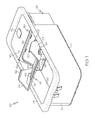
- FIGs. 1 and 2 are isometric views of an actuated media docking station in loading and retaining positions, respectively, as illustrated in accordance with exemplary embodiment of the present invention
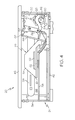
- FIGs. 3 and 4 are side views of an exemplary mass media device and the actuated media docking station (shown in partial cutaway) in loading and retaining positions, respectively;
- FIGs. 5 and 6 are isometric and exploded views, respectively, of a mass media device receptacle, an actuator, and an over-center locking mechanism included within the actuated media docking station shown in FIGs. 1-4 ;
- FIGs. 7 and 8 are side views of the bi-stable, over-center locking mechanism shown in FIGs. 3-6 in retracted and extended locked positions, respectively, as further illustrated in accordance with an exemplary embodiment
- FIG. 9 is a schematic generically illustrating an exemplary avionic media system in which the actuated media docking station shown in FIGs. 1-6 may be included.
- FIGs. 1 and 2 are isometric views of an actuated media docking station 20 illustrated in accordance with an exemplary embodiment of the present invention.
- Embodiments of actuated media docking station 20 can be designed for usage in conjunction with a specific type of mass media device ("MMD"), which may or may not be commercially available; however, in preferred embodiments, docking station 20 is designed to be universally compatible with any number of commercially-available MMDs.
- MMDs may include digital audio players, portable media players, removable/portable mass storage devices (e.g., portable hard disk drives and flash drives), digital cameras, personal digital assistants, and smartphones, to list but a few examples.
- actuated media docking station 20 are similar to certain other conventionally-known universal docking stations developed and commercially marketed for home use. However, in contrast to other known docking stations, docking station 20 can be actuated to retract or withdraw a docked MMD into a ruggedized housing to prevent disengagement and/or forceful ejection of the MMD from docking station 20 in the event of significant and abrupt inertial loads. For this and other reasons, embodiments of actuated media docking station 20 are well-suited for usage onboard aircraft, such as commercial airliners and business-class jets, as well as other types of vehicles (e.g., water-borne and ground-based vehicles). In preferred embodiments, actuated media docking station 20 is included within an avionic media system, such as system 130 described below in conjunction with FIG. 9 .
- an avionic media system such as system 130 described below in conjunction with FIG. 9 .
- Actuated media docking station 20 includes an MMD receptacle 22 and a ruggedized housing assembly 24.
- MMD receptacle 22 is hingedly joined to housing assembly 24 and rotatable between: (i) an extended or “loading" position (shown in FIG. 1 ) in which an MMD can be manually inserted into MMD receptacle 22 or removed therefrom; and (ii) a retracted or “retaining” position (shown in FIG. 2 ) in which receptacle 22 rotates into housing assembly 24 to physically prevent the removal or forceful ejection of a docked MMD.
- FIGs. 3 and 4 further illustrate docking station 20 in loading and retaining positions, respectively, after insertion of an exemplary MMD 26 into MMD receptacle 22.
- an actuator 28 may be disposed within an actuator cavity 30 internal to housing assembly 24 and, when activated, may rotate MMD receptacle 22 between the loading position (shown in FIGs. 1 and 3 ) and the retaining position (shown in FIGs. 2 and 4 ).
- Actuator 28 may rotate MMD receptacle 22 between these two positional extremes in response to activation of a user input; e.g., the actuator may rotate receptacle 22 from its current position to the opposing position when a user depresses a button 32 provided on the exterior of housing assembly 24 (shown in FIGs. 1 and 2 ) and operatively coupled to actuator 28. Additionally or alternatively, actuator 28 may rotate MMD receptacle 22 between the loading position ( FIGs. 1 and 3 ) and the retaining position ( FIGs. 2 and 4 ) in response to receipt of a stow signal supplied by an external controller included within a larger avionic media system of the type described below in conjunction with FIG. 9 .
- Housing assembly 24 can include any number of components suitable for supporting MMD receptacle 22 and for cooperating or combining with receptacle 22 to enclose or otherwise capture a docked MMD when receptacle 22 is rotated in the retaining position shown in FIGs. 2 and 4 .
- housing assembly 24 includes a casing or frame 34, which extends around and thus circumferentially bounds an open device cavity 36.
- Device cavity 36 is exposed through the outer face of actuated media docking station 20.
- Device cavity 36 will typically open in either a forward direction or in an upward direction depending upon whether docking station 20 is mounted in a generally vertical or horizontal orientation, respectively.
- the floor of open device cavity 36 is defined by an internal wall 38 provided within frame 34, as shown most clearly in FIGs. 3 and 4 .
- Frame 34 further extends around and thus bounds a portion of actuator cavity 30, which is enclosed by an actuator faceplate 40.
- a rear cover 42 is affixed to the backside of frame 34 utilizing a first plurality of bolts, screws, or other such fasteners (not shown).
- a rounded bezel 46 is further positioned over the outer circumferential edge of frame 34 and may be attached thereto utilizing, for example, a second plurality of fasteners (not shown).
- Device cavity 36 accommodates or receives MMD receptacle 22 and MMD 26 when receptacle 22 is rotated into the retaining position ( FIGs. 2 and 4 ). Open device cavity 36 will thus typically be sized and shaped to generally conform with the largest mass media device likely to be utilized with docking station 20. In the illustrated example, device cavity 36 has a generally rectangular planform geometry, and the height and width of cavity 36 are slightly greater than the respective height and width of MMD 26. The depth of cavity 36 is preferably sufficient to allow MMD 26 to be fully withdrawn into housing 24 when MMD receptacle 22 is rotated into the retaining position ( FIGs. 2 and 4 ); however, this need not always be the case.
- MMD receptacle 22 can assume the form of any structural element or assemblage of structural elements into which an MMD can be slidably inserted; which can be rotatably mounted to housing assembly 24; and which cooperates with housing assembly 24 and/or another component of docking station 20 to physically prevent the disengagement of a docked MMD when MMD receptacle 22 resides in the retaining position ( FIGs. 2 and 4 ).
- MMD receptacle 22 includes a base member 50, a backrest 52, opposing backrest sidewalls 54, and first and second retention tabs 56 (shown most clearly in FIGs. 1 and 2 ).
- Base member 50 is positioned within open device cavity 36 and hingedly mounted to housing assembly 24 utilizing, for example, first and second hinge pins 62.
- Backrest 52 is fixedly joined to and extends longitudinally from base member 50; e.g., backrest 52 may be fabricated to include a lower flange 58, which is affixed to an inner edge portion of base member 50 by fasteners 60 (one of which is shown in FIG. 1 ).
- Backrest sidewalls 54 extend axially from opposing longitudinal edges of backrest in a generally forward direction to flank or enclose the sides of MMD 26 ( FIGs. 3 and 4 ) or other such MMD inserted into receptacle 22.
- cutouts 59 may be provided in sidewalls 54 for weight saving purposes or ease of manufacturing, as further indicated in FIGs. 1-4 .
- backrest 52, opposing backrest sidewalls 54, and first and second retention tabs 56 are integrally fabricated as a single, manufactured piece.
- First and second retention tabs 56 extend laterally inward from opposing sidewalls 54 to cover or encroach over an outer peripheral portion of the front face of MMD 26.
- Backrest 52, opposing sidewalls 54, and retention tabs 56 thus collectively wrap around MMD 26 to prevent removal of MMD 26 in all directions except along a predetermined insertion/removal axis (generically shown in FIG. 3 at 65 and described below).
- Retention tabs 56 specifically, prevent removal of MMD 26 through the open face of receptacle 22 in an axial or forward direction.
- retention tabs 56 cover a relatively small region of the perimeter of the MMD face to minimize obstruction of any forward-facing controls, whether physical or virtual (touchscreen), provided on MMD 26 when MMD 26 is held by receptacle 22.
- a compressible pad 61 may further be adhered or otherwise attached to backrest 52 to cushion and to protect the surface finish of the backside of MMD 26, which may jostle slightly within MMD 26 in embodiments wherein docking station 20 is utilized within a high vibratory avionic environment.
- Pad 61 may be fabricated from a tacky material to further help retain MMD 26 in place in the loading and retaining positions shown in FIGs. 1-4 .
- MMD 26 can be slidably inserted into MMD receptacle 22 when in the loading position shown in FIGs. 1 and 3 .
- MMD receptacle 22 is fabricated to include an outer, receiving end portion 64 having an opening through which the bottom portion of MMD 26 can pass as MMD 26 is slidably inserted into and removed from MMD receptacle 22, as taken along an insertion/removal axis (represented in FIG. 3 by double headed arrow 65).
- the bottom portion of MMD 26 seats within a connector well 66 provided within base member 50.
- a device-side connector included within MMD 26 matingly engages a corresponding dock-side connector 68 positioned within connector well 66 (shown in FIGs. 1 and 2 ).
- Connector 68 will typically assume the form of a multi-pin connector, such as a conventionally-known thirty pin connector utilized in conjunction with commercially-available portable media players, such as an APPLE® IPOD®, and smartphones, such as an APPLE® IPHONE®. For this reason, connector 68 is illustrated in FIGs. 1-4 (and shown most clearly in FIG.
- multi-pin connector 68 can assume any form suitable for interfacing with a mating MMD connector to enable the transmission of data to and/or from a mass media device of the type described herein.
- a circumferential ledge or step 70 may further be provided around the outer perimeter of connector well 66 to matingly receive interchangeable adapter pieces or cups (not shown) corresponding to different MMD types or models as is conventionally known.
- open end portion 64 is covered or obstructed by wall 72 of frame 34, as taken along insertion/removal axis 65.
- first and second retention tabs 56 wrap around or encroach over the front face of MMD 26 to prevent removal of MMD 26 in an axial direction (i.e., along an axis orthogonal to backrest 52), MMD 26 cannot be removed from actuated media docking station 20 when receptacle 22 is in the retaining position without disassembly or destruction of docking station 20.
- actuated media docking station 20 will prevent dislodgement of a mass media device, such as MMD 26, when MMD receptacle 22 is in the retaining position ( FIGs. 2 and 4 ) even when subjected to significant and abrupt disturbances forces as might be encountered during hard touchdown, takeoff, or abrupt maneuvering of an aircraft carrying actuated media docking station 20.
- a mass media device such as MMD 26
- actuator 28 assumes the form of a rotary actuator (e.g., a motor) having a rotary output, which is mechanically coupled to MMD receptacle 22 by way of unique, bi-stable, over-center locking mechanism capable of securely latching receptacle 22 in both the loading and retaining positions.
- a bi-stable, over-center locking mechanism 80 is shown in FIGs. 3 and 4 and described more fully below in conjunction with FIGs. 5-8 .
- FIGs. 5 and 6 are isometric and exploded views, respectively, of MMD receptacle 22, actuator 28, and over-center locking mechanism 80 illustrating locking mechanism 80 in greater detail.
- over-center locking mechanism 80 includes three main components: (i) a motor arm 82, (ii) an over-center link 84, and (iii) a reinforcement piece 86.
- motor arm 82 assumes the form of a pear-shaped member (e.g., a machined piece) having an input end 88 and an output end 90. Input end 88 of motor arm 82 is affixed to the rotary output 92 of actuator 28. For example, as indicated in FIGs.
- input end 88 may be machined or otherwise fabricated to include a bore through which rotary output 92 extends; and relative rotation between input end 88 of motor arm 82 and rotary output 92 of actuator 28 may be prevented utilizing, for example, a keyed interface or a set-screw 94 ( FIG. 6 ) threadably coupled to motor arm 82.
- Output end 90 of motor arm 82 is rotatably coupled to an input end 96 of over-center link 84.
- output end 90 of motor arm 82 has an opening, which matingly receives an internally-threaded, tubular protuberance 98 extending from on output end 90 of motor arm 82 (also identified in FIG.
- a link retention cap 100 is affixed over protuberance 98 utilizing a threaded fastener 102 to capture input end 96 of over-center link 84 against output end 90 of motor arm 82, while permitting relative rotation therebetween.
- Output end 104 of over-center link 84 is, in turn, rotatably coupled to an end 106 of reinforcement piece 86 by a pin joint 108.
- the opposing end 110 of reinforcement piece 86 is attached to a lower flange 112 included within base member 50 by a fastener 114 (e.g., a screw).
- reinforcement piece 86 is rotationally fixed with respect to base member 50, while over-center link 84 may pivot with respect to base member 50 and reinforcement piece 86 about pin joint 108.
- Over-center locking mechanism 80 is movable between an extend locked position (shown in FIG. 3 ) and a retracted locked position (shown in FIGs. 4 and 5 ).
- the extended locked position of locking mechanism 80 corresponds to the loading position of MMD receptacle 22, as described above in conjunction with FIGs. 1 and 3 ; while the retracted locked position of locking mechanism 80 corresponds to the retaining position of MMD receptacle 22, as described above in conjunction with FIGs. 2 and 4 .
- Movement of over-center locking mechanism 80 between the extended locked position ( FIG. 3 ) and the retracted locked position ( FIGs. 4 and 5 ) is driven by actuator 28.
- actuator 28 may be energized to rotate motor arm 82 about the fixed rotational axis in a first rotational direction (e.g., clockwise) over a predetermined angular range (approximately 215 degrees in the illustrated example). This results in retraction of over-center link 84 and the corresponding rotation of MMD receptacle 22 into the retaining position ( FIGs. 2 , 4 , and 5 ).
- a first rotational direction e.g., clockwise
- predetermined angular range approximately 215 degrees in the illustrated example
- actuator 28 may again be energized or activated to rotate motor arm 82 about the fixed rotational axis in the opposing rotational direction (e.g., counter-clockwise) to extend over-center link 84 and return MMD receptacle 22 to the loading position shown in FIGs. 1 and 3 .
- locking mechanism 80 is provided, at least in substantial part, by the relative positioning and movement of motor arm 82 and over-center link 84. This may be more fully appreciated by referring to FIGs. 7 and 8 , which illustrate motor arm 82 and over-center link 84 when over-center locking mechanism 80 (partially shown) resides in the retracted position ( FIG. 7 ) and the extended position ( FIG. 8 ). In FIGs. 7 and 8 , which illustrate motor arm 82 and over-center link 84 when over-center locking mechanism 80 (partially shown) resides in the retracted position ( FIG. 7 ) and the extended position ( FIG. 8 ). In FIGs.
- the fixed rotational axis around which motor arm 82 rotates is represented by circle 116;
- the input pivot joint allowing relative rotation between output end 90 of motor arm 82 and input end 96 of over-center link 84 is represented by circle 118;
- the output pivot joint allowing relative rotation between output end 104 of over-center link 84 and base member 50 of MMD receptacle 22 is represented by circle 120.
- input pivot point 118 resides on a first side of (e.g., below) a plane 122 transecting fixed rotational axis 116 and output pivot point 120 when over-center locking mechanism 80 resides in the retracted position shown in FIG. 7 .
- Over-center locking mechanism 80 is thus generally prevented from being forcefully moved from the retracted position ( FIG. 7 ) toward the extended position ( FIG. 8 ) by application of force to MMD receptacle 22 thereby locking receptacle 22 in the retaining position.
- input pivot point 118 again resides on the first side of plane 122; i.e., below plane 122 in the illustrated orientation.
- over-center locking mechanism 80 cannot be forcefully retracted and MMD receptacle 22 is locked in the loading position ( FIGs. 1 and 3 ).
- actuator 28 To purposefully move over-center locking mechanism 80 into the retracted position ( FIG. 7 ) from the extend position ( FIG. 8 ), actuator 28 ( FIGs. 1-6 ) need only rotate motor arm 82 in the appropriate direction (e.g., clockwise). It will be noted that input pivot point 116 traverses plane 122 as over-center locking mechanism 80 moves between the extended position ( FIG. 8 ) and the retracted position ( FIG. 7 ).
- over-center link 84 is fabricated to have a generally S-shaped geometry including first and second curved sections 124 and 126 (identified in FIGs. 7 and 8 ). As can be seen most clearly in FIG. 7 , when over-center locking mechanism 80 resides in the retracted position, curved section 124 of over-center link 84 extends around a generally cylindrical protrusion or boss 128 extending from input end 88 of motor arm 82. Such a structural arrangement provides at least two advantages.
- the curved or undulating shaped of over-center link 84 imparts link 84 with a compliance or resiliency in a longitudinal direction, which allows over-center link 84 to firmly snap into place when moving from the extended position ( FIG. 8 ) into the retracted position ( FIG. 7 ).
- the inner circumferential surface of curved section 124 contacts or pinches against boss 128 when over-center locking mechanism 80 is rotated fully into the retracted position ( FIG. 7 ) to provide a first hardstop preventing over-rotation of motor arm 82 in a clockwise direction.
- the outer circumferential surface of curved section 124 likewise pinches against boss 128 when locking mechanism 80 is rotated fully into the extended position ( FIG.
- over-center link 84 may assume other curved and non-curved shapes (e.g., C-shaped geometries) in further embodiments, in which case over-rotation of motor arm 82 in clockwise and counterclockwise directions may be prevented by separately provided or discrete hardstop features.
- FIG. 9 is a schematic of an avionic media system 130 in which actuated media docking station 20 ( FIGs. 1-6 ) may be included in accordance with an exemplary embodiment of the present invention.
- actuated media docking station 20 is illustrated in FIG. 9 as including only MMD receptacle 22, multi-pin connector 68, actuator 28, and over-center locking mechanism 80 (the mechanical connection between these components generically represented in FIG. 9 by arrows 132).
- Avionic media system 130 further includes a controller 134, which may be integrated into actuated media docking station 20 as a controller board, and a cabin electronics systems 136. As indicated in FIG.
- controller 134 is, in turn, operably coupled to cabin electronics system 136 (indicated by double-headed arrow 140) to enable the transfer of electrical signals to and/or from one or more onboard electronic devices 142 included within avionic media system 130.
- Devices 142 may include, for example, one or more monitors on which video content from MMD 26 may be rendered, an audio system on which audio content from MMD 26 may be played, a computer system including a memory to which data files from MMD 26 can be uploaded or from which data files can be downloaded to MMD 26, and so on.
- controller 134 may be configured to decrypt the signals received from MMD 26 and supply corresponding decrypted signals to cabin electronics system 136.
- Docking station 20 may be electrically coupled cabin electronics system 136 utilizing one or more wire harnesses.
- controller 134 includes an additional output coupled to an input of actuator 28.
- controller 134 selectively commands actuator 28 to rotate MMD receptacle 22 between the loading position ( FIGs. 1 and 3 ) and retaining position ( FIGs. 2 and 4 ).
- controller 134 may command actuator 28 to rotate MMD receptacle 22 between the loading and retaining positions in response to actuation of a user input, such as button 32 shown in FIGs. 1 and 2 .
- controller 134 may command actuator 28 to rotate MMD receptacle 22 into the retaining position (providing that receptacle 22 is not already therein) when determining that significant disturbance forces are applied or are more likely to be applied to actuated media docking station 20.
- controller 134 may command actuator 28 to rotate receptacle 22 into the retaining position ( FIGs. 2 and 4 ) immediately prior to or during takeoff, abrupt maneuvering, or turbulence encounter, or landing of the host aircraft as may be determined by monitoring signals issued from the aircraft cockpit.
- an actuated media docking station well-suited for usage onboard an aircraft or other vehicle.
- the above-described exemplary docking station is relatively lightweight, rugged, compact, and capable of operation in both horizontal and vertical orientations to permit integration of the docking station into various locations within the aircraft, such as mounting within a cabin wall.
- embodiments of the above-described media docking station allow retraction or withdraw of a docked mass media device into a ruggedized housing such that the mass media device cannot be thrown or dislodged from the docking station in the event of abrupt inertial loads.
- the media docking station securely locks the mass media device in such a retracted or retaining position and, in preferred embodiments, in an extend or loading position utilizing a bi-stable, over-center locking mechanism requiring little to no power consumption.
- embodiments of the over-center locking mechanism can be utilized within any device including a pivoting member (e.g., in the case of docking station 20 shown in FIGs. 1-6 , mass media device receptacle 22) and a rotary actuator (e.g., rotary actuator 28 shown in FIGs. 3-6 ) wherein it is desired to mechanically lock or latch the pivoting member in two positional extremes.
- a pivoting member e.g., in the case of docking station 20 shown in FIGs. 1-6 , mass media device receptacle 22
- a rotary actuator e.g., rotary actuator 28 shown in FIGs. 3-6
- a bi-stable, over-centering locking mechanism including a motor arm configured to be fixedly coupled to the rotary actuator for rotation about a fixed rotational axis, and an over-center link rotatably coupled to the motor arm at an input pivot point and configured to be rotatably coupled to the pivoting member at an output pivot point.
- the over-center locking mechanism is movable between: (i) an extended position wherein the input pivot point resides on a first side of a plane transecting the fixed rotational axis and the output pivot point, and (ii) a retracted position wherein the input pivot point also resides on the first side of the plane transecting the fixed rotational axis and the output pivot point.
- the input pivot point traverses the plane when the over-center locking mechanism is moved between the extended position and the retracted position.
Landscapes
- Fittings On The Vehicle Exterior For Carrying Loads, And Devices For Holding Or Mounting Articles (AREA)
- Casings For Electric Apparatus (AREA)
- Telephone Set Structure (AREA)
- Details Of Connecting Devices For Male And Female Coupling (AREA)
Applications Claiming Priority (1)
| Application Number | Priority Date | Filing Date | Title |
|---|---|---|---|
| US13/356,352 US9036361B2 (en) | 2012-01-23 | 2012-01-23 | Avionic media systems including actuated media docking stations and over-center locking mechanisms suitable for usage therein |
Publications (2)
| Publication Number | Publication Date |
|---|---|
| EP2618332A2 true EP2618332A2 (de) | 2013-07-24 |
| EP2618332A3 EP2618332A3 (de) | 2017-05-03 |
Family
ID=47631281
Family Applications (1)
| Application Number | Title | Priority Date | Filing Date |
|---|---|---|---|
| EP13151094.3A Withdrawn EP2618332A3 (de) | 2012-01-23 | 2013-01-11 | Flugzeugmediensysteme mit betätigten Mediendockstationen und Sperrmechanismen, die für die Verwendung darin geeignet sind |
Country Status (4)
| Country | Link |
|---|---|
| US (1) | US9036361B2 (de) |
| EP (1) | EP2618332A3 (de) |
| CN (1) | CN103219610A (de) |
| CA (1) | CA2802319A1 (de) |
Families Citing this family (9)
| Publication number | Priority date | Publication date | Assignee | Title |
|---|---|---|---|---|
| GB2503714B (en) | 2012-07-05 | 2017-04-05 | Ford Global Tech Llc | A combined storage and docking unit for a portable electronic device |
| US9468122B2 (en) * | 2013-03-13 | 2016-10-11 | Ford Global Technologies, Llc | Portable device holding apparatus |
| TWI488180B (zh) * | 2014-01-16 | 2015-06-11 | Quanta Comp Inc | 伺服器 |
| US9665135B2 (en) * | 2014-03-07 | 2017-05-30 | Ergotron, Inc. | Device storage cabinet |
| TWM490673U (en) * | 2014-07-02 | 2014-11-21 | shun-qing Li | Socket for charging |
| AU2015384779B2 (en) * | 2015-03-03 | 2019-05-02 | Axon Enterprise, Inc. | Automated integration of video evidence with data records |
| US11081846B2 (en) * | 2016-09-15 | 2021-08-03 | Hewlett-Packard Development Company, L.P. | Connectors |
| US20200186181A1 (en) * | 2018-12-06 | 2020-06-11 | GM Global Technology Operations LLC | Wireless charging phone retention assembly |
| US12446178B2 (en) * | 2022-12-23 | 2025-10-14 | Hewlett Packard Enterprise Development Lp | Electronic device ejection mechanism with selectively disableable ejection function |
Family Cites Families (48)
| Publication number | Priority date | Publication date | Assignee | Title |
|---|---|---|---|---|
| JPH07105130B2 (ja) * | 1989-08-31 | 1995-11-13 | パイオニア株式会社 | 記録媒体演奏装置 |
| KR0130883Y1 (ko) * | 1994-02-02 | 1998-12-15 | 김광호 | 컴퓨터의 하드 디스크 드라이버 착탈장치 |
| AUPM962294A0 (en) | 1994-11-23 | 1994-12-15 | Kwa Operations Pty Ltd | Cradle for mobile telephone or other electrical device |
| US5940502A (en) | 1996-12-11 | 1999-08-17 | Harness System Technologies Research, Ltd. | Phone holder |
| DE19652826A1 (de) | 1996-12-18 | 1998-06-25 | Nokia Mobile Phones Ltd | Haltevorrichtung für eine Kommunikationseinheit |
| US5779205A (en) | 1996-12-23 | 1998-07-14 | Ching; Allen | Extensible windshield portable phone holder |
| US6339699B1 (en) | 1997-09-24 | 2002-01-15 | Harness System Technologies Research, Ltd. | Phone holder |
| US6002921A (en) | 1997-11-17 | 1999-12-14 | Ericsson Inc. | Lockable radiotelephone cradle |
| US6229893B1 (en) | 1998-11-27 | 2001-05-08 | E. Lead Electronic Co., Ltd. | Universal hands-free receiver for a mobile telephone |
| DE19934099C2 (de) | 1999-07-21 | 2003-08-21 | Nokia Mobile Phones Ltd | Halterung |
| US6445576B1 (en) * | 2000-02-25 | 2002-09-03 | Intel Corporation | Tilt mounted hard drive bay |
| US7062300B1 (en) | 2000-11-09 | 2006-06-13 | Ki Il Kim | Cellular phone holder with charger mounted to vehicle dashboard |
| JP3740022B2 (ja) * | 2001-03-05 | 2006-01-25 | パイオニア株式会社 | 電子機器 |
| US6867942B2 (en) * | 2001-04-26 | 2005-03-15 | International Business Machines Corporation | Storage device mounted in portable data storage media type cartridges |
| US6798647B2 (en) * | 2001-07-16 | 2004-09-28 | Hewlett-Packard Development Company, L.P. | Portable computer with integrated PDA I/O docking cradle |
| JP3699027B2 (ja) | 2001-09-28 | 2005-09-28 | Necパーソナルプロダクツ株式会社 | 携帯情報端末の載置台 |
| KR100464099B1 (ko) | 2001-10-09 | 2005-01-03 | 삼성전자주식회사 | 이동기기를 위한 차량용 거치대 |
| JP2003134209A (ja) | 2001-10-26 | 2003-05-09 | Toshiba Corp | 無線機器ホルダ |
| JP4029924B2 (ja) * | 2001-12-17 | 2008-01-09 | パイオニア株式会社 | 電子機器デモンストレーションシステム及び方法 |
| DE60300578T2 (de) | 2003-01-23 | 2006-01-19 | Sony Ericsson Mobile Communications Ab | Halter für aufklappbares Mobiltelefon |
| DE10308189A1 (de) | 2003-02-25 | 2004-09-02 | Audioton Kabelwerk Gmbh | Haltevorrichtung für mobile Benutzereinrichtungen |
| TW568408U (en) | 2003-05-14 | 2003-12-21 | High Tech Comp Corp | Slide structure |
| US7017243B2 (en) | 2003-08-07 | 2006-03-28 | Carnevali Jeffrey D | Secure interface cradle for pocket personal computer device |
| US7388755B2 (en) * | 2004-02-11 | 2008-06-17 | E-Lead Electronic Co., Ltd. | Mechanical liquid crystal display device |
| US7540379B2 (en) * | 2004-05-09 | 2009-06-02 | Shenzhen Wang Ling Science And Technology Development Co., Ltd. | Information book with PDA and multiple foldable pieces |
| TWM268757U (en) | 2004-12-07 | 2005-06-21 | High Tech Comp Corp | Recoverable connector structure and cradle having the connector structure |
| US7668576B2 (en) | 2004-12-16 | 2010-02-23 | Dashjack, Inc. | Incorporating a portable digital music player into a vehicle audio system |
| US7158092B2 (en) | 2005-01-31 | 2007-01-02 | Vincent Shen | Cellular phone holder |
| US7551458B2 (en) | 2005-05-24 | 2009-06-23 | Carnevali Jeffrey D | Secure universal mounting apparatus |
| US8641121B2 (en) | 2005-07-22 | 2014-02-04 | Airgizmos, Lp | Mounting device for use with portable electronic instruments |
| JP4644712B2 (ja) * | 2005-09-30 | 2011-03-02 | パイオニア株式会社 | 電子機器 |
| US7580254B2 (en) * | 2005-10-19 | 2009-08-25 | David Anderson | Apparatus, system, and method for secure storage bay for an electronic handheld device |
| DE102006012763B3 (de) | 2006-03-17 | 2007-10-18 | Bury Gmbh & Co. Kg | Gerätehalter mit einem beweglichen Kontaktstecker |
| EP2099649B1 (de) | 2006-12-08 | 2010-03-31 | Bury Sp.z.o.o | Satellitentelefonhalter |
| US20080259550A1 (en) | 2007-04-18 | 2008-10-23 | Microtips Technology Inc. | Cradle for handheld electronic device |
| US8159818B2 (en) * | 2007-10-10 | 2012-04-17 | Tomtom International B.V. | Docking apparatus for portable device |
| JP2009248932A (ja) * | 2008-04-10 | 2009-10-29 | Fujitsu Ten Ltd | 電子機器及び電子システム |
| US8559172B2 (en) * | 2008-05-02 | 2013-10-15 | Norman R. Byrne | Docking station |
| FR2938725B1 (fr) * | 2008-11-20 | 2015-12-04 | Radiall Sa | Boitier pour module electronique de controle de machine |
| US8408513B2 (en) | 2009-01-06 | 2013-04-02 | Mark Smith | Holder systems for mobile devices |
| US7733643B1 (en) * | 2009-05-07 | 2010-06-08 | Philips & Lite-On Digital Solutions Corporation | Digital player interface device with exchangeable adapter |
| US20100317413A1 (en) | 2009-06-15 | 2010-12-16 | Qing Song Tan | Portable phone holder and solar charger |
| US20100317412A1 (en) | 2009-06-15 | 2010-12-16 | Qing Song Tan | Portable phone holder and charger |
| US20100315041A1 (en) | 2009-06-15 | 2010-12-16 | Qing Song Tan | Portable phone holder and charger with quick release feature |
| US8157311B2 (en) | 2010-03-11 | 2012-04-17 | Ford Global Technologies, Llc | Vehicular trim panel with storage and interfacing of electronic devices |
| US9405395B2 (en) * | 2010-08-04 | 2016-08-02 | Crestron Electronics, Inc. | Wall-mounted control system for a portable touch screen device |
| USD650784S1 (en) * | 2010-08-04 | 2011-12-20 | Crestron Electronics Inc. | Tablet wall dock |
| USD692008S1 (en) * | 2012-10-11 | 2013-10-22 | Crestron Electronics Inc. | Tablet wall dock with locking features |
-
2012
- 2012-01-23 US US13/356,352 patent/US9036361B2/en not_active Expired - Fee Related
-
2013
- 2013-01-11 EP EP13151094.3A patent/EP2618332A3/de not_active Withdrawn
- 2013-01-15 CA CA2802319A patent/CA2802319A1/en not_active Abandoned
- 2013-01-22 CN CN2013100228634A patent/CN103219610A/zh active Pending
Non-Patent Citations (1)
| Title |
|---|
| None |
Also Published As
| Publication number | Publication date |
|---|---|
| CN103219610A (zh) | 2013-07-24 |
| US20130188300A1 (en) | 2013-07-25 |
| CA2802319A1 (en) | 2013-07-23 |
| EP2618332A3 (de) | 2017-05-03 |
| US9036361B2 (en) | 2015-05-19 |
Similar Documents
| Publication | Publication Date | Title |
|---|---|---|
| US9036361B2 (en) | Avionic media systems including actuated media docking stations and over-center locking mechanisms suitable for usage therein | |
| EP2156662B1 (de) | Unterhaltungselektroniksystem in sitzrücklehne | |
| EP2569187B1 (de) | Kupplungseinheit | |
| US10429891B2 (en) | Pivotable vehicle mounting system for mobile computing devices | |
| US20110157801A1 (en) | Electronic Device Docking System | |
| EP2673549B1 (de) | System zum halten und verstauen von tablets | |
| EP2694367B1 (de) | Rückenlehnenhalter für tablet-computer | |
| EP2808593B1 (de) | Rotierender elektronischer Anzeigeadapter | |
| US20200403361A1 (en) | Docking cradle for a computing device having multiple mounting orientations | |
| GB2494474A (en) | Motor vehicle with anchor point apparatus and method | |
| EP3230162B1 (de) | Einziehbarer vorrichtungshalter für einen flugzeugsitz | |
| WO2007109703A2 (en) | Holster for portable ife device | |
| US20080157574A1 (en) | Dockable media system | |
| EP3971036A1 (de) | Halter für induktive ladevorrichtung | |
| KR20190088208A (ko) | 무인 비행체용 붐 결합 장치 및 이를 이용하는 무인 비행체 | |
| US20210039563A1 (en) | Mobile device holding system for a seat | |
| US20190393661A1 (en) | Infrastructure for mobile devices and electronic loose equipment | |
| US20040174668A1 (en) | System and method for pivotably securing display housing to computer system | |
| CN220096264U (zh) | 支撑架、承载件和座椅组件 | |
| CN118790156A (zh) | 支撑架、承载件和座椅组件 | |
| DE102013005098A1 (de) | "Systeme zum Anbringen eines mobilen Endgeräts in einem Fahrzeug" | |
| NL2033505B1 (en) | Vehicle comprising a storage assembly | |
| CN121416914A (zh) | 用于车辆的接口面板、接口系统以及车辆内饰 | |
| HK1143119A (en) | Docking apparatus for portable device | |
| TW201739644A (zh) | 車用主機系統 |
Legal Events
| Date | Code | Title | Description |
|---|---|---|---|
| PUAI | Public reference made under article 153(3) epc to a published international application that has entered the european phase |
Free format text: ORIGINAL CODE: 0009012 |
|
| 17P | Request for examination filed |
Effective date: 20130111 |
|
| AK | Designated contracting states |
Kind code of ref document: A2 Designated state(s): AL AT BE BG CH CY CZ DE DK EE ES FI FR GB GR HR HU IE IS IT LI LT LU LV MC MK MT NL NO PL PT RO RS SE SI SK SM TR |
|
| AX | Request for extension of the european patent |
Extension state: BA ME |
|
| RAP1 | Party data changed (applicant data changed or rights of an application transferred) |
Owner name: HONEYWELL INTERNATIONAL INC. |
|
| PUAL | Search report despatched |
Free format text: ORIGINAL CODE: 0009013 |
|
| STAA | Information on the status of an ep patent application or granted ep patent |
Free format text: STATUS: THE APPLICATION HAS BEEN WITHDRAWN |
|
| AK | Designated contracting states |
Kind code of ref document: A3 Designated state(s): AL AT BE BG CH CY CZ DE DK EE ES FI FR GB GR HR HU IE IS IT LI LT LU LV MC MK MT NL NO PL PT RO RS SE SI SK SM TR |
|
| AX | Request for extension of the european patent |
Extension state: BA ME |
|
| RIC1 | Information provided on ipc code assigned before grant |
Ipc: G11B 33/12 20060101AFI20170330BHEP Ipc: H05K 7/14 20060101ALI20170330BHEP |
|
| 17Q | First examination report despatched |
Effective date: 20170418 |
|
| 18W | Application withdrawn |
Effective date: 20170412 |