EP2619283B1 - Substances fluorescentes à base de silicate - Google Patents
Substances fluorescentes à base de silicate Download PDFInfo
- Publication number
- EP2619283B1 EP2619283B1 EP12705801.4A EP12705801A EP2619283B1 EP 2619283 B1 EP2619283 B1 EP 2619283B1 EP 12705801 A EP12705801 A EP 12705801A EP 2619283 B1 EP2619283 B1 EP 2619283B1
- Authority
- EP
- European Patent Office
- Prior art keywords
- phosphor
- stands
- range
- phosphors
- value
- Prior art date
- Legal status (The legal status is an assumption and is not a legal conclusion. Google has not performed a legal analysis and makes no representation as to the accuracy of the status listed.)
- Active
Links
Images
Classifications
-
- C—CHEMISTRY; METALLURGY
- C09—DYES; PAINTS; POLISHES; NATURAL RESINS; ADHESIVES; COMPOSITIONS NOT OTHERWISE PROVIDED FOR; APPLICATIONS OF MATERIALS NOT OTHERWISE PROVIDED FOR
- C09K—MATERIALS FOR MISCELLANEOUS APPLICATIONS, NOT PROVIDED FOR ELSEWHERE
- C09K11/00—Luminescent materials, e.g. electroluminescent or chemiluminescent
- C09K11/08—Luminescent materials, e.g. electroluminescent or chemiluminescent containing inorganic luminescent materials
- C09K11/77—Luminescent materials, e.g. electroluminescent or chemiluminescent containing inorganic luminescent materials containing rare earth metals
- C09K11/7728—Luminescent materials, e.g. electroluminescent or chemiluminescent containing inorganic luminescent materials containing rare earth metals containing europium
- C09K11/774—Borates
-
- H—ELECTRICITY
- H10—SEMICONDUCTOR DEVICES; ELECTRIC SOLID-STATE DEVICES NOT OTHERWISE PROVIDED FOR
- H10H—INORGANIC LIGHT-EMITTING SEMICONDUCTOR DEVICES HAVING POTENTIAL BARRIERS
- H10H20/00—Individual inorganic light-emitting semiconductor devices having potential barriers, e.g. light-emitting diodes [LED]
- H10H20/80—Constructional details
- H10H20/85—Packages
- H10H20/851—Wavelength conversion means
-
- H—ELECTRICITY
- H10—SEMICONDUCTOR DEVICES; ELECTRIC SOLID-STATE DEVICES NOT OTHERWISE PROVIDED FOR
- H10H—INORGANIC LIGHT-EMITTING SEMICONDUCTOR DEVICES HAVING POTENTIAL BARRIERS
- H10H20/00—Individual inorganic light-emitting semiconductor devices having potential barriers, e.g. light-emitting diodes [LED]
- H10H20/80—Constructional details
- H10H20/85—Packages
- H10H20/851—Wavelength conversion means
- H10H20/8511—Wavelength conversion means characterised by their material, e.g. binder
- H10H20/8512—Wavelength conversion materials
Definitions
- the invention relates to silicate compounds containing alkali metal borate, processes for the preparation of these compounds and their use as conversion phosphors or in illuminants.
- Inorganic fluorescent powders which are excitable in the blue and / or UV region of the spectrum, are becoming increasingly important as phosphors for so-called phosphor converted LEDs, in short pc LEDs.
- phosphor material systems for example, alkaline earth orthosilicates, thiogallates, garnets and nitrides each doped with Cer 3+ or Eu 2+ .
- a disadvantage of these materials is their sensitivity to moisture.
- compounds with a high barium content in the crystal lattice hydrolyze gradually on contact with water. This leads to a degradation of the crystal lattice, whereby the phosphor drastically loses intensity.
- EP 0019710 describes a filter-coated phosphor such as sulfides provided with filter particles of pigments wherein the pigments are coated with metal borate.
- the borate coating serves to increase the adhesion of the pigment particles to the phosphor.
- WO 02/054502 describes alkaline earth orthosilicates which, in addition to phosphorus pentoxide, aluminum oxide or germanium oxide, also contain boron oxide (B 2 O 3 ), boron being partly incorporated in the lattice site of silicon.
- the object of the present invention is to develop certain alkaline earth metal orthosilicate phosphors which have good stability against moisture.
- Another object of the present invention is to provide a process for producing these alkaline earth metal orthosilicate phosphors.
- an object of the invention is also to provide a mixture of said alkaline earth metal orthosilicate phosphor with further phosphors.
- Another object of the invention is to show various uses for these phosphors.
- alkaline earth metal ortho-silicate phosphors in particular europium-doped alkaline earth metal ortho-silicate phosphors, which contain alkali metal borate (M 2 B 4 O 7 ), fulfill the abovementioned object.
- M is Na or K, more preferably Na.
- EA stands for Ba and Sr.
- EA stands for Ba and Sr and Ca and those embodiments in which EA stands for Ba and Sr and Zn.
- particularly preferred are embodiments of the present invention wherein EA is Ba and Sr. It is very particularly preferred if the ratio Ba: Sr is in the range of 0.4-1.2, in particular in the range of 0.7-1.1.
- a stands for a value from the range 0.01 ⁇ a ⁇ 0.05.
- x stands for a value from the range 0.03 ⁇ x ⁇ 0.20, particularly preferably for a value from the range 0.04 ⁇ x ⁇ 0.13.
- europium is present exclusively in divalent form.
- the compounds of the formula I represent phosphors whose emission wavelength range is from 505 to 610 nm and is thus unchanged in comparison to the emission wavelengths of phosphors of composition EA 2-x Eu x SiO 4 , where EA is two or more elements selected from Ca , Sr, Zn and Ba, and x stands for a value from the range 0.01 ⁇ x ⁇ 0.25.
- green light such light whose intensity maximum is between 505 and 545 nm wavelength
- yellow light such light whose maximum intensity is between 545 and 565 nm wavelength
- orange light such light whose intensity maximum between 565 and 600 nm wavelength and as red light such light whose maximum is between 600 and 670 nm wavelength.
- the excitability of the phosphors according to the invention extends over a wide range, which ranges from about 410 nm to 530 nm, preferably 430 nm to about 500 nm.
- these phosphors are not only suitable for excitation by UV or blue emitting light sources such as LEDs or conventional energy discharge lamps (for example based on Hg), but also for light sources which exploit the blue In 3 + line at 451 nm.
- the compounds of the formula I according to the invention are also referred to for simplicity as silicate phosphors.
- the silicate phosphors according to the invention have a surprisingly high resistance to contact with moisture, as will be explained in more detail below, and can be prepared by a simple process.
- the molar ratio of M 2 B 4 O 7 from step a) and EA 2-x Eu x SiO 4 from step b) is adjusted so that a value a of formula I in the range of 0.01 to 0.08, preferably from 0.01 to 0.05, results.
- a suitable excess of alkali borate is provided for the reaction. The expert can easily determine this from his specialist knowledge.
- the washing according to step c) is carried out according to the invention preferably by means of a water-soluble solvent such as, for example, ethanol, methanol or acetone. Ethanol is particularly preferably used.
- an M 2 B 4 O 7 -containing solution preferably takes place from commercially available salts (such as, for example, Na 2 B 4 O 7 from Merck), which are preferably used dissolved in water.
- Phosphors of composition EA 2-x Eu x SiO 4 wherein EA is two or more elements selected from Ca, Sr, Zn and Ba, and x is a value in the range 0.01 ⁇ x ⁇ 0.25, are known per se and commercially available.
- europium and silicon containing compounds preferably oxides, carbonates or oxalates
- barium and strontium preferably barium and strontium
- optionally calcium or zinc containing materials also preferably oxides, carbonates or oxalates
- europium and silicon containing compounds preferably oxides, carbonates or oxalates
- barium and strontium preferably barium and strontium
- calcium or zinc containing materials also preferably oxides, carbonates or oxalates
- Said thermal treatment is preferably carried out at least partially under reducing conditions.
- the reaction is usually carried out at a temperature above 800 ° C, preferably above 1200 ° C, more preferably between 1300 and 1500 ° C.
- the at least partially reducing conditions are, for example, adjusted (reducing) with carbon monoxide, forming gas or hydrogen, or (partially reducing) at least by means of a vacuum or by an oxygen-deficient atmosphere.
- a reducing atmosphere is preferably set by means of a nitrogen / hydrogen atmosphere and particularly preferably in the N 2 / H 2 stream (90-70: 10-30).
- At least one substance from the group of ammonium halides preferably ammonium chloride, alkaline earth fluorides such as calcium, strontium or barium fluoride, carbonates, preferably ammonium bicarbonate, or various alkoxides and / or oxalates used.
- alkaline earth fluorides such as calcium, strontium or barium fluoride
- carbonates preferably ammonium bicarbonate
- various alkoxides and / or oxalates used.
- the phosphors according to formula EA 2-x Eu x SiO 4 are preferably produced by a solid-state diffusion method (starting, for example, from oxides, carbonates or oxalates of the corresponding alkaline earth metals, alkali metals or rare earths).
- a solid-state diffusion method starting, for example, from oxides, carbonates or oxalates of the corresponding alkaline earth metals, alkali metals or rare earths.
- methods are also known by means of which the phosphors can be prepared by wet-chemical methods from the corresponding inorganic and / or organic salts via a sol-gel process, coprecipitation and / or drying processes.
- step b) of the preparation process according to the invention described above can immediately before the reaction according to the invention with a M 2 B 4 O 7 -containing solution (meaning of M as described above) and thus be integrated as a precursor in the process according to the invention, or optionally take place at a greater time interval from the method according to the invention.
- M 2 B 4 O 7 -containing solution meaning of M as described above
- the silicate phosphors according to the invention can also be mixed with other phosphors, in particular if they have a comparatively high relative proportion of barium ( ⁇ max ⁇ 545 nm), preferably with red-emitting phosphors, whereby such mixtures are very suitable for applications suitable for general lighting (eg for warm white LEDs) and LCD backlighting.
- Another object of the present invention is therefore a mixture containing at least one compound of formula I and at least one further phosphor, preferably a red-emitting phosphor.
- the red-emitting phosphor is preferably selected from Eu-doped sulfoselenides and Eu- and / or Ce-doped nitrides, oxynitrides, Alumosiliconitriden and / or Mn (IV) doped oxides and / or fluorides.
- the red-emitting phosphor is selected from the nitride phosphors, preferably (Ca, Sr, Ba) 2 Si 5 N 8 : Eu, (Ca, Sr) AlSiN 3 : Eu, A 2 -0 , 5 yx Eu x Si 5 N 8-y O y , wherein A is one or more elements selected from Ca, Sr and Ba, x for a value in the range of 0.005 to 1 and y for a value in the range of 0 , 01 to 3, or variants of the compounds mentioned, in which individual lattice positions are substituted by other chemical elements, such as alkali metals, aluminum, gallium, or gadolinium, or occupy such further elements as a dopant defects.
- the nitride phosphors preferably (Ca, Sr, Ba) 2 Si 5 N 8 : Eu, (Ca, Sr) AlSiN 3 : Eu, A 2 -0 , 5 yx Eu x Si
- the material systems known and suitable to the person skilled in the art are silicon nitrides and aluminosiliconitrides (cf. Xie, Sci. Technol. Adv. Mater. 2007, 8, 588-600 ) 2-5-8-nitrides, such as (Ca, Sr, Ba) 2 Si 5 N 8: Eu 2+ ( Li et al., Chem. Mater. 2005, 15, 4492 ) and aluminosiliconitrides, such as the (Ca, Sr) AlSiN 3 : Eu 2+ ( K. Uheda et al., Electrochem. Solid State Lett. 2006, 9, H22 ).
- a phosphor of the compound A 2-0.5y-x Eu x Si 5 N 8-y O y is particularly preferably used as the red-emitting phosphor, where A is one or more elements selected from Ca, Sr and Ba and x is is a value in the range of 0.005 to 1, and y is a value in the range of 0.01 to 3.
- Compounds of this type are in the patent application PCT / EP2010 / 007954 described in more detail and are referred to below as the compound of formula II.
- the compound of the formula II may be present as a pure substance or in a mixture with at least one further silicon and oxygen-containing compound, it being preferred if the at least one further silicon and oxygen-containing compound is a reaction by-product of Preparation of the compound of formula II and this does not adversely affect the application-relevant optical properties of the compound of formula II.
- A is Sr
- x is from 0.01 to 0.8, preferably from 0.02 to 0.7, and more preferably in the range 0.05 to 0.6, and particularly preferably in the range 0.1 to 0.4
- y in preferred embodiments for a value in the range of 0.1 to 2.5, preferably in the range 0 , 2 to 2, and more preferably from 0.22 to 1.8.
- suitable starting materials selected from binary nitrides and oxides or corresponding reactive forms are mixed in a first process step and the mixture is thermally treated under reductive conditions in a second process step. In this thermal treatment, it is preferred if it is carried out at least partly under reducing conditions.
- the reaction is usually carried out at a temperature above 800 C, preferably at a temperature above 1200 ° C and more preferably in the range of 1400 ° C - 1800 ° C.
- the reductive conditions are set here, for example, with carbon monoxide, forming gas or hydrogen or at least a vacuum or oxygen-deficient atmosphere, preferably in a stream of nitrogen, preferably in the stream of N 2 / H 2 and particularly preferably in the N 2 / H 2 / NH 3 stream.
- carbon monoxide forming gas or hydrogen
- at least a vacuum or oxygen-deficient atmosphere preferably in a stream of nitrogen, preferably in the stream of N 2 / H 2 and particularly preferably in the N 2 / H 2 / NH 3 stream.
- the silicate phosphors according to the invention of formula I are particulate and have a particle size which is usually between 50 nm and 30 .mu.m, preferably between 1 .mu.m and 20 .mu.m.
- the phosphor particles according to the invention may also have a surface which carries functional groups which allow a chemical attachment to the environment, preferably consisting of epoxy or silicone resin.
- These functional groups may e.g. oxo group-attached esters or other derivatives which can form linkages with components based on epoxides and / or silicones.
- Such surfaces have the advantage that a homogeneous mixing of the phosphors is made possible in the binder.
- the rheological properties of the system phosphor / binder and also the pot life can be adjusted to a certain extent. This simplifies the processing of the mixtures.
- the silicate phosphors according to the invention are particularly advantageously used in light-emitting diodes (LEDs), and in particular in the previously mentioned pc-LEDs.
- the silicate phosphors according to the invention can also be converted into any other external forms, such as spherical particles, platelets and structured materials and ceramics. These forms are usually summarized under the term "shaped body".
- the molding is here around a "phosphor body”.
- the silicate phosphors of the formula I according to the invention are therefore particularly preferably used in moldings, or in phosphor bodies, containing the silicate phosphors according to the invention.
- the production of ceramic phosphor bodies containing the silicate phosphors according to the invention is preferably carried out analogously to that in the DE 10349038 described method.
- the cited patent is therefore incorporated by reference in the context of the present application.
- the phosphor is isostatically pressed and applied directly to the surface of a chip in the form of a homogeneous thin and non-porous plate.
- no location-dependent variation of the excitation and emission of the phosphor takes place, as a result of which the LED equipped with it emits a homogeneous and color-constant light cone and has a high light output.
- the ceramic phosphor bodies can be produced industrially, for example, as platelets in thicknesses of a few 100 nm up to about 500 ⁇ m.
- the platelet extent depends on the arrangement.
- the size of the wafer according to the chip size (from about 100 .mu.m * 100 microns to several mm 2 ) with a certain excess of about 10% - 30% of the chip surface with a suitable chip arrangement (eg Flip Chip arrangement) or to choose accordingly. If the phosphor plate is placed over a finished LED, the emerging cone of light is completely covered by the plate.
- the side surfaces of the ceramic phosphor body can be mirrored with a light or noble metal, preferably aluminum or silver.
- the mirroring causes no light to emerge laterally from the phosphor body. Lateral exiting light can reduce the luminous flux to be coupled out of the LED.
- the mirroring of the ceramic phosphor body is carried out in a process step after the isostatic pressing to rods or plates, which may be done before the mirroring cutting the rods or plates into the required size.
- the side surfaces are wetted, for example, with a solution of silver nitrate and glucose, and then exposed to an ammonia atmosphere at elevated temperature.
- an ammonia atmosphere at elevated temperature.
- the ceramic phosphor body may, if necessary, be fixed with a water glass solution on an LED chip, which serves as a substrate.
- the ceramic phosphor body has a patterned (e.g., pyramidal) surface on the side opposite an LED chip.
- the structured surface on the phosphor body is produced in that in the isostatic pressing, the pressing tool has a structured pressing plate and thereby embossed a structure in the surface. Structured surfaces are desired when thin phosphor bodies or platelets are to be produced.
- the pressing conditions are known to the person skilled in the art (see J. Kriegsmann, Technische keramische Werkstoffe, Chapter 4, Irishr dienst, 1998). It is important that 2/3 to 5/6 of the melting temperature of the material to be pressed are used as pressing temperatures.
- silicate phosphors according to the invention to a light-emitting diode (see Example 4, GaN chip as LED chip), in which a fluorescent layer to be applied, which is to contain the silicate phosphors according to the invention, is applied by volume casting , preferably by volumetric casting of a mixture of silicone and homogeneous silicate phosphor particles.
- Another object of the present invention is a light source, which contains a semiconductor and at least one compound of formula I.
- a light source which contains a semiconductor and at least one compound of formula I, and at least one other, red-emitting phosphor.
- this light source emits white or emits light with a certain color point (color-on-demand principle).
- the red-emitting phosphors used here are preferably the red-emitting phosphors already described in more detail above.
- the light source is a luminescent arrangement based on ZnO, TCO (transparent conducting oxide), ZnSe or SiC, or else an arrangement based on an organic light-emitting layer (OLED).
- ZnO transparent conducting oxide
- ZnSe transparent conducting oxide
- SiC transparent conducting oxide
- OLED organic light-emitting layer
- the light source is a source which exhibits electroluminescence and / or photoluminescence.
- the light source may also be a plasma or discharge source.
- the silicate phosphors of the present invention may be either dispersed in a resin (eg, epoxy or silicone resin), or placed directly on the light source at appropriate size ratios, or remotely located therefrom, depending on the application (the latter arrangement also includes “remote phosphor Technology ".
- a resin eg, epoxy or silicone resin
- the advantages of "remote phosphor technology” are known to the person skilled in the art and can be found, for example, in the following publication: Japanese Journ of Appl. Phys. Vol. 44, no. 21 (2005) L649-L651 ,
- Another object of the invention is a lighting unit, in particular for the backlight of display devices, which contains at least one light source previously described and thus at least one silicate phosphor according to formula I.
- Such lighting units are mainly used in display devices, in particular liquid crystal display devices (LC display), with a backlight. Therefore, such a display device is the subject of the present invention.
- the optical coupling of the illumination unit described above between the silicate phosphor or the phosphor mixture containing the silicate phosphor according to the invention and the semiconductor can also be realized by a light-conducting arrangement.
- the semiconductor is installed at a central location and this is optically coupled to the phosphor by means of light-conducting devices, such as, for example, photoconductive fibers.
- the lighting requirements adapted lights can only be realized consisting of one or different phosphors, which can be arranged to form a luminescent screen, and a light guide, which is coupled to the light source.
- Another object of the present invention is the use of the phosphors according to the invention as conversion phosphor, preferably for partial or complete conversion of blue or in the near UV emission of a light emitting diode.
- silicate phosphors according to the invention is also inventively in electroluminescent materials, such as electroluminescent films (also called phosphors or light foils) in which, for example, zinc sulfide or zinc sulfide doped with Mn 2+ , Cu + , or Ag + is used as an emitter that emit in the yellow-green range, advantageous.
- electroluminescent films also called phosphors or light foils
- zinc sulfide or zinc sulfide doped with Mn 2+ , Cu + , or Ag + is used as an emitter that emit in the yellow-green range, advantageous.
- the fields of application of the electroluminescent film are, for example, advertising, display background lighting in liquid crystal displays (LC displays) and thin-film transistor displays (TFT displays), self-illuminating license plate labels, floor graphics (in conjunction with a non-slip and non-slip laminate) in displays - And / or controls, for example, in automobiles, trains, ships and aircraft or household, gardening, measuring or sports and leisure equipment.
- LC displays liquid crystal displays
- TFT displays thin-film transistor displays
- silicate phosphors according to the invention give, already used in LEDs in small amounts, good LED qualities.
- the silicate phosphors according to formula I according to the invention have, in comparison to commercially available silicate phosphors of the formula EA 2-x Eu x SiO 4 , wherein EA stands for two or more elements selected from Ca, Sr, Zn and Ba, and x is a value in the range 0.01 ⁇ x ⁇ 0.25, an excellent resistance to moisture, which reduces the decrease in the intensity of the phosphor for a long period of time in contact with atmospheric humidity lasting.
- EA stands for two or more elements selected from Ca, Sr, Zn and Ba
- x is a value in the range 0.01 ⁇ x ⁇ 0.25
- an excellent resistance to moisture which reduces the decrease in the intensity of the phosphor for a long period of time in contact with atmospheric humidity lasting.
- silicate phosphors according to the invention have emission spectra whose maximum is neither shifted nor reduced compared with the emission maximum of commercially available silicate phosphors not treated with alkali borates. They can therefore be used with good success in all the usual application media in which conventional silicate phosphors are used.
- the phosphor according to the invention having the composition (Sr 0.9 Ba 1.02 Eu 0.08 SiO 4 • 0.02 Na 2 B 4 O 7 ) is prepared in two synthesis stages.
- Stage 1 Preparation of the orthosilicate phosphor having the composition Sr 0.9 Ba 1:02 eu 12:08 SiO 4
- the starting materials BaCO 3 , SrCO 3 , Eu 2 O 3 and SiO 2 are intensively mixed in the stated stoichiometric ratio together with small amounts of the flux NH 4 Cl (about 5% w / w). Subsequently, the starting mixture is filled into corundum crucible and annealed in a high-temperature oven at 1350 C in a reducing atmosphere for 6 hours. After cooling of the annealing this is crushed, washed with water, dried and sieved.
- Stage 2 Preparation of the orthosilicate phosphor according to the invention having the composition Sr 0.9 Ba 1:02 eu 12:08 SiO 4 • 0.02 Na 2 B 4 O 7
- the phosphor For the production of the phosphor, 500 g of the untreated phosphor Sr 0.9 Ba 1.02 Eu 0.08 SiO 4 are introduced into the solution A and stirred for 60 min. Subsequently, the phosphor suspension is filtered off with suction filter, washed with ethanol and dried in a drying oven at about 100 ° C.
- the phosphor is removed and suspended in 100 ml of deionized water. The resulting suspension is stirred for 30 minutes, then the stirrer is switched off. After a few minutes, the supernatant is poured off, the residue remaining is again taken up in demineralized water, filtered off with suction, washed neutral with demineralized water and dried.
- Example 2B Preparation of a red-emitting phosphor (Sr, Ca) AlSiN 3 : Eu
- Example 3 Sr 0.9 Ba 1.02 Eu 0.08 SiO 4 • 0.02 Na 2 B 4 O 7 and nitride-based phosphor
- Example 3 A a mixture containing the phosphors from Stage 2 of Example 1 and Example 2B is prepared.
- the phosphor mixture from Example 3A is mixed in a tumble mixer with a 2-component silicone (OE 6550 from Dow Corning), so that equal amounts of the phosphor mixture are dispersed in the two components of the silicone; the total concentration of the phosphor mixture in the silicone is 8% by weight.
- OE 6550 from Dow Corning
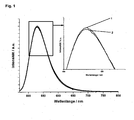
- Tab. 1 shows the optical properties of the silicate phosphor according to the invention from stage 2 of example 1 in comparison to a known silicate phosphor according to stage 1 from example 1.
- CIE x and CIE y represent the coordinates in the CIE standard color diagram familiar to the person skilled in the art (here standard observer 1931), which describes the color of a light source. All the variables listed above are calculated from emission spectra of the light source according to methods familiar to the person skilled in the art.
- the lumen equivalent (Im / W) results from the product of the normalized emission spectrum I (lambda) with the eye sensitivity curve V (lambda).
- Example 5 Environmental tests to check the stability of the phosphors to moisture
- the climate tests with the o-silicate phosphors from stages 1 and 2 of Example 1 are carried out in a climate test cabinet of the LHL 113 type from Thermotec.
- 10 LEDs of the PLCC2 package type are filled with the phosphors to be compared.
- a suspension of commercially available LED silicone resin and 15% w / w of the respective phosphor is used.
- a relative humidity of 85 ⁇ 3% and a temperature of 80 ⁇ 1 ° C the LEDs, which are constantly energized with 20 mA, are tested in the climate test cabinet.
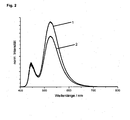
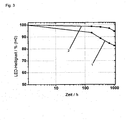
- the results are shown in the following spectra (see Fig. 2 and 3 ). It turns out that the phosphors according to the invention containing Na 2 B 4 O 7 (curve 2 in FIG. 3 ) are more stable to moisture than the phosphors without Na 2 B 4 O 7 .
Landscapes
- Chemical & Material Sciences (AREA)
- Inorganic Chemistry (AREA)
- Engineering & Computer Science (AREA)
- Materials Engineering (AREA)
- Organic Chemistry (AREA)
- Luminescent Compositions (AREA)
- Planar Illumination Modules (AREA)
- Led Device Packages (AREA)
Claims (11)
- Composé de la formule I
EA2-xEuxSiO4 • a M2B4O7 (I)
dans laquelleEA représente deux éléments ou plus choisis parmi Ca, Sr, Zn et Ba,M représente Li, Na ou K, eta représente une valeur de la plage 0,01 ≤ a ≤ 0,08, etx représente une valeur de la plage 0,01 ≤ x ≤ 0,25. - Composé selon la revendication 1, caractérisé en ce que x représente une valeur de la plage 0,03 ≤ x ≤ 0,20, de façon préférable de la plage 0,04 ≤ x ≤ 0,1 3.
- Composé selon la revendication 1 ou 2, caractérisé en ce que a représente une valeur de la plage 0,01 ≤ a ≤ 0,05.
- Procédé pour la préparation d'un composé selon une ou plusieurs des revendications 1 à 3, comprenant les étapes de procédé qui suivent :a) fourniture d'une solution contenant du M2B4O7, où M = Li, Na ou K (solution A)b) fourniture d'un phosphore de la composition EA2-xEuxSiO4, où EA représente deux éléments ou plus choisis parmi Ca, Sr, Zn et Ba, et x représente une valeur de la plage 0,01 ≤ x ≤ 0,25 (phosphore B)c) ajout et mélange intime du phosphore B avec la solution A,d) lavage, ete) séchage ensuite.
- Mélange comprenant au moins un composé selon une ou plusieurs des revendications 1 à 3 et au moins un autre phosphore.
- Mélange selon la revendication 5, caractérisé en ce que l'au moins un autre phosphore est au moins un phosphore émetteur de rouge choisi parmi le groupe constitué par des sulfoséléniures dopés à l'Eu, des nitrures, oxynitrures, alumosiliconitrures dopés à l'Eu et/ou au Ce, et/ou des oxydes et/ou fluorures dopés au Mn(IV).
- Source de lumière, caractérisée en ce qu'elle comprend un semiconducteur et au moins un composé selon une ou plusieurs des revendications 1 à 3.
- Source de lumière selon la revendication 7, caractérisée en ce que le semiconducteur est un nitrure d'indium aluminium gallium luminescent, en particulier de la formule IniGajAlkN, où 0 ≤ i, 0 ≤ j, 0 ≤ k, et i+j+k=1.
- Unité d'éclairage, en particulier pour l'éclairage arrière de dispositifs d'affichage, caractérisée en ce qu'elle comprend au moins une source de lumière selon la revendication 7 ou 8.
- Dispositif d'affichage, en particulier dispositif d'affichage à cristaux liquides (affichage LC), caractérisé en ce qu'il comprend au moins une unité d'éclairage selon la revendication 9.
- Utilisation d'au moins un composé selon une ou plusieurs des revendications 1 à 3 en tant que phosphore de conversion, de préférence pour la conversion partielle ou complète de l'émission de bleu ou des UV proches en provenance d'une diode luminescente, ou dans des matériaux électroluminescents, en particulier dans des films électroluminescents.
Priority Applications (1)
| Application Number | Priority Date | Filing Date | Title |
|---|---|---|---|
| EP12705801.4A EP2619283B1 (fr) | 2011-03-18 | 2012-02-24 | Substances fluorescentes à base de silicate |
Applications Claiming Priority (3)
| Application Number | Priority Date | Filing Date | Title |
|---|---|---|---|
| EP11002247 | 2011-03-18 | ||
| EP12705801.4A EP2619283B1 (fr) | 2011-03-18 | 2012-02-24 | Substances fluorescentes à base de silicate |
| PCT/EP2012/000814 WO2012126561A1 (fr) | 2011-03-18 | 2012-02-24 | Substances fluorescentes à base de silicate |
Publications (2)
| Publication Number | Publication Date |
|---|---|
| EP2619283A1 EP2619283A1 (fr) | 2013-07-31 |
| EP2619283B1 true EP2619283B1 (fr) | 2014-07-16 |
Family
ID=45757380
Family Applications (1)
| Application Number | Title | Priority Date | Filing Date |
|---|---|---|---|
| EP12705801.4A Active EP2619283B1 (fr) | 2011-03-18 | 2012-02-24 | Substances fluorescentes à base de silicate |
Country Status (8)
| Country | Link |
|---|---|
| US (1) | US8906264B2 (fr) |
| EP (1) | EP2619283B1 (fr) |
| JP (1) | JP5536288B2 (fr) |
| KR (1) | KR101365361B1 (fr) |
| CN (1) | CN103221510B (fr) |
| DE (1) | DE212012000015U1 (fr) |
| TW (1) | TWI540198B (fr) |
| WO (1) | WO2012126561A1 (fr) |
Family Cites Families (13)
| Publication number | Priority date | Publication date | Assignee | Title |
|---|---|---|---|---|
| JPS55136441A (en) | 1979-04-10 | 1980-10-24 | Toshiba Corp | Filter-covered fluorescent body |
| US4451757A (en) * | 1982-01-25 | 1984-05-29 | Gte Products Corporation | Fluorescent lamp having improved maintenance |
| JPH04315371A (ja) | 1991-04-15 | 1992-11-06 | Canon Inc | 画像処理方法及び装置 |
| AT410266B (de) | 2000-12-28 | 2003-03-25 | Tridonic Optoelectronics Gmbh | Lichtquelle mit einem lichtemittierenden element |
| US7554258B2 (en) | 2002-10-22 | 2009-06-30 | Osram Opto Semiconductors Gmbh | Light source having an LED and a luminescence conversion body and method for producing the luminescence conversion body |
| KR100511562B1 (ko) | 2003-01-29 | 2005-09-02 | 한국화학연구원 | 백색 발광 다이오드 및 능동 발광형 액정 디스플레이에 적용되는 스트론튬실리케이트계 황색 형광체와 이의 제조방법 |
| JP4315371B2 (ja) | 2003-09-11 | 2009-08-19 | 根本特殊化学株式会社 | 赤外可視変換蛍光体 |
| US7573072B2 (en) * | 2004-03-10 | 2009-08-11 | Lumination Llc | Phosphor and blends thereof for use in LEDs |
| DE102007016229A1 (de) | 2007-04-04 | 2008-10-09 | Litec Lll Gmbh | Verfahren zur Herstellung von Leuchtstoffen basierend auf Orthosilikaten für pcLEDs |
| JP5092686B2 (ja) | 2007-10-24 | 2012-12-05 | 日亜化学工業株式会社 | 蛍光体及びそれを用いた蛍光ランプ |
| JP5471091B2 (ja) | 2009-07-07 | 2014-04-16 | 日亜化学工業株式会社 | 蛍光体及びこれを備える発光装置並びに蛍光体の製造方法 |
| WO2011091839A1 (fr) | 2010-01-29 | 2011-08-04 | Merck Patent Gmbh | Substances luminescentes |
| JP2012079883A (ja) | 2010-09-30 | 2012-04-19 | Sekisui Chem Co Ltd | Led発光装置 |
-
2012
- 2012-02-24 US US13/988,040 patent/US8906264B2/en not_active Expired - Fee Related
- 2012-02-24 CN CN201280003723.6A patent/CN103221510B/zh not_active Expired - Fee Related
- 2012-02-24 KR KR1020137012787A patent/KR101365361B1/ko not_active Expired - Fee Related
- 2012-02-24 EP EP12705801.4A patent/EP2619283B1/fr active Active
- 2012-02-24 JP JP2013539304A patent/JP5536288B2/ja not_active Expired - Fee Related
- 2012-02-24 WO PCT/EP2012/000814 patent/WO2012126561A1/fr not_active Ceased
- 2012-02-24 DE DE212012000015U patent/DE212012000015U1/de not_active Expired - Lifetime
- 2012-03-16 TW TW101109207A patent/TWI540198B/zh not_active IP Right Cessation
Also Published As
| Publication number | Publication date |
|---|---|
| US8906264B2 (en) | 2014-12-09 |
| JP5536288B2 (ja) | 2014-07-02 |
| EP2619283A1 (fr) | 2013-07-31 |
| CN103221510B (zh) | 2014-12-10 |
| KR101365361B1 (ko) | 2014-02-20 |
| JP2014505741A (ja) | 2014-03-06 |
| DE212012000015U1 (de) | 2013-08-05 |
| TWI540198B (zh) | 2016-07-01 |
| US20130341664A1 (en) | 2013-12-26 |
| KR20130069862A (ko) | 2013-06-26 |
| CN103221510A (zh) | 2013-07-24 |
| TW201241156A (en) | 2012-10-16 |
| WO2012126561A1 (fr) | 2012-09-27 |
Similar Documents
| Publication | Publication Date | Title |
|---|---|---|
| EP2576725B1 (fr) | Substances luminescentes | |
| EP2616523B1 (fr) | Substances luminescentes de silicophosphate | |
| EP2596078B1 (fr) | Substances luminescentes à base d'aluminate | |
| EP2401342B1 (fr) | Nitridosilicate co-dopé au zirconium et à l'hafnium | |
| EP2528991B1 (fr) | Substances luminescentes | |
| EP2129740B1 (fr) | Procédé de production de substances luminescentes à base d'orthosilicates pour diodes électroluminescentes à convertisseur phosphore | |
| EP2841529B1 (fr) | Luminophores à base de silicate | |
| EP2324096B1 (fr) | Nitrures 1-1-2 co-dopés | |
| EP2914688B1 (fr) | Substances luminescentes activées par eu | |
| DE102009032711A1 (de) | Co-dotierte Silicooxynitride | |
| EP2625247B1 (fr) | Luminophores activés par mn | |
| EP2596681B1 (fr) | Substances luminescentes de type carbodiimide | |
| EP2683790B1 (fr) | Luminophores carbodiimide | |
| DE102009050542A1 (de) | Sm-aktivierte Aluminat- und Borat-Leuchtstoffe | |
| EP2619283B1 (fr) | Substances fluorescentes à base de silicate |
Legal Events
| Date | Code | Title | Description |
|---|---|---|---|
| PUAI | Public reference made under article 153(3) epc to a published international application that has entered the european phase |
Free format text: ORIGINAL CODE: 0009012 |
|
| 17P | Request for examination filed |
Effective date: 20130422 |
|
| AK | Designated contracting states |
Kind code of ref document: A1 Designated state(s): AL AT BE BG CH CY CZ DE DK EE ES FI FR GB GR HR HU IE IS IT LI LT LU LV MC MK MT NL NO PL PT RO RS SE SI SK SM TR |
|
| GRAP | Despatch of communication of intention to grant a patent |
Free format text: ORIGINAL CODE: EPIDOSNIGR1 |
|
| RIN1 | Information on inventor provided before grant (corrected) |
Inventor name: HEIDEN, ERIC Inventor name: OPOLKA, ANDREA Inventor name: SCHLUETER, STEFAN Inventor name: HESS, SASCHA Inventor name: DEGENRING, DANIELA Inventor name: VOSGROENE, TIM |
|
| DAX | Request for extension of the european patent (deleted) | ||
| INTG | Intention to grant announced |
Effective date: 20140320 |
|
| INTG | Intention to grant announced |
Effective date: 20140326 |
|
| GRAS | Grant fee paid |
Free format text: ORIGINAL CODE: EPIDOSNIGR3 |
|
| GRAA | (expected) grant |
Free format text: ORIGINAL CODE: 0009210 |
|
| AK | Designated contracting states |
Kind code of ref document: B1 Designated state(s): AL AT BE BG CH CY CZ DE DK EE ES FI FR GB GR HR HU IE IS IT LI LT LU LV MC MK MT NL NO PL PT RO RS SE SI SK SM TR |
|
| REG | Reference to a national code |
Ref country code: GB Ref legal event code: FG4D Free format text: NOT ENGLISH |
|
| REG | Reference to a national code |
Ref country code: CH Ref legal event code: EP |
|
| REG | Reference to a national code |
Ref country code: IE Ref legal event code: FG4D Free format text: LANGUAGE OF EP DOCUMENT: GERMAN |
|
| REG | Reference to a national code |
Ref country code: AT Ref legal event code: REF Ref document number: 677665 Country of ref document: AT Kind code of ref document: T Effective date: 20140815 |
|
| REG | Reference to a national code |
Ref country code: DE Ref legal event code: R096 Ref document number: 502012001018 Country of ref document: DE Effective date: 20140828 |
|
| REG | Reference to a national code |
Ref country code: NL Ref legal event code: T3 |
|
| REG | Reference to a national code |
Ref country code: LT Ref legal event code: MG4D |
|
| PG25 | Lapsed in a contracting state [announced via postgrant information from national office to epo] |
Ref country code: GR Free format text: LAPSE BECAUSE OF FAILURE TO SUBMIT A TRANSLATION OF THE DESCRIPTION OR TO PAY THE FEE WITHIN THE PRESCRIBED TIME-LIMIT Effective date: 20141017 Ref country code: BG Free format text: LAPSE BECAUSE OF FAILURE TO SUBMIT A TRANSLATION OF THE DESCRIPTION OR TO PAY THE FEE WITHIN THE PRESCRIBED TIME-LIMIT Effective date: 20141016 Ref country code: FI Free format text: LAPSE BECAUSE OF FAILURE TO SUBMIT A TRANSLATION OF THE DESCRIPTION OR TO PAY THE FEE WITHIN THE PRESCRIBED TIME-LIMIT Effective date: 20140716 Ref country code: PT Free format text: LAPSE BECAUSE OF FAILURE TO SUBMIT A TRANSLATION OF THE DESCRIPTION OR TO PAY THE FEE WITHIN THE PRESCRIBED TIME-LIMIT Effective date: 20141117 Ref country code: NO Free format text: LAPSE BECAUSE OF FAILURE TO SUBMIT A TRANSLATION OF THE DESCRIPTION OR TO PAY THE FEE WITHIN THE PRESCRIBED TIME-LIMIT Effective date: 20141016 Ref country code: ES Free format text: LAPSE BECAUSE OF FAILURE TO SUBMIT A TRANSLATION OF THE DESCRIPTION OR TO PAY THE FEE WITHIN THE PRESCRIBED TIME-LIMIT Effective date: 20140716 Ref country code: LT Free format text: LAPSE BECAUSE OF FAILURE TO SUBMIT A TRANSLATION OF THE DESCRIPTION OR TO PAY THE FEE WITHIN THE PRESCRIBED TIME-LIMIT Effective date: 20140716 Ref country code: SE Free format text: LAPSE BECAUSE OF FAILURE TO SUBMIT A TRANSLATION OF THE DESCRIPTION OR TO PAY THE FEE WITHIN THE PRESCRIBED TIME-LIMIT Effective date: 20140716 |
|
| PG25 | Lapsed in a contracting state [announced via postgrant information from national office to epo] |
Ref country code: RS Free format text: LAPSE BECAUSE OF FAILURE TO SUBMIT A TRANSLATION OF THE DESCRIPTION OR TO PAY THE FEE WITHIN THE PRESCRIBED TIME-LIMIT Effective date: 20140716 Ref country code: CY Free format text: LAPSE BECAUSE OF FAILURE TO SUBMIT A TRANSLATION OF THE DESCRIPTION OR TO PAY THE FEE WITHIN THE PRESCRIBED TIME-LIMIT Effective date: 20140716 Ref country code: IS Free format text: LAPSE BECAUSE OF FAILURE TO SUBMIT A TRANSLATION OF THE DESCRIPTION OR TO PAY THE FEE WITHIN THE PRESCRIBED TIME-LIMIT Effective date: 20141116 Ref country code: LV Free format text: LAPSE BECAUSE OF FAILURE TO SUBMIT A TRANSLATION OF THE DESCRIPTION OR TO PAY THE FEE WITHIN THE PRESCRIBED TIME-LIMIT Effective date: 20140716 Ref country code: PL Free format text: LAPSE BECAUSE OF FAILURE TO SUBMIT A TRANSLATION OF THE DESCRIPTION OR TO PAY THE FEE WITHIN THE PRESCRIBED TIME-LIMIT Effective date: 20140716 |
|
| REG | Reference to a national code |
Ref country code: DE Ref legal event code: R097 Ref document number: 502012001018 Country of ref document: DE |
|
| PG25 | Lapsed in a contracting state [announced via postgrant information from national office to epo] |
Ref country code: DK Free format text: LAPSE BECAUSE OF FAILURE TO SUBMIT A TRANSLATION OF THE DESCRIPTION OR TO PAY THE FEE WITHIN THE PRESCRIBED TIME-LIMIT Effective date: 20140716 Ref country code: EE Free format text: LAPSE BECAUSE OF FAILURE TO SUBMIT A TRANSLATION OF THE DESCRIPTION OR TO PAY THE FEE WITHIN THE PRESCRIBED TIME-LIMIT Effective date: 20140716 Ref country code: IT Free format text: LAPSE BECAUSE OF FAILURE TO SUBMIT A TRANSLATION OF THE DESCRIPTION OR TO PAY THE FEE WITHIN THE PRESCRIBED TIME-LIMIT Effective date: 20140716 Ref country code: RO Free format text: LAPSE BECAUSE OF FAILURE TO SUBMIT A TRANSLATION OF THE DESCRIPTION OR TO PAY THE FEE WITHIN THE PRESCRIBED TIME-LIMIT Effective date: 20140716 Ref country code: SK Free format text: LAPSE BECAUSE OF FAILURE TO SUBMIT A TRANSLATION OF THE DESCRIPTION OR TO PAY THE FEE WITHIN THE PRESCRIBED TIME-LIMIT Effective date: 20140716 Ref country code: CZ Free format text: LAPSE BECAUSE OF FAILURE TO SUBMIT A TRANSLATION OF THE DESCRIPTION OR TO PAY THE FEE WITHIN THE PRESCRIBED TIME-LIMIT Effective date: 20140716 |
|
| PLBE | No opposition filed within time limit |
Free format text: ORIGINAL CODE: 0009261 |
|
| STAA | Information on the status of an ep patent application or granted ep patent |
Free format text: STATUS: NO OPPOSITION FILED WITHIN TIME LIMIT |
|
| 26N | No opposition filed |
Effective date: 20150417 |
|
| PG25 | Lapsed in a contracting state [announced via postgrant information from national office to epo] |
Ref country code: BE Free format text: LAPSE BECAUSE OF NON-PAYMENT OF DUE FEES Effective date: 20150228 |
|
| PG25 | Lapsed in a contracting state [announced via postgrant information from national office to epo] |
Ref country code: LU Free format text: LAPSE BECAUSE OF FAILURE TO SUBMIT A TRANSLATION OF THE DESCRIPTION OR TO PAY THE FEE WITHIN THE PRESCRIBED TIME-LIMIT Effective date: 20150224 |
|
| REG | Reference to a national code |
Ref country code: CH Ref legal event code: PL |
|
| PG25 | Lapsed in a contracting state [announced via postgrant information from national office to epo] |
Ref country code: LI Free format text: LAPSE BECAUSE OF NON-PAYMENT OF DUE FEES Effective date: 20150228 Ref country code: CH Free format text: LAPSE BECAUSE OF NON-PAYMENT OF DUE FEES Effective date: 20150228 Ref country code: MC Free format text: LAPSE BECAUSE OF FAILURE TO SUBMIT A TRANSLATION OF THE DESCRIPTION OR TO PAY THE FEE WITHIN THE PRESCRIBED TIME-LIMIT Effective date: 20140716 |
|
| REG | Reference to a national code |
Ref country code: IE Ref legal event code: MM4A |
|
| REG | Reference to a national code |
Ref country code: FR Ref legal event code: ST Effective date: 20151030 |
|
| PG25 | Lapsed in a contracting state [announced via postgrant information from national office to epo] |
Ref country code: SI Free format text: LAPSE BECAUSE OF FAILURE TO SUBMIT A TRANSLATION OF THE DESCRIPTION OR TO PAY THE FEE WITHIN THE PRESCRIBED TIME-LIMIT Effective date: 20140716 |
|
| PG25 | Lapsed in a contracting state [announced via postgrant information from national office to epo] |
Ref country code: IE Free format text: LAPSE BECAUSE OF NON-PAYMENT OF DUE FEES Effective date: 20150224 |
|
| PG25 | Lapsed in a contracting state [announced via postgrant information from national office to epo] |
Ref country code: FR Free format text: LAPSE BECAUSE OF NON-PAYMENT OF DUE FEES Effective date: 20150302 |
|
| PG25 | Lapsed in a contracting state [announced via postgrant information from national office to epo] |
Ref country code: MT Free format text: LAPSE BECAUSE OF FAILURE TO SUBMIT A TRANSLATION OF THE DESCRIPTION OR TO PAY THE FEE WITHIN THE PRESCRIBED TIME-LIMIT Effective date: 20140716 |
|
| PG25 | Lapsed in a contracting state [announced via postgrant information from national office to epo] |
Ref country code: HU Free format text: LAPSE BECAUSE OF FAILURE TO SUBMIT A TRANSLATION OF THE DESCRIPTION OR TO PAY THE FEE WITHIN THE PRESCRIBED TIME-LIMIT; INVALID AB INITIO Effective date: 20120224 Ref country code: SM Free format text: LAPSE BECAUSE OF FAILURE TO SUBMIT A TRANSLATION OF THE DESCRIPTION OR TO PAY THE FEE WITHIN THE PRESCRIBED TIME-LIMIT Effective date: 20140716 |
|
| PG25 | Lapsed in a contracting state [announced via postgrant information from national office to epo] |
Ref country code: HR Free format text: LAPSE BECAUSE OF FAILURE TO SUBMIT A TRANSLATION OF THE DESCRIPTION OR TO PAY THE FEE WITHIN THE PRESCRIBED TIME-LIMIT Effective date: 20140716 |
|
| PG25 | Lapsed in a contracting state [announced via postgrant information from national office to epo] |
Ref country code: TR Free format text: LAPSE BECAUSE OF FAILURE TO SUBMIT A TRANSLATION OF THE DESCRIPTION OR TO PAY THE FEE WITHIN THE PRESCRIBED TIME-LIMIT Effective date: 20140716 |
|
| REG | Reference to a national code |
Ref country code: AT Ref legal event code: MM01 Ref document number: 677665 Country of ref document: AT Kind code of ref document: T Effective date: 20170224 |
|
| PG25 | Lapsed in a contracting state [announced via postgrant information from national office to epo] |
Ref country code: AT Free format text: LAPSE BECAUSE OF NON-PAYMENT OF DUE FEES Effective date: 20170224 |
|
| PG25 | Lapsed in a contracting state [announced via postgrant information from national office to epo] |
Ref country code: MK Free format text: LAPSE BECAUSE OF FAILURE TO SUBMIT A TRANSLATION OF THE DESCRIPTION OR TO PAY THE FEE WITHIN THE PRESCRIBED TIME-LIMIT Effective date: 20140716 |
|
| PG25 | Lapsed in a contracting state [announced via postgrant information from national office to epo] |
Ref country code: AL Free format text: LAPSE BECAUSE OF FAILURE TO SUBMIT A TRANSLATION OF THE DESCRIPTION OR TO PAY THE FEE WITHIN THE PRESCRIBED TIME-LIMIT Effective date: 20140716 |
|
| PGFP | Annual fee paid to national office [announced via postgrant information from national office to epo] |
Ref country code: GB Payment date: 20200212 Year of fee payment: 9 Ref country code: NL Payment date: 20200130 Year of fee payment: 9 |
|
| REG | Reference to a national code |
Ref country code: DE Ref legal event code: R081 Ref document number: 502012001018 Country of ref document: DE Owner name: LITEC-VERMOEGENSVERWALTUNGSGESELLSCHAFT MBH, DE Free format text: FORMER OWNER: MERCK PATENT GMBH, 64293 DARMSTADT, DE |
|
| REG | Reference to a national code |
Ref country code: GB Ref legal event code: 732E Free format text: REGISTERED BETWEEN 20201029 AND 20201104 |
|
| GBPC | Gb: european patent ceased through non-payment of renewal fee |
Effective date: 20210224 |
|
| REG | Reference to a national code |
Ref country code: NL Ref legal event code: MM Effective date: 20210301 |
|
| PG25 | Lapsed in a contracting state [announced via postgrant information from national office to epo] |
Ref country code: NL Free format text: LAPSE BECAUSE OF NON-PAYMENT OF DUE FEES Effective date: 20210301 |
|
| PG25 | Lapsed in a contracting state [announced via postgrant information from national office to epo] |
Ref country code: GB Free format text: LAPSE BECAUSE OF NON-PAYMENT OF DUE FEES Effective date: 20210224 |
|
| REG | Reference to a national code |
Ref country code: DE Ref legal event code: R084 Ref document number: 502012001018 Country of ref document: DE |
|
| PGFP | Annual fee paid to national office [announced via postgrant information from national office to epo] |
Ref country code: DE Payment date: 20250121 Year of fee payment: 14 |