EP2623101B1 - Dérivés de pipéridine et de pipérazine en tant qu'inhibiteurs de l'autotaxine - Google Patents
Dérivés de pipéridine et de pipérazine en tant qu'inhibiteurs de l'autotaxine Download PDFInfo
- Publication number
- EP2623101B1 EP2623101B1 EP13002080.3A EP13002080A EP2623101B1 EP 2623101 B1 EP2623101 B1 EP 2623101B1 EP 13002080 A EP13002080 A EP 13002080A EP 2623101 B1 EP2623101 B1 EP 2623101B1
- Authority
- EP
- European Patent Office
- Prior art keywords
- phenyl
- group
- compound
- oxo
- independently
- Prior art date
- Legal status (The legal status is an assumption and is not a legal conclusion. Google has not performed a legal analysis and makes no representation as to the accuracy of the status listed.)
- Active
Links
- 0 C*CCC(CC1C(CCC2)C2C1C)(C(C)S1CCC1)*=C Chemical compound C*CCC(CC1C(CCC2)C2C1C)(C(C)S1CCC1)*=C 0.000 description 6
- JMGXHPRISACATF-UHFFFAOYSA-N O=C(C(C1)CN(C(CC2)CCN2C(OCc2cc(Cl)cc(Cl)c2)=O)C1=O)Nc(cc1)ccc1-c1c[s]nn1 Chemical compound O=C(C(C1)CN(C(CC2)CCN2C(OCc2cc(Cl)cc(Cl)c2)=O)C1=O)Nc(cc1)ccc1-c1c[s]nn1 JMGXHPRISACATF-UHFFFAOYSA-N 0.000 description 2
- HSGLSUALSRGCCF-UHFFFAOYSA-N CC(C1)CN(C2CCN(C)CC2)C1=O Chemical compound CC(C1)CN(C2CCN(C)CC2)C1=O HSGLSUALSRGCCF-UHFFFAOYSA-N 0.000 description 1
- KBKLQHRZPAAUTR-UHFFFAOYSA-N N=C(CCc1cccnc1)CC(C(C1)CN(C2CCC(CC(OCc3cc(Cl)cc(Cl)c3)=O)=CCC2)C1=O)=O Chemical compound N=C(CCc1cccnc1)CC(C(C1)CN(C2CCC(CC(OCc3cc(Cl)cc(Cl)c3)=O)=CCC2)C1=O)=O KBKLQHRZPAAUTR-UHFFFAOYSA-N 0.000 description 1
- YEGQMUOUKUEJRM-UHFFFAOYSA-N Nc1n[nH]c(cc2)c1cc2C(O)=O Chemical compound Nc1n[nH]c(cc2)c1cc2C(O)=O YEGQMUOUKUEJRM-UHFFFAOYSA-N 0.000 description 1
- CTSJXEVSVGNCFD-UHFFFAOYSA-N O=C(C(C1)CN(C(CC2)CCN2C(OCc2cc(Cl)cc(Cl)c2)=O)C1=O)NCCc1c[nH]cn1 Chemical compound O=C(C(C1)CN(C(CC2)CCN2C(OCc2cc(Cl)cc(Cl)c2)=O)C1=O)NCCc1c[nH]cn1 CTSJXEVSVGNCFD-UHFFFAOYSA-N 0.000 description 1
- AUQOAQUVYVWRTL-UHFFFAOYSA-N O=C(C(C1)CN(C(CC2)CCN2C(OCc2cc(Cl)cc(Cl)c2)=O)C1=O)NCCc1ncccc1 Chemical compound O=C(C(C1)CN(C(CC2)CCN2C(OCc2cc(Cl)cc(Cl)c2)=O)C1=O)NCCc1ncccc1 AUQOAQUVYVWRTL-UHFFFAOYSA-N 0.000 description 1
- FERUQGLVJSCANV-UHFFFAOYSA-N O=C(CC(CCC1)CCC1N(CC1)CC1NC(c(cc1)cc2c1[nH]nn2)=O)OCc(cc1)ccc1Cl Chemical compound O=C(CC(CCC1)CCC1N(CC1)CC1NC(c(cc1)cc2c1[nH]nn2)=O)OCc(cc1)ccc1Cl FERUQGLVJSCANV-UHFFFAOYSA-N 0.000 description 1
- PCYGQWDOXVVKLM-UHFFFAOYSA-N OC(c(cc1)cc(O2)c1NC2=S)=O Chemical compound OC(c(cc1)cc(O2)c1NC2=S)=O PCYGQWDOXVVKLM-UHFFFAOYSA-N 0.000 description 1
- USZSGINUZRHINQ-UHFFFAOYSA-N OC(c(cc1)cc(S2)c1NC2=O)=O Chemical compound OC(c(cc1)cc(S2)c1NC2=O)=O USZSGINUZRHINQ-UHFFFAOYSA-N 0.000 description 1
- GUOVBFFLXKJFEE-UHFFFAOYSA-N OC(c(cc1)cc2c1[nH]nn2)=O Chemical compound OC(c(cc1)cc2c1[nH]nn2)=O GUOVBFFLXKJFEE-UHFFFAOYSA-N 0.000 description 1
Classifications
-
- C—CHEMISTRY; METALLURGY
- C07—ORGANIC CHEMISTRY
- C07D—HETEROCYCLIC COMPOUNDS
- C07D401/00—Heterocyclic compounds containing two or more hetero rings, having nitrogen atoms as the only ring hetero atoms, at least one ring being a six-membered ring with only one nitrogen atom
- C07D401/14—Heterocyclic compounds containing two or more hetero rings, having nitrogen atoms as the only ring hetero atoms, at least one ring being a six-membered ring with only one nitrogen atom containing three or more hetero rings
-
- A—HUMAN NECESSITIES
- A61—MEDICAL OR VETERINARY SCIENCE; HYGIENE
- A61K—PREPARATIONS FOR MEDICAL, DENTAL OR TOILETRY PURPOSES
- A61K31/00—Medicinal preparations containing organic active ingredients
- A61K31/33—Heterocyclic compounds
- A61K31/395—Heterocyclic compounds having nitrogen as a ring hetero atom, e.g. guanethidine or rifamycins
- A61K31/435—Heterocyclic compounds having nitrogen as a ring hetero atom, e.g. guanethidine or rifamycins having six-membered rings with one nitrogen as the only ring hetero atom
- A61K31/44—Non condensed pyridines; Hydrogenated derivatives thereof
- A61K31/4427—Non condensed pyridines; Hydrogenated derivatives thereof containing further heterocyclic ring systems
-
- A—HUMAN NECESSITIES
- A61—MEDICAL OR VETERINARY SCIENCE; HYGIENE
- A61K—PREPARATIONS FOR MEDICAL, DENTAL OR TOILETRY PURPOSES
- A61K31/00—Medicinal preparations containing organic active ingredients
- A61K31/33—Heterocyclic compounds
- A61K31/395—Heterocyclic compounds having nitrogen as a ring hetero atom, e.g. guanethidine or rifamycins
- A61K31/435—Heterocyclic compounds having nitrogen as a ring hetero atom, e.g. guanethidine or rifamycins having six-membered rings with one nitrogen as the only ring hetero atom
- A61K31/44—Non condensed pyridines; Hydrogenated derivatives thereof
- A61K31/445—Non condensed piperidines, e.g. piperocaine
- A61K31/4523—Non condensed piperidines, e.g. piperocaine containing further heterocyclic ring systems
- A61K31/4545—Non condensed piperidines, e.g. piperocaine containing further heterocyclic ring systems containing a six-membered ring with nitrogen as a ring hetero atom, e.g. pipamperone, anabasine
-
- A—HUMAN NECESSITIES
- A61—MEDICAL OR VETERINARY SCIENCE; HYGIENE
- A61K—PREPARATIONS FOR MEDICAL, DENTAL OR TOILETRY PURPOSES
- A61K31/00—Medicinal preparations containing organic active ingredients
- A61K31/33—Heterocyclic compounds
- A61K31/395—Heterocyclic compounds having nitrogen as a ring hetero atom, e.g. guanethidine or rifamycins
- A61K31/495—Heterocyclic compounds having nitrogen as a ring hetero atom, e.g. guanethidine or rifamycins having six-membered rings with two or more nitrogen atoms as the only ring heteroatoms, e.g. piperazine or tetrazines
- A61K31/496—Non-condensed piperazines containing further heterocyclic rings, e.g. rifampin, thiothixene or sparfloxacin
-
- A—HUMAN NECESSITIES
- A61—MEDICAL OR VETERINARY SCIENCE; HYGIENE
- A61P—SPECIFIC THERAPEUTIC ACTIVITY OF CHEMICAL COMPOUNDS OR MEDICINAL PREPARATIONS
- A61P1/00—Drugs for disorders of the alimentary tract or the digestive system
-
- A—HUMAN NECESSITIES
- A61—MEDICAL OR VETERINARY SCIENCE; HYGIENE
- A61P—SPECIFIC THERAPEUTIC ACTIVITY OF CHEMICAL COMPOUNDS OR MEDICINAL PREPARATIONS
- A61P1/00—Drugs for disorders of the alimentary tract or the digestive system
- A61P1/04—Drugs for disorders of the alimentary tract or the digestive system for ulcers, gastritis or reflux esophagitis, e.g. antacids, inhibitors of acid secretion, mucosal protectants
-
- A—HUMAN NECESSITIES
- A61—MEDICAL OR VETERINARY SCIENCE; HYGIENE
- A61P—SPECIFIC THERAPEUTIC ACTIVITY OF CHEMICAL COMPOUNDS OR MEDICINAL PREPARATIONS
- A61P1/00—Drugs for disorders of the alimentary tract or the digestive system
- A61P1/16—Drugs for disorders of the alimentary tract or the digestive system for liver or gallbladder disorders, e.g. hepatoprotective agents, cholagogues, litholytics
-
- A—HUMAN NECESSITIES
- A61—MEDICAL OR VETERINARY SCIENCE; HYGIENE
- A61P—SPECIFIC THERAPEUTIC ACTIVITY OF CHEMICAL COMPOUNDS OR MEDICINAL PREPARATIONS
- A61P1/00—Drugs for disorders of the alimentary tract or the digestive system
- A61P1/18—Drugs for disorders of the alimentary tract or the digestive system for pancreatic disorders, e.g. pancreatic enzymes
-
- A—HUMAN NECESSITIES
- A61—MEDICAL OR VETERINARY SCIENCE; HYGIENE
- A61P—SPECIFIC THERAPEUTIC ACTIVITY OF CHEMICAL COMPOUNDS OR MEDICINAL PREPARATIONS
- A61P11/00—Drugs for disorders of the respiratory system
-
- A—HUMAN NECESSITIES
- A61—MEDICAL OR VETERINARY SCIENCE; HYGIENE
- A61P—SPECIFIC THERAPEUTIC ACTIVITY OF CHEMICAL COMPOUNDS OR MEDICINAL PREPARATIONS
- A61P13/00—Drugs for disorders of the urinary system
-
- A—HUMAN NECESSITIES
- A61—MEDICAL OR VETERINARY SCIENCE; HYGIENE
- A61P—SPECIFIC THERAPEUTIC ACTIVITY OF CHEMICAL COMPOUNDS OR MEDICINAL PREPARATIONS
- A61P13/00—Drugs for disorders of the urinary system
- A61P13/08—Drugs for disorders of the urinary system of the prostate
-
- A—HUMAN NECESSITIES
- A61—MEDICAL OR VETERINARY SCIENCE; HYGIENE
- A61P—SPECIFIC THERAPEUTIC ACTIVITY OF CHEMICAL COMPOUNDS OR MEDICINAL PREPARATIONS
- A61P13/00—Drugs for disorders of the urinary system
- A61P13/12—Drugs for disorders of the urinary system of the kidneys
-
- A—HUMAN NECESSITIES
- A61—MEDICAL OR VETERINARY SCIENCE; HYGIENE
- A61P—SPECIFIC THERAPEUTIC ACTIVITY OF CHEMICAL COMPOUNDS OR MEDICINAL PREPARATIONS
- A61P15/00—Drugs for genital or sexual disorders; Contraceptives
-
- A—HUMAN NECESSITIES
- A61—MEDICAL OR VETERINARY SCIENCE; HYGIENE
- A61P—SPECIFIC THERAPEUTIC ACTIVITY OF CHEMICAL COMPOUNDS OR MEDICINAL PREPARATIONS
- A61P17/00—Drugs for dermatological disorders
-
- A—HUMAN NECESSITIES
- A61—MEDICAL OR VETERINARY SCIENCE; HYGIENE
- A61P—SPECIFIC THERAPEUTIC ACTIVITY OF CHEMICAL COMPOUNDS OR MEDICINAL PREPARATIONS
- A61P17/00—Drugs for dermatological disorders
- A61P17/02—Drugs for dermatological disorders for treating wounds, ulcers, burns, scars, keloids, or the like
-
- A—HUMAN NECESSITIES
- A61—MEDICAL OR VETERINARY SCIENCE; HYGIENE
- A61P—SPECIFIC THERAPEUTIC ACTIVITY OF CHEMICAL COMPOUNDS OR MEDICINAL PREPARATIONS
- A61P19/00—Drugs for skeletal disorders
- A61P19/02—Drugs for skeletal disorders for joint disorders, e.g. arthritis, arthrosis
-
- A—HUMAN NECESSITIES
- A61—MEDICAL OR VETERINARY SCIENCE; HYGIENE
- A61P—SPECIFIC THERAPEUTIC ACTIVITY OF CHEMICAL COMPOUNDS OR MEDICINAL PREPARATIONS
- A61P25/00—Drugs for disorders of the nervous system
-
- A—HUMAN NECESSITIES
- A61—MEDICAL OR VETERINARY SCIENCE; HYGIENE
- A61P—SPECIFIC THERAPEUTIC ACTIVITY OF CHEMICAL COMPOUNDS OR MEDICINAL PREPARATIONS
- A61P25/00—Drugs for disorders of the nervous system
- A61P25/28—Drugs for disorders of the nervous system for treating neurodegenerative disorders of the central nervous system, e.g. nootropic agents, cognition enhancers, drugs for treating Alzheimer's disease or other forms of dementia
-
- A—HUMAN NECESSITIES
- A61—MEDICAL OR VETERINARY SCIENCE; HYGIENE
- A61P—SPECIFIC THERAPEUTIC ACTIVITY OF CHEMICAL COMPOUNDS OR MEDICINAL PREPARATIONS
- A61P27/00—Drugs for disorders of the senses
- A61P27/02—Ophthalmic agents
-
- A—HUMAN NECESSITIES
- A61—MEDICAL OR VETERINARY SCIENCE; HYGIENE
- A61P—SPECIFIC THERAPEUTIC ACTIVITY OF CHEMICAL COMPOUNDS OR MEDICINAL PREPARATIONS
- A61P29/00—Non-central analgesic, antipyretic or antiinflammatory agents, e.g. antirheumatic agents; Non-steroidal antiinflammatory drugs [NSAID]
-
- A—HUMAN NECESSITIES
- A61—MEDICAL OR VETERINARY SCIENCE; HYGIENE
- A61P—SPECIFIC THERAPEUTIC ACTIVITY OF CHEMICAL COMPOUNDS OR MEDICINAL PREPARATIONS
- A61P3/00—Drugs for disorders of the metabolism
- A61P3/08—Drugs for disorders of the metabolism for glucose homeostasis
- A61P3/10—Drugs for disorders of the metabolism for glucose homeostasis for hyperglycaemia, e.g. antidiabetics
-
- A—HUMAN NECESSITIES
- A61—MEDICAL OR VETERINARY SCIENCE; HYGIENE
- A61P—SPECIFIC THERAPEUTIC ACTIVITY OF CHEMICAL COMPOUNDS OR MEDICINAL PREPARATIONS
- A61P35/00—Antineoplastic agents
-
- A—HUMAN NECESSITIES
- A61—MEDICAL OR VETERINARY SCIENCE; HYGIENE
- A61P—SPECIFIC THERAPEUTIC ACTIVITY OF CHEMICAL COMPOUNDS OR MEDICINAL PREPARATIONS
- A61P35/00—Antineoplastic agents
- A61P35/02—Antineoplastic agents specific for leukemia
-
- A—HUMAN NECESSITIES
- A61—MEDICAL OR VETERINARY SCIENCE; HYGIENE
- A61P—SPECIFIC THERAPEUTIC ACTIVITY OF CHEMICAL COMPOUNDS OR MEDICINAL PREPARATIONS
- A61P35/00—Antineoplastic agents
- A61P35/04—Antineoplastic agents specific for metastasis
-
- A—HUMAN NECESSITIES
- A61—MEDICAL OR VETERINARY SCIENCE; HYGIENE
- A61P—SPECIFIC THERAPEUTIC ACTIVITY OF CHEMICAL COMPOUNDS OR MEDICINAL PREPARATIONS
- A61P37/00—Drugs for immunological or allergic disorders
-
- A—HUMAN NECESSITIES
- A61—MEDICAL OR VETERINARY SCIENCE; HYGIENE
- A61P—SPECIFIC THERAPEUTIC ACTIVITY OF CHEMICAL COMPOUNDS OR MEDICINAL PREPARATIONS
- A61P37/00—Drugs for immunological or allergic disorders
- A61P37/02—Immunomodulators
- A61P37/06—Immunosuppressants, e.g. drugs for graft rejection
-
- A—HUMAN NECESSITIES
- A61—MEDICAL OR VETERINARY SCIENCE; HYGIENE
- A61P—SPECIFIC THERAPEUTIC ACTIVITY OF CHEMICAL COMPOUNDS OR MEDICINAL PREPARATIONS
- A61P43/00—Drugs for specific purposes, not provided for in groups A61P1/00-A61P41/00
-
- A—HUMAN NECESSITIES
- A61—MEDICAL OR VETERINARY SCIENCE; HYGIENE
- A61P—SPECIFIC THERAPEUTIC ACTIVITY OF CHEMICAL COMPOUNDS OR MEDICINAL PREPARATIONS
- A61P5/00—Drugs for disorders of the endocrine system
- A61P5/14—Drugs for disorders of the endocrine system of the thyroid hormones, e.g. T3, T4
-
- A—HUMAN NECESSITIES
- A61—MEDICAL OR VETERINARY SCIENCE; HYGIENE
- A61P—SPECIFIC THERAPEUTIC ACTIVITY OF CHEMICAL COMPOUNDS OR MEDICINAL PREPARATIONS
- A61P9/00—Drugs for disorders of the cardiovascular system
-
- A—HUMAN NECESSITIES
- A61—MEDICAL OR VETERINARY SCIENCE; HYGIENE
- A61P—SPECIFIC THERAPEUTIC ACTIVITY OF CHEMICAL COMPOUNDS OR MEDICINAL PREPARATIONS
- A61P9/00—Drugs for disorders of the cardiovascular system
- A61P9/10—Drugs for disorders of the cardiovascular system for treating ischaemic or atherosclerotic diseases, e.g. antianginal drugs, coronary vasodilators, drugs for myocardial infarction, retinopathy, cerebrovascula insufficiency, renal arteriosclerosis
-
- C—CHEMISTRY; METALLURGY
- C07—ORGANIC CHEMISTRY
- C07D—HETEROCYCLIC COMPOUNDS
- C07D211/00—Heterocyclic compounds containing hydrogenated pyridine rings, not condensed with other rings
- C07D211/04—Heterocyclic compounds containing hydrogenated pyridine rings, not condensed with other rings with only hydrogen or carbon atoms directly attached to the ring nitrogen atom
- C07D211/06—Heterocyclic compounds containing hydrogenated pyridine rings, not condensed with other rings with only hydrogen or carbon atoms directly attached to the ring nitrogen atom having no double bonds between ring members or between ring members and non-ring members
- C07D211/08—Heterocyclic compounds containing hydrogenated pyridine rings, not condensed with other rings with only hydrogen or carbon atoms directly attached to the ring nitrogen atom having no double bonds between ring members or between ring members and non-ring members with hydrocarbon or substituted hydrocarbon radicals directly attached to ring carbon atoms
- C07D211/18—Heterocyclic compounds containing hydrogenated pyridine rings, not condensed with other rings with only hydrogen or carbon atoms directly attached to the ring nitrogen atom having no double bonds between ring members or between ring members and non-ring members with hydrocarbon or substituted hydrocarbon radicals directly attached to ring carbon atoms with substituted hydrocarbon radicals attached to ring carbon atoms
- C07D211/26—Heterocyclic compounds containing hydrogenated pyridine rings, not condensed with other rings with only hydrogen or carbon atoms directly attached to the ring nitrogen atom having no double bonds between ring members or between ring members and non-ring members with hydrocarbon or substituted hydrocarbon radicals directly attached to ring carbon atoms with substituted hydrocarbon radicals attached to ring carbon atoms with hydrocarbon radicals, substituted by nitrogen atoms
-
- C—CHEMISTRY; METALLURGY
- C07—ORGANIC CHEMISTRY
- C07D—HETEROCYCLIC COMPOUNDS
- C07D211/00—Heterocyclic compounds containing hydrogenated pyridine rings, not condensed with other rings
- C07D211/04—Heterocyclic compounds containing hydrogenated pyridine rings, not condensed with other rings with only hydrogen or carbon atoms directly attached to the ring nitrogen atom
- C07D211/06—Heterocyclic compounds containing hydrogenated pyridine rings, not condensed with other rings with only hydrogen or carbon atoms directly attached to the ring nitrogen atom having no double bonds between ring members or between ring members and non-ring members
- C07D211/08—Heterocyclic compounds containing hydrogenated pyridine rings, not condensed with other rings with only hydrogen or carbon atoms directly attached to the ring nitrogen atom having no double bonds between ring members or between ring members and non-ring members with hydrocarbon or substituted hydrocarbon radicals directly attached to ring carbon atoms
- C07D211/18—Heterocyclic compounds containing hydrogenated pyridine rings, not condensed with other rings with only hydrogen or carbon atoms directly attached to the ring nitrogen atom having no double bonds between ring members or between ring members and non-ring members with hydrocarbon or substituted hydrocarbon radicals directly attached to ring carbon atoms with substituted hydrocarbon radicals attached to ring carbon atoms
- C07D211/30—Heterocyclic compounds containing hydrogenated pyridine rings, not condensed with other rings with only hydrogen or carbon atoms directly attached to the ring nitrogen atom having no double bonds between ring members or between ring members and non-ring members with hydrocarbon or substituted hydrocarbon radicals directly attached to ring carbon atoms with substituted hydrocarbon radicals attached to ring carbon atoms with hydrocarbon radicals, substituted by doubly bound oxygen or sulfur atoms or by two oxygen or sulfur atoms singly bound to the same carbon atom
-
- C—CHEMISTRY; METALLURGY
- C07—ORGANIC CHEMISTRY
- C07D—HETEROCYCLIC COMPOUNDS
- C07D249/00—Heterocyclic compounds containing five-membered rings having three nitrogen atoms as the only ring hetero atoms
- C07D249/16—Heterocyclic compounds containing five-membered rings having three nitrogen atoms as the only ring hetero atoms condensed with carbocyclic rings or ring systems
- C07D249/18—Benzotriazoles
-
- C—CHEMISTRY; METALLURGY
- C07—ORGANIC CHEMISTRY
- C07D—HETEROCYCLIC COMPOUNDS
- C07D401/00—Heterocyclic compounds containing two or more hetero rings, having nitrogen atoms as the only ring hetero atoms, at least one ring being a six-membered ring with only one nitrogen atom
- C07D401/02—Heterocyclic compounds containing two or more hetero rings, having nitrogen atoms as the only ring hetero atoms, at least one ring being a six-membered ring with only one nitrogen atom containing two hetero rings
- C07D401/06—Heterocyclic compounds containing two or more hetero rings, having nitrogen atoms as the only ring hetero atoms, at least one ring being a six-membered ring with only one nitrogen atom containing two hetero rings linked by a carbon chain containing only aliphatic carbon atoms
-
- C—CHEMISTRY; METALLURGY
- C07—ORGANIC CHEMISTRY
- C07D—HETEROCYCLIC COMPOUNDS
- C07D401/00—Heterocyclic compounds containing two or more hetero rings, having nitrogen atoms as the only ring hetero atoms, at least one ring being a six-membered ring with only one nitrogen atom
- C07D401/02—Heterocyclic compounds containing two or more hetero rings, having nitrogen atoms as the only ring hetero atoms, at least one ring being a six-membered ring with only one nitrogen atom containing two hetero rings
- C07D401/12—Heterocyclic compounds containing two or more hetero rings, having nitrogen atoms as the only ring hetero atoms, at least one ring being a six-membered ring with only one nitrogen atom containing two hetero rings linked by a chain containing hetero atoms as chain links
-
- C—CHEMISTRY; METALLURGY
- C07—ORGANIC CHEMISTRY
- C07D—HETEROCYCLIC COMPOUNDS
- C07D405/00—Heterocyclic compounds containing both one or more hetero rings having oxygen atoms as the only ring hetero atoms, and one or more rings having nitrogen as the only ring hetero atom
- C07D405/02—Heterocyclic compounds containing both one or more hetero rings having oxygen atoms as the only ring hetero atoms, and one or more rings having nitrogen as the only ring hetero atom containing two hetero rings
- C07D405/06—Heterocyclic compounds containing both one or more hetero rings having oxygen atoms as the only ring hetero atoms, and one or more rings having nitrogen as the only ring hetero atom containing two hetero rings linked by a carbon chain containing only aliphatic carbon atoms
-
- C—CHEMISTRY; METALLURGY
- C07—ORGANIC CHEMISTRY
- C07D—HETEROCYCLIC COMPOUNDS
- C07D405/00—Heterocyclic compounds containing both one or more hetero rings having oxygen atoms as the only ring hetero atoms, and one or more rings having nitrogen as the only ring hetero atom
- C07D405/14—Heterocyclic compounds containing both one or more hetero rings having oxygen atoms as the only ring hetero atoms, and one or more rings having nitrogen as the only ring hetero atom containing three or more hetero rings
-
- C—CHEMISTRY; METALLURGY
- C07—ORGANIC CHEMISTRY
- C07D—HETEROCYCLIC COMPOUNDS
- C07D413/00—Heterocyclic compounds containing two or more hetero rings, at least one ring having nitrogen and oxygen atoms as the only ring hetero atoms
- C07D413/14—Heterocyclic compounds containing two or more hetero rings, at least one ring having nitrogen and oxygen atoms as the only ring hetero atoms containing three or more hetero rings
-
- C—CHEMISTRY; METALLURGY
- C07—ORGANIC CHEMISTRY
- C07D—HETEROCYCLIC COMPOUNDS
- C07D417/00—Heterocyclic compounds containing two or more hetero rings, at least one ring having nitrogen and sulfur atoms as the only ring hetero atoms, not provided for by group C07D415/00
- C07D417/14—Heterocyclic compounds containing two or more hetero rings, at least one ring having nitrogen and sulfur atoms as the only ring hetero atoms, not provided for by group C07D415/00 containing three or more hetero rings
-
- C—CHEMISTRY; METALLURGY
- C07—ORGANIC CHEMISTRY
- C07D—HETEROCYCLIC COMPOUNDS
- C07D471/00—Heterocyclic compounds containing nitrogen atoms as the only ring hetero atoms in the condensed system, at least one ring being a six-membered ring with one nitrogen atom, not provided for by groups C07D451/00 - C07D463/00
- C07D471/02—Heterocyclic compounds containing nitrogen atoms as the only ring hetero atoms in the condensed system, at least one ring being a six-membered ring with one nitrogen atom, not provided for by groups C07D451/00 - C07D463/00 in which the condensed system contains two hetero rings
- C07D471/10—Spiro-condensed systems
Definitions
- the present invention relates to piperidine and piperazine derivatives as autotaxin inhibitors and the use of such compounds for the treatment and/or prophylaxis of physiological and/or pathophysiological conditions, which are caused, mediated and/or propagated by increased lysophosphatic acid levels and/or the activation of autotaxin, in particular of different cancers.
- ATX Autotaxin
- LPA lysophosphatidic acid
- LPC lysophatidylcholine
- LPA is an intracellular lipid mediator, which influences a multiplicity of biologic and biochemical processes such as smooth muscle contraction, thrombocyte aggregation and apoptosis ( Tigyi et al., Prog. Lipid Res. 2003, 42: 498 ; Mills et al., Nat. Rev. Cancer 2003, 3: 582 ; Lynch et al. Prost. Lipid Med. 2001, 64: 33 ). Furthermore, LPA is found in increased concentrations in plasma and ascites fluid of ovarian cancer patients of early and late phase.
- LPA has been shown to promote tumor cell proliferation, survival, migration and invasion into neighboring tissues, which can result in the formation of metastases ( Xu et al., Clinical Cancer Research 1995, 1: 1223 ; Xu et al., Biochem. J. 1995, 309: 933 ). These biological and pathobiological processes are switched on through the activation of G-protein coupled receptors by LPA ( Contos et al., Mol. Pharm. 2000, 58: 1188 ).
- LPA is potentially also involved in prostate, breast, melanoma, head and neck, bowel and thyroid cancers.
- ATX belongs to the family of nucleotide pyrophosphatases and phosphodiesterases ( Goding et al., Immunol. Rev. 1998, 161: 11 ). It represents an important starting point for anti-tumor therapy ( Mills et al. Nat. Rev. Cancer 2003, 3: 582 ; Goto et al. J. Cell. Biochem. 2004, 92: 1115 ), since it is increasingly expressed in tumors and effects tumor cell proliferation and invasion into neighboring tissues both of which can lead to the formation of metastases ( Nam et al. 2000, Oncogene, Vol. 19 Seite 241 ). In addition, in the course of angiogenesis ATX together with other anti-angiogenetic factors brings about blood vessel formation ( Nam et al.
- Angiogenesis is an important process during tumor growth as it secures supply of the tumor with nutrients. Therefore, the inhibition of angiogenesis is an important starting point of cancer and tumor therapy, by means of which the tumor is to be starved ( Folkman, Nature Reviews Drug Discovery 2007, 6: 273-286 ).
- ATX is a relatively novel target
- the amount of preclinical data on protein production, in vitro and in vivo assays is rather limited.
- No target-dependent cell model has been described but LPA itself is an excellent biomarker to follow ATX inhibition in vitro and in vivo. Neither structural information nor reference compounds are available.
- WO 2002/102380 describes monocyclic or bicyclic carbocycles and heterocycles as factor Xa inhibitors.
- the patent application does not mention the inhibition of autotaxin.
- WO 2003/097615 is directed to treatment of fibroproliferative diseases, such as diabetic neuropathy, involving identifying a non-peptide small molecule, selectively binding to a transforming growth factor beta kinase receptor and administering the molecule to subjects.
- fibroproliferative diseases such as diabetic neuropathy
- identifying a non-peptide small molecule selectively binding to a transforming growth factor beta kinase receptor and administering the molecule to subjects.
- the patent application does not mention the inhibition of autotaxin.
- US 2003/0139431 relates to the use of quinazoline- and quinolino-guanidine derivatives for treating urge incontinence, pain, memory disorders, endocrine disorders, psychotic behaviour, diabetes, hypertension and gastrointestinal disorders.
- the patent application does not mention the inhibition of autotaxin.
- WO 2004/099192 describes heterocycle substituted carboxylic acids which can be used in the treatment of metabolic disorders.
- the patent application does not mention the inhibition of autotaxin.
- WO 2005/003100 deals with the use of quinazoline derivatives for the treatment of tubulin inhibitor mediated diseases, such as cancer, autoimmune diseases, autoimmune lymphoproliferative syndrome, inflammation and viral infections.
- tubulin inhibitor mediated diseases such as cancer, autoimmune diseases, autoimmune lymphoproliferative syndrome, inflammation and viral infections.
- the patent application does not mention the inhibition of autotaxin.
- WO 2006/062972 discloses heterocyclic compounds that function as selective inhibitors of serine protease enzymes of the coagulation cascade and can be used for the treatment of arterial cardiovascular thromboembolic disorders, thromboembolic disorders, unstable angina and acute coronary syndrome.
- the patent application does not mention the inhibition of autotaxin.
- WO 2006/072828 is directed to heteroaromatic quinoline compounds that serve as PDE inhibitors, in particular PDE10 inhibitors. These compounds can be used for the treatment of central nervous system disorders, such as psychotic disorders, anxiety disorders, movement disorders, mood disorders and neurodegenerative disorders.
- central nervous system disorders such as psychotic disorders, anxiety disorders, movement disorders, mood disorders and neurodegenerative disorders.
- the patent application does not mention the inhibition of autotaxin.
- WO 2006/074147 describes 4-arylamino-quinazoline as caspase-3 cascade activators that can be used for the treatment of cancer, autoimmune diseases, autoimmune lymphoproliferative syndrome, synovial cell hyperplasia, inflammation and viral infections.
- the patent application does not mention the inhibition of autotaxin.
- WO 2006/108107 deals with diarylamine derivatives that are steroid hormone nuclear receptor modulators and can be used for the treatment of hypokalemia, hypertension, congestive heart failure, renal failure, artherosclerosis and obesity.
- the patent application does not mention the inhibition of autotaxin.
- WO 2007/030582 relates to alkyl amine acompounds as potassium channel 1 function inhibitors that are useful for the treatment of arrhythmia, atrial fibrillation, atrial flutter, supraventricular arrhythmias, gastrointestinal disorders, esophagitis and asthma.
- the patent application does not mention the inhibition of autotaxin.
- WO 2007/076034 describes fused bicyclic arene compounds that function as hepatitis C virus replication inhibitors and can be used for the treatment hepatitis C or other viral infections.
- the patent application does not mention the inhibition of autotaxin.
- WO 2007/110868 discloses novel heterocyclic compounds that exhibit a dopamine receptor, preferably D4 receptor, antagonistic activity and/or a PDE5 inhibitory activity. These compounds can be used for the treatment of descreased libido, orgasm disorder and erectile dysfunction.
- the patent application does not mention the inhibition of autotaxin.
- WO 2008/060621 is directed to aminopyrrolidines as chemokine receptor antagonists.
- the patent application does not mention the inhibition of autotaxin.
- WO 2008/091580 relates to fungicidal amides and methods for controlling plant diseases caused by a fungal pathogen.
- the patent application does not mention the inhibition of autotaxin.
- WO 2004/052862 discloses heterocyclic compounds bearing a piperidiriyl substituted pyrrolidinyl moiety as CXCR4 antagonists being useful for the treatment of cancer and inflammatory diseases.
- JP 10-298180 A discloses N-[1-(1-acetyl-4-piperidinyl)-3-pyrrolidyl-2-ethyl-4-methoxy-thieno[2,3-b]pyridirie-5-carboxamide as a dopamine D4 receptor antagonist being useful for the treatment of schizophrenia.
- the present invention has the object to provide novel autotaxin inhibitors.
- compounds according to formulae (Ia) and (Ib) and as defined supra and above preferred embodiments are provided, wherein: is independently substituted by a chemical group selected from the group consisting of: and the physiologically acceptable salts, solvates and stereoisomers thereof, including mixtures thereof in all ratios.
- R1, R2, R3, R4, R5, R5a, R10, R11, R12, R13, R14, R15 are independently from each other selected from the group consisting of: "hydrogen, and the physiologically acceptable salts, solvates and stereoisomers thereof, including mixtures thereof in all ratios.
- the object of the invention has surprisingly been solved by providing a compound selected from the group consisting of: Compound 2 4-[4-(1 H-Benzotriazol-5-ylcarbamoyl)-2-oxo-pyrrolidin-1-yl]-piperidine-1-carboxylic acid 4-chloro-benzyl ester Compound 3 5-Oxo-1- ⁇ 1-[3-(4-trifluoromethylphenyl)-propionyl]-piperidin-4-yl ⁇ -pyrrolidine-3-carboxylic acid (1H-benzotriazol-5-yl)-amide Compound 4 4-[4-(1 H-Benzotriazol-5-ylcarbamoyl)-2-oxo-pyrrolidin-1-yl]-piperidine-1-carboxylic acid 3,5-dichloro-benzyl ester Compound 7 4- ⁇ 3-[(1 H-Benzotriazole-5-carbonyl)-amino]-pyrroli
- substituted means that the corresponding radical, group or moiety has one or more substituents. Where a radical has a plurality of substituents, and a selection of various substituents is specified, the substituents are selected independently of one another and do not need to be identical.
- alkyl or “A” as well as other groups having the prefix “alk” for the purposes of this invention refer to acyclic saturated or unsaturated hydrocarbon radicals which may be branched or straight-chain and preferably have 1 to 8 carbon atoms, i.e. C 1 -C 8 -alkanyls, C 2 -C 8 -alkenyls and C 2 -C 8 -alkynyls.
- Alkenyls have at least one C-C double bond and alkynyls at least one C-C triple bond.
- Alkynyls may additionally also have at least one C-C double bond.
- C 1 - 4 -alkyl is Especially preferred.
- a C 1 - 4 -alkyl radical is for example a methyl, ethyl, propyl, isopropyl, butyl, isobutyl, tert-butyl.
- (C 9 -C 30 )alkyl refers to acyclic saturated or unsaturated hydrocarbon radicals which may be branched or straight-chain and have 9 to 30 carbon atoms, i.e. C 9 - 30 -alkanyls, C 9 - 30 -alkenyls and C 9 - 30 -alkynyls.
- C 9 - 30 -Alkenyls have at least one C-C double bond and C 9 - 30 -alkynyls at least one C-C triple bond.
- C 9 - 30 -Alkynyls may additionally also have at least one C-C double bond.
- Examples of suitable (C 9 -C 30 )alkyl radicals are tetradecyl, hexadecyl, octadecyl, eicosanyl, cis-13-docosenyl (erucyl), trans-13-docosenyl (brassidyl), cis-15-tetracosenyl (nervonyl) and trans-15-tetracosenyl.
- cycloalkyl for the purposes of this invention refers to saturated and partially unsaturated non-aromatic cyclic hydrocarbon groups/radicals, having 1 to 3 rings, that contain 3 to 20, preferably 3 to 12, most preferably 3 to 8 carbon atoms.
- the cycloalkyl radical may also be part of a bi- or polycyclic system, where, for example, the cycloalkyl radical is fused to an aryl, heteroaryl or heterocyclyl radical as defined herein by any possible and desired ring member(s).
- the bonding to the compounds of the general formula can be effected via any possible ring member of the cycloalkyl radical.
- Suitable cycloalkyl radicals are cyclopropyl, cyclobutyl, cyclopentyl, cyclohexyl, cycloheptyl, cyclooctyl, cyclodecyl, cyclohexenyl, cyclopentenyl and cyclooctadienyl.
- C 3 -C 9 -cycloalkyl and C 4 -C 8 -cycloalkyl are especially preferred.
- a C 4 -C 8 -cycloalkyl radical is for example a cyclobutyl, cyclopentyl, cyclohexyl, cycloheptyl, cyclooctyl.
- heterocyclyl refers to a mono- or polycyclic system of 3 to 20, preferably 5 or 6 to 14 ring atoms comprising carbon atoms and 1, 2, 3, 4, or 5 heteroatoms, in particular nitrogen, oxygen and/or sulfur which are identical or different.
- the cyclic system may be saturated, mono- or polyunsaturated but may not be aromatic. In the case of a cyclic system consisting of at least two rings the rings may be fused or spiro- or otherwise connected.
- Such "heterocyclyl” radicals can be linked via any ring member.
- heterocyclyl also includes systems in which the heterocycle is part of a bi- or polycyclic saturated, partially unsaturated and/or aromatic system, such as where the heterocycle is fused to an "aryl", “cycloalkyl”, “heteroaryl” or “heterocyclyl” group as defined herein via any desired and possible ring member of the heterocycyl radical.
- the bonding to the compounds of the general formula can be effected via any possible ring member of the heterocycyl radical.
- heterocyclyl radicals examples include pyrrolidinyl, thiapyrrolidinyl, piperidinyl, piperazinyl, oxapiperazinyl, oxapiperidinyl, oxadiazolyl, tetrahydrofuryl, imidazolidinyl, thiazolidinyl, tetrahydropyranyl, morpholinyl, tetrahydrothiophenyl, dihydropyranyl, indolinyl, indolinylmethyl, imidazolidinyl, 2-aza-bicyclo[2.2.2]octanyl.
- aryl for the purposes of this invention refers to a mono- or polycyclic aromatic hydrocarbon systems having 3 to 14, preferably 5 to 14, more preferably 6 to 10 carbon atoms.
- aryl also includes systems in which the aromatic cycle is part of a bi- or polycyclic saturated, partially unsaturated and/or aromatic system, such as where the aromatic cycle is fused to an "aryl", “cycloalkyl”, “heteroaryl” or “heterocyclyl” group as defined herein via any desired and possible ring member of the aryl radical.
- the bonding to the compounds of the general formula can be effected via any possible ring member of the aryl radical.
- aryl radicals are phenyl, biphenyl, naphthyl, 1-naphthyl, 2-naphthyl and anthracenyl, but likewise indanyl, indenyl, or 1,2,3,4-tetrahydronaphthyl.
- the most preferred aryl is phenyl.
- heteroaryl for the purposes of this invention refers to a 3 to 15, preferably 5 to 14, more preferably 5-, 6- or 7-membered mono- or polycyclic aromatic hydrocarbon radical which comprises at least 1, where appropriate also 2, 3, 4 or 5 heteroatoms, preferably nitrogen, oxygen and/or sulfur, where the heteroatoms are identical or different.
- the number of nitrogen atoms is preferably 0, 1, 2, or 3, and that of the oxygen and sulfur atoms is independently 0 or 1.
- heteroaryl also includes systems in which the aromatic cycle is part of a bi- or polycyclic saturated, partially unsaturated and/or aromatic system, such as where the aromatic cycle is fused to an "aryl", “cycloalkyl”, “heteroaryl” or “heterocyclyl” group as defined herein via any desired and possible ring member of the heteroaryl radical.
- the bonding to the compounds of the general formula can be effected via any possible ring member of the heteroaryl radical.
- heteroaryl examples include acridinyl, benzdioxinyl, benzimidazolyl, benzisoxazolyl, benzodioxolyl, benzofuranyl, benzothiadiazolyl, benzothiazolyl, benzothienyl, benzoxazolyl, carbazolyl, cinnolinyl, dibenzofuranyl, dihydrobenzothienyl, furanyl, furazanyl, furyl, imidazolyl, indazolyl, indolinyl, indolizinyl, indolyl, isobenzylfuranyl, isoindolyl, isoquinolinyl, isoquinolyl, isothiazolyl, isoxazolyl, naphthyridinyl, oxadiazolyl, oxazolyl, phenazinyl, phenothiazinyl, phenoxaziny
- alkyl-cycloalkyl mean that alkyl, cycloalkyl, heterocycl, aryl and heteroaryl are each as defined above, and the cycloalkyl, heterocyclyl, aryl and heteroaryl radical is bonded to the compounds of the general formula via an alkyl radical, preferably C 1 -C 8 -alkyl radical, more preferably C 1 -C 4 -alkyl radical.
- alkyloxy or "alkoxy” for the purposes of this invention refers to an alkyl radical according to above definition that is attached to an oxygen atom. The attachment to the compounds of the general formula is via the oxygen atom. Examples are methoxy, ethoxy and n-propyloxy, propoxy, isopropoxy. Preferred is "C 1 -C 4 -alkyloxy” having the indicated number of carbon atoms.
- cycloalkyloxy or "cycloalkoxy” for the purposes of this invention refers to a cycloalkyl radical according to above definition that is attached to an oxygen atom. The attachment to the compounds of the general formula is via the oxygen atom. Examples are cyclopropyloxy, cyclobutyloxy, cyclopentyloxy, cyclohexyloxy, cycloheptyloxy, cyclooctyloxy. Preferred is "C 3 -C 9 cycloalkyloxy" having the indicated number of carbon atoms.
- heterocyclyloxy refers to a heterocyclyl radical according to above definition that is attached to an oxygen atom.
- the attachment to the compounds of the general formulae is via the oxygen atom. Examples are pyrrolidinyloxy, thiapyrrolidinyloxy, piperidinyloxy, piperazinyloxy.
- aryloxy for the purposes of this invention refers to an aryl radical according to above definition that is attached to an oxygen atom.
- the attachment to the compounds of the general formula is via the oxygen atom. Examples are phenyloxy, 2-naphthyloxy, 1-naphthyloxy, biphenyloxy, indanyloxy. Preferred is phenyloxy.
- heteroaryloxy refers to a heteroaryl radical according to above definition that is attached to an oxygen atom.
- the attachment to the compounds of the general formula is via the oxygen atom. Examples are pyrrolyloxy, thienyloxy, furyloxy, imidazolyloxy, thiazolyloxy.
- carbonyl or “carbonyl moiety” for the purposes of this invention refers to a -C(O)- group.
- alkylcarbonyl for the purposes of this invention refers to a "alkyl-C(O)-" group, wherein alkyl is as defined herein.
- alkoxycarbonyl or “alkyloxycarbonyl” for the purposes of this invention refers to a “alkyl-O-C(O)-" group, wherein alkyl is as defined herein.
- alkoxyalkyl for the purposes of this invention refers to a "alkyl-O-alkyl-" group, wherein alkyl is as defined herein.
- haloalkyl for the purposes of this invention refers to an alkyl group as defined herein comprising at least one carbon atom substituent with at least one halogen as defined herein.
- halogen refers to one or, where appropriate, a plurality of fluorine (F, fluoro), bromine (Br, bromo), chlorine (CI, chloro), or iodine (I, iodo) atoms.
- fluorine fluoro
- bromine Br, bromo
- chlorine CI, chloro
- iodine I, iodo
- perhalogen refer respectively to two, three and four substituents, where each substituent can be selected independently from the group consisting of fluorine, chlorine, bromine and iodine.
- Halogen preferably means a fluorine, chlorine or bromine atom. Fluorine is most preferred, when the halogens are substituted on an alkyl (haloalkyl) or alkoxy group (e.g. CF 3 and CF 3 O).
- hydroxyl or "hydroxy” means an OH group.
- composition as in pharmaceutical composition, for the purposes of this invention is intended to encompass a product comprising the active ingredient(s), and the inert ingredient(s) that make up the carrier, as well as any product which results, directly or indirectly, from combination, complexation or aggregation of any two or more of the ingredients, or from dissociation of one or more of the ingredients, or from other types of reactions or interactions of one or more of the ingredients.
- the pharmaceutical compositions of the present invention encompass any composition made by admixing a compound of the present invention and a pharmaceutically acceptable carrier.
- administering should be understood to mean providing a compound of the invention or a prodrug of a compound of the invention to the individualist need.
- the term "effective amount” refers to any amount of a drug or pharmaceutical agent that will elicit the biological or medical response of a tissue, system, animal or human that is being sought, for instance, by a researcher or clinician.
- therapeutically effective amount means any amount which, as compared to a corresponding subject who has not received such amount, results in improved treatment, healing, prevention, or amelioration of a disease, disorder, or side effect, or a decrease in the rate of advancement of a disease or disorder.
- the term also includes within its scope amounts effective to enhance normal physiological function.
- All stereoisomers of the compounds of the invention are contemplated, either in a mixture or in pure or substantially pure form.
- the compounds of the invention can have asymmetric centers at any of the carbon atoms. Consequently, they can exist in the form of their racemates, in the form of the pure enantiomers and/or diastereomers or in the form of mixtures of these enantiomers and/or diastereomers.
- the mixtures may have any desired mixing ratio of the stereoisomers.
- the compounds of the invention which have one or more centers of chirality and which occur as racemates or as diastereomer mixtures can be fractionated by methods known per se into their optical pure isomers, i.e. enantiomers or diastereomers.
- the separation of the compounds of the invention can take place by column separation on chiral or nonchiral phases or by recrystallization from an optionally optically active solvent or with use of an optically active acid or base or by derivatization with an optically active reagent such as, for example, an optically active alcohol, and subsequent elimination of the radical.
- the compounds of the invention may be present in the form of their double bond isomers as "pure" E or Z isomers, or in the form of mixtures of these double bond isomers.
- the compounds of the invention may be in the form of the tautomers, such as keto-enol tautomers.
- the compounds of the invention can be in the form of any desired prodrugs such as, for example, esters, carbonates, carbamates, ureas, amides or phosphates, in which cases the actually biologically active form is released only through metabolism.
- Any compound that can be converted in vivo to provide the bioactive agent i.e. compounds of the invention is a prodrug within the spirit of the invention.
- Any biologically active compound that was converted in vivo by metabolism from any of the compounds of the invention is a metabolite within the spirit of the invention.
- the compounds of the invention can, if they have a sufficiently basic group such as, for example, a secondary or tertiary amine, be converted with inorganic and organic acids into salts.
- the pharmaceutically acceptable salts of the compounds of the invention are preferably formed with hydrochloric acid, hydrobromic acid, iodic acid, sulfuric acid, phosphoric acid, methanesulfonic acid, p-toluenesulfonic acid, carbonic acid, formic acid, acetic acid, sulfoacetic acid, trifluoroacetic acid, oxalic acid, malonic acid, maleic acid, succinic acid, tartaric acid, racemic acid, malic acid, embonic acid, mandelic acid, fumaric acid, lactic acid, citric acid, taurocholic acid, glutaric acid, stearic acid, glutamic acid or aspartic acid.
- the salts which are formed are, inter alia, hydrochlorides, chlorided, hydrobromides, bromides, iodides, sulfates, phosphates, methanesulfonates, tosylates, carbonates, bicarbonates, formates, acetates, sulfoacetates, triflates, oxalates, malonates, maleates, succinates, tartrates, malates, embonates, mandelates, fumarates, lactates, citrates, glutarates, stearates, aspartates and glutamates.
- the stoichiometry of the salts formed from the compounds of the invention may moreover be an integral or non-integral multiple of one.
- the compounds of the invention can, if they contain a sufficiently acidic group such as, for example, the carboxy, sulfonic acid, phosphoric acid or a phenolic group, be converted with inorganic and organic bases into their physiologically tolerated salts.
- suitable inorganic bases are ammonium, sodium hydroxide, potassium hydroxide, calcium hydroxide
- organic bases are ethanolamine, diethanolamine, triethanolamine, ethylenediamine, t-butylamine, t-octylamine, dehydroabietylamine, cyclohexylamine, dibenzylethylene-diamine and lysine.
- the stoichiometry of the salts formed from the compounds of the invention can moreover be an integral or non-integral multiple of one.
- the compounds of the invention are in the form of their solvates and, in particular, hydrates which can be obtained for example by crystallization from a solvent or from aqueous solution. It is moreover possible for one, two, three or any number of solvate or water molecules to combine with the compounds of the invention to give solvates and hydrates.
- solvate is meant a hydrate, an alcoholate, or other solvate of crystallization.
- polymorphic forms or modifications It is known that chemical substances form solids which exist in different order states which are referred to as polymorphic forms or modifications.
- the various modifications of a polymorphic substance may differ greatly in their physical properties.
- the compounds of the invention can exist in various polymorphic forms and certain modifications may moreover be metastable. All these polymorphic forms of the compounds are to be regarded as belonging to the invention.
- the compounds of the invention are surprisingly characterized by a strong and/or selective inhibition of autotaxin.
- the compounds of the invention can be advantageously administered at lower doses compared to other less potent or selective inhibitors of the prior art while still achieving equivalent or even superior desired biological effects.
- a dose reduction may advantageously lead to less or even no medicinal adverse effects.
- the high inhibition selectivity of the compounds of the invention may translate into a decrease of undesired side effects on its own regardless of the dose applied.
- the compounds of the invention being autotaxin inhibitors generally have an inhibition constant IC 50 of less than about 30 ⁇ M, and preferably less than about 5 ⁇ M.
- the object of the present invention has surprisingly been solved in another aspect by providing the use of a compound of the invention as autotaxin inhibitor.
- inhibiting, inhibition and/or retardation are intended to refer for the purposes of the present invention to as follows: "partial or complete inhibiting, inhibition and/or retardation". In this case, it is within the specialist knowledge of the average person skilled in the art to measure and determine such inhibiting, inhibition, and/or retardation by means of the usual methods of measurement and determination. Thus, a partial inhibiting, inhibition and/or retardation, for example, can be measured and determined in relation to a complete inhibiting, inhibition and/or retardation.
- the object of the present invention has surprisingly been solved in another aspect by providing a process for the preparation of a compound of the invention, comprising the steps:
- the object of the present invention has surprisingly been solved in another aspect by providing a process for the preparation of a compound of the invention, comprising the steps:
- a physiologically acceptable salt of a compound of the invention can also be obtained by isolating and/or treating the compound of the invention obtained by the described reaction with an acid or a base.
- the compounds of the invention and also the starting materials for their preparation are, are prepared by methods as described in the examples or by methods known per se, as described in the literature (for example in standard works, such as Houben-Weyl, Methoden der Organischen Chemie [Methods of Organic Chemistry], Georg Thieme Verlag, Stuttgart ; Organic Reactions, John Wiley & Sons, Inc., New York ), to be precise under reaction conditions which are known and suitable for the said reactions. Use can also be made here of variants which are known per se, but are not mentioned here in greater detail.
- the starting materials for the claimed process may, if desired, also be formed in situ by not isolating them from the reaction mixture, but instead immediately converting them further into the compounds of the invention. On the other hand, it is possible to carry out the reaction stepwise.
- the reaction of the compounds is carried out in the presence of a suitable solvent, which is preferably inert under the respective reaction conditions.
- suitable solvents are hydrocarbons, such as hexane, petroleum ether, benzene, toluene or xylene; chlorinated hydrocarbons, such as trichlorethylene, 1,2-dichloroethane, tetrachloromethane, chloroform or dichloromethane; alcohols, such as methanol, ethanol, isopropanol, n-propanol, n-butanol or tert-butanol; ethers, such as diethyl ether, diisopropyl ether, tetrahydrofuran (THF) or dioxane; glycol ethers, such as ethylene glycol monomethyl or monoethyl ether or ethylene glycol dimethyl ether (diglyme); ketones, such as acetone or butanone; amides,
- Polar solvents are in general preferred.
- suitable polar solvents are chlorinated hydrocarbons, alcohols, glycol ethers, nitriles, amides and sulfoxides or mixtures thereof. More preferred are amides, especially dimethylformamide (DMF).
- the reaction temperature is between about -100° C and 300° C, depending on the reaction step and the conditions used.
- Reaction times are generally in the range between some minutes and several days, depending on the reactivity of the respective compounds and the respective reaction conditions. Suitable reaction times are readily determinable by methods known in the art, for example reaction monitoring. Based on the reaction temperatures given above, suitable reaction times generally lie in the range between 10 min and 48 hrs.
- a base of a compound of the invention can be converted into the associated acid-addition salt using an acid, for example by reaction of equivalent amounts of the base and the acid in a preferably inert solvent, such as ethanol, followed by evaporation.
- Suitable acids for this reaction are, in particular, those which give physiologically acceptable salts.
- inorganic acids for example sulfuric acid, sulfurous acid, dithionic acid, nitric acid, hydrohalic acids, such as hydrochloric acid or hydrobromic acid, phosphoric acids, such as, for example, orthophosphoric acid, sulfamic acid, furthermore organic acids, in particular aliphatic, alicyclic, araliphatic, aromatic or heterocyclic monobasic or polybasic carboxylic, sulfonic or sulfuric acids, for example formic acid, acetic acid, propionic acid, hexanoic acid, octanoic acid, decanoic acid, hexadecanoic acid, octadecanoic acid, pivalic acid, diethylacetic acid, malonic acid, succinic acid, pimelic acid, fumaric acid, maleic acid, lactic acid, tartaric acid, malic acid, citric acid, gluconic acid, ascorbic acid, nicotinic acid,
- inorganic acids for
- Salts with physiologically unacceptable acids for example picrates, can be used to isolate and/or purify the compounds of the invention.
- compounds of the invention can be converted into the corresponding metal salts, in particular alkali metal salts or alkaline earth metal salts, or into the corresponding ammonium salts, using bases (for example sodium hydroxide, potassium hydroxide, sodium carbonate or potassium carbonate).
- bases for example sodium hydroxide, potassium hydroxide, sodium carbonate or potassium carbonate.
- Suitable salts are furthermore substituted ammonium salts, for example the dimethyl-, diethyl- and diisopropylammonium salts, monoethanol-, diethanol- and diisopropanolammonium salts, cyclohexyl- and dicyclohexylammonium salts, dibenzylethylenediammonium salts, furthermore, for example, salts with arginine or lysine.
- the free bases of the compounds of the invention can be liberated from their salts by treatment with strong bases, such as sodium hydroxide, potassium hydroxide, sodium carbonate or potassium carbonate, so long as no further acidic groups are present in the molecule.
- strong bases such as sodium hydroxide, potassium hydroxide, sodium carbonate or potassium carbonate
- salt formation can likewise be achieved by treatment with bases.
- bases are alkali metal hydroxides, alkaline earth metal hydroxides or organic bases in the form of primary, secondary or tertiary amines.
- Every reaction step described herein can optionally be followed by one or more working up procedures and/or isolating procedures.
- Suitable such procedures are known in the art, for example from standard works, such as Houben-Weyl, Methoden der organischen Chemie [Methods of Organic Chemistry], Georg-Thieme-Verlag, Stuttgart).
- Examples for such procedures include, but are not limited to evaporating a solvent, distilling, crystallization, fractionised crystallization, extraction procedures, washing procedures, digesting procedures, filtration procedures, chromatography, chromatography by HPLC and drying procedures, especially drying procedures in vacuo and/or elevated temperature.
- the object of the present invention has surprisingly been solved in another aspect by providing a medicament comprising at least one compound of the invention.
- the object of the present invention has surprisingly been solved in another aspect by providing a medicament comprising at least one compound of the invention for use in the treatment and/or prophylaxis of physiological and/or pathophysiological conditions, which are caused, mediated and/or propagated by increased lysophosphatic acid levels and/or the activation of autotaxin.
- a corresponding use for the preparation of a medicament for the treatment and/or prophylaxis of the aforementioned conditions is intended to be comprised.
- the object of the present invention has surprisingly been solved in another aspect by providing a medicament comprising at least one compound of the invention for use in the treatment and/or prophylaxis of physiological and/or pathophysiological conditions selected from the group consisting of: "cancer, tumour, malignant tumours, benign tumours, solid tumours, sarcomas, carcinomas, hyperproliferative disorders, carcinoids, Ewing sarcomas, Kaposi sarcomas, brain tumours, tumours originating from the brain and/or the nervous system and/or the meninges, gliomas, glioblastomas, neuroblastomas, stomach cancer, kidney cancer, kidney cell carcinomas, prostate cancer, prostate carcinomas, connective tissue tumours, soft tissue sarcomas, pancreas tumours, liver tumours, head tumours, neck tumours, laryngeal cancer, oesophageal cancer, thyroid cancer, osteosarcomas, retinoblastomas, thymoma
- Compounds of the invention may be used in combination with one or more other active substances (ingredients, drugs) in the treatment, prevention, suppression or amelioration of diseases or conditions for which compounds of the invention or the other substances have utility.
- the combination of the drugs is safer or more effective than either drug alone, or the combination is safer or more effective than would it be expected based on the additive properties of the individual drugs.
- Such other drug(s) may be administered, by a route and in an amount commonly used contemporaneously or sequentially with a compound of the invention.
- a combination product containing such other drug(s) and the compound of the invention is preferred.
- combination therapy also includes therapies in which the compound of the invention and one or more other drugs are administered on different overlapping schedules. It is contemplated that when used in combination with other active ingredients, the compound of the present invention or the other active ingredient or both may be used effectively in lower doses than when each is used alone. Accordingly, the pharmaceutical compositions of the present invention include those that contain one or more other active ingredients, in addition to a compound of the invention.
- Examples of other active substances that may be administered in combination with a compound of the invention, and either administered separately or in the same pharmaceutical composition, include, but are not limited to the compounds classes and specific compounds listed in Table 1: Table 1 Alkylating agents Cyclophosphamide Lomustine Busulfane Procarbazine Ifosfamide Altretamine Melphalane Estramustinphosphate Hexamethylmelamine Mechlorethamine Thiotepa Streptozocine Chlorambucil Temozolomide dacarbazine Semustine Carmustine Platinum agents Cisplatin Carboplatin Oxaliplatin ZD-0473 (AnorMED) Spiroplatin Lobaplatin (AeternaZentaris) Carboxyphthalatoplatinum Satraplatin (Johnson Matthey) Tetraplatin BBR-3464 (Hoffrnann-La Roche) Ormiplatin SM-11355 (Sumitomo) Iproplatin AP-5280 (Access) Antimetabol
- a compound of the invention is administered in combination with one or more known anti-tumor agents, such as the following: estrogen receptor modulators, androgen receptor modulators, retinoid receptor modulators, cytotoxics, antiproliferative agents, prenyl proteintransferase inhibitors, HMG-CoA-reductase inhibitors, HIV protease inhibitors, reverse transcriptase inhibitors, angiogenesis inhibitors.
- one or more known anti-tumor agents such as the following: estrogen receptor modulators, androgen receptor modulators, retinoid receptor modulators, cytotoxics, antiproliferative agents, prenyl proteintransferase inhibitors, HMG-CoA-reductase inhibitors, HIV protease inhibitors, reverse transcriptase inhibitors, angiogenesis inhibitors.
- the compounds of the invention are in particular well suited for administration in combination with radiotherapy.
- the synergistic effects of VEGF inhibition in combination with radiotherapy are known to the skilled artisan ( WO 00/61186 ).
- estrogen receptor modulators in the course of the present invention refers to compounds that interfere with or inhibit the binding of estrogen to estrogen receptor - independently from the mode of action.
- Non-limiting examples of estrogen receptor modulators are tamoxifen, raloxifen, idoxifen, LY353381, LY 117081, toremifen, fulvestrant, 4-[7-(2,2-Dimethyl-1-oxopropoxy-4-methyl-2-[4-[2-(1-piperidinyl)ethoxy]phenyl]-2H-1-benzopyran-3-yl]phenyl-2,2-dimethyl-propanoate, 4,4'-Dihydroxybenzophenon-2,4-dinitrophenylhydrazone and SH646.
- androgen receptor modulators in the course of the present invention refers to compounds that interfere with or inhibit the binding of androgens to androgen receptor - independently from the mode of action.
- Non-limiting examples of androgen receptor modulators are finasteride and other 5alpha-reductase inhibitors, nilutamide, flutamide, bicalutamide, liarozole and abirateron acetate.
- retinoid receptor modulators in the course of the present invention refers to compounds that interfere with or inhibit the binding of retinoids to retinoid receptor - independently from the mode of action.
- Non-limiting examples of retinoid receptor modulators are bexaroten, tretinoin, 13-cis-retinoic acid, 9-cis-retinoic acid, alpha-difluoromethylornithine, ILX23-7553, trans-N-(4'-Hydroxyphenyl)retinamide and N-4-carboxyphenylretinamide.
- cytotoxics in the course of the present invention refers to compounds that primarily trigger cell death through direct action on cell function(s) or which interfere with or inhibit cell myosis, such as alkylating agents, tumor necrosis factors, intercalating agents, microtubule inhibitors and topoisomerase inhibitors.
- Non-limiting examples of cytotoxics are tirapazimin, sertenef, cachectine, ifosfamide, tasonermine, lonidamine, carboplatin, altretamine, prednimustine, dibromodulcit, ranimustine, fotemustine, nedaplatin, oxaliplatin, temozolomide, heptaplatin, estramustin, improsulfan-tosylate, trofosfamide, nimustine, dibrospidium-chloride, pumitepa, lobaplatin, satraplatin, profiromycin, cisplatin, irofulven, dexifosfamide, cis-amindichloro(2-methylpyridine)platin, benzylguanine, glufosfamide, GPX100, (trans,trans,trans)-bis-mu-(hexane-1,6-diamine)-
- Non-limiting examples of microtubule inhibitors are paclitaxel, vindesine-sulfate, 3',4'-dideshydro-4'-desoxy-8'-norvincaleukoblastine, docetaxol, rhizoxine, dolastatine, mivobuline-isethionate, auristatine, cemadotine, RPR109881, BMS184476, vinflunine, cryptophycine, 2,3,4,5,6-pentafluoro-N-(3-fluoro-4-methoxyphenyl)-benzenesulfonamide, anhydrovinblastine, N,N-dimethyl-L-valyl-L-valyl-N-methyl-L-valyl-L-prolyl-L-proline-t-butylamide, TDX258 and BMS188797.
- topoisomerase inhibitors are topotecane, hycaptamine, irinotecane, rubitecane, 6-ethoxypropionyl-3',4'-O-exo-benzylidene-chartreusine, 9-methoxy-N,N-dimethyl-5-nitropyrazolo[3,4,5-kl]acridine-2-(6H)propanamine, 1-amino-9-ethyl-5-fluoro-2,3-dihydro-9-hydroxy-4-methyl-1H,12H-benzo-[de]-pyrano-[3',4':b,7]indolizino[1,2b]quiinoline-10,13(9H,15H)-dione, lurtotecane, 7-[2-(N-isopropylamino)ethyl]-(20S)camptothecine, BNP1350, BNPI1100, BN80915, BN80942,
- Non-limiting examples of antiproliferative agents are antisense RNA- and antisense-DNA oligonucleotides, such as G3139, ODN698, RVASKRAS, GEM231 and INX3001, as well as antimetabolites scuh as enocitabine, carmofur, tegafur, pentostatine, doxifluridine, trimetrexate, fludarabine, capecitabine, galocitabine, cytarabin-ocfosfate, fosteabine sodiumhydrate, raltitrexed, paltitrexide, emitefur, tiazofurine, decitabine, nolatrexed, pemetrexed, nelzarabine, 2'-desoxy-2'-methylidencytidine, 2'-fluoromethylen-2'-desoxycytidine, N-[5-(2,3-dihydrobenzofuryl)sulfonyl]-N'-(3,4
- Antiproliferative agents also comprises monoclonal antibodies against growth factors that have not been listed under “angiogenesis inhibitors”, such as trastuzumab, as well as tumor suppressor genes, such as p53.
- a medicament according to above aspects and embodiments is provided, wherein in such medicament comprises at least one additional pharmacologically active substance (drug, ingredient).
- the at least one pharmacologically active substance is a substance as described herein.
- a medicament according to above aspects and embodiments is provided, wherein the medicament is applied before and/or during and/or after treatment with at least one additional pharmacologically active substance.
- the at least one pharmacologically active substance is a substance as described herein.
- composition comprising a therapeutically effective amount of at least one compound of the invention.
- the pharmaceutical composition contains at least one additional compound selected from the group consisting of physiologically acceptable excipients, auxiliaries, adjuvants, diluents, carriers and/or additional pharmaceutically active substance other than the compounds of the invention.
- a pharmaceutical composition which comprises at least one compound of the invention, at least one pharmacologically active substance other than the compounds of the invention as described herein; and a pharmaceutically acceptable carrier.
- a further embodiment of the present invention is a process for the manufacture of said pharmaceutical compositions, characterized in that one or more compounds according to the invention and one or more compounds selected from the group consisting of solid, liquid or semiliquid excipients, auxiliaries, adjuvants, diluents, carriers and pharmaceutically active agents other than the compounds according to the invention, are converted in a suitable dosage form.
- kits comprising a therapeutically effective amount of at least one compound of the invention and/or at least one pharmaceutical composition as described herein and a therapeutically effective amount of at least one further pharmacologically active substance other than the compounds of the invention.
- compositions of the present invention may be administered by any means that achieve their intended purpose.
- administration may be by oral, parenteral, topical, enteral, intravenous, intramuscular, inhalant, nasal, intraarticular, intraspinal, transtracheal, transocular, subcutaneous, intraperitoneal, transdermal, or buccal routes.
- administration may be by the oral route.
- the dosage administered will be dependent upon the age, health, and weight of the recipient, kind of concurrent treatment, if any, frequency of treatment, and the nature of the effect desired. Parenteral administration is preferred. Oral administration is especially preferred.
- Suitable dosage forms include, but are not limited to capsules, tablets, pellets, dragees, semi-solids, powders, granules, suppositories, ointments, creams, lotions, inhalants, injections, cataplasms, gels, tapes, eye drops, solution, syrups, aerosols, suspension, emulsion, which can be produced according to methods known in the art, for example as described below:
- non-chemical routes for the production of pharmaceutical compositions and/or pharmaceutical preparations comprise processing steps on suitable mechanical means known in the art that transfer one or more compounds of the invenion into a dosage form suitable for administration to a patient in need of such a treatment.
- the transfer of one or more compounds of the invention into such a dosage form comprises the addition of one or more compounds, selected from the group consisting of carriers, excipients, auxiliaries and pharmaceutical active ingredients other than the compounds of the invention.
- Suitable processing steps include, but are not limited to combining, milling, mixing, granulating, dissolving, dispersing, homogenizing, casting and/or compressing the respective active and non-active ingredients.
- active ingredients are preferably at least one compound of the invention and one or more additional compounds other than the compounds of the invention, which show valuable pharmaceutical properties, preferably those pharmaceutical active agents other than the compounds of the invention, which are disclosed herein.
- Particularly suitable for oral use are tablets, pills, coated tablets, capsules, powders, granules, syrups, juices or drops, suitable for rectal use are suppositories, suitable for parenteral use are solutions, preferably oil-based or aqueous solutions, furthermore suspensions, emulsions or implants, and suitable for topical use are ointments, creams or powders.
- the compounds of the invention may also be lyophilised and the resultant lyophilisates used, for example, for the preparation of injection preparations.
- the preparations indicated may be sterilised and/or comprise assistants, such as lubricants, preservatives, stabilisers and/or wetting agents, emulsifiers, salts for modifying the osmotic pressure, buffer substances, dyes, flavours and/or a plurality of further active ingredients, for example one or more vitamins.
- assistants such as lubricants, preservatives, stabilisers and/or wetting agents, emulsifiers, salts for modifying the osmotic pressure, buffer substances, dyes, flavours and/or a plurality of further active ingredients, for example one or more vitamins.
- Suitable excipients are organic or inorganic substances, which are suitable for enteral (for example oral), parenteral or topical administration and do not react with the compounds of the invention, for example water, vegetable oils, benzyl alcohols, alkylene glycols, polyethylene glycols, glycerol triacetate, gelatine, carbohydrates, such as lactose, sucrose, mannitol, sorbitol or starch (maize starch, wheat starch, rice starch, potato starch), cellulose preparations and/or calcium phosphates, for example tricalcium phosphate or calcium hydrogen phosphate, magnesium stearate, talc, gelatine, tragacanth, methyl cellulose, hydroxypropylmethylcellulose, sodium carboxymethylcellulose, polyvinyl pyrrolidone and/or vaseline.
- enteral for example oral
- parenteral or topical administration do not react with the compounds of the invention
- carbohydrates such as lactose, sucrose, mannitol
- disintegrating agents may be added such as the above-mentioned starches and also carboxymethyl-starch, cross-linked polyvinyl pyrrolidone, agar, or alginic acid or a salt thereof, such as sodium alginate.
- Auxiliaries include, without limitation, flow-regulating agents and lubricants, for example, silica, talc, stearic acid or salts thereof, such as magnesium stearate or calcium stearate, and/or polyethylene glycol.
- Dragee cores are provided with suitable coatings, which, if desired, are resistant to gastric juices.
- concentrated saccharide solutions may be used, which may optionally contain gum arabic, talc, polyvinyl pyrrolidone, polyethylene glycol and/or titanium dioxide, lacquer solutions and suitable organic solvents or solvent mixtures.
- the tablet, dragee or pill can comprise an inner dosage and an outer dosage component me latter being in the form of an envelope over the former.
- the two components can be separated by an enteric layer, which serves to resist disintegration in the stomach and permits the inner component to pass intact into the duodenum or to be delayed in release.
- enteric layers or coatings such materials including a number of polymeric acids and mixtures of polymeric acids with such materials as shellac, acetyl alcohol, solutions of suitable cellulose preparations such as acetyl-cellulose phthalate, cellulose acetate or hydroxypropylmethyl-cellulose phthalate, are used.
- Dye stuffs or pigments may be added to the tablets or dragee coatings, for example, for identification or in order to characterize combinations of active compound doses.
- Suitable carrier substances are organic or inorganic substances which are suitable for enteral (e.g. oral) or parenteral administration or topical application and do not react with the novel compounds, for example water, vegetable oils, benzyl alcohols, polyethylene glycols, gelatin, carbohydrates such as lactose or starch, magnesium stearate, talc and petroleum jelly.
- tablets, coated tablets, capsules, syrups, suspensions, drops or suppositories are used for enteral administration, solutions, preferably oily or aqueous solutions, furthermore suspensions, emulsions or implants, are used for parenteral administration, and ointments, creams or powders are used for topical application.
- the compounds of the invention can also be lyophilized and the lyophilizates obtained can be used, for example, for the production of injection preparations.
- the preparations indicated can be sterilized and/or can contain excipients such as lubricants, preservatives, stabilizers and/or wetting agents, emulsifiers, salts for affecting the osmotic pressure, buffer substances, colorants, flavourings and/or aromatizers. They can, if desired, also contain one or more further active compounds, e.g. one or more vitamins.
- Other pharmaceutical preparations which can be used orally include push-fit capsules made of gelatine, as well as soft, sealed capsules made of gelatine and a plasticizer such as glycerol or sorbitol.
- the push-fit capsules can contain the active compounds in the form of granules, which may be mixed with fillers such as lactose, binders such as starches, and/or lubricants such as talc or magnesium stearate and, optionally, stabilizers.
- the active compounds are preferably dissolved or suspended in suitable liquids, such as fatty oils, or liquid paraffin.
- suitable liquids such as fatty oils, or liquid paraffin.
- stabilizers may be added.
- liquid forms in which the novel compositions of the present invention may be incorporated for administration orally include aqueous solutions, suitably flavoured syrups, aqueous or oil suspensions, and flavoured emulsions with edible oils such as cottonseed oil, sesame oil, coconut oil or peanut oil, as well as elixirs and similar pharmaceutical vehicles.
- Suitable dispersing or suspending agents for aqueous suspensions include synthetic and natural gums such as tragacanth, acacia, alginate, dextran, sodium carboxymethylcellulose, methylcellulose, polyvinylpyrrolidone or gelatine.
- Suitable formulations for parenteral administration include aqueous solutions of the active compounds in water-soluble form, for example, water-soluble salts and alkaline solutions.
- suspensions of the active compounds as appropriate oily injection suspensions may be administered.
- Suitable lipophilic solvents or vehicles include fatty oils, for example, sesame oil, or synthetic fatty acid esters, for example, ethyl oleate or triglycerides or polyethylene glycol-400 (the compounds are soluble in PEG-400).
- Aqueous injection suspensions may contain substances, which increase the viscosity of the suspension, including, for example, sodium carboxymethyl cellulose, sorbitol, and/or dextran, optionally, the suspension may also contain stabilizers.
- inhalation sprays for administration as an inhalation spray, it is possible to use sprays in which the active ingredient is either dissolved or suspended in a propellant gas or propellant gas mixture (for example CO 2 or chlorofluorocarbons).
- a propellant gas or propellant gas mixture for example CO 2 or chlorofluorocarbons.
- the active ingredient is advantageously used here in micronized form, in which case one or more additional physiologically acceptable solvents may be present, for example ethanol.
- Inhalation solutions can be administered with the aid of conventional inhalers.
- Possible pharmaceutical preparations which can be used rectally include, for example, suppositories, which consist of a combination of one or more of the active compounds with a suppository base.
- Suitable suppository bases are, for example, natural or synthetic triglycerides, or paraffin hydrocarbons.
- gelatine rectal capsules which consist of a combination of the active compounds with a base.
- Possible base materials include, for example, liquid triglycerides, polyethylene glycols, or paraffin hydrocarbons.
- the compounds of the present invention will be in the form of pharmaceutically acceptable salts.
- Other salts may, however, be useful in the preparation of the compounds of the invention or of their pharmaceutically acceptable salts.
- Suitable pharmaceutically acceptable salts of the compounds of this invention include acid addition salts which may, for example be formed by mixing a solution of the compound according to the invention with a solution of a pharmaceutically acceptable acid such as hydrochloric acid, sulphuric acid, methanesulphonic acid, fumaric acid, maleic acid, succinic acid, acetic acid, benzoic acid, oxalic acid, citric acid, tartaric acid, carbonic acid or phosphoric acid.
- a pharmaceutically acceptable acid such as hydrochloric acid, sulphuric acid, methanesulphonic acid, fumaric acid, maleic acid, succinic acid, acetic acid, benzoic acid, oxalic acid, citric acid, tartaric acid, carbonic acid or phosphoric acid.
- suitable pharmaceutically acceptable salts thereof may include alkali metal salts, e.g. sodium or potassium salts; alkaline earth metal salts, e.g. calcium or magnesium salts; and salts formed with suitable organic bases, e.g. quaternary ammonium salts.
- the pharmaceutical preparations can be employed as medicaments in human and veterinary medicine.
- the term "effective amount” means that amount of a drug or pharmaceutical agent that will elicit the biological or medical response of a tissue, system, animal or human that is being sought, for instance, by a researcher or clinician.
- therapeutically effective amount means any amount which, as compared to a corresponding subject who has not received such amount, results in improved treatment, healing, prevention, or amelioration of a disease, disorder, or side effect, or a decrease in the rate of advancement of a disease or disorder.
- the term also includes within its scope amounts effective to enhance normal physiological function. Said therapeutic effective amount of one or more of the compounds of the invention is known to the skilled artisan or can be easily determined by standard methods known in the art.
- suitable doses that are therapeutically effective lie in the range between 0.0005 mg and 1000 mg, preferably between 0.005 mg and 500 mg and especially between 0.5 mg and 100 mg per dose unit.
- the daily dose is preferably between about 0.001 mg/kg and 10 mg/kg of body weight.
- dose levels can vary as a function of the specific compound, the severity of the symptoms and the susceptibility of the subject to side effects. Some of the specific compounds are more potent than others. Preferred dosages for a given compound are readily determinable by those of skill in the art by a variety of means. A preferred means is to measure the physiological potency of a given compound.
- mammalian species are regarded as being comprised.
- such mammals are selected from the group consisting of "primate, human, rodent, equine, bovine, canine, feline, domestic animals, cattle, livestock, pets, cow, sheep, pig, goat, horse, pony, donkey, hinny, mule, hare, rabbit, cat, dog, guinea pig, hamster, rat, mouse". More preferably, such mammals are humans. Animal models are of interest for experimental investigations, providing a model for treatment of human diseases.
- the specific dose for the individual patient depends, however, on the multitude of factors, for example on the efficacy of the specific compounds employed, on the age, body weight, general state of health, the sex, the kind of diet, on the time and route of administration, on the excretion rate, the kind of administration and the dosage form to be administered, the pharmaceutical combination and severity of the particular disorder to which the therapy relates.
- the specific therapeutic effective dose for the individual patient can readily be determined by routine experimentation, for example by the doctor or physician, which advises or attends the therapeutic treatment.
- the susceptibility of a particular cell to treatment with the subject compounds may be determined by in vitro testing.
- a culture of the cell is combined with a subject compound at varying concentrations for a period of time sufficient to allow the active agents to show a relevant reaction, usually between about one hour and one week.
- cultured cells from a biopsy sample may be used.
- Table 2 Compound Chemical Name ESI [M+1] + HPLC Rt [min] 1 HPLC/MS Rt [min] 2 2 4-[4-(1H-Benzotriazol-5-ylcarbamoyl)-2-oxo-pyrrolidin-1-yl]-piperidine-1-carboxylic acid 4-chloro-benzyl ester 498 3,79 1,88 3 5-Oxo-1- ⁇ 1-[3-(4-trifluoromethyl-phenyl)-propionyl]-piperidin-4-yl ⁇ -pyrrolidine-3-carboxylic acid (1H-benzotriazol-5-yl)-amide 530 3,47 1,83 4 4-[4-(1H-Benzotriazol-5-ylcarbamoyl)-2-oxo-pyrrolidin-1-yl]-piperidine-1-carboxylic acid
- Autotaxin activity is measured indirectly by means of Amplex Red Reagent.
- Amplex Red is measured as fluorogenic indicator for generated H 2 O 2 .
- Autotaxin converts substrate lysophosphatidylcholine (LPC) to phosphocholine and lysophosphatidylic acid (LPA). After the conversion phosphocholine is reacted with alkaline phosphatase to obtain inorganic phosphate and choline. During the next step choline is oxidized with choline oxidase to yield betaine, whereby H 2 O 2 is generated.
- LPC substrate lysophosphatidylcholine
- LPA lysophosphatidylic acid
- H 2 O 2 reacts with Amplex Red Reagent in the presence of peroxidase (Horseradish peroxidase) in an 1:1 stochiometry and yields highly fluorescent resorufin.
- the generated fluorescence is measured in a reaction-dependent kinetic mode in order to enable subtraction of fluorescence signals of possible other fluorescent compounds that are not part of the reaction from total measured fluorescence.
- LPC L-a-lysophosphatidylcholine
- the reaction is started through the addition of 5 ⁇ l L-a-lysophosphatidylcholine (LPC), whereby the final concentration of LPC is 75 ⁇ M.
- LPC L-a-lysophosphatidylcholine
- the mixture is incubated for 90 min. at 37°C.
- Amplex Red Reagent peroxidase (Horseradish peroxidase) and choline oxidase are added.
- the fluorescence is immediately measured at a wavelength of 612 nm with an excitation wavelength of 485 nm in a "Tecan Ultra multimode" fluorescence reader.
- the activity of autotaxin is indirectly calculated via the amount of detected generated H 2 O 2 .
Landscapes
- Chemical & Material Sciences (AREA)
- Organic Chemistry (AREA)
- Health & Medical Sciences (AREA)
- Life Sciences & Earth Sciences (AREA)
- Veterinary Medicine (AREA)
- Public Health (AREA)
- General Health & Medical Sciences (AREA)
- Animal Behavior & Ethology (AREA)
- Medicinal Chemistry (AREA)
- Pharmacology & Pharmacy (AREA)
- Nuclear Medicine, Radiotherapy & Molecular Imaging (AREA)
- General Chemical & Material Sciences (AREA)
- Chemical Kinetics & Catalysis (AREA)
- Engineering & Computer Science (AREA)
- Bioinformatics & Cheminformatics (AREA)
- Epidemiology (AREA)
- Immunology (AREA)
- Urology & Nephrology (AREA)
- Diabetes (AREA)
- Endocrinology (AREA)
- Neurosurgery (AREA)
- Biomedical Technology (AREA)
- Neurology (AREA)
- Oncology (AREA)
- Dermatology (AREA)
- Rheumatology (AREA)
- Heart & Thoracic Surgery (AREA)
- Cardiology (AREA)
- Hematology (AREA)
- Orthopedic Medicine & Surgery (AREA)
- Physical Education & Sports Medicine (AREA)
- Reproductive Health (AREA)
- Ophthalmology & Optometry (AREA)
- Gastroenterology & Hepatology (AREA)
- Transplantation (AREA)
- Psychiatry (AREA)
- Vascular Medicine (AREA)
- Hospice & Palliative Care (AREA)
- Pulmonology (AREA)
- Pain & Pain Management (AREA)
Claims (14)
- Composé selon la formule (Ia)
 W1, W2 forment indépendamment ensemble « -N=N-, -C(O)-O-, -C(O)-S-, -C(O)-N(R5)-, -C(S)-N(R5a)-, -N=C[N(R8)(R9)]- » ;Y1 est choisi indépendamment dans le groupe constitué par « -C(O)-, -N(R10)-C(O)-, -C(O)-N(R11)- » ;Y2 est choisi indépendamment dans le groupe constitué par « -C(R12)(R13)-, -O-, -N(R14)-, -C(O)-, -C(O)-NH-, liaison simple » ;Y3 est choisi indépendamment dans le groupe constitué par «-O-, -C(O)-, liaison simple » ;Z1 est choisi indépendamment dans le groupe constitué par « O » ;L est choisi indépendamment dans le groupe constitué par le groupe constitué par :
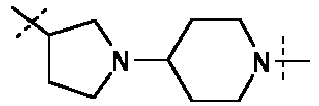 B est choisi indépendamment dans le groupe constitué par « hétéro-cyclyle, aryle, hétéroaryle », où « hétérocyclyle, aryle, hétéroaryle » peuvent être indépendamment substitués par un ou plusieurs substituants identiques ou différents choisis dans le groupe constitué par : « (i) « hydrogène, alkyle, (C9-C30)alkyle, cycloalkyle, cycloalkylalkyle, hétérocyclyle, hétérocyclylalkyle, aryle, arylalkyle, hétéroaryle, hétéroarylalkyle, halogène, -F, -Cl, -Br, -I, -CN, -CF3, -SF3, -N3, -NH2, -NHX1, -NX2X3, -NO2, -OH, =O, -OCF3, -SCF3, -OCHF2, -SCHF2, -SH, -O-SO3H, -OP(O)(OH)2, -CHO, -COOH, -C(O)NH2, -SO3H, -P(O)(OH)2, -C(O)-X4, -C(O)O-X5, -C(O)NH-X6, -C(O)NX7X8, -O-X9, -O(-X10-O)a-H (a = 1, 2, 3, 4, 5), -O(-X11-O)b-X12 (b = 1, 2, 3, 4, 5), -OC(O)-X13, -OC(O)-O-X14, -OC(O)-NHX15, -O-C(O)-NX16X17, -OP(O)(OX18)(OX19), -OSi(X20)(X21)(X22), -OS(O2)-X23, -NHC(O)-NH2, -NHC(O)-X24, -NX25C(O)-X26, -NH-C(O)-O-X27, -NH-C(O)-NH-X28, -NH-C(O)-NX29X30, -NX31-C(O)-O-X32, -NX33-C(O)-NH-X34, -NX35-C(O)-NX36X37, -NHS(O2)-X38, -NX39S(O2)-X40, -S-X41, -S(O)-X42, -S(O2)-X43, -S(O2)NH-X44, -S(O2)NX45X46, -S(O2)O-X47, -P(O)(OX48)(OX49), -Si(X50)(X51)(X52), -C(NH)-NH2, -C(NX53)-NH2, -C(NH)-NHX54, -C(NH)-NX55X56, -C(NX57)-NHX58, -C(NX59)-NX60X61, -NH-C(O)-NH-O-X62, -NH-C(O)-NX63-O-X64, -NX65-C(O)-NX66-O-X67, -N(-C(O)-NH-O-X68)2, -N(-C(O)-NX69-O-X70)2, -N(-C(O)-NH-O-X71)(-C(O)-NX72-O-X73), -C(S)-X74, -C(S)-O-X75, -C(S)-NH-X76, -C(S)-NX77X78, -C(O)-NH-O-X79, -C(O)-NX80-O-X81, -C(S)-NH-O-X82, -C(S)-NX83-O-X84, -C(O)-NH-NH-X85, -C(O)-NH-NX86X87, -C(O)-NX88-NX89X90, -C(S)-NH-NH-X91, -C(S)-NH-NX92X93, -C(S)-NX94-NX95X96, -C(O)-C(O)-O-X97, -C(O)-C(O)-NH2, -C(O)-C(O)-NHX98, -C(O)-C(O)-NX99X100, -C(S)-C(O)-O-X101, -C(O)-C(S)-O-X102, -C(S)-C(S)-O-X103, -C(S)-C(O)-NH2, -C(S)-C(O)-NHX104, -C(S)-C(O)-NX105X106, -C(S)-C(S)-NH2, -C(S)-C(S)-NHX107, -C(S)-C(S)-NX108X109, -C(O)-C(S)-NH2, -C(O)-C(S)-NHX110, -C(O)-C(S)-NX111X112" ;
où X1, X2, X3, X4, X5, X6, X7, X8, X9, X10, X11, X12, X13, X14, X15, X16, X17, X18, X19, X20, X21, X22, X23, X24, X25, X26, X27, X28, X29, X30, X31, X32, X33, X34, X35, X36, X37, X38, X39, X40, X41, X42, X43, X44, X45, X46, X47, X48, X49, X50, X51, X52, X53, X54, X55, X56, X57, X58, X59, X60, X61, X62, X63, X64, X65, X66, X67, X68, X69, X70, X71, X72, X73, X74, X75, X76, X77, X78, X79, X80, X81, X82, X83, X84, X85, X86, X87, X88, X89, X90, X91, X92, X93, X94, X95, X96, X97, X98, X99, X100, X101, X102, X103, X104, X105, X106, X107, X108, X109, X110, X111, X112 sont, indépendamment les uns des autres, choisis dans le groupe constitué par : « alkyle, (C9-C30)alkyle, cycloalkyle, cycloalkylalkyle, hétérocyclyle, hétérocyclylalkyle, aryle, arylalkyle, hétéroaryle, hétéroarylalkyle » et où, de manière alternative, X7, X8 et/ou X16, X17 et/ou X29, X30 et/ou X36, X37 et/ou X45, X46 et/ou X55, X56 et/ou X60, X61 et/ou X77, X78 et/ou X86, X87 et/ou X89, X90 et/ou X92, X93 et/ou X95, X96 et/ou X99, X100 et/ou X105, X106 et/ou X108, X109 et/ou X111, X112 respectivement ensemble peuvent également former « hétérocyclyle » ;
où éventuellement les substituants ci-dessus du groupe de substituants (i) peuvent à leur tour, indépendamment les uns des autres, être substitués par un ou plusieurs substituants V identiques ou différents ;R1, R2, R3, R4, R5, R5a, R8, R9, R10, R11, R12, R13, R14 sont, indépendamment les uns des autres, choisis dans le groupe constitué par: « V » ;V est choisi indépendamment dans le groupe constitué par: « (i) « hydrogène, alkyle, (C9-C30)alkyle, cycloalkyle, cycloalkylalkyle, hétérocyclyle, hétérocyclylalkyle, aryle, arylalkyle, hétéroaryle, hétéroarylalkyle, halogène, -F, -Cl, -Br, -l, -CN, -CF3, -SF3, -N3, -NH2, -NHA1, -NA2A3, -NO2, -OH, =O, -OCF3, -SCF3, -OCHF2, -SCHF2, -SH, -O-SO3H, -OP(O)(OH)2, -CHO, -COOH, -C(O)NH2, -SO3H, -P(O)(OH)2, -C(O)-A4, -C(O)O-A5, -C(O)NH-A6, -C(O)NA7A8, -O-A9, -O(-A10-O)a-H (a = 1, 2, 3, 4, 5), -O(-A11-O)b-A12 (b = 1, 2, 3, 4, 5), -OC(O)-A13, -OC(O)-O-A14, -OC(O)-NHA15, -O-C(O)-NA16A17, -OP(O)(OA18)(OA19), -OSi(A20)(A21)(A22), -OS(O2)-A23, -NHC(O)-NH2, -NHC(O)-A24, -NA25C(O)-A26, -NH-C(O)-O-A27, -NH-C(O)-NH-A28, -NH-C(O)-NA29A30, -NA31-C(O)-O-A32, -NA33-C(O)-NH-A34, -NA35-C(O)-NA36A37, -NHS(O2)-A38, -NA39S(O2)-A40, -S-A41, -S(O)-A42, -S(O2)-A43, -S(O2)NH-A44, -S(O2)NA45A46, -S(O2)O-A47, -P(O)(OA48)(OA49), -Si(A50)(A51 )(A52), -C(NH)-NH2, -C(NA53)-NH2, -C(NH)-NHA54, -C(NH)-NA55A56, -C(NA57)-NHA58, -C(NA59)-NA60A61, -NH-C(O)-NH-O-A62, -NH-C(O)-NA63-O-A64, -NA65-C(O)-NA66-O-A67, -N(-C(O)-NH-O-A68)2, -N(-C(O)-NA69-O-A70)2, -N(-C(O)-NH-O-A71)(-C(O)-NA72-O-A73), -C(S)-A74, -C(S)-O-A75, -C(S)-NH-A76, -C(S)-NA77A78, -C(O)-NH-O-A79, -C(O)-NA80-O-A81, -C(S)-NH-O-A82, -C(S)-NA83-O-A84, -C(O)-NH-NH-A85, -C(O)-NH-NA86A87, -C(O)-NA88-NA89A90, -C(S)-NH-NH-A91, -C(S)-NH-NA92A93, -C(S)-NA94-NA95A96, -C(O)-C(O)-O-A97, -C(O)-C(O)-NH2, -C(O)-C(O)-NHA98, -C(O)-C(O)-NA99A100, -C(S)-C(O)-O-A101, -C(O)-C(S)-O-A102, -C(S)-C(S)-O-A103, -C(S)-C(O)-NH2, -C(S)-C(O)-NHA104, -C(S)-C(O)-NA105A106, -C(S)-C(S)-NH2, -C(S)-C(S)-NHA107, -C(S)-C(S)-NA108A109, -C(O)-C(S)-NH2, -C(O)-C(S)-NHA110, -C(O)-C(S)-NA111A112" ; «
où A1, A2, A3, A4, A5, A6, A7, A8, A9, A10, A11, A12, A13, A14, A15, A16, A17, A18, A19, A20, A21, A22, A23, A24, A25, A26, A27, A28, A29, A30, A31, A32, A33, A34, A35, A36, A37, A38, A39, A40, A41, A42, A43, A44, A45, A46, A47, A48, A49, A50, A51, A52, A53, A54, A55, A56, A57, A58, A59, A60, A61, A62, A63, A64, A65, A66, A67, A68, A69, A70, A71, A72, A73, A74, A75, A76, A77, A78, A79, A80, A81, A82, A83, A84, A85, A86, A87, A88, A89, A90, A91, A92, A93, A94, A95, A96, A97, A98, A99, A100, A101, A102, A103, A104, A105, A106, A107, A108, A109, A110, A111, A112 sont, indépendamment les uns des autres, choisis dans le groupe constitué par : alkyle, (C9-C30)alkyle, cycloalkyle, cycloalkylalkyle, hétérocyclyle, hétérocyclylalkyle, aryle, arylalkyle, hétéroaryle, hétéroarylalkyle » et où, de manière alternative, A7, A8 et/ou A16, A17 et/ou A29, A30 et/ou A36, A37 et/ou A45, A46 et/ou A55, A56 et/ou A60, A61 et/ou A77, A78 et/ou A86, A87 et/ou A89, A90 et/ou A92, A93 et/ou A95, A96 et/ou A99, A100 et/ou A105, A106 et/ou A108, A109 et/ou A111, A112 respectivement ensemble peuvent également former « hétérocyclyle » ;
où éventuellement les substituants ci-dessus du groupe de substituants (i) peuvent à leur tour, indépendamment les uns des autres, être substitués par un ou plusieurs substituants V identiques ou différents ;m vaut 0 ;n vaut indépendamment 0, 1, 2, ou 3 ;o vaut 0 ;ainsi que les sels, solvates et stéréoisomères physiologiquement acceptables de celui-ci, y compris des mélanges de ceux-ci en toutes proportions. - Composé selon la formule (Ib)
 W1, W2 forment indépendamment ensemble « -N=N-, -C(O)-O » ;Y1 est choisi indépendamment dans le groupe constitué par « -N(R10)-C(O)-, -C(O)-N(R11)- » ;Y2 est choisi indépendamment dans le groupe constitué par « -C(R12)(R13)-, -O-, liaison simple » ;Z1 est choisi indépendamment dans le groupe constitué par « O » ;L est choisi indépendamment dans le groupe constitué par le groupe constitué par :
 B est choisi indépendamment dans le groupe constitué par « hétérocyclyle, aryle, hétéroaryle », où « hétérocyclyle, aryle, hétéroaryle » peuvent être indépendamment substitués par un ou plusieurs substituants identiques ou différents choisis dans le groupe constitué par : « (i) « hydrogène, alkyle, aryle, halogène, -F, -Cl, -Br, -l, -CN, -CF3 » ;
où éventuellement les substituants ci-dessus du groupe de substituants (i) peuvent à leur tour, indépendamment les uns des autres, être substitués par un ou plusieurs substituants V identiques ou différents ;R1, R2, R3, R4, R10, R11, R12, R13 sont, indépendamment les uns des autres, choisis dans le groupe constitué par: "V" ;V est choisi indépendamment dans le groupe constitué par: « (i) « hydrogène, alkyle, halogène, -F, -Cl, -Br, -I, -CN, -CF3 » ;n vaut indépendamment 0, 1 ou 2 ;ainsi que les sels, solvates et stéréoisomères physiologiquement acceptables de celui-ci, y compris des mélanges de ceux-ci en toutes proportions. - Composé selon les formules (Ia) et (Ib) selon l'une quelconque des revendications 1 à 2, dans lequel :




- Composé selon les formules (Ia) et (Ib) selon l'une quelconque des revendications 1 à 3, dans lequel :W1, W2 forment indépendamment ensemble « -N=N-, -C(O)-O- » ;Y1 est choisi indépendamment dans le groupe constitué par « -N(R10)-C(O)-, -C(O)-N(R11)- » ;Z1 est indépendamment « O » ;B est choisi indépendamment dans le groupe constitué par « 2-(4-chlorophényl)-4-méthyl-thiazol-5-yle, 2-(4-trifluorométhylphényl)-thiazol-5-yle, 2,3,5,6-tétrafluoro-4-trifluorométhylphényle, 2,3-difluoro-4-trifluorométhylphényle, 2,4-dichlorophényle, 2-chlorophényle, 2-fluoro-4-trifluorométhylphényle, 2-fluoro-5-trifluorométhylphényle, 3,4,5-trifluorophényle, 3,4-dichlorophényle, 3,4-difluoro-5-trifluorométhylphényle, 3,5-bis-trifluorométhylphényle, 3,5-dibromophényle, 3,5-dichloro-4-fluorophényle, 3,5-dichlorophényle, 3-bromo-5-chlorophényle, 3-bromo-5-fluorophényle, 3-chloro-4,5-difluorophényle, 3-chloro-4-fluorophényle, 3-chloro-4-trifluorométhylphényle, 3-chloro-5-fluorophényle, 3-chloro-5-trifluorométhylphényle, 3-chlorophényle, 3-fluoro-4-trifluorométhylphényle, 3-fluoro-5-trifluorométhylphényle, 3-trifluorométhylphényle, 4-(1,2,3-thiadiazol-4-yl)-phényle, 4-bromo-2,6-difluorophényle, 4-bromo-2-fluorophényle, 4-bromophényle, 4-chloro-2-fluorophényle, 4-chloro-3-fluorophényle, 4-chloro-3-trifluoro-méthylphényle, 4-chlorophényle, 4-cyanophényle, 4-fluoro-3-trifluoro-méthylphényle, 4-trifluorométhylphényle, 5-chloro-2-fluoro-3-trifluoro-méthylphényle, phényle, tétrahydrofuran-2-yle » ;R1, R2, R3, R4, R5, R5a, R10, R11, R12, R13, R14 sont, indépendamment les uns des autres, choisis dans le groupe constitué par: « hydrogène »m vaut 0 ;n vaut indépendamment 0, 1 ou 2 ;o vaut 0 ;ainsi que les sels, solvates et stéréoisomères physiologiquement acceptables de celui-ci, y compris des mélanges de ceux-ci en toutes proportions.
- Composé selon l'une quelconque des revendications 1 à 3, choisis dans le groupe constitué par :
Composé 2 
Acide 4-[4-(1H-benzotriazol-5-yl-carbamoyl)-2-oxopyrrolidin-1-yl]-pipéridine-1-carboxylique 4-chlorobenzylester Composé 3 
Acide 5-oxo-1-{1-[3-(4-trifluoro-méthylphényl)-propionyl]-pipéridin-4-yl}-pyrrolidine-3-carboxylique (1H-benzotriazol-5-yl)-amide Composé 4 
Acide 4-[4-(1H-benzotriazol-5-yl-carbamoyl)-2-oxopyrrolidin-1-yl]-pipéridine-1-carboxylique 3,5-dichlorobenzylester Composé 7 
Acide 4-{3-[(1H-benzotriazole-5-carbonyl)-amino]-pyrrolidin-1-yl}-pipéridine-1-carboxylique 4-chlorobenzylester Composé 8 
Acide 1 H-benzotriazole-5-carboxylique (1-{1-[3-(4-trifluoro-méthylphényl)-propionyl]-pipéridin-4-yl}-pyrrolidin-3-yl)-amide Composé 9 
Acide 4-{3-[(1H-benzotriazole-5-carbonyl)-amino]-pyrrolidin-1-yl}-pipéridine-1-carboxylique 3,5-dich lorobenzylester Composé 15 
Acide 4-[2-oxo-4-(2-oxo-2,3-dihydrobenzooxazol-6-yl-carbamoyl)-pyrrolidin-1-yl]-pipéridine-1-carboxylique 3,5-dich lorobenzylester Composé 16 
Acide 4-[2-oxo-4-(2-oxo-2,3-dihydrobenzooxazol-6-yl-carbamoyl)-pyrrolidin-1-yl]-pipéridine-1-carboxylique 4-chlorobenzylester Composé 17 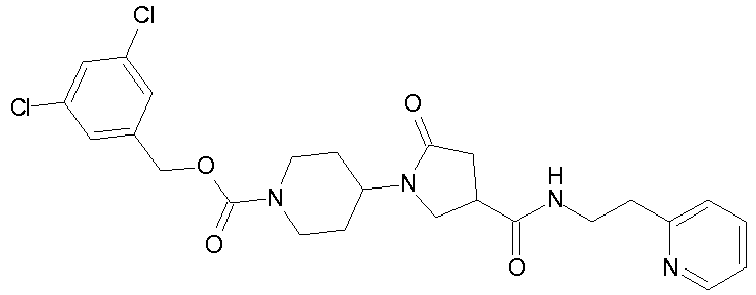
Acide 4-[2-oxo-4-(2-pyridin-2-yl-éthylcarbamoyl)-pyrrolidin-1-yl]-pipéridine-1-carboxylique 3,5-dich lorobenzylester Composé 24 
Acide 1-{1-[4-méthyl-2-(4-trifluorométhylphényl)-thiazole-5-carbonyl]-pipéridin-4-yl}-5-oxopyrrolidine-3-carboxylique (1 H-benzotriazol-5-yl)-amide Composé 27 
Acide 4-[4-(1H-benzotriazol-5-yl-carbamoyl)-2-oxopyrrolidin-1-yl]-pipéridine-1-carboxylique tétrahydro-furan-2-ylméthylester Composé 28 
Acide 4-[2-oxo-4-(2-pyridin-4-yl-éthylcarbamoyl)-pyrrolidin-1-yl]-pipéridine-1-carboxylique 3,5-dich lorobenzylester Composé 30 
Acide 4-[2-oxo-4-(2-pyridin-3-yl-éthylcarbamoyl)-pyrrolidin-1-yl]-pipéridine-1-carboxylique 3,5-dich lorobenzylester Composé 53 
Acide 4-{4-[2-(1H-imidazol-4-yl)-éthylcarbamoyl]-2-oxopyrrolidin-1-yl}-pipéridine-1-carboxylique 3,5-dich lorobenzylester Composé 54 
Acide 4-[2-oxo-4-(4-[1,2,4]triazol-1-ylphénylcarbamoyl)-pyrrolidin-1-yl]-pipéridine-1-carboxylique 3,5-dichlorobenzylester Composé 55 
Acide 4-[2-oxo-4-(4-pyrazol-1-yl-phénylcarbamoyl)-pyrrolidin-1-yl]-pipéridine-1-carboxylique 3,5-dichlorobenzylester Composé 56 
Acide 4-{4-[4-(3-méthyl-5-oxo-4, 5-dihydropyrazol-1-yl)-phényl-carbamoyl]-2-oxopyrrolidin-1-yl}-pipéridine-1-carboxylique 3,5-dichlorobenzylester Composé 57 
Acide 4-[2-oxo-4-(4-[1,2,3]-thiadiazol-4-ylphénylcarbamoyl)-pyrrolidin-1-yl]-pipéridine-1-carboxylique 3,5-dichloro-benzylester - Procédé de préparation d'un composé selon les formules (Ia) ou (Ib) selon l'une quelconque des revendications 1 à 5, comprenant les étapes :(a) de réaction d'un composé de formule (III),


ou(b) de réaction d'un composé de formule (VII)

ou(c) de leur libération depuis l'un de leurs dérivés fonctionnels (par exemple ayant des groupements de protection) en les traitant par un agent acide, basique, de solvolyse ou d'hydrogénolyse ;
et/ou de conversion d'une base ou d'un acide d'un composé répondant aux formules (Ia) ou (Ib) en l'un de ses sels. - Médicament comprenant au moins un composé selon l'une quelconque des revendications 1 à 5.
- Médicament comprenant au moins un composé selon l'une quelconque des revendications 1 à 5, pour une utilisation dans le traitement et/ou la prophylaxie de conditions physiologiques et/ou physiopathologiques, qui sont provoquées, médiées et/ou propagées par des taux accrus en acide lysophosphatidique et/ou l'activation de l'autotaxine.
- Médicament comprenant au moins un composé selon l'une quelconque des revendications 1 à 5, pour une utilisation dans le traitement et/ou la prophylaxie de conditions physiologiques et/ou physiopathologiques choisies dans le groupe constitué par: « le cancer, les tumeurs, les tumeurs malignes, les tumeurs bénignes, les tumeurs solides, les sarcomes, les carcinomes, les troubles hyperprolifératifs, les carcinoïdes, les sarcomes d'Ewing, les sarcomes de Kaposi, les tumeurs du cerveau, les tumeurs ayant pour origine le cerveau et/ou le système nerveux et/ou les méninges, les gliomes, les glioblastomes, les neuroblastomes, le cancer de l'estomac, le cancer du rein, les carcinomes des cellules rénales, le cancer de la prostate, les carcinomes de la prostate, les tumeurs du tissu conjonctif, les sarcomes des tissus mous, les tumeurs du pancréas, les tumeurs du foie, les tumeurs de la tête, les tumeurs du cou, le cancer du larynx, le cancer de l'œsophage, le cancer de la thyroïde, les ostéosarcomes, les rétinoblastomes, le thymome, le cancer des testicules, le cancer du poumon, l'adénocarcinome du poumon, le carcinome du poumon à petites cellules, les carcinomes bronchiaux, le cancer du sein, les carcinomes mammaires, le cancer intestinal, les tumeurs colorectales, les carcinomes du côlon, les carcinomes du rectum, les tumeurs gynécologiques, les tumeurs des ovaires/tumeurs ovariennes, le cancer de l'utérus, le cancer du col de l'utérus, les carcinomes du col de l'utérus, le cancer du corps utérin, les carcinomes du corps utérin, les carcinomes de l'endomètre, le cancer de la vessie urinaire, le cancer du tractus urogénital, le cancer de la vessie, le cancer de la peau, les tumeurs épithéliales, le carcinome épithélial squameux, les basaliomes, les spinaliomes, les mélanomes, les mélanomes intraoculaires, les leucémies, la leucémie monocytaire, les leucémies chroniques, la leucémie myéloïde chronique, la leucémie lymphoïde chronique, les leucémies aiguës, la leucémie myéloïde aiguë, la leucémie lymphoïde aiguë, les lymphomes, l'angiogenèse, l'artériosclérose, les maladies ophtalmiques, la néo-vascularisation choroïdienne, la rétinopathie diabétique, les maladies inflammatoires, l'arthrite, la neurodégénérescence, la resténose, la guérison de plaies et/ou le rejet de greffe ».
- Médicament selon l'une quelconque des revendications 7 à 9, caractérisé en ce qu'un tel médicament comprend au moins une substance pharmacologiquement active supplémentaire.
- Médicament selon l'une quelconque des revendications 7 à 9, caractérisé en ce que le médicament est appliqué avant et/ou pendant et/ou après un traitement par au moins une substance pharmacologiquement active supplémentaire.
- Composition pharmaceutique comprenant une quantité thérapeutiquement efficace d'au moins un composé selon l'une quelconque des revendications 1 à 5.
- Composition pharmaceutique selon la revendication 12, comprenant en outre au moins un composé supplémentaire choisi dans le groupe constitué par les excipients, auxiliaires, adjuvants, diluants, véhicules physiologiquement acceptables et/ou une substance pharmaceutiquement active supplémentaire autre que le composé selon l'une quelconque des revendications 1 à 5.
- Kit comprenant une quantité thérapeutiquement efficace d'au moins un composé selon l'une quelconque des revendications 1 à 5 et/ou d'au moins une composition pharmaceutique selon l'une quelconque des revendications 12 à 13 et une quantité thérapeutiquement efficace d'au moins une substance pharmacologiquement active supplémentaire autre que le composé selon l'une quelconque des revendications 1 à 5.
Applications Claiming Priority (3)
| Application Number | Priority Date | Filing Date | Title |
|---|---|---|---|
| EP09004856 | 2009-04-02 | ||
| EP10707470.0A EP2414330B1 (fr) | 2009-04-02 | 2010-03-03 | Dérivés de pipéridine et de pyrazine comme inhibiteurs de l'autotaxine |
| PCT/EP2010/001323 WO2010115491A2 (fr) | 2009-04-02 | 2010-03-03 | Dérivés de pipéridine et de pyrazine comme inhibiteurs de l'autotaxine |
Related Parent Applications (2)
| Application Number | Title | Priority Date | Filing Date |
|---|---|---|---|
| EP10707470.0 Division | 2010-03-03 | ||
| EP10707470.0A Division EP2414330B1 (fr) | 2009-04-02 | 2010-03-03 | Dérivés de pipéridine et de pyrazine comme inhibiteurs de l'autotaxine |
Publications (2)
| Publication Number | Publication Date |
|---|---|
| EP2623101A1 EP2623101A1 (fr) | 2013-08-07 |
| EP2623101B1 true EP2623101B1 (fr) | 2021-04-21 |
Family
ID=42359429
Family Applications (4)
| Application Number | Title | Priority Date | Filing Date |
|---|---|---|---|
| EP13002080.3A Active EP2623101B1 (fr) | 2009-04-02 | 2010-03-03 | Dérivés de pipéridine et de pipérazine en tant qu'inhibiteurs de l'autotaxine |
| EP10707470.0A Active EP2414330B1 (fr) | 2009-04-02 | 2010-03-03 | Dérivés de pipéridine et de pyrazine comme inhibiteurs de l'autotaxine |
| EP13002078.7A Withdrawn EP2623491A3 (fr) | 2009-04-02 | 2010-03-03 | Dérivés pipéridines et pipérazines comme inhibiteurs de l'autotaxine |
| EP13002079.5A Active EP2626072B1 (fr) | 2009-04-02 | 2010-03-03 | Dérivés de pipéridine et de pipérazine en tant qu'inhibiteurs de l'autotaxine |
Family Applications After (3)
| Application Number | Title | Priority Date | Filing Date |
|---|---|---|---|
| EP10707470.0A Active EP2414330B1 (fr) | 2009-04-02 | 2010-03-03 | Dérivés de pipéridine et de pyrazine comme inhibiteurs de l'autotaxine |
| EP13002078.7A Withdrawn EP2623491A3 (fr) | 2009-04-02 | 2010-03-03 | Dérivés pipéridines et pipérazines comme inhibiteurs de l'autotaxine |
| EP13002079.5A Active EP2626072B1 (fr) | 2009-04-02 | 2010-03-03 | Dérivés de pipéridine et de pipérazine en tant qu'inhibiteurs de l'autotaxine |
Country Status (16)
| Country | Link |
|---|---|
| US (2) | US8822476B2 (fr) |
| EP (4) | EP2623101B1 (fr) |
| JP (2) | JP5591318B2 (fr) |
| KR (1) | KR20120027177A (fr) |
| CN (1) | CN102369186B (fr) |
| AR (1) | AR076005A1 (fr) |
| AU (1) | AU2010234087B2 (fr) |
| BR (1) | BRPI1012679A2 (fr) |
| CA (1) | CA2757368C (fr) |
| EA (1) | EA201101400A1 (fr) |
| ES (3) | ES2422718T3 (fr) |
| IL (1) | IL215260A (fr) |
| MX (1) | MX2011010203A (fr) |
| SG (1) | SG174928A1 (fr) |
| WO (1) | WO2010115491A2 (fr) |
| ZA (1) | ZA201107985B (fr) |
Families Citing this family (53)
| Publication number | Priority date | Publication date | Assignee | Title |
|---|---|---|---|---|
| EP2623101B1 (fr) * | 2009-04-02 | 2021-04-21 | Merck Patent GmbH | Dérivés de pipéridine et de pipérazine en tant qu'inhibiteurs de l'autotaxine |
| CA2794153C (fr) | 2010-03-25 | 2018-01-02 | Glaxosmithkline Llc | Derives d'indoline substitue comme inhibiteurs de perk |
| BR112012032082B1 (pt) | 2010-06-30 | 2019-11-26 | Avon Products, Inc. | Composição e método cosmético para melhorar a aparência estética da pele humana |
| US8815265B2 (en) | 2010-06-30 | 2014-08-26 | Avon Products, Inc. | Cosmetic use of N-substituted sulfonyloxybenzylamines and related compounds |
| WO2012083178A1 (fr) | 2010-12-17 | 2012-06-21 | Neo Oncology Inc. | Procédés et dispositifs pour l'utilisation d'alcool isoperillylique |
| US20160038600A1 (en) | 2012-08-03 | 2016-02-11 | Neonc Technologies Inc. | Pharmaceutical compositions comprising poh derivatives |
| CN103260703A (zh) * | 2010-10-22 | 2013-08-21 | 詹森药业有限公司 | 作为单酰甘油脂肪酶抑制剂的哌啶-4-基-氮杂环丁烷二酰胺 |
| AU2012314943B9 (en) * | 2011-09-26 | 2017-06-08 | Merck Patent Gmbh | Benzyl piperidine compounds as lysophosphatidic acid (LPA) receptor antagonist |
| WO2013070879A1 (fr) | 2011-11-10 | 2013-05-16 | Bristol-Myers Squibb Company | Méthodes de traitement de lésion de la moelle épinière par des antagonistes du récepteur du lpa |
| TWI633087B (zh) | 2012-06-13 | 2018-08-21 | 赫孚孟拉羅股份公司 | 新穎二氮雜螺環烷及氮雜螺環烷 |
| EP3590940B1 (fr) | 2012-09-25 | 2021-06-09 | F. Hoffmann-La Roche AG | Dérivés du héxahydropyrrolo[3,4-c]pyrrole et composés similaires en tant qu'inhibiteurs de l'autotaxine (atx) et inhibiteurs de la production de l'acid lysophosphatidique (lpa) pour traiter des maladies rénales |
| EP2935249B1 (fr) | 2012-12-19 | 2018-12-12 | Novartis AG | Inhibiteurs d'autotaxine |
| US9409895B2 (en) | 2012-12-19 | 2016-08-09 | Novartis Ag | Autotaxin inhibitors |
| JPWO2014133112A1 (ja) * | 2013-03-01 | 2017-02-02 | 国立大学法人 東京大学 | オートタキシン阻害活性を有する8−置換イミダゾピリミジノン誘導体 |
| AR095079A1 (es) * | 2013-03-12 | 2015-09-16 | Hoffmann La Roche | Derivados de octahidro-pirrolo[3,4-c]-pirrol y piridina-fenilo |
| PT3022202T (pt) | 2013-07-18 | 2019-09-03 | Novartis Ag | Inibidores da autotaxina compreendendo um núcleo beteroaromático anel-benzilo-amida-ciclo |
| US9714240B2 (en) | 2013-09-17 | 2017-07-25 | Pharmakea, Inc. | Vinyl autotaxin inhibitor compounds |
| US9951026B2 (en) | 2013-09-17 | 2018-04-24 | Pharmakea, Inc. | Heterocyclic vinyl autotaxin inhibitor compounds |
| EP3049405A4 (fr) | 2013-09-26 | 2017-03-08 | Pharmakea Inc. | Composés inhibiteurs de l'autotaxine |
| CA2930735A1 (fr) | 2013-11-22 | 2015-05-28 | Sabre Therapeutics Llc | Inhibiteurs d'autotaxine tetracyclique |
| KR102367876B1 (ko) | 2013-11-22 | 2022-02-24 | 사브레 테라퓨틱스 엘엘씨 | 오토탁신 억제제 화합물 |
| NO3074400T3 (fr) | 2013-11-26 | 2018-04-14 | ||
| EP3122751B1 (fr) | 2014-03-26 | 2019-10-30 | F.Hoffmann-La Roche Ag | Composés condensés de [1,4]diazépine en tant qu'inhibiteurs d'autotaxine (atx) et de production d'acide lysophosphatidique (lpa) |
| MA39792B1 (fr) * | 2014-03-26 | 2019-12-31 | Hoffmann La Roche | Composés bicycliques en tant qu'inhibiteurs de production d'autotaxine (atx) et d'acide lysophosphatidique (lpa) |
| CR20160496A (es) | 2014-04-04 | 2017-01-02 | X-Rx Inc | Inhibidores espirocíclicos sustituidos de la autotaxina |
| US20170037030A1 (en) | 2014-04-24 | 2017-02-09 | Novartis Ag | Autotaxin inhibitors |
| US9051320B1 (en) | 2014-08-18 | 2015-06-09 | Pharmakea, Inc. | Methods for the treatment of metabolic disorders by a selective small molecule autotaxin inhibitor |
| GB201501870D0 (en) | 2015-02-04 | 2015-03-18 | Cancer Rec Tech Ltd | Autotaxin inhibitors |
| GB201502020D0 (en) | 2015-02-06 | 2015-03-25 | Cancer Rec Tech Ltd | Autotaxin inhibitory compounds |
| MA41898A (fr) | 2015-04-10 | 2018-02-13 | Hoffmann La Roche | Dérivés de quinazolinone bicyclique |
| UY36630A (es) | 2015-04-17 | 2016-11-30 | Abbvie Inc | Moduladores tricíclicos de la señalización por tnf |
| US9879016B2 (en) | 2015-04-17 | 2018-01-30 | Abbvie Inc. | Indazolones as modulators of TNF signaling |
| WO2016168633A1 (fr) | 2015-04-17 | 2016-10-20 | Abbvie Inc. | Indazolones utilisées en tant que modulateurs de la signalisation du tnf |
| EA036337B1 (ru) * | 2015-05-27 | 2020-10-28 | Сабре Терапьютикс Ллс | Ингибиторы аутотаксина и их применения |
| CA2988306A1 (fr) | 2015-06-05 | 2016-12-08 | Vertex Pharmaceuticals Incorporated | Triazoles pour le traitement de maladies liees a la demyelinisation |
| MX387736B (es) | 2015-09-04 | 2025-03-18 | Hoffmann La Roche | Derivados de fenoximetilo. |
| PE20180451A1 (es) | 2015-09-24 | 2018-03-05 | Hoffmann La Roche | Nuevos compuestos biciclicos como inhibidores de atx |
| KR20180054634A (ko) | 2015-09-24 | 2018-05-24 | 에프. 호프만-라 로슈 아게 | 이중 오토탁신(atx)/탄산 무수화효소(ca) 억제제로서 신규한 이환형 화합물 |
| MX2017015034A (es) | 2015-09-24 | 2018-04-13 | Hoffmann La Roche | Nuevos compuestos biciclicos como inhibidores duales de autotaxina (atx)/anhidrasa carbonica (ca). |
| CN107635995B (zh) | 2015-09-24 | 2022-08-19 | 豪夫迈·罗氏有限公司 | 作为atx抑制剂的二环化合物 |
| JOP20190024A1 (ar) | 2016-08-26 | 2019-02-19 | Gilead Sciences Inc | مركبات بيروليزين بها استبدال واستخداماتها |
| WO2018106643A1 (fr) | 2016-12-06 | 2018-06-14 | Vertex Pharmaceuticals Incorporated | Azoles hétérocycliques pour le traitement de maladies de démyélinisation |
| WO2018106646A1 (fr) | 2016-12-06 | 2018-06-14 | Vertex Pharmaceuticals Incorporated | Aminotriazoles pour traiter des maladies démyélinisantes |
| WO2018106641A1 (fr) | 2016-12-06 | 2018-06-14 | Vertex Pharmaceuticals Incorporated | Pyrazoles pour le traitement de maladies démyélinisantes |
| CN110382484B (zh) | 2017-03-16 | 2022-12-06 | 豪夫迈·罗氏有限公司 | 新的作为atx抑制剂的二环化合物 |
| MA49879A (fr) | 2017-03-16 | 2020-06-24 | Hoffmann La Roche | Composés hétérocycliques utiles en tant qu'inhibiteurs doubles d'atx/ca |
| KR101798840B1 (ko) | 2017-05-17 | 2017-11-17 | 주식회사 레고켐 바이오사이언스 | 신규 오토탁신 저해 화합물 및 이를 함유하는 약제학적 조성물 |
| US10961242B2 (en) | 2017-05-17 | 2021-03-30 | Legochem Biosciences, Inc. | Compounds as autotaxin inhibitors and pharmaceutical compositions comprising the same |
| JP2021501785A (ja) | 2017-11-02 | 2021-01-21 | カリコ ライフ サイエンシーズ エルエルシー | 統合的ストレス経路の調節剤 |
| KR102526964B1 (ko) | 2018-02-26 | 2023-04-28 | 길리애드 사이언시즈, 인코포레이티드 | Hbv 복제 억제제로서의 치환된 피롤리진 화합물 |
| CN115867547B (zh) * | 2020-08-27 | 2024-12-20 | 上海和誉生物医药科技有限公司 | 一种1h-吡唑-4-酰胺衍生物,其制备方法和应用 |
| MX2023013961A (es) | 2021-10-01 | 2023-12-11 | Nextgen Bioscience Co Ltd | Nuevos derivados de la piperidina y composiciones farmaceuticas que los contienen, para inhibir la autotaxina. |
| KR102502940B1 (ko) * | 2021-11-30 | 2023-02-24 | 주식회사 넥스트젠바이오사이언스 | 오토탁신 저해제로서의 신규 화합물 및 이의 용도 |
Family Cites Families (34)
| Publication number | Priority date | Publication date | Assignee | Title |
|---|---|---|---|---|
| DE19608653A1 (de) * | 1996-03-06 | 1997-09-11 | Thomae Gmbh Dr K | Pyrimido[5,4-d]pyrimidine, diese Verbindungen enthaltende Arzneimittel, deren Verwendung und Verfahren zu ihrer Herstellung |
| JP4166296B2 (ja) * | 1997-04-25 | 2008-10-15 | 塩野義製薬株式会社 | ドーパミン受容体拮抗作用を有する化合物 |
| GB9904387D0 (en) | 1999-02-25 | 1999-04-21 | Pharmacia & Upjohn Spa | Antitumour synergistic composition |
| AU4972900A (en) | 1999-04-08 | 2000-11-14 | Arch Development Corporation | Use of anti-vegf antibody to enhance radiation in cancer therapy |
| AR033517A1 (es) | 2000-04-08 | 2003-12-26 | Astrazeneca Ab | Derivados de piperidina, proceso para su preparacion y uso de estos derivados en la fabricacion de medicamentos |
| US6710058B2 (en) | 2000-11-06 | 2004-03-23 | Bristol-Myers Squibb Pharma Company | Monocyclic or bicyclic carbocycles and heterocycles as factor Xa inhibitors |
| GB0107907D0 (en) | 2001-03-29 | 2001-05-23 | Smithkline Beecham Plc | Novel compounds |
| US20030139431A1 (en) | 2001-09-24 | 2003-07-24 | Kawakami Joel K. | Guanidines which are agonist/antagonist ligands for neuropeptide FF (NPFF) receptors |
| WO2003097855A2 (fr) | 2002-05-14 | 2003-11-27 | Baylor College Of Medicine | Petites molecules inhibitrices de l'expression du gene her2 |
| WO2003097615A1 (fr) | 2002-05-17 | 2003-11-27 | Scios, Inc. | Traitement de troubles de fibro-proliferation au moyen d'inhibiteur de tgf-$g(b) |
| DE10228103A1 (de) | 2002-06-24 | 2004-01-15 | Bayer Cropscience Ag | Fungizide Wirkstoffkombinationen |
| AU2003256297A1 (en) * | 2002-08-09 | 2004-02-25 | Eli Lilly And Company | Benzimidazoles and benzothiazoles as inhibitors of map kinase |
| WO2004052862A1 (fr) * | 2002-12-10 | 2004-06-24 | Ono Pharmaceutical Co., Ltd. | Composes heterocycliques contenant de l'azote et leur utilisation medicale |
| AU2003293555A1 (en) | 2002-12-17 | 2004-07-29 | Schering Corporation | 17 beta-hydroxysteroid dehydrogenase type 3 inhibitors for the treatment of androgen dependent diseases |
| AR042956A1 (es) * | 2003-01-31 | 2005-07-13 | Vertex Pharma | Inhibidores de girasa y usos de los mismos |
| WO2004080966A1 (fr) * | 2003-03-14 | 2004-09-23 | Ono Pharmaceutical Co., Ltd. | Derives heterocycliques renfermant de l'azote et medicaments contenant ces derives comme principe actif |
| RU2006100190A (ru) * | 2003-06-13 | 2006-08-10 | Шеринг Акциенгезельшафт (De) | Производные хинолиламида в качестве антагонистов ccr-5 |
| US7563748B2 (en) | 2003-06-23 | 2009-07-21 | Cognis Ip Management Gmbh | Alcohol alkoxylate carriers for pesticide active ingredients |
| JO2525B1 (en) | 2004-04-08 | 2010-03-17 | شركة جانسين فارماسوتيكا ان. في | Derived 4-alkyl-and-4-canoelperidine derivatives and their use as anti-neroquin |
| RU2346996C2 (ru) | 2004-06-29 | 2009-02-20 | ЮРОПИЭН НИКЕЛЬ ПиЭлСи | Усовершенствованное выщелачивание основных металлов |
| JP2008537953A (ja) * | 2005-04-15 | 2008-10-02 | エラン ファーマシューティカルズ,インコーポレイテッド | ブラジキニンb1受容体拮抗作用に有用な新規化合物 |
| EP1895898B1 (fr) | 2005-06-29 | 2011-02-16 | Compumedics Limited | Ensemble capteur a pont conducteur |
| DE102005050892A1 (de) * | 2005-10-21 | 2007-04-26 | Boehringer Ingelheim Pharma Gmbh & Co. Kg | Ausgewählte CGRP-Antagonisten, Verfahren zu deren Herstellung sowie deren Verwendung als Arzneimittel |
| EP1984331B1 (fr) * | 2006-02-16 | 2010-10-20 | Schering Corporation | Dérivés de pyrrolidine comme inhibiteurs de la erk |
| AU2007227425A1 (en) | 2006-03-21 | 2007-09-27 | Pharmacopeia, Inc. | Heterocyclic substituted pyridine compounds with CXCR3 antagonist activity |
| WO2007115805A2 (fr) * | 2006-04-05 | 2007-10-18 | European Molecular Biology Laboratory (Embl) | Inhibiteurs de la kinase aurora |
| TW200801513A (en) | 2006-06-29 | 2008-01-01 | Fermiscan Australia Pty Ltd | Improved process |
| US7902199B2 (en) | 2006-07-14 | 2011-03-08 | Schering Corporation | Heterocyclic substituted piperazine compounds with CXCR3 antagonist activity |
| CN101534824A (zh) | 2006-11-17 | 2009-09-16 | 艾博特公司 | 作为化学活素受体拮抗剂的氨基吡咯烷 |
| WO2009063244A1 (fr) * | 2007-11-15 | 2009-05-22 | Istituto Di Ricerche Di Biologia Molecolare P. Angeletti S.P.A. | Derivés de pyridazinone inhibiteurs de la parp |
| CN102202523A (zh) * | 2008-08-26 | 2011-09-28 | 梅里桑特公司 | 包含莱鲍迪甙a、赤藓糖醇、二糖碳水化合物或果糖以及口味改善量的纤维素的甜味剂组合物及其制造方法 |
| TW201038572A (en) | 2009-03-25 | 2010-11-01 | Gruenenthal Gmbh | Substituted spiro-amide compounds |
| JP5767205B2 (ja) * | 2009-04-02 | 2015-08-19 | メルク パテント ゲゼルシャフト ミット ベシュレンクテル ハフツングMerck Patent Gesellschaft mit beschraenkter Haftung | オートタキシン阻害剤としての複素環式化合物 |
| EP2623101B1 (fr) * | 2009-04-02 | 2021-04-21 | Merck Patent GmbH | Dérivés de pipéridine et de pipérazine en tant qu'inhibiteurs de l'autotaxine |
-
2010
- 2010-03-03 EP EP13002080.3A patent/EP2623101B1/fr active Active
- 2010-03-03 US US13/258,068 patent/US8822476B2/en active Active
- 2010-03-03 ES ES10707470T patent/ES2422718T3/es active Active
- 2010-03-03 WO PCT/EP2010/001323 patent/WO2010115491A2/fr not_active Ceased
- 2010-03-03 EP EP10707470.0A patent/EP2414330B1/fr active Active
- 2010-03-03 CA CA2757368A patent/CA2757368C/fr active Active
- 2010-03-03 EP EP13002078.7A patent/EP2623491A3/fr not_active Withdrawn
- 2010-03-03 BR BRPI1012679A patent/BRPI1012679A2/pt not_active Application Discontinuation
- 2010-03-03 ES ES13002079T patent/ES2775000T3/es active Active
- 2010-03-03 EP EP13002079.5A patent/EP2626072B1/fr active Active
- 2010-03-03 KR KR1020117025495A patent/KR20120027177A/ko not_active Withdrawn
- 2010-03-03 ES ES13002080T patent/ES2880623T3/es active Active
- 2010-03-03 JP JP2012502477A patent/JP5591318B2/ja not_active Expired - Fee Related
- 2010-03-03 MX MX2011010203A patent/MX2011010203A/es not_active Application Discontinuation
- 2010-03-03 EA EA201101400A patent/EA201101400A1/ru unknown
- 2010-03-03 SG SG2011069879A patent/SG174928A1/en unknown
- 2010-03-03 AU AU2010234087A patent/AU2010234087B2/en not_active Ceased
- 2010-03-03 CN CN201080015570.8A patent/CN102369186B/zh not_active Expired - Fee Related
- 2010-03-31 AR ARP100101047A patent/AR076005A1/es unknown
-
2011
- 2011-09-20 IL IL215260A patent/IL215260A/en active IP Right Grant
- 2011-11-01 ZA ZA2011/07985A patent/ZA201107985B/en unknown
-
2014
- 2014-07-29 JP JP2014153400A patent/JP5965947B2/ja not_active Expired - Fee Related
- 2014-07-30 US US14/446,484 patent/US9452997B2/en not_active Expired - Fee Related
Non-Patent Citations (1)
| Title |
|---|
| None * |
Also Published As
Similar Documents
| Publication | Publication Date | Title |
|---|---|---|
| EP2626072B1 (fr) | Dérivés de pipéridine et de pipérazine en tant qu'inhibiteurs de l'autotaxine | |
| EP2414346B1 (fr) | Inhibiteurs de l'autotaxine | |
| EP2352732B1 (fr) | PYRIDO[4,3-d]PYRIMIDINES 2,5-DIAMINO-SUBSTITUÉES EN TANT QU'INHIBITEURS D'AUTOTAXINE CONTRE LE CANCER | |
| EP2373640B1 (fr) | Nouvelles formes polymorphes de sel chlorhydrate de 3-(1-{3-ý5-(1-méthyl-pipéridin-4ylméthoxy)-pyrimidin-2-yl¨-benzyl}-6-oxo-1,6-dihydro-pyridazin-3-yl)-benzonitrile et leurs procédés de fabrication | |
| AU2012224979A1 (en) | Pyrido [2, 3 - b] pyrazine derivatives and their therapeutical uses | |
| EP2361250B1 (fr) | Nouveaux polymorphes de dihydrogénophosphate de 6-(1-méthyl-1h-pyrazol-4-yl)-2-{3-[5-(2-morpholin-4-yl-éthoxy)-pyrimidin-2-yl]-benzyl}-2h-pyridazin-3-one et procédés de préparation associés |
Legal Events
| Date | Code | Title | Description |
|---|---|---|---|
| PUAI | Public reference made under article 153(3) epc to a published international application that has entered the european phase |
Free format text: ORIGINAL CODE: 0009012 |
|
| 17P | Request for examination filed |
Effective date: 20130419 |
|
| AC | Divisional application: reference to earlier application |
Ref document number: 2414330 Country of ref document: EP Kind code of ref document: P |
|
| AK | Designated contracting states |
Kind code of ref document: A1 Designated state(s): AT BE BG CH CY CZ DE DK EE ES FI FR GB GR HR HU IE IS IT LI LT LU LV MC MK MT NL NO PL PT RO SE SI SK SM TR |
|
| RIN1 | Information on inventor provided before grant (corrected) |
Inventor name: STAEHLE, WOLFGANG Inventor name: SCHIEMANN, KAI Inventor name: SCHULTZ, MELANIE |
|
| STAA | Information on the status of an ep patent application or granted ep patent |
Free format text: STATUS: EXAMINATION IS IN PROGRESS |
|
| 17Q | First examination report despatched |
Effective date: 20170306 |
|
| GRAP | Despatch of communication of intention to grant a patent |
Free format text: ORIGINAL CODE: EPIDOSNIGR1 |
|
| STAA | Information on the status of an ep patent application or granted ep patent |
Free format text: STATUS: GRANT OF PATENT IS INTENDED |
|
| INTG | Intention to grant announced |
Effective date: 20190829 |
|
| GRAS | Grant fee paid |
Free format text: ORIGINAL CODE: EPIDOSNIGR3 |
|
| GRAA | (expected) grant |
Free format text: ORIGINAL CODE: 0009210 |
|
| STAA | Information on the status of an ep patent application or granted ep patent |
Free format text: STATUS: THE PATENT HAS BEEN GRANTED |
|
| AC | Divisional application: reference to earlier application |
Ref document number: 2414330 Country of ref document: EP Kind code of ref document: P |
|
| AK | Designated contracting states |
Kind code of ref document: B1 Designated state(s): AT BE BG CH CY CZ DE DK EE ES FI FR GB GR HR HU IE IS IT LI LT LU LV MC MK MT NL NO PL PT RO SE SI SK SM TR |
|
| REG | Reference to a national code |
Ref country code: GB Ref legal event code: FG4D |
|
| REG | Reference to a national code |
Ref country code: CH Ref legal event code: EP |
|
| REG | Reference to a national code |
Ref country code: DE Ref legal event code: R096 Ref document number: 602010066854 Country of ref document: DE Ref country code: IE Ref legal event code: FG4D |
|
| REG | Reference to a national code |
Ref country code: AT Ref legal event code: REF Ref document number: 1383907 Country of ref document: AT Kind code of ref document: T Effective date: 20210515 |
|
| REG | Reference to a national code |
Ref country code: LT Ref legal event code: MG9D |
|
| REG | Reference to a national code |
Ref country code: AT Ref legal event code: MK05 Ref document number: 1383907 Country of ref document: AT Kind code of ref document: T Effective date: 20210421 |
|
| REG | Reference to a national code |
Ref country code: NL Ref legal event code: MP Effective date: 20210421 |
|
| PG25 | Lapsed in a contracting state [announced via postgrant information from national office to epo] |
Ref country code: LT Free format text: LAPSE BECAUSE OF FAILURE TO SUBMIT A TRANSLATION OF THE DESCRIPTION OR TO PAY THE FEE WITHIN THE PRESCRIBED TIME-LIMIT Effective date: 20210421 Ref country code: NL Free format text: LAPSE BECAUSE OF FAILURE TO SUBMIT A TRANSLATION OF THE DESCRIPTION OR TO PAY THE FEE WITHIN THE PRESCRIBED TIME-LIMIT Effective date: 20210421 Ref country code: FI Free format text: LAPSE BECAUSE OF FAILURE TO SUBMIT A TRANSLATION OF THE DESCRIPTION OR TO PAY THE FEE WITHIN THE PRESCRIBED TIME-LIMIT Effective date: 20210421 Ref country code: BG Free format text: LAPSE BECAUSE OF FAILURE TO SUBMIT A TRANSLATION OF THE DESCRIPTION OR TO PAY THE FEE WITHIN THE PRESCRIBED TIME-LIMIT Effective date: 20210721 Ref country code: AT Free format text: LAPSE BECAUSE OF FAILURE TO SUBMIT A TRANSLATION OF THE DESCRIPTION OR TO PAY THE FEE WITHIN THE PRESCRIBED TIME-LIMIT Effective date: 20210421 Ref country code: HR Free format text: LAPSE BECAUSE OF FAILURE TO SUBMIT A TRANSLATION OF THE DESCRIPTION OR TO PAY THE FEE WITHIN THE PRESCRIBED TIME-LIMIT Effective date: 20210421 |
|
| REG | Reference to a national code |
Ref country code: ES Ref legal event code: FG2A Ref document number: 2880623 Country of ref document: ES Kind code of ref document: T3 Effective date: 20211125 |
|
| PG25 | Lapsed in a contracting state [announced via postgrant information from national office to epo] |
Ref country code: LV Free format text: LAPSE BECAUSE OF FAILURE TO SUBMIT A TRANSLATION OF THE DESCRIPTION OR TO PAY THE FEE WITHIN THE PRESCRIBED TIME-LIMIT Effective date: 20210421 Ref country code: GR Free format text: LAPSE BECAUSE OF FAILURE TO SUBMIT A TRANSLATION OF THE DESCRIPTION OR TO PAY THE FEE WITHIN THE PRESCRIBED TIME-LIMIT Effective date: 20210722 Ref country code: IS Free format text: LAPSE BECAUSE OF FAILURE TO SUBMIT A TRANSLATION OF THE DESCRIPTION OR TO PAY THE FEE WITHIN THE PRESCRIBED TIME-LIMIT Effective date: 20210821 Ref country code: SE Free format text: LAPSE BECAUSE OF FAILURE TO SUBMIT A TRANSLATION OF THE DESCRIPTION OR TO PAY THE FEE WITHIN THE PRESCRIBED TIME-LIMIT Effective date: 20210421 Ref country code: PL Free format text: LAPSE BECAUSE OF FAILURE TO SUBMIT A TRANSLATION OF THE DESCRIPTION OR TO PAY THE FEE WITHIN THE PRESCRIBED TIME-LIMIT Effective date: 20210421 Ref country code: PT Free format text: LAPSE BECAUSE OF FAILURE TO SUBMIT A TRANSLATION OF THE DESCRIPTION OR TO PAY THE FEE WITHIN THE PRESCRIBED TIME-LIMIT Effective date: 20210823 Ref country code: NO Free format text: LAPSE BECAUSE OF FAILURE TO SUBMIT A TRANSLATION OF THE DESCRIPTION OR TO PAY THE FEE WITHIN THE PRESCRIBED TIME-LIMIT Effective date: 20210721 |
|
| REG | Reference to a national code |
Ref country code: DE Ref legal event code: R097 Ref document number: 602010066854 Country of ref document: DE |
|
| PG25 | Lapsed in a contracting state [announced via postgrant information from national office to epo] |
Ref country code: RO Free format text: LAPSE BECAUSE OF FAILURE TO SUBMIT A TRANSLATION OF THE DESCRIPTION OR TO PAY THE FEE WITHIN THE PRESCRIBED TIME-LIMIT Effective date: 20210421 Ref country code: SK Free format text: LAPSE BECAUSE OF FAILURE TO SUBMIT A TRANSLATION OF THE DESCRIPTION OR TO PAY THE FEE WITHIN THE PRESCRIBED TIME-LIMIT Effective date: 20210421 Ref country code: SM Free format text: LAPSE BECAUSE OF FAILURE TO SUBMIT A TRANSLATION OF THE DESCRIPTION OR TO PAY THE FEE WITHIN THE PRESCRIBED TIME-LIMIT Effective date: 20210421 Ref country code: CZ Free format text: LAPSE BECAUSE OF FAILURE TO SUBMIT A TRANSLATION OF THE DESCRIPTION OR TO PAY THE FEE WITHIN THE PRESCRIBED TIME-LIMIT Effective date: 20210421 Ref country code: EE Free format text: LAPSE BECAUSE OF FAILURE TO SUBMIT A TRANSLATION OF THE DESCRIPTION OR TO PAY THE FEE WITHIN THE PRESCRIBED TIME-LIMIT Effective date: 20210421 Ref country code: DK Free format text: LAPSE BECAUSE OF FAILURE TO SUBMIT A TRANSLATION OF THE DESCRIPTION OR TO PAY THE FEE WITHIN THE PRESCRIBED TIME-LIMIT Effective date: 20210421 |
|
| PLBE | No opposition filed within time limit |
Free format text: ORIGINAL CODE: 0009261 |
|
| STAA | Information on the status of an ep patent application or granted ep patent |
Free format text: STATUS: NO OPPOSITION FILED WITHIN TIME LIMIT |
|
| 26N | No opposition filed |
Effective date: 20220124 |
|
| PG25 | Lapsed in a contracting state [announced via postgrant information from national office to epo] |
Ref country code: IS Free format text: LAPSE BECAUSE OF FAILURE TO SUBMIT A TRANSLATION OF THE DESCRIPTION OR TO PAY THE FEE WITHIN THE PRESCRIBED TIME-LIMIT Effective date: 20210821 |
|
| PG25 | Lapsed in a contracting state [announced via postgrant information from national office to epo] |
Ref country code: MC Free format text: LAPSE BECAUSE OF FAILURE TO SUBMIT A TRANSLATION OF THE DESCRIPTION OR TO PAY THE FEE WITHIN THE PRESCRIBED TIME-LIMIT Effective date: 20210421 |
|
| REG | Reference to a national code |
Ref country code: BE Ref legal event code: MM Effective date: 20220331 |
|
| PG25 | Lapsed in a contracting state [announced via postgrant information from national office to epo] |
Ref country code: LU Free format text: LAPSE BECAUSE OF NON-PAYMENT OF DUE FEES Effective date: 20220303 Ref country code: IE Free format text: LAPSE BECAUSE OF NON-PAYMENT OF DUE FEES Effective date: 20220303 |
|
| PG25 | Lapsed in a contracting state [announced via postgrant information from national office to epo] |
Ref country code: BE Free format text: LAPSE BECAUSE OF NON-PAYMENT OF DUE FEES Effective date: 20220331 |
|
| PGFP | Annual fee paid to national office [announced via postgrant information from national office to epo] |
Ref country code: FR Payment date: 20230110 Year of fee payment: 14 |
|
| PGFP | Annual fee paid to national office [announced via postgrant information from national office to epo] |
Ref country code: IT Payment date: 20230213 Year of fee payment: 14 Ref country code: GB Payment date: 20230112 Year of fee payment: 14 Ref country code: DE Payment date: 20221230 Year of fee payment: 14 |
|
| P01 | Opt-out of the competence of the unified patent court (upc) registered |
Effective date: 20230518 |
|
| PGFP | Annual fee paid to national office [announced via postgrant information from national office to epo] |
Ref country code: ES Payment date: 20230404 Year of fee payment: 14 Ref country code: CH Payment date: 20230401 Year of fee payment: 14 |
|
| PG25 | Lapsed in a contracting state [announced via postgrant information from national office to epo] |
Ref country code: HU Free format text: LAPSE BECAUSE OF FAILURE TO SUBMIT A TRANSLATION OF THE DESCRIPTION OR TO PAY THE FEE WITHIN THE PRESCRIBED TIME-LIMIT; INVALID AB INITIO Effective date: 20100303 |
|
| PG25 | Lapsed in a contracting state [announced via postgrant information from national office to epo] |
Ref country code: MK Free format text: LAPSE BECAUSE OF FAILURE TO SUBMIT A TRANSLATION OF THE DESCRIPTION OR TO PAY THE FEE WITHIN THE PRESCRIBED TIME-LIMIT Effective date: 20210421 Ref country code: CY Free format text: LAPSE BECAUSE OF FAILURE TO SUBMIT A TRANSLATION OF THE DESCRIPTION OR TO PAY THE FEE WITHIN THE PRESCRIBED TIME-LIMIT Effective date: 20210421 |
|
| PG25 | Lapsed in a contracting state [announced via postgrant information from national office to epo] |
Ref country code: TR Free format text: LAPSE BECAUSE OF FAILURE TO SUBMIT A TRANSLATION OF THE DESCRIPTION OR TO PAY THE FEE WITHIN THE PRESCRIBED TIME-LIMIT Effective date: 20210421 |
|
| PG25 | Lapsed in a contracting state [announced via postgrant information from national office to epo] |
Ref country code: MT Free format text: LAPSE BECAUSE OF FAILURE TO SUBMIT A TRANSLATION OF THE DESCRIPTION OR TO PAY THE FEE WITHIN THE PRESCRIBED TIME-LIMIT Effective date: 20210421 |
|
| REG | Reference to a national code |
Ref country code: DE Ref legal event code: R119 Ref document number: 602010066854 Country of ref document: DE |
|
| REG | Reference to a national code |
Ref country code: CH Ref legal event code: PL |
|
| GBPC | Gb: european patent ceased through non-payment of renewal fee |
Effective date: 20240303 |
|
| PG25 | Lapsed in a contracting state [announced via postgrant information from national office to epo] |
Ref country code: DE Free format text: LAPSE BECAUSE OF NON-PAYMENT OF DUE FEES Effective date: 20241001 |
|
| PG25 | Lapsed in a contracting state [announced via postgrant information from national office to epo] |
Ref country code: GB Free format text: LAPSE BECAUSE OF NON-PAYMENT OF DUE FEES Effective date: 20240303 |
|
| PG25 | Lapsed in a contracting state [announced via postgrant information from national office to epo] |
Ref country code: FR Free format text: LAPSE BECAUSE OF NON-PAYMENT OF DUE FEES Effective date: 20240331 |
|
| PG25 | Lapsed in a contracting state [announced via postgrant information from national office to epo] |
Ref country code: GB Free format text: LAPSE BECAUSE OF NON-PAYMENT OF DUE FEES Effective date: 20240303 Ref country code: FR Free format text: LAPSE BECAUSE OF NON-PAYMENT OF DUE FEES Effective date: 20240331 Ref country code: DE Free format text: LAPSE BECAUSE OF NON-PAYMENT OF DUE FEES Effective date: 20241001 Ref country code: CH Free format text: LAPSE BECAUSE OF NON-PAYMENT OF DUE FEES Effective date: 20240331 |
|
| REG | Reference to a national code |
Ref country code: ES Ref legal event code: FD2A Effective date: 20250425 |
|
| PG25 | Lapsed in a contracting state [announced via postgrant information from national office to epo] |
Ref country code: IT Free format text: LAPSE BECAUSE OF NON-PAYMENT OF DUE FEES Effective date: 20240303 |
|
| PG25 | Lapsed in a contracting state [announced via postgrant information from national office to epo] |
Ref country code: ES Free format text: LAPSE BECAUSE OF NON-PAYMENT OF DUE FEES Effective date: 20240304 |