EP2623657A1 - Vliesstoff und verfahren zur herstellung des vliesstoffs - Google Patents
Vliesstoff und verfahren zur herstellung des vliesstoffs Download PDFInfo
- Publication number
- EP2623657A1 EP2623657A1 EP11828534.5A EP11828534A EP2623657A1 EP 2623657 A1 EP2623657 A1 EP 2623657A1 EP 11828534 A EP11828534 A EP 11828534A EP 2623657 A1 EP2623657 A1 EP 2623657A1
- Authority
- EP
- European Patent Office
- Prior art keywords
- nonwoven fabric
- fibers
- spun
- bonded
- raised
- Prior art date
- Legal status (The legal status is an assumption and is not a legal conclusion. Google has not performed a legal analysis and makes no representation as to the accuracy of the status listed.)
- Granted
Links
- 239000004745 nonwoven fabric Substances 0.000 title claims abstract description 681
- 238000004519 manufacturing process Methods 0.000 title description 20
- 239000000835 fiber Substances 0.000 claims abstract description 456
- 230000004927 fusion Effects 0.000 claims abstract description 82
- 238000000034 method Methods 0.000 claims description 93
- 230000002093 peripheral effect Effects 0.000 claims description 45
- 229920005989 resin Polymers 0.000 claims description 44
- 239000011347 resin Substances 0.000 claims description 44
- 238000009826 distribution Methods 0.000 claims description 35
- -1 polypropylene Polymers 0.000 claims description 35
- 230000006835 compression Effects 0.000 claims description 32
- 238000007906 compression Methods 0.000 claims description 32
- 230000036961 partial effect Effects 0.000 claims description 28
- 230000002745 absorbent Effects 0.000 claims description 27
- 239000002250 absorbent Substances 0.000 claims description 27
- 229920006026 co-polymeric resin Polymers 0.000 claims description 19
- HQQADJVZYDDRJT-UHFFFAOYSA-N ethene;prop-1-ene Chemical group C=C.CC=C HQQADJVZYDDRJT-UHFFFAOYSA-N 0.000 claims description 19
- 239000004743 Polypropylene Substances 0.000 claims description 13
- 229920001155 polypropylene Polymers 0.000 claims description 13
- 239000000470 constituent Substances 0.000 claims description 12
- 230000002441 reversible effect Effects 0.000 claims description 11
- 230000000052 comparative effect Effects 0.000 description 90
- 239000010410 layer Substances 0.000 description 69
- 229910000831 Steel Inorganic materials 0.000 description 46
- 239000010959 steel Substances 0.000 description 46
- 238000012545 processing Methods 0.000 description 37
- 230000009467 reduction Effects 0.000 description 27
- 230000008569 process Effects 0.000 description 23
- 238000004049 embossing Methods 0.000 description 22
- 238000005259 measurement Methods 0.000 description 21
- QQONPFPTGQHPMA-UHFFFAOYSA-N propylene Natural products CC=C QQONPFPTGQHPMA-UHFFFAOYSA-N 0.000 description 16
- 125000004805 propylene group Chemical group [H]C([H])([H])C([H])([*:1])C([H])([H])[*:2] 0.000 description 16
- 238000011156 evaluation Methods 0.000 description 11
- 229920005604 random copolymer Polymers 0.000 description 11
- 239000000853 adhesive Substances 0.000 description 10
- 230000001070 adhesive effect Effects 0.000 description 10
- 230000006872 improvement Effects 0.000 description 10
- 230000002829 reductive effect Effects 0.000 description 10
- 230000008901 benefit Effects 0.000 description 9
- 230000000694 effects Effects 0.000 description 9
- 244000137852 Petrea volubilis Species 0.000 description 8
- 244000144992 flock Species 0.000 description 8
- 239000002390 adhesive tape Substances 0.000 description 7
- 239000000463 material Substances 0.000 description 7
- 230000035699 permeability Effects 0.000 description 7
- 238000007781 pre-processing Methods 0.000 description 7
- 238000005520 cutting process Methods 0.000 description 6
- 230000006378 damage Effects 0.000 description 6
- 239000007788 liquid Substances 0.000 description 6
- 230000004048 modification Effects 0.000 description 6
- 238000012986 modification Methods 0.000 description 6
- 238000004080 punching Methods 0.000 description 6
- 230000015572 biosynthetic process Effects 0.000 description 5
- 238000006073 displacement reaction Methods 0.000 description 5
- 238000002844 melting Methods 0.000 description 5
- 230000008018 melting Effects 0.000 description 5
- 239000000203 mixture Substances 0.000 description 5
- 239000006187 pill Substances 0.000 description 5
- 229920005672 polyolefin resin Polymers 0.000 description 5
- 238000001878 scanning electron micrograph Methods 0.000 description 5
- 238000004677 spark ionization mass spectrometry Methods 0.000 description 5
- 239000000126 substance Substances 0.000 description 5
- QNRATNLHPGXHMA-XZHTYLCXSA-N (r)-(6-ethoxyquinolin-4-yl)-[(2s,4s,5r)-5-ethyl-1-azabicyclo[2.2.2]octan-2-yl]methanol;hydrochloride Chemical compound Cl.C([C@H]([C@H](C1)CC)C2)CN1[C@@H]2[C@H](O)C1=CC=NC2=CC=C(OCC)C=C21 QNRATNLHPGXHMA-XZHTYLCXSA-N 0.000 description 4
- 229910052782 aluminium Inorganic materials 0.000 description 4
- XAGFODPZIPBFFR-UHFFFAOYSA-N aluminium Chemical compound [Al] XAGFODPZIPBFFR-UHFFFAOYSA-N 0.000 description 4
- 230000008859 change Effects 0.000 description 4
- 125000002573 ethenylidene group Chemical group [*]=C=C([H])[H] 0.000 description 4
- 238000001000 micrograph Methods 0.000 description 4
- 229920006122 polyamide resin Polymers 0.000 description 4
- 229920001225 polyester resin Polymers 0.000 description 4
- 239000004645 polyester resin Substances 0.000 description 4
- 230000001953 sensory effect Effects 0.000 description 4
- 238000000926 separation method Methods 0.000 description 4
- 229920005992 thermoplastic resin Polymers 0.000 description 4
- 238000011144 upstream manufacturing Methods 0.000 description 4
- 125000000391 vinyl group Chemical group [H]C([*])=C([H])[H] 0.000 description 4
- 229920002554 vinyl polymer Polymers 0.000 description 4
- XLYOFNOQVPJJNP-UHFFFAOYSA-N water Substances O XLYOFNOQVPJJNP-UHFFFAOYSA-N 0.000 description 4
- VGGSQFUCUMXWEO-UHFFFAOYSA-N Ethene Chemical compound C=C VGGSQFUCUMXWEO-UHFFFAOYSA-N 0.000 description 3
- 239000005977 Ethylene Substances 0.000 description 3
- 239000004698 Polyethylene Substances 0.000 description 3
- 230000002411 adverse Effects 0.000 description 3
- 229920001577 copolymer Polymers 0.000 description 3
- BXKDSDJJOVIHMX-UHFFFAOYSA-N edrophonium chloride Chemical compound [Cl-].CC[N+](C)(C)C1=CC=CC(O)=C1 BXKDSDJJOVIHMX-UHFFFAOYSA-N 0.000 description 3
- 238000005304 joining Methods 0.000 description 3
- 229920000573 polyethylene Polymers 0.000 description 3
- 229920001296 polysiloxane Polymers 0.000 description 3
- 229920001384 propylene homopolymer Polymers 0.000 description 3
- 230000002940 repellent Effects 0.000 description 3
- 239000005871 repellent Substances 0.000 description 3
- 239000004094 surface-active agent Substances 0.000 description 3
- PAFJZWHXMSQJKV-UQZRNVAESA-N (3r,4s)-2-[(1r)-1,2-dihydroxyethyl]oxolane-3,4-diol;octadecanoic acid Chemical compound OC[C@@H](O)C1OC[C@H](O)[C@H]1O.OC[C@@H](O)C1OC[C@H](O)[C@H]1O.OC[C@@H](O)C1OC[C@H](O)[C@H]1O.CCCCCCCCCCCCCCCCCC(O)=O.CCCCCCCCCCCCCCCCCC(O)=O PAFJZWHXMSQJKV-UQZRNVAESA-N 0.000 description 2
- VBICKXHEKHSIBG-UHFFFAOYSA-N 1-monostearoylglycerol Chemical compound CCCCCCCCCCCCCCCCCC(=O)OCC(O)CO VBICKXHEKHSIBG-UHFFFAOYSA-N 0.000 description 2
- NLHHRLWOUZZQLW-UHFFFAOYSA-N Acrylonitrile Chemical compound C=CC#N NLHHRLWOUZZQLW-UHFFFAOYSA-N 0.000 description 2
- 229910000838 Al alloy Inorganic materials 0.000 description 2
- IJGRMHOSHXDMSA-UHFFFAOYSA-N Atomic nitrogen Chemical compound N#N IJGRMHOSHXDMSA-UHFFFAOYSA-N 0.000 description 2
- OKTJSMMVPCPJKN-UHFFFAOYSA-N Carbon Chemical compound [C] OKTJSMMVPCPJKN-UHFFFAOYSA-N 0.000 description 2
- 239000004677 Nylon Substances 0.000 description 2
- 229920003171 Poly (ethylene oxide) Polymers 0.000 description 2
- 229920001214 Polysorbate 60 Polymers 0.000 description 2
- 229920001328 Polyvinylidene chloride Polymers 0.000 description 2
- 230000009471 action Effects 0.000 description 2
- 239000000654 additive Substances 0.000 description 2
- 230000000996 additive effect Effects 0.000 description 2
- 239000012790 adhesive layer Substances 0.000 description 2
- 125000001931 aliphatic group Chemical group 0.000 description 2
- 229910052799 carbon Inorganic materials 0.000 description 2
- 239000003795 chemical substances by application Substances 0.000 description 2
- 239000002131 composite material Substances 0.000 description 2
- 235000014113 dietary fatty acids Nutrition 0.000 description 2
- 230000007613 environmental effect Effects 0.000 description 2
- 230000001747 exhibiting effect Effects 0.000 description 2
- 229930195729 fatty acid Natural products 0.000 description 2
- 239000000194 fatty acid Substances 0.000 description 2
- 229920001519 homopolymer Polymers 0.000 description 2
- 230000014759 maintenance of location Effects 0.000 description 2
- 229910052751 metal Inorganic materials 0.000 description 2
- 239000002184 metal Substances 0.000 description 2
- 229920001778 nylon Polymers 0.000 description 2
- 229920001083 polybutene Polymers 0.000 description 2
- 229920001707 polybutylene terephthalate Polymers 0.000 description 2
- 229920000139 polyethylene terephthalate Polymers 0.000 description 2
- 239000005020 polyethylene terephthalate Substances 0.000 description 2
- 239000004800 polyvinyl chloride Substances 0.000 description 2
- 229920000915 polyvinyl chloride Polymers 0.000 description 2
- 239000005033 polyvinylidene chloride Substances 0.000 description 2
- 239000004576 sand Substances 0.000 description 2
- 238000006748 scratching Methods 0.000 description 2
- 230000002393 scratching effect Effects 0.000 description 2
- 238000007789 sealing Methods 0.000 description 2
- 150000003335 secondary amines Chemical class 0.000 description 2
- 150000003512 tertiary amines Chemical class 0.000 description 2
- 239000004711 α-olefin Substances 0.000 description 2
- JFGOFVYBKYRDOK-KTKRTIGZSA-N 1-[bis(2-hydroxyethyl)amino]-3-[(z)-octadec-9-enoxy]propan-2-ol Chemical compound CCCCCCCC\C=C/CCCCCCCCOCC(O)CN(CCO)CCO JFGOFVYBKYRDOK-KTKRTIGZSA-N 0.000 description 1
- RZRNAYUHWVFMIP-KTKRTIGZSA-N 1-oleoylglycerol Chemical compound CCCCCCCC\C=C/CCCCCCCC(=O)OCC(O)CO RZRNAYUHWVFMIP-KTKRTIGZSA-N 0.000 description 1
- PHDVPEOLXYBNJY-KTKRTIGZSA-N 2-(2-hydroxyethoxy)ethyl (z)-octadec-9-enoate Chemical compound CCCCCCCC\C=C/CCCCCCCC(=O)OCCOCCO PHDVPEOLXYBNJY-KTKRTIGZSA-N 0.000 description 1
- PWVUXRBUUYZMKM-UHFFFAOYSA-N 2-(2-hydroxyethoxy)ethyl octadecanoate Chemical compound CCCCCCCCCCCCCCCCCC(=O)OCCOCCO PWVUXRBUUYZMKM-UHFFFAOYSA-N 0.000 description 1
- FKOKUHFZNIUSLW-UHFFFAOYSA-N 2-Hydroxypropyl stearate Chemical compound CCCCCCCCCCCCCCCCCC(=O)OCC(C)O FKOKUHFZNIUSLW-UHFFFAOYSA-N 0.000 description 1
- 229920000089 Cyclic olefin copolymer Polymers 0.000 description 1
- FBPFZTCFMRRESA-FSIIMWSLSA-N D-Glucitol Natural products OC[C@H](O)[C@H](O)[C@@H](O)[C@H](O)CO FBPFZTCFMRRESA-FSIIMWSLSA-N 0.000 description 1
- 244000043261 Hevea brasiliensis Species 0.000 description 1
- 241000282412 Homo Species 0.000 description 1
- 239000004820 Pressure-sensitive adhesive Substances 0.000 description 1
- 208000003251 Pruritus Diseases 0.000 description 1
- 238000005299 abrasion Methods 0.000 description 1
- 150000001412 amines Chemical class 0.000 description 1
- 239000002280 amphoteric surfactant Substances 0.000 description 1
- 239000003945 anionic surfactant Substances 0.000 description 1
- 230000004323 axial length Effects 0.000 description 1
- 235000013871 bee wax Nutrition 0.000 description 1
- 239000012166 beeswax Substances 0.000 description 1
- 238000005452 bending Methods 0.000 description 1
- 229920001400 block copolymer Polymers 0.000 description 1
- 150000007942 carboxylates Chemical class 0.000 description 1
- 150000001734 carboxylic acid salts Chemical class 0.000 description 1
- 238000009960 carding Methods 0.000 description 1
- 239000004359 castor oil Substances 0.000 description 1
- 235000019438 castor oil Nutrition 0.000 description 1
- 239000003093 cationic surfactant Substances 0.000 description 1
- 238000004140 cleaning Methods 0.000 description 1
- 239000011248 coating agent Substances 0.000 description 1
- 238000000576 coating method Methods 0.000 description 1
- 239000003086 colorant Substances 0.000 description 1
- 230000002860 competitive effect Effects 0.000 description 1
- 238000000151 deposition Methods 0.000 description 1
- 229920001971 elastomer Polymers 0.000 description 1
- 229910001651 emery Inorganic materials 0.000 description 1
- 239000000839 emulsion Substances 0.000 description 1
- CGPRUXZTHGTMKW-UHFFFAOYSA-N ethene;ethyl prop-2-enoate Chemical group C=C.CCOC(=O)C=C CGPRUXZTHGTMKW-UHFFFAOYSA-N 0.000 description 1
- 229920001038 ethylene copolymer Polymers 0.000 description 1
- 229920005674 ethylene-propylene random copolymer Polymers 0.000 description 1
- 210000000416 exudates and transudate Anatomy 0.000 description 1
- 239000004744 fabric Substances 0.000 description 1
- 150000004665 fatty acids Chemical class 0.000 description 1
- 230000002349 favourable effect Effects 0.000 description 1
- 239000002657 fibrous material Substances 0.000 description 1
- YQEMORVAKMFKLG-UHFFFAOYSA-N glycerine monostearate Natural products CCCCCCCCCCCCCCCCCC(=O)OC(CO)CO YQEMORVAKMFKLG-UHFFFAOYSA-N 0.000 description 1
- RZRNAYUHWVFMIP-HXUWFJFHSA-N glycerol monolinoleate Natural products CCCCCCCCC=CCCCCCCCC(=O)OC[C@H](O)CO RZRNAYUHWVFMIP-HXUWFJFHSA-N 0.000 description 1
- SVUQHVRAGMNPLW-UHFFFAOYSA-N glycerol monostearate Natural products CCCCCCCCCCCCCCCCC(=O)OCC(O)CO SVUQHVRAGMNPLW-UHFFFAOYSA-N 0.000 description 1
- ZEMPKEQAKRGZGQ-XOQCFJPHSA-N glycerol triricinoleate Natural products CCCCCC[C@@H](O)CC=CCCCCCCCC(=O)OC[C@@H](COC(=O)CCCCCCCC=CC[C@@H](O)CCCCCC)OC(=O)CCCCCCCC=CC[C@H](O)CCCCCC ZEMPKEQAKRGZGQ-XOQCFJPHSA-N 0.000 description 1
- 239000002085 irritant Substances 0.000 description 1
- 231100000021 irritant Toxicity 0.000 description 1
- 235000021174 kaiseki Nutrition 0.000 description 1
- 239000000314 lubricant Substances 0.000 description 1
- 230000007246 mechanism Effects 0.000 description 1
- 229920003052 natural elastomer Polymers 0.000 description 1
- 229920001194 natural rubber Polymers 0.000 description 1
- 229910052757 nitrogen Inorganic materials 0.000 description 1
- 239000002736 nonionic surfactant Substances 0.000 description 1
- 230000003287 optical effect Effects 0.000 description 1
- 125000005702 oxyalkylene group Chemical group 0.000 description 1
- 238000012856 packing Methods 0.000 description 1
- 230000010412 perfusion Effects 0.000 description 1
- 229920000259 polyoxyethylene lauryl ether Polymers 0.000 description 1
- 229920002635 polyurethane Polymers 0.000 description 1
- 239000004814 polyurethane Substances 0.000 description 1
- 230000002265 prevention Effects 0.000 description 1
- 125000002924 primary amino group Chemical group [H]N([H])* 0.000 description 1
- 238000003672 processing method Methods 0.000 description 1
- 229940093625 propylene glycol monostearate Drugs 0.000 description 1
- 150000003242 quaternary ammonium salts Chemical class 0.000 description 1
- 239000004672 reactive softener Substances 0.000 description 1
- 230000000717 retained effect Effects 0.000 description 1
- 239000005060 rubber Substances 0.000 description 1
- 238000005070 sampling Methods 0.000 description 1
- 230000035945 sensitivity Effects 0.000 description 1
- 239000002356 single layer Substances 0.000 description 1
- 238000002791 soaking Methods 0.000 description 1
- 239000000600 sorbitol Substances 0.000 description 1
- 229920006302 stretch film Polymers 0.000 description 1
- 229920003048 styrene butadiene rubber Polymers 0.000 description 1
- 150000005846 sugar alcohols Polymers 0.000 description 1
- QAOWNCQODCNURD-UHFFFAOYSA-L sulfate group Chemical group S(=O)(=O)([O-])[O-] QAOWNCQODCNURD-UHFFFAOYSA-L 0.000 description 1
- BDHFUVZGWQCTTF-UHFFFAOYSA-M sulfonate Chemical compound [O-]S(=O)=O BDHFUVZGWQCTTF-UHFFFAOYSA-M 0.000 description 1
- 150000003460 sulfonic acids Chemical class 0.000 description 1
- 229920000247 superabsorbent polymer Polymers 0.000 description 1
- 239000001993 wax Substances 0.000 description 1
- 239000002759 woven fabric Substances 0.000 description 1
Images





Classifications
-
- D—TEXTILES; PAPER
- D04—BRAIDING; LACE-MAKING; KNITTING; TRIMMINGS; NON-WOVEN FABRICS
- D04H—MAKING TEXTILE FABRICS, e.g. FROM FIBRES OR FILAMENTARY MATERIAL; FABRICS MADE BY SUCH PROCESSES OR APPARATUS, e.g. FELTS, NON-WOVEN FABRICS; COTTON-WOOL; WADDING ; NON-WOVEN FABRICS FROM STAPLE FIBRES, FILAMENTS OR YARNS, BONDED WITH AT LEAST ONE WEB-LIKE MATERIAL DURING THEIR CONSOLIDATION
- D04H3/00—Non-woven fabrics formed wholly or mainly of yarns or like filamentary material of substantial length
- D04H3/08—Non-woven fabrics formed wholly or mainly of yarns or like filamentary material of substantial length characterised by the method of strengthening or consolidating
- D04H3/14—Non-woven fabrics formed wholly or mainly of yarns or like filamentary material of substantial length characterised by the method of strengthening or consolidating with bonds between thermoplastic yarns or filaments produced by welding
-
- D—TEXTILES; PAPER
- D04—BRAIDING; LACE-MAKING; KNITTING; TRIMMINGS; NON-WOVEN FABRICS
- D04H—MAKING TEXTILE FABRICS, e.g. FROM FIBRES OR FILAMENTARY MATERIAL; FABRICS MADE BY SUCH PROCESSES OR APPARATUS, e.g. FELTS, NON-WOVEN FABRICS; COTTON-WOOL; WADDING ; NON-WOVEN FABRICS FROM STAPLE FIBRES, FILAMENTS OR YARNS, BONDED WITH AT LEAST ONE WEB-LIKE MATERIAL DURING THEIR CONSOLIDATION
- D04H1/00—Non-woven fabrics formed wholly or mainly of staple fibres or like relatively short fibres
- D04H1/04—Non-woven fabrics formed wholly or mainly of staple fibres or like relatively short fibres from fleeces or layers composed of fibres having existing or potential cohesive properties, e.g. natural fibres, prestretched or fibrillated artificial fibres
- D04H1/08—Non-woven fabrics formed wholly or mainly of staple fibres or like relatively short fibres from fleeces or layers composed of fibres having existing or potential cohesive properties, e.g. natural fibres, prestretched or fibrillated artificial fibres and hardened by felting; Felts or felted products
-
- D—TEXTILES; PAPER
- D04—BRAIDING; LACE-MAKING; KNITTING; TRIMMINGS; NON-WOVEN FABRICS
- D04H—MAKING TEXTILE FABRICS, e.g. FROM FIBRES OR FILAMENTARY MATERIAL; FABRICS MADE BY SUCH PROCESSES OR APPARATUS, e.g. FELTS, NON-WOVEN FABRICS; COTTON-WOOL; WADDING ; NON-WOVEN FABRICS FROM STAPLE FIBRES, FILAMENTS OR YARNS, BONDED WITH AT LEAST ONE WEB-LIKE MATERIAL DURING THEIR CONSOLIDATION
- D04H11/00—Non-woven pile fabrics
- D04H11/08—Non-woven pile fabrics formed by creation of a pile on at least one surface of a non-woven fabric without addition of pile-forming material, e.g. by needling, by differential shrinking
-
- D—TEXTILES; PAPER
- D04—BRAIDING; LACE-MAKING; KNITTING; TRIMMINGS; NON-WOVEN FABRICS
- D04H—MAKING TEXTILE FABRICS, e.g. FROM FIBRES OR FILAMENTARY MATERIAL; FABRICS MADE BY SUCH PROCESSES OR APPARATUS, e.g. FELTS, NON-WOVEN FABRICS; COTTON-WOOL; WADDING ; NON-WOVEN FABRICS FROM STAPLE FIBRES, FILAMENTS OR YARNS, BONDED WITH AT LEAST ONE WEB-LIKE MATERIAL DURING THEIR CONSOLIDATION
- D04H3/00—Non-woven fabrics formed wholly or mainly of yarns or like filamentary material of substantial length
- D04H3/08—Non-woven fabrics formed wholly or mainly of yarns or like filamentary material of substantial length characterised by the method of strengthening or consolidating
- D04H3/16—Non-woven fabrics formed wholly or mainly of yarns or like filamentary material of substantial length characterised by the method of strengthening or consolidating with bonds between thermoplastic filaments produced in association with filament formation, e.g. immediately following extrusion
-
- D—TEXTILES; PAPER
- D06—TREATMENT OF TEXTILES OR THE LIKE; LAUNDERING; FLEXIBLE MATERIALS NOT OTHERWISE PROVIDED FOR
- D06C—FINISHING, DRESSING, TENTERING OR STRETCHING TEXTILE FABRICS
- D06C11/00—Teasing, napping or otherwise roughening or raising pile of textile fabrics
-
- D—TEXTILES; PAPER
- D06—TREATMENT OF TEXTILES OR THE LIKE; LAUNDERING; FLEXIBLE MATERIALS NOT OTHERWISE PROVIDED FOR
- D06C—FINISHING, DRESSING, TENTERING OR STRETCHING TEXTILE FABRICS
- D06C3/00—Stretching, tentering or spreading textile fabrics; Producing elasticity in textile fabrics
- D06C3/06—Stretching, tentering or spreading textile fabrics; Producing elasticity in textile fabrics by rotary disc, roller, or like apparatus
Definitions
- the present invention relates to a nonwoven fabric composed of filament fibers.
- Spun-bonded nonwoven fabric is frequently used in absorbent articles, such as disposable diapers, for its high breaking strength, excellent processability, and good economy.
- spun-bonded nonwoven fabric lacks overall fluffiness in nature of the production process and has been difficult to impart improved feel to the touch (hand).
- patent literature 1 describes a nonwoven fabric having arcuate loops of fibers in relief on its surface, which is obtained by airlaying staple fibers on a spun-bonded nonwoven base and needle-punching the resulting structure.
- the nonwoven fabric having arcuate loops of fibers in relief is used in an absorbent article, like a disposable diaper, the arcuate loops of fibers feel rough and scratchy and cause reduction in wearer comfort on the contrary.
- patent literature 1 gives no mention of the shape of the tip of the constituent fibers.
- Patent literature 2 discloses a fluffed textured nonwoven fabric obtained by stretching a continuous filament nonwoven fabric and separating the stretched filament nonwoven fabric into halves along the middle in the thickness direction.
- the nonwoven fabric disclosed has on its one side fibers torn at the fiber bonds and fibers drawn into loop form.
- the fluffed nonwoven fabric of patent literature 2 is considered to have many fibers drawn into loop form on its surface in nature of the production process described. When such a nonwoven fabric is used in an absorbent article, such as a disposable diaper, the loops will feel scratchy against the skin to cause reduction in wearer comfort.
- Patent literature 2 also gives no mention about the shape of the tip of constituent fibers.
- Patent literature 3 below describes a flocked sheet having flocks (short fibers) fixed via an adhesive.
- the tip of the flocks of the sheet is not thickened but is angular as a result of cutting, which can provide poor feel to the touch. Furthermore, because flocks are fixed to a nonwoven fabric base using an adhesive, a chemical used in the adhesive and the like can adversely affect or irritate the skin.
- the flocked sheet has additional problems, such as fall-off of flocks during use and resultant exposure of the adhesive.
- Techniques available for obtaining nonwoven fabrics with raised fibers include needle punching, emerizing a nonwoven fabric, and depositing short fibers on a nonwoven fabric by flocking.
- patent literature 4 discloses a process for producing a nonwoven fabric including the steps of applying a mechanical force to a nonwoven fabric by contact processing to form weakened portions in the constituent fibers, passing the nonwoven fabric having the weakened portions on a roller covered with sand paper, and further processing the nonwoven fabric on a raising machine to raise the constituent fibers.
- Patent literature 5 below teaches a method for treating a fluffed textured sheet including the steps of exerting a dynamic effect on a fluffed textured sheet and abrading the resulting sheet with sand paper.
- Patent literature 6 describes a method for producing nonwoven fabric including shrinking a web and needle-punching the shrunken web.
- Patent literature 7 proposes a method for making a nonwoven fabric sheet by simply stretching a nonwoven fabric sheet until the constituent fibers break.
- the nonwoven fabrics produced by the methods according to patent literatures 4 to 7 cited above certainly have soft touch (hand).
- the method of patent literature 4 for producing a fluffed nonwoven fabric and the method of patent literature 5 for treating a fluffed textured sheet both involve emerizing (processing using sand paper). Processing with sand paper considerably damages nonwoven fabric, making it difficult to minimize reduction in breaking strength of the fluffed nonwoven fabric.
- the method of patent literature 6 for producing nonwoven fabric includes needle punching, so that the production speed is low, making it difficult to reduce the production cost.
- the method for making a nonwoven fabric sheet according to patent literature 7 achieves fiber raising merely by a stretch process that gives the nonwoven fabric a great damage, making it difficult to reduce the reduction in strength of the resulting raised nonwoven fabric.
- the invention provides a nonwoven fabric having high breaking strength and yet feeling fluffy as a whole with improved feel to the touch.
- the invention also relates to the provision of a nonwoven fabric that has a reduced amount of fibers in loop form and is therefore less likely to feel scratchy against the skin and has improved feel to the touch.
- the invention relates to a nonwoven fabric including a web of filament fibers consolidated by bonding at fusion bonds.
- the nonwoven fabric contains fibers only one end of each of which has a fixed end fixed at the fusion bond with the other end free as a result of breaking part of the filament fibers.
- the free end has an increased thickness.
- the invention also provides a method for making a nonwoven fabric having raised fibers and thereby exhibiting a pleasant feel to the touch while minimizing reduction in breaking strength of the resulting raised nonwoven fabric.
- the invention also provides a method for making a nonwoven fabric having raised fibers at a high production speed and a reduced cost.
- the invention relates to a method for making a nonwoven fabric including the steps of partially stretching a plurality of regions of a nonwoven fabric at 50°C or a lower temperature and raising the constituent fibers of the partially stretched nonwoven fabric.
- the nonwoven fabric according to the invention will be described generally based on its preferred embodiment with reference to Figs. 1 through 5 .
- a nonwoven fabric 1 of the present embodiment is a web of filament fibers 2 consolidated at discrete fusion bonds 3.
- the nonwoven fabric 1 has fibers 21 fixed at one end thereof 20a at the fusion bond 3 with the other end 20b free as a result of partly breaking the filament fibers 2.
- the free end 20b of each fiber 21 has an increased thickness.
- the nonwoven fabric 1 has a longitudinal direction designated Y direction and a transverse direction designated X direction.
- the machine direction (MD) of the nonwoven fabric 1 which is a direction of orientation of constituent fibers is taken as the longitudinal direction (Y direction), and the cross-machine direction (CD) perpendicular to the MD is taken as the transverse direction (X direction). Accordingly, in the following description the longitudinal direction (Y direction) is the same as the MD, and the transverse direction (X direction) is the same as the CD.
- the nonwoven fabric 1 of the present embodiment is made by starting with a spun-bonded nonwoven fabric, which is a web of filament fibers 2 consolidated at discrete fusion bonds 3 where the filament fibers are press bonded or fusion bonded to one another.
- This spun-bonded nonwoven fabric will hereinafter be referred to as a starting nonwoven fabric.
- the nonwoven fabric 1 even with a small thickness, provides fluffiness as compared with general spun-bonded nonwoven fabrics.
- the term "filament fibers” refers to fibers with a length of at least 30 mm. To obtain nonwoven fabrics having high breaking strength, the filament fibers are preferably what we call continuous filaments with a length of 150 mm or longer.
- the nonwoven fabric 1 preferably has a basis weight of 5 to 100 g/m 2 , more preferably 5 to 25 g/m 2 , in the interests of competitive price, good feel to the touch, and processability.
- the nonwoven fabric 1 preferably has a breaking strength of 5.00 N/50 mm or more, more preferably 8 to 30 N/50 mm, from the viewpoint of prevention of tear during use and processability.
- the starting nonwoven fabric preferably has a breaking strength of 7 N/50 mm or more, more preferably 10 to 50 N/50 mm, in order to secure the breaking strength of the nonwoven fabric 1.
- the nonwoven fabric 1 of the invention which is obtained by the hereinafter described raising technique shows a smaller reduction in breaking strength from the breaking strength of the starting spun-bonded nonwoven fabric than a nonwoven fabric obtained by other raising techniques. It is preferred for the nonwoven fabric 1 and the starting spun-bonded nonwoven fabric to have a breaking strength within the above recited respective ranges in the X direction (CD).
- the ratio of the breaking strength of the nonwoven fabric 1 to that of the starting nonwoven fabric (nonwoven fabric 1/starting nonwoven fabric) is preferably 0.5 to 1.0, more preferably 0.7 to 1.0.
- the breaking strength is measured by the
- a rectangular specimen measuring 50 mm by 200 mm is cut out of the nonwoven fabric 1 or the starting spun-bonded nonwoven fabric, with the length coincide with the X direction (transverse direction) and the width coincide with the Y direction (longitudinal direction), in an environment of 22°C and 65% RH.
- the specimen is set on a tensile tester (e.g., Tensilon tensile tester RTA-100 from Orientec) at an initial jaw separation of 150 mm with its X direction coincide with the pulling direction and pulled at a rate of 300 mm/min. The maximum load reached until the specimen breaks is taken as a breaking strength in the X direction.
- a tensile tester e.g., Tensilon tensile tester RTA-100 from Orientec
- Another rectangular specimen measuring 50 mm in the X direction and 200 mm in the Y direction is cut out and set on the tensile tester with its Y direction coincide with the pulling direction.
- the breaking strength in the Y direction is measured in the same manner as for the measurement in the X direction.
- the nonwoven fabric 1 of the present embodiment is also characterized by good feel to the touch.
- characteristic values heretofore known to represent feel to the touch are many characteristic values heretofore known to represent feel to the touch.
- Particularly well-known are characteristic values determined using a KES system available from Kato Tech Co., Ltd. (Tokio Kawabata, Fuaihyoukano Hyoujunka to Kaiseki, 2nd Ed., July 10, 1980).
- KES three values called compression characteristics, i.e., LC (linearity of compression load-strain curve), WC (work of compression), and RC (resilience of compression) are known for representation of fluffiness.
- This characteristic value provides a parameter capable of clearly demonstrating a difference in feel to the touch between a spun-bonded nonwoven fabric and an air-through nonwoven fabric. That is, the feel to the touch of a spun-bonded nonwoven fabric can be represented by this new characteristic value.
- a compression characteristic value under a small load is defined to be a new characteristic value representing feel to the touch.
- the measurement is taken in an environment of 22°C and 65% RH.
- the data from which a compression characteristic value under a small load is calculated is obtained using KES FB3-AUTO-A (trade name) available from Kato Tech Co., Ltd.
- Three specimens measuring 20 cm by 20 cm are cut out of the nonwoven fabric 1. Every one of the specimens is placed on a stage with its raised side up. When the sample is not raised on either side or is raised on both sides, both sides of the specimen are tested, and a smaller one of the resulting values is adopted.
- the specimen is then compressed between circular flat steel plates having an area of 2 cm 2 at a rate of 20 ⁇ m/sec to a maximum load of 10 gf/cm 2 and recovered at the same rate.
- the displacement between the steel plates is taken as x (mm), and the load as y (gf/cm 2 ).
- the value x increases with the progress of compression.
- the compression characteristic value under small load is calculated by extracting the displacement in the thickness direction under small load from the resulting x-y data. Specifically, the load vs. displacement data in a range of load from 0.30 to 1.00 gf/cm 2 in the first loading mode (not in the unloading mode) are extracted, and an approximate straight line of the x-y relation is obtained by the method of least squares. The slope of the approximate straight line (in a unit of (gf/cm 2 )/mm) is taken as the above discussed characteristic value. Measurement is made at three different points per specimen to give a total of nine values per sample, an average of which is taken as a compression characteristic value under small load of the nonwoven fabric.
- the inventors found, between a compression characteristic value under small load and feel to the touch, particularly when the starting nonwoven fabrics are the same.
- a smaller compression characteristic value indicates higher liability to collapse under a small load, i.e., better feeling perceptible by humans, especially fluffiness.
- the above-identified compression characteristic value of an ordinary spun-bonded nonwoven fabric having a basis weight of 5 to 25 g/m 2 (starting nonwoven fabric), which has not been subjected to the hereinafter process is 20.0 to 30.0 (gf/cm 2 )/mm.
- the compression characteristic value of the nonwoven fabric 1 obtained by subjecting the same spun-bonded nonwoven fabric with a basis weight of 5 to 25 g/m 2 to the hereinafter described processing treatment is 18.0 (gf/cm 2 )/mm or less, indicating a more collapsible surface thereof.
- the above identified compression characteristic value of the nonwoven fabric 1 which is obtained by subjecting the starting spun-bonded nonwoven fabric to the hereinafter described process is preferably 18.0 (gf/cm 2 )/mm or less, more preferably 15.0 (gf/cm 2 )/mm or less, in the interest of feel to the touch, and even more preferably 10.0 (gf/cm 2 )/mm or less in terms of obtaining a pleasant feel to the touch like that of air-through nonwovens.
- the lower limit of the compression characteristic value of the nonwoven fabric 1 which is obtained by processing the starting spun-bonded nonwoven fabric with a basis weight of 5 to 25 g/m 2 is not particularly limited.
- the lower limit would be about 1.00 (gf/cm 2 )/mm. It is noteworthy that it has been conventionally difficult to raise or otherwise process a starting spun-bonded nonwoven fabric with a small basis weight of, e.g., 5 to 25 g/m 2 to provide a processed nonwoven fabric having the above identified characteristic value falling within the recited range without involving a great reduction in breaking strength.
- the filament fiber 2 making up the nonwoven fabric 1, which is the fiber making up the starting spun-bonded nonwoven fabric, contains a thermoplastic resin as a main component.
- the thermoplastic resin include polyolefin resins, polyester resins, polyamide resins, acrylonitrile resins, vinyl resins, and vinylidene resins.
- the polyolefin resins are polyethylene, polypropylene, and polybutene.
- the polyester resins are polyethylene terephthalate and polybutylene terephthalate.
- the polyamide resin include nylon.
- the vinyl resins are exemplified by polyvinyl chloride.
- An example of the vinylidene resins is polyvinylidene chloride.
- Conjugate fibers are also useful as the filament fibers making up the nonwoven fabric 1.
- Examples of the conjugate fibers include side-by-side conjugate fibers, sheath-core conjugate fibers, crimped eccentric sheath-core conjugate fibers, and splittable conjugate fibers.
- sheath-core conjugate fibers composed of a polyethylene sheath and a polypropylene core are preferred in terms of softness of the resulting raised nonwoven fabric.
- the filament fibers 2 may be those given a small amount of a colorant, an antistatic, a lubricant, a hydrophilizing agent, or a like additive.
- the diameter of the filament fiber 2 is desirably 5 to 30 ⁇ m, more desirably 10 to 20 ⁇ m, at a stage before being subjected to the hereinafter described processing step.
- the starting spun-bonded nonwoven fabric, from which the nonwoven fabric 1 is obtained, is preferably made of a polypropylene resin, a kind of polyolefin resins, in the interest of spinnability.
- the polypropylene resin is preferably a resin containing 5% to 100%, more preferably 25% to 80%, by weight of at least one of a random copolymer, a homopolymer, and a block copolymer in terms of surface smoothness, better feel to the touch, and ease of breaking.
- propylene copolymer and homopolymer may be used as a mixture thereof or combined with other resins
- a mixture of a propylene homopolymer and a propylene random copolymer is preferred in terms of strength against being broken when spun.
- Fibers made of the mixture of a propylene homopolymer and a propylene random copolymer have reduced crystallinity. Therefore, raised fibers per se feel soft and comfortable to the skin and yet retain strength when converted to the form of nonwoven fabric. On being raised, the fibers are easily broken at fusion bonds (e.g., debossed or otherwise fused portions), so that the fibers are not debonded at the bonds, such as debossed fusion bonds.
- fusion bonds e.g., debossed or otherwise fused portions
- the raised fibers are short enough not to form pills and to provide a good appearance. Furthermore, such fibers have a broad range of melting point, which provides good sealability.
- a random copolymer including a propylene unit as a main unit and ethylene or an ⁇ -olefin as a comonomer is preferred, with an ethylene-propylene copolymer resin being more preferred. From the same viewpoint, it is preferred for the polypropylene resin to contain 5% by weight or more, more preferably 25% by weight or more, of an ethylene-propylene copolymer resin.
- the ethylene-propylene copolymer resin preferably has an ethylene content of 1% to 20% by weight.
- the ethylene content is more preferably 3% to 8% in term of non-stickiness, drawability, non-shedding of fuzz, and breaking strength retention.
- the polypropylene resin preferably contains 25% by weight or more, more preferably 50% by weight or more, of a recycled polypropylene resin. The same applies when the nonwoven fabric 1 starts from a complex nonwoven fabric composed of a spun-bonded layer and a melt-blown layer.
- the individual fusion bonds 3 formed by debossing preferably have an area of 0.05 to 10 mm 2 , more preferably 0.1 to 1 mm 2 , in terms of feel to the touch and processability.
- the number of the fusion bonds 3 is preferably 10 to 250 per square centimeter, more preferably 35 to 65 per square centimeter.
- the center-to-center distance between X-directionally adjacent fusion bonds 3 is preferably 0.5 to 10 mm, more preferably 1 to 3mm, and that between Y-directionally adjacent fusion bonds is preferably 0.5 to 10 mm, more preferably 1 to 3mm.
- the fusion bonds 3 may be formed by discretely applying heat and pressure using a debossing roller combined with a flat roller, ultrasonic fusion bonding, or discretely applying hot air to cause fusion bonding.
- the fusion bonds 3 are preferably formed by applying heat and pressure in terms of ease of breaking the fibers.
- the fusion bond 3 is not particularly limited in shape and may have a circular, a rhombic, a triangular, or a like shape.
- the fusion bonds 3 preferably have a total area ratio of 5% to 30% per side. The total area ratio of the fusion bonds 3 is more preferably 10% to 20% per side to prevent pilling.
- the nonwoven fabric 1 of the present embodiment is obtained from a spun-bonded nonwoven fabric made of filament fibers 2.
- the filament fibers 2 are partly broken to form fibers 20 each of which has a fixed end 20a fixed at the fusion bond 3 with the other end 20b free.
- the fibers 20 include fibers 21 the free end of each of which has a thickened tip.
- the thickened tip of the fibers 21 preferably has a flattened cross-section, i.e., an oval or a squeezed circular cross-section.
- Such raised fibers have a soft tip and provide a nonwoven fabric non-irritant to the skin. As shown in Figs.
- the fibers 20 only one end 20a of each of which is fixed at the fusion bond 3 include the fibers 21 each having a thickened free end 20b at the other end and fibers 22 each having a non-thickened free end 20b at the other end.
- the term "free end” means the end opposite to the fixed end 20a fixed at the fusion bond 3. In other words, the term “free end” means the tip of each broken fiber. Whether or not the free end 20b is thickened is judged by measuring the diameters of a fiber by the method below and calculating the increase ratio of the tip diameter of the fiber.
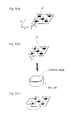
- a specimen measuring 2 cm in X direction and 2 cm in Y direction is cut out of a nonwoven fabric 1 to be evaluated using a sharp razor in an environment of 22°C and 65% RH as shown in Fig. 5(a) .
- the specimen is folded along a folding line Z that passes through a plurality of fusion bonds 3 in the X direction as shown in Fig. 5(b) .
- the folded specimen is fixed onto an aluminum mount for a scanning electron microscope (SEM) via double-sided carbon tape.
- SEM scanning electron microscope
- each chosen fiber 20 is micrographed, and the diameter of the fiber 20 is measured at a position 120 ⁇ m away from the tip of the free end 20b on the micrograph (see Fig. 2 ) to give the diameter 21a of the fiber 20 at other than the free end 20b.
- the line along which the diameter 21a is measured is translated toward the free end 20b until it reaches a position where the fiber 20 is thickest between the tip of the free end 20b and a position 20 ⁇ m away from the tip, and the diameter of the fiber 21 is measured along the line to give the diameter 21b of the fiber 21 at the free end 20b. Even when the tip of a fiber has a flattened shape and does not look thick at some viewing angles, the diameter 21b is measured on the micrograph.
- the fiber 21 with a thickened free end 20b is defined to be a fiber, out of the randomly chosen ten fibers 20, having an increase ratio of a tip diameter of 15% or more, the increase ratio being calculated from the diameter 21b (the diameter at the free end 20b) and the diameter 21 a (the diameter at other than the free end 20b) according to formula (1) below.
- the increase ratio is preferably 20% or more, more preferably 25% or more, from the standpoint of avoiding fiber break between adjacent fusion bonds 3 (excluding the boundaries between a fusion bond 3 and the fiber, i.e., in the region where the fiber retains the fibrous form), minimizing reduction in breaking strength, and obtaining pleasant feel to the touch.
- Increase ratio of fiber tip diameter % 21 ⁇ b - 21 ⁇ a / 21 ⁇ a ⁇ 100
- the ratio of the fibers 21 having a thickened free end 20b to the total number of fibers 20 only one end (20a) of each of which is fixed at the fusion bond 3 is preferably 20% or more, more preferably 30% or more, even more preferably 40% or more.
- the ratio of the fibers 21 with a thickened free end 20b is obtained by calculating the increase ratio of fiber tip diameter for each of the randomly chosen ten fibers 20 on their SEM image (about 750X) as described above with respect to the measurement of fiber diameter and calculating the ratio of the fibers 21 with a thickened free end 20b.
- the nonwoven fabric 1 contains fibers cut in the peripheral portion of the fusion bonds.
- a peripheral portion of a randomly chosen fusion bond 3 specifically a portion sandwiched between lines 100 ⁇ m inwardly and outwardly away from the boundary line between the fusion bond 3 and the filament fibers 2 is observed under an electron microscope, and the number of the signs of fibers' having been cut (discontinuities between a fiber segment having been debossed and therefore having a collapsed shape and a fiber segment not having been debossed and therefore remaining in a fibrous shape) is counted. If there are many fiber discontinuities, then that means that the nonwoven fabric has only the fibers on the very surface raised and will exhibit high breaking strength for the amount of fiber raising. From this viewpoint, the number of such discontinuities is preferably at least 3, more preferably 5 to 15 per fusion bond.
- the nonwoven fabric 1 has loop fibers 23 projecting in loop form between fusion bonds 3.
- the term projecting "loop fiber 23" as used herein denotes a fiber having no free end 20b and projecting at least 0.5 mm away from the folding line Z when observed in the manner shown in Fig. 5(c) as in the measurement of fiber diameter.
- the term “loop fiber 23" as used in the present embodiment refers to the above described projecting loop fiber.
- the fibers constituting the nonwoven fabric 1 of the present embodiment include the fibers 20 only one end of each of which is fixed at the fusion bond 3 and the loop fibers 23 projecting between fusion bonds 3, the fibers 20 including the fibers 21 with a thickened free end 20b and the fibers 22 with a non-thickened free end 20b.
- the ratio of the loop fibers 23 to the total number of the fibers 20 only one end of each of which is fixed at the fusion bond 3 and the loop fibers 23 is preferably less than 50%, more preferably less than 45%, and even more preferably less than 40%.
- the ratio of the loop fibers 23 is obtained in the above described measurement of fiber diameter as follows. Ten fibers are chosen at random on an SEM image at about 50X. Fibers 20 having only one end 20a fixed at the fusion bond 3 (fibers 21 with a thickened free end 20b + fibers 22 with a non-thickened free end 20b) and loop fibers 23 are extracted from the 10 fibers, and the ratio of the loop fibers 23 to the total number of the fibers 21, 22, and 23 is calculated. The ratio is obtained for a total of ten points on the respective SEM images taken per sample, and an average of the ten measurements is calculated. When the randomly chosen ten fibers include one loop fiber 23, the loop fiber 23 is counted as one.
- Fibers having relatively high freedom fill the interfiber spaces in the nonwoven fabric 1 to make the surface less rough and smoother. While a broader distribution (distribution index) of fiber diameter is more desirable, a sufficiently satisfactory effect on feel to the touch is obtained with a distribution of 0.33 or greater. A more satisfactory effect is obtained with a distribution of 0.35 or greater.
- a preferred upper limit is 100.
- a more preferred fiber diameter distribution (distribution index) is 0.35 to 0.9.
- the term "fiber diameter distribution (distribution index)" refers to the distribution (distribution index) of the diameter of all the fibers constituting the nonwoven fabric 1, i.e., all of the fibers 20 only one end 20a of each of which is fixed at the fusion bond 3, the loop fibers 23, and fibers each having both ends thereof fixed at the respective fusion bonds 3 and not projecting in loop form (fibers not having been influenced by the hereinafter described processing treatment).
- the fiber diameter distribution (distribution index) is determined as follows.
- a specimen measuring 2 cm in X direction and 2 cm in Y direction is cut out of a nonwoven fabric 1 to be evaluated using a sharp razor in an environment of 22°C and 65% RH.
- the specimen (not folded) is fixed onto an aluminum mount for a scanning electron microscope (SEM) via double-sided carbon tape.
- SEM scanning electron microscope
- Ten fibers are randomly chosen from an SEM image at a magnification of about 750X, and the diameter of each fiber is measured at other than the free end 20b.
- the starting nonwoven fabric from which the nonwoven fabric 1 is obtained is a complex nonwoven fabric composed of a spun-bonded layer and a melt-blown layer, the fibers should be chosen not from the melt-blown layer but the spun-bonded layer.
- the diameters of the ten fibers are measured on a single aluminum mount as described above, and an average d ave is obtained from the resulting fiber diameters d 1 to d 10 of the ten fibers.
- a distribution of the randomly chosen ten fibers' diameters is calculated from the resulting 10 fibers' diameters d1 to d10 and their average value d ave according to formula (2) below. The measurements are in micrometers with a resolution of 0.1 ⁇ m.
- a distribution of ten fibers' diameters is determined for six specimens on the respective aluminum mounts per sample (nonwoven fabric 1), and an average of the six distributions of the ten fibers' diameters as calculated according to formula (3) below is the fiber diameter distribution of the nonwoven fabric 1.
- the number of the raised fibers of the nonwoven fabric 1 is preferably 8 or greater, more preferably 12 or greater, per centimeter in terms of good feel to the touch and 100 or fewer per centimeter in terms of sufficient breaking strength, more preferably 40 or fewer per centimeter in the interest of non-fuzzy appearance.
- the number of raised fibers is measured as follows.
- Fig. 6 schematically illustrates how to count the number of raised fibers out of the fibers constituting the nonwoven fabric 1 in an environment of 22°C and 65% RH.
- a piece measuring 20 cm by 20 cm is cut out of the nonwoven fabric to be evaluated with a sharp razor and folded with the raised side out to make a specimen 104 as shown in Fig. 6(a) .
- the specimen 104 is placed on a black sheet of A4 size.
- Another black sheet of A4 size having a hole 107 measuring 1 cm (vertical) by 1 cm (horizontal) is put thereon as shown in Fig. 6(b) such that the folded edge 105 of the specimen 104 may be seen through the hole 107 of the upper black sheet as shown.
- the two black sheets are of KENRAN KURO (ream weight: 265 g) available from Fujikyowa Seishi K.K.
- a 50 g weight is put on the upper sheet at a position 5 cm outward from each lateral side of the hole 107 along the folded edge 105 to ensure that the specimen 104 is completely folded.
- the specimen 104 seen through the hole 107 is observed using a microscope (VHX-900 from Keyence) at a magnification of 30 times.
- An imaginary line 108 is drawn in the micrograph in parallel to and 0.2 mm above the folded edge 105 of the specimen 104.
- the number of the fibers projecting above the imaginary line 108 per centimeter is counted.
- the measurement is taken at a total of 9 points per sample nonwoven fabric.
- the average (rounded off to the whole number) of the nine measurements is taken as the number of raised fibers.
- the raised fibers (the fibers intersecting the imaginary line 108) have a smaller average diameter than the surface fibers at the non-raised site on the same side (fibers not intersecting nor reaching the imaginary line 108).
- the term "average (fiber) diameter” refers to an average of diameters measured at 12 points of each of a raised fiber and a non-raised fiber using a microscope (an optical microscope, an SEM, etc.). It is preferred for better feel to the touch that the diameter of a raised fiber be 40% to 97%, more preferably 40% to 90%, of the diameter of a non-raised fiber.
- the height of the raised fiber is preferably 1.5 mm or less, more preferably 0.8 mm or less. While a smaller height is more favorable from the above standpoint, sufficiently satisfactory feel to the touch will be obtained with a height of 0.2 mm or more. From the standpoint of providing breaking strength as well as the above standpoint, it is more preferred that the height of the raised fibers be 1.5 mm or less and that the number of the raised fibers be 8 or more per centimeter. It is also preferred in terms of pleasant feel to the touch with less cling to the skin that the height of the raised fibers be 0.5 mm or less and that the number of the raised fibers be 15 or more per centimeter.
- the term "height of a fiber” means the height of a fiber measured in its natural relaxed state without being pulled unlike the measurement of the length of a fiber.
- a raised fiber tends to have a greater height when it has a larger length or higher stiffness. The height of a raised fiber is measured as follows.
- the height of a raised fiber is measured at the same time of measuring the number of raised fibers. Specifically, as shown in Fig. 6(c) , the inside of the hole 107 is observed, and lines are drawn in parallel with the folded edge 105 at an interval of 0.05 mm away from the folded edge 105 until there are no more intersecting raised fibers. Then one of the parallel lines is selected which intersects half as many raised fibers as the number of the raised fibers as determined by the above described method (the fibers intersecting the imaginary line 108 drawn 0.2 mm above the folded edge 105). The distance from the folded edge to the thus selected line is taken as the raised fiber height. Three specimens cut out of the nonwoven fabric sample to be evaluated are evaluated at tree positions per specimen to provide a total of nine measurements, which are averaged to give the height of raised fibers of the sample.
- the nonwoven fabric 1 In addition to the above discussed height and number of raised fibers, it is preferred for the nonwoven fabric 1 to have a bulk softness of 8.0 cN or less in terms of flexibility and excellent feel to the touch.
- the bulk softness is more preferably 0.5 to 3.0 cN in terms of providing pliable fabric like baby clothes. Bulk softness is measured by the following method.
- a specimen measuring 30 mm along the CD and 150 mm along the MD is cut out of the nonwoven fabric 1 in an environment of 22°C and 65% RH. Both longitudinal ends of the specimen are joined with an overlap, and the overlap is stapled at both longitudinal ends thereof to make a cylinder of 45 mm in diameter. Each of the staples is affixed in parallel with the MD.
- the cylindrical specimen is set upright on the mount of a tensile tester (Tensilon tensile tester RTA-100, supplied by Orientec) and axially compressed by a compression plate substantially parallel with the mount at a rate of 10 mm/min. The maximum load applied during the compression is recorded as a bulk softness in the CD.
- a cylindrical specimen is prepared and tested in the same manner, except for exchanging the CD for the MD to determine a bulk softness in the MD.
- the measurement is taken in duplicate for each direction.
- the average of the bulk softness in the CD and that in the MD is taken as a bulk softness of the nonwoven fabric 1.
- a softener Internally or externally (by coating) adding a softener to the starting spun-bonded nonwoven fabric from which the nonwoven fabric 1 is obtained is effective to bring out the effects of the invention.
- Useful softeners include wax emulsions, reactive softeners, silicones, and surfactants. Amino-containing silicones, oxyalkylene-containing silicones, and surfactants are particularly preferred.
- surfactants examples include anionic surfactants, such as carboxylic acid salts, sulfonic acid salts, sulfuric ester salts, and phosphoric ester salts (especially alkylphosphoric ester salts); nonionic surfactants, such as sorbitan fatty acid esters, polyhydric alcohol fatty acid monoesters (e.g., diethylene glycol monostearate, diethylene glycol monooleate, glycerol monostearate, glycerol monooleate, and propylene glycol monostearate), N-(3-oleyloxy-2-hydroxypropyl)diethanolamine, polyoxyethylene hydrogenated castor oil, polyoxyethylene sorbitol beeswax, polyoxyethylene sorbitan sesquistearate, polyoxyethylene monooleate, polyoxyethylene sorbitan sesquistearate, polyoxyethylene glycerol monooleate, polyoxyethylene monostearate, polyoxyethylene monolaurate, polyoxyethylene monoo
- a known agent may be added to the softeners as a secondary additive (a trace component).
- the softener when used in the invention exhibits particularly high effects in providing good feel to the touch, little shedding of fuzz, low surface friction against human skin, and high breaking strength. When combined with the random copolymer described in paragraph [0021], the softener produces further enhanced effects. In particular, the softener is effective in reducing the slimy texture of the raised fibers caused by the random copolymer thereby to provide a comfortable dry feel to the touch.
- the softener is preferably internally incorporated into only one spun-bonded layer, or the softener may be incorporated into all the spun-bonded layers.
- the softener is incorporated into one spun-bonded layer, it is preferred for providing good feel to the touch and high breaking strength that the hereinafter described processing treatment for forming raised fibers with a thickened free end be performed on the softener-added side of the starting complex nonwoven fabric.
- a complex nonwoven fabric composed of a spun-bonded layer and a melt-blown layer is preferred to a single-layered spun-bonded nonwoven fabric as the starting nonwoven fabric from which the nonwoven fabric 1 is to be obtained in the interests of easy control of the balance between feel to the touch and the breaking strength of the resulting nonwoven fabric 1.
- a preferred method for making the nonwoven fabric 1 of the invention will then be described with reference to Figs. 3 and 4 .
- An apparatus preferably used in the production of the nonwoven fabric 1 is largely divided into a preprocessing part 4 and a raising part 5 downstream of the preprocessing part 4.
- the preprocessing part 4 has a steel-to-steel matched embossing unit 43 composed of a pair of rollers, one having a plurality of projections 410 and the other having a plurality of recesses 420 intermeshing with the projections 410 on their peripheral surfaces.
- the steel/steel matched embossing unit 43 is configured such that the projections 410 formed on the peripheral surface of the roller 41 and the recesses 420 formed on the peripheral surface of the roller 42 are matched.
- the projections 410 are uniformly and regularly arranged in both the axial direction and the circumferential direction of the roller 41.
- the pair of rollers 41 and 42 rotate in mesh with each other on being driven by a driving force transmitted from an unshown driving means to the axis of rotation of either one of them.
- the preprocessing part 4 also has transport rollers upstream and downstream from the steel/steel matched embossing unit 43, for example, rollers 44 and 45 as shown in Fig. 3 .
- Each projection 410 of the roller 41 preferably has a height (distance from the peripheral surface of the roller 41 to the top of the projection 410) of 1 to 10 mm, more preferably 2 to 7 mm.
- the distance between adjacent projections 410 (the pitch of the projections 410) in the axial direction is preferably 0.01 to 20 mm, more preferably 1 to 10 mm, and that in the circumferential direction is preferably 0.01 to 20 mm, more preferably 1 to 10 mm.
- the shape of the top of each projection 410 of the roller 41 is not particularly limited and may be, for example, a circular, polygonal, or oval shape.
- the area of the top of each projection 410 is preferably 0.01 to 500 mm 2 , more preferably 0.1 to 10 mm 2 .
- the individual recesses 420 of the roller 42 are arranged at positions corresponding to the individual projections 410 of the roller 41.
- the depth of engagement between the projections 410 of the roller 41 and the recesses 420 of the roller 42 is preferably 0.1 to 10 mm, more preferably 1 to 5 mm.
- the raising part 5 includes an engraved roller 51 having projections 510 on its peripheral surface and transport rollers 52 and 53 upstream and downstream, respectively, of the engraved roller 51 for transporting a starting nonwoven fabric 10.
- the engraved roller 51 is rotated by a driving force transmitted from an unshown driving means to its axis of rotation.
- each projection 510 of the engraved roller 51 (the distance from the peripheral surface of the engraved roller 51 to the top of the projection 510) is preferably 0.001 to 3 mm, more preferably 0.001 to 0.1 mm.
- the distance between adjacent projections 510 (the pitch of the projections 510) in the axial direction is preferably 0.1 to 50 mm, more preferably 0.1 to 3 mm, and that in the circumferential direction is preferably 0.1 to 50 mm, more preferably 0.1 to 3 mm.
- the shape of the top of each projection 510 of the roller 51 is not particularly limited and may be, for example, a circular, polygonal, or oval shape.
- the area of the top of each projection 510 is preferably 0.001 to 20 mm 2 , more preferably 0.01 to 1 mm 2 .
- the apparatus having so configured preprocessing part 4 and raising part 5 operates as follows.
- a starting nonwoven fabric 10 of the nonwoven fabric 1, for example, a spun-bonded nonwoven fabric is unwounded from an unshown stock roll and fed by the transport rollers 44 and 45 into the nip of the pair of rollers 41, 42 of the steel/steel matched embossing unit 43.
- the preprocessing part 4 the starting nonwoven fabric 10 is nipped between the pair of rollers 41, 42 to be given damage as shown in Fig. 3 .
- the pair of rollers 41, 42 of the steel/steel matched embossing unit 43 not be positively heated or be at a temperature not higher than the melting point of the component the melting temperature of which is lower than any other components of the fibers making up the starting nonwoven fabric 10, more preferably at a temperature lower than that melting point by 70°C or more.
- the damaged starting nonwoven fabric 10' is transported by the transport rollers 52, 53 to the engraved roller 51 having the projections 510 on its peripheral surface.
- a surface of the damaged starting nonwoven fabric 10' is processed by the engraved roller 51.
- part of the filament fibers 2 making up the spun-bonded nonwoven fabric are broken to provide a nonwoven fabric 1 having fibers 20 only one end 20a of each of which is fixed at the fusion bond 3 of the spun-bonded nonwoven fabric (see Fig. 1 ).
- Fig. 1 In order to effectively break part of the filament fibers 2 to effectively form the fibers 20 shown in Fig.
- the direction of rotation of the engraved roller 51 is preferably the reverse of the transport direction of the starting nonwoven fabric 10', and the rotational speed of the engraved roller 51 is preferably 0.3 to 10 times the transport speed of the starting nonwoven fabric 10'.
- the rotational speed is preferably 1.5 to 20 times the transport speed of the starting nonwoven fabric 10'.
- the term "rotational speed" of the engraved roller 51 is the circumferential speed measured on the periphery of the engraved roller 51.
- the position of the transport roller 53 be higher than that of the engraved roller 51 as shown in Fig. 4 so that the damaged starting nonwoven fabric 10' may be partially wrapped around the engraved roller 51 at a wrap angle ⁇ of 10° to 180°.
- the wrap angle ⁇ is more preferably 30° to 120°C.
- the starting nonwoven fabric 10' having been processed with the engraved roller 51 on one side thereof is further processed with another engraved roller 51 on the opposite side (reverse side) thereof.
- the inventors consider that the mechanism of the formation of the above-identified fibers 20 is as follows. On stretching the spun-bonded nonwoven fabric (starting nonwoven fabric 10) using the steel/steel matched embossing unit 43, a weakened point is formed in the fusion bonds 3 of the spun-bonded nonwoven fabric (starting nonwoven fabric 10). Subsequently, a filament fiber 2 on the very surface of a fusion bond 3 is cut by the engraved roller 51 at the weakened point to provide a fiber broken at the fusion bond 3. The fiber cut at the fusion bond 3, the inventors assume, is the fiber 21 the free end 20b of which is thickened.
- the inventors also assume that a filament fiber 2 is pulled apart from the weakened point of the fusion bond 3 by the engraved roller 51 and becomes a loop fiber 23 projecting into a loop form between the fusion bonds 3.
- the inventors assume that a filament fiber 2 is cut between the fusion bonds 3 by the engraved roller 51 to become a fiber 22 the free end 20b of which is not thickened.
- the nonwoven fabric produced by the aforementioned preferred method for producing the nonwoven fabric 1 according to the invention is characterized in that the ratios of the loop fibers 23 and the non-thick-tipped fibers 22 are smaller than those of the nonwoven fabrics obtained by conventional raising/napping techniques.
- the nonwoven fabric would break between fusion bonds 3 (for example, between debossed portions), which can cause the nonwoven fabric to tear or bore a hole between the fusion bonds 3.
- fusion bonds 3 for example, between debossed portions
- a nonwoven fabric with no weakened points is subjected to the raising process, the fibers will not easily be raised unless a strong abrading force is applied to the surface of the fibers, which will damage not only the fibers on the very surface but the base fibers of the starting nonwoven fabric, only to provide a nonwoven fabric liable to tear on account of the failure to retain the strength. Because a nonwoven fabric obtained by the above described preferred method for producing the nonwoven fabric 1 of the invention has a smaller ratio of the non-thick-tipped fibers 22, a breaking strength is retained.
- the nonwoven fabric of the invention When used as an outer cover material of, for example, a disposable pull-on diaper, the nonwoven fabric of the invention provides an advantage of resistance against being pierced or broken by a finger when the diaper is pulled up in fixing onto a wearer (high piercing strength).
- the nonwoven fabric of the invention When used in side seals of a disposable pull-on diaper which are to be torn apart in removing the diaper from the wearer, the nonwoven fabric of the invention is easy to torn along the side seals without being torn in the lateral direction of the diaper. If a starting nonwoven fabric having no weakened points is subjected to the raising process, the fibers tend to be just debonded and liberated from the fusion bonds. As a result, the number of the raised fibers tends to decrease, and the height of the raised fibers tends to increase. This can lead to problems, such as fuzz formation.
- the fibers are stretched between fusion bonds, and weakened points are predominantly formed around the periphery of the fusion bonds. Formation of the weakened points is controllable by the depth of engagement between the meshing rollers 41 and 42 of the steel/steel matched embossing unit 43.
- a weakened point is easily formed in a region where the bond-to-bond length of fibers is short in the stretch direction. The thus formed weakened point provides a vulnerable region, where the fiber is easily cut at the weakened point on being processed in the raising part 5.
- the raised nonwoven fabric has improved air permeability as compared with a non-raised nonwoven fabric having the same basis weight.
- the air permeability of a nonwoven fabric is preferably increased to 1.2 to 2.0 times, more preferably 1.3 to 1.8 times, that of the starting nonwoven fabric by combining fiber stretch and raising as described.
- Air permeability is represented by a reciprocal of an air resistance determined using an automatic air permeability tester KES-F8-AP1 from Kato Tech Co., Ltd.
- the resulting nonwoven fabric preferably has an air permeability of 24 m/(kPa ⁇ s) or more.
- a spun-bonded complex nonwoven fabric containing no melt-blown layer, such as a spun-bonded/spun-bonded nonwoven fabric, is preferably used as a starting nonwoven fabric 10 having good feel to the touch and good air permeability.
- the nonwoven fabric 1 of the present embodiment has part of the filament fibers 2 broken to form fibers 20 only one end 20a of each of which is fixed at the fusion bond 3.
- the fibers 20 impart fluffiness to the whole nonwoven fabric 1. Since the filament fibers 2 are broken only partly, the nonwoven fabric 1 still retains high breaking strength similarly to the starting spun-bonded nonwoven fabric.
- the nonwoven fabric 1 of the present embodiment contains fibers 21 each having a thickened free end 20b as shown in Fig. 1 .
- the presence of the fibers 21 with a thickened free end 20b makes the nonwoven fabric 1 feel pleasant with no itchy or scratchy feeling on the skin.
- the fibers 21 with a thickened free end 20b tend to bow their free end 20b to make the nonwoven fabric 1 feel smooth and pleasant to the skin.
- Spun-bonded nonwoven fabrics or spun-bonded complex nonwoven fabrics essentially lack a fluffy feel and are inferior to air-through nonwoven fabrics in feel to the touch.
- the nonwoven fabric 1 exhibits greatly improved feel to the touch in terms of Japanese paper-like smoothness essential to a spun-bonded/melt-blown complex nonwoven fabric combined with a fluffy feel.
- the nonwoven fabric 1 is suited chiefly for use as a member making up absorbent articles, such as disposable diapers and sanitary napkins. Suitable members include a topsheet, a backsheet, and an outer cover-forming sheet. The nonwoven fabric 1 is also suited as a cleaning sheet. The application of the nonwoven fabric 1 will be described more concretely taking a disposable diaper for instance.
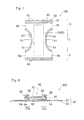
- a disposable pull-on diaper 100 includes an absorbent assembly 50 containing an absorbent member 40 and an outer cover 60 located on the non-skin contact side of the absorbent assembly 50 and having the absorbent assembly 50 fixed thereto.
- the absorbent assembly 50 includes a liquid permeable topsheet 70, a liquid impermeable (or water repellent) backsheet 80, and the liquid retentive absorbent member 40 interposed between the sheets 70 and 80.
- the absorbent assembly 50 is substantially oblong.
- the outer cover 60 has a rear portion A to be located on the back side of a wearer, a front portion B to be located on the front side of a wearer, and a crotch portion C located between the rear portion A and the front portion B and adapted to be worn about the crotch of the wearer. Both lateral side edges 6a of the rear portion A and both lateral side edges 6b of the front portion B are joined together to form a pair of side seals (not shown), a pair of leg openings (not shown), and a waist opening (not shown).
- the outer cover 60 has an outer sheet 62 forming the exterior surface of the diaper and an inner sheet 61 located on and partly joined to the skin facing of the outer sheet 62.
- the outer cover 60 has waist elastic members 63 and leg elastic members 64 disposed between the two sheets 61 and 62 to form gathers along a waist portion forming the waist opening and along leg portions 6d forming the leg openings.
- the absorbent assembly 50 extends to straddle the rear portion A and the front portion B, with its longitudinal ends inward from the corresponding longitudinal ends of the outer cover 60.
- the absorbent assembly 50 is bonded on the non-skin facing side of its backsheet 80 to the skin facing side of the inner sheet 61 of the outer cover 60 via an adhesive or by heat sealing, ultrasonic sealing, or otherwise.
- the absorbent assembly 50 has a pair of side cuffs 55, 55 formed of a liquid impermeable or water repellent and breathable material along both lateral side portions thereof.
- a side-cuff-forming elastic member 56 is fixed in its stretched state along near the free edge of each side cuff 55.
- each side cuff 55 rises with its free edge up to block the lateral flow of bodily exudates.
- a side portion 55a with a prescribed width of the side cuff-forming sheet extending laterally outward from the absorbent assembly 50 is folded over the non-skin facing side of the absorbent member 40 and fixed between the absorbent member 40 and the backsheet 80.
- the side portion 55a may be fixed between the backsheet 30 and the outer cover 60.
- the nonwoven fabric according to the invention is preferably used as the outer sheet 62.
- the raised nonwoven fabric of the invention is also useful as the topsheet 70, the backsheet 80, the side cuff-forming sheet, and the inner sheet 61.
- any materials usually used in absorbent articles, such as disposable diapers may be used.
- the topsheet 70 may be formed of liquid permeable nonwoven fabric, perforated film, or a laminate thereof.
- the backsheet 80 may be formed of resin film or a laminate composed of resin film and nonwoven fabric.
- the side cuff-forming sheet may be of stretch film, nonwoven fabric, woven fabric, or a laminate sheet thereof.
- the inner sheet 61 and the outer sheet 62 may be formed, e.g., of water repellent nonwoven fabric.
- the absorbent member 40 may be of any type conventionally used in absorbent articles, such as disposable diapers.
- the absorbent member may be an aggregate of fibrous materials, such as pulp, with or without a superabsorbent polymer incorporated therein, the aggregate being wrapped in a wrapper, such as tissue or water pervious nonwoven fabric.
- the side cuff-forming elastic members 56, the waist elastic members 63, and the leg elastic members 64 may be of any materials commonly used in absorbent articles, such as disposable diapers.
- extensible and contractible materials made of natural rubber, polyurethane, a styrene-isoprene copolymer, a styrene-butadiene copolymer, an ethylene- ⁇ -olefin copolymer (e.g., ethyl acrylate-ethylene copolymer), and so on may be used.
- the nonwoven fabric of the invention is not limited to the nonwoven fabric 1 of the above discussed embodiment, and various changes and modifications can be added to the nonwoven fabric 1.
- the nonwoven fabric 1 of the present embodiment is prepared starting from a spun-bonded nonwoven fabric as shown in Fig. 2 , it may be obtained from a complex nonwoven fabric composed of a spun-bonded layer and a melt-blown layer.
- the spun-bonded layer is preferably disposed on the surface side and/or the reverse side of the melt-blown layer.
- the spun-bonded/melt-blown complex nonwoven fabric contain at least 25% by weight of an ethylene-propylene random copolymer resin (hereinafter "random copolymer") and that the melt-blown layer be made of a propylene homopolymer resin in terms of overall smoothness, improved feel to the touch, and fiber breakability during raising process.
- a spun-bonded layer formed of a resin containing the random copolymer, which is a soft layer, is preferably disposed as an outermost layer so that the complex nonwoven fabric may have reduced bending stiffness and improved pliability.
- a complex nonwoven fabric only the skin-contact side of which is a spun-bonded layer made of the random copolymer-containing resin is advantageous in that the properties providing a good feel to the touch (the properties exhibited by the random copolymer-containing layer) and the properties providing breaking strength may be performed by the respective sides to achieve efficient improvement on feel to the touch.
- the complex nonwoven fabric is preferably made of a polypropylene resin containing at least 25% by weight of a recycled polypropylene resin in place of the random copolymer.
- the starting nonwoven fabrics used to provide the nonwoven fabric 1 include nonwoven fabrics (e.g., a spun-bonded nonwoven fabric), complex nonwoven fabrics (e.g., a laminate obtained by joining a spun-bonded layer and a melt-blown layer by heat debossing and a laminate obtained by joining a nonwoven fabric and an unconsolidated web by heat application), and a nonwoven fabric obtained by consolidating 30 mm or longer staple fibers by applying heat and pressure using a heat roller or through-air thermal bonding, followed by debossing.
- nonwoven fabrics e.g., a spun-bonded nonwoven fabric
- complex nonwoven fabrics e.g., a laminate obtained by joining a spun-bonded layer and a melt-blown layer by heat debossing and a laminate obtained by joining a nonwoven fabric and an unconsolidated
- the fibers constituting the nonwoven fabric include single fibers, conjugate fibers (side-by-side or concentric or eccentric sheath/core configuration), crimped fibers, heat shrunken fibers, heat extended fibers, and fibers splittable on stretch. Single fibers are preferred for inexpensiveness.
- Composite nonwoven fabrics composed of the nonwoven fabric described and another nonwoven fabric or film joined together with an adhesive or by heat are also useful. In using a composite nonwoven fabric, the raising may be carried out either before or after joining another nonwoven fabric or film.
- the degree of fiber orientation is preferably 1.1 to 1.8, more preferably 1.2 to 1.5, so that the fibers are easily caught on the projections 510 to achieve a large amount of fiber raising.
- the degree of fiber orientation is represented by an MOR value determined on a square specimen measuring 95 mm in the MD and 95 mm in the CD using a microwave molecular orientation analyzer MOA-6004 from Oji Scientific Instruments. The determination was done in quintuplicate per sample to obtain an average MOR value.
- the nonwoven fabric produced using the above described apparatus has an advantage over a flocked sheet, such as the one disclosed in patent literature 3, in that the production does not involve the step of bonding separate fibers (flocks) to a base nonwoven fabric using an adhesive or a like chemical so that the risk of adversely affecting the skin caused by a chemical, such as an adhesive, is reduced.
- a flocked sheet such as the one disclosed in patent literature 3
- there are no problems associated with a flocked sheet such as fall-off of flocks during use and resultant exposure of the adhesive layer.
- a spun-bonded nonwoven fabric one type of nonwoven fabrics used in absorbent articles, is thin and difficult to make fluffy by a general raising process without the likelihood of being broken. According to the production method using the above described apparatus, there is produced a raised spun-bonded nonwoven fabric having a high raised fiber density and good feel to the touch.
- the directions of a nonwoven fabric are defined based on the direction of constituent fibers.
- the direction along the fiber orientation direction is referred to as an MD or a longitudinal direction
- the direction perpendicular to that direction is referred to as a CD or a transverse direction.
- the MD (longitudinal direction) of a nonwoven fabric is the transport direction of the nonwoven fabric, which is the same as the direction of transporting the nonwoven fabric by the rotation of rollers
- the CD (transverse direction) of the nonwoven fabric is the same as the axial direction of the rollers.
- Figs. 9 through 12 schematically illustrate an embodiment of a processing apparatus used to carry out the method for making a nonwoven fabric according to the invention (hereinafter simply referred to as the processing apparatus).
- the processing apparatus 1 of the present embodiment is largely divided into a partial stretching part 2 and a raising part 3 downstream of the partial stretching part 2.
- the partial stretching part 2 is a part in which a nonwoven fabric 4 is stretched in a plurality of regions.
- the partial stretching part 2 of the processing apparatus 1 according to the present embodiment has a pair of engraved rollers 21, 22 as shown in Figs. 9 and 10 .
- the term "partial stretching” does not refer to a generally practiced stretch process in which a nonwoven fabric is totally stretched utilizing a difference in rotational speed between pairs of rollers but a process resulting in the formation of stretched regions and non-stretched regions.
- non-stretched region means a region of a nonwoven fabric that is not subjected to stretching, and the expression “not subjected to stretching” is intended to mean “not positively subjected to stretching”.
- the roller 21 has projections 210 on its peripheral surface
- the roller 22 has on its peripheral surface recesses 220 for receiving the projections 210 of the roller 21 at positions corresponding to the projections 210.
- the paired engraved rollers 21 and 22 are cylindrical members made of metal, such as an aluminum alloy or steel.
- the processing apparatus 1 of the present embodiment has a steel-to-steel matched embossing unit 23 composed of the pair of engraved rollers 21 and 22 having the projections 210 and the recesses 220, respectively, on their peripheral surface in meshing engagement with each other. As shown in Fig.
- the steel/steel matched embossing unit 23 is configured such that the projections 210 on the peripheral surface of the roller 21 and the recesses 220 on the peripheral surface of the roller 22 are in matched engagement.
- the projections 210 are uniformly and regularly arranged in both the axial direction and the circumferential direction of the roller 21.
- the pair of rollers 21 and 22 rotate on being driven by a driving force transmitted from an unshown driving means using unshown gears.
- a driving force from the unshown driving means may be transmitted to only one of the two rollers 21 and 22, and the other roller is driven by the engagement of the rollers.
- the rotational speed (peripheral velocity V2) of the paired rollers 21 and 22 is controlled by the controller (not shown) of the processing apparatus 1.
- the peripheral velocity V2 is obtained as a velocity of the circumference from the number of rotation of the rollers taking [the outside diameter of the roller 21 - the depth of engagement D) as a diameter.
- the shape of the individual projections 210 of the roller 21 when viewed from above may be circular, square, elliptic, rhombic, or rectangular (oblong in the MD or the CD) and is preferably circular in view of minimizing reduction in breaking strength of the nonwoven fabric 4.
- the shape of the individual projections 210 when viewed from the side may be trapezoidal, square, or convex and is preferably trapezoidal in view of reduced abrasion during rotation.
- the bottom angle of a trapezoidal projection preferably ranges from 70° to 89°.
- the nonwoven fabric 4 (i.e., the nonwoven fabric before being processed) is preferably stretched to a mechanical stretch ratio of 1.05 to 20, more preferably 2 to 10, in every region to be stretched in order to obtain high effects in improving flexibility and the like while retaining satisfactory breaking strength after the stretching.
- mechanical stretch ratio means a value obtained from the engagement geometry between the projections 210 of the roller 21 and the recesses 220 of the roller 22. The mechanical stretch ratio of each stretched region is calculated according to the Math. 1 or Math. 2 described below, wherein (see Fig.
- P 1 is the distance between the tops of adjacent projections 210 (pitch P 1 of the projections 210) in the circumferential direction of the roller 21;
- P 2 is the distance between the tops of adjacent projections 210 (pitch P 2 of the projections 210) in the axial direction of the roller 21;
- D is the depth of engagement between the individual projections 210 of the roller 21 and the individual projections of the roller 22;
- a 1 is the length of the top of the individual projections 210 of the roller 21 measured in the circumferential direction of the roller 21 (dot diameter A 1 ); and
- a 2 is the length of the top of the individual projections 210 of the roller 21 measured in the axial direction of the roller 21 (dot diameter A 2 ).
- the dot diameter A 1 is obtained as an average of the circumferential length of the top of the projections of the roller 21 and that of the top of the projections of the roller 22.
- the dot diameter A 2 is obtained as an average of the axial length of the top of the projections of the roller 21 and that of the top of the projections of the roller 22.
- the dot diameters A 1 and A 2 are obtained in the same manner.
- the mechanical stretch ratio thus calculated is taken as the stretch ratio of the regions having the highest stretch ratio (the regions via which the projection 210 of the roller 21 and the projection of the roller 22 come closest to each other), which is taken as the mechanical stretch ratio.
- the mechanical stretch ratio is obtained in the same manner even when the stretching means is other than the pair of rollers, such as a plate type or a caterpillar belt type stretching means as described in JP 2007-22066A .
- the pair of engraved rollers of the partial stretching part 2 are preferably designed to achieve partial stretch processing on 10% to 80%, more preferably 40% to 80%, of the total area of the nonwoven fabric 4 introduced therein, taking into consideration minimizing reduction in breaking strength of the nonwoven fabric while attaining the above recited range of mechanical stretch ratio.
- the plurality of stretched regions of the nonwoven fabric 4 are parts stretched by the engagement between the individual projections 210 of the roller 21 and the individual recesses 220 of the roller 22, more specifically parts stretched between the edge 210a of the individual projections 210 of the roller 21 and the edge 220a (at which recessing starts) of the individual recesses 220 of the roller 22 as shown in Fig. 11 .
- the regions of the nonwoven fabric that are applied to the top of the individual projections are less positively subject to a stretching action. Accordingly, the total area of the stretched regions of the nonwoven fabric is the area obtained by subtracting the total area of the top surface of the projections 210 of the roller 21 and the total area of the bottom between adjacent projections 210 of the roller 21 from the total area of the nonwoven fabric 4.
- the overall stretch ratio of the nonwoven fabric is calculated based on the value obtained by multiplying the area ratio of the regions to be stretched by the stretch ratio applied to these regions and adding to the product the area ratio of the non-stretched regions (inclusive of the regions that are not substantially stretched), the stretch ratio applied to the non-stretched regions being 1.
- stretch ratio of the nonwoven fabric in the circumferential direction (MD) varies with the nonwoven fabric feed rate
- stretch ratio of the nonwoven fabric in the circumferential direction (MD) denotes the value obtained by multiplying the above-identified mechanical stretch ratio in the circumferential direction by the ratio of the peripheral velocity of the roller 21 (or the roller 22) to the feed rate (peripheral velocity of the roller/ feed rate).
- the term "stretch ratio of the nonwoven fabric in the axial direction (CD)" as used herein denotes the value obtained by multiplying the above-identified mechanical stretch ratio in the axial direction by the ratio of change in nonwoven fabric width between before and after the passage between the pair of the rollers 21 and 22, the width after the passage/the width before the passage.
- the mechanical stretch ratio is obtained as a vector sum of MD and CD.
- the projections have a circular or a similar shape when viewed from above, the mechanical stretch ratio is obtained as a value of integral of the mechanical stretch ratio at the individual dots.
- the overall stretch ratio is preferably 1.3 to 4, more preferably 1.5 to 3.
- the fibers become finer between heat and pressure bonds (hereinafter "heat/pressure bonds") of the starting nonwoven fabric as a result of the partial stretching; a crack develops in the peripheral portion of each heat/pressure bond (i.e., the vicinities of the boundary line between the heat/pressure bond and the fibers) by the stretching, from which crack the fiber is easily cut at the peripheral portion when subjected to the raising process; the heat/pressure bonds are deformed and softened by the stretching so that the fibers are easily cut to provide short raised fibers without being debonded from the heat/pressure bonds; and therefore the resulting nonwoven fabric is easily raised and exhibits excellent feel to the touch.
- heat/pressure bonds heat and pressure bonds
- the ratio of the area ratio of the heat/pressure bonds to the overall stretch ratio, ⁇ area ratio of heat/pressure bonds (%)/(overall stretch ratio ⁇ 100) ⁇ , is preferably 0.02 to 0.12, more preferably 0.04 to 0.10, in the interests of breaking strength retention, moderate destruction of the heat/pressure bonds, and increased amount of fiber raising.
- the starting nonwoven fabric has discrete heat/pressure bonds regularly spaced in planar directions.
- heat/pressure bond includes not only thermal pressure bonds of the constituent fibers but ultrasonic pressure bonds of constituent fibers.
- each projection 210 measured from the peripheral surface of the roller 21 to the top of the projection 210 be 1 to 10 mm, more preferably 2 to 7 mm;
- the pitch P 1 of the adjacent projections 210 in the circumferential direction be 0.01 to 20 mm, more preferably 1 to 10 mm;
- the pitch P 2 (unshown) of the adjacent projections 210 in the axial direction be 0.01 to 20 mm, more preferably 1 to 10 mm.
- the shape of the top of each projection 210 of the roller 21 is not particularly limited and may be, for example, a circular, polygonal, or oval shape.
- each projection 210 is preferably 0.01 to 500 mm 2 , more preferably 0.1 to 10 mm 2 .
- the area of the bottom between adjacent projections 210 is preferably 0.01 to 500 mm 2 , more preferably 0.1 to 10 mm 2 .
- Each projection 210 preferably has a rounded edge to avoid tearing the nonwoven fabric during processing.
- the curvature radius (R) of the edge is preferably 0.2 mm to (0.5 ⁇ dot diameter A 1 ) or (0.5 ⁇ dot diameter A 2 ).
- the area of the top of the projection 210 is obtained as a projected area of the shape delineated by the centerline of the width of the curved edge viewed from above. In the calculation of a partial mechanical stretch ratio, the same shape is used.
- the ratio of the pitch of the heat/pressure bonds (e.g., fusion bonds formed by, for example, debossing) of the nonwoven fabric to the pitch of the projections 210 of the pair of rollers 21 and 22 is preferably 0.05 to 0.7, more preferably 0.1 to 0.4. When this ratio is satisfied, there is a high probability of existence of the heat/pressure bonds of the nonwoven fabric in the regions being stretched. The heat/pressure bonds in the regions being stretched are deformed and softened, which ensures the formation of weakened points in the peripheral portion of the heat/pressure bonds of the nonwoven fabric.
- the ratio of the pitch of the heat/pressure bonds of the nonwoven fabric to the pitch of the projections 210 of the pair of rollers 21 and 22 includes (1) the ratio of the pitch of the heat/pressure bonds of the nonwoven fabric in the MD to the pitch of the projections 210 of the pair of rollers 21 and 22 in the circumferential direction and (2) the ratio of the pitch of the heat/pressure bonds of the nonwoven fabric in the CD to the pitch of the projections 210 of the pair of rollers 21 and 22 in the axial direction. Although it suffices that either one of these ratios falls within the range recited, it is preferred that both of them fall within the range.
- the individual recesses 220 of the roller 22 are arranged at positions corresponding to the individual projections 210 of the roller 21 as shown in Figs. 10 and 11 .
- the depth of engagement D (see Fig. 11 ) between the individual projections 210 of the roller 21 and the individual projections of the roller 22 (the length of the overlap between the projection 210 and the recess 220) is preferably 0.1 to 10 mm, more preferably 1 to 8 mm. It is preferred that there be a clearance between the top of the projection 210 of the roller 21 and the bottom of the recess 220 of the roller 22 so as not to press the nonwoven fabric 4 passing therebetween to prevent the nonwoven fabric 4 from getting hard.
- the partial stretching part 2 has transport rollers 24 and 25 upstream and downstream, respectively, of the steel/steel matched embossing unit 23 for transporting the nonwoven fabric 4.
- the transport rate V1 of the nonwoven fabric 4 is controlled by the controller (not shown) of the processing apparatus 1.
- the term "transport rate V1" of the nonwoven fabric 4 means the speed of the surface of the nonwoven fabric 4 being unrolled from the stock roll of the nonwoven fabric 4.
- the raising part 3 is a part in which the constituent fibers 41 of the partially stretched nonwoven fabric 4' are raised.
- the raising part 3 of the processing apparatus 1 according to the present embodiment has an engraved roller 31 having projections 310 on its peripheral surface.
- the engraved roller 31 is a cylindrical member made of metal, such as an aluminum alloy or steel.
- the engraved roller 31 rotates by a driving force transmitted from an unshown driving means to its shaft of rotation.
- the rotational speed (peripheral velocity V4) of the engraved roller 31 is controlled by the unshown controller of the processing apparatus 1.
- the term "peripheral velocity V4" of the engraved roller 31 means the velocity of the surface of the engraved roller 31 similarly to the peripheral velocity V2 of the rollers 21 and 22.
- the raising part 3 has transport rollers 32 and 33 upstream and downstream, respectively, of the engraved roller 31 for transporting the nonwoven fabrics 4'.
- the transport rate V3 of the stretched nonwoven fabric 4' is controlled by the unshown controller of the processing apparatus 1.
- the term "transport rate V3" of the stretched nonwoven fabric 4' means the speed of the surface of the nonwoven fabric 4' being fed to the engraved roller 31 similarly to the transport rate V1 of the nonwoven fabric 4 to be stretched.
- each projection 310 of the engraved roller 31 (the distance from the peripheral surface of the engraved roller 31 to the top of the projection 310) is preferably 0.01 to 3 mm, more preferably 0.01 to 1 mm.
- the distance between adjacent projections 310 (the pitch of the projections 310) in the circumferential direction is preferably 0.01 to 50 mm, more preferably 0.01 to 3 mm, and that in the axial direction is preferably 0.01 to 30 mm, more preferably 0.01 to 3 mm.
- the density of the projections is preferably 500 to 5000 projections per cm 2 in terms of providing many points of raising action to give a nonwoven fabric with many raised fibers.
- the shape of the top of each projection 310 of the roller 31 is not particularly limited and may be, for example, a circular, polygonal, or oval shape.
- the area of the top of each projection 310 is preferably 0.001 to 20 mm 2 , more preferably 0.01 to 1 mm 2 .
- the position of the transport roller 33 downstream of the engraved roller 31 be higher than that of the engraved roller 31 so that the stretched nonwoven fabric 4' may be partially wrapped around the engraved roller 31 at a wrap angle ⁇ of 10° to 180°, more preferably 30° to 120°. While in the processing apparatus 1 of the present embodiment a difference is provided in position between the engraved roller 31 and the transport roller 33 to give a wrap angle ⁇ , such a difference does not need to be provided.
- the processing apparatus 1 of the present embodiment has a controller (not shown) which controls the peripheral velocity V2 of the pair of rollers 21 and 22 based on the driving means, the peripheral velocity V4 of the engraved roller 31 based on the driving means, the transport rate V1 of the nonwoven fabric 4 based on the tension detected using a tension sensor, and the transport rate V3 of the stretched nonwoven fabric 4' based on the tension detected using a tension sensor in accordance with a prescribed sequence of operations.
- the method for making a nonwoven fabric according to the invention includes the step of stretching a plurality of regions of a nonwoven fabric 4 at or below 50°C.
- a continuous length of a starting nonwoven fabric 4 unrolled from a stock roll is introduced by the transport rollers 24 and 25 into the nip between the pair of rollers 21 and 22 of the steel/steel matched embossing unit 23 to be partially stretched as shown in Fig. 9 .
- the nonwoven fabric 4 fed by the transport rollers 24 and 25 is pressed between a plurality of the projections 210 of the roller 21 and a plurality of the recesses 220 of the roller 22 (partial stretching) shown in Figs.
- the feed rate V1 in feeding the nonwoven fabric 4 into the nip of the pair of rollers 21 and 22 is preferably higher than the peripheral velocity V2 of the pair of rollers 21 and 22 (V1>V2) to achieve the partial stretch processing satisfactorily.
- the V1/V2 is more preferably 1.05 or greater, even more preferably 1.1 or greater.
- the V1/V2 is preferably smaller than 10. With the V1/V2 being smaller than 10, the amount of fiber raising increases, and the feel to the touch improves.
- the peripheral velocity of a pair of smooth rollers is greater than the feed rate, i.e., V1/V2 ⁇ 1, unlike the above discussed partial stretching.
- V1/V2 ⁇ 1 the feed rate
- an ordinary spun-bonded nonwoven fabric is stretched to an overall stretch ratio of 1.3 or greater (which is obtained as V2/V1 in the case of uniaxial stretching)
- V2/V1 the feed rate
- the nonwoven fabric hardly suffers from tearing or otherwise being damaged even if there are regions showing an overall stretch ratio of 1.3 or greater.
- the partially stretched nonwoven fabric 4' is then subjected to a raising process for raising the fibers of the nonwoven fabric 4'.
- the partially stretched nonwoven fabric 4' is transported by the transport rollers 32 and 33 to the engraved roller 31 having the projections 310 on its peripheral surface, where the fibers of the partially stretched nonwoven fabric 4' are raised from the surface of the nonwoven fabric 4' by the engraved roller 31 shown in Fig. 12 .
- the direction of rotation of the engraved roller 31 is preferably the reverse of the transport direction of the partially stretched nonwoven fabric 4' as shown in Fig. 12 .
- V4/V3 is preferably 0.3 to 10, more preferably V4>V3, and even more preferably V4/V3 ranges from 1.1 to 10.
- a particularly preferred V4/V3 is 1.5 to 5 in terms of sufficient fiber raising and reduced clinging of fibers to the roller.
- the transport rate V3 of the partially stretched nonwoven fabric 4' and the peripheral velocity V4 of the engraved roller 31 satisfy the relationship that V4/V3 ranges from 1.1 to 20, more preferably 1.5 to 10, even more preferably 2 to 8.
- the nonwoven fabric 4 to be subjected to the above described processing steps may be a spun-bonded nonwoven fabric, a complex nonwoven fabric composed of a spun-bonded layer and a melt-blown layer, or a nonwoven fabric made of continuous fibers in tow form.
- a spun-bonded nonwoven fabric for its inexpensiveness, high breaking strength and thinness.
- the spun-bonded layer is preferably disposed on the surface side and/or the reverse side of the melt-blown layer.
- the spun-bonded/melt-blown complex nonwoven fabric be made of a polypropylene resin containing 50% by weight or more of a recycled polypropylene resin.
- the continuous fibers in tow form as referred to above each preferably have a thickness of 5 to 30 ⁇ m, more preferably 10 to 20 ⁇ m.
- the nonwoven fabric 4 preferably has a basis weight of 10 to 100 g/m 2 , 10 to 25 g/m 2 , in terms of inexpensiveness, good feel to the touch, and processability.
- a plurality of fusion bonds which are heat/pressure bonds of the nonwoven fabric 4 may be formed by discretely applying heat and pressure using a debossing roller combined with a flat roller, ultrasonic fusion bonding, or discretely applying hot air.
- the fusion bonds are preferably formed by applying heat and pressure in terms of ease of fiber raising.
- the fusion bond is not particularly limited in shape and may have a circular, a rhombic, a triangular, or a like shape.
- the fusion bonds preferably have a total area ratio of 5% to 30% per side.
- the total area ratio of the fusion bonds is more preferably 10% to 20% per side to prevent pilling.
- the individual fusion bonds formed by debossing preferably have an area of 0.05 to 10 mm 2 , more preferably 0.1 to 1 mm 2 .
- the number of the fusion bonds is preferably 10 to 250/cm 2 , more preferably 35 to 65/cm 2 .
- the fusion bond is not particularly limited in shape and may have a circular, a rhombic, a triangular, or a like shape.
- the total area ratio of the fusion bonds is preferably 5% to 30%, more preferably 10% to 20%, per side of the spun-bonded nonwoven fabric.
- the spun-bonded nonwoven fabric may have a single layer structure or a multilayered structure composed of a plurality of layers.
- the spun-bonded nonwoven fabric used in the present embodiment is made of thermoplastic resin fibers.
- the thermoplastic resin include polyolefin resins, polyester resins, polyamide resins, acrylonitrile resins, vinyl resins, and vinylidene resins.
- the polyolefin resins are polyethylene, polypropylene, and polybutene.
- the polyester resins are polyethylene terephthalate and polybutylene terephthalate.
- the polyamide resin include nylon.
- the vinyl resins are exemplified by polyvinyl chloride.
- An example of the vinylidene resins is polyvinylidene chloride. Modification products of these resins or mixtures of these resins are useful as well.
- the diameter of the fibers is preferably 5 to 30 ⁇ m, more preferably 10 to 20 ⁇ m, at a stage before being subjected to the partial stretching.
- the method of the present embodiment using the processing apparatus 1 includes the step of preprocessing in which a plurality of discrete regions of the nonwoven fabric 4 are stretched at or below 50°C, the fibers are not fused together during the partial stretching and are easily raised in the subsequent raising step. As a result, there is obtained a soft nonwoven fabric 4" having fibers raised to provide a good feel to the touch. Since the stretch process is performed in only the plurality of discrete regions of the starting nonwoven fabric 4, the other regions of the nonwoven fabric 4, which are not stretched, retain the strength of the starting nonwoven fabric and serve to minimize the reduction in strength due to the stretching.
- the nonwoven fabric is allowed to be transported at an increased rate so as to reduce the production cost of the nonwoven fabric 4" when, in particular, an essentially strong nonwoven fabric, such as a spun-bonded nonwoven fabric, is used.
- an essentially strong nonwoven fabric such as a spun-bonded nonwoven fabric
- the reduction in breaking strength due to the partial stretching can be limited to 50% or less. That is, when a starting nonwoven fabric 4 is a spun-bonded nonwoven fabric having a breaking strength of 10 to 30 N/50 mm with a basis weight of 20 g/m 2 , the breaking strength after the processing is 5 to 20 N/50 mm. Thus, the breaking strength of the processed spun-bonded nonwoven fabric is almost equal to that of the starting spun-bonded nonwoven fabric. It is preferred that the starting spun-bonded nonwoven fabric or the processed spun-bonded nonwoven fabric satisfy the range recited above in either one of the X direction and the Y direction, more preferably in both directions. The breaking strength is measured by the following method.
- a rectangular specimen measuring 50 mm by 200 mm is cut out of a starting spun-bonded nonwoven fabric or a processed nonwoven fabric, with the length coincide with the X direction (transverse direction or CD) and the width coincide with the Y direction (longitudinal direction or MD).
- the specimen is set on a tensile tester (e.g., Tensilon tensile tester RTA-100 from Orientec) at an initial jaw separation of 150 mm with its X direction coincide with the pulling direction and pulled at a rate of 300 mm/min. The maximum load reached until the specimen breaks is taken as a breaking strength in the X direction.
- a tensile tester e.g., Tensilon tensile tester RTA-100 from Orientec
- Another rectangular specimen measuring 50 mm in the X direction (transverse direction or CD) and 200 mm in the Y direction (longitudinal direction or MD) is cut out and set on the tensile tester with its Y direction coincide with the pulling direction.
- the breaking strength in the Y direction is measured in the same manner as for the measurement in the X direction.
- the fibers raised from the surface of the resulting processed nonwoven fabric are short enough not to impair the appearance.
- the term "fibers raised from the surface of a nonwoven fabric” is defined to be those fibers the tip of each of which is located at least 0.2 mm above the surface of a nonwoven fabric. The inventors consider that the reason why the fibers raised from the surface of a spun-bonded nonwoven fabric are short is as follows. On stretching a spun-bonded nonwoven fabric using the steel/steel matched embossing unit 23 in the partial stretching part 2, a weakened point is formed in the fusion bond of the spun-bonded nonwoven fabric.
- a continuous fiber constituting the spun-bonded nonwoven fabric is cut at the weakened point of the fusion bond to form a fiber cut at the fusion bond.
- the number of the raised fibers of the nonwoven fabric is preferably 8 or greater, more preferably 12 or greater, per centimeter in terms of good feel to the touch and 100 or fewer per centimeter in terms of sufficient breaking strength, more preferably 40 or fewer per centimeter in terms of non-fuzzy appearance.
- the number of raised fibers is measured as follows.
- Fig. 13 schematically illustrates how to count the number of raised fibers. Sampling and measurement are carried out in an environment of 22°C and 65% RH. A piece measuring 20 cm by 20 cm is cut out of the nonwoven fabric to be evaluated with a sharp razor and folded with the raised side out to make a specimen 104 as shown in Fig. 13(a) . The specimen 104 is placed on a black sheet of A4 size. Another black sheet of A4 size having a hole 107 measuring 1 cm (vertical) by 1 cm (horizontal) is put thereon as shown in Fig. 13(b) such that the folded edge 105 of the specimen 104 may be seen through the hole 107 of the upper black sheet as shown.
- the two black sheets are of KENRAN KURO (ream weight: 265 g) available from Fujikyowa Seishi K.K.
- a 50 g weight is put on the upper sheet at a position 5 cm outward from each lateral side of the hole 107 along the folded edge 105 to ensure that the specimen 104 is completely folded.
- the specimen 104 seen through the hole 107 is observed using a microscope (VHX-900 from Keyence) at a magnification of 30 times.
- An imaginary line 108 is drawn in the micrograph in parallel to and 0.2 mm above the folded edge 105 of the sample 104. The number of the fibers projecting above the imaginary line 108 is counted.
- the width of the raised region of the nonwoven fabric to be evaluated is 1 cm or more, three specimens each measuring 20 cm by 20 cm and containing the raised region are cut out from the nonwoven fabric. When the width of the raised region of the nonwoven fabric is 1 cm or less, three specimens each measuring 20 cm by 20 cm are randomly cut out of the nonwoven fabric. Three specimens are prepared from a nonwoven fabric to be evaluated, and measurements are taken at three positions per specimen. The average of nine measurements is taken as the number of raised fibers.
- the raised nonwoven fabric produced by the method of the invention has an advantage over a flocked sheet in that the production does not involve the step of bonding separate fibers (flocks) to a base nonwoven fabric using an adhesive or a like chemical so that the risk of adversely affecting the skin caused by a chemical, such as an adhesive, is reduced.
- a flocked sheet there are no problems associated with a flocked sheet, such as fall-off of flocks during use and resultant exposure of the adhesive layer.
- a spun-bonded nonwoven fabric one type of nonwoven fabrics used in absorbent articles, is thin and difficult to make fluffy by a general raising process without the likelihood of being broken. According to the production method of the invention, there is obtained a raised, spun-bonded nonwoven fabric having a high raised fiber density and good feel to the touch.
- the nonwoven fabric obtained by the method of the invention is also characterized by pleasant fluffiness for its thickness. While there is almost no difference in thickness between the starting nonwoven fabric and the nonwoven fabric obtained by the method of the invention when a high load is applied thereon, there is a difference in thickness between them when a low load is applied. For example, with a load of 10 gf/cm 2 applied, the thickness of the spun-bonded nonwoven fabric obtained by the method of the invention and that of an ordinary, starting spun-bonded nonwoven fabric both having a basis weight of 15 g/m 2 are not so different, ranging from about 0.15 to 0.18 mm.
- the thickness of the starting spun-bonded nonwoven fabric is 0.41 to 0.46 mm, while the spun-bonded nonwoven fabric obtained by the method of the invention is 0.5 to 0.6 mm, showing a difference.
- the load of 0.05 gf/cm 2 corresponds to the load applied when one lightly presses the nonwoven fabric with his or her finger(s). One is able to feel fluffiness by perceiving such a small difference in thickness on touching.
- the method for making a nonwoven fabric according to the invention is by no means limited to the above discussed embodiment, and various changes and modifications can be added thereto as exemplified as follows.
- the processing apparatus 1 used in the present embodiment of the method has the steel/steel matched embossing unit 23 composed of a meshing pair of engraved rollers 21 and 22 in the partial stretching part 2 as shown in Fig. 9 and 10 .
- the steel/steel matched embossing unit 23 may be replaced with a pair of corrugated rollers having intermeshing corrugations on their peripheral surface.
- the meshing engagement may be along either the transport direction or a direction crossing the transport direction. In the latter case, because the pair of corrugated rollers are rotatable even when the depth of engagement is increased, a high mechanical stretch ratio is achieved to provide a nonwoven fabric with better feel to the touch.
- the steel/steel matched embossing unit is preferred, nevertheless, in view of the following advantages: non-stretched regions are distributed discretely, by which the reduction in breaking strength of the nonwoven fabric is minimized, and the nonwoven fabric being processed hardly suffers wrinkling; and the nonwoven fabric is stretched in both the MD and CD thereby to be provided with excellent feel to the touch. It is also desirable preferred embodiment that the raising is performed in stripes or in a pattern for decorative purposes.
- the processing apparatus 1 used in the present embodiment of the method has the engraved roller 31 with the projections 310 around its periphery in the raising part 3 as shown in Figs. 9 and 12 .
- the engraved roller 31 may be replaced with a pair of corrugated rollers having intermeshing corrugations on their peripheral surface, a knurled roller, a thermal sprayed roller, a carding wire, or a roller covered on its periphery with a material having friction resistant properties.
- the material having friction resistant properties is exemplified by rubber or emery paper.
- the partial stretching and the raising may each be carried out continuously or successively.
- the method of the present embodiment has an additional advantage in that, if the raised fibers of the raised nonwoven fabric are once collapsed when the nonwoven fabric is wound into a stock roll, they will rise again after being unwounded simply by touching with a hand or passing on a guide roller to provide a nonwoven fabric or an absorbent article having a good feel to the touch.
- SMS nonwoven fabric A spun-bonded/melt-blown/spun-bonded complex nonwoven fabric (hereinafter referred to as SMS nonwoven fabric) having a basis weight of 15 g/m 2 and each spun-bonded layer of which was made of ethylene-propylene copolymer resin fibers having a fiber diameter of 14.7 ⁇ m was used as a starting nonwoven fabric.
- This nonwoven fabric was used as such in Comparative Example 5 hereinafter given.
- the SMS nonwoven fabric was treated in two stages: first passed through the steel/steel matched embossing unit 43 shown in Fig. 3 and then surface-treated by the engraved roller 51 shown in Fig. 4 to obtain a nonwoven fabric.
- the individual projections 410 of the roller 41 of the steel/steel matched embossing unit 43 had a height of 2.8 mm.
- the depth of engagement between the individual projections 410 of the roller 41 and the individual recesses 420 of the roller 42 was 2.7 mm.
- the distance between adjacent projections 410 (the pitch of the projections 410) in the axial direction was 7 mm, and that in the circumferential direction was 7 mm.
- the height of the individual projections 510 of the engraved roller 51 was 0.6 mm.
- the distance between adjacent projections 510 (the pitch of the projections 510) in the axial direction was 1.4 mm, and that in the circumferential direction was 2.1 mm.
- the engraved roller 51 was rotated in the direction reverse to the transport direction of the nonwoven fabric at a rotational speed four times the feed rate of the nonwoven fabric.
- the wrap angle was 130°.
- the nonwoven fabric feed rate in each of the two stages was 10 m/min.
- SMS nonwoven fabric A spun-bonded/melt-blown/spun-bonded complex nonwoven fabric (hereinafter "SMS nonwoven fabric”) having a basis weight of 15 g/m 2 and each spun-bonded layer of which was made of propylene resin fibers having a diameter of 17.7 ⁇ m was used as a starting nonwoven fabric.
- SMS nonwoven fabric was processed in two stages under the same conditions as in Example 1.
- a spun-bonded/spun-bonded/melt-blown/spun-bonded complex nonwoven fabric (hereinafter "SSMS nonwoven fabric") having a basis weight of 18 g/m 2 of which every spun-bonded layer was made of ethylene-propylene copolymer resin fibers having a diameter of 12.9 ⁇ m was used as a starting nonwoven fabric.
- the outermost spun-bonded layers of this SSMS nonwoven fabric contained a softener.
- the SSMS nonwoven fabric was processed in two stages under the same conditions as in Example 1.
- a spun-bonded/melt-blown/melt-blown/spun-bonded complex nonwoven fabric (hereinafter "SMMS nonwoven fabric") having a basis weight of 12 g/m 2 of which each spun-bonded layer was made of propylene resin fibers having a diameter of 14.6 ⁇ m was used as a starting nonwoven fabric.
- the SMMS nonwoven fabric was processed in two stages under the same conditions as in Example 1.
- SMS nonwoven fabric A spun-bonded/melt-blown/spun-bonded complex nonwoven fabric (hereinafter "SMS nonwoven fabric”) having a basis weight of 18 g/m 2 of which each spun-bonded layer was made of ethylene-propylene copolymer resin fibers having a diameter of 14.9 ⁇ m was used as a starting nonwoven fabric.
- the spun-bonded layer on one side of this SMS nonwoven fabric contained a softener.
- the SMS nonwoven fabric was processed on its softener-containing side in two stages under the same conditions as in Example 1.
- a spun-bonded/spun-bonded/spun-bonded complex nonwoven fabric (hereinafter "SSS nonwoven fabric") having a basis weight of 18 g/m 2 of which every spun-bonded layer was made of ethylene-propylene copolymer resin fibers having a diameter of 15.0 ⁇ m was used as a starting nonwoven fabric.
- the SSS nonwoven fabric contained a softener.
- the SSS nonwoven fabric was processed in two stages under the same conditions as in Example 1.
- SSS nonwoven fabric A spun-bonded/spun-bonded/spun-bonded complex nonwoven fabric (hereinafter "SSS nonwoven fabric”) having a basis weight of 18 g/m 2 of which every spun-bonded layer was made of propylene resin fibers having a diameter of 14.9 ⁇ m was used as a starting nonwoven fabric.
- SSS nonwoven fabric was processed in two stages under the same conditions as in Example 1.
- SMS nonwoven fabric spun-bonded/melt-blown/spun-bonded complex nonwoven fabric
- the basis weight was 15 g/m 2
- each spun-bonded layer was made of ethylene-propylene copolymer resin fibers having a diameter of 14.7 ⁇ m
- the upper surface of the SMS nonwoven fabric measuring 5 cm by 5 cm was scratched by the pointed tips of a pair of tweezers K-14 in a manner that the fibers on the surface of the nonwoven fabric were pulled out and cut. The scratching and cutting operation was repeated 30 times in total to obtain a nonwoven fabric with surface fibers raised.
- SMS nonwoven fabric spun-bonded/melt-blown/spun-bonded complex nonwoven fabric
- the basis weight was 15 g/m 2
- each spun-bonded layer was made of ethylene-propylene copolymer resin fibers having a diameter of 14.7 ⁇ m
- the SMS nonwoven fabric was subjected to a cutting process to obtain a nonwoven fabric. The cutting process was carried out by soaking the SMS nonwoven fabric in liquid nitrogen for 5 minutes and cutting the frozen nonwoven fabric with a razor.
- SMS nonwoven fabric spun-bonded/melt-blown/spun-bonded complex nonwoven fabric
- the basis weight was 15 g/m 2
- each spun-bonded layer was made of ethylene-propylene copolymer resin fibers having a diameter of 14.7 ⁇ m
- Sand paper 240 grit; from Trusco Nakayama Corp.
- the SMS nonwoven fabric ran in contact with the sand paper-covered roller at a wrap angle of 8.5° at a velocity of 10 m/min, while the roller rotated at a velocity of 50 m/min in the direction reverse to the running direction of the nonwoven fabric. There was thus obtained a nonwoven fabric having fibers broken.
- SMS nonwoven fabric spun-bonded/melt-blown/spun-bonded complex nonwoven fabric
- the basis weight was 15 g/m 2
- each spun-bonded layer was made of ethylene-propylene copolymer resin fibers having a diameter of 14.7 ⁇ m
- SMS nonwoven fabric spun-bonded/melt-blown/spun-bonded complex nonwoven fabric
- the basis weight was 15 g/m 2
- each spun-bonded layer was made of propylene resin fibers having a diameter of 17.7 ⁇ m
- the upper surface of the SMS nonwoven fabric measuring 5 cm by 5 cm was scratched with the pointed tips of a pair of tweezers K-14 in a manner that the fibers on the surface of the nonwoven fabric were pulled out and cut.
- the scratching and cutting operation was repeated 30 times in total to obtain a nonwoven fabric with surface fibers napped.
- SMS nonwoven fabric spun-bonded/melt-blown/spun-bonded complex nonwoven fabric
- the basis weight was 15 g/m 2
- each spun-bonded layer was made of propylene resin fibers having a diameter of 17.7 ⁇ m
- SSMS nonwoven fabric spun-bonded/spun-bonded/melt-blown/spun-bonded complex nonwoven fabric (SSMS nonwoven fabric) as used in Example 3 (the basis weight was 18 g/m 2 , every spun-bonded layer was made of ethylene-propylene copolymer resin fibers having a diameter of 12.9 ⁇ m, and the outermost spun-bonded layers of this SSMS nonwoven fabric contained a softener) was used as such without conducting raising.
- SMMS nonwoven fabric spun-bonded/melt-blown/melt-blown/spun-bonded complex nonwoven fabric
- basis weight was 12 g/m 2
- each spun-bonded layer was made of propylene resin fibers having a diameter of 14.6 ⁇ m
- SMS nonwoven fabric spun-bonded/melt-blown/spun-bonded complex nonwoven fabric
- the basis weight was 18 g/m 2
- each spun-bonded layer was made of propylene resin fibers having a diameter of 14.9 ⁇ m
- the spun-bonded layer on one side of this SMS nonwoven fabric contained a softener.
- the SMS nonwoven fabric was not subjected to raising.
- SSS nonwoven fabric spun-bonded/spun-bonded/spun-bonded complex nonwoven fabric
- the SSS nonwoven fabric contained a softener. The SSS nonwoven fabric was not subjected to raising.
- SSS nonwoven fabric spun-bonded/spun-bonded/spun-bonded complex nonwoven fabric
- the basis weight was 18 g/m 2
- every spun-bonded layer was made of ethylene-propylene copolymer resin fibers having a diameter of 14.9 ⁇ m
- the SSS nonwoven fabric was not subjected to raising.
- the nonwoven fabrics obtained in Examples 1 to 7 and Comparative Examples 1 to 3 and 5 were evaluated by measuring the fiber diameters by the method for measuring fiber diameter described supra and calculating the increase ratio of the tip diameter of the fiber. If the increase ratio of the fiber tip diameter was 15% or higher, it was considered a pass (P). If it was lower than 15%, the nonwoven fabric was rated a fail (F). The results obtained are shown in Tables 1 to 4.
- the nonwoven fabrics obtained in Examples 1 to 7 and Comparative Examples 1 to 3 and 5 were evaluated by obtaining the ratio of the fibers 21 having a thickened free end 20b to the total number of the fibers 20 only one end 20a of each of which was fixed at the fusion bond 3 (i.e., the sum of the fibers 21 with a thickened free end 20b and the fibers 22 whose free end 20b was not thickened) by the method for measuring fiber diameter described supra. If the ratio of the fibers 21 with a thickened end was 20% or higher, the nonwoven fabric was given a pass (P). If it was lower than 20%, the nonwoven fabric was given a fail (F). The results are shown in Tables 1 to 4.
- the nonwoven fabrics obtained in Examples 1 to 7 and Comparative Examples 1 to 3 and 5 were evaluated by obtaining the ratio of the loop fibers 23 to the total number of the fibers constituting the nonwoven fabric (i.e., the total of the fibers 20 only one end 20a of each of which is fixed at the fusion bond 3 (including the fibers 21 with a thickened free end 20b and the fibers 22 whose free end 20b is not thickened) and the loop fibers 23) by the method for measuring fiber diameter described supra. If the ratio of the loop fibers 23 was lower than 50%, the nonwoven fabric was given a pass (P). If it was 50% or higher, the nonwoven fabric was rated a fail (F). The results are shown in Tables 1 to 4.
- the nonwoven fabrics obtained in Examples 1 to 7 and Comparative Examples 1 to 11 were evaluated by obtaining the fiber diameter distribution by the method for determining fiber diameter distribution described supra. If the distribution was 0.33 or greater, the nonwoven fabric was rated a pass (P). If the distribution was less than 0.33, it was rated a fail (F). The results are shown in Tables 1 to 4.
- the nonwoven fabrics obtained in Examples 1 to 7 and Comparative Examples 1 to 3 and 5 to 11 were sensorily evaluated on a scale of 1 to 10 using the nonwoven fabric of Comparative Example 4 as a reference given a value of 3. The greater the value, the better the feel to the touch. Each nonwoven fabric was tested in triplicate, and the average was rounded off to the whole number.
- a specimen measuring 200 mm in the X direction (transverse direction) and 50 mm in the Y direction (longitudinal direction) was cut out of each of the nonwoven fabrics obtained in Examples 1 to 7 and Comparative Examples 1 to 11.
- the specimen was pulled on a tensile tester from Shimadzu Corp. starting from an initial jaw separation of 150 mm at a rate of 300 mm/min to determine the strength in the X direction (transverse direction). An average of the measurements on four specimens per sample was obtained.
- a specimen measuring 200 mm in the X direction (transverse direction) and 200 mm in the Y direction (longitudinal direction) was cut out of each of the nonwoven fabrics obtained in Examples 1 to 7 and Comparative Examples 1 to 11.
- One side of the specimen was evaluated. Specifically, the specimen was fixed with the side to be evaluated up to a plate at its four corners with packing tape.
- a friction plate wrapped in sponge (Moltoprene MF-30) was placed on the specimen to give a load of 240 g and given 15 cycles of turns, each cycle consisting of three clockwise turns followed by three counterclockwise turns, taking 3 seconds for each turn. Then, all the fibers adhering to the sponge were transferred to transparent pressure-sensitive adhesive tape, and the adhesive tape was attached to a black paper.
- the surface condition of the specimen and the fibers adhering to the adhesive tape were observed with naked eyes to evaluate the degree of fuzz shedding according to the following rating system. The results obtained are shown in Tables 1 through 4.
- the nonwoven fabrics of Examples 1 to 7 and Comparative Examples 1 to 11 were evaluated by determining a compression characteristic value under a small load by the method for determining compression characteristic value under small load described supra. If the compression characteristic value was 18.0 (gf/cm 2 )/mm or smaller, the nonwoven fabric was deemed a pass (P). If it was greater than 18.0 (gf/cm 2 )/mm, the nonwoven fabric was deemed a fail (F). The results obtained are shown in Tables 1 to 4.
- the nonwoven fabrics of Examples 1 to 7 and Comparative Examples 1 to 11 were evaluated by determining the number of raised fibers by the method for measuring the number of raised fibers described supra.
- the nonwoven fabric was rated as a pass (P). If the number was fewer than 8 per cm, the nonwoven fabric was rated as a fail (F).
- the results are shown in Tables 1 through 4.
- the nonwoven fabrics of Examples 1 to 7 and Comparative Examples 1 to 11 were evaluated by determining the height of raised fibers by the method for measuring the height of raised fibers described supra. If the height of the raised fibers was 1.5 mm or less, the nonwoven fabric was rated as a pass (P). If the height was larger than 1.5 mm, the nonwoven fabric was rated as a fail (F). The results are shown in Tables 1 through 4.
- Example 6 Compara.
- Example 7 Ratio of Fiber Diameter at Free End (increase ratio of fiber tip diameter) % 15 -5 - 32 - P F - P - Ratio of Fibers with Thickened Free End % 50 0 - 60 - P F - P - Ratio of Loop Fibers % 45 75 - 20 - P F - P - Fiber Diameter Distribution - 2.48 1.89 0.310 0.447 0.318 P P F P F Feel to the Touch point 3 2 2 8 4 P F - P - Breaking Strength in X direction cN 832 1550 1628 1415 1777 P(51%) P (95%) - P (80%) - Fuzz Shedding A A A A A A A Compression Characteristic Value under Small Load (gf/cm 2 )/mm 11.9 22.1 23.8 10.8 25.8 P F F P F Number of Raised Fibers number/cm 15 10 0 18 0 P P F P
- Example 8 Example 5 Compara.
- Example 9 Ratio of Fiber Diameter at Free End (increase ratio of fiber tip diameter) % 50 - 26 - P - P - Ratio of Fibers with Thickened Free End % 90 - 90 - P - P - Ratio of Loop Fibers % 23 - 43 - P - P - Fiber Diameter Distribution - 0.951 0.299 1.204 0.303 P F P F Feel to the Touch point 3 2 9 4 P - P - Breaking Strength in X direction cN 788 1394 1416 1888 P(57%) - P(75%) - Fuzz Shedding A A A A Compression Characteristic Value under Small Load (gf/cm 2 )/mtn 12.3 16.6 10.9 25.8 P F P F Number of Raised Fibers number/cm 10 0 11 0 p F P F Height of Raised Fibers mm 0.38 0 0.44 0 P P P P P P P P P F Number
- Example 10 Compara.
- Example 11 Ratio of Fiber Diameter at Free End (increase ratio of fiber tip diameter) % 43 - 40 - P - P - Ratio of Fibers with Thickened Free End % 60 - 50 - P - P - Ratio of Loop Fibers % 39 - 37 - P - P - Fiber Diameter Distribution - 1.18 0.104 0.606 0.179 P F P F Feel to the Touch point 9 5 6 4 P - P - Breaking Strength in X direction cN 1330 1540 1260 1450 P (86%) - P (87%) - Fuzz Shedding A A A A Compression Characteristic Value under Small Load (gf/cm 2 )/mm 7.58 19.1 9.78 19.2 P F P F Number of Raised Fibers number/cm 24 0 14 0 P F P F Height of Raised Fibers mm 0.69 0 032 0 P P P P P P P
- the nonwoven fabric of Example 1 has a higher ratio of the fibers 21 with a thickened free end 20b and a higher increase ratio of fiber tip diameter than those of Comparative Examples 1 to 3. It is also seen that the nonwoven fabric of Example 1 has a smaller ratio of the loop fibers 23 and a broader fiber diameter distribution than those of Comparative Examples 1 to 3.
- the nonwoven fabric of Example 1 compared with its starting non-processed nonwoven fabric (Comparative Example 4), exhibits improved feel to the touch with a minimized reduction in breaking strength, still has resistance to fuzz shedding and pilling, and is not scratchy against skin.
- the nonwoven fabrics of Comparative Examples 1 and 2 show no improvement in feel to the touch over their starting nonwoven fabric (Comparative Example 4).
- the nonwoven fabric of Comparative Example 3 enjoys improvement in feel to the touch over its starting nonwoven fabric (Comparative Example 4) but, in return, shows a considerable reduction in breaking strength.
- the fact that the nonwoven fabric of Example 1 is superior to the non-processed starting nonwoven fabric of Comparative Example 4 can be confirmed by the lower compression characteristic value under small load and a larger number of raised fibers than those of the non-processed nonwoven fabric of Comparative Example 4.
- the nonwoven fabric of Comparative Example 5 has an increased number of raised fibers compared with the non-processed nonwoven fabric of Comparative Example 6, it proves to rank low in feel to the touch because of the too large height of its raised fibers.
- Using an ethylene propylene copolymer or incorporating a softener proves to further improve the feel to the touch.
- the nonwoven fabrics of Examples 6 and 7 exhibit good feel to the touch by virtue of their satisfactory compression characteristic values under small load.
- SMS nonwoven fabric including a spun-bonded layer of an ethylene-propylene copolymer resin and having a basis weight of 15g/m 2 , a fiber diameter of 1.3 dtex, and a heat/pressure bond (fusion bond formed by debossing) area ratio of 15% was used as a starting nonwoven fabric.
- the SMS nonwoven fabric was subjected to raising by the above described processing method shown in Figs. 9 through 12 to obtain a nonwoven fabric of Example 8.
- the individual projections 210 of the roller of the steel/steel matched embossing unit 23 had a height of 2.8 mm.
- the depth D of engagement between the individual projections 210 of the roller 21 and the individual projections of the roller 22 was 2.7 mm.
- the mechanical stretch ratio was 2.9.
- the distance between axially adjacent projections 210 (pitch P 2 of the projections 210 in the axial direction) was 7 mm, and the distance between circumferentially adjacent projections 210 (pitch P 1 of the projections 210 in the circumferential direction) was 7 mm.
- the peripheral velocity V2 of the rollers of the steel/steel matched embossing unit was 20 m/min, and the transport rate V1 of the nonwoven fabric was 26 m/min.
- the individual projections 310 of the engraved roller 31 used for fiber raising had a height of 0.6 mm and were arranged at a pitch of 1.4 mm in the axial direction and at a pitch of 2.1 mm in the circumferential direction.
- the transport rate V3 of the nonwoven fabric was 20 m/min.
- the engraved roller 31 was rotated in the direction reverse to the transport direction of the nonwoven fabric at a peripheral velocity V4 four times the transport rate of the nonwoven fabric.
- the wrap angle was 130°.
- only one side of the nonwoven fabric was raised.
- the total stretch ratio of the nonwoven fabric was 1.7.
- the ratio of the pitch of the heat/pressure bonds of the nonwoven fabric to the pitch of the projections of the engraved rollers was 0.43 in the MD (the circumferential direction of the rollers) and 0.37 in the CD (the rotational axial direction).
- the ratio of the total heat/pressure bond area ratio to the total stretch ratio of the nonwoven fabric was 0.088.
- An SMS nonwoven fabric including a spun-bonded layer of a propylene resin and having a basis weight of 13 g/m 2 , a fiber diameter of 15.9 ⁇ m, and a heat/pressure bond (fusion bond formed by debossing) area ratio of 13% was used as a starting nonwoven fabric.
- the SMS nonwoven fabric was processed under the same conditions as in Example 8 to obtain a nonwoven fabric of Example 9.
- the total stretch ratio of the nonwoven fabric was 1.7.
- the ratio of the pitch of the heat/pressure bonds of the nonwoven fabric to the pitch of the projections of the engraved rollers was 0.41 in the MD (the circumferential direction of the rollers) and 0.24 in the CD (the rotational axial direction).
- the ratio of the total heat/pressure bond area ratio to the total stretch ratio of the nonwoven fabric was 0.076.
- a nonwoven fabric including a spun-bonded layer of a propylene layer, not including a melt-blown layer, and having a basis weight of 18 g/m 2 , a fiber diameter of 1.8 dtex, and a heat/pressure bond (fusion bond formed by debossing) area ratio of 12% was used as a starting nonwoven fabric.
- the nonwoven fabric was processed under the same conditions as in Example 8 to obtain a nonwoven fabric of Example 10.
- the total stretch ratio of the nonwoven fabric was 1.7.
- the ratio of the pitch of the heat/pressure bonds of the nonwoven fabric to the pitch of the projections of the engraved rollers was 0.3 in the MD (the circumferential direction of the rollers) and 0.3 in the CD (the rotational axial direction).
- the ratio of the total heat/pressure bond area ratio to the total stretch ratio of the nonwoven fabric was 0.071.
- Example 8 The same SMS nonwoven fabric as used in Example 8, which included a spun-bonded layer of an ethylene-propylene copolymer resin and had a basis weight of 15 g/m 2 and a fiber diameter of 1.3 dtex, was used as a starting nonwoven fabric.
- the SMS nonwoven fabric was processed on the steel/steel matched embossing unit in the same manner as in Example 8.
- the total stretch ratio of the nonwoven fabric was 1.7.
- the ratio of the pitch of the heat/pressure bonds of the nonwoven fabric to the pitch of the projections of the engraved rollers was 0.43 in the MD (the circumferential direction of the rollers) and 0.37 in the CD (the rotational axial direction).
- the ratio of the total heat/pressure bond area ratio to the total stretch ratio of the nonwoven fabric was 0.088. Thereafter, the nonwoven fabric was raised using an engraved roller having projections with the maximum height of about 0.07 mm at a density of about 2000/cm 2 .
- the transport rate V3 of the nonwoven fabric was 20 m/min.
- the engraved roller 31 was rotated at a peripheral velocity V4 four times the transport rate of the nonwoven fabric in the direction reverse to the transport direction of the nonwoven fabric.
- the wrap angle was 60°. In Example 11, too, only one side of the nonwoven fabric was raised.
- Example 12 The same SMS nonwoven fabric as used in Example 8, which included a spun-bonded layer of an ethylene-propylene copolymer resin and had a basis weight of 15 g/m 2 and a fiber diameter of 1.3 dtex, was used as a nonwoven fabric of Comparative Example 12.
- Example 13 The same SMS nonwoven fabric as used in Example 8, which included a spun-bonded layer of an ethylene-propylene copolymer resin and had a basis weight of 15 g/m 2 and a fiber diameter of 1.3 dtex, was used as a starting nonwoven fabric.
- Sand paper (240 grit; from Trusco Nakayama Corp.) was wrapped around the whole periphery of a 110 diameter roller via double-sided adhesive tape.
- the SMS nonwoven fabric ran in contact with the sand paper-covered roller at a wrap angle of 8.5° at a velocity of 10 m/min, while the roller rotated at a velocity of 40 m/min in the direction reverse to the running direction of the nonwoven fabric. There was thus obtained a raised nonwoven fabric of Comparative Example 13.
- Example 14 The same SMS nonwoven fabric as used in Example 9, which included a spun-bonded layer of propylene resin and had a basis weight of 13 g/m 2 and a fiber diameter of 15.9 ⁇ m, was used as a nonwoven fabric of Comparative Example 14.
- Example 9 The same SMS nonwoven fabric as used in Example 9, which included a spun-bonded layer of propylene resin and had a basis weight of 13 g/m 2 and a fiber diameter of 15.9 ⁇ m, was used as a starting nonwoven fabric.
- the nonwoven fabric was processed under the same conditions as in Example 13 to obtain a nonwoven fabric of Comparative Example 15.
- Example 10 The same nonwoven fabric as used in Example 10 having only a spun-bonded layer of a propylene layer, not having a melt-blown layer, and having a basis weight of 18 g/m 2 and a fiber diameter of 1.8 dtex, was used as a nonwoven fabric of Comparative Example 16.
- Example 10 The same nonwoven fabric as used in Example 10 having only a spun-bonded layer of a propylene layer, not having a melt-blown layer, and having a basis weight of 18 g/m 2 and a fiber diameter of 1.8 dtex, was processed under the same conditions as in Comparative Example 13 to obtain a nonwoven fabric of Comparative Example 17.
- the nonwoven fabrics obtained in Examples 8 to 11 and Comparative Examples 12 to 16 were sensorily evaluated on a scale of 1 to 10 using the nonwoven fabric of Comparative Example 12 as a reference given a value of 3. The greater the value, the better the feel to the touch. Each nonwoven fabric was tested in triplicate, and the average was rounded off to the whole number.
- the nonwoven fabrics of Examples 8 to 11 and Comparative Examples 12 to 16 were compared with their respective starting nonwoven fabrics that had not been processed at all (i.e., between Example 8 and Comparative Example 12, between Example 9 and Comparative Example 14, between Example 10 and Comparative Example 16, between Comparative Examples 13 and 12, between Comparative Examples 15 and 14, and between Comparative Examples 17 and 16).
- the nonwoven fabrics of Examples 8 to 11 and Comparative Examples 12 to 16 were evaluated by determining the number of raised fibers by the method for measuring the number of raised fibers described supra. If the number of the raised fibers was 10 or greater, the nonwoven fabric was rated "good”. If the number was 20 or greater, the nonwoven fabric was rated "very good”. If the number was fewer than 10, the nonwoven fabric was rated as a fail (F). The results are shown in Tables 5 through 7.
- a specimen measuring 200 mm in the X direction (transverse direction or CD) and 50 mm in the Y direction (longitudinal direction or MD) was cut out of each of the nonwoven fabrics obtained in Examples 8 to 11 and Comparative Examples 12 to 16.
- the specimen was pulled on a tensile tester from Shimadzu Corp. starting from an initial jaw separation of 150 mm at a rate of 300 mm/min to determine the strength in the X direction (transverse direction or CD). An average of the measurements on four specimens per sample was obtained.
- Example 13 Example 11 Feel to the Touch point 7 3 6 8 P
- Example 9 Compara.
- Example 14 Compara.
- Example 15 Feel to the Touch point 3 1 1 P
- F good Breaking Strength in X direction cN 750 1150 1040 P (65%) P(100%) P (90%)
- Example 10 Compara Example 16 Compara.
- Example 17 Feel to the Touch point 3 1 1 P
- the nonwoven fabric of Example 8 had excellent feel to the touch and a small reduction in breaking strength. Specifically, the nonwoven fabric of Example 8 proved to have markedly improved feel to the touch as compared with that of Comparative Example 12.
- the nonwoven fabric of Comparative Example 13 shows an improvement in feel to the touch as compared with that of Comparative Example 12, it shows a great reduction in breaking strength.
- the most of the raised fibers were not loop fibers but had a cut end and was therefore non-scratchy against fingertip, and the raising roller was observed satisfactory with no lint clinging thereto.
- the sand paper used in the raising of the nonwoven fabric in Comparative Example 13 was observed having lint clinging thereto, and the sand paper itself had durability problem.
- Example 9 had improved feel to the touch with a small reduction in breaking strength similarly to that of Example 8.
- the nonwoven fabric of Comparative Example 15 showed only a small reduction in breaking strength but enjoyed no improvement in feel to the touch as compared with the starting nonwoven fabric of Comparative Example 14. That is, it is only the nonwoven fabric of Example 9 that enjoyed improvement in feel to the touch with a small reduction in breaking strength as compared with the starting nonwoven fabric of Comparative Example 14.
- Example 10 had improved feel to the touch with a small reduction in breaking strength similarly to that of Example 8.
- the nonwoven fabric of Comparative Example 17 showed only a small reduction in breaking strength but enjoyed no improvement in feel to the touch as compared with the starting nonwoven fabric of Comparative Example 16. That is, it is only the nonwoven fabric of Example 10 that enjoyed improvement in feel to the touch with a small reduction in breaking strength as compared with the starting nonwoven fabric of Comparative Example 16.
- the nonwoven fabric of the invention has high breaking strength and yet feels fluffy as a whole with improved feel to the touch.
- the nonwoven fabric of the invention has a reduced amount of loop fibers and is therefore less likely to feel scratchy against the skin and has improved feel to the touch.
- the method for making a nonwoven fabric according to the invention provides a nonwoven fabric having raised fibers and thereby exhibiting a pleasant feel to the touch while minimizing reduction in breaking strength.
- the method for making a nonwoven fabric according to the invention provides a nonwoven fabric having raised fibers at a high production speed and a reduced cost.
Landscapes
- Engineering & Computer Science (AREA)
- Textile Engineering (AREA)
- Nonwoven Fabrics (AREA)
- Absorbent Articles And Supports Therefor (AREA)
- Treatment Of Fiber Materials (AREA)
- Aiming, Guidance, Guns With A Light Source, Armor, Camouflage, And Targets (AREA)
Applications Claiming Priority (5)
| Application Number | Priority Date | Filing Date | Title |
|---|---|---|---|
| JP2010221941 | 2010-09-30 | ||
| JP2010221940 | 2010-09-30 | ||
| JP2011095916A JP4982616B2 (ja) | 2010-09-30 | 2011-04-22 | 不織布の製造方法 |
| JP2011095915A JP4982615B2 (ja) | 2010-09-30 | 2011-04-22 | 不織布 |
| PCT/JP2011/062083 WO2012042972A1 (ja) | 2010-09-30 | 2011-05-26 | 不織布及び不織布の製造方法 |
Publications (3)
| Publication Number | Publication Date |
|---|---|
| EP2623657A1 true EP2623657A1 (de) | 2013-08-07 |
| EP2623657A4 EP2623657A4 (de) | 2016-03-23 |
| EP2623657B1 EP2623657B1 (de) | 2016-12-28 |
Family
ID=46725777
Family Applications (1)
| Application Number | Title | Priority Date | Filing Date |
|---|---|---|---|
| EP11828534.5A Not-in-force EP2623657B1 (de) | 2010-09-30 | 2011-05-26 | Vliesstoff |
Country Status (8)
| Country | Link |
|---|---|
| EP (1) | EP2623657B1 (de) |
| KR (1) | KR101798140B1 (de) |
| CN (1) | CN103080399B (de) |
| EA (1) | EA025743B1 (de) |
| MY (1) | MY182143A (de) |
| SG (1) | SG188511A1 (de) |
| TW (1) | TWI456096B (de) |
| WO (1) | WO2012042972A1 (de) |
Cited By (1)
| Publication number | Priority date | Publication date | Assignee | Title |
|---|---|---|---|---|
| US9993369B2 (en) | 2012-09-21 | 2018-06-12 | The Procter & Gamble Company | Article with soft nonwoven layer |
Families Citing this family (14)
| Publication number | Priority date | Publication date | Assignee | Title |
|---|---|---|---|---|
| JP5530023B1 (ja) * | 2012-12-19 | 2014-06-25 | 花王株式会社 | 不織布 |
| JP5514948B1 (ja) * | 2012-12-19 | 2014-06-04 | 花王株式会社 | 不織布及びその製造方法 |
| JP5622921B2 (ja) * | 2012-12-19 | 2014-11-12 | 花王株式会社 | 不織布 |
| JP6228814B2 (ja) * | 2013-06-28 | 2017-11-08 | 花王株式会社 | シート融着体の製造装置及び製造方法 |
| JP6170822B2 (ja) * | 2013-11-28 | 2017-07-26 | 花王株式会社 | 不織布及びその製造方法 |
| JP6560015B2 (ja) * | 2014-05-30 | 2019-08-14 | 花王株式会社 | 使い捨ておむつ |
| JP6108417B2 (ja) * | 2014-10-17 | 2017-04-05 | 花王株式会社 | 吸収性物品 |
| DE102014119519B4 (de) * | 2014-12-23 | 2022-11-17 | Coroplast Fritz Müller Gmbh & Co. Kg | Klebeband mit einem Langfaser-Nähvlies |
| CN106192213B (zh) * | 2016-08-15 | 2019-01-08 | 东莞市悠悠美居家居制造有限公司 | 一种柔性无纺布及其制备方法 |
| CN111334941A (zh) * | 2020-04-14 | 2020-06-26 | 湖南工程学院 | 一种服装装饰拼缝工艺描线定位一体装置 |
| JP7567215B2 (ja) * | 2020-06-03 | 2024-10-16 | セイコーエプソン株式会社 | 繊維構造体製造装置、繊維構造体製造方法、繊維構造体 |
| JPWO2022181590A1 (de) * | 2021-02-26 | 2022-09-01 | ||
| TWI876233B (zh) | 2021-11-30 | 2025-03-11 | 美商貝里國際公司 | 含再生聚丙烯之不織布、製造方法及製品 |
| TWI839951B (zh) * | 2022-11-15 | 2024-04-21 | 康那香企業股份有限公司 | 人工皮革 |
Family Cites Families (18)
| Publication number | Priority date | Publication date | Assignee | Title |
|---|---|---|---|---|
| JPS5065645A (de) | 1973-10-18 | 1975-06-03 | ||
| JPS5246181A (en) | 1975-10-08 | 1977-04-12 | Toyo Boseki | Manufacture of unwoven fabrics |
| JPS5810504B2 (ja) | 1978-02-09 | 1983-02-25 | 東レ株式会社 | 不織布の製造法 |
| JPS59187665A (ja) | 1983-04-05 | 1984-10-24 | 東レ株式会社 | 立毛シ−トの処理法 |
| JPH0730501B2 (ja) * | 1986-01-29 | 1995-04-05 | 旭化成工業株式会社 | 立毛長繊維不織シートの製造方法 |
| JPH1119015A (ja) | 1997-07-02 | 1999-01-26 | Mitsui Chem Inc | 清拭材用不織布およびその製造方法 |
| KR100497583B1 (ko) * | 1998-03-24 | 2005-07-01 | 미쓰이 가가쿠 가부시키가이샤 | 유연성 부직포 적층체 |
| JPH11318791A (ja) * | 1998-05-18 | 1999-11-24 | Uni Charm Corp | 起毛させた拭き取りシート及びその製造方法並びにこの拭き取りシートを用いた清掃用物品 |
| JP4224890B2 (ja) * | 1999-05-07 | 2009-02-18 | 株式会社日本吸収体技術研究所 | 不織布状ウェブの嵩高加工方法およびそれにより得られる嵩高性不織布 |
| JP3732377B2 (ja) | 2000-01-19 | 2006-01-05 | ユニ・チャーム株式会社 | 衛生用植毛シート |
| JP2002302861A (ja) | 2001-04-09 | 2002-10-18 | Chisso Corp | 起毛様不織布、その製造法及びそれを用いた繊維製品 |
| JP3926587B2 (ja) * | 2001-07-12 | 2007-06-06 | ユニ・チャーム株式会社 | 吸収性物品 |
| US7194789B2 (en) * | 2003-12-23 | 2007-03-27 | Kimberly-Clark Worldwide, Inc. | Abraded nonwoven composite fabrics |
| JP4338578B2 (ja) * | 2004-04-28 | 2009-10-07 | 花王株式会社 | 嵩高シート及びその製造方法 |
| JP4827597B2 (ja) | 2005-06-17 | 2011-11-30 | 花王株式会社 | 伸縮性シート及びその製造方法 |
| EP2157223A1 (de) * | 2005-06-21 | 2010-02-24 | The Procter and Gamble Company | Tufted-Faserbahn |
| JP5099752B2 (ja) * | 2007-05-24 | 2012-12-19 | 花王株式会社 | 表面シートの製造方法 |
| DK2216435T3 (en) * | 2007-11-12 | 2019-03-18 | Mitsui Chemicals Inc | LONG FIBER NON-WOVEN FABRICS MANUFACTURED BY Eccentric HOLE COMPOSITION LONG FIBER AND APPLICATION THEREOF |
-
2011
- 2011-05-26 MY MYPI2013700409A patent/MY182143A/en unknown
- 2011-05-26 EA EA201390431A patent/EA025743B1/ru not_active IP Right Cessation
- 2011-05-26 WO PCT/JP2011/062083 patent/WO2012042972A1/ja not_active Ceased
- 2011-05-26 EP EP11828534.5A patent/EP2623657B1/de not_active Not-in-force
- 2011-05-26 CN CN201180042544.9A patent/CN103080399B/zh not_active Expired - Fee Related
- 2011-05-26 SG SG2013018023A patent/SG188511A1/en unknown
- 2011-05-26 KR KR1020137007873A patent/KR101798140B1/ko not_active Expired - Fee Related
- 2011-06-01 TW TW100119311A patent/TWI456096B/zh not_active IP Right Cessation
Cited By (1)
| Publication number | Priority date | Publication date | Assignee | Title |
|---|---|---|---|---|
| US9993369B2 (en) | 2012-09-21 | 2018-06-12 | The Procter & Gamble Company | Article with soft nonwoven layer |
Also Published As
| Publication number | Publication date |
|---|---|
| SG188511A1 (en) | 2013-05-31 |
| EP2623657B1 (de) | 2016-12-28 |
| CN103080399A (zh) | 2013-05-01 |
| EA025743B1 (ru) | 2017-01-30 |
| MY182143A (en) | 2021-01-18 |
| CN103080399B (zh) | 2016-01-20 |
| KR101798140B1 (ko) | 2017-11-15 |
| TW201224239A (en) | 2012-06-16 |
| KR20130137619A (ko) | 2013-12-17 |
| EP2623657A4 (de) | 2016-03-23 |
| TWI456096B (zh) | 2014-10-11 |
| WO2012042972A1 (ja) | 2012-04-05 |
| EA201390431A1 (ru) | 2013-07-30 |
Similar Documents
| Publication | Publication Date | Title |
|---|---|---|
| EP2623657B1 (de) | Vliesstoff | |
| JP6099030B2 (ja) | 吸収性物品 | |
| JP5390976B2 (ja) | 吸収性物品 | |
| US20030077430A1 (en) | Nonwoven laminate material for mechanical closure systems, method for its production, and its use | |
| JP4982615B2 (ja) | 不織布 | |
| JP5898421B2 (ja) | 吸収体及びそれを用いた吸収性物品 | |
| AU2008236148A1 (en) | Nonwoven stretch fabric | |
| JP5622921B2 (ja) | 不織布 | |
| CN103608507B (zh) | 无纺布的制造方法 | |
| RU2558905C1 (ru) | Нетканый материал и способ его изготовления | |
| JP5530023B1 (ja) | 不織布 | |
| KR101164703B1 (ko) | 음순간 패드 | |
| JP6170822B2 (ja) | 不織布及びその製造方法 | |
| JP2003306858A (ja) | 熱収縮性不織布 | |
| JP4013346B2 (ja) | 不織布およびこれを用いた吸収性物品 | |
| JP6546435B2 (ja) | 不織布の製造方法 | |
| JP6538410B2 (ja) | 不織布及びその製造方法 | |
| JP2007321287A (ja) | 伸縮性不織布 | |
| JP4845597B2 (ja) | 伸縮性不織布 | |
| JP2021177019A (ja) | 不織布およびその製造方法 | |
| JPH01192802A (ja) | 使い捨て衛生材料 |
Legal Events
| Date | Code | Title | Description |
|---|---|---|---|
| PUAI | Public reference made under article 153(3) epc to a published international application that has entered the european phase |
Free format text: ORIGINAL CODE: 0009012 |
|
| 17P | Request for examination filed |
Effective date: 20130320 |
|
| AK | Designated contracting states |
Kind code of ref document: A1 Designated state(s): AL AT BE BG CH CY CZ DE DK EE ES FI FR GB GR HR HU IE IS IT LI LT LU LV MC MK MT NL NO PL PT RO RS SE SI SK SM TR |
|
| DAX | Request for extension of the european patent (deleted) | ||
| RIC1 | Information provided on ipc code assigned before grant |
Ipc: D06C 11/00 20060101ALI20150907BHEP Ipc: D04H 3/16 20060101ALI20150907BHEP Ipc: D04H 11/08 20060101AFI20150907BHEP Ipc: D04H 3/14 20120101ALI20150907BHEP Ipc: D06C 3/06 20060101ALI20150907BHEP |
|
| RA4 | Supplementary search report drawn up and despatched (corrected) |
Effective date: 20160219 |
|
| RIC1 | Information provided on ipc code assigned before grant |
Ipc: D06C 11/00 20060101ALI20160215BHEP Ipc: D04H 3/16 20060101ALI20160215BHEP Ipc: D06C 3/06 20060101ALI20160215BHEP Ipc: D04H 3/14 20120101ALI20160215BHEP Ipc: D04H 11/08 20060101AFI20160215BHEP |
|
| RIC1 | Information provided on ipc code assigned before grant |
Ipc: D04H 3/16 20060101ALI20160728BHEP Ipc: D04H 3/14 20120101ALI20160728BHEP Ipc: D04H 1/08 20120101ALI20160728BHEP Ipc: D04H 11/08 20060101AFI20160728BHEP Ipc: D06C 3/06 20060101ALI20160728BHEP |
|
| GRAP | Despatch of communication of intention to grant a patent |
Free format text: ORIGINAL CODE: EPIDOSNIGR1 |
|
| INTG | Intention to grant announced |
Effective date: 20160906 |
|
| GRAS | Grant fee paid |
Free format text: ORIGINAL CODE: EPIDOSNIGR3 |
|
| GRAA | (expected) grant |
Free format text: ORIGINAL CODE: 0009210 |
|
| RAP1 | Party data changed (applicant data changed or rights of an application transferred) |
Owner name: KAO CORPORATION |
|
| AK | Designated contracting states |
Kind code of ref document: B1 Designated state(s): AL AT BE BG CH CY CZ DE DK EE ES FI FR GB GR HR HU IE IS IT LI LT LU LV MC MK MT NL NO PL PT RO RS SE SI SK SM TR |
|
| REG | Reference to a national code |
Ref country code: GB Ref legal event code: FG4D |
|
| REG | Reference to a national code |
Ref country code: CH Ref legal event code: EP |
|
| REG | Reference to a national code |
Ref country code: AT Ref legal event code: REF Ref document number: 857385 Country of ref document: AT Kind code of ref document: T Effective date: 20170115 |
|
| REG | Reference to a national code |
Ref country code: IE Ref legal event code: FG4D |
|
| REG | Reference to a national code |
Ref country code: DE Ref legal event code: R096 Ref document number: 602011033914 Country of ref document: DE |
|
| PG25 | Lapsed in a contracting state [announced via postgrant information from national office to epo] |
Ref country code: LV Free format text: LAPSE BECAUSE OF FAILURE TO SUBMIT A TRANSLATION OF THE DESCRIPTION OR TO PAY THE FEE WITHIN THE PRESCRIBED TIME-LIMIT Effective date: 20161228 |
|
| REG | Reference to a national code |
Ref country code: SE Ref legal event code: TRGR |
|
| REG | Reference to a national code |
Ref country code: LT Ref legal event code: MG4D |
|
| PG25 | Lapsed in a contracting state [announced via postgrant information from national office to epo] |
Ref country code: GR Free format text: LAPSE BECAUSE OF FAILURE TO SUBMIT A TRANSLATION OF THE DESCRIPTION OR TO PAY THE FEE WITHIN THE PRESCRIBED TIME-LIMIT Effective date: 20170329 Ref country code: LT Free format text: LAPSE BECAUSE OF FAILURE TO SUBMIT A TRANSLATION OF THE DESCRIPTION OR TO PAY THE FEE WITHIN THE PRESCRIBED TIME-LIMIT Effective date: 20161228 Ref country code: NO Free format text: LAPSE BECAUSE OF FAILURE TO SUBMIT A TRANSLATION OF THE DESCRIPTION OR TO PAY THE FEE WITHIN THE PRESCRIBED TIME-LIMIT Effective date: 20170328 |
|
| REG | Reference to a national code |
Ref country code: NL Ref legal event code: MP Effective date: 20161228 |
|
| REG | Reference to a national code |
Ref country code: AT Ref legal event code: MK05 Ref document number: 857385 Country of ref document: AT Kind code of ref document: T Effective date: 20161228 |
|
| REG | Reference to a national code |
Ref country code: FR Ref legal event code: PLFP Year of fee payment: 7 |
|
| PG25 | Lapsed in a contracting state [announced via postgrant information from national office to epo] |
Ref country code: RS Free format text: LAPSE BECAUSE OF FAILURE TO SUBMIT A TRANSLATION OF THE DESCRIPTION OR TO PAY THE FEE WITHIN THE PRESCRIBED TIME-LIMIT Effective date: 20161228 Ref country code: HR Free format text: LAPSE BECAUSE OF FAILURE TO SUBMIT A TRANSLATION OF THE DESCRIPTION OR TO PAY THE FEE WITHIN THE PRESCRIBED TIME-LIMIT Effective date: 20161228 Ref country code: FI Free format text: LAPSE BECAUSE OF FAILURE TO SUBMIT A TRANSLATION OF THE DESCRIPTION OR TO PAY THE FEE WITHIN THE PRESCRIBED TIME-LIMIT Effective date: 20161228 |
|
| PG25 | Lapsed in a contracting state [announced via postgrant information from national office to epo] |
Ref country code: NL Free format text: LAPSE BECAUSE OF FAILURE TO SUBMIT A TRANSLATION OF THE DESCRIPTION OR TO PAY THE FEE WITHIN THE PRESCRIBED TIME-LIMIT Effective date: 20161228 |
|
| PG25 | Lapsed in a contracting state [announced via postgrant information from national office to epo] |
Ref country code: RO Free format text: LAPSE BECAUSE OF FAILURE TO SUBMIT A TRANSLATION OF THE DESCRIPTION OR TO PAY THE FEE WITHIN THE PRESCRIBED TIME-LIMIT Effective date: 20161228 Ref country code: SK Free format text: LAPSE BECAUSE OF FAILURE TO SUBMIT A TRANSLATION OF THE DESCRIPTION OR TO PAY THE FEE WITHIN THE PRESCRIBED TIME-LIMIT Effective date: 20161228 Ref country code: EE Free format text: LAPSE BECAUSE OF FAILURE TO SUBMIT A TRANSLATION OF THE DESCRIPTION OR TO PAY THE FEE WITHIN THE PRESCRIBED TIME-LIMIT Effective date: 20161228 Ref country code: CZ Free format text: LAPSE BECAUSE OF FAILURE TO SUBMIT A TRANSLATION OF THE DESCRIPTION OR TO PAY THE FEE WITHIN THE PRESCRIBED TIME-LIMIT Effective date: 20161228 Ref country code: IS Free format text: LAPSE BECAUSE OF FAILURE TO SUBMIT A TRANSLATION OF THE DESCRIPTION OR TO PAY THE FEE WITHIN THE PRESCRIBED TIME-LIMIT Effective date: 20170428 |
|
| PG25 | Lapsed in a contracting state [announced via postgrant information from national office to epo] |
Ref country code: BG Free format text: LAPSE BECAUSE OF FAILURE TO SUBMIT A TRANSLATION OF THE DESCRIPTION OR TO PAY THE FEE WITHIN THE PRESCRIBED TIME-LIMIT Effective date: 20170328 Ref country code: PL Free format text: LAPSE BECAUSE OF FAILURE TO SUBMIT A TRANSLATION OF THE DESCRIPTION OR TO PAY THE FEE WITHIN THE PRESCRIBED TIME-LIMIT Effective date: 20161228 Ref country code: SM Free format text: LAPSE BECAUSE OF FAILURE TO SUBMIT A TRANSLATION OF THE DESCRIPTION OR TO PAY THE FEE WITHIN THE PRESCRIBED TIME-LIMIT Effective date: 20161228 Ref country code: AT Free format text: LAPSE BECAUSE OF FAILURE TO SUBMIT A TRANSLATION OF THE DESCRIPTION OR TO PAY THE FEE WITHIN THE PRESCRIBED TIME-LIMIT Effective date: 20161228 Ref country code: ES Free format text: LAPSE BECAUSE OF FAILURE TO SUBMIT A TRANSLATION OF THE DESCRIPTION OR TO PAY THE FEE WITHIN THE PRESCRIBED TIME-LIMIT Effective date: 20161228 Ref country code: IT Free format text: LAPSE BECAUSE OF FAILURE TO SUBMIT A TRANSLATION OF THE DESCRIPTION OR TO PAY THE FEE WITHIN THE PRESCRIBED TIME-LIMIT Effective date: 20161228 Ref country code: LU Free format text: LAPSE BECAUSE OF NON-PAYMENT OF DUE FEES Effective date: 20170531 Ref country code: PT Free format text: LAPSE BECAUSE OF FAILURE TO SUBMIT A TRANSLATION OF THE DESCRIPTION OR TO PAY THE FEE WITHIN THE PRESCRIBED TIME-LIMIT Effective date: 20170428 Ref country code: BE Free format text: LAPSE BECAUSE OF FAILURE TO SUBMIT A TRANSLATION OF THE DESCRIPTION OR TO PAY THE FEE WITHIN THE PRESCRIBED TIME-LIMIT Effective date: 20161228 |
|
| REG | Reference to a national code |
Ref country code: DE Ref legal event code: R097 Ref document number: 602011033914 Country of ref document: DE |
|
| PLBE | No opposition filed within time limit |
Free format text: ORIGINAL CODE: 0009261 |
|
| STAA | Information on the status of an ep patent application or granted ep patent |
Free format text: STATUS: NO OPPOSITION FILED WITHIN TIME LIMIT |
|
| PG25 | Lapsed in a contracting state [announced via postgrant information from national office to epo] |
Ref country code: DK Free format text: LAPSE BECAUSE OF FAILURE TO SUBMIT A TRANSLATION OF THE DESCRIPTION OR TO PAY THE FEE WITHIN THE PRESCRIBED TIME-LIMIT Effective date: 20161228 |
|
| 26N | No opposition filed |
Effective date: 20170929 |
|
| REG | Reference to a national code |
Ref country code: CH Ref legal event code: PL |
|
| PG25 | Lapsed in a contracting state [announced via postgrant information from national office to epo] |
Ref country code: MC Free format text: LAPSE BECAUSE OF FAILURE TO SUBMIT A TRANSLATION OF THE DESCRIPTION OR TO PAY THE FEE WITHIN THE PRESCRIBED TIME-LIMIT Effective date: 20161228 |
|
| REG | Reference to a national code |
Ref country code: IE Ref legal event code: MM4A |
|
| PG25 | Lapsed in a contracting state [announced via postgrant information from national office to epo] |
Ref country code: CH Free format text: LAPSE BECAUSE OF NON-PAYMENT OF DUE FEES Effective date: 20170531 Ref country code: LI Free format text: LAPSE BECAUSE OF NON-PAYMENT OF DUE FEES Effective date: 20170531 Ref country code: SI Free format text: LAPSE BECAUSE OF FAILURE TO SUBMIT A TRANSLATION OF THE DESCRIPTION OR TO PAY THE FEE WITHIN THE PRESCRIBED TIME-LIMIT Effective date: 20161228 |
|
| PG25 | Lapsed in a contracting state [announced via postgrant information from national office to epo] |
Ref country code: LU Free format text: LAPSE BECAUSE OF NON-PAYMENT OF DUE FEES Effective date: 20170526 |
|
| REG | Reference to a national code |
Ref country code: FR Ref legal event code: PLFP Year of fee payment: 8 |
|
| PG25 | Lapsed in a contracting state [announced via postgrant information from national office to epo] |
Ref country code: IE Free format text: LAPSE BECAUSE OF NON-PAYMENT OF DUE FEES Effective date: 20170526 |
|
| PG25 | Lapsed in a contracting state [announced via postgrant information from national office to epo] |
Ref country code: MT Free format text: LAPSE BECAUSE OF NON-PAYMENT OF DUE FEES Effective date: 20170526 |
|
| PG25 | Lapsed in a contracting state [announced via postgrant information from national office to epo] |
Ref country code: HU Free format text: LAPSE BECAUSE OF FAILURE TO SUBMIT A TRANSLATION OF THE DESCRIPTION OR TO PAY THE FEE WITHIN THE PRESCRIBED TIME-LIMIT; INVALID AB INITIO Effective date: 20110526 |
|
| PG25 | Lapsed in a contracting state [announced via postgrant information from national office to epo] |
Ref country code: CY Free format text: LAPSE BECAUSE OF NON-PAYMENT OF DUE FEES Effective date: 20161228 |
|
| PG25 | Lapsed in a contracting state [announced via postgrant information from national office to epo] |
Ref country code: MK Free format text: LAPSE BECAUSE OF FAILURE TO SUBMIT A TRANSLATION OF THE DESCRIPTION OR TO PAY THE FEE WITHIN THE PRESCRIBED TIME-LIMIT Effective date: 20161228 |
|
| PG25 | Lapsed in a contracting state [announced via postgrant information from national office to epo] |
Ref country code: TR Free format text: LAPSE BECAUSE OF FAILURE TO SUBMIT A TRANSLATION OF THE DESCRIPTION OR TO PAY THE FEE WITHIN THE PRESCRIBED TIME-LIMIT Effective date: 20161228 |
|
| PG25 | Lapsed in a contracting state [announced via postgrant information from national office to epo] |
Ref country code: AL Free format text: LAPSE BECAUSE OF FAILURE TO SUBMIT A TRANSLATION OF THE DESCRIPTION OR TO PAY THE FEE WITHIN THE PRESCRIBED TIME-LIMIT Effective date: 20161228 |
|
| PGFP | Annual fee paid to national office [announced via postgrant information from national office to epo] |
Ref country code: SE Payment date: 20220411 Year of fee payment: 12 Ref country code: GB Payment date: 20220407 Year of fee payment: 12 Ref country code: FR Payment date: 20220408 Year of fee payment: 12 Ref country code: DE Payment date: 20220329 Year of fee payment: 12 |
|
| REG | Reference to a national code |
Ref country code: DE Ref legal event code: R119 Ref document number: 602011033914 Country of ref document: DE |
|
| REG | Reference to a national code |
Ref country code: SE Ref legal event code: EUG |
|
| GBPC | Gb: european patent ceased through non-payment of renewal fee |
Effective date: 20230526 |
|
| PG25 | Lapsed in a contracting state [announced via postgrant information from national office to epo] |
Ref country code: SE Free format text: LAPSE BECAUSE OF NON-PAYMENT OF DUE FEES Effective date: 20230527 |
|
| PG25 | Lapsed in a contracting state [announced via postgrant information from national office to epo] |
Ref country code: DE Free format text: LAPSE BECAUSE OF NON-PAYMENT OF DUE FEES Effective date: 20231201 Ref country code: GB Free format text: LAPSE BECAUSE OF NON-PAYMENT OF DUE FEES Effective date: 20230526 |
|
| PG25 | Lapsed in a contracting state [announced via postgrant information from national office to epo] |
Ref country code: FR Free format text: LAPSE BECAUSE OF NON-PAYMENT OF DUE FEES Effective date: 20230531 |