EP2633131B1 - Element de construction en terre crue - Google Patents
Element de construction en terre crue Download PDFInfo
- Publication number
- EP2633131B1 EP2633131B1 EP11775798.9A EP11775798A EP2633131B1 EP 2633131 B1 EP2633131 B1 EP 2633131B1 EP 11775798 A EP11775798 A EP 11775798A EP 2633131 B1 EP2633131 B1 EP 2633131B1
- Authority
- EP
- European Patent Office
- Prior art keywords
- construction element
- elements
- building
- activatable
- adobe
- Prior art date
- Legal status (The legal status is an assumption and is not a legal conclusion. Google has not performed a legal analysis and makes no representation as to the accuracy of the status listed.)
- Not-in-force
Links
- 238000010276 construction Methods 0.000 title claims description 38
- 239000000203 mixture Substances 0.000 claims description 33
- 238000000034 method Methods 0.000 claims description 30
- 239000004927 clay Substances 0.000 claims description 16
- 235000008733 Citrus aurantifolia Nutrition 0.000 claims description 13
- 235000011941 Tilia x europaea Nutrition 0.000 claims description 13
- 239000004571 lime Substances 0.000 claims description 13
- 230000000694 effects Effects 0.000 claims description 10
- 230000004913 activation Effects 0.000 claims description 9
- 238000004220 aggregation Methods 0.000 claims description 9
- 230000002776 aggregation Effects 0.000 claims description 9
- 229910021647 smectite Inorganic materials 0.000 claims description 9
- OYPRJOBELJOOCE-UHFFFAOYSA-N Calcium Chemical compound [Ca] OYPRJOBELJOOCE-UHFFFAOYSA-N 0.000 claims description 8
- 239000000440 bentonite Substances 0.000 claims description 8
- 229910000278 bentonite Inorganic materials 0.000 claims description 8
- SVPXDRXYRYOSEX-UHFFFAOYSA-N bentoquatam Chemical compound O.O=[Si]=O.O=[Al]O[Al]=O SVPXDRXYRYOSEX-UHFFFAOYSA-N 0.000 claims description 8
- 239000011575 calcium Substances 0.000 claims description 8
- 229910052791 calcium Inorganic materials 0.000 claims description 8
- GUJOJGAPFQRJSV-UHFFFAOYSA-N dialuminum;dioxosilane;oxygen(2-);hydrate Chemical compound O.[O-2].[O-2].[O-2].[Al+3].[Al+3].O=[Si]=O.O=[Si]=O.O=[Si]=O.O=[Si]=O GUJOJGAPFQRJSV-UHFFFAOYSA-N 0.000 claims description 6
- 229910052901 montmorillonite Inorganic materials 0.000 claims description 6
- 239000000463 material Substances 0.000 claims description 5
- 230000008961 swelling Effects 0.000 claims description 5
- 239000011248 coating agent Substances 0.000 claims description 4
- 238000000576 coating method Methods 0.000 claims description 4
- 238000001035 drying Methods 0.000 claims description 4
- 239000002245 particle Substances 0.000 claims description 4
- 239000004576 sand Substances 0.000 claims description 4
- 238000000643 oven drying Methods 0.000 claims 1
- 238000003825 pressing Methods 0.000 claims 1
- 238000005406 washing Methods 0.000 claims 1
- 238000006243 chemical reaction Methods 0.000 description 9
- 230000006835 compression Effects 0.000 description 9
- 238000007906 compression Methods 0.000 description 9
- 239000002689 soil Substances 0.000 description 8
- 239000004033 plastic Substances 0.000 description 7
- 229920003023 plastic Polymers 0.000 description 7
- 230000008569 process Effects 0.000 description 6
- VYPSYNLAJGMNEJ-UHFFFAOYSA-N Silicium dioxide Chemical compound O=[Si]=O VYPSYNLAJGMNEJ-UHFFFAOYSA-N 0.000 description 5
- 230000008901 benefit Effects 0.000 description 5
- 239000004570 mortar (masonry) Substances 0.000 description 5
- 230000006641 stabilisation Effects 0.000 description 5
- 238000011105 stabilization Methods 0.000 description 5
- 238000004519 manufacturing process Methods 0.000 description 4
- 230000009286 beneficial effect Effects 0.000 description 3
- 239000000920 calcium hydroxide Substances 0.000 description 3
- 235000011116 calcium hydroxide Nutrition 0.000 description 3
- 230000003628 erosive effect Effects 0.000 description 3
- 238000004064 recycling Methods 0.000 description 3
- 238000010025 steaming Methods 0.000 description 3
- 239000011230 binding agent Substances 0.000 description 2
- 239000004566 building material Substances 0.000 description 2
- 239000004020 conductor Substances 0.000 description 2
- 230000002349 favourable effect Effects 0.000 description 2
- 239000003292 glue Substances 0.000 description 2
- 230000007774 longterm Effects 0.000 description 2
- 238000005192 partition Methods 0.000 description 2
- 230000035515 penetration Effects 0.000 description 2
- 230000000087 stabilizing effect Effects 0.000 description 2
- 239000000126 substance Substances 0.000 description 2
- XLYOFNOQVPJJNP-UHFFFAOYSA-N water Substances O XLYOFNOQVPJJNP-UHFFFAOYSA-N 0.000 description 2
- 238000004078 waterproofing Methods 0.000 description 2
- 229910018072 Al 2 O 3 Inorganic materials 0.000 description 1
- 238000005299 abrasion Methods 0.000 description 1
- 230000003213 activating effect Effects 0.000 description 1
- 239000012190 activator Substances 0.000 description 1
- XAGFODPZIPBFFR-UHFFFAOYSA-N aluminium Chemical compound [Al] XAGFODPZIPBFFR-UHFFFAOYSA-N 0.000 description 1
- 229910052782 aluminium Inorganic materials 0.000 description 1
- PNEYBMLMFCGWSK-UHFFFAOYSA-N aluminium oxide Inorganic materials [O-2].[O-2].[O-2].[Al+3].[Al+3] PNEYBMLMFCGWSK-UHFFFAOYSA-N 0.000 description 1
- 239000004568 cement Substances 0.000 description 1
- 238000005253 cladding Methods 0.000 description 1
- 239000002734 clay mineral Substances 0.000 description 1
- 238000005056 compaction Methods 0.000 description 1
- 239000000470 constituent Substances 0.000 description 1
- 238000009792 diffusion process Methods 0.000 description 1
- 238000004090 dissolution Methods 0.000 description 1
- 238000010981 drying operation Methods 0.000 description 1
- 239000010433 feldspar Substances 0.000 description 1
- 230000000774 hypoallergenic effect Effects 0.000 description 1
- 238000005470 impregnation Methods 0.000 description 1
- 230000006872 improvement Effects 0.000 description 1
- 239000007924 injection Substances 0.000 description 1
- 238000002347 injection Methods 0.000 description 1
- 239000007788 liquid Substances 0.000 description 1
- 239000008267 milk Substances 0.000 description 1
- 210000004080 milk Anatomy 0.000 description 1
- 235000013336 milk Nutrition 0.000 description 1
- 231100000252 nontoxic Toxicity 0.000 description 1
- 230000003000 nontoxic effect Effects 0.000 description 1
- 238000010422 painting Methods 0.000 description 1
- 230000000704 physical effect Effects 0.000 description 1
- 238000009417 prefabrication Methods 0.000 description 1
- 239000010453 quartz Substances 0.000 description 1
- 230000007420 reactivation Effects 0.000 description 1
- 238000005215 recombination Methods 0.000 description 1
- 230000006798 recombination Effects 0.000 description 1
- 230000035945 sensitivity Effects 0.000 description 1
- 150000004760 silicates Chemical class 0.000 description 1
- 239000003381 stabilizer Substances 0.000 description 1
- 238000003860 storage Methods 0.000 description 1
- 230000002522 swelling effect Effects 0.000 description 1
- 239000002699 waste material Substances 0.000 description 1
Images


Classifications
-
- E—FIXED CONSTRUCTIONS
- E04—BUILDING
- E04C—STRUCTURAL ELEMENTS; BUILDING MATERIALS
- E04C1/00—Building elements of block or other shape for the construction of parts of buildings
- E04C1/40—Building elements of block or other shape for the construction of parts of buildings built-up from parts of different materials, e.g. composed of layers of different materials or stones with filling material or with insulating inserts
-
- C—CHEMISTRY; METALLURGY
- C04—CEMENTS; CONCRETE; ARTIFICIAL STONE; CERAMICS; REFRACTORIES
- C04B—LIME, MAGNESIA; SLAG; CEMENTS; COMPOSITIONS THEREOF, e.g. MORTARS, CONCRETE OR LIKE BUILDING MATERIALS; ARTIFICIAL STONE; CERAMICS; REFRACTORIES; TREATMENT OF NATURAL STONE
- C04B28/00—Compositions of mortars, concrete or artificial stone, containing inorganic binders or the reaction product of an inorganic and an organic binder, e.g. polycarboxylate cements
- C04B28/001—Compositions of mortars, concrete or artificial stone, containing inorganic binders or the reaction product of an inorganic and an organic binder, e.g. polycarboxylate cements containing unburned clay
-
- E—FIXED CONSTRUCTIONS
- E04—BUILDING
- E04B—GENERAL BUILDING CONSTRUCTIONS; WALLS, e.g. PARTITIONS; ROOFS; FLOORS; CEILINGS; INSULATION OR OTHER PROTECTION OF BUILDINGS
- E04B2/00—Walls, e.g. partitions, for buildings; Wall construction with regard to insulation; Connections specially adapted to walls
- E04B2/02—Walls, e.g. partitions, for buildings; Wall construction with regard to insulation; Connections specially adapted to walls built-up from layers of building elements
-
- E—FIXED CONSTRUCTIONS
- E04—BUILDING
- E04G—SCAFFOLDING; FORMS; SHUTTERING; BUILDING IMPLEMENTS OR AIDS, OR THEIR USE; HANDLING BUILDING MATERIALS ON THE SITE; REPAIRING, BREAKING-UP OR OTHER WORK ON EXISTING BUILDINGS
- E04G21/00—Preparing, conveying, or working-up building materials or building elements in situ; Other devices or measures for constructional work
- E04G21/02—Conveying or working-up concrete or similar masses able to be heaped or cast
-
- E—FIXED CONSTRUCTIONS
- E04—BUILDING
- E04B—GENERAL BUILDING CONSTRUCTIONS; WALLS, e.g. PARTITIONS; ROOFS; FLOORS; CEILINGS; INSULATION OR OTHER PROTECTION OF BUILDINGS
- E04B2/00—Walls, e.g. partitions, for buildings; Wall construction with regard to insulation; Connections specially adapted to walls
- E04B2/02—Walls, e.g. partitions, for buildings; Wall construction with regard to insulation; Connections specially adapted to walls built-up from layers of building elements
- E04B2002/0256—Special features of building elements
- E04B2002/0273—Adhesive layers other than mortar between building elements
- E04B2002/0278—Adhesive layers other than mortar between building elements forming a unity with the building elements
Definitions
- the invention relates to construction elements of compressed green earth.
- the invention also relates to a method of assembling a building part from such elements.
- Raw earth has been used for millennia as a building material. It is still the most widely used building material around the world. A third of civilization lives in an earthen habitat, more than two billion people in 150 countries, mostly in the third world.
- the raw land in a stabilized form is also now of interest in western countries, particularly because of its properties that are part of the sustainable development approach: excellent sustainability, reduced transport and processing costs (practically without spending energy ), great thermal inertia, easy recycling of rubble etc.
- the stabilization of the raw earth which aims to reduce its sensitivity to water and increase its mechanical strength, can be performed by compression / compaction and / or chemically, for example by adding lime.
- mud is also of aesthetic interest because it allows a great variety of architecture as well as forms of complex appearance: walls, partitions, vaults, cupolas, cornices, decorative elements of facade, etc.
- Such construction elements are known in compressed raw earth, for example, in the document FR 2 861 010 which discloses a method of prefabrication architectonic elements stabilized in rammed earth. The assembly of these elements is however not described.
- the documents FR 2 936 534 and FR 2,509,344 are blocks in compressed and stabilized earth with profiles allowing their interlocking and self-alignment for mounting walls.
- the blocks are joined together by glue or mortar.
- the document FR 2,638,187 Refers to a compressed earth building block whose exposed faces each consist of an erosion protection plate. The solidarity between the blocks is provided by mortar as a binder.
- An object of the invention is to provide a compressed raw earth construction element having properties forming part of the development durable while allowing the realization of parts of buildings under optimal conditions of mechanical strength (stability), and productivity.
- construction element is meant in the present application any element, bearing or not, which can be implemented in the field of construction, such as a masonry element, a partition element, a floor element, an element of exterior or interior cladding, an exterior or interior decorative element etc.
- the compressed clay raw earth construction element according to the invention is able to aggregate on at least one of its faces to an adjacent element through a layer.
- This comprises an activatable gelling mixture extending over the at least one face of the element.
- This layer can be obtained in various ways, for example by applying a coating or filling in a mold.
- This gélifiable mixture once activated is likely to react between them to a certain depth the contacting surfaces of adjacent elements. It follows that in the contact zone the materials interact and aggregate under the effect of physicochemical phenomena, which links the elements in-depth between them without forming a joint and thus promotes the stability of parts of buildings thus assembled.
- Another object of the invention is to achieve a particular aesthetic effect by using a type of earth generally neglected because of its mechanical properties.
- the clayey raw earth used in the building elements according to the invention is characterized by a plasticity index of preferably between 10 and 35 (indicative values for "plastic” earth), and preferably greater than 35. (indicative values for "very plastic” soils such as those including smectite including bentonite). These soils, usually used in the field of pottery and the terracotta industry, give the building element a very low surface porosity and therefore a higher quality finished appearance.
- the clayey raw earth is supplemented with 3 to 10% by weight of lime before compression.
- These stabilizing contents make it possible, surprisingly, for pozzolanic reactions in the short, medium and long term to have a very beneficial scale, particularly in the case of use of plastics to very plastics, for durability as well as for resistance. erosion and compression of the construction element according to the invention.
- the clay soil advantageously comprises as much as possible of a smectite to be chosen from montmorillonite and any type of bentonite, preferably calcium. These smectite contents favor the waterproofing and therefore the frost resistance of the building elements.
- the activatable gelling mixture incorporated in the building element comprises smectite with moderate swelling, to be chosen from montmorillonite and any type of bentonite, preferably calcium.
- These clays which can swell during activation, amplify the phenomenon of aggregation at the interface between adjacent elements. They are also, in the event of stabilization of lime elements, the most reactive with respect to it and stimulate the pozzolanic reactions of lime, which maximizes the stabilization of the construction.
- the activatable gelling mixture preferably comprises siliceous sand or any other inert, permeable material with a particle size of between 0.02 and 5 mm. This ensures a deep activation of the activatable gelling mixture layer. This may further comprise fine clayeyers having a plasticity index greater than 35.
- the construction element of the invention comprises on the at least one of its aggregation faces grooves capable of cooperating, upon activation, with the grooves of an adjacent element which are arranged perpendicular to the grooves of the first element, in order to accentuate the aggregation of elements between them.
- Another object of the invention is to provide a method of assembling a building part from clay raw earth elements having properties within the framework of sustainable development, which allows its realization in optimal conditions of mechanical strength (stability), and productivity.
- the method of assembling a building part comprises providing a mold and filling it with a clayey raw earth which is then compressed. A building element is thus formed. It is then removed from the mold. A layer comprising an activatable gélifiable mixture is then present on at least one of the faces of the construction element which is then dried.
- the faces to be assembled of a first and a second building elements are brushed or sprayed so as to activate the gélifiable mixture. These faces are brought into contact and pressed against each other. Under the effect of the activated gelled mixture, the contact zone softens and can swell slightly. The two adjoining elements aggregate. The building part is then allowed to dry.
- the building parts produced according to the method of the invention have, by mutual aggregation of the constituent building elements, increased mechanical strength, which is advantageous, especially in areas with seismic activity.
- This method also has the advantage that the operations of applying the layer of the gélifiable mixture and painting for its reactivation are both extremely simple and fast. This technique therefore promotes productivity and accessibility to a low-skilled workforce that is found in large numbers in low-income countries.
- the method according to the invention also has a favorable impact on the environment and sustainable development.
- it makes it possible to develop local non-agricultural land which, in many cases, constitutes a source of virtually inexhaustible material.
- the process requires virtually no energy and does not use chemicals.
- the buildings are, after demolition, easily recyclable.
- the assembly method according to the invention is perfectly in phase with the development of an economy based on profitability, sustainability and improvement of human living conditions. It is also applicable virtually everywhere, regardless of the level of local development considered.
- the operation of filling the mold with clayey raw earth is simultaneous with the operation of producing the layer comprising the activatable gelling mixture.
- a layer of the activatable gelling mixture is placed on at least one of the faces of the mold, the remainder of the volume being composed of clayey raw earth.
- the method according to the invention also has an aesthetic impact, because due to the aggregation of the building elements constituting the building part, there are no joints, except in the case of a gasket molded to the manufacture of the element.
- the building part can therefore have the external appearance of a veil, which saves the application of an equalizing coating.
- the drying operation of the construction element is advantageously a parboiling. This is preferably carried out at 100 ° C. and 100% humidity.
- the drying can also take place in an autoclave under a vapor pressure.
- the storage of the elements is carried out so as to preserve as long as possible the moisture obtained during steaming or steam treatment in an autoclave. Maintaining this moisture prevents the carbonation of the eventual lime and thereby maximizes the lime available for the pozzolanic reactions, thereby increasing the scale and thus improving the stability of the elements.
- the whitewash is preferably a milk of lime.
- the whitewash may comprise fine clayeyers having a plasticity index greater than 35 and / or a small amount of siliceous sand or any other conductive material of the whitewash. This conductive material must allow, by facilitating the penetration of whitewash into the activatable gel layer, the deep activation of the latter.
- a clayey raw earth having a plasticity index preferably comprised between 10 and 35, and preferably greater than 35.
- These grounds usually used in the field of pottery and the terracotta industry, give the building element a very low surface porosity and therefore a higher quality finished appearance.
- clayey raw earth comprising 3 to 10% by weight of lime before compression.
- levels of stabilizer surprisingly allow pozzolanic reactions in the short, medium and long term of a very beneficial magnitude, particularly in the case of use of plastics to very plastics, for durability as well as for resistance to erosion and compression of the building element according to the invention.
- clayey earth which comprises as much as possible a smectite to be chosen from montmorillonite and any type of bentonite, preferably calcium.
- a smectite to be chosen from montmorillonite and any type of bentonite, preferably calcium.
- the presence of smectite favors the waterproofing and therefore the frost resistance of the building elements.
- a gélifiable mixture comprising smectite moderate swelling to choose from montmorillonite and any type of bentonite, preferably calcium. These clays, which can swell, amplify the phenomenon of aggregation at the interface between adjacent elements.
- a gélifiable mixture comprising clayey fines having a plasticity index greater than 35 is advantageously used.
- this mixture also contains siliceous sand or any other inert, permeable material and a particle size of between 0.02 and 5 mm in order to ensure the deep penetration of the whitewash into the layer of the gélifiable mixture.
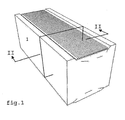
- FIG. 1 we see a building element (here a block) 1 cut by a plane II-II.
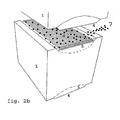
- the Fig. 2a shows the cross section of this building element 1, two faces 4 of which are provided with a layer comprising an activatable gelling mixture 5.
- an activator here a milk of lime 7
- Fig. 2b This has the effect that the mixture 5 goes to the activated state 9.
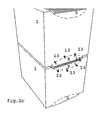
- Fig. 2c After assembly ( Fig. 2c ), physicochemical phenomena come to upset, under the effect of the activation of the geliform mixture 9, the contact zone 11 between the two elements 1.
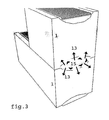
- pozzolanic reactions, softening effects and swelling and other physical effects move the boundaries of this zone 11 towards the interior of each of the elements 1 in the direction of the arrows 13, which has the effect of result that the two elements 1 are aggregated with each other, as shown in FIG. Fig. 3 .
- the two elements 1 finally merge into one without forming a discernible seal.
- connection between the elements 1 is not superficial but extends in depth.
- swelling effects result by reaction additional compression according to the arrows 15 in each element 1.
- pozzolanic reactions take place within the clayey earth.
- the resulting stabilization of elements 1 is mainly due to the dissolution of clay minerals in the alkaline environment created by lime and the recombination of silica (SiO 2 ) and alumina (Al 2 O 3). ) (usually found in very plastic clay soils) clays and feldspars in the presence of calcium to form calcium and aluminum complex silicates that cement inert grains (eg quartz) together.
- the pozzolanic reactions are further amplified in case of steaming or pressure steaming in autoclave building elements, which helps to smooth the mechanical performance of the building elements. These then become eligible in particular as supporting elements.
- the calcium in question comes from both soil and whitewash whitewash when diffused into the earth during assembly.
- the Fig. 4a and 4b show a construction element 1 provided on its upper face 4 of longitudinal grooves and on its lower face 4 of transverse grooves.
- the grooves of the upper face 4 receive the wash.
- the surfaces are grooved to increase the contact surface developed with the whitewash and therefore the extent of activation and subsequent physico-chemical phenomena.
- the perpendicular disposition of the grooves of adjacent superposed elements 1 makes the grooves not interlock, which prevents the lime milk from overflowing towards shoulders 17 and thus the loss of activating product of the gelable layer activated.
- the distance between the shoulders 17 of two superposed adjacent elements 1 serves to control the subsidence of the contact zone resulting from the activation.
- the mutually perpendicular disposition of the grooves also assists in the collapse of the contact zone, consecutive to the activation, of two adjacent superimposed elements 1. During this collapse, the grooves become smaller as the thickness increases. collapse of the contact zone and force the milk of lime to diffuse inside the elements 1. The grooves consequently have a favorable impact on the quality of the construction and the productivity of the process.
- the Fig. 5 shows, in four phases (5.1 to 5.4), the filling operation of a mold, in which three layers are successively formed: a first layer of activatable gelling mixture followed by a layer of clay soil, then a second activatable gel mixture layer. Then all of these three layers is compressed (phase 5.5). In contrast to the coating, it starts from a gel-free layer free of water.
Landscapes
- Engineering & Computer Science (AREA)
- Chemical & Material Sciences (AREA)
- Architecture (AREA)
- Structural Engineering (AREA)
- Civil Engineering (AREA)
- Ceramic Engineering (AREA)
- Materials Engineering (AREA)
- Inorganic Chemistry (AREA)
- Organic Chemistry (AREA)
- Physics & Mathematics (AREA)
- Chemical Kinetics & Catalysis (AREA)
- Electromagnetism (AREA)
- Dispersion Chemistry (AREA)
- Mechanical Engineering (AREA)
- Curing Cements, Concrete, And Artificial Stone (AREA)
- Building Environments (AREA)
- Finishing Walls (AREA)
Description
- L'invention se rapporte à des éléments de construction en terre crue comprimée.
- L'invention se rapporte aussi à un procédé d'assemblage d'une partie d'édifice à partir de tels éléments.
- La terre crue est utilisée depuis des millénaires comme matériau de construction. Elle est encore toujours le matériau de construction le plus répandu à travers le monde. Un tiers de l'humanité vit dans un habitat en terre, soit plus de deux milliards de personnes dans 150 pays, le plus souvent dans le tiers-monde.
- La terre crue sous une forme stabilisée connaît également désormais un intérêt dans les pays occidentaux notamment en raison de ses propriétés s'inscrivant dans la démarche du développement durable : excellente durabilité, réduction des coûts de transport et de transformation (pratiquement sans dépenser d'énergie), grande inertie thermique, recyclage aisé des gravats etc. La stabilisation de la terre crue, qui vise à réduire sa sensibilité à l'eau et à augmenter sa résistance mécanique, peut être effectuée par compression/compactage et/ou par voie chimique, par exemple en ajoutant de la chaux. Il existe différentes techniques de mise en oeuvre de terre crue stabilisée, dont le pisé et les blocs de terre comprimée. Ces techniques exigent toutefois beaucoup de temps et de main d'oeuvre.
- D'autres avantages de la terre crue résident en son caractère incombustible et sain, notamment hypoallergénique.
- Par ailleurs, la mise en oeuvre de terre crue présente aussi un intérêt esthétique, car elle permet une grande variété architecturale ainsi que des formes d'apparence complexe : murs, cloisons, voûtes, coupoles, corniches, éléments décoratifs de façade, etc.
- Les architectes et les entreprises actives dans la mise en oeuvre de la terre crue s'efforcent de répandre ce mode de construction d'avenir, à la fois économique, sain, flexible au niveau de ses applications et à faible empreinte écologique. A cet effet, ces entreprises visent à augmenter la qualité de leurs édifices et leur productivité tout en réduisant autant que possible les coûts de main d'oeuvre.
- On connaît de tels éléments de construction en terre crue comprimée, par exemple, dans le document
FR 2 861 010 - Cette remarque vaut également pour la demande
FR 2 527 136 - Les documents
FR 2 936 534 FR 2 509 344 - La demande internationale
WO 1986/06126 - Le document
FR 2 638 187 - La demande internationale
WO 2008/062299 porte sur des blocs de terre stabilisés qui comprennent une partie intérieure en terre non stabilisée et une fine couche en terre stabilisée sur une ou deux faces, lesquelles faces servent à protéger le mur construit avec de tels blocs contre l'humidité, l'effritement et l'abrasion. Les blocs de terre sont solidarisés par du mortier. - Dans ces cinq derniers documents, les blocs en terre crue comprimée décrits sont assemblés de manière traditionnelle par des moyens tels que la colle ou du mortier. Un élément de construction selon le préambule de la revendication 1 est connu de
FR 2 936 533 - Ces moyens traditionnels présentent plusieurs inconvénients. En premier lieu ils ne permettent qu'une adhérence superficielle entre les éléments de construction. En outre, leur fabrication nécessite généralement une quantité non négligeable d'énergie et leur recyclage après démolition des édifices ainsi assemblés est difficile, ce qui est défavorable pour leur empreinte, écologique. Par ailleurs, l'imprégnation des surfaces des éléments de construction au moment de l'assemblage prend beaucoup de temps, ce qui nuit à la productivité.
- Un but de l'invention est de procurer un élément de construction en terre crue comprimée présentant des propriétés s'inscrivant dans le cadre du développement durable tout en permettant la réalisation de parties d'édifices dans des conditions optimales de tenue mécanique (stabilité), et de productivité.
- Par élément de construction on entend dans la présente demande tout élément, porteur ou non, pouvant être mis en oeuvre dans le domaine de la construction, tel qu'un élément de maçonnerie, un élément de cloison, un élément de plancher, un élément de revêtement extérieur ou intérieur, un élément de décoratif extérieur ou intérieur etc.
- A cette fin, l'élément de construction en terre crue argileuse comprimée selon l'invention est apte à s'agréger sur au moins une de ses faces à un élément adjacent par l'intermédiaire d'une couche. Celle-ci comprend un mélange gélifiable activable s'étendant sur l'au moins une face de l'élément. Cette couche peut être obtenue de différentes façons, par exemple par application d'un enduit ou par remplissage dans un moule.
- Ce mélange gélifiable une fois activé est de nature à faire réagir entre elles sur une certaine profondeur les surfaces en contact des éléments adjacents. Il s'en suit que dans la zone de contact les matériaux interagissent et s'agrègent sous l'effet de phénomènes physico-chimiques, ce qui lie en profondeur les éléments entre eux sans former de joint et favorise donc la stabilité de parties d'édifices ainsi assemblées.
- L'avantage de ce procédé est que l'on peut utiliser pour ce mélange gélifiable des éléments naturels, abondants et non toxiques, ce qui élimine tous les problèmes de transport et/ou de recyclage des déchets de construction.
- Un autre but de l'invention est d'atteindre un effet esthétique particulier en utilisant un type de terre généralement négligé en raison de ses propriétés mécaniques.
- A cette fin, la terre crue argileuse utilisée dans les éléments de construction selon l'invention est caractérisée par un indice de plasticité compris de préférence entre 10 et 35 (valeurs indicatives pour des terres « plastiques »), et de façon préférée supérieur à 35 (valeurs indicatives pour des terres « très plastiques » telles que celles comprenant de la smectite dont la bentonite). Ces terres, habituellement utilisées dans le domaine de la poterie et de l'industrie de la terre cuite, donnent à l'élément de construction une porosité de surface très faible et par conséquent un aspect fini de plus grande qualité.
- Avantageusement, la terre crue argileuse est complétée par 3 à 10 % en poids de chaux avant compression. Ces teneurs en stabilisant permettent, de façon surprenante, à des réactions pouzzolaniques à court, moyen et long terme d'avoir une ampleur fort bénéfique, particulièrement en cas d'usage de terres plastiques à très plastiques, pour la durabilité ainsi que pour la résistance à l'érosion et à la compression de l'élément de construction selon l'invention.
- La terre argileuse comprend avantageusement autant que possible d'une smectite à choisir parmi la montmorillonite et tout type de bentonite, de préférence calcique. Ces teneurs en smectite favorisent l'imperméabilisation et donc la résistance au gel des éléments de construction.
- Avantageusement, le mélange gélifiable activable intégré à l'élément de construction comprend de la smectite à gonflement modéré, à choisir parmi la montmorillonite et tout type de bentonite, de préférence calcique. Ces argiles, qui peuvent gonfler lors de l'activation, amplifient le phénomène d'agrégation à l'interface entre éléments adjacents. Elles sont en outre, en cas de stabilisation des éléments à la chaux, les plus réactives par rapport à celle-ci et stimulent les réactions pouzzolaniques de la chaux, ce qui maximise la stabilisation de la construction.
- Le mélange gélifiable activable comprend de préférence du sable silicieux ou toute autre matière inerte, perméable et d'une granulométrie comprise entre 0,02 et 5 mm. Cela permet d'assurer une activation en profondeur de la couche de mélange gélifiable activable. Celui-ci peut comprendre en outre des fines argileuses présentant un indice de plasticité supérieur à 35.
- Avantageusement, l'élément de construction de l'invention comprend sur l'au moins une de ses faces d'agrégation des rainures aptes à coopérer, lors de l'activation, avec les rainures d'un élément adjacent qui sont disposées perpendiculairement aux rainures du premier élément, afin d'accentuer l'agrégation des éléments entre eux. Ces caractéristiques apportent des bénéfices en termes notamment de qualité (stabilité) de la construction et de productivité.
- Un autre but de l'invention est de procurer un procédé d'assemblage d'une partie d'édifice à partir d'éléments de terre crue argileuse présentant des propriétés s'inscrivant dans le cadre du développement durable, qui permet sa réalisation dans des conditions optimales de tenue mécanique (stabilité), et de productivité.
- A cette fin, le procédé d'assemblage d'une partie d'édifice selon l'invention, comprend la mise à disposition d'un moule et son remplissage par une terre crue argileuse qui est ensuite comprimée. Un élément de construction est ainsi formé. Il est ensuite démoulé. Une couche comprenant un mélange gélifiable activable est alors présente sur au moins une des faces de l'élément de construction qui est ensuite séché. Lors de la mise en oeuvre, les faces à assembler d'un premier et d'un deuxième éléments de construction sont badigeonnées ou aspergées de façon à activer le mélange gélifiable. Ces faces sont mises en contact et pressées l'une contre l'autre. Sous l'effet du mélange gélifié activée, la zone de contact se ramollit et peut gonfler légèrement. Les deux éléments accolés s'agrègent. On laisse ensuite sécher la partie d'édifice.
- Les parties d'édifice réalisées selon le procédé de l'invention présentent, de par l'agrégation mutuelle des éléments de construction constitutifs, une tenue mécanique accrue, ce qui est avantageux, notamment dans des zones présentant une activité sismique.
- Ce procédé présente également l'avantage que les opérations d'application de la couche du mélange gélifiable et de badigeonnage pour sa réactivation sont à la fois extrêmement simples et rapides. Cette technique favorise donc la productivité et l'accessibilité à une main d'oeuvre faiblement qualifiée que l'on rencontre en grand nombre dans les pays à faibles revenus.
- Outre ses avantages socio-économiques, le procédé selon l'invention a aussi un impact favorable sur l'environnement et le développement durable. Il permet notamment de valoriser des terres locales non agricoles qui, dans de nombreux cas, constituent une source de matériau quasi inépuisable. Le procédé ne requiert pratiquement pas d'énergie et n'utilise pas de produits chimiques. Par ailleurs, les constructions sont, après démolition, facilement recyclables.
- D'une façon générale, le procédé d'assemblage selon l'invention est parfaitement en phase avec le développement d'une économie axée sur la rentabilité, la durabilité et l'amélioration des conditions d'existence humaines. Il est de plus applicable pratiquement partout, quelque soit le niveau de développement local considéré.
- Avantageusement, l'opération de remplissage du moule par de la terre crue argileuse est simultanée à l'opération de réalisation de la couche comprenant le mélange gélifiable activable. Selon une forme de réalisation préférée, l'on place sur au moins une des faces du moule une couche du mélange gélifiable activable, le reste du volume étant constitué de terre crue argileuse. Ces variantes permettent d'envisager une fabrication des éléments de construction davantage automatisée.
- Par ailleurs, le procédé selon l'invention a également un impact esthétique, car du fait de l'agrégation des éléments de construction constituant la partie d'édifice, il n'y a pas de joints, sauf en cas de joint moulé à la fabrication de l'élément. La partie d'édifice peut donc avoir l'apparence extérieure d'un voile, ce qui permet d'économiser l'application d'un revêtement égalisateur.
- Dans le procédé selon l'invention, l'opération de séchage de l'élément de construction est avantageusement un étuvage. Celui-ci est effectué de préférence à 100°C et 100% d'humidité. Le séchage peut également avoir lieu en autoclave sous une pression de vapeur. Ces dispositions ont pour effet, en cas de stabilisation des éléments de construction à la chaux, d'amplifier très nettement la réaction entre la terre et la chaux et de la contrôler, ce qui permet à la fois d'assurer une constance des caractéristiques physiques et surtout mécaniques sur l'ensemble d'une production et d'augmenter la productivité.
- Avantageusement, le stockage des éléments est réalisé de façon à conserver aussi longtemps que possible l'humidité obtenue lors de l'étuvage ou du traitement à la vapeur en autoclave. Le maintien de cette humidité empêche la carbonatation de la chaux éventuelle et maximise de ce fait la chaux disponible pour les réactions pouzzolaniques, ce qui en augmente l'ampleur et améliore par conséquent la stabilité des éléments.
- Selon l'invention, le badigeon est de préférence un lait de chaux.
- Par ailleurs, le badigeon peut comprendre des fines argileuses présentant un indice de plasticité supérieur à 35 et/ou une faible quantité de sable silicieux ou de tout autre matière conductible du badigeon. Cette matière conductible doit permettre, en facilitant la pénétration du badigeon dans la couche gélifiable activable, l'activation en profondeur de cette dernière.
- Dans le procédé d'assemblage selon l'invention on utilise de façon avantageuse une terre crue argileuse présentant un indice de plasticité compris de préférence entre 10 et 35, et de façon préférée supérieur à 35. Ces terres, habituellement utilisées dans le domaine de la poterie et de l'industrie de la terre cuite, donnent à l'élément de construction une porosité de surface très faible et par conséquent un aspect fini de plus grande qualité.
- Selon le procédé d'assemblage de l'invention, on utilise avantageusement de la terre crue argileuse comprenant 3 à 10 % en poids de chaux avant compression. Ces teneurs en stabilisant permettent de façon surprenante des réactions pouzzolaniques à court, moyen et long terme d'une ampleur fort bénéfique, particulièrement en cas d'usage de terres plastiques à très plastiques, pour la durabilité ainsi que pour la résistance à l'érosion et à la compression de l'élément de construction selon l'invention.
- Avantageusement, on utilise de la terre argileuse comprenant autant que possible d'une smectite à choisir parmi la montmorillonite et tout type de bentonite, de préférence calcique. La présence de smectite favorise l'imperméabilisation et donc la résistance au gel des éléments de construction.
- On utilise avantageusement dans le procédé d'assemblage selon l'invention un mélange gélifiable comprenant de la smectite à gonflement modéré à choisir parmi la montmorillonite et tout type de bentonite, de préférence calcique. Ces argiles, qui peuvent gonfler, amplifient le phénomène d'agrégation à l'interface entre éléments adjacents.
- Selon le procédé d'assemblage selon l'invention, on utilise de préférence un mélange gélifiable comprenant des fines argileuses présentant un indice de plasticité supérieur à 35. Avantageusement, ce mélange contient aussi du sable silicieux ou toute autre matière inerte, perméable et d'une granulométrie comprise entre 0,02 et 5 mm afin d'assurer la pénétration en profondeur du badigeon dans la couche du mélange gélifiable.
- Ces aspects ainsi que d'autres aspects de l'invention seront clarifiés dans la description détaillée de modes de réalisation particuliers de l'invention, référence étant faite aux dessins des figures, dans lesquelles :
- La
Fig.1 représente schématiquement en perspective une partie d'édifice (ici, un bloc de construction) selon le procédé de l'invention ; - Les
Fig.2a à 2c et laFig.3 sont des vues en coupe suivant le plan II-II de laFig. 1 de différents stades d'assemblage de deux éléments de construction de laFig. 1 . - Les
Fig. 4a et 4b montrent un élément de construction selon l'invention pourvu sur ses faces d'assemblage de rainures. - La
Fig. 5 montre l'opération de remplissage de la terre argileuse et du mélange gélifiable activable avant compression selon une forme de réalisation du procédé de l'invention. - Les figures ne sont pas dessinées à l'échelle. Généralement, des éléments semblables sont dénotés par des références semblables dans les figures.
- A la
Fig. 1 , l'on voit un élément de construction (ici un parpaing) 1 coupé par un plan II-II. - La
Fig. 2a montre la section transversale de cet élément de construction 1 dont deux faces 4 sont pourvues d'une couche comprenant un mélange gélifiable activable 5. Au moment de l'assemblage de deux éléments 1 sur la face 4, un activateur, soit ici un lait de chaux 7, est appliqué sur cette face (Fig. 2b ). Celui-ci a pour effet que le mélange 5 passe à l'état activé 9. Après assemblage (Fig. 2c ), des phénomènes physico-chimiques viennent bouleverser, sous l'effet de l'activation du mélange géliforme 9, la zone de contact 11 entre les deux éléments 1. En effet, des réactions pouzzolaniques, des effets de ramollissement et de gonflement ainsi que d'autres effets physiques (par exemple : diffusion, phénomènes électriques etc....) déplacent les limites de cette zone 11 vers l'intérieur de chacun des éléments 1 dans le sens des flèches 13, ce qui a pour résultat que les deux éléments 1 s'agrègent l'un à l'autre, comme cela est représenté à laFig. 3 . Les deux éléments 1 se fondent finalement en un seul sans former de joint discernable. - La liaison entre les éléments 1 n'est donc pas superficielle mais s'étend en profondeur. En outre, les effets de gonflement entraînent par réaction une compression supplémentaire selon les flèches 15 dans chaque élément 1. Ces phénomènes d'agrégation et de compression sont bénéfiques pour la stabilité d'une partie d'édifice constituée de tels éléments de construction 1.
- En cas d'ajout de chaux dans la terre argileuse constitutive des éléments de construction 1, des réactions pouzzolaniques ont lieu au sein de la terre argileuse. La stabilisation des éléments 1 qui en résulte est due pour l'essentiel à la dissolution des minéraux argileux dans l'environnement alcalin créé par la chaux et de la recombinaison de la silice (SiO2) et de l'alumine (Al2O3) (que l'on retrouve généralement dans les terres argileuses très plastiques) des argiles et feldspaths en présence du calcium pour former des silicates complexes d'aluminium et de calcium qui cimentent les grains inertes (de quartz, par exemple) entre eux. Les réactions pouzzolaniques sont encore amplifiées en cas d'étuvage ou de traitement sous pression de vapeur en autoclave des éléments de construction, ce qui contribue à lisser les performances mécaniques des éléments de construction. Ceux-ci deviennent alors éligibles en particulier comme éléments porteurs. Le calcium en question provient aussi bien de la terre que du badigeon lait de chaux lorsqu'il a diffusé dans la terre lors de l'assemblage.
- Les
Fig. 4a et 4b montrent un élément de construction 1 pourvu sur sa face supérieure 4 de rainures longitudinales et sur sa face inférieure 4 de rainures transversales. Les rainures de la face supérieure 4 reçoivent le badigeon. Les surfaces sont rainurées afin d'augmenter la surface de contact développée avec le badigeon et donc l'ampleur de l'activation et des phénomènes physico-chimiques subséquents. La disposition perpendiculaire des rainures d'éléments superposés adjacents 1 fait qu'il n'y a pas emboîtement des rainures, ce qui évite le débordement du lait de chaux vers des épaulements 17 et donc la perte de produit d'activation de la couche gélifiable activable. La distance entre les épaulements 17 de deux éléments adjacents superposés 1 sert à contrôler l'affaissement de la zone de contact résultant de l'activation. Par ailleurs, la disposition mutuellement perpendiculaire des rainures aide aussi à l'affaissement de la zone de contact, consécutif à l'activation, de deux éléments adjacents superposés 1. Lors de cet affaissement, les rainures se rapetissent au fur à mesure de l'effondrement de la zone de contact et forcent le lait de chaux à diffuser à l'intérieur des éléments 1. Les rainures ont par conséquent un impact favorable sur la qualité de la construction et la productivité du procédé. - La
Fig. 5 montre, en quatre phases (5.1 à 5.4), l'opération de remplissage d'un moule, dans laquelle trois couches sont formées successivement : une première couche de mélange gélifiable activable suivie d'une couche de terre argileuse, puis d'une seconde couche de mélange gélifiable activable. Ensuite l'ensemble de ces trois couches est comprimé (phase 5.5). Au contraire de l'enduction, on part d'une couche gélifiable exempte d'eau. - Il apparaîtra évident pour l'homme du métier que la présente invention n'est pas limitée aux exemples illustrés et décrits ci-dessus. La présence de numéros de référence ne peut être considérée comme limitative. L'usage du terme « comprend » ne peut en aucune façon exclure la présence d'autres éléments autres que ceux mentionnés. L'usage de l'article défini « un » pour introduire un élément n'exclut pas la présence d'une pluralité de ces éléments. La présente invention a été décrite en relation avec des modes de réalisations spécifiques, qui ont une valeur purement illustrative et ne doivent pas être considérés comme limitatifs.
Claims (17)
- Elément de construction (1) en terre crue argileuse comprimée, apte à s'agréger sur au moins une de ses faces (4) à un élément (1) adjacent caracterisé en ce qu'il comprend une couche comprenant un mélange gélifiable activable (5) s'étendant sur l'au moins une face (4) de l'élément (1) qui permet ladite agrégation.
- Elément de construction selon la revendication 1, caractérisé en ce que la terre crue argileuse présente un indice de plasticité compris entre 10 et 35.
- Elément de construction selon la revendication 1, caractérisé en ce que la terre crue argileuse présente un indice de plasticité supérieur à 35.
- Elément de construction selon l'une quelconque des revendications précédentes, caractérisé en ce que la terre crue argileuse comprend 3 à 10 % en poids de chaux.
- Elément de construction selon l'une quelconque des revendications précédentes, caractérisé en ce que la terre crue argileuse comprend autant que possible d'une smectite à choisir parmi la montmorillonite et tout type de bentonite.
- Elément de construction selon l'une quelconque des revendications précédentes, caractérisé en ce que le mélange gélifiable activable (5) comprend de la smectite à gonflement modéré à choisir parmi la montmorillonite et tout type de bentonite.
- Elément de construction selon la revendication 6, caractérisé en ce que la bentonite est de type calcique.
- Elément de construction selon l'une quelconque des revendications précédentes, caractérisé en ce que le mélange gélifiable activable (5) comprend des fines argileuses présentant un indice de plasticité supérieur à 35.
- Elément de construction selon l'une quelconque des revendications précédentes, caractérisé en ce que le mélange gélifiable activable (5) comprend du sable silicieux ou toute autre matière inerte, perméable et d'une granulométrie comprise entre 0,02 et 5 mm.
- Elément de construction selon l'une quelconque des revendications précédentes, caractérisé en ce qu'il comprend sur l'au moins une de ses faces (4) d'agrégation des rainures aptes à coopérer, lors de l'activation, avec les rainures de l'élément (1) adjacent qui sont disposées perpendiculairement aux rainures du premier élément (1), afin d'accentuer d'agrégation des éléments (1) entre eux.
- Procédé d'assemblage d'une partie d'édifice à partir d'éléments (1) de terre crue argileuse comprimée, caractérisé en ce qu'il comprend les opérations suivantes :a) mise à disposition d'un moule ;b) remplissage de ce moule par une terre crue argileuse ;c) compression de cette terre ;d) démoulage de l'élément de construction (1) ainsi formé ;e) réalisation d'une couche comprenant un mélange gélifiable activable (5) sur au moins une des faces (4) de l'élément de construction (1);f) séchage de cet élément ;g) stockage ;h) badigeonnage des faces (4) à assembler d'un premier et d'un deuxième éléments de construction (1), de façon à activer le mélange gélifiable (5) ;i) mise en contact et pressage de ces faces (4) l'une contre l'autre;j) ramollissement et gonflement de la zone de contact (11) sous l'effet du mélange géliforme activé (9) ;k) agrégation des deux éléments accolés (1) ;l) séchage de la partie d'édifice.
- Procédé d'assemblage d'une partie d'édifice selon la revendication 11, caractérisé en ce que l'opération e) est réalisée simultanément à l'opération b).
- Procédé d'assemblage d'une partie d'édifice selon la revendication 12, caractérisé en ce que l'on place sur au moins une des faces du moule une couche du mélange gélifiable activable (5), le reste du volume étant constitué de terre crue argileuse.
- Procédé d'assemblage d'une partie d'édifice selon la revendication 11, caractérisé en ce que l'opération e) est réalisée par l'application d'un enduit comprenant le mélange gélifiable activable (5) après l'opération b).
- Procédé d'assemblage d'une partie d'édifice selon l'une quelconque des revendications 11 à 14, caractérisé en ce que l'opération de séchage de l'élément (1) est sélectionnée parmi un étuvage et un traitement sous pression de vapeur en autoclave.
- Procédé d'assemblage d'une partie d'édifice selon l'une quelconque des revendications 11 à 15, caractérisé en ce que le badigeon est un lait de chaux (7).
- Procédé d'assemblage d'une partie d'édifice selon l'une quelconque des revendications 11 à 16, caractérisé en ce que le badigeon comprend des fines argileuses présentant un indice de plasticité supérieur à 35.
Priority Applications (1)
| Application Number | Priority Date | Filing Date | Title |
|---|---|---|---|
| EP11775798.9A EP2633131B1 (fr) | 2010-10-28 | 2011-10-26 | Element de construction en terre crue |
Applications Claiming Priority (3)
| Application Number | Priority Date | Filing Date | Title |
|---|---|---|---|
| EP10189218A EP2447433A1 (fr) | 2010-10-28 | 2010-10-28 | Élément de construction en terre crue |
| EP11775798.9A EP2633131B1 (fr) | 2010-10-28 | 2011-10-26 | Element de construction en terre crue |
| PCT/EP2011/068767 WO2012055918A2 (fr) | 2010-10-28 | 2011-10-26 | Element de construction en terre crue |
Publications (2)
| Publication Number | Publication Date |
|---|---|
| EP2633131A2 EP2633131A2 (fr) | 2013-09-04 |
| EP2633131B1 true EP2633131B1 (fr) | 2015-03-25 |
Family
ID=43709021
Family Applications (2)
| Application Number | Title | Priority Date | Filing Date |
|---|---|---|---|
| EP10189218A Withdrawn EP2447433A1 (fr) | 2010-10-28 | 2010-10-28 | Élément de construction en terre crue |
| EP11775798.9A Not-in-force EP2633131B1 (fr) | 2010-10-28 | 2011-10-26 | Element de construction en terre crue |
Family Applications Before (1)
| Application Number | Title | Priority Date | Filing Date |
|---|---|---|---|
| EP10189218A Withdrawn EP2447433A1 (fr) | 2010-10-28 | 2010-10-28 | Élément de construction en terre crue |
Country Status (9)
| Country | Link |
|---|---|
| US (1) | US20130337275A1 (fr) |
| EP (2) | EP2447433A1 (fr) |
| BR (1) | BR112013010155A2 (fr) |
| ES (1) | ES2539258T3 (fr) |
| MA (1) | MA34681B1 (fr) |
| MX (1) | MX2013004600A (fr) |
| PT (1) | PT2633131E (fr) |
| WO (1) | WO2012055918A2 (fr) |
| ZA (1) | ZA201302985B (fr) |
Families Citing this family (3)
| Publication number | Priority date | Publication date | Assignee | Title |
|---|---|---|---|---|
| FR3133872B1 (fr) * | 2022-03-22 | 2024-07-12 | Wienerberger | Procédé d’assemblage d’au moins deux éléments de construction en terre crue non-cuite et construction réalisée par ce procédé |
| FR3152805A1 (fr) | 2023-09-13 | 2025-03-14 | Universite Gustave Eiffel | Matériau argileux comprenant un mélange de cellulose et d’amidon pour la construction en terre crue |
| WO2025179317A1 (fr) * | 2024-02-26 | 2025-09-04 | Martin Leitl | Procédé pour assembler deux blocs de construction d'origine minérale présentant des surfaces de pose sensiblement planes |
Family Cites Families (62)
| Publication number | Priority date | Publication date | Assignee | Title |
|---|---|---|---|---|
| US1702096A (en) * | 1925-08-24 | 1929-02-12 | Charles C Thompson | Reenforced adobe block and wall construction |
| US2880470A (en) * | 1954-03-26 | 1959-04-07 | Pickersgill Eleanor | Structure blocks |
| US3145502A (en) * | 1955-04-01 | 1964-08-25 | Rubenstein David | Structural element and method of making |
| US2805448A (en) * | 1955-06-10 | 1957-09-10 | Rubenstein David | Method of making composite structural members |
| US2751775A (en) * | 1955-07-12 | 1956-06-26 | Burns & Russell Co | Masonry block having an integral molded facing layer and method of making same |
| US2951001A (en) * | 1956-01-12 | 1960-08-30 | Rubenstein David | Decorative structural element |
| US2814836A (en) * | 1956-02-01 | 1957-12-03 | Burns & Russell Co | Method of producing coated masonry building units |
| US3116570A (en) * | 1959-11-05 | 1964-01-07 | Torricelli Decio | Brick |
| US3194724A (en) * | 1961-06-29 | 1965-07-13 | Burns & Russell Co | Coated blocks |
| US3545155A (en) * | 1965-09-17 | 1970-12-08 | George W Church Jr | Confined soil bricks |
| US3534518A (en) * | 1968-09-27 | 1970-10-20 | Groutlock Corp | Interlocking building block construction |
| DE2345568A1 (de) * | 1973-09-10 | 1975-04-17 | Franz Julius Dipl Ing Gergely | Bau-elemente |
| US4161852A (en) * | 1977-10-17 | 1979-07-24 | Schultz Karl V | Adobe wall construction |
| US4229222A (en) * | 1978-07-28 | 1980-10-21 | Schneider Gordon L | Earthen cement compositions for building materials and process |
| US4365451A (en) * | 1980-01-08 | 1982-12-28 | Nelson Lynn S | Poured adobe building construction and method of forming same |
| US4366657A (en) * | 1980-03-05 | 1983-01-04 | Fred Hopman | Method and form for mechanically pouring adobe structures |
| FR2509344A1 (fr) | 1981-07-10 | 1983-01-14 | Bride Michel | Bloc en terre hyper-pressee et stabilisee pour la construction |
| US4557681A (en) * | 1982-04-14 | 1985-12-10 | John W. Wright | Apparatus for forming adobe blocks |
| FR2527136A1 (fr) | 1982-05-19 | 1983-11-25 | Victor Lorenzi | Procede de stabilisation d'elements de construction realises en terre comprimee et dispositif pour sa mise en oeuvre |
| CA1222149A (fr) * | 1984-07-19 | 1987-05-26 | Rodney J.P. Dietrich | Bloc autoniveleur, et son emploi dans le batiment |
| BE902233A (fr) | 1985-04-18 | 1985-08-16 | Taddei Serge | Bloc creux auto-emboitant en terre hyper-pressee a double compression et stabilisee a froid pour la constructions sans joint. |
| FR2638187B1 (fr) | 1988-10-24 | 1991-06-28 | Popa Laurentiu | Bloc de construction en terre comprimee |
| US5362342A (en) * | 1990-12-18 | 1994-11-08 | Polyfoam Products, Inc. | Method of bonding roof tiles to roof substrate utilizing urethane foam |
| US5241795A (en) * | 1992-03-12 | 1993-09-07 | Giroux Francis A | Building materials made from waste and unusual properties thereof |
| US5407879A (en) * | 1993-09-29 | 1995-04-18 | American Colloid Company | Method of improving the contaminant resistance of a smectite clay by rewetting and impregnating the clay with a water-soluble polymer, and redrying the polymer-impregnated clay |
| US5782970A (en) * | 1995-01-03 | 1998-07-21 | Composite Industries Of America, Inc. | Lightweight, waterproof, insulating, cementitious composition |
| US5873206A (en) * | 1995-03-06 | 1999-02-23 | Polyceramics, Inc. | Interlocking building block |
| US5895536A (en) * | 1996-05-17 | 1999-04-20 | Insta-Foam Products | Method of adhering roof tiles using one-component adhesive and roof construction obtained thereby |
| CA2182128C (fr) * | 1996-07-26 | 1999-08-24 | Michael Domazet | Appareils servant a faconner des adobes |
| US6233897B1 (en) * | 1997-01-09 | 2001-05-22 | Dean Jurik | Landscaping block |
| US6122881A (en) * | 1998-10-08 | 2000-09-26 | Aubertot; Christophe | Lengthwise extrusion of facing bricks to create interlocking profiles |
| DE60043283D1 (de) * | 1999-04-07 | 2009-12-24 | Nihon Kogyo Co Ltd | Pflasterstein und dazugehörige legemethode |
| US6206991B1 (en) * | 1999-05-24 | 2001-03-27 | Fomo Products, Inc. | Roof tile construction using sandwiched adhesive |
| DE10003213A1 (de) * | 2000-01-26 | 2001-08-02 | Ziegelwerk Ott Bermatingen Gmb | Lehmtrockenbausystem |
| AUPQ746100A0 (en) * | 2000-05-05 | 2000-06-08 | Collier, Peter | Improvements in building blocks |
| US6393786B1 (en) * | 2000-05-19 | 2002-05-28 | Pittsburgh Corning Corporation | Fire-resistant block |
| US6526720B2 (en) * | 2000-06-26 | 2003-03-04 | Peerless Block & Brick, Co. | Masonry block |
| US6619945B1 (en) * | 2000-08-31 | 2003-09-16 | James O. Sims | Apparatus for forming structural blocks from compactible materials |
| EP1412588B1 (fr) * | 2001-07-19 | 2011-11-30 | G.J. Den Daas Management B.V. | Systeme de blocs empilables secs ainsi qu'un bloc et un element d'assemblage du systeme |
| EP1442179A1 (fr) * | 2001-10-18 | 2004-08-04 | Westblock Systems Inc. | Bloc mural, systeme et procede associes |
| US20030188501A1 (en) * | 2002-04-05 | 2003-10-09 | Busch Dario Francisco | Recycled building component systems |
| US20070277472A1 (en) * | 2002-04-11 | 2007-12-06 | Sinclair Raymond F | Building block and system for manufacture |
| US8215079B2 (en) * | 2002-04-11 | 2012-07-10 | Encore Building Solutions, Inc | Building block and system for manufacture |
| WO2003089383A1 (fr) * | 2002-04-16 | 2003-10-30 | G.Plus Co., Ltd. | Composites d'argile non chauffee pour materiaux de construction |
| US6665994B1 (en) * | 2002-06-07 | 2003-12-23 | John Robert Ruggeri | Self-aligning building blocks |
| AU2003301560A1 (en) * | 2002-10-22 | 2004-05-13 | Owens Corning | Composite exterior cladding panel and method of manufacture |
| CA2423680A1 (fr) * | 2003-03-27 | 2004-09-27 | Horacio Correia | Porte-adhesif pour blocs superposables |
| US7661239B2 (en) * | 2003-10-17 | 2010-02-16 | Alliance Concrete Concepts Inc. | Masonry brick |
| FR2861010B1 (fr) | 2003-10-20 | 2009-01-16 | Mehdi Mahmoud Dellagi | Procede de fabrication d'elements architectoniques en pise. |
| US7067004B2 (en) * | 2004-01-29 | 2006-06-27 | Halliburton Energy Services, Inc. | Grout compositions having high thermal conductivities and methods of using the same |
| CA2513969A1 (fr) * | 2004-08-02 | 2006-02-02 | W.R. Grace & Co.-Conn. | Methode pour attacher des materiaux de construction ensemble |
| US20060037267A1 (en) * | 2004-08-05 | 2006-02-23 | Taylor Charles D Jr | Simulated granite |
| US7472520B2 (en) * | 2005-03-17 | 2009-01-06 | Steve Eugene Everett | Structural building block system and method comprising same |
| US20060260256A1 (en) * | 2005-05-19 | 2006-11-23 | Everett Steve E | Structural building block system and method comprising same |
| US7666340B2 (en) * | 2005-07-02 | 2010-02-23 | Steve Eugene Everett | Method and system for forming structural building blocks having a cured binding material therein |
| US7669375B2 (en) * | 2005-10-25 | 2010-03-02 | Steve Eugene Everett | Structural building block system with enhanced load bearing capability and method comprising same |
| EP1820916A1 (fr) * | 2006-02-17 | 2007-08-22 | Prexo | Elément de paroi et méthode d'assemblage d' éléments de construction pour former un élément de paroi |
| WO2008062299A2 (fr) | 2006-11-22 | 2008-05-29 | NIYONIZIGIYE, Déogratias | Blocs de terre hétérogènes |
| US7882674B2 (en) * | 2006-12-08 | 2011-02-08 | Craven Joseph H | Building blocks and wall assembly utilizing same |
| US7648666B2 (en) * | 2007-12-13 | 2010-01-19 | Steve Eugene Everett | Method of forming building blocks using block press equipment having translating fluid injection apparatus |
| US7772302B2 (en) * | 2008-07-22 | 2010-08-10 | Sierra Process Systems, Inc. | Incorporation of plastic scrap in asphalt compositions |
| FR2936533A1 (fr) | 2008-10-01 | 2010-04-02 | Benoit Francis Patrick Andre Derot | Systeme constructif a base de blocs de terre compressee et stabilisee pour la construction |
-
2010
- 2010-10-28 EP EP10189218A patent/EP2447433A1/fr not_active Withdrawn
-
2011
- 2011-10-26 PT PT117757989T patent/PT2633131E/pt unknown
- 2011-10-26 BR BR112013010155A patent/BR112013010155A2/pt not_active IP Right Cessation
- 2011-10-26 ES ES11775798.9T patent/ES2539258T3/es active Active
- 2011-10-26 WO PCT/EP2011/068767 patent/WO2012055918A2/fr not_active Ceased
- 2011-10-26 EP EP11775798.9A patent/EP2633131B1/fr not_active Not-in-force
- 2011-10-26 MX MX2013004600A patent/MX2013004600A/es active IP Right Grant
- 2011-10-26 US US13/882,125 patent/US20130337275A1/en not_active Abandoned
-
2013
- 2013-04-24 ZA ZA2013/02985A patent/ZA201302985B/en unknown
- 2013-05-24 MA MA35935A patent/MA34681B1/fr unknown
Also Published As
| Publication number | Publication date |
|---|---|
| EP2447433A1 (fr) | 2012-05-02 |
| BR112013010155A2 (pt) | 2016-09-13 |
| MX2013004600A (es) | 2013-12-02 |
| WO2012055918A3 (fr) | 2012-06-28 |
| EP2633131A2 (fr) | 2013-09-04 |
| MA34681B1 (fr) | 2013-11-02 |
| ZA201302985B (en) | 2014-06-25 |
| PT2633131E (pt) | 2015-07-22 |
| WO2012055918A2 (fr) | 2012-05-03 |
| ES2539258T3 (es) | 2015-06-29 |
| US20130337275A1 (en) | 2013-12-19 |
Similar Documents
| Publication | Publication Date | Title |
|---|---|---|
| EP4041509B1 (fr) | Fabrication additive d'elements de construction en beton | |
| FR2948708A1 (fr) | Procede de fabrication de panneaux avec isolation integree pour la realisation de batiments, panneaux ainsi realises | |
| FR3050744A1 (fr) | Procede pour la construction d'un mur de batiment par fabrication additive | |
| FR2525528A1 (fr) | Panneau de construction compressible et son procede d'emploi dans la realisation de fondations en beton | |
| FR2885617A1 (fr) | Blocs en bois agglomere | |
| EP2775056A1 (fr) | Bloc de construction hybride structural/isolant | |
| EP2633131A2 (fr) | Element de construction en terre crue | |
| EP4150170A1 (fr) | Panneau pour plancher ou paroi et procédé de fabrication d'un tel panneau | |
| EP1690993B1 (fr) | Mur à coffrage intégré | |
| FR2643667A1 (fr) | Bloc de maconnerie isolant et porteur et procede de fabrication du bloc | |
| WO2019101692A1 (fr) | Procédé de fabrication de blocs de granulats légers végétalisables | |
| WO2023025826A1 (fr) | Panneau mural et procédé de fabrication d'un tel panneau mural | |
| WO2009081009A1 (fr) | Blocs en fibres de cellulose agglomerees | |
| CN2786222Y (zh) | 三明治式复合外保温墙体 | |
| FR2956419A1 (fr) | Elements de construction calorifuges | |
| FR3034117B1 (fr) | Module de construction rapide a base de beton de perlite expansee | |
| FR2970620A1 (fr) | Procede de fabrication d'un pot horticole ornemental | |
| EP2473684B1 (fr) | Mur de bâtiment et procede pour realiser ce mur. | |
| FR3036123A1 (fr) | Dalle prefabriquee | |
| FR2598447A1 (fr) | Structure porteuse legere perfectionnee pour batiments, divers, notamment a usage d'habitation | |
| FR2477608A1 (fr) | Moellon et son procede de fabrication | |
| CN214740152U (zh) | 一种防装饰物空鼓和掉落的土墙体 | |
| EP3290608B1 (fr) | Procédé de montage d'un ensemble de construction et ensemble de construction associé | |
| CN1587571A (zh) | 易装的装饰板及其生产和安装方法 | |
| CN106696045A (zh) | 一种内设真空管的中空微球刨花板及其制造方法 |
Legal Events
| Date | Code | Title | Description |
|---|---|---|---|
| PUAI | Public reference made under article 153(3) epc to a published international application that has entered the european phase |
Free format text: ORIGINAL CODE: 0009012 |
|
| 17P | Request for examination filed |
Effective date: 20130515 |
|
| AK | Designated contracting states |
Kind code of ref document: A2 Designated state(s): AL AT BE BG CH CY CZ DE DK EE ES FI FR GB GR HR HU IE IS IT LI LT LU LV MC MK MT NL NO PL PT RO RS SE SI SK SM TR |
|
| DAX | Request for extension of the european patent (deleted) | ||
| GRAP | Despatch of communication of intention to grant a patent |
Free format text: ORIGINAL CODE: EPIDOSNIGR1 |
|
| INTG | Intention to grant announced |
Effective date: 20140825 |
|
| GRAS | Grant fee paid |
Free format text: ORIGINAL CODE: EPIDOSNIGR3 |
|
| RAP1 | Party data changed (applicant data changed or rights of an application transferred) |
Owner name: ARGIO S.A. |
|
| GRAA | (expected) grant |
Free format text: ORIGINAL CODE: 0009210 |
|
| AK | Designated contracting states |
Kind code of ref document: B1 Designated state(s): AL AT BE BG CH CY CZ DE DK EE ES FI FR GB GR HR HU IE IS IT LI LT LU LV MC MK MT NL NO PL PT RO RS SE SI SK SM TR |
|
| REG | Reference to a national code |
Ref country code: GB Ref legal event code: FG4D Free format text: NOT ENGLISH |
|
| REG | Reference to a national code |
Ref country code: CH Ref legal event code: EP |
|
| REG | Reference to a national code |
Ref country code: IE Ref legal event code: FG4D Free format text: LANGUAGE OF EP DOCUMENT: FRENCH |
|
| REG | Reference to a national code |
Ref country code: DE Ref legal event code: R096 Ref document number: 602011015083 Country of ref document: DE Effective date: 20150507 |
|
| REG | Reference to a national code |
Ref country code: AT Ref legal event code: REF Ref document number: 717986 Country of ref document: AT Kind code of ref document: T Effective date: 20150515 |
|
| REG | Reference to a national code |
Ref country code: ES Ref legal event code: FG2A Ref document number: 2539258 Country of ref document: ES Kind code of ref document: T3 Effective date: 20150629 |
|
| REG | Reference to a national code |
Ref country code: PT Ref legal event code: SC4A Free format text: AVAILABILITY OF NATIONAL TRANSLATION Effective date: 20150616 |
|
| PG25 | Lapsed in a contracting state [announced via postgrant information from national office to epo] |
Ref country code: HR Free format text: LAPSE BECAUSE OF FAILURE TO SUBMIT A TRANSLATION OF THE DESCRIPTION OR TO PAY THE FEE WITHIN THE PRESCRIBED TIME-LIMIT Effective date: 20150325 Ref country code: LT Free format text: LAPSE BECAUSE OF FAILURE TO SUBMIT A TRANSLATION OF THE DESCRIPTION OR TO PAY THE FEE WITHIN THE PRESCRIBED TIME-LIMIT Effective date: 20150325 Ref country code: SE Free format text: LAPSE BECAUSE OF FAILURE TO SUBMIT A TRANSLATION OF THE DESCRIPTION OR TO PAY THE FEE WITHIN THE PRESCRIBED TIME-LIMIT Effective date: 20150325 Ref country code: FI Free format text: LAPSE BECAUSE OF FAILURE TO SUBMIT A TRANSLATION OF THE DESCRIPTION OR TO PAY THE FEE WITHIN THE PRESCRIBED TIME-LIMIT Effective date: 20150325 |
|
| REG | Reference to a national code |
Ref country code: AT Ref legal event code: MK05 Ref document number: 717986 Country of ref document: AT Kind code of ref document: T Effective date: 20150325 |
|
| REG | Reference to a national code |
Ref country code: LT Ref legal event code: MG4D |
|
| PG25 | Lapsed in a contracting state [announced via postgrant information from national office to epo] |
Ref country code: GR Free format text: LAPSE BECAUSE OF FAILURE TO SUBMIT A TRANSLATION OF THE DESCRIPTION OR TO PAY THE FEE WITHIN THE PRESCRIBED TIME-LIMIT Effective date: 20150626 Ref country code: LV Free format text: LAPSE BECAUSE OF FAILURE TO SUBMIT A TRANSLATION OF THE DESCRIPTION OR TO PAY THE FEE WITHIN THE PRESCRIBED TIME-LIMIT Effective date: 20150325 Ref country code: RS Free format text: LAPSE BECAUSE OF FAILURE TO SUBMIT A TRANSLATION OF THE DESCRIPTION OR TO PAY THE FEE WITHIN THE PRESCRIBED TIME-LIMIT Effective date: 20150325 |
|
| PG25 | Lapsed in a contracting state [announced via postgrant information from national office to epo] |
Ref country code: NL Free format text: LAPSE BECAUSE OF FAILURE TO SUBMIT A TRANSLATION OF THE DESCRIPTION OR TO PAY THE FEE WITHIN THE PRESCRIBED TIME-LIMIT Effective date: 20150325 |
|
| PG25 | Lapsed in a contracting state [announced via postgrant information from national office to epo] |
Ref country code: RO Free format text: LAPSE BECAUSE OF FAILURE TO SUBMIT A TRANSLATION OF THE DESCRIPTION OR TO PAY THE FEE WITHIN THE PRESCRIBED TIME-LIMIT Effective date: 20150325 Ref country code: SK Free format text: LAPSE BECAUSE OF FAILURE TO SUBMIT A TRANSLATION OF THE DESCRIPTION OR TO PAY THE FEE WITHIN THE PRESCRIBED TIME-LIMIT Effective date: 20150325 Ref country code: EE Free format text: LAPSE BECAUSE OF FAILURE TO SUBMIT A TRANSLATION OF THE DESCRIPTION OR TO PAY THE FEE WITHIN THE PRESCRIBED TIME-LIMIT Effective date: 20150325 Ref country code: CZ Free format text: LAPSE BECAUSE OF FAILURE TO SUBMIT A TRANSLATION OF THE DESCRIPTION OR TO PAY THE FEE WITHIN THE PRESCRIBED TIME-LIMIT Effective date: 20150325 |
|
| REG | Reference to a national code |
Ref country code: FR Ref legal event code: PLFP Year of fee payment: 5 |
|
| PG25 | Lapsed in a contracting state [announced via postgrant information from national office to epo] |
Ref country code: PL Free format text: LAPSE BECAUSE OF FAILURE TO SUBMIT A TRANSLATION OF THE DESCRIPTION OR TO PAY THE FEE WITHIN THE PRESCRIBED TIME-LIMIT Effective date: 20150325 Ref country code: IS Free format text: LAPSE BECAUSE OF FAILURE TO SUBMIT A TRANSLATION OF THE DESCRIPTION OR TO PAY THE FEE WITHIN THE PRESCRIBED TIME-LIMIT Effective date: 20150725 Ref country code: AT Free format text: LAPSE BECAUSE OF FAILURE TO SUBMIT A TRANSLATION OF THE DESCRIPTION OR TO PAY THE FEE WITHIN THE PRESCRIBED TIME-LIMIT Effective date: 20150325 |
|
| PGFP | Annual fee paid to national office [announced via postgrant information from national office to epo] |
Ref country code: LU Payment date: 20151030 Year of fee payment: 5 |
|
| REG | Reference to a national code |
Ref country code: DE Ref legal event code: R097 Ref document number: 602011015083 Country of ref document: DE |
|
| PG25 | Lapsed in a contracting state [announced via postgrant information from national office to epo] |
Ref country code: DK Free format text: LAPSE BECAUSE OF FAILURE TO SUBMIT A TRANSLATION OF THE DESCRIPTION OR TO PAY THE FEE WITHIN THE PRESCRIBED TIME-LIMIT Effective date: 20150325 |
|
| PGFP | Annual fee paid to national office [announced via postgrant information from national office to epo] |
Ref country code: IT Payment date: 20151030 Year of fee payment: 5 Ref country code: GB Payment date: 20151116 Year of fee payment: 5 Ref country code: DE Payment date: 20151109 Year of fee payment: 5 |
|
| PLBE | No opposition filed within time limit |
Free format text: ORIGINAL CODE: 0009261 |
|
| STAA | Information on the status of an ep patent application or granted ep patent |
Free format text: STATUS: NO OPPOSITION FILED WITHIN TIME LIMIT |
|
| PGFP | Annual fee paid to national office [announced via postgrant information from national office to epo] |
Ref country code: PT Payment date: 20151026 Year of fee payment: 5 Ref country code: BE Payment date: 20151028 Year of fee payment: 5 Ref country code: ES Payment date: 20151125 Year of fee payment: 5 Ref country code: FR Payment date: 20151102 Year of fee payment: 5 |
|
| 26N | No opposition filed |
Effective date: 20160105 |
|
| REG | Reference to a national code |
Ref country code: DE Ref legal event code: R082 Ref document number: 602011015083 Country of ref document: DE Representative=s name: HERNANDEZ, YORCK, DIPL.-ING., DE |
|
| PG25 | Lapsed in a contracting state [announced via postgrant information from national office to epo] |
Ref country code: SI Free format text: LAPSE BECAUSE OF FAILURE TO SUBMIT A TRANSLATION OF THE DESCRIPTION OR TO PAY THE FEE WITHIN THE PRESCRIBED TIME-LIMIT Effective date: 20150325 |
|
| REG | Reference to a national code |
Ref country code: CH Ref legal event code: PL |
|
| PG25 | Lapsed in a contracting state [announced via postgrant information from national office to epo] |
Ref country code: MC Free format text: LAPSE BECAUSE OF FAILURE TO SUBMIT A TRANSLATION OF THE DESCRIPTION OR TO PAY THE FEE WITHIN THE PRESCRIBED TIME-LIMIT Effective date: 20150325 |
|
| REG | Reference to a national code |
Ref country code: IE Ref legal event code: MM4A |
|
| PG25 | Lapsed in a contracting state [announced via postgrant information from national office to epo] |
Ref country code: LI Free format text: LAPSE BECAUSE OF NON-PAYMENT OF DUE FEES Effective date: 20151031 Ref country code: CH Free format text: LAPSE BECAUSE OF NON-PAYMENT OF DUE FEES Effective date: 20151031 |
|
| PG25 | Lapsed in a contracting state [announced via postgrant information from national office to epo] |
Ref country code: IE Free format text: LAPSE BECAUSE OF NON-PAYMENT OF DUE FEES Effective date: 20151026 |
|
| PG25 | Lapsed in a contracting state [announced via postgrant information from national office to epo] |
Ref country code: BE Free format text: LAPSE BECAUSE OF NON-PAYMENT OF DUE FEES Effective date: 20161031 |
|
| REG | Reference to a national code |
Ref country code: DE Ref legal event code: R119 Ref document number: 602011015083 Country of ref document: DE |
|
| PG25 | Lapsed in a contracting state [announced via postgrant information from national office to epo] |
Ref country code: SM Free format text: LAPSE BECAUSE OF FAILURE TO SUBMIT A TRANSLATION OF THE DESCRIPTION OR TO PAY THE FEE WITHIN THE PRESCRIBED TIME-LIMIT Effective date: 20150325 Ref country code: NO Free format text: LAPSE BECAUSE OF FAILURE TO SUBMIT A TRANSLATION OF THE DESCRIPTION OR TO PAY THE FEE WITHIN THE PRESCRIBED TIME-LIMIT Effective date: 20150625 Ref country code: HU Free format text: LAPSE BECAUSE OF FAILURE TO SUBMIT A TRANSLATION OF THE DESCRIPTION OR TO PAY THE FEE WITHIN THE PRESCRIBED TIME-LIMIT; INVALID AB INITIO Effective date: 20111026 Ref country code: BG Free format text: LAPSE BECAUSE OF FAILURE TO SUBMIT A TRANSLATION OF THE DESCRIPTION OR TO PAY THE FEE WITHIN THE PRESCRIBED TIME-LIMIT Effective date: 20150325 |
|
| GBPC | Gb: european patent ceased through non-payment of renewal fee |
Effective date: 20161026 |
|
| PG25 | Lapsed in a contracting state [announced via postgrant information from national office to epo] |
Ref country code: CY Free format text: LAPSE BECAUSE OF FAILURE TO SUBMIT A TRANSLATION OF THE DESCRIPTION OR TO PAY THE FEE WITHIN THE PRESCRIBED TIME-LIMIT Effective date: 20150325 |
|
| REG | Reference to a national code |
Ref country code: FR Ref legal event code: ST Effective date: 20170630 |
|
| PG25 | Lapsed in a contracting state [announced via postgrant information from national office to epo] |
Ref country code: GB Free format text: LAPSE BECAUSE OF NON-PAYMENT OF DUE FEES Effective date: 20161026 Ref country code: FR Free format text: LAPSE BECAUSE OF NON-PAYMENT OF DUE FEES Effective date: 20161102 Ref country code: DE Free format text: LAPSE BECAUSE OF NON-PAYMENT OF DUE FEES Effective date: 20170503 |
|
| PG25 | Lapsed in a contracting state [announced via postgrant information from national office to epo] |
Ref country code: PT Free format text: LAPSE BECAUSE OF NON-PAYMENT OF DUE FEES Effective date: 20170426 Ref country code: MT Free format text: LAPSE BECAUSE OF FAILURE TO SUBMIT A TRANSLATION OF THE DESCRIPTION OR TO PAY THE FEE WITHIN THE PRESCRIBED TIME-LIMIT Effective date: 20150325 Ref country code: LU Free format text: LAPSE BECAUSE OF NON-PAYMENT OF DUE FEES Effective date: 20161026 |
|
| PG25 | Lapsed in a contracting state [announced via postgrant information from national office to epo] |
Ref country code: IT Free format text: LAPSE BECAUSE OF NON-PAYMENT OF DUE FEES Effective date: 20161026 |
|
| REG | Reference to a national code |
Ref country code: BE Ref legal event code: MM Effective date: 20161031 |
|
| PG25 | Lapsed in a contracting state [announced via postgrant information from national office to epo] |
Ref country code: ES Free format text: LAPSE BECAUSE OF NON-PAYMENT OF DUE FEES Effective date: 20161027 |
|
| PG25 | Lapsed in a contracting state [announced via postgrant information from national office to epo] |
Ref country code: MK Free format text: LAPSE BECAUSE OF FAILURE TO SUBMIT A TRANSLATION OF THE DESCRIPTION OR TO PAY THE FEE WITHIN THE PRESCRIBED TIME-LIMIT Effective date: 20150325 Ref country code: TR Free format text: LAPSE BECAUSE OF FAILURE TO SUBMIT A TRANSLATION OF THE DESCRIPTION OR TO PAY THE FEE WITHIN THE PRESCRIBED TIME-LIMIT Effective date: 20150325 |
|
| PG25 | Lapsed in a contracting state [announced via postgrant information from national office to epo] |
Ref country code: AL Free format text: LAPSE BECAUSE OF FAILURE TO SUBMIT A TRANSLATION OF THE DESCRIPTION OR TO PAY THE FEE WITHIN THE PRESCRIBED TIME-LIMIT Effective date: 20150325 |
|
| REG | Reference to a national code |
Ref country code: ES Ref legal event code: FD2A Effective date: 20181105 |
|
| P01 | Opt-out of the competence of the unified patent court (upc) registered |
Effective date: 20230515 |