EP2639211A1 - Sic-keramikmaterial und sic-keramikstruktur sowie herstellungsverfahren dafür - Google Patents
Sic-keramikmaterial und sic-keramikstruktur sowie herstellungsverfahren dafür Download PDFInfo
- Publication number
- EP2639211A1 EP2639211A1 EP11839148.1A EP11839148A EP2639211A1 EP 2639211 A1 EP2639211 A1 EP 2639211A1 EP 11839148 A EP11839148 A EP 11839148A EP 2639211 A1 EP2639211 A1 EP 2639211A1
- Authority
- EP
- European Patent Office
- Prior art keywords
- sic
- sic ceramic
- carbon
- powder
- ceramic structure
- Prior art date
- Legal status (The legal status is an assumption and is not a legal conclusion. Google has not performed a legal analysis and makes no representation as to the accuracy of the status listed.)
- Granted
Links
Images

Classifications
-
- C—CHEMISTRY; METALLURGY
- C04—CEMENTS; CONCRETE; ARTIFICIAL STONE; CERAMICS; REFRACTORIES
- C04B—LIME, MAGNESIA; SLAG; CEMENTS; COMPOSITIONS THEREOF, e.g. MORTARS, CONCRETE OR LIKE BUILDING MATERIALS; ARTIFICIAL STONE; CERAMICS; REFRACTORIES; TREATMENT OF NATURAL STONE
- C04B35/00—Shaped ceramic products characterised by their composition; Ceramics compositions; Processing powders of inorganic compounds preparatory to the manufacturing of ceramic products
- C04B35/71—Ceramic products containing macroscopic reinforcing agents
- C04B35/78—Ceramic products containing macroscopic reinforcing agents containing non-metallic materials
- C04B35/80—Fibres, filaments, whiskers, platelets, or the like
-
- B—PERFORMING OPERATIONS; TRANSPORTING
- B32—LAYERED PRODUCTS
- B32B—LAYERED PRODUCTS, i.e. PRODUCTS BUILT-UP OF STRATA OF FLAT OR NON-FLAT, e.g. CELLULAR OR HONEYCOMB, FORM
- B32B18/00—Layered products essentially comprising ceramics, e.g. refractory products
-
- C—CHEMISTRY; METALLURGY
- C04—CEMENTS; CONCRETE; ARTIFICIAL STONE; CERAMICS; REFRACTORIES
- C04B—LIME, MAGNESIA; SLAG; CEMENTS; COMPOSITIONS THEREOF, e.g. MORTARS, CONCRETE OR LIKE BUILDING MATERIALS; ARTIFICIAL STONE; CERAMICS; REFRACTORIES; TREATMENT OF NATURAL STONE
- C04B35/00—Shaped ceramic products characterised by their composition; Ceramics compositions; Processing powders of inorganic compounds preparatory to the manufacturing of ceramic products
- C04B35/515—Shaped ceramic products characterised by their composition; Ceramics compositions; Processing powders of inorganic compounds preparatory to the manufacturing of ceramic products based on non-oxide ceramics
- C04B35/56—Shaped ceramic products characterised by their composition; Ceramics compositions; Processing powders of inorganic compounds preparatory to the manufacturing of ceramic products based on non-oxide ceramics based on carbides or oxycarbides
- C04B35/565—Shaped ceramic products characterised by their composition; Ceramics compositions; Processing powders of inorganic compounds preparatory to the manufacturing of ceramic products based on non-oxide ceramics based on carbides or oxycarbides based on silicon carbide
-
- C—CHEMISTRY; METALLURGY
- C04—CEMENTS; CONCRETE; ARTIFICIAL STONE; CERAMICS; REFRACTORIES
- C04B—LIME, MAGNESIA; SLAG; CEMENTS; COMPOSITIONS THEREOF, e.g. MORTARS, CONCRETE OR LIKE BUILDING MATERIALS; ARTIFICIAL STONE; CERAMICS; REFRACTORIES; TREATMENT OF NATURAL STONE
- C04B35/00—Shaped ceramic products characterised by their composition; Ceramics compositions; Processing powders of inorganic compounds preparatory to the manufacturing of ceramic products
- C04B35/515—Shaped ceramic products characterised by their composition; Ceramics compositions; Processing powders of inorganic compounds preparatory to the manufacturing of ceramic products based on non-oxide ceramics
- C04B35/56—Shaped ceramic products characterised by their composition; Ceramics compositions; Processing powders of inorganic compounds preparatory to the manufacturing of ceramic products based on non-oxide ceramics based on carbides or oxycarbides
- C04B35/565—Shaped ceramic products characterised by their composition; Ceramics compositions; Processing powders of inorganic compounds preparatory to the manufacturing of ceramic products based on non-oxide ceramics based on carbides or oxycarbides based on silicon carbide
- C04B35/573—Shaped ceramic products characterised by their composition; Ceramics compositions; Processing powders of inorganic compounds preparatory to the manufacturing of ceramic products based on non-oxide ceramics based on carbides or oxycarbides based on silicon carbide obtained by reaction sintering or recrystallisation
-
- C—CHEMISTRY; METALLURGY
- C04—CEMENTS; CONCRETE; ARTIFICIAL STONE; CERAMICS; REFRACTORIES
- C04B—LIME, MAGNESIA; SLAG; CEMENTS; COMPOSITIONS THEREOF, e.g. MORTARS, CONCRETE OR LIKE BUILDING MATERIALS; ARTIFICIAL STONE; CERAMICS; REFRACTORIES; TREATMENT OF NATURAL STONE
- C04B35/00—Shaped ceramic products characterised by their composition; Ceramics compositions; Processing powders of inorganic compounds preparatory to the manufacturing of ceramic products
- C04B35/515—Shaped ceramic products characterised by their composition; Ceramics compositions; Processing powders of inorganic compounds preparatory to the manufacturing of ceramic products based on non-oxide ceramics
- C04B35/56—Shaped ceramic products characterised by their composition; Ceramics compositions; Processing powders of inorganic compounds preparatory to the manufacturing of ceramic products based on non-oxide ceramics based on carbides or oxycarbides
- C04B35/565—Shaped ceramic products characterised by their composition; Ceramics compositions; Processing powders of inorganic compounds preparatory to the manufacturing of ceramic products based on non-oxide ceramics based on carbides or oxycarbides based on silicon carbide
- C04B35/575—Shaped ceramic products characterised by their composition; Ceramics compositions; Processing powders of inorganic compounds preparatory to the manufacturing of ceramic products based on non-oxide ceramics based on carbides or oxycarbides based on silicon carbide obtained by pressure sintering
-
- C—CHEMISTRY; METALLURGY
- C04—CEMENTS; CONCRETE; ARTIFICIAL STONE; CERAMICS; REFRACTORIES
- C04B—LIME, MAGNESIA; SLAG; CEMENTS; COMPOSITIONS THEREOF, e.g. MORTARS, CONCRETE OR LIKE BUILDING MATERIALS; ARTIFICIAL STONE; CERAMICS; REFRACTORIES; TREATMENT OF NATURAL STONE
- C04B35/00—Shaped ceramic products characterised by their composition; Ceramics compositions; Processing powders of inorganic compounds preparatory to the manufacturing of ceramic products
- C04B35/622—Forming processes; Processing powders of inorganic compounds preparatory to the manufacturing of ceramic products
- C04B35/64—Burning or sintering processes
- C04B35/645—Pressure sintering
-
- C—CHEMISTRY; METALLURGY
- C04—CEMENTS; CONCRETE; ARTIFICIAL STONE; CERAMICS; REFRACTORIES
- C04B—LIME, MAGNESIA; SLAG; CEMENTS; COMPOSITIONS THEREOF, e.g. MORTARS, CONCRETE OR LIKE BUILDING MATERIALS; ARTIFICIAL STONE; CERAMICS; REFRACTORIES; TREATMENT OF NATURAL STONE
- C04B38/00—Porous mortars, concrete, artificial stone or ceramic ware; Preparation thereof
-
- C—CHEMISTRY; METALLURGY
- C04—CEMENTS; CONCRETE; ARTIFICIAL STONE; CERAMICS; REFRACTORIES
- C04B—LIME, MAGNESIA; SLAG; CEMENTS; COMPOSITIONS THEREOF, e.g. MORTARS, CONCRETE OR LIKE BUILDING MATERIALS; ARTIFICIAL STONE; CERAMICS; REFRACTORIES; TREATMENT OF NATURAL STONE
- C04B38/00—Porous mortars, concrete, artificial stone or ceramic ware; Preparation thereof
- C04B38/0022—Porous mortars, concrete, artificial stone or ceramic ware; Preparation thereof obtained by a chemical conversion or reaction other than those relating to the setting or hardening of cement-like material or to the formation of a sol or a gel, e.g. by carbonising or pyrolysing preformed cellular materials based on polymers, organo-metallic or organo-silicon precursors
- C04B38/0032—Porous mortars, concrete, artificial stone or ceramic ware; Preparation thereof obtained by a chemical conversion or reaction other than those relating to the setting or hardening of cement-like material or to the formation of a sol or a gel, e.g. by carbonising or pyrolysing preformed cellular materials based on polymers, organo-metallic or organo-silicon precursors one of the precursor materials being a monolithic element having approximately the same dimensions as the final article, e.g. a paper sheet which after carbonisation will react with silicon to form a porous silicon carbide porous body
-
- C—CHEMISTRY; METALLURGY
- C04—CEMENTS; CONCRETE; ARTIFICIAL STONE; CERAMICS; REFRACTORIES
- C04B—LIME, MAGNESIA; SLAG; CEMENTS; COMPOSITIONS THEREOF, e.g. MORTARS, CONCRETE OR LIKE BUILDING MATERIALS; ARTIFICIAL STONE; CERAMICS; REFRACTORIES; TREATMENT OF NATURAL STONE
- C04B38/00—Porous mortars, concrete, artificial stone or ceramic ware; Preparation thereof
- C04B38/06—Porous mortars, concrete, artificial stone or ceramic ware; Preparation thereof by burning-out added substances by burning natural expanding materials or by sublimating or melting out added substances
- C04B38/063—Preparing or treating the raw materials individually or as batches
- C04B38/0635—Compounding ingredients
- C04B38/0645—Burnable, meltable, sublimable materials
- C04B38/068—Carbonaceous materials, e.g. coal, carbon, graphite, hydrocarbons
-
- G—PHYSICS
- G21—NUCLEAR PHYSICS; NUCLEAR ENGINEERING
- G21B—FUSION REACTORS
- G21B1/00—Thermonuclear fusion reactors
- G21B1/11—Details
- G21B1/13—First wall; Blanket; Divertor
-
- C—CHEMISTRY; METALLURGY
- C04—CEMENTS; CONCRETE; ARTIFICIAL STONE; CERAMICS; REFRACTORIES
- C04B—LIME, MAGNESIA; SLAG; CEMENTS; COMPOSITIONS THEREOF, e.g. MORTARS, CONCRETE OR LIKE BUILDING MATERIALS; ARTIFICIAL STONE; CERAMICS; REFRACTORIES; TREATMENT OF NATURAL STONE
- C04B2111/00—Mortars, concrete or artificial stone or mixtures to prepare them, characterised by specific function, property or use
- C04B2111/20—Resistance against chemical, physical or biological attack
- C04B2111/28—Fire resistance, i.e. materials resistant to accidental fires or high temperatures
-
- C—CHEMISTRY; METALLURGY
- C04—CEMENTS; CONCRETE; ARTIFICIAL STONE; CERAMICS; REFRACTORIES
- C04B—LIME, MAGNESIA; SLAG; CEMENTS; COMPOSITIONS THEREOF, e.g. MORTARS, CONCRETE OR LIKE BUILDING MATERIALS; ARTIFICIAL STONE; CERAMICS; REFRACTORIES; TREATMENT OF NATURAL STONE
- C04B2235/00—Aspects relating to ceramic starting mixtures or sintered ceramic products
- C04B2235/02—Composition of constituents of the starting material or of secondary phases of the final product
- C04B2235/30—Constituents and secondary phases not being of a fibrous nature
- C04B2235/32—Metal oxides, mixed metal oxides, or oxide-forming salts thereof, e.g. carbonates, nitrates, (oxy)hydroxides, chlorides
- C04B2235/3217—Aluminum oxide or oxide forming salts thereof, e.g. bauxite, alpha-alumina
-
- C—CHEMISTRY; METALLURGY
- C04—CEMENTS; CONCRETE; ARTIFICIAL STONE; CERAMICS; REFRACTORIES
- C04B—LIME, MAGNESIA; SLAG; CEMENTS; COMPOSITIONS THEREOF, e.g. MORTARS, CONCRETE OR LIKE BUILDING MATERIALS; ARTIFICIAL STONE; CERAMICS; REFRACTORIES; TREATMENT OF NATURAL STONE
- C04B2235/00—Aspects relating to ceramic starting mixtures or sintered ceramic products
- C04B2235/02—Composition of constituents of the starting material or of secondary phases of the final product
- C04B2235/30—Constituents and secondary phases not being of a fibrous nature
- C04B2235/32—Metal oxides, mixed metal oxides, or oxide-forming salts thereof, e.g. carbonates, nitrates, (oxy)hydroxides, chlorides
- C04B2235/3224—Rare earth oxide or oxide forming salts thereof, e.g. scandium oxide
- C04B2235/3225—Yttrium oxide or oxide-forming salts thereof
-
- C—CHEMISTRY; METALLURGY
- C04—CEMENTS; CONCRETE; ARTIFICIAL STONE; CERAMICS; REFRACTORIES
- C04B—LIME, MAGNESIA; SLAG; CEMENTS; COMPOSITIONS THEREOF, e.g. MORTARS, CONCRETE OR LIKE BUILDING MATERIALS; ARTIFICIAL STONE; CERAMICS; REFRACTORIES; TREATMENT OF NATURAL STONE
- C04B2235/00—Aspects relating to ceramic starting mixtures or sintered ceramic products
- C04B2235/02—Composition of constituents of the starting material or of secondary phases of the final product
- C04B2235/30—Constituents and secondary phases not being of a fibrous nature
- C04B2235/38—Non-oxide ceramic constituents or additives
- C04B2235/3817—Carbides
- C04B2235/3826—Silicon carbides
-
- C—CHEMISTRY; METALLURGY
- C04—CEMENTS; CONCRETE; ARTIFICIAL STONE; CERAMICS; REFRACTORIES
- C04B—LIME, MAGNESIA; SLAG; CEMENTS; COMPOSITIONS THEREOF, e.g. MORTARS, CONCRETE OR LIKE BUILDING MATERIALS; ARTIFICIAL STONE; CERAMICS; REFRACTORIES; TREATMENT OF NATURAL STONE
- C04B2235/00—Aspects relating to ceramic starting mixtures or sintered ceramic products
- C04B2235/02—Composition of constituents of the starting material or of secondary phases of the final product
- C04B2235/30—Constituents and secondary phases not being of a fibrous nature
- C04B2235/38—Non-oxide ceramic constituents or additives
- C04B2235/3817—Carbides
- C04B2235/3826—Silicon carbides
- C04B2235/383—Alpha silicon carbide
-
- C—CHEMISTRY; METALLURGY
- C04—CEMENTS; CONCRETE; ARTIFICIAL STONE; CERAMICS; REFRACTORIES
- C04B—LIME, MAGNESIA; SLAG; CEMENTS; COMPOSITIONS THEREOF, e.g. MORTARS, CONCRETE OR LIKE BUILDING MATERIALS; ARTIFICIAL STONE; CERAMICS; REFRACTORIES; TREATMENT OF NATURAL STONE
- C04B2235/00—Aspects relating to ceramic starting mixtures or sintered ceramic products
- C04B2235/02—Composition of constituents of the starting material or of secondary phases of the final product
- C04B2235/30—Constituents and secondary phases not being of a fibrous nature
- C04B2235/38—Non-oxide ceramic constituents or additives
- C04B2235/3817—Carbides
- C04B2235/3826—Silicon carbides
- C04B2235/3834—Beta silicon carbide
-
- C—CHEMISTRY; METALLURGY
- C04—CEMENTS; CONCRETE; ARTIFICIAL STONE; CERAMICS; REFRACTORIES
- C04B—LIME, MAGNESIA; SLAG; CEMENTS; COMPOSITIONS THEREOF, e.g. MORTARS, CONCRETE OR LIKE BUILDING MATERIALS; ARTIFICIAL STONE; CERAMICS; REFRACTORIES; TREATMENT OF NATURAL STONE
- C04B2235/00—Aspects relating to ceramic starting mixtures or sintered ceramic products
- C04B2235/02—Composition of constituents of the starting material or of secondary phases of the final product
- C04B2235/30—Constituents and secondary phases not being of a fibrous nature
- C04B2235/42—Non metallic elements added as constituents or additives, e.g. sulfur, phosphor, selenium or tellurium
- C04B2235/422—Carbon
-
- C—CHEMISTRY; METALLURGY
- C04—CEMENTS; CONCRETE; ARTIFICIAL STONE; CERAMICS; REFRACTORIES
- C04B—LIME, MAGNESIA; SLAG; CEMENTS; COMPOSITIONS THEREOF, e.g. MORTARS, CONCRETE OR LIKE BUILDING MATERIALS; ARTIFICIAL STONE; CERAMICS; REFRACTORIES; TREATMENT OF NATURAL STONE
- C04B2235/00—Aspects relating to ceramic starting mixtures or sintered ceramic products
- C04B2235/02—Composition of constituents of the starting material or of secondary phases of the final product
- C04B2235/50—Constituents or additives of the starting mixture chosen for their shape or used because of their shape or their physical appearance
- C04B2235/52—Constituents or additives characterised by their shapes
- C04B2235/5208—Fibers
- C04B2235/5216—Inorganic
- C04B2235/524—Non-oxidic, e.g. borides, carbides, silicides or nitrides
- C04B2235/5244—Silicon carbide
-
- C—CHEMISTRY; METALLURGY
- C04—CEMENTS; CONCRETE; ARTIFICIAL STONE; CERAMICS; REFRACTORIES
- C04B—LIME, MAGNESIA; SLAG; CEMENTS; COMPOSITIONS THEREOF, e.g. MORTARS, CONCRETE OR LIKE BUILDING MATERIALS; ARTIFICIAL STONE; CERAMICS; REFRACTORIES; TREATMENT OF NATURAL STONE
- C04B2235/00—Aspects relating to ceramic starting mixtures or sintered ceramic products
- C04B2235/02—Composition of constituents of the starting material or of secondary phases of the final product
- C04B2235/50—Constituents or additives of the starting mixture chosen for their shape or used because of their shape or their physical appearance
- C04B2235/52—Constituents or additives characterised by their shapes
- C04B2235/5208—Fibers
- C04B2235/5264—Fibers characterised by the diameter of the fibers
-
- C—CHEMISTRY; METALLURGY
- C04—CEMENTS; CONCRETE; ARTIFICIAL STONE; CERAMICS; REFRACTORIES
- C04B—LIME, MAGNESIA; SLAG; CEMENTS; COMPOSITIONS THEREOF, e.g. MORTARS, CONCRETE OR LIKE BUILDING MATERIALS; ARTIFICIAL STONE; CERAMICS; REFRACTORIES; TREATMENT OF NATURAL STONE
- C04B2235/00—Aspects relating to ceramic starting mixtures or sintered ceramic products
- C04B2235/60—Aspects relating to the preparation, properties or mechanical treatment of green bodies or pre-forms
- C04B2235/614—Gas infiltration of green bodies or pre-forms
-
- C—CHEMISTRY; METALLURGY
- C04—CEMENTS; CONCRETE; ARTIFICIAL STONE; CERAMICS; REFRACTORIES
- C04B—LIME, MAGNESIA; SLAG; CEMENTS; COMPOSITIONS THEREOF, e.g. MORTARS, CONCRETE OR LIKE BUILDING MATERIALS; ARTIFICIAL STONE; CERAMICS; REFRACTORIES; TREATMENT OF NATURAL STONE
- C04B2235/00—Aspects relating to ceramic starting mixtures or sintered ceramic products
- C04B2235/60—Aspects relating to the preparation, properties or mechanical treatment of green bodies or pre-forms
- C04B2235/616—Liquid infiltration of green bodies or pre-forms
-
- C—CHEMISTRY; METALLURGY
- C04—CEMENTS; CONCRETE; ARTIFICIAL STONE; CERAMICS; REFRACTORIES
- C04B—LIME, MAGNESIA; SLAG; CEMENTS; COMPOSITIONS THEREOF, e.g. MORTARS, CONCRETE OR LIKE BUILDING MATERIALS; ARTIFICIAL STONE; CERAMICS; REFRACTORIES; TREATMENT OF NATURAL STONE
- C04B2235/00—Aspects relating to ceramic starting mixtures or sintered ceramic products
- C04B2235/65—Aspects relating to heat treatments of ceramic bodies such as green ceramics or pre-sintered ceramics, e.g. burning, sintering or melting processes
- C04B2235/66—Specific sintering techniques, e.g. centrifugal sintering
- C04B2235/661—Multi-step sintering
- C04B2235/662—Annealing after sintering
-
- C—CHEMISTRY; METALLURGY
- C04—CEMENTS; CONCRETE; ARTIFICIAL STONE; CERAMICS; REFRACTORIES
- C04B—LIME, MAGNESIA; SLAG; CEMENTS; COMPOSITIONS THEREOF, e.g. MORTARS, CONCRETE OR LIKE BUILDING MATERIALS; ARTIFICIAL STONE; CERAMICS; REFRACTORIES; TREATMENT OF NATURAL STONE
- C04B2235/00—Aspects relating to ceramic starting mixtures or sintered ceramic products
- C04B2235/70—Aspects relating to sintered or melt-casted ceramic products
- C04B2235/74—Physical characteristics
- C04B2235/77—Density
-
- C—CHEMISTRY; METALLURGY
- C04—CEMENTS; CONCRETE; ARTIFICIAL STONE; CERAMICS; REFRACTORIES
- C04B—LIME, MAGNESIA; SLAG; CEMENTS; COMPOSITIONS THEREOF, e.g. MORTARS, CONCRETE OR LIKE BUILDING MATERIALS; ARTIFICIAL STONE; CERAMICS; REFRACTORIES; TREATMENT OF NATURAL STONE
- C04B2235/00—Aspects relating to ceramic starting mixtures or sintered ceramic products
- C04B2235/70—Aspects relating to sintered or melt-casted ceramic products
- C04B2235/96—Properties of ceramic products, e.g. mechanical properties such as strength, toughness, wear resistance
-
- C—CHEMISTRY; METALLURGY
- C04—CEMENTS; CONCRETE; ARTIFICIAL STONE; CERAMICS; REFRACTORIES
- C04B—LIME, MAGNESIA; SLAG; CEMENTS; COMPOSITIONS THEREOF, e.g. MORTARS, CONCRETE OR LIKE BUILDING MATERIALS; ARTIFICIAL STONE; CERAMICS; REFRACTORIES; TREATMENT OF NATURAL STONE
- C04B2235/00—Aspects relating to ceramic starting mixtures or sintered ceramic products
- C04B2235/70—Aspects relating to sintered or melt-casted ceramic products
- C04B2235/96—Properties of ceramic products, e.g. mechanical properties such as strength, toughness, wear resistance
- C04B2235/9607—Thermal properties, e.g. thermal expansion coefficient
-
- C—CHEMISTRY; METALLURGY
- C04—CEMENTS; CONCRETE; ARTIFICIAL STONE; CERAMICS; REFRACTORIES
- C04B—LIME, MAGNESIA; SLAG; CEMENTS; COMPOSITIONS THEREOF, e.g. MORTARS, CONCRETE OR LIKE BUILDING MATERIALS; ARTIFICIAL STONE; CERAMICS; REFRACTORIES; TREATMENT OF NATURAL STONE
- C04B2237/00—Aspects relating to ceramic laminates or to joining of ceramic articles with other articles by heating
- C04B2237/30—Composition of layers of ceramic laminates or of ceramic or metallic articles to be joined by heating, e.g. Si substrates
- C04B2237/32—Ceramic
- C04B2237/36—Non-oxidic
- C04B2237/365—Silicon carbide
-
- C—CHEMISTRY; METALLURGY
- C04—CEMENTS; CONCRETE; ARTIFICIAL STONE; CERAMICS; REFRACTORIES
- C04B—LIME, MAGNESIA; SLAG; CEMENTS; COMPOSITIONS THEREOF, e.g. MORTARS, CONCRETE OR LIKE BUILDING MATERIALS; ARTIFICIAL STONE; CERAMICS; REFRACTORIES; TREATMENT OF NATURAL STONE
- C04B2237/00—Aspects relating to ceramic laminates or to joining of ceramic articles with other articles by heating
- C04B2237/30—Composition of layers of ceramic laminates or of ceramic or metallic articles to be joined by heating, e.g. Si substrates
- C04B2237/32—Ceramic
- C04B2237/38—Fiber or whisker reinforced
-
- G—PHYSICS
- G21—NUCLEAR PHYSICS; NUCLEAR ENGINEERING
- G21C—NUCLEAR REACTORS
- G21C15/00—Cooling arrangements within the pressure vessel containing the core; Selection of specific coolants
-
- G—PHYSICS
- G21—NUCLEAR PHYSICS; NUCLEAR ENGINEERING
- G21C—NUCLEAR REACTORS
- G21C17/00—Monitoring; Testing ; Maintaining
- G21C17/017—Inspection or maintenance of pipe-lines or tubes in nuclear installations
-
- G—PHYSICS
- G21—NUCLEAR PHYSICS; NUCLEAR ENGINEERING
- G21C—NUCLEAR REACTORS
- G21C7/00—Control of nuclear reaction
- G21C7/06—Control of nuclear reaction by application of neutron-absorbing material, i.e. material with absorption cross-section very much in excess of reflection cross-section
- G21C7/08—Control of nuclear reaction by application of neutron-absorbing material, i.e. material with absorption cross-section very much in excess of reflection cross-section by displacement of solid control elements, e.g. control rods
- G21C7/10—Construction of control elements
-
- Y—GENERAL TAGGING OF NEW TECHNOLOGICAL DEVELOPMENTS; GENERAL TAGGING OF CROSS-SECTIONAL TECHNOLOGIES SPANNING OVER SEVERAL SECTIONS OF THE IPC; TECHNICAL SUBJECTS COVERED BY FORMER USPC CROSS-REFERENCE ART COLLECTIONS [XRACs] AND DIGESTS
- Y02—TECHNOLOGIES OR APPLICATIONS FOR MITIGATION OR ADAPTATION AGAINST CLIMATE CHANGE
- Y02E—REDUCTION OF GREENHOUSE GAS [GHG] EMISSIONS, RELATED TO ENERGY GENERATION, TRANSMISSION OR DISTRIBUTION
- Y02E30/00—Energy generation of nuclear origin
- Y02E30/10—Nuclear fusion reactors
Definitions
- the present invention relates to a material using a SiC ceramic, a structure made of the material, and a method for producing the structure.
- Porous SiC ceramics are a type of materials made of silicon carbide (SiC) which have an infinite number of micro pores. They have excellent thermal and electrical insulation properties as well as good heat resistance, and therefore, are expected to be used for functional structures in nuclear energy systems, sustainable-energy systems and other similar systems.
- porous SiC ceramics are produced by forming a material into a certain shape and sintering it by an appropriate sintering method, such as the pressureless sintering, reaction sintering or macromolecule sintering.
- porous SiC ceramics produced by these conventional methods have low strengths due to the weak bonding force between SiC molecules. This means that the product easily cracks by a shock or the like, so that it cannot be used as a structural material.
- Non-Patent Document 1 discloses a porous SiC ceramic produced by sintering a mixture of SiC powder and carbon powder under high pressure and high temperature, and subjecting the sintered product to a decarburization process.
- the portions other than the pores are sintered with a strong bonding force, making the product remarkably higher in strength than conventional ones.
- porous SiC ceramic according to Non-Patent Document 1 has high strength, its toughness is extremely low. That is to say, similar to glass products, even a slight, partial crack leads to a sudden rupture of the entire product. Accordingly, using this ceramic as a structural material is still difficult.
- the problem to be solved by the present invention is to provide a SiC ceramic material having not only high thermal insulation properties, high heat resistance and high strength but also a high degree of toughness, and to provide a SiC ceramic structure as well as a method for producing the structure.
- a SiC ceramic material according to the present invention aimed at solving the aforementioned problem is characterized in that porous SiC ceramics are reinforced with continuous SiC fibers.
- the porous SiC ceramic matrix used in the SiC ceramic material according to the present invention should preferably have a porosity within a range from 15 to 80 %.
- a porous SiC ceramic matrix with the porosity lower than 15 % cannot provide adequate thermal insulation properties.
- the porosity is higher than 80 %, it is difficult to ensure adequate strength and toughness.
- the porosity of the porous SiC ceramic matrix should preferably be within a range from 25 to 60 %.
- a SiC continuous fiber is any type of SiC fiber exclusive of SiC chopped fibers, which is produced by chopping fibers. There are many types of SiC continuous fibers with different thicknesses. For the present invention, a fiber having a diameter within a range from about 5 ⁇ m to about 200 ⁇ m is preferable.
- a SiC ceramic structure according to the present invention aimed at solving the aforementioned problem is characterized in that it is a structure with various shapes made of the previously described SiC ceramic material.
- the SiC ceramic structure according to the present invention may include a non-fiber-reinforced portion made of the aforementioned porous SiC ceramic matrix containing no SiC fiber, in addition to the fiber-reinforced portion made of a porous ceramic matrix containing a bundle of SiC continuous fibers,
- the SiC ceramic structure according to the present invention can be produced by a method including:
- the SiC ceramic structure can be shaped like a rod shape or plate.
- a rod-shaped structure can be obtained by creating a pressure-sintered compact from a rod-shaped bundle of SiC fibers and decarburizing this compact.
- a plate-shaped structure can be obtained by creating a pressure-sintered compact from a sheet made of a bundle of SiC fibers and decarburizing this compact.
- the number of bundles of the SiC fibers included in the porous SiC ceramic matrix may be any number equal to or greater than one.
- the SiC ceramic structure according to the present invention can also be produced by a method including:
- the SiC ceramic structure according to the present invention can also be produced by a method including:
- a laminated SiC ceramic structure including a fiber-reinforced portion (made of a bundle of SiC fibers soaked with the slurry) and a non-fiber-reinforced portion (made of the slurry sheet only) is obtained.
- This lamination may be made like a stack of plates or shaped into a cylindrical or spiral form. These shapes can be combined to produce SiC ceramic structures with various shapes, including the fiber-reinforced and non-fiber-reinforced portions.
- the internal structure e.g. the ratio between the fiber-reinforced portion and the non-fiber-reinforced portion, and/or their thicknesses
- the SiC ceramic structure can be changed by varying the thicknesses and/or the number of sheets to be laminated.
- the SiC ceramic structure according to the present invention can be produced by using a reaction sintering method as well as the previously described liquid-phase sintering method (hot-pressing method).
- the method for producing a SiC ceramic structure according to the present invention includes:
- the reaction preparation may be a prepreg sheet created by preparing a slurry by mixing carbon powder and Si powder in a liquid, and by infiltrating the slurry into a sheet made of a bundle of SiC fibers.
- Another example of the reaction preparation is a laminate created by preparing a slurry sheet made from the aforementioned slurry and laminating the slurry sheet and a sheet made of a bundle of SiC fibers.
- a phenol resin or similar resin which carbonizes at a temperature equal to or lower than the melting point of silicon may also be used as the carbon component.
- the amount of carbon component to be mixed in the bundle of SiC fibers in the reaction preparation making step must exceed the amount necessary for the carbon component to react with Si powder and form SiC in the reaction sintering step.
- the excessive portion of the carbon component (residual carbon component) will be gasified and released in the decarburization step, forming a porous SiC ceramic matrix.
- the reaction preparation may contain SiC powder.
- the particles of SiC powder mixed in the reaction preparation serve as nuclei, around which the SiC resulting from the reaction grows, forming a porous SiC ceramic matrix. This improves the efficiency of forming the porous SiC ceramic matrix.
- a SiC ceramic structure in a rod shape, plate shape or another shape can be created by using a rod-shaped bundle of SiC fibers or a sheet made of a bundle of SiC fibers.
- the number of bundles of the SiC fibers used may be any number equal to or greater than one.
- the SiC ceramic structure according to the present invention can be produced by using a chemical vapor deposition method.
- the method for producing a SiC ceramic structure according to the present invention includes:
- SiC precursor methyltrichlorosilane (MTS), ethyltrichlorosilane (ETS) or a mixture thereof can be used.
- carbon precursor methane, ethane, propylene or a mixture thereof can be used.
- the porosity of the porous SiC ceramic matrix can be controlled by regulating the amount of carbon powder in the case of the liquid-phase sintering method, the amount of carbon component (residual carbon component) in the case of the reaction sintering method, or the amount of the carbon precursor gas in the case of the chemical vapor deposition method.
- the amount of carbon powder to be mixed in the slurry preparation step corresponds to the amount of carbon powder to be gasified and released from the pressure-sintered compact in the decarburization step.
- the porosity of the porous SiC ceramic matrix can be changed by regulating the volume ratio of the carbon powder mixed in the slurry preparation step, to the SiC powder.
- the amount of carbon component remaining after the reaction between the carbon component and the molten silicon in the reaction sintering step corresponds to the amount of residual carbon component to be gasified and released from the pressure-sintered compact in the decarburization step. Therefore, the porosity of the porous SiC ceramic matrix can be changed by regulating the amount of carbon component used in the reaction preparation making step.
- the amount of carbon to be deposited on the bundle of SiC fibers in the chemical-vapor-deposited object preparation step corresponds to the amount of carbon powder to be gasified and released from the chemical-vapor-deposited object in the decarburization step. Therefore, the porosity of the porous SiC ceramic matrix can be changed by regulating the volume ratio of carbon resulting from the thermal decomposition of the carbon precursor contained in the mixed deposition gas used in the chemical-vapor-deposited object preparation step, to SiC resulting from the thermal decomposition of the SiC precursor.
- the amount of carbon powder, carbon component or deposited carbon so that the porosity of the porous SiC ceramic matrix will be within a range from 15 to 80 %. This is because, if the amount of carbon powder or the like is lower than the aforementioned lower limit, oxygen cannot easily penetrate into the pressure-sintered compact, reaction-sintered compact or chemical-vapor-deposited object ("pressure-sintered compact or the like") in the decarburization step, so that it is difficult to assuredly gasify and release the carbon powder or the like contained in the pressure-sintered compact or the like. Other reasons for recommending the range from 15 to 80 % for the porosity of the porous SiC ceramic matrix have already been explained. It is further preferable to regulate the amount of carbon powder or carbon component so that the porosity of the porous SiC ceramic matrix will be within a range from 25 to 60 %.
- a SiC continuous fiber fabric can be used as the bundle of SiC continuous fibers.
- the SiC ceramic structure produced by using a SiC continuous fiber fabric is resistant to a rupture because, even if it is slightly cracked in some direction, the crack will not easily propagate in that direction.
- All the methods for producing a SiC ceramic structure according to the present invention are based on a common technical idea in that a porous SiC ceramic matrix containing a bundle of continuous SiC fabrics is created by preparing a shaped object (a sintered compact or chemical-vapor-deposited object) containing a bundle of SiC continuous fibers and a carbon component and performing a decarburization step for gasifying and releasing carbon from the shaped object.
- a shaped object a sintered compact or chemical-vapor-deposited object
- the SiC ceramic material according to the present invention Due to the presence of the bundle of SiC continuous fibers in the porous SiC ceramic matrix, the SiC ceramic material according to the present invention has not only high strength but also a high degree of toughness. Accordingly, the SiC ceramic structure consisting of this SiC ceramic material will not easily crack by a shock or the like. If a slight, partial crack is formed, it will not lead to a sudden rupture of the entire structure since the SiC continuous fibers impede development of the crack.
- Fig. 1 is a schematic diagram showing a process for producing a SiC ceramic structure by a liquid-phase sintering method (hot-press method).
- the process for producing the SiC ceramic structure according to the present embodiment consists of a slurry preparation step (Step S1), a prepreg material preparation step (Step S2), a pressure sintering step (Step S3) and a decarburization step (Step S4).
- a slurry is prepared by mixing SiC powder, carbon powder and a sintering additive in a liquid, such as water or alcohol.
- the use of the sintering additive is aimed at the promotion and stabilization of the sintering. Its amount is small and barely affects the qualities of the resulting SiC ceramic structure.
- a prepreg material is prepared by infiltrating the slurry into a bundle of SiC fibers.
- One example of the method for infiltrating the slurry into a bundle of SiC fibers is to apply the slurry on the bundle of SiC fibers. Another method is to immerse the bundle of SiC strand fibers in the slurry.
- the pressure sintering step (Step S3), the prepreg material is put in a molding die and press-molded at high temperature, whereby the prepreg material is sintered and a pressure-sintered compact is obtained.
- the temperature in this process is set to be higher than the eutectic point of SiC and the sintering additive and lower than the heatproof temperature of the SiC strand fibers.
- the pressure-sintered compact is heated under atmospheric air (under atmosphere in which oxygen is present). Due to the exposure of the pressure-sintered compact to atmospheric air at an elevated temperature, the carbon powder in the pressure-sintered compact reacts with oxygen, forming carbon dioxide, to be released in the form of gas. Depending on the temperature, the reaction of the carbon powder with oxygen can produce carbon dioxide and carbon monoxide, which are to be released in the form of gas. As a result, pores are formed at the locations from which carbon powder has been removed.
- the portion in which the SiC powder contained in the prepreg material is sintered in the pressure sintering step, and in which a large number of micro pores have been formed as a result of the gasification and release of the carbon powder in the pressure-sintered compact in the decarburization step, corresponds to the porous SiC ceramic matrix of the SiC ceramic material according to the present invention.
- a SiC ceramic structure made of a SiC ceramic material composed of a porous SiC ceramic matrix containing a bundle of SiC fibers is obtained.
- a laminate of prepreg sheets each of which consists of a bundle of SiC fibers soaked with the slurry can be used.
- a SiC ceramic structure having an appropriate thickness can be obtained.
- the SiC ceramic structure may also be produced by preparing a slurry sheet from a slurry with a low liquid content, laminating the slurry sheet and a sheet made of a bundle of SiC fibers, pressure-sintering the laminate in a molding die, and decarburizing the sintered laminate.
- a laminated SiC ceramic structure including a fiber-reinforced portion (made of a bundle of SiC fibers soaked with the slurry) and a non-fiber-reinforced portion (made of the slurry sheet only) can be produced.
- the internal structure e.g. the ratio between the fiber-reinforced portion and the non-fiber-reinforced portion, and/or their thicknesses
- the SiC ceramic structure can be changed by varying the thicknesses and/or the number of sheets to be laminated.
- SiC ceramic structure One specific example of the SiC ceramic structure and its production method according to the present invention will be hereinafter described in detail.
- the SiC ceramic structure of the present example was produced as follows: First, a slurry was prepared by mixing ⁇ -SiC powder (cubic crystalline powder of SiC), carbon powder, and aluminum oxide powder (Al 2 O 3 ) and yttrium oxide (Y 2 O 3 ) as the sintering additives in an alcohol-based solvent. In the present example, the ⁇ -SiC powder and the carbon powder were mixed at a volume ratio of 1:1.
- prepreg sheets were prepared by infiltrating the slurry into a sheet-shaped bundle of Tyranno-SA fiber, which is a type of high-crystallinity SiC fiber produced by Ube Industries, Ltd.
- the Tyranno-SA fiber used is a SiC fiber with a diameter of approximately 7 ⁇ m.
- approximately 1600 Tyranno-SA fibers were bundled and shaped into a sheet, and the slurry was infiltrated into that sheet.
- the prepreg sheets thus prepared were stacked in the form of a laminate in a graphite mold, and sintered at 1800°C for one hour under argon atmosphere, being subjected to a uniaxial pressing of 10 MPa.
- a thermal treatment was performed at 700°C for five hours under atmospheric air to gasify and release the carbon powder in the pressure-sintered compact.
- a SiC ceramic structure made of a SiC ceramic material was obtained.
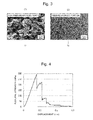
- (1) is a scanning electron microscope image of a section of the SiC ceramic structure 1 obtained in the previously described example, and (2) is an enlarged view of a portion of (1).
- These images (1) and (2) of Fig. 2 show that the relatively dark-shaded areas are the portions made of a bundle of SiC fibers soaked with the slurry (which are hereinafter called the "fiber-reinforced portions 12"), while the light-shaded areas are the portions containing no SiC strand fibers (which are hereinafter called the "non-fiber-reinforced portions 11").
- the non-fiber-reinforced portions 11 correspond to the bonding areas of the laminated prepreg sheets.
- the SiC ceramic structure 1 of the present example is a laminated SiC ceramic structure including the fiber-reinforced portions 12 and the non-fiber-reinforced portions 11.
- (1) and (2) are scanning electron microscope images of the non-fiber-reinforced portion 11 and the fiber-reinforced portion 12, respectively.
- image (2) in Fig. 2 as well as the images (1) and (2) in Fig. 3 , it has been confirmed that the non-fiber-reinforced portion 11 have an infinite number of micro pores.
- each SiC fiber retains a circular cross section, keeping much of its original shape.
- the bonding of the SiC fibers is achieved by the sintering of the SiC powder and the SiC fibers, rather than by the mutual sintering of the SiC fibers.
- the proportion of the SiC fibers (fiber volume content) in the SiC ceramic structure 1 obtained in the previous example was approximately 55 % by volume.
- the porosity of the entire SiC ceramic structure 1 determined by the Archimedes method was approximately 30 %, of which the open porosity was about 27 % and the closed porosity was 3 %.
- the vast majority of the pores in the SiC ceramic structure 1 were formed in the non-fiber-reinforced portions 11.
- An open pore is a pore which is open to the outside.
- a closed pore is a pore which has no contact with the outside and is isolated inside.
- the porosity of the porous SiC ceramic matrix correlated to the amount of carbon gasified and released in the decarburization step.
- the amount of carbon powder mixed in the slurry sheet preparation step correlated to the amount of carbon powder gasified and released from the pressure-sintered compact in the decarburization step. If the porosity of the porous SiC ceramic matrix is lower than 15 %, the thermal insulation properties of the product will be insufficient. On the other hand, if the porosity of the porous SiC ceramic matrix exceeds 80 %, it is difficult to obtain adequate strength and toughness.
- the carbon powder by a volume ratio of 15 to 80 % to the SiC powder in the slurry preparation step so that the porosity of the porous SiC ceramic matrix will be within a range from 15 to 80 %. It is further preferable to set the volume ratio within a range from 25 to 60 % so that the porosity of the porous SiC ceramic matrix will be within a range from 25 to 60 %. Satisfying this condition allows the SiC ceramic material according to the present invention to be suitably used in the fields of nuclear energy, aerospace or other areas in which high thermal insulation properties, high thermal resistance and high toughness are particularly required.
- a three-point bending test is a test in which a roughly rectangular parallelepiped specimen is fixed at two supporting points at both ends, and a load is applied to one middle point to determine the flexural strength, i.e. the stress that the specimen can bear during the bending test.
- Fig. 4 is a graph showing the result of a three-point bending test using a specimen of the SiC ceramic structure 1 in the present example.
- the X-axis indicates the displacement (mm), i.e. the magnitude of flexure of the specimen during the bending test
- the Y-axis indicates the flexural strength (MPa).
- the specimen of the SiC ceramic structure 1 exhibited an extremely high flexural strength of up to 300 MPa.
- the graph shows that the flexural strength did not vertically fall toward the X-axis but decreased in a stepwise manner after reaching the highest point. This fact confirms that the specimen did not rupture suddenly but gradually.
- Photograph (1) in Fig. 5 shows the entirety of the specimen of the SiC ceramic structure 1 after the three-point bending test. Even after the three-point test, the specimen kept much of its original shape, without being entirely ruptured. This fact also proves that the SiC ceramic structure 1 of the present example has a high degree of toughness.
- Photograph (2) in Fig. 5 is an enlarged view of the specimen, showing the cracks formed in the specimen as viewed from one side. The crack formed in the surface of the specimen (at the bottom of the photograph) extends horizontally along the direction of the SiC fibers, making non-smooth progress in its entirety, rather than straightly running in the vertical direction. This result demonstrates that, in the SiC ceramic structure 1 of the present example, development of local cracks is impeded by the SiC fibers.
- a tensile test is a test for evaluating the toughness and strength of the materials constituting a specimen.
- both ends of a roughly rectangular parallelepiped specimen are pinched with chucks and pulled in opposite directions to measure the tensile strain and the tensile stress until the specimen is ruptured.
- Tensile Stress MPa F / A where F is the tensile-test load, and A is the cross-sectional area of the specimen before the test.
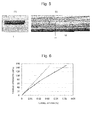
- Fig. 6 is a graph showing the result of a tensile test in which a specimen of the SiC ceramic structure 1 was pulled along the same direction as the layer direction of the fiber-reinforced portion 12 of the SiC ceramic structure 1.
- the X-axis indicates the tensile strain (%)
- the Y-axis indicates the tensile stress (MPa).
- the solid line in the graph shows the actual result of the test, while the broken line shows a theoretical relationship between the tensile stress and the tensile strain of an inductile material, based on the gradient at the point where the tensile strain is zero on the solid line showing the actual result of the test.
- the tensile strain and the tensile stress are perfectly proportional to each other, as shown.
- the specimen of the SiC ceramic structure 1 of the present example shows a greater increase in the tensile strain than the inductile material with increasing tensile stress. This result confirms that the structure in question is ductile.
- Photograph (1) in Fig. 7 shows the entirety of the specimen of the SiC ceramic structure 1 after the tensile test. As can be seen, the specimen was cracked along the layer direction of the fiber-reinforced portions 12. Photograph (2) in Fig. 7 shows a close-up of one side of the ruptured portion of the specimen. As can be seen in photograph (2) in Fig. 7 , a shear fracture in the non-fiber-reinforced portion 11 and a pull-out of fibers in the fiber-reinforced portion 12 were observed in the specimen after the tensile test. This result confirms that the fiber-reinforced portion 12 has a higher level of strength than the non-fiber-reinforced portion 11. The fact that most of the cracks ran parallel to the tensile direction suggests that the frictional force which occurs inside the cracks may possibly contribute to the strength of the specimen.
- the SiC ceramic structure 1 according to the present example is made of a SiC ceramic material which has not only a high level of strength but also a high degree of toughness. Therefore, the structure will not suddenly rupture if a slight crack is formed in it. In the case of conventional ceramic structures, a local crack will immediately lead to a rupture of the material. Therefore, their operating life is short, and they cannot be easily replaced with a new one before being entirely ruptured. By contrast, the SiC ceramic structure according to the present invention will not be ruptured all at once, because the development of the local crack is impeded by the SiC fibers. Therefore, it has a considerably longer operating life than conventional ceramic structures and needs to be replaced less frequently.
- SiC ceramic structure according to the present embodiment can be suitably used, for example, as structural materials for the wall surfaces of a waste incineration power generation reactor or the nozzle of a chimney.
- the SiC ceramic structure 1 according to the present example is entirely composed of SiC, including not only the non-fiber-reinforced portion 11 and the fiber-reinforced portion 12 but also the interfaces between them. Therefore, the interface layers do not easily deteriorate due to oxidative erosion even at high temperatures and under oxidative atmosphere, thus providing the SiC ceramic structure 1 according to the present example with an anti-corrosion characteristic suitable for structural materials.
- the present invention is not limited to the previously described example.
- a hexagonal or ⁇ -type SiC powder may be used.
- a SiC fiber with a lower degree of crystallinity may be used.
- low-crystallinity SiC fibers have lower heatproof temperatures (i.e. the temperature at which the fiber strength is maintained), and the pressure-sintering temperature must be set accordingly lower so that it will not exceed the low heatproof temperatures.
- the SiC ceramic material according to the present invention can also be produced by the reaction sintering (RS) method.
- RS reaction sintering
- the slurry preparation step (Step S1), the prepreg material preparation step (Step S2) and the pressure-sintering step (Step S3) in the previous example are replaced by a reaction preparation making step for making a reaction preparation containing a bundle of SiC fibers, a carbon component (e.g. carbon powder) and Si powder and a reaction sintering step for heating the reaction preparation to a temperature equal to or higher than the melting point of silicon so as to cause a reaction of the carbon component and the Si powder to obtain a reaction-sintered compact.
- the decarburization step is performed in the same manner as in the case of producing a SiC ceramic structure by the liquid-phase sintering method.
- the amount of carbon component used in the reaction preparation making step must exceed the amount necessary for the carbon component to react with Si powder and form SiC in the reaction sintering step.
- the excessive portion of the carbon component (residual carbon component) is to be gasified and released in the decarburization step, forming a porous SiC ceramic matrix. Therefore, the porosity of the porous SiC ceramic matrix can be changed by regulating the amount of carbon component to be mixed in the reaction preparation making step.
- the porosity should preferably be within a range from 15 to 80 %, and more preferably from 25 to 60 %.
- the reaction preparation may contain SiC powder.
- the SiC particles serve as nuclei, around which the SiC resulting from the reaction grows, forming a porous SiC ceramic matrix. This improves the efficiency of creating the porous SiC ceramic matrix.
- a phenol resin or similar resin which carbonizes at a temperature equal to or lower than the melting point of silicon may also be used as the carbon component.
- the resin carbonizes before the temperature reaches the melting point of silicon, i.e. 1414°C, and after the melting point of silicon is reached, the carbonized component of the resin reacts with molten silicon, forming SiC.
- the pressure-sintered compact is obtained at a high temperature and under high pressure (e.g. 1800°C, 10MPa), so that it is difficult to use low-crystallinity SiC ceramic fibers, whose heatproof temperature is low.
- the reaction sintering method is used, the reaction sintering step is performed at temperatures around the melting point of silicon, i.e. 1414°C, without applying pressure, so that a low-crystallinity SiC fiber can be used.
- the reaction sintering method is advantageous in that a porous SiC ceramic material can be easily produced even if an inexpensive, low-crystallinity SiC fiber is used.
- SiC ceramic structure produced by using the reaction sintering method is hereinafter described.
- carbon powder was used as the carbon component
- a Tyranno-ZMI fiber (produced by Ube Industries, Ltd.), which is a type of SiC strand fiber whose crystallinity is lower than that of the Tyranno-SA fiber used in the previous example, was used.
- the amount of carbon powder to be used in the reaction preparation making step was regulated so that the volume ratio of the residual carbon component to SiC formed by the reaction of the carbon component and the molten silicon would be 20 %.
- a reaction preparation was made by preparing a slurry sheet from a slurry containing carbon powder and Si powder and by sequentially laminating this slurry sheet and a sheet made of a bundle of Tyranno-ZMI fibers.
- the reaction preparation was heated to 1450°C to obtain a reaction-sintered compact.
- the decarburization step was performed in the same manner as in the previous example which used the liquid-phase sintering method.
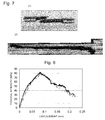
- Fig. 8 shows the result of a three-point bending test using two specimens cut out from the ceramic structure produced under the aforementioned conditions.
- the method of the three-point bending test was the same as used in the previous example.
- the horizontal axis is the displacement (mm) which indicates the magnitude of flexure of the specimen during the bending test
- the vertical axis is the flexural strength (MPa).
- MPa flexural strength
- the SiC ceramic material according to the present invention can also be produced by the chemical vapor infiltration (CVI) method.
- the chemical vapor infiltration method is a technique including the steps of passing a gaseous precursor through low-density fibers and thermally decomposing the precursor, with the resultant product deposited on the surfaces of the fibers.
- a detailed procedure is as follows: A mixed deposition gas prepared by mixing a gaseous SiC precursor and a gaseous carbon precursor is passed through a bundle of SiC fibers at high temperature.
- the gaseous SiC precursor methyltrichlorosilane (MTS), ethyltrichlorosilane (ETS) or a mixture of these compounds can be used.
- the gaseous carbon precursor methane, ethane, propylene or a mixture of these compounds can be used.
- a chemical-vapor-deposited object made of the bundle of SiC fibers on the surfaces of which SiC resulting from thermal decomposition of the SiC precursor and carbon resulting from thermal decomposition of the carbon precursor are deposited is produced.
- the decarburization step for gasifying and releasing carbon by heating the chemical-vapor-deposited object to approximately 700°C is performed.
- a SiC ceramic structure made of a SiC ceramic material composed of a porous SiC ceramic matrix containing a bundle of SiC strand fibers is obtained.
- the porosity of the porous SiC ceramic matrix can be changed by regulating the amount of carbon in the chemical-vapor-deposited object by increasing or decreasing the amount of carbon precursor gas in the mixed deposition gas.
- the porosity should preferably be within a range from 15 to 80 %, and more preferably from 25 to 60 %.
- the methods for producing a SiC ceramic structure according to the present invention have the common feature that a porous SiC ceramic matrix containing a bundle of continuous SiC fabrics is created by preparing a shaped object (a sintered compact or chemical-vapor-deposited object) containing a bundle of SiC fibers and a carbon component and performing a decarburization step for gasifying and releasing carbon from the shaped obj ect.
- a SiC ceramic structure in rod shape, plate shape or another shape can be created by using a rod-shaped bundle of SiC fibers or a sheet made of a bundle of SiC fibers. It is also possible to produce the SiC ceramic structure in various shapes by appropriately combining a plurality of bundles of SiC fibers. Furthermore, in any of the previously described production methods, a SiC fiber fabric can be used as the bundle of SiC fibers.
- the SiC ceramic structure produced by using a SiC fiber fabric is resistant to rupture because, even if it is slightly cracked in some direction, the crack will not easily develop in that direction.
- the SiC ceramic material according to the present invention has a high level of strength and a high degree of toughness in addition to the high thermal insulation properties and lightness due to the porousness of the ceramic matrix.
- the "high thermal insulation properties” means that the material does not easily deteriorate under an environment in which high and low temperature conditions repeatedly occur as well as under an environment with a constant high-temperature condition.
- the SiC ceramic material according to the present invention does not easily deteriorate due to oxidative erosion even at high temperatures and under oxidative atmosphere, because it is made of SiC except for a trace amount of impurities and there is no other layer or part made of a different element.
- ultra-high temperature members for environmental energy industries, such as the wall surfaces of a waste incineration power generation reactor or the nozzle of a chimney. It may also be used in nuclear energy generation, e.g. for the cladding tubes in light-water reactors or the control rods in high-temperature gas reactors. Other possible applications include a nozzle for an ultra-high temperature engine, an ultra-high temperature turbine blade, and a ceramic heater in aerospace industry applications. Furthermore, the present material also has neutron resistance due to SiC and therefore can be used as an insert material of a dual-coolant lead lithium (DCLL) blanket for fusion reactors.
- DCLL dual-coolant lead lithium
Landscapes
- Chemical & Material Sciences (AREA)
- Engineering & Computer Science (AREA)
- Ceramic Engineering (AREA)
- Materials Engineering (AREA)
- Structural Engineering (AREA)
- Organic Chemistry (AREA)
- Manufacturing & Machinery (AREA)
- Chemical Kinetics & Catalysis (AREA)
- Physics & Mathematics (AREA)
- Inorganic Chemistry (AREA)
- Plasma & Fusion (AREA)
- General Engineering & Computer Science (AREA)
- High Energy & Nuclear Physics (AREA)
- Dispersion Chemistry (AREA)
- Ceramic Products (AREA)
- Porous Artificial Stone Or Porous Ceramic Products (AREA)
Applications Claiming Priority (2)
| Application Number | Priority Date | Filing Date | Title |
|---|---|---|---|
| JP2010252729 | 2010-11-11 | ||
| PCT/JP2011/076004 WO2012063923A1 (ja) | 2010-11-11 | 2011-11-10 | SiCセラミックス材料並びにSiCセラミックス構造体及びその製造方法 |
Publications (3)
| Publication Number | Publication Date |
|---|---|
| EP2639211A1 true EP2639211A1 (de) | 2013-09-18 |
| EP2639211A4 EP2639211A4 (de) | 2014-08-13 |
| EP2639211B1 EP2639211B1 (de) | 2021-02-17 |
Family
ID=46051060
Family Applications (1)
| Application Number | Title | Priority Date | Filing Date |
|---|---|---|---|
| EP11839148.1A Not-in-force EP2639211B1 (de) | 2010-11-11 | 2011-11-10 | Sic-keramikmaterial und sic-keramikstruktur sowie herstellungsverfahren dafür |
Country Status (5)
| Country | Link |
|---|---|
| US (1) | US9353013B2 (de) |
| EP (1) | EP2639211B1 (de) |
| JP (1) | JPWO2012063923A1 (de) |
| KR (1) | KR101494116B1 (de) |
| WO (1) | WO2012063923A1 (de) |
Cited By (3)
| Publication number | Priority date | Publication date | Assignee | Title |
|---|---|---|---|---|
| WO2018031596A3 (en) * | 2016-08-08 | 2018-07-26 | General Atomics | Engineered sic-sic composite and monolithic sic layered structures |
| EP3636620A4 (de) * | 2017-05-15 | 2021-01-20 | Kyoto University | Siliciumcarbid-keramik |
| WO2021083440A1 (de) | 2019-10-31 | 2021-05-06 | MTU Aero Engines AG | Verfahren zur herstellung eines bauteils aus einem sic/sic- faserverbundwerkstoff |
Families Citing this family (12)
| Publication number | Priority date | Publication date | Assignee | Title |
|---|---|---|---|---|
| WO2014025060A1 (ja) * | 2012-08-10 | 2014-02-13 | 京セラ株式会社 | チャンネルボックスおよびこれを備える燃料集合体 |
| US9892804B2 (en) | 2012-09-26 | 2018-02-13 | Kabushiki Kaisha Toshiba | Nuclear reactor control rod with SIC fiber reinforced structure |
| JP2014167423A (ja) * | 2013-02-28 | 2014-09-11 | Kyocera Corp | 原子炉構造部材およびこれを備える燃料集合体 |
| US9650303B2 (en) * | 2013-03-15 | 2017-05-16 | Rolls-Royce Corporation | Silicon carbide ceramic matrix composites |
| JP2015030632A (ja) * | 2013-07-31 | 2015-02-16 | イビデン株式会社 | セラミック複合材料及びセラミック複合材料の製造方法 |
| JP6122728B2 (ja) * | 2013-07-31 | 2017-04-26 | イビデン株式会社 | SiC繊維強化SiC複合材料及びSiC繊維強化SiC複合材料の製造方法 |
| CN104402517B (zh) * | 2014-10-27 | 2016-01-13 | 武汉科技大学 | 一种Al2O3-SiC泡沫陶瓷及其制备方法 |
| JP6473601B2 (ja) * | 2014-11-12 | 2019-02-20 | イビデン株式会社 | 炉心構造材 |
| EP3527547B1 (de) * | 2014-12-12 | 2024-03-20 | Kyoto University | Mit siliciumcarbidfasern verstärktes siliciumcarbidverbundstoffmaterial und verfahren zu seiner herstellung |
| CN105314996B (zh) * | 2015-11-19 | 2017-09-29 | 福州赛瑞特新材料技术开发有限公司 | 一种单向直通多孔碳化硅‑硅陶瓷材料的制备方法 |
| CN114276163B (zh) * | 2022-01-25 | 2023-04-07 | 西安交通大学 | 一种耐高温的轻质高强多孔陶瓷及其制备方法 |
| CN115679163B (zh) * | 2022-11-22 | 2023-09-22 | 山东创新金属科技有限公司 | 一种汽车防撞架用铝合金材料及其制备方法 |
Family Cites Families (15)
| Publication number | Priority date | Publication date | Assignee | Title |
|---|---|---|---|---|
| FR2643898B1 (fr) * | 1989-03-02 | 1993-05-07 | Europ Propulsion | Procede de fabrication d'un materiau composite a matrice ceramique a tenacite amelioree |
| JP2704332B2 (ja) * | 1991-10-11 | 1998-01-26 | 株式会社ノリタケカンパニーリミテド | 炭素繊維強化窒化珪素質ナノ複合材及びその製造方法 |
| JPH0733530A (ja) * | 1993-07-26 | 1995-02-03 | Toshiba Corp | セラミックス基複合材料およびその製造方法 |
| JPH08169761A (ja) * | 1994-12-16 | 1996-07-02 | Toshiba Corp | 炭化珪素基繊維複合材料の製造方法 |
| US6024898A (en) | 1996-12-30 | 2000-02-15 | General Electric Company | Article and method for making complex shaped preform and silicon carbide composite by melt infiltration |
| JP4014254B2 (ja) | 1997-07-18 | 2007-11-28 | 日本碍子株式会社 | Si濃度段階的変化型Si−SiC材料及びSi濃度段階的変化型SiC繊維強化Si−SiC複合材料並びにこれらの製造方法 |
| US6040008A (en) * | 1997-08-04 | 2000-03-21 | University Of Florida | Silicon carbide fibers with boron nitride coatings |
| JP3143086B2 (ja) | 1997-10-14 | 2001-03-07 | 核燃料サイクル開発機構 | SiC複合材料スリーブおよびその製造方法 |
| JPH11130558A (ja) * | 1997-10-29 | 1999-05-18 | Tokai Konetsu Kogyo Co Ltd | 多孔質炭化珪素焼結体とその製造方法 |
| JP4014765B2 (ja) * | 1999-08-20 | 2007-11-28 | 株式会社東芝 | 炭化ケイ素長繊維強化セラミックス基複合材料 |
| JP2001158673A (ja) * | 1999-12-03 | 2001-06-12 | Oji Paper Co Ltd | 多孔質炭化ケイ素繊維構造体の製造方法 |
| US7686990B2 (en) | 2004-12-31 | 2010-03-30 | General Electric Company | Method of producing a ceramic matrix composite article |
| JP5168451B2 (ja) * | 2007-03-13 | 2013-03-21 | 独立行政法人 宇宙航空研究開発機構 | 多孔質成形体の製造方法及び多孔質充填成形体の製造方法 |
| WO2009118862A1 (ja) * | 2008-03-27 | 2009-10-01 | イビデン株式会社 | ハニカム構造体の製造方法 |
| CN102803589A (zh) * | 2010-03-19 | 2012-11-28 | 宇部兴产株式会社 | 纤维束用无机纤维及其制造方法、由这种纤维束用无机纤维构成的复合材料用无机纤维束、以及用这种纤维束强化的陶瓷基复合材料 |
-
2011
- 2011-11-10 US US13/884,636 patent/US9353013B2/en not_active Expired - Fee Related
- 2011-11-10 JP JP2012542982A patent/JPWO2012063923A1/ja active Pending
- 2011-11-10 WO PCT/JP2011/076004 patent/WO2012063923A1/ja not_active Ceased
- 2011-11-10 EP EP11839148.1A patent/EP2639211B1/de not_active Not-in-force
- 2011-11-10 KR KR1020137014875A patent/KR101494116B1/ko not_active Expired - Fee Related
Cited By (5)
| Publication number | Priority date | Publication date | Assignee | Title |
|---|---|---|---|---|
| WO2018031596A3 (en) * | 2016-08-08 | 2018-07-26 | General Atomics | Engineered sic-sic composite and monolithic sic layered structures |
| US12417853B2 (en) | 2016-08-08 | 2025-09-16 | General Atomics | Engineered SiC-SiC composite and monolithic SiC layered structures |
| EP3636620A4 (de) * | 2017-05-15 | 2021-01-20 | Kyoto University | Siliciumcarbid-keramik |
| US12358842B2 (en) | 2017-05-15 | 2025-07-15 | Kyoto University | Silicon carbide ceramic |
| WO2021083440A1 (de) | 2019-10-31 | 2021-05-06 | MTU Aero Engines AG | Verfahren zur herstellung eines bauteils aus einem sic/sic- faserverbundwerkstoff |
Also Published As
| Publication number | Publication date |
|---|---|
| KR101494116B1 (ko) | 2015-02-16 |
| WO2012063923A1 (ja) | 2012-05-18 |
| EP2639211A4 (de) | 2014-08-13 |
| KR20130087556A (ko) | 2013-08-06 |
| US20130288880A1 (en) | 2013-10-31 |
| JPWO2012063923A1 (ja) | 2014-05-12 |
| US9353013B2 (en) | 2016-05-31 |
| EP2639211B1 (de) | 2021-02-17 |
Similar Documents
| Publication | Publication Date | Title |
|---|---|---|
| US9353013B2 (en) | SiC ceramic material, SiC ceramic structure, and their fabrication methods | |
| US8894918B2 (en) | Methods for producing high-performance silicon carbide fibers, architectural preforms, and high-temperature composite structures | |
| Yin et al. | The effects of SiC precursors on the microstructures and mechanical properties of SiCf/SiC composites prepared via polymer impregnation and pyrolysis process | |
| EP3527547B1 (de) | Mit siliciumcarbidfasern verstärktes siliciumcarbidverbundstoffmaterial und verfahren zu seiner herstellung | |
| CN101863665B (zh) | 自愈合抗氧化功能纤维增强陶瓷基复合材料的制备方法 | |
| JP3971903B2 (ja) | SiC繊維強化型SiC複合材料の製造方法 | |
| Galizia et al. | Disclosing residual thermal stresses in UHT fibre-reinforced ceramic composites and their effect on mechanical behaviour and damage evolution | |
| EP0891956B1 (de) | Silicium-Siliciumcarbidwerkstoff und siliciumcarbidfaserverstärkter Silicium-Siliciumcarbidverbundwerkstoff | |
| Yoshida et al. | Improvement of the mechanical properties of hot-pressed silicon-carbide-fiber-reinforced silicon carbide composites by polycarbosilane impregnation | |
| Shimoda et al. | Enchanced high-temperature performances of SiC/SiC composites by high densification and crystalline structure | |
| WO1999019273A1 (en) | Fibrous composite material and process for producing the same | |
| Shimoda et al. | Novel production route for SiC/SiC ceramic-matrix composites using sandwich prepreg sheets | |
| Kotani et al. | Development of SiC/SiC composites by PIP in combination with RS | |
| JPWO1999019273A1 (ja) | 繊維複合材料及びその製造方法 | |
| Zhang et al. | Damage mechanisms of SiC fibers and BN interphase in SiCf/SiC composites during NITE process | |
| Shan et al. | Microstructure and mechanical properties of carbon fiber needled felt reinforced sol-derived YAG composite | |
| Shimoda et al. | Effect of BN nanoparticle content in SiC matrix on microstructure and mechanical properties of SiC/SiC composites | |
| Liu et al. | Additive manufacturing of high-performance CCF/SiC composites under dual protection | |
| Marrow | Design, fabrication, characterization and simulation of PIP-SiC/SiC composites | |
| Katoh et al. | Mechanical properties of chemically vapor-infiltrated silicon carbide structural composites with thin carbon interphases for fusion and advanced fission applications | |
| JP2765543B2 (ja) | 反応焼結セラミックス及びその製造方法 | |
| CN121941671A (zh) | 陶瓷基质复合材料 | |
| Bansal et al. | Advances in Ceramic Matrix Composites IX | |
| Lim et al. | Fabrication of dense 2D SiC fiber-SiC matrix composites by slurry infiltration and a stacking process | |
| DiCarlo et al. | Methods for producing silicon carbide architectural preforms |
Legal Events
| Date | Code | Title | Description |
|---|---|---|---|
| PUAI | Public reference made under article 153(3) epc to a published international application that has entered the european phase |
Free format text: ORIGINAL CODE: 0009012 |
|
| 17P | Request for examination filed |
Effective date: 20130611 |
|
| AK | Designated contracting states |
Kind code of ref document: A1 Designated state(s): AL AT BE BG CH CY CZ DE DK EE ES FI FR GB GR HR HU IE IS IT LI LT LU LV MC MK MT NL NO PL PT RO RS SE SI SK SM TR |
|
| DAX | Request for extension of the european patent (deleted) | ||
| A4 | Supplementary search report drawn up and despatched |
Effective date: 20140711 |
|
| RIC1 | Information provided on ipc code assigned before grant |
Ipc: C04B 35/80 20060101AFI20140707BHEP Ipc: G21B 1/13 20060101ALI20140707BHEP Ipc: G21C 7/10 20060101ALI20140707BHEP Ipc: C04B 38/06 20060101ALI20140707BHEP Ipc: G21C 3/30 20060101ALI20140707BHEP |
|
| STAA | Information on the status of an ep patent application or granted ep patent |
Free format text: STATUS: EXAMINATION IS IN PROGRESS |
|
| 17Q | First examination report despatched |
Effective date: 20190520 |
|
| GRAP | Despatch of communication of intention to grant a patent |
Free format text: ORIGINAL CODE: EPIDOSNIGR1 |
|
| STAA | Information on the status of an ep patent application or granted ep patent |
Free format text: STATUS: GRANT OF PATENT IS INTENDED |
|
| INTG | Intention to grant announced |
Effective date: 20200916 |
|
| GRAS | Grant fee paid |
Free format text: ORIGINAL CODE: EPIDOSNIGR3 |
|
| GRAA | (expected) grant |
Free format text: ORIGINAL CODE: 0009210 |
|
| STAA | Information on the status of an ep patent application or granted ep patent |
Free format text: STATUS: THE PATENT HAS BEEN GRANTED |
|
| AK | Designated contracting states |
Kind code of ref document: B1 Designated state(s): AL AT BE BG CH CY CZ DE DK EE ES FI FR GB GR HR HU IE IS IT LI LT LU LV MC MK MT NL NO PL PT RO RS SE SI SK SM TR |
|
| REG | Reference to a national code |
Ref country code: GB Ref legal event code: FG4D |
|
| REG | Reference to a national code |
Ref country code: CH Ref legal event code: EP |
|
| REG | Reference to a national code |
Ref country code: DE Ref legal event code: R096 Ref document number: 602011070171 Country of ref document: DE |
|
| REG | Reference to a national code |
Ref country code: AT Ref legal event code: REF Ref document number: 1361260 Country of ref document: AT Kind code of ref document: T Effective date: 20210315 |
|
| REG | Reference to a national code |
Ref country code: IE Ref legal event code: FG4D |
|
| REG | Reference to a national code |
Ref country code: LT Ref legal event code: MG9D |
|
| REG | Reference to a national code |
Ref country code: NL Ref legal event code: MP Effective date: 20210217 |
|
| PG25 | Lapsed in a contracting state [announced via postgrant information from national office to epo] |
Ref country code: PT Free format text: LAPSE BECAUSE OF FAILURE TO SUBMIT A TRANSLATION OF THE DESCRIPTION OR TO PAY THE FEE WITHIN THE PRESCRIBED TIME-LIMIT Effective date: 20210617 Ref country code: LT Free format text: LAPSE BECAUSE OF FAILURE TO SUBMIT A TRANSLATION OF THE DESCRIPTION OR TO PAY THE FEE WITHIN THE PRESCRIBED TIME-LIMIT Effective date: 20210217 Ref country code: HR Free format text: LAPSE BECAUSE OF FAILURE TO SUBMIT A TRANSLATION OF THE DESCRIPTION OR TO PAY THE FEE WITHIN THE PRESCRIBED TIME-LIMIT Effective date: 20210217 Ref country code: GR Free format text: LAPSE BECAUSE OF FAILURE TO SUBMIT A TRANSLATION OF THE DESCRIPTION OR TO PAY THE FEE WITHIN THE PRESCRIBED TIME-LIMIT Effective date: 20210518 Ref country code: FI Free format text: LAPSE BECAUSE OF FAILURE TO SUBMIT A TRANSLATION OF THE DESCRIPTION OR TO PAY THE FEE WITHIN THE PRESCRIBED TIME-LIMIT Effective date: 20210217 Ref country code: BG Free format text: LAPSE BECAUSE OF FAILURE TO SUBMIT A TRANSLATION OF THE DESCRIPTION OR TO PAY THE FEE WITHIN THE PRESCRIBED TIME-LIMIT Effective date: 20210517 Ref country code: NO Free format text: LAPSE BECAUSE OF FAILURE TO SUBMIT A TRANSLATION OF THE DESCRIPTION OR TO PAY THE FEE WITHIN THE PRESCRIBED TIME-LIMIT Effective date: 20210517 |
|
| REG | Reference to a national code |
Ref country code: AT Ref legal event code: MK05 Ref document number: 1361260 Country of ref document: AT Kind code of ref document: T Effective date: 20210217 |
|
| PG25 | Lapsed in a contracting state [announced via postgrant information from national office to epo] |
Ref country code: SE Free format text: LAPSE BECAUSE OF FAILURE TO SUBMIT A TRANSLATION OF THE DESCRIPTION OR TO PAY THE FEE WITHIN THE PRESCRIBED TIME-LIMIT Effective date: 20210217 Ref country code: NL Free format text: LAPSE BECAUSE OF FAILURE TO SUBMIT A TRANSLATION OF THE DESCRIPTION OR TO PAY THE FEE WITHIN THE PRESCRIBED TIME-LIMIT Effective date: 20210217 Ref country code: PL Free format text: LAPSE BECAUSE OF FAILURE TO SUBMIT A TRANSLATION OF THE DESCRIPTION OR TO PAY THE FEE WITHIN THE PRESCRIBED TIME-LIMIT Effective date: 20210217 Ref country code: LV Free format text: LAPSE BECAUSE OF FAILURE TO SUBMIT A TRANSLATION OF THE DESCRIPTION OR TO PAY THE FEE WITHIN THE PRESCRIBED TIME-LIMIT Effective date: 20210217 Ref country code: RS Free format text: LAPSE BECAUSE OF FAILURE TO SUBMIT A TRANSLATION OF THE DESCRIPTION OR TO PAY THE FEE WITHIN THE PRESCRIBED TIME-LIMIT Effective date: 20210217 |
|
| PG25 | Lapsed in a contracting state [announced via postgrant information from national office to epo] |
Ref country code: IS Free format text: LAPSE BECAUSE OF FAILURE TO SUBMIT A TRANSLATION OF THE DESCRIPTION OR TO PAY THE FEE WITHIN THE PRESCRIBED TIME-LIMIT Effective date: 20210617 |
|
| PG25 | Lapsed in a contracting state [announced via postgrant information from national office to epo] |
Ref country code: SM Free format text: LAPSE BECAUSE OF FAILURE TO SUBMIT A TRANSLATION OF THE DESCRIPTION OR TO PAY THE FEE WITHIN THE PRESCRIBED TIME-LIMIT Effective date: 20210217 Ref country code: AT Free format text: LAPSE BECAUSE OF FAILURE TO SUBMIT A TRANSLATION OF THE DESCRIPTION OR TO PAY THE FEE WITHIN THE PRESCRIBED TIME-LIMIT Effective date: 20210217 Ref country code: CZ Free format text: LAPSE BECAUSE OF FAILURE TO SUBMIT A TRANSLATION OF THE DESCRIPTION OR TO PAY THE FEE WITHIN THE PRESCRIBED TIME-LIMIT Effective date: 20210217 Ref country code: EE Free format text: LAPSE BECAUSE OF FAILURE TO SUBMIT A TRANSLATION OF THE DESCRIPTION OR TO PAY THE FEE WITHIN THE PRESCRIBED TIME-LIMIT Effective date: 20210217 |
|
| REG | Reference to a national code |
Ref country code: DE Ref legal event code: R097 Ref document number: 602011070171 Country of ref document: DE |
|
| PG25 | Lapsed in a contracting state [announced via postgrant information from national office to epo] |
Ref country code: RO Free format text: LAPSE BECAUSE OF FAILURE TO SUBMIT A TRANSLATION OF THE DESCRIPTION OR TO PAY THE FEE WITHIN THE PRESCRIBED TIME-LIMIT Effective date: 20210217 Ref country code: SK Free format text: LAPSE BECAUSE OF FAILURE TO SUBMIT A TRANSLATION OF THE DESCRIPTION OR TO PAY THE FEE WITHIN THE PRESCRIBED TIME-LIMIT Effective date: 20210217 Ref country code: DK Free format text: LAPSE BECAUSE OF FAILURE TO SUBMIT A TRANSLATION OF THE DESCRIPTION OR TO PAY THE FEE WITHIN THE PRESCRIBED TIME-LIMIT Effective date: 20210217 Ref country code: ES Free format text: LAPSE BECAUSE OF FAILURE TO SUBMIT A TRANSLATION OF THE DESCRIPTION OR TO PAY THE FEE WITHIN THE PRESCRIBED TIME-LIMIT Effective date: 20210217 |
|
| PLBE | No opposition filed within time limit |
Free format text: ORIGINAL CODE: 0009261 |
|
| STAA | Information on the status of an ep patent application or granted ep patent |
Free format text: STATUS: NO OPPOSITION FILED WITHIN TIME LIMIT |
|
| 26N | No opposition filed |
Effective date: 20211118 |
|
| PG25 | Lapsed in a contracting state [announced via postgrant information from national office to epo] |
Ref country code: AL Free format text: LAPSE BECAUSE OF FAILURE TO SUBMIT A TRANSLATION OF THE DESCRIPTION OR TO PAY THE FEE WITHIN THE PRESCRIBED TIME-LIMIT Effective date: 20210217 |
|
| PG25 | Lapsed in a contracting state [announced via postgrant information from national office to epo] |
Ref country code: SI Free format text: LAPSE BECAUSE OF FAILURE TO SUBMIT A TRANSLATION OF THE DESCRIPTION OR TO PAY THE FEE WITHIN THE PRESCRIBED TIME-LIMIT Effective date: 20210217 |
|
| PG25 | Lapsed in a contracting state [announced via postgrant information from national office to epo] |
Ref country code: IT Free format text: LAPSE BECAUSE OF FAILURE TO SUBMIT A TRANSLATION OF THE DESCRIPTION OR TO PAY THE FEE WITHIN THE PRESCRIBED TIME-LIMIT Effective date: 20210217 |
|
| PG25 | Lapsed in a contracting state [announced via postgrant information from national office to epo] |
Ref country code: IS Free format text: LAPSE BECAUSE OF FAILURE TO SUBMIT A TRANSLATION OF THE DESCRIPTION OR TO PAY THE FEE WITHIN THE PRESCRIBED TIME-LIMIT Effective date: 20210617 |
|
| REG | Reference to a national code |
Ref country code: DE Ref legal event code: R119 Ref document number: 602011070171 Country of ref document: DE |
|
| PG25 | Lapsed in a contracting state [announced via postgrant information from national office to epo] |
Ref country code: MC Free format text: LAPSE BECAUSE OF FAILURE TO SUBMIT A TRANSLATION OF THE DESCRIPTION OR TO PAY THE FEE WITHIN THE PRESCRIBED TIME-LIMIT Effective date: 20210217 |
|
| REG | Reference to a national code |
Ref country code: CH Ref legal event code: PL |
|
| GBPC | Gb: european patent ceased through non-payment of renewal fee |
Effective date: 20211110 |
|
| PG25 | Lapsed in a contracting state [announced via postgrant information from national office to epo] |
Ref country code: LU Free format text: LAPSE BECAUSE OF NON-PAYMENT OF DUE FEES Effective date: 20211110 Ref country code: BE Free format text: LAPSE BECAUSE OF NON-PAYMENT OF DUE FEES Effective date: 20211130 |
|
| REG | Reference to a national code |
Ref country code: BE Ref legal event code: MM Effective date: 20211130 |
|
| PG25 | Lapsed in a contracting state [announced via postgrant information from national office to epo] |
Ref country code: LI Free format text: LAPSE BECAUSE OF NON-PAYMENT OF DUE FEES Effective date: 20211130 Ref country code: CH Free format text: LAPSE BECAUSE OF NON-PAYMENT OF DUE FEES Effective date: 20211130 |
|
| PG25 | Lapsed in a contracting state [announced via postgrant information from national office to epo] |
Ref country code: IE Free format text: LAPSE BECAUSE OF NON-PAYMENT OF DUE FEES Effective date: 20211110 Ref country code: GB Free format text: LAPSE BECAUSE OF NON-PAYMENT OF DUE FEES Effective date: 20211110 Ref country code: DE Free format text: LAPSE BECAUSE OF NON-PAYMENT OF DUE FEES Effective date: 20220601 |
|
| PG25 | Lapsed in a contracting state [announced via postgrant information from national office to epo] |
Ref country code: FR Free format text: LAPSE BECAUSE OF NON-PAYMENT OF DUE FEES Effective date: 20211130 |
|
| PG25 | Lapsed in a contracting state [announced via postgrant information from national office to epo] |
Ref country code: HU Free format text: LAPSE BECAUSE OF FAILURE TO SUBMIT A TRANSLATION OF THE DESCRIPTION OR TO PAY THE FEE WITHIN THE PRESCRIBED TIME-LIMIT; INVALID AB INITIO Effective date: 20111110 Ref country code: CY Free format text: LAPSE BECAUSE OF FAILURE TO SUBMIT A TRANSLATION OF THE DESCRIPTION OR TO PAY THE FEE WITHIN THE PRESCRIBED TIME-LIMIT Effective date: 20210217 |
|
| PG25 | Lapsed in a contracting state [announced via postgrant information from national office to epo] |
Ref country code: MK Free format text: LAPSE BECAUSE OF FAILURE TO SUBMIT A TRANSLATION OF THE DESCRIPTION OR TO PAY THE FEE WITHIN THE PRESCRIBED TIME-LIMIT Effective date: 20210217 |
|
| PG25 | Lapsed in a contracting state [announced via postgrant information from national office to epo] |
Ref country code: TR Free format text: LAPSE BECAUSE OF FAILURE TO SUBMIT A TRANSLATION OF THE DESCRIPTION OR TO PAY THE FEE WITHIN THE PRESCRIBED TIME-LIMIT Effective date: 20210217 |
|
| PG25 | Lapsed in a contracting state [announced via postgrant information from national office to epo] |
Ref country code: MT Free format text: LAPSE BECAUSE OF FAILURE TO SUBMIT A TRANSLATION OF THE DESCRIPTION OR TO PAY THE FEE WITHIN THE PRESCRIBED TIME-LIMIT Effective date: 20210217 |