EP2641422B1 - Reprise de connexion améliorée pour déploiements multi-rat - Google Patents
Reprise de connexion améliorée pour déploiements multi-rat Download PDFInfo
- Publication number
- EP2641422B1 EP2641422B1 EP10777036.4A EP10777036A EP2641422B1 EP 2641422 B1 EP2641422 B1 EP 2641422B1 EP 10777036 A EP10777036 A EP 10777036A EP 2641422 B1 EP2641422 B1 EP 2641422B1
- Authority
- EP
- European Patent Office
- Prior art keywords
- radio access
- access network
- type radio
- connection
- information
- Prior art date
- Legal status (The legal status is an assumption and is not a legal conclusion. Google has not performed a legal analysis and makes no representation as to the accuracy of the status listed.)
- Active
Links
Images



Classifications
-
- H—ELECTRICITY
- H04—ELECTRIC COMMUNICATION TECHNIQUE
- H04W—WIRELESS COMMUNICATION NETWORKS
- H04W76/00—Connection management
- H04W76/10—Connection setup
- H04W76/19—Connection re-establishment
-
- H—ELECTRICITY
- H04—ELECTRIC COMMUNICATION TECHNIQUE
- H04W—WIRELESS COMMUNICATION NETWORKS
- H04W36/00—Hand-off or reselection arrangements
- H04W36/14—Reselecting a network or an air interface
- H04W36/144—Reselecting a network or an air interface over a different radio air interface technology
- H04W36/1443—Reselecting a network or an air interface over a different radio air interface technology between licensed networks
Definitions
- the present invention relates to apparatuses, methods and a computer program product for enhancing connection recovery for multi-radio access technology (RAT) deployments.
- RAT radio access technology
- Embodiments of the present invention relate to mobile radio communications with focus on inter radio access technique (inter-RAT) operation, for instance, coverage limited handover between overlaying radio access networks.
- Inter-RAT inter radio access technique
- Embodiments of the present invention aim on inter-RAT handover improvement.
- LTE will be deployed as second or third radio access network (RAN) of an operator.
- RAN radio access network
- several radio technologies will exist as overlay networks.
- LTE system will only be deployed at some hotspot area embedded in wide-ranging legacy 2G/3G overlay coverage. An example for this is illustrated in Fig. 8 .
- Many inter-RAT handovers will happen either due to the limited LTE coverage or triggered by dedicated operator policies in terms of service or load based traffic steering.
- the problem underlying the present application relates to a missing appropriate procedure for connection re-establishment in case of RLF detection in a multi-RAT environment.
- RLF radio link failure
- the UE After detecting RLF, the UE stays in RRC_connected mode and tries to recover by sending a RRC CONNECTION RE-ESTABLISHMENT REQUEST message to the next best serving eNB staying on same carrier frequency, i.e. UE is working in intra-RAT / intra-frequency mode.
- the re-establishment method allows a rather fast recovery of the connection without lengthy authentication procedures and security activation provided that the concerned cell is prepared, i.e. it has a valid UE context. If there is no UE context prepared at the targeted eNB, the UE changes to status RRC_IDLE.
- Fig. 9 shows the intra-LTE recovery phases as specified in 3GPP TS 36.300.
- a first phase initiated by radio link quality problem detection (signal quality of the serving cell falls below a certain threshold) operation is continued and it is checked if the signal quality recovers within a time frame T1. If the UE does not recover in the same cell, i.e. timer T1 expires, it is determined that a radio link failure (RLF) is present and the second phase, (timed by timer T2), is started where the UE, still in status RRC-connected, is selecting a different cell from the same eNB and tries to resume activity by sending the RRC Connection re-establishment. If this is also not successful, the UE goes back to idle (RRC_IDLE) and has to pass to the normal re-connection procedure.
- RLF radio link failure
- the problem is that in case of multi-RAT layout an appropriate procedure for connection re-establishment to another RAT in case of RLF detection is missing.
- Document EP224768 A1 discusses aspects regarding cell selection and re-establishment.
- Document US2008/280615 discusses context transfer.
- the present invention and its embodiments aim at solving the above problem.
- embodiments of the present invention relate to mobile radio communications with focus on inter radio access technique (inter-RAT) operation. More specifically, according to embodiments of the present invention, a UE being in a multi-RAT environment and is already monitoring another RAT or an inter-RAT handover (HO) has been initiated already and is achieving a radio link failure (RLF) should be able to re-establish the connection in a prepared or unprepared cell using another RAT than that used before the RLF.
- RLF radio link failure
- the UE now tries to re-establish in the previously connected RAT and may finally end up in status RRC IDLE, as shown in Fig. 9 .
- the current standard does not provide means to start recovery (i.e. re-establishment) in the new RAT. Therefore, the UE has to setup a new connection with all authentication and security procedures even though the UE context may already be available in the new RAT, e.g. because of handover preparation signaling.
- An intra-RAT recovery method is also applied in case the UE is in UTRAN connected state.
- the UE selects a suitable UTRAN cell and informs the corresponding radio network controller (RNC) via a cell update message.
- RRC radio network controller
- An RRC re-establishment procedure within the used RAT here: UTRAN
- T314 or T315 as defined in UTRAN has not expired.
- NRT non-real time
- Embodiments of the present application overcome this problem.
- Fig. 1 shows an apparatus, which may be or may be part of a user equipment (UE), for example.
- the UE which is an example for a mobile device, comprises a processor (processing means) 1, a transceiver (transceiving means) 2 and a memory 3.
- the transceiver 2 is capable of establishing connection with a first and at least a second type radio access network.
- the first and the second type radio access network operate with different radio access technologies (RAT), as mentioned above.
- the processor 1 is to detect a radio link failure (RLF).
- RLF radio link failure
- the processor tries to re-establish connection with the first type radio access network by means of the transceiver.
- the processor 1 In case re-establishing the connection with the first type radio access network was not successful, the processor 1 tries to connect with the second type radio access network by means of the transceiver.
- the process serves to control an apparatus (such as the UE described above) capable of establishing connection with a first and at least a second type radio access network operating with different radio access technologies.
- step S1 it is checked whether a radio link failure is detected. In case a radio link failure is detected when the apparatus was connected with the first type radio access network, it is tried to re-establish connection with the first type radio access network in step S2. In case re-establishing the connection with the first type radio access network was not successful (NO in step S3), it is tried to connect with the second type radio access network by means of the transceiver in step S4. If this was successful (YES in step S5), the process ends.
- This invention proposes an advanced recovery method applicable to multi-RAT environment.
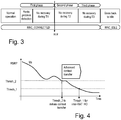
- the recovery phase which is described above for the prior art case by referring to Fig. 9 , is extended by a third part trying connection re-establishment to another RAT before the UE goes into idle mode, as shown in Fig. 3 .
- the proposed principle is applicable to all RATs albeit the RAT the UE is connected to when RLF is detected.
- the proposed procedure according to the first embodiment is as following: If an RLF happened before any inter-RAT HO has been initiated or any inter-RAT measurement events have been achieved, UE tries first a re-establishment in the previously used RAT (and carrier frequency), i.e. the second phase is carried out as hitherto (potentially with a shorter timer). If this is successful (YES in step S3 of Fig. 2 ), the process ends. But if a re-establish to the previous RAT was not successful and the timer (T2) of the second phase has been expired, the new third phase is started where the UE tries a connection re-establishment with another dedicated RAT and dedicated frequency.
- step S5 of Fig. 2 the UE is set into idle mode in step S6 (RRC_IDLE in Fig. 3 ).
- the UE knows the target RAT and frequency it has to get in synch in order to keep the phase as short as possible.
- the interruption time in case of an inter-RAT handover failure can be significantly reduced to levels which are known from intra-LTE connection re-establishment procedure, i.e. the user would not even perceive any interruption for most of the services. Furthermore, signaling for authentication etc. can be avoided.
- the third phase is not carried out at all and UE goes into idle mode.
- the information about the target RAT and frequency is either
- the UE should be able to store this information in the memory 3 and to use it in the re-establishment phase three.
- a second measurement event is introduced which includes a threshold being slightly higher than that for HO trigger event which triggers the context transfer in advance. This is illustrated in Fig. 4 .
- the UE performs the measurements, wherein Ms shown in Fig. 4 is the measured signal from serving node at UE.
- the UE is reporting a specific event (indicating a preterm context exchange) if a threshold is exceeded.
- RSRP reference signal received power
- the context can be also sent out to several potential target eNBs or RATs to increase the probability of availability.
- the subsequent HO preparation message (triggered by a further measurement event, i.e., when the signaling strength falls below Thresh 1) does not need to contain the UE context again, but a crosscheck if it is available can be performed.
- a context release indication is sent to those entities being not the HO target.
- connection re-establishment request may include additional information that allows the receiving radio node to identify already present context that is associated with this UE, or otherwise to enable the network to fetch the context from the previous source node of the UE in the other RAT (e.g. via RAN information management (RIM)).
- RIM RAN information management
- the RNC holds the required UE context a fast connection re-establishment can be accomplished even if the targeted NB is not the same which previously has been chosen for inter-RAT HO preparation.
- the UE context can be easily retrieved for all NodeBs belonging to the same common RNC. Having a controlling node for several base stations provides a further degree of freedom to enable a successful RRC connection re-establishment between RATs.
- the UE context can be also send out to a set of potential target eNBs or RATs to increase the probability of availability in case of a subsequent inter-RAT handover or connection re-establishment.
- the UE context does not need to be transmitted within the subsequent HO preparation (triggered by the second measurement event in Fig 4 .), provided that the target network node is the same or at least one of the set of nodes to which the context has been transmitted in advance. That is, the context transfer as part of the actual handover preparation phase triggered by the second criterion can be neglected. It is noted that a target network node is a candidate for a possible handover of the UE to the second RAT (second type radio access network).
- a context release indication is sent to the other entities apart from the target cell.
- a context release indication may also to be sent to all target network nodes to which the context transfer has been sent in advance in case the second criterion is not reached and, therefore, inter-RAT handover is not triggered within a defined time interval.
- Fig. 5 shows a method carried out according to the second embodiment.
- the method serves to ensure the availability of the UE context a case of UE mobility from a first to a second type radio access network, the first and the second type radio access network operating with different radio access technologies, as mentioned above.
- the reference signal strength or quality from a base station is measured at the mobile device (UE), wherein the UE is connected to the first type radio access network.
- the result is evaluated.
- a first criterion CONTEXT_TRANSFER_EVENT
- the context transfer is initiated, as shown in step S14.
- the inter-RAT handover is initiated, as shown in step S13.
- the inter-RAT handover will be triggered by a more stringent second criterion (INTER-RAT_HANDOVER_EVENT) (e.g. B2 in case of LTE) compared to the first criterion with more stringent thresholds against the reference signal strength or quality of the measured signals. Therefore, the CONTEXT_TRANSFER_EVENT is occurring before INTER-RAT_HANDOVER_EVENT.
- a more stringent second criterion e.g. B2 in case of LTE
- the method as described above and shown in Fig. 5 may be carried out by a suitable network control node, depending on in which RAT the network control element is located. That is, in LTE this may be an eNodeB, in 3G this may be a RNC and in 2G, this may be a BSC, for example.
- the network control node receives the measurement results of the UE (measured in step S11) and carries out the evaluation as shown in step S12 and the following steps.
- the network control node comprises a processor 11 and a transceiver 12.
- the transceiver 12 receives information regarding a detected reference signal strength and/or quality from base stations detected by a mobile device connected to a first type radio access network (first RAT).
- first RAT first type radio access network
- the processor 11 initiates a transfer of a context of the mobile device to the second type radio access network.
- the network control node may comprise a memory 13, in which programs, data etc. are stored.
- the target network node may have a possibility to check whether it has the UE context available, and, if not, to retrieve the UE context.
- the target network node comprises a processor 21 and a transceiver 22.
- the transceiver 22 receives a connection re-establishment request from a mobile node, which performs a handover from a first type radio access network to a second type radio access network, the first and the second type radio access network operating with different radio access technologies.
- the processor 21 is configured to identify already present context that is associated with the mobile device based on information included the connection re-establishment request.
- the target network node can easily check whether the context information of the UE is already present in the target network node. If not, the processor can use the information included in the connection re-establishment request to fetch the context from a previous source node of the mobile device in the first RAT (e.g., eNodeB, RNC or the like).
- a previous source node of the mobile device in the first RAT e.g., eNodeB, RNC or the like.
- the target network node may comprise a memory 23, in which programs, data etc. are stored.
- a method which comprises
- the method may further comprise
- the method may further comprise determining that a radio link failure has occurred when a radio problem is detected and a first timer has expired since detection of the radio problem.
- the method may further comprise determining that re-establishing the connection with the first type radio access network was not successful when a second timer has expired since detection of the radio link failure.
- the method may further comprise setting the apparatus in an idle mode in case trying a connection re-establishment with the second type radio access network was not successful until a third timer has expired.
- the method may further comprise
- connection re-establishment request may include additional information that allows the target node to identify already present context that is associated with the mobile device.
- the method may further comprise using the information of connection re-establishment request to enable the target network node to fetch the context from the previous source node of the mobile node in the first type radio access network.
- the first and the second aspect may be modified as follows:
- the method may further comprise
- the method may further comprise
- the context transfer may be performed to a target network node, which is a candidate for a possible handover, of the second type radio access network.
- the context transfer may be performed to a set of potential target network nodes.
- the method may further comprise performing an information exchange to check the availability of the context at the target network node.
- the method may further comprise sending a context release indication to the other entities apart from the target network node.
- the method may further comprise sending a context release indication to all target network nodes to which the context transfer has been sent in advance in case the second criterion is not reached and, therefore, a handover from the first to the second type radio access network is not triggered within a defined time interval.
- the method may further comprise using the information of the connection re-establishment request to fetch the context from the previous source node of the mobile node in the first type radio access network.
- an apparatus which comprises
- the processor may be configured
- the processor may be configured to determine that a radio link failure has occurred when a radio problem is detected and a first timer has expired since detection of the radio problem.
- the processor may be configured to determine that re-establishing the connection with the first type radio access network was not successful when a second timer has expired since detection of the radio link failure.
- the processor may be configured to enter an idle mode in case trying a connection re-establishment with the second type radio access network was not successful until a third timer has expired.
- the processor may be configured to obtain the information based on
- the processor may be configured to
- an apparatus which comprises
- the processor may be configured to
- the processor may be configured to perform the context transfer to a target network node, which is a candidate for a possible handover, of the second type radio access network.
- the processor may be configured to perform the context transfer to a set of potential target network nodes.
- the processor may be configured to neglect the context transfer as part of the actual handover preparation phase triggered by second criterion.
- the processor may be configured to perform an information exchange to check the availability of the context at the target network node.
- the processor may be configured to send a context release indication to the other entities apart from the target network node.
- the processor may be configured to send a context release indication to all target network nodes to which the context transfer has been sent in advance in case the second criterion is not reached and, therefore, a handover from the first to the second type radio access network is not triggered within a defined time interval.
- an apparatus which comprises
- the processor may be configured to use the information of the connection re-establishment request to fetch the context from the previous source node of the mobile node in the first type radio access network.
- a computer program product which comprises code means for performing a method according to any one of the first to third aspects and their modifications when run on a processing means or module.
- the computer program product may comprise a computer-readable medium on which the software code portions are stored, and/or wherein the program is directly loadable into a memory of the processor.
- an apparatus which comprises
- the apparatus may further comprise means for checking whether it has available information regarding the second type radio access network and/or information regarding a frequency to be used for connecting with the second type radio access network, and, means for entering, in case it does not comprise the information, an idle mode in case re-establishing the connection with the first type radio access network was not successful.
- the apparatus may further comprise means for determining that a radio link failure has occurred when a radio problem is detected and a first timer has expired since detection of the radio problem.
- the apparatus may further comprise means for determining that re-establishing the connection with the first type radio access network was not successful when a second timer has expired since detection of the radio link failure.
- the apparatus may further comprise means for entering an idle mode in case trying a connection re-establishment with the second type radio access network was not successful until a third timer has expired.
- the apparatus may further comprise means for obtaining the information based on
- the apparatus may further comprise
- an apparatus which comprises
- the apparatus may further comprise means for
- the apparatus may further comprise means for performing the context transfer to a target network node, which is a candidate for a possible handover, of the second type radio access network.
- the apparatus may further comprise means for performing the context transfer to a set of potential target network nodes.
- the apparatus may further comprise means for neglecting the context transfer as part of the actual handover preparation phase triggered by second criterion.
- the apparatus may further comprise means for performing an information exchange to check the availability of the context at the target network node.
- the apparatus may further comprise means for sending a context release indication to the other entities apart from the target network node.
- the apparatus may further comprise means for sending a context release indication to all target network nodes to which the context transfer has been sent in advance in case the second criterion is not reached and, therefore, a handover from the first to the second type radio access network is not triggered within a defined time interval.
- an apparatus which comprises
- the apparatus may further comprise means for using the information of the connection re-establishment request to fetch the context from the previous source node of the mobile node in the first type radio access network.
Landscapes
- Engineering & Computer Science (AREA)
- Computer Networks & Wireless Communication (AREA)
- Signal Processing (AREA)
- Mobile Radio Communication Systems (AREA)
Claims (14)
- Procédé de rétablissement de connexion, comprenant la commande d'un dispositif mobile capable d'établir une connexion avec un réseau d'accès radio d'un premier et au moins d'un deuxième type, le réseau d'accès radio du premier et du deuxième type fonctionnant avec des technologies d'accès radio différentes,
la détection (S1) d'une défaillance de liaison radio, une tentative (S2), dans le cas où une défaillance de liaison radio est détectée lorsque le dispositif mobile était en connexion avec le réseau d'accès radio du premier type, de rétablir la connexion avec le réseau d'accès radio du premier type,
l'action de vérifier si l'appareil dispose d'informations concernant le réseau d'accès radio du deuxième type et/ou d'informations concernant une fréquence à utiliser pour se connecter au réseau d'accès radio du deuxième type,
dans le cas où le rétablissement de la connexion avec le réseau d'accès radio du premier type n'a pas réussi et où l'appareil comprend les informations, une tentative (S2) de rétablir la connexion avec le réseau d'accès radio du deuxième type d'après les informations, et
dans le cas où le rétablissement de la connexion avec le réseau d'accès radio du premier type n'a pas réussi et où l'appareil ne dispose pas des informations, le passage dans un mode inactif. - Procédé selon la revendication 1, comprenant en outre
l'envoi d'une demande de rétablissement de connexion au réseau d'accès radio du deuxième type pour rétablir la connexion avec le réseau d'accès radio du deuxième type ; et
l'inclusion, dans la demande de rétablissement de connexion, d'informations qui permettent à un noeud radio récepteur d'identifier ou de récupérer un contexte qui est associé à ce dispositif mobile. - Procédé selon la revendication 1 ou 2, comprenant en outre
la détermination du fait qu'une défaillance de liaison radio est survenue lorsqu'un problème radio est détecté et qu'un premier temporisateur a expiré depuis la détection du problème radio. - Procédé selon l'une quelconque des revendications 1 à 3, comprenant en outre
la détermination du fait que le rétablissement de la connexion avec le réseau d'accès radio du premier type n'a pas réussi lorsqu'un deuxième temporisateur a expiré depuis la détection de la défaillance de liaison radio. - Procédé selon l'une quelconque des revendications 1 à 4, comprenant en outre
le placement de l'appareil dans un mode inactif dans le cas où la tentative de rétablissement de connexion avec le réseau d'accès radio du deuxième type ne réussit pas jusqu'à ce qu'un troisième temporisateur ait expiré. - Procédé selon la revendication 2, comprenant en outre
l'obtention des informations d'aprèsdes mesures inter-technologies d'accès radio réalisées précédemment,un message reçu de consigne de transfert contenant des informations détaillées concernant le réseau d'accès radio du deuxième type et une cellule vers laquelle un transfert doit être réalisé, et/ouune signalisation explicite provenant du réseau, etle stockage des informations dans une mémoire. - Procédé selon l'une quelconque des revendications 1 à 6, comprenant en outre
la détection (S11) d'une intensité de signal et/ou d'une qualité de référence provenant de stations de base des première et deuxième technologies d'accès radio, et
l'amorce (S14) d'un transfert d'un contexte du dispositif mobile à la deuxième technologie d'accès radio dans le cas où l'intensité de signal et/ou la qualité des signaux mesurés satisfait un premier critère qui est moins strict que un critère effectif pour un transfert du réseau d'accès radio du premier type à celui du deuxième type. - Procédé selon la revendication 7, comprenant en outre
l'amorce (S13) d'un transfert dans le cas où l'intensité de signal et/ou la qualité de référence des signaux mesurés satisfait un deuxième critère, et
le deuxième critère étant plus strict que le premier critère. - Procédé selon la revendication 7 ou 8, le transfert de contexte étant effectué vers un noeud de réseau de destination, qui est un candidat pour un transfert possible, du réseau d'accès radio du deuxième type.
- Procédé selon la revendication 9, comprenant en outre
la réalisation d'un échange d'informations pour vérifier la disponibilité du contexte au niveau du noeud de réseau de destination. - Appareil capable d'établir une connexion avec un réseau d'accès radio d'un premier et au moins d'un deuxième type, le réseau d'accès radio du premier et du deuxième type fonctionnant avec des technologies d'accès radio différentes, l'appareil comprenant :un moyen servant à détecter (S1) une défaillance de liaison radio, etun moyen servant à tenter (S2) de rétablir une connexion avec le réseau d'accès radio du premier type, dans le cas où la défaillance de liaison radio est détectée lorsque l'émetteur-récepteur était en connexion avec le réseau d'accès radio du premier type,un moyen servant à vérifier si l'appareil dispose d'informations concernant le réseau d'accès radio du deuxième type et/ou d'informations concernant une fréquence à utiliser pour se connecter au réseau d'accès radio du deuxième type,un moyen servant à tenter (S4) de rétablir la connexion avec le réseau d'accès radio du deuxième type d'après les informations, dans le cas où le rétablissement de la connexion avec le réseau d'accès radio du premier type n'a pas réussi et où l'appareil comprend les informations, etun moyen servant à passer dans un mode inactif dans le cas où le rétablissement de la connexion avec le réseau d'accès radio du premier type n'a pas réussi et où l'appareil ne dispose pas des informations.
- Appareil selon la revendication 11, comprenant en outre :un moyen servant à envoyer une demande de rétablissement de connexion au réseau d'accès radio du deuxième type pour rétablir la connexion avec le réseau d'accès radio du deuxième type ; etun moyen servant à inclure dans la demande de rétablissement de connexion des informations qui permettent à un noeud radio récepteur d'identifier ou de récupérer un contexte qui est associé à ce dispositif mobile.
- Appareil selon l'une quelconque des revendications 11 à 12, l'appareil comprenant en outre
un moyen servant à obtenir les informations d'aprèsdes mesures inter-technologies d'accès radio réalisées précédemment,un message reçu de consigne de transfert contenant des informations détaillées concernant le réseau d'accès radio du deuxième type et une cellule vers laquelle un transfert doit être réalisé, et/ouune signalisation explicite provenant du réseau, etun moyen servant à stocker les informations dans une mémoire. - Produit de programme d'ordinateur comprenant un moyen de code servant à réaliser un procédé selon l'une quelconque des revendications 1 à 10 lorsqu'il est exécuté sur un moyen ou un module de traitement.
Applications Claiming Priority (1)
| Application Number | Priority Date | Filing Date | Title |
|---|---|---|---|
| PCT/EP2010/067769 WO2012065646A1 (fr) | 2010-11-18 | 2010-11-18 | Reprise de connexion améliorée pour déploiements multi-rat |
Publications (2)
| Publication Number | Publication Date |
|---|---|
| EP2641422A1 EP2641422A1 (fr) | 2013-09-25 |
| EP2641422B1 true EP2641422B1 (fr) | 2019-05-01 |
Family
ID=44513306
Family Applications (1)
| Application Number | Title | Priority Date | Filing Date |
|---|---|---|---|
| EP10777036.4A Active EP2641422B1 (fr) | 2010-11-18 | 2010-11-18 | Reprise de connexion améliorée pour déploiements multi-rat |
Country Status (3)
| Country | Link |
|---|---|
| US (1) | US9220124B2 (fr) |
| EP (1) | EP2641422B1 (fr) |
| WO (1) | WO2012065646A1 (fr) |
Families Citing this family (25)
| Publication number | Priority date | Publication date | Assignee | Title |
|---|---|---|---|---|
| FI3319395T3 (fi) | 2010-12-03 | 2023-08-01 | Interdigital Patent Holdings Inc | Menetelmä ja laite moniradioliityntätekniikan kantoaaltojen yhdistämisen suorittamiseksi |
| WO2014029429A1 (fr) * | 2012-08-22 | 2014-02-27 | Nokia Siemens Networks Oy | Gestion de défaillance de liaison radio |
| US8958799B2 (en) | 2012-10-18 | 2015-02-17 | Apple Inc. | Wireless device based inter radio access technology handover initiation |
| US9185587B2 (en) | 2012-10-18 | 2015-11-10 | Apple Inc. | Load estimation in 3GPP networks |
| GB2507299B (en) * | 2012-10-25 | 2015-04-01 | Samsung Electronics Co Ltd | Mobile terminal preparation |
| US10009819B2 (en) * | 2012-11-02 | 2018-06-26 | Apple Inc. | Network cell transitions for VoLTE devices at call initiation |
| WO2014069959A1 (fr) * | 2012-11-04 | 2014-05-08 | 엘지전자 주식회사 | Procédé par lequel un terminal destiné à supporter des technologies d'accès radio multiple se restaure lorsqu'un échec de liaison radio a eu lieu et son dispositif |
| US9386485B2 (en) | 2012-11-30 | 2016-07-05 | Marvell International Ltd | Adaptive re-establishment of data sessions |
| GB201304098D0 (en) | 2013-03-07 | 2013-04-24 | Shoo 533 Ltd | Data call recovery |
| EP3220683B1 (fr) * | 2013-06-19 | 2018-09-26 | BlackBerry Limited | Supporter un service de communication en utilisant des services ps or cs |
| US9537796B2 (en) | 2013-06-19 | 2017-01-03 | Blackberry Limited | Method and apparatus for supporting a communication service |
| US20170251512A1 (en) * | 2014-01-31 | 2017-08-31 | Nokia Technologies Oy | Configured condition for radio resource control connection re-establishment procedure |
| US9924419B2 (en) * | 2014-03-21 | 2018-03-20 | Samsung Electronics Co., Ltd. | Method and apparatus for controlling waiting time for determination of radio link failure in wireless communication system |
| GB2527358B (en) * | 2014-06-20 | 2018-08-01 | Masternaut Holdings Ltd | Embedded communication device for an automotive vehicle |
| US9461684B2 (en) | 2014-07-17 | 2016-10-04 | Qualcomm Incorporated | Fast system recovery in multi-radio-access-technology devices |
| US10440626B2 (en) * | 2015-03-20 | 2019-10-08 | Parallel Wireless, Inc. | Content-aware inter-RAT RAB steering |
| EP3289825B1 (fr) | 2015-04-29 | 2020-12-16 | Nokia Solutions and Networks Oy | Traitement de problème de liaison radio dans des systèmes de communication mobile |
| EP3384698B1 (fr) | 2015-12-03 | 2022-09-14 | Telefonaktiebolaget LM Ericsson (publ) | Sécurité d'une strate d'accès multi-rat |
| WO2017092814A1 (fr) | 2015-12-03 | 2017-06-08 | Telefonaktiebolaget Lm Ericsson (Publ) | Établissement de connexion rrc légère dans un réseau multi-rat |
| KR102537960B1 (ko) * | 2016-01-20 | 2023-05-31 | 삼성전자주식회사 | 고속 무선 네트워크에서의 전송제어장치 및 방법 |
| CN112887000B (zh) * | 2016-05-31 | 2022-07-15 | 中兴通讯股份有限公司 | 信息反馈方法、装置及系统 |
| CN111164998B (zh) | 2017-11-29 | 2025-06-17 | Oppo广东移动通信有限公司 | 重建rrc连接的方法、终端和存储介质 |
| WO2021071147A1 (fr) * | 2019-10-07 | 2021-04-15 | 삼성전자 주식회사 | Procédé et appareil de prise en charge d'un service d'appel vocal dans un système de communication mobile de prochaine génération |
| CN112954759B (zh) * | 2021-02-10 | 2023-06-23 | 联想(北京)有限公司 | 网络切换方法、装置及电子设备和存储介质 |
| CN116056183A (zh) * | 2021-10-28 | 2023-05-02 | 惠州Tcl移动通信有限公司 | 切换方法及电子设备 |
Citations (2)
| Publication number | Priority date | Publication date | Assignee | Title |
|---|---|---|---|---|
| US20080280615A1 (en) * | 2007-05-11 | 2008-11-13 | Nokia Corporation | Method and apparatus ensuring application quality of service |
| EP2224768A1 (fr) * | 2008-04-03 | 2010-09-01 | NTT DoCoMo, Inc. | Station mobile, station d'échange mobile, et procédé de communication mobile |
Family Cites Families (4)
| Publication number | Priority date | Publication date | Assignee | Title |
|---|---|---|---|---|
| WO2008131401A1 (fr) * | 2007-04-23 | 2008-10-30 | Interdigital Technology Corporation | Gestion d'échec de liaison radio et de transfert |
| US8391906B2 (en) * | 2007-11-16 | 2013-03-05 | Qualcomm Incorporated | Basing neighbor list updates on a radio link failure |
| GB2464137B (en) * | 2008-10-06 | 2011-06-08 | Samsung Electronics Co Ltd | Method of operating a communication system |
| RU2495548C2 (ru) * | 2009-04-24 | 2013-10-10 | Хуавэй Текнолоджиз Ко., Лтд. | Способ, устройство и система мобильной связи для обеспечения бесперебойности обслуживания |
-
2010
- 2010-11-18 EP EP10777036.4A patent/EP2641422B1/fr active Active
- 2010-11-18 US US13/988,073 patent/US9220124B2/en active Active
- 2010-11-18 WO PCT/EP2010/067769 patent/WO2012065646A1/fr not_active Ceased
Patent Citations (2)
| Publication number | Priority date | Publication date | Assignee | Title |
|---|---|---|---|---|
| US20080280615A1 (en) * | 2007-05-11 | 2008-11-13 | Nokia Corporation | Method and apparatus ensuring application quality of service |
| EP2224768A1 (fr) * | 2008-04-03 | 2010-09-01 | NTT DoCoMo, Inc. | Station mobile, station d'échange mobile, et procédé de communication mobile |
Also Published As
| Publication number | Publication date |
|---|---|
| US20130295939A1 (en) | 2013-11-07 |
| US9220124B2 (en) | 2015-12-22 |
| WO2012065646A1 (fr) | 2012-05-24 |
| EP2641422A1 (fr) | 2013-09-25 |
Similar Documents
| Publication | Publication Date | Title |
|---|---|---|
| EP2641422B1 (fr) | Reprise de connexion améliorée pour déploiements multi-rat | |
| US11665599B2 (en) | Light-weight RRC connection setup in multi-rat network | |
| US10098163B2 (en) | Service recovery method, apparatus, and system for a wireless communication network | |
| CN102630389B (zh) | 用于在蜂窝式无线通信系统中提供信息的方法 | |
| CN103314618B (zh) | 增强型连接恢复方法和用户设备 | |
| CN112087785B (zh) | 无线链路失败恢复方法以及用户设备 | |
| KR101950666B1 (ko) | 통신 시스템에서의 연결 재수립을 위한 방법 및 구조 | |
| US9578549B2 (en) | Method and apparatus for supporting RLF reason detection or handover failure reason detection | |
| EP2617237B1 (fr) | Procédés et dispositifs adapté pour fournir des informations dans un système de communication cellulaire sans fil | |
| US20140050197A1 (en) | Method for Providing Information in a Cellular Wireless Communication System | |
| US20150131454A1 (en) | Method, Device and Computer Program for Reporting Radio Link Failures (RLF) for Cellular Communication Based on Communication Links Enabled on at Least Two Different Access Technologies | |
| CN113825182A (zh) | 由用户设备执行的方法以及用户设备 | |
| KR20170121877A (ko) | 무선 통신 시스템에서 핸드오버를 지원하는 방법 및 장치 | |
| CN103517322B (zh) | 用于在蜂窝式无线通信系统中提供信息的方法和装置 | |
| EP3248407B1 (fr) | Amélioration de l'analyse de trou de couverture | |
| WO2013046282A1 (fr) | Procédé et appareil de commande de rétablissement dans un système de télécommunications | |
| CN102271362B (zh) | 一种用户设备进行跨rnc切换的方法和一种rnc |
Legal Events
| Date | Code | Title | Description |
|---|---|---|---|
| PUAI | Public reference made under article 153(3) epc to a published international application that has entered the european phase |
Free format text: ORIGINAL CODE: 0009012 |
|
| 17P | Request for examination filed |
Effective date: 20130618 |
|
| AK | Designated contracting states |
Kind code of ref document: A1 Designated state(s): AL AT BE BG CH CY CZ DE DK EE ES FI FR GB GR HR HU IE IS IT LI LT LU LV MC MK MT NL NO PL PT RO RS SE SI SK SM TR |
|
| RAP1 | Party data changed (applicant data changed or rights of an application transferred) |
Owner name: NOKIA SOLUTIONS AND NETWORKS OY |
|
| DAX | Request for extension of the european patent (deleted) | ||
| STAA | Information on the status of an ep patent application or granted ep patent |
Free format text: STATUS: EXAMINATION IS IN PROGRESS |
|
| 17Q | First examination report despatched |
Effective date: 20180323 |
|
| REG | Reference to a national code |
Ref country code: DE Ref legal event code: R079 Ref document number: 602010058599 Country of ref document: DE Free format text: PREVIOUS MAIN CLASS: H04W0036000000 Ipc: H04W0076190000 |
|
| GRAP | Despatch of communication of intention to grant a patent |
Free format text: ORIGINAL CODE: EPIDOSNIGR1 |
|
| STAA | Information on the status of an ep patent application or granted ep patent |
Free format text: STATUS: GRANT OF PATENT IS INTENDED |
|
| RIC1 | Information provided on ipc code assigned before grant |
Ipc: H04W 76/19 20180101AFI20181114BHEP Ipc: H04W 36/14 20090101ALN20181114BHEP |
|
| INTG | Intention to grant announced |
Effective date: 20181203 |
|
| RIC1 | Information provided on ipc code assigned before grant |
Ipc: H04W 76/19 20180101AFI20181114BHEP Ipc: H04W 36/14 20090101ALN20181114BHEP |
|
| GRAS | Grant fee paid |
Free format text: ORIGINAL CODE: EPIDOSNIGR3 |
|
| GRAA | (expected) grant |
Free format text: ORIGINAL CODE: 0009210 |
|
| STAA | Information on the status of an ep patent application or granted ep patent |
Free format text: STATUS: THE PATENT HAS BEEN GRANTED |
|
| AK | Designated contracting states |
Kind code of ref document: B1 Designated state(s): AL AT BE BG CH CY CZ DE DK EE ES FI FR GB GR HR HU IE IS IT LI LT LU LV MC MK MT NL NO PL PT RO RS SE SI SK SM TR |
|
| REG | Reference to a national code |
Ref country code: GB Ref legal event code: FG4D |
|
| REG | Reference to a national code |
Ref country code: CH Ref legal event code: EP Ref country code: AT Ref legal event code: REF Ref document number: 1128655 Country of ref document: AT Kind code of ref document: T Effective date: 20190515 |
|
| REG | Reference to a national code |
Ref country code: DE Ref legal event code: R096 Ref document number: 602010058599 Country of ref document: DE |
|
| REG | Reference to a national code |
Ref country code: IE Ref legal event code: FG4D |
|
| REG | Reference to a national code |
Ref country code: NL Ref legal event code: FP |
|
| RAP2 | Party data changed (patent owner data changed or rights of a patent transferred) |
Owner name: NOKIA SOLUTIONS AND NETWORKS OY |
|
| REG | Reference to a national code |
Ref country code: LT Ref legal event code: MG4D |
|
| PG25 | Lapsed in a contracting state [announced via postgrant information from national office to epo] |
Ref country code: HR Free format text: LAPSE BECAUSE OF FAILURE TO SUBMIT A TRANSLATION OF THE DESCRIPTION OR TO PAY THE FEE WITHIN THE PRESCRIBED TIME-LIMIT Effective date: 20190501 Ref country code: SE Free format text: LAPSE BECAUSE OF FAILURE TO SUBMIT A TRANSLATION OF THE DESCRIPTION OR TO PAY THE FEE WITHIN THE PRESCRIBED TIME-LIMIT Effective date: 20190501 Ref country code: LT Free format text: LAPSE BECAUSE OF FAILURE TO SUBMIT A TRANSLATION OF THE DESCRIPTION OR TO PAY THE FEE WITHIN THE PRESCRIBED TIME-LIMIT Effective date: 20190501 Ref country code: ES Free format text: LAPSE BECAUSE OF FAILURE TO SUBMIT A TRANSLATION OF THE DESCRIPTION OR TO PAY THE FEE WITHIN THE PRESCRIBED TIME-LIMIT Effective date: 20190501 Ref country code: NO Free format text: LAPSE BECAUSE OF FAILURE TO SUBMIT A TRANSLATION OF THE DESCRIPTION OR TO PAY THE FEE WITHIN THE PRESCRIBED TIME-LIMIT Effective date: 20190801 Ref country code: PT Free format text: LAPSE BECAUSE OF FAILURE TO SUBMIT A TRANSLATION OF THE DESCRIPTION OR TO PAY THE FEE WITHIN THE PRESCRIBED TIME-LIMIT Effective date: 20190901 Ref country code: FI Free format text: LAPSE BECAUSE OF FAILURE TO SUBMIT A TRANSLATION OF THE DESCRIPTION OR TO PAY THE FEE WITHIN THE PRESCRIBED TIME-LIMIT Effective date: 20190501 Ref country code: AL Free format text: LAPSE BECAUSE OF FAILURE TO SUBMIT A TRANSLATION OF THE DESCRIPTION OR TO PAY THE FEE WITHIN THE PRESCRIBED TIME-LIMIT Effective date: 20190501 |
|
| PG25 | Lapsed in a contracting state [announced via postgrant information from national office to epo] |
Ref country code: LV Free format text: LAPSE BECAUSE OF FAILURE TO SUBMIT A TRANSLATION OF THE DESCRIPTION OR TO PAY THE FEE WITHIN THE PRESCRIBED TIME-LIMIT Effective date: 20190501 Ref country code: BG Free format text: LAPSE BECAUSE OF FAILURE TO SUBMIT A TRANSLATION OF THE DESCRIPTION OR TO PAY THE FEE WITHIN THE PRESCRIBED TIME-LIMIT Effective date: 20190801 Ref country code: GR Free format text: LAPSE BECAUSE OF FAILURE TO SUBMIT A TRANSLATION OF THE DESCRIPTION OR TO PAY THE FEE WITHIN THE PRESCRIBED TIME-LIMIT Effective date: 20190802 Ref country code: RS Free format text: LAPSE BECAUSE OF FAILURE TO SUBMIT A TRANSLATION OF THE DESCRIPTION OR TO PAY THE FEE WITHIN THE PRESCRIBED TIME-LIMIT Effective date: 20190501 |
|
| REG | Reference to a national code |
Ref country code: AT Ref legal event code: MK05 Ref document number: 1128655 Country of ref document: AT Kind code of ref document: T Effective date: 20190501 |
|
| PG25 | Lapsed in a contracting state [announced via postgrant information from national office to epo] |
Ref country code: IS Free format text: LAPSE BECAUSE OF FAILURE TO SUBMIT A TRANSLATION OF THE DESCRIPTION OR TO PAY THE FEE WITHIN THE PRESCRIBED TIME-LIMIT Effective date: 20190901 |
|
| PG25 | Lapsed in a contracting state [announced via postgrant information from national office to epo] |
Ref country code: RO Free format text: LAPSE BECAUSE OF FAILURE TO SUBMIT A TRANSLATION OF THE DESCRIPTION OR TO PAY THE FEE WITHIN THE PRESCRIBED TIME-LIMIT Effective date: 20190501 Ref country code: CZ Free format text: LAPSE BECAUSE OF FAILURE TO SUBMIT A TRANSLATION OF THE DESCRIPTION OR TO PAY THE FEE WITHIN THE PRESCRIBED TIME-LIMIT Effective date: 20190501 Ref country code: DK Free format text: LAPSE BECAUSE OF FAILURE TO SUBMIT A TRANSLATION OF THE DESCRIPTION OR TO PAY THE FEE WITHIN THE PRESCRIBED TIME-LIMIT Effective date: 20190501 Ref country code: AT Free format text: LAPSE BECAUSE OF FAILURE TO SUBMIT A TRANSLATION OF THE DESCRIPTION OR TO PAY THE FEE WITHIN THE PRESCRIBED TIME-LIMIT Effective date: 20190501 Ref country code: EE Free format text: LAPSE BECAUSE OF FAILURE TO SUBMIT A TRANSLATION OF THE DESCRIPTION OR TO PAY THE FEE WITHIN THE PRESCRIBED TIME-LIMIT Effective date: 20190501 Ref country code: SK Free format text: LAPSE BECAUSE OF FAILURE TO SUBMIT A TRANSLATION OF THE DESCRIPTION OR TO PAY THE FEE WITHIN THE PRESCRIBED TIME-LIMIT Effective date: 20190501 |
|
| REG | Reference to a national code |
Ref country code: DE Ref legal event code: R097 Ref document number: 602010058599 Country of ref document: DE |
|
| PG25 | Lapsed in a contracting state [announced via postgrant information from national office to epo] |
Ref country code: IT Free format text: LAPSE BECAUSE OF FAILURE TO SUBMIT A TRANSLATION OF THE DESCRIPTION OR TO PAY THE FEE WITHIN THE PRESCRIBED TIME-LIMIT Effective date: 20190501 Ref country code: SM Free format text: LAPSE BECAUSE OF FAILURE TO SUBMIT A TRANSLATION OF THE DESCRIPTION OR TO PAY THE FEE WITHIN THE PRESCRIBED TIME-LIMIT Effective date: 20190501 |
|
| PLBE | No opposition filed within time limit |
Free format text: ORIGINAL CODE: 0009261 |
|
| STAA | Information on the status of an ep patent application or granted ep patent |
Free format text: STATUS: NO OPPOSITION FILED WITHIN TIME LIMIT |
|
| PG25 | Lapsed in a contracting state [announced via postgrant information from national office to epo] |
Ref country code: TR Free format text: LAPSE BECAUSE OF FAILURE TO SUBMIT A TRANSLATION OF THE DESCRIPTION OR TO PAY THE FEE WITHIN THE PRESCRIBED TIME-LIMIT Effective date: 20190501 |
|
| 26N | No opposition filed |
Effective date: 20200204 |
|
| PG25 | Lapsed in a contracting state [announced via postgrant information from national office to epo] |
Ref country code: PL Free format text: LAPSE BECAUSE OF FAILURE TO SUBMIT A TRANSLATION OF THE DESCRIPTION OR TO PAY THE FEE WITHIN THE PRESCRIBED TIME-LIMIT Effective date: 20190501 |
|
| PG25 | Lapsed in a contracting state [announced via postgrant information from national office to epo] |
Ref country code: SI Free format text: LAPSE BECAUSE OF FAILURE TO SUBMIT A TRANSLATION OF THE DESCRIPTION OR TO PAY THE FEE WITHIN THE PRESCRIBED TIME-LIMIT Effective date: 20190501 |
|
| REG | Reference to a national code |
Ref country code: CH Ref legal event code: PL |
|
| PG25 | Lapsed in a contracting state [announced via postgrant information from national office to epo] |
Ref country code: LI Free format text: LAPSE BECAUSE OF NON-PAYMENT OF DUE FEES Effective date: 20191130 Ref country code: LU Free format text: LAPSE BECAUSE OF NON-PAYMENT OF DUE FEES Effective date: 20191118 Ref country code: CH Free format text: LAPSE BECAUSE OF NON-PAYMENT OF DUE FEES Effective date: 20191130 Ref country code: MC Free format text: LAPSE BECAUSE OF FAILURE TO SUBMIT A TRANSLATION OF THE DESCRIPTION OR TO PAY THE FEE WITHIN THE PRESCRIBED TIME-LIMIT Effective date: 20190501 |
|
| REG | Reference to a national code |
Ref country code: BE Ref legal event code: MM Effective date: 20191130 |
|
| GBPC | Gb: european patent ceased through non-payment of renewal fee |
Effective date: 20191118 |
|
| PG25 | Lapsed in a contracting state [announced via postgrant information from national office to epo] |
Ref country code: GB Free format text: LAPSE BECAUSE OF NON-PAYMENT OF DUE FEES Effective date: 20191118 Ref country code: IE Free format text: LAPSE BECAUSE OF NON-PAYMENT OF DUE FEES Effective date: 20191118 Ref country code: FR Free format text: LAPSE BECAUSE OF NON-PAYMENT OF DUE FEES Effective date: 20191130 |
|
| PG25 | Lapsed in a contracting state [announced via postgrant information from national office to epo] |
Ref country code: BE Free format text: LAPSE BECAUSE OF NON-PAYMENT OF DUE FEES Effective date: 20191130 |
|
| PG25 | Lapsed in a contracting state [announced via postgrant information from national office to epo] |
Ref country code: CY Free format text: LAPSE BECAUSE OF FAILURE TO SUBMIT A TRANSLATION OF THE DESCRIPTION OR TO PAY THE FEE WITHIN THE PRESCRIBED TIME-LIMIT Effective date: 20190501 |
|
| PG25 | Lapsed in a contracting state [announced via postgrant information from national office to epo] |
Ref country code: MT Free format text: LAPSE BECAUSE OF FAILURE TO SUBMIT A TRANSLATION OF THE DESCRIPTION OR TO PAY THE FEE WITHIN THE PRESCRIBED TIME-LIMIT Effective date: 20190501 Ref country code: HU Free format text: LAPSE BECAUSE OF FAILURE TO SUBMIT A TRANSLATION OF THE DESCRIPTION OR TO PAY THE FEE WITHIN THE PRESCRIBED TIME-LIMIT; INVALID AB INITIO Effective date: 20101118 |
|
| PG25 | Lapsed in a contracting state [announced via postgrant information from national office to epo] |
Ref country code: MK Free format text: LAPSE BECAUSE OF FAILURE TO SUBMIT A TRANSLATION OF THE DESCRIPTION OR TO PAY THE FEE WITHIN THE PRESCRIBED TIME-LIMIT Effective date: 20190501 |
|
| P01 | Opt-out of the competence of the unified patent court (upc) registered |
Effective date: 20230527 |
|
| PGFP | Annual fee paid to national office [announced via postgrant information from national office to epo] |
Ref country code: NL Payment date: 20251003 Year of fee payment: 16 |
|
| PGFP | Annual fee paid to national office [announced via postgrant information from national office to epo] |
Ref country code: DE Payment date: 20250930 Year of fee payment: 16 |