EP3220683B1 - Supporter un service de communication en utilisant des services ps or cs - Google Patents
Supporter un service de communication en utilisant des services ps or cs Download PDFInfo
- Publication number
- EP3220683B1 EP3220683B1 EP17169114.0A EP17169114A EP3220683B1 EP 3220683 B1 EP3220683 B1 EP 3220683B1 EP 17169114 A EP17169114 A EP 17169114A EP 3220683 B1 EP3220683 B1 EP 3220683B1
- Authority
- EP
- European Patent Office
- Prior art keywords
- service
- mobile device
- component
- voice
- sip
- Prior art date
- Legal status (The legal status is an assumption and is not a legal conclusion. Google has not performed a legal analysis and makes no representation as to the accuracy of the status listed.)
- Active
Links
Images






Classifications
-
- H—ELECTRICITY
- H04—ELECTRIC COMMUNICATION TECHNIQUE
- H04W—WIRELESS COMMUNICATION NETWORKS
- H04W48/00—Access restriction; Network selection; Access point selection
- H04W48/18—Selecting a network or a communication service
-
- H—ELECTRICITY
- H04—ELECTRIC COMMUNICATION TECHNIQUE
- H04W—WIRELESS COMMUNICATION NETWORKS
- H04W36/00—Hand-off or reselection arrangements
- H04W36/0005—Control or signalling for completing the hand-off
- H04W36/0011—Control or signalling for completing the hand-off for data sessions of end-to-end connection
- H04W36/0022—Control or signalling for completing the hand-off for data sessions of end-to-end connection for transferring data sessions between adjacent core network technologies
- H04W36/00224—Control or signalling for completing the hand-off for data sessions of end-to-end connection for transferring data sessions between adjacent core network technologies between packet switched [PS] and circuit switched [CS] network technologies, e.g. circuit switched fallback [CSFB]
- H04W36/00226—Control or signalling for completing the hand-off for data sessions of end-to-end connection for transferring data sessions between adjacent core network technologies between packet switched [PS] and circuit switched [CS] network technologies, e.g. circuit switched fallback [CSFB] wherein the core network technologies comprise IP multimedia system [IMS], e.g. single radio voice call continuity [SRVCC]
-
- H—ELECTRICITY
- H04—ELECTRIC COMMUNICATION TECHNIQUE
- H04W—WIRELESS COMMUNICATION NETWORKS
- H04W60/00—Affiliation to network, e.g. registration; Terminating affiliation with the network, e.g. de-registration
- H04W60/005—Multiple registrations, e.g. multihoming
-
- H—ELECTRICITY
- H04—ELECTRIC COMMUNICATION TECHNIQUE
- H04W—WIRELESS COMMUNICATION NETWORKS
- H04W88/00—Devices specially adapted for wireless communication networks, e.g. terminals, base stations or access point devices
- H04W88/02—Terminal devices
- H04W88/06—Terminal devices adapted for operation in multiple networks or having at least two operational modes, e.g. multi-mode terminals
Definitions
- aspects of the disclosure relate to methods and apparatuses for supporting a communication service by a mobile device. Specifically, aspects of the disclosure relate to supporting a communication service using a Circuit Switched (CS) service or a Packet Switched (PS) service.
- CS Circuit Switched
- PS Packet Switched
- a wireless communication network may support Packet Switched (PS) services and/or Circuit Switched (CS) services.
- Network equipment for a wireless communication network can be divided into access network equipment and core network equipment.
- An access network and a core network are connected.
- a single core network can be supported by multiple different access networks.
- An example of a core network that supports PS services is the Evolved Packet Core (EPC).
- An example of a core network that supports CS services is the Network Switching Subsystem (NSS) or Global System for Mobile Communications (GSM) core network.
- NSS Network Switching Subsystem
- GSM Global System for Mobile Communications
- Examples of access networks are: GSM EDGE Radio Access Network (GERAN); Universal Mobile Telecommunications System (UMTS) Terrestrial Radio Access Network (UTRAN); Evolved UTRAN (E-UTRAN); Wireless Local Area Network (WLAN) based access networks, including Institute of Electrical and Electronics Engineers (IEEE) 802.11 networks.
- GERAN, UTRAN, E-UTRAN are examples of 3rd Generation Partnership Project (3GPP) access networks.
- WLAN-based access networks (including IEEE 802.11) and 1X CDMA are examples of non-3GPP access networks. Some, but not all, access networks support CS services. Some, but not all, access networks support PS services.
- E-UTRAN is an example of a 3GPP access network that supports PS services, such as Internet Protocol (IP) Multimedia core network Subsystem (IMS) voice.
- WLAN networks are examples of non-3GPP access networks that may provide PS services, such as Voice over IP (VoIP) services.
- GERAN, UTRAN, and 1XCDMA are examples of 3GPP access networks that support CS services.
- the E-UTRAN and the EPC make up the Evolved Packet System (EPS).
- the EPS is an evolution of the 3G UMTS characterized by higher-data-rate, lower-latency, packet optimized system that supports multiple Radio Access Technologies (RATs).
- RATs Radio Access Technologies
- the wireless communication network may support one or more communication services for a mobile communication device.
- Examples of communication services are voice service, text message service, data service, and video service. Examples of these communication services as implemented in a CS domain and delivered to a user by the mobile device are CS voice service, Short Message Service (SMS) and Unstructured Supplementary Service Data (USSD).
- a communication service may also be supported or realized using a PS service.
- a same or similar functionality of a CS service (such as a voice service) may be supported using a PS service (such as IMS PS voice or VoIP).
- IMS PS voice or VoIP such as IMS PS voice or VoIP.
- IMS PS services may be provided by a 3GPP network.
- VoIP services may be provided by a WLAN network. IMS and VoIP may utilize the Session Initiation Protocol (SIP).
- SIP Session Initiation Protocol
- the mobile device collaborates with the network equipment to support PS and CS services.
- the mobile device may, for example, utilize SIP components forming part of the mobile device to support PS services provided by the network.
- a mobile device terminating the SIP protocol can receive and transmit SIP messages configured to support the PS service.
- Certain SIP request messages request creation of a dialog.
- a SIP INVITE message is a request for a dialog.
- media may be exchanged between both ends of the dialog.
- a SIP user agent (UA) terminates a dialog.
- Voice is an example of media.
- a SIP dialog that includes voice media can be thought of as a voice call.
- the document EP 2184945 discloses a call set-up method for use in a communication network.
- the document WO 2012/065646 A1 discloses a method by which a mobile device is capable of establishing a connection with a first and at least a second type of radio access network.
- E-UTRA Evolved Universal Terrestrial Radio Access
- Some embodiments described herein may be suited for WLAN systems such as IEEE 802.11 systems (such as Wi-FiTM).
- mobile device used herein may refer to a mobile station, user equipment (e.g. using an E-UTRA network), or any other mobile wireless device capable of communicating with a wireless network.
- a network component includes an access node.
- the term access node may refer to a base station (BS), a base node, an evolved base node (eNB), a relay node, or other comparable wireless network radio receiver/transmitter components.
- BS base station
- eNB evolved base node
- a relay node or other comparable wireless network radio receiver/transmitter components.
- an access node may be an eNB or a relay node. It is to be understood that although some embodiments are described herein as implementing an access node, other embodiments may utilize or be implemented in other network components.
- the terms mobile device, network component and access node are meant generically and do not limit embodiments to any particular wireless system or specification.
- the network and the mobile device may support CS and PS services.
- Some types of communication services e.g. voice, text, data, video, etc.
- the PS service is an IMS service using SIP to provide a "CS-like" communication service such as voice or text message.
- embodiments are not limited to any particular PS or CS service.
- a voice communication service may be considered a critical service by network operators.
- Voice communication services are often required to be reliable by (network) operators.
- Network operators may be reimbursed by their customers for reliably operating the voice service.
- SMS may be considered a critical service.
- Network operators may be reimbursed for reliably operating the SMS.
- USSD has been used for pre-paid services, and pre-paid subscribers rely on a service like USSD. Basically, operators have a financial stake in ensuring their services are operable. It is preferable that any components that support communication services that are delivered by the mobile device be operable or that fall back mechanisms exist. Also, mobile device vendors may wish that the users of their mobile devices can receive (i.e. terminate) or make (i.e. originate) voice calls.
- the mobile device may alert the user to the terminating phone call.
- Mobile devices that "miss" terminating a voice call may not sell well.
- a mobile device may no longer be able to process data for the PS service. Such device-side issues may, therefore, result in call failures.
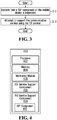
- Figure 1 shows a flowchart of an example method in a mobile device for obtaining a communication service, where the communication service can be supported using a PS service or a CS service, according to some embodiments.
- the mobile device detects that the mobile device is or has become unable to process data for the PS service.
- the PS service may be one of: a voice service; a text message service; a data service; and a video service.
- the communication service may comprise other services that may be supported using both a CS service and a PS service.
- the mobile device may become unable to process data for the PS service because a component of the mobile device that supports the communication service using the PS service (e.g. a SIP component) is or has become inoperable.
- a component of the mobile device that supports the communication service using the PS service e.g. a SIP component
- supporting the communication service using the PS service may be referred to as "supporting the PS service” herein.
- the component of the mobile device may be a software component or a hardware component or a combination of software and hardware. The component may become inoperable due to a software failure or hardware failure.
- the mobile device may become unable to process data for the PS service at a time when PS service session was in progress (e.g. during a PS voice call).
- Embodiments are not limited to any specific method of detecting that the mobile station cannot process data for the PS service. Specific examples of such detection are described below.
- the mobile device attempts to support the communication service using the CS service.
- supporting the communication service using the CS service may be referred to as "supporting the CS service” herein.
- Attempting to support the CS service may be performed automatically and/or responsive to detecting that the mobile device isunable to process data for the PS service.
- the mobile device may attempt to attach to an access server that can provide the CS service.
- the mobile device may attempt to register for CS services via E-UTRAN.
- the mobile device may become “combined attached" via E-UTRAN and use "CS Fallback (CSFB)" procedures, as discussed below in more detail.
- CSFB CS Fallback
- the mobile device may already be combined attached and may simply initiate CSFB.
- FIG. 2 shows a block diagram of an example apparatus 200 that may implement the method of Figure 1 .
- the apparatus 200 may be part of the mobile device (not shown).
- the apparatus 200 includes a processor 202, a memory 204, a monitoring module 206, a CS service support component 208 and a PS service support component 209.
- the CS service support component 208 is for supporting a communication service using the CS service.
- the PS service support component 209 is for supporting the communication service using the PS service. Supporting the communication service using the PS service may include processing data for the PS service.
- the monitoring module 206 detects that the mobile device is or has become unable to process data for the PS service. For example, the monitoring module 206 may detect that the PS service support component 209 is or has become inoperable.
- the PS service support component 209 may include a SIP component, and the SIP component may become inoperable.
- the CS service support component 208 attempts to support the CS service responsive to the monitoring module 206 detecting that the mobile device is unable to process the data for the PS service.
- the CS service support component 208 may interact or work together with other components of the apparatus 200 to attempt to support the CS service.
- the CS service support component 208 may interact with a transmitter/receiver (not shown) and/or a radio component (not shown) of the mobile device.
- the mobile device may have a component called an Operating System (OS), which is also not shown in Figure 2 .
- OS Operating System
- the monitoring module 206, the CS service support component 208 and/or the PS service support component 209 may be within the OS or elsewhere on the mobile device.
- the monitoring module 206, the CS service support component 208 and/or the PS service support component 209 may be implemented as a processor (such as the processor 202) configured to perform the functions described above.
- the monitoring module 206, the CS service support component 208 and/or the PS service support component 209 may be implemented as a memory (such as the memory 204) containing instructions for execution by a processor (such as the processor 202), by hardware, or by a combination of instructions stored in a memory and additional hardware, to name a few examples.
- the apparatus 200 may include additional components, such as a transmitter and/or a receiver, that are not shown in Figure 2 .
- examples of communication services that may be supported using a PS service or a CS service include: voice; text message; and data service.
- video calls can be also established using the CS network.
- Some examples of components of the mobile device that support SIP are a SIP stack, a SIP application, and a SIP User Agent (UA). These SIP components may be used by the mobile device to terminate or originate SIP messages.
- detecting that the mobile device is or has become unable to process data for the PS service comprises detecting that a component of the mobile device supporting PS services is or has become inoperable.
- the component is an IMS component and/or a SIP component in some embodiments.
- the inoperable component may also be a non-IMS and/or a non-SIP component.
- non-SIP and non-IMS components hardware and/or software
- Examples of non-SIP and non-IMS components that could fail and affect the ability of the mobile device to process data for the PS service include: an IP Packet Protocol component; an RTP Packet Protocol component; a processor; a modem component; an audio Digital Signal Processor (DSP) component; a decoder, encoder and/or codec component.
- DSP Digital Signal Processor
- Embodiments are not limited to any particular method of detecting that the mobile device is unable to process data for the PS service.
- Figure 3 shows a flowchart of an example method in a mobile device for supporting a communication service according to some embodiments.
- the mobile device detects that a component of the mobile device that supports the PS service is or has become inoperable.
- the component is a SIP component although the component is not required to be a SIP component as discussed above. Since the mobile device has detected that a PS service (e.g. IMS voice service) is no longer supported by the mobile device, the mobile device attempts to support the CS service (e.g. CS voice service) at block 3-2.
- a PS service e.g. IMS voice service
- FIG 4 shows a block diagram of an example apparatus 400 that may implement the method of Figure 3 .
- the apparatus 400 may be part of the mobile device.
- the apparatus 400 includes a processor 402, a memory 404, a monitoring module 406, a CS service support component 408, and a PS service support component 409 that includes a SIP component 410.
- the CS service support component 408 is for supporting a communication service using the CS service.
- the PS service support component 409 is for supporting the communication service using the PS service. Supporting the communication service using the PS service may include processing data for the PS service.
- the SIP component 410 in this example supports SIP-based PS services in the mobile device.
- the SIP component 410 is separate from the PS service support component 409 in some embodiments.
- the monitoring module 406 detects that the mobile device is or has become unable to process data for the PS service.
- the monitoring module 406 monitors the SIP component 410 and is configured to detect if the SIP component 410 is inoperable.
- the monitoring module 406 monitors a non-SIP component used to process data for the PS service and detects that the non-SIP component is inoperable.
- the CS service support component 408 attempts to support the CS service responsive to the monitoring module 406 detecting that the mobile device is unable to process the data for the PS service.
- the monitoring module 406, the CS service support component 408 and/or the PS service support component 409 may be implemented as a processor (such as the processor 402) configured to perform the functions described above.
- the monitoring module 406, the CS service support component 408 and/or the PS service support component 409 may be implemented as a memory (such as the memory 404) containing instructions for execution by a processor (such as the processor 402), by hardware, or by a combination of instructions stored in a memory and additional hardware, to name a few examples.
- the apparatus 400 may include additional components, such as a transmitter and/or a receiver, that are not shown in Figure 4 .
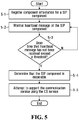
- FIG. 5 shows a flowchart of another example method showing additional details regarding how inoperability of a component supporting the PS service may be detected.
- the component in this example is a SIP component, although non-SIP components are monitored in other embodiments.
- the SIP component registers component information (for example, as part of a registration process for the SIP component).
- the SIP component may perform a registration process in which the component information is registered with a monitoring component of the mobile device.
- the component information for the SIP component may indicate that the SIP component supports the PS service.
- the monitoring component may thereby be aware that the SIP component needs to be monitored.
- the monitoring component will also, then, know that if the SIP component is determined to be inoperable, data for the PS service can no longer be processed.
- Registration of one or more components is not required in some embodiments. In some embodiments, more than one component registers respective component information and/or more than one component is monitored.
- the mobile device monitors the component that supports the PS service, the SIP component in this example.
- the monitoring functions shown in Figure 5 may also be performed in embodiments where the component supporting the PS service is a non-SIP component. Specifically, in this example, a "heartbeat message" for the SIP component is monitored.
- a heartbeat message is a message that may be periodically transmitted from a component (the SIP component in this example). If the heartbeat message is not received within a threshold time the component may be deemed inoperable.
- the SIP component is determined to be inoperable at block 5-4. If a time in which the heartbeat message for the SIP component has not been received has not exceeded the threshold (no branch block 5-3), then the method returns to block 5-2 such that continued monitoring takes place.
- the mobile device since the SIP component has been determined to be inoperable, and the PS service cannot be supported, the mobile device attempts to support the CS service. In other words, if a monitoring component of the mobile device is satisfied that a SIP component's operation to support a PS service is sufficiently impaired (e.g. due to detecting indicators or time bound violations for heartbeat responses), the mobile device may initiate attempts to restore the communication service by supporting the CS service.
- the CS service may be supported via other domains (e.g. CS domain) and/or via other access networks.
- Figure 6 shows a flowchart of another example method showing additional details regarding how inoperability of a component may be detected.
- the component in this example is a SIP component, but the component is a non-SIP component in some embodiments.
- the SIP component may register component information as discussed with respect to block 5-1 of Figure 5 , although that is not required.
- the mobile device monitors the component that supports the PS service. Specifically, in this example, the mobile device monitors for a signal that indicates inoperability (e.g. failure) of the SIP component.
- the mobile device may know to monitor the SIP component due to component information registered by the SIP component, as explained with respect to Figure 5 . Signals that indicate inoperability of non-SIP components may be monitored as well.
- the SIP component may be the SIP stack, the SIP application or the SIP UA, for example.
- An example of a monitoring component that may be configured to monitor a SIP component is a SIP stack monitor.
- the signals monitored may be Portable Operating System Interface (POSIX) signals or other signals defined in existing standards or operating systems.
- POSIX Portable Operating System Interface
- the signals may be signals that are transmitted to or from the component supporting the PS service. By monitoring such predefined signals, additional signalling may not need to be created or monitored in the mobile device. This may reduce the complexity of or otherwise facilitate implementing the monitoring functions described herein.
- POSIX signals that may, upon detection, indicate inoperability of a SIP component include the following; abort (SIGABRT); bus error (SIGBUS); floating point error (SIGFPE); illegal instruction (SIGILL); quit (SIGQUIT); segmentation violation (SIGSEGV); bad arg to sys call (SIGSYS); exceeded CPU limit (SIGXCPU); exceeded file size limit (SIGXFSZ); and power-fail restart (SIGPWR).
- Other signals may also, when detected, indicate that a SIP component or another component that supports PS services is inoperable. Embodiments are not limited to any particular method of detecting inoperability of a component of the mobile device.
- the SIP component is determined to be inoperable at block 6-3.
- the mobile device attempts to support the CS service similar to block 5-5 in Figure 5 . If no signal indicating that the SIP component is inoperable has been detected (no branch, block 6-2), then the method proceeds back to block 6-1 for continued monitoring of the SIP component.
- the method includes both: (1) monitoring a heartbeat message (for example, as shown in Figure 5 ); and ( 2 ) monitoring/detecting a signal that indicates inoperability of a component that supports the PS service (for example, as shown in Figure 6 ).
- the specific monitoring functions shown in Figures 5 and 6 are not required. Additional monitoring/detecting functions not shown in Figures 5 and 6 may be performed. Any suitable method of detecting that the mobile device is unable to process data for the PS service may be employed.
- FIG. 7 shows a block diagram of an example apparatus 700 that may implement the methods of Figures 5 and 6 .
- the apparatus 700 may be part of the mobile device.
- the apparatus 700 includes a processor 702, a memory 704, a monitoring module 706, a CS service support component 708 and a PS service support component 709 that includes a SIP component 710.
- the CS service support component 708 is for supporting a communication service using the CS service.
- the PS service support component 709 is for supporting the communication service using the PS service. Supporting the communication service using the PS service may include processing data for the PS service.
- the SIP component 710 is separate from the PS service support component 709 in some embodiments.
- the SIP component 710 is similar to the SIP component 410 shown in Figure 4 .
- the SIP component may register component information that indicates that the SIP component supports the PS service.
- the heartbeat message monitor 712 monitors a heartbeat message of the SIP component 710. If the heartbeat message is not received for a time that exceeds a threshold, then the monitoring module 706 determines that the SIP component 710 is or has become inoperable.
- the SIP error detector 714 may include a SIP stack monitor (not shown). The SIP error detector 714 monitors for one or more signals that indicate that the SIP component 710 is inoperable.
- the signals may, for example, be any of the POSIX signals described above or other suitable signals.
- the monitoring module 706 determines that the SIP component 710 is inoperable.
- the CS service support component 708 attempts to support the CS service if the SIP component 710 is determined to be inoperable (i.e. responsive to the monitoring module 706 detecting that the mobile device is unable to process data for the PS service).
- the monitoring module 706 (including the heartbeat message monitor 712 and the SIP error detector 714), the CS service support component 708 and/or the PS service support component 709 (including the SIP component 710) may be implemented as a processor (such as the processor 702) configured to perform the functions described above.
- the monitoring module 706, the CS service support component 708 and/or the PS service support component 709 may be implemented as a memory (such as the memory 704) containing instructions for execution by a processor (such as the processor 702), by hardware, or by a combination of instructions stored in a memory and additional hardware, to name a few examples.
- the heartbeat message monitor 712 and the SIP error detector 714 are shown as part of the monitoring module 706 in this example. However, it is possible that either or both of the heartbeat message monitor 712 and the SIP error detector 714 may be separate from and/or external to the monitoring module 706. It will also be appreciated that the apparatus 700 may include additional components, such as a transmitter and/or a receiver, that are not shown in Figure 7 .
- PS and CS services may be supported in a 3GPP network or in a non-3GPP network.
- PS services may be supported in the 3GPP domain with E-UTRAN as the access network and the EPC core network.
- Other 3GPP access networks GERAN, UTRAN, etc.
- CS services such as CS voice, SMS or USSD.
- 3GPP networks may be commonly be referred to as "cellular" networks.
- a mobile device supporting WLAN services may maintain a "voice over WLAN” setting that can be set to one of the following: “cellular only”; “cellular preferred”; “WLAN preferred”; and “WLAN only”.
- cellular only the mobile device uses only cellular networks.
- cellular preferred the mobile device uses cellular networks if available, and otherwise uses a WLAN connection.
- WLAN preferred the mobile device uses a WLAN network if available, and otherwise uses cellular networks.
- WLAN only the mobile device only uses a WLAN connection.
- E-UTRAN may allow a mobile device to be registered for both PS services and CS services.
- a mobile device that is registered for both PS and CS services (for example, using E-UTRAN registration information of the mobile device is provisioned in the CS network's core network and the EPC network) may be referred to as being "combined attached”.
- the access network may be supported by a core network that supports PS services and also "CS Fallback" (CSFB).
- CSFB CS Fallback
- the access network e.g. E-UTRAN
- CSFB may allow a combined attached mobile device to quickly select and switch between PS and CS services as needed or preferred.
- the CS services may be offered by a different access network.
- the mobile device When combined attached, the mobile device may be registered both in the core network supporting PS services (e.g. an EPC supporting EPS services) and a core network offering CS services (e.g. non-EPS services).
- PS services e.g. an EPC supporting EPS services
- CS services e.g. non-EPS services.
- CSFB in EPS may be realized by using the SGs interface mechanism between a Mobile Switching Centre (MSC) Server and a Mobility Management Entity (MME).
- MSC Mobile Switching Centre
- MME Mobility Management Entity
- a mobile device that is combined attached via E-UTRAN may use PS services for data communication and CS services for voice calls.
- the mobile device Upon detecting that a voice call is required, the mobile device (currently using PS services) may use the CSFB procedure to quickly switch to the CS domain and support the CS voice service.
- the CSFB procedure may terminate or originate the voice call via the core network in which it is registered for CS services and via an access network that offers CS services.
- the CSFB procedure may include the MSC providing a priority indication together with a paging message to the MME.
- the network may initiate a handover from the E-UTRAN and EPC to the access network and/or core network that support the CS service.
- the mobile device may send an Extended Service Request for mobile originating CSFB to the MME.
- the MME may then send a message to a base station indicating that the mobile device should be moved to the access network that supports the CS service (e.g. GERAN or UTRAN). Additional details regarding CSFB are provided in the 3GPP TS 23.272 version 11.4.0 Release 11 specification document.
- the E-UTRAN may maintain a "usage setting" for the mobile device with the following options: “Data Centric”; and “Voice Centric".
- the E-UTRAN may also maintain a "voice domain preference" setting for the mobile device.
- the network may use the mobile device's usage setting and the "voice domain preference" for E-UTRAN to select the Radio Access Technology (RAT)/Frequency Selection Priority (RFSP) index.
- the mobile device may transmit messages to the network to update and/or change the "usage setting" or the "voice domain preference” setting for the mobile device.
- the "voice domain preference" may have the following options: "CS voice only”; “IMS PS voice only”; "CS voice preferred, IMS PS voice as secondary”; and "IMS PS voice preferred, CS voice as secondary”.
- More information regarding the usage setting for a mobile device may be found, for example, in the 3GPP TS 23.221 version 11.1.0 specification document, the entire contents of which is incorporated herein by reference. More information regarding voice domain preference settings may be found, for example, in the 3GPP TS 24.167 version 11.1.0 specification document.
- Updating the "voice over WLAN” mode of operation or generating a message to update the "voice domain preference" for E-UTRAN are examples of how a mobile device may update communication setting information for the mobile device.
- the mobile device's usage setting indicates the value configured on the mobile device as defined in 3GPP TS 23.221.
- a voice domain preference for E-UTRAN information indicates the value configured on the mobile device of the "voice domain preference" for E-UTRAN as defined in 3GPP TS 24.167.
- the mobile device may indicate the "voice domain preference" information to the network in a message.
- the "voice domain preference” information can be indicated to the network when the "voice domain preference" changes.
- a usage setting information element may be included in the message; the usage setting information element may define the usage setting for the mobile device.
- An example of how the mobile device's usage setting information element is coded is shown in Figure 10.5.151A of the 3GPP TS 24.008 version 12.1.0 specification document, which is shown below.
- Table 10.5.166A of the 3GPP TS 24.008 version 12.1.0 specification document An example of how the "voice domain preference" information for a mobile device is coded is shown in Table 10.5.166A of the 3GPP TS 24.008 version 12.1.0 specification document, which is shown below.
- Table 10.5.166A/3GPP TS 24.008 Voice domain preference and UE's usage setting information element Voice domain preference and UE's usage setting value (octet 3, bit 1 to 3) UE's usage setting (1 bit field) Bit 3 0 Voice centric 1 Data centric Voice domain preference for E-UTRAN (2 bit field) Bit 2 1 0 0 CS Voice only 0 1 IMS PS Voice only 1 0 CS voice preferred, IMS PS Voice as secondary 1 1 IMS PS voice preferred, CS Voice as secondary MS not supporting IMS voice shall indicate "CS Voice only”. MS only supporting IMS voice shall indicate "IMS PS Voice only”.
- FIG 8 shows a flowchart of an example method for supporting a communication service according to some embodiments, where the communication service can be supported using a PS service or using a CS service.
- the mobile device detects that the mobile device is or has become unable to process data for the PS service. This detection may include any of the specifics discussed above with respect to Figures 1 to 7 .
- the PS service may be provided by a WLAN network (e.g. VoIP) or by a 3GPP network (e.g. IMS voice). In this example, however, the PS service is VoIP provided by a WLAN network.
- the mobile device attempts to register with an access network that can provide the CS service (such as GERAN, UTRAN or 1XCDMA, for example).
- an access network that can provide the CS service (such as GERAN, UTRAN or 1XCDMA, for example).
- the mobile device may thereby attempt to attach to a CS core network via the access network and support the CS service.
- the mobile device attempts to attach to an access network that can provide the CS service (block 8-2) if the mobile device is not already attached to such an access network.
- the mobile device attempts to attach to an access network that can provide the CS service (block 8-2) if: (1) the mobile device is not already combined attached via E-UTRAN; or (2) the mobile device is combined attached, but not in a manner that allows CSFB to be attempted for the communication service.
- the mobile device may be combined attached for SMS only and CSFB may not be available for a voice call.
- the mobile device may then attempt to attach to a different access network that could support a CS voice call.
- the mobile device updates its communication setting information by changing or setting its "voice over WLAN" mode of operation to one of: “cellular only”; “cellular preferred”; or “WLAN preferred”.
- Each of these settings may permit the mobile device to use cellular services (e.g. the CS service as provided by a 3GPP network).
- the mode of operation is changed to "cellular only”.
- block 8-3 is omitted.
- the mobile device may not change its "voice over WLAN" mode of operation. For example, the preference may already be set to one of the options set out above or the setting may otherwise not be changed.
- the mobile device may also generate a message to change or set its "voice domain preference" as described, for example, in Figure 10 .
- the network may not be aware of this. Therefore, the network may not have any reason to signal to the mobile device to change its "voice over WLAN" mode of operation.
- the current mode of operation may not allow the mobile device to use the CS service efficiently or at all. For example, the mode of operation could be set to "WLAN only" when the SIP component becomes inoperable. Thus, the mobile device may actively update the "voice over WLAN" mode of operation itself as described above rather than wait for the network to signal that it should do so.
- the mobile device may use information or settings associated with the PS voice session when establishing a CS voice session. For example, a dial string used for the PS voice session may be used to establish the CS voice session.
- attempting to support the CS service includes attempting a voice call.
- information used in the PS voice session is used to attempt to establish a new CS voice session using the CS service. Specifically, in this example, the voice call is attempted using a dial string from the SIP dialog.
- the dial string may be one of: a dial string that was used in establishing a Session Initiation Protocol (SIP) dialog; a dial string associated with a SIP Uniform Resource Identifier (URI); and a telephone (tel) URI used when establishing the SIP dialog.
- the dial string may, for example, be encoded in the Request-URI (R-URI) field of the SIP INVITE that was used to request the SIP dialog. It is not necessary to use a dial string from a SIP dialog or to attempt to establish a voice call and block 8-4 is not required in some embodiments.
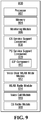
- FIG. 9 shows a block diagram of an example apparatus 900 that may implement the method of Figure 8 .
- the apparatus 900 may be part of the mobile device.
- the apparatus 900 includes a processor 902, a memory 904, a monitoring module 906, a CS service support component 908, a PS service support component 909 that includes a SIP component 910, a voice over WLAN mode module 912, a WLAN radio module 914, a voice call module 916, and a CS radio module 918.
- the CS service support component 908 is for supporting a communication service using the CS service.
- the PS service support component 909 is for supporting the communication service using the PS service. Supporting the communication service using the PS service may include processing data for the PS service.
- the SIP component 910 is separate from the PS service support component 909, or may be omitted, in some embodiments.
- the SIP component 910 supports the PS service, which is a WLAN voice service in this embodiment.
- the PS service support component 909 may include, or share hardware/software elements with, the voice over WLAN mode module 912, the WLAN radio module 914, and/or other components of the apparatus 900.
- the CS service support component 908 may include, or share hardware/software elements with the voice call module 916, the CS radio module 918 and/or other components of the apparatus 900.
- the monitoring module 906 is configured to detect if the mobile device is or has become unable to process data for the PS service. For example, the monitoring module may detect that SIP component 910 is inoperable. This detection may include any of the example detection functionality described herein.
- the CS service support component 908 in this example is configured to work with the CS radio module 918 to attempt to support the CS service responsive to the monitoring module 906 detecting that the mobile device is unable to process the data for the PS service.
- the CS radio module 918 is configured to communicate with access networks that provide CS services.
- the CS radio module 918 may comprise a UTRAN radio, a GERAN radio component, and/or any other radio components for communicating with an access network that provides the CS service.
- the CS service support component 908 signals to the CS radio module 918 to attempt to register with an access network that can support the CS service if: (1) the mobile device is not currently attached to another access network that can provide the CS service; and (2) the mobile device is not already combined attached via E-UTRAN such that CSFB is possible.
- the voice over WLAN mode module 912 is configured to update the mobile device's "voice over WLAN" mode of operation in accordance with the methods described herein.
- the WLAN radio module 914 is configured to support WLAN communications in accordance with the voice over WLAN mode module 912.
- the mobile device may become unable to process data for the PS service during a voice session (using a SIP dialog).
- the voice call module 916 is configured to attempt a voice call using information from the previous PS voice session. Specifically, the voice call module 916, in this example, attempts the voice call using one of: a dial string that was used in establishing a Session Initiation Protocol (SIP) dialog; a dial string associated with a SIP Uniform Resource Identifier (URI); and a tel URI used when establishing the SIP dialog.
- SIP Session Initiation Protocol
- URI Uniform Resource Identifier
- tel URI used when establishing the SIP dialog.
- the monitoring module 906, the CS service support component 908, the PS service support component 909 (including the SIP component 910), the voice over WLAN mode module 912, the voice call module 916 and/or the CS radio module 918 may be implemented as a processor (such as the processor 902) configured to perform the functions described above.
- the monitoring module 906, the CS service support component 908, the PS service support component 909 (including the SIP component 910), the voice over WLAN mode module 912 the voice call module 916 and/or the CS radio module 918 may be implemented as a memory (such as the memory 904) containing instructions for execution by a processor (such as the processor 902), by hardware, or by a combination of instructions stored in a memory and additional hardware, to name a few examples.
- the apparatus 900 may include additional components, such as a transmitter and/or a receiver, that are not shown in Figure 9 . Not all of the elements of the apparatus 900 are required in all embodiments, and Figure 9 is provided only as an example.
- the mobile device may attempt to register for CS services through E-UTRAN. That is, if a WLAN PS service can no longer be provided, the mobile device may attempt to register via E-UTRAN for the CS service. This registration may include a combined Tracking Area Update (TAU) procedure. If said registration is successful, the mobile device may become "combined attached" via E-UTRAN such that CSFB is available for the mobile device. The mobile device in this example may also update its "voice over WLAN" setting or generate a message to update the E-UTRAN "voice domain preference" for the mobile device.
- TAU Tracking Area Update
- Figure 10 shows a flowchart of another example method for supporting a communication service according to some embodiments, where the communication service can be supported using a PS service or a CS service.
- the mobile device is already attached to E-UTRAN and is registered for PS services (such as IMS PS voice).
- PS services such as IMS PS voice
- the PS service is provided by another network such as a WLAN network.
- the mobile device detects that it is or has become unable to process data for the PS service. This detection may include any of the specific detection functions discussed herein.
- Blocks 10-2, 10-3 and 10-4 of Figure 10 generally show an example of determining whether CSFB via E-UTRAN is currently available for supporting the CS service.
- the mobile device may already know whether CSFB is available and one or more of blocks 10-2, 10-3 and 10-4 are omitted in some embodiments.
- the order of blocks 10-2, 10-3 and 10-4 may be altered.
- the mobile device initiates the CSFB procedure to support the CS service. Otherwise, the mobile device attempts to obtain the CS service from another access network. More specifically, at block 10-2, if the network (e.g. E-UTRAN network and/or core network) has indicated that CSFB is supported (yes branch, block 10-2), then the method continues to block 10-3.
- the network e.g. E-UTRAN network and/or core network
- the method continues to block 10-6.
- block 10-3 if the mobile device is combined attached such that CSFB is possible (yes branch, block 10-3), then the method continues at block 10-4. However, if the mobile device is not combined attached such that CSFB is possible (no branch, block 10-3), then the method continues at block 10-6.
- block 10-4 if the mobile device is combined attached for the needed communication service (yes branch, block 10-4), then the method continues to block 10-5. However, if the mobile device is combined attached, but not for the needed communication service (no branch 10-4), then the method continues to block 10-6.
- the mobile device uses CSFB procedures to fall back to the CS domain in order to support the CS service.
- the mobile device attempts to attach to an access network that can provide the CS service.
- the mobile device generates a message to change or set the "voice domain preference" of the mobile device to one of the following: "CS voice only", "CS voice preferred, IMS PS voice as secondary", and "IMS PS voice preferred, CS voice as secondary".
- Each of these voice domain settings may allow the option for the mobile device to support the CS service.
- the message may be for transmission to a network component such as a base station.
- the preference may be set to "CS voice only”. Additional information may be sent in the message regarding the status of the mobile device.
- the message to set the voice domain setting is a Non-Access Stratum (NAS) message. It is to be understood that some other embodiments omit block 10-7.
- the mobile device may not send a message to set the voice domain preference. For example, the preference may already be set to one of the options set out above or may otherwise not be changed.
- NAS Non-Access Stratum
- the network may not be aware that the PS service is no longer supported. Therefore, the network may not have any reason to signal to the mobile device to change its "voice domain preference".
- the current "voice domain preference" may not allow the mobile device to use the CS service efficiently or at all.
- the mode of operation could be set to "IMS PS voice only" when the SIP component becomes inoperable.
- the mobile device may actively take steps to update the "voice domain preference" by generating the message for transmission to the network as described above. This message may also provide additional information to allow the network to better deal with the mobile device's current condition.
- the mobile device also performs functions similar to those shown in blocks 8-3 and/or 8-4 of Figure 8 in combination with the method of Figure 10 .
- the method may also include changing a voice over WLAN setting and/or attempting a voice call as described above.
- FIG 11 shows a block diagram of an example apparatus 1100 that may implement the method of Figure 10 .
- the apparatus 1100 may be part of the mobile device.
- the apparatus 1100 includes a processor 1102, a memory 1104, a monitoring module 1106, a CS service support component 1108, a PS service support component 1109 that includes a SIP component 1110, and an E-UTRAN module 1112 including an E-UTRAN radio 1114, a CS radio module 1116, and a voice domain preference message generator 1120 and a transmitter 1122.
- the CS service support component 1108 is for supporting a communication service using the CS service.
- the PS service support component 1109 is for supporting the communication service using the PS service. Supporting the communication service using the PS service may include processing data for the PS service.
- the SIP component 1110 is separate from the PS service support component 1109, or is omitted, in some embodiments.
- the SIP component 1110 supports the PS service, which is IMS voice in this embodiment.
- the PS service is a different service, such as a WLAN service in some embodiments.
- the PS service support component 1109 may include, or share elements with, the E-UTRAN module 1112, the E-UTRAN radio 1114, the voice domain preference message generator 1120, and/or other components of the apparatus 1100.
- the monitoring module 1106 is configured to detect if the mobile device is or has become unable to process data for the PS service. For example, the monitoring module 1106 may detect that the SIP component 1110 is inoperable. This detection may include any of the example detection functionality described herein.
- the CS radio module 1116 is configured to register with access networks that provide the CS service and to support said service.
- the E-UTRAN module 1112 is configured to support services using the E-UTRAN via the E-UTRAN radio 1114, and employs CSFB procedures when available.
- the CS service support component 1108 in this example is configured to work together with the E-UTRAN module 1112 and the CS radio module 1116 to attempt to support the CS service responsive to the monitoring module 1106 detecting that the mobile device is unable to process the data for the PS service. Specifically, if CSFB is not available, then the CS service support component 1108 signals to the CS radio module 1116 to attempt to register with an access network that can provide the CS service. The determination of whether CSFB is available may be made in accordance with the method shown in Figure 10 , for example. The CS service support component 1108 in this example also signals the E-UTRAN module 1112 to disable the E-UTRAN radio 1114 in this event. The CS radio module 1116 then camps on the Radio Access Technology (RAT) enabling the CS service.
- RAT Radio Access Technology
- the voice domain preference message generator 1120 is configured to generate a message, for transmission to a network component, requesting that the voice domain preference be changed to one of: "CS voice only", "CS voice preferred, IMS PS voice as secondary", and "IMS PS voice preferred, CS voice as secondary".
- the message may also contain additional information indicating that IMS service is not available.
- the message in this embodiment is generated for transmission via the transmitter 1122.
- the monitoring module 1106, the CS service support component 1108, the PS service support component 1109 (including the SIP component 1110), the E-UTRAN module 1112, the E-UTRAN radio 1114 and/or the CS radio module 1116 may be implemented as a processor (such as the processor 1102) configured to perform the functions described above.
- the monitoring module 1106, the CS service support component 1108, the PS service support component 1109 (including the SIP component 1110), the E-UTRAN module 1112, the E-UTRAN radio 1114 and/or the CS radio module 1116 may be implemented as a memory (such as the memory 1104) containing instructions for execution by a processor (such as the processor 1102), by hardware, or by a combination of instructions stored in a memory and additional hardware, to name a few examples.
- the apparatus 1100 may include additional components, such as a receiver, that are not shown in Figure 11 .
- the E-UTRAN radio 1114 is shown as part of the E-UTRAN module 1112 in Figure 11 . However, the E-UTRAN radio 1114 may be separate from and/or external to the E-UTRAN module 1112.
- a component in a mobile device supporting PS services that becomes inoperable or fails may subsequently become operable again. For example, the component may restart or recover such that PS services are once again supported.
- the mobile device detects that the component that supports the PS service is again operable. A few examples of how this may be detected are discussed below.
- a functioning SIP component may request resources from layers lower than the SIP layer.
- the SIP component may request a Packet Data Protocol (PDP) context (e.g. when using UTRAN) or for an EPS bearer context (when using E-UTRAN).
- PDP Packet Data Protocol
- the mobile device may detect that the SIP component is requesting resources, thereby determining that the SIP component has become operable again. Other indications that the SIP component has become operable may also be detected. For example, the heartbeat message of the SIP component may again be responding as expected when the component is operable.
- the SIP component may perform a registration process with other components of the mobile device when re-starting or resetting. The registration process could indicate to other elements of the mobile device that the component has become operable.
- the SIP component may be considered to be operable when it is ready to attempt to send a SIP REGISTER request. It is to be understood that although recovery of a SIP component has been discussed, the mobile device may also detect recovery of non-SIP components using the same or similar methods, or any other suitable method.
- the monitoring module of the mobile device in addition to detecting when a component is inoperable, also subsequently detects if that component has become operable again.
- the monitoring component may indicate to the operating system (or other software components of the device) which components are being monitored by the monitoring module.
- the operating system or other software component
- the monitoring component may notify the monitoring component of this fact.
- the monitoring component may also simply detect that the component has recovered without the operating system signalling the monitoring module.
- the monitoring module may detect a signal from the recovered component (such as a heartbeat signal) and/or detect that the component has performed a registration process.
- the mobile device may change an internal setting "IMS voice is not available” to "true”. Later, the monitoring component of the mobile device may change the setting "IMS voice is not available” to "false” in response to detecting that the PS service can again be supported. Alternatively, the recovered component itself may restore the setting "IMS voice is not available” to "false”.
- Embodiments are not limited to the specific detection methods described herein and any suitable method for detecting operability or inoperability of a mobile device component may be employed.
- a component or element of the mobile device other than the monitoring module may perform the functions described in the paragraph above.
- the functions described above may be performed in the NAS layer or another layer of the mobile device.
- a layer of the mobile device may be realized in software.
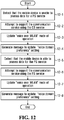
- FIG. 12 shows a flowchart of an example method in accordance with some embodiments.
- the mobile device detects that the mobile device cannot process data for the PS service. For example, the mobile device may detect that a SIP component is inoperable.
- the mobile device attempts to support the CS service.
- the CS service may be supported using any of the methods described above.
- the mobile device updates its "voice over WLAN" mode of operation. For example, the setting may be changed to "cellular only”.
- the mobile device generates a message to update the "voice domain preference" for E-UTRAN.
- the message may request the preference be changed to "CS voice only".
- the mobile device detects that it is again able to process data for the PS service.
- the mobile device may detect that the component that supports the PS service has recovered. This detection may comprise any of the examples described above for detecting that the mobile device can again support the PS service.
- the mobile device attempts to support the PS service. Attempting to support the PS service may include one or more of the following: (1) detaching from the access network providing the CS service (e.g. UTRAN or GERAN); (2) accepting to attach to an access network that can provide the PS service (e.g. E-UTRAN or WLAN); or (3) accepting to become combined registered/attached with E-UTRAN.
- the mobile device updates its "voice over WLAN” mode of operation.
- the mobile device may change its mode of operation to "WLAN only".
- the mobile device changes to a different mode or alternatively does not change its "voice over WLAN" mode of operation.
- the mobile device generates a message to update its "voice domain preference" setting.
- the mobile device may change its voice domain preference to "IMS voice only".
- the mobile device requests a change to a different voice domain preference or alternatively does not generate such a message.
- the mobile device may "undo" the changes that it made earlier in response to detecting that the component was inoperable. Thus, the mobile device may again function as it had before the component had become inoperable.
- the mobile device may attempt to support a different PS-version of the communication service. For example, if the mobile device had been terminating a VoIP call via WLAN when the SIP component failed, the mobile device may then initiate IMS PS voice when the SIP component recovers.
- FIG. 13 shows a block diagram of a of an example apparatus 1300 that may implement the method of Figure 12 .
- the apparatus 1300 may be part of the mobile device.
- the apparatus 1300 includes a processor 1302, a memory 1304, a monitoring module 1306, a CS service support component 1308, a PS service support component 1309 including a SIP component 1310, an E-UTRAN module 1312, a WLAN module 1314, a voice over WLAN mode module 1316, a voice domain preference message generator 1318 and a transmitter 1320.
- the CS service support component 1308 is for supporting a communication service using the CS service.
- the PS service support component 1309 is for supporting the communication service using the PS service. Supporting the communication service using the PS service may include processing data for the PS service.
- the SIP component 1310 is separate from the PS service support component 1309, or is omitted, in some embodiments.
- the SIP component 1310 supports both WLAN and 3GPP PS services in this example.
- the monitoring module 1306 is configured to detect if the mobile device is or has become unable to process data for the PS service. For example, the monitoring module 1306 may detect that SIP component 1310 is inoperable.
- the CS service support component 1308 attempts to support the CS service responsive to the monitoring module 1306 detecting that the mobile device is unable to process the data for the PS service.
- the monitoring module 1306 is also configured to detect if the SIP component 1310 becomes operable again. These functions of the monitoring module 1306 may include any of the example detection functionality described herein.
- the CS service support component 1308 is configured to work with the E-UTRAN module 1312, the WLAN module 1314, the voice over WLAN mode module 1316, and the voice domain preference message generator 1318 to attempt to support the CS service.
- the PS service support component 1309 is configured to work with the E-UTRAN module 1312, the WLAN module 1314, the voice over WLAN mode module 1316, and the voice domain preference message generator 1318 to attempt to support the CS service responsive to the monitoring module 1306 determining that the mobile device is again able to process data for the PS service.
- the monitoring module 1306 may detect that the SIP component 1310 has recovered and is operable.
- the PS service support component 1309 may signal to the E-UTRAN module 1312 to attempt to register for the PS service.
- the PS service support component 1309 may signal to the to the WLAN module 1314 to attempt to obtain the PS service.
- the PS service support component 1309 may also signal to the voice over WLAN mode module 1316 and the voice domain preference message generator 1318 to initiate the process of updating either or both of the voice domain preference for E-UTRAN and the voice over WLAN setting for the mobile device as described herein.
- the PS service support component 1309 may include, or share elements with, the E-UTRAN module 1312, the WLAN module 1314, the voice over WLAN mode module 1316, the voice domain preference message generator 1318, and/or other components of the apparatus 1300.
- the monitoring module 1306, the CS service support component 1308, the PS service support component 1309, the SIP component 1310, the E-UTRAN module 1312, the WLAN module 1314, the voice over WLAN mode module 1316 and/or the voice domain preference message generator 1318 may be implemented as a processor (such as the processor 1302) configured to perform the functions described above.
- the monitoring module 1306, the CS service support component 1308, the PS service support component 1309, the SIP component 1310, the E-UTRAN module 1312, the WLAN module 1314, the voice over WLAN mode module 1316 and/or the voice domain preference message generator 1318 may be implemented as a memory (such as the memory 1304) containing instructions for execution by a processor (such as the processor 1302), by hardware, or by a combination of instructions stored in a memory and additional hardware, to name a few examples. It will also be appreciated that the apparatus 1300 may include additional components, such as a receiver, that are not shown in Figure 13 .
- the mobile device may send a SIP REGISTER request as part of initiating a SIP REGISTRATION procedure.
- the SIP REGISTER request may be sent if the IP address of the mobile device is different from a previous IP address that was use just prior to detecting the failure or if the mobile device has reasons to assume it has been deregistered at the SIP REGISTRAR (e.g. due to timers having expired).
- the mobile device may determine that its Public User Identity is successfully registered with the REGISTRAR (e.g. after receiving an SIP 200 OK response to the SIP REGISTER request or after receiving a SIP NOTIFY request).
- the mobile device then detaches from UTRAN or GERAN.
- the mobile device accepts being registered for EPS services only at the E-UTRAN.
- the mobile device may accept being combined registered for SMS-only at the E-UTRAN (for example if the PS service that can again be supported at the mobile device is a voice service).
- the mobile device may wait until the CS voice call is finished before switching over to the PS voice service.
- the mobile device may re-enable E-UTRA radio capabilities or WLAN capabilities.
- the mobile device may re-enable E-UTRA radio capabilities or WLAN capabilities.
- the mobile device determines its Public User Identity is successfully registered with the REGISTRAR, the Non Access Stratum (NAS) or the monitoring module may set the "IMS voice not available" setting to false.
- NAS Non Access Stratum
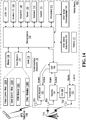
- FIG 14 shows block diagram of a mobile device 100 that may implement the methods described herein.
- the mobile device 100 is shown with specific components for implementing features similar to those of the apparatuses 200, 400, 700, 900, 1100 and 1300 shown in Figures 2 , 4 , 7 , 9 , 11 and 13 respectively. It is to be understood that the mobile device 100 is shown with very specific details for example purposes only.
- the mobile device 100 has a housing that may be elongated vertically, or may take on other sizes and shapes (including clamshell housing structures).
- the keyboard 114 may include a mode selection key, or other hardware or software for switching between text entry and telephony entry.
- the mobile device 100 may have a housing that does not take on other sizes and shapes.
- a microprocessor 128 is shown schematically as coupled between a keyboard 114 and a display 126.
- the microprocessor 128 is a type of processor with features similar to those of the processors 202, 402, 702, 902, 1102 and 1302 of the apparatuses 200, 400, 700, 900, 1100 and 1300 shown in Figures 2 , 4 , 7 , 9 , 11 and 13 respectively.
- the microprocessor 128 controls operation of the display 126, as well as overall operation of the mobile device 100, in response to actuation of keys on the keyboard 114 by a user.
- a communications subsystem 170 In addition to the microprocessor 128, other parts of the mobile device 100 are shown schematically. These include: a communications subsystem 170; a short-range communications subsystem 102; the keyboard 114 and the display 126, along with other input/output devices including a set of LEDs 104, a set of auxiliary I/O devices 106, a serial port 108, a speaker 111 and a microphone 112; as well as memory devices including a flash memory 116 and a Random Access Memory (RAM) 118; and various other device subsystems 120.
- the mobile device 100 may have a battery 121 to power the active elements of the mobile device 100.
- the mobile device 100 is in some example embodiments a two-way radio frequency (RF) communication device having voice and data communication capabilities.
- the mobile device 100 in some example embodiments has the capability to communicate with other computer systems via the Internet.
- RF radio frequency
- Operating system software executed by the microprocessor 128 is in some example embodiments stored in a persistent store, such as the flash memory 116, but may be stored in other types of memory devices, such as a read only memory (ROM) or similar storage element.
- system software, specific device applications, or parts thereof may be temporarily loaded into a volatile store, such as the RAM 118.
- Communication signals received by the mobile device 100 may also be stored to the RAM 118.
- a personal information manager (PIM) application module 130C may also be installed on the mobile device 100 during manufacture.
- the PIM application is in some example embodiments capable of organizing and managing data items, such as e-mail, calendar events, voice mails, appointments, and task items.
- the PIM application is also in some example embodiments capable of sending and receiving data items via a wireless network 110.
- the data items managed by the PIM application are seamlessly integrated, synchronized and updated via the wireless network 110 with the device user's corresponding data items stored or associated with a host computer system.
- the software modules may include, for example, the monitoring module 206, 406, 706, 906, 1106 or 1306, the CS service support component 208, 408, 708, 908, 1108 or 1308, the PS service support component 209, 409, 709, 909, 1109 or 1309, the SIP component 410, 710, 910, 1110 or 1310, the heartbeat message monitor 712, the SIP error detector 714, the voice over WLAN mode module 912 or 1316, the WLAN radio module 914, a voice call module 916, the CS radio module 918 or 1116, the E-UTRAN module 1112 or 1312, the E-UTRAN radio 1114, a CS radio 1116, the voice domain preference message generator 1120 or 1318 and/or the WLAN module 1314 of Figures 2 , 4 , 7 , 9 , 11 and 13 .
- the information updater is not implemented as software and stored on the flash memory 116. More generally, the information updater may be implemented as software, hardware, firmware, or any appropriate combination thereof.
- the communications subsystem 170 includes a receiver 150, a transmitter 152, a GPS receiver 162, and one or more antennas, illustrated as a receive antenna 154, a transmit antenna 156, and a GPS antenna 164.
- the communication subsystem 170 also includes a processing module, such as a digital signal processor (DSP) 158, and local oscillators (LOs) 160.
- DSP digital signal processor
- LOs local oscillators
- the communications subsystem 170 is dependent upon the communication network in which the mobile device 100 is intended to operate.
- the communications subsystem 170 of the mobile device 100 may be designed to operate with the MobitexTM, DataTACTM or General Packet Radio Service (GPRS) mobile data communication networks and also designed to operate with any of a variety of voice communication networks, such as Advanced Mobile Phone Service (AMPS), Time Division Multiple Access (TDMA), Code Division Multiple Access (CDMA), Personal Communications Service (PCS), Global System for Mobile Communications (GSM), etc. Examples of CDMA include 1X and 1x EV-DO.
- the communication subsystem 170 may also be designed to operate with an 802.11 Wi-Fi network, or an 802.16 WiMAX network or both. Other types of data and voice networks, both separate and integrated, may also be utilized with the mobile device 100.
- Network access may vary depending upon the type of communication system. For example, in the MobitexTM and DataTACTM networks, mobile devices are registered on the network using a unique Personal Identification Number (PIN) associated with each device. In GPRS networks, however, network access is typically associated with a subscriber or user of a device. A GPRS device therefore typically has a subscriber identity module, commonly referred to as a Subscriber Identity Module (SIM) card, in order to operate on a GPRS network.
- SIM Subscriber Identity Module
- the mobile device 100 may send and receive communication signals over the communication network 110.
- Signals received from the communication network 110 by the receive antenna 154 are routed to the receiver 150, which provides for signal amplification, frequency down conversion, filtering, channel selection, etc., and may also provide analog to digital conversion. Analog-to-digital conversion of the received signal allows the DSP 158 to perform more complex communication functions, such as demodulation and decoding.
- signals to be transmitted to the network 110 are processed (e.g., modulated and encoded) by the DSP 158 and are then provided to the transmitter 152 for digital to analog conversion, frequency up conversion, filtering, amplification and transmission to the communication network 110 (or networks) via the transmit antenna 156.
- the DSP 158 provides for control of the receiver 150, the transmitter 152, and the GPS receiver 162. For example, gains applied to communication signals in the receiver 150 and the transmitter 152 may be adaptively controlled through automatic gain control algorithms implemented in the DSP 158.
- a received signal such as a text message or web page download
- the communication subsystem 170 is input to the microprocessor 128.
- the received signal is then further processed by the microprocessor 128 for an output to the display 126, or alternatively to some other auxiliary I/O devices 106.
- a device user may also compose data items, such as e-mail messages, using at least one of the keyboard 114 and some other auxiliary I/O device 106, such as a touchpad, a rocker switch, a thumb-wheel, or some other type of input device.
- the composed data items may then be transmitted over the communication network 110 via the communication subsystem 170.
- a voice communication mode In a voice communication mode, overall operation of the device is substantially similar to the data communication mode, except that received signals are output to a speaker 111, and signals for transmission are generated by a microphone 112.
- Alternative voice or audio I/O subsystems such as a voice message recording subsystem, may also be implemented on the mobile device 100.
- the display 126 may also be utilized in voice communication mode, for example, to display the identity of a calling party, the duration of a voice call, or other voice call related information.
- GPS Location determination using GPS technology involves receiving GPS signals from GPS satellites 166 on the antenna 164.
- the GPS signals are received using the GPS receiver 162 and processed by the DSP 158.
- GPS signals from at least four satellites are processed. Further details of GPS are omitted for simplicity.
- the short-range communications subsystem 102 enables communication between the mobile device 100 and other proximate systems or devices, which need not necessarily be similar devices.
- the short range communications subsystem may include an infrared device and associated circuits and components, or a BluetoothTM communication module to provide for communication with similarly-enabled systems and devices.
- a computer-readable medium having computer-executable instructions stored thereon that, when executed, cause a computer to implement any one of the methods described herein.
Landscapes
- Engineering & Computer Science (AREA)
- Computer Networks & Wireless Communication (AREA)
- Signal Processing (AREA)
- Multimedia (AREA)
- Computer Security & Cryptography (AREA)
- Mobile Radio Communication Systems (AREA)
- Telephonic Communication Services (AREA)
Claims (16)
- Procédé exécuté dans un dispositif mobile, le procédé comprenant :
par rapport à un service de communication qui peut être pris en charge à l'aide d'un service à commutation de paquets, PS, ou d'un service à commutation de circuits, CS :détecter que le dispositif mobile n'est pas apte à traiter des données pour le service PS (1-1) ;la détection du fait que le dispositif mobile n'est pas apte à traiter les données pour le service PS comprenant la surveillance d'un composant de prise en charge de service à commutation de paquets, PS, (209, 409, 709, 1109, 1309) du dispositif mobile pour prendre en charge un service de communication à l'aide du service PS (5-2, 6-2), la surveillance dudit composant qui prend en charge le service de communication à l'aide du service PS comprenant en outre la surveillance d'un signal qui indique une défaillance du composant (6-2) ; eten réponse à la détection du fait que le dispositif mobile n'est pas apte à traiter des données pour le service PS, tenter de prendre en charge le service de communication à l'aide du service CS (1-2). - Procédé selon la revendication 1, dans lequel le service de communication est l'un parmi : un service vocal ; un service de message texte ; un service de données ; et un service vidéo.
- Procédé selon la revendication 1 ou 2, dans lequel le composant qui prend en charge le service de communication à l'aide du service PS comprend l'un parmi ou les deux parmi : un composant de sous-système de réseau central multimédia de protocole Internet, IP, IMS ; et un composant de protocole d'initiation de session, SIP, (410, 710, 910, 1110, 1310).
- Procédé selon la revendication 1, dans lequel la détection du fait que le dispositif mobile n'est pas apte à prendre en charge le service de communication à l'aide du service PS comprend outre :
déterminer qu'un temps pendant lequel un message de rythme cardiaque pour le composant n'a pas été reçu dépasse un seuil (5-3). - Procédé selon l'une quelconque des revendications 1 ou 3, comprenant en outre :
détecter que le composant qui prend en charge le service PS n'est plus défaillant (12-5) ; et tenter de prend en charge le service de communication à l'aide du service PS (12-6). - Procédé selon l'une quelconque des revendications 1 à 5, dans lequel
la tentative de prise en charge du service de communication à l'aide du service CS comprend :réaliser une procédure de reprise de CS par l'intermédiaire d'un réseau d'accès radio terrestre universel évolué, E-UTRAN, (10-5) ; outenter de s'enregistrer avec un réseau d'accès qui peut fournir le service CS. - Procédé selon la revendication 6, dans lequel la tentative de s'enregistrer avec le réseau d'accès qui peut fournir le service CS comprend la tentative de s'enregistrer avec le réseau d'accès qui peut fournir le service CS si une reprise de CS par l'intermédiaire d'un réseau d'accès radio terrestre universel évolué, E-UTRAN, n'est pas actuellement disponible (10-6).
- Procédé selon l'une quelconque des revendications 1 à 7, dans lequel ledit composant qui prend en charge le service de communication à l'aide du service PS enregistre des informations de composant (5-1), les informations de composant indiquant que ledit composant prend en charge le service de communication à l'aide du service PS.
- Procédé selon l'une quelconque des revendications 1 à 8, comprenant en outre une opération ou les deux parmi :la génération d'un message à transmettre pour régler une préférence de domaine vocal pour le dispositif mobile à l'une parmi : voix CS uniquement ; voix CS préférée, voix PS de sous-système de réseau central multimédia de protocole Internet, IP, IMS, en tant que domaine secondaire ; et voix PS IMS préférée, voix CS en tant que domaine secondaire (10-7) ; etle réglage d'une voix sur le mode de fonctionnement WLAN du dispositif mobile à l'un parmi : cellulaire uniquement ; cellulaire préféré ; et WLAN préféré (8-3).
- Procédé selon l'une quelconque des revendications 1 à 9, dans lequel le service de communication est un service vocal, et le procédé comprend en outre la tentative d'un appel vocal en utilisant un élément parmi : une chaîne de numérotation qui a été utilisée lors de l'établissement d'un dialogue de protocole d'initiation de session, SIP ; une chaîne de numérotation associée à un identificateur de ressource uniforme, URI, de SIP ; et un URI de téléphone, tel, utilisé lors de l'établissement du dialogue de SIP (8-4).
- Appareil (200, 400, 700, 900, 1100, 1300) dans un dispositif mobile, comprenant :un composant de prise en charge de service à commutation de paquets, PS, (209, 409, 709, 1109, 1309) pour prendre en charge un service de communication à l'aide d'un service PS ;un composant de prise en charge de service à commutation de circuits, CS, (208, 408, 708, 1108, 1308) pour prendre en charge le service de communication à l'aide d'un service CS ; etun module de surveillance (206, 406, 706, 1106, 1306) qui est configuré pour détecter que le dispositif mobile n'est pas apte à traiter des données pour le service PS par surveillance du composant de prise en charge de service PS, ledit module de surveillance comprenant un détecteur d'erreur (714) pour détecter un signal qui indique une défaillance du composant de prise en charge de service PS (709),le composant de prise en charge de service CS étant configuré pour tenter de prendre en charge le service de communication à l'aide du service CS en réponse à la détection, par le module de surveillance, du fait que le dispositif mobile n'est pas apte à traiter les données pour le service PS.
- Appareil selon la revendication 11, dans lequel le composant de prise en charge de service PS comprend l'un parmi ou les deux parmi : un composant de sous-système de réseau central multimédia de protocole Internet, IP, IMS ; et un composant de protocole d'initiation de session, SIP, (410, 710, 910, 1110, 1310).
- Appareil selon la revendication 11, dans lequel le module de surveillance (706) est en outre configuré pour déterminer que le dispositif mobile n'est pas apte à traiter les données pour le service PS si :
un temps pendant lequel un message de rythme cardiaque pour le composant de prise en charge de service PS n'a pas été reçu dépasse un seuil. - Appareil (900, 1100, 1300) selon l'une des revendications 11 et 12, dans lequel le composant de prise en charge de service CS (908, 1108, 1308) est configuré pour tenter de prendre en charge le service CS pour le dispositif mobile par une opération ou les deux opérations parmi :la tentative de se rattacher à un réseau d'accès qui peut fournir le service CS ;l'initiation d'une procédure de reprise de CS par l'intermédiaire d'un réseau d'accès radio terrestre universel évolué, E-UTRAN.
- Appareil (900, 1100, 1300) selon l'une quelconque des revendications 11 à 14, comprenant en outre :un émetteur (1122, 1320) pour transmettre un message afin de régler une préférence de domaine vocal pour le dispositif mobile à l'une parmi : voix CS uniquement ; voix CS préférée, voix PS de sous-système de réseau central multimédia de protocole Internet, IP, IMS en tant que domaine secondaire ; et voix PS IMS préférée, voix CS en tant que domaine secondaire ; etun module WLAN (912, 1316) pour régler une voix sur le mode de fonctionnement WLAN du dispositif mobile à l'un parmi : cellulaire uniquement ; cellulaire préféré ; et WLAN préféré.
- Support de stockage lisible par ordinateur ayant des instructions pouvant être exécutées par ordinateur stockées sur celui-ci qui, lorsqu'elles sont exécutées par un dispositif mobile, amènent le dispositif mobile à mettre en oeuvre le procédé selon l'une quelconque des revendications 1 à 10.
Priority Applications (1)
| Application Number | Priority Date | Filing Date | Title |
|---|---|---|---|
| EP17169114.0A EP3220683B1 (fr) | 2013-06-19 | 2013-06-19 | Supporter un service de communication en utilisant des services ps or cs |
Applications Claiming Priority (2)
| Application Number | Priority Date | Filing Date | Title |
|---|---|---|---|
| EP13172895.8A EP2816838B1 (fr) | 2013-06-19 | 2013-06-19 | Supporter un service de communication en utilisant des services PS or CS |
| EP17169114.0A EP3220683B1 (fr) | 2013-06-19 | 2013-06-19 | Supporter un service de communication en utilisant des services ps or cs |
Related Parent Applications (2)
| Application Number | Title | Priority Date | Filing Date |
|---|---|---|---|
| EP13172895.8A Division EP2816838B1 (fr) | 2013-06-19 | 2013-06-19 | Supporter un service de communication en utilisant des services PS or CS |
| EP13172895.8A Division-Into EP2816838B1 (fr) | 2013-06-19 | 2013-06-19 | Supporter un service de communication en utilisant des services PS or CS |
Publications (2)
| Publication Number | Publication Date |
|---|---|
| EP3220683A1 EP3220683A1 (fr) | 2017-09-20 |
| EP3220683B1 true EP3220683B1 (fr) | 2018-09-26 |
Family
ID=48672433
Family Applications (2)
| Application Number | Title | Priority Date | Filing Date |
|---|---|---|---|
| EP17169114.0A Active EP3220683B1 (fr) | 2013-06-19 | 2013-06-19 | Supporter un service de communication en utilisant des services ps or cs |
| EP13172895.8A Active EP2816838B1 (fr) | 2013-06-19 | 2013-06-19 | Supporter un service de communication en utilisant des services PS or CS |
Family Applications After (1)
| Application Number | Title | Priority Date | Filing Date |
|---|---|---|---|
| EP13172895.8A Active EP2816838B1 (fr) | 2013-06-19 | 2013-06-19 | Supporter un service de communication en utilisant des services PS or CS |
Country Status (1)
| Country | Link |
|---|---|
| EP (2) | EP3220683B1 (fr) |
Family Cites Families (2)
| Publication number | Priority date | Publication date | Assignee | Title |
|---|---|---|---|---|
| ES2355561B1 (es) * | 2008-11-07 | 2012-02-02 | Vodafone España, S.A.U. | Establecimiento de llamada en una red de comunicacion |
| EP2641422B1 (fr) * | 2010-11-18 | 2019-05-01 | Nokia Solutions and Networks Oy | Reprise de connexion améliorée pour déploiements multi-rat |
-
2013
- 2013-06-19 EP EP17169114.0A patent/EP3220683B1/fr active Active
- 2013-06-19 EP EP13172895.8A patent/EP2816838B1/fr active Active
Non-Patent Citations (1)
| Title |
|---|
| None * |
Also Published As
| Publication number | Publication date |
|---|---|
| EP2816838A1 (fr) | 2014-12-24 |
| EP2816838B1 (fr) | 2017-08-30 |
| EP3220683A1 (fr) | 2017-09-20 |
Similar Documents
| Publication | Publication Date | Title |
|---|---|---|
| US9537796B2 (en) | Method and apparatus for supporting a communication service | |
| US8879503B2 (en) | Voice service in evolved packet system | |
| US8238267B2 (en) | Voice service in evolved packet system | |
| US20110002327A1 (en) | Voice service in evolved packet system | |
| CN102640539B (zh) | 移动网络中接入能力信息的处理 | |
| US10485050B2 (en) | Methods and user equipment for managing internet protocol multimedia subsystem call over long-term evolution in single radio voice call continuity area | |
| US10009830B2 (en) | Access information handling in a mobile network with cellular network accesses and wireless local area network accesses | |
| US20160165510A1 (en) | Apparatus and method for management of service requests in an overload environment | |
| WO2019075741A1 (fr) | Procédé et dispositif de transfert de réseau support de service, et support de stockage informatique | |
| JP2012532507A (ja) | 進化型パケットシステムにおけるボイスサービスのためのシステムおよび方法 | |
| KR20120107920A (ko) | 진화형 패킷 시스템에서 음성 서비스 인디케이터에 기초하여 음성 서비스에 액세스하기 위한 시스템 및 방법 | |
| SG176238A1 (en) | Voice service in evolved packet system | |
| EP2984859B1 (fr) | Indication de la prise en charge homogène de la parole par commutation de circuits dans un réseau mobile | |
| US20150181513A1 (en) | Deferred domain selection in a mobile communications network | |
| EP3220683B1 (fr) | Supporter un service de communication en utilisant des services ps or cs | |
| WO2021013353A1 (fr) | Repli pendant un établissement d'appel | |
| OA17563A (en) | Homogeneous circuit switched voice support indication in a mobile network. |
Legal Events
| Date | Code | Title | Description |
|---|---|---|---|
| PUAI | Public reference made under article 153(3) epc to a published international application that has entered the european phase |
Free format text: ORIGINAL CODE: 0009012 |
|
| STAA | Information on the status of an ep patent application or granted ep patent |
Free format text: STATUS: THE APPLICATION HAS BEEN PUBLISHED |
|
| AC | Divisional application: reference to earlier application |
Ref document number: 2816838 Country of ref document: EP Kind code of ref document: P |
|
| AK | Designated contracting states |
Kind code of ref document: A1 Designated state(s): AL AT BE BG CH CY CZ DE DK EE ES FI FR GB GR HR HU IE IS IT LI LT LU LV MC MK MT NL NO PL PT RO RS SE SI SK SM TR |
|
| STAA | Information on the status of an ep patent application or granted ep patent |
Free format text: STATUS: REQUEST FOR EXAMINATION WAS MADE |
|
| 17P | Request for examination filed |
Effective date: 20180316 |
|
| RBV | Designated contracting states (corrected) |
Designated state(s): AL AT BE BG CH CY CZ DE DK EE ES FI FR GB GR HR HU IE IS IT LI LT LU LV MC MK MT NL NO PL PT RO RS SE SI SK SM TR |
|
| GRAP | Despatch of communication of intention to grant a patent |
Free format text: ORIGINAL CODE: EPIDOSNIGR1 |
|
| STAA | Information on the status of an ep patent application or granted ep patent |
Free format text: STATUS: GRANT OF PATENT IS INTENDED |
|
| RIC1 | Information provided on ipc code assigned before grant |
Ipc: H04W 36/00 20090101AFI20180419BHEP Ipc: H04W 60/00 20090101ALN20180419BHEP Ipc: H04W 48/18 20090101ALI20180419BHEP Ipc: H04W 88/06 20090101ALN20180419BHEP |
|
| INTG | Intention to grant announced |
Effective date: 20180516 |
|
| GRAS | Grant fee paid |
Free format text: ORIGINAL CODE: EPIDOSNIGR3 |
|
| GRAA | (expected) grant |
Free format text: ORIGINAL CODE: 0009210 |
|
| STAA | Information on the status of an ep patent application or granted ep patent |
Free format text: STATUS: THE PATENT HAS BEEN GRANTED |
|
| AC | Divisional application: reference to earlier application |
Ref document number: 2816838 Country of ref document: EP Kind code of ref document: P |
|
| AK | Designated contracting states |
Kind code of ref document: B1 Designated state(s): AL AT BE BG CH CY CZ DE DK EE ES FI FR GB GR HR HU IE IS IT LI LT LU LV MC MK MT NL NO PL PT RO RS SE SI SK SM TR |
|
| REG | Reference to a national code |
Ref country code: GB Ref legal event code: FG4D |
|
| REG | Reference to a national code |
Ref country code: CH Ref legal event code: EP |
|
| REG | Reference to a national code |
Ref country code: AT Ref legal event code: REF Ref document number: 1047516 Country of ref document: AT Kind code of ref document: T Effective date: 20181015 |
|
| REG | Reference to a national code |
Ref country code: IE Ref legal event code: FG4D |
|
| REG | Reference to a national code |
Ref country code: DE Ref legal event code: R096 Ref document number: 602013044358 Country of ref document: DE |
|
| REG | Reference to a national code |
Ref country code: NL Ref legal event code: MP Effective date: 20180926 |
|
| PG25 | Lapsed in a contracting state [announced via postgrant information from national office to epo] |
Ref country code: RS Free format text: LAPSE BECAUSE OF FAILURE TO SUBMIT A TRANSLATION OF THE DESCRIPTION OR TO PAY THE FEE WITHIN THE PRESCRIBED TIME-LIMIT Effective date: 20180926 Ref country code: BG Free format text: LAPSE BECAUSE OF FAILURE TO SUBMIT A TRANSLATION OF THE DESCRIPTION OR TO PAY THE FEE WITHIN THE PRESCRIBED TIME-LIMIT Effective date: 20181226 Ref country code: FI Free format text: LAPSE BECAUSE OF FAILURE TO SUBMIT A TRANSLATION OF THE DESCRIPTION OR TO PAY THE FEE WITHIN THE PRESCRIBED TIME-LIMIT Effective date: 20180926 Ref country code: NO Free format text: LAPSE BECAUSE OF FAILURE TO SUBMIT A TRANSLATION OF THE DESCRIPTION OR TO PAY THE FEE WITHIN THE PRESCRIBED TIME-LIMIT Effective date: 20181226 Ref country code: LT Free format text: LAPSE BECAUSE OF FAILURE TO SUBMIT A TRANSLATION OF THE DESCRIPTION OR TO PAY THE FEE WITHIN THE PRESCRIBED TIME-LIMIT Effective date: 20180926 Ref country code: GR Free format text: LAPSE BECAUSE OF FAILURE TO SUBMIT A TRANSLATION OF THE DESCRIPTION OR TO PAY THE FEE WITHIN THE PRESCRIBED TIME-LIMIT Effective date: 20181227 |
|
| REG | Reference to a national code |
Ref country code: LT Ref legal event code: MG4D |
|
| PG25 | Lapsed in a contracting state [announced via postgrant information from national office to epo] |
Ref country code: AL Free format text: LAPSE BECAUSE OF FAILURE TO SUBMIT A TRANSLATION OF THE DESCRIPTION OR TO PAY THE FEE WITHIN THE PRESCRIBED TIME-LIMIT Effective date: 20180926 Ref country code: HR Free format text: LAPSE BECAUSE OF FAILURE TO SUBMIT A TRANSLATION OF THE DESCRIPTION OR TO PAY THE FEE WITHIN THE PRESCRIBED TIME-LIMIT Effective date: 20180926 Ref country code: LV Free format text: LAPSE BECAUSE OF FAILURE TO SUBMIT A TRANSLATION OF THE DESCRIPTION OR TO PAY THE FEE WITHIN THE PRESCRIBED TIME-LIMIT Effective date: 20180926 |
|
| REG | Reference to a national code |
Ref country code: AT Ref legal event code: MK05 Ref document number: 1047516 Country of ref document: AT Kind code of ref document: T Effective date: 20180926 |
|
| PG25 | Lapsed in a contracting state [announced via postgrant information from national office to epo] |
Ref country code: RO Free format text: LAPSE BECAUSE OF FAILURE TO SUBMIT A TRANSLATION OF THE DESCRIPTION OR TO PAY THE FEE WITHIN THE PRESCRIBED TIME-LIMIT Effective date: 20180926 Ref country code: IT Free format text: LAPSE BECAUSE OF FAILURE TO SUBMIT A TRANSLATION OF THE DESCRIPTION OR TO PAY THE FEE WITHIN THE PRESCRIBED TIME-LIMIT Effective date: 20180926 Ref country code: CZ Free format text: LAPSE BECAUSE OF FAILURE TO SUBMIT A TRANSLATION OF THE DESCRIPTION OR TO PAY THE FEE WITHIN THE PRESCRIBED TIME-LIMIT Effective date: 20180926 Ref country code: EE Free format text: LAPSE BECAUSE OF FAILURE TO SUBMIT A TRANSLATION OF THE DESCRIPTION OR TO PAY THE FEE WITHIN THE PRESCRIBED TIME-LIMIT Effective date: 20180926 Ref country code: IS Free format text: LAPSE BECAUSE OF FAILURE TO SUBMIT A TRANSLATION OF THE DESCRIPTION OR TO PAY THE FEE WITHIN THE PRESCRIBED TIME-LIMIT Effective date: 20190126 Ref country code: AT Free format text: LAPSE BECAUSE OF FAILURE TO SUBMIT A TRANSLATION OF THE DESCRIPTION OR TO PAY THE FEE WITHIN THE PRESCRIBED TIME-LIMIT Effective date: 20180926 Ref country code: NL Free format text: LAPSE BECAUSE OF FAILURE TO SUBMIT A TRANSLATION OF THE DESCRIPTION OR TO PAY THE FEE WITHIN THE PRESCRIBED TIME-LIMIT Effective date: 20180926 Ref country code: PL Free format text: LAPSE BECAUSE OF FAILURE TO SUBMIT A TRANSLATION OF THE DESCRIPTION OR TO PAY THE FEE WITHIN THE PRESCRIBED TIME-LIMIT Effective date: 20180926 Ref country code: ES Free format text: LAPSE BECAUSE OF FAILURE TO SUBMIT A TRANSLATION OF THE DESCRIPTION OR TO PAY THE FEE WITHIN THE PRESCRIBED TIME-LIMIT Effective date: 20180926 |
|
| PG25 | Lapsed in a contracting state [announced via postgrant information from national office to epo] |
Ref country code: SM Free format text: LAPSE BECAUSE OF FAILURE TO SUBMIT A TRANSLATION OF THE DESCRIPTION OR TO PAY THE FEE WITHIN THE PRESCRIBED TIME-LIMIT Effective date: 20180926 Ref country code: PT Free format text: LAPSE BECAUSE OF FAILURE TO SUBMIT A TRANSLATION OF THE DESCRIPTION OR TO PAY THE FEE WITHIN THE PRESCRIBED TIME-LIMIT Effective date: 20190126 Ref country code: SK Free format text: LAPSE BECAUSE OF FAILURE TO SUBMIT A TRANSLATION OF THE DESCRIPTION OR TO PAY THE FEE WITHIN THE PRESCRIBED TIME-LIMIT Effective date: 20180926 |
|
| REG | Reference to a national code |
Ref country code: DE Ref legal event code: R097 Ref document number: 602013044358 Country of ref document: DE |
|
| PG25 | Lapsed in a contracting state [announced via postgrant information from national office to epo] |
Ref country code: DK Free format text: LAPSE BECAUSE OF FAILURE TO SUBMIT A TRANSLATION OF THE DESCRIPTION OR TO PAY THE FEE WITHIN THE PRESCRIBED TIME-LIMIT Effective date: 20180926 |
|
| PLBE | No opposition filed within time limit |
Free format text: ORIGINAL CODE: 0009261 |
|
| STAA | Information on the status of an ep patent application or granted ep patent |
Free format text: STATUS: NO OPPOSITION FILED WITHIN TIME LIMIT |
|
| 26N | No opposition filed |
Effective date: 20190627 |
|
| PG25 | Lapsed in a contracting state [announced via postgrant information from national office to epo] |
Ref country code: SI Free format text: LAPSE BECAUSE OF FAILURE TO SUBMIT A TRANSLATION OF THE DESCRIPTION OR TO PAY THE FEE WITHIN THE PRESCRIBED TIME-LIMIT Effective date: 20180926 |
|
| PG25 | Lapsed in a contracting state [announced via postgrant information from national office to epo] |
Ref country code: MC Free format text: LAPSE BECAUSE OF FAILURE TO SUBMIT A TRANSLATION OF THE DESCRIPTION OR TO PAY THE FEE WITHIN THE PRESCRIBED TIME-LIMIT Effective date: 20180926 |
|
| REG | Reference to a national code |
Ref country code: CH Ref legal event code: PL |
|
| REG | Reference to a national code |
Ref country code: BE Ref legal event code: MM Effective date: 20190630 |
|
| PG25 | Lapsed in a contracting state [announced via postgrant information from national office to epo] |
Ref country code: TR Free format text: LAPSE BECAUSE OF FAILURE TO SUBMIT A TRANSLATION OF THE DESCRIPTION OR TO PAY THE FEE WITHIN THE PRESCRIBED TIME-LIMIT Effective date: 20180926 |
|
| PG25 | Lapsed in a contracting state [announced via postgrant information from national office to epo] |
Ref country code: IE Free format text: LAPSE BECAUSE OF NON-PAYMENT OF DUE FEES Effective date: 20190619 |
|
| PG25 | Lapsed in a contracting state [announced via postgrant information from national office to epo] |
Ref country code: LU Free format text: LAPSE BECAUSE OF NON-PAYMENT OF DUE FEES Effective date: 20190619 Ref country code: CH Free format text: LAPSE BECAUSE OF NON-PAYMENT OF DUE FEES Effective date: 20190630 Ref country code: BE Free format text: LAPSE BECAUSE OF NON-PAYMENT OF DUE FEES Effective date: 20190630 Ref country code: LI Free format text: LAPSE BECAUSE OF NON-PAYMENT OF DUE FEES Effective date: 20190630 |
|
| PG25 | Lapsed in a contracting state [announced via postgrant information from national office to epo] |
Ref country code: CY Free format text: LAPSE BECAUSE OF FAILURE TO SUBMIT A TRANSLATION OF THE DESCRIPTION OR TO PAY THE FEE WITHIN THE PRESCRIBED TIME-LIMIT Effective date: 20180926 |
|
| PG25 | Lapsed in a contracting state [announced via postgrant information from national office to epo] |
Ref country code: SE Free format text: LAPSE BECAUSE OF NON-PAYMENT OF DUE FEES Effective date: 20180926 |
|
| PG25 | Lapsed in a contracting state [announced via postgrant information from national office to epo] |
Ref country code: MT Free format text: LAPSE BECAUSE OF FAILURE TO SUBMIT A TRANSLATION OF THE DESCRIPTION OR TO PAY THE FEE WITHIN THE PRESCRIBED TIME-LIMIT Effective date: 20180926 Ref country code: HU Free format text: LAPSE BECAUSE OF FAILURE TO SUBMIT A TRANSLATION OF THE DESCRIPTION OR TO PAY THE FEE WITHIN THE PRESCRIBED TIME-LIMIT; INVALID AB INITIO Effective date: 20130619 |
|
| PG25 | Lapsed in a contracting state [announced via postgrant information from national office to epo] |
Ref country code: MK Free format text: LAPSE BECAUSE OF FAILURE TO SUBMIT A TRANSLATION OF THE DESCRIPTION OR TO PAY THE FEE WITHIN THE PRESCRIBED TIME-LIMIT Effective date: 20180926 |
|
| REG | Reference to a national code |
Ref country code: DE Ref legal event code: R081 Ref document number: 602013044358 Country of ref document: DE Owner name: MALIKIE INNOVATIONS LTD., IE Free format text: FORMER OWNER: BLACKBERRY LTD., WATERLOO, ONTARIO, CA |
|
| REG | Reference to a national code |
Ref country code: GB Ref legal event code: 732E Free format text: REGISTERED BETWEEN 20240620 AND 20240627 |
|
| PGFP | Annual fee paid to national office [announced via postgrant information from national office to epo] |
Ref country code: DE Payment date: 20250626 Year of fee payment: 13 |
|
| PGFP | Annual fee paid to national office [announced via postgrant information from national office to epo] |
Ref country code: GB Payment date: 20250617 Year of fee payment: 13 |
|
| PGFP | Annual fee paid to national office [announced via postgrant information from national office to epo] |
Ref country code: FR Payment date: 20250624 Year of fee payment: 13 |