EP2642015A1 - Châssis pour séchoir à linge - Google Patents
Châssis pour séchoir à linge Download PDFInfo
- Publication number
- EP2642015A1 EP2642015A1 EP13405035.0A EP13405035A EP2642015A1 EP 2642015 A1 EP2642015 A1 EP 2642015A1 EP 13405035 A EP13405035 A EP 13405035A EP 2642015 A1 EP2642015 A1 EP 2642015A1
- Authority
- EP
- European Patent Office
- Prior art keywords
- support arm
- support
- line guide
- laundry rack
- support column
- Prior art date
- Legal status (The legal status is an assumption and is not a legal conclusion. Google has not performed a legal analysis and makes no representation as to the accuracy of the status listed.)
- Withdrawn
Links
- 230000007246 mechanism Effects 0.000 claims abstract description 16
- 230000001681 protective effect Effects 0.000 claims description 33
- 210000000056 organ Anatomy 0.000 claims 1
- 238000000034 method Methods 0.000 description 11
- 238000001035 drying Methods 0.000 description 3
- 238000013459 approach Methods 0.000 description 2
- 230000002950 deficient Effects 0.000 description 2
- 238000013461 design Methods 0.000 description 2
- 230000005484 gravity Effects 0.000 description 2
- 238000004904 shortening Methods 0.000 description 2
- 208000027418 Wounds and injury Diseases 0.000 description 1
- XAGFODPZIPBFFR-UHFFFAOYSA-N aluminium Chemical compound [Al] XAGFODPZIPBFFR-UHFFFAOYSA-N 0.000 description 1
- 229910052782 aluminium Inorganic materials 0.000 description 1
- 238000011109 contamination Methods 0.000 description 1
- 230000006378 damage Effects 0.000 description 1
- 230000001419 dependent effect Effects 0.000 description 1
- 238000011161 development Methods 0.000 description 1
- 230000018109 developmental process Effects 0.000 description 1
- 238000006073 displacement reaction Methods 0.000 description 1
- 239000004744 fabric Substances 0.000 description 1
- 208000014674 injury Diseases 0.000 description 1
- 238000012423 maintenance Methods 0.000 description 1
- 238000000926 separation method Methods 0.000 description 1
- 239000004753 textile Substances 0.000 description 1
Images



Classifications
-
- D—TEXTILES; PAPER
- D06—TREATMENT OF TEXTILES OR THE LIKE; LAUNDERING; FLEXIBLE MATERIALS NOT OTHERWISE PROVIDED FOR
- D06F—LAUNDERING, DRYING, IRONING, PRESSING OR FOLDING TEXTILE ARTICLES
- D06F57/00—Supporting means, other than simple clothes-lines, for linen or garments to be dried or aired
- D06F57/02—Supporting means, other than simple clothes-lines, for linen or garments to be dried or aired mounted on pillars, e.g. rotatably
- D06F57/04—Supporting means, other than simple clothes-lines, for linen or garments to be dried or aired mounted on pillars, e.g. rotatably and having radial arms, e.g. collapsible
Definitions
- the invention relates to the field of the laundry rack and refers to a hinged laundry rack with a central support column and at least one hinged via a hinge to the support column support arm which carries a clothesline.
- the at least one support arm is pivotable between an upright closing position and an oblique to horizontal operating position, wherein on the support arm at least one along the support arm movably guided linen guide member is attached.
- Laundry rack of the type described above especially in the expression as laundry umbrellas or Wäschespinnen, are extremely popular for hanging laundry, especially of garments.
- the laundry items are z. B. hung for airing or drying on such laundry racks. With these laundry racks, it is possible to hang a large amount of laundry in a small space.
- rotary clothes dryers which have a central, upright support column and a plurality of support arms arranged radially around the support column.
- the support arms are in this case pivotable between an upright closing position and an oblique to horizontal operating position.
- the support arms form holding or attachment points for the circulating around the support column clothesline.
- the clothes dryer now has the particular advantage that you can fold this when not in use to a compact form.
- the Tramarme are simply up to the support column out or folded and placed in an upright position, in which the support arms closely nestle against the support column. In this way, the clothes dryer can be placed in a confined space.
- means may be provided with which the clothesline is well stowed away from contamination within the clothes dryer can be stowed.
- the support arms each have protective flaps arranged on both sides, which completely shield the support column and the drawn in clothesline in the closed position to the outside.
- the clothes dryer according to the EP 831 163 B1 has support arms in the form of rail profiles with C-shaped longitudinal channel on which the clothesline is held by fastening means.
- the fastening means consist of several strips which are arranged displaceably in the longitudinal channel and locked together. The strips have appropriate recordings for the clothesline.
- the EP 837 174 B1 also describes a rotary clothes dryer with hollow support arms, in which the clothesline is pulled up when the support arms are raised or lowered. For this purpose, the clothesline is guided through openings in the support arms. In the interior of the support arms linen slider are guided out, to which the clothesline is attached.
- the clothes dryer according to the EP 655 524 B1 has brackets from a box section and a split into individual linen wreath clothesline.
- the linen wreaths are held at their ends by staples in sliders.
- the slides in turn are guided sliding in the box section.
- segment covers are provided with linen passage for closing the support arms and locked on the support arm.
- the clothesline is held over holes in the support arms of the rotary clothes dryer.
- the clothesline is retracted when the support arms are raised or lowered via an actuating element in the support arms.
- the actuating device comprises a pull rope arranged in the support arm, which is connected to the clothesline.
- the pull rope is now connected via a arranged in the foot region of the support arm deflection with a fixed point on the support column. By sliding down the foot area and the associated deflection along the support column during the closing process, the distance between deflection and fixed point is increased. As a result, a train on the clothesline is generated via the pull rope, which ultimately leads to the collection of the clothesline in the support arm.
- the DE 10 2004 060511 B3 also discloses a device for inserting the clothesline into the support arms of a clothes dryer when folding or folding the support arms.
- actuating elements are arranged displaceably in the support arm, which are connected to the clothesline and this move when closing the rotary dryer in the support arm.
- the actuators are connected via equalizing loops with a retaining element arranged on the mast.
- the retaining element is arranged above the displacement end point of the fastening star, which supports the support arms.
- the retaining element is connected to a hand pull-in rope which allows the clothesline to be pulled in by hand via the leveling loop and the actuating elements.
- the WO 2010 057542 A1 describes a clothes dryer with sliders, which are arranged longitudinally displaceable in at least one support arm, and to which a clothesline is attached.
- the slides are pulled when opening the clothes dryer from the clothesline from its closed position by the support arm.
- the sliders pull the clothesline into the support arm.
- the slides are designed so that lateral forces that can lead to tilting of the slide can be avoided.
- the EP 1 842 955 B1 Although describes a arranged in the support arm of a rotary clothes line pull-in component for pulling a clothesline in the support arm, wherein the line retracting member has a wheel or even formed as a wheel. Although this solution eliminates or reduces the problem of jamming, it further increases the level of complexity of the design and makes the product more expensive. In addition, wheels are prone to failure, especially if the rotary axes pollute.
- clothes dryers with linen introduction devices which introduce the hanging clothesline in the cavities between the support arms.
- the support arms of such clothes dryers have this usually on both sides arranged protective flaps, which shield the cavity between the support arms to the outside.
- the clothesline is here so arranged on the inside of these protective flaps.
- each support arm is provided with two lateral, hinged to the support arm protective flaps.
- each support arm has a number of linen guide members are provided which are slidably disposed inside the protective flaps.
- the line guide components now guide the clothesline when folding or folding the support arms behind the protective flaps in the cavity between the support arms.
- the laundry drying rack according to WO 2006 063636 A1 and the DE 10345874 B3 has support arms, which by moving a sliding joint on the support pole of an approximately horizontal, the clothesline exciting in an approximately vertical position can be transferred.
- the down hanging clotheslines sections are guided via guide elements in the cavities between the support arms.
- the guide elements are on both sides arranged by the support arm and surround this outside. As a result, tilting of the guide elements is prevented or at least reduced.
- the constructive means used to initiate the clothesline should be as simple, reliable, robust and cost-effective. Furthermore, these means should also allow easy maintenance of the laundry rack, and in particular the simple replacement of the clothesline or parts thereof.
- the hinged laundry rack according to the invention is, as described in detail below, preferably designed as a clothes dryer or laundry screen.
- the laundry rack is used in particular for ventilating and drying laundry.
- the term laundry should be any kind of textile fabrics such. As garments to be understood.
- the laundry rack comprises a central support column, which is conveniently positioned upright in the operating position. Furthermore, the laundry rack comprises at least one articulated via a hinge on the support column support arm, which carries a clothes line.
- the joint is preferably designed as a sliding joint, so that the Support arm on the one hand relative to the support column pivotable and on the other hand with a foot area along the support column is displaceable.
- the slide joint preferably comprises a sliding sleeve guided over the support column.
- the support arm is further preferably articulated connected to a support strut, which in turn is articulated via another joint in an upper region of the support column.
- the support strut holds in operating position the outwardly pivoted support arm in a defined inclination relative to the support column.
- the load of the support arm is derived in this way, inter alia, via the support strut on the support column.
- the support arm is now pivotable between an upright closing position and an oblique to horizontal operating position.
- the support arm is preferably in the closed position closely to the support column or nestles against it. Accordingly, the support arm in the closed position is preferably aligned substantially parallel to the support column.
- At least one along the support arm movably guided linen guide member is attached to the support arm, which is part of a Leineneinleit issued.
- the linen introduction device of the laundry rack further comprises an actuating mechanism with an elongated, limp tension element for pulling up the at least one line guide component along the support arm.
- the actuating mechanism is attached at one end to the support column and at another end to the line guide member.
- the actuating mechanism is preferably fixedly mounted on the support column.
- the elongate, pliable tension element is preferably a pull rope, a pull cord, a pull thread or a pull line.
- the actuating mechanism is now arranged on the laundry rack and in operative connection with the line guide component in such a manner that the line guide component is pulled outwardly along the support arm when the carrier arm is folded out through the tensioning tension element.
- the actuating mechanism is preferably mounted in an upper region of the support column, in particular in the region of the attachment of any support struts.
- the actuating mechanism is particularly preferably arranged in the head region of the support column.
- the at least one support arm preferably comprises a deflection element for the tension element.
- the deflecting member is preferably arranged in the longitudinal section third, in particular in the longitudinal section quarter and particularly preferably in the L Lucassabitessachtel of the support arm, which contains in each case the head portion.
- the tension element is now preferably guided by the support column to the support arm and deflected at the deflection member in the longitudinal direction of the support arm in the direction of the foot portion of the support arm to the line guide member.
- the tension element now forms a first (rope) length section between the support column and the deflection element and a second (rope) length section between the deflection element and the line guide component.
- the lengths of the first and second (rope) length section are variable depending on the position of the support arm between a closing and opening position. However, the total length of the tension element is preferably constant.
- the tension element is particularly preferably guided by the support column directly to the support arm or to the deflection point on the support arm.
- the tension element is thus stretched between the support column and deflecting.
- the required (rope) length with increasing distance between attachment point and deflecting member during the unfolding of the support arm relates the tension member of the second (rope) length section between deflecting member and line guide member.
- the second (rope) length section is therefore shortened when unfolding the support arm in favor of the first (rope) length section.
- the tension member slides through the deflecting member, wherein the line guide member is simultaneously pulled up along the support arm.
- the pulling up of the line guide member is a passive process because the pull member is not actively pulled.
- the first (rope) length portion of the tension element is expedient in the operating position directly from the support column radially outwardly to the tram arm or to the deflecting out stretched.
- the actuating device consists of the elongate, limp tension element. This is connected to one end portion on the support column and with another end portion with the line guide member and guided by the deflecting member.
- the deflection can z.
- the line guide component is preferably arranged laterally displaceable on the support arm along a guide.
- the line guide component is preferably designed as a sliding element and guided over a corresponding sliding guide on the support arm.
- the line guide component can also be arranged rollable on the support arm via roller body.
- the actuating mechanism is preferably connected to the line guide component in such a way that the associated tension element is also deflected toward the foot region in the longitudinal direction R of the support arm in the position of the line guide component which is the outermost region towards the head region of the support arm.
- the support arm has on both sides at least one laterally arranged line guide component of the type described above.
- the line guide components on both sides are each actuated by a separate tension element.
- the tension elements are guided via separate deflecting elements on the support arm.
- the support arm comprises at least one, laterally arranged by a profile body protective flap.
- a protective flap is arranged on both sides of the profile body.
- the protective flaps are preferably arranged articulated on the profile body.
- the leash guide member is adapted to travel inwardly down the projecting loops of the clothesline during shutting down along the support arm during the folding up or down of the support arm. behind or under the protective cover brushes.
- the clothesline is guided around the support column and is held by the support arms.
- the clothesline may be integrally formed and the support column spirally surrounded from the inside to the outside.
- the clothesline can also be formed of separate linen sections.
- a linen section can z. B. be a support column once completely revolving linen wreath or a stretched between two support arms linen segment.
- the clothesline may be independent of the line guide component. That the clothesline is not connected to the line guide member or attached to this or passed therethrough. Preferably, however, an outermost linen ring is guided through an opening on the linen guide component, so that it is actively pulled in by the linen guide component.
- the line introduction device can now have one or a plurality of line guide components arranged one behind the other along the support arm per pull element. These can be independent of each other or coupled with each other.
- the Leineneinleit Skelets-N-(2-aminoethyl)
- the line guide component has according to a particular embodiment of the support arm away up or inwardly directed Leineneinleitorgane.
- the Leineneinleitorgane have in the direction of the head portion of the support arm directed, inclined edges, in particular with a slight to moderate inclination, and the foot portion of the support arm directed steep flanks on steep slope. In this way, the hanging down loops of the clothesline strip when pulling up the line guide component in the head area only over the inclined edges away. That is, the line guide member minimally affects the clothesline.
- the line guide member When descending the line guide component in the direction of the foot area, however, the drooping loops of the clothesline are caught by the steep flanks and are slipped inwards behind the protective flap.
- the clothes dryer or the laundry screen now comprises, according to a particularly preferred embodiment of the invention, a plurality of, in particular four support arms arranged uniformly and radially around the support column.
- the support arms have the structure described above and are articulated as described above to the support column.
- the clothes dryer further includes a Leineneinleit worn as described above with actuators with tension members and linen guide components for each support arm on.
- the tension elements lead in this case star-shaped or radially away from the support column to the support arms or to the deflecting members on the support arms.
- the support arms are also carried in the operating position of each of the support column hinged support struts in the manner described above.
- the slide joint for attachment of the support arms may be formed as a sliding mounting star with sliding sleeve on which the support arms are fastened in a star shape with their foot area.
- the support struts in turn are preferably fixed in a star-shaped manner to the supporting column via a fixed holding device in the form of a holding star with a fastening sleeve.
- the actuating mechanism or its tension elements are preferably also attached to the holding device.
- the linen introduction device has the advantage that the linen guide components are moved along the support arm independently of the clothes line when the clothes dryer is opened by a separate actuating device. With the exception of the outermost linen wreath, the clothesline is not connected to the linen guide components. This allows easy replacement of defective clothesline sections. Furthermore, a non-uniform separation of the clothesline also no longer leads to a tilting of the linen guide components.
- the actuator ensures reliable pulling up of the line guide components.
- the guided from the support column to the support arm tension elements do not affect the operation of the laundry rack, as they are located in the upper part of the laundry rack and do not interfere with their hanging out of the laundry by their radial guidance to the support column. Furthermore, defective tension elements are easy and quick to replace.
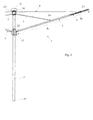
- the clothes dryer 1 according to the FIGS. 1 to 5 comprises a central support column 2, which is held in operating position via its foot portion 24 in a holding device (not shown) in an upright position.
- the holding device may, for. B. be a ground socket.
- the clothes dryer 1 further comprises four evenly, that is arranged at an angle of 90 ° radially to the supporting column 2 arranged support arms 3. The overview because of the FIGS. 1 and 2 only two opposing support arms 3 are shown.
- the support arms 3 are arranged on their foot portion 22 articulated to the support column 2 and slidably along this.
- a sliding joint 17 in the form of a support column comprising the sliding sleeve is attached to the support arm 2.
- the support arms 3 are hinged to the sliding sleeve 17.
- the support arms 3 are braced via a respective support strut 4 on the support column 2.
- the support struts 4 are attached to one end via a fixed in the head portion 23 of the support column 2 mounted holding device 18, here in the form of a holding star, hinged to the support column 2.
- the support struts 4 are each hinged to the support arms 3, between the head 21 and foot area 22, here about halfway along the support arms 3, attached.
- the support struts 4 hold the support arms 3 in their angled to horizontal operating position.
- a cover 19 is arranged in the form of a protective cover, which covers the support column 2 and the support arms 3 in the closed position against the top.
- the clothes dryer 1 can now be transferred via an opening and closing device (not shown) from a closed position to the operating position and vice versa.
- the support arms 3 are aligned parallel to the support column 2 and are close to this.
- the support arms 3 are folded from an upright closing position in an oblique to horizontal operating position.
- the head portions 21 of the support arms 3 are guided in this process by the support column 2 away to the outside.
- the clothesline 5 is stretched, which surrounds the support column 2 in the form of linen wreaths 5a-5d and is held by the support arms 3.
- the linen wreaths 5a-5d are for this purpose guided through the web passage openings 13a-13h in the support arms 3 ( FIG. 3 and 4 ).
- the support arms 3 each comprise a profile body 12 which forms a support column 2 towards open U-shaped groove. In the lateral gutter flanks the linen passage openings 13a-13h are arranged ( FIGS. 3 to 5 ).
- the profile body 12 is for example a pressing profile made of aluminum.
- the support arms 2 also each comprise two on both sides of the profile body 12 arranged protective flaps 9a, 9b.
- the protective flaps 9a, 9b are pivotally attached to the profile body 12 via corresponding articulation points.
- the protective flaps 9a, 9b which are pivotable inwardly and outwardly relative to the profile body, serve, inter alia, to close the cavity 20 between two adjacent support arms 3 in the closed position, so that the clothes dryer 1 is fully closed in the closed position. This is particularly important because the clothes line 5, as described in more detail below, is stowed in the closed position in this cavity 20.
- the clothes dryer 1 now comprises a line introduction device with a plurality of line guide components 6 for introducing the clothesline loops into the cavity 20 between the support arms 2 and behind the protective flaps 9a, 9b.
- an oblong line guide component 6 in the longitudinal direction R of the support arms 3 is slidably slidable on both protective flaps 9a, 9b of the support arms 3 arranged.
- the line guide component 6 is clipped on guide tabs on the outside of the protective flap 9a, 9b.
- the line guide components 6 each have a plurality of Leineneinleitorganen 15, 16 arranged one behind the other in the longitudinal direction R of the support arms 3.
- the Leineneinleitorgane 15, 16 each have a pointing in the direction of the head portion 21 of the support arm 3, moderately inclined sloping edge 16a and pointing in the direction of the foot portion 22 of the support arm 2, steeply inclined steep edge 16b.
- the to the head portion 21 of the support arm 3 towards outwardly arranged Leineneinleitorgan 16 is additionally formed as a linen intake member and has a passage opening for leading receiving the outermost linen wreath 5a.
- the line guide component 6 are now arranged in the closed position of the rotary dryer 1 below in the foot region 22 of the support arm 3.
- the linen introduction device now comprises actuating mechanisms which pull up the line guide components 6 when the clothes dryer 1 is opened and the support arms 3 are folded out in the direction of the head region 21 of the support arms 3 along the protective flap 9a, 9b.
- the actuating mechanisms each consist of a traction cable 8, which is associated with a line guide component 6.
- the traction cables 8 are each connected at one end to the holding device 18 at the head region 23 of the support column 2 and at the other end to a line guide component 6 on the support arm 3.
- the traction cables 8 are each guided directly from the support column 2 to a deflecting member 11 in the form of a Umlenkinate on the support arm 3.
- the Umlenkinate 11 is disposed in the upper L jossabêtsviertel of the support arm 3 to the head portion 21 through.
- the traction cable 8 is guided by the Umlenkinate 11 and deflected in the longitudinal direction R of the support arm 2 in the direction of the foot portion 22 to the line guide member 6 out.
- the pull rope 8 now forms between the attachment point to the support column 2 and the Umlenkinate 11 a first cable section 8a and between the Umlenkinate 11 and the attachment point on the line guide member 6, a second cable section 8b.
- Each support arm 3 thus two Zügseile 8 are provided in operating position two between the support arm 3 and support column 2 parallel cable sections 8a.
- the traction cable 8 is now fastened to the line guide component 6 in a lower section directed towards the foot region 22 of the support arm, such that the traction cable 8 is also in the outermost position of the line guide component 6 in the longitudinal direction R of the support arm 2 toward the foot region 22 in the outermost position of the line guide component 3 towards the head region 21 of the support arm 3 is diverted.
- the first cable section 8a is extended at the expense of the second cable section 8b. Since the total length of the pull cable 8 does not change, the shortening of the second cable section 8b causes the associated line guide element 6 to be passively pulled up along the support arm 3. This reaches in the operating position its outermost position in the head portion 21 of the support arm. 3
- the outermost linen wreath 5 a Since the loops of the outermost linen wreath 5 a can be introduced insufficiently behind the protective flaps 9 a, 9 b for understandable reasons, the outermost linen wreath 5 a is guided through through openings in the outermost linen laying members 16 of the linen guide components 6 and becomes active when the linen guide components 6 slide down moved in.
Landscapes
- Engineering & Computer Science (AREA)
- Textile Engineering (AREA)
- Accessory Of Washing/Drying Machine, Commercial Washing/Drying Machine, Other Washing/Drying Machine (AREA)
Applications Claiming Priority (1)
| Application Number | Priority Date | Filing Date | Title |
|---|---|---|---|
| CH3862012A CH706257A2 (de) | 2012-03-19 | 2012-03-19 | Aufklappbares Wäschegestell. |
Publications (1)
| Publication Number | Publication Date |
|---|---|
| EP2642015A1 true EP2642015A1 (fr) | 2013-09-25 |
Family
ID=48050641
Family Applications (1)
| Application Number | Title | Priority Date | Filing Date |
|---|---|---|---|
| EP13405035.0A Withdrawn EP2642015A1 (fr) | 2012-03-19 | 2013-03-13 | Châssis pour séchoir à linge |
Country Status (2)
| Country | Link |
|---|---|
| EP (1) | EP2642015A1 (fr) |
| CH (1) | CH706257A2 (fr) |
Citations (13)
| Publication number | Priority date | Publication date | Assignee | Title |
|---|---|---|---|---|
| EP0228494A1 (fr) * | 1986-01-08 | 1987-07-15 | Walter Steiner | Support sèche-linge |
| EP0514561B1 (fr) | 1991-05-18 | 1995-08-30 | LEIFHEIT Aktiengesellschaft | Support pour aération et séchage |
| EP0655524B1 (fr) | 1993-11-25 | 1996-08-28 | LEIFHEIT Aktiengesellschaft | Séchoir à linge type parapluie |
| EP0837174B1 (fr) | 1996-10-14 | 2001-09-12 | LEIFHEIT Aktiengesellschaft | Séchoir à linge type parapluie |
| EP0831163B1 (fr) | 1996-09-18 | 2001-11-28 | LEIFHEIT Aktiengesellschaft | Support pour sécher le ligne |
| EP1245715A2 (fr) * | 2001-03-30 | 2002-10-02 | Blome-Tillmann, Gerhard | Séchoir à linge |
| EP0882833B1 (fr) | 1997-06-05 | 2003-08-13 | LEIFHEIT Aktiengesellschaft | Support pour aération et séchage |
| DE10345874B3 (de) | 2003-09-30 | 2005-01-05 | Leifheit Ag | Wäschetrocknungsgestell |
| DE102004060511B3 (de) | 2004-12-16 | 2006-03-30 | Leifheit Ag | Lüftungs- und Trocknungsgestell |
| DE102004060508B3 (de) * | 2004-12-16 | 2006-03-30 | Leifheit Ag | Wäschetrocknungsgestell |
| EP1760188B1 (fr) | 2005-09-02 | 2008-04-09 | Stewi AG | Séchoir à linge pliable |
| WO2010057542A1 (fr) | 2008-11-19 | 2010-05-27 | Leifheit Ag | Cercle sèche-linge à retrait de corde dans les bras-supports |
| EP1842955B1 (fr) | 2006-03-24 | 2011-01-05 | Leifheit Ag | Composant pour tirer sur les cordes à sécher le linge. |
-
2012
- 2012-03-19 CH CH3862012A patent/CH706257A2/de not_active Application Discontinuation
-
2013
- 2013-03-13 EP EP13405035.0A patent/EP2642015A1/fr not_active Withdrawn
Patent Citations (14)
| Publication number | Priority date | Publication date | Assignee | Title |
|---|---|---|---|---|
| EP0228494A1 (fr) * | 1986-01-08 | 1987-07-15 | Walter Steiner | Support sèche-linge |
| EP0514561B1 (fr) | 1991-05-18 | 1995-08-30 | LEIFHEIT Aktiengesellschaft | Support pour aération et séchage |
| EP0655524B1 (fr) | 1993-11-25 | 1996-08-28 | LEIFHEIT Aktiengesellschaft | Séchoir à linge type parapluie |
| EP0831163B1 (fr) | 1996-09-18 | 2001-11-28 | LEIFHEIT Aktiengesellschaft | Support pour sécher le ligne |
| EP0837174B1 (fr) | 1996-10-14 | 2001-09-12 | LEIFHEIT Aktiengesellschaft | Séchoir à linge type parapluie |
| EP0882833B1 (fr) | 1997-06-05 | 2003-08-13 | LEIFHEIT Aktiengesellschaft | Support pour aération et séchage |
| EP1245715A2 (fr) * | 2001-03-30 | 2002-10-02 | Blome-Tillmann, Gerhard | Séchoir à linge |
| DE10345874B3 (de) | 2003-09-30 | 2005-01-05 | Leifheit Ag | Wäschetrocknungsgestell |
| DE102004060511B3 (de) | 2004-12-16 | 2006-03-30 | Leifheit Ag | Lüftungs- und Trocknungsgestell |
| DE102004060508B3 (de) * | 2004-12-16 | 2006-03-30 | Leifheit Ag | Wäschetrocknungsgestell |
| WO2006063636A1 (fr) | 2004-12-16 | 2006-06-22 | Leifheit Ag | Sechoir a linge |
| EP1760188B1 (fr) | 2005-09-02 | 2008-04-09 | Stewi AG | Séchoir à linge pliable |
| EP1842955B1 (fr) | 2006-03-24 | 2011-01-05 | Leifheit Ag | Composant pour tirer sur les cordes à sécher le linge. |
| WO2010057542A1 (fr) | 2008-11-19 | 2010-05-27 | Leifheit Ag | Cercle sèche-linge à retrait de corde dans les bras-supports |
Also Published As
| Publication number | Publication date |
|---|---|
| CH706257A2 (de) | 2013-09-30 |
Similar Documents
| Publication | Publication Date | Title |
|---|---|---|
| EP0113788B1 (fr) | Support pour aération et séchage | |
| EP0514561B1 (fr) | Support pour aération et séchage | |
| DE202007007496U1 (de) | Vorrichtung zum Trocknen von Wäsche | |
| DE3200013C2 (de) | Lüftungs- und Trocknungsgestell mit Wäscheleineneinzug | |
| EP0272361B1 (fr) | Séchoir à linge repliable du type parapluie | |
| EP1245715B1 (fr) | Séchoir à linge | |
| EP1532307B1 (fr) | Sechoir a linge en forme de parapluie et dote d'une housse de protection | |
| AT502115B1 (de) | Schirmartiger wäschetrockner mit betätigungsvorrichtung | |
| EP2642015A1 (fr) | Châssis pour séchoir à linge | |
| EP3293841A1 (fr) | Armature battante de sécurisation des câbles conducteurs | |
| EP1508635B1 (fr) | Séchoir à linge du type parapluie | |
| EP1834028B1 (fr) | Sechoir a linge | |
| DE19723602A1 (de) | Lüftungs- und Trocknungsgestell | |
| EP2354297B1 (fr) | Séchoir parapluie | |
| DE102011001448B3 (de) | Wäschespinne mit Leineneinzug | |
| DE19637341B4 (de) | Lüftungs- und Trocknungsgestell | |
| DE3249358A1 (de) | Lueftungs- und trocknungsgestell mit waescheleineneinzug | |
| DE10105365A1 (de) | Wäschetrocknungsvorrichtung | |
| DE102011050256B4 (de) | Wäschespinne | |
| EP1842955A2 (fr) | Composant pour tirer sur les cordes à sécher le linge. | |
| EP1776499B1 (fr) | Sechoir parapluie | |
| EP0841023B1 (fr) | Parasol | |
| DE102013107317B3 (de) | Wäschespinne | |
| CH693570A5 (de) | Sich teilautomatisch öffnende Wäschespinne. | |
| DE202011000190U1 (de) | Rahmenmontierte Sonnenblendenvorrichtung |
Legal Events
| Date | Code | Title | Description |
|---|---|---|---|
| PUAI | Public reference made under article 153(3) epc to a published international application that has entered the european phase |
Free format text: ORIGINAL CODE: 0009012 |
|
| AK | Designated contracting states |
Kind code of ref document: A1 Designated state(s): AL AT BE BG CH CY CZ DE DK EE ES FI FR GB GR HR HU IE IS IT LI LT LU LV MC MK MT NL NO PL PT RO RS SE SI SK SM TR |
|
| AX | Request for extension of the european patent |
Extension state: BA ME |
|
| 17P | Request for examination filed |
Effective date: 20140206 |
|
| RBV | Designated contracting states (corrected) |
Designated state(s): AL AT BE BG CH CY CZ DE DK EE ES FI FR GB GR HR HU IE IS IT LI LT LU LV MC MK MT NL NO PL PT RO RS SE SI SK SM TR |
|
| STAA | Information on the status of an ep patent application or granted ep patent |
Free format text: STATUS: EXAMINATION IS IN PROGRESS |
|
| 17Q | First examination report despatched |
Effective date: 20171215 |
|
| GRAP | Despatch of communication of intention to grant a patent |
Free format text: ORIGINAL CODE: EPIDOSNIGR1 |
|
| STAA | Information on the status of an ep patent application or granted ep patent |
Free format text: STATUS: GRANT OF PATENT IS INTENDED |
|
| INTG | Intention to grant announced |
Effective date: 20180918 |
|
| STAA | Information on the status of an ep patent application or granted ep patent |
Free format text: STATUS: THE APPLICATION IS DEEMED TO BE WITHDRAWN |
|
| 18D | Application deemed to be withdrawn |
Effective date: 20190129 |