EP2643348B1 - Modules de coiffage améliorés pour les repetitions d'ankyrine conçues - Google Patents
Modules de coiffage améliorés pour les repetitions d'ankyrine conçues Download PDFInfo
- Publication number
- EP2643348B1 EP2643348B1 EP11788152.4A EP11788152A EP2643348B1 EP 2643348 B1 EP2643348 B1 EP 2643348B1 EP 11788152 A EP11788152 A EP 11788152A EP 2643348 B1 EP2643348 B1 EP 2643348B1
- Authority
- EP
- European Patent Office
- Prior art keywords
- seq
- amino acid
- acid residue
- repeat
- terminal capping
- Prior art date
- Legal status (The legal status is an assumption and is not a legal conclusion. Google has not performed a legal analysis and makes no representation as to the accuracy of the status listed.)
- Active
Links
Images

Classifications
-
- A—HUMAN NECESSITIES
- A61—MEDICAL OR VETERINARY SCIENCE; HYGIENE
- A61K—PREPARATIONS FOR MEDICAL, DENTAL OR TOILETRY PURPOSES
- A61K47/00—Medicinal preparations characterised by the non-active ingredients used, e.g. carriers or inert additives; Targeting or modifying agents chemically bound to the active ingredient
- A61K47/50—Medicinal preparations characterised by the non-active ingredients used, e.g. carriers or inert additives; Targeting or modifying agents chemically bound to the active ingredient the non-active ingredient being chemically bound to the active ingredient, e.g. polymer-drug conjugates
- A61K47/51—Medicinal preparations characterised by the non-active ingredients used, e.g. carriers or inert additives; Targeting or modifying agents chemically bound to the active ingredient the non-active ingredient being chemically bound to the active ingredient, e.g. polymer-drug conjugates the non-active ingredient being a modifying agent
- A61K47/62—Medicinal preparations characterised by the non-active ingredients used, e.g. carriers or inert additives; Targeting or modifying agents chemically bound to the active ingredient the non-active ingredient being chemically bound to the active ingredient, e.g. polymer-drug conjugates the non-active ingredient being a modifying agent the modifying agent being a protein, peptide or polyamino acid
- A61K47/64—Drug-peptide, drug-protein or drug-polyamino acid conjugates, i.e. the modifying agent being a peptide, protein or polyamino acid which is covalently bonded or complexed to a therapeutically active agent
-
- C—CHEMISTRY; METALLURGY
- C07—ORGANIC CHEMISTRY
- C07K—PEPTIDES
- C07K19/00—Hybrid peptides, i.e. peptides covalently bound to nucleic acids, or non-covalently bound protein-protein complexes
-
- A—HUMAN NECESSITIES
- A61—MEDICAL OR VETERINARY SCIENCE; HYGIENE
- A61P—SPECIFIC THERAPEUTIC ACTIVITY OF CHEMICAL COMPOUNDS OR MEDICINAL PREPARATIONS
- A61P35/00—Antineoplastic agents
-
- B—PERFORMING OPERATIONS; TRANSPORTING
- B01—PHYSICAL OR CHEMICAL PROCESSES OR APPARATUS IN GENERAL
- B01D—SEPARATION
- B01D15/00—Separating processes involving the treatment of liquids with solid sorbents; Apparatus therefor
-
- C—CHEMISTRY; METALLURGY
- C07—ORGANIC CHEMISTRY
- C07K—PEPTIDES
- C07K14/00—Peptides having more than 20 amino acids; Gastrins; Somatostatins; Melanotropins; Derivatives thereof
- C07K14/001—Peptides having more than 20 amino acids; Gastrins; Somatostatins; Melanotropins; Derivatives thereof by chemical synthesis
-
- C—CHEMISTRY; METALLURGY
- C07—ORGANIC CHEMISTRY
- C07K—PEPTIDES
- C07K14/00—Peptides having more than 20 amino acids; Gastrins; Somatostatins; Melanotropins; Derivatives thereof
- C07K14/435—Peptides having more than 20 amino acids; Gastrins; Somatostatins; Melanotropins; Derivatives thereof from animals; from humans
- C07K14/46—Peptides having more than 20 amino acids; Gastrins; Somatostatins; Melanotropins; Derivatives thereof from animals; from humans from vertebrates
- C07K14/47—Peptides having more than 20 amino acids; Gastrins; Somatostatins; Melanotropins; Derivatives thereof from animals; from humans from vertebrates from mammals
- C07K14/4701—Peptides having more than 20 amino acids; Gastrins; Somatostatins; Melanotropins; Derivatives thereof from animals; from humans from vertebrates from mammals not used
- C07K14/4702—Regulators; Modulating activity
-
- C—CHEMISTRY; METALLURGY
- C07—ORGANIC CHEMISTRY
- C07K—PEPTIDES
- C07K16/00—Immunoglobulins [IG], e.g. monoclonal or polyclonal antibodies
-
- C—CHEMISTRY; METALLURGY
- C12—BIOCHEMISTRY; BEER; SPIRITS; WINE; VINEGAR; MICROBIOLOGY; ENZYMOLOGY; MUTATION OR GENETIC ENGINEERING
- C12N—MICROORGANISMS OR ENZYMES; COMPOSITIONS THEREOF; PROPAGATING, PRESERVING, OR MAINTAINING MICROORGANISMS; MUTATION OR GENETIC ENGINEERING; CULTURE MEDIA
- C12N15/00—Mutation or genetic engineering; DNA or RNA concerning genetic engineering, vectors, e.g. plasmids, or their isolation, preparation or purification; Use of hosts therefor
- C12N15/09—Recombinant DNA-technology
-
- A—HUMAN NECESSITIES
- A61—MEDICAL OR VETERINARY SCIENCE; HYGIENE
- A61K—PREPARATIONS FOR MEDICAL, DENTAL OR TOILETRY PURPOSES
- A61K38/00—Medicinal preparations containing peptides
-
- C—CHEMISTRY; METALLURGY
- C07—ORGANIC CHEMISTRY
- C07K—PEPTIDES
- C07K2318/00—Antibody mimetics or scaffolds
- C07K2318/20—Antigen-binding scaffold molecules wherein the scaffold is not an immunoglobulin variable region or antibody mimetics
-
- C—CHEMISTRY; METALLURGY
- C07—ORGANIC CHEMISTRY
- C07K—PEPTIDES
- C07K2319/00—Fusion polypeptide
-
- C—CHEMISTRY; METALLURGY
- C07—ORGANIC CHEMISTRY
- C07K—PEPTIDES
- C07K2319/00—Fusion polypeptide
- C07K2319/20—Fusion polypeptide containing a tag with affinity for a non-protein ligand
- C07K2319/21—Fusion polypeptide containing a tag with affinity for a non-protein ligand containing a His-tag
-
- C—CHEMISTRY; METALLURGY
- C07—ORGANIC CHEMISTRY
- C07K—PEPTIDES
- C07K2319/00—Fusion polypeptide
- C07K2319/20—Fusion polypeptide containing a tag with affinity for a non-protein ligand
- C07K2319/22—Fusion polypeptide containing a tag with affinity for a non-protein ligand containing a Strep-tag
-
- C—CHEMISTRY; METALLURGY
- C07—ORGANIC CHEMISTRY
- C07K—PEPTIDES
- C07K2319/00—Fusion polypeptide
- C07K2319/30—Non-immunoglobulin-derived peptide or protein having an immunoglobulin constant or Fc region, or a fragment thereof, attached thereto
-
- C—CHEMISTRY; METALLURGY
- C07—ORGANIC CHEMISTRY
- C07K—PEPTIDES
- C07K2319/00—Fusion polypeptide
- C07K2319/31—Fusion polypeptide fusions, other than Fc, for prolonged plasma life, e.g. albumin
-
- C—CHEMISTRY; METALLURGY
- C07—ORGANIC CHEMISTRY
- C07K—PEPTIDES
- C07K2319/00—Fusion polypeptide
- C07K2319/55—Fusion polypeptide containing a fusion with a toxin, e.g. diphteria toxin
-
- C—CHEMISTRY; METALLURGY
- C07—ORGANIC CHEMISTRY
- C07K—PEPTIDES
- C07K2319/00—Fusion polypeptide
- C07K2319/60—Fusion polypeptide containing spectroscopic/fluorescent detection, e.g. green fluorescent protein [GFP]
Definitions
- the present invention relates to improved N-terminal capping modules for designed ankyrin repeat proteins (DARPins) conferring improved thermal stability to the DARPins, as well as nucleic acids encoding such proteins, pharmaceutical compositions comprising such proteins and the use of such proteins in the treatment of diseases.
- DARPins ankyrin repeat proteins
- novel binding proteins or binding domains that can be used to specifically bind a target molecule (e.g. Binz, H.K., Amstutz, P. and Plückthun, A., Nat. Biotechnol. 23, 1257-1268, 2005 ).
- One such novel class of binding proteins or binding domains are based on designed repeat proteins or designed repeat domains ( WO 2002/020565 ; Binz, H.K., Amstutz, P., Kohl, A., Stumpp, M.T., Briand, C., Forrer, P., Grütter, M.G., and Plückthun, A., Nat. Biotechnol.
- WO 2002/020565 describes how large libraries of repeat proteins can be constructed and their general application. These designed repeat domains harness the modular nature of repeat proteins and possess N-terminal and C-terminal capping modules to prevent the designed repeat domains from aggregation by shielding the hydrophobic core of the domain ( Forrer, P., Stumpp, M.T., Binz, H.K. and Plückthun, A., FEBS letters 539, 2-6, 2003 ).
- capping modules were based on the capping repeats of the natural guanine-adenine-binding protein (GA-binding protein). It was shown that the thermal and thermodynamic stability of these designed ankyrin repeat domains could be further increased by improving the C-terminal capping repeat derived from the GA-binding protein ( Interlandi, G., Wetzel, S.K, Settanni, G., Plückthun, A. and Caflisch, A., J. Mol. Biol. 375, 837-854, 2008 ; Kramer, M.A, Wetzel, S.K., Plückthun, A., Mittl, P.R.E, and Grütter, M.G., J. Mol. Biol.
- the technical problem underlying the present invention is identifying novel ankyrin repeat proteins with improved stability for an improved treatment of cancer and other pathological conditions.
- the solution to this technical problem is achieved by providing the embodiments characterized in the claims.
- the present invention relates to a binding protein comprising at least one ankyrin repeat domain, wherein said ankyrin repeat domain comprises an N-terminal capping module having an amino acid sequence selected from
- the invention relates to a binding protein, wherein said N-terminal capping module comprises the sequence
- binding protein comprising at least one ankyrin repeat domain, wherein said ankyrin repeat domain comprises an N-terminal capping module having an amino acid sequence with at least 70% amino acid sequence identity with
- binding proteins show improved thermal stability when compared to the same binding protein differing only in the N-terminal capping module, for example when compared to a binding protein with an N-terminal capping module of the state of the art, such as an N-terminal capping module having an amino acid sequence with the amino acid M (methionine) in position 24, e.g. SEQ ID NO:14 or SEQ ID NO:15 wherein L at position 24 is replaced by M.
- M methionine
- binding protein comprising at least one ankyrin repeat domain, wherein said ankyrin repeat domain comprises a C-terminal capping module having an amino acid sequence X 1 DKX 2 GKTX 3 X 4 DX 5 X 6 X 7 DX 8 GX 9 EDX 10 AEX 11 LQKAA (SEQ ID NO:6).
- the invention further relates to nucleic acid molecules encoding the binding proteins of the present invention, and to a pharmaceutical composition comprising the above mentioned binding proteins or nucleic acid molecules.
- protein refers to a polypeptide, wherein at least part of the polypeptide has, or is able to acquire a defined three-dimensional arrangement by forming secondary, tertiary, or quaternary structures within and/or between its polypeptide chain(s). If a protein comprises two or more polypeptides, the individual polypeptide chains may be linked non-covalently or covalently, e.g. by a disulfide bond between two polypeptides. A part of a protein, which individually has, or is able to acquire, a defined three-dimensional arrangement by forming secondary or tertiary structures, is termed "protein domain". Such protein domains are well known to the practitioner skilled in the art.
- recombinant as used in recombinant protein, recombinant protein domain, recombinant binding protein and the like, means that said polypeptides are produced by the use of recombinant DNA technologies well known by the practitioner skilled in the relevant art.
- a recombinant DNA molecule e.g. produced by gene synthesis
- a bacterial expression plasmid e.g. pQE30, Qiagen
- yeast expression plasmid e.g. pQE30, Qiagen
- mammalian expression plasmid e.g. pQE30, Qiagen
- yeast expression plasmid e.g. pQE30, Qiagen
- mammalian expression plasmid e.g. pQE30, Qiagen
- yeast expression plasmid e.g. pQE30, Qiagen
- mammalian expression plasmid e.g. pQE
- polypeptide relates to a molecule consisting of one or more chains of multiple, i.e. two or more, amino acids linked via peptide bonds.
- a polypeptide consists of more than eight amino acids linked via peptide bonds.
- polypeptide tag refers to an amino acid sequence attached to a polypeptide/protein, wherein said amino acid sequence is useful for the purification, detection, or targeting of said polypeptide/protein, or wherein said amino acid sequence improves the physicochemical behavior of the polypeptide/protein, or wherein said amino acid sequence possesses an effector function.
- the individual polypeptide tags, moieties and/or domains of a binding protein may be connected to each other directly or via polypeptide linkers. These polypeptide tags are all well known in the art and are fully available to the person skilled in the art. Examples of polypeptide tags are small polypeptide sequences, for example, His (e.g.
- the His-tag of SEQ ID NO:16 myc, FLAG, or Strep-tags or moieties such as enzymes (for example enzymes like alkaline phosphatase), which allow the detection of said polypeptide/protein, or moieties which can be used for targeting (such as immunoglobulins or fragments thereof) and/or as effector molecules.
- enzymes for example enzymes like alkaline phosphatase
- moieties which can be used for targeting such as immunoglobulins or fragments thereof
- polypeptide linker refers to an amino acid sequence, which is able to link, for example, two protein domains, a polypeptide tag and a protein domain, a protein domain and a non-polypeptide moiety such as polyethylene glycol or two sequence tags.
- additional domains, tags, non-polypeptide moieties and linkers are known to the person skilled in the relevant art.
- linkers are glycine-serine-linkers and proline-threonine-linkers of variable lengths; preferably, said linkers have a length between 2 and 24 amino acids; more preferably, said linkers have a length between 2 and 16 amino acids.
- binding protein refers to a protein comprising one or more binding domains, one or more bioactive compounds and one or more polymer moieties as further explained below.
- said binding protein comprises up to four binding domains. More preferably, said binding protein comprises up to two binding domains. Most preferably, said binding protein comprises only one binding domain.
- any such binding protein may comprise additional protein domains that are not binding domains, multimerization moieties, polypeptide tags, polypeptide linkers and/or a single Cys residue.
- multimerization moieties are immunoglobulin heavy chain constant regions which pair to provide functional immunoglobulin Fc domains, and leucine zippers or polypeptides comprising a free thiol which forms an intermolecular disulfide bond between two such polypeptides.
- the single Cys residue may be used for conjugating other moieties to the polypeptide, for example, by using the maleimide chemistry well known to the person skilled in the art.
- said binding protein is a recombinant binding protein.
- the binding domains of binding protein possess different target specificities.
- binding domain means an ankyrin repeat domain having a predetermined property, as defined below.
- a binding domain may be obtained by rational, or most commonly, combinatorial protein engineering techniques, skills which are known in the art (Binz et al., 2005, loc. cit.).
- a binding domain having a predetermined property can be obtained by a method comprising the steps of (a) providing a diverse collection of repeat domains; and (b) screening said diverse collection and/or selecting from said diverse collection to obtain at least one repeat domain having said predetermined property.
- the diverse collection of repeat domains may be provided by several methods in accordance with the screening and/or selection system being used, and may comprise the use of methods well known to the person skilled in the art, such as phage display or ribosome display.
- said binding domain is a recombinant binding domain.
- predetermined property refers to a property such as binding to a target, blocking of a target, activation of a target-mediated reaction, enzymatic activity, and related further properties.
- a target e.g., binding to a target, blocking of a target, activation of a target-mediated reaction, enzymatic activity, and related further properties.
- said predetermined property is binding to a target.
- a preferred binding protein comprises at least one repeat domain.
- the term "has binding specificity for a target”, “specifically binding to a target” or “target specificity” and the like means that a binding protein or binding domain binds in PBS to a target with a lower dissociation constant than to an unrelated protein such as the E. coli maltose binding protein (MBP).
- the dissociation constant in PBS for the target is at least 10, more preferably 10 2 , even more preferably 10 3 , or most preferably 10 4 times lower than the corresponding dissociation constant for MBP.
- Kd values of a particular protein-protein interaction can vary if measured under different conditions (e.g., salt concentration, pH).
- measurements of Kd values are preferably made with standardized solutions of protein and a standardized buffer, such as PBS.
- repeat proteins refers to a protein comprising one or more repeat domains.
- each of said repeat proteins comprises up to four repeat domains. More preferably, each of said repeat proteins comprises up to two repeat domains. Most preferably, each of the repeat proteins comprises only one repeat domain.
- said repeat protein may comprise additional non-repeat protein domains, polypeptide tags and/or polypeptide linkers.
- repeat domain refers to a protein domain comprising two or more consecutive repeat units (modules) as structural units, wherein said structural units have the same fold, and stack tightly to create, for example, a superhelical structure having a joint hydrophobic core.
- a repeat domain further comprises an N-terminal and/or a C-terminal capping unit (or module). Even more preferably, said N-terminal and/or C-terminal capping units (or modules) are capping repeats.
- Designed repeat protein and designed repeat domain refer to a repeat protein or repeat domain, respectively, obtained as the result of the inventive procedure explained in patent application WO 2002/020565 .
- Designed repeat proteins and designed repeat domains are synthetic and not from nature. They are man-made proteins or domains, respectively, obtained by expression of correspondingly designed nucleic acids. Preferably, the expression is done in eukaryotic or prokaryotic cells, such as bacterial cells, or by using a cell-free in vitro expression system.
- a designed ankyrin repeat protein i.e. a DARPin
- structural unit refers to a locally ordered part of a polypeptide, formed by three-dimensional interactions between two or more segments of secondary structure that are near one another along the polypeptide chain. Such a structural unit exhibits a structural motif.
- structural motif refers to a three-dimensional arrangement of secondary structure elements present in at least one structural unit. Structural motifs are well known to the person skilled in the art. Structural units alone are not able to acquire a defined three-dimensional arrangement; however, their consecutive arrangement, for example as repeat modules in a repeat domain, leads to a mutual stabilization of neighboring units resulting in a superhelical structure.
- repeat unit refers to amino acid sequences comprising repeat sequence motifs of one or more naturally occurring repeat proteins, wherein said “repeat units” are found in multiple copies, and which exhibit a defined folding topology common to all said motifs determining the fold of the protein.
- Such repeat units correspond to the "repeating structural units (repeats)" of repeat proteins as described by Forrer et al., 2003, loc. cit. or the “consecutive homologous structural units (repeats)” of repeat proteins as described by Binz et al., 2004, loc. cit..
- Such repeat units comprise framework residues and interaction residues.
- repeat units examples include armadillo repeat units, leucine-rich repeat units, ankyrin repeat units, tetratricopeptide repeat units, HEAT repeat units, and leucine-rich variant repeat units.
- Naturally occurring proteins containing two or more such repeat units are referred to as "naturally occurring repeat proteins".
- the amino acid sequences of the individual repeat units of a repeat protein may have a significant number of mutations, substitutions, additions and/or deletions when compared to each other, while still substantially retaining the general pattern, or motif, of the repeat units.
- ankyrin repeat unit shall mean a repeat unit, which is an ankyrin repeat as described, for example, by Forrer et al., 2003, loc. cit.. Ankyrin repeats are well known to the person skilled in the art.
- frame residues relates to amino acid residues of the repeat units, or the corresponding amino acid residues of the repeat modules, which contribute to the folding topology, i.e. which contribute to the fold of said repeat unit (or module) or which contribute to the interaction with a neighboring unit (or module). Such contribution might be the interaction with other residues in the repeat unit (or module), or the influence on the polypeptide backbone conformation as found in ⁇ -helices or ⁇ -sheets, or amino acid stretches forming linear polypeptides or loops.
- target interaction residues refers to amino acid residues of the repeat units, or the corresponding amino acid residues of the repeat modules, which contribute to the interaction with target substances. Such contribution might be the direct interaction with the target substances, or the influence on other directly interacting residues, e.g. by stabilizing the conformation of the polypeptide of a repeat unit (or module) to allow or enhance the interaction of directly interacting residues with said target.
- framework and target interaction residues may be identified by analysis of the structural data obtained by physicochemical methods, such as X-ray crystallography, NMR and/or CD spectroscopy, or by comparison with known and related structural information well known to practitioners in structural biology and/or bioinformatics.
- the repeat units used for the deduction of a repeat sequence motif are homologous repeat units, wherein the repeat units comprise the same structural motif and wherein more than 70% of the framework residues of said repeat units are homologous to each other.
- more than 80% of the framework residues of said repeat units are homologous.
- more than 90% of the framework residues of said repeat units are homologous.
- Computer programs to determine the percentage of homology between polypeptides, such as Fasta, Blast or Gap are known to the person skilled in the art.
- the repeat units used for the deduction of a repeat sequence motif are homologous repeat units obtained from repeat domains selected on a target and having the same target-specificity.
- repeat sequence motif refers to an amino acid sequence, which is deduced from one or more repeat units or repeat modules.
- said repeat units or repeat modules are from repeat domains having binding specificity for the same target.
- Such repeat sequence motifs comprise framework residue positions and target interaction residue positions. Said framework residue positions correspond to the positions of framework residues of the repeat units (or modules). Likewise, said target interaction residue positions correspond to the positions of target interaction residues of the repeat units (or modules).
- Repeat sequence motifs comprise fixed positions and randomized positions.
- the term "fixed position” refers to an amino acid position in a repeat sequence motif, wherein said position is set to a particular amino acid.
- randomized position refers to an amino acid position in a repeat sequence motif, wherein two or more amino acids are allowed at said amino acid position, for example, wherein any of the usual twenty naturally occurring amino acids are allowed, or wherein most of the twenty naturally occurring amino acids are allowed, such as amino acids other than cysteine, or amino acids other than glycine, cysteine and proline. Most often, such randomized positions correspond to the positions of target interaction residues. However, some positions of framework residues may also be randomized.
- folding topology refers to the tertiary structure of said repeat units or repeat modules.
- the folding topology will be determined by stretches of amino acids forming at least parts of ⁇ -helices or ⁇ -sheets, or amino acid stretches forming linear polypeptides or loops, or any combination of ⁇ -helices, ⁇ -sheets and/or linear polypeptides/loops.
- repeat units refers to an arrangement, wherein the repeat units or repeat modules are arranged in tandem.
- repeat proteins there are at least 2, usually about 2 to 6, in particular at least about 6, frequently 20 or more repeat units (or modules).
- repeat units (or modules) of a repeat domain will exhibit a high degree of sequence identity (same amino acid residues at corresponding positions) or sequence similarity (amino acid residues being different, but having similar physicochemical properties), and some of the amino acid residues might be key residues being strongly conserved.
- a high degree of sequence variability by amino acid insertions and/or deletions, and/or substitutions between the different repeat units (or modules) of a repeat domain may be possible as long as the common folding topology of the repeat units (or modules) is maintained.
- Methods for directly determining the folding topology of repeat proteins by physicochemical means such as X-ray crystallography, NMR or CD spectroscopy, are well known to the practitioner skilled in the art.
- Methods for identifying and determining repeat units or repeat sequence motifs or for identifying families of related proteins comprising such repeat units or motifs, such as homology searches (BLAST etc.) are well established in the field of bioinformatics, and are well known to the practitioner in the art.
- the step of refining an initial repeat sequence motif may comprise an iterative process.
- repeat modules refers to the repeated amino acid sequences of the designed repeat domains, which are originally derived from the repeat units of naturally occurring repeat proteins.
- Each repeat module comprised in a repeat domain is derived from one or more repeat units of the family or subfamily of naturally occurring repeat proteins, e.g. the family of armadillo repeat proteins or ankyrin repeat proteins.
- Repeat modules may comprise positions with amino acid residues present in all copies of corresponding repeat modules ("fixed positions") and positions with differing or "randomized” amino acid residues ("randomized positions").
- capping module refers to a polypeptide fused to the N- or C-terminal repeat module of a repeat domain, wherein said capping module forms tight tertiary interactions (i.e. tertiary structure interactions) with said repeat module thereby providing a cap that shields the hydrophobic core of said repeat module at the side not in contact with the consecutive repeat module from the solvent.
- Said N- and/or C-terminal capping module may be, or may be derived from, a capping unit or other structural unit found in a naturally occurring repeat protein adjacent to a repeat unit.
- capping unit refers to a naturally occurring folded polypeptide, wherein said polypeptide defines a particular structural unit which is N- or C-terminally fused to a repeat unit, wherein said polypeptide forms tight tertiary structure interactions with said repeat unit thereby providing a cap that shields the hydrophobic core of said repeat unit at one side from the solvent.
- capping modules or capping units are capping repeats.
- capping repeat refers to capping module or capping unit having a similar or the same fold as said adjacent repeat unit (or module) and/or sequence similarities to said adjacent repeat unit (or module). Capping modules and capping repeats are described in WO 2002/020565 and by Interlandi et al., 2008 (loc.
- WO 2002/020565 describes the N-terminal capping module (i.e. a capping repeat) having the amino acid sequence GSDLGKKLLEAARAGQDDEVRILMANGADVNA (SEQ ID NO:1) and
- the N-terminal capping module of SEQ ID NO:17 is encoded by the amino acids from position 1 to 32 and the C-terminal capping module of SEQ ID NO:17 is encoded by the amino acids from position 99 to 126.
- the present invention relates to a binding protein comprising at least one ankyrin repeat domain, wherein said ankyrin repeat domain comprises an N-terminal capping module having an amino acid sequence
- position 24 in the N-terminal capping module should not be methionine (M).
- position 24 is leucine (L).
- the amino acid in this position can likewise be V, I or A.
- Preferred is L in position 24, or replacement by A. Most preferred is L in position 24.
- N-terminal capping modules which differ from amino acid sequences SEQ ID NO:14 and SEQ ID NO:15 by replacement of up to 5 amino acids in other positions than in position 24. More preferably such N-terminal capping modules differ by replacement of 4 amino acids, more preferably 3 amino acids, more preferably 2 amino acids, and most preferably 1 amino acid.
- the replacement of amino acids can be by any of the 20 most often naturally occurring amino acids, preferably by amino acids selected from the group consisting of A, D, E, F, H, I, K, L, M, N, Q, R, S, T, V, W and Y; and more preferably from the group consisting of A, D, E, H, I, K, L, Q, R, S, T, V, and Y.
- the replacement of amino acids is by a homologous amino acid; i.e. an amino acid is replaced by an amino acid having a side chain with similar biophysical properties.
- the negative charged amino acid D may be replaced by the negative charged amino acid E, or a hydrophobic amino acid such as L may be replaced by A, I or V.
- the replacement of an amino acid by a homologous amino acid is well known to the person skilled in the art.
- Amino acids G at position 1 and/or S at position 2 of SEQ ID NO:14 or SEQ ID NO:15 can be removed from N-terminal capping modules without any apparent influence on the properties. These two amino acids serve as linkers to connect the ankyrin repeat domain to further amino acids and proteins.
- the invention also comprises such N-terminal capping modules wherein G at position 1 and/or S at position 2 are removed. It is understood that "position 24" as defined herein is adapted accordingly, resulting in position 23 if one amino acid is missing, or position 22, if 2 amino acids are missing, respectively.
- the replacement of methionine at position 24 in a N-terminal capping module confers higher thermal stability, i.e. a higher Tm value in PBS, to an ankyrin repeat domain when compared to an ankyrin repeat domain having an identical amino acid sequence, including the N-terminal capping module with the exception that the amino acid residue of its N-terminal capping module corresponding to position 24 of SEQ ID NO:14 or SEQ ID NO:15 is M in place of L, V, I or A. Examples of such pairs of ankyrin repeat domains and binding proteins (M in position 24 versus L, V, I or A in position 24) and their Tm value are described in the Examples and shown in the Figures.
- N-terminal capping modules wherein the exchange of M at position 24 by another amino acid leads to an increase of Tm by at least 1°C, preferably at least 2°C, more preferably at least 3°C, or most preferably at least 4°C in an ankyrin repeat domain carrying such N-terminal capping modules.
- Thermal stability of a protein, and of an ankiryn repeat domain in particular can be analyzed with a fluorescence-based thermal stability assay ( Niesen, F.H., Nature Protocols 2(9): 2212-2221, 2007 ).
- a fluorescence-based thermal stability assay Niesen, F.H., Nature Protocols 2(9): 2212-2221, 2007 .
- the temperature at which a protein unfolds is measured by an increase in the fluorescence of a dye with affinity for hydrophobic parts of the protein, which are exposed as the protein unfolds.
- the temperature at the thereby obtained fluorescence transition midpoint (from lower fluorescence intensity to higher fluorescence intensity) then corresponds to the midpoint denaturation temperature (Tm) of the protein analyzed.
- the thermal stability of a protein can be analyzed by CD spectroscopy; i.e. by measurement of its heat denaturation by following its circular dichroism (CD) signal at 222 nm by techniques well known to the person skilled in the art.
- amino acid residue A at position 26 of SEQ ID NO:14 or SEQ ID NO:15 is replaced by H, Y, K or R. More preferably, however, amino acid residue A at position 26 is not replaced.
- amino acid residue R at position 21 of SEQ ID NO:14 or SEQ ID NO:15 is replaced by E. More preferably, however, amino acid residue R at position 21 is not replaced.
- amino acid residue I at position 22 of SEQ ID NO:14 or the amino acid residue E at position 22 of SEQ ID NO:15 is replaced by V. More preferably, however, amino acid residue I or E, respectively, at position 22 is not replaced; see e.g. the pair of compounds shown in Figure 2 .
- amino acid residue K at position 25 of SEQ ID NO:14 or SEQ ID NO:15 is replaced by A or E. More preferably, however, amino acid residue K at position 25 is not replaced or replaced by A as demonstrated by the pair of compounds shown in Figure 1 .
- amino acid residues RILLKA from positions 21 to 26 of SEQ ID NO:14 or the amino acid residues RELLKA from positions 21 to 26 of SEQ ID NO:15 are not replaced.
- a further preferred N-terminal capping module comprises the sequence motif
- binding proteins comprising at least one ankyrin repeat domain, wherein said ankyrin repeat domain comprises an N-terminal capping module having an amino acid sequence
- binding protein comprising at least one ankyrin repeat domain, wherein said ankyrin repeat domain comprises an N-terminal capping module having an amino acid sequence with at least 70% amino acid sequence identity with
- the corresponding N-terminal capping modules have an amino acid sequence with at least 75% amino acid sequence identity with SEQ ID NO:14 or SEQ ID NO:15, more preferably 80% amino acid sequence identity, even more preferably 85% amino acid sequence identity, more preferably 90% amino acid sequence identity, and most preferably 95% amino acid sequence identity, always under the condition that the amino acid residue at position 24 in the amino acid sequence of said N-terminal capping module is L, V, I or A, more preferably L or A, and most preferably L.
- the N-terminal capping modules have the indicated percentage of amino acid sequence identity with SEQ ID NO:14 or SEQ ID NO:15, and an amino acid residue A, H, Y, K or R at position 26, and/or an amino acid residue R or E at position 21, always under the condition that the amino acid residue at position 24 in the amino acid sequence of said N-terminal capping module is L, V, I or A.
- N-terminal capping module comprising an N-terminal capping repeat, wherein one or more of the amino acids residues in said capping repeat are replaced by an amino acid residue found at the corresponding position on alignment of a corresponding capping unit or repeat unit.
- the binding protein of the invention comprising at least one ankyrin repeat domain, wherein said ankyrin repeat domain comprises an N-terminal capping module as defined herein, said ankyrin repeat domain may further contain one of the following preferred C-terminal capping modules.
- a preferred C-terminal capping module comprises the sequence motif
- a further preferred C-terminal capping module comprises the sequence motif
- a further preferred C-terminal capping module comprises the sequence motif
- such a C-terminal capping module comprising the sequence motif of SEQ ID NO:6, 7 or 8 has an amino acid residue A, I or K; preferably, I or K; at the position corresponding to position 3 of said sequence motif.
- such a C-terminal capping module comprising the sequence motif of SEQ ID NO:6, 7 or 8 has an amino acid residue R or D at the position corresponding to position 14 of said sequence motif.
- a preferred C-terminal capping module is a C-terminal capping module having the amino acid sequence QDKSGKTPADLAADAGHEDIAEVLQKAA (SEQ ID NO:9).
- binding protein comprising at least one ankyrin repeat domain, wherein said ankyrin repeat domain comprises a C-terminal capping module having an amino acid sequence SEQ ID NO:6, 7 or 8 as defined hereinbefore.
- An ankyrin repeat domain of the invention can be constructed genetically by assembling a N-terminal capping module (i.e. the N-terminal capping repeat of SEQ ID NO:14) followed by one or more repeat modules (i.e. the repeat modules comprising the amino acid residues from position 33 to 98 of SEQ ID NO:17 ) and a C-terminal capping module (i.e. the C-terminal capping repeat of SEQ ID NO:9) by means of gene synthesis.
- the genetically assembled repeat domain gene can then be expressed in E. coli as described above.
- binding protein a repeat domain, an N-terminal capping module or a C-terminal capping module having an amino acid sequence devoid of amino acids C, M or N.
- binding protein a repeat domain, an N-terminal capping module or a C-terminal capping module having an amino acid sequence devoid of amino acid N followed by G.
- non-naturally occurring capping modules are non-naturally occurring capping modules, repeat modules, binding proteins or binding domains.
- non-naturally occurring means synthetic or not from nature, more specifically, the term means made from the hand of man.
- non-naturally occurring binding protein or “non-naturally occurring binding domain” means that said binding protein or said binding domain is synthetic (i.e. produced by chemical synthesis from amino acids) or recombinant and not from nature.
- Non-naturally occurring binding protein or “non-naturally occurring binding domain” is a man-made protein or domain, respectively, obtained by expression of correspondingly designed nucleic acids. Preferably, the expression is done in eukaryotic or bacterial cells, or by using a cell-free in vitro expression system.
- sequence of said binding protein or said binding domain is not present as a non-artificial sequence entry in a sequence database, for example in GenBank, EMBL-Bank or Swiss-Prot. These databases and other similar sequence databases are well known to the person skilled in the art.
- PBS means a phosphate buffered water solution containing 137 mM NaCl, 10 mM phosphate and 2.7 mM KCI and having a pH of 7.4.
- the invention relates to a binding protein comprising an ankyrin repeat domain comprising an N-terminal capping module according to the invention and comprising a bioactive compound.
- bioactive compound refers to a compound that is disease modifying when applied to a mammal having said disease.
- a bioactive compound may have antagonistic or agonistic properties and can be a proteinaceous bioactive compound or a non-proteinaceous bioactive compound.
- Such proteinaceous bioactive compounds can be covalently attached to, for example, a ankyrin repeat domain of the invention by the generation of genetic fusion polypeptides using standard DNA cloning technologies, followed by their standard expression and purification.
- non-proteinaceous bioactive compounds can be covalently attached to, for example, an ankyrin repeat domain of the invention by chemical means, e.g., by coupling to a cysteine thiol via a maleimide linker with a cysteine being coupled via a peptide linker to the N- or C-terminus of a binding domain as described herein.
- proteinaceous bioactive compounds are binding domains having a distinct target specificity (e.g. neutralizing a growth factor by binding to it), cytokines (e.g. interleukins), growth factors (e.g. human growth hormone), antibodies and fragments thereof, hormones (e.g. GLP-1) and any possible proteinaceous drug.
- cytokines e.g. interleukins
- growth factors e.g. human growth hormone
- hormones e.g. GLP-1
- GLP-1 any possible proteinaceous drug.
- non-proteinaceous bioactive compounds examples include, toxins (e.g. DM1 from ImmunoGen), small molecules targeting GPCRs, antibiotics and any possible non-proteinaceous drug.
- Another preferred embodiment is a recombinant binding protein comprising a binding domain wherein said binding domain is an ankyrin repeat domain or a designed ankyrin repeat domain.
- Such an ankyrin repeat domain may comprise one, two, three or more internal repeat modules that will participate in binding to a target.
- Such an ankyrin repeat domain comprises an N-terminal capping module as defined by the present invention, two to four internal repeat modules, and a C-terminal capping module.
- said binding domain is an ankyrin repeat domain or designed ankyrin repeat domain.
- binding protein as defined above, wherein said ankyrin repeat domain or said designed ankyrin repeat domain comprises a repeat module with the ankyrin repeat sequence motif
- any of the binding proteins or domains described herein may be covalently bound to one or more additional moieties, including, for example, a moiety that binds to a different target to create a dual-specificity binding agent, a bioactive compound, a labeling moiety (e.g. a fluorescent label such as fluorescein, or a radioactive tracer), a moiety that facilitates protein purification (e.g. a small peptide tag, such as a His- or strep-tag), a moiety that provides effector functions for improved therapeutic efficacy (e.g.
- a labeling moiety e.g. a fluorescent label such as fluorescein, or a radioactive tracer
- a moiety that facilitates protein purification e.g. a small peptide tag, such as a His- or strep-tag
- a moiety that provides effector functions for improved therapeutic efficacy e.g.
- a toxic protein moiety such as Pseudomonas aeruginosa exotoxin A (ETA) or small molecular toxic agents such as maytansinoids or DNA alkylating agents) or a moiety that provides improved pharmacokinetics.
- ETA Pseudomonas aeruginosa exotoxin A
- small molecular toxic agents such as maytansinoids or DNA alkylating agents
- Improved pharmacokinetics may be assessed according to the perceived therapeutic need. Often it is desirable to increase bioavailability and/or increase the time between doses, possibly by increasing the time that a protein remains available in the serum after dosing. In some instances, it is desirable to improve the continuity of the serum concentration of the protein over time (e.g., decrease the difference in serum concentration of the protein between the concentration shortly after administration and the concentration shortly before the next administration).
- the invention relates to nucleic acid molecules encoding the particular binding proteins, the particular ankyrin repeat domains, and the particular N-terminal capping modules. Further, a vector comprising said nucleic acid molecule is provided.
- a pharmaceutical composition comprising one or more of the above mentioned binding proteins comprising ankyrin repeat domains, or nucleic acid molecules encoding the particular binding proteins, and optionally a pharmaceutical acceptable carrier and/or diluent is provided.
- Pharmaceutical acceptable carriers and/or diluents are known to the person skilled in the art and are explained in more detail below.
- a diagnostic composition comprising one or more of the above mentioned binding proteins, in particular binding proteins comprising ankyrin repeat domains, is disclosed.
- a pharmaceutical composition comprises binding proteins as described above and a pharmaceutically acceptable carrier, excipient or stabilizer, for example as described in Remington's Pharmaceutical Sciences 16th edition, Osol, A. Ed. [1980 ].
- Suitable carriers, excipients or stabilizers known to the skilled man are saline, Ringer's solution, dextrose solution, Hank's solution, fixed oils, ethyl oleate, 5% dextrose in saline, substances that enhance isotonicity and chemical stability, buffers and preservatives.
- Other suitable carriers include any carrier that does not itself induce the production of antibodies harmful to the individual receiving the composition such as proteins, polysaccharides, polylactic acids, polyglycolic acids, polymeric amino acids and amino acid copolymers.
- a pharmaceutical composition may also be a combination formulation, comprising an additional active agent, such as an anti-cancer agent or an anti-angiogenic agent.
- the formulations to be used for in vivo administration must be aseptic or sterile. This is readily accomplished by filtration through sterile filtration membranes.
- the pharmaceutical composition may be administered by any suitable method within the knowledge of the skilled man.
- the preferred route of administration is parenterally.
- the medicament of this invention will be formulated in a unit dosage injectable form such as a solution, suspension or emulsion, in association with the pharmaceutically acceptable excipients as defined above.
- the dosage and mode of administration will depend on the individual to be treated and the particular disease.
- the pharmaceutical composition is administered so that the binding protein of the present invention is given at a dose between 1 ⁇ g/kg and 20 mg/kg, more preferably between 10 ⁇ g/kg and 5 mg/kg, most preferably between 0.1 and 2 mg/kg.
- it is given as a bolus dose.
- Continuous infusion may also be used and includes continuous subcutaneous delivery via an osmotic minipump. If so, the pharmaceutical composition may be infused at a dose between 5 and 20 ⁇ g/kg/minute, more preferably between 7 and 15 ⁇ g/kg/minute.
- any of the above mentioned pharmaceutical composition is disclosed for the treatment of a disorder. Further disclosed are methods of treatment.
- the method comprises administering, to a patient in need thereof, a therapeutically effective amount of a binding protein of the invention.
- a method of treating a pathological condition in a mammal including man comprising administering to a patient in need thereof an effective amount of the above mentioned pharmaceutical composition is disclosed.
- the binding protein according to the invention may be obtained and/or further evolved by several methods such as display on the surface of bacteriophages ( WO 1990/002809 , WO 2007/006665 ) or bacterial cells ( WO 1993/010214 ), ribosomal display ( WO 1998/048008 ), display on plasmids ( WO 1993/008278 ) or by using covalent RNA-repeat protein hybrid constructs ( WO 2000/032823 ), or intracellular expression and selection / screening such as by protein complementation assay ( WO 1998/341120 ).
- Such methods are known to the person skilled in the art.
- a library of ankyrin repeat proteins used for the selection/screening of a binding protein according to the invention may be obtained according to protocols known to the person skilled in the art ( WO 2002/020565 , Binz, H.K., et al., J. Mol. Biol., 332, 489-503, 2003 , and Binz et al., 2004, loc. cit).
- Repeat domains of the present invention may be modularly assembled from repeat modules according to the current invention and appropriate capping modules or capping repeats ( Forrer, P., et al., FEBS letters 539, 2-6, 2003 ) using standard recombinant DNA technologies (e.g. WO 2002/020565 , Binz et al., 2003, loc. cit. and Binz et al., 2004, loc. cit).
- N2C and N3C designed ankyrin repeat protein libraries are described ( WO 2002/020565 ; Binz et al. 2003, loc. cit.; Binz et al. 2004, loc. cit.).
- the digit in N2C and N3C describes the number of randomized repeat modules present between the N-terminal and C-terminal capping modules.
- the nomenclature used to define the positions inside the repeat units and modules is based on Binz et al. 2004, loc. cit. with the modification that borders of the ankyrin repeat modules and ankyrin repeat units are shifted by one amino acid position. For example, position 1 of an ankyrin repeat module of Binz et al. 2004 (loc.
- DARPins having a defined amino acid sequence can be produced by gene synthesis of a corresponding reverse translated nucleic acid sequence, subcloning into an appropriate expression vector of an expression system (e.g. an E. coli expression system), expression and purification of the protein. Such methods are known to the person skilled in the art.
- an expression system e.g. an E. coli expression system
- N- or C-terminal capping repeat of an ankyrin repeat domain can be exchanged by an N- or C-terminal capping repeat of the invention, respectively, by combining techniques, such as alignment of amino acid sequences, mutagenesis and gene synthesis, known to the person skilled in the art.
- the C-terminal capping repeat of SEQ ID NO:17 can be replaced by the C-terminal capping repeat of SEQ ID NO:9 by (i) determination of the C-terminal capping repeat of SEQ ID NO:17 (i.e. sequence position 99 to 126) by sequence alignment with SEQ ID NO:9, (ii) replacing the sequence of the determined C-terminal capping repeat of SEQ ID NO:17 with the sequence of SEQ ID NO:9, (iii) generation of a gene encoding the repeat domain encoding the exchanged C-terminal capping module, (iv) expressing of the modified repeat domain in the cytoplasm of E. coli and (v) purification of the modified repeat domain by standard means.
- DARPins were expressed in E. coli BL21 or XL1-Blue cells and purified using their His-tag using standard protocols. 25 ml of stationary overnight cultures (LB, 1% glucose, 100 mg/l of ampicillin; 37°C) were used to inoculate 1 l cultures (same medium). At an absorbance of about 1 at 600 nm, the cultures were induced with 0.5 mM IPTG and incubated at 37°C for 4 h. The cultures were centrifuged and the resulting pellets were resuspended in 40 ml of TBS500 (50 mM Tris-HCl, 500 mM NaCl, pH 8) and sonicated.
- TBS500 50 mM Tris-HCl, 500 mM NaCl, pH 8
- DARPins or ankyrin repeat domains devoid of a 6xHis-tag were purified by anion exchange chromatography followed by size exclusion chromatography according to standard resins and protocols known to the person skilled in the art. Up to 200 mg of highly soluble DARPins can be purified from one liter of E. coli culture with a purity > 95% as estimated from SDS-15% PAGE. Such purified DARPins are used for further characterizations.
- Example 2 Higher thermal stability of DARPins with an improved N-terminal capping module.
- Thermal stability of a purified DARPin was analyzed with a fluorescence-based thermal stability assay ( Niesen, F.H., Nature Protocols 2(9): 2212-2221, 2007 ).
- a fluorescence-based thermal stability assay Niesen, F.H., Nature Protocols 2(9): 2212-2221, 2007 .
- the temperature at which a protein (i.e. such a DARPin) unfolds is measured by an increase in the fluorescence of a dye (e.g. SYPRO orange; Invitrogen, cat. No. S6650) with affinity for hydrophobic parts of the protein, which are exposed as the protein unfolds.
- the temperature at the thereby obtained fluorescence transition midpoint (from lower fluorescence intensity to higher fluorescence intensity) then corresponds to the midpoint denaturation temperature (Tm) of the protein analyzed.
- thermal stability of such a purified DARPin was analyzed by CD spectroscopy; i.e. by measurement of its heat denaturation by following its circular dichroism (CD) signal at 222 nm by techniques well known to the person skilled in the art.
- CD circular dichroism
- DARPins were prepared at 50 ⁇ M concentration in either PBS at pH 7.4 or MES buffer at pH 5.8 (250 mM (2-N-morpholino)-ethanesulphonic acid pH 5.5, 150 mM NaCl, mixed with PBS pH 7.4 1 to 4 (v/v) and adjusting the pH to 5.8) containing 1x SYPRO Orange (diluted from a 5'000x SYPRO Orange stock solution, Invitrogen) and 50 ⁇ l of such protein solutions or buffer only was added in a white 96-well PCR plate (Bio-Rad).
- the plates were sealed with Microseal 'B' Adhesive Seals (Bio-Rad) and heated in the real time PCR instrument from 20°C to 95°C in increments of 0.5°C including a 25 sec hold step after each temperature increment and the thermal denaturation of the DARPins was followed by measurement of the relative fluorescence units of the samples at each temperature increment.
- Relative fluorescence units in the wells of the plate were measured using channel 2 of the real time PCR instruments (i.e. excitation was at 515-535 nm and detection was at 560-580 nm) and the corresponding values obtained for buffer only were subtracted. From the thereby obtained thermal denaturation transition midpoints, Tm values for the analyzed DARPins can be determined.
- the CD signal of the DARPin was recorded at 222 nm in a Jasco J-715 instrument (Jasco, Japan) while slowly heating the protein at a concentration of 0.02 mM in PBS pH 7.4 from 20°C to 95°C using a temperature ramp of 1°C or 2°C per min.
- This is an effective means to follow the denaturation of DARPins as they mainly consist of alpha helices that show a strong change in their CD signal at 222 nm upon unfolding.
- the midpoint of the observed transition of such a measured CD signal trace for a DARPin corresponds to its Tm value.
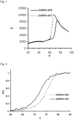
- the thermal stability of DARPin #17 was compared to the thermal stability of DARPin #18 using the fluorescence-based thermal stability assay (Table 1, Figure 1 ). These two DARPins possess an identical amino acid sequence except for a single amino acid in the N-terminal capping module of their repeat domains.
- the repeat domain of DARPin #18, but not DARPin #17 comprises an improved N-terminal capping module as described herein; i.e. the N-terminal capping module of DARPin#18 contains a leucine (L) residue at position 24 of its N-terminal capping module, whereas DARPin#17 contains a methionine (M) at this position.
- this change of a single amino acid resulted in an increase of the Tm value of about 6.5°C.
- the thermal stability of DARPin #19 was compared to the thermal stability of DARPin #20 using the fluorescence-based and CD-based thermal stability assay (Table 1, Figure 2 ). These two DARPins possess an identical amino acid sequence except for single amino acid in the N-terminal capping module of their repeat domains.
- the repeat domain of DARPin #20, but not DARPin #19, comprises an improved N-terminal capping module as described herein; i.e. the N-terminal capping module of DARPin#20 contains a L residue at position 24 of its N-terminal capping module, whereas DARPin#19 contains a M at this position.
- the thermal stability of DARPin#21 was compared to the thermal stability of DARPin#22 and DARPin#23 using CD-based thermal stability assay (Table 1, Figure 3 ). These three DARPins possess an identical amino acid sequence except for two or three amino acid in the N-terminal capping module of their repeat domains.
- the repeat domains of DARPin #22 and DARPin#23, but not DARPin #21, comprise an improved N-terminal capping module as described herein; i.e.
- the N-terminal capping module of DARPin#22 and DARPin#23 contain a L residue at position 24 (whereas DARPin#21 contains a M at this position) and an A residue at position 26 (whereas DARPin#21 contains a N at this position); in addition, the N-terminal capping module of DARPin#23 contains a K residue at position 25 (whereas DARPin#21 and DARPin#22 contain an A at this position).
- the DARPin#23 comprises an improved N-terminal capping module comprising the amino acid sequence RILLKA (SEQ ID NO:11) from position 21 to 26 as described herein.
- the thermal stability of DARPin#24 was compared to the thermal stability of DARPin#25 and DARPin#26 using the fluorescence-based and CD-based thermal stability assay (Table 1, Figure 4 ). These three DARPins possess an identical amino acid sequence except for three or four amino acid in the N-terminal capping module of their repeat domains.
- the N-terminal capping module of DARPin#25 and DARPin#26 contain a L residue at position 24 (whereas DARPin#24 contains a M at this position), contain a K residue at position 25 (whereas DARPin#24 contains an A at this position) and an A residue at position 26 (whereas DARPin#24 contains a N at this position); in addition, the N-terminal capping module of DARPin#26 contains an E residue at position 22 (whereas DARPin#24 and DARPin#25 contain an I at this position).
- the DARPin#25 and DARPin#26 comprises an improved N-terminal capping module comprising the amino acid sequence RILLKA (SEQ ID NO:11) and RELLKA (SEQ ID NO:12) , respectively, from position 21 to 26 as described herein.
- RILLKA SEQ ID NO:11
- RELLKA SEQ ID NO:12
- these small changes in the N-terminal capping module of DARPins#25 and DARPin#26 resulted in an increase of the Tm value of about 5°C or 6°C, respectively, when compared to DARPin#24.
- DARPin#25 and DARPin#26 possess an almost identical thermal stability, while their amino acid sequence differs in a single amino acid in the N-terminal capping module of their repeat domains; i.e.
- the N-terminal capping module of DARPin#25 contains an I residue at position 22 of its N-terminal capping module, whereas DARPin#26 contains an E at this position.
- this change of a single amino acid at position 22 of such an N-terminal capping module seems to be well tolerated and to have no significant effect on the thermal stability.
- Table 1 Tm values of DARPins Tm [°C] 1 Tm [°C] 2 DARPin #17 64.5 n.d. DARPin #18 71.0 n.d. DARPin #19 70.5 72.3 DARPin #20 73.0 74.8 DARPin #21 n.d. 56.5 DARPin #22 n.d. 65 DARPin #23 n.d.
- Tm values as determined with the fluorescence based assay in PBS at pH 7.4 2 Tm values as determined with the CD based assay in PBS at pH 7.4 3 Tm values are estimates only as no post-transition baseline could be reached n.d.: not determined
- Example 3 Higher thermal stability of DARPins with improved C-terminal capping modules
- the thermal stability of DARPin #27 (SEQ ID NO:27 with a His-tag (SEQ ID NO:16) fused to its N-terminus) was compared to the thermal stability of DARPin #28 (SEQ ID NO:28 with a His-tag (SEQ ID NO:16) fused to its N-terminus) using the fluorescence-based thermal stability assay.
- These two DARPins possess an identical amino acid sequence except for the C-terminal capping module of their repeat domains.
- the repeat domain of DARPin #28, but not DARPin #27, comprises an improved C-terminal capping module as described herein.
- the Tm values in PBS pH 7.4 determined for DARPin #27 and DARPin #28 were about 63°C and about 73°C, respectively.
- the Tm values in MES buffer pH 5.8 determined for DARPin #27 and DARPin #28 were about 54.5°C and about 66°C, respectively.
- the thermal stability of DARPin #29 (SEQ ID NO:29 with a His-tag (SEQ ID NO:16) fused to its N-terminus) was compared to the thermal stability of DARPin #30 (SEQ ID NO:30 with a His-tag (SEQ ID NO:16) fused to its N-terminus) using the fluorescence-based thermal stability assay.
- These two DARPins possess an identical amino acid sequence except for the C-terminal capping module of their repeat domains.
- the repeat domain of DARPin #30, but not DARPin #29, comprises an improved C-terminal capping module as described herein.
- the Tm values in MES buffer pH 5.8 determined for DARPin #29 and DARPin #30 were about 51°C and about 55°C, respectively.
- the thermal stability of DARPin #31 was compared to the thermal stability of DARPin #32 (SEQ ID NO:32) using CD spectroscopy. These two DARPins possess an identical amino acid sequence except for the C-terminal capping module of their repeat domains.
- the repeat domain of DARPin #32, but not DARPin #31, comprises an improved C-terminal capping module as described herein.
- the Tm values in PBS pH 7.4 determined for DARPin #31 and DARPin #32 were about 59.5°C and about 73°C, respectively.
Landscapes
- Chemical & Material Sciences (AREA)
- Health & Medical Sciences (AREA)
- Life Sciences & Earth Sciences (AREA)
- Organic Chemistry (AREA)
- General Health & Medical Sciences (AREA)
- Proteomics, Peptides & Aminoacids (AREA)
- Medicinal Chemistry (AREA)
- Genetics & Genomics (AREA)
- Molecular Biology (AREA)
- Biochemistry (AREA)
- Biophysics (AREA)
- Engineering & Computer Science (AREA)
- Gastroenterology & Hepatology (AREA)
- Zoology (AREA)
- Bioinformatics & Cheminformatics (AREA)
- Toxicology (AREA)
- Chemical Kinetics & Catalysis (AREA)
- Animal Behavior & Ethology (AREA)
- Veterinary Medicine (AREA)
- Public Health (AREA)
- Pharmacology & Pharmacy (AREA)
- General Chemical & Material Sciences (AREA)
- Epidemiology (AREA)
- Immunology (AREA)
- Biotechnology (AREA)
- Wood Science & Technology (AREA)
- General Engineering & Computer Science (AREA)
- Biomedical Technology (AREA)
- Plant Pathology (AREA)
- Physics & Mathematics (AREA)
- Analytical Chemistry (AREA)
- Microbiology (AREA)
- Nuclear Medicine, Radiotherapy & Molecular Imaging (AREA)
- Peptides Or Proteins (AREA)
- Medicines That Contain Protein Lipid Enzymes And Other Medicines (AREA)
- Medicinal Preparation (AREA)
- Pharmaceuticals Containing Other Organic And Inorganic Compounds (AREA)
Claims (16)
- Protéine de liaison comprenant au moins un domaine de répétition d'ankyrine, dans laquelle ledit domaine de répétition d'ankyrine comprend un module de coiffage N-terminal ayant une séquence d'acides aminés choisie parmiGSDLGKKLLE AARAGQDDEV RILLKAGADV NA (SEQ ID NO:14), etGSDLGKKLLE AARAGQDDEV RELLKAGADV NA (SEQ ID NO:15),dans laquellele résidu d'acide aminé L à la position 24 est éventuellement remplacé par V, I ou A ;et dans laquelle jusqu'à 5 acides aminés dans d'autres positions que la position 24 sont échangés éventuellement par d'autres acides aminés ; et dans laquelleG en position 1 et/ou S en position 2 sont éventuellement manquants ; etdans laquelle le résidu d'acide aminé A en position 26 de SEQ ID NO:14 ou de SEQ ID NO:15 n'est pas remplacé ou est remplacé par H, Y, K ou R ; etdans laquelle ledit module de coiffage N-terminal conférant une valeur Tm plus élevée en PBS audit domaine de répétition ankyrine par rapport à un domaine de répétition ankyrine ayant une séquence d'acides aminés identique à l'exception que le résidu d'acide aminé correspondant à la position 24 de SEQ ID NO:14 ou de SEQ ID NO:15 est M au lieu de L, V, I ou A.
- Protéine de liaison selon la revendication 1, dans laquelle ledit module de coiffage N-terminal a la séquence d'acides aminésGSDLGKKLLE AARAGQDDEV RELLKAGADV NA (SEQ ID NO:15), dans laquelle le résidu d'acide aminé L à la position 24 de la SEQ ID NO:15 est éventuellement remplacé par V, I ou A ;dans laquelle jusqu'à 2 acides aminés de SEQ ID NO:15 dans d'autres positions que la position 24 sont éventuellement échangés par d'autres acides aminés ; etdans laquelle le résidu d'acide aminé A en position 26 de SEQ ID NO:15 n'est pas remplacé ou est remplacé par H, Y, K ou R ; etdans laquelle G en position 1 et/ou S en position 2 de SEQ ID NO:15 sont éventuellement manquants.
- Protéine de liaison selon la revendication 1, dans laquelle jusqu'à 1 acide aminé de SEQ ID NO:14 ou de SEQ ID NO:15 dans une position autre que la position 24 est échangé par un autre acide aminé. et dans laquelle le résidu d'acide aminé A en position 26 de SEQ ID NO:14 ou de SEQ ID NO:15 n'est pas remplacé ou est remplacé par H, Y, K ou R.
- Protéine de liaison selon l'une quelconque des revendications 1 à 3, dans laquelle le résidu d'acide aminé à ladite position 24 est L, et dans laquelle le résidu d'acide aminé A à la position 26 de SEQ ID NO:14 ou SEQ ID NO:15 n'est pas remplacé.
- Protéine de liaison selon l'une quelconque des revendications 1 à 4, dans laquelle le résidu d'acide aminé R en position 21 de SEQ ID NO:14 ou de SEQ ID NO:15 n'est pas remplacé ou est remplacé par E.
- Protéine de liaison selon l'une quelconque des revendications 1 à 4, dans laquelle le résidu d'acide aminé I en position 22 de SEQ ID NO:14 ou le résidu d'acide aminé E en position 22 de SEQ ID NO:15 n'est pas remplacé ou est remplacé par V.
- Protéine de liaison selon l'une quelconque des revendications 1 à 4, dans laquelle le résidu d'acide aminé K en position 25 de SEQ ID NO:14 ou de SEQ ID NO:15 n'est pas remplacé ou est remplacé par A ou E.
- Protéine de liaison selon l'une quelconque des revendications 1 à 3, dans laquelle les résidus d'acides aminés RILLKA des positions 21 à 26 de SEQ ID NO:14 ou les résidus d'acides aminés RELLKA des positions 21 à 26 de SEQ ID NO:15 ne sont pas remplacés.
- Protéine de liaison selon la revendication 1, dans laquelle ledit module de coiffage N-terminal comprend la séquenceGSX1LX2KKLLE AARAGQDDEV X3X4LX5X6X7GADV NA (SEQ ID NO:5), dans laquelleG en position 1 et/ou S en position 2 de SEQ ID NO:5 sont éventuellement manquants ;X1 représente un résidu d'acide aminé G, A ou D ;X2 représente un résidu d'acide aminé G ou D ;X3 représente un résidu d'acide aminé R ou E ;X4 représente un résidu d'acide aminé I, E ou V ;X5 représente un résidu d'acide aminé L, V, I ou A ;X6 représente un résidu d'acide aminé A, K ou E ; etX7 représente un résidu d'acide aminé choisi dans le groupe constitué de A, H, Y, K et R.
- Protéine de liaison selon la revendication 1, dans laquelle la séquence d'acides aminés dudit module de coiffage N-terminal estGSDLGKKLLEAARAGQDDEVRILLKAGADVNA (SEQ ID NO:14) ouGSDLGKKLLEAARAGQDDEVRELLKAGADVNA (SEQ ID NO:15), dans laquelleG en position 1 et/ou S en position 2 de SEQ ID NO:14 et SEQ ID NO : 15 sont éventuellement manquants.
- Protéine de liaison selon la revendication 1, dans laquelle la séquence d'acides aminés dudit module de coiffage N-terminal estGSDLGKKLLEAARAGQDDEVRILLKAGADVNA (SEQ ID NO:14), dans laquelleG en position 1 et/ou S en position 2 de SEQ ID NO:14 sont éventuellement manquants.
- Protéine de liaison selon la revendication 1, dans laquelle la séquence d'acides aminés dudit module de coiffage N-terminal estGSDLGKKLLEAARAGQDDEVRELLKAGADVNA (SEQ ID NO:15), dans laquelleG en position 1 et/ou S en position 2 de SEQ ID NO : 15 sont éventuellement manquants.
- Protéine de liaison selon l'une quelconque des revendications 1 à 3, dans laquelle le résidu d'acide aminé à ladite position 24 est L.
- Acide nucléique codant pour la protéine de liaison selon l'une quelconque des revendications 1 à 13.
- Composition pharmaceutique comprenant la protéine de liaison selon l'une quelconque des revendications 1 à 13 ou l'acide nucléique de la revendication 14, et éventuellement un support et/ou diluant pharmaceutiquement acceptable.
- Procédé de génération de la protéine de liaison selon l'une quelconque des revendications 1 à 13, le procédé comprenant les étapes suivantes :(1) l'assemblage par des moyens génétiques d'un gène codant pour ledit domaine de répétition ankyrine comprenant ledit module de coiffage N-terminal suivi par un ou plusieurs modules de répétition et un module de coiffage C-terminal, et(2) l'expression dudit gène codant pour ledit domaine de répétition ankyrine.
Priority Applications (1)
| Application Number | Priority Date | Filing Date | Title |
|---|---|---|---|
| EP11788152.4A EP2643348B1 (fr) | 2010-11-26 | 2011-11-25 | Modules de coiffage améliorés pour les repetitions d'ankyrine conçues |
Applications Claiming Priority (3)
| Application Number | Priority Date | Filing Date | Title |
|---|---|---|---|
| EP10192711 | 2010-11-26 | ||
| EP11788152.4A EP2643348B1 (fr) | 2010-11-26 | 2011-11-25 | Modules de coiffage améliorés pour les repetitions d'ankyrine conçues |
| PCT/EP2011/071084 WO2012069655A2 (fr) | 2010-11-26 | 2011-11-25 | Modules de coiffage n-terminal améliorés pour des protéines de répétitions d'ankyrine conçues |
Publications (2)
| Publication Number | Publication Date |
|---|---|
| EP2643348A2 EP2643348A2 (fr) | 2013-10-02 |
| EP2643348B1 true EP2643348B1 (fr) | 2025-02-12 |
Family
ID=43858162
Family Applications (3)
| Application Number | Title | Priority Date | Filing Date |
|---|---|---|---|
| EP19160342.2A Active EP3514169B1 (fr) | 2010-11-26 | 2011-11-25 | Liaison de protéines de répétition conçues à l'albumine sérique |
| EP11788152.4A Active EP2643348B1 (fr) | 2010-11-26 | 2011-11-25 | Modules de coiffage améliorés pour les repetitions d'ankyrine conçues |
| EP11788815.6A Active EP2643349B1 (fr) | 2010-11-26 | 2011-11-25 | Liaison de protéines de répétition conçues à l'albumine sérique |
Family Applications Before (1)
| Application Number | Title | Priority Date | Filing Date |
|---|---|---|---|
| EP19160342.2A Active EP3514169B1 (fr) | 2010-11-26 | 2011-11-25 | Liaison de protéines de répétition conçues à l'albumine sérique |
Family Applications After (1)
| Application Number | Title | Priority Date | Filing Date |
|---|---|---|---|
| EP11788815.6A Active EP2643349B1 (fr) | 2010-11-26 | 2011-11-25 | Liaison de protéines de répétition conçues à l'albumine sérique |
Country Status (13)
| Country | Link |
|---|---|
| US (5) | US9284361B2 (fr) |
| EP (3) | EP3514169B1 (fr) |
| JP (3) | JP6173216B2 (fr) |
| KR (3) | KR101838037B1 (fr) |
| CN (3) | CN113278077A (fr) |
| AU (2) | AU2011333666B2 (fr) |
| BR (3) | BR112013012786B1 (fr) |
| CA (2) | CA2818969C (fr) |
| DK (1) | DK2643349T3 (fr) |
| ES (2) | ES2981441T3 (fr) |
| PL (1) | PL2643349T3 (fr) |
| RU (2) | RU2636552C2 (fr) |
| WO (2) | WO2012069654A1 (fr) |
Families Citing this family (87)
| Publication number | Priority date | Publication date | Assignee | Title |
|---|---|---|---|---|
| TWI510246B (zh) | 2010-04-30 | 2015-12-01 | Molecular Partners Ag | 抑制vegf-a受體交互作用的經修飾結合性蛋白質 |
| EP3514169B1 (fr) | 2010-11-26 | 2024-03-06 | Molecular Partners AG | Liaison de protéines de répétition conçues à l'albumine sérique |
| PT2846836T (pt) | 2012-05-07 | 2019-10-29 | Allergan Inc | Método de tratamento de dmi em doentes refratários à terapia anti-vegf |
| SG11201408196RA (en) * | 2012-06-28 | 2015-03-30 | Molecular Partners Ag | Designed ankyrin repeat proteins binding to platelet-derived growth factor |
| EP2906591A1 (fr) * | 2012-10-15 | 2015-08-19 | Universität Zürich | Ligands her2 bispécifiques pour la thérapie du cancer |
| EP2738180A1 (fr) | 2012-11-30 | 2014-06-04 | Molecular Partners AG | Protéines de liaison comportant au moins deux domaines de liaison ciblant HER2 |
| WO2014131694A1 (fr) | 2013-02-26 | 2014-09-04 | Roche Glycart Ag | Molécules bispécifiques de liaison à l'antigène activant les lymphocytes t |
| US11453708B2 (en) | 2013-05-31 | 2022-09-27 | Molecular Partners Ag | Designed ankyrin repeat proteins binding to hepatocyte growth factor |
| KR20150097304A (ko) | 2014-02-18 | 2015-08-26 | 삼성전자주식회사 | 항 EGFR DARPin을 포함하는 EGFR/HER2 이중 특이 항체 |
| CN106605228B (zh) | 2014-07-07 | 2019-08-16 | 耶达研究及发展有限公司 | 计算蛋白质设计的方法 |
| US9458211B1 (en) * | 2015-04-02 | 2016-10-04 | Molecular Partners Ag | Recombinant proteins that simultaneously bind HGF, VEGF-A and serum albumin, comprising ankyrin repeat domains |
| MY196882A (en) | 2016-09-22 | 2023-05-08 | Molecular Partners Ag | Recombinant binding proteins and their use |
| AU2017354041B2 (en) * | 2016-11-01 | 2024-02-01 | Arrowhead Pharmaceuticals, Inc. | Alpha-V beta-6 integrin ligands and uses thereof |
| WO2018165046A1 (fr) | 2017-03-07 | 2018-09-13 | Igc Bio, Inc. | Pipeline informatique pour modélisation et conception d'anticorps |
| EP3623382A1 (fr) | 2018-09-14 | 2020-03-18 | Universität Zürich | Ligands vers gm-csf ou un récepteur gm-csf destinés à être utilisés dans une leucémie chez un patient ayant subi une allo-hct |
| US11655293B2 (en) | 2018-02-22 | 2023-05-23 | Universitat Zurich | Ligands to GM-CSF or GM-CSF-receptor for use in leukemia in a patient having undergone allo-HCT |
| CA3094176A1 (fr) | 2018-03-22 | 2019-09-26 | Charite-Universitatsmedizin Berlin | Immunite mediee par les lymphocytes t reactifs vis-a-vis d'une proteine associee a crispr |
| WO2019238966A1 (fr) | 2018-06-15 | 2019-12-19 | Universität Bern | Ligands de light ou de son récepteur ltssr destinés à être utilisés dans des malignités hématologiques |
| KR20210075080A (ko) | 2018-10-08 | 2021-06-22 | 유니베르시태트 취리히 | Her2-결합 사량체 폴리펩티드 |
| WO2020104627A1 (fr) | 2018-11-21 | 2020-05-28 | Universität Zürich | Conjugaison photochimiquement induite de radiométaux à de petites molécules, peptides et nanoparticules dans une réaction monotope simultanée |
| EP3677911A3 (fr) | 2019-01-03 | 2020-07-29 | Universität Basel | Utilisation de ligand non agoniste pour la suppression de métastases |
| WO2020144378A1 (fr) | 2019-01-11 | 2020-07-16 | Universitätsspital Basel | Inhibiteurs de sglt-2 ou antagonistes d'il-1r pour la réduction de l'hypoglycémie après chirurgie bariatrique |
| EP3930687A4 (fr) | 2019-02-25 | 2023-06-07 | The University of Chicago | Méthodes et compositions destinées au traitement de maladies auto-immunes et inflammatoires faisant intervenir des peptides à affinité pour la matrice extracellulaire liés à des agents anti-inflammatoires |
| EP3953712A1 (fr) | 2019-04-10 | 2022-02-16 | Universität Zürich | Procédé de détermination de la probabilité qu'un patient réponde à une immunothérapie anticancéreuse |
| KR20220016944A (ko) * | 2019-06-04 | 2022-02-10 | 몰리큘라 파트너스 아게 | 개선된 안정성을 갖는 설계된 안키린 반복 도메인 |
| CA3139164A1 (fr) * | 2019-06-04 | 2020-12-10 | Molecular Partners Ag | Proteines de liaison fap de recombinaison et leur utilisation |
| JP2022535564A (ja) | 2019-06-04 | 2022-08-09 | モレキュラー パートナーズ アクチェンゲゼルシャフト | 多選択性タンパク質 |
| EP4025693A1 (fr) | 2019-09-05 | 2022-07-13 | Genome Biologics UG | Inhibition de mthfdll pour une utilisation dans une cardiopathie hypertrophique et une insuffisance cardiaque |
| AU2020402581A1 (en) | 2019-12-11 | 2022-06-23 | Molecular Partners Ag | Designed ankyrin repeat domains with altered surface residues |
| CN114945584A (zh) | 2019-12-11 | 2022-08-26 | 分子合作伙伴股份公司 | 重组肽-mhc复合物结合蛋白及其生成和用途 |
| WO2021122813A1 (fr) | 2019-12-16 | 2021-06-24 | Universität Basel | Agents favorisant l'angiogenèse pour la prévention d'un cancer métastatique |
| WO2021176008A1 (fr) | 2020-03-04 | 2021-09-10 | Cornell University | Agents ciblant baf155 ou brg1 destinés à être utilisés dans le traitement du cancer avancé de la prostate |
| EP4132578A1 (fr) | 2020-04-06 | 2023-02-15 | Universität Zürich | Ligands artc1 pour le traitement du cancer |
| MX2022013945A (es) | 2020-05-06 | 2023-02-14 | Molecular Partners Ag | Nuevas proteinas de union a repeticiones de anquirina y sus usos. |
| AU2021271131A1 (en) * | 2020-05-14 | 2022-12-15 | Molecular Partners Ag | Recombinant CD40 binding proteins and their use |
| IL298168A (en) * | 2020-05-14 | 2023-01-01 | Molecular Partners Ag | Multispecific proteins |
| JP2023504675A (ja) | 2020-05-19 | 2023-02-06 | ベーリンガー インゲルハイム インターナショナル ゲゼルシャフト ミット ベシュレンクテル ハフツング | ガンの処置のための結合分子 |
| WO2021239844A1 (fr) | 2020-05-27 | 2021-12-02 | Universitätsspital Basel | Inhibiteurs de sglt-2 ou antagonistes d'il-1r pour la réduction de l'hypoglycémie chez un patient atteint de prédiabète |
| WO2021239999A1 (fr) | 2020-05-28 | 2021-12-02 | Universität Zürich | Protéine de fusion de ligand pd-l1 il-12 |
| US11981710B2 (en) * | 2020-08-18 | 2024-05-14 | Athebio Ag | N-terminal capping modules of ankyrin repeat domains |
| EP3957649A1 (fr) | 2020-08-18 | 2022-02-23 | Athebio AG | Modules de coiffage de domaines de répétition d'ankyrine à n-terminaux améliorés |
| US12692306B2 (en) | 2020-08-18 | 2026-07-28 | Universität Zürich | CD25-biased anti-IL-2 antibody |
| CN114106194B (zh) * | 2020-08-31 | 2024-01-16 | 中国科学院天津工业生物技术研究所 | 一种用于治疗糖尿病和/或肥胖症的融合蛋白 |
| WO2022098743A1 (fr) | 2020-11-03 | 2022-05-12 | Indi Molecular, Inc. | Compositions, imagerie et procédés thérapeutiques ciblant le récepteur 1 de folate (folr1) |
| WO2022098745A1 (fr) | 2020-11-03 | 2022-05-12 | Indi Molecular, Inc. | Compositions, systèmes d'administration et méthodes utiles dans la thérapie antitumorale |
| US20240108746A1 (en) | 2020-12-16 | 2024-04-04 | Molecular Partners Ag | Novel slow-release prodrugs |
| AU2021403658A1 (en) | 2020-12-16 | 2023-06-29 | Molecular Partners Ag | Recombinant cd3 binding proteins and their use |
| US20240310378A1 (en) | 2021-02-11 | 2024-09-19 | Universität Zürich | Use of markers found on lymph node metastatic samples for the prognosis of breast cancer |
| EP4043481A1 (fr) * | 2021-02-15 | 2022-08-17 | Affilogic | Composés et procédés pour prolonger la demi-vie de biomolécules |
| WO2022190016A1 (fr) | 2021-03-09 | 2022-09-15 | Molecular Partners Ag | Nouveaux agents de mise en contact de lymphocytes t multi-spécifiques à base de darpin |
| EP4305063A1 (fr) | 2021-03-09 | 2024-01-17 | Molecular Partners AG | Promédicaments clivables par protéase |
| CA3211368A1 (fr) | 2021-03-09 | 2022-09-15 | Molecular Partners Ag | Nouveaux agents de mise en contact de cd123 a base de darpin |
| US20240317852A1 (en) | 2021-03-09 | 2024-09-26 | Molecular Partners Ag | Novel darpin based cd33 engagers |
| KR20230169182A (ko) * | 2021-04-09 | 2023-12-15 | 몰리큘라 파트너스 아게 | 신규한 DARPin 기반 CD70 인게이저 |
| IL310612A (en) | 2021-08-05 | 2024-04-01 | Immunos Therapeutics Ag | HLA-B57 is different with increased expression levels |
| MX2024001691A (es) | 2021-08-05 | 2024-04-19 | Immunos Therapeutics Ag | Medicamentos de combinación que comprenden proteínas de fusión de antígeno leucocitario de humano (hla). |
| WO2023021006A1 (fr) | 2021-08-16 | 2023-02-23 | Universität Zürich | Agents de ciblage de l'il-1 pour le traitement du pityriasis rubra pilaire |
| EP4137508A1 (fr) | 2021-08-17 | 2023-02-22 | Athebio AG | Variantes de domaines de répétition d'ankyrine |
| WO2023021050A1 (fr) | 2021-08-17 | 2023-02-23 | Athebio Ag | Variants de domaines de répétition d'ankyrine |
| WO2023036849A1 (fr) | 2021-09-07 | 2023-03-16 | ETH Zürich | Identification et prédiction de futurs variants de coronavirus |
| EP4163380A1 (fr) | 2021-10-08 | 2023-04-12 | ETH Zurich | Dispositif et procédé de manipulation de vésicules extracellulaires |
| WO2023110942A1 (fr) | 2021-12-14 | 2023-06-22 | Charité-Universitätsmedizin Berlin | Prévention de guérison d'une fracture altérée |
| WO2023110983A1 (fr) | 2021-12-14 | 2023-06-22 | Molecular Partners Ag | Domaines de répétition modélisés à double spécificité de liaison et leur utilisation |
| EP4260907A1 (fr) | 2022-04-11 | 2023-10-18 | Universität Zürich | Agents pour le traitement de l'endométriose et d'autres néoplasmes gynécologiques bénins |
| WO2024002914A1 (fr) | 2022-06-27 | 2024-01-04 | Charité-Universitätsmedizin Berlin | Prédiction de la cicatrisation des tendons et composition pour l'améliorer |
| CA3262553A1 (fr) | 2022-08-01 | 2024-02-08 | Molecular Partners Ag | Domaines de répétition conçus à charges modifiées et leur utilisation |
| EP4573106A2 (fr) | 2022-08-16 | 2025-06-25 | Athebio AG | Variants de domaines de répétition d'ankyrine |
| WO2024037743A1 (fr) | 2022-08-16 | 2024-02-22 | Athebio Ag | Variants de domaines de répétition d'ankyrine |
| WO2024038307A1 (fr) | 2022-08-19 | 2024-02-22 | Novartis Ag | Schémas posologiques pour molécules de liaison au sars-cov-2 |
| WO2024064200A2 (fr) * | 2022-09-20 | 2024-03-28 | The Texas A&M University System | Compositions contenant la darpin et méthodes associées |
| EP4638473A1 (fr) | 2022-12-19 | 2025-10-29 | Max-Planck-Gesellschaft zur Förderung der Wissenschaften e.V. | Moyens et procédés pour cibler des condensats endogènes |
| JP2026514293A (ja) | 2023-02-08 | 2026-05-08 | イムノス セラピューティクス アーゲー | β2ミクログロブリン、HLA重鎖ポリペプチド及びCD47-SIRPαの阻害剤の融合タンパク質 |
| IL322519A (en) | 2023-02-17 | 2025-10-01 | Ablynx Nv | Polypeptides that bind to the neonatal fc receptor |
| EP4673159A1 (fr) | 2023-02-27 | 2026-01-07 | Molecular Partners AG | Darpines utilisées pour réduire l'accumulation rénale de médicaments |
| EP4724473A1 (fr) | 2023-06-06 | 2026-04-15 | Molecular Partners AG | Protéines de liaison à cd47 recombinantes et leur utilisation |
| JP2026524079A (ja) | 2023-06-06 | 2026-07-17 | モレキュラー パートナーズ アクチェンゲゼルシャフト | 組換えcd2結合タンパク質及びその使用 |
| WO2024251628A1 (fr) | 2023-06-06 | 2024-12-12 | Molecular Partners Ag | Protéines de liaison à cd16a recombinantes et leur utilisation |
| WO2025008519A1 (fr) | 2023-07-05 | 2025-01-09 | Universität Bern | Bloqueurs d'il-1ra pour le traitement et la prévention de la sepsie |
| WO2025021293A1 (fr) | 2023-07-25 | 2025-01-30 | Universität Zürich | Interruption de l'expression de rbr1 dans des cellules végétales |
| WO2025146491A1 (fr) | 2024-01-05 | 2025-07-10 | Molecular Partners Ag | Domaines de répétition artificiels présentant une double spécificité de liaison pour cd117 et agent de liaison à cd47 |
| WO2025146490A1 (fr) | 2024-01-05 | 2025-07-10 | Molecular Partners Ag | Protéines de liaison à cd117 recombinantes et leur utilisation |
| CN122438868A (zh) | 2024-01-05 | 2026-07-21 | 分子合作伙伴股份公司 | 多特异性结合蛋白 |
| WO2025163144A1 (fr) | 2024-01-31 | 2025-08-07 | Molecular Partners Ag | Protéines de liaison à la mésothéline recombinantes et leur utilisation |
| WO2025163082A1 (fr) | 2024-01-31 | 2025-08-07 | Molecular Partners Ag | Constructions de liaison spécifiques à dll3 et leur utilisation en radiothérapie |
| WO2025202503A1 (fr) | 2024-03-28 | 2025-10-02 | Universität Zürich | Vésicules extracellulaires portant des variants d'épissage spécifiques du cancer |
| WO2026093563A2 (fr) | 2024-10-31 | 2026-05-07 | Molecular Partners Ag | Protéines de liaison multispécifiques et leur utilisation |
| WO2026150109A1 (fr) | 2025-01-10 | 2026-07-16 | Molecular Partners Ag | Construits de liaison spécifiques à la mésothéline et leur utilisation en radiothérapie |
Family Cites Families (37)
| Publication number | Priority date | Publication date | Assignee | Title |
|---|---|---|---|---|
| DE68927933T2 (de) | 1988-09-02 | 1997-08-14 | Dyax Corp | Herstellung und auswahl von rekombinantproteinen mit verschiedenen bindestellen |
| SE509359C2 (sv) | 1989-08-01 | 1999-01-18 | Cemu Bioteknik Ab | Användning av stabiliserade protein- eller peptidkonjugat för framställning av ett läkemedel |
| US5270170A (en) | 1991-10-16 | 1993-12-14 | Affymax Technologies N.V. | Peptide library and screening method |
| US5348867A (en) | 1991-11-15 | 1994-09-20 | George Georgiou | Expression of proteins on bacterial surface |
| CA2196496A1 (fr) | 1997-01-31 | 1998-07-31 | Stephen William Watson Michnick | Epreuve de complementation de fragments de proteines pour la detection d'interactions entre proteines |
| DE69834032T2 (de) | 1997-04-23 | 2006-12-07 | Universität Zürich | Verfahren zur erkennung von nucleinsäuremolekülen codierend für (poly)peptide, welche mit zielmolekülen interagieren |
| CA2350417C (fr) | 1998-12-02 | 2010-02-09 | Bristol-Myers Squibb Company | Fusions de proteine-adn et leurs utilisations |
| US7608681B2 (en) | 1999-12-24 | 2009-10-27 | Genentech, Inc. | Methods and compositions for prolonging elimination half-times of bioactive compounds |
| US20060228364A1 (en) | 1999-12-24 | 2006-10-12 | Genentech, Inc. | Serum albumin binding peptides for tumor targeting |
| EP1332209B1 (fr) * | 2000-09-08 | 2009-11-11 | Universität Zürich | Groupes de proteines a domaines de repetition comprenant des modules de repetition |
| RU2299208C2 (ru) * | 2001-05-08 | 2007-05-20 | Шеринг Акциенгезельшафт | Антраниламидпиридинамиды избирательного действия в качестве ингибиторов vegfr-2 и vegfr-3 |
| US7696320B2 (en) | 2004-08-24 | 2010-04-13 | Domantis Limited | Ligands that have binding specificity for VEGF and/or EGFR and methods of use therefor |
| CN1678634A (zh) | 2002-06-28 | 2005-10-05 | 多曼蒂斯有限公司 | 免疫球蛋白单个变体抗原结合区及其特异性构建体 |
| US9321832B2 (en) | 2002-06-28 | 2016-04-26 | Domantis Limited | Ligand |
| NZ540194A (en) | 2002-11-08 | 2008-07-31 | Ablynx Nv | Single domain antibodies directed against tumour necrosis factor-alpha and uses therefor |
| US7772188B2 (en) * | 2003-01-28 | 2010-08-10 | Ironwood Pharmaceuticals, Inc. | Methods and compositions for the treatment of gastrointestinal disorders |
| US8642743B2 (en) | 2004-04-06 | 2014-02-04 | Affibody Ab | Method for reducing the immune response to a biologically active protein |
| WO2006040153A2 (fr) | 2004-10-13 | 2006-04-20 | Ablynx N.V. | Nanocorps™ contre la proteine beta-amyloide et polypeptides les renfermant pour le traitement de maladies degeneratives neurales, telles que la maladie d'alzheimer |
| AU2006249144B2 (en) | 2005-05-18 | 2011-11-17 | Ablynx Nv | Improved NanobodiesTM against Tumor Necrosis Factor-alpha |
| KR101268939B1 (ko) | 2005-07-08 | 2013-05-30 | 유니버시티 오브 취리히 | 융합 폴리펩티드의 공번역 전좌를 사용한 파아지디스플레이 |
| CA2644712C (fr) | 2006-03-06 | 2016-09-13 | Amunix, Inc. | Polymeres recombines non structures et utilisations correspondantes |
| US20100113339A1 (en) | 2006-09-08 | 2010-05-06 | Ablynx N. V. | Serum albumin binding proteins with long half-lives |
| US20100129368A9 (en) | 2006-10-11 | 2010-05-27 | Ablynx N.V. | Amino acid sequences that bind to serum proteins in a manner that is essentially independent of the pH, compounds comprising the same, and uses thereof |
| US20100034194A1 (en) | 2006-10-11 | 2010-02-11 | Siemens Communications Inc. | Eliminating unreachable subscribers in voice-over-ip networks |
| EP2111228B1 (fr) | 2007-02-02 | 2011-07-20 | Bristol-Myers Squibb Company | Domaine 10Fn3 pour utilisation dans le traitement de maladies associées à une angiogenese inappropriée |
| US8563521B2 (en) | 2007-06-21 | 2013-10-22 | Technische Universitat Munchen | Biological active proteins having increased in vivo and/or in vitro stability |
| DE08786222T1 (de) | 2007-07-31 | 2010-11-25 | Affibody Ab | Neue albuminbindende zusammensetzungen, verfahren und anwendungen |
| CA2700391A1 (fr) | 2007-09-24 | 2009-04-02 | University Of Zuerich | Proteines de repetition de tatou mises au point |
| EP2263088A2 (fr) * | 2008-03-19 | 2010-12-22 | Institut Pasteur | Biocapteurs fluorescents sans réactif comprenant un module protéique à répétition ankyrine sur mesure, procédés d'élaboration rationnelle de biocapteurs fluorescents sans réactif et procédés d'utilisation desdits biocapteurs |
| NZ592591A (en) * | 2008-11-03 | 2012-04-27 | Molecular Partners Ag | Binding proteins comprising ankyrin repeast domains that inhibit the vegf-a receptor interaction |
| TWI510246B (zh) | 2010-04-30 | 2015-12-01 | Molecular Partners Ag | 抑制vegf-a受體交互作用的經修飾結合性蛋白質 |
| EP2636236A4 (fr) * | 2010-11-03 | 2016-06-29 | Ericsson Telefon Ab L M | Station de base radio et procédé correspondant |
| EP3514169B1 (fr) | 2010-11-26 | 2024-03-06 | Molecular Partners AG | Liaison de protéines de répétition conçues à l'albumine sérique |
| WO2012149439A2 (fr) | 2011-04-29 | 2012-11-01 | Janssen Biotech, Inc. | Protéines de répétition de liaison à il4/il13 et leurs utilisations |
| SG11201408196RA (en) | 2012-06-28 | 2015-03-30 | Molecular Partners Ag | Designed ankyrin repeat proteins binding to platelet-derived growth factor |
| EP2738180A1 (fr) * | 2012-11-30 | 2014-06-04 | Molecular Partners AG | Protéines de liaison comportant au moins deux domaines de liaison ciblant HER2 |
| US9458211B1 (en) * | 2015-04-02 | 2016-10-04 | Molecular Partners Ag | Recombinant proteins that simultaneously bind HGF, VEGF-A and serum albumin, comprising ankyrin repeat domains |
-
2011
- 2011-11-25 EP EP19160342.2A patent/EP3514169B1/fr active Active
- 2011-11-25 AU AU2011333666A patent/AU2011333666B2/en not_active Ceased
- 2011-11-25 EP EP11788152.4A patent/EP2643348B1/fr active Active
- 2011-11-25 ES ES19160342T patent/ES2981441T3/es active Active
- 2011-11-25 CA CA2818969A patent/CA2818969C/fr active Active
- 2011-11-25 BR BR112013012786-4A patent/BR112013012786B1/pt active IP Right Grant
- 2011-11-25 JP JP2013540387A patent/JP6173216B2/ja active Active
- 2011-11-25 KR KR1020177010815A patent/KR101838037B1/ko active Active
- 2011-11-25 CA CA2818990A patent/CA2818990C/fr active Active
- 2011-11-25 CN CN202110301133.2A patent/CN113278077A/zh active Pending
- 2011-11-25 AU AU2011333665A patent/AU2011333665B2/en not_active Ceased
- 2011-11-25 PL PL11788815T patent/PL2643349T3/pl unknown
- 2011-11-25 ES ES11788815T patent/ES2758352T3/es active Active
- 2011-11-25 US US13/989,174 patent/US9284361B2/en active Active
- 2011-11-25 EP EP11788815.6A patent/EP2643349B1/fr active Active
- 2011-11-25 CN CN201180066086.2A patent/CN103459415B/zh active Active
- 2011-11-25 RU RU2013128895A patent/RU2636552C2/ru active
- 2011-11-25 DK DK11788815T patent/DK2643349T3/da active
- 2011-11-25 BR BR122020011428-2A patent/BR122020011428B1/pt active IP Right Grant
- 2011-11-25 WO PCT/EP2011/071083 patent/WO2012069654A1/fr not_active Ceased
- 2011-11-25 WO PCT/EP2011/071084 patent/WO2012069655A2/fr not_active Ceased
- 2011-11-25 CN CN201180066084.3A patent/CN103403024B/zh active Active
- 2011-11-25 JP JP2013540386A patent/JP6105479B2/ja active Active
- 2011-11-25 US US13/989,181 patent/US9221892B2/en active Active
- 2011-11-25 KR KR1020137014067A patent/KR101782790B1/ko not_active Expired - Fee Related
- 2011-11-25 KR KR1020137014339A patent/KR20140032356A/ko not_active Ceased
- 2011-11-25 RU RU2013128896A patent/RU2625882C2/ru active
- 2011-11-25 BR BR112013013043A patent/BR112013013043A2/pt not_active Application Discontinuation
-
2015
- 2015-11-20 US US14/947,148 patent/US9717802B2/en active Active
-
2016
- 2016-02-02 US US15/013,092 patent/US9775912B2/en active Active
- 2016-10-28 JP JP2016211658A patent/JP2017048216A/ja active Pending
-
2017
- 2017-06-23 US US15/631,028 patent/US10322190B2/en active Active
Also Published As
Similar Documents
| Publication | Publication Date | Title |
|---|---|---|
| US10322190B2 (en) | Capping modules for designed ankyrin repeat proteins | |
| EP2867360B1 (fr) | Liaison de protéines de répétition ankyrine sur mesure au facteur de croissance dérivé des plaquettes (pdgf) | |
| AU2020289383A1 (en) | Designed ankyrin repeat domain with improved stability | |
| HK40012160A (en) | Designed repeat proteins binding to serum albumin | |
| HK40012160B (en) | Designed repeat proteins binding to serum albumin | |
| HK1189387B (en) | Improved n-terminal capping modules for designed ankyrin repeat proteins | |
| HK40059771A (en) | Designed repeat proteins binding to serum albumin | |
| HK1189387A (en) | Improved n-terminal capping modules for designed ankyrin repeat proteins | |
| HK1189386B (en) | Designed repeat proteins binding to serum albumin |
Legal Events
| Date | Code | Title | Description |
|---|---|---|---|
| PUAI | Public reference made under article 153(3) epc to a published international application that has entered the european phase |
Free format text: ORIGINAL CODE: 0009012 |
|
| 17P | Request for examination filed |
Effective date: 20130617 |
|
| AK | Designated contracting states |
Kind code of ref document: A2 Designated state(s): AL AT BE BG CH CY CZ DE DK EE ES FI FR GB GR HR HU IE IS IT LI LT LU LV MC MK MT NL NO PL PT RO RS SE SI SK SM TR |
|
| AX | Request for extension of the european patent |
Extension state: BA ME |
|
| 17Q | First examination report despatched |
Effective date: 20160311 |
|
| STAA | Information on the status of an ep patent application or granted ep patent |
Free format text: STATUS: EXAMINATION IS IN PROGRESS |
|
| GRAP | Despatch of communication of intention to grant a patent |
Free format text: ORIGINAL CODE: EPIDOSNIGR1 |
|
| STAA | Information on the status of an ep patent application or granted ep patent |
Free format text: STATUS: GRANT OF PATENT IS INTENDED |
|
| RIC1 | Information provided on ipc code assigned before grant |
Ipc: A61K 47/64 20170101ALI20200127BHEP Ipc: C07K 14/47 20060101AFI20200127BHEP Ipc: A61K 38/00 20060101ALI20200127BHEP |
|
| RIN1 | Information on inventor provided before grant (corrected) |
Inventor name: BINZ, HANS KASPAR |
|
| INTG | Intention to grant announced |
Effective date: 20200224 |
|
| GRAJ | Information related to disapproval of communication of intention to grant by the applicant or resumption of examination proceedings by the epo deleted |
Free format text: ORIGINAL CODE: EPIDOSDIGR1 |
|
| STAA | Information on the status of an ep patent application or granted ep patent |
Free format text: STATUS: EXAMINATION IS IN PROGRESS |
|
| GRAP | Despatch of communication of intention to grant a patent |
Free format text: ORIGINAL CODE: EPIDOSNIGR1 |
|
| STAA | Information on the status of an ep patent application or granted ep patent |
Free format text: STATUS: GRANT OF PATENT IS INTENDED |
|
| TPAC | Observations filed by third parties |
Free format text: ORIGINAL CODE: EPIDOSNTIPA |
|
| INTC | Intention to grant announced (deleted) | ||
| RIC1 | Information provided on ipc code assigned before grant |
Ipc: C07K 14/47 20060101AFI20200708BHEP Ipc: A61P 35/00 20060101ALI20200708BHEP Ipc: A61K 38/00 20060101ALI20200708BHEP Ipc: A61K 47/64 20170101ALI20200708BHEP |
|
| INTG | Intention to grant announced |
Effective date: 20200721 |
|
| GRAJ | Information related to disapproval of communication of intention to grant by the applicant or resumption of examination proceedings by the epo deleted |
Free format text: ORIGINAL CODE: EPIDOSDIGR1 |
|
| STAA | Information on the status of an ep patent application or granted ep patent |
Free format text: STATUS: EXAMINATION IS IN PROGRESS |
|
| INTC | Intention to grant announced (deleted) | ||
| TPAC | Observations filed by third parties |
Free format text: ORIGINAL CODE: EPIDOSNTIPA |
|
| TPAC | Observations filed by third parties |
Free format text: ORIGINAL CODE: EPIDOSNTIPA |
|
| GRAP | Despatch of communication of intention to grant a patent |
Free format text: ORIGINAL CODE: EPIDOSNIGR1 |
|
| STAA | Information on the status of an ep patent application or granted ep patent |
Free format text: STATUS: GRANT OF PATENT IS INTENDED |
|
| INTG | Intention to grant announced |
Effective date: 20230123 |
|
| TPAC | Observations filed by third parties |
Free format text: ORIGINAL CODE: EPIDOSNTIPA |
|
| TPAC | Observations filed by third parties |
Free format text: ORIGINAL CODE: EPIDOSNTIPA |
|
| P01 | Opt-out of the competence of the unified patent court (upc) registered |
Effective date: 20230426 |
|
| GRAJ | Information related to disapproval of communication of intention to grant by the applicant or resumption of examination proceedings by the epo deleted |
Free format text: ORIGINAL CODE: EPIDOSDIGR1 |
|
| STAA | Information on the status of an ep patent application or granted ep patent |
Free format text: STATUS: EXAMINATION IS IN PROGRESS |
|
| GRAP | Despatch of communication of intention to grant a patent |
Free format text: ORIGINAL CODE: EPIDOSNIGR1 |
|
| STAA | Information on the status of an ep patent application or granted ep patent |
Free format text: STATUS: GRANT OF PATENT IS INTENDED |
|
| INTC | Intention to grant announced (deleted) | ||
| INTG | Intention to grant announced |
Effective date: 20231010 |
|
| GRAJ | Information related to disapproval of communication of intention to grant by the applicant or resumption of examination proceedings by the epo deleted |
Free format text: ORIGINAL CODE: EPIDOSDIGR1 |
|
| STAA | Information on the status of an ep patent application or granted ep patent |
Free format text: STATUS: EXAMINATION IS IN PROGRESS |
|
| GRAP | Despatch of communication of intention to grant a patent |
Free format text: ORIGINAL CODE: EPIDOSNIGR1 |
|
| STAA | Information on the status of an ep patent application or granted ep patent |
Free format text: STATUS: GRANT OF PATENT IS INTENDED |
|
| INTC | Intention to grant announced (deleted) | ||
| INTG | Intention to grant announced |
Effective date: 20240529 |
|
| GRAS | Grant fee paid |
Free format text: ORIGINAL CODE: EPIDOSNIGR3 |
|
| GRAA | (expected) grant |
Free format text: ORIGINAL CODE: 0009210 |
|
| STAA | Information on the status of an ep patent application or granted ep patent |
Free format text: STATUS: THE PATENT HAS BEEN GRANTED |
|
| AK | Designated contracting states |
Kind code of ref document: B1 Designated state(s): AL AT BE BG CH CY CZ DE DK EE ES FI FR GB GR HR HU IE IS IT LI LT LU LV MC MK MT NL NO PL PT RO RS SE SI SK SM TR |
|
| REG | Reference to a national code |
Ref country code: GB Ref legal event code: FG4D |
|
| REG | Reference to a national code |
Ref country code: CH Ref legal event code: EP |
|
| REG | Reference to a national code |
Ref country code: DE Ref legal event code: R096 Ref document number: 602011075230 Country of ref document: DE |
|
| REG | Reference to a national code |
Ref country code: IE Ref legal event code: FG4D |
|
| REG | Reference to a national code |
Ref country code: NL Ref legal event code: MP Effective date: 20250212 |
|
| PG25 | Lapsed in a contracting state [announced via postgrant information from national office to epo] |
Ref country code: RS Free format text: LAPSE BECAUSE OF FAILURE TO SUBMIT A TRANSLATION OF THE DESCRIPTION OR TO PAY THE FEE WITHIN THE PRESCRIBED TIME-LIMIT Effective date: 20250512 |
|
| PG25 | Lapsed in a contracting state [announced via postgrant information from national office to epo] |
Ref country code: FI Free format text: LAPSE BECAUSE OF FAILURE TO SUBMIT A TRANSLATION OF THE DESCRIPTION OR TO PAY THE FEE WITHIN THE PRESCRIBED TIME-LIMIT Effective date: 20250212 |
|
| PG25 | Lapsed in a contracting state [announced via postgrant information from national office to epo] |
Ref country code: PL Free format text: LAPSE BECAUSE OF FAILURE TO SUBMIT A TRANSLATION OF THE DESCRIPTION OR TO PAY THE FEE WITHIN THE PRESCRIBED TIME-LIMIT Effective date: 20250212 |
|
| PG25 | Lapsed in a contracting state [announced via postgrant information from national office to epo] |
Ref country code: ES Free format text: LAPSE BECAUSE OF FAILURE TO SUBMIT A TRANSLATION OF THE DESCRIPTION OR TO PAY THE FEE WITHIN THE PRESCRIBED TIME-LIMIT Effective date: 20250212 |
|
| REG | Reference to a national code |
Ref country code: LT Ref legal event code: MG9D |
|
| PG25 | Lapsed in a contracting state [announced via postgrant information from national office to epo] |
Ref country code: IS Free format text: LAPSE BECAUSE OF FAILURE TO SUBMIT A TRANSLATION OF THE DESCRIPTION OR TO PAY THE FEE WITHIN THE PRESCRIBED TIME-LIMIT Effective date: 20250612 Ref country code: NO Free format text: LAPSE BECAUSE OF FAILURE TO SUBMIT A TRANSLATION OF THE DESCRIPTION OR TO PAY THE FEE WITHIN THE PRESCRIBED TIME-LIMIT Effective date: 20250512 |
|
| PG25 | Lapsed in a contracting state [announced via postgrant information from national office to epo] |
Ref country code: NL Free format text: LAPSE BECAUSE OF FAILURE TO SUBMIT A TRANSLATION OF THE DESCRIPTION OR TO PAY THE FEE WITHIN THE PRESCRIBED TIME-LIMIT Effective date: 20250212 |
|
| PG25 | Lapsed in a contracting state [announced via postgrant information from national office to epo] |
Ref country code: HR Free format text: LAPSE BECAUSE OF FAILURE TO SUBMIT A TRANSLATION OF THE DESCRIPTION OR TO PAY THE FEE WITHIN THE PRESCRIBED TIME-LIMIT Effective date: 20250212 |
|
| PG25 | Lapsed in a contracting state [announced via postgrant information from national office to epo] |
Ref country code: LV Free format text: LAPSE BECAUSE OF FAILURE TO SUBMIT A TRANSLATION OF THE DESCRIPTION OR TO PAY THE FEE WITHIN THE PRESCRIBED TIME-LIMIT Effective date: 20250212 Ref country code: PT Free format text: LAPSE BECAUSE OF FAILURE TO SUBMIT A TRANSLATION OF THE DESCRIPTION OR TO PAY THE FEE WITHIN THE PRESCRIBED TIME-LIMIT Effective date: 20250612 |
|
| PG25 | Lapsed in a contracting state [announced via postgrant information from national office to epo] |
Ref country code: GR Free format text: LAPSE BECAUSE OF FAILURE TO SUBMIT A TRANSLATION OF THE DESCRIPTION OR TO PAY THE FEE WITHIN THE PRESCRIBED TIME-LIMIT Effective date: 20250513 Ref country code: BG Free format text: LAPSE BECAUSE OF FAILURE TO SUBMIT A TRANSLATION OF THE DESCRIPTION OR TO PAY THE FEE WITHIN THE PRESCRIBED TIME-LIMIT Effective date: 20250212 |
|
| REG | Reference to a national code |
Ref country code: AT Ref legal event code: MK05 Ref document number: 1766003 Country of ref document: AT Kind code of ref document: T Effective date: 20250212 |
|
| PG25 | Lapsed in a contracting state [announced via postgrant information from national office to epo] |
Ref country code: SE Free format text: LAPSE BECAUSE OF FAILURE TO SUBMIT A TRANSLATION OF THE DESCRIPTION OR TO PAY THE FEE WITHIN THE PRESCRIBED TIME-LIMIT Effective date: 20250212 |
|
| PG25 | Lapsed in a contracting state [announced via postgrant information from national office to epo] |
Ref country code: SM Free format text: LAPSE BECAUSE OF FAILURE TO SUBMIT A TRANSLATION OF THE DESCRIPTION OR TO PAY THE FEE WITHIN THE PRESCRIBED TIME-LIMIT Effective date: 20250212 |
|
| PG25 | Lapsed in a contracting state [announced via postgrant information from national office to epo] |
Ref country code: DK Free format text: LAPSE BECAUSE OF FAILURE TO SUBMIT A TRANSLATION OF THE DESCRIPTION OR TO PAY THE FEE WITHIN THE PRESCRIBED TIME-LIMIT Effective date: 20250212 |
|
| PG25 | Lapsed in a contracting state [announced via postgrant information from national office to epo] |
Ref country code: IT Free format text: LAPSE BECAUSE OF FAILURE TO SUBMIT A TRANSLATION OF THE DESCRIPTION OR TO PAY THE FEE WITHIN THE PRESCRIBED TIME-LIMIT Effective date: 20250212 |
|
| PG25 | Lapsed in a contracting state [announced via postgrant information from national office to epo] |
Ref country code: AT Free format text: LAPSE BECAUSE OF FAILURE TO SUBMIT A TRANSLATION OF THE DESCRIPTION OR TO PAY THE FEE WITHIN THE PRESCRIBED TIME-LIMIT Effective date: 20250212 |
|
| PG25 | Lapsed in a contracting state [announced via postgrant information from national office to epo] |
Ref country code: CZ Free format text: LAPSE BECAUSE OF FAILURE TO SUBMIT A TRANSLATION OF THE DESCRIPTION OR TO PAY THE FEE WITHIN THE PRESCRIBED TIME-LIMIT Effective date: 20250212 Ref country code: EE Free format text: LAPSE BECAUSE OF FAILURE TO SUBMIT A TRANSLATION OF THE DESCRIPTION OR TO PAY THE FEE WITHIN THE PRESCRIBED TIME-LIMIT Effective date: 20250212 |
|
| PG25 | Lapsed in a contracting state [announced via postgrant information from national office to epo] |
Ref country code: RO Free format text: LAPSE BECAUSE OF FAILURE TO SUBMIT A TRANSLATION OF THE DESCRIPTION OR TO PAY THE FEE WITHIN THE PRESCRIBED TIME-LIMIT Effective date: 20250212 |
|
| PG25 | Lapsed in a contracting state [announced via postgrant information from national office to epo] |
Ref country code: SK Free format text: LAPSE BECAUSE OF FAILURE TO SUBMIT A TRANSLATION OF THE DESCRIPTION OR TO PAY THE FEE WITHIN THE PRESCRIBED TIME-LIMIT Effective date: 20250212 |
|
| REG | Reference to a national code |
Ref country code: DE Ref legal event code: R097 Ref document number: 602011075230 Country of ref document: DE |
|
| PLBE | No opposition filed within time limit |
Free format text: ORIGINAL CODE: 0009261 |
|
| STAA | Information on the status of an ep patent application or granted ep patent |
Free format text: STATUS: NO OPPOSITION FILED WITHIN TIME LIMIT |
|
| REG | Reference to a national code |
Ref country code: CH Ref legal event code: L10 Free format text: ST27 STATUS EVENT CODE: U-0-0-L10-L00 (AS PROVIDED BY THE NATIONAL OFFICE) Effective date: 20251224 |
|
| 26N | No opposition filed |
Effective date: 20251113 |
|
| REG | Reference to a national code |
Ref country code: DE Ref legal event code: R119 Ref document number: 602011075230 Country of ref document: DE |
|
| REG | Reference to a national code |
Ref country code: CH Ref legal event code: H13 Free format text: ST27 STATUS EVENT CODE: U-0-0-H10-H13 (AS PROVIDED BY THE NATIONAL OFFICE) Effective date: 20260623 |
|
| PG25 | Lapsed in a contracting state [announced via postgrant information from national office to epo] |
Ref country code: LT Free format text: LAPSE BECAUSE OF FAILURE TO SUBMIT A TRANSLATION OF THE DESCRIPTION OR TO PAY THE FEE WITHIN THE PRESCRIBED TIME-LIMIT Effective date: 20250212 |
|
| PG25 | Lapsed in a contracting state [announced via postgrant information from national office to epo] |
Ref country code: MC Free format text: LAPSE BECAUSE OF FAILURE TO SUBMIT A TRANSLATION OF THE DESCRIPTION OR TO PAY THE FEE WITHIN THE PRESCRIBED TIME-LIMIT Effective date: 20250212 |
|
| PG25 | Lapsed in a contracting state [announced via postgrant information from national office to epo] |
Ref country code: CH Free format text: LAPSE BECAUSE OF NON-PAYMENT OF DUE FEES Effective date: 20251130 Ref country code: LU Free format text: LAPSE BECAUSE OF NON-PAYMENT OF DUE FEES Effective date: 20251125 |