EP2645996B1 - Procédés pour la preparation d'une composition comprennant d'inhibiteurs de la pompe à protons - Google Patents
Procédés pour la preparation d'une composition comprennant d'inhibiteurs de la pompe à protons Download PDFInfo
- Publication number
- EP2645996B1 EP2645996B1 EP11788458.5A EP11788458A EP2645996B1 EP 2645996 B1 EP2645996 B1 EP 2645996B1 EP 11788458 A EP11788458 A EP 11788458A EP 2645996 B1 EP2645996 B1 EP 2645996B1
- Authority
- EP
- European Patent Office
- Prior art keywords
- pellets
- nsaid
- less
- ppi
- equal
- Prior art date
- Legal status (The legal status is an assumption and is not a legal conclusion. Google has not performed a legal analysis and makes no representation as to the accuracy of the status listed.)
- Active
Links
Images




Classifications
-
- A—HUMAN NECESSITIES
- A61—MEDICAL OR VETERINARY SCIENCE; HYGIENE
- A61K—PREPARATIONS FOR MEDICAL, DENTAL OR TOILETRY PURPOSES
- A61K9/00—Medicinal preparations characterised by special physical form
- A61K9/14—Particulate form, e.g. powders, Processes for size reducing of pure drugs or the resulting products, Pure drug nanoparticles
- A61K9/16—Agglomerates; Granulates; Microbeadlets ; Microspheres; Pellets; Solid products obtained by spray drying, spray freeze drying, spray congealing,(multiple) emulsion solvent evaporation or extraction
- A61K9/1605—Excipients; Inactive ingredients
- A61K9/1629—Organic macromolecular compounds
-
- A—HUMAN NECESSITIES
- A61—MEDICAL OR VETERINARY SCIENCE; HYGIENE
- A61J—CONTAINERS SPECIALLY ADAPTED FOR MEDICAL OR PHARMACEUTICAL PURPOSES; DEVICES OR METHODS SPECIALLY ADAPTED FOR BRINGING PHARMACEUTICAL PRODUCTS INTO PARTICULAR PHYSICAL OR ADMINISTERING FORMS; DEVICES FOR ADMINISTERING FOOD OR MEDICINES ORALLY; BABY COMFORTERS; DEVICES FOR RECEIVING SPITTLE
- A61J3/00—Devices or methods specially adapted for bringing pharmaceutical products into particular physical or administering forms
-
- A—HUMAN NECESSITIES
- A61—MEDICAL OR VETERINARY SCIENCE; HYGIENE
- A61K—PREPARATIONS FOR MEDICAL, DENTAL OR TOILETRY PURPOSES
- A61K31/00—Medicinal preparations containing organic active ingredients
- A61K31/185—Acids; Anhydrides, halides or salts thereof, e.g. sulfur acids, imidic, hydrazonic or hydroximic acids
- A61K31/19—Carboxylic acids, e.g. valproic acid
- A61K31/192—Carboxylic acids, e.g. valproic acid having aromatic groups, e.g. sulindac, 2-aryl-propionic acids, ethacrynic acid
-
- A—HUMAN NECESSITIES
- A61—MEDICAL OR VETERINARY SCIENCE; HYGIENE
- A61K—PREPARATIONS FOR MEDICAL, DENTAL OR TOILETRY PURPOSES
- A61K31/00—Medicinal preparations containing organic active ingredients
- A61K31/185—Acids; Anhydrides, halides or salts thereof, e.g. sulfur acids, imidic, hydrazonic or hydroximic acids
- A61K31/19—Carboxylic acids, e.g. valproic acid
- A61K31/195—Carboxylic acids, e.g. valproic acid having an amino group
- A61K31/196—Carboxylic acids, e.g. valproic acid having an amino group the amino group being directly attached to a ring, e.g. anthranilic acid, mefenamic acid, diclofenac, chlorambucil
-
- A—HUMAN NECESSITIES
- A61—MEDICAL OR VETERINARY SCIENCE; HYGIENE
- A61K—PREPARATIONS FOR MEDICAL, DENTAL OR TOILETRY PURPOSES
- A61K31/00—Medicinal preparations containing organic active ingredients
- A61K31/33—Heterocyclic compounds
- A61K31/395—Heterocyclic compounds having nitrogen as a ring hetero atom, e.g. guanethidine or rifamycins
- A61K31/40—Heterocyclic compounds having nitrogen as a ring hetero atom, e.g. guanethidine or rifamycins having five-membered rings with one nitrogen as the only ring hetero atom, e.g. sulpiride, succinimide, tolmetin, buflomedil
- A61K31/403—Heterocyclic compounds having nitrogen as a ring hetero atom, e.g. guanethidine or rifamycins having five-membered rings with one nitrogen as the only ring hetero atom, e.g. sulpiride, succinimide, tolmetin, buflomedil condensed with carbocyclic rings, e.g. carbazole
- A61K31/404—Indoles, e.g. pindolol
- A61K31/405—Indole-alkanecarboxylic acids; Derivatives thereof, e.g. tryptophan, indomethacin
-
- A—HUMAN NECESSITIES
- A61—MEDICAL OR VETERINARY SCIENCE; HYGIENE
- A61K—PREPARATIONS FOR MEDICAL, DENTAL OR TOILETRY PURPOSES
- A61K31/00—Medicinal preparations containing organic active ingredients
- A61K31/33—Heterocyclic compounds
- A61K31/395—Heterocyclic compounds having nitrogen as a ring hetero atom, e.g. guanethidine or rifamycins
- A61K31/435—Heterocyclic compounds having nitrogen as a ring hetero atom, e.g. guanethidine or rifamycins having six-membered rings with one nitrogen as the only ring hetero atom
- A61K31/44—Non condensed pyridines; Hydrogenated derivatives thereof
- A61K31/4427—Non condensed pyridines; Hydrogenated derivatives thereof containing further heterocyclic ring systems
- A61K31/4439—Non condensed pyridines; Hydrogenated derivatives thereof containing further heterocyclic ring systems containing a five-membered ring with nitrogen as a ring hetero atom, e.g. omeprazole
-
- A—HUMAN NECESSITIES
- A61—MEDICAL OR VETERINARY SCIENCE; HYGIENE
- A61K—PREPARATIONS FOR MEDICAL, DENTAL OR TOILETRY PURPOSES
- A61K31/00—Medicinal preparations containing organic active ingredients
- A61K31/33—Heterocyclic compounds
- A61K31/395—Heterocyclic compounds having nitrogen as a ring hetero atom, e.g. guanethidine or rifamycins
- A61K31/54—Heterocyclic compounds having nitrogen as a ring hetero atom, e.g. guanethidine or rifamycins having six-membered rings with at least one nitrogen and one sulfur as the ring hetero atoms, e.g. sulthiame
- A61K31/5415—Heterocyclic compounds having nitrogen as a ring hetero atom, e.g. guanethidine or rifamycins having six-membered rings with at least one nitrogen and one sulfur as the ring hetero atoms, e.g. sulthiame ortho- or peri-condensed with carbocyclic ring systems, e.g. phenothiazine, chlorpromazine, piroxicam
-
- A—HUMAN NECESSITIES
- A61—MEDICAL OR VETERINARY SCIENCE; HYGIENE
- A61K—PREPARATIONS FOR MEDICAL, DENTAL OR TOILETRY PURPOSES
- A61K31/00—Medicinal preparations containing organic active ingredients
- A61K31/60—Salicylic acid; Derivatives thereof
- A61K31/612—Salicylic acid; Derivatives thereof having the hydroxy group in position 2 esterified, e.g. salicylsulfuric acid
- A61K31/616—Salicylic acid; Derivatives thereof having the hydroxy group in position 2 esterified, e.g. salicylsulfuric acid by carboxylic acids, e.g. acetylsalicylic acid
-
- A—HUMAN NECESSITIES
- A61—MEDICAL OR VETERINARY SCIENCE; HYGIENE
- A61K—PREPARATIONS FOR MEDICAL, DENTAL OR TOILETRY PURPOSES
- A61K31/00—Medicinal preparations containing organic active ingredients
- A61K31/63—Compounds containing para-N-benzenesulfonyl-N-groups, e.g. sulfanilamide, p-nitrobenzenesulfonyl hydrazide
-
- A—HUMAN NECESSITIES
- A61—MEDICAL OR VETERINARY SCIENCE; HYGIENE
- A61K—PREPARATIONS FOR MEDICAL, DENTAL OR TOILETRY PURPOSES
- A61K45/00—Medicinal preparations containing active ingredients not provided for in groups A61K31/00 - A61K41/00
- A61K45/06—Mixtures of active ingredients without chemical characterisation, e.g. antiphlogistics and cardiaca
-
- A—HUMAN NECESSITIES
- A61—MEDICAL OR VETERINARY SCIENCE; HYGIENE
- A61K—PREPARATIONS FOR MEDICAL, DENTAL OR TOILETRY PURPOSES
- A61K9/00—Medicinal preparations characterised by special physical form
- A61K9/14—Particulate form, e.g. powders, Processes for size reducing of pure drugs or the resulting products, Pure drug nanoparticles
- A61K9/16—Agglomerates; Granulates; Microbeadlets ; Microspheres; Pellets; Solid products obtained by spray drying, spray freeze drying, spray congealing,(multiple) emulsion solvent evaporation or extraction
- A61K9/1682—Processes
- A61K9/1694—Processes resulting in granules or microspheres of the matrix type containing more than 5% of excipient
-
- A—HUMAN NECESSITIES
- A61—MEDICAL OR VETERINARY SCIENCE; HYGIENE
- A61K—PREPARATIONS FOR MEDICAL, DENTAL OR TOILETRY PURPOSES
- A61K9/00—Medicinal preparations characterised by special physical form
- A61K9/20—Pills, tablets, discs, rods
- A61K9/2004—Excipients; Inactive ingredients
- A61K9/2022—Organic macromolecular compounds
-
- A—HUMAN NECESSITIES
- A61—MEDICAL OR VETERINARY SCIENCE; HYGIENE
- A61K—PREPARATIONS FOR MEDICAL, DENTAL OR TOILETRY PURPOSES
- A61K9/00—Medicinal preparations characterised by special physical form
- A61K9/20—Pills, tablets, discs, rods
- A61K9/28—Dragees; Coated pills or tablets, e.g. with film or compression coating
- A61K9/2886—Dragees; Coated pills or tablets, e.g. with film or compression coating having two or more different drug-free coatings; Tablets of the type inert core-drug layer-inactive layer
-
- A—HUMAN NECESSITIES
- A61—MEDICAL OR VETERINARY SCIENCE; HYGIENE
- A61K—PREPARATIONS FOR MEDICAL, DENTAL OR TOILETRY PURPOSES
- A61K9/00—Medicinal preparations characterised by special physical form
- A61K9/48—Preparations in capsules, e.g. of gelatin, of chocolate
- A61K9/50—Microcapsules having a gas, liquid or semi-solid filling; Solid microparticles or pellets surrounded by a distinct coating layer, e.g. coated microspheres, coated drug crystals
- A61K9/5073—Microcapsules having a gas, liquid or semi-solid filling; Solid microparticles or pellets surrounded by a distinct coating layer, e.g. coated microspheres, coated drug crystals having two or more different coatings optionally including drug-containing subcoatings
-
- A—HUMAN NECESSITIES
- A61—MEDICAL OR VETERINARY SCIENCE; HYGIENE
- A61P—SPECIFIC THERAPEUTIC ACTIVITY OF CHEMICAL COMPOUNDS OR MEDICINAL PREPARATIONS
- A61P29/00—Non-central analgesic, antipyretic or antiinflammatory agents, e.g. antirheumatic agents; Non-steroidal antiinflammatory drugs [NSAID]
Definitions
- This invention relates to a process for the preparation of a pharmaceutical preparation containing a proton pump inhibitor and optionally a non-steroidal anti-inflammatory drug in the form of pellets. Furthermore, the invention relates to pharmaceutical preparations obtainable by the process, in particular those having a specific dissolution profile.
- Proton pump inhibitors also known as proton pump inhibitors, are drugs that suppress the formation of gastric acid via the inhibition of H + / K + -ATPase - a so-called proton pump - in the parietal cells of the stomach.
- Omeprazole the most well-known drug from the group of proton pump inhibitors, has been proven in the treatment of duodenal ulcer, gastric ulcer, reflux oesophagitis and Zollinger-Ellision syndrome. Parenteral and solid oral drugs are used.
- Omeprazole and its derivatives degrade very rapidly under acidic conditions to inactive compounds, where obviously already the contact of the active ingredient in a solid state of aggregation with acidic groups (of eg enteric polymers) leads to degradation.
- Solid peroral medicines tablettes, pellets, granules
- omeprazole has a half-life of less than 10 minutes at pH's less than 2 (Pilbrandt A. and Cederberg C. Scandinavian Journal of Gastroenterology, 1985, Suppl. 108).
- omeprazole occurs in the upper duodenum, so that a rapid release of the drug after passage of the pylorus must be sought.
- omeprazole is to be provided with a coating which, on the one hand, is insoluble in the acidic environment of the stomach but, on the other hand, dissolves in the neutral to weakly alkaline region of the duodenum.
- coated pellets in pharmaceutical drugs, it should be noted that they should be well below 2000 microns in size to achieve passage of the pylorus and thereby avoid irregular gastric transit times.
- the pellets should have a minimum size of more than 500 microns, so that the coating can be carried out even more economically efficient, since the surface increases disproportionately in relation to the weight and thus with the same layer thickness high paint amounts are required (KH Bauer, et al., Coated Pharmaceutical Dosage Forms CRC Press, 1998, page 133 f.).
- the narrowest possible particle size distribution is advantageous in order to enable a uniform filling for the administration of pellets used capsules.
- the European patent application EP 0 247 983 A2 describes the preparation of pharmaceutical preparations of omeprazole, wherein the active ingredient is processed together with an alkaline reacting excipient into pellet cores, which are then coated with an insulating layer and an enteric coating layer.
- organic solvents and water are considered to be detrimental to the stability of omeprazole
- pellet cores are made through an aqueous omeprazole suspension (with partially dissolved active ingredient). The process involves many manufacturing steps and is therefore time consuming. Furthermore, the use of water in the manufacture makes it difficult to dry the pellets obtained.
- the publication DE 42 19 390 A1 describes the preparation of oral dosage forms such as pellets or tablets for pantoprazole, which consist of a core, an intermediate layer and an enteric outer layer.
- the production of Pellet cores are made by coating sucrose pellets with hydroxypropylmethylcellulose from an aqueous solution and then applying the active ingredient from an aqueous alcoholic solution in the fluidized bed. This manufacturing process is severely limited because it requires that certain fillers or binders are not used. In addition, this method is only conditionally suitable for water-sensitive active ingredients, as these decompose when not sufficiently drying.
- the WO 03/080029 A1 discloses the preparation of pharmaceutical formulations containing an NO-releasing NSAID.
- the NO-donating NSAIDs are suspended in water during the production of enteric-coated pellets and sprayed onto porous support materials.
- the WO 97/25064 describes the preparation of oral pharmaceutical preparations which may contain one or more NSAIDs in addition to an enterically coated PPI.
- the production of pellet cores is done by spraying the pellets in the fluidized bed, usually water is used as granulation.
- the EP 0 567 201 discloses pellets prepared from granulated blends of PPI with at least one basic component, at least one pharmaceutically acceptable excipient, and at least one alcohol to obtain PPI-containing cores.
- the cores are dried and subsequently coated with an inert intermediate layer and then coated with an enteric layer.
- the object of the invention is to provide a process for the production of enteric coated pellets, with which higher yields of the pellets and in a narrow particle size range can be achieved with short process times.
- the object is achieved by using a special agglomeration process using a high-speed mixer.
- the process is carried out without the use of water or aqueous granulation liquids by selecting process parameters which favor a rolling movement of the granules and thereby achieve spherical agglomerates.
- the method is particularly advantageous when using PPI-containing pellet cores, as by the exclusion of water at the degradation of the PPI can be avoided as much as possible.
- the process also has the advantage that it is largely independent of the physicochemical properties of the active ingredients to be processed, in particular of the water solubility. As a result, several active ingredients can be processed simultaneously into spherical pellet cores and thus treated together in the subsequent process steps.
- Another advantage of the method described lies in the short process times and the associated cost-effectiveness of production.
- the production of the pellet cores is significantly accelerated compared to the usual methods such as coating of starter cores in the pelletizing or in the fluidized bed and extrusion / spheronization, since the production of a drug suspension is omitted, the formation of the spherical granules takes place in a short time and requires significantly shorter drying times become.
- the granulation in step (a) is done without the use of water or water-containing solvents. It is particularly preferred that granulation be carried out in the absence of water, as far as technically possible. Absence of water in this context means that the solvent preferably contains not more than 10.0 wt .-%, in particular not more than 5.0 wt .-%, preferably not more than 1.0 wt .-% water. It is particularly preferred to use 96% by volume of ethanol or 99.9% by weight of ethanol or 99.5% by weight of isopropanol. It may also be advantageous to use mixtures of solvents.
- the granulation of the NSAID in both variant (i) and variant (ii) is preferably carried out without the use of water or water-containing solvents. It is particularly preferred that granulation be carried out in the absence of water, as far as technically possible. Absence of water in this context means that the solvent preferably contains not more than 10.0 wt .-%, in particular not more than 5.0 wt .-%, preferably not more than 1.0 wt .-% water. It is particularly preferred to use 96% by volume of ethanol or 99.9% by weight of ethanol or 99.5% by weight of isopropanol. It may also be advantageous to use mixtures of solvents.
- the invention relates to the above process for the preparation of a pharmaceutical preparation which contains in addition to the PPI also an NSAID in the form of pellets, wherein a (further) part of the NSAID processed into pellets and these are coated with a permeable for the NSAID permeable diffusion membrane, for Obtaining delayed release NSAID pellets, and mixing the delayed release NSAID pellets with the PPI pellets and optionally the enteric NSAID pellets.
- delayed-release NSAID pellets it is preferred that these have a residual moisture content of less than or equal to 2% by weight, preferably less than or equal to 1.5% by weight, particularly preferably be dried by less than or equal to 1.0 wt .-%.
- step (a) magnesium carbonate is used as the basic component and isopropanol as the alcohol, in particular at a stirring blade speed of the high-speed mixer in the range from 70 to 140 rpm, since then at a granulation time of less than or equal to 10 minutes (better still less than or equal to 8 minutes, and most preferably 5 to 8 minutes) of PPI-containing pellets can be obtained, which is characterized by a narrow particle size distribution and a high yield of spherical pellets in the range of 700 .mu.m to 1250 ⁇ m distinguish.
- the PPI is preferably omeprazole, esomeprazole, lansoprazole, pantoprazole or rabeprazole, in particular omeprazole.
- the process according to the invention is used to prepare a pharmaceutical preparation which, in addition to the PPI, furthermore contains an NSAID (non-steroidal anti-inflammatory drug) in the form of pellets, a portion of the NSAID being in the form of a salt, for example as sodium salt or as potassium salt , granulated, dried, coated, film-coated and redried together with the PPI according to steps (a) to (e) to obtain PPI pellets in which the cores contain both a PPI and an NSAID.
- an NSAID non-steroidal anti-inflammatory drug
- the pharmaceutical preparation containing, in addition to the PPI, an NSAID in the form of pellets can be prepared in which the NSAID is in free form or in the form of a salt, for example as a sodium salt or as a potassium salt, separated from the PPI together with at least one pharmaceutically acceptable excipient and at least one alcohol, preferably ethanol and / or isopropanol, especially isopropanol, preferably in the absence of water as defined above (eg using 96% by volume ethanol or 99.9% by weight Ethanol or 99.5% by weight of isopropanol), granulated using a high-speed mixer to obtain NSAID-containing cores, the cores dried, coated with an enteric coating layer and the enteric coated cores to a residual moisture of less than or equal to 4, 0 wt .-%, preferably of less than or equal to 3.0 wt .-%, particularly preferably of less than or equal to 2.5 wt .-% dried, to obtain mage non
- the method according to the invention has the advantage that it allows the production of pharmaceutical preparations which allow the simultaneous administration of both PPIs, such as omeprazole, and NSAIDs, such as diclofenac.
- the NSAID is preferably present partly in enteric-coated pellets, and partly in delayed-release NSAID pellets.
- a portion of the NSAID is processed into NSAID containing cores along with at least one pharmaceutically acceptable excipient and coated with a diffusion permeable membrane permeable to the NSAID to yield sustained release NSAID pellets.
- the retarded release NSAID pellets are dried to a residual moisture content of less than or equal to 2% by weight, preferably less than or equal to 1.5% by weight, more preferably less than or equal to 1.0% by weight.
- the optionally dried sustained-release NSAID pellets are then mixed with the PPI pellets and, optionally, the enteric-coated NSAID pellets.
- the NSAID is selected from diclofenac, ibuprofen, ketoprofen, naproxen, indomethacin, piroxicam, meloxicam, acetylsalicylic acid, celecoxib, parecoxib and etoricoxib.
- diclofenac in particular diclofenac sodium, as NSAID.
- the molar ratio of NSAID in enteric-coated pellets to NSAID in sustained-release pellets is 0.1: 1 to 1: 1, preferably 0.5: 1 to 1: 1, in particular 0.5: 1.
- the PPI pellets after production have a water content of less than or equal to 1.0% by weight, preferably less than or equal to 0.5% by weight.
- the at least one basic component used in the process of the present invention is, in particular, magnesium carbonate, magnesium oxide, magnesium hydroxide, aluminum carbonate, aluminum hydroxide, calcium carbonate, calcium phosphate, calcium citrate, sodium carbonate, sodium hydrogencarbonate, sodium phosphate, sodium citrate, potassium carbonate, potassium phosphate and / or potassium citrate , preferably magnesium carbonate.
- the at least one adjuvant used in the process according to the invention is preferably mannitol, sorbitol, isomalt, fumed silica, microcrystalline cellulose, dextrin, maltodextrin, corn starch, sucrose, lactose and / or sodium lauryl sulfate, preferably mannitol and / or sodium lauryl sulfate.
- the above-mentioned inert intermediate layer comprises in particular hydroxypropylcellulose, hydroxypropylmethylcellulose, polyvinylpyrrolidone, polyvinyl alcohol and mixtures thereof, in particular hydroxypropylmethylcellulose.
- the inert intermediate layer may further contain detackifying agents such as talc.
- the enteric coating layer is preferably independently selected from: methacrylic acid-ethyl acrylate copolymer, methacrylic acid-methyl methacrylate copolymer, polyvinyl acetate phthalate, hydroxypropyl methylcellulose acetate phthalate, cellulose acetate phthalate, and hydroxypropylmethyl cellulose acetate succinate, especially methacrylic acid-ethyl acrylate copolymer, e.g. Eudragit L 30 D-55®.
- the enteric coating layer may further contain plasticizers such as polyethylene glycol (e.g., PEG 6000) or triethyl citrate, detackifiers such as talc, and / or white pigment such as titanium dioxide.
- the high-speed mixers used in the process according to the invention are preferably those which are obtainable from DIOSNA Dierks & Söhne GmbH, Germany (eg Diosna P1200 or VAC 1200), Glatt Saw Technology GmbH, Germany (eg Glatt VG 1500 or TDG1500) , LB Bohle Maschinen + Maschinen GmbH, Germany, Collette / GEA Pharma Systems AG, Switzerland (e.g., Collette Gral 1200), Zanchetta / I.M.A. Industria Macchine Automatiche S.p.A., Italy, Fielder-Aeromatic / GEA Pharma Systems AG, Switzerland and Gebr. Lödige Maschinenbau GmbH, Germany.
- the present invention relates to a pharmaceutical preparation obtainable by a method according to the invention, in particular a preparation which contains omeprazole as PPI and diclofenac, in particular diclofenac sodium as NSAID. It is particularly preferred for the diclofenac to be present both in the form of enteric coated pellets and in the form of sustained release pellets.
- the weight ratio of omeprazole: diclofenac sodium (enterically coated): diclofenac sodium (sustained release) 1.0: 1.0 - 3.0: 1.5 - 5.0, especially 1 , 0: 1.25 - 2.5: 2.5 - 5.0, preferably 1.0: 1.25: 2.5 or 1.0: 2.5: 5.0, more preferably 1.0: 1.25: 2.5.
- the present invention provides a pharmaceutical preparation obtainable by the method according to the invention, wherein the pellets have a release rate which, when measured in vitro in a rotary vial apparatus according to the European Pharmacopoeia Version 6 in phosphate buffer at a solvent amount of 900 ml (or 1000 ml) at 100 rpm and 37 ° C. corresponds essentially to the following dissolution pattern: after 10 min measuring time, at pH 6.8 80% or more, preferably 90% or more of the PPI are released.
- the present invention provides a pharmaceutical preparation obtainable by the method according to the invention, wherein the pellets have a dissolution rate which, when measured in vitro in a Drehkörbchen- or Blattrlocherapparatur according to the European Pharmacopoeia Version 6 in hydrochloric acid or Phosphate buffer at a solvent level of 900 ml at 100 rpm and 37 ° C. substantially corresponds to the following dissolution pattern: (i) after 2 hours of measurement at pH 1.2, 10% or less, preferably 5% or less of the total PPI is dissolved and (ii) after 2 hours of measurement at pH 1.2 and after 10 minutes of measurement at pH 6.8, 80% or more, preferably 90% or more of the total PPI is dissolved.
- the present invention provides a pharmaceutical preparation obtainable by the method according to the invention, wherein the enteric-coated pellets have a dissolution rate which, when measured in vitro in a Drehkörbchen- or Blattrlocherapparatur according to the European Pharmacopoeia Version 6 in hydrochloric acid or phosphate buffer at a solvent level of 900 ml at 100 rpm and 37 ° C.
- compositions of the invention comprising both PPI and NSAIDs wherein the PPI is rapidly releasing and the NSAID is partially fast-releasing and partially delaying release have the advantage that (i) rapid onset of action of the NSAID occurs, (ii) the required blood level of the NSAID is maintained over a period of several hours; and (iii) side effects of the NSAID, which may particularly occur with long-term use, such as gastric and intestinal disorders, which may be caused by inhibition of gastric mucosal COX-1, be reduced by the simultaneous administration of a PPI or even completely avoided.
- compliance is promoted as there are no two or even three different medications to be taken. This also increases the application security.
- the residual moisture (water content) of enteric-coated or retarding-coated cores (PPI pellets or NSAID pellets) after drying was determined by Karl Fischer titration according to the European Pharmacopoeia, Version 6 (eg on the Methrom KF Titrino 701 instrument) using Hydranal Reagents determined.
- the drying loss was measured with a halogen moisture meter, e.g. Mettler Toledo HR73, measured at 85 ° C over 10 min.
- Example 1 Titration experiments on omeprazole pellet cores with different base components
- pellet core drug-free formulations consisting of mannitol, hydroxypropyl cellulose and sodium lauryl sulfate with different base components were added and then titrated with 0.1 N HCl. Different amounts of Na 2 HPO 4 , MgCO 3 and meglumines were used.
- the aim of the investigations was to select a base with good buffer effect for the pellet core, in order to avoid a degradation of the omeprazole during penetration of small amounts of acid during the gastric passage (or during the gastric juice resistance test). Furthermore, after opening the enteric polymer a slightly alkaline pH should be present to avoid possible degradation of the active ingredient in vivo.
- Na 2 HPO 4 For Na 2 HPO 4 , a range of 0.5-1.0 g was investigated. Higher amounts were omitted because Na 2 HPO 4 has hygroscopic properties that may adversely affect omeprazole stability.
- MgCO 3 available, for example, from Merck KGaA, Darmstadt, Germany or from Magnesia, Lüneburg, Germany
- the pellet yield in the particularly important range of 700 microns - 1250 microns in particular by shortening the granulation time to less than 20 minutes (in particular to less than or equal to 8 minutes), by increasing the Granulierffenmenge and by increasing the mixer speed during granulation greater than or equal to 50 U / min, in particular to greater than or equal to 65 U / min, can be significantly increased.
- Formulations with different proportions of active ingredient and auxiliaries can be prepared by the described method become.
- Table 2 gives recipe examples relating to the composition of the pellet core, the protective layer and the enteric layer.
- the given recipe examples refer to batch sizes of 1 kg pellet cores. ⁇ b> Table 2.
- the weighed components of the pellet core are transferred to a pharmaceutically acceptable high speed mixer and mixed.
- Isopropanol is added with continuous mixing / granulation to the powder mixture in the mixer until pellets of the required quality (roundness, diameter about 1 mm) are formed.
- the mixing time is 1 to 10 minutes, usually 5 to 8 minutes, to achieve a suitable quality and yield.
- the isopropanol moist pellets are then dried in a dryer at a supply air temperature of about 50-70 ° C. for about 30-60 minutes until a drying loss of less than 1% by weight, preferably less than 0.3% by weight, is obtained ,
- the pellets with the desired diameter less than 2 mm, in particular those with a diameter of 700 to 1250 microns are then sieved.
- the pellets are subsequently coated in the fluidized bed with the aqueous suspension of the intermediate layer (preparation according to customary pharmaceutical methods), and after an intermediate dry phase with the aqueous suspension of the enteric coating (preparation by customary pharmaceutical processes) under suitable process conditions (film-coated) and then dried, until the residual moisture content (water content) is less than or equal to 1.5% by weight, preferably less than or equal to 1% by weight.
- the enteric-coated pellets are then sieved and filled into hard gelatine capsules.
- the dissolution rate of the omeprazole from the pure pellet cores was measured using a European Pharmacopoeia Version 6 blade stirrer apparatus, at 100 rpm and 37 ° C, in phosphate buffer at a solvent level of 900 mL and a pH of 6.8. Determination of the dissolved (or liberated) omeprazole was carried out using a Distec measuring device (Premiere 5100 Dissolution System with Agilent 8453 UV-online system) with UV-online absorbance measurement at 301 nm and background correction at 345 nm using quartz cuvettes with one Layer thickness of 5 mm to 10 mm.
- the dissolution rate of omeprazole for Formulation Examples 3 and 4 is in FIG. 1 shown graphically.
- the pellet cores disintegrate rapidly and release the drug very rapidly during the release test, i. Within 10 minutes more than 95% of omeprazole is dissolved.
- pellet cores prepared according to formula example 3 were stored under stress conditions and then the rate of dissolution of omeprazole as described above was investigated.
- the pellet cores produced according to recipe example 3 have excellent stability and completely release the active ingredient even after storage under stress conditions within 10 min. This excellent stability could be due to the chemical structure and the low residual moisture of the pellet cores.
- Comparative Formulation Example V1 The composition of the pellet cores for Comparative Formulation Example V1 was according to European Patent Application EP-A-0 247 983 selected. It differs from the above-mentioned Formulation Examples 1 to 5 in particular in the base component used disodium hydrogen phosphate instead of magnesium carbonate.
- the pellet cores according to Comparative Formulation Example V1 were film-coated under analogous process conditions as Formulation Examples 1 to 5 with a protective layer and an enteric layer.
- the composition is shown in the following Table 4 .
- the formulation example given refers to a batch size of 1 kg pellet cores.
- Formulation Examples 2 and 3 and Comparative Formulation V1 were packed in a quantity of pellets corresponding to 20 mg of omeprazole in hard gelatine capsules and stored for a stress stability test over 2 weeks. The storage was carried out open at 40 ° C / 75% relative humidity and sealed in a glass bottle with screw cap at 60 ° C. The pellets were then analyzed for the total amount of impurities HPLC-analytically compared to the starting value. The results obtained are shown in Table 5 below. ⁇ b> Table 5.
- Formulation Examples 2 and 3 which contain magnesium carbonate, are significantly more stable than Example V1, in which sodium dihydrogen phosphate was used.
- omeprazole-containing cores coated with different film thicknesses were prepared using a stirrer apparatus according to the European Pharmacopoeia Version 6, at 100 rpm at 37 ° C., two hours with a solvent amount of 500 ml at pH 1.2 ( hydrochloric acid medium) or pH 4.5 (sodium acetate buffer).
- the release medium was then decanted, the cores isolated and the amount of intact omeprazole determined using high pressure liquid chromatographic content determination with UV absorbance measurement at 280 nm.
- the percentage ratio between the omeprazole content after two hours of release testing and the omeprazole content before the release test is reported as Enteric resistance (%).
- the results are shown in Table 6 .
- the pH of the dissolution medium was changed to pH 6.8 by adding 400 ml of appropriately concentrated phosphate buffer solution (reflecting the neutral pH milieu of the intestine).
- the active ingredient is released at pH 6.8 with a coating application of at least 25% within 10 minutes to over 80% and within 20 minutes to over 90%.
- the pH during the Enteric resistance testing has only a minor influence on the dissolution rate.
- Table 7 gives recipe examples relating to the composition of diclofenac-containing pellet cores with an enteric layer or retarding layer.
- the given recipe examples refer to batch sizes of 1 kg pellet cores.
- Table 7 ⁇ / b> Formulation examples for diclofenac pellets formulation example 6 7 pellet core
- the weighed components of the pellet core are transferred to a pharmaceutically acceptable high speed mixer and mixed.
- Isopropanol is added to the powder mixture in the mixer with continuous mixing / granulation Pellets with the required quality (roundness, diameter about 1 mm) form.
- the mixing time is 1 to 10 minutes, usually 5 to 8 minutes, to achieve a suitable quality and yield.
- the isopropanol moist pellets are then dried in a dryer at a supply air temperature of about 50-70 ° C. for about 30-60 minutes until a drying loss of less than 2% by weight, better still less than 1.0% by weight, is obtained ,
- the pellets with the desired diameter less than 2 mm, in particular those with a diameter of 700 to 1250 microns are then sieved.
- the pellets are then in the fluidized bed with the aqueous suspension of the enteric polymer, dissolved in the propylene glycol and suspended talc (prepared by conventional pharmaceutical methods) under the process conditions described above (film) and then dried until the Residual moisture content (water content) is less than or equal to 4.0 wt .-%, preferably less than or equal to 3.0 wt .-%, more preferably less than or equal to 2.5 wt .-%.
- the pellets are coated in the fluidized bed with an organic solution (isopropanol / acetone) of the sustained-release polymers in which triethyl citrate is dissolved and talc is suspended (preparation by customary pharmaceutical processes), coated (film-coated) under the above-described process conditions and then dried, until the residual moisture content (water content) is less than or equal to 2% by weight, preferably less than or equal to 1.5% by weight, particularly preferably less than or equal to 1.0% by weight.
- an organic solution isopropanol / acetone
- the sustained-release polymers in which triethyl citrate is dissolved and talc is suspended
- the film-coated pellets are then sieved, mixed and filled into hard gelatine capsules.
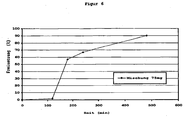
- the dissolution rates of the diclofenac pellets of Formulation Examples 6 and 7 and a mixture thereof were examined at different pH values. Enteric-coated pellets containing 25 mg diclofenac sodium, delayed-release lacquered pellets containing 50 mg diclofenac sodium, and a mixture of gastroresistant-coated pellets containing 25 mg diclofenac sodium and delayed-release lacquers containing 50 mg diclofenac sodium were investigated.
- a rotary basket apparatus according to the European Pharmacopoeia Version 6 with a solvent quantity of 1000 ml at 100 rpm and 37 ° C was used. After 2 hours of release testing using hydrochloric acid medium (pH 1.2), the release medium was changed to phosphate buffer (pH 6.8) and the dissolution rate was examined for a further 6 hours. The determination of the dissolved diclofenac was carried out with UV absorption measurement at 281.
- the dissolution rates are shown in Table 8, Table 9 and Table 10 and are in FIG. 4 . FIG. 5 respectively.
- FIG. 6 graphically illustrated. ⁇ b> Table 8. ⁇ / b> Dissolution Rates of Formulation Example 6 pH 1.2 pH 1.2 pH 6.8 pH 6, 8 pH 6.8 Time (min) 0 120 130 140 165 Release (%) 0 2 69 88 100 pH 1.2 pH 1.2 pH 6.8 pH 6.8 pH 6.8 Time (min) 0 120 180 240 480 Release (%) 0 2 35 50 85 pH 1.2 pH 1.2 pH 6.8 pH 6.8 Time (min) 0 120 180 240 480 Release (%) 0 2 57 67 90
- Example 7 Pharmaceutical preparation containing a combination of omeprazole and diclofenac pellets
- a hard gelatin capsule was treated with enteric-coated omeprazole pellets (containing a total of 20 mg of omeprazole), enteric-coated diclofenac sodium pellets (containing a total of 25 mg of diclofenac sodium) and with release-releasing diclofenac sodium pellets (containing a total of 50 mg of diclofenac sodium). filled to obtain a pharmaceutical composition containing a combination of both active ingredients.
- the enteric-coated omeprazole pellets were prepared according to Example 3 (formulation example 3).
- the gastroresistant film-coated and the sustained release diclofenac sodium pellets were prepared according to Example 5 (Formulation Examples 6 and 7, respectively).
- Example 8 Enteric-coated pellets containing a combination of omeprazole and diclofenac
- enteric-coated pellets containing a combination of omeprazole and diclofenac sodium with different proportions can also be prepared.
- Table 12 gives recipe examples relating to the composition of the pellet core, the protective layer and the enteric layer.
- the given recipe examples refer to batch sizes of 1 kg pellet cores. ⁇ b> Table 12.
- enteric-coated pellets obtained by the production process according to the invention are sieved and filled into hard gelatine capsules. Gastro-enteric coated pellets are then filled into the hard gelatine capsules at a dose of 20 mg omeprazole and 25 mg diclofenac sodium, and at a dosage of 10 mg omeprazole and 25 mg diclofenac sodium.
- Example 7 The release of the active substances from the dosage forms according to Formulation Examples 9 and 10 was investigated at different pH values, analogously to the procedure described in Example 7 (rotary basket apparatus, 900 ml, 100 rpm, 37 ° C.). After a 2 hour release test, the medium was changed from pH 1.2 to pH 6.8 and the continuation of the measurement of the dissolution rate over a further 45 minutes. The analytical Determination of the two active ingredients was carried out as described in Example 7.
Landscapes
- Health & Medical Sciences (AREA)
- Life Sciences & Earth Sciences (AREA)
- Chemical & Material Sciences (AREA)
- Veterinary Medicine (AREA)
- Public Health (AREA)
- Medicinal Chemistry (AREA)
- General Health & Medical Sciences (AREA)
- Animal Behavior & Ethology (AREA)
- Pharmacology & Pharmacy (AREA)
- Epidemiology (AREA)
- Engineering & Computer Science (AREA)
- Bioinformatics & Cheminformatics (AREA)
- Organic Chemistry (AREA)
- Nuclear Medicine, Radiotherapy & Molecular Imaging (AREA)
- General Chemical & Material Sciences (AREA)
- Chemical Kinetics & Catalysis (AREA)
- Rheumatology (AREA)
- Pain & Pain Management (AREA)
- Pharmaceuticals Containing Other Organic And Inorganic Compounds (AREA)
- Medicinal Preparation (AREA)
- Acyclic And Carbocyclic Compounds In Medicinal Compositions (AREA)
- Medicines That Contain Protein Lipid Enzymes And Other Medicines (AREA)
- Medicines Containing Material From Animals Or Micro-Organisms (AREA)
Claims (17)
- Procédé de production d'une préparation pharmaceutique contenant un IPP (inhibiteur de la pompe à protons) sous la forme de granules sphériques (pastilles), qui comprend les étapes suivantes :(a) granulation de l'IPP, d'au moins un composant basique, d'au moins un excipient pharmaceutiquement acceptable et d'au moins un alcool, préférablement l'éthanol et/ou l'isopropanol et en particulier l'isopropanol, au moyen d'un mélangeur à grande vitesse pour obtenir des noyaux contenant l'IPP,(b) séchage des noyaux,(c) enrobage des noyaux séchés avec une couche intermédiaire inerte,(d) pelliculage des noyaux enrobés avec un film gastro-résistant, et(e) séchage des noyaux à pelliculage gastro-résistant jusqu'à ce que l'humidité résiduelle soit inférieure ou égale à 1,5 % en poids, préférablement inférieure ou égale à 1 % en poids, pour obtenir des pastilles de l'IPP,dans lequel la vitesse de la palette d'agitation du mélangeur à grande vitesse est supérieure ou égale à 50 tours/min, préférablement supérieure ou égale à 65 tours/min et plus préférablement dans la plage de 70 à 140 tours/min, la durée de la granulation est préférablement inférieure à 20 minutes, plus préférablement inférieure ou égale à 10 minutes, particulièrement préférablement inférieure ou égale à 8 minutes et le plus préférablement de 5 à 8 minutes et l'étape de granulation (a) a lieu en l'absence d'eau.
- Procédé selon la revendication 1, dans lequel l'IPP est sélectionné parmi l'oméprazole, l'ésoméprazole, le lansoprazole, le pantoprazole et le rabéprazole, préférablement l'oméprazole.
- Procédé selon la revendication 1 ou 2, dans lequel la préparation pharmaceutique contient en outre un AINS (anti-inflammatoire non stéroïdien) sous la forme de pastilles, une proportion de l'AINS étant(i) sous la forme d'un sel, par exemple d'un sel de sodium, qui est soumis, avec l'IPP, à une granulation, à un séchage, à un enrobage, à un pelliculage et à nouveau à un séchage conformément aux étapes (a) à (e) et/ou(ii) sous une forme libre ou sous la forme d'un sel, par exemple d'un sel de sodium, qui est soumis, séparément de l'IPP, à une granulation avec un excipient pharmaceutiquement acceptable et au moins un alcool, préférablement l'éthanol et/ou l'isopropanol et en particulier l'isopropanol, au moyen d'un mélangeur à grande vitesse pour obtenir des noyaux contenant l'AINS, les noyaux étant ensuite séchés et pelliculés avec un film gastro-résistant avant d'être à nouveau séchés jusqu'à ce que l'humidité résiduelle soit inférieure ou égale à 4,0 % en poids, préférablement inférieure ou égale à 3,0 % en poids et particulièrement préférablement inférieure ou égale à 2,5 % en poids pour obtenir des pastilles de l'AINS à pelliculage gastro-résistant qui sont ensuite mélangées avec les pastilles de l'IPP, dans lequel la vitesse de la palette d'agitation du mélangeur à grande vitesse est supérieure ou égale à 50 tours/min, préférablement supérieure ou égale à 65 tours/min et plus préférablement dans la plage de 70 à 140 tours/min, la durée de la granulation est préférablement inférieure à 20 minutes, plus préférablement inférieure ou égale à 10 minutes, particulièrement préférablement inférieure ou égale à 8 minutes et le plus préférablement de 5 à 8 minutes et l'étape de granulation (a) a lieu en l'absence d'eau.
- Procédé selon la revendication 3, dans lequel une autre proportion de l'AINS est transformée, avec au moins un excipient pharmaceutiquement acceptable, en des noyaux contenant l'AINS qui sont ensuite enrobés avec une membrane de diffusion ayant une perméabilité retardée pour l'AINS pour obtenir des pastilles de l'AINS à libération retardée, dans lequel les pastilles de l'AINS à libération retardée sont en option séchées jusqu'à ce que l'humidité résiduelle soit inférieure ou égale à 2,0 % en poids, préférablement inférieure ou égale à 1,5 % en poids et particulièrement préférablement inférieure ou égale à 1 % en poids avant mélange des pastilles d'AINS à libération retardée avec les pastilles de l'IPP et, en option, les pastilles de l'AINS à pelliculage gastro-résistant.
- Procédé selon la revendication 3 ou 4, dans lequel l'AIN est sélectionné parmi le diclofénac, l'ibuprofène, le kétoprofène, le naproxène, l'indométacine, le piroxicam, le méloxicam, l'acide acétylsalicylique, le célécoxib, le parécoxib et l'étoricoxib, préférablement le diclofénac.
- Procédé selon la revendication 4 ou 5, dans lequel le rapport molaire de l'AINS contenu dans les pastilles à pelliculage gastro-résistant et de l'AINS contenu dans les pastilles à libération prolongée va de 0,1:1 à 1:1, préférablement de 0,5:1 à 1:1.
- Procédé selon l'une des revendications 1 à 6, dans lequel les pastilles de l'IPP présentent, après production, une teneur en eau inférieure ou égale à 1,0 % en poids, préférablement inférieure ou égale à 0,5 % en poids.
- Procédé selon l'une des revendications 1 à 7, dans lequel le au moins un composant basique est indépendamment sélectionné dans le groupe consistant en les suivants : carbonate de magnésium, oxyde de magnésium, hydroxyde de magnésium, carbonate d'aluminium, hydroxyde d'aluminium, carbonate de calcium, phosphate de calcium, citrate de calcium, carbonate de sodium, hydrogénocarbonate de sodium, phosphate de sodium, citrate de sodium, carbonate de potassium, phosphate de potassium et citrate de potassium, préférablement le carbonate de magnésium.
- Procédé selon l'une des revendications 1 à 8, dans lequel le au moins un excipient est indépendamment sélectionné dans le groupe consistant en les suivants : mannitol, sorbitol, isomalt, silice colloïdale, cellulose microcristalline, dextrine, maltodextrine, amidon de maïs, sucrose, lactose et laurylsulfate de sodium, préférablement le mannitol et le laurylsulfate de sodium.
- Procédé selon l'une des revendications 1 à 9, dans lequel la couche intermédiaire inerte comprend l'un des agents suivants ou est indépendamment sélectionnée parmi ceux-ci : hydroxypropylcellulose, hydroxypropylméthylcellulose, polyvinylpyrrolidone, alcool polyvinylique et mélanges de ceux-ci, en particulier l'hydroxypropylméthylcellulose.
- Procédé selon l'une des revendications 1 à 10, dans lequel le film gastro-résistant est indépendamment sélectionné parmi les suivants : copolymère acide méthacrylique-acrylate d'éthyle, copolymère acide méthacrylique-méthacrylate de méthyle, phtalate-acétate de polyvinyle, phtalate-acétate d'hydroxypropylméthylcellulose, phtalate-acétate de cellulose et succinate-acétate d'hydroxypropylméthylcellulose, en particulier un copolymère acide méthacrylique-acrylate d'éthyle.
- Préparation pharmaceutique pouvant être obtenue par un procédé selon l'une des revendications 1 à 11, dans laquelle les pastilles sont préférablement renfermées dans une capsule de gélatine, en particulier une capsule de gélatine dure.
- Préparation pharmaceutique selon la revendication 12, dans laquelle les pastilles à pelliculage gastro-résistant ont une vitesse de dissolution qui, quand mesurée in vitro dans un appareil à panier ou un appareil à palette conforme à celui décrit dans la version 6 de la Pharmacopée européenne dans un tampon phosphate en présence d'une quantité de solvant qui est de 900 ml à 100 tours/min et à 37 °C, produit essentiellement le profil de dissolution suivant :(i) après une période de mesure de 2 h à pH 1,2, une dissolution de 10 % ou moins, préférablement de 5 % ou moins, de l'IPP total est rapportée, et(ii) après une période de mesure de 2 h à pH 1,2 et après une période de mesure de 10 minutes à pH 6,8, une dissolution de 80 % ou plus, préférablement de 90 % ou plus, de l'IPP total est rapportée.
- Préparation pharmaceutique selon la revendication 12 ou 13, dans laquelle les pastilles à pelliculage gastro-résistant ont une vitesse de dissolution qui, quand mesurée in vitro dans un appareil à panier ou un appareil à palette conforme à celui décrit dans la version 6 de la Pharmacopée européenne dans l'acide chlorhydrique ou dans un tampon phosphate en présence d'une quantité de solvant qui est de 900 ml à 100 tours/min et à 37 °C, produit essentiellement le profil de dissolution suivant :(i) après une période de mesure de 2 h à pH 1,2, une dissolution de 10 % ou moins, préférablement de 5 % ou moins, de l'AINS total est rapportée, et(ii) après une période de mesure de 1 h à pH 6,8, une dissolution de 80 % ou plus de l'AINS total est rapportée.
- Préparation pharmaceutique selon la revendication 12, 13 ou 14, dont le profil de dissolution, mesuré in vitro dans un appareil à panier ou un appareil à palette conforme à celui décrit dans la version 6 de la Pharmacopée européenne dans l'acide chlorhydrique ou dans un tampon phosphate en présence d'une quantité de solvant qui est de 900 ml à 100 tours/min et à 37 °C, est essentiellement le suivant :(i) après une période de mesure de 2 h à pH 1,2, une dissolution de 10 % ou moins, préférablement de 5 % ou moins, de l'IPP total et de 10 % ou moins, préférablement de 5 % ou moins, de l'AINS total est rapportée,(ii) après une période de mesure de 10 min à pH 6,8, une dissolution de 80 % ou plus, préférablement de 90 % ou plus, de l'IPP total est rapportée, et(iii) après une période de mesure de 1 h à pH 6.8, une dissolution de 40 à 70 % de l'AINS total est rapportée et, sur une période de mesure supplémentaire de 5 h à pH 6,8, une dissolution supplémentaire de 2,5 à 10 % par heure de l'AINS total est rapportée.
- Préparation pharmaceutique selon l'une des revendications 12, 13, 14 ou 15, dans laquelle le au moins un composant basique est sélectionné indépendamment dans le groupe consistant en les suivants : carbonate de magnésium, oxyde de magnésium, hydroxyde de magnésium, carbonate de calcium, phosphate de calcium et citrate de calcium, préférablement le carbonate de magnésium.
- Préparation pharmaceutique selon la revendication 12, 13, 14, 15 ou 16, pour une utilisation dans le traitement de douleurs et d'inflammations, en particulier d'un rhumatisme, de contusions, d'entorses et d'une arthrose, préférablement d'un rhumatisme.
Priority Applications (5)
| Application Number | Priority Date | Filing Date | Title |
|---|---|---|---|
| PL11788458T PL2645996T3 (pl) | 2010-11-29 | 2011-11-28 | Sposób wytwarzania preparatu farmaceutycznego zawierającego inhibitory pompy protonowej (IPP) |
| HRP20160593TT HRP20160593T1 (hr) | 2010-11-29 | 2011-11-28 | Postupak proizvodnje farmaceutskog pripravka koji sadrži inhibitore protonske pumpe |
| SI201130835A SI2645996T1 (sl) | 2010-11-29 | 2011-11-28 | Postopek za izdelavo farmacevtskega pripravka, ki vsebuje ppi |
| RS20160387A RS54826B1 (sr) | 2010-11-29 | 2011-11-28 | Postupak proizvodnje farmaceutskog preparata koji sadrži inhibitor protonske pumpe |
| CY20161100484T CY1117589T1 (el) | 2010-11-29 | 2016-06-01 | Μεθοδος για την παραγωγη φαρμακευτικου παρασκευασματος το οποιο περιεχει αναστολεις αντλιας πρωτονιων |
Applications Claiming Priority (2)
| Application Number | Priority Date | Filing Date | Title |
|---|---|---|---|
| DE102010052847A DE102010052847A1 (de) | 2010-11-29 | 2010-11-29 | Verfahren zur Herstellung einer PPI-haltigen pharmazeutischen Zubereitung |
| PCT/EP2011/071149 WO2012072570A2 (fr) | 2010-11-29 | 2011-11-28 | Procédé de production d'une préparation pharmaceutique contenant un ipp |
Publications (2)
| Publication Number | Publication Date |
|---|---|
| EP2645996A2 EP2645996A2 (fr) | 2013-10-09 |
| EP2645996B1 true EP2645996B1 (fr) | 2016-03-02 |
Family
ID=45047786
Family Applications (1)
| Application Number | Title | Priority Date | Filing Date |
|---|---|---|---|
| EP11788458.5A Active EP2645996B1 (fr) | 2010-11-29 | 2011-11-28 | Procédés pour la preparation d'une composition comprennant d'inhibiteurs de la pompe à protons |
Country Status (23)
| Country | Link |
|---|---|
| US (1) | US20130266658A1 (fr) |
| EP (1) | EP2645996B1 (fr) |
| CN (1) | CN103260607B (fr) |
| BR (1) | BR112013013042B1 (fr) |
| CA (1) | CA2819039C (fr) |
| CL (1) | CL2013001497A1 (fr) |
| CO (1) | CO6801720A2 (fr) |
| CY (1) | CY1117589T1 (fr) |
| DE (1) | DE102010052847A1 (fr) |
| DK (1) | DK2645996T3 (fr) |
| EA (1) | EA025070B1 (fr) |
| EC (1) | ECSP13012715A (fr) |
| ES (1) | ES2574402T3 (fr) |
| HR (1) | HRP20160593T1 (fr) |
| HU (1) | HUE027418T2 (fr) |
| MX (1) | MX346789B (fr) |
| PH (1) | PH12013500981A1 (fr) |
| PL (1) | PL2645996T3 (fr) |
| RS (1) | RS54826B1 (fr) |
| SI (1) | SI2645996T1 (fr) |
| SM (1) | SMT201600285B (fr) |
| WO (1) | WO2012072570A2 (fr) |
| ZA (1) | ZA201303568B (fr) |
Families Citing this family (81)
| Publication number | Priority date | Publication date | Assignee | Title |
|---|---|---|---|---|
| CN103877085B (zh) * | 2013-10-16 | 2016-05-04 | 山西兰花药业有限公司 | 酮洛芬奥美拉唑缓释微丸及其制备方法 |
| US10722583B2 (en) | 2015-02-10 | 2020-07-28 | Axsome Therapeutics, Inc. | Pharmaceutical compositions comprising meloxicam |
| US10729773B2 (en) | 2015-02-10 | 2020-08-04 | Axsome Therapeutics, Inc. | Pharmaceutical compositions comprising meloxicam |
| US11045549B2 (en) | 2015-02-10 | 2021-06-29 | Axsome Therapeutics, Inc. | Pharmaceutical compositions comprising meloxicam |
| US11602563B2 (en) | 2015-02-10 | 2023-03-14 | Axsome Therapeutics, Inc. | Pharmaceutical compositions comprising meloxicam |
| US11013805B2 (en) | 2015-02-10 | 2021-05-25 | Axsome Therapeutics, Inc. | Pharmaceutical compositions comprising meloxicam |
| US10933137B2 (en) | 2015-02-10 | 2021-03-02 | Axsome Therapeutics, Inc. | Pharmaceutical compositions comprising meloxicam |
| US10780166B2 (en) | 2015-02-10 | 2020-09-22 | Axsome Therapeutics, Inc. | Pharmaceutical compositions comprising meloxicam |
| US10653777B2 (en) | 2015-02-10 | 2020-05-19 | Axsome Therapeutics, Inc. | Pharmaceutical compositions comprising meloxicam |
| US10537642B1 (en) | 2015-02-10 | 2020-01-21 | Axsome Therapeutics, Inc. | Pharmaceutical compositions comprising meloxicam |
| US11738085B2 (en) | 2015-02-10 | 2023-08-29 | Axsome Therapeutics, Inc. | Pharmaceutical compositions comprising meloxicam |
| US10702602B2 (en) | 2015-02-10 | 2020-07-07 | Axsome Therapeutics, Inc. | Pharmaceutical compositions comprising meloxicam |
| US12485176B2 (en) | 2015-02-10 | 2025-12-02 | Axsome Therapeutics, Inc. | Pharmaceutical compositions comprising meloxicam |
| US10799588B2 (en) | 2015-02-10 | 2020-10-13 | Axsome Therapeutics, Inc. | Pharmaceutical compositions comprising meloxicam |
| US10729774B1 (en) | 2015-02-10 | 2020-08-04 | Axsome Therapeutics, Inc. | Pharmaceutical compositions comprising meloxicam |
| US10512692B2 (en) | 2015-02-10 | 2019-12-24 | Axsome Therapeutics, Inc. | Pharmaceutical compositions comprising meloxicam |
| US10695430B2 (en) | 2015-02-10 | 2020-06-30 | Axsome Therapeutics, Inc. | Pharmaceutical compositions comprising meloxicam |
| US11110173B2 (en) | 2015-02-10 | 2021-09-07 | Axsome Therapeutics, Inc | Pharmaceutical compositions comprising meloxicam |
| US10695429B2 (en) | 2015-02-10 | 2020-06-30 | Axsome Therapeutics, Inc. | Pharmaceutical compositions comprising meloxicam |
| US10933136B2 (en) | 2015-02-10 | 2021-03-02 | Axsome Therapeutics, Inc. | Pharmaceutical compositions comprising meloxicam |
| US10821181B2 (en) | 2015-02-10 | 2020-11-03 | Axsome Therapeutics, Inc. | Pharmaceutical compositions comprising meloxicam |
| US10517950B1 (en) | 2015-02-10 | 2019-12-31 | Axsome Therapeutics, Inc. | Pharmaceutical compositions comprising meloxicam |
| US11607456B2 (en) | 2015-02-10 | 2023-03-21 | Axsome Therapeutics, Inc. | Pharmaceutical compositions comprising meloxicam |
| US10532101B1 (en) | 2015-02-10 | 2020-01-14 | Axsome Therapeutics, Inc. | Pharmaceutical compositions comprising meloxicam |
| US10780165B2 (en) | 2015-02-10 | 2020-09-22 | Axsome Therapeutics, Inc. | Pharmaceutical compositions comprising meloxicam |
| US10058614B2 (en) | 2015-02-10 | 2018-08-28 | Axsome Therapeutics, Inc. | Pharmaceutical compositions comprising meloxicam |
| US10758618B2 (en) | 2015-02-10 | 2020-09-01 | Axsome Therapeutics, Inc. | Pharmaceutical compositions comprising meloxicam |
| US9821075B2 (en) | 2015-02-10 | 2017-11-21 | Axsome Therapeutics, Inc. | Pharmaceutical compositions comprising meloxicam |
| US11013806B2 (en) | 2015-02-10 | 2021-05-25 | Axsome Therapeutics, Inc. | Pharmaceutical compositions comprising meloxicam |
| CN107428550B (zh) * | 2015-03-16 | 2020-06-16 | 宇部材料工业株式会社 | 氧化镁粉末及含其的树脂组成物、以及氧化镁粉末的制造方法 |
| US20170042806A1 (en) | 2015-04-29 | 2017-02-16 | Dexcel Pharma Technologies Ltd. | Orally disintegrating compositions |
| US12472149B2 (en) | 2015-07-17 | 2025-11-18 | BE Pharbel Manufacturing | Multilayered pharmaceutically active compound-releasing microparticles in a liquid dosage form |
| SMT202300083T1 (it) * | 2015-07-17 | 2023-05-12 | Be Pharbel Mfg | Microparticelle multistrato rilascianti composti farmaceuticamente attivi in una forma di dosaggio liquida |
| EP3117824A1 (fr) * | 2015-07-17 | 2017-01-18 | BE Pharbel Manufacturing | Microparticules multicouche à libération de composé pharmaceutiquement actif sous forme posologique liquide |
| BE1024339B1 (fr) * | 2016-07-01 | 2018-01-29 | Be Pharbel Mfg Sa | Microparticules multicouches libérant un composé pharmaceutiquement actif dans une forme pharmaceutique liquide |
| US10736855B2 (en) | 2016-02-25 | 2020-08-11 | Dexcel Pharma Technologies Ltd. | Compositions comprising proton pump inhibitors |
| US10076494B2 (en) | 2016-06-16 | 2018-09-18 | Dexcel Pharma Technologies Ltd. | Stable orally disintegrating pharmaceutical compositions |
| US10940153B2 (en) | 2017-01-04 | 2021-03-09 | Axsome Therapeutics, Inc. | Pharmaceutical compositions comprising meloxicam |
| US10821182B2 (en) | 2017-06-29 | 2020-11-03 | Axsome Therapeutics, Inc. | Pharmaceutical compositions comprising meloxicam |
| US11266657B2 (en) | 2017-01-04 | 2022-03-08 | Axsome Therapeutics, Inc. | Pharmaceutical compositions comprising meloxicam |
| US10583088B2 (en) | 2017-01-04 | 2020-03-10 | Axsome Therapeutics, Inc. | Pharmaceutical compositions comprising meloxicam |
| US10471014B2 (en) | 2017-01-04 | 2019-11-12 | Axsome Therapeutics, Inc. | Pharmaceutical compositions comprising meloxicam |
| US10905693B2 (en) | 2017-01-04 | 2021-02-02 | Axsome Therapeutics, Inc. | Pharmaceutical compositions comprising meloxicam |
| US11207327B2 (en) | 2017-01-04 | 2021-12-28 | Axsome Therapeutics, Inc. | Pharmaceutical compositions comprising meloxicam |
| US10583144B2 (en) | 2017-01-04 | 2020-03-10 | Axsome Therapeutics, Inc. | Pharmaceutical compositions comprising meloxicam |
| US10894053B2 (en) | 2017-01-04 | 2021-01-19 | Axsome Therapeutics, Inc. | Pharmaceutical compositions comprising meloxicam |
| WO2018129220A1 (fr) | 2017-01-04 | 2018-07-12 | Axsome Therapeutics, Inc. | Compositions pharmaceutiques contenant du méloxicam |
| US11433079B2 (en) | 2017-01-04 | 2022-09-06 | Axsome Therapeutics, Inc. | Pharmaceutical compositions comprising meloxicam |
| US10729697B2 (en) | 2017-01-04 | 2020-08-04 | Axsome Therapeutics, Inc. | Pharmaceutical compositions comprising meloxicam |
| US10729696B2 (en) | 2017-01-04 | 2020-08-04 | Axsome Therapeutics, Inc. | Pharmaceutical compositions comprising meloxicam |
| US11617755B2 (en) | 2017-01-04 | 2023-04-04 | Axsome Therapeutics, Inc. | Pharmaceutical compositions comprising meloxicam |
| US11433078B2 (en) | 2017-01-04 | 2022-09-06 | Axsome Therapeutics, Inc. | Pharmaceutical compositions comprising meloxicam |
| US11801250B2 (en) | 2017-01-04 | 2023-10-31 | Axsome Therapeutics, Inc. | Pharmaceutical compositions comprising meloxicam |
| US11471465B2 (en) | 2017-01-04 | 2022-10-18 | Axsome Therapeutics, Inc. | Pharmaceutical compositions comprising meloxicam |
| US11806354B2 (en) | 2017-01-04 | 2023-11-07 | Axsome Therapeutics, Inc. | Pharmaceutical compositions comprising meloxicam |
| US10561664B1 (en) | 2017-01-04 | 2020-02-18 | Axsome Therapeutics, Inc. | Pharmaceutical compositions comprising meloxicam |
| US10688102B2 (en) | 2017-06-29 | 2020-06-23 | Axsome Therapeutics, Inc. | Combination treatment for migraine and other pain |
| US11617756B2 (en) | 2017-06-29 | 2023-04-04 | Axsome Therapeutics, Inc. | Pharmaceutical compositions comprising meloxicam |
| US10918722B2 (en) | 2017-06-29 | 2021-02-16 | Axsome Therapeutics, Inc. | Pharmaceutical compositions comprising meloxicam |
| US10758617B2 (en) | 2017-06-29 | 2020-09-01 | Axsome Therapeutics, Inc. | Pharmaceutical compositions comprising meloxicam |
| US11759522B2 (en) | 2017-06-29 | 2023-09-19 | Axsome Therapeutics, Inc. | Pharmaceutical compositions comprising meloxicam |
| US11865117B2 (en) | 2017-06-29 | 2024-01-09 | Axsome Therapeutics, Inc | Pharmaceutical compositions comprising meloxicam |
| US11185550B2 (en) | 2017-06-29 | 2021-11-30 | Axsome Therapeutics, Inc. | Pharmaceutical compositions comprising meloxicam |
| US11510927B2 (en) | 2017-06-29 | 2022-11-29 | Axsome Therapeutics, Inc. | Pharmaceutical compositions comprising meloxicam |
| US11617791B2 (en) | 2017-06-29 | 2023-04-04 | Axsome Therapeutics, Inc. | Pharmaceutical compositions comprising meloxicam |
| US11219626B2 (en) | 2017-06-29 | 2022-01-11 | Axsome Therapeutics, Inc. | Pharmaceutical compositions comprising meloxicam |
| US10987358B2 (en) | 2017-06-29 | 2021-04-27 | Axsome Therapeutics, Inc. | Pharmaceutical compositions comprising meloxicam |
| US10688185B2 (en) | 2017-06-29 | 2020-06-23 | Axsome Therapeutics, Inc. | Pharmaceutical compositions comprising meloxicam |
| US10512693B2 (en) | 2017-06-29 | 2019-12-24 | Axsome Therapeutics, Inc. | Pharmaceutical compositions comprising meloxicam |
| US20190125676A1 (en) * | 2017-11-02 | 2019-05-02 | Dexcel Pharma Technologies Ltd. | Compositions comprising proton pump inhibitors for oral administration |
| CN109700777B (zh) * | 2019-02-27 | 2021-06-22 | 中国药科大学 | 一种pH依赖型药物疏水骨架缓释片及其制备方法 |
| SI4072532T1 (sl) | 2019-12-11 | 2024-05-31 | Evonik Operations Gmbh | Dozirna oblika za uporabo v zdravljenju ali preprečevanju bolezni |
| US20230048354A1 (en) * | 2019-12-11 | 2023-02-16 | Evonik Operations Gmbh | Dosage form for use in treating or preventing of a disease |
| JP7754812B2 (ja) | 2019-12-11 | 2025-10-15 | エボニック オペレーションズ ゲーエムベーハー | アルカリ剤及び腸溶性コーティング層を含む剤形 |
| US20240058354A1 (en) | 2020-04-06 | 2024-02-22 | Axsome Therapeutics, Inc. | Pharmaceutical compositions comprising meloxicam |
| US12128052B2 (en) | 2020-05-28 | 2024-10-29 | Axsome Therapeutics, Inc. | Pharmaceutical compositions comprising meloxicam |
| EP4271386A4 (fr) | 2020-12-31 | 2024-11-13 | Axsome Therapeutics, Inc. | Compositions pharmaceutiques comprenant du méloxicam |
| US12370196B2 (en) | 2020-12-31 | 2025-07-29 | Axsome Therapeutics, Inc. | Pharmaceutical compositions comprising meloxicam |
| CA3249196A1 (fr) * | 2022-01-20 | 2023-07-27 | Bionxt Solutions Inc. | Composition chimique pour l’administration d’un médicament entérique |
| US12005118B2 (en) | 2022-05-19 | 2024-06-11 | Axsome Therapeutics, Inc. | Pharmaceutical compositions comprising meloxicam |
| US12544383B1 (en) | 2025-01-30 | 2026-02-10 | Axsome Therapeutics, Inc. | Methods of treating migraines with a combination of a meloxicam and a rizatriptan |
Family Cites Families (9)
| Publication number | Priority date | Publication date | Assignee | Title |
|---|---|---|---|---|
| GB2189698A (en) * | 1986-04-30 | 1987-11-04 | Haessle Ab | Coated omeprazole tablets |
| DE3822095A1 (de) * | 1988-06-30 | 1990-01-04 | Klinge Co Chem Pharm Fab | Neue arzneimittelformulierung sowie verfahren zu deren herstellung |
| YU48263B (sh) * | 1991-06-17 | 1997-09-30 | Byk Gulden Lomberg Chemische Fabrik Gmbh. | Postupak za dobijanje farmaceutskog preparata na bazi pantoprazola |
| SE9600070D0 (sv) | 1996-01-08 | 1996-01-08 | Astra Ab | New oral pharmaceutical dosage forms |
| US6623759B2 (en) * | 1996-06-28 | 2003-09-23 | Astrazeneca Ab | Stable drug form for oral administration with benzimidazole derivatives as active ingredient and process for the preparation thereof |
| DE19626045C2 (de) * | 1996-06-28 | 1998-12-03 | Klinge Co Chem Pharm Fab | Stabile Arzneiform zur oralen Verabreichung, welche Omeprazol als aktiven Wirkstoff enthält, sowie Verfahren zur Herstellung derselben |
| SE0200895D0 (sv) * | 2002-03-22 | 2002-03-22 | Astrazeneca Ab | New pharmaceutical composition |
| AR051654A1 (es) * | 2004-11-04 | 2007-01-31 | Astrazeneca Ab | Nuevas formulaciones de pellets de liberacion modificada para inhibidores de la bomba de protones |
| WO2006085335A2 (fr) * | 2005-01-03 | 2006-08-17 | Lupin Limited | Composition pharmaceutique de substances labiles acides |
-
2010
- 2010-11-29 DE DE102010052847A patent/DE102010052847A1/de not_active Withdrawn
-
2011
- 2011-11-28 WO PCT/EP2011/071149 patent/WO2012072570A2/fr not_active Ceased
- 2011-11-28 RS RS20160387A patent/RS54826B1/sr unknown
- 2011-11-28 CN CN201180057095.5A patent/CN103260607B/zh active Active
- 2011-11-28 PH PH1/2013/500981A patent/PH12013500981A1/en unknown
- 2011-11-28 HU HUE11788458A patent/HUE027418T2/en unknown
- 2011-11-28 DK DK11788458.5T patent/DK2645996T3/en active
- 2011-11-28 SI SI201130835A patent/SI2645996T1/sl unknown
- 2011-11-28 BR BR112013013042-3A patent/BR112013013042B1/pt not_active IP Right Cessation
- 2011-11-28 EP EP11788458.5A patent/EP2645996B1/fr active Active
- 2011-11-28 HR HRP20160593TT patent/HRP20160593T1/hr unknown
- 2011-11-28 CA CA2819039A patent/CA2819039C/fr active Active
- 2011-11-28 ES ES11788458.5T patent/ES2574402T3/es active Active
- 2011-11-28 EA EA201390793A patent/EA025070B1/ru not_active IP Right Cessation
- 2011-11-28 MX MX2013005896A patent/MX346789B/es active IP Right Grant
- 2011-11-28 PL PL11788458T patent/PL2645996T3/pl unknown
-
2013
- 2013-05-16 ZA ZA2013/03568A patent/ZA201303568B/en unknown
- 2013-05-27 CL CL2013001497A patent/CL2013001497A1/es unknown
- 2013-05-28 CO CO13130481A patent/CO6801720A2/es not_active Application Discontinuation
- 2013-05-29 US US13/904,924 patent/US20130266658A1/en not_active Abandoned
- 2013-06-24 EC ECSP13012715 patent/ECSP13012715A/es unknown
-
2016
- 2016-06-01 CY CY20161100484T patent/CY1117589T1/el unknown
- 2016-08-25 SM SM201600285T patent/SMT201600285B/it unknown
Also Published As
| Publication number | Publication date |
|---|---|
| CL2013001497A1 (es) | 2013-12-27 |
| EP2645996A2 (fr) | 2013-10-09 |
| ZA201303568B (en) | 2014-07-30 |
| SMT201600285B (it) | 2016-11-10 |
| WO2012072570A3 (fr) | 2012-09-13 |
| CY1117589T1 (el) | 2017-04-26 |
| CN103260607A (zh) | 2013-08-21 |
| ECSP13012715A (es) | 2013-08-30 |
| DE102010052847A1 (de) | 2012-05-31 |
| RS54826B1 (sr) | 2016-10-31 |
| PH12013500981A1 (en) | 2013-07-08 |
| CA2819039C (fr) | 2018-09-11 |
| BR112013013042B1 (pt) | 2021-09-28 |
| CN103260607B (zh) | 2016-05-04 |
| BR112013013042A2 (pt) | 2016-08-09 |
| MX2013005896A (es) | 2013-06-28 |
| HUE027418T2 (en) | 2016-09-28 |
| MX346789B (es) | 2017-03-31 |
| CA2819039A1 (fr) | 2012-06-07 |
| DK2645996T3 (en) | 2016-06-13 |
| PL2645996T3 (pl) | 2016-08-31 |
| CO6801720A2 (es) | 2013-11-29 |
| US20130266658A1 (en) | 2013-10-10 |
| EA025070B1 (ru) | 2016-11-30 |
| EA201390793A1 (ru) | 2013-11-29 |
| WO2012072570A2 (fr) | 2012-06-07 |
| HRP20160593T1 (hr) | 2016-07-29 |
| SI2645996T1 (sl) | 2016-07-29 |
| ES2574402T3 (es) | 2016-06-17 |
Similar Documents
| Publication | Publication Date | Title |
|---|---|---|
| WO2012072570A2 (fr) | Procédé de production d'une préparation pharmaceutique contenant un ipp | |
| DE69624910T2 (de) | Orale pharmazeutische dosierungsformen die einen protonenpumpeninhibitor und ein prokinetisches mittel enthalten | |
| AU748445B2 (en) | Omeprazole formulation | |
| DE3751860T2 (de) | Verwendung von spezifischem Kernmaterial und Schichten zur Herstellung pharmazeutischer Formulierungen, die stabil gegen die Verfärbung von Omeprazol sind | |
| JP4649001B2 (ja) | オメプラゾール製剤 | |
| DE3751851T2 (de) | Verwendung von spezifischem Kernmaterial und Schichten zur Herstellung pharmazeutischer Formulierungen, die stabil gegen die Verfärbung säurelabiler Verbindungen sind | |
| DE69631981T2 (de) | Lansoprazolhaltige Arzneizusammensetzung und Herstellungsverfahren | |
| DE69628551T2 (de) | Oral anzuwendende pharmazeutische dosierungsformen,enthaltend einem protonenpunpeninibitor und einen nicht-steriodalen antiinflamatorischen wirkstoff | |
| DE60038447T2 (de) | Stabile benzimidazol zusammensetzungen | |
| CA2637444C (fr) | Composition pharmaceutique de tolterodine enrobee ou sel de celle-ci presentant une dissolution rapide dans des conditions acides et une dissolution lente a des valeurs de ph pluselevees | |
| KR20010012402A (ko) | 안정한 약제학적 경구 투여형 | |
| JP2001518083A (ja) | アミノ酸/シクロデキストリン混合物による酸感受性ベンズイミダゾール類の安定化 | |
| BG64967B1 (bg) | Метод за получаване на орален фармацевтичен препарат, включващ съединение с противоязвена активност | |
| WO2007122478A2 (fr) | Compositions à unités multiples | |
| JP2000514051A (ja) | ベンズイミダゾール誘導体を活性成分とする経口投与用の安定な薬剤形およびその製造方法 | |
| AU5791900A (en) | Solid oral pharmaceutical formulation of modified release that contains an acid labile benzimidazole compound | |
| HK175796A (en) | Oral dosage forms containing pimobendan | |
| WO2011140446A2 (fr) | Formulations pharmaceutiques | |
| JP7541617B2 (ja) | 腸溶性ペレット及びその製造方法並びにそれを含む製剤 | |
| DE602005006409T2 (de) | Ein amin-arzneimittel enthaltende granulatzubereitung mit langsamer freisetzung auf basis von teilchen mit einer überzugsschicht und entsprechendes herstellungsverfahren | |
| EP3646855A2 (fr) | Composition pour préparation solide à usage oral comprenant un inhibiteur de pompe à protons, préparation solide à usage oral la comprenant, et son procédé de préparation | |
| AU2006213439A1 (en) | Pharmaceutical composition of acid labile substances | |
| US20060051421A1 (en) | Stable pharmaceutical formulations of benzimidazole compounds | |
| EP1696889A1 (fr) | Compositions pharmaceutiques de benzimidazole et leurs procedes de preparation | |
| EP4393513A1 (fr) | Particules de suspension sèche pour suspension sèche, leur procédé de préparation et leur utilisation |
Legal Events
| Date | Code | Title | Description |
|---|---|---|---|
| PUAI | Public reference made under article 153(3) epc to a published international application that has entered the european phase |
Free format text: ORIGINAL CODE: 0009012 |
|
| 17P | Request for examination filed |
Effective date: 20130612 |
|
| AK | Designated contracting states |
Kind code of ref document: A2 Designated state(s): AL AT BE BG CH CY CZ DE DK EE ES FI FR GB GR HR HU IE IS IT LI LT LU LV MC MK MT NL NO PL PT RO RS SE SI SK SM TR |
|
| DAX | Request for extension of the european patent (deleted) | ||
| GRAP | Despatch of communication of intention to grant a patent |
Free format text: ORIGINAL CODE: EPIDOSNIGR1 |
|
| INTG | Intention to grant announced |
Effective date: 20141029 |
|
| GRAP | Despatch of communication of intention to grant a patent |
Free format text: ORIGINAL CODE: EPIDOSNIGR1 |
|
| INTG | Intention to grant announced |
Effective date: 20150812 |
|
| GRAS | Grant fee paid |
Free format text: ORIGINAL CODE: EPIDOSNIGR3 |
|
| GRAA | (expected) grant |
Free format text: ORIGINAL CODE: 0009210 |
|
| AK | Designated contracting states |
Kind code of ref document: B1 Designated state(s): AL AT BE BG CH CY CZ DE DK EE ES FI FR GB GR HR HU IE IS IT LI LT LU LV MC MK MT NL NO PL PT RO RS SE SI SK SM TR |
|
| REG | Reference to a national code |
Ref country code: GB Ref legal event code: FG4D Free format text: NOT ENGLISH |
|
| REG | Reference to a national code |
Ref country code: AT Ref legal event code: REF Ref document number: 777495 Country of ref document: AT Kind code of ref document: T Effective date: 20160315 Ref country code: CH Ref legal event code: EP |
|
| REG | Reference to a national code |
Ref country code: IE Ref legal event code: FG4D Free format text: LANGUAGE OF EP DOCUMENT: GERMAN |
|
| REG | Reference to a national code |
Ref country code: DE Ref legal event code: R096 Ref document number: 502011009021 Country of ref document: DE |
|
| REG | Reference to a national code |
Ref country code: PT Ref legal event code: SC4A Free format text: AVAILABILITY OF NATIONAL TRANSLATION Effective date: 20160519 |
|
| REG | Reference to a national code |
Ref country code: HR Ref legal event code: TUEP Ref document number: P20160593 Country of ref document: HR |
|
| REG | Reference to a national code |
Ref country code: DK Ref legal event code: T3 Effective date: 20160607 |
|
| RAP2 | Party data changed (patent owner data changed or rights of a patent transferred) |
Owner name: TEMMLER WERKE GMBH |
|
| REG | Reference to a national code |
Ref country code: CH Ref legal event code: NV Representative=s name: KELLER AND PARTNER PATENTANWAELTE AG, CH |
|
| REG | Reference to a national code |
Ref country code: ES Ref legal event code: FG2A Ref document number: 2574402 Country of ref document: ES Kind code of ref document: T3 Effective date: 20160617 |
|
| REG | Reference to a national code |
Ref country code: NL Ref legal event code: FP |
|
| REG | Reference to a national code |
Ref country code: EE Ref legal event code: FG4A Ref document number: E011876 Country of ref document: EE Effective date: 20160602 |
|
| REG | Reference to a national code |
Ref country code: RO Ref legal event code: EPE |
|
| PG25 | Lapsed in a contracting state [announced via postgrant information from national office to epo] |
Ref country code: NO Free format text: LAPSE BECAUSE OF FAILURE TO SUBMIT A TRANSLATION OF THE DESCRIPTION OR TO PAY THE FEE WITHIN THE PRESCRIBED TIME-LIMIT Effective date: 20160602 Ref country code: FI Free format text: LAPSE BECAUSE OF FAILURE TO SUBMIT A TRANSLATION OF THE DESCRIPTION OR TO PAY THE FEE WITHIN THE PRESCRIBED TIME-LIMIT Effective date: 20160302 |
|
| REG | Reference to a national code |
Ref country code: HR Ref legal event code: T1PR Ref document number: P20160593 Country of ref document: HR |
|
| PG25 | Lapsed in a contracting state [announced via postgrant information from national office to epo] |
Ref country code: SE Free format text: LAPSE BECAUSE OF FAILURE TO SUBMIT A TRANSLATION OF THE DESCRIPTION OR TO PAY THE FEE WITHIN THE PRESCRIBED TIME-LIMIT Effective date: 20160302 |
|
| REG | Reference to a national code |
Ref country code: HU Ref legal event code: AG4A Ref document number: E027418 Country of ref document: HU |
|
| REG | Reference to a national code |
Ref country code: GR Ref legal event code: EP Ref document number: 20160401108 Country of ref document: GR Effective date: 20160729 |
|
| PG25 | Lapsed in a contracting state [announced via postgrant information from national office to epo] |
Ref country code: IS Free format text: LAPSE BECAUSE OF FAILURE TO SUBMIT A TRANSLATION OF THE DESCRIPTION OR TO PAY THE FEE WITHIN THE PRESCRIBED TIME-LIMIT Effective date: 20160702 |
|
| REG | Reference to a national code |
Ref country code: FR Ref legal event code: PLFP Year of fee payment: 6 |
|
| REG | Reference to a national code |
Ref country code: DE Ref legal event code: R097 Ref document number: 502011009021 Country of ref document: DE |
|
| PLBE | No opposition filed within time limit |
Free format text: ORIGINAL CODE: 0009261 |
|
| STAA | Information on the status of an ep patent application or granted ep patent |
Free format text: STATUS: NO OPPOSITION FILED WITHIN TIME LIMIT |
|
| 26N | No opposition filed |
Effective date: 20161205 |
|
| REG | Reference to a national code |
Ref country code: CH Ref legal event code: PFA Owner name: AENOVA IP GMBH, DE Free format text: FORMER OWNER: TEMMLER WERKE GMBH, DE |
|
| REG | Reference to a national code |
Ref country code: NL Ref legal event code: HC Owner name: AENOVA IP GMBH; DE Free format text: DETAILS ASSIGNMENT: CHANGE OF OWNER(S), CHANGE OF OWNER(S) NAME; FORMER OWNER NAME: TEMMLER WERKE GMBH Effective date: 20170224 |
|
| REG | Reference to a national code |
Ref country code: HU Ref legal event code: HC9C Owner name: AENOVA IP GMBH, DE Free format text: FORMER OWNER(S): TEMMLER WERKE GMBH, DE; AENOVE IP GMBH, DE |
|
| REG | Reference to a national code |
Ref country code: EE Ref legal event code: HC1A Ref document number: E011876 Country of ref document: EE |
|
| REG | Reference to a national code |
Ref country code: SK Ref legal event code: TC4A Ref document number: E 21672 Country of ref document: SK Owner name: AENOVA IP GMBH, MARBURG, DE Effective date: 20170517 |
|
| REG | Reference to a national code |
Ref country code: DE Ref legal event code: R082 Ref document number: 502011009021 Country of ref document: DE Representative=s name: ABITZ & PARTNER PATENTANWAELTE MBB, DE Ref country code: DE Ref legal event code: R081 Ref document number: 502011009021 Country of ref document: DE Owner name: AENOVA IP GMBH, DE Free format text: FORMER OWNER: TEMMLER WERKE GMBH, 81673 MUENCHEN, DE |
|
| REG | Reference to a national code |
Ref country code: SI Ref legal event code: SP73 Owner name: AENOVA IP GMBH; DE Effective date: 20170517 |
|
| REG | Reference to a national code |
Ref country code: LU Ref legal event code: HC Owner name: AENOVA IP GMBH; DE Free format text: FORMER OWNER: TEMMLER WERKE GMBH Effective date: 20170517 |
|
| REG | Reference to a national code |
Ref country code: HR Ref legal event code: PNAN Ref document number: P20160593 Country of ref document: HR Owner name: AENOVA IP GMBH, DE |
|
| REG | Reference to a national code |
Ref country code: ES Ref legal event code: PC2A Owner name: AENOVA IP GMBH Effective date: 20170928 |
|
| REG | Reference to a national code |
Ref country code: FR Ref legal event code: CD Owner name: AENOVA IP GMBH, DE Effective date: 20170915 |
|
| REG | Reference to a national code |
Ref country code: FR Ref legal event code: PLFP Year of fee payment: 7 |
|
| REG | Reference to a national code |
Ref country code: AT Ref legal event code: HC Ref document number: 777495 Country of ref document: AT Kind code of ref document: T Owner name: AENOVA IP GMBH, DE Effective date: 20180511 |
|
| PG25 | Lapsed in a contracting state [announced via postgrant information from national office to epo] |
Ref country code: TR Free format text: LAPSE BECAUSE OF FAILURE TO SUBMIT A TRANSLATION OF THE DESCRIPTION OR TO PAY THE FEE WITHIN THE PRESCRIBED TIME-LIMIT Effective date: 20160302 |
|
| REG | Reference to a national code |
Ref country code: HR Ref legal event code: ODRP Ref document number: P20160593 Country of ref document: HR Payment date: 20181120 Year of fee payment: 8 |
|
| REG | Reference to a national code |
Ref country code: HR Ref legal event code: ODRP Ref document number: P20160593 Country of ref document: HR Payment date: 20191119 Year of fee payment: 9 |
|
| REG | Reference to a national code |
Ref country code: CH Ref legal event code: PFA Owner name: AENOVA IP GMBH, DE Free format text: FORMER OWNER: AENOVA IP GMBH, DE |
|
| REG | Reference to a national code |
Ref country code: HR Ref legal event code: ODRP Ref document number: P20160593 Country of ref document: HR Payment date: 20201120 Year of fee payment: 10 |
|
| REG | Reference to a national code |
Ref country code: HR Ref legal event code: ODRP Ref document number: P20160593 Country of ref document: HR Payment date: 20211119 Year of fee payment: 11 |
|
| REG | Reference to a national code |
Ref country code: HR Ref legal event code: ODRP Ref document number: P20160593 Country of ref document: HR Payment date: 20221117 Year of fee payment: 12 |
|
| REG | Reference to a national code |
Ref country code: HR Ref legal event code: ODRP Ref document number: P20160593 Country of ref document: HR Payment date: 20231121 Year of fee payment: 13 |
|
| REG | Reference to a national code |
Ref country code: HR Ref legal event code: ODRP Ref document number: P20160593 Country of ref document: HR Payment date: 20241120 Year of fee payment: 14 |
|
| REG | Reference to a national code |
Ref country code: CH Ref legal event code: U11 Free format text: ST27 STATUS EVENT CODE: U-0-0-U10-U11 (AS PROVIDED BY THE NATIONAL OFFICE) Effective date: 20251201 |
|
| PGFP | Annual fee paid to national office [announced via postgrant information from national office to epo] |
Ref country code: PT Payment date: 20251113 Year of fee payment: 15 |
|
| PGFP | Annual fee paid to national office [announced via postgrant information from national office to epo] |
Ref country code: HU Payment date: 20251127 Year of fee payment: 15 |
|
| PGFP | Annual fee paid to national office [announced via postgrant information from national office to epo] |
Ref country code: LU Payment date: 20251118 Year of fee payment: 15 Ref country code: NL Payment date: 20251119 Year of fee payment: 15 |
|
| REG | Reference to a national code |
Ref country code: HR Ref legal event code: ODRP Ref document number: P20160593 Country of ref document: HR Payment date: 20251120 Year of fee payment: 15 |
|
| PGFP | Annual fee paid to national office [announced via postgrant information from national office to epo] |
Ref country code: DE Payment date: 20251126 Year of fee payment: 15 |
|
| PGFP | Annual fee paid to national office [announced via postgrant information from national office to epo] |
Ref country code: LT Payment date: 20251114 Year of fee payment: 15 Ref country code: GB Payment date: 20251120 Year of fee payment: 15 |
|
| PGFP | Annual fee paid to national office [announced via postgrant information from national office to epo] |
Ref country code: MC Payment date: 20251118 Year of fee payment: 15 |
|
| PGFP | Annual fee paid to national office [announced via postgrant information from national office to epo] |
Ref country code: SM Payment date: 20251114 Year of fee payment: 15 Ref country code: AT Payment date: 20251117 Year of fee payment: 15 Ref country code: MK Payment date: 20251114 Year of fee payment: 15 |
|
| PGFP | Annual fee paid to national office [announced via postgrant information from national office to epo] |
Ref country code: DK Payment date: 20251119 Year of fee payment: 15 Ref country code: IT Payment date: 20251128 Year of fee payment: 15 |
|
| PGFP | Annual fee paid to national office [announced via postgrant information from national office to epo] |
Ref country code: HR Payment date: 20251120 Year of fee payment: 15 Ref country code: FR Payment date: 20251125 Year of fee payment: 15 |
|
| PGFP | Annual fee paid to national office [announced via postgrant information from national office to epo] |
Ref country code: GR Payment date: 20251117 Year of fee payment: 15 Ref country code: BE Payment date: 20251118 Year of fee payment: 15 Ref country code: AL Payment date: 20251008 Year of fee payment: 15 |
|
| PGFP | Annual fee paid to national office [announced via postgrant information from national office to epo] |
Ref country code: CH Payment date: 20251201 Year of fee payment: 15 |
|
| PGFP | Annual fee paid to national office [announced via postgrant information from national office to epo] |
Ref country code: CY Payment date: 20251009 Year of fee payment: 15 Ref country code: CZ Payment date: 20251118 Year of fee payment: 15 Ref country code: IE Payment date: 20251120 Year of fee payment: 15 |
|
| PGFP | Annual fee paid to national office [announced via postgrant information from national office to epo] |
Ref country code: MT Payment date: 20251124 Year of fee payment: 15 Ref country code: LV Payment date: 20251125 Year of fee payment: 15 |
|
| PGFP | Annual fee paid to national office [announced via postgrant information from national office to epo] |
Ref country code: PL Payment date: 20251007 Year of fee payment: 15 Ref country code: BG Payment date: 20251114 Year of fee payment: 15 |
|
| PGFP | Annual fee paid to national office [announced via postgrant information from national office to epo] |
Ref country code: EE Payment date: 20251118 Year of fee payment: 15 |
|
| PGFP | Annual fee paid to national office [announced via postgrant information from national office to epo] |
Ref country code: SK Payment date: 20251121 Year of fee payment: 15 Ref country code: RO Payment date: 20251124 Year of fee payment: 15 |
|
| PGFP | Annual fee paid to national office [announced via postgrant information from national office to epo] |
Ref country code: RS Payment date: 20251114 Year of fee payment: 15 |
|
| PGFP | Annual fee paid to national office [announced via postgrant information from national office to epo] |
Ref country code: SI Payment date: 20251119 Year of fee payment: 15 Ref country code: ES Payment date: 20251216 Year of fee payment: 15 |