EP2647644B1 - Arn modifié par 2'-o - Google Patents
Arn modifié par 2'-o Download PDFInfo
- Publication number
- EP2647644B1 EP2647644B1 EP11844255.7A EP11844255A EP2647644B1 EP 2647644 B1 EP2647644 B1 EP 2647644B1 EP 11844255 A EP11844255 A EP 11844255A EP 2647644 B1 EP2647644 B1 EP 2647644B1
- Authority
- EP
- European Patent Office
- Prior art keywords
- group
- formula
- nucleic acid
- acid base
- ribonucleoside
- Prior art date
- Legal status (The legal status is an assumption and is not a legal conclusion. Google has not performed a legal analysis and makes no representation as to the accuracy of the status listed.)
- Active
Links
- 0 B[C@]1O[C@](C*)C(O)=C1OC(*)(*)OC(*)(*)C(*)(*)* Chemical compound B[C@]1O[C@](C*)C(O)=C1OC(*)(*)OC(*)(*)C(*)(*)* 0.000 description 6
Images


Classifications
-
- C—CHEMISTRY; METALLURGY
- C07—ORGANIC CHEMISTRY
- C07H—SUGARS; DERIVATIVES THEREOF; NUCLEOSIDES; NUCLEOTIDES; NUCLEIC ACIDS
- C07H21/00—Compounds containing two or more mononucleotide units having separate phosphate or polyphosphate groups linked by saccharide radicals of nucleoside groups, e.g. nucleic acids
- C07H21/02—Compounds containing two or more mononucleotide units having separate phosphate or polyphosphate groups linked by saccharide radicals of nucleoside groups, e.g. nucleic acids with ribosyl as saccharide radical
-
- C—CHEMISTRY; METALLURGY
- C07—ORGANIC CHEMISTRY
- C07H—SUGARS; DERIVATIVES THEREOF; NUCLEOSIDES; NUCLEOTIDES; NUCLEIC ACIDS
- C07H23/00—Compounds containing boron, silicon or a metal, e.g. chelates or vitamin B12
-
- C—CHEMISTRY; METALLURGY
- C07—ORGANIC CHEMISTRY
- C07H—SUGARS; DERIVATIVES THEREOF; NUCLEOSIDES; NUCLEOTIDES; NUCLEIC ACIDS
- C07H1/00—Processes for the preparation of sugar derivatives
-
- C—CHEMISTRY; METALLURGY
- C07—ORGANIC CHEMISTRY
- C07H—SUGARS; DERIVATIVES THEREOF; NUCLEOSIDES; NUCLEOTIDES; NUCLEIC ACIDS
- C07H19/00—Compounds containing a hetero ring sharing one ring hetero atom with a saccharide radical; Nucleosides; Mononucleotides; Anhydro-derivatives thereof
- C07H19/02—Compounds containing a hetero ring sharing one ring hetero atom with a saccharide radical; Nucleosides; Mononucleotides; Anhydro-derivatives thereof sharing nitrogen
- C07H19/04—Heterocyclic radicals containing only nitrogen atoms as ring hetero atom
- C07H19/06—Pyrimidine radicals
-
- C—CHEMISTRY; METALLURGY
- C07—ORGANIC CHEMISTRY
- C07H—SUGARS; DERIVATIVES THEREOF; NUCLEOSIDES; NUCLEOTIDES; NUCLEIC ACIDS
- C07H19/00—Compounds containing a hetero ring sharing one ring hetero atom with a saccharide radical; Nucleosides; Mononucleotides; Anhydro-derivatives thereof
- C07H19/02—Compounds containing a hetero ring sharing one ring hetero atom with a saccharide radical; Nucleosides; Mononucleotides; Anhydro-derivatives thereof sharing nitrogen
- C07H19/04—Heterocyclic radicals containing only nitrogen atoms as ring hetero atom
- C07H19/06—Pyrimidine radicals
- C07H19/067—Pyrimidine radicals with ribosyl as the saccharide radical
-
- C—CHEMISTRY; METALLURGY
- C07—ORGANIC CHEMISTRY
- C07H—SUGARS; DERIVATIVES THEREOF; NUCLEOSIDES; NUCLEOTIDES; NUCLEIC ACIDS
- C07H19/00—Compounds containing a hetero ring sharing one ring hetero atom with a saccharide radical; Nucleosides; Mononucleotides; Anhydro-derivatives thereof
- C07H19/02—Compounds containing a hetero ring sharing one ring hetero atom with a saccharide radical; Nucleosides; Mononucleotides; Anhydro-derivatives thereof sharing nitrogen
- C07H19/04—Heterocyclic radicals containing only nitrogen atoms as ring hetero atom
- C07H19/06—Pyrimidine radicals
- C07H19/10—Pyrimidine radicals with the saccharide radical esterified by phosphoric or polyphosphoric acids
-
- C—CHEMISTRY; METALLURGY
- C07—ORGANIC CHEMISTRY
- C07H—SUGARS; DERIVATIVES THEREOF; NUCLEOSIDES; NUCLEOTIDES; NUCLEIC ACIDS
- C07H19/00—Compounds containing a hetero ring sharing one ring hetero atom with a saccharide radical; Nucleosides; Mononucleotides; Anhydro-derivatives thereof
- C07H19/02—Compounds containing a hetero ring sharing one ring hetero atom with a saccharide radical; Nucleosides; Mononucleotides; Anhydro-derivatives thereof sharing nitrogen
- C07H19/04—Heterocyclic radicals containing only nitrogen atoms as ring hetero atom
- C07H19/16—Purine radicals
- C07H19/167—Purine radicals with ribosyl as the saccharide radical
-
- Y—GENERAL TAGGING OF NEW TECHNOLOGICAL DEVELOPMENTS; GENERAL TAGGING OF CROSS-SECTIONAL TECHNOLOGIES SPANNING OVER SEVERAL SECTIONS OF THE IPC; TECHNICAL SUBJECTS COVERED BY FORMER USPC CROSS-REFERENCE ART COLLECTIONS [XRACs] AND DIGESTS
- Y02—TECHNOLOGIES OR APPLICATIONS FOR MITIGATION OR ADAPTATION AGAINST CLIMATE CHANGE
- Y02P—CLIMATE CHANGE MITIGATION TECHNOLOGIES IN THE PRODUCTION OR PROCESSING OF GOODS
- Y02P20/00—Technologies relating to chemical industry
- Y02P20/50—Improvements relating to the production of bulk chemicals
- Y02P20/55—Design of synthesis routes, e.g. reducing the use of auxiliary or protecting groups
Definitions
- the present invention relates to a 2'-O-modified RNA that is substituted with a halogen atom. More specifically, the invention relates to a 2'-O-alkoxymethyl-modified body of RNA that is substituted with a halogen atom, which has a high double strand-forming ability, and is easily manufactured, and a method of manufacturing the same.
- nucleic acid analogs have been synthesized with an aim to use a nucleic acid molecule as a pharmaceutical or functional molecule.
- 2'-modified type nucleic acid exhibits improved double strand-forming ability and enzyme resistance by conducting an appropriate chemical modification, and is known to be a useful chemical modified-type nucleic acid.
- Non-Patent document 1 Inoue, H; Miura, K.; Ohtsuka, E. et al, G Nucleic Acid Res., 1987, 15, 6131-6148 ) suggests that 2'-O-methyl modification (O*-CH 3 ) of the nucleic acid can improve the T m value.
- Non-Patent Document 2 Saneyoshi, H.; Seio, K.; Sekine, M., J. Org. Chem. 2005, 70, 10453-10460 ) describes that when 2'-O-Me modification is conducted at only one nucleic acid, the T m value decreases.
- JP 2009-256335 A discloses a method of manufacturing a ribonucleic acid that has an alkyl type-protective group at the 2' position.
- Non-Patent Document 3 Martin, P., Helv. Chim. Acta., 1995, 78, 486-504 ) discloses a 2'- O -methoxyethyl-modified body (O*-C 2 H 4 OCH 3 ).
- RNAs including the 2'-O-methyl-modified body or the 2'- O -methoxyethyl-modified body mentioned above have a trouble in the introduction depending on the kind of the nucleic acid base.
- synthesis examples of only the RNA modified bodies having the pyrimidine nucleic acid base have been reported.
- Non-Patent Document 4 discloses a 2'- O- ethoxymethyl-modified body (O*-CH 2 OC 2 H 5 ). However, if the 2'- O -ethoxymethyl modification is performed, the double strand melting temperature T m is lowered. In other words, the 2'- O -ethoxymethyl-modified body has a low double strand-forming ability. For this reason, it has been considered that the 2'- O -ethoxymethyl-modified body is not useful as a modified body of RNA.
- Non-Patent document 5 discloses ribonucleosides/ribonucleotides carrying at oxygen 2'-O a halogen-substituted ethyl-based protective group, which components exhibit high duplex stability and nuclease resistance.
- Patent document 1 Japanese Patent Document No. 2009-256335
- An object of the invention is to manufacture a novel modified RNA that has a high double strand-forming ability.
- Another object of the invention is to provide an effective method of manufacturing a modified RNA that can be adopted regardless of the nucleic acid base to be added.
- the invention is basically based on the findings by Examples where a high double strand-forming ability can be imparted by introducing a halogen atom as a substituent into the moiety of the protective group of a modified body such as a ribonucleoside having an alkoxymethyl-based protective group.
- a modified body such as a ribonucleoside having an alkoxymethyl-based protective group.
- the modified body of RNA having the alkoxymethyl-based protective group has a low double strand-forming ability.
- the modified body of RNA having the halogen-substituted alkoxymethyl-based protective group of the invention exhibits a high double strand-forming ability that is comparable to the double strand-forming ability of the 2'-O-methyl-modified body of the nucleic acid.
- the invention is based on the findings by Examples where the modified body of RNA can be easily synthesized regardless of the kind of the nucleic acid base of RNA by introducing a halogen atom as a substituent into the moiety of the protective group of a modified body such as a ribonucleoside having an alkoxymethyl skeleton.
- a modified body such as a ribonucleoside having an alkoxymethyl skeleton.
- an appropriate synthesis method has to be investigated depending on the nucleic acid base contained in the RNA, and there is a modified body that cannot be synthesized.
- the 2'-modified body can be manufactured with a common method regardless of the nucleic acid base contained in the RNA.
- the manufacturing method of the invention can be said to a method that can easily synthesize the 2'-modified body having a high double strand-forming ability described above, regardless of the kind of the nucleic acid base in the RNA.
- a first aspect of the invention relates to a ribonucleoside, a ribonucleotide, or a derivative thereof having a protective group at the 2'-position.
- the protective group is represented by the following Formula (I).
- O* represents an oxygen atom of a hydroxyl group at the 2' position of the ribonucleoside, the ribonucleotide, or the derivative thereof.
- the site connected to O* is the moiety of the protective group.
- the ribonucleotide is a unit constituting RNA.
- the ribonucleoside includes a ribose and a nucleic acid base.
- a ribonucleoside phosphate is a ribonucleotide.
- a derivative of the ribonucleoside or the ribonucleotide is those obtained by adding one or multiple substituents to the ribonucleoside or the ribonucleotide constituting RNA.
- substituents include a C 1-3 alkyl group, or a C 1-3 haloalkyl group that substitutes a hydrogen atom of the ribonucleoside or ribonucleotide, but are not limited thereto.
- the C 1-3 alkyl group means a straight-chain alkyl group having one to three carbon atoms, a branched chain alkyl group having three carbon atoms, or a cyclic alkyl group having three carbon atoms.
- Examples of the straight-chain C 1-3 alkyl group include a methyl group, an ethyl group, or a propyl group.
- Examples of the branched chain C 1-3 alkyl group include an isopropyl group.
- Examples of the cyclic C 1-3 alkyl group include a cyclopropyl group. In the C 1-3 alkyl group, a straight-chain or branched chain group is preferred.
- the C 2-3 alkenyl group means a straight-chain alkenyl group having two or three carbon atoms with at least one double bond, a branched chain alkenyl group having three carbon atoms, examples of which include a vinyl group, and an aryl group.
- the C 2-3 alkynyl group means a straight-chain alkynyl group having two or three carbon atoms with at least one triple bond, examples of which include a 2-propynyl group.
- the hydroxyC 2-3 alkyl group means a C 2-3 alkyl group substituted by at least one hydroxy group, examples of which include a 2-hydroxyethyl group, and a 3-hydroxypropyl group.
- the C 1-3 haloalkyl group and a halogenoC 1-3 alkyl group are the same.
- the C 1-3 haloalkyl group means a C 1-3 alkyl group in which at least hydrogen atom is substituted by one fluorine atom, chlorine atom, bromine atom or iodine atom.
- Examples of the C 1-3 haloalkyl group include a 2-chloroethyl group, a 2-bromoethyl group, a 2-iodoethyl group, and a 3-chloropropyl group.
- the C 1-3 alkyl group substituted by one or two C 6-12 aryl groups means a C 1-3 alkyl group one or two hydrogen atoms of which are substituted by C 6-12 aryl group.
- Examples of the C 1-3 alkyl group substituted by one or two aryl C 6-12 groups include a benzyl group, a diphenylmethyl group, a 2-phenyethyl group, a 2-phenylpropyl group, a 1-methyl-1-phenyethyl group, a 2-nitrobenzyl group, a 3-nitrobenzyl group, a 4-nitrobenzyl group, a 2,4-dinitrobenzyl group, a 2,4,6-trinitrobenzyl group, a 2-phenylbenzyl group, a 3-phenylbenzyl group, a 4-phenylbenzyl group, a 2-hydroxybenzyl group, a 3-hydroxybenzyl group, a 4-hydroxybenzyl group, a 2-chlorobenzyl group
- the C 6-12 aryl group means a polycyclic aromatic group having six to twelve carbon atoms.
- the examples of the C 6-12 aryl group include a phenyl group, a 1-naphthyl group and a 2-naphthyl group.
- the C 6-12 aryl group optionally having a substituent means a C 6-12 aryl group one or two hydrogen atoms of which is substituted by other atoms or groups.
- Examples of the C 6-12 aryl group optionally having a substituent include a halogen atom, C 1-3 alkyl group, C 1-3 alkoxy group and a hydroxyC 2-3 alkyl group.
- halogen atoms examples include a fluorine atom, a chlorine atom, a bromine atom, and an iodine atom.
- a fluorine atom or a chlorine atom is preferred.
- R 1 to R 5 represent a hydrogen atom.
- R 6 represents a hydrogen atom, a fluorine atom or a chlorine atom.
- R 7 represents a fluorine atom or a chlorine atom.
- a nucleic acid having a 2-chloroethoxymethyl group and a 2,2-dichloroethoxymethyl group at the 2'-position as a protective group is a novel substance having a high double strand-forming ability.
- a preferred embodiment of the first aspect is the ribonucleoside, the ribonucleotide, or the derivative thereof having a protective group at the 2'-position described above, wherein when R 7 is a C 1-3 haloalkyl group in Formula (I), preferred examples of the C 1-3 haloalkyl group include a chloromethyl group; a dichloromethyl group; a trichloromethyl group; a 1-chloroethyl group; a 2-chloroethyl group; a 1,1-dichloroethyl group; a 1,2-dichloroethyl group; a 2,2-dichloroethyl group; a 1-chloropropyl group; a 2-chloropropyl group; a 1,1-dichloropropyl group; a 1,2-dichloropropyl group; or a 2,2-dichloropropyl group.
- R 7 is a C 1-3 haloalkyl
- a preferred embodiment of the first aspect is the following compounds when the nucleic acid base B is adenosine, guanosine, cytidine or uridine.
- the nucleic acid base B is a nucleic acid base constituting the ribonucleoside, the ribonucleotide, or the derivative thereof.
- a bromine-substituted body including a 2-bromoethoxymethyl group is regarded as a useful compound similarly to a chlorine-substituted body.
- a preferred embodiment of the first aspect is 2'-O-(2-chloro)ethoxymethyl-5'-O-(4,4'-dimethoxytrityl) nucleic acid base B 3'-(2-cyanoethyldiisopropyl phosphoramidite), or 2'-O-(2,2-dichloro)ethoxymethyl-5'-O-(4,4'-dimethoxytrityl) nucleic acid base B 3'-(2-cyanoethyldiisopropyl phosphoramidite) when the nucleic acid base B is adenosine, guanosine, cytidine or uridine.
- a second aspect of the invention relates to a method of manufacturing a ribonucleoside, a ribonucleotide, or a derivative thereof represented by the following Formula (I) and having a protective group at the 2'-position.
- a ribonucleoside, the ribonucleotide, or the derivative thereof in this method any one of the compounds described in the first aspect can be adopted.
- This method includes a process of reacting a compound represented by the following Formula (III) with a compound represented by the following Formula (II).
- O* represents an oxygen atom of a hydroxyl group at the 2' position of the ribonucleoside, the ribonucleotide, or the derivative thereof, and R 1 to R 7 are the same as described above.
- B represents a nucleic acid base that may be protected with a protective group
- R 21 , R 22 , R 23 and R 24 may be identical or different, and each represents a C 1-5 alkyl group, a C 1-5 alkoxy group or a C 1-5 haloalkyl group that may be straight or branched
- R 1 and R 2 represent the same as R 1 and R 2 in Formula (I).
- the nucleic acid base in the "nucleic acid base that may be protected with a protective group” means a substituent including the base contained in RNA, and specific examples thereof include adenosine, guanosine, cytidine or uridine.
- Examples of the nucleic acid base in the invention include adenine, guanine, cytosine, uracil or a derivative thereof.
- Examples of the derivative of the nucleic acid base include 5-methyl cytosine; 5-hydroxymethyl cytosine; 5-fluorouracil; thiouracil; 6-azauracil; 5-hydroxyuracil; 2, 6-diaminopurine; azadenine; azaguanine; and isoguanine.
- nucleic acid base protected with a protective group examples include nucleic acid bases in which an atom in an amino group in the nucleic acid base is substituted with a group that can be eliminated.
- Examples of the protective group of the amino group in the nucleic acid base include aliphatic acyl groups such as an acetyl group, a propionyl group, a butyryl group, and an isobutyryl group; aromatic acyl groups such as a benzoyl group, a 4-methyl benzoyl group, a 4-methoxybenzoyl group, a phenylacetyl group, a phenoxyacetyl group, a 4-tert-butylphenoxyacetyl group; and a 4-isopropylphenoxyacetyl group; an aliphatic acyl group or aromatic acyl group having substituents such as a halogen atom, a C 1-10 alkyl group, and a C 1-10 alkyloxy group; a 2-cyanoethyl group; a 2-(p-nitrophenyl)ethyl group; a 2-(benzene sulfonyl)ethyl group; a
- the C 1-5 alkyl group means an alkyl group having one to five carbon atoms.
- Examples of the straight-chain C 1-5 alkyl group include a methyl group, an ethyl group, a propyl group, butyl group and a pentyl group.
- Examples of the branched chain C 1-5 alkyl group include an isopropyl group, an isobutyl group, a 1-methylpropyl group, a t-butyl group, a 1-methylbutyl group, a 2-methylbutyl group, a 3-methylbutyl group, a 1-ethylpropyl group, a 1,1-dimethylpropyl group, a 2,2-dimethylpropyl group, a 1,2-dimethylpropyl group.
- Examples of the cyclic C 1-3 alkyl group include a cyclopropyl group, a cyclobutyl group, and a cyclopentyl group.
- the C 1-5 alkoxy group means an alkoxy group having one to five carbon atoms.
- Examples of the C 1-5 alkoxy group include a methoxy group, an ethoxy group and a propyloxy group.
- the C 1-5 haloalkyl group means a haloalkyl group having one to five carbon atoms.
- R 21 to R 24 include a C 2-4 alkyl group, and specific examples of R 21 to R 24 include an ethyl group, a propyl group, an isopropyl group, an n-butyl group, a sec-butyl group, an isobutyl group, or a ter-butyl group.
- R 3 to R 7 represent the same as R 3 to R 7 in Formula (I).
- the compound represented by Formula (II) is dried by an appropriate solvent, and then dissolved in a solvent.
- the solvent include THF.
- the compound represented by Formula (III) is added.
- the solution is cooled to equal to or higher than -50°C and equal to or lower than -20°C, preferably equal to or higher than -45°C and equal to or lower than -30°C.
- a halogen source such as NIS and NBS
- an organic acid such as toluenesulfonic acid and trifluoromethanesulfonic acid are added while stirring.
- the stirring time include equal to or longer than 30 minutes and equal to or shorter than 2 hours.
- a base such as triethyl amine may be added in order to stop the reaction. Then, the reaction solution is purified. By such procedures, a ribonucleoside represented by the following Formula (IV) can be obtained. With use of the compound represented by Formula (IV), a compound represented by Formula (I) as described below can be obtained.
- the second aspect of the invention preferably includes the following process after the above-described process.
- the compound represented by Formula (III) is reacted with the compound represented by Formula (II) to obtain a compound represented by the following Formula (IV).
- the compound represented by Formula (IV) is reacted with a C 1-3 alcohol for deprotection, whereby to obtain a compound represented by the following Formula (V).
- B represents a nucleic acid base that may be protected with a protective group
- R 1 to R 7 represent the same as R 1 to R 7 in Formula (I)
- R 21 to R 24 represent the same as R 21 to R 24 in Formula (II).
- the nucleic acid base that may be protected with a protective group represents the same as those in Formula (II).
- B represents a nucleic acid base that may be protected with a protective group
- R 1 to R 7 represent the same as R 1 to R 7 in Formula (I).
- This process is performed, for example, after drying the compound represented by Formula (IV). Then, the compound represented by Formula (IV) is dissolved in a C 1-3 alcohol (lower alcohol). Examples of the lower alcohol include methanol or ethanol. To the solution, for example, ammonium fluoride is added, and the reaction mixture is stirred. The temperature at the time of the stirring may be equal to or higher than 30°C and equal to or lower than 60°C, or equal to or higher than 45°C and equal to or lower than 55°C. The reaction time may be equal to or longer than for 3 hours and equal to or shorter than 1 day, or equal to or longer than for 4 hours and equal to or shorter than for 7 hours. The obtained compound is concentrated or extracted with a known method.
- a C 1-3 alcohol lower alcohol
- the reaction mixture is stirred.
- the temperature at the time of the stirring may be equal to or higher than 30°C and equal to or lower than 60°C, or equal to or higher than 45°C and equal to or lower than 55°C.
- B represents a nucleic acid base that may be protected with a protective group
- R 1 to R 7 represent the same as R 1 to R 7 in Formula (I)
- the formula DMTr represents a 4,4'-dimethoxytrityl group.
- dimethoxytriphenylmethyl halide examples include 4,4'-dimethoxytrityl chloride.
- the second aspect of the invention preferably further includes the following process after the process described above.
- the second aspect of the invention includes a process of reacting the compound represented by Formula (VI), which has been obtained in the process described above, with a compound represented by the following Formula (VII), to obtain a compound represented by the following Formula (VIII).
- R 31 to R 34 may be identical or different, and each represents a hydrogen atom, or a methyl group. Meanwhile, all of R 31 to R 34 are most preferably a hydrogen atom.
- R 35 and R 36 include a C 2-4 alkyl group
- specific examples of R 21 to R 24 include an ethyl group, a propyl group, an isopropyl group, an n-butyl group, a sec-butyl group, an isobutyl group, or a ter-butyl group.
- R 37 include a fluorine atom, a chlorine atom or a bromine atom.
- B represents a nucleic acid base that may be protected with a protective group
- R 1 to R 7 represent the same as R 1 to R 7 in Formula (I)
- R 31 to R 36 represent the same as R 31 to R 36 in Formula (VII)
- the formula DMTr represents a 4,4'-dimethoxytrityl group.
- the compound represented by Formula (VI) is suitably dried.
- This compound is dissolved in a solvent, and the compound represented by formula (VII) is dropped thereto.
- the reaction solution is stirred, for example, at a temperature of equal to or higher than 20°C and equal to or lower than 30°C for equal to or longer than 30 minutes and equal to or shorter than 2 hours.
- a lower alcohol may be added in order to stop the reaction.
- the invention can impart a high double strand-forming ability basically by introducing a halogen atom as a substituent into the moiety of the protective group of the modified body of RNA having an alkoxymethyl-based protective group.
- the invention can easily synthesize the modified body of RNA regardless of the kind of the nucleic acid base of RNA by introducing a halogen atom as a substituent into the moiety of the protective group of the modified body of RNA having an alkoxymethyl skeleton.
- the first aspect of the invention relates to a ribonucleoside, a ribonucleotide, or a derivative thereof having a protective group at the 2'-position.
- the protective group is represented by the following Formula (I) when an oxygen atom at the 2'-position of the ribonucleoside, the ribonucleotide, or the derivative thereof is expressed as O*.
- O* represents the oxygen atom of the hydroxyl group at the 2' position of the ribonucleoside, the ribonucleotide, or the derivative thereof.
- the site connected to O* is the moiety of the protective group.
- the ribonucleotide is a unit constituting RNA.
- the ribonucleoside includes a ribose and a nucleic acid base.
- a ribonucleoside phosphate is a ribonucleotide.
- a derivative of the ribonucleoside or the ribonucleotide is those obtained by adding one or multiple substituents to a ribonucleoside or ribonucleotide constituting RNA.
- substituents include a C 1-3 alkyl group, or a C 1-3 haloalkyl group that substitutes a hydrogen atom of the ribonucleoside or ribonucleotide.
- R 1 and R 2 may be identical or different, and each represents a hydrogen atom, a C 1-3 alkyl group, a C 2-3 alkenyl group, a C 2-3 alkynyl group, a hydroxy C 2-3 alkyl group, or a C 1-3 haloalkyl group.
- R 3 and R 4 may be identical or different, and each represents a hydrogen atom, a halogen atom, a C 1-3 alkyl group, a C 2-3 alkenyl group, a C 2-3 alkynyl group, a hydroxy C 2-3 alkyl group, or a C 1-3 haloalkyl group.
- R 5 and R 6 may be identical or different, and each represents a hydrogen atom, a halogen atom, a C 1-3 alkyl group, a C 2-3 alkenyl group, a C 2-3 alkynyl group, a hydroxy C 2-3 alkyl group or a C 1-3 haloalkyl group.
- R 7 represents a halogen atom or a C 1-3 haloalkyl group.
- all of R 1 to R 5 represent a hydrogen atom
- R 6 represents a hydrogen atom, a fluorine atom or a chlorine atom
- R 7 represents a fluorine atom or a chlorine atom.
- the invention also provides oligo ribonucleic acid (oligo RNA) containing the ribonucleoside, the ribonucleotide, or the derivative thereof.
- oligo ribonucleic acid oligo RNA
- the oligo ribonucleic acid (oligo RNA) becomes a material for a pharmaceutical product containing antisense RNA, siRNA, and an aptamer.
- the invention also provides a reagent, a reagent for antisense RNA, a reagent for siRNA, and a reagent for an aptamer containing the ribonucleoside, the ribonucleotide, or the derivative thereof.
- the second aspect of the invention relates to a method of manufacturing a ribonucleoside, a ribonucleotide, or a derivative thereof having a protective group at the 2'-position.
- this manufacturing method those adjusted by suitably adopting a known method by one of ordinary skill in the art based on the Examples described below are also encompassed in the second aspect of the invention.
- NIS represents N-iodosuccinimide.
- TfOH represents trifluoromethane sulfonic acid.
- THF represents tetrahydrofuran.
- N-iodosuccinimide (540 mg, in 5.4 ml of 2.4 mmol THF) was added, and trifluoromethane sulfonic acid (351 ml, in 7 ml of 2 mmol THF) was dropped.
- the reaction mixture was stirred at -40°C for 1 hour, and then 7 ml of triethyl amine was added to stop the reaction.
- dichloromethane 60 ml was added, and the reaction mixture was washed with 10% Na 2 S 2 O 3 aqueous solution (40 ml ⁇ 2) and saturated sodium bicarbonate water (40 ml ⁇ 2), and the collected washing liquid was extracted with dichloromethane (60 ml).
- dichloromethane 60 ml was added, and the reaction mixture was washed with 10% Na 2 S 2 O 3 aqueous solution (40 ml ⁇ 2) and saturated sodium bicarbonate water (40 ml ⁇ 2), and the collected washing liquid was extracted with dichloromethane (40 ml ⁇ 2).
- dichloromethane 150 ml was added, and the reaction mixture was washed with 10% Na 2 S 2 O 3 aqueous solution (150 ml ⁇ 2) and saturated sodium bicarbonate water (150 ml ⁇ 2), and the collected washing liquid was extracted with dichloromethane (50 ml ⁇ 2).
- MeOH represents methanol.
- DMTrCI represents 4,4'-dimethoxytrityl chloride.
- Pyridine represents pyridine.
- the rt represents room temperature.
- DIPEA represents diisopropylamine
- NIS represents N-iodosuccinimide.
- TfOH represents trifluoromethane sulfonic acid.
- THF represents tetrahydrofuran.
- MeOH represents methanol.
- DMTrCI represents 4,4'-dimethoxytrityl chloride.
- Pyridine represents pyridine. The rt represents room temperature.
- the crude purified matter of 2f was obtained by similar techniques to those of 2a from 1- (1.64 g, 3 mmol) and 2-fluoroethanol (1.65 ml, 30 mmol). Purification was performed with silica gel chromatography [3 ⁇ 17 cm, 50 g of silica gel, hexane-ethyl acetate (7 : 3, v/v)], to obtain 2f (1.13 g, 66%).
- the crude purified matter of 4f was obtained by using 2'- O -(2-fluoro)ethoxymethyl-3',5'- O -(1,1,3,3-tetraisopropyldisiloxane-1,3-diyl)uridine 2f (1.13 g, 2.0 mmol) as a raw material by similar techniques to those of 4a. Purification was performed with silica gel chromatography [2.5 ⁇ 15 cm, 22 g of silica gel, dichloromethane-methanol-pyridine (99.5 : 0:0.5, v/v/v ⁇ 96.5 : 1 : 0.5, v/v/v)] to obtain 4f (908 mg, 73%).
- the diastereomer mixture of 5f was obtained by being synthesized and purified similarly to 5a using 2'- O -(2-fluoro)ethoxymethyl-5'- O -(4,4'-dimethoxytrityl)uridine 4f (908 mg, 1.46 mmol) as a raw material (918 mg, 77%).
- the chain length elongation cycle was performed by the protocol of 2'- O- TBDMS RNA 0.2 micromole scale. All of the reagents for synthesis were those for ABI purchased from Glen Research Corporation. For the solid phase carrier, U-RNA-CPG (0.2 micromole for Expedite) purchased from Glen Research Corporation was used. The amidite unit was used as dissolved in dichloromethane.
- the synthesized U 12 oligomer and rA 12 or dA 12 oligomer of 0.3 nmol, respectively were dissolved in 150 ml of 10 mM phosphate-100 mM NaCl-0.1 mM EDTA buffer (pH 7.0). 100 ml of the oligomer solution was added to a 8-run cell, and the reaction mixture was temperature-increased to 90°C at a speed of 5°C/min from room temperature, and then kept at 90°C for 10 minutes. The reaction mixture was temperature-decreased to 0°C at a speed of -2°C, and the annealing was performed. The oligomer solution was stood at 4°C for 1 hour, and then the melting temperature T m value was measured.
- the oligomer solution was put into the cell, and deaerated under reduced pressure for 15 minutes, and then the absorbance was measured at 260 nm at an interval of 0.5°C with temperature-increase to 90°C at a speed of 0.5°C/min under nitrogen flow.
- Fig. 1 is a graph, instead of a drawing, illustrating the influence of the substituent on the alkoxymethyl skeleton modification.
- the vertical axis represents the relative absorption amount.
- U represents a nucleic acid of which the nucleic-acid base is uracil.
- DFEM represents 2,2-difluoroethoxymethyl-modified body of the nucleic acid.
- DCEM represents 2,2-dichloroethoxymethyl-modified body of the nucleic acid.
- EOM represents 2'- O- ethoxymethyl-modified body of the nucleic acid.
- these characteristics are listed in the Table below. [Table 3] modification T m (°C) ⁇ T m (°C) ⁇ T m /modfication (°C) rU 15.4 12.8 -2.6 -0.2 18.9 +3.5 +0.3 26.2 +10.8 +1.0
- Fig. 2 is a graph, instead of a drawing, illustrating the influence of the number of the substituents of the fluorine-containing modified body.
- the vertical axis represents the relative absorption amount.
- U represents a nucleic acid of which the nucleic-acid base is uracil.
- DFEM represents the 2,2-difluoroethoxymethyl-modified body of the nucleic acid.
- TFEM represents the 2,2,2-trichloroethoxymethyl-modified body of the nucleic acid.
- EOM represents the 2'- O -ethoxymethyl-modified body of the nucleic acid.
- a ribonucleoside having, as a protective group, a haloethoxymethyl group which is substituted with a fluorine atom does not have so high double strand-forming ability.
- Fig. 3 is a graph, instead of a drawing, illustrating the influence of the number of the substituents of the chlorine atom-containing modified body.
- Fig. 4 is a graph, instead of a drawing, that shows comparison of the chlorine atom-monosubstituted and disubstituted bodies with the cyano group-substituted body and the methyl-substituted body.
- chlorine atom-monosubstituted and disubstituted bodies showed dominant increase of the melting temperature in comparison to the 2-cyanoethoxymethyl (CEM) substituted body.
- CEM 2-cyanoethoxymethyl
- the chlorine atom-monosubstituted and disubstituted bodies show high melting temperature in a comparable level to the methyl-substituted body.
- FIG. 5 is a graph, instead of a drawing, illustrating the affinity of the fluorine-containing modified body with respect to DNA.
- the fluorine atom-containing modified body showed no affinity with respect to DNA.
- Fig. 6 is a graph, instead of a drawing, illustrating the affinity of the chlorine atom-containing modified body with respect to DNA.
- the chlorine atom-containing modified body showed no affinity with respect to DNA.
- Fig. 7 is a graph, instead of a drawing, illustrating the influence of the substituent of the fluorine-containing modified body.
- the vertical axis represents the relative absorption amount.
- U represents a nucleic acid of which the nucleic-acid base is uracil.
- EOM represents the 2'- O -ethoxymethyl-modified body of the nucleic acid.
- MFEM represents the 2'- O -fluoroethoxymethyl-modified body of the nucleic acid.
- these characteristics are listed in the Table below. [Table 9] modification T m (°C) ⁇ T m (°C) AT m /modfication (°C) rU 16.1 13.9 -2.2 -0.2 17.3 +1.2 +0.1
- the ribonucleoside having a haloethoxymethyl group substituted with a fluorine atom has a higher double strand-forming ability than natural type RNA, but did not have so great effect of the stabilization.
- oligo ribonucleic acid draws attentions as a functional molecule that becomes a material for a pharmaceutical product such as antisense RNA, siRNA and an aptamer, and under development worldwide as a pharmaceutical product. Accordingly, the invention can be used in the field of the pharmaceutical industry.
Landscapes
- Chemical & Material Sciences (AREA)
- Organic Chemistry (AREA)
- Health & Medical Sciences (AREA)
- Life Sciences & Earth Sciences (AREA)
- Biochemistry (AREA)
- Molecular Biology (AREA)
- Engineering & Computer Science (AREA)
- Biotechnology (AREA)
- General Health & Medical Sciences (AREA)
- Genetics & Genomics (AREA)
- Saccharide Compounds (AREA)
Claims (8)
- Un ribonucléoside, un ribonucléotide ou un dérivé de ceux-ci ayant un groupe protecteur en position 2', dans lequel le groupe protecteur est représenté par la formule I suivante:
 , dans lequel, dans la formule, O* représente un atome d'oxygène du groupe hydroxyle en position 2' du ribonucléoside, du ribonucléotide ou du dérivé de ceux-ci, dans lequel le groupement chimique incluant le ribose et la base d'acide nucléique dans la Formule I est incluses entre les parenthèses, le ribonucléotide est une unité constituant du RNA ; le ribonucléose inclut un ribose et une base d'acide nucléique ; un ribonucléoside phosphate est un ribonucléotide ; un dérivé du nucléotide ou du nucléoside est ceux obtenus par addition d'un ou plusieurs substituants au ribonucléoside ou au ribonucléotide constituant du RNA, où le substituant est un groupe alkyl en C1-3 ou un group haloalkyl en C1-3 qui se substitue à un atome d'hydrogène du nucléoside ou du nucléotide ;dans lequel chacun des R1 à R5 représente un atome d'hydrogène,R6 représente un atome d'hydrogène, un atome de fluor ou un atome de chlore, etR7 représente un atome de fluor ou un atome de chlore.
 - Le ribonucléoside, le ribonucléotide ou le dérivé de ceux-ci selon la revendication 1, lequel ribonucléoside, ribonucléotide ou dérivé de ceux-ci est une unité constituant du RNA qui fait partie d'un brin de RNA.
- Le ribonucléoside, le ribonucléotide ou le dérivé de ceux-ci selon la revendication 2, dans lequel le brin de RNA est caractérisé par une haute capacité à former un double brin comparé au RNA modifié ayant le groupe protecteur basé sur de l'alkoxyméthyl auquel il manque un atome halogène.
- Le ribonucléoside, le ribonucléotide ou le dérivé de ceux-ci ayant un groupe protecteur en position 2' selon la revendication 1, qui est
2'-O-(2-chloro)éthoxyméthyl-3',5'-O-(1,1,3,3-tétraisopropyldisiloxane-1,3diyl) base d'acide nucléique B,
2'-O-(2,2-dichloro)éthoxyméthyl-3',5'-O-(1,1,3,3-tétraisopropyldisiloxane-1,3diyl) base d'acide nucléique B,
2'-O-(2,2,2-trichloro)éthoxyméthyl-3',5'-O-(1,1,3,3-tétraisopropyldisiloxane-1,3diyl) base d'acide nucléique B,
2'-O-(2,2-difluoro)éthoxyméthyl-3',5'-O-(1,1,3,3-tétraisopropyldisiloxane-1,3diyl) base d'acide nucléique B,
2'-O-(2,2,2-trifluoro)éthoxyméthyl-3',5'-O-(1,1,3,3-tétraisopropyldisiloxane-1,3diyl) base d'acide nucléique B,
2'-O-(2-chloro)éthoxyméthyl-5'-O-(4,4'-diméthoxytrityl) base d'acide nucléique B,
2'-O-(2,2-dichloro)éthoxyméthyl-5'-O-(4,4'-diméthoxytrityl) base d'acide nucléique B,
2'-O-2,2,2-trichloroéthoxyméthyl-5'-O-(4,4'-diméthoxytrityl) base d'acide nucléique B,
2'-O-2,2-difluoroéthoxyméthyl-5'-O-(4,4'-diméthoxytrityl) base d'acide nucléique B,
2'-O-2,2,2-trifluoroéthoxyméthyl-5'-O-(4,4'-diméthoxytrityl) base d'acide nucléique B,
2'-O-(2-chloro)éthoxyméthyl-5'-O-(4,4'-diméthoxytrityl) base d'acide nucléique B 3'-(2-cyanoéthyldiisopropyl phosphoramidite),
2'-O-(2,2-dichloro)éthoxyméthyl-5'-O-(4,4'-diméthoxytrityl) base d'acide nucléique B 3'-(2-cyanoéthyldiisopropyl phosphoramidite),
2'-O-(2,2,2-trichloro)éthoxyméthyl-5'-O-(4,4'-diméthoxytrityl) base d'acide nucléique B 3'-(2-cyanoéthyldiisopropyl phosphoramidite),
2'-O-(2,2-difluoro)éthoxyméthyl-5'-O-(4,4'-diméthoxytrityl) base d'acide nucléique B 3'-(2-cyanoéthyldiisopropyl phosphoramidite),
2'-O-(2,2,2-trifluoro)éthoxyméthyl-5'-O-(4,4'-diméthoxytrityl) base d'acide nucléique B 3'-(2-cyanoéthyldiisopropyl phosphoramidite),
lorsque la base d'acide nucléique B est l'adénosine, la guanosine , la cytidine ou l'uridine. - Le ribonucléoside, le ribonucléotide ou le dérivé de ceux-ci ayant un groupe protecteur en position 2' selon la revendication 4, qui est
2'-O-(2-chloro)éthoxyméthyl-5'-O-(4,4'-diméthoxytrityl) base d'acide nucléique B 3'-(2-cyanoéthyldiisopropyl phosphoramidite), ou
2'-O-(2,2-dichloro)éthoxyméthyl-5'-O-(4,4'-diméthoxytrityl) base d'acide nucléique B 3'-(2-cyanoéthyldiisopropyl phosphoramidite)
lorsque la base d'acide nucléique B est l'adénosine, la guanosine, la cytidine ou l'uridine. - Procédé de fabrication d'un ribonucléoside, d'un ribonucléotide ou d'un dérivé de ceux-ci, représenté par la formule I suivante et ayant un groupe protecteur en position 2', le procédé comprenant:
un processus de réaction d'un composé représenté par la formule III suivante avec un composé représenté par la formule II suivante: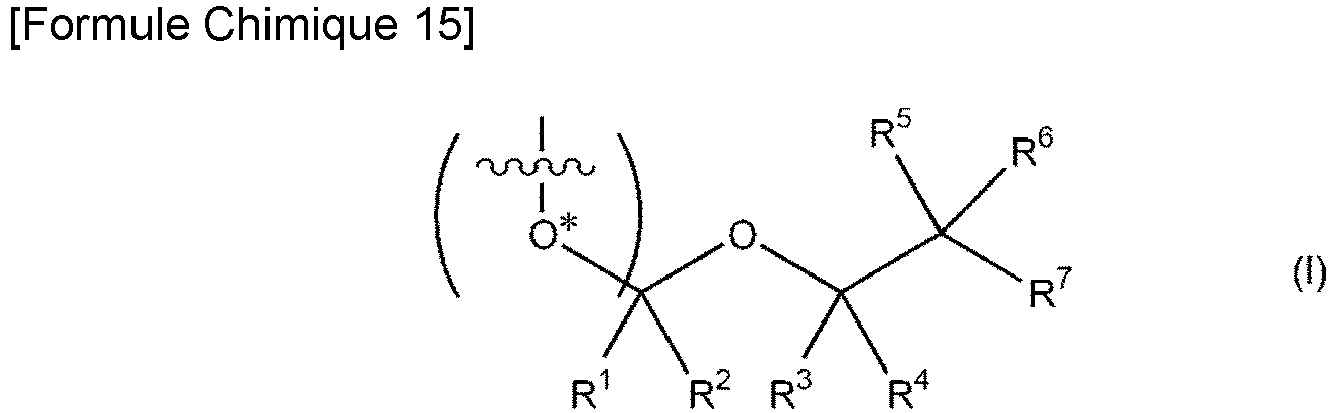 dans lequel, dans la formule I, O* représente un atome d'oxygène du groupe hydroxyle en position 2' du ribonucléoside, du ribonucléotide ou du dérivé de ceux-ci, dans lequel le groupement chimique incluant le ribose et la base d'acide nucléique dans la Formule I est incluses entre les parenthèses, le ribonucléotide est une unité constituant du RNA ; le ribonucléose inclut un ribose et une base d'acide nucléique ; un ribonucléoside phosphate est un ribonucléotide ; un dérivé du nucléotide ou du nucléoside est ceux obtenus par addition d'un ou plusieurs substituants au ribonucléoside ou au ribonucléotide constituant du RNA, où le substituant est un groupe alkyl en C1-3 ou un group en haloalkyl en C1-3 qui se substitue à un atome d'hydrogène du nucléoside ou du nucléotide ;dans lequel chacun des R1 à R5 représente un atome d'hydrogène,R6 représente un atome d'hydrogène, un atome de fluor ou un atome de chlore, etR7 représente un atome de fluor ou un atome de chlore;

- Procédé de fabrication d'un ribonucléoside, d'un ribonucléotide ou d'un dérivé de ceux-ci ayant un groupe protecteur en position 2' selon la revendication 6, comprenant en outre:un processus de réaction d'un composé représenté par la formule III avec un composé représenté par la formule II pour obtenir un composé représenté par la formule IV suivante, puis la réaction du composé représenté par la formule IV avec un alcool en C1-3 pour obtenir un composé représenté par la formule V suivante; etun processus de réaction du composé représenté par la formule V avec un halogénure de diméthoxytriphénylméthyle, pour obtenir un composé représenté par la formule VI:dans la formule IV, B représente une base d'acide nucléique qui peut être protégée par un groupe protecteur, R1 à R7 représentent les mêmes R1 à R7 que dans la formule I et R21 à R24 représentent les mêmes R21 à R24 que dans la formule II;


- Procédé de fabrication d'un ribonucléoside, d'un ribonucléotide ou d'un dérivé de ceux-ci ayant un groupe protecteur en position 2' selon la revendication 7, comprenant en outre, après le processus d'obtention du composé représenté par la formule VI:
un processus de réaction du composé représenté par la formule VI avec un composé représenté par la formule VII suivante pour obtenir un composé représenté par la formule VIII suivante: dans la formule VII,R31 à R34 peuvent être identiques ou différents, et chacun représente un atome d'hydrogène, un groupe alkyl en C1-3, ou un groupe haloalky en C1-3,R35 et R36 peuvent être identiques ou différents, et chacun représente un un groupe alkyle en C1-5 ou un groupe haloalkyle en C1-5, etR37 représente représente un atome halogène;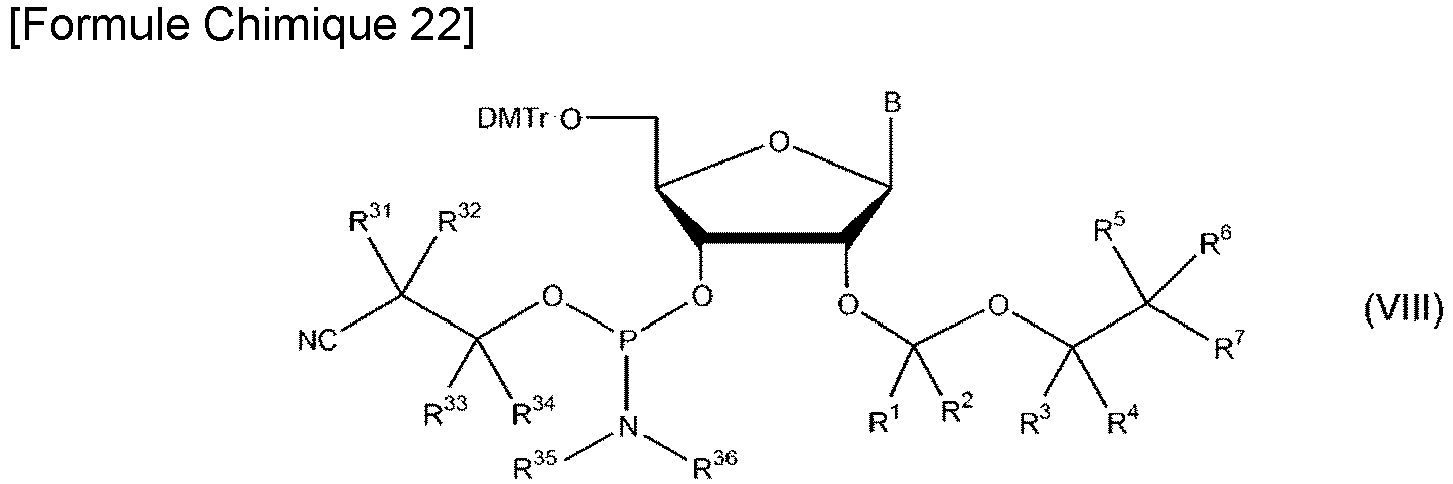
Applications Claiming Priority (2)
| Application Number | Priority Date | Filing Date | Title |
|---|---|---|---|
| US41838410P | 2010-11-30 | 2010-11-30 | |
| PCT/JP2011/077313 WO2012073857A1 (fr) | 2010-11-30 | 2011-11-28 | Arn modifié par 2'-o |
Publications (3)
| Publication Number | Publication Date |
|---|---|
| EP2647644A1 EP2647644A1 (fr) | 2013-10-09 |
| EP2647644A4 EP2647644A4 (fr) | 2014-05-14 |
| EP2647644B1 true EP2647644B1 (fr) | 2020-09-09 |
Family
ID=46171789
Family Applications (1)
| Application Number | Title | Priority Date | Filing Date |
|---|---|---|---|
| EP11844255.7A Active EP2647644B1 (fr) | 2010-11-30 | 2011-11-28 | Arn modifié par 2'-o |
Country Status (4)
| Country | Link |
|---|---|
| US (1) | US8822671B2 (fr) |
| EP (1) | EP2647644B1 (fr) |
| JP (2) | JP6093924B2 (fr) |
| WO (1) | WO2012073857A1 (fr) |
Families Citing this family (29)
| Publication number | Priority date | Publication date | Assignee | Title |
|---|---|---|---|---|
| SG171914A1 (en) | 2008-12-02 | 2011-07-28 | Chiralgen Ltd | Method for the synthesis of phosphorus atom modified nucleic acids |
| EP2451461A4 (fr) | 2009-07-06 | 2013-05-29 | Ontorii Inc | Nouveaux précurseurs d'acide nucléique et leurs méthodes d'utilisation |
| DK2620428T3 (da) | 2010-09-24 | 2019-07-01 | Wave Life Sciences Ltd | Asymmetrisk hjælpegruppe |
| EP2647644B1 (fr) * | 2010-11-30 | 2020-09-09 | Wave Life Sciences Japan, Inc. | Arn modifié par 2'-o |
| US9605019B2 (en) | 2011-07-19 | 2017-03-28 | Wave Life Sciences Ltd. | Methods for the synthesis of functionalized nucleic acids |
| DK2872485T3 (da) | 2012-07-13 | 2021-03-08 | Wave Life Sciences Ltd | Asymmetrisk hjælpegruppe |
| CN112007045B (zh) | 2012-07-13 | 2026-01-06 | 波涛生命科学有限公司 | 手性控制 |
| JP6246121B2 (ja) | 2012-07-13 | 2017-12-13 | 株式会社新日本科学 | キラル核酸アジュバント |
| WO2015108048A1 (fr) | 2014-01-15 | 2015-07-23 | 株式会社新日本科学 | Adjuvant d'acide nucléique chiral ayant un effet antitumoral et agent antitumoral |
| US10322173B2 (en) | 2014-01-15 | 2019-06-18 | Shin Nippon Biomedical Laboratories, Ltd. | Chiral nucleic acid adjuvant having anti-allergic activity, and anti-allergic agent |
| EP3095461A4 (fr) | 2014-01-15 | 2017-08-23 | Shin Nippon Biomedical Laboratories, Ltd. | Adjuvant d'acide nucléique chiral possédant une activité d'induction d'immunité, et activateur d'induction d'immunité |
| KR102423317B1 (ko) | 2014-01-16 | 2022-07-22 | 웨이브 라이프 사이언시스 리미티드 | 키랄 디자인 |
| WO2017015575A1 (fr) | 2015-07-22 | 2017-01-26 | Wave Life Sciences Ltd. | Compositions d'oligonucléotides et méthodes associées |
| EP3359523A4 (fr) | 2015-10-09 | 2019-07-24 | Wave Life Sciences Ltd. | Compositions d'oligonucléotides et procédés associés |
| AU2017234150B2 (en) | 2016-03-13 | 2021-09-16 | Wave Life Sciences Ltd. | Compositions and methods for phosphoramidite and oligonucleotide synthesis |
| JP2019516680A (ja) | 2016-05-04 | 2019-06-20 | ウェイブ ライフ サイエンシズ リミテッドWave Life Sciences Ltd. | オリゴヌクレオチド組成物およびその方法 |
| US11013757B2 (en) | 2016-06-03 | 2021-05-25 | Wave Life Sciences Ltd. | Oligonucleotides, compositions and methods thereof |
| JP7296882B2 (ja) | 2016-11-23 | 2023-06-23 | ウェイブ ライフ サイエンシズ リミテッド | ホスホラミダイト及びオリゴヌクレオチド合成のための組成物及び方法 |
| WO2018223081A1 (fr) | 2017-06-02 | 2018-12-06 | Wave Life Sciences Ltd. | Compositions d'oligonucléotides et leurs procédés d'utilisation |
| CN111050806A (zh) | 2017-06-02 | 2020-04-21 | 波涛生命科学有限公司 | 寡核苷酸组合物及其使用方法 |
| WO2018237194A1 (fr) | 2017-06-21 | 2018-12-27 | Wave Life Sciences Ltd. | Composés, compositions et procédés de synthèse |
| TW201920672A (zh) | 2017-08-08 | 2019-06-01 | 新加坡商波濤生命科學有限公司 | 寡核苷酸組合物及其使用方法 |
| US11608355B2 (en) | 2017-09-18 | 2023-03-21 | Wave Life Sciences Ltd. | Technologies for oligonucleotide preparation |
| US11596646B2 (en) | 2017-10-12 | 2023-03-07 | Wave Life Sciences Ltd. | Oligonucleotide compositions and methods thereof |
| IL277889B2 (en) | 2018-04-12 | 2025-01-01 | Wave Life Sciences Ltd | Oligonucleotide preparations and methods of using them |
| JP7280248B2 (ja) * | 2018-04-24 | 2023-05-23 | 住友化学株式会社 | アミダイト化合物及び該化合物を用いたポリヌクレオチドの製造方法 |
| SG11202010131QA (en) | 2018-05-11 | 2020-11-27 | Wave Life Sciences Ltd | Oligonucleotide compositions and methods of use thereof |
| US12590115B2 (en) | 2019-03-20 | 2026-03-31 | Wave Life Sciences Ltd. | Technologies useful for oligonucleotide preparation |
| EP4271695A2 (fr) * | 2020-12-31 | 2023-11-08 | Alnylam Pharmaceuticals, Inc. | Promédicaments oligonucléotidiques à base de nucléosides modifiés en 2' |
Family Cites Families (6)
| Publication number | Priority date | Publication date | Assignee | Title |
|---|---|---|---|---|
| JP2794461B2 (ja) * | 1989-08-17 | 1998-09-03 | 有機合成薬品工業株式会社 | ホスホアミダイト化合物及びそれを用いたオリゴリボヌクレオチドの固相合成法 |
| ES2386709T3 (es) * | 2004-08-26 | 2012-08-27 | Nippon Shinyaku Co., Ltd. | Compuesto de fosforamidita y método para producir un oligo-ARN |
| JP2009256335A (ja) | 2008-03-26 | 2009-11-05 | Univ Of Tokyo | 2’位にアルキル型保護基を有するリボ核酸の製造法 |
| CN102574888A (zh) * | 2009-09-16 | 2012-07-11 | 株式会社启拉坚 | 用于rna及其衍生物的合成的新型保护基 |
| WO2011108682A1 (fr) * | 2010-03-05 | 2011-09-09 | 国立大学法人 東京大学 | Procédé de fabrication de ribonucléoside phosphorothioate |
| EP2647644B1 (fr) * | 2010-11-30 | 2020-09-09 | Wave Life Sciences Japan, Inc. | Arn modifié par 2'-o |
-
2011
- 2011-11-28 EP EP11844255.7A patent/EP2647644B1/fr active Active
- 2011-11-28 US US13/990,441 patent/US8822671B2/en active Active
- 2011-11-28 JP JP2012546840A patent/JP6093924B2/ja active Active
- 2011-11-28 WO PCT/JP2011/077313 patent/WO2012073857A1/fr not_active Ceased
-
2016
- 2016-05-16 JP JP2016097667A patent/JP6284977B2/ja active Active
Non-Patent Citations (1)
| Title |
|---|
| None * |
Also Published As
| Publication number | Publication date |
|---|---|
| JP6093924B2 (ja) | 2017-03-15 |
| JP2016175933A (ja) | 2016-10-06 |
| WO2012073857A1 (fr) | 2012-06-07 |
| US20130253178A1 (en) | 2013-09-26 |
| JPWO2012073857A1 (ja) | 2014-05-19 |
| JP6284977B2 (ja) | 2018-02-28 |
| US8822671B2 (en) | 2014-09-02 |
| EP2647644A1 (fr) | 2013-10-09 |
| EP2647644A4 (fr) | 2014-05-14 |
Similar Documents
| Publication | Publication Date | Title |
|---|---|---|
| EP2647644A1 (fr) | Arn modifié par 2'-o | |
| EP2217612B9 (fr) | Préparation d'oligomère ribonucléotidique | |
| Chen et al. | Synthesis of oligodeoxyribonucleotide N3′→ P5′ phosphoramidates | |
| US5506351A (en) | Process for the preparation of 2'-O-alkyl guanosine and related compounds | |
| US6525191B1 (en) | Conformationally constrained L-nucleosides | |
| DE69333842T2 (de) | Neue 2'-O-Alkyl-Nukleoside und -Phosphoramidite, Verfahren zu ihrer Herstellung und ihre Verwendungen | |
| EP1792909A1 (fr) | Procédé de synthèse de polynucleotides | |
| EP3643706B1 (fr) | Monomères d'acides nucléiques modifiés et analogues d'acides oligonucléiques avec une stabilité biologique haute et une activité de silençage du gène cible, pour l'utilisation dans le traitement et le diagnostic du cancer et de maladies virales | |
| EP1795536A1 (fr) | Compose de phosphoramidite et procede de fabrication d'oligo-arn | |
| JPH11510790A (ja) | オリゴヌクレオチド合成のための改良された方法 | |
| EP2609107B1 (fr) | Procédé de synthèse d'oligoribonucléotides | |
| EP1995253B1 (fr) | Procede pour detacher un groupe protecteur d'un acide nucleique | |
| EP2006293B1 (fr) | Derive de ribonucleoside modifie par 2'-hydroxyle | |
| EP3556764A1 (fr) | Dérivé de nucléoside et utilisation associée | |
| EP1995252A1 (fr) | Procede de clivage d'un groupe protecteur d'acide nucleique | |
| CN100484949C (zh) | 用于rna寡核苷酸合成中的核苷亚磷酰胺及其合成方法 | |
| EP1541581A1 (fr) | 4'-thionucleotide | |
| EP4108670A1 (fr) | Nucléoside ponté et nucléotide l'utilisant | |
| Bogucka et al. | Facile preparation of the oxetane-nucleosides | |
| JP5205873B2 (ja) | 新規なジデオキシヌクレオシド誘導体 | |
| Andersen et al. | Nucleic acid secondary structures containing the double-headed nucleoside 5′(S)-C-(2-(thymin-1-yl) ethyl) thymidine | |
| Seela et al. | 6-Azauracil or 8-aza-7-deazaadenine nucleosides and oligonucleotides: the effect of 2′-fluoro substituents and nucleobase nitrogens on conformation and base pairing | |
| EP2647617A1 (fr) | Analogue de nucléoside ou son sel, analogue d'oligonucléotide, inhibiteur d'expression génique, et sonde d'acide nucléique pour la détection de gène | |
| EP4108262A1 (fr) | Nucléoside réticulé et nucléotide l'utilisant | |
| EP1565479B1 (fr) | Derive du ribonucleoside 2'o-silyloxymethyl trisubstitue et son procede de preparation |
Legal Events
| Date | Code | Title | Description |
|---|---|---|---|
| PUAI | Public reference made under article 153(3) epc to a published international application that has entered the european phase |
Free format text: ORIGINAL CODE: 0009012 |
|
| 17P | Request for examination filed |
Effective date: 20130611 |
|
| AK | Designated contracting states |
Kind code of ref document: A1 Designated state(s): AL AT BE BG CH CY CZ DE DK EE ES FI FR GB GR HR HU IE IS IT LI LT LU LV MC MK MT NL NO PL PT RO RS SE SI SK SM TR |
|
| DAX | Request for extension of the european patent (deleted) | ||
| A4 | Supplementary search report drawn up and despatched |
Effective date: 20140411 |
|
| RIC1 | Information provided on ipc code assigned before grant |
Ipc: C07H 19/167 20060101ALI20140407BHEP Ipc: C07H 23/00 20060101ALI20140407BHEP Ipc: C07H 19/067 20060101AFI20140407BHEP |
|
| STAA | Information on the status of an ep patent application or granted ep patent |
Free format text: STATUS: EXAMINATION IS IN PROGRESS |
|
| 17Q | First examination report despatched |
Effective date: 20161031 |
|
| RAP1 | Party data changed (applicant data changed or rights of an application transferred) |
Owner name: WAVE LIFE SCIENCES JAPAN, INC. Owner name: THE UNIVERSITY OF TOKYO |
|
| GRAP | Despatch of communication of intention to grant a patent |
Free format text: ORIGINAL CODE: EPIDOSNIGR1 |
|
| STAA | Information on the status of an ep patent application or granted ep patent |
Free format text: STATUS: GRANT OF PATENT IS INTENDED |
|
| RIC1 | Information provided on ipc code assigned before grant |
Ipc: C07H 19/167 20060101ALI20200227BHEP Ipc: C07H 23/00 20060101ALI20200227BHEP Ipc: C07H 1/00 20060101ALI20200227BHEP Ipc: C07H 19/067 20060101AFI20200227BHEP |
|
| INTG | Intention to grant announced |
Effective date: 20200401 |
|
| GRAS | Grant fee paid |
Free format text: ORIGINAL CODE: EPIDOSNIGR3 |
|
| GRAA | (expected) grant |
Free format text: ORIGINAL CODE: 0009210 |
|
| STAA | Information on the status of an ep patent application or granted ep patent |
Free format text: STATUS: THE PATENT HAS BEEN GRANTED |
|
| AK | Designated contracting states |
Kind code of ref document: B1 Designated state(s): AL AT BE BG CH CY CZ DE DK EE ES FI FR GB GR HR HU IE IS IT LI LT LU LV MC MK MT NL NO PL PT RO RS SE SI SK SM TR |
|
| REG | Reference to a national code |
Ref country code: GB Ref legal event code: FG4D |
|
| REG | Reference to a national code |
Ref country code: AT Ref legal event code: REF Ref document number: 1311441 Country of ref document: AT Kind code of ref document: T Effective date: 20200915 Ref country code: CH Ref legal event code: EP |
|
| REG | Reference to a national code |
Ref country code: DE Ref legal event code: R096 Ref document number: 602011068568 Country of ref document: DE |
|
| REG | Reference to a national code |
Ref country code: IE Ref legal event code: FG4D |
|
| REG | Reference to a national code |
Ref country code: LT Ref legal event code: MG4D |
|
| PG25 | Lapsed in a contracting state [announced via postgrant information from national office to epo] |
Ref country code: FI Free format text: LAPSE BECAUSE OF FAILURE TO SUBMIT A TRANSLATION OF THE DESCRIPTION OR TO PAY THE FEE WITHIN THE PRESCRIBED TIME-LIMIT Effective date: 20200909 Ref country code: NO Free format text: LAPSE BECAUSE OF FAILURE TO SUBMIT A TRANSLATION OF THE DESCRIPTION OR TO PAY THE FEE WITHIN THE PRESCRIBED TIME-LIMIT Effective date: 20201209 Ref country code: LT Free format text: LAPSE BECAUSE OF FAILURE TO SUBMIT A TRANSLATION OF THE DESCRIPTION OR TO PAY THE FEE WITHIN THE PRESCRIBED TIME-LIMIT Effective date: 20200909 Ref country code: BG Free format text: LAPSE BECAUSE OF FAILURE TO SUBMIT A TRANSLATION OF THE DESCRIPTION OR TO PAY THE FEE WITHIN THE PRESCRIBED TIME-LIMIT Effective date: 20201209 Ref country code: SE Free format text: LAPSE BECAUSE OF FAILURE TO SUBMIT A TRANSLATION OF THE DESCRIPTION OR TO PAY THE FEE WITHIN THE PRESCRIBED TIME-LIMIT Effective date: 20200909 Ref country code: GR Free format text: LAPSE BECAUSE OF FAILURE TO SUBMIT A TRANSLATION OF THE DESCRIPTION OR TO PAY THE FEE WITHIN THE PRESCRIBED TIME-LIMIT Effective date: 20201210 Ref country code: HR Free format text: LAPSE BECAUSE OF FAILURE TO SUBMIT A TRANSLATION OF THE DESCRIPTION OR TO PAY THE FEE WITHIN THE PRESCRIBED TIME-LIMIT Effective date: 20200909 |
|
| REG | Reference to a national code |
Ref country code: AT Ref legal event code: MK05 Ref document number: 1311441 Country of ref document: AT Kind code of ref document: T Effective date: 20200909 |
|
| REG | Reference to a national code |
Ref country code: NL Ref legal event code: MP Effective date: 20200909 |
|
| PG25 | Lapsed in a contracting state [announced via postgrant information from national office to epo] |
Ref country code: PL Free format text: LAPSE BECAUSE OF FAILURE TO SUBMIT A TRANSLATION OF THE DESCRIPTION OR TO PAY THE FEE WITHIN THE PRESCRIBED TIME-LIMIT Effective date: 20200909 Ref country code: LV Free format text: LAPSE BECAUSE OF FAILURE TO SUBMIT A TRANSLATION OF THE DESCRIPTION OR TO PAY THE FEE WITHIN THE PRESCRIBED TIME-LIMIT Effective date: 20200909 Ref country code: RS Free format text: LAPSE BECAUSE OF FAILURE TO SUBMIT A TRANSLATION OF THE DESCRIPTION OR TO PAY THE FEE WITHIN THE PRESCRIBED TIME-LIMIT Effective date: 20200909 |
|
| PG25 | Lapsed in a contracting state [announced via postgrant information from national office to epo] |
Ref country code: NL Free format text: LAPSE BECAUSE OF FAILURE TO SUBMIT A TRANSLATION OF THE DESCRIPTION OR TO PAY THE FEE WITHIN THE PRESCRIBED TIME-LIMIT Effective date: 20200909 Ref country code: PT Free format text: LAPSE BECAUSE OF FAILURE TO SUBMIT A TRANSLATION OF THE DESCRIPTION OR TO PAY THE FEE WITHIN THE PRESCRIBED TIME-LIMIT Effective date: 20210111 Ref country code: SM Free format text: LAPSE BECAUSE OF FAILURE TO SUBMIT A TRANSLATION OF THE DESCRIPTION OR TO PAY THE FEE WITHIN THE PRESCRIBED TIME-LIMIT Effective date: 20200909 Ref country code: RO Free format text: LAPSE BECAUSE OF FAILURE TO SUBMIT A TRANSLATION OF THE DESCRIPTION OR TO PAY THE FEE WITHIN THE PRESCRIBED TIME-LIMIT Effective date: 20200909 Ref country code: EE Free format text: LAPSE BECAUSE OF FAILURE TO SUBMIT A TRANSLATION OF THE DESCRIPTION OR TO PAY THE FEE WITHIN THE PRESCRIBED TIME-LIMIT Effective date: 20200909 Ref country code: CZ Free format text: LAPSE BECAUSE OF FAILURE TO SUBMIT A TRANSLATION OF THE DESCRIPTION OR TO PAY THE FEE WITHIN THE PRESCRIBED TIME-LIMIT Effective date: 20200909 |
|
| PG25 | Lapsed in a contracting state [announced via postgrant information from national office to epo] |
Ref country code: AT Free format text: LAPSE BECAUSE OF FAILURE TO SUBMIT A TRANSLATION OF THE DESCRIPTION OR TO PAY THE FEE WITHIN THE PRESCRIBED TIME-LIMIT Effective date: 20200909 Ref country code: AL Free format text: LAPSE BECAUSE OF FAILURE TO SUBMIT A TRANSLATION OF THE DESCRIPTION OR TO PAY THE FEE WITHIN THE PRESCRIBED TIME-LIMIT Effective date: 20200909 Ref country code: IS Free format text: LAPSE BECAUSE OF FAILURE TO SUBMIT A TRANSLATION OF THE DESCRIPTION OR TO PAY THE FEE WITHIN THE PRESCRIBED TIME-LIMIT Effective date: 20210109 Ref country code: ES Free format text: LAPSE BECAUSE OF FAILURE TO SUBMIT A TRANSLATION OF THE DESCRIPTION OR TO PAY THE FEE WITHIN THE PRESCRIBED TIME-LIMIT Effective date: 20200909 |
|
| REG | Reference to a national code |
Ref country code: DE Ref legal event code: R097 Ref document number: 602011068568 Country of ref document: DE |
|
| PG25 | Lapsed in a contracting state [announced via postgrant information from national office to epo] |
Ref country code: MC Free format text: LAPSE BECAUSE OF FAILURE TO SUBMIT A TRANSLATION OF THE DESCRIPTION OR TO PAY THE FEE WITHIN THE PRESCRIBED TIME-LIMIT Effective date: 20200909 Ref country code: SK Free format text: LAPSE BECAUSE OF FAILURE TO SUBMIT A TRANSLATION OF THE DESCRIPTION OR TO PAY THE FEE WITHIN THE PRESCRIBED TIME-LIMIT Effective date: 20200909 |
|
| REG | Reference to a national code |
Ref country code: CH Ref legal event code: PL |
|
| PLBE | No opposition filed within time limit |
Free format text: ORIGINAL CODE: 0009261 |
|
| STAA | Information on the status of an ep patent application or granted ep patent |
Free format text: STATUS: NO OPPOSITION FILED WITHIN TIME LIMIT |
|
| PG25 | Lapsed in a contracting state [announced via postgrant information from national office to epo] |
Ref country code: LU Free format text: LAPSE BECAUSE OF NON-PAYMENT OF DUE FEES Effective date: 20201128 |
|
| REG | Reference to a national code |
Ref country code: BE Ref legal event code: MM Effective date: 20201130 |
|
| 26N | No opposition filed |
Effective date: 20210610 |
|
| PG25 | Lapsed in a contracting state [announced via postgrant information from national office to epo] |
Ref country code: DK Free format text: LAPSE BECAUSE OF FAILURE TO SUBMIT A TRANSLATION OF THE DESCRIPTION OR TO PAY THE FEE WITHIN THE PRESCRIBED TIME-LIMIT Effective date: 20200909 Ref country code: CH Free format text: LAPSE BECAUSE OF NON-PAYMENT OF DUE FEES Effective date: 20201130 Ref country code: LI Free format text: LAPSE BECAUSE OF NON-PAYMENT OF DUE FEES Effective date: 20201130 Ref country code: SI Free format text: LAPSE BECAUSE OF FAILURE TO SUBMIT A TRANSLATION OF THE DESCRIPTION OR TO PAY THE FEE WITHIN THE PRESCRIBED TIME-LIMIT Effective date: 20200909 |
|
| PG25 | Lapsed in a contracting state [announced via postgrant information from national office to epo] |
Ref country code: IT Free format text: LAPSE BECAUSE OF FAILURE TO SUBMIT A TRANSLATION OF THE DESCRIPTION OR TO PAY THE FEE WITHIN THE PRESCRIBED TIME-LIMIT Effective date: 20200909 Ref country code: IE Free format text: LAPSE BECAUSE OF NON-PAYMENT OF DUE FEES Effective date: 20201128 |
|
| PG25 | Lapsed in a contracting state [announced via postgrant information from national office to epo] |
Ref country code: TR Free format text: LAPSE BECAUSE OF FAILURE TO SUBMIT A TRANSLATION OF THE DESCRIPTION OR TO PAY THE FEE WITHIN THE PRESCRIBED TIME-LIMIT Effective date: 20200909 Ref country code: MT Free format text: LAPSE BECAUSE OF FAILURE TO SUBMIT A TRANSLATION OF THE DESCRIPTION OR TO PAY THE FEE WITHIN THE PRESCRIBED TIME-LIMIT Effective date: 20200909 Ref country code: CY Free format text: LAPSE BECAUSE OF FAILURE TO SUBMIT A TRANSLATION OF THE DESCRIPTION OR TO PAY THE FEE WITHIN THE PRESCRIBED TIME-LIMIT Effective date: 20200909 |
|
| PG25 | Lapsed in a contracting state [announced via postgrant information from national office to epo] |
Ref country code: MK Free format text: LAPSE BECAUSE OF FAILURE TO SUBMIT A TRANSLATION OF THE DESCRIPTION OR TO PAY THE FEE WITHIN THE PRESCRIBED TIME-LIMIT Effective date: 20200909 |
|
| PG25 | Lapsed in a contracting state [announced via postgrant information from national office to epo] |
Ref country code: BE Free format text: LAPSE BECAUSE OF NON-PAYMENT OF DUE FEES Effective date: 20201130 |
|
| PGFP | Annual fee paid to national office [announced via postgrant information from national office to epo] |
Ref country code: DE Payment date: 20251128 Year of fee payment: 15 |
|
| PGFP | Annual fee paid to national office [announced via postgrant information from national office to epo] |
Ref country code: GB Payment date: 20251127 Year of fee payment: 15 |
|
| PGFP | Annual fee paid to national office [announced via postgrant information from national office to epo] |
Ref country code: FR Payment date: 20251125 Year of fee payment: 15 |