EP2647723A2 - Améliorations se rapportant à un appareil de test de micro-organismes et leurs procédés d'utilisation - Google Patents
Améliorations se rapportant à un appareil de test de micro-organismes et leurs procédés d'utilisation Download PDFInfo
- Publication number
- EP2647723A2 EP2647723A2 EP12184133.2A EP12184133A EP2647723A2 EP 2647723 A2 EP2647723 A2 EP 2647723A2 EP 12184133 A EP12184133 A EP 12184133A EP 2647723 A2 EP2647723 A2 EP 2647723A2
- Authority
- EP
- European Patent Office
- Prior art keywords
- barrier
- container
- compartment
- micro
- growth
- Prior art date
- Legal status (The legal status is an assumption and is not a legal conclusion. Google has not performed a legal analysis and makes no representation as to the accuracy of the status listed.)
- Granted
Links
- 238000012360 testing method Methods 0.000 title claims abstract description 69
- 244000005700 microbiome Species 0.000 title claims abstract description 35
- 238000000034 method Methods 0.000 title description 13
- 230000004888 barrier function Effects 0.000 claims abstract description 52
- 239000001963 growth medium Substances 0.000 claims abstract description 51
- 239000000654 additive Substances 0.000 claims abstract description 29
- 230000000996 additive effect Effects 0.000 claims abstract description 26
- 230000007246 mechanism Effects 0.000 claims abstract description 24
- 239000000463 material Substances 0.000 claims abstract description 12
- 239000002609 medium Substances 0.000 claims abstract description 8
- 239000004033 plastic Substances 0.000 claims abstract description 8
- 229920003023 plastic Polymers 0.000 claims abstract description 8
- 239000011521 glass Substances 0.000 claims abstract description 3
- 230000000844 anti-bacterial effect Effects 0.000 claims abstract 3
- 239000003899 bactericide agent Substances 0.000 claims abstract 3
- 239000011888 foil Substances 0.000 claims description 11
- 230000000994 depressogenic effect Effects 0.000 claims description 10
- 239000003086 colorant Substances 0.000 claims 1
- 241000894006 Bacteria Species 0.000 description 36
- 239000003795 chemical substances by application Substances 0.000 description 15
- 210000003739 neck Anatomy 0.000 description 12
- 230000000007 visual effect Effects 0.000 description 10
- 239000000047 product Substances 0.000 description 8
- 230000001580 bacterial effect Effects 0.000 description 7
- 239000007844 bleaching agent Substances 0.000 description 6
- 230000008859 change Effects 0.000 description 6
- XLYOFNOQVPJJNP-UHFFFAOYSA-N water Substances O XLYOFNOQVPJJNP-UHFFFAOYSA-N 0.000 description 6
- 235000013372 meat Nutrition 0.000 description 5
- 230000000295 complement effect Effects 0.000 description 4
- 235000013336 milk Nutrition 0.000 description 4
- 239000008267 milk Substances 0.000 description 4
- 210000004080 milk Anatomy 0.000 description 4
- 239000000203 mixture Substances 0.000 description 4
- 210000002445 nipple Anatomy 0.000 description 4
- 239000002904 solvent Substances 0.000 description 4
- 241000251730 Chondrichthyes Species 0.000 description 3
- 239000003242 anti bacterial agent Substances 0.000 description 3
- 229940088710 antibiotic agent Drugs 0.000 description 3
- 238000013461 design Methods 0.000 description 3
- 229920001971 elastomer Polymers 0.000 description 3
- -1 foodstuffs Substances 0.000 description 3
- 239000007788 liquid Substances 0.000 description 3
- 230000002906 microbiologic effect Effects 0.000 description 3
- 239000004698 Polyethylene Substances 0.000 description 2
- FAPWRFPIFSIZLT-UHFFFAOYSA-M Sodium chloride Chemical compound [Na+].[Cl-] FAPWRFPIFSIZLT-UHFFFAOYSA-M 0.000 description 2
- 230000003115 biocidal effect Effects 0.000 description 2
- 230000002147 killing effect Effects 0.000 description 2
- 235000015097 nutrients Nutrition 0.000 description 2
- 230000000149 penetrating effect Effects 0.000 description 2
- 230000002093 peripheral effect Effects 0.000 description 2
- 229920000573 polyethylene Polymers 0.000 description 2
- 239000000843 powder Substances 0.000 description 2
- 230000002265 prevention Effects 0.000 description 2
- 239000007787 solid Substances 0.000 description 2
- 239000000243 solution Substances 0.000 description 2
- 238000010998 test method Methods 0.000 description 2
- 241001631457 Cannula Species 0.000 description 1
- 241000233866 Fungi Species 0.000 description 1
- 244000043261 Hevea brasiliensis Species 0.000 description 1
- 239000001888 Peptone Substances 0.000 description 1
- 108010080698 Peptones Proteins 0.000 description 1
- PLXBWHJQWKZRKG-UHFFFAOYSA-N Resazurin Chemical compound C1=CC(=O)C=C2OC3=CC(O)=CC=C3[N+]([O-])=C21 PLXBWHJQWKZRKG-UHFFFAOYSA-N 0.000 description 1
- 240000004808 Saccharomyces cerevisiae Species 0.000 description 1
- 238000010521 absorption reaction Methods 0.000 description 1
- 230000009471 action Effects 0.000 description 1
- 238000004458 analytical method Methods 0.000 description 1
- 239000003833 bile salt Substances 0.000 description 1
- 229940093761 bile salts Drugs 0.000 description 1
- 239000003139 biocide Substances 0.000 description 1
- 239000012620 biological material Substances 0.000 description 1
- 229960001506 brilliant green Drugs 0.000 description 1
- HXCILVUBKWANLN-UHFFFAOYSA-N brilliant green cation Chemical compound C1=CC(N(CC)CC)=CC=C1C(C=1C=CC=CC=1)=C1C=CC(=[N+](CC)CC)C=C1 HXCILVUBKWANLN-UHFFFAOYSA-N 0.000 description 1
- 238000013098 chemical test method Methods 0.000 description 1
- 238000004140 cleaning Methods 0.000 description 1
- 238000011109 contamination Methods 0.000 description 1
- 238000013270 controlled release Methods 0.000 description 1
- 239000002537 cosmetic Substances 0.000 description 1
- 230000003247 decreasing effect Effects 0.000 description 1
- 238000001514 detection method Methods 0.000 description 1
- 238000002405 diagnostic procedure Methods 0.000 description 1
- AIUDWMLXCFRVDR-UHFFFAOYSA-N dimethyl 2-(3-ethyl-3-methylpentyl)propanedioate Chemical class CCC(C)(CC)CCC(C(=O)OC)C(=O)OC AIUDWMLXCFRVDR-UHFFFAOYSA-N 0.000 description 1
- 239000003814 drug Substances 0.000 description 1
- 230000000694 effects Effects 0.000 description 1
- 210000003811 finger Anatomy 0.000 description 1
- 239000012530 fluid Substances 0.000 description 1
- GNBHRKFJIUUOQI-UHFFFAOYSA-N fluorescein Chemical compound O1C(=O)C2=CC=CC=C2C21C1=CC=C(O)C=C1OC1=CC(O)=CC=C21 GNBHRKFJIUUOQI-UHFFFAOYSA-N 0.000 description 1
- 235000013305 food Nutrition 0.000 description 1
- 230000005484 gravity Effects 0.000 description 1
- 239000007952 growth promoter Substances 0.000 description 1
- 238000011835 investigation Methods 0.000 description 1
- 230000000670 limiting effect Effects 0.000 description 1
- 230000013011 mating Effects 0.000 description 1
- 238000010339 medical test Methods 0.000 description 1
- 230000002503 metabolic effect Effects 0.000 description 1
- 230000000877 morphologic effect Effects 0.000 description 1
- 229920003052 natural elastomer Polymers 0.000 description 1
- 229920001194 natural rubber Polymers 0.000 description 1
- 230000036961 partial effect Effects 0.000 description 1
- 239000002245 particle Substances 0.000 description 1
- 239000013618 particulate matter Substances 0.000 description 1
- 235000019319 peptone Nutrition 0.000 description 1
- 229940066779 peptones Drugs 0.000 description 1
- 230000002028 premature Effects 0.000 description 1
- 238000002360 preparation method Methods 0.000 description 1
- 230000005180 public health Effects 0.000 description 1
- 238000011084 recovery Methods 0.000 description 1
- 230000002829 reductive effect Effects 0.000 description 1
- 238000011012 sanitization Methods 0.000 description 1
- 238000007789 sealing Methods 0.000 description 1
- 239000011780 sodium chloride Substances 0.000 description 1
- 239000012265 solid product Substances 0.000 description 1
- 238000001179 sorption measurement Methods 0.000 description 1
- 241000894007 species Species 0.000 description 1
- 230000001954 sterilising effect Effects 0.000 description 1
- 235000000346 sugar Nutrition 0.000 description 1
- 150000008163 sugars Chemical class 0.000 description 1
- 239000012085 test solution Substances 0.000 description 1
- 238000012956 testing procedure Methods 0.000 description 1
- 210000003813 thumb Anatomy 0.000 description 1
- 239000000080 wetting agent Substances 0.000 description 1
Images



Classifications
-
- C—CHEMISTRY; METALLURGY
- C12—BIOCHEMISTRY; BEER; SPIRITS; WINE; VINEGAR; MICROBIOLOGY; ENZYMOLOGY; MUTATION OR GENETIC ENGINEERING
- C12Q—MEASURING OR TESTING PROCESSES INVOLVING ENZYMES, NUCLEIC ACIDS OR MICROORGANISMS; COMPOSITIONS OR TEST PAPERS THEREFOR; PROCESSES OF PREPARING SUCH COMPOSITIONS; CONDITION-RESPONSIVE CONTROL IN MICROBIOLOGICAL OR ENZYMOLOGICAL PROCESSES
- C12Q1/00—Measuring or testing processes involving enzymes, nucleic acids or microorganisms; Compositions therefor; Processes of preparing such compositions
- C12Q1/02—Measuring or testing processes involving enzymes, nucleic acids or microorganisms; Compositions therefor; Processes of preparing such compositions involving viable microorganisms
- C12Q1/04—Determining presence or kind of microorganism; Use of selective media for testing antibiotics or bacteriocides; Compositions containing a chemical indicator therefor
- C12Q1/06—Quantitative determination
- C12Q1/08—Quantitative determination using multifield media
-
- C—CHEMISTRY; METALLURGY
- C12—BIOCHEMISTRY; BEER; SPIRITS; WINE; VINEGAR; MICROBIOLOGY; ENZYMOLOGY; MUTATION OR GENETIC ENGINEERING
- C12M—APPARATUS FOR ENZYMOLOGY OR MICROBIOLOGY; APPARATUS FOR CULTURING MICROORGANISMS FOR PRODUCING BIOMASS, FOR GROWING CELLS OR FOR OBTAINING FERMENTATION OR METABOLIC PRODUCTS, i.e. BIOREACTORS OR FERMENTERS
- C12M23/00—Constructional details, e.g. recesses, hinges
- C12M23/34—Internal compartments or partitions
-
- C—CHEMISTRY; METALLURGY
- C12—BIOCHEMISTRY; BEER; SPIRITS; WINE; VINEGAR; MICROBIOLOGY; ENZYMOLOGY; MUTATION OR GENETIC ENGINEERING
- C12M—APPARATUS FOR ENZYMOLOGY OR MICROBIOLOGY; APPARATUS FOR CULTURING MICROORGANISMS FOR PRODUCING BIOMASS, FOR GROWING CELLS OR FOR OBTAINING FERMENTATION OR METABOLIC PRODUCTS, i.e. BIOREACTORS OR FERMENTERS
- C12M41/00—Means for regulation, monitoring, measurement or control, e.g. flow regulation
- C12M41/30—Means for regulation, monitoring, measurement or control, e.g. flow regulation of concentration
- C12M41/36—Means for regulation, monitoring, measurement or control, e.g. flow regulation of concentration of biomass, e.g. colony counters or by turbidity measurements
-
- C—CHEMISTRY; METALLURGY
- C12—BIOCHEMISTRY; BEER; SPIRITS; WINE; VINEGAR; MICROBIOLOGY; ENZYMOLOGY; MUTATION OR GENETIC ENGINEERING
- C12Q—MEASURING OR TESTING PROCESSES INVOLVING ENZYMES, NUCLEIC ACIDS OR MICROORGANISMS; COMPOSITIONS OR TEST PAPERS THEREFOR; PROCESSES OF PREPARING SUCH COMPOSITIONS; CONDITION-RESPONSIVE CONTROL IN MICROBIOLOGICAL OR ENZYMOLOGICAL PROCESSES
- C12Q1/00—Measuring or testing processes involving enzymes, nucleic acids or microorganisms; Compositions therefor; Processes of preparing such compositions
- C12Q1/02—Measuring or testing processes involving enzymes, nucleic acids or microorganisms; Compositions therefor; Processes of preparing such compositions involving viable microorganisms
- C12Q1/04—Determining presence or kind of microorganism; Use of selective media for testing antibiotics or bacteriocides; Compositions containing a chemical indicator therefor
-
- Y—GENERAL TAGGING OF NEW TECHNOLOGICAL DEVELOPMENTS; GENERAL TAGGING OF CROSS-SECTIONAL TECHNOLOGIES SPANNING OVER SEVERAL SECTIONS OF THE IPC; TECHNICAL SUBJECTS COVERED BY FORMER USPC CROSS-REFERENCE ART COLLECTIONS [XRACs] AND DIGESTS
- Y10—TECHNICAL SUBJECTS COVERED BY FORMER USPC
- Y10T—TECHNICAL SUBJECTS COVERED BY FORMER US CLASSIFICATION
- Y10T436/00—Chemistry: analytical and immunological testing
- Y10T436/17—Nitrogen containing
- Y10T436/173076—Nitrite or nitrate
Definitions
- the present invention relates to improvements in and relating to the detection of micro-organisms, in particular, apparatus adapted to grow the micro-organisms and test apparatus to test the grown micro-organisms as well as a method of detecting micro-organisms using one or both types of apparatus.
- One such technique currently carried out by the Applicant involves the use of a growth medium already stored in an evacuated UV light penetrative, clear plastics container that is sealed with a rubber septum.
- the liquid sample to be tested is introduced into the container through the septum via a needle or some other form of cannulas, the pressure difference ensuring that the sample is "sucked” into the container.
- the sample is then incubated and tested for specific or broad types of micro-organisms using visual techniques.
- the bacteria although present in un-detectably small quantities are nevertheless still present and multiply and under the right conditions, given the shelf life of the product, may be able to recover to the extent that the bacteria are suddenly present in sufficient quantity to cause harm once the product is consumed.
- shelf life recovery is a serious one in many types of industry and very few solutions to this problem apart from limiting the shelf life of the product to a very small time frame have been proposed.
- micro-organism testing kits (of the type described above) have relatively low shelf lives "out in the field” as UV light tends to kill the growth medium contained therein.
- the material once tested may or may not be a bio-hazard and disposal of such materials is expensive and legislation in this area is only ever going to increase the cost of disposal of such materials.
- a micro-organism testing apparatus for carrying out tests for or involving micro-organisms comprising a multi-compartment resealable container provided with or adapted to receive a growth medium in one compartment and having a growth medium additive in another compartment, the compartments being separated by a barrier whose removal or puncture will expose the medium to the additive.
- the growth medium additive is an agent (for example bleach or a product known by the Registered Trade Mark VERKON ®) capable of killing the micro-organisms within the container.
- an agent for example bleach or a product known by the Registered Trade Mark VERKON ®
- the biohazard problem can, in principle, be 'reduced' or eliminated entirely.
- the resealable nature of the container could be something as simple as a rubber septum, it is preferable if it were some form of removable lid. If the septum variant is employed, a moveable cannula could be fitted to the apparatus inside a sleeve that is fits over the septum to allow safe use of the cannula when using it to pass a sample into the apparatus.
- the apparatus has at least three compartments, the third containing a further additive.
- This further additive may include bacteria. This would be useful if the test sample is milk. If antibiotics are present in the milk, the bacteria may be killed by the antibiotics providing a test result for the presence of the antibiotic but if the bacteria flourish, then the milk sample may be viewed as antibiotic free. This demonstrates a test involving (but not for) micro-organisms.
- this additive may include a bacterium or micro-organisms specific detector, growth promotant, selective growth promotant, growth metabolic or biochemical indicator selective growth agent and a non specific container sterilising medium.
- the apparatus comprises a tubular body portion provided with screw threads at either end and two closure members each containing complementary screw threads and each containing a compartment (sealed by one or more barriers), housing at least one additive and a similar number of barrier removal or puncture mechanism.
- the removal of the barrier could for example constitute a pair of apertured completely overlying concentric rotatable discs where in one position the apertures of one disc do not overlie the apertures of the second disc thus presenting a "sealed” barrier and upon rotation of one disc relative to the other, at least some of the apertures align removing the "sealed” nature of the barrier to allow either the growth medium or additive to enter the rest of the apparatus.
- the barrier may simply be removable by tearing it off.
- the apparatus comprises a barrier puncture mechanism adapted to move from a first barrier intact position to a second barrier punctured position.
- a barrier puncture mechanism adapted to move from a first barrier intact position to a second barrier punctured position.
- Such a mechanism may be resilient so that once it has been moved from its first to its second position, it can recover and return automatically to its first position again.
- the rotation of the discs could cause the barrier (if it were made of foil) to tear.
- the movement of the puncture mechanism is a translational movement. This does not necessarily mean that actuation of the puncture mechanism is through a translational movement (although it probably will be), one could envisage a scenario whereby rotation of the puncture mechanism causes it to move in a translational direction, similar to the rotary action of a domestic tap that causes the spindle to move translational manner to enable water to flow.
- the barrier puncture mechanism is provided with means to prevent accidental actuation of the mechanism.
- the means are in the form of a locking member adapted to lock the mechanism in its first position.
- barrier there may be multiple barriers or only one (if it were to comprise a pair of wells one housing the growth medium and the other housing an additive), however, preferably there is more than one barrier.
- barrier puncture mechanism which may or may not be identical in design to the first. If there are two, they may be located at opposite ends of the apparatus.
- the additive may be a so-called controlled release additive.
- it could be a timed release additive in the sense that a barrier puncture mechanism could be so operatively connected to the apparatus as to puncture a barrier containing additive after a timed delay via a "press and forget" system which a person skilled in the art would be able to design.
- the additive may be in the form of a tablet, a powder, a liquid or a strip of material impregnated with the additive through liquid absorption or adsorption.
- the design of the apparatus could be such that once an additive has been added via the removal of a barrier, access to the interior of the container would not normally be possible.
- the apparatus could be provided with a lockable lid that could only be locked once a lock prevention device has been removed from the apparatus.
- This lock prevention device could be a barrier in the form of a tub or cup or removable gasket.
- each additive is enclosed within its own barrier and its own barrier puncture or removal mechanism.
- growth promotant means anything that enables bacteria to grow or provide an environment in which more rapid growth can occur and typical growth promotants include water, sugars, peptones and particulate matter.
- a selective growth agent includes one which either inhibits growth of all the bacteria that is not the subject of investigation or is specifically required by the species being investigated for growth and typical selective growth agents include sodium chloride and bile salts or selective antibiotics.
- Typical growth indicators include resazurin, fluorescein and brilliant green.
- each barrier puncture mechanism once actuated is adapted to release a separate additive.
- the apparatus could comprise many types of plastics or glass material, it is preferable if the body of the apparatus absorbs UV light and does not allow it to pass through the apparatus.
- the apparatus incorporates a swab that may or may not be integral with part of the apparatus and which may or may not be supplied with a wetting agent which may be a non specific growth medium.
- the apparatus is provided with a mesh or sieve to filter or trap solid particles of a test specimen whilst allowing the growth medium to interact with the specimen.
- the mesh or sieve is integrally locked or forms an integral part of the apparatus.
- the mesh size is in the range of 25-250 microns, more preferably 70-200 microns.
- the micro-organism under test could be fungi, yeast or protozoa, however, preferably the micro-organism that is going to be tested for is a bacterium or a number of different strains of bacteria.
- the invention includes within its scope micro-organism testing apparatus substantially as herein described with reference to and as illustrated in the accompanying drawings.
- the invention also includes within its scope a testing apparatus fitted with one or more micro-organism testing apparatus's as specified herein
- the testing apparatus may be adapted to warm the test sample up to 37 degrees or more.
- the micro-organism is a bacterium.
- a method of testing for at least one type of micro-organism comprising the steps of:
- Unsealing the container may be achieved through the puncturing of a rubber septum.
- the barrier is removed by puncturing it.
- the growth medium is an aqueous growth medium.
- the method further includes the step of placing the apparatus into the test apparatus in appendix 1 to obtain the test results.
- the apparatus and the methods of testing described herein provide a self contained kit for testing material that does not require the use of a laboratory, can combine tests for multiple types of micro-organisms in the same piece of apparatus and is simple to use (you do not need to be a trained scientist to use or indeed understand how to use the apparatus) and is safe to use.
- the tested material can be sanitized or rendered safe, again without the tester being able to contact the tested sample.
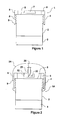
- Figure 1 shows one embodiment of a bacterium testing apparatus comprising a screw threaded container generally referenced 1.
- the container 1 comprises a body 2 containing an aqueous growth medium 3 and a lid 4.
- the internal face of the lid 4 about its circumferential periphery is provided with resilient wadding 5 adapted to create a water tight seal with the body 2 when the lid 4 is tightly screwed to the body 2 via the mating threads 8.
- a foil barrier 6 overlies and mates with the circumferential peripheral face or mouth of the body 2 in a watertight manner.
- the barrier 6 is provided with a tag 9 (that reveals itself when the lid 4 is removed), to enable the barrier 6 to be removed from the mouth of the body 2 of the container 1 when the lid 2 has been unscrewed from the body 2.
- Substantially centrally located on the internal face of the lid 4 is a circular sheet of filter paper 7 impregnated with a bacterium testing agent.
- the lid 4 is unscrewed from the body 2 by an individual (not illustrated) who is about to perform the bacterial test. Then the individual grabs the tag 9 and pulling the tag 9 swiftly across the mouth of the body of the container 2 removes the barrier 6 exposing the growth medium 3 held within the body 2 of the container 1 for the first time.
- the sample to be tested (not illustrated) in this particular example is milk powder and the tester is going to be looking for coliform bacteria.
- the sample is then placed into the medium 3 and the lid 4 screwed tightly back onto the body 2 of the container 1, the resilient wadding 5 forming a watertight seal for the container 1.
- Subsequent inversion or shaking of the container 1 causes mixing of the bacterium testing agent with the growth medium/sample mixture or growth medium solvent/dissolved sample solute.
- the container 1 is then placed in an incubator and warmed to 37 degrees for an adequate passage of time. Removal of the container 1 and a visual check of the growth medium 3 will tell whether the bacterium is present because the growth medium will have experienced a visible colour change.
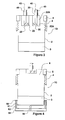
- FIG. 2 shows a different embodiment to that shown in figure 1 although the general features of the apparatus generally referenced 1A are the same as previously described hereinabove.
- a cylindrical foil pocket 22 instead of a piece of filter paper impregnated with a bacterium testing agent, there is provided a cylindrical foil pocket 22 containing a bacterium testing agent 23.
- the pocket 22 is centrally located on the internal face of the lid 4, with the mouth of the pocket 22 permanently sealed to the internal face of the lid 4.
- Concentric with the pocket 22 and located on the exterior surface of the lid 4 is an upwardly projecting sleeve 21 that acts as a guide for and houses a sliding plunger 20.
- the top of the plunger 20 is provided with a flange that overlies the sleeve 21 and acts as a stop member to prevent the plunger 20 from moving beyond a certain point when depressed and the base portion of the plunger 20 is provided with a cutting edge to puncture the base of the pocket 22 when it is depressed.
- This "guard” 24 also acts as a visual tamper proof check to see if the container 1A has already been opened.
- the guard 24 is broken and subsequently removed by an individual (not illustrated) who is about to perform the bacterial test. Then the lid 4 is unscrewed from the body 2 by the individual. Then the individual grabs the tag 9 and pulling the tag 9 swiftly across the mouth of the body of the container 2 removes the barrier 6 exposing the growth medium 3 held within the body 2 of the container 1A for the first time.
- the item to be tested (not illustrated) is then placed into the medium 3 and the lid 4 screwed tightly back onto the body 2 of the container 1A, the resilient wadding 5 forming a watertight seal for the container 1A.
- the plunger 20 is then depressed puncturing the pocket 22 and allowing the pocket's contents 23 to mix with the growth medium 3 and sample.
- Subsequent inversion or shaking of the container 1A causes further mixing of the bacterium testing agent 23 with the growth medium/sample mixture or growth medium solvent/dissolved sample solute.
- the container 1A is then placed in an incubator and warmed to 37 degrees for a sufficient time period. Removal of the container 1A and a visual check of the growth medium 3 will tell whether the bacterium that is being tested for is present because the growth medium will have experienced a visible colour change.
- Figure 3 shows a different embodiment to that shown in figure 1 & 2 although the general features of the apparatus generally referenced 1B are the same as previously described in figure 2 .
- the lid 4 instead of a single plunger, the lid 4 possesses a pair of plungers 42 arranged in side by side relationship and instead of the guard being in the form of a bubble, each plunger is provided with a removable clip 40 located in the space between the top of the sleeve 20 and the base of the flange. The clip 40 prevents depression of the plunger until it is removed.
- One of the plungers 42 contains a second bacterium testing agent 50 adapted to test for another subset of bacteria after the first test using the other plunger 42 has been carried out.
- the clips 40 are removed by an individual (not illustrated) who is about to perform the bacteria test. Then the lid 4 is unscrewed from the body 2 by the individual, exposing the growth medium 3 held within the body 2 of the container 1B for the first time. The item to be tested (not illustrated) is then placed into the medium 3 and the lid 4 screwed tightly back onto the body 2 of the container 1B, the resilient wadding 5 forming a watertight seal for the container 1B. The container 1B is then placed in an incubator and warmed to 37 degrees for an adequate time period.
- the plunger 42 is then depressed puncturing the pocket 22 and allowing the pocket's contents 23 to mix with the growth medium 3.
- Subsequent inversion or shaking of the container 1B causes further mixing of the bacterium testing agent 23 with the growth medium/sample mixture or growth medium solvent/dissolved sample solute. Removal of the container 1B from the incubator and a visual check of the growth medium 3 will tell whether the bacterium that is being tested for is present because the growth medium will have experienced a visible colour change.
- the container 1B is removed from the incubator.
- the other plunger 42 is depressed puncturing the pocket 22A and allowing the pocket's contents 50 to mix with the contents of the container 1B.
- Subsequent inversion or shaking of the container 1B causes further mixing of the bacterium testing agent 50 with the container 1B contents. Again, the container is placed in the incubator and heated to a sufficient temperature for a sufficient time period.
- Figure 4 shows a different embodiment to that shown in the other figures although the general features of the apparatus generally referenced 1C are the same as previously described in figure 2 .
- the barrier 6 is not present
- the base of the container 1C is provided with a spring loaded 61 sealed 60 bleach containing 63 reservoir with a tang 64 adapted to break the base of the container 1C allowing the contents of the container 1C to mix with the bleaching agent 63 to kill the live contents of the container 1C after the test has been completed thus dispensing with the need to incinerate the apparatus 1C post testing.
- the lid 4 is unscrewed from the body 2 by an individual (not illustrated) who is about to perform the bacterial test exposing the growth medium 3 held within the body 2 of the container 1C for the first time.
- the item to be tested (not illustrated) is then placed into the medium 3 and the lid 4 screwed tightly back onto the body 2 of the container 1C, the resilient wadding 5 forming a watertight seal for the container 1C.
- the plunger 20 is then depressed puncturing the pocket 22 and allowing the pocket's contents 23 to mix with the growth medium 3.
- Subsequent inversion or shaking of the container 1C causes further mixing of the bacterium testing agent 23 with the growth medium/sample mixture or growth medium solvent/dissolved sample solute.
- the container 1C is then placed in an incubator and warmed to 37 degrees for an adequate time period. Removal of the container 1C and a visual check of the growth medium 3 will tell whether the bacterium that is being tested for is present because the growth medium will have experienced a visible colour change.
- Figure 5 shows a side view of a columnar bacteria testing apparatus comprising a screw threaded container that is generally referenced 70.
- the apparatus 71 comprises a top portion in the form of a lockable lid 71, made from blue polyethylene, to serve as a visual indicator to a user of the apparatus 70 of the type of growth medium (and hence the type of test that is going to be carried out) is located therein, a base portion 72 again made from polyethylene, but this time the plastics material used is coloured pink to serve as a visual indicator to the user that this is the end that contains a killing agent, and a central body portion 73 formed from UV absorbing (i.e. non penetrative) plastics material.
- the lid 71 is in the form of a truncated dome incorporating a flange base.
- the lid 71 is provided with a twelve elongate, parallel spaced apart completely overlying ribs 76 whose longitudinal axes are parallel with the longitudinal axis of the assembled apparatus 70.
- Each rib 76 begins in the flange base and terminates prior to the truncated top of the lid 71 and they serve as a finger grip when a user handles the apparatus 70.
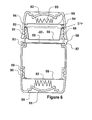
- FIG 6 shows a cross section of the embodiment shown in figure 5 and as can be seen, the lid 71 mates with the body 73 via complementary screw threads 80,81 located around the respective necks of the lid 71 and body 73.
- a black natural rubber tub 84,85,86 of uniform thickness comprising an annular flange top 84, integral with a continuous linear sloping side wall 85 that is to all intents and purposes, frusto-conical in shape and which terminates in a flat circular base 86 that is concentric with, is smaller than and parallel with, the flange top 84.
- the flange top 84 is so designed as to overlie the thickness of the top of the neck of the body 73, whilst the base 86 is substantially flush with bottom of the neck of the body 73.
- the flange top 84 prevents the lid 71 from being screwed down completely onto the threaded 81 neck of the body 73 of the apparatus 70.
- the lid 71 is provided with a resilient circular convex diaphram 82, the centre of which passes through the longitudinal axis of the apparatus 70. This centre sits below the truncated top of the lid 71 to prevent accidental depression of the top 82 if something that can span the lid top comes to rest on the truncated top of the lid 71.
- the underside of the diaphram 82 is operatively connected to a downwardly depending and expanding frusto-conical wall terminated by a plurality of "saw tooth” shaped teeth that are adapted to puncture a circular foil sheet 95 that is glued to and which spans the upper portion of the interior of the lid 71 above the flange top 84 to form a separate integral compartment within the lid 71.
- the compartment contains a specific type of growth medium.
- annular shaped testing swab sponge 97 Centrally located, glued to and downwardly depending from the foil 95 is an annular shaped testing swab sponge 97 whose dimensions are such that it extends down to substantially contact the base 86 and occupy a large volume of the tub 84,85,86.
- the tub 84,85,86 contains sufficient amounts of a non specific growth medium to wet the sponge 97.
- a plastics "O" ring Sandwiched between the foil sheet 95 and the top of the flange top 84 is a plastics "O" ring that substantially overlies the annulus of the flange top 84.
- a wider concentric flange shoulder 87 Moving from the top of the apparatus 70 in a downward direction in the apparatus's initial attitude of operation, immediately below the screw threaded 81 neck of the body 73, is a wider concentric flange shoulder 87 that is immediately followed by a concentric constriction 93, which then widens once again to substantially the same dimensions as the shoulder 87, to form the main part of the columnar body 73 of the apparatus 71.
- a flat circular filter 88 Trapped within the internal thickness of the shoulder 87 is a flat circular filter 88 that spans the entire surface area swept out by the internal thickness of the shoulder 87.
- the distance separating the bottom of the flange base of the lid 71 from a top surface 75 of the shoulder 87 is substantially equal to the thickness of the flange top 84.
- the base portion 72 mates with the body 73 via complementary screw threads 89,90 located around the respective base necks of the base portion 72 and the body 73 in a lockable manner and is usually supplied pre-locked into place.
- the teeth 92 are adapted to puncture a circular foil sheet 96 that is glued to and which spans the start of the base neck of the body 73 to form a separate integral compartment within the base portion 72.
- the centre of the diaphragm 91 is recessed within the flat base 99 of the base portion 72 so that accidental depression of the diaphragm 91 if something that can span the base 99 comes to rest on base 99 during for example transit of the apparatus 70, does not occur.
- This compartment located within the base portion 72 contains bleach.
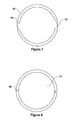
- FIG 7 this is a top view of the shoulder 87 in its initial normal attitude of operation and the figure also shows the area immediately above the shoulder 87, i.e. the area immediately below the start of the screw threaded neck 81 of the body 73.
- a curved shoulder 74 Integral with and sat on the uppermost surface 75 of the shoulder 87 is a curved shoulder 74 (similar in shape to a leading edge of a shark fin) whose radius of curvature has a centre that is not the same as the centre of the radius of curvature of the apparatus 70 but is parallel with it.
- the shoulder 74 extends as a continuous curve from the base of the exterior surface of the neck 81 and terminates abruptly with a straight line that overlies a virtual diameter of the apparatus 74.
- both shoulders 74 are slightly less than the thickness of the flange top 84.
- Figure 8 shows the underside of the flange base of the lid 71 Projecting radially inwards from the internal circumferential peripheral wall of the base of the flange base, are a pair of mutually opposed elongate resilient "shark fin” shaped nipples 98 that are of a similar thickness to the thickness of the shoulders 74.
- the nipples 98 extend inwardly, decreasing in size until they would substantially contact the screw thread 81 at which point they terminate.
- each "shark fin” is designed to contact respective curved shoulders 74 as the lid 71 is screwed down fully.
- the lid 71 is unscrewed and the tub 84,85,86 is first removed.
- the lid 71 and the non specific growth medium impregnated sponge 97 combination is used to swab the test surface for bacteria.
- Aqueous growth media is added to the body 73 of the apparatus 70
- the lid 71 (free from the tub 84,85,86) is fully screwed back over the neck of the body 73.
- the convex top 82 is then depressed by a thumb of an operator and the teeth 83 puncture the foil 95 to release the growth medium.
- the apparatus 70 is then inverted and in this state is placed into a bacterial testing machine where it is incubated and scanned with a range of light wave lengths to detect the presence of bacteria.
- the convex base 92 is depressed causing the teeth 92 to puncture the foil 96 to enable the bleach to enter the body 73 and kill all of the micro-biological material within it.
- the apparatus 70 water is pre supplied in the apparatus 70.
- the meat sample is placed within the neck of the body 71 and the lid 71 is screwed down tight as before. Puncturing of the foil 95 and shaking of the apparatus 70 will cause the meat to mix with the growth medium but the filter 88 will prevent lumps of meat from entering the body 73 of the apparatus 70, 'clouding' the test solution and causing erroneous readings during the testing procedure.
- Inversion of the apparatus 70 prior to placing it within the incubating bacterial testing machine will ensure that the meat through gravity will sit within the base of the lid 71 and not tend to potentially diffuse through the filter 88 to cause erroneous results.
Landscapes
- Chemical & Material Sciences (AREA)
- Health & Medical Sciences (AREA)
- Organic Chemistry (AREA)
- Life Sciences & Earth Sciences (AREA)
- Wood Science & Technology (AREA)
- Engineering & Computer Science (AREA)
- Zoology (AREA)
- Bioinformatics & Cheminformatics (AREA)
- General Health & Medical Sciences (AREA)
- Proteomics, Peptides & Aminoacids (AREA)
- Microbiology (AREA)
- Biotechnology (AREA)
- Biochemistry (AREA)
- General Engineering & Computer Science (AREA)
- Genetics & Genomics (AREA)
- Analytical Chemistry (AREA)
- Sustainable Development (AREA)
- Toxicology (AREA)
- Physics & Mathematics (AREA)
- Biophysics (AREA)
- Biomedical Technology (AREA)
- Immunology (AREA)
- Molecular Biology (AREA)
- Clinical Laboratory Science (AREA)
- Apparatus Associated With Microorganisms And Enzymes (AREA)
- Measuring Or Testing Involving Enzymes Or Micro-Organisms (AREA)
- Sampling And Sample Adjustment (AREA)
- Investigating Or Analysing Biological Materials (AREA)
Applications Claiming Priority (2)
| Application Number | Priority Date | Filing Date | Title |
|---|---|---|---|
| NZ53370604 | 2004-06-23 | ||
| EP05757540.9A EP1883706B1 (fr) | 2004-06-23 | 2005-06-23 | Améliorations apportées à un appareil de détection de micro-organismes et procédés d'utilisation |
Related Parent Applications (5)
| Application Number | Title | Priority Date | Filing Date |
|---|---|---|---|
| WOPCT/NZ2005/000139 Previously-Filed-Application | 2005-06-23 | ||
| EP05757540.9 Division | 2005-06-23 | ||
| EP05757540.9A Division-Into EP1883706B1 (fr) | 2004-06-23 | 2005-06-23 | Améliorations apportées à un appareil de détection de micro-organismes et procédés d'utilisation |
| EP05757540.9A Division EP1883706B1 (fr) | 2004-06-23 | 2005-06-23 | Améliorations apportées à un appareil de détection de micro-organismes et procédés d'utilisation |
| PCT/NZ2005/000139 Previously-Filed-Application WO2006001716A1 (fr) | 2004-06-23 | 2005-06-23 | Ameliorations apportees a un appareil de detection de micro-organismes et procedes d'utilisation |
Publications (3)
| Publication Number | Publication Date |
|---|---|
| EP2647723A2 true EP2647723A2 (fr) | 2013-10-09 |
| EP2647723A3 EP2647723A3 (fr) | 2014-01-15 |
| EP2647723B1 EP2647723B1 (fr) | 2017-02-01 |
Family
ID=35782059
Family Applications (2)
| Application Number | Title | Priority Date | Filing Date |
|---|---|---|---|
| EP12184133.2A Expired - Lifetime EP2647723B1 (fr) | 2004-06-23 | 2005-06-23 | Améliorations se rapportant à un appareil de test de micro-organismes et leurs procédés d'utilisation |
| EP05757540.9A Expired - Lifetime EP1883706B1 (fr) | 2004-06-23 | 2005-06-23 | Améliorations apportées à un appareil de détection de micro-organismes et procédés d'utilisation |
Family Applications After (1)
| Application Number | Title | Priority Date | Filing Date |
|---|---|---|---|
| EP05757540.9A Expired - Lifetime EP1883706B1 (fr) | 2004-06-23 | 2005-06-23 | Améliorations apportées à un appareil de détection de micro-organismes et procédés d'utilisation |
Country Status (10)
| Country | Link |
|---|---|
| US (2) | US9260740B2 (fr) |
| EP (2) | EP2647723B1 (fr) |
| CN (1) | CN101061232A (fr) |
| AR (1) | AR049361A1 (fr) |
| AU (1) | AU2005257683B2 (fr) |
| BR (1) | BRPI0512480A (fr) |
| CA (2) | CA2613311A1 (fr) |
| NZ (2) | NZ596586A (fr) |
| TW (1) | TW200621992A (fr) |
| WO (1) | WO2006001716A1 (fr) |
Cited By (1)
| Publication number | Priority date | Publication date | Assignee | Title |
|---|---|---|---|---|
| US9726585B2 (en) | 2011-06-14 | 2017-08-08 | Ax-Lab Innovation Aps | Container assembly and associated method |
Families Citing this family (24)
| Publication number | Priority date | Publication date | Assignee | Title |
|---|---|---|---|---|
| US9260740B2 (en) | 2004-06-23 | 2016-02-16 | Zyzeba Testing Limited | Micro-organism test apparatus and methods of using the same |
| CN102435487A (zh) * | 2010-09-29 | 2012-05-02 | 无锡奥克丹生物科技有限公司 | 小型测试仪器的试剂容器 |
| NZ593660A (en) * | 2011-06-22 | 2013-05-31 | Zyzeba Testing Ltd | Method of tracking spread of microorganisms using optical determination of microorganism populations at known locations and transmission of results of determination to a remote collection device |
| ES2770042T3 (es) * | 2013-05-24 | 2020-06-30 | Premier Biotech Inc | Dispositivo de análisis de fluidos orales de múltiples etapas |
| US11030778B2 (en) * | 2014-03-31 | 2021-06-08 | Healthy.Io Ltd. | Methods and apparatus for enhancing color vision and quantifying color interpretation |
| DE102014208748B4 (de) * | 2014-05-09 | 2016-03-10 | Siemens Aktiengesellschaft | Multifunktionales Einwegbehältnis und Verwendung desselben für eine Zubereitung und Verteilung von mikrobiologischen Lösungen |
| US11305287B2 (en) * | 2015-07-09 | 2022-04-19 | Environmental Laboratories, Inc. | Water testing apparatus and methods of using the same |
| EP3125271B1 (fr) * | 2015-07-29 | 2018-06-06 | FEI Company | Microchambre pour inspecter un matériau échantillon |
| WO2017107837A1 (fr) * | 2015-12-23 | 2017-06-29 | 上海吉凯基因科技有限公司 | Système complètement automatisé, continu, de culture cellulaire |
| CN106955754A (zh) * | 2016-01-11 | 2017-07-18 | 广州市华代生物科技有限公司 | 一种生物膜夹持器及其检测方法 |
| FR3065227B1 (fr) * | 2017-04-13 | 2024-04-12 | Biomerieux Sa | Dispositif de controle microbiologique, procede de mise a disposition et utilisation d'un tel dispositif |
| DE102017005835B4 (de) * | 2017-06-20 | 2020-04-02 | Diehl Metering Gmbh | Vorrichtung zur mobilen Bestimmung einer Eigenschaft einer flüssigen, festen oder gasförmigen Probe |
| DE102017124840B3 (de) * | 2017-10-24 | 2018-12-13 | Testo SE & Co. KGaA | Inkubator, Probenbehälter, Set und Verfahren zur Untersuchung eines Probenmaterials |
| CN108792258A (zh) * | 2018-05-21 | 2018-11-13 | 南京申友生物技术有限公司 | 一种基因检测用试剂盒 |
| US11850320B2 (en) | 2018-12-20 | 2023-12-26 | Asp Global Manufacturing Gmbh | Liquid-chemical sterilization system with biological indicator |
| TWI729914B (zh) * | 2020-08-18 | 2021-06-01 | 國立臺灣海洋大學 | 鮮度指示裝置 |
| CA3130654C (fr) | 2020-09-15 | 2026-05-19 | Norgen Biotek Corp. | Appareil de collecte d'echantillons et utilisations connexes |
| CN112616757B (zh) * | 2020-12-25 | 2023-07-25 | 中国科学院海洋研究所 | 基于rov的深海原位大型生物培养装置及其使用方法 |
| US20230172591A1 (en) * | 2021-12-07 | 2023-06-08 | Porex Corporation | Liquid Sample Collection Devices, Systems, and Methods |
| USD1140078S1 (en) | 2022-09-02 | 2026-08-04 | Becton, Dickinson And Company | Test device |
| US12402557B2 (en) | 2022-12-22 | 2025-09-02 | Meristem Crop Performance Group, LLC | Method and device for delivering biological material to liquid medium |
| EP4638305A1 (fr) | 2022-12-22 | 2025-10-29 | Meristem Crop Performance Group, LLC | Procédé et dispositif pour distribuer des micro-organismes viables dans un lubrifiant pour semences à une alimentation en semences |
| USD1069156S1 (en) | 2023-04-10 | 2025-04-01 | Becton, Dickinson And Company | Dispensing device |
| CN117417815B (zh) * | 2023-12-19 | 2024-03-12 | 广州蕊特生物科技有限公司 | 一种瓶型培养基装置 |
Family Cites Families (54)
| Publication number | Priority date | Publication date | Assignee | Title |
|---|---|---|---|---|
| US3504376A (en) * | 1966-12-15 | 1970-03-31 | Xerox Corp | Automated chemical analyzer |
| US3715189A (en) | 1970-06-15 | 1973-02-06 | Secretary Of The Treasury | Qualitative analysis device |
| US4551766A (en) * | 1982-03-08 | 1985-11-05 | Halliburton Company | Optical reader |
| US4925789A (en) | 1986-06-30 | 1990-05-15 | Edberg Stephen C | Method and medium for use in detecting target microbes in situ in a specimen sample of a possibly contaminated material |
| US5429933A (en) | 1986-06-30 | 1995-07-04 | Edberg; Stephen C. | Detection of first generation environmental sourced microbes in an environmentally-derived sample |
| EP0301699A3 (fr) | 1987-06-23 | 1990-02-28 | Utah State University Foundation | Procédé et appareil pour déterminer la bioactivité d'echantillons biologiques |
| JPS6435347A (en) | 1987-07-31 | 1989-02-06 | Sumitomo Electric Industries | Detection of intrusion of various bacteria |
| ATE117378T1 (de) | 1987-11-05 | 1995-02-15 | James D Berg | Schnellverfahren zum nachweis von coliformen mikroorganismen. |
| AU4318389A (en) | 1988-09-14 | 1990-04-02 | Genencor Inc. | Microbiological oil prospecting |
| US5501959A (en) * | 1989-01-17 | 1996-03-26 | Alamar Biosciences Laboratory, Inc. | Antibiotic and cytotoxic drug susceptibility assays using resazurin and poising agents |
| US5284772A (en) * | 1990-04-13 | 1994-02-08 | T Systems Inc. | Specimen collection and analysis bag |
| US5210022A (en) | 1990-04-20 | 1993-05-11 | Rcr Scientific, Inc. | Method test media and chromogenic compounds for identifying and differentiating general coliforms and Escherichia coli bacteria |
| US5411867A (en) | 1990-05-14 | 1995-05-02 | The Regents Of The University Of California | Method for determination of E. coli in water |
| US5164301A (en) | 1990-06-22 | 1992-11-17 | Difco Laboratories | Process and kit for detecting microbial metabolism |
| DK17791D0 (da) * | 1991-02-01 | 1991-02-01 | Novo Nordisk As | Beholderinspektion |
| FR2704650B1 (fr) | 1993-04-27 | 1995-06-09 | Savoie Universite | Procédé et dispositif pour la détection et l'identification instantanées d'une entité. |
| US5364766A (en) | 1993-05-14 | 1994-11-15 | Minnesota Mining And Manufacturing Company | Culture medium for rapid count of coliform bacteria |
| JP3051626B2 (ja) * | 1993-12-09 | 2000-06-12 | 富士写真フイルム株式会社 | インキュベータ |
| US5690825A (en) | 1993-12-21 | 1997-11-25 | Genera Technologies Limited | Filtration method and apparatus |
| US5518892A (en) | 1994-02-23 | 1996-05-21 | Idexx Laboratories, Inc. | Apparatus and method for quantification of biological material in a liquid sample |
| US5550032A (en) | 1994-05-27 | 1996-08-27 | George Mason University | Biological assay for microbial contamination |
| US5620865A (en) | 1994-11-04 | 1997-04-15 | Idexx Laboratories, Inc. | Medium for detecting Enterococci in a sample |
| US5610029A (en) | 1994-11-04 | 1997-03-11 | Idexx Laboratories, Inc. | Medium for detecting target microbes in a sample |
| US5605812A (en) | 1995-05-19 | 1997-02-25 | Charm Sciences, Inc. | Test kit and method for the quantitative determination of coliform bacteria and E. coli |
| US5728542A (en) | 1995-05-19 | 1998-03-17 | Charm Sciences, Inc. | Disposable test kit apparatus and method for bacteria |
| US6387650B1 (en) | 1995-06-07 | 2002-05-14 | Biocontrol Systems, Inc. | Method and composition for detecting bacterial contamination in food products |
| US5827675A (en) | 1995-07-12 | 1998-10-27 | Charm Sciences, Inc. | Test apparatus, system and method for the detection of test samples |
| CA2226857C (fr) | 1995-07-12 | 2008-03-18 | Charm Sciences, Inc. | Testeur, systeme et procede pour la detection d'echantillons a tester |
| JP3666621B2 (ja) * | 1995-10-05 | 2005-06-29 | 和光純薬工業株式会社 | 微生物由来成分の測定装置及び測定方法 |
| US5700655A (en) | 1995-11-14 | 1997-12-23 | Idexx Laboratories, Inc. | Method for quantification of biological material in a sample |
| US5985594A (en) | 1995-11-14 | 1999-11-16 | Idexx Laboratories, Inc. | Method for quantification of biological material in a sample |
| CA2199445C (fr) | 1996-03-08 | 2000-10-24 | Stanley E. Charm | Trousse d'essai jetable et methode de detection des bacteries |
| US6653096B1 (en) * | 1996-07-29 | 2003-11-25 | Process Challenge Devices | Process challenge device and method |
| US5817475A (en) | 1996-11-15 | 1998-10-06 | Giles Scientific, Inc. | Automatic microbiological testing apparatus and method |
| JPH10150976A (ja) | 1996-11-22 | 1998-06-09 | Corona Giken Kogyo Kk | 菌判定装置 |
| IT1292677B1 (it) | 1997-02-28 | 1999-02-11 | Bormioli Metalplast Spa | Confezione per mantenere separati dei prodotti prima dell'uso. |
| US5917592A (en) * | 1997-02-28 | 1999-06-29 | Charm Sciences, Inc. | Photometer, and test sample holder for use therein, method and system |
| ATE308037T1 (de) | 1997-05-23 | 2005-11-15 | Becton Dickinson Co | Automat für mikrobiologische tests und verfahren dafür |
| US6597450B1 (en) * | 1997-09-15 | 2003-07-22 | Becton, Dickinson And Company | Automated Optical Reader for Nucleic Acid Assays |
| AU736154B2 (en) | 1997-10-27 | 2001-07-26 | Idexx Laboratories, Inc. | Device and methods for determination of analyte in a solution |
| DE69940647D1 (de) * | 1998-05-01 | 2009-05-07 | Gen Probe Inc | Automatische diagnostische Analysevorrichtung |
| WO2001069330A2 (fr) | 2000-03-10 | 2001-09-20 | Meta Controls, Inc. | Architecture repartie de logiciel de commande de machines |
| ATE303618T1 (de) | 2000-03-10 | 2005-09-15 | Smiths Detection Inc | Steuerung für einen industriellen prozes mit einer oder mehreren multidimensionalen variablen |
| US6783934B1 (en) * | 2000-05-01 | 2004-08-31 | Cepheid, Inc. | Methods for quantitative analysis of nucleic acid amplification reaction |
| US6849422B1 (en) | 2000-05-31 | 2005-02-01 | Becton, Dickinson And Company | System and method for analyzing antibiotic susceptibility of biological samples using redox and turbidity measurments to ascertain minimum inhibitory concentrations (MICs) |
| AU2001283066A1 (en) | 2000-08-01 | 2002-02-13 | Charm Sciences, Inc. | Hygiene monitoring |
| US6573088B2 (en) * | 2001-08-08 | 2003-06-03 | Dade Microscan Inc. | Automated random access microbiological analyzer |
| FR2831182B1 (fr) | 2001-10-19 | 2003-12-26 | Univ Nantes | Bio-reacteur pour le controle et/ou la culture en milieu liquide d'organismes vivants |
| IL166340A0 (en) | 2002-07-18 | 2006-01-16 | Kemire Phosphates Pty Ltd | Proliferation and delivery apparatus |
| NZ541057A (en) | 2003-01-03 | 2007-04-27 | Sji Ltd | Mixing dispenser |
| US7297531B2 (en) | 2003-04-17 | 2007-11-20 | Idexx Laboratories, Inc. | Apparatus and method for testing liquid samples |
| US9260740B2 (en) | 2004-06-23 | 2016-02-16 | Zyzeba Testing Limited | Micro-organism test apparatus and methods of using the same |
| NZ539210A (en) | 2005-04-04 | 2006-09-29 | Rosemary Katherine Cameron Sha | Optical micro-organism analysis using change of light to detect organisms |
| NZ540021A (en) | 2005-05-16 | 2008-01-31 | Sji Ltd | Dispensing closure, or cap, for use on containers such as bottles |
-
2005
- 2005-06-23 US US11/922,785 patent/US9260740B2/en not_active Expired - Fee Related
- 2005-06-23 TW TW094121098A patent/TW200621992A/zh unknown
- 2005-06-23 BR BRPI0512480-8A patent/BRPI0512480A/pt not_active Application Discontinuation
- 2005-06-23 AU AU2005257683A patent/AU2005257683B2/en not_active Ceased
- 2005-06-23 CA CA002613311A patent/CA2613311A1/fr not_active Abandoned
- 2005-06-23 EP EP12184133.2A patent/EP2647723B1/fr not_active Expired - Lifetime
- 2005-06-23 WO PCT/NZ2005/000139 patent/WO2006001716A1/fr not_active Ceased
- 2005-06-23 NZ NZ596586A patent/NZ596586A/en not_active IP Right Cessation
- 2005-06-23 EP EP05757540.9A patent/EP1883706B1/fr not_active Expired - Lifetime
- 2005-06-23 NZ NZ588578A patent/NZ588578A/en not_active IP Right Cessation
- 2005-06-23 AR ARP050102589A patent/AR049361A1/es unknown
- 2005-06-23 CA CA2895994A patent/CA2895994A1/fr not_active Abandoned
- 2005-06-23 CN CNA2005800276951A patent/CN101061232A/zh active Pending
-
2012
- 2012-01-17 US US13/351,637 patent/US8642323B2/en not_active Expired - Fee Related
Non-Patent Citations (1)
| Title |
|---|
| None |
Cited By (2)
| Publication number | Priority date | Publication date | Assignee | Title |
|---|---|---|---|---|
| US9726585B2 (en) | 2011-06-14 | 2017-08-08 | Ax-Lab Innovation Aps | Container assembly and associated method |
| US10376247B2 (en) | 2011-06-14 | 2019-08-13 | Biopsafe ApS | Container assembly and associated method |
Also Published As
| Publication number | Publication date |
|---|---|
| EP1883706A1 (fr) | 2008-02-06 |
| NZ596586A (en) | 2012-06-29 |
| EP1883706B1 (fr) | 2015-03-11 |
| CN101061232A (zh) | 2007-10-24 |
| NZ588578A (en) | 2012-03-30 |
| EP1883706A4 (fr) | 2009-09-09 |
| EP2647723A3 (fr) | 2014-01-15 |
| CA2613311A1 (fr) | 2006-01-05 |
| BRPI0512480A (pt) | 2008-03-11 |
| WO2006001716A1 (fr) | 2006-01-05 |
| AR049361A1 (es) | 2006-07-19 |
| US8642323B2 (en) | 2014-02-04 |
| AU2005257683B2 (en) | 2011-08-04 |
| US20090111173A1 (en) | 2009-04-30 |
| US9260740B2 (en) | 2016-02-16 |
| CA2895994A1 (fr) | 2006-01-05 |
| AU2005257683A1 (en) | 2006-01-05 |
| EP2647723B1 (fr) | 2017-02-01 |
| TW200621992A (en) | 2006-07-01 |
| US20120115216A1 (en) | 2012-05-10 |
Similar Documents
| Publication | Publication Date | Title |
|---|---|---|
| US20090111173A1 (en) | Micro-Organism Test Apparatus and Methods of Using the Same | |
| CN101331398B (zh) | 粪便采集容器 | |
| JP5432891B2 (ja) | 複式容器、及び注出方法 | |
| JP5150507B2 (ja) | 物質を解放できるように貯蔵するための容器システム | |
| KR101629046B1 (ko) | 샘플 수용 장치 | |
| US20230172591A1 (en) | Liquid Sample Collection Devices, Systems, and Methods | |
| EP0861330B1 (fr) | Testeur, systeme et procede pour la detection d'echantillons a tester | |
| AU2004291923B2 (en) | Sample collection cup with integrated activatable sample analysis system | |
| US20060210448A1 (en) | Fecal specimen collection, preserving and transport device and method | |
| ES2774386T3 (es) | Dispositivo portátil para el enriquecimiento, alicuotado y análisis de microorganismos y toxinas | |
| EP1687628A4 (fr) | Dispositif d'analyse d'echantillon de fluide a reservoir de stockage d'echantillon hermetique | |
| CN117511714A (zh) | 具有用于控制成分释放进入培养基的机构的血液培养瓶 | |
| JP2003139780A (ja) | 液体検体収集システム | |
| JP2001513897A (ja) | 流体試料の収集および試験装置 | |
| US5756049A (en) | Water testing capsule using water soluble film membranes | |
| JP4703876B2 (ja) | 菌検出器 | |
| AU2011204782B2 (en) | Container for testing for micro-organisms | |
| WO2007064233A1 (fr) | Dispositif de test de micro-organismes | |
| NZ543824A (en) | Micro Organism Testing Device | |
| GB2572820A (en) | Liquid sample testers | |
| HK1152018B (en) | Compound container and pouring-out method |
Legal Events
| Date | Code | Title | Description |
|---|---|---|---|
| PUAI | Public reference made under article 153(3) epc to a published international application that has entered the european phase |
Free format text: ORIGINAL CODE: 0009012 |
|
| AC | Divisional application: reference to earlier application |
Ref document number: 1883706 Country of ref document: EP Kind code of ref document: P |
|
| AK | Designated contracting states |
Kind code of ref document: A2 Designated state(s): AT BE BG CH CY CZ DE DK EE ES FI FR GB GR HU IE IS IT LI LT LU MC NL PL PT RO SE SI SK TR |
|
| PUAL | Search report despatched |
Free format text: ORIGINAL CODE: 0009013 |
|
| AK | Designated contracting states |
Kind code of ref document: A3 Designated state(s): AT BE BG CH CY CZ DE DK EE ES FI FR GB GR HU IE IS IT LI LT LU MC NL PL PT RO SE SI SK TR |
|
| RIC1 | Information provided on ipc code assigned before grant |
Ipc: C12Q 1/08 20060101ALI20131210BHEP Ipc: G01N 33/48 20060101ALI20131210BHEP Ipc: B65D 51/22 20060101ALI20131210BHEP Ipc: C12Q 1/04 20060101ALI20131210BHEP Ipc: C12Q 1/00 20060101AFI20131210BHEP Ipc: B65D 25/08 20060101ALI20131210BHEP |
|
| 17P | Request for examination filed |
Effective date: 20140711 |
|
| RBV | Designated contracting states (corrected) |
Designated state(s): AT BE BG CH CY CZ DE DK EE ES FI FR GB GR HU IE IS IT LI LT LU MC NL PL PT RO SE SI SK TR |
|
| 17Q | First examination report despatched |
Effective date: 20141126 |
|
| REG | Reference to a national code |
Ref country code: DE Ref legal event code: R079 Ref document number: 602005051276 Country of ref document: DE Free format text: PREVIOUS MAIN CLASS: C12Q0001040000 Ipc: C12M0001000000 |
|
| GRAP | Despatch of communication of intention to grant a patent |
Free format text: ORIGINAL CODE: EPIDOSNIGR1 |
|
| RIC1 | Information provided on ipc code assigned before grant |
Ipc: C12Q 1/08 20060101ALI20160401BHEP Ipc: C12M 1/34 20060101ALI20160401BHEP Ipc: C12Q 1/04 20060101ALI20160401BHEP Ipc: C12M 1/00 20060101AFI20160401BHEP |
|
| INTG | Intention to grant announced |
Effective date: 20160511 |
|
| GRAJ | Information related to disapproval of communication of intention to grant by the applicant or resumption of examination proceedings by the epo deleted |
Free format text: ORIGINAL CODE: EPIDOSDIGR1 |
|
| GRAP | Despatch of communication of intention to grant a patent |
Free format text: ORIGINAL CODE: EPIDOSNIGR1 |
|
| INTC | Intention to grant announced (deleted) | ||
| INTG | Intention to grant announced |
Effective date: 20161013 |
|
| GRAS | Grant fee paid |
Free format text: ORIGINAL CODE: EPIDOSNIGR3 |
|
| GRAA | (expected) grant |
Free format text: ORIGINAL CODE: 0009210 |
|
| AC | Divisional application: reference to earlier application |
Ref document number: 1883706 Country of ref document: EP Kind code of ref document: P |
|
| AK | Designated contracting states |
Kind code of ref document: B1 Designated state(s): AT BE BG CH CY CZ DE DK EE ES FI FR GB GR HU IE IS IT LI LT LU MC NL PL PT RO SE SI SK TR |
|
| REG | Reference to a national code |
Ref country code: GB Ref legal event code: FG4D |
|
| REG | Reference to a national code |
Ref country code: CH Ref legal event code: EP Ref country code: AT Ref legal event code: REF Ref document number: 865612 Country of ref document: AT Kind code of ref document: T Effective date: 20170215 |
|
| REG | Reference to a national code |
Ref country code: IE Ref legal event code: FG4D |
|
| REG | Reference to a national code |
Ref country code: DE Ref legal event code: R096 Ref document number: 602005051276 Country of ref document: DE |
|
| REG | Reference to a national code |
Ref country code: NL Ref legal event code: MP Effective date: 20170201 |
|
| REG | Reference to a national code |
Ref country code: LT Ref legal event code: MG4D |
|
| REG | Reference to a national code |
Ref country code: AT Ref legal event code: MK05 Ref document number: 865612 Country of ref document: AT Kind code of ref document: T Effective date: 20170201 |
|
| PG25 | Lapsed in a contracting state [announced via postgrant information from national office to epo] |
Ref country code: FI Free format text: LAPSE BECAUSE OF FAILURE TO SUBMIT A TRANSLATION OF THE DESCRIPTION OR TO PAY THE FEE WITHIN THE PRESCRIBED TIME-LIMIT Effective date: 20170201 Ref country code: IS Free format text: LAPSE BECAUSE OF FAILURE TO SUBMIT A TRANSLATION OF THE DESCRIPTION OR TO PAY THE FEE WITHIN THE PRESCRIBED TIME-LIMIT Effective date: 20170601 Ref country code: LT Free format text: LAPSE BECAUSE OF FAILURE TO SUBMIT A TRANSLATION OF THE DESCRIPTION OR TO PAY THE FEE WITHIN THE PRESCRIBED TIME-LIMIT Effective date: 20170201 Ref country code: GR Free format text: LAPSE BECAUSE OF FAILURE TO SUBMIT A TRANSLATION OF THE DESCRIPTION OR TO PAY THE FEE WITHIN THE PRESCRIBED TIME-LIMIT Effective date: 20170502 |
|
| PG25 | Lapsed in a contracting state [announced via postgrant information from national office to epo] |
Ref country code: PT Free format text: LAPSE BECAUSE OF FAILURE TO SUBMIT A TRANSLATION OF THE DESCRIPTION OR TO PAY THE FEE WITHIN THE PRESCRIBED TIME-LIMIT Effective date: 20170601 Ref country code: ES Free format text: LAPSE BECAUSE OF FAILURE TO SUBMIT A TRANSLATION OF THE DESCRIPTION OR TO PAY THE FEE WITHIN THE PRESCRIBED TIME-LIMIT Effective date: 20170201 Ref country code: AT Free format text: LAPSE BECAUSE OF FAILURE TO SUBMIT A TRANSLATION OF THE DESCRIPTION OR TO PAY THE FEE WITHIN THE PRESCRIBED TIME-LIMIT Effective date: 20170201 Ref country code: NL Free format text: LAPSE BECAUSE OF FAILURE TO SUBMIT A TRANSLATION OF THE DESCRIPTION OR TO PAY THE FEE WITHIN THE PRESCRIBED TIME-LIMIT Effective date: 20170201 Ref country code: BG Free format text: LAPSE BECAUSE OF FAILURE TO SUBMIT A TRANSLATION OF THE DESCRIPTION OR TO PAY THE FEE WITHIN THE PRESCRIBED TIME-LIMIT Effective date: 20170501 Ref country code: PL Free format text: LAPSE BECAUSE OF FAILURE TO SUBMIT A TRANSLATION OF THE DESCRIPTION OR TO PAY THE FEE WITHIN THE PRESCRIBED TIME-LIMIT Effective date: 20170201 Ref country code: SE Free format text: LAPSE BECAUSE OF FAILURE TO SUBMIT A TRANSLATION OF THE DESCRIPTION OR TO PAY THE FEE WITHIN THE PRESCRIBED TIME-LIMIT Effective date: 20170201 |
|
| PG25 | Lapsed in a contracting state [announced via postgrant information from national office to epo] |
Ref country code: EE Free format text: LAPSE BECAUSE OF FAILURE TO SUBMIT A TRANSLATION OF THE DESCRIPTION OR TO PAY THE FEE WITHIN THE PRESCRIBED TIME-LIMIT Effective date: 20170201 Ref country code: RO Free format text: LAPSE BECAUSE OF FAILURE TO SUBMIT A TRANSLATION OF THE DESCRIPTION OR TO PAY THE FEE WITHIN THE PRESCRIBED TIME-LIMIT Effective date: 20170201 Ref country code: IT Free format text: LAPSE BECAUSE OF FAILURE TO SUBMIT A TRANSLATION OF THE DESCRIPTION OR TO PAY THE FEE WITHIN THE PRESCRIBED TIME-LIMIT Effective date: 20170201 Ref country code: SK Free format text: LAPSE BECAUSE OF FAILURE TO SUBMIT A TRANSLATION OF THE DESCRIPTION OR TO PAY THE FEE WITHIN THE PRESCRIBED TIME-LIMIT Effective date: 20170201 Ref country code: CZ Free format text: LAPSE BECAUSE OF FAILURE TO SUBMIT A TRANSLATION OF THE DESCRIPTION OR TO PAY THE FEE WITHIN THE PRESCRIBED TIME-LIMIT Effective date: 20170201 |
|
| REG | Reference to a national code |
Ref country code: DE Ref legal event code: R097 Ref document number: 602005051276 Country of ref document: DE |
|
| PG25 | Lapsed in a contracting state [announced via postgrant information from national office to epo] |
Ref country code: DK Free format text: LAPSE BECAUSE OF FAILURE TO SUBMIT A TRANSLATION OF THE DESCRIPTION OR TO PAY THE FEE WITHIN THE PRESCRIBED TIME-LIMIT Effective date: 20170201 |
|
| PLBE | No opposition filed within time limit |
Free format text: ORIGINAL CODE: 0009261 |
|
| STAA | Information on the status of an ep patent application or granted ep patent |
Free format text: STATUS: NO OPPOSITION FILED WITHIN TIME LIMIT |
|
| REG | Reference to a national code |
Ref country code: DE Ref legal event code: R119 Ref document number: 602005051276 Country of ref document: DE |
|
| 26N | No opposition filed |
Effective date: 20171103 |
|
| PG25 | Lapsed in a contracting state [announced via postgrant information from national office to epo] |
Ref country code: MC Free format text: LAPSE BECAUSE OF FAILURE TO SUBMIT A TRANSLATION OF THE DESCRIPTION OR TO PAY THE FEE WITHIN THE PRESCRIBED TIME-LIMIT Effective date: 20170201 |
|
| REG | Reference to a national code |
Ref country code: CH Ref legal event code: PL |
|
| PG25 | Lapsed in a contracting state [announced via postgrant information from national office to epo] |
Ref country code: SI Free format text: LAPSE BECAUSE OF FAILURE TO SUBMIT A TRANSLATION OF THE DESCRIPTION OR TO PAY THE FEE WITHIN THE PRESCRIBED TIME-LIMIT Effective date: 20170201 |
|
| REG | Reference to a national code |
Ref country code: IE Ref legal event code: MM4A |
|
| REG | Reference to a national code |
Ref country code: FR Ref legal event code: ST Effective date: 20180228 |
|
| PG25 | Lapsed in a contracting state [announced via postgrant information from national office to epo] |
Ref country code: CH Free format text: LAPSE BECAUSE OF NON-PAYMENT OF DUE FEES Effective date: 20170630 Ref country code: IE Free format text: LAPSE BECAUSE OF NON-PAYMENT OF DUE FEES Effective date: 20170623 Ref country code: LI Free format text: LAPSE BECAUSE OF NON-PAYMENT OF DUE FEES Effective date: 20170630 Ref country code: DE Free format text: LAPSE BECAUSE OF NON-PAYMENT OF DUE FEES Effective date: 20180103 Ref country code: LU Free format text: LAPSE BECAUSE OF NON-PAYMENT OF DUE FEES Effective date: 20170623 |
|
| PG25 | Lapsed in a contracting state [announced via postgrant information from national office to epo] |
Ref country code: FR Free format text: LAPSE BECAUSE OF NON-PAYMENT OF DUE FEES Effective date: 20170630 |
|
| REG | Reference to a national code |
Ref country code: BE Ref legal event code: MM Effective date: 20170630 |
|
| PG25 | Lapsed in a contracting state [announced via postgrant information from national office to epo] |
Ref country code: BE Free format text: LAPSE BECAUSE OF NON-PAYMENT OF DUE FEES Effective date: 20170630 |
|
| PGFP | Annual fee paid to national office [announced via postgrant information from national office to epo] |
Ref country code: GB Payment date: 20181223 Year of fee payment: 14 |
|
| PG25 | Lapsed in a contracting state [announced via postgrant information from national office to epo] |
Ref country code: HU Free format text: LAPSE BECAUSE OF FAILURE TO SUBMIT A TRANSLATION OF THE DESCRIPTION OR TO PAY THE FEE WITHIN THE PRESCRIBED TIME-LIMIT; INVALID AB INITIO Effective date: 20050623 |
|
| PG25 | Lapsed in a contracting state [announced via postgrant information from national office to epo] |
Ref country code: CY Free format text: LAPSE BECAUSE OF NON-PAYMENT OF DUE FEES Effective date: 20170201 |
|
| GBPC | Gb: european patent ceased through non-payment of renewal fee |
Effective date: 20190623 |
|
| PG25 | Lapsed in a contracting state [announced via postgrant information from national office to epo] |
Ref country code: TR Free format text: LAPSE BECAUSE OF FAILURE TO SUBMIT A TRANSLATION OF THE DESCRIPTION OR TO PAY THE FEE WITHIN THE PRESCRIBED TIME-LIMIT Effective date: 20170201 |
|
| PG25 | Lapsed in a contracting state [announced via postgrant information from national office to epo] |
Ref country code: GB Free format text: LAPSE BECAUSE OF NON-PAYMENT OF DUE FEES Effective date: 20190623 |