EP2668176B1 - Nouveau procédé de synthèse de polyphénols - Google Patents
Nouveau procédé de synthèse de polyphénols Download PDFInfo
- Publication number
- EP2668176B1 EP2668176B1 EP12739384.1A EP12739384A EP2668176B1 EP 2668176 B1 EP2668176 B1 EP 2668176B1 EP 12739384 A EP12739384 A EP 12739384A EP 2668176 B1 EP2668176 B1 EP 2668176B1
- Authority
- EP
- European Patent Office
- Prior art keywords
- formula
- compound
- group
- epicatechin
- bromo
- Prior art date
- Legal status (The legal status is an assumption and is not a legal conclusion. Google has not performed a legal analysis and makes no representation as to the accuracy of the status listed.)
- Active
Links
- 0 *Oc1cc([o+]c(-c(cc2)cc(O*)c2O*)c(O*)c2)c2c(O*)c1 Chemical compound *Oc1cc([o+]c(-c(cc2)cc(O*)c2O*)c(O*)c2)c2c(O*)c1 0.000 description 4
- UHJSJSCRESPKFB-QVJLAMPOSA-N CO[C@@H](C(OC[C@@H](C1)[C@H](c(cc2OCc3ccccc3)ccc2OCc2ccccc2)Oc2c1c(OCc1ccccc1)cc(OCc1ccccc1)c2)=O)c1ccccc1 Chemical compound CO[C@@H](C(OC[C@@H](C1)[C@H](c(cc2OCc3ccccc3)ccc2OCc2ccccc2)Oc2c1c(OCc1ccccc1)cc(OCc1ccccc1)c2)=O)c1ccccc1 UHJSJSCRESPKFB-QVJLAMPOSA-N 0.000 description 1
Classifications
-
- C—CHEMISTRY; METALLURGY
- C07—ORGANIC CHEMISTRY
- C07D—HETEROCYCLIC COMPOUNDS
- C07D311/00—Heterocyclic compounds containing six-membered rings having one oxygen atom as the only hetero atom, condensed with other rings
- C07D311/02—Heterocyclic compounds containing six-membered rings having one oxygen atom as the only hetero atom, condensed with other rings ortho- or peri-condensed with carbocyclic rings or ring systems
- C07D311/74—Benzo[b]pyrans, hydrogenated in the carbocyclic ring
-
- C—CHEMISTRY; METALLURGY
- C07—ORGANIC CHEMISTRY
- C07D—HETEROCYCLIC COMPOUNDS
- C07D311/00—Heterocyclic compounds containing six-membered rings having one oxygen atom as the only hetero atom, condensed with other rings
- C07D311/02—Heterocyclic compounds containing six-membered rings having one oxygen atom as the only hetero atom, condensed with other rings ortho- or peri-condensed with carbocyclic rings or ring systems
- C07D311/04—Benzo[b]pyrans, not hydrogenated in the carbocyclic ring
- C07D311/22—Benzo[b]pyrans, not hydrogenated in the carbocyclic ring with oxygen or sulfur atoms directly attached in position 4
- C07D311/26—Benzo[b]pyrans, not hydrogenated in the carbocyclic ring with oxygen or sulfur atoms directly attached in position 4 with aromatic rings attached in position 2 or 3
- C07D311/28—Benzo[b]pyrans, not hydrogenated in the carbocyclic ring with oxygen or sulfur atoms directly attached in position 4 with aromatic rings attached in position 2 or 3 with aromatic rings attached in position 2 only
- C07D311/30—Benzo[b]pyrans, not hydrogenated in the carbocyclic ring with oxygen or sulfur atoms directly attached in position 4 with aromatic rings attached in position 2 or 3 with aromatic rings attached in position 2 only not hydrogenated in the hetero ring, e.g. flavones
-
- A—HUMAN NECESSITIES
- A61—MEDICAL OR VETERINARY SCIENCE; HYGIENE
- A61P—SPECIFIC THERAPEUTIC ACTIVITY OF CHEMICAL COMPOUNDS OR MEDICINAL PREPARATIONS
- A61P13/00—Drugs for disorders of the urinary system
- A61P13/12—Drugs for disorders of the urinary system of the kidneys
-
- A—HUMAN NECESSITIES
- A61—MEDICAL OR VETERINARY SCIENCE; HYGIENE
- A61P—SPECIFIC THERAPEUTIC ACTIVITY OF CHEMICAL COMPOUNDS OR MEDICINAL PREPARATIONS
- A61P3/00—Drugs for disorders of the metabolism
-
- A—HUMAN NECESSITIES
- A61—MEDICAL OR VETERINARY SCIENCE; HYGIENE
- A61P—SPECIFIC THERAPEUTIC ACTIVITY OF CHEMICAL COMPOUNDS OR MEDICINAL PREPARATIONS
- A61P3/00—Drugs for disorders of the metabolism
- A61P3/08—Drugs for disorders of the metabolism for glucose homeostasis
- A61P3/10—Drugs for disorders of the metabolism for glucose homeostasis for hyperglycaemia, e.g. antidiabetics
-
- A—HUMAN NECESSITIES
- A61—MEDICAL OR VETERINARY SCIENCE; HYGIENE
- A61P—SPECIFIC THERAPEUTIC ACTIVITY OF CHEMICAL COMPOUNDS OR MEDICINAL PREPARATIONS
- A61P35/00—Antineoplastic agents
-
- A—HUMAN NECESSITIES
- A61—MEDICAL OR VETERINARY SCIENCE; HYGIENE
- A61P—SPECIFIC THERAPEUTIC ACTIVITY OF CHEMICAL COMPOUNDS OR MEDICINAL PREPARATIONS
- A61P39/00—General protective or antinoxious agents
- A61P39/06—Free radical scavengers or antioxidants
-
- A—HUMAN NECESSITIES
- A61—MEDICAL OR VETERINARY SCIENCE; HYGIENE
- A61P—SPECIFIC THERAPEUTIC ACTIVITY OF CHEMICAL COMPOUNDS OR MEDICINAL PREPARATIONS
- A61P9/00—Drugs for disorders of the cardiovascular system
-
- A—HUMAN NECESSITIES
- A61—MEDICAL OR VETERINARY SCIENCE; HYGIENE
- A61P—SPECIFIC THERAPEUTIC ACTIVITY OF CHEMICAL COMPOUNDS OR MEDICINAL PREPARATIONS
- A61P9/00—Drugs for disorders of the cardiovascular system
- A61P9/10—Drugs for disorders of the cardiovascular system for treating ischaemic or atherosclerotic diseases, e.g. antianginal drugs, coronary vasodilators, drugs for myocardial infarction, retinopathy, cerebrovascula insufficiency, renal arteriosclerosis
-
- C—CHEMISTRY; METALLURGY
- C07—ORGANIC CHEMISTRY
- C07D—HETEROCYCLIC COMPOUNDS
- C07D311/00—Heterocyclic compounds containing six-membered rings having one oxygen atom as the only hetero atom, condensed with other rings
- C07D311/02—Heterocyclic compounds containing six-membered rings having one oxygen atom as the only hetero atom, condensed with other rings ortho- or peri-condensed with carbocyclic rings or ring systems
- C07D311/04—Benzo[b]pyrans, not hydrogenated in the carbocyclic ring
- C07D311/58—Benzo[b]pyrans, not hydrogenated in the carbocyclic ring other than with oxygen or sulphur atoms in position 2 or 4
- C07D311/60—Benzo[b]pyrans, not hydrogenated in the carbocyclic ring other than with oxygen or sulphur atoms in position 2 or 4 with aryl radicals attached in position 2
- C07D311/62—Benzo[b]pyrans, not hydrogenated in the carbocyclic ring other than with oxygen or sulphur atoms in position 2 or 4 with aryl radicals attached in position 2 with oxygen atoms directly attached in position 3, e.g. anthocyanidins
Definitions
- the present invention provides synthetic processes for preparing racemic and/or optically pure polyphenols and their variously functionalized derivatives.
- Polyphenolic natural products are of current interest because of their numerous biological activities, their widespread occurrence in foodstuffs, and their resulting relevance for human health. Polyphenolic natural products have one or several hydroxyl groups on their aromatic rings and often an additional hydroxyl group in the 3 position. Several different hydroxylation patterns of the A and B rings have been found in nature.
- Representative examples include: (-)-epiafzelechin, (+)-catechin, (-)-epicatechin, (-)-gallocatechin, (-)-epigallocatechin, their respective 3-gallate esters, as well as two 3-(30-methyl)gallate esters, which are referred to collectively herein as "catechins.”
- (+)-Catechin, (-)-catechin, (+)-epicatechin and (-)-epicatechin are flavan-3-ols, with (+)-catechin, (-)-epicatechin the most abundant.
- Catechins constitute about 25% of the dry weight of fresh tea leaves although the total content varies widely depending on tea variety and growth conditions.
- Catechins are also present in the human diet in chocolate, fruits, vegetables and wine. Catechins have found use in the treatment of acute coronary syndromes, including but not limited to myocardial infarction and angina; acute ischemic events in other organs and tissues, including but not limited to renal injury, renal ischemia and diseases of the aorta and its branches;.injuries arising from medical interventions, including but not limited to coronary artery bypass grafting (CABG) procedures and aneurysm repair; cancer; and metabolic diseases, including but not limited to diabetes mellitus.
- CABG coronary artery bypass grafting
- Health benefits of catechins have been broadly attributed to antioxidant properties, effects on intestinal microorganisms and nutrient absorption, and effects on metabolism and metabolic enzymes.
- Catechins for use as pharmaceutical and neutraceutical preparations have been obtained through plant extraction, followed if desired by purification of individual catechin species using chromatographic methods. To prove definitively the structures and to develop structure-activity relationships assigned to the compounds purified from cocoa, and other sources, comparisons must be made of defined structure prepared synthetically to polyphenols such as epicatechin. Synthetic monomers, dimers and oligomers are useful in various in vitro and ultimately in vivo models for pharmacological activity.
- An object of the invention is to provide a novel method of synthesis to obtain polyphenols in isomerically pure and/or racemic forms.
- the present invention relates to a novel synthetic process for preparing polyphenols or their derivatives both as racemic mixtures and enantiomerically pure forms of Formula (I) and their pharmaceutically acceptable salts.
- Y is selected from the group consisting of H and OR6;
- R1, R2, R3, R4, R5, and R6 are independently selected from the group consisting of H, Ac, Bn, Allyl, propargyl, benzyl,2-fluoroethyl, 4-nitrobenzyl, 4-chlorobenzyl, 4-methoxybenzyl, 4-methoxybenzonitrile, cinnamyl, methyl 4-crotonyl, but-2-en-1-yl, 2-pentenyl, (3-prop-1en-1yl)sulfonyl benzene, 1-trimethylsilyl-prop-1-yn-3-yl, 2-octyne-1-yl, 2-butyne-1-yl, 2-picolyl, 3-picolyl, 4-picolyl, quinolin-4-yl-methyl, acetonitrile, 2-methyl-oxirane, fluoromethyl, nitromethyl, methyl acetate-2-yl, methoxy
- Formula (I) may be envisage to comprise the following compounds F1 to F4
- the present invention relates to a novel synthetic process for preparing polyphenols or their derivatives both as racemic mixtures and enantiomerically pure forms of Formula (I), their racemic mixtures, enantiomers, diastereomers and their pharmaceutically acceptable salts.
- Y is selected from the group consisting of H and OR6;
- R1, R2, R3, R4, R5, and R6 are independently selected from the group consisting of H, Ac, Bn, Allyl, propargyl, benzyl,2-fluoroethyl, 4-nitrobenzyl, 4-chlorobenzyl, 4-methoxybenzyl, 4-methoxybenzonitrile, cinnamyl, methyl 4-crotonyl, but-2-en-1-yl, 2-pentenyl, (3-prop-1en-1yl)sulfonyl benzene, 1-trimethylsilyl-prop-1-yn-3-yl, 2-octyne-1-yl, 2-butyne-1-yl, 2-picolyl, 3-picolyl, 4-picolyl, quinolin-4-yl-methyl, acetonitrile, 2-methyl-oxirane, fluoromethyl, nitromethyl, methyl acetate-2-yl, methoxy
- Formula (I) may be envisage to comprise the following compounds F1 to F4
- the invention is directed to a novel method for preparing the compounds of Formula (I), or pharmaceutically acceptable salt(s) thereof.
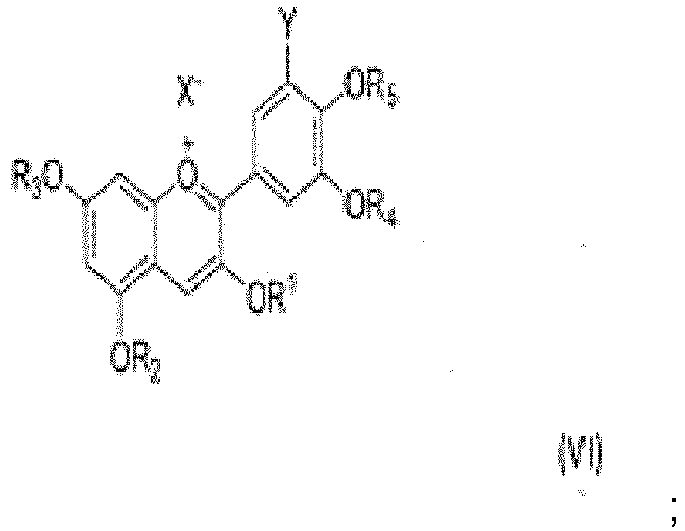
- the process of the present invention may yield pure formula (IV) or formula (V) or formula (VI) or a mixture of formula (IV) and (V).
- the reduction of the compound may be chiral or achiral, that may yield a compound of Formula (I) as a single enantiomer or an enantiomerically enriched mixture, for instance the compounds R,R diastereomer (Formula (VII)), the S,S diastereomer (Formula (VIII)), or a mixture thereof:
- the process of the present invention may yield compounds of Formula (I) such as (S,S)-epicatechin, (R,R)-epicatechin, a mixture of (S,S)- and (R,R)-epicatechin, (S,S)-epigallocatechin, (R,R)-epigallocatechin, and a mixture of (S,S)- and (R,R)-epigallocatechin.
- Formula (I) such as (S,S)-epicatechin, (R,R)-epicatechin, a mixture of (S,S)- and (R,R)-epicatechin, (S,S)-epigallocatechin, (R,R)-epigallocatechin, and a mixture of (S,S)- and (R,R)-epigallocatechin.
- the protected starting material [1] may be reduced to compounds such as [3] directly or through the intermediate [2] using suitable reducing agents such as lithium aluminum hydride in solvent such as tetrahydrofuran and followed by treatment with an acid such as hydrochloric acid.
- suitable reducing agents such as lithium aluminum hydride in solvent such as tetrahydrofuran and followed by treatment with an acid such as hydrochloric acid.
- the compound 3 may also be converted to [5a] and/ or [5b] using a reducing agent such as NaCNBH 3 in a solvent such as DCM.
- Further allylic alcohol [2] may be converted to 5a using reagent such as triethylsilane in solvent such as tetrahydrofuran at heating.
- [1] may also be selectively reduced to [4] in presence of a reagent such as lithium aluminum hydride with or without copper salt as a co-catalyst in solvent such as tetrahydrofuran at a temperature ranging from 60 - 80°C.
- a reagent such as lithium aluminum hydride with or without copper salt as a co-catalyst in solvent such as tetrahydrofuran at a temperature ranging from 60 - 80°C.
- racemic epicatechin or epigallocatechin [8] in major amount along with minor amount of catechin analogues.
- the racemic [8] can be resolved to pure enantiomer with the art known in literature such as enzymatic resolution using lipases/esterases and/ or chemical resolution by making diastereoisomers with a chiral acid.
- Achiral hydrogenation either of [3] or [5a] and/or [5b] in the presence of catalyst such as palladium on carbon in a solvent such as ethyl acetate under reducing atmosphere such as hydrogen can provide racemic [8].
- Chiral reduction either of [3] or [5a] and/or [5b] in the presence of a chiral reducing agent such as cinchona or other alkaloid-modified metal catalyst with a reducing atmosphere such as hydrogen in a solvent such as tetrahydrofuran can provide optically enriched or pure [6] or [7] as major products.
- the compounds of Formula(I), that contain more than one hydroxyl group may be protected by methods suitable for protecting hydroxyl groups.
- the compounds of Formula (I) may be obtained by natural sources or synthetic sources and may be either anhydrous, hydrous or as a dihydrate.
- Suitable methods for protection of the hydroxyl group may be effected through alkylation, silylation, or esterification to form an ether, an ester, an acetate, a chloroacetate, a trifluoroacetate, a pivaloate, a benzoate, a 1,2- isopropylidene or a 1,3- isopropylidene.
- Alkylating agents include alkyl chlorides, bromides, iodides or alkyl sulfonates. Specific examples of alkylating agents include allyl bromide, propargyl bromide, benzyl bromide, 2-fluoroethyl bromide, 4-nitrobenzyl bromide, 4-chlorobenzyl bromide, 4-methoxybenzyl bromide, ⁇ -bromo-p-tolunitrile, cinnamyl bromide, methyl 4-bromocrotonate, crotyl bromide, 1-bromo-2-pentene, 3-bromo-1-propenyl phenyl sulfone, 3-bromo-1-trimethylsilyl-1-propyne, 3-bromo-2-octyne, 1-bromo-2-butyne, 2-picolyl chloride, 3-picolyl chloride, 3-picolyl chloride,
- a preferred reagent for alkylation may be a benzyl halide, such as benzyl bromide.
- the protection of the hydroxyl group by alkylation reaction may be carried out in the presence of a strong base and a polar organic solvent.
- the base may be selected from alkali metal hydride, dialkylamide, bis(trialkylsilyl)amide, carbonates or hydroxide, more preferably an alkali metal carbonate such as potassium carbonate.
- the solvent may be a polar water-miscible solvent selected from acetonitrile, tetrahydrofuran (tetrahydrofuran), dimethylacetamide, dioxane, N,N-dimethylformamide, a sulfoxide such as dimethylsulfoxide, or N-methylpyrrolidinone.
- a polar water-miscible solvent selected from acetonitrile, tetrahydrofuran (tetrahydrofuran), dimethylacetamide, dioxane, N,N-dimethylformamide, a sulfoxide such as dimethylsulfoxide, or N-methylpyrrolidinone.
- the solvent is dimethylformamide.
- the alkylation reaction for the protection of the hydroxyl groups of quercetin [9] may be carried for a period of 4 - 7 hours, preferably at atmospheric pressure and at a temperature ranging from 60 -80 °C by reacting with [10] to yield the protected compound [11].
- the reduction of compounds of Formula (1) may be carried out by the use of suitable reducing agents such as metal hydride which may include sodium bis(2-methoxyethoxy)aluminum hydride, lithium aluminum hydride, sodium borohydride, aluminum hydride, diisobutyl aluminum hydride, trialkoxy aluminum hydride sodium amalgam, zinc mercury amalgam and sodium bis(2-methoxyethoxy)aluminum hydride.
- metal hydride which may include sodium bis(2-methoxyethoxy)aluminum hydride, lithium aluminum hydride, sodium borohydride, aluminum hydride, diisobutyl aluminum hydride, trialkoxy aluminum hydride sodium amalgam, zinc mercury amalgam and sodium bis(2-methoxyethoxy)aluminum hydride.
- the reducing agent is lithium aluminum hydride.
- the reduction may be carried out in the presence of lewis acids such as aluminum chloride, cerium chloride, zinc chloride, boron trifluoride, iodine
- the reduction reaction may be carried out in the presence of a solvent, which may be selected from the group comprising methyl tertiary butyl ether, tetrahydrofuran, diethyl ether, toluene, acetonitrile, etc.
- a solvent which may be selected from the group comprising methyl tertiary butyl ether, tetrahydrofuran, diethyl ether, toluene, acetonitrile, etc.
- the solvent is methyl tertiary butyl ether.
- the reaction may be carried out in a temperature ranging from -10 °C to 80 °C.
- the reduction and deprotection may be carried out by methods such that both reactions are carried out simultaneously.
- the hydrogenation catalyst is hydrogenation catalyst is selected from the group consisting of platinum, palladium, ruthenium, rhodium and nickel etc.
- a preferred catalyst is by the use of hydrogen in presence of 10 % palladium and carbon.
- Reaction is carried out in the presence of a solvent or mixture of solvents selected from methanol, ethanol, ethyl acetate, tetrahydrofuran, acetic acid, or their mixtures, where preferably the solvent is methanol, ethanol, ethylacetate or their mixtures.
- a solvent or mixture of solvents selected from methanol, ethanol, ethyl acetate, tetrahydrofuran, acetic acid, or their mixtures, where preferably the solvent is methanol, ethanol, ethylacetate or their mixtures.
- Reaction may be carried out at a temperature ranging from 25 - 60°C and at a pressure ranging from 4 - 50 psi.
- catechin may be prepared by the same process as claimed in this invention and is included within the scope of this invention.
- the present invention includes a process of converting the compound of Formula (VI) to the compound of Formula (IV), by the use of the reducing agent.
- the reducing agent may be selected from the group comprising metal hydrides which may include sodium bis(2-methoxyethoxy)aluminum hydride, lithium aluminum hydride, sodium borohydride, sodium cyanoborohydride, aluminum hydride, isobutyl aluminum hydride, trialkoxy aluminum hydride with or without Lewis acids such as aluminum chloride, cerium chloride, zinc chloride, boron trifluoride, or iodine.
- a suitable reducing reagent may include sodium amalgam, zinc mercury amalgam.
- the reducing agent is sodium cyanoborohydride.
- the reduction reaction may be carried in the presence of a solvent selected from the group consisting of methanol, ethanol, acetic acid, ethyl acetate, methyl t -butyl ether, diethyl ether, toluene, acetonitrile or tetrahydrofuran.
- a solvent selected from the group consisting of methanol, ethanol, acetic acid, ethyl acetate, methyl t -butyl ether, diethyl ether, toluene, acetonitrile or tetrahydrofuran.
- the reaction may be carried out in the presence of sodium cyanoborohydride, acetic acid, and dichloromethane at a temperature of from 0 °C to 35 °C
- the unprotected or partially protected polyphenol may be resolved to obtain both the enantiomers in optically enriched form using asymmetric resolution technique such as:
- Racemic epicatechin may be resolved by methods such as enzymatic resolution, chemical resolution, chiral column chromatography and chiral induced fractional crystallization of either unprotected or selectively protected polyphenols, as mentioned above.
- the racemic polyphenol may be resolved by a method comprising the steps of:
- Alkylating agents include alkyl chlorides, bromides, iodides or alkyl sulfonates.
- alkylating agents include allyl bromide, propargyl bromide, benzyl bromide, 2-fluoroethyl bromide, 4-nitrobenzyl bromide, 4-chlorobenzyl bromide, 4-methoxybenzyl bromide, ⁇ -bromo-p-tolunitrile, cinnamyl bromide, methyl 4-bromocrotonate, crotyl bromide, 1-bromo-2-pentene, 3-bromo-1-propenyl phenyl sulfone, 4-bromomethyl quinoline, bromoacetonitrile, bromofluoromethane, methyl bromoacetate, methoxymethyl chloride, bromoacetamide, 2-bro
- a suitable reagent for alkylation may be benzyl halide, such as benzyl bromide.
- the protection of the hydroxyl group by alkylation reaction is carried out in the presence of a base and a polar organic solvent.
- the base may be selected from the group comprising alkali metal hydride, dialkylamide, bis(trialkylsilyl)amide, carbonates or hydroxide, more preferably an alkali metal carbonate such as potassium carbonate.
- the solvent may be selected from the group comprising acetonitrile, tetrahydrofuran (tetrahydrofuran), N,N-dimethylformamide, a sulfoxide such as dimethylsulfoxide, or N-methylpyrrolidinone.
- the solvent is dimethylformamide.
- the alkylation reaction for the protection of the hydroxyl groups of epicatechin may be carried for a period of 4-7 hours preferably at atmospheric pressure and at a temperature ranging from 25 - 80 °C.
- the protected polyphenol may be converted into its diastereoisomer by the use of chiral compounds selected from the group consisting of chiral tartaric acid or it's derivative, methoxyphenylacetic acid, 2-methoxy-2-(1-naphthyl)-propionic acid, etc.
- the chiral reagent is (S and/or R)-2-methoxy-2-phenylacetic acid.
- the reaction may be carried out under general reaction conditions used for esterification where a hydroxyl group of polyphenol may be esterified with a corresponding activated or unactivated acylating agent in a solvent such as tetrahydrofuran, dichloromethane, acetonitrile, dimethylformamide etc., in the presence of a base such as pyridine, triethyl amine, diisopropyl amine with or without the presence of a catalyst such 4-dimethylaminopyridine (DMAP) or N',N'-dicylcohexylcarbodiimide (DCC) at a temperature ranging from 0 - 50 °C.
- a solvent such as tetrahydrofuran, dichloromethane, acetonitrile, dimethylformamide etc.
- a base such as pyridine, triethyl amine, diisopropyl amine with or without the presence of a catalyst such 4-dimethylaminopyridine
- reaction conditions include the use of activated acid as acid chloride in dichloromethane as the solvent, triethyl amine as a base and 4-dimethylaminopyridine as a catalyst.
- the reaction may be preferably carried out at room temperature.
- the diastereoisomers may be separated by any method known in the art such as column chromatography, fractional crystallization etc. Preferably, the diastereoisomers are separated by fractional crystallization.
- Fractional crystallization may be achieved by solubilizing the compound in a single solvent in which the compound is freely soluble at higher temperature, but one of the diastereoisomers is insoluble at lower temperature, and thereby selectively precipitating one diastereoisomer and retaining the other in solution.
- Fractional crystallization may also be achieved by solubilizing the compound in a solvent or solvents in which the compound is freely soluble and adding another solvent or solvents in which one of the diastereoisomer is insoluble and thereby selectively precipitating one diastereoisomer and retaining the other in solution.
- the fractional crystallization of the polyphenol stereoisomer may be achieved by the use of any suitable solvents.
- the fractional crystallization may be carried out solubilizing the compound in dichloromethane and precipitating the solution by methanol to selectively obtain one diastereomer in excess in the form of ester. This process may be repeated again to get a desire level of diastereomeric excess
- the chiral ester may be hydrolyzed by any method known in the art to obtain chiral purepolyphenol.
- a preferred method of hydrolyzing the chiral ester is by treating the diastereoisomerically pure ester with a base such as potassium carbonate in a solvent such as methanol and/or dichloromethane.
- optically pure benzyl protected polyphenol may be deprotected by general hydrogenolysis reaction conditions known in the art.
- This reaction may preferably be carried out in an atmosphere of hydrogen gas in a suitable organic solvent such as methanol, ethanol, ethyl acetate, tetrahydrofuran, acetic acid, etc. or mixtures thereof in the presence of a suitable catalyst such as palladium hydroxide, palladium on carbon at temperature range from room temperature to 60 °C.
- a suitable catalyst such as palladium hydroxide, palladium on carbon at temperature range from room temperature to 60 °C.
- the catalyst is palladium hydroxide and solvent is ethyl acetate at room temperature under a hydrogen atmosphere.
- the protected polyphenol may be converted to an ester by esterification, using acids or acid chlorides, such as alkyl or aryl esters.
- the enzymatic separation reaction may be carried out under general enzyme hydrolysis conditions known in the art used for resolving prochiral esters, for example using commercial esterases with a mixture of water-miscible or immiscible solvents such as tetrahydrofuran, acetonitrile, dimethylformamide, or ethyl acetate, etc., in the presence of base addition so as to maintain a pH range where the enzyme is still active.
- the reaction may be carried out at room temperature.
- the resulting chiral hydrolyzed protected enantiomer of polyphenol may be separated from the unreacted ester by any method known in the art such as column chromatography, fractional crystallization etc.
- the process of the present invention as may be directed to a novel method for preparing epicatechin and epigallocatechin, or pharmaceutically acceptable salt(s) thereof.
- the process for preparing epicatechin and epigallocatechin comprises one or more of the following steps, and illustrated in Scheme 1:
- Quercetin may be conducted by a process as illustrated in Scheme 3.
- the protected quercetin [11] (pentabenzyl quercetin; 3,5,7-tris(benzyloxy)-2-(3,4-bis(benzyloxy)phenyl)-4H-chromen-4-one) is reduced by suitable reducing agents as described above to obtain protected 4H chromene [12] 3,5,7-tris(benzyloxy)-2-(3,4-bis(benzyloxy)phenyl)-4H-chromene.
- racemic epicatechin [13] by reduction and deprotection of 4H chromene is illustrated in Scheme 5.
- the protected 4H chromene [12] may be simultaneously reduced and deprotected or sequentially reduced and de-protected as shown in the general synthetic Scheme 5. Further the reduction of chromene may be carried out in the presence of a chiral catalyst and/or chiral auxiliary known in the art, to provide isomerically enriched reduced product.
- the preferred method is the simultaneous reduction and deprotection of cyanidin.
- This reaction may preferably be carried out in an atmosphere of hydrogen gas in a suitable organic solvent such as methanol, ethanol, ethyl acetate, tetrahydrofuran, acetic acid etc. or mixtures thereof in the presence of a suitable catalyst such as Pd, Pt, Ni etc. adsorbed onto a solid support.
- a suitable organic solvent such as methanol, ethanol, ethyl acetate, tetrahydrofuran, acetic acid etc. or mixtures thereof
- a suitable catalyst such as Pd, Pt, Ni etc. adsorbed onto a solid support.
- the reduction and protection of 4 H chromene may be carried out by methods as above.
- the protected quercetin [11] (pentabenzyl quercetin; 3,5,7-tris(benzyloxy)-2-(3,4-bis(benzyloxy)phenyl)-4H-chromen-4-one) is reduced by suitable reducing agents to obtain protected cyanidin [14] (3,5,7-tris(benzyloxy)-2-(3,4-bis(benzyloxy)phenyl)chromenylium).
- the conversion of cyanidin is illustrated in scheme 7.
- the protected cyanidin can be converted to of 4H chromene and 2H chromene using a suitable reducing agent. Further, reaction conditions can be optimized to get either 4H chromene or 2H chromene as an exclusive product.
- cyanidin [14] may be converted to 2H chromene [16] and 4 H chromene [12] by reduction.
- the reducing agent may be selected from the group consisting of metal hydrides which may include sodium bis(2-methoxyethoxy)aluminum hydride, lithium aluminum hydride, sodium borohydride, sodium cyanoborohydride, aluminum hydride, isobutyl aluminum hydride, trialkoxy aluminum hydride with or without Lewis acids such as aluminum chloride, cerium chloride, zinc chloride, boron trifluoride, or iodine.
- a suitable reducing reagent may include sodium amalgam, zinc mercury amalgam, preferbaly sodium cyanoborohydride.
- the reaction may be conducted in the presence of a solvent selected from the group consisting of methanol, ethanol, acetic acid, ethyl acetate, methyl t -butyl ether, diethyl ether, toluene, acetonitrile or tetrahydrofuran or their mixture.
- a solvent selected from the group consisting of methanol, ethanol, acetic acid, ethyl acetate, methyl t -butyl ether, diethyl ether, toluene, acetonitrile or tetrahydrofuran or their mixture.
- the solvent is a mixture of acetic acid and dichloromethane at a temperature of from 0 °C to 35 °C
- 4H chromene to 2H chromene may be converted to 2 H chromene as below at Scheme 8.
- 2H chromene may be converted to 4H chromene by the use of a catalyst.
- Catalyst may be a lewis acid such as aluminum chloride, cerium chloride, zinc chloride, boron trifluoride and/ or iodine or a mild acid such as para-toluenesulfonic acid in a solvent such as THF, toluene, xylene, nitrobenzene etc at a temperature ranging from 20 to 150 oC.
- a lewis acid such as aluminum chloride, cerium chloride, zinc chloride, boron trifluoride and/ or iodine
- a mild acid such as para-toluenesulfonic acid in a solvent such as THF, toluene, xylene, nitrobenzene etc at a temperature ranging from 20 to 150 oC.
- the synthesis of racemic epicatechin [13] by reduction and deprotection of cyanidin is illustrated in Scheme 9.
- the protected cyanidin [14] may be simultaneously reduced and deprotected or sequentially reduced and de-protected as shown in the general synthetic Scheme 9.
- the reduction of cyanidin could be carried out in the presence of a chiral catalyst and/or chiral auxiliary known in the art, to provide isomerically enriched reduced product.
- the preferred method is the simultaneous reduction and deprotection of cyanidin.
- This reaction may preferably be carried out in an atmosphere of hydrogen gas in a suitable organic solvent such as methanol, ethanol, ethyl acetate, tetrahydrofuran, acetic acid etc. or mixtures thereof in the presence of a suitable catalyst such as Pd, Pt, Ni etc. adsorbed onto a solid support.
- the unprotected or partially protected racemic epicatechin and/or epigallocatechin or related phenols can be resolved to get both the enantiomers in optically enriched form using asymmetric resolution technique known in the art such as:
- the product is the ester of the desired isomer
- the final product in this instance epicatechin or epigallocatechin can be obtained by the hydrolysis of the ester moiety by acid catalyzed hydrolysis or base catalyzed hydrolysis by methods
- the compounds of the present invention may be reloved by the method comprising the steps of:
- the resolution may be carried out such that the esterification occurs at step (v)
- the racemic epicatechin may be resolved by any method known in the art such as enzymatic resolution, chemical resolution, chiral column chromatography and chiral induced fractional crystallization of either unprotected or selectively protected epicatechin, as mentioned above.
- the compound of formula (II) is a racemic quercetin or myricetin.
- racemic myricetin or quercetin may be carried out by:
- the protection at step (i) of the resolution of quercetin and myricetin may be 5,7,3',4' hydroxyl groups of epicatechin.
- the esterification may be carried out preferably at 3 position by an optically pure -acid or activated acid to obtain an ester as a mixture of two diastereomers.
- the protected epicatechin may be converted to its diastereoisomer by the use of chiral compounds selected from the group consisting of chiral tartaric acid or it's derivative, methoxyphenylacetic acid, 2-methoxy-2-(1-naphthyl)-propionic acid, etc.
- the chiral reagent is (S and/or R)-2-methoxy-2-phenylacetic acid.
- the diastereoisomers may be separated by any method known in the art such as column chromatography, fractional crystallization etc. Preferably, the diastereoisomers are separated by fractional crystallization.
- the chiral ester may be hydrolyzed by any method known in the art to obtain chiral pure epicatechin.
- a preferred method of hydrolyzing the chiral ester may be by treating the diastereoisomerically pure ester with a base such as potassium carbonate in a solvent such as methanol and/or dichloromethane.
- optically pure benzyl protected epicatechin may be deprotected by general hydrogenolysis reaction conditions known in the art.
- the protected epicatechin may be converted to an ester by esterification, using acids or acid chlorides, such as alkyl or aryl esters.
- the present invention is drawn to the intermediates of the novel process of synthesis of polyphenols.
- this aspect discloses the unprotected, partially protected and completely protected 4H chromene[formula (II)] and 2H chromene[formula (III)] structures of as below:
- R is selected from H, CH 3 , Bn, Ac, Si(CH 3 ) 3 , allyl.
- the present invention is drawn to the use of 4H chromene and 2H chromene in the synthesis of epicatechin.
- the invention is directed to methods of preparing pharmaceutical or nutraceutical compositions comprising catechin and/ or epicatechin. These methods comprise preparing catechin and/ or epicatechin, or pharmaceutically acceptable salt(s) thereof, by the methods described herein and combining this with a pharmaceutically or neutraceutially acceptable carrier.
- the invention is directed to methods of administering such a pharmaceutical or nutraceutical composition to a subject in need thereof.
- Routes of administration for the pharmaceutical and nutraceutical compositions of the present invention include parenteral and enteral routes.
- Preferred enteral routes of administration include delivery by mouth (oral), nasal, rectal, and vaginal routes.
- Preferred parenteral routes of administration include intravenous, intramuscular, subcutaneous, and intraperitoneal routes.
- the pharmaceutical or nutraceutical compositions of the present invention are administered in an "effective amount.”
- an "effective amount” is not limited to a minimal amount sufficient to ameliorate a condition, or to an amount that results in an optimal or a maximal amelioration of the condition.
- an effective amount of one such pharmaceutical may not be, in and of itself be an effective amount, but may be an effective amount when used together with additional pharmaceuticals.
- the semi solid obtained was triturated with 50% ethyl acetate: hexane (250 ml) for 30 min at room temperature yielding a solid.
- the solid was further filtered and washed with 50% ethyl acetate: hexane (200ml).
- the solid was dried under vacuum to obtain the product as an off-white solid (0.250g, 10%) [16].
- reaction mixture was filtered through Celite bed under suction and concentration of the filtrate gave a crude solid material (2.2 g, 110%).
- the solid material was purified by column chromatography using methanol/ dichlormethane as eluent to obtained pure [13] (1.65 g, 66%).
- the solid obtained was further re-crystallized from water (10 ml) to afford a light pink solid.
- Example 6 Synthesis of racemic epicatechin and racemic catechin from 2H-Chromene [16]
- Example 7 Synthesis of 4H-chromene [16] and/or 2H-chromene [14] from cyanidin:
- Example 16 Chiral Preparative HPLC Resolution of Racemic Epicatechin/catechin:
- the racemic mixture of epicatechin was dissolved in methanol and checked for its chiral purity on reverse phase CHIRAL PAK ® IC (250 X 4.6) mm, 5 ⁇ column at 25 ° C temperature.
- the mobile phase used was hexanes/ ethanol/ trifluoroacetic acid// 60/ 40/ 0.05 (v/v/v) with a flow rate of 1.0 ml/minute and sample injection volume of 10 ⁇ l.
- the signals were monitored at UV 280 nm with PDA.
- the both isomers separated with a retention time difference of about 1.6 minutes.
- the faster moving isomer on HPLC eluted at 4.7 minute while the slower moving isomer came at 6.3 minute on a 15 minute run.
- the racemic mixture (0.200 g) was dissolved in methanol and separated on a preparative HPLC on CHIRAL PAK ® IC (250 X 20) mm column at 25 ° C temperature.
- the sample injection volume was 2.0 ml with a feed concentration of 5 mg/ml.
- the mobile phase used was Hexanes/ EtOH// 60/40 v/v with a flow rate of 18 ml/ minute.
- the detection was done at UV 280 nm with PDA.
- the faster moving epicatechin isomer I (0.085 g) eluted at 4.7 minute and the slower moving epicatechin isomer II (0.084 g) at 6.3 minute with a qualitative purity of 99.6% and 99.8 % respectively.
- the slow moving isomer eluted at 6.3 minutes was assigned to be (-)-epicatechin ((2 R ,3 R )-2-(3,4-Dihydroxyphenyl)-3,4-dihydro-1(2 H )-benzopyran-3,5,7-triol) isomer and the fast moving isomer which eluted at 4.7 minutes was assigned to be (+)-epicatechin (((2 S ,3 S )-2-(3,4-Dihydroxyphenyl)-3,4-dihydro-1(2 H )-benzopyran-3,5,7-triol) isomer.
Landscapes
- Chemical & Material Sciences (AREA)
- Organic Chemistry (AREA)
- Health & Medical Sciences (AREA)
- Life Sciences & Earth Sciences (AREA)
- Veterinary Medicine (AREA)
- General Chemical & Material Sciences (AREA)
- Medicinal Chemistry (AREA)
- Nuclear Medicine, Radiotherapy & Molecular Imaging (AREA)
- Pharmacology & Pharmacy (AREA)
- Animal Behavior & Ethology (AREA)
- General Health & Medical Sciences (AREA)
- Public Health (AREA)
- Chemical Kinetics & Catalysis (AREA)
- Bioinformatics & Cheminformatics (AREA)
- Engineering & Computer Science (AREA)
- Diabetes (AREA)
- Cardiology (AREA)
- Hematology (AREA)
- Heart & Thoracic Surgery (AREA)
- Urology & Nephrology (AREA)
- Obesity (AREA)
- Emergency Medicine (AREA)
- Endocrinology (AREA)
- Biochemistry (AREA)
- Toxicology (AREA)
- Vascular Medicine (AREA)
- Pharmaceuticals Containing Other Organic And Inorganic Compounds (AREA)
- Organic Low-Molecular-Weight Compounds And Preparation Thereof (AREA)
- Low-Molecular Organic Synthesis Reactions Using Catalysts (AREA)
- Coloring Foods And Improving Nutritive Qualities (AREA)
- Pyrane Compounds (AREA)
Claims (15)
- Un procédé de préparation de composés de formule (I)

Y est choisi dans le groupe constitué de H et OR6 ;
R1, R2, R3, R4, R5 et R6 sont indépendamment choisis dans le groupe constitué de H, acétyle, allyle, propargyle, benzyle, 2-fluoroéthyle, 4-nitrobenzyle, 4-chlorobénzyle, 4-méthoxybenzyle, 4-méthoxybenzonitrile, cinnamyle, 4-méthoxy-4-oxo-but-2-en-1-yle, but-2-en-1-yle, 2-penten-1-yle, 3-(phénylsulfonyl)prop-1-en-1-yle), 1 triméthylsilylprop-1-yn-3-yle, 2-octyne-1-yle, 2-butyne-1-yle, 2-picolyle, 3-picolyle, 4-picolyle, quinolin-4-yl-méthyle, cyanométhyle, oxyranylméthyle, fluorométhyle, nitrométhyle, méthoxycarbonylméthyle, méthoxyméthyle, méthyl carbamoyle, 1-phényléthanone-2-yle, 2-butanone-1-yle, chlorométhyle, phényl sulfonylméthyle, 1-bromo-prop-1-en-3-yle, t-butyle, méthyle, éthyle, triméthyl-silyle, t-butyldiphénylsilyléthyle ;
comprenant ledit procédé les étapes suivantes :i. protéger les groupes hydroxyle d'un composé de formule (II) avec un ou plusieurs groupes protecteurs, pour donner un composé de formule (III) ii. traiter ledit composé de formule (III) avec un agent réducteur pour obtenir un composé choisi dans le groupe de la formule (IV), la formule (V) et la formule (VI), dans lesquelles X est choisi parmi l'halogénure, l'acétate, le trifluoroacétate, le méthanesulfonate, et l'hydroxyle ;
 iii. traiter un compose choisi dans le groupe de la formule (IV), la formule (V) ou la formule (VI) avec un agent réducteur pour obtenir un composé de formule (I), réalisant de préférence l'enlèvement d'un ou plusieurs groupes protecteurs.
 - Le procédé selon la revendication 1, dans lequel l'agent réducteur de l'étape (iii) est un agent réducteur chiral qui donne le composé de formule (I) en tant qu'un diastéréomère R,R pur (formule (VII)), un diastéréomère S,S pur (formula (VIII)), ou un mélange énantiomériquement enrichi de ceux-ci.
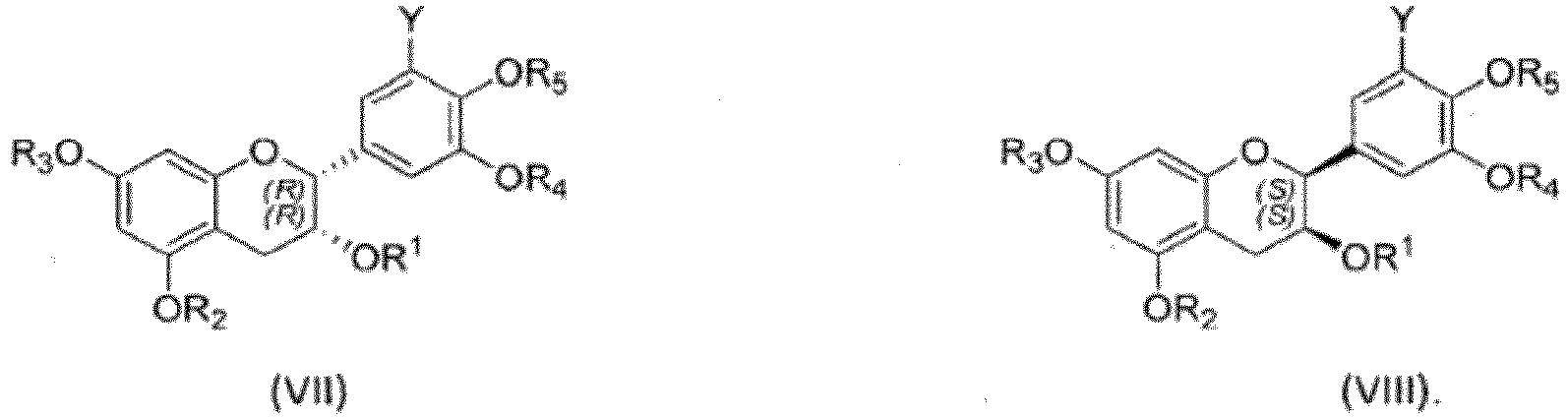
- Le procédé selon la revendication 1 ou 2, dans lequel le composé de formule (I) est choisi dans le groupe constitué de la (S,S)-épicatéchine, la (R,R)-épicatéchine, un mélange de (S,S) et (R,R)-épicatéchine, la (S, S)-épigallocatéchine, la (R,R)-épigallocatéchine et un mélange de (S,S)- et (R,R)-épigallocatéchine.
- Le procédé selon l'une quelconque des revendications 1 - 3, dans lequel la protection des groupes hydroxyle dans l'étape (i) est mise à exécution par alkylation, silylation, ou estérification pour former un éther, un ester, un acétate, un chloroacétate, un trifluoroacétate, un pivaloate, un benzoate, un 1,2-isopropylidène ou un 1,3-isopropylidène.
- Le procédé selon l'une quelconque des revendications 1 - 4, dans lequel l'étape (i) est mise à exécution :- avec un agent d'alkylation choisi dans le groupe constitué de bromure d'allyle, bromure de propargyle, bromure de benzyle, bromure de 2-fluoroéthyle, bromure de 4-nitrobenzyle, bromure de 4-chlorobenzyle, bromure de 4-méthoxybenzyle, α-bromo-p-tolunitrile, bromure de cinnamyle, 4-bromocrotonate de méthyle, bromure de crotyle, 1-bromo-2-pentène, 3-bromo-1-propényl-phényl-sulfone, 3-bromo-1-triméthylsilyl-1-propyne, 3-bromo-2-octyne, 1-bromo-2-butyne, chlorure de 2-picolyle, chlorure de 3-picolyle, chlorure de 4-picolyle, 4-bromométhylquinoline, bromoacétonitrile, épichlorohydrine, bromofluorométhane, bromonitrométhane, bromoacétate de méthyle, chlorure de méthoxyméthyle, bromoacétamide, 2-bromo acétophenone, 1-bromo-2-butanone, bromochlorométhane, bromométhylphényle sulfone et 1,3-dibromo-1-propène, étant l'agent d'alkylation de préférence le bromure de benzyle ; et/ou- en présence d'une base choisie dans le groupe constitué d'un hydrure de métal alcalin, une dialkylamide, une bis(trialkylsilyl)amide, un carbonate de métal alcalin et un hydroxyde de métal alcalin ; et/ou- avec un solvant organique choisi dans le groupe constitué de l'acétonitrile, le tétrahydrofurane, la diméthylacétamide, le dioxane, la N,N-diméthylformamide, un sulfoxyde, tel que le diméthylsulfoxyde et la N-méthylpyrrolidinone ; et/ou- à une température de 60 °C à 80 °C, pendant de 4 à 7 heures.
- Le procédé selon l'une quelconque des revendications 1 - 5, dans lequel l'étape (ii) est mise à exécution :- avec un agent réducteur choisi dans le groupe constitué de l'hydrure de lithium aluminium, du borohydrure de sodium, de l'hydrure d'aluminium, de l'hydrure de diisobutylaluminium, de l'hydrure de trialkoxyaluminium, de l'amalgame de sodium, de l'amalgame de zinc-mercure, et de l'hydrure de sodium bis(2-méthoxyéthoxy)aluminium, de préférence l'hydrure de lithium aluminium ou l'hydrure de sodium bis(2-méthoxyéthoxy)aluminum, et/ou- en présence d'un ou de plusieurs acides de Lewis additionnels choisis dans le groupe constitué du chlorure d'aluminium, du chlorure de cérium, du chlorure de zinc, du trifluorure de bore, et de l'iode, et/ou- en présence d'un solvant choisi dans le groupe constitué du méthyl tertio-butyl éther, du tétrahydrofurane, du diéthyléther, du toluène et de l'acétonitrile, de préférence le méthyl tertio-butyl éther ou le tétrahydrofurane, et/ou- à une température allant de -10 °C à 80 °C.
- Le procédé selon l'une quelconque des revendications 1 - 6, dans lequel l'étape (iii) est mise à exécution en utilisant de l'hydrogène gazeux en présence d'un catalyseur d'hydrogénation choisi dans le groupe constitué du platine, du palladium, du ruthénium, du rhodium et du nickel, de préférence du palladium sur charbon, et/ou en présence d'un solvant choisi dans le groupe constitué du méthanol, de l'éthanol, de l'acétate d'éthyle, du tétrahydrofurane, de l'acide acétique et des mélanges de ceux-ci, de préférence à une température allant de 25 °C à 60 °C à une pression allant de 4 à 50 psi.
- Le procédé selon l'une quelconque des revendications 1 - 7, comprenant une étape additionnelle de conversion du composé de formule (V) dans le composé de formule (IV), en présence d'un catalyseur acide choisi dans le groupe constitué de l'acide paratoluènesulfonique et des acides de Lewis, tels que le chlorure d'aluminium, le chlorure de cérium, le chlorure de zinc, le trifluorure de bore, le iode, de préférence en présence d'un solvant choisi dans le groupe constitué du méthanol, de l'éthanol, de l'acétate de l'éthyle, du tétrahydrofurane, du méthyl tertio-butyl éther, du diéthyléther, du toluène, de l'acétonitrile et/ou de l'acide acétique, de préférence à une température allant de 85 °C à 90 °C.
- Le procédé selon l'une quelconque des revendications 1 - 7, comprenant une étape additionnelle de conversion du composé de formule (VI) dans le composé de formule (IV) en présence d'un agent réducteur choisi dans le groupe constitué des hydrures de métal, tels que l'hydrure de sodium bis(2-méthoxyéthoxy)aluminum, l'hydrure de lithium aluminium, le borohydrure de sodium, le cyanoborohydrure de sodium, l'hydrure d'aluminium, l'hydrure d'isobutylaluminium et l'hydrure de trialkoxyaluminium, facultativement en présence d'un acide de Lewis, tel que le chlorure d'aluminium, le chlorure de cérium, le chlorure de zinc, le trifluorure de bore, ou le iode, de préférence le cyanoborohydrure de sodium, ou en présence d'un agent réducteur choisi parmi l'amalgame de sodium, l'amalgame de zinc-mercure, de manière plus préférée le cyanoborohydrure de sodium, de préférence en présence d'un solvant choisi dans le groupe constitué du méthanol, de l'éthanol, de l'acide acétique, de l'acétate d'éthyle, du méthyl-t-butyl éther, du diéthyl éther, du toluène, de l'acétonitrile ou du tétrahydrofurane, de préférence à une température allant de 0 °C à 35 °C.
- Le procédé selon l'une quelconque des revendications 1 - 9, comprenant une étape additionnelle de
résoudre le composé de formule (I) pour former un stéréo-isomère essentiellement pur moyennant résolution enzymatique, résolution chimique, chromatographie chirale, cristallisation partielle ou cristallisation fractionnelle induite chirale d'un mélange diastéréomérique d'esters correspondants générés par la fonctionnalisation d'un groupe hydroxyle de formule (I) avec un acide optiquement pur tel que l'acide mandélique ou l'acide tartarique. - Le procédé selon la revendication 10, dans lequel le composé de formule (I) est résolu par un procédé comprenant une ou plusieurs des étapes suivantes :i. protéger tous sauf un des groupes hydroxyle du composé de formule (I) en utilisant un ou plus groupes protecteurs achiraux ;ii. coupler le groupe hydroxyle non protégé avec un acide optiquement pur pour former un ester comme un mélange de deux diastéréomères, de préférence dans la position 5 du composé de formule (I) ;iii. séparer les deux diastéréoisomères formés dans l'étape (ii) par cristallisation fractionnelle où cristallisation préférentielle pour obtenir un ester optiquement pur ou diastéréomériquement enrichi ;iv. hydrolyser l'ester optiquement pur ou diastéréomériquement enrichi pour obtenir un composé protégé enantiomériquement enrichi ; etv. déprotéger le composé protégé enantiomériquement enrichi pour donner un composé de formule (I).
- Le procédé selon la revendication 10 ou 11, dans lequel le composé de formule (I) est l'épicatéchine et la résolution comprend les étapes suivantes :i. protéger quatre groupes hydroxyle quelconques de l'épicatéchine ;ii. coupler le groupe hydroxyle non protégé avec un acide optiquement pur pour former un ester comme un mélange de deux diastéréomères ;iii. séparer les deux diastéréoisomères pour donner un ester diastéréomériquement enrichi;iv. hydrolyse de l'ester diastéréomériquement enrichi pour obtenir de l'épicatéchine protégée enantiomériquement enrichie ; etv. déprotection de l'épicatéchine protégée enantiomériquement enrichie pour donner de l'épicatéchine comme un enantiomère essentiellement pur ou un mélange enantiomériquement enrichi.
- Le procédé selon l'une quelconque des revendications 3 - 12, dans lequel le composé de formule (I) est la (R,R)-épicatéchine, la (S,S)-épicatéchine ou un mélange de celles-ci.
- Un composé de formule (IV) ou de formule (V)
 Y est choisi dans le groupe constitué de H et OR6, de préférence H ;R1, R2, R3, R4, R5, et R6 sont benzyle.
 - Un composé de formule (VI)
Applications Claiming Priority (2)
| Application Number | Priority Date | Filing Date | Title |
|---|---|---|---|
| IN196DE2011 | 2011-01-27 | ||
| PCT/IN2012/000052 WO2012101652A2 (fr) | 2011-01-27 | 2012-01-24 | Nouveau procédé de synthèse de polyphénols |
Publications (3)
| Publication Number | Publication Date |
|---|---|
| EP2668176A2 EP2668176A2 (fr) | 2013-12-04 |
| EP2668176A4 EP2668176A4 (fr) | 2014-08-27 |
| EP2668176B1 true EP2668176B1 (fr) | 2017-05-17 |
Family
ID=46581222
Family Applications (1)
| Application Number | Title | Priority Date | Filing Date |
|---|---|---|---|
| EP12739384.1A Active EP2668176B1 (fr) | 2011-01-27 | 2012-01-24 | Nouveau procédé de synthèse de polyphénols |
Country Status (7)
| Country | Link |
|---|---|
| US (1) | US9428482B2 (fr) |
| EP (1) | EP2668176B1 (fr) |
| JP (1) | JP5890846B2 (fr) |
| CN (1) | CN103582635B (fr) |
| ES (1) | ES2636441T3 (fr) |
| TW (1) | TWI697489B (fr) |
| WO (1) | WO2012101652A2 (fr) |
Families Citing this family (8)
| Publication number | Priority date | Publication date | Assignee | Title |
|---|---|---|---|---|
| CN105026384A (zh) * | 2013-01-26 | 2015-11-04 | 斯法尔制药私人有限公司 | 合成儿茶素的新方法 |
| WO2014162320A2 (fr) | 2013-04-04 | 2014-10-09 | Sphaera Pharma Pvt. Ltd. | Nouveaux analogues d'épicatéchine et polyphénols associés |
| CN106714770B (zh) | 2014-07-23 | 2024-04-19 | 斯法尔制药私人有限公司 | 羟基类固醇化合物、其中间体、制备方法、组合物及其用途 |
| EP3472176B1 (fr) * | 2016-06-21 | 2024-05-15 | Sphaera Pharma Pvt. Ltd. | L'utilité de (+) épicatéchine et de leurs analogues |
| CN105949161B (zh) * | 2016-06-28 | 2018-05-15 | 温州大学 | 一种3-芳巯基黄酮化合物的制备方法 |
| CN106946835B (zh) * | 2017-04-25 | 2019-03-01 | 广州科技职业技术学院 | 橙皮素酯化物及其制备方法和应用 |
| EP3677577A4 (fr) | 2017-08-28 | 2021-04-28 | NBC Meshtec, Inc. | Procédé de production de polyphénol |
| BR112021007684A2 (pt) | 2018-10-24 | 2021-07-27 | Epirium Bio Inc. | cocristal, composição farmacêutica, métodos para tratar uma doença ou distúrbio que se beneficiaria da modificação da cadeia de transporte de elétrons, para reduzir os níveis de triglicerídeos, para tratar uma doença ou distúrbio selecionado a partir do grupo que consiste em uma síndrome metabólica, diabetes tipo ii, uma hiperlipidemia congênita e hiperlipidemia induzida por drogas, para tratar uma condição relacionada à disfunção mitocondrial, para melhorar o desempenho esportivo, resistência, construção de forma ou força muscular, ou facilitar a recuperação dos efeitos do treinamento ou competição e para tratar ou prevenir distrofinopatia, sarcoglicanopatia ou disferlinopatia, processo para preparar um cocristal, e, uso de um cocristal |
Family Cites Families (9)
| Publication number | Priority date | Publication date | Assignee | Title |
|---|---|---|---|---|
| GB2122608B (en) * | 1982-06-01 | 1985-10-02 | Zyma Sa | (+)-cyanidan-3-ol derivatives |
| EP0445819B1 (fr) * | 1990-03-08 | 2001-08-22 | Fuji Photo Film Co., Ltd. | Composition photosensible positive |
| US6476241B1 (en) * | 2000-09-05 | 2002-11-05 | Mars Incorporated | Synthesis of 4α-arylepicatechins |
| CN100400535C (zh) * | 2003-03-03 | 2008-07-09 | 三荣源有限公司 | 脂联素表达促进剂 |
| JP5339664B2 (ja) * | 2004-02-13 | 2013-11-13 | 花王株式会社 | Ampk活性化剤 |
| JP2006083105A (ja) * | 2004-09-16 | 2006-03-30 | Ito En Ltd | 血液流動性改善剤および飲食物 |
| CN101248057A (zh) * | 2005-06-29 | 2008-08-20 | 马尔斯公司 | (+)-儿茶素、(-)-表儿茶素、(-)-儿茶素、(+)-表儿茶素以及它们的5,7,3',4'-四-o-苄基类似物的制备 |
| WO2008153945A2 (fr) * | 2007-06-06 | 2008-12-18 | University Of South Florida | Compositions nutraceutiques de co-cristal |
| JP5382676B2 (ja) * | 2007-12-07 | 2014-01-08 | 国立大学法人名古屋大学 | アントシアニジン類の製造方法 |
-
2012
- 2012-01-24 JP JP2013551012A patent/JP5890846B2/ja not_active Expired - Fee Related
- 2012-01-24 EP EP12739384.1A patent/EP2668176B1/fr active Active
- 2012-01-24 CN CN201280010653.7A patent/CN103582635B/zh active Active
- 2012-01-24 WO PCT/IN2012/000052 patent/WO2012101652A2/fr not_active Ceased
- 2012-01-24 ES ES12739384.1T patent/ES2636441T3/es active Active
- 2012-01-24 US US13/981,279 patent/US9428482B2/en active Active
- 2012-01-30 TW TW101102826A patent/TWI697489B/zh active
Also Published As
| Publication number | Publication date |
|---|---|
| WO2012101652A2 (fr) | 2012-08-02 |
| EP2668176A4 (fr) | 2014-08-27 |
| TW201309662A (zh) | 2013-03-01 |
| CN103582635A (zh) | 2014-02-12 |
| US9428482B2 (en) | 2016-08-30 |
| EP2668176A2 (fr) | 2013-12-04 |
| ES2636441T3 (es) | 2017-10-05 |
| CN103582635B (zh) | 2019-02-19 |
| TWI697489B (zh) | 2020-07-01 |
| JP2014509312A (ja) | 2014-04-17 |
| JP5890846B2 (ja) | 2016-03-22 |
| US20140031421A1 (en) | 2014-01-30 |
| WO2012101652A3 (fr) | 2012-12-27 |
| ES2636441T8 (es) | 2018-12-14 |
Similar Documents
| Publication | Publication Date | Title |
|---|---|---|
| EP2668176B1 (fr) | Nouveau procédé de synthèse de polyphénols | |
| JP7039643B2 (ja) | カテキンの新規合成手法 | |
| KR101829102B1 (ko) | 크로마논 2-카르복실산 유도체, 크로만 2-카르복실산 유도체 및 이의 제조방법 | |
| US20250042838A1 (en) | Process for the synthesis and purification of cannabinoic acids and acylated derivatives thereof | |
| JP5744738B2 (ja) | ネビボロールの調製方法 | |
| EP2868657A1 (fr) | Procédé de préparation d'aglycone de scutellarine à haute pureté | |
| EP3105214B1 (fr) | Nouveau procédé de production chlorhydrate de nébivolol à haute pureté | |
| CN113896616A (zh) | 一种大麻二酚的制备方法 | |
| JP5780651B2 (ja) | エクオールの不斉合成法 | |
| US11434217B2 (en) | Method for synthesis of lobaric acid and analog thereof | |
| JP2018070509A (ja) | 新規トコフェリルアスコルビン酸誘導体とその製造方法 | |
| CN121362223A (zh) | 一种卡培他滨及其中间体的制备方法 | |
| EP1997815B1 (fr) | Méthode de synthèse d'un dérivé de flavane | |
| JP2010006729A (ja) | テアフラビン類の製造方法 | |
| JPH10204077A (ja) | 抗酸化活性を有するベンゾクロマン誘導体 |
Legal Events
| Date | Code | Title | Description |
|---|---|---|---|
| PUAI | Public reference made under article 153(3) epc to a published international application that has entered the european phase |
Free format text: ORIGINAL CODE: 0009012 |
|
| 17P | Request for examination filed |
Effective date: 20130823 |
|
| AK | Designated contracting states |
Kind code of ref document: A2 Designated state(s): AL AT BE BG CH CY CZ DE DK EE ES FI FR GB GR HR HU IE IS IT LI LT LU LV MC MK MT NL NO PL PT RO RS SE SI SK SM TR |
|
| DAX | Request for extension of the european patent (deleted) | ||
| A4 | Supplementary search report drawn up and despatched |
Effective date: 20140725 |
|
| RIC1 | Information provided on ipc code assigned before grant |
Ipc: C07D 311/64 20060101AFI20140721BHEP |
|
| 17Q | First examination report despatched |
Effective date: 20160628 |
|
| REG | Reference to a national code |
Ref country code: DE Ref legal event code: R079 Ref document number: 602012032556 Country of ref document: DE Free format text: PREVIOUS MAIN CLASS: C07D0311640000 Ipc: C07D0311300000 |
|
| RIC1 | Information provided on ipc code assigned before grant |
Ipc: C07D 311/74 20060101ALI20161117BHEP Ipc: C07D 311/30 20060101AFI20161117BHEP |
|
| GRAP | Despatch of communication of intention to grant a patent |
Free format text: ORIGINAL CODE: EPIDOSNIGR1 |
|
| INTG | Intention to grant announced |
Effective date: 20161223 |
|
| GRAS | Grant fee paid |
Free format text: ORIGINAL CODE: EPIDOSNIGR3 |
|
| GRAA | (expected) grant |
Free format text: ORIGINAL CODE: 0009210 |
|
| AK | Designated contracting states |
Kind code of ref document: B1 Designated state(s): AL AT BE BG CH CY CZ DE DK EE ES FI FR GB GR HR HU IE IS IT LI LT LU LV MC MK MT NL NO PL PT RO RS SE SI SK SM TR |
|
| REG | Reference to a national code |
Ref country code: GB Ref legal event code: FG4D |
|
| REG | Reference to a national code |
Ref country code: CH Ref legal event code: EP |
|
| REG | Reference to a national code |
Ref country code: IE Ref legal event code: FG4D |
|
| REG | Reference to a national code |
Ref country code: AT Ref legal event code: REF Ref document number: 894336 Country of ref document: AT Kind code of ref document: T Effective date: 20170615 |
|
| REG | Reference to a national code |
Ref country code: DE Ref legal event code: R096 Ref document number: 602012032556 Country of ref document: DE |
|
| REG | Reference to a national code |
Ref country code: NL Ref legal event code: MP Effective date: 20170517 |
|
| REG | Reference to a national code |
Ref country code: ES Ref legal event code: FG2A Ref document number: 2636441 Country of ref document: ES Kind code of ref document: T3 Effective date: 20171005 |
|
| REG | Reference to a national code |
Ref country code: LT Ref legal event code: MG4D |
|
| REG | Reference to a national code |
Ref country code: AT Ref legal event code: MK05 Ref document number: 894336 Country of ref document: AT Kind code of ref document: T Effective date: 20170517 |
|
| PG25 | Lapsed in a contracting state [announced via postgrant information from national office to epo] |
Ref country code: AT Free format text: LAPSE BECAUSE OF FAILURE TO SUBMIT A TRANSLATION OF THE DESCRIPTION OR TO PAY THE FEE WITHIN THE PRESCRIBED TIME-LIMIT Effective date: 20170517 Ref country code: GR Free format text: LAPSE BECAUSE OF FAILURE TO SUBMIT A TRANSLATION OF THE DESCRIPTION OR TO PAY THE FEE WITHIN THE PRESCRIBED TIME-LIMIT Effective date: 20170818 Ref country code: NO Free format text: LAPSE BECAUSE OF FAILURE TO SUBMIT A TRANSLATION OF THE DESCRIPTION OR TO PAY THE FEE WITHIN THE PRESCRIBED TIME-LIMIT Effective date: 20170817 Ref country code: HR Free format text: LAPSE BECAUSE OF FAILURE TO SUBMIT A TRANSLATION OF THE DESCRIPTION OR TO PAY THE FEE WITHIN THE PRESCRIBED TIME-LIMIT Effective date: 20170517 Ref country code: FI Free format text: LAPSE BECAUSE OF FAILURE TO SUBMIT A TRANSLATION OF THE DESCRIPTION OR TO PAY THE FEE WITHIN THE PRESCRIBED TIME-LIMIT Effective date: 20170517 Ref country code: LT Free format text: LAPSE BECAUSE OF FAILURE TO SUBMIT A TRANSLATION OF THE DESCRIPTION OR TO PAY THE FEE WITHIN THE PRESCRIBED TIME-LIMIT Effective date: 20170517 |
|
| PG25 | Lapsed in a contracting state [announced via postgrant information from national office to epo] |
Ref country code: IS Free format text: LAPSE BECAUSE OF FAILURE TO SUBMIT A TRANSLATION OF THE DESCRIPTION OR TO PAY THE FEE WITHIN THE PRESCRIBED TIME-LIMIT Effective date: 20170917 Ref country code: NL Free format text: LAPSE BECAUSE OF FAILURE TO SUBMIT A TRANSLATION OF THE DESCRIPTION OR TO PAY THE FEE WITHIN THE PRESCRIBED TIME-LIMIT Effective date: 20170517 Ref country code: LV Free format text: LAPSE BECAUSE OF FAILURE TO SUBMIT A TRANSLATION OF THE DESCRIPTION OR TO PAY THE FEE WITHIN THE PRESCRIBED TIME-LIMIT Effective date: 20170517 Ref country code: PL Free format text: LAPSE BECAUSE OF FAILURE TO SUBMIT A TRANSLATION OF THE DESCRIPTION OR TO PAY THE FEE WITHIN THE PRESCRIBED TIME-LIMIT Effective date: 20170517 Ref country code: BG Free format text: LAPSE BECAUSE OF FAILURE TO SUBMIT A TRANSLATION OF THE DESCRIPTION OR TO PAY THE FEE WITHIN THE PRESCRIBED TIME-LIMIT Effective date: 20170817 Ref country code: SE Free format text: LAPSE BECAUSE OF FAILURE TO SUBMIT A TRANSLATION OF THE DESCRIPTION OR TO PAY THE FEE WITHIN THE PRESCRIBED TIME-LIMIT Effective date: 20170517 Ref country code: RS Free format text: LAPSE BECAUSE OF FAILURE TO SUBMIT A TRANSLATION OF THE DESCRIPTION OR TO PAY THE FEE WITHIN THE PRESCRIBED TIME-LIMIT Effective date: 20170517 |
|
| REG | Reference to a national code |
Ref country code: FR Ref legal event code: PLFP Year of fee payment: 7 |
|
| PG25 | Lapsed in a contracting state [announced via postgrant information from national office to epo] |
Ref country code: DK Free format text: LAPSE BECAUSE OF FAILURE TO SUBMIT A TRANSLATION OF THE DESCRIPTION OR TO PAY THE FEE WITHIN THE PRESCRIBED TIME-LIMIT Effective date: 20170517 Ref country code: RO Free format text: LAPSE BECAUSE OF FAILURE TO SUBMIT A TRANSLATION OF THE DESCRIPTION OR TO PAY THE FEE WITHIN THE PRESCRIBED TIME-LIMIT Effective date: 20170517 Ref country code: SK Free format text: LAPSE BECAUSE OF FAILURE TO SUBMIT A TRANSLATION OF THE DESCRIPTION OR TO PAY THE FEE WITHIN THE PRESCRIBED TIME-LIMIT Effective date: 20170517 Ref country code: EE Free format text: LAPSE BECAUSE OF FAILURE TO SUBMIT A TRANSLATION OF THE DESCRIPTION OR TO PAY THE FEE WITHIN THE PRESCRIBED TIME-LIMIT Effective date: 20170517 Ref country code: CZ Free format text: LAPSE BECAUSE OF FAILURE TO SUBMIT A TRANSLATION OF THE DESCRIPTION OR TO PAY THE FEE WITHIN THE PRESCRIBED TIME-LIMIT Effective date: 20170517 |
|
| REG | Reference to a national code |
Ref country code: DE Ref legal event code: R097 Ref document number: 602012032556 Country of ref document: DE |
|
| PG25 | Lapsed in a contracting state [announced via postgrant information from national office to epo] |
Ref country code: SM Free format text: LAPSE BECAUSE OF FAILURE TO SUBMIT A TRANSLATION OF THE DESCRIPTION OR TO PAY THE FEE WITHIN THE PRESCRIBED TIME-LIMIT Effective date: 20170517 |
|
| PLBE | No opposition filed within time limit |
Free format text: ORIGINAL CODE: 0009261 |
|
| STAA | Information on the status of an ep patent application or granted ep patent |
Free format text: STATUS: NO OPPOSITION FILED WITHIN TIME LIMIT |
|
| 26N | No opposition filed |
Effective date: 20180220 |
|
| PG25 | Lapsed in a contracting state [announced via postgrant information from national office to epo] |
Ref country code: SI Free format text: LAPSE BECAUSE OF FAILURE TO SUBMIT A TRANSLATION OF THE DESCRIPTION OR TO PAY THE FEE WITHIN THE PRESCRIBED TIME-LIMIT Effective date: 20170517 |
|
| PG25 | Lapsed in a contracting state [announced via postgrant information from national office to epo] |
Ref country code: LU Free format text: LAPSE BECAUSE OF NON-PAYMENT OF DUE FEES Effective date: 20180124 |
|
| PG25 | Lapsed in a contracting state [announced via postgrant information from national office to epo] |
Ref country code: MC Free format text: LAPSE BECAUSE OF FAILURE TO SUBMIT A TRANSLATION OF THE DESCRIPTION OR TO PAY THE FEE WITHIN THE PRESCRIBED TIME-LIMIT Effective date: 20170517 |
|
| PG25 | Lapsed in a contracting state [announced via postgrant information from national office to epo] |
Ref country code: MT Free format text: LAPSE BECAUSE OF NON-PAYMENT OF DUE FEES Effective date: 20180124 |
|
| PG25 | Lapsed in a contracting state [announced via postgrant information from national office to epo] |
Ref country code: TR Free format text: LAPSE BECAUSE OF FAILURE TO SUBMIT A TRANSLATION OF THE DESCRIPTION OR TO PAY THE FEE WITHIN THE PRESCRIBED TIME-LIMIT Effective date: 20170517 |
|
| PG25 | Lapsed in a contracting state [announced via postgrant information from national office to epo] |
Ref country code: HU Free format text: LAPSE BECAUSE OF FAILURE TO SUBMIT A TRANSLATION OF THE DESCRIPTION OR TO PAY THE FEE WITHIN THE PRESCRIBED TIME-LIMIT; INVALID AB INITIO Effective date: 20120124 Ref country code: PT Free format text: LAPSE BECAUSE OF FAILURE TO SUBMIT A TRANSLATION OF THE DESCRIPTION OR TO PAY THE FEE WITHIN THE PRESCRIBED TIME-LIMIT Effective date: 20170517 |
|
| PG25 | Lapsed in a contracting state [announced via postgrant information from national office to epo] |
Ref country code: MK Free format text: LAPSE BECAUSE OF NON-PAYMENT OF DUE FEES Effective date: 20170517 Ref country code: CY Free format text: LAPSE BECAUSE OF FAILURE TO SUBMIT A TRANSLATION OF THE DESCRIPTION OR TO PAY THE FEE WITHIN THE PRESCRIBED TIME-LIMIT Effective date: 20170517 |
|
| PG25 | Lapsed in a contracting state [announced via postgrant information from national office to epo] |
Ref country code: AL Free format text: LAPSE BECAUSE OF FAILURE TO SUBMIT A TRANSLATION OF THE DESCRIPTION OR TO PAY THE FEE WITHIN THE PRESCRIBED TIME-LIMIT Effective date: 20170517 |
|
| PGFP | Annual fee paid to national office [announced via postgrant information from national office to epo] |
Ref country code: ES Payment date: 20240208 Year of fee payment: 13 |
|
| PGFP | Annual fee paid to national office [announced via postgrant information from national office to epo] |
Ref country code: BE Payment date: 20241220 Year of fee payment: 14 |
|
| PGFP | Annual fee paid to national office [announced via postgrant information from national office to epo] |
Ref country code: GB Payment date: 20241205 Year of fee payment: 14 |
|
| PGFP | Annual fee paid to national office [announced via postgrant information from national office to epo] |
Ref country code: FR Payment date: 20241209 Year of fee payment: 14 |
|
| PGFP | Annual fee paid to national office [announced via postgrant information from national office to epo] |
Ref country code: IE Payment date: 20241126 Year of fee payment: 14 |
|
| PGFP | Annual fee paid to national office [announced via postgrant information from national office to epo] |
Ref country code: DE Payment date: 20241126 Year of fee payment: 14 |
|
| PGFP | Annual fee paid to national office [announced via postgrant information from national office to epo] |
Ref country code: CH Payment date: 20250201 Year of fee payment: 14 |
|
| PGFP | Annual fee paid to national office [announced via postgrant information from national office to epo] |
Ref country code: IT Payment date: 20241210 Year of fee payment: 14 |
|
| REG | Reference to a national code |
Ref country code: ES Ref legal event code: FD2A Effective date: 20260227 |
|
| PG25 | Lapsed in a contracting state [announced via postgrant information from national office to epo] |
Ref country code: ES Free format text: LAPSE BECAUSE OF NON-PAYMENT OF DUE FEES Effective date: 20250125 |