EP2671123B1 - Procede et dispositif flottant autonome d'asservissement de position d'une embarcation nautique. - Google Patents
Procede et dispositif flottant autonome d'asservissement de position d'une embarcation nautique. Download PDFInfo
- Publication number
- EP2671123B1 EP2671123B1 EP12707637.0A EP12707637A EP2671123B1 EP 2671123 B1 EP2671123 B1 EP 2671123B1 EP 12707637 A EP12707637 A EP 12707637A EP 2671123 B1 EP2671123 B1 EP 2671123B1
- Authority
- EP
- European Patent Office
- Prior art keywords
- geographical
- propulsion unit
- orientation
- boat
- propulsion
- Prior art date
- Legal status (The legal status is an assumption and is not a legal conclusion. Google has not performed a legal analysis and makes no representation as to the accuracy of the status listed.)
- Not-in-force
Links
- 238000007667 floating Methods 0.000 title claims description 7
- 238000000034 method Methods 0.000 title claims description 7
- 238000004891 communication Methods 0.000 description 5
- 238000005265 energy consumption Methods 0.000 description 5
- 238000001514 detection method Methods 0.000 description 2
- 238000010586 diagram Methods 0.000 description 2
- 230000015654 memory Effects 0.000 description 2
- 238000011084 recovery Methods 0.000 description 2
- 230000003321 amplification Effects 0.000 description 1
- 230000005540 biological transmission Effects 0.000 description 1
- 238000004883 computer application Methods 0.000 description 1
- 230000007423 decrease Effects 0.000 description 1
- 239000002828 fuel tank Substances 0.000 description 1
- 230000006870 function Effects 0.000 description 1
- 238000002347 injection Methods 0.000 description 1
- 239000007924 injection Substances 0.000 description 1
- 230000007774 longterm Effects 0.000 description 1
- 238000012423 maintenance Methods 0.000 description 1
- 238000012986 modification Methods 0.000 description 1
- 230000004048 modification Effects 0.000 description 1
- 238000003199 nucleic acid amplification method Methods 0.000 description 1
- 238000012545 processing Methods 0.000 description 1
- 239000007858 starting material Substances 0.000 description 1
- 230000001960 triggered effect Effects 0.000 description 1
- XLYOFNOQVPJJNP-UHFFFAOYSA-N water Substances O XLYOFNOQVPJJNP-UHFFFAOYSA-N 0.000 description 1
Images



Classifications
-
- G—PHYSICS
- G05—CONTROLLING; REGULATING
- G05D—SYSTEMS FOR CONTROLLING OR REGULATING NON-ELECTRIC VARIABLES
- G05D1/00—Control of position, course, altitude or attitude of land, water, air or space vehicles, e.g. using automatic pilots
- G05D1/02—Control of position or course in two dimensions
- G05D1/0206—Control of position or course in two dimensions specially adapted to water vehicles
- G05D1/0208—Control of position or course in two dimensions specially adapted to water vehicles dynamic anchoring
-
- B—PERFORMING OPERATIONS; TRANSPORTING
- B63—SHIPS OR OTHER WATERBORNE VESSELS; RELATED EQUIPMENT
- B63B—SHIPS OR OTHER WATERBORNE VESSELS; EQUIPMENT FOR SHIPPING
- B63B35/00—Vessels or similar floating structures specially adapted for specific purposes and not otherwise provided for
- B63B35/66—Tugs
- B63B35/665—Floating propeller units, i.e. a motor and propeller unit mounted in a floating box
-
- B—PERFORMING OPERATIONS; TRANSPORTING
- B63—SHIPS OR OTHER WATERBORNE VESSELS; RELATED EQUIPMENT
- B63H—MARINE PROPULSION OR STEERING
- B63H25/00—Steering; Slowing-down otherwise than by use of propulsive elements; Dynamic anchoring, i.e. positioning vessels by means of main or auxiliary propulsive elements
- B63H25/42—Steering or dynamic anchoring by propulsive elements; Steering or dynamic anchoring by propellers used therefor only; Steering or dynamic anchoring by rudders carrying propellers
-
- B—PERFORMING OPERATIONS; TRANSPORTING
- B63—SHIPS OR OTHER WATERBORNE VESSELS; RELATED EQUIPMENT
- B63B—SHIPS OR OTHER WATERBORNE VESSELS; EQUIPMENT FOR SHIPPING
- B63B35/00—Vessels or similar floating structures specially adapted for specific purposes and not otherwise provided for
- B63B2035/006—Unmanned surface vessels, e.g. remotely controlled
- B63B2035/007—Unmanned surface vessels, e.g. remotely controlled autonomously operating
-
- B—PERFORMING OPERATIONS; TRANSPORTING
- B63—SHIPS OR OTHER WATERBORNE VESSELS; RELATED EQUIPMENT
- B63B—SHIPS OR OTHER WATERBORNE VESSELS; EQUIPMENT FOR SHIPPING
- B63B35/00—Vessels or similar floating structures specially adapted for specific purposes and not otherwise provided for
- B63B35/66—Tugs
- B63B35/68—Tugs for towing
-
- B—PERFORMING OPERATIONS; TRANSPORTING
- B63—SHIPS OR OTHER WATERBORNE VESSELS; RELATED EQUIPMENT
- B63H—MARINE PROPULSION OR STEERING
- B63H25/00—Steering; Slowing-down otherwise than by use of propulsive elements; Dynamic anchoring, i.e. positioning vessels by means of main or auxiliary propulsive elements
- B63H2025/005—Steering specially adapted for towing trains, tug-barge systems, or the like; Equipment or accessories therefor
-
- B—PERFORMING OPERATIONS; TRANSPORTING
- B63—SHIPS OR OTHER WATERBORNE VESSELS; RELATED EQUIPMENT
- B63H—MARINE PROPULSION OR STEERING
- B63H25/00—Steering; Slowing-down otherwise than by use of propulsive elements; Dynamic anchoring, i.e. positioning vessels by means of main or auxiliary propulsive elements
- B63H25/02—Initiating means for steering, for slowing down, otherwise than by use of propulsive elements, or for dynamic anchoring
- B63H25/04—Initiating means for steering, for slowing down, otherwise than by use of propulsive elements, or for dynamic anchoring automatic, e.g. reacting to compass
- B63H2025/045—Initiating means for steering, for slowing down, otherwise than by use of propulsive elements, or for dynamic anchoring automatic, e.g. reacting to compass making use of satellite radio beacon positioning systems, e.g. the Global Positioning System [GPS]
-
- B—PERFORMING OPERATIONS; TRANSPORTING
- B63—SHIPS OR OTHER WATERBORNE VESSELS; RELATED EQUIPMENT
- B63H—MARINE PROPULSION OR STEERING
- B63H25/00—Steering; Slowing-down otherwise than by use of propulsive elements; Dynamic anchoring, i.e. positioning vessels by means of main or auxiliary propulsive elements
- B63H25/02—Initiating means for steering, for slowing down, otherwise than by use of propulsive elements, or for dynamic anchoring
- B63H25/04—Initiating means for steering, for slowing down, otherwise than by use of propulsive elements, or for dynamic anchoring automatic, e.g. reacting to compass
Definitions
- the present invention relates to a method and an autonomous floating device for controlling the position of a nautical craft. It applies, in particular to pleasure craft or fishing.
- any drift from the boat can cause inconvenience.
- the boat when the boat is close to shoals, it may run aground.
- the fishing area or target depth may not be obtained or maintained due to drift.
- anchors anchored on the seabed are known.
- these anchors have many disadvantages. On the one hand, they can only be used when the depth of the water is low. On the other hand, they can damage the flora and the marine fauna.
- Some vessels such as cruise ships, are equipped with satellite positioning systems, the main one of which is known as “GPS” (the acronym for “Global Positioning System”) which enslave the main engines of the aircraft. and, if necessary, the rudder, to keep the vessel in a fixed position, as far as possible, as for example in the documents US 5,386,368 or WO 9,528,682 .
- GPS Global Positioning System
- rudder the rudder
- the user can set an area in which he wishes his craft to remain, for example a fishing zone, a fixed position or an area without shoals, and automatically the device detects the risk of getting out. of the chosen zone and controls the propulsion member and the orientation means for holding the boat in this zone.
- the user can have his time.
- the device being autonomous, it is independent of the boat and compatible with all boats, without modification thereof.
- control means are further adapted to orient the device in a direction of lower energy consumption during operation of the propulsion member.
- the device being autonomous, it can take a different orientation from that of the boat and thus minimize its energy consumption.
- the device which is the subject of the invention further comprises a means of determining the geographical orientation of the device, the control means being adapted, as a function of the geographical position of the device and the geographical orientation. the device to maintain the device in said geographical area and to direct the device in a direction of lower energy consumption during operation of the propulsion member.
- the means for determining the geographical orientation of the device comprises a magnetometer.
- the means of orientation of the force exerted by the propulsion member is adapted to put the propulsion member in rotation about a vertical axis.
- the force exerted by the propulsion member is oriented independently of the orientation of the device.
- the geographical position determining means is adapted to receive and process signals from terrestrial satellites.
- the determination of the position of the device is particularly precise.
- the device further comprises a control unit remote from the operation of the control means.
- the user can control the device remotely from the boat.
- the device comprises means for transmitting to said data box representative of the state of at least one element of the device and of data representative of the maintenance of the device in said zone.
- the device comprises a risk detection means that the device leaves said zone and means for transmitting to said data box representative of alarms according to said risk.
- the device comprises a proximity detection means with a pitfall and means of transmission to said data box representative of said proximity.
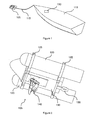
- FIG. 1 a device 105 object of the present invention connected to a boat 110 by a rope 115 and a control box 190 of the device 105.
- the device 105 is a floating device described with reference to Figures 2 to 6 .
- the boat 110 is a nautical boat of any type, for example a pleasure craft, as shown here, or fishing.
- the rope 115 is of any type.
- the housing 190 is provided with a screen (not shown), buttons (not shown), possibly integrated in the screen when the latter is touch and a wireless communication means (not shown) with the device 105
- the housing 190 is a mobile telephone, a personal digital assistant or a known type of electronic tablet, equipped with Bluetouth (registered trademark) or Wifi communication means and a computer application for exchanging data with the device. 105 and displaying data to the user.
- the device 105 comprises two floats 120, connected by means of attachment 125 to a watertight box 130.
- the watertight box 130 carries a rear rope attachment 135, a propulsion means 140 and electrical and electronic elements 145.
- the propulsion means 140 comprises a propulsion member or motor 170 (see figure 4 ) and a propeller oriented by an orientation motor 165.
- the propulsion member or motor 140 is placed in a central position, relative to the forces that can exert the marine current or the wind.
- the rope attachment 135 is, alternatively, movable, for example along a curved rail. It is placed in such a way that in the case of a large wave or a gust of wind the device does not tip over.
- propulsion members of the 105 may be used.
- the propeller is fixed relative to the device 105 and a rudder oriented by an orientation motor similar to the orientation motor 165 is provided.
- a positioning signal receiver 150 a control unit 155, a battery 160, the orientation motor 165, the propulsion motor 170, a watertight connection 175 and a motion recovery box 180.
- the positioning signal receiver 150 is preferably constituted by a receiver of terrestrial satellite signals and a processor adapted to determine the geographical position of the device 105.
- the receiver 150 is a signal receiver emitted by the constellation of GPS satellites or the satellite constellation Galileo (trademark).
- the control unit 155 comprises a central unit 205 (see figure 5 ) comprising a processor (not shown), memories (not shown) and amplification means (not shown) of the motor control signals.
- the battery 160 is a rechargeable electric battery, possibly equipped with a converter to allow its charging on the mains and / or a connection to an electric generator or a battery of the boat 110.
- the orientation motor 165 is adapted to rotate, about a vertical axis, the propulsion motor 170, through the motion recovery box 180.
- the sealed connection 175 allows the propulsion motor 170 to rotate, on either side of the bottom wall of the box 130 about the vertical axis to orient the axis of the propeller.
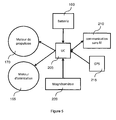
- the central unit 205 of the control unit 155 is powered by the battery 160 and receives data from the circuit 215 of the receiver 150, a wireless communication means 210 adapted to communicate with the housing 190 and a magnetometer 220. After processing, the central unit 205 transmits commands to the propulsion engine 170, the orientation motor 165 and data through the communication means 210. The operation of the central unit 205 is detailed in FIG. look at the figure 6 .
- a start step 305 which can be caused remotely by the housing 190, during a step 310, the central unit 205 loads the operating program into memory in a manner known per se.
- the central unit 205 determines whether a geographical position is supplied by the receiver 150. If yes, we go to step 320. Otherwise, the central unit repeats step 315.
- step 320 the CPU 205 determines whether it has received a position control command from the housing 190 through the communication means 210. If so, it proceeds to the step 325. Otherwise, she repeats step 320.
- step 325 the CPU 205 stores the current geographic position as the target geographic position value.
- the central unit receives a new geographical position from the receiver 150 and an orientation of the device 105, from the magnetometer 220.
- the central unit determines, from the difference between the current position and the target position, on the one hand, the speed of rotation of the propeller of the propulsion means and, on the other hand, on the other hand, the orientation to be given to the propulsion engine.
- the CPU With respect to the speed of rotation of the helix, the CPU makes it grow until the distance between the current position and the target position decreases. The enslavement is thus done according to a feedback loop.
- the servo law is, for example PID (acronym for "Proportional Integral Derivative").
- PID proportional Integral Derivative
- This type of corrector adapts to disturbances and is insensitive to variations of the disturbing elements in the long term.
- the adjustment of the coefficients of the corrector allows that, for example, if the current passes from one node to three nodes at time t, at t + 1 minute, the device is recalibrated while having temporarily suffered a difference of less than 15 m with a GPS resolution at 3 m.
- an accelerometer for example MEMS (acronym for Micro ElectroMechanical System for miniature electromechanical system) to increase the resolution.
- MEMS Micro ElectroMechanical System for miniature electromechanical system
- the CPU 205 orients the device in a direction of lower energy consumption during operation of the propulsion engine.
- the central unit 205 transmits to the box 190 the current geographical position, the distance between the current position and the target position, the status (correct or not functioning) of the sensors, here of the receiver 215 and the magnetometer 220, and, where appropriate, alarm data.
- an alarm represents a drift that the device can not compensate even using the propulsion engine at full power.
- an alarm represents a distance between the current geographical position and the target position greater than one predetermined value, for example parameterizable by the user using the housing 190.
- the receiver 215 integrates a database of underwater reefs, for example shoals, reefs or areas prohibited to navigation. An alarm is then automatically triggered when approaching one of these pitfalls, for example within one kilometer of one of them.
- the central unit determines the remaining capacitance in the battery 160 and emits an alarm below a predetermined limit value.
- the central unit 205 determines whether the target position has been updated by the user. If so, during a step 350, the target position is updated, for example by taking the current geographic position as the target position. Then we return to step 330.
- the central unit 205 determines whether an engine stop command has been received from the case 190. If yes during a step 360, the motors are stopped. Then we return to step 305.
- the user selects an area in which he authorizes the boat to be diverted, for example during a night.
- the central unit 205 waits for the current position to come close to a limit of the zone chosen by the user before starting the engine (s).
- the user selects an area in which the boat has sufficient depth to avoid running aground.
- the central unit 205 waits for the current position to come close to a limit of the zone chosen by the user before starting the engine (s).
- the battery of the device is connected to a source of electrical energy of the boat, for example a generator or an on-board battery, to complete its electrical capacity.
- the propulsion motor 170 is replaced by a heat engine equipped with a fuel tank.
- the starter, the injection and the clutch of the heat engine are controlled by the central unit 205.
Landscapes
- Engineering & Computer Science (AREA)
- Chemical & Material Sciences (AREA)
- Ocean & Marine Engineering (AREA)
- Mechanical Engineering (AREA)
- Combustion & Propulsion (AREA)
- Remote Sensing (AREA)
- Automation & Control Theory (AREA)
- General Physics & Mathematics (AREA)
- Physics & Mathematics (AREA)
- Radar, Positioning & Navigation (AREA)
- Aviation & Aerospace Engineering (AREA)
- Position Fixing By Use Of Radio Waves (AREA)
- Navigation (AREA)
Description
- La présente invention concerne un procédé et un dispositif flottant autonome d'asservissement de position d'une embarcation nautique. Elle s'applique, en particulier aux embarcations de plaisance ou de pêche.
- Lorsque les passagers d'une embarcation de plaisance dorment ou lorsqu'ils pêchent à la ligne, toute dérive de l'embarcation, qu'elle soit due au vent ou au courant marin, peut provoquer des désagréments. Par exemple, lorsque l'embarcation est proche de hauts-fonds, elle risque de s'échouer. Dans le cas de la pêche à la ligne, la zone de pêche ou la profondeur visée peuvent ne pas être obtenues ou maintenue du fait de la dérive.
- On connaît l'utilisation d'ancres qui prennent ancrage sur le fond marin. Cependant, ces ancres présentent de nombreux inconvénients. D'une part, elles ne peuvent être utilisées que lorsque la profondeur de l'eau est faible. D'autre part, elles peuvent endommager la flore et la faune marine.
- Certaines embarcations, telles que des paquebots sont munis de systèmes de positionnement par satellites, dont le principal est connu sous le nom de « GPS » (acronyme de « Global Positioning System » pour système de positionnement global) qui asservissent les moteurs principaux de l'embarcation et, éventuellement, le gouvernail, pour maintenir l'embarcation en une position fixe, autant que possible, comme par exemple dans les documents
US 5 386 368 ouWO 9 528 682 - La présente invention vise à remédier à tout ou partie de ces inconvénients. A cet effet, selon un premier aspect, la présente invention vise un dispositif flottant autonome d'asservissement de position d'une embarcation mobile, qui comporte :
- un moyen de détermination de position géographique,
- un organe de propulsion,
- une source d'énergie pour alimenter l'organe de propulsion,
- un moyen d'orientation de la force exercée par l'organe de propulsion,
- un moyen d'attache d'un filin relié à ladite embarcation,
- un moyen de sélection d'une zone géographique et
- des moyens de contrôle de l'organe de propulsion et du moyen d'orientation, adaptés, en fonction de la position géographique du dispositif à maintenir le dispositif dans ladite zone géographique.
- Grâce à ces dispositions, l'utilisateur peut fixer une zone dans laquelle il souhaite que son embarcation reste, par exemple une zone de pêche, une position fixe ou une zone sans hauts-fonds, et, automatiquement, le dispositif détecte le risque de sortir de la zone choisie et commande l'organe de propulsion et le moyen d'orientation pour maintenir l'embarcation dans cette zone. L'utilisateur peut ainsi disposer de son temps.
- De plus, le dispositif étant autonome, il est indépendant de l'embarcation et compatible avec toutes les embarcations, sans modification de celles-ci.
- Selon des caractéristiques particulières, les moyens de contrôle sont, en outre, adaptés à orienter le dispositif dans une direction de moindre consommation en énergie lors du fonctionnement de l'organe de propulsion.
- Ainsi, le dispositif étant autonome, il peut prendre une orientation différente de celle de l'embarcation et minimiser ainsi sa consommation en énergie.
- Selon des caractéristiques particulières, le dispositif objet de l'invention comporte, en outre, un moyen de détermination de l'orientation géographique du dispositif, les moyens de contrôle étant adaptés, en fonction de la position géographique du dispositif et de l'orientation géographique du dispositif à maintenir le dispositif dans ladite zone géographique et à orienter le dispositif dans une direction de moindre consommation en énergie lors du fonctionnement de l'organe de propulsion.
- Selon des caractéristiques particulières, le moyen de détermination de l'orientation géographique du dispositif comporte un magnétomètre.
- Grâce à chacune de ces dispositions, la détermination de la direction de moindre consommation est plus aisée.
- Selon des caractéristiques particulières, le moyen d'orientation de la force exercée par l'organe de propulsion est adapté à mettre l'organe de propulsion en rotation autour d'un axe vertical.
- Grâce à ces dispositions, la force exercée par l'organe de propulsion est orientée indépendamment de l'orientation du dispositif.
- Selon des caractéristiques particulières, le moyen de détermination de position géographique est adapté à recevoir et à traiter des signaux provenant de satellites terrestres.
- Grâce à ces dispositions, la détermination de la position du dispositif est particulièrement précise.
- Selon des caractéristiques particulières, le dispositif comporte, en outre, un boîtier de commande à distance du fonctionnement des moyens de contrôle.
- Grâce à ces dispositions, l'utilisateur peut commander le dispositif à distance, depuis l'embarcation.
- Selon des caractéristiques particulières, le dispositif comporte un moyen de transmission audit boîtier de données représentatives de l'état d'au moins un élément du dispositif et de données représentatives du maintien du dispositif dans ladite zone.
- Selon des caractéristiques particulières, le dispositif comporte un moyen de détection de risque que le dispositif sorte de ladite zone et un moyen de transmission audit boîtier de données représentatives d'alarmes en fonction dudit risque.
- Selon des caractéristiques particulières, le dispositif comporte un moyen de détection de proximité avec un écueil et un moyen de transmission audit boîtier de données représentatives de ladite proximité.
- Grâce à chacune de ces dispositions, l'utilisateur peut être avertit de l'état et de la situation du dispositif ou d'un risque d'échouage.
- Selon un deuxième aspect, la présente invention vise un procédé d'asservissement de position d'une embarcation mobile par un dispositif autonome flottant, qui comporte un organe de propulsion, une source d'énergie pour alimenter l'organe de propulsion, un moyen d'orientation de la force exercée par l'organe de propulsion, un moyen d'attache d'un filin relié à ladite embarcation et un moyen de sélection d'une zone géographique, qui comporte :
- une étape de détermination de position géographique,
- une étape de contrôle de l'organe de propulsion et du moyen d'orientation, en fonction de la position géographique du dispositif, pour maintenir le dispositif dans ladite zone géographique.
- D'autres avantages, buts et caractéristiques de la présente invention apparaîtront à la lecture de la description qui suit et à l'examen des figures qui l'accompagnent. Cette description est donnée à titre indicatif et nullement limitatif de l'invention.
-
- La
figure 1 est une représentation schématique, en perspective, d'un dispositif objet de l'invention et d'une embarcation. - La
figure 2 est une représentation schématique, en perspective inférieure, du dispositif objet de l'invention illustré enfigure 1 . - La
figure 3 est une représentation schématique, en perspective supérieure, du dispositif objet de l'invention illustré enfigures 1 et 2 . - La
figure 4 est une représentation schématique, en perspective, des parties électriques et électroniques du dispositif illustré enfigures 1 à 3 . - La
figure 5 est un schéma-bloc des relations entre les éléments illustrés enfigure 4 . - La
figure 6 est un logigramme d'étapes mises en oeuvre par une unité centrale illustrée enfigure 5 , pour la mise en oeuvre du procédé objet de l'invention. - On note, dès à présent, que les figures ne sont pas à l'échelle.
- On observe, en
figure 1 , un dispositif 105 objet de la présente invention relié à une embarcation 110 par un filin 115 et un boîtier 190 de commande du dispositif 105. - Le dispositif 105 est un dispositif flottant décrit en regard des
figures 2 à 6 . L'embarcation 110 est une embarcation nautique de type quelconque, par exemple une embarcation de plaisance, comme représentée ici, ou de pêche. Le filin 115 est de type quelconque. Le boîtier 190 est muni d'un écran (non représenté), de touches (non représentées), éventuellement intégrées à l'écran lorsque celui-ci est tactile et d'un moyen de communication sans fil (non représenté) avec le dispositif 105. Par exemple, le boîtier 190 est un téléphone mobile, un assistant personnel numérique ou une tablette électronique de type connu, muni de moyens de communication Bluetouth (marque déposée) ou Wifi et d'une application informatique d'échange de données avec le dispositif 105 et d'affichage de données à l'utilisateur. - On observe, en
figures 2 et3 , que le dispositif 105 comporte deux flotteurs 120, reliés par des moyens de fixation 125 à un caisson étanche 130. Le caisson étanche 130 porte une attache de filin arrière 135, un moyen de propulsion 140 et des éléments électriques et électronique 145. - Le moyen de propulsion 140 comporte un organe ou moteur de propulsion 170 (voir
figure 4 ) et une hélice orientés par un moteur d'orientation 165. - L'organe ou moteur de propulsion 140 est placé en une position centrale, par rapport aux forces que peuvent exercer le courant marin ou le vent. L'attache de filin 135 est, en variante, mobile, par exemple le long d'un rail courbé. Elle est placée de telle façon que dans le cas d'une vague importante ou une bourrasque de vent le dispositif ne se renverse pas.
- D'autres organes de propulsion du 105 peuvent être utilisés. En variante, l'hélice est fixe par rapport au dispositif 105 et un gouvernail orienté par un moteur d'orientation similaire au moteur d'orientation 165 est prévu.
- On observe, en
figure 4 , un récepteur de signaux de positionnement 150, une unité de commande 155, une batterie 160, le moteur d'orientation 165, le moteur de propulsion 170, une connexion étanche 175 et une boîte de reprise de mouvement 180. - Le récepteur de signaux de positionnement 150 est préférentiellement constitué d'un récepteur de signaux de satellites terrestres et d'un processeur adapté à déterminer la position géographique du dispositif 105. Par exemple, le récepteur 150 est un récepteur de signaux émis par la constellation de satellites GPS ou la constellation de satellites Galiléo (marque déposée).
- L'unité de commande 155 comporte une unité centrale 205 (voir
figure 5 ) comportant un processeur (non représenté), des mémoires (non représentées) et des moyens d'amplification (non représentés) des signaux de commande des moteurs. La batterie 160 est une batterie électrique rechargeable, éventuellement munie d'un convertisseur pour permettre sa recharge sur le secteur et/ou d'une connexion à un générateur électrique ou à une batterie de l'embarcation 110. - Le moteur d'orientation 165 est adapté à faire tourner, autour d'un axe vertical, le moteur de propulsion 170, par l'intermédiaire de la boîte de reprise de mouvement 180.
- La connexion étanche 175 permet au moteur de propulsion 170 de tourner, de part et d'autre de la paroi inférieure du caisson 130 autour de l'axe vertical pour orienter l'axe de l'hélice.
- On observe, en
figure 5 , que l'unité centrale 205 de l'unité de commande 155 est alimentée par la batterie 160 et reçoit des données de la part du circuit 215 du récepteur 150, d'un moyen de communication sans fil 210 adapté à communiqué avec le boîtier 190 et d'un magnétomètre 220. Après traitement, l'unité centrale 205 transmet des commandes au moteur de propulsion 170, au moteur d'orientation 165 et des données au moyen de communication 210. Le fonctionnement de l'unité centrale 205 est détaillé en regard de lafigure 6 . - Après une étape de démarrage 305, qui peut être provoquée, à distance, par le boîtier 190, au cours d'une étape 310, l'unité centrale 205 charge en mémoire le programme de fonctionnement, de manière connue en soi.
- Au cours d'une étape 315, l'unité centrale 205 détermine si une position géographique lui est fournie par le récepteur 150. Si oui, on passe à l'étape 320. Sinon, l'unité centrale réitère l'étape 315.
- Au cours de l'étape 320, l'unité centrale 205 détermine si elle a reçu une commande d'asservissement de position en provenance du boîtier 190, par l'intermédiaire du moyen de communication 210. Si oui, elle passe à l'étape 325. Sinon, elle réitère l'étape 320.
- Au cours de l'étape 325, l'unité centrale 205 met en mémoire la position géographique courante come valeur de position géographique cible.
- Puis, au cours d'une étape 330, l'unité centrale reçoit une nouvelle position géographique de la part du récepteur 150 et une orientation du dispositif 105, de la part du magnétomètre 220.
- Au cours d'une étape 335, l'unité centrale détermine, à partir de la différence entre la position courante et la position cible, d'une part, la vitesse de rotation de l'hélice du moyen de propulsion et, d'autre part, l'orientation à donner au moteur de propulsion.
- En ce qui concerne la vitesse de rotation de l'hélice, l'unité centrale la fait croître jusqu'à ce que la distance entre la position courante et la position cible diminue. L'asservissement se fait ainsi selon une boucle de contre-réaction.
- En ce qui concerne l'angle formé entre l'axe du dispositif 105 et l'axe de l'hélice, la loi d'asservissement est, par exemple de type PID (acronyme de « Proportionnel Intégral Dérivé »). Ce type de correcteur s'adapte aux perturbations et est insensible aux variations des éléments perturbateurs sur le long terme. L'ajustement des coefficients du correcteur permet que, par exemple, si le courant passe de un noeud à trois Noeuds à l'instant t, à t + 1 minute, le dispositif est recalé tout en ayant subit temporairement un écart inférieur à 15 m avec une résolution GPS à 3 m.
- En variante, on prévoit un accéléromètre, par exemple de type MEMS (acronyme de Micro ElectroMechanical System pour système électromécanique miniature) pour augmenter la résolution.
- Ainsi, l'unité centrale 205 oriente le dispositif dans une direction de moindre consommation en énergie lors du fonctionnement du moteur de propulsion.
- Au cours d'une étape 340, l'unité centrale 205 transmet au boîtier 190 la position géographique courante, la distance entre la position courante et la position cible, le statut (fonctionnement correct ou non) des capteurs, ici du récepteur 215 et du magnétomètre 220, et, le cas échéant, des données d'alarme.
- Par exemple, une alarme représente une dérive que le dispositif ne peut compenser même en utilisant le moteur de propulsion à pleine puissance.
- Selon un deuxième exemple, une alarme représente une distance entre la position géographique courante et la position cible supérieure à une valeur prédéterminée, par exemple paramétrable par l'utilisateur en utilisant le boîtier 190.
- Selon un troisième exemple, le récepteur 215 intègre une base de données d'écueils sous-marins, par exemple des hauts-fonds, des récifs ou des zones interdites à la navigation. Une alarme est alors automatiquement déclenchée à l'approche de l'un de ces écueils, par exemple à moins d'un kilomètre de l'un d'entre eux.
- Selon un quatrième exemple, l'unité centrale détermine la capacité électrique restante dans la batterie 160 et émet une alarme en dessous d'une valeur limite prédéterminée.
- Au cours d'une étape 345, l'unité centrale 205 détermine si la position cible a été actualisée par l'utilisateur. Si oui, au cours d'une étape 350, la position cible est mise à jour, par exemple en prenant la position géographique courante comme position cible. Puis on retourne à l'étape 330.
- Si la position cible n'est pas actualisée par l'utilisateur, au cours d'une étape 355, l'unité centrale 205 détermine si une commande d'arrêt de fonctionnement des moteurs a été reçue de la part du boîtier 190. Si oui, au cours d'une étape 360, on arrête les moteurs. Puis on retourne à l'étape 305.
- Si aucune commande n'a été reçue, on retourne à l'étape 330.
- En variante, au cours des étapes 320 et 325, l'utilisateur sélectionne une zone dans laquelle il autorise l'embarcation à dériver, par exemple au cours d'une nuit. Dans ce cas, au cours de l'étape 335, l'unité centrale 205 attend que la position courante arrive à proximité d'une limite de la zone choisie par l'utilisateur avant de démarrer le ou les moteur(s).
- En variante, au cours des étapes 320 et 325, l'utilisateur sélectionne une zone dans laquelle l'embarcation possède suffisamment de profondeur pour ne pas risquer de s'échouer. Dans ce cas, au cours de l'étape 335, l'unité centrale 205 attend que la position courante arrive à proximité d'une limite de la zone choisie par l'utilisateur avant de démarrer le ou les moteur(s).
- En variante, la batterie du dispositif est reliée à une source d'énergie électrique de l'embarcation, par exemple un groupe électrogène ou une batterie embarquée, pour compléter sa capacité électrique.
- En variante, on remplace le moteur de propulsion 170 par un moteur thermique muni d'un réservoir d'essence. Dans ce cas, le démarreur, l'injection et l'embrayage du moteur thermique sont commandés par l'unité centrale 205.
Claims (11)
- Dispositif (105) flottant autonome d'asservissement de position d'une embarcation mobile (110), caractérisé en ce qu'il comporte :- un moyen (150) de détermination de position géographique,- un organe de propulsion (170),- une source d'énergie (160) pour alimenter l'organe de propulsion,- un moyen d'orientation (165) de la force exercée par l'organe de propulsion,- un moyen (135) d'attache d'un filin (115) relié à ladite embarcation,- un moyen (155) de sélection d'une zone géographique et- des moyens (155) de contrôle de l'organe de propulsion et du moyen d'orientation, adaptés, en fonction de la position géographique du dispositif à maintenir le dispositif dans ladite zone géographique.
- Dispositif (105) selon la revendication 1, dans lequel les moyens (155) de contrôle sont, en outre, adaptés à orienter le dispositif dans une direction de moindre consommation en énergie lors du fonctionnement de l'organe de propulsion (170).
- Dispositif (105) selon l'une des revendications 1 ou 2, qui comporte, en outre, un moyen (220) de détermination de l'orientation géographique du dispositif, les moyens (155) de contrôle étant adaptés, en fonction de la position géographique du dispositif et de l'orientation géographique du dispositif à maintenir le dispositif dans ladite zone géographique et à orienter le dispositif dans une direction de moindre consommation en énergie lors du fonctionnement de l'organe de propulsion (170).
- Dispositif (105) selon la revendication 3, dans lequel le moyen (220) de détermination de l'orientation géographique du dispositif comporte un magnétomètre.
- Dispositif (105) selon l'une des revendications 1 à 4, dans lequel le moyen d'orientation (165) de la force exercée par l'organe de propulsion (170) est adapté à mettre l'organe de propulsion en rotation autour d'un axe vertical.
- Dispositif (105) selon l'une des revendications 1 à 5, dans lequel le moyen (150) de détermination de position géographique est adapté à recevoir et à traiter des signaux provenant de satellites terrestres.
- Dispositif (105) selon l'une quelconque des revendications 1 à 6, qui comporte, en outre, un boîtier (190) de commande à distance du fonctionnement des moyens de contrôle.
- Dispositif (105) selon la revendication 7, qui comporte un moyen (155) de transmission audit boîtier (190) de données représentatives de l'état d'au moins un élément du dispositif et de données représentatives du maintien du dispositif dans ladite zone.
- Dispositif (105) selon l'une des revendications 7 ou 8, qui comporte un moyen (155) de détection de risque que le dispositif sorte de ladite zone et un moyen de transmission audit boîtier (190) de données représentatives d'alarmes en fonction dudit risque.
- Dispositif (105) selon l'une des revendications 7 à 9, qui comporte un moyen (155) de détection de proximité avec un écueil et un moyen de transmission audit boîtier (190) de données représentatives de ladite proximité.
- Procédé d'asservissement de position d'une embarcation mobile (110) par un dispositif autonome flottant (105), qui comporte un organe de propulsion (170), une source d'énergie pour alimenter l'organe de propulsion, un moyen d'orientation (165) de la force exercée par l'organe de propulsion, un moyen d'attache d'un filin (115) relié à ladite embarcation et un moyen (155) de sélection d'une zone géographique, qui comporte :- une étape de détermination de position géographique,- une étape de contrôle de l'organe de propulsion et du moyen d'orientation, en fonction de la position géographique du dispositif, pour maintenir le dispositif dans ladite zone géographique.
Applications Claiming Priority (2)
| Application Number | Priority Date | Filing Date | Title |
|---|---|---|---|
| FR1150842A FR2971229B1 (fr) | 2011-02-03 | 2011-02-03 | Procede et dispositif flottant autonome d'asservissement de position d'une embarcation nautique |
| PCT/FR2012/050244 WO2012104565A1 (fr) | 2011-02-03 | 2012-02-03 | Procede et dispositif flottant autonome d'asservissement de position d'une embarcation nautique. |
Publications (2)
| Publication Number | Publication Date |
|---|---|
| EP2671123A1 EP2671123A1 (fr) | 2013-12-11 |
| EP2671123B1 true EP2671123B1 (fr) | 2015-04-08 |
Family
ID=45809307
Family Applications (1)
| Application Number | Title | Priority Date | Filing Date |
|---|---|---|---|
| EP12707637.0A Not-in-force EP2671123B1 (fr) | 2011-02-03 | 2012-02-03 | Procede et dispositif flottant autonome d'asservissement de position d'une embarcation nautique. |
Country Status (4)
| Country | Link |
|---|---|
| EP (1) | EP2671123B1 (fr) |
| ES (1) | ES2543048T3 (fr) |
| FR (1) | FR2971229B1 (fr) |
| WO (1) | WO2012104565A1 (fr) |
Families Citing this family (1)
| Publication number | Priority date | Publication date | Assignee | Title |
|---|---|---|---|---|
| ITUB20160526A1 (it) * | 2016-01-29 | 2017-07-29 | Edp Rent S R L | Dispositivo di ancoraggio per imbarcazioni e metodo di ancoraggio per imbarcazioni che utilizza detto dispositivo |
Family Cites Families (4)
| Publication number | Priority date | Publication date | Assignee | Title |
|---|---|---|---|---|
| US5386368A (en) * | 1993-12-13 | 1995-01-31 | Johnson Fishing, Inc. | Apparatus for maintaining a boat in a fixed position |
| US5491636A (en) * | 1994-04-19 | 1996-02-13 | Glen E. Robertson | Anchorless boat positioning employing global positioning system |
| KR100725393B1 (ko) * | 2005-05-19 | 2007-06-07 | 삼성전자주식회사 | 자바 가상 머신에서 바이트 코드의 수행 시간을 줄이는시스템 및 방법 |
| US20090095208A1 (en) * | 2007-05-11 | 2009-04-16 | Miguel Angel Cardoza | Water drift compensation method and device |
-
2011
- 2011-02-03 FR FR1150842A patent/FR2971229B1/fr not_active Expired - Fee Related
-
2012
- 2012-02-03 ES ES12707637.0T patent/ES2543048T3/es active Active
- 2012-02-03 WO PCT/FR2012/050244 patent/WO2012104565A1/fr not_active Ceased
- 2012-02-03 EP EP12707637.0A patent/EP2671123B1/fr not_active Not-in-force
Also Published As
| Publication number | Publication date |
|---|---|
| FR2971229A1 (fr) | 2012-08-10 |
| WO2012104565A1 (fr) | 2012-08-09 |
| FR2971229B1 (fr) | 2013-03-15 |
| ES2543048T3 (es) | 2015-08-14 |
| EP2671123A1 (fr) | 2013-12-11 |
Similar Documents
| Publication | Publication Date | Title |
|---|---|---|
| CA2151947C (fr) | Procede et dispositif de controle et de commande a distance d'engins mobiles sous-marins inhabites | |
| EP3355150B1 (fr) | Procédé et système d'aide à l'approche et la mise en vol stationnaire relatif d'un giravion vis-à-vis d'une cible mobile | |
| GB2512455A (en) | Ship course obstruction warning transport | |
| EP1851107B1 (fr) | Procede et dispositif d'identification et de neutralisation d'une mine sous-marine | |
| EP2671123B1 (fr) | Procede et dispositif flottant autonome d'asservissement de position d'une embarcation nautique. | |
| EP1828802B1 (fr) | Dispositif de determination autonome des coordonnees geographiques absolues d'un mobile evoluant en immersion | |
| EP3697681A1 (fr) | Système de guidage d'un bateau connecté doté d'un système embarqué communiquant avec un serveur distant afin de modifier son plan de route | |
| EP3577494B1 (fr) | Balise, système et procédé d'aide à la navigation de précision | |
| WO2012032251A1 (fr) | Procede d'aide a la localisation d'objets immerges emettant un signal acoustique | |
| EP0788969B1 (fr) | Véhicule subaquatique quasi immergé autopropulsé et radiocommandé | |
| WO2020136046A1 (fr) | Dispositif de navigation destine a rendre des corps mobiles dans l'eau | |
| WO2013057238A1 (fr) | Dispositif de balisage, système d'exploration d'une zone immergée ainsi que procédés de déploiement et repliement d'un tel dispositif de balisage | |
| FR2982375A1 (fr) | Systeme et procede de suivi par un second objet motorise d'un premier objet se deplacant a la surface d'une etendue d'eau ou en immersion dans ladite etendue | |
| US20230071338A1 (en) | Navigation by mimic autonomy | |
| EP3749571B1 (fr) | Dispositif de localisation d'un plongeur sous-marin et procede de mise en oeuvre | |
| FR2817631A1 (fr) | Systeme de telecommande d'un vehicule sans pilote | |
| FR3066829A1 (fr) | Systeme bidirectionnel de navigation sous-marine | |
| WO2024008510A1 (fr) | Dispositif générateur de flux fluidique | |
| FR3066828B1 (fr) | Procede d'approche d'une station de base, programme d'ordinateur et drone sous-marin associes | |
| EP3497479A1 (fr) | Dispositif de positionnement et de controle de drone a voilure tournante dans un environnement exterieur, systeme et procede associes | |
| FR3136743A1 (fr) | Gestion de moteur annulaire d’un navire à propulsion par moteur annulaire | |
| FR3164587A1 (fr) | Système de communication radio entre navires à l’aide de satellites tournant autour de la Terre et procédé de communication associé. | |
| WO2024224248A1 (fr) | Systeme de transport a hydroptere | |
| Yan et al. | Development of a Multi-Motion Mode Underwater Vehicle for Sea Ice Observation | |
| Defilippo et al. | Rex 4-An Autonomous Surface Vessel For Marine Research |
Legal Events
| Date | Code | Title | Description |
|---|---|---|---|
| PUAI | Public reference made under article 153(3) epc to a published international application that has entered the european phase |
Free format text: ORIGINAL CODE: 0009012 |
|
| 17P | Request for examination filed |
Effective date: 20130830 |
|
| AK | Designated contracting states |
Kind code of ref document: A1 Designated state(s): AL AT BE BG CH CY CZ DE DK EE ES FI FR GB GR HR HU IE IS IT LI LT LU LV MC MK MT NL NO PL PT RO RS SE SI SK SM TR |
|
| DAX | Request for extension of the european patent (deleted) | ||
| GRAP | Despatch of communication of intention to grant a patent |
Free format text: ORIGINAL CODE: EPIDOSNIGR1 |
|
| INTG | Intention to grant announced |
Effective date: 20140930 |
|
| GRAS | Grant fee paid |
Free format text: ORIGINAL CODE: EPIDOSNIGR3 |
|
| GRAA | (expected) grant |
Free format text: ORIGINAL CODE: 0009210 |
|
| AK | Designated contracting states |
Kind code of ref document: B1 Designated state(s): AL AT BE BG CH CY CZ DE DK EE ES FI FR GB GR HR HU IE IS IT LI LT LU LV MC MK MT NL NO PL PT RO RS SE SI SK SM TR |
|
| REG | Reference to a national code |
Ref country code: GB Ref legal event code: FG4D Free format text: NOT ENGLISH |
|
| REG | Reference to a national code |
Ref country code: CH Ref legal event code: EP |
|
| REG | Reference to a national code |
Ref country code: IE Ref legal event code: FG4D Free format text: LANGUAGE OF EP DOCUMENT: FRENCH |
|
| REG | Reference to a national code |
Ref country code: AT Ref legal event code: REF Ref document number: 721003 Country of ref document: AT Kind code of ref document: T Effective date: 20150515 |
|
| REG | Reference to a national code |
Ref country code: DE Ref legal event code: R096 Ref document number: 602012006507 Country of ref document: DE Effective date: 20150528 |
|
| REG | Reference to a national code |
Ref country code: ES Ref legal event code: FG2A Ref document number: 2543048 Country of ref document: ES Kind code of ref document: T3 Effective date: 20150814 |
|
| REG | Reference to a national code |
Ref country code: AT Ref legal event code: MK05 Ref document number: 721003 Country of ref document: AT Kind code of ref document: T Effective date: 20150408 |
|
| REG | Reference to a national code |
Ref country code: NL Ref legal event code: VDEP Effective date: 20150408 |
|
| REG | Reference to a national code |
Ref country code: LT Ref legal event code: MG4D |
|
| PG25 | Lapsed in a contracting state [announced via postgrant information from national office to epo] |
Ref country code: NL Free format text: LAPSE BECAUSE OF FAILURE TO SUBMIT A TRANSLATION OF THE DESCRIPTION OR TO PAY THE FEE WITHIN THE PRESCRIBED TIME-LIMIT Effective date: 20150408 |
|
| PG25 | Lapsed in a contracting state [announced via postgrant information from national office to epo] |
Ref country code: FI Free format text: LAPSE BECAUSE OF FAILURE TO SUBMIT A TRANSLATION OF THE DESCRIPTION OR TO PAY THE FEE WITHIN THE PRESCRIBED TIME-LIMIT Effective date: 20150408 Ref country code: LT Free format text: LAPSE BECAUSE OF FAILURE TO SUBMIT A TRANSLATION OF THE DESCRIPTION OR TO PAY THE FEE WITHIN THE PRESCRIBED TIME-LIMIT Effective date: 20150408 Ref country code: HR Free format text: LAPSE BECAUSE OF FAILURE TO SUBMIT A TRANSLATION OF THE DESCRIPTION OR TO PAY THE FEE WITHIN THE PRESCRIBED TIME-LIMIT Effective date: 20150408 Ref country code: PT Free format text: LAPSE BECAUSE OF FAILURE TO SUBMIT A TRANSLATION OF THE DESCRIPTION OR TO PAY THE FEE WITHIN THE PRESCRIBED TIME-LIMIT Effective date: 20150810 Ref country code: NO Free format text: LAPSE BECAUSE OF FAILURE TO SUBMIT A TRANSLATION OF THE DESCRIPTION OR TO PAY THE FEE WITHIN THE PRESCRIBED TIME-LIMIT Effective date: 20150708 |
|
| PG25 | Lapsed in a contracting state [announced via postgrant information from national office to epo] |
Ref country code: GR Free format text: LAPSE BECAUSE OF FAILURE TO SUBMIT A TRANSLATION OF THE DESCRIPTION OR TO PAY THE FEE WITHIN THE PRESCRIBED TIME-LIMIT Effective date: 20150709 Ref country code: IS Free format text: LAPSE BECAUSE OF FAILURE TO SUBMIT A TRANSLATION OF THE DESCRIPTION OR TO PAY THE FEE WITHIN THE PRESCRIBED TIME-LIMIT Effective date: 20150808 Ref country code: RS Free format text: LAPSE BECAUSE OF FAILURE TO SUBMIT A TRANSLATION OF THE DESCRIPTION OR TO PAY THE FEE WITHIN THE PRESCRIBED TIME-LIMIT Effective date: 20150408 Ref country code: LV Free format text: LAPSE BECAUSE OF FAILURE TO SUBMIT A TRANSLATION OF THE DESCRIPTION OR TO PAY THE FEE WITHIN THE PRESCRIBED TIME-LIMIT Effective date: 20150408 Ref country code: AT Free format text: LAPSE BECAUSE OF FAILURE TO SUBMIT A TRANSLATION OF THE DESCRIPTION OR TO PAY THE FEE WITHIN THE PRESCRIBED TIME-LIMIT Effective date: 20150408 |
|
| REG | Reference to a national code |
Ref country code: DE Ref legal event code: R097 Ref document number: 602012006507 Country of ref document: DE |
|
| PG25 | Lapsed in a contracting state [announced via postgrant information from national office to epo] |
Ref country code: EE Free format text: LAPSE BECAUSE OF FAILURE TO SUBMIT A TRANSLATION OF THE DESCRIPTION OR TO PAY THE FEE WITHIN THE PRESCRIBED TIME-LIMIT Effective date: 20150408 Ref country code: DK Free format text: LAPSE BECAUSE OF FAILURE TO SUBMIT A TRANSLATION OF THE DESCRIPTION OR TO PAY THE FEE WITHIN THE PRESCRIBED TIME-LIMIT Effective date: 20150408 |
|
| REG | Reference to a national code |
Ref country code: FR Ref legal event code: PLFP Year of fee payment: 5 |
|
| PLBE | No opposition filed within time limit |
Free format text: ORIGINAL CODE: 0009261 |
|
| STAA | Information on the status of an ep patent application or granted ep patent |
Free format text: STATUS: NO OPPOSITION FILED WITHIN TIME LIMIT |
|
| PG25 | Lapsed in a contracting state [announced via postgrant information from national office to epo] |
Ref country code: SK Free format text: LAPSE BECAUSE OF FAILURE TO SUBMIT A TRANSLATION OF THE DESCRIPTION OR TO PAY THE FEE WITHIN THE PRESCRIBED TIME-LIMIT Effective date: 20150408 Ref country code: RO Free format text: LAPSE BECAUSE OF NON-PAYMENT OF DUE FEES Effective date: 20150408 Ref country code: CZ Free format text: LAPSE BECAUSE OF FAILURE TO SUBMIT A TRANSLATION OF THE DESCRIPTION OR TO PAY THE FEE WITHIN THE PRESCRIBED TIME-LIMIT Effective date: 20150408 Ref country code: PL Free format text: LAPSE BECAUSE OF FAILURE TO SUBMIT A TRANSLATION OF THE DESCRIPTION OR TO PAY THE FEE WITHIN THE PRESCRIBED TIME-LIMIT Effective date: 20150408 |
|
| 26N | No opposition filed |
Effective date: 20160111 |
|
| PG25 | Lapsed in a contracting state [announced via postgrant information from national office to epo] |
Ref country code: SI Free format text: LAPSE BECAUSE OF FAILURE TO SUBMIT A TRANSLATION OF THE DESCRIPTION OR TO PAY THE FEE WITHIN THE PRESCRIBED TIME-LIMIT Effective date: 20150408 Ref country code: BE Free format text: LAPSE BECAUSE OF NON-PAYMENT OF DUE FEES Effective date: 20160229 |
|
| REG | Reference to a national code |
Ref country code: DE Ref legal event code: R119 Ref document number: 602012006507 Country of ref document: DE |
|
| PG25 | Lapsed in a contracting state [announced via postgrant information from national office to epo] |
Ref country code: LU Free format text: LAPSE BECAUSE OF FAILURE TO SUBMIT A TRANSLATION OF THE DESCRIPTION OR TO PAY THE FEE WITHIN THE PRESCRIBED TIME-LIMIT Effective date: 20160203 Ref country code: MC Free format text: LAPSE BECAUSE OF FAILURE TO SUBMIT A TRANSLATION OF THE DESCRIPTION OR TO PAY THE FEE WITHIN THE PRESCRIBED TIME-LIMIT Effective date: 20150408 |
|
| REG | Reference to a national code |
Ref country code: CH Ref legal event code: PL |
|
| PG25 | Lapsed in a contracting state [announced via postgrant information from national office to epo] |
Ref country code: CH Free format text: LAPSE BECAUSE OF NON-PAYMENT OF DUE FEES Effective date: 20160229 Ref country code: LI Free format text: LAPSE BECAUSE OF NON-PAYMENT OF DUE FEES Effective date: 20160229 |
|
| REG | Reference to a national code |
Ref country code: FR Ref legal event code: PLFP Year of fee payment: 6 |
|
| PG25 | Lapsed in a contracting state [announced via postgrant information from national office to epo] |
Ref country code: DE Free format text: LAPSE BECAUSE OF NON-PAYMENT OF DUE FEES Effective date: 20160901 |
|
| PG25 | Lapsed in a contracting state [announced via postgrant information from national office to epo] |
Ref country code: SE Free format text: LAPSE BECAUSE OF FAILURE TO SUBMIT A TRANSLATION OF THE DESCRIPTION OR TO PAY THE FEE WITHIN THE PRESCRIBED TIME-LIMIT Effective date: 20150408 |
|
| PG25 | Lapsed in a contracting state [announced via postgrant information from national office to epo] |
Ref country code: MT Free format text: LAPSE BECAUSE OF FAILURE TO SUBMIT A TRANSLATION OF THE DESCRIPTION OR TO PAY THE FEE WITHIN THE PRESCRIBED TIME-LIMIT Effective date: 20150408 |
|
| REG | Reference to a national code |
Ref country code: FR Ref legal event code: PLFP Year of fee payment: 7 |
|
| PGFP | Annual fee paid to national office [announced via postgrant information from national office to epo] |
Ref country code: ES Payment date: 20180301 Year of fee payment: 7 Ref country code: GB Payment date: 20180227 Year of fee payment: 7 |
|
| PG25 | Lapsed in a contracting state [announced via postgrant information from national office to epo] |
Ref country code: CY Free format text: LAPSE BECAUSE OF FAILURE TO SUBMIT A TRANSLATION OF THE DESCRIPTION OR TO PAY THE FEE WITHIN THE PRESCRIBED TIME-LIMIT Effective date: 20150408 Ref country code: SM Free format text: LAPSE BECAUSE OF FAILURE TO SUBMIT A TRANSLATION OF THE DESCRIPTION OR TO PAY THE FEE WITHIN THE PRESCRIBED TIME-LIMIT Effective date: 20150408 Ref country code: HU Free format text: LAPSE BECAUSE OF FAILURE TO SUBMIT A TRANSLATION OF THE DESCRIPTION OR TO PAY THE FEE WITHIN THE PRESCRIBED TIME-LIMIT; INVALID AB INITIO Effective date: 20120203 |
|
| PGFP | Annual fee paid to national office [announced via postgrant information from national office to epo] |
Ref country code: IE Payment date: 20180227 Year of fee payment: 7 Ref country code: IT Payment date: 20180222 Year of fee payment: 7 Ref country code: FR Payment date: 20180130 Year of fee payment: 7 |
|
| PG25 | Lapsed in a contracting state [announced via postgrant information from national office to epo] |
Ref country code: MK Free format text: LAPSE BECAUSE OF FAILURE TO SUBMIT A TRANSLATION OF THE DESCRIPTION OR TO PAY THE FEE WITHIN THE PRESCRIBED TIME-LIMIT Effective date: 20150408 Ref country code: TR Free format text: LAPSE BECAUSE OF FAILURE TO SUBMIT A TRANSLATION OF THE DESCRIPTION OR TO PAY THE FEE WITHIN THE PRESCRIBED TIME-LIMIT Effective date: 20150408 |
|
| PG25 | Lapsed in a contracting state [announced via postgrant information from national office to epo] |
Ref country code: BG Free format text: LAPSE BECAUSE OF FAILURE TO SUBMIT A TRANSLATION OF THE DESCRIPTION OR TO PAY THE FEE WITHIN THE PRESCRIBED TIME-LIMIT Effective date: 20150408 |
|
| PG25 | Lapsed in a contracting state [announced via postgrant information from national office to epo] |
Ref country code: AL Free format text: LAPSE BECAUSE OF FAILURE TO SUBMIT A TRANSLATION OF THE DESCRIPTION OR TO PAY THE FEE WITHIN THE PRESCRIBED TIME-LIMIT Effective date: 20150408 |
|
| GBPC | Gb: european patent ceased through non-payment of renewal fee |
Effective date: 20190203 |
|
| REG | Reference to a national code |
Ref country code: IE Ref legal event code: MM4A |
|
| PG25 | Lapsed in a contracting state [announced via postgrant information from national office to epo] |
Ref country code: GB Free format text: LAPSE BECAUSE OF NON-PAYMENT OF DUE FEES Effective date: 20190203 Ref country code: IE Free format text: LAPSE BECAUSE OF NON-PAYMENT OF DUE FEES Effective date: 20190203 |
|
| PG25 | Lapsed in a contracting state [announced via postgrant information from national office to epo] |
Ref country code: IT Free format text: LAPSE BECAUSE OF NON-PAYMENT OF DUE FEES Effective date: 20190203 Ref country code: FR Free format text: LAPSE BECAUSE OF NON-PAYMENT OF DUE FEES Effective date: 20190228 |
|
| REG | Reference to a national code |
Ref country code: ES Ref legal event code: FD2A Effective date: 20200327 |
|
| PG25 | Lapsed in a contracting state [announced via postgrant information from national office to epo] |
Ref country code: ES Free format text: LAPSE BECAUSE OF NON-PAYMENT OF DUE FEES Effective date: 20190204 |