EP2671691A2 - Procédé et dispositif de commande d'un agencement de manipulateurs - Google Patents
Procédé et dispositif de commande d'un agencement de manipulateurs Download PDFInfo
- Publication number
- EP2671691A2 EP2671691A2 EP13002907.7A EP13002907A EP2671691A2 EP 2671691 A2 EP2671691 A2 EP 2671691A2 EP 13002907 A EP13002907 A EP 13002907A EP 2671691 A2 EP2671691 A2 EP 2671691A2
- Authority
- EP
- European Patent Office
- Prior art keywords
- monitoring
- manipulator
- sub
- controller
- virtual target
- Prior art date
- Legal status (The legal status is an assumption and is not a legal conclusion. Google has not performed a legal analysis and makes no representation as to the accuracy of the status listed.)
- Pending
Links
Images

Classifications
-
- B—PERFORMING OPERATIONS; TRANSPORTING
- B25—HAND TOOLS; PORTABLE POWER-DRIVEN TOOLS; MANIPULATORS
- B25J—MANIPULATORS; CHAMBERS PROVIDED WITH MANIPULATION DEVICES
- B25J9/00—Program-controlled manipulators
- B25J9/16—Program controls
- B25J9/1656—Program controls characterised by programming, planning systems for manipulators
- B25J9/1661—Program controls characterised by programming, planning systems for manipulators characterised by task planning, object-oriented languages
-
- B—PERFORMING OPERATIONS; TRANSPORTING
- B25—HAND TOOLS; PORTABLE POWER-DRIVEN TOOLS; MANIPULATORS
- B25J—MANIPULATORS; CHAMBERS PROVIDED WITH MANIPULATION DEVICES
- B25J9/00—Program-controlled manipulators
- B25J9/16—Program controls
- B25J9/1674—Program controls characterised by safety, monitoring, diagnostic
-
- G—PHYSICS
- G05—CONTROLLING; REGULATING
- G05B—CONTROL OR REGULATING SYSTEMS IN GENERAL; FUNCTIONAL ELEMENTS OF SUCH SYSTEMS; MONITORING OR TESTING ARRANGEMENTS FOR SUCH SYSTEMS OR ELEMENTS
- G05B2219/00—Program-control systems
- G05B2219/30—Nc systems
- G05B2219/40—Robotics, robotics mapping to robotics vision
- G05B2219/40131—Virtual reality control, programming of manipulator
Definitions
- the present invention relates to a method and a device for controlling a manipulator arrangement with at least one manipulator, in particular a robot.
- Manipulator arrangements are increasingly becoming outside of security cells, i.e. operated outside of structured environments, e.g. People can cross the working space of a manipulator or even work directly with a manipulator. Operating in unstructured environments can be dangerous to people.
- Typical measures for the safe control of manipulators relate inter alia. Limitations of certain states of the manipulator, e.g. working space, speed, acceleration, forces, etc.
- Safe technology usually meets the requirements of application-specific standards, e.g. EN-13849 and / or IEC-61508. Safe technology can u.a. Sensors, data processing and / or communication links and usually includes all parts of a monitoring.
- manipulator arrangements are becoming obsolete operated in-house practice with a safety controller in parallel to a non-safe standard controller and configured via its own safe man-machine interface.
- the safety controller is therefore operated independently of the non-safe control and can at best interact with it via dedicated communication channels to a limited extent.
- a safety control in which zone-by-zone information about positions of moving parts of a handling device is transmitted to a safety control, so that safety-relevant functions of the handling device are controlled by the safety control in cooperation with the handling device control.
- the DE 10 2005 011 143 A1 relates to a device for controlling at least one safety-related function of a robot with at least one spatially resolving sensor, in particular a camera, for monitoring a safety area of the robot, an evaluation unit for processing the data supplied by the sensor, triggering means for triggering the safety-relevant function in case of intrusion of an impermissible object in the safety area and means for changing the contour of the safety area as a function of movement, position or operating data of the robot.
- the EP 1 035 953 B1 relates to a monitoring and control device for monitoring a technical system with increased safety requirements, in particular a handling device, with a control unit and associated actuators for performing dangerous actions, the monitoring and control device is connected to sensors and evaluates their states, processes and controls ,
- the object of the present invention is to improve a manipulator arrangement.
- Claim 13 protects a controller for carrying out a method according to the invention
- claim 14 protects a computer program which carries out a method according to the invention
- claim 15 a computer program product, in particular a storage medium, with such a computer program.
- a virtual setpoint process for one or more manipulators is initially specified.
- a number of Cartesian target poses are given, which are to be approached by a manipulator in succession.
- a manipulator is in particular a robot and preferably in several degrees of freedom, in particular in four, six or seven degrees of freedom, movable, wherein a degree of freedom is realized in particular by an axis of the manipulator.
- the manipulator assembly has one or more controls, preferably, each manipulator of the manipulator assembly is equipped with a controller. Additionally or alternatively, the manipulator assembly has an overall control.
- the manipulator order executes a real actual process. For example, the departure of a train by a manipulator.
- the real actual process is monitored. For example, it is monitored whether the manipulator does not exceed a maximum permissible speed when traveling down a lane.
- a real actual process of the respective manipulator is monitored by a manipulator of the manipulator arrangement.
- one or more monitoring of the real actual process is predetermined by the controller, in particular automatically. The predetermined monitoring is specified in particular based on the virtual target process.
- a specification in the sense of the present invention may comprise a configuration of a virtual target process of the manipulator arrangement, in particular of one or more manipulators of the manipulator arrangement.
- a default may include a, in particular automatic, default, which is communicated by a controller from the environment of the manipulator assembly.
- a specification is dependent on a state of the manipulator arrangement, in particular a state of a manipulator of the manipulator arrangement and / or a tool of a manipulator of the manipulator arrangement.
- a default may be dependent on a workpiece of the manipulator assembly. Additionally or alternatively, a default may be communicated through a device that interacts with the manipulator assembly.
- a process within the meaning of the present invention may be a process performed by the manipulator assembly in a targeted manner.
- a process may include algorithmic information processing.
- a process is a process controlled by a program which, in particular for execution, requires a processor, which is preferably provided by a controller.
- a process preferably has sub-processes that both hierarchically and / or vertically integrated include a sequence of processing steps to a final result of the sub-process. Additionally or alternatively, a process preferably has subprocesses which are processed in parallel, in particular concurrent, and / or sequential, in particular temporally successive. In particular, two or more manipulators of the manipulator arrangement are operated in parallel. In particular, each manipulator is assigned one or more sub-processes. The sub-processes can be executed both by a controller, wherein the allocation of the resources of this controller to each sub-process is preferably organized by a scheduling algorithm. Additionally or alternatively, two or more sub-processes may be operated by dedicated controllers. In particular, in such a way that exclusively allocates resources to these sub-processes become.
- a process and / or a subprocess preferably represents a real-time process.
- Monitoring in the sense of the present invention is preferably a process that carries out a targeted observation of devices, methods and / or living beings, in particular humans.
- a monitoring serves in particular to increase the safety of man and machine.
- monitoring serves to increase the safety of people and devices of the manipulator assembly.
- monitoring may also serve to increase the safety of people and devices that interact with the manipulator assembly and / or are located within the danger zone of the manipulator assembly.
- a monitoring preferably has a comparison of actual and desired values. Monitoring may relate to limit values to be observed, in particular position-dependent limit values (for example working space, deflection of a manipulator, speed, acceleration, jerk, etc.) and / or force and / or torque-dependent limit values, as well as combinations of these values.
- a parameter of a model in particular of an estimated model, can be monitored, wherein the model is preferably estimated on the basis of a detected information.
- monitoring is carried out continuously, discretely, periodically and / or at irregular intervals, in particular event-controlled.
- the manipulator arrangement in particular one or more manipulators of the manipulator arrangement, is transferred to a safe state if a monitoring registers a malfunction.
- a safe state can be achieved by an emergency stop and / or by a soft switching, in particular certain axes of a manipulator.
- monitoring is predetermined on the basis of a detection of a state of the manipulator arrangement.
- a state can be a physical state, in particular a position, a velocity, an acceleration, a jerk, a force of one or more manipulators or other device, in particular a workpiece and / or a tool, the manipulator assembly.
- a (rotational) torque ie an antiparallel force pair, is generally referred to as force.
- monitoring can be predetermined depending on a specific movement of a manipulator of the manipulator arrangement.
- monitoring based on a controller is specified.
- a monitoring is given by an overall control of the manipulator arrangement.
- a controller may represent a controller of a manipulator of the manipulator arrangement and / or another device of the manipulator arrangements.
- a controller may relate to a controller, or a device that interacts with the manipulator assembly.
- a monitoring based on the flow control of the virtual actual process is specified.
- this can be automatically predetermined by a controller monitoring depending on a specific actual process situation.
- monitoring is predefined on the basis of a tool of a manipulator of the manipulator arrangement and / or on the basis of a workpiece to be manipulated.
- torque monitoring is given as soon as a tool signals a robot that it has grabbed a component.
- a monitoring based on a device that interacts with the manipulator arrangement set.
- Such a device can be a manipulator and / or a manipulator arrangement in addition to a controller. Additionally or alternatively, such a device may be a large-capacity monitoring system and / or an emergency device.
- monitoring can be predetermined situation-specific.
- a state may be defined by certain components, in particular a presence or absence of certain components, of a device.
- a speed monitor for a robot can only be specified if the robot has position sensors in safe technology.
- one or more states indicate the presence or absence of secure and / or non-secure hardware, in particular sensors and / or actuators.
- Such a device may relate in particular to the above-mentioned devices.
- a state may also be defined by a property of a method.
- one or more states indicate security and / or non-security of a method.
- a monitoring according to available safer components and methods, in particular automatically, can be specified.
- a process and / or a monitoring of a method according to the invention comprises a plurality of hierarchized sub-processes, in particular a path planning and / or a kinematic transformation.
- the hierarchized sub-processes can be organized within a vertical or / or horizontal integration.
- the hierarchized sub-processes are preferably structured by an ordering relation or by a, in particular directed, graph.
- a sub-process may have one or more higher-level sub-processes and / or one or more subordinate sub-processes.
- a subprocess may represent path planning, filtering, backward transformation and / or forward transformation.
- monitoring can be directed to specific parts of the actual process.
- one or more monitors of a sub-process of the real actual process on the basis of a sub-process of the virtual target process is specified by the controller.
- the controller For example, in the target process, calculated interpolation values are compared with the interpolation values determined from the actual process and it is monitored whether a maximum permissible difference is not exceeded.
- a result of a sub-process of the actual process is compared with a result of a sub-process of a desired process.
- a parameter of a sub-process of a desired process is compared with a parameter of a sub-process of an actual process.
- monitoring relates to sub-processes of different hierarchy levels.
- compliance with a speed is monitored by the difference of a deviation of two successive position values of a position signal does not exceed a maximum permissible value.
- a deviation between the monitored information of the target process and the actual process is compared against a limit value which may not be exceeded or only limited often, in particular during a defined period of time.
- monitoring can be specified flexibly.
- a process comprises a plurality of sub-processes which follow one after the other and / or run concurrently.
- a robot performs a movement and at the same time opens a gripper located on the tool of the robot.
- a sub-process can be an unbound movement, in particular a movement of a manipulator of the manipulator arrangement in the free space or in a medium.
- a subprocess may include an environmental contact.
- monitoring can be directed to specific phases of the actual process.
- monitoring is predefined model-based.
- a speed control based on a derivative of the position signals of the robot and / or based on a state space model is specified.
- a model in the sense of the invention is preferably a model of an actual process or of a subprocess of an actual process.
- a model can also depict an actual process or one or more sub-processes of a target process.
- monitoring may be directed to one or more results of a model.
- monitoring may be directed to one or more parameters of a model.
- a model includes a state observer and / or a Kalman filter.
- a model can image a working space of one or more manipulators of the manipulator arrangement.
- a model transforms a safely detected size into a size that is not detected safely. This allows monitoring of a condition that is not detected safely.
- a state of a robot can be monitored by a model without observing it by a direct measurement.
- monitoring is specified by a user.
- monitoring for a robot is configured by an operator of that robot.
- a user may be an operator of the manipulator arrangement.
- the user specifies the monitoring at the same user interface at which he also specifies the virtual target process.
- a user may be a person who commands instructions to the manipulator arrangement via a communication interface, in particular a network, preferably via the Internet.
- a monitoring based on new assessments of a human operator can be modified.
- a monitoring by a state of a device can be specified.
- such a state may be a state of a manipulator arrangement, a controller or a device from the environment of the manipulator arrangement, which cooperates with the manipulator arrangement.
- a predetermined monitoring in particular a standard default monitoring can be modified, extended and / or replaced.
- existing monitoring can be qualitatively changed, in particular by adjusting a parameter, and / or structurally, in particular by adding new partial monitoring.
- thereby a modification of one or more monitors can be performed automatically, while the robot executes an actual process.
- the specification of a desired process and / or the specification of a monitoring is carried out off-line, in particular in advance, and preferably only then the execution of the actual process actual started.
- this can first be ensured whether a predetermined desired process and / or a predetermined monitoring meet all the relevant requirements.
- the specification of a desired process and / or the specification of a monitoring is carried out on-line. This can be done in particular during execution of a real actual process. For example, while driving, a maximum allowable speed value for a robot is corrected downward.
- the on-line modification of a monitoring of a sub-process is possible while another sub-process is performed.
- a modification of a monitoring of a sub-process is possible while this sub-process is executed.
- an execution of the actual process is only possible if in a previous step, a release of the execution has taken place, in particular by an enable signal.
- changes to one or more monitors can be made after the actual process has been started.
- a specification of a monitoring is authorized changeable.
- a specially trained user configures monitors that other users are not allowed to configure.
- the amount and scope of default options is organized in different classes.
- the classes distinguish defaults by "operator”, “expert” and “adminstrator”.
- "operators” only have the option of prescribing a virtual target process within the framework of parameters already specified, in particular parameters of the security functions.
- experts can also add or deselect certain security functions.
- only an administrator can set parameters of security functions, e.g. Modify workspace, speed and / or force limits and make a full selection of which safety features to use.
- the classes preferably relate not only to users, but also to devices by means of which virtual target processes and / or monitoring can be specified. Advantageously, this ensures that only authorized persons and / or devices are allowed to exercise complete control over the security functions.
- one or more monitors are given securely.
- a speed monitoring is defined redundantly on two channels.
- a safe specification is in particular a requirement which corresponds to a standard safety standard for manipulator arrangements, preferably EN 13849 and / or IEC 61508.
- monitoring is reliably predetermined by a corresponding interface, in particular a secure operator interface. This can be ergonomically designed specifically to avoid input errors Be user interface.
- a secure specification of a monitoring can be communicated by a corresponding network, in particular by EtherCAT, preferably with the safety-related functionality FsoE. This can advantageously be avoided errors already in the configuration of monitoring.
- monitoring is generated in a secure structure. In particular, such monitoring has one or more structural or temporal redundancies.
- secure monitoring may include cross comparisons between multiple independent monitors that are directed to an actual process or partial process of that actual process. Preferably, this allows a higher reliability of the monitoring.
- Fig. 1 shows the inventive method.
- a virtual setpoint trajectory P_v is specified.
- monitoring is automatically generated on the basis of the virtual target trajectory.
- the virtual nominal trajectory is converted by a manipulator and a real actual trajectory is traversed. In this case, the monitoring is carried out according to the specification, so that the actual trajectory is monitored.
- Fig. 2 shows automatically generated monitors 5,6 of a hierarchically structured sub-process.
- interpolation setpoints are generated. These are monitored by a monitor and compared with the initially specified movement.
- interpolation values are determined via a kinematic transformation.
- a monitoring registers on the basis of these interpolated axis values, whether maximum workspace limits are exceeded. For this purpose, the kinematic model is analyzed.
- the interpolation values are communicated to a robot 4 for execution.
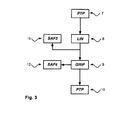
- Fig. 3 shows automatically generated monitors 11,12 of a phase-built sub-process.
- a PTP movement is performed by a manipulator.
- a LIN movement is executed.
- This LIN movement is monitored by monitoring.
- Maximum speeds are monitored.
- the robot performs a gripping movement.
- the gripping motion is also monitored. The monitoring of the gripping movement checks whether maximum force values to be observed by the gripper during gripping are exceeded.
- a target process P_v for a human-robot interaction is predetermined via a user interface.
- the user interface also indicates to the operator which variables or states can be used for user-configurable monitoring of such an interaction of a person with a robot. These quantities or states must be recorded using secure technology and marked in yellow in the user interface and released for programming monitoring.
- the monitoring S are specified by the user via the same user interface as the virtual target process.
- the configuration takes place in an IEC 61131 language, eg as Sequential Function Chart and / or a Function Block Diagram. First, a user identifying himself at the operator status controller simply configures a virtual target process and designates that it is to be executed within a human-robot interaction.
- the controller generates the corresponding interpolation values for execution by the robot based on the predetermined virtual target process. Likewise, the controller generates the monitoring necessary to execute the process. In this case, the controller generates a monitoring of the forces that can be applied by the gripper, which are limited to a maximum of 10N by default. In addition, the controller generates a collision detection. It uses safe torque sensors and secure position sensors. For collision detection, a collision observer is used, which includes models of the robot and in particular the environment. After completion of the specification and generation of the interpolation averages and the monitoring, the process is carried out by the robot and the actual process realized thereby is monitored by the automatically generated monitoring. During execution, the process is modified by another user. This identifies itself, also at the user interface, as a security administrator. It modifies the maximum applicable force to 20N and additionally activates a speed control, defining the maximum speed at 20 cm / s. The affected safety functions are automatically updated and applied by the controller.
Landscapes
- Engineering & Computer Science (AREA)
- Robotics (AREA)
- Mechanical Engineering (AREA)
- Manipulator (AREA)
- Automatic Assembly (AREA)
Applications Claiming Priority (1)
| Application Number | Priority Date | Filing Date | Title |
|---|---|---|---|
| DE102012011108A DE102012011108A1 (de) | 2012-06-05 | 2012-06-05 | Verfahren und Vorrichtung zum Steuern einer Manipulatoranordnung |
Publications (2)
| Publication Number | Publication Date |
|---|---|
| EP2671691A2 true EP2671691A2 (fr) | 2013-12-11 |
| EP2671691A3 EP2671691A3 (fr) | 2017-01-11 |
Family
ID=48625685
Family Applications (1)
| Application Number | Title | Priority Date | Filing Date |
|---|---|---|---|
| EP13002907.7A Pending EP2671691A3 (fr) | 2012-06-05 | 2013-06-05 | Procédé et dispositif de commande d'un agencement de manipulateurs |
Country Status (2)
| Country | Link |
|---|---|
| EP (1) | EP2671691A3 (fr) |
| DE (1) | DE102012011108A1 (fr) |
Cited By (2)
| Publication number | Priority date | Publication date | Assignee | Title |
|---|---|---|---|---|
| EP3056322A1 (fr) * | 2015-02-11 | 2016-08-17 | KUKA Roboter GmbH | Procede et systeme de fonctionnement d'une machine multiaxiale, en particulier un robot |
| WO2017186596A1 (fr) * | 2016-04-24 | 2017-11-02 | Haddadin Beteiligungs UG (haftungsbeschränkt) | Commande d'un système de robot |
Families Citing this family (3)
| Publication number | Priority date | Publication date | Assignee | Title |
|---|---|---|---|---|
| DE102015011910A1 (de) * | 2015-09-11 | 2017-03-16 | Kuka Roboter Gmbh | Verfahren und System zum Steuern einer Roboteranordnung |
| DE102022112439B3 (de) | 2022-05-05 | 2023-07-27 | Franka Emika Gmbh | Sicherer Roboter |
| DE102022111226B3 (de) | 2022-05-05 | 2023-07-27 | Franka Emika Gmbh | Gekapselte Sicherheit für den Betrieb eines Robotermanipulators |
Citations (1)
| Publication number | Priority date | Publication date | Assignee | Title |
|---|---|---|---|---|
| DE102010048369A1 (de) * | 2010-10-13 | 2012-04-19 | DLR - Deutsches Zentrum für Luft- und Raumfahrt e.V. | Verfahren und Vorrichtung zur Sicherheitsüberwachung eines Manipulators |
Family Cites Families (11)
| Publication number | Priority date | Publication date | Assignee | Title |
|---|---|---|---|---|
| CH682351A5 (fr) * | 1986-10-16 | 1993-08-31 | Sohard Ag | |
| DE59809233D1 (de) | 1997-12-06 | 2003-09-11 | Elan Schaltelemente Gmbh & Co | Überwachungs- und steuergerät sowie verfahren zur überwachung einer technischen anlage mit erhöhten sicherheitsanforderungen, insbesondere eines handhabungsgerätes |
| DE10320343B4 (de) * | 2003-05-07 | 2008-05-21 | Fraunhofer-Gesellschaft zur Förderung der angewandten Forschung e.V. | Verfahren zur überwachten Kooperation zwischen einer Robotereinheit und einem Menschen |
| DE10361132B4 (de) * | 2003-06-18 | 2013-02-28 | Elan Schaltelemente Gmbh & Co. Kg | Verfahren zur Überwachung der Bewegung eines sich in mehreren Freiheitsgraden bewegenden Gefahr bringenden Objektes eines Handhabungsgerätes, wie Handhabungsmasse und/oder bewegliche Masse |
| DE102004041821A1 (de) | 2004-08-27 | 2006-03-16 | Abb Research Ltd. | Vorrichtung und Verfahren zur Sicherung eines maschinell gesteuerten Handhabungsgerätes |
| DE102005011143A1 (de) | 2005-03-10 | 2006-09-14 | Sick Ag | Vorrichtung und Verfahren zum Steuern einer sicherheitsrelevanten Funktion |
| DE102007061323A1 (de) * | 2007-12-19 | 2009-07-02 | Kuka Roboter Gmbh | Verfahren zum Steuern der Bewegung eines Roboters innerhalb eines Arbeitsraums |
| DE102008005926A1 (de) * | 2008-01-24 | 2009-07-30 | Kuka Roboter Gmbh | Verfahren und Vorrichtung zur Überwachung eines Manipulators |
| DE102008015948A1 (de) * | 2008-03-27 | 2009-10-08 | Kuka Roboter Gmbh | Verfahren und Vorrichtung zur Überwachung eines Manipulators |
| US8285402B2 (en) * | 2008-07-14 | 2012-10-09 | Ge Intelligent Platforms, Inc. | Method and system for safety monitored terminal block |
| DE102009049172B4 (de) * | 2009-10-13 | 2019-07-25 | Kuka Roboter Gmbh | Verfahren und Vorrichtung zur Steuerung eines Manipulators |
-
2012
- 2012-06-05 DE DE102012011108A patent/DE102012011108A1/de active Pending
-
2013
- 2013-06-05 EP EP13002907.7A patent/EP2671691A3/fr active Pending
Patent Citations (1)
| Publication number | Priority date | Publication date | Assignee | Title |
|---|---|---|---|---|
| DE102010048369A1 (de) * | 2010-10-13 | 2012-04-19 | DLR - Deutsches Zentrum für Luft- und Raumfahrt e.V. | Verfahren und Vorrichtung zur Sicherheitsüberwachung eines Manipulators |
Cited By (5)
| Publication number | Priority date | Publication date | Assignee | Title |
|---|---|---|---|---|
| EP3056322A1 (fr) * | 2015-02-11 | 2016-08-17 | KUKA Roboter GmbH | Procede et systeme de fonctionnement d'une machine multiaxiale, en particulier un robot |
| US10935955B2 (en) | 2015-02-11 | 2021-03-02 | Kuka Deutschland Gmbh | Method and system for operating a multi-axis machine, in particular a robot |
| WO2017186596A1 (fr) * | 2016-04-24 | 2017-11-02 | Haddadin Beteiligungs UG (haftungsbeschränkt) | Commande d'un système de robot |
| CN109070347A (zh) * | 2016-04-24 | 2018-12-21 | 富兰卡爱米卡股份有限公司 | 机器人系统的控制 |
| US11396098B2 (en) | 2016-04-24 | 2022-07-26 | Franka Emika Gmbh | Control of a robot system |
Also Published As
| Publication number | Publication date |
|---|---|
| EP2671691A3 (fr) | 2017-01-11 |
| DE102012011108A1 (de) | 2013-12-19 |
Similar Documents
| Publication | Publication Date | Title |
|---|---|---|
| EP2839934B1 (fr) | Procédé de commande d'un robot | |
| DE102007028390A1 (de) | Prozesssteuerung, System und Verfahren zur automatisierten Anpassung von Prozessparametern wenigstens einer Handhabungsvorrichtung | |
| EP2392434B1 (fr) | Commande de robot | |
| DE102010048369A1 (de) | Verfahren und Vorrichtung zur Sicherheitsüberwachung eines Manipulators | |
| EP3056322B1 (fr) | Procédé et système de fonctionnement d'une machine multiaxiale, en particulier un robot | |
| EP2671691A2 (fr) | Procédé et dispositif de commande d'un agencement de manipulateurs | |
| DE112019007579T5 (de) | Numerische-Steuerung-Vorrichtung und Maschinelles-Lernen-Gerät | |
| EP2754537A2 (fr) | Surveillance de sécurité paramétrable d'un dispositif robotisé | |
| EP3037219B1 (fr) | Robot sur ayant des variables de progression de glissiere | |
| EP2907626A2 (fr) | Procédé et dispositif d'immobilisation d'un axe de manipulateur | |
| DE102017005604A1 (de) | Überwachung eines Roboters | |
| DE102011005985B4 (de) | Roboter, Steuervorrictung für einen Roboter und Verfahren zum Betreiben eines Roboters | |
| DE202014010055U1 (de) | Akustische Teach-Hilfe zum leichten Erkennen von Arbeitsraumgrenzen und singulären Stellungen | |
| EP3328595A2 (fr) | Procédé et système pour commander un robot | |
| EP2208584B1 (fr) | Procédé destiné à la commande de robots industriels | |
| WO2025002895A1 (fr) | Procédé et système d'actionnement d'un robot | |
| EP2345511A2 (fr) | Commande pour un manipulateur | |
| WO2010066318A1 (fr) | Procédé et dispositif de commande d'un système de manipulateur | |
| EP2625008B1 (fr) | Commande de robot | |
| DE102017007909A1 (de) | Produktionssteuerung, ausgestattet mit einer Funktion zur Identifizierung der Ursache nach einem Betriebsstop einer Produktionseinrichtung, die Fertigungseinrichtungen umfasst | |
| DE10245188B3 (de) | Verfahren zur Überwachung einer eine Energiequelle führenden Vorrichtung insbesondere eines Handhabungsgerätes | |
| DE102019125326B3 (de) | Prognostizierter Bremsbereich eines Robotermanipulators | |
| EP3710900B1 (fr) | Procédé et système pour la prescription ou l'apprentissage d'une instruction pour robot | |
| EP4470727A1 (fr) | Procédé de fonctionnement sécurisé d'une machine | |
| DE102022112439B3 (de) | Sicherer Roboter |
Legal Events
| Date | Code | Title | Description |
|---|---|---|---|
| PUAI | Public reference made under article 153(3) epc to a published international application that has entered the european phase |
Free format text: ORIGINAL CODE: 0009012 |
|
| AK | Designated contracting states |
Kind code of ref document: A2 Designated state(s): AL AT BE BG CH CY CZ DE DK EE ES FI FR GB GR HR HU IE IS IT LI LT LU LV MC MK MT NL NO PL PT RO RS SE SI SK SM TR |
|
| AX | Request for extension of the european patent |
Extension state: BA ME |
|
| PUAL | Search report despatched |
Free format text: ORIGINAL CODE: 0009013 |
|
| AK | Designated contracting states |
Kind code of ref document: A3 Designated state(s): AL AT BE BG CH CY CZ DE DK EE ES FI FR GB GR HR HU IE IS IT LI LT LU LV MC MK MT NL NO PL PT RO RS SE SI SK SM TR |
|
| AX | Request for extension of the european patent |
Extension state: BA ME |
|
| RIC1 | Information provided on ipc code assigned before grant |
Ipc: B25J 9/16 20060101AFI20161205BHEP |
|
| STAA | Information on the status of an ep patent application or granted ep patent |
Free format text: STATUS: REQUEST FOR EXAMINATION WAS MADE |
|
| 17P | Request for examination filed |
Effective date: 20170706 |
|
| RBV | Designated contracting states (corrected) |
Designated state(s): AL AT BE BG CH CY CZ DE DK EE ES FI FR GB GR HR HU IE IS IT LI LT LU LV MC MK MT NL NO PL PT RO RS SE SI SK SM TR |
|
| RAP1 | Party data changed (applicant data changed or rights of an application transferred) |
Owner name: KUKA DEUTSCHLAND GMBH |
|
| STAA | Information on the status of an ep patent application or granted ep patent |
Free format text: STATUS: EXAMINATION IS IN PROGRESS |
|
| 17Q | First examination report despatched |
Effective date: 20190417 |
|
| P01 | Opt-out of the competence of the unified patent court (upc) registered |
Effective date: 20230528 |
|
| APBK | Appeal reference recorded |
Free format text: ORIGINAL CODE: EPIDOSNREFNE |
|
| APBN | Date of receipt of notice of appeal recorded |
Free format text: ORIGINAL CODE: EPIDOSNNOA2E |
|
| APBR | Date of receipt of statement of grounds of appeal recorded |
Free format text: ORIGINAL CODE: EPIDOSNNOA3E |
|
| APAF | Appeal reference modified |
Free format text: ORIGINAL CODE: EPIDOSCREFNE |
|
| APBT | Appeal procedure closed |
Free format text: ORIGINAL CODE: EPIDOSNNOA9E |
|
| GRAP | Despatch of communication of intention to grant a patent |
Free format text: ORIGINAL CODE: EPIDOSNIGR1 |
|
| STAA | Information on the status of an ep patent application or granted ep patent |
Free format text: STATUS: GRANT OF PATENT IS INTENDED |
|
| INTG | Intention to grant announced |
Effective date: 20260202 |