EP2672209A1 - Haushaltskühlschrank - Google Patents
Haushaltskühlschrank Download PDFInfo
- Publication number
- EP2672209A1 EP2672209A1 EP13183244.6A EP13183244A EP2672209A1 EP 2672209 A1 EP2672209 A1 EP 2672209A1 EP 13183244 A EP13183244 A EP 13183244A EP 2672209 A1 EP2672209 A1 EP 2672209A1
- Authority
- EP
- European Patent Office
- Prior art keywords
- cam
- hinge portion
- door leaf
- cam members
- mullion bar
- Prior art date
- Legal status (The legal status is an assumption and is not a legal conclusion. Google has not performed a legal analysis and makes no representation as to the accuracy of the status listed.)
- Withdrawn
Links
- 230000033001 locomotion Effects 0.000 claims abstract description 15
- 230000008878 coupling Effects 0.000 claims description 11
- 238000010168 coupling process Methods 0.000 claims description 11
- 238000005859 coupling reaction Methods 0.000 claims description 11
- 230000015572 biosynthetic process Effects 0.000 claims description 9
- 238000005755 formation reaction Methods 0.000 claims description 9
- 238000004321 preservation Methods 0.000 claims description 7
- 239000000463 material Substances 0.000 description 11
- 235000013305 food Nutrition 0.000 description 6
- 239000011295 pitch Substances 0.000 description 6
- 238000005057 refrigeration Methods 0.000 description 6
- 238000009413 insulation Methods 0.000 description 5
- 239000004033 plastic Substances 0.000 description 5
- 229920003023 plastic Polymers 0.000 description 5
- 230000007774 longterm Effects 0.000 description 4
- 239000012815 thermoplastic material Substances 0.000 description 4
- DHKHKXVYLBGOIT-UHFFFAOYSA-N 1,1-Diethoxyethane Chemical compound CCOC(C)OCC DHKHKXVYLBGOIT-UHFFFAOYSA-N 0.000 description 3
- 229920005176 Hostaform® Polymers 0.000 description 3
- 229920002292 Nylon 6 Polymers 0.000 description 3
- 229920002302 Nylon 6,6 Polymers 0.000 description 3
- 239000004793 Polystyrene Substances 0.000 description 3
- 239000011354 acetal resin Substances 0.000 description 3
- 239000004676 acrylonitrile butadiene styrene Substances 0.000 description 3
- 229920000122 acrylonitrile butadiene styrene Polymers 0.000 description 3
- 230000008901 benefit Effects 0.000 description 3
- 238000004519 manufacturing process Methods 0.000 description 3
- 239000004417 polycarbonate Substances 0.000 description 3
- 229920000515 polycarbonate Polymers 0.000 description 3
- 229920006324 polyoxymethylene Polymers 0.000 description 3
- 229920002223 polystyrene Polymers 0.000 description 3
- 238000005452 bending Methods 0.000 description 2
- 230000003993 interaction Effects 0.000 description 2
- 239000002184 metal Substances 0.000 description 2
- 238000000465 moulding Methods 0.000 description 2
- 229920000638 styrene acrylonitrile Polymers 0.000 description 2
- 239000011145 styrene acrylonitrile resin Substances 0.000 description 2
- 230000009471 action Effects 0.000 description 1
- 238000004873 anchoring Methods 0.000 description 1
- 238000006243 chemical reaction Methods 0.000 description 1
- 230000000295 complement effect Effects 0.000 description 1
- 239000006185 dispersion Substances 0.000 description 1
- 230000000694 effects Effects 0.000 description 1
- 230000007246 mechanism Effects 0.000 description 1
- 238000007789 sealing Methods 0.000 description 1
- 239000013545 self-assembled monolayer Substances 0.000 description 1
- 238000006467 substitution reaction Methods 0.000 description 1
- 235000013311 vegetables Nutrition 0.000 description 1
Images




Classifications
-
- E—FIXED CONSTRUCTIONS
- E05—LOCKS; KEYS; WINDOW OR DOOR FITTINGS; SAFES
- E05F—DEVICES FOR MOVING WINGS INTO OPEN OR CLOSED POSITION; CHECKS FOR WINGS; WING FITTINGS NOT OTHERWISE PROVIDED FOR, CONCERNED WITH THE FUNCTIONING OF THE WING
- E05F1/00—Closers or openers for wings, not otherwise provided for in this subclass
- E05F1/08—Closers or openers for wings, not otherwise provided for in this subclass spring-actuated, e.g. for horizontally sliding wings
- E05F1/10—Closers or openers for wings, not otherwise provided for in this subclass spring-actuated, e.g. for horizontally sliding wings for swinging wings, e.g. counterbalance
- E05F1/12—Mechanisms in the shape of hinges or pivots, operated by springs
- E05F1/1284—Mechanisms in the shape of hinges or pivots, operated by springs with a leaf or similar spring
-
- E—FIXED CONSTRUCTIONS
- E05—LOCKS; KEYS; WINDOW OR DOOR FITTINGS; SAFES
- E05D—HINGES OR SUSPENSION DEVICES FOR DOORS, WINDOWS OR WINGS
- E05D11/00—Additional features or accessories of hinges
- E05D11/10—Devices for preventing movement between relatively-movable hinge parts
- E05D11/1028—Devices for preventing movement between relatively-movable hinge parts for maintaining the hinge in two or more positions, e.g. intermediate or fully open
- E05D11/105—Devices for preventing movement between relatively-movable hinge parts for maintaining the hinge in two or more positions, e.g. intermediate or fully open the maintaining means acting perpendicularly to the pivot axis
-
- E—FIXED CONSTRUCTIONS
- E05—LOCKS; KEYS; WINDOW OR DOOR FITTINGS; SAFES
- E05D—HINGES OR SUSPENSION DEVICES FOR DOORS, WINDOWS OR WINGS
- E05D11/00—Additional features or accessories of hinges
- E05D11/10—Devices for preventing movement between relatively-movable hinge parts
- E05D11/1028—Devices for preventing movement between relatively-movable hinge parts for maintaining the hinge in two or more positions, e.g. intermediate or fully open
- E05D11/1078—Devices for preventing movement between relatively-movable hinge parts for maintaining the hinge in two or more positions, e.g. intermediate or fully open the maintaining means acting parallel to the pivot
-
- F—MECHANICAL ENGINEERING; LIGHTING; HEATING; WEAPONS; BLASTING
- F25—REFRIGERATION OR COOLING; COMBINED HEATING AND REFRIGERATION SYSTEMS; HEAT PUMP SYSTEMS; MANUFACTURE OR STORAGE OF ICE; LIQUEFACTION SOLIDIFICATION OF GASES
- F25D—REFRIGERATORS; COLD ROOMS; ICE-BOXES; COOLING OR FREEZING APPARATUS NOT OTHERWISE PROVIDED FOR
- F25D23/00—General constructional features
- F25D23/02—Doors; Covers
- F25D23/028—Details
-
- E—FIXED CONSTRUCTIONS
- E05—LOCKS; KEYS; WINDOW OR DOOR FITTINGS; SAFES
- E05Y—INDEXING SCHEME ASSOCIATED WITH SUBCLASSES E05D AND E05F, RELATING TO CONSTRUCTION ELEMENTS, ELECTRIC CONTROL, POWER SUPPLY, POWER SIGNAL OR TRANSMISSION, USER INTERFACES, MOUNTING OR COUPLING, DETAILS, ACCESSORIES, AUXILIARY OPERATIONS NOT OTHERWISE PROVIDED FOR, APPLICATION THEREOF
- E05Y2800/00—Details, accessories and auxiliary operations not otherwise provided for
- E05Y2800/20—Combinations of elements
- E05Y2800/21—Combinations of elements of identical elements, e.g. of identical compression springs
-
- E—FIXED CONSTRUCTIONS
- E05—LOCKS; KEYS; WINDOW OR DOOR FITTINGS; SAFES
- E05Y—INDEXING SCHEME ASSOCIATED WITH SUBCLASSES E05D AND E05F, RELATING TO CONSTRUCTION ELEMENTS, ELECTRIC CONTROL, POWER SUPPLY, POWER SIGNAL OR TRANSMISSION, USER INTERFACES, MOUNTING OR COUPLING, DETAILS, ACCESSORIES, AUXILIARY OPERATIONS NOT OTHERWISE PROVIDED FOR, APPLICATION THEREOF
- E05Y2800/00—Details, accessories and auxiliary operations not otherwise provided for
- E05Y2800/26—Form or shape
- E05Y2800/262—Form or shape column shaped
-
- E—FIXED CONSTRUCTIONS
- E05—LOCKS; KEYS; WINDOW OR DOOR FITTINGS; SAFES
- E05Y—INDEXING SCHEME ASSOCIATED WITH SUBCLASSES E05D AND E05F, RELATING TO CONSTRUCTION ELEMENTS, ELECTRIC CONTROL, POWER SUPPLY, POWER SIGNAL OR TRANSMISSION, USER INTERFACES, MOUNTING OR COUPLING, DETAILS, ACCESSORIES, AUXILIARY OPERATIONS NOT OTHERWISE PROVIDED FOR, APPLICATION THEREOF
- E05Y2900/00—Application of doors, windows, wings or fittings thereof
- E05Y2900/30—Application of doors, windows, wings or fittings thereof for domestic appliances
- E05Y2900/31—Application of doors, windows, wings or fittings thereof for domestic appliances for refrigerators
-
- F—MECHANICAL ENGINEERING; LIGHTING; HEATING; WEAPONS; BLASTING
- F25—REFRIGERATION OR COOLING; COMBINED HEATING AND REFRIGERATION SYSTEMS; HEAT PUMP SYSTEMS; MANUFACTURE OR STORAGE OF ICE; LIQUEFACTION SOLIDIFICATION OF GASES
- F25D—REFRIGERATORS; COLD ROOMS; ICE-BOXES; COOLING OR FREEZING APPARATUS NOT OTHERWISE PROVIDED FOR
- F25D2323/00—General constructional features not provided for in other groups of this subclass
- F25D2323/02—Details of doors or covers not otherwise covered
- F25D2323/021—French doors
-
- F—MECHANICAL ENGINEERING; LIGHTING; HEATING; WEAPONS; BLASTING
- F25—REFRIGERATION OR COOLING; COMBINED HEATING AND REFRIGERATION SYSTEMS; HEAT PUMP SYSTEMS; MANUFACTURE OR STORAGE OF ICE; LIQUEFACTION SOLIDIFICATION OF GASES
- F25D—REFRIGERATORS; COLD ROOMS; ICE-BOXES; COOLING OR FREEZING APPARATUS NOT OTHERWISE PROVIDED FOR
- F25D2323/00—General constructional features not provided for in other groups of this subclass
- F25D2323/02—Details of doors or covers not otherwise covered
- F25D2323/024—Door hinges
Definitions
- the present invention refers to household refrigerating appliances, such as refrigerators, freezers and freezer-refrigerators.
- the invention was developed with particular attention being paid to a refrigeration apparatus having a preservation compartment provided with a double-leafed door, i.e. of the type also known as a French-style door.
- a refrigerator of the indicated type is known from US-B-7,008,032 , upon which the preamble of claim 1 is based.
- a mullion bar must be provided in the apparatuses of the indicated type, essentially having the function of supplying a seal surface: a vertical section of a gasket borne by a respective member of the door is intended to abut against this surface, in order to ensure a substantially sealed closure of the preservation compartment.
- US-B-7,008,032 proposes to hinge the mullion bar to one of the two door leaves: in such a manner, the opening of the aforesaid door leaf causes theremoval of the mullion bar from the opening of the preservation compartment, thereby facilitating the accessibility to the latter.
- the refrigerator according to US -B-7,008,032 is also provided with means for determining and guiding a rotation movement of the mullion bar during the opening and closing of the related door leaf, so that each of the two door leaves can be opened without having to open the other.
- a guide member is associated to at least one of the upper wall and the lower wall of the preservation compartment of the refrigerator, such guide member being intended to cooperate with a guided appendage or projection provided at a respective end of the mullion bar.
- the guide member defines a surface against which the of the mullion bar abuts and interacts, at least during the closing of the door leaf, in order to cause a forced rotation of the mullion bar.
- a further element of the guide member is exploited, which is spaced from the surface of the guide and the guided projection abuts thereon during the opening of the door leaf.
- the mullion bar is hinged to the related door leaf by means of an upper hinge and a lower hinge.
- Each of these hinges has a fixed hinge element and a movable hinge element, and each hinge element integrates a cam with a trilobed surface.
- the cams of the two hinge parts are coaxial to each other and with respect to the hinge pin, and they are maintained in the respective mutual engagement condition by means of a helical spring.
- the previous solution also leads to, above all in the mid-long term use of the refrigerator, occasional breakage or damage of the hinge system of the mullion bar.
- Another drawback of the mentioned prior art solution is represented by the fact that the forced rotation of the mullion bar, during the openings and closings of the related door leaf, occurs with relatively sharp snaps or movements, poorly perceived by the user.
- the present invention aims at solving this drawback in a simple and inexpensive manner. Such aim is achieved by a refrigeration apparatus having the characteristics indicated in claim 21.
- FIG. 1 a household refrigerator with several compartments is indicated with 1 as a whole, according to the present invention.
- the invention is also applicable to freezers and freezer-refrigerators provided with a double-leafed door.
- the refrigerator 1 has a fixed structure or cabinet 2, defining a plurality of compartments for the preservation of food products, comprising a compartment for fresh foods, indicated with 3 in figure 2 .
- the refrigerator 1 also comprises a drawer compartment 4 for defining a variable temperature space, which can function at 0°C or -18°C (for example similar to that described in the Italian patent application, owned by the same Applicant, having filing number RN2007A000056 , in which the functioning mode at 0°C is obtained by means of an electrical resistance and an insulating separator which counter the heat dispersions) and a drawer compartment 5 for preserving frozen and/or chilled food products (such compartment can for example use the teachings of the Italian patent application, owned by the same Applicant, having filing number TO2007A000911 , regarding a space for containing foods in a refrigeration apparatus, the space being openable as a drawer and provided with a cover, preferably transparent, which defines a containment space for foods at its interior).
- different configurations of the refrigerator can function at 0
- the compartment 3 has a front access opening, at which a double-leafed door is mounted.
- This door comprises a first and a second door leaf, indicated with 6 and 7, each of which is hinged to the cabinet 2 at a respective side of the access opening of the compartment 3.
- the two door leaves 6 and 7 have different size, the door leaf 6 having smaller width than the door leaf 7.
- the means for hinging the two door leaves 6 and 7 to the cabinet 2 can be of any known type and are thus not described here.
- the width of the refrigerator 1 can be equal to about 900 mm, or less than 900 mm, for example equal to about 700 mm, so as to be able to utilise, for manufacturing the refrigerator 1, a refrigerator cabinet identical to that usable for making the refrigerator apparatus whose doors are all made of single leaves.
- Each door leaf 6 and 7 is provided on the inner face with a perimetr gasket, indicated with 6a and 7a.
- Three sections of each gasket 6a and 7a - and in particular the vertical section close to the hinging side of the related leaf to the cabinet 2 and the two upper and lower horizontal sections - are intended to operate in a sealing manner on respective portions of the edge of the compartment 3 opening, according to per se known manners.
- a vertical section of each gasket 6a and 7a is instead intended to operate on a front surface of a mullion bar.
- This mullion bar is indicated with 10 as a whole in figure 2 and is hinged to the door leaf 6 in upper and lower regions thereof, by means of a lower hinge 20 and an upper hinge 40.
- the refrigerator 1 also comprises a guide member, indicated with 50 in figure 2 , which is fixed to the upper wall of the compartment 3 near the related front opening.
- This guide member 50 is designed for interacting with a respective guided member, indicated with 60, provided at the upper end of the mullion bar 10.
- the guided member 60 is adapted for being engaged with the guide member 50 during opening and closing of the door leaf 6a, so as to cause a forced rotation of the mullion bar 10, around the axes of the hinges 20 and 40, with respect to the door leaf itself.
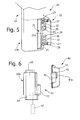
- the mullion bar 10 is represented in enlarged scale in figure 3 , together with the respective hinges 20, 40 and the guide member 50; figures 4 and 5 represent, in further enlarged scale, the two upper and lower end regions of the mullion bar 10.
- the lower hinge 20 comprises a movable hinge portion 21 and a fixed hinge portion 22.
- the movable portion 21 is integral with the mullion bar 10 and the fixed portion 22 is fixed to the door leaf 6a, at the side of the latter opposite the hinging side to the cabinet 2.
- the movable portion 21 belongs to a structural component of the mullion bar 10, indicated with 10a (see also figure 11 ).
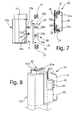
- the movable hinge portion 21 comprises a substantially tubular intermediate vertical portion 21a; the portion 21a is provided with an axial passage, at the two ends of which two fixed cams 23 and 24 are provided, having respective cam surfaces 23a and 24a ( figure 7 ) directed in opposite directions, in particular multiple-lobed cam surfaces, still more preferably trilobed cam surfaces.
- the cams 23 and 24 are defined here as fixed with the sole purpose of distinguishing them from additional cams, defined below as movable.
- the fixed cams 23 and 24 are coaxial with each other and with respect to the axial passage of the portion 21a, which provides a reception seat for a hinge pin, indicated with 25, which defines the hinge axis.
- the cams 23 and 24, which are preferably formed integral with the tubular portion 22, are axially hollow for allowing the passage of the pin 25.
- the fixed hinge member 22 has a fixing base 26, used for the anchoring, for example by means of screws, to the related edge of the door leaf 6a.
- This base 26 is provided with two cantilever formations, or brackets, indicated with 27, substantially parallel to each other. From each bracket 27, a cam-holder element respectively departs downward or upward and is indicated with 28; in the depicted example such element has a substantially cylindrical configuration.
- the two cam holders 28 are coaxial and spaced from each other, and are each provided with a related axial passage, which also crosses the related bracket 27.
- Each cam-holder 28 is coupled with a movable cam, indicated with 29 and 30, having a respective cam surface 29a, 30a ( figure 7 ), particularly a multiple-lobed cam surface, still more in particular a trilobed cam surface.
- the coupling is such that the movable cam 29 or 30 can axially translate with respect to the related cam-holder 28, without however being able to rotate.
- the movable cams 29, 30 are thus configured as separate components, provided with an axial passage, so that they can be mounted on the cam-holders 28.
- Each cam-holder 28 has at least one axial channel 28a ( figure 7 ) on the outer surface, designed to be coupled with a respective axial ribbing (not visible) of the passage of the related movable cam 29, 30, with a coupling that is thus of grooved type: as deducible, in this manner each movable cam 29, 30 is adapted for axially sliding on the related cam-holder 28, without however being able to rotate.
- each spring 32 is mounted on a related cam-holder 28, with one end abutting on a stop surface 27a defined by the related bracket 27, the other end of the same spring 32, on the other hand, abutting against the related movable cam 29, 30; advantageously, for this purpose, each movable cam 29, 30 has a respective spring-guide portion, 29b, 30b, here having substantially cylindrical configuration, which is received in the spiral of the related spring 32.
- the two end portions of the pin 25 are each inserted through the brackets 27 and the cam-holders 28, on which the movable cams 29 or 30 are fit; arranged between the two movable cams 29 and 30 are the two fixed cams 23 and 24 and the related tubular portion 21a, crossed by the intermediate portion of the pin 25; the movable cams 29, 30 are each pressed on a respective fixed cam 23, 24 by means of the related spring 32, so as to keep the cam profiles 23a-29a and 24a-30a nested together.
- the pin 25 is conveniently provided with an enlarged upper head, not indicated in the figures but clearly visible for example in figure 5 .
- the trilobed characteristic of the cam surfaces 23a, 24a, 29a, 30a allows maintaining the springs 32 at rest in the open and closed positions of the mullion bar 10 and therefore ensures that such springs 32 maintain their elasticity even over the long term (by "long term” it is intended a use equal to at least 100,000 cycles).
- the springs 32 are in fact only compressed with the rotation of the mullion bar 10.
- the friction forces are divided more uniformly with respect to the case of the single lobe, thus ensuring a lower wear over time of the cam surfaces 23a, 24a, 29a, 30a.
- the rotation angle of the mullion bar 10 being equal to 90°, the additional 30° of the pitch between the lobes can be equally divided between the open and closed positions, so as to obtain a good stability of the mullion bar 10 both in the open and closed positions.
- the guided member 60 is adapted to engage with the guide member 50 ( figure 2 ), so as to cause the forced rotation of the mullion bar 10 with respect to the door leaf 6, around the hinge axis given by the pin 25.
- This rotation of the mullion bar 10, and thus of the movable hinge portion 21, causes rotating and translating motions of the movable cam 29 on the fixed cam 23, and simultaneously of the movable cam 30 on the fixed cam 24, these roto-translational movements occurring in opposition to the biasing forces of the springs 32.
- the fixed cams 23 and 24 are in intermediate position with respect to the movable cams 29 and 30, with the latter in turn in intermediate position with respect to the springs 32: the springs 32 thus respectively bias the cams 29 and 30 downward and upward, so as to keep the cam profiles 23a-29a and 24a-30a nested together.
- At least one of the hinges 20, 40 of the mullion bar of the refrigerator 1 is provided with two pairs of interacting cams, which precisely distinguish the various rotation pitches of the mullion bar during the opening and closing of the door leaf 6.
- the hinges of the mullion bar each comprise a single pair of interacting cams, on which the mechanical stresses due to the angular movements of the mullion bar are entirely unloaded. It was observed that this known arrangement is subject to occasional breakage of the hinge over the medium-long range period, as well as to early wear of the two interacting cam profiles, in consideration of the fact that the single spring provided for according to the prior art must develop a significant force; additionally, for this reason, in the prior art, the subsequent roto-translational pitches of the movable cam on the fixed cam are perceived as sharp releases, producing an unpleasant effect during refrigerator use.
- the two springs 32 can each develop a force which is comparatively lower with respect to that of the single spring provided in the refrigerator according to the prior art, and this allows both facilitating the rotation movement of the mullion bar, while ensuring an improved precision and reliability of the system, and making the roto-translational pitches of the cams less noticeable.
- the opening and closing movements of the door leaf 6 are generally smoother and more gradual, respectively in the final and initial step.
- the fixed cams 23 and 24 are obtainable in a single piece with the related tubular element 21a and with the body of the component 10a, for such purpose preferably using a mouldable thermoplastic material.
- the movable hinge portion 22 given by the base 26, by the brackets 27 and by the cam-holders 28 is easily obtainable in a single piece, particular in mouldable thermoplastic material.
- the movable cams 29, 30 are obtainable by means of moulding of thermoplastic material.
- the springs 32 and the pin 25 are commercial components. The manufacturing of the lower hinge 20 is thus simple and economical from the industrial standpoint.
- the coupling elements - and especially at least the cams - are made of plastic materials that are different from each other, so as to reduce the friction during the opening and closing phases of the door leaf 6.
- the component 10a including the fixed cams 23 and 24 and the tubular element 21a is made of ABS, polycarbonate, polystyrene or SAN, while the movable hinge portion 22 including the base 26, the brackets 27 and the cam-holders 28 is made of acetal resin (for example, the material known commercially with the name of Hostaform®, by Ticona GmbH, can be used), polyamide-6 or polyamide-6,6 (the use of the materials for the fixed portion and the movable portion can be reversed with respect to that exemplified).
- the lower hinge of the mullion bar 10 can be provided with the two aforesaid cam pairs.
- the upper hinge 40 can therefore be differently conceived, simpler with respect to the lower hinge 20 and even lacking cam members.
- the upper hinge 40 also has a movable hinge portion 41, integral with the mullion bar 10, and a fixed hinge portion 42, fixed to the door leaf 6.
- the movable portion 41 is also integrated into a structural component of the mullion bar 10, and specifically an upper component, indicated with 10b having general configuration similar to that of the component 10a (of course, apart from the specific configuration of the hinge).
- the movable hinge portion 41 essentially comprises a reception seat 43, provided with an axial cavity of circular section, this cavity having an opening in the inner portion of the component 10b, i.e. the portion not visible in the figures, in order to allow the passage of a cable, in particular an electric cable, as will be clear below.
- the fixed hinge portion 42 includes a base 44 for fixing to the door leaf 6, having a substantially cantilever formation 45, from which a cylindrical portion departs downward, which provides a hinge pin 46 having the same fulcrum as the pin 25 of the lower hinge 20.
- the formation 45 and the pin 46 are internally hollow, with the respective cavities that communicate with each other; the cavity of the formation 45 opens in the inner portion of the base 44, not visible in the figures, while the pin 46 is open at its lower end.
- the power supply cable of an electrical resistance is made to pass inside the mullion bar 10, schematically represented in figure 4 , where it is indicated with 47; such electrical resistance 47 has the function of preventing the forming of ice and/or condensate on the mullion bar 10 during the functioning of the refrigerator 1 (ice can in fact be formed if the compartment 3 is a freezer space).
- the path of the aforesaid cable is represented in a merely schematic manner in figure 6 , by means of the line indicated with 47a.
- the upper hinge 40 is also conceived for performing the cable-guide function, and the proposed configuration actually allows working of the cable 47a by twisting rather than bending, reducing the stresses which act on the cable 47a and consequently ensuring a greater duration of such component.
- the coupling elements can be advantageously made of plastic materials that are different from each other, so as to reduce the friction during the phases of opening and closing of the door leaf 6.
- the component 10b with the reception seat 43 is obtainable in moulded thermoplastic material, for example in ABS, polycarbonate, polystyrene or SAN;
- the movable hinge portion 42 including the base 44, the formation 45 and the pin 46 can be made of acetal resin (for example, the already mentioned Hostaform®), polyamide-6 or polyamide-6,6 (the use of the materials for the fixed portion and the movable portion can be reversed with respect to that exemplified).
- the guided member of the mullion bar 10 is visible.
- the guided member is formed by joining the different components of the mullion bar 10: over the long term, and following repeated interactions of the guided member with the guide member, misalignments of the two components can occur, above all if the door leaf which bears the mullion bar is sharply closed.
- this drawback is solved due to the fact that the guided member 60 is fully obtained in one and the same component of the mullion bar 10, and in particular it is made integrally with the component 10b which also makes the movable hinge portion 41.
- the guided member 60 is essentially configured as an appendage or projection, whose external profile makes a first and a second cam surface, indicated with 61a and 61b in figure 8 , substantially opposite each other, designed to cooperate with different parts of the guide member 50.
- the guide member 50 is visible, which is formed so as to have a guide surface 51 which defines a guide path for the guided member 60, and especially for at least part of its cam surface 61a during the closing of the door leaf 6.
- the member 50 also has a guide element, shaped as a projection 52, which is spaced from the guide surface 51: the cam surface 61b of the guided member 60 abuts against this guide element 52 following the opening of the door leaf 6.
- At least a portion of the guide surface 51 for the guided member 60 is defined by an elastic part of the guide member 50.
- This elastic part is indicated with 53 in figures 9 and 10 and is substantially configured as a flat flexure spring.
- the portion of the guide surface 51 which is defined by the elastic part 53 belongs to a curvilinear section of the same guide surface, with the elastic part 53 which thus has a substantially curvilinear longitudinal axis.
- the member 50 is preferably formed as a single piece, particularly of mouldable plastic material, so as to define a bottom wall 54 provided with holes 54a employed for fixing the member itself to the upper wall of the compartment 3 ( figure 2 ), for example by means of screws.
- the plastic material used for making the guide member 50 is advantageously different from that used for making the guided member 60, so as to reduce the friction at the time of coupling between the two aforesaid components of the refrigerator 1: in particular, the guide member 50 can be made of acetal resin (for example, the material known commercially with the name of Hostaform®, by Ticona GmbH, can be used), polyamide-6 or polyamide-6,6, while the guided member 60 can be made of ABS, polycarbonate, polystyrene or SAM (the use of the materials for the fixed portion and the movable portion can be reversed with respect to that exemplified).
- acetal resin for example, the material known commercially with the name of Hostaform®, by Ticona GmbH, can be used
- the elastic part 53 constitutes a kind of cantilever longitudinal extension of a substantially vertical wall 55 of the member 50.
- the bottom wall 54 is provided with a cavity 56, which in the represented example is configured as a through opening of the wall 54.
- the vertical wall 55 rises substantially orthogonal from the bottom wall 54 and the flexible portion 53 extends length-wise under the cavity 56 (naturally, if a guide member of the type indicated with 50 is mounted on the lower wall of the compartment 3, the flexible portion extends above the cavity 56).
- the cavity 56 is provided for facilitating the making of the cantilevered portion 53 by means of moulding the body of the member 50, but naturally the form of the body itself and the cavity 56 can be different from those exemplified in the figures.
- FIG 11 a possible type of modular structure of the mullion bar 10 is visible, such structure being formed by a plurality of separate components.
- a metal base plate is indicated with 11, on which a plastic material tubular body is fixed, indicated with 12, having substantially rectangular section here with rounded edges.
- the plate 11 is provided with hooks or joints, not represented, intended to cooperate with corresponding hooks or joints provided in the rear portion of the tubular body 12.
- the electrical resistance (not shown here) is glued on the plate 11, which remains locked between the plate 11 and the tubular body 12 after assembly.
- the coupling zone between the ends 13b can be entirely orthogonal to the plane of the plate 11 (as illustrated in figure 11 ), or it can advantageously comprise at least one surface substantially parallel to the plane of the plate 11, in order to prevent that possible sliding between the elements 13b at the time of coupling can reduce the effectiveness of the insulation in the central zone of the mullion bar 10.
- the insulation of the upper mullion 10 can be obtained by means of a single element, to be inserted in the tubular body 12.
- the mullion bar 10 has substantially modular structure and is obtainable by means of components of easy industrial manufacture, whose length can vary according to the height of the compartment 3.
- the fixed cams 23, 24 are integral with the movable hinge portion 21, while the movable cams 29, 30 with the related springs 32 are provided on the fixed hinge member 22: nevertheless, it will be appreciated that the arrangement of the cams could be reversed with respect to that exemplified.
- the lower hinge 20 is provided with two cam pairs, while in a possible variant the upper hinge is provided with at least two or four cams (such variant is advantageous if it is necessary to equip the mullion bar 10 with an electrical resistance).
- the arrangement of the hinges is reversed with respect to that illustrated, i.e. with the hinges 20 and 40 provided in the upper and lower regions, respectively, of the movable mullion bar 10.
- the lower end of the mullion bar 10 is provided with a guide element of the type indicated with 60 and a guide member of the type indicated with 50 is provided in the bottom wall of the compartment 3, near its front access opening.
- the elastic part 53 could comprise a lamina configured as a separate component with respect to the main body of the guide member 60, for example a metal lamina fixed with screws or similar mechanical fixing means to the aforesaid body.
- the guide member 50 also acts as a biasing member: in this case, the elastic part 53 constantly acts on the mullion bar 10, when the door leaf 6 is closed, in order to press it against the element 52 and then to retain it in the end stop position.
- the cam surfaces 23a, 24a, 29a, 30a have multiple lobes for ensuring a correct closure of the door leaf 6, since the profile of the cams can also be simpler.
Landscapes
- Engineering & Computer Science (AREA)
- Mechanical Engineering (AREA)
- Chemical & Material Sciences (AREA)
- Combustion & Propulsion (AREA)
- Physics & Mathematics (AREA)
- Thermal Sciences (AREA)
- General Engineering & Computer Science (AREA)
- Refrigerator Housings (AREA)
Applications Claiming Priority (2)
| Application Number | Priority Date | Filing Date | Title |
|---|---|---|---|
| IT000027U ITTO20080027U1 (it) | 2008-03-05 | 2008-03-05 | "apparato di refrigerazione domestico" |
| EP09717531.9A EP2247903B1 (de) | 2008-03-05 | 2009-02-26 | Haushaltskühlschrank |
Related Parent Applications (1)
| Application Number | Title | Priority Date | Filing Date |
|---|---|---|---|
| EP09717531.9 Division | 2009-02-26 |
Publications (1)
| Publication Number | Publication Date |
|---|---|
| EP2672209A1 true EP2672209A1 (de) | 2013-12-11 |
Family
ID=40293544
Family Applications (2)
| Application Number | Title | Priority Date | Filing Date |
|---|---|---|---|
| EP09717531.9A Not-in-force EP2247903B1 (de) | 2008-03-05 | 2009-02-26 | Haushaltskühlschrank |
| EP13183244.6A Withdrawn EP2672209A1 (de) | 2008-03-05 | 2009-02-26 | Haushaltskühlschrank |
Family Applications Before (1)
| Application Number | Title | Priority Date | Filing Date |
|---|---|---|---|
| EP09717531.9A Not-in-force EP2247903B1 (de) | 2008-03-05 | 2009-02-26 | Haushaltskühlschrank |
Country Status (3)
| Country | Link |
|---|---|
| EP (2) | EP2247903B1 (de) |
| IT (1) | ITTO20080027U1 (de) |
| WO (1) | WO2009109878A1 (de) |
Cited By (5)
| Publication number | Priority date | Publication date | Assignee | Title |
|---|---|---|---|---|
| CN104019604A (zh) * | 2014-05-29 | 2014-09-03 | 青岛海尔特种电冰箱有限公司 | 对开门冰箱 |
| CN105466122A (zh) * | 2015-12-22 | 2016-04-06 | 青岛海尔股份有限公司 | 双开门冰箱 |
| AT515491A3 (de) * | 2014-03-14 | 2018-06-15 | Simonswerk Gmbh | Selbstschließendes Rollentürband |
| US10267554B2 (en) | 2017-08-10 | 2019-04-23 | Haier Us Appliance Solutions, Inc. | Mullion for a refrigerator appliance |
| WO2020126471A1 (en) * | 2018-12-21 | 2020-06-25 | Arcelik Anonim Sirketi | A cooling appliance comprising a partition |
Families Citing this family (21)
| Publication number | Priority date | Publication date | Assignee | Title |
|---|---|---|---|---|
| CN101865592B (zh) * | 2010-06-21 | 2012-11-28 | 广东奥马电器股份有限公司 | 一种左右对开门冰箱密封中梁结构 |
| JP5788159B2 (ja) * | 2010-09-29 | 2015-09-30 | 株式会社東芝 | 冷蔵庫 |
| EP2686625B1 (de) * | 2011-03-17 | 2015-09-09 | Vestel Beyaz Esya Sanayi Ve Ticaret A.S. | Kühlvorrichtung |
| CN102425908A (zh) * | 2011-11-22 | 2012-04-25 | 合肥美的荣事达电冰箱有限公司 | 冰箱及用于冰箱的翻转梁 |
| CN103900318B (zh) * | 2012-12-30 | 2017-09-12 | 博西华电器(江苏)有限公司 | 包括两个门的制冷电器 |
| US9127876B2 (en) | 2013-03-14 | 2015-09-08 | Electrolux Home Products, Inc. | Snap off center flipper mullion |
| CN203274419U (zh) * | 2013-04-25 | 2013-11-06 | 海信容声(广东)冰箱有限公司 | 一种冰箱翻转梁装置及对开门冰箱 |
| CN203572131U (zh) * | 2013-07-31 | 2014-04-30 | 博西华电器(江苏)有限公司 | 冰箱 |
| ES2657633T3 (es) * | 2013-08-07 | 2018-03-06 | Hisense Ronshen Guangdong Refrigerator Co., Ltd. | Viga articulada y frigorífico equipado con la misma |
| WO2015018053A1 (zh) * | 2013-08-09 | 2015-02-12 | 海信容声(广东)冰箱有限公司 | 一种翻转梁 |
| US9234695B1 (en) * | 2014-07-15 | 2016-01-12 | Electrolux Home Products, Inc. | Leaf spring flipper mullion |
| CN105423685B (zh) * | 2015-11-30 | 2018-07-13 | 青岛海尔股份有限公司 | 一种竖梁导向结构 |
| US20170234606A1 (en) * | 2016-02-11 | 2017-08-17 | Electrolux Home Products, Inc. | Bottom mount mullion roller |
| US9989297B1 (en) * | 2016-11-23 | 2018-06-05 | Bsh Hausgeraete Gmbh | Home appliance door |
| KR102705438B1 (ko) | 2017-01-23 | 2024-09-11 | 삼성전자주식회사 | 냉장고 |
| US10837695B2 (en) | 2017-12-04 | 2020-11-17 | Electrolux Home Products, Inc. | Refrigerator assembly |
| US10995977B2 (en) * | 2019-08-28 | 2021-05-04 | Whirlpool Corporation | Mullion hinge assembly |
| CN115183516A (zh) * | 2021-04-02 | 2022-10-14 | 青岛海尔电冰箱有限公司 | 一种冰箱 |
| US12326295B2 (en) * | 2022-07-21 | 2025-06-10 | Whirlpool Corporation | Refrigerator appliance with rotating mullion bar |
| TR2023016959A1 (tr) * | 2023-12-11 | 2025-06-23 | Vestel Beyaz Esya Sanayi Ve Ticaret Anonim Sirketi | Bir Soğutucu Cihaz Kapısı. |
| US12571580B2 (en) | 2024-05-22 | 2026-03-10 | Haier Us Appliance Solutions, Inc. | Adjustable mullion for a refrigerator appliance |
Citations (4)
| Publication number | Priority date | Publication date | Assignee | Title |
|---|---|---|---|---|
| KR20030078137A (ko) * | 2002-03-28 | 2003-10-08 | 호일정공 주식회사 | 도어용 힌지 |
| US7008032B2 (en) | 2003-08-29 | 2006-03-07 | Maytag Corporation | Refrigerator incorporating french doors with rotating mullion bar |
| WO2006036044A1 (en) * | 2004-08-24 | 2006-04-06 | I-One Innotech Co., Ltd. | Hinge apparatus for heavy door having automatic return function function |
| CN1888364A (zh) * | 2005-06-30 | 2007-01-03 | 乐金电子(天津)电器有限公司 | 顶开门式电冰箱铰接装置 |
Family Cites Families (6)
| Publication number | Priority date | Publication date | Assignee | Title |
|---|---|---|---|---|
| JP3140292B2 (ja) * | 1994-05-11 | 2001-03-05 | 松下冷機株式会社 | 断熱箱体の扉装置 |
| JPH0933162A (ja) * | 1995-07-21 | 1997-02-07 | Sanyo Electric Co Ltd | 貯蔵庫 |
| JP2000304419A (ja) * | 1999-04-19 | 2000-11-02 | Sanyo Electric Co Ltd | 貯蔵庫等の扉装置 |
| DE20114654U1 (de) * | 2001-09-05 | 2003-02-06 | Liebherr-Hausgeräte GmbH, 88416 Ochsenhausen | Kühl- und Gefriergerät |
| JP2004176941A (ja) | 2002-11-25 | 2004-06-24 | Sanyo Electric Co Ltd | 冷却貯蔵庫 |
| DE102006015991A1 (de) * | 2006-04-05 | 2007-10-11 | BSH Bosch und Siemens Hausgeräte GmbH | Kältegerät mit zwei Türen |
-
2008
- 2008-03-05 IT IT000027U patent/ITTO20080027U1/it unknown
-
2009
- 2009-02-26 WO PCT/IB2009/050777 patent/WO2009109878A1/en not_active Ceased
- 2009-02-26 EP EP09717531.9A patent/EP2247903B1/de not_active Not-in-force
- 2009-02-26 EP EP13183244.6A patent/EP2672209A1/de not_active Withdrawn
Patent Citations (4)
| Publication number | Priority date | Publication date | Assignee | Title |
|---|---|---|---|---|
| KR20030078137A (ko) * | 2002-03-28 | 2003-10-08 | 호일정공 주식회사 | 도어용 힌지 |
| US7008032B2 (en) | 2003-08-29 | 2006-03-07 | Maytag Corporation | Refrigerator incorporating french doors with rotating mullion bar |
| WO2006036044A1 (en) * | 2004-08-24 | 2006-04-06 | I-One Innotech Co., Ltd. | Hinge apparatus for heavy door having automatic return function function |
| CN1888364A (zh) * | 2005-06-30 | 2007-01-03 | 乐金电子(天津)电器有限公司 | 顶开门式电冰箱铰接装置 |
Non-Patent Citations (1)
| Title |
|---|
| DATABASE WPI Week 200739, Derwent World Patents Index; AN 2007-404658, XP002539101 * |
Cited By (8)
| Publication number | Priority date | Publication date | Assignee | Title |
|---|---|---|---|---|
| AT515491A3 (de) * | 2014-03-14 | 2018-06-15 | Simonswerk Gmbh | Selbstschließendes Rollentürband |
| AT515491B1 (de) * | 2014-03-14 | 2018-12-15 | Simonswerk Gmbh | Selbstschließendes Rollentürband |
| CN104019604A (zh) * | 2014-05-29 | 2014-09-03 | 青岛海尔特种电冰箱有限公司 | 对开门冰箱 |
| CN104019604B (zh) * | 2014-05-29 | 2017-01-11 | 青岛海尔特种电冰箱有限公司 | 对开门冰箱 |
| CN105466122A (zh) * | 2015-12-22 | 2016-04-06 | 青岛海尔股份有限公司 | 双开门冰箱 |
| CN105466122B (zh) * | 2015-12-22 | 2018-10-12 | 青岛海尔股份有限公司 | 双开门冰箱 |
| US10267554B2 (en) | 2017-08-10 | 2019-04-23 | Haier Us Appliance Solutions, Inc. | Mullion for a refrigerator appliance |
| WO2020126471A1 (en) * | 2018-12-21 | 2020-06-25 | Arcelik Anonim Sirketi | A cooling appliance comprising a partition |
Also Published As
| Publication number | Publication date |
|---|---|
| EP2247903A1 (de) | 2010-11-10 |
| WO2009109878A1 (en) | 2009-09-11 |
| EP2247903B1 (de) | 2013-11-13 |
| ITTO20080027U1 (it) | 2009-09-06 |
Similar Documents
| Publication | Publication Date | Title |
|---|---|---|
| EP2247903B1 (de) | Haushaltskühlschrank | |
| KR102706908B1 (ko) | 냉장고 | |
| KR101949738B1 (ko) | 냉장고용 레일 조립체 및 냉장고 | |
| US8393694B2 (en) | Refrigerator with vertically moving member attached to home bar door | |
| KR102186243B1 (ko) | 냉장고 | |
| KR102118047B1 (ko) | 냉장고 | |
| KR101962138B1 (ko) | 냉장고 | |
| RU2498173C2 (ru) | Выдвижной ящик холодильного аппарата и устройств, относящихся к холодильным аппаратам | |
| EP3628946B1 (de) | Kühlschrank | |
| KR102043198B1 (ko) | 냉장고 | |
| US20120125035A1 (en) | Consumer appliance drawer with improved anti-racking system | |
| US20170367480A1 (en) | Refrigerator appliance with a drawer slide synchronizer | |
| KR20080069434A (ko) | 양방향 개폐 가능한 도어유닛 및 이를 포함하는 냉장고 | |
| KR20080094353A (ko) | 냉장고 | |
| US20050046319A1 (en) | Refrigerator incorporating french doors with rotating mullion bar | |
| KR20150119651A (ko) | 냉장고 | |
| KR20150031011A (ko) | 냉장고 | |
| KR20220007291A (ko) | 도어개방장치 및 이를 포함하는 냉장고 | |
| KR20080079061A (ko) | 냉장고 | |
| KR101022900B1 (ko) | 냉장고 | |
| EP2235456B1 (de) | Kühlschrank | |
| KR20140097798A (ko) | 선반 어셈블리 및 선반 어셈블리를 포함하는 냉장고 | |
| EP3040660B1 (de) | Türgriff für eine möbeleinheit, insbesondere einen kühlschrank | |
| JP2007093130A (ja) | 冷蔵庫 | |
| KR20130061472A (ko) | 냉장고 홈바 |
Legal Events
| Date | Code | Title | Description |
|---|---|---|---|
| PUAI | Public reference made under article 153(3) epc to a published international application that has entered the european phase |
Free format text: ORIGINAL CODE: 0009012 |
|
| AC | Divisional application: reference to earlier application |
Ref document number: 2247903 Country of ref document: EP Kind code of ref document: P |
|
| AK | Designated contracting states |
Kind code of ref document: A1 Designated state(s): AT BE BG CH CY CZ DE DK EE ES FI FR GB GR HR HU IE IS IT LI LT LU LV MC MK MT NL NO PL PT RO SE SI SK TR |
|
| 17P | Request for examination filed |
Effective date: 20140611 |
|
| RBV | Designated contracting states (corrected) |
Designated state(s): AT BE BG CH CY CZ DE DK EE ES FI FR GB GR HR HU IE IS IT LI LT LU LV MC MK MT NL NO PL PT RO SE SI SK TR |
|
| RAP1 | Party data changed (applicant data changed or rights of an application transferred) |
Owner name: WHIRLPOOL EMEA S.P.A |
|
| STAA | Information on the status of an ep patent application or granted ep patent |
Free format text: STATUS: THE APPLICATION IS DEEMED TO BE WITHDRAWN |
|
| 18D | Application deemed to be withdrawn |
Effective date: 20170901 |