EP2677054A1 - Duplex-edelstahl und herstellungsverfahren dafür - Google Patents
Duplex-edelstahl und herstellungsverfahren dafür Download PDFInfo
- Publication number
- EP2677054A1 EP2677054A1 EP12746805.6A EP12746805A EP2677054A1 EP 2677054 A1 EP2677054 A1 EP 2677054A1 EP 12746805 A EP12746805 A EP 12746805A EP 2677054 A1 EP2677054 A1 EP 2677054A1
- Authority
- EP
- European Patent Office
- Prior art keywords
- duplex stainless
- stainless steel
- steel
- ferrite
- less
- Prior art date
- Legal status (The legal status is an assumption and is not a legal conclusion. Google has not performed a legal analysis and makes no representation as to the accuracy of the status listed.)
- Granted
Links
Images
Classifications
-
- C—CHEMISTRY; METALLURGY
- C21—METALLURGY OF IRON
- C21D—MODIFYING THE PHYSICAL STRUCTURE OF FERROUS METALS; GENERAL DEVICES FOR HEAT TREATMENT OF FERROUS OR NON-FERROUS METALS OR ALLOYS; MAKING METAL MALLEABLE, e.g. BY DECARBURISATION OR TEMPERING
- C21D6/00—Heat treatment of ferrous alloys
- C21D6/005—Heat treatment of ferrous alloys containing Mn
-
- C—CHEMISTRY; METALLURGY
- C21—METALLURGY OF IRON
- C21D—MODIFYING THE PHYSICAL STRUCTURE OF FERROUS METALS; GENERAL DEVICES FOR HEAT TREATMENT OF FERROUS OR NON-FERROUS METALS OR ALLOYS; MAKING METAL MALLEABLE, e.g. BY DECARBURISATION OR TEMPERING
- C21D6/00—Heat treatment of ferrous alloys
- C21D6/004—Heat treatment of ferrous alloys containing Cr and Ni
-
- C—CHEMISTRY; METALLURGY
- C21—METALLURGY OF IRON
- C21D—MODIFYING THE PHYSICAL STRUCTURE OF FERROUS METALS; GENERAL DEVICES FOR HEAT TREATMENT OF FERROUS OR NON-FERROUS METALS OR ALLOYS; MAKING METAL MALLEABLE, e.g. BY DECARBURISATION OR TEMPERING
- C21D6/00—Heat treatment of ferrous alloys
- C21D6/008—Heat treatment of ferrous alloys containing Si
-
- C—CHEMISTRY; METALLURGY
- C22—METALLURGY; FERROUS OR NON-FERROUS ALLOYS; TREATMENT OF ALLOYS OR NON-FERROUS METALS
- C22C—ALLOYS
- C22C1/00—Making non-ferrous alloys
- C22C1/02—Making non-ferrous alloys by melting
-
- C—CHEMISTRY; METALLURGY
- C22—METALLURGY; FERROUS OR NON-FERROUS ALLOYS; TREATMENT OF ALLOYS OR NON-FERROUS METALS
- C22C—ALLOYS
- C22C38/00—Ferrous alloys, e.g. steel alloys
- C22C38/001—Ferrous alloys, e.g. steel alloys containing N
-
- C—CHEMISTRY; METALLURGY
- C22—METALLURGY; FERROUS OR NON-FERROUS ALLOYS; TREATMENT OF ALLOYS OR NON-FERROUS METALS
- C22C—ALLOYS
- C22C38/00—Ferrous alloys, e.g. steel alloys
- C22C38/002—Ferrous alloys, e.g. steel alloys containing In, Mg, or other elements not provided for in one single group C22C38/001 - C22C38/60
-
- C—CHEMISTRY; METALLURGY
- C22—METALLURGY; FERROUS OR NON-FERROUS ALLOYS; TREATMENT OF ALLOYS OR NON-FERROUS METALS
- C22C—ALLOYS
- C22C38/00—Ferrous alloys, e.g. steel alloys
- C22C38/005—Ferrous alloys, e.g. steel alloys containing rare earths, i.e. Sc, Y, Lanthanides
-
- C—CHEMISTRY; METALLURGY
- C22—METALLURGY; FERROUS OR NON-FERROUS ALLOYS; TREATMENT OF ALLOYS OR NON-FERROUS METALS
- C22C—ALLOYS
- C22C38/00—Ferrous alloys, e.g. steel alloys
- C22C38/02—Ferrous alloys, e.g. steel alloys containing silicon
-
- C—CHEMISTRY; METALLURGY
- C22—METALLURGY; FERROUS OR NON-FERROUS ALLOYS; TREATMENT OF ALLOYS OR NON-FERROUS METALS
- C22C—ALLOYS
- C22C38/00—Ferrous alloys, e.g. steel alloys
- C22C38/04—Ferrous alloys, e.g. steel alloys containing manganese
-
- C—CHEMISTRY; METALLURGY
- C22—METALLURGY; FERROUS OR NON-FERROUS ALLOYS; TREATMENT OF ALLOYS OR NON-FERROUS METALS
- C22C—ALLOYS
- C22C38/00—Ferrous alloys, e.g. steel alloys
- C22C38/06—Ferrous alloys, e.g. steel alloys containing aluminium
-
- C—CHEMISTRY; METALLURGY
- C22—METALLURGY; FERROUS OR NON-FERROUS ALLOYS; TREATMENT OF ALLOYS OR NON-FERROUS METALS
- C22C—ALLOYS
- C22C38/00—Ferrous alloys, e.g. steel alloys
- C22C38/18—Ferrous alloys, e.g. steel alloys containing chromium
- C22C38/40—Ferrous alloys, e.g. steel alloys containing chromium with nickel
- C22C38/42—Ferrous alloys, e.g. steel alloys containing chromium with nickel with copper
-
- C—CHEMISTRY; METALLURGY
- C22—METALLURGY; FERROUS OR NON-FERROUS ALLOYS; TREATMENT OF ALLOYS OR NON-FERROUS METALS
- C22C—ALLOYS
- C22C38/00—Ferrous alloys, e.g. steel alloys
- C22C38/18—Ferrous alloys, e.g. steel alloys containing chromium
- C22C38/40—Ferrous alloys, e.g. steel alloys containing chromium with nickel
- C22C38/44—Ferrous alloys, e.g. steel alloys containing chromium with nickel with molybdenum or tungsten
-
- C—CHEMISTRY; METALLURGY
- C22—METALLURGY; FERROUS OR NON-FERROUS ALLOYS; TREATMENT OF ALLOYS OR NON-FERROUS METALS
- C22C—ALLOYS
- C22C38/00—Ferrous alloys, e.g. steel alloys
- C22C38/18—Ferrous alloys, e.g. steel alloys containing chromium
- C22C38/40—Ferrous alloys, e.g. steel alloys containing chromium with nickel
- C22C38/46—Ferrous alloys, e.g. steel alloys containing chromium with nickel with vanadium
-
- C—CHEMISTRY; METALLURGY
- C22—METALLURGY; FERROUS OR NON-FERROUS ALLOYS; TREATMENT OF ALLOYS OR NON-FERROUS METALS
- C22C—ALLOYS
- C22C38/00—Ferrous alloys, e.g. steel alloys
- C22C38/18—Ferrous alloys, e.g. steel alloys containing chromium
- C22C38/40—Ferrous alloys, e.g. steel alloys containing chromium with nickel
- C22C38/54—Ferrous alloys, e.g. steel alloys containing chromium with nickel with boron
-
- C—CHEMISTRY; METALLURGY
- C22—METALLURGY; FERROUS OR NON-FERROUS ALLOYS; TREATMENT OF ALLOYS OR NON-FERROUS METALS
- C22C—ALLOYS
- C22C38/00—Ferrous alloys, e.g. steel alloys
- C22C38/18—Ferrous alloys, e.g. steel alloys containing chromium
- C22C38/40—Ferrous alloys, e.g. steel alloys containing chromium with nickel
- C22C38/58—Ferrous alloys, e.g. steel alloys containing chromium with nickel with more than 1.5% by weight of manganese
-
- C—CHEMISTRY; METALLURGY
- C21—METALLURGY OF IRON
- C21D—MODIFYING THE PHYSICAL STRUCTURE OF FERROUS METALS; GENERAL DEVICES FOR HEAT TREATMENT OF FERROUS OR NON-FERROUS METALS OR ALLOYS; MAKING METAL MALLEABLE, e.g. BY DECARBURISATION OR TEMPERING
- C21D2211/00—Microstructure comprising significant phases
- C21D2211/005—Ferrite
Definitions
- the present invention relates to a duplex stainless steel and a production method therefor, and, more particularly, to a duplex stainless steel that is suitable for a steel material for a line pipe and a production method therefor.
- Petroleum oil and natural gas produced from oil fields and gas fields contain associated gas.
- the associated gas contains corrosive gas such as carbon dioxide gas (CO 2 ) and hydrogen sulfide (H 2 S).
- Line pipes transport the associated gas while transmitting the petroleum oil and the natural gas.
- the line pipes suffer from problems of stress corrosion cracking (SCC), sulfide stress corrosion cracking (sulfide stress cracking: SSC), and general corrosion cracking that causes a decrease in wall thickness.
- SCC stress corrosion cracking
- SSC sulfide stress corrosion cracking
- general corrosion cracking that causes a decrease in wall thickness.
- stainless steel for the line pipes is required to have an excellent corrosion resistance.
- Duplex stainless steel has an excellent corrosion resistance. Hence, the duplex stainless steel is used for the line pipes.
- the duplex stainless steel for the line pipes is further required to have an excellent yield strength and toughness, in addition to the above-mentioned corrosion resistance.
- Techniques intended to improve the strength and toughness of duplex stainless steel are disclosed in JP 10-60598A , JP 10-60526A , JP 7-268552A , JP 6-184699A , JP 6-145903A , JP 2726591B , and JP 3155431B .
- the duplex stainless steel disclosed in JP 10-60598A and JP 10-60526A contains 2 to 6% of Mo and 4 to 10% of W, and further contains 1 to 4% of Cu. JP 10-60598A and JP 10-60526A describe that aging heat treatment performed on the duplex stainless steel for 4 hours at 480°C can provide the duplex stainless steel with an excellent strength.
- the duplex stainless cast steel disclosed in JP 7-268552A contains 0.1 to 2% of C and 2% or less of Cu. JP 7-268552A describes that precipitation hardening heat treatment performed on the duplex stainless cast steel at 600 to 700°C can provide the duplex stainless cast steel with a high strength.
- the duplex stainless steel disclosed in JP 6-184699A is made of a casting material.
- the duplex stainless steel contains 0.5 to 4% of Cu and 0.5 to 3% of W.
- Precipitation hardening heat treatment performed on the duplex stainless steel at 600 to 700°C can cause fine Nb carbo-nitrides and V carbo-nitrides to disperse therein.
- JP 6-184699A describes that this can provide the duplex stainless steel with a high strength.
- the duplex stainless steel disclosed in JP 6-145903A is made of a casting material.
- the duplex stainless steel contains 0.5 to 4% of Cu, 0.5 to 3% of W, and 0.1 to 0.5% of Ta.
- Cu and W are dissolved in ferrite, and strengthen the ferrite.
- Ta forms carbides, finely disperses in ferrite, and increases the strength thereof.
- JP 6-145903A describes that the duplex stainless steel can thus be provided with an excellent corrosion fatigue strength.
- the duplex stainless steel disclosed in JP 2726591B contains 1 to 4% of Cu and 2% or less of W. Precipitation strengthening treatment performed on the duplex stainless steel at 600 to 700°C can cause Cu to be precipitated for precipitation strengthening. JP 2726591B describes that the duplex stainless steel can thus be provided with an excellent strength.
- the duplex stainless cast member disclosed in JP 3155431B contains 2.6 to 3.5% of Cu, and aging heat treatment is performed thereon for 4 hours at 480°C. JP 3155431B describes that the strength of the steel is improved by precipitation strengthening of Cu.
- the duplex stainless steel disclosed in each of the above-mentioned patent documents may not be provided with both of an excellent strength and an excellent toughness at the same time.
- an excellent strength may not be obtained.
- an excellent toughness may not be obtained due to excessive precipitation of carbides.
- JP 7-268552A , JP 6-184699A , and JP 2726591B an excellent strength and toughness may not be obtained.
- Ta may form coarse carbides, and an excellent toughness may not be obtained.
- JP 3155431B an excellent strength may not be obtained.
- the present invention has an objective to provide a duplex stainless steel having a high strength and a high toughness.
- a stainless steel according to the present invention includes: a chemical composition containing, in mass percent, C: at most 0.030%, Si: 0.20 to 1.00%, Mn: at most 8.00%, P: at most 0.040%, S: at most 0.0100%, Cu: more than 2.00% and at most 4.00%, Ni: 4.00 to 8.00%, Cr: 20.0 to 30.0%, Mo: at least 0.50% and less than 2.00%, N: 0.100 to 0.350%, and sol. Al: at most 0.040%, the balance being Fe and impurities; and a structure, wherein a rate of ferrite in the structure is 30 to 70%, and a hardness of the ferrite in the structure is at least 300 Hv 10gf .
- the duplex stainless steel according to the present invention has a high strength and a high toughness.
- the chemical composition of the above-mentioned duplex stainless steel may contain one or more types of element selected from at least one group of the following first group to third group, instead of part of the Fe.
- the duplex stainless steel according to the present invention is subjected to solution treatment at 980 to 1,200°C, and is further subjected to aging heat treatment at 460 to 630°C.
- a production method for a duplex stainless steel material according to the present invention includes the steps of: producing a duplex stainless steel material having a chemical composition containing, in mass percent, C: at most 0.030%, Si: 0.20 to 1.00%, Mn: at most 8.00%, P: at most 0.040%, S: at most 0.0100%, Cu: more than 2.00% and at most 4.00%, Ni: 4.00 to 8.00%, Cr: 20.0 to 30.0%, Mo: at least 0.50% and less than 2.00%, N: 0.100 to 0.350%, and sol.
- Al at most 0.040%, the balance being Fe and impurities; performing solution treatment on the produced duplex stainless steel material at 980 to 1,200°C; and performing aging heat treatment on the duplex stainless steel material that has been subjected to the solution treatment, at 460 to 630°C.
- the inventors of the present invention carried out various experiments and detailed studies to obtain the following findings.
- (a) Solution treatment is performed on a duplex stainless steel having a chemical composition at an appropriate temperature, and aging heat treatment is then performed thereon at an appropriate temperature.
- the chemical composition contains, in mass percent, C: at most 0.030%, Si: 0.20 to 1.00%, Mn: at most 8.00%, P: at most 0.040%, S: at most 0.0100%, Cu: more than 2.00% and at most 4.00%, Ni: 4.00 to 8.00%, Cr: 20.0 to 30.0%, Mo: at least 0.50% and less than 2.00%, N: 0.100 to 0.350%, and sol. Al: at most 0.040%, and the balance being Fe and impurities. Consequently, a large amount of fine Cu precipitates in ferrite, and the strength of the duplex stainless steel increases.
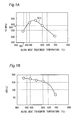
- Figure 1A is a graph showing a relation between an aging heat treatment temperature (°C) and the yield strength (MPa) of the duplex stainless steel. Figure 1A was obtained according to the following method.
- a duplex stainless steel having the same chemical composition as that of steel A in Table 1 to be described later was molten.
- the molten duplex stainless steel was cast, whereby ingots were produced.
- the produced ingots were each heated to 1,250°C.
- Hot forging was performed on the heated ingots, whereby plate materials were produced.
- the produced plate materials were heated again to 1,250°C.
- Hot rolling was performed on the heated plate materials, whereby a plurality of steel plates were produced. The surface temperature of each steel material at the time of the rolling was 1,050°C.
- Solution treatment was performed on the plurality of produced steel plates at 1,070°C. At this time, the soaking time was 5 minutes.
- aging heat treatment was performed on the plurality of steel plates at various aging heat treatment temperatures. The soaking time of the aging heat treatment was 30 minutes.
- the yield strength (MPa) of each steel plate that was subjected to the aging heat treatment was measured. At this time, an offset yield stress of 0.2% based on ASTM A370 was defined as the yield strength (MPa).
- Figure 1A was made on the basis of the obtained yield strength.
- a graph G YS of the yield strength of the duplex stainless steel is convex upward and has a peak in the vicinity of an aging heat treatment temperature of 550°C. More specifically, until the aging heat treatment temperature reaches 550°C, the yield strength increases as the aging heat treatment temperature increases. Meanwhile, after the aging heat treatment temperature exceeds 550°C, the yield strength decreases as the aging heat treatment temperature increases. As shown in Figure 1A , in the case where the aging heat treatment temperature is 460 to 630°C, the yield strength of the duplex stainless steel is equal to or more than 550 MPa. Moreover, in the case where the aging heat treatment temperature is 480 to 600°C, the yield strength of the duplex stainless steel is equal to or more than 580 MPa.
- FIG. 1B is a graph showing a relation between the aging heat treatment temperature and absorbed energy (vE0) of the duplex stainless steel obtained in a Charpy impact test at 0°C.
- Figure 1B was obtained according to the following method.
- a full-size V-notch specimen (having a width of 10 mm, a thickness of 10 mm, a length of 55 mm, and a notch depth of 2 mm) was collected from each steel plate produced at the time of making Figure 1A .
- the Charpy impact test at 0°C was performed using the collected V-notch specimen on the basis of JIS Z2242, whereby the absorbed energy (vE0) was obtained.
- the absorbed energy vE0 of the duplex stainless steel gradually decreases with the aging heat treatment temperature. Then, after the aging heat treatment temperature exceeds 630°C, the toughness of the duplex stainless steel rapidly decreases as the aging heat treatment temperature increases. That is, the absorbed energy vE0 has an inflection point in the vicinity of an aging heat treatment temperature of 630°C. Then, when the aging heat treatment temperature is equal to or less than 630°C, the absorbed energy vE0 is as high as 100 J or more. Moreover, in the case where the aging heat treatment temperature is equal to or less than 600°C, the absorbed energy vE0 of the duplex stainless steel is equal to or more than 150 J.
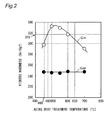
- Figure 2 is a graph showing a relation between the aging heat treatment temperature and the Vickers hardness (Hv 10gf ) of each of a ferrite phase and an austenite phase in the duplex stainless. Figure 2 was obtained according to the following method.
- a sample for structure observation was collected from each steel plate produced at the time of making Figure 1A .
- the collected sample was mechanically polished, and then the polished sample was electrolytically etched in a 30%-KOH solution.
- the etched sample surface was observed using an optical microscope, and a ferrite phase and an austenite phase thereof were found. Given ten points were selected from the found ferrite phase.
- the Vickers hardness in conformity to JIS Z2244 was measured at the selected ten points.
- the test power at the time of the measurement was set to 98.07 N (the hardness symbol was "Hv 10gf ").
- the average of eight points obtained by excluding the maximum value and the minimum value from the measured Vickers hardness values was defined as the hardness of the ferrite.
- a graph G FH of the hardness of the ferrite phase has the same shape as that of the yield strength of the duplex stainless steel shown in Figure 1A .
- the curved line G FH is convex upward and has a peak in the vicinity of an aging heat treatment temperature of 550°C.
- the hardness of the ferrite phase is equal to or more than 300 Hv 10gf .
- the hardness of the ferrite phase is equal to or more than 315 Hv 10gf .
- the hardness of the austenite phase is substantially constant at 245 to 250 MPa.
- the yield strength of the duplex stainless steel decreases (see Figure 1A ).
- the aging heat treatment temperature is excessively high, a ⁇ phase, Mo carbides, and Cr carbides are produced in the steel, and the toughness of the duplex stainless steel decreases (see Figure 1B ).
- the aging heat treatment temperature is 460 to 630°C
- the ferrite rate in the steel is 30 to 70%, and a sufficient amount of fine Cu precipitates in the ferrite.
- the ferrite hardness is equal to or more than 300 Hv 10gf .
- the strength of the duplex stainless is equal to or more than 550 MPa.
- the aging heat treatment temperature falls within the above-mentioned temperature range, a ⁇ phase, Mo carbides, and Cr carbides can be suppressed from being produced.
- the absorbed energy vE0 of the duplex stainless is equal to or more than 100 J.
- the Mo content is set to be low. Moreover, W is not contained. That is, in the present invention, W is an impurity. If aging heat treatment is performed, Mo and W are more likely to form intermetallic compounds such as a ⁇ phase and carbides in the steel. The ⁇ phase and the carbides of Mo and W decrease the toughness of the steel. Accordingly, in the present invention, the Mo content is suppressed to be low, and W is an impurity.
- the duplex stainless steel according to the present invention has the following chemical composition.
- Silicon (Si) suppresses a decrease in the flowability of molten metal at the time of welding, and suppresses the occurrence of a weld defect. Meanwhile, if Si is excessively contained, an intermetallic compound typified by the ⁇ phase is more easily produced. Accordingly, the Si content is 0.20 to 1.00%. Moreover, the upper limit of the Si content is preferably 0.80% and more preferably 0.65%. Moreover, the lower limit of the Si content is preferably 0.30% and more preferably 0.35%.
- Manganese (Mn) desulfurizes and deoxidizes the steel, and increases the hot workability of the steel. Moreover, Mn increases the solubility of nitrogen (N). Meanwhile, if Mn is excessively contained, the corrosion resistance decreases. Accordingly, the Mn content is equal to or less than 8.00%. Moreover, the upper limit of the Mn content is preferably 7.50% and more preferably 5.00%. The lower limit of the Mn content is preferably 0.03% and more preferably 0.05%.
- Phosphorus (P) is an impurity. P decreases the corrosion resistance and toughness of the steel. Accordingly, it is preferable that the P content be low.
- the P content is equal to or less than 0.040%.
- the P content is preferably equal to or less than 0.030% and more preferably equal to or less than 0.020%.
- S Sulfur
- S is an impurity. S decreases the hot workability of the steel. Moreover, S forms sulfides. The sulfides become pitting occurrence origins, and thus decrease the pitting resistance of the steel. Accordingly, it is preferable that the S content be low.
- the S content is equal to or less than 0.0100%.
- the S content is preferably equal to or less than 0.0050% and more preferably equal to or less than 0.0010%.
- Copper (Cu) strengthens a passivation film, and increases the corrosion resistance including the SCC resistance. Moreover, Cu finely precipitates in ferrite at the time of aging heat treatment. The precipitated Cu increases the hardness of the ferrite, and increases the strength of the steel. Moreover, Cu extremely finely precipitates in a base material at the time of high heat input welding, and suppresses the precipitation of the ⁇ phase at the ferrite/austenite phase boundary. Meanwhile, if Cu is excessively contained, the hot workability of the steel decreases. Accordingly, the Cu content is more than 2.00% and equal to or less than 4.00%. Moreover, the lower limit of the Cu content is preferably 2.20% and more preferably 2.40%.
- the lower limit of the Ni content is preferably 4.20% and more preferably 4.50%.
- the upper limit of the Ni content is preferably 7.50% and more preferably 7.00%.
- Chromium (Cr) increases the corrosion resistance of the steel.
- Cr increases the SCC resistance of the steel.
- an intermetallic compound typified by the ⁇ phase is produced, and Cr carbides are also produced.
- the ⁇ phase and the Cr carbides decrease the toughness of the steel, and also decrease the hot workability.
- the Cr content is 20.0 to 30.0%.
- the lower limit of the Cr content is preferably 22.0% and more preferably 24.0%.
- the upper limit of the Cr content is preferably 28.0% and more preferably 27.0%.
- Molybdenum (Mo) increases the SCC resistance of the steel. Meanwhile, if Mo is excessively contained, an intermetallic compound typified by the ⁇ phase is produced. The ⁇ phase decreases the toughness, weldability, and hot workability of the steel. If Mo is excessively contained, moreover, Mo carbides are produced. The Mo carbides decrease the toughness of the steel. Accordingly, the Mo content is equal to or more than 0.50% and less than 2.00%. The lower limit of the Mo content is preferably 0.80% and more preferably 1.00%.
- N Nitrogen
- the duplex stainless steel according to the present invention contains Cr and Mo that are ferrite forming elements. If the balance of the amount of ferrite and the amount of austenite in the duplex stainless steel is taken into consideration, the N content is equal to or more than 0.100%. Meanwhile, if N is excessively contained, blow holes that are weld defects occur. If N is excessively contained, moreover, nitrides are more easily produced at the time of welding, and the toughness and corrosion resistance of the steel decrease. Accordingly, the N content is 0.100 to 0.350%. The lower limit of the N content is preferably 0.120% and more preferably 0.150%.
- Al deoxidizes the steel. Meanwhile, if Al is excessively contained, aluminum nitride (AlN) is formed, and the toughness and corrosion resistance of the steel decrease. Accordingly, the Al content is equal to or less than 0.040%.
- the Al content herein means the content of acid-soluble Al (sol. Al). In the present invention, Al is an essential element.
- the lower limit of the Al content is preferably 0.003% and more preferably 0.005%.
- the upper limit of the Al content is preferably 0.035% and more preferably 0.030%.
- the balance of the duplex stainless steel according to the present invention consists of Fe and impurities.
- the impurities in this context mean elements mixed in for ores and scraps used as raw materials for the steel or various factors in a production process.
- W is an impurity.
- W promotes the production of the ⁇ phase.
- W forms carbides.
- the ⁇ phase and the W carbides decrease the toughness of the steel.
- W is an impurity, and the W content is equal to or less than 0.1%.
- the chemical composition of the duplex stainless steel according to the present invention may contain, instead of Fe, one or more types of element selected from at least one group of the following first group to third group. That is, the elements in the first group to the third group are selective elements that can be contained as needed.
- non-metallic inclusions such as oxides and sulfides of Ca, Mg, and B
- the non-metallic inclusions become pitting origins, and thus decrease the corrosion resistance of the steel. Accordingly, the Ca content is equal to or less than 0.0200%, the Mg content is equal to or less than 0.02%, and the B content is equal to or less than 0.0200%.
- the content of at least one type of Ca, Mg, and B or the total content of two or more types thereof be equal to or more than S (mass percent) + 1 / 2 x O (mass percent).
- the above-mentioned effect can be obtained to some extent.
- the total content of these elements is equal to or less than 0.04%. In the case where all of Ca, Mg, and B are contained, the total content of these elements is equal to or less than 0.06%.
- REM is a collective term including 15 elements of lanthanoid, Y, and Sc. One or more types of these elements are contained. The REM content means the total content of one or more types of these elements.
- the structure of the duplex stainless steel according to the present invention includes ferrite and austenite, and the balance thereof consists of precipitates and inclusions.
- the ferrite rate is 30 to 70%.
- the ferrite rate refers to the ferrite area fraction, and is measured according to the following method. A sample is collected from a given portion of the duplex stainless steel. The collected sample is mechanically polished, and then the polished sample is electrolytically etched in a 30%-KOH solution. The etched sample surface is observed using an optical microscope. At this time, the ferrite rate is measured according to a point counting method in conformity to ASTM E562.
- the hardness of the ferrite is equal to or more than 300 Hv 10gf .
- the hardness of the ferrite is determined according to the following method. Given ten points are selected from the ferrite in the sample used for structure observation described above. The Vickers hardness in conformity to JIS Z2244 is measured at the selected ten points. The test power at the time of the measurement is set to 98.07 N (the hardness symbol is "Hv 10gf "). The average of eight points obtained by excluding the maximum value and the minimum value from the measured Vickers hardness values is defined as the hardness of the ferrite.
- the duplex stainless steel cannot be provided with a sufficient yield strength. Specifically, the yield strength of the duplex stainless steel is less than 550 MPa. Meanwhile, in the case where the ferrite rate is more than 70%, the toughness of the duplex stainless steel is excessively low. Hence, the upper limit of the ferrite rate is 70%.
- the duplex stainless steel cannot be provided with a sufficient yield strength. Specifically, even if the ferrite rate is 30 to 70%, if the ferrite hardness is less than 300 Hv 10gf , the yield strength of the duplex stainless steel is less than 550 MPa.
- the duplex stainless steel has an excellent strength. Moreover, if the ferrite rate is 30 to 70%, the duplex stainless steel has an excellent toughness. In the case where the ferrite rate is 30 to 70% and where the ferrite hardness is equal to or more than 300 Hv 10gf , the yield strength of the duplex stainless steel is equal to or more than 550 MPa, and the absorbed energy vE0 is equal to or more than 100 J.
- the ferrite hardness is preferably equal to or more than 315 Hv 10gf .
- the yield strength of the duplex stainless steel is equal to or more than 580 MPa.
- the duplex stainless steel having the above-mentioned chemical composition is molten.
- the duplex stainless steel may be molten using an electric furnace, and may be molten using an Ar-O 2 gaseous mixture bottom blowing decarburization furnace (AOD furnace).
- AOD furnace Ar-O 2 gaseous mixture bottom blowing decarburization furnace
- VOD furnace vacuum decarburization furnace
- the molten duplex stainless steel may be formed into an ingot according to an ingot-making process, and may be formed into a cast piece (a slab, a bloom, or a billet) according to a continuous casting process.
- a duplex stainless steel material is produced using the produced ingot or cast piece.
- Examples of the duplex stainless steel material include a duplex stainless steel plate and a duplex stainless steel pipe.
- the duplex stainless steel plate is produced according to, for example, the following method. Hot working is performed on the produced ingot or slab, whereby the duplex stainless steel plate is produced. Examples of the hot working include hot forging and hot rolling.
- the duplex stainless steel pipe is produced according to, for example, the following method. Hot working is performed on the produced ingot, slab, or bloom, whereby a billet is produced. Hot working is performed on the produced billet, whereby the duplex stainless steel pipe is produced. Examples of the hot working include piercing-rolling according to a Mannesmann process. Hot extrusion may be performed as the hot working, and hot forging may be performed thereas.
- the produced duplex stainless steel pipe may be a seamless pipe, and may be a welded steel pipe.
- duplex stainless steel pipe is a welded steel pipe
- bending work is performed on the above-mentioned duplex stainless steel pipe, to be thereby formed into an open pipe.
- Both end faces in the longitudinal direction of the open pipe are welded according to a well-known welding method such as submerged arc welding, whereby the welded steel pipe is produced.
- Solution treatment is performed on the produced duplex stainless steel material. Specifically, the duplex stainless steel material is put in a heat treatment furnace, and is soaked at a solution treatment temperature of 980 to 1,200°C. After the soaking, the duplex stainless steel is rapidly cooled by water-cooling or the like. The soaking time in the solution treatment is preferably 2 to 60 minutes.
- aging heat treatment is performed on the duplex stainless steel material. Specifically, the duplex stainless steel material is put in a heat treatment furnace. Then, the duplex stainless steel material is soaked at an aging heat treatment temperature of 460 to 630°C. After the soaking, the duplex stainless steel is air-cooled. The soaking time in the aging heat treatment is preferably 2 to 60 minutes.
- the ferrite rate of the duplex stainless steel is adjusted to be 30 to 70%. Moreover, the ferrite hardness is equal to or more than 300 Hv 10gf . As a result, the duplex stainless steel can be provided with an excellent yield strength and toughness.
- the solution treatment temperature is preferably 1,050 to 1,150°C, and the aging heat treatment temperature is preferably 480 to 600°C.
- the ferrite rate is 35 to 55%
- the ferrite hardness is equal to or more than 315 Hv 10gf .
- the yield strength of the duplex stainless steel is equal to or more than 580 MPa.
- the aging heat treatment temperature is more preferably more than 480°C and equal to or less than 600°C and still more preferably 500 to 600°C.
- Duplex stainless steels having various chemical compositions were molten using a vacuum furnace having a capacity of 150 kg.
- a plurality of duplex stainless steel plates were produced using the molten duplex stainless steels according to various production conditions. The yield strength and toughness of the produced steel plates are examined.
- Duplex stainless steels having chemical compositions of the steel A to steel F and steel X to steel Z shown in Table 1 were molten.
- Table 1 TABLE 1 Steel Chemical Composition (in mass percent, the balance: Fe and impurities) C Si Mn P S Cu Ni Cr Mo N sol.Al V Ca Mg B REM A 0.014 0.52 0.97 0.021 0.0002 2.44 5.03 25.0 1.10 0.189 0.014 0.05 0.0023 - 0.0023 - B 0.015 0.50 1.51 0.001 0.0008 3.41 4.21 20.3 1.98 0.152 0.020 - - - - C 0.015 0.50 1.52 0.014 0.0011 2.20 4.08 23.9 1.96 0.192 0.020 0.06 0.0015 - - - D 0.017 0.51 1.53 0.012 0.0004 2.51 7.82 25.2 1.02 0.305 0.013 - - 0.02 - - E 0.015 0.50 1.03 0.014 0.0006 2.07 5.22 26.0 0.51 0.228
- the contents (mass percents) of elements in each of the steel A to the steel F and the steel X to the steel Z are shown in the chemical composition section in Table 1.
- the balance (components other than the elements shown in Table 1) in the chemical composition with each steel type number consists of Fe and impurities. "-" in Table 1 represents that the content of the corresponding element is in an impurity level.
- the chemical compositions of the steel A to the steel F fell within the range of the chemical composition of the present invention.
- the Cr content of the steel X was less than the lower limit of the Cr content according to the present invention.
- the Cu content of the steel Y was less than the lower limit of the Cu content according to the present invention.
- the Cu content of the steel Z was less than the lower limit of the Cu content according to the present invention.
- the Mo content of the steel Z was more than the upper limit of the Mo content according to the present invention.
- the molten duplex stainless steels were cast, whereby ingots were produced.
- the produced ingots were each heated to 1,250°C.
- Hot forging was performed on the heated ingots, whereby plate materials were produced.
- the produced plate materials were heated again to 1,250°C.
- Hot rolling was performed on the heated plate materials, whereby a plurality of steel plates each having a thickness of 15 mm were produced.
- the surface temperature of each steel material at the time of the rolling was 1,050°C.
- Solution treatment was performed on the steel plate with each test number.
- the solution treatment temperature (°C) was as shown in Table 2, and the soaking time was 5 minutes for all the test numbers. More specifically, each steel plate was put in a heat treatment furnace, and then was held for 5 minutes at the solution treatment temperature (°C) shown in Table 2. After that, each steel plate was taken out of the heat treatment, and was water-cooled until the surface temperature of the steel plate reached a normal temperature (25°C).
- aging heat treatment was performed on each steel plate.
- the aging heat treatment temperature (°C) was as shown in Table 2, and the soaking time was 30 minutes for all the test numbers. More specifically, each steel plate was put in a heat treatment furnace, and then was held for 30 minutes at the aging heat treatment temperature (°C) shown in Table 2. After that, each steel plate was taken out of the heat treatment furnace, and was air-cooled until the surface temperature of the steel plate reached a normal temperature (25°C).
- the ferrite rate of the steel plate with each test number was obtained according to the following method.
- a specimen for structure observation was collected from each steel plate.
- the collected specimen was mechanically polished, and the polished specimen was electrolytically etched in a 30%-KOH solution.
- the etched sample surface was observed using an optical microscope (with x400 field). At this time, the area of the observed region was about 2,000 ⁇ m 2 .
- the ferrite rate (%) in the observed region was obtained.
- the ferrite rate was obtained according to a point counting method in conformity to ASTM E562.
- the ferrite hardness of the steel plate with each test number was determined according to the following method. Given ten points were selected from the ferrite in the observed region of the specimen for structure observation described above. The Vickers hardness in conformity to JIS Z2244 was measured at each of the selected points. The test power at the time of the measurement was 98.07 N. The average of eight points obtained by excluding the maximum value and the minimum value from the measured Vickers hardness values is defined as the ferrite hardness (Hv 10 g f ).
- a round bar tensile specimen was collected from the steel plate with each test number.
- the round bar tensile specimen had an outer diameter of 6.35 mm and a parallel part length of 25.4 mm. The parallel part thereof extended in the rolling direction of the steel plate.
- a tensile test was performed on the collected round bar specimen at a normal temperature, whereby a yield strength YS (MPa) and a tensile strength TS (MPa) were obtained.
- An offset yield stress of 0.2% based on ASTM A370 was defined as the yield strength YS (MPa).
- a Charpy impact test was performed as the toughness test.
- a full-size V-notch specimen (having a width of 10 mm, a thickness of 10 mm, a length of 55 mm, and a notch depth of 2 mm) was collected from each steel plate.
- the Charpy impact test at 0°C was performed using the collected V-notch specimen on the basis of JIS Z2242, whereby the absorbed energy (vE0) was obtained.
- the test results are shown in Table 2.
- the ferrite rate (%) for each test number is inputted to the "Ferrite Rate” section in Table 2.
- the ferrite hardness (Hv 10gf ) for each test number is inputted to the "Ferrite Hardness” section.
- the yield strength (MPa) for each test number is inputted to the "YS” section.
- the tensile strength (MPa) for each test number is inputted to the "TS” section.
- the absorbed energy (J) at 0°C for each test number is inputted to the "vE0" section.
- the chemical compositions of the steel plates with the test numbers 1 to 8 fell within the range of the present invention.
- the solution treatment temperatures and the aging heat treatment temperatures of the steel plates with the test numbers 1 to 8 fell within the range of the present invention.
- the ferrite rates of the steel plates with the test numbers 1 to 8 fell within a range of 30 to 70%, and all the ferrite hardnesses thereof were equal to or more than 300 Hv 10 g f .
- the yield strengths YS of the steel plates with the test numbers 1 to 8 were equal to or more than 550 MPa, and were more specifically equal to or more than 580 MPa.
- the absorbed energies vE0 at 0°C of the steel plates with the test numbers 1 to 8 were equal to or more than 100 J.
- the aging heat treatment temperature was 450°C, which was less than the lower limit of the aging heat treatment temperature according to the present invention.
- the yield strength YS of the steel plate with the test number 9 was less than 550 MPa. This is presumably because, due to the excessively low aging heat treatment temperature, the amount of precipitated Cu was not enough to increase the strength of the entire ferrite.
- the chemical composition of the steel plate with the test number 10 fell within the range of the present invention, the aging heat treatment temperature was 700°C, which was more than the upper limit of the present invention.
- the ferrite hardness of the steel plate with the test number 10 was less than 300 Hv 10 g f , and the yield strength YS thereof was equal to or less than 550 MPa. This is presumably because, due to the excessively high aging heat treatment temperature, Cu dissolved in the ferrite, and the amount of precipitated Cu was thus small.
- the absorbed energy vE0 of the steel plate with the test number 10 was less than 100 J. This is presumably because, due to the excessively high aging heat treatment temperature, large amounts of ⁇ phases, Mo carbides, and Cr carbides precipitated.
- the Cr content of the steel plate with the test number 11 was less than the lower limit of the Cr content according to the present invention. Hence, the ferrite rate was less than 30%, and the yield strength YS was less than 550 MPa. It is estimated that, due to the excessively low ferrite rate, the yield strength YS was low.
- the Cu content of the steel plate with the test number 12 was less than the lower limit of the Cu content according to the present invention.
- the ferrite hardness was less than 300 Hv 10 g f
- the yield strength YS was less than 550 MPa. It is estimated that, due to the excessively low Cu content, the amount of Cu precipitated in the ferrite was low.
- the Cu content of the steel plate with the test number 13 was less than the lower limit of the Cu content according to the present invention. Moreover, the Mo content of the steel plate with the test number 13 was more than the upper limit of the Mo content according to the present invention. Hence, the yield strength YS was less than 550 MPa, and the absorbed energy vE0 was less than 100 J. It is estimated that, due to the excessively low Cu content, the amount of precipitated Cu was small, and the yield strength YS was low. It is also estimated that, due to the excessively high Mo content, large amounts of ⁇ phases and Mo carbides precipitated, and the toughness was low.
- the chemical composition of the steel plate with the test number 14 fell within the range of the present invention, and the solution treatment temperature thereof fell within the range of the present invention.
- the aging heat treatment was not performed on the steel plate with the test number 14.
- the ferrite hardness was less than 300 Hv 10 g f
- the yield strength was less than 550 MPa.
- the chemical composition of the steel plate with the test number 15 fell within the range of the present invention, the aging heat treatment temperature was 700°C, which was more than the upper limit of the present invention.
- the ferrite rate of the steel plate with the test number 15 was less than 30%, the ferrite hardness thereof was less than 300 Hv 10 g f , and the yield strength thereof was less than 550 MPa. It is estimated that, due to the excessively high aging heat treatment temperature and the excessively low ferrite rate, target performance could not be achieved.
- the present invention has been described, and the above-mentioned embodiment is given as a mere example for carrying out the present invention. Accordingly, the present invention is not limited to the above-mentioned embodiment, and can be carried out by appropriately modifying the above-mentioned embodiment within a range not departing from the gist thereof.
- a duplex stainless steel according to the present invention can be widely applied to fields that are required to have a high strength and a high toughness.
- a duplex stainless steel according to the present invention can be applied to a steel material for a line pipe.
Landscapes
- Chemical & Material Sciences (AREA)
- Engineering & Computer Science (AREA)
- Materials Engineering (AREA)
- Mechanical Engineering (AREA)
- Metallurgy (AREA)
- Organic Chemistry (AREA)
- Physics & Mathematics (AREA)
- Thermal Sciences (AREA)
- Crystallography & Structural Chemistry (AREA)
- Heat Treatment Of Steel (AREA)
- Heat Treatment Of Sheet Steel (AREA)
Applications Claiming Priority (2)
| Application Number | Priority Date | Filing Date | Title |
|---|---|---|---|
| JP2011028335 | 2011-02-14 | ||
| PCT/JP2012/053036 WO2012111536A1 (ja) | 2011-02-14 | 2012-02-10 | 二相ステンレス鋼およびその製造方法 |
Publications (3)
| Publication Number | Publication Date |
|---|---|
| EP2677054A1 true EP2677054A1 (de) | 2013-12-25 |
| EP2677054A4 EP2677054A4 (de) | 2016-12-28 |
| EP2677054B1 EP2677054B1 (de) | 2020-03-25 |
Family
ID=46672461
Family Applications (1)
| Application Number | Title | Priority Date | Filing Date |
|---|---|---|---|
| EP12746805.6A Active EP2677054B1 (de) | 2011-02-14 | 2012-02-10 | Duplex-edelstahl-blech oder -rohr und herstellungsverfahren dafür |
Country Status (10)
| Country | Link |
|---|---|
| US (1) | US9771628B2 (de) |
| EP (1) | EP2677054B1 (de) |
| JP (1) | JP5229425B2 (de) |
| CN (1) | CN103370436B (de) |
| AU (1) | AU2012218660B2 (de) |
| BR (1) | BR112013020445B1 (de) |
| CA (1) | CA2826880C (de) |
| ES (1) | ES2795753T3 (de) |
| MX (1) | MX355892B (de) |
| WO (1) | WO2012111536A1 (de) |
Cited By (3)
| Publication number | Priority date | Publication date | Assignee | Title |
|---|---|---|---|---|
| EP3467132A4 (de) * | 2016-06-01 | 2019-05-01 | Nippon Steel & Sumitomo Metal Corporation | Duplexedelstahl und duplexedelstahlherstellungsverfahren |
| EP4130321A4 (de) * | 2020-03-31 | 2024-08-07 | NIPPON STEEL Stainless Steel Corporation | Geschweisste struktur und speicherbehälter |
| EP4411006A4 (de) * | 2021-09-29 | 2026-01-21 | Nippon Steel Corp | Duplexedelstahlmaterial |
Families Citing this family (23)
| Publication number | Priority date | Publication date | Assignee | Title |
|---|---|---|---|---|
| CA2770378C (en) * | 2009-09-10 | 2014-02-18 | Sumitomo Metal Industries, Ltd. | Duplex stainless steel |
| WO2013035588A1 (ja) * | 2011-09-06 | 2013-03-14 | 新日鐵住金株式会社 | 二相ステンレス鋼 |
| JP6286435B2 (ja) * | 2013-08-28 | 2018-02-28 | 株式会社日立製作所 | 二相ステンレス鋼並びにこれを用いた二相ステンレス鋼製構造物 |
| CN106032561A (zh) * | 2015-03-11 | 2016-10-19 | 大田精密工业股份有限公司 | 高尔夫球铁杆头的组成合金 |
| CN108779539B (zh) | 2015-12-14 | 2021-03-26 | 世伟洛克公司 | 无需退火固溶的高度合金不锈钢锻件 |
| JP6780426B2 (ja) * | 2016-10-06 | 2020-11-04 | 日本製鉄株式会社 | 二相ステンレス鋼 |
| JP6946737B2 (ja) * | 2017-05-18 | 2021-10-06 | 日本製鉄株式会社 | 二相ステンレス鋼材及びその製造方法 |
| CN107675099A (zh) * | 2017-08-23 | 2018-02-09 | 宁波市鄞州亚大汽车管件有限公司 | 弯管式消音器 |
| CN107604244A (zh) * | 2017-08-23 | 2018-01-19 | 宁波市鄞州亚大汽车管件有限公司 | 直通式消音器 |
| BR112021012900B1 (pt) | 2019-01-30 | 2024-01-23 | Jfe Steel Corporation | Aço inoxidável duplex, cano ou tubo de aço sem costura e um método de fabricação do aço inoxidável duplex |
| US12385118B2 (en) | 2019-04-24 | 2025-08-12 | Nippon Steel Corporation | Duplex stainless seamless steel pipe and method for producing duplex stainless seamless steel pipe |
| JP7277731B2 (ja) * | 2019-05-14 | 2023-05-19 | 日本製鉄株式会社 | 2相ステンレス鋼及び2相ステンレス鋼の製造方法 |
| US12264376B2 (en) * | 2019-05-29 | 2025-04-01 | Jfe Steel Corporation | Duplex stainless steel and method for manufacturing same, and duplex stainless steel pipe |
| CN110333192A (zh) * | 2019-05-29 | 2019-10-15 | 合肥通用机械研究院有限公司 | 一种双相不锈钢中有害析出相的快速检测评价方法 |
| EP4019651A4 (de) * | 2019-08-19 | 2022-11-02 | Nippon Steel Corporation | Duplexedelstahlmaterial |
| JP7518343B2 (ja) * | 2020-04-10 | 2024-07-18 | 日本製鉄株式会社 | 二相ステンレス鋼材 |
| JP7623601B2 (ja) * | 2020-06-30 | 2025-01-29 | 日本製鉄株式会社 | 二相ステンレス鋼管および溶接継手 |
| CN112195414B (zh) * | 2020-10-21 | 2021-10-29 | 中泽电气科技有限公司 | 一种配电箱用耐腐蚀不锈钢材料制备方法 |
| CN115584443A (zh) * | 2021-07-05 | 2023-01-10 | 中国石油天然气集团有限公司 | 一种含铜抗菌双相不锈钢连续管及加工方法 |
| WO2023162817A1 (ja) | 2022-02-25 | 2023-08-31 | 日本製鉄株式会社 | 二相ステンレス鋼材 |
| JP7827977B2 (ja) * | 2022-03-31 | 2026-03-11 | 日本製鉄株式会社 | 粗製リン酸による耐変色性に優れる二相ステンレス鋼およびそれを使用した粗製リン酸用構造物 |
| CN114836606B (zh) * | 2022-04-01 | 2023-05-26 | 山西太钢不锈钢股份有限公司 | 经济型双相不锈钢板材、提高其强度的方法及其应用 |
| JP7364955B1 (ja) | 2022-07-04 | 2023-10-19 | 日本製鉄株式会社 | 二相ステンレス鋼材 |
Family Cites Families (23)
| Publication number | Priority date | Publication date | Assignee | Title |
|---|---|---|---|---|
| JPS505972B1 (de) * | 1970-05-11 | 1975-03-10 | ||
| GB1456634A (en) * | 1972-09-13 | 1976-11-24 | Langley Alloys Ltd | High strength stainless steel having a high resistance to corro sive and abrasive wear in corrosive environments particularly chloride environments |
| JPS61564A (ja) * | 1984-06-13 | 1986-01-06 | Nippon Kokan Kk <Nkk> | 衝撃特性の優れた2相ステンレス鋼 |
| US4740254A (en) * | 1984-08-06 | 1988-04-26 | Sandusky Foundry & Machine Co. | Pitting resistant duplex stainless steel alloy |
| JPH069693B2 (ja) | 1987-06-20 | 1994-02-09 | 住友金属工業株式会社 | 耐食性に優れた二相ステンレス鋼管の製造方法 |
| JP2726591B2 (ja) | 1992-02-14 | 1998-03-11 | 株式会社クボタ | 高耐食性高強度高靱性二相ステンレス鋼 |
| JPH06145903A (ja) | 1992-11-05 | 1994-05-27 | Kubota Corp | 高腐食疲労強度ステンレス鋼 |
| JPH06184699A (ja) | 1992-12-17 | 1994-07-05 | Kubota Corp | 高腐食疲労強度ステンレス鋼 |
| JPH07268552A (ja) | 1994-03-30 | 1995-10-17 | Kubota Corp | パルプシート脱水ロール用析出硬化型二相ステンレス鋳鋼 |
| JP3155431B2 (ja) | 1994-10-26 | 2001-04-09 | 株式会社安来製作所 | 2相ステンレス鋳造部材およびその製造方法 |
| JPH08170153A (ja) | 1994-12-19 | 1996-07-02 | Sumitomo Metal Ind Ltd | 高耐食性2相ステンレス鋼 |
| JPH1060598A (ja) | 1996-08-19 | 1998-03-03 | Nkk Corp | 耐海水性用析出強化型二相ステンレス鋼 |
| JPH1060526A (ja) | 1996-08-19 | 1998-03-03 | Nkk Corp | 耐海水性用析出強化型二相ステンレス鋼の製造方法 |
| JP2000313940A (ja) * | 1999-04-27 | 2000-11-14 | Sumitomo Metal Ind Ltd | 二相ステンレス鋼材およびその製造方法 |
| JP3534032B2 (ja) * | 2000-02-03 | 2004-06-07 | 住友金属工業株式会社 | 2相ステンレス鋼製鋼管の製造方法 |
| JP3758508B2 (ja) | 2001-02-13 | 2006-03-22 | 住友金属工業株式会社 | 二相ステンレス鋼管の製造方法 |
| JP2002339042A (ja) * | 2001-05-17 | 2002-11-27 | Hitachi Metals Ltd | 耐孔食性に優れたシャフト用ニ相ステンレス鋼 |
| JP4252893B2 (ja) * | 2001-06-11 | 2009-04-08 | 日新製鋼株式会社 | スチールベルト用複相ステンレス鋼帯 |
| JP3920185B2 (ja) * | 2002-09-27 | 2007-05-30 | 日新製鋼株式会社 | 耐たわみ性に優れたステンレス鋼製の二輪車用タイヤリム材および二輪車用フレーム材 |
| SE528782C2 (sv) * | 2004-11-04 | 2007-02-13 | Sandvik Intellectual Property | Duplext rostfritt stål med hög sträckgräns, artiklar och användning av stålet |
| JP5072285B2 (ja) * | 2006-08-08 | 2012-11-14 | 新日鐵住金ステンレス株式会社 | 二相ステンレス鋼 |
| CA2770378C (en) * | 2009-09-10 | 2014-02-18 | Sumitomo Metal Industries, Ltd. | Duplex stainless steel |
| AU2012218661B2 (en) * | 2011-02-14 | 2015-04-30 | Nippon Steel Corporation | Duplex stainless steel |
-
2012
- 2012-02-10 EP EP12746805.6A patent/EP2677054B1/de active Active
- 2012-02-10 CN CN201280008783.7A patent/CN103370436B/zh active Active
- 2012-02-10 JP JP2012507513A patent/JP5229425B2/ja active Active
- 2012-02-10 CA CA2826880A patent/CA2826880C/en not_active Expired - Fee Related
- 2012-02-10 AU AU2012218660A patent/AU2012218660B2/en active Active
- 2012-02-10 BR BR112013020445A patent/BR112013020445B1/pt active IP Right Grant
- 2012-02-10 WO PCT/JP2012/053036 patent/WO2012111536A1/ja not_active Ceased
- 2012-02-10 ES ES12746805T patent/ES2795753T3/es active Active
- 2012-02-10 US US13/984,314 patent/US9771628B2/en active Active
- 2012-02-10 MX MX2013009235A patent/MX355892B/es active IP Right Grant
Non-Patent Citations (1)
| Title |
|---|
| See references of WO2012111536A1 * |
Cited By (3)
| Publication number | Priority date | Publication date | Assignee | Title |
|---|---|---|---|---|
| EP3467132A4 (de) * | 2016-06-01 | 2019-05-01 | Nippon Steel & Sumitomo Metal Corporation | Duplexedelstahl und duplexedelstahlherstellungsverfahren |
| EP4130321A4 (de) * | 2020-03-31 | 2024-08-07 | NIPPON STEEL Stainless Steel Corporation | Geschweisste struktur und speicherbehälter |
| EP4411006A4 (de) * | 2021-09-29 | 2026-01-21 | Nippon Steel Corp | Duplexedelstahlmaterial |
Also Published As
| Publication number | Publication date |
|---|---|
| ES2795753T3 (es) | 2020-11-24 |
| MX355892B (es) | 2018-05-04 |
| CA2826880C (en) | 2017-07-25 |
| CN103370436A (zh) | 2013-10-23 |
| CA2826880A1 (en) | 2012-08-23 |
| AU2012218660A1 (en) | 2013-09-05 |
| US20130312880A1 (en) | 2013-11-28 |
| BR112013020445B1 (pt) | 2019-08-13 |
| MX2013009235A (es) | 2013-08-29 |
| BR112013020445A2 (pt) | 2018-09-04 |
| EP2677054A4 (de) | 2016-12-28 |
| CN103370436B (zh) | 2016-04-20 |
| JP5229425B2 (ja) | 2013-07-03 |
| JPWO2012111536A1 (ja) | 2014-07-07 |
| WO2012111536A1 (ja) | 2012-08-23 |
| EP2677054B1 (de) | 2020-03-25 |
| US9771628B2 (en) | 2017-09-26 |
| AU2012218660B2 (en) | 2015-05-21 |
Similar Documents
| Publication | Publication Date | Title |
|---|---|---|
| EP2677054B1 (de) | Duplex-edelstahl-blech oder -rohr und herstellungsverfahren dafür | |
| EP1514950B1 (de) | Rohr aus nichtrostendem stahl für ölquelle und herstellungsverfahren dafür | |
| AU2012218661B2 (en) | Duplex stainless steel | |
| US11066719B2 (en) | Duplex stainless steel and method of manufacturing duplex stainless steel | |
| EP1683885B1 (de) | Rohr aus hochfestem nichtrostendem stahl mit hervorragender korrosionsbeständigkeit und herstellungsverfahren dafür | |
| KR20180095639A (ko) | 페라이트계 내열강용 용접 재료, 페라이트계 내열강용 용접 조인트 및 페라이트계 내열강용 용접 조인트의 제조 방법 | |
| EP2754726B1 (de) | Zweiphasiger edelstahl | |
| JP7063364B2 (ja) | 高Mn鋼 | |
| CN100497705C (zh) | 耐腐蚀性优良的管线管用高强度不锈钢管及其制造方法 | |
| CN110408842B (zh) | 低温韧性优异的双相不锈钢 | |
| EP1826285B1 (de) | Martensitischer nichtrostender stahl | |
| EP4692390A1 (de) | Cr-ni-legierungsrohr | |
| EP2843068B1 (de) | Eine methode zur herstellung eines cr-haltigen stahlrohrs für ein leitungsrohr mit hervorragender beständigkeit gegen interkristalline spannungsrisskorrosion der wärmebeeinflussten schweiszzone |
Legal Events
| Date | Code | Title | Description |
|---|---|---|---|
| PUAI | Public reference made under article 153(3) epc to a published international application that has entered the european phase |
Free format text: ORIGINAL CODE: 0009012 |
|
| 17P | Request for examination filed |
Effective date: 20130813 |
|
| AK | Designated contracting states |
Kind code of ref document: A1 Designated state(s): AL AT BE BG CH CY CZ DE DK EE ES FI FR GB GR HR HU IE IS IT LI LT LU LV MC MK MT NL NO PL PT RO RS SE SI SK SM TR |
|
| DAX | Request for extension of the european patent (deleted) | ||
| RA4 | Supplementary search report drawn up and despatched (corrected) |
Effective date: 20161128 |
|
| RIC1 | Information provided on ipc code assigned before grant |
Ipc: C22C 38/00 20060101AFI20161122BHEP Ipc: C21D 6/00 20060101ALI20161122BHEP Ipc: C22C 38/58 20060101ALI20161122BHEP |
|
| STAA | Information on the status of an ep patent application or granted ep patent |
Free format text: STATUS: EXAMINATION IS IN PROGRESS |
|
| 17Q | First examination report despatched |
Effective date: 20180611 |
|
| RAP1 | Party data changed (applicant data changed or rights of an application transferred) |
Owner name: NIPPON STEEL CORPORATION |
|
| GRAP | Despatch of communication of intention to grant a patent |
Free format text: ORIGINAL CODE: EPIDOSNIGR1 |
|
| STAA | Information on the status of an ep patent application or granted ep patent |
Free format text: STATUS: GRANT OF PATENT IS INTENDED |
|
| RIC1 | Information provided on ipc code assigned before grant |
Ipc: C22C 38/00 20060101AFI20190909BHEP Ipc: C22C 38/46 20060101ALI20190909BHEP Ipc: C22C 38/42 20060101ALI20190909BHEP Ipc: C22C 38/04 20060101ALI20190909BHEP Ipc: C21D 6/00 20060101ALI20190909BHEP Ipc: C22C 38/54 20060101ALI20190909BHEP Ipc: C22C 1/02 20060101ALI20190909BHEP Ipc: C22C 38/02 20060101ALI20190909BHEP Ipc: C22C 38/44 20060101ALI20190909BHEP Ipc: C22C 38/58 20060101ALI20190909BHEP Ipc: C22C 38/06 20060101ALI20190909BHEP |
|
| INTG | Intention to grant announced |
Effective date: 20191001 |
|
| GRAJ | Information related to disapproval of communication of intention to grant by the applicant or resumption of examination proceedings by the epo deleted |
Free format text: ORIGINAL CODE: EPIDOSDIGR1 |
|
| STAA | Information on the status of an ep patent application or granted ep patent |
Free format text: STATUS: EXAMINATION IS IN PROGRESS |
|
| GRAR | Information related to intention to grant a patent recorded |
Free format text: ORIGINAL CODE: EPIDOSNIGR71 |
|
| GRAS | Grant fee paid |
Free format text: ORIGINAL CODE: EPIDOSNIGR3 |
|
| STAA | Information on the status of an ep patent application or granted ep patent |
Free format text: STATUS: GRANT OF PATENT IS INTENDED |
|
| GRAA | (expected) grant |
Free format text: ORIGINAL CODE: 0009210 |
|
| STAA | Information on the status of an ep patent application or granted ep patent |
Free format text: STATUS: THE PATENT HAS BEEN GRANTED |
|
| INTC | Intention to grant announced (deleted) | ||
| INTG | Intention to grant announced |
Effective date: 20200207 |
|
| AK | Designated contracting states |
Kind code of ref document: B1 Designated state(s): AL AT BE BG CH CY CZ DE DK EE ES FI FR GB GR HR HU IE IS IT LI LT LU LV MC MK MT NL NO PL PT RO RS SE SI SK SM TR |
|
| REG | Reference to a national code |
Ref country code: GB Ref legal event code: FG4D |
|
| REG | Reference to a national code |
Ref country code: AT Ref legal event code: REF Ref document number: 1248631 Country of ref document: AT Kind code of ref document: T Effective date: 20200415 Ref country code: IE Ref legal event code: FG4D |
|
| REG | Reference to a national code |
Ref country code: DE Ref legal event code: R096 Ref document number: 602012068733 Country of ref document: DE |
|
| REG | Reference to a national code |
Ref country code: SE Ref legal event code: TRGR |
|
| REG | Reference to a national code |
Ref country code: NL Ref legal event code: FP |
|
| PG25 | Lapsed in a contracting state [announced via postgrant information from national office to epo] |
Ref country code: RS Free format text: LAPSE BECAUSE OF FAILURE TO SUBMIT A TRANSLATION OF THE DESCRIPTION OR TO PAY THE FEE WITHIN THE PRESCRIBED TIME-LIMIT Effective date: 20200325 Ref country code: FI Free format text: LAPSE BECAUSE OF FAILURE TO SUBMIT A TRANSLATION OF THE DESCRIPTION OR TO PAY THE FEE WITHIN THE PRESCRIBED TIME-LIMIT Effective date: 20200325 |
|
| REG | Reference to a national code |
Ref country code: NO Ref legal event code: T2 Effective date: 20200325 |
|
| PG25 | Lapsed in a contracting state [announced via postgrant information from national office to epo] |
Ref country code: GR Free format text: LAPSE BECAUSE OF FAILURE TO SUBMIT A TRANSLATION OF THE DESCRIPTION OR TO PAY THE FEE WITHIN THE PRESCRIBED TIME-LIMIT Effective date: 20200626 Ref country code: LV Free format text: LAPSE BECAUSE OF FAILURE TO SUBMIT A TRANSLATION OF THE DESCRIPTION OR TO PAY THE FEE WITHIN THE PRESCRIBED TIME-LIMIT Effective date: 20200325 Ref country code: HR Free format text: LAPSE BECAUSE OF FAILURE TO SUBMIT A TRANSLATION OF THE DESCRIPTION OR TO PAY THE FEE WITHIN THE PRESCRIBED TIME-LIMIT Effective date: 20200325 Ref country code: BG Free format text: LAPSE BECAUSE OF FAILURE TO SUBMIT A TRANSLATION OF THE DESCRIPTION OR TO PAY THE FEE WITHIN THE PRESCRIBED TIME-LIMIT Effective date: 20200625 |
|
| REG | Reference to a national code |
Ref country code: LT Ref legal event code: MG4D |
|
| PG25 | Lapsed in a contracting state [announced via postgrant information from national office to epo] |
Ref country code: RO Free format text: LAPSE BECAUSE OF FAILURE TO SUBMIT A TRANSLATION OF THE DESCRIPTION OR TO PAY THE FEE WITHIN THE PRESCRIBED TIME-LIMIT Effective date: 20200325 Ref country code: CZ Free format text: LAPSE BECAUSE OF FAILURE TO SUBMIT A TRANSLATION OF THE DESCRIPTION OR TO PAY THE FEE WITHIN THE PRESCRIBED TIME-LIMIT Effective date: 20200325 Ref country code: IS Free format text: LAPSE BECAUSE OF FAILURE TO SUBMIT A TRANSLATION OF THE DESCRIPTION OR TO PAY THE FEE WITHIN THE PRESCRIBED TIME-LIMIT Effective date: 20200725 Ref country code: SK Free format text: LAPSE BECAUSE OF FAILURE TO SUBMIT A TRANSLATION OF THE DESCRIPTION OR TO PAY THE FEE WITHIN THE PRESCRIBED TIME-LIMIT Effective date: 20200325 Ref country code: PT Free format text: LAPSE BECAUSE OF FAILURE TO SUBMIT A TRANSLATION OF THE DESCRIPTION OR TO PAY THE FEE WITHIN THE PRESCRIBED TIME-LIMIT Effective date: 20200818 Ref country code: SM Free format text: LAPSE BECAUSE OF FAILURE TO SUBMIT A TRANSLATION OF THE DESCRIPTION OR TO PAY THE FEE WITHIN THE PRESCRIBED TIME-LIMIT Effective date: 20200325 Ref country code: EE Free format text: LAPSE BECAUSE OF FAILURE TO SUBMIT A TRANSLATION OF THE DESCRIPTION OR TO PAY THE FEE WITHIN THE PRESCRIBED TIME-LIMIT Effective date: 20200325 Ref country code: LT Free format text: LAPSE BECAUSE OF FAILURE TO SUBMIT A TRANSLATION OF THE DESCRIPTION OR TO PAY THE FEE WITHIN THE PRESCRIBED TIME-LIMIT Effective date: 20200325 |
|
| REG | Reference to a national code |
Ref country code: AT Ref legal event code: MK05 Ref document number: 1248631 Country of ref document: AT Kind code of ref document: T Effective date: 20200325 |
|
| REG | Reference to a national code |
Ref country code: ES Ref legal event code: FG2A Ref document number: 2795753 Country of ref document: ES Kind code of ref document: T3 Effective date: 20201124 |
|
| REG | Reference to a national code |
Ref country code: DE Ref legal event code: R097 Ref document number: 602012068733 Country of ref document: DE |
|
| PG25 | Lapsed in a contracting state [announced via postgrant information from national office to epo] |
Ref country code: AT Free format text: LAPSE BECAUSE OF FAILURE TO SUBMIT A TRANSLATION OF THE DESCRIPTION OR TO PAY THE FEE WITHIN THE PRESCRIBED TIME-LIMIT Effective date: 20200325 Ref country code: DK Free format text: LAPSE BECAUSE OF FAILURE TO SUBMIT A TRANSLATION OF THE DESCRIPTION OR TO PAY THE FEE WITHIN THE PRESCRIBED TIME-LIMIT Effective date: 20200325 |
|
| PLBE | No opposition filed within time limit |
Free format text: ORIGINAL CODE: 0009261 |
|
| STAA | Information on the status of an ep patent application or granted ep patent |
Free format text: STATUS: NO OPPOSITION FILED WITHIN TIME LIMIT |
|
| PG25 | Lapsed in a contracting state [announced via postgrant information from national office to epo] |
Ref country code: PL Free format text: LAPSE BECAUSE OF FAILURE TO SUBMIT A TRANSLATION OF THE DESCRIPTION OR TO PAY THE FEE WITHIN THE PRESCRIBED TIME-LIMIT Effective date: 20200325 |
|
| 26N | No opposition filed |
Effective date: 20210112 |
|
| PG25 | Lapsed in a contracting state [announced via postgrant information from national office to epo] |
Ref country code: SI Free format text: LAPSE BECAUSE OF FAILURE TO SUBMIT A TRANSLATION OF THE DESCRIPTION OR TO PAY THE FEE WITHIN THE PRESCRIBED TIME-LIMIT Effective date: 20200325 |
|
| PG25 | Lapsed in a contracting state [announced via postgrant information from national office to epo] |
Ref country code: MC Free format text: LAPSE BECAUSE OF FAILURE TO SUBMIT A TRANSLATION OF THE DESCRIPTION OR TO PAY THE FEE WITHIN THE PRESCRIBED TIME-LIMIT Effective date: 20200325 |
|
| REG | Reference to a national code |
Ref country code: BE Ref legal event code: MM Effective date: 20210228 |
|
| PG25 | Lapsed in a contracting state [announced via postgrant information from national office to epo] |
Ref country code: CH Free format text: LAPSE BECAUSE OF NON-PAYMENT OF DUE FEES Effective date: 20210228 Ref country code: LU Free format text: LAPSE BECAUSE OF NON-PAYMENT OF DUE FEES Effective date: 20210210 Ref country code: LI Free format text: LAPSE BECAUSE OF NON-PAYMENT OF DUE FEES Effective date: 20210228 |
|
| REG | Reference to a national code |
Ref country code: NL Ref legal event code: MM Effective date: 20210301 |
|
| PG25 | Lapsed in a contracting state [announced via postgrant information from national office to epo] |
Ref country code: NL Free format text: LAPSE BECAUSE OF NON-PAYMENT OF DUE FEES Effective date: 20210301 |
|
| PG25 | Lapsed in a contracting state [announced via postgrant information from national office to epo] |
Ref country code: IE Free format text: LAPSE BECAUSE OF NON-PAYMENT OF DUE FEES Effective date: 20210210 Ref country code: FR Free format text: LAPSE BECAUSE OF NON-PAYMENT OF DUE FEES Effective date: 20210228 |
|
| REG | Reference to a national code |
Ref country code: ES Ref legal event code: FD2A Effective date: 20220510 |
|
| PG25 | Lapsed in a contracting state [announced via postgrant information from national office to epo] |
Ref country code: ES Free format text: LAPSE BECAUSE OF NON-PAYMENT OF DUE FEES Effective date: 20210211 Ref country code: BE Free format text: LAPSE BECAUSE OF NON-PAYMENT OF DUE FEES Effective date: 20210228 |
|
| PG25 | Lapsed in a contracting state [announced via postgrant information from national office to epo] |
Ref country code: IT Free format text: LAPSE BECAUSE OF NON-PAYMENT OF DUE FEES Effective date: 20210210 |
|
| PG25 | Lapsed in a contracting state [announced via postgrant information from national office to epo] |
Ref country code: HU Free format text: LAPSE BECAUSE OF FAILURE TO SUBMIT A TRANSLATION OF THE DESCRIPTION OR TO PAY THE FEE WITHIN THE PRESCRIBED TIME-LIMIT; INVALID AB INITIO Effective date: 20120210 Ref country code: CY Free format text: LAPSE BECAUSE OF FAILURE TO SUBMIT A TRANSLATION OF THE DESCRIPTION OR TO PAY THE FEE WITHIN THE PRESCRIBED TIME-LIMIT Effective date: 20200325 |
|
| PG25 | Lapsed in a contracting state [announced via postgrant information from national office to epo] |
Ref country code: MK Free format text: LAPSE BECAUSE OF FAILURE TO SUBMIT A TRANSLATION OF THE DESCRIPTION OR TO PAY THE FEE WITHIN THE PRESCRIBED TIME-LIMIT Effective date: 20200325 |
|
| PG25 | Lapsed in a contracting state [announced via postgrant information from national office to epo] |
Ref country code: TR Free format text: LAPSE BECAUSE OF FAILURE TO SUBMIT A TRANSLATION OF THE DESCRIPTION OR TO PAY THE FEE WITHIN THE PRESCRIBED TIME-LIMIT Effective date: 20200325 |
|
| PG25 | Lapsed in a contracting state [announced via postgrant information from national office to epo] |
Ref country code: MT Free format text: LAPSE BECAUSE OF FAILURE TO SUBMIT A TRANSLATION OF THE DESCRIPTION OR TO PAY THE FEE WITHIN THE PRESCRIBED TIME-LIMIT Effective date: 20200325 |
|
| PGFP | Annual fee paid to national office [announced via postgrant information from national office to epo] |
Ref country code: GB Payment date: 20241227 Year of fee payment: 14 |
|
| PGFP | Annual fee paid to national office [announced via postgrant information from national office to epo] |
Ref country code: DE Payment date: 20241231 Year of fee payment: 14 |
|
| PGFP | Annual fee paid to national office [announced via postgrant information from national office to epo] |
Ref country code: NO Payment date: 20250212 Year of fee payment: 14 |
|
| PGFP | Annual fee paid to national office [announced via postgrant information from national office to epo] |
Ref country code: SE Payment date: 20251230 Year of fee payment: 15 |