EP2679907A2 - Buse de combustion et procédé associé - Google Patents
Buse de combustion et procédé associé Download PDFInfo
- Publication number
- EP2679907A2 EP2679907A2 EP13174185.2A EP13174185A EP2679907A2 EP 2679907 A2 EP2679907 A2 EP 2679907A2 EP 13174185 A EP13174185 A EP 13174185A EP 2679907 A2 EP2679907 A2 EP 2679907A2
- Authority
- EP
- European Patent Office
- Prior art keywords
- jets
- combustion nozzle
- exit surface
- ratio
- combustion
- Prior art date
- Legal status (The legal status is an assumption and is not a legal conclusion. Google has not performed a legal analysis and makes no representation as to the accuracy of the status listed.)
- Withdrawn
Links
Images


Classifications
-
- F—MECHANICAL ENGINEERING; LIGHTING; HEATING; WEAPONS; BLASTING
- F23—COMBUSTION APPARATUS; COMBUSTION PROCESSES
- F23R—GENERATING COMBUSTION PRODUCTS OF HIGH PRESSURE OR HIGH VELOCITY, e.g. GAS-TURBINE COMBUSTION CHAMBERS
- F23R3/00—Continuous combustion chambers using liquid or gaseous fuel
- F23R3/28—Continuous combustion chambers using liquid or gaseous fuel characterised by the fuel supply
- F23R3/286—Continuous combustion chambers using liquid or gaseous fuel characterised by the fuel supply having fuel-air premixing devices
-
- F—MECHANICAL ENGINEERING; LIGHTING; HEATING; WEAPONS; BLASTING
- F23—COMBUSTION APPARATUS; COMBUSTION PROCESSES
- F23D—BURNERS
- F23D14/00—Burners for combustion of a gas, e.g. of a gas stored under pressure as a liquid
- F23D14/46—Details
- F23D14/48—Nozzles
- F23D14/58—Nozzles characterised by the shape or arrangement of the outlet or outlets from the nozzle, e.g. of annular configuration
-
- F—MECHANICAL ENGINEERING; LIGHTING; HEATING; WEAPONS; BLASTING
- F23—COMBUSTION APPARATUS; COMBUSTION PROCESSES
- F23D—BURNERS
- F23D14/00—Burners for combustion of a gas, e.g. of a gas stored under pressure as a liquid
- F23D14/46—Details
- F23D14/62—Mixing devices; Mixing tubes
-
- Y—GENERAL TAGGING OF NEW TECHNOLOGICAL DEVELOPMENTS; GENERAL TAGGING OF CROSS-SECTIONAL TECHNOLOGIES SPANNING OVER SEVERAL SECTIONS OF THE IPC; TECHNICAL SUBJECTS COVERED BY FORMER USPC CROSS-REFERENCE ART COLLECTIONS [XRACs] AND DIGESTS
- Y02—TECHNOLOGIES OR APPLICATIONS FOR MITIGATION OR ADAPTATION AGAINST CLIMATE CHANGE
- Y02E—REDUCTION OF GREENHOUSE GAS [GHG] EMISSIONS, RELATED TO ENERGY GENERATION, TRANSMISSION OR DISTRIBUTION
- Y02E20/00—Combustion technologies with mitigation potential
- Y02E20/16—Combined cycle power plant [CCPP], or combined cycle gas turbine [CCGT]
-
- Y—GENERAL TAGGING OF NEW TECHNOLOGICAL DEVELOPMENTS; GENERAL TAGGING OF CROSS-SECTIONAL TECHNOLOGIES SPANNING OVER SEVERAL SECTIONS OF THE IPC; TECHNICAL SUBJECTS COVERED BY FORMER USPC CROSS-REFERENCE ART COLLECTIONS [XRACs] AND DIGESTS
- Y10—TECHNICAL SUBJECTS COVERED BY FORMER USPC
- Y10T—TECHNICAL SUBJECTS COVERED BY FORMER US CLASSIFICATION
- Y10T29/00—Metal working
- Y10T29/49—Method of mechanical manufacture
- Y10T29/49229—Prime mover or fluid pump making
- Y10T29/49231—I.C. [internal combustion] engine making
Definitions
- the invention relates generally to combustors, and more specifically, to a combustion nozzle for injecting an air-fuel mixture into a combustion zone within a combustor.
- a combustor is a component or area of an engine where combustion takes place.
- a compressor feeds high pressure air to the combustor or combustion chamber.
- the combustor then heats the air along with a fuel at a constant pressure.
- the generated exhaust gases are fed from the combustor to the turbine via the nozzle guide vanes.
- Such an engine employed in a gas turbine plant or a combined cycle plant for example, is operated to achieve higher operational efficiency under higher temperature and higher pressure conditions, and tends to increase emissions (for example, CO, NOx) in an exhaust gas stream.
- emissions for example, CO, NOx
- CO emissions in gas turbines are an important parameter for machines which are required to operate away from baseload (maximum capacity) conditions. Increased CO emission is associated with the typically lower pressures/temperatures associated with part load operation of the machine. Such conditions are characterized by inadequate consumption of CO produced in the flame front.
- a combustion nozzle in accordance with one exemplary embodiment of the present invention, includes a mixing section and an exit section.
- the mixing section includes an air inlet, and a fuel inlet.
- the exit section includes a plurality of jets formed in a predefined pattern on an exit surface. A ratio of a core area of the plurality of jets to an exit surface area is greater than 0.25.
- a gas turbine in accordance with another exemplary embodiment of the present invention, includes an air compressor, a combustor coupled to the compressor, and a turbine coupled to the combustor.
- the combustor includes a casing, and an exemplary combustion nozzle disposed upstream of a combustion zone within the casing.
- a method in accordance with another exemplary embodiment of the present invention, includes mixing air and a fuel within a mixing section of an exemplary combustion nozzle to generate an air-fuel mixture. The method further includes injecting the air-fuel mixture via an exit section of the exemplary combustion nozzle to a combustion zone disposed downstream of the exemplary combustion nozzle.
- a method for forming an exemplary combustion nozzle is disclosed.
- a combustion nozzle in accordance with the embodiments of the present invention, includes a mixing section having an air inlet, and a fuel inlet.
- the nozzle further includes an exit section having a plurality of jets formed in a predefined pattern on an exit surface. A ratio of a core area of the plurality of jets to a nozzle exit total surface area is greater than 0.25.
- a gas turbine having the exemplary combustion nozzle is disclosed.
- a method associated with the combustion nozzle is disclosed. At part-load conditions, the intra-jet recirculation zones generated by the exemplary combustion nozzles are sufficiently large to consume the carbon monoxide (CO) produced at the flame front of the combustor.
- CO carbon monoxide
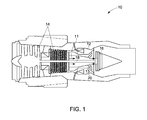
- the gas turbine 10 includes a compressor 14 configured to compress ambient air.
- the combustor 12 is in flow communication with the compressor 14 and is configured to receive compressed air 11 from the compressor 14 and to combust a fuel stream to generate a combustor exit gas stream 13.
- the combustor 12 includes a combustor housing 20 defining a combustion area.
- the combustor 12 includes a can combustor.
- the combustor 12 includes a can-annular combustor or a purely annular combustor.
- the gas turbine 10 includes a turbine 16 located downstream of the combustor 12.
- the turbine 16 is configured to expand the combustor exit gas stream 13 to drive an external load.
- the compressor 14 is driven by the power generated by the turbine 16 via a shaft 18.
- the combustor 12 includes a combustion nozzle for receiving compressed air 11 and the fuel stream, mix the air 11 and the fuel stream to generate an air-fuel mixture, and inject the air-fuel mixture to a combustion zone.
- the combustion nozzle is explained in greater detail with reference to subsequent figures.
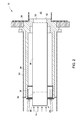
- the exemplary combustor 12 in accordance with the aspects of FIG. 1 is illustrated.
- the exemplary combustor 12 includes a combustor housing 22 defining a combustion chamber 24.
- a cover assembly (not shown) may be provided on one end of the combustor housing 22.
- a combustion liner 26 is disposed within the combustor housing 22. The combustion liner 26 may be provided with a plurality of dilution holes.
- a combustion nozzle 28 is disposed within the combustion chamber 24.
- the exemplary combustion nozzle 28 includes a mixing section 30 and an exit section 32.
- the combustor 12 further includes a fuel plenum 34 for supplying a fuel to the combustion chamber 24.
- the fuel enters the combustion nozzle 28 via one or more fuel inlet holes 36 provided in the mixing section 30.
- the mixing section 30 also has an air inlet 38 for receiving the air stream 11 from the compressor.
- the fuel may include hydrocarbons, natural gas, or high hydrogen gas, or hydrogen, or biogas, or carbon monoxide, or syngas, or inert gas, or water vapor, or oxidizers along with predetermined amount of diluents.
- Diluents may include nitrogen, carbon dioxide, water, steam, or the like.
- the mixing section 30 of the combustion nozzle 28 is configured to mix air 11 and the fuel and generate an air-fuel mixture.
- the exit section 32 is configured to receive the air-fuel mixture and inject the air-fuel mixture to a combustion zone 40 of the combustion chamber 24.
- the exit section 32 is configured to generate turbulent flow of the air-fuel mixture in the combustion zone 40 of the combustor 12.
- the exit section 32 includes a plurality of jets formed in a predefined pattern on an exit surface 42. The exit surface 42 with the plurality of jets is explained in greater detail with reference to subsequent figures.
- the exit surface 42 having a plurality of jets 44 is illustrated.
- the plurality of jets 44 are spaced so to occupy a large area of the exit surface 42.
- a core area of the plurality of jets 44 is defined as an area bounded by the farthest jets among the plurality of jets 44 from a surface center 46.
- circumference of the core area of the plurality of jets 44 is represented by a circle 48.
- the plurality of jets 44 may be arranged in different patterns as explained with reference to subsequent figures.
- a ratio of a core area of the plurality of jets to an exit surface area is greater than 0.25.
- the ratio of the core area of the plurality of jets 44 to the exit surface area is in the range of 0.25 to 0.4.
- the ratio of the core area of the plurality of jets 44 to the exit surface area is in the range of 0.4 to 0.5.
- the ratio of the core area of the plurality of jets 44 to the exit surface area is greater than 0.5.
- a ratio of a diameter of the core area of the plurality of jets 44 to an exit surface diameter is in the range of 0.5 to 0.63. In certain other embodiments of the exit section having an alternate desired jet distribution, a ratio of a diameter of the core area of the plurality of jets to an exit surface diameter is greater than 0.63.
- CO emission in gas turbines is an important parameter for machines which are required to operate away from baseload (maximum capacity) conditions.
- Increased CO emission is associated with the typically lower pressures/temperatures associated with part load operation of the machine.
- the intra-jet recirculation zones generated by conventional combustion nozzles based on arrays of jet phase are not sufficiently large to consume the CO produced at the flame front of the combustor.
- the exit section 32 of the nozzle in accordance with an embodiment of the present invention is illustrated.
- the exit section 32 includes the exit surface 42 having the plurality of jets 44.
- the plurality of jets 44 are spaced apart so as to occupy a large area of the exit surface 42.
- the plurality of jets 44 are spaced in such a way that a spacing between two mutually adjacent jets among the plurality of jets 44 is representative of a distance extending from a center of one jet to another corresponding center of other jet among the mutually adjacent jets 44.
- the spacing between two mutually adjacent jets is represented by "s”
- diameter of each jet is represented by "d”.
- a ratio of the spacing "s" between two mutually adjacent jets among the plurality of jets to the jet diameter "d” is in a range of 1.5 to 1.9.
- a ratio of the spacing "s" between two mutually adjacent jets among the plurality of jets 44 to the jet diameter "d” is in a range of 1.9 to 2.5.
- a ratio of the spacing "s" between two mutually adjacent jets among the plurality of jets to the jet diameter "d" is greater than 2.5.
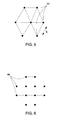
- the plurality of jets 44 formed in a hexagonal pattern on the exit surface of the exit section of the nozzle is illustrated.
- the plurality of jets 44 are spaced so as to occupy a large area of the exit surface of the nozzle.
- the plurality of jets 44 are spaced in such a way that a spacing between two mutually adjacent jets among the plurality of jets 44 is representative of a distance extending from a center of one jet to another corresponding center of other jet among the mutually adjacent jets 44.
- Each dotted line is representative of the spacing between two mutually adjacent jets.
- Any set of three mutually adjacent jets 44 form a three-sided polygon.
- the plurality of three-sided polygon forms the hexagonal pattern of arrangement of jets.
- the plurality of jets 44 formed in a square pattern on the exit surface of the exit section of the nozzle is illustrated.
- the plurality of jets 44 are spaced in such a way that a spacing between two mutually adjacent jets among the plurality of jets 44 is representative of a distance extending from a center of one jet to another corresponding center of other jet among the mutually adjacent jets 44.
- Each dotted line is representative of the spacing between two mutually adjacent jets.
- Any set of four mutually adjacent jets 44 form a quadrilateral.
- the plurality of quadrilateral forms the square pattern of arrangement of jets.
- the plurality of jets 44 formed in a morphed hexagonal (sector) pattern on the exit surface of the exit section of the nozzle is illustrated.
- the plurality of jets 44 are spaced in such a way that a spacing between two mutually adjacent jets among the plurality of jets 44 is representative of a distance extending from a center of one jet to another corresponding center of other jet among the mutually adjacent jets 44.
- Each dotted line is representative of the spacing between two mutually adjacent jets.
- the jets in each row are arranged along a straight line (i.e. oriented 180 degrees). In some embodiments, the jets may not be arranged along a straight line.
- a spacing between two mutually adjacent jets among the plurality of jets 44 may be an "arc length" extending from a center of one jet to center of the mutually adj acent jet.
- the plurality of jets 44 formed in a circular/pattern on the exit surface of the exit section of the nozzle is illustrated.
- the plurality of jets 44 are spaced in such a way that a spacing between two mutually adjacent jets among the plurality of jets 44 is representative of a distance extending from a center of one jet to another corresponding center of other jet among the mutually adjacent jets 44.
- the spacing between mutually jets 44 is a distance along a straight line as represented by the reference numeral 46.
- the spacing between mutually jets 44 is an arc length as represented by the reference numeral 48.
- other suitable patterns of jet arrangement are also envisioned.
- the jets 44 may be arranged in oval pattern, elliptical pattern, or the like. It should be noted herein all permutations and combinations of features discussed with reference to FIGS. 3-8 , are also envisioned.
- achieving low CO emissions from a gas turbine is driven by optimal spacing between the jets of the nozzle.
- the optimal spacing between the jets increase the size of the recirculation zones between the jets to consume the CO produced in the flame front.
- Embodiments of the present invention disclose distributed jets with minimal bluff areas on the exit surface of the nozzle. The lower CO emissions enable part-load operation of the gas turbine.
Landscapes
- Engineering & Computer Science (AREA)
- Chemical & Material Sciences (AREA)
- Combustion & Propulsion (AREA)
- Mechanical Engineering (AREA)
- General Engineering & Computer Science (AREA)
- Spray-Type Burners (AREA)
Applications Claiming Priority (1)
| Application Number | Priority Date | Filing Date | Title |
|---|---|---|---|
| US13/538,516 US20140000269A1 (en) | 2012-06-29 | 2012-06-29 | Combustion nozzle and an associated method thereof |
Publications (1)
| Publication Number | Publication Date |
|---|---|
| EP2679907A2 true EP2679907A2 (fr) | 2014-01-01 |
Family
ID=48703215
Family Applications (1)
| Application Number | Title | Priority Date | Filing Date |
|---|---|---|---|
| EP13174185.2A Withdrawn EP2679907A2 (fr) | 2012-06-29 | 2013-06-28 | Buse de combustion et procédé associé |
Country Status (5)
| Country | Link |
|---|---|
| US (1) | US20140000269A1 (fr) |
| EP (1) | EP2679907A2 (fr) |
| JP (1) | JP2014009940A (fr) |
| CN (1) | CN103528093A (fr) |
| RU (1) | RU2013129579A (fr) |
Families Citing this family (6)
| Publication number | Priority date | Publication date | Assignee | Title |
|---|---|---|---|---|
| US9869190B2 (en) | 2014-05-30 | 2018-01-16 | General Electric Company | Variable-pitch rotor with remote counterweights |
| US10072510B2 (en) | 2014-11-21 | 2018-09-11 | General Electric Company | Variable pitch fan for gas turbine engine and method of assembling the same |
| US10100653B2 (en) | 2015-10-08 | 2018-10-16 | General Electric Company | Variable pitch fan blade retention system |
| US11674435B2 (en) | 2021-06-29 | 2023-06-13 | General Electric Company | Levered counterweight feathering system |
| US11795964B2 (en) | 2021-07-16 | 2023-10-24 | General Electric Company | Levered counterweight feathering system |
| US12601271B2 (en) | 2022-10-21 | 2026-04-14 | General Electric Company | Variable pitch fan of a gas turbine engine |
Family Cites Families (18)
| Publication number | Priority date | Publication date | Assignee | Title |
|---|---|---|---|---|
| US3061001A (en) * | 1958-09-12 | 1962-10-30 | Zink Co John | Gaseous fuel burner |
| US4100733A (en) * | 1976-10-04 | 1978-07-18 | United Technologies Corporation | Premix combustor |
| US5263325A (en) * | 1991-12-16 | 1993-11-23 | United Technologies Corporation | Low NOx combustion |
| US5377483A (en) * | 1993-07-07 | 1995-01-03 | Mowill; R. Jan | Process for single stage premixed constant fuel/air ratio combustion |
| EP0747635B1 (fr) * | 1995-06-05 | 2003-01-15 | Rolls-Royce Corporation | Brûleur à prémélange pauvre avec faible production de NOx pour turbines à gaz industrielles |
| JP4508474B2 (ja) * | 2001-06-07 | 2010-07-21 | 三菱重工業株式会社 | 燃焼器 |
| US7003958B2 (en) * | 2004-06-30 | 2006-02-28 | General Electric Company | Multi-sided diffuser for a venturi in a fuel injector for a gas turbine |
| US7841182B2 (en) * | 2006-08-01 | 2010-11-30 | Siemens Energy, Inc. | Micro-combustor for gas turbine engine |
| GB2449267A (en) * | 2007-05-15 | 2008-11-19 | Alstom Technology Ltd | Cool diffusion flame combustion |
| US9140454B2 (en) * | 2009-01-23 | 2015-09-22 | General Electric Company | Bundled multi-tube nozzle for a turbomachine |
| US8539773B2 (en) * | 2009-02-04 | 2013-09-24 | General Electric Company | Premixed direct injection nozzle for highly reactive fuels |
| US8424311B2 (en) * | 2009-02-27 | 2013-04-23 | General Electric Company | Premixed direct injection disk |
| US8157189B2 (en) * | 2009-04-03 | 2012-04-17 | General Electric Company | Premixing direct injector |
| US8616002B2 (en) * | 2009-07-23 | 2013-12-31 | General Electric Company | Gas turbine premixing systems |
| US8794545B2 (en) * | 2009-09-25 | 2014-08-05 | General Electric Company | Internal baffling for fuel injector |
| US8683804B2 (en) * | 2009-11-13 | 2014-04-01 | General Electric Company | Premixing apparatus for fuel injection in a turbine engine |
| US8800289B2 (en) * | 2010-09-08 | 2014-08-12 | General Electric Company | Apparatus and method for mixing fuel in a gas turbine nozzle |
| US20120058437A1 (en) * | 2010-09-08 | 2012-03-08 | General Electric Company | Apparatus and method for mixing fuel in a gas turbine nozzle |
-
2012
- 2012-06-29 US US13/538,516 patent/US20140000269A1/en not_active Abandoned
-
2013
- 2013-06-27 JP JP2013134420A patent/JP2014009940A/ja active Pending
- 2013-06-28 RU RU2013129579/06A patent/RU2013129579A/ru not_active Application Discontinuation
- 2013-06-28 EP EP13174185.2A patent/EP2679907A2/fr not_active Withdrawn
- 2013-06-28 CN CN201310268770.XA patent/CN103528093A/zh active Pending
Non-Patent Citations (1)
| Title |
|---|
| None |
Also Published As
| Publication number | Publication date |
|---|---|
| RU2013129579A (ru) | 2015-01-10 |
| CN103528093A (zh) | 2014-01-22 |
| US20140000269A1 (en) | 2014-01-02 |
| JP2014009940A (ja) | 2014-01-20 |
Similar Documents
| Publication | Publication Date | Title |
|---|---|---|
| EP3679300B1 (fr) | Ensemble de chambre de combustion de turbine à gaz ayant une cavité à vortex piégé et methode d'opération d'une chambre de combustion de turbine à gaz | |
| US10941940B2 (en) | Burner for a gas turbine and method for operating the burner | |
| US9284888B2 (en) | System for supplying fuel to late-lean fuel injectors of a combustor | |
| KR101450874B1 (ko) | 연료-공기 혼합기, 가스 터빈, 가스 액화 시스템 및 연소 시스템에서의 연료와 산화제의 예혼합 방법 | |
| US8550809B2 (en) | Combustor and method for conditioning flow through a combustor | |
| US20080163627A1 (en) | Fuel-flexible triple-counter-rotating swirler and method of use | |
| US20110185703A1 (en) | Gas Turbine Combustor | |
| EP2679907A2 (fr) | Buse de combustion et procédé associé | |
| CN102809176A (zh) | 气动力燃料喷嘴 | |
| KR20100048555A (ko) | 삼중 스월형 가스터빈 연소기 | |
| EP3102877B1 (fr) | Chambre de combustion | |
| JP2014122784A (ja) | 燃焼器に燃料を供給するためのシステム | |
| US20090139236A1 (en) | Premixing device for enhanced flameholding and flash back resistance | |
| CN102155738A (zh) | 用于供给燃料的装置与方法 | |
| US20180045414A1 (en) | Swirler, burner and combustor for a gas turbine engine | |
| EP3220050A1 (fr) | Brûleur pour turbine à gaz | |
| KR20140090141A (ko) | 가스 터빈 엔진에 사용되는 예비혼합된 연료와 공기를 가진 접선방향의 애뉼러형 연소실 | |
| EP3056818A2 (fr) | Nouveau procédé pour l'entrée d'air dans un revêtement afin de réduire les besoins en eau pour contrôler les nox | |
| EP2119966A1 (fr) | Chambre de combustion à émissions réduites de monoxyde de carbone | |
| JP2018536132A (ja) | 予混合保炎器を有する燃料ノズルアセンブリ | |
| US20180299129A1 (en) | Combustor for a gas turbine | |
| JP5972125B2 (ja) | ガスタービン燃焼器 | |
| WO2025049170A1 (fr) | Brûleur d'ammoniac |
Legal Events
| Date | Code | Title | Description |
|---|---|---|---|
| PUAI | Public reference made under article 153(3) epc to a published international application that has entered the european phase |
Free format text: ORIGINAL CODE: 0009012 |
|
| AK | Designated contracting states |
Kind code of ref document: A2 Designated state(s): AL AT BE BG CH CY CZ DE DK EE ES FI FR GB GR HR HU IE IS IT LI LT LU LV MC MK MT NL NO PL PT RO RS SE SI SK SM TR |
|
| AX | Request for extension of the european patent |
Extension state: BA ME |
|
| STAA | Information on the status of an ep patent application or granted ep patent |
Free format text: STATUS: THE APPLICATION IS DEEMED TO BE WITHDRAWN |
|
| 18D | Application deemed to be withdrawn |
Effective date: 20170103 |