EP2682888A1 - Méthode d'arbitrage de politique, serveur d'arbitrage de politique et programme - Google Patents
Méthode d'arbitrage de politique, serveur d'arbitrage de politique et programme Download PDFInfo
- Publication number
- EP2682888A1 EP2682888A1 EP12751889.2A EP12751889A EP2682888A1 EP 2682888 A1 EP2682888 A1 EP 2682888A1 EP 12751889 A EP12751889 A EP 12751889A EP 2682888 A1 EP2682888 A1 EP 2682888A1
- Authority
- EP
- European Patent Office
- Prior art keywords
- policy
- user
- service
- service policy
- privacy information
- Prior art date
- Legal status (The legal status is an assumption and is not a legal conclusion. Google has not performed a legal analysis and makes no representation as to the accuracy of the status listed.)
- Withdrawn
Links
Images











Classifications
-
- H—ELECTRICITY
- H04—ELECTRIC COMMUNICATION TECHNIQUE
- H04L—TRANSMISSION OF DIGITAL INFORMATION, e.g. TELEGRAPHIC COMMUNICATION
- H04L63/00—Network architectures or network communication protocols for network security
- H04L63/20—Network architectures or network communication protocols for network security for managing network security; network security policies in general
-
- G—PHYSICS
- G06—COMPUTING OR CALCULATING; COUNTING
- G06F—ELECTRIC DIGITAL DATA PROCESSING
- G06F21/00—Security arrangements for protecting computers, components thereof, programs or data against unauthorised activity
- G06F21/60—Protecting data
- G06F21/62—Protecting access to data via a platform, e.g. using keys or access control rules
- G06F21/6218—Protecting access to data via a platform, e.g. using keys or access control rules to a system of files or objects, e.g. local or distributed file system or database
- G06F21/6245—Protecting personal data, e.g. for financial or medical purposes
-
- G—PHYSICS
- G06—COMPUTING OR CALCULATING; COUNTING
- G06F—ELECTRIC DIGITAL DATA PROCESSING
- G06F21/00—Security arrangements for protecting computers, components thereof, programs or data against unauthorised activity
- G06F21/60—Protecting data
- G06F21/604—Tools and structures for managing or administering access control systems
-
- G—PHYSICS
- G16—INFORMATION AND COMMUNICATION TECHNOLOGY [ICT] SPECIALLY ADAPTED FOR SPECIFIC APPLICATION FIELDS
- G16H—HEALTHCARE INFORMATICS, i.e. INFORMATION AND COMMUNICATION TECHNOLOGY [ICT] SPECIALLY ADAPTED FOR THE HANDLING OR PROCESSING OF MEDICAL OR HEALTHCARE DATA
- G16H10/00—ICT specially adapted for the handling or processing of patient-related medical or healthcare data
- G16H10/60—ICT specially adapted for the handling or processing of patient-related medical or healthcare data for patient-specific data, e.g. for electronic patient records
-
- H—ELECTRICITY
- H04—ELECTRIC COMMUNICATION TECHNIQUE
- H04L—TRANSMISSION OF DIGITAL INFORMATION, e.g. TELEGRAPHIC COMMUNICATION
- H04L63/00—Network architectures or network communication protocols for network security
- H04L63/10—Network architectures or network communication protocols for network security for controlling access to devices or network resources
- H04L63/102—Entity profiles
Definitions
- the present invention relates to a policy arbitration method, a policy arbitration server, and a program, and particularly to a policy arbitration method, a policy arbitration server, and a program that resolve a conflict between a privacy information holder's policy regarding how his privacy information is handled and a policy of a user of the privacy information regarding how the privacy information is used.
- Non-Patent Literature (NPL) 1 describes a policy-based control method using P3P (Platform for Privacy Preferences).
- service policy In P3P, privacy information collected by a privacy information user (service provider) and the way this information is handled are set as a policy file (referred to as “service policy” hereinafter) written in XML (Extensible Markup Language), and by investigating whether or not conditions of data disclosure match between a policy file (referred to as "user policy” hereinafter) describing a data disclosure policy set in advance by a privacy information holder and the aforementioned service policy, a data disclosure decision can be automatically/semi-automatically made.
- service policy Written in XML (Extensible Markup Language)
- P3P has a problem that a privacy information user cannot use the data and a privacy information holder cannot receive a service when a conflict arises between the user policy and the service policy and data disclosure agreement cannot be reached (for instance, when there is a conflict between the two policies regarding the conditions of data disclosure). Therefore, policy agreement must be reached between the privacy information holder and the privacy information user.
- policy arbitration method Such a method for reaching policy agreement between two parties is called policy arbitration method.
- Patent Literature (PTL) 1 describes an example of the policy arbitration method.
- the policy arbitration method in Patent Literature 1 is constituted by privacy information holder terminals connected to each other via a network, a privacy information user terminal, and a server.
- each of the privacy information holder terminals registers a privacy policy defining standards for using privacy information to the server
- the privacy information user terminal registers a user policy defining a range of requirements for privacy information disclosure to the server
- the server determines whether or not there is a conflict between the policies
- the server notifies the privacy information holder terminal of the user policy when there is a conflict, requesting consent for privacy information disclosure.
- the privacy information user terminal is able to use the privacy information.
- Non-Patent Literature 2 describes another example of a policy arbitration method.
- the policy arbitration method in Non-Patent Literature 2 is constituted by privacy information holder terminals and privacy information user terminals connected by a network.
- a privacy information user terminal transmits a user policy to a privacy information holder terminal, and the privacy information holder terminal compares the user policy to a privacy policy and transmits attribute information of the privacy information holder if there is no conflict. Further, when there is a conflict, a user transmits use/preservation conditions to the privacy information user terminal from the privacy information holder terminal, and the privacy information user terminal creates a new user policy meeting these conditions and transmits the new policy to the privacy information holder terminal.
- policy arbitration is performed by repeating the transmission of the user policy, the comparison, the transmission of conditions, and the creation of a new policy until agreement between the two parties is reached.
- Patent Literatures 2 to 4 are other relevant documents.
- Patent Literature 1 The policy arbitration method described in Patent Literature 1 is able to perform policy arbitration with only one interaction, however, even when there is a conflict between the user policy and the service policy, the privacy information holder has no choice but to agree to the service policy in order to receive the service. As a result, there is no option in terms of changing the quality of the service offered according to the degree of the privacy information provided such as a case where a better service will be offered if a certain piece of data is additionally provided, and policy agreement cannot be flexibly reached.
- Non-Patent Literature 2 a privacy information holder and privacy information user can flexibly reach policy agreement by performing a plurality of interactions between the privacy information holder and the privacy information user.
- the present invention has been invented to solve the above problems, and it is an object thereof to provide a policy arbitration method capable of flexibly facilitating policy agreement between a privacy information holder and privacy information user while reducing the number of interactions.
- a policy arbitration method comprises: entering a user policy in which a privacy information holder describes at least one rule that is a pair of a data type of privacy information possessed by the privacy information holder and the way to handle the data type; generating, using the user policy and a service policy set that includes at least one service policy in which a privacy information user describes at least one rule that is a pair of a data type of the privacy information and the way to handle the data type, a ranking of the service policy according to the degree of divergence between the user policy and the service policy; displaying the service policy ranking on a privacy information holder terminal; and having the privacy information holder select one service policy from the service policy ranking.
- the present method is tied to a particular machine, which is a computer that handles privacy information of a privacy information holder.
- an arbitration server comprises: user policy receiving means for receiving from a user a user policy describing at least one rule that is a pair of a data type of privacy information possessed by the user and the way to handle the data type; ranking generation means for generating, using the user policy and a service policy set that includes at least one service policy describing at least one rule that is a pair of a data type of the privacy information and the way to handle the data type, a ranking of the service policy based on the degree of divergence between the user policy and the service policy; and agreed policy receiving means for receiving from the user who has referred to the service policy ranking selection of a service policy to be applied to the privacy information of the user.
- a program causes an arbitration server to execute: receiving from a user a user policy describing at least one rule that is a pair of a data type of privacy information possessed by the user and the way to handle the data type; generating, using the user policy and a service policy set that includes at least one service policy describing at least one rule that is a pair of a data type of the privacy information and the way to handle the data type, a ranking of the service policy based on the degree of divergence between the user policy and the service policy; and receiving from the user who has referred to the service policy ranking selection of a service policy to be applied to the privacy information of the user.
- this program can be stored in a computer-readable recording-medium.
- the present invention can be realized as a computer program product as well.
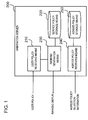
- the present invention in an exemplary embodiment thereof, can be realized by an arbitration server 200 comprising user policy receiving means 210 for receiving a user policy supplied by a privacy information holder (simply referred to as "user” hereinafter); service policy storage means 220 for storing at least one service policy describing at least one rule which is a set of a data type and an action desired by a privacy information user; ranking generation means 230 for generating a service policy ranking of the service policy in the order of the degree of divergence (smallest to largest) between the supplied user policy and at least one service policy; agreed policy receiving means 240 for receiving a service policy (also referred to as "agreed policy” hereinafter) selected by the user as an accepted policy from the service policies; and agreed policy storage means 250 for storing the agreed policy.
- user policy receiving means 210 for receiving a user policy supplied by a privacy information holder (simply referred to as "user” hereinafter); service policy storage means 220 for storing at least one service policy describing at least one rule which is a
- the user policy and the service policy describes a data type (value identifying the property of data such as name, age, etc.) and an action for each data type (how to handle privacy information such as whether or not the disclosure of the data is allowed, whether or not the information should be acquired, a privacy protection process is performed, etc.).
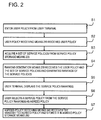
- the arbitration server operates as shown in Fig. 2 .
- a privacy information holder enters a user policy using his own terminal (referred to as "user terminal” hereinafter) (step S1).
- the user policy receiving means 210 of the arbitration server 200 receives the user policy (step S2).
- the ranking generation means 230 acquires a set of service policies from the service policy storage means 220 (step S3).
- the ranking generation means 230 receives the user policy and the set of service policies, generates rankings of the service policies based on the degree of divergence between the user policy and the service policies, and transmits the service policy rankings to the user terminal (step S4).
- the generated service policy rankings are displayed on the user terminal (step S5).
- the user selects a service policy from the service policy rankings displayed, and transmits the selected policy to the arbitration server 200 as an agreed policy (step S6).
- the agreed policy receiving means 240 receives the agreed policy and stores it in the agreed policy storage means 250 (step S7).
- the user may be able to choose not to receive the service if he cannot select any agreed policy from the service policy rankings or there is no service policy he wants to select.
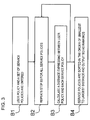
- step B1 the user policy received in the step S2 and the set of service policies acquired in the step S3 are entered into the ranking generation means 230 (step B1).
- step B3 the ranking generation means 230 repeats step B3 for all the service policies (step B2).
- the ranking generation means 230 calculates a distance expressing the degree of divergence between the user policy and each service policy (the step B3). For instance, this distance can be derived by expressing the difference in the handling of data between the user policy and a service policy as a numerical value for each data type and summing the differences in the handling of the data for all the data attributes. Further, in the calculation of the distance, a weighting may be appropriately performed for each data type.
- service policies are sorted in the order of smallest to largest distance and outputted as the service policy rankings (step B4).
- service policy rankings generated based on the distance between a user policy entered by a user and service policies determined by a privacy information user are provided to the user, enabling the user to select an agreed policy he can accept.
- an agreed policy desirable for both the privacy information holder and the privacy information user can be generated by having the two parties perform only one interaction.
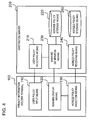
- Fig. 4 is a block diagram showing a configuration of the first exemplary embodiment of the present invention. With reference to Fig. 4 , a configuration including a privacy information holder terminal 100 and the arbitration server 200 is shown.
- the privacy information holder terminal 100 comprises user policy input means 110 for entering a user policy, ranking display means 120 for displaying rankings of service policies, and agreed policy selection means 130 for selecting an agreed policy from service policy rankings.
- the arbitration server 200 comprises the service policy storage means 220 for storing a service policy ID identifying a service policy and a service policy, the user policy receiving means 210 for receiving a user policy entered by a privacy information holder, the ranking generation means 230 for generating service policy rankings based on the distance between the user policy and the service policies stored in the service policy storage means 220, the agreed policy receiving means 240 for receiving an agreed policy selected by the privacy information holder, and the agreed policy storage means 250 for storing a user ID of the privacy information holder and the agreed policy.
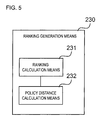
- the ranking generation means 230 includes policy distance calculation means 232 for calculating the distance between policies, which is the degree of divergence between the user policy and a service policy, and ranking calculation means 231 for ranking the service policies based on the distance between the policies.
- the user policy is assumed to be written in XML in such a manner that binary values ("Provide” and "Do not provide”) are set using ACTION tags as the content of a rule defining how each data type (datatype) such as Name and Address is handled, as shown in Fig. 6 .
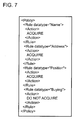
- the service policy is also assumed to be written in XML in such a manner that binary values ("Acquire” and "Do not acquire") are set using ACTION tags as the content of a rule defining how each data type (datatype) such as Name and Address is handled, as shown in Fig. 7 .
- a conflict between the user policy and the service policy occurs when "not provided” is written in the rule of a data type while “acquire” is written in the rule of the corresponding data type of the service policy.
- each part (processing means) of the arbitration server 200 shown in Figs. 4 and 5 can be realized by a computer program having a computer that constitutes the arbitration server 200 execute each processing described below using the hardware thereof.
- the service policy storage means 220 is assumed to store service policy IDs and service policies in a table shown in Fig. 8 .
- the service policy IDs in Fig. 8 are the identifiers of service policies.
- Fig. 9 is a flowchart showing an operation of the first exemplary embodiment of the present invention.
- the user policy receiving means 110 receives the entry of a user policy such as the one shown in Fig. 6 from the privacy information holder, and transmits it to the arbitration server 200 (step A1).
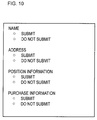
- Fig. 10 is an example of a user policy input screen displayed on the privacy information holder terminal 100 by the user policy input means 110.
- the user policy receiving means 210 of the arbitration server 200 receives the user policy from the privacy information holder terminal 110 (step A2).
- the ranking generation means 230 of the arbitration server 200 Upon receiving the user policy, the ranking generation means 230 of the arbitration server 200 acquires a set of service policies from the service policy storage means 220 (step A3).
- the service policy storage means 220 In the present exemplary embodiment, five pairs of the service policy IDs ("1,” “2,” “3,” “4,” and "5") and the service policies written in XML are assumed to be acquired, as shown in Fig. 8 .
- the ranking generation means 230 generates service policy rankings (step A4).
- the user policy (refer to Fig. 6 ) entered by the privacy information holder and the set of the pairs of the service policy IDs and the service policies (refer to Fig. 7 ) are entered into the ranking generation means 230 (the step B1).
- the processing of the step B3 is performed on all the service policies (the step B2). More concretely, the distance between the user policy and a service policy that is the distance calculation target is calculated (the step B3).
- the calculation of the distance between the user policy and the service policy performed by the policy distance calculation means in the ranking generation means 230 will be described in detail.
- the distance between the user policy and the service policy is expressed by the number of conflicting rules.
- step C1 the user policy and the service policy are entered.
- the user policy shown in Fig. 6 and the service policy having the service policy ID "1" in Fig. 8 are assumed to be entered.
- the policy distance calculation means 232 treats this data type as having the action "Do not provide.”
- (t_u, a_u) _ (“NAME,” “Acquire”).
- the policy distance calculation means 232 changes the data type t_s and returns to the step C6 (the step C9).
- the policy distance calculation means 232 After performing the steps C6 to C9 on all t_s, the policy distance calculation means 232 outputs the distance d (step C10).
- Fig. 12 is a drawing showing the results of calculating the distances between the user policy in Fig. 6 and all the service policies stored in the service policy storage means 220 shown in Fig. 8 .
- the ranking calculation means 231 in the ranking generation means 230 generates rankings by sorting the service policies in the order of smallest to largest distance d, and transmits the service policy rankings (a set of combinations of rankings, service policy IDs, and service policies) to the privacy information holder terminal 100 (the step B4).
- the ranking display means 120 receives and displays the service policy rankings.
- Fig. 14 is an example of the service policy rankings displayed by the ranking display means 120 of the privacy information holder terminal 100 using the service policy rankings shown in Fig. 13 .
- the agreed policy selection means 130 of the privacy information holder terminal 100 receives the selection of a service policy (agreed policy) applied to his privacy information from the service policy rankings.
- a service policy (agreed policy)
- the agreed policy selection means 130 can be realized by the selection buttons provided for the service policy rankings in Fig. 14 or input means for entering a service policy ID (not shown in the drawing).
- the service policy ID "5" is transmitted to the arbitration server 200 as an agreed policy.
- the agreed policy receiving means 240 receives the agreed policy transmitted by the privacy information holder terminal 100 and stores it in the agreed policy storage means 250.
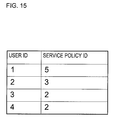
- Fig. 15 is a drawing showing a state in which the selected agreed policy is stored in the agreed policy storage means 250, and the service policy ID "5" is registered as the agreed policy of the privacy information holder having the user ID "1.”
- the present exemplary embodiment it becomes possible to lead the user to agree to an agreed policy that he feels the most comfortable with by presenting rankings using the degree of divergence between the user policy entered by the privacy information holder using the user policy input means 110 and the service policies entered by the privacy information user in advance. Further, in the present exemplary embodiment, the total number of data types having "Do not provide" written in the user policy and "Acquire" in the service policy is calculated as the distance between the policies, however, it is possible to calculate the distance by weighting a particular data type containing sensitive private information so as to increase the distance.
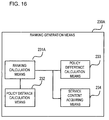
- Fig. 16 is a block diagram showing a configuration of ranking generation means 230A provided in an arbitration server of the second exemplary embodiment of the present invention.
- policy difference calculation means 233 and service content acquiring means 234 are newly added to the ranking generation means 230 in the first exemplary embodiment.
- the policy difference calculation means 233 drives an explanation regarding conflicting rules between a user policy and service policy.
- the service content acquiring means 234 acquires an explanation regarding the service provided by each service policy.
- Ranking calculation means 231A of the present exemplary embodiment transmits service policy rankings, to which information sent from the policy difference calculation means 233 and the service content acquiring means 234 is added, to the privacy information holder terminal 100.
- Fig. 17 is an example of a service policy storage table stored in the service policy storage means of the arbitration server 200 of the present exemplary embodiment. This table differs from the table of the first exemplary embodiment, shown in Fig. 8 , in that fields describing the service content are added.
- the service content acquiring means 234 acquires an explanation regarding the service provided by each service policy from these fields describing the service content.
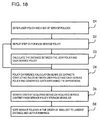
- a user policy and a set of service policies are entered into the ranking generation means 230A (step D1).
- the user policy shown in Fig. 6 and the set of service policies shown in Fig. 17 are assumed to be entered.
- the ranking generation means 230A repeats step D3 for each service policy (step D2). More concretely, the distance between the user policy and each service policy is calculated as in the first exemplary embodiment (the step D3). In the present exemplary embodiment, the calculation results shown in Fig. 12 are assumed to be obtained as in the first exemplary embodiment.
- the policy difference calculation means 233 extracts conflicting rules between the user policy and each service policy and generates texts explaining the differences (step D4). For instance, in a case of the service policy having the service policy ID "4," the rule of the data type "Position” is in conflict, and for example, a text saying, "Must provide the information "Position” that you do not want to provide” is generated as the explanation text.
- the service content acquiring means 234 acquires the service content from the service policy storage means 220 (step D5). For instance, in the case of the service policy having the service policy ID "4," the service content acquiring means 234 acquires "Provide recommendations based on location information" as the service content of the service policy.
- the ranking calculation means 231A sorts the service policies in the order of smallest to largest distance, generates rankings with the texts explaining the differences and the service content added, and transmits the rankings to the privacy information holder terminal 100 (step D6).
- Fig. 19 is an example of the service policy rankings sorted and created by the ranking calculation means 231A of the present exemplary embodiment.
- the policy difference information is "NONE" because the service policy having the service policy ID "5" does not have any difference.
- each of the other service policies has a difference; therefore, the content of the differences are displayed as the policy difference information.
- the ranking display means 120 receives and displays the service policy rankings.
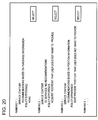
- Fig. 20 is an example of the service policy rankings displayed by the ranking display means 120 of the privacy information holder terminal 100 using the service policy rankings shown in Fig. 19 .
- the privacy information holder with the policy difference that explains conflicting rules between the user policy and each service policy, and the content of the service that the privacy information holder is able to receive when he agrees to each service policy, in addition to the user policy and the service policy rankings.
- Fig. 21 is a block diagram showing a configuration of policy distance calculation means 232A in ranking generation means of an arbitration server of the third exemplary embodiment of the present invention.
- the configuration comprises policy mapping means 2322 for mapping the action of each data type written in user and service policies to a protection vector, which is a real value or real-valued vector, action information storage means 2323 for storing the relation between the action and the real-valued vector, and vector distance calculation means 2321 for calculating the distance between vectors using the protection vector.
- the protection vector is a real value or real-valued vector indicating the level of privacy protection derived from the action, which is the content of a rule.
- the service policy storage means 220 is assumed to store service policies in which service policy IDs and the action "Protect" are set, as shown in Fig. 23 .
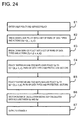
- Fig. 24 is a flowchart showing an operation of the policy distance calculation means 232A of an arbitration server of the third exemplary embodiment of the present invention.
- a user policy and a service policy are entered into the policy distance calculation means 232A (step E1).
- the user policy shown in Fig. 22 and the service policy having the service policy ID "3" shown in Fig. 23 are assumed to be entered.
- the broken down user policy p ⁇ ("NAME,” “Provide”), ("Address,” “Do not provide”), ("Position,” “Protect”), ("Buying,” “Provide”) ⁇ is entered.
- step F3 executes the processing of step F3 on each data type t (step F2).
- the policy mapping means 2322 acquires a vector V associated with the action a from the action information storage means 2323 (the step F3).
- the action information storage means 2323 defines the associations between the rules and the real-valued vectors in a table shown in Fig. 26
- a one-dimensional vector V (0) is acquired from the action "Provide" of the data type "NAME.”
- the service policy in Fig. 23 is mapped as shown in Fig. 27 .
- the vector distance calculation means 2321 calculates a distance d between the mapped policies Up' and Sp' (step E6).
- the vector distance calculation means 2321 initializes the distance d to zero (step G2).
- the vector distance calculation means 2321 executes the processing of steps G4 to G7 on each data type t_s of the service policy (step G3).
- the vector distance calculation means 2321 deems Sr to be zero (the step G6).
- Fig. 29 is a drawing showing the results of calculating the distances between the user policy in Fig. 22 and all the service policies in Fig. 23 .
- the ranking generation means of the present exemplary embodiment generates service policy rankings using the distances calculated as described.
- policy arbitration can be performed for various policy formats.
- the reason is that the policy mapping means 2322 maps policies to real-valued vectors based on the information stored in the action information storage means 2323, and using these vectors, the vector distance calculation means 2321 calculates the distance between the policies by calculating the distances between the vectors.
- the protection vectors are derived from the actions, regardless of the data type, using the table shown in Fig. 26 , however, it is possible to define the value of a protection vector corresponding to an action for each data type. In this way, the distance can be calculated to be large for a conflict regarding sensitive privacy information.
- the present invention can be applied to uses such as a recommendation service utilizing privacy information and privacy policy arbitration in an SNS (Social Networking Service).
- SNS Social Networking Service
Landscapes
- Engineering & Computer Science (AREA)
- Computer Security & Cryptography (AREA)
- General Engineering & Computer Science (AREA)
- Computer Hardware Design (AREA)
- Bioethics (AREA)
- Health & Medical Sciences (AREA)
- General Health & Medical Sciences (AREA)
- Theoretical Computer Science (AREA)
- Computer Networks & Wireless Communication (AREA)
- Signal Processing (AREA)
- Computing Systems (AREA)
- Databases & Information Systems (AREA)
- Software Systems (AREA)
- Physics & Mathematics (AREA)
- General Physics & Mathematics (AREA)
- Medical Informatics (AREA)
- Information Retrieval, Db Structures And Fs Structures Therefor (AREA)
- Storage Device Security (AREA)
- Management, Administration, Business Operations System, And Electronic Commerce (AREA)
Applications Claiming Priority (2)
| Application Number | Priority Date | Filing Date | Title |
|---|---|---|---|
| JP2011045911 | 2011-03-03 | ||
| PCT/JP2012/055459 WO2012118205A1 (fr) | 2011-03-03 | 2012-03-02 | Méthode d'arbitrage de politique, serveur d'arbitrage de politique et programme |
Publications (2)
| Publication Number | Publication Date |
|---|---|
| EP2682888A1 true EP2682888A1 (fr) | 2014-01-08 |
| EP2682888A4 EP2682888A4 (fr) | 2015-03-25 |
Family
ID=46758129
Family Applications (1)
| Application Number | Title | Priority Date | Filing Date |
|---|---|---|---|
| EP12751889.2A Withdrawn EP2682888A4 (fr) | 2011-03-03 | 2012-03-02 | Méthode d'arbitrage de politique, serveur d'arbitrage de politique et programme |
Country Status (5)
| Country | Link |
|---|---|
| US (1) | US9374388B2 (fr) |
| EP (1) | EP2682888A4 (fr) |
| JP (1) | JP5939248B2 (fr) |
| CN (1) | CN103534706A (fr) |
| WO (1) | WO2012118205A1 (fr) |
Families Citing this family (7)
| Publication number | Priority date | Publication date | Assignee | Title |
|---|---|---|---|---|
| US8918632B1 (en) | 2013-01-23 | 2014-12-23 | The Privacy Factor, LLC | Methods for analyzing application privacy and devices thereof |
| US10731246B2 (en) | 2014-07-28 | 2020-08-04 | Gatan, Inc. | Ion beam sample preparation and coating apparatus and methods |
| US9390285B1 (en) * | 2015-06-09 | 2016-07-12 | Hortonworks, Inc. | Identifying inconsistent security policies in a computer cluster |
| WO2017199235A1 (fr) | 2016-05-16 | 2017-11-23 | Koren Yoseph | Système et procédé d'application de politique de confidentialité |
| US10574540B2 (en) * | 2016-09-17 | 2020-02-25 | Anand Sambandam | Method and system for facilitating management of service agreements for consumer clarity over multiple channels |
| US20230081480A1 (en) * | 2020-01-31 | 2023-03-16 | Nippon Telegraph And Telephone Corporation | Data distribution management apparatus, data distribution management method, and program |
| JP7715624B2 (ja) * | 2021-12-21 | 2025-07-30 | 株式会社日立製作所 | データ流通システム及びデータ利用条件決定方法 |
Family Cites Families (20)
| Publication number | Priority date | Publication date | Assignee | Title |
|---|---|---|---|---|
| JPH05250415A (ja) * | 1992-03-09 | 1993-09-28 | Hitachi Ltd | データ検索方式 |
| US7225460B2 (en) | 2000-05-09 | 2007-05-29 | International Business Machine Corporation | Enterprise privacy manager |
| JP2003132160A (ja) | 2001-10-23 | 2003-05-09 | Nec Corp | 個人情報管理システムと個人情報管理装置、及び個人情報管理プログラム |
| US7478157B2 (en) * | 2001-11-07 | 2009-01-13 | International Business Machines Corporation | System, method, and business methods for enforcing privacy preferences on personal-data exchanges across a network |
| US7305432B2 (en) * | 2002-10-23 | 2007-12-04 | Aol Llc | Privacy preferences roaming and enforcement |
| US20050076233A1 (en) * | 2002-11-15 | 2005-04-07 | Nokia Corporation | Method and apparatus for transmitting data subject to privacy restrictions |
| JP2004192353A (ja) | 2002-12-11 | 2004-07-08 | Nippon Telegr & Teleph Corp <Ntt> | 個人情報開示制御システム及び個人情報開示制御方法 |
| US20050091101A1 (en) * | 2003-10-24 | 2005-04-28 | Epling Jeremiah S. | Systems and methods for user-tailored presentation of privacy policy data |
| US7831995B2 (en) * | 2004-10-29 | 2010-11-09 | CORE, SDI, Inc. | Establishing and enforcing security and privacy policies in web-based applications |
| JP5036140B2 (ja) | 2005-06-10 | 2012-09-26 | 日本電気株式会社 | 個人情報流通管理システム、個人情報流通管理方法、個人情報提供プログラム及び個人情報利用プログラム |
| US20070006278A1 (en) * | 2005-06-29 | 2007-01-04 | Ioan Avram Mircea S | Automated dissemination of enterprise policy for runtime customization of resource arbitration |
| JP2007072582A (ja) * | 2005-09-05 | 2007-03-22 | Nippon Telegr & Teleph Corp <Ntt> | 類似度計算装置とその制御方法 |
| JP4882671B2 (ja) | 2006-11-01 | 2012-02-22 | 富士通株式会社 | アクセス制御方法及びアクセス制御システム並びにプログラム |
| US20090249430A1 (en) * | 2008-03-25 | 2009-10-01 | Novell, Inc. | Claim category handling |
| US8799982B2 (en) * | 2008-01-30 | 2014-08-05 | International Business Machines Corporation | System and methods for efficiently classifying and selecting among security policy alternatives for outbound network communications |
| US8423483B2 (en) * | 2008-05-16 | 2013-04-16 | Carnegie Mellon University | User-controllable learning of policies |
| US20100153695A1 (en) * | 2008-12-16 | 2010-06-17 | Microsoft Corporation | Data handling preferences and policies within security policy assertion language |
| US8621554B1 (en) * | 2009-05-01 | 2013-12-31 | Google Inc. | User privacy framework |
| US20110283335A1 (en) * | 2010-05-12 | 2011-11-17 | Microsoft Corporation | Handling privacy preferences and policies through logic language |
| CN102314449B (zh) * | 2010-07-05 | 2013-11-06 | 日电(中国)有限公司 | 后置数据访问过滤器和过滤方法 |
-
2012
- 2012-03-02 WO PCT/JP2012/055459 patent/WO2012118205A1/fr not_active Ceased
- 2012-03-02 JP JP2013502432A patent/JP5939248B2/ja not_active Expired - Fee Related
- 2012-03-02 EP EP12751889.2A patent/EP2682888A4/fr not_active Withdrawn
- 2012-03-02 US US14/002,624 patent/US9374388B2/en active Active
- 2012-03-02 CN CN201280011223.7A patent/CN103534706A/zh active Pending
Also Published As
| Publication number | Publication date |
|---|---|
| US9374388B2 (en) | 2016-06-21 |
| EP2682888A4 (fr) | 2015-03-25 |
| JP5939248B2 (ja) | 2016-06-22 |
| JPWO2012118205A1 (ja) | 2014-07-07 |
| CN103534706A (zh) | 2014-01-22 |
| US20130340036A1 (en) | 2013-12-19 |
| WO2012118205A1 (fr) | 2012-09-07 |
Similar Documents
| Publication | Publication Date | Title |
|---|---|---|
| EP2682888A1 (fr) | Méthode d'arbitrage de politique, serveur d'arbitrage de politique et programme | |
| US20150160846A1 (en) | Providing dynamic widgets in a browser | |
| JP5548723B2 (ja) | 情報処理装置、情報処理方法及び情報処理プログラム | |
| US10134073B2 (en) | Information processing device, category displaying method, program, and information storage medium | |
| KR101967696B1 (ko) | 구독서비스 제공 방법 및 장치 | |
| US10339611B2 (en) | Systems and methods for page recommendations | |
| JP2009181468A (ja) | 画像検索ログ収集システム、画像検索ログ収集方法、及びプログラム | |
| US10165068B2 (en) | Systems and methods for smart publishing | |
| US20170140036A1 (en) | Systems and methods for ranking comments | |
| Zhou et al. | Measuring web service security in the era of Internet of Things | |
| KR101950908B1 (ko) | 디자인 의뢰를 위한 디자인 통합 서비스 플랫폼 장치 | |
| JP2015141642A (ja) | 利用同意管理装置 | |
| US8281245B1 (en) | System and method of preparing presentations | |
| JP6018541B2 (ja) | 推薦ルール生成装置、推薦ルール生成方法および推薦ルール生成プログラム | |
| EP3690790A1 (fr) | Programme, procédé et dispositif de présentation de portefeuille | |
| US10268335B2 (en) | Custom onboarding process for application functionality | |
| CN113051477B (zh) | 内容推荐方法、装置、电子设备和介质 | |
| JP6873312B1 (ja) | 保険商品リコメンドシステム | |
| KR20160015657A (ko) | 집단지성을 통한 개인화 맞춤 정보 제공 시스템 및 이를 위한 제공 방법 | |
| US20140108535A1 (en) | System and method for generating a customized singular activity stream | |
| Revill et al. | Forging Partnership Between Health Economics Researchers and Policy Makers: Better Methods, Better Policy, Better Health | |
| CN105867890A (zh) | 一种页面显示方法及装置 | |
| Zhang et al. | A multi agent recommender system that utilises consumer reviews in its recommendations | |
| JP6060322B1 (ja) | サーバ、電子メール送信装置及びそれらの制御方法、コンピュータプログラム並びに記憶媒体 | |
| JP5789481B2 (ja) | アプリケーション開発支援装置及びアプリケーション開発支援方法 |
Legal Events
| Date | Code | Title | Description |
|---|---|---|---|
| PUAI | Public reference made under article 153(3) epc to a published international application that has entered the european phase |
Free format text: ORIGINAL CODE: 0009012 |
|
| 17P | Request for examination filed |
Effective date: 20130926 |
|
| AK | Designated contracting states |
Kind code of ref document: A1 Designated state(s): AL AT BE BG CH CY CZ DE DK EE ES FI FR GB GR HR HU IE IS IT LI LT LU LV MC MK MT NL NO PL PT RO RS SE SI SK SM TR |
|
| DAX | Request for extension of the european patent (deleted) | ||
| A4 | Supplementary search report drawn up and despatched |
Effective date: 20150220 |
|
| 17Q | First examination report despatched |
Effective date: 20180830 |
|
| STAA | Information on the status of an ep patent application or granted ep patent |
Free format text: STATUS: THE APPLICATION HAS BEEN WITHDRAWN |
|
| 18W | Application withdrawn |
Effective date: 20191211 |