EP2683710B1 - Activateurs de guanylate cyclase solubles - Google Patents
Activateurs de guanylate cyclase solubles Download PDFInfo
- Publication number
- EP2683710B1 EP2683710B1 EP12712176.2A EP12712176A EP2683710B1 EP 2683710 B1 EP2683710 B1 EP 2683710B1 EP 12712176 A EP12712176 A EP 12712176A EP 2683710 B1 EP2683710 B1 EP 2683710B1
- Authority
- EP
- European Patent Office
- Prior art keywords
- compound
- mmol
- alkyl
- group
- heteroaryl
- Prior art date
- Legal status (The legal status is an assumption and is not a legal conclusion. Google has not performed a legal analysis and makes no representation as to the accuracy of the status listed.)
- Active
Links
- 0 C*c1nc(C)c(C(O)=O)[s]1 Chemical compound C*c1nc(C)c(C(O)=O)[s]1 0.000 description 15
- CPQCUXGQMVNDPT-UHFFFAOYSA-N CC(N1Cc2ccc(COc(ccc(C)c3)c3-c3cccc(-[n]4ncc(C(O)=O)c4C(F)(F)F)n3)cc2CC1)=O Chemical compound CC(N1Cc2ccc(COc(ccc(C)c3)c3-c3cccc(-[n]4ncc(C(O)=O)c4C(F)(F)F)n3)cc2CC1)=O CPQCUXGQMVNDPT-UHFFFAOYSA-N 0.000 description 2
- LXMKEGVCYBYJQF-UHFFFAOYSA-N Cc(cc1)cc(-c2cccc(-[n]3ncc(C(O)=O)c3C(F)(F)F)n2)c1OCc(cc1)cc(CC2)c1N2S(C)(=O)=O Chemical compound Cc(cc1)cc(-c2cccc(-[n]3ncc(C(O)=O)c3C(F)(F)F)n2)c1OCc(cc1)cc(CC2)c1N2S(C)(=O)=O LXMKEGVCYBYJQF-UHFFFAOYSA-N 0.000 description 2
- XFRROYGOQTWHIV-UHFFFAOYSA-N Cc(cc1)cc(-c2cccc(-[n]3ncc(C(O)=O)c3C(F)(F)F)n2)c1OCc1ccc(CN(CC2)C3COCCC3)c2c1 Chemical compound Cc(cc1)cc(-c2cccc(-[n]3ncc(C(O)=O)c3C(F)(F)F)n2)c1OCc1ccc(CN(CC2)C3COCCC3)c2c1 XFRROYGOQTWHIV-UHFFFAOYSA-N 0.000 description 2
- PXHLARWVSZFYPX-UHFFFAOYSA-N Cc(cc1)cc(-c2cccc(-[n]3ncc(C(O)=O)c3C(F)(F)F)n2)c1OCc1ccc(CN(CC2COCC2)CC2)c2c1 Chemical compound Cc(cc1)cc(-c2cccc(-[n]3ncc(C(O)=O)c3C(F)(F)F)n2)c1OCc1ccc(CN(CC2COCC2)CC2)c2c1 PXHLARWVSZFYPX-UHFFFAOYSA-N 0.000 description 2
- BOJGXWNGNHCISQ-UHFFFAOYSA-N Cc1c(-c2nc(-c(cc(C)cc3)c3OCc3cc(CCN(C4)C5CCOCC5)c4cc3)ccc2)[n](C)nc1C(O)=O Chemical compound Cc1c(-c2nc(-c(cc(C)cc3)c3OCc3cc(CCN(C4)C5CCOCC5)c4cc3)ccc2)[n](C)nc1C(O)=O BOJGXWNGNHCISQ-UHFFFAOYSA-N 0.000 description 2
- SJRDXXCVXJUPBP-UHFFFAOYSA-N CC(C)(C)[n]1nc(C(O)=O)c(C)c1-c1nc(-c2cccc(C)c2OCc2cc(CCN(C3)C4CCOCC4)c3cc2)ccc1 Chemical compound CC(C)(C)[n]1nc(C(O)=O)c(C)c1-c1nc(-c2cccc(C)c2OCc2cc(CCN(C3)C4CCOCC4)c3cc2)ccc1 SJRDXXCVXJUPBP-UHFFFAOYSA-N 0.000 description 1
- WQJQDCPXVSNDLS-UHFFFAOYSA-N CC(C)N1Cc2ccc(COc(ccc(C)c3)c3-c3cccc(-[n]4ncc(C(O)=O)c4C(F)(F)F)n3)cc2CC1 Chemical compound CC(C)N1Cc2ccc(COc(ccc(C)c3)c3-c3cccc(-[n]4ncc(C(O)=O)c4C(F)(F)F)n3)cc2CC1 WQJQDCPXVSNDLS-UHFFFAOYSA-N 0.000 description 1
- ISGGYEOUESYAOR-UHFFFAOYSA-N CC(C)[n]1nc(C(O)=O)c(C)c1-c1nc(-c(cccc2C)c2OCc2cc(CCN(C3)C4CCOCC4)c3cc2)ccc1 Chemical compound CC(C)[n]1nc(C(O)=O)c(C)c1-c1nc(-c(cccc2C)c2OCc2cc(CCN(C3)C4CCOCC4)c3cc2)ccc1 ISGGYEOUESYAOR-UHFFFAOYSA-N 0.000 description 1
- NQUCDKKWSXIRMI-UHFFFAOYSA-N CC(c1ccccc1)N1Cc2ccc(COc(ccc(C)c3)c3-c3cccc(-[n]4ncc(C(O)=O)c4C(F)(F)F)n3)cc2CC1 Chemical compound CC(c1ccccc1)N1Cc2ccc(COc(ccc(C)c3)c3-c3cccc(-[n]4ncc(C(O)=O)c4C(F)(F)F)n3)cc2CC1 NQUCDKKWSXIRMI-UHFFFAOYSA-N 0.000 description 1
- GKLWOAMEOICPGF-UHFFFAOYSA-N CC(c1nccnc1)N1Cc2ccc(COc(ccc(C)c3)c3-c3cccc(-[n]4ncc(C(O)=O)c4C(F)(F)F)n3)cc2CC1 Chemical compound CC(c1nccnc1)N1Cc2ccc(COc(ccc(C)c3)c3-c3cccc(-[n]4ncc(C(O)=O)c4C(F)(F)F)n3)cc2CC1 GKLWOAMEOICPGF-UHFFFAOYSA-N 0.000 description 1
- UOIWOHLIGKIYFE-UHFFFAOYSA-N CCCCCNC Chemical compound CCCCCNC UOIWOHLIGKIYFE-UHFFFAOYSA-N 0.000 description 1
- IVYHUNHUZXGRMO-UHFFFAOYSA-N Cc([n](-c1nc(-c(cc(C)cc2)c2OCc2ccc(CN(CC3)C4CCOCC4)c3c2)ccc1)nc1)c1C(O)=O Chemical compound Cc([n](-c1nc(-c(cc(C)cc2)c2OCc2ccc(CN(CC3)C4CCOCC4)c3c2)ccc1)nc1)c1C(O)=O IVYHUNHUZXGRMO-UHFFFAOYSA-N 0.000 description 1
- NWUVMANISZIWCM-UHFFFAOYSA-N Cc(cc1)cc(-c2cccc(-[n]3ncc(C(O)=O)c3C(F)(F)F)n2)c1OCc1cc(CCN(C2)S(C)(=O)=O)c2cc1 Chemical compound Cc(cc1)cc(-c2cccc(-[n]3ncc(C(O)=O)c3C(F)(F)F)n2)c1OCc1cc(CCN(C2)S(C)(=O)=O)c2cc1 NWUVMANISZIWCM-UHFFFAOYSA-N 0.000 description 1
- LCHROFRRBCVQOJ-UHFFFAOYSA-N Cc(cc1)cc(-c2cccc(-[n]3ncc(C(O)=O)c3C(F)(F)F)n2)c1OCc1ccc(CN(C)CC2)c2c1C Chemical compound Cc(cc1)cc(-c2cccc(-[n]3ncc(C(O)=O)c3C(F)(F)F)n2)c1OCc1ccc(CN(C)CC2)c2c1C LCHROFRRBCVQOJ-UHFFFAOYSA-N 0.000 description 1
- RTQCRPFZPZQIKN-UHFFFAOYSA-N Cc(cc1)cc(-c2cccc(-[n]3ncc(C(O)=O)c3C(F)(F)F)n2)c1OCc1ccc(CN(CC2)C(CC3)CCC3C(F)(F)F)c2c1 Chemical compound Cc(cc1)cc(-c2cccc(-[n]3ncc(C(O)=O)c3C(F)(F)F)n2)c1OCc1ccc(CN(CC2)C(CC3)CCC3C(F)(F)F)c2c1 RTQCRPFZPZQIKN-UHFFFAOYSA-N 0.000 description 1
- LYKMMMOZOSOIJC-UHFFFAOYSA-N Cc(cc1)cc(-c2cccc(-[n]3ncc(C(O)=O)c3C(F)(F)F)n2)c1OCc1ccc(CN(CC2)C3CCC3)c2c1 Chemical compound Cc(cc1)cc(-c2cccc(-[n]3ncc(C(O)=O)c3C(F)(F)F)n2)c1OCc1ccc(CN(CC2)C3CCC3)c2c1 LYKMMMOZOSOIJC-UHFFFAOYSA-N 0.000 description 1
- OMSCRBKYDKHIGO-UHFFFAOYSA-N Cc(cc1)cc(-c2cccc(-[n]3ncc(C(O)=O)c3C(F)(F)F)n2)c1OCc1ccc(CN(CC2)C3CCCCC3)c2c1 Chemical compound Cc(cc1)cc(-c2cccc(-[n]3ncc(C(O)=O)c3C(F)(F)F)n2)c1OCc1ccc(CN(CC2)C3CCCCC3)c2c1 OMSCRBKYDKHIGO-UHFFFAOYSA-N 0.000 description 1
- BJSDWJCBGSFBKY-UHFFFAOYSA-N Cc(cc1)cc(-c2cccc(-c3ccc(C(O)=O)[s]3)n2)c1OCc1cc(CCN(C)C2)c2cc1 Chemical compound Cc(cc1)cc(-c2cccc(-c3ccc(C(O)=O)[s]3)n2)c1OCc1cc(CCN(C)C2)c2cc1 BJSDWJCBGSFBKY-UHFFFAOYSA-N 0.000 description 1
- HFQHJZWZCLEHPT-UHFFFAOYSA-N Cc(cc1)cc(-c2cccc(-c3ncc(C(O)=O)[n]3C(F)(F)F)n2)c1OCc1ccc(CN(C)CC2)c2c1 Chemical compound Cc(cc1)cc(-c2cccc(-c3ncc(C(O)=O)[n]3C(F)(F)F)n2)c1OCc1ccc(CN(C)CC2)c2c1 HFQHJZWZCLEHPT-UHFFFAOYSA-N 0.000 description 1
- ULIVMVDHZFWTKV-UHFFFAOYSA-N Cc(cc1)cc(-c2cccc(-c3ncc(C(O)=O)[n]3C)n2)c1OCc1c(C)c(CCN(C2)C3COCC3)c2cc1 Chemical compound Cc(cc1)cc(-c2cccc(-c3ncc(C(O)=O)[n]3C)n2)c1OCc1c(C)c(CCN(C2)C3COCC3)c2cc1 ULIVMVDHZFWTKV-UHFFFAOYSA-N 0.000 description 1
- JJTHSDMINYKRPC-UHFFFAOYSA-N Cc(cc1)cc(-c2cccc(-c3ncc(C(O)=O)[n]3C)n2)c1OCc1ccc(CN(C)CC2)c2c1C Chemical compound Cc(cc1)cc(-c2cccc(-c3ncc(C(O)=O)[n]3C)n2)c1OCc1ccc(CN(C)CC2)c2c1C JJTHSDMINYKRPC-UHFFFAOYSA-N 0.000 description 1
- QSSDEHFHOVLVHI-UHFFFAOYSA-N Cc(cccc1-c2cccc(-c3ncc(C(O)=O)[n]3C)n2)c1OCc1ccc(CN(CC2)C3CCOCC3)c2c1 Chemical compound Cc(cccc1-c2cccc(-c3ncc(C(O)=O)[n]3C)n2)c1OCc1ccc(CN(CC2)C3CCOCC3)c2c1 QSSDEHFHOVLVHI-UHFFFAOYSA-N 0.000 description 1
- NZPIAMSGIHKYIV-UHFFFAOYSA-N Cc1c(-c2nc(-c3cccc(C)c3OCc3cc(CCN(C4)C(CC5)CCC5(F)F)c4cc3)ccc2)[n](C2CC2)nc1C(O)=O Chemical compound Cc1c(-c2nc(-c3cccc(C)c3OCc3cc(CCN(C4)C(CC5)CCC5(F)F)c4cc3)ccc2)[n](C2CC2)nc1C(O)=O NZPIAMSGIHKYIV-UHFFFAOYSA-N 0.000 description 1
- UBEPEJJYCTXRLM-UHFFFAOYSA-N Cc1c(C(O)=O)[s]cc1-c1nc(-c(cc(C)cc2)c2OCc2c(C)c(CCN(C3)C4COCC4)c3cc2)ccc1 Chemical compound Cc1c(C(O)=O)[s]cc1-c1nc(-c(cc(C)cc2)c2OCc2c(C)c(CCN(C3)C4COCC4)c3cc2)ccc1 UBEPEJJYCTXRLM-UHFFFAOYSA-N 0.000 description 1
- QZNCIMGZPBDYTF-UHFFFAOYSA-N Cc1c(C(O)=O)nc[n]1-c1nc(-c(cccc2C)c2OCc2cc(CCN(C3)C4CCOCC4)c3cc2)ccc1 Chemical compound Cc1c(C(O)=O)nc[n]1-c1nc(-c(cccc2C)c2OCc2cc(CCN(C3)C4CCOCC4)c3cc2)ccc1 QZNCIMGZPBDYTF-UHFFFAOYSA-N 0.000 description 1
- DLTKNQLDZOLQJY-UHFFFAOYSA-N Cc1c(C(O)=O)nc[n]1-c1nc(-c2cccc(C)c2OCc2c(C)c(CCN(C3)C4COCC4)c3cc2)ccc1 Chemical compound Cc1c(C(O)=O)nc[n]1-c1nc(-c2cccc(C)c2OCc2c(C)c(CCN(C3)C4COCC4)c3cc2)ccc1 DLTKNQLDZOLQJY-UHFFFAOYSA-N 0.000 description 1
- SMEGUERNKFKOTA-UHFFFAOYSA-N Cc1c[s]c(CN2Cc3ccc(COc(ccc(C)c4)c4-c4cccc(-c5c[s]c(C(O)=O)c5C)n4)cc3CC2)n1 Chemical compound Cc1c[s]c(CN2Cc3ccc(COc(ccc(C)c4)c4-c4cccc(-c5c[s]c(C(O)=O)c5C)n4)cc3CC2)n1 SMEGUERNKFKOTA-UHFFFAOYSA-N 0.000 description 1
Classifications
-
- C—CHEMISTRY; METALLURGY
- C07—ORGANIC CHEMISTRY
- C07D—HETEROCYCLIC COMPOUNDS
- C07D401/00—Heterocyclic compounds containing two or more hetero rings, having nitrogen atoms as the only ring hetero atoms, at least one ring being a six-membered ring with only one nitrogen atom
- C07D401/14—Heterocyclic compounds containing two or more hetero rings, having nitrogen atoms as the only ring hetero atoms, at least one ring being a six-membered ring with only one nitrogen atom containing three or more hetero rings
-
- A—HUMAN NECESSITIES
- A61—MEDICAL OR VETERINARY SCIENCE; HYGIENE
- A61P—SPECIFIC THERAPEUTIC ACTIVITY OF CHEMICAL COMPOUNDS OR MEDICINAL PREPARATIONS
- A61P1/00—Drugs for disorders of the alimentary tract or the digestive system
- A61P1/16—Drugs for disorders of the alimentary tract or the digestive system for liver or gallbladder disorders, e.g. hepatoprotective agents, cholagogues, litholytics
-
- A—HUMAN NECESSITIES
- A61—MEDICAL OR VETERINARY SCIENCE; HYGIENE
- A61P—SPECIFIC THERAPEUTIC ACTIVITY OF CHEMICAL COMPOUNDS OR MEDICINAL PREPARATIONS
- A61P11/00—Drugs for disorders of the respiratory system
-
- A—HUMAN NECESSITIES
- A61—MEDICAL OR VETERINARY SCIENCE; HYGIENE
- A61P—SPECIFIC THERAPEUTIC ACTIVITY OF CHEMICAL COMPOUNDS OR MEDICINAL PREPARATIONS
- A61P11/00—Drugs for disorders of the respiratory system
- A61P11/06—Antiasthmatics
-
- A—HUMAN NECESSITIES
- A61—MEDICAL OR VETERINARY SCIENCE; HYGIENE
- A61P—SPECIFIC THERAPEUTIC ACTIVITY OF CHEMICAL COMPOUNDS OR MEDICINAL PREPARATIONS
- A61P13/00—Drugs for disorders of the urinary system
-
- A—HUMAN NECESSITIES
- A61—MEDICAL OR VETERINARY SCIENCE; HYGIENE
- A61P—SPECIFIC THERAPEUTIC ACTIVITY OF CHEMICAL COMPOUNDS OR MEDICINAL PREPARATIONS
- A61P13/00—Drugs for disorders of the urinary system
- A61P13/08—Drugs for disorders of the urinary system of the prostate
-
- A—HUMAN NECESSITIES
- A61—MEDICAL OR VETERINARY SCIENCE; HYGIENE
- A61P—SPECIFIC THERAPEUTIC ACTIVITY OF CHEMICAL COMPOUNDS OR MEDICINAL PREPARATIONS
- A61P13/00—Drugs for disorders of the urinary system
- A61P13/10—Drugs for disorders of the urinary system of the bladder
-
- A—HUMAN NECESSITIES
- A61—MEDICAL OR VETERINARY SCIENCE; HYGIENE
- A61P—SPECIFIC THERAPEUTIC ACTIVITY OF CHEMICAL COMPOUNDS OR MEDICINAL PREPARATIONS
- A61P13/00—Drugs for disorders of the urinary system
- A61P13/12—Drugs for disorders of the urinary system of the kidneys
-
- A—HUMAN NECESSITIES
- A61—MEDICAL OR VETERINARY SCIENCE; HYGIENE
- A61P—SPECIFIC THERAPEUTIC ACTIVITY OF CHEMICAL COMPOUNDS OR MEDICINAL PREPARATIONS
- A61P15/00—Drugs for genital or sexual disorders; Contraceptives
-
- A—HUMAN NECESSITIES
- A61—MEDICAL OR VETERINARY SCIENCE; HYGIENE
- A61P—SPECIFIC THERAPEUTIC ACTIVITY OF CHEMICAL COMPOUNDS OR MEDICINAL PREPARATIONS
- A61P15/00—Drugs for genital or sexual disorders; Contraceptives
- A61P15/10—Drugs for genital or sexual disorders; Contraceptives for impotence
-
- A—HUMAN NECESSITIES
- A61—MEDICAL OR VETERINARY SCIENCE; HYGIENE
- A61P—SPECIFIC THERAPEUTIC ACTIVITY OF CHEMICAL COMPOUNDS OR MEDICINAL PREPARATIONS
- A61P17/00—Drugs for dermatological disorders
- A61P17/06—Antipsoriatics
-
- A—HUMAN NECESSITIES
- A61—MEDICAL OR VETERINARY SCIENCE; HYGIENE
- A61P—SPECIFIC THERAPEUTIC ACTIVITY OF CHEMICAL COMPOUNDS OR MEDICINAL PREPARATIONS
- A61P19/00—Drugs for skeletal disorders
- A61P19/02—Drugs for skeletal disorders for joint disorders, e.g. arthritis, arthrosis
-
- A—HUMAN NECESSITIES
- A61—MEDICAL OR VETERINARY SCIENCE; HYGIENE
- A61P—SPECIFIC THERAPEUTIC ACTIVITY OF CHEMICAL COMPOUNDS OR MEDICINAL PREPARATIONS
- A61P25/00—Drugs for disorders of the nervous system
-
- A—HUMAN NECESSITIES
- A61—MEDICAL OR VETERINARY SCIENCE; HYGIENE
- A61P—SPECIFIC THERAPEUTIC ACTIVITY OF CHEMICAL COMPOUNDS OR MEDICINAL PREPARATIONS
- A61P25/00—Drugs for disorders of the nervous system
- A61P25/14—Drugs for disorders of the nervous system for treating abnormal movements, e.g. chorea, dyskinesia
- A61P25/16—Anti-Parkinson drugs
-
- A—HUMAN NECESSITIES
- A61—MEDICAL OR VETERINARY SCIENCE; HYGIENE
- A61P—SPECIFIC THERAPEUTIC ACTIVITY OF CHEMICAL COMPOUNDS OR MEDICINAL PREPARATIONS
- A61P25/00—Drugs for disorders of the nervous system
- A61P25/28—Drugs for disorders of the nervous system for treating neurodegenerative disorders of the central nervous system, e.g. nootropic agents, cognition enhancers, drugs for treating Alzheimer's disease or other forms of dementia
-
- A—HUMAN NECESSITIES
- A61—MEDICAL OR VETERINARY SCIENCE; HYGIENE
- A61P—SPECIFIC THERAPEUTIC ACTIVITY OF CHEMICAL COMPOUNDS OR MEDICINAL PREPARATIONS
- A61P29/00—Non-central analgesic, antipyretic or antiinflammatory agents, e.g. antirheumatic agents; Non-steroidal antiinflammatory drugs [NSAID]
-
- A—HUMAN NECESSITIES
- A61—MEDICAL OR VETERINARY SCIENCE; HYGIENE
- A61P—SPECIFIC THERAPEUTIC ACTIVITY OF CHEMICAL COMPOUNDS OR MEDICINAL PREPARATIONS
- A61P29/00—Non-central analgesic, antipyretic or antiinflammatory agents, e.g. antirheumatic agents; Non-steroidal antiinflammatory drugs [NSAID]
- A61P29/02—Non-central analgesic, antipyretic or antiinflammatory agents, e.g. antirheumatic agents; Non-steroidal antiinflammatory drugs [NSAID] without antiinflammatory effect
-
- A—HUMAN NECESSITIES
- A61—MEDICAL OR VETERINARY SCIENCE; HYGIENE
- A61P—SPECIFIC THERAPEUTIC ACTIVITY OF CHEMICAL COMPOUNDS OR MEDICINAL PREPARATIONS
- A61P3/00—Drugs for disorders of the metabolism
- A61P3/08—Drugs for disorders of the metabolism for glucose homeostasis
- A61P3/10—Drugs for disorders of the metabolism for glucose homeostasis for hyperglycaemia, e.g. antidiabetics
-
- A—HUMAN NECESSITIES
- A61—MEDICAL OR VETERINARY SCIENCE; HYGIENE
- A61P—SPECIFIC THERAPEUTIC ACTIVITY OF CHEMICAL COMPOUNDS OR MEDICINAL PREPARATIONS
- A61P37/00—Drugs for immunological or allergic disorders
-
- A—HUMAN NECESSITIES
- A61—MEDICAL OR VETERINARY SCIENCE; HYGIENE
- A61P—SPECIFIC THERAPEUTIC ACTIVITY OF CHEMICAL COMPOUNDS OR MEDICINAL PREPARATIONS
- A61P43/00—Drugs for specific purposes, not provided for in groups A61P1/00-A61P41/00
-
- A—HUMAN NECESSITIES
- A61—MEDICAL OR VETERINARY SCIENCE; HYGIENE
- A61P—SPECIFIC THERAPEUTIC ACTIVITY OF CHEMICAL COMPOUNDS OR MEDICINAL PREPARATIONS
- A61P7/00—Drugs for disorders of the blood or the extracellular fluid
- A61P7/02—Antithrombotic agents; Anticoagulants; Platelet aggregation inhibitors
-
- A—HUMAN NECESSITIES
- A61—MEDICAL OR VETERINARY SCIENCE; HYGIENE
- A61P—SPECIFIC THERAPEUTIC ACTIVITY OF CHEMICAL COMPOUNDS OR MEDICINAL PREPARATIONS
- A61P9/00—Drugs for disorders of the cardiovascular system
-
- A—HUMAN NECESSITIES
- A61—MEDICAL OR VETERINARY SCIENCE; HYGIENE
- A61P—SPECIFIC THERAPEUTIC ACTIVITY OF CHEMICAL COMPOUNDS OR MEDICINAL PREPARATIONS
- A61P9/00—Drugs for disorders of the cardiovascular system
- A61P9/04—Inotropic agents, i.e. stimulants of cardiac contraction; Drugs for heart failure
-
- A—HUMAN NECESSITIES
- A61—MEDICAL OR VETERINARY SCIENCE; HYGIENE
- A61P—SPECIFIC THERAPEUTIC ACTIVITY OF CHEMICAL COMPOUNDS OR MEDICINAL PREPARATIONS
- A61P9/00—Drugs for disorders of the cardiovascular system
- A61P9/08—Vasodilators for multiple indications
-
- A—HUMAN NECESSITIES
- A61—MEDICAL OR VETERINARY SCIENCE; HYGIENE
- A61P—SPECIFIC THERAPEUTIC ACTIVITY OF CHEMICAL COMPOUNDS OR MEDICINAL PREPARATIONS
- A61P9/00—Drugs for disorders of the cardiovascular system
- A61P9/10—Drugs for disorders of the cardiovascular system for treating ischaemic or atherosclerotic diseases, e.g. antianginal drugs, coronary vasodilators, drugs for myocardial infarction, retinopathy, cerebrovascula insufficiency, renal arteriosclerosis
-
- A—HUMAN NECESSITIES
- A61—MEDICAL OR VETERINARY SCIENCE; HYGIENE
- A61P—SPECIFIC THERAPEUTIC ACTIVITY OF CHEMICAL COMPOUNDS OR MEDICINAL PREPARATIONS
- A61P9/00—Drugs for disorders of the cardiovascular system
- A61P9/12—Antihypertensives
-
- C—CHEMISTRY; METALLURGY
- C07—ORGANIC CHEMISTRY
- C07D—HETEROCYCLIC COMPOUNDS
- C07D405/00—Heterocyclic compounds containing both one or more hetero rings having oxygen atoms as the only ring hetero atoms, and one or more rings having nitrogen as the only ring hetero atom
- C07D405/14—Heterocyclic compounds containing both one or more hetero rings having oxygen atoms as the only ring hetero atoms, and one or more rings having nitrogen as the only ring hetero atom containing three or more hetero rings
-
- C—CHEMISTRY; METALLURGY
- C07—ORGANIC CHEMISTRY
- C07D—HETEROCYCLIC COMPOUNDS
- C07D409/00—Heterocyclic compounds containing two or more hetero rings, at least one ring having sulfur atoms as the only ring hetero atoms
- C07D409/14—Heterocyclic compounds containing two or more hetero rings, at least one ring having sulfur atoms as the only ring hetero atoms containing three or more hetero rings
-
- C—CHEMISTRY; METALLURGY
- C07—ORGANIC CHEMISTRY
- C07D—HETEROCYCLIC COMPOUNDS
- C07D413/00—Heterocyclic compounds containing two or more hetero rings, at least one ring having nitrogen and oxygen atoms as the only ring hetero atoms
- C07D413/14—Heterocyclic compounds containing two or more hetero rings, at least one ring having nitrogen and oxygen atoms as the only ring hetero atoms containing three or more hetero rings
-
- C—CHEMISTRY; METALLURGY
- C07—ORGANIC CHEMISTRY
- C07D—HETEROCYCLIC COMPOUNDS
- C07D417/00—Heterocyclic compounds containing two or more hetero rings, at least one ring having nitrogen and sulfur atoms as the only ring hetero atoms, not provided for by group C07D415/00
- C07D417/14—Heterocyclic compounds containing two or more hetero rings, at least one ring having nitrogen and sulfur atoms as the only ring hetero atoms, not provided for by group C07D415/00 containing three or more hetero rings
Definitions
- This invention relates to heterocyclic compounds which are useful as activators of soluble guanylate cyclase and are thus useful for treating a variety of diseases that are mediated or sustained by decreased or diminished soluble guanylate cyclase activity, including cardiovascular diseases, renal disease, diabetes, fibrotic disorders, urologic disorders, neurological disorders and inflammatory disorders.
- This invention also relates to pharmaceutical compositions comprising these compounds, which are suitable for the use in methods of treatment of various diseases and disorders.
- Soluble guanylate cyclase is a receptor for nitric oxide (NO) which is found in the cytoplasm of many cell types.
- NO nitric oxide
- functional sGC is a heterodimer composed of either an alpha 1 or alpha 2 subunit combined with the beta 1 subunit which has a heme prosthetic group.
- NO binding to the heme of sGC activates the enzyme to catalyze the conversion of guanosine-5'-triphosphate (GTP) to cyclic guanosine monophosphate (cGMP).
- GTP guanosine-5'-triphosphate
- cGMP cyclic guanosine monophosphate
- cGMP is a second messanger which exerts effects by modulating cGMP dependent protein kinase (PKG) isoforms, phosphodiesterases, and cGMP gated ion channels.
- PKG cGMP dependent protein kinase
- sGC has been demonstrated to modulate numerous pathways associated with diseases including arterial hypertension, pulmonary hypertension, atherosclerosis, heart failure, liver cirrhosis, renal fibrosis, and erectile dysfunction ( O. Evgenov et al., Nature Reviews, 2006, 5, 755-768 and Y. Wang-Rosenke et al., Curr. Med. Chem., 2008, 15, 1396-1406 ).
- sGC activators provide the advantage of being able to preferentially target the diseased, non-functional form of the enzyme.
- sGC activators include BAY 58-2667 (cinaciguat) ( J-P Stasch et al., Brit J. Pharmacol., 2002, 136, 773-783 ) and HMR-1766 (ataciguat) ( U. Schindler et al., 2006, Mol. Pharmacol., 69, 1260-1268 ). Further sGC activators are disclosed in WO 2009/032249 .
- NO has an important role in maintaining normal cellular and tissue function.
- adequate signaling in the NO pathway can be disrupted at a number of steps.
- NO signaling can be impaired by reduced levels of nitric oxide synthase (NOS) enzymes, NOS activity, NO bioavailability, sGC levels, and sGC activity.
- NOS nitric oxide synthase
- sGC activators have the potential to bypass the functional impediment produced by all of these impairments. Since sGC activation occurs downstream of NO synthesis or NO availability, these deficiencies will not impact the activity of sGC activators. As described above, the activity of sGC in which function is disrupted by heme iron oxidation will be corrected by sGC activators. Thus, sGC activators have the potential to provide benefit in many diseases caused by defective signaling in the NO pathway.
- Cinaciguat treatment has been demonstrated to prevent neointimal hyperplasia after endothelial denudation by wire injury of the carotid artery in rats ( K. Hirschberg et al., Cardiovasc. Res., 2010, 87, Suppl. 1, S100, Abstract 343 ).
- Ataciguat inhibited atherosclerotic plaque formation in ApoE-/- mice feed a high fat diet ( M. van Eickels, BMC Pharmacology, 2007, 7, Suppl. 1, S4 ).
- Glucose induced suppression of glucagon release is lost in pancreatic islets that lack PKG, thus suggesting a role of sGC mediated cGMP production in glucose regulation ( V. Leiss et al., BMC Pharmacology, 2009, 9, Suppl. 1, P40 ).
- sGC activation may be useful in preventing tissue fibrosis, including that of the lung, liver, and kidney.
- the processes of epithelial to mesenchyal transition (EMT) and fibroblast to myofibroblast conversion are believed to contribute to tissue fibrosis.
- EMT epithelial to mesenchyal transition
- BAY 41-2272 was combined with sildenafil
- lung fibroblast to myofibroblast conversion was inhibited ( T. Dunkern et al., Eur. J. Pharm., 2007, 572, 12-22 ).
- NO is capable of inhibiting EMT of alveolar epithelial cells ( S. Vyas-Read et al., Am. J. Physiol. Lung Cell Mol.
- Activators of sGC can be used to treat hypertension. This has been clearly demonstrated in clinical studies in which the dose of cinaciguat is titrated based on the magnitude of blood pressure reduction achieved ( H. Lapp et al., Circulation, 2009, 119, 2781-2788 ). Preclinical studies using cinaciguat had previously shown the ability of sGC activation to reduce blood pressure ( J.-P. Stasch et al., 2006, J. Clin. Invest., 116, 2552-2561 ). Similar findings have been reported using the sGC activator HMR 1766 as well ( U. Schindler et al., 2006, Mol. Pharmacol., 69, 1260-1268 ).
- sGC The activation of sGC has the potential to reduce inflammation by effects on the endothelium.
- BAY 41-2272 and a NO donor inhibited leukocyte rolling and adhesion in eNOS deficient mice. This was demonstrated to be mediated by down-regulation of expression of the adhesion molecule P-selectin ( A. Ahluwalla et al., Proc. Natl. Acad. Sci. USA, 2004, 101, 1386-1391 ).
- Inhibitors of NOS and sGC were shown to increase endotoxin (LPS) induced ICAM expression on mesenteric microcirculation vessels. This was reduced by an NO donor in a cGMP dependent manner.
- mice with NOS or sGC inhibitors increased neutrophil migration, rolling, and adhesion induced by LPS or carrageenen ( D. Dal Secco, Nitric Oxide, 2006, 15, 77-86 ).
- Activation of sGC has been shown to produce protection from ischemia-reperfusion injury using BAY 58-2667 in both in vivo and in an isolated heart model ( T. Krieg et al., Eur. Heart J., 2009, 30, 1607-6013 ). Similar results were obtained using the same compound in a canine model of cardioplegic arrest and extracorporeal circulation ( T. Radovits et al., Eur J. Cardiothorac. Surg., 2010 ).
- the sGC inhibitor 1 H -1,2,4.-oxadiazolo4,2- a .quinoxalin-1-one has been demonstrated to block the antinociceptive effects of various agents including meloxicam and diphenyl diselenide in a formalin induced pain model ( P. Aguirre-Banuelos et al., Eur. J. Pharmacol., 2000, 395, 9-13 and L. Savegnago et al., J. Pharmacy Pharmacol., 2008, 60, 1679-1686 ) and xylazine in a paw pressure model ( T. Romero et al., Eur. J. Pharmacol., 2009, 613, 64-67 ). Furthermore, ataciguat was antinociceptive in the carrageenan model of inflammatory triggered thermal hyperalgesia and the spared nerve injury model of neuropathic pain in mice ( WO 09/043495 ).
- sGC is the primary enzyme which catalyzes the formation of cGMP ( K. Domek-Lopacinska et al., Mol. Neurobiol., 2010, 41, 129-137 ).
- sGC activation may be beneficial in treating Alzheimer's and Parkinson's disease.
- Activation of sGC has the potential to treat chronic kidney disease.
- Both BAY 58-2667 and HMR 1766 improved renal function and structure in a rat subtotal nephrectomy model of kidney disease ( P. Kalk et al., 2006, Brit. J. Pharmacol., 148, 853-859 and K. Benz et al., 2007, Kidney Blood Press. Res., 30, 224-233 ). Improved kidney function and survival was provided by BAY 58-2667 treatment in hypertensive renin transgenic rats (TG(mRen2)27 rats) treated with a NOS inhibitor ( J.-P. Stasch et al., 2006, J. Clin. Invest., 116, 2552-2561 ).
- BAY 41-2272 treatment preserved kidney function and structure in a chronic model of kidney disease in rats induced by uninephrectomy and anti-thyl antibody treatment ( Y. Wang et al., 2005, Kidney Intl., 68, 47-61 ). Diseases caused by excessive blood clotting may be treated with sGC activators. Activation of sGC using BAY 58-2667 was capable of inhibiting platelet aggregation induced by various stimuli ex vivo. Additionally, this compound inhibited thrombus formation in vivo in mice and prolonged bleeding time ( J.-P. Stasch et al., 2002, Brit. J. Pharmacol., 136, 773-783 ).
- sGC activators to treat cardiovascular diseases including hypertension, atherosclerosis, peripheral artery disease, restenosis, stroke, heart failure, coronary vasospasm, cerebral vasospasm, ischemia/reperfusion injury, thromboembolic pulmonary hypertension, pulmonary arterial hypertension, stable and unstable angina, thromboembolic disorders.
- sGC activators have the potential to treat renal disease, diabetes, fibrotic disorders including those of the liver, kidney and lungs, urologic disorders including overactive bladder, benign prostatic hyperplasia, and erectile dysfunction, and neurological disorders including Alzheimer's disease, Parkinson's disease, as well as neuropathic pain.
- Treatment with sGC activators may also provide benefits in inflammatory disorders such as psoriasis, multiple sclerosis, arthritis, asthma, and chronic obstructive pulmonary disease.
- the present invention provides novel compounds which activate or potentiate sGC and are thus useful for treating a variety of diseases and disorders that can be alleviated by sGC activation or potentiation including cardiovascular, inflammatory and renal diseases.
- This invention also relates to pharmaceutical compositions comprising these compounds, which are suitable for the use in methods of treatment of various diseases and disorders.
- the invention relates to any of the compounds depicted in Table 1 above and the pharmaceutically acceptable salts thereof.
- the invention relates to the group consisting of compounds 1-7, 10, 12, 14-33, 35, 36, 46, 48, 49, 51-54, 58-63 and 65-89 from Table 1 above and the pharmaceutically acceptable salts thereof.
- a given chemical formula or name shall encompass tautomers and all stereo, optical and geometrical isomers (e.g. enantiomers, diastereomers, E/Z isomers ,etc.) and racemates thereof as well as mixtures in different proportions of the separate enantiomers, mixtures of diastereomers, or mixtures of any of the foregoing forms where such isomers and enantiomers exist, as well as salts, including pharmaceutically acceptable salts thereof and solvates thereof such as for instance hydrates including solvates of the free compounds or solvates of a salt of the compound.
- Some of the compounds of formula (I) can exist in more than one tautomeric form.
- the invention includes all such tautomers suitable for use in methods of treatment.
- the compounds of formula (I) may be used in the form of pharmaceutically acceptable derivatives.
- a "pharmaceutically acceptable derivative” refers to any pharmaceutically acceptable salt or ester, or any other compound which, upon administration to a patient, is capable of providing (directly or indirectly) a compound useful for the invention, or a pharmacologically active metabolite or pharmacologically active residue thereof.
- a pharmacologically active metabolite shall be understood to mean any compound of the invention capable of being metabolized enzymatically or chemically. This includes, for example, hydroxylated or oxidized derivative compounds of the formula (I).
- pharmaceutically acceptable salts refer to derivatives of the disclosed compounds wherein the parent compound is modified by making acid or base salts thereof.
- examples of pharmaceutically acceptable salts include, but are not limited to, mineral or organic acid salts of basic residues such as amines; alkali or organic salts of acidic residues such as carboxylic acids; and the like.
- such salts include acetates, ascorbates, benzenesulfonates, benzoates, besylates, bicarbonates, bitartrates, bromides/hydrobromides, edetates, camsylates, carbonates, chlorides/hydrochlorides, citrates, edisylates, ethane disulfonates, estolates esylates, fumarates, gluceptates, gluconates, glutamates, glycolates, glycollylarsnilates, hexylresorcinates, hydrabamines, hydroxymaleates, hydroxynaphthoates, iodides, isothionates, lactates, lactobionates, malates, maleates, mandelates, methanesulfonates, methylbromides, methylnitrates, methylsulfates, mucates, napsylates, nitrates,
- salts can be formed with cations from metals like aluminium, calcium, lithium, magnesium, potassium, sodium, zinc and the like. (also see Pharmaceutical salts, Birge, S.M. et al., J. Pharm. Sci., (1977), 66, 1-19 ).
- the pharmaceutically acceptable salts of the present invention can be synthesized from the parent compound which contains a basic or acidic moiety by conventional chemical methods. Generally, such salts can be prepared by reacting the free acid or base forms of these compounds with a sufficient amount of the appropriate base or acid in water or in an organic diluent like ether, ethyl acetate, ethanol, isopropanol, or acetonitrile, or a mixture thereof.
- Salts of other acids than those mentioned above which for example are useful for purifying or isolating the compounds of the present invention e.g. trifluoro acetate salts
- Salts of other acids than those mentioned above which for example are useful for purifying or isolating the compounds of the present invention also comprise a part of the invention.
- compounds of the formula (I) may be used in the form of prodrugs.
- Prodrugs include those compounds that, upon simple chemical transformation, are modified to produce compounds of the invention. Simple chemical transformations include hydrolysis, oxidation and reduction. Specifically, when a prodrug is administered to a patient, the prodrug may be transformed into a compound disclosed hereinabove, thereby imparting the desired pharmacological effect.
- the compounds of the invention are only those which are contemplated to be 'chemically stable' as will be appreciated by those skilled in the art.
- a compound which would have a 'dangling valency', or a 'carbanion' are not compounds contemplated by the inventive methods disclosed herein.
- C 1-4 alkyl is a saturated aliphatic hydrocarbon monovalent radical containing 1-4 carbons such as methyl, ethyl, n -propyl, 1-methylethyl (isopropyl), n -butyl or t -butyl;
- C 1-4 alkoxy is a C 1-4 alkyl with a terminal oxygen, such as methoxy, ethoxy, propoxy, butoxy.
- All alkyl, alkenyl and alkynyl groups shall be understood as being branched or unbranched, cyclized or uncyclized where structurally possible and unless otherwise specified. Other more specific definitions are as follows:
- C 1-n -alkyl wherein n is an integer from 2 to n, either alone or in combination with another radical denotes an acyclic, saturated, branched or linear hydrocarbon radical with 1 to n C atoms.
- C 1-5 -alkyl embraces the radicals H 3 C-, H 3 C-CH 2 -, H 3 C-CH 2 -CH 2 -, H 3 C-CH(CH 3 )-, H 3 C-CH 2 -CH 2 -CH 2 -, H 3 C-CH 2 -CH(CH 3 )-, H 3 C-CH(CH 3 )-CH 2 -, H 3 C-C(CH 3 ) 2 -, H 3 C-CH 2 -CH 2 -CH 2 -CH 2 -, H 3 C-CH 2 -CH 2 -CH(CH 3 )-, H 3 C-CH 2 -CH(CH 3 )-CH 2 -, H 3 C-CH(CH 3 )-CH 2 -, H 3
- C 1-n -alkylene wherein n is an integer 1 to n, either alone or in combination with another radical, denotes an acyclic, straight or branched chain divalent alkyl radical containing from 1 to n carbon atoms.
- C 1-4 -alkylene includes -(CH 2 )-,-(CH 2 -CH 2 )-, -(CH(CH 3 ))-, -(CH 2 -CH 2 -CH 2 )-, -(C(CH 3 ) 2 )-, -(CH(CH 2 CH 3 ))-, -(CH(CH 3 )-CH 2 )-, -(CH 2 -CH(CH 3 ))-, -(CH 2 -CH 2 -CH 2 -CH 2 )-, -(CH 2 -CH 2 -CH(CH 3 ))-, -(CH(CH 3 )-CH 2 -CH 2 )-, -(CH 2 -CH(CH 3 )-CH 2 )-, -(CH 2 -CH(CH 3 )-CH 2 )-, -(CH 2 -CH(CH 3 )-CH 2 )-, -(CH 2 -C(CH 3 ) 2
- C 3-n -cycloalkyl wherein n is an integer 4 to n, either alone or in combination with another radical denotes a cyclic, saturated, unbranched hydrocarbon radical with 3 to n C atoms.
- C 3-7 -cycloalkyl includes cyclopropyl, cyclobutyl, cyclopentyl, cyclohexyl and cycloheptyl.
- heteroatom as used herein shall be understood to mean atoms other than carbon such as O, N, S and P.
- aryl denotes a carbocyclic aromatic monocyclic group containing 6 carbon atoms which may be further fused to a second 5- or 6-membered carbocyclic group which may be aromatic, saturated or unsaturated.
- Aryl includes, but is not limited to, phenyl, indanyl, indenyl, naphthyl, anthracenyl, phenanthrenyl, tetrahydronaphthyl and dihydronaphthyl.
- heteroaryl means an aromatic 5 to 6-membered monocyclic heteroaryl or an aromatic 7 to 11-membered heteroaryl bicyclic ring where at least one of the rings is aromatic, wherein the heteroaryl ring contains 1-4 heteroatoms such as N, O and S.
- Non-limiting examples of 5 to 6-membered monocyclic heteroaryl rings include furanyl, oxazolyl, isoxazolyl, oxadiazolyl, thiazolyl, pyrazolyl, pyrrolyl, imidazolyl, tetrazolyl, triazolyl, thienyl, thiadiazolyl, pyridinyl, pyrimidinyl, pyridazinyl, pyrazinyl, triazinyl, and purinyl.
- Non-limiting examples of 7 to 11-membered heteroaryl bicyclic heteroaryl rings include benzimidazolyl, quinolinyl, dihydro-2 H -quinolinyl, isoquinolinyl, quinazolinyl, indazolyl, thieno[2,3-d]pyrimidinyl, indolyl, isoindolyl, benzofuranyl, benzopyranyl, benzodioxolyl, benzoxazolyl and benzothiazolyl.
- heterocyclyl means a stable nonaromatic 4-8 membered monocyclic heterocyclic radical or a stable nonaromatic 6 to 11-membered fused bicyclic, bridged bicyclic or spirocyclic heterocyclic radical.
- the 5 to 11-membered heterocycle consists of carbon atoms and one or more, preferably from one to four heteroatoms chosen from nitrogen, oxygen and sulfur.
- the heterocycle may be either saturated or partially unsaturated.
- Non-limiting examples of nonaromatic 4-8 membered monocyclic heterocyclic radicals include tetrahydrofuranyl, azetidinyl, pyrrolidinyl, pyranyl, tetrahydropyranyl, dioxanyl, thiomorpholinyl, 1,1-dioxo-1 ⁇ 6 -thiomorpholinyl, morpholinyl, piperidinyl, piperazinyl, and azepinyl.
- Non-limiting examples of nonaromatic 6 to 11-membered fused bicyclic radicals include octahydroindolyl, octahydrobenzofuranyl, and octahydrobenzothiophenyl.
- Non-limiting examples of nonaromatic 6 to 11-membered bridged bicyclic radicals include 2-azabicyclo[2.2.1]heptanyl, 3-azabicyclo[3.1.0]hexanyl, and 3-azabicyclo[3.2.1]octanyl.
- Non-limiting examples of nonaromatic 6 to 11-membered spirocyclic heterocyclic radicals include 7-aza-spiro[3,3]heptanyl, 7-spiro[3,4]octanyl, and 7-aza-spiro[3,4]octanyl.
- heterocyclyl or is intended to include all the possible isomeric forms.
- halogen as used in the present specification shall be understood to mean bromine, chlorine, fluorine or iodine.
- alkyl a non-limiting example would be -CH 2 CHF 2 , -CF 3 etc.
- nitrogen or N and "sulfur” or S includes any oxidized form of nitrogen and sulfur and the quaternized form of any basic nitrogen.
- -S-C 1-6 alkyl radical unless otherwise specified, this shall be understood to include -S(O)-C 1-6 alkyl and - S(O) 2 -C 1-6 alkyl, likewise, -S-R a may be represented as phenyl-S(O) m - when R a is phenyl and where m is 0, 1 or 2.
- the compounds of the invention may be prepared by the general methods and examples presented below and methods known to those of ordinary skill in the art. Optimum reaction conditions and reaction times may vary depending on the particular reactants used. Unless otherwise specified, solvents, temperatures, pressures, and other reaction conditions may be readily selected by one of ordinary skill in the art. Specific procedures are provided in the Synthetic Examples section. Intermediates used in the syntheses below are either commercially available or easily prepared by methods known to those skilled in the art. Reaction progress may be monitored by conventional methods such as thin layer chromatography (TLC) or high pressure liquid chromatography-mass spec (HPLC-MS). Intermediates and products may be purified by methods known in the art, including column chromatography, HPLC, preparative TLC or recrystallization.
- TLC thin layer chromatography
- HPLC-MS high pressure liquid chromatography-mass spec
- ester II where R is an alkyl group, such as Me or Et, and X is selected from either a halide such as Cl or Br or a triflate or pinacolboronate ester, is coupled with a pyridine derivative III, where Y is either iodo or a pinacolboronate ester, in the presence of a palladium catalyst such as tetrakis(triphenyl)phosphine (0) and a suitable base such as Na 2 CO 3 in aqueous 1,2-DME (1,2-dimethoxyethane) under microwave irradiation at 120 °C.
- a palladium catalyst such as tetrakis(triphenyl)phosphine (0)
- a suitable base such as Na 2 CO 3
- phenol VIa is reacted under Mitsonobu conditions in the presence of a phosphine such as tri-n-butyl phosphine (PBu 3 ) and an azodicarbonyl compound such as 1,1'-bis-azodicarbonyldipiperidine (ADDP) with alcohol VIII in an appropriate solvent such as PhMe at about 80 °C, followed by hydrolysis with a suitable base such a LiOH in a solvent mixture such as aqueous MeOH in THF at about 50 °C to afford the desired compound of formula I .
- a phosphine such as tri-n-butyl phosphine (PBu 3 ) and an azodicarbonyl compound such as 1,1'-bis-azodicarbonyldipiperidine (ADDP)
- PBu 3 tri-n-butyl phosphine
- ADDP 1,1'-bis-azodicarbonyldipiperidine
- a phosphine such as tri-n-butyl phosphine (PBu 3 ) and an azodicarbonyl compound such as 1,1'-bis-azodicarbonyldipiperidine (ADDP) in an appropriate solvent such as PhMe at about 80 °C.
- a suitable acid such as trifluoroacetic acid (TFA) provides tetrahydroisoquinoline X.
- TFA trifluoroacetic acid
- Reductive amination of amine X with the desired ketone or aldehyde using an appropriate hydride source such as NaBH 3 CN in a solvent such as MeOH containing an organic acid such as AcOH at about 50 °C, followed by in situ hydrolysis with a base such as aqueous LiOH affords the desired compound of formula I .
- ayclation or sulfonylation of amine X with acyl or sulfonyl chlorides in the presence of a suitable base such as pyridine in a solvent such as DCM (dichloromethane) followed by hydrolysis of the ester delivers the desired compound of formula I .
- Method A1 is used for all of the compounds in Table 1 except for compounds 44 and 49 for which Method A2 is used.
- the crude product is purified by reverse phase column chromatography on C18 (using a solvent gradient of 45- 95% MeCN/H 2 O + 0.1% TFA).
- the product fractions are neutralized with saturated sodium bicarbonate solution and brine.
- the organic phase is separated, then the aqueous phase is extracted with EtOAc.
- the combined organic phases are dried over MgSO 4 , filtered and concentrated in vacuo to provide intermediate 1-6 (4.19 g).
- Ester 2-11 (920 mg, 4.81 mmol) and 4-dimethylaminopyridine (194 mg, 1.59 mmol) are combined in THF (20 mL), then treated in one portion with Boc 2 O (1.1 g, 5.0 mmol). The mixture is stirred at room temperature for 3 d, then concentrated to half of the original volume. The remaining mixture is applied to a silica gel column and purified by gradient elution (20-60% EtOAc/heptane) to afford the intermediate carbamate as a solid. The solid is subsequently dissolved in THF (12 mL) at room temperature, then treated with solid lithium aluminum hydride (LAH) powder (240 mg, 6.32 mmol).
- LAH solid lithium aluminum hydride
- the intermediate 3-14 is prepared from ester 3-13 according to the procedure detailed in Example 2.
- the intermediate 4-16 is prepared from ester 4-15 according to the procedure outlined in Example 2.
- Ester 5-17 (250 mg, 1.10 mmol) is combined with N,N -diisopropylethylamine (DIEA) (421 ⁇ L, 2.41 mmol) in DCM (10.0 mL) at room temperature, then treated with acetyl chloride (AcCl) (85.9 ⁇ L, 1.21 mmol). The resulting mixture is stirred for 1 h, then partitioned between H 2 O and EtOAc and the phases are separated. The organic phase is washed with 1N HCl, saturated aqueous NaHCO 3 , and brine, then dried over Na 2 SO 4 , filtered, and concentrated to afford 5-18 (258 mg).
- DIEA N,N -diisopropylethylamine
- AcCl acetyl chloride
- Acid 6-23 (500 mg, 1.71 mmol) is dissolved at room temperature in a 1:1 mix of PhMe and MeOH (10 mL).
- a solution of trimethylsilyldiazomethane (TMSCHN 2 ) (1.5 mL, 2M in hexanes, 3.0 mmol) is added via syringe and the mixture is stirred for 1 h.
- Glacial AcOH is added until gas evolution is no longer observed, and then the mixture is stirred for 2 h.
- the solvent is then removed in vacuo, and the residue is azeotroped with PhMe (3 X 10 mL) to remove residual AcOH.
- Acid 7-25 (300 mg, 1.24 mmol) is dissolved in dry THF (8 mL) at room temperature under Ar, then treated via syringe with borane dimethylsulfide (BH 3 -DMS) (0.26 mL, 2.7 mmol). The mixture is stirred 14 h, then heated to 70 °C for 3 h. The mixture is cooled to room temperature, then quenched with MeOH (2 mL) and concentrated in vacuo to afford the desired intermediate 7-26 (289 mg) that is used without further purification.
- BH 3 -DMS borane dimethylsulfide
- Example 8 Preparation of 1- ⁇ 6-[2-(1-methanesulfonyl-2,3-dihydro-1H-indol-5-ylmethyoxy)-5-methylphenyl]pyridin-2-yl ⁇ -5-trifluoromethyl-1H-pyrazole-4-carboxylic acid (Compound 8, Table 1):
- TMSCHN 2 (2 M in hexanes, 36.0 mL, 72.0 mmol) is added to a stirred room temperature solution of acid 9-33 (9.99 g, 36.02 mmol) in a 1:1 mixture of PhMe/MeOH (134 mL). After 1.5 h, the mixture is quenched with glacial AcOH (10 mL) and stirred for an additional 5 min. The solvents are removed in vacuo to provide the crude ester as a solid upon standing. The intermediate ester (15.2 g, 52.1 mmol) is dissolved in THF (200 mL) and treated with LAH powder (4.95 g, 130 mmol).
- the resulting slurry is heated to 65 °C for 3 h, then cooled to room temperature and slowly quenched with water (3.6 mL). The mixture is then treated with 2 N NaOH (3.6 mL), followed by additional water (10.8 mL). The resulting slurry is stirred for 1 h, then filtered to remove solids. The filtrate is dried over Na 2 SO 4 , filtered again, and concentrated in vacuo to provide the desired product. The solids initially collected by filtration are resuspended in acetone and vigorously stirred overnight at room temperature. The slurry is refiltered, and the remaining acetone is combined with the initially collected product. Concentration of the combined organic filtrates provides the desired intermediate 9-34 (7.50 g).
- Example 11 1- ⁇ 6-[5-methyl-2-(2-methyl-1,2,3,4-tetrahydroisoquinolin-6-ylmethoxy)phenyl]pyridin-2-yl ⁇ -5-trifluoromethyl-1H-pyrazole-4-carboxylic acid (Compound 2, Table 1)
- PBu 3 (166 ⁇ L, 0.66 mmol) is added to a mixture of intermediate 1-7 (64 mg, 0.16 mmol) (Example 1 ), compound 9-34 (116 mg, 0.66 mmol), and ADDP (166 mg, 0.66 mmol) in PhMe (3 mL). The mixture is then heated to 80 °C for 15 h. The hot mixture is then applied directly to a silica gel column and purified using a solvent gradient of 5-60% EtOAc:heptane. The product is isolated and redissolved in a mixture of THF (3 mL) and H 2 O (1 mL), then treated with lithium hydroxide monohydrate (69 mg, 1.6 mmol).
- Phenol 12-48 (13.0 g, 69.5 mmol) is combined with (Bpin) 2 (19.5 g, 76.9 mmol), KOAc (20.6 g, 210 mmol), and 1,1'-bis(diphenylphosphino)ferrocene palladium (II) chloride [Pd(dppf)Cl 2 ] (5.5 g, 6.7 mmol) in 1,2-DME (250 mL) at room temperature. The mixture is heated to 80 °C for 16 h, then cooled to room temperature and directly applied to a silica gel column. Purification by column chromatography (using a solvent gradient of 0-10% EtOAc:heptanes) provides the desired intermediate 12-49 (8.7 g).
- Ester 13-50 (12.0g, 51.0 mmol) is combined in 1,2 DME (400 mL) with KOAc (14.2 g, 145 mmol), (Bpin) 2 (24.0g, 96.3 mmol) and [Pd(dppf)Cl 2 -DCM] (3.68g, 4.53 mmol), then irradiated at 130 °C for 30 min.
- the mixture is cooled to room temperature, and purified by column chromatography on silica gel (using a solvent gradient of 5-75% EtOAc/heptane) to deliver intermediate 13-51 (14.0 g).
- Example 16 Preparation of 1-methyl-5- ⁇ 6-[5-methyl-2-(2-methyl-1,2,3,4-tetrahydroisoquinolin-6-ylmethoxy)phenyl]pyridin-2-yl ⁇ -1H-pyrazole-3-carboxylic acid (Compound 42, Table 1)
- Methylhydrazine (37.4 mL, 704 mmol) is added to a solution of alkyne 16-64 (100 g, 704 mmol) in Et 2 O (450 mL) cooled to -5 °C. The resulting mixture is allowed to stir at 0 °C for 1 h, then is filtered to collect the solids. The solids are rinsed with additional Et 2 O, then dried at 40 °C. This material is heated in a 120 °C oil bath for 10 min then cooled to room temperature and recrystallized from MeOH to afford intermediate 16-65 (80 g).
- Example 17 Preparation of 5-methyl-1- ⁇ 6-[5-methyl-2-(2-methyl-1,2,3,4-tetrahydro-isoquinolin-6-ylmethoxy)phenyl]pyridin-2-yl ⁇ -1H-pyrazole-4-carboxylic acid (Compound 41, Table 1)
- Example 18 Preparation of 1,4-dimethyl-5- ⁇ 6-[5-methyl-2-(2-methyl-1,2,3,4-tetrahydroisoquinolin-6-ylmethoxy)phenyl]pyridin-2-yl ⁇ 1H-pyrazole-3-carboxylic acid (Compound 13, Table 1)
- Ester 18-72 (10 g, 49 mmol), glacial AcOH (10 mL), and methylhydrazine (2.96 g, 64.0 mmol) are combined in absolute EtOH (50 mL) at room temperature. The mixture is heated to reflux for 3 days, then cooled to room temperature and concentrated in vacuo. A 1:1 mixture of heptanes:EtOAc is added and the product crystallizes out of solution. The solid is collected by filtration, then washed with heptanes and dried in vacuo to give 8.9 g of 18-73.
- Bromide 19-77 (300 mg, 1.27 mmol) is combined with boronate 15-61 (370 mg, 1.55 mmol), Pd(PPh 3 ) 4 (70 mg, 0.061 mmol), and aqueous Na 2 CO 3 solution (2.0 mL, 2.0 M, 4.0 mmol) in 1,2-DME (8 mL). The mixture is irradiated at 120 °C for 40 min, then cooled to room temperature and concentrated under a stream of N 2 . The crude material is purified by column chromatography on C18 silica (using a solvent gradient of 5-95% MeCN:H 2 O + 0.1% TFA) to provide intermediate 19-78 (321 mg).
- Bromide 20-80 (300 mg, 1.27 mmol) is combined with boronate 15-61 (370 mg, 1.55 mmol), Pd(PPh 3 ) 4 (70 mg, 0.061 mmol),and aqueous Na 2 CO 3 solution (1.9 mL, 2.0M, 3.8 mmol) in 1,2-DME (10 mL). The mixture is irradiated at 120 °C for 40 min, then directly purified by column chromatography on silica gel (using a solvent gradient of 5-60% EtOAc:heptane) to provide intermediate 20-81 (192 mg).
- Example 25 Preparation of 1- ⁇ 6-[5-Methyl-2-(1,2,3,4-tetrahydroisoquinolin-6-ylmethoxy)phenyl]pyridin-2-yl ⁇ -5-trifluoromethyl-1H-pyrazole-4-carboxylic acid (Compound 4, Table 1)
- PBu 3 (4.00 mL, 15.9 mmol) is added to a solution of 1-7 (2.23g, 5.70 mmol), ADDP (4.00g, 15.9 mmol), and 23-95 (2.00g, 7.60 mmol) in PhMe/THF (2:1) (120 mL) at room temperature. The mixture is then heated to 80 °C for 14 h, before cooling to room temperature. The solvent is evaporated in vacuo, and the remaining solids are triturated with EtOAc, then filtered through diatomaceous earth. The filtrate is concentrated in vacuo, and purified by column chromatography on silica gel (using a solvent gradient of 5-60% EtOAc:heptane) to deliver the desired intermediate.
- the product is subsequently redissolved in DCM (20 mL) at room temperature, then treated with TFA (5 mL). After 2 h, the mixture is quenched with saturated aqueous NaHCO 3 , and the layers are separated using a hydrophobic frit. The organic filtrate is dried over Na 2 SO 4 , then filtered and concentrated in vacuo.
- Example 27 Preparation of 1-(6- ⁇ 2-[2-(3-carboxypropane-1-sulfonyl)-1,2,3,4-tetrahydroisoquinolin-6-ylmethoxy]-5-methylphenyl ⁇ pyridin-2-yl)-5-trifluoromethyl-1H-pyrazole-4-carboxylic acid (Compound 3, Table 1)
- Example 28 Preparation of 1-(6- ⁇ 5-methyl-2-[2-(tetrahydofuran-3-yl)-1,2,3,4-tetrahydroisoquinolin-6-ylmethoxy]phenyl ⁇ pyridin-2-yl)-5-trifluoromethyl-1H-pyrazole-4-carboxylic acid (Compound 33, Table 1)
- Imidazole 29-107 (3.0 g, 19.5 mmol) is combined with pyridine 29-108 (5.16 g, 39.2 mmol) and CS 2 CO 3 (12.7 g, 38.9 mmol) in N,N-DMA (60 mL), then irradiated at 150 °C for 30 min. The resulting mixture is evaporated to dryness.
- Crude intermediate 29-109 (1.0 g, 3.76 mmol) is combined with Pd(PPh 3 ) 4 (400 mg, 0.35 mmol), 2M aqueous Na 2 CO 3 solution (4 mL, 8 mmol), and 29-110 (740 mg, 4.87 mmol) in 1,2-DME (15 mL).
- the carbamate is dissolved in DCM (10 mL) and treated with TFA (1 mL) at room temperature. After 1.5 h, the mixture is neutralized with saturated NaHCO 3 solution and the layers are separated with a hydrophobic frit. The organic filtrate is concentrated to afford the crude amine. This material is combined with 4 ⁇ molecular sieves (30 mg), tetrahydropyran 4-one (38 ⁇ L, 0.41 mmol), AcOH (10 ⁇ L), and NaBH 3 CN (24 mg, 0.38 mmol) in MeOH (4 mL). The mixture is stirred at room temperature for 45 minutes, and then heated to 50 °C for 16 h.
- Imidazole 32-114 (500 mg, 2.8 mmol) is dissolved in (1:1) PhMe/MeOH (40 mL), then treated via syringe with a 2 M solution of TMSCHN 2 in hexanes (6 mL, 12 mmol). The mixture is allowed to stir at room temperature 1h, then quenched with AcOH (1 mL). The mixture is then concentrated in vacuo, then redissolved in DCM (15 mL) and neutralized with sat. NaHCO 3 soln (30 mL). Separation of the layers and concentration of the organic phase affords the crude intermediate ester (269 mg).
- the preceeding ester (265 mg, 1.7 mmol) NBS (612 mg, 3.4 mmol), and AIBN (15 mg, 0.1 mmol) are combined in CCl 4 (30 mL), and then heated to 50 °C for 4 h.
- the reaction is filtered hot through a short pad of diatomaceous earth, rinsing with additional CCl 4 , then concentrated in vacuo to afford crude bromide 32-115 (450 mg).
- Example 33 Preparation of 5-[6-[2-[2-[2-(4,4-difluorocyclohexyl)-3,4-dihydro-1H-isoquinolin-6-yl] ethyl] -3-methylphenyl]-2-pyridyl]-1-isopropyl-4-methyl-pyrazole-3-carboxylic acid (Compound 86, Table 1)
- Example 36 Preparation of 1-[6-[2-[(2,7-dimethyl-3,4-dihydro-1H-isoquinolin-6-yl)methoxy]-5-methylphenyl]-2-pyridyl]-5-(trifluoromethyl)pyrazole-4-carboxylic acid (Compound 60, Table 1)
- the compounds of the invention may be evaluated in the following molecular assay:
- Recombinant human soluble guanylate cyclase is purified from Sf9 insect cells coinfected with baculoviruses expressing the alpha 1 or beta 1 subunit of sGC, both with a C-terminal histidine tag.
- Heme-free sGC is prepared by treating cell lysate with a final concentration of 0.5% Tween 20 prior to purification on a nickel affinity column.
- sGC catalyzes the conversion of guanosine-5'-triphosphate (GTP) to cyclic guanosine monophosphate (cGMP).
- sGC The activity of sGC is measured in vitro using the commercially available CisBio cGMP detection kit (catalog # 62GM2PEB) in a 384 well format.
- 300 pM heme-free sGC is incubated in reaction buffer (50 mM MOPS pH 6.8, 0.2 N KOH, 50 mM NaCl, 2 mM MgCl 2 , 0.1% BSA, 1.25 mM IBMX, 0.25 mM TCEP, 50 nM GTP) in the presence or absence of dilutions of test compounds diluted in DMSO (final concentration of 1%) in a volume of 10 microL at 37°C for 60 minutes.
- reaction buffer 50 mM MOPS pH 6.8, 0.2 N KOH, 50 mM NaCl, 2 mM MgCl 2 , 0.1% BSA, 1.25 mM IBMX, 0.25 mM TCEP, 50 nM GTP
- Undiluted reaction products or an 80-fold dilution of reaction products (10 microL of either) prepared in reaction buffer containing 0.2 mM TCEP and 10 mM EDTA is mixed with 5 microL of d2-cGMP plus 5 microL of Eu 3+ cryptate-labeled anti-cGMP, each diluted in buffer containing 0.1 M KPO 4 pH 7.5, 0.4 M KF, 20 mM EDTA, 0.2% BSA. After a one hour incubation at room temperature in the dark, the mixtures are quantified on an EnVision plate reader (PerkinElmer) according to manufacturer instructions (laser excitation 337 nm, emission 620 and 665 nm). The ratio at each compound concentration is converted to nM cGMP using the linear portion of a calibration curve. Log compound concentration is plotted against combined undiluted and diluted nM cGMP values to determine the EC 50 for each curve.
- Representative compounds of the present invention were tested for activity in the above assay.
- Preferred compounds have an IC 50 ⁇ 5,000 nM and more preferred compounds have an IC 50 ⁇ 100 nM in this assay.
- data for representative compounds from Table 1 are shown in Table 2.
- Table 2 Cpd No. EC 50 (nM) Cpd No.
- Solubility is measured by the following method.
- DMSO stock samples at 10 mM conc are prepared. 100 ul of 95 compds +1 DMSO (blank) are prepared in a 96 Remp tube plate for HT solubility analysis (2 x 95 plates). The samples are pierced and 100 ul of thawed samples are transferred into the PCR plate for analysis. Each sample is run in duplicate at each pH (pH 4.5 and 7.4). Up to 95 samples can be run in replicate at 2 pH's +1 DMSO (blank).
- each stock sample (including DMSO control) is added to 190 ul of N-propanol to prepare the reference stock plate.
- Reference stock samples are mixed and 5ul of each stock sample is added to UV blank plate after it is read spectrophotometrically.
- the reference stock sample is mixed with blank solution in UV plate and the reference spectrum is read using UV spectrophotometer.
- Solubility at pH 7.4 6 ul of each stock sample (including DMSO control) is added to the storage plate containing 600 ul of pH 7.4 buffer, mixed and incubated for 16-19 hours. The plate is sealed well during the incubation process. The DMSO content in the sample is 1.0%. The concn in deep well plates is 100 uM
- each stock sample (including DMSO control) is added to the deep well plate containing 600 ul of pH 4.5 buffer, mixed and incubated for 16-19 hours.
- the plate is sealed well during the incubation process.
- the DMSO content in the sample is 1.0%.
- the concn in deep well plates is 100 uM
- the compounds disclosed herein effectively activate soluble guanylate cyclase.
- the activation or potentiation of soluble guanylate cyclase is an attractive means for preventing and treating a variety of diseases or conditions associated with deficient sGC activation.
- compounds suitable for use in methods of treating diseases that can be alleviated by sGC activation or potentiation include:
- the compounds of the invention may be administered via a pharmaceutical composition in any conventional pharmaceutical dosage form in any conventional manner.
- Conventional dosage forms typically include a pharmaceutically acceptable carrier suitable to the particular dosage form selected.
- Routes of administration include, but are not limited to, intravenously, intramuscularly, subcutaneously, intrasynovially, by infusion, sublingually, transdermally, orally, topically or by inhalation.
- the preferred modes of administration are oral and intravenous.
- the compounds of this invention may be administered alone or in combination with adjuvants that enhance stability of the inhibitors, facilitate administration of pharmaceutical compositions containing them in certain embodiments, provide increased dissolution or dispersion, increase inhibitory activity, provide adjunct therapy, and the like, including other active ingredients.
- multiple compounds of the present invention can be administered.
- combination therapies utilize lower dosages of the conventional therapeutics, thus avoiding possible toxicity and adverse side effects incurred when those agents are used as monotherapies.
- Compounds of the invention may be physically combined with the conventional therapeutics or other adjuvants into a single pharmaceutical composition.
- the compounds may then be administered together in a single dosage form.
- the pharmaceutical compositions comprising such combinations of compounds contain at least about 5%, but more preferably at least about 20%, of a compound of formula (I) (w/w) or a combination thereof.
- the optimum percentage (w/w) of a compound of the invention may vary and is within the purview of those skilled in the art.
- the compounds of the present invention and the conventional therapeutics or other adjuvants may be administered separately (either serially or in parallel). Separate dosing allows for greater flexibility in the dosing regime.
- dosage forms of the compounds of this invention may include pharmaceutically acceptable carriers and adjuvants known to those of ordinary skill in the art and suitable to the dosage form.
- carriers and adjuvants include, for example, ion exchangers, alumina, aluminum stearate, lecithin, serum proteins, buffer substances, water, salts or electrolytes and cellulose-based substances.
- Preferred dosage forms include tablet, capsule, caplet, liquid, solution, suspension, emulsion, lozenges, syrup, reconstitutable powder, granule, suppository and transdermal patch. Methods for preparing such dosage forms are known (see, for example, H.C. Ansel and N.G.
- Dosage levels and requirements for the compounds of the present invention may be selected by those of ordinary skill in the art from available methods and techniques suitable for a particular patient. In some embodiments, dosage levels range from about 1-1000 mg/dose for a 70 kg patient. Although one dose per day may be sufficient, up to 5 doses per day may be given. For oral doses, up to 2000 mg/day may be required. As the skilled artisan will appreciate, lower or higher doses may be required depending on particular factors. For instance, specific dosage and treatment regimens will depend on factors such as the patient's general health profile, the severity and course of the patient's disorder or disposition thereto, and the judgment of the treating physician.
Landscapes
- Health & Medical Sciences (AREA)
- Organic Chemistry (AREA)
- Chemical & Material Sciences (AREA)
- Bioinformatics & Cheminformatics (AREA)
- Engineering & Computer Science (AREA)
- Public Health (AREA)
- Pharmacology & Pharmacy (AREA)
- Veterinary Medicine (AREA)
- General Health & Medical Sciences (AREA)
- Chemical Kinetics & Catalysis (AREA)
- General Chemical & Material Sciences (AREA)
- Medicinal Chemistry (AREA)
- Nuclear Medicine, Radiotherapy & Molecular Imaging (AREA)
- Animal Behavior & Ethology (AREA)
- Life Sciences & Earth Sciences (AREA)
- Cardiology (AREA)
- Neurosurgery (AREA)
- Neurology (AREA)
- Heart & Thoracic Surgery (AREA)
- Urology & Nephrology (AREA)
- Biomedical Technology (AREA)
- Diabetes (AREA)
- Pulmonology (AREA)
- Endocrinology (AREA)
- Rheumatology (AREA)
- Immunology (AREA)
- Hematology (AREA)
- Hospice & Palliative Care (AREA)
- Reproductive Health (AREA)
- Pain & Pain Management (AREA)
- Gastroenterology & Hepatology (AREA)
- Orthopedic Medicine & Surgery (AREA)
- Psychiatry (AREA)
- Dermatology (AREA)
- Obesity (AREA)
- Emergency Medicine (AREA)
- Vascular Medicine (AREA)
- Psychology (AREA)
- Physical Education & Sports Medicine (AREA)
- Gynecology & Obstetrics (AREA)
Claims (16)
- Composé de formule I
 A dénote un groupe aryle, hétéroaryle ou hétérocyclyle de 5 ou 6 chaînons;B denote un groupe hétérocyclyle de 5-7 chaînons contenant un atome d'azote, dans lequel un atome de carbone du groupe hétérocyclyl est éventuellement substitué avec un groupe oxo;R1 et R2 sont indépendamment choisis parmi les groupes H, C1-4alkyle, C3-6cycloalkyle, tétrahydropyranyle, -CF3, -CH2CF3 et -CH2CH2CO2H;R3 est choisi parmi H et -CH3;R4 est choisi parmi les groupes H, C1-6alkyle, C3-7cycloalkyle, -C(O)C1-6alkyle, -CH2CF3, -SO2C1-6alkyle, -SO2(CH2)1-3CO2H, -CO2C1-4alkyle, hétérocyclyle, aryle, hétéroaryle, -(C0-2alkyl)hétérocyclyle, -(C1-2alkyl)aryle et -(C1-2alkyl)hétéroaryle,dans lequel ledit groupe hétérocyclyle est choisi parmi les groupes tétrahydrofuranyle, azétidinyle, pyrrolidinyle, pyranyle, tétrahydropyranyle, dioxanyle, thiomorpholinyle, 1,1-dioxo-1λ6-thiomorpholinyle, morpholinyle, pipéridinyle, pipérazinyle et azépinyle, etlesdits groupes hétérocyclyle, cycloalkyle, aryle et heteroaryle sont éventuellement substitués avec un ou deux groupes indépendamment choisis parmi les groupes C1-3alkyle, -CF3 et halogène;R5 est choisi parmi les groupes H, -C1-3alkyle, -OCH3, -CF3, -CN et Cl; etR6 est choisi parmi H et CH3;à condition que R5 et R6 ne soient pas tous les deux H;dans lequel "aryle" comme mentionné ci-dessus, soit seul soit en combinaison avec un autre radicale, dénotes, sauf définition différente, un groupe carbocyclique aromatique monocyclique contenant 6 atomes de carbone qui peut un plus être condensé avec un deuxième groupe carbocyclique de 5 ou 6 chaînons qui peut être aromatique, saturaté ou insaturaté, etdans lequel "hétéroaryle" comme mentionné ci-dessus signifie, sauf définition différente, un groupe hétéroaryle aromatique monocyclique de 5 à 6 chaînons ou un cycle hétéroaryle bicyclique aromatique de 7 à 11 chaînons, dans lequel au moins un des cycles est aromatique et dans lequel le cycle hétéroaryle contient 1 à 4 hétéroatomes, etdans lequel "hétérocyclyle" comme mentionné ci-dessus signifie, sauf définition différente, un radicale nonaromatique monocyclique hétérocyclique stable de 4 à 8 chaînons ou un radicale nonaromatique hétérocyclique stable bicyclique condensé, bicyclique ponté ou spirocyclique de 6 à 11 chaînons;ou un sel de celui-ci.
 - Composé selon la revendication 1, dans lequel


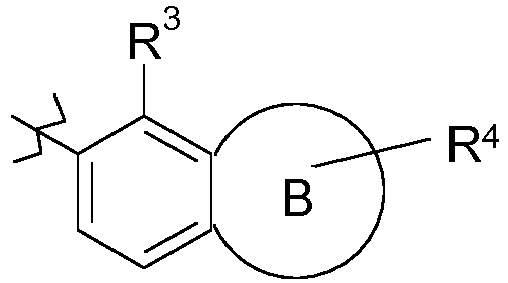
 R1 et R2 sont indépendamment choisi parmi les groupes H, C1-4alkyle, cyclopropyle et -CF3;R4 est choisi parmi les groupes H, C1-6alkyle, C3-7cycloalkyle, -C(O)C1-6alkyle, -CH2CF3,-SO2C1-6alkyle, -SO2(CH2)1-3CO2H, -CO2C1-4alkyle, hétérocyclyle, phényle, hétéroaryle, -(C0-2alkyl)hétérocyclyle, -(C1-2alkyl)phényle et -(C1-2alkyl)hétéroaryle,où ledit hétérocyclyle est choisi parmi tétrahydrofuranyle et tétrahydropyranyle, etledit hétéroaryle est choisi parmi les groupes imidazolyle, oxazolyle, pyrazinyle, pyrazolyle, pyridinyle, pyrimidinyle, thiazolyle et 4,5,6,7-tétrahydrobenzothiazolyle,et où lesdits groupes hétérocyclyle, cycloalkyle, phényle et hétéroaryle sont éventuellement substitués avec un ou deux groupes indépendamment choisis parmi méthyle, éthyle, -CF3 et fluor;R5 est choisi parmi les groupes -CH3, -CH2CH3, -OCH3 et -CF3; etR6 est choisi parmi H et -CH3;à condition que R5 et R6 ne soient pas tous les deux H;ou un sel de celui-ci.
 - Composé selon la revendication 2, dans lequel le groupe


- Composé selon la revendication 2, dans lequel le groupe


- Composé selon la revendication 2, dans lequel le groupe


- Composé selon la revendication 4, dans lequel le groupe


- Composé selon la revendication 2, dans lequel le groupe


- Composé selon la revendication 4, dans lequel le groupe


- Composé selon la revendication 4, dans lequel le groupe

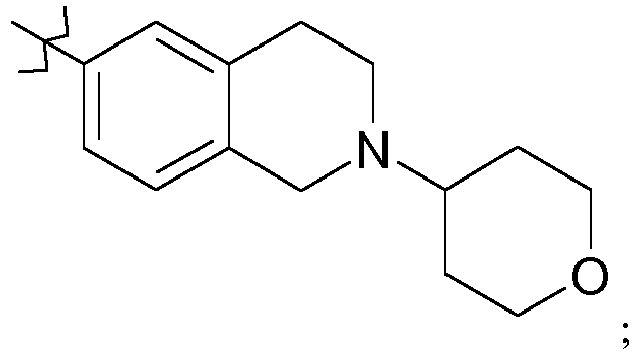
- Composé selon la revendication 4, dans lequel le groupe


- Composé selon la revendication 1 choisi parmi le groupe consistant en


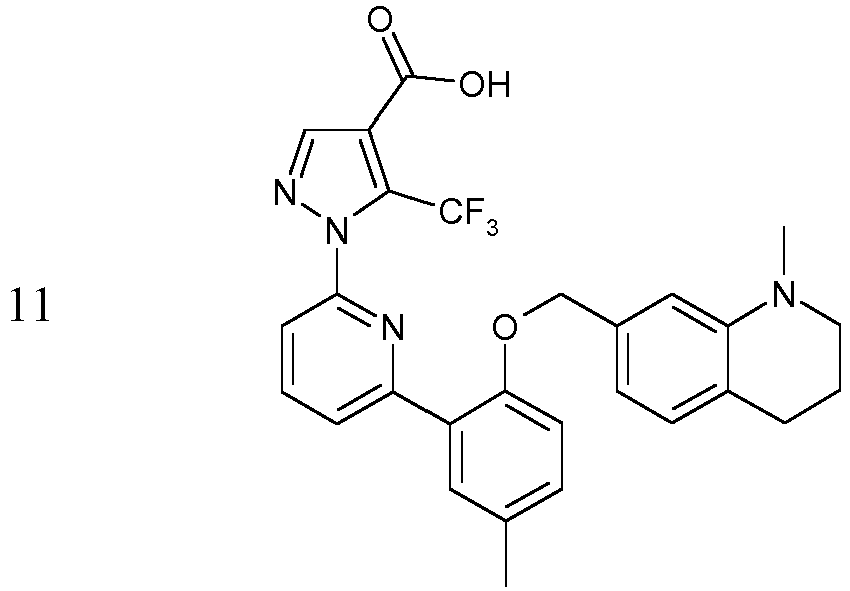


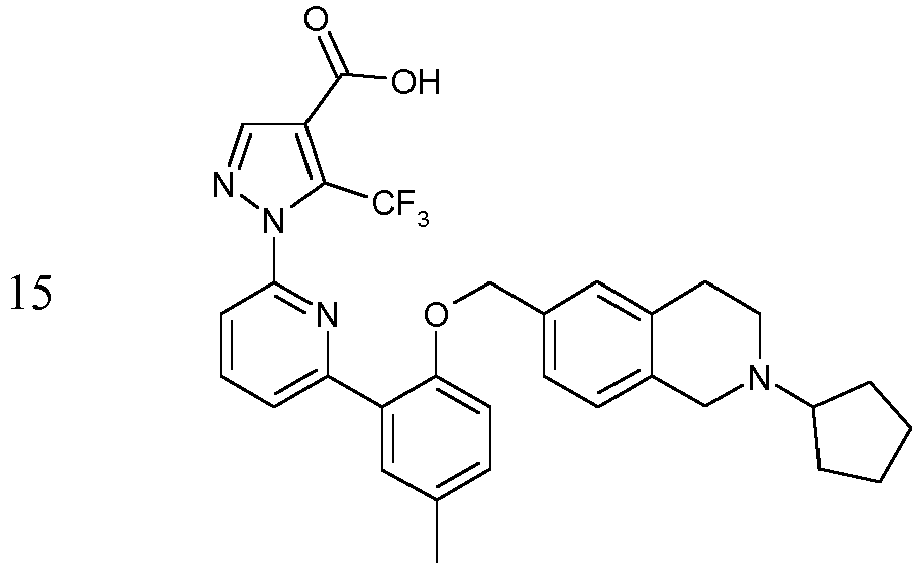


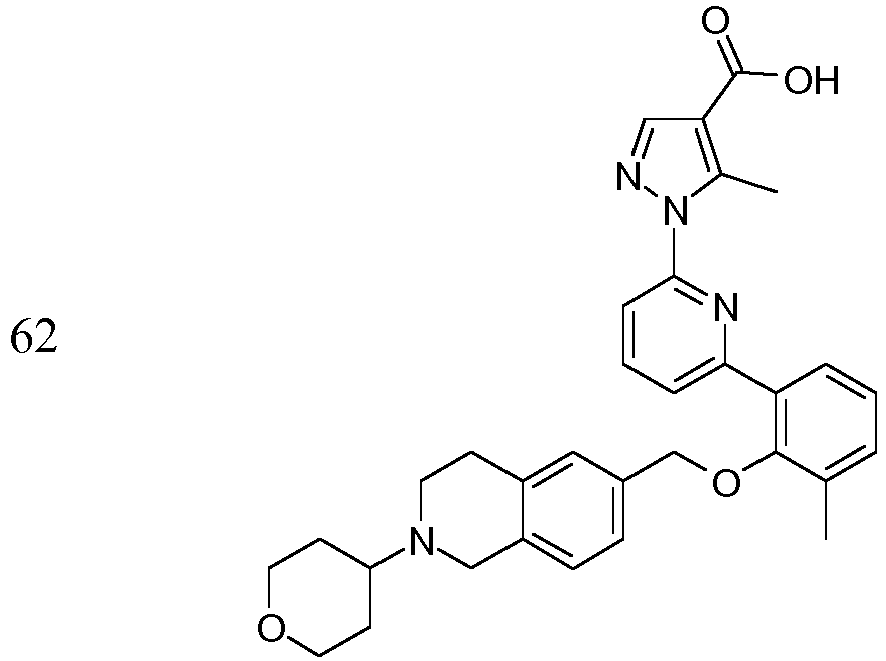


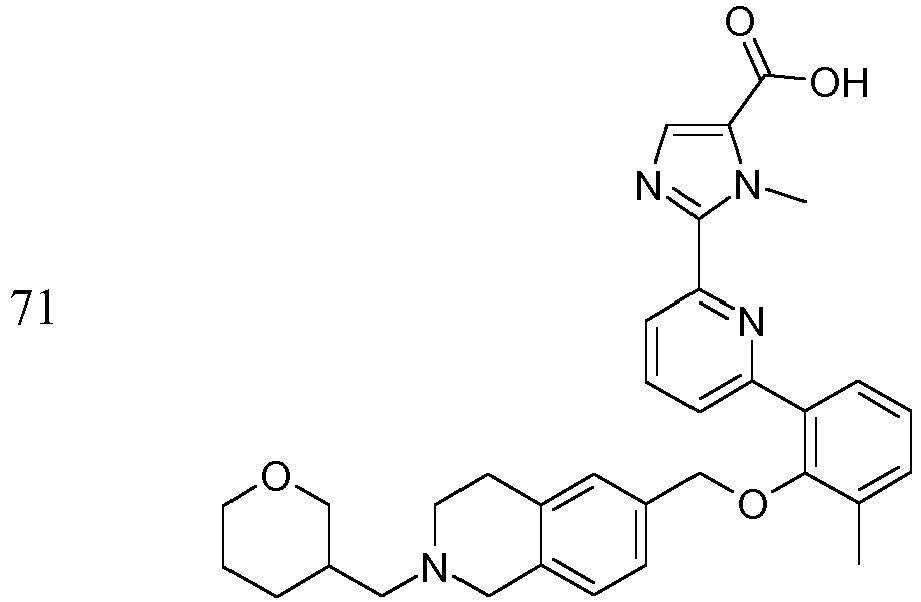
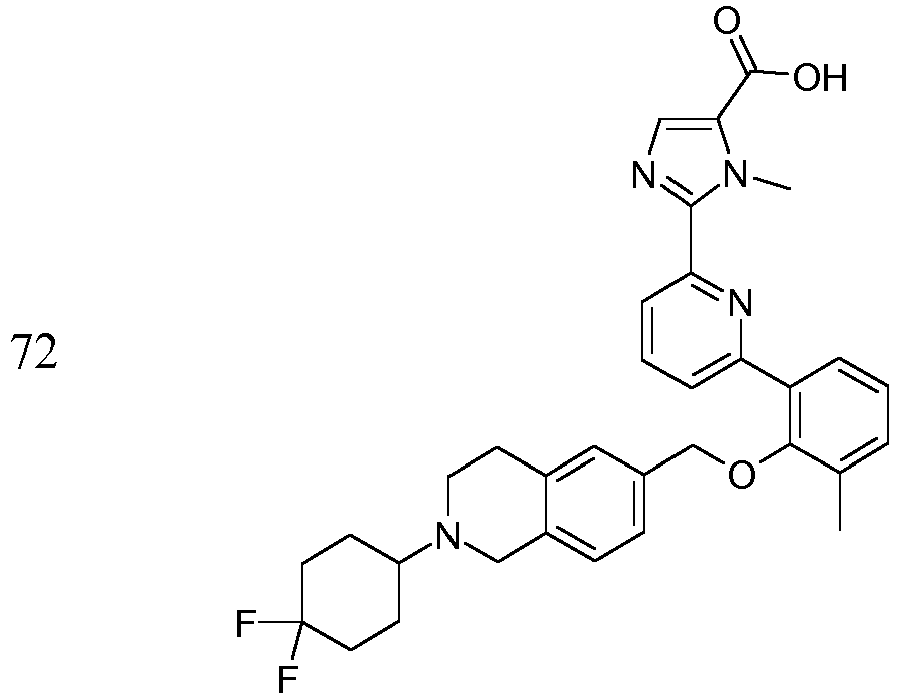


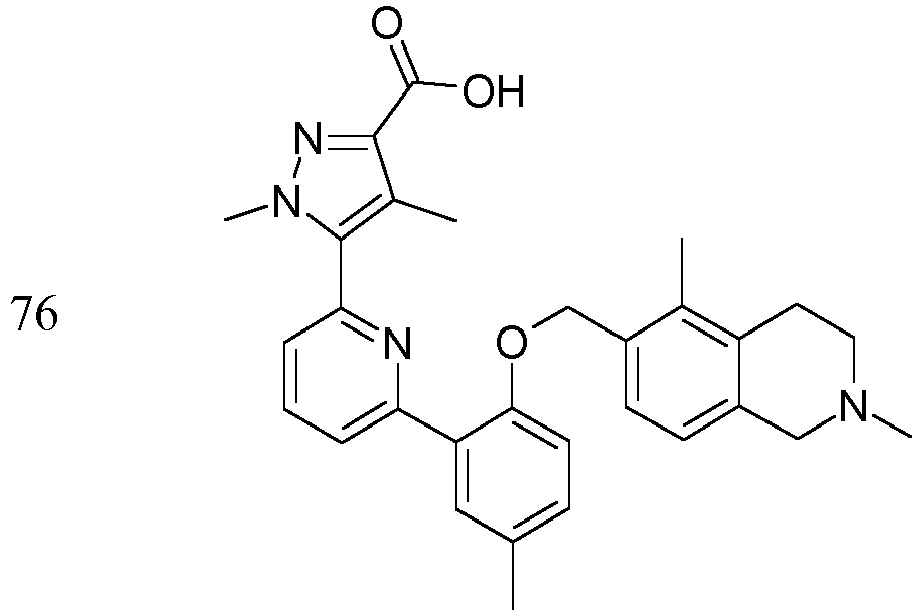


- Composé selon la revendication 11 choisi parmi le groupe consistant en les composés numéro 1-7, 10, 12, 14-33, 35, 36, 46, 48, 49, 51-54, 58-63 et 65-89;
a et les sels pharmaceutiquement acceptable de ceux-ci. - Composition pharmaceutique comprenant un composé selon la revendication 1 et un diluants ou support pharmaceutiquement acceptable.
- Composé selon l'une quelconques des revendications 1 à 12, pour son utilisation dans une méthode de traitement d'une maladie ou d'une affection qui peuvent être atténuées par une activation ou une exponentiation de guanylate cyclase soluble (sGC).
- Composé pour son utilisation dans une méthode selon la revendication 14, où la maladie ou l'affection est choisie parmi une maladie cardiovasculaire, une maladie inflammatoire, l'affection fibrotique hépatique (hepatic fibrotic disorder), l'affection fibrotique rénale (renal fibrotic disorder), l'affection fibrotique pulmonale (pulmonary fibrotic disorder) et l'affection fibrotique cardiaque (cardiac fibrotic disorder).
- Composé pour son utilisation dans une méthode selon la revendication 14, où la maladie est choisi parmi une maladie rénale, l'hyperactivité vésicale, l'hypertrophie bénigne de la prostate, la dysfonction érectile, la maladie d'Alzheimer, la maladie de Parkinson et la douleur neuropathique.
Applications Claiming Priority (3)
| Application Number | Priority Date | Filing Date | Title |
|---|---|---|---|
| US201161451163P | 2011-03-10 | 2011-03-10 | |
| US201161537741P | 2011-09-22 | 2011-09-22 | |
| PCT/US2012/028205 WO2012122340A1 (fr) | 2011-03-10 | 2012-03-08 | Activateurs de guanylate cyclase solubles |
Publications (2)
| Publication Number | Publication Date |
|---|---|
| EP2683710A1 EP2683710A1 (fr) | 2014-01-15 |
| EP2683710B1 true EP2683710B1 (fr) | 2017-07-19 |
Family
ID=45929608
Family Applications (1)
| Application Number | Title | Priority Date | Filing Date |
|---|---|---|---|
| EP12712176.2A Active EP2683710B1 (fr) | 2011-03-10 | 2012-03-08 | Activateurs de guanylate cyclase solubles |
Country Status (4)
| Country | Link |
|---|---|
| US (1) | US8569339B2 (fr) |
| EP (1) | EP2683710B1 (fr) |
| JP (1) | JP5715713B2 (fr) |
| WO (1) | WO2012122340A1 (fr) |
Families Citing this family (39)
| Publication number | Priority date | Publication date | Assignee | Title |
|---|---|---|---|---|
| SG10201510665WA (en) | 2009-12-04 | 2016-01-28 | Sunovion Pharmaceuticals Inc | Multicycle Compounds And Pharmaceutical Compositions Useful For The Treatment Of Neurological Disorders |
| JP5715713B2 (ja) | 2011-03-10 | 2015-05-13 | ベーリンガー インゲルハイム インターナショナル ゲゼルシャフト ミット ベシュレンクテル ハフツング | 可溶性グアニル酸シクラーゼ活性化因子 |
| US8815857B2 (en) | 2011-08-12 | 2014-08-26 | Boehringer Ingelheim International Gmbh | Soluble guanylate cyclase activators |
| RS55651B1 (sr) | 2012-07-20 | 2017-06-30 | Bayer Pharma AG | Nove 5-aminotetrahidrohinolin-2-karbonske kiseline i njihova upotreba |
| HRP20191755T1 (hr) | 2012-09-07 | 2019-12-27 | Boehringer Ingelheim International Gmbh | Alkoksipirazoli kao aktivatori topljive gvanilat ciklaze |
| EA027909B1 (ru) * | 2012-11-30 | 2017-09-29 | Астеллас Фарма Инк. | Имидазопиридиновые соединения |
| WO2015033307A1 (fr) * | 2013-09-05 | 2015-03-12 | Glaxosmithkline Intellectual Property Development Limited | Nouveaux activateurs de guanylate cyclase soluble et leur utilisation |
| WO2015095515A1 (fr) | 2013-12-20 | 2015-06-25 | Novartis Ag | Activateurs sgc pour le traitement de glaucome |
| TW201625584A (zh) | 2014-07-02 | 2016-07-16 | 諾華公司 | 茚滿及吲哚啉衍生物及其作為可溶性鳥苷酸環化酶活化劑之用途 |
| TW201625586A (zh) | 2014-07-02 | 2016-07-16 | 諾華公司 | 環己烯-1-基-吡啶-2-基-1h-吡唑-4-羧酸衍生物及其作為可溶性鳥苷酸環化酶活化劑之用途 |
| TW201625601A (zh) | 2014-07-02 | 2016-07-16 | 諾華公司 | 噻吩-2-基-吡啶-2-基-1h-吡唑-4-羧酸衍生物及其作為可溶性鳥苷酸環化酶活化劑之用途 |
| PL3172202T3 (pl) * | 2014-07-22 | 2020-07-13 | Boehringer Ingelheim International Gmbh | Heterocykliczne kwasy karboksylowe jako aktywatory rozpuszczalnej cyklazy guanylanowej |
| CN105980373A (zh) * | 2014-09-05 | 2016-09-28 | 葛兰素史密斯克莱知识产权发展有限公司 | 新的可溶性鸟苷酸环化酶活化剂及它们的用途 |
| KR102601972B1 (ko) | 2015-02-11 | 2023-11-13 | 선오비온 파마슈티컬스 인코포레이티드 | 중추 신경계 질환을 치료하기 위한 1-헤테로사이클릴 이소크로만일 화합물 및 유사체 |
| WO2016160706A1 (fr) * | 2015-03-28 | 2016-10-06 | Wisconsin Alumni Research Foundation | Inhibiteurs de la collagène prolyl-4-hydroxylase |
| AU2017216429B2 (en) | 2016-02-01 | 2022-10-06 | Cyclerion Therapeutics, Inc. | Use of sGC stimulators for the treatment of Nonalcoholic Steatohepatitis (NASH) |
| PT3494119T (pt) | 2016-07-29 | 2024-12-10 | Pgi Drug Discovery Llc | Compostos e composições e seus usos |
| MA45795A (fr) | 2016-07-29 | 2019-06-05 | Sunovion Pharmaceuticals Inc | Composés et compositions, et utilisations associées |
| CN109890379A (zh) | 2016-10-11 | 2019-06-14 | 拜耳制药股份公司 | 包含sGC活化剂和盐皮质激素受体拮抗剂的组合产品 |
| MX390141B (es) | 2017-02-16 | 2025-03-20 | Sunovion Pharmaceuticals Inc | Metodos para tratar esquizofrenia |
| CA3070993C (fr) | 2017-08-02 | 2025-05-20 | Sunovion Pharmaceuticals Inc. | Composés d’isochromane et leurs utilisations |
| WO2019081456A1 (fr) | 2017-10-24 | 2019-05-02 | Bayer Aktiengesellschaft | Utilisation d'activateurs et de stimulateurs de sgc comprenant une sous-unité bêta2 |
| EP3498298A1 (fr) | 2017-12-15 | 2019-06-19 | Bayer AG | Utilisation de stimulateurs sgc et d'activateurs sgc seuls ou en combinaison avec des inhibiteurs pde5 pour le traitement de troubles osseux, y compris l'ostéogénèse imparfaite (oi) |
| UA130249C2 (uk) | 2018-02-16 | 2025-12-31 | Сумітомо Фарма Америка, Інк. | Солі, кристалічні форми і способи їх отримання |
| EP3787610A1 (fr) | 2018-04-30 | 2021-03-10 | Bayer Aktiengesellschaft | Utilisation d'activateurs de la gcs et de stimulateurs de la gcs pour le traitement de déficiences cognitives |
| EP3793553A1 (fr) | 2018-05-15 | 2021-03-24 | Bayer Aktiengesellschaft | Benzamides à substitution 1,3-thiazol-2-yl pour le traitement de maladies associées à la sensibilisation de fibres nerveuses |
| EP3574905A1 (fr) | 2018-05-30 | 2019-12-04 | Adverio Pharma GmbH | Procédé d'identification d'un sous-groupe de patients souffrant de dcssc qui bénéficie d'un traitement comportant des stimulateurs sgc et des activateurs sgc à un degré supérieur à celui d'un groupe de contrôle |
| US20220128561A1 (en) | 2019-01-17 | 2022-04-28 | Bayer Aktiengesellschaft | Methods to determine whether a subject is suitable of being treated with an agonist of soluble gyanylyl cyclase (sgc) |
| EP3938045A1 (fr) | 2019-03-14 | 2022-01-19 | Sunovion Pharmaceuticals Inc. | Sels d'un composé d'isochromanyle et formes cristallines, procédés de préparation, utilisations thérapeutiques et compositions pharmaceutiques associées |
| EP4010333A1 (fr) | 2019-08-09 | 2022-06-15 | Kalvista Pharmaceuticals Limited | Inhibiteurs de la kallicréine plasmatique |
| TW202120478A (zh) * | 2019-11-22 | 2021-06-01 | 美商富曼西公司 | 用於合成(3-氯-2-吡啶基)肼的新穎製程 |
| JP7312120B2 (ja) * | 2020-01-22 | 2023-07-20 | 公益財団法人相模中央化学研究所 | N-(ジフルオロヨードメチル)イミダゾール類及びその製造方法 |
| CA3180115A1 (fr) | 2020-04-14 | 2021-10-21 | Sunovion Pharmaceuticals Inc. | (s)-(4,5-dihydro-7 h-thieno[2,3-c]pyran-7-yl)-n-methylmethanamine pour le traitement de troubles neurologiques et psychiatriques |
| CN112079781B (zh) * | 2020-09-30 | 2022-11-22 | 苏州康润医药有限公司 | 5-溴-1-甲基-1h-吡唑-3-胺的合成方法 |
| EP4011873A1 (fr) | 2020-12-10 | 2022-06-15 | Bayer Aktiengesellschaft | Acides carboxyliques de pyrazolo pipéridine substitués |
| EP4456896A1 (fr) | 2021-12-29 | 2024-11-06 | Bayer Aktiengesellschaft | Traitement de troubles cardio-pulmonaires |
| KR20240144177A (ko) | 2021-12-29 | 2024-10-02 | 바이엘 악티엔게젤샤프트 | (5s)-{[2-(4-카르복시페닐)에틸][2-(2-{[3-클로로-4'-(트리플루오로메틸)비페닐-4-일]메톡시}페닐)에틸]아미노}-5,6,7,8-테트라히드로퀴놀린-2-카르복실산및 약학적 활성 화합물로서 사용하기 위한 이의 결정질 형태를 제조하는 방법 |
| EP4536205A1 (fr) | 2022-06-09 | 2025-04-16 | Bayer Aktiengesellschaft | Activateurs de guanylate cyclase soluble destinés à être utilisés dans le traitement de l'insuffisance cardiaque à fraction d'éjection préservée chez les femmes |
| CN120225203A (zh) | 2022-11-04 | 2025-06-27 | 勃林格殷格翰国际有限公司 | 用于治疗系统性硬化症的可溶性鸟苷酸环化酶活化剂 |
Family Cites Families (18)
| Publication number | Priority date | Publication date | Assignee | Title |
|---|---|---|---|---|
| US20040067938A1 (en) | 2000-09-29 | 2004-04-08 | Penglie Zhang | Quaternary amines and related inhibitors of factor xa |
| AU2006272088A1 (en) | 2005-07-18 | 2007-01-25 | Bayer Schering Pharma Aktiengesellschaft | Novel use of activators and stimulators of soluble guanylate cyclase for the prevention or treatment of renal disorders |
| US20080045560A1 (en) | 2006-08-15 | 2008-02-21 | Wyeth | Pyrrolidine and related derivatives useful as PR modulators |
| AU2008250643A1 (en) | 2007-05-12 | 2008-11-20 | Bayer Schering Pharma Aktiengesellschaft | sGC stimulators, sGC activators and combinations for the treatment of urological disorders |
| BRPI0816382A2 (pt) * | 2007-09-06 | 2015-02-24 | Merck Sharp & Dohme | Composto, composição, e, métodos para ativar a guanilato ciclase solúvel e para tratar ou previnir doenças |
| WO2009043495A1 (fr) | 2007-10-05 | 2009-04-09 | Sanofi-Aventis Deutschland Gmbh | Utilisation de n-phénylamides d'acide 2-sulfonylaminobenzoïque sulfonyl-substituées dans le traitement de la douleur |
| FR2923907B1 (fr) * | 2007-11-16 | 2010-01-08 | Snr Roulements Sa | Jauge de contrainte pour mesurer des deformations longitudinales et transversales |
| WO2009068652A1 (fr) | 2007-11-30 | 2009-06-04 | Smithkline Beecham Corporation | Pyridines 2, 6-disubstituées et pyrimidines 2, 4-disubstituées en tant qu'activateurs de guanylate cyclase soluble |
| TW200938529A (en) | 2007-12-03 | 2009-09-16 | Smithkline Beecham Corp | Compounds |
| WO2010015653A1 (fr) | 2008-08-07 | 2010-02-11 | Smithkline Beecham Corporation | Dérivés de pyrimidine comme activateurs de guanylate cyclase soluble |
| WO2010015652A2 (fr) | 2008-08-07 | 2010-02-11 | Smithkline Beecham Corporation | Composés thiazole utilisés comme activateurs de la guanylate cyclase soluble |
| AU2009322836B2 (en) | 2008-11-25 | 2013-04-04 | Merck Sharp & Dohme Corp. | Soluble guanylate cyclase activators |
| JP5780430B2 (ja) | 2009-01-17 | 2015-09-16 | アドヴェリオ・ファーマ・ゲゼルシャフト・ミット・ベシュレンクテル・ハフツング | 勃起不全の処置用のPDE5阻害剤と組み合わせたsGC刺激剤またはsGC活性化剤 |
| KR20110133034A (ko) | 2009-02-26 | 2011-12-09 | 머크 샤프 앤드 돔 코포레이션 | 가용성 구아닐레이트 시클라제 활성화제 |
| EP2687210A1 (fr) * | 2010-06-25 | 2014-01-22 | Bayer Intellectual Property GmbH | Stimulateurs et activateurs de la guanylate cyclase soluble pour leur utilisation dans le traitement de la drépanocytose et de la conservation des substituts sanguins |
| EP2632551B1 (fr) | 2010-10-28 | 2016-07-06 | Merck Sharp & Dohme Corp. | Activateurs de la guanylate cyclase soluble |
| JP5715713B2 (ja) | 2011-03-10 | 2015-05-13 | ベーリンガー インゲルハイム インターナショナル ゲゼルシャフト ミット ベシュレンクテル ハフツング | 可溶性グアニル酸シクラーゼ活性化因子 |
| US8815857B2 (en) | 2011-08-12 | 2014-08-26 | Boehringer Ingelheim International Gmbh | Soluble guanylate cyclase activators |
-
2012
- 2012-03-08 JP JP2013557848A patent/JP5715713B2/ja active Active
- 2012-03-08 US US13/414,991 patent/US8569339B2/en active Active
- 2012-03-08 EP EP12712176.2A patent/EP2683710B1/fr active Active
- 2012-03-08 WO PCT/US2012/028205 patent/WO2012122340A1/fr not_active Ceased
Non-Patent Citations (1)
| Title |
|---|
| None * |
Also Published As
| Publication number | Publication date |
|---|---|
| US20130065918A1 (en) | 2013-03-14 |
| JP2014507478A (ja) | 2014-03-27 |
| EP2683710A1 (fr) | 2014-01-15 |
| WO2012122340A8 (fr) | 2013-04-25 |
| WO2012122340A1 (fr) | 2012-09-13 |
| US8569339B2 (en) | 2013-10-29 |
| JP5715713B2 (ja) | 2015-05-13 |
Similar Documents
| Publication | Publication Date | Title |
|---|---|---|
| EP2683710B1 (fr) | Activateurs de guanylate cyclase solubles | |
| USRE46886E1 (en) | Alkoxy pyrazoles as soluble guanylate cyclase activators | |
| CN109071498B (zh) | 激酶抑制剂及其制备方法和用途 | |
| CN102365277B (zh) | Jun n-末端激酶抑制剂 | |
| ES2525581T3 (es) | Derivados de N-sulfonilbenzamida útiles como inhibidores del canal de sodio dependiente de voltaje | |
| CN102203101B (zh) | 作为p38激酶抑制剂的吡咯并[2,3-c]吡啶衍生物 | |
| EP3172202B1 (fr) | Acides carboxyliques hétérocycliques en tant qu'activateurs de la guanylate cyclase soluble | |
| CN105308036A (zh) | 用于激酶调节的化合物和方法及其适应症 | |
| BRPI0915084B1 (pt) | Composto, e, composição farmacêutica | |
| WO2014028589A2 (fr) | Composés d'acide benzoïque substitués par un 4-hétéroaryle à titre d'inhibiteurs de rorgammat et leurs utilisations | |
| RS56669B1 (sr) | 1h-pirazolo[3,4-b]piridini i njihove terapeutske primene | |
| HUE030067T2 (en) | Bicyclic pyrazinone derivatives | |
| KR102519948B1 (ko) | 암 치료용 화합물 및 조성물 | |
| TW201217362A (en) | Heteroaryls and uses thereof | |
| US10131642B1 (en) | Aldosterone synthase inhibitors | |
| CN106687464B (zh) | 大环rip2激酶抑制剂 | |
| CN106459041A (zh) | 嘧啶并[4,5‑b]喹啉‑4,5(3H,10H)‑二酮衍生物 | |
| CN115427409A (zh) | 作为trpv4拮抗剂的嘧啶-4(3h)-酮衍生物 | |
| WO2023220225A1 (fr) | Inhibiteurs du virus respiratoire syncytial humain et du métapneumovirus humain | |
| WO2024245264A1 (fr) | Inhibiteur de cbl-b et son utilisation | |
| HK40078094A (en) | Pyrimidin-4(3h)-one derivatives as trpv4 antagonists |
Legal Events
| Date | Code | Title | Description |
|---|---|---|---|
| PUAI | Public reference made under article 153(3) epc to a published international application that has entered the european phase |
Free format text: ORIGINAL CODE: 0009012 |
|
| 17P | Request for examination filed |
Effective date: 20131010 |
|
| AK | Designated contracting states |
Kind code of ref document: A1 Designated state(s): AL AT BE BG CH CY CZ DE DK EE ES FI FR GB GR HR HU IE IS IT LI LT LU LV MC MK MT NL NO PL PT RO RS SE SI SK SM TR |
|
| DAX | Request for extension of the european patent (deleted) | ||
| 17Q | First examination report despatched |
Effective date: 20150703 |
|
| RIN1 | Information on inventor provided before grant (corrected) |
Inventor name: RAUDENBUSH, BRIAN CHRISTOPHER Inventor name: SARKO, CHRISTOPHER RONALD Inventor name: BRENNEMAN, JEHROD BURNETT Inventor name: HUBER, JOHN D. |
|
| GRAP | Despatch of communication of intention to grant a patent |
Free format text: ORIGINAL CODE: EPIDOSNIGR1 |
|
| INTG | Intention to grant announced |
Effective date: 20170220 |
|
| GRAS | Grant fee paid |
Free format text: ORIGINAL CODE: EPIDOSNIGR3 |
|
| GRAA | (expected) grant |
Free format text: ORIGINAL CODE: 0009210 |
|
| AK | Designated contracting states |
Kind code of ref document: B1 Designated state(s): AL AT BE BG CH CY CZ DE DK EE ES FI FR GB GR HR HU IE IS IT LI LT LU LV MC MK MT NL NO PL PT RO RS SE SI SK SM TR |
|
| REG | Reference to a national code |
Ref country code: GB Ref legal event code: FG4D |
|
| REG | Reference to a national code |
Ref country code: CH Ref legal event code: EP |
|
| REG | Reference to a national code |
Ref country code: IE Ref legal event code: FG4D |
|
| REG | Reference to a national code |
Ref country code: AT Ref legal event code: REF Ref document number: 910265 Country of ref document: AT Kind code of ref document: T Effective date: 20170815 |
|
| REG | Reference to a national code |
Ref country code: DE Ref legal event code: R096 Ref document number: 602012034686 Country of ref document: DE |
|
| REG | Reference to a national code |
Ref country code: NL Ref legal event code: MP Effective date: 20170719 |
|
| REG | Reference to a national code |
Ref country code: LT Ref legal event code: MG4D |
|
| REG | Reference to a national code |
Ref country code: AT Ref legal event code: MK05 Ref document number: 910265 Country of ref document: AT Kind code of ref document: T Effective date: 20170719 |
|
| PG25 | Lapsed in a contracting state [announced via postgrant information from national office to epo] |
Ref country code: NO Free format text: LAPSE BECAUSE OF FAILURE TO SUBMIT A TRANSLATION OF THE DESCRIPTION OR TO PAY THE FEE WITHIN THE PRESCRIBED TIME-LIMIT Effective date: 20171019 Ref country code: AT Free format text: LAPSE BECAUSE OF FAILURE TO SUBMIT A TRANSLATION OF THE DESCRIPTION OR TO PAY THE FEE WITHIN THE PRESCRIBED TIME-LIMIT Effective date: 20170719 Ref country code: HR Free format text: LAPSE BECAUSE OF FAILURE TO SUBMIT A TRANSLATION OF THE DESCRIPTION OR TO PAY THE FEE WITHIN THE PRESCRIBED TIME-LIMIT Effective date: 20170719 Ref country code: SE Free format text: LAPSE BECAUSE OF FAILURE TO SUBMIT A TRANSLATION OF THE DESCRIPTION OR TO PAY THE FEE WITHIN THE PRESCRIBED TIME-LIMIT Effective date: 20170719 Ref country code: LT Free format text: LAPSE BECAUSE OF FAILURE TO SUBMIT A TRANSLATION OF THE DESCRIPTION OR TO PAY THE FEE WITHIN THE PRESCRIBED TIME-LIMIT Effective date: 20170719 Ref country code: NL Free format text: LAPSE BECAUSE OF FAILURE TO SUBMIT A TRANSLATION OF THE DESCRIPTION OR TO PAY THE FEE WITHIN THE PRESCRIBED TIME-LIMIT Effective date: 20170719 Ref country code: FI Free format text: LAPSE BECAUSE OF FAILURE TO SUBMIT A TRANSLATION OF THE DESCRIPTION OR TO PAY THE FEE WITHIN THE PRESCRIBED TIME-LIMIT Effective date: 20170719 |
|
| PG25 | Lapsed in a contracting state [announced via postgrant information from national office to epo] |
Ref country code: PL Free format text: LAPSE BECAUSE OF FAILURE TO SUBMIT A TRANSLATION OF THE DESCRIPTION OR TO PAY THE FEE WITHIN THE PRESCRIBED TIME-LIMIT Effective date: 20170719 Ref country code: ES Free format text: LAPSE BECAUSE OF FAILURE TO SUBMIT A TRANSLATION OF THE DESCRIPTION OR TO PAY THE FEE WITHIN THE PRESCRIBED TIME-LIMIT Effective date: 20170719 Ref country code: LV Free format text: LAPSE BECAUSE OF FAILURE TO SUBMIT A TRANSLATION OF THE DESCRIPTION OR TO PAY THE FEE WITHIN THE PRESCRIBED TIME-LIMIT Effective date: 20170719 Ref country code: BG Free format text: LAPSE BECAUSE OF FAILURE TO SUBMIT A TRANSLATION OF THE DESCRIPTION OR TO PAY THE FEE WITHIN THE PRESCRIBED TIME-LIMIT Effective date: 20171019 Ref country code: GR Free format text: LAPSE BECAUSE OF FAILURE TO SUBMIT A TRANSLATION OF THE DESCRIPTION OR TO PAY THE FEE WITHIN THE PRESCRIBED TIME-LIMIT Effective date: 20171020 Ref country code: IS Free format text: LAPSE BECAUSE OF FAILURE TO SUBMIT A TRANSLATION OF THE DESCRIPTION OR TO PAY THE FEE WITHIN THE PRESCRIBED TIME-LIMIT Effective date: 20171119 Ref country code: RS Free format text: LAPSE BECAUSE OF FAILURE TO SUBMIT A TRANSLATION OF THE DESCRIPTION OR TO PAY THE FEE WITHIN THE PRESCRIBED TIME-LIMIT Effective date: 20170719 |
|
| REG | Reference to a national code |
Ref country code: FR Ref legal event code: PLFP Year of fee payment: 7 |
|
| REG | Reference to a national code |
Ref country code: DE Ref legal event code: R097 Ref document number: 602012034686 Country of ref document: DE |
|
| PG25 | Lapsed in a contracting state [announced via postgrant information from national office to epo] |
Ref country code: RO Free format text: LAPSE BECAUSE OF FAILURE TO SUBMIT A TRANSLATION OF THE DESCRIPTION OR TO PAY THE FEE WITHIN THE PRESCRIBED TIME-LIMIT Effective date: 20170719 Ref country code: DK Free format text: LAPSE BECAUSE OF FAILURE TO SUBMIT A TRANSLATION OF THE DESCRIPTION OR TO PAY THE FEE WITHIN THE PRESCRIBED TIME-LIMIT Effective date: 20170719 Ref country code: CZ Free format text: LAPSE BECAUSE OF FAILURE TO SUBMIT A TRANSLATION OF THE DESCRIPTION OR TO PAY THE FEE WITHIN THE PRESCRIBED TIME-LIMIT Effective date: 20170719 |
|
| PLBE | No opposition filed within time limit |
Free format text: ORIGINAL CODE: 0009261 |
|
| STAA | Information on the status of an ep patent application or granted ep patent |
Free format text: STATUS: NO OPPOSITION FILED WITHIN TIME LIMIT |
|
| PG25 | Lapsed in a contracting state [announced via postgrant information from national office to epo] |
Ref country code: IT Free format text: LAPSE BECAUSE OF FAILURE TO SUBMIT A TRANSLATION OF THE DESCRIPTION OR TO PAY THE FEE WITHIN THE PRESCRIBED TIME-LIMIT Effective date: 20170719 Ref country code: EE Free format text: LAPSE BECAUSE OF FAILURE TO SUBMIT A TRANSLATION OF THE DESCRIPTION OR TO PAY THE FEE WITHIN THE PRESCRIBED TIME-LIMIT Effective date: 20170719 Ref country code: SK Free format text: LAPSE BECAUSE OF FAILURE TO SUBMIT A TRANSLATION OF THE DESCRIPTION OR TO PAY THE FEE WITHIN THE PRESCRIBED TIME-LIMIT Effective date: 20170719 Ref country code: SM Free format text: LAPSE BECAUSE OF FAILURE TO SUBMIT A TRANSLATION OF THE DESCRIPTION OR TO PAY THE FEE WITHIN THE PRESCRIBED TIME-LIMIT Effective date: 20170719 |
|
| 26N | No opposition filed |
Effective date: 20180420 |
|
| PG25 | Lapsed in a contracting state [announced via postgrant information from national office to epo] |
Ref country code: SI Free format text: LAPSE BECAUSE OF FAILURE TO SUBMIT A TRANSLATION OF THE DESCRIPTION OR TO PAY THE FEE WITHIN THE PRESCRIBED TIME-LIMIT Effective date: 20170719 |
|
| REG | Reference to a national code |
Ref country code: CH Ref legal event code: PL |
|
| PG25 | Lapsed in a contracting state [announced via postgrant information from national office to epo] |
Ref country code: MC Free format text: LAPSE BECAUSE OF FAILURE TO SUBMIT A TRANSLATION OF THE DESCRIPTION OR TO PAY THE FEE WITHIN THE PRESCRIBED TIME-LIMIT Effective date: 20170719 |
|
| REG | Reference to a national code |
Ref country code: BE Ref legal event code: MM Effective date: 20180331 |
|
| REG | Reference to a national code |
Ref country code: IE Ref legal event code: MM4A |
|
| PG25 | Lapsed in a contracting state [announced via postgrant information from national office to epo] |
Ref country code: LU Free format text: LAPSE BECAUSE OF NON-PAYMENT OF DUE FEES Effective date: 20180308 |
|
| PG25 | Lapsed in a contracting state [announced via postgrant information from national office to epo] |
Ref country code: IE Free format text: LAPSE BECAUSE OF NON-PAYMENT OF DUE FEES Effective date: 20180308 |
|
| PG25 | Lapsed in a contracting state [announced via postgrant information from national office to epo] |
Ref country code: BE Free format text: LAPSE BECAUSE OF NON-PAYMENT OF DUE FEES Effective date: 20180331 Ref country code: CH Free format text: LAPSE BECAUSE OF NON-PAYMENT OF DUE FEES Effective date: 20180331 Ref country code: LI Free format text: LAPSE BECAUSE OF NON-PAYMENT OF DUE FEES Effective date: 20180331 |
|
| PG25 | Lapsed in a contracting state [announced via postgrant information from national office to epo] |
Ref country code: MT Free format text: LAPSE BECAUSE OF NON-PAYMENT OF DUE FEES Effective date: 20180308 |
|
| PG25 | Lapsed in a contracting state [announced via postgrant information from national office to epo] |
Ref country code: TR Free format text: LAPSE BECAUSE OF FAILURE TO SUBMIT A TRANSLATION OF THE DESCRIPTION OR TO PAY THE FEE WITHIN THE PRESCRIBED TIME-LIMIT Effective date: 20170719 |
|
| PG25 | Lapsed in a contracting state [announced via postgrant information from national office to epo] |
Ref country code: HU Free format text: LAPSE BECAUSE OF FAILURE TO SUBMIT A TRANSLATION OF THE DESCRIPTION OR TO PAY THE FEE WITHIN THE PRESCRIBED TIME-LIMIT; INVALID AB INITIO Effective date: 20120308 Ref country code: PT Free format text: LAPSE BECAUSE OF FAILURE TO SUBMIT A TRANSLATION OF THE DESCRIPTION OR TO PAY THE FEE WITHIN THE PRESCRIBED TIME-LIMIT Effective date: 20170719 |
|
| PG25 | Lapsed in a contracting state [announced via postgrant information from national office to epo] |
Ref country code: CY Free format text: LAPSE BECAUSE OF FAILURE TO SUBMIT A TRANSLATION OF THE DESCRIPTION OR TO PAY THE FEE WITHIN THE PRESCRIBED TIME-LIMIT Effective date: 20170719 Ref country code: MK Free format text: LAPSE BECAUSE OF NON-PAYMENT OF DUE FEES Effective date: 20170719 |
|
| PG25 | Lapsed in a contracting state [announced via postgrant information from national office to epo] |
Ref country code: AL Free format text: LAPSE BECAUSE OF FAILURE TO SUBMIT A TRANSLATION OF THE DESCRIPTION OR TO PAY THE FEE WITHIN THE PRESCRIBED TIME-LIMIT Effective date: 20170719 |
|
| PGFP | Annual fee paid to national office [announced via postgrant information from national office to epo] |
Ref country code: GB Payment date: 20260324 Year of fee payment: 15 |
|
| PGFP | Annual fee paid to national office [announced via postgrant information from national office to epo] |
Ref country code: DE Payment date: 20260319 Year of fee payment: 15 |
|
| PGFP | Annual fee paid to national office [announced via postgrant information from national office to epo] |
Ref country code: FR Payment date: 20260320 Year of fee payment: 15 |