EP2684027B1 - Quantification rapide de biomolécules dans un biocapteur nanofluidique sélectivement fonctionnalisé et procédé associé - Google Patents
Quantification rapide de biomolécules dans un biocapteur nanofluidique sélectivement fonctionnalisé et procédé associé Download PDFInfo
- Publication number
- EP2684027B1 EP2684027B1 EP12711449.4A EP12711449A EP2684027B1 EP 2684027 B1 EP2684027 B1 EP 2684027B1 EP 12711449 A EP12711449 A EP 12711449A EP 2684027 B1 EP2684027 B1 EP 2684027B1
- Authority
- EP
- European Patent Office
- Prior art keywords
- nanochannel
- biomolecules
- biosensor
- solution
- biomarkers
- Prior art date
- Legal status (The legal status is an assumption and is not a legal conclusion. Google has not performed a legal analysis and makes no representation as to the accuracy of the status listed.)
- Active
Links
Images


Classifications
-
- B—PERFORMING OPERATIONS; TRANSPORTING
- B01—PHYSICAL OR CHEMICAL PROCESSES OR APPARATUS IN GENERAL
- B01L—CHEMICAL OR PHYSICAL LABORATORY APPARATUS FOR GENERAL USE
- B01L3/00—Containers or dishes for laboratory use, e.g. laboratory glassware; Droppers
- B01L3/50—Containers for the purpose of retaining a material to be analysed, e.g. test tubes
- B01L3/502—Containers for the purpose of retaining a material to be analysed, e.g. test tubes with fluid transport, e.g. in multi-compartment structures
- B01L3/5027—Containers for the purpose of retaining a material to be analysed, e.g. test tubes with fluid transport, e.g. in multi-compartment structures by integrated microfluidic structures, i.e. dimensions of channels and chambers are such that surface tension forces are important, e.g. lab-on-a-chip
- B01L3/502746—Containers for the purpose of retaining a material to be analysed, e.g. test tubes with fluid transport, e.g. in multi-compartment structures by integrated microfluidic structures, i.e. dimensions of channels and chambers are such that surface tension forces are important, e.g. lab-on-a-chip characterised by the means for controlling flow resistance, e.g. flow controllers, baffles or throttle valves
-
- G—PHYSICS
- G01—MEASURING; TESTING
- G01N—INVESTIGATING OR ANALYSING MATERIALS BY DETERMINING THEIR CHEMICAL OR PHYSICAL PROPERTIES
- G01N33/00—Investigating or analysing materials by specific methods not covered by groups G01N1/00 - G01N31/00
- G01N33/48—Biological material, e.g. blood, urine; Haemocytometers
- G01N33/50—Chemical analysis of biological material, e.g. blood, urine; Testing involving biospecific ligand binding methods; Immunological testing
- G01N33/53—Immunoassay; Biospecific binding assay; Materials therefor
- G01N33/543—Immunoassay; Biospecific binding assay; Materials therefor with an insoluble carrier for immobilising immunochemicals
- G01N33/54366—Apparatus specially adapted for solid-phase testing
- G01N33/54373—Apparatus specially adapted for solid-phase testing involving physiochemical end-point determination, e.g. wave-guides, FETS, gratings
-
- B—PERFORMING OPERATIONS; TRANSPORTING
- B01—PHYSICAL OR CHEMICAL PROCESSES OR APPARATUS IN GENERAL
- B01L—CHEMICAL OR PHYSICAL LABORATORY APPARATUS FOR GENERAL USE
- B01L3/00—Containers or dishes for laboratory use, e.g. laboratory glassware; Droppers
- B01L3/50—Containers for the purpose of retaining a material to be analysed, e.g. test tubes
- B01L3/502—Containers for the purpose of retaining a material to be analysed, e.g. test tubes with fluid transport, e.g. in multi-compartment structures
- B01L3/5027—Containers for the purpose of retaining a material to be analysed, e.g. test tubes with fluid transport, e.g. in multi-compartment structures by integrated microfluidic structures, i.e. dimensions of channels and chambers are such that surface tension forces are important, e.g. lab-on-a-chip
- B01L3/502753—Containers for the purpose of retaining a material to be analysed, e.g. test tubes with fluid transport, e.g. in multi-compartment structures by integrated microfluidic structures, i.e. dimensions of channels and chambers are such that surface tension forces are important, e.g. lab-on-a-chip characterised by bulk separation arrangements on lab-on-a-chip devices, e.g. for filtration or centrifugation
-
- B—PERFORMING OPERATIONS; TRANSPORTING
- B82—NANOTECHNOLOGY
- B82Y—SPECIFIC USES OR APPLICATIONS OF NANOSTRUCTURES; MEASUREMENT OR ANALYSIS OF NANOSTRUCTURES; MANUFACTURE OR TREATMENT OF NANOSTRUCTURES
- B82Y30/00—Nanotechnology for materials or surface science, e.g. nanocomposites
-
- G—PHYSICS
- G01—MEASURING; TESTING
- G01N—INVESTIGATING OR ANALYSING MATERIALS BY DETERMINING THEIR CHEMICAL OR PHYSICAL PROPERTIES
- G01N21/00—Investigating or analysing materials by the use of optical means, i.e. using sub-millimetre waves, infrared, visible or ultraviolet light
- G01N21/62—Systems in which the material investigated is excited whereby it emits light or causes a change in wavelength of the incident light
- G01N21/63—Systems in which the material investigated is excited whereby it emits light or causes a change in wavelength of the incident light optically excited
- G01N21/64—Fluorescence; Phosphorescence
- G01N21/6428—Measuring fluorescence of fluorescent products of reactions or of fluorochrome labelled reactive substances, e.g. measuring quenching effects, using measuring "optrodes"
-
- G—PHYSICS
- G01—MEASURING; TESTING
- G01N—INVESTIGATING OR ANALYSING MATERIALS BY DETERMINING THEIR CHEMICAL OR PHYSICAL PROPERTIES
- G01N21/00—Investigating or analysing materials by the use of optical means, i.e. using sub-millimetre waves, infrared, visible or ultraviolet light
- G01N21/62—Systems in which the material investigated is excited whereby it emits light or causes a change in wavelength of the incident light
- G01N21/63—Systems in which the material investigated is excited whereby it emits light or causes a change in wavelength of the incident light optically excited
- G01N21/64—Fluorescence; Phosphorescence
- G01N21/645—Specially adapted constructive features of fluorimeters
- G01N21/6452—Individual samples arranged in a regular 2D-array, e.g. multiwell plates
-
- B—PERFORMING OPERATIONS; TRANSPORTING
- B01—PHYSICAL OR CHEMICAL PROCESSES OR APPARATUS IN GENERAL
- B01L—CHEMICAL OR PHYSICAL LABORATORY APPARATUS FOR GENERAL USE
- B01L2300/00—Additional constructional details
- B01L2300/08—Geometry, shape and general structure
- B01L2300/0809—Geometry, shape and general structure rectangular shaped
- B01L2300/0819—Microarrays; Biochips
-
- B—PERFORMING OPERATIONS; TRANSPORTING
- B01—PHYSICAL OR CHEMICAL PROCESSES OR APPARATUS IN GENERAL
- B01L—CHEMICAL OR PHYSICAL LABORATORY APPARATUS FOR GENERAL USE
- B01L2300/00—Additional constructional details
- B01L2300/08—Geometry, shape and general structure
- B01L2300/0861—Configuration of multiple channels and/or chambers in a single devices
- B01L2300/0877—Flow chambers
-
- B—PERFORMING OPERATIONS; TRANSPORTING
- B01—PHYSICAL OR CHEMICAL PROCESSES OR APPARATUS IN GENERAL
- B01L—CHEMICAL OR PHYSICAL LABORATORY APPARATUS FOR GENERAL USE
- B01L2400/00—Moving or stopping fluids
- B01L2400/04—Moving fluids with specific forces or mechanical means
- B01L2400/0403—Moving fluids with specific forces or mechanical means specific forces
- B01L2400/0406—Moving fluids with specific forces or mechanical means specific forces capillary forces
-
- B—PERFORMING OPERATIONS; TRANSPORTING
- B82—NANOTECHNOLOGY
- B82Y—SPECIFIC USES OR APPLICATIONS OF NANOSTRUCTURES; MEASUREMENT OR ANALYSIS OF NANOSTRUCTURES; MANUFACTURE OR TREATMENT OF NANOSTRUCTURES
- B82Y15/00—Nanotechnology for interacting, sensing or actuating, e.g. quantum dots as markers in protein assays or molecular motors
-
- B—PERFORMING OPERATIONS; TRANSPORTING
- B82—NANOTECHNOLOGY
- B82Y—SPECIFIC USES OR APPLICATIONS OF NANOSTRUCTURES; MEASUREMENT OR ANALYSIS OF NANOSTRUCTURES; MANUFACTURE OR TREATMENT OF NANOSTRUCTURES
- B82Y35/00—Methods or apparatus for measurement or analysis of nanostructures
-
- G—PHYSICS
- G01—MEASURING; TESTING
- G01N—INVESTIGATING OR ANALYSING MATERIALS BY DETERMINING THEIR CHEMICAL OR PHYSICAL PROPERTIES
- G01N21/00—Investigating or analysing materials by the use of optical means, i.e. using sub-millimetre waves, infrared, visible or ultraviolet light
- G01N21/01—Arrangements or apparatus for facilitating the optical investigation
- G01N21/03—Cuvette constructions
- G01N2021/0346—Capillary cells; Microcells
-
- G—PHYSICS
- G01—MEASURING; TESTING
- G01N—INVESTIGATING OR ANALYSING MATERIALS BY DETERMINING THEIR CHEMICAL OR PHYSICAL PROPERTIES
- G01N21/00—Investigating or analysing materials by the use of optical means, i.e. using sub-millimetre waves, infrared, visible or ultraviolet light
- G01N21/01—Arrangements or apparatus for facilitating the optical investigation
- G01N21/03—Cuvette constructions
- G01N21/05—Flow-through cuvettes
- G01N2021/058—Flat flow cell
Definitions
- the present invention relates to methods and devices for the detection of fluorescently labeled biomolecules in selectively functionalized nanofluidic biosensors, using an optical system.
- the present invention may advantageously be used for rapid quantification of biomedical and biological samples.
- Nanofluidic biosensors are defined as fluidic systems with nanometer-sized confinements and/or lateral apertures, which are used to quantify the presence of biomolecules in a solution. A majority of the current nanofluidic biosensor developments are intended for bioengineering and biotechnology applications. In the scope of this invention, biosensors are used to quantify the presence of biomolecules in solution for in vitro diagnostic applications.
- Swiss patent application CH 01824/09 discloses biosensors with lateral apertures for the detection of biomolecular interactions
- PCT application IB2010/050867 discloses their use with simple optical systems. The diffusion of biomolecules in these configurations are slow and require either long waiting times to attain stable measurement conditions or highly concentrated solutions for the observation of the biomolecular interactions.
- Biomarkers also called biological markers, are substances used as specific indicators for detecting the presence of biomolecules. It is a characteristic that is objectively measured and evaluated as an indicator of biological processes, pathogenic processes, or pharmacologic responses to a therapeutic intervention.
- labeled techniques the widely used are fluorescence, colorimetry, radioactivity, phosphorescence, bioluminescence and chemiluminescence. Functionalized magnetic beads can also be considered as labeling techniques. Labeled techniques advantages are the sensitivity in comparison to label-free methods and the molecular recognition due to specific labeling.
- electrochemical biosensors referring to amperometric, capacitive, conductometric or impedimetric sensors, which have the advantage of being rapid and inexpensive. They measure the change in electrical properties of electrode structures as biomolecules become entrapped or immobilized onto or near the electrode, but all these concepts lack molecular specific contrast, sensitivity and reliability.
- Enzyme linked immunosorbent assay is an important biochemical technique mainly used to detect the presence of soluble biomolecules in serum, and thus is widely used as diagnostic tool in medicine and quality control check in various industries. ELISA analysis are however expensive, require large amounts of solution and is time consuming.
- Still another object of the invention is to geometrically confine the optical measurement volume using nanofluidics, and to selectively functionalize nanochannel surfaces in order to obtain a high sensitivity of the biosensor.
- Still another object of the invention is to enhance the sensitivity of the detection by forcing a convective flow across a nanometer-sized confinement (nanochannel) in order to increase the probability for the biomolecules to interact with immobilized biomarkers.
- This invention is based on the discovery that forcing biomolecules to enter into a nanometer sized confinement that has selectively functionalized surfaces strongly increase the probability for the biomolecules to interact with immobilized biomarkers. This allows quantifying the presence of fluorescently-labeled biomolecules at ultra-low concentration.
- This invention is also based on the discovery that monitoring the photobleaching of the fluophores attached to the biomolecules can be used to differentiate between biomolecules that have interacted with biomarkers and are immobilized in the nanochannel, and those that are simply diffusing through the detection volume.
- the invention uses a driving component to force the convective flow of the solution to be analyzed through the nanochannel.
- the term “driving component” has to be understood as an absorbing element, which is used for facilitating the solution flow through the nanochannel.
- nanofluidics is used because of its high surface-to-volume ratio, meaning that the surfaces included in the detection volume, maximize the probability of the interactions between biomolecules and immobilized biomarkers on surfaces. It also strongly reduces the background signal of the solution due to the small portion of substrate that is within the detection volume.
- the invention therefore relates to a biosensor as defined in claim 1.
- biomolecules is intended to be a generic term, which includes for example (but not limited to) proteins such as antibodies or cytokines, peptides, nucleic acids, lipid molecules, polysaccharides and virus.
- nanochannel is intended to be a generic term, which means well-defined microfabricated structure with at least one nanometer-sized dimension.
- the nanometer-sized dimension of the nanochannel is defined to be higher than 2 nm because of the size of the smallest biomolecules to be detected that have to enter into the slit and that are in the same order of magnitude.
- the present invention is limited to nanochannels with a height lower than one micron, because of the range of the detection volume of the optical system that are typically in the same order of magnitude.
- the present invention aims to enhance the detection of biomolecules by increasing the probability of interactions with specific biomarkers due to the confinement of functionalized surfaces.
- an array of nanofluidic biosensors 200 is immobilized in a capsule system 101 or on a surface 102.
- a mix solution 300 containing the fluorescently-labeled biomolecules of interest is disposed inside the capsule 101 or on the surface 102 by a pipet system 400.
- the capsule 101 may be hermetically closed in order to avoid contamination.
- an optical unit 500 is used to measure the biomolecular interactions inside the biosensors 200 by focusing the laser beam 510 inside the biosensors nanochannel.
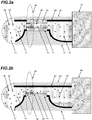
- FIGURE 2a and FIGURE 2b illustrate the principle of detection and the cross-section of a biosensor according to the invention.
- the system is composed of a nanochannel 210 linking a lateral input aperture 220 with a lateral output aperture 230.
- a driving component that can be external ( 241 ) or internal ( 242 ) is located next to the lateral output aperture 230.
- biomarkers 310 are immobilized on selectively functionalized nanochannel surfaces of one or both substrates 201 and 202. The other nanochannel surfaces and the lateral aperture surfaces may be protected by the deposition of a non-functionalized layer 203.
- the detection volume 520 has to be focused inside the nanochannel 210 such as the intersection volume defined by the volume of the nanochannel 210 and the detection volume 520 is maximal, and directly next to the lateral input aperture 220.
- the solution 300 containing the fluorescently labeled specific biomolecules 320 and non-specific biomolecules 330 is filled into the system from the lateral input aperture 220 by capillarity.
- the driving component 241 or 242 the solution 300 fills the driving component by absorption for example, leading to a forced convective flow across the biosensor.
- the driving component 241 or 242 achieves its maximum filling capacity, the convective flow stops and the system reaches equilibrium.
- biomolecules 320 interact with the biomarkers 310 immobilized inside the nanochannel 210 and may create molecular complexes 340.
- a concentration gradient is obtained across the nanochannel 210.
- the non-specific biomolecules 330 will diffuse in the nanochannel 210 but will not form molecular complexes with the immobilized biomarkers 310.
- Non-specific biomolecules 331 will be present in the lateral output aperture 230 , and some 332 may also be present inside the driving component 241 or 242.
- the immobilized fluorescently emitting complexes 340 and the diffusing fluorescently emitting biomolecules 330 diffusing across the optical detection volume are both detected by the optical system.
- the present invention is distinguishable from techniques currently being used to detect molecular interactions.
- the unique method of measuring the concentration of immobilized complexes across the selectively functionalized nanochannel being linked to lateral apertures is different from current techniques based on measuring interactions on a single surface or reservoir. These solutions do not benefit from the increased probability of interaction events that occur in the unique design presented in this patent.
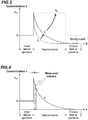
- FIGURE 3 shows the evolution of concentration with time across the biosensor when the solution contains specific biomolecules.
- a background concentration c 0 of fluorescently labeled molecules inside the lateral input aperture.
- Specific biomolecules that enter into the nanochannel interact quickly with the nanochannel functionalized surfaces, leading to an increase of concentration (dashed curve).
- the maximum concentration c sat corresponds to the case where, for a given x position, all biomarkers have interacted with specific biomolecules.
- the concentration gradient will tend to the t inf dotted curve, corresponding to the total saturation of the nanochannel biomarkers (dotted curve).
- FIGURE 4 illustrates the concentration gradient across the biosensor at a time t 1 corresponding to the case when the solution has already filled the biosensor as well as the absorbing component. Thanks to Brownian motion, the biomolecules continue to enter the nanochannel and continue to interact with the biomarkers, but depending on the background concentration c 0 , the transition to saturation t inf may be very long. This allows a stable measurement of the concentration profile across the nanochannel.
- the measurement volume (hatched area) corresponds to the intersection of the laser beam with a width b and the nanochannel.
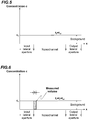
- FIGURE 5 shows the concentration evolution with time across the biosensor when the solution contains only non-specific biomolecules.
- a background concentration c 0 of fluorescently labeled molecules is present inside the lateral input aperture and the nanochannel. No further concentration increase is expected as there is no interaction with the functionalized surfaces. In this case, the concentration c 0 remains constant for all x positions and with time.
- FIGURE 6 illustrates the concentration gradient across the biosensor at a time t 1 , corresponding to the case when the solution contains no specific biomolecules and has already filled the biosensor as well as the absorbing component.
- the measurement volume (hatched area) corresponds to the intersection of the laser beam with a width b and the nanochannel.
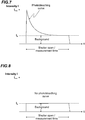
- FIGURE 7 shows the fluorescence intensity evolution with time during measurement, for a given position inside the nanochannel, when the solution contains specific biomolecules.
- the measurement starts when the shutter of the optical system opens.
- a standard photobleaching curve is obtained containing quantitative information on the number of immobilized and fluorescently-labeled molecules present within the measurement volume.
- FIGURE 8 shows the fluorescence intensity evolution with time during a measurement, for a given position inside the nanochannel, when the solution does not contain any specific biomolecules.
- the measurement starts when the shutter of the optical system opens. No photobleaching curve is obtained, since there are only diffusing fluorescently-labeled biomolecules inside the measurement volume leading to a constant background signal.
- FIGURE 9 shows the evolution of the convective flow of the solution inside the nanochannel in function of time.
- the nanochannel is filled by capillarity during a time t cap , which results in an increase of the flow velocity.
- the solution has completely filled the nanochannel and the flow is no more driven by capillarity but rather by absorption. This results in a change of flow velocity during a time t act .
- the solution flow inside the nanochannel tends to 0, and biomolecule movements are only due to Brownian motion. Measuring time t m should occur after the convective flow stopped.
- the device offers great improvements for the detection, enumeration, identification and characterization of biomolecules interacting or not with other immobilized biomolecules.
- Applications of the present invention can cover biomedical, biological or food analysis as well as fundamental studies in analytical and bioanalytical chemistry.
Landscapes
- Health & Medical Sciences (AREA)
- Chemical & Material Sciences (AREA)
- Immunology (AREA)
- Life Sciences & Earth Sciences (AREA)
- Engineering & Computer Science (AREA)
- Physics & Mathematics (AREA)
- General Health & Medical Sciences (AREA)
- Analytical Chemistry (AREA)
- General Physics & Mathematics (AREA)
- Hematology (AREA)
- Chemical Kinetics & Catalysis (AREA)
- Pathology (AREA)
- Biochemistry (AREA)
- Nuclear Medicine, Radiotherapy & Molecular Imaging (AREA)
- Nanotechnology (AREA)
- Molecular Biology (AREA)
- Clinical Laboratory Science (AREA)
- Dispersion Chemistry (AREA)
- Biomedical Technology (AREA)
- Urology & Nephrology (AREA)
- Composite Materials (AREA)
- Crystallography & Structural Chemistry (AREA)
- Materials Engineering (AREA)
- Condensed Matter Physics & Semiconductors (AREA)
- Optics & Photonics (AREA)
- Microbiology (AREA)
- Cell Biology (AREA)
- Food Science & Technology (AREA)
- Medicinal Chemistry (AREA)
- Biotechnology (AREA)
- Investigating, Analyzing Materials By Fluorescence Or Luminescence (AREA)
- Investigating Or Analysing Materials By The Use Of Chemical Reactions (AREA)
Claims (10)
- Biocapteur (200) pour détecter et quantifier des biomolécules marquées par fluorescence (320) ; ledit biocapteur (200) comprenant un nanocanal (210) défini entre deux substrats (201, 202) et contenant une ou plusieurs zones sélectivement fonctionnalisées (211) sur lesquelles sont immobilisés des biomarqueurs (310), ledit nanocanal étant en outre défini par une ouverture d'entrée latérale (220) et une ouverture de sortie latérale (230), ladite ouverture d'entrée (220) étant conçue pour laisser une solution contenant des biomolécules (320) entrer dans ledit nanocanal (210) caractérisé en ce que
ladite ouverture de sortie (230) contient ou est en contact avec un composant de commande (241, 242) adapté pour absorber ladite solution à travers ledit nanocanal (210) par capillarité. - Biocapteur (200) selon la revendication 1, lesdits biomarqueurs (310) interagissant biologiquement ou chimiquement avec des biomolécules spécifiques (320) et/ou n'interagissant pas avec des biomolécules non spécifiques (330) contenues dans ladite solution (300).
- Biocapteur (200) selon la revendication 1 ou 2, les substrats (201, 202) étant constitués d'un matériau choisi dans le groupe constitué par le silicium, le verre, le plastique et des composés oxydés.
- Biocapteur (200) selon l'une quelconque des revendications précédentes, les surfaces non fonctionnalisées à l'intérieur du nanocanal (210) et des ouvertures latérales (220, 230) contenant une mince couche de matériau choisi dans le groupe constitué de composés métalliques, plastiques et oxydés, ayant une épaisseur entre 1 nm et 1000 nm.
- Biocapteur (200) selon l'une quelconque des revendications précédentes, les ouvertures latérales (220, 230) ayant une surface de 100 nm2 à 20 mm2 et le nanocanal (210) une hauteur entre 2 nm et 1000 nm, une largeur entre 2 nm et 20 mm et une longueur entre 2 nm et 20 mm.
- Réseau comprenant plusieurs biocapteurs (200), chaque biocapteur étant selon l'une quelconque des revendications précédentes, lesdits biocapteurs (200) étant fixés à l'intérieur d'un système de capsules (101) ou sur une surface (102).
- Ensemble comprenant un ou plusieurs biocapteurs (200) selon l'une quelconque des revendications précédentes et comprenant des moyens optiques (500) pour l'excitation et la détection par fluorescence.
- Ensemble selon la revendication 7, ledit moyen optique (500) étant une unité de mesure de fluorescence comprenant un détecteur qui est un détecteur monophotonique, constitué d'un réseau de détecteurs (CMOS ou CCD), d'une photodiode à avalanche (APD) ou d'un tube photomultiplicateur (PMT).
- Procédé pour détecter et quantifier la présence de biomolécules marquées par fluorescence (320) dans une solution (300) comprenant les étapes suivantes :a) la fourniture d'au moins un biocapteur (200) selon l'une quelconque des revendications 1 à 5 ;b) le remplissage dudit au moins un biocapteur (200) depuis l'ouverture d'entrée latérale (220) vers l'ouverture de sortie latérale (230) en plaçant à travers le nanocanal (210) une solution (300) contenant des biomolécules (320, 330) marquées par fluorescence qui peuvent être spécifiques aux biomarqueurs (310) immobilisés dans le nanocanal ;c) la fourniture d'un système optique basé sur un faisceau laser (510) ;d) la détection de biomolécules spécifiques (320) immobilisées sur les biomarqueurs (310) à l'intérieur dudit nanocanal (210) par photo-blanchiment des fluophores fixés aux biomolécules (320) ainsi que la détermination du gradient de concentration sur la longueur du nanocanal (210).
- Procédé selon la revendication 9, lesdites biomolécules (320) étant des protéines, de l'ADN, de l'ARN, des anticorps, des acides aminés, des acides nucléiques, des enzymes, des molécules lipidiques, des peptides, des polysaccharides ou des virus.
Applications Claiming Priority (2)
| Application Number | Priority Date | Filing Date | Title |
|---|---|---|---|
| IB2011050979 | 2011-03-09 | ||
| PCT/IB2012/050527 WO2012120387A1 (fr) | 2011-03-09 | 2012-02-06 | Quantification rapide de biomolécules dans un biocapteur nanofluidique sélectivement fonctionnalisé et procédé associé |
Publications (2)
| Publication Number | Publication Date |
|---|---|
| EP2684027A1 EP2684027A1 (fr) | 2014-01-15 |
| EP2684027B1 true EP2684027B1 (fr) | 2019-12-11 |
Family
ID=45922721
Family Applications (1)
| Application Number | Title | Priority Date | Filing Date |
|---|---|---|---|
| EP12711449.4A Active EP2684027B1 (fr) | 2011-03-09 | 2012-02-06 | Quantification rapide de biomolécules dans un biocapteur nanofluidique sélectivement fonctionnalisé et procédé associé |
Country Status (10)
| Country | Link |
|---|---|
| US (1) | US9547004B2 (fr) |
| EP (1) | EP2684027B1 (fr) |
| JP (1) | JP6130306B2 (fr) |
| CN (1) | CN103502795B (fr) |
| AU (1) | AU2012226463B2 (fr) |
| BR (1) | BR112013022952B1 (fr) |
| CA (1) | CA2829178C (fr) |
| ES (1) | ES2767123T3 (fr) |
| PT (1) | PT2684027T (fr) |
| WO (1) | WO2012120387A1 (fr) |
Families Citing this family (12)
| Publication number | Priority date | Publication date | Assignee | Title |
|---|---|---|---|---|
| US9194838B2 (en) | 2010-03-03 | 2015-11-24 | Osaka University | Method and device for identifying nucleotide, and method and device for determining nucleotide sequence of polynucleotide |
| US9989526B2 (en) | 2013-07-17 | 2018-06-05 | Abionic Sa | Method and device for bioassays |
| CA2929929A1 (fr) | 2013-09-18 | 2015-03-26 | Quantum Biosystems Inc. | Dispositifs, systemes et procedes de sequencage de biomolecules |
| JP2015077652A (ja) | 2013-10-16 | 2015-04-23 | クオンタムバイオシステムズ株式会社 | ナノギャップ電極およびその製造方法 |
| CN105874320B (zh) * | 2013-12-13 | 2019-08-30 | 阿比奥尼克公司 | 用于纳米流体生物传感器的气体排空系统 |
| KR20160130380A (ko) * | 2014-01-24 | 2016-11-11 | 퀀텀 바이오시스템즈 가부시키가이샤 | 생체분자를 서열화하기 위한 디바이스, 시스템 및 방법 |
| CN106573240B (zh) * | 2014-07-03 | 2020-05-01 | 阿比奥尼克公司 | 用于诸如全血的流体试样的快速分子定量的胶囊 |
| CN104651500B (zh) * | 2015-01-30 | 2017-06-30 | 华东理工大学 | 气单胞菌溶素纳米孔通道的制备方法及其应用 |
| BR112018015698A2 (pt) | 2016-02-01 | 2018-12-26 | Prevencio Inc | ?métodos diagnósticos e prognósticos para doenças cardiovasculares e eventos? |
| ES2877193T3 (es) | 2016-04-27 | 2021-11-16 | Quantum Biosystems Inc | Sistemas y métodos para la medición y secuenciación de biomoléculas |
| CN113324958A (zh) * | 2021-05-19 | 2021-08-31 | 江南大学 | 一种可视化检测重金属汞的快检毛细管及其制备方法和应用 |
| DE102022208445A1 (de) * | 2022-08-15 | 2024-02-15 | Carl Zeiss Microscopy Gmbh | Verbessertes FCS-Verfahren |
Family Cites Families (14)
| Publication number | Priority date | Publication date | Assignee | Title |
|---|---|---|---|---|
| CH182409A (de) | 1934-03-03 | 1936-02-15 | Ig Farbenindustrie Ag | Vaselinähnliches Produkt. |
| DE3588124T2 (de) * | 1984-06-13 | 1997-02-20 | Applied Research Systems | Vorrichtung, mit Verwendung in chemischen Prüfverfahren |
| US4775637A (en) * | 1984-12-10 | 1988-10-04 | Purtec Limited | An immunoassay apparatus having at least two waveguides and method for its use |
| US5637469A (en) * | 1992-05-01 | 1997-06-10 | Trustees Of The University Of Pennsylvania | Methods and apparatus for the detection of an analyte utilizing mesoscale flow systems |
| JP4010171B2 (ja) * | 2001-04-16 | 2007-11-21 | 東ソー株式会社 | 微小流路構造体、その製造方法及びその用途 |
| CN1690711B (zh) * | 2004-04-23 | 2010-04-14 | 中国人民解放军军事医学科学院微生物流行病研究所 | 基于上转换发光技术免疫层析试纸条 |
| FR2890173B1 (fr) * | 2005-08-23 | 2008-02-22 | Vedalab Sa | Dispositif de determination d'un analyte dans un echantillon liquide par un test sandwich et un test de competition |
| US8586316B2 (en) | 2008-02-07 | 2013-11-19 | The Board Of Regents Of The University Of Texas System | Methods for detecting molecule-molecule interactions with a single detection channel |
| WO2010042007A1 (fr) | 2008-10-10 | 2010-04-15 | Jonas Tegenfeldt | Procédé de cartographie du rapport at/gc local sur la longueur d'un fragment d'adn |
| KR101226957B1 (ko) | 2008-12-08 | 2013-02-07 | 한국전자통신연구원 | 일회용 진단 키트 |
| AU2010206657A1 (en) | 2009-01-23 | 2011-08-11 | Drexel University | Apparatus and methods for detecting inflammation using quantum dots |
| US9810680B2 (en) * | 2009-04-16 | 2017-11-07 | Nanonex Corporation | Nanogap electronic detector for measuring properties of a biomolecule stretched in a nanochannel, and method thereof |
| US8246799B2 (en) * | 2009-05-28 | 2012-08-21 | Nabsys, Inc. | Devices and methods for analyzing biomolecules and probes bound thereto |
| EP2504684B1 (fr) * | 2009-11-27 | 2023-11-15 | Ecole Polytechnique Federale De Lausanne (Epfl) | Biocapteur nanofluidique et son utilisation à des fins de mesure rapide d'interactions biomoléculaires en solution et procédés associés |
-
2012
- 2012-02-06 EP EP12711449.4A patent/EP2684027B1/fr active Active
- 2012-02-06 US US14/003,277 patent/US9547004B2/en active Active
- 2012-02-06 WO PCT/IB2012/050527 patent/WO2012120387A1/fr not_active Ceased
- 2012-02-06 AU AU2012226463A patent/AU2012226463B2/en active Active
- 2012-02-06 ES ES12711449T patent/ES2767123T3/es active Active
- 2012-02-06 JP JP2013557188A patent/JP6130306B2/ja active Active
- 2012-02-06 CN CN201280012408.XA patent/CN103502795B/zh active Active
- 2012-02-06 CA CA2829178A patent/CA2829178C/fr active Active
- 2012-02-06 BR BR112013022952-7A patent/BR112013022952B1/pt active IP Right Grant
- 2012-02-06 PT PT127114494T patent/PT2684027T/pt unknown
Non-Patent Citations (1)
| Title |
|---|
| None * |
Also Published As
| Publication number | Publication date |
|---|---|
| AU2012226463A1 (en) | 2013-10-10 |
| CN103502795A (zh) | 2014-01-08 |
| CA2829178A1 (fr) | 2012-09-13 |
| JP2014507668A (ja) | 2014-03-27 |
| EP2684027A1 (fr) | 2014-01-15 |
| BR112013022952A2 (pt) | 2016-12-06 |
| CN103502795B (zh) | 2016-02-24 |
| US20140256573A1 (en) | 2014-09-11 |
| JP6130306B2 (ja) | 2017-05-17 |
| PT2684027T (pt) | 2020-01-27 |
| CA2829178C (fr) | 2020-01-07 |
| BR112013022952B1 (pt) | 2020-09-08 |
| US9547004B2 (en) | 2017-01-17 |
| HK1187982A1 (zh) | 2014-04-17 |
| WO2012120387A1 (fr) | 2012-09-13 |
| ES2767123T3 (es) | 2020-06-16 |
| AU2012226463B2 (en) | 2015-03-12 |
Similar Documents
| Publication | Publication Date | Title |
|---|---|---|
| CA2829178C (fr) | Quantification rapide de biomolecules dans un biocapteur nanofluidique selectivement fonctionnalise et procede associe | |
| JP5685601B2 (ja) | ナノ流体バイオセンサ及び溶液中における生体分子の相互作用の迅速測定のためのその活用及び方法 | |
| EP3021968B1 (fr) | Procédé et dispositif destinés à des essais biologiques | |
| CA2932577C (fr) | Systeme d'evacuation de gaz pour biocapteur nanofluidique | |
| HK1187982B (en) | Rapid quantification of biomolecules in a selectively functionalized nanofluidic biosensor and method thereof | |
| HK1219456B (en) | Method and device for bioassays | |
| HK1175527B (en) | Nanofluidic biosensor and its use for rapid measurement of biomolecular interactions in solution and methods |
Legal Events
| Date | Code | Title | Description |
|---|---|---|---|
| PUAI | Public reference made under article 153(3) epc to a published international application that has entered the european phase |
Free format text: ORIGINAL CODE: 0009012 |
|
| 17P | Request for examination filed |
Effective date: 20131004 |
|
| AK | Designated contracting states |
Kind code of ref document: A1 Designated state(s): AL AT BE BG CH CY CZ DE DK EE ES FI FR GB GR HR HU IE IS IT LI LT LU LV MC MK MT NL NO PL PT RO RS SE SI SK SM TR |
|
| DAX | Request for extension of the european patent (deleted) | ||
| REG | Reference to a national code |
Ref country code: DE Ref legal event code: R079 Ref document number: 602012066366 Country of ref document: DE Free format text: PREVIOUS MAIN CLASS: G01N0021030000 Ipc: B82Y0030000000 |
|
| RIC1 | Information provided on ipc code assigned before grant |
Ipc: G01N 21/03 20060101ALI20190529BHEP Ipc: B82Y 30/00 20110101AFI20190529BHEP Ipc: B01L 3/00 20060101ALI20190529BHEP Ipc: B82Y 35/00 20110101ALI20190529BHEP Ipc: G01N 33/543 20060101ALI20190529BHEP Ipc: G01N 21/64 20060101ALI20190529BHEP Ipc: B82Y 15/00 20110101ALI20190529BHEP Ipc: G01N 21/05 20060101ALI20190529BHEP |
|
| GRAP | Despatch of communication of intention to grant a patent |
Free format text: ORIGINAL CODE: EPIDOSNIGR1 |
|
| STAA | Information on the status of an ep patent application or granted ep patent |
Free format text: STATUS: GRANT OF PATENT IS INTENDED |
|
| INTG | Intention to grant announced |
Effective date: 20190710 |
|
| GRAS | Grant fee paid |
Free format text: ORIGINAL CODE: EPIDOSNIGR3 |
|
| GRAA | (expected) grant |
Free format text: ORIGINAL CODE: 0009210 |
|
| STAA | Information on the status of an ep patent application or granted ep patent |
Free format text: STATUS: THE PATENT HAS BEEN GRANTED |
|
| RAP1 | Party data changed (applicant data changed or rights of an application transferred) |
Owner name: ABIONIC SA |
|
| RIN1 | Information on inventor provided before grant (corrected) |
Inventor name: MAYOR, ANNICK Inventor name: MAERKI, IWAN Inventor name: DURAND, NICOLAS Inventor name: LASSER, THEO Inventor name: BROILLET, STEPHANE |
|
| AK | Designated contracting states |
Kind code of ref document: B1 Designated state(s): AL AT BE BG CH CY CZ DE DK EE ES FI FR GB GR HR HU IE IS IT LI LT LU LV MC MK MT NL NO PL PT RO RS SE SI SK SM TR |
|
| REG | Reference to a national code |
Ref country code: GB Ref legal event code: FG4D |
|
| REG | Reference to a national code |
Ref country code: CH Ref legal event code: EP |
|
| REG | Reference to a national code |
Ref country code: AT Ref legal event code: REF Ref document number: 1212003 Country of ref document: AT Kind code of ref document: T Effective date: 20191215 |
|
| REG | Reference to a national code |
Ref country code: CH Ref legal event code: NV Representative=s name: ANDRE ROLAND S.A., CH |
|
| REG | Reference to a national code |
Ref country code: DE Ref legal event code: R096 Ref document number: 602012066366 Country of ref document: DE |
|
| REG | Reference to a national code |
Ref country code: IE Ref legal event code: FG4D |
|
| REG | Reference to a national code |
Ref country code: PT Ref legal event code: SC4A Ref document number: 2684027 Country of ref document: PT Date of ref document: 20200127 Kind code of ref document: T Free format text: AVAILABILITY OF NATIONAL TRANSLATION Effective date: 20200117 |
|
| REG | Reference to a national code |
Ref country code: SE Ref legal event code: TRGR |
|
| REG | Reference to a national code |
Ref country code: NL Ref legal event code: FP |
|
| REG | Reference to a national code |
Ref country code: LT Ref legal event code: MG4D |
|
| PG25 | Lapsed in a contracting state [announced via postgrant information from national office to epo] |
Ref country code: GR Free format text: LAPSE BECAUSE OF FAILURE TO SUBMIT A TRANSLATION OF THE DESCRIPTION OR TO PAY THE FEE WITHIN THE PRESCRIBED TIME-LIMIT Effective date: 20200312 Ref country code: NO Free format text: LAPSE BECAUSE OF FAILURE TO SUBMIT A TRANSLATION OF THE DESCRIPTION OR TO PAY THE FEE WITHIN THE PRESCRIBED TIME-LIMIT Effective date: 20200311 Ref country code: BG Free format text: LAPSE BECAUSE OF FAILURE TO SUBMIT A TRANSLATION OF THE DESCRIPTION OR TO PAY THE FEE WITHIN THE PRESCRIBED TIME-LIMIT Effective date: 20200311 Ref country code: LT Free format text: LAPSE BECAUSE OF FAILURE TO SUBMIT A TRANSLATION OF THE DESCRIPTION OR TO PAY THE FEE WITHIN THE PRESCRIBED TIME-LIMIT Effective date: 20191211 Ref country code: LV Free format text: LAPSE BECAUSE OF FAILURE TO SUBMIT A TRANSLATION OF THE DESCRIPTION OR TO PAY THE FEE WITHIN THE PRESCRIBED TIME-LIMIT Effective date: 20191211 Ref country code: FI Free format text: LAPSE BECAUSE OF FAILURE TO SUBMIT A TRANSLATION OF THE DESCRIPTION OR TO PAY THE FEE WITHIN THE PRESCRIBED TIME-LIMIT Effective date: 20191211 |
|
| PG25 | Lapsed in a contracting state [announced via postgrant information from national office to epo] |
Ref country code: RS Free format text: LAPSE BECAUSE OF FAILURE TO SUBMIT A TRANSLATION OF THE DESCRIPTION OR TO PAY THE FEE WITHIN THE PRESCRIBED TIME-LIMIT Effective date: 20191211 Ref country code: HR Free format text: LAPSE BECAUSE OF FAILURE TO SUBMIT A TRANSLATION OF THE DESCRIPTION OR TO PAY THE FEE WITHIN THE PRESCRIBED TIME-LIMIT Effective date: 20191211 |
|
| REG | Reference to a national code |
Ref country code: ES Ref legal event code: FG2A Ref document number: 2767123 Country of ref document: ES Kind code of ref document: T3 Effective date: 20200616 |
|
| PG25 | Lapsed in a contracting state [announced via postgrant information from national office to epo] |
Ref country code: AL Free format text: LAPSE BECAUSE OF FAILURE TO SUBMIT A TRANSLATION OF THE DESCRIPTION OR TO PAY THE FEE WITHIN THE PRESCRIBED TIME-LIMIT Effective date: 20191211 |
|
| PG25 | Lapsed in a contracting state [announced via postgrant information from national office to epo] |
Ref country code: CZ Free format text: LAPSE BECAUSE OF FAILURE TO SUBMIT A TRANSLATION OF THE DESCRIPTION OR TO PAY THE FEE WITHIN THE PRESCRIBED TIME-LIMIT Effective date: 20191211 Ref country code: RO Free format text: LAPSE BECAUSE OF FAILURE TO SUBMIT A TRANSLATION OF THE DESCRIPTION OR TO PAY THE FEE WITHIN THE PRESCRIBED TIME-LIMIT Effective date: 20191211 Ref country code: EE Free format text: LAPSE BECAUSE OF FAILURE TO SUBMIT A TRANSLATION OF THE DESCRIPTION OR TO PAY THE FEE WITHIN THE PRESCRIBED TIME-LIMIT Effective date: 20191211 |
|
| PG25 | Lapsed in a contracting state [announced via postgrant information from national office to epo] |
Ref country code: SM Free format text: LAPSE BECAUSE OF FAILURE TO SUBMIT A TRANSLATION OF THE DESCRIPTION OR TO PAY THE FEE WITHIN THE PRESCRIBED TIME-LIMIT Effective date: 20191211 Ref country code: SK Free format text: LAPSE BECAUSE OF FAILURE TO SUBMIT A TRANSLATION OF THE DESCRIPTION OR TO PAY THE FEE WITHIN THE PRESCRIBED TIME-LIMIT Effective date: 20191211 Ref country code: IS Free format text: LAPSE BECAUSE OF FAILURE TO SUBMIT A TRANSLATION OF THE DESCRIPTION OR TO PAY THE FEE WITHIN THE PRESCRIBED TIME-LIMIT Effective date: 20200411 |
|
| REG | Reference to a national code |
Ref country code: DE Ref legal event code: R097 Ref document number: 602012066366 Country of ref document: DE |
|
| PLBE | No opposition filed within time limit |
Free format text: ORIGINAL CODE: 0009261 |
|
| STAA | Information on the status of an ep patent application or granted ep patent |
Free format text: STATUS: NO OPPOSITION FILED WITHIN TIME LIMIT |
|
| PG25 | Lapsed in a contracting state [announced via postgrant information from national office to epo] |
Ref country code: MC Free format text: LAPSE BECAUSE OF FAILURE TO SUBMIT A TRANSLATION OF THE DESCRIPTION OR TO PAY THE FEE WITHIN THE PRESCRIBED TIME-LIMIT Effective date: 20191211 Ref country code: LU Free format text: LAPSE BECAUSE OF NON-PAYMENT OF DUE FEES Effective date: 20200206 Ref country code: DK Free format text: LAPSE BECAUSE OF FAILURE TO SUBMIT A TRANSLATION OF THE DESCRIPTION OR TO PAY THE FEE WITHIN THE PRESCRIBED TIME-LIMIT Effective date: 20191211 |
|
| 26N | No opposition filed |
Effective date: 20200914 |
|
| PG25 | Lapsed in a contracting state [announced via postgrant information from national office to epo] |
Ref country code: SI Free format text: LAPSE BECAUSE OF FAILURE TO SUBMIT A TRANSLATION OF THE DESCRIPTION OR TO PAY THE FEE WITHIN THE PRESCRIBED TIME-LIMIT Effective date: 20191211 Ref country code: PL Free format text: LAPSE BECAUSE OF FAILURE TO SUBMIT A TRANSLATION OF THE DESCRIPTION OR TO PAY THE FEE WITHIN THE PRESCRIBED TIME-LIMIT Effective date: 20191211 |
|
| PG25 | Lapsed in a contracting state [announced via postgrant information from national office to epo] |
Ref country code: IE Free format text: LAPSE BECAUSE OF NON-PAYMENT OF DUE FEES Effective date: 20200206 |
|
| REG | Reference to a national code |
Ref country code: AT Ref legal event code: UEP Ref document number: 1212003 Country of ref document: AT Kind code of ref document: T Effective date: 20191211 |
|
| PG25 | Lapsed in a contracting state [announced via postgrant information from national office to epo] |
Ref country code: MT Free format text: LAPSE BECAUSE OF FAILURE TO SUBMIT A TRANSLATION OF THE DESCRIPTION OR TO PAY THE FEE WITHIN THE PRESCRIBED TIME-LIMIT Effective date: 20191211 Ref country code: CY Free format text: LAPSE BECAUSE OF FAILURE TO SUBMIT A TRANSLATION OF THE DESCRIPTION OR TO PAY THE FEE WITHIN THE PRESCRIBED TIME-LIMIT Effective date: 20191211 |
|
| PG25 | Lapsed in a contracting state [announced via postgrant information from national office to epo] |
Ref country code: MK Free format text: LAPSE BECAUSE OF FAILURE TO SUBMIT A TRANSLATION OF THE DESCRIPTION OR TO PAY THE FEE WITHIN THE PRESCRIBED TIME-LIMIT Effective date: 20191211 |
|
| P01 | Opt-out of the competence of the unified patent court (upc) registered |
Effective date: 20230515 |
|
| REG | Reference to a national code |
Ref country code: GB Ref legal event code: 732E Free format text: REGISTERED BETWEEN 20230810 AND 20230816 |
|
| REG | Reference to a national code |
Ref country code: NL Ref legal event code: RC Free format text: DETAILS LICENCE OR PLEDGE: RIGHT OF PLEDGE, ESTABLISHED Name of requester: MARCEL SEVERIN Effective date: 20230901 |
|
| REG | Reference to a national code |
Ref country code: BE Ref legal event code: RC Free format text: DETAILS PLEDGE: RIGHT OF PLEDGE, ESTABLISHED Effective date: 20231023 |
|
| PGFP | Annual fee paid to national office [announced via postgrant information from national office to epo] |
Ref country code: ES Payment date: 20250331 Year of fee payment: 14 |
|
| REG | Reference to a national code |
Ref country code: CH Ref legal event code: U11 Free format text: ST27 STATUS EVENT CODE: U-0-0-U10-U11 (AS PROVIDED BY THE NATIONAL OFFICE) Effective date: 20260301 |
|
| PGFP | Annual fee paid to national office [announced via postgrant information from national office to epo] |
Ref country code: NL Payment date: 20260218 Year of fee payment: 15 |
|
| PGFP | Annual fee paid to national office [announced via postgrant information from national office to epo] |
Ref country code: SE Payment date: 20260218 Year of fee payment: 15 |
|
| PGFP | Annual fee paid to national office [announced via postgrant information from national office to epo] |
Ref country code: GB Payment date: 20260219 Year of fee payment: 15 |
|
| PGFP | Annual fee paid to national office [announced via postgrant information from national office to epo] |
Ref country code: DE Payment date: 20260218 Year of fee payment: 15 |
|
| PGFP | Annual fee paid to national office [announced via postgrant information from national office to epo] |
Ref country code: AT Payment date: 20260219 Year of fee payment: 15 |
|
| PGFP | Annual fee paid to national office [announced via postgrant information from national office to epo] |
Ref country code: BE Payment date: 20260218 Year of fee payment: 15 Ref country code: IT Payment date: 20260224 Year of fee payment: 15 |
|
| PGFP | Annual fee paid to national office [announced via postgrant information from national office to epo] |
Ref country code: FR Payment date: 20260218 Year of fee payment: 15 |
|
| PGFP | Annual fee paid to national office [announced via postgrant information from national office to epo] |
Ref country code: TR Payment date: 20260202 Year of fee payment: 15 |
|
| PGFP | Annual fee paid to national office [announced via postgrant information from national office to epo] |
Ref country code: CH Payment date: 20260301 Year of fee payment: 15 Ref country code: PT Payment date: 20260129 Year of fee payment: 15 |