EP2684985B1 - Procédé de fabrication d'un élément pressé à chaud qui utilise une tôle d'acier - Google Patents
Procédé de fabrication d'un élément pressé à chaud qui utilise une tôle d'acier Download PDFInfo
- Publication number
- EP2684985B1 EP2684985B1 EP12754523.4A EP12754523A EP2684985B1 EP 2684985 B1 EP2684985 B1 EP 2684985B1 EP 12754523 A EP12754523 A EP 12754523A EP 2684985 B1 EP2684985 B1 EP 2684985B1
- Authority
- EP
- European Patent Office
- Prior art keywords
- steel sheet
- hot
- coated layer
- content
- pressed
- Prior art date
- Legal status (The legal status is an assumption and is not a legal conclusion. Google has not performed a legal analysis and makes no representation as to the accuracy of the status listed.)
- Not-in-force
Links
Images
Classifications
-
- C—CHEMISTRY; METALLURGY
- C22—METALLURGY; FERROUS OR NON-FERROUS ALLOYS; TREATMENT OF ALLOYS OR NON-FERROUS METALS
- C22C—ALLOYS
- C22C18/00—Alloys based on zinc
-
- B—PERFORMING OPERATIONS; TRANSPORTING
- B21—MECHANICAL METAL-WORKING WITHOUT ESSENTIALLY REMOVING MATERIAL; PUNCHING METAL
- B21D—WORKING OR PROCESSING OF SHEET METAL OR METAL TUBES, RODS OR PROFILES WITHOUT ESSENTIALLY REMOVING MATERIAL; PUNCHING METAL
- B21D22/00—Shaping without cutting, by stamping, spinning, or deep-drawing
- B21D22/02—Stamping using rigid devices or tools
- B21D22/022—Stamping using rigid devices or tools by heating the blank or stamping associated with heat treatment
-
- B—PERFORMING OPERATIONS; TRANSPORTING
- B32—LAYERED PRODUCTS
- B32B—LAYERED PRODUCTS, i.e. PRODUCTS BUILT-UP OF STRATA OF FLAT OR NON-FLAT, e.g. CELLULAR OR HONEYCOMB, FORM
- B32B15/00—Layered products comprising a layer of metal
- B32B15/01—Layered products comprising a layer of metal all layers being exclusively metallic
- B32B15/012—Layered products comprising a layer of metal all layers being exclusively metallic one layer being formed of an iron alloy or steel, another layer being formed of aluminium or an aluminium alloy
-
- B—PERFORMING OPERATIONS; TRANSPORTING
- B32—LAYERED PRODUCTS
- B32B—LAYERED PRODUCTS, i.e. PRODUCTS BUILT-UP OF STRATA OF FLAT OR NON-FLAT, e.g. CELLULAR OR HONEYCOMB, FORM
- B32B15/00—Layered products comprising a layer of metal
- B32B15/01—Layered products comprising a layer of metal all layers being exclusively metallic
- B32B15/013—Layered products comprising a layer of metal all layers being exclusively metallic one layer being formed of an iron alloy or steel, another layer being formed of a metal other than iron or aluminium
-
- B—PERFORMING OPERATIONS; TRANSPORTING
- B32—LAYERED PRODUCTS
- B32B—LAYERED PRODUCTS, i.e. PRODUCTS BUILT-UP OF STRATA OF FLAT OR NON-FLAT, e.g. CELLULAR OR HONEYCOMB, FORM
- B32B15/00—Layered products comprising a layer of metal
- B32B15/01—Layered products comprising a layer of metal all layers being exclusively metallic
- B32B15/013—Layered products comprising a layer of metal all layers being exclusively metallic one layer being formed of an iron alloy or steel, another layer being formed of a metal other than iron or aluminium
- B32B15/015—Layered products comprising a layer of metal all layers being exclusively metallic one layer being formed of an iron alloy or steel, another layer being formed of a metal other than iron or aluminium the said other metal being copper or nickel or an alloy thereof
-
- C—CHEMISTRY; METALLURGY
- C21—METALLURGY OF IRON
- C21D—MODIFYING THE PHYSICAL STRUCTURE OF FERROUS METALS; GENERAL DEVICES FOR HEAT TREATMENT OF FERROUS OR NON-FERROUS METALS OR ALLOYS; MAKING METAL MALLEABLE, e.g. BY DECARBURISATION OR TEMPERING
- C21D1/00—General methods or devices for heat treatment, e.g. annealing, hardening, quenching or tempering
- C21D1/18—Hardening; Quenching with or without subsequent tempering
-
- C—CHEMISTRY; METALLURGY
- C21—METALLURGY OF IRON
- C21D—MODIFYING THE PHYSICAL STRUCTURE OF FERROUS METALS; GENERAL DEVICES FOR HEAT TREATMENT OF FERROUS OR NON-FERROUS METALS OR ALLOYS; MAKING METAL MALLEABLE, e.g. BY DECARBURISATION OR TEMPERING
- C21D1/00—General methods or devices for heat treatment, e.g. annealing, hardening, quenching or tempering
- C21D1/62—Quenching devices
- C21D1/673—Quenching devices for die quenching
-
- C—CHEMISTRY; METALLURGY
- C22—METALLURGY; FERROUS OR NON-FERROUS ALLOYS; TREATMENT OF ALLOYS OR NON-FERROUS METALS
- C22C—ALLOYS
- C22C21/00—Alloys based on aluminium
- C22C21/02—Alloys based on aluminium with silicon as the next major constituent
-
- C—CHEMISTRY; METALLURGY
- C22—METALLURGY; FERROUS OR NON-FERROUS ALLOYS; TREATMENT OF ALLOYS OR NON-FERROUS METALS
- C22C—ALLOYS
- C22C38/00—Ferrous alloys, e.g. steel alloys
- C22C38/001—Ferrous alloys, e.g. steel alloys containing N
-
- C—CHEMISTRY; METALLURGY
- C22—METALLURGY; FERROUS OR NON-FERROUS ALLOYS; TREATMENT OF ALLOYS OR NON-FERROUS METALS
- C22C—ALLOYS
- C22C38/00—Ferrous alloys, e.g. steel alloys
- C22C38/02—Ferrous alloys, e.g. steel alloys containing silicon
-
- C—CHEMISTRY; METALLURGY
- C22—METALLURGY; FERROUS OR NON-FERROUS ALLOYS; TREATMENT OF ALLOYS OR NON-FERROUS METALS
- C22C—ALLOYS
- C22C38/00—Ferrous alloys, e.g. steel alloys
- C22C38/04—Ferrous alloys, e.g. steel alloys containing manganese
-
- C—CHEMISTRY; METALLURGY
- C22—METALLURGY; FERROUS OR NON-FERROUS ALLOYS; TREATMENT OF ALLOYS OR NON-FERROUS METALS
- C22C—ALLOYS
- C22C38/00—Ferrous alloys, e.g. steel alloys
- C22C38/06—Ferrous alloys, e.g. steel alloys containing aluminium
-
- C—CHEMISTRY; METALLURGY
- C22—METALLURGY; FERROUS OR NON-FERROUS ALLOYS; TREATMENT OF ALLOYS OR NON-FERROUS METALS
- C22C—ALLOYS
- C22C38/00—Ferrous alloys, e.g. steel alloys
- C22C38/18—Ferrous alloys, e.g. steel alloys containing chromium
- C22C38/28—Ferrous alloys, e.g. steel alloys containing chromium with titanium or zirconium
-
- C—CHEMISTRY; METALLURGY
- C22—METALLURGY; FERROUS OR NON-FERROUS ALLOYS; TREATMENT OF ALLOYS OR NON-FERROUS METALS
- C22C—ALLOYS
- C22C38/00—Ferrous alloys, e.g. steel alloys
- C22C38/18—Ferrous alloys, e.g. steel alloys containing chromium
- C22C38/32—Ferrous alloys, e.g. steel alloys containing chromium with boron
-
- C—CHEMISTRY; METALLURGY
- C22—METALLURGY; FERROUS OR NON-FERROUS ALLOYS; TREATMENT OF ALLOYS OR NON-FERROUS METALS
- C22C—ALLOYS
- C22C38/00—Ferrous alloys, e.g. steel alloys
- C22C38/60—Ferrous alloys, e.g. steel alloys containing lead, selenium, tellurium, or antimony, or more than 0.04% by weight of sulfur
-
- C—CHEMISTRY; METALLURGY
- C23—COATING METALLIC MATERIAL; COATING MATERIAL WITH METALLIC MATERIAL; CHEMICAL SURFACE TREATMENT; DIFFUSION TREATMENT OF METALLIC MATERIAL; COATING BY VACUUM EVAPORATION, BY SPUTTERING, BY ION IMPLANTATION OR BY CHEMICAL VAPOUR DEPOSITION, IN GENERAL; INHIBITING CORROSION OF METALLIC MATERIAL OR INCRUSTATION IN GENERAL
- C23C—COATING METALLIC MATERIAL; COATING MATERIAL WITH METALLIC MATERIAL; SURFACE TREATMENT OF METALLIC MATERIAL BY DIFFUSION INTO THE SURFACE, BY CHEMICAL CONVERSION OR SUBSTITUTION; COATING BY VACUUM EVAPORATION, BY SPUTTERING, BY ION IMPLANTATION OR BY CHEMICAL VAPOUR DEPOSITION, IN GENERAL
- C23C30/00—Coating with metallic material characterised only by the composition of the metallic material, i.e. not characterised by the coating process
-
- C—CHEMISTRY; METALLURGY
- C25—ELECTROLYTIC OR ELECTROPHORETIC PROCESSES; APPARATUS THEREFOR
- C25D—PROCESSES FOR THE ELECTROLYTIC OR ELECTROPHORETIC PRODUCTION OF COATINGS; ELECTROFORMING; APPARATUS THEREFOR
- C25D5/00—Electroplating characterised by the process; Pretreatment or after-treatment of workpieces
- C25D5/48—After-treatment of electroplated surfaces
- C25D5/50—After-treatment of electroplated surfaces by heat-treatment
-
- C—CHEMISTRY; METALLURGY
- C25—ELECTROLYTIC OR ELECTROPHORETIC PROCESSES; APPARATUS THEREFOR
- C25D—PROCESSES FOR THE ELECTROLYTIC OR ELECTROPHORETIC PRODUCTION OF COATINGS; ELECTROFORMING; APPARATUS THEREFOR
- C25D7/00—Electroplating characterised by the article coated
- C25D7/06—Wires; Strips; Foils
- C25D7/0614—Strips or foils
-
- C—CHEMISTRY; METALLURGY
- C25—ELECTROLYTIC OR ELECTROPHORETIC PROCESSES; APPARATUS THEREFOR
- C25D—PROCESSES FOR THE ELECTROLYTIC OR ELECTROPHORETIC PRODUCTION OF COATINGS; ELECTROFORMING; APPARATUS THEREFOR
- C25D3/00—Electroplating: Baths therefor
- C25D3/02—Electroplating: Baths therefor from solutions
- C25D3/04—Electroplating: Baths therefor from solutions of chromium
-
- C—CHEMISTRY; METALLURGY
- C25—ELECTROLYTIC OR ELECTROPHORETIC PROCESSES; APPARATUS THEREFOR
- C25D—PROCESSES FOR THE ELECTROLYTIC OR ELECTROPHORETIC PRODUCTION OF COATINGS; ELECTROFORMING; APPARATUS THEREFOR
- C25D3/00—Electroplating: Baths therefor
- C25D3/02—Electroplating: Baths therefor from solutions
- C25D3/12—Electroplating: Baths therefor from solutions of nickel or cobalt
-
- C—CHEMISTRY; METALLURGY
- C25—ELECTROLYTIC OR ELECTROPHORETIC PROCESSES; APPARATUS THEREFOR
- C25D—PROCESSES FOR THE ELECTROLYTIC OR ELECTROPHORETIC PRODUCTION OF COATINGS; ELECTROFORMING; APPARATUS THEREFOR
- C25D3/00—Electroplating: Baths therefor
- C25D3/02—Electroplating: Baths therefor from solutions
- C25D3/56—Electroplating: Baths therefor from solutions of alloys
- C25D3/562—Electroplating: Baths therefor from solutions of alloys containing more than 50% by weight of iron or nickel or cobalt
Definitions
- the present invention relates to a method for manufacturing steel sheets to be hot-pressed suitable for suspension members and body structure members of an automobile which are manufactured by using a hot pressing technique and to methods for manufacturing hot-pressed members from the steel sheets.
- Patent Literature 1 discloses a manufacturing method called hot pressing technique for ensuring not only increased formability but also increased strength of a steel sheet by heating the steel sheet and then placing the steel sheet in a mold including a die and a punch in which the steel sheet is deformed and simultaneously rapidly cooled.
- hot pressing technique however, scale (iron oxide) is generated on the surface of the steel sheet, because the steel sheet is heated up to a high temperature around 950°C before hot pressing is performed.
- the scale causes damage to the mold or to the surface of the member after hot pressing has been performed by peeling off from the surface of the steel sheet during hot pressing.
- the scale left on the surface of the member also results in a poor appearance and poor paint adhesion.
- the scale on the surface of the member is usually removed by pickling or shot blasting, which involves using a complicated manufacturing process and results in a decrease in productivity. Furthermore, although sufficient corrosion resistance is also required for suspension members and body structure members of an automobile, the corrosion resistance of the hot-pressed members manufactured by the process described above is very unsatisfactory, because the hot-pressed members are not provided with an anti-corrosion film such as a coated layer.
- Patent Literature 2 discloses a method for manufacturing a hot-pressed member having good corrosion resistance which is coated with a Zn-Fe base alloy or a Zn-Fe-Al base alloy by hot-pressing a steel sheet coated with Zn or a Zn base alloy.
- Patent Literature 3 discloses a steel sheet for heat treatment which has a specific composition and which is provided with a coated layer of a Fe-Zn alloy the Fe content of which is from 13 to 80%, the Al content of which is not more than 0.4%, and the Zn coating weight of which is from 10 to 65 g/m 2 .
- a further method for making coated structural automotive components is disclosed in US 2006/130940 A1 .
- An object of the present invention is to provide a method for manufacturing a hot-pressed member from a steel sheet which has not only sufficient resistance to oxidation in order to suppress generation of scale or ZnO during hot pressing but also sufficient resistance to liquid metal brittleness in order to prevent the occurrence of liquid metal embrittlement cracking caused by an element in a coated layer.
- the present inventors diligently conducted a study on a steel sheet to be hot-pressed for the object described above, and as a result, it was clarified that it is effective to provide the surface of the steel sheet with a coated layer the melting point of which is not lower than 800°C and the coating weight of which is not less than 45 g/m 2 , in order to obtain sufficient resistance to oxidation and liquid metal brittleness.
- the present invention which was completed on the basis of the knowledge described above, provides a method for manufacturing a steel sheet to be hot-pressed which has on the surface thereof a coated layer the melting point of which is not lower than 800°C and the coating weight of which per side is from 45 to 90 g/m 2 .
- the coated layer is preferably an electroplated layer in the steel sheet to be hot-pressed according to the present invention.
- the coated steel sheet is heated up to a temperature in the range of the Ac 3 transformation point to 1000°C at a heating rate not less than 3°C/s.
- the time the steel sheet stays at a temperature not lower than the melting point of the coated layer be no longer than 200 s or that the heating rate be not less than 30°C/s.
- a steel sheet to be hot-pressed having not only sufficient resistance to oxidation in order to suppress generation of scale or ZnO during hot pressing but also sufficient resistance to liquid metal brittleness in order to prevent liquid metal embrittlement cracking caused by an element in a coated layer.
- the hot-pressed members manufactured by the method according to the present invention from the below described steel sheet to be hot-pressed are suitable for suspension members and body structure members of an automobile, because they not only have an excellent appearance and paint adhesion but also prevent the occurrence of liquid metal embrittlement cracking caused by an element in a coated layer.
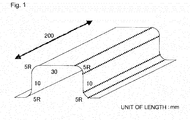
- Fig. 1 illustrates the shape of the hat-type member manufactured in the example of the present invention. Description of Embodiments
- a steel sheet to be hot-pressed according to the method of the present invention is provided with a coated layer on the surface thereof, the melting point of which is not lower than 800°C and the coating weight of which per side is from 45 to 90 g/m 2 , in order to ensure resistance to oxidation during hot pressing and resistance to liquid metal brittleness.
- the melting point of the coated layer is set to be not lower than 800°C.
- Liquid metal embrittlement cracking of the base metal is brought about by a metal composition in the coated layer, as the composition element melts and intrudes into grain boundaries of the steel sheet serving as a base metal.
- molten metal liquid metal
- the melting point of the coated layer is lower than the heating temperature before hot pressing is performed, if the melting point which is not lower than 800°C is as close to the heating temperature as possibly, a shorter contact time is assured for the molten metal and the base steel sheet, which results in better resistance to liquid metal brittleness.
- the melting point which is not lower than 800°C is as close to the heating temperature as possibly, a higher viscosity is assured for the molten metal, which results in better resistance to liquid metal brittleness, because, if the temperature of the molten metal is high, the viscosity of the molten metal is low, which results in increased wettability of the molten metal, making it easier for the molten metal to intrude into grain boundaries of the base metal steel sheet.
- the melting point of the coated layer is set to be not lower than 800°C. Incidentally, in the case that the melting point of the coated layer is higher than the heating temperature before hot pressing is performed, there is no problem of liquid metal brittleness at all.
- the coated layer contains Zn, if the melting point of the coated layer is not lower than 800°C, generation of ZnO is suppressed, which results in good resistance to oxidation.
- coated layers the melting point of which is not lower than 800°C are Cr plating (melting point: 1900°C), Ni plating (melting point: 1455°C), and Zn-Ni plating (melting point: 881°C).
- the method for making these coated layers is not necessarily limited to any specified one, a well-known electroplating method is suitable.
- an electroplating method as a coated layer is usually formed in a temperature range from 5 to 80°C, molten metal and a steel sheet do not contact each other before hot pressing. Therefore, electroplating metal does not intrude into the grain boundaries of the base steel sheet or oxidation of plated metal such as generation of ZnO does not occur. Consequently, it can be said that it is advantageous from the viewpoint of resistance to liquid metal brittleness and oxidation that the coated layer be an electroplated layer.
- a coated layer of Zn-Ni is formed by an electroplating method
- a ⁇ phase having a crystal structure of any one of Ni 2 Zn 11 , NiZn 3 , and Ni 5 Zn 21 is generated, if the Ni content of the coated layer is from 10 to 25 mass%.
- the melting point of the ⁇ phase is 881°C in accordance with the equilibrium diagram.
- the generation of the ⁇ phase is not necessarily in accordance with the equilibrium diagram of Ni-Zn alloy, in the case that the Ni content is from 10 to 25 mass%. It is supposed that the reason for this is that the reaction for generation of the coated layer by a method such as electroplating progresses in a non-equilibrium state.
- the ⁇ phase of Ni 2 Zn 11 , NiZn 3 or Ni 5 Zn 21 can be confirmed by X-ray diffraction analysis or electron diffraction analysis with TEM (Transmission Electron Microscopy).
- the coating weight per side is set to be from 10 to 90 g/m 2 .
- the coating weight per side is 45 to 90 g/m 2 .
- An example of a base steel sheet which is to be provided with a coated layer and which is to be made into a hot-pressed member the strength of which is not less than 980 MPa is a hot-rolled steel sheet or a cold-rolled steel sheet the composition of which indicated in percent by mass is as follows: C from 0.15 to 0.5%, Si from 0.05 to 2.0%, Mn from 0.5 to 3%, P not larger than 0.1%, S not larger than 0.05%, Al not larger than 0.1%, N not larger than 0.01%, and the remainder Fe and inevitable impurities.
- the reason for the specific limits imposed on each composition element will be described below.
- the notation "%" for the content of a composition, herein, shall denote percent by mass, unless otherwise noted.
- C content be not less than 0.15% in order to make the TS of a hot-pressed member not less than 980MPa, as C is an element used to increase steel strength.
- C content is set to be from 0.15 to 0.5%.
- Si content be not less than 0.05% in order to make the TS of a hot-pressed member not less than 980 MPa, as Si is an element used to increase steel strength as well as C.
- Si content is larger than 2.0%, as well as there being a marked increase in generation of surface defects called red scale during hot rolling, there are an increase in rolling load and a reduction in the ductility of the hot-rolled steel sheet.
- Si content is set to be from 0.05 to 2.0%.
- Mn is an element which is effective for increasing the hardenability of steel by suppressing ferrite transformation, and which is also effective at for lowering the heating temperature before hot pressing is performed, because it lowers the Ac 3 transformation point. It is necessary that Mn content be not less than 0.5% in order to realize these effects. On the other hand, if Mn content is larger than 3%, it decreases the uniformity of characteristics of base steel sheet and hot-pressed member because of its segregation. Therefore, Mn content is set to be from 0.5 to 3%.
- P content is set to be not larger than 0.1%.
- S content is set to be not larger than 0.05%.
- Al content is larger than 0.1%, it decreases the blanking workability and hardenability of the steel sheet. Therefore, Al content is set to be not larger than 0.1%.
- N content is larger than 0.01%, it decreases the blanking workability and hardenability of the steel sheet by forming a nitride such as AlN during hot rolling and heating before hot pressing is performed. Therefore, N content is set to be not larger than 0.01%.
- the remainder which includes Fe and inevitable impurities, have simultaneously or separately at least one element selected among Cr the content of which is from 0.01 to 1%, Ti the content of which is not larger than 0.2% and B the content of which is from 0.0005 to 0.08%, and Sb the content of which is from 0.003 to 0.03% for the following reasons.
- Cr is an element which is effective for strengthening steel as well as at increasing hardenability. It is preferable that Cr content be not less than 0.01% in order to realize those effects. On the other hand, if Cr content is larger than 1%, there is a marked increase in cost. Therefore, it is preferable that the upper limit of Cr content be 1%.
- Ti is an element which is effective not only for strengthening steel but also for increasing toughness by grain refining. Moreover, Ti is an element which is also effective for inducing a hardenability improvement effect by using solid solution of B described next, because Ti forms a nitride in preference to B. On the other hand, if Ti content is larger than 0.2%, there are a marked increase in rolling load during hot rolling and a marked decrease in the toughness of hot-pressed member. Therefore, it is preferable that the upper limit of Ti content be 0.2%.
- B is an element which is effective for increasing hardenability during hot pressing and toughness after hot pressing has been performed. It is preferable that B content is not less than 0.0005% in order to realize these effects. On the other hand, if B content is larger than 0.08%, there is a marked increase in rolling load during hot rolling and a martensite phase or a bainite phase is generated after hot rolling has been performed, which results in cracking of steel sheet. Therefore, it is preferable that the upper limit of B content be 0.08%.
- Sb is effective for suppressing generation of a decarburized layer on the surface of the steel sheet through the processes from heating before hot pressing is performed to cooling by the series of treatments in hot pressing. It is necessary that Sb content be not less than 0.003% in order to realize this effect. On the other hand, if Sb content is larger than 0.03%, there are an increase in rolling load and a decrease in productivity. Therefore, it is preferable that Sb content be from 0.003 to 0.03%.
- the steel sheet to be hot-pressed according to the method of the present invention described above is formed into a hot-pressed member by hot pressing after being heated up to a temperature in the range of the Ac 3 transformation point to 1000°C. It is for the purpose of strengthening the hot-pressed member by generating a hard phase such as a martensite phase by rapid cooling during hot pressing that the steel sheet is heated up to a temperature not lower than Ac 3 transformation point before hot pressing is performed. Moreover, the reason why the upper limit of the heating temperature is set to be 1000°C is that resistance to oxidation is poor if it is higher than 1000°C.
- heating temperature herein, shall refer to the maximum temperature of the steel sheet.
- intrusion of a metal element in a coated layer into grain boundaries of a base steel sheet or oxidation of the metal element is suppressed as far as possibly before and during heating in hot pressing in order to increase resistance to liquid metal brittleness and oxidation during hot pressing, which is effectively realized by avoiding alloying treatment of the coated layer of the base steel sheet to be hot-pressed and also, as described below, by shortening the time the steel sheet stays at a temperature not lower than the melting point of the coated layer or by increasing the heating rate.
- the melting point of a coated layer of steel sheet according to the present invention is not lower than 800°C, the resistance to liquid metal brittleness is not decreased, even if the time the steel sheet stays at a temperature not lower than the melting point of the coated layer is longer than 200 s.
- local generation of scale at defects in the coated layer and generation of ZnO in the coated layer containing Zn are increased, as the time the steel sheet remains exposed to high temperature is longer, especially, markedly increased, if the steel sheet remains exposed too long to an ambient temperature that is not lower than the melting point of the coated layer. Therefore, it is preferable that the time the steel sheet stays at a temperature not lower than the melting point of the coated layer be as short as possibly, preferably no longer than 200 s. It is more preferable that the time be no longer than 150 s.
- the heating rate before hot pressing is performed be not less than 3°C/s in order to increase resistance to oxidation, and it is preferable that it be as large as possibly, especially it is more preferable that it be not less than 30°C/s.
- the holding time of the steel sheet at the maximum temperature be short for the same reason as described above, preferably no longer than 300 s, more preferably no longer than 150 s, yet more preferably no longer than 10 s.
- Examples of the heating method before hot pressing is performed include heating by an electric furnace or a gas furnace, flame heating, electrical heating, high-frequency heating and induction heating.
- the base steel sheet was a cold rolled steel sheet 1.6 mm in thickness the Ac 3 transformation point of which is 820°C and the composition of which indicated in percent by mass is as follows: C 0.23%, Si 0.25%, Mn 1.2%, P 0.01%, S 0.01%, Al 0.03%, N 0.005%, Cr 0.2%, Ti 0.02%, B 0.0022%, Sb 0.008% and the remainder Fe and inevitable impurities.
- Steel sheets No. 1 through No. 23 were made using an electroplating method for forming coated layers of Cr, Ni or Zn-Ni on the surface of the cold rolled steel sheet.
- the Cr plating was carried out in a plating bath the chromic acid concentration of which was 250 g/L, the sulfuric acid concentration of which was 2.5 g/L and the bath temperature of which was 50°C, with a current density of 25 A/dm 2 , and the plating weight was adjusted by varying plating time.
- the Ni plating was carried out in a plating bath the nickel sulfate hexahydrate concentration of which was 240 g/L, the boric acid concentration of which was 30 g/L, the pH value of which was 3.6 and the bath temperature of which was 50°C, with a current density of 5 A/dm 2 , and the plating weight was adjusted by varying plating time.
- the Zn-Ni plating was carried out in a plating bath the nickel sulfate hexahydrate concentration of which was 200 g/L, the zinc sulfate heptahydrate concentration of which was from 10 to 100 g/L, the pH value of which was 1.5, the bath temperature of which was 50°C, with a current density from 5 to 100 A/dm 2 , and the plating weight was adjusted by varying plating time, while Ni content was adjusted (to 10 wt%, 12 wt% or 25 wt%) by varying zinc sulfate heptahydrate concentration and current density.
- the Zn plating was carried out by conventional hot dip zinc galvanizing.
- the Zn-Fe plating was carried out by performing an alloying treatment after hot dip zinc galvanizing, and Fe content was adjusted (to 10 mass% or 25 mass%) by varying the temperature and time of the alloying treatment.
- the Al-Si plating was carried out in an aluminum hot dipping bath the Si content of which was 10 wt%.
- the samples of 100 mm ⁇ 200 mm obtained from steel sheets No. 1 through No. 39 were hot pressed into hat-type members illustrated in Fig. 1 with a hat-type mold immediately after being heated by electric furnace or electrical heating method under the conditions given in Tables 1 and 2.
- the cooling rate in that hot pressing process is given in Tables 1 and 2.
- the hat-type mold had a semicylindrical shape the size of which was as follows: the length of the top plane was 30 mm, the radius of both top corners was 5 mm, the length of the side plane was 10 mm, the radius of both bottom corners was 5 mm, and the remainder was the bottom plane.
- Hot pressing was carried out with a blank holding force of 20 tons and a working speed of 15 shot/min.
- Resistance to oxidation and liquid metal brittleness of hat-type members made as described above were evaluated in the following way.
- Resistance to oxidation was evaluated by the difference between the weight of the hat-type member and that of the steel sheet before heating. This difference indicates the increase in weight by generation of scale and ZnO, therefore it is understood that the lower the difference the better the resistance to oxidation, and that symbol O indicates that the sample satisfies the object of the present invention, where the evaluation results are indicated as follows:
- the resistance to liquid metal brittleness was evaluated on the basis of crack density (number/mm), which is defined as the number of cracks penetrating into the base steel sheet per unit length observed in the field of a scanning electron microscope (SEM) for a length of 4 mm in the cross section of the sample obtained from the outer surface of the upper corner of the hat-type member. It is understood that the lower the crack density the better the resistance to liquid metal brittleness, and that symbol O indicates that the sample satisfies the object of the present invention, where the evaluation results are indicated as follows:
Landscapes
- Chemical & Material Sciences (AREA)
- Engineering & Computer Science (AREA)
- Materials Engineering (AREA)
- Metallurgy (AREA)
- Organic Chemistry (AREA)
- Mechanical Engineering (AREA)
- Physics & Mathematics (AREA)
- Chemical Kinetics & Catalysis (AREA)
- Thermal Sciences (AREA)
- Electrochemistry (AREA)
- Crystallography & Structural Chemistry (AREA)
- Electroplating Methods And Accessories (AREA)
- Shaping Metal By Deep-Drawing, Or The Like (AREA)
- Heat Treatment Of Articles (AREA)
- Coating With Molten Metal (AREA)
- Heat Treatment Of Sheet Steel (AREA)
Claims (3)
- Procédé de fabrication d'un élément pressé à chaud, le procédé comprenant : le chauffage d'une tôle d'acier destinée à être pressée à chaud ayant une couche de revêtement fournie directement sur une surface de celle-ci, le point de fusion de la couche de revêtement n'étant pas inférieur à 800 °C et un poids de revêtement de la couche de revêtement par côté allant de 45 à 90 g/m2, jusqu'à une température dans la plage allant de la température de transformation Ac3 à 1000 °C à une vitesse de chauffage non inférieure à 3 °C/s ; et le pressage à chaud de la tôle d'acier chauffée.
- Procédé de fabrication d'un élément pressé à chaud selon la revendication 1, dans lequel la tôle d'acier ne séjourne pas plus de 200 s à une température qui n'est pas inférieure au point de fusion de la couche de revêtement.
- Procédé de fabrication d'un élément pressé à chaud selon la revendication 1 ou la revendication 2, dans lequel la vitesse de chauffage n'est pas inférieure à 30 °C/s.
Applications Claiming Priority (3)
| Application Number | Priority Date | Filing Date | Title |
|---|---|---|---|
| JP2011052500 | 2011-03-10 | ||
| JP2011261798A JP5817479B2 (ja) | 2011-03-10 | 2011-11-30 | 熱間プレス部材の製造方法 |
| PCT/JP2012/056209 WO2012121399A1 (fr) | 2011-03-10 | 2012-03-05 | Tôle d'acier pour un pressage à chaud et procédé de fabrication d'un élément pressé à chaud qui utilise ladite tôle d'acier |
Publications (3)
| Publication Number | Publication Date |
|---|---|
| EP2684985A1 EP2684985A1 (fr) | 2014-01-15 |
| EP2684985A4 EP2684985A4 (fr) | 2015-01-21 |
| EP2684985B1 true EP2684985B1 (fr) | 2022-01-12 |
Family
ID=46798350
Family Applications (1)
| Application Number | Title | Priority Date | Filing Date |
|---|---|---|---|
| EP12754523.4A Not-in-force EP2684985B1 (fr) | 2011-03-10 | 2012-03-05 | Procédé de fabrication d'un élément pressé à chaud qui utilise une tôle d'acier |
Country Status (6)
| Country | Link |
|---|---|
| EP (1) | EP2684985B1 (fr) |
| JP (1) | JP5817479B2 (fr) |
| MX (1) | MX359231B (fr) |
| MY (1) | MY168717A (fr) |
| TW (1) | TWI453300B (fr) |
| WO (1) | WO2012121399A1 (fr) |
Cited By (1)
| Publication number | Priority date | Publication date | Assignee | Title |
|---|---|---|---|---|
| EP4403675A4 (fr) * | 2022-02-08 | 2025-05-07 | JFE Steel Corporation | Tôle d'acier pour pressage à chaud, élément pressé à chaud et procédé de production d'élément pressé à chaud |
Families Citing this family (28)
| Publication number | Priority date | Publication date | Assignee | Title |
|---|---|---|---|---|
| WO2014109242A1 (fr) * | 2013-01-11 | 2014-07-17 | フタバ産業株式会社 | Dispositif d'estampage à chaud |
| JP6135261B2 (ja) * | 2013-04-05 | 2017-05-31 | 新日鐵住金株式会社 | ホットスタンプ成形品の溶融金属脆化割れの発生を判定する方法及びホットスタンプ成形品 |
| KR101482395B1 (ko) * | 2013-04-19 | 2015-01-13 | 주식회사 포스코 | 도금 강재의 열간 프레스 성형 장치 및 이를 이용한 성형 방법 |
| MX383352B (es) * | 2013-06-19 | 2025-03-13 | Jfe Steel Corp | Miembro estampado en caliente y método para la fabricación del mismo. |
| JP5949680B2 (ja) * | 2013-06-25 | 2016-07-13 | Jfeスチール株式会社 | 熱間プレス部材の製造方法 |
| JP6020589B2 (ja) * | 2013-07-02 | 2016-11-02 | Jfeスチール株式会社 | 熱間プレス部材の製造方法 |
| EP3040133B1 (fr) * | 2013-08-29 | 2017-03-01 | JFE Steel Corporation | Procédé de fabrication d'un élément pressé à chaud et élément pressé à chaud |
| KR101568543B1 (ko) * | 2013-12-25 | 2015-11-11 | 주식회사 포스코 | 액체금속취화에 의한 크랙 저항성이 우수한 용융아연도금강판 |
| JP5825413B1 (ja) * | 2014-04-23 | 2015-12-02 | Jfeスチール株式会社 | 熱間プレス成形品の製造方法 |
| WO2016006232A1 (fr) * | 2014-07-10 | 2016-01-14 | Jfeスチール株式会社 | Corps moulé à la presse à chaud ainsi que procédé de fabrication de celui-ci, et tôle d'acier plaquée pour corps moulé à la presse à chaud |
| JP6152836B2 (ja) * | 2014-09-25 | 2017-06-28 | Jfeスチール株式会社 | 熱間プレス成形品の製造方法 |
| JP5910710B1 (ja) * | 2014-12-02 | 2016-04-27 | Jfeスチール株式会社 | 熱間プレス成形品の評価方法及び製造方法 |
| JP6178301B2 (ja) * | 2014-12-12 | 2017-08-09 | Jfeスチール株式会社 | 熱間プレス成形品の製造方法 |
| JP6451327B2 (ja) * | 2015-01-08 | 2019-01-16 | 新日鐵住金株式会社 | ホットスタンプ用重ね合わせブランクと、重ね合わせホットスタンプ成形体の製造方法、および重ね合わせホットスタンプ成形体 |
| CN107405667A (zh) * | 2015-03-05 | 2017-11-28 | 杰富意钢铁株式会社 | 热冲压构件及其制造方法 |
| WO2017187215A1 (fr) * | 2016-04-29 | 2017-11-02 | Arcelormittal | Feuille d'acier ordinaire enduite d'un revêtement protecteur |
| IT201700040796A1 (it) * | 2017-04-12 | 2018-10-12 | Gabriele Guizzardi | Metodo di realizzazione di un acciaio trattato e relativo acciaio trattato |
| CN110582359B (zh) | 2018-04-06 | 2020-12-29 | 日本制铁株式会社 | 热冲压用重叠坯料、重叠热冲压成型体的制造方法以及重叠热冲压成型体 |
| KR102550953B1 (ko) | 2019-05-31 | 2023-07-05 | 닛폰세이테츠 가부시키가이샤 | 핫 스탬프용 도금 강판 |
| JP7188585B2 (ja) * | 2019-05-31 | 2022-12-13 | 日本製鉄株式会社 | ホットスタンプ成形体 |
| US12054800B2 (en) | 2019-05-31 | 2024-08-06 | Nippon Steel Corporation | Steel sheet for hot stamping |
| WO2020241866A1 (fr) * | 2019-05-31 | 2020-12-03 | 日本製鉄株式会社 | Tôle en acier plaqué pour estampage à chaud |
| JP7188583B2 (ja) * | 2019-05-31 | 2022-12-13 | 日本製鉄株式会社 | ホットスタンプ用鋼板 |
| KR102603447B1 (ko) * | 2019-05-31 | 2023-11-21 | 닛폰세이테츠 가부시키가이샤 | 핫 스탬프 성형체 |
| KR102608759B1 (ko) | 2019-05-31 | 2023-12-04 | 닛폰세이테츠 가부시키가이샤 | 핫 스탬프 성형체 |
| US11904573B2 (en) * | 2019-05-31 | 2024-02-20 | Nippon Steel Corporation | Hot-stamp-molded article |
| WO2020241258A1 (fr) * | 2019-05-31 | 2020-12-03 | 日本製鉄株式会社 | Corps moule par estampage a chaud |
| CN119731371A (zh) * | 2022-09-05 | 2025-03-28 | 杰富意钢铁株式会社 | 热压用钢板、热压部件和热压部件的制造方法 |
Citations (1)
| Publication number | Priority date | Publication date | Assignee | Title |
|---|---|---|---|---|
| US6143430A (en) * | 1998-07-30 | 2000-11-07 | Nippon Steel Corporation | Surface-treated steel sheet for fuel containers having excellent corrosion resistance, formability and weldability |
Family Cites Families (19)
| Publication number | Priority date | Publication date | Assignee | Title |
|---|---|---|---|---|
| SE435527B (sv) | 1973-11-06 | 1984-10-01 | Plannja Ab | Forfarande for framstellning av en detalj av herdat stal |
| JPH03126888A (ja) * | 1989-10-09 | 1991-05-30 | Sumitomo Metal Ind Ltd | 加工性,溶接性に優れた表面処理鋼板 |
| JPH049498A (ja) * | 1990-04-26 | 1992-01-14 | Nkk Corp | 優れた剥離性および高い硬度を有するニツケル‐燐合金めつき金属板およびその製造方法 |
| JP2000015741A (ja) * | 1998-07-06 | 2000-01-18 | Nkk Corp | 耐加熱変色性、加熱時発煙性、加熱後耐食性および耐疵付き性に優れた亜鉛系めっき鋼板 |
| FR2807447B1 (fr) | 2000-04-07 | 2002-10-11 | Usinor | Procede de realisation d'une piece a tres hautes caracteristiques mecaniques, mise en forme par emboutissage, a partir d'une bande de tole d'acier laminee et notamment laminee a chaud et revetue |
| JP3582504B2 (ja) * | 2001-08-31 | 2004-10-27 | 住友金属工業株式会社 | 熱間プレス用めっき鋼板 |
| JP3582511B2 (ja) * | 2001-10-23 | 2004-10-27 | 住友金属工業株式会社 | 熱間プレス成形用表面処理鋼とその製造方法 |
| JP2004124208A (ja) * | 2002-10-04 | 2004-04-22 | Nippon Steel Corp | 塗装後耐食性に優れた高強度表面処理鋼板および高強度自動車部品 |
| JP2005113233A (ja) * | 2003-10-09 | 2005-04-28 | Nippon Steel Corp | 熱間プレス用Zn系めっき鋼材 |
| JP4329639B2 (ja) | 2004-07-23 | 2009-09-09 | 住友金属工業株式会社 | 耐液体金属脆性に優れた熱処理用鋼板 |
| US20060130940A1 (en) * | 2004-12-20 | 2006-06-22 | Benteler Automotive Corporation | Method for making structural automotive components and the like |
| JP4860542B2 (ja) * | 2006-04-25 | 2012-01-25 | 新日本製鐵株式会社 | 高強度自動車部品およびその熱間プレス方法 |
| JP5315677B2 (ja) * | 2007-11-28 | 2013-10-16 | Jfeスチール株式会社 | 燃料タンク用鋼板およびその製造方法 |
| JP5098864B2 (ja) * | 2008-07-11 | 2012-12-12 | 新日鐵住金株式会社 | 塗装後耐食性に優れた高強度自動車部材およびホットプレス用めっき鋼板 |
| JP5338243B2 (ja) * | 2008-10-10 | 2013-11-13 | Jfeスチール株式会社 | 熱間プレス成形用めっき鋼板およびその製造方法 |
| JP5277851B2 (ja) * | 2008-10-10 | 2013-08-28 | Jfeスチール株式会社 | 熱間プレス成形用めっき鋼板およびその製造方法 |
| JP5277852B2 (ja) * | 2008-10-10 | 2013-08-28 | Jfeスチール株式会社 | 熱間プレス成形用めっき鋼板およびその製造方法 |
| JP2010242196A (ja) * | 2009-04-09 | 2010-10-28 | Kyowa Hakko Chemical Co Ltd | 熱間プレス鋼板の製造方法 |
| JP4883240B1 (ja) * | 2010-08-04 | 2012-02-22 | Jfeスチール株式会社 | 熱間プレス用鋼板およびそれを用いた熱間プレス部材の製造方法 |
-
2011
- 2011-11-30 JP JP2011261798A patent/JP5817479B2/ja active Active
-
2012
- 2012-03-05 EP EP12754523.4A patent/EP2684985B1/fr not_active Not-in-force
- 2012-03-05 WO PCT/JP2012/056209 patent/WO2012121399A1/fr not_active Ceased
- 2012-03-05 MY MYPI2013002972A patent/MY168717A/en unknown
- 2012-03-05 MX MX2013010352A patent/MX359231B/es active IP Right Grant
- 2012-03-08 TW TW101107793A patent/TWI453300B/zh not_active IP Right Cessation
Patent Citations (1)
| Publication number | Priority date | Publication date | Assignee | Title |
|---|---|---|---|---|
| US6143430A (en) * | 1998-07-30 | 2000-11-07 | Nippon Steel Corporation | Surface-treated steel sheet for fuel containers having excellent corrosion resistance, formability and weldability |
Cited By (1)
| Publication number | Priority date | Publication date | Assignee | Title |
|---|---|---|---|---|
| EP4403675A4 (fr) * | 2022-02-08 | 2025-05-07 | JFE Steel Corporation | Tôle d'acier pour pressage à chaud, élément pressé à chaud et procédé de production d'élément pressé à chaud |
Also Published As
| Publication number | Publication date |
|---|---|
| EP2684985A1 (fr) | 2014-01-15 |
| EP2684985A4 (fr) | 2015-01-21 |
| TW201243106A (en) | 2012-11-01 |
| TWI453300B (zh) | 2014-09-21 |
| MX359231B (es) | 2018-09-20 |
| JP2012197505A (ja) | 2012-10-18 |
| MX2013010352A (es) | 2013-11-20 |
| MY168717A (en) | 2018-11-29 |
| WO2012121399A1 (fr) | 2012-09-13 |
| JP5817479B2 (ja) | 2015-11-18 |
Similar Documents
| Publication | Publication Date | Title |
|---|---|---|
| EP2684985B1 (fr) | Procédé de fabrication d'un élément pressé à chaud qui utilise une tôle d'acier | |
| US9023488B2 (en) | Steel sheet for hot pressing and method of manufacturing hot-pressed part using steel sheet for hot pressing | |
| JP5884151B2 (ja) | 熱間プレス用鋼板およびそれを用いた熱間プレス部材の製造方法 | |
| US10253386B2 (en) | Steel sheet for hot press-forming, method for manufacturing the same, and method for producing hot press-formed parts using the same | |
| JP6020589B2 (ja) | 熱間プレス部材の製造方法 | |
| JP5672849B2 (ja) | 熱間プレス用鋼板、その製造方法およびそれを用いた熱間プレス部材の製造方法 | |
| CN111334796B (zh) | 热冲压用钢制造方法、热冲压用钢及热冲压部件制造方法 | |
| CN105324519B (zh) | 热压用钢板 | |
| WO2016092720A1 (fr) | Procédé permettant de fabriquer un produit moulé à la presse à chaud et produit moulé à la presse à chaud | |
| JP2016029214A (ja) | 熱間プレス用鋼板およびそれを用いた熱間プレス部材の製造方法 | |
| JP5245376B2 (ja) | 焼付硬化性に優れた合金化溶融亜鉛めっき用鋼板を用いた合金化溶融亜鉛めっき鋼板 | |
| JP2013185184A (ja) | 熱間プレス成形体およびその製造方法 | |
| JP6011629B2 (ja) | 熱間プレス部材およびその製造方法 | |
| JP6237729B2 (ja) | 熱間プレス用鋼板 |
Legal Events
| Date | Code | Title | Description |
|---|---|---|---|
| PUAI | Public reference made under article 153(3) epc to a published international application that has entered the european phase |
Free format text: ORIGINAL CODE: 0009012 |
|
| 17P | Request for examination filed |
Effective date: 20130910 |
|
| AK | Designated contracting states |
Kind code of ref document: A1 Designated state(s): AL AT BE BG CH CY CZ DE DK EE ES FI FR GB GR HR HU IE IS IT LI LT LU LV MC MK MT NL NO PL PT RO RS SE SI SK SM TR |
|
| DAX | Request for extension of the european patent (deleted) | ||
| A4 | Supplementary search report drawn up and despatched |
Effective date: 20150105 |
|
| RIC1 | Information provided on ipc code assigned before grant |
Ipc: C25D 5/50 20060101AFI20141218BHEP Ipc: C21D 9/00 20060101ALI20141218BHEP Ipc: C21D 1/18 20060101ALI20141218BHEP Ipc: B21D 22/22 20060101ALI20141218BHEP |
|
| STAA | Information on the status of an ep patent application or granted ep patent |
Free format text: STATUS: EXAMINATION IS IN PROGRESS |
|
| 17Q | First examination report despatched |
Effective date: 20170221 |
|
| REG | Reference to a national code |
Ref country code: DE Ref legal event code: R079 Ref document number: 602012077525 Country of ref document: DE Free format text: PREVIOUS MAIN CLASS: C25D0005260000 Ipc: C25D0007060000 |
|
| RIC1 | Information provided on ipc code assigned before grant |
Ipc: C25D 3/56 20060101ALN20210624BHEP Ipc: C25D 3/12 20060101ALN20210624BHEP Ipc: C25D 3/04 20060101ALN20210624BHEP Ipc: C22C 38/04 20060101ALI20210624BHEP Ipc: C22C 38/02 20060101ALI20210624BHEP Ipc: C22C 38/28 20060101ALI20210624BHEP Ipc: C22C 38/32 20060101ALI20210624BHEP Ipc: C22C 38/60 20060101ALI20210624BHEP Ipc: C22C 38/00 20060101ALI20210624BHEP Ipc: C23C 30/00 20060101ALI20210624BHEP Ipc: C22C 21/02 20060101ALI20210624BHEP Ipc: C22C 18/00 20060101ALI20210624BHEP Ipc: C22C 38/06 20060101ALI20210624BHEP Ipc: C21D 1/673 20060101ALI20210624BHEP Ipc: C21D 1/18 20060101ALI20210624BHEP Ipc: B32B 15/01 20060101ALI20210624BHEP Ipc: B21D 22/02 20060101ALI20210624BHEP Ipc: C25D 5/50 20060101ALI20210624BHEP Ipc: C25D 7/06 20060101AFI20210624BHEP |
|
| GRAP | Despatch of communication of intention to grant a patent |
Free format text: ORIGINAL CODE: EPIDOSNIGR1 |
|
| RIC1 | Information provided on ipc code assigned before grant |
Ipc: C25D 3/56 20060101ALN20210727BHEP Ipc: C25D 3/12 20060101ALN20210727BHEP Ipc: C25D 3/04 20060101ALN20210727BHEP Ipc: C22C 38/04 20060101ALI20210727BHEP Ipc: C22C 38/02 20060101ALI20210727BHEP Ipc: C22C 38/28 20060101ALI20210727BHEP Ipc: C22C 38/32 20060101ALI20210727BHEP Ipc: C22C 38/60 20060101ALI20210727BHEP Ipc: C22C 38/00 20060101ALI20210727BHEP Ipc: C23C 30/00 20060101ALI20210727BHEP Ipc: C22C 21/02 20060101ALI20210727BHEP Ipc: C22C 18/00 20060101ALI20210727BHEP Ipc: C22C 38/06 20060101ALI20210727BHEP Ipc: C21D 1/673 20060101ALI20210727BHEP Ipc: C21D 1/18 20060101ALI20210727BHEP Ipc: B32B 15/01 20060101ALI20210727BHEP Ipc: B21D 22/02 20060101ALI20210727BHEP Ipc: C25D 5/50 20060101ALI20210727BHEP Ipc: C25D 7/06 20060101AFI20210727BHEP |
|
| STAA | Information on the status of an ep patent application or granted ep patent |
Free format text: STATUS: GRANT OF PATENT IS INTENDED |
|
| INTG | Intention to grant announced |
Effective date: 20210902 |
|
| RIN1 | Information on inventor provided before grant (corrected) |
Inventor name: NAKAMARU, HIROKI Inventor name: MIYOSHI, TATSUYA Inventor name: NAKAJIMA, SEIJI |
|
| RAP3 | Party data changed (applicant data changed or rights of an application transferred) |
Owner name: JFE STEEL CORPORATION |
|
| GRAS | Grant fee paid |
Free format text: ORIGINAL CODE: EPIDOSNIGR3 |
|
| GRAA | (expected) grant |
Free format text: ORIGINAL CODE: 0009210 |
|
| STAA | Information on the status of an ep patent application or granted ep patent |
Free format text: STATUS: THE PATENT HAS BEEN GRANTED |
|
| AK | Designated contracting states |
Kind code of ref document: B1 Designated state(s): AL AT BE BG CH CY CZ DE DK EE ES FI FR GB GR HR HU IE IS IT LI LT LU LV MC MK MT NL NO PL PT RO RS SE SI SK SM TR |
|
| REG | Reference to a national code |
Ref country code: GB Ref legal event code: FG4D |
|
| REG | Reference to a national code |
Ref country code: CH Ref legal event code: EP |
|
| REG | Reference to a national code |
Ref country code: DE Ref legal event code: R096 Ref document number: 602012077525 Country of ref document: DE |
|
| REG | Reference to a national code |
Ref country code: IE Ref legal event code: FG4D |
|
| REG | Reference to a national code |
Ref country code: AT Ref legal event code: REF Ref document number: 1462445 Country of ref document: AT Kind code of ref document: T Effective date: 20220215 |
|
| REG | Reference to a national code |
Ref country code: LT Ref legal event code: MG9D |
|
| REG | Reference to a national code |
Ref country code: NL Ref legal event code: MP Effective date: 20220112 |
|
| REG | Reference to a national code |
Ref country code: AT Ref legal event code: MK05 Ref document number: 1462445 Country of ref document: AT Kind code of ref document: T Effective date: 20220112 |
|
| PG25 | Lapsed in a contracting state [announced via postgrant information from national office to epo] |
Ref country code: NL Free format text: LAPSE BECAUSE OF FAILURE TO SUBMIT A TRANSLATION OF THE DESCRIPTION OR TO PAY THE FEE WITHIN THE PRESCRIBED TIME-LIMIT Effective date: 20220112 |
|
| PG25 | Lapsed in a contracting state [announced via postgrant information from national office to epo] |
Ref country code: SE Free format text: LAPSE BECAUSE OF FAILURE TO SUBMIT A TRANSLATION OF THE DESCRIPTION OR TO PAY THE FEE WITHIN THE PRESCRIBED TIME-LIMIT Effective date: 20220112 Ref country code: RS Free format text: LAPSE BECAUSE OF FAILURE TO SUBMIT A TRANSLATION OF THE DESCRIPTION OR TO PAY THE FEE WITHIN THE PRESCRIBED TIME-LIMIT Effective date: 20220112 Ref country code: PT Free format text: LAPSE BECAUSE OF FAILURE TO SUBMIT A TRANSLATION OF THE DESCRIPTION OR TO PAY THE FEE WITHIN THE PRESCRIBED TIME-LIMIT Effective date: 20220512 Ref country code: NO Free format text: LAPSE BECAUSE OF FAILURE TO SUBMIT A TRANSLATION OF THE DESCRIPTION OR TO PAY THE FEE WITHIN THE PRESCRIBED TIME-LIMIT Effective date: 20220412 Ref country code: LT Free format text: LAPSE BECAUSE OF FAILURE TO SUBMIT A TRANSLATION OF THE DESCRIPTION OR TO PAY THE FEE WITHIN THE PRESCRIBED TIME-LIMIT Effective date: 20220112 Ref country code: HR Free format text: LAPSE BECAUSE OF FAILURE TO SUBMIT A TRANSLATION OF THE DESCRIPTION OR TO PAY THE FEE WITHIN THE PRESCRIBED TIME-LIMIT Effective date: 20220112 Ref country code: ES Free format text: LAPSE BECAUSE OF FAILURE TO SUBMIT A TRANSLATION OF THE DESCRIPTION OR TO PAY THE FEE WITHIN THE PRESCRIBED TIME-LIMIT Effective date: 20220112 Ref country code: BG Free format text: LAPSE BECAUSE OF FAILURE TO SUBMIT A TRANSLATION OF THE DESCRIPTION OR TO PAY THE FEE WITHIN THE PRESCRIBED TIME-LIMIT Effective date: 20220412 |
|
| PG25 | Lapsed in a contracting state [announced via postgrant information from national office to epo] |
Ref country code: PL Free format text: LAPSE BECAUSE OF FAILURE TO SUBMIT A TRANSLATION OF THE DESCRIPTION OR TO PAY THE FEE WITHIN THE PRESCRIBED TIME-LIMIT Effective date: 20220112 Ref country code: LV Free format text: LAPSE BECAUSE OF FAILURE TO SUBMIT A TRANSLATION OF THE DESCRIPTION OR TO PAY THE FEE WITHIN THE PRESCRIBED TIME-LIMIT Effective date: 20220112 Ref country code: GR Free format text: LAPSE BECAUSE OF FAILURE TO SUBMIT A TRANSLATION OF THE DESCRIPTION OR TO PAY THE FEE WITHIN THE PRESCRIBED TIME-LIMIT Effective date: 20220413 Ref country code: FI Free format text: LAPSE BECAUSE OF FAILURE TO SUBMIT A TRANSLATION OF THE DESCRIPTION OR TO PAY THE FEE WITHIN THE PRESCRIBED TIME-LIMIT Effective date: 20220112 Ref country code: AT Free format text: LAPSE BECAUSE OF FAILURE TO SUBMIT A TRANSLATION OF THE DESCRIPTION OR TO PAY THE FEE WITHIN THE PRESCRIBED TIME-LIMIT Effective date: 20220112 |
|
| PG25 | Lapsed in a contracting state [announced via postgrant information from national office to epo] |
Ref country code: IS Free format text: LAPSE BECAUSE OF FAILURE TO SUBMIT A TRANSLATION OF THE DESCRIPTION OR TO PAY THE FEE WITHIN THE PRESCRIBED TIME-LIMIT Effective date: 20220512 |
|
| REG | Reference to a national code |
Ref country code: DE Ref legal event code: R097 Ref document number: 602012077525 Country of ref document: DE |
|
| PG25 | Lapsed in a contracting state [announced via postgrant information from national office to epo] |
Ref country code: SM Free format text: LAPSE BECAUSE OF FAILURE TO SUBMIT A TRANSLATION OF THE DESCRIPTION OR TO PAY THE FEE WITHIN THE PRESCRIBED TIME-LIMIT Effective date: 20220112 Ref country code: SK Free format text: LAPSE BECAUSE OF FAILURE TO SUBMIT A TRANSLATION OF THE DESCRIPTION OR TO PAY THE FEE WITHIN THE PRESCRIBED TIME-LIMIT Effective date: 20220112 Ref country code: RO Free format text: LAPSE BECAUSE OF FAILURE TO SUBMIT A TRANSLATION OF THE DESCRIPTION OR TO PAY THE FEE WITHIN THE PRESCRIBED TIME-LIMIT Effective date: 20220112 Ref country code: MC Free format text: LAPSE BECAUSE OF FAILURE TO SUBMIT A TRANSLATION OF THE DESCRIPTION OR TO PAY THE FEE WITHIN THE PRESCRIBED TIME-LIMIT Effective date: 20220112 Ref country code: EE Free format text: LAPSE BECAUSE OF FAILURE TO SUBMIT A TRANSLATION OF THE DESCRIPTION OR TO PAY THE FEE WITHIN THE PRESCRIBED TIME-LIMIT Effective date: 20220112 Ref country code: DK Free format text: LAPSE BECAUSE OF FAILURE TO SUBMIT A TRANSLATION OF THE DESCRIPTION OR TO PAY THE FEE WITHIN THE PRESCRIBED TIME-LIMIT Effective date: 20220112 Ref country code: CZ Free format text: LAPSE BECAUSE OF FAILURE TO SUBMIT A TRANSLATION OF THE DESCRIPTION OR TO PAY THE FEE WITHIN THE PRESCRIBED TIME-LIMIT Effective date: 20220112 |
|
| REG | Reference to a national code |
Ref country code: CH Ref legal event code: PL |
|
| PLBE | No opposition filed within time limit |
Free format text: ORIGINAL CODE: 0009261 |
|
| STAA | Information on the status of an ep patent application or granted ep patent |
Free format text: STATUS: NO OPPOSITION FILED WITHIN TIME LIMIT |
|
| PG25 | Lapsed in a contracting state [announced via postgrant information from national office to epo] |
Ref country code: AL Free format text: LAPSE BECAUSE OF FAILURE TO SUBMIT A TRANSLATION OF THE DESCRIPTION OR TO PAY THE FEE WITHIN THE PRESCRIBED TIME-LIMIT Effective date: 20220112 |
|
| REG | Reference to a national code |
Ref country code: BE Ref legal event code: MM Effective date: 20220331 |
|
| 26N | No opposition filed |
Effective date: 20221013 |
|
| PG25 | Lapsed in a contracting state [announced via postgrant information from national office to epo] |
Ref country code: LU Free format text: LAPSE BECAUSE OF NON-PAYMENT OF DUE FEES Effective date: 20220305 Ref country code: LI Free format text: LAPSE BECAUSE OF NON-PAYMENT OF DUE FEES Effective date: 20220331 Ref country code: IE Free format text: LAPSE BECAUSE OF NON-PAYMENT OF DUE FEES Effective date: 20220305 Ref country code: CH Free format text: LAPSE BECAUSE OF NON-PAYMENT OF DUE FEES Effective date: 20220331 |
|
| PG25 | Lapsed in a contracting state [announced via postgrant information from national office to epo] |
Ref country code: SI Free format text: LAPSE BECAUSE OF FAILURE TO SUBMIT A TRANSLATION OF THE DESCRIPTION OR TO PAY THE FEE WITHIN THE PRESCRIBED TIME-LIMIT Effective date: 20220112 Ref country code: BE Free format text: LAPSE BECAUSE OF NON-PAYMENT OF DUE FEES Effective date: 20220331 |
|
| PG25 | Lapsed in a contracting state [announced via postgrant information from national office to epo] |
Ref country code: IT Free format text: LAPSE BECAUSE OF FAILURE TO SUBMIT A TRANSLATION OF THE DESCRIPTION OR TO PAY THE FEE WITHIN THE PRESCRIBED TIME-LIMIT Effective date: 20220112 |
|
| PG25 | Lapsed in a contracting state [announced via postgrant information from national office to epo] |
Ref country code: HU Free format text: LAPSE BECAUSE OF FAILURE TO SUBMIT A TRANSLATION OF THE DESCRIPTION OR TO PAY THE FEE WITHIN THE PRESCRIBED TIME-LIMIT; INVALID AB INITIO Effective date: 20120305 |
|
| PG25 | Lapsed in a contracting state [announced via postgrant information from national office to epo] |
Ref country code: MK Free format text: LAPSE BECAUSE OF FAILURE TO SUBMIT A TRANSLATION OF THE DESCRIPTION OR TO PAY THE FEE WITHIN THE PRESCRIBED TIME-LIMIT Effective date: 20220112 Ref country code: CY Free format text: LAPSE BECAUSE OF FAILURE TO SUBMIT A TRANSLATION OF THE DESCRIPTION OR TO PAY THE FEE WITHIN THE PRESCRIBED TIME-LIMIT Effective date: 20220112 |
|
| PGFP | Annual fee paid to national office [announced via postgrant information from national office to epo] |
Ref country code: DE Payment date: 20240130 Year of fee payment: 13 Ref country code: GB Payment date: 20240201 Year of fee payment: 13 |
|
| PGFP | Annual fee paid to national office [announced via postgrant information from national office to epo] |
Ref country code: FR Payment date: 20240213 Year of fee payment: 13 |
|
| PG25 | Lapsed in a contracting state [announced via postgrant information from national office to epo] |
Ref country code: MT Free format text: LAPSE BECAUSE OF FAILURE TO SUBMIT A TRANSLATION OF THE DESCRIPTION OR TO PAY THE FEE WITHIN THE PRESCRIBED TIME-LIMIT Effective date: 20220112 |
|
| REG | Reference to a national code |
Ref country code: DE Ref legal event code: R119 Ref document number: 602012077525 Country of ref document: DE |
|
| GBPC | Gb: european patent ceased through non-payment of renewal fee |
Effective date: 20250305 |
|
| PG25 | Lapsed in a contracting state [announced via postgrant information from national office to epo] |
Ref country code: TR Free format text: LAPSE BECAUSE OF FAILURE TO SUBMIT A TRANSLATION OF THE DESCRIPTION OR TO PAY THE FEE WITHIN THE PRESCRIBED TIME-LIMIT Effective date: 20220112 |
|
| PG25 | Lapsed in a contracting state [announced via postgrant information from national office to epo] |
Ref country code: DE Free format text: LAPSE BECAUSE OF NON-PAYMENT OF DUE FEES Effective date: 20251001 |
|
| PG25 | Lapsed in a contracting state [announced via postgrant information from national office to epo] |
Ref country code: GB Free format text: LAPSE BECAUSE OF NON-PAYMENT OF DUE FEES Effective date: 20250305 |
|
| PG25 | Lapsed in a contracting state [announced via postgrant information from national office to epo] |
Ref country code: FR Free format text: LAPSE BECAUSE OF NON-PAYMENT OF DUE FEES Effective date: 20250331 |