EP2685532A1 - Batterie secondaire à électrolyte non aqueux - Google Patents
Batterie secondaire à électrolyte non aqueux Download PDFInfo
- Publication number
- EP2685532A1 EP2685532A1 EP11861072.4A EP11861072A EP2685532A1 EP 2685532 A1 EP2685532 A1 EP 2685532A1 EP 11861072 A EP11861072 A EP 11861072A EP 2685532 A1 EP2685532 A1 EP 2685532A1
- Authority
- EP
- European Patent Office
- Prior art keywords
- positive electrode
- active material
- electrode active
- nonaqueous electrolyte
- battery
- Prior art date
- Legal status (The legal status is an assumption and is not a legal conclusion. Google has not performed a legal analysis and makes no representation as to the accuracy of the status listed.)
- Withdrawn
Links
Images

Classifications
-
- H—ELECTRICITY
- H01—ELECTRIC ELEMENTS
- H01M—PROCESSES OR MEANS, e.g. BATTERIES, FOR THE DIRECT CONVERSION OF CHEMICAL ENERGY INTO ELECTRICAL ENERGY
- H01M4/00—Electrodes
- H01M4/02—Electrodes composed of, or comprising, active material
- H01M4/36—Selection of substances as active materials, active masses, active liquids
- H01M4/48—Selection of substances as active materials, active masses, active liquids of inorganic oxides or hydroxides
- H01M4/50—Selection of substances as active materials, active masses, active liquids of inorganic oxides or hydroxides of manganese
- H01M4/505—Selection of substances as active materials, active masses, active liquids of inorganic oxides or hydroxides of manganese of mixed oxides or hydroxides containing manganese for inserting or intercalating light metals, e.g. LiMn2O4 or LiMn2OxFy
-
- C—CHEMISTRY; METALLURGY
- C01—INORGANIC CHEMISTRY
- C01G—COMPOUNDS CONTAINING METALS NOT COVERED BY SUBCLASSES C01D OR C01F
- C01G53/00—Compounds of nickel
- C01G53/40—Complex oxides containing nickel and at least one other metal element
- C01G53/42—Complex oxides containing nickel and at least one other metal element containing alkali metals, e.g. LiNiO2
- C01G53/44—Complex oxides containing nickel and at least one other metal element containing alkali metals, e.g. LiNiO2 containing manganese
- C01G53/50—Complex oxides containing nickel and at least one other metal element containing alkali metals, e.g. LiNiO2 containing manganese of the type (MnO2)n-, e.g. Li(NixMn1-x)O2 or Li(MyNixMn1-x-y)O2
-
- C—CHEMISTRY; METALLURGY
- C01—INORGANIC CHEMISTRY
- C01G—COMPOUNDS CONTAINING METALS NOT COVERED BY SUBCLASSES C01D OR C01F
- C01G53/00—Compounds of nickel
- C01G53/80—Compounds containing nickel, with or without oxygen or hydrogen, and containing one or more other elements
- C01G53/82—Compounds containing nickel, with or without oxygen or hydrogen, and containing two or more other elements
-
- H—ELECTRICITY
- H01—ELECTRIC ELEMENTS
- H01M—PROCESSES OR MEANS, e.g. BATTERIES, FOR THE DIRECT CONVERSION OF CHEMICAL ENERGY INTO ELECTRICAL ENERGY
- H01M4/00—Electrodes
- H01M4/02—Electrodes composed of, or comprising, active material
- H01M4/36—Selection of substances as active materials, active masses, active liquids
-
- H—ELECTRICITY
- H01—ELECTRIC ELEMENTS
- H01M—PROCESSES OR MEANS, e.g. BATTERIES, FOR THE DIRECT CONVERSION OF CHEMICAL ENERGY INTO ELECTRICAL ENERGY
- H01M4/00—Electrodes
- H01M4/02—Electrodes composed of, or comprising, active material
- H01M4/36—Selection of substances as active materials, active masses, active liquids
- H01M4/48—Selection of substances as active materials, active masses, active liquids of inorganic oxides or hydroxides
- H01M4/52—Selection of substances as active materials, active masses, active liquids of inorganic oxides or hydroxides of nickel, cobalt or iron
- H01M4/525—Selection of substances as active materials, active masses, active liquids of inorganic oxides or hydroxides of nickel, cobalt or iron of mixed oxides or hydroxides containing iron, cobalt or nickel for inserting or intercalating light metals, e.g. LiNiO2, LiCoO2 or LiCoOxFy
-
- H—ELECTRICITY
- H01—ELECTRIC ELEMENTS
- H01M—PROCESSES OR MEANS, e.g. BATTERIES, FOR THE DIRECT CONVERSION OF CHEMICAL ENERGY INTO ELECTRICAL ENERGY
- H01M10/00—Secondary cells; Manufacture thereof
- H01M10/05—Accumulators with non-aqueous electrolyte
- H01M10/052—Li-accumulators
- H01M10/0525—Rocking-chair batteries, i.e. batteries with lithium insertion or intercalation in both electrodes; Lithium-ion batteries
-
- H—ELECTRICITY
- H01—ELECTRIC ELEMENTS
- H01M—PROCESSES OR MEANS, e.g. BATTERIES, FOR THE DIRECT CONVERSION OF CHEMICAL ENERGY INTO ELECTRICAL ENERGY
- H01M10/00—Secondary cells; Manufacture thereof
- H01M10/05—Accumulators with non-aqueous electrolyte
- H01M10/056—Accumulators with non-aqueous electrolyte characterised by the materials used as electrolytes, e.g. mixed inorganic/organic electrolytes
- H01M10/0564—Accumulators with non-aqueous electrolyte characterised by the materials used as electrolytes, e.g. mixed inorganic/organic electrolytes the electrolyte being constituted of organic materials only
- H01M10/0566—Liquid materials
- H01M10/0569—Liquid materials characterised by the solvents
-
- H—ELECTRICITY
- H01—ELECTRIC ELEMENTS
- H01M—PROCESSES OR MEANS, e.g. BATTERIES, FOR THE DIRECT CONVERSION OF CHEMICAL ENERGY INTO ELECTRICAL ENERGY
- H01M4/00—Electrodes
- H01M4/02—Electrodes composed of, or comprising, active material
- H01M4/36—Selection of substances as active materials, active masses, active liquids
- H01M4/58—Selection of substances as active materials, active masses, active liquids of inorganic compounds other than oxides or hydroxides, e.g. sulfides, selenides, tellurides, halogenides or LiCoFy; of polyanionic structures, e.g. phosphates, silicates or borates
- H01M4/583—Carbonaceous material, e.g. graphite-intercalation compounds or CFx
- H01M4/587—Carbonaceous material, e.g. graphite-intercalation compounds or CFx for inserting or intercalating light metals
-
- Y—GENERAL TAGGING OF NEW TECHNOLOGICAL DEVELOPMENTS; GENERAL TAGGING OF CROSS-SECTIONAL TECHNOLOGIES SPANNING OVER SEVERAL SECTIONS OF THE IPC; TECHNICAL SUBJECTS COVERED BY FORMER USPC CROSS-REFERENCE ART COLLECTIONS [XRACs] AND DIGESTS
- Y02—TECHNOLOGIES OR APPLICATIONS FOR MITIGATION OR ADAPTATION AGAINST CLIMATE CHANGE
- Y02E—REDUCTION OF GREENHOUSE GAS [GHG] EMISSIONS, RELATED TO ENERGY GENERATION, TRANSMISSION OR DISTRIBUTION
- Y02E60/00—Enabling technologies; Technologies with a potential or indirect contribution to GHG emissions mitigation
- Y02E60/10—Energy storage using batteries
Definitions
- the present invention relates to a nonaqueous electrolyte secondary battery.
- nickel-hydrogen storage batteries are widely used as the power supplies of the hybrid electric cars, but use of nonaqueous electrolyte secondary batteries is researched as power supplies with higher capacity and higher output.
- the nonaqueous electrolyte secondary batteries mainly use, as a positive electrode active material of a positive electrode, a lithium transition metal oxide containing cobalt as a main component, such as lithium cobalt oxide (LiCoO 2 ) or the like.
- a lithium transition metal oxide containing cobalt as a main component, such as lithium cobalt oxide (LiCoO 2 ) or the like.
- cobalt used in the positive electrode active material is a scarce resource and thus has the problems of high cost, the difficulty of stable supply, and the like.
- lithium nickel oxide (LiNiO 2 ) having a layered structure is expected as a material capable of achieving large discharge capacity, but has the disadvantages of low heat stability, low safety, a high overvoltage.
- lithium manganese oxide (LiMn 2 O 4 ) having a spinel-type structure has the advantages of abundant resources and low cost but has the disadvantages of low energy density and elution of manganese into a nonaqueous electrolyte in a high-temperature environment.
- the proposals described above in (1) to (3) have problems described below. That is, the cycling characteristics cannot be necessarily improved only by regulating the aspect ratio of primary particles according to the proposal described in (1). In addition, the cycling characteristics cannot be necessarily improved only by regulating the ratio A/B of median diameter A of secondary particles to average diameter (average primary particle diameter B) and FWHM110 according to the proposal described in (2). Further, the cycling characteristics cannot be necessarily improved only by regulating FWHM003 according to the proposal described in (3). In addition, when the aspect ratio of primary particles is regulated to 1 to 1.8 according to the proposal described in (1), the aspect ratio is excessively small, and thus stress induced by expansion and contraction cannot be sufficiently relaxed even by regulating other requirements (FWHM110 value and the like). Therefore, a decrease in electron conduction in secondary particles cannot be suppressed, and thus the cycling characteristics cannot be improved.
- the present invention includes a positive electrode containing a positive electrode active material, a negative electrode containing a negative electrode active material, and a nonaqueous electrolyte containing a solute dissolved in a nonaqueous solvent, wherein the positive electrode active material includes secondary particles composed of aggregated primary particles, the primary particles have an aspect ratio of 2.0 or more and 10.0 or less, and in powder X-ray diffraction measurement using CuK ⁇ ray, the positive electrode active material satisfies 0.10° ⁇ FWHM110 ⁇ 0.30° wherein FWHM110 represents a full width at half maximum of a 110 diffraction peak present within a range of diffraction angle 2 ⁇ of 64.5° ⁇ 1.0°.
- the excellent effect of capable of improving cycling characteristics is exhibited.
- the present invention includes a positive electrode containing a positive electrode active material, a negative electrode containing a negative electrode active material, and a nonaqueous electrolyte containing a solute dissolved in a nonaqueous solvent, wherein the positive electrode active material includes secondary particles composed of aggregated primary particles, the primary particles have an aspect ratio of 2.0 or more and 10.0 or less, and in powder X-ray diffraction measurement using CuK ⁇ ray, the positive electrode active material satisfies 0.10° ⁇ FWHM110 ⁇ 0.30° wherein FWHM110 represents a full width at half maximum of a 110 diffraction peak present within a range of diffraction angle 2 ⁇ of 64.5° ⁇ 1.0°.
- Cycling characteristics can be improved by regulating the aspect ratio of the primary particles and FWHM110 representing a full width at half maximum of a 110 diffraction peak as described above. This is specifically described as follows.
- the aspect ratio of the primary particles is less than 2.0, the shape of the primary particles becomes close to a spherical shape, increasing the particle density in the secondary particles. Consequently, electron conduction in the secondary particles is decreased due to stress induced by expansion and contraction. Therefore, when the aspect ratio of the primary particles is regulated to 2.0 or more, the particle density in the secondary particles is decreased, and stress induced by expansion and contraction is relaxed, thereby suppressing a decrease in electron conduction in the secondary particles. However, when the aspect ratio of the primary particles exceeds 10.0, voids inside the secondary particles are enlarged.
- the aspect ratio of the primary particles in the positive electrode active material is required to be regulated to 2.0 or more and 10.0 or less, and is particularly preferably regulated to 2.0 or more and 6.0 or less.
- the FWHM110 is required to be regulated to 0.10° or more and 0.30° or less, and is particularly preferably regulated to 0.10° or more and 0.22° or less.
- FWHM003 is not regulated, the FWHM003 is preferably regulated to 0.03° or more and 0.08° or less and is particularly preferably regulated to 0.03° or more and 0.06° or less for the same reasons as the regulation of FWHM110.
- the positive electrode active material contains a lithium transition metal oxide having a layered structure and preferably contains nickel and/or manganese as transition metals in the lithium transition metal oxide, and the lithium transition metal oxide is particularly preferably composed of the two elements of nickel and manganese as main components of transition metals.
- the lithium transition metal oxide having a layered structure and being composed of the two elements of nickel and manganese as main components of the transition metals, an attempt can be made to decrease the cost of the battery.
- LiCo0 2 used as the positive electrode active material has rapid lithium diffusion in a solid phase, and thus primary particles can be made large. There is thus the small effect of forming secondary particles and little need for the regulation as described above.
- the lithium transition metal oxide having a layered structure and including the two elements of nickel and manganese as main components of the transition metals has slow lithium diffusion in a solid phase, and thus primary particles become small.
- the expression "composed of the two elements of nickel and manganese as the main components” represents a case in which a ratio of the total amount of nickel and manganese to the total amount of the transition metals exceeds 50 mol%.
- the lithium transition metal oxide represented by the general formula where the cobalt composition ratio c, the nickel composition ratio a, and the manganese composition ratio b satisfy the condition 0 ⁇ c/(a + b) ⁇ 0.6 is used because the material cost of the positive electrode active material is decreased by decreasing the cobalt ratio, and with the low cobalt ratio, it is necessary to decrease the primary particle size because of the slow lithium diffusion in a solid phase and to form secondary particles by aggregating the primary particles in order to enhance the filling properties of the positive electrode active material.
- 0 ⁇ c/(a + b) ⁇ 0.4 is more preferred, and 0 ⁇ c/(a + b) ⁇ 0.2 is most preferred.
- the nickel composition ratio a and the manganese composition ratio b satisfy the condition 0.7 ⁇ a/b ⁇ 3.0 for the following reasons. That is, when the a/b value exceeds 3.0 and the ratio of nickel is high, heat stability of the lithium transition metal oxide is extremely lowered, and thus the temperature at a peak heating value may be decreased, thereby degrading stability. On the other hand, when the a/b value is less than 0.7, the ratio of manganese is increased, and the capacity is decreased due to the occurrence of an impurity phase.
- the lithium transition metal oxide represented by the general formula where x in the lithium composition ratio (1 + x) satisfies the condition 0 ⁇ x ⁇ 0.2 is used because when x > 0, output characteristics are improved.
- x > 0.2 the amount of alkali remaining on a surface of the lithium transition metal oxide is increased, resulting in gelling of slurry in a battery forming step and a decrease in capacity due to a decrease in amount of the transition metal which produces oxidation-reduction reaction.
- d in the oxygen composition ratio (2 + d) satisfies the condition -0.1 ⁇ d ⁇ 0.1 in order to prevent deterioration in the crystal structure of the lithium transition metal oxide due to an oxygen-deficient state or an oxygen-surplus state.
- the secondary particles of the positive electrode active material preferably have a volume-average particle diameter of 4 ⁇ m or more and 15 ⁇ m or less.
- a mixed solvent containing cyclic carbonate and linear carbonate at a volume ratio regulated to a range of 2:8 to 5:5 is preferably used as a nonaqueous solvent of the nonaqueous electrolyte.
- the nonaqueous solvent When the mixed solvent containing cyclic carbonate and linear carbonate at a higher ratio of the linear carbonate is used as the nonaqueous solvent, the low-temperature characteristics of the nonaqueous electrolyte secondary battery can be improved.
- the negative electrode active material preferably contains amorphous carbon and particularly preferably contains graphite coated with amorphous carbon.
- the amorphous carbon present on a surface of the negative electrode active material permits smooth insertion and desertion of lithium and thus permits an attempt to improve output when the battery of the present invention is used for an automotive power supply or the like.
- a nonaqueous electrolyte secondary battery according to the present invention is described in detail below by way of examples, but the nonaqueous electrolyte secondary battery according to the present invention is not limited to the examples below, and appropriate modification can be made without changing the gist of the present invention.
- an aqueous solution prepared from nickel sulfate, cobalt sulfate, and manganese sulfate and containing cobalt ions, nickel ions, and manganese ions was prepared in a reaction vessel so that the molar ratio (cobalt:nickel:manganese) between cobalt, nickel, and manganese in the aqueous solution was 2:5:3.
- precipitates containing cobalt, nickel, and manganese were produced, and the precipitates were filtered off, washed with water, and then dried to produce Ni 0.5 Co 0.2 Mn 0.3 (OH) 2 .
- Li 1.13 Ni 0.43 Co 0.17 Mn 0.26 O 2 (lithium transition metal oxide) having a layered structure.
- the thus-produced Li 1.13 Ni 0.43 Co 0.17 Mn 0.26 O 2 was composed of secondary particles 20 formed by aggregation of primary particles 21, the primary particles had an aspect ratio of 3.8, and the secondary particles had a volume-average particle diameter of about 8 ⁇ m.
- the aspect ratio of the primary particles was determined as follows. A plurality of primary particles were randomly observed with SEM to determine x (maximum diameter of particle image) and y (maximum diameter perpendicular to x) of each of primary particle images shown in Figure 2 . An average of values obtained by dividing x values by y values was determined as the aspect ratio. Also, the volume-average particle diameter of the secondary particles was measured using a laser diffraction particle size distribution analyzer.
- Each of the full widths at half maximums calculated by the method [B] includes a full width at half maximum dependent on the device. Therefore, a full width at half maximum dependent on the device was calculated and then subtracted from the full width at half maximum calculated by the method [B]. This is specifically described as follows.
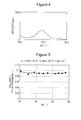
- a value at each angle in the approximate formula corresponds to the full width at half maximum dependent on the device (a value of about 0.10° at 2 ⁇ ⁇ 18.5° for the full width at half maximum FWHM003, and value of about 0.09° at 2 ⁇ ⁇ 64.5° for the full width at half maximum FWHM110).
- each of the FWHM003 and FWHM110 with a device-dependent value subtracted was calculated by subtracting the full width at half maximum dependent on the device from the full width at half maximum calculated by the method [B].
- the full widths at half maximum FWHM003 and FWHM110 obtained by this method were 0.05° (0.15° - 0.10°) and 0.17° (0.26° - 0.09°), respectively.
- the aspect ratio of the primary particles, the full width at half maximum FWHM003, the full width at half maximum FWHM110, and the volume-average particle diameter of the secondary particles can be changed by changing the temperature of the aqueous solution containing cobalt, nickel, and manganese, the dropping time of the aqueous sodium hydroxide solution, pH, the firing temperature, the firing time, and the presence of Zr.
- Li 1.13 Ni 0.43 Co 0.17 Mn 0.26 O 2 used as a positive electrode active material, acetylene black as a conductive agent, and polyvinylidene fluoride as a binder were mixed at a mass ratio of 90:5:5, and an appropriate amount of N-methyl-2-pyrrolidone (NMP) was added to the resultant mixture to prepare a positive electrode slurry.
- NMP N-methyl-2-pyrrolidone
- the positive electrode slurry was applied to both surfaces of a positive-electrode current collector composed of an aluminum foil by a doctor blade method, dried, cut into a size of 55 mm x 750 mm, and then rolled with a roller.
- a positive-electrode lead was attached, thereby forming a positive electrode including positive electrode active material layers formed on both surfaces of the positive-electrode current collector.
- the packing density of the positive electrode active material layer was 2.6 g/cm 3 .
- amorphous carbon-coated graphite (amorphous carbon content: 2% by mass) used as a negative electrode active material, SBR as a binder, and CMC (carboxymethyl cellulose) as a thickener were mixed at a mass ratio of 98:1:1, and an appropriate amount of distilled water was added to the resultant mixture to prepare a negative electrode slurry.
- the negative electrode slurry was applied to both surfaces of a negative-electrode current collector composed of a copper foil by a doctor blade method, dried, cut into a size of 58 mm x 850 mm, and then rolled with a roller. Further, a negative-electrode lead was attached, thereby forming a negative electrode.
- LiPF 6 was dissolved at 1 mol/l in a solvent prepared by mixing ethylene carbonate, methylethyl carbonate, and dimethyl carbonate at a volume ratio of 3:3:4, and then vinylene carbonate was mixed so that a ratio to the solvent was 1% by mass to prepare a nonaqueous electrolyte.
- a 18650-type nonaqueous electrolyte secondary battery was formed by using the above-described positive electrode, negative electrode, and nonaqueous electrolyte, and a separator composed of a polyethylene micro-porous film.
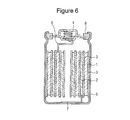
- FIG. 6 is a schematic sectional view illustrating the formed nonaqueous electrolyte secondary battery.
- the nonaqueous electrolyte secondary battery shown in Figure 6 includes a positive electrode 1, a negative electrode 2, a separator 3, a sealing plate 4 also serving as a positive electrode terminal, a negative electrode case 5, a positive electrode current collector 6, a negative electrode current collector 7, and an insulating packing 8.
- the positive electrode 1 and the negative electrode face each other with the separator 3 disposed therebetween, and are housed in a battery case including the sealing plate 4 and the negative electrode case 5.
- the positive electrode 1 is connected to the sealing plate 4, which also serves as the positive electrode terminal, through the positive electrode current collector 6, and the negative electrode 2 is connected to the negative electrode case 5 through the negative electrode current collector 7 so that chemical energy produced in the battery can be taken out as electric energy to the outside.
- battery A1 The thus-formed battery is referred to as "battery A1" hereinafter.
- a nonaqueous electrolyte secondary battery was formed by the same method as in Example 1 except that in forming the positive electrode active material, the firing temperature was 970°C.
- the aspect ratio was 3.1.
- the FWHM003 was 0.03°
- the FWHM110 was 0.12°.
- each of the full width at half maximum FWHM003 and the full width at half maximum FWHM110 represents a full width at half maximum (with a device-dependent value subtracted) by peak fitting described above in [C].
- each of the full width at half maximum FWHM003 and the full width at half maximum FWHM110 represents a full width at half maximum (with a device-dependent value subtracted) by peak fitting described above in [C] unless otherwise specified. Further, as a result of measurement of a volume-average particle diameter of secondary particles by the same method as in Example 1, the volume-average particle diameter was about 8 ⁇ m.
- battery A2 The thus-formed battery is referred to as "battery A2" hereinafter.
- a nonaqueous electrolyte secondary battery was formed by the same method as in Example 1 except that in forming the positive electrode active material, the aqueous sodium hydroxide solution was added dropwise over 3 hours, and the firing temperature was 970°C.
- the aspect ratio was 5.2.
- the FWHM003 was 0.03°
- the FWHM110 was 0.11°.
- the volume-average particle diameter was about 8 ⁇ m.
- battery A3 The thus-formed battery is referred to as "battery A3" hereinafter.
- a nonaqueous electrolyte secondary battery was formed by the same method as in Example 1 except that in forming the positive electrode active material, the aqueous sodium hydroxide solution was added dropwise over 1 hour, and the firing temperature was 900°C.
- the aspect ratio was 2.0.
- the FWHM003 was 0.04°
- the FWHM110 was 0.16°.
- the volume-average particle diameter was about 8 ⁇ m.
- battery A4 The thus-formed battery is referred to as "battery A4" hereinafter.
- a nonaqueous electrolyte secondary battery was formed by the same method as in Example 1 except that in forming the positive electrode active material, the aqueous sodium hydroxide solution was added dropwise over 1 hour, and the firing temperature was 880°C.
- the aspect ratio was 2.7.
- the FWHM003 was 0.06°
- the FWHM110 was 0.22°.
- the volume-average particle diameter was about 8 ⁇ m.
- battery A5 The thus-formed battery is referred to as "battery A5" hereinafter.
- an aqueous solution prepared from nickel sulfate and manganese sulfate and containing nickel ions and manganese ions was prepared in a reaction vessel so that a molar ratio (nickel:manganese) between nickel and manganese in the aqueous solution was 6:4.
- precipitates containing nickel and manganese were produced, and the precipitates were filtered off, washed with water, and then dried to produce Ni 0.6 Mn 0.4 (OH) 2 .
- Ni 0.6 Mn 0.4 (OH) 2 produced by a coprecipitation method was mixed with Li 2 CO 3 at a predetermined ratio, and the resultant mixture was fired in air at 830°C for 10 hours to produce Li 1.15 Ni 0.52 Mn 0.35 O 2 (lithium transition metal oxide) having a layered structure.
- a nonaqueous electrolyte secondary battery was formed by the same method as in Example 1 except that the positive electrode active material was prepared as described above.
- the resultant Li 1.15 Ni 0.52 Mn 0.35 O 2 was composed of secondary particles 20 produced by aggregating primary particles 21 as shown in Figure 1 .
- the aspect ratio of the primary particles was 2.0.
- the FWHM003 was 0.08°
- the FWHM110 was 0.26°.
- the volume-average particle diameter was about 8 ⁇ m.
- battery A6 The thus-formed battery is referred to as "battery A6" hereinafter.
- a nonaqueous electrolyte secondary battery was formed by the same method as in Example 6 except that in forming the positive electrode active material, the aqueous sodium hydroxide solution was added dropwise over 3 hours, and the firing temperature was 850°C.
- the aspect ratio was 3.1.
- the FWHM003 was 0.07°
- the FWHM110 was 0.24°.
- the volume-average particle diameter was about 8 ⁇ m.
- battery A7 The thus-formed battery is referred to as "battery A7" hereinafter.
- an aqueous solution prepared from nickel sulfate, cobalt sulfate, and manganese sulfate and containing cobalt ions, nickel ions, and manganese ions was prepared in a reaction vessel so that a molar ratio (cobalt:nickel:manganese) between cobalt, nickel, and manganese in the aqueous solution was 35:35:30.
- precipitates containing cobalt, nickel, and manganese were produced, and the precipitates were filtered off, washed with water, and then dried to produce Ni 0.35 Co 0.35 Mn 0.30 (OH) 2 .
- Ni 0.35 Co 0.35 Mn 0.30 (OH) 2 produced by a coprecipitation method was mixed with Li 2 CO 3 at a predetermined ratio, and the resultant mixture was fired in air at 970°C for 10 hours to produce Li 1.09 Ni 0.32 Co 0.32 Mn 0.27 O 2 (lithium transition metal oxide) having a layered structure.
- a nonaqueous electrolyte secondary battery was formed by the same method as in Example 1 except that the positive electrode active material was prepared as described above.
- the resultant Li 1.09 Ni 0.32 Co 0.32 Mn 0.27 O 2 was composed of secondary particles 20 produced by aggregating primary particles 21 as shown in Figure 1 .
- the aspect ratio of the primary particles was 2.6.
- the FWHM003 was 0.03°
- the FWHM110 was 0.13°.
- the volume-average particle diameter was about 8 ⁇ m.
- battery A8 The thus-formed battery is referred to as "battery A8" hereinafter.
- a nonaqueous electrolyte secondary battery was formed by the same method as in Example 8 except that in forming the positive electrode active material, a mixing ratio between Ni 0.35 CO 0.35 Mn 0.30 (OH) 2 produced by a co-precipitation method and Li 2 CO 3 was changed to produce Li 1.05 Ni 0.33 CO 0.33 Mn 0.29 O 2 having a layered structure.
- the aspect ratio was 3.1.
- the FWHM003 was 0.04°
- the FWHM110 was 0.12°.
- the volume-average particle diameter of secondary particles by the same method as in Example 1 the volume-average particle diameter was about 8 ⁇ m.
- battery A9 The thus-formed battery is referred to as "battery A9" hereinafter.
- a nonaqueous electrolyte secondary battery was formed by the same method as in Example 1 except that in forming the positive electrode active material, the temperature of the aqueous solution was 40°C, the aqueous sodium hydroxide solution was added dropwise over 1 hour, and the firing temperature was 910°C.
- the aspect ratio was 2.9.
- the FWHM003 was 0.06°
- the FWHM110 was 0.17°.
- the volume-average particle diameter was about 6 ⁇ m.
- battery A10 The thus-formed battery is referred to as "battery A10" hereinafter.
- a nonaqueous electrolyte secondary battery was formed by the same method as in Example 3 except that in forming the positive electrode active material, 0.5 mol% of ZrO 2 was added to Ni 0.5 Co 0.2 Mn 0.3 (OH) 2 .
- the aspect ratio was 5.3.
- the FWHM003 was 0.06°
- the FWHM110 was 0.16°.
- the volume-average particle diameter was about 8 ⁇ m.
- battery A11 The thus-formed battery is referred to as "battery A11" hereinafter.
- a nonaqueous electrolyte secondary battery was formed by the same method as in Example 1 except that in forming the positive electrode active material, the aqueous sodium hydroxide solution was added dropwise over 5 hours, and the firing temperature was 970°C.
- the aspect ratio was 9.8.
- the FWHM003 was 0.06°
- the FWHM110 was 0.16°.
- the volume-average particle diameter was about 8 ⁇ m.
- battery A12 The thus-formed battery is referred to as "battery A12" hereinafter.
- a nonaqueous electrolyte secondary battery was formed by the same method as in Example 1 except that in forming the positive electrode active material, the aqueous sodium hydroxide solution was added dropwise over 1 hour, and the firing temperature was 970°C.
- the aspect ratio was 1.7.
- the FWHM003 was 0.04°
- the FWHM110 was 0.12°.
- the volume-average particle diameter was about 8 ⁇ m.
- battery Z1 The thus-formed battery is referred to as "battery Z1" hereinafter.
- a nonaqueous electrolyte secondary battery was formed by the same method as in Example 1 except that in forming the positive electrode active material, the firing temperature was 1000°C.
- the aspect ratio was 2.3.
- the FWHM003 was 0.02°
- the FWHM110 was 0.06°.
- the volume-average particle diameter was about 8 ⁇ m.
- battery Z2 The thus-formed battery is referred to as "battery Z2" hereinafter.
- a nonaqueous electrolyte secondary battery was formed by the same method as in Comparative Example 1 except that in forming the positive electrode active material, the temperature of the aqueous solution was 40°C.
- the aspect ratio was 1.7.
- the FWHM003 was 0.04°
- the FWHM110 was 0.13°.
- the volume-average particle diameter was about 6 ⁇ m.
- battery Z3 The thus-formed battery is referred to as "battery Z3" hereinafter.
- a nonaqueous electrolyte secondary battery was formed by the same method as in Example 6 except that in forming the positive electrode active material, the temperature of the aqueous solution was 40°C, the aqueous sodium hydroxide solution was added dropwise over 1 hour, and the firing temperature was 850°C.
- the aspect ratio was 1.4.
- the FWHM003 was 0.03°
- the FWHM110 was 0.16°.
- the volume-average particle diameter was about 6 ⁇ m.
- battery Z4 The thus-formed battery is referred to as "battery Z4" hereinafter.
- a nonaqueous electrolyte secondary battery was formed by the same method as in Comparative Example 2 except that in forming the positive electrode active material, 0.5 mol% of ZrO 2 was added to Ni 0.5 Co 0.2 Mn 0.3 (OH) 2 .
- the aspect ratio was 2.4.
- the FWHM003 was 0.02°
- the FWHM110 was 0.07°.
- the volume-average particle diameter was about 8 ⁇ m.
- battery Z5 The thus-formed battery is referred to as "battery Z5" hereinafter.
- Table 1 below shows differences in production of the positive electrode active material between the batteries A1 to A12 and Z1 to Z5 and the compositions of the positive electrode active materials.
- Type of battery Dropping of sodium hydroxide Firing Presence of Zr Composition of positive electrode active material Temperature of aqueous solution (°C) Dropping time (hr) pH Temperature (°C) Time (hr) Battery
- the conditions were that constant-current charge was performed with 700 mA [1.01t] until a battery voltage was 4.1 V, and charge was performed with a constant voltage until a current was 10 mA, and further discharge was performed with 10 A [(100/7)lt] until a battery voltage was 2.5 V.
- the temperature during charge and discharge was 60°C.
- Table 2 indicates that the batteries A1 to A12 having an aspect ratio of 2.0 or more and 10.0 or less and a FWHM110 of 0.10° or more and 0.30° or less exhibit higher capacity retention ratios as compared with the batteries Z1, Z3, and Z4 having a FWHM110 of 0.10° or more and 0.30° or less but an aspect ratio of less than 2.0 and the batteries Z2 and Z5 having an aspect ratio of 2.0 or more and 10.0 or less but a FWHM110 of less than 0.10°.
- the positive electrode active material used in each of the batteries Z1, Z3, and Z4 includes the primary particles with a low aspect ratio and the secondary particles having a high internal particle density, and thus stress induced by expansion and contraction is not relaxed. Therefore, the electron conduction in the secondary particles is decreased.
- the positive electrode active material used in each of the batteries Z2 and Z5 has a large crystallite size, and thus crystallite interface stress induced by expansion and contraction during charge-discharge is not relaxed. Therefore, the electron conduction in the primary particles is decreased.
- the battery Z3 exhibits a lower capacity retention ratio than the battery Z1.
- the positive electrode active material of the battery Z3 has a smaller volume-average particle diameter than the positive electrode active material of the battery Z1 and thus has lower packing properties of the positive electrode active material in the positive electrode. Therefore, when the both materials are rolled to have the same packing density, it is necessary to increase the pressure for forming the positive electrode of the battery Z3, and thus the contact area between the positive electrode active material particles in the positive electrode of the battery Z3 is increased. Consequently, when the particles of the positive electrode active material are expanded, the crystallite interface stress is not relaxed, thereby causing defects or the like in the particles of the positive electrode active material and thus decreasing electron conduction in the secondary particles.
- a comparison between the battery Z2 and the battery Z5 which are different only in the presence of Zr reveals that the battery Z5 using the positive electrode active material containing Zr has a slightly higher capacity retention ratio than the battery Z2 using the positive electrode active material not containing Zr.
- FWHM110 is slightly increased by adding Zr to the positive electrode active material, and thus crystal growth is suppressed, thereby causing a small crystallite size and nonuniform crystal orientation. Therefore, crystallite interface stress induced by expansion and contraction during charge-discharge is relaxed, and a decrease in the electron conduction in the primary particles is suppressed.
- crystal growth cannot be satisfactorily suppressed only by adding Zr to the positive electrode active material, a significant improvement in the capacity retention ratio is not observed.
- the positive electrode active material used in each of the batteries A1 to A12 crystal growth is sufficiently suppressed, thereby causing a small crystallite size and nonuniform crystal orientation. Therefore, crystallite interface stress induced by expansion and contraction during charge-discharge is sufficiently relaxed, and a decrease in the electron conduction in the primary particles is significantly suppressed.
- the positive electrode active material used in each of the batteries A1 to A12 includes the primary particles with a high aspect ratio and the secondary particles having a lower internal particle density, thereby relaxing the stress induced by expansion and contraction. Therefore, a decrease in the electron conduction in the secondary particles is also sufficiently suppressed.
- a comparison between the battery A3 and the battery A11 which are different only in the presence of Zr reveals that the battery A11 using the positive electrode active material containing Zr has a higher capacity retention ratio than the battery A3 using the positive electrode active material not containing Zr.
- FWHM110 is slightly increased by adding Zr to the positive electrode active material, and thus crystal growth is suppressed, thereby causing a small crystallite size and nonuniform crystal orientation. Therefore, crystallite interface stress induced by expansion and contraction during charge-discharge is relaxed, and a decrease in the electron conduction in the primary particles is suppressed.
- the batteries A1 to A5 and A8 to A12 each having a FWHM110 of 0.10° or more and 0.22° or less exhibit higher efficiency ratios than the batteries A6 and A7 each having a FWHM110 exceeding 0.22°. This is because with a FWHM110 exceeding 0.22°, crystal growth becomes slightly insufficient (smaller crystallite size), and thus the capacity of the positive electrode is slightly decreased due to difficulty in lithium insertion and desertion. Therefore, FWHM110 is required to be regulated to 0.10° or more and 0.30° or less, particularly 0.10° or more and 0.22° or less.
- a nonaqueous electrolyte secondary battery according to the present invention can be used for various power supplies such as a power supply for a hybrid car, and the like.
Landscapes
- Chemical & Material Sciences (AREA)
- Chemical Kinetics & Catalysis (AREA)
- Electrochemistry (AREA)
- General Chemical & Material Sciences (AREA)
- Inorganic Chemistry (AREA)
- Organic Chemistry (AREA)
- Battery Electrode And Active Subsutance (AREA)
- Secondary Cells (AREA)
Applications Claiming Priority (3)
| Application Number | Priority Date | Filing Date | Title |
|---|---|---|---|
| JP2011054369 | 2011-03-11 | ||
| JP2011206903 | 2011-09-22 | ||
| PCT/JP2011/080498 WO2012124240A1 (fr) | 2011-03-11 | 2011-12-28 | Batterie secondaire à électrolyte non aqueux |
Publications (1)
| Publication Number | Publication Date |
|---|---|
| EP2685532A1 true EP2685532A1 (fr) | 2014-01-15 |
Family
ID=46830338
Family Applications (1)
| Application Number | Title | Priority Date | Filing Date |
|---|---|---|---|
| EP11861072.4A Withdrawn EP2685532A1 (fr) | 2011-03-11 | 2011-12-28 | Batterie secondaire à électrolyte non aqueux |
Country Status (5)
| Country | Link |
|---|---|
| US (1) | US20130323606A1 (fr) |
| EP (1) | EP2685532A1 (fr) |
| JP (1) | JP5128018B1 (fr) |
| CN (1) | CN103415947B (fr) |
| WO (1) | WO2012124240A1 (fr) |
Families Citing this family (21)
| Publication number | Priority date | Publication date | Assignee | Title |
|---|---|---|---|---|
| JP5835614B2 (ja) * | 2011-12-08 | 2015-12-24 | トヨタ自動車株式会社 | 非水系二次電池 |
| CN105122516B (zh) * | 2013-02-28 | 2017-03-29 | 日产自动车株式会社 | 正极活性物质、正极材料、正极及非水电解质二次电池 |
| CN105247710B (zh) * | 2013-05-28 | 2018-07-13 | 住友化学株式会社 | 正极活性物质 |
| CN105247709B (zh) * | 2013-05-28 | 2018-10-23 | 住友化学株式会社 | 正极活性物质 |
| KR101785262B1 (ko) | 2013-07-08 | 2017-10-16 | 삼성에스디아이 주식회사 | 양극 활물질, 그 제조방법, 이를 채용한 양극 및 리튬이차전지 |
| CN104584284B (zh) * | 2013-08-29 | 2017-11-24 | 株式会社Lg 化学 | 锂过渡金属复合粒子及其制备方法、以及包含它的正极活性物质 |
| JP2015082480A (ja) * | 2013-10-24 | 2015-04-27 | 株式会社豊田自動織機 | リチウムイオン二次電池用正極及びリチウムイオン二次電池 |
| JP6603058B2 (ja) * | 2014-08-20 | 2019-11-06 | 住友化学株式会社 | リチウム含有複合酸化物の製造方法およびリチウム含有複合酸化物 |
| JP6587804B2 (ja) * | 2015-01-23 | 2019-10-09 | 住友化学株式会社 | 正極活物質、リチウムイオン二次電池用正極およびリチウムイオン二次電池 |
| JP6620367B2 (ja) * | 2015-03-10 | 2019-12-18 | 株式会社豊田自動織機 | リチウムイオン二次電池 |
| JP6496177B2 (ja) * | 2015-04-08 | 2019-04-03 | 住友化学株式会社 | リチウム含有複合酸化物、その製造方法、正極活物質、リチウムイオン二次電池用正極およびリチウムイオン二次電池 |
| KR102006207B1 (ko) * | 2015-11-30 | 2019-08-02 | 주식회사 엘지화학 | 이차전지용 양극활물질 및 이를 포함하는 이차전지 |
| US10200485B2 (en) * | 2016-04-05 | 2019-02-05 | Facebook, Inc. | Pushing news feed content to client devices |
| CN109844999B (zh) * | 2016-09-07 | 2022-02-18 | 株式会社杰士汤浅国际 | 蓄电元件和蓄电元件的制造方法 |
| KR102288294B1 (ko) | 2018-06-20 | 2021-08-10 | 주식회사 엘지화학 | 리튬 이차 전지용 양극 활물질 및 리튬 이차 전지 |
| JP6600066B1 (ja) | 2018-12-20 | 2019-10-30 | 住友化学株式会社 | リチウム複合金属酸化物粉末、リチウム二次電池用正極活物質、リチウム二次電池用正極及びリチウム二次電池 |
| JP7414056B2 (ja) * | 2019-02-22 | 2024-01-16 | 住友金属鉱山株式会社 | リチウムイオン二次電池用正極活物質、リチウムイオン二次電池用正極活物質の製造方法、リチウムイオン二次電池 |
| CN111969200B (zh) * | 2020-08-28 | 2022-11-04 | 巴斯夫杉杉电池材料有限公司 | 一种高容量、长循环镍钴锰三元正极材料及其制备方法 |
| WO2022130982A1 (fr) * | 2020-12-18 | 2022-06-23 | パナソニックIpマネジメント株式会社 | Électrode positive de batterie secondaire à électrolyte non aqueux et batterie secondaire à électrolyte non aqueux |
| JP7759904B2 (ja) | 2023-01-20 | 2025-10-24 | プライムプラネットエナジー&ソリューションズ株式会社 | 正極用ncm系活物質、正極および電池 |
| WO2025070064A1 (fr) * | 2023-09-29 | 2025-04-03 | パナソニックエナジー株式会社 | Matériau actif d'électrode positive pour batterie secondaire à électrolyte non aqueux, et batterie secondaire à électrolyte non aqueux |
Family Cites Families (12)
| Publication number | Priority date | Publication date | Assignee | Title |
|---|---|---|---|---|
| WO2002086993A1 (fr) | 2001-04-20 | 2002-10-31 | Yuasa Corporation | Matiere active anodique et son procede de production, anode pour pile secondaire a electrolyte non aqueux et pile secondaire a electrolyte non aqueux |
| JP4199506B2 (ja) * | 2002-09-26 | 2008-12-17 | Agcセイミケミカル株式会社 | リチウム二次電池用の正極活物質の製造方法 |
| JP2005251716A (ja) | 2004-02-05 | 2005-09-15 | Nichia Chem Ind Ltd | 非水電解質二次電池用正極活物質、非水電解質二次電池用正極合剤および非水電解質二次電池 |
| KR100570638B1 (ko) * | 2004-02-17 | 2006-04-12 | 삼성에스디아이 주식회사 | 리튬 이차 전지용 양극 활물질 및 그의 제조 방법 |
| WO2006118279A1 (fr) * | 2005-04-28 | 2006-11-09 | Nissan Motor Co., Ltd. | Materiau d'electrode positive pour batterie d'ion de lithium avec un electrolyte non aqueux et batterie utilisant celui-ci |
| KR20080108222A (ko) * | 2006-04-07 | 2008-12-12 | 미쓰비시 가가꾸 가부시키가이샤 | 리튬 이차 전지 정극 재료용 리튬 천이 금속계 화합물분체, 그 제조 방법, 그 분무 건조체 및 그 소성 전구체,그리고, 그것을 사용한 리튬 이차 전지용 정극 및 리튬이차 전지 |
| JP4591717B2 (ja) * | 2006-09-22 | 2010-12-01 | 三菱化学株式会社 | リチウム二次電池正極材料用リチウムニッケルマンガンコバルト系複合酸化物粉体、その製造方法、及び噴霧乾燥粉体、並びにそれを用いたリチウム二次電池用正極及びリチウム二次電池 |
| JP2008108689A (ja) * | 2006-09-29 | 2008-05-08 | Sanyo Electric Co Ltd | 非水電解質二次電池 |
| CN102769130A (zh) * | 2007-09-04 | 2012-11-07 | 三菱化学株式会社 | 锂过渡金属类化合物粉末 |
| JP5428251B2 (ja) * | 2007-09-04 | 2014-02-26 | 三菱化学株式会社 | リチウム遷移金属系化合物粉体、それを用いたリチウム二次電池用正極及びリチウム二次電池 |
| WO2009099158A1 (fr) * | 2008-02-06 | 2009-08-13 | Agc Seimi Chemical Co., Ltd. | Procédé pour produire une poudre granulaire pour un matériau actif d'électrode positive de batterie secondaire lithium-ion |
| JP5430920B2 (ja) * | 2008-03-17 | 2014-03-05 | 三洋電機株式会社 | 非水電解質二次電池 |
-
2011
- 2011-12-28 EP EP11861072.4A patent/EP2685532A1/fr not_active Withdrawn
- 2011-12-28 US US13/985,190 patent/US20130323606A1/en not_active Abandoned
- 2011-12-28 CN CN201180069219.1A patent/CN103415947B/zh active Active
- 2011-12-28 JP JP2012534454A patent/JP5128018B1/ja active Active
- 2011-12-28 WO PCT/JP2011/080498 patent/WO2012124240A1/fr not_active Ceased
Also Published As
| Publication number | Publication date |
|---|---|
| JP5128018B1 (ja) | 2013-01-23 |
| JPWO2012124240A1 (ja) | 2014-07-17 |
| US20130323606A1 (en) | 2013-12-05 |
| CN103415947A (zh) | 2013-11-27 |
| WO2012124240A1 (fr) | 2012-09-20 |
| CN103415947B (zh) | 2016-05-11 |
Similar Documents
| Publication | Publication Date | Title |
|---|---|---|
| EP2685532A1 (fr) | Batterie secondaire à électrolyte non aqueux | |
| JP6072688B2 (ja) | 非水電解質二次電池及び非水電解質二次電池の製造方法 | |
| US20110195309A1 (en) | Nonaqueous electrolyte secondary battery | |
| US10256461B2 (en) | Nonaqueous electrolyte secondary battery and positive electrode active material for nonaqueous electrolyte secondary batteries | |
| US20090305136A1 (en) | Non-aqueous electrolyte secondary battery and method of manufacturing the same | |
| JP2011070789A (ja) | 非水電解質二次電池 | |
| US20120135315A1 (en) | Non-aqueous electrolyte secondary battery | |
| JP5078334B2 (ja) | 非水電解質二次電池 | |
| CN103782423B (zh) | 非水电解质二次电池的正极活性物质及非水电解质二次电池 | |
| US20080286654A1 (en) | Non-aqueous electrolyte secondary battery | |
| WO2016002158A1 (fr) | Matière active d'électrode positive pour batterie secondaire à électrolyte non aqueux, et batterie secondaire à électrolyte non aqueux mettant en œuvre celle-ci | |
| JP4530822B2 (ja) | 非水電解質二次電池及びその充電方法 | |
| KR20220136718A (ko) | 리튬 이차 전지용 양극 활물질 및 이를 포함하는 리튬 이차 전지 | |
| JP2009218112A (ja) | 非水電解質二次電池及びその製造方法 | |
| EP4227269A1 (fr) | Matériau actif de cathode, précurseur pour batterie secondaire au lithium, matériau actif de cathode pour batterie secondaire au lithium et batterie secondaire au lithium | |
| KR20250165297A (ko) | 리튬 이차 전지용 양극 활물질 및 이를 포함하는 리튬 이차 전지 | |
| JP4530843B2 (ja) | 非水電解質二次電池及びその充電方法 | |
| JP5147891B2 (ja) | 非水電解質二次電池及びその充電方法 | |
| KR20090091053A (ko) | 비수전해질 이차 전지 및 그의 제조 방법 | |
| JP5147890B2 (ja) | 非水電解質二次電池及びその充電方法 | |
| WO2025115777A1 (fr) | Batterie secondaire à électrolyte non aqueux |
Legal Events
| Date | Code | Title | Description |
|---|---|---|---|
| PUAI | Public reference made under article 153(3) epc to a published international application that has entered the european phase |
Free format text: ORIGINAL CODE: 0009012 |
|
| 17P | Request for examination filed |
Effective date: 20130930 |
|
| AK | Designated contracting states |
Kind code of ref document: A1 Designated state(s): AL AT BE BG CH CY CZ DE DK EE ES FI FR GB GR HR HU IE IS IT LI LT LU LV MC MK MT NL NO PL PT RO RS SE SI SK SM TR |
|
| STAA | Information on the status of an ep patent application or granted ep patent |
Free format text: STATUS: THE APPLICATION HAS BEEN WITHDRAWN |
|
| 18W | Application withdrawn |
Effective date: 20140317 |