WO2016002158A1 - Matière active d'électrode positive pour batterie secondaire à électrolyte non aqueux, et batterie secondaire à électrolyte non aqueux mettant en œuvre celle-ci - Google Patents
Matière active d'électrode positive pour batterie secondaire à électrolyte non aqueux, et batterie secondaire à électrolyte non aqueux mettant en œuvre celle-ci Download PDFInfo
- Publication number
- WO2016002158A1 WO2016002158A1 PCT/JP2015/003102 JP2015003102W WO2016002158A1 WO 2016002158 A1 WO2016002158 A1 WO 2016002158A1 JP 2015003102 W JP2015003102 W JP 2015003102W WO 2016002158 A1 WO2016002158 A1 WO 2016002158A1
- Authority
- WO
- WIPO (PCT)
- Prior art keywords
- primary particles
- positive electrode
- active material
- particles
- aspect ratio
- Prior art date
- Legal status (The legal status is an assumption and is not a legal conclusion. Google has not performed a legal analysis and makes no representation as to the accuracy of the status listed.)
- Ceased
Links
Images



Classifications
-
- H—ELECTRICITY
- H01—ELECTRIC ELEMENTS
- H01M—PROCESSES OR MEANS, e.g. BATTERIES, FOR THE DIRECT CONVERSION OF CHEMICAL ENERGY INTO ELECTRICAL ENERGY
- H01M4/00—Electrodes
- H01M4/02—Electrodes composed of, or comprising, active material
- H01M4/36—Selection of substances as active materials, active masses, active liquids
- H01M4/48—Selection of substances as active materials, active masses, active liquids of inorganic oxides or hydroxides
- H01M4/50—Selection of substances as active materials, active masses, active liquids of inorganic oxides or hydroxides of manganese
- H01M4/505—Selection of substances as active materials, active masses, active liquids of inorganic oxides or hydroxides of manganese of mixed oxides or hydroxides containing manganese for inserting or intercalating light metals, e.g. LiMn2O4 or LiMn2OxFy
-
- H—ELECTRICITY
- H01—ELECTRIC ELEMENTS
- H01M—PROCESSES OR MEANS, e.g. BATTERIES, FOR THE DIRECT CONVERSION OF CHEMICAL ENERGY INTO ELECTRICAL ENERGY
- H01M4/00—Electrodes
- H01M4/02—Electrodes composed of, or comprising, active material
- H01M4/36—Selection of substances as active materials, active masses, active liquids
- H01M4/48—Selection of substances as active materials, active masses, active liquids of inorganic oxides or hydroxides
- H01M4/52—Selection of substances as active materials, active masses, active liquids of inorganic oxides or hydroxides of nickel, cobalt or iron
- H01M4/525—Selection of substances as active materials, active masses, active liquids of inorganic oxides or hydroxides of nickel, cobalt or iron of mixed oxides or hydroxides containing iron, cobalt or nickel for inserting or intercalating light metals, e.g. LiNiO2, LiCoO2 or LiCoOxFy
-
- Y—GENERAL TAGGING OF NEW TECHNOLOGICAL DEVELOPMENTS; GENERAL TAGGING OF CROSS-SECTIONAL TECHNOLOGIES SPANNING OVER SEVERAL SECTIONS OF THE IPC; TECHNICAL SUBJECTS COVERED BY FORMER USPC CROSS-REFERENCE ART COLLECTIONS [XRACs] AND DIGESTS
- Y02—TECHNOLOGIES OR APPLICATIONS FOR MITIGATION OR ADAPTATION AGAINST CLIMATE CHANGE
- Y02E—REDUCTION OF GREENHOUSE GAS [GHG] EMISSIONS, RELATED TO ENERGY GENERATION, TRANSMISSION OR DISTRIBUTION
- Y02E60/00—Enabling technologies; Technologies with a potential or indirect contribution to GHG emissions mitigation
- Y02E60/10—Energy storage using batteries
Definitions
- the present invention relates to a positive electrode active material for a non-aqueous electrolyte secondary battery with high capacity and high durability, and a non-aqueous electrolyte secondary battery using the same.
- non-aqueous electrolyte secondary batteries especially lithium ion secondary batteries
- have high energy density and high capacity so mobile phones, laptop computers, smartphones, etc. that are required to be small and light are moved. Widely used as a driving power source for information terminals.
- Such a lithium ion secondary battery includes a positive electrode, a negative electrode, and a separator interposed therebetween, and as a positive electrode active material, a lithium cobalt oxide (for example, LiCoO 2) having a high potential with respect to lithium and being easily synthesized. ) Is used.
- a lithium cobalt oxide for example, LiCoO 2
- a layered active material mainly composed of nickel or a layered compound composed of three components of nickel cobalt manganese has been used as a positive electrode active material for the purpose of increasing the capacity.
- the positive electrode active material of the lithium ion secondary battery (the positive electrode active material including the secondary particles in which the primary particles are aggregated) is the primary particles due to insertion and desorption of lithium ions when the charge / discharge cycle is repeated for a long time. Expansion and contraction occur, cracks occur at the crystal grain interface between the primary particles, and the cycle characteristics deteriorate.
- the primary particles in the secondary particles are joined at the crystal grain interface, but the volume change accompanying the expansion / contraction causes distortion at the grain interface between the primary particles, and the charge / discharge cycle
- the conductive path between the primary particles is interrupted, the primary particles are isolated as the active material, the discharge capacity is reduced, and a problem occurs in the cycle characteristics.
- Patent Document 1 by using positive electrode active material particles including secondary particles in which primary particles having an aspect ratio of 1.5 or more are aggregated, the contact area between adjacent primary particles is increased, and the primary particles have a larger area. It is disclosed that the bonding strength is increased, cracks at the crystal grain interface between primary particles are suppressed, and cycle characteristics are improved.
- Patent Document 1 Since primary particles having a high aspect ratio used in Patent Document 1 have ab surfaces of crystallites aligned in the major axis direction, they tend to preferentially expand and contract in the minor axis direction during charge and discharge.
- Such secondary particles composed only of particles having a high aspect ratio form an aggregate in which the particles are aligned in the same direction as shown in FIG. 1, and the aggregate is randomly arranged to form secondary particles.
- the presence of an aggregate of primary particles having a high aspect ratio at the center of the secondary particles causes a large distortion inside the secondary particles during charge / discharge, thereby causing more significant collapse of the active material particles.
- the problem to be solved by the present invention is to provide a non-aqueous electrolyte secondary battery capable of obtaining excellent cycle characteristics.
- the present invention obtains excellent cycle characteristics by using a positive electrode active material composed of secondary particles in which a plurality of primary particles are aggregated and the distribution curve representing the appearance frequency of the primary particle aspect ratio is multimodal.
- a nonaqueous electrolyte secondary battery is provided.
- the positive electrode active material of the present invention it is possible to suppress particle cracks due to the orientation of primary particles having a high aspect ratio in the secondary particles, and it is possible to relieve the stress in the particles during charging and discharging. Since cracks are suppressed, a non-aqueous electrolyte secondary battery with improved cycle characteristics can be provided.
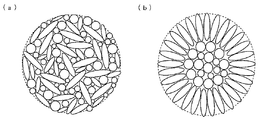
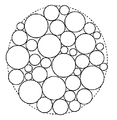
- the schematic diagram which shows the secondary particle of the positive electrode active material which concerns on one experiment example of this invention The schematic diagram which shows the primary particle of the positive electrode active material which concerns on one Embodiment of this invention.
- a diagram showing a unimodal distribution curve representing the appearance frequency of the primary particle aspect ratio (b) a diagram showing a multimodal (bimodal) distribution curve representing the appearance frequency of the primary particle aspect ratio.
- the schematic diagram which shows the secondary particle of the positive electrode active material which concerns on one experiment example of this invention Sectional drawing of the cylindrical nonaqueous electrolyte secondary battery which concerns on one Embodiment of this invention.
- the present invention consists of secondary particles in which a plurality of primary particles are aggregated, and by using a positive electrode active material in which the distribution curve representing the appearance frequency of the aspect ratio of the primary particles exhibits multimodality, It becomes possible to mix primary particles having a low aspect ratio in the same secondary particles, and to suppress generation of cracks at the grain interface between the primary particles due to expansion of the primary particles in the coaxial direction.
- the aspect ratio of the primary particles of the present invention is obtained by dividing “the length x of the longest diameter of the particle image” shown in FIG. 2 by “the length y of the maximum diameter perpendicular to x”. This is an index that represents the shape of the secondary particle, and is evaluated using a cross-sectional image of secondary particles photographed by a scanning ion microscope (SIM).
- SIM scanning ion microscope
- a processing device using an ion beam and a shielding plate is used to adjust the secondary particle cross-sectional analysis sample.
- a particle cross section obtained by cutting the vicinity of the center of the secondary particle is selected.
- a plurality of primary particles are selected at random, and the aspect ratio is calculated for the ratio (x / y) of the primary particles.
- FIG. 3A a structure composed of only one peak as shown in FIG. 3A is called a unimodal distribution
- FIG. A distribution in which the appearance frequency is composed of a plurality of peaks is called a multimodal (bimodal) distribution.
- the present invention also includes spherical primary particles having an aspect ratio appearance frequency peak of 1 or more and 2 or less, and elongated primary particles having an aspect ratio appearance frequency peak of greater than 2 and 10 or less. As a result, the orientation of the primary particles is suppressed, a sufficient amount of the bonding area between the primary particles can be ensured, and even better cycle characteristics can be obtained.
- the appearance frequency of the aspect ratio of the elongated primary particles is larger than the appearance ratio of the aspect ratio of the spherical primary particles, the characteristics of the elongated primary particles having a high aspect ratio appear.
- the elongated primary particles can increase the contact area with adjacent particles, and it is easy to suppress the occurrence of cracks at the grain interface.
- the distance of the average ab surface in the primary particle which is a lithium diffusion surface is long, it is advantageous for cycle characteristics at a low load.
- the appearance frequency of the aspect ratio of the spherical primary particles is larger than the appearance frequency of the aspect ratio of the elongated primary particles, the characteristics of the spherical primary particles with a low aspect ratio appear.
- the spherical primary particles have a shorter distance of the average ab plane in the particles, which is the surface of lithium diffusion, and therefore are less affected by defects in the crystallite plane, which is advantageous for high-rate cycle characteristics. .
- the orientation of the primary particles is suppressed, and a sufficient amount of the bonding area between the primary particles can be ensured, and good cycle characteristics can be obtained.
- the peak of the appearance frequency of the aspect ratio of the elongated primary particles is more preferably 4 or more and 6 or less.
- the primary particles aggregated in the central part of the secondary particles are spherical primary particles and the primary particles aggregated in the outer peripheral part of the secondary particles are elongated primary particles, even better cycle characteristics Can be obtained.
- the primary particles with a small aspect ratio are placed in the center of the particles where stress is likely to concentrate in the secondary particles, reducing the stress inside the particles during charge and discharge, while the aspect ratio on the secondary particle surface where stress is difficult to concentrate. It is considered that by disposing primary particles having large and excellent adhesion, it is possible to suppress particle peeling and to improve cycle characteristics.
- the region that reaches half the length from the center of the secondary particle to the outermost circumference (50% of the radius of the secondary particle) is the central part of the secondary particle, and the region outside it is the secondary particle.
- the particles present on the boundary line between the central portion and the outer peripheral portion the particles are regarded as belonging to the higher presence ratio of the particles.
- the distribution of the appearance frequency of the aspect ratio of the elongated primary particles and the aspect ratio of the spherical primary particles is calculated, and at the center of the secondary particles and the outer periphery of the secondary particles, If the values match, the primary particle distribution within the secondary particles is considered uniform.
- each primary particle is composed of the same transition metal composition.
- the molar ratio of each transition metal element to the total amount of the transition metal element is determined, even when the composition analysis of any primary particle constituting the secondary particle is performed by EDX (energy dispersive X-ray spectroscopy), When the difference in composition is 3 mol% or less, it can be considered that the composition is the same.
- the lithium transition metal oxide represented by the above general formula is used in which the cobalt composition ratio c, the nickel composition ratio a, and the manganese composition ratio b satisfy the condition of 0 ⁇ c / (a + b) ⁇ 0.6.
- the nickel composition ratio a and the manganese composition ratio b satisfying the condition of a / b ⁇ 3.0 are used because the change in the c-axis direction is suppressed even when the particle aspect ratio is relatively large. Therefore, even better cycle characteristics can be obtained.
- 1> a / b it is difficult to obtain a lithium transition metal oxide having a uniform composition, and the degree of expansion / contraction associated with charging / discharging of each particle is difficult to be constant, resulting in deterioration of cycle characteristics. It is.
- the cycle characteristic is improved when 0 ⁇ x.
- x> 0.2 there are many alkali components on the surface of the lithium-containing transition metal oxide, so that side reactions increase and cycle characteristics deteriorate.
- d in the oxygen composition ratio (2 + d) satisfies the condition of ⁇ 0.1 ⁇ d ⁇ 0.1 because the lithium-containing transition metal oxide is in an oxygen deficient state or an oxygen excess state. This is because the crystal structure is damaged, the active material is easily cracked, and the cycle characteristics are deteriorated.
- the average particle diameter (volume basis) of secondary particles is preferably in the range of 5 ⁇ m to 30 ⁇ m, and more preferably in the range of 10 ⁇ m to 20 ⁇ m.
- the average particle diameter of the secondary particles is larger than 30 ⁇ m, sufficient diffusibility of lithium in the particles cannot be ensured, and the cycle characteristics deteriorate.
- the average particle diameter of the secondary particles is 3 ⁇ m or less, the specific surface area is increased and the side reaction is increased, whereby the cycle characteristics are deteriorated.
- the average particle diameter of the spherical primary particles is preferably 0.3 ⁇ m or more and 4 ⁇ m or less, and the average particle diameter of the elongated primary particles is preferably 1.5 ⁇ m or more and 13 ⁇ m or less.
- the bonding characteristics between the primary particles cannot be sufficiently obtained, and the cycle characteristics are deteriorated.
- the average particle diameter of the primary particles when the average particle diameter of the primary particles is less than 1 ⁇ m, the number of constituent particles of the secondary particles increases, so that the interfacial resistance increases, the electron conductivity decreases, and the cycle characteristics are reduced. descend.
- the average particle diameter of the primary particles when the average particle diameter of the primary particles is larger than 26 ⁇ m, the strain due to the stress due to expansion / contraction during charging / discharging is not easily reduced in the central part of the secondary particles, so that the cycle characteristics are deteriorated.
- the long axis length of the elongated primary particles in the secondary particles is preferably 25% or more and 60% or less of the major axis of the secondary particles.
- the major axis length of the primary particles is 60% or more of the major axis of the secondary particles, the strain caused by the stress due to expansion and contraction during charge / discharge is not easily reduced at the center of the secondary particles. Characteristics are degraded. On the other hand, if it is less than 25%, a sufficient fixing force between the primary particles cannot be obtained, so that the cycle characteristics deteriorate.
- addition amounts are preferably 0.1 mol% or more and 5.0 mol% or less with respect to the transition metal in the lithium-containing transition metal composite oxide, and particularly 0.1 mol% or more and 3.0 mol% or less. Is more preferable. This is because when the amount added exceeds 5.0 mol%, the capacity is lowered and the energy density is lowered. On the other hand, when the added amount is less than 0.1 mol%, the effect on the crystal growth by the added element is reduced.
- the positive electrode active material used in the nonaqueous electrolyte secondary battery of the present invention does not need to be composed of only the positive electrode active material described above, and has a layered structure capable of reversibly inserting and extracting lithium. If it is, it will not specifically limit.
- the lithium-containing transition metal composite oxide include lithium cobaltate, lithium composite oxide of Ni—Mn—Al, lithium composite oxide of Ni—Co—Al, lithium composite oxide of Co—Mn, iron, manganese, and the like. Examples include transition metal oxides.
- the active material a compound having a spinel structure, a phosphoric acid compound, a boric acid compound, and a silicic acid compound (the active material is at least one selected from the group consisting of Li, Ni, Mn, Co, Fe, and rare earths) May be used in combination.
- the packing density of the positive electrode used in the nonaqueous electrolyte secondary battery of the present invention is preferably 2.0 g / cm 3 or more and 4.0 g / cm 3 or less, particularly 2.8 g / cm 3 or more and 3.7 g. / Cm 3 or less is more preferable.
- the packing density of the positive electrode exceeds 4.0 g / cm 3 , the amount of the electrolytic solution in the positive electrode is reduced, and the cycle characteristics are deteriorated due to a heterogeneous reaction.
- the packing density of the positive electrode is less than 2.0 g / cm 3 , not only the energy density is decreased, but also the electron conductivity in the positive electrode is decreased, resulting in a decrease in capacity and cycle characteristics due to a heterogeneous reaction. Because.
- Examples of the negative electrode active material for the non-aqueous electrolyte secondary battery of the present invention include carbon materials such as various natural graphites, cokes, graphitized carbon, carbon fibers, spherical carbon, various artificial graphites, amorphous carbon, and metals, Two or more kinds of metal fibers, oxides, nitrides, tin compounds, silicon compounds, various alloy materials and the like can be used in combination.
- a material used together with the carbon material a simple substance such as silicon (Si) or tin (Sn), or a silicon compound or tin compound such as an alloy, a compound, or a solid solution is preferable from the viewpoint of a large capacity density.
- SiO x (0.05 ⁇ x ⁇ 1.95), or any one of these may be B, Mg, Ni, Ti, Mo, Co, Ca, Cr, Cu, Fe, Mn, Nb, An alloy, a compound, a solid solution, or the like in which a part of Si is substituted with at least one element selected from the group consisting of Ta, V, W, Zn, C, N, and Sn can be used. More preferably, the silicon oxide has a ratio of oxygen atom to silicon atom (O / Si) of 0.5 to 1.5.
- Ni 2 Sn 4 , Mg 2 Sn, SnO x (0 ⁇ x ⁇ 2), SnO 2 , SnSiO 3 or the like can be applied.
- a material having a higher charge / discharge potential with respect to lithium metal such as lithium titanate than a carbon material can be used.
- positive electrode or negative electrode binder examples include polyvinylidene fluoride, polytetrafluoroethylene, polyethylene, polypropylene, aramid resin, polyamide, polyimide, polyamideimide, polyacrylonitrile, polyacrylic acid, polyacrylic acid methyl ester, and polyacrylic.
- Acid ethyl ester polyacrylic acid hexyl ester, polymethacrylic acid, polymethacrylic acid methyl ester, polymethacrylic acid ethyl ester, polymethacrylic acid hexyl ester, polyvinyl acetate, polyvinylpyrrolidone, polyether, polyethersulfone, hexafluoropolypropylene Styrene butadiene rubber, carboxymethyl cellulose, etc. can be used.
- a copolymer of the above materials may be used. Two or more selected from these may be mixed and used.
- Examples of the conductive agent included in the electrode include natural graphite and artificial graphite graphite, acetylene black, ketjen black, channel black, furnace black, lamp black, thermal black, carbon nanotubes, and other carbon blacks, gas phase Conductive fibers such as carbon fibers and metal fibers such as growth carbon fiber (VGCF), metal powders such as carbon fluoride and aluminum, conductive whiskers such as zinc oxide and potassium titanate, and conductivity such as titanium oxide
- VGCF growth carbon fiber
- conductive whiskers such as zinc oxide and potassium titanate
- conductivity such as titanium oxide
- Organic conductive materials such as metal oxides and phenylene derivatives can be used.
- the mixing ratio of the positive electrode active material, the conductive agent, and the binder is within the range of 80 to 99% by mass of the positive electrode active material, 0.5 to 20% by mass of the conductive agent, and 0.5 to 20% by mass of the binder, respectively. It is preferable. This is because when the positive electrode active material is less than 80% by mass, the energy density decreases, and when it exceeds 99% by mass, the electron conductivity in the positive electrode decreases, resulting in a decrease in capacity and cycle characteristics due to heterogeneous reactions. .
- the blending ratio of the negative electrode active material and the binder is preferably in the range of 93 to 99% by mass of the negative electrode active material and 1 to 10% by mass of the binder, respectively. This is because if the negative electrode active material is less than 93% by mass, the energy density decreases, and if it exceeds 99% by mass, the binder is insufficient and the active material collapses.
- the current collector a long porous conductive substrate or a non-porous conductive substrate is used.
- a material used for the conductive substrate for example, stainless steel, aluminum, titanium, or the like is used.
- the negative electrode current collector for example, stainless steel, nickel, copper, or the like is used.
- the thickness of these current collectors is not particularly limited, but is preferably 1 to 500 ⁇ m, and more preferably 5 to 20 ⁇ m. By setting the thickness of the current collector within the above range, it is possible to reduce the weight while maintaining the strength of the electrode plate.
- a microporous thin film, a woven fabric, a non-woven fabric or the like having a large ion permeability and having a predetermined mechanical strength and an insulating property is used.
- a material of the separator for example, polyolefin such as polypropylene and polyethylene is preferable from the viewpoint of safety of the nonaqueous electrolyte secondary battery because it has excellent durability and has a shutdown function.
- the thickness of the separator is generally 6 to 300 ⁇ m, preferably 40 ⁇ m or less. Further, the range of 10 to 30 ⁇ m is more preferable, and the more preferable range of the separator thickness is 10 to 25 ⁇ m.
- the microporous film may be a single layer film made of one kind of material, or a composite film or a multilayer film made of one kind or two or more kinds of materials.
- the porosity of the separator is preferably in the range of 30 to 70%.
- the porosity indicates the volume ratio of the pores to the separator volume.
- a more preferable range of the porosity of the separator is 35 to 60%.
- the solute of the non-aqueous electrolyte used in the present invention is not limited, and solutes conventionally used for non-aqueous electrolyte secondary batteries can be used.
- a lithium salt a lithium salt containing one or more elements among P, B, F, O, S, N, and Cl can be used.
- a lithium salt having an oxalato complex as an anion can also be used.
- the lithium salt having the oxalato complex as an anion include LiBOB [lithium-bisoxalate borate] and a lithium salt having an anion in which C 2 O 4 2 ⁇ is coordinated to the central atom, such as Li [M (C 2 O 4 ) x R y ] (wherein M is a transition metal, an element selected from groups IIIb, IVb and Vb of the periodic table, R is selected from a halogen, an alkyl group and a halogen-substituted alkyl group) Group, x is a positive integer, and y is 0 or a positive integer).
- M is a transition metal, an element selected from groups IIIb, IVb and Vb of the periodic table
- R is selected from a halogen, an alkyl group and a halogen-substituted alkyl group
- x is a positive integer
- y
- the above solutes may be used alone or in combination of two or more.
- the concentration of the solute is not particularly limited, but is preferably 0.8 to 1.7 mol per liter of the electrolyte.
- the nonaqueous electrolyte solvent used in the present invention can be used by mixing the following solvents.
- cyclic carbonates such as ethylene carbonate, propylene carbonate, butylene carbonate, vinylene carbonate, chain carbonates such as dimethyl carbonate, methyl ethyl carbonate, diethyl carbonate, methyl acetate, ethyl acetate, propyl acetate, methyl propionate, propionic acid
- esters such as ethyl and ⁇ -butyrolactone
- compounds containing sulfone groups such as propane sultone, 1,2-dimethoxyethane, 1,2-diethoxyethane, tetrahydrofuran, 1,2-dioxane, 1, 4 -Compounds containing ethers such as dioxane and 2-methyltetrahydrofuran, butyronitrile, valeronitrile, n-heptanenitrile, succinonitrile, gluta
- a solvent in which some or all of these H are substituted with F can be used. Further, these can be used alone or in combination, and a solvent in which a cyclic carbonate and a chain carbonate are combined, and a solvent in which a compound containing a small amount of nitrile or an ether is further combined with these is preferable. .
- the non-aqueous electrolyte may contain a known benzene derivative that decomposes during overcharge to form a film on the electrode and inactivate the battery.
- the benzene derivative those having a phenyl group and a cyclic compound group adjacent to the phenyl group are preferable.
- the cyclic compound group a phenyl group, a cyclic ether group, a cyclic ester group, a cycloalkyl group, a phenoxy group, and the like are preferable.
- Specific examples of the benzene derivative include cyclohexylbenzene, biphenyl, diphenyl ether, and tertiary amylbenzene. These may be used alone or in combination of two or more. However, the content of the benzene derivative is preferably 10% by volume or less of the entire non-aqueous solvent.
- a layer made of an inorganic filler that has been conventionally used can be formed at the interface between the positive electrode and the separator or the interface between the negative electrode and the separator.
- the filler it is possible to use oxides or phosphate compounds using titanium, aluminum, silicon, magnesium, etc., which have been used conventionally, or those whose surfaces are treated with hydroxide or the like. .
- the filler layer can be formed by directly applying a filler-containing slurry to a positive electrode, a negative electrode, or a separator, or by attaching a sheet formed of a filler to the positive electrode, the negative electrode, or the separator. it can.
- a cylindrical battery may be an easily deformable one such as an aluminum laminate and a stainless steel can, as well as an aluminum laminate.
- Ni 0.5 Co 0.2 Mn 0.3 (OH) 2 obtained by the coprecipitation method is roasted to obtain an oxide, and then Li 2 so as to have a molar ratio of 1: 0.54.
- Li 1.08 Ni 0.5 0 Co 0.20 Mn 0.30 O 2 (lithium-containing transition metal oxide) having a layered structure ) was produced.
- Li 1.08 Ni 0.50 Co 0.20 Mn 0.30 O 2 has a multimodal distribution showing the appearance frequency of the aspect ratio of the primary particles, and the aspect ratio of the primary particles
- the appearance frequency peaks were 6 and 1, and as shown in FIG. 4A, the primary particles having different aspect ratios were composed of secondary particles that were uniformly dispersed and aggregated.
- the calculation of the distribution of the appearance frequency of the primary particle aspect ratio is performed by first using a cross section polisher of JEOL, creating a cross section, observing using SIM, and then calculating the average particle diameter observed by particle surface observation.
- Ten secondary particles having a similar cross-sectional diameter were selected and calculated using Image Pro Plus from Roper Industries.
- Lithium hexafluorophosphate Lithium hexafluorophosphate with respect to a mixed solvent in which ethylene carbonate (EC), propylene carbonate (PC) and ethyl methyl carbonate (EMC) dimethyl carbonate (DMC) are mixed at a volume ratio of 10: 10: 50: 30 (LiPF 6 ) was dissolved at a rate of 1 mol / liter to prepare a non-aqueous electrolyte.
- EC ethylene carbonate
- PC propylene carbonate
- EMC ethyl methyl carbonate
- FIG. 6 is a schematic view showing the produced nonaqueous electrolyte secondary battery.
- the nonaqueous electrolyte secondary battery shown in FIG. 6 includes a battery case 1 made of stainless steel and an electrode plate group accommodated in the battery case 1.
- the electrode plate group includes a positive electrode 5, a negative electrode 6, and a polyethylene separator 7, and the positive electrode 5 and the negative electrode 6 are wound in a spiral shape via the separator 7.
- An upper insulating plate 8a and a lower insulating plate 8b are disposed above and below the electrode plate group.
- the battery case 1 is sealed by caulking the opening plate 2 with a sealing plate 2 through a gasket 3.
- One end of an aluminum positive electrode lead 5a is attached to the positive electrode 5, and the other end of the positive electrode lead 5a is connected to a sealing plate 2 that also serves as a positive electrode terminal.
- One end of a nickel negative electrode lead 6 a is attached to the negative electrode 6, and the other end of the negative electrode lead 6 a is connected to the battery case 1 that also serves as a negative electrode terminal.
- an aluminum positive electrode lead 5a and a nickel negative electrode lead 6a were attached to current collectors of a predetermined positive electrode 5 and negative electrode 6, respectively, and then wound through a separator 7 to constitute an electrode plate group.
- Insulating plates 8a and 8b are arranged on the upper and lower parts of the electrode plate group, the negative electrode lead 6a is welded to the battery case 1, and the positive electrode lead 5a is welded to the sealing plate 2 having an internal pressure actuated safety valve. 1 was stored inside. Thereafter, a non-aqueous electrolyte was injected into the battery case 1 by a reduced pressure method. Finally, the 18650 type nonaqueous electrolyte secondary battery was completed by caulking the opening end of the battery case 1 to the sealing plate 2 via the gasket 3. The battery thus produced was designated as battery A1.
- Example 2 The temperature of the aqueous solution at the time of coprecipitation is maintained at 40 ° C. and pH is 9 and an aqueous solution of sodium hydroxide is added dropwise for 15 minutes, then the temperature of the aqueous solution is raised to 50 ° C.
- the positive electrode active material Li 1.08 was obtained in the same manner as in Experimental Example 1, except that the obtained Ni 0.5 Co 0.2 Mn 0.3 (OH) 2 and Li 2 CO 3 were fired at 910 ° C. for 12 hours. Ni 0.50 Co 0.20 Mn 0.30 O 2 was produced.
- the Li 1.08 Ni 0.50 Co 0.20 Mn 0.30 O 2 produced in this way has a multimodal distribution of the frequency of appearance of the primary particle aspect ratio, and the primary particle aspect ratio.
- the appearance frequency peaks were 4 and 2.
- the elongated primary particles form the outer periphery of the secondary particles, the long axis is radially from the center, and the short axis is parallel to the tangential direction of the outer periphery.
- the appearance frequency of the aspect ratio of the elongated primary particles was higher than the appearance frequency of the aspect ratio of the spherical primary particles.
- a battery produced using this positive electrode active material was designated as battery A2.
- the Li 1.08 Ni 0.50 Co 0.20 Mn 0.30 O 2 produced in this way has a multimodal distribution of the frequency of appearance of the primary particle aspect ratio, and the primary particle aspect ratio.
- the appearance frequency peaks of 6 and 2 were.
- FIG. 4 (b) it is composed of secondary particles arranged by primary particles as in the positive electrode active material of Experimental Example 2, and the appearance frequency of the aspect ratio of the elongated primary particles is spherical. It was more than the appearance frequency of the aspect ratio of primary particles.
- a battery produced using this positive electrode active material was designated as battery A3.
- the Li 1.08 Ni 0.50 Co 0.20 Mn 0.30 O 2 produced in this way has a multimodal distribution of the frequency of appearance of the primary particle aspect ratio, and the primary particle aspect ratio.
- the appearance frequency peaks were 10 and 2.
- FIG. 4 (b) it is composed of secondary particles arranged by primary particles as in the positive electrode active material of Experimental Example 2, and the appearance frequency of the aspect ratio of the elongated primary particles is spherical. It was more than the appearance frequency of the aspect ratio of primary particles.
- a battery produced using this positive electrode active material was designated as battery A4.
- Example 5 The temperature of the aqueous solution at the time of coprecipitation is maintained at 40 ° C. and pH is 9, and after adding sodium hydroxide aqueous solution dropwise for 105 minutes, the temperature of the aqueous solution is raised to 50 ° C., and sodium hydroxide aqueous solution is dropped over 15 minutes.
- the Li 1.08 Ni 0.50 Co 0.20 Mn 0.30 O 2 produced in this way has a multimodal distribution of the frequency of appearance of the primary particle aspect ratio, and the primary particle aspect ratio.
- the appearance frequency peaks were aspect ratios 2 and 4.
- the elongated primary particles form the outer periphery of the secondary particles, the long axis is radially from the center, and the short axis is parallel to the tangential direction of the outer periphery.
- the appearance ratio of the aspect ratio of the spherical primary particles was higher than the appearance ratio of the aspect ratio of the elongated primary particles.
- a battery produced using this positive electrode active material was designated as battery A5.
- the positive electrode active material Li 1.08 Ni 0 .0 was prepared in the same manner as in Experimental Example 1 except that the aqueous sodium hydroxide solution was added dropwise over 2 hours while maintaining the temperature of the aqueous solution at 45 ° C. and pH 9 at the time of coprecipitation . 50 Co 0.20 Mn 0.30 O 2 was produced.
- Li 1.08 Ni 0.50 Co 0.20 Mn 0.30 O 2 has a monomodal distribution indicating the appearance frequency of the primary particle aspect ratio, and the primary particle aspect ratio.
- the appearance frequency peak was 2.
- a battery produced using this positive electrode active material was designated as battery Z1.
- Example 7 A positive electrode active material was produced in the same manner as in Experimental Example 6 except that the temperature of the aqueous solution during coprecipitation was 55 ° C.
- Li 1.08 Ni 0.50 Co 0.20 Mn 0.30 O 2 has a monomodal distribution indicating the appearance frequency of the primary particle aspect ratio, and the primary particle aspect ratio.
- the appearance frequency peak was 5.
- a battery produced using this positive electrode active material was designated as battery Z2.
- the battery was charged at a constant current of 1150 mA [0.5 It] until the battery voltage reached 4.10 V, charged at a voltage of 4.10 V until the current value reached 46 mA, paused for 10 minutes, and then 1150 mA [0. 5 It] was discharged to a battery voltage of 3.0 V, and then rested for 20 minutes.
- charging / discharging of the battery was performed at 25 degreeC.
- the battery A1 and the battery Z2 are compared, it can be seen that the battery A1 has a lower battery cycle deterioration rate than the battery Z2, and has improved cycle characteristics.
- the battery Z2 uses only the positive electrode active material composed of secondary particles in which the primary particles having an aspect ratio of greater than 2 and 10 or less are aggregated, and the primary particles having a high aspect ratio are long axes of each other in the secondary particles. It becomes easy to align in contact with the surface. In such an oriented structure, the direction of volume change due to the expansion and contraction of the primary particles is aligned.
- the distribution indicating the appearance frequency of the primary particle aspect ratio in the secondary particles is a multimodal distribution, and the appearance frequency peak of the primary particle aspect ratio is 6 and 1.
- the distribution showing the appearance frequency of the primary particle aspect ratio in the secondary particles is a multimodal distribution, and the appearance frequency peak of the primary particle aspect ratio is 1 or more and 2 or less and larger than 2.
- An aspect ratio of 10 or less is provided.
- the primary particles having a low aspect ratio in the secondary particles are mixed with the primary particles having a high aspect ratio, and the orientation of the primary particles is suppressed and the bonding area between the primary particles is sufficient. Can be secured. As a result, it is considered that the battery A1 has improved cycle characteristics as compared with the battery Z2.
- the battery A2 to the battery A5 have a cycle deterioration rate lower than that of the battery A1, and the cycle characteristics are improved.
- the distribution indicating the appearance frequency of the primary particle aspect ratio in the secondary particles is a multimodal distribution, and the aspect ratio peak of the primary particle aspect ratio is 1 or more and 2 or less. 2 and an aspect ratio of 10 or less.
- the positive electrode active material stress is likely to concentrate at the center in the secondary particle, and therefore it is preferable to arrange an active material having a small aspect ratio, but there is a problem that bonding between particles is weak.
- the active material having a high aspect ratio is disposed on the outer peripheral portion, thereby strengthening the bonding between the primary particles and the active material having the low aspect ratio disposed in the central portion.
- the substance can be prevented from falling off.
- distortion due to stress concentration caused by the volume change of the crystal at the time of charging / discharging is more easily reduced in the outer peripheral portion than in the central portion, so that primary particles having a high aspect ratio can be arranged.
- the primary particles forming the outer peripheral portion can obtain excellent cycle characteristics by arranging the long axis so as to be radial with respect to the center of the secondary particles.
- the batteries A2 to A5 have a cycle deterioration rate lower than that of the battery A1, and the cycle characteristics are improved.
- the cycle deterioration rate of the battery Z2 is reduced and the cycle characteristics are improved.
- the distribution indicating the appearance frequency of the primary particle aspect ratio in the secondary particles is a unimodal distribution, but in the positive electrode active material used for the battery Z1, the aspect ratio is 1 or more, 2 Since the following primary particles are composed of agglomerated secondary particles, cracks are generated because sufficient bonding force cannot be obtained for expansion and contraction during charging and discharging between the particles of the active material.
- the aspect ratio is higher than the primary particles contained in the positive electrode active material of the battery Z1.
- the bonding area between the particles in the primary particles is increased.
- the battery Z2 is considered to have improved cycle characteristics than the battery Z1.
- the nonaqueous electrolyte secondary battery according to one aspect of the present invention can be applied to applications that require a high capacity and a long life, such as a mobile phone, a notebook computer, a smartphone, and a tablet terminal.
Landscapes
- Chemical & Material Sciences (AREA)
- Inorganic Chemistry (AREA)
- Chemical Kinetics & Catalysis (AREA)
- Electrochemistry (AREA)
- General Chemical & Material Sciences (AREA)
- Battery Electrode And Active Subsutance (AREA)
Abstract
L'invention a pour objet de fournir une batterie secondaire à électrolyte non aqueux permettant d'obtenir d'excellentes caractéristiques de cycle. Plus précisément, l'invention fournit une batterie secondaire à électrolyte non aqueux dans laquelle est mise en œuvre une matière active d'électrode positive pour batterie secondaire à électrolyte non aqueux qui est constituée de particules secondaires telles qu'une pluralité de particules primaires sont agglomérées, et dans laquelle une courbe de distribution représentant la fréquence d'occurrence d'un rapport de forme des particules primaires, présente des propriétés de pics multiples. Ainsi, il est possible d'empêcher l'apparition de fissures aux interfaces entre particules primaires dues à des propriétés d'orientation élevées du rapport de forme lors d'expension/contraction pendant la charge et la décharge, et les caractéristiques de cycle sont améliorées.
Applications Claiming Priority (2)
| Application Number | Priority Date | Filing Date | Title |
|---|---|---|---|
| JP2014133711 | 2014-06-30 | ||
| JP2014-133711 | 2014-06-30 |
Publications (1)
| Publication Number | Publication Date |
|---|---|
| WO2016002158A1 true WO2016002158A1 (fr) | 2016-01-07 |
Family
ID=55018739
Family Applications (1)
| Application Number | Title | Priority Date | Filing Date |
|---|---|---|---|
| PCT/JP2015/003102 Ceased WO2016002158A1 (fr) | 2014-06-30 | 2015-06-22 | Matière active d'électrode positive pour batterie secondaire à électrolyte non aqueux, et batterie secondaire à électrolyte non aqueux mettant en œuvre celle-ci |
Country Status (1)
| Country | Link |
|---|---|
| WO (1) | WO2016002158A1 (fr) |
Cited By (17)
| Publication number | Priority date | Publication date | Assignee | Title |
|---|---|---|---|---|
| WO2017170548A1 (fr) * | 2016-03-30 | 2017-10-05 | Basf戸田バッテリーマテリアルズ合同会社 | Matière active d'électrode positive pour batteries secondaires à électrolyte non aqueux, son procédé de production et batterie secondaire à électrolyte non aqueux l'utilisant |
| JP2017188428A (ja) * | 2016-03-30 | 2017-10-12 | Basf戸田バッテリーマテリアルズ合同会社 | 非水電解質二次電池用の正極活物質及びその製造方法、並びにそれを用いた非水電解質二次電池 |
| JP2017533568A (ja) * | 2014-08-07 | 2017-11-09 | 株式会社エコプロ ビーエム | リチウム二次電池用正極活物質及びこれを含むリチウム二次電池 |
| JP2018020950A (ja) * | 2016-08-02 | 2018-02-08 | エコプロ ビーエム コーポレイテッドEcopro Bm Co., Ltd. | リチウム二次電池用リチウム複合酸化物及びその製造方法 |
| JP2019029243A (ja) * | 2017-08-01 | 2019-02-21 | トヨタ自動車株式会社 | リチウムイオン二次電池 |
| WO2019182153A1 (fr) | 2018-03-23 | 2019-09-26 | 住友化学株式会社 | Oxyde métallique contenant du lithium, matériau actif d'électrode positive pour batteries secondaires au lithium, électrode positive pour batteries secondaires au lithium, et batterie secondaire au lithium |
| CN110546795A (zh) * | 2017-04-27 | 2019-12-06 | 株式会社村田制作所 | 正极活性物质、正极、电池、电池包、电子设备、电动车辆、蓄电装置及电力系统 |
| JP2020087879A (ja) * | 2018-11-30 | 2020-06-04 | 住友化学株式会社 | リチウム金属複合酸化物粉末、リチウム二次電池用正極活物質、正極、及びリチウム二次電池 |
| KR20200084565A (ko) * | 2019-01-03 | 2020-07-13 | 주식회사 엘지화학 | 양극 활물질, 이를 포함하는 양극 및 리튬 이차전지 |
| CN112886001A (zh) * | 2019-11-29 | 2021-06-01 | 艾可普罗 Bm 有限公司 | 正极活性材料及包括其的锂二次电池 |
| US20210336252A1 (en) * | 2020-03-20 | 2021-10-28 | Ningde Amperex Technology Limited | Positive electrode active material, electrochemical device, and electronic device |
| US12272815B2 (en) | 2022-03-22 | 2025-04-08 | Samsung Sdi Co., Ltd. | Positive electrode active material for rechargeable lithium battery, method of preparing the same, and rechargeable lithium battery |
| JP7718566B1 (ja) * | 2024-11-29 | 2025-08-05 | トヨタ自動車株式会社 | 正極活物質、電極および電池 |
| WO2025182454A1 (fr) * | 2024-02-29 | 2025-09-04 | 日本特殊陶業株式会社 | Composition d'électrode, électrode et élément électrochimique |
| JP2025534835A (ja) * | 2022-12-23 | 2025-10-17 | エルジー エナジー ソリューション リミテッド | 正極活物質、その製造方法、これを含む正極およびリチウム二次電池 |
| EP4657566A1 (fr) | 2024-05-31 | 2025-12-03 | Prime Planet Energy & Solutions, Inc. | Matériau actif d'électrode positive, plaque d'électrode positive et batterie secondaire à électrolyte non aqueux |
| JP7862680B2 (ja) | 2022-12-23 | 2026-05-19 | エルジー エナジー ソリューション リミテッド | 正極活物質、その製造方法、これを含む正極およびリチウム二次電池 |
Citations (3)
| Publication number | Priority date | Publication date | Assignee | Title |
|---|---|---|---|---|
| JP2009245954A (ja) * | 2009-07-28 | 2009-10-22 | Toyota Motor Corp | 被覆正極活物質、非水系二次電池用正極、及び、非水系二次電池 |
| JP2012123909A (ja) * | 2010-12-06 | 2012-06-28 | Hitachi Ltd | リチウムイオン二次電池用正極材料およびその製造方法,リチウムイオン二次電池用正極活物質,リチウムイオン二次電池用正極,リチウムイオン二次電池 |
| US20140158932A1 (en) * | 2012-06-08 | 2014-06-12 | Iucf-Hyu (Industry-University Cooperation Foundation Hanyang University) | Positive electrode active material precursor for lithium secondary battery, positive electrode active material manufactured by using thereof, and lithium secondary battery including same |
-
2015
- 2015-06-22 WO PCT/JP2015/003102 patent/WO2016002158A1/fr not_active Ceased
Patent Citations (3)
| Publication number | Priority date | Publication date | Assignee | Title |
|---|---|---|---|---|
| JP2009245954A (ja) * | 2009-07-28 | 2009-10-22 | Toyota Motor Corp | 被覆正極活物質、非水系二次電池用正極、及び、非水系二次電池 |
| JP2012123909A (ja) * | 2010-12-06 | 2012-06-28 | Hitachi Ltd | リチウムイオン二次電池用正極材料およびその製造方法,リチウムイオン二次電池用正極活物質,リチウムイオン二次電池用正極,リチウムイオン二次電池 |
| US20140158932A1 (en) * | 2012-06-08 | 2014-06-12 | Iucf-Hyu (Industry-University Cooperation Foundation Hanyang University) | Positive electrode active material precursor for lithium secondary battery, positive electrode active material manufactured by using thereof, and lithium secondary battery including same |
Cited By (25)
| Publication number | Priority date | Publication date | Assignee | Title |
|---|---|---|---|---|
| JP2017533568A (ja) * | 2014-08-07 | 2017-11-09 | 株式会社エコプロ ビーエム | リチウム二次電池用正極活物質及びこれを含むリチウム二次電池 |
| JP2017188428A (ja) * | 2016-03-30 | 2017-10-12 | Basf戸田バッテリーマテリアルズ合同会社 | 非水電解質二次電池用の正極活物質及びその製造方法、並びにそれを用いた非水電解質二次電池 |
| US11018339B2 (en) | 2016-03-30 | 2021-05-25 | Basf Toda Battery Materials Llc | Positive electrode active material for nonaqueous electrolyte secondary batteries, method for producing same, and nonaqueous electrolyte secondary battery using same |
| WO2017170548A1 (fr) * | 2016-03-30 | 2017-10-05 | Basf戸田バッテリーマテリアルズ合同会社 | Matière active d'électrode positive pour batteries secondaires à électrolyte non aqueux, son procédé de production et batterie secondaire à électrolyte non aqueux l'utilisant |
| JP2018020950A (ja) * | 2016-08-02 | 2018-02-08 | エコプロ ビーエム コーポレイテッドEcopro Bm Co., Ltd. | リチウム二次電池用リチウム複合酸化物及びその製造方法 |
| CN110546795A (zh) * | 2017-04-27 | 2019-12-06 | 株式会社村田制作所 | 正极活性物质、正极、电池、电池包、电子设备、电动车辆、蓄电装置及电力系统 |
| JP2019029243A (ja) * | 2017-08-01 | 2019-02-21 | トヨタ自動車株式会社 | リチウムイオン二次電池 |
| JP2019169374A (ja) * | 2018-03-23 | 2019-10-03 | 住友化学株式会社 | リチウム複合金属酸化物、リチウム二次電池用正極活物質、リチウム二次電池用正極及びリチウム二次電池 |
| KR20200133743A (ko) | 2018-03-23 | 2020-11-30 | 스미또모 가가꾸 가부시끼가이샤 | 리튬 복합 금속 산화물, 리튬 이차 전지용 정극 활물질, 리튬 이차 전지용 정극 및 리튬 이차 전지 |
| WO2019182153A1 (fr) | 2018-03-23 | 2019-09-26 | 住友化学株式会社 | Oxyde métallique contenant du lithium, matériau actif d'électrode positive pour batteries secondaires au lithium, électrode positive pour batteries secondaires au lithium, et batterie secondaire au lithium |
| JP2020087879A (ja) * | 2018-11-30 | 2020-06-04 | 住友化学株式会社 | リチウム金属複合酸化物粉末、リチウム二次電池用正極活物質、正極、及びリチウム二次電池 |
| WO2020110486A1 (fr) * | 2018-11-30 | 2020-06-04 | 住友化学株式会社 | Oxyde composite de lithium métallique, matériau actif d'électrode positive pour des batteries rechargeables au lithium, électrode positive et batterie rechargeable au lithium |
| KR20200084565A (ko) * | 2019-01-03 | 2020-07-13 | 주식회사 엘지화학 | 양극 활물질, 이를 포함하는 양극 및 리튬 이차전지 |
| KR102745357B1 (ko) * | 2019-01-03 | 2024-12-20 | 주식회사 엘지에너지솔루션 | 양극 활물질, 이를 포함하는 양극 및 리튬 이차전지 |
| JP7089002B2 (ja) | 2019-11-29 | 2022-06-21 | エコプロ ビーエム カンパニー リミテッド | 正極活物質およびこれを含むリチウム二次電池 |
| JP2021086830A (ja) * | 2019-11-29 | 2021-06-03 | エコプロ ビーエム カンパニー リミテッドEcopro Bm Co., Ltd. | 正極活物質およびこれを含むリチウム二次電池 |
| CN112886001A (zh) * | 2019-11-29 | 2021-06-01 | 艾可普罗 Bm 有限公司 | 正极活性材料及包括其的锂二次电池 |
| US20210336252A1 (en) * | 2020-03-20 | 2021-10-28 | Ningde Amperex Technology Limited | Positive electrode active material, electrochemical device, and electronic device |
| US12176527B2 (en) * | 2020-03-20 | 2024-12-24 | Ningde Amperex Technology Limited | Positive electrode active material, electrochemical device, and electronic device |
| US12272815B2 (en) | 2022-03-22 | 2025-04-08 | Samsung Sdi Co., Ltd. | Positive electrode active material for rechargeable lithium battery, method of preparing the same, and rechargeable lithium battery |
| JP2025534835A (ja) * | 2022-12-23 | 2025-10-17 | エルジー エナジー ソリューション リミテッド | 正極活物質、その製造方法、これを含む正極およびリチウム二次電池 |
| JP7862680B2 (ja) | 2022-12-23 | 2026-05-19 | エルジー エナジー ソリューション リミテッド | 正極活物質、その製造方法、これを含む正極およびリチウム二次電池 |
| WO2025182454A1 (fr) * | 2024-02-29 | 2025-09-04 | 日本特殊陶業株式会社 | Composition d'électrode, électrode et élément électrochimique |
| EP4657566A1 (fr) | 2024-05-31 | 2025-12-03 | Prime Planet Energy & Solutions, Inc. | Matériau actif d'électrode positive, plaque d'électrode positive et batterie secondaire à électrolyte non aqueux |
| JP7718566B1 (ja) * | 2024-11-29 | 2025-08-05 | トヨタ自動車株式会社 | 正極活物質、電極および電池 |
Similar Documents
| Publication | Publication Date | Title |
|---|---|---|
| JP6531652B2 (ja) | 非水電解質二次電池用負極 | |
| JP5877349B2 (ja) | 非水電解質二次電池用正極および非水電解質二次電池 | |
| JP6219302B2 (ja) | 非水電解質二次電池用電極板及びこれを用いた非水電解質二次電池並びにその製造方法 | |
| CN103415947B (zh) | 非水电解质二次电池 | |
| US9979012B2 (en) | Lithium ion secondary battery and method for manufacturing the same | |
| KR20190131842A (ko) | 이차전지용 양극 활물질, 그 제조방법 및 이를 포함하는 리튬 이차전지 | |
| WO2020084986A1 (fr) | Batterie secondaire cylindrique | |
| JP6443437B2 (ja) | 非水電解質二次電池 | |
| JP2020537315A (ja) | 二次電池用正極活物質、その製造方法及びそれを含むリチウム二次電池 | |
| CN109962213A (zh) | 复合负极活性材料、其制备方法和负极 | |
| JP2009117159A (ja) | 正極及びリチウムイオン二次電池 | |
| CN109937504A (zh) | 非水电解质二次电池 | |
| KR20210007483A (ko) | 리튬 이차 전지용 전해질 및 이를 포함하는 리튬 이차 전지 | |
| WO2013014830A1 (fr) | Batterie secondaire au lithium-ion | |
| CN108140830A (zh) | 锂离子二次电池及其制造方法 | |
| WO2020202745A1 (fr) | Batterie secondaire à électrolyte non aqueux | |
| CN106463767A (zh) | 锂离子二次电池 | |
| WO2021117480A1 (fr) | Batterie secondaire à électrolyte non aqueux | |
| WO2012029654A1 (fr) | Batterie secondaire | |
| JPWO2019207924A1 (ja) | 非水電解質二次電池 | |
| JP7584063B2 (ja) | 非水電解質二次電池用正極活物質、非水電解質二次電池、及び非水電解質二次電池用正極活物質の製造方法 | |
| JP6897228B2 (ja) | 活物質、電極及びリチウムイオン二次電池 | |
| JP2022127991A (ja) | 正極活物質およびリチウムイオン二次電池 | |
| JP5241766B2 (ja) | 非水電解質二次電池及びその充電方法 | |
| JP7003775B2 (ja) | リチウムイオン二次電池 |
Legal Events
| Date | Code | Title | Description |
|---|---|---|---|
| 121 | Ep: the epo has been informed by wipo that ep was designated in this application |
Ref document number: 15815812 Country of ref document: EP Kind code of ref document: A1 |
|
| NENP | Non-entry into the national phase |
Ref country code: DE |
|
| 122 | Ep: pct application non-entry in european phase |
Ref document number: 15815812 Country of ref document: EP Kind code of ref document: A1 |
|
| NENP | Non-entry into the national phase |
Ref country code: JP |