EP2687841A1 - Bande d'électrode et bande de capteur, leur procédé de fabrication et système associé - Google Patents
Bande d'électrode et bande de capteur, leur procédé de fabrication et système associé Download PDFInfo
- Publication number
- EP2687841A1 EP2687841A1 EP20120198648 EP12198648A EP2687841A1 EP 2687841 A1 EP2687841 A1 EP 2687841A1 EP 20120198648 EP20120198648 EP 20120198648 EP 12198648 A EP12198648 A EP 12198648A EP 2687841 A1 EP2687841 A1 EP 2687841A1
- Authority
- EP
- European Patent Office
- Prior art keywords
- electrode
- insulation layer
- reactive
- opening
- substrate
- Prior art date
- Legal status (The legal status is an assumption and is not a legal conclusion. Google has not performed a legal analysis and makes no representation as to the accuracy of the status listed.)
- Granted
Links
Images




Classifications
-
- G—PHYSICS
- G01—MEASURING; TESTING
- G01N—INVESTIGATING OR ANALYSING MATERIALS BY DETERMINING THEIR CHEMICAL OR PHYSICAL PROPERTIES
- G01N27/00—Investigating or analysing materials by the use of electric, electrochemical, or magnetic means
- G01N27/26—Investigating or analysing materials by the use of electric, electrochemical, or magnetic means by investigating electrochemical variables; by using electrolysis or electrophoresis
- G01N27/416—Systems
- G01N27/4166—Systems measuring a particular property of an electrolyte
-
- C—CHEMISTRY; METALLURGY
- C12—BIOCHEMISTRY; BEER; SPIRITS; WINE; VINEGAR; MICROBIOLOGY; ENZYMOLOGY; MUTATION OR GENETIC ENGINEERING
- C12Q—MEASURING OR TESTING PROCESSES INVOLVING ENZYMES, NUCLEIC ACIDS OR MICROORGANISMS; COMPOSITIONS OR TEST PAPERS THEREFOR; PROCESSES OF PREPARING SUCH COMPOSITIONS; CONDITION-RESPONSIVE CONTROL IN MICROBIOLOGICAL OR ENZYMOLOGICAL PROCESSES
- C12Q1/00—Measuring or testing processes involving enzymes, nucleic acids or microorganisms; Compositions therefor; Processes of preparing such compositions
- C12Q1/001—Enzyme electrodes
-
- C—CHEMISTRY; METALLURGY
- C12—BIOCHEMISTRY; BEER; SPIRITS; WINE; VINEGAR; MICROBIOLOGY; ENZYMOLOGY; MUTATION OR GENETIC ENGINEERING
- C12Q—MEASURING OR TESTING PROCESSES INVOLVING ENZYMES, NUCLEIC ACIDS OR MICROORGANISMS; COMPOSITIONS OR TEST PAPERS THEREFOR; PROCESSES OF PREPARING SUCH COMPOSITIONS; CONDITION-RESPONSIVE CONTROL IN MICROBIOLOGICAL OR ENZYMOLOGICAL PROCESSES
- C12Q1/00—Measuring or testing processes involving enzymes, nucleic acids or microorganisms; Compositions therefor; Processes of preparing such compositions
- C12Q1/001—Enzyme electrodes
- C12Q1/005—Enzyme electrodes involving specific analytes or enzymes
-
- G—PHYSICS
- G01—MEASURING; TESTING
- G01N—INVESTIGATING OR ANALYSING MATERIALS BY DETERMINING THEIR CHEMICAL OR PHYSICAL PROPERTIES
- G01N27/00—Investigating or analysing materials by the use of electric, electrochemical, or magnetic means
- G01N27/26—Investigating or analysing materials by the use of electric, electrochemical, or magnetic means by investigating electrochemical variables; by using electrolysis or electrophoresis
- G01N27/28—Electrolytic cell components
- G01N27/30—Electrodes, e.g. test electrodes; Half-cells
- G01N27/327—Biochemical electrodes, e.g. electrical or mechanical details for in vitro measurements
- G01N27/3271—Amperometric enzyme electrodes for analytes in body fluids, e.g. glucose in blood
-
- G—PHYSICS
- G01—MEASURING; TESTING
- G01N—INVESTIGATING OR ANALYSING MATERIALS BY DETERMINING THEIR CHEMICAL OR PHYSICAL PROPERTIES
- G01N27/00—Investigating or analysing materials by the use of electric, electrochemical, or magnetic means
- G01N27/26—Investigating or analysing materials by the use of electric, electrochemical, or magnetic means by investigating electrochemical variables; by using electrolysis or electrophoresis
- G01N27/28—Electrolytic cell components
- G01N27/30—Electrodes, e.g. test electrodes; Half-cells
- G01N27/327—Biochemical electrodes, e.g. electrical or mechanical details for in vitro measurements
- G01N27/3271—Amperometric enzyme electrodes for analytes in body fluids, e.g. glucose in blood
- G01N27/3273—Devices therefor, e.g. test element readers, circuitry
-
- G—PHYSICS
- G01—MEASURING; TESTING
- G01N—INVESTIGATING OR ANALYSING MATERIALS BY DETERMINING THEIR CHEMICAL OR PHYSICAL PROPERTIES
- G01N27/00—Investigating or analysing materials by the use of electric, electrochemical, or magnetic means
- G01N27/26—Investigating or analysing materials by the use of electric, electrochemical, or magnetic means by investigating electrochemical variables; by using electrolysis or electrophoresis
- G01N27/28—Electrolytic cell components
- G01N27/30—Electrodes, e.g. test electrodes; Half-cells
- G01N27/327—Biochemical electrodes, e.g. electrical or mechanical details for in vitro measurements
- G01N27/3271—Amperometric enzyme electrodes for analytes in body fluids, e.g. glucose in blood
- G01N27/3274—Corrective measures, e.g. error detection, compensation for temperature or hematocrit, calibration
-
- G—PHYSICS
- G01—MEASURING; TESTING
- G01N—INVESTIGATING OR ANALYSING MATERIALS BY DETERMINING THEIR CHEMICAL OR PHYSICAL PROPERTIES
- G01N33/00—Investigating or analysing materials by specific methods not covered by groups G01N1/00 - G01N31/00
- G01N33/48—Biological material, e.g. blood, urine; Haemocytometers
- G01N33/50—Chemical analysis of biological material, e.g. blood, urine; Testing involving biospecific ligand binding methods; Immunological testing
- G01N33/80—Chemical analysis of biological material, e.g. blood, urine; Testing involving biospecific ligand binding methods; Immunological testing involving blood groups or blood types or red blood cells
-
- Y—GENERAL TAGGING OF NEW TECHNOLOGICAL DEVELOPMENTS; GENERAL TAGGING OF CROSS-SECTIONAL TECHNOLOGIES SPANNING OVER SEVERAL SECTIONS OF THE IPC; TECHNICAL SUBJECTS COVERED BY FORMER USPC CROSS-REFERENCE ART COLLECTIONS [XRACs] AND DIGESTS
- Y10—TECHNICAL SUBJECTS COVERED BY FORMER USPC
- Y10T—TECHNICAL SUBJECTS COVERED BY FORMER US CLASSIFICATION
- Y10T156/00—Adhesive bonding and miscellaneous chemical manufacture
- Y10T156/10—Methods of surface bonding and/or assembly therefor
-
- Y—GENERAL TAGGING OF NEW TECHNOLOGICAL DEVELOPMENTS; GENERAL TAGGING OF CROSS-SECTIONAL TECHNOLOGIES SPANNING OVER SEVERAL SECTIONS OF THE IPC; TECHNICAL SUBJECTS COVERED BY FORMER USPC CROSS-REFERENCE ART COLLECTIONS [XRACs] AND DIGESTS
- Y10—TECHNICAL SUBJECTS COVERED BY FORMER USPC
- Y10T—TECHNICAL SUBJECTS COVERED BY FORMER US CLASSIFICATION
- Y10T156/00—Adhesive bonding and miscellaneous chemical manufacture
- Y10T156/10—Methods of surface bonding and/or assembly therefor
- Y10T156/1052—Methods of surface bonding and/or assembly therefor with cutting, punching, tearing or severing
-
- Y—GENERAL TAGGING OF NEW TECHNOLOGICAL DEVELOPMENTS; GENERAL TAGGING OF CROSS-SECTIONAL TECHNOLOGIES SPANNING OVER SEVERAL SECTIONS OF THE IPC; TECHNICAL SUBJECTS COVERED BY FORMER USPC CROSS-REFERENCE ART COLLECTIONS [XRACs] AND DIGESTS
- Y10—TECHNICAL SUBJECTS COVERED BY FORMER USPC
- Y10T—TECHNICAL SUBJECTS COVERED BY FORMER US CLASSIFICATION
- Y10T156/00—Adhesive bonding and miscellaneous chemical manufacture
- Y10T156/10—Methods of surface bonding and/or assembly therefor
- Y10T156/1052—Methods of surface bonding and/or assembly therefor with cutting, punching, tearing or severing
- Y10T156/1056—Perforating lamina
- Y10T156/1057—Subsequent to assembly of laminae
Definitions
- the present disclosure relates to an electrode strip and a sensor strip, and more particularly, to an electrode strip and a sensor strip having two reactive areas. Notably, the sample liquids accommodated in one reactive area do not contaminate the sample liquids accommodated in the other reactive area.
- Electrodes made by utilizing electrochemical methods can be divided into two types: enzymatic electrodes and non-enzymatic electrodes.
- enzymatic electrodes such as well-commercialized blood sugar electrodes.
- non-enzymatic electrodes most of them are used in the testing of general chemical compounds, such as pH electrodes for testing hydrogen ions. Since many enzymatic electrodes have restrictive conditions for moisture preservation, complicated manufacturing processes, and over-elaborate control conditions, manufacturing costs are quite high and mass production is not feasible, and thus, they are only suitable for use by technicians in research organizations and large scale medical testing units.
- the manufacturing process uses screen printing to spread the reaction layer formulation to cover two electrode systems.
- the composition of the reaction layer formulation requires large amounts of polymers mixed with a salt buffer.
- the analyte concentration, measured by the above-identified non-enzymatic electrode strips, is usually interfered by variant hematocrit factors in the blood samples.
- the electrochemical method is one of the typical methods for measuring analyte concentration and involves amperometric responses indicative of the concentration of the analyte.
- An important limitation of electrochemical methods of measuring the concentration of the analyte in blood is the effect of confounding variables on the diffusion of analyte and the various active ingredients of the reagent.
- the electrochemical method has a problem in that the accuracy of the analyte concentration is interfered by hematocrit concentrations (a ratio of the volume of packed red blood cells to the total blood volume).
- the normal hematocrit range for an average human being is about 35% to 45%, though in extreme cases, the hematocrit may range from about 20% to about 70%.
- the mean hematocrit range for a neonatal infant is about 53% to 69%.
- Variations in a volume of red blood cells within blood can cause variations in glucose readings measured by electrochemical sensor strips.
- a negative bias i.e., lower calculated analyte concentration
- a positive bias i.e., higher calculated analyte concentration
- the red blood cells may impede the reaction of enzymes and electrochemical mediators, reduce the rate of chemistry dissolution, since there less plasma volume to solvate the chemical reactants, and slow diffusion of the mediator, causing a slower current result.
- a higher measured current can result.
- the blood sample resistance is also hematocrit dependent, which can affect voltage and/or current measurements.
- hematocrit levels are extremely broad, and therefore, needs to be measured by a biosensor and biosensor strips. It is highly crucial to design biosensor strips and a biosensor which effectively prevent hematocrit from interfering. How to make a system and a method to prevent hematocrit from interfering with an analyte measurement is needed by the present related manufactory.
- U.S. Patent No. 7,407,811 ('811) described a method for measuring the analyte concentration.
- the method utilizes an alternative current (AC) excitation to measure hematocrit for correcting the analyte concentration and reducing hematocrit from interfering.
- the method of '811 is the measuring phase angle and admittance magnitude of the AC excitation and cooperated with a formula to detect hematocrit.
- '811 further described the blood glucose measurement for correcting hematocrit by using the above hematocrit measurement method, which applies DC and AC signals in only one electrode set and only one reaction zone of a biosensor strip, whether applying AC or DC signal firstly.
- phase angle and admittance magnitude of AC excitation is utilized to detect hematocrit
- DC excitation is utilized to detect analyte concentration.
- parameters of a set formula of the prior method further include temperature, and therefore, the analyte concentration will be corrected with the phase angle, admittance magnitude and temperature.
- the provided AC excitation uses at least two frequencies and may use two to five frequencies in practice, and therefore, the hematocrit is detected by the applied AC excitation using different frequencies.
- the method of '811 provides AC and DC signals to a sample in the same reaction zone and further uses only one electrode set for detection, and consequentially, there could be noise produced which would interfere with each other.
- a result of uncorrected analyte concentration and hematocrit measured by the provided AC with DC offset to the same reaction zone will interfere with each other's result and then influence the accuracy.
- the method of '811 further needs the appropriate temperature and two to five AC frequencies to correct the measured analyte concentration, which requires complex operations and an extended amount of time.
- the cost and complexity of the meter increases as the number of measurements and frequencies increase. Thus, an effective system and method are needed in order to solve the foregoing problem.
- U.S. Patent No. 5,264,103 ('103) describes a biosensor including two electrode sets which are disposed in two separated reactive areas, respectively. Two electrode sets are disposed on two sides of a single substrate. Although the substrate separates one electrode set from the other electrode set, two electrode sets might be easily interfered by each other due to adjacency between the upper electrode set and the lower electrode set. For instance, when the upper electrode set is applied with an AC signal for measuring hematocrit levels, a response signal in the lower electrode set will be induced in response to the AC signal of the upper electrode set due to the electrical coupling and as a result, the DC signal applied to the lower electrode will be interfered.
- the design of '103 cannot perform a simultaneous measurement in the upper electrode of the first reactive area and the lower electrode of the second reactive area.
- the biosensor strip of '103 includes two vent holes disposed on two opposite sides of the substrate. However, if the amount of sample liquid exceeds the capacity of the biosensor strip, the sample liquids may overflow the vent hole and cause contamination.
- the substrate with a printed electrode set has to be upside down for printing the other electrode set on the substrate in the manufacturing process. Since the substrate with the two electrode sets is placed on a friction surface, the electrode set printed on the lower surface of the substrate is easily abraded in the manufacturing process.
- the present disclosure provides a sensor strip and an electrode strip for hematocrit correction. Both of which have two separated electrode sets in different reactive areas for measuring either hematocrit or the analyte concentration.
- the present disclosure provides a sensor strip and an electrode strip having two independent reactive areas which do not contaminate each other so as to reduce the signals (such as the AC signal and the DC signal) interfering at the same electrode set in the same reactive area or to reduce the signals interfering at distinct electrode sets in separated reactive areas. Since the present disclosure does not require an appropriate temperature for correcting the analyte concentration, an electrode strip or a sensor strip having conditions for a strengthened structure of the present disclosure provides simple operations and low cost requirements.
- the present disclosure further provides an electrode strip having two reactive areas.
- the electrode strip includes a first substrate, a first electrode set disposed on the first substrate, a first insulation layer, a second substrate, a second electrode set and a second insulation layer.
- the first insulation layer is disposed on the first electrode set and includes a first opening.
- the second substrate is disposed on the first insulation layer and includes a sampling opening and a connecting hole.
- the second electrode set is disposed on the second substrate and uncovers the connecting hole.
- the second insulation layer includes a second opening which is vertically connected with the first opening through the connecting hole.
- the present disclosure provides a sensor strip having two reactive areas.
- the sensor strip comprises a first reactive film, a second reactive film and a vent hole.
- the first reactive film includes a substrate, a first electrode layer disposed on the substrate and a first insulation layer.
- the first insulation layer is disposed on the first electrode layer and includes a first end, which is concaved to form a first reactive area with a first depth.
- the second reactive film includes a second electrode layer disposed on the first insulation layer and a second insulation layer that is disposed on the second electrode layer and includes a first end.
- the first end of the second insulation layer is concaved to form a second reactive area with a second depth.
- the vent hole penetrates the second insulation layer, the second electrode layer and the first insulation layer to connect the first reactive area and the second reactive area.
- the present disclosure also provides a manufacturing method of a sensor strip and the method includes the following steps: providing a first reactive film and a second reactive film, wherein the first reactive film includes a first reactive area and the second reactive film includes a second reactive area; disposing the first reactive film on the second reactive film; and forming a vent hole which penetrates the first reactive film and connects the first reactive area and the second reactive area.
- the present disclosure also provides a manufacturing method of an electrode strip and the method includes the following steps: providing a first substrate; disposing a first electrode set on the first substrate; forming a first insulation layer on the first electrode set, wherein the first insulation layer includes a first opening; disposing a second substrate on the first insulation layer, wherein the second substrate includes a sampling opening and a connecting hole; disposing a second electrode set on the second substrate, wherein the second electrode set uncovers the connecting hole; and forming a second insulation layer on the second electrode set, wherein the second insulation layer includes a second opening, wherein the connecting hole vertically connects the first opening and the second opening.
- the present disclosure also provides a measurement system with hematocrit correction and the measurement system includes either the above-mentioned electrode strip or sensor strip and a sensor.
- the first electrode set of the electrode strip or the first electrode layer of the sensor strip is configured to measure an analyte concentration
- the second electrode set of the electrode strip or the second electrode layer of the sensor strip is configured for measuring hematocrit from the same sample.
- the sensor includes a power source, a detector and a microprocessor.
- the power source is configured to simultaneously provide a DC signal and an AC signal.
- the DC signal is transmitted to either the first electrode set or the first electrode layer while the AC signal is transmitted to either the second electrode set or the second electrode layer.
- the detector is configured to detect a first reactive value in response to the analyte concentration and a second reactive value in response to hematocrit concentration.
- the microprocessor is configured to calculate the hematocrit-corrected analyte concentration in response to the first reactive value and the second reactive value.
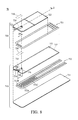
- FIG. 1 is a schematic view of an electrode strip in accordance with an embodiment of the present disclosure
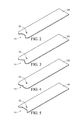
- FIG. 2 is a schematic view of a sampling opening of the second substrate in accordance with a second embodiment of the present disclosure
- FIG. 3 is a schematic view of a sampling opening of the second substrate in accordance with a third embodiment of the present disclosure
- FIG. 4 is a schematic view of a sampling opening of the second substrate in accordance with a fourth embodiment of the present disclosure.
- FIG. 5 is a schematic view of a sampling opening of the second substrate in accordance with a fifth embodiment of the present disclosure.
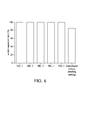
- FIG. 6 is a bar chart of the sample separation ratio in accordance with embodiments shown in FIG. 1 to FIG. 5 of the present disclosure
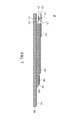
- FIG. 7 is a cross-sectional view of the embodiment of FIG. 1 along with a cross-sectional line 1-1 in accordance with the embodiment of the present disclosure
- FIG. 8 is a schematic view of a sensor strip in accordance with another embodiment of the present disclosure.
- FIG. 9 is a cross-sectional view of the embodiment of FIG. 7 along with a cross-sectional line 2-2 in accordance with the embodiment of the present disclosure
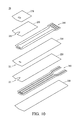
- FIG. 10 illustrates a schematic view of another electrode strip in accordance with another embodiment of the present disclosure.
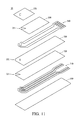
- FIG. 11 illustrates a schematic view of another electrode strip in accordance with another embodiment of the present disclosure.
- FIG. 12 illustrates a flow chart of a manufacturing method of a sensor strip in accordance with another embodiment of the present disclosure
- FIG. 13 illustrates a flow chart of a step of providing the first reactive film in accordance with the embodiment in FIG. 12 of the present disclosure
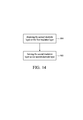
- FIG. 14 illustrates a flow chart of a step of providing the second reactive film in accordance with another embodiment in FIG. 12 of the present disclosure.
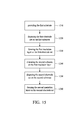
- FIG. 15 illustrates a flow chart of a manufacturing method of the electrode strip in accordance with another embodiment of the present disclosure.
- the present disclosure is directed to an electrode strip, a sensor strip, a manufacturing method thereof and a measurement system thereof.
- detailed steps and structures are provided in the following description. Obviously, implementation of the present disclosure does not limit special details known by persons skilled in the art. In addition, known structures and steps are not described in details, so as not to limit the present disclosure unnecessarily. Preferred embodiments of the present disclosure will be described below in detail. However, in addition to the detailed description, the present disclosure may also be widely implemented in other embodiments. The scope of the present disclosure is not limited to the detailed embodiments, and is defined by the claims.
- references to "one embodiment,” “an embodiment,” “other embodiments,” “another embodiment,” etc. indicate that the embodiment(s) of the disclosure so described may include a particular feature, structure, or characteristic, but not every embodiment necessarily includes the particular feature, structure, or characteristic. Further, repeated use of the phrase “in the embodiment” does not necessarily refer to the same embodiment, although it may.
- the quantity of components is single. If the quantity of the labeled component is one, the quantifier is explained to include one unit or at least one unit. If the quantity of the labeled component is a plurality, the quantifier is explained to include at least two units.
- the present disclosure relates to an electrode strip and a sensor strip having two independent reactive areas.
- the other minor reactive area is capable of measuring a factor which allows correcting of the analyte concentration detected in the major reactive area so as to obtain a higher accuracy of analyte concentration in the electrode strips and sensor strips.
- the minor reactive area when the major reactive area is configured to measure blood sugar, the minor reactive area is configured to detect an interfering factor for correcting the readings of blood sugar.
- the interfering factor is selected, but not limited, from hematocrit, triglyceride, cholesterol, uric acid, maltose, galactose, ascorbic acid, acetaminophenol, L-3,4-dihydroxyphenylalanine and dopamine.
- the minor reactive area when the major reactive area is configured to measure cholesterol, the minor reactive area is configured to detect an interfering factor for correcting the readings of cholesterol.
- an interfering factor is selected, but not limited, from hematocrit, hemoglobin, ascorbic acid, and methyl-3,4- dihydroxyphenylalanine.
- the minor reactive area when the major reactive area is configured to measure uric acid, the minor reactive area is configured to detect an interfering factor for correcting the readings of uric acid.
- an interfering factor is selected, but not limited, from hematocrit, hemoglobin, bilirubin and methyl-3,4- dihydroxyphenylalanine.
- the minor reactive area when the major reactive area is configured to measure hemoglobin, the minor reactive area is configured to detect an interfering factor for correcting the readings of hemoglobin.
- an interfering factor is selected, but not limited, from hematocrit.
- the minor reactive area when the major reactive area is configured to measure lactic acid, the minor reactive area is configured to detect an interfering factor for correcting the readings of lactic acid.
- an interfering factor is selected, but not limited, from hematocrit, ascorbic acid, acetaminophenol and dopamine.
- the so-called “substrate” in the present disclosure refers to a thin-layered plate with a flat surface and electric insulating properties. More preferably, the insulating substrate is selected, but not limited, from the group consisting of polyvinyl chloride (PVC) plates, fiber glass (FR-4) plates, polyester sulphone, bakelite plates, polyester (PET) plates, polycarbonate (PC) plates, glass plates and ceramic plates (CEM-1). Particularly, the thickness of the substrate ranges from 0.03 mm to 0.7 mm, from 0.07 mm to 0.15 mm, or from 0.5 mm to 0.62 mm.
- PVC polyvinyl chloride
- FR-4 fiber glass
- PET polyester
- PC polycarbonate
- CEM-1 glass plates
- the thickness of the substrate ranges from 0.03 mm to 0.7 mm, from 0.07 mm to 0.15 mm, or from 0.5 mm to 0.62 mm.
- electrode set or “electrode layer” in the present disclosure includes at least two metal electrodes that are isolated and disconnected from each other and used to connect the electric current biosensor.
- either the electrode set or the electrode layer is partly covered by an electric insulating layer.
- An end of both metal electrodes is exposed by the electric insulation layer, which include a working electrode and a reference electrode, and the other end of which forms connections of the working electrode and the reference electrode.
- the connections are used to connect the sensor, while the electric effect is evoked during the electrochemical reaction caused by the analyte and the aforementioned sensor.
- the components used in the electrode layer or the electrode set can include carbon paste, gold paste, silver paste, mixed carbon-silver paste, evaporated graphite or copper paste, or a combination thereof (e.g., screen printing of silver paste initially, followed by printing of carbon paste), or any conductive paste material that is suitable for screen printing and can be dried at below 80 °C.
- the so-called "insulation layer” in the present disclosure refers to a thin layer formed by a material with electric insulating properties and partially covering the electrode set or the electrode layer.
- the electric insulation layer does not cover the reaction zone and the connections of the electrode set or the electrode layer, and is formed on the substrate.
- the material of the insulation layer is selected, but not limited, from PVC insulation tape, PET insulation tape, thermal curing adhesive and ultraviolet photo-curable adhesive. More preferably, the insulation layer has a thickness of 0.01 to 0.6 mm, 0.4 to 0.51 mm, or 0.02 to 0.03 mm.
- reaction layer formulation in the present disclosure includes an electron mediator and a surfactant.
- reaction layer formulation further includes specific enzymes or water-soluble polymer carriers.
- the "electron mediator” disclosed in the present application refers to a substance that, after reacting with the analyte to be tested in the whole blood sample (such as uric acid or hemoglobin), can itself be reduced from the oxidized state to the reduced state.
- an external potential can be applied to the electrode strip to prompt the electron mediator to return to the oxidized state from the reduced state.
- the variations of potential, resistance or current due to the chemical reaction can be transmitted to connections at the other ends of the electrode set or the electrode layer by the working electrode and the reference electrode by contact with the conductive film and the reaction layer.
- the biosensor can apply an external potential to the electrode strip, through a potential output device or power source, to receive the aforementioned change of potential, resistance or current due to the chemical reaction through a signal receiver or detector, and convert the signal into the concentration of the target compound through a display device.
- the electron mediator can be potassium ferricyanide. More preferably, the amount of the electron mediator ranges from 0.05% to 6% of the reaction layer formulation (calculated by weight).
- the amount of the electron mediator ranges about 0.3% of the reaction layer formulation (calculated by weight), and when using the whole blood detecting electrode strip for the detection of hemoglobin, the amount of the electron mediator ranges about 3% of the reaction layer formulation (calculated by weight).
- the so-called "surfactant” in the present disclosure refers to a substance for increasing the reaction between a test sample and the electron mediator.
- the surfactant is selected from, but is not limited to, Sodium dodecyl sulfate, Sodium dodecyl sulfonate, Tween 20, Triton X-100, Sodium cholate and the derivatives thereof.
- the amount of the surfactant ranges about 0.01% to 1% of the reaction layer formulation (calculated by weight).
- water-soluble polymer carrier refers to a substance that makes the electron mediator, once dried, adhere to the electric insulating substrate and strengthens the contact between the reaction layer and the liquid sample. More preferably, the molecular diameter of the water-soluble polymer carrier is smaller than 100 microns, thereby enabling the water-soluble polymer carrier to be dispersed evenly in the reaction film formulation solution and will not easily precipitate. After the reaction layer has been dried, if the distribution of the water-soluble polymer carrier is uneven, it will cause poor conductivity or will function unevenly between the water-soluble electron mediator and the liquid sample, resulting in an inaccurate test result.
- the water-soluble polymer carrier can be selected from the group consisting of polyvinyl acetate (PVA), polyvinyl pyrrolidone (PVP), polyethylene glycol (PEG), gelatin, carboxymethyl cellulose (CMC), methyl cellulose, and the mixture thereof. More preferably, the amount of the water-soluble polymer carrier is below 5% of the reaction layer formulation (calculated by weight).
- FIG. 1 illustrates a schematic view of an electrode strip 10 in accordance with an embodiment of the present disclosure.
- the electrode strip 10 includes a first substrate 100, a first electrode set 110, a first insulation layer 120, a second substrate 130, a second electrode set 140 and a second insulation layer 150.
- the material of the first substrate 100 may be a PVC plate.
- the first electrode set 110 is disposed on the first substrate 100.
- the first electrode set 110 includes a reference electrode 111, a working electrode 112 and a sensing electrode 113. Since the location of the sensing electrode 113, corresponding to locations of the reference electrode 111 and working electrode 112, is far from the opening 122 of the first insulation layer 120, the sensing electrode 113 can ensure that the reference electrode 111 and the working electrode 112 have reacted to the blood sample, which finally reaches the sensing electrode 113.
- the electrode strip 10 may further include a plurality of multifunctional electrodes for confirming whether the electrode strip is received inside the above-mentioned sensor (not shown).
- the first insulation layer 120 is disposed on the first electrode set 110 and includes a first opening 121, which exposes the reference electrode 111, the working electrode 112 and sensing electrode 113 of the first electrode set 110.
- the first insulation layer 120 also uncovers the connection 114, which is far from the first opening 121.
- the connection 114 is configured to electrically connect with the sensor (not shown). In other words, the first insulation layer 120 does not cover the connection 114 of the first electrode set 110.
- the first opening 121 is located between the first substrate 100 and the second substrate 130 to form a first reactive area 123 (indicated with dotted line).
- the second substrate 130 includes a sampling opening 131 and a connecting hole 132.
- the sampling opening 131 is capable of removing the surface tension of the sample liquid so as to smoothly conduct the sample liquid into the first reactive area 123.
- the connecting hole 132 is configured to construct a capillary attraction to guide the sample liquid into the first reactive area 123.
- the electrode strip 10 further includes a first reaction layer 160 (indicated with dotted line), which is a film covering on the first reactive area 123.
- the reaction layer formulation is added dropwise or printed onto the first reactive area 123 to form a first reaction layer 160.
- the second electrode set 140 is disposed on the second substrate 130.
- the reference electrode 141 and the working electrode 142 of the second electrode set 140 uncover the connecting hole 132 of the second substrate 130.
- the gaseous molecules of the connecting hole 132 may diffuse into the second electrode set 140.
- an AC signal or an AC with DC offset signal may be applied to the second electrode set 140 for measuring hematocrit levels or the above-mentioned interfering factors from the minor reactive area.
- the first electrode set 110 is applied by a DC signal for measuring the above-identified test samples in the major reactive area.
- the first electrode set 110 and the second electrode set 140 are disposed on different substrates, when the first electrode 110 measures the hematocrit, the signal of the first electrode set 110 does not interfere with the DC signal applied to the second electrode set 140. Furthermore, since the first electrode set 110 and the second electrode set 140 are not disposed on two opposite sides of a single substrate, the first electrode set 110 or the second electrode set 140 can avoid abrasion in the manufacturing process.
- the second insulation layer 150 includes a second opening 151, which has an aperture 152.
- the electrode strip 10 further includes a cover 170, which is disposed on the second insulation layer 150 and includes a through hole 171.
- the second opening 151 is located between the cover 170 and the second substrate 130 to form a second reactive area 153 (indicated with dotted lines).
- the electrode strip 10 further includes a second reaction layer 180 (indicated with dotted lines), which is a film that covers the second reactive area 153.
- the reaction layer formulation is added dropwise or printed onto the second reactive area 153 so as to form a second reaction layer 180.
- the second insulation layer 150 also uncovers the connection 143 of the second electrode set 140 which is far from the second opening 151.
- the connection 143 is configured to electrically connect with a sensor (not shown).
- the second insulation layer 150 exposes the connection 143 of the second electrode set 140.
- the connection 114 of the first electrode set 110 does not overlap with the connection 143 of the second electrode set 140.
- the connecting hole 132 vertically connects the first opening 121 and the second opening 151. Since the through hole 171 connects with the connecting hole 132 through the second opening 151, the gaseous molecules of the first opening 121 may diffuse out of the cover 170 through the connecting hole 132 and the through hole 171. In other words, when sample liquid is conducted into the first reactive area 123 and the second reactive area 153 through the sampling opening 131, the capillary attraction generated from the connecting hole 132 and the through hole 171 guides the sample liquid into the first reactive area 123 and the second reactive area 153.
- the shape of the through hole 171 and the connecting hole 132 can be selected from a cylinder, a square pillar and a multilateral pillar, but both the through hole 171 and the connecting hole 132 do not necessarily have to be the same shape.
- the inside diameter of the through hole 171 ranges from 1.6 x 0.7 mm to 2.0 x 1.1 mm, while the inside diameter of the connecting hole 132 ranges from 0.5 x 0.5 mm to 1.6 x 0.7 mm.
- the inside diameter of the connecting hole 132 can be designed to be smaller than or equal to the inside diameter of the through hole 151 to enhance capillary attraction and to avoid the sample liquid of the first reactive area 123 to contaminate the sample liquid of the second reactive area 153 through the connecting hole 132 or vise versa.
- the first reactive area 123 of the present disclosure has a first depth D1
- the second reactive area 153 has a second depth D2
- the sampling opening 131 has a third depth D3.
- the first depth D1 and the second depth D2 are longer than the third depth D3. Since the first reactive area 123 and the second reactive area 153 accommodate sample liquids from the same source, the first depth D1 and the second depth D2 are configured to separate the sample liquid of the first reactive area 123 from the sample liquid of the second reactive area 153. Particularly, because the amount of the sample liquids entering the sampling opening 131 is constant, the capacity of the first reactive area 123 and the second reactive area 153 can be designed to accommodate half of the amount of the sample liquids, respectively.
- the sample liquids of the first reactive area 123 do not contaminate the sample liquids of the second reactive area 153.
- the first depth D1 of the first reactive area 123 may be longer than the second depth D2 of the second reactive area 153 or vise versa.
- the second substrate 130 of the present disclosure has an end 133 adjacent to the sampling opening 131.
- the end 133 where the sampling opening 131 is formed is a hydrophobic surface which is configured to separate sample liquids from the sampling opening 131 and to avoid sample liquid from staying in the sampling opening 131 and to avoid the sample liquids of the first reactive area 123 from contaminating the sample liquids of the second reactive area 153.
- the third depth D3 of the sampling opening 131 is smaller than either the first depth D1 or the second depth D2.
- the third depth D3 may be 0.15 to 1.5 mm, or 0.3 to 0.8 mm.
- both of the inside diameter of the aperture 122 of the first opening 121 and the inside diameter of the aperture 152 of the second opening 151 are smaller than the inside diameter of the sampling opening 131.
- the inside diameter of either the aperture 122 or the aperture 152 can be designed to equal to the inside diameter of the sampling opening 131.
- the inside diameter of either the aperture 122 or the aperture 152 may be designed to be larger than the inside diameter of the sampling opening 131. Since the sampling opening 131 is configured to remove the surface tension of the sample liquids, the shape of the sampling opening 131 of the second substrate 131 may be selected from semicircular (illustrated in FIG. 2 ), cuneal (illustrated in FIG.
- the sample liquids are separated by the sampling opening 131 and conducted into the first reactive area 123 and the second reactive area 153.
- the sampling opening 131 is capable of dividing the sample liquids into two parts.
- an experiment is performed to calculate sample separation ratios of the embodiments of FIG. 1 to FIG. 5 and the embodiment without any sampling opening. The experiment utilizes the same sample liquid and has a sampling count (e.g., 100 strips) for each group. As shown in FIG. 6 , 15% of the electrode strip, without any sampling opening, cannot divide the sample liquids. In contrast, the other electrode strips are capable of separating the sample liquids of the first reactive area 123 from the other of the second reactive area 153.
- FIG. 7 is a cross-sectional view of the cross-sectional line 1-1 of each of the layers of the electrode strip 10 shown in FIG. 1 , once stacked up.
- the electrode strip 10 includes the first substrate 100, the first electrode set 110, the first insulation layer 120, the second substrate 130, the second electrode set 140, the second insulation layer 150 and a cover 170.
- the through hole 171 of the cover 170 connects with the connecting hole 132 of the first insulation layer 120 through the second opening 151 and the second electrode set 140, the first opening 121 and the second opening 151 connect with each other.
- the sample liquids do not stay at the sampling opening 131 after the sample liquids enters into the sampling opening 131. Moreover, since capillary attraction of the first opening 121 and the second opening 151 will take in the sample liquids, the sample liquids do not stay at the sampling opening 131. Since the through hole 171 connects to the connecting hole 132, the gaseous molecules in the first opening 121 and the second opening 151, through the through hole 171, can be ejected. Moreover, compared with the patent of '103, the design of the upward through hole 171 in the cover 170 of the present disclosure can prevent the sample liquid from overflowing, which would result in contamination.
- the present disclosure also provide a sensor strip 70, which comprises a first reactive film 710 and a second reactive film 720.
- the first reactive film 710 includes a substrate 711, a first electrode layer 712 and a first insulation layer 713.
- the first electrode layer 712 includes a reference electrode 712A, a working electrode 712B and a sensor electrode 712C.
- the first electrode layer 712 is disposed on the substrate 711 and is partially covered by the first insulation layer 713. In other words, the first electrode layer 712 is disposed between the first insulation layer 713 and the substrate 711.
- the first insulation layer 713 includes a first end 714.
- the first end 714 adjacent to the first electrode layer 712 is concaved to form a first reactive area 715 that has a first depth D4.
- the first insulation layer 713 further includes a second end 717.
- the electrodes 712A, 712B, 712C of the first electrode layer 712 to which the second end 717 is adjacent are exposed by the first insulation layer 713.
- the second reactive film 720 includes a second electrode layer 721 and a second insulation layer 722.
- the second electrode layer 721 is disposed on the first insulation layer 713, while the second insulation layer 722 partially covers the second electrode layer 721.
- the second electrode layer 721 is disposed between the second insulation layer 722 and the first insulation layer 713.
- the second insulation layer 722 includes a first end 723, which forms a concaved second reactive area 724 that has a second depth D5.
- the first insulation layer 713 has a first end 714. The first end 714 from which the substrate 711 is formed by a concaved sampling opening 716 that has a third depth D6.
- the first end 714 adjacent to the second electrode layer 721 forms the concaved sampling opening 716.
- both, the first depth D4 and the second depth D5 are longer than the third depth D6.
- the second electrode layer 721 may be applied with an AC signal or an AC with DC offset signal for measuring hematocrit level or the above-identified interfering factors in the minor reactive areas.
- the first electrode layer 712 may be applied with a DC signal for measuring the aforesaid analyte in the major reactive area.
- the first electrode layer 712 may be applied with the AC signal or the AC with DC offset signal for measuring hematocrit level or the above-identified interfering factors in the minor reactive areas. Therefore, the second electrode layer 721 may be applied with a DC signal for measuring the foregoing analyte in the major reactive area.
- the sensor strip 70 further includes a first reaction layer 730 and a second reaction layer 740.
- the first reaction layer 730 has a similar function and location with the first reaction layer 160, shown in FIG. 1 .
- the second reaction layer 740 and the second reaction layer 180 have similar functions and locations.
- FIG. 9 is a cross-sectional view of the cross-sectional line 2-2 of each of the layers of the sensor strip 70 shown in FIG. 8 , once stacked up.
- the sensor strip 70 includes a substrate 711, a first electrode layer 712, a first insulation layer 713, a second electrode layer 721 (referring to FIG. 8 and not shown in FIG. 9 ) and a second insulation layer 722.
- the sensor strip 70 further includes a vent hole 750 which penetrates the second insulation layer 722, the second electrode layer 721 and the first insulation layer 713 so as to connect the first reactive area 715 and the second reactive area 724.
- the vent hole 750 is configured to eject the gaseous molecules and to generate capillary attraction.
- the vent hole 750 is fabricated on the second insulation layer 722 and the first insulation layer 713 by a punch press method or a laser ablation method.
- the first reactive area 715 and the second reactive area 724 are capable of accommodating a sample liquid from the same source and since the first depth D4 of the first reactive area 715 and the second depth D5 of the second reactive area 724 are configured to separate the sample liquids of the first reactive area 715 from the sample liquids of the second reactive area 724, the sample liquids of the first reactive area 715 do not contaminate the sample liquid of the second reactive area 724.
- the sample liquids, entering the first reactive area 715 and the second reactive area 724 from the sampling opening 716, do not stay at the hydrophobic surface (such as silicone surface) of the sampling opening 716 so as to avoid contamination between the sample liquids of the first reactive area 715 and the sample liquids of the second reactive area 724.
- FIG. 10 illustrates another embodiment of the present disclosure.
- the electrode strip 20 of the embodiment includes a first substrate 200, a first electrode set 210, a first insulation layer 220, a second substrate 230, a second electrode set 240, a second insulation layer 250 and a cover 270.
- the structure and assembly of the electrode strip 20 and its components are similar with that of the electrode strip 10 shown in FIG. 1 .
- the feature of the electrode strip 20 is that the cover 270, the second insulation layer 250, the second substrate 230, the first insulation layer 220 and the first substrate 200 include an awl-like shaped end.
- the sampling opening 231 is located at a tip area of the awl-like shaped end.
- only the second substrate 230 of the electrode strip includes an awl-like shaped end. Because the awl-like shaped end converges toward the sampling opening 231 to reduce the contact area of the sampling opening 231, the amount of the sample liquids is drawn through the sampling opening 231 to the first opening 221 and the second opening 251 and decreases so as to prevent the sample liquids of the first opening 221 from contaminating the sample liquids of the second opening 251. Additionally, the above-mentioned design for reducing the contact area can be replaced with other designs that truncate the second substrate 230, where the sampling opening 231 is located, to reduce the contact area surrounding the sampling opening 231.
- first insulation layer 220 and the second substrate 230 can be integrated as the first insulation layer 713 shown in FIG. 8 .
- the second insulation layer 250 and the cover 270 can be integrated as the second insulation layer 722 shown in FIG. 8 .
- the embodiment shown in FIG. 11 is modified from the embodiment shown in FIG. 10 .
- the electrode strip 30 includes a first substrate 300, a first electrode set 310, a first insulation layer 320, a second substrate 330, a second electrode set 340, a second insulation layer 350 and a cover 370.
- the structure and assembly of the electrode strip 30 is similar with that of the electrode strip 10 shown in FIG. 1 .
- the feature of the electrode strip 30 is that the sampling opening 331 is disposed at the corner of the second substrate 330.
- the contact area of the sampling opening 331 will reduce so that the amount of sample liquids, through the sampling opening, entering the first opening 321 and the second opening 351 will reduce to avoid cross-contamination between the first opening 321 and the second opening 351.
- the difference between the embodiment of FIG. 11 and that of FIG. 10 is the locations of the sampling opening 231 and 331.
- the first opening 321 and the second opening 351 may be disposed corresponding to the sampling opening 231.
- the lengthwise axis of the first opening 321 and the lengthwise axis of the first insulation layer 330 intersect to form an included angle which ranges from 20° to 70°.
- the lengthwise axis of the second opening 351 and the lengthwise axis of the second insulation layer 350 intersect to form an included angle which also ranges from 20° to 70°.
- the first electrode set 310 and the second electrode set 340 may bend toward the corner in response to the location of the sampling opening 331.
- the flow chart shown in FIG 12 illustrates a manufacturing method of the sensor strip (referring to the structure shown in FIG. 8 ) including steps as follows.
- Step 910 provides a first reactive film and a second reactive film.
- the first reactive film includes a concaved first reactive area, while the second reactive film includes a concaved second reactive area.
- Step 920 disposes the first reactive film on the top surface or bottom surface of the second reactive film.
- Step 930 forms a vent hole, which penetrates the first reactive film so as to connect the first reactive area and the second reactive area.
- the above-mentioned steps do not necessarily have to be in numeric order as shown in FIG. 12 .
- the manufacturing method of the present disclosure may perform step 930 to form a vent hole in the first reactive film prior to step 920, which places the first reactive film on the second reactive film.
- step 930, which forms the vent hole may include, but is not limited to, a laser ablation method to fabricate the vent hole.
- the vent hole can be fabricated by a punch press method.
- step 910 which provides the first reactive film, further includes steps as follows.
- Step 911 provides a substrate and step 912 is implemented.
- Step 912 disposes a first electrode layer on the substrate and step 913 is implemented.
- Step 913 forms a first insulation layer on the first electrode layer, wherein a first end of the first insulation layer is concaved to form a first reactive area with a first depth.
- the first insulation layer forming step 913 can be performed by coating or printing.
- step 910, which provides the first reactive film further includes coating or printing a first reaction layer in the first reactive area.
- the first insulation layer forming step 913 further includes a step that exposes an electrode of the first electrode layer, which is adjacent to a second end of the first insulation layer.
- step 910 which provides the second reactive film, further includes steps as follows.
- Step 914 disposes a second electrode layer on the first insulation layer and step 915 is implemented.
- Step 915 forms a second insulation layer on the second electrode layer, wherein a first end of the second insulation layer is concaved to form a second reactive area with a second depth.
- the second insulation layer forming step 915 can be implemented by coating or printing.
- the above-mentioned steps 911 to 913 and steps 914 to 915 do not necessarily have to be in numeric order.
- step 910, which provides the second reactive film further includes a step of coating or printing a second reaction layer in the second reactive area.
- the second insulation layer forming step 915 further includes a step that exposes an electrode of the second electrode layer, which is adjacent to a second end of the second insulation layer.
- the manufacturing method of the electrode strip includes steps as follows.
- Step 1210 provides a first substrate and step 1220 is implemented.
- Step 1220 disposes a first electrode set on the first substrate and step 1230 is implemented.
- Step 1230 forms a first insulation layer on the first electrode set, wherein the first insulation layer includes a first opening and step 1240 is implemented.
- Step 1240 disposes a second substrate on the first insulation layer, wherein the second substrate includes a sampling opening and a connecting hole and step 1250 is implemented.
- Step 1250 disposes a second electrode set on the second substrate, wherein the second electrode set uncovers the connecting hole and step 1260 is implemented.
- Step 1260 forms a second insulation layer on the second electrode set, wherein the second insulation layer includes a second opening and the connecting hole vertically connects the first opening and the second opening.
- Step 1230, which forms the first insulation layer and step 1260, which forms the second insulation layer, can be performed by a coating or a printing method.
- the manufacturing method of the electrode strip further includes steps as follows.
- Step 1270 coats or prints a first reaction layer in the first opening.
- Step 1280 coats or prints a second reaction layer in the second opening.
- the above-mentioned steps 1210 to 1260 and steps 1270 to 1280 do not necessarily have to be in numeric order.
- the manufacturing method of the electrode strip further includes step 1290.
- Step 1290 disposes a cover on the second insulation layer, wherein the cover includes a through hole that connects the connecting hole.
- steps 1210 to 1260, steps 1270 to 1280 and step 1290 do not necessarily have to be in numeric order.
- the present disclosure further provides a measurement system with hematocrit correction.
- the measurement system includes either the above-mentioned electrode strip or the above-identified sensor strip, and a sensor.
- the first electrode set or the first electrode layer is configured to measure an analyte concentration (such as the analyte concentration in the above-identified major reactive area).
- Either the second electrode set or the second electrode layer is configured to measure hematocrit or interfering factors in the above-mentioned minor reactive area.
- the sensor is configured to electrically connect with either the electrode strip or the sensor strip.
- the sensor includes a power source, a detector and a microprocessor.
- the power source is configured to simultaneously provide a DC signal and either an AC signal or an AC with DC offset signal.
- the DC signal is transmitted to either the first electrode set or the first electrode layer.
- Either the AC signal or the AC with DC offset signal is transmitted to either the second electrode set or the second electrode layer.
- the detector is configured to detect a first reactive value in response to the analyte concentration and a second reactive value in response to the hematocrit concentration.
- the microprocessor is configured to calculate the hematocrit-corrected analyte concentration in response to the first reactive value and the second reactive value.
- the sensor strip and the electrode strip can avoid cross-contamination of sample liquids in two separated reactive areas so as to be suitable for domestic usage and quick diagnosis.
Landscapes
- Health & Medical Sciences (AREA)
- Life Sciences & Earth Sciences (AREA)
- Chemical & Material Sciences (AREA)
- Immunology (AREA)
- Molecular Biology (AREA)
- Hematology (AREA)
- Engineering & Computer Science (AREA)
- General Health & Medical Sciences (AREA)
- Biochemistry (AREA)
- Analytical Chemistry (AREA)
- Physics & Mathematics (AREA)
- Organic Chemistry (AREA)
- General Physics & Mathematics (AREA)
- Pathology (AREA)
- Proteomics, Peptides & Aminoacids (AREA)
- Zoology (AREA)
- Wood Science & Technology (AREA)
- Chemical Kinetics & Catalysis (AREA)
- Electrochemistry (AREA)
- Microbiology (AREA)
- Biotechnology (AREA)
- Urology & Nephrology (AREA)
- Biomedical Technology (AREA)
- Biophysics (AREA)
- Bioinformatics & Cheminformatics (AREA)
- General Engineering & Computer Science (AREA)
- Genetics & Genomics (AREA)
- Food Science & Technology (AREA)
- Cell Biology (AREA)
- Medicinal Chemistry (AREA)
- Investigating Or Analyzing Materials By The Use Of Electric Means (AREA)
- Investigating Or Analysing Biological Materials (AREA)
Priority Applications (1)
| Application Number | Priority Date | Filing Date | Title |
|---|---|---|---|
| PL12198648T PL2687841T3 (pl) | 2012-07-20 | 2012-12-20 | Pasek czujnikowy oraz sposób jego wytwarzania i jego system |
Applications Claiming Priority (1)
| Application Number | Priority Date | Filing Date | Title |
|---|---|---|---|
| TW101126157A TWI481863B (zh) | 2012-07-20 | 2012-07-20 | 電極試片及感測試片及其製造方法及具有校正血容比之感測系統 |
Publications (2)
| Publication Number | Publication Date |
|---|---|
| EP2687841A1 true EP2687841A1 (fr) | 2014-01-22 |
| EP2687841B1 EP2687841B1 (fr) | 2019-11-27 |
Family
ID=47519912
Family Applications (1)
| Application Number | Title | Priority Date | Filing Date |
|---|---|---|---|
| EP12198648.3A Active EP2687841B1 (fr) | 2012-07-20 | 2012-12-20 | Bande de capteur, leur procédé de fabrication et système associé |
Country Status (5)
| Country | Link |
|---|---|
| US (2) | US9039877B2 (fr) |
| EP (1) | EP2687841B1 (fr) |
| CN (1) | CN103575782B (fr) |
| PL (1) | PL2687841T3 (fr) |
| TW (1) | TWI481863B (fr) |
Families Citing this family (11)
| Publication number | Priority date | Publication date | Assignee | Title |
|---|---|---|---|---|
| US9523653B2 (en) | 2013-05-09 | 2016-12-20 | Changsha Sinocare Inc. | Disposable test sensor with improved sampling entrance |
| US9518951B2 (en) | 2013-12-06 | 2016-12-13 | Changsha Sinocare Inc. | Disposable test sensor with improved sampling entrance |
| US9897566B2 (en) | 2014-01-13 | 2018-02-20 | Changsha Sinocare Inc. | Disposable test sensor |
| US9939401B2 (en) | 2014-02-20 | 2018-04-10 | Changsha Sinocare Inc. | Test sensor with multiple sampling routes |
| TWI522612B (zh) * | 2014-10-14 | 2016-02-21 | 五鼎生物技術股份有限公司 | 生化試片及其製造方法 |
| GB2531728A (en) * | 2014-10-27 | 2016-05-04 | Cilag Gmbh Int | Method for determining diffusion |
| GB201511299D0 (en) * | 2015-06-26 | 2015-08-12 | Inside Biometrics Ltd | Test device and method of using a test device |
| TWI696828B (zh) * | 2015-07-22 | 2020-06-21 | 五鼎生物技術股份有限公司 | 電化學試片及生產此試片之試片母板與方法 |
| US9823242B2 (en) | 2015-08-07 | 2017-11-21 | Apex Biotechnology Corp. | Sensor strip and manufacture method thereof and system thereof |
| TWI609182B (zh) * | 2016-11-04 | 2017-12-21 | 五鼎生物技術股份有限公司 | 葡萄糖量測裝置與設備 |
| CN113125529A (zh) | 2020-01-14 | 2021-07-16 | 利多(香港)有限公司 | 用于检测肾功能指标的电化学测试条及其检测方法 |
Citations (6)
| Publication number | Priority date | Publication date | Assignee | Title |
|---|---|---|---|---|
| US5264103A (en) | 1991-10-18 | 1993-11-23 | Matsushita Electric Industrial Co., Ltd. | Biosensor and a method for measuring a concentration of a substrate in a sample |
| US6258230B1 (en) | 1998-11-09 | 2001-07-10 | Apex Biotechnology Corporation | Non-enzymatic disposable uric acid detecting electrode strip, method for producing the same and its use |
| EP1734362A2 (fr) * | 2005-06-13 | 2006-12-20 | Nova Biomedical Corporation | Capteur d'oxygène jetable et procédé de correction de l'influence de l'oxygène sur les dispositifs analytiques basés sur l'oxydase |
| WO2008030757A1 (fr) * | 2006-09-05 | 2008-03-13 | Home Diagnostics, Inc. | Système et procédés pour déterminer la concentration d'analyte comprenant une correction d'hématocrite |
| US7407811B2 (en) | 1997-12-22 | 2008-08-05 | Roche Diagnostics Operations, Inc. | System and method for analyte measurement using AC excitation |
| US20110139634A1 (en) * | 2009-12-14 | 2011-06-16 | Taidoc Technology Corporation | System and method for measuring analyte concentration with interferant correction |
Family Cites Families (13)
| Publication number | Priority date | Publication date | Assignee | Title |
|---|---|---|---|---|
| KR0156176B1 (ko) * | 1995-06-01 | 1998-12-01 | 구자홍 | 전기화학식 면역 바이오센서 |
| EP1042667B1 (fr) * | 1997-12-22 | 2009-06-17 | Roche Diagnostics Operations, Inc. | Instrument de mesure |
| US6923894B2 (en) * | 1999-11-11 | 2005-08-02 | Apex Biotechnology Corporation | Biosensor with multiple sampling ways |
| JP2001159618A (ja) * | 1999-12-03 | 2001-06-12 | Matsushita Electric Ind Co Ltd | バイオセンサ |
| JP2001201479A (ja) * | 2000-01-21 | 2001-07-27 | Matsushita Electric Ind Co Ltd | バイオセンサ |
| EP1571443B1 (fr) * | 2002-10-25 | 2014-07-02 | ARKRAY, Inc. | Biocapteur électrochimique |
| US20050100880A1 (en) * | 2003-11-12 | 2005-05-12 | Yu-Hong Chang | Biosensor test strips of multiple function for multiple uses |
| US7955484B2 (en) * | 2005-12-14 | 2011-06-07 | Nova Biomedical Corporation | Glucose biosensor and method |
| TWI368029B (en) | 2007-10-19 | 2012-07-11 | Gen Life Biotechnology Co Ltd | Electrochemical method for detecting hemoglobin and test strip thereof |
| TW201024721A (en) * | 2008-12-24 | 2010-07-01 | Delta Electronics Inc | Strip for electrochemically sensing and electrochemically sensing system |
| CN102023180B (zh) * | 2009-09-18 | 2015-05-06 | 五鼎生物技术股份有限公司 | 生化传感系统、测量装置、生化传感试片及其制造方法 |
| US20110079522A1 (en) | 2009-10-02 | 2011-04-07 | Lifescan Scotland Limited | Multi-analyte test strip with inline working electrodes and shared opposing counter/reference electrode |
| CN102128932A (zh) * | 2010-01-15 | 2011-07-20 | 泰博科技股份有限公司 | 电化学生物感测试纸、生物感测器装置、分析物测量系统 |
-
2012
- 2012-07-20 TW TW101126157A patent/TWI481863B/zh active
- 2012-10-12 CN CN201210384324.0A patent/CN103575782B/zh active Active
- 2012-12-20 EP EP12198648.3A patent/EP2687841B1/fr active Active
- 2012-12-20 PL PL12198648T patent/PL2687841T3/pl unknown
- 2012-12-21 US US13/725,244 patent/US9039877B2/en active Active
-
2015
- 2015-03-06 US US14/640,193 patent/US9880128B2/en active Active
Patent Citations (6)
| Publication number | Priority date | Publication date | Assignee | Title |
|---|---|---|---|---|
| US5264103A (en) | 1991-10-18 | 1993-11-23 | Matsushita Electric Industrial Co., Ltd. | Biosensor and a method for measuring a concentration of a substrate in a sample |
| US7407811B2 (en) | 1997-12-22 | 2008-08-05 | Roche Diagnostics Operations, Inc. | System and method for analyte measurement using AC excitation |
| US6258230B1 (en) | 1998-11-09 | 2001-07-10 | Apex Biotechnology Corporation | Non-enzymatic disposable uric acid detecting electrode strip, method for producing the same and its use |
| EP1734362A2 (fr) * | 2005-06-13 | 2006-12-20 | Nova Biomedical Corporation | Capteur d'oxygène jetable et procédé de correction de l'influence de l'oxygène sur les dispositifs analytiques basés sur l'oxydase |
| WO2008030757A1 (fr) * | 2006-09-05 | 2008-03-13 | Home Diagnostics, Inc. | Système et procédés pour déterminer la concentration d'analyte comprenant une correction d'hématocrite |
| US20110139634A1 (en) * | 2009-12-14 | 2011-06-16 | Taidoc Technology Corporation | System and method for measuring analyte concentration with interferant correction |
Also Published As
| Publication number | Publication date |
|---|---|
| TWI481863B (zh) | 2015-04-21 |
| US20140021046A1 (en) | 2014-01-23 |
| US9880128B2 (en) | 2018-01-30 |
| PL2687841T3 (pl) | 2020-05-18 |
| CN103575782B (zh) | 2017-04-05 |
| EP2687841B1 (fr) | 2019-11-27 |
| US9039877B2 (en) | 2015-05-26 |
| TW201405122A (zh) | 2014-02-01 |
| US20150276671A1 (en) | 2015-10-01 |
| CN103575782A (zh) | 2014-02-12 |
Similar Documents
| Publication | Publication Date | Title |
|---|---|---|
| US9880128B2 (en) | Electrode strip and sensor strip and manufacture method thereof and system thereof | |
| KR101566256B1 (ko) | 전기화학적 테스트 스트립 | |
| US20150241378A1 (en) | Electrochemical-based analytical test strip with bare interferent electrodes | |
| JP2007507710A (ja) | 電気化学セル | |
| US11774395B2 (en) | Test element for electrochemically detecting at least one analyte | |
| EP2873969B1 (fr) | Système de mesure d'hématocrite et procédé de mesure l'utilisant | |
| KR20020077407A (ko) | 피분석물 측정에 사용하기 위한 전기화학적 시험 스트립 | |
| EP3071703B1 (fr) | Bandelette de test analytique double chambre | |
| US9470648B2 (en) | Electrode strip and sensor strip and system thereof | |
| KR20190128119A (ko) | 센서 스트립 및 이를 이용한 생체 물질 측정 장치 | |
| US20170038331A1 (en) | System and method for compensating sample-related measurements based on polarization effects of test strips | |
| CN100392389C (zh) | 一种电化感测试片 | |
| EP2297574B1 (fr) | Biocapteur | |
| CN106471361A (zh) | 具有垂直相交的样品接收室的端部填充基于电化学的分析测试条 | |
| EP1939612A1 (fr) | Puce de biocapteur et processus de fabrication idoine | |
| CN101153875A (zh) | 用于检测血液样本总胆固醇的感测件 | |
| GB2530542A (en) | Sensor for detecting glucose of rhizome plants | |
| KR200408934Y1 (ko) | 미세량의 샘플 채취가 가능한 생물 감측기 시료편 | |
| GB2509325A (en) | End-fill electrochemical analytical test strip with perpendicular intersecting sample receiving chambers | |
| KR20070050337A (ko) | 미세량의 샘플 채취가 가능한 생물 감측기 시료편 | |
| HK1227943B (en) | Dual-chamber analytical test strip | |
| HK1227943A1 (en) | Dual-chamber analytical test strip |
Legal Events
| Date | Code | Title | Description |
|---|---|---|---|
| PUAI | Public reference made under article 153(3) epc to a published international application that has entered the european phase |
Free format text: ORIGINAL CODE: 0009012 |
|
| AK | Designated contracting states |
Kind code of ref document: A1 Designated state(s): AL AT BE BG CH CY CZ DE DK EE ES FI FR GB GR HR HU IE IS IT LI LT LU LV MC MK MT NL NO PL PT RO RS SE SI SK SM TR |
|
| AX | Request for extension of the european patent |
Extension state: BA ME |
|
| 17P | Request for examination filed |
Effective date: 20140430 |
|
| RBV | Designated contracting states (corrected) |
Designated state(s): AL AT BE BG CH CY CZ DE DK EE ES FI FR GB GR HR HU IE IS IT LI LT LU LV MC MK MT NL NO PL PT RO RS SE SI SK SM TR |
|
| RIN1 | Information on inventor provided before grant (corrected) |
Inventor name: HUANG, YING-CHE Inventor name: HUANG, LAN-HSIANG Inventor name: CHU, CHING-YUAN |
|
| STAA | Information on the status of an ep patent application or granted ep patent |
Free format text: STATUS: EXAMINATION IS IN PROGRESS |
|
| 17Q | First examination report despatched |
Effective date: 20180321 |
|
| GRAP | Despatch of communication of intention to grant a patent |
Free format text: ORIGINAL CODE: EPIDOSNIGR1 |
|
| STAA | Information on the status of an ep patent application or granted ep patent |
Free format text: STATUS: GRANT OF PATENT IS INTENDED |
|
| INTG | Intention to grant announced |
Effective date: 20190807 |
|
| GRAS | Grant fee paid |
Free format text: ORIGINAL CODE: EPIDOSNIGR3 |
|
| GRAA | (expected) grant |
Free format text: ORIGINAL CODE: 0009210 |
|
| STAA | Information on the status of an ep patent application or granted ep patent |
Free format text: STATUS: THE PATENT HAS BEEN GRANTED |
|
| AK | Designated contracting states |
Kind code of ref document: B1 Designated state(s): AL AT BE BG CH CY CZ DE DK EE ES FI FR GB GR HR HU IE IS IT LI LT LU LV MC MK MT NL NO PL PT RO RS SE SI SK SM TR |
|
| REG | Reference to a national code |
Ref country code: GB Ref legal event code: FG4D |
|
| REG | Reference to a national code |
Ref country code: CH Ref legal event code: EP |
|
| REG | Reference to a national code |
Ref country code: AT Ref legal event code: REF Ref document number: 1207271 Country of ref document: AT Kind code of ref document: T Effective date: 20191215 |
|
| REG | Reference to a national code |
Ref country code: DE Ref legal event code: R096 Ref document number: 602012065990 Country of ref document: DE |
|
| REG | Reference to a national code |
Ref country code: IE Ref legal event code: FG4D |
|
| REG | Reference to a national code |
Ref country code: NL Ref legal event code: MP Effective date: 20191127 |
|
| REG | Reference to a national code |
Ref country code: LT Ref legal event code: MG4D |
|
| PG25 | Lapsed in a contracting state [announced via postgrant information from national office to epo] |
Ref country code: GR Free format text: LAPSE BECAUSE OF FAILURE TO SUBMIT A TRANSLATION OF THE DESCRIPTION OR TO PAY THE FEE WITHIN THE PRESCRIBED TIME-LIMIT Effective date: 20200228 Ref country code: NL Free format text: LAPSE BECAUSE OF FAILURE TO SUBMIT A TRANSLATION OF THE DESCRIPTION OR TO PAY THE FEE WITHIN THE PRESCRIBED TIME-LIMIT Effective date: 20191127 Ref country code: BG Free format text: LAPSE BECAUSE OF FAILURE TO SUBMIT A TRANSLATION OF THE DESCRIPTION OR TO PAY THE FEE WITHIN THE PRESCRIBED TIME-LIMIT Effective date: 20200227 Ref country code: FI Free format text: LAPSE BECAUSE OF FAILURE TO SUBMIT A TRANSLATION OF THE DESCRIPTION OR TO PAY THE FEE WITHIN THE PRESCRIBED TIME-LIMIT Effective date: 20191127 Ref country code: LT Free format text: LAPSE BECAUSE OF FAILURE TO SUBMIT A TRANSLATION OF THE DESCRIPTION OR TO PAY THE FEE WITHIN THE PRESCRIBED TIME-LIMIT Effective date: 20191127 Ref country code: ES Free format text: LAPSE BECAUSE OF FAILURE TO SUBMIT A TRANSLATION OF THE DESCRIPTION OR TO PAY THE FEE WITHIN THE PRESCRIBED TIME-LIMIT Effective date: 20191127 Ref country code: LV Free format text: LAPSE BECAUSE OF FAILURE TO SUBMIT A TRANSLATION OF THE DESCRIPTION OR TO PAY THE FEE WITHIN THE PRESCRIBED TIME-LIMIT Effective date: 20191127 Ref country code: SE Free format text: LAPSE BECAUSE OF FAILURE TO SUBMIT A TRANSLATION OF THE DESCRIPTION OR TO PAY THE FEE WITHIN THE PRESCRIBED TIME-LIMIT Effective date: 20191127 Ref country code: NO Free format text: LAPSE BECAUSE OF FAILURE TO SUBMIT A TRANSLATION OF THE DESCRIPTION OR TO PAY THE FEE WITHIN THE PRESCRIBED TIME-LIMIT Effective date: 20200227 |
|
| PG25 | Lapsed in a contracting state [announced via postgrant information from national office to epo] |
Ref country code: IS Free format text: LAPSE BECAUSE OF FAILURE TO SUBMIT A TRANSLATION OF THE DESCRIPTION OR TO PAY THE FEE WITHIN THE PRESCRIBED TIME-LIMIT Effective date: 20200327 Ref country code: HR Free format text: LAPSE BECAUSE OF FAILURE TO SUBMIT A TRANSLATION OF THE DESCRIPTION OR TO PAY THE FEE WITHIN THE PRESCRIBED TIME-LIMIT Effective date: 20191127 Ref country code: RS Free format text: LAPSE BECAUSE OF FAILURE TO SUBMIT A TRANSLATION OF THE DESCRIPTION OR TO PAY THE FEE WITHIN THE PRESCRIBED TIME-LIMIT Effective date: 20191127 |
|
| PG25 | Lapsed in a contracting state [announced via postgrant information from national office to epo] |
Ref country code: AL Free format text: LAPSE BECAUSE OF FAILURE TO SUBMIT A TRANSLATION OF THE DESCRIPTION OR TO PAY THE FEE WITHIN THE PRESCRIBED TIME-LIMIT Effective date: 20191127 |
|
| PG25 | Lapsed in a contracting state [announced via postgrant information from national office to epo] |
Ref country code: CZ Free format text: LAPSE BECAUSE OF FAILURE TO SUBMIT A TRANSLATION OF THE DESCRIPTION OR TO PAY THE FEE WITHIN THE PRESCRIBED TIME-LIMIT Effective date: 20191127 Ref country code: RO Free format text: LAPSE BECAUSE OF FAILURE TO SUBMIT A TRANSLATION OF THE DESCRIPTION OR TO PAY THE FEE WITHIN THE PRESCRIBED TIME-LIMIT Effective date: 20191127 Ref country code: PT Free format text: LAPSE BECAUSE OF FAILURE TO SUBMIT A TRANSLATION OF THE DESCRIPTION OR TO PAY THE FEE WITHIN THE PRESCRIBED TIME-LIMIT Effective date: 20200419 Ref country code: EE Free format text: LAPSE BECAUSE OF FAILURE TO SUBMIT A TRANSLATION OF THE DESCRIPTION OR TO PAY THE FEE WITHIN THE PRESCRIBED TIME-LIMIT Effective date: 20191127 Ref country code: DK Free format text: LAPSE BECAUSE OF FAILURE TO SUBMIT A TRANSLATION OF THE DESCRIPTION OR TO PAY THE FEE WITHIN THE PRESCRIBED TIME-LIMIT Effective date: 20191127 |
|
| REG | Reference to a national code |
Ref country code: CH Ref legal event code: PL |
|
| REG | Reference to a national code |
Ref country code: BE Ref legal event code: MM Effective date: 20191231 |
|
| REG | Reference to a national code |
Ref country code: DE Ref legal event code: R097 Ref document number: 602012065990 Country of ref document: DE |
|
| PG25 | Lapsed in a contracting state [announced via postgrant information from national office to epo] |
Ref country code: SK Free format text: LAPSE BECAUSE OF FAILURE TO SUBMIT A TRANSLATION OF THE DESCRIPTION OR TO PAY THE FEE WITHIN THE PRESCRIBED TIME-LIMIT Effective date: 20191127 Ref country code: MC Free format text: LAPSE BECAUSE OF FAILURE TO SUBMIT A TRANSLATION OF THE DESCRIPTION OR TO PAY THE FEE WITHIN THE PRESCRIBED TIME-LIMIT Effective date: 20191127 Ref country code: SM Free format text: LAPSE BECAUSE OF FAILURE TO SUBMIT A TRANSLATION OF THE DESCRIPTION OR TO PAY THE FEE WITHIN THE PRESCRIBED TIME-LIMIT Effective date: 20191127 |
|
| REG | Reference to a national code |
Ref country code: AT Ref legal event code: MK05 Ref document number: 1207271 Country of ref document: AT Kind code of ref document: T Effective date: 20191127 |
|
| PLBE | No opposition filed within time limit |
Free format text: ORIGINAL CODE: 0009261 |
|
| STAA | Information on the status of an ep patent application or granted ep patent |
Free format text: STATUS: NO OPPOSITION FILED WITHIN TIME LIMIT |
|
| PG25 | Lapsed in a contracting state [announced via postgrant information from national office to epo] |
Ref country code: IE Free format text: LAPSE BECAUSE OF NON-PAYMENT OF DUE FEES Effective date: 20191220 Ref country code: LU Free format text: LAPSE BECAUSE OF NON-PAYMENT OF DUE FEES Effective date: 20191220 |
|
| 26N | No opposition filed |
Effective date: 20200828 |
|
| PG25 | Lapsed in a contracting state [announced via postgrant information from national office to epo] |
Ref country code: BE Free format text: LAPSE BECAUSE OF NON-PAYMENT OF DUE FEES Effective date: 20191231 Ref country code: AT Free format text: LAPSE BECAUSE OF FAILURE TO SUBMIT A TRANSLATION OF THE DESCRIPTION OR TO PAY THE FEE WITHIN THE PRESCRIBED TIME-LIMIT Effective date: 20191127 Ref country code: SI Free format text: LAPSE BECAUSE OF FAILURE TO SUBMIT A TRANSLATION OF THE DESCRIPTION OR TO PAY THE FEE WITHIN THE PRESCRIBED TIME-LIMIT Effective date: 20191127 Ref country code: CH Free format text: LAPSE BECAUSE OF NON-PAYMENT OF DUE FEES Effective date: 20191231 Ref country code: LI Free format text: LAPSE BECAUSE OF NON-PAYMENT OF DUE FEES Effective date: 20191231 |
|
| PG25 | Lapsed in a contracting state [announced via postgrant information from national office to epo] |
Ref country code: IT Free format text: LAPSE BECAUSE OF FAILURE TO SUBMIT A TRANSLATION OF THE DESCRIPTION OR TO PAY THE FEE WITHIN THE PRESCRIBED TIME-LIMIT Effective date: 20191127 |
|
| PG25 | Lapsed in a contracting state [announced via postgrant information from national office to epo] |
Ref country code: CY Free format text: LAPSE BECAUSE OF FAILURE TO SUBMIT A TRANSLATION OF THE DESCRIPTION OR TO PAY THE FEE WITHIN THE PRESCRIBED TIME-LIMIT Effective date: 20191127 |
|
| PG25 | Lapsed in a contracting state [announced via postgrant information from national office to epo] |
Ref country code: MT Free format text: LAPSE BECAUSE OF FAILURE TO SUBMIT A TRANSLATION OF THE DESCRIPTION OR TO PAY THE FEE WITHIN THE PRESCRIBED TIME-LIMIT Effective date: 20191127 Ref country code: HU Free format text: LAPSE BECAUSE OF FAILURE TO SUBMIT A TRANSLATION OF THE DESCRIPTION OR TO PAY THE FEE WITHIN THE PRESCRIBED TIME-LIMIT; INVALID AB INITIO Effective date: 20121220 |
|
| PG25 | Lapsed in a contracting state [announced via postgrant information from national office to epo] |
Ref country code: TR Free format text: LAPSE BECAUSE OF FAILURE TO SUBMIT A TRANSLATION OF THE DESCRIPTION OR TO PAY THE FEE WITHIN THE PRESCRIBED TIME-LIMIT Effective date: 20191127 |
|
| PG25 | Lapsed in a contracting state [announced via postgrant information from national office to epo] |
Ref country code: MK Free format text: LAPSE BECAUSE OF FAILURE TO SUBMIT A TRANSLATION OF THE DESCRIPTION OR TO PAY THE FEE WITHIN THE PRESCRIBED TIME-LIMIT Effective date: 20191127 |
|
| PGFP | Annual fee paid to national office [announced via postgrant information from national office to epo] |
Ref country code: DE Payment date: 20251106 Year of fee payment: 14 |
|
| PGFP | Annual fee paid to national office [announced via postgrant information from national office to epo] |
Ref country code: GB Payment date: 20251113 Year of fee payment: 14 |
|
| PGFP | Annual fee paid to national office [announced via postgrant information from national office to epo] |
Ref country code: FR Payment date: 20251113 Year of fee payment: 14 |
|
| PGFP | Annual fee paid to national office [announced via postgrant information from national office to epo] |
Ref country code: PL Payment date: 20251127 Year of fee payment: 14 |