EP2689681A1 - Schuh mit verbesserter Sohle - Google Patents
Schuh mit verbesserter Sohle Download PDFInfo
- Publication number
- EP2689681A1 EP2689681A1 EP13003556.1A EP13003556A EP2689681A1 EP 2689681 A1 EP2689681 A1 EP 2689681A1 EP 13003556 A EP13003556 A EP 13003556A EP 2689681 A1 EP2689681 A1 EP 2689681A1
- Authority
- EP
- European Patent Office
- Prior art keywords
- shoe
- layer
- reinforcing layer
- width
- length
- Prior art date
- Legal status (The legal status is an assumption and is not a legal conclusion. Google has not performed a legal analysis and makes no representation as to the accuracy of the status listed.)
- Ceased
Links
Images



Classifications
-
- A—HUMAN NECESSITIES
- A43—FOOTWEAR
- A43B—CHARACTERISTIC FEATURES OF FOOTWEAR; PARTS OF FOOTWEAR
- A43B13/00—Soles; Sole-and-heel integral units
- A43B13/02—Soles; Sole-and-heel integral units characterised by the material
- A43B13/026—Composites, e.g. carbon fibre or aramid fibre; the sole, one or more sole layers or sole part being made of a composite
-
- A—HUMAN NECESSITIES
- A43—FOOTWEAR
- A43B—CHARACTERISTIC FEATURES OF FOOTWEAR; PARTS OF FOOTWEAR
- A43B13/00—Soles; Sole-and-heel integral units
- A43B13/02—Soles; Sole-and-heel integral units characterised by the material
- A43B13/12—Soles with several layers of different materials
- A43B13/125—Soles with several layers of different materials characterised by the midsole or middle layer
-
- A—HUMAN NECESSITIES
- A43—FOOTWEAR
- A43B—CHARACTERISTIC FEATURES OF FOOTWEAR; PARTS OF FOOTWEAR
- A43B13/00—Soles; Sole-and-heel integral units
- A43B13/14—Soles; Sole-and-heel integral units characterised by the constructive form
-
- A—HUMAN NECESSITIES
- A43—FOOTWEAR
- A43B—CHARACTERISTIC FEATURES OF FOOTWEAR; PARTS OF FOOTWEAR
- A43B13/00—Soles; Sole-and-heel integral units
- A43B13/14—Soles; Sole-and-heel integral units characterised by the constructive form
- A43B13/141—Soles; Sole-and-heel integral units characterised by the constructive form with a part of the sole being flexible, e.g. permitting articulation or torsion
-
- A—HUMAN NECESSITIES
- A43—FOOTWEAR
- A43B—CHARACTERISTIC FEATURES OF FOOTWEAR; PARTS OF FOOTWEAR
- A43B13/00—Soles; Sole-and-heel integral units
Definitions
- the invention relates to a shoe, and relates in particular to a shoe for the practice of a sport.
- This shoe can be used in areas such as walking, sports or not, or running on flat terrain or in the mountains, mountaineering, or wheeling, a ball sport, or other.
- the shoe may include a low or high upper.
- the shoe can also be relatively flexible or on the contrary more rigid.
- the shoe must meet the expectations of a user. The latter must be able to perform all the movements necessary for his activity, transmit impulses, take support, or perceive the sensory information from the ground or various elements.
- a shoe includes a structured sole to allow longitudinal flexing while preventing or strongly opposing transverse flexion.
- the sole disclosed by this document comprises a reinforcing layer embedded in a matrix.
- the reinforcing layer has transverse slits which, by definition, traverse the thickness of the layer and which also open out at a lateral edge or at a medial edge of the layer. Two successive slots open at a different edge of the layer.
- the shoe according to the document FR 2,457,081 gives satisfaction to the extent that the user can perform the movements useful to his activity: he can freely unwind the pled and take strong transverse support. These are stable because, between two slots, the reinforcement provides the sole transverse rigidity.
- this shoe has some disadvantages.
- the general object of the invention is to improve the shoes according to the prior art.
- an object of the invention is to ensure that a shoe, the sole of which comprises a reinforcing layer which has transverse slots, adheres better to the ground.
- the ground adhesion of the boot is better during support in dynamic mode, for example during acceleration, braking, or other impulses.
- the goal sought above is to increase the adhesion to the ground, whatever the mode of use of the shoe.
- Another object of the invention is to decline this adhesion in a broad manner, that is to say to obtain it as well on wet, wet, or soiled as on more land. predictable, such as dry land.
- a further object of the invention is to provide at the level of the outer sole a certain damping capacity.
- the invention seeks to optimize the behavior of the sole assembly during the entirety, or at least a significant part, of its contact with the ground, according to the activity practiced, and / or the terrain encountered.
- Another object of the invention is to improve the accuracy in the transmission of sensory information or pulses related to walking or running.
- a further object of the invention is to reduce as much as possible the mass of the outer sole.
- an object of the invention is to gather in a single shoe the ability of free unwinding and regular grounding, sufficient adhesion on a regular floor, and sufficient adhesion or grip on Irregular soil. It means a versatile shoe, more effective in all situations, and on all terrains.
- an additional object of the invention is to improve the cooperation of a shoe with an accessory such as a crampon.
- the invention provides a shoe comprising an outer sole and a upper, the outer sole extending in length from a rear end to a front end, in width between a lateral edge and a medial edge, and in height. between a ground engaging face and a rod connecting face, the sole comprising a first reinforcing layer extending in length from a rear end to a front end, in width between a lateral edge and a medial edge, and in height between a distal face and a proximal face, the first reinforcing layer having transverse slots.
- the shoe according to the invention is characterized in that the sole comprises a wearing layer and a first damping layer, the wear layer delimiting the contact face, and in that the first damping layer is located between the wear layer and the first reinforcing layer.
- the damping layer dampens shocks, pulses related to running or walking, or sensory information that passes between the wear layer and the reinforcing layer.
- the damping layer serves as a mechanical filter.
- this layer allows small elastic displacements, which are reversibly, subdivisions or the entire wear layer relative to the reinforcing layer.
- the damping layer absorbs excess energy related to bearings, shocks, pulses, changes of terrain or relief, or the transit of sensory information. It follows that it is necessary to apply more energy to the outer sole, compared to a shoe without a damping layer, to obtain a slip or inadvertent sliding.
- the shoe according to the invention has a better adhesion to the ground that a shoe whose sole has no cushioning layer under the reinforcing layer.
- the improvement of the adhesion to the ground, for the shoe of the invention is obtained on diverse grounds, that is to say, wet, wet, or dry, flat or sloping and smooth or with reliefs, in particular because of the more progressive reversible elastic deformation of the sole assembly.
- the damping layer improves the behavior of the sole assembly during a significant part, even the entirety, of its contact with the ground.
- the invention also improves the accuracy in the transmission of sensory information or pulses, because skidding is reduced or non-existent.
- the invention minimizes user fatigue by giving the outer sole a low mass, since the damping layer is light, and providing improved shock absorption.
- the shoe of the invention combines the ability of free and regular unwinding of the ground assembly, frank and accurate transverse support, sufficient adhesion on a regular soil, and sufficient adhesion or grip on uneven ground.
- the shoe is therefore versatile, effective in all situations.
- the shoe improves the perception of sensory information and the transmission of impulses to the ground when it is provided with a crampon.
- the first embodiment that will be described after more specifically relates to a shoe for walking or running flat or on rough ground.
- the invention applies to other fields such as those mentioned before.
- a walking shoe is provided to accommodate the foot of the user.
- the boot 1 comprises an outer sole 2, which extends in a longitudinal direction L between a rear end 3 and a front end 4, and in a transverse direction W between a lateral edge 5 and a medial edge 6.
- the sole assembly 2 comprises a rear portion, or heel 7, and a front portion 8.
- the sole assembly 2 is in one piece, in the direction in which the heel 7 and the front portion 8 extend. one another.
- these parts 7, 8 could be separated and spaced from each other.
- the shoe 1 comprises a rod 9 disposed on the sole.
- the rod 9 comprises a lower portion 10, provided to surround the foot, excluding an upper portion.
- the stem also comprises an upper portion.
- the rod 9 is not shown in detail.
- the rod 9 may comprise in particular a lateral quarter 12, a medial quarter 13, and a tongue.
- the latter not visible in the figures, connects the one to the other quarters 12, 13 to give the rod 9 its continuity. However, it could be planned not to use a tab. In this case, the neighborhoods 12, 13 may remain separate or superimposed.
- a clamping device is generally provided for clamping the rod 9 reversibly.
- the shoe 1 could be devoid of clamping device.
- the outer sole 2 extends in height between a contact face 20 with the ground and a connecting face 21 to the rod.
- the face 20 is by definition intended to make contact with the ground or with various supports.
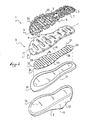
- the outer soleing 2 comprises a first reinforcing layer 22 which extends in length, in the longitudinal direction L, from a rear end 23 to a front end 24, in width, in the transverse direction W, between a lateral edge 25 and a medial edge 26, and in height between a distal face 27 and a proximal face 28.
- the distal face 27 is that of the two faces 27, 28 farthest from the rod 9 while, by corollary, the proximal face 28 is the closest.
- the first reinforcing layer 22 has transverse slots 29, which will be described in more detail later.
- the outer soleing 2 comprises a wear layer 30 and a first damping layer 31, the wear layer 30 delimiting the contact face 20 with the ground, and the first damping layer 31 is located between the wear layer 30 and the first reinforcing layer 22.
- the damping layer 31 dampens shocks, pulses or other stresses that pass through the outer sole 2, in particular between the wear layer 30 and the layer 22. Indeed, all or subdivisions of the damping layer 31 deform, elastically and reversibly, to allow a relative displacement of the wear layer 30 or subdivisions of this layer relative to the reinforcing layer 22.
- the deformations of the damping layer dissipate energy which, by corollary, increases the intensity of stress required to derail the shoe. They also allow a better adaptation of the layer of wear to the various forms and terrain reliefs. In other words, the ground adhesion is better with the shoe of the invention.
- the damping layer 31 has a reduced thickness, between 1 and 10 mm, knowing that values of 1 to 5 mm have given good results. This gives this layer a minimum mass. As a result, the shoe 1 remains light, and the wearer fatigue is reduced.
- the width of the first reinforcing layer 22 is between 25 and 100% of the width of the outer sole 2, knowing that values between 75 and 100% have given good results.
- the reinforcing layer 22 fills in particular a transverse rigidlfication role, role all the more significant that its width is high. The user can therefore take more stable supports, or better perceive the sensory information, even if a ground contact is only at the lateral edge 5 or only at the medial edge 6 of the sole assembly 2. The user also perceives better sensory information, and more accurately transmits impulses to the ground, in a case where the shoe is provided with a crampon.
- the length of the first reinforcing layer 22 is between 25 and 100% of the length of the outer soleplate 2. This means that the first reinforcing layer 22 may occupy, longitudinally, a reduced portion or, at contrary, high, of the sizing 2. It has been observed that significant lengths, between 75 and 100% of the length of the outer sole 2, have given good results. This is related to the fact that the transverse supports are improved over a significant length of the sole 2. Here again the cooperation with a crampon is improved.
- the slots 29 open alternately at the lateral edge 25 and at the medial edge 26 of the first reinforcing layer 22.
- the slots 29 it is possible for the slots 29 to open at only one of the lateral and medial edges 26 of the first reinforcing layer 22.
- the edges at which the slots open has a discontinuous structure
- the edges at which no slot opens has a continuous structure.
- the edge whose structure is continuous is more rigid, or less flexible, in longitudinal flexion, with respect to the edge of discontinuous structure.
- the edges 25, 26 flex differently in flexion.
- it is possible, depending on the arrangement of the slots to give the outer sole 2 mechanical properties specific to certain locations.
- a slot 29 has a length between 50 and 100% of the width of the first reinforcing layer 22, at a given cross-section of the outer sole 2.
- the extreme case is that of a length of 100%.
- the spacing between two transverse portions of the layer 22 remains stable because these portions are secured, for example by gluing, to the rest of the sole assembly.
- a slot 29 has a width of between 0.1 and 30 mm.
- the narrower the slots the greater the transverse flexural strength. In other words, the narrower the slots, the more the shoe is stable in the transverse supports.
- slots 29 are formed along the entire length of the first reinforcing layer 22. In this case it is the entirety of this layer which is able to flex longitudinally. The progress of the foot is only better, especially in cases where the reinforcing layer 22 extends longitudinally over a significant portion of the sole.
- slots 29 are provided only between the front end 24 of the first reinforcing layer 22, and a backward point of a value of 50% of the length of this layer 22. from the front end 24. This is to promote the longitudinal flexion of the front of the layer. If the latter extends along a substantial length of the outer sole 2, or even all, then it is the front of the outer sole 2 which can flex longitudinally. By corollary the course of the foot is easy because the toes are freer. In addition, the transverse supports at the toes remain very strong and precise, because of the transverse flexural strength of the reinforcing layer 22.
- slots 29 are provided only between a setback of 25% of the length of the first reinforcing layer 22 from the front end 24, and a point advanced by a value of 25% of the length of the first reinforcing layer 22 from the rear end 23.
- the slots 29 are parallel to each other. This allows the first reinforcing layer 22, and thus also the sole 2, to flex longitudinally in a regular manner.
- the course of the foot tends to be flat, which is well suited for use on flat ground.
- at least two slots 29 to form with each other an angle whose value is between 0 and 30 °. In this case the unwinding of the foot can be done with a slight longitudinal twist, which favors use in rough terrain.
- the first reinforcing layer 22 is capable of flexing longitudinally, while remaining transversely flat, as is understood by considering the Figures 5 to 7 .
- the outer sole 2 is able to flex longitudinally, which is suitable for a good unwinding of the foot, and to maintain its natural shape transversely, which makes the transverse support to the ground much more accurate.
- the first reinforcing layer 22 is here made of a synthetic material reinforced with fibers. These can be synthetic or natural, such as carbon, glass, linen, or other. This constitution makes the first layer of reinforcement 22 light, which benefits the entire shoe. However, it may be provided to use other materials, such as a plastic, a metal or a metal alloy, or any equivalent, to make the reinforcing layer 22.
- the outer soleing 2 comprises a second damping layer 32, and that the first reinforcing layer 22 is located, in the direction of the height, between the first damping layer 31 and the second damping layer 32.
- the first 31 and second 32 damping layers are secured to one another, by a means such as gluing or any equivalent, to trap the first reinforcing layer 22.
- the first 31 and second 32 damping layers form a single piece.
- the first reinforcing layer 22 is embedded in an assembly which, ultimately, is a cushioning layer located between the wear layer 30 and the rod 9.
- first reinforcing layer 22 with a rear end 23, a front end 24, a lateral edge 25 and a medial edge 26, as well as transverse slots 29.
- the width of the first reinforcing layer 22 is between 25 and 50% of the width of the outer sole. 2, and at the front portion 8, the width of the first reinforcing layer 22 is between 50 and 100% of the width of the outer sole 2.
- the first reinforcing layer 22 extends according to at least 60% of the length of the outer sole 2. In the end, the first reinforcing layer 22 is rather narrow at the rear and wider at the front. This makes the outer sole 2 more rigid transversely to the front than to the back.
- the wear layer 30 may be discontinuous, that is to say formed of separate elements respectively secured to the first damping layer 31.
- Each damping layer 31, 32 consists for example of a low density synthetic material, such as EVA (ethyl-vinyl-acetate) or any equivalent material.
- EVA ethyl-vinyl-acetate
- the structure of the outer sole 2 may be minimalist, that is to say exclusively comprise the wear layer 30, the first damping layer 31 and the first reinforcing layer 22, or the wear layer 30, the first damping layer 31, the first reinforcing layer 22 and the second damping layer 32, excluding any additional layer, or excluding any additional element.
Landscapes
- Chemical & Material Sciences (AREA)
- Engineering & Computer Science (AREA)
- Materials Engineering (AREA)
- Footwear And Its Accessory, Manufacturing Method And Apparatuses (AREA)
Applications Claiming Priority (1)
| Application Number | Priority Date | Filing Date | Title |
|---|---|---|---|
| FR1202135A FR2993758B1 (fr) | 2012-07-27 | 2012-07-27 | Chaussure a semelage ameliore |
Publications (1)
| Publication Number | Publication Date |
|---|---|
| EP2689681A1 true EP2689681A1 (de) | 2014-01-29 |
Family
ID=47172701
Family Applications (1)
| Application Number | Title | Priority Date | Filing Date |
|---|---|---|---|
| EP13003556.1A Ceased EP2689681A1 (de) | 2012-07-27 | 2013-07-15 | Schuh mit verbesserter Sohle |
Country Status (8)
| Country | Link |
|---|---|
| US (1) | US9516916B2 (de) |
| EP (1) | EP2689681A1 (de) |
| CN (1) | CN103564976A (de) |
| AR (1) | AR091918A1 (de) |
| BR (1) | BR102013019024A2 (de) |
| CA (1) | CA2821468A1 (de) |
| FR (1) | FR2993758B1 (de) |
| RU (1) | RU2624190C2 (de) |
Cited By (3)
| Publication number | Priority date | Publication date | Assignee | Title |
|---|---|---|---|---|
| EP4066671A1 (de) * | 2021-04-01 | 2022-10-05 | Bär GmbH | Querversteifte sohle für einen schuh |
| USD1010297S1 (en) | 2021-06-30 | 2024-01-09 | Puma SE | Shoe |
| US11974630B2 (en) | 2021-01-20 | 2024-05-07 | Puma SE | Article of footwear having a sole plate |
Families Citing this family (36)
| Publication number | Priority date | Publication date | Assignee | Title |
|---|---|---|---|---|
| US11445784B2 (en) | 2012-04-12 | 2022-09-20 | Worcester Polytechnic Institute | Adjustable response elastic kinetic energy converter and storage field system for a footwear appliance |
| USD731769S1 (en) * | 2014-10-23 | 2015-06-16 | Skechers U.S.A., Inc. Ii | Shoe outsole periphery and bottom |
| US10497814B2 (en) * | 2014-12-23 | 2019-12-03 | Intel Corporation | III-V semiconductor alloys for use in the subfin of non-planar semiconductor devices and methods of forming the same |
| EP3297478B1 (de) * | 2015-05-22 | 2021-11-10 | Nike Innovate C.V. | Bodengreifstrukturen für schuhwerk |
| EP3297476B1 (de) * | 2015-05-22 | 2021-05-05 | Nike Innovate C.V. | Bodeneingriffsstrukturen für schuhwerk |
| US10226097B2 (en) * | 2015-09-18 | 2019-03-12 | Nike, Inc. | Footwear sole structure with nonlinear bending stiffness |
| USD781545S1 (en) * | 2015-11-16 | 2017-03-21 | Nike, Inc. | Shoe outsole |
| FR3046913B1 (fr) | 2016-01-21 | 2019-05-31 | Hyperios | Semelle de chaussure |
| US11197514B2 (en) * | 2016-02-29 | 2021-12-14 | Nike, Inc. | Layered sole structure for an article of footwear |
| USD794298S1 (en) * | 2016-05-16 | 2017-08-15 | Nike, Inc. | Shoe outsole |
| KR102173524B1 (ko) * | 2016-07-20 | 2020-11-04 | 나이키 이노베이트 씨.브이. | 신발 플레이트 |
| CN106165936A (zh) * | 2016-08-31 | 2016-11-30 | 琪尔特有限公司 | 一种耐折鞋底 |
| US10952498B2 (en) * | 2016-11-11 | 2021-03-23 | Nike, Inc. | Plate with foam for footwear |
| CN113876073A (zh) * | 2017-05-23 | 2022-01-04 | 耐克创新有限合伙公司 | 具有波状鞋底板的用于鞋类物品的鞋底结构 |
| DE202017107867U1 (de) * | 2017-12-22 | 2018-02-27 | Caprice Schuhproduktion Gmbh & Co. Kg | Außensohle für einen Schuh |
| US11006695B2 (en) | 2018-05-31 | 2021-05-18 | Nike, Inc. | Footwear sole plate with forefoot through hole |
| CN112188846B (zh) | 2018-05-31 | 2023-02-28 | 耐克创新有限合伙公司 | 具有变化的厚度的非平行波的鞋类鞋底板 |
| MX2021003914A (es) * | 2018-10-05 | 2021-06-04 | Worcester Polytech Inst | Aparato de calzado de absorcion de impacto. |
| FR3094872B1 (fr) * | 2019-04-10 | 2021-03-19 | Salomon Sas | Chaussure de sport |
| WO2020214169A1 (en) * | 2019-04-17 | 2020-10-22 | Hewlett-Packard Development Company, L. P. | Inserts to mold footwear midsoles |
| US12220019B2 (en) * | 2019-08-08 | 2025-02-11 | Saucony, Inc. | Footwear with a composite plate sole assembly |
| US11478039B2 (en) * | 2019-08-08 | 2022-10-25 | Saucony, Inc. | Footwear with a composite plate sole assembly |
| USD943904S1 (en) * | 2019-12-26 | 2022-02-22 | Salomon S.A.S. | Sole and heel counter of a footwear article |
| US11641906B2 (en) | 2020-02-27 | 2023-05-09 | Nike, Inc. | Medially-located lateral footwear stabilizer |
| IT202100018557A1 (it) * | 2021-07-14 | 2023-01-14 | Scarpa Calzaturificio Spa | Gruppo suola per calzature sportive e calzatura dotata di tale gruppo suola |
| US20230137398A1 (en) * | 2021-10-28 | 2023-05-04 | Nike, Inc. | Sole structure for article of footwear |
| USD1007826S1 (en) | 2022-03-23 | 2023-12-19 | Mountain Origins Design LLC | Footwear |
| USD1007110S1 (en) | 2022-03-23 | 2023-12-12 | Mountain Origins Design LLC | Footwear |
| USD1033862S1 (en) | 2022-03-23 | 2024-07-09 | Mountain Origins Design LLC | Footwear |
| USD1007825S1 (en) | 2022-03-23 | 2023-12-19 | Mountain Origins Design LLC | Footwear |
| USD1008611S1 (en) | 2022-03-23 | 2023-12-26 | Mountain Origins Design LLC | Footwear |
| US20240000186A1 (en) * | 2022-06-30 | 2024-01-04 | Asics Corporation | Sole and shoe |
| US20240023669A1 (en) * | 2022-07-19 | 2024-01-25 | Skechers U.S.A., Inc.Ii | Footwear sole configured to impart pressure and stimulation |
| US20240398063A1 (en) * | 2023-06-01 | 2024-12-05 | Caleres, Inc. | Shoe bottom construction |
| USD1014932S1 (en) * | 2023-06-21 | 2024-02-20 | Nike, Inc. | Shoe |
| USD1014941S1 (en) * | 2023-06-21 | 2024-02-20 | Nike, Inc. | Shoe |
Citations (5)
| Publication number | Priority date | Publication date | Assignee | Title |
|---|---|---|---|---|
| US1981677A (en) * | 1932-02-17 | 1934-11-20 | Stark David | Shoe |
| FR2457081A1 (fr) | 1979-05-21 | 1980-12-19 | Salomon & Fils F | Chaussure de sport et plus particulierement de ski de fond |
| FR2775875A1 (fr) * | 1998-03-11 | 1999-09-17 | Lafuma Sa | Chaussure de marche |
| US20040250446A1 (en) * | 2003-06-11 | 2004-12-16 | Nike, Inc. | Article of footwear having a suspended footbed |
| US20080289220A1 (en) * | 2007-05-18 | 2008-11-27 | The North Face Apparel Corporation | Supporting plate apparatus for shoes |
Family Cites Families (15)
| Publication number | Priority date | Publication date | Assignee | Title |
|---|---|---|---|---|
| US4506460A (en) * | 1982-06-18 | 1985-03-26 | Rudy Marion F | Spring moderator for articles of footwear |
| EP0373336B1 (de) * | 1988-12-13 | 1992-12-30 | Helmut Mayer | Einlage für einen Schuh |
| SU1757598A1 (ru) * | 1989-06-13 | 1992-08-30 | Московский Текстильный Институт Им.А.Н.Косыгина | Узел низа обуви |
| FR2770096B1 (fr) * | 1997-10-29 | 1999-12-17 | Salomon Sa | Semelle de chaussure de sport |
| FR2765083B1 (fr) | 1997-06-27 | 1999-08-27 | Salomon Sa | Semelle multicouche couplee a un renfort de la tige de la chaussure |
| FR2848389B1 (fr) | 2002-12-11 | 2006-02-10 | Salomon Sa | Semelage de chaussure |
| US7421805B2 (en) * | 2003-07-17 | 2008-09-09 | Red Wing Shoe Company, Inc. | Integral spine structure for footwear |
| WO2006066331A1 (en) * | 2004-12-23 | 2006-06-29 | Craig Edward Richards | Sole assembly |
| WO2006125182A2 (en) * | 2005-05-19 | 2006-11-23 | Danner, Inc. | Footwear with a shank system |
| US7398608B2 (en) * | 2005-06-02 | 2008-07-15 | Wolverine World Wide, Inc. | Footwear sole |
| US8220186B2 (en) * | 2008-04-30 | 2012-07-17 | Nike, Inc. | Sole structures and articles of footwear including such sole structures |
| FR2932963B1 (fr) | 2008-06-25 | 2010-08-27 | Salomon Sa | Chaussure a semelage ameliore |
| FR2940019B1 (fr) | 2008-12-22 | 2011-03-25 | Salomon Sas | Chaussure a semelage ameliore |
| US8635785B2 (en) * | 2010-07-28 | 2014-01-28 | Jione Frs Corporation | Midsole for a shoe |
| CN201995722U (zh) * | 2011-04-27 | 2011-10-05 | 茂泰(福建)鞋材有限公司 | 一种平衡稳定鞋底 |
-
2012
- 2012-07-27 FR FR1202135A patent/FR2993758B1/fr not_active Expired - Fee Related
-
2013
- 2013-07-15 EP EP13003556.1A patent/EP2689681A1/de not_active Ceased
- 2013-07-18 CA CA2821468A patent/CA2821468A1/fr not_active Abandoned
- 2013-07-24 BR BR102013019024A patent/BR102013019024A2/pt not_active Application Discontinuation
- 2013-07-26 AR ARP130102673A patent/AR091918A1/es unknown
- 2013-07-26 CN CN201310317616.7A patent/CN103564976A/zh active Pending
- 2013-07-26 US US13/952,120 patent/US9516916B2/en not_active Expired - Fee Related
- 2013-07-26 RU RU2013135286A patent/RU2624190C2/ru not_active IP Right Cessation
Patent Citations (5)
| Publication number | Priority date | Publication date | Assignee | Title |
|---|---|---|---|---|
| US1981677A (en) * | 1932-02-17 | 1934-11-20 | Stark David | Shoe |
| FR2457081A1 (fr) | 1979-05-21 | 1980-12-19 | Salomon & Fils F | Chaussure de sport et plus particulierement de ski de fond |
| FR2775875A1 (fr) * | 1998-03-11 | 1999-09-17 | Lafuma Sa | Chaussure de marche |
| US20040250446A1 (en) * | 2003-06-11 | 2004-12-16 | Nike, Inc. | Article of footwear having a suspended footbed |
| US20080289220A1 (en) * | 2007-05-18 | 2008-11-27 | The North Face Apparel Corporation | Supporting plate apparatus for shoes |
Cited By (9)
| Publication number | Priority date | Publication date | Assignee | Title |
|---|---|---|---|---|
| US11974630B2 (en) | 2021-01-20 | 2024-05-07 | Puma SE | Article of footwear having a sole plate |
| US12225968B2 (en) | 2021-01-20 | 2025-02-18 | Puma SE | Article of footwear having a sole plate |
| US12426676B2 (en) | 2021-01-20 | 2025-09-30 | Puma SE | Article of footwear having a sole plate |
| US12543822B2 (en) | 2021-01-20 | 2026-02-10 | Puma SE | Article of footwear having a sole plate |
| EP4066671A1 (de) * | 2021-04-01 | 2022-10-05 | Bär GmbH | Querversteifte sohle für einen schuh |
| USD1010297S1 (en) | 2021-06-30 | 2024-01-09 | Puma SE | Shoe |
| USD1022421S1 (en) | 2021-06-30 | 2024-04-16 | Puma SE | Shoe |
| USD1022422S1 (en) | 2021-06-30 | 2024-04-16 | Puma SE | Shoe |
| USD1023531S1 (en) | 2021-06-30 | 2024-04-23 | Puma SE | Shoe |
Also Published As
| Publication number | Publication date |
|---|---|
| US9516916B2 (en) | 2016-12-13 |
| CN103564976A (zh) | 2014-02-12 |
| FR2993758B1 (fr) | 2015-03-27 |
| US20140026443A1 (en) | 2014-01-30 |
| AR091918A1 (es) | 2015-03-11 |
| RU2624190C2 (ru) | 2017-06-30 |
| FR2993758A1 (fr) | 2014-01-31 |
| RU2013135286A (ru) | 2015-02-10 |
| BR102013019024A2 (pt) | 2016-06-28 |
| CA2821468A1 (fr) | 2014-01-27 |
Similar Documents
| Publication | Publication Date | Title |
|---|---|---|
| EP2689681A1 (de) | Schuh mit verbesserter Sohle | |
| EP2548465B1 (de) | Schuh mit verbesserter Sohle | |
| EP2198729B1 (de) | Schuh mit verbessertem Schuhboden | |
| EP3387937B1 (de) | Schuh mit verbesserter sohle | |
| EP2138063A1 (de) | Schuh mit verbesserter Sohle | |
| EP2394523A1 (de) | Schuh mit verbessertem Laufkomfort | |
| FR2851130A1 (fr) | Semelage de chaussure | |
| EP2647304B1 (de) | Schuhelement | |
| FR2962630A1 (fr) | Chaussure a semelage ameliore | |
| EP2572601A1 (de) | Shoe with improved bottom assembly | |
| FR3007949A1 (fr) | Crampon pour chaussure | |
| CA2774381A1 (fr) | Chaussure a tige amelioree | |
| FR2974481A1 (fr) | Chaussure a semelage ameliore | |
| FR2823076A1 (fr) | Renfort de chaussure, en particulier de sport et plus precisement encore de ski de fond, et chaussure comprenant un tel renfort | |
| CA2817349A1 (fr) | Crampon pour chaussure | |
| EP3050452A1 (de) | Fussbekleidungselement | |
| EP2353417A1 (de) | Schuh mit verbesserter Sohle | |
| EP2931390B1 (de) | Verbessertes netz für einen schneeschuh | |
| FR3036927A1 (fr) | Chaussure a semelage ameliore | |
| EP2989917B1 (de) | Sportschuh | |
| EP2756771A1 (de) | Steigeisen für Schuh | |
| FR2946229A1 (fr) | Chaussure a semelage ameliore |
Legal Events
| Date | Code | Title | Description |
|---|---|---|---|
| PUAI | Public reference made under article 153(3) epc to a published international application that has entered the european phase |
Free format text: ORIGINAL CODE: 0009012 |
|
| AK | Designated contracting states |
Kind code of ref document: A1 Designated state(s): AL AT BE BG CH CY CZ DE DK EE ES FI FR GB GR HR HU IE IS IT LI LT LU LV MC MK MT NL NO PL PT RO RS SE SI SK SM TR |
|
| AX | Request for extension of the european patent |
Extension state: BA ME |
|
| 17P | Request for examination filed |
Effective date: 20140707 |
|
| TPAC | Observations filed by third parties |
Free format text: ORIGINAL CODE: EPIDOSNTIPA |
|
| 17Q | First examination report despatched |
Effective date: 20170726 |
|
| 18R | Application refused |
Effective date: 20180414 |