EP2694131B1 - Procédés et systèmes automatisés pour produire des concentrés de plaquettes avec des volumes de plasma résiduel réduits et des milieux de conservation pour de tels concentrés de plaquettes - Google Patents
Procédés et systèmes automatisés pour produire des concentrés de plaquettes avec des volumes de plasma résiduel réduits et des milieux de conservation pour de tels concentrés de plaquettes Download PDFInfo
- Publication number
- EP2694131B1 EP2694131B1 EP12768563.4A EP12768563A EP2694131B1 EP 2694131 B1 EP2694131 B1 EP 2694131B1 EP 12768563 A EP12768563 A EP 12768563A EP 2694131 B1 EP2694131 B1 EP 2694131B1
- Authority
- EP
- European Patent Office
- Prior art keywords
- plasma
- platelet
- platelets
- volume
- solution
- Prior art date
- Legal status (The legal status is an assumption and is not a legal conclusion. Google has not performed a legal analysis and makes no representation as to the accuracy of the status listed.)
- Active
Links
Images




Classifications
-
- C—CHEMISTRY; METALLURGY
- C12—BIOCHEMISTRY; BEER; SPIRITS; WINE; VINEGAR; MICROBIOLOGY; ENZYMOLOGY; MUTATION OR GENETIC ENGINEERING
- C12N—MICROORGANISMS OR ENZYMES; COMPOSITIONS THEREOF; PROPAGATING, PRESERVING, OR MAINTAINING MICROORGANISMS; MUTATION OR GENETIC ENGINEERING; CULTURE MEDIA
- C12N5/00—Undifferentiated human, animal or plant cells, e.g. cell lines; Tissues; Cultivation or maintenance thereof; Culture media therefor
- C12N5/06—Animal cells or tissues; Human cells or tissues
- C12N5/0602—Vertebrate cells
- C12N5/0634—Cells from the blood or the immune system
- C12N5/0644—Platelets; Megakaryocytes
-
- A—HUMAN NECESSITIES
- A01—AGRICULTURE; FORESTRY; ANIMAL HUSBANDRY; HUNTING; TRAPPING; FISHING
- A01N—PRESERVATION OF BODIES OF HUMANS OR ANIMALS OR PLANTS OR PARTS THEREOF; BIOCIDES, e.g. AS DISINFECTANTS, AS PESTICIDES OR AS HERBICIDES; PEST REPELLANTS OR ATTRACTANTS; PLANT GROWTH REGULATORS
- A01N1/00—Preservation of bodies of humans or animals, or parts thereof
- A01N1/10—Preservation of living parts
- A01N1/12—Chemical aspects of preservation
- A01N1/122—Preservation or perfusion media
- A01N1/126—Physiologically active agents, e.g. antioxidants or nutrients
-
- A—HUMAN NECESSITIES
- A61—MEDICAL OR VETERINARY SCIENCE; HYGIENE
- A61K—PREPARATIONS FOR MEDICAL, DENTAL OR TOILETRY PURPOSES
- A61K35/00—Medicinal preparations containing materials or reaction products thereof with undetermined constitution
- A61K35/12—Materials from mammals; Compositions comprising non-specified tissues or cells; Compositions comprising non-embryonic stem cells; Genetically modified cells
- A61K35/14—Blood; Artificial blood
- A61K35/19—Platelets; Megacaryocytes
-
- A—HUMAN NECESSITIES
- A61—MEDICAL OR VETERINARY SCIENCE; HYGIENE
- A61M—DEVICES FOR INTRODUCING MEDIA INTO, OR ONTO, THE BODY; DEVICES FOR TRANSDUCING BODY MEDIA OR FOR TAKING MEDIA FROM THE BODY; DEVICES FOR PRODUCING OR ENDING SLEEP OR STUPOR
- A61M1/00—Suction or pumping devices for medical purposes; Devices for carrying-off, for treatment of, or for carrying-over, body-liquids; Drainage systems
- A61M1/02—Blood transfusion apparatus
- A61M1/0272—Apparatus for treatment of blood or blood constituents prior to or for conservation, e.g. freezing, drying or centrifuging
-
- A—HUMAN NECESSITIES
- A61—MEDICAL OR VETERINARY SCIENCE; HYGIENE
- A61M—DEVICES FOR INTRODUCING MEDIA INTO, OR ONTO, THE BODY; DEVICES FOR TRANSDUCING BODY MEDIA OR FOR TAKING MEDIA FROM THE BODY; DEVICES FOR PRODUCING OR ENDING SLEEP OR STUPOR
- A61M1/00—Suction or pumping devices for medical purposes; Devices for carrying-off, for treatment of, or for carrying-over, body-liquids; Drainage systems
- A61M1/36—Other treatment of blood in a by-pass of the natural circulatory system, e.g. temperature adaptation, irradiation ; Extra-corporeal blood circuits
- A61M1/3621—Extra-corporeal blood circuits
- A61M1/3622—Extra-corporeal blood circuits with a cassette forming partially or totally the blood circuit
- A61M1/36222—Details related to the interface between cassette and machine
-
- A—HUMAN NECESSITIES
- A61—MEDICAL OR VETERINARY SCIENCE; HYGIENE
- A61M—DEVICES FOR INTRODUCING MEDIA INTO, OR ONTO, THE BODY; DEVICES FOR TRANSDUCING BODY MEDIA OR FOR TAKING MEDIA FROM THE BODY; DEVICES FOR PRODUCING OR ENDING SLEEP OR STUPOR
- A61M1/00—Suction or pumping devices for medical purposes; Devices for carrying-off, for treatment of, or for carrying-over, body-liquids; Drainage systems
- A61M1/36—Other treatment of blood in a by-pass of the natural circulatory system, e.g. temperature adaptation, irradiation ; Extra-corporeal blood circuits
- A61M1/3621—Extra-corporeal blood circuits
- A61M1/3622—Extra-corporeal blood circuits with a cassette forming partially or totally the blood circuit
- A61M1/36222—Details related to the interface between cassette and machine
- A61M1/362227—Details related to the interface between cassette and machine the interface providing means for actuating on functional elements of the cassette, e.g. plungers
-
- A—HUMAN NECESSITIES
- A61—MEDICAL OR VETERINARY SCIENCE; HYGIENE
- A61M—DEVICES FOR INTRODUCING MEDIA INTO, OR ONTO, THE BODY; DEVICES FOR TRANSDUCING BODY MEDIA OR FOR TAKING MEDIA FROM THE BODY; DEVICES FOR PRODUCING OR ENDING SLEEP OR STUPOR
- A61M1/00—Suction or pumping devices for medical purposes; Devices for carrying-off, for treatment of, or for carrying-over, body-liquids; Drainage systems
- A61M1/36—Other treatment of blood in a by-pass of the natural circulatory system, e.g. temperature adaptation, irradiation ; Extra-corporeal blood circuits
- A61M1/3621—Extra-corporeal blood circuits
- A61M1/3622—Extra-corporeal blood circuits with a cassette forming partially or totally the blood circuit
- A61M1/36225—Extra-corporeal blood circuits with a cassette forming partially or totally the blood circuit with blood pumping means or components thereof
-
- A—HUMAN NECESSITIES
- A61—MEDICAL OR VETERINARY SCIENCE; HYGIENE
- A61M—DEVICES FOR INTRODUCING MEDIA INTO, OR ONTO, THE BODY; DEVICES FOR TRANSDUCING BODY MEDIA OR FOR TAKING MEDIA FROM THE BODY; DEVICES FOR PRODUCING OR ENDING SLEEP OR STUPOR
- A61M1/00—Suction or pumping devices for medical purposes; Devices for carrying-off, for treatment of, or for carrying-over, body-liquids; Drainage systems
- A61M1/36—Other treatment of blood in a by-pass of the natural circulatory system, e.g. temperature adaptation, irradiation ; Extra-corporeal blood circuits
- A61M1/3621—Extra-corporeal blood circuits
- A61M1/3622—Extra-corporeal blood circuits with a cassette forming partially or totally the blood circuit
- A61M1/36226—Constructional details of cassettes, e.g. specific details on material or shape
- A61M1/362265—Details of valves
-
- A—HUMAN NECESSITIES
- A61—MEDICAL OR VETERINARY SCIENCE; HYGIENE
- A61M—DEVICES FOR INTRODUCING MEDIA INTO, OR ONTO, THE BODY; DEVICES FOR TRANSDUCING BODY MEDIA OR FOR TAKING MEDIA FROM THE BODY; DEVICES FOR PRODUCING OR ENDING SLEEP OR STUPOR
- A61M1/00—Suction or pumping devices for medical purposes; Devices for carrying-off, for treatment of, or for carrying-over, body-liquids; Drainage systems
- A61M1/36—Other treatment of blood in a by-pass of the natural circulatory system, e.g. temperature adaptation, irradiation ; Extra-corporeal blood circuits
- A61M1/3692—Washing or rinsing blood or blood constituents
-
- A—HUMAN NECESSITIES
- A61—MEDICAL OR VETERINARY SCIENCE; HYGIENE
- A61M—DEVICES FOR INTRODUCING MEDIA INTO, OR ONTO, THE BODY; DEVICES FOR TRANSDUCING BODY MEDIA OR FOR TAKING MEDIA FROM THE BODY; DEVICES FOR PRODUCING OR ENDING SLEEP OR STUPOR
- A61M1/00—Suction or pumping devices for medical purposes; Devices for carrying-off, for treatment of, or for carrying-over, body-liquids; Drainage systems
- A61M1/36—Other treatment of blood in a by-pass of the natural circulatory system, e.g. temperature adaptation, irradiation ; Extra-corporeal blood circuits
- A61M1/3693—Other treatment of blood in a by-pass of the natural circulatory system, e.g. temperature adaptation, irradiation ; Extra-corporeal blood circuits using separation based on different densities of components, e.g. centrifuging
- A61M1/3696—Other treatment of blood in a by-pass of the natural circulatory system, e.g. temperature adaptation, irradiation ; Extra-corporeal blood circuits using separation based on different densities of components, e.g. centrifuging with means for adding or withdrawing liquid substances during the centrifugation, e.g. continuous centrifugation
-
- A—HUMAN NECESSITIES
- A61—MEDICAL OR VETERINARY SCIENCE; HYGIENE
- A61P—SPECIFIC THERAPEUTIC ACTIVITY OF CHEMICAL COMPOUNDS OR MEDICINAL PREPARATIONS
- A61P7/00—Drugs for disorders of the blood or the extracellular fluid
-
- A—HUMAN NECESSITIES
- A61—MEDICAL OR VETERINARY SCIENCE; HYGIENE
- A61P—SPECIFIC THERAPEUTIC ACTIVITY OF CHEMICAL COMPOUNDS OR MEDICINAL PREPARATIONS
- A61P7/00—Drugs for disorders of the blood or the extracellular fluid
- A61P7/04—Antihaemorrhagics; Procoagulants; Haemostatic agents; Antifibrinolytic agents
-
- A—HUMAN NECESSITIES
- A61—MEDICAL OR VETERINARY SCIENCE; HYGIENE
- A61M—DEVICES FOR INTRODUCING MEDIA INTO, OR ONTO, THE BODY; DEVICES FOR TRANSDUCING BODY MEDIA OR FOR TAKING MEDIA FROM THE BODY; DEVICES FOR PRODUCING OR ENDING SLEEP OR STUPOR
- A61M1/00—Suction or pumping devices for medical purposes; Devices for carrying-off, for treatment of, or for carrying-over, body-liquids; Drainage systems
- A61M1/02—Blood transfusion apparatus
- A61M1/0209—Multiple bag systems for separating or storing blood components
-
- A—HUMAN NECESSITIES
- A61—MEDICAL OR VETERINARY SCIENCE; HYGIENE
- A61M—DEVICES FOR INTRODUCING MEDIA INTO, OR ONTO, THE BODY; DEVICES FOR TRANSDUCING BODY MEDIA OR FOR TAKING MEDIA FROM THE BODY; DEVICES FOR PRODUCING OR ENDING SLEEP OR STUPOR
- A61M1/00—Suction or pumping devices for medical purposes; Devices for carrying-off, for treatment of, or for carrying-over, body-liquids; Drainage systems
- A61M1/36—Other treatment of blood in a by-pass of the natural circulatory system, e.g. temperature adaptation, irradiation ; Extra-corporeal blood circuits
- A61M1/3621—Extra-corporeal blood circuits
- A61M1/3622—Extra-corporeal blood circuits with a cassette forming partially or totally the blood circuit
- A61M1/36226—Constructional details of cassettes, e.g. specific details on material or shape
- A61M1/362266—Means for adding solutions or substances to the blood
-
- A—HUMAN NECESSITIES
- A61—MEDICAL OR VETERINARY SCIENCE; HYGIENE
- A61M—DEVICES FOR INTRODUCING MEDIA INTO, OR ONTO, THE BODY; DEVICES FOR TRANSDUCING BODY MEDIA OR FOR TAKING MEDIA FROM THE BODY; DEVICES FOR PRODUCING OR ENDING SLEEP OR STUPOR
- A61M1/00—Suction or pumping devices for medical purposes; Devices for carrying-off, for treatment of, or for carrying-over, body-liquids; Drainage systems
- A61M1/36—Other treatment of blood in a by-pass of the natural circulatory system, e.g. temperature adaptation, irradiation ; Extra-corporeal blood circuits
- A61M1/3693—Other treatment of blood in a by-pass of the natural circulatory system, e.g. temperature adaptation, irradiation ; Extra-corporeal blood circuits using separation based on different densities of components, e.g. centrifuging
-
- A—HUMAN NECESSITIES
- A61—MEDICAL OR VETERINARY SCIENCE; HYGIENE
- A61M—DEVICES FOR INTRODUCING MEDIA INTO, OR ONTO, THE BODY; DEVICES FOR TRANSDUCING BODY MEDIA OR FOR TAKING MEDIA FROM THE BODY; DEVICES FOR PRODUCING OR ENDING SLEEP OR STUPOR
- A61M2202/00—Special media to be introduced, removed or treated
- A61M2202/04—Liquids
- A61M2202/0413—Blood
- A61M2202/0427—Platelets; Thrombocytes
Definitions
- the present disclosure relates to storage media for blood components such as blood platelets, which optimize energy metabolism of platelets stored in vitro to preserve and prolong platelet functionality. More particularly, the present disclosure relates to storage media that includes a synthetic storage solution and plasma, where a reduced amount of plasma may be utilized.
- the present disclosure also relates to automated systems and methods for processing biological fluid to obtain substantially plasma-reduced platelets. More particularly, the present disclosure relates to systems and methods for reducing the residual plasma volume remaining in platelet concentrate obtained during an apheresis procedure, where the residual plasma volume may be reduced to less than 5% of the total volume of the platelet concentrate. The present disclosure also relates to using automated systems and methods for washing platelet concentrate to reduce the residual plasma volume to 1% or less than 1% of the total volume of the platelet concentrate.
- Whole blood is made up of various cellular components such as red cells, white cells and platelets suspended in its liquid component, plasma.
- Whole blood can be separated into its constituent components (cellular or liquid), and the desired separated component can be administered to a patient in need of that particular component.
- platelets can be removed from the whole blood of a healthy donor, collected, and later administered to a cancer patient, whose ability to "make" platelets has been compromised by chemotherapy or radiation treatment.
- platelets are collected by introducing whole blood into a centrifuge chamber wherein the whole blood is separated into its constituent components, including platelets, based on the size and densities of the different components.
- Typical blood processing systems thus include a permanent, reusable centrifuge assembly containing the hardware (drive system, pumps, valve actuators, programmable controller, and the like) that spins and pumps the blood, and a disposable, sealed and sterile fluid processing assembly that is mounted cooperatively on the hardware.
- the centrifuge assembly spins a disposable centrifuge chamber in the fluid processing assembly during a collection procedure, thereby separating the blood into its constituent components.
- On line automated blood separation systems are today used to collect large numbers of platelets. On line systems perform the separation steps necessary to separate platelets from whole blood in a sequential process with the donor present. On line systems draw whole blood from the donor, separate out the desired platelets from the drawn blood, and return the remaining red blood cells and plasma to the donor, all in a sequential flow loop. Large volumes of whole blood can be processed using an automated on line system. Due to the large processing volumes, large yields of concentrated platelets can be collected. Moreover, since the donor's red blood cells are returned, the donor can donate platelets for on line processing much more frequently.
- platelet apheresis In the automated, on-line separation and collection of platelets, sometimes referred to as platelet apheresis or simply “plateletpheresis", the platelets are separated from whole blood and concentrated in the centrifuge chamber or elsewhere in the fluid processing set (hereinafter “platelet concentrate” or "PC"). Although most of the plasma is removed during apheresis, a volume of plasma still remains in the PC, hereinafter referred to as “residual plasma”. Platelets may also be derived from buffy coats obtained from manually collected units of whole blood. A plurality of buffy coats are typically pooled to provide an amount or dose of platelets suitable for transfusion. The platelets, whether collected by apheresis or from pooled buffy coats, are typically reconstituted in a liquid medium, such as plasma and/or a synthetic storage solution, for storage until needed for transfusion to a patient.
- a liquid medium such as plasma and/or a synthetic storage solution
- the stored platelets For the stored platelets to be suitable for later administration they must substantially retain their viability and platelet function. A number of interrelated factors may affect platelet viability and function during storage. Some of these factors include the anticoagulant used for blood collection, the method used to prepare the platelets, the type of storage container used, and the medium in which the platelets are stored.
- platelets may be stored for five or even seven days at 22°C. After seven days, however, platelet function may become impaired. In addition to storage time, other storage conditions have been shown to affect platelet metabolism and function including pH, storage temperature, total platelet count, plasma volume, agitation during storage and platelet concentration.
- ESC assay A variety of assays have been developed which attempt to determine the quality of stored platelets and the in vivo viability of those platelets when transfused to a patient. For instance, the percentage of platelets that respond appropriately to an ADP agonist (the ESC assay) and the percentage of platelets that respond appropriately to hypotonic shock (HSR assay) are two assays which are thought to correlate well with viability of stored platelets.
- ESC is a photometric assessment of discoid platelet shape change in response to an ADP agonist. VandenBroeke, et al., "Platelet storage solution effects on the accuracy of laboratory tests for platelet function: a multi-laboratory study.” Vox Sanguinis (2004) 86, 183-188 .
- HSR Hydrophilicity Stimulation
- Morphology Scores may be determined by, for example, the Kunicki Method, whereby a selected number of platelets in a sample are examined to determine the shape, e.g., discoid, spherical, dendritic or balloon. The number of each shape is then multiplied by a selected multiplier and the resultant numbers are summed to arrive at a Morphology Score. A score of 250-400 is typically indicative of a viable platelet population.
- swirling assay Another shape based assay is the so called “swirling assay” which has also been used as a measure of the quality of platelet concentrates.
- the swirling assay is based on the ability of discoid platelets to reflect light, producing a shimmering phenomenon. As described by Bertolini and Murphy, Transfusion 1994; 34:796-801 and Transfusion 1996: 36:128-132 , platelet samples scoring positive in a swirling assay are believed to be of higher quality than samples scoring intermediate or negative for swirling.
- glycoprotein P-selectin on the surface of platelets is also used to characterize the viability of platelets upon transfusion with the presence of P-selectin believed to indicate a loss of viability.
- platelets undergo a shape change transforming from disc shaped to sphere shaped upon platelet activation. This activation is thought to involve the secretion of ⁇ -thromboglobulin from the alpha granules resulting in the appearance of P-selectin on the surface of the platelets.
- Antibodies directed against P-selectin are used to detect the presence of P-selectin on the surface of platelets and have been used as a marker of platelet activation and a decreased viability of the platelets upon transfusion.
- Lactate dehydogenase is an intracellular enzyme and therefore higher extracellular levels of lactate dehydogenase are thought to reflect increased levels of platelet lysis.
- platelets In order to maintain viability, platelets must generate new adenosine triphosphate (ATP) continuously to meet their energy needs. As shown in Fig. 1 platelets use two metabolic pathways to generate ATP: (a) anaerobic glycolysis followed by lactic acid fermentation or (b) glycolysis followed by oxidative phosphorylation. Glycolysis results in one mole of glucose being converted to 2 moles of pyruvate, and two moles of ATP. The pyruvate can then undergo lactic acid fermentation also called anaerobic glycolysis. Although no additional ATP is produced in lactic acid fermentation, the conversion of pyruvate to lactic acid regenerates NAD + and allows glycolysis to continue generating at least a small amount of ATP from the metabolism of glucose. Because lactic acid fermentation, which can negatively affect the pH of the medium and platelets stored therein, is stimulated by the absence of oxygen, platelets are typically stored in containers permeable to oxygen to promote oxidative phosphorylation and suppress lactic acid formation.
- ATP
- oxidative phosphorylation In oxidative phosphorylation, pyruvate, fatty acid or amino acids are converted to CO 2 and water in the citric acid cycle. This pathway requires the presence of an adequate supply of oxygen. Glycolysis followed by oxidative phosphorylation produces 36 moles of ATP per mole of glucose and therefore is much more efficient than glycolysis followed by lactic acid fermentation.
- the platelets continue to produce lactic acid through anaerobic glycolysis. Therefore, even in the presence of adequate amounts of oxygen and when stored in media containing glucose, (media such as plasma and certain synthetic storage solutions) the utilization by platelets of glycolysis coupled with lactic acid fermentation for energy production results in the concentration of lactic acid increasing over time.
- the increase in lactic acid gradually acidifies the storage media. This acidification of the media alters platelet physiology and morphology such that when the pH of the media drops below about 6 the platelets may be considered nonviable.
- Even drops in pH that are too small to render platelets nonviable have been observed to cause decreases in the total amount of ATP.
- These reductions in ATP affect platelet function as ATP plays a role in platelet adhesion and platelet aggregation. Consequently, it would be desirable to provide a storage medium for platelets that results in the prevention and/or delay of this decrease in pH.
- plasma is effective for storage of platelets, it may not be the ideal medium for platelet storage because plasma itself is a valuable blood component that can be removed from the platelets and then used or further processed for use in the treatment of patients with other disorders.
- ATR allergic transfusion reactions
- the platelet product has a substantially reduced volume of plasma such as less than approximately 5% of the total platelet product volume, or even less.
- Reductions of residual plasma to below 5% by volume and even to and/or less than 1% by volume plasma may be achieved by "washing" platelets or PC to remove residual plasma.
- the volume of plasma remaining in the resuspended PC may preferably be less than approximately 1% by volume of the total washed platelet product volume. Accordingly, it would be desirable to develop automated systems and methods for washing platelet concentrate to obtain a washed platelet product having less than approximately 1% by volume plasma (and up to approximately 0%).
- platelets may be resuspended and stored in some small volume of residual plasma and a substantially greater volume of an alternate storage medium.
- Synthetic aqueous solutions have been developed to provide a suitable environment for stored platelets, which may be "stand alone” solutions or, as indicated above, used in combination with some amount of plasma. Reducing the amount of residual plasma in platelet concentrate and then combining the plasma-reduced platelet concentrate with a synthetic storage medium may have advantages, such as preserving the in vivo viability of platelets and achieving extended storage times of such platelets. Thus, it would be desirable to combine PC or platelets having a reduced residual plasma volume with synthetic aqueous solutions to obtain a platelet product for storage.
- InterSol® a commercially available platelet storage medium is generally described in US Patent No. 5,908,742 .
- InterSol® contains sodium citrate, sodium acetate, sodium phosphate and adjusted to isoosmolarity with sodium chloride.
- a typical formulation of InterSol® contains 21.5 mM (3.05 g/L) dibasic sodium phosphate anhydrous (Na 2 HPO 4 ), 6.7 mM (1.05 g/L) monobasic sodium phosphate (NaH 2 PO 4 .2H 2 O), 10.8 mM (3.18 g/L) sodium citrate 2H 2 O, 32.5 mM (4.42 g/L) sodium acetate 3H 2 O, and 77.3 mM (4,52 g/L) sodium chloride.
- InterSol® solution is approximately isoosmolar (about 300 mOsm/L) with platelets and plasma, and has a pH of approximately 7.2.
- InterSol® may be used in combination with plasma ratio of InterSol® /plasma ratio approximately 70%/30% to 60%/40%.
- Phosphate buffer in InterSol® stabilizes the pH of the solution during platelet storage and increases glycolysis.
- InterSol® has worked satisfactorily in the preservation of blood platelets, further improvements to the storage time and in vivo viability of platelets would be desirable.
- a platelet storage media that reduces platelet utilization of lactic acid fermentation and thus slows the drop in pH that typically occurs during platelet storage, thereby increasing viability of stored platelets to seven days or more, up to as many as 15 days, at 22°C.
- a synthetic storage media that allows for the storage of platelets in a reduced amount of plasma (such as less than approximately 30%, preferably less than 5%, and even more preferably less than 1%).
- the present disclosure is directed to a platelet product comprising platelets in an aqueous solution that includes from 45-125 mM of sodium chloride, from 5-15 mM sodium citrate, from 20-40 mM sodium acetate, from 0.05 to 12 mM of phosphate, from 0.05 to 3 mM magnesium ion, from 0.05 to 10 mM potassium chloride, from 20 to 25 mM of sodium bicarbonate, from 0.5 to 30 mM of glucose, and up to 5% by volume plasma.
- the present disclosure is also directed to an aqueous solution for the processing of platelets including about 69 mM sodium chloride, about 10 mM sodium citrate, about 30 mM sodium acetate, about 9.3 mM sodium phosphate monobasic dihydrate and dibasic sodium phosphate anhydrous, about 1.5 mM magnesium chloride, about 5 mM potassium chloride, about 16.8 mM of glucose (dextrose) and about 20 mM sodium bicarbonate, as well as to methods for washing and/or storing platelets with or in such a solution.
- the present disclosure is further directed to an aqueous solution for the processing of platelets including about 69.55 mM sodium chloride, about 10 mM sodium citrate, about 30 mM sodium acetate 9.4 mM sodium phosphate containing 7.2 mM dibasic sodium phosphate anhydrous and 2.2 mM monobasic sodium phosphate dehydrate, about 1.5 mM magnesium chloride, about 5 mM potassium chloride, about 16.8 mM of D-glucose (dextrose), 0 or 1.0 mM calcium chloride, and about 20 mM sodium bicarbonate
- the present disclosure is directed to an automated method as claimed in claim 8 for providing the substantially plasma-reduced platelet product as claimed in claim 1.
- the method comprises the steps of providing an automated apheresis separator comprising a platelet concentration chamber and concentrating platelets in the chamber, wherein the platelet concentrate comprises platelets suspended in a volume of plasma.
- the method further comprises the steps of removing a selected volume of plasma from the platelet concentrate and reconstituting the platelet concentrate with an additive solution to obtain a platelet product comprising platelets, aqueous additive solution and plasma, wherein the volume of plasma in said platelet product is 5% or less of the total platelet product volume.
- the method may further comprise introducing the platelet product into an automated apheresis separator and removing substantially all of the plasma component from the platelet product, to obtain a second platelet concentrate suspended in a residual volume of plasma.
- Wash solution may be introduced into the separator to displace substantially all of the residual plasma remaining in the second platelet concentrate and residual plasma may be removed from the separator to obtain a washed platelet concentrate.
- the method may further comprise the step of reconstituting the washed platelet concentrate in the wash solution to obtain a washed platelet product comprising platelets, wash solution and plasma, wherein the volume of plasma in the product is 1% or less of the total washed platelet product.
- the present disclosure is directed to an automated system for processing biological fluid to obtain substantially plasma-reduced platelets, as claimed in Claim 12.
- the system comprises a disposable fluid circuit comprising a separation chamber for separating biological fluid into one or more components including platelets suspended in a volume of plasma, a source of aqueous additive solution in openable flow communication with the separation chamber, a separation device adapted to receive the separation chamber for effecting separation of biological fluid and a programmable controller.
- the controller is programmed to collect platelets suspended in a volume of plasma in the separation chamber, remove substantially all of the plasma from the platelets to obtain a platelet concentrate, introduce additive solution from the additive source into the chamber to reconstitute the platelet concentrate to obtain a platelet product comprising platelets, aqueous additive solution and plasma, wherein the volume of plasma in said platelet product is 5% or less of the total platelet product volume.
- the embodiments disclosed herein provide a general description of automated systems and methods for processing blood components, such as platelet concentrate, to remove residual plasma. Automated systems and methods for washing platelet concentrate are also the subject of this disclosure, as are the solutions used in the methods of processing, washing and storing.
- the embodiments disclosed herein also provide a general description of the storage media and methods for storing blood components, such as platelets. These embodiments are only exemplary, and may be embodied in various forms. Therefore, specific details disclosed herein are not to be interpreted as limiting the subject matter of the invention which is set forth in the accompanying claims.
- the platelet storage media described herein include at least an aqueous solution and, typically, some amount of plasma.
- Platelet products described herein include the platelet storage media (platelet storage solution and plasma) and the platelets stored therein. As claimed in claim 1, the amount of plasma that makes up the storage media is "reduced" in the platelet product to up to 5%.
- platelet storage media described herein promote ATP production through the oxidative phosphorylation pathway over ATP production through anaerobic glycolysis, thereby limiting lactic acid formation and consequently, a decrease in the pH of the medium. Accordingly, platelets stored in the platelet storage media described herein exhibit properties such as response to hypotonic shock, levels of P-selectin, morphology, etc., that are typically at least as good or better than platelets stored in plasma or other storage media.
- a platelet storage medium in one embodiment, includes a synthetic aqueous storage solution that itself includes one or more nutrients and buffer(s) in a salt solution.
- the buffer(s), one of which may be a phosphate buffer may include a lower concentration (as compared to InterSol ® or other storage solution or media) of phosphate in the platelet storage medium. Additional buffering is by a selected concentration of bicarbonate ion of 20 mM-25 mM. Bicarbonate may be provided as sodium bicarbonate.
- the synthetic aqueous storage solution thereof includes 45-125 mM sodium chloride, 5-15 mM sodium citrate, 20-40 mM sodium acetate, 0.5-12 mM phosphate buffer, 0.05-3 mM magnesium ion, 0.05-10 mM potassium chloride and 0.5-30 mM glucose, with the initial pH of the complete storage media ranging from 6.8 -7.3.
- the aqueous storage solution further includes 20-25 mM of sodium bicarbonate.
- 0.05-3 mM calcium chloride may also be present in synthetic platelet storage solution.
- the sodium chloride may be present from about 50 mM to about 110 mM. More particularly, the sodium chloride may be present from about 58 mM to about 90 mM, or from about 65 mM to about 80 mM. In one embodiment, the concentration of sodium chloride in the final (combined) aqueous solution may be about 69 mM.
- the sodium citrate may be present from about 7 mM to about 13 mM, and more typically from about 9 mM to about 12 mM. In one embodiment, the concentration of sodium citrate in the final (combined) aqueous solution may be about 10 mM.
- the storage solution may also include an amount of sodium acetate.
- the sodium acetate may be present from about 24 mM to about 36 mM, and more preferably from about 28 mM to about 33 mM.
- the final concentration of sodium acetate in the final (combined) aqueous solution may be about 30 mM.
- additional buffering may be provided by bicarbonate ion.
- Bicarbonate may preferably be provided as the sodium salt, sodium bicarbonate NaHCO 3 .
- Sodium bicarbonate may be present in the synthetic solution in an amount of 20-25mM. In one embodiment, the final concentration of bicarbonate in the final (combined) solution may be about 20 mM.
- a phosphate buffer is also included in a concentration from 0.5-12 mM, preferably from 3 mM to about 11 mM, and more typically from about 6 mM to about 10 mM.
- sources of phosphate include (but are not limited to) sodium phosphate and/or potassium phosphate.
- the sodium phosphate and potassium phosphate used may include various forms of phosphate such as either or both monobasic and dibasic forms of phosphate.
- a phosphate buffer having a phosphate concentration of 9.4 mM may contain approximately 7.2 mM (1.017 g/L) dibasic sodium phosphate anhydrous (Na 2 HPO 4 ) and 2.2 (0.350g/L) mM monobasic sodium phosphate dihydrate (NaH 2 PO 4 .2H 2 O).
- a synthetic storage medium which has a phosphate concentration of less than approximately 10mM and promotes oxidative phosphorylation during platelet storage should be capable of buffering the H + produced from the fraction of pyruvate produced by glycolysis that undergoes lactic acid fermentation. Consequently, the phosphate concentration of the synthetic storage solution described herein is preferably below 10 mM in order to maintain intact platelet mitochondria with normal membrane permeability.
- the addition of 300 ml of an aqueous solution with a phosphate concentration of about 9.4 mM is combined with a platelet concentrate in plasma to produce a suspension of platelets in a storage solution comprising 10% plasma, the final phosphate concentration will be approximately 15 mEq/L.
- the storage solution disclosed herein may also be buffered by amino acids.
- the amino acids may be used as the primary buffering agents, or may be used in conjunction with other buffering agents such as phosphate.
- the amino acid, histidine may be used to buffer the storage solution.
- the storage solution may contain amino acids from about 1 mM to about 7 mM, or from about 2 mM to about 5 mM. More particularly, the storage solution may contain histidine from about 1 mM to about 7mM, or from about 2 mM to about 5 mM.
- the storage solution described herein may also include a selected concentration of magnesium ion.
- magnesium ion may be present in the synthetic solution at concentrations close to plasma levels which will be about 3 mEq/L (1.5 mM).
- Magnesium ion at high cytosolic (intercellular) concentrations appears to play a role in resealing of the mitochondria [ Petrollini V, Cola C, Bernardi P, Modulation of the mitochondria cyclosporin A-sensitive permeability transition pore, J. Biol. Chem. 1993; 268; 1011-6 . Consequently, magnesium ion in the medium should maintain the optimal intercellular magnesium levels in the platelets and may promote oxidative phosphorylation in the platelets and in so doing help maintain the pH of the medium.
- magnesium ion may be added either as a chloride or a sulfate salt.
- the magnesium ion is present in the aqueous solution of the platelet product from 0.05 mM to 3 mM, preferably from about 0.1 mM to about 3.5 mM, or from about 0.5 mM to about 3.0 mM, or from about 1.0 mM to about 2.5 mM.
- magnesium ion may be present from about 1.4 mM to about 2.2 mM.
- the concentration of magnesium (chloride) in the final (combined) aqueous solution may be about 1.5 mM.
- the storage solution described herein may also include a selected concentration of calcium ion.
- calcium ion may be present in the aqueous solution.
- the presence of calcium ion in the medium may assist in maintaining intracellular magnesium ions. Stress can cause an influx of calcium into platelets, therefore to maintain free calcium in the complete storage medium, the synthetic storage media may initially contain about 0.5 mM to about 2.5 mM (1 to 5 mEq/) calcium ion.
- calcium ion may be present from about 0.05 mM to about 3 mM. More particularly, calcium ion may be present from about 0.4 mM to about 2.8 mM, or from about 0.6 mM to about 2.2 mM, or about 0.8 mM to about 1.2 mM.
- the storage solution described herein may also include a selected concentration of potassium ion (from, for example, potassium chloride).
- potassium ion from, for example, potassium chloride
- the presence of potassium ion in the medium may assist in maintaining intracellular magnesium ion concentration.
- Potassium ion also appears to be involved in the transport of pyruvate across the mitochondria membrane for oxidative phosphorylation in the citric acid cycle (TCA cycle).
- potassium ion may be present from about 1 mM to about 10 mM. More preferably, potassium ion may be present from about 2 mM to about 9 mM, or from about 3 mM to about 8 mM, or from about 4 mM to about 7 mM, or from about 4.5 mM to about 6.5 mM. In one embodiment, the concentration of potassium (chloride) in the final (combined) aqueous solution may be about 5 mM.
- the storage solution described herein may include a combination of magnesium ion, calcium ion, and potassium ion, or any other subcombinations of these three ions may be present in the storage solution.
- the storage solution is separated into two compartments (described in detail below), such as a neutral buffered physiological compartment and a carbohydrate compartment, as shown, for example in Fig. 2 , one or more of the magnesium ion, calcium ion, and potassium ion may be contained in either or both compartments.
- a carbohydrate is preferably included as a nutrient source of intermediate metabolites for production of energy.
- Glucose and other carbohydrates such as sucrose are nutrients for the platelets and can provide an important source of energy for platelets in storage by being the primary source of intermediate metabolites for the production of energy in the citric acid cycle.
- the aqueous solution of the platelet product as claimed in claim 1 has an initial glucose concentration may be from 0.5 mM to 30 mM.
- the initial glucose concentration may be from about 2 mM to about 22 mM.
- the initial glucose concentration may be from about 4 mM to about 20 mM.
- the initial glucose concentration may be from about 6 mM to about 19 mM.
- the initial glucose concentration may be from about 10 mM to about 18 mM.
- the concentration of glucose in the final (combined) aqueous solution may be about 16.8 mM.
- Carbohydrates such as sucrose can be used either in place of glucose or in combination with glucose as primary energy sources.
- the carbohydrate for instance glucose
- the concentrated carbohydrate solution may also contain other salts such as the calcium, magnesium, potassium, or sodium salts or any possible subcombination of these salts to raise the osmolarity of the concentrated carbohydrate compartment such that it is close to that of the buffered physiological compartment (Bag 1).
- the glucose solution should be acidic for example with a pH between from about 4 to about 6.
- the concentrated glucose solution may be combined with 275 ml of the buffered salt solution to produce 300 ml of aqueous solution.
- the concentrated glucose solution is 40g/l glucose which results in a concentration of 3.3g/L or 0.32 % weight/weight glucose in the final platelet mixture.
- Carbohydrate such as glucose, and more particularly D-glucose (dextrose) may be added to the platelet storage medium on the processing day (day 1) and/or later during storage, for instance on day 3 or 4 of storage. Addition of carbohydrate subsequent to the processing day may allow lower initial concentrations of carbohydrate to be used in the storage buffer, and as the carbohydrate is metabolized during storage, additional carbohydrate may be added. In this manner, lower concentrations of the carbohydrates are present in the storage medium throughout platelet storage, which as discussed herein, helps to suppress the production of lactic acid.
- D-glucose D-glucose
- the aqueous synthetic solution referred to herein as PAS-5 includes: TABLE 1 Composition (g/L) PAS-5 Na 3 Citrate.2H 2 O 2.94 Na Acetate.3H 2 O 4.08 NaH 2 PO 4 .2H 2 O 0.35 NaH 2 PO 4 1.02 NaCl 4.06 KCl 0.37 MgCl 2 0.30 Glucose 3.33 CaCl 2 0.15 Na Bicarbonate 0.75-1.70
- oxaloacetate may be present in the synthetic media or may be added to platelet suspension after the synthetic media has been added to a platelet rich fraction.
- the synthetic storage media may be formulated such that it contains no or reduced amounts of glucose and similar carbohydrates, which generate pyruvate through glycolysis. In the absence of these carbohydrates pyruvate is not produced and consequently lactic acid is not produced.
- oxaloacetate may be added directly to synthetic storage media.
- Oxaloacetate is a four-carbon molecule found in the mitochondria that condenses with Acetyl Co-A to form the first reaction of the TCA cycle (citric acid cycle).
- TCA cycle citric acid cycle
- Fig. 1 in the presence of glucose the oxaloacetate is produced from the oxidation of pyruvate.
- the oxaloacetate cannot be produced from acetate as the conversion of pyruvate into acetic acid is irreversible. Consequently in the absence of glucose, oxaloacetate may be supplied to the stored platelets either directly or in the form of precursor amino acids such as aspartate.
- oxaloacetate may allow the metabolism of acetyl Co-A and acetate to generate ATP.
- the presence of oxaloacetate therefore prevents the accumulation of acetate and the generation of "cetonic" compounds such as acetoacetic acid which can acidify the medium.
- the storage medium may contain approximately equimolar amounts of oxaloacetate and acetate.
- oxaloacetate may be present in the synthetic solution from about 10 mM to about 45 mM. More particularly, oxaloacetate may be present in the synthetic solution from about 20 mM to about 40 mM, or from about 24 mM to about 36 mM, or from about 28 mM to about 33 mM.
- the storage solution and storage media generally disclosed herein may also include other components that promote oxidative phosphorylation.
- a naturally occurring ester of L-carnitine such as acetyl-L-carnitine may be included in the storage solution.
- Acetyl-L-carnitine in catalytic amounts has been shown to restore oxidative phosphorylation in aged mitochondria. Therefore, to preserve the mitochondria of stored platelets and promote oxidative phosphorylation of carbohydrates, naturally occurring esters of L-carnitine such as acetyl-L-carnitine may be present in the storage solution.
- the ester of L-carnitine may be present in the synthetic solution and/or may be added to the platelet suspension after the synthetic solution has been added to a platelet rich fraction.
- a naturally occurring esters of L-carnitine may be present in the storage solution from about 0.1 ⁇ M to about 10 ⁇ M. In some embodiments a naturally occurring esters of L-carnitine may be present in the storage solution from about 0.2 ⁇ M to about 8 ⁇ M. In some embodiments a naturally occurring ester(s) of L-carnitine may be present in the storage solution from about 0.5 ⁇ M to about 1.5 ⁇ M.
- the storage medium disclosed herein may further include other components that promote oxidative phosphorylation.
- An antioxidant may be added to the platelet storage medium or the composition that includes platelets and a storage medium.
- antioxidants include glutathione, selenium and the like.
- the antioxidant may be present in the synthetic solution from about 0.5 ⁇ M to about 3 mM. More particularly, the antioxidant may be present in the solution from about 1.0 ⁇ M to about 2 mM.
- glutathione, or its precursor N-acetylcysteine, and/or selenium alone or in combination may be present in the synthetic solution from about 0.5 ⁇ M to about 3 mM.
- glutathione, or its precursor N-acetylcysteine, and/or selenium alone or in combination may be present in the synthetic solution from about 1.0 ⁇ M to about 2 mM.
- the antioxidants described herein may be included or added to the storage solutions and platelet storage media described herein as well as to known storage solutions such as Intersol® and media that include Intersol®.
- the synthetic storage medium or platelets in a storage medium disclosed herein may include other components that may stabilize membranes.
- a phospholipid or a mixture or phospholipids may be included in the storage solution.
- phospholipids may be present in the storage solution from about 0.1 mg/ml to about 7.5 mg/ml, and more typically from about 0.25 mg/ml to about 5 mg/ml.
- L-alpha phosphatidylcholine may be present in the storage solution from about 0.1 mg/ml to about 7.5 mg/ml, and more typically from about 0.25 mg/ml to about 5 mg/ml.
- Oxidative phosphorylation may also be promoted by including non-essential amino acids in the synthetic storage medium.
- non-essential amino acids from about 0.5 mM to about 14 mM may be present in the storage solution, or about 1.0 mM to about 10 mM.
- L-alanine from about 0.5 mM to about 14 mM may be present in the storage solution, or from about 1.0 mM to about 10 Mm.
- the synthetic storage solution may also contain unsaturated free long chain fatty acids to promote oxidative phosphorylation.
- the storage solution described herein may contain from about 0.05 mM to about 1.5 mM of contain unsaturated free long chain fatty acids, or about 0.1 mM to about 1 mM. More particularly the storage medium may contain palmitic acid from about 0.05 mM to about 1.5 mM, or about 0.1 mM to about 1 mM.
- the storage solutions described above may be used as a "stand-alone" storage medium substantially free of plasma.
- the platelet storage medium described herein may also include a selected concentration of plasma.
- the plasma may be supplied by the residual plasma contained in the platelet rich fractions which are resuspended with storage medium.
- plasma may also be added to the storage medium.
- Platelets for storage in the above-identified synthetic medium may, as described above, be obtained from pooled buffy coats, or by other manual and automated methods.
- platelets may be collected by known automated apheresis devices, such as the Amicus® Separator, available from Fenwal, Inc., of Lake Zurich, Illinois.
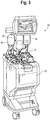
- Figs. 3 and 4 show a representative separation device useful in the separation and collection of platelets and the delivery of the additive solution described herein.
- the separator 50 includes a hardware component 52 and a disposable processing kit 54 mounted thereon.
- the separation principle used by the separator is based on centrifugation, but an automated separator based on a different separation principle may also be used.
- Disposable kit 54 includes the plastic containers for holding fluid, and may include the additive solution and tubing defining flow paths for movement of the blood, blood components and other fluids through the fluid circuit of kit 54.
- Disposable processing kit 54 includes one or more cassettes 56 (i.e., cassettes 56a, 56b and 56c shown in Fig. 4 ) which interface with the front panel of hardware component 52.
- cassettes 56a, 56b and 56c include flow paths and valve stations.
- a series of pneumatically or electrically operated valves (numbered 1-10 in Fig.
- Disposable kit 54 further includes a processing chamber shown generally at 57 of Fig. 5 (which is mounted on a rotor/spool of the centrifuge). Processing chamber 57 has a sub-chamber 58 wherein blood or blood components are separated under the influence of centrifugal force (i.e., the "separation chamber') and a sub-chamber 59 where blood components from sub-chamber 58 can be further processed, separated and/or collected (i.e., the "concentration chamber").
- a processing chamber shown generally at 57 of Fig. 5 which is mounted on a rotor/spool of the centrifuge.
- Processing chamber 57 has a sub-chamber 58 wherein blood or blood components are separated under the influence of centrifugal force (i.e., the "separation chamber') and a sub-chamber 59 where blood components from sub-chamber 58 can be further processed, separated and/or collected (i.e., the "concentration chamber").
- the relative amount of plasma that may be present in the storage medium described herein will preferably be less than about 20%. More preferably, plasma may be present from about 10 % to about 20 %.
- the storage medium for the platelets may be plasma-free (i.e., 0% plasma).
- plasma may be present in the storage medium (i.e., platelets, plasma and the synthetic aqueous storage solution) in an amount of up to 5%, such as, from about 0.5% to about 5%, or from about 1% to about 5%.
- plasma may be present in the storage medium from about 2% to about 5%, or from about 3% to about 5%, or from about 4% to about 5%, such as about 5%.
- the storage media allows the stored platelets to preserve functionality and viability upon transfusion to a patient for between about 2 to about 15 days, or between about 4 to about 14 days, or between about 5 to about 10 days.
- the storage media allows the stored platelets to preserve functionality and viability upon transfusion to a patient for more than about 5 days, or for more than about 7-8 days, including up to nine (9) days and, in some cases, up to 14 days, as determined by at least some of the markers and assays identified above.
- Storage medium disclosed herein may be also used in conjunction with methods of photodecontamination of platelets as described, for example, in U.S. Patent No. 5,908,742 .
- the partitioning of the ingredients of the synthetic storage solution may consist of 2 parts -- part 1, a neutral buffered physiological compartment containing one set of components such as the citrate, acetate, phosphate, sodium ion and optionally magnesium ion, calcium ion, potassium ion, bicarbonate ion, and part 2, an acidic carbohydrate compartment containing the dextrose, and optionally calcium ion, magnesium ion and potassium ion with both compartments having similar osmolarity.
- Table 2 an example of a synthetic media with two compartments is presented. The concentrations and/or amounts of the components are as previously described.
- Table 2 Composition of platelet storage solution in a three bag assembly (in g/Liter) Buffered Physiological Compartment Bag 1 containing (in g/L) 275 ml Na 3 Citrate.2H 2 O Na Acetate 3H 2 O NaH 2 PO 4 .2H 2 O Na 2 HPO 4 KCl NaCl NaHCO 3 pH 7.0 - 7.4 Osmolarity 300 mOsm/L Bag 2 containing (in g/L) 25ml Carbohydrate Compartment Dextrose Monohydrate CaCl 2 .2H 2 O MgCl 2 .6H 2 O pH 4-6 Osmolarity 292 or 328 mOsm/L Bag 3: final storage container (e.g., PL146) Bicarbonate, such as sodium bicarbonate may be added directly to Bag 3 or be included in Bag 1 as shown.
- final storage container e.g., PL146
- Bicarbonate such as sodium bicarbonate may be added directly to Bag 3 or be included
- Fig. 2 shows each compartment separately provided in a sterile bag with the carbohydrate compartment having a volume of 25 ml in Bag 2 and the buffered physiological compartment having a volume of 275 ml in Bag 1.
- the compartments may be combined by flow paths defined by plastic tubing 26, 22, to allow mixing of the compartments to form the synthetic medium in Bag 3.
- each Bag 1 and Bag 2 could be individually connected to Bag 3 and the compartments mixed in Bag 3.
- Frangible connectors 24, 20 are provided to establish flow communication between the Bags of set 10.
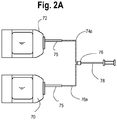
- Fig. 2A shows an alternative container system for combining the components of the storage solution described herein.
- container 70 preferably holds the buffered physiological components of citrate, acetate, phosphate, and potassium chloride.
- Container 72 preferably holds dextrose, sodium chloride, magnesium chloride and optionally calcium chloride.
- tubing 74a and 74b may include frangible connectors 75.
- Tubing 74a and 74b are joined at Y-connector 76.
- Tubing segment 78 downstream of connector 76 may be joined to a separate container (not shown) in which the components of containers 70 and 72 may be combined and to which bicarbonate may be added to arrive at the solution (PAS 5) described herein.
- containers 70 and 72 may include a combined volume of 300 ml (150 ml of solution in each of Container 70 and Container 72).
- concentrations of the individual components in Containers 70 and 72 are selected so that upon combination, the combined aqueous solution has the concentration for each of the components as previously described.
- two units of 300 ml of storage solution may be combined.
- two container systems of the type shown in Fig. 2A may be attached to the separate container (not shown in Fig. 2A ) to provide approximately 600 ml of the storage solution.
- Container systems of the type shown in Fig. 2A were utilized to prepare the storage solution (PAS 5) that was used in Studies 1-4 below.
- the storage solution described herein may contain, for example, approximately 16.8 mM dextrose monohydrate (D-glucose), 0 or 1.0 mM calcium chloride, approximately 1.5 mM magnesium chloride, approximately 10 mM sodium citrate, approximately 30 mM sodium acetate, approximately 9.4 mM sodium phosphate (7.2 mM dibasic sodium phosphate anhydrous and 2.2 mM monobasic sodium phosphate dihydrate), approximately 5 mM potassium chloride, approximately 69.55 mM sodium chloride, and approximately 20 mM of sodium bicarbonate.
- D-glucose dextrose monohydrate
- calcium chloride approximately 1.5 mM magnesium chloride
- approximately 10 mM sodium citrate approximately 30 mM sodium acetate
- approximately 9.4 mM sodium phosphate 7.2 mM dibasic sodium phosphate anhydrous and 2.2 mM monobasic sodium phosphate dihydrate
- approximately 5 mM potassium chloride approximately 69.55 mM sodium chlor
- aqueous storage solution may then be combined with platelets containing some amount of residual plasma, to yield a platelet product or suspension for storage with a plasma ratio for instance from about 10% to about 20%, and more preferably between about 1% and 10%, such as about 5%, and preferably less than about 5% and in other embodiments, less than 1%.
- a plasma ratio for instance from about 10% to about 20%, and more preferably between about 1% and 10%, such as about 5%, and preferably less than about 5% and in other embodiments, less than 1%.
- the exemplary automated systems and methods described above may be used for reducing residual plasma from platelet concentrate.
- an automated device that has been pre-programmed to perform desired processing procedures may be used to reduce plasma in platelet concentrate to obtain a desired platelet product.
- an apheresis device may include a programmable controller that is pre-programmed with one or more selectable protocols.
- a user/operator may select a particular processing protocol to achieve a desired outcome or objective, including, for example, to obtain a platelet product having a reduced plasma volume of approximately 5% of the total platelet product volume.
- the pre-programmed selectable protocol(s) may be based on several fixed and/or adjustable parameters, including, but not limited to, the volume of fluid being processed, volume of additive solution used or added to the platelets during processing, the desired platelet concentration, the desired volume of plasma to be removed, the processing time/duration of a given procedure and/or desired volume of final platelet product.
- the automated apheresis device may operate to perform one or more processing steps to reduce the amount of plasma from platelet concentrate until a desired plasma-reduced platelet product has been obtained.
- an automated apheresis device may be used to perform a procedure that includes, but is not limited to, the steps of separating whole blood in a centrifugal separation chamber to obtain a platelet-rich component, separating plasma from the platelet-rich component in the same or different chamber to obtain a platelet concentrate, removing plasma from the platelet concentrate and reconstituting the platelet concentrate to obtain a platelet product with a desired reduced plasma volume.
- the pre-programmed controller may operate the centrifuge and processing chamber associated therewith to separate blood into its various components as well as operate one or more pumps to move blood, blood components and/or additive solution through the various openable valves and tubing segments of a processing set 54, such as the one illustrated in Fig. 5 .
- This may include, for example, initiating and causing the centrifugal separation of platelets from whole blood in a separation chamber (or, more specifically, in a separation chamber of a processing chamber), removing plasma from platelets (i.e.
- pumping the removed plasma to a storage or waste bag to obtain platelet concentrate
- pumping additive solution such as the synthetic aqueous storage solutions described above
- pumping additive solution such as the synthetic aqueous storage solutions described above
- pumping additive solution such as the synthetic aqueous storage solutions described above
- fluid such as plasma
- the various processing steps performed by the pre-programmed automated apheresis device may occur separately, in series, simultaneously or any combination of these.
- Fig. 5 diagrammatically illustrates one example of a disposable processing set or kit 54 that can be used with an apheresis device (such as the automated Amicus® Separator (centrifugal separation device) available from Fenwal, Inc. of Lake Zurich, Illinois, and generally shown in Figs. 3 and 4 ) for the separation and collection of platelets.
- apheresis device such as the automated Amicus® Separator (centrifugal separation device) available from Fenwal, Inc. of Lake Zurich, Illinois, and generally shown in Figs. 3 and 4
- Blood drawn from a volunteer donor may be centrifugally processed in separation sub-chamber 58 of processing chamber 57 to separate platelets from other blood components to obtain a platelet rich plasma suspension (i.e. platelets suspended in plasma).
- the platelet rich plasma may be conveyed from sub-chamber 58 to sub-chamber 59 where additional plasma may be removed to obtain platelet concentrate.
- Platelet concentrate collected in sub-chamber 59 is relatively highly concentrated, as much of the plasma has been removed during the apheresis procedure for collection and/or return to the donor. However, it will be appreciated that the platelet concentrate still contains some residual amount of plasma. Further reduction of this plasma is desirable, such that upon resuspension of the platelet concentrate in an additive solution, the resulting platelet product comprises platelets suspended in approximately 5% plasma/95% additive solution (e.g., aqueous synthetic storage solution).
- additive solution e.g., aqueous synthetic storage solution
- the same separation device used to obtain the PC may also be used to reduce the residual plasma in the collected PC.
- an identical or other centrifugal separation device may be used to further process the PC to remove residual plasma.
- one exemplary processing protocol that may be performed by an automated apheresis device for removing residual plasma from collected PC is illustrated in exemplary Figs. 5A-5F , and described in further detail below. It will be appreciated that while the method described below may be performed using an Amicus® Separator, the method is not limited to any one type of separator. Thus, the order of steps and the volumes of fluids described below may vary depending on the device utilized.
- platelet concentrate has been collected in chamber 59 in an apheresis procedure and the donor disconnected.
- concentrated platelets with residual plasma may reside in chamber 59 having a total volume of typically about 25 ml.
- a source of platelet additive solution (PAS) (such as the aqueous synthetic solutions described above) 18 is connected to the PAS line 16 (as also shown in Fig. 6 ), such as by sterile docking, so that the additive solution from source 18 is in flow communication with the various cassettes 56a, b, c, tubing flow paths and separation and collection chambers 58 and 59 of disposable kit 54.
- PAS platelet additive solution
- this additive solution may be any aqueous solution or media suitable for the preservation, storage and reconstitution of platelets, such as, but not limited to Intersol, PAS 3, PAS 4 or PAS 5, or other commercially available media.
- PES aqueous storage solutions 18
- a method for reducing residual plasma from PC approximately 10 ml of plasma may be removed from the platelet concentrate in chamber 59 and conveyed into plasma collection bag 60 as shown in Fig. 5A .
- a pump such as pump 62 in a counter-clockwise direction
- plasma is pumped from chamber 59, through the respective flow path segments and open valves of cassette 56b, and conveyed into plasma bag 60.
- valves 1-10 on each of cassettes 56(a)-(c) are shown as shaded, to indicate a closed valve or unshaded to indicate an open valve.
- pump 64 of cassette 56c may be rotated (in a counter-clockwise direction) to pump fluid, such as plasma, remaining in one or more tubing segments such as tubing segments 68a, b, c and d following an apheresis procedure, to chamber 58.
- chamber 58 which served as a separation chamber for blood components during apheresis, will be substantially empty following the apheresis procedure, as blood and/or blood components, including platelets, have been conveyed out of chamber 58 and returned to the donor or conveyed into chamber 59, for example, for further processing.
- sub-chamber 58 may serve as a "waste container" for receiving and containing excess fluid, blood components or other materials that are flushed out of the cassettes, tubing or other parts of processing kit 54. While fluid such as plasma is flushed out of tubing segments 68a, b, c and d and into sub-chamber 58, platelet concentrate remains in chamber 59 preferably undisturbed.
- the processing step of removing or flushing fluid, such as plasma, from tubing segments 68a, b, c and d and into chamber 58, as illustrated in Fig. 5B may be performed as an optional step, if desired.
- pump 70 may be rotated (for example, in a clock-wise direction) to pump approximately 20 ml of PAS from source container 18 into the flow path of cassette 56c, (through valves 4, 1 and 3 of cassette 56c) through tubing segment 68b and into the flow path of cassette 56b.
- the PAS then flows through the flow path segments of cassette 56b (through valves 4, 9 and 8) and is conveyed through tubing segments 68c and d, and into chamber 58.
- the step of pumping PAS from source 18 through cassettes 56c and 56b and into chamber 58 serves to flush out fluid, such as plasma, that may remain in the various tubing segments and valves of the cassettes 56b and 56c.
- This flushed plasma may be received by and held in (waste) sub-chamber 58, while platelet concentrate still remains in chamber 59 undisturbed.
- pump 70 associated with cassette 56c is operated (in a clock-wise direction) to pump approximately 25 ml of PAS from source container 18 into chamber 59 in order to reconstitute platelet concentrate in chamber 59.
- the PAS from source 18 may flow through tubing segment 16 into cassette 56c (and through open valves 4, 2 and 3 of cassette 56c).
- the PAS may flow through tubing 68b, into cassette 56b (through open valves 4 and 7) through tubing segment 68e, where it is conveyed into sub-chamber 59.
- the optional processing step illustrated in Fig. 5B is performed (i.e., plasma remaining in tubing segments 68a, b, c and d pumped to chamber 58), it is possible that some platelets may have been pulled out of chamber 59 and into tubing segment 68a by action of pump 64, (for example, pump 64 is operated for too long of a duration or too aggressively). Accordingly, in this instance, the further optional processing step illustrated in Fig. 5E may be employed. As shown in Fig.
- approximately 15 ml of PAS may be pumped from source container 18 through cassette 56c (through open valves 4, 10 and 8) and tubing segment 68a to push back any platelets that may have been pulled from chamber 59 into tubing 68a in the processing step illustrated in Fig. 5B into sub-chamber 59. This may be accomplished by operating pump 64 in a clock-wise direction. Any platelets pumped from tubing 68a back into chamber 59 may be reconstituted, or more specifically, resuspended with the platelet concentrate in chamber 59. Platelets, now combined with PAS may then be resuspended. Resuspension may be assisted by manual manipulation, massage or agitation of the platelet container by the operator, although other suitable methods of resuspension may be used including automated resuspension methods.
- platelets are transferred into storage containers 12 and combined with a sufficient volume of PAS to arrive at the desired percent volume of plasma.
- approximately 570 ml of PAS may be pumped from source container 18 through cassette 56c (through open valves 4, 1 and 3) and into chamber 59 by operating pump 70 in a clock-wise direction and pump 64 in a counter-clockwise direction.
- PAS may be conveyed into the flow path of cassette 56c (through open valves 4, 1 and 3) through tubing segment 68b, into cassette 56b (through open valves 4 and 7), through tubing segment 68e and into chamber 59. Platelets are flushed by the PAS from chamber 59 into storage container 12.
- the platelets flow out of chamber 59 into tubing segment 68a, into cassette 56c (through open valves 8 and 5), through tubing segment 68f and into storage container 12.
- the platelets are suspended in 570 ml of PAS and approximately 30 ml of plasma, preferably, in two separate containers, each having platelets suspended in approximately 285 ml of PAS and 15 ml of plasma, resulting in a platelet product of platelet concentrate suspended in approximately 5% plasma/95% PAS-5, suitable for storage and/or transfusion.
- Figs. 3 and 4 are examples of suitable apparatus and systems for collecting and/or otherwise providing (in an automated fashion) platelets in a reduced volume of plasma.
- Other systems wherein platelets are concentrated in a separation chamber and/or collected outside of such chamber may also be used. Concentrated platelets that are collected outside of the separation chamber may be reconstituted in, for example, an external but attached container to provide an initial platelet product with some residual plasma. If reductions to or below 5% plasma are desired, the collected platelets may be reintroduced into the separation chamber to reduce volume of plasma accordingly, including to or below 1% by washing.
- steps described above have been described as part of one continuous procedure (after the donor has been disconnected), it will be appreciated that these steps may be carried out intermittently and in multiple passes until the desired amount of platelets has been collected.
- a volume of whole blood may be collected and the platelets separated, reconstituted and transferred to a collection container in the manner described above with the donor still connected, and additional whole blood can be collected and the steps described above, repeated.
- the exemplary automated systems and methods described above are useful for reducing the residual volume of plasma from PC collected in an apheresis procedure to obtain a platelet product (i.e. platelets suspended in platelet storage media and plasma) wherein the volume of plasma has been reduced to approximately 5% or less of the total platelet product volume.
- a platelet product i.e. platelets suspended in platelet storage media and plasma
- platelet concentrate may be washed after apheresis is complete or "post-apheresis". This may include washing platelets immediately following an apheresis procedure using the same automated separation device in which the PC was obtained, or washing previously collected platelets from another source, such as a different separation device or platelets from a storage container.
- platelet concentrate can be washed as part of, or during, an apheresis procedure (method 200).
- platelet concentrate may be obtained in an apheresis procedure using the Amicus® Separator or other separation device, reconstituted in additive solution and held in a collection container 12, in accordance with the methods described above and as shown in Figs. 5A-5F (e.g., preferably after the donor has been disconnected) and referenced as method 100 in Fig. 9 .
- the resuspended platelet concentrate may then be washed using an automated separation device, such as the Amicus® Separator or other device.
- one or more sources of platelets such as resuspended platelet concentrate in container(s) 12 that were collected with the Amicus® Separator or other suitable device in accordance with the methods described above, may be connected through a junction, such as a "Y" connector, to a new sterile disposable processing set 54, and the set loaded on to an Amicus® Separator (or other device).
- a source of wash solution such as a PAS solution including those described herein (e.g., PAS-5), may also be connected though a junction to processing set 54.
- a wash procedure (referred to by reference numeral 120 in Fig.
- a washed platelet concentrate that upon reconstitution, will result in a platelet product having a volume of plasma that is less than about 1% of the total platelet product volume may be provided.
- the automated washing procedure may be initiated, such that platelet concentrate (with reduced plasma) from source container(s) 12 may be drawn into, and concentrated in a centrifugal field, in chamber 59. Washing fluid such as a PAS, may be drawn into chamber 59 while a centrifugal field is maintained. As the procedure progresses and wash solution is continuously fed through chamber 59 to displace and push the plasma out, the proportion of plasma in the fluid removed from the chamber is reduced, as it is replaced by an increasing proportion of wash (e.g., PAS) solution.
- wash e.g., PAS
- the washed platelet concentrate residing in collection chamber 59 may then be resuspended in a selected volume of a resuspension fluid (e.g., PAS).
- Resuspension may be performed using any suitable resuspension method, such as manual manipulation of chamber 59 as previously described.
- the resuspension fluid may be the same as the wash solution, or may be a different fluid suitable for platelet resuspension and/or storage.
- both the wash solution and the resuspension fluid is a synthetic platelet additive solution, such as PAS-5 described above.
- the resuspended washed platelets may be harvested by transferring them to a container for storage, transfusion, or further processing. In one example, this may be accomplished by conveying additional wash solution through chamber 59, to thereby flush the resuspended washed platelets into a storage container.
- platelets may be washed as part of an apheresis procedure. Washing platelets during, or as part of an apheresis procedure may be accomplished using separation devices such as the Amicus® Separator, or by other known automated separation devices as indicated by reference numeral 200 in Fig. 9 . In particular, washing may be performed while platelets are being separated from whole blood into platelet rich plasma in a centrifugal field. As described above, a platelet rich suspension is separated from other blood components in a centrifugal field, for example, in separation chamber 58 (using, for example, the Amicus® Separator shown in Figs. 3 and 4 ). The platelet rich suspension is conveyed into chamber 59 where plasma is continuously removed from the chamber 59 while the centrifugal field is maintained. It will be appreciated that as plasma is continuously removed, platelets become increasingly concentrated in chamber 59.
- a selected volume of plasma may be removed from the platelets in collection chamber 59 such that the platelets are considered to be "hyper-concentrated".
- "hyper concentrated platelets” may include, but are not limited to, platelets having a concentration that is higher than that at which platelets are typically stored.
- the concentration of stored platelets may typically be less than 2 million platelets per microliter ( ⁇ L), such as in the range of approximately 1.3 to 2 million platelets/ ⁇ L, whereas hyper-concentrated platelets may have a concentration of greater than 2 million platelets/ ⁇ L.
- wash solution including, but not limited to, aqueous solutions such as saline, platelet additive solution (PAS-5, PAS-4, PAS-3, Intersol or any other suitable synthetic media) may be continuously added to chamber 59 to help displace or "wash" plasma out of the chamber 59, while platelets remain in the chamber.
- aqueous solutions such as saline
- platelet additive solution PAS-5, PAS-4, PAS-3, Intersol or any other suitable synthetic media
- wash solution such as PAS-5 or other PAS
- a centrifugal field is maintained. Plasma is thereby pushed out of the chamber by the wash solution as it is continuously added and then removed from chamber 59, while platelets remain in the chamber.
- the majority of the fluid removed from chamber 59 is plasma.
- wash solution is continuously fed through the chamber to displace and push the plasma out
- the proportion of plasma in the fluid removed from the chamber is reduced, as it is replaced by an increasing proportion of wash solution.
- the fluid removed from chamber 59 is typically largely wash solution. This procedure may be repeated one or more times, as necessary.
- the wash procedure may be terminated once it has been determined that the desired volume of plasma has been removed, and the platelets concentrated to a desired level.
- the automated separation device used to perform the wash procedure may be pre-programmed into the software-driven controller of the apheresis device to conduct a particular selectable wash procedure or "protocol".
- the device may be pre-programmed with one or more platelet collection and/or washing protocol(s) from which a user may select, based on the user's objective or desired outcome for a particular procedure, such as reducing the plasma in the platelet concentrate to obtain a washed platelet product having less than approximately 1% plasma.
- the pre-programmed selectable protocol(s) may be based on several fixed and/or adjustable parameters, including, for example, the volume of fluid being processed, volume of wash solution used, desired platelet concentration, the desired volume of plasma to be removed, the processing time/duration of a given procedure and/or desired volume of final platelet product.
- the washed platelet concentrate may reside in collection chamber 59.
- the washed platelet concentrate may then be resuspended in a selected volume of fluid.
- the resuspension fluid may be the same as the wash solution, or may be a different fluid suitable for platelet resuspension.
- both the wash solution and the resuspension fluid is a synthetic platelet additive solution, such as PAS-5.
- the resuspended washed platelets may, if desired, be transferred to a container for storage, transfusion, or further processing.
- PAS-5 was prepared on the day of platelet collection by mixing separate salt and glucose solutions provided a dual bag assembly of the type shown in Fig. 2A , into a transfer pack (PL1813, Fenwal Inc., Lake Zurich, Illinois).
- This combined solution 600 ml, pH 7.3
- This combined solution contained (in mM concentrations): 9.99 Na 3 -citrate; 30.0 Na-acetate; 2.2 NaH 2 PO 4 ; 7.2 Na 2 HPO 4 ; 69.4 NaCl, 5.0 KCI; 1.5 MgCl 2 ; 1.0 CaCl 2 and 16.8 glucose.
- Double platelet products were collected from volunteer donors using the Amicus® Separator, as shown generally in Figs. 3 and 4 , (software v3.2, Fenwal Inc., Lake Zurich, IL), and acid-citrate-dextrose Formula A (ACD-A) anticoagulant with a whole blood:anticoagulant ratio of 10:1.
- a double platelet product was collected with a target platelet yield of 6.0-8.0 x 10 11 platelets and collecting between 100-500 ml total plasma volume.
- Fig. 5 is a diagram of the disposable processing set used with the Amicus® apheresis device.
- the centrifuge pack was not removed from the Amicus® spool.
- the lines leading to the ACD and saline bags were heat sealed and the bags removed from the kit.
- the kit was loaded onto another Amicus® device.
- PAS 5 container 18 was attached to the kit as shown in Fig. 5 . Additional processing steps are shown and described above with reference to Figs. 5A-5F .
- Platelets were transferred to the platelet storage containers by flushing PAS-5 through the collection chamber and into the platelet storage containers 12.
- the resulting platelet concentrates contained approximately 5% plasma/ 95% PAS-5 in 300 ml total volume per each product.
- the platelet units were transferred to a horizontal agitator (Helmer, model PC2200; Noblesville, IN) for storage at 20 - 24°C. Only one platelet unit was evaluated from each pair.
- Apheresis platelet units were sampled aseptically using a syringe on Days 1 and 7 of storage. Day 5 samples were also collected when available. Approximately 5 ml were withdrawn from each platelet unit on each day of sampling. Platelet concentration and mean platelet volume were determined using a hematology analyzer (KX-21N, Sysmex America Inc., Mundelein, IL). Platelet content was calculated by multiplying the platelet concentration by the platelet product volume (weight of unit/specific gravity of PAS, 1.01) measured the same day. An automated gas analyzer (Bioprofile pHOx, Nova Biomedical, Waltham, MA) was used to measure platelet pH, pO 2 , and pCO 2 at 37°C.
- Bicarbonate concentration and pH at 22°C were automatically calculated from these measurements.
- Glucose, lactate and lactate dehydrogenase were determined spectrophotometrically (AU400E, Olympus America, Inc., Center Valley, PA). Morphology score was performed after the method of Kunicki et al., with the addition of an altered disc category, Kunicki TJ, Tuccelli M, Becker, GA, Aster, RH., "A Study of Variables Affecting the Quality of Platelets Stored in Room Temperature.” Transfusion, 1975; 15(5):414-21 . Hypotonic shock response (HSR) was measured turbimetrically (SPA 2000, Chrono-Log Corp., Havertown, PA), Holme, S.
- HSR Hypotonic shock response
- HSR samples were diluted with refrigerated autologous plasma (pre-warmed to room temperature before addition to samples) and test sample blanks were made using the same concentration of PAS-5 as in the diluted sample.
- Total protein concentration in the concurrent plasma and platelet concentrate supernatant were determined using a protein assay based on Coomassie Blue staining (Bio-Rad Protein Assay Kit, Bio-Rad Laboratories, Hercules, CA). Plasma fraction was calculated from total protein concentration in the platelet concentrate supernatant divided by total protein concentration in the concurrent plasma.
- An Amicus® double apheresis unit was collected from a donor by ARC Research Blood Program with a targeted yield of 7.6 x 10 11 platelets in 198 ml plasma using a single needle procedure, Amicus® software v 3.2 and acid-citrate-dextrose Formula A (ACD-A) anticoagulant with a whole blood:anticoagulant ratio of 10:1.
- a concurrent plasma volume of 320 ml was also collected.
- Platelets were allowed to rest without agitation at 20-24°C for 4 hours.
- the double unit was divided equally into the two supplied, 1L containers 12 ( Fig. 5 ) by weight.
- Two hundred ml of concurrent (autologous) plasma was sterile docked to one of the PL-2410 containers and transferred to one unit (Control) using a sterile connection device (TSCD model SC-201A, Terumo Transfusion Products, Somerset, NJ).
- TSCD model SC-201A Terumo Transfusion Products, Somerset, NJ
- Both units were then centrifuged at 4161 x g (3800 rpm, Sorval RC3BP+, Thermo Scientific, Waltham, MA) at 20 to 24°C and with an accumulated centrifugal effect (ACE) of 5.5 x 10 7 . All but approximately 35-40 ml of PAS-5/plasma were expressed from the Test unit. From the Control unit, sufficient plasma was expressed, leaving 250 ml remaining plasma volume. Fresh PAS-5 was added to the platelet pellet immersed in PAS-5/plasma to yield a 250 ml volume of approximately 5% plasma/95% PAS-5.
- Platelets were then resuspended immediately and both units were rested for 1 hour without agitation at 20-24°C prior to being placed on an agitator (Helmer, model PC900i, Noblesville, IN, 70 cycles/minute) for 20-24°C storage.
- Helmer, model PC900i, Noblesville, IN, 70 cycles/minute for 20-24°C storage.
- All apheresis platelet units were sampled by syringe on the mornings of Days 1, 5 and 7. Approximately 5-6 ml were withdrawn from each platelet unit on each day of sampling. Platelet concentration and mean platelet volume (MPV) were determined using a hematology analyzer (Cell Dyn 3700, Abbott, Abbott Park, IL), and platelet content was calculated by multiplying the platelet concentration by the platelet volume (weight of the unit / specific gravity, 1.03 for plasma and 1.01 for PAS) measured the same day. Measurements of pH were performed at room temperature (20-24°C) using an Orion meter (Thermo Scientific, Beverly, MA)/Accu-pHast combination pH electrode (Fisher Scientific, Pittsburgh, PA).
- the platelets were assayed for pO 2 , pCO 2 , glucose, and lactate were measured at 37oC using a blood gas/blood chemistry analyzer (Cobas, Roche b 221, Indianapolis, IN). Bicarbonate was automatically calculated from these measurements. Platelet morphology was assessed by phase microscopy as the percentage of platelets with discoid morphology. Extent of shape change (ESC) and hypotonic stress response (HSR) were measured turbimetrically (SPA2000 Chronolog, Havertown, PA), Holme, S., et al., ESC and HSR samples and blanks were prepared as described in Study 1.
- ESC shape change
- HSR hypotonic stress response
- Table 3 Platelet storage parameters in suspensions containing 5% plasma/95% PAS-5 (Study 1) Day 1 Day 5* Day 7 Platelet count (x10 3 / ⁇ L) 1009 ⁇ 157 1039 ⁇ 134 1032 ⁇ 154 Platelet content (x10 11 ) ⁇ 3.03 ⁇ 0.49 2.99 ⁇ 0.41 2.89 ⁇ 0.45 MPV (fL) 7.7 ⁇ 0.5 7.6 ⁇ 0.6 7.7 ⁇ 0.6 pH (22°C) 7.44 ⁇ 0.06 7.51 ⁇ 0.07 7.50 ⁇ 0.09 Glucose (mg/dL) ⁇ 295 ⁇ 10 265 ⁇ 12 243 ⁇ 13 Lactate (mM) ⁇ 1.7 ⁇ 0.5 5.1 ⁇ 1.2 7.2 ⁇ 1.7 Bicarbonate (mM) 9.8 ⁇ 0.5 9.7 ⁇ 1.2 9.4 ⁇ 1.3 pCO 2 (mm Hg) 23.0 ⁇ 2.8 19.4 ⁇ 2.4 19.3 ⁇ 2.9 pO 2 (mm Hg) 75.1 ⁇ 18.7 89.9 ⁇ 16.0 98.1 ⁇ 18.5 LDH (U/L) 68 ⁇ 39 76 ⁇ 29 91 ⁇ 32
- a manual protocol was used to produce Amicus® double platelet products in 5% plasma/95% PAS-5 (Table 5).
- a standard Amicus® double platelet collection was performed using a US approved InterSol® kit, as generally shown in Fig. 6 .
- the umbilicus assembly, "PAS" line and platelet storage containers 12 were heat sealed off from the kit.
- the PAS line and platelet storage containers were then sterile connected to the umbilicus assembly 14.
- PAS-5 was connected onto the PAS line 16 and was used to resuspend the platelets as well as to transfer the platelets to the platelet storage containers.
- Amicus® operator's manual instructions were followed for single and double needle platelet collections.
- a double platelet product was collected with a target of 6.0 - 8.0 ⁇ 10 11 platelets, ACD ratio of 10:1 and between 100 - 700 ml total plasma volume collected.
- the PPP line 80 and PRP line 82 were labeled at a location near the umbilicus with black indelible marker. All of the tubing lines leading to the umbilicus were heat sealed at a location approximately in line with the bottom of the drip chamber 84 (as shown in Fig. 6 ).
- the PAS line 16 was heat sealed near the cassette 56c port, as shown in Fig. 6 and disconnected from the kit.
- the collection chamber/umbilicus assembly was disconnected from the kit.
- the double platelet product and approximately 30 ml of plasma remained in this assembly.
- the tubing leading to the platelet storage containers was heat sealed at approximately 6 inches from the "Y" 86, as also shown in Fig. 6 and disconnected from kit.
- the PAS-5 solution was sterile connected onto the PAS line 16 in the correct orientation (arrow on filter pointing in the direction of fluid flow).
- the opposite end of the PAS line was sterile connected to an empty 150 ml transfer pack.
- the filter and PAS line were primed with PAS-5 to remove any air in the assembly and the line was heat sealed approximately 6 inches below the filter.
- the line was primed with just enough PAS-5 to clear air from the PAS line.
- An excess amount of PAS-5 was not used for priming as the majority of the volume was needed for platelet storage.
- the clamp was closed on each tubing line leading to a platelet storage container.
- the two platelet storage container assembly was sterile connected to the PPP line 80 (as shown in broken lines in Fig. 7 ).
- the PAS-5 line was sterile connected to the PRP line 82 (as shown by the broken line in Fig. 7 ).
- a hemostat was placed on the line in between the sterile filter and umbilicus.
- the hemostat was opened on the PAS line and approximately 20 - 30 ml of PAS-5 was drained into the collection chamber 58.
- the hemostat on the PAS line was closed.
- the platelets were resuspended manually per Amicus® operator's manual.
- One of the platelet storage containers was placed on a scale and the storage container was used to tare the scale.
- the hemostat on the PAS line was opened.
- the clamp leading to the platelet storage container on the scale was opened.
- PAS-5 solution was drained through the collection chamber and into the open platelet storage container 12 until the scale read approximately 605 ⁇ 10 g, at which time, the hemostat on the PAS line was closed. Note: For optimal draining, the collection chamber was hung vertically at a height below the PAS-5 solution and above the platelet storage containers as shown in Fig. 8 . A blood bag spike injection site was inserted into each storage container and a sample was removed for total protein analysis.
- the platelet concentrates were stored under standard blood bank conditions, i.e. with continuous agitation at 20 - 24 °C in PL 2410 suitable platelet storage containers until the end of storage. On Day 0, 1, 7 and 14 at a minimum and on Day 5 and 9 when possible, the products were removed from storage and mixed thoroughly. The bag weights were recorded prior to sampling.
- a sample of the PPP (platelet poor plasma) from each collection was analyzed for total protein content (g/dL).
- a sample of each platelet concentrate was assayed for total protein content (mg/dL) using the Bio-Rad Quick Start Bradford Protein Assay kit, Product # 500-0202, following manufacturer's instructions.
- PAS-5L and PAS-5H refer to the storage of platelets in “low” and “high” pH PAS 5 of Study 3.
- PAS-5 refers to the solution and storage medium used in Study 4.
Landscapes
- Health & Medical Sciences (AREA)
- Life Sciences & Earth Sciences (AREA)
- Engineering & Computer Science (AREA)
- Heart & Thoracic Surgery (AREA)
- Vascular Medicine (AREA)
- Hematology (AREA)
- Biomedical Technology (AREA)
- General Health & Medical Sciences (AREA)
- Veterinary Medicine (AREA)
- Animal Behavior & Ethology (AREA)
- Public Health (AREA)
- Anesthesiology (AREA)
- Cardiology (AREA)
- Chemical & Material Sciences (AREA)
- Zoology (AREA)
- Biotechnology (AREA)
- Organic Chemistry (AREA)
- Bioinformatics & Cheminformatics (AREA)
- Wood Science & Technology (AREA)
- Cell Biology (AREA)
- Genetics & Genomics (AREA)
- Immunology (AREA)
- Medicinal Chemistry (AREA)
- Pharmacology & Pharmacy (AREA)
- Epidemiology (AREA)
- Biochemistry (AREA)
- General Engineering & Computer Science (AREA)
- Developmental Biology & Embryology (AREA)
- Virology (AREA)
- Microbiology (AREA)
- Nuclear Medicine, Radiotherapy & Molecular Imaging (AREA)
- Chemical Kinetics & Catalysis (AREA)
- Diabetes (AREA)
- General Chemical & Material Sciences (AREA)
- Dentistry (AREA)
- Environmental Sciences (AREA)
- Medicines Containing Material From Animals Or Micro-Organisms (AREA)
- External Artificial Organs (AREA)
- Biophysics (AREA)
- Physiology (AREA)
Claims (15)
- Produit de plaquettes, comprenant :des plaquettes, etune solution aqueuse comprenant :de 45 à 125 mM de chlorure de sodium ;de 5 à 15 mM de citrate de sodium ;de 20 à 40 mM d'acétate de sodium ;de 0,05 à 12 mM de phosphate ;de 0,05 à 3 mM d'ion magnésium ;de 0,05 à 10 mM de chlorure de potassium ;de 20 à 25 mM de bicarbonate de sodium ;d'environ 0,5 à environ 30 mM de glucose, etjusqu' à 5 % en volume de plasma.
- Produit de plaquettes selon la revendication 1 comprenant en outre d'environ 0,05 mM à 3 mM de chlorure de calcium.
- Produit de plaquettes selon la revendication 1 comprenant jusqu'à 1 % en volume de plasma.
- Produit de plaquette selon la revendication 1, dans lequel le phosphate est présent sous la forme de phosphate de sodium.
- Produit de plaquette selon les revendications 1 ou 3 et 4, dans lequel la solution aqueuse est la solution aqueuse synthétique selon la revendication 6, dans lequel le phosphate est approximativement 9,4 mM de phosphate de sodium.
- Solution aqueuse synthétique pour le stockage de plaquettes comprenant :environ 69 mM de chlorure de sodium ;environ 10 mM de citrate de sodium ;environ 30 mM d'acétate de sodium ;environ 9,3 mM de dihydrate de phosphate monobasique et de phosphate de sodium dibasique anhydre ;environ 1,5 mM de chlorure de magnésium ;environ 5 mM de chlorure de potassium ;environ 16,8 mM de glucose (dextrose) ; etenviron 20 mM de bicarbonate de sodium.ou comprenantenviron 69,55 nM de chlorure de sodium ;environ 10 mM de citrate de sodium ;environ 30 mM d'acétate de sodium ;environ 9,4 mM de phosphate de sodium contenant 7,2 mM de phosphate de sodium dibasique anhydre ;et 2,2 mM de phosphate de sodium monobasique dihydrate ;environ 1,5 mM de chlorure de magnésium ;environ 5 mM de chlorure de potassium ;environ 16,8 mM de dextrose monohydrate (D-glucose) ;environ 20 mM de bicarbonate de sodium ; et0 ou 1,0 mM du chlorure de calcium.
- Solution aqueuse synthétique selon la revendication 6, dans laquelle la concentration en phosphate de sodium est de 9,4 mM et comprenant en outre environ 1,0 mM de chlorure de calcium.
- Procédé automatique de fourniture d'un produit de plaquettes à teneur en plasma sensiblement réduite selon l'une quelconque des revendications 1 à 5, comprenant :la fourniture d'un séparateur d'aphérèse automatique comprenant une chambre de concentration de plaquettes ;la concentration des plaquettes dans ladite chambre, ledit concentré de plaquettes comprenant des plaquettes en suspension dans un volume de plasma ;le retrait d'un volume sélectionné de plasma dudit concentré de plaquettes ;la reconstitution du concentré de plaquettes avec une solution additive aqueuse pour obtenir le produit de plaquettes à teneur réduite en plasma comprenant des plaquettes, une solution additive aqueuse et du plasma, dans lequel le volume de plasma dans ledit produit de plaquettes est de 5 % ou moins du volume de produit de plaquettes total.
- Procédé selon la revendication 8 dans lequel ledit concentré de plaquettes est reconstitué hors de ladite chambre de concentration.
- Procédé selon la revendication 8 comprenant la collecte desdites plaquettes dans ladite chambre de concentration de plaquettes.
- Procédé selon la revendication 8 comprenant en outre :l'introduction dudit produit de plaquettes dans un séparateur d'aphérèse automatique,le retrait du plasma supplémentaire dudit produit de plaquettes pour obtenir un second concentré de plaquettes en suspension dans un volume résiduel de plasma,l'introduction d'une solution de lavage dans ledit séparateur ;le retrait de sensiblement la totalité dudit volume de plasma résiduel dudit produit de plaquettes pour obtenir un concentré de plaquettes lavé,la reconstitution dudit concentré de plaquettes lavé dans ladite solution de lavage pour obtenir un produit de plaquettes lavé comprenant des plaquettes, la solution de lavage et le plasma, dans lequel le volume de plasma dans ledit produit est de 1 % ou moins du produit de plaquettes lavé total.
- Système automatique de traitement de fluide biologique pour obtenir un produit de plaquettes à teneur en plasma sensiblement réduite selon l'une quelconque des revendications 1 à 5 comprenant :(a) un circuit de fluide jetable comprenant :(i) une chambre de traitement pour la séparation du fluide biologique en un ou plusieurs composants incluant les plaquettes en suspension dans un volume de plasma,(ii) une source de solution additive aqueuse en communication d'écoulement ouvrante avec ladite chambre de traitement, ladite solution additive aqueuse comprenant :de 45 à 125 mM de chlorure de sodium ;de 5 à 15 mM de citrate de sodium ;de 20 à 40 mM d'acétate de sodium ;de 0,05 à 12 mM de phosphate ;de 0,05 à 3 mM d'ion magnésium ;de 0,05 à 10 mM de chlorure de potassium ;de 20 à 25 mM de bicarbonate de sodium ; etde 0,5 à 30 mM de glucose ;(b) un dispositif de séparation adapté pour recevoir ladite chambre de traitement pour effectuer une séparation d'un fluide biologique incluant des plaquettes et du plasma,(c) un dispositif de commande programmable programmé pour :(i) concentrer lesdites plaquettes en suspension dans un volume de plasma dans ladite chambre de séparation,(ii) éliminer sensiblement la totalité du plasma desdites plaquettes pour obtenir un concentré de plaquettes, et(iii) combiner une solution additive de ladite source de solution additive avec ledit concentré de plaquettes pour obtenir un produit de plaquettes comprenant des plaquettes, une solution additive aqueuse synthétique et du plasma, dans lequel le volume de plasma dans ledit produit de plaquettes est de 5 % ou moins du volume de produit de plaquettes total.
- Système selon la revendication 12, comprenant en outre un récipient de collecte en communication fluidique avec ladite chambre de séparation.
- Système selon la revendication 12, dans lequel ladite chambre de traitement comprend une chambre de concentration pour la concentration des plaquettes et dans lequel ladite chambre de traitement comprend en outre une chambre de séparation pour séparer les plaquettes et le plasma du sang total.
- Système selon la revendication 12, dans lequel ledit dispositif de commande programmable est en outre programmé pour :(a) acheminer ledit produit de plaquettes dudit récipient à ladite chambre de traitement,(b) introduire une solution de lavage dans ladite chambre de traitement pour déplacer sensiblement la totalité du plasma restant dans ledit produit de plaquettes pour obtenir un concentré de plaquettes lavé, et(c) remettre en suspension ledit concentré de plaquettes lavé dans ladite solution de lavage pour obtenir un produit de plaquettes lavé comprenant des plaquettes, la solution de lavage et le plasma,
dans lequel le volume de plasma dans ledit produit de plaquettes lavé est d'approximativement 1 % ou moins du volume de produit de plaquettes lavé total, et de préférence le volume de plasma dans ledit produit de plaquettes est d'approximativement 0 % du volume de produit de plaquettes total.
Priority Applications (1)
| Application Number | Priority Date | Filing Date | Title |
|---|---|---|---|
| EP19193939.6A EP3662750A1 (fr) | 2011-04-07 | 2012-04-06 | Procédés et systèmes automatisés pour produire des concentrés de plaquettes avec des volumes de plasma résiduel réduits et des milieux de conservation pour de tels concentrés de plaquettes |
Applications Claiming Priority (3)
| Application Number | Priority Date | Filing Date | Title |
|---|---|---|---|
| US201161472952P | 2011-04-07 | 2011-04-07 | |
| US201161541793P | 2011-09-30 | 2011-09-30 | |
| PCT/US2012/032551 WO2012139017A1 (fr) | 2011-04-07 | 2012-04-06 | Procédés et systèmes automatisés pour produire des concentrés de plaquettes avec des volumes de plasma résiduel réduits et des milieux de conservation pour de tels concentrés de plaquettes |
Related Child Applications (1)
| Application Number | Title | Priority Date | Filing Date |
|---|---|---|---|
| EP19193939.6A Division EP3662750A1 (fr) | 2011-04-07 | 2012-04-06 | Procédés et systèmes automatisés pour produire des concentrés de plaquettes avec des volumes de plasma résiduel réduits et des milieux de conservation pour de tels concentrés de plaquettes |
Publications (3)
| Publication Number | Publication Date |
|---|---|
| EP2694131A1 EP2694131A1 (fr) | 2014-02-12 |
| EP2694131A4 EP2694131A4 (fr) | 2014-09-24 |
| EP2694131B1 true EP2694131B1 (fr) | 2019-08-28 |
Family
ID=46969572
Family Applications (2)
| Application Number | Title | Priority Date | Filing Date |
|---|---|---|---|
| EP19193939.6A Withdrawn EP3662750A1 (fr) | 2011-04-07 | 2012-04-06 | Procédés et systèmes automatisés pour produire des concentrés de plaquettes avec des volumes de plasma résiduel réduits et des milieux de conservation pour de tels concentrés de plaquettes |
| EP12768563.4A Active EP2694131B1 (fr) | 2011-04-07 | 2012-04-06 | Procédés et systèmes automatisés pour produire des concentrés de plaquettes avec des volumes de plasma résiduel réduits et des milieux de conservation pour de tels concentrés de plaquettes |
Family Applications Before (1)
| Application Number | Title | Priority Date | Filing Date |
|---|---|---|---|
| EP19193939.6A Withdrawn EP3662750A1 (fr) | 2011-04-07 | 2012-04-06 | Procédés et systèmes automatisés pour produire des concentrés de plaquettes avec des volumes de plasma résiduel réduits et des milieux de conservation pour de tels concentrés de plaquettes |
Country Status (5)
| Country | Link |
|---|---|
| US (3) | US9402866B2 (fr) |
| EP (2) | EP3662750A1 (fr) |
| JP (4) | JP2014518547A (fr) |
| AU (1) | AU2012240016B2 (fr) |
| WO (1) | WO2012139017A1 (fr) |
Families Citing this family (22)
| Publication number | Priority date | Publication date | Assignee | Title |
|---|---|---|---|---|
| US10039877B2 (en) | 2013-08-23 | 2018-08-07 | Fenwal, Inc. | Apheresis platelets with fixed residual plasma volume |
| JP6257397B2 (ja) * | 2014-03-19 | 2018-01-10 | テルモ株式会社 | 赤血球瀉血用希釈剤、赤血球瀉血用希釈剤充填済容器およびそれを備えた赤血球瀉血用具 |
| JP2016044125A (ja) * | 2014-08-19 | 2016-04-04 | テルモ株式会社 | 血小板洗浄置換液 |
| US11566225B2 (en) * | 2014-10-03 | 2023-01-31 | Fenwal, Inc. | Automated system for processing a biological fluid |
| WO2017038624A1 (fr) * | 2015-08-28 | 2017-03-09 | テルモ株式会社 | Procédé de prélèvement de plaquettes sanguines, et système de prélèvement associé |
| EP3342435B1 (fr) * | 2015-08-28 | 2022-12-21 | Terumo Kabushiki Kaisha | Séparateur de plaquettes sanguines, et dispositif de collecte de plaquettes sanguines |
| CN105749370B (zh) * | 2016-04-22 | 2018-08-14 | 四川南格尔生物科技有限公司 | 一种断续式血浆采集装置 |
| EP3254713B1 (fr) | 2016-06-08 | 2020-01-08 | Fenwal, Inc. | Système pour déplétion thérapeutique de plaquettes |
| WO2018052102A1 (fr) * | 2016-09-15 | 2018-03-22 | Terumo Kabushiki Kaisha | Séparateur de plaquettes sanguines, dispositif de récupération de plaquettes sanguines, système de collecte de plaquettes sanguines, et procédé de collecte de plaquettes sanguines |
| EP3612247B1 (fr) * | 2017-04-20 | 2025-06-04 | Fenwal, Inc. | Systèmes et procédés de filtration de plaquettes à l'aide d'un additif |
| EP3466449B1 (fr) | 2017-10-06 | 2022-08-03 | Fenwal, Inc. | Systèmes intégrés de collecte de plaquettes et de traitement d'inactivation d'agents pathogènes et circuits de fluides |
| CA3121200A1 (fr) | 2018-11-30 | 2020-06-04 | Cellphire, Inc. | Plaquettes utilisees comme agents d'administration |
| WO2020112963A1 (fr) | 2018-11-30 | 2020-06-04 | Cellphire, Inc. | Plaquettes en tant qu'agents de livraison |
| US20200196593A1 (en) * | 2018-12-21 | 2020-06-25 | Fenwal, Inc. | Methods and Systems for Platelet Cryopreservation |
| GB2581985B (en) * | 2019-03-06 | 2021-09-15 | Pplus Skin Care Ltd | Apparatus for storing platelet-rich plasma |
| IL322149A (en) * | 2019-05-03 | 2025-09-01 | Cellphire Inc | Materials and methods for manufacturing blood products |
| CN114450066A (zh) | 2019-08-16 | 2022-05-06 | 塞尔菲乐有限公司 | 作为抗血小板剂逆转剂的血栓小体 |
| US20210069240A1 (en) * | 2019-09-05 | 2021-03-11 | Cellphire, Inc. | Materials and methods for blood plasma preparations |
| CA3170196A1 (fr) | 2020-02-04 | 2021-08-12 | Cellphire, Inc. | Plaquettes chargees antifibrinolytiques |
| TW202245814A (zh) | 2021-02-17 | 2022-12-01 | 美商賽菲爾公司 | 用於治療抗血小板誘導的凝血病之凍乾血小板衍生物組成物 |
| US12161784B2 (en) | 2021-10-05 | 2024-12-10 | Fenwal, Inc. | Systems and methods for volume reduction of blood products prior to transfusion |
| EP4506022A1 (fr) | 2023-08-11 | 2025-02-12 | Fenwal, Inc. | Procédé de détermination du volume d'une solution d'additif de globules rouges |
Family Cites Families (155)
| Publication number | Priority date | Publication date | Assignee | Title |
|---|---|---|---|---|
| US2786014A (en) | 1952-09-10 | 1957-03-19 | James L Tullis | Platelet preservation |
| US3629071A (en) | 1970-02-10 | 1971-12-21 | Upjohn Co | Storage-stable hemostatic transfusion suspensions of blood platelets, glucose, magnesium chloride and certain prostaglandins |
| DE2532183C3 (de) | 1975-07-18 | 1982-03-04 | Behringwerke Ag, 3550 Marburg | Polyionische isotonische Salzlösung zur Konservierung von Erythrozyten oder zur Perfusion und zur Konservierung von zur Transplantion bestimmter Organen |
| US4054488A (en) | 1975-08-14 | 1977-10-18 | Marbach Edward P | Preservation of glucose in blood samples |
| US4124598A (en) | 1976-10-20 | 1978-11-07 | Hoffmann-La Roche Inc. | Psoralens |
| US4304672A (en) | 1978-04-04 | 1981-12-08 | Sbr Lab, Inc. | Stored blood and liquid system pH control method and apparatus |
| US4405719A (en) | 1981-05-29 | 1983-09-20 | Coulter Electronics, Inc. | Method of stabilizing platelets for determining multiple platelet parameters in reference control and calibrator compositions; diluents therefor; and combination stabilization procedures |
| US4455299A (en) | 1981-11-20 | 1984-06-19 | Baxter Travenol Laboratories, Inc. | Storage of blood platelets |
| DE3225408A1 (de) | 1982-07-07 | 1984-01-12 | Biotest-Serum-Institut Gmbh, 6000 Frankfurt | Waessrige loesung zum suspendieren und lagern von zellen, insbesondere erythrozyten |
| FR2529787B1 (fr) | 1982-07-09 | 1985-08-02 | Rgl Transfusion Sanguine Centr | Solution protectrice pour la conservation de cellules fonctionnelles |
| CA1216518A (fr) | 1982-11-01 | 1987-01-13 | Gail A. Rock | Milieu ne contenant pas de plasma pour la conservation des plaquettes sanguines |
| GB8328495D0 (en) | 1983-10-25 | 1983-11-23 | Wellcome Found | Pharmacologically active ketones |
| US4992363A (en) | 1983-11-09 | 1991-02-12 | Thomas Jefferson University | Method for preparing glucose free media for storing blood platelets |
| US4828976A (en) | 1983-12-29 | 1989-05-09 | Thomas Jefferson University | Glucose free media for storing blood platelets |
| US4585735A (en) | 1984-07-19 | 1986-04-29 | American National Red Cross | Prolonged storage of red blood cells |
| US4608255A (en) | 1985-01-31 | 1986-08-26 | American National Red Cross | Biocompatible method for in situ production of functional platelets and product produced thereby lacking immunogenicity |
| GB8507299D0 (en) | 1985-03-21 | 1985-05-01 | Lucas Ind Plc | Automatic adjuster |
| US5281392A (en) | 1986-03-10 | 1994-01-25 | Rubinstein Alan I | Method for disinfecting red blood cells, blood products, and corneas |
| US4695460A (en) * | 1986-03-19 | 1987-09-22 | American Red Cross | Synthetic, plasma-free, transfusible platelet storage medium |
| US4961928A (en) | 1986-03-19 | 1990-10-09 | American Red Cross | Synthetic, plasma-free, transfusible storage medium for red blood cells and platelets |
| US5248506A (en) | 1986-03-19 | 1993-09-28 | American National Red Cross | Synthetic, plasma-free, transfusible storage medium for red blood cells and platelets |
| SE8601891D0 (sv) | 1986-04-24 | 1986-04-24 | Svante Jonsson | Maskin for plasmabytesbehandling och trombocytgivning |
| US5213813A (en) | 1987-05-29 | 1993-05-25 | The University Of Vermont | Pyridoxal-5'-phosphate as an in vitro blood platelet stabilizer |
| DE3730533A1 (de) | 1987-09-11 | 1989-03-30 | Biotest Pharma Gmbh | Verfahren zur sterilisation von plasma oder plasmafraktionen |
| US4980277A (en) | 1987-10-16 | 1990-12-25 | Cultor Ltd. | Cryoprotectant solution and method |
| DE3804965A1 (de) | 1988-02-18 | 1989-08-31 | Norbert Prof Dr Kleine | Pharmazeutisches mittel zur konservierung von blut |
| GB8807380D0 (en) | 1988-03-29 | 1988-05-05 | Gunn A | Blood processing apparatus |
| US4994367A (en) | 1988-10-07 | 1991-02-19 | East Carolina University | Extended shelf life platelet preparations and process for preparing the same |
| US4923797A (en) | 1988-11-29 | 1990-05-08 | President & Fellows Of Harvard College | Stabilization of leukocytes |
| US5252720A (en) | 1989-03-06 | 1993-10-12 | Board Of Regents, The University Of Texas System | Metal complexes of water soluble texaphyrins |
| US4925665A (en) | 1989-06-22 | 1990-05-15 | Thomas Jefferson University | Glucose free primary anticoagulant for blood containing citrate ions |
| US5152905A (en) | 1989-09-12 | 1992-10-06 | Pall Corporation | Method for processing blood for human transfusion |
| DE3938907C2 (de) | 1989-11-24 | 1999-11-04 | Dade Behring Marburg Gmbh | Mittel zum Lagern und Suspendieren von Zellen, insbesondere Erythrozyten |
| US5236716A (en) | 1990-02-12 | 1993-08-17 | Miles Inc. | Platelets concentrate with low white blood cells content |
| US5089146A (en) | 1990-02-12 | 1992-02-18 | Miles Inc. | Pre-storage filtration of platelets |
| EP0452596A1 (fr) | 1990-04-18 | 1991-10-23 | N.V. Innogenetics S.A. | Sondes d'hybridation provenant de régions d'espacement entre les gènes de rRNA 16S et 23S pour la détection des micro-organismes non viraux |
| US5712086A (en) | 1990-05-15 | 1998-01-27 | New York Blood Center, Inc. | Process for transfusing cell containing fractions sterilized with radiation and a quencher of type I and type II photodynamic reactions |
| FR2663505B3 (fr) | 1990-06-25 | 1993-04-16 | Micheline Thuaire | Procede de preparation d'une suspension conservable de leucocytes en vue de leur examen. |
| JP3185108B2 (ja) | 1990-11-07 | 2001-07-09 | バクスター、インターナショナル、インコーポレイテッド | 赤血球貯蔵溶液 |
| JPH05503944A (ja) | 1990-11-07 | 1993-06-24 | バクスター、インターナショナル、インコーポレイテッド | 血小板貯蔵媒質 |
| FR2672129B1 (fr) | 1990-11-16 | 1994-04-08 | Alcyon Analyser Sa | Machine pour realiser des analyses d'un materiau biologique a partir de prelevements du dit materiau et de reactif. |
| ZA919934B (en) | 1990-12-20 | 1992-09-30 | Baxter Int | Systems and methods for eradicating contaminants using photoactive materials in fluids like blood using discrete sources of radiation |
| CA2074830C (fr) | 1990-12-20 | 1999-03-02 | Daniel F. Bischof | Systemes et methodes permettant d'eliminer simultanement des contaminants libres ou entraines dans un liquide tel que le sang au moyen d'une therapie photodynamique et de techniques de separation cellulaire |
| US5935092A (en) | 1990-12-20 | 1999-08-10 | Baxter International Inc. | Systems and methods for removing free and entrained contaminants in plasma |
| JP3051997B2 (ja) | 1990-12-20 | 2000-06-12 | バクスター、インターナショナル、インコーポレイテッド | 液体中の汚染物を根絶するシステム及び方法 |
| US5376524A (en) | 1991-04-01 | 1994-12-27 | Thomas Jefferson University | Platelet storage medium containing acetate and phosphate |
| US5569579A (en) | 1991-04-01 | 1996-10-29 | Thomas Jefferson University | Synthetic-based platelet storage media |
| CA2066374C (fr) | 1991-04-19 | 2002-01-29 | Paul E. Segall | Solutions |
| US5344752A (en) | 1991-10-30 | 1994-09-06 | Thomas Jefferson University | Plasma-based platelet concentrate preparations |
| US5474891A (en) | 1991-10-30 | 1995-12-12 | Thomas Jefferson University | Plasma-based platelet concentrate preparations with additive |
| US5234808A (en) | 1991-10-30 | 1993-08-10 | Thomas Jefferson University | Acetate addition to platelets stored in plasma |
| EP0572656B1 (fr) | 1991-12-23 | 1997-11-05 | Baxter International Inc. | Centrifugeuse a bol et bobine separables permettant d'acceder a la chambre de separation |
| US5618662A (en) | 1992-03-02 | 1997-04-08 | Cerus Corporation | Intravenous administration of psoralen |
| WO1996014740A1 (fr) | 1992-03-02 | 1996-05-23 | Cerus Corporation | Produits synthetiques pour preparations sanguines |
| US5459030A (en) | 1992-03-02 | 1995-10-17 | Steritech, Inc. | Synthetic media compositions for inactivating bacteria and viruses in blood preparations with 8-methoxypsoralen |
| SE9201413L (sv) | 1992-04-30 | 1993-10-31 | Stiftelsen Foer Medicinsk Tekn | Beredning och sätt för aferesframställning av trombocytkoncentrat med väsentligt förlängd hållbarhet |
| DE69333924T2 (de) | 1992-05-29 | 2006-08-17 | University Of North Carolina At Chapel Hill | Im immobilisierten Zustand getrocknete pharmazeutisch verträgliche menschliche Blutplättchen |
| FR2691911B1 (fr) | 1992-06-05 | 1994-11-25 | Delmas Olivier | Dispositif permettant l'obtention d'un surnageant de thrombocytes activés, procédé mettant en Óoeuvre le dispositif et surnageant obtenu. |
| US5494590A (en) | 1992-06-11 | 1996-02-27 | Becton Dickinson | Method of using anticoagulant solution in blood separation |
| US5378601A (en) | 1992-07-24 | 1995-01-03 | Montefiore Medical Center | Method of preserving platelets with apyrase and an antioxidant |
| ES2147203T3 (es) | 1992-08-07 | 2000-09-01 | Cerus Corp | Procedimientos de inactivacion de bacterias en las preparaciones a base de sangre con la ayuda de 8-metoxipsoraleno. |
| PL308116A1 (en) | 1992-09-21 | 1995-07-24 | Quadra Logic Technologies | Percutaneous in vivo activation of a photosensitive factor present in blood |
| TW262386B (fr) | 1992-09-30 | 1995-11-11 | Senju Pharma Co | |
| WO1994016099A1 (fr) | 1993-01-15 | 1994-07-21 | Baxter International Inc. | Milieux pour l'isolation et la stabilisation de cellules |
| US5462733A (en) | 1993-02-04 | 1995-10-31 | Yale University | Immune system modulation using psoralens activated with visible light |
| US5358844A (en) | 1993-02-18 | 1994-10-25 | Brigham And Women's Hospital, Inc. | Preservation of blood platelets |
| US5614106A (en) * | 1993-03-12 | 1997-03-25 | Baxter International Inc. | Method and apparatus for collection of platelets |
| US5712085A (en) | 1993-06-28 | 1998-01-27 | Cerus Corporation | 5'-(4-amino-2-oxa)butye-4,4', 8-trinethylpsoralen in synthetic medium |
| US5871900A (en) | 1993-06-28 | 1999-02-16 | Cerus Corporation | Method of inactivating pathogens in biological fluids using photoactivated 5-primaryamino psoralens |
| US6004742A (en) | 1993-06-28 | 1999-12-21 | Cerus Corporation | Method for inactivation of pathogens in platelets using 4' and 5' primary amino-substituted psoralens |
| US5427695A (en) | 1993-07-26 | 1995-06-27 | Baxter International Inc. | Systems and methods for on line collecting and resuspending cellular-rich blood products like platelet concentrate |
| DE4330213C2 (de) | 1993-09-07 | 1995-08-10 | Patscheke Heinrich | Mittel zur Stabilisierung von Blut |
| US5427509A (en) | 1993-12-22 | 1995-06-27 | Baxter International Inc. | Peristaltic pump tube cassette with angle pump tube connectors |
| US5511558A (en) | 1994-06-06 | 1996-04-30 | Becton, Dickinson And Company | Blood collection assembly having additive dispensing means and method for sample collection using same |
| WO1996003139A1 (fr) | 1994-07-27 | 1996-02-08 | Duke University | Utilisation de l'oxyde nitrique ou de ses produits d'addition pour la conservation des plaquettes |
| US5762867A (en) | 1994-09-01 | 1998-06-09 | Baxter International Inc. | Apparatus and method for activating photoactive agents |
| US6221669B1 (en) | 1994-10-19 | 2001-04-24 | Lifecell Corporation | Prolonged preservation of blood platelets |
| US5622867A (en) | 1994-10-19 | 1997-04-22 | Lifecell Corporation | Prolonged preservation of blood platelets |
| WO1996014741A2 (fr) | 1994-11-14 | 1996-05-23 | Pall Corporation | Procede et systeme de conservation longue duree de composants sanguins |
| JP4041171B2 (ja) * | 1994-12-14 | 2008-01-30 | 日本赤十字社 | 血小板保存液 |
| JPH09509681A (ja) | 1994-12-16 | 1997-09-30 | バクスター、インターナショナル、インコーポレイテッド | 供血者血液特性の制御 |
| DE19506163C2 (de) | 1995-02-22 | 1998-01-29 | Hans Mueller | Vorrichtung zur Behandlung von Blut |
| US5601972A (en) | 1995-03-24 | 1997-02-11 | Organ, Inc. | Long term storage of red cells in unfrozen solution |
| US5629145A (en) | 1995-03-24 | 1997-05-13 | Organ, Inc. | Cryopreservation of cell suspensions |
| US6312607B1 (en) | 1995-06-07 | 2001-11-06 | Baxter International Inc. | Blood processing systems and methods which optically monitor incremental platelet volumes in a plasma constituent |
| US5676644A (en) | 1995-06-07 | 1997-10-14 | Cobe Laboratories, Inc. | Extracorporeal blood processing methods and apparatus |
| US6544727B1 (en) | 1995-06-07 | 2003-04-08 | Cerus Corporation | Methods and devices for the removal of psoralens from blood products |
| JP2930908B2 (ja) | 1995-07-19 | 1999-08-09 | 川澄化学工業株式会社 | 血小板保存液 |
| US5834418A (en) | 1996-03-20 | 1998-11-10 | Theratechnologies, Inc. | Process for the preparation of platelet growth factors extract |
| US6743575B2 (en) | 1996-06-14 | 2004-06-01 | Biostore New Zealand Ltd. | Compositions and methods for the preservation of living tissues |
| DK0915906T3 (da) | 1996-07-10 | 2000-11-20 | American Nat Red Cross | Fremgangsmåder til selektiv adskillelse af organiske komponenter fra biologiske væsker |
| US5922278A (en) | 1996-11-19 | 1999-07-13 | Baxter International Inc. | Method and apparatus for inactivating contaminants in biological fluid |
| US5951509A (en) | 1996-11-22 | 1999-09-14 | Therakos, Inc. | Blood product irradiation device incorporating agitation |
| US5783093A (en) | 1997-01-02 | 1998-07-21 | Haemonetics Corporation | Blood cell concentrates using a single solution for anticoagulation and preservation |
| US20010018179A1 (en) | 1998-01-06 | 2001-08-30 | Derek J. Hei | Batch devices for the reduction of compounds from biological compositions containing cells and methods of use |
| US6482585B2 (en) | 1997-04-16 | 2002-11-19 | Sigma-Tau Industrie Farmaceutiche Riunite S.P.A. | Storage and maintenance of blood products including red blood cells and platelets |
| US6063624A (en) | 1997-06-09 | 2000-05-16 | Baxter International Inc. | Platelet suspensions and methods for resuspending platelets |
| US6027657A (en) | 1997-07-01 | 2000-02-22 | Baxter International Inc. | Systems and methods for collecting diluted mononuclear cells |
| US6027441A (en) | 1997-07-01 | 2000-02-22 | Baxter International Inc. | Systems and methods providing a liquid-primed, single flow access chamber |
| FR2782166B1 (fr) | 1998-08-04 | 2000-10-06 | Abx Sa | Reactif pour la mesure de l'hemoglobine et la determination des leucocytes dans un echantillon de sang |
| WO2000011946A2 (fr) | 1998-08-31 | 2000-03-09 | Walter Reed Army Institute Of Research | Stockage prolonge de globules rouges |
| US6413713B1 (en) | 1998-10-30 | 2002-07-02 | Hyperbaric Systems | Method for preserving blood platelets |
| JP5230042B2 (ja) | 1999-06-02 | 2013-07-10 | 株式会社ビーエムジー | 動物の細胞または臓器の保存剤およびその保存方法。 |
| US7220747B2 (en) | 1999-07-20 | 2007-05-22 | Gambro, Inc. | Method for preventing damage to or rejuvenating a cellular blood component using mitochondrial enhancer |
| DE10085291T1 (de) | 1999-12-21 | 2003-05-08 | Bioenergy Inc | Zusammensetzungen für die Lagerung von Blutplättchen |
| WO2001051088A1 (fr) | 2000-01-07 | 2001-07-19 | Anthony Cincotta | Composition permettant la reduction des triglycerides plasmatiques, l'agregation plaquettaire, et la capacite oxydative |
| US6492103B1 (en) | 2000-01-31 | 2002-12-10 | Organ Recovery Systems, Inc. | System for organ and tissue preservation and hypothermic blood substitution |
| CA2397362A1 (fr) | 2000-02-10 | 2001-08-16 | The Regents Of The University Of California | Plaquettes et procedes therapeutiques |
| US20020104808A1 (en) | 2000-06-30 | 2002-08-08 | Lou Blasetti | Method and apparatus for producing platelet rich plasma and/or platelet concentrate |
| US6653062B1 (en) | 2000-07-26 | 2003-11-25 | Wisconsin Alumni Research Foundation | Preservation and storage medium for biological materials |
| AU2002238218A1 (en) | 2000-09-19 | 2002-04-02 | U.S. Army Medical Research And Materiel Command | Prolonged storage of red blood cells |
| CA2427765C (fr) | 2000-11-03 | 2012-01-24 | Vitrolife Ab | Solution d'evaluation et de conservation |
| GB0027309D0 (en) | 2000-11-08 | 2000-12-27 | Barts And The London Nat Healt | Method of measuring measuring platlet activation |
| US6548241B1 (en) | 2000-11-28 | 2003-04-15 | Gambro, Inc. | Storage solution containing photosensitizer for inactivation of biological contaminants |
| US20020131958A1 (en) | 2001-01-22 | 2002-09-19 | John Chapman | Method for purifying a biological composition |
| AU2002248415B8 (en) | 2001-02-07 | 2008-07-24 | Shanbrom Technologies , Llc | Carboxylic Acid Such as Citric Acid for Disinfecting or Enhacing the Production of Blood Products Such as Plasma, Cryoprecipitate and/or Platelet |
| US6884228B2 (en) * | 2001-03-06 | 2005-04-26 | Baxter International Inc. | Automated system adaptable for use with different fluid circuits |
| EP1399018A1 (fr) | 2001-06-26 | 2004-03-24 | Human Biosystems | Conservation de plaquettes sanguines a basse temperature |
| US6936413B1 (en) | 2001-12-05 | 2005-08-30 | Baxter International Inc. | Methods and systems for preparing blood products |
| US7264608B2 (en) | 2001-12-05 | 2007-09-04 | Fenwal, Inc. | Manual processing systems and methods for providing blood components conditioned for pathogen inactivation |
| WO2003090794A1 (fr) | 2002-04-26 | 2003-11-06 | Gambro, Inc. | Solution contenant des inhibiteurs de l'activation plaquettaire pour la reduction des agents pathogenes et le stockage des plaquettes sanguines |
| US20040182795A1 (en) * | 2003-03-21 | 2004-09-23 | Randel Dorian | Apparatus and method for concentration of plasma from whole blood |
| DE10262084B4 (de) | 2002-05-17 | 2009-12-24 | Dr. Franz Köhler Chemie GmbH | Protektive Lösung zur Verhinderung von Ischämieschäden |
| GB0218932D0 (en) | 2002-08-14 | 2002-09-25 | Zoolife Internat Ltd | Composition for dietary enrichment |
| US6913932B2 (en) | 2002-08-23 | 2005-07-05 | Beckman Coulter, Inc. | Formaldehyde-ammonium salt complexes for the stabilization of blood cells |
| WO2004043381A2 (fr) | 2002-11-08 | 2004-05-27 | The Brigham And Women's Hospital, Inc. | Compositions et methodes de prolongement de la survie des plaquettes |
| EP1435241A1 (fr) | 2002-12-30 | 2004-07-07 | Kyokuto Pharmaceutical Industrial Co. Ltd | Methode pour la stabilisation du sang, serum ou plasma et recipient contenant untampon |
| US20040229205A1 (en) | 2003-05-16 | 2004-11-18 | Ericson Daniel G. | Compositions for the storage of platelets |
| WO2004112477A1 (fr) | 2003-06-20 | 2004-12-29 | Pall Corporation | Traitement de liquides biologiques contenant des plaquettes |
| JP2007501255A (ja) | 2003-08-04 | 2007-01-25 | ヒューマン バイオシステムズ | 血液細胞の保存 |
| US20050074743A1 (en) | 2003-10-06 | 2005-04-07 | Purmal Andrei A. | Method and composition for treating a biological sample |
| US9314014B2 (en) | 2004-02-18 | 2016-04-19 | University Of Maryland, Baltimore | Compositions and methods for the storage of red blood cells |
| US20060019234A1 (en) | 2004-07-22 | 2006-01-26 | Shanbrom Technologies, Llc | Modern blood banking employing improved cell preservation composition |
| CN103931605B (zh) | 2004-10-07 | 2015-11-18 | 特兰斯迈迪茨公司 | 用于活体外器官护理的系统和方法 |
| DE602005026043D1 (de) | 2004-10-15 | 2011-03-03 | Velico Medical Inc | Zusammensetzungen und verfahren für die verlängerung der überlebensdauer von blutplättchen |
| WO2006076401A2 (fr) | 2005-01-12 | 2006-07-20 | Biovec, Llc | Composition destinee a preserver des plaquettes et procede d'utilisation correspondant |
| CN101166420B (zh) | 2005-02-17 | 2015-08-19 | 辛辛那提大学 | 贮存红细胞的组合物和方法 |
| EP1736051A3 (fr) | 2005-06-22 | 2010-03-17 | Cheng-Yao Su | Milieu et procédé de preservation de plaquettes, de globules rouges, et autres cellules sans noyeau et composition comprenant des plaquettes |
| DE102005031532A1 (de) | 2005-07-01 | 2007-01-04 | Cytonet Gmbh & Co. Kg | Lagermedium für Zellen |
| US7931919B2 (en) | 2005-08-12 | 2011-04-26 | The United States Of America As Represented By The Secretary Of The Army | Method of producing glycine-stabilized, lyophilized plasma |
| JP5552231B2 (ja) | 2005-10-14 | 2014-07-16 | ベリコ メディカル インコーポレイティッド | 血小板の生存延長のための組成物および方法 |
| EP1787512A1 (fr) | 2005-11-09 | 2007-05-23 | Paul-Ehrlich-Institut Bundesamt für Sera und Impfstoffe | Méthode de cryopréservation de sang humain entier |
| CN101505591A (zh) | 2005-12-06 | 2009-08-12 | 纳维甘特生物技术有限责任公司 | 利用内源性咯嗪和乙酸盐来处理和存储血液和血液制品的方法 |
| EP1815741B1 (fr) | 2006-01-19 | 2011-07-06 | Medestea Research & Production S.p.A. | L'utilisation de compositions contenants des dérivés des pipéridine pour protéger des systèmes biologiques |
| EP1886559B1 (fr) | 2006-07-31 | 2016-03-23 | Canadian Blood Services | Solution additive pour plaquettes |
| WO2008027917A2 (fr) | 2006-08-28 | 2008-03-06 | The Regents Of The University Of California | Procédé pour congeler des plaquettes sanguines préservant des facteurs de croissance de plaquettes sanguines actifs |
| EP1908346A1 (fr) | 2006-09-27 | 2008-04-09 | Paul-Ehrlich-Institut Bundesamt für Sera und Impfstoffe | Procédé de préparation de sang ou de cellules sanguines congelés pour d'analyses biologiques |
| WO2008089776A1 (fr) | 2007-01-22 | 2008-07-31 | Crd Saidal | Formulation et procede de fabrication d'un solute de rehydratation en perfusion |
| KR20100015578A (ko) | 2007-03-14 | 2010-02-12 | 시에라 몰레큘러 코포레이션 | 세포 및/또는 거대분자의 보존 및/또는 안정화를 위한 조성물, 시스템 및 방법 |
| US8835104B2 (en) * | 2007-12-20 | 2014-09-16 | Fenwal, Inc. | Medium and methods for the storage of platelets |
| US8192386B2 (en) | 2008-02-27 | 2012-06-05 | Fenwal, Inc. | System and method for controlling hematocrit during a therapeutic red blood cell exchange procedure |
| US20090214807A1 (en) | 2008-02-27 | 2009-08-27 | Shawn Davis | Peelable seals including porous inserts |
| US8968992B2 (en) | 2008-03-21 | 2015-03-03 | Fenwal, Inc. | Red blood cell storage medium for extended storage |
| US8454548B2 (en) * | 2008-04-14 | 2013-06-04 | Haemonetics Corporation | System and method for plasma reduced platelet collection |
| US8808978B2 (en) * | 2010-11-05 | 2014-08-19 | Haemonetics Corporation | System and method for automated platelet wash |
-
2012
- 2012-04-06 EP EP19193939.6A patent/EP3662750A1/fr not_active Withdrawn
- 2012-04-06 AU AU2012240016A patent/AU2012240016B2/en active Active
- 2012-04-06 WO PCT/US2012/032551 patent/WO2012139017A1/fr not_active Ceased
- 2012-04-06 JP JP2014504030A patent/JP2014518547A/ja active Pending
- 2012-04-06 US US14/110,076 patent/US9402866B2/en active Active
- 2012-04-06 EP EP12768563.4A patent/EP2694131B1/fr active Active
-
2016
- 2016-02-26 JP JP2016035620A patent/JP6377654B2/ja not_active Expired - Fee Related
- 2016-06-27 US US15/193,397 patent/US10273456B2/en active Active
- 2016-08-05 JP JP2016154582A patent/JP2017019817A/ja active Pending
-
2018
- 2018-05-09 JP JP2018090509A patent/JP6731014B2/ja not_active Expired - Fee Related
-
2019
- 2019-03-07 US US16/295,203 patent/US20190203176A1/en not_active Abandoned
Non-Patent Citations (1)
| Title |
|---|
| None * |
Also Published As
| Publication number | Publication date |
|---|---|
| JP2016152919A (ja) | 2016-08-25 |
| AU2012240016A1 (en) | 2013-10-24 |
| US20140037750A1 (en) | 2014-02-06 |
| US9402866B2 (en) | 2016-08-02 |
| JP2018141002A (ja) | 2018-09-13 |
| EP3662750A1 (fr) | 2020-06-10 |
| JP2014518547A (ja) | 2014-07-31 |
| EP2694131A4 (fr) | 2014-09-24 |
| AU2012240016B2 (en) | 2016-11-10 |
| US10273456B2 (en) | 2019-04-30 |
| US20160333315A1 (en) | 2016-11-17 |
| JP6731014B2 (ja) | 2020-07-29 |
| JP2017019817A (ja) | 2017-01-26 |
| JP6377654B2 (ja) | 2018-08-22 |
| WO2012139017A1 (fr) | 2012-10-11 |
| EP2694131A1 (fr) | 2014-02-12 |
| US20190203176A1 (en) | 2019-07-04 |
Similar Documents
| Publication | Publication Date | Title |
|---|---|---|
| EP2694131B1 (fr) | Procédés et systèmes automatisés pour produire des concentrés de plaquettes avec des volumes de plasma résiduel réduits et des milieux de conservation pour de tels concentrés de plaquettes | |
| US10358627B2 (en) | Medium and methods for the storage of platelets | |
| EP2271209B1 (fr) | Matériaux et procédés pour le prélévement hypothermique de sang total | |
| US20050137517A1 (en) | Processing systems and methods for providing leukocyte-reduced blood components conditioned for pathogen inactivation | |
| WO1989002274A1 (fr) | Milieu de stockage transfusable synthetique exempt de plasma, pour globules rouges et plaquettes | |
| EP2490751A1 (fr) | Procédés et systèmes donnant des produits à base de globules rouges et à teneur réduite en plasma | |
| JPH10212236A (ja) | 濃縮赤血球の調製における抗凝固及び保存用溶液 | |
| JP2022071183A (ja) | 哺乳動物細胞の保存液 | |
| US20180304005A1 (en) | Apheresis Platelets With Fixed Residual Plasma Volume | |
| US9089479B2 (en) | Medium, solutions and methods for the washing, culturing and storage of white blood cells | |
| CN115777690A (zh) | 脐带血以及末梢血的冻结保存方法以及冻结保存用溶液 | |
| US20160081328A1 (en) | Solutions for Red Blood Cells | |
| US20070020607A1 (en) | Methods for the storage and deglycerolization of red blood cells | |
| Farrugia | Platelet Concentrates for Transfusion—Metabolic and Storage Aspects | |
| RU2720487C1 (ru) | Добавочный раствор для хранения концентрата тромбоцитов | |
| WO2010020052A1 (fr) | Procédé et dispositif permettant d'accroître la survie des globules rouges | |
| Sweeney et al. | OF RED CELLS AND PLATELETS |
Legal Events
| Date | Code | Title | Description |
|---|---|---|---|
| PUAI | Public reference made under article 153(3) epc to a published international application that has entered the european phase |
Free format text: ORIGINAL CODE: 0009012 |
|
| 17P | Request for examination filed |
Effective date: 20131106 |
|
| AK | Designated contracting states |
Kind code of ref document: A1 Designated state(s): AL AT BE BG CH CY CZ DE DK EE ES FI FR GB GR HR HU IE IS IT LI LT LU LV MC MK MT NL NO PL PT RO RS SE SI SK SM TR |
|
| DAX | Request for extension of the european patent (deleted) | ||
| A4 | Supplementary search report drawn up and despatched |
Effective date: 20140825 |
|
| RIC1 | Information provided on ipc code assigned before grant |
Ipc: A01N 1/02 20060101AFI20140819BHEP Ipc: A61M 1/02 20060101ALI20140819BHEP Ipc: A61M 1/36 20060101ALI20140819BHEP |
|
| 17Q | First examination report despatched |
Effective date: 20160224 |
|
| STAA | Information on the status of an ep patent application or granted ep patent |
Free format text: STATUS: EXAMINATION IS IN PROGRESS |
|
| REG | Reference to a national code |
Ref country code: DE Ref legal event code: R079 Ref document number: 602012063397 Country of ref document: DE Free format text: PREVIOUS MAIN CLASS: A61M0001380000 Ipc: A01N0001020000 |
|
| GRAP | Despatch of communication of intention to grant a patent |
Free format text: ORIGINAL CODE: EPIDOSNIGR1 |
|
| STAA | Information on the status of an ep patent application or granted ep patent |
Free format text: STATUS: GRANT OF PATENT IS INTENDED |
|
| RIC1 | Information provided on ipc code assigned before grant |
Ipc: A61M 1/02 20060101ALI20190227BHEP Ipc: A61M 1/36 20060101ALI20190227BHEP Ipc: A61K 35/19 20150101ALI20190227BHEP Ipc: A01N 1/02 20060101AFI20190227BHEP Ipc: C12N 5/078 20100101ALI20190227BHEP |
|
| INTG | Intention to grant announced |
Effective date: 20190326 |
|
| GRAS | Grant fee paid |
Free format text: ORIGINAL CODE: EPIDOSNIGR3 |
|
| GRAA | (expected) grant |
Free format text: ORIGINAL CODE: 0009210 |
|
| STAA | Information on the status of an ep patent application or granted ep patent |
Free format text: STATUS: THE PATENT HAS BEEN GRANTED |
|
| AK | Designated contracting states |
Kind code of ref document: B1 Designated state(s): AL AT BE BG CH CY CZ DE DK EE ES FI FR GB GR HR HU IE IS IT LI LT LU LV MC MK MT NL NO PL PT RO RS SE SI SK SM TR |
|
| REG | Reference to a national code |
Ref country code: GB Ref legal event code: FG4D |
|
| REG | Reference to a national code |
Ref country code: CH Ref legal event code: EP |
|
| REG | Reference to a national code |
Ref country code: AT Ref legal event code: REF Ref document number: 1171266 Country of ref document: AT Kind code of ref document: T Effective date: 20190915 |
|
| REG | Reference to a national code |
Ref country code: IE Ref legal event code: FG4D |
|
| REG | Reference to a national code |
Ref country code: DE Ref legal event code: R096 Ref document number: 602012063397 Country of ref document: DE |
|
| REG | Reference to a national code |
Ref country code: NL Ref legal event code: MP Effective date: 20190828 |
|
| REG | Reference to a national code |
Ref country code: LT Ref legal event code: MG4D |
|
| PG25 | Lapsed in a contracting state [announced via postgrant information from national office to epo] |
Ref country code: LT Free format text: LAPSE BECAUSE OF FAILURE TO SUBMIT A TRANSLATION OF THE DESCRIPTION OR TO PAY THE FEE WITHIN THE PRESCRIBED TIME-LIMIT Effective date: 20190828 Ref country code: HR Free format text: LAPSE BECAUSE OF FAILURE TO SUBMIT A TRANSLATION OF THE DESCRIPTION OR TO PAY THE FEE WITHIN THE PRESCRIBED TIME-LIMIT Effective date: 20190828 Ref country code: NL Free format text: LAPSE BECAUSE OF FAILURE TO SUBMIT A TRANSLATION OF THE DESCRIPTION OR TO PAY THE FEE WITHIN THE PRESCRIBED TIME-LIMIT Effective date: 20190828 Ref country code: BG Free format text: LAPSE BECAUSE OF FAILURE TO SUBMIT A TRANSLATION OF THE DESCRIPTION OR TO PAY THE FEE WITHIN THE PRESCRIBED TIME-LIMIT Effective date: 20191128 Ref country code: SE Free format text: LAPSE BECAUSE OF FAILURE TO SUBMIT A TRANSLATION OF THE DESCRIPTION OR TO PAY THE FEE WITHIN THE PRESCRIBED TIME-LIMIT Effective date: 20190828 Ref country code: NO Free format text: LAPSE BECAUSE OF FAILURE TO SUBMIT A TRANSLATION OF THE DESCRIPTION OR TO PAY THE FEE WITHIN THE PRESCRIBED TIME-LIMIT Effective date: 20191128 Ref country code: FI Free format text: LAPSE BECAUSE OF FAILURE TO SUBMIT A TRANSLATION OF THE DESCRIPTION OR TO PAY THE FEE WITHIN THE PRESCRIBED TIME-LIMIT Effective date: 20190828 Ref country code: PT Free format text: LAPSE BECAUSE OF FAILURE TO SUBMIT A TRANSLATION OF THE DESCRIPTION OR TO PAY THE FEE WITHIN THE PRESCRIBED TIME-LIMIT Effective date: 20191230 |
|
| PG25 | Lapsed in a contracting state [announced via postgrant information from national office to epo] |
Ref country code: RS Free format text: LAPSE BECAUSE OF FAILURE TO SUBMIT A TRANSLATION OF THE DESCRIPTION OR TO PAY THE FEE WITHIN THE PRESCRIBED TIME-LIMIT Effective date: 20190828 Ref country code: IS Free format text: LAPSE BECAUSE OF FAILURE TO SUBMIT A TRANSLATION OF THE DESCRIPTION OR TO PAY THE FEE WITHIN THE PRESCRIBED TIME-LIMIT Effective date: 20191228 Ref country code: GR Free format text: LAPSE BECAUSE OF FAILURE TO SUBMIT A TRANSLATION OF THE DESCRIPTION OR TO PAY THE FEE WITHIN THE PRESCRIBED TIME-LIMIT Effective date: 20191129 Ref country code: LV Free format text: LAPSE BECAUSE OF FAILURE TO SUBMIT A TRANSLATION OF THE DESCRIPTION OR TO PAY THE FEE WITHIN THE PRESCRIBED TIME-LIMIT Effective date: 20190828 Ref country code: AL Free format text: LAPSE BECAUSE OF FAILURE TO SUBMIT A TRANSLATION OF THE DESCRIPTION OR TO PAY THE FEE WITHIN THE PRESCRIBED TIME-LIMIT Effective date: 20190828 Ref country code: ES Free format text: LAPSE BECAUSE OF FAILURE TO SUBMIT A TRANSLATION OF THE DESCRIPTION OR TO PAY THE FEE WITHIN THE PRESCRIBED TIME-LIMIT Effective date: 20190828 |
|
| REG | Reference to a national code |
Ref country code: AT Ref legal event code: MK05 Ref document number: 1171266 Country of ref document: AT Kind code of ref document: T Effective date: 20190828 |
|
| PG25 | Lapsed in a contracting state [announced via postgrant information from national office to epo] |
Ref country code: TR Free format text: LAPSE BECAUSE OF FAILURE TO SUBMIT A TRANSLATION OF THE DESCRIPTION OR TO PAY THE FEE WITHIN THE PRESCRIBED TIME-LIMIT Effective date: 20190828 |
|
| PG25 | Lapsed in a contracting state [announced via postgrant information from national office to epo] |
Ref country code: AT Free format text: LAPSE BECAUSE OF FAILURE TO SUBMIT A TRANSLATION OF THE DESCRIPTION OR TO PAY THE FEE WITHIN THE PRESCRIBED TIME-LIMIT Effective date: 20190828 Ref country code: DK Free format text: LAPSE BECAUSE OF FAILURE TO SUBMIT A TRANSLATION OF THE DESCRIPTION OR TO PAY THE FEE WITHIN THE PRESCRIBED TIME-LIMIT Effective date: 20190828 Ref country code: PL Free format text: LAPSE BECAUSE OF FAILURE TO SUBMIT A TRANSLATION OF THE DESCRIPTION OR TO PAY THE FEE WITHIN THE PRESCRIBED TIME-LIMIT Effective date: 20190828 Ref country code: IT Free format text: LAPSE BECAUSE OF FAILURE TO SUBMIT A TRANSLATION OF THE DESCRIPTION OR TO PAY THE FEE WITHIN THE PRESCRIBED TIME-LIMIT Effective date: 20190828 Ref country code: RO Free format text: LAPSE BECAUSE OF FAILURE TO SUBMIT A TRANSLATION OF THE DESCRIPTION OR TO PAY THE FEE WITHIN THE PRESCRIBED TIME-LIMIT Effective date: 20190828 Ref country code: EE Free format text: LAPSE BECAUSE OF FAILURE TO SUBMIT A TRANSLATION OF THE DESCRIPTION OR TO PAY THE FEE WITHIN THE PRESCRIBED TIME-LIMIT Effective date: 20190828 |
|
| PG25 | Lapsed in a contracting state [announced via postgrant information from national office to epo] |
Ref country code: SM Free format text: LAPSE BECAUSE OF FAILURE TO SUBMIT A TRANSLATION OF THE DESCRIPTION OR TO PAY THE FEE WITHIN THE PRESCRIBED TIME-LIMIT Effective date: 20190828 Ref country code: CZ Free format text: LAPSE BECAUSE OF FAILURE TO SUBMIT A TRANSLATION OF THE DESCRIPTION OR TO PAY THE FEE WITHIN THE PRESCRIBED TIME-LIMIT Effective date: 20190828 Ref country code: SK Free format text: LAPSE BECAUSE OF FAILURE TO SUBMIT A TRANSLATION OF THE DESCRIPTION OR TO PAY THE FEE WITHIN THE PRESCRIBED TIME-LIMIT Effective date: 20190828 Ref country code: IS Free format text: LAPSE BECAUSE OF FAILURE TO SUBMIT A TRANSLATION OF THE DESCRIPTION OR TO PAY THE FEE WITHIN THE PRESCRIBED TIME-LIMIT Effective date: 20200224 |
|
| REG | Reference to a national code |
Ref country code: DE Ref legal event code: R097 Ref document number: 602012063397 Country of ref document: DE |
|
| PLBE | No opposition filed within time limit |
Free format text: ORIGINAL CODE: 0009261 |
|
| STAA | Information on the status of an ep patent application or granted ep patent |
Free format text: STATUS: NO OPPOSITION FILED WITHIN TIME LIMIT |
|
| PG2D | Information on lapse in contracting state deleted |
Ref country code: IS |
|
| 26N | No opposition filed |
Effective date: 20200603 |
|
| PG25 | Lapsed in a contracting state [announced via postgrant information from national office to epo] |
Ref country code: SI Free format text: LAPSE BECAUSE OF FAILURE TO SUBMIT A TRANSLATION OF THE DESCRIPTION OR TO PAY THE FEE WITHIN THE PRESCRIBED TIME-LIMIT Effective date: 20190828 |
|
| PG25 | Lapsed in a contracting state [announced via postgrant information from national office to epo] |
Ref country code: MC Free format text: LAPSE BECAUSE OF FAILURE TO SUBMIT A TRANSLATION OF THE DESCRIPTION OR TO PAY THE FEE WITHIN THE PRESCRIBED TIME-LIMIT Effective date: 20190828 |
|
| REG | Reference to a national code |
Ref country code: CH Ref legal event code: PL |
|
| PG25 | Lapsed in a contracting state [announced via postgrant information from national office to epo] |
Ref country code: LI Free format text: LAPSE BECAUSE OF NON-PAYMENT OF DUE FEES Effective date: 20200430 Ref country code: CH Free format text: LAPSE BECAUSE OF NON-PAYMENT OF DUE FEES Effective date: 20200430 Ref country code: LU Free format text: LAPSE BECAUSE OF NON-PAYMENT OF DUE FEES Effective date: 20200406 |
|
| REG | Reference to a national code |
Ref country code: BE Ref legal event code: MM Effective date: 20200430 |
|
| PG25 | Lapsed in a contracting state [announced via postgrant information from national office to epo] |
Ref country code: BE Free format text: LAPSE BECAUSE OF NON-PAYMENT OF DUE FEES Effective date: 20200430 |
|
| PG25 | Lapsed in a contracting state [announced via postgrant information from national office to epo] |
Ref country code: IE Free format text: LAPSE BECAUSE OF NON-PAYMENT OF DUE FEES Effective date: 20200406 |
|
| PG25 | Lapsed in a contracting state [announced via postgrant information from national office to epo] |
Ref country code: MT Free format text: LAPSE BECAUSE OF FAILURE TO SUBMIT A TRANSLATION OF THE DESCRIPTION OR TO PAY THE FEE WITHIN THE PRESCRIBED TIME-LIMIT Effective date: 20190828 Ref country code: CY Free format text: LAPSE BECAUSE OF FAILURE TO SUBMIT A TRANSLATION OF THE DESCRIPTION OR TO PAY THE FEE WITHIN THE PRESCRIBED TIME-LIMIT Effective date: 20190828 |
|
| PG25 | Lapsed in a contracting state [announced via postgrant information from national office to epo] |
Ref country code: MK Free format text: LAPSE BECAUSE OF FAILURE TO SUBMIT A TRANSLATION OF THE DESCRIPTION OR TO PAY THE FEE WITHIN THE PRESCRIBED TIME-LIMIT Effective date: 20190828 |
|
| P01 | Opt-out of the competence of the unified patent court (upc) registered |
Effective date: 20230515 |
|
| PGFP | Annual fee paid to national office [announced via postgrant information from national office to epo] |
Ref country code: GB Payment date: 20240429 Year of fee payment: 13 |
|
| PGFP | Annual fee paid to national office [announced via postgrant information from national office to epo] |
Ref country code: DE Payment date: 20240429 Year of fee payment: 13 |
|
| PGFP | Annual fee paid to national office [announced via postgrant information from national office to epo] |
Ref country code: FR Payment date: 20240425 Year of fee payment: 13 |
|
| REG | Reference to a national code |
Ref country code: DE Ref legal event code: R079 Ref document number: 602012063397 Country of ref document: DE Free format text: PREVIOUS MAIN CLASS: A01N0001020000 Ipc: A01N0001100000 |
|
| REG | Reference to a national code |
Ref country code: DE Ref legal event code: R119 Ref document number: 602012063397 Country of ref document: DE |
|
| GBPC | Gb: european patent ceased through non-payment of renewal fee |
Effective date: 20250406 |
|
| PG25 | Lapsed in a contracting state [announced via postgrant information from national office to epo] |
Ref country code: DE Free format text: LAPSE BECAUSE OF NON-PAYMENT OF DUE FEES Effective date: 20251104 |
|
| PG25 | Lapsed in a contracting state [announced via postgrant information from national office to epo] |
Ref country code: GB Free format text: LAPSE BECAUSE OF NON-PAYMENT OF DUE FEES Effective date: 20250406 |
|
| PG25 | Lapsed in a contracting state [announced via postgrant information from national office to epo] |
Ref country code: FR Free format text: LAPSE BECAUSE OF NON-PAYMENT OF DUE FEES Effective date: 20250430 |