EP2712468B1 - Matériau d'électrolyte solide à base de sulfure, son procédé de fabrication, et batterie à l'état solide incluant ce dernier - Google Patents
Matériau d'électrolyte solide à base de sulfure, son procédé de fabrication, et batterie à l'état solide incluant ce dernier Download PDFInfo
- Publication number
- EP2712468B1 EP2712468B1 EP12737596.2A EP12737596A EP2712468B1 EP 2712468 B1 EP2712468 B1 EP 2712468B1 EP 12737596 A EP12737596 A EP 12737596A EP 2712468 B1 EP2712468 B1 EP 2712468B1
- Authority
- EP
- European Patent Office
- Prior art keywords
- solid electrolyte
- sulfide
- electrolyte material
- sulfide solid
- electrode active
- Prior art date
- Legal status (The legal status is an assumption and is not a legal conclusion. Google has not performed a legal analysis and makes no representation as to the accuracy of the status listed.)
- Active
Links
Images




Classifications
-
- H—ELECTRICITY
- H01—ELECTRIC ELEMENTS
- H01M—PROCESSES OR MEANS, e.g. BATTERIES, FOR THE DIRECT CONVERSION OF CHEMICAL ENERGY INTO ELECTRICAL ENERGY
- H01M10/00—Secondary cells; Manufacture thereof
- H01M10/05—Accumulators with non-aqueous electrolyte
- H01M10/056—Accumulators with non-aqueous electrolyte characterised by the materials used as electrolytes, e.g. mixed inorganic/organic electrolytes
- H01M10/0561—Accumulators with non-aqueous electrolyte characterised by the materials used as electrolytes, e.g. mixed inorganic/organic electrolytes the electrolyte being constituted of inorganic materials only
- H01M10/0562—Solid materials
-
- C—CHEMISTRY; METALLURGY
- C03—GLASS; MINERAL OR SLAG WOOL
- C03C—CHEMICAL COMPOSITION OF GLASSES, GLAZES OR VITREOUS ENAMELS; SURFACE TREATMENT OF GLASS; SURFACE TREATMENT OF FIBRES OR FILAMENTS MADE FROM GLASS, MINERALS OR SLAGS; JOINING GLASS TO GLASS OR OTHER MATERIALS
- C03C10/00—Devitrified glass ceramics, i.e. glass ceramics having a crystalline phase dispersed in a glassy phase and constituting at least 50% by weight of the total composition
- C03C10/16—Halogen containing crystalline phase
-
- C—CHEMISTRY; METALLURGY
- C03—GLASS; MINERAL OR SLAG WOOL
- C03C—CHEMICAL COMPOSITION OF GLASSES, GLAZES OR VITREOUS ENAMELS; SURFACE TREATMENT OF GLASS; SURFACE TREATMENT OF FIBRES OR FILAMENTS MADE FROM GLASS, MINERALS OR SLAGS; JOINING GLASS TO GLASS OR OTHER MATERIALS
- C03C4/00—Compositions for glass with special properties
- C03C4/18—Compositions for glass with special properties for ion-sensitive glass
-
- H—ELECTRICITY
- H01—ELECTRIC ELEMENTS
- H01M—PROCESSES OR MEANS, e.g. BATTERIES, FOR THE DIRECT CONVERSION OF CHEMICAL ENERGY INTO ELECTRICAL ENERGY
- H01M10/00—Secondary cells; Manufacture thereof
- H01M10/05—Accumulators with non-aqueous electrolyte
- H01M10/052—Li-accumulators
-
- H—ELECTRICITY
- H01—ELECTRIC ELEMENTS
- H01M—PROCESSES OR MEANS, e.g. BATTERIES, FOR THE DIRECT CONVERSION OF CHEMICAL ENERGY INTO ELECTRICAL ENERGY
- H01M10/00—Secondary cells; Manufacture thereof
- H01M10/05—Accumulators with non-aqueous electrolyte
- H01M10/052—Li-accumulators
- H01M10/0525—Rocking-chair batteries, i.e. batteries with lithium insertion or intercalation in both electrodes; Lithium-ion batteries
-
- H—ELECTRICITY
- H01—ELECTRIC ELEMENTS
- H01M—PROCESSES OR MEANS, e.g. BATTERIES, FOR THE DIRECT CONVERSION OF CHEMICAL ENERGY INTO ELECTRICAL ENERGY
- H01M10/00—Secondary cells; Manufacture thereof
- H01M10/05—Accumulators with non-aqueous electrolyte
- H01M10/056—Accumulators with non-aqueous electrolyte characterised by the materials used as electrolytes, e.g. mixed inorganic/organic electrolytes
- H01M10/0561—Accumulators with non-aqueous electrolyte characterised by the materials used as electrolytes, e.g. mixed inorganic/organic electrolytes the electrolyte being constituted of inorganic materials only
-
- H—ELECTRICITY
- H01—ELECTRIC ELEMENTS
- H01M—PROCESSES OR MEANS, e.g. BATTERIES, FOR THE DIRECT CONVERSION OF CHEMICAL ENERGY INTO ELECTRICAL ENERGY
- H01M4/00—Electrodes
- H01M4/02—Electrodes composed of, or comprising, active material
- H01M4/36—Selection of substances as active materials, active masses, active liquids
- H01M4/48—Selection of substances as active materials, active masses, active liquids of inorganic oxides or hydroxides
- H01M4/485—Selection of substances as active materials, active masses, active liquids of inorganic oxides or hydroxides of mixed oxides or hydroxides for inserting or intercalating light metals, e.g. LiTi2O4 or LiTi2OxFy
-
- H—ELECTRICITY
- H01—ELECTRIC ELEMENTS
- H01M—PROCESSES OR MEANS, e.g. BATTERIES, FOR THE DIRECT CONVERSION OF CHEMICAL ENERGY INTO ELECTRICAL ENERGY
- H01M2300/00—Electrolytes
- H01M2300/0017—Non-aqueous electrolytes
- H01M2300/0065—Solid electrolytes
- H01M2300/0068—Solid electrolytes inorganic
-
- H—ELECTRICITY
- H01—ELECTRIC ELEMENTS
- H01M—PROCESSES OR MEANS, e.g. BATTERIES, FOR THE DIRECT CONVERSION OF CHEMICAL ENERGY INTO ELECTRICAL ENERGY
- H01M2300/00—Electrolytes
- H01M2300/0017—Non-aqueous electrolytes
- H01M2300/0065—Solid electrolytes
- H01M2300/0068—Solid electrolytes inorganic
- H01M2300/008—Halides
-
- Y—GENERAL TAGGING OF NEW TECHNOLOGICAL DEVELOPMENTS; GENERAL TAGGING OF CROSS-SECTIONAL TECHNOLOGIES SPANNING OVER SEVERAL SECTIONS OF THE IPC; TECHNICAL SUBJECTS COVERED BY FORMER USPC CROSS-REFERENCE ART COLLECTIONS [XRACs] AND DIGESTS
- Y02—TECHNOLOGIES OR APPLICATIONS FOR MITIGATION OR ADAPTATION AGAINST CLIMATE CHANGE
- Y02E—REDUCTION OF GREENHOUSE GAS [GHG] EMISSIONS, RELATED TO ENERGY GENERATION, TRANSMISSION OR DISTRIBUTION
- Y02E60/00—Enabling technologies; Technologies with a potential or indirect contribution to GHG emissions mitigation
- Y02E60/10—Energy storage using batteries
-
- Y—GENERAL TAGGING OF NEW TECHNOLOGICAL DEVELOPMENTS; GENERAL TAGGING OF CROSS-SECTIONAL TECHNOLOGIES SPANNING OVER SEVERAL SECTIONS OF THE IPC; TECHNICAL SUBJECTS COVERED BY FORMER USPC CROSS-REFERENCE ART COLLECTIONS [XRACs] AND DIGESTS
- Y02—TECHNOLOGIES OR APPLICATIONS FOR MITIGATION OR ADAPTATION AGAINST CLIMATE CHANGE
- Y02P—CLIMATE CHANGE MITIGATION TECHNOLOGIES IN THE PRODUCTION OR PROCESSING OF GOODS
- Y02P70/00—Climate change mitigation technologies in the production process for final industrial or consumer products
- Y02P70/50—Manufacturing or production processes characterised by the final manufactured product
-
- Y—GENERAL TAGGING OF NEW TECHNOLOGICAL DEVELOPMENTS; GENERAL TAGGING OF CROSS-SECTIONAL TECHNOLOGIES SPANNING OVER SEVERAL SECTIONS OF THE IPC; TECHNICAL SUBJECTS COVERED BY FORMER USPC CROSS-REFERENCE ART COLLECTIONS [XRACs] AND DIGESTS
- Y02—TECHNOLOGIES OR APPLICATIONS FOR MITIGATION OR ADAPTATION AGAINST CLIMATE CHANGE
- Y02T—CLIMATE CHANGE MITIGATION TECHNOLOGIES RELATED TO TRANSPORTATION
- Y02T10/00—Road transport of goods or passengers
- Y02T10/60—Other road transportation technologies with climate change mitigation effect
- Y02T10/70—Energy storage systems for electromobility, e.g. batteries
Definitions
- the present invention relates to a sulfide solid electrolyte material that has high Li ion conductivity.
- Lithium batteries that are commercially available at the present time use an electrolytic solution containing inflammable organic solvent, and accordingly, a safety device that can prevent the temperature from increasing at the time of short-circuiting has to be provided and an improvement in structure and material for preventing the short-circuiting is necessary.
- all-solid-state lithium batteries in which a solid electrolyte layer is used in place of the electrolytic solution do not contain inflammable organic solvent therein, and accordingly a safety device can be simplified.
- the all-solid-state lithium batteries are thus considered to be superior in production costs and productivity.
- solid electrolyte materials usable for the solid electrolyte layer like this sulfide solid electrolyte materials have been known.
- the sulfide solid electrolyte materials have high Li ion conductivity and are advantageous in realizing higher output of the battery, and accordingly, various studies have been conducted thereon.
- Tomei et al. "Preparation of Amorphous Materials in the system LiI-Li2S-P2S5 by Mechanical Milling and Their Lithium Ion Conducting Properties", Proceedings of The Symposium On Solid State Ionics, Vol. 23, p. 26-27 (2003 )
- Non-Patent Document 1 LiI-Li 2 S-P 2 S 5 system amorphous materials obtained by mechanical milling are disclosed. Further, in F.
- Document US 2008 / 268 348 A1 discloses a lithium secondary battery using at least a fused salt at ambient temperature having ionic conductivity in which at least one of positive and negative electrodes contains a powder which certainly comprises an inorganic solid electrolyte having the lithium ionic conductivity.
- Document WO 2010 / 106 412 A1 discloses an all-solid secondary battery comprising a positive electrode body including a positive electrode current collector and a positive electrode active material layer that contains at least a positive electrode active material and a positive electrode electrolyte, and that is formed on the positive electrode current collector; a negative electrode body including a negative electrode current collector and a negative electrode active material layer that contains at least a negative electrode active material and a negative electrode electrolyte, and that is formed on the negative electrode current collector; and a solid electrolyte that is held between the positive electrode body and the negative electrode body, wherein in the electrode active material layer of at least one of the positive electrode body and the negative electrode body, a total content ratio, which is represented by a ratio of mass of the electrolyte contained in the electrode active material layer to mass of the active material contained in the electrode active material layer, is larger than 1; and the electrode active material layer of the at least one of the positive electrode body and the negative electrode body has a composition distribution in which a local content ratio, which is represented by
- Document US 4,331,750 A discloses a cation conductive vitreous alkaline composition and method of preparing such composition, wherein the composition corresponds to a formula of aP 2 S 5 , bLi 2 S, cLiX, where X represents the chlorine, bromine or iodine; c is greater than or equal to 0; the ratio b/(a+b) lies between 0.61 and 0.70; and the ratio c/(a+b+c) is less than or equal to a limit which corresponds to solubility in the vitreous phase of LiX in the composition aP 2 S 5 , bLi 2 S.
- Document JP 59 151 770 A discloses a glass-like three component system solid solution of lithium sulfide, germanium disulfide, and lithium iodide, wherein a solid electrolyte prepared using said system has high conductivity compared with conventional solid electrolytes.
- Document EP 0 079 228 A1 discloses a solid ionic conductive material, suitable for use as solid electrolyte in an alkali metal-sulphur battery in the form of a glass ceramic prepared by crystallization from class derived from a composition comprising at least one alkali or alkaline earth metal borate selected from lithium, sodium, potassium, calcium and magnesium borates and at least one source of halogen selected from metal chlorides, bromides and iodides.
- Sulfide solid electrolyte materials having high Li ion conductivity are in demand. It is an object of the present invention to provide sulfide solid electrolyte materials having high Li ion conductivity.
- the object of the present invention is solved by subject-matter as defined in the claims. In particular, the object is solved by the sulfide solid electrolyte material according to claim 1, the lithium solid-state battery according to claim 10, and the method for producing a sulfide solid electrolyte material according to claim 12.
- the present inventors found that, when synthesizing glass ceramics by heat-treating LiX-doped sulfide glass, in a limited range of each of addition amount of LiX and heat treatment temperature, glass ceramics having extremely high Li ion conductivity can be obtained. Further, the present inventors also found that the high Li ion conductivity is due to a novel crystalline phase that has not been known. The present invention is achieved based on these findings.
- a first aspect of the present invention relates to a sulfide solid electrolyte material according to claim 1.
- the sulfide solid electrolyte material contains a glass ceramics having Li, A, X, and S.
- A is at least one element of P, Si, Ge, A1 and B.
- X is a halogen.
- the sulfide solid electrolyte material can have high Li ion conductivity.
- the glass ceramics may include an ion conductor containing Li, A, and S, and LiX.
- a ratio of the LiX may be 14% by mole or more and less than 30% by mole.
- the ratio of the LiX may be more than 14% by mole and less than 30% by mole.
- the ratio of the LiX may be 25% by mole or less.
- the ion conductor may have an ortho composition. This is because the sulfide solid electrolyte material may have high chemical stability.
- a second aspect of the present invention relates to a lithium solid-state battery according to claim 10.
- the lithium solid-state battery includes a positive electrode active material layer containing a positive electrode active material, a negative electrode active material layer containing a negative electrode active material, and a solid electrolyte layer disposed between the positive electrode active material layer and the negative electrode active material layer. At least one of the positive electrode active material layer, the negative electrode active material layer, and the solid electrolyte layer includes the sulfide solid electrolyte material described above.
- a lithium solid-state battery having high Li ion conductivity can be obtained.
- output power of the lithium solid-state battery can be made higher.
- the glass ceramics may include an ion conductor containing Li, A, and S, and LiX, wherein the LiX is LiI, and wherein the ion conductor has an ortho composition.
- the positive electrode active material may have a potential of 2.8 V or more with respect to Li.
- a third aspect of the present invention relates to a method for producing a sulfide solid electrolyte material according to claim 12.
- A is at least one element of P, Si, Ge, A1 and B.
- X is a halogen.
- a ratio of the LiX contained in the raw material composition and the heat treatment temperature are controlled to obtain the glass ceramics.
- the third aspect of the present invention by controlling the ratio of LiX contained in the raw material composition and the heat treatment temperature in the step of heating, sulfide solid electrolyte materials having high Li ion conductivity can be obtained.
- the ratio of the LiX contained in the raw material composition may be in a first range of 14% by mole or more and less than 30% by mole or in a second range in a vicinity of the first range and allows to synthesize the glass ceramics, and an upper limit of the heat treatment temperature is a temperature that allows to synthesize the glass ceramics in a vicinity of 200°C.
- the ratio of the LiX contained in the raw material composition may be 14% by mole or more and less than 30% by mole, and the heat treatment temperature may be less than 200°C.
- the heat treatment temperature may be 170°C or more. In the method for producing sulfide a solid electrolyte material, the heat treatment temperature may be 190°C or less.
- the present invention achieves the effect of obtaining sulfide solid electrolyte materials having high Li ion conductivity.
- a sulfide solid electrolyte material, a lithium solid-state battery, and a method for producing the sulfide solid electrolyte material will be described below in details.
- the sulfide solid electrolyte materials having high Li ion conductivity can be obtained. These peaks are peaks of a novel crystalline phase that is unknown until now. Since the Li ion conductivity of the novel crystalline phase is high, the Li ion conductivity of the sulfide solid electrolyte material can be improved.
- the sulfide solid electrolyte material according to the embodiment of the invention is glass ceramics, it has an advantage that the heat resistance thereof is higher than that of sulfide glass.
- the Li ion conductivity can be enhanced.
- the crystallization temperature of the sulfide glass can be lowered. In the case where the sulfide glass of which crystallization temperature is low is used in, for example, a battery, when a temperature of the battery reaches the crystallization temperature of the sulfide glass or more, heat generation caused by crystallization of the sulfide glass occurs.
- the respective materials configuring the battery may be altered (deteriorated) or a battery case and so on may be damaged.
- the present invention by preparing glass ceramics crystallized in advance, the sulfide solid electrolyte material in which adverse affect of heat generation due to crystallization is inhibited can be obtained. Further, there are advantages also in that a cooling mechanism and a safety mechanism for the battery can be simplified.
- Non-Patent Document 1 LiI-Li 2 S-P 2 S 5 system amorphous materials obtained by mechanical milling are disclosed.
- the heat treatment of the LiI-Li 2 S-P 2 S 5 system sulfide glass is neither disclosed nor indicated.
- the sulfide solid electrolyte material of the embodiment of the invention is a glass ceramics.
- the glass ceramics of the invention refers to a material obtained by crystallizing sulfide glass. Whether it is glass ceramics can be confirmed by, for example, X-ray diffraction. Further, the sulfide glass refers to a material that is synthesized by amorphizing raw material compositions, including not only an exact "glass" in which the periodicity as crystal is not observed in X-ray diffraction measurement, but also materials in general that are synthesized by amorphizing by mechanical milling that will be described below.
- the crystalline phase is referred to as a crystalline phase having high Li ion conductivity.
- a position of the peak can be varied slightly, and accordingly, the definition as mentioned above is adopted.
- the sulfide solid electrolyte material according to the embodiment of the invention preferably mainly has the crystalline phase having high Li ion conductivity. Specifically, a ratio of the crystalline phase having high Li ion conductivity is preferably 50% by mole or more in an entire crystalline phase.
- the crystalline phase is referred to as a crystalline phase having low Li ion conductivity.
- a position of the peak can be varied slightly, and accordingly, the definition as mentioned above is adopted.
- the sulfide solid electrolyte material according to the embodiment of the invention preferably contains the low Li ion conductivity crystalline phase at a lower ratio.
- the sulfide solid electrolyte material according to the embodiment of the invention has specified peaks.
- I 20.2 /I 21.0 is preferably 1 or more. This is because a sulfide solid electrolyte material with a high ratio of the crystalline phase having high Li ion conductivity can be obtained.
- the sulfide solid electrolyte material of the embodiment of the invention includes Li, A (A is at least one kind of P, Si, Ge, A1 and B), X (X is a halogen), and S.
- the sulfide solid electrolyte material of the invention has specified peaks in X-ray diffraction measurement.
- the X-ray diffraction measurement is a method in which by analyzing results of diffraction of X-rays from a crystal lattice, an atomic arrangement in a crystal is specified.
- the sulfide solid electrolyte material of the embodiment of the invention is preferably configured of an ion conductor that includes Li, A (A is at least one kind of P, Si, Ge, A1 and B), and S, and LiX (X is a halogen). At least a part of LiX is usually present incorporated in a structure of the ion conductor as a LiX component.
- the ion conductor of the embodiment of the invention includes Li, A (A is at least one kind of P, Si, Ge, A1 and B), and S.
- the ion conductor is not particularly limited as long as it includes Li, A, and S.
- the ion conductor having an ortho composition is preferred. This is because a sulfide solid electrolyte material having high chemical stability can be obtained.
- the ortho generally refers to an oxo acid with the highest degree of hydration among oxo acids obtained by hydrating the same oxide.
- a crystal composition of sulfide to which Li 2 S is most added is referred to as ortho composition.
- Li 3 PS 4 corresponds to the ortho composition
- Li 3 AlS 3 corresponds to the ortho composition
- Li 2 S-B 2 S 3 system Li 3 BS 3 corresponds to the ortho composition
- Li 4 SiS 4 corresponds to the ortho composition
- Li 2 S-GeS 2 system Li 4 GeS 4 corresponds to the ortho composition.
- “having an ortho composition” includes not only an exact ortho composition, but also a composition in the vicinity thereof.
- “having an ortho composition” means that an anion structure of the ortho composition (PS 4 3- structure, SiS 4 4- structure, GeS 4 4- structure, AlS 3 3- structure, and BS 3 3- structure) is mainly contained.
- a ratio of the anion structure of the ortho composition relative to a total anion structure in an ion conductor is preferably 60% by mole or more, more preferably 70% by mole or more, still more preferably 80% by mole or more, and particularly preferably 90% by mole or more.
- the ratio of the anion structure of the ortho composition can be determined by use of Raman spectrometry, NMR, XPS and so on.
- the sulfide solid electrolyte material of the embodiment of the invention is preferably obtained in such a manner that a raw material composition containing Li 2 S, sulfide of A (A is at least one kind of P, Si, Ge, A1 and B), and LiX (X is a halogen) is amorphized and further heat-treated.
- the Li 2 S contained in the raw material composition preferably contains less impurities. This is because a side reaction can be suppressed.
- a method for synthesizing Li 2 S a method described in, for example, Japanese Patent Application Publication No. 07-330312 ( JP 07-330312 A ) and so on can be cited. Further, Li 2 S is preferably purified by use of a method described in WO2005/040039 .
- the sulfide of A contained in the raw material composition P 2 S 3 , P 2 S 5 , SiS 2 , GeS 2 , Al 2 S 3 , B 2 S 3 and so on can be cited.
- the sulfide solid electrolyte material preferably does not substantially contain Li 2 S. This is because a sulfide solid electrolyte material generating a smaller amount of hydrogen sulfide can be obtained.
- Li 2 S reacts with water, hydrogen sulfide is generated.
- a ratio of Li 2 S contained in the raw material composition is high, Li 2 S tends to remain.
- the sulfide solid electrolyte material preferably does not substantially contain cross-linked sulfur. This is because a sulfide solid electrolyte material generating a smaller amount of hydrogen sulfide can be obtained.
- the "cross-linked sulfur” refers to cross-linked sulfur in a compound formed by a reaction between Li 2 S and the sulfide of A.
- cross-linked sulfur having an S 3 P-S-PS 3 structure that is formed by a reaction between Li 2 S and P 2 S 5 corresponds to this. This cross-linked sulfur tends to react with water and tends to generate hydrogen sulfide.
- sulfide solid electrolyte material "does not substantially contain cross-linked sulfur" can be confirmed by Raman spectrum measurement.
- a peak of the S 3 P-S-PS 3 structure usually appears at 402 cm -1 . Accordingly, it is preferable that the peak is not detected.
- a peak of a PS 4 3- structure usually appears at 417 cm -1 .
- an intensity I 402 at 402 cm -1 is preferably smaller than an intensity I 417 at 417 cm -1 .
- the intensity I 402 is preferably, for example, 70% or less, more preferably 50% or less, and still more preferably 35% or less. Further, whether a sulfide solid electrolyte material other than the Li 2 S-P 2 S 5 system sulfide solid electrolyte material does not substantially contain the cross-linked sulfur can be determined by specifying a unit containing the crosslinked sulfur and by measuring a peak of the unit.
- the same ratio is also applied to both the case of the Li 2 S-Al 2 S 3 system sulfide solid electrolyte material and the case of the Li 2 S-B 2 S 3 system sulfide solid electrolyte material.
- a ratio of Li 2 S to a sum total of Li 2 S and P 2 S 5 is set preferably in the range of 70% by mole to 80% by mole, more preferably in the range of 72% by mole to 78% by mole, and still more preferably in the range of 74% by mole to 76% by mole.
- the ratio set in the same range is also applied to both the case where the raw material composition contains Li 2 S and Al 2 S 3 and the case where the raw material composition contains Li 2 S and B 2 S 3 .
- a ratio of Li 2 S to a sum total of Li 2 S and SiS 2 is set preferably in the range of 62.5% by mole to 70.9% by mole, more preferably in the range of 63% by mole to 70% by mole, and still more preferably in the range of 64% by mole to 68% by mole.
- the ratio set in the same range is also applied to the case where the raw material composition contains Li 2 S and GeS 2 .
- X in LiX is a halogen that is specifically F, Cl, Br and I. Among these, Cl, Br and I are preferable. This is because a sulfide solid electrolyte material having high ion conductivity can be obtained.
- a ratio of LiX in the sulfide solid electrolyte material of the embodiment of the invention is not particularly limited as long as it allows to synthesize desired glass ceramics. However, for example, the ratio of LiX is preferably in the range of 14% by mole or more and 30% by mole or less, and more preferably in the range of 15% by mole or more and 25% by mole or less.
- the sulfide solid electrolyte material of the embodiment of the invention is in the form of particles, for example.
- An average particle size (D50) of the sulfide solid electrolyte material in the form of particles is preferably in the range of, for example, 0.1 ⁇ m to 50 ⁇ m.
- the sulfide solid electrolyte material preferably has high Li ion conductivity.
- the Li ion conductivity thereof at room temperature is preferably, for example, 1 ⁇ 10 4 S/cm or more, and more preferably 1 ⁇ 10 -3 S/cm or more.
- the sulfide solid electrolyte material of the embodiment of the invention can be used in any applications that need the Li ion conductivity. Among these, the sulfide solid electrolyte material is preferably used in batteries.
- the lithium solid-state battery of the invention includes a positive electrode active material layer containing a positive electrode active material, a negative electrode active material layer containing a negative electrode active material, and a solid electrolyte layer disposed between the positive electrode active material layer and the negative electrode active material layer, and at least one of the positive electrode active material layer, the negative electrode active material layer and the solid electrolyte layer contains the sulfide solid electrolyte material.
- the lithium solid-state battery having high Li ion conductivity can be obtained.
- output power of the lithium battery can be made higher.
- FIG. 1 is a schematic sectional view showing an example of the lithium solid-state battery of the embodiment of the invention.
- a lithium solid-state battery 10 shown in FIG. 1 includes a positive electrode active material layer 1 containing a positive electrode active material, a negative electrode active material layer 2 containing a negative electrode active material, a solid electrolyte layer 3 disposed between the positive electrode active material layer 1 and the negative electrode active material layer 2, a positive electrode collector 4 that collects current of the positive electrode active material layer 1, and a negative electrode collector 5 that collects current of the negative electrode active material layer 2.
- at least one of the positive electrode active material layer 1, the negative electrode active material layer 2 and the solid electrolyte layer 3 includes the sulfide solid electrolyte material described in the "A. Sulfide Solid Electrolyte Material". Respective constituents of the lithium solid-state battery of the embodiment of the invention will be described below.
- the positive electrode active material layer in the embodiment of the invention is a layer that contains at least a positive electrode active material, and may further contain at least one of a solid electrolyte material, a conductive material and a binder, as required.
- a solid electrolyte material contained in the positive electrode active material layer is preferably the sulfide solid electrolyte material described in the "A. Sulfide Solid Electrolyte Material”.
- a content of the sulfide solid electrolyte material in the positive electrode active material layer is preferably, for example, in the range of 0.1% by volume to 80% by volume, more preferably in the range of 1% by volume to 60% by volume, and particularly in the range of 10% by volume to 50% by volume.
- the positive electrode active materials include, but not particularly limited to, rock salt layer like active materials such as LiCoO 2 , LiMnO 2 , LiNiO 2 , LiVO 2 and LiNi 1/3 Co 1/3 Mn 1/3 O 2 , spinel-type active materials such as LiMn 2 O 4 and Li(Ni 0.5 Mn 1.5 )O 4 , and olivine-type active materials such as LiFePO 4 , LiMnPO 4 , LiNiPO 4 and LiCuPO 4 . Further, also silicon-containing oxides such as Li 2 FeSiO 4 and Li 2 MnSiO 4 may be used as the positive electrode active material.
- rock salt layer like active materials such as LiCoO 2 , LiMnO 2 , LiNiO 2 , LiVO 2 and LiNi 1/3 Co 1/3 Mn 1/3 O 2
- spinel-type active materials such as LiMn 2 O 4 and Li(Ni 0.5 Mn 1.5 )O 4
- olivine-type active materials such as LiFePO 4 , Li
- the positive electrode active material has preferably a potential of 2.8 V (vs. Li) or more and more preferably has a potential of 3.0 V (vs. Li) or more. This is because LiI can be effectively inhibited from oxidative decomposition. Since LiI has been considered to be decomposed in the vicinity of 2.8 V, a sulfide solid electrolyte material having LiI has not been used in a positive electrode active material layer.
- the sulfide solid electrolyte material has an ion conductor having the ortho composition, and accordingly, it is considered that LiI is stabilized via an interaction with the ion conductor, thereby inhibiting LiI from oxidative decomposition.
- the positive electrode active material is in the form of particles, for example, and preferably in the form of a true sphere or an oval sphere. Further, when the positive electrode active material is in the form of particles, an average particle size thereof is preferably in the range of, for example, 0.1 ⁇ m to 50 ⁇ m. Still further, a content of the positive electrode active material in the positive electrode active material layer is preferably in the range of, for example, 10% by volume to 99% by volume, and more preferably in the range of 20% by volume to 99% by volume.
- the positive electrode active material layer in the embodiment of the invention may further contain, other than the positive electrode active material and the solid electrolyte material, at least one of a conductive material and a binder.
- a conductive material include acetylene black, Ketjen black, carbon fiber and so on.
- the binder include fluorine-containing binders such as PTFE and PVDF.
- a thickness of the positive electrode active material layer is preferably in the range of, for example, 0.1 ⁇ m to 1000 ⁇ m.
- the negative electrode active material layer of the embodiment of the invention is a layer that contains at least a negative electrode active material and may further contain at least one of a solid electrolyte material, a conductive material and a binder, as required.
- a solid electrolyte material contained in the negative electrode active material layer is preferably the sulfide solid electrolyte material described in the "A. Sulfide Solid Electrolyte Material”.
- a content of the sulfide solid electrolyte material in the negative electrode active material layer is preferably, for example, in the range of 0.1% by volume to 80% by volume, more preferably, in the range of 1% by volume to 60% by volume, and particularly in the range of 10% by volume to 50% by volume.
- Examples of the negative electrode active material include metal active materials and carbon active materials.
- Examples of the metal active material include In, Al, Si and Sn.
- examples of the carbon active materials include mesocarbon microbeads (MCMB), highly ordered pyrolytic graphite (HOPG), hard carbon, soft carbon and so on.
- a content of the negative electrode active material in the negative electrode active material layer is preferably in the range of 10% by volume to 99% by volume, for example, and more preferably in the range of 20% by volume to 99% by volume. Both the conductive material and the binder are the same as those used in the positive electrode active material layer.
- a thickness of the negative electrode active material layer is preferably in the range of 0.1 ⁇ m to 1000 ⁇ m, for example.
- the solid electrolyte layer of the embodiment of the invention is a layer that is formed between the positive electrode active material layer and the negative electrode active material layer and configured of a solid electrolyte material.
- the solid electrolyte material contained in the solid electrolyte layer is not particularly limited as long as it has the Li ion conductivity.
- the solid electrolyte material contained in the solid electrolyte layer is preferably the sulfide solid electrolyte material described in the "A. Sulfide Solid Electrolyte Material.”
- a content of the sulfide solid electrolyte material in the solid electrolyte layer is not particularly limited as long as desired insulating properties are obtained.
- the content of the sulfide solid electrolyte material is preferably in the range of 10% by volume to 100% by volume, for example, and more particularly in the range of 50% by volume to 100% by volume.
- the solid electrolyte layer is preferably configured only of the sulfide solid electrolyte material.
- the solid electrolyte layer may contain a binder. This is because when the binder is contained, the solid electrolyte layer having flexibility can be obtained.
- the binder include fluorine-containing binders such as PTFE and PVDF.
- a thickness of the solid electrolyte layer is preferably in the range of 0.1 ⁇ m to 1000 ⁇ m, and more preferably in the range of 0.1 ⁇ m to 300 ⁇ m.
- the lithium solid-state battery of the embodiment of the invention includes at least the positive electrode active material layer, the negative electrode active material layer, and the solid electrolyte layer. Further, usually, the lithium solid-state battery includes a positive electrode collector that collects current of the positive electrode active material layer, and a negative electrode collector that collects current of the negative electrode active material layer.
- the material of the positive electrode collector include SUS, aluminum, nickel, iron, titanium, carbon and so on. Among these, SUS is preferable.
- examples of the material of the negative electrode collector include SUS, copper, nickel, carbon and so on. Among these, SUS is preferable.
- a thickness, a shape and so on of the positive electrode collector and negative electrode collector are preferably selected appropriately in accordance with usages and so on of the lithium solid-state battery.
- a battery case used in the invention a battery case for general lithium solid-state batteries can be used.
- An example of the battery case includes an SUS battery case.
- the lithium solid-state battery of the embodiment of the invention may be a primary battery or a secondary battery.
- the secondary battery is preferable. This is because the secondary battery can be repeatedly charged and discharged and is useful as a battery for automobiles.
- Examples of a shape of the lithium solid-state battery of the embodiment of the invention include a coin shape, a laminate shape, a cylinder shape, and a rectangular shape.
- the method for producing a lithium solid-state battery of the embodiment of the invention is not particularly limited as long as the above-described lithium solid-state battery can be produced. Namely, a general method for producing a lithium solid-state battery can also be used. Examples of the method for producing a lithium solid-state battery include a method in which a material that configures a positive electrode active material layer, a material that configures a solid electrolyte layer, and a material that configures a negative electrode active material layer are sequentially pressed to prepare an electricity-generating element, the electricity-generating element is housed inside of a battery case, and the battery case is caulked, and so on.
- FIG. 2 is a flowchart showing an example of the method for producing a sulfide solid electrolyte material of the embodiment of the invention.
- a raw material composition containing LiI, Li 2 S and P 2 S 5 is prepared.
- the raw material composition is mechanically milled to synthesize sulfide glass containing an ion conductor (for example, Li 3 PS 4 ) containing Li, P, and S, and LiI.
- an ion conductor for example, Li 3 PS 4
- a sulfide solid electrolyte material having high Li ion conductivity can be obtained.
- the method for producing the sulfide solid electrolyte material of the embodiment of the invention will be described below for each step.
- the amorphizing step in the embodiment of the invention is a step of amorphizing a raw material composition containing Li 2 S, a sulfide of A (A is at least one kind of P, Si, Ge, A1 and B), and LiX (x is a halogen) to synthesize sulfide glass
- Li 2 S, a sulfide of A (A is at least one kind of P, Si, Ge, Al, and B), and LiX (x is a halogen) in the raw material composition are the same as those described in the "A. Sulfide Solid Electrolyte Material," and accordingly, description thereof will be omitted.
- a ratio of LiX in the raw material composition is not particularly limited as long as it allows to synthesize desired glass ceramics and varies slightly depending on a synthesis condition.
- the ratio of LiX in the raw material composition is preferably in the range of 14% by mole to 30% by mole or in the range of the vicinity thereof, which allows to synthesize the glass ceramics. Under the conditions of examples described below, when the ratio of LiX is more than 14% by mole and less than 30% by mole, desired glass ceramics could be obtained.
- Examples of a method for amorphizing the raw material composition include a mechanical milling method and a melt quenching method.
- the mechanical milling method is preferred. This is because the mechanical milling method allows to process at room temperature to simplify the producing process. Further, while the melt quenching method is limited by a reaction atmosphere and a reaction vessel, the mechanical milling method is advantageous in that sulfide glass having a targeted composition can be conveniently synthesized.
- the mechanical milling method may be a dry mechanical milling method or a wet mechanical milling method. However, the wet mechanical milling method is preferred. This is because the raw material composition can be inhibited from adhering to a wall surface of the vessel to enable to obtain sulfide glass having higher amorphous properties.
- the method of mechanical milling is not particularly limited as long as it can mix the raw material composition while imparting mechanical energy.
- Examples of the method include a ball mill, a vibration mill, a turbo-mill, a mechanofusion mill, and a disc mill.
- the ball mill is preferable, and, a satellite ball mill is particularly preferable. This is because desired sulfide glass can be efficiently obtained.
- Various kinds of conditions of the mechanical milling are set so as to obtain desired sulfide glass.
- a raw material composition and pulverizing balls are charged in a vessel and treated at a predetermined rotation speed for a predetermined time.
- the rotation speed of a base when a satellite ball mill is used is, for example, in the range of 200 rpm to 500 rpm, and preferably in the range of 250 rpm to 400 rpm.
- a processing time when the satellite ball mill is used is set, for example, in the range of one hour to 100 hours, and preferably in the range of one hour to 50 hours.
- materials for the vessel and the pulverizing balls for the ball mill include ZrO 2 and Al 2 O 3 .
- a diameter of the pulverizing balls is, for example, in the range of 1 mm to 20 mm.
- a liquid used for the wet mechanical milling preferably has a property that does not generate hydrogen sulfide during reaction with the raw material composition is preferred. Hydrogen sulfide is generated when protons dissociated from molecules of the liquid react with the raw material composition or sulfide glass. Accordingly, the liquid preferably has non-proton properties to an extent that does not generate hydrogen sulfide. Further, the non-protonic liquid can be usually roughly divided into polar non-protonic liquid and nonpolar nonprotonic liquid.
- polar nonprotonic liquid examples include, but not particularly limited to, ketones such as acetone, nitriles such as acetonitrile, amides such as N,N-dimethyl formamide (DMF), and sulfoxides such as dimethylsulfoxide (DMSO).
- ketones such as acetone
- nitriles such as acetonitrile
- amides such as N,N-dimethyl formamide (DMF)
- sulfoxides such as dimethylsulfoxide (DMSO).
- nonpolar nonprotonic liquid examples include an alkane that is in the form of liquid at room temperature (25°C).
- the alkane may be a chain alkane or a cyclic alkane.
- the chain alkane preferably has carbon atoms of 5 or more.
- the upper limit of the number of carbon atoms of the chain alkane is not particularly limited as long as it is in the form of liquid at room temperature.
- Specific examples of the chain alkane include pentane, hexane, heptane, octane, nonane, decane, undecane, dodecane, and paraffin.
- the chain alkane may have a branched chain.
- specific examples of the cyclic alkane include cyclopentane, cyclohexane, cycloheptane, cyclooctane, and cycloparaffin.
- nonpolar nonprotonic liquid examples include aromatic hydrocarbons such as benzene, toluene, and xylene, chain ethers such as diethyl ether and dimethyl ether, cyclic ethers such as tetrahydrofuran, halogenated alkyls such as chloroform, methyl chloride, and methylene chloride, esters such as ethyl acetate, and fluorocompounds such as benzene fluoride, heptane fluoride, 2,3-dihydroperfluoropentane, and 1,1,2,2,3,3,4-heptafluorocyclopentane.
- An addition amount of the liquid is not particularly limited as long as it is an amount to an extent that allows to obtain a desired sulfide solid electrolyte material.
- the heat treatment temperature is usually a temperature equal to or more than the crystallization temperature of sulfide glass.
- the crystallization temperature of the sulfide glass can be determined by differential thermal analysis (DTA).
- the heat treatment temperature is not particularly limited as long as it is a temperature equal to or higher than the crystallization temperature. However, it is preferably, for example, 160°C or higher.
- the upper limit of the heat treatment temperature is not particularly limited as long as it is a temperature that allows to synthesize desired glass ceramics and varies slightly depending on a composition of the sulfide glass.
- the upper limit of the heat treatment temperature is usually a temperature that is in the vicinity of 200°C and allows to synthesize the glass ceramics. Under the conditions of examples described below, when the heat treatment temperature is less than 200°C, desired glass ceramics could be obtained.
- the heat treatment time is not particularly limited as long as the heat treatment time allows to obtain desired glass ceramics, and, preferably in the range of, for example, one minute to 24 hours. Further, the heat treatment is preferably conducted in an inert gas atmosphere (for example, Ar gas atmosphere). This is because the glass ceramics can be inhibited from deteriorating (for example, oxidation).
- a method of the heat treatment is not particularly limited. For example, a method that uses a firing furnace can be used.
- lithium sulfide Li 2 S, manufactured by Nippon Chemical Industrial Co., Ltd.
- phosphorus pentasulfide P 2 S 5 , manufactured by Aldrich Corporation
- lithium iodide LiI, manufactured by Aldrich Corporation
- Li 2 S and P 2 S 5 were measured to be 75Li 2 S 25P 2 S 5 by mole ratio (Li 3 PS 4 , ortho composition).
- LiI was measured so that a ratio of LiI may be 14% by mole.
- the vessel was installed on a satellite ball mill machine (trade name: P7, manufactured by Fritsch Gmbh), and the mechanical milling was conducted at 500 rpm of the base for 40 hours. After that, the mixture was dried at 100°C to remove heptane to obtain sulfide glass.
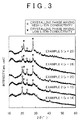
- X-ray diffraction (XRD) measurements with CuK ⁇ line were conducted on the glass ceramics obtained in Examples 1 to 5 and Comparative Examples 2 to 4.
- XRD measurement RINT Ultima III (trade name, manufactured by Rigaku Corporation) was used. Results thereof are shown in FIG. 3 and FIG. 4 .
- FIG. 3 X-ray diffraction
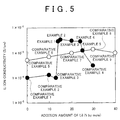
- the Li ion conductivity (at room temperature) was measured on each of the samples obtained in Examples 1 to 5 and Comparative Examples 1 to 9 by AC impedance method.
- the Li ion conductivity was measured as described below. Firstly, a sample powder was cold-pressed under pressure of 4 ton/cm 2 and a pellet having a diameter of 11.29 mm and a thickness of about 500 ⁇ m was prepared. Next, the pellet was installed in a vessel of inert gas atmosphere, which is filled with Ar gas, to perform measurement. In the measurement, SOLARTRON (trade name: SI1260, manufactured by Toyo Corporation) was used. A measurement temperature was controlled to 25°C by use of a thermostat. Results are shown in Table 3 and FIG. 5 .
- the Li ion conductivity (room temperature) was measured on each of the samples obtained in Examples 6 to 8 and Comparative Examples 10 and 11 by AC impedance method. The measurement method was the same as that described in the Evaluation 1. Results thereof are shown in FIG. 7 . As illustrated in FIG. 7 , all of the glass ceramics obtained in Examples 6 to 8 exhibited the Li ion conductivity higher than that of Comparative Example 10 in which the heat treatment was not conducted. On the other hand, in the sample obtained in Comparative Example 11, it is considered that the heat treatment temperature was too high to obtain the crystalline phase having high Li ion conductivity.
Landscapes
- Chemical & Material Sciences (AREA)
- Engineering & Computer Science (AREA)
- Chemical Kinetics & Catalysis (AREA)
- General Chemical & Material Sciences (AREA)
- Electrochemistry (AREA)
- Manufacturing & Machinery (AREA)
- Materials Engineering (AREA)
- Geochemistry & Mineralogy (AREA)
- Life Sciences & Earth Sciences (AREA)
- Inorganic Chemistry (AREA)
- Organic Chemistry (AREA)
- Condensed Matter Physics & Semiconductors (AREA)
- General Physics & Mathematics (AREA)
- Physics & Mathematics (AREA)
- Ceramic Engineering (AREA)
- Dispersion Chemistry (AREA)
- Crystallography & Structural Chemistry (AREA)
- Secondary Cells (AREA)
- Conductive Materials (AREA)
- Glass Compositions (AREA)
- Primary Cells (AREA)
Claims (17)
- Matériau d'électrolyte solide à base de sulfure, caractérisé en ce qu'il comprend :une vitrocéramique contenant du Li, A, X et du S,dans lequel A est au moins un élément parmi P, Si, Ge, Al et B,X est un atome d'halogène, etle matériau d'électrolyte solide à base de sulfure possède des pics à 2θ = 20,2° et 23,6° lors d'une mesure de diffraction aux rayons X avec une ligne CuKα.
- Matériau d'électrolyte solide à base de sulfure selon la revendication 1, dans lequel un rapport entre une intensité de pic à 2θ = 20,2° et une intensité de pic à 2θ = 21,0° est de 1 ou plus.
- Matériau d'électrolyte solide à base de sulfure selon la revendication 1 ou 2, dans lequel le matériau d'électrolyte solide à base de sulfure ne contient pas de soufre réticulé.
- Matériau d'électrolyte solide à base de sulfure selon l'une quelconque des revendications 1 à 3, dans lequel la vitrocéramique comprend un conducteur ionique contenant du Li, A, et du S, et du LiX.
- Matériau d'électrolyte solide à base de sulfure selon la revendication 4, dans lequel un rapport de LiX est de 14% en moles ou plus et inférieur à 30 % en moles.
- Matériau d'électrolyte solide à base de sulfure selon la revendication 5, dans lequel le rapport de LiX est supérieur à 14 % en moles et inférieur à 30 % en moles.
- Matériau d'électrolyte solide à base de sulfure selon la revendication 5 ou 6, dans lequel le rapport de LiX est de 25 % en moles ou moins.
- Matériau d'électrolyte solide à base de sulfure selon l'une quelconque des revendications 4 à 7, dans lequel le conducteur ionique possède une composition ortho.
- Matériau d'électrolyte solide à base de sulfure selon l'une quelconque des revendications 1 à 8, dans lequel le matériau d'électrolyte solide à base de sulfure comprend 50 % en moles ou plus d'une phase cristalline correspondant au 2θ = 20,2° et 23,6° par rapport à une phase cristalline totale du matériau d'électrolyte solide à base de sulfure.
- Batterie solide au lithium, caractérisée en ce qu'elle comprend :une couche de matériau actif d'électrode positive (1) contenant un matériau actif d'électrode positive ;une couche de matériau actif d'électrode négative (2) contenant un matériau actif d'électrode négative ; etune couche d'électrolyte solide (3) disposée entre la couche de matériau actif d'électrode positive (1) et la couche de matériau actif d'électrode négative (2),dans laquelle au moins l'une des couche de matériau actif d'électrode positive (1), couche de matériau actif d'électrode négative (2) et couche d'électrolyte solide (3) comprend le matériau d'électrolyte solide à base de sulfure selon l'une quelconque des revendications 1 à 9.
- Batterie solide au lithium selon la revendication 10, caractérisée en ce que
la vitrocéramique comprend un conducteur ionique contenant du Li, A, et du S, et du LiX, où LiX est LiI,
dans laquelle le conducteur ionique possède une composition ortho ; et
le matériau actif d'électrode positive possède un potentiel de 2,8 V ou plus, par rapport au Li. - Procédé de production d'un matériau d'électrolyte solide à base de sulfure, comprenant une vitrocéramique, le procédé étant caractérisé en ce qu'il comprend les étapes consistant à :rendre amorphe une composition de matière première contenant du Li2S, un sulfure de A, et du LiX pour synthétiser le verre de sulfure ; etchauffer le verre de sulfure à une température de traitement thermique égale ou supérieure à une température de cristallisation du verre de sulfure afin de synthétiser la vitrocéramique ayant des pics à 2θ = 20,2° et 23,6° lors d'une mesure de diffraction aux rayons X avec une ligne CuKα,dans lequel A est au moins un élément parmi P, Si, Ge, Al et B,X est un halogène, etun rapport de LiX contenu dans la composition de matière première et la température de traitement thermique sont contrôlés pour obtenir la vitrocéramique.
- Procédé selon la revendication 12, dans lequel un rapport entre une intensité du pic à 2θ = 20,2° et une intensité de pic à 2θ = 21,0° est de 1 ou plus.
- Procédé selon la revendication 12 ou 13, dans lequel le matériau d'électrolyte solide à base de sulfure ne contient pas de soufre réticulé.
- Procédé selon l'une quelconque des revendications 12 à 14, dans lequel le rapport de LiX contenu dans la composition de matière première est de 14 % en moles ou plus et inférieur à 30 % en moles, et la température de traitement thermique est inférieure à 200 °C.
- Procédé selon l'une quelconque des revendications 12 à 15, dans lequel la température de traitement thermique est de 170 °C ou plus.
- Procédé selon l'une quelconque des revendications 12 à 16, dans lequel la température de traitement thermique est de 190 °C ou plus.
Applications Claiming Priority (2)
| Application Number | Priority Date | Filing Date | Title |
|---|---|---|---|
| JP2011150002A JP5443445B2 (ja) | 2011-07-06 | 2011-07-06 | 硫化物固体電解質材料、リチウム固体電池、および、硫化物固体電解質材料の製造方法 |
| PCT/IB2012/001203 WO2013005085A1 (fr) | 2011-07-06 | 2012-06-19 | Matériau électrolyte solide à base de sulfure, batterie à l'état solide au lithium et procédé de fabrication d'un matériau électrolyte solide à base de sulfure |
Publications (2)
| Publication Number | Publication Date |
|---|---|
| EP2712468A1 EP2712468A1 (fr) | 2014-04-02 |
| EP2712468B1 true EP2712468B1 (fr) | 2016-07-27 |
Family
ID=46545822
Family Applications (1)
| Application Number | Title | Priority Date | Filing Date |
|---|---|---|---|
| EP12737596.2A Active EP2712468B1 (fr) | 2011-07-06 | 2012-06-19 | Matériau d'électrolyte solide à base de sulfure, son procédé de fabrication, et batterie à l'état solide incluant ce dernier |
Country Status (9)
| Country | Link |
|---|---|
| US (2) | US9172113B2 (fr) |
| EP (1) | EP2712468B1 (fr) |
| JP (1) | JP5443445B2 (fr) |
| KR (1) | KR101506109B1 (fr) |
| CN (1) | CN103650231B (fr) |
| AU (1) | AU2012280008B2 (fr) |
| BR (1) | BR112014000252B1 (fr) |
| CA (1) | CA2840671C (fr) |
| WO (1) | WO2013005085A1 (fr) |
Families Citing this family (151)
| Publication number | Priority date | Publication date | Assignee | Title |
|---|---|---|---|---|
| JP5443445B2 (ja) | 2011-07-06 | 2014-03-19 | トヨタ自動車株式会社 | 硫化物固体電解質材料、リチウム固体電池、および、硫化物固体電解質材料の製造方法 |
| JP6234665B2 (ja) * | 2011-11-07 | 2017-11-22 | 出光興産株式会社 | 固体電解質 |
| JP6518745B2 (ja) * | 2011-11-07 | 2019-05-22 | 出光興産株式会社 | 結晶化固体電解質 |
| JP6077740B2 (ja) * | 2011-12-02 | 2017-02-08 | 出光興産株式会社 | 固体電解質 |
| EP2874158B1 (fr) * | 2012-07-12 | 2018-11-07 | Idemitsu Kosan Co., Ltd | Procédé de fabrication de substance conductrice des ions, substance conductrice des ions, substance cristallisée conductrice des ions, et cellule |
| JP2014029796A (ja) * | 2012-07-31 | 2014-02-13 | Kansai Electric Power Co Inc:The | リチウムイオン伝導性結晶化固体電解質およびリチウムイオン伝導性結晶化固体電解質の製造方法 |
| EP2919313A4 (fr) * | 2012-11-06 | 2016-03-30 | Idemitsu Kosan Co | Electrolyte solide |
| JP5877401B2 (ja) * | 2012-12-28 | 2016-03-08 | トヨタ自動車株式会社 | 硫化物固体電解質材料の製造方法、及び当該方法により製造された硫化物固体電解質材料を含むリチウム固体電池 |
| JP5692266B2 (ja) * | 2013-03-15 | 2015-04-01 | トヨタ自動車株式会社 | 硫化物固体電解質材料の製造方法 |
| JP6062308B2 (ja) * | 2013-04-09 | 2017-01-18 | 古河機械金属株式会社 | リチウムイオン電池用固体電解質材料、リチウムイオン電池用固体電解質、リチウムイオン電池およびリチウムイオン電池用固体電解質材料の製造方法 |
| EP2997611B1 (fr) | 2013-05-15 | 2026-04-22 | QuantumScape Battery, Inc. | Catholyte ou électrolyte à semi-conducteurs pour une batterie utilisant le liampbsc (m = si, ge, et/ou sn) |
| JP2015002053A (ja) * | 2013-06-14 | 2015-01-05 | 出光興産株式会社 | 固体電解質組成物 |
| JP6003831B2 (ja) | 2013-06-28 | 2016-10-05 | トヨタ自動車株式会社 | 硫化物固体電解質材料、硫化物ガラス、リチウム固体電池、および、硫化物固体電解質材料の製造方法 |
| JP6077403B2 (ja) | 2013-06-28 | 2017-02-08 | トヨタ自動車株式会社 | 硫化物固体電解質材料の製造方法 |
| KR101729091B1 (ko) * | 2013-07-04 | 2017-04-21 | 미쓰이금속광업주식회사 | 결정성 고체 전해질 및 그 제조 방법 |
| JP6070468B2 (ja) * | 2013-08-02 | 2017-02-01 | トヨタ自動車株式会社 | 硫化物固体電解質材料 |
| JP2015050161A (ja) * | 2013-09-04 | 2015-03-16 | トヨタ自動車株式会社 | 硫化物固体電解質の回復方法 |
| JP5673760B1 (ja) * | 2013-09-13 | 2015-02-18 | トヨタ自動車株式会社 | 硫化物固体電解質の製造方法 |
| DE102013219606A1 (de) * | 2013-09-27 | 2015-04-02 | Robert Bosch Gmbh | Elektrodenmaterial mit Lithium-Argyrodit |
| JP5720753B2 (ja) * | 2013-10-02 | 2015-05-20 | トヨタ自動車株式会社 | 硫化物固体電解質材料、電池および硫化物固体電解質材料の製造方法 |
| JP6425426B2 (ja) * | 2014-06-10 | 2018-11-21 | 三星電子株式会社Samsung Electronics Co.,Ltd. | 硫化物固体電解質、および硫化物固体電解質の製造方法 |
| JP2015088226A (ja) * | 2013-10-28 | 2015-05-07 | トヨタ自動車株式会社 | 硫化物固体電解質の製造方法 |
| JP2014089971A (ja) * | 2013-12-18 | 2014-05-15 | Toyota Motor Corp | 硫化物固体電解質材料、リチウム固体電池、および、硫化物固体電解質材料の製造方法 |
| JP6044587B2 (ja) * | 2014-05-15 | 2016-12-14 | トヨタ自動車株式会社 | 硫化物固体電解質材料、電池および硫化物固体電解質材料の製造方法 |
| US9859560B2 (en) | 2014-06-04 | 2018-01-02 | Quantumscape Corporation | Electrode materials with mixed particle sizes |
| JP5975071B2 (ja) * | 2014-07-22 | 2016-08-23 | トヨタ自動車株式会社 | 硫化物固体電解質材料、電池および硫化物固体電解質材料の製造方法 |
| US9627709B2 (en) * | 2014-10-15 | 2017-04-18 | Sakti3, Inc. | Amorphous cathode material for battery device |
| EP3214054A4 (fr) | 2014-10-31 | 2018-07-18 | Idemitsu Kosan Co., Ltd | Procédé de production de verre de sulfure et d'électrolyte solide cristallin, électrolyte solide cristallin, verre de sulfure et batterie à l'état solide |
| WO2016075921A1 (fr) * | 2014-11-10 | 2016-05-19 | ソニー株式会社 | Vitrocéramique, conducteur lithium-ion, pile, dispositif électronique, et procédé de fabrication d'une électrode |
| KR102350807B1 (ko) * | 2014-11-18 | 2022-01-14 | 내셔날 인스티튜트 오브 어드밴스드 인더스트리얼 사이언스 앤드 테크놀로지 | 리튬-철-인-황-탄소 복합체 및 그 제조 방법 |
| US12294050B2 (en) | 2014-12-02 | 2025-05-06 | Polyplus Battery Company | Lithium ion conducting sulfide glass fabrication |
| US20190173128A1 (en) | 2014-12-02 | 2019-06-06 | Polyplus Battery Company | Making and inspecting a web of vitreous lithium sulfide separator sheet and lithium electrode assemblies and battery cells |
| US10164289B2 (en) | 2014-12-02 | 2018-12-25 | Polyplus Battery Company | Vitreous solid electrolyte sheets of Li ion conducting sulfur-based glass and associated structures, cells and methods |
| US12454478B2 (en) | 2022-09-09 | 2025-10-28 | Polyplus Battery Company | Ionically conductive glass preform |
| US12051824B2 (en) | 2020-07-10 | 2024-07-30 | Polyplus Battery Company | Methods of making glass constructs |
| US11749834B2 (en) | 2014-12-02 | 2023-09-05 | Polyplus Battery Company | Methods of making lithium ion conducting sulfide glass |
| US10601071B2 (en) | 2014-12-02 | 2020-03-24 | Polyplus Battery Company | Methods of making and inspecting a web of vitreous lithium sulfide separator sheet and lithium electrode assemblies |
| US10147968B2 (en) | 2014-12-02 | 2018-12-04 | Polyplus Battery Company | Standalone sulfide based lithium ion-conducting glass solid electrolyte and associated structures, cells and methods |
| US11984553B2 (en) | 2014-12-02 | 2024-05-14 | Polyplus Battery Company | Lithium ion conducting sulfide glass fabrication |
| JP6761928B2 (ja) * | 2014-12-05 | 2020-09-30 | 国立大学法人豊橋技術科学大学 | 固体電解質ガラス及びその製造方法、固体電解質ガラス用前駆体、サスペンジョン、リチウムイオン電池用電極並びにリチウムイオン電池 |
| EP3240089B1 (fr) | 2014-12-26 | 2019-04-24 | Mitsui Mining and Smelting Co., Ltd. | Electrolyte solide a base de sulfure pour pile au lithium-ion, et compose electrolytique solide |
| US9728808B2 (en) * | 2015-02-25 | 2017-08-08 | Toyota Jidosha Kabushiki Kaisha | All solid state battery |
| JP6256451B2 (ja) * | 2015-02-25 | 2018-01-10 | トヨタ自動車株式会社 | 全固体電池 |
| JP6287945B2 (ja) * | 2015-05-08 | 2018-03-07 | トヨタ自動車株式会社 | 電極積層体の製造方法 |
| WO2016210371A1 (fr) | 2015-06-24 | 2016-12-29 | Quantumscape Corporation | Électrolytes composites |
| JP6376068B2 (ja) * | 2015-07-27 | 2018-08-22 | トヨタ自動車株式会社 | 負極合材および全固体電池 |
| KR101728825B1 (ko) * | 2015-08-18 | 2017-04-20 | 울산과학기술원 | 고체 전해질, 이의 제조방법, 및 이를 포함하는 전고체 전지 |
| KR101878339B1 (ko) * | 2015-08-18 | 2018-07-13 | 울산과학기술원 | 전극 활물질-고체 전해질 복합체, 이의 제조 방법, 이를 포함하는 전고체 전지 |
| WO2017030390A1 (fr) * | 2015-08-18 | 2017-02-23 | 울산과학기술원 | Électrolyte solide et son procédé de préparation, complexe de matière active d'électrode-électrolyte solide et son procédé de préparation, batterie entièrement à l'état solide comprenant un électrolyte solide, et batterie entièrement à l'état solide comprenant un complexe de matière active d'électrode-électrolyte solide |
| US10324138B2 (en) | 2015-11-16 | 2019-06-18 | Massachusettes Institute Of Technology | Computing system for identification of solid-solid interphase products |
| KR102765039B1 (ko) * | 2015-12-04 | 2025-02-11 | 퀀텀스케이프 배터리, 인코포레이티드 | 리튬, 인, 황 및 요오드를 포함하는 전해질 및 음극액 조성물, 전기화학적 장치를 위한 전해질 막, 및 이들 전해질 및 음극액을 제조하는 어닐링 방법(annealing method). |
| JP6418145B2 (ja) * | 2015-12-07 | 2018-11-07 | トヨタ自動車株式会社 | 複合固体電解質 |
| US11245131B2 (en) | 2015-12-25 | 2022-02-08 | Samsung Electronics Co., Ltd. | Solid electrolyte and lithium battery including the same |
| WO2017159666A1 (fr) * | 2016-03-14 | 2017-09-21 | 出光興産株式会社 | Procédé de fabrication d'électrolyte solide |
| CN108780683B (zh) * | 2016-03-14 | 2021-02-12 | 出光兴产株式会社 | 固体电解质和固体电解质的制造方法 |
| US10707536B2 (en) | 2016-05-10 | 2020-07-07 | Polyplus Battery Company | Solid-state laminate electrode assemblies and methods of making |
| US10868293B2 (en) | 2017-07-07 | 2020-12-15 | Polyplus Battery Company | Treating sulfide glass surfaces and making solid state laminate electrode assemblies |
| US12482827B2 (en) | 2021-04-13 | 2025-11-25 | Polyplus Battery Company | Binary phosphorus nitride protective solid electrolyte intermediary structures for electrode assemblies |
| US11631889B2 (en) | 2020-01-15 | 2023-04-18 | Polyplus Battery Company | Methods and materials for protection of sulfide glass solid electrolytes |
| US10629950B2 (en) | 2017-07-07 | 2020-04-21 | Polyplus Battery Company | Encapsulated sulfide glass solid electrolytes and solid-state laminate electrode assemblies |
| CN109641780A (zh) * | 2016-08-17 | 2019-04-16 | Agc株式会社 | 玻璃 |
| US11342630B2 (en) | 2016-08-29 | 2022-05-24 | Quantumscape Battery, Inc. | Catholytes for solid state rechargeable batteries, battery architectures suitable for use with these catholytes, and methods of making and using the same |
| JP6679736B2 (ja) * | 2016-09-12 | 2020-04-15 | 出光興産株式会社 | 硫化物固体電解質 |
| KR20180055086A (ko) * | 2016-11-16 | 2018-05-25 | 현대자동차주식회사 | 습식공정을 통한 황화물계 고체전해질의 제조방법 |
| WO2018096957A1 (fr) * | 2016-11-28 | 2018-05-31 | 国立研究開発法人産業技術総合研究所 | Sulfure inorganique et procédé pour le produire |
| CN108114492B (zh) * | 2016-11-28 | 2020-06-09 | 丰田自动车株式会社 | 复合化粒子的制造方法 |
| US20190305293A1 (en) | 2016-12-26 | 2019-10-03 | Showa Denko K. K. | All-solid-state lithium ion battery |
| KR101981657B1 (ko) * | 2016-12-27 | 2019-08-28 | 울산과학기술원 | 고체 전해질, 이의 제조 방법, 및 이를 포함하는 전고체 전지 |
| KR101867555B1 (ko) * | 2017-01-04 | 2018-06-14 | 울산과학기술원 | 전극 활물질-고체 전해질 복합체, 이의 제조 방법, 이를 포함하는 전고체 전지 |
| JP6373417B2 (ja) * | 2017-01-04 | 2018-08-15 | 出光興産株式会社 | 固体電解質 |
| JP6763808B2 (ja) | 2017-03-14 | 2020-09-30 | 出光興産株式会社 | 固体電解質の製造方法 |
| EP3601159A4 (fr) * | 2017-03-29 | 2020-11-25 | Solid Power, Inc. | Matériau d'électrolyte solide et pile à électrolyte solide fabriquée avec ce dernier |
| KR102398467B1 (ko) * | 2017-04-12 | 2022-05-13 | 한국전기연구원 | 황화물계 고체전해질 분말을 포함하는 복합체 제조방법, 이를 이용한 고체전해질층, 전극복합체층 제조방법 및 이를 포함하는 전고체전지 |
| KR20190001798A (ko) * | 2017-06-28 | 2019-01-07 | 한국전기연구원 | 황화물계 고체전해질 재료 및 그 제조방법 |
| CN107394263B (zh) * | 2017-06-29 | 2019-09-27 | 深圳大学 | 一种高锂离子含量的硫化物微晶玻璃及其制备方法 |
| WO2019003986A1 (fr) | 2017-06-29 | 2019-01-03 | 出光興産株式会社 | Électrolyte solide au sulfure |
| US10862171B2 (en) | 2017-07-19 | 2020-12-08 | Polyplus Battery Company | Solid-state laminate electrode assembly fabrication and making thin extruded lithium metal foils |
| US10854877B2 (en) * | 2017-08-25 | 2020-12-01 | Samsung Electronics Co., Ltd. | All-solid-state secondary battery |
| JP7164939B2 (ja) * | 2017-08-25 | 2022-11-02 | 株式会社サムスン日本研究所 | 全固体型二次電池 |
| WO2019051305A1 (fr) * | 2017-09-08 | 2019-03-14 | The Board Of Trustees Of The Leland Stanford Junior University | Matériau céramique à haute conductivité d'ions lithium et à haute stabilité électrochimique utilisable en tant qu'électrolyte solide et additif d'électrode |
| JP7236648B2 (ja) * | 2017-09-08 | 2023-03-10 | パナソニックIpマネジメント株式会社 | 硫化物固体電解質材料及びそれを用いた電池 |
| KR102406179B1 (ko) * | 2017-10-13 | 2022-06-07 | 현대자동차주식회사 | 침상형 황화물계 고체 전해질의 제조 방법 |
| DE102017219170A1 (de) * | 2017-10-25 | 2019-04-25 | Robert Bosch Gmbh | Lithiumfestkörperbatterie und Verfahren zum Herstellen einer Lithiumfestkörperbatterie |
| CN109786814B (zh) * | 2017-11-14 | 2025-01-03 | 三星电子株式会社 | 用于全固态二次电池的固体电解质、复合电极、全固态二次电池和制备固体电解质的方法 |
| EP3736823A4 (fr) * | 2018-01-05 | 2021-03-10 | Panasonic Intellectual Property Management Co., Ltd. | Matériau d'électrolyte solide et batterie |
| CN111712959B (zh) * | 2018-03-26 | 2023-09-05 | 丰田自动车欧洲公司 | 用于固态电池的固体电解质材料,固体电解质和固态电池 |
| EP3776709A1 (fr) * | 2018-03-26 | 2021-02-17 | Toyota Motor Europe | Procédé de production d'un matériau d'électrolyte solide et électrolyte solide pour des batteries à l'état solide |
| KR20210016518A (ko) * | 2018-04-06 | 2021-02-16 | 더 플로리다 스테이트 유니버시티 리서치 파운데이션, 인크 | 고체 전해질 및 방법 |
| US11127974B2 (en) | 2018-05-14 | 2021-09-21 | Samsung Electronics Co., Ltd. | Method of preparing sulfide-based solid electrolyte, sulfide-based solid electrolyte prepared therefrom, and solid secondary battery including the sulfide electrolyte |
| JP7077766B2 (ja) * | 2018-05-18 | 2022-05-31 | トヨタ自動車株式会社 | 硫化物系固体電解質、当該硫化物系固体電解質の製造方法、及び、全固体電池の製造方法 |
| CN110534681A (zh) * | 2018-05-25 | 2019-12-03 | 浙江锋锂新能源科技有限公司 | 传导离子的管状陶瓷膜及其制备方法 |
| CN112424886B (zh) * | 2018-07-17 | 2023-02-28 | 出光兴产株式会社 | 固体电解质的制造方法 |
| EP4099463B1 (fr) | 2018-08-30 | 2025-03-05 | GS Yuasa International Ltd. | Électrolyte solide à base de sulfure et batterie tout à l'état solide |
| JP7501857B2 (ja) | 2018-09-19 | 2024-06-18 | ブルー カレント、インコーポレイテッド | 酸化リチウムのアルジロダイト |
| CN109638360B (zh) * | 2018-11-09 | 2022-03-08 | 哈尔滨工业大学无锡新材料研究院 | 一种全固态锂硫电池的制备方法及制备模具 |
| KR102743515B1 (ko) * | 2018-11-22 | 2024-12-16 | 이데미쓰 고산 가부시키가이샤 | 고체 전해질의 제조 방법 및 전해질 전구체 |
| EP3886119A4 (fr) | 2018-11-22 | 2022-08-10 | Idemitsu Kosan Co.,Ltd. | Électrolyte solide au sulfure et son procédé de traitement |
| JP7319900B2 (ja) * | 2018-12-05 | 2023-08-02 | 出光興産株式会社 | アルジロダイト型結晶構造を有する固体電解質の製造方法 |
| US11799126B2 (en) | 2019-05-31 | 2023-10-24 | Samsung Electronics Co., Ltd. | Method of preparing solid electrolyte and all-solid battery including solid electrolyte prepared by the method |
| CN114466821A (zh) * | 2019-07-24 | 2022-05-10 | 巴斯夫欧洲公司 | 锂离子传导性固体材料 |
| US20210047195A1 (en) | 2019-08-16 | 2021-02-18 | Blue Current, Inc. | Argyrodites doped with thiophilic metals |
| JP7623361B2 (ja) * | 2019-09-06 | 2025-01-28 | スペシャルティ オペレーションズ フランス | Li-p-s製品の新規な製造方法及び対応する製品 |
| CN114245946B (zh) | 2019-09-17 | 2025-12-23 | 出光兴产株式会社 | 固体电解质的制造方法以及电解质前体 |
| TWI737011B (zh) * | 2019-10-22 | 2021-08-21 | 輝能科技股份有限公司 | 固態電解質接面調整材及其混合式電解質系統 |
| TWI719683B (zh) * | 2019-10-22 | 2021-02-21 | 輝能科技股份有限公司 | 陶瓷隔離層 |
| JP6896202B1 (ja) | 2019-11-21 | 2021-06-30 | 出光興産株式会社 | 硫化物固体電解質の製造方法 |
| US12166239B2 (en) | 2019-12-20 | 2024-12-10 | Blue Current, Inc. | Polymer microspheres as binders for composite electrolytes |
| EP4078698A4 (fr) | 2019-12-20 | 2024-08-14 | Blue Current, Inc. | Électrolytes composites avec liants |
| WO2021132173A1 (fr) | 2019-12-23 | 2021-07-01 | 出光興産株式会社 | Procédé de production d'électrolyte solide |
| WO2021132538A1 (fr) * | 2019-12-27 | 2021-07-01 | 三井金属鉱業株式会社 | Électrolyte solide à base de sulfure et son procédé de fabrication |
| WO2021172159A1 (fr) | 2020-02-28 | 2021-09-02 | 株式会社Gsユアサ | Électrolyte solide, procédé de production d'électrolyte solide et élément de stockage d'électricité |
| CN115362586A (zh) * | 2020-03-23 | 2022-11-18 | 坚固力量公司 | 固体电解质材料及由其制成的固态电池 |
| CN115552553A (zh) | 2020-05-13 | 2022-12-30 | 出光兴产株式会社 | 固体电解质的制造方法 |
| JP7667146B2 (ja) | 2020-05-13 | 2025-04-22 | 出光興産株式会社 | 固体電解質の製造方法 |
| CN115667146B (zh) | 2020-05-27 | 2025-09-23 | 出光兴产株式会社 | 卤化锂化合物的制造方法 |
| EP4160718A4 (fr) | 2020-05-27 | 2025-05-21 | Idemitsu Kosan Co., Ltd | Mélange pour électrode et son procédé de production |
| US12034116B2 (en) | 2020-08-04 | 2024-07-09 | Polyplus Battery Company | Glass solid electrolyte layer, methods of making glass solid electrolyte layer and electrodes and battery cells thereof |
| US12021238B2 (en) | 2020-08-04 | 2024-06-25 | Polyplus Battery Company | Glassy embedded solid-state electrode assemblies, solid-state batteries and methods of making electrode assemblies and solid-state batteries |
| US12021187B2 (en) | 2020-08-04 | 2024-06-25 | Polyplus Battery Company | Surface treatment of a sulfide glass solid electrolyte layer |
| JP2022059592A (ja) * | 2020-10-01 | 2022-04-13 | 国立大学法人東京工業大学 | 全固体電池の充放電方法およびそれに用いることができる固体電解質材 |
| EP4227276A4 (fr) | 2020-10-09 | 2024-11-13 | Idemitsu Kosan Co., Ltd | Électrolyte solide à base de sulfure de type vitrocéramique et procédé de fabrication associé |
| JP7723007B2 (ja) | 2020-11-13 | 2025-08-13 | 出光興産株式会社 | 固体電解質の製造方法 |
| US20240030488A1 (en) * | 2020-11-30 | 2024-01-25 | Furukawa Co., Ltd. | Sulfide-based inorganic solid electrolyte material, solid electrolyte, solid electrolyte membrane, and lithium ion battery |
| EP4246630A4 (fr) * | 2020-12-10 | 2024-07-31 | GS Yuasa International Ltd. | Électrolyte solide, procédé de fabrication d'électrolyte solide, élément de stockage d'énergie, dispositif électronique et automobile |
| KR102269019B1 (ko) * | 2020-12-14 | 2021-06-25 | 한국전자기술연구원 | 고체전해질 및 그를 포함하는 전고체전지 |
| US20240105985A1 (en) | 2021-01-19 | 2024-03-28 | Idemitsu Kosan Co., Ltd. | Modified sulfide solid electrolyte and method for producing same |
| JPWO2022239614A1 (fr) | 2021-05-11 | 2022-11-17 | ||
| JPWO2022239754A1 (fr) | 2021-05-14 | 2022-11-17 | ||
| CN117716448A (zh) | 2021-07-16 | 2024-03-15 | 出光兴产株式会社 | 硫化物固体电解质 |
| EP4383282A4 (fr) | 2021-08-06 | 2025-11-12 | Idemitsu Kosan Co | Procédé de production d'électrolyte solide au sulfure et électrolyte solide au sulfure |
| JP7776971B2 (ja) * | 2021-11-25 | 2025-11-27 | トヨタ自動車株式会社 | 全固体電池 |
| EP4468314A4 (fr) | 2022-01-18 | 2026-01-21 | Idemitsu Kosan Co | Procédé de production d'un électrolyte solide au sulfure |
| WO2023190624A1 (fr) | 2022-03-30 | 2023-10-05 | 出光興産株式会社 | Procédé de fabrication d'un électrolyte solide à base de sulfure |
| KR20250029040A (ko) | 2022-07-04 | 2025-03-04 | 이데미쓰 고산 가부시키가이샤 | 복합 분말, 정극 합재 및 알칼리 금속 이온 전지 |
| CN119452436A (zh) | 2022-07-07 | 2025-02-14 | 出光兴产株式会社 | 硫化物固体电解质的制造方法 |
| US20250388468A1 (en) | 2022-07-07 | 2025-12-25 | Idemitsu Kosan Co.,Ltd. | Method for producing sulfide solid electrolyte |
| JPWO2024010078A1 (fr) | 2022-07-07 | 2024-01-11 | ||
| EP4557317A1 (fr) | 2022-07-13 | 2025-05-21 | Idemitsu Kosan Co.,Ltd. | Procédé de fabrication d'un électrolyte solide à base de sulfure |
| JPWO2024024711A1 (fr) | 2022-07-29 | 2024-02-01 | ||
| KR20250048249A (ko) | 2022-08-24 | 2025-04-08 | 이데미쓰 고산 가부시키가이샤 | 정극 합재, 정극 합재의 제조 방법 및 리튬 이온 전지 |
| EP4600976A1 (fr) | 2022-10-07 | 2025-08-13 | Idemitsu Kosan Co.,Ltd. | Procédé de fabrication d'électrolyte solide au sulfure |
| JP7764357B2 (ja) | 2022-12-27 | 2025-11-05 | トヨタ自動車株式会社 | 正極層、正極及び固体電池 |
| KR20250136812A (ko) | 2023-01-17 | 2025-09-16 | 이데미쓰 고산 가부시키가이샤 | 황화물 고체 전해질의 제조 방법 |
| EP4657469A1 (fr) | 2023-01-27 | 2025-12-03 | Idemitsu Kosan Co.,Ltd. | Procédé de production d'un électrolyte solide à base de sulfure |
| JP7837913B2 (ja) * | 2023-02-17 | 2026-03-31 | エルジー エナジー ソリューション リミテッド | 硫化物系固体電解質、硫化物系固体電解質の製造方法、及び硫化物系固体電解質を含む全固体電池 |
| WO2024195646A1 (fr) | 2023-03-17 | 2024-09-26 | 出光興産株式会社 | Procédé de traitement de matériau contenant un atome de soufre, appareil de production de matériau contenant un atome de soufre, et dispositif et récipient de transport de matériau contenant un atome de soufre |
| JPWO2024195788A1 (fr) | 2023-03-23 | 2024-09-26 | ||
| JP2025007393A (ja) | 2023-06-30 | 2025-01-17 | トヨタ自動車株式会社 | 固体電池用電極及び固体電池 |
| KR20250080962A (ko) * | 2023-11-29 | 2025-06-05 | 포스코홀딩스 주식회사 | 고체 전해질, 이의 제조 방법 및 이를 포함하는 리튬 이차 전지 |
| WO2026019527A1 (fr) * | 2024-07-16 | 2026-01-22 | Massachusetts Institute Of Technology | Procédé de mise en forme thermoplastique pour fabrication industrielle d'électrodes de batterie entièrement solides |
| CN119370812A (zh) * | 2024-12-30 | 2025-01-28 | 四川新能源汽车创新中心有限公司 | 纯相硫化物固态电解质制备方法、固态电解质及固态电池 |
Family Cites Families (23)
| Publication number | Priority date | Publication date | Assignee | Title |
|---|---|---|---|---|
| FR2477128A1 (fr) | 1980-02-29 | 1981-09-04 | Saft Leclanche | Composition vitreuse conductrice de cations alcalins et procede de preparation d'une telle composition |
| EP0079228B1 (fr) | 1981-11-10 | 1986-04-02 | United States Borax & Chemical Corporation | Matériaux conducteurs ioniques |
| JPS5973850A (ja) * | 1982-10-19 | 1984-04-26 | Sanyo Electric Co Ltd | 固体電解質電池 |
| JPS59151700A (ja) | 1983-02-15 | 1984-08-30 | Kajima Corp | 液化ガス地下式貯槽 |
| JPH0670906B2 (ja) * | 1983-02-16 | 1994-09-07 | 三洋電機株式会社 | 固体電解質電池 |
| US5227148A (en) | 1990-09-18 | 1993-07-13 | Eveready Battery Company, Inc. | Vitreous compositions based on Li3 PO4 and LiPO3 as network formers and network modifiers |
| JP3528866B2 (ja) | 1994-06-03 | 2004-05-24 | 出光石油化学株式会社 | 硫化リチウムの製造方法 |
| JP3655443B2 (ja) | 1997-09-03 | 2005-06-02 | 松下電器産業株式会社 | リチウム電池 |
| JP4174816B2 (ja) * | 2001-02-28 | 2008-11-05 | 住友電気工業株式会社 | 無機固体電解質およびリチウム電池部材 |
| JP4896520B2 (ja) | 2003-10-23 | 2012-03-14 | 出光興産株式会社 | 硫化リチウムの精製方法 |
| JP4813767B2 (ja) | 2004-02-12 | 2011-11-09 | 出光興産株式会社 | リチウムイオン伝導性硫化物系結晶化ガラス及びその製造方法 |
| JP4392618B2 (ja) * | 2006-05-15 | 2010-01-06 | 住友電気工業株式会社 | 固体電解質の形成方法 |
| JP5096722B2 (ja) * | 2006-10-18 | 2012-12-12 | 出光興産株式会社 | 電池材料の製造方法及び全固体電池 |
| JP5226967B2 (ja) * | 2007-04-27 | 2013-07-03 | 株式会社オハラ | リチウム二次電池およびリチウム二次電池用の電極 |
| JP5395346B2 (ja) | 2007-10-11 | 2014-01-22 | 出光興産株式会社 | リチウムイオン二次電池用硫化物系固体電解質 |
| JP2009283344A (ja) * | 2008-05-23 | 2009-12-03 | Idemitsu Kosan Co Ltd | リチウム電池用負極合材、リチウム電池用負極、リチウム電池、装置およびリチウム電池用負極合材の製造方法 |
| JP5333184B2 (ja) | 2009-03-16 | 2013-11-06 | トヨタ自動車株式会社 | 全固体二次電池 |
| CN102124600B (zh) | 2009-06-19 | 2013-10-30 | 住友电气工业株式会社 | 发电元件以及具有该发电元件的非水电解质电池 |
| JP5521899B2 (ja) * | 2010-08-26 | 2014-06-18 | トヨタ自動車株式会社 | 硫化物固体電解質材料およびリチウム固体電池 |
| JP5349427B2 (ja) | 2010-08-26 | 2013-11-20 | トヨタ自動車株式会社 | 硫化物固体電解質材料、正極体およびリチウム固体電池 |
| JP5553004B2 (ja) | 2010-11-08 | 2014-07-16 | トヨタ自動車株式会社 | 硫化物固体電解質材料、リチウム固体電池、および硫化物固体電解質材料の製造方法 |
| JP5443445B2 (ja) | 2011-07-06 | 2014-03-19 | トヨタ自動車株式会社 | 硫化物固体電解質材料、リチウム固体電池、および、硫化物固体電解質材料の製造方法 |
| CN102736310B (zh) * | 2012-05-30 | 2015-04-22 | 深圳市华星光电技术有限公司 | 彩色滤光片的制作方法 |
-
2011
- 2011-07-06 JP JP2011150002A patent/JP5443445B2/ja active Active
-
2012
- 2012-06-19 KR KR1020137034563A patent/KR101506109B1/ko active Active
- 2012-06-19 EP EP12737596.2A patent/EP2712468B1/fr active Active
- 2012-06-19 CN CN201280031714.8A patent/CN103650231B/zh active Active
- 2012-06-19 WO PCT/IB2012/001203 patent/WO2013005085A1/fr not_active Ceased
- 2012-06-19 US US14/130,105 patent/US9172113B2/en active Active
- 2012-06-19 AU AU2012280008A patent/AU2012280008B2/en active Active
- 2012-06-19 BR BR112014000252-5A patent/BR112014000252B1/pt active IP Right Grant
- 2012-06-19 CA CA2840671A patent/CA2840671C/fr active Active
-
2015
- 2015-08-21 US US14/832,194 patent/US9484597B2/en active Active
Also Published As
| Publication number | Publication date |
|---|---|
| CN103650231A (zh) | 2014-03-19 |
| US20140141341A1 (en) | 2014-05-22 |
| AU2012280008B2 (en) | 2015-10-29 |
| US9172113B2 (en) | 2015-10-27 |
| US9484597B2 (en) | 2016-11-01 |
| CA2840671A1 (fr) | 2013-01-10 |
| BR112014000252A8 (pt) | 2019-02-12 |
| WO2013005085A1 (fr) | 2013-01-10 |
| JP2013016423A (ja) | 2013-01-24 |
| CN103650231B (zh) | 2015-11-25 |
| BR112014000252A2 (pt) | 2017-02-14 |
| AU2012280008A1 (en) | 2014-01-23 |
| EP2712468A1 (fr) | 2014-04-02 |
| US20150357675A1 (en) | 2015-12-10 |
| KR20140025542A (ko) | 2014-03-04 |
| KR101506109B1 (ko) | 2015-03-25 |
| JP5443445B2 (ja) | 2014-03-19 |
| CA2840671C (fr) | 2016-08-02 |
| BR112014000252B1 (pt) | 2020-06-30 |
Similar Documents
| Publication | Publication Date | Title |
|---|---|---|
| EP2712468B1 (fr) | Matériau d'électrolyte solide à base de sulfure, son procédé de fabrication, et batterie à l'état solide incluant ce dernier | |
| KR101723331B1 (ko) | 황화물 고체 전해질 재료, 황화물 유리, 리튬 고체 전지, 및, 황화물 고체 전해질 재료의 제조 방법 | |
| JP5553004B2 (ja) | 硫化物固体電解質材料、リチウム固体電池、および硫化物固体電解質材料の製造方法 | |
| EP2988360B1 (fr) | Matériau de matériau d'électrolyte solide au sulfure de lithium et batterie à l'état solide | |
| KR101708579B1 (ko) | 황화물 고체 전해질 재료, 리튬 고체 전지 및 황화물 고체 전해질 재료를 제조하는 방법 | |
| JP5552974B2 (ja) | 硫化物固体電解質材料、硫化物固体電解質材料の製造方法およびリチウム固体電池 | |
| JP5458740B2 (ja) | 硫化物固体電解質材料 | |
| JP5857912B2 (ja) | 硫化物固体電解質材料の製造方法 | |
| JP5594253B2 (ja) | 硫化物固体電解質材料、リチウム固体電池、および、硫化物固体電解質材料の製造方法 | |
| JP5877401B2 (ja) | 硫化物固体電解質材料の製造方法、及び当該方法により製造された硫化物固体電解質材料を含むリチウム固体電池 | |
| JP6783731B2 (ja) | 硫化物固体電解質 | |
| JP2014089971A (ja) | 硫化物固体電解質材料、リチウム固体電池、および、硫化物固体電解質材料の製造方法 | |
| JP6070468B2 (ja) | 硫化物固体電解質材料 | |
| JP6783736B2 (ja) | 硫化物固体電解質 | |
| JP2014127387A (ja) | 硫化物固体電解質材料の製造方法およびリチウム固体電池 | |
| JP2015069855A (ja) | 硫化物固体電解質材料 |
Legal Events
| Date | Code | Title | Description |
|---|---|---|---|
| PUAI | Public reference made under article 153(3) epc to a published international application that has entered the european phase |
Free format text: ORIGINAL CODE: 0009012 |
|
| 17P | Request for examination filed |
Effective date: 20131227 |
|
| AK | Designated contracting states |
Kind code of ref document: A1 Designated state(s): AL AT BE BG CH CY CZ DE DK EE ES FI FR GB GR HR HU IE IS IT LI LT LU LV MC MK MT NL NO PL PT RO RS SE SI SK SM TR |
|
| RAP1 | Party data changed (applicant data changed or rights of an application transferred) |
Owner name: TOYOTA JIDOSHA KABUSHIKI KAISHA |
|
| RIN1 | Information on inventor provided before grant (corrected) |
Inventor name: OHTOMO, TAKAMASA Inventor name: KAWAMOTO, KOJI Inventor name: KATO, YUKI Inventor name: HAMA, SHIGENORI |
|
| DAX | Request for extension of the european patent (deleted) | ||
| 17Q | First examination report despatched |
Effective date: 20141023 |
|
| REG | Reference to a national code |
Ref country code: DE Ref legal event code: R079 Ref document number: 602012021004 Country of ref document: DE Free format text: PREVIOUS MAIN CLASS: H01M0010056200 Ipc: C03C0004180000 |
|
| RIC1 | Information provided on ipc code assigned before grant |
Ipc: H01M 10/0562 20100101ALI20151221BHEP Ipc: C03C 4/18 20060101AFI20151221BHEP Ipc: C03C 10/16 20060101ALI20151221BHEP Ipc: H01M 10/052 20100101ALI20151221BHEP |
|
| GRAP | Despatch of communication of intention to grant a patent |
Free format text: ORIGINAL CODE: EPIDOSNIGR1 |
|
| INTG | Intention to grant announced |
Effective date: 20160205 |
|
| GRAS | Grant fee paid |
Free format text: ORIGINAL CODE: EPIDOSNIGR3 |
|
| GRAA | (expected) grant |
Free format text: ORIGINAL CODE: 0009210 |
|
| AK | Designated contracting states |
Kind code of ref document: B1 Designated state(s): AL AT BE BG CH CY CZ DE DK EE ES FI FR GB GR HR HU IE IS IT LI LT LU LV MC MK MT NL NO PL PT RO RS SE SI SK SM TR |
|
| REG | Reference to a national code |
Ref country code: GB Ref legal event code: FG4D |
|
| REG | Reference to a national code |
Ref country code: CH Ref legal event code: EP |
|
| REG | Reference to a national code |
Ref country code: AT Ref legal event code: REF Ref document number: 815657 Country of ref document: AT Kind code of ref document: T Effective date: 20160815 |
|
| REG | Reference to a national code |
Ref country code: IE Ref legal event code: FG4D |
|
| REG | Reference to a national code |
Ref country code: DE Ref legal event code: R096 Ref document number: 602012021004 Country of ref document: DE |
|
| REG | Reference to a national code |
Ref country code: LT Ref legal event code: MG4D |
|
| REG | Reference to a national code |
Ref country code: NL Ref legal event code: MP Effective date: 20160727 |
|
| REG | Reference to a national code |
Ref country code: AT Ref legal event code: MK05 Ref document number: 815657 Country of ref document: AT Kind code of ref document: T Effective date: 20160727 |
|
| PG25 | Lapsed in a contracting state [announced via postgrant information from national office to epo] |
Ref country code: NO Free format text: LAPSE BECAUSE OF FAILURE TO SUBMIT A TRANSLATION OF THE DESCRIPTION OR TO PAY THE FEE WITHIN THE PRESCRIBED TIME-LIMIT Effective date: 20161027 Ref country code: HR Free format text: LAPSE BECAUSE OF FAILURE TO SUBMIT A TRANSLATION OF THE DESCRIPTION OR TO PAY THE FEE WITHIN THE PRESCRIBED TIME-LIMIT Effective date: 20160727 Ref country code: IS Free format text: LAPSE BECAUSE OF FAILURE TO SUBMIT A TRANSLATION OF THE DESCRIPTION OR TO PAY THE FEE WITHIN THE PRESCRIBED TIME-LIMIT Effective date: 20161127 Ref country code: RS Free format text: LAPSE BECAUSE OF FAILURE TO SUBMIT A TRANSLATION OF THE DESCRIPTION OR TO PAY THE FEE WITHIN THE PRESCRIBED TIME-LIMIT Effective date: 20160727 Ref country code: LT Free format text: LAPSE BECAUSE OF FAILURE TO SUBMIT A TRANSLATION OF THE DESCRIPTION OR TO PAY THE FEE WITHIN THE PRESCRIBED TIME-LIMIT Effective date: 20160727 Ref country code: NL Free format text: LAPSE BECAUSE OF FAILURE TO SUBMIT A TRANSLATION OF THE DESCRIPTION OR TO PAY THE FEE WITHIN THE PRESCRIBED TIME-LIMIT Effective date: 20160727 Ref country code: FI Free format text: LAPSE BECAUSE OF FAILURE TO SUBMIT A TRANSLATION OF THE DESCRIPTION OR TO PAY THE FEE WITHIN THE PRESCRIBED TIME-LIMIT Effective date: 20160727 Ref country code: IT Free format text: LAPSE BECAUSE OF FAILURE TO SUBMIT A TRANSLATION OF THE DESCRIPTION OR TO PAY THE FEE WITHIN THE PRESCRIBED TIME-LIMIT Effective date: 20160727 |
|
| PG25 | Lapsed in a contracting state [announced via postgrant information from national office to epo] |
Ref country code: LV Free format text: LAPSE BECAUSE OF FAILURE TO SUBMIT A TRANSLATION OF THE DESCRIPTION OR TO PAY THE FEE WITHIN THE PRESCRIBED TIME-LIMIT Effective date: 20160727 Ref country code: AT Free format text: LAPSE BECAUSE OF FAILURE TO SUBMIT A TRANSLATION OF THE DESCRIPTION OR TO PAY THE FEE WITHIN THE PRESCRIBED TIME-LIMIT Effective date: 20160727 Ref country code: BE Free format text: LAPSE BECAUSE OF FAILURE TO SUBMIT A TRANSLATION OF THE DESCRIPTION OR TO PAY THE FEE WITHIN THE PRESCRIBED TIME-LIMIT Effective date: 20160727 Ref country code: PT Free format text: LAPSE BECAUSE OF FAILURE TO SUBMIT A TRANSLATION OF THE DESCRIPTION OR TO PAY THE FEE WITHIN THE PRESCRIBED TIME-LIMIT Effective date: 20161128 Ref country code: ES Free format text: LAPSE BECAUSE OF FAILURE TO SUBMIT A TRANSLATION OF THE DESCRIPTION OR TO PAY THE FEE WITHIN THE PRESCRIBED TIME-LIMIT Effective date: 20160727 Ref country code: GR Free format text: LAPSE BECAUSE OF FAILURE TO SUBMIT A TRANSLATION OF THE DESCRIPTION OR TO PAY THE FEE WITHIN THE PRESCRIBED TIME-LIMIT Effective date: 20161028 Ref country code: PL Free format text: LAPSE BECAUSE OF FAILURE TO SUBMIT A TRANSLATION OF THE DESCRIPTION OR TO PAY THE FEE WITHIN THE PRESCRIBED TIME-LIMIT Effective date: 20160727 Ref country code: SE Free format text: LAPSE BECAUSE OF FAILURE TO SUBMIT A TRANSLATION OF THE DESCRIPTION OR TO PAY THE FEE WITHIN THE PRESCRIBED TIME-LIMIT Effective date: 20160727 |
|
| REG | Reference to a national code |
Ref country code: DE Ref legal event code: R084 Ref document number: 602012021004 Country of ref document: DE |
|
| REG | Reference to a national code |
Ref country code: GB Ref legal event code: 746 Effective date: 20170314 |
|
| PG25 | Lapsed in a contracting state [announced via postgrant information from national office to epo] |
Ref country code: RO Free format text: LAPSE BECAUSE OF FAILURE TO SUBMIT A TRANSLATION OF THE DESCRIPTION OR TO PAY THE FEE WITHIN THE PRESCRIBED TIME-LIMIT Effective date: 20160727 Ref country code: EE Free format text: LAPSE BECAUSE OF FAILURE TO SUBMIT A TRANSLATION OF THE DESCRIPTION OR TO PAY THE FEE WITHIN THE PRESCRIBED TIME-LIMIT Effective date: 20160727 |
|
| REG | Reference to a national code |
Ref country code: DE Ref legal event code: R097 Ref document number: 602012021004 Country of ref document: DE |
|
| REG | Reference to a national code |
Ref country code: FR Ref legal event code: PLFP Year of fee payment: 6 |
|
| PG25 | Lapsed in a contracting state [announced via postgrant information from national office to epo] |
Ref country code: SM Free format text: LAPSE BECAUSE OF FAILURE TO SUBMIT A TRANSLATION OF THE DESCRIPTION OR TO PAY THE FEE WITHIN THE PRESCRIBED TIME-LIMIT Effective date: 20160727 Ref country code: CZ Free format text: LAPSE BECAUSE OF FAILURE TO SUBMIT A TRANSLATION OF THE DESCRIPTION OR TO PAY THE FEE WITHIN THE PRESCRIBED TIME-LIMIT Effective date: 20160727 Ref country code: SK Free format text: LAPSE BECAUSE OF FAILURE TO SUBMIT A TRANSLATION OF THE DESCRIPTION OR TO PAY THE FEE WITHIN THE PRESCRIBED TIME-LIMIT Effective date: 20160727 Ref country code: BG Free format text: LAPSE BECAUSE OF FAILURE TO SUBMIT A TRANSLATION OF THE DESCRIPTION OR TO PAY THE FEE WITHIN THE PRESCRIBED TIME-LIMIT Effective date: 20161027 Ref country code: DK Free format text: LAPSE BECAUSE OF FAILURE TO SUBMIT A TRANSLATION OF THE DESCRIPTION OR TO PAY THE FEE WITHIN THE PRESCRIBED TIME-LIMIT Effective date: 20160727 |
|
| PLBE | No opposition filed within time limit |
Free format text: ORIGINAL CODE: 0009261 |
|
| STAA | Information on the status of an ep patent application or granted ep patent |
Free format text: STATUS: NO OPPOSITION FILED WITHIN TIME LIMIT |
|
| 26N | No opposition filed |
Effective date: 20170502 |
|
| PG25 | Lapsed in a contracting state [announced via postgrant information from national office to epo] |
Ref country code: SI Free format text: LAPSE BECAUSE OF FAILURE TO SUBMIT A TRANSLATION OF THE DESCRIPTION OR TO PAY THE FEE WITHIN THE PRESCRIBED TIME-LIMIT Effective date: 20160727 |
|
| PG25 | Lapsed in a contracting state [announced via postgrant information from national office to epo] |
Ref country code: MC Free format text: LAPSE BECAUSE OF FAILURE TO SUBMIT A TRANSLATION OF THE DESCRIPTION OR TO PAY THE FEE WITHIN THE PRESCRIBED TIME-LIMIT Effective date: 20160727 |
|
| REG | Reference to a national code |
Ref country code: CH Ref legal event code: PL |
|
| REG | Reference to a national code |
Ref country code: IE Ref legal event code: MM4A |
|
| PG25 | Lapsed in a contracting state [announced via postgrant information from national office to epo] |
Ref country code: CH Free format text: LAPSE BECAUSE OF NON-PAYMENT OF DUE FEES Effective date: 20170630 Ref country code: IE Free format text: LAPSE BECAUSE OF NON-PAYMENT OF DUE FEES Effective date: 20170619 Ref country code: LU Free format text: LAPSE BECAUSE OF NON-PAYMENT OF DUE FEES Effective date: 20170619 Ref country code: LI Free format text: LAPSE BECAUSE OF NON-PAYMENT OF DUE FEES Effective date: 20170630 |
|
| REG | Reference to a national code |
Ref country code: FR Ref legal event code: PLFP Year of fee payment: 7 |
|
| PG25 | Lapsed in a contracting state [announced via postgrant information from national office to epo] |
Ref country code: MT Free format text: LAPSE BECAUSE OF NON-PAYMENT OF DUE FEES Effective date: 20170619 |
|
| PG25 | Lapsed in a contracting state [announced via postgrant information from national office to epo] |
Ref country code: AL Free format text: LAPSE BECAUSE OF FAILURE TO SUBMIT A TRANSLATION OF THE DESCRIPTION OR TO PAY THE FEE WITHIN THE PRESCRIBED TIME-LIMIT Effective date: 20160727 |
|
| PG25 | Lapsed in a contracting state [announced via postgrant information from national office to epo] |
Ref country code: HU Free format text: LAPSE BECAUSE OF FAILURE TO SUBMIT A TRANSLATION OF THE DESCRIPTION OR TO PAY THE FEE WITHIN THE PRESCRIBED TIME-LIMIT; INVALID AB INITIO Effective date: 20120619 |
|
| PG25 | Lapsed in a contracting state [announced via postgrant information from national office to epo] |
Ref country code: CY Free format text: LAPSE BECAUSE OF NON-PAYMENT OF DUE FEES Effective date: 20160727 |
|
| PG25 | Lapsed in a contracting state [announced via postgrant information from national office to epo] |
Ref country code: MK Free format text: LAPSE BECAUSE OF FAILURE TO SUBMIT A TRANSLATION OF THE DESCRIPTION OR TO PAY THE FEE WITHIN THE PRESCRIBED TIME-LIMIT Effective date: 20160727 |
|
| PG25 | Lapsed in a contracting state [announced via postgrant information from national office to epo] |
Ref country code: TR Free format text: LAPSE BECAUSE OF FAILURE TO SUBMIT A TRANSLATION OF THE DESCRIPTION OR TO PAY THE FEE WITHIN THE PRESCRIBED TIME-LIMIT Effective date: 20160727 |
|
| REG | Reference to a national code |
Ref country code: FR Ref legal event code: PLFP Year of fee payment: 12 |
|
| P01 | Opt-out of the competence of the unified patent court (upc) registered |
Effective date: 20230427 |
|
| PGFP | Annual fee paid to national office [announced via postgrant information from national office to epo] |
Ref country code: DE Payment date: 20250402 Year of fee payment: 14 |
|
| PGFP | Annual fee paid to national office [announced via postgrant information from national office to epo] |
Ref country code: GB Payment date: 20250401 Year of fee payment: 14 |
|
| PGFP | Annual fee paid to national office [announced via postgrant information from national office to epo] |
Ref country code: FR Payment date: 20250409 Year of fee payment: 14 |