EP2715055B1 - Séparation de minéraux au moyen de bulles ou de billes polymères sur la base de la taille, du poids ou du magnétisme - Google Patents
Séparation de minéraux au moyen de bulles ou de billes polymères sur la base de la taille, du poids ou du magnétisme Download PDFInfo
- Publication number
- EP2715055B1 EP2715055B1 EP12789209.9A EP12789209A EP2715055B1 EP 2715055 B1 EP2715055 B1 EP 2715055B1 EP 12789209 A EP12789209 A EP 12789209A EP 2715055 B1 EP2715055 B1 EP 2715055B1
- Authority
- EP
- European Patent Office
- Prior art keywords
- beads
- synthetic bubbles
- mixture
- bubbles
- valuable material
- Prior art date
- Legal status (The legal status is an assumption and is not a legal conclusion. Google has not performed a legal analysis and makes no representation as to the accuracy of the status listed.)
- Active
Links
Images


Classifications
-
- B—PERFORMING OPERATIONS; TRANSPORTING
- B03—SEPARATION OF SOLID MATERIALS USING LIQUIDS OR USING PNEUMATIC TABLES OR JIGS; MAGNETIC OR ELECTROSTATIC SEPARATION OF SOLID MATERIALS FROM SOLID MATERIALS OR FLUIDS; SEPARATION BY HIGH-VOLTAGE ELECTRIC FIELDS
- B03C—MAGNETIC OR ELECTROSTATIC SEPARATION OF SOLID MATERIALS FROM SOLID MATERIALS OR FLUIDS; SEPARATION BY HIGH-VOLTAGE ELECTRIC FIELDS
- B03C5/00—Separating dispersed particles from liquids by electrostatic effect
-
- B—PERFORMING OPERATIONS; TRANSPORTING
- B03—SEPARATION OF SOLID MATERIALS USING LIQUIDS OR USING PNEUMATIC TABLES OR JIGS; MAGNETIC OR ELECTROSTATIC SEPARATION OF SOLID MATERIALS FROM SOLID MATERIALS OR FLUIDS; SEPARATION BY HIGH-VOLTAGE ELECTRIC FIELDS
- B03D—FLOTATION; DIFFERENTIAL SEDIMENTATION
- B03D1/00—Flotation
- B03D1/001—Flotation agents
- B03D1/004—Organic compounds
- B03D1/0046—Organic compounds containing silicon
-
- B—PERFORMING OPERATIONS; TRANSPORTING
- B01—PHYSICAL OR CHEMICAL PROCESSES OR APPARATUS IN GENERAL
- B01D—SEPARATION
- B01D15/00—Separating processes involving the treatment of liquids with solid sorbents; Apparatus therefor
- B01D15/02—Separating processes involving the treatment of liquids with solid sorbents; Apparatus therefor with moving adsorbents
-
- B—PERFORMING OPERATIONS; TRANSPORTING
- B01—PHYSICAL OR CHEMICAL PROCESSES OR APPARATUS IN GENERAL
- B01D—SEPARATION
- B01D37/00—Processes of filtration
- B01D37/02—Precoating the filter medium; Addition of filter aids to the liquid being filtered
-
- B—PERFORMING OPERATIONS; TRANSPORTING
- B01—PHYSICAL OR CHEMICAL PROCESSES OR APPARATUS IN GENERAL
- B01D—SEPARATION
- B01D39/00—Filtering material for liquid or gaseous fluids
-
- B—PERFORMING OPERATIONS; TRANSPORTING
- B03—SEPARATION OF SOLID MATERIALS USING LIQUIDS OR USING PNEUMATIC TABLES OR JIGS; MAGNETIC OR ELECTROSTATIC SEPARATION OF SOLID MATERIALS FROM SOLID MATERIALS OR FLUIDS; SEPARATION BY HIGH-VOLTAGE ELECTRIC FIELDS
- B03B—SEPARATING SOLID MATERIALS USING LIQUIDS OR USING PNEUMATIC TABLES OR JIGS
- B03B1/00—Conditioning for facilitating separation by altering physical properties of the matter to be treated
- B03B1/04—Conditioning for facilitating separation by altering physical properties of the matter to be treated by additives
-
- B—PERFORMING OPERATIONS; TRANSPORTING
- B03—SEPARATION OF SOLID MATERIALS USING LIQUIDS OR USING PNEUMATIC TABLES OR JIGS; MAGNETIC OR ELECTROSTATIC SEPARATION OF SOLID MATERIALS FROM SOLID MATERIALS OR FLUIDS; SEPARATION BY HIGH-VOLTAGE ELECTRIC FIELDS
- B03C—MAGNETIC OR ELECTROSTATIC SEPARATION OF SOLID MATERIALS FROM SOLID MATERIALS OR FLUIDS; SEPARATION BY HIGH-VOLTAGE ELECTRIC FIELDS
- B03C1/00—Magnetic separation
- B03C1/005—Pretreatment specially adapted for magnetic separation
- B03C1/01—Pretreatment specially adapted for magnetic separation by addition of magnetic adjuvants
-
- B—PERFORMING OPERATIONS; TRANSPORTING
- B03—SEPARATION OF SOLID MATERIALS USING LIQUIDS OR USING PNEUMATIC TABLES OR JIGS; MAGNETIC OR ELECTROSTATIC SEPARATION OF SOLID MATERIALS FROM SOLID MATERIALS OR FLUIDS; SEPARATION BY HIGH-VOLTAGE ELECTRIC FIELDS
- B03C—MAGNETIC OR ELECTROSTATIC SEPARATION OF SOLID MATERIALS FROM SOLID MATERIALS OR FLUIDS; SEPARATION BY HIGH-VOLTAGE ELECTRIC FIELDS
- B03C5/00—Separating dispersed particles from liquids by electrostatic effect
- B03C5/02—Separators
-
- B—PERFORMING OPERATIONS; TRANSPORTING
- B03—SEPARATION OF SOLID MATERIALS USING LIQUIDS OR USING PNEUMATIC TABLES OR JIGS; MAGNETIC OR ELECTROSTATIC SEPARATION OF SOLID MATERIALS FROM SOLID MATERIALS OR FLUIDS; SEPARATION BY HIGH-VOLTAGE ELECTRIC FIELDS
- B03D—FLOTATION; DIFFERENTIAL SEDIMENTATION
- B03D1/00—Flotation
- B03D1/001—Flotation agents
- B03D1/004—Organic compounds
- B03D1/016—Macromolecular compounds
-
- B—PERFORMING OPERATIONS; TRANSPORTING
- B03—SEPARATION OF SOLID MATERIALS USING LIQUIDS OR USING PNEUMATIC TABLES OR JIGS; MAGNETIC OR ELECTROSTATIC SEPARATION OF SOLID MATERIALS FROM SOLID MATERIALS OR FLUIDS; SEPARATION BY HIGH-VOLTAGE ELECTRIC FIELDS
- B03D—FLOTATION; DIFFERENTIAL SEDIMENTATION
- B03D1/00—Flotation
- B03D1/02—Froth-flotation processes
- B03D1/023—Carrier flotation; Flotation of a carrier material to which the target material attaches
-
- B—PERFORMING OPERATIONS; TRANSPORTING
- B03—SEPARATION OF SOLID MATERIALS USING LIQUIDS OR USING PNEUMATIC TABLES OR JIGS; MAGNETIC OR ELECTROSTATIC SEPARATION OF SOLID MATERIALS FROM SOLID MATERIALS OR FLUIDS; SEPARATION BY HIGH-VOLTAGE ELECTRIC FIELDS
- B03D—FLOTATION; DIFFERENTIAL SEDIMENTATION
- B03D1/00—Flotation
- B03D1/14—Flotation machines
-
- B—PERFORMING OPERATIONS; TRANSPORTING
- B04—CENTRIFUGAL APPARATUS OR MACHINES FOR CARRYING-OUT PHYSICAL OR CHEMICAL PROCESSES
- B04C—APPARATUS USING FREE VORTEX FLOW, e.g. CYCLONES
- B04C1/00—Apparatus in which the main direction of flow follows a flat spiral ; so-called flat cyclones or vortex chambers
-
- B—PERFORMING OPERATIONS; TRANSPORTING
- B07—SEPARATING SOLIDS FROM SOLIDS; SORTING
- B07B—SEPARATING SOLIDS FROM SOLIDS BY SIEVING, SCREENING, SIFTING OR BY USING GAS CURRENTS; SEPARATING BY OTHER DRY METHODS APPLICABLE TO BULK MATERIAL, e.g. LOOSE ARTICLES FIT TO BE HANDLED LIKE BULK MATERIAL
- B07B1/00—Sieving, screening, sifting, or sorting solid materials using networks, gratings, grids, or the like
-
- C—CHEMISTRY; METALLURGY
- C02—TREATMENT OF WATER, WASTE WATER, SEWAGE, OR SLUDGE
- C02F—TREATMENT OF WATER, WASTE WATER, SEWAGE, OR SLUDGE
- C02F1/00—Treatment of water, waste water, or sewage
- C02F1/24—Treatment of water, waste water, or sewage by flotation
-
- C—CHEMISTRY; METALLURGY
- C22—METALLURGY; FERROUS OR NON-FERROUS ALLOYS; TREATMENT OF ALLOYS OR NON-FERROUS METALS
- C22B—PRODUCTION AND REFINING OF METALS; PRETREATMENT OF RAW MATERIALS
- C22B15/00—Obtaining copper
- C22B15/0063—Hydrometallurgy
-
- Y—GENERAL TAGGING OF NEW TECHNOLOGICAL DEVELOPMENTS; GENERAL TAGGING OF CROSS-SECTIONAL TECHNOLOGIES SPANNING OVER SEVERAL SECTIONS OF THE IPC; TECHNICAL SUBJECTS COVERED BY FORMER USPC CROSS-REFERENCE ART COLLECTIONS [XRACs] AND DIGESTS
- Y02—TECHNOLOGIES OR APPLICATIONS FOR MITIGATION OR ADAPTATION AGAINST CLIMATE CHANGE
- Y02W—CLIMATE CHANGE MITIGATION TECHNOLOGIES RELATED TO WASTEWATER TREATMENT OR WASTE MANAGEMENT
- Y02W30/00—Technologies for solid waste management
- Y02W30/50—Reuse, recycling or recovery technologies
- Y02W30/52—Mechanical processing of waste for the recovery of materials, e.g. crushing, shredding, separation or disassembly
-
- Y—GENERAL TAGGING OF NEW TECHNOLOGICAL DEVELOPMENTS; GENERAL TAGGING OF CROSS-SECTIONAL TECHNOLOGIES SPANNING OVER SEVERAL SECTIONS OF THE IPC; TECHNICAL SUBJECTS COVERED BY FORMER USPC CROSS-REFERENCE ART COLLECTIONS [XRACs] AND DIGESTS
- Y10—TECHNICAL SUBJECTS COVERED BY FORMER USPC
- Y10T—TECHNICAL SUBJECTS COVERED BY FORMER US CLASSIFICATION
- Y10T428/00—Stock material or miscellaneous articles
- Y10T428/29—Coated or structually defined flake, particle, cell, strand, strand portion, rod, filament, macroscopic fiber or mass thereof
- Y10T428/2982—Particulate matter [e.g., sphere, flake, etc.]
Definitions
- This invention relates generally to an apparatus for separating valuable material from unwanted material in a mixture, such as a pulp slurry. A method involving the use of the apparatus is also described.
- flotation is used to separate valuable or desired material from unwanted material.
- a mixture of water, valuable material, unwanted material, chemicals and air is placed into a flotation cell.
- the chemicals are used to make the desired material hydrophobic and the air is used to carry the material to the surface of the flotation cell.
- the hydrophobic material and the air bubbles collide they become attached to each other. The bubble rises to the surface carrying the desired material with it.
- the performance of the flotation cell is dependent on the bubble surface area flux in the collection zone of the cell.
- the bubble surface area flux is dependent on the size of the bubbles and the air injection rate. Controlling the bubble surface area flux has traditionally been very difficult. This is a multivariable control problem and there are no dependable real time feedback mechanisms to use for control.
- US 2010/0072110 A1 discloses a method and system for recovering fluid hydrocarbons from both naturally-occurring and man-made mixtures of hydrocarbons and mineral substrates using buoyant beads. The beads have bare oleophilic surfaces.
- US 4,956,077 A is concerned with froth flotation of mineral fines where air bubbles are used to allow the flocculated particles to penetrate and attach to air bubbles.
- Hydrophobic polymeric flocculating agents are used to render the mineral fines hydrophobic.
- EP 0 164 237 A2 relates to fine coal beneficiation where a collector such as water-dispersible polyorganosiloxane or its mixture with aryl radicals is employed for flotation.
- EP 0 562 040 A1 discloses a process for the recovery of minerals by froth flotation wherein an aqueous slurry of particulate minerals is subjected to froth flotation. A collector is used to render the ore particles hydrophobic.
- WO 2007/098115 A2 discloses a method of separating a first material from a second material in a beneficiation process using air bubbles and a beneficiation composition.
- the beneficiation composition increases the hydrophobicity of fine particles such as coal, plastics, sand, phosphates and diamond ore.
- WO 2009/030669 A2 relates to a process for separating at least a first, hydrophobic material from a mix comprising the first, hydrophobic material and at least a second, hydrophilic material.
- the first material is preferably at least one hydrophobic metal compound or coal and the at least one second material is preferably at least one hydrophilic metal compound.
- a hydrophobic magnetic particle and a magnetic field are used for separating the first hydrophobic material from the second hydrophilic material.
- WO 2015/028701 A2 discloses a stable mixture comprising surface-modified particles obtained by reacting metal or semi-metal oxide particles with at least one compound selected from silicon-containing compounds which carry one, two or three alkoxy radicals.
- An exemplary silicon-containing compound is nOctSi(OMe) 3 .
- the present invention provides new and unique mineral separation techniques using size- or weight- based polymer bubbles or beads. Magnetic-based polymer bubbles or beads are also described, but are not within the scope of the claimed invention.
- Subject-matter of this invention is an apparatus for use in, or forming part of, a separation process to be implemented in separation processor technology, said apparatus comprising synthetic bubbles or beads, the separation process involving the use of the synthetic bubbles or beads, wherein: the synthetic bubbles or beads are configured as solid polymer bubbles or beads with a polymer or polymer-based material functionalized to attach to a valuable material in a mixture having water so as to form enriched synthetic bubbles or beads having the valuable material attached thereto, and are also configured to be separated from the mixture based at least partly on a difference in a physical property between the enriched synthetic bubbles or beads having the valuable material attached thereto and the mixture, wherein the valuable material comprises mineral particles, and wherein the polymer or polymer-based material comprises a surface configured with a hydrophobic polymer selected from a
- the separation process is implemented in separation processor technology disclosed herein which combines the synthetic bubbles or beads and the mixture, and then which provides the enriched synthetic bubbles or beads having the valuable material attached thereto that are separated from the mixture based at least partly on the difference in the physical property between the enriched synthetic bubbles or beads having the valuable material attached thereto and the mixture.
- the present invention may be implemented using sized-based separation, where the synthetic bubbles or beads may be configured to be separated from the mixture based at least partly on the difference between the size of the enriched synthetic bubbles or beads having the valuable material attached thereto in relation to the size of unwanted material in the mixture.
- the synthetic bubbles or beads may be configured either so that the size of the synthetic bubbles or beads is greater than a maximum ground ore particle size in the mixture, or so that the size of the synthetic bubbles or beads is less than a minimum ground ore particle size in the mixture.
- the synthetic bubbles or beads are configured as solid polymer bubbles or beads.
- the synthetic bubbles or beads may be configured with a core material of sand, silica or other suitable material and also configured with a polymer encapsulation.
- the present invention may take the form of apparatus for implementing the separation process using the synthetic bubbles or beads, where the apparatus further comprises a vertical column or horizontal pipeline configured with a screen to separate the enriched synthetic bubbles or beads having the valuable material attached thereto from the mixture based at least partly on the difference in size.
- the vertical column or horizontal pipeline may also be configured to separate the enriched synthetic bubbles or beads having the valuable material attached thereto from the mixture using countercurrent flows with mixing, so as to receive in the vertical column or horizontal pipeline ground ore flowing in a first direction, receive in the vertical column or horizontal pipeline slurried synthetic bubbles or beads flowing in a second direction opposite to the first direction, provide from the vertical column or horizontal pipeline the enriched synthetic bubbles or beads having the valuable material attached thereto and flowing in the second direction, and provide from the vertical column or horizontal pipeline waste that is separated from the mixture using the screen and flowing in the second direction.
- the vertical column or horizontal pipeline may also be configured to separate the enriched synthetic bubbles or beads having the valuable material attached thereto from the mixture using concurrent flows with mixing, so as to receive in the vertical column or horizontal pipeline the synthetic bubbles or beads in water flowing in a first direction, receive in the vertical column or horizontal pipeline ground ore flowing in the first direction, provide from the vertical column or horizontal pipeline waste that is separated from the mixture using the screen and flowing in the first direction, and also provide from the vertical column or horizontal pipeline the enriched synthetic bubbles or beads having the valuable material attached thereto and flowing in the first direction.
- the present invention may take the form of apparatus for implementing the separation process using the synthetic bubbles or beads, where the apparatus further comprises a vertical column or horizontal pipeline and a hydrocyclone cyclone.
- the vertical column or horizontal pipeline is configured to receive the synthetic bubbles or beads in water, receive ground ore, and provide the synthetic bubbles or beads in water and the ground ore in a process mixture.
- the hydrocyclone cyclone is configured to receive the process mixture, separate from the process mixture the enriched synthetic bubbles or beads having the valuable material attached thereto and unwanted material in the form of waste ore, and provide the enriched synthetic bubbles or beads having the valuable material attached thereto and the waste ore, including using techniques for separating the waste ore in the form of ore particles that are smaller in size than the enriched synthetic bubbles or beads having the valuable material attached thereto, or for separating the enriched synthetic bubbles or beads having the valuable material attached thereto that are larger in size than the ore particles.
- the present invention may take the form of apparatus for implementing the separation process using the synthetic bubbles or beads, where the apparatus further comprises a mixing vat configured to receive the synthetic bubbles or beads and ore particles in a slurry, and to provide the enriched synthetic bubbles or beads having the valuable material attached thereto and waste; and either a screen or a hydrocyclone cyclone configured to separate the enriched synthetic bubbles or beads having the valuable material attached thereto and the waste.
- the present invention may be implemented using weight-based separation, where the synthetic bubbles or beads are configured to be separated from the mixture based at least partly on the difference between the weight of the enriched synthetic bubbles or beads having the valuable material attached thereto in relation to the weight of unwanted material in the mixture.
- the synthetic bubbles or beads may be configured so that the weight of the synthetic bubbles or beads is greater than a maximum ground ore particle weight in the mixture, or so that the weight of the synthetic bubbles or beads is less than a minimum ground ore particle weight in the mixture.
- the synthetic bubbles or beads may be configured as solid polymer bubbles or beads.
- the synthetic bubbles or beads are configured with a core material of magnetite, air or other suitable material and also configured with a polymer encapsulation.
- the present invention may take the form of apparatus for implementing the separation process using the synthetic bubbles or beads, where the apparatus further comprises a vertical column or horizontal pipeline and a hydrocyclone cyclone.
- the vertical column or horizontal pipeline may be configured to receive the synthetic bubbles or beads in water, receive ground ore, and provide the synthetic bubbles or beads in water and the ground ore in a process mixture.
- the hydrocyclone cyclone may be configured to receive the process mixture, separate from the process mixture the enriched synthetic bubbles or beads having the valuable material attached thereto and unwanted material in the form of waste ore, and provide the enriched synthetic bubbles or beads having the valuable material attached thereto or the waste ore.
- the hydrocyclone cyclone may be configured to separate the enriched synthetic bubbles or beads having the valuable material attached thereto and the unwanted material, e.g., using techniques based on the enriched synthetic bubbles or beads having the valuable material attached thereto being heavier than the ore particles, or based on the waste ore being lighter than the enriched synthetic bubbles or beads having the valuable material attached thereto.
- the present invention may take the form of apparatus for implementing the separation process using the synthetic bubbles or beads, where the apparatus further comprises a wet or dry mixing vat configured to receive the synthetic bubbles or beads and ore particles, e.g., in a slurry, and to provide the enriched synthetic bubbles or beads having the valuable material attached thereto and waste ore; and either a screen configured to separate the enriched synthetic bubbles or beads having the valuable material attached thereto and the waste ore, including being responsive to a jig for weight-based separation; or a hydrocyclone cyclone configured to separate the enriched synthetic bubbles or beads having the valuable material attached thereto and the waste ore.
- a wet or dry mixing vat configured to receive the synthetic bubbles or beads and ore particles, e.g., in a slurry, and to provide the enriched synthetic bubbles or beads having the valuable material attached thereto and waste ore
- a screen configured to separate the enriched synthetic bubbles or beads having the valuable material attached thereto and the waste ore,
- Magnetic-based separation does not fall under the scope of the claimed invention. Separating valuable material from unwanted material may be implemented using magnetic-based separation, where the synthetic bubbles or beads may be configured to be separated from the mixture based at least partly on the difference between the para-, ferri-, ferro-magnetism of the enriched synthetic bubbles or beads having the valuable material attached thereto in relation to the para-, ferri, ferro-magnetism of unwanted material in the mixture.
- the synthetic bubbles or beads may be configured so that the para-, ferri-, ferro-magnetism of the synthetic bubbles or beads is greater than the para-, ferri-, ferro-magnetism of the unwanted ground ore particle in the mixture.
- the synthetic bubbles or beads may be configured with a ferro-magnetic or ferri-magnetic core that attract to paramagnetic surfaces and also configured with a polymer encapsulation.
- the synthetic bubbles or beads are configured with a para-magnetic core that attract to magnetized surfaces and also configured with a polymer encapsulation.
- the present invention may take the form of apparatus for implementing the separation process using the synthetic bubbles or beads, where the apparatus may comprise a column or pipeline and a drum or belt separator.
- the column or pipeline may be configured to receive the synthetic bubbles or beads, receive a ground ore slurry, and provide the synthetic bubbles or beads and the ground ore slurry in a process mixture.
- the drum or belt separator may be configured to receive the process mixture, separate the enriched synthetic bubbles or beads having the valuable material attached thereto and the unwanted material in the form of waste ore, and provide the enriched synthetic bubbles or beads having the valuable material attached thereto and the waste ore.
- the drum or belt separator may be configured to be magnetized or have magnetic fields extending to, or along a portion of, a surface of the drum or belt separator so as to form a separator surface to collect para-magnetic, ferro-magnetic or ferri-magnetic synthetic bubbles or beads attracted to the separator surface.
- the present invention may be implemented using density-based separation, where the synthetic bubbles or beads are configured to be separated from the mixture based at least partly on the difference between the density of the enriched synthetic bubbles or beads having the valuable material attached thereto and the density of the mixture.
- the synthetic bubbles or beads are configured as solid polymer bubbles or beads with a polymer or polymer-based material functionalized to attach to a valuable material in a mixture having water so as to form enriched synthetic bubbles or beads having the valuable material attached thereto, and are also configured to be separated from the mixture based at least partly on a difference in a physical property between the enriched synthetic bubbles or beads having the valuable material attached thereto and the mixture, wherein the valuable material comprises mineral particles, and wherein the polymer or polymer-based material comprises a surface configured with a hydrophobic polymer selected from a group consisting of polydimethylsiloxane, polysiloxanates, hydroxyl-terminated polydimethylsiloxane, fluoroalkylsilane, and silicone alkyd copolymer.
- the synthetic bead or bubble may take the form of a solid-phase body comprising a surface in combination with a plurality of molecules attached to the surface, the molecules comprising a functional group selected for attracting or attaching one or more mineral particles of interest to the molecules.
- the solid-phase body may be made of a synthetic material comprising the molecules.
- the synthetic material may be selected from a group consisting of polyamides (nylon), polyesters, polyurethanes, phenol-formaldehyde, ureaformaldehyde, melamine-formaldehyde, polyacetal, polyethylene, polyisobutylene, polyacrylonitrile, poly(vinyl chloride), polystyrene, poly(methyl methacrylates), poly(vinyl acetate), poly(vinylidene chloride), polyisoprene, polybutadiene, polyacrylates, poly(carbonate), phenolic resin and polydimethylsiloxane.
- the solid-phase body may include a shell providing the surface, the shell being made of a synthetic material comprising the molecules.
- the shell may comprise an interior part arranged to encapsulate a gaseous element such that the synthetic bead has a density less than the aqueous mixture.
- the shell may comprise an interior part arranged to encapsulate a liquid having a chemical property different from the aqueous mixture, in order to control the chemistry of a process being performed in relation to the aqueous mixture.
- the shell may comprise an interior part arranged to encapsulate a solid-phase material different from the synthetic material, and the solid-phase material may be selected to control the density of the synthetic bead relative to the density of the aqueous mixture.
- the shell may comprise an interior part configured to encapsulate a magnetic material.
- the solid-phase body may comprise a core and a coating over the core for providing the surface, and the coating may be made of a synthetic material and the core is made of a core material different from the synthetic material. Then, the core material is a polymer that is different from the synthetic material of the coating.
- polymer in this specification is understood to mean a large molecule made of many units of the same or similar structure linked together.
- the functional group may have an anionic bond for attracting or attaching the mineral particles to the surface.
- the functional group may take the form of a collector having a non-ionizing bond or an ionizing bond.
- the ionizing bond may be an anionic bond or a cationic bond.
- the anionic bond comprises an oxyhydryl, including carboxylic, sulfates and sulfonates, and sulfhydral bond.
- the synthetic beads may be configured with a size depending on the particular application, or depending on the particular size of the mineral particle of interest. According to some embodiments of the present invention, the synthetic beads may be configured with a size less than 100 ⁇ m for attracting or attaching to the mineral particles, e.g., having a substantially similar size, including in applications related to flotation cells. Alternatively, according to some embodiments of the present invention, the synthetic beads may be configured with a size in a range of about 1mm to 10mm for attracting or attaching to the mineral particles, including in applications related to a tailings pond.
- the synthetic beads may also be configured with a size of about 100 ⁇ m for attracting or attaching to the mineral particles, e.g., having a substantially similar size; or the synthetic beads may be configured with a size in a range of about 100-200 ⁇ m for attracting or attaching to the mineral particles, e.g., having a substantially similar size; or the synthetic beads may be configured with a size about 200 ⁇ m for attracting to the mineral particles, e.g., having a substantially similar size.
- the surface of the synthetic bubbles or beads may be functionalized to be hydrophobic so as to provide a bonding between the surface and a mineral particle associated with one or more hydrophobic molecules.
- polymer bubbles or beads and “synthetic bubbles or beads” may be used interchangeably herein.
- Hydrophobic polymers include polystyrene, poly(d,l-lactide), poly(dimethylsiloxane), polypropylene, polyacrylic, polyethylene, etc.
- the mineral particle of interest or the valuable material associated with one or more hydrophobic molecules is referred to as a wetted mineral particle.
- Bubbles or beads made from a different material than polymer are not within the scope of the present invention.
- the bubbles or beads can be made of glass to be coated with hydrophobic silicone polymer including polysiloxanates so that the bubbles or beads become hydrophobic.
- the bubbles or beads can be made of metal to be coated with silicone alkyd copolymer, for example, so as to render the bubbles or beads hydrophobic.
- the bubbles or beads can be made of ceramic to be coated with fluoroalkylsilane, for example, so as to render the bubbles and hydrophobic.
- the bubbles or beads can be made of hydrophobic polymers, such as polystyrene and polypropylene to provide the desired hydrophobicity.
- only a part of the surface of the functionalized polymer coated member may be configured to have the molecules attached thereto, wherein the molecules comprise collectors.
- a part of the surface of the functionalized polymer coated member may be configured to have the molecules attached thereto, wherein the molecules comprise collectors, and another part of the surface of the functionalized polymer coated member may be configured to be hydrophobic.
- a part of the surface of the functionalized polymer coated member may be configured to be hydrophobic.
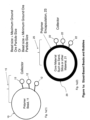
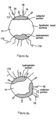
- Figures 1a and 1b show the present invention is the form of apparatus for use in, or forming part of, a separation process to be implemented in separation processor technology
- Fig 1c shows a corresponding apparatus not within the scope of the present invention, the apparatus featuring synthetic bubbles or beads indicated by arrows 10 ( Fig. 1a (1)), 20 ( Fig. 1a (2)), 30 ( Fig. 1b (1)), 40 ( Fig. 1b (2)), 50 ( Fig. 1c (1)), 60 ( Fig. 1c (2)), configured with a polymer or polymer-based material 11 ( Fig. 1a (1)), 21 ( Fig. 1a (2)), 31 ( Fig. 1b (1)), 41 ( Fig. 1b (2)), 51 ( Fig. 1c (1)), 61 ( Fig.
- the synthetic bubble or bead 10 is a size-based solid polymer bead or bubble 11 functionalized to attach to the valuable material 12 of interest in the mixture and to be separated from the mixture based on size.
- the synthetic bubble or bead 20 is a size-based bead or bubble 20 having a polymer core material 21 and a polymer encapsulation 23 functionalized to attach to the valuable material 22 of interest in the mixture and to be separated from the mixture based on size.
- the core material 21 may include materials such as sand, silica or other suitable material either now known or later developed in the future.
- Polymers or polymer-based materials that may be functionalized to attach to such a valuable material such as valuable material 12 ( Fig. 1a (1)), 22 ( Fig. 1a (2)), 32 ( Fig. 1b (1)), 42 ( Fig. 1b (2)), 52 ( Fig. 1c (1)), 62 ( Fig. 1c (2)), of interest, such as copper gold or other mineral are known in the art, and the scope of the invention is not intended to be limited to any particular type or kind thereof.
- the synthetic bubbles or beads 10 or 20 in Figure 1a may be configured to be separated from the mixture based at least partly on the difference between the size of the enriched synthetic bubbles or beads having the valuable material 12, 22 attached thereto in relation to the size of unwanted material in the mixture, consistent with that disclosed in Figures 2-4 .
- the synthetic bubble or bead 10 or 20 may be configured either so that the size of the synthetic bubbles or beads 10 or 20 is greater than a maximum ground ore particle size in the mixture, or so that the size of the synthetic bubbles or beads 10 or 20 is less than a minimum ground ore particle size in the mixture.
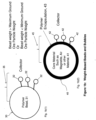
- the synthetic bubble or bead 30 is a weight-based solid polymer bead or bubble 31 functionalized to attach to the valuable material 32 of interest in the mixture and to be separated from the mixture based on weight.
- the synthetic bubbles or beads 40 is a weight-based bead or bubble 40 having a polymer core material 41 and a polymer encapsulation 43 functionalized to attach to the valuable material 42 of interest in the mixture and to be separated from the mixture based on weight.
- the core material 41 may be made of materials, e.g., such as magnetite, air or other suitable material and also configured with a polymer encapsulation.
- the synthetic bubbles or beads 30, 40 may be configured to be separated from the mixture based at least partly on the difference between the weight of the enriched synthetic bubbles or beads having the valuable material attached thereto in relation to the weight of unwanted material in the mixture.
- the synthetic bubbles or beads 30, 40 may be configured so that the weight of the synthetic bubbles or beads is greater than a maximum ground ore particle weight in the mixture, or so that the weight of the synthetic bubbles or beads is less than a minimum ground ore particle weight in the mixture.
- the following embodiments illustrated in Figures 1c ( 1 ) and 1c(2) are not within the scope of the present invention.
- the synthetic bead or bubble 50 is shown as a magnetic-based bead or bubble having a ferro- or ferri-magnetic core 51 and a polymer encapsulation 53, such that the ferro-magnetic or ferri-magnetic core 51 attracts to paramagnetic surfaces.
- the synthetic bead or bubble is shown as a magnetic-based bead or bubble having a para-magnetic core 61 and a polymer encapsulation 63, such that the para-magnetic core attracts to magnetized surfaces.
- the synthetic bubbles or beads 50, 60 may be configured to be separated from the mixture based at least partly on the difference between the para-, ferri-, ferro-magnetism of the enriched synthetic bubbles or beads having the valuable material 52, 62 attached thereto in relation to the para-, ferri-, ferro-magnetism of unwanted material in the mixture.
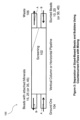
- the synthetic bubbles or beads 10 may be used in, or form part of, a size-based separation process using countercurrent flows with mixing implemented in apparatus such as a vertical column or horizontal pipeline generally indicated as 100, according to some embodiments of the present invention.
- the vertical column or horizontal pipeline 100 is configured with a screen 102 to separate the enriched synthetic bubbles or beads 15 ( Fig. 1a (1)), 25 ( Fig. 1a (2)) having the valuable material 12 ( Fig. 1a (1)), 22 ( Fig. 1a (2)) attached thereto from the mixture based at least partly on the difference in size.
- the vertical column or horizontal pipeline 100 may be configured to separate the enriched synthetic bubbles or beads 15 ( Fig. 1a (1)), 25 ( Fig. 1a (2)) having the valuable material 12 ( Fig. 1a (1)), 22 ( Fig. 1a (2)) attached thereto from the mixture using countercurrent flows with mixing, so as to receive in the vertical column or horizontal pipeline 100 ground ore 104 flowing in a first direction A, receive in the vertical column or horizontal pipeline 100 slurried synthetic bubbles or beads 10 ( Fig. 1a (1)), 20 ( Fig. 1a (2)) flowing in a second direction B opposite to the first direction A, provide from the vertical column or horizontal pipeline 100 the enriched synthetic bubbles or beads 15 ( Fig. 1a (1)), 25 ( Fig.
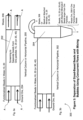
- the synthetic bubbles or beads 10 may be used in, or form part of, a size-based separation process implemented in apparatus such as a vertical column or horizontal pipeline generally indicated as 200, according to some embodiments of the present invention.
- the vertical column or horizontal pipeline 200 may be configured with a screen 202 to separate the enriched synthetic bubbles or beads 15 ( Fig. 1a (1)), 25 ( Fig. 1a (2)) having the valuable material 12 ( Fig. 1a (1)), 22 ( Fig. 1a (2)) attached thereto from the mixture using concurrent flows with mixing, so as to receive in the vertical column or horizontal pipeline 200 the synthetic bubbles or beads 10 ( Fig. 1a (1)), 20 ( Fig.
- the synthetic bubbles or beads 10 may be used in, or form part of, a size-based separation process implemented in apparatus generally indicated as 300 having a vertical column or horizontal pipeline 302 in combination with a hydrocyclone cyclone 304, according to some embodiments of the present invention.
- the vertical column or horizontal pipeline 302 may be configured to receive the synthetic bubbles or beads 10 ( Fig. 1a (1)), 20 ( Fig. 1a (2)) in water, receive ground ore 306, and provide the synthetic bubbles or beads in water and the ground ore in a process mixture.
- the hydrocyclone cyclone 304 is configured to receive the process mixture, separate from the process mixture the enriched synthetic bubbles or beads 15 ( Fig. 1a (1)), 25 ( Fig. 1a (2)) having the valuable material 12 ( Fig. 1a (1)), 22 ( Fig. 1a (2)) attached thereto and unwanted material in the form of waste ore 308, and provide either the enriched synthetic bubbles or beads 15 ( Fig. 1a (1)), 25 ( Fig. 1a (2)) having the valuable material 12 ( Fig. 1a (1)), 22 ( Fig.
- the synthetic bubbles or beads 10 may be used in, or form part of, a size-based separation process implemented in apparatus generally indicated as 400 having a mixing vat 402 in combination with a hydrocyclone cyclone 404 or a separation screen 406, according to some embodiments of the present invention.
- the mixing vat 402 is configured with piping 408, 410, 412 to receive the synthetic bubbles or beads 10 ( Fig. 1a (1)), 20 ( Fig. 1a (2)) and ore particles 414 in a slurry, and to provide via piping 416 the enriched synthetic bubbles or beads 15 ( Fig. 1a (1)), 25 ( Fig.
- the screen 406 may be configured to separate the enriched synthetic bubbles or beads 15 ( Fig. 1a (1)), 25 ( Fig. 1a (2)) having the valuable material 12 ( Fig. 1a (1)), 22 ( Fig. 1a (2)) attached thereto and the waste.
- the hydrocyclone cyclone 404 may be configured to separate the enriched synthetic bubbles or beads 15 ( Fig. 1a (1)), 25 ( Fig. 1a (2)) having the valuable material 12 ( Fig. 1a (1)), 22 ( Fig. 1a (2)) attached thereto and the waste.
- apparatus 300 and 400 disclosed in Figures 3b and 4 may be adapted and configured to implement a weight-based separation process according to some embodiments of the present invention.
- the synthetic bubbles or beads 30 may be used in, or form part of, a weight-based separation process implemented in the apparatus 300 in Figure 3b , or the apparatus 400 in Figure 4 , according to some embodiments of the present invention.
- the apparatus 300 in Figure 3b including the vertical column or horizontal pipeline 302 and the hydrocyclone cyclone 304, may be suitably adapted or configured to implement a weigh-based separation technique.
- the vertical column or horizontal pipeline 302 may be suitably adapted or configured to receive the synthetic bubbles or beads 30 ( Fig. 1b (1)), 40 ( Fig. 1b (2)) in water, receive ground ore like ore 306, and provide the synthetic bubbles or beads in water and the ground ore in a process mixture.
- the hydrocyclone cyclone 304 may be suitably adapted or configured to receive the process mixture, separate from the process mixture the enriched synthetic bubbles or beads 35 ( Fig. 1b (1)), 45 ( Fig.
- the apparatus 400 in Figure 4 including the wet or dry mixing vat 402 and the hydrocyclone cyclone 404 or the screen 406, may be suitably adapted or configured to implement a weigh-based separation technique.
- the wet or dry mixing vat 402 may be suitably adapted or configured to receive the synthetic bubbles or beads 30 ( Fig. 1b (1)), 40 ( Fig. 1b (2)) and ore particles 414 in a slurry, and to provide the enriched synthetic bubbles or beads 35 ( Fig. 1b (1)), 45 ( Fig. 1b (2)) having the valuable material 32 ( Fig. 1b (1)), 42 ( Fig. 1b (2)) attached thereto and waste ore.
- the screen 406 may be suitably adapted or configured to separate the enriched synthetic bubbles or beads 35 ( Fig. 1b (1)), 45 ( Fig. 1b (2)) having the valuable material 32 ( Fig. 1b (1)), 42 ( Fig. 1b (2)) attached thereto and the waste ore 418, including being responsive to a jig for weight-based separation of the enriched synthetic bubbles or beads 35 ( Fig. 1b (1)), 45 ( Fig. 1b (2)) from the waste ore.
- the hydrocyclone cyclone 404 may be suitably adapted or configured to separate the enriched synthetic bubbles or beads 35 ( Fig. 1b (1)), 45 ( Fig. 1b (2)) having the valuable material the enriched synthetic bubbles or beads 32 ( Fig. 1b (1)), 42 ( Fig. 1b (2)) attached thereto and the waste ore.
- the synthetic bubbles or beads 50 may be used in, or form part of, a magnetic-based separation process implemented in apparatus generally indicated as 500.
- the apparatus 500 may comprise a column or pipeline 502, a vat or container 504 and a drum or belt magnetic separator or other magnetic separator 506.
- the drum or belt magnetic separator or other magnetic separator 506 may include a drum or belt 506a and a knife-like or edge-like device 506b.
- the column or pipeline 502 may be configured to receive the synthetic bubbles or beads 50 ( Fig. 1c (1)), 60 ( Fig.
- the drum or belt separator 506 may be configured to separate the enriched synthetic bubbles or beads 55 ( Fig. 1c (1)), 65 ( Fig. 1c (2)) having the valuable material 52 ( Fig. 1c (1)), 62 ( Fig. 1c (2)) attached thereto and the unwanted material 510 in the form of waste ore, and provide the enriched synthetic bubbles or beads 55 ( Fig. 1c (1)), 65 ( Fig. 1c (2)) having the valuable material 52 ( Fig. 1c (1)), 62 ( Fig. 1c (2)) attached thereto and the unwanted material 510 in the form of waste ore, and provide the enriched synthetic bubbles or beads 55 ( Fig. 1c (1)), 65 ( Fig. 1c (2)) having the valuable material 52 ( Fig. 1c (1)), 62 ( Fig.
- the drum or belt magnetic separator or other magnetic separator 506 includes knife-like or edge-like device 506b for removing magnetically coupled enriched synthetic bubbles or beads 55 ( Fig. 1c (1)), 65 ( Fig. 1c (2)) from the drum or belt 506a.
- the drum or belt separator 506 may be configured to be magnetized or have magnetic fields extending to, or along a portion of, its surface of the drum or belt separator so as to form a separator surface to collect the para-magnetic, ferro-magnetic or ferri-magnetic synthetic bubbles or beads 55 ( Fig. 1c (1)), 65 ( Fig. 1c (2)) having the valuable material 52 ( Fig. 1c (1)), 62 ( Fig. 1c (2)) attached thereto that are attracted to the separator surface as it rotates inside the vat or container 504, as shown.
- a physical property is understood to be any quality that is a measurable whose value describes a physical system's state, as defined by the Wikipedia Dictionary. Changes in the physical properties of a system can be used to describe its transformations (or evolutions between its momentary states). Physical properties can be intensive or extensive, where an intensive property does not depend on the size or amount of matter in the object, while an extensive property does. Physical properties are contrasted with chemical properties which determine the way a material behaves in a chemical reaction. Physical properties are properties that do not change the chemical nature of matter.
- the present invention is described in relation to physical property of the synthetic beads or bubbles that take the form of size, weight, and density.
- the synthetic bubbles or beads are configured as solid polymer bubbles or beads with a polymer or polymer-based material functionalized to attach to a valuable material, wherein the polymer or polymer-based material comprises a surface configured with a hydrophobic polymer selected from a group consisting of polydimethylsiloxane, polysiloxanates, hydroxyl-terminated polydimethylsiloxane, fluoroalkylsilane, and silicone alkyd copolymer.
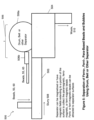
- Figure 6a shows a generalized synthetic bead
- Figure 6b shows an enlarged portion of the surface.
- the synthetic bead 70 has a bead body to provide a bead surface 74.
- the bead body is made of a polymer, so as to provide a plurality of molecules or molecular segments 76 on the surface 74.
- the molecule 76 is used to attach a chemical functional group 78 to the surface 74.
- the molecule 76 can be a hydrocarbon chain, for example, and the functional group 78 can have an anionic bond for attracting a mineral, such as copper to the surface 74.
- a xanthate for example, has both the functional group 78 and the molecular segment 76 to be incorporated into the polymer that is used to make the synthetic bead 70.
- the functional group 78 is also known as a collector that can have a non-ionizing or ionizing bond.
- the ionizing bond can be anionic or cationic.
- An anionic bond includes oxyhydryl, such as carboxylic, sulfates and sulfonates, and sulfhydral, such as xanthates and dithiophosphates.
- Other molecules or compounds that can be used to provide the function group 78 include thionocarboamates, thioureas, xanthogens, monothiophosphates, hydroquinones and polyamines.
- a chelating agent can be incorporated into the polymer as a collector site for attracting a mineral, such as copper.
- a mineral particle 72 is attached to the functional group 78 on the molecule 76.
- the mineral particle 72 is much smaller than the synthetic bead 70.
- Many mineral particles 72 can be attracted to or attached to the surface 74 of a synthetic bead 70.
- smaller synthetic beads 70 can also be used.
- a synthetic bead takes the form of a solid-phase body made of a polymer.
- solid-phase body is understood herein to be a body having a cohesive force of matter that is strong enough to keep the molecules or atoms in the given positions, restraining the thermal mobility.
- the polymer can be rigid or elastomeric.
- An elastomeric polymer can be a bisoxazolone-based polymer, for example.
- the body has a surface comprising a plurality of molecules with one or more functional groups for attracting mineral particles of interest to the surface.
- a polymer having a functional group to attract or collect mineral particles is referred to as a functionalized polymer.
- the entire body of the synthetic bead may be made of the same functionalized material, or the bead body may be a shell, which can be formed by way of expansion, such as thermal expansion or pressure reduction.
- the shell may be formed as a micro-bubble or a balloon.
- the shell which may be made of functionalized material, may have an interior part.
- the interior part may be filled with air or gas to aid buoyancy, for example.
- the interior part can be used to contain a liquid to be released during the mineral separation process, in order to control the chemistry of the process being performed, e.g., in the flotation cell or column.
- the encapsulated liquid can be a polar liquid or a non-polar liquid, for example.
- the encapsulated liquid can contain a depressant composition for the enhanced separation of copper, nickel, zinc, lead in sulfide ores in the flotation stage, for example.
- the shell can be used to encapsulate a powder which can have a magnetic property so as to cause the synthetic bead to be magnetic, for example.
- an electromagnetic field may be generated to capture or stir the synthetic beads.
- the encapsulated liquid or powder may contain monomers, oligomers or short polymer segments for wetting the surface of mineral particles when released from the beads.
- each of the monomers or oligomers may contain one functional group for attaching to a mineral particle of interest and one ionic bond for attaching the wetted mineral particle to the synthetic bead.
- the shell can be used to encapsulate a solid core, such as Styrofoam to aid buoyancy, for example.
- only the coating of the bead body may be made of functionalized polymer.
- the synthetic bead can have a core made of ceramic, glass or metal and only the surface of core can have a coating made of functionalized polymer.
- the core can be a hollow core or a filled core depending on the applications.
- the core can be a micro-bubble, a sphere or balloon.
- a filled core made of metal makes the density of the synthetic bead to be higher than the density of the pulp slurry, for example, so as to settle in the flotation cell or column and be capture.
- the core can be made of a magnetic material so that the para-, ferri-, ferro-magnetism of the synthetic bead is greater than the para-, ferri-, ferro-magnetism of the unwanted ground ore particle in the mixture.
- the synthetic bead can be configured with a ferro-magnetic or ferri-magnetic core that attract to paramagnetic surfaces.
- a core made of glass or ceramic can be used to make the density of the synthetic bead substantially equal to the density of the pulp slurry so that when the synthetic beads are mixed into the pulp slurry for mineral collection, the beads can be in a so-called suspension state.
- the use of the term "bead” is not intended to limit the shape of the synthetic bead of the present invention to being spherical, as shown in Figure 6a, 6b .
- the synthetic bead can have an elliptical shape, a cylindrical shape, a shape of a block, an irregular shape. In effect, the scope of the invention is not intended to be limited to any particular type or kind of shape of the synthetic bead.
- the surface of a synthetic bead is not limited to an overall smoothness of its surface as shown in Figure 6a .
- the surface can be irregular and rough.
- the surface can have some physical structures like grooves or rods, or holes or dents.
- the surface can have some physical structures formed from stacked beads.
- the surface can have some hair-like physical structures.
- the physical structures can help trapping the mineral particles on the bead surface.
- the surface can be configured to be a honeycomb surface or a sponge-like surface for trapping the mineral particles and/or increasing the contacting surface. In effect, the scope of the invention is not intended to be limited to any particular type or kind of surface of the synthetic bead.
- the synthetic beads of the present invention can be realized by a different way to achieve the same goal. Namely, it is possible to use a different means to attract the mineral particles of interest to the surface of the synthetic beads.
- the surface of the polymer beads or shells can be functionalized with a hydrophobic chemical molecule or compound, as discussed below.
- the surface of beads made of glass, ceramic and metal can be coated with hydrophobic chemical molecules or compounds.
- polysiloxanates can be used to functionalize the glass beads in order to make the synthetic beads.
- xanthate and hydroxamate collectors can also be added therein for collecting the mineral particles and making the mineral particles hydrophobic.
- the synthetic beads are used to collect the mineral particles in the pulp slurry having a pH value around 8-9, it is possible to release the mineral particles on the enriched synthetic beads from the surface of the synthetic beads in an acidic solution, such as a sulfuric acid solution.
- an acidic solution such as a sulfuric acid solution.
- the synthetic bubbles or beads are configured as solid polymer bubbles or beads with a polymer or polymer-based material functionalized to attach to a valuable material, wherein the polymer or polymer-based material comprises a surface configured with a hydrophobic polymer selected from a group consisting of polydimethylsiloxane, polysiloxanates, hydroxyl-terminated polydimethylsiloxane, fluoroalkylsilane, and silicone alkyd copolymer.
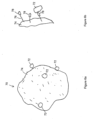
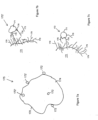
- Figure 7a shows a generalized synthetic bubble or bead having some particles attached to the surface.
- Figure 7b illustrates an enlarged portion of the synthetic bead showing a wetted mineral particle attached to the hydrophobic surface of the synthetic bead.
- Figure 7c illustrates an enlarged portion of the synthetic bead showing a hydrophobic particle attached to the hydrophobic surface of the synthetic bead.
- the hydrophobic particle can be mineral related or non-mineral related. Non-mineral related particles are not within the scope of the present invention.
- the synthetic bead can be a size-based bead or bubble, weight-based polymer bead and bubble, or magnetic-based bead and bubble (not within the scope of the present invention), consistent with that set forth herein.
- the size of the synthetic bead can be smaller than the minimum size of the mineral particles of interest which is about 150 ⁇ m, and can be larger than the maximum size of the mineral particles of interest. In certain applications, the size of the synthetic bead can be 1cm or larger.
- the synthetic bubble or bead 170 may have a bead body to provide a bead surface 174.
- the bead body is made of a hydrophobic polymer, or has a coating of a hydrophobic chemical.
- hydrophobic particles 172, 172' are attracted to the surface 174 to form an enriched synthetic bubble or bead 175.
- the surface 174 of the synthetic bubble or bead comprises a plurality of molecules 179 which renders the surface 174 hydrophobic.
- the surface 174 may be a glass surface coated with polysiloxanates which have functional groups that bind to the hydroxyl group of the glass surface.
- Polysiloxanates such as hydroxyl-terminated polydimethysiloxanes, have a silicon-oxygen chain to provide the hydrophobic molecules 179.
- the hydrophobic particle 172' as shown in Figure 7b , is a mineral particle 171' having one or more collectors 173 attached thereto. One end (178) of the collector 173 has an ionic bond attached to the mineral particle of interest 171'. The other end of the collector 173 has a hydrophobic chain 176 which tends to move into the hydrophobic molecules 179.
- the hydrophobic particle 172' is a wetted mineral particle.
- a collector such as xanthate, has both the functional group 178 and the molecule 176.
- a xanthate for example, has both the functional group 178 and the molecular segment 176 to be incorporated into the polymer that is used to make the synthetic bead 170.
- a functional group 178 is also known as a collector that can have a non-ionizing or ionizing bond.
- the ionizing bond can be anionic or cationic.
- An anionic bond includes oxyhydryl, such as carboxylic, sulfates and sulfonates, and sulfhydral, such as xanthates and dithiophosphates.
- Other molecules or compounds that can be used to provide the functional group 178 include thionocarboamates, thioureas, xanthogens, monothiophosphates, hydroquinones and polyamines.
- the hydrophobic particle 172 can be a particle that has a hydrophobic chain 176.
- such particle can be non-mineral related, but it can be arranged to contact with the hydrophobic synthetic bubbles or beads 170 of the present inventions.
- the hydrophobic bubbles or beads 170 according to various embodiments not within the scope of the present invention, can be used in non-mining applications, such as water-pollution control and water purification.
- the pH value is lower than the pH value for mineral attachment. It should be noted that, however, when the valuable material is copper, for example, it is possible to provide a lower pH environment for the attachment of mineral particles and to provide a higher pH environment for the releasing of the mineral particles from the synthetic beads or bubbles.
- the pH value is chosen to facilitate the strongest attachment, and a different pH value is chosen to facilitate release.
- one pH value is chosen for mineral attachment, and a different pH value is chosen for mineral releasing. The different pH could be higher or lower, depending on the specific mineral and collector.
- the synthetic beads can be made with different sizes in order to attract mineral particles of different sizes.
- the synthetic beads of a larger size can be used to attract mineral particles larger than, say, 200 ⁇ m.
- the grinding of the blasted ore can be separated into different stages. In the first stage, the rock is crushed into particles in the order of 200 ⁇ m. After the separation process using the larger synthetic beads in the slurry containing these crude particles, the remaining slurry can be subjected to a finer grinding stage where the crushed rock is further crushed into particles in the order of 100 ⁇ m. With the slurry containing the finer mineral particles, synthetic beads with a smaller size may be more effective in interacting with the finer mineral particles.
- the bead size can be smaller than 100 ⁇ m. In a tailings pond application, the bead size can be 1mm to 10mm or larger. However, large beads would reduce the functionalized surfaces where the mineral particles can attach to the synthetic beads.
- the synthetic beads are configured with a size less than 100 ⁇ m for attracting to mineral particles having a substantially similar size, including in applications related to flotation cells; the synthetic beads are configured with a size of about 100 ⁇ m for attracting or attaching to mineral particles having a substantially similar size, smaller size or larger size; the synthetic beads are configured with a size in a range of about 50-500 ⁇ m for attracting or attaching to mineral particles having a substantially similar size, smaller size or larger size; the synthetic beads are configured with a size about 200 ⁇ m for attracting to mineral particles having a substantially similar size; the synthetic beads are configured with a size in a range of about 1mm to 10mm, including in applications related to a tailings pond. In general, the synthetic beads are configured with a size in a range of about 50 ⁇ m to 10mm. But the beads can be smaller than 50 ⁇ m and larger than 10mm.
- the synthetic beads are configured to be larger than the mineral particles. As such, a plurality of mineral particles may attach to one synthetic bead. According to other embodiments of the present invention, the synthetic beads are configured to be smaller than the mineral particles. As such, a plurality of synthetic beads may attach to one mineral particle.
- the size of the synthetic beads can also be about the same as the size of the mineral particle.
- the synthetic beads are also configured for use in oilsands separation - to separate bitumen from sand and water in the recovery of bitumen in an oilsands mining operation.
- only a portion of the surface of the synthetic bead is functionalized to be hydrophobic. This has the benefits as follows:
- only a portion of the surface of the synthetic bead is functionalized with collectors. This also has the benefits of
- one part of the synthetic bead is functionalized with collectors while another part of same synthetic bead is functionalized to be hydrophobic as shown in Figures 8a and 8b .
- a synthetic bead 74 has a surface portion where polymer is functionalized to have collector molecules 73 with functional group 78 and molecular segment 76 attached to the surface of the bead 74.
- the synthetic bead 74 also has a different surface portion where polymer is functionalized to have hydrophobic molecules 179 (or 79).
- the entire surface of the synthetic bead 74 can be functionalized to have collector molecules 73, but a portion of the surface is functionalized to have hydrophobic molecules 179 (or 79) render it hydrophobic.
- one part of the synthetic bead is functionalized with collectors while another part of same synthetic bead is functionalized to be hydrophobic and this "hybrid" synthetic bead is configured for use in a traditional flotation cell as well.
- the "hybrid” synthetic bead (see Figures 8a and 8b ) has a hydrophobic portion and a separate collector portion. When the "hybrid" beads are mixed with air in the flotation cell, some of them will attach to the air bubbles because of the hydrophobic portion. As the "hybrid" synthetic bead is attached to an air bubble, the collector portion of the attached bead can collect mineral particles with the functional groups.
- the synthetic beads according to some embodiments of the present inventions, can be used to replace the air bubbles, or to work together with the air bubbles in a flotation process.
- This "hybrid" synthetic bead can collect mineral particles that are wet and not wet.
- the surface of a synthetic bead can be functionalized to have a collector molecule.
- the collector has a functional group with an ion capable of forming a chemical bond with a mineral particle.
- a mineral particle associated with one or more collector molecules is referred to as a wetted mineral particle.
- the synthetic bead can be functionalized to be hydrophobic in order to collect one or more wetted mineral particles.
- applications are envisioned to include:
Landscapes
- Chemical & Material Sciences (AREA)
- Engineering & Computer Science (AREA)
- Chemical Kinetics & Catalysis (AREA)
- Life Sciences & Earth Sciences (AREA)
- Organic Chemistry (AREA)
- Analytical Chemistry (AREA)
- Biotechnology (AREA)
- Water Supply & Treatment (AREA)
- Environmental & Geological Engineering (AREA)
- Manufacturing & Machinery (AREA)
- Materials Engineering (AREA)
- Mechanical Engineering (AREA)
- Metallurgy (AREA)
- Hydrology & Water Resources (AREA)
- Physical Or Chemical Processes And Apparatus (AREA)
- Separation Of Solids By Using Liquids Or Pneumatic Power (AREA)
- Separation, Recovery Or Treatment Of Waste Materials Containing Plastics (AREA)
- Filtering Materials (AREA)
- Separation Using Semi-Permeable Membranes (AREA)
- Compositions Of Macromolecular Compounds (AREA)
- Farming Of Fish And Shellfish (AREA)
- Solid-Sorbent Or Filter-Aiding Compositions (AREA)
- Physical Water Treatments (AREA)
- Glanulating (AREA)
- Water Treatment By Sorption (AREA)
- Management, Administration, Business Operations System, And Electronic Commerce (AREA)
- Cyclones (AREA)
- Adornments (AREA)
- Separation Of Suspended Particles By Flocculating Agents (AREA)
- Processing And Handling Of Plastics And Other Materials For Molding In General (AREA)
- Other Resins Obtained By Reactions Not Involving Carbon-To-Carbon Unsaturated Bonds (AREA)
- Water Treatment By Electricity Or Magnetism (AREA)
- Medicines Containing Material From Animals Or Micro-Organisms (AREA)
- Paper (AREA)
- Processing Of Solid Wastes (AREA)
Claims (14)
- Appareil destiné à être utilisé dans, ou faisant partie d'un processus de séparation à mettre en oeuvre dans une technologie de processeur de séparation, ledit appareil comprenant des bulles ou billes synthétiques, le processus de séparation impliquant l'utilisation des bulles ou billes synthétiques, dans lequel :
les bulles ou billes synthétiques sont configurées comme des bulles ou billes polymères solides avec un polymère ou un matériau à base de polymère fonctionnalisé pour s'attacher à un matériau de valeur dans un mélange comportant de l'eau de façon à former des bulles ou billes synthétiques enrichies auxquelles le matériau de valeur est attaché, et sont également configurées pour être séparées du mélange sur la base, au moins en partie, d'une différence de propriété physique entre les bulles ou billes synthétiques enrichies auxquelles le matériau de valeur est attaché et le mélange, dans lequel le matériau de valeur comprend des particules minérales, et dans lequel le polymère ou le matériau à base de polymère comprend une surface configurée avec un polymère hydrophobe choisi dans un groupe consistant en un polydiméthylsiloxane, des polysiloxanates. - Appareil selon la revendication 1, dans lequel les bulles ou billes synthétiques sont configurées pour être séparées du mélange sur la base, au moins en partie, de la différence entre la taille des bulles ou billes synthétiques enrichies auxquelles le matériau de valeur est attaché par rapport à la taille d'un matériau indésirable dans le mélange.
- Appareil selon la revendication 1, dans lequel les bulles ou billes synthétiques sont configurées pour être séparées du mélange sur la base, au moins en partie, de la différence entre le poids des bulles ou billes synthétiques enrichies auxquelles le matériau de valeur est attaché par rapport au poids d'un matériau indésirable dans le mélange.
- Appareil selon la revendication 1, dans lequel les bulles ou billes synthétiques sont configurées pour être séparées du mélange sur la base, au moins en partie, de la différence entre la densité des bulles ou billes synthétiques enrichies auxquelles le matériau de valeur est attaché et la densité du mélange.
- Appareil selon la revendication 2, dans lequel les bulles ou billes synthétiques sont configurées de de sorte que la taille des bulles ou billes synthétiques soit supérieure à une taille maximale de particules de minerai broyé dans le mélange ; ou
les bulles ou billes synthétiques sont configurées de de sorte que la taille des bulles ou billes synthétiques soit inférieure à une taille minimale de particules de minerai broyé dans le mélange. - Appareil selon la revendication 2,l'appareil comprenant en outre une colonne verticale ou un pipeline horizontal pour mettre en oeuvre le processus de séparation, la colonne verticale ou le pipeline horizontal étant configuré avec un crible pour séparer du mélange les bulles ou billes synthétiques enrichies auxquelles le matériau de valeur est attaché, sur la base, au moins en partie, de la différence de taille ; oul'appareil comprenant en outre une colonne verticale ou un pipeline horizontal pour mettre en oeuvre le processus de séparation, et un cyclone hydrocyclone,la colonne verticale ou le pipeline horizontal étant configuré pourrecevoir les bulles ou billes synthétiques dans l'eau, recevoir du minerai broyé, etfournir les bulles ou billes synthétiques dans l'eau et le minerai broyé dans un mélange de processus ; etle cyclone hydrocyclone étant configuré pour recevoir le mélange de processus,séparer du mélange de processus les bulles ou billes synthétiques enrichies auxquelles le matériau de valeur est attaché et le matériau indésirable sous forme de stériles, etfournir soit les bulles ou billes synthétiques enrichies auxquelles le matériau de valeur est attaché, soit les stériles, en incluant la séparation des stériles sous forme de particules de minerai qui ont une taille plus petite que les bulles ou billes synthétiques enrichies auxquelles le matériau de valeur est attaché, et en incluant la séparation des bulles ou billes synthétiques enrichies auxquelles le matériau de valeur est attaché qui ont une taille plus grande que les particules de minerai ; oul'appareil comprenant en outre une cuve de mélange et soit un crible soit un cyclone hydrocyclone pour mettre en oeuvre le processus de séparation,la cuve de mélange est configurée pour recevoir les bulles ou billes synthétiques et les particules de minerai dans une barbotine, et pour fournir les bulles ou billes synthétiques enrichies auxquelles le matériau de valeur est attaché et les stériles ; etle crible étant configuré pour séparer les bulles ou billes synthétiques enrichies auxquelles le matériau de valeur est attaché et les stériles ; oule cyclone hydrocyclone étant configuré pour séparer les bulles ou billes synthétiques enrichies auxquelles le matériau de valeur est attaché et les stériles.
- Appareil selon la revendication 6, dans lequel la colonne verticale ou le pipeline horizontal est également configuré pour séparer du mélange les bulles ou les billes synthétiques enrichies auxquelles le matériau de valeur est attaché en utilisant des flux à contre-courant avec mélange, de façon àrecevoir dans la colonne verticale ou le pipeline horizontal du minerai broyé s'écoulant dans une première direction,recevoir dans la colonne verticale ou le pipeline horizontal des bulles ou billes synthétiques en barbotine s'écoulant dans une seconde direction opposée à la première direction,fournir, à partir de la colonne verticale ou du pipeline horizontal, les bulles ou les billes synthétiques enrichies auxquelles le matériau de valeur est attaché et s'écoulant dans la seconde direction, etfournir, à partir de la colonne verticale ou du pipeline horizontal, des stériles qui sont séparés du mélange à l'aide du crible et qui s'écoulent dans la seconde direction.
- Appareil selon la revendication 6, dans lequel la colonne verticale ou le pipeline horizontal est également configuré pour séparer du mélange les bulles ou billes synthétiques enrichies auxquelles le matériau de valeur est attaché en utilisant des flux simultanés avec mélange, de façon àrecevoir dans la colonne verticale ou le pipeline horizontal les bulles ou billes synthétiques dans l'eau s'écoulant dans une première direction,recevoir dans la colonne verticale ou le pipeline horizontal du minerai broyé s'écoulant dans la première direction,fournir, à partir de la colonne verticale ou du pipeline horizontal, des stériles qui sont séparés du mélange à l'aide du crible et qui s'écoulent dans la première direction, etfournir, à partir de la colonne verticale ou du pipeline horizontal, les bulles ou billes synthétiques enrichies auxquelles le matériau de valeur est attaché et s'écoulant dans la première direction.
- Appareil selon la revendication 3, dans lequelles bulles ou billes synthétiques sont configurées de sorte que le poids des bulles ou billes synthétiques soit supérieur à un poids maximal de particules de minerai broyé dans le mélange ; oules bulles ou billes synthétiques sont configurées de sorte que le poids des bulles ou billes synthétiques est inférieur à un poids minimal de particules de minerai broyé dans le mélange.
- Appareil selon la revendication 3,l'appareil comprenant en outre une colonne verticale ou un pipeline horizontal pour mettre en oeuvre le processus de séparation, et un cyclone hydrocyclone, la colonne verticale ou le pipeline horizontal étant configuré pourrecevoir les bulles ou billes synthétiques dans l'eau,recevoir du minerai broyé,fournir les bulles ou billes synthétiques dans l'eau et le minerai broyé dans un mélange de processus ; etle cyclone hydrocyclone étant configuré pourrecevoir le mélange de processus,séparer du mélange de processus les bulles ou billes synthétiques enrichies auxquelles le matériau de valeur est attaché et le matériau indésirable sous forme de stériles ; etfournir soit les bulles ou billes synthétiques enrichies auxquelles le matériau de valeur est attaché, soit les stériles, y compris lorsque les bulles ou billes synthétiques enrichies auxquelles le matériau de valeur est attaché se présentent sous la forme de bulles ou billes synthétiques enrichies qui sont plus lourdes que des particules de minerai, et y compris lorsque les stériles se présentent sous la forme de particules de minerai qui sont plus légères que les bulles ou billes synthétiques enrichies auxquelles le matériau de valeur est attaché ; oul'appareil comprenant en outre une cuve de mélange humide ou sèche et soit un crible, soit un cyclone hydrocyclone pour mettre en oeuvre le processus de séparation,la cuve de mélange humide ou sèche étant configurée pour recevoir les bulles ou billes synthétiques et les particules de minerai dans une barbotine, et pour fournir les bulles ou billes synthétiques enrichies auxquelles le matériau de valeur est attaché et les stériles ; etle crible étant configuré pour séparer les bulles ou billes synthétiques enrichies auxquelles le matériau de valeur est attaché et les stériles, y compris en répondant à un gabarit pour la séparation basée sur le poids ; oule cyclone hydrocyclone étant configuré pour séparer les bulles ou les billes synthétiques enrichies auxquelles le matériau de valeur est attaché et les stériles.
- Appareil selon la revendication 4,l'appareil comprenant en outre une colonne ou un pipeline et un séparateur à tambour ou à bande pour mettre en oeuvre le processus de séparation,la colonne ou le pipeline étant configuré pourrecevoir les bulles ou billes synthétiques,recevoir une barbotine de minerai broyé, etfournir les bulles ou billes synthétiques et la barbotine de minerai broyé dans un mélange de processus ; etle séparateur à tambour ou à bande étant configuré pourrecevoir le mélange de processus,séparer les bulles ou billes synthétiques enrichies auxquelles le matériau de valeur est attaché et le matériau indésirable sous forme de stériles, etfournir les bulles ou billes synthétiques enrichies auxquelles le matériau de valeur est attaché et les stériles.
- Appareil selon la revendication 1, dans lequel la surface comprend un revêtement du polymère hydrophobe.
- Appareil selon la revendication 1, dans lequel seule une partie de la surface des bulles ou billes synthétiques est configurée pour être hydrophobe.
- Appareil selon la revendication 13, dans lequel une autre partie de la surface des bulles ou billes synthétiques est configurée pour avoir des molécules attachées à celle-ci, les molécules comprenant un groupe fonctionnel choisi pour attirer le matériau de valeur dans le mélange, dans lequel les molécules comprennent des collecteurs.
Applications Claiming Priority (3)
| Application Number | Priority Date | Filing Date | Title |
|---|---|---|---|
| US201161489893P | 2011-05-25 | 2011-05-25 | |
| US201161533544P | 2011-09-12 | 2011-09-12 | |
| PCT/US2012/039540 WO2012162593A2 (fr) | 2011-05-25 | 2012-05-25 | Séparation de minéraux au moyen de bulles ou de billes polymères sur la base de la taille, du poids ou du magnétisme |
Publications (4)
| Publication Number | Publication Date |
|---|---|
| EP2715055A2 EP2715055A2 (fr) | 2014-04-09 |
| EP2715055A4 EP2715055A4 (fr) | 2015-04-15 |
| EP2715055B1 true EP2715055B1 (fr) | 2024-08-28 |
| EP2715055C0 EP2715055C0 (fr) | 2024-08-28 |
Family
ID=47217769
Family Applications (9)
| Application Number | Title | Priority Date | Filing Date |
|---|---|---|---|
| EP12788746.1A Active EP2717988B1 (fr) | 2011-05-25 | 2012-05-25 | Perles synthétiques ayant une surface hydrophobe |
| EP12789209.9A Active EP2715055B1 (fr) | 2011-05-25 | 2012-05-25 | Séparation de minéraux au moyen de bulles ou de billes polymères sur la base de la taille, du poids ou du magnétisme |
| EP12789071.3A Active EP2714792B1 (fr) | 2011-05-25 | 2012-05-25 | Billes fonctionnalisées avec des molécules servant à attirer et à fixer des particules de minéraux d'intérêt |
| EP12788889.9A Active EP2714596B1 (fr) | 2011-05-25 | 2012-05-25 | Procédé et appareil pour libérer un minéral de billes synthétiques |
| EP12849063.8A Active EP2714949B1 (fr) | 2011-05-25 | 2012-05-25 | Récupération de minerais dans les résidus utilisant des polydiméthylsiloxanes à terminaison hydroxy |
| EP12789960.7A Active EP2714248B1 (fr) | 2011-05-25 | 2012-05-25 | Séparation minérale |
| EP12792251.6A Active EP2714242B1 (fr) | 2011-05-25 | 2012-05-25 | Séparation par flottation utilisant des billes ou bulles contenant du polydiméthylsiloxane |
| EP12790002.5A Active EP2714235B1 (fr) | 2011-05-25 | 2012-05-25 | Séparation minérale utilisant un élément revêtu de polymère fonctionnalisé |
| EP12849247.7A Active EP2714233B1 (fr) | 2011-05-25 | 2012-05-25 | Perles synthétiques dans une cellule de flottation |
Family Applications Before (1)
| Application Number | Title | Priority Date | Filing Date |
|---|---|---|---|
| EP12788746.1A Active EP2717988B1 (fr) | 2011-05-25 | 2012-05-25 | Perles synthétiques ayant une surface hydrophobe |
Family Applications After (7)
| Application Number | Title | Priority Date | Filing Date |
|---|---|---|---|
| EP12789071.3A Active EP2714792B1 (fr) | 2011-05-25 | 2012-05-25 | Billes fonctionnalisées avec des molécules servant à attirer et à fixer des particules de minéraux d'intérêt |
| EP12788889.9A Active EP2714596B1 (fr) | 2011-05-25 | 2012-05-25 | Procédé et appareil pour libérer un minéral de billes synthétiques |
| EP12849063.8A Active EP2714949B1 (fr) | 2011-05-25 | 2012-05-25 | Récupération de minerais dans les résidus utilisant des polydiméthylsiloxanes à terminaison hydroxy |
| EP12789960.7A Active EP2714248B1 (fr) | 2011-05-25 | 2012-05-25 | Séparation minérale |
| EP12792251.6A Active EP2714242B1 (fr) | 2011-05-25 | 2012-05-25 | Séparation par flottation utilisant des billes ou bulles contenant du polydiméthylsiloxane |
| EP12790002.5A Active EP2714235B1 (fr) | 2011-05-25 | 2012-05-25 | Séparation minérale utilisant un élément revêtu de polymère fonctionnalisé |
| EP12849247.7A Active EP2714233B1 (fr) | 2011-05-25 | 2012-05-25 | Perles synthétiques dans une cellule de flottation |
Country Status (14)
| Country | Link |
|---|---|
| US (11) | US9943860B2 (fr) |
| EP (9) | EP2717988B1 (fr) |
| CN (4) | CN104010708B (fr) |
| AU (9) | AU2012337376B2 (fr) |
| CA (9) | CA2836803C (fr) |
| CL (9) | CL2013003378A1 (fr) |
| DK (2) | DK2717988T3 (fr) |
| ES (3) | ES2936663T3 (fr) |
| PE (9) | PE20140708A1 (fr) |
| PL (3) | PL2717988T3 (fr) |
| RS (1) | RS63788B1 (fr) |
| RU (3) | RU2600764C2 (fr) |
| WO (9) | WO2012166580A1 (fr) |
| ZA (9) | ZA201309599B (fr) |
Families Citing this family (63)
| Publication number | Priority date | Publication date | Assignee | Title |
|---|---|---|---|---|
| US12186690B2 (en) | 2011-05-25 | 2025-01-07 | Cidra Corporate Services Inc. | Polymer coating for selective separation of hydrophobic particles in aqueous slurry |
| US9731221B2 (en) * | 2011-05-25 | 2017-08-15 | Cidra Corporate Services, Inc. | Apparatus having polymer surfaces having a siloxane functional group |
| US10835905B2 (en) | 2011-05-25 | 2020-11-17 | Cidra Corporate Services Inc. | Recovery media for mineral processing |
| AU2012337376B2 (en) * | 2011-05-25 | 2016-12-08 | Cidra Corporate Services Inc. | Mineral recovery in tailings using functionalized polymers |
| EP2790817B1 (fr) * | 2011-12-13 | 2020-05-27 | CiDRA Corporate Services, Inc. | Séparation de minéraux utilisant des filtres et des membranes revêtus de polymères ou de polymères fonctionnalisés |
| US12618010B2 (en) | 2012-02-28 | 2026-05-05 | Cidra Corporate Services Llc | Method and system for flotation separation in a magnetically controllable and steerable medium |
| US9932525B2 (en) | 2012-02-28 | 2018-04-03 | Cidra Corporate Services, Inc. | Method and system for flotation separation in a magnetically controllable and steerable medium |
| US10751693B2 (en) | 2012-05-22 | 2020-08-25 | CiDRA Corporate Service Inc. | Mineral recovery using hydrophobic polymer surfaces |
| WO2014110121A1 (fr) | 2013-01-08 | 2014-07-17 | Cidra Corporate Services Inc. | Technologie des agents de soutènement intelligents pour la fracturation et surveillance de la performance de production des puits |
| US10060570B2 (en) | 2013-01-09 | 2018-08-28 | Cidra Corporate Services, Inc. | Smart pipe concept based on embedded taggant-sensor and/or color-encoded elements to monitor liner wear in lined pipelines, including urethane lined pipe |
| PE20151816A1 (es) * | 2013-05-13 | 2016-01-06 | Cidra Corporate Services Inc | Superficies polimericas que tienen un grupo funcional siloxano |
| WO2015095054A2 (fr) * | 2013-12-17 | 2015-06-25 | Flsmidth A/S | Procédé de lixiviation par flottaison de minéraux de sulfure de cuivre |
| DE102014200415A1 (de) | 2013-12-20 | 2015-06-25 | Siemens Aktiengesellschaft | Verfahren zur Abtrennung einer definierten mineralischen Wertstoffphase aus einem gemahlenen Erz |
| US10772997B2 (en) * | 2014-05-15 | 2020-09-15 | Ronald D. Shippert | Tissue parcelization method and apparatus |
| ES2754600T3 (es) * | 2014-05-30 | 2020-04-20 | Cidra Corporate Services Inc | Recuperación de mineral mediante el uso de superficies poliméricas hidrófobas |
| US10481696B2 (en) | 2015-03-03 | 2019-11-19 | Nvidia Corporation | Radar based user interface |
| CN104815760B (zh) * | 2015-03-24 | 2017-08-29 | 湖南有色金属研究院 | 一种用于含磁性杂质的氧化铜矿浮选工艺的捕收剂 |
| CN104888959B (zh) * | 2015-04-30 | 2017-06-23 | 中国地质科学院矿产综合利用研究所 | 一种强磁性矿物的提质降杂选矿方法 |
| CN108431304B (zh) * | 2015-10-16 | 2021-04-27 | 锡德拉企业服务公司 | 适用于钼生产的回收加强过程的机会 |
| WO2017066752A1 (fr) * | 2015-10-16 | 2017-04-20 | Cidra Corporate Services Inc. | Enrichissement de minéraux utilisant des matériaux modifiés pour la séparation des minéraux et la récupération de grosses particules |
| AU2016357752B2 (en) | 2015-11-16 | 2020-10-29 | Cidra Corporate Services Llc | Utilizing engineered media for recovery of minerals in tailings stream at the end of a flotation separation process |
| EP3181230A1 (fr) * | 2015-12-17 | 2017-06-21 | Basf Se | Ultraflottation avec des particules support magnétiquement réactives |
| US10807105B2 (en) * | 2015-12-28 | 2020-10-20 | CiDRA CORPORATION SERVICES LLC | Tumbler cell for mineral recovery using engineered media |
| CN120535056A (zh) * | 2016-01-07 | 2025-08-26 | 锡德拉企业服务有限责任公司 | 用于水系统中的矿物颗粒的选择性分离的、开孔或网状泡沫的官能化开放网络结构 |
| US10416049B2 (en) * | 2016-04-05 | 2019-09-17 | The Government Of The United States Of America, As Represented By The Secretary Of The Navy | Processing of solid micron sized particles for rapid deposition on substrate surfaces with uniform particle distribution |
| PE20190703A1 (es) * | 2016-10-04 | 2019-05-15 | Cidra Corporate Services Llc | Tecnica de modificacion de la distribucion del tamano de clasificacion de particulas basada en medios hidrofobos para mejorar la separacion por flotacion en lecho fluidizado |
| CA3039207C (fr) * | 2016-10-04 | 2022-08-02 | Cidra Corporate Services Llc | Separation de sulfures de cuivre et de molybdene de la pyrite au moyen d'un procede hybride eau de mer/eau dessalee |
| WO2018067649A1 (fr) | 2016-10-04 | 2018-04-12 | Cidra Corporate Services Inc. | Récupération par flottation hybride de minerais contenant des minéraux |
| WO2018068049A1 (fr) * | 2016-10-07 | 2018-04-12 | Cidra Corporate Services, Inc. | Récupération sans flottation de minerai contenant des minéraux à l'aide d'une collecte de particules hydrophobes dans une section de canalisation |
| EP3535428B1 (fr) * | 2016-11-01 | 2024-03-06 | Cidra Corporate Services LLC | Système de réacteur pour la séparation et l'enrichissement de minéraux à partir d'une boue contenant des minéraux et d'autres matériaux |
| AU2017354147A1 (en) | 2016-11-02 | 2019-05-23 | Cidra Corporate Services Llc | Polymer coating for selective separation of hydrophobic particles in aqueous slurry |
| CL2016003331A1 (es) * | 2016-12-26 | 2017-05-05 | Univ Chile | Celda de flotación magneto-centrifuga para concentración de minerales que reduce el consumo de agua |
| EP3589416A4 (fr) * | 2017-02-28 | 2021-01-13 | Cidra Corporate Services LLC | Conditionnement d'intensité élevée avant un procédé de séparation minérale assistée |
| AU2018227463B2 (en) * | 2017-02-28 | 2022-08-25 | Cidra Corporate Services Llc. | Process configurations to prevent excess re-grinding of scavengering concentrates |
| US12048946B2 (en) | 2017-02-28 | 2024-07-30 | Cidra Corporate Services Llc | Processes for coating reticulated foams |
| EP3589764A4 (fr) * | 2017-03-01 | 2021-01-13 | Cidra Corporate Services LLC | Procédé de piégeage de sousverse de séparateur à cyclone à l'aide de circuits de séparation de minéraux améliorés (emsc) |
| MX2019010384A (es) * | 2017-03-01 | 2020-01-21 | Cidra Corporate Services Llc | Recubrimiento polimérico para la separación selectiva de partículas hidrófobas en suspensión acuosa. |
| EP3589399B1 (fr) * | 2017-03-01 | 2023-09-13 | Cidra Corporate Services LLC | Installation de traitement de minéraux |
| WO2018183244A1 (fr) | 2017-03-27 | 2018-10-04 | Cidra Corporate Services Llc | Élimination de particules hydrophobes à l'aide de dioxyde de carbone |
| DE102017111515A1 (de) | 2017-05-26 | 2018-11-29 | Gebrüder Dorfner GmbH & Co. Kaolin- und Kristallquarzsand-Werke KG | Composit-Partikel mit hydrophilen und hydrophoben Oberflächenbeschichtungen |
| CN107561146A (zh) * | 2017-08-15 | 2018-01-09 | 江西理工大学 | 一种更贴近真实矿物浮选的电化学研究方法 |
| KR102578304B1 (ko) * | 2017-11-16 | 2023-09-13 | 시냅틱스 인코포레이티드 | 디스플레이 패널을 위한 복수의 감마 제어 기술 |
| WO2019157147A2 (fr) | 2018-02-07 | 2019-08-15 | Cidra Corporate Services Llc | Mousse à cellules ouvertes ou réticulée présentant une structure tridimensionnelle en réseau ouvert constituée d'un matériau hydrophobe pour la séparation sélective de particules minérales |
| CN116251658A (zh) * | 2018-04-04 | 2023-06-13 | 乔迪·G·罗宾斯 | 按比重分离矿物 |
| JP6642616B2 (ja) * | 2018-04-23 | 2020-02-05 | 栗田工業株式会社 | 湿式塗装ブース循環水の処理方法 |
| JP7102267B2 (ja) * | 2018-07-10 | 2022-07-19 | リンテック株式会社 | セラミックグリーンシート製造工程用剥離フィルム |
| CN109046743B (zh) * | 2018-07-20 | 2020-06-16 | 太原理工大学 | 一种用于磁铁矿分选的复合力场分选机及其分选方法 |
| CN109127110A (zh) * | 2018-08-10 | 2019-01-04 | 江苏凯达石英股份有限公司 | 黄铁矿型石英砂浮选提纯工艺 |
| US12059688B2 (en) | 2018-08-31 | 2024-08-13 | Gt Of Ohio, Ltd. | Method and apparatus for continuous magnetic filtration of ferrous mill scale from liquid solutions |
| CN109110967B (zh) * | 2018-09-11 | 2021-09-10 | 博天环境集团股份有限公司 | 一种基于膜化学反应器的铝土矿选矿废水回用系统及方法 |
| CN109225657B (zh) * | 2018-09-25 | 2020-10-20 | 北矿机电科技有限责任公司 | 一种高浓度浮选机成套装置 |
| CN109482333B (zh) * | 2018-11-22 | 2020-02-14 | 中国矿业大学 | 一种铜矿石干-湿法联合富集工艺 |
| CN109731696B (zh) * | 2019-03-14 | 2019-12-13 | 中国矿业大学 | 一种适于粗颗粒回收的静态浮选方法 |
| CN109772591A (zh) * | 2019-03-22 | 2019-05-21 | 山东超美清洁能源有限公司 | 一种节能环保、清洁高效的助选剂 |
| KR102484008B1 (ko) * | 2021-02-23 | 2023-01-03 | 한국원자력연구원 | 부유선별에 의하여 오염물질이 흡착된 미세토를 오염 토양으로부터 분리하는 방법 및 상기 방법에 이용되는 소수성 무기 나노입자 |
| US20230149945A1 (en) * | 2021-11-17 | 2023-05-18 | Royal Biotech Inc | Method and System for Facilitating Green Screening, Classification, and Adsorption of Target Elements from a Mixture |
| EP4590872A2 (fr) | 2022-09-22 | 2025-07-30 | Cidra Corporate Services LLC | Nouveaux promoteurs pour collecte de minéraux |
| WO2024112811A2 (fr) | 2022-11-23 | 2024-05-30 | Good Earth Ip Holdings, Llc | Separation de mineraux par injection de gaz |
| PE20252563A1 (es) | 2023-02-28 | 2025-10-28 | Cidra Corporate Services Llc | Metodo de recuperacion y mejora de tensoactivos de baja concentracion a partir de agua de lavado |
| CN116272436A (zh) * | 2023-04-11 | 2023-06-23 | 东北大学秦皇岛分校 | 一种铁尾矿基电纺纤维膜及其制备方法和应用 |
| CL2023003860A1 (es) * | 2023-12-21 | 2024-03-22 | Univ Concepcion | Reactor para mejorar la recuperación de elementos de valor por flotación y proceso de operación |
| WO2025195934A1 (fr) * | 2024-03-18 | 2025-09-25 | Magnify Biotechnologies Gmbh | Utilisation d'une technologie de processus de séparation magnétique pour capturer des composés cibles |
| US20250339794A1 (en) | 2024-05-06 | 2025-11-06 | Active Minerals International, Llc | Product for mine tailings |
Citations (3)
| Publication number | Priority date | Publication date | Assignee | Title |
|---|---|---|---|---|
| EP0562040B1 (fr) * | 1990-12-17 | 1997-07-23 | The Dow Chemical Company | Agents collecteurs a base de monosulfonate d'aryle utiles a la flottation de mineraux |
| WO2009030669A2 (fr) * | 2007-09-03 | 2009-03-12 | Basf Se | Traitement de minerais de valeur au moyen de particules magnétiques |
| WO2012028701A2 (fr) * | 2010-09-03 | 2012-03-08 | Basf Se | Particules hydrophobes fonctionnalisées |
Family Cites Families (146)
| Publication number | Priority date | Publication date | Assignee | Title |
|---|---|---|---|---|
| US2588976A (en) | 1952-03-11 | Filter | ||
| US1684536A (en) | 1927-01-24 | 1928-09-18 | Guggenheim Brothers | Flotation process |
| US2585473A (en) | 1947-05-03 | 1952-02-12 | Vera Alward Kennedy | Extraction apparatus and method |
| US2678132A (en) * | 1950-03-31 | 1954-05-11 | Socony Vacuum Oil Co Inc | Endless belt adsorption |
| US2699872A (en) | 1952-07-10 | 1955-01-18 | William H Kelsey | Pulp-circulating vacuum filter |
| US2934208A (en) | 1958-02-27 | 1960-04-26 | Saskatchewan Potash | Silicone reagent flotation |
| US2957576A (en) * | 1958-03-07 | 1960-10-25 | Anaconda Co | Recovery of molybdenite by flotation |
| SU118472A1 (ru) * | 1958-05-12 | 1958-11-30 | Р.Н. Беловод | Способ получени пиритных концентратов из хвостов медной и цинковой флотации |
| US3224582A (en) | 1965-06-01 | 1965-12-21 | Huber Corp J M | Kaolin clay beneficiation |
| GB1352515A (en) | 1970-04-15 | 1974-05-08 | English Clays Lovering Pochin | Separation of particulate materials |
| US4100242A (en) | 1971-02-24 | 1978-07-11 | Leach Irby H | Method of molding aqueous settable slurries containing shredded open-cell polystyrene particles |
| IT947165B (it) * | 1971-05-17 | 1973-05-21 | Grefco | Composizioni e processo per la eliminazione selettiva di prodot ti oleosi dall acqua |
| SU441314A1 (ru) | 1971-05-20 | 1974-08-30 | Предприятие П/Я М-5885 | Способ извлечени меди из кислых медьсодержащих растворов и пульп сорбцией |
| GB1339337A (en) * | 1971-11-30 | 1973-12-05 | Engelhard Min & Chem | Method for treating floated solids |
| US3796308A (en) | 1972-07-24 | 1974-03-12 | Canadian Patents Dev | Bacterial oxidation in upgrading sulfidic ores and coals |
| US3970518A (en) * | 1975-07-01 | 1976-07-20 | General Electric Company | Magnetic separation of biological particles |
| CA1085760A (fr) | 1976-02-10 | 1980-09-16 | Research Council Of Alberta (The) | Procede d'extraction du bitume de sables bitumineux |
| US4279756A (en) | 1976-05-03 | 1981-07-21 | Commonwealth Scientific And Industrial Research Organization | Water clarification |
| GB1582956A (en) | 1976-07-30 | 1981-01-21 | Ici Ltd | Composite magnetic particles |
| USRE30360E (en) | 1977-12-14 | 1980-08-05 | Maryland Patent Development Co., Inc. | Magnetic separation of particulate mixtures |
| US4685963A (en) | 1978-05-22 | 1987-08-11 | Texasgulf Minerals And Metals, Inc. | Process for the extraction of platinum group metals |
| US4235562A (en) | 1978-12-08 | 1980-11-25 | Ribas Alberto L | Land reclamation system |
| US4224138A (en) | 1979-05-10 | 1980-09-23 | Jan Kruyer | Process for recovering bitumen from oil sand |
| US4269699A (en) | 1979-10-23 | 1981-05-26 | Canadian Patents & Dev. Ltd. | Bioadsorption alteration of iron sulfide surfaces |
| US4304573A (en) | 1980-01-22 | 1981-12-08 | Gulf & Western Industries, Inc. | Process of beneficiating coal and product |
| US4391608A (en) | 1980-03-31 | 1983-07-05 | Dondelewski Michael A | Process for the beneficiation of carbonous materials with the aid of ultrasound |
| DE3020211A1 (de) * | 1980-05-28 | 1981-12-03 | Krauss-Maffei AG, 8000 München | Verfahren zum entwaessern von in suspensionen enthaltenen farbstoffen |
| US4313832A (en) | 1980-06-12 | 1982-02-02 | Rohm And Haas Company | Method for treatment of aqueous solutions with ion exchange fibers |
| DE3030956A1 (de) * | 1980-08-16 | 1982-03-25 | Chemische Fabrik Pfersee Gmbh, 8900 Augsburg | Verfahren zur verbesserung des oelaufsaugevermoegens von torf, nach dem verfahren behandelter torf und dessen verwendung |
| SU1309904A3 (ru) | 1981-05-13 | 1987-05-07 | Берол Кеми Аб (Фирма) | Способ пенной флотации апатит-карбонатной руды |
| EP0091923B1 (fr) | 1981-10-26 | 1987-03-04 | W.S.R. Pty. Ltd. | Flottation magnetique |
| US4523991A (en) * | 1982-12-27 | 1985-06-18 | The Dow Chemical Company | Carrier particle for the froth flotation of fine ores |
| US4537599A (en) | 1983-04-28 | 1985-08-27 | Greenwald Sr Edward H | Process for removing sulfur and ash from coal |
| GB8314138D0 (en) | 1983-05-21 | 1983-06-29 | British Petroleum Co Plc | Benefication of carbonaceous fuels |
| US4511461A (en) | 1983-07-06 | 1985-04-16 | Jan Kruyer | Process for recovering minerals and metals by oleophilic adhesion |
| US4526680A (en) * | 1984-05-30 | 1985-07-02 | Dow Corning Corporation | Silicone glycol collectors in the beneficiation of fine coal by froth flotation |
| US4532032A (en) | 1984-05-30 | 1985-07-30 | Dow Corning Corporation | Polyorganosiloxane collectors in the beneficiation of fine coal by froth flotation |
| US4556482A (en) | 1984-08-17 | 1985-12-03 | American Cyanamid Company | Process for the flotation of base metal sulfide minerals in acid, neutral or mildly alkaline circuits |
| GB8726857D0 (en) | 1987-11-17 | 1987-12-23 | Fospur Ltd | Froth floatation of mineral fines |
| US4981582A (en) | 1988-01-27 | 1991-01-01 | Virginia Tech Intellectual Properties, Inc. | Process and apparatus for separating fine particles by microbubble flotation together with a process and apparatus for generation of microbubbles |
| US5167798A (en) * | 1988-01-27 | 1992-12-01 | Virginia Tech Intellectual Properties, Inc. | Apparatus and process for the separation of hydrophobic and hydrophilic particles using microbubble column flotation together with a process and apparatus for generation of microbubbles |
| SU1558473A2 (ru) * | 1988-03-21 | 1990-04-23 | Донецкий политехнический институт | Способ обогащени и обвоживани угл "ОВЗУМС |
| US4888106A (en) | 1988-04-18 | 1989-12-19 | American Cyanamid Company | Method of using polymeric sulfide mineral depressants |
| FI79953C (fi) | 1988-04-28 | 1990-04-10 | Svi Distec Oy | Apparatur foer flotationsanrikning. |
| DE3821465A1 (de) | 1988-06-25 | 1989-12-28 | Degussa | Verfahren zur herstellung ein- oder mehrfach substituierter organyloxysilylfunktioneller thioharnstoffe und diese verbindungen |
| US4971685A (en) | 1989-04-11 | 1990-11-20 | The United States Of America As Represented By The Secretary Of The Interior | Bubble injected hydrocyclone flotation cell |
| US5161694A (en) | 1990-04-24 | 1992-11-10 | Virginia Tech Intellectual Properties, Inc. | Method for separating fine particles by selective hydrophobic coagulation |
| RU2022656C1 (ru) * | 1990-12-29 | 1994-11-15 | Акционерное общество "Союзцветметавтоматика" (научно-производственный комплекс "Югцветметавтоматика") | Устройство для определения расхода флотационных реагентов в рудной пульпе |
| RU2038155C1 (ru) * | 1991-07-04 | 1995-06-27 | Грозненский нефтяной научно-исследовательский институт | Липкий состав для извлечения алмазов |
| US5192423A (en) | 1992-01-06 | 1993-03-09 | Hydro Processing & Mining Ltd. | Apparatus and method for separation of wet particles |
| US5256298A (en) | 1992-04-22 | 1993-10-26 | Powell Paul E | Continuous-belt separator/reactor and method |
| US5260353A (en) * | 1992-10-16 | 1993-11-09 | Kerr-Mcgee Chemical Corporation | Hydrophobicity through metal ion activation |
| GB2281521B (en) * | 1993-09-06 | 1997-04-09 | Supaflo Tech Pty Ltd | Membrane washing apparatus for flotation device |
| RU2063813C1 (ru) | 1993-12-10 | 1996-07-20 | Михаил Николаевич Злобин | Способ извлечения из руд алмазов |
| US5514218A (en) * | 1994-10-03 | 1996-05-07 | General Electric Company | Soil washing process using polymeric sorbents |
| RU2091141C1 (ru) | 1995-01-30 | 1997-09-27 | Российский научный центр "Прикладная химия" | Способ мембранного выделения фтористого водорода |
| US5670056A (en) | 1995-04-17 | 1997-09-23 | Virginia Tech Intellectual Properties, Inc. | Chemical-mechanical dewatering process |
| ATE194929T1 (de) * | 1995-06-07 | 2000-08-15 | Cytec Tech Corp | Verfahren zum drücken nichtsulfidischer silikatischer gangarten |
| JPH11510137A (ja) | 1995-07-28 | 1999-09-07 | イー・アイ・デユポン・ドウ・ヌムール・アンド・カンパニー | 植物プランクトン用の微量栄養素を含有する水−浮遊性の粒状物質 |
| US5603841A (en) | 1995-10-31 | 1997-02-18 | Nalco Chemical Company | Hydrophobically-modified polymers for dewatering in mining processes |
| US5746910A (en) * | 1996-03-05 | 1998-05-05 | Her Majesty The Queen In Right Of Canada, As Represented By The Minister Of Natural Resources | Frothless flotation apparatus |
| WO1998046991A1 (fr) | 1997-04-15 | 1998-10-22 | Hideyuki Nishizawa | Appareil de separation en continu pour extraction solide-liquide a contre-courant |
| DE69916822T2 (de) | 1998-04-28 | 2005-04-21 | Amersham Health As Oslo | Verbesserung von trennungsverfahren |
| FI104486B (fi) * | 1998-10-14 | 2000-02-15 | Raimo Maeaettae | Menetelmä ja järjestelmä jäteveden puhdistamiseksi |
| US7759123B2 (en) * | 1998-11-13 | 2010-07-20 | Mesosystems Technology, Inc. | Removing surface deposits of concentrated collected particles |
| US6200377B1 (en) * | 1999-04-16 | 2001-03-13 | Thiele Kaolin Company | Process for beneficiation of mixtures of mineral particles |
| AUPP991799A0 (en) * | 1999-04-23 | 1999-05-20 | Cardiac Crc Nominees Pty Limited | Siloxane-containing polyurethane-urea compositions |
| US6234318B1 (en) | 1999-05-04 | 2001-05-22 | Barrick Gold Corporation | Flotation and cyanidation process control |
| US6855260B1 (en) | 1999-06-07 | 2005-02-15 | Roe-Hoan Yoon | Methods of enhancing fine particle dewatering |
| ZA200006996B (en) * | 1999-12-06 | 2001-05-29 | Antonio T Robles | Method for the regenaration of sorbent materials. |
| US6890431B1 (en) | 2000-02-18 | 2005-05-10 | The F. B. Leopold Co., Inc. | Buoyant media flotation |
| AU2001242630A1 (en) | 2000-04-01 | 2001-10-15 | The Secretary Of State For Defence | Polymers |
| US6799682B1 (en) | 2000-05-16 | 2004-10-05 | Roe-Hoan Yoon | Method of increasing flotation rate |
| DE10042190A1 (de) | 2000-08-28 | 2002-03-14 | Messo Chemietechnik Gmbh | Verfahren zur Reinigung von Kristallen |
| US20020195376A1 (en) * | 2000-09-11 | 2002-12-26 | Siess Harold Edward | Method for the separation of a mixture of differing particulate types |
| US6576590B2 (en) | 2001-02-01 | 2003-06-10 | University Of Monatan | Materials for the separation of copper ions and ferric iron in liquid solutions |
| AUPR319001A0 (en) * | 2001-02-19 | 2001-03-15 | Ausmelt Limited | Improvements in or relating to flotation |
| WO2002086168A1 (fr) * | 2001-04-19 | 2002-10-31 | Ciphergen Biosystems, Inc. | Caracterisation de biomolecule par spectrometrie de masse et a l'aide d'etiquettes d'affinite |
| US7255793B2 (en) * | 2001-05-30 | 2007-08-14 | Cort Steven L | Methods for removing heavy metals from water using chemical precipitation and field separation methods |
| US7571814B2 (en) * | 2002-02-22 | 2009-08-11 | Wave Separation Technologies Llc | Method for separating metal values by exposing to microwave/millimeter wave energy |
| US7074337B2 (en) | 2002-08-12 | 2006-07-11 | Jeffrey S. Melcher | Methods and apparatuses for filtering water |
| US7264728B2 (en) | 2002-10-01 | 2007-09-04 | Dow Corning Corporation | Method of separating components in a sample using silane-treated silica filter media |
| US6793079B2 (en) | 2002-11-27 | 2004-09-21 | University Of Illinois | Method and apparatus for froth flotation |
| FR2849444B1 (fr) * | 2002-12-30 | 2006-07-28 | Rhodia Chimie Sa | Procede de preparation d'un suspension de silice dans une matiere silicone eventuellement reticulable |
| FR2849842B1 (fr) | 2003-01-13 | 2006-03-03 | Rene Brunone | Bande de convoyage, convoyeur a bande la comportant et utilisation de la bande |
| WO2004064997A1 (fr) | 2003-01-23 | 2004-08-05 | Inotech Ag | Nouvelles microcapsules pouvant etre utilisees comme agent d'extraction, en particulier pour l'extraction de contaminants contenus dans l'eau ou dans le sol |
| US7641863B2 (en) * | 2003-03-06 | 2010-01-05 | Ut-Battelle Llc | Nanoengineered membranes for controlled transport |
| AU2003901734A0 (en) | 2003-04-11 | 2003-05-01 | Unisearch Limited | Transparent superhydrophobic coating |
| US7344783B2 (en) * | 2003-07-09 | 2008-03-18 | Shell Oil Company | Durable hydrophobic surface coatings using silicone resins |
| US7270745B2 (en) | 2003-08-04 | 2007-09-18 | Schwartzkopf Steven H | Liquid filtration apparatus embodying super-buoyant filtration particles |
| DE10357063B3 (de) | 2003-12-04 | 2005-04-21 | Heraeus Tenevo Ag | Vertikalziehverfahren zur Herstellung eines zylinderförmigen Glaskörpers und Vorrichtung zur Durchführung des Verfahrens |
| EP1544596B1 (fr) | 2003-12-17 | 2016-11-23 | Boehringer Ingelheim microParts GmbH | Méthode et appareil de détermination de la viscosité |
| US7727710B2 (en) | 2003-12-24 | 2010-06-01 | 3M Innovative Properties Company | Materials, methods, and kits for reducing nonspecific binding of molecules to a surface |
| JP4211059B2 (ja) * | 2004-01-09 | 2009-01-21 | マックス株式会社 | 鉄筋結束機、ワイヤリール及びワイヤリールの識別方法 |
| US7426852B1 (en) | 2004-04-26 | 2008-09-23 | Expro Meters, Inc. | Submersible meter for measuring a parameter of gas hold-up of a fluid |
| US7267232B2 (en) | 2004-04-30 | 2007-09-11 | The Board Of Trustees Of The University Of Illinois | Flotation device and method of froth flotation |
| US7285219B2 (en) | 2004-08-10 | 2007-10-23 | Prime Separations, Inc. | Chromatographic separation member and method |
| CN101090914B (zh) * | 2004-10-26 | 2011-02-09 | 株式会社普利司通 | 具有连接基团的官能化聚合物 |
| WO2006061835A1 (fr) | 2004-12-07 | 2006-06-15 | Yissum Research Development Company Of The Hebrew University Of Jerusalem | Composites spheriques emprisonnant des nanoparticules, procedes de preparation et utilisations associes |
| CN101137443B (zh) * | 2004-12-23 | 2016-03-16 | 佐治亚-太平洋化学有限责任公司 | 从含粘土矿中提纯粘土的方法 |
| US8702993B2 (en) | 2004-12-23 | 2014-04-22 | Georgia-Pacific Chemicals Llc | Amine-aldehyde resins and uses thereof in separation processes |
| CA2597176C (fr) | 2005-02-04 | 2013-10-22 | Mineral And Coal Technologies, Inc. | Separation de diamants de mineraux de gangue amelioree |
| CA2542289A1 (fr) | 2005-04-07 | 2006-10-07 | The Mosaic Company | Utilisation de resine uree/formaldehyde pour le traitement du minerai de potasse |
| RU2286842C1 (ru) * | 2005-06-24 | 2006-11-10 | Общество с ограниченной ответственностью Научно-производственное предприятие "Технофильтр" | Способ получения микрофильтрационной положительно заряженной мембраны |
| FR2894243B1 (fr) | 2005-12-07 | 2008-08-01 | Otv Sa | Procede d'elimination de matiere organique dans l'eau et dispositif pour sa mise en oeuvre |
| US7624878B2 (en) | 2006-02-16 | 2009-12-01 | Nalco Company | Fatty acid by-products and methods of using same |
| US7998342B2 (en) | 2006-03-07 | 2011-08-16 | Marathon Oil Canada Corporation | Separation of tailings that include asphaltenes |
| US7585407B2 (en) | 2006-03-07 | 2009-09-08 | Marathon Oil Canada Corporation | Processing asphaltene-containing tailings |
| EP2230264B1 (fr) | 2006-06-29 | 2019-10-09 | Life Technologies AS | Particules contenant polymères à multiblocs |
| US7686960B2 (en) | 2006-09-27 | 2010-03-30 | Cort Steven L | Multistage process for treating water utilizing in one stage magnetic seed to sorb dissolved contaminants, and in another stage utilizing magnetic seed to clarify the water |
| WO2008055371A2 (fr) | 2006-11-09 | 2008-05-15 | Eth Zurich | Nanoparticules magnétiques recouvertes d'une couche de carbone et leur utilisation dans des procédés de séparation |
| ATE555836T1 (de) * | 2007-06-29 | 2012-05-15 | Harvard College | Materialtrennungsverfahren auf dichtebasis, überwachung feststoffunterstützter reaktionen und messung der dichte kleiner flüssigkeitsvolumina und feststoffe |
| UA99623C2 (ru) | 2007-07-17 | 2012-09-10 | Басф Се | Способ обогащения руды с помощью гидрофобной поверхности и использование гидрофобной поверхности |
| CA2697405A1 (fr) | 2007-08-28 | 2009-03-05 | Xstrata Technology Pty Ltd | Procede pour ameliorer la performance d'une cellule de flottation |
| US8252866B2 (en) | 2007-10-19 | 2012-08-28 | Georgia-Pacific Chemicals Llc | Azetidinium-functional polysaccharides and uses thereof |
| US20090139906A1 (en) | 2007-11-30 | 2009-06-04 | Jan Kruyer | Isoelectric separation of oil sands |
| US8353641B2 (en) | 2008-02-14 | 2013-01-15 | Soane Energy, Llc | Systems and methods for removing finely dispersed particulate matter from a fluid stream |
| US8349188B2 (en) | 2008-02-14 | 2013-01-08 | Soane Mining, Llc | Systems and methods for removing finely dispersed particulate matter from a fluid stream |
| US8206596B2 (en) | 2008-02-22 | 2012-06-26 | Jiangsu Sinorgchem Technology Co., Ltd. | Magnetic separation apparatus and method for recovery of solid material from solid-liquid mixture |
| PE20100438A1 (es) * | 2008-06-05 | 2010-07-14 | Georgia Pacific Chemicals Llc | Composicion de suspension acuosa con particulas de materiales valiosos e impurezas |
| US20120209396A1 (en) * | 2008-07-07 | 2012-08-16 | David Myung | Orthopedic implants having gradient polymer alloys |
| WO2010006449A1 (fr) | 2008-07-17 | 2010-01-21 | 1139076 Alberta Ltd. | Procédé et appareil pour séparer des hydrocarbures d'eau produite |
| PL2313200T3 (pl) | 2008-07-18 | 2012-11-30 | Basf Se | Cząstki nieorganiczne z powłoką organiczną o właściwościach hydrofilowych/hydrofobowych, które mogą ulegać zmianie pod wpływem temperatury |
| WO2010007075A1 (fr) | 2008-07-18 | 2010-01-21 | Basf Se | Séparation sélective de substances au moyen de particules magnétiques modifiées |
| RS20080356A (en) * | 2008-08-13 | 2010-05-07 | Milorad akademik prof.dr. GRUJIĆ | MOLYBDENUM PROCESS OF IDENTIFYING THE COLLECTIVE CONCENTRATE Cu-Mo |
| CA2639749A1 (fr) * | 2008-09-23 | 2010-03-23 | Thomas Gradek | Utilisation de perles oleophiles pour extraire des hydrocarbures contenus dans les melanges aqueux |
| CA2742044C (fr) | 2008-10-31 | 2016-11-29 | Cytec Technology Corp. | Procede permettant d'accroitre la separation electrostatique a destination de minerais |
| EP2401049A4 (fr) * | 2009-02-27 | 2013-06-05 | Soane Energy Llc | Systèmes, procédés, processus et appareil pour l'élimination d'une matière particulaire finement dispersée à partir d'un courant de fluide |
| CN101507950A (zh) * | 2009-03-20 | 2009-08-19 | 中南大学 | 一种从白钨浮选尾矿中回收微细粒白钨矿的选矿方法 |
| EP2244268B1 (fr) * | 2009-04-23 | 2016-04-13 | Turbobeads GmbH | Procédé de production de porteurs magnétiques chimiquement stables |
| US20100279322A1 (en) | 2009-05-04 | 2010-11-04 | Creatv Microtech, Inc. | Direct detection of intracellular fluorescently tagged cells in solution |
| US8475662B2 (en) | 2009-11-30 | 2013-07-02 | Basf Se | Modified HIMS process |
| CN101745267B (zh) * | 2009-12-18 | 2011-11-23 | 中国铝业股份有限公司 | 一种氧化物微细粒浆体的过滤方法 |
| WO2011091522A1 (fr) | 2010-01-28 | 2011-08-04 | Mcmaster University | Collecteurs par flottaison de nanoparticules |
| US20130140218A1 (en) | 2010-02-05 | 2013-06-06 | Glenn S. Dobby | Froth flotation and apparatus for same |
| US20120029120A1 (en) | 2010-07-27 | 2012-02-02 | Soane Mining, Llc | Systems and methods for removing finely dispersed particulate matter from a fluid stream |
| US20120076694A1 (en) | 2010-09-27 | 2012-03-29 | Victor Morozov | Analyte Detection Using an Active Assay |
| US9095808B2 (en) | 2010-10-13 | 2015-08-04 | Physical Sciences, Inc. | Electrolytic system and method for filtering an aqueous particulate suspension |
| US9731221B2 (en) * | 2011-05-25 | 2017-08-15 | Cidra Corporate Services, Inc. | Apparatus having polymer surfaces having a siloxane functional group |
| AU2012337376B2 (en) | 2011-05-25 | 2016-12-08 | Cidra Corporate Services Inc. | Mineral recovery in tailings using functionalized polymers |
| DK2714055T3 (da) | 2011-06-01 | 2019-12-02 | Univ Sydney | Biokompatibelt materiale og anvendelser deraf |
| US10751693B2 (en) * | 2012-05-22 | 2020-08-25 | CiDRA Corporate Service Inc. | Mineral recovery using hydrophobic polymer surfaces |
| WO2013177267A1 (fr) * | 2012-05-22 | 2013-11-28 | Cidra Corporate Services Inc. | Billes/bulles polymères modifiées, chargées, fonctionnalisées par des molécules pour attirer et fixer des particules minérales d'intérêt pour une séparation par flottation |
| JP6037202B2 (ja) | 2012-06-07 | 2016-12-07 | 株式会社リコー | 振動篩装置 |
| US10427166B2 (en) * | 2014-12-17 | 2019-10-01 | Cidra Corporate Services Inc. | Transportable modular system for enhanced mineral recovery, from tailings line and deposits |
| CN108431304B (zh) * | 2015-10-16 | 2021-04-27 | 锡德拉企业服务公司 | 适用于钼生产的回收加强过程的机会 |
-
2012
- 2012-05-25 AU AU2012337376A patent/AU2012337376B2/en active Active
- 2012-05-25 EP EP12788746.1A patent/EP2717988B1/fr active Active
- 2012-05-25 AU AU2012337377A patent/AU2012337377B2/en active Active
- 2012-05-25 CN CN201280025341.3A patent/CN104010708B/zh active Active
- 2012-05-25 PE PE2013002570A patent/PE20140708A1/es active IP Right Grant
- 2012-05-25 PL PL12788746T patent/PL2717988T3/pl unknown
- 2012-05-25 RU RU2013157582/05A patent/RU2600764C2/ru active
- 2012-05-25 WO PCT/US2012/039528 patent/WO2012166580A1/fr not_active Ceased
- 2012-05-25 ES ES12792251T patent/ES2936663T3/es active Active
- 2012-05-25 PE PE2013002571A patent/PE20140709A1/es active IP Right Grant
- 2012-05-25 PE PE2013002567A patent/PE20140953A1/es active IP Right Grant
- 2012-05-25 CA CA2836803A patent/CA2836803C/fr active Active
- 2012-05-25 AU AU2012258615A patent/AU2012258615B2/en active Active
- 2012-05-25 PL PL12792251.6T patent/PL2714242T3/pl unknown
- 2012-05-25 WO PCT/US2012/039540 patent/WO2012162593A2/fr not_active Ceased
- 2012-05-25 US US14/119,013 patent/US9943860B2/en active Active
- 2012-05-25 EP EP12789209.9A patent/EP2715055B1/fr active Active
- 2012-05-25 AU AU2012258592A patent/AU2012258592B2/en active Active
- 2012-05-25 CN CN201810556256.9A patent/CN108970242A/zh active Pending
- 2012-05-25 CN CN201280028591.2A patent/CN103945922B/zh active Active
- 2012-05-25 PE PE2013002573A patent/PE20141475A1/es active IP Right Grant
- 2012-05-25 CA CA2836308A patent/CA2836308C/fr active Active
- 2012-05-25 CA CA2836785A patent/CA2836785C/fr active Active
- 2012-05-25 EP EP12789071.3A patent/EP2714792B1/fr active Active
- 2012-05-25 CA CA2837220A patent/CA2837220C/fr active Active
- 2012-05-25 CA CA2836129A patent/CA2836129C/fr active Active
- 2012-05-25 AU AU2012262483A patent/AU2012262483B2/en active Active
- 2012-05-25 EP EP12788889.9A patent/EP2714596B1/fr active Active
- 2012-05-25 US US14/117,946 patent/US9327294B2/en active Active
- 2012-05-25 WO PCT/US2012/039631 patent/WO2012162632A1/fr not_active Ceased
- 2012-05-25 EP EP12849063.8A patent/EP2714949B1/fr active Active
- 2012-05-25 US US14/117,209 patent/US11731143B2/en active Active
- 2012-05-25 RU RU2013157524/05A patent/RU2578317C2/ru active
- 2012-05-25 AU AU2012258576A patent/AU2012258576C1/en active Active
- 2012-05-25 CA CA2837224A patent/CA2837224C/fr active Active
- 2012-05-25 US US14/117,534 patent/US9827574B2/en active Active
- 2012-05-25 US US14/117,912 patent/US9981271B2/en active Active
- 2012-05-25 PE PE2013002572A patent/PE20140717A1/es active IP Right Grant
- 2012-05-25 US US14/119,048 patent/US9981272B2/en active Active
- 2012-05-25 EP EP12789960.7A patent/EP2714248B1/fr active Active
- 2012-05-25 WO PCT/US2012/039576 patent/WO2012162609A1/fr not_active Ceased
- 2012-05-25 DK DK12788746.1T patent/DK2717988T3/da active
- 2012-05-25 CN CN201280025507.1A patent/CN103608079A/zh active Pending
- 2012-05-25 EP EP12792251.6A patent/EP2714242B1/fr active Active
- 2012-05-25 PE PE2013002568A patent/PE20140952A1/es active IP Right Grant
- 2012-05-25 WO PCT/US2012/039655 patent/WO2013074150A2/fr not_active Ceased
- 2012-05-25 AU AU2012258597A patent/AU2012258597B9/en active Active
- 2012-05-25 PE PE2013002569A patent/PE20140843A1/es active IP Right Grant
- 2012-05-25 RS RS20221102A patent/RS63788B1/sr unknown
- 2012-05-25 AU AU2012258667A patent/AU2012258667B2/en active Active
- 2012-05-25 RU RU2013157534/03A patent/RU2585615C2/ru active
- 2012-05-25 WO PCT/US2012/039534 patent/WO2012162591A1/fr not_active Ceased
- 2012-05-25 WO PCT/US2012/039658 patent/WO2013074151A2/fr not_active Ceased
- 2012-05-25 US US14/117,887 patent/US9352335B2/en active Active
- 2012-05-25 PE PE2013002575A patent/PE20142002A1/es active IP Right Grant
- 2012-05-25 WO PCT/US2012/039591 patent/WO2012162612A1/fr not_active Ceased
- 2012-05-25 ES ES12788746T patent/ES2908075T3/es active Active
- 2012-05-25 US US14/116,438 patent/US10357782B2/en active Active
- 2012-05-25 PE PE2013002574A patent/PE20140718A1/es active IP Right Grant
- 2012-05-25 CA CA2836586A patent/CA2836586C/fr active Active
- 2012-05-25 CA CA2836130A patent/CA2836130C/fr active Active
- 2012-05-25 WO PCT/US2012/039596 patent/WO2012162614A1/fr not_active Ceased
- 2012-05-25 AU AU2012258595A patent/AU2012258595B2/en active Active
- 2012-05-25 EP EP12790002.5A patent/EP2714235B1/fr active Active
- 2012-05-25 EP EP12849247.7A patent/EP2714233B1/fr active Active
- 2012-05-25 US US14/118,984 patent/US9302270B2/en active Active
- 2012-05-25 ES ES12788889T patent/ES2908077T3/es active Active
- 2012-05-25 CA CA2837223A patent/CA2837223C/fr active Active
- 2012-05-25 DK DK12788889.9T patent/DK2714596T3/da active
- 2012-05-25 PL PL12788889T patent/PL2714596T3/pl unknown
-
2013
- 2013-11-25 CL CL2013003378A patent/CL2013003378A1/es unknown
- 2013-11-25 CL CL2013003381A patent/CL2013003381A1/es unknown
- 2013-11-25 CL CL2013003385A patent/CL2013003385A1/es unknown
- 2013-11-25 CL CL2013003379A patent/CL2013003379A1/es unknown
- 2013-11-25 CL CL2013003386A patent/CL2013003386A1/es unknown
- 2013-11-25 CL CL2013003383A patent/CL2013003383A1/es unknown
- 2013-11-25 CL CL2013003380A patent/CL2013003380A1/es unknown
- 2013-11-25 CL CL2013003384A patent/CL2013003384A1/es unknown
- 2013-11-25 CL CL2013003382A patent/CL2013003382A1/es unknown
- 2013-12-19 ZA ZA2013/09599A patent/ZA201309599B/en unknown
- 2013-12-19 ZA ZA2013/09600A patent/ZA201309600B/en unknown
- 2013-12-19 ZA ZA2013/09601A patent/ZA201309601B/en unknown
- 2013-12-19 ZA ZA2013/09606A patent/ZA201309606B/en unknown
- 2013-12-19 ZA ZA2013/09598A patent/ZA201309598B/en unknown
- 2013-12-19 ZA ZA2013/09607A patent/ZA201309607B/en unknown
- 2013-12-19 ZA ZA2013/09604A patent/ZA201309604B/en unknown
- 2013-12-19 ZA ZA2013/09605A patent/ZA201309605B/en unknown
- 2013-12-19 ZA ZA2013/09602A patent/ZA201309602B/en unknown
-
2017
- 2017-10-26 US US15/794,327 patent/US11117141B2/en active Active - Reinstated
-
2018
- 2018-04-12 US US15/951,656 patent/US11135597B2/en active Active
Patent Citations (3)
| Publication number | Priority date | Publication date | Assignee | Title |
|---|---|---|---|---|
| EP0562040B1 (fr) * | 1990-12-17 | 1997-07-23 | The Dow Chemical Company | Agents collecteurs a base de monosulfonate d'aryle utiles a la flottation de mineraux |
| WO2009030669A2 (fr) * | 2007-09-03 | 2009-03-12 | Basf Se | Traitement de minerais de valeur au moyen de particules magnétiques |
| WO2012028701A2 (fr) * | 2010-09-03 | 2012-03-08 | Basf Se | Particules hydrophobes fonctionnalisées |
Also Published As
Similar Documents
| Publication | Publication Date | Title |
|---|---|---|
| US11117141B2 (en) | Mineral separation using sized-, weight- or magnetic-based polymer bubbles or beads | |
| AU2012258576A1 (en) | Mineral separation using sized-, weight- or magnetic-based polymer bubbles or beads | |
| EP2852465B1 (fr) | Billes/bulles polymères modifiées, chargées, fonctionnalisées par des molécules pour attirer et fixer des particules minérales d'intérêt pour une séparation par flottation | |
| AU2012258592A1 (en) | Synthetic beads/bubbles functionalized with molecules for attracting and attaching to mineral particles of interest | |
| AU2018227782B2 (en) | High intensity conditioning prior to enhanced mineral separation process |
Legal Events
| Date | Code | Title | Description |
|---|---|---|---|
| PUAI | Public reference made under article 153(3) epc to a published international application that has entered the european phase |
Free format text: ORIGINAL CODE: 0009012 |
|
| 17P | Request for examination filed |
Effective date: 20131205 |
|
| AK | Designated contracting states |
Kind code of ref document: A2 Designated state(s): AL AT BE BG CH CY CZ DE DK EE ES FI FR GB GR HR HU IE IS IT LI LT LU LV MC MK MT NL NO PL PT RO RS SE SI SK SM TR |
|
| R17D | Deferred search report published (corrected) |
Effective date: 20140508 |
|
| A4 | Supplementary search report drawn up and despatched |
Effective date: 20150318 |
|
| DAX | Request for extension of the european patent (deleted) | ||
| RIC1 | Information provided on ipc code assigned before grant |
Ipc: C22B 15/00 20060101ALI20150312BHEP Ipc: B03D 1/02 20060101ALI20150312BHEP Ipc: B01D 39/00 20060101ALI20150312BHEP Ipc: B01D 15/02 20060101ALI20150312BHEP Ipc: B03D 1/016 20060101ALI20150312BHEP Ipc: B03D 1/14 20060101ALI20150312BHEP Ipc: B01D 37/02 20060101AFI20150312BHEP Ipc: C02F 1/24 20060101ALI20150312BHEP |
|
| TPAC | Observations filed by third parties |
Free format text: ORIGINAL CODE: EPIDOSNTIPA |
|
| STAA | Information on the status of an ep patent application or granted ep patent |
Free format text: STATUS: EXAMINATION IS IN PROGRESS |
|
| 17Q | First examination report despatched |
Effective date: 20200916 |
|
| REG | Reference to a national code |
Ref country code: DE Ref legal event code: R079 Free format text: PREVIOUS MAIN CLASS: E21B0037080000 Ipc: B01D0015020000 Ref country code: DE Ref legal event code: R079 Ref document number: 602012081029 Country of ref document: DE Free format text: PREVIOUS MAIN CLASS: E21B0037080000 Ipc: B01D0015020000 |
|
| RIC1 | Information provided on ipc code assigned before grant |
Ipc: B01D 39/00 20060101ALI20240131BHEP Ipc: B03D 1/016 20060101ALI20240131BHEP Ipc: B03D 1/14 20060101ALI20240131BHEP Ipc: C02F 1/24 20060101ALI20240131BHEP Ipc: C22B 15/00 20060101ALI20240131BHEP Ipc: B01D 37/02 20060101ALI20240131BHEP Ipc: B03D 1/01 20060101ALI20240131BHEP Ipc: B03D 1/004 20060101ALI20240131BHEP Ipc: B03C 1/01 20060101ALI20240131BHEP Ipc: B03D 1/02 20060101ALI20240131BHEP Ipc: B01D 15/02 20060101AFI20240131BHEP |
|
| GRAP | Despatch of communication of intention to grant a patent |
Free format text: ORIGINAL CODE: EPIDOSNIGR1 |
|
| STAA | Information on the status of an ep patent application or granted ep patent |
Free format text: STATUS: GRANT OF PATENT IS INTENDED |
|
| INTG | Intention to grant announced |
Effective date: 20240327 |
|
| GRAS | Grant fee paid |
Free format text: ORIGINAL CODE: EPIDOSNIGR3 |
|
| GRAA | (expected) grant |
Free format text: ORIGINAL CODE: 0009210 |
|
| STAA | Information on the status of an ep patent application or granted ep patent |
Free format text: STATUS: THE PATENT HAS BEEN GRANTED |
|
| AK | Designated contracting states |
Kind code of ref document: B1 Designated state(s): AL AT BE BG CH CY CZ DE DK EE ES FI FR GB GR HR HU IE IS IT LI LT LU LV MC MK MT NL NO PL PT RO RS SE SI SK SM TR |
|
| REG | Reference to a national code |
Ref country code: GB Ref legal event code: FG4D |
|
| REG | Reference to a national code |
Ref country code: CH Ref legal event code: EP |
|
| REG | Reference to a national code |
Ref country code: DE Ref legal event code: R096 Ref document number: 602012081029 Country of ref document: DE |
|
| REG | Reference to a national code |
Ref country code: IE Ref legal event code: FG4D |
|
| U01 | Request for unitary effect filed |
Effective date: 20240828 |
|
| U07 | Unitary effect registered |
Designated state(s): AT BE BG DE DK EE FI FR IT LT LU LV MT NL PT RO SE SI Effective date: 20240906 |
|
| PG25 | Lapsed in a contracting state [announced via postgrant information from national office to epo] |
Ref country code: NO Free format text: LAPSE BECAUSE OF FAILURE TO SUBMIT A TRANSLATION OF THE DESCRIPTION OR TO PAY THE FEE WITHIN THE PRESCRIBED TIME-LIMIT Effective date: 20241128 |
|
| PG25 | Lapsed in a contracting state [announced via postgrant information from national office to epo] |
Ref country code: GR Free format text: LAPSE BECAUSE OF FAILURE TO SUBMIT A TRANSLATION OF THE DESCRIPTION OR TO PAY THE FEE WITHIN THE PRESCRIBED TIME-LIMIT Effective date: 20241129 Ref country code: PL Free format text: LAPSE BECAUSE OF FAILURE TO SUBMIT A TRANSLATION OF THE DESCRIPTION OR TO PAY THE FEE WITHIN THE PRESCRIBED TIME-LIMIT Effective date: 20240828 |
|
| PG25 | Lapsed in a contracting state [announced via postgrant information from national office to epo] |
Ref country code: IS Free format text: LAPSE BECAUSE OF FAILURE TO SUBMIT A TRANSLATION OF THE DESCRIPTION OR TO PAY THE FEE WITHIN THE PRESCRIBED TIME-LIMIT Effective date: 20241228 |
|
| PG25 | Lapsed in a contracting state [announced via postgrant information from national office to epo] |
Ref country code: HR Free format text: LAPSE BECAUSE OF FAILURE TO SUBMIT A TRANSLATION OF THE DESCRIPTION OR TO PAY THE FEE WITHIN THE PRESCRIBED TIME-LIMIT Effective date: 20240828 |
|
| PG25 | Lapsed in a contracting state [announced via postgrant information from national office to epo] |
Ref country code: ES Free format text: LAPSE BECAUSE OF FAILURE TO SUBMIT A TRANSLATION OF THE DESCRIPTION OR TO PAY THE FEE WITHIN THE PRESCRIBED TIME-LIMIT Effective date: 20240828 Ref country code: RS Free format text: LAPSE BECAUSE OF FAILURE TO SUBMIT A TRANSLATION OF THE DESCRIPTION OR TO PAY THE FEE WITHIN THE PRESCRIBED TIME-LIMIT Effective date: 20241128 |
|
| PG25 | Lapsed in a contracting state [announced via postgrant information from national office to epo] |
Ref country code: RS Free format text: LAPSE BECAUSE OF FAILURE TO SUBMIT A TRANSLATION OF THE DESCRIPTION OR TO PAY THE FEE WITHIN THE PRESCRIBED TIME-LIMIT Effective date: 20241128 Ref country code: PL Free format text: LAPSE BECAUSE OF FAILURE TO SUBMIT A TRANSLATION OF THE DESCRIPTION OR TO PAY THE FEE WITHIN THE PRESCRIBED TIME-LIMIT Effective date: 20240828 Ref country code: NO Free format text: LAPSE BECAUSE OF FAILURE TO SUBMIT A TRANSLATION OF THE DESCRIPTION OR TO PAY THE FEE WITHIN THE PRESCRIBED TIME-LIMIT Effective date: 20241128 Ref country code: IS Free format text: LAPSE BECAUSE OF FAILURE TO SUBMIT A TRANSLATION OF THE DESCRIPTION OR TO PAY THE FEE WITHIN THE PRESCRIBED TIME-LIMIT Effective date: 20241228 Ref country code: HR Free format text: LAPSE BECAUSE OF FAILURE TO SUBMIT A TRANSLATION OF THE DESCRIPTION OR TO PAY THE FEE WITHIN THE PRESCRIBED TIME-LIMIT Effective date: 20240828 Ref country code: GR Free format text: LAPSE BECAUSE OF FAILURE TO SUBMIT A TRANSLATION OF THE DESCRIPTION OR TO PAY THE FEE WITHIN THE PRESCRIBED TIME-LIMIT Effective date: 20241129 Ref country code: ES Free format text: LAPSE BECAUSE OF FAILURE TO SUBMIT A TRANSLATION OF THE DESCRIPTION OR TO PAY THE FEE WITHIN THE PRESCRIBED TIME-LIMIT Effective date: 20240828 |
|
| PG25 | Lapsed in a contracting state [announced via postgrant information from national office to epo] |
Ref country code: SM Free format text: LAPSE BECAUSE OF FAILURE TO SUBMIT A TRANSLATION OF THE DESCRIPTION OR TO PAY THE FEE WITHIN THE PRESCRIBED TIME-LIMIT Effective date: 20240828 |
|
| PG25 | Lapsed in a contracting state [announced via postgrant information from national office to epo] |
Ref country code: CZ Free format text: LAPSE BECAUSE OF FAILURE TO SUBMIT A TRANSLATION OF THE DESCRIPTION OR TO PAY THE FEE WITHIN THE PRESCRIBED TIME-LIMIT Effective date: 20240828 |
|
| PG25 | Lapsed in a contracting state [announced via postgrant information from national office to epo] |
Ref country code: SK Free format text: LAPSE BECAUSE OF FAILURE TO SUBMIT A TRANSLATION OF THE DESCRIPTION OR TO PAY THE FEE WITHIN THE PRESCRIBED TIME-LIMIT Effective date: 20240828 |
|
| U20 | Renewal fee for the european patent with unitary effect paid |
Year of fee payment: 14 Effective date: 20250526 |
|
| PLBE | No opposition filed within time limit |
Free format text: ORIGINAL CODE: 0009261 |
|
| STAA | Information on the status of an ep patent application or granted ep patent |
Free format text: STATUS: NO OPPOSITION FILED WITHIN TIME LIMIT |
|
| 26N | No opposition filed |
Effective date: 20250530 |
|
| REG | Reference to a national code |
Ref country code: CH Ref legal event code: H13 Free format text: ST27 STATUS EVENT CODE: U-0-0-H10-H13 (AS PROVIDED BY THE NATIONAL OFFICE) Effective date: 20251223 |
|
| PG25 | Lapsed in a contracting state [announced via postgrant information from national office to epo] |
Ref country code: CH Free format text: LAPSE BECAUSE OF NON-PAYMENT OF DUE FEES Effective date: 20250531 |
|
| GBPC | Gb: european patent ceased through non-payment of renewal fee |
Effective date: 20250525 |
|
| PG25 | Lapsed in a contracting state [announced via postgrant information from national office to epo] |
Ref country code: MC Free format text: LAPSE BECAUSE OF FAILURE TO SUBMIT A TRANSLATION OF THE DESCRIPTION OR TO PAY THE FEE WITHIN THE PRESCRIBED TIME-LIMIT Effective date: 20240828 |
|
| PG25 | Lapsed in a contracting state [announced via postgrant information from national office to epo] |
Ref country code: GB Free format text: LAPSE BECAUSE OF NON-PAYMENT OF DUE FEES Effective date: 20250525 |
|
| PG25 | Lapsed in a contracting state [announced via postgrant information from national office to epo] |
Ref country code: IE Free format text: LAPSE BECAUSE OF NON-PAYMENT OF DUE FEES Effective date: 20250525 |