EP2716364A1 - Catalyseur de décomposition d'oxyde d'azote et son procédé de préparation - Google Patents
Catalyseur de décomposition d'oxyde d'azote et son procédé de préparation Download PDFInfo
- Publication number
- EP2716364A1 EP2716364A1 EP13154042.9A EP13154042A EP2716364A1 EP 2716364 A1 EP2716364 A1 EP 2716364A1 EP 13154042 A EP13154042 A EP 13154042A EP 2716364 A1 EP2716364 A1 EP 2716364A1
- Authority
- EP
- European Patent Office
- Prior art keywords
- catalyst
- cerium
- denox
- weight
- antimony
- Prior art date
- Legal status (The legal status is an assumption and is not a legal conclusion. Google has not performed a legal analysis and makes no representation as to the accuracy of the status listed.)
- Granted
Links
Images



Classifications
-
- B—PERFORMING OPERATIONS; TRANSPORTING
- B01—PHYSICAL OR CHEMICAL PROCESSES OR APPARATUS IN GENERAL
- B01J—CHEMICAL OR PHYSICAL PROCESSES, e.g. CATALYSIS OR COLLOID CHEMISTRY; THEIR RELEVANT APPARATUS
- B01J23/00—Catalysts comprising metals or metal oxides or hydroxides, not provided for in group B01J21/00
- B01J23/16—Catalysts comprising metals or metal oxides or hydroxides, not provided for in group B01J21/00 of arsenic, antimony, bismuth, vanadium, niobium, tantalum, polonium, chromium, molybdenum, tungsten, manganese, technetium or rhenium
- B01J23/20—Vanadium, niobium or tantalum
- B01J23/22—Vanadium
-
- B—PERFORMING OPERATIONS; TRANSPORTING
- B01—PHYSICAL OR CHEMICAL PROCESSES OR APPARATUS IN GENERAL
- B01D—SEPARATION
- B01D53/00—Separation of gases or vapours; Recovering vapours of volatile solvents from gases; Chemical or biological purification of waste gases, e.g. engine exhaust gases, smoke, fumes, flue gases, aerosols
- B01D53/34—Chemical or biological purification of waste gases
- B01D53/46—Removing components of defined structure
- B01D53/54—Nitrogen compounds
- B01D53/56—Nitrogen oxides
-
- B—PERFORMING OPERATIONS; TRANSPORTING
- B01—PHYSICAL OR CHEMICAL PROCESSES OR APPARATUS IN GENERAL
- B01D—SEPARATION
- B01D53/00—Separation of gases or vapours; Recovering vapours of volatile solvents from gases; Chemical or biological purification of waste gases, e.g. engine exhaust gases, smoke, fumes, flue gases, aerosols
- B01D53/34—Chemical or biological purification of waste gases
- B01D53/74—General processes for purification of waste gases; Apparatus or devices specially adapted therefor
- B01D53/86—Catalytic processes
- B01D53/8621—Removing nitrogen compounds
- B01D53/8625—Nitrogen oxides
- B01D53/8628—Processes characterised by a specific catalyst
-
- B—PERFORMING OPERATIONS; TRANSPORTING
- B01—PHYSICAL OR CHEMICAL PROCESSES OR APPARATUS IN GENERAL
- B01D—SEPARATION
- B01D53/00—Separation of gases or vapours; Recovering vapours of volatile solvents from gases; Chemical or biological purification of waste gases, e.g. engine exhaust gases, smoke, fumes, flue gases, aerosols
- B01D53/34—Chemical or biological purification of waste gases
- B01D53/92—Chemical or biological purification of waste gases of engine exhaust gases
- B01D53/94—Chemical or biological purification of waste gases of engine exhaust gases by catalytic processes
- B01D53/9404—Removing only nitrogen compounds
- B01D53/9409—Nitrogen oxides
- B01D53/9413—Processes characterised by a specific catalyst
- B01D53/9418—Processes characterised by a specific catalyst for removing nitrogen oxides by selective catalytic reduction [SCR] using a reducing agent in a lean exhaust gas
-
- B—PERFORMING OPERATIONS; TRANSPORTING
- B01—PHYSICAL OR CHEMICAL PROCESSES OR APPARATUS IN GENERAL
- B01J—CHEMICAL OR PHYSICAL PROCESSES, e.g. CATALYSIS OR COLLOID CHEMISTRY; THEIR RELEVANT APPARATUS
- B01J21/00—Catalysts comprising the elements, oxides, or hydroxides of magnesium, boron, aluminium, carbon, silicon, titanium, zirconium, or hafnium
- B01J21/06—Silicon, titanium, zirconium or hafnium; Oxides or hydroxides thereof
-
- B—PERFORMING OPERATIONS; TRANSPORTING
- B01—PHYSICAL OR CHEMICAL PROCESSES OR APPARATUS IN GENERAL
- B01J—CHEMICAL OR PHYSICAL PROCESSES, e.g. CATALYSIS OR COLLOID CHEMISTRY; THEIR RELEVANT APPARATUS
- B01J21/00—Catalysts comprising the elements, oxides, or hydroxides of magnesium, boron, aluminium, carbon, silicon, titanium, zirconium, or hafnium
- B01J21/06—Silicon, titanium, zirconium or hafnium; Oxides or hydroxides thereof
- B01J21/063—Titanium; Oxides or hydroxides thereof
-
- B—PERFORMING OPERATIONS; TRANSPORTING
- B01—PHYSICAL OR CHEMICAL PROCESSES OR APPARATUS IN GENERAL
- B01J—CHEMICAL OR PHYSICAL PROCESSES, e.g. CATALYSIS OR COLLOID CHEMISTRY; THEIR RELEVANT APPARATUS
- B01J37/00—Processes, in general, for preparing catalysts; Processes, in general, for activation of catalysts
- B01J37/04—Mixing
-
- B—PERFORMING OPERATIONS; TRANSPORTING
- B01—PHYSICAL OR CHEMICAL PROCESSES OR APPARATUS IN GENERAL
- B01J—CHEMICAL OR PHYSICAL PROCESSES, e.g. CATALYSIS OR COLLOID CHEMISTRY; THEIR RELEVANT APPARATUS
- B01J37/00—Processes, in general, for preparing catalysts; Processes, in general, for activation of catalysts
- B01J37/08—Heat treatment
-
- B—PERFORMING OPERATIONS; TRANSPORTING
- B01—PHYSICAL OR CHEMICAL PROCESSES OR APPARATUS IN GENERAL
- B01D—SEPARATION
- B01D2251/00—Reactants
- B01D2251/20—Reductants
- B01D2251/206—Ammonium compounds
- B01D2251/2067—Urea
-
- B—PERFORMING OPERATIONS; TRANSPORTING
- B01—PHYSICAL OR CHEMICAL PROCESSES OR APPARATUS IN GENERAL
- B01D—SEPARATION
- B01D2251/00—Reactants
- B01D2251/20—Reductants
- B01D2251/208—Hydrocarbons
-
- B—PERFORMING OPERATIONS; TRANSPORTING
- B01—PHYSICAL OR CHEMICAL PROCESSES OR APPARATUS IN GENERAL
- B01D—SEPARATION
- B01D2255/00—Catalysts
- B01D2255/20—Metals or compounds thereof
- B01D2255/206—Rare earth metals
- B01D2255/2065—Cerium
-
- B—PERFORMING OPERATIONS; TRANSPORTING
- B01—PHYSICAL OR CHEMICAL PROCESSES OR APPARATUS IN GENERAL
- B01D—SEPARATION
- B01D2255/00—Catalysts
- B01D2255/20—Metals or compounds thereof
- B01D2255/207—Transition metals
- B01D2255/20723—Vanadium
-
- B—PERFORMING OPERATIONS; TRANSPORTING
- B01—PHYSICAL OR CHEMICAL PROCESSES OR APPARATUS IN GENERAL
- B01D—SEPARATION
- B01D2258/00—Sources of waste gases
- B01D2258/01—Engine exhaust gases
- B01D2258/012—Diesel engines and lean burn gasoline engines
Definitions
- a catalyst for decomposing nitrogen oxide and a preparation method thereof are provided.
- Nitrogen oxide (NO x ) is usually produced during combustion of fossil fuel, and is generated from mobile sources such as ships or vehicles, or stationary sources such as power plants or incinerators. Nitrogen oxide is responsible for the formation of acid rain and smog and has been named as one of the main factors that contaminate the atmosphere. Recently, due to stricter regulations on the atmospheric environment being enforced, and in response thereto, a lot of studies have been conducted to use a reducing agent to decompose nitrogen oxide.
- a catalyst is installed in a position where the temperature of an exhaust gas is about 300°C or more.
- the catalyst is used under a condition in which the temperature of the exhaust gas is artificially increased.
- the use temperature of the catalyst is limited to approximately 300°C in this way, spatial limitations may be imposed to install a catalyst and economical loss to artificially increase the temperature of the exhaust gas may occur. Therefore, according to the emission situation of the exhaust gas, demand for catalysts that use low temperature to decompose nitrogen oxide at about 300°C or less has been increasing. According to the situation, a catalyst used at a temperature of about 400°C or more may be needed.
- tungsten oxide may be added as a co-catalyst to a catalyst using vanadium as an active material in a titania support, and the catalyst may improve low temperature characteristics and also improve sulfur poisoning tolerance characteristics.
- a catalyst in which the characteristics are further improved.
- An exemplary embodiment may improve sulfur poisoning tolerance characteristics while improving the deNox efficiency in a wide range of temperature from low temperature to high temperature.
- An exemplary embodiment may provide a catalyst used in a selective reduction deNox reaction in order to improve the deNox efficiency at low and high temperatures and sulfur poisoning tolerance characteristics, and a preparation method thereof.
- the catalyst according to an exemplary embodiment may be prepared by using titanium oxide (TiO 2 ) as a support to synthesize vanadium as a catalyst active component and cerium and antimony as co-catalysts, and a hydrocarbon-based compound including ammonia is used as a reducing agent.
- the catalyst may be prepared by mixing vanadium as a catalyst active component and precursors of antimony and cerium which are co-catalysts with titanium oxide (TiO 2 ) powder as a support material and sintering the mixture by a preparation method such as impregnation, precipitation, a sol-gel method and the like.
- a soluble compound as a compound containing antimony such as antimony trichloride (SbCl 3 ) and the like may be used as a precursor of antimony.
- a soluble compound containing cerium such as cerium nitrate (CeN 3 O 9 ⁇ 6H 2 O) and the like may be used as a precursor of cerium.
- ceria CeO 2 may be directly mixed instead of the cerium precursor.
- the deNOx efficiency may be further improved at a lower temperature than a catalyst in the related art, but also sulfur poisoning tolerance characteristics may be further improved.
- the catalyst according to an exemplary embodiment may be easily regenerated to the original state by increasing the temperature even though the catalyst is poisoned.
- the catalyst according to an embodiment also has better deNOx performance in a high temperature region than catalysts in the related art.
- the deNox efficiency may be relatively improved even with the addition thereof in a smaller amount than in tungsten by using titania as a support, vanadium as a basic deNOx active material, and antimony as a co-catalyst, and by additionally adding cerium as a co-catalyst, sulfur poisoning tolerance characteristics may also further improved while further improving the deNox characteristics at low and high temperatures.
- An exemplary embodiment relates to a catalyst used to selectively remove nitrogen oxide in an exhaust gas by a reduction method, and deNOx characteristics at low and high temperatures may be improved and sulfur poisoning tolerance characteristics may be improved.
- the catalyst according to an exemplary embodiment may include a titanium oxide (TiO 2 ) support and vanadium oxide (V 2 O 5 ) as an active catalyst component, and includes antimony and cerium as co-catalysts.
- the preparation method of the catalyst may include mixing titanium oxide (TiO 2 ) that is a support material with a precursor of vanadium that is a catalyst active component and an antimony precursor and a cerium precursor, which are co-catalysts, and sintering the mixture.
- a soluble compound as a compound containing antimony and cerium such as antimony trichloride (SbCl 3 ), cerium nitrate (CeN 3 O 9 ⁇ 6H 2 O) and the like may be used.
- a precursor of cerium a compound including cerium may be used, and cerium oxide instead of a cerium precursor may also be used.
- cerium oxide powder may be used, and the cerium oxide powder has a cost cutting effect which is much higher than that of a cerium precursor.
- ammonia, a hydrocarbon-based compound, a mixture thereof and the like may be used as reducing agent necessary for a deNox reaction.
- a deNox reducing catalyst may be a catalyst using titanium oxide as a support, vanadium oxide (V 2 O 5 ) as an active catalyst component and antimony and cerium as co-catalysts.
- Vanadium oxide, antimony and cerium may be used in amounts of approximately 1 % by weight to 3 % by weight, approximately 1 % by weight to 3 % by weight and approximately 3 % by weight to 17 % by weight, respectively, based on the total weight of the catalyst including a titanium oxide support, and when the components are in the content range, the deNOx efficiency in a wide range from low temperature to high temperature may be further improved and sulfur poisoning tolerance characteristics may be further improved.
- Table 1 shows various Examples of deNox reduction catalysts.
- the following Examples are only examples of the present invention, but the present invention is not limited to the following Examples.
- Table 1 catalyst name TiO 2 V(wt%) Sb(wt%) Ce(wt%) Comparative Example 1 SbVT Anatase phase 2 2
- Example 1 SbV5CT Anatase phase 2 2 5
- Example 2 SbV10CT Anatase phase 2 2 10
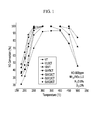
- FIG. 1 is, when ammonia was used as a reducing agent, a series of deNox efficiency data of a catalyst (VT) in which about 2% vanadium that is a catalyst active component was added to a titanium oxide (TiO 2 ) support, a catalyst (V10CT) in which 1 about 0% cerium that is a co-catalyst is added to the catalyst, a catalyst (SbVT) in which about 2% antimony oxide that is a co-catalyst was added to the catalyst, and a catalyst (SbV5CT-SbV20CT) in which cerium is added to a catalyst in which vanadium and antimony oxide were added in an amount of about 2%, respectively, while varying the content of cerium from about 5% to about 20%, according to the temperature.
- VT vanadium that is a catalyst active component was added to a titanium oxide (TiO 2 ) support
- V10CT in which 1 about 0% cerium that is a co-catalyst is
- the amount of nitrogen oxide and ammonia used at this time was about 800 ppm, respectively.
- the deNox efficiency of a catalyst when a co-catalyst is not added shows about 90% or more at about 300°C or more, but when antimony is added as a co-catalyst, a deNox efficiency of about 90% or more is shown from about 250°C, and thus it may be known that the addition of antimony may improve low-temperature deNox efficiency.
- FIG. 1 the deNox efficiency of a catalyst when a co-catalyst is not added shows about 90% or more at about 300°C or more, but when antimony is added as a co-catalyst, a deNox efficiency of about 90% or more is shown from about 250°C, and thus it may be known that the addition of antimony may improve low-temperature deNox efficiency.
- FIG. 1 the deNox efficiency of a catalyst when a co-catalyst is not added shows about 90% or more at about 300°C
- a catalyst prepared by mixing about 2 % vanadium that is a catalyst active component with a about 2 % precursor of antimony and about 5 % to about 15 % cerium, which are co-catalysts, and sintering the mixture shows a deNox efficiency of about 90 % or more even at a low temperature of about 225°C, compared to the case of impregnating about 2 % vanadium that is a catalyst active component and an antimony co-catalyst on titanium oxide, and thus, it may be known that low temperature deNox performance has been improved by using antimony and cerium as co-catalysts.
- the deNox performance may be improved even at a high temperature of about 400°C or more.
- the amount of cerium added is from about 5% to about 15%, the deNox efficiency is best improved in a wide range from low temperature to high temperature.
- FIG. 2 is a graph illustrating the deNox efficiency according to the amount of cerium supported at a temperature of about 250°C or less.
- a catalyst prepared by mixing about 2 % vanadium that is a catalyst active component with a about 2 % antimony and about 5 % to about 15 % cerium, which are co-catalysts, and sintering the mixture shows a deNox efficiency of about 90 % or more even at a temperature of about 225°C, compared to the case of impregnating about 2 % vanadium that is a catalyst active component and an antimony co-catalyst on titanium oxide, and thus, it may be known that low temperature deNox performance has been improved.
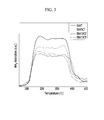
- FIG. 3 is a graph illustrating the amount of ammonia adsorbed and desorbed as a result of NH3-TPD (Temperature Programmed Desorption) experiments according to the amount of cerium supported.
- the amount of ammonia desorbed is caused by the peak area, and as known from FIG. 3 , it may be known that the ammonia desorption peak includes two peaks of a physisorbed peak with Bronsted acid points at approximately 80°C to approximately 200°C and a chemisorbed peak with Lewis acid points at approximately 250°C to approximately 400°C, and a catalyst with cerium supported has more Lewis acid points than a catalyst with no cerium supported.
- the result of deNOx efficiency is affected by the amount of ammonia adsorbed and desorbed, and thus it may be known that a catalyst with cerium supported in an amount from about 5 % to about 15 % has more acid points than a catalyst with cerium supported when compared to the deNox efficiency, and thus the deNOx efficiency has been improved.
- FIG. 4 is a graph illustrating vanadium oxide reduction peaks on the catalysts as a result of H 2 -TPR (Temperature Programmed Reduction) experiments according to the amount of cerium supported, and Table 2 shows the reduction temperatures of the catalysts and values obtained by calculating the amount of hydrogen consumed, according to the amount of cerium supported.
- Table 2 Catalyst name T max (°C) H 2 -uptake ( ⁇ mol/g) Comparative Example 1 SbVT 357 7.57 Example 1 SbV5CT 367 9.84 Example 2 SbV10CT 372 11.33 Example 3 SbV15CT 383 10.65
- the reduction temperature (T max ) As known from FIG. 4 and Table 2, as the amount of cerium supported was increased, the reduction temperature (T max ) was increased. This seems to be caused by interaction of vanadia (V 2 O 5 ) and ceria (CeO 2 ) on the surface of the catalyst, and the relationship between the increase in reduction temperature (T max ) and deNOx efficiency seems to be unrelated to each other.
- the area of the reduction peak is an amount of hydrogen consumed, this is a reduction peak from V 5+ to V 3+ of the vanadia (V 2 O 5 ) species on the catalyst, and as the amount of hydrogen consumed is increased, the deNOx efficiency at low temperature may be increased. Referring to the results of the experiments of FIG. 4 and Table 2, it may be known that a catalyst prepared by mixing about 10 % cerium therewith and sintering the mixture showed the largest amount of hydrogen consumed and the deNOx efficiency at low temperature was also the best.
- the deNOx efficiency of a deNOx reduction catalyst used in the reduction reaction of nitrogen oxide at low and high temperatures may be improved.
- poisoning tolerance characteristics to sulfur are also excellent.
- FIG. 5 is a series of data measuring the sulfur tolerance characteristics of a catalyst prepared by mixing about 2 % vanadium that is a catalyst active component, a about 2 % precursor of antimony and about 10 % cerium which are co-catalysts with a titania support and sintering the mixture.
- Table 3 is a result of XPS analysis in order to observe the chemical state on the surface of a catalyst prepared by mixing about 2 % vanadium that was a catalyst active component and about 2 % precursor of antimony and cerium, which were co-catalysts with a titania support and sintering the mixture.
- a catalyst with cerium supported had relatively higher atomic ratios of V/Ti and Sb/Ti on the surface of the catalyst than those of a catalyst with no cerium supported. Accordingly, it may be known that in the catalyst with cerium supported, vanadia (V 2 O 5 ) and antimony had been dispersed on the surface of the catalyst better than in the catalyst with no cerium supported.
- FIG. 6 is an 01s spectrum illustrating the oxygen state on the surface of the catalyst, illustrating lattice oxygen (529.3 eV to 530.2 eV, O ⁇ ) and chemisorbed oxygen (531.3 eV to 531.9 eV, O ⁇ ) on the surface of the catalyst.
- lattice oxygen (529.3 eV to 530.2 eV, O ⁇ )
- chemisorbed oxygen 531.3 eV to 531.9 eV, O ⁇
- the oxygen chemisorbed on the surface of the catalyst is an active oxygen that serves as a role of oxidizing NO into NO 2 in the deNox efficiency, and this is a factor of increasing the deNOx efficiency of the catalyst at low temperature.
- the experimental result coincides with the result of data of TPR that measures the amount of hydrogen consumed on the surface of the catalyst.
- FIGS. 7A and 7B are DRIFTS (diffuse reflectance infrared Fourier Transforms Spectroscopy) graphs for SbV10CT and SbVT catalysts, respectively.
- a group of peaks at 1330-1380 cm -1 were observed on SbV/TiO 2 catalyst, which could be assigned to the intermediates of ammonia oxidation species and their intensities increase drastically on SbV/TiO 2 catalyst above 250°C. This indicates that the direct oxidation of ammonia is provoked at higher temperatures over SbV/TiO 2 , which leads to lower NO x conversions for SbV/TiO 2 catalyst than ceria loaded catalysts above 350°C temperatures.
- FIG. 8 is a graph illustrating the result of the deNOx efficiency for the sulfur poisoning tolerance of the catalyst and a regeneration experiment that the deNOx efficiency of the catalyst had been recovered when the temperature was increased after the inactivation of the catalyst.
- a catalyst with cerium supported it may be known that when the catalyst was regenerated by increasing the temperature after the inactivation of the catalyst by sulfur poisoning tolerance for about 24 hours, the catalyst was regenerated into the initial active state of the catalyst within a short time, and it may be known that a catalyst with cerium supported had higher resistance to sulfur poisoning tolerance and a shorter regeneration time than a catalyst with no cerium supported.
- FIG. 9 is a graph illustrating the result of desorption and decomposition of ammonium sulfate salts on the surface of a catalyst according to the temperature after the inactivation of the catalyst by sulfur poisoning tolerance through TPD-mass.
- FIG. 9 it may be known that ammonium sulfate salts produced on the surface of a catalyst with cerium supported at a relatively lower temperature had been decomposed than a catalyst with no cerium supported, when the temperature was increased after the inactivation of the catalyst by sulfur poisoning tolerance. It may be known that the experimental result well coincides with a phenomenon that in the catalyst to which cerium was added, the regeneration of the poisoned catalyst occurs at a relatively low temperature.
Landscapes
- Chemical & Material Sciences (AREA)
- Engineering & Computer Science (AREA)
- Chemical Kinetics & Catalysis (AREA)
- Materials Engineering (AREA)
- Organic Chemistry (AREA)
- Environmental & Geological Engineering (AREA)
- Analytical Chemistry (AREA)
- Biomedical Technology (AREA)
- Health & Medical Sciences (AREA)
- General Chemical & Material Sciences (AREA)
- Oil, Petroleum & Natural Gas (AREA)
- Combustion & Propulsion (AREA)
- Physics & Mathematics (AREA)
- Thermal Sciences (AREA)
- Catalysts (AREA)
- Exhaust Gas Treatment By Means Of Catalyst (AREA)
Applications Claiming Priority (1)
| Application Number | Priority Date | Filing Date | Title |
|---|---|---|---|
| KR1020120110137A KR101284214B1 (ko) | 2012-10-04 | 2012-10-04 | 질소산화물 분해 촉매 및 그 제조 방법 |
Publications (2)
| Publication Number | Publication Date |
|---|---|
| EP2716364A1 true EP2716364A1 (fr) | 2014-04-09 |
| EP2716364B1 EP2716364B1 (fr) | 2023-06-14 |
Family
ID=47665986
Family Applications (1)
| Application Number | Title | Priority Date | Filing Date |
|---|---|---|---|
| EP13154042.9A Active EP2716364B1 (fr) | 2012-10-04 | 2013-02-05 | Catalyseur de décomposition d'oxyde d'azote et son procédé de préparation |
Country Status (5)
| Country | Link |
|---|---|
| US (1) | US10857519B2 (fr) |
| EP (1) | EP2716364B1 (fr) |
| JP (1) | JP5752159B2 (fr) |
| KR (1) | KR101284214B1 (fr) |
| CN (1) | CN103706351B (fr) |
Cited By (2)
| Publication number | Priority date | Publication date | Assignee | Title |
|---|---|---|---|---|
| EP3482825A1 (fr) * | 2017-11-14 | 2019-05-15 | Umicore Ag & Co. Kg | Catalyseur rcs |
| US11492945B2 (en) | 2017-11-14 | 2022-11-08 | Umicore Ag & Co. Kg | SCR catalyst |
Families Citing this family (11)
| Publication number | Priority date | Publication date | Assignee | Title |
|---|---|---|---|---|
| KR101513834B1 (ko) * | 2014-04-14 | 2015-04-20 | 두산엔진주식회사 | 선택적 촉매 환원을 위한 촉매 및 이의 제조방법 |
| CN104162349B (zh) * | 2014-07-23 | 2016-05-18 | 浙江大学 | 一种抑制低温脱硝催化剂so2中毒的方法 |
| KR101616669B1 (ko) * | 2015-01-29 | 2016-04-28 | 서울대학교산학협력단 | 질소산화물 환원 촉매 및 그 제조방법 |
| KR101566186B1 (ko) * | 2015-04-17 | 2015-11-05 | 지이큐솔루션 주식회사 | 초저배출 NOx 수관보일러 |
| CN107149941B (zh) * | 2016-03-03 | 2020-03-10 | 许承柱 | 利用催化废弃物的选择性还原反应的低温脱硝催化剂及其制造方法 |
| CN108620058B (zh) * | 2018-03-23 | 2021-01-26 | 大唐南京环保科技有限责任公司 | 一种宽温脱硝催化剂及其制备方法 |
| KR102161131B1 (ko) | 2018-03-26 | 2020-09-29 | 경기대학교 산학협력단 | 안티몬/티타니아 담체 및 그 제조방법, 상기 담체를 이용한 가스상 유해물질 제거를 위한 촉매 및 그 제조방법 |
| KR102170922B1 (ko) * | 2018-12-26 | 2020-10-29 | 에이치에스디엔진 주식회사 | 탈질 촉매의 제조방법 및 이에 의해 제조된 탈질 촉매 |
| CN110218304B (zh) * | 2019-07-02 | 2021-07-20 | 广昌立骅科技股份有限公司 | 一种自干型水性醇酸树脂的制备方法及其改性方法 |
| KR102715688B1 (ko) | 2021-10-21 | 2024-10-11 | 한국전력공사 | 석탄화력발전소 질소산화물 제거 촉매 및 그 제조방법 |
| KR102765429B1 (ko) | 2023-02-03 | 2025-02-07 | 연세대학교 산학협력단 | 황산화물 분위기에서 탈질촉매 특성이 강화된 4원계 강상관계 산화물 VxNi1-xWO4 및 이의 제조방법 |
Citations (1)
| Publication number | Priority date | Publication date | Assignee | Title |
|---|---|---|---|---|
| US20080249328A1 (en) * | 2007-04-03 | 2008-10-09 | Kaduk James A | Mixed metal oxide catalysts and catalytic conversions of lower alkane hydrocarbons |
Family Cites Families (10)
| Publication number | Priority date | Publication date | Assignee | Title |
|---|---|---|---|---|
| CA2154500C (fr) * | 1994-07-28 | 2001-10-02 | Kouzo Iida | Methodes de denitration de gaz d'echappement |
| CN1102453C (zh) | 1999-07-06 | 2003-03-05 | 中国石油化工集团公司 | 一种脱除烟气中氮氧化物和一氧化碳的催化剂的制备 |
| JP3510541B2 (ja) | 1999-09-14 | 2004-03-29 | 三菱重工業株式会社 | 排ガス処理用触媒、排ガス処理方法及び処理装置 |
| KR100427397B1 (ko) * | 2001-02-27 | 2004-04-27 | 세신전자(주) | 질소산화물 환원용 촉매의 제조방법 |
| AT412846B (de) | 2003-11-13 | 2005-08-25 | Treibacher Ind Ag | Abgaskatalysatorzusammensetzung |
| KR100671978B1 (ko) * | 2005-07-19 | 2007-01-24 | 한국과학기술연구원 | 탈질환원촉매 |
| JP5241277B2 (ja) | 2008-03-11 | 2013-07-17 | 日揮触媒化成株式会社 | 排ガス処理装置 |
| US7879759B2 (en) * | 2009-02-16 | 2011-02-01 | Augustine Steve M | Mobile DeNOx catalyst |
| JP5350935B2 (ja) | 2009-08-06 | 2013-11-27 | バブコック日立株式会社 | Co2回収装置排ガスの処理方法 |
| CN101947443B (zh) | 2010-09-03 | 2013-07-31 | 浙江省环境保护科学设计研究院 | 用于低温选择性催化还原脱硝反应的蜂窝状Mn-Ti基催化剂及制备和使用方法 |
-
2012
- 2012-10-04 KR KR1020120110137A patent/KR101284214B1/ko active Active
-
2013
- 2013-02-05 EP EP13154042.9A patent/EP2716364B1/fr active Active
- 2013-02-06 US US13/760,309 patent/US10857519B2/en active Active
- 2013-02-21 JP JP2013031986A patent/JP5752159B2/ja active Active
- 2013-03-13 CN CN201310080594.7A patent/CN103706351B/zh active Active
Patent Citations (1)
| Publication number | Priority date | Publication date | Assignee | Title |
|---|---|---|---|---|
| US20080249328A1 (en) * | 2007-04-03 | 2008-10-09 | Kaduk James A | Mixed metal oxide catalysts and catalytic conversions of lower alkane hydrocarbons |
Cited By (5)
| Publication number | Priority date | Publication date | Assignee | Title |
|---|---|---|---|---|
| EP3482825A1 (fr) * | 2017-11-14 | 2019-05-15 | Umicore Ag & Co. Kg | Catalyseur rcs |
| WO2019096785A1 (fr) * | 2017-11-14 | 2019-05-23 | Umicore Ag & Co. Kg | Catalyseur scr |
| US11135571B2 (en) | 2017-11-14 | 2021-10-05 | Umicore Ag & Co. Kg | SCR catalyst |
| US11492945B2 (en) | 2017-11-14 | 2022-11-08 | Umicore Ag & Co. Kg | SCR catalyst |
| US11498055B2 (en) | 2017-11-14 | 2022-11-15 | Umicore Ag & Co. Kg | SCR catalyst |
Also Published As
| Publication number | Publication date |
|---|---|
| JP5752159B2 (ja) | 2015-07-22 |
| JP2014073485A (ja) | 2014-04-24 |
| CN103706351B (zh) | 2016-03-09 |
| EP2716364B1 (fr) | 2023-06-14 |
| CN103706351A (zh) | 2014-04-09 |
| US20140100106A1 (en) | 2014-04-10 |
| KR101284214B1 (ko) | 2013-07-08 |
| US10857519B2 (en) | 2020-12-08 |
Similar Documents
| Publication | Publication Date | Title |
|---|---|---|
| EP2716364B1 (fr) | Catalyseur de décomposition d'oxyde d'azote et son procédé de préparation | |
| JP5185942B2 (ja) | 選択接触還元のためのバナジウム不含の触媒およびその製造方法 | |
| KR101807440B1 (ko) | 비-제올라이트 비금속 scr 촉매 | |
| JP4686553B2 (ja) | 炭化水素またはアルコールにより排気流中の窒素酸化物を還元するための触媒および方法 | |
| US6624113B2 (en) | Alkali metal/alkaline earth lean NOx catalyst | |
| US6455463B1 (en) | Alkaline earth/transition metal lean NOx catalyst | |
| JP2009538724A (ja) | ディーゼルエンジンの排気ガスから窒素含有有害ガスを減少させる触媒 | |
| CA2081963A1 (fr) | Systeme catalyseur destine au traitement des gaz d'echappement d'un moteur a gaz pauvre | |
| CN111203268A (zh) | 一种低温高效氨氧化催化剂 | |
| EP4039365A1 (fr) | Catalyseur rcs présentant une excellente tolérance au soufre | |
| JPH04354536A (ja) | 窒素酸化物分解触媒と窒素酸化物の分解方法 | |
| US20230249131A1 (en) | Method for reducing nitrogen dioxide in exhaust gas of stationary source without injection of reducing agent | |
| JP4901129B2 (ja) | 窒素酸化物接触還元用触媒 | |
| KR100870483B1 (ko) | 촉매용 캐리어 및 이를 이용한 촉매 | |
| US20060034740A1 (en) | Catalyst composition for use in a lean NOx trap and method of using | |
| KR101251499B1 (ko) | 질소 산화물 제거용 제올라이트 촉매, 이의 제조 방법 및 이를 이용한 질소 산화물 제거 방법 | |
| KR20220041443A (ko) | 질소 도핑된 이산화티타늄 지지체를 포함하는 선택적 환원 촉매 및 그의 제조방법 | |
| CN111530454B (zh) | 一种低温脱硝催化剂及其制备方法和应用 | |
| KR102877537B1 (ko) | 일산화탄소 산화 촉매 및 그 제조방법 | |
| KR101126247B1 (ko) | 희토류 금속을 함유하는 배기가스내 질소 산화물의 선택적 환원용 촉매 및 이의 제조방법 | |
| JP4881226B2 (ja) | 排ガス浄化用触媒および排ガス浄化方法 | |
| JP6674858B2 (ja) | 排ガス浄化触媒及びそれを用いた排ガス浄化装置 | |
| KR20230091060A (ko) | 금속지지체 및 질산암모늄을 이용한 선택적 촉매환원방법 | |
| KR100892528B1 (ko) | NOx 흡장-환원 촉매 조성물 | |
| KR101282690B1 (ko) | 내열성 강화 페롭스카이트계 촉매 |
Legal Events
| Date | Code | Title | Description |
|---|---|---|---|
| PUAI | Public reference made under article 153(3) epc to a published international application that has entered the european phase |
Free format text: ORIGINAL CODE: 0009012 |
|
| 17P | Request for examination filed |
Effective date: 20130226 |
|
| AK | Designated contracting states |
Kind code of ref document: A1 Designated state(s): AL AT BE BG CH CY CZ DE DK EE ES FI FR GB GR HR HU IE IS IT LI LT LU LV MC MK MT NL NO PL PT RO RS SE SI SK SM TR |
|
| AX | Request for extension of the european patent |
Extension state: BA ME |
|
| RBV | Designated contracting states (corrected) |
Designated state(s): AL AT BE BG CH CY CZ DE DK EE ES FI FR GB GR HR HU IE IS IT LI LT LU LV MC MK MT NL NO PL PT RO RS SE SI SK SM TR |
|
| STAA | Information on the status of an ep patent application or granted ep patent |
Free format text: STATUS: EXAMINATION IS IN PROGRESS |
|
| 17Q | First examination report despatched |
Effective date: 20190809 |
|
| GRAP | Despatch of communication of intention to grant a patent |
Free format text: ORIGINAL CODE: EPIDOSNIGR1 |
|
| STAA | Information on the status of an ep patent application or granted ep patent |
Free format text: STATUS: GRANT OF PATENT IS INTENDED |
|
| INTG | Intention to grant announced |
Effective date: 20230102 |
|
| GRAS | Grant fee paid |
Free format text: ORIGINAL CODE: EPIDOSNIGR3 |
|
| GRAA | (expected) grant |
Free format text: ORIGINAL CODE: 0009210 |
|
| STAA | Information on the status of an ep patent application or granted ep patent |
Free format text: STATUS: THE PATENT HAS BEEN GRANTED |
|
| AK | Designated contracting states |
Kind code of ref document: B1 Designated state(s): AL AT BE BG CH CY CZ DE DK EE ES FI FR GB GR HR HU IE IS IT LI LT LU LV MC MK MT NL NO PL PT RO RS SE SI SK SM TR |
|
| REG | Reference to a national code |
Ref country code: GB Ref legal event code: FG4D |
|
| REG | Reference to a national code |
Ref country code: CH Ref legal event code: EP |
|
| REG | Reference to a national code |
Ref country code: DE Ref legal event code: R096 Ref document number: 602013084042 Country of ref document: DE |
|
| REG | Reference to a national code |
Ref country code: AT Ref legal event code: REF Ref document number: 1578823 Country of ref document: AT Kind code of ref document: T Effective date: 20230715 |
|
| REG | Reference to a national code |
Ref country code: LT Ref legal event code: MG9D |
|
| REG | Reference to a national code |
Ref country code: NL Ref legal event code: MP Effective date: 20230614 |
|
| PG25 | Lapsed in a contracting state [announced via postgrant information from national office to epo] |
Ref country code: SE Free format text: LAPSE BECAUSE OF FAILURE TO SUBMIT A TRANSLATION OF THE DESCRIPTION OR TO PAY THE FEE WITHIN THE PRESCRIBED TIME-LIMIT Effective date: 20230614 Ref country code: NO Free format text: LAPSE BECAUSE OF FAILURE TO SUBMIT A TRANSLATION OF THE DESCRIPTION OR TO PAY THE FEE WITHIN THE PRESCRIBED TIME-LIMIT Effective date: 20230914 Ref country code: ES Free format text: LAPSE BECAUSE OF FAILURE TO SUBMIT A TRANSLATION OF THE DESCRIPTION OR TO PAY THE FEE WITHIN THE PRESCRIBED TIME-LIMIT Effective date: 20230614 |
|
| REG | Reference to a national code |
Ref country code: AT Ref legal event code: MK05 Ref document number: 1578823 Country of ref document: AT Kind code of ref document: T Effective date: 20230614 |
|
| PG25 | Lapsed in a contracting state [announced via postgrant information from national office to epo] |
Ref country code: RS Free format text: LAPSE BECAUSE OF FAILURE TO SUBMIT A TRANSLATION OF THE DESCRIPTION OR TO PAY THE FEE WITHIN THE PRESCRIBED TIME-LIMIT Effective date: 20230614 Ref country code: NL Free format text: LAPSE BECAUSE OF FAILURE TO SUBMIT A TRANSLATION OF THE DESCRIPTION OR TO PAY THE FEE WITHIN THE PRESCRIBED TIME-LIMIT Effective date: 20230614 Ref country code: LV Free format text: LAPSE BECAUSE OF FAILURE TO SUBMIT A TRANSLATION OF THE DESCRIPTION OR TO PAY THE FEE WITHIN THE PRESCRIBED TIME-LIMIT Effective date: 20230614 Ref country code: LT Free format text: LAPSE BECAUSE OF FAILURE TO SUBMIT A TRANSLATION OF THE DESCRIPTION OR TO PAY THE FEE WITHIN THE PRESCRIBED TIME-LIMIT Effective date: 20230614 Ref country code: HR Free format text: LAPSE BECAUSE OF FAILURE TO SUBMIT A TRANSLATION OF THE DESCRIPTION OR TO PAY THE FEE WITHIN THE PRESCRIBED TIME-LIMIT Effective date: 20230614 Ref country code: GR Free format text: LAPSE BECAUSE OF FAILURE TO SUBMIT A TRANSLATION OF THE DESCRIPTION OR TO PAY THE FEE WITHIN THE PRESCRIBED TIME-LIMIT Effective date: 20230915 |
|
| PG25 | Lapsed in a contracting state [announced via postgrant information from national office to epo] |
Ref country code: FI Free format text: LAPSE BECAUSE OF FAILURE TO SUBMIT A TRANSLATION OF THE DESCRIPTION OR TO PAY THE FEE WITHIN THE PRESCRIBED TIME-LIMIT Effective date: 20230614 |
|
| PG25 | Lapsed in a contracting state [announced via postgrant information from national office to epo] |
Ref country code: SK Free format text: LAPSE BECAUSE OF FAILURE TO SUBMIT A TRANSLATION OF THE DESCRIPTION OR TO PAY THE FEE WITHIN THE PRESCRIBED TIME-LIMIT Effective date: 20230614 |
|
| PG25 | Lapsed in a contracting state [announced via postgrant information from national office to epo] |
Ref country code: IS Free format text: LAPSE BECAUSE OF FAILURE TO SUBMIT A TRANSLATION OF THE DESCRIPTION OR TO PAY THE FEE WITHIN THE PRESCRIBED TIME-LIMIT Effective date: 20231014 |
|
| PG25 | Lapsed in a contracting state [announced via postgrant information from national office to epo] |
Ref country code: CZ Free format text: LAPSE BECAUSE OF FAILURE TO SUBMIT A TRANSLATION OF THE DESCRIPTION OR TO PAY THE FEE WITHIN THE PRESCRIBED TIME-LIMIT Effective date: 20230614 Ref country code: AT Free format text: LAPSE BECAUSE OF FAILURE TO SUBMIT A TRANSLATION OF THE DESCRIPTION OR TO PAY THE FEE WITHIN THE PRESCRIBED TIME-LIMIT Effective date: 20230614 Ref country code: SM Free format text: LAPSE BECAUSE OF FAILURE TO SUBMIT A TRANSLATION OF THE DESCRIPTION OR TO PAY THE FEE WITHIN THE PRESCRIBED TIME-LIMIT Effective date: 20230614 Ref country code: SK Free format text: LAPSE BECAUSE OF FAILURE TO SUBMIT A TRANSLATION OF THE DESCRIPTION OR TO PAY THE FEE WITHIN THE PRESCRIBED TIME-LIMIT Effective date: 20230614 Ref country code: RO Free format text: LAPSE BECAUSE OF FAILURE TO SUBMIT A TRANSLATION OF THE DESCRIPTION OR TO PAY THE FEE WITHIN THE PRESCRIBED TIME-LIMIT Effective date: 20230614 Ref country code: PT Free format text: LAPSE BECAUSE OF FAILURE TO SUBMIT A TRANSLATION OF THE DESCRIPTION OR TO PAY THE FEE WITHIN THE PRESCRIBED TIME-LIMIT Effective date: 20231016 Ref country code: IS Free format text: LAPSE BECAUSE OF FAILURE TO SUBMIT A TRANSLATION OF THE DESCRIPTION OR TO PAY THE FEE WITHIN THE PRESCRIBED TIME-LIMIT Effective date: 20231014 Ref country code: EE Free format text: LAPSE BECAUSE OF FAILURE TO SUBMIT A TRANSLATION OF THE DESCRIPTION OR TO PAY THE FEE WITHIN THE PRESCRIBED TIME-LIMIT Effective date: 20230614 |
|
| PG25 | Lapsed in a contracting state [announced via postgrant information from national office to epo] |
Ref country code: PL Free format text: LAPSE BECAUSE OF FAILURE TO SUBMIT A TRANSLATION OF THE DESCRIPTION OR TO PAY THE FEE WITHIN THE PRESCRIBED TIME-LIMIT Effective date: 20230614 |
|
| REG | Reference to a national code |
Ref country code: DE Ref legal event code: R097 Ref document number: 602013084042 Country of ref document: DE |
|
| PLBE | No opposition filed within time limit |
Free format text: ORIGINAL CODE: 0009261 |
|
| STAA | Information on the status of an ep patent application or granted ep patent |
Free format text: STATUS: NO OPPOSITION FILED WITHIN TIME LIMIT |
|
| PG25 | Lapsed in a contracting state [announced via postgrant information from national office to epo] |
Ref country code: DK Free format text: LAPSE BECAUSE OF FAILURE TO SUBMIT A TRANSLATION OF THE DESCRIPTION OR TO PAY THE FEE WITHIN THE PRESCRIBED TIME-LIMIT Effective date: 20230614 |
|
| PG25 | Lapsed in a contracting state [announced via postgrant information from national office to epo] |
Ref country code: SI Free format text: LAPSE BECAUSE OF FAILURE TO SUBMIT A TRANSLATION OF THE DESCRIPTION OR TO PAY THE FEE WITHIN THE PRESCRIBED TIME-LIMIT Effective date: 20230614 |
|
| 26N | No opposition filed |
Effective date: 20240315 |
|
| PG25 | Lapsed in a contracting state [announced via postgrant information from national office to epo] |
Ref country code: SI Free format text: LAPSE BECAUSE OF FAILURE TO SUBMIT A TRANSLATION OF THE DESCRIPTION OR TO PAY THE FEE WITHIN THE PRESCRIBED TIME-LIMIT Effective date: 20230614 Ref country code: IT Free format text: LAPSE BECAUSE OF FAILURE TO SUBMIT A TRANSLATION OF THE DESCRIPTION OR TO PAY THE FEE WITHIN THE PRESCRIBED TIME-LIMIT Effective date: 20230614 |
|
| PG25 | Lapsed in a contracting state [announced via postgrant information from national office to epo] |
Ref country code: MC Free format text: LAPSE BECAUSE OF FAILURE TO SUBMIT A TRANSLATION OF THE DESCRIPTION OR TO PAY THE FEE WITHIN THE PRESCRIBED TIME-LIMIT Effective date: 20230614 |
|
| REG | Reference to a national code |
Ref country code: CH Ref legal event code: PL |
|
| PG25 | Lapsed in a contracting state [announced via postgrant information from national office to epo] |
Ref country code: LU Free format text: LAPSE BECAUSE OF NON-PAYMENT OF DUE FEES Effective date: 20240205 |
|
| PG25 | Lapsed in a contracting state [announced via postgrant information from national office to epo] |
Ref country code: CH Free format text: LAPSE BECAUSE OF NON-PAYMENT OF DUE FEES Effective date: 20240229 |
|
| PG25 | Lapsed in a contracting state [announced via postgrant information from national office to epo] |
Ref country code: LU Free format text: LAPSE BECAUSE OF NON-PAYMENT OF DUE FEES Effective date: 20240205 Ref country code: CH Free format text: LAPSE BECAUSE OF NON-PAYMENT OF DUE FEES Effective date: 20240229 |
|
| PG25 | Lapsed in a contracting state [announced via postgrant information from national office to epo] |
Ref country code: BG Free format text: LAPSE BECAUSE OF FAILURE TO SUBMIT A TRANSLATION OF THE DESCRIPTION OR TO PAY THE FEE WITHIN THE PRESCRIBED TIME-LIMIT Effective date: 20230614 |
|
| PG25 | Lapsed in a contracting state [announced via postgrant information from national office to epo] |
Ref country code: BG Free format text: LAPSE BECAUSE OF FAILURE TO SUBMIT A TRANSLATION OF THE DESCRIPTION OR TO PAY THE FEE WITHIN THE PRESCRIBED TIME-LIMIT Effective date: 20230614 |
|
| REG | Reference to a national code |
Ref country code: BE Ref legal event code: MM Effective date: 20240229 |
|
| PG25 | Lapsed in a contracting state [announced via postgrant information from national office to epo] |
Ref country code: BE Free format text: LAPSE BECAUSE OF NON-PAYMENT OF DUE FEES Effective date: 20240229 |
|
| PG25 | Lapsed in a contracting state [announced via postgrant information from national office to epo] |
Ref country code: FR Free format text: LAPSE BECAUSE OF NON-PAYMENT OF DUE FEES Effective date: 20240229 |
|
| PG25 | Lapsed in a contracting state [announced via postgrant information from national office to epo] |
Ref country code: IE Free format text: LAPSE BECAUSE OF NON-PAYMENT OF DUE FEES Effective date: 20240205 |
|
| PG25 | Lapsed in a contracting state [announced via postgrant information from national office to epo] |
Ref country code: IE Free format text: LAPSE BECAUSE OF NON-PAYMENT OF DUE FEES Effective date: 20240205 Ref country code: FR Free format text: LAPSE BECAUSE OF NON-PAYMENT OF DUE FEES Effective date: 20240229 Ref country code: BE Free format text: LAPSE BECAUSE OF NON-PAYMENT OF DUE FEES Effective date: 20240229 |
|
| PG25 | Lapsed in a contracting state [announced via postgrant information from national office to epo] |
Ref country code: CY Free format text: LAPSE BECAUSE OF FAILURE TO SUBMIT A TRANSLATION OF THE DESCRIPTION OR TO PAY THE FEE WITHIN THE PRESCRIBED TIME-LIMIT; INVALID AB INITIO Effective date: 20130205 |
|
| PG25 | Lapsed in a contracting state [announced via postgrant information from national office to epo] |
Ref country code: HU Free format text: LAPSE BECAUSE OF FAILURE TO SUBMIT A TRANSLATION OF THE DESCRIPTION OR TO PAY THE FEE WITHIN THE PRESCRIBED TIME-LIMIT; INVALID AB INITIO Effective date: 20130205 |
|
| PG25 | Lapsed in a contracting state [announced via postgrant information from national office to epo] |
Ref country code: TR Free format text: LAPSE BECAUSE OF FAILURE TO SUBMIT A TRANSLATION OF THE DESCRIPTION OR TO PAY THE FEE WITHIN THE PRESCRIBED TIME-LIMIT Effective date: 20230614 |
|
| PGFP | Annual fee paid to national office [announced via postgrant information from national office to epo] |
Ref country code: GB Payment date: 20260122 Year of fee payment: 14 |
|
| PGFP | Annual fee paid to national office [announced via postgrant information from national office to epo] |
Ref country code: DE Payment date: 20260120 Year of fee payment: 14 |