EP2720168A1 - Système et procédé de libération d'une connexion de données entre un terminal et une passerelle d'un serveur de courrier électronique - Google Patents
Système et procédé de libération d'une connexion de données entre un terminal et une passerelle d'un serveur de courrier électronique Download PDFInfo
- Publication number
- EP2720168A1 EP2720168A1 EP12188565.1A EP12188565A EP2720168A1 EP 2720168 A1 EP2720168 A1 EP 2720168A1 EP 12188565 A EP12188565 A EP 12188565A EP 2720168 A1 EP2720168 A1 EP 2720168A1
- Authority
- EP
- European Patent Office
- Prior art keywords
- terminal
- server
- connection
- mail server
- terminals
- Prior art date
- Legal status (The legal status is an assumption and is not a legal conclusion. Google has not performed a legal analysis and makes no representation as to the accuracy of the status listed.)
- Withdrawn
Links
Images


Classifications
-
- G—PHYSICS
- G06—COMPUTING OR CALCULATING; COUNTING
- G06F—ELECTRIC DIGITAL DATA PROCESSING
- G06F21/00—Security arrangements for protecting computers, components thereof, programs or data against unauthorised activity
- G06F21/30—Authentication, i.e. establishing the identity or authorisation of security principals
- G06F21/44—Program or device authentication
-
- H—ELECTRICITY
- H04—ELECTRIC COMMUNICATION TECHNIQUE
- H04L—TRANSMISSION OF DIGITAL INFORMATION, e.g. TELEGRAPHIC COMMUNICATION
- H04L51/00—User-to-user messaging in packet-switching networks, transmitted according to store-and-forward or real-time protocols, e.g. e-mail
- H04L51/21—Monitoring or handling of messages
- H04L51/212—Monitoring or handling of messages using filtering or selective blocking
Definitions
- the invention relates to a system and a method for enabling a data connection between a terminal and a gateway of an e-mail server.
- the currently most widespread e-mail servers are Microsoft ® Exchange and IBM ® Lotus Domino.
- gateways which communicate with mobile terminals and synchronize the data between the mobile terminals with the respective server.
- the appropriate gateway from Microsoft ® is called Microsoft ® CAS (Client Access Services for Exchange).
- Microsoft ® CAS Client Access Services for Exchange
- said functions also include the authentication of mobile terminals by means of terminal-specific codes, such as a device ID, IMEI.
- a device-specific access control is therefore very advantageous because it can then be decided device-specific, whether the respective device gets access to the server.
- the device-specific access control differs fundamentally from the user-specific access control in the administration, since each device is to be managed individually and also in the definition of the access rules, since in this case the individual configuration of the respective device can be taken into account.
- IBM distributes a gateway for bidirectional wireless synchronization between the IBM Lotus Domino e-mail server and certain mobile devices, called IBM® Lotus® Notes Traveler.
- IBM Lotus Notes Traveler synchronizes e-mail, calendar data, tasks, address book, and journal data in real time.
- a Lotus Notes or Lotus iNotes user is automatically enabled as a Lotus Notes Traveler user.
- Users of each mobile device need only install the appropriate client software and target the device to an IBM Lotus Domino server with a Lotus Notes Traveler Gateway. The connection between the mobile device and the server is established automatically and the synchronization is started automatically.
- the Applicant has added similar features to the IBM Lotus Notes Traveler gateway in an unpublished project.
- rules were provided that were accessed in IBM Lotus Notes Traveler on a special database in which the different possible connection requests from devices are stored, so that, depending on a comparison with the contents of the database access to the e-mail server IBM Lotus Domino allowed or refused.
- This system worked well for a small number of terminals.
- it has not been useful for a large number of terminals, especially more than a few thousand terminals, because the size of the database has become too large and the number of accesses to the database has become so much that there is no adequate response time on a request of a terminal to the gateway of the e-mail server.
- the system could not be operated due to overload.
- the invention is therefore an object of the invention to provide a system and a method for enabling a data connection between a terminal and a gateway of an e-mail server, with the simple way the access of the Terminal devices can be controlled by device-specific information and short response times are possible even with a large number of terminals.
- the inventive system and method for releasing a data connection between a terminal and a gateway of an e-mail server have a filter for filtering connection requests from terminals.
- the filter is independent of the gateway and coupled via a program interface (API) to a standard web server.
- the filter is designed such that it can refuse or release it after an authorization check of the connection request, a shared connection request being forwarded to the gateway for carrying out the further communication with the respective terminal.
- the authorization check of the connection request comprises at least the checking of a code specific to the respective terminal.
- the filter for filtering connection requests from terminals is not provided at the gateway, but is formed independently of the gateway and coupled to a standard web server.
- a standard web server in the sense of the present invention is a computer-executable computer program that downloads files to clients, e.g. Web browser, where the default web server does not have filters for device-specific filtering of connection requests.
- the files are usually transferred according to the http or https protocol.
- the filter according to the invention can also be easily implemented on a standard web server, even if the standard web server is not specifically designed for this purpose.
- the standard web server merely has to have a program interface (API) with which a program can be coupled to the web server.
- API program interface
- the program interface of a standard web server was originally intended to make web pages executable very quickly, as via the program interface to the standard web server coupled web pages are executed directly from the core of the standard web server and the Most or all data is processed in the cache memory.
- connection requests corresponding to a synchronization protocol for synchronizing data from a mobile terminal with an e-mail server such as the ActiveSync ® protocol or the Open sync protocol.
- an e-mail server such as the ActiveSync ® protocol or the Open sync protocol.
- the use of standardized protocols allows, on the one hand, the connection of terminal devices that operate according to these protocols, and on the other hand, the individual steps to be performed in the filtering are carried out according to standardized rules, which comprise only a few steps and are easy to implement in the corresponding program code.
- connection requests are based on the http protocol or the https protocol.
- a DMS server which has a plurality of communication modules which each communicate with at least one terminal in order to transmit a device status of the respective terminal to the DMS server. Based on the device status, a connection status with at least the values "connect” and "disconnect” is determined and entered in a consolidated list.
- the consolidated list is transmitted to a filter provided on an e-mail server, wherein in a connection request of a terminal on the e-mail server, the connection status associated with the respective terminal is taken into account in the authorization of the respective terminal by means of the filter.
- a connection request to the e-mail server can also be checked with a user-specific authorization as to whether a user is authorized to access the data of the e-mail server, and only if both the terminal used by the user and the user himself are authorized, the user is allowed to access the e-mail server.
- This user-specific authorization is preferably carried out on the basis of data transmitted with the connection request, in particular of at least one user-specific identification transmitted with the connection request, so as to ensure that the connection request originates from a correct user.
- This user-specific identification transmitted with the connection request can be compared with corresponding data transmitted with the consolidated list in order to obtain an additional security level.
- the communication modules can be configured differently and in each case communicate with a plurality of the terminals of a client. As a result, different compilations of the device status can be transmitted from the terminals of different clients and / or the communication can be executed in different ways, in particular according to different security rules, between the terminals of different clients.
- the transferred device statuses of the terminals of a client are entered in a client file, for each client one client file is kept.
- a compliance module determines or checks the connection status based on the device status of the respective terminal and enters it in the corresponding client file.
- a grabber module reads the connection status from the multiple tenant files and enters it into the consolidated list.
- the filter coupled to the e-mail server can be kept updated with little communication effort on the connection status of the plurality of terminals.
- This aspect of the invention represents an independent idea of the invention, which can also be used in conjunction with a device-specific filter which is not integrated independently of the gateway or into an e-mail server.
- the traffic between the DMS server and the filter involves few transfers. This greatly simplifies the communication between the DMS server and the filter as compared to a method whereby each communication module would separately exchange the connection status with the filter.
- the entire consolidated list is maintained at relatively large intervals of e.g. 2 to 24 hours from the DMS server to the filter.
- Delta lists containing only the changes since the last transmission of the list are displayed at shorter intervals of e.g. periodically from the DMS server to the filter for five minutes to two hours.
- the transmission of the lists preferably takes place in that the filter retrieves the corresponding lists from the DMS server.
- the individual communication modules are realized, for example, as services, in particular web services, on the DMS server. They preferably receive a device status from the respective terminals at regular intervals.
- This device status contains a device-specific identification, and may contain further information about the configuration, the status and the use of the respective terminal. In particular, the further information includes a list of all installed applications and statistical data for use of the respective applications.
- the DMS server can be configured with a compliance module that analyzes the device status of the individual terminals and can block a connection to the e-mail server according to predetermined rules.
- the compliance module thus continuously monitors the activities on the terminal, and if, for example, an unauthorized application is installed on a terminal, the connection to the e-mail server is blocked. Therefore, authorization by the compliance module is also called dynamic authorization.
- This dynamic authorization can be subject to a wide variety of rules. If, for example, the terminal does not transmit to the communication module within a predetermined time interval of the terminal status, then the connection is blocked. When a connection is blocked, the compliance module enters the connection status "disconnect" for the respective terminal in the consolidated list. It is also possible to supplement this connection status with detailed status information, which can also be entered in the list or transmitted to the e-mail server with a separate message.
- the filter for filtering connection requests preferably has a DPM module (Device Permission Manager), in which the connection status of the individual terminals is kept. With the help of the DMS server and the regular transmission of the consolidated list or the consolidated delta list, the connection status at the DPM module is regularly updated. In the case of a connection request arriving at the web server, the filter can thus access a current connection status in order to check the connection request.
- DPM module Device Permission Manager
- compliance rules can be implemented, which define which terminals can always be connected and / or which terminals are not allowed to be connected. An administrator of the system can thus specify which terminals can be released or are to be blocked in principle.
- a static connection status list which lists devices that are not allowed to connect, is called a blacklist.
- a static connection status list that lists devices that are allowed to connect is called a whitelist.
- the examination of the connection request by the filter is preferably carried out in two stages, an input check and a subsequent release check.
- the entrance check first checks whether the request arriving at the web server is a connection request for releasing a data connection between a terminal and a gateway of the e-mail server. This check takes place, for example, on the basis of a URL transmitted during the request and / or of a path specified in the URL and / or of a user agent named in the URL.
- the user agent describes the respective terminal, in particular the type of the terminal and the operating system used on the terminal.
- the URL may contain an explicit call to the filter or the gateway, making it a connection request.
- this connection request is recognized as such by the filter, then it can be confirmed to the terminal, whereby the terminal transmits further data in a further data exchange with the web server, which contain at least one terminal-specific code.
- These additional data are checked in the release check by the filter, in particular with the help of the DPM module, and released if they comply with the compliance rules.
- a shared connection request is then forwarded by the filter to the e-mail server's gateway so that the gateway communicates directly with the respective terminal to synchronize e-mail data between the terminal and the e-mail server.
- the methods according to the invention can be realized as software.
- the software can be stored and executed on one or more computers.
- the software can be stored on a data medium.
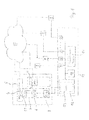
- the e-mail server 2 includes all the computer program elements necessary to manage, receive and send e-mails. In Fig. 1 only one gateway 4 of the e-mail server 2 is shown. In addition, the e-mail server 2 has various other program elements, such as at least one database for storing the e-mails and various utilities, such as an editor, for editing the e-mails.
- a web server 5 which serves to transfer files or documents to clients.
- the web server 5 has a program interface 6 (API; Application Programming Interface).
- the filter for filtering connection requests from terminals.
- the filter comprises a filter module 17, a DPM module 8 (Device Permission Manager) and a requester 9.
- the filter 7 is coupled to the filter module 17 to the program interface 6.
- the filter module 17 is connected to the DPM module 8, in which a connection status is maintained for each terminal 1, which can in principle issue a connection request for a connection to the e-mail server 2.
- the connection statuses of the terminals 1 are stored in one or more lists. These connection status lists include at least one static connection status list in which the connection status for certain terminals is stored and which is not changed during normal operation. An operator can manually change the connection status in the static connection status list, or certain functions can temporarily change the connection status automatically, such as importing an external list. Furthermore, there is preferably a dynamic connection status list, which can be changed regularly during operation, as explained in more detail below.
- the DPM module 8 provides the data of the connection status lists to the filter module 17 for checking a connection request.
- a terminal can either be allowed or denied the connection to the e-mail server.
- the rule that a terminal not included in any of the connection status lists is allowed to connect to the e-mail server and after the login phase can be applied is switched to the rule that a terminal that is not included in any of the connection status lists, the connection to the e-mail server is not allowed.
- end devices can connect to the e-mail server and be registered. After the registration phase, unregistered devices will not be allowed to connect to the e-mail server.
- the DPM module 8 is connected to a requester 9, which can retrieve data from a DMS server 10.
- the DMS server 10 (Device Management Server) is a computer program package that supports the management of the terminals.
- the DMS server 10 may be installed and executed on the server computer 3 on which the e-mail server 2 is installed. However, the DMS server 10 may also be installed and executed on a separate server computer.
- the DMS server 10 has a plurality of communication modules 11, which each communicate with at least one of the terminals 1.
- the communication modules are designed, for example, as services, in particular web services, on the DMS server 10.
- a communication module 11 communicates with all terminals of a single Clients.
- a client-specific communication structure can be implemented on the DMS server, so that the communication for the respective clients takes place according to different specifications (policies).
- the communication modules 11 communicate with a web service 12 on which a consolidated list 13 is stored.
- the web service 12 provides the consolidated list 13 for retrieval by the requester 9.
- the web service 12 provides the retrieval of the entire consolidated list 13 and a consolidated delta list, the delta list containing only the data records of the terminals in which changes since the last call of the consolidated list or consolidated delta list.
- the communication modules 11 receive at regular intervals a device status of the respective terminals 1 and enter this in a client file.
- the device status has at least one device-specific identification and communication data and / or configuration data.
- Communication data describes, for example, the communication connections (exchange of e-mails, telephone connections or Internet connections) of the respective terminal in a specific period of time.
- Configuration data describes parts of the software and hardware configured on the terminal. This data can already be summarized on the terminal to statistics, then the statistics are added to the device status.
- the composition of the device status usually differs for the different clients. For certain clients, detailed communication data is included, especially if the corresponding terminals confidential information is to be transmitted, for other clients, the configuration data is more extensive.
- a client file For each communication module a client file is provided, which can be kept at the communication module or at another point of the DMS server 10.
- the client files thus comprise the device statuses of all terminals of the respective client.
- a compliance module 14 is provided which, according to predetermined compliance rules (policies), checks on the basis of the device status received from the communication modules 11 and entered in the client files whether the respective terminals 1 are in principle connected to the e-mail server. Server 2 may be connected. The compliance module 14 derives a connection status from the respective device status and enters it in the corresponding client file or changes it if necessary.
- predetermined compliance rules policies
- connection status includes at least the two values "connect” and "disconnect”.
- connect status "connect” and “disconnect” may be encoded with any other predetermined string and / or flag in the client files.
- different rules may be provided, such as that the device status must be transmitted from the terminal 1 within a predetermined time interval to the respective communication module 11, otherwise the communication status "disconnect" is set or if, based on the device status, it can be determined that unauthorized applications are installed on the respective terminal 1, the connection status is also set to "disconnect".
- the monitoring of the device status of the terminals 1 is carried out continuously during operation by means of the compliance module 14 and takes into account changes in the device state during the operation of the terminals 1. Therefore, the determination of the connection status by the compliance module 14 on the basis of the device status as a dynamic authorization designated.
- the monitoring of the connection status can be carried out for the individual clients according to different rules, ie client-specific.
- a grabber module 16 is provided which can read the client files of all communication modules and reads out certain information about the individual terminals 1, in particular the connection status and a device-specific identification and optionally a user-specific identification and enters the consolidated list 13.
- client programs are installed and run there, on the one hand the communication modules 11 at regular intervals to communicate the device status and on the other hand to synchronize e-mail data via the Internet 15 between the e-mail server and the terminals .
- the terminals 1 are preferably mobile terminals. In certain types of mobile terminals, such a client program is already included in the basic configuration.
- These client programs can communicate to predetermined protocols, in particular the ActiveSync ® protocol or opensync protocol.
- the device module of the individual terminals 1 is detected by the communication module 11.
- the device status can include not only the device-specific identification but also configuration data and / or communication data.
- the configuration data describe the programs installed on the respective terminal 1 and the installed operating system.
- the configuration data may also include adjustment parameters of the operating system or programs.
- the communication data describes the communication of the terminal with other devices.
- the communication data may include information about the communication partners, statistics and the like.
- the device status entered in each case is entered in the respective client files.
- the compliance module 14 determines the connection status and evaluates this the device status. This can be done at predetermined intervals or be event driven, each time the device status in the client file of the respective terminal is changed.
- connection status is read out of the client files by the grabber module 16 and entered into the consolidated list 13 in a data record which is assigned to the respective terminal.
- these records may still contain selected information except the connection status.
- these records contain a device-specific code, so that the record can be uniquely assigned to a specific terminal 1.
- This DMS server 10 is designed multi-client capable.
- An e-mail server 2 has a database, wherein the e-mail data is stored in the database.
- a tenant includes all users or users who can access e-mail information in a single, specific database. To do this you must correctly authorize the e-mail server as a user of one of the specific databases.
- For the access to e-mail data of an e-mail server there are in the prior art established rules with which a user who belongs to a particular client can not read the e-mail data of another client. There are e.g. a system that requires a separate certificate for each client. E-mail servers thus have an authorization module for authorizing the access of users to a particular database.
- connection request based on the data contained in the consolidated list can also be a connection request to the e-mail server with and only if both the user-used terminal and the user himself are authorized, the user is allowed access to the e-mail server.
- an incoming connection request is checked as to whether the user from whom the connection request originates is authorized to access the data of the e-mail server.
- This user-specific authorization is preferably carried out on the basis of data transmitted with the connection request, in particular of at least one user-specific identification transmitted with the connection request.
- this user-specific identification transmitted with the connection request can be compared with corresponding data transmitted with the consolidated list in order to obtain an additional security level.
- This user-specific authorization is executed independently of the device-specific filtering.
- the inventive system comprising the filter 7 and the DMS server 10 does not replace the user-specific authorization on the e-mail server 2, but provides an additional device-specific authorization.
- a terminal 1 must be enabled by the filter 7 so that a user using the respective terminal 1 can authenticate himself as a user at the e-mail server 2 for synchronizing the e-mail data.
- the filter 7 can perform no or optionally only limited authorization with respect to the user with regard to the user. Due to the decoupling of the user-specific authorization at the e-mail server 2, the device-specific identifications can be collected and checked independently of the connection requests at the DMS server.
- the client-specific communication structure is not transferred to the consolidated list 13.
- the client-specific communication structure often required due to different hardware and software systems of different clients and / or different security policies of different clients is removed when transferring the data to the connection status in the consolidated list.
- the provided on the DMS server 10 communication modules 11 can communicate with terminals 1 different clients simultaneously and on the other hand, the connection data from a variety of devices - even from different clients - can be transmitted with low data volume and little communication effort to the filter. This is possible since the filtering according to the invention precedes the authorization of the e-mail server 2 and is independent of this. Due to the multi-client capability of the DMS server 10, the device-specific access data and the device-specific check to an e-mail server can be detected via a single central DMS server.
- a DMS server can be used to manage several 100 to a few thousand clients, each with a few to a few thousand terminals.
- the DMS server 10 is preferably implemented on a server computer separate from the e-mail server 2, so that the communication with the individual terminals does not affect the performance of the e-mail server 2. It is even possible that two or more consolidated lists 13 are maintained on a DMS server, with which device-specific access to a different e-mail server is controlled in each case. That is, each consolidated list 13 is assigned a filter 7 to a particular e-mail server 2, respectively.
- the DMS server 10 or the communication modules 11 and the DMS server 10 are designed such that the terminals 1 of a client in each case by means of a specific URL access the DMS server 10 and the terminals of a client in each case with a particular of the communication modules 11 communicate. This means that each client has a separate URL set up on the DMS server.
- the requester 9 calls the consolidated list 13 at regular intervals from the web server 12 and supplies the corresponding data to the DPM module 8.
- the connection status of the consolidated list becomes dynamic Connection status list entered.
- the DPM module 8 can check the data received from the DMS server 10 and if necessary change the communication status.
- a whitelist and a blacklist are provided as static connection status lists.
- the whitelist contains entries of the terminals that are allowed to communicate with the e-mail server 2.
- the blacklist contains entries of terminals that are not allowed to communicate with the e-mail server 2.
- the consolidated list 13 is preferably maintained as an xml file or in another markup language on the web server 12.
- FIG. 3 exemplifies such a consolidated list 13.
- "ManagedMemberList xmlns: xsi http: //www.w3.org./2001/XMLSchema-instance”
- noNamespaceSchemaLocation "managedmemberlist.xsd” means a reference to the schema with which to render this xml file.
- the notes between the tags " ⁇ ! - -" and "- ->" contain the information from which sources the respective device statuses are read. In the present embodiment, it is merely a single client referred to as "amagu". These annotations are automatically generated and tell the operator the source of this xml file.
- the identification "allow” is assigned to the first group and the identification "deny” to the second group.
- FIG. 4 shows a consolidated list of both device-specific identifications and the optional user-specific identifications.
- the first group, labeled "allow”, represents the whitelist and the second group, labeled “deny”, represents the blacklist FIG. 3 and 4 comprise only four entries. Even if these lists are supplemented by a few thousand entries, the amount of data is still so small that it can be transferred from the DMS server to the requester 9 in the shortest possible time.
- the blacklist can be used. If the registration phase is completed and the normal operating phase begins, then only the whitelist can be used, with all devices registered during the registration phase being entered in the whitelist.
- the exclusive use of the whitelist means that a device that is not included in the whitelist may not communicate with the gateway. Of course it is also possible to use the blacklist and the whitelist permanently.
- the held in the DPM module 8 communication status is thus updated by the DMS server 10 at regular intervals. Since the connection status of the plurality of terminals 1 is entered in the DMS server 10 in a common consolidated list and only this list or a delta list is transmitted to the DPM module 8, the cost of data transfer is much lower than if the individual communication modules 11 separately report the respective status to the DPM module 8. As a result, the connection status at the DPM module 8 can be reliably updated for a plurality of terminals, and the data transfer between the DMS server 10 and the DPM module 8 does not restrict the number of the terminals 1. In addition, a comprehensive examination of the respective device status of the terminals 1 can take place on the DMS server, without affecting the operation of the e-mail server.
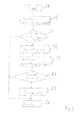
- the client program at the terminal 1 To establish a connection between one of the terminals and the e-mail server 2, the client program at the terminal 1 generates a connection request, which is transmitted via the Internet 15 to the web server 5. As a result, the in Fig. 2 shown method for checking the connection request is triggered (S1 start).
- connection request is transmitted, for example, as an http request.
- step S2 the connection request is analyzed and the method, the path, the query and the user agent are extracted from the requested / called URL.
- the user agent information includes the type of web browser used on the terminal, the type of terminal and CPU data, and other software configuration information at that terminal.
- gateway 4 In the path the present embodiment used is called the gateway "Traveler” and this gateway 4 is to be called with the function Microsoft-Server-ActiveSync, with which an authorization and synchronization according to the ActiveSync® standard is performed.
- the query specifies the CND Sync command, the rmjones user, the v140 device identification number, and the iPhone device type.
- the filter module 17 forwards the values of the user agent and the path to the DPM module 8, which checks on the basis of these values whether a correct connection request is present (step S3). If this is not the case, the authentication method is aborted and the procedure goes to step S4 (end).
- the filter module 17 transmits a corresponding confirmation to the respective terminal 1 (step S5).
- the terminal can then transmit further information to the web server 5, which is detected and analyzed by the filter module 17.
- Whether further communication between the terminal 1 and the web server 5 is necessary depends on the standard used. In principle, it is possible that all information is already transmitted in the first connection request. In most standards, however, it is the case that first a connection request is made and after receiving a confirmation with one or more other messages, additional information, in particular device-specific information, is transmitted. Therefore, it is expedient to carry out an additional release check in step S6 and S7 in addition to the input check in steps S2 and S3.
- step S6 the corresponding data is analyzed, that is, the relevant data, in particular a device-specific code, is extracted from the information transmitted from the terminal 1 (step S6) and transmitted to the DPM module 8 for checking. If the device-specific code is not correct, then the method is aborted and the procedure goes to step S4. However, if the authorization request indicates that the connection request can be released, whereby at least one correct device-specific code must be present, then the connection request is released in step S8.
- the connection request is forwarded together with the corresponding communication data of the respective terminal 1 to the gateway 4, which then establishes a connection to this terminal 1 to exchange e-mail data between the terminal 1 and the e-mail server 2 or to synchronize.
- the filter 7 is formed independently of the gateway 4 and coupled by means of the program interface 6 to the web server 5, as already explained above is, the connection requests are answered very quickly.
- the connection status of all terminals it is expedient for the connection status of all terminals to be loaded into the main memory of the server computer 3, so that even with a large number of terminals the check according to step S7 can be carried out quickly.
- the invention relates to a system and a method for enabling a data connection between a terminal and a gateway of an e-mail server.
- a filter is provided, which is coupled to a standard web server via a program interface (API).
- API program interface
- a connection request released by the filter is forwarded to the gateway for further communication with the respective terminal.
- the authorization check of the connection request comprises at least the check of a code specific to the respective terminal.
- reserved data on the connection status of the individual terminals is accessed. These data are preferably collected on an independent DMS server and summarized in a consolidated list.
Landscapes
- Engineering & Computer Science (AREA)
- Computer Security & Cryptography (AREA)
- Theoretical Computer Science (AREA)
- Computer Networks & Wireless Communication (AREA)
- Signal Processing (AREA)
- Computer Hardware Design (AREA)
- Software Systems (AREA)
- Physics & Mathematics (AREA)
- General Engineering & Computer Science (AREA)
- General Physics & Mathematics (AREA)
- Information Transfer Between Computers (AREA)
- Data Exchanges In Wide-Area Networks (AREA)
Priority Applications (2)
| Application Number | Priority Date | Filing Date | Title |
|---|---|---|---|
| EP12188565.1A EP2720168A1 (fr) | 2012-10-15 | 2012-10-15 | Système et procédé de libération d'une connexion de données entre un terminal et une passerelle d'un serveur de courrier électronique |
| EP13188747.3A EP2720169A1 (fr) | 2012-10-15 | 2013-10-15 | Système et procédé de libération d'une connexion de données entre un terminal et une passerelle d'un serveur de courrier électronique |
Applications Claiming Priority (1)
| Application Number | Priority Date | Filing Date | Title |
|---|---|---|---|
| EP12188565.1A EP2720168A1 (fr) | 2012-10-15 | 2012-10-15 | Système et procédé de libération d'une connexion de données entre un terminal et une passerelle d'un serveur de courrier électronique |
Publications (1)
| Publication Number | Publication Date |
|---|---|
| EP2720168A1 true EP2720168A1 (fr) | 2014-04-16 |
Family
ID=47010418
Family Applications (2)
| Application Number | Title | Priority Date | Filing Date |
|---|---|---|---|
| EP12188565.1A Withdrawn EP2720168A1 (fr) | 2012-10-15 | 2012-10-15 | Système et procédé de libération d'une connexion de données entre un terminal et une passerelle d'un serveur de courrier électronique |
| EP13188747.3A Withdrawn EP2720169A1 (fr) | 2012-10-15 | 2013-10-15 | Système et procédé de libération d'une connexion de données entre un terminal et une passerelle d'un serveur de courrier électronique |
Family Applications After (1)
| Application Number | Title | Priority Date | Filing Date |
|---|---|---|---|
| EP13188747.3A Withdrawn EP2720169A1 (fr) | 2012-10-15 | 2013-10-15 | Système et procédé de libération d'une connexion de données entre un terminal et une passerelle d'un serveur de courrier électronique |
Country Status (1)
| Country | Link |
|---|---|
| EP (2) | EP2720168A1 (fr) |
Citations (3)
| Publication number | Priority date | Publication date | Assignee | Title |
|---|---|---|---|---|
| EP2317709A1 (fr) * | 2009-10-28 | 2011-05-04 | Research In Motion Limited | Authentification automatique d'utilisateur et identification pour application de messagerie instantanée mobile |
| US20110162051A1 (en) * | 2009-12-25 | 2011-06-30 | Yunfeng Li | Authentication methods |
| WO2011143591A1 (fr) * | 2010-05-14 | 2011-11-17 | Yvonne Lo | Système de communication comprenant une validation basée sur un changement d'identification unique et procédés associés |
Family Cites Families (1)
| Publication number | Priority date | Publication date | Assignee | Title |
|---|---|---|---|---|
| US8407337B2 (en) | 2009-07-14 | 2013-03-26 | Compuware Corporation | Multiple instance commercial browser website test agent |
-
2012
- 2012-10-15 EP EP12188565.1A patent/EP2720168A1/fr not_active Withdrawn
-
2013
- 2013-10-15 EP EP13188747.3A patent/EP2720169A1/fr not_active Withdrawn
Patent Citations (3)
| Publication number | Priority date | Publication date | Assignee | Title |
|---|---|---|---|---|
| EP2317709A1 (fr) * | 2009-10-28 | 2011-05-04 | Research In Motion Limited | Authentification automatique d'utilisateur et identification pour application de messagerie instantanée mobile |
| US20110162051A1 (en) * | 2009-12-25 | 2011-06-30 | Yunfeng Li | Authentication methods |
| WO2011143591A1 (fr) * | 2010-05-14 | 2011-11-17 | Yvonne Lo | Système de communication comprenant une validation basée sur un changement d'identification unique et procédés associés |
Also Published As
| Publication number | Publication date |
|---|---|
| EP2720169A1 (fr) | 2014-04-16 |
Similar Documents
| Publication | Publication Date | Title |
|---|---|---|
| DE69838262T2 (de) | Allgemeine benutzer-authentifizierung für netz-rechner | |
| DE60222871T2 (de) | Anordnung und Verfahren zum Schutz von Endbenutzerdaten | |
| DE60308700T2 (de) | Dynamische fernkonfiguration eines webservers zur bereitstellung von kapazität auf anfrage | |
| DE112010003464B4 (de) | Modifikation von Zugangskontrolllisten | |
| DE202014010945U1 (de) | Systeme zur Bereitstellung von Meldungen von Änderungen in einem Cloud-basierten Dateisystem | |
| EP2250598B1 (fr) | Système client/serveur de communication selon le protocole standard opc ua comportant des mécanismes d'authentification single sign-on et procédé d'exécution de single sign-on dans ce système | |
| DE112011102224B4 (de) | Identitätsvermittlung zwischen Client- und Server-Anwendungen | |
| DE102020113257A1 (de) | Policy management system zur bereitstellung von autorisierungsinformationen über den distributed data store | |
| EP2575385B1 (fr) | Procédé d'initialisation et/ou d'activation d'au moins un compte d'utilisateur, de réalisation d'une transaction, ainsi que terminal | |
| DE102011077513A1 (de) | Verfahren zur sicheren Verarbeitung von Daten | |
| EP3432539B1 (fr) | Procédé d'établissement d'un canal de communication entre un dispositif serveur et un dispositif client | |
| DE102018219067A1 (de) | Transparenzmechanismus zur lokalen Komposition von personenbezogenen, verteilt gespeicherten Nutzerdaten | |
| DE102014204344B4 (de) | Authentifizierungsvorrichtung, Authentifizierungssystem und Authentifizierungsverfahren | |
| EP3669501B1 (fr) | Procédé de préparation de paquets de données à partir d'un bus can ; appareil de commande et système pourvu d'un bus can | |
| EP2720168A1 (fr) | Système et procédé de libération d'une connexion de données entre un terminal et une passerelle d'un serveur de courrier électronique | |
| EP3537654B1 (fr) | Procédé et système de détermination d'une configuration d'une interface | |
| EP2067341B1 (fr) | Système informatique et procédé de signature, de vérification de signature et/ou d'archivage | |
| WO2008003404A1 (fr) | Procédé et système de communication destinés à commander le flux de données par des noeuds réseau | |
| EP1183847B1 (fr) | Procede de transmission securisee de donnees protegees | |
| EP1845689B1 (fr) | Procédé et système de communication destinés à la préparation d'un accès personnalisable à un groupe de dispositifs | |
| DE102012102399A1 (de) | Verfahren und Telekommunikationsanordnung zur Bereitstellung von Daten an einem Client-Computer | |
| EP2723111B1 (fr) | Authentification multifactorielle pour terminaux mobiles | |
| DE102005062332B4 (de) | Behandlung von unverlangtem Inhalt an einem Telekommunikationsendgerät | |
| AT412314B (de) | Verfahren und vorrichtung zum verbinden eines nach dem bluetooth standard arbeitenden gerätes mit einem datennetz | |
| WO2005098565A1 (fr) | Procede permettant de liberer un service et/ou de lire des contenus d'un serveur d'applications d'un prestataire de contenus/services par un reseau de telecommunication |
Legal Events
| Date | Code | Title | Description |
|---|---|---|---|
| PUAI | Public reference made under article 153(3) epc to a published international application that has entered the european phase |
Free format text: ORIGINAL CODE: 0009012 |
|
| AK | Designated contracting states |
Kind code of ref document: A1 Designated state(s): AL AT BE BG CH CY CZ DE DK EE ES FI FR GB GR HR HU IE IS IT LI LT LU LV MC MK MT NL NO PL PT RO RS SE SI SK SM TR |
|
| AX | Request for extension of the european patent |
Extension state: BA ME |
|
| STAA | Information on the status of an ep patent application or granted ep patent |
Free format text: STATUS: THE APPLICATION IS DEEMED TO BE WITHDRAWN |
|
| 18D | Application deemed to be withdrawn |
Effective date: 20141017 |