EP2720209B2 - Dispositif d'alarme avec un capteur de température numérique - Google Patents
Dispositif d'alarme avec un capteur de température numérique Download PDFInfo
- Publication number
- EP2720209B2 EP2720209B2 EP12187861.5A EP12187861A EP2720209B2 EP 2720209 B2 EP2720209 B2 EP 2720209B2 EP 12187861 A EP12187861 A EP 12187861A EP 2720209 B2 EP2720209 B2 EP 2720209B2
- Authority
- EP
- European Patent Office
- Prior art keywords
- temperature sensor
- warning system
- detector
- connecting line
- evaluation unit
- Prior art date
- Legal status (The legal status is an assumption and is not a legal conclusion. Google has not performed a legal analysis and makes no representation as to the accuracy of the status listed.)
- Active
Links
Images

Classifications
-
- G—PHYSICS
- G08—SIGNALLING
- G08B—SIGNALLING SYSTEMS, e.g. PERSONAL CALLING SYSTEMS; ORDER TELEGRAPHS; ALARM SYSTEMS
- G08B17/00—Fire alarms; Alarms responsive to explosion
- G08B17/10—Actuation by presence of smoke or gases, e.g. automatic alarm devices for analysing flowing fluid materials by the use of optical means
- G08B17/103—Actuation by presence of smoke or gases, e.g. automatic alarm devices for analysing flowing fluid materials by the use of optical means using a light emitting and receiving device
- G08B17/107—Actuation by presence of smoke or gases, e.g. automatic alarm devices for analysing flowing fluid materials by the use of optical means using a light emitting and receiving device for detecting light-scattering due to smoke
-
- G—PHYSICS
- G08—SIGNALLING
- G08B—SIGNALLING SYSTEMS, e.g. PERSONAL CALLING SYSTEMS; ORDER TELEGRAPHS; ALARM SYSTEMS
- G08B17/00—Fire alarms; Alarms responsive to explosion
- G08B17/10—Actuation by presence of smoke or gases, e.g. automatic alarm devices for analysing flowing fluid materials by the use of optical means
- G08B17/11—Actuation by presence of smoke or gases, e.g. automatic alarm devices for analysing flowing fluid materials by the use of optical means using an ionisation chamber for detecting smoke or gas
- G08B17/113—Constructional details
Definitions
- the invention relates to a hazard detector, in particular a point detector, with a detector housing, with a temperature sensor mounted centrally in or on the detector housing for largely direction-independent detection of a temperature in the vicinity of the hazard detector, and with an evaluation unit for evaluating the detected ambient temperature.
- the invention also relates to a gas alarm and a smoke or fire alarm equipped according to the generic hazard alarm.
- Hazard detectors can be provided to detect an ambient temperature, e.g. to detect the heat generated in a fire or fire and / or to regulate the room temperature in the sense of a room climate control.
- the hazard alarms can also be fire alarms or smoke alarms.
- they have a detection unit for detecting smoke particles.
- the detection unit can e.g. have an open measuring chamber or a closed measuring chamber for smoke detection. Consequently, such a fire or smoke alarm is also referred to as a closed or open fire or smoke alarm.
- these fire or smoke alarms can be optical fire or smoke alarms which have an optical detector unit that works according to the scattering principle for the detection of smoke particles.
- they can have a detector unit working according to the acousto-optical principle and / or one or more gas sensors for the detection of gases typical of a fire.
- Hazard alarms with one or more temperature sensors are known from the prior art.
- Hazard detector with Several temperature sensors are complex to manufacture because soldering processes are required for each sensor.
- the temperature sensor is attached to the top of the detector.
- the connection to an evaluation unit which is located on a printed circuit board on the base of the hazard detector, is made by a connection line that leads through the optically sensitive interior of the detector housing and through the measuring chamber for smoke detection to the evaluation unit. This leads to complex constructions with regard to the measuring chamber and complicates the installation of the hazard alarm.
- a hazard detector in particular a point detector, with a detector housing, with a temperature sensor mounted centrally in or on the detector housing for largely direction-independent detection of a temperature in the vicinity of the hazard detector, and with an evaluation unit for evaluating the detected ambient temperature
- the temperature sensor is a digital temperature sensor
- the temperature sensor is connected for data purposes to the evaluation unit via a connecting line arranged on the inside of the detector housing, the connecting line away from the centrally mounted temperature sensor is arranged for the evaluation unit, wherein the connecting line is designed as a conductor track film, wherein the temperature sensor is applied to the conductor track film and wherein the digital temperature sensor has a microcontroller and a digital data interface.
- Digital temperature sensors are inexpensive and have a small component size (1.0 mm x 0.8 mm).
- a semiconductor temperature sensor for example, in which the temperature is measured on the basis of semiconductor materials, can be used as the temperature sensor.
- the TMP104 from Texas Instruments, the TC 77 from Microchip or the LM71A from National Semiconductor can be used as temperature sensor.
- connection line is attached to the inside of the housing (e.g. by means of a suitable adhesive tape, by using a stick-on strip conductor foil as a connection line or by retaining clips that are molded on the inside of the detector housing) means that the interior of the housing is used for receiving and Easy installation of detection modules for various fire parameters (e.g. measuring chambers for smoke detection) kept free.
- the digital temperature sensor has a high level of EMC resistance, since the transmission of digital signals results in a high S / N (signal-to-noise ratio), i.e. a high signal-to-noise ratio on lines exposed to radiation.
- the evaluation unit is advantageously a microcontroller or a processor-supported processing unit.
- Conductor foils have power and control lines and can be attached to the inside of the housing very easily (e.g. by pressing on) with a positive fit.
- the conductor track film is typically metallized, usually made of copper.
- a further advantageous embodiment of the invention is that the connecting line is designed as a conductor track film laminated on one or both sides. This means that a conductor track film, scaled with regard to the respective application requirements (e.g. moisture, dirt), can be used on the hazard detector.
- Another advantageous embodiment of the invention is that the power supply for the temperature sensor is provided via the connecting line. There is therefore no need for a separate power supply for the temperature sensor. Furthermore, the cabling in the housing is reduced and the installation effort of the hazard alarm is simplified.
- preliminary evaluations can be carried out in the sensor, such as the correction of any detected measurement errors.
- the digital data interface enables simple and safe coupling of further components to the digital temperature sensor.
- the data interface can e.g. be a serial interface.
- a further advantageous embodiment of the invention is that an indicator is arranged on the connecting line, which indicator can be controlled electrically via the evaluation unit.
- This is advantageously an acoustic (e.g. siren) or optical (e.g. LED) indicator.
- An LED can e.g. be applied with SMD technology on a conductor track film.
- a further advantageous embodiment of the invention is that the evaluation unit issues an alarm message (or warning message) when a dangerous situation is recognized and / or reports the alarm message to a control center via a communication link.
- An alarm message can e.g. by the hazard detector by activating a siren or by activating a loudspeaker announcement.
- the hazard alarm it is also possible for the hazard alarm to include a transmitter unit and / or a communication device (e.g. radio link) for outputting alarm or warning messages to a fire alarm center or a building control center.
- a communication device e.g. radio link
- Received messages can thus be clearly assigned to a hazard detector.
- a further advantageous embodiment of the invention is that at least one further second sensor is data-technically coupled to the temperature sensor on the connecting line, for example in a daisy-chain arrangement.
- one or more fire gas sensors can be used for detection typical fire gases (e.g. CO, NO x ) are data-linked to the temperature sensor. This makes it possible to record several fire parameters and report them to the evaluation unit on a common connection line.
- the second sensor is a gas sensor.
- the detection and consideration of different fire parameters leads to more precise analyzes in the evaluation unit.
- the hazard alarm comprises a measuring chamber based on the optical scattering principle.
- An electro-optical sensor is used to detect the scattered light generated by smoke in the room air.
- the measuring chamber also known as a labyrinth, is typically shielded from external light by shielding. Furthermore, at least one light source and one light receiver are required to operate according to the optical scattering principle. Because the interior of the hazard alarm housing is kept free, the measuring chamber can easily be accommodated and installed in the hazard alarm.
- the object is also achieved by a gas detector, implemented according to the generic hazard detector.
- a gas detector combined with a temperature detector, enables dangerous situations in buildings to be recognized quickly and reliably.
- a smoke or fire alarm designed according to the generic hazard alarm, the smoke or fire alarm having a detection unit for detecting smoke particles.
- a Smoke or fire detectors combined with a temperature detector, enable quick and reliable detection of dangerous situations in buildings.
- the detection unit can be, for example, an optical detection unit for detecting smoke particles according to the scattering principle. In principle, however, the detection unit can also work according to the acousto-optical principle or according to the ionization principle. Since the space in the interior of the detector housing is not taken up by the temperature sensor, the detector can in principle even accommodate more than one detection unit that can supply different fire parameters.
- Hazard detectors can be designed as point detectors.
- Point detectors can be provided to detect an ambient temperature, for example to detect the heat generated in a fire or fire and / or around room temperature to be regulated in terms of room climate regulation.
- the point detectors can also be fire detectors or smoke detectors.
- they have a detection unit for detecting smoke particles.
- the detection unit can, for example, have an open measuring chamber (8) or a closed measuring chamber for smoke detection. Consequently, such a fire or smoke alarm is also referred to as a closed or open fire or smoke alarm.
- these fire or smoke alarms can be optical fire or smoke alarms which have an optical detector unit that works according to the scattering principle for the detection of smoke particles.
- they can have a detector unit working according to the acousto-optical principle and / or one or more gas sensors for the detection of gases typical of a fire.
- Point detectors can be connected to a fire alarm center (e.g. fire brigade or building control center) for signaling and / or data technology via a common detector line, in particular a two-wire line.
- a fire alarm center e.g. fire brigade or building control center
- Several such fire alarms in alarm groups or alarm lines can be connected to a central fire alarm system, via which the fire alarms are typically also supplied with electricity.
- the point detectors can be designed "wirelessly". In this case the point detectors communicate wirelessly, e.g. via radio, with the fire alarm center and / or with other neighboring point detectors.
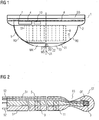
- Figure 1 shows an exemplary hazard detector 1 according to the invention as a point detector with a digital temperature sensor 3 and a measuring chamber 8.
- the hazard detector 1 can be designed for attachment to a base SO.
- the hazard alarm 1 essentially has a spherical housing 2, typically made of plastic.
- the housing 2 can be constructed in one or more parts.
- a circuit carrier 6 circuit board, printed circuit board
- the detection modules for detecting hazard parameters e.g. fire parameters
- the base SO is intended for mounting on the ceiling of the room to be monitored, with mounting either directly on a flush-mounted box or on-wall with or without a base attachment, for example by screw, plug or adhesive connections.
- the base SO usually consists essentially of a circular plate and a downwardly protruding edge web and contains connection mechanisms (e.g. plug-in mechanism) for attaching the housing 2. Furthermore, the base SO can have connection contacts for an external power supply or for data connections (e.g. to other hazard alarms or to a control center).
- connection mechanisms e.g. plug-in mechanism
- the hazard alarm 1 can contain further detection units for recognizing additional hazard parameters.
- the detection units can, for example, be components for detecting smoke particles according to the optical scattering principle. Such optical detection units are provided for the measurement of scattered light caused by smoke.
- At least one light source, a light receiver, a measuring chamber 8 and a labyrinth system with diaphragms arranged on the periphery of the measuring chamber 8 are used, the at least one light source and the light receiver in the housing 2 advantageously being attached to the underside of a carrier plate TP.
- the smoke can enter the measuring chamber 8 through smoke inlet openings RO located in the housing 2.
- the carrier plate TP can e.g. be fixed by a plug connection on the underside of the base SO.
- the circuit carrier 6 (circuit board, printed circuit board) has an evaluation unit 4 and, under certain circumstances, other electronic elements that are usually attached to the circuit carrier 6 using SMD technology (surfacemounted device) or through-hole mounting.
- the electronic evaluation unit 4 is typically implemented in an integrated form, for example as a microcontroller.
- the evaluation unit 4 essentially serves to record and evaluate the ambient temperature or other hazard parameters in the area of the point detector. Furthermore, the hazard parameters (for example fire parameters) of further detection units (if present in hazard alarm 1) are recorded and evaluated in the evaluation unit 4. In the evaluation unit 4, an analysis can then take place based on an overall view of the recorded parameters.
- the evaluation unit 4 causes an output (for example flashlight, siren) and / or transmission (for example to a control center) of the information derived in the analysis.
- the transfer can take place in a wired or wireless manner through a communication link 10.
- the evaluation unit 4 can initiate the output (alarm) or forwarding to the control center, for example on the basis of defined threshold values for hazard parameters or by averaging the hazard parameters over a defined period (for example 30 seconds).
- the communication link 10 can be established, for example, by a radio link (with a transmitter / receiver unit), the hazard alarm 1 comprising at least one transmitter unit.
- the communication connection 10 is implemented, for example, by a radio chip on the circuit carrier 6.
- the circuit carrier 6 (circuit board, printed circuit board) can be attached to the base SO or e.g. on the carrier plate TP (advantageously on the side of the carrier plate TP that faces away from the detection units).
- the circuit carrier 6 can e.g. be attached by a plug connection.
- the digital temperature sensor 3 is mounted centrally in or on the detector housing 2 at a location that is favorable in terms of measurement technology and enables the temperature in the vicinity of the hazard detector 1 to be recorded largely independently of the direction.
- the digital temperature sensor 3 is advantageously attached to a central plumb line LA of the detector base SO on the inside of the detector housing 2 on the detector apex MS. Temperature sensors 3 mounted in the axis LA of the detector 1 work completely independent of direction.
- the hazard detector 1 on the detector apex MS has a detector dome MK in which the temperature sensor 3 is accommodated.
- the alarm dome MK consists of an upper annular part and a plate 22, which is spaced apart from this and forms the dome of the detector, which is connected to the upper annular part by arched or rib-like webs 21.
- the height of the alarm dome MK is just high enough that the temperature sensor 3 can be attached within the alarm dome MK on the alarm apex MS in the axis LA.
- the temperature sensor 3 can e.g. be fastened by a press fit or a plug connection in the alarm head MK.
- the temperature sensor 3 can, however, also be attached to the connecting line 5.
- the temperature sensor 3 is connected in terms of data to the evaluation unit 4 via a connecting line 5 arranged on the inside IS of the detector housing 2.
- the connecting line 5 leads from the housing 2 through a passage opening DO to the temperature sensor 3.
- the connecting line 5 is connected to the evaluation unit 4 for data purposes by a conductor track 7.
- the power supply to the temperature sensor 3 is advantageously provided via the connecting line 5.
- the connecting line 5 can be attached to the inside IS of the detector housing 2, for example, by an adhesive connection. Because the temperature sensor 3 and the connecting line 5 are located in the periphery of the detector housing 2, there is space in the interior of the detector housing 2 for undisturbed accommodation of further detection units (e.g. for fire or smoke detection).
- the connecting line 5 is designed as a conductor track film laminated on one or two sides. Conductor foils take up little space, can be flexibly bendable, adaptable to the environment and can easily be contacted with electronic components.
- Figure 2 shows a first example of a connecting line 5, designed as a conductor track film with a digital temperature sensor 3.
- a conductor track film has conductor layers 51 arranged between insulating layers, which can be contacted via contacts 52 in terms of data and power (power supply).
- the conductor track film represents the sensor carrier ST, on the surface OF of which the digital temperature sensor 3 is applied.
- the digital temperature sensor 3 can be applied to the surface OF of the conductor track film, for example by pressing in, soldering, bonding or by means of a conductive adhesive.
- the temperature sensor 3 is advantageously applied to one end of the conductor track film ST, this end of the conductor track film ST being thermally well decoupled from the rest of the conductor track film ST by a constriction ES (eg, punched recess). This avoids measurement errors on the sensor.
- a constriction ES eg, punched recess.
- Another advantage is that temperature changes in the area of the temperature sensor can be transferred to a connection contact of the temperature sensor 3 via the large-area, preferably bilateral, conductive track surface with high thermal conductivity, as in FIG Figure 2 lower right connection shown, can be forwarded.
- the conductor track film ST can optionally have an indicator 9 for displaying the operating state of the digital sensor 3.
- the indicator 9 can, for example, be an LED applied to the conductor track film ST.
- the LED can, for example, parallel to the supply connections of the temperature sensor 3, which only lights up when the supply voltage in the permissible voltage range of the temperature sensor 3 is raised to a forward voltage value of the LED, such as from 1.8 V to 2.2 volts.
- a capacitor 11 is optionally advantageously applied to the conductor track film ST, as a buffer capacitor to compensate for voltage drops.
- the width of the conductor track film is dimensioned so that the temperature sensor and possibly other components can be accommodated. From the inventors' point of view, a width of approx. 3 mm is sufficient for a conductor track film.
- the connecting line 5 can be electrically contacted via the contacts 52 directly or via a conductor track 7 with the evaluation unit 4 (microchip), e.g. by pressing or soldering.
- Figure 3 shows a second example of a connecting line 5, designed as a conductor track film ST with a digital temperature sensor 3 and a gas sensor 12.
- the gas sensor 12 can, for example, be a fire gas sensor (CO, CO 2 , NO x ).
- the gas sensor 12 can be designed, for example, as a semiconductor gas sensor (MOX).
- the gas sensor 12, like the temperature sensor 3, is advantageously mounted centrally in or on the detector housing 2 so that a gas can be detected independently of the direction.
- the gas sensor 12, like the temperature sensor 3, is advantageously at the outer end of the conductor track ST on the surface OF, which is separated from the rest of the conductor track by a constriction ES, attached.
- several further sensors 12 with the temperature sensor 3 can also be coupled to the conductor track 51 via a corresponding contact (ie digital data interface).
- Figure 4 shows an exemplary “daisy chain arrangement” of a digital temperature sensor 3 with a plurality of gas sensors 12, 12 '.
- the sensors 3, 12, 12 ′ are advantageously coupled in terms of data technology via a digital connecting line 5 and connected to the evaluation unit 4.
- the information supplied by the sensors is evaluated and further processed in the evaluation unit 4. If necessary, an alarm message is output (optically and / or acoustically) and / or an alarm message is forwarded to a control center.
- several temperature sensors 3 can also be arranged.
- a “daisy chain arrangement” according to Figure 4 enables a simple detection of a plurality of sensor signals and a simple and inexpensive supply of these signals to the evaluation unit 4, since only a single connection line 5 is required.
- the evaluation unit 4 is connected to the digital sensors 3, 12, 12 'in terms of data technology the connecting line 5 uses a digital input port and possibly a digital output port of the evaluation unit 4.
- a so-called SPI ie a serial port interface
- the evaluation unit 4 is provided for evaluating the detected ambient temperature, the digital temperature sensor 3 being connected for data purposes to the evaluation unit 4 via a connecting line 5 arranged on the inside of the detector housing.
- the connecting line 5 is a strip conductor foil at one end of which the temperature sensor 3 and possibly the additional sensors 12, 12 'are attached at the level of the detector apex and which is attached to the inside of the housing via an adhesive connection.
- the interior of the housing is free to accommodate additional detection modules for determining fire parameters.
- the digital temperature sensor 3 can be applied to the conductor track film, for example, as an SMD component.
- Hazard detectors in particular point detectors, with a detector housing, with a digital temperature sensor mounted centrally in or on the detector housing for largely direction-independent detection of a temperature in the vicinity of the hazard detector, and with an evaluation unit for evaluating the detected ambient temperature, the digital temperature sensor having an on the inside of the detector housing arranged connecting line is connected to the evaluation unit in terms of data.
- the connection line is a conductor track film at one end of which the temperature sensor is attached at the level of the detector apex and which is attached to the inside of the housing via an adhesive connection.
- the digital temperature sensor can e.g. be applied as an SMD component on the conductor track film.
Landscapes
- Chemical & Material Sciences (AREA)
- Analytical Chemistry (AREA)
- Business, Economics & Management (AREA)
- Emergency Management (AREA)
- Physics & Mathematics (AREA)
- General Physics & Mathematics (AREA)
- Fire-Detection Mechanisms (AREA)
- Fire Alarms (AREA)
Claims (10)
- Détecteur de danger (1), en particulier détecteur ponctuel, avec un boîtier de détecteur (2), avec un capteur de température (3) installé de manière centrale dans ou contre le boîtier de détecteur (2) en vue d'une acquisition, dans une large mesure indépendante de la direction, d'une température dans l'environnement immédiat du détecteur de danger (1), et avec une unité d'exploitation (4) en vue de l'exploitation de la température ambiante acquise, le capteur de température (3) étant un capteur de température numérique, et le capteur de température (3) étant connecté informatiquement à l'unité d'exploitation (4) par l'intermédiaire d'une ligne de connexion (5) disposée à l'intérieur (IS) du boîtier de détecteur (2), la ligne de connexion (5) étant disposée loin du capteur de température (3) installé de manière centrale par rapport à l'unité d'exploitation (4), la ligne de connexion (5) étant conçue en tant que circuit imprimé, le capteur de température (3) étant appliqué sur le circuit imprimé et le capteur de température numérique (3) présentant un microcontrôleur et une interface de données numérique.
- Détecteur de danger (1) selon la revendication 1, dans lequel la ligne de connexion (5) est conçue en tant que circuit imprimé dissimulé d'un côté ou des deux côtés.
- Détecteur de danger (1) selon l'une des revendications précédentes, dans lequel l'alimentation électrique du capteur de température (3) s'effectue par le biais de la ligne de connexion (5).
- Détecteur de danger (1) selon l'une des revendications précédentes, dans lequel sur la ligne de connexion est disposé un indicateur (9) qui peut être commandé électriquement par le biais de l'unité d'exploitation (4).
- Détecteur de danger (1) selon l'une des revendications précédentes, dans lequel l'unité d'exploitation (4) émet une notification d'alerte lors de la reconnaissance d'une situation de danger et/ou la notification d'alerte émet un avertissement à destination d'un centre de contrôle par le biais d'une liaison de communication (10).
- Détecteur de danger (1) selon l'une des revendications précédentes, dans lequel au moins un autre deuxième capteur (12, 12') est couplé informatiquement avec le capteur de température (3) dans un agencement en guirlande sur la ligne de connexion (5).
- Détecteur de danger (1) selon la revendication 6, dans lequel le deuxième capteur (12, 12') est un capteur de gaz.
- Détecteur de danger (1) selon l'une des revendications précédentes, dans lequel le détecteur de danger (1) comprend un compartiment de mesure (8) selon le principe d'éparpillement optique.
- Détecteur de gaz, réalisé en tant que détecteur de danger (1) selon l'une des revendications précédentes.
- Détecteur de fumée ou d'incendie, réalisé en tant que détecteur de danger (1) selon l'une des revendications 1 à 8, dans lequel le détecteur de fumée ou d'incendie présente une unité de détection (8) destinée à la détection de particules de fumée.
Priority Applications (2)
| Application Number | Priority Date | Filing Date | Title |
|---|---|---|---|
| EP12187861.5A EP2720209B2 (fr) | 2012-10-09 | 2012-10-09 | Dispositif d'alarme avec un capteur de température numérique |
| PL12187861T PL2720209T5 (pl) | 2012-10-09 | 2012-10-09 | Sygnalizator zagrożenia z cyfrowym czujnikiem temperatury |
Applications Claiming Priority (1)
| Application Number | Priority Date | Filing Date | Title |
|---|---|---|---|
| EP12187861.5A EP2720209B2 (fr) | 2012-10-09 | 2012-10-09 | Dispositif d'alarme avec un capteur de température numérique |
Publications (3)
| Publication Number | Publication Date |
|---|---|
| EP2720209A1 EP2720209A1 (fr) | 2014-04-16 |
| EP2720209B1 EP2720209B1 (fr) | 2017-01-18 |
| EP2720209B2 true EP2720209B2 (fr) | 2020-11-04 |
Family
ID=47146169
Family Applications (1)
| Application Number | Title | Priority Date | Filing Date |
|---|---|---|---|
| EP12187861.5A Active EP2720209B2 (fr) | 2012-10-09 | 2012-10-09 | Dispositif d'alarme avec un capteur de température numérique |
Country Status (2)
| Country | Link |
|---|---|
| EP (1) | EP2720209B2 (fr) |
| PL (1) | PL2720209T5 (fr) |
Families Citing this family (2)
| Publication number | Priority date | Publication date | Assignee | Title |
|---|---|---|---|---|
| EP2953103A1 (fr) * | 2014-06-02 | 2015-12-09 | Siemens Schweiz AG | Dispositif d'alarme |
| DE102022116321B3 (de) | 2022-06-30 | 2023-08-10 | Diehl Aviation Gilching Gmbh | Rauchmelder |
Citations (1)
| Publication number | Priority date | Publication date | Assignee | Title |
|---|---|---|---|---|
| WO2009115720A2 (fr) † | 2008-03-03 | 2009-09-24 | F.A.R.E | Detecteur de fumee compact |
Family Cites Families (2)
| Publication number | Priority date | Publication date | Assignee | Title |
|---|---|---|---|---|
| DE50205813D1 (de) * | 2002-06-20 | 2006-04-20 | Siemens Schweiz Ag Zuerich | Brandmelder |
| US6967582B2 (en) * | 2002-09-19 | 2005-11-22 | Honeywell International Inc. | Detector with ambient photon sensor and other sensors |
-
2012
- 2012-10-09 EP EP12187861.5A patent/EP2720209B2/fr active Active
- 2012-10-09 PL PL12187861T patent/PL2720209T5/pl unknown
Patent Citations (1)
| Publication number | Priority date | Publication date | Assignee | Title |
|---|---|---|---|---|
| WO2009115720A2 (fr) † | 2008-03-03 | 2009-09-24 | F.A.R.E | Detecteur de fumee compact |
Also Published As
| Publication number | Publication date |
|---|---|
| EP2720209B1 (fr) | 2017-01-18 |
| PL2720209T3 (pl) | 2017-07-31 |
| PL2720209T5 (pl) | 2021-01-11 |
| EP2720209A1 (fr) | 2014-04-16 |
Similar Documents
| Publication | Publication Date | Title |
|---|---|---|
| EP2879104B1 (fr) | Dispositif auxiliaire pour un détecteur de danger configuré sous forme de détecteur ponctuel pour la surveillance du fonctionnement du détecteur de danger, agencement et utilisation d'un tel dispositif | |
| DE69710019T2 (de) | Anwesenheitssensor mit mehreren Funktionen | |
| EP1376505B1 (fr) | Détecteur d'incendie | |
| DE102014108503B4 (de) | Stromrichtermodul mit Hochspannungs-Schutzsystem | |
| WO2008014911A1 (fr) | Détecteur modulaire pour un véhicule automobile | |
| WO2004001693A1 (fr) | Detecteur de fumee a diffusion | |
| EP1550093A1 (fr) | Detecteur de fumees | |
| DE102015105212A1 (de) | Schaltschranküberwachungsvorrichtung | |
| DE102015212316A1 (de) | Sensorgerät für einen Parkplatz | |
| EP2720209B2 (fr) | Dispositif d'alarme avec un capteur de température numérique | |
| EP3479658B1 (fr) | Système d'éclairage avec acquisition de valeurs mesurées basée sur la localisation | |
| DE202013005999U1 (de) | Optische Empfangseinheit für einen nach dem Streulichtprinzip arbeitenden optischen Rauchmelder mit verbessertem Schutz gegen EMV-Einstrahlung | |
| DE102017111017B4 (de) | Leuchtenbaldachin zum Detektieren und Signalisieren unterschiedlicher Gefahrensituationen | |
| US20120032815A1 (en) | System and method for detecting a property of a strobe cover | |
| DE102013207990A1 (de) | Gefahrenmelder mit Temperatursensor | |
| DE102004034908A1 (de) | Rauchmeldesystem | |
| EP2182497B1 (fr) | Détecteur de gaz | |
| DE102018128063A1 (de) | Verfahren zur Erkennung des Vorliegens eines korrosionsfördernden Zustands und Feldgerät der Automatisierungstechnik | |
| CN219300311U (zh) | 一种嵌入式火灾探测器 | |
| DE102009027230B4 (de) | Brandmeldeanlage | |
| DE102022134086A1 (de) | Elektrisches/elektronisches Gerät für die Gebäudeinstallationstechnik | |
| WO2020239825A1 (fr) | Composant capteur optoélectronique pour la mesure de la lumière avec redondance incorporée | |
| DE102024103527A1 (de) | Sensorvorrichtung mit kammerlosem Rauchmelder | |
| DE102022134087A1 (de) | Verfahren zum Betreiben eines Präsenzmelders | |
| TW202248895A (zh) | 用於感測塔燈燈號之感測裝置以及包括其之感測系統 |
Legal Events
| Date | Code | Title | Description |
|---|---|---|---|
| PUAI | Public reference made under article 153(3) epc to a published international application that has entered the european phase |
Free format text: ORIGINAL CODE: 0009012 |
|
| 17P | Request for examination filed |
Effective date: 20130319 |
|
| AK | Designated contracting states |
Kind code of ref document: A1 Designated state(s): AL AT BE BG CH CY CZ DE DK EE ES FI FR GB GR HR HU IE IS IT LI LT LU LV MC MK MT NL NO PL PT RO RS SE SI SK SM TR |
|
| AX | Request for extension of the european patent |
Extension state: BA ME |
|
| RAP1 | Party data changed (applicant data changed or rights of an application transferred) |
Owner name: SIEMENS SCHWEIZ AG |
|
| GRAP | Despatch of communication of intention to grant a patent |
Free format text: ORIGINAL CODE: EPIDOSNIGR1 |
|
| RIC1 | Information provided on ipc code assigned before grant |
Ipc: G08B 17/113 20060101ALI20160801BHEP Ipc: G08B 17/107 20060101AFI20160801BHEP |
|
| INTG | Intention to grant announced |
Effective date: 20160819 |
|
| GRAS | Grant fee paid |
Free format text: ORIGINAL CODE: EPIDOSNIGR3 |
|
| STAA | Information on the status of an ep patent application or granted ep patent |
Free format text: STATUS: GRANT OF PATENT IS INTENDED |
|
| GRAA | (expected) grant |
Free format text: ORIGINAL CODE: 0009210 |
|
| STAA | Information on the status of an ep patent application or granted ep patent |
Free format text: STATUS: THE PATENT HAS BEEN GRANTED |
|
| AK | Designated contracting states |
Kind code of ref document: B1 Designated state(s): AL AT BE BG CH CY CZ DE DK EE ES FI FR GB GR HR HU IE IS IT LI LT LU LV MC MK MT NL NO PL PT RO RS SE SI SK SM TR |
|
| REG | Reference to a national code |
Ref country code: GB Ref legal event code: FG4D Free format text: NOT ENGLISH |
|
| REG | Reference to a national code |
Ref country code: CH Ref legal event code: EP |
|
| REG | Reference to a national code |
Ref country code: AT Ref legal event code: REF Ref document number: 863292 Country of ref document: AT Kind code of ref document: T Effective date: 20170215 |
|
| REG | Reference to a national code |
Ref country code: IE Ref legal event code: FG4D Free format text: LANGUAGE OF EP DOCUMENT: GERMAN |
|
| REG | Reference to a national code |
Ref country code: DE Ref legal event code: R096 Ref document number: 502012009356 Country of ref document: DE |
|
| REG | Reference to a national code |
Ref country code: NL Ref legal event code: FP |
|
| REG | Reference to a national code |
Ref country code: SE Ref legal event code: TRGR |
|
| REG | Reference to a national code |
Ref country code: LT Ref legal event code: MG4D |
|
| PG25 | Lapsed in a contracting state [announced via postgrant information from national office to epo] |
Ref country code: FI Free format text: LAPSE BECAUSE OF FAILURE TO SUBMIT A TRANSLATION OF THE DESCRIPTION OR TO PAY THE FEE WITHIN THE PRESCRIBED TIME-LIMIT Effective date: 20170118 Ref country code: GR Free format text: LAPSE BECAUSE OF FAILURE TO SUBMIT A TRANSLATION OF THE DESCRIPTION OR TO PAY THE FEE WITHIN THE PRESCRIBED TIME-LIMIT Effective date: 20170419 Ref country code: NO Free format text: LAPSE BECAUSE OF FAILURE TO SUBMIT A TRANSLATION OF THE DESCRIPTION OR TO PAY THE FEE WITHIN THE PRESCRIBED TIME-LIMIT Effective date: 20170418 Ref country code: LT Free format text: LAPSE BECAUSE OF FAILURE TO SUBMIT A TRANSLATION OF THE DESCRIPTION OR TO PAY THE FEE WITHIN THE PRESCRIBED TIME-LIMIT Effective date: 20170118 Ref country code: IS Free format text: LAPSE BECAUSE OF FAILURE TO SUBMIT A TRANSLATION OF THE DESCRIPTION OR TO PAY THE FEE WITHIN THE PRESCRIBED TIME-LIMIT Effective date: 20170518 Ref country code: HR Free format text: LAPSE BECAUSE OF FAILURE TO SUBMIT A TRANSLATION OF THE DESCRIPTION OR TO PAY THE FEE WITHIN THE PRESCRIBED TIME-LIMIT Effective date: 20170118 |
|
| PG25 | Lapsed in a contracting state [announced via postgrant information from national office to epo] |
Ref country code: ES Free format text: LAPSE BECAUSE OF FAILURE TO SUBMIT A TRANSLATION OF THE DESCRIPTION OR TO PAY THE FEE WITHIN THE PRESCRIBED TIME-LIMIT Effective date: 20170118 Ref country code: BG Free format text: LAPSE BECAUSE OF FAILURE TO SUBMIT A TRANSLATION OF THE DESCRIPTION OR TO PAY THE FEE WITHIN THE PRESCRIBED TIME-LIMIT Effective date: 20170418 Ref country code: LV Free format text: LAPSE BECAUSE OF FAILURE TO SUBMIT A TRANSLATION OF THE DESCRIPTION OR TO PAY THE FEE WITHIN THE PRESCRIBED TIME-LIMIT Effective date: 20170118 Ref country code: PT Free format text: LAPSE BECAUSE OF FAILURE TO SUBMIT A TRANSLATION OF THE DESCRIPTION OR TO PAY THE FEE WITHIN THE PRESCRIBED TIME-LIMIT Effective date: 20170518 Ref country code: RS Free format text: LAPSE BECAUSE OF FAILURE TO SUBMIT A TRANSLATION OF THE DESCRIPTION OR TO PAY THE FEE WITHIN THE PRESCRIBED TIME-LIMIT Effective date: 20170118 |
|
| REG | Reference to a national code |
Ref country code: DE Ref legal event code: R026 Ref document number: 502012009356 Country of ref document: DE |
|
| REG | Reference to a national code |
Ref country code: FR Ref legal event code: PLFP Year of fee payment: 6 |
|
| PLBI | Opposition filed |
Free format text: ORIGINAL CODE: 0009260 |
|
| PG25 | Lapsed in a contracting state [announced via postgrant information from national office to epo] |
Ref country code: EE Free format text: LAPSE BECAUSE OF FAILURE TO SUBMIT A TRANSLATION OF THE DESCRIPTION OR TO PAY THE FEE WITHIN THE PRESCRIBED TIME-LIMIT Effective date: 20170118 Ref country code: SK Free format text: LAPSE BECAUSE OF FAILURE TO SUBMIT A TRANSLATION OF THE DESCRIPTION OR TO PAY THE FEE WITHIN THE PRESCRIBED TIME-LIMIT Effective date: 20170118 Ref country code: CZ Free format text: LAPSE BECAUSE OF FAILURE TO SUBMIT A TRANSLATION OF THE DESCRIPTION OR TO PAY THE FEE WITHIN THE PRESCRIBED TIME-LIMIT Effective date: 20170118 Ref country code: RO Free format text: LAPSE BECAUSE OF FAILURE TO SUBMIT A TRANSLATION OF THE DESCRIPTION OR TO PAY THE FEE WITHIN THE PRESCRIBED TIME-LIMIT Effective date: 20170118 |
|
| 26 | Opposition filed |
Opponent name: HEKATRON VERTRIEBS GMBH Effective date: 20171018 |
|
| PLAX | Notice of opposition and request to file observation + time limit sent |
Free format text: ORIGINAL CODE: EPIDOSNOBS2 |
|
| PG25 | Lapsed in a contracting state [announced via postgrant information from national office to epo] |
Ref country code: SM Free format text: LAPSE BECAUSE OF FAILURE TO SUBMIT A TRANSLATION OF THE DESCRIPTION OR TO PAY THE FEE WITHIN THE PRESCRIBED TIME-LIMIT Effective date: 20170118 Ref country code: DK Free format text: LAPSE BECAUSE OF FAILURE TO SUBMIT A TRANSLATION OF THE DESCRIPTION OR TO PAY THE FEE WITHIN THE PRESCRIBED TIME-LIMIT Effective date: 20170118 |
|
| PG25 | Lapsed in a contracting state [announced via postgrant information from national office to epo] |
Ref country code: SI Free format text: LAPSE BECAUSE OF FAILURE TO SUBMIT A TRANSLATION OF THE DESCRIPTION OR TO PAY THE FEE WITHIN THE PRESCRIBED TIME-LIMIT Effective date: 20170118 |
|
| PLBB | Reply of patent proprietor to notice(s) of opposition received |
Free format text: ORIGINAL CODE: EPIDOSNOBS3 |
|
| PG25 | Lapsed in a contracting state [announced via postgrant information from national office to epo] |
Ref country code: MC Free format text: LAPSE BECAUSE OF FAILURE TO SUBMIT A TRANSLATION OF THE DESCRIPTION OR TO PAY THE FEE WITHIN THE PRESCRIBED TIME-LIMIT Effective date: 20170118 |
|
| REG | Reference to a national code |
Ref country code: IE Ref legal event code: MM4A |
|
| PG25 | Lapsed in a contracting state [announced via postgrant information from national office to epo] |
Ref country code: LU Free format text: LAPSE BECAUSE OF NON-PAYMENT OF DUE FEES Effective date: 20171009 |
|
| REG | Reference to a national code |
Ref country code: BE Ref legal event code: MM Effective date: 20171031 |
|
| PG25 | Lapsed in a contracting state [announced via postgrant information from national office to epo] |
Ref country code: BE Free format text: LAPSE BECAUSE OF NON-PAYMENT OF DUE FEES Effective date: 20171031 |
|
| PG25 | Lapsed in a contracting state [announced via postgrant information from national office to epo] |
Ref country code: MT Free format text: LAPSE BECAUSE OF FAILURE TO SUBMIT A TRANSLATION OF THE DESCRIPTION OR TO PAY THE FEE WITHIN THE PRESCRIBED TIME-LIMIT Effective date: 20170118 |
|
| REG | Reference to a national code |
Ref country code: FR Ref legal event code: PLFP Year of fee payment: 7 |
|
| PG25 | Lapsed in a contracting state [announced via postgrant information from national office to epo] |
Ref country code: IE Free format text: LAPSE BECAUSE OF NON-PAYMENT OF DUE FEES Effective date: 20171009 |
|
| APBM | Appeal reference recorded |
Free format text: ORIGINAL CODE: EPIDOSNREFNO |
|
| APBP | Date of receipt of notice of appeal recorded |
Free format text: ORIGINAL CODE: EPIDOSNNOA2O |
|
| APAH | Appeal reference modified |
Free format text: ORIGINAL CODE: EPIDOSCREFNO |
|
| PG25 | Lapsed in a contracting state [announced via postgrant information from national office to epo] |
Ref country code: HU Free format text: LAPSE BECAUSE OF FAILURE TO SUBMIT A TRANSLATION OF THE DESCRIPTION OR TO PAY THE FEE WITHIN THE PRESCRIBED TIME-LIMIT; INVALID AB INITIO Effective date: 20121009 |
|
| APBU | Appeal procedure closed |
Free format text: ORIGINAL CODE: EPIDOSNNOA9O |
|
| PG25 | Lapsed in a contracting state [announced via postgrant information from national office to epo] |
Ref country code: CY Free format text: LAPSE BECAUSE OF NON-PAYMENT OF DUE FEES Effective date: 20170118 |
|
| PG25 | Lapsed in a contracting state [announced via postgrant information from national office to epo] |
Ref country code: MK Free format text: LAPSE BECAUSE OF FAILURE TO SUBMIT A TRANSLATION OF THE DESCRIPTION OR TO PAY THE FEE WITHIN THE PRESCRIBED TIME-LIMIT Effective date: 20170118 |
|
| PG25 | Lapsed in a contracting state [announced via postgrant information from national office to epo] |
Ref country code: TR Free format text: LAPSE BECAUSE OF FAILURE TO SUBMIT A TRANSLATION OF THE DESCRIPTION OR TO PAY THE FEE WITHIN THE PRESCRIBED TIME-LIMIT Effective date: 20170118 |
|
| PG25 | Lapsed in a contracting state [announced via postgrant information from national office to epo] |
Ref country code: AL Free format text: LAPSE BECAUSE OF FAILURE TO SUBMIT A TRANSLATION OF THE DESCRIPTION OR TO PAY THE FEE WITHIN THE PRESCRIBED TIME-LIMIT Effective date: 20170118 |
|
| PUAH | Patent maintained in amended form |
Free format text: ORIGINAL CODE: 0009272 |
|
| STAA | Information on the status of an ep patent application or granted ep patent |
Free format text: STATUS: PATENT MAINTAINED AS AMENDED |
|
| REG | Reference to a national code |
Ref country code: CH Ref legal event code: AELC |
|
| 27A | Patent maintained in amended form |
Effective date: 20201104 |
|
| AK | Designated contracting states |
Kind code of ref document: B2 Designated state(s): AL AT BE BG CH CY CZ DE DK EE ES FI FR GB GR HR HU IE IS IT LI LT LU LV MC MK MT NL NO PL PT RO RS SE SI SK SM TR |
|
| REG | Reference to a national code |
Ref country code: DE Ref legal event code: R102 Ref document number: 502012009356 Country of ref document: DE |
|
| REG | Reference to a national code |
Ref country code: SE Ref legal event code: RPEO |
|
| REG | Reference to a national code |
Ref country code: NL Ref legal event code: FP |
|
| P01 | Opt-out of the competence of the unified patent court (upc) registered |
Effective date: 20230523 |
|
| PGFP | Annual fee paid to national office [announced via postgrant information from national office to epo] |
Ref country code: PL Payment date: 20250925 Year of fee payment: 14 |
|
| PGFP | Annual fee paid to national office [announced via postgrant information from national office to epo] |
Ref country code: NL Payment date: 20251002 Year of fee payment: 14 |
|
| PGFP | Annual fee paid to national office [announced via postgrant information from national office to epo] |
Ref country code: GB Payment date: 20251111 Year of fee payment: 14 |
|
| PGFP | Annual fee paid to national office [announced via postgrant information from national office to epo] |
Ref country code: AT Payment date: 20250905 Year of fee payment: 14 |
|
| PGFP | Annual fee paid to national office [announced via postgrant information from national office to epo] |
Ref country code: IT Payment date: 20251027 Year of fee payment: 14 |
|
| REG | Reference to a national code |
Ref country code: CH Ref legal event code: U11 Free format text: ST27 STATUS EVENT CODE: U-0-0-U10-U11 (AS PROVIDED BY THE NATIONAL OFFICE) Effective date: 20260114 |
|
| PGFP | Annual fee paid to national office [announced via postgrant information from national office to epo] |
Ref country code: FR Payment date: 20251020 Year of fee payment: 14 |
|
| PGFP | Annual fee paid to national office [announced via postgrant information from national office to epo] |
Ref country code: SE Payment date: 20251013 Year of fee payment: 14 |
|
| PGFP | Annual fee paid to national office [announced via postgrant information from national office to epo] |
Ref country code: DE Payment date: 20251219 Year of fee payment: 14 |
|
| PGFP | Annual fee paid to national office [announced via postgrant information from national office to epo] |
Ref country code: CH Payment date: 20260114 Year of fee payment: 14 |