EP2720794B1 - Matériaux poreux à base d'oxydes métalliques mixtes ainsi que leur production et leur utilisation - Google Patents
Matériaux poreux à base d'oxydes métalliques mixtes ainsi que leur production et leur utilisation Download PDFInfo
- Publication number
- EP2720794B1 EP2720794B1 EP12729870.1A EP12729870A EP2720794B1 EP 2720794 B1 EP2720794 B1 EP 2720794B1 EP 12729870 A EP12729870 A EP 12729870A EP 2720794 B1 EP2720794 B1 EP 2720794B1
- Authority
- EP
- European Patent Office
- Prior art keywords
- matrix material
- porous materials
- particulate
- nanoparticles
- pore
- Prior art date
- Legal status (The legal status is an assumption and is not a legal conclusion. Google has not performed a legal analysis and makes no representation as to the accuracy of the status listed.)
- Active
Links
Images





Classifications
-
- B—PERFORMING OPERATIONS; TRANSPORTING
- B01—PHYSICAL OR CHEMICAL PROCESSES OR APPARATUS IN GENERAL
- B01J—CHEMICAL OR PHYSICAL PROCESSES, e.g. CATALYSIS OR COLLOID CHEMISTRY; THEIR RELEVANT APPARATUS
- B01J21/00—Catalysts comprising the elements, oxides, or hydroxides of magnesium, boron, aluminium, carbon, silicon, titanium, zirconium, or hafnium
- B01J21/06—Silicon, titanium, zirconium or hafnium; Oxides or hydroxides thereof
- B01J21/063—Titanium; Oxides or hydroxides thereof
-
- B—PERFORMING OPERATIONS; TRANSPORTING
- B01—PHYSICAL OR CHEMICAL PROCESSES OR APPARATUS IN GENERAL
- B01J—CHEMICAL OR PHYSICAL PROCESSES, e.g. CATALYSIS OR COLLOID CHEMISTRY; THEIR RELEVANT APPARATUS
- B01J35/00—Catalysts, in general, characterised by their form or physical properties
- B01J35/70—Catalysts, in general, characterised by their form or physical properties characterised by their crystalline properties, e.g. semi-crystalline
-
- B—PERFORMING OPERATIONS; TRANSPORTING
- B01—PHYSICAL OR CHEMICAL PROCESSES OR APPARATUS IN GENERAL
- B01J—CHEMICAL OR PHYSICAL PROCESSES, e.g. CATALYSIS OR COLLOID CHEMISTRY; THEIR RELEVANT APPARATUS
- B01J21/00—Catalysts comprising the elements, oxides, or hydroxides of magnesium, boron, aluminium, carbon, silicon, titanium, zirconium, or hafnium
- B01J21/02—Boron or aluminium; Oxides or hydroxides thereof
- B01J21/04—Alumina
-
- B—PERFORMING OPERATIONS; TRANSPORTING
- B01—PHYSICAL OR CHEMICAL PROCESSES OR APPARATUS IN GENERAL
- B01J—CHEMICAL OR PHYSICAL PROCESSES, e.g. CATALYSIS OR COLLOID CHEMISTRY; THEIR RELEVANT APPARATUS
- B01J21/00—Catalysts comprising the elements, oxides, or hydroxides of magnesium, boron, aluminium, carbon, silicon, titanium, zirconium, or hafnium
- B01J21/06—Silicon, titanium, zirconium or hafnium; Oxides or hydroxides thereof
- B01J21/066—Zirconium or hafnium; Oxides or hydroxides thereof
-
- B—PERFORMING OPERATIONS; TRANSPORTING
- B01—PHYSICAL OR CHEMICAL PROCESSES OR APPARATUS IN GENERAL
- B01J—CHEMICAL OR PHYSICAL PROCESSES, e.g. CATALYSIS OR COLLOID CHEMISTRY; THEIR RELEVANT APPARATUS
- B01J21/00—Catalysts comprising the elements, oxides, or hydroxides of magnesium, boron, aluminium, carbon, silicon, titanium, zirconium, or hafnium
- B01J21/06—Silicon, titanium, zirconium or hafnium; Oxides or hydroxides thereof
- B01J21/08—Silica
-
- B—PERFORMING OPERATIONS; TRANSPORTING
- B01—PHYSICAL OR CHEMICAL PROCESSES OR APPARATUS IN GENERAL
- B01J—CHEMICAL OR PHYSICAL PROCESSES, e.g. CATALYSIS OR COLLOID CHEMISTRY; THEIR RELEVANT APPARATUS
- B01J21/00—Catalysts comprising the elements, oxides, or hydroxides of magnesium, boron, aluminium, carbon, silicon, titanium, zirconium, or hafnium
- B01J21/18—Carbon
-
- B—PERFORMING OPERATIONS; TRANSPORTING
- B01—PHYSICAL OR CHEMICAL PROCESSES OR APPARATUS IN GENERAL
- B01J—CHEMICAL OR PHYSICAL PROCESSES, e.g. CATALYSIS OR COLLOID CHEMISTRY; THEIR RELEVANT APPARATUS
- B01J23/00—Catalysts comprising metals or metal oxides or hydroxides, not provided for in group B01J21/00
- B01J23/002—Mixed oxides other than spinels, e.g. perovskite
-
- B—PERFORMING OPERATIONS; TRANSPORTING
- B01—PHYSICAL OR CHEMICAL PROCESSES OR APPARATUS IN GENERAL
- B01J—CHEMICAL OR PHYSICAL PROCESSES, e.g. CATALYSIS OR COLLOID CHEMISTRY; THEIR RELEVANT APPARATUS
- B01J23/00—Catalysts comprising metals or metal oxides or hydroxides, not provided for in group B01J21/00
- B01J23/10—Catalysts comprising metals or metal oxides or hydroxides, not provided for in group B01J21/00 of rare earths
-
- B—PERFORMING OPERATIONS; TRANSPORTING
- B01—PHYSICAL OR CHEMICAL PROCESSES OR APPARATUS IN GENERAL
- B01J—CHEMICAL OR PHYSICAL PROCESSES, e.g. CATALYSIS OR COLLOID CHEMISTRY; THEIR RELEVANT APPARATUS
- B01J23/00—Catalysts comprising metals or metal oxides or hydroxides, not provided for in group B01J21/00
- B01J23/16—Catalysts comprising metals or metal oxides or hydroxides, not provided for in group B01J21/00 of arsenic, antimony, bismuth, vanadium, niobium, tantalum, polonium, chromium, molybdenum, tungsten, manganese, technetium or rhenium
- B01J23/20—Vanadium, niobium or tantalum
- B01J23/22—Vanadium
-
- B—PERFORMING OPERATIONS; TRANSPORTING
- B01—PHYSICAL OR CHEMICAL PROCESSES OR APPARATUS IN GENERAL
- B01J—CHEMICAL OR PHYSICAL PROCESSES, e.g. CATALYSIS OR COLLOID CHEMISTRY; THEIR RELEVANT APPARATUS
- B01J23/00—Catalysts comprising metals or metal oxides or hydroxides, not provided for in group B01J21/00
- B01J23/16—Catalysts comprising metals or metal oxides or hydroxides, not provided for in group B01J21/00 of arsenic, antimony, bismuth, vanadium, niobium, tantalum, polonium, chromium, molybdenum, tungsten, manganese, technetium or rhenium
- B01J23/24—Chromium, molybdenum or tungsten
- B01J23/28—Molybdenum
-
- B—PERFORMING OPERATIONS; TRANSPORTING
- B01—PHYSICAL OR CHEMICAL PROCESSES OR APPARATUS IN GENERAL
- B01J—CHEMICAL OR PHYSICAL PROCESSES, e.g. CATALYSIS OR COLLOID CHEMISTRY; THEIR RELEVANT APPARATUS
- B01J23/00—Catalysts comprising metals or metal oxides or hydroxides, not provided for in group B01J21/00
- B01J23/16—Catalysts comprising metals or metal oxides or hydroxides, not provided for in group B01J21/00 of arsenic, antimony, bismuth, vanadium, niobium, tantalum, polonium, chromium, molybdenum, tungsten, manganese, technetium or rhenium
- B01J23/32—Manganese, technetium or rhenium
- B01J23/34—Manganese
-
- B—PERFORMING OPERATIONS; TRANSPORTING
- B01—PHYSICAL OR CHEMICAL PROCESSES OR APPARATUS IN GENERAL
- B01J—CHEMICAL OR PHYSICAL PROCESSES, e.g. CATALYSIS OR COLLOID CHEMISTRY; THEIR RELEVANT APPARATUS
- B01J23/00—Catalysts comprising metals or metal oxides or hydroxides, not provided for in group B01J21/00
- B01J23/70—Catalysts comprising metals or metal oxides or hydroxides, not provided for in group B01J21/00 of the iron group metals or copper
- B01J23/74—Iron group metals
- B01J23/745—Iron
-
- B—PERFORMING OPERATIONS; TRANSPORTING
- B01—PHYSICAL OR CHEMICAL PROCESSES OR APPARATUS IN GENERAL
- B01J—CHEMICAL OR PHYSICAL PROCESSES, e.g. CATALYSIS OR COLLOID CHEMISTRY; THEIR RELEVANT APPARATUS
- B01J23/00—Catalysts comprising metals or metal oxides or hydroxides, not provided for in group B01J21/00
- B01J23/70—Catalysts comprising metals or metal oxides or hydroxides, not provided for in group B01J21/00 of the iron group metals or copper
- B01J23/76—Catalysts comprising metals or metal oxides or hydroxides, not provided for in group B01J21/00 of the iron group metals or copper combined with metals, oxides or hydroxides provided for in groups B01J23/02 - B01J23/36
- B01J23/84—Catalysts comprising metals or metal oxides or hydroxides, not provided for in group B01J21/00 of the iron group metals or copper combined with metals, oxides or hydroxides provided for in groups B01J23/02 - B01J23/36 with arsenic, antimony, bismuth, vanadium, niobium, tantalum, polonium, chromium, molybdenum, tungsten, manganese, technetium or rhenium
- B01J23/889—Manganese, technetium or rhenium
- B01J23/8892—Manganese
-
- B—PERFORMING OPERATIONS; TRANSPORTING
- B01—PHYSICAL OR CHEMICAL PROCESSES OR APPARATUS IN GENERAL
- B01J—CHEMICAL OR PHYSICAL PROCESSES, e.g. CATALYSIS OR COLLOID CHEMISTRY; THEIR RELEVANT APPARATUS
- B01J35/00—Catalysts, in general, characterised by their form or physical properties
- B01J35/40—Catalysts, in general, characterised by their form or physical properties characterised by dimensions, e.g. grain size
- B01J35/45—Nanoparticles
-
- B—PERFORMING OPERATIONS; TRANSPORTING
- B01—PHYSICAL OR CHEMICAL PROCESSES OR APPARATUS IN GENERAL
- B01J—CHEMICAL OR PHYSICAL PROCESSES, e.g. CATALYSIS OR COLLOID CHEMISTRY; THEIR RELEVANT APPARATUS
- B01J35/00—Catalysts, in general, characterised by their form or physical properties
- B01J35/60—Catalysts, in general, characterised by their form or physical properties characterised by their surface properties or porosity
- B01J35/61—Surface area
- B01J35/615—100-500 m2/g
-
- B—PERFORMING OPERATIONS; TRANSPORTING
- B01—PHYSICAL OR CHEMICAL PROCESSES OR APPARATUS IN GENERAL
- B01J—CHEMICAL OR PHYSICAL PROCESSES, e.g. CATALYSIS OR COLLOID CHEMISTRY; THEIR RELEVANT APPARATUS
- B01J35/00—Catalysts, in general, characterised by their form or physical properties
- B01J35/60—Catalysts, in general, characterised by their form or physical properties characterised by their surface properties or porosity
- B01J35/63—Pore volume
- B01J35/635—0.5-1.0 ml/g
-
- B—PERFORMING OPERATIONS; TRANSPORTING
- B01—PHYSICAL OR CHEMICAL PROCESSES OR APPARATUS IN GENERAL
- B01J—CHEMICAL OR PHYSICAL PROCESSES, e.g. CATALYSIS OR COLLOID CHEMISTRY; THEIR RELEVANT APPARATUS
- B01J35/00—Catalysts, in general, characterised by their form or physical properties
- B01J35/60—Catalysts, in general, characterised by their form or physical properties characterised by their surface properties or porosity
- B01J35/64—Pore diameter
- B01J35/647—2-50 nm
-
- B—PERFORMING OPERATIONS; TRANSPORTING
- B01—PHYSICAL OR CHEMICAL PROCESSES OR APPARATUS IN GENERAL
- B01J—CHEMICAL OR PHYSICAL PROCESSES, e.g. CATALYSIS OR COLLOID CHEMISTRY; THEIR RELEVANT APPARATUS
- B01J37/00—Processes, in general, for preparing catalysts; Processes, in general, for activation of catalysts
- B01J37/0009—Use of binding agents; Moulding; Pressing; Powdering; Granulating; Addition of materials ameliorating the mechanical properties of the product catalyst
- B01J37/0018—Addition of a binding agent or of material, later completely removed among others as result of heat treatment, leaching or washing,(e.g. forming of pores; protective layer, desintegrating by heat)
-
- B—PERFORMING OPERATIONS; TRANSPORTING
- B01—PHYSICAL OR CHEMICAL PROCESSES OR APPARATUS IN GENERAL
- B01J—CHEMICAL OR PHYSICAL PROCESSES, e.g. CATALYSIS OR COLLOID CHEMISTRY; THEIR RELEVANT APPARATUS
- B01J37/00—Processes, in general, for preparing catalysts; Processes, in general, for activation of catalysts
- B01J37/02—Impregnation, coating or precipitation
- B01J37/03—Precipitation; Co-precipitation
- B01J37/031—Precipitation
-
- B—PERFORMING OPERATIONS; TRANSPORTING
- B01—PHYSICAL OR CHEMICAL PROCESSES OR APPARATUS IN GENERAL
- B01J—CHEMICAL OR PHYSICAL PROCESSES, e.g. CATALYSIS OR COLLOID CHEMISTRY; THEIR RELEVANT APPARATUS
- B01J37/00—Processes, in general, for preparing catalysts; Processes, in general, for activation of catalysts
- B01J37/02—Impregnation, coating or precipitation
- B01J37/03—Precipitation; Co-precipitation
- B01J37/036—Precipitation; Co-precipitation to form a gel or a cogel
-
- B—PERFORMING OPERATIONS; TRANSPORTING
- B01—PHYSICAL OR CHEMICAL PROCESSES OR APPARATUS IN GENERAL
- B01J—CHEMICAL OR PHYSICAL PROCESSES, e.g. CATALYSIS OR COLLOID CHEMISTRY; THEIR RELEVANT APPARATUS
- B01J37/00—Processes, in general, for preparing catalysts; Processes, in general, for activation of catalysts
- B01J37/08—Heat treatment
- B01J37/082—Decomposition and pyrolysis
- B01J37/084—Decomposition of carbon-containing compounds into carbon
-
- B—PERFORMING OPERATIONS; TRANSPORTING
- B01—PHYSICAL OR CHEMICAL PROCESSES OR APPARATUS IN GENERAL
- B01J—CHEMICAL OR PHYSICAL PROCESSES, e.g. CATALYSIS OR COLLOID CHEMISTRY; THEIR RELEVANT APPARATUS
- B01J37/00—Processes, in general, for preparing catalysts; Processes, in general, for activation of catalysts
- B01J37/08—Heat treatment
- B01J37/082—Decomposition and pyrolysis
- B01J37/088—Decomposition of a metal salt
-
- B—PERFORMING OPERATIONS; TRANSPORTING
- B01—PHYSICAL OR CHEMICAL PROCESSES OR APPARATUS IN GENERAL
- B01J—CHEMICAL OR PHYSICAL PROCESSES, e.g. CATALYSIS OR COLLOID CHEMISTRY; THEIR RELEVANT APPARATUS
- B01J2235/00—Indexing scheme associated with group B01J35/00, related to the analysis techniques used to determine the catalysts form or properties
- B01J2235/10—Infrared [IR]
-
- B—PERFORMING OPERATIONS; TRANSPORTING
- B01—PHYSICAL OR CHEMICAL PROCESSES OR APPARATUS IN GENERAL
- B01J—CHEMICAL OR PHYSICAL PROCESSES, e.g. CATALYSIS OR COLLOID CHEMISTRY; THEIR RELEVANT APPARATUS
- B01J2235/00—Indexing scheme associated with group B01J35/00, related to the analysis techniques used to determine the catalysts form or properties
- B01J2235/15—X-ray diffraction
-
- B—PERFORMING OPERATIONS; TRANSPORTING
- B01—PHYSICAL OR CHEMICAL PROCESSES OR APPARATUS IN GENERAL
- B01J—CHEMICAL OR PHYSICAL PROCESSES, e.g. CATALYSIS OR COLLOID CHEMISTRY; THEIR RELEVANT APPARATUS
- B01J2235/00—Indexing scheme associated with group B01J35/00, related to the analysis techniques used to determine the catalysts form or properties
- B01J2235/30—Scanning electron microscopy; Transmission electron microscopy
-
- B—PERFORMING OPERATIONS; TRANSPORTING
- B01—PHYSICAL OR CHEMICAL PROCESSES OR APPARATUS IN GENERAL
- B01J—CHEMICAL OR PHYSICAL PROCESSES, e.g. CATALYSIS OR COLLOID CHEMISTRY; THEIR RELEVANT APPARATUS
- B01J35/00—Catalysts, in general, characterised by their form or physical properties
- B01J35/20—Catalysts, in general, characterised by their form or physical properties characterised by their non-solid state
- B01J35/23—Catalysts, in general, characterised by their form or physical properties characterised by their non-solid state in a colloidal state
-
- B—PERFORMING OPERATIONS; TRANSPORTING
- B01—PHYSICAL OR CHEMICAL PROCESSES OR APPARATUS IN GENERAL
- B01J—CHEMICAL OR PHYSICAL PROCESSES, e.g. CATALYSIS OR COLLOID CHEMISTRY; THEIR RELEVANT APPARATUS
- B01J35/00—Catalysts, in general, characterised by their form or physical properties
- B01J35/30—Catalysts, in general, characterised by their form or physical properties characterised by their physical properties
- B01J35/34—Mechanical properties
- B01J35/36—Mechanical strength
-
- B—PERFORMING OPERATIONS; TRANSPORTING
- B01—PHYSICAL OR CHEMICAL PROCESSES OR APPARATUS IN GENERAL
- B01J—CHEMICAL OR PHYSICAL PROCESSES, e.g. CATALYSIS OR COLLOID CHEMISTRY; THEIR RELEVANT APPARATUS
- B01J35/00—Catalysts, in general, characterised by their form or physical properties
- B01J35/30—Catalysts, in general, characterised by their form or physical properties characterised by their physical properties
- B01J35/391—Physical properties of the active metal ingredient
Definitions
- the present invention relates to the technical field of porous materials, in particular self-supporting porous materials, based on metal mixed oxides, as well as their preparation and use.
- the present invention relates to a process for the preparation of particulate porous materials based on metallic mixed oxides of at least two mutually different metals by template method (template synthesis) and the particulate porous materials obtainable in this way and their use, in particular for the field of catalysis, the treatment of exhaust gases, the application in gas sensors or the application in fuel cells.
- template method template synthesis
- Metal oxides are used in particular as catalysts or catalyst supports for a very wide variety of applications, but also in other areas, such as in fuel cell technology, in gas sensors, in catalytic exhaust gas treatment or the like.
- a method known from the prior art is to provide the respective mixed metal oxides or the mixture of various metal oxides on an inert carrier (eg., Alumina, silica, activated carbon, etc.), in particular by impregnating the respective carrier with a corresponding salt solution or dispersion of the concerned Metal ions can be carried out, followed by a subsequent oxidation of the metal salts to the respective metal oxides.
- an inert carrier eg., Alumina, silica, activated carbon, etc.
- this method is that the respective metal oxides are not self-supporting, but only on a corresponding carrier, so that a not inconsiderable part of the specific surface is lost.
- the catalytic activity of such systems is not always optimal, since the contact surfaces or surfaces to the respective metal oxides are not readily accessible.
- precipitation methods exist in the prior art in which the respective metal oxides are precipitated from solutions of corresponding precursor salts of the metals.
- a thermal treatment can then follow after separation of the precipitated particles. In this method, however, usually only amorphous powders are obtained with low specific surface area and low specific pore volume.
- EP 1 063 002 A2 a catalyst for removing organohalogen compounds based on titanium dioxide and vanadium oxide, which has a bimodal pore distribution.
- porous materials based on metallic mixed oxides in particular mixed oxides of at least two mutually different metals are to be provided, which have a sufficiently high specific surface area (BET) and a sufficiently large specific pore volume with simultaneously good mechanical stability.
- BET specific surface area
- the relevant porous materials should be self-supporting, ie manage without an additional support system.
- controllable particle morphologies and / or controllable, in particular homogeneous particle diameter distributions be achievable.
- the present invention thus proposes, according to a first aspect of the present invention, a process for the preparation of particulate porous materials based on metallic mixed oxides of at least two mutually different metals by means of template methods (template synthesis) according to claim 1. Further, particularly advantageous embodiments of the method according to the invention are the subject of the relevant sub-claims.
- Another object of the present invention are - according to a second aspect of the present invention - available by the novel particulate porous materials based on metallic mixed oxides at least two mutually different metals according to claim 9. Further, particularly advantageous embodiments of the porous materials according to the invention are the subject of related subclaims.
- template synthesis a chemical template organizes a collection of atoms, ions, or molecules with respect to one or more geometric locations in order to achieve a specific crosslinking of these atoms, ions or molecules.
- the template serves as a pre-orientation of the components to be linked.
- so-called exotic templates on the one hand and endotemplates on the other.
- Fig. 1A and 1B illustrates what will be discussed in more detail below.
- a particulate, in particular granular, preferably spherical activated carbon having a defined particle morphology, in particular a defined particle size, is used as the porous three-dimensional matrix material (that is to say as the exotemplate).
- activated carbon as an exotic template in particular has a number of advantages:
- the activated carbon used according to the invention as an exotic template can readily be prepared by processes of the prior art and is also commercially available on a large scale;
- Commercially available activated carbon, as used according to the invention as an exotemplate is sold, for example, by Blücher GmbH, Erkrath, Germany, and by Adsor-Tech GmbH, Premnitz, Germany.
- Activated carbon has the further advantage that in the process step of the thermal treatment a complete removal, in particular via combustion or pyrolysis, is possible, so that ultimately self-supporting porous materials are obtained in particulate form.
- activated carbon has the advantage that in addition to the particle size and the inner pore system is adjustable or controllable and thus can be tailored for the application in question; In this way, the pore system of the resulting mixed metal oxides can be readily adjusted or controlled and thus tailored, since the activated carbon used as an exotic template acts as a template for the resulting end products.
- the used granular, in particular spherical activated carbon has the advantage that it is mechanically strong and, moreover, transmits the spherical morphology also on the resulting end products.
- the particulate porous materials according to the invention in the spatially limited pores of the activated carbon exotemplate also small crystallites of the metal oxides are stabilized; In this way, sintering or undesired phase transformations, which can occur when calcined after other synthetic routes (for example with endotemplates) and lead to the loss of a high specific surface area, are prevented in an efficient manner.
- the dimensions and geometry of the exotemplate pore system can affect the resulting end product in the sense of a negative impression be transmitted.
- the activated carbon-based exotemplate has a defined particle morphology, in particular a defined particle size, this remains even after removal of the activated carbon-based exotemplate.
- particulate porous materials based on metallic mixed oxides in particular porous particles of mixed oxides of at least two mutually different metals, are obtained, which have high specific surface areas and large specific pore volumes.
- the resulting particulate porous materials are mechanically stable and self-supporting (i.e., they do not require additional support), which is particularly advantageous for catalytic applications.
- the particulate porous materials obtainable by the processes according to the invention generally have a high degree of crystallinity, which on the one hand contributes to their mechanical stability and on the other hand significantly increases their catalytic performance.
- the inventive method thus enables the production of self-supporting porous materials based on metallic mixed oxides of at least two mutually different metals in particulate form, which in particular for catalytic applications, but also for other applications (eg., Gas sensor, fuel cell technology, exhaust gas treatment, etc.) suitable are.
- mixed metallic oxides is to be understood very broadly and includes in particular both pure mixtures of different metal oxides and real mixed oxides in the true sense, in which the different metals or metal ions in a unitary structure, in particular a common grid exist.
- the nanoparticles are used in the form of a dispersion or a colloidal solution, in particular in the form of a sol.
- the nanoparticles in the form of a dispersion or a colloidal solution, in particular a sol introduced into the pores of the matrix material (ie activated carbon).
- the dispersion or colloidal solution of the nanoparticles used may in principle be water-based or else be organically based, preferably aqueous-based.
- This embodiment of the present invention is associated with a number of advantages: Firstly, in this way, higher concentrations of metal mixed oxides can be obtained in the Exotemplat - compared to the introduction of precursor salts of the metals with subsequent oxidation. This results in more mechanically stable end products having a higher degree of crystallinity and larger specific surface areas and pore volumes. On the other hand, this leads to an improved stabilization of the crystallites inside the exotemplate, since the nanoparticles form nucleation nuclei, which effectively prevent unwanted phase transformations.
- the spatially limited pore system of the activated carbon-exotic template also leads to a further stabilization of the Metallloxidkristallite and also prevents unwanted sintering and unwanted phase transformations.
- a sol, d. H. a colloidal solution prepared the respective nanoparticles or inserted and introduced into the pore system of the Exotemplats.
- the nanoparticles, in particular the dispersions or colloidal solutions, preferably sols, of the relevant nanoparticles are obtained by precipitation, in which case in particular in particular solutions or dispersions of salts or other compounds (eg alkoxides) of the relevant metals with subsequent oxidation can be assumed.
- solutions or dispersions of salts or other compounds eg alkoxides
- the preparation of the nanoparticles, in particular the dispersions and colloidal solutions of the nanoparticles takes place in situ.
- the process step of introducing the nanoparticle-containing dispersion or colloidal solution, in particular of the sol, into the pores of the matrix material (exotemplate) - before the thermal treatment according to process step (b) is carried out - is followed first by a drying process step.
- This drying step serves in particular for the removal of the liquid medium of the dispersion or colloidal solution containing the nanoparticles, in particular of the sol.
- the particle sizes of the nanoparticles are smaller than the diameters of the pores of the matrix material. It is particularly preferred if the ratio of the diameters of the pores of the matrix material to the particle sizes of the nanoparticles is> 1: 1 (eg at least 1.05: 1), in particular at least 1.25: 1, preferably at least 1.5: 1, preferably at least 1.75: 1, more preferably at least 2, most preferably at least 5, even more preferably at least 10, even more preferably at least 20, even more preferably at least 50.
- 1: 1 eg at least 1.05: 1
- the ratio of the diameters of the pores of the matrix material to the particle sizes of the nanoparticles is> 1: 1 (eg at least 1.05: 1), in particular at least 1.25: 1, preferably at least 1.5: 1, preferably at least 1.75: 1, more preferably at least 2, most preferably at least 5, even more preferably at least 10, even more preferably at least 20, even more preferably at least 50.
- the nanoparticles used fulfill this requirement; However, if a portion of the nanoparticles as previously specified does not fulfill this requirement, this is not detrimental since this part of the nanoparticles can then be attached to the matrix material and form an outer shell layer in the end product after thermal treatment of the matrix material in process step (b) an additional stabilization of the end products leads).
- the nanoparticles of the respective metal oxides to be introduced have particle sizes in the range from 0.1 nm to 2000 nm, in particular 0.5 nm to 1000 nm, preferably 0.75 nm to 750 nm, particularly preferably 1 nm to 500 nm, very particularly preferably 1 nm to 250 nm, more preferably 2 to 100 nm.
- the relevant nanoparticles have average particle sizes (D50) in the range from 0.1 nm to 500 nm, in particular 0.2 nm to 100 nm, preferably 0.5 nm to 50 nm, particularly preferably 1 nm to 25 nm.
- the nanoparticles are introduced into the pores of the matrix material in the presence of and / or together with at least one endotemplate, in particular a structure-directing and / or porogenic (pore-forming) agent.
- the endotemplate should in this embodiment be selected such that it can be removed at least partially, preferably at least substantially completely, during the thermal treatment according to method step (b).
- This embodiment has the advantage that-in addition to the pore system, which is transferred to the end product as a negative impression of the exotic-an additional, so to speak intrinsic, second pore system with a diameter distribution different from the first pore system is generated, wherein in general the pore system produced by the endotemplate generates a pore system having smaller pore diameter than the pore system specified by the Exotemplat.
- this embodiment therefore, results in a so-called hierarchically structured pore system, d. H. a pore system with bimodal or multimodal pore size distribution.
- the specific surface areas (BET) and specific pore volumes are increased, so that the performance properties of the particulate porous materials according to the invention can be further increased, in particular for catalytic but also for other applications.
- ammonium salts in particular quaternary or diquaternary ammonium salts, and mixtures and combinations thereof.
- the endotemplate is part of a dispersion or colloidal solution containing the nanoparticles, in particular of a sol.
- the endotemplate can be incorporated into a dispersion or colloidal solution, in particular a sol, containing the nanoparticles (for example by dissolving or dispersing the endotemplate, in particular based on block copolymers, in the relevant dispersion or solution of the nanoparticles).
- the endotemplate should be in a molar ratio n endotemplate / n metals , calculated as the molar ratio of endotemplate used to metal oxides used, in the range of 0.005 to 0.2, in particular 0.01 to 0.1, preferably 0.015 to 0.08, are used.
- the process according to the invention is thus carried out as a combined exo-and endotemplate synthesis.
- activated carbon used as an exotemplate according to the invention a granular, in particular spherical, activated carbon is used for this purpose, as it is commercially available (for example, in particular from Blücher GmbH, Erkrath, Germany, or Adsor-Tech GmbH, Premnitz, Germany).
- the activated carbon used in particular in the form of granular carbon or spherical carbon, is obtainable by known processes of the prior art: Usually, spherical or spherical sulfonated are used for this purpose organic polymers, in particular based on divinylbenzene crosslinked polystyrene, carbonized and then activated to the respective activated carbon.
- organic polymers in particular based on divinylbenzene crosslinked polystyrene
- the parameter data given below with regard to the activated carbon used as an exotic template and the resulting particulate porous materials are determined using standardized or explicitly stated determination methods or methods of determination familiar to the person skilled in the art.
- the parameters concerning the characterization of the porosity, the pore size distribution and other adsorption properties generally result in each case from the relevant nitrogen sorption isotherm of the relevant activated carbon or the measured products.
- a matrix material ie an activated carbon, which contains particle sizes, in particular particle diameter, in the range from 0.001 to 2 mm, in particular 0.01 to 1 mm, preferably 0.05 to 0.8 mm, is used as the exotemplate. preferably 0.1 to 0.7 mm, more preferably 0.15 to 0.6 mm; at least 80% by weight, in particular at least 90% by weight, preferably at least 95% by weight, of the matrix material used should advantageously have particle sizes, in particular particle diameters, in the abovementioned ranges, based on the matrix material or activated carbon used.
- the matrix material used as the exotemplate ie the activated carbon, average particle sizes (D50), in particular average particle diameter (D50), in the range of 0.01 to 1 mm, in particular 0.05 to 0.8 mm, preferably 0 , 1 to 0.6 mm, preferably 0.15 to 0.5 mm, particularly preferably 0.2 to 0.4 mm.
- the matrix material used as an exotic template i. H. the activated carbon, have a large total pore volume.
- the matrix material, ie the activated carbon should have a total pore volume, in particular a total pore volume according to Gurvich, in the range of 0.4 to 4 cm 3 / g, in particular 0.5 to 3.5 cm 3 / g, preferably 0.6 to 3 cm 3 / g, more preferably 0.7 to 2.5 cm 3 / g. It is particularly advantageous if 50% to 99%, in particular 60% to 99%, preferably 70% to 95%, of the total pore volume, in particular the total pore volume according to Gurvich, of the matrix material, ie the activated carbon, through pores with pore diameters of ⁇ 500 nm , in particular ⁇ 250 nm, preferably ⁇ 100 nm.
- micropores refers to pores having pore diameters up to 20 ⁇ (ie 2 nm) inclusive
- mesopores includes pores having pore diameters> 20 ⁇ to 500 ⁇ inclusive (ie> 2 nm to 50 nm including)
- macropores refers to pores having pore diameters> 500 ⁇ (ie> 50 nm).
- the matrix material, ie the activated carbon a pore volume formed by pores having a pore diameter ⁇ 20 ⁇ , in particular micropore volume to carbon black, in the range from 0.1 to 2 cm 3 / g , in particular 0.2 to 1.5 cm 3 / g, preferably 0.3 to 1.1 cm 3 / g, particularly preferably 0.4 to 1 cm 3 / g.
- 20% to 95%, in particular 30% to 95%, preferably 40% to 90% of the total pore volume of the matrix material, ie the activated carbon should be formed by pores with pore diameters of ⁇ 20 ⁇ (ie micropores).
- the carbon black determination method is known per se to the person skilled in the art, so that no further details are required in this regard.
- RW MAGEE Evaluation of the External Surface Area of Carbon Black by Nitrogen Adsorption, Presented at the Meeting of the Rubber Division of the American Chem. Soc., October 1994 , z. B. lectures in: Quantachrome Instruments, AUTOSORB-1, AS1 WinVersion 1.50, Operating Manual, OM, 05061, Quantachrome Instruments 2004, Florida, USA, pp. 71 et seq ,
- the matrix material used as an exotic template i. H.
- the activated carbon has an average pore diameter in the range of 1 to 150 ⁇ , especially 1 to 100 ⁇ , preferably 1.5 to 75 ⁇ , particularly preferably 1.5 to 50 ⁇ . In this way, a corresponding pore system is also obtained in the final product.
- the determination of the mean pore diameter is based on the respective nitrogen absorption isotherms.
- the matrix material used as the exotemplate, ie the activated carbon should have a sufficiently large BET surface area.
- the matrix material used as the exotemplate, ie the activated carbon should have a BET specific surface area in the range from 500 m 2 / g to 3500 m 2 / g, in particular 600 to 2500 m 2 / g, preferably 700 to 2000 m 2 / g, more preferably 800 to 1,800 m 2 / g.
- All BET surface area information refers to the determination according to ASTM D6556-04.
- MP-BET MultiPoint BET determination method
- the matrix material used as the exotemplate, i. H. the activated carbon has sufficient mechanical strength.
- the matrix material used as an exotemplate, i. H. the activated carbon, a pressure and / or bursting strength (weight load) per activated carbon grain, in particular per activated carbon beads in the range of 10 to 50 Newton, in particular 12 to 45 Newton, preferably 15 to 40 Newton on.
- the matrix material used as the exotemplate, ie the activated carbon is modified on its surface.
- the matrix material used as the exotemplate, ie the activated carbon may have been subjected to a surface treatment and / or surface modification.
- the matrix material used as an exotic template or the activated carbon can be equipped or modified, for example, on the surface with polar groups.
- the matrix material or the activated carbon used as an exotic template can be provided on its or its surface hydrophilic or hydrophobic, in particular be modified with hydrophilic or hydrophobic groups.
- the surface modification or surface treatment of the exotic template is carried out in adaptation to the nanoparticles or their dispersions or solutions to be introduced: If an aqueous dispersion or solution, In particular, an aqueous sol, the nanoparticles is used, in this particular embodiment, a polar or hydrophilic finishing of the surface of the exotic template is recommended, while when using organically based dispersions or solutions of the nanoparticles, a hydrophobic surface modification should be provided. To agree or discontinue this on a case-by-case basis is at the discretion of the person skilled in the art.
- the surface modification takes place by oxidative or reductive treatment of the matrix material or of the activated carbon, wherein the oxidative or reductive treatment of the matrix material can basically be effected thermally and / or chemically.
- a polar and / or hydrophilic finish of the matrix material or the activated carbon can be carried out by oxidative thermal treatment.
- the polar and / or hydrophilic finish by means of oxidative thermal treatment can be carried out in particular in the preparation of the matrix material, in particular in the context of the activation treatment in the production of the activated carbon.
- thermal treatment in the presence of oxidizing gases, preferably oxygen a polar and / or hydrophilic finishing of the surface of the exotemplate, in particular the attachment of hydrophilic and / or polar groups, such as. B. OH groups, oxo groups, etc.
- the polar and / or hydrophilic finish of the surface of the matrix material or the activated carbon but also be carried out by oxidative chemical treatment, in particular by treatment and / or reaction of the matrix material or the activated carbon at least one chemical oxidizing agent (which oxidizing agent may for example be selected from the group of nitric acid or other oxidizing acids, peroxides and peracids and their mixtures or combinations).
- oxidizing agent may for example be selected from the group of nitric acid or other oxidizing acids, peroxides and peracids and their mixtures or combinations.
- nonpolar and / or hydrophobic finishing of the surface of the matrix material or of the activated carbon can be effected in particular by reductive treatment of the matrix material or of the activated carbon, in particular by reductive treatment in the presence of at least one reducing agent (eg hydrogen ).
- at least one reducing agent eg hydrogen
- the process step (a) of the loading of nanoparticles is followed by a subsequent second process step (b) of the thermal treatment for purposes of at least partial, preferably for at least substantially complete, removal of the matrix material or endotemplate.
- the thermal treatment according to the second process step (b) is usually carried out under oxidative conditions, in particular in the presence of oxygen or an oxygen-containing atmosphere.
- the thermal treatment according to the second method step (b) is carried out in such a way that it leads to an at least partial, preferably at least substantially complete, removal of the matrix material or exotemplate by means of burnup or pyrolysis.
- the thermal treatment according to the second process step (b) is carried out at temperatures in the range from 300 to 1500 ° C., in particular 400 to 1200 ° C., preferably 500 to 1000 ° C., particularly preferably 550 to 800 ° C.
- the thermal treatment is carried out for a period of 1 to 20 hours, in particular 2 to 15 hours, preferably 3 to 10 hours.
- the thermal treatment is usually carried out in the presence of an oxygen-containing atmosphere or in the presence of oxygen.
- metals of the mixed oxides of the final porous materials may be selected in particular from metals of the main groups and subgroups of the Periodic Table of the Elements and the lanthanides, preferably from the group of Al, Bi, Ce, Cu, Fe, Mn , Mo, Si, Ti, V, Zr, Co, Cr, Ni, Zn, Mg, Ca and B, particularly preferably from the group of Al, Bi, Ce, Cu, Fe, Mn, Mo, Si, Ti, V and Zr.
- the mixed oxides of the metals are selected from the group consisting of aluminum oxide, bismuth oxide, iron oxide, copper oxide, lanthanide oxide, in particular cerium oxide, manganese oxide, molybdenum oxide, silicon oxide, titanium oxide, vanadium oxide, tungsten oxide and zirconium oxide.
- the mixed oxides of the metals are selected from the following combinations: Al 2 O 3 / SiO 2 ; Iron oxide / manganese oxide; Copper oxide / manganese oxide; MoO 3 / Bi 2 O 3 ; TiO 2 / V 2 O 5 ; ZrO 2 / lanthanide oxide, in particular ZrO 2 / CeO 2 ; ZrO 2 / iron oxide; ZrO 2 / manganese oxide; ZrO 2 / SiO 2 ; ZrO 2 / TiO 2 .
- the above enumeration of preferred combinations is not to be understood as conclusive in each case, that is to say that in addition to the respectively specifically mentioned binary system based on two oxides each, it is also possible to add further oxides of other metals.
- the TiO 2 / V 2 O 5 system may also contain other components, such as. B. WO 3 etc.
- the above combinations are therefore to be understood so that the respective metal oxide pairs or binary oxide system should be present at least, but excluding other components.
- catalytically active metals such as Cu, Ag, Pt, Au, Pd, Rh, Ir, Ru, Co, Ni, etc.
- catalytically active metals such as Cu, Ag, Pt, Au, Pd, Rh, Ir, Ru, Co, Ni, etc.
- the resulting particles of the final porous materials they generally have smaller particle sizes than the exotic templates;
- this phenomenon can be attributed to a densification of the phases of the metal mixed oxides, in particular due to crystallization, which occurs during the removal of the activated carbon by pyrolysis.
- the aforementioned phenomenon can therefore be explained by compaction and phase transformation.
- the size ratio of the particles of the matrix material used to the particles of the resulting porous materials is in the range between 1.1: 1 to 50: 1, in particular 1.2: 1 to 20: 1, preferably 1.4: 1 to 10: 1, more preferably 1.5: 1 to 5: 1.
- the inventive method leads to particulate, in particular self-supporting porous materials based on metallic mixed oxides of at least two mutually different metals, which compared to the corresponding materials of the prior art have significantly improved properties, in particular with regard to the specific surfaces (BET ), the specific pore volumes, the mechanical stability, the particle morphology and the pore systems or pore size distribution.
- BET specific surfaces
- the present invention relates to particulate porous materials based on metallic mixed oxides of at least two mutually different metals in the form of discrete particles, as obtainable according to a method according to the invention described above, wherein the Metals of the mixed oxides are selected from the group of Al, Bi, Ce, Cu, Fe, Mn, Mo, Si, Ti, V and Zr.
- the present invention are thus particulate porous materials based on metallic mixed oxides of at least two mutually different metals, wherein the porous materials are in the form of particles.
- a particular advantage of the present invention is that the particulate porous materials are self-supporting or that the particulate porous materials are formed without carrier material.
- particulate porous materials according to the invention are in the form of granules, in particular spheres, or that the particulate porous materials are in the form of granular, in particular spherical, discrete or individual particles.
- the form or particle morphology of the exotome thus transfers, like a negative impression, to the resulting products, ie. H. the particulate porous materials of the invention.
- the particles of the particulate porous materials according to the invention have reduced particle sizes or reduced particle diameters compared to the exotemplate used, but due to compaction and crystallization phenomena.
- the particulate porous materials according to the present invention have particle sizes, in particular particle diameters, in the range of 0.001 to 1 mm, in particular 0.01 to 0.8 mm, preferably 0.05 to 0.6 mm, preferably 0.1 to 0, 5 mm, on.
- at least 80% by weight, in particular at least 90% by weight, preferably at least 95% by weight, of the particles of the particulate porous materials of the invention have particle sizes, in particular particle diameters, in the abovementioned ranges.
- the particulate porous materials according to the present invention have average particle sizes (D50), in particular average particle diameter (D50), in the range of 0.01 to 0.8 mm, in particular 0.05 to 0.7 mm, preferably 0.1 to 0.6 mm, on.
- D50 average particle sizes
- D50 average particle diameter
- the particulate porous materials according to the invention have a large pore volume.
- the particulate porous materials according to the present invention have a total pore volume, in particular a total pore volume to BJH (V BJH ), in the range of 0.01 to 2 cm 3 / g, in particular 0.05 to 1.5 cm 3 / g, preferably 0.05 to 1 cm 3 / g, particularly preferably 0.1 to 0.8 cm 3 / g, on.
- the particulate porous materials according to the invention have an average pore diameter, in particular determined by the BJH method, in the range from 1 to 35 ⁇ , in particular 1 to 30 ⁇ , preferably 1.5 to 30 ⁇ , particularly preferably 2 to 25 ⁇ .
- the standard (meso) pore analysis according to the BJH method includes not only the BJH pore size distribution (DIN 66134) and the pore volume but also the multipoint BET surface area (DIN ISO 9277).
- pore radius distribution and average pore diameters can be calculated from the recorded nitrogen isotherms.
- the method of BJH is based on the effect of capillary condensation and on the determination of the volume of the liquid condensate in pores as a function of the relative pressure of the gaseous sorptive (nitrogen) over the solid sample at constant temperature.
- the nitrogen desorption isotherm is measured at the boiling temperature of the nitrogen, about 77K.
- the calculation is based on a cylindrical pore model, whereby for cylindrical pores the pore size is equal to the pore diameter. At a given sorptive pressure, all pores are filled to a maximum radius given for cylindrical pores by the Kelving equation.
- the particulate porous materials according to the invention have high specific surface areas.
- the particulate porous materials according to the present invention have a BET specific surface area in the range of 10 m 2 / g to 1000 m 2 / g, in particular 15 to 900 m 2 / g, preferably 20 to 500 m 2 / g, particularly preferred 25 to 300 m 2 / g, on.
- the particulate porous materials have a hierarchically structured or a hierarchically constructed pore system.
- the particulate porous materials of the present invention according to this embodiment have a bimodal or multimodal pore diameter distribution; the particulate porous materials according to the invention may have at least one first and second pore system whose distribution maxima of the pore diameters differ by at least 5 nm, in particular by at least 10 nm (in particular based on the diagram "differential pore volume (dV / dD) / pore diameter (D) ").
- the particulate porous materials of the invention are characterized by a high mechanical strength.
- the particulate porous materials according to the invention have a compressive and / or bursting strength (weight loading) per grain, in particular per bead, of the particulate porous materials of at least 1 Newton, in particular at least 2 Newton, preferably at least 5 Newton.
- the particulate porous materials according to the present invention have a compressive and / or bursting strength (weight loading) per grain, in particular per bead, of the porous materials in the range of 1 to 30 Newton, in particular 2 to 25 Newton, preferably 5 to 20 Newton, on.
- a further special feature of the present invention is the fact that the particulate porous materials according to the present invention are at least partially crystalline, in particular at least substantially completely crystalline.
- the particulate porous materials have a degree of crystallinity of at least 25%, in particular at least 30%, preferably at least 40%, particularly preferably at least 50%, very particularly preferably at least 60% or more. This leads to particularly advantageous properties in catalytic, but also in other applications of the particulate porous materials according to the present invention.
- the metals of the mixed oxides of the particulate porous materials are selected from the group of Al, Bi, Ce, Cu, Fe, Mn, Mo, Si, Ti, V and Zr.
- the mixed oxides of the metals of the particulate porous materials according to the invention are preferably selected from the group consisting of aluminum oxide, bismuth oxide, iron oxide, copper oxide, cerium oxide, manganese oxide, molybdenum oxide, silicon oxide, titanium oxide, vanadium oxide and zirconium oxide.
- the mixed oxides of the metals of the particulate porous materials according to the invention are selected from the following combinations: Al 2 O 3 / SiO 2 ; Iron oxide / manganese oxide; Copper oxide / manganese oxide; MoO 3 / Bi 2 O 3 ; TiO 2 / V 2 O 5 ; ZrO 2 / lanthanide oxide, in particular ZrO 2 / CeO 2 ; ZrO 2 / iron oxide; ZrO 2 / manganese oxide; ZrO 2 / SiO 2 ; ZrO 2 / TiO 2 .
- the above enumeration of preferred combinations is not to be understood as conclusive in each case, that is to say that in addition to the respectively specifically mentioned binary system based on two oxides each, it is also possible to add further oxides of other metals.
- the TiO 2 / V 2 O 5 system may also contain other components, such as. B. WO 3 etc.
- the above combinations are therefore to be understood so that the respective metal oxide pairs or binary oxide system should be present at least, but excluding other components.
- the proportions or mass ratios of the mutually different metals of the metallic mixed oxides can vary in the particulate porous materials in very wide ranges:
- the particulate porous materials according to the present invention also contain other ingredients or components than the metal mixed oxides (eg, in particular by subsequent or initial doping, subsequent impregnation or the like).
- the particulate porous materials of the present invention may include, for example, catalytically active metals (such as Cu, Ag, Pt, Au, Pd, Rh, Ir, Ru, Co, Ni, etc.).
- the particulate porous materials according to the invention of the present invention allow a wide range of applications.
- Another object of the present invention - according to a third aspect of the present invention - are thus the uses of the invention according to the invention obtainable particulate porous materials.
- the particulate porous materials according to the invention can be used as catalysts or catalyst supports (catalyst support materials).
- catalysts or catalyst supports catalyst support materials
- the particulate porous materials according to the invention are particularly suitable for these applications, in particular also under high temperatures.
- the high specific surface area and large specific pore volume of the particulate porous materials of the present invention are of critical importance.
- the particulate porous materials according to the invention can be used, for example, for the catalytic treatment of exhaust gases from combustion processes, in particular exhaust gases from internal combustion engines or exhaust gases from chemical or industrial processes, in particular flue gases.
- Suitable materials for this purpose are materials based on zirconium oxide with at least one further metal oxide based on cerium oxide, iron oxide, titanium oxide or silicon oxide, preferably a particulate porous material based on CeO 2 / ZrO 2 according to the invention.
- particulate porous materials according to the invention based on CeO 2 / ZrO 2 can find application in or as catalysts for the treatment of exhaust gases of internal combustion engines.
- the particulate porous materials according to the invention can be used for other catalytic uses.
- environmental catalysis which involves the degradation of environmentally harmful substances (eg., So-called Volatile Organic Compounds or VOCs)
- the particulate porous materials according to the invention can be used.
- particulate porous materials according to the invention are also suitable, for example, for the catalytic removal of nitrogen oxides from exhaust gases of combustion processes.
- particulate porous materials based on V 2 O 5 / TiO 2 according to the invention can be used for this purpose.
- this application allows the purification of wastewater contaminated with organic substances.
- particulate porous materials according to the invention are suitable for catalyzing chemical processes and reactions.
- the particulate porous materials according to the invention can be used for example for the catalytic preparation or synthesis of bulk chemicals (bulk chemicals) as well as fine chemicals (eg for hydrogenation, oxidation, etc.), for example in the context of the production of sulfuric acid , Ammonia etc.
- particulate porous materials according to the invention can find use in photocatalysis.
- Porous materials according to the invention which contain TiO 2 are particularly suitable for this purpose.
- particulate porous materials according to the invention is their use in or as gas sensors.
- particulate porous materials according to the invention are also suitable, for example, for use in fuel cells.
- particulate porous materials according to the invention are also suitable for sorptive, in particular adsorptive, applications, in particular as a preferably reactive adsorbent.
- mixed oxides with specifically adjustable porosity can be produced with the method according to the invention as granular or spherical particles of defined size, grain-shaped, in particular spherical, porous activated carbon materials being used as structuring and shaping agents in the form of exotic templates for this purpose.
- the materials obtainable by the present invention are suitable for a wide variety of applications, e.g. B. as catalysts or catalyst support, as (reactive) sorbents, in particular adsorbents, for the field of fuel cell technology, for the field of gas sensors, etc.
- grain-shaped or spherical mixed oxides are obtained using so-called exotemplate based on activated carbon.
- the porosity and the particle properties (such as, for example, the ball diameter, etc.) can be specifically controlled or adjusted.
- the mixed oxide particles produced according to the invention have excellent mechanical stability and a high degree of crystallinity. This results in mixed oxides with defined porosity in particle form based on grains or spheres with adjustable diameters.
- the use of activated carbon grains or activated carbon spheres with specifically adjustable properties eg particle diameter, porosity, mechanical stability, surface properties, etc.
- the synthesis of mixed oxides of very different compositions is described by the use of activated carbon spherules having defined properties as exotemplates.
- precursors of oxides such as.
- metal salts or metal alkoxides introduced into the pores of the activated carbon spheres in solution or suspension, preferably for this purpose nanosols of the corresponding oxides are used.
- the activated carbon is removed by pyrolysis or by burning.
- mixed oxides of various elements can be prepared, such as. B. mixed oxides based on silicon, zirconium, cerium, aluminum, titanium, etc., in the form of porous grains or spheres.
- the activated carbon spheres as Exotemplate with defined particle diameters, defined porosity and high mechanical stability and the properties of the resulting mixed oxides (such as particle diameter, porosity, mechanical stability, etc.) can be selectively adjusted or controlled.
- the inventive method is also suitable for the production of a variety of mixed oxides, that is, it is universally applicable, - and also with respect to mixed oxides that were previously not accessible or not with these properties.
- the loading with different solutions or dispersions of mixed oxide precursors can be made particularly efficient: Both the speed and the amount of loading in the activated carbon spherules can be compared to unmodified activated carbon spheres be increased significantly.
- the process according to the invention also allows the additional addition of endotemplates, in particular based on structure-directing or porogenic (pore-forming) reagents, with which further pore systems can be produced in the resulting mixed oxides.
- pore systems have structures and pore diameter ranges other than those caused by the porosity of the exotemplate. This results in hierarchically structured materials with bimodal or multimodal pore size distribution in this way.
- mixed oxide spheres or grains of high mechanical stability can also be produced within the scope of the preparation according to the invention.
- the mixed oxide products are characterized by their grain or spherical shape and their adjustable properties of the chemical composition, the ball diameter and the porosity and the mechanical stability.
- Fig. 1 shows a schematic representation of a template method (template synthesis).
- Figure 3 shows schematically an endotemplate synthesis in which the template is enclosed by the starting compounds and subsequently removed.
- the starting compounds are introduced into the template or its cavities (pores) before the template is then removed after the reaction.
- a negative impression of the template is obtained.
- exotemplate and endotemplate synthesis can be combined with one another.
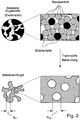
- Fig. 2 shows a schematic representation of the process according to the invention using both exotemplates and endotemplates.
- a dispersion or solution containing both the metal oxide nanoparticles and the endotemplates can be introduced into the exotemplate (spherical activated carbon), followed by thermal treatment for purposes of calcination and removal of the exotemplate as well as of the endotemplate.
- the result is a product which has a bimodal pore size distribution, wherein in the figure representation according to Fig. 2 the pore diameter "d P, 1 " shows the pore system or pore diameter due to the use of the exotemplate and the pore diameter "d P, 2 " the pore system or pore diameter due to the use of the endotemplate.
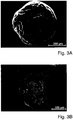
- FIG. 3 shows SEM images of a spherical activated carbon used according to the invention as an exotate ( Fig. 3A ) as well as a particulate porous material according to the present invention ( Fig. 3B ), wherein both the exotemplate and the product are in spherical form.
- the spheres of the product have significantly smaller diameters compared to the activated carbon spheres used, which can be attributed to a compaction of the phases due to crystallization effects.
- Fig. 4 again shows various Stickstoffsorptionsisothermen (ie adsorption and desorption isotherms) of porous mixed oxide particles according to the invention.
- the two upper curves concern products according to the invention which have been produced both with endo- and with exotemplate, while the middle curves (with the symbol “square”) concern products according to the invention which are produced only with an exotemplate are.
- the two lower curves (with the symbol “Circle”) are non-inventive products that are made using only endotemplate.
- FIG. 5 again shows pore diameter distributions of porous mixed oxide particles of the invention, which are prepared using only one Exotemplats (symbol “square") or using an endo- and Exotemplats (symbol “triangle”).
- Exotemplats symbol "square”
- endo- and Exotemplats symbol "triangle”
- a comparison serves a non-inventive product, which has been produced only with endotemplate (symbol "circle”).
- Fig. 5 shows that the use of both endo- and exotemplates leads to a bimodal pore diameter distribution due to two pore systems, one of which is due to the exotemplate and the other to the endotemplate.
- Fig. 6 again shows the influence of the endotemplate content on the formation of the second pore system in combined exotemplate and endotemplate synthesis.
- FIG. 7 again shows graphs of Stickstoffsorptionsisothermen different porous mixed oxide particles according to the invention, which have been prepared starting from different activated carbon Exotemplaten (see Example 6).
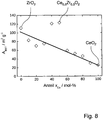
- FIG. 8 shows a graphical representation of BET surface areas of ceria / zirconia composite oxide particles according to the invention according to the present invention, depending on the respective cerium and zirconium content, while the corresponding figure representation according to Fig. 9 the relevant X-ray powder diffractograms of these products according to the invention shows.
- FIG. 10 various nitrogen adsorption isotherms of porous V 2 O 5 / TiO 2 mixed oxide particles of varying vanadium oxide and titanium oxide content according to the present invention
- Fig. 11 the corresponding X-ray powder diffractograms of these products shows.
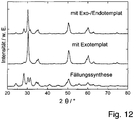
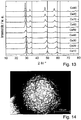
- Fig. 12 again shows X-ray powder diffraction patterns of synthesis products with exo- and endotemplate (according to the invention), only with Exotemplat (also according to the invention) and by means of precipitation synthesis according to the prior art (not according to the invention).
- Fig. 14 a SEM micrograph of a porous cerium / zirconium mixed oxide according to the invention shows.
- porous cerium / zirconium mixed oxide particles For the synthesis of porous cerium / zirconium mixed oxide particles according to the invention, first a common sol of ceria nanoparticles and zirconia nanoparticles was prepared. The nanoparticles concerned were obtained by precipitation from corresponding precursor salts of the two aforementioned metals.
- the sol of zirconia nanoparticles was obtained as follows: zirconium hydroxide Zr (OH) 4 was prepared from an aqueous solution of 7.28 g ZrOCl 2 in 75 g deionized water by adding ammonia solution to pH 8.4 with stirring like; after stirring for an additional hour at room temperature, the precipitate was filtered off and washed with deionized water to neutrality of the wash water, then added to the hydrous filter cake deionized water to a total mass of 29 g and with 1.6 ml of a 65-% HNO 3 solution slurried.
- the zirconia nanoparticulate sol was obtained after treating this suspension for 120 minutes in an ultrasonic bath.
- a sol of ceria nanoparticles was prepared. By combining the two sols, a sol is formed which contains both zirconia nanoparticles and ceria nanoparticles.
- TBC triblock copolymer
- activated carbon spheres were after drying at 110 ° C in air activated carbon from Adsor-Tech GmbH, Premnitz, Germany [BET surface area: 1748 m 2 / g, total pore volume Gurvich: 2 cm 3 / g, Ball diameter: 0.45 to 0.50 mm]) impregnated with the previously prepared nanoparticle sols.
- the activated carbon spheres loaded in this way then became at 600 ° C for five hours calcined in an air flow of 40 cm 3 / min in order to remove the carbon by means of pyrolysis. Grain fractions in the range from 0.2 to 0.4 mm were sieved out of the colorless CeO 2 / ZrO 2 spheres thus obtained.
- the particle morphology of the obtained solids was determined by scanning electron microscopy (SEM, Philips, ESEM XL 30 FEG), the pore system by nitrogen sorption at -196 ° C (Micromeritics, ASAP 2010) and the present phases by X-ray powder diffractometry of previously ground samples (XRD, Siemens, D5000 Characterized.
- the smaller diameter of the spheres of the product compared to the activated carbon spheres used can be attributed to a compaction of the phases due to crystallization effects, which takes place during the removal of the activated carbon by burning.
- the mechanical stability of the particles according to the invention is also significantly higher than that of comparative products which are obtained after impregnation of the activated carbon beads with a solution of the metal salts instead of the nanosol.
- the SEM micrographs of a fractured surface of the resulting products show that the synthesis did not involve a mere agglomeration of nanoparticles, but that a cerium / zirconium mixed oxide network was formed inside the particle with a pore system that was similar to the original carbon exotate in resembles its shape.
- the advantageous effect of the carbon-exotemplate on the formation of an open pore system manifests itself in a substantially larger mean pore diameter (15.4 nm compared to 8.2 nm and 5.9, respectively) compared to the products in the absence of carbon or compared to the products produced by precipitation nm, see Table 1).
- This pore diameter is also well above the pore diameter of the activated carbon spheres used.
- the activated carbon since the activated carbon also has micropores, the pore system of the product spheres can not be considered as a direct negative impression of the activated carbon pore system.
- the nitrogen sorption isotherm of type IV with a characteristic hysteresis at p / p 0 ⁇ 0.7 also indicates a mainly mesoporous material (cf. Fig. 4 , especially left part); However, the distribution of the pore diameter with a maximum at about 10 nm is wide (see. Fig. 4 , in particular right part).
- an additional mesopore system can be generated by additionally adding an endotemplate based on the triblock copolymer Pluronic® from BASF to the nanosol for the impregnation of the activated carbon spheres.
- an endotemplate based on the triblock copolymer Pluronic® from BASF
- spherical mixed oxide with a similar particle size distribution as in the synthesis with exotic template is again present.
- the nitrogen sorption capacity is markedly increased (cf. Fig. 5 , especially left part).
- an additional maximum occurs at about 3 nm. This demonstrates the formation of an additional pore system with dimensions almost an order of magnitude lower than those of the pores obtained due to the activated carbon exotate.
- a pore system with a similar maximum is formed even if the synthesis is carried out only in the presence of the endotemplate (cf. Fig. 5 , in particular the right-hand part); however, this results in a much lower specific surface area (see Table 1).
- the diameter distribution of the pores due to the activated carbon exotemplate widens to larger values, and their maximum shifts from about 10 nm in the absence of the endotemplate to about 20 nm in the presence of both templates (cf. Fig. 5 , in particular right part).
- the additional space requirement of the endotemplate in the crystallization of mixed oxides in the pores of the activated carbon exotate could be responsible for this, but without wishing to be bound by any particular theory or explanation.
- the specific surface area and the specific pore volume of the products according to the invention are several times higher than for a product synthesized by conventional precipitation.
- exo- and endotemplates opens up the possibility of producing other crystalline, but also amorphous metal oxides and metal mixed oxides with a hierarchically structured bimodal pore system and at the same time a defined particle morphology in a targeted and simple manner.
- polar or hydrophilic exotic template surfaces were carried out either by means of thermal oxidation treatment in the presence of an oxygen-containing atmosphere during activation in the production of the activated carbon or by chemical oxidation of the finished activated carbon with a suitable chemical oxidant (eg nitric acid or hydrogen peroxide).
- a suitable chemical oxidant eg nitric acid or hydrogen peroxide.
- the polar or hydrophilic exotemplates were impregnated with aqueous nanosol based on ceria nanoparticles and zirconia nanoparticles. The experiment is carried out according to Embodiment 1.
- hydrophobic exotic template surfaces by means of reductive treatment with hydrogen.
- the hydrophobic exotemplates were impregnated with organic nanosol in n-hexane based on ceria nanoparticles and zirconia nanoparticles. The experiment is carried out according to Embodiment 1.
- the mixed oxide particles according to the invention were tested for various catalytic applications and gave excellent results there.
- mixed oxide particles based on CeO 2 / ZrO 2 according to the invention showed excellent results in the catalytic exhaust gas treatment of exhaust gases from internal combustion engines, while mixed oxide particles based on V 2 O 5 / TiO 2 showed excellent results in the catalytic removal of nitrogen oxides from industrial exhaust gases.
- a mixture of various volumes of zirconium (IV) propylate (Aldrich, 70% by weight in propanol) and cyclohexane (Fluka, 99.5%) of 100: 0 and 50:50 was prepared.
- Spherical activated carbon was dry-impregnated with these mixtures, ie the added volume of precursor solution corresponded to the pore volume of the activated carbon composition used.
- So z. B 5 g of activated carbon with a mixture of 5 ml of zirconium (IV) propylate solution and 5 ml Cylcohexan impregnated. The process can be carried out for activated carbon in the range of 1 to 20 g.
- the synthesis of the zirconia sol was carried out according to Deshpande et al. ( AS Deshpande, N. Pinna, P. Beato, M. Antonietti, M. Niederberger, Chem. Mater. 16 (2004) 2599 ) carried out.
- a precipitation of nanoparticles was carried out in an acidic or basic medium according to the following procedure.
- ZrOCl 2 • 8H 2 O (Fluka, 99%) was dissolved in deionized water.
- a calculated mass of activated carbon in the range of 1 to 10 g was impregnated with the nanoparticle sol and dried at 333 K for 48 h in air. Subsequently, the material was calcined at 873 K for 5 h (heating rate: 2 K min -1 , 40 ml min -1 air flow).
- the synthesis of the nanoparticle sol was carried out as described above.
- the nanoparticle sol with the molar composition ZrO 2 : HNO 3 : H 2 O of 1: 0.4: 1283 was added the triblock copolymer (PEO-PPO-PEO) of the type Pluronic F77® (BASF).
- the molar ratio of triblock copolymer (TBC) to zirconium in the nanoparticle sol was varied between 0 and 0.027.
- So z. B. 1 to 5 g of activated carbon with a nanoparticle sol with a ratio of n TBC / n Zr 0.20 impregnated and dried at 333 K for 48 h in air.
- the material was calcined at 873 K for 5 h (heating rate: 2 K min -1 , 40 ml min -1 air flow).
- a cerium precursor such as cerium (III) nitrate hexahydrate (Aldrich, 99%) or cerium (III) chloride heptahydrate (Aldrich,> 98%) in deionized water, typically in concentrations of 2 to 6 mol l -1 , dissolved.
- 25 wt .-% ammonia solution was added dropwise with stirring until a pH of 10 to 11 was reached. The precipitate was aged at room temperature for 60 minutes.
- Cerium / zirconium mixed oxides (synthesis with nanoparticle sol)
- the corresponding metal salts were dissolved in deionized water.
- 25 wt .-% ammonia solution was added dropwise with stirring until a pH of 10 to 11 was reached.
- the precipitate was aged at room temperature for 60 minutes.
- the resulting precipitate was filtered off and washed with deionized water.
- the resulting filter cake was slurried with deionized water and HNO 3 (65 wt% in H 2 O) to give a molar composition Ce x Zr 1-x O 2 : HNO 3 : H 2 O of 1: 0.5: 1283 to obtain.
- HNO 3 65 wt% in H 2 O
- activated carbon (1 to 10 g) was impregnated with the nanoparticle sol and dried for two days at 333 K in air. Subsequently, the material obtained was calcined at 873 K for 5 h (heating rate: 2 K min -1 , 40 ml min -1 air stream).
- Vanadium pentoxide synthesis (synthesis with metal isopropylates); (not according to the invention)
- Activated carbon spheres (1 to 5 g) were dry-impregnated with VO (O i Pr) 3 (Alfa Aesar, 96%, 1.99 ml per 1 g of activated charcoal). This mixture was aged for one day to condense in the presence of atmospheric moisture. The product was then dried at 383 K in air and then calcined at 873 K for 5 h (heating rate 2 K min -1 , 40 ml min -1 air stream).
- Vanadium / titanium mixed oxides (synthesis with metal isopropylates)
- Titanium dioxide (synthesis with metal isopropylates); (not according to the invention)
- Activated carbon (1 to 10 g) was dry impregnated with Ti (O i Pr) 4 (Aldrich, 97%). Deionized water (0.2 ml g- 1 activated charcoal) was added to the loaded charcoal to initiate hydrolysis. The product was dried at 383 K in air and then calcined at 873 K for 5 h (heating rate 2 K min -1 , 40 ml min -1 air flow).
- Titanium dioxide (synthesis with nanoparticle sol); (not according to the invention)
- the modified residence time W / F in the catalytic experiments carried out here is 0.12 gs cm -3 .
- W corresponds to the catalyst mass used and F corresponds to the total volume flow of the gaseous reactant stream.
- the detector used was a non-dispersive infrared analyzer (type URAS 10 E, Hartmann & Braun ). This CO 2 , C 3 H 6 , NO and N 2 O could be detected in the reaction gas.
- the detector was preceded by a converter (type CGK-O, Hartmann & Braun ), since NO 2 can not be detected by the analyzer.
- the control of the system and the data recording were carried out by a computer with a connected control unit (software WorkBench PC 2.1.0, Strawberry Tree). Constant heating and cooling rates were assumed.
- the respective catalyst sample is heated in a helium stream (100 cm 3 min -1 ) at a heating rate of 10 K min -1 to 400 ° C and activated at this temperature for 1 h.
- the temperature step profile begins. With the beginning of the step profile, the reaction gas mixture is passed over the catalyst.
- the temperature steps are each 50 ° C at a heating rate of 10 K min -1 .
- the temperature plateaus at 200, 250, 300 and 350 ° C are each held for 2 h and at 400, 450, 500, 550 and 600 ° C for 1 h each time until a stationary state is established.
- the stream of helium is cooled to 60 ° C. at a flow rate of 60 cm 3 min -1 .
- the analysis was carried out by means of non-dispersive infrared analysis.
- Lambert-Beer has an exponential relationship between the measured absorption and the concentration of the measuring component.
- the processing electronics provide a linear DC signal which is stored by the control unit, the PC, in the form of an ASCII file. The evaluation is carried out with the analysis program Origin.
- a commercial comparative catalyst based on supported TiO 2 was investigated; this investigated catalyst (ie only supported TiO 2 ) shows no activity for the HC-SCR under the conditions used: the NO conversion achieved is due to the added corundum. Comparable results are also for a commercial Comparative catalyst based on supported V 2 O 5 (ie only V 2 O 5 supported).
- the catalyst system based on V 2 O 5 -TiO 2 according to the invention exhibits excellent conversions; The conversion of NO increases steadily with increasing temperatures, which is mainly due to the formation of N 2 O.
- the catalyst system based on V 2 O 5 -TiO 2 according to the invention also has a high selectivity for the formation of N 2 O of more than 80%.
Landscapes
- Chemical & Material Sciences (AREA)
- Engineering & Computer Science (AREA)
- Materials Engineering (AREA)
- Organic Chemistry (AREA)
- Chemical Kinetics & Catalysis (AREA)
- Physics & Mathematics (AREA)
- Thermal Sciences (AREA)
- Dispersion Chemistry (AREA)
- Catalysts (AREA)
- Solid-Sorbent Or Filter-Aiding Compositions (AREA)
Claims (15)
- Procédé de fabrication de matériaux poreux particulaires à base d'oxydes métalliques mixtes d'au moins deux métaux différents l'un de l'autre selon le procédé de templating,
caractérisé en ce que(a) d'abord dans une première étape de procédé les nanoparticules d'oxydes métalliques d'au moins deux métaux différents l'un de l'autre sont introduits dans les pores d'un matériau matriciel (« exotemplate ») poreux tridimensionnel, les nanoparticules présentant une granulométrie dans la plage comprise entre 0,1 nm et 2000 nm et du charbon actif particulaire étant utilisé comme matériau matriciel poreux tridimensionnel, le matériau matriciel étant modifié sur sa surface, la modification de surface s'effectuant par traitement oxydatif ou réducteur du matériau matriciel ; et(b) en ce qu'ensuite dans une seconde étape de procédé le matériau matriciel chargé de nanoparticules est soumis à un traitement thermique servant à éliminer au moins partiellement, de préférence sensiblement totalement, le matériau matriciel. - Procédé selon la revendication 1, caractérisé en ce
les nanoparticules sous forme d'une dispersion ou d'une solution colloïdale, en particulier sous forme d'un sol, sont introduites dans les pores du matériau matriciel, en particulier la dispersion ou la solution colloïdale étant conçue sous forme de base aqueuse ou organique, de préférence de base aqueuse ; et/ou
en ce que l'introduction des nanoparticules dans les pores du matériau matriciel s'effectue par imprégnation du matériau matriciel par une dispersion ou une solution colloïdale , en particulier un sol, contenant les nanoparticules ; et/ou
en ce que les nanoparticules, en particulier les dispersions ou les solutions colloïdales, de préférence les sols, des nanoparticules sont obtenues par précipitation, en particulier en partant de solutions ou de dispersions de sels ou d'autres précurseurs, en particulier des alcoxydes, des métaux concernés ; en particulier l'étape de procédé d'introduction de la dispersion ou de la solution colloïdale, en particulier du sol, contenant les nanoparticules dans les pores du matériau matriciel encore avant la mise en oeuvre du traitement thermique selon l'étape de procédé (b) étant d'abord suivie d'une étape de procédé de séchage. - Procédé selon une des revendications précédentes, caractérisé en ce que
la granulométrie des nanoparticules est inférieure au diamètre des pores du matériau matriciel et/ou en ce que le rapport entre le diamètre des pores du matériau matriciel et la granulométrie des nanoparticules est > 1 : 1, en particulier au moins 1,25 : 1, de préférence au moins 1,5 : 1, de préférence au moins 1,75 : 1, de préférence encore au moins 2, mieux encore au moins 5, encore davantage de préférence au moins 10, mieux encore au moins 20, idéalement au moins 50 ; et/ou
en ce que les nanoparticules présentent une granulométrie dans la plage comprise entre 0,5 nm et 1000 nm, de préférence comprise entre 0,75 nm et 750 nm, de préférence encore entre 1 nm et 500 nm, mieux encore entre 1 nm et 250 nm, et/ou en ce que les nanoparticules présentent une granulométrie moyenne (D50) dans la plage comprise entre 0,1 nm et 500 nm, en particulier entre 0,2 nm et 100 nm, de préférence entre 0,5 nm et 50 nm, de préférence encore entre 1 nm et 25 nm, idéalement entre 2 et 100 nm. - Procédé selon une des revendications précédentes, caractérisé en ce que
l'introduction des nanoparticules dans les pores du matériau matriciel s'effectue en présence d'au moins un endo-template et/ou conjointement à celui-ci ;
en particulier l'endo-template étant éliminé au moins partiellement, de préférence au moins sensiblement totalement, par le traitement thermique selon l'étape de procédé (b) ; et/ou
en particulier l'endo-template étant sélectionné dans le groupe des polymères et copolymères organiques, en particulier des copolymères à blocs, des tensioactifs organiques, des composés formant des micelles et des sels d'ammonium, en particulier des sels d'ammonium quaternaire ou diquaternaire, ainsi que leurs mélanges et combinaisons ; et/ou
en particulier l'endo-template étant un constituant d'une dispersion ou d'une solution colloïdale, en particulier d'un sol, contenant les nanoparticules ; et/ou
en particulier l'endo-template étant utilisé dans un rapport molaire nEndotemplat/nMetalle, calculé par le rapport molaire entre l'endo-template utilisé et les métaux utilisés des oxydes métalliques, dans la plage comprise entre 0,005 et 0,2, en particulier entre 0,01 et 0,1, de préférence entre 0,015 et 0,08. - Procédé selon une des revendications précédentes, caractérisé en ce que
le matériau matriciel présente une granulométrie moyenne (D50), en particulier un diamètre moyen des particules (D50), dans la plage comprise entre 0,01 et 1 mm, en particulier entre 0,05 et 0,8 mm, de préférence entre 0,1 et 0,6 mm, préférentiellement entre 0,15 et 0,5 mm, de manière particulièrement préférée entre 0,2 et 0,4 mm ; et/ou en ce que le matériau matriciel comprend un volume poreux total, en particulier un volume poreux total selon Gurvich, dans la plage comprise entre 0,4 et 4 cm3/g, en particulier entre 0,5 et 3,5 cm3/g, de préférence entre 0,6 et 3 cm3/g, mieux encore entre 0,7 et 2,5 cm3/g, et/ou en ce qu'entre 50 % et 99 %, en particulier entre 60 % et 99 %, de préférence entre 70 % et 95 %, du volume poreux total, en particulier du volume poreux total selon Gurvich, du matériau matriciel sont formés par les pores ayant un diamètre de pore < 500 nm, en particulier < 250 nm, de préférence < 100 nm ; et/ou
en ce que le matériau matriciel comprend un volume poreux, en particulier un volume microporeux formé par des pores ayant un diamètre ≤ 20 Å, en particulier un volume microporeux par la méthode au noir de carbone, dans la plage comprise entre 0,1 et 2 cm3/g, en particulier entre 0,2 et 1,5 cm3/g, de préférence entre 0,3 et 1,1 cm3/g, mieux encore entre 0,4 et 1 cm3/g, et/ou en ce qu'entre 20 % et 95 %, en particulier entre 30 % et 95 %, de préférence entre 40 % et 90 %, du volume poreux total du matériau matriciel sont formés par des pores ayant un diamètre ≤ 20 Å (micropores) ; et/ou
en ce que le matériau matriciel présente un diamètre moyen des pores dans la plage de 1 à 150 Å, en particulier de 1 à 100 Å, préférablement de 1,5 à 75 Å, de manière particulièrement préférée de 1,5 à 50 Å ; et/ou
en ce que le matériau matriciel présente une aire spécifique BET dans la plage comprise entre 500 m2/g et 3,500 m2/g, en particulier entre 600 et 2 500 m2/g, de préférence entre 700 et 2 000 m2/g, de préférence encore entre 800 et 1 800 m2/g. - Procédé selon une des revendications précédentes, caractérisé en ce que
le matériau matriciel est sur sa surface modifié et/ou est apprêté par des groupes polaires et/ou en ce que le matériau matriciel est sur sa surface doté d'un apprêt hydrophile ou hydrophobe, en particulier est modifié par des groupes hydrophiles ou hydrophobes,
en particulier l'apprêt polaire et/ou hydrophile du matériau matriciel s'effectue par traitement thermique oxydatif, en particulier lors de la fabrication du matériau matriciel, en particulier dans le cadre du traitement d'activation, en particulier par traitement thermique en présence de gaz oxydants, de préférence l'oxygène, et/ou en particulier l'apprêt polaire et/ou hydrophile du matériau matriciel s'effectue par traitement chimique oxydatif, en particulier par traitement et/ou par réaction du matériau matriciel avec au moins un agent oxydant, de préférence sélectionné parmi l'acide nitrique, les peroxydes et les peracides ainsi que leurs mélanges ou combinaisons ; et/ou
en particulier l'apprêt non polaire et/ou hydrophobe du matériau matriciel s'effectue par traitement réducteur du matériau matriciel, en particulier par traitement réducteur en présence d'au moins un agent réducteur, de préférence hydrogène. - Procédé selon une des revendications précédentes, caractérisé en ce que
le traitement thermique est effectué selon la seconde étape de procédé (b) dans des conditions oxydatives, en particulier en présence d'oxygène ; et/ou
en ce que le traitement thermique selon la seconde étape de procédé (b) provoque une élimination au moins partielle, de préférence au moins sensiblement totale du matériau matriciel par grillage ou par pyrolyse et/ou
en ce que dans le cadre du traitement thermique selon la seconde étape de procédé (b) on procède à une calcination des oxydes métalliques mixtes et/ou à un grillage ou une pyrolyse au moins partiel, de préférence au moins sensiblement total, du matériau matriciel et/ou
en ce que le traitement thermique selon la seconde étape de procédé (b) est réalisé à des températures dans la plage comprise entre 300 et 1 500 °C, en particulier entre 400 et 1 200 °C, de préférence entre 500 et 1 000 °C, mieux encore entre 550 et 800 °C, et/ou sur une durée de 1 à 20 heures, de préférence de 2 à 15 heures, de préférence de 3 à 10 heures, et/ou en présence d'une atmosphère oxygénée. - Procédé selon une des revendications précédentes, caractérisé en ce que
les métaux des oxydes mixtes sont sélectionnés parmi les métaux des groupes principaux et secondaires du tableau périodique des éléments et les lanthanides, de préférence provenant du groupe Al, Bi, Ce, Cu, Fe, Mn, Mo, Si, Ti, V, Zr, Co, Cr, Ni, Zn, Mg, Ca et B, mieux encore du groupe Al, Bi, Ce, Cu, Fe, Mn, Mo, Si, Ti, V et Zr, et/ou
en ce que les oxydes mixtes des métaux sont sélectionnés parmi les combinaisons suivantes : Al2O3/SiO2 ; oxyde de fer /oxyde de manganèse ; oxyde de cuivre/oxyde de manganèse ; MoO3/Bi2O3 ; TiO2/V2O5 ; ZrO2/oxyde de lanthanide, en particulier ZrO2/CeO2 ; ZrO2/oxyde de fer ; ZrO2/oxyde de manganèse ; ZrO2/SiO2 ; ZrO2/TiO2 ; et/ou
en ce que le rapport entre la granulométrie des particules du matériau matriciel utilisé et celle des particules des matériaux poreux particulaires obtenus se situe dans la plage entre 1,1 : 1 à 50 : 1, en particulier 1,2 : 1 à 20 : 1, de préférence 1,4 : 1 à 10 : 1, préférablement 1,5 : 1 à 5 : 1. - Matériaux poreux particulaires à base d'oxydes métalliques mixtes d'au moins deux métaux différents l'un de l'autre sous la forme de particules discrètes, pouvant être obtenus par un procédé selon l'une quelconque des revendications précédentes, les métaux des oxydes mixtes étant sélectionnés dans le groupe Al, Bi, Ce, Cu, Fe, Mn, Mo, Si, Ti, V et Zr.
- Matériaux poreux particulaires selon la revendication 9, caractérisés
en ce que les matériaux poreux particulaires sont conçus comme auto-porteurs ; et/ou
en ce que les matériaux poreux particulaires sont conçus sous la forme de particules discrètes granulaires, en particulier sphériques ; et/ou
en ce que les matériaux poreux particulaires présentent une granulométrie moyenne (D50), en particulier un diamètre moyen de particule (D50), dans la plage comprise entre 0,01 et 0,8 mm, en particulier entre 0,05 et 0,7 mm, de préférence entre 0,1 et 0,6 mm. - Matériaux poreux particulaires selon l'une quelconque des revendications précédentes, caractérisés en ce que
les matériaux poreux particulaires présentent un diamètre moyen des pores, en particulier par la méthode BJH, dans la plage comprise entre 1 et 35 Å, en particulier entre 1 et 30 Å, préférablement entre 1,5 et 30 Å, de manière particulièrement préférée entre 2 et 25 Å ; et/ou
en ce que les matériaux poreux matriciels présentent une aire spécifique BET dans la plage comprise entre 10 m2/g et 1 000 m2/g, en particulier entre 15 et 900 m2/g, de préférence entre 20 et 500 m2/g, de préférence encore entre 25 et 300 m2/g ; et/ou
en ce que les matériaux poreux particulaires présentent un système poreux à structure hiérarchique et/ou en ce que les matériaux poreux particulaires présentent une répartition du diamètre des pores multimodale ou bimodale, en particulier les matériaux poreux particulaires présentant au moins un premier et un second système poreux, dont les valeurs maximum de répartition du diamètre des pores diffèrent d'au moins 5 nm, en particulier d'au moins 10 nm, en particulier rapporté au diagramme « volumes différentiel des pores (dV/dD)/ diamètre des pores (D) ». - Matériaux poreux particulaires selon l'une quelconque des revendications précédentes, caractérisés en ce que
les matériaux poreux particulaires sont conçus au moins comme partiellement cristallins, en particulier au moins sensiblement comme entièrement cristallin, en particulier les matériaux poreux particulaires présentant un taux de cristallinité d'au moins 25 %, en particulier au moins 30 %, de préférence au moins 40 %, mieux encore au moins 50 %, idéalement au moins 60 % et plus ; et/ou
en ce que les oxydes mixtes des métaux sont sélectionnés parmi les combinaisons suivantes : Al2O3/SiO2 ; oxyde de fer /oxyde de manganèse ; oxyde de cuivre/oxyde de manganèse ; MoO3/Bi2O3 ; TiO2/V2O5 ; ZrO2/oxyde de lanthanide, en particulier ZrO2/CeO2 ; ZrO2/oxyde de fer; ZrO2/oxyde de manganèse ; ZrO2/SiO2 ; ZrO2/TiO2 ; et/ou
en ce que les rapports massiques des au moins deux métaux différents l'un de l'autre des oxydes métalliques mixtes varient dans la plage 1 : 99 à 99 : 1, en particulier 5 : 95 à 95 : 5, de préférence 10 : 90 à 90 : 10. - Utilisation de matériaux poreux particulaires selon l'une quelconque des revendications précédentes comme catalyseurs ou supports de catalyseur, en particulier pour le traitement catalytique des gaz d'échappement provenant des processus de combustion, destinés à l'élimination catalytique des oxydes d'azote des gaz d'échappement des processus de combustion, à la catalyse de processus et réactions chimiques ou à la photocatalyse.
- Utilisation de matériaux poreux particulaires selon l'une quelconque des revendications précédentes dans des détecteurs de gaz ou comme détecturs de gaz ou dans des piles à combustible.
- Utilisation de matériaux poreux particulaires selon l'une quelconque des revendications précédentes pour des applications sorbantes, en particulier adsorbantes, en particulier comme des adsorbants de préférence réactifs.
Applications Claiming Priority (2)
| Application Number | Priority Date | Filing Date | Title |
|---|---|---|---|
| DE102011105196 | 2011-06-17 | ||
| PCT/EP2012/002543 WO2012171656A1 (fr) | 2011-06-17 | 2012-06-15 | Matériaux poreux à base d'oxydes métalliques mixtes ainsi que leur production et leur utilisation |
Publications (2)
| Publication Number | Publication Date |
|---|---|
| EP2720794A1 EP2720794A1 (fr) | 2014-04-23 |
| EP2720794B1 true EP2720794B1 (fr) | 2018-11-14 |
Family
ID=46384295
Family Applications (1)
| Application Number | Title | Priority Date | Filing Date |
|---|---|---|---|
| EP12729870.1A Active EP2720794B1 (fr) | 2011-06-17 | 2012-06-15 | Matériaux poreux à base d'oxydes métalliques mixtes ainsi que leur production et leur utilisation |
Country Status (4)
| Country | Link |
|---|---|
| EP (1) | EP2720794B1 (fr) |
| DE (2) | DE102012011764A1 (fr) |
| ES (1) | ES2711324T3 (fr) |
| WO (1) | WO2012171656A1 (fr) |
Cited By (1)
| Publication number | Priority date | Publication date | Assignee | Title |
|---|---|---|---|---|
| US20210313569A1 (en) * | 2020-04-06 | 2021-10-07 | Samsung Electronics Co., Ltd. | Positive electrode having excellent alkali resistance, method of manufacturing the same, and metal-air battery and electrochemical device including the positive electrode |
Families Citing this family (15)
| Publication number | Priority date | Publication date | Assignee | Title |
|---|---|---|---|---|
| CN105408018B (zh) * | 2013-06-27 | 2018-02-23 | 科莱恩公司 | 氧化锰稳定的氧化锆催化剂支撑体材料 |
| DE102013217863A1 (de) | 2013-09-06 | 2015-03-12 | Robert Bosch Gmbh | Sensorelement zur Erfassung mindestens einer Eigenschaft eines Messgases in einem Messgasraum und Verfahren zum Herstellen desselben |
| DE202014101137U1 (de) * | 2013-12-09 | 2014-12-12 | BLüCHER GMBH | Katalysatorsystem |
| CN105289627A (zh) * | 2015-10-09 | 2016-02-03 | 合肥学院 | 一种Fe-Ce-ZrO2催化材料的制备方法 |
| US10807071B2 (en) * | 2016-05-05 | 2020-10-20 | University Of Connecticut | Mesoporous metal doped cerium oxide catalyst |
| JP6692256B2 (ja) | 2016-08-25 | 2020-05-13 | 日本碍子株式会社 | 多孔質セラミックス構造体 |
| CN111068681A (zh) * | 2019-11-28 | 2020-04-28 | 上海应用技术大学 | 用于甲醇水蒸气重整制氢的催化剂及其制备方法和应用 |
| CN111530480B (zh) * | 2020-05-20 | 2022-11-25 | 杭州师范大学 | 一种多孔层状过渡金属硫族化合物及其制备方法和应用 |
| CN112371084A (zh) * | 2020-10-20 | 2021-02-19 | 广西南宁都宁通风防护设备有限公司 | 一种灭菌活性炭的制备方法及应用 |
| CN113058627B (zh) * | 2021-03-30 | 2022-04-29 | 中建三局绿色产业投资有限公司 | Al/Si-C基多孔核壳分离球体及其负载型催化剂和应用 |
| CN113092544B (zh) * | 2021-04-08 | 2024-02-20 | 青岛大学 | 级次结构氧化铋材料在气体检测中的应用 |
| US20240342663A1 (en) * | 2021-07-28 | 2024-10-17 | National University Of Singapore | Porous materials, methods and uses thereof |
| CN115487800B (zh) * | 2022-09-16 | 2023-11-14 | 四川大学 | 具有稳定大孔结构的CeO2-ZrO2催化材料及其制备方法和应用 |
| CN115805069B (zh) * | 2022-11-14 | 2024-03-19 | 天津大学 | 基于高分散钙钛矿催化成分的柴油机用催化剂及制备方法 |
| CN117323969B (zh) * | 2023-11-30 | 2024-03-15 | 中汽研汽车检验中心(天津)有限公司 | 一种高效氮氧化物吸附剂、制备方法及应用 |
Family Cites Families (7)
| Publication number | Priority date | Publication date | Assignee | Title |
|---|---|---|---|---|
| DE4304026B4 (de) | 1992-02-28 | 2005-02-17 | Mhb Filtration Gmbh & Co. Kg | Verfahren zur Entsorgung von verbrauchten Ionenaustauschern |
| DE4328219A1 (de) | 1993-08-21 | 1995-02-23 | Hasso Von Bluecher | Aktivkohlekügelchen aus Ionenaustauschern |
| JPH11501606A (ja) | 1995-01-11 | 1999-02-09 | ブリュッヒャー,ハッソ フォン | 粒状活性炭の製造方法 |
| JP3648125B2 (ja) * | 1999-06-25 | 2005-05-18 | 株式会社日本触媒 | 有機ハロゲン化合物の除去用触媒および有機ハロゲン化合物の除去方法 |
| DE10226131A1 (de) * | 2002-06-12 | 2003-12-24 | Studiengesellschaft Kohle Mbh | Thermisch stabile Materialien mit hoher spezifischer Oberfläche |
| KR100660916B1 (ko) | 2006-02-09 | 2006-12-26 | 삼성전자주식회사 | 트렌치들의 패턴 밀도 및 깊이를 매개 변수로 이용하는도전층 평탄화 단계를 포함하는 반도체 소자의 제조 방법 |
| DE202006016898U1 (de) | 2006-10-12 | 2007-11-22 | BLüCHER GMBH | Hochleistungsadsorbentien auf der Basis von Aktivkohle mit hoher Mikroporosität |
-
2012
- 2012-06-15 ES ES12729870T patent/ES2711324T3/es active Active
- 2012-06-15 DE DE102012011764A patent/DE102012011764A1/de not_active Withdrawn
- 2012-06-15 WO PCT/EP2012/002543 patent/WO2012171656A1/fr not_active Ceased
- 2012-06-15 EP EP12729870.1A patent/EP2720794B1/fr active Active
- 2012-06-15 DE DE202012005818U patent/DE202012005818U1/de not_active Expired - Lifetime
Non-Patent Citations (1)
| Title |
|---|
| None * |
Cited By (2)
| Publication number | Priority date | Publication date | Assignee | Title |
|---|---|---|---|---|
| US20210313569A1 (en) * | 2020-04-06 | 2021-10-07 | Samsung Electronics Co., Ltd. | Positive electrode having excellent alkali resistance, method of manufacturing the same, and metal-air battery and electrochemical device including the positive electrode |
| US12489110B2 (en) * | 2020-04-06 | 2025-12-02 | Samsung Electronics Co., Ltd. | Positive electrode having excellent alkali resistance, method of manufacturing the same, and metal-air battery and electrochemical device including the positive electrode |
Also Published As
| Publication number | Publication date |
|---|---|
| WO2012171656A1 (fr) | 2012-12-20 |
| DE202012005818U1 (de) | 2012-07-13 |
| DE102012011764A1 (de) | 2012-12-20 |
| ES2711324T3 (es) | 2019-05-03 |
| EP2720794A1 (fr) | 2014-04-23 |
Similar Documents
| Publication | Publication Date | Title |
|---|---|---|
| EP2720789B1 (fr) | Production des matériaux poreux à base d'oxydes de titane et/ou vanadium | |
| DE102012011764A1 (de) | Poröse Materialien auf Basis von metallischen Mischoxiden sowie deren Herstellung und Verwendung | |
| KR102298817B1 (ko) | 티타니아 입자 및 이의 제조방법 | |
| Taghavimoghaddam et al. | Preparation and characterization of mesoporous silica supported cobalt oxide as a catalyst for the oxidation of cyclohexanol | |
| EP2069439B1 (fr) | Particule nanocomposite et son processus de préparation | |
| EP1984112B1 (fr) | Mélange d'oxydes | |
| Ye et al. | Synthesis of oxygen functionalized carbon nanotubes and their application for selective catalytic reduction of NO x with NH 3 | |
| WO2015086109A1 (fr) | Système catalytique basé sur du charbon activé en granulés comme support et son utilisation | |
| US20040241427A1 (en) | Metal oxide nanoparticles in an exfoliated silicate framework | |
| JP6936847B2 (ja) | 安定性の向上した高温層状混合金属酸化物材料 | |
| WO2016184805A1 (fr) | Oxyde de titane en poudre, son procédé de fabrication et son utilisation | |
| DE102015102484A1 (de) | Katalysatorprecursormaterial auf TiO2-Basis, dessen Herstellung und dessen Verwendung | |
| EP3312145A1 (fr) | Procédé de préparation de nanocristaux d'oxydes métalliques et leur utilisation pour l'oxydation de l'eau | |
| Hamidi et al. | Silver nanoparticles modified mesoporous titanosilicate materials for high oxidation of carbon monoxide | |
| Shao et al. | Two step synthesis of a mesoporous titania–silica composite from titanium oxychloride and sodium silicate | |
| CN100464856C (zh) | 制备金属纳米颗粒的方法和由此得到的材料 | |
| KR102474055B1 (ko) | 초임계 이산화탄소 추출을 이용한 금속산화물 촉매들의 합성 | |
| DE102011051334A1 (de) | Alkaliarmes Katalysatormaterial und Verfahren zu dessen Herstellung | |
| EP1478459A1 (fr) | Catalyseurs d'or sur support d'oxyde metallique, leur procede de production et leur utilisation | |
| Zou et al. | A facile and green synthesis route to mesoporous spinel-type Zn− Al complex oxide | |
| DE102011085903A1 (de) | Festkörper, insbesondere Katalysator | |
| DE102011082332A1 (de) | Heterogenkatalysator | |
| JP4749093B2 (ja) | NOx浄化用触媒の担体 | |
| KR20090025880A (ko) | 기공구조의 실리카를 이용한 페로브스카이트 구조를 갖는산화물 나노분말 및 산화물과 실리카의 복합체 나노분말의제조방법 | |
| DE102007006436A1 (de) | Oxidmischung |
Legal Events
| Date | Code | Title | Description |
|---|---|---|---|
| PUAI | Public reference made under article 153(3) epc to a published international application that has entered the european phase |
Free format text: ORIGINAL CODE: 0009012 |
|
| 17P | Request for examination filed |
Effective date: 20131202 |
|
| AK | Designated contracting states |
Kind code of ref document: A1 Designated state(s): AL AT BE BG CH CY CZ DE DK EE ES FI FR GB GR HR HU IE IS IT LI LT LU LV MC MK MT NL NO PL PT RO RS SE SI SK SM TR |
|
| AX | Request for extension of the european patent |
Extension state: BA ME |
|
| RAP1 | Party data changed (applicant data changed or rights of an application transferred) |
Owner name: BLUECHER GMBH |
|
| STAA | Information on the status of an ep patent application or granted ep patent |
Free format text: STATUS: EXAMINATION IS IN PROGRESS |
|
| 17Q | First examination report despatched |
Effective date: 20180430 |
|
| GRAP | Despatch of communication of intention to grant a patent |
Free format text: ORIGINAL CODE: EPIDOSNIGR1 |
|
| STAA | Information on the status of an ep patent application or granted ep patent |
Free format text: STATUS: GRANT OF PATENT IS INTENDED |
|
| GRAS | Grant fee paid |
Free format text: ORIGINAL CODE: EPIDOSNIGR3 |
|
| INTG | Intention to grant announced |
Effective date: 20180912 |
|
| GRAA | (expected) grant |
Free format text: ORIGINAL CODE: 0009210 |
|
| STAA | Information on the status of an ep patent application or granted ep patent |
Free format text: STATUS: THE PATENT HAS BEEN GRANTED |
|
| AK | Designated contracting states |
Kind code of ref document: B1 Designated state(s): AL AT BE BG CH CY CZ DE DK EE ES FI FR GB GR HR HU IE IS IT LI LT LU LV MC MK MT NL NO PL PT RO RS SE SI SK SM TR |
|
| AX | Request for extension of the european patent |
Extension state: BA ME |
|
| REG | Reference to a national code |
Ref country code: CH Ref legal event code: EP Ref country code: AT Ref legal event code: REF Ref document number: 1064176 Country of ref document: AT Kind code of ref document: T Effective date: 20181115 |
|
| REG | Reference to a national code |
Ref country code: DE Ref legal event code: R096 Ref document number: 502012013819 Country of ref document: DE |
|
| REG | Reference to a national code |
Ref country code: IE Ref legal event code: FG4D Free format text: LANGUAGE OF EP DOCUMENT: GERMAN |
|
| REG | Reference to a national code |
Ref country code: NL Ref legal event code: MP Effective date: 20181114 |
|
| REG | Reference to a national code |
Ref country code: LT Ref legal event code: MG4D |
|
| PG25 | Lapsed in a contracting state [announced via postgrant information from national office to epo] |
Ref country code: IS Free format text: LAPSE BECAUSE OF FAILURE TO SUBMIT A TRANSLATION OF THE DESCRIPTION OR TO PAY THE FEE WITHIN THE PRESCRIBED TIME-LIMIT Effective date: 20190314 Ref country code: FI Free format text: LAPSE BECAUSE OF FAILURE TO SUBMIT A TRANSLATION OF THE DESCRIPTION OR TO PAY THE FEE WITHIN THE PRESCRIBED TIME-LIMIT Effective date: 20181114 Ref country code: BG Free format text: LAPSE BECAUSE OF FAILURE TO SUBMIT A TRANSLATION OF THE DESCRIPTION OR TO PAY THE FEE WITHIN THE PRESCRIBED TIME-LIMIT Effective date: 20190214 Ref country code: LT Free format text: LAPSE BECAUSE OF FAILURE TO SUBMIT A TRANSLATION OF THE DESCRIPTION OR TO PAY THE FEE WITHIN THE PRESCRIBED TIME-LIMIT Effective date: 20181114 Ref country code: NO Free format text: LAPSE BECAUSE OF FAILURE TO SUBMIT A TRANSLATION OF THE DESCRIPTION OR TO PAY THE FEE WITHIN THE PRESCRIBED TIME-LIMIT Effective date: 20190214 Ref country code: HR Free format text: LAPSE BECAUSE OF FAILURE TO SUBMIT A TRANSLATION OF THE DESCRIPTION OR TO PAY THE FEE WITHIN THE PRESCRIBED TIME-LIMIT Effective date: 20181114 Ref country code: LV Free format text: LAPSE BECAUSE OF FAILURE TO SUBMIT A TRANSLATION OF THE DESCRIPTION OR TO PAY THE FEE WITHIN THE PRESCRIBED TIME-LIMIT Effective date: 20181114 |
|
| REG | Reference to a national code |
Ref country code: ES Ref legal event code: FG2A Ref document number: 2711324 Country of ref document: ES Kind code of ref document: T3 Effective date: 20190503 |
|
| PG25 | Lapsed in a contracting state [announced via postgrant information from national office to epo] |
Ref country code: SE Free format text: LAPSE BECAUSE OF FAILURE TO SUBMIT A TRANSLATION OF THE DESCRIPTION OR TO PAY THE FEE WITHIN THE PRESCRIBED TIME-LIMIT Effective date: 20181114 Ref country code: AL Free format text: LAPSE BECAUSE OF FAILURE TO SUBMIT A TRANSLATION OF THE DESCRIPTION OR TO PAY THE FEE WITHIN THE PRESCRIBED TIME-LIMIT Effective date: 20181114 Ref country code: RS Free format text: LAPSE BECAUSE OF FAILURE TO SUBMIT A TRANSLATION OF THE DESCRIPTION OR TO PAY THE FEE WITHIN THE PRESCRIBED TIME-LIMIT Effective date: 20181114 Ref country code: NL Free format text: LAPSE BECAUSE OF FAILURE TO SUBMIT A TRANSLATION OF THE DESCRIPTION OR TO PAY THE FEE WITHIN THE PRESCRIBED TIME-LIMIT Effective date: 20181114 Ref country code: PT Free format text: LAPSE BECAUSE OF FAILURE TO SUBMIT A TRANSLATION OF THE DESCRIPTION OR TO PAY THE FEE WITHIN THE PRESCRIBED TIME-LIMIT Effective date: 20190314 Ref country code: GR Free format text: LAPSE BECAUSE OF FAILURE TO SUBMIT A TRANSLATION OF THE DESCRIPTION OR TO PAY THE FEE WITHIN THE PRESCRIBED TIME-LIMIT Effective date: 20190215 |
|
| PG25 | Lapsed in a contracting state [announced via postgrant information from national office to epo] |
Ref country code: IT Free format text: LAPSE BECAUSE OF FAILURE TO SUBMIT A TRANSLATION OF THE DESCRIPTION OR TO PAY THE FEE WITHIN THE PRESCRIBED TIME-LIMIT Effective date: 20181114 Ref country code: PL Free format text: LAPSE BECAUSE OF FAILURE TO SUBMIT A TRANSLATION OF THE DESCRIPTION OR TO PAY THE FEE WITHIN THE PRESCRIBED TIME-LIMIT Effective date: 20181114 Ref country code: DK Free format text: LAPSE BECAUSE OF FAILURE TO SUBMIT A TRANSLATION OF THE DESCRIPTION OR TO PAY THE FEE WITHIN THE PRESCRIBED TIME-LIMIT Effective date: 20181114 Ref country code: CZ Free format text: LAPSE BECAUSE OF FAILURE TO SUBMIT A TRANSLATION OF THE DESCRIPTION OR TO PAY THE FEE WITHIN THE PRESCRIBED TIME-LIMIT Effective date: 20181114 |
|
| REG | Reference to a national code |
Ref country code: DE Ref legal event code: R097 Ref document number: 502012013819 Country of ref document: DE |
|
| PG25 | Lapsed in a contracting state [announced via postgrant information from national office to epo] |
Ref country code: SM Free format text: LAPSE BECAUSE OF FAILURE TO SUBMIT A TRANSLATION OF THE DESCRIPTION OR TO PAY THE FEE WITHIN THE PRESCRIBED TIME-LIMIT Effective date: 20181114 Ref country code: EE Free format text: LAPSE BECAUSE OF FAILURE TO SUBMIT A TRANSLATION OF THE DESCRIPTION OR TO PAY THE FEE WITHIN THE PRESCRIBED TIME-LIMIT Effective date: 20181114 Ref country code: RO Free format text: LAPSE BECAUSE OF FAILURE TO SUBMIT A TRANSLATION OF THE DESCRIPTION OR TO PAY THE FEE WITHIN THE PRESCRIBED TIME-LIMIT Effective date: 20181114 Ref country code: SK Free format text: LAPSE BECAUSE OF FAILURE TO SUBMIT A TRANSLATION OF THE DESCRIPTION OR TO PAY THE FEE WITHIN THE PRESCRIBED TIME-LIMIT Effective date: 20181114 |
|
| PLBE | No opposition filed within time limit |
Free format text: ORIGINAL CODE: 0009261 |
|
| STAA | Information on the status of an ep patent application or granted ep patent |
Free format text: STATUS: NO OPPOSITION FILED WITHIN TIME LIMIT |
|
| 26N | No opposition filed |
Effective date: 20190815 |
|
| PG25 | Lapsed in a contracting state [announced via postgrant information from national office to epo] |
Ref country code: SI Free format text: LAPSE BECAUSE OF FAILURE TO SUBMIT A TRANSLATION OF THE DESCRIPTION OR TO PAY THE FEE WITHIN THE PRESCRIBED TIME-LIMIT Effective date: 20181114 |
|
| PG25 | Lapsed in a contracting state [announced via postgrant information from national office to epo] |
Ref country code: MC Free format text: LAPSE BECAUSE OF FAILURE TO SUBMIT A TRANSLATION OF THE DESCRIPTION OR TO PAY THE FEE WITHIN THE PRESCRIBED TIME-LIMIT Effective date: 20181114 |
|
| REG | Reference to a national code |
Ref country code: CH Ref legal event code: PL |
|
| REG | Reference to a national code |
Ref country code: BE Ref legal event code: MM Effective date: 20190630 |
|
| PG25 | Lapsed in a contracting state [announced via postgrant information from national office to epo] |
Ref country code: TR Free format text: LAPSE BECAUSE OF FAILURE TO SUBMIT A TRANSLATION OF THE DESCRIPTION OR TO PAY THE FEE WITHIN THE PRESCRIBED TIME-LIMIT Effective date: 20181114 |
|
| PG25 | Lapsed in a contracting state [announced via postgrant information from national office to epo] |
Ref country code: IE Free format text: LAPSE BECAUSE OF NON-PAYMENT OF DUE FEES Effective date: 20190615 |
|
| PG25 | Lapsed in a contracting state [announced via postgrant information from national office to epo] |
Ref country code: CH Free format text: LAPSE BECAUSE OF NON-PAYMENT OF DUE FEES Effective date: 20190630 Ref country code: LU Free format text: LAPSE BECAUSE OF NON-PAYMENT OF DUE FEES Effective date: 20190615 Ref country code: BE Free format text: LAPSE BECAUSE OF NON-PAYMENT OF DUE FEES Effective date: 20190630 Ref country code: LI Free format text: LAPSE BECAUSE OF NON-PAYMENT OF DUE FEES Effective date: 20190630 |
|
| REG | Reference to a national code |
Ref country code: AT Ref legal event code: MM01 Ref document number: 1064176 Country of ref document: AT Kind code of ref document: T Effective date: 20190615 |
|
| PG25 | Lapsed in a contracting state [announced via postgrant information from national office to epo] |
Ref country code: AT Free format text: LAPSE BECAUSE OF NON-PAYMENT OF DUE FEES Effective date: 20190615 |
|
| PG25 | Lapsed in a contracting state [announced via postgrant information from national office to epo] |
Ref country code: CY Free format text: LAPSE BECAUSE OF FAILURE TO SUBMIT A TRANSLATION OF THE DESCRIPTION OR TO PAY THE FEE WITHIN THE PRESCRIBED TIME-LIMIT Effective date: 20181114 |
|
| PG25 | Lapsed in a contracting state [announced via postgrant information from national office to epo] |
Ref country code: HU Free format text: LAPSE BECAUSE OF FAILURE TO SUBMIT A TRANSLATION OF THE DESCRIPTION OR TO PAY THE FEE WITHIN THE PRESCRIBED TIME-LIMIT; INVALID AB INITIO Effective date: 20120615 Ref country code: MT Free format text: LAPSE BECAUSE OF FAILURE TO SUBMIT A TRANSLATION OF THE DESCRIPTION OR TO PAY THE FEE WITHIN THE PRESCRIBED TIME-LIMIT Effective date: 20181114 |
|
| PG25 | Lapsed in a contracting state [announced via postgrant information from national office to epo] |
Ref country code: MK Free format text: LAPSE BECAUSE OF FAILURE TO SUBMIT A TRANSLATION OF THE DESCRIPTION OR TO PAY THE FEE WITHIN THE PRESCRIBED TIME-LIMIT Effective date: 20181114 |
|
| P01 | Opt-out of the competence of the unified patent court (upc) registered |
Effective date: 20230613 |
|
| PGFP | Annual fee paid to national office [announced via postgrant information from national office to epo] |
Ref country code: DE Payment date: 20250625 Year of fee payment: 14 |
|
| PGFP | Annual fee paid to national office [announced via postgrant information from national office to epo] |
Ref country code: GB Payment date: 20250618 Year of fee payment: 14 |
|
| PGFP | Annual fee paid to national office [announced via postgrant information from national office to epo] |
Ref country code: FR Payment date: 20250624 Year of fee payment: 14 |
|
| PGFP | Annual fee paid to national office [announced via postgrant information from national office to epo] |
Ref country code: ES Payment date: 20250728 Year of fee payment: 14 |