EP2727988A2 - Verfahren zur Verbesserung der Reinigungsleistung eines Wasch- oder Reinigungsmittels - Google Patents
Verfahren zur Verbesserung der Reinigungsleistung eines Wasch- oder Reinigungsmittels Download PDFInfo
- Publication number
- EP2727988A2 EP2727988A2 EP14152968.5A EP14152968A EP2727988A2 EP 2727988 A2 EP2727988 A2 EP 2727988A2 EP 14152968 A EP14152968 A EP 14152968A EP 2727988 A2 EP2727988 A2 EP 2727988A2
- Authority
- EP
- European Patent Office
- Prior art keywords
- washing
- daltons
- cleaning
- component
- culture supernatant
- Prior art date
- Legal status (The legal status is an assumption and is not a legal conclusion. Google has not performed a legal analysis and makes no representation as to the accuracy of the status listed.)
- Granted
Links
Images

Classifications
-
- C—CHEMISTRY; METALLURGY
- C11—ANIMAL OR VEGETABLE OILS, FATS, FATTY SUBSTANCES OR WAXES; FATTY ACIDS THEREFROM; DETERGENTS; CANDLES
- C11D—DETERGENT COMPOSITIONS; USE OF SINGLE SUBSTANCES AS DETERGENTS; SOAP OR SOAP-MAKING; RESIN SOAPS; RECOVERY OF GLYCEROL
- C11D3/00—Other compounding ingredients of detergent compositions covered in group C11D1/00
- C11D3/16—Organic compounds
- C11D3/38—Products with no well-defined composition, e.g. natural products
- C11D3/386—Preparations containing enzymes, e.g. protease or amylase
- C11D3/3869—Enzyme enhancers or mediators
-
- C—CHEMISTRY; METALLURGY
- C11—ANIMAL OR VEGETABLE OILS, FATS, FATTY SUBSTANCES OR WAXES; FATTY ACIDS THEREFROM; DETERGENTS; CANDLES
- C11D—DETERGENT COMPOSITIONS; USE OF SINGLE SUBSTANCES AS DETERGENTS; SOAP OR SOAP-MAKING; RESIN SOAPS; RECOVERY OF GLYCEROL
- C11D1/00—Detergent compositions based essentially on surface-active compounds; Use of these compounds as a detergent
- C11D1/02—Anionic compounds
- C11D1/32—Protein hydrolysates; Fatty acid condensates thereof
-
- C—CHEMISTRY; METALLURGY
- C11—ANIMAL OR VEGETABLE OILS, FATS, FATTY SUBSTANCES OR WAXES; FATTY ACIDS THEREFROM; DETERGENTS; CANDLES
- C11D—DETERGENT COMPOSITIONS; USE OF SINGLE SUBSTANCES AS DETERGENTS; SOAP OR SOAP-MAKING; RESIN SOAPS; RECOVERY OF GLYCEROL
- C11D3/00—Other compounding ingredients of detergent compositions covered in group C11D1/00
- C11D3/16—Organic compounds
- C11D3/20—Organic compounds containing oxygen
- C11D3/2003—Alcohols; Phenols
-
- C—CHEMISTRY; METALLURGY
- C11—ANIMAL OR VEGETABLE OILS, FATS, FATTY SUBSTANCES OR WAXES; FATTY ACIDS THEREFROM; DETERGENTS; CANDLES
- C11D—DETERGENT COMPOSITIONS; USE OF SINGLE SUBSTANCES AS DETERGENTS; SOAP OR SOAP-MAKING; RESIN SOAPS; RECOVERY OF GLYCEROL
- C11D3/00—Other compounding ingredients of detergent compositions covered in group C11D1/00
- C11D3/16—Organic compounds
- C11D3/20—Organic compounds containing oxygen
- C11D3/2003—Alcohols; Phenols
- C11D3/2006—Monohydric alcohols
- C11D3/201—Monohydric alcohols linear
-
- C—CHEMISTRY; METALLURGY
- C11—ANIMAL OR VEGETABLE OILS, FATS, FATTY SUBSTANCES OR WAXES; FATTY ACIDS THEREFROM; DETERGENTS; CANDLES
- C11D—DETERGENT COMPOSITIONS; USE OF SINGLE SUBSTANCES AS DETERGENTS; SOAP OR SOAP-MAKING; RESIN SOAPS; RECOVERY OF GLYCEROL
- C11D3/00—Other compounding ingredients of detergent compositions covered in group C11D1/00
- C11D3/16—Organic compounds
- C11D3/20—Organic compounds containing oxygen
- C11D3/2003—Alcohols; Phenols
- C11D3/2041—Dihydric alcohols
-
- C—CHEMISTRY; METALLURGY
- C11—ANIMAL OR VEGETABLE OILS, FATS, FATTY SUBSTANCES OR WAXES; FATTY ACIDS THEREFROM; DETERGENTS; CANDLES
- C11D—DETERGENT COMPOSITIONS; USE OF SINGLE SUBSTANCES AS DETERGENTS; SOAP OR SOAP-MAKING; RESIN SOAPS; RECOVERY OF GLYCEROL
- C11D3/00—Other compounding ingredients of detergent compositions covered in group C11D1/00
- C11D3/16—Organic compounds
- C11D3/20—Organic compounds containing oxygen
- C11D3/2003—Alcohols; Phenols
- C11D3/2041—Dihydric alcohols
- C11D3/2044—Dihydric alcohols linear
-
- C—CHEMISTRY; METALLURGY
- C11—ANIMAL OR VEGETABLE OILS, FATS, FATTY SUBSTANCES OR WAXES; FATTY ACIDS THEREFROM; DETERGENTS; CANDLES
- C11D—DETERGENT COMPOSITIONS; USE OF SINGLE SUBSTANCES AS DETERGENTS; SOAP OR SOAP-MAKING; RESIN SOAPS; RECOVERY OF GLYCEROL
- C11D3/00—Other compounding ingredients of detergent compositions covered in group C11D1/00
- C11D3/16—Organic compounds
- C11D3/20—Organic compounds containing oxygen
- C11D3/2003—Alcohols; Phenols
- C11D3/2065—Polyhydric alcohols
-
- C—CHEMISTRY; METALLURGY
- C11—ANIMAL OR VEGETABLE OILS, FATS, FATTY SUBSTANCES OR WAXES; FATTY ACIDS THEREFROM; DETERGENTS; CANDLES
- C11D—DETERGENT COMPOSITIONS; USE OF SINGLE SUBSTANCES AS DETERGENTS; SOAP OR SOAP-MAKING; RESIN SOAPS; RECOVERY OF GLYCEROL
- C11D3/00—Other compounding ingredients of detergent compositions covered in group C11D1/00
- C11D3/16—Organic compounds
- C11D3/20—Organic compounds containing oxygen
- C11D3/2072—Aldehydes-ketones
-
- C—CHEMISTRY; METALLURGY
- C11—ANIMAL OR VEGETABLE OILS, FATS, FATTY SUBSTANCES OR WAXES; FATTY ACIDS THEREFROM; DETERGENTS; CANDLES
- C11D—DETERGENT COMPOSITIONS; USE OF SINGLE SUBSTANCES AS DETERGENTS; SOAP OR SOAP-MAKING; RESIN SOAPS; RECOVERY OF GLYCEROL
- C11D3/00—Other compounding ingredients of detergent compositions covered in group C11D1/00
- C11D3/16—Organic compounds
- C11D3/20—Organic compounds containing oxygen
- C11D3/2075—Carboxylic acids-salts thereof
-
- C—CHEMISTRY; METALLURGY
- C11—ANIMAL OR VEGETABLE OILS, FATS, FATTY SUBSTANCES OR WAXES; FATTY ACIDS THEREFROM; DETERGENTS; CANDLES
- C11D—DETERGENT COMPOSITIONS; USE OF SINGLE SUBSTANCES AS DETERGENTS; SOAP OR SOAP-MAKING; RESIN SOAPS; RECOVERY OF GLYCEROL
- C11D3/00—Other compounding ingredients of detergent compositions covered in group C11D1/00
- C11D3/16—Organic compounds
- C11D3/20—Organic compounds containing oxygen
- C11D3/2075—Carboxylic acids-salts thereof
- C11D3/2079—Monocarboxylic acids-salts thereof
-
- C—CHEMISTRY; METALLURGY
- C11—ANIMAL OR VEGETABLE OILS, FATS, FATTY SUBSTANCES OR WAXES; FATTY ACIDS THEREFROM; DETERGENTS; CANDLES
- C11D—DETERGENT COMPOSITIONS; USE OF SINGLE SUBSTANCES AS DETERGENTS; SOAP OR SOAP-MAKING; RESIN SOAPS; RECOVERY OF GLYCEROL
- C11D3/00—Other compounding ingredients of detergent compositions covered in group C11D1/00
- C11D3/16—Organic compounds
- C11D3/20—Organic compounds containing oxygen
- C11D3/2075—Carboxylic acids-salts thereof
- C11D3/2082—Polycarboxylic acids-salts thereof
-
- C—CHEMISTRY; METALLURGY
- C11—ANIMAL OR VEGETABLE OILS, FATS, FATTY SUBSTANCES OR WAXES; FATTY ACIDS THEREFROM; DETERGENTS; CANDLES
- C11D—DETERGENT COMPOSITIONS; USE OF SINGLE SUBSTANCES AS DETERGENTS; SOAP OR SOAP-MAKING; RESIN SOAPS; RECOVERY OF GLYCEROL
- C11D3/00—Other compounding ingredients of detergent compositions covered in group C11D1/00
- C11D3/16—Organic compounds
- C11D3/20—Organic compounds containing oxygen
- C11D3/2075—Carboxylic acids-salts thereof
- C11D3/2086—Hydroxy carboxylic acids-salts thereof
-
- C—CHEMISTRY; METALLURGY
- C11—ANIMAL OR VEGETABLE OILS, FATS, FATTY SUBSTANCES OR WAXES; FATTY ACIDS THEREFROM; DETERGENTS; CANDLES
- C11D—DETERGENT COMPOSITIONS; USE OF SINGLE SUBSTANCES AS DETERGENTS; SOAP OR SOAP-MAKING; RESIN SOAPS; RECOVERY OF GLYCEROL
- C11D3/00—Other compounding ingredients of detergent compositions covered in group C11D1/00
- C11D3/16—Organic compounds
- C11D3/20—Organic compounds containing oxygen
- C11D3/22—Carbohydrates or derivatives thereof
- C11D3/221—Mono, di- or trisaccharides or derivatives thereof
-
- C—CHEMISTRY; METALLURGY
- C11—ANIMAL OR VEGETABLE OILS, FATS, FATTY SUBSTANCES OR WAXES; FATTY ACIDS THEREFROM; DETERGENTS; CANDLES
- C11D—DETERGENT COMPOSITIONS; USE OF SINGLE SUBSTANCES AS DETERGENTS; SOAP OR SOAP-MAKING; RESIN SOAPS; RECOVERY OF GLYCEROL
- C11D3/00—Other compounding ingredients of detergent compositions covered in group C11D1/00
- C11D3/16—Organic compounds
- C11D3/20—Organic compounds containing oxygen
- C11D3/22—Carbohydrates or derivatives thereof
- C11D3/222—Natural or synthetic polysaccharides, e.g. cellulose, starch, gum, alginic acid or cyclodextrin
-
- C—CHEMISTRY; METALLURGY
- C11—ANIMAL OR VEGETABLE OILS, FATS, FATTY SUBSTANCES OR WAXES; FATTY ACIDS THEREFROM; DETERGENTS; CANDLES
- C11D—DETERGENT COMPOSITIONS; USE OF SINGLE SUBSTANCES AS DETERGENTS; SOAP OR SOAP-MAKING; RESIN SOAPS; RECOVERY OF GLYCEROL
- C11D3/00—Other compounding ingredients of detergent compositions covered in group C11D1/00
- C11D3/16—Organic compounds
- C11D3/26—Organic compounds containing nitrogen
- C11D3/33—Amino carboxylic acids
-
- C—CHEMISTRY; METALLURGY
- C11—ANIMAL OR VEGETABLE OILS, FATS, FATTY SUBSTANCES OR WAXES; FATTY ACIDS THEREFROM; DETERGENTS; CANDLES
- C11D—DETERGENT COMPOSITIONS; USE OF SINGLE SUBSTANCES AS DETERGENTS; SOAP OR SOAP-MAKING; RESIN SOAPS; RECOVERY OF GLYCEROL
- C11D3/00—Other compounding ingredients of detergent compositions covered in group C11D1/00
- C11D3/16—Organic compounds
- C11D3/37—Polymers
- C11D3/3703—Macromolecular compounds obtained otherwise than by reactions only involving carbon-to-carbon unsaturated bonds
- C11D3/3719—Polyamides or polyimides
-
- C—CHEMISTRY; METALLURGY
- C11—ANIMAL OR VEGETABLE OILS, FATS, FATTY SUBSTANCES OR WAXES; FATTY ACIDS THEREFROM; DETERGENTS; CANDLES
- C11D—DETERGENT COMPOSITIONS; USE OF SINGLE SUBSTANCES AS DETERGENTS; SOAP OR SOAP-MAKING; RESIN SOAPS; RECOVERY OF GLYCEROL
- C11D3/00—Other compounding ingredients of detergent compositions covered in group C11D1/00
- C11D3/16—Organic compounds
- C11D3/37—Polymers
- C11D3/3703—Macromolecular compounds obtained otherwise than by reactions only involving carbon-to-carbon unsaturated bonds
- C11D3/3723—Polyamines or polyalkyleneimines
-
- C—CHEMISTRY; METALLURGY
- C11—ANIMAL OR VEGETABLE OILS, FATS, FATTY SUBSTANCES OR WAXES; FATTY ACIDS THEREFROM; DETERGENTS; CANDLES
- C11D—DETERGENT COMPOSITIONS; USE OF SINGLE SUBSTANCES AS DETERGENTS; SOAP OR SOAP-MAKING; RESIN SOAPS; RECOVERY OF GLYCEROL
- C11D3/00—Other compounding ingredients of detergent compositions covered in group C11D1/00
- C11D3/16—Organic compounds
- C11D3/37—Polymers
- C11D3/3746—Macromolecular compounds obtained by reactions only involving carbon-to-carbon unsaturated bonds
- C11D3/3753—Polyvinylalcohol; Ethers or esters thereof
-
- C—CHEMISTRY; METALLURGY
- C11—ANIMAL OR VEGETABLE OILS, FATS, FATTY SUBSTANCES OR WAXES; FATTY ACIDS THEREFROM; DETERGENTS; CANDLES
- C11D—DETERGENT COMPOSITIONS; USE OF SINGLE SUBSTANCES AS DETERGENTS; SOAP OR SOAP-MAKING; RESIN SOAPS; RECOVERY OF GLYCEROL
- C11D3/00—Other compounding ingredients of detergent compositions covered in group C11D1/00
- C11D3/16—Organic compounds
- C11D3/37—Polymers
- C11D3/3746—Macromolecular compounds obtained by reactions only involving carbon-to-carbon unsaturated bonds
- C11D3/3757—(Co)polymerised carboxylic acids, -anhydrides, -esters in solid and liquid compositions
-
- C—CHEMISTRY; METALLURGY
- C11—ANIMAL OR VEGETABLE OILS, FATS, FATTY SUBSTANCES OR WAXES; FATTY ACIDS THEREFROM; DETERGENTS; CANDLES
- C11D—DETERGENT COMPOSITIONS; USE OF SINGLE SUBSTANCES AS DETERGENTS; SOAP OR SOAP-MAKING; RESIN SOAPS; RECOVERY OF GLYCEROL
- C11D3/00—Other compounding ingredients of detergent compositions covered in group C11D1/00
- C11D3/16—Organic compounds
- C11D3/37—Polymers
- C11D3/3746—Macromolecular compounds obtained by reactions only involving carbon-to-carbon unsaturated bonds
- C11D3/3769—(Co)polymerised monomers containing nitrogen, e.g. carbonamides, nitriles or amines
-
- C—CHEMISTRY; METALLURGY
- C11—ANIMAL OR VEGETABLE OILS, FATS, FATTY SUBSTANCES OR WAXES; FATTY ACIDS THEREFROM; DETERGENTS; CANDLES
- C11D—DETERGENT COMPOSITIONS; USE OF SINGLE SUBSTANCES AS DETERGENTS; SOAP OR SOAP-MAKING; RESIN SOAPS; RECOVERY OF GLYCEROL
- C11D3/00—Other compounding ingredients of detergent compositions covered in group C11D1/00
- C11D3/16—Organic compounds
- C11D3/38—Products with no well-defined composition, e.g. natural products
- C11D3/381—Microorganisms
-
- C—CHEMISTRY; METALLURGY
- C11—ANIMAL OR VEGETABLE OILS, FATS, FATTY SUBSTANCES OR WAXES; FATTY ACIDS THEREFROM; DETERGENTS; CANDLES
- C11D—DETERGENT COMPOSITIONS; USE OF SINGLE SUBSTANCES AS DETERGENTS; SOAP OR SOAP-MAKING; RESIN SOAPS; RECOVERY OF GLYCEROL
- C11D3/00—Other compounding ingredients of detergent compositions covered in group C11D1/00
- C11D3/16—Organic compounds
- C11D3/38—Products with no well-defined composition, e.g. natural products
- C11D3/386—Preparations containing enzymes, e.g. protease or amylase
-
- C—CHEMISTRY; METALLURGY
- C11—ANIMAL OR VEGETABLE OILS, FATS, FATTY SUBSTANCES OR WAXES; FATTY ACIDS THEREFROM; DETERGENTS; CANDLES
- C11D—DETERGENT COMPOSITIONS; USE OF SINGLE SUBSTANCES AS DETERGENTS; SOAP OR SOAP-MAKING; RESIN SOAPS; RECOVERY OF GLYCEROL
- C11D3/00—Other compounding ingredients of detergent compositions covered in group C11D1/00
- C11D3/16—Organic compounds
- C11D3/38—Products with no well-defined composition, e.g. natural products
- C11D3/386—Preparations containing enzymes, e.g. protease or amylase
- C11D3/38627—Preparations containing enzymes, e.g. protease or amylase containing lipase
-
- C—CHEMISTRY; METALLURGY
- C11—ANIMAL OR VEGETABLE OILS, FATS, FATTY SUBSTANCES OR WAXES; FATTY ACIDS THEREFROM; DETERGENTS; CANDLES
- C11D—DETERGENT COMPOSITIONS; USE OF SINGLE SUBSTANCES AS DETERGENTS; SOAP OR SOAP-MAKING; RESIN SOAPS; RECOVERY OF GLYCEROL
- C11D3/00—Other compounding ingredients of detergent compositions covered in group C11D1/00
- C11D3/16—Organic compounds
- C11D3/38—Products with no well-defined composition, e.g. natural products
- C11D3/386—Preparations containing enzymes, e.g. protease or amylase
- C11D3/38636—Preparations containing enzymes, e.g. protease or amylase containing enzymes other than protease, amylase, lipase, cellulase, oxidase or reductase
-
- C—CHEMISTRY; METALLURGY
- C11—ANIMAL OR VEGETABLE OILS, FATS, FATTY SUBSTANCES OR WAXES; FATTY ACIDS THEREFROM; DETERGENTS; CANDLES
- C11D—DETERGENT COMPOSITIONS; USE OF SINGLE SUBSTANCES AS DETERGENTS; SOAP OR SOAP-MAKING; RESIN SOAPS; RECOVERY OF GLYCEROL
- C11D3/00—Other compounding ingredients of detergent compositions covered in group C11D1/00
- C11D3/16—Organic compounds
- C11D3/38—Products with no well-defined composition, e.g. natural products
- C11D3/386—Preparations containing enzymes, e.g. protease or amylase
- C11D3/38645—Preparations containing enzymes, e.g. protease or amylase containing cellulase
Definitions
- the present application is directed to methods for improving the cleaning performance of a detergent or cleaning agent containing a hydrolytic enzyme.
- enzymes in detergents and cleaners serve to extend the range of services of the funds concerned according to their specific activities. These include in particular hydrolytic enzymes such as proteases, amylases, lipases and cellulases. The first three hydrolyze proteins, starches and fats and thus contribute directly to soil removal. Cellulases are used in particular because of their tissue effect.
- Another group of washing and cleaning agent enzymes are oxidative enzymes, in particular oxidases, which, if appropriate, in combination with other components, are preferably used to bleach soiling or to generate the bleaching agents in situ.
- enzymes for use in detergents and cleaners are constantly being made available in order to be able to optimally address particular soiling, such as pectinases, ⁇ -glucanases, mannanases or other hemicellulases for hydrolysis, in particular more specific vegetable polymers.
- proteases and in particular serine proteases, which include the subtilases. They cause the degradation of protein-containing stains on the items to be cleaned.
- proteases of the subtilisin type (subtilases, subtilopeptidases, EC 3.4.21.62) are particularly important, which are attributed to the serine proteases due to the catalytically active amino acids. They act as nonspecific endopeptidases, that is, they hydrolyze any acid amide linkages that are internal to peptides or proteins. Their pH optimum is usually in the clearly alkaline range.
- Subtilases Subtilisin-like Proteases "by R. Siezen, pages 75-95 in”
- Subtilisin enzymes edited by R. Bott and C. Betzel, New York, 1996
- Subtilases are naturally produced by microorganisms; Of these, in particular, the subtilisins formed and secreted by Bacillus species are to be mentioned as the most important group within the subtilases.
- subtilisin-type proteases preferably used in detergents and cleaners are the subtilisins BPN 'and Carlsberg, the protease PB92, the subtilisins 147 and 309, the alkaline protease from Bacillus lentus, in particular from Bacillus lentus DSM 5483, subtilisin DY and the subtilases, but not the subtilisins in the narrower sense attributable enzymes thermitase, proteinase K and the proteases TW3 and TW7.
- proteases are, for example, those under the trade names Durazym®, Relase®, Everlase®, Nafizym, Natalase®, Kannase® and Ovozyme® from Novozymes, which are available under the trade names, Purafect®, Purafect® OxP, Purafect® Prime and Properase ® from Genencor, sold under the trade name Protosol® by Advanced Biochemicals Ltd., Thane, India, under the trade name Wuxi® by Wuxi Snyder Bioproducts Ltd., China, under the trade names Proleather® and Protease P From Amano Pharmaceuticals Ltd., Nagoya, Japan, and that available under the name Proteinase K-16 from Kao Corp., Tokyo, Japan.
- a disadvantage of these enzymes used in detergents and cleaning agents, in particular proteases, from the prior art is that they are especially at low temperatures, for example between 10 ° C and 40 ° C, in particular between 10 ° C and 30 ° C or even between 10 ° C and 25 ° C, have no satisfactory hydrolytic activity, in particular proteolytic activity, and therefore in particular in detergents and dishwashing detergents in this temperature range show no optimal cleaning performance.
- cleaning performance is significantly improved if in these agents at least one hydrolytic enzyme (also referred to herein as component (a)) with one or more of the above i. to iv. cited substances or substance classes (also referred to herein as component (b)) is combined.
- hydrolytic enzyme also referred to herein as component (a)
- component (b) hydrolytic enzyme
- cleaning performance is understood to mean the whitening performance of one or more soiling, in particular laundry soiling, which are sensitive to degradation by the particular hydrolytic enzyme, in particular for degradation by proteases.
- both the washing or cleaning agent which comprises the hydrolytic enzyme, or the washing or cleaning liquor formed by this agent, and the hydrolytic enzyme itself have a respective cleaning performance.
- the cleaning performance of the hydrolytic enzyme thus contributes to the cleaning performance of the agent or the washing or cleaning liquor formed by the agent.
- component (b) The cleaning performance of detergents and cleaners based on the enzymatic activity used, in particular on the proteolytic activity, is improved by the addition of component (b).
- component (a) and (b) With regard to the interaction of these components (a) and (b), a synergistic effect results, ie a better performance compared to the individual performances of the respective component in one-component systems (ie detergents or cleaners, each containing only the hydrolytic, in particular proteolytic enzyme, or the Component (b)) and also compared to the sum of the individual performances of components (a) and (b), ie the sum of two one-component systems, each having the component (a) and (b) alone.
- hydrolytic enzyme (a), in particular protease, with a component (b) according to the invention represents a further possibility for improving the performance of detergents in terms of their cleaning performance, in particular their enzyme-based cleaning performance, especially with regard to their cleaning performance, which is caused by a contained protease to improve.
- the washing or cleaning liquor is understood to mean the use solution containing the washing or cleaning agent which acts on textiles or fabrics (wash liquor) or hard surfaces (cleaning liquor) and thus comes into contact with the soiling present on textiles or fabrics or hard surfaces .
- the washing or cleaning liquor arises when the washing or cleaning process begins and the detergent or cleaning agent, for example, in a washing machine or other suitable container dissolved in water or diluted with water.
- Preferred hydrolytic enzymes in the sense of component (a) include in particular proteases, amylases, in particular ⁇ -amylases, cellulases, lipases, hemicellulases, in particular pectinases, mannanases, ⁇ -glucanases, and mixtures thereof.
- proteases in particular proteases, amylases, in particular ⁇ -amylases, cellulases, lipases, hemicellulases, in particular pectinases, mannanases, ⁇ -glucanases, and mixtures thereof.
- proteases are particularly preferred.
- These enzymes are basically of natural origin; Starting from the natural molecules, improved variants are available for use in detergents or cleaning agents, which are preferably used accordingly.
- subtilisin type those of the subtilisin type are preferable.
- subtilisins BPN 'and Carlsberg the protease PB92, the subtilisins 147 and 309, the alkaline protease from Bacillus lentus, subtilisin DY and the enzymes thermitase, proteinase K and the subtilases, but not the subtilisins in the narrower sense Proteases TW3 and TW7.
- Subtilisin Carlsberg is available in a further developed form under the trade name Alcalase® from Novozymes A / S, Bagsv ⁇ rd, Denmark.
- subtilisins 147 and 309 are sold under the trade names Esperase®, and Savinase® by the company Novozymes. From the protease from Bacillus lentus DSM 5483 derived under the name BLAP® protease variants derived.
- proteases are, for example, those under the trade names Durazym®, Relase®, Everlase®, Nafizym®, Natalase®, Kannase® and Ovozyme® from Novozymes, available under the trade names, Purafect®, Purafect® OxP, Purafect® Prime, Excellase® and Properase® from Genencor, sold under the trade name Protosol® by Advanced Biochemicals Ltd., Thane, India sold under the trade name Wuxi® by Wuxi Snyder Bioproducts Ltd., China, under the trade names Proleather® and Protease P® by Amano Pharmaceuticals Ltd., Nagoya, Japan, and the product called Proteinase K-16 of enzymes available from Kao Corp., Tokyo, Japan. Particular preference is also given to using the proteases from Bacillus gibsonii and Bacillus pumilus, which are disclosed in the international patent applications WO2008 / 086916 and W02007 / 131656 ,
- amylases which can be used according to the invention are the ⁇ -amylases from Bacillus licheniformis, B. amyloliquefaciens or B. stearothermophilus and their further developments improved for use in detergents or cleaners.
- the B. licheniformis enzyme is available from Novozymes under the name Termamyl® and from Genencor under the name Purastar®ST. Further development products of this ⁇ -amylase are available from Novozymes under the trade names Duramyl® and Termamyl®ultra, from Genencor under the name Purastar®OxAm, and from Daiwa Seiko Inc., Tokyo, Japan, as Keistase®. B.
- amyloliquefaciens ⁇ -amylase is sold by Novozymes under the name BAN®, and variants derived from the B. stearothermophilus ⁇ -amylase under the names BSG® and Novamyl®, also from Novozymes. Furthermore, for this purpose, the ⁇ -amylase from Bacillus sp. A 7-7 (DSM 12368) and the cyclodextrin glucanotransferase (CGTase) from B. agaradherens (DSM 9948).
- amylolytic enzymes belonging to the sequence space of ⁇ -amylases which can be used in the international patent application WO 03/002711 A2 is defined, and the ones in the application WO 03/054177 A2 to be discribed.
- fusion products of said molecules can be used.
- the further developments of the ⁇ -amylase from Aspergillus niger and A. oryzae available under the trade names Fungamyl® from Novozymes are suitable.
- Further usable commercial products are, for example, the Amylase-LT® and Stainzyme® or Stainzyme ultra® or Stainzyme plus®, the latter also from Novozymes.
- variants of these enzymes obtainable by point mutations can be used according to the invention.
- lipases or cutinases which can be used according to the invention, which are contained in particular because of their triglyceride-cleaving activities, but also in order to generate in situ peracids from suitable precursors, are the lipases which are originally obtainable from Humicola lanuginosa (Thermomyces lanuginosus) or further developed, in particular those with the amino acid exchange D96L. They are, for example, from the company Novozymes under the Trade names Lipolase®, Lipolase® Ultra, LipoPrime®, Lipozyme® and Lipex®. Furthermore, for example, the cutinases can be used, which were originally isolated from Fusarium solani pisi and Humicola insolens.
- Lipases which are likewise useful are sold by Amano under the names Lipase CE®, Lipase P®, Lipase B® or Lipase CES®, Lipase AKG®, Bacillis sp. Lipase®, Lipase AP®, Lipase M-AP® and Lipase AML®.
- Lipases or cutinases can be used, the initial enzymes were originally isolated from Pseudomonas mendocina and Fusarium solanii.
- Other important commercial products are the preparations M1 Lipase.RTM. And Lipomax.RTM.
- Lipase MY-30® Lipase OF®
- Lipase PL® Lipase PL® to mention also the product Lumafast® from the company Genencor.
- cellulases may be present as pure enzymes, as enzyme preparations or in the form of mixtures in which the individual components advantageously complement each other in terms of their various performance aspects.
- These performance aspects include in particular the contributions of the cellulase to the primary washing performance of the composition (cleaning performance), to the secondary washing performance of the composition (anti-redeposition effect or graying inhibition), to softening (fabric effect) or to the exercise of a "stone washed" effect.
- cleaning performance cleaning performance
- anti-redeposition effect or graying inhibition anti-redeposition effect or graying inhibition
- fabric effect to softening
- a useful fungal endoglucanase (EG) -rich cellulase preparation or its further developments is offered by Novozymes under the trade name Celluzyme®.
- Endolase® and Carezyme® which are also available from Novozymes, are based on the 50 kD EG or the 43 kD EG from H. insolens DSM 1800. Further commercial products of this company are Cellusoft®, Renozyme® and Celluclean®. Also usable are, for example, the 20 kD-EG from Melanocarpus available from AB Enzymes, Finland, under the trade names Ecostone® and Biotouch®. Further commercial products of AB Enzymes are Econase® and Ecopulp®. Other suitable cellulases are from Bacillus sp. CBS 670.93 and CBS 669.93, those derived from Bacillus sp. CBS 670.93 from the company Genencor under the trade name Puradax® is available. Other commercial products of Genencor are "Genencor detergent cellulase L" and IndiAge®Neutra.
- Suitable enzymes for this purpose are, for example, available under the names Gamanase® and Pektinex AR® from Novozymes, under the name Rohapec® B1L from AB Enzymes and under the name Pyrolase® from Diversa Corp., San Diego, CA, USA , The from Bacillus subtilis-derived ⁇ -glucanase is available under the name Cereflo® from Novozymes.
- Hemicellulases which are particularly preferred according to the invention are mannanases which are sold, for example, under the trade names Mannaway® by the company Novozymes or Purabrite® by the company Genencor.
- the enzymes may be formulated together with accompanying substances, for example from the fermentation or with stabilizers.
- Agents used in a method according to the invention preferably contain enzymes in total amounts of 1 ⁇ 10 -8 to 5 percent by weight based on active protein.
- the enzymes are from 0.001 to 5% by weight, more preferably from 0.01 to 5% by weight, even more preferably from 0.05 to 4% by weight and most preferably from 0.075 to 3.5% by weight. % contained in these agents, wherein each enzyme contained can be present in the stated amounts.
- the protein concentration can be determined by known methods, for example the BCA method (bicinchoninic acid, 2,2'-biquinolyl-4,4'-dicarboxylic acid) or the biuret method ( Gornall AG, CS Bardawill and MM David, J. Biol. Chem., 177 (1948), pp. 751-766 ).
- BCA method bicinchoninic acid, 2,2'-biquinolyl-4,4'-dicarboxylic acid
- the biuret method Gornall AG, CS Bardawill and MM David, J. Biol. Chem., 177 (1948), pp. 751-766 .
- the hydrolytic enzyme at least one of which is present in a detergent or cleaning agent used in the method according to the invention (namely as component (a)), supports the cleaning performance of the composition with respect to certain soils or stains.
- a detergent or cleaning agent used in the method according to the invention namely as component (a)
- an agent used in a method according to the invention contains a plurality of enzymes, wherein the enzymes may belong to the same or different enzyme classes.
- the enzymes exhibit synergistic effects on their action against certain soils or stains, i. the enzymes contained in the middle composition mutually support each other in their cleaning performance.
- the substances mentioned are preferably amino acids or polymers thereof or their salts or derivatives thereof, where both stereoisomers of the amino acids can be used, ie both D and L amino acids, also in combination, or corresponding polymers or derivatives.
- a polyamino acid in this regard comprises at least two amino acid residues. Particularly preferred are glutamate, polyglutamate, lysine, glutamine, histidine, phenylalanine, tyrosine, alanine, leucine, isoleucine, methionine, proline, valine, gluramine, cysteine, trypptophan, threonine, serine, glycine, aspartate and asparagine.
- Particularly preferred are poly-glutamic acid, including yD-polyglutamic acid, L-polyglutamic acid and DL-polyglutamic acid, poly-aspartic acid, including ⁇ -D-polyaspartic acid and L-polyaspartic acid, poly-glutamine, including yD-polyglutamine, L-polyglutamine and DL Polyglutamine, as well as poly-asparagine, including ⁇ -D-polyasparagine and L-polyasparagine.
- An example of a particularly preferred polyaspartic acid is the compound available under the trade name Baypure DS 100 solid G (Lanxess company).
- biosurfactants In the under ii. specified substances are biosurfactants. These are understood in the context of the invention substances that are formed by microorganisms and often also deposited. Like traditional surfactants, biosurfactants are surface-active substances that reduce the surface tension of liquids and thereby promote the mixing of aqueous (hydrophilic) and water-repellent (hydrophobic) phases. Preferred biosurfactants according to the invention belong, in particular, to the substance group of the lipids or lipid derivatives, in particular lipopeptides. They are therefore bioactive, peptidic substances that are formed by microorganisms.
- peptide chains preferably consist of two to forty amino acids and may be linear, cyclic or branched.
- ribosomally synthesized peptide chains they have as monomeric building blocks not only proteinogenic L-amino acids, but also D-amino acids as well as alpha-hydroxy and / or carboxylic acids of all kinds.
- the amino acids are L- ⁇ - or D, respectively ⁇ -amino acids, but also ⁇ -, ⁇ - or ⁇ -amino acids may be present, both in the D and in the L configuration.
- the peptide chains may also have further chemical modifications, in particular they may be glycosylated, hydrolyzed, N-methylated or N-formylated. Frequently occurring structural elements are also thiazoline and / or oxazoline rings in different oxidation states.
- Particularly preferred biosurfactants according to the invention are anionic lipopeptides and more preferably surfactin-like or lichenigen-like substances or surfactin or lichenin itself.
- Surfactin-like or lichenigen-like substances are understood to mean those which have either a similar chemical structure as surfactin or lichenin and / or which have a comparable effect to surfactin or lichenin.
- Surfactin can be described in particular by the following formula: fatty acid-cyclo- [Glu-Leu-Leu-Val-Asp-Leu-Leu]. The structure of surfactin is also in FIG. 1 specified.
- Lichenysine can be described in particular by the following formula: Fatty acid-cyclo [Gln-Leu-Leu-Val-Asp-Leu-Ile]. Since Lichenycin is often also referred to as Lichenisin, it is expressly pointed out at this point that according to the invention with the name Lichenysin both terms are included.
- Biosurfactant type microorganism Trehalose lipids Arthrobacter paraffineus Corynebacterium sp. Mycobacterium sp. Rhodococcus erythropolis, Norcardia sp. rhamnolipids Pseudomonas aeruginosa Pseudomonas sp., Serratia rubidea sophorolipids Candida apicola, Candida bombicola Candida lipolytica Candida bogoriensis glycolipids Alcanivorax borkumensis Arthrobacter sp., Corynebacterium sp. R.
- microbial metabolites In the under iii. specified substances are microbial metabolites. These are understood to mean substances which arise as intermediates or as degradation products of metabolic processes of the microorganism or as degradation products of nutrient medium through the microorganism. Microbial metabolites preferred according to the invention are present in the culture medium of a culture of the microorganism forming them. Therefore, they are particularly preferably secreted by the microorganism which forms them.
- particularly preferred microbial metabolites according to the invention are diols, in particular 2,3-butanediol, acids, in particular acetate, lactate, pyruvate, 2-methylpropionate, 3-methylbutyrate, ⁇ -ketogluterate, propionate, butyrate, butyate, sugar, in particular levan, and as another particularly preferred microbial metabolite acetoin.
- microbial metabolites may also be propanediol, glycol, glycerol, citrate, formate, ethanol, methanol or butanol.
- component (b) is a preparation of a microbial culture supernatant containing at least 2.5% by weight of one of the substances i) to iii).
- the culture medium of a microbial culture contains one of the substances i described above. and / or ii. and / or iii.
- the culture supernatant obtained after the greatest possible separation of the cells or cell fragments containing at least one of these substances can therefore be used to enrich a washing or cleaning agent with the component (b).
- the detergent or cleaning agent a preparation of such a microbial culture supernatant is added, the at least 2.5 wt .-% of one of the substances i.
- the preparation contains at least 3, 3.5, 4, 4.5, 5, 5.5, 6, 6.5, 7, 7.5, 8, 8.5, 9, 9.5, 10, 12 , 14, 16, 18, 20, 22, 24, 26, 28, 30, 35, 40, 45, 50, 55, 60, 65, 70, 75, 80, 85 and 90 wt .-% of one of the substances i. to iii.
- the required amount is necessary for the provision of a sufficient minimum amount of the respective substance, without affecting the washing or cleaning agent in its washing performance due to the presence of too many other components of the microbial culture supernatant, in particular adversely affect.
- component (b) is contained in the supernatant of a microbial culture. It may either have been actively produced or secreted by the microorganisms in the supernatant or have entered the supernatant due to cell lytic events in the culture. By customary routine measures, for example by fractionation, it is then possible to produce preparations of these culture supernatants which contain component (b) in sufficient quantity to allow use according to the invention.
- a suitable preparation can therefore also be, for example, one or more fractions of a culture supernatant. If the culture supernatant already contains component (b) in sufficient quantity, the culture supernatant can also be added directly to the washing or cleaning agent. In this case, the preparation is the culture supernatant itself.
- the natto or its non-bean content obtained with the aid of cultures of Bacillus subtilis natto can also be used according to the invention as component (b).
- component (b) is added to the detergent or cleaning agent as a separate single substance, i. not as a component of another ingredient of the washing or cleaning agent.
- component (b) is therefore free in the detergent, i. it is distributed in this and distributed as homogeneously as possible.
- component (b) is preferably dissolved or dispersed in them.
- the washing or cleaning agent particularly preferably does not contain component (b) as part of the dosage form of the hydrolytic enzyme (a), in particular not as a constituent of an enzyme granulate.
- liquid or gel-shaped i. non-solid detergents or cleaners.
- a preferred liquid detergent for such a washing system is composed as follows (all figures in weight percent): 0.3- 0.5% xanthan gum, 0.2-0.4% anti-foaming agent, 6-7% glycerol, 0.3-0.5% ethanol, 4-7% FAEOS (fatty alcohol ether sulfate), 24-28% nonionic surfactants, 1% boric acid, 1-2% sodium citrate (dihydrate), 2-4% soda, 14-16% coconut Fatty acids, 0.5% HEDP (1-hydroxyethane- (1,1-di-phosphonic acid)), 0-0.4% PVP (polyvinylpyrrolidone), 0-0.05% optical brightener, 0-0.001% dye, Rest demineralized water.
- the dosage of the liquid detergent is between 4.5 and 5.5 grams per liter of wash liquor, for example, 4.9 grams per liter of wash liquor. Preference is given to washing in a pH range between pH 8 and pH 10.5, preferably between pH 8 and pH 9.
- a preferred powder detergent for such a washing system is composed as follows (all figures in weight percent): 10% linear alkylbenzenesulfonate (sodium salt), 1.5% C12-C18 fatty alcohol sulfate (sodium salt), 2.0% C12-C18 fatty alcohol with 7 EO, 20% sodium carbonate, 6.5% sodium bicarbonate, 4.0% amorphous sodium disilicate, 17 % Sodium carbonate peroxohydrate, 4.0% TAED, 3.0% polyacrylate, 1.0% carboxymethylcellulose, 1.0% phosphonate, 25% sodium sulfate, balance: optional foam inhibitors, optical brightener, fragrances and, if necessary, water ad 100%.
- the dosage of the liquid detergent is between 6.0 and 7.0 grams per liter of wash liquor, for example, 6.7 grams per liter of wash liquor.
- a liquid detergent is used.
- the degree of whiteness i. the brightening of the stains, is preferably determined by optical measuring methods, preferably photometrically.
- a suitable device for this purpose is for example the spectrometer Minolta CM508d.
- the devices used for the measurement are previously calibrated with a white standard, preferably a supplied white standard.
- the activity-like use ensures that, even if the ratio of active substance to total protein (the values of the specific activity) diverge, the respective enzymatic properties, for example the washing performance of certain soils, are compared. In general, a low specific activity can be compensated by adding a larger amount of protein.
- Methods for the determination of the enzyme activities are familiar to the expert in the field of enzyme technology and are routinely used by him. For example, methods for the determination of protease activity are disclosed in U.S. Patent Nos. 4,936,866 and 4,347,866 Surfactants, Vol. 7 (1970), pp. 125-132 ,
- the protease activity is preferably indicated in PE (protease units).
- suitable protease activities are 5 or 10 PE (protease units) per ml wash liquor.
- the enzymatic activity used is not equal to zero.
- the synergistic cleaning performance is preferably based on a novel mechanism of action, ie there is no increase in enzyme activity per se in the classical sense, as would be measured in one of the following methods, based on proteases. Accordingly, a synergism according to the invention is also present in particular when an improved cleaning performance in the presence of components (a) and (b) is found compared to the sum of the cleaning powers of component (a) alone and component (b) alone, and the component ( b) in at least one of the subsequent test methods, preferably in both subsequent test methods, no effect with respect to increasing the hydrolytic activity of component (a), in particular with regard to increasing the hydrolytic activity of a protease, beyond the standard deviation due to measurement:
- the protease activity is determined quantitatively by the release of the chromophore para-nitroaniline (pNA) from the substrate.
- the substrate is: suc-L-Ala-L-Ala-L-Pro-L-Phe-p-Nitroanilide (substrate solution: 110 mM in DMSO).
- the protease cleaves the substrate and releases pNA.
- the release of pNA causes an increase in absorbance at 410 nm, the time course of which is a measure of enzymatic activity (see Del Mar et al., 1979).
- the measurement is carried out at a temperature of 25 ° C, at pH 8.6 and a wavelength of 410 nm.
- the measurement time is 5 min and the measurement interval 20s to 60s.
- the use buffer (Tris-HCl pH 8.6) is used as a blank sample, 10 ⁇ L of the substrate solution are added to each cuvette, 1000 ⁇ L of buffer are added to each cuvette, 1-300 ⁇ l of buffer (s) are added Add component (b) (0.1, 0.2, 0.5 or 1% by weight in working buffer) to the cuvette and place 1-300 ⁇ l of the protease or blank sample in the cuvette The measurement is started by mixing the sample After mixing, the cuvettes are immediately transferred to the photometer and the measurement is started.An activation or stabilization of the protease can be quantified by means of the measurement data.
- Tris-HCl pH 8.6 Tris-HCl pH 8.6
- Protease activity is determined via the hydrolysis of casein and subsequent reaction of TCA-soluble peptides with Folin &Ciocalteu's phenol reagent. The absorbance of the resulting complex is measured at 660 nm and compared to a tyrosine standard. Reaction mixtures contain 3 ml of 0.8% (w / v) casein and 0.5 ml of a suitable enzyme dilution with or without the component (b) to be tested (concentration 0.1, 0.2, 0.5 or 1 wt. %), both in universal buffer 1 from Britton and Robinson, pH 9.5 (cf. J. Chem. Soc. 1931, p. 1451 ).
- the mixtures are incubated for 30 minutes at 25 ° C, then the reaction is stopped by adding Stop Reagent (TCA). In control reactions, the stop reagent is added before enzyme addition with or without the substance to be tested. After 20 minutes at 25 ° C, the reaction mixtures are filtered through Whatman # 42 filter paper or centrifuged.
- TCA Stop Reagent
- the method is characterized in that component (b) is contained in a microbial culture supernatant, in particular in a bacterial or fungal culture supernatant, in particular in a culture supernatant of Bacillus sp. and in particular in a culture supernatant of Bacillus subtilis, Bacillus licheniformis, Bacillus pumilus, Bacillus aeolius or Bacillus subtilis natto. It has been found that culture supernatants of these microorganisms comprise at least one, preferably a plurality of substances of component (b) and thus can advantageously be used according to the invention.
- microorganisms whose culture supernatants contain a component (b) according to the invention in this regard are selected from the group of the genera of Escherichia, Klebsiella, Bacillus, Staphylococcus, Corynebacterium, Arthrobacter, Streptomyces, Stenotrophomonas and Pseudomonas and in particular selected from the group of Escherichia coli, Klebsiella planticola, Bacillus licheniformis, Bacillus lentus, Bacillus amyloliquefaciens, Bacillus subtilis, Bacillus alcalophilus, Bacillus globigii, Bacillus gibsonii, Bacillus pumilus, Staphylococcus carnosus, Corynebacterium glutamicum, Arthrobacter oxidans, Streptomyces lividans, Streptomyces coelicolor and Stenotrophomonas maltophilia.
- a particularly advantageous synergistic cleaning performance also results from the fact that the substance used as component (b) is present in a certain concentration in the washing or cleaning liquor.
- the process is accordingly characterized in that this component is present in the washing or cleaning liquor in a concentration of from 0.00025 to 0.6% by weight, in particular from 0.0003 to 0.5% by weight .-%.
- This advantageous use concentration relates to the components i described above. and / or ii. and / or iii. and / or iv.
- Detergents and cleaning agents which can be used in the process according to the invention include all conceivable types of detergents or cleaners, both concentrates and undiluted agents, for use on a commercial scale, in the washing machine or in hand washing or cleaning. These include detergents for textiles, carpets, or natural fibers, for which the term detergent is used. These include, for example, dishwashing detergents for dishwashers or manual dishwashing detergents or cleaners for hard surfaces such as metal, glass, porcelain, ceramics, tiles, stone, painted surfaces, plastics, wood or leather, for which the term detergent is used, ie in addition to manual and machine Dishwashing agents, for example, scouring agents, glass cleaners, toilet scenters, etc.
- washing and cleaning agents in the invention also include washing aids which are added to the actual detergent in the manual or machine textile laundry to achieve a further effect.
- laundry detergents and cleaners in the context of the invention also include textile pre-treatment and post-treatment agents, ie those agents with which the laundry item is brought into contact before the actual laundry, for example to dissolve stubborn soiling, and also agents which are in one of the actual Textile laundry downstream step to give the laundry further desirable properties such as comfortable grip, crease resistance or low static charge. Among the latter, i.a. calculated the fabric softener.
- the detergents or cleaning agents which can be used in the process according to the invention can in addition to the active compounds used according to the invention - the components (a) and (b) - in principle all known and contain usual ingredients in such agents, wherein preferably at least one further ingredient is present in the agent.
- the agents may in particular be builders, surface-active surfactants, bleaches based on organic and / or inorganic peroxygen compounds, bleach activators, water-miscible organic solvents, enzymes, sequestering agents, electrolytes, pH regulators and other auxiliaries such as optical brighteners, grayness inhibitors, foam regulators and colorants and fragrances, and combinations thereof.
- a further combination of the active compounds according to the invention with one or more further ingredient (s) of the agents proves advantageous, since then a further improved cleaning performance can be achieved by further resulting synergisms.
- the combination with a surfactant and / or a builder and / or a bleaching agent such a further synergism is achieved.
- Such preferred further ingredients of the washing or cleaning agent are disclosed in the international publication WO 2009/021867 , whose disclosure is therefore expressly referred to or the disclosure thereof is therefore expressly incorporated into the present application.
- the ingredients to be selected as well as the conditions under which the agent is used, such as temperature, pH, ionic strength, redox ratios or mechanical influences, should be optimized for the respective cleaning problem.
- conventional temperatures for the use of detergents and cleaners in the ranges of 10 ° C over 40 ° C and 60 ° C up to 95 ° for mechanical means or in technical applications.
- the ingredients of the respective agents are coordinated, in particular in such a way that synergies arise with regard to the cleaning performance.
- synergies which are present in a temperature range between 10 ° C and 60 ° C, in particular in a temperature range of 10 ° C to 50 ° C, from 10 ° C to 40 ° C, from 10 ° C to 30 ° C. , from 15 ° C to 30 ° C from 10 ° C to 25 ° C, from 15 ° C to 25 ° C, and most preferably at 20 ° C.
- an agent useful in the method of the invention further contains the hydrolytic enzyme in an amount of from 2 ⁇ g to 20 mg, preferably from 5 ⁇ g to 17.5 mg, more preferably from 20 ⁇ g to 15 mg and most preferably from 50 ⁇ g to 10 mg per g of the agent.
- the hydrolytic enzyme contained in the agent in particular a protease, and / or other ingredients of the agent may be coated with a substance impermeable to the enzyme at room temperature or in the absence of water, which becomes permeable to the enzyme under conditions of use of the agent.
- the washing or cleaning agent itself may be packaged in a container, preferably an air-permeable container, from which it is released shortly before use or during the washing process.
- inventions of the present invention furthermore comprise all solid, powdery, liquid, gelatinous or paste-like administration forms of the agents which can be used in the method according to the invention, which if appropriate can also consist of several phases and can be present in compressed or uncompressed form.
- the agent can be present as a free-flowing powder, in particular with a bulk density of 300 g / l to 1200 g / l, in particular 500 g / l to 900 g / l or 600 g / l to 850 g / l.
- the solid dosage forms of the composition also include extrudates, granules, tablets or pouches.
- the agent can also be liquid, gelatinous or pasty, for example in the form of a non-aqueous liquid detergent or a non-aqueous paste or in the form of an aqueous liquid detergent or a water-containing paste.
- the agent may be present as a one-component system. Such means preferably consist of one phase. Alternatively, an agent can also consist of several phases. Such an agent is therefore divided into several components.
- Detergents or cleaning agents which can be used in the process according to the invention may contain exclusively a hydrolytic enzyme, for example and in particular a protease. Alternatively, however, they may also contain further hydrolytic enzymes or other enzymes in a concentration which is expedient for the effectiveness of the agent, it being possible in principle to use all enzymes established for this purpose in the prior art.
- Preferred enzymes which can be used as enzymes are all enzymes which can display catalytic activity in the composition, in particular proteases, amylases, cellulases, hemicellulases, mannanases, tannases, xylanases, xanthanases, .beta.-glucosidases, carrageenases, oxidases, perhydrolases, oxidoreductases or lipases, and preferably mixtures thereof.
- These enzymes are basically of natural origin; Starting from the natural molecules, improved variants are available for use in detergents and cleaners, which are preferably used accordingly.
- Such a method is advantageous since, as described above, the cleaning performance of a washing or cleaning agent containing a corresponding hydrolytic enzyme is improved by the addition of a component as indicated.
- the method is advantageous to remove from textiles or hard surfaces corresponding contaminants, especially proteinaceous impurities.
- Embodiments of this subject invention include, for example, hand washing, manual removal of stains from textiles or from hard surfaces or machine processes.
- Methods for cleaning textiles are generally distinguished by the fact that various cleaning-active substances are applied to the items to be cleaned in a plurality of process steps and washed off after the action time, or that the items to be cleaned are otherwise treated with a detergent or a solution of this agent. The same applies to methods for cleaning hard surfaces.
- a hydrolytic enzyme i. Component (a)
- a hydrolytic enzyme which naturally already possesses a hydrolytic activity and also unfolds these in media which otherwise have no cleaning power, such as, for example, in mere buffer
- such a method can also consist merely in that apart from the added component (b) the only other Component a hydrolytic enzyme, ie Component (a) is applied, preferably in a buffer solution or in water.
- All processes of the invention are preferably in a temperature range of 10 ° C to 60 ° C, in particular from 10 ° C to 50 ° C, from 10 ° C to 40 ° C, from 10 ° C to 30 ° C, from 15 ° C to 30 ° C from 10 ° C to 25 ° C and from 15 ° C to 25 ° C performed.
- a synergistic interaction of the components (a) and (b) with regard to the cleaning performance is especially at these lower to middle washing temperatures or cleaning temperatures.
- the assays were assembled into 48-well plates in 1 ml each of wash liquor as shown in Table 3 below. The incubation was carried out for 60 minutes at 40 ° C with shaking (about 600 revolutions per minute (rpm)).
- Table 3 volumes solution 420 ⁇ l 161-966 mg of laundry detergent in 42 ml of water or buffer 30-530 ⁇ l 1-100 PE / ml protease 30-530 ⁇ l Prepared substance solution rest H 2 O Soiling ⁇ approx. 1cm
- Proteases used were the alkaline protease from Bacillus lentus DSM 5483 ( WO 92/21760 ), the protease from Bacillus pumilus according to WO2007 / 131656 and the protease shown in FIG. 2 or SEQ ID NO. 3 of the international publication WO 03/057713 is disclosed.
- component (b) polyglutamate (poly-glutamic acid), lysine, phenylalanine, tyrosine, alanine, leucine, proline, cysteine, threonine, serine, glycine, aspartate, asparagine, 2,3- Butanediol, pyruvate, propionate, butyrate, levan and surfactin.
- Stock solutions of these substances were prepared with 0.00001-1.5 M substance or 0.0001-55% (weight) in water or buffer (phosphate 0.00001-1.5 M pH 6.5-8.0 or Tris 0.00001-1.5 M pH 7.5-9.0 or Soerensen buffer pH 7.5-9.0 or citrate buffer 0.00001-1.5 M pH 4.5-7.0 or acetate buffer 0 , 00001-1.5 M pH 2.5-5.5).
- buffer phosphate 0.00001-1.5 M pH 6.5-8.0 or Tris 0.00001-1.5 M pH 7.5-9.0 or Soerensen buffer pH 7.5-9.0 or citrate buffer 0.00001-1.5 M pH 4.5-7.0 or acetate buffer 0 , 00001-1.5 M pH 2.5-5.5).
- the washing performance was increased with bacterial or fungal fermenter supernatants and nutrient media (culture supernatants) or fractions from the purification of these fluids, especially with Bacillus fermenter and Bacillus culture media and fractions containing such substances.
- component (b) Used as component (b) were therefore culture supernatants or dilutions of two different cultures of Bacillus sp. (Strain 1 or strain 2) as well as differently processed and / or fractionated preparations of the supernatants as indicated in each case.
- the washing performance was achieved with surfactin or lichenycin or fermented supernatants from microorganisms producing surfactin, lichenigen or similar lipopeptide-type molecules.
- surfactin-like or surfactin-like molecules were detected by mass spectroscopy.
- Tables 16 to 19 below show the washings obtained. It is clear that the components used (b) cause a synergistic increase in the washing performance of those detergents containing a hydrolytic enzyme, namely a protease, ie component (a). In controls which do not contain a hydrolytic enzyme, these components (b) do not increase the washing performance, so that the increased washing performance is due to an advantageous synergistic interaction of components (a) and (b).
- An inactivated hydrolytic enzyme (see Table 19) also results in no longer a synergistic cleaning performance, which is further evidence of the specific advantageous interaction of components (a) and (b).
Landscapes
- Chemical & Material Sciences (AREA)
- Life Sciences & Earth Sciences (AREA)
- Oil, Petroleum & Natural Gas (AREA)
- Engineering & Computer Science (AREA)
- Chemical Kinetics & Catalysis (AREA)
- Wood Science & Technology (AREA)
- Organic Chemistry (AREA)
- Health & Medical Sciences (AREA)
- Emergency Medicine (AREA)
- Molecular Biology (AREA)
- Microbiology (AREA)
- Detergent Compositions (AREA)
- Enzymes And Modification Thereof (AREA)
Abstract
Description
- Die vorliegende Anmeldung richtet sich auf Verfahren zur Verbesserung der Reinigungsleistung eines Wasch- oder Reinigungsmittels, das ein hydrolytisches Enzym enthält.
- Der Einsatz von Enzymen in Wasch- und Reinigungsmitteln ist im Stand der Technik etabliert. Sie dienen dazu, das Leistungsspektrum der betreffenden Mittel entsprechend ihren speziellen Aktivitäten zu erweitern. Hierzu gehören insbesondere hydrolytische Enzyme wie Proteasen, Amylasen, Lipasen und Cellulasen. Die ersten drei genannten hydrolysieren Proteine, Stärke und Fette und tragen somit unmittelbar zur Schmutzentfernung bei. Cellulasen werden insbesondere wegen ihrer Gewebewirkung eingesetzt. Eine weitere Gruppe von Wasch- und Reinigungsmittelenzymen sind oxidative Enzyme, insbesondere Oxidasen, die ggf. im Zusammenspiel mit anderen Komponenten vorzugsweise dazu dienen, Anschmutzungen zu bleichen oder die bleichenden Agentien in situ zu erzeugen. Neben diesen Enzymen, die einer fortwährenden Optimierung unterworfen werden, werden laufend weitere Enzyme für den Einsatz in Wasch- und Reinigungsmitteln bereitgestellt, um insbesondere spezielle Anschmutzungen optimal angehen zu können, wie beispielsweise Pektinasen, β-Glucanasen, Mannanasen oder weitere Hemicellulasen zur Hydrolyse insbesondere spezieller pflanzlicher Polymere.
- Die am längsten etablierten und in praktisch allen modernen, leistungsfähigen Wasch- und Reinigungsmitteln enthaltenen Enzyme sind Proteasen und hierunter insbesondere Serin-Proteasen, zu denen auch die Subtilasen zählen. Sie bewirken den Abbau proteinhaltiger Anschmutzungen auf dem Reinigungsgut. Hierunter sind wiederum Proteasen vom Subtilisin-Typ (Subtilasen, Subtilopeptidasen, EC 3.4.21.62) besonders wichtig, welche aufgrund der katalytisch wirksamen Aminosäuren den Serin-Proteasen zugerechnet werden. Sie wirken als unspezifische Endopeptidasen, das heißt, sie hydrolysieren beliebige Säureamidbindungen, die im Inneren von Peptiden oder Proteinen liegen. Ihr pH-Optimum liegt meist im deutlich alkalischen Bereich. Einen Überblick über diese Familie bietet beispielsweise der Artikel "Subtilases: Subtilisin-like Proteases" von R. Siezen, Seite 75-95 in "Subtilisin enzymes", herausgegegeben von R. Bott und C. Betzel, New York, 1996. Subtilasen werden natürlicherweise von Mikroorganismen gebildet; hierunter sind insbesondere die von Bacillus-Spezies gebildeten und sekretierten Subtilisine als bedeutendste Gruppe innerhalb der Subtilasen zu erwähnen.
- Beispiele für die in Wasch- und Reinigungsmitteln bevorzugt eingesetzten Proteasen vom Subtilisin-Typ sind die Subtilisine BPN' und Carlsberg, die Protease PB92, die Subtilisine 147 und 309, die alkalische Protease aus Bacillus lentus, insbesonder aus Bacillus lentus DSM 5483, Subtilisin DY und die den Subtilasen, nicht mehr jedoch den Subtilisinen im engeren Sinne zuzuordnenden Enzyme Thermitase, Proteinase K und die Proteasen TW3 und TW7. Weitere verwendbare Proteasen sind beispielsweise die unter den Handelsnamen Durazym®, Relase®, Everlase®, Nafizym, Natalase®, Kannase® und Ovozyme® von der Firma Novozymes, die unter den Handelsnamen, Purafect®, Purafect® OxP, Purafect® Prime und Properase® von der Firma Genencor, das unter dem Handelsnamen Protosol® von der Firma Advanced Biochemicals Ltd., Thane, Indien, das unter dem Handelsnamen Wuxi® von der Firma Wuxi Snyder Bioproducts Ltd., China, die unter den Handelsnamen Proleather® und Protease P® von der Firma Amano Pharmaceuticals Ltd., Nagoya, Japan, und das unter der Bezeichnung Proteinase K-16 von der Firma Kao Corp., Tokyo, Japan, erhältlichen Enzyme.
- Günstigenfalls ergeben sich Synergieeffekte zwischen den Enzymen und den übrigen Bestandteilen der jeweiligen Wasch- oder Reinigungsmittel.
- Ein Nachteil dieser bevorzugt in Wasch- und Reinigungsmitteln eingesetzten Enzyme, insbesondere Proteasen, aus dem Stand der Technik ist, dass sie insbesondere bei niedrigen Temperaturen, beispielsweise zwischen 10°C und 40°C, insbesondere zwischen 10°C und 30°C oder gar zwischen 10°C und 25°C, keine zufrieden stellende hydrolytische Aktivität, insbesondere proteolytische Aktivität, aufweisen und daher insbesondere in Waschmitteln und Geschirrspülmitteln in diesem Temperaturbereich keine optimale Reinigungsleistung zeigen.
- Überraschenderweise wurde festgestellt, dass der Zusatz bestimmter Substanzen die Reinigungsleistung von Wasch- und Reinigungsmitteln, welche hydrolytische Enzyme, insbesondere Proteasen, enthalten, erheblich verbessert, insbesondere bei vergleichsweise niedrigen Temperaturen, insbesondere zwischen 10°C und 50°C, zwischen 10°C und 40°C und bevorzugt zwischen 10°C und 30°C bzw. 10°C und 25°C.
- Der vorliegenden Erfindung liegt daher die Aufgabe zugrunde, die Reinigungsleistung (Waschkraft) von Wasch- oder Reinigungsmitteln zu verbessern, insbesondere hinsichtlich Anschmutzungen, die sensitiv sind für den Abbau durch hydrolytische Enzyme, insbesondere durch Proteasen. Eine weitere Aufgabe der Erfindung ist es, die Reinigungsleistung von hydrolytischen Enzymen, insbesondere Proteasen, in Wasch- oder Reinigungsmitteln bzw. der durch die Wasch- bzw. Reinigungsmittel gebildeten Waschflotte zu verbessern, insbesondere hinsichtlich Anschmutzungen, die sensitiv sind für den Abbau durch hydrolytische Enzyme, insbesondere durch Proteasen, und insbesondere in einem Temperaturbereich zwischen 10°C und 50°C, zwischen 10°C und 40°C und bevorzugt zwischen 10°C und 30°C bzw. 10°C und 25°C. Gegenstand der Erfindung ist somit ein Verfahren zur Verbesserung der Reinigungsleistung eines Wasch- oder Reinigungsmittels, das ein hydrolytisches Enzym, insbesondere eine Protease, Amylase, Cellulase, Hemicellulase, Mannanase, Tannase, Xylanase, Xanthanase, ß-Glucosidase, Carrageenase oder eine Lipase, besonders bevorzugt eine Protease, umfasst, dadurch gekennzeichnet, dass dem Wasch- oder Reinigungsmittel eine Komponente zugesetzt wird, die im Zusammenwirken mit dem hydrolytischen Enzym bei Anwendung des Mittels eine synergistische Reinigungsleistung bewirkt und die ausgewählt ist aus
- i. Aminosäure oder Polyaminosäure oder deren Derivat und/oder
- ii. Biotensid und/oder
- iii. mikrobieller Metabolit
- iv. Präparat eines mikrobiellen Kulturüberstandes, das mindestens 2,5 Gew.-% einer der Substanzen i) bis iii) enthält.
- Erfindungsgemäß wurde festgestellt, dass die Reinigungsleistung von Wasch- oder Reinigungsmitteln, insbesondere hinsichtlich ihrer enzymatischen, insbesondere proteolytischen Reinigungsleistung signifikant verbessert wird, wenn in diesen Mitteln mindestens ein hydrolytisches Enzym (hierin auch bezeichnet als Komponente (a)) mit einer oder mehreren der vorstehend unter i. bis iv. angeführten Substanzen bzw. Substanzklassen (hierin auch bezeichnet als Komponente (b)) kombiniert wird. Unter Reinigungsleistung wird im Rahmen der Erfindung die Aufhellungsleistung an einer oder mehreren Anschmutzungen, insbesondere Wäscheanschmutzungen, verstanden, die sensitiv sind für den Abbau durch das jeweilige hydrolytische Enzym, insbesondere für den Abbau durch Proteasen. Beispiele für solche Anschmutzungen sind Blut-Milch/Tusche auf Baumwolle, Voll-Ei/Pigment auf Baumwolle, Schokolade-Milch/Tusche auf Baumwolle, Erdnuss Öl-Pigment/Tusche auf Polyester/Baumwolle, Gras auf Baumwolle oder Kakao auf Baumwolle, insbesondere derart wie weiter unten angegeben. Im Rahmen der Erfindung weist sowohl das Wasch- oder Reinigungsmittel, welches das hydrolytische Enzym umfasst, bzw. die durch dieses Mittel gebildete Wasch- bzw. Reinigungsflotte, als auch das hydrolytische Enzym selbst eine jeweilige Reinigungsleistung auf. Die Reinigungsleistung des hydrolytischen Enzyms trägt somit zur Reinigungsleistung des Mittels bzw. der durch das Mittel gebildeten Wasch- bzw. Reinigungsflotte bei.
- Die Reinigungsleistung von Wasch- und Reinigungsmitteln bezogen auf die eingesetzte enzymatische Aktivität, insbesonders auf die proteolytische Aktivität, wird durch den Zusatz der Komponente (b) verbessert. Hinsichtlich des Zusammenwirkens von diesen Komponenten (a) und (b) ergibt sich eine synergistische Wirkung, d.h. eine bessere Leistung im Vergleich mit den Einzelleistungen der jeweiligen Komponente in Ein-Komponenten-Systemen (d.h. Wasch- oder Reinigungsmittel, die nur jeweils das hydrolytische, insbesondere proteolytische Enzym, bzw. die Komponente (b) enthalten) und auch gegenüber der Summe der Einzelleistungen der Komponenten (a) und (b), d.h. der Summe von zwei Ein-Komponenten-Systemen mit jeweils der Komponente (a) und (b) alleine. Somit stellt die ausgewählte Kombination von hydrolytischem Enzym (a), insbesondere Protease, mit einer erfindungsgemäßen Komponente (b) eine weitere Möglichkeit dar, um die Leistungsfähigkeit von Wasch- oder Reinigungsmitteln hinsichtlich ihrer Reinigungsleistung, insbesondere ihrer enzymbasierten Reinigungsleistung, ganz besonders hinsichtlich ihrer Reinigungsleistung, die durch eine enthaltene Protease bewirkt wird, zu verbessern.
- Die Vorteilhaftigkeit der Kombination der Komponenten (a) und (b) liegt bei Anwendung des Mittels vor, d.h. in der Wasch- bzw. Reinigungsflotte. Unter Wasch- bzw. Reinigungsflotte wird diejenige das Wasch- oder Reinigungsmittel enthaltende Gebrauchslösung verstanden, die auf Textilien oder Gewebe (Waschflotte) bzw. harte Oberflächen (Reinigungsflotte) einwirkt und damit mit den auf Textilien bzw. Geweben oder harten Oberflächen vorhandenen Anschmutzungen in Kontakt kommt. Üblicherweise entsteht die Wasch- bzw. Reinigungsflotte, wenn der Wasch- oder Reinigungsvorgang beginnt und das Wasch- oder Reinigungsmittel beispielsweise in einer Waschmaschine oder in einem anderen geeigneten Behältnis in Wasser gelöst bzw. mit Wasser verdünnt wird.
- Bevorzugte hydrolytische Enzyme im Sinne der Komponente (a) umfassen insbesondere Proteasen, Amylasen, insbesondere α-Amylasen, Cellulasen, Lipasen, Hemicellulasen, insbesondere Pectinasen, Mannanasen, ß-Glucanasen, sowie deren Gemische. Besonders bevorzugt sind Proteasen, Amylasen und/oder Lipasen sowie deren Gemische und ganz besonders bevorzugt sind Proteasen. Diese Enzyme sind im Prinzip natürlichen Ursprungs; ausgehend von den natürlichen Molekülen stehen für den Einsatz in Wasch- oder Reinigungsmitteln verbesserte Varianten zur Verfügung, die entsprechend bevorzugt eingesetzt werden.
- Unter den Proteasen sind solche vom Subtilisin-Typ bevorzugt. Beispiele hierfür sind die Subtilisine BPN' und Carlsberg, die Protease PB92, die Subtilisine 147 und 309, die Alkalische Protease aus Bacillus lentus, Subtilisin DY und die den Subtilasen, nicht mehr jedoch den Subtilisinen im engeren Sinne zuzuordnenden Enzyme Thermitase, Proteinase K und die Proteasen TW3 und TW7. Subtilisin Carlsberg ist in weiterentwickelter Form unter dem Handelsnamen Alcalase® von der Firma Novozymes A/S, Bagsværd, Dänemark, erhältlich. Die Subtilisine 147 und 309 werden unter den Handelsnamen Esperase®, beziehungsweise Savinase® von der Firma Novozymes vertrieben. Von der Protease aus Bacillus lentus DSM 5483 leiten sich die unter der Bezeichnung BLAP® geführten Protease-Varianten ab. Weitere brauchbare Proteasen sind beispielsweise die unter den Handelsnamen Durazym®, Relase®, Everlase®, Nafizym®, Natalase®, Kannase® und Ovozyme® von der Firma Novozymes, die unter den Handelsnamen, Purafect®, Purafect® OxP, Purafect® Prime, Excellase® und Properase® von der Firma Genencor, das unter dem Handelsnamen Protosol® von der Firma Advanced Biochemicals Ltd., Thane, Indien, das unter dem Handelsnamen Wuxi® von der Firma Wuxi Snyder Bioproducts Ltd., China, die unter den Handelsnamen Proleather® und Protease P® von der Firma Amano Pharmaceuticals Ltd., Nagoya, Japan, und das unter der Bezeichnung Proteinase K-16 von der Firma Kao Corp., Tokyo, Japan, erhältlichen Enzyme. Besonders bevorzugt eingesetzt werden auch die Proteasen aus Bacillus gibsonii und Bacillus pumilus, die offenbart sind in den internationalen Patentanmeldungen
WO2008/086916 undW02007/131656 . - Beispiele für erfindungsgemäß verwendbare Amylasen sind die α-Amylasen aus Bacillus licheniformis, aus B. amyloliquefaciens oder aus B. stearothermophilus sowie deren für den Einsatz in Wasch- oder Reinigungsmitteln verbesserte Weiterentwicklungen. Das Enzym aus B. licheniformis ist von der Firma Novozymes unter dem Namen Termamyl® und von der Firma Genencor unter dem Namen Purastar®ST erhältlich. Weiterentwicklungsprodukte dieser α-Amylase sind von der Firma Novozymes unter den Handelsnamen Duramyl® und Termamyl®ultra, von der Firma Genencor unter dem Namen Purastar®OxAm und von der Firma Daiwa Seiko Inc., Tokyo, Japan, als Keistase® erhältlich. Die α-Amylase von B. amyloliquefaciens wird von der Firma Novozymes unter dem Namen BAN® vertrieben, und abgeleitete Varianten von der α-Amylase aus B. stearothermophilus unter den Namen BSG® und Novamyl®, ebenfalls von der Firma Novozymes. Desweiteren sind für diesen Zweck die α-Amylase aus Bacillus sp. A 7-7 (DSM 12368) und die Cyclodextrin-Glucanotransferase (CGTase) aus B. agaradherens (DSM 9948) hervorzuheben. Ferner sind die amylolytischen Enzyme einsetzbar, die dem Sequenzraum von α-Amylasen angehören, der in der internationalen Patentanmeldung
WO 03/002711 A2 WO 03/054177 A2 - Beispiele für erfindungsgemäß verwendbare Lipasen oder Cutinasen, die insbesondere wegen ihrer Triglycerid-spaltenden Aktivitäten enthalten sind, aber auch, um aus geeigneten Vorstufen in situ Persäuren zu erzeugen, sind die ursprünglich aus Humicola lanuginosa (Thermomyces lanuginosus) erhältlichen, beziehungsweise weiterentwickelten Lipasen, insbesondere solche mit dem Aminosäureaustausch D96L. Sie werden beispielsweise von der Firma Novozymes unter den Handelsnamen Lipolase®, Lipolase®Ultra, LipoPrime®, Lipozyme® und Lipex® vertrieben. Desweiteren sind beispielsweise die Cutinasen einsetzbar, die ursprünglich aus Fusarium solani pisi und Humicola insolens isoliert worden sind. Ebenso brauchbare Lipasen sind von der Firma Amano unter den Bezeichnungen Lipase CE®, Lipase P®, Lipase B®, beziehungsweise Lipase CES®, Lipase AKG®, Bacillis sp. Lipase®, Lipase AP®, Lipase M-AP® und Lipase AML® erhältlich. Von der Firma Genencor sind beispielsweise die Lipasen beziehungsweise Cutinasen einsetzbar, deren Ausgangsenzyme ursprünglich aus Pseudomonas mendocina und Fusarium solanii isoliert worden sind. Als weitere wichtige Handelsprodukte sind die ursprünglich von der Firma Gist-Brocades vertriebenen Präparationen M1 Lipase® und Lipomax® und die von der Firma Meito Sangyo KK, Japan, unter den Namen Lipase MY-30®, Lipase OF® und Lipase PL® vertriebenen Enzyme zu erwähnen, ferner das Produkt Lumafast® von der Firma Genencor.
- Cellulasen können je nach Zweck als reine Enzyme, als Enzympräparationen oder in Form von Mischungen, in denen sich die einzelnen Komponenten vorteilhafterweise hinsichtlich ihrer verschiedenen Leistungsaspekte ergänzen, vorhanden sein. Zu diesen Leistungsaspekten zählen insbesondere die Beiträge der Cellulase zur Primärwaschleistung des Mittels (Reinigungsleistung), zur Sekundärwaschleistung des Mittels (Antiredepositionswirkung oder Vergrauungsinhibition), zur Avivage (Gewebewirkung) oder zur Ausübung eines "stone washed"-Effekts. Eine brauchbare pilzliche, Endoglucanase(EG)-reiche Cellulase-Präparation, beziehungsweise deren Weiterentwicklungen wird von der Firma Novozymes unter dem Handelsnamen Celluzyme® angeboten. Die ebenfalls von der Firma Novozymes erhältlichen Produkte Endolase® und Carezyme® basieren auf der 50 kD-EG, beziehungsweise der 43 kD-EG aus H. insolens DSM 1800. Weitere einsetzbare Handelsprodukte dieser Firma sind Cellusoft®, Renozyme® und Celluclean®. Weiterhin einsetzbar sind beispielsweise die 20 kD-EG aus Melanocarpus, die von der Firma AB Enzymes, Finnland, unter den Handelsnamen Ecostone® und Biotouch® erhältlich sind. Weitere Handelsprodukte der Firma AB Enzymes sind Econase® und Ecopulp®. Weitere geeignete Cellulasen sind aus Bacillus sp. CBS 670.93 und CBS 669.93, wobei die aus Bacillus sp. CBS 670.93 von der Firma Genencor unter dem Handelsnamen Puradax® erhältlich ist. Weitere Handelsprodukte der Firma Genencor sind "Genencor detergent cellulase L" und IndiAge®Neutra.
- Ferner können insbesondere zur Entfernung bestimmter Problemanschmutzungen weitere Enzyme eingesetzt sein, die unter dem Begriff Hemicellulasen zusammengefasst werden. Hierzu gehören beispielsweise Mannanasen, Xanthanlyasen, Pektinlyasen (=Pektinasen), Pektinesterasen, Pektatlyasen, Xyloglucanasen (=Xylanasen), Pullulanasen und ß-Glucanasen. Diesbezüglich geeignete Enzyme sind beispielsweise unter den Namen Gamanase® und Pektinex AR® von der Firma Novozymes, unter dem Namen Rohapec® B1L von der Firma AB Enzymes und unter dem Namen Pyrolase® von der Firma Diversa Corp., San Diego, CA, USA erhältlich. Die aus Bacillus subtilis gewonnene ß-Glucanase ist unter dem Namen Cereflo® von der Firma Novozymes erhältlich. Erfindungsgemäß besonders bevorzugte Hemicellulasen sind Mannanasen, welche beispielsweise unter den Handelsnamen Mannaway(R) von dem Unternehmen Novozymes oder Purabrite® von dem Unternehmen Genencor vertrieben werden.
- Ferner können die Enzyme im Rahmen der Erfindung zusammen mit Begleitstoffen, etwa aus der Fermentation oder mit Stabilisatoren, konfektioniert sein.
- Unter all diesen Enzymen sind solche besonders bevorzugt, die an sich gegenüber einer Oxidation vergleichsweise stabil oder beispielsweise über Punktmutagenese stabilisiert worden sind. Hierunter sind insbesondere die bereits erwähnten Handelsprodukte Everlase und Purafect® OxP als Beispiele für solche Proteasen und Duramyl als Beispiel für eine solche α-Amylase anzuführen.
- In einem erfindungsgemäßen Verfahren eingesetzte Mittel enthalten Enzyme vorzugsweise in Gesamtmengen von 1 x 10⁻⁸ bis 5 Gewichts-Prozent bezogen auf aktives Protein. Bevorzugt sind die Enzyme von 0,001 bis 5 Gew.-%, weiter bevorzugt von 0,01 bis 5 Gew.-%, noch weiter bevorzugt von 0,05 bis 4 Gew.-% und besonders bevorzugt von 0,075 bis 3,5 Gew.-% in diesen Mitteln enthalten, wobei jedes enthaltene Enzym in den genannten Mengen vorliegen kann.
- Die Proteinkonzentration kann mit Hilfe bekannter Methoden, zum Beispiel dem BCA-Verfahren (Bicinchoninsäure; 2,2'-Bichinolyl-4,4'-dicarbonsäure) oder dem Biuret-Verfahren (A. G. Gornall, C. S. Bardawill und M.M. David, J. Biol. Chem., 177 (1948), S. 751-766) bestimmt werden.
- Das hydrolytische Enzym, von denen mindestens eines in einem Wasch- oder Reinigungsmittel, das in erfindungsgemäßen Verfahren eingesetzt wird, vorhanden ist (nämlich als Komponente (a)), unterstützt die Reinigungsleistung des Mittels hinsichtlich bestimmter Anschmutzungen oder Flecken. Besonders bevorzugt enthält ein in einem erfindungsgemäßen Verfahren eingesetztes Mittel mehrere Enzyme, wobei die Enzyme gleichen oder verschiedenen Enzymklassen angehören können. Besonders bevorzugt zeigen die Enzyme synergistische Effekte hinsichtlich ihrer Wirkung gegenüber bestimmter Anschmutzungen oder Flecken, d.h. die in der Mittelzusammensetzung enthaltenen Enzyme unterstützen sich in ihrer Reinigungsleistung gegenseitig.
- Synergistische Effekte können nicht nur zwischen verschiedenen Enzymen vorliegen, sondern treten insbesondere auch zwischen einem oder mehreren Enzymen und weiteren Inhaltsstoffen des Mittels auf, das in erfindungsgemäßen Verfahren eingesetzt wird. Erfindungsgemäß wird hierfür ein hydrolytisches Enzym (a) kombiniert mit einer Komponente (b), d.h. mindestens einer Substanz, die im Zusammenwirken mit dem hydrolytischen Enzym (a) bei Anwendung des Mittels eine synergistische Reinigungsleistung bewirkt und die ausgewählt ist aus i. Aminosäure oder Polyaminosäure oder deren Derivat und/oder
- ii. Biotensid und/oder
- iii. mikrobieller Metabolit und/oder
- iv. Präparat eines mikrobiellen Kulturüberstandes, das mindestens 2,5 Gew.-% einer der Substanzen i) bis iii) enthält.
- Bei den unter i. angegebenen Substanzen handelt es sich bevorzugt um Aminosäuren oder Polymere davon oder deren Salze oder deren Derivate, wobei beide Stereoisomere der Aminosäuren eingesetzt werden können, also sowohl D- als auch L-Aminosäuren, auch in Kombination, bzw. entsprechende Polymere oder Derivate. Eine Polyaminosäure umfasst diesbezüglich mindestens zwei Aminosäurereste. Besonders bevorzugt handelt es sich um Glutamat, Polyglutamat, Lysin, Glutamin, Histidin, Phenylalanin, Tyrosin, Alanin, Leucin, Isoleucin, Methionin, Prolin, Valin, Gluramin, Cystein, Trpyptophan, Threonin, Serin, Glycin, Aspartat und Asparagin. Bevorzugt werden geladene Polyaminosäuren eingesetzt und hierunter weiter bevorzugt negativ geladene Polyaminosäuren. Besonders bevorzugt eingesetzt werden Poly-Glutaminsäure, darunter y-D-Polyglutaminsäure, L-Polyglutaminsäure und DL-Polyglutaminsäure, Poly-Asparaginsäure, darunter ß-D-Polyasparaginsäure und L-Polyasparaginsäure, Poly-Glutamin, darunter y-D-Polyglutamin, L-Polyglutamin und DL-Polyglutamin, sowie Poly-Asparagin, darunter ß-D-Polyasparagin und L-Polyasparagin. Ein Beispiel für eine besonders bevorzugte Polyasparaginsäure ist die unter dem Handelsnamen Baypure DS 100 fest G verfügbare Verbindung (Unternehmen Lanxess).
- Unter Derivaten werden im Sinne der vorliegenden Anmeldung solche Substanzen verstanden, deren reine Aminosäure oder Aminosäurekette modifiziert worden ist. Solche Derivatisierungen können beispielsweise bereits biologisch im Zusammenhang mit der Biosynthese durch die Wirtszelle erfolgen oder aber auch durch molekularbiologische Methoden erfolgen. Sie können aber auch chemisch durchgeführt werden, etwa durch die chemische Umwandlung einer Seitenkette einer Aminosäure oder durch kovalente Bindung einer anderen Verbindung an die Aminosäure bzw. die Aminosäurekette. Bei solch einer Verbindung kann es sich beispielsweise um niedrigmolekulare Verbindungen wie Lipide oder Mono-, Oligo- oder Polysaccharide oder Amine bzw. Aminverbindungen handeln. Ferner können die Aminosäuren bzw. Aminosäureketten weitere chemische Modifikationen aufweisen, insbesondere können sie glykosyliert, hydrolysiert, oxidiert, N-methyliert, N-formyliert, N-acetyliert sein oder Methyl, Formyl, Ethyl, Acetyl, t-Butyl, Anisyl, Benzyl, Trifluroacetyl, N-hydroxysuccinimide, t-Butyloxycarbonyl, Benzoyl, 4-Methylbenzyl, Thioanizyl, Thiocresyl, Benzyloxymethyl, 4-Nitrophenyl, Benzyloxycarbonyl, 2-Nitrobenzoyl, 2-Nitrophenylsulphenyl, 4-Toluenesulphonyl, Pentafluorophenyl, Diphenylmethyl, 2-Chlorobenzyloxycarbonyl, 2,4,5-trichlorophenyl, 2-bromobenzyloxycarbonyl, 9-Fluorenylmethyloxycarbonyl, Tripheylmethyl, 2,2,5,7,8-pentamethyl-chroman-6-sulphonyl enthalten. Ebenso ist unter Derivatisierung die kovalente oder nichtkovalente Bindung an einen makromolekularen Träger zu verstehen, genauso wie auch ein nichtkovalenter Einschluss in geeignete makromolekulare Käfigstrukturen. Auch Kopplungen mit sonstigen makromolekularen Verbindungen, wie etwa Polyethylenglykol, können vorgenommen sein. Aminosäureketten können weitere chemische Modifikationen aufweisen, wobei die Aminosäuregruppen: -COOH, -OH, =NH, -NH2 -SH bevorzugt folgende Modifikationen tragen: -COOR, -OR, -NHR, -NR2, -NHR, -NR, -SR; wobei:
- R ist-CH=CH-R2, -C≡C-R2, -C(R2)=CH2, -C(R2)=C(R3), -CH=NR2, -C(R2)=N-R3, ein 4-7 C-Ring System mit oder ohne Substitution, 4-7 Stickstoffheterozyklus mit oder ohne Substitution, oder eine 2 bis 8 Kohlenstoff Kette mit 1 bis 5 Doppel- oder Dreifachbindungen mit Substitutionen selektiert aus R1, R2, oder R3;
- -R1 ist H, -R, -NO2, -CN, -halo, -N3, -C1-8 alkyl, -(CH2)nCO2R2, -C2-8 alkenyl-CO2R2,-O(CH2)nCO2R2, -C(O)NR2R3, -P(O)(OR2)2, alkyl substitutiertes tetrazol-5-yl, -(CH2)nO(CH2)n aryl, -NR2R3, -(CH2)n OR2, -(CH2)n SR2, -N(R2)C(O)R3, -S(O2)NR2R3, -N(R2)S(O2)R3, -(CHR2)n NR2R3, -C(O)R3, (CH2)n N(R3)C(O)R3, -N(R2)CR2R3 substitutiertes oder nicht substitutiertes (CH2)n-cycloalkyl, substitutiertes oder nicht substitutiertes (CH2)n-phenyl, oder zyklus;
- -R2 ist H, -halo, -alkyl, -haloalkyl, -(CH2)n-phenyl, -(CH2)1-3-biphenyl, -(CH2)1-4-Ph-N(SO2-C1-2-alkyl)2, -CO(CHR1)n-OR1, -(CHR1)n-Heterozyklus, -(CHR1)n-NH-CO-R1,-(CHR1)n-NH-SO2R1, -(CHR1)n-Ph-N(SO2-C1-2-alkyl)2, -(CHR1)n-C(O)(CHR1)-NHR1,-(CHR1)n-C(S)(CHR1)-NHR1, -(CH2)nO(CH2)nCH3, -CF3, -C2-5 acyl, -(CHR1)nOH, - (CHR1)nCO2R1, -(CHR1)n-O-alkyl, -(CHR1)n-O-(CH2)n-O-alkyl, -(CHR1)n-S-alkyl, - (CHR1)n-S(O)-alkyl, -(CHR1)n-S(O2)-alkyl, -(CHR1)n-S(O2)-NHR3, -(CHR3)n-N3,-(CHR3)nNHR4, 2 bis 8 Kohlenstoffatom Alken-Kette mit 1 bis 5 Doppelbindungen, 2 bis 8 Kohlenstoff Alkyne-Kette mit 1 bis 5 Dreifachbindungen, substitutierter oder nicht substitutierter -(CHR3)n Heterocyclus, oder substitutiertes oder nicht substitutiertes gesättigtes oder nicht gesättigtes -(CHR3)n Cycloalkyl;
- -Wobei n größer als 1 ist und R1 und R3 gleich oder unterschiedlich sein kann;
- -R3 ist H, -OH, -CN, substitutiertes Alkyl, -C2-8 alkenyl, substitutiertes oder nicht substitutiertes Zykloalkyl, -N(R1)R2, oder 5-6 Kohlenstoff gesättigter oder nicht gesättigter Heterozyklus. -NR2R3 kann bestehen aus einem gesättigten oder nicht gesättigten Heterozyklus oder einem Heterobizyklus von 4 to 7 Atomen;
- -n ist 0-4 ;
- -R4 und R5 besteht jeweils aus: H, -(CH2)nOH, -C(O)OR6, -C(O)SR6, -(CH2)n C(O)NR7R8, -O-C(O)-O-R7, einer Aminosäure oder einem Peptid;
- -R6 ist H,
- -R7 ist, -C(R7)(R8)-(CH2)n-O-C(O)-R9, -(CH2)n-C(R7)(R8)-O-C(O)R9, -(CH2)n-C(R7)(R8)-O-C(O)-O-R9, or -C(R7)(R8)-(CH2)n-O-C(O)-O-R9; und
- -R7, R8 und R9 bestehen jeweils aus H, Alkyl, substitutiertes Alkyl, Aryl, substitutiertes Aryl, Alkenyl, substitutiertes Alkenyl, Alkynyl, substitutiertes Alkynyl, Heterozyklus, substitutiertes Heterozyklus, Alkylaryl, substitutiertes Alkylaryl, Zykloalkyl, substituiertes Zykloalkyl, oder CH2CO2alkyl.
- Bei den unter ii. angegebenen Substanzen handelt es sich um Biotenside. Darunter werden im Rahmen der Erfindung Substanzen verstanden, die von Mikroorganismen gebildet und oftmals auch abgeschieden werden. Wie klassische Tenside sind die Biotenside oberflächenaktive Substanzen, die die Oberflächenspannung von Flüssigkeiten verringern und dadurch die Vermischung von wässrigen (hydrophilen) und wasserabstoßenden (hydrophoben) Phasen fördern. Erfindungsgemäß bevorzugte Biotenside gehören vor allem zur Stoffgruppe der Lipide bzw. Lipidderivate, insbesondere Lipopeptide. Sie sind demnach bioaktive, peptidische Substanzen, die von Mikroorganismen gebildet werden. In der Regel werden sie nichtribosomal von den jeweiligen Mikroorganismen synthetisiert, beispielsweise von Gram-positiven Bakterien, insbesondere der Gattungen Bacillus und Streptomyces, Gram-negativen Bakterien, insbesondere der Gattungen Pseudomonas und Myxobakterien, sowie von filamentösen Pilzen. Die Peptidketten bestehen bevorzugt aus zwei bis vierzig Aminosäuren und können linear, zyklisch oder verzweigt sein. Im Gegensatz zu ribosomal synthetisierten Peptidketten weisen sie als monomere Bausteine nicht nur proteinogene L-Aminosäuren auf, sondern auch D-Aminosäuren sowie alpha-Hydroxy- und/oder Carbonsäuren aller Art. Bei den Aminosäuren handelt es sich um L-α- bzw. D-α-Aminosäuren, jedoch können auch ß-, y- oder δ-Aminosäuren vorhanden sein, sowohl in D- als auch in L-Konfiguration. Die Peptidketten können auch weitere chemische Modifikationen aufweisen, insbesondere können sie glykosyliert, hydrolysiert, N-methyliert oder N-formyliert sein. Häufig auftretende Strukturelemente sind ferner Thiazolin- und/oder Oxazolinringe in verschiedenen Oxidationsstufen. Erfindungsgemäß besonders bevorzugte Biotenside sind anionische Lipopeptide und weiter bevorzugt Surfactin-ähnliche oder Lichenysin-ähnliche Substanzen bzw. Surfactin oder Lichenysin selbst. Unter Surfactin-ähnlichen bzw. Lichenysinähnlichen Substanzen werden solche verstanden, die entweder eine gleichartige chemische Struktur wie Surfactin bzw. Lichenysin aufweisen und/oder die eine mit Surfactin bzw. Lichenysin vergleichbare Wirkung aufweisen. Surfactin lässt sich insbesondere durch folgende Formel beschreiben: Fettsäure-cyclo-[Glu-Leu-Leu-Val-Asp-Leu-Leu]. Die Struktur von Surfactin ist ferner in
Figur 1 angegeben. Lichenysin lässt sich insbesondere durch folgende Formel beschreiben: Fettsäure-cyclo-[Gln-Leu-Leu-Val-Asp-Leu-Ile]. Da Lichenycin oftmals auch als Lichenisin bezeichnet wird, wird an dieser Stelle ausdrücklich darauf hingewiesen, dass erfindungsgemäß mit der Bezeichnung Lichenysin beide Bezeichnungen umfasst sind. - Weitere Biotenside sowie diese herstellende Mikroorganismen sind in nachfolgender Tabelle 1 angegeben.
Tabelle 1: Biotensid-Typ Mikroorganismus Trehalose Lipide Arthrobacter paraffineus Corynebacterium sp. Mycobacterium sp. Rhodococcus erythropolis, Norcardia sp. Rhamnolipide Pseudomonas aeruginosa Pseudomonas sp., Serratia rubidea Sophorolipide Candida apicola, Candida bombicola Candida lipolytica Candida bogoriensis Glycolipide Alcanivorax borkumensis Arthrobacter sp., Corynebacterium sp. R. erythropolis, Serratia marcescens Tsukamurella sp. Cellobiose Lipide Ustilago maydis Polyol Lipide Rhodotorula glutinus Rhodotorula graminus Diglycosyl Diglyceride Lactobacillus fermentii Lipopolysaccharide Acinetocbacter calcoacetius (RAG1) Pseudomonas sp., Candida lipolytica Arthrofactin Arthrobacter sp. Lichenysin A. Lichenysin B. Bacillus licheniformis Surfactin Bacillus subtilis, Bacillus pumilus Viscosin Pseudomonas fluorescens Ornithin, Lysin Peptide Thiobacillus thiooxidans Streptomyces sioyaensis Gluconobacter cerinus Phospholipide Acinetobacter sp. Sulfonylipide T. thioosidans Corynebacterium alkanolyticum Fettsäuren Capnocytophaga sp. ("Corynomy colic adics, spiculisporic acids", usw.) Penicillium spiculisporum Corynebacterium lepus Arthrobacter paraffineus Talaramyces trachyspermus Norcadia erythropolis Alasan Acinetrobacter radioesistens Streptofactin Streptomyces tendae "Particulate surfactant" (PM) Pseudomonas marginalis Biosur PM Pseudomonas maltophila - Bei den unter iii. angegebenen Substanzen handelt es sich um mikrobielle Metabolite. Darunter werden Substanzen verstanden, die als Zwischenstufen oder als Abbauprodukte von Stoffwechselvorgängen des Mikroorganismus oder als Abbauprodukte von Nährmedium durch den Mikroorganismus entstehen. Erfindungsgemäß bevorzugte mikrobielle Metabolite sind im Kulturmedium einer Kultur des sie bildenden Mikroorganismus vorhanden. Besonders bevorzugt werden sie daher von dem sie bildenden Mikroorganismus sezerniert. Beispiele für erfindungsgemäß besonders bevorzugte mikrobielle Metabolite sind Diole, insbesondere 2,3-Butandiol, Säuren, insbesondere Acetat, Lactat, Pyruvat, 2-Methylpropionat, 3-Methylbutyrat, α-Ketogluterat, Propionat, Butyrat, Buterat, Zucker, insbesondere Levan, sowie als weiterer besonders bevorzugter mikrobieller Metabolit Acetoin.
- Ferner können mikrobielle Metabolite auch Propandiol, Glycol, Glycerin, Citrat, Formiat, Ethanol, Methanol oder Butanol sein.
- In einer gesonderten Ausführungsform der Erfindung ist die Komponente (b) ein Präparat eines mikrobiellen Kulturüberstandes, das mindestens 2,5 Gew.-% einer der Substanzen i) bis iii) enthält. Bevorzugterweise enthält das Kulturmedium einer mikrobiellen Kultur eine der vorstehend beschriebenen Substanzen i. und/oder ii. und/oder iii. Der nach möglichst weitgehender Abtrennung der Zellen bzw. Zellbruchstücke erhaltene Kulturüberstand enthaltend mindestens eine dieser Substanzen kann daher verwendet werden, ein Wasch- oder Reinigungsmittel um die Komponente (b) zu bereichern. Hierfür ist es allerdings notwendig, dass dem Wasch- oder Reinigungsmittel ein Präparat eines solchen mikrobiellen Kulturüberstandes zugesetzt wird, das mindestens 2,5 Gew.-% einer der Substanzen i. bis iii. enthält. Alternativ enthält das Präparat mindestens 3, 3,5, 4, 4,5, 5, 5,5, 6, 6,5, 7, 7,5, 8, 8,5, 9, 9,5, 10, 12, 14, 16, 18, 20, 22, 24, 26, 28, 30, 35, 40, 45, 50, 55, 60, 65, 70, 75, 80, 85 bzw. 90 Gew.-% einer der Substanzen i. bis iii. Die geforderte Menge ist notwendig für die Bereitstellung einer ausreichenden Mindestmenge der jeweiligen Substanz, ohne das Wasch- oder Reinigungsmittel in seiner Waschleistung auf Grund des Vorliegens von zu vielen weiteren Bestandteilen des mikrobiellen Kulturüberstandes zu beeinflussen, insbesondere negativ zu beeinflussen. Schlimmstenfalls würde die Waschleistung den Wasch- oder Reinigungsmittels durch den Zusatz eines zu großen Volumens des mikrobiellen Kulturüberstandes vermindert, was auf Grund der vorstehend angegebenen Mindestmengen der Substanzen i. bis iii. vermieden wird. Demnach ist die Komponente (b) im Überstand einer mikrobiellen Kultur enthalten. Sie kann entweder aktiv von den Mikroorganismen in den Überstand hergestellt oder sezerniert worden sein oder auf Grund von zell-lytischen Ereignissen in der Kultur in den Überstand gelangt sein. Durch fachübliche Routinemaßnahmen, beispielsweise durch Fraktionierung, ist es dann möglich, Präparate dieser Kulturüberstände herzustellen, die die Komponente (b) in ausreichender Menge enthalten, um einen erfindungsgemäßen Einsatz zu ermöglichen. Ein geeignetes Präparat kann daher beispielsweise auch eine oder mehrere Fraktionen eines Kulturüberstandes sein. Sofern der Kulturüberstand bereits die Komponente (b) in ausreichender Menge enthält, kann auch der Kulturüberstand direkt dem Wasch- oder Reinigungsmittel zugesetzt werden. In diesem Fall ist das Präparat der Kulturüberstand selbst.
- Erfindungsgemäß ist es weiter möglich, alle möglichen Kombinationen der vorstehend beschriebenen Substanzen i. bis iv. in erfindungsgemäßen Verfahren einzusetzen. Beispielsweise kann auch das mit Hilfe von Kulturen von Bacillus subtilis natto gewonnene Natto bzw. dessen Nicht-Bohnen-Anteil erfindungsgemäß als Komponente (b) verwendet werden.
- Bevorzugt wird die Komponente (b) dem Waschmittel- oder Reinigungsmittel als separater Einzelstoff, d.h. nicht als ein Bestandteil eines weiteren Inhaltsstoffes des Wasch- oder Reinigungsmittels, zugefügt. Bevorzugt liegt die Komponente (b) daher frei in dem Wasch- bzw. Reinigungsmittel vor, d.h. sie ist in diesem verteilt und möglichst homogen verteilt. Im Falle von flüssigen oder gelförmigen Wasch- oder Reinigungsmitteln ist die Komponente (b) bevorzugt in diesen gelöst oder dispergiert. Besonders bevorzugt enthält das Wasch- oder Reinigungsmittel die Komponente (b) nicht als Bestandteil der Darreichungsform des hydrolytischen Enzyms (a), insbesondere nicht als Bestandteil eines Enzymgranulates.
- Erfindungsgemäß bevorzugt sind flüssige oder gelförmige, d.h. nicht feste Wasch- oder Reinigungsmittel.
- Eine synergistische Reinigungsleistung der Komponente (b), die im Zusammenwirken mit dem hydrolytischen Enzym (a) bei Anwendung des Mittels eine synergistische Reinigungsleistung bewirkt, wird in einem Waschsystem bestimmt, das ein Waschmittel in einer Dosierung zwischen 4,5 und 7,0 Gramm pro Liter Waschflotte sowie das hydrolytische Enzym (a) und die Komponente (b) jeweils einzeln oder in Kombination enthält, wobei das Enzym jeweils aktivitätsgleich eingesetzt ist, die Komponente (b) eingesetzt ist in einer Konzentration von 0,00025 bis 0,6 Gew.-%, insbesondere von 0,0003 bis 0,5 Gew.-% (Einsatzkonzentration in der Waschflotte), und die Waschleistung gegenüber einer oder mehrerer der Anschmutzungen Blut-Milch/Tusche auf Baumwolle, Voll-Ei/Pigment auf Baumwolle, Schokolade-Milch/Tusche auf Baumwolle, Erdnuss Öl-Pigment/Tusche auf Polyester/Baumwolle, Gras auf Baumwolle und Kakao auf Baumwolle, insbesondere gegenüber einer oder mehrerer der Anschmutzungen
- Blut-Milch/Tusche auf Baumwolle: Produkt Nr. C5 von CFT B.V. Vlaardingen, Holland
- Voll-Ei/Pigment auf Baumwolle: Produkt Nr. 10N erhältlich von der Firma wfk Testgewebe GmbH; Brüggen-Bracht, Deutschland, in kleine Stücke geschnitten
- Schokolade-Milch/Tusche auf Baumwolle: Produkt Nr. C3 von CFT B.V. Vlaardingen, Holland
- Erdnuss Öl-Pigment/Tusche auf Polyester/Baumwolle: Produkt Nr. PC10 von CFT B.V. Vlaardingen, Holland
- Gras auf Baumwolle: Produkt Nr. 164 von erhältlich von der Firma Eidgenössische Material- und Prüfanstalt (EMPA) Testmaterialien AG, St. Gallen, Schweiz
- Kakao auf Baumwolle: Produkt Nr. 112 von erhältlich von der Firma Eidgenössische Material- und Prüfanstalt (EMPA) Testmaterialien AG, St. Gallen, Schweiz, bestimmt wird durch Messung des Weißheitsgrades der gewaschenen Textilien, der Waschvorgang für mindestens 30 Minuten, optional 60 Minuten, bei einer Temperatur von 40°C erfolgt und das Wasser eine Wasserhärte zwischen 15,5 und 16,5° (deutsche Härte) aufweist.
- Ein bevorzugtes flüssiges Waschmittel für ein solches Waschsystem ist wie folgt zusammengesetzt (alle Angaben in Gewichts-Prozent): 0,3- 0,5% Xanthan Gum, 0,2-0,4% Anti-Schaummittel, 6-7% Glycerin, 0,3-0,5% Ethanol, 4-7% FAEOS (Fettalkoholethersulfat), 24-28% nichtionische Tenside, 1% Borsäure, 1-2% Natriumcitrat (Dihydrat), 2-4% Soda, 14-16% Kokosnuss-Fettsäuren, 0,5% HEDP (1-Hydroxyethan-(1,1-di-phosphonsäure)), 0-0,4% PVP (Polyvinylpyrrolidon), 0-0,05% optischer Aufheller, 0-0,001 % Farbstoff, Rest demineralisiertes Wasser. Bevorzugt beträgt die Dosierung des flüssigen Waschmittels zwischen 4,5 und 5,5 Gramm pro Liter Waschflotte, beispielsweise 4,9 Gramm pro Liter Waschflotte. Bevorzugt wird gewaschen in einem pH-Wertebereich zwischen pH 8 und pH 10,5, bevorzugt zwischen pH 8 und pH 9.
- Ein bevorzugtes pulverförmiges Waschmittel für ein solches Waschsystem ist wie folgt zusammengesetzt (alle Angaben in Gewichts-Prozent): 10 % lineares Alkylbenzolsulfonat (Natrium-Salz), 1,5 % C12-C18-Fettalkoholsulfat (Natrium-Salz), 2,0 % C12-C18-Fettalkohol mit 7 EO, 20 % Natriumcarbonat, 6,5 % Natriumhydrogencarbonat, 4,0 % amorphes Natriumdisilikat, 17 % Natriumcarbonat-peroxohydrat, 4,0 % TAED, 3,0 % Polyacrylat, 1,0 % Carboxymethylcellulose, 1,0 % Phosphonat, 25 % Natriumsulfat, Rest: optional Schauminhibitoren, optischer Aufheller, Duftstoffe und ggfs. Wasser ad 100%. Bevorzugt beträgt die Dosierung des flüssigen Waschmittels zwischen 6,0 und 7,0 Gramm pro Liter Waschflotte, beispielsweise 6,7 Gramm pro Liter Waschflotte. Bevorzugt wird gewaschen in einem pH-Wertebereich zwischen pH 9 und pH 11.
- Bevorzugt wird ein flüssiges Waschmittel verwendet.
- Der Weißheitsgrad, d.h. die Aufhellung der Anschmutzungen, wird bevorzugt mit optischen Messverfahren bestimmt, bevorzugt photometrisch. Ein hierfür geeignetes Gerät ist beispielsweise das Spektrometer Minolta CM508d. Üblicherweise werden die für die Messung eingesetzten Geräte zuvor mit einem Weißstandard, bevorzugt einem mitgelieferten Weißstandard, kalibriert.
- Durch den aktivitätsgleichen Einsatz wird sichergestellt, dass auch bei einem etwaigen Auseinanderklaffen des Verhältnisses von Aktivsubstanz zu Gesamtprotein (die Werte der spezifischen Aktivität) die jeweiligen enzymatischen Eigenschaften, also beispielsweise die Waschleistung an bestimmten Anschmutzungen, verglichen werden. Generell gilt, dass eine niedrige spezifische Aktivität durch Zugabe einer größeren Proteinmenge ausgeglichen werden kann. Verfahren zur Bestimmung der Enzymaktivitäten sind dem Fachmann auf dem Gebiet der Enzymtechnologie geläufig und werden von ihm routinemäßig angewendet. Beispielsweise sind Verfahren zur Bestimmung der Proteaseaktivität offenbart in Tenside, Band 7 (1970), S. 125-132. Die Proteaseaktivität wird vorzugsweise in PE (Protease-Einheiten) angegeben. Beispielsweise geeignete Proteaseaktivitäten betragen 5 oder 10 PE (Protease-Einheiten) pro ml Waschflotte. Die eingesetzte enzymatische Aktivität ist jedoch nicht gleich Null.
- Bevorzugt basiert die synergistische Reinigungsleistung auf einem neuen Wirkmechanismus, d.h. es erfolgt keine Steigerung der Enzymaktivität per se im klassischen Sinne, wie sie - bezogen auf Proteasen - in einem der nachfolgenden Verfahren gemessen werden würde. Ein erfindungsgemäßer Synergismus ist demnach auch insbesondere dann vorhanden, wenn eine verbesserte Reinigungsleistung in Anwesenheit von Komponenten (a) und (b) gegenüber der Summe der Reinigungsleistungen der Komponente (a) alleine und der Komponente (b) alleine festgestellt wird, und die Komponente (b) in mindestens einem den nachfolgenden Testverfahren, bevorzugt in beiden nachfolgenden Testverfahren, keinen Effekt hinsichtlich der Steigerung der hydrolytischen Aktivität der Komponente (a), insbesondere hinsichtlich der Steigerung der hydrolytischen Aktivität einer Protease, über die messbedingte Standardabweichung hinaus zeigt:
- Die Protease-Aktivität wird quantitativ über die Freisetzung des Chromophors para-Nitroanilin (pNA) aus dem Substrat bestimmt. Bei dem Substrat handelt es sich um: suc-L-Ala-L-Ala-L-Pro-L-Phe-p-Nitroanilid (Substratlösung: 110 mM in DMSO). Die Protease spaltet das Substrat und setzt pNA frei. Die Freisetzung des pNA verursacht eine Zunahme der Extinktion bei 410 nm, deren zeitlicher Verlauf ein Maß für die enzymatische Aktivität ist (vgl. Del Mar et al., 1979).
- Die Messung erfolgt bei einer Temperatur von 25°C, bei pH 8,6 und einer Wellenlänge von 410 nm. Die Messzeit beträgt 5 min und das Messintervall 20s bis 60s.
- Der Gebrauchspuffer (Tris-HCl pH 8,6] wird als Blank-Probe verwendet. Zu jeder Küvette werden 10 µL der Substratlösung gegeben. Je Probe werden 1000 µL Puffer in eine Küvette gegeben. Es werden 1-300 µl der Puffer bzw. der Komponente (b) (0,1, 0,2, 0,5 oder 1 Gew.-% in Gebrauchspuffer] in die Küvette gegeben. Es werden 1-300 µl der Protease bzw. der Blank-Probe in die Küvette gegeben. Der Start der Messung erfolgt durch Mischen der Probe. Nach dem Mischen werden die Küvetten sofort in das Photometer überführt und die Messung gestartet. Eine Aktivierung oder Stabilisierung der Protease kann mittels der Messdaten quantifiziert werden.
- Die Protease-Aktivität wird über die Hydrolyse von Casein und anschließende Reaktion von in TCA löslichen Peptiden mit Folin & Ciocalteu's Phenol Reagenz bestimmt. Die Extinktion des resultierenden Komplexes wird bei 660 nm gemessen und mit einem Tyrosin-Standard verglichen. Reaktionsmischungen enthalten 3 ml 0,8 % (w/v) Casein und 0,5 ml einer geeigneten Enzymverdünnung mit oder ohne der zu testenden Komponente (b) (Konzentration 0,1, 0,2, 0,5 oder 1 Gew.-%), beide in Universalpuffer 1 von Britton und Robinson, pH 9,5 (vgl. J. Chem. Soc. 1931, S. 1451). Die Mischungen werden für 30 Minuten bei 25°C inkubiert, dann wird die Reaktion durch Zugabe von Stopreagenz (TCA) abgebrochen. In Kontrollreaktionen wird das Stopreagenz vor Enzymzugabe mit oder ohne der zu testenden Substanz zugegeben. Nach 20 Minuten bei 25°C werden die Reaktionsmischungen durch Whatman-Filterpapier Nr. 42 filtriert oder zentrifugiert.
- Zu dem Filtrat wird Wasser, Natriumcarbonat und Folin & Ciocalteu's Phenol Reagenz gegeben. Nach 30 Minuten Inkubation wird die Extinktion bei 660 nm bestimmt. In vergleichbarer Weise wird ein aliquotierter Teil von 200 µl eines Tyrosin-Standards bestimmt. Die Aktivität wird in Protease Einheiten ausgedrückt, wobei 1 PE definiert ist als die Menge an proteolytischem Enzym, die zur Freisetzung von 1 mmol Tyrosin führt, freigesetzt pro Minute unter definierten Bedingungen (vgl. Anson, M.L., (1938) J. Gen. Physiol. 22, 79-89 sowie Folin, O., and Ciocalteu, V., (1929) J. Biol. Chem. 73, 627).
- In einer weiteren Ausführungsform der Erfindung ist das Verfahren dadurch gekennzeichnet, dass die Komponente (b) in einem mikrobiellen Kulturüberstand enthalten ist, insbesondere in einem bakteriellen oder pilzlichen Kulturüberstand, insbesondere in einem Kulturüberstand von Bacillus sp. und insbesondere in einem Kulturüberstand von Bacillus subtilis, Bacillus licheniformis, Bacillus pumilus, Bacillus aeolius oder Bacillus subtilis natto. Es hat sich herausgestellt, dass Kulturüberstände dieser Mikroorganismen mindestens eine, bevorzugt mehrere Substanzen der Komponente (b) umfassen und somit vorteilhaft erfindungsgemäß angewendet werden können. Weitere Mikroorganismen, deren Kulturüberstände diesbezüglich eine erfindungsgemäße Komponente (b) enthalten, sind ausgewählt ist aus der Gruppe der Gattungen von Escherichia, Klebsiella, Bacillus, Staphylococcus, Corynebakterium, Arthrobacter, Streptomyces, Stenotrophomonas und Pseudomonas und insbesondere ausgewählt aus der Gruppe von Escherichia coli, Klebsiella planticola, Bacillus licheniformis, Bacillus lentus, Bacillus amyloliquefaciens, Bacillus subtilis, Bacillus alcalophilus, Bacillus globigii, Bacillus gibsonii, Bacillus pumilus, Staphylococcus carnosus, Corynebacterium glutamicum, Arthrobacter oxidans, Streptomyces lividans, Streptomyces coelicolor und Stenotrophomonas maltophilia.
- Vorteilhafte synergistische Reinigungsleistungen ergeben sich ferner dadurch, dass die als Komponente (b) eingesetzten Substanzen bestimmte Molekulargewichte aufweisen. In einer weiteren Ausführungsform der Erfindung ist das Verfahren dadurch gekennzeichnet, dass die Komponente
- i. ein Molekulargewicht (MW) aufweist von 150 bis 5x10⁶ Dalton, insbesondere von 200 bis 1x10⁶ Dalton, von 220 bis 0,75x10⁶ Dalton und insbesondere von 400 bis 0,5x10⁶ Dalton,
- ii. ein Molekulargewicht (MW) aufweist von 500 bis 3000 Dalton, insbesondere von 600 bis 2500 Dalton, von 700 bis 2250 Dalton und insbesondere von 800 bis 2000 Dalton,
- iii. ein Molekulargewicht (MW) aufweist von 150 bis 5x10⁶ Dalton, insbesondere von 200 bis 1x10⁶ Dalton, von 220 bis 0,75x10⁶ Dalton und insbesondere von 400 bis 0,5x10⁶ Dalton.
- Vorteilhafte synergistische Reinigungsleistungen ergeben sich weiter auch dadurch, dass die als Komponente (b) eingesetzte Substanz in bestimmten Konzentrationen in dem Wasch- oder Reinigungsmittel vorliegt. In einer weiteren Ausführungsform der Erfindung ist das Verfahren dadurch gekennzeichnet, dass die Komponente
- i. in dem Mittel vorliegt von 0,018 bis 0,2 Gew.-%, insbesondere von 0,04 bis 0,1 Gew.-%,
- ii. in dem Mittel vorliegt von 0,001 % bis 25 Gew.-%, insbesondere von 0,005 bis 10 Gew.-%,
- iii. in dem Mittel vorliegt von 0,018 bis 0,2 Gew.-%, insbesondere von 0,04 bis 0,1 Gew.-%.
- Betreffend die Einsatzkonzentration, also die Konzentration in der Wasch- bzw. Reinigungsflotte, ergibt sich eine besonders vorteilhafte synergistische Reinigungsleistung ebenfalls dadurch, dass die als Komponente (b) eingesetzte Substanz in einer bestimmten Konzentration in der Wasch- bzw. Reinigungsflotte vorliegt. In einer weiteren Ausführungsform der Erfindung ist das Verfahren demnach dadurch gekennzeichnet, dass diese Komponente in der Wasch- bzw. Reinigungsflotte vorliegt in einer Konzentration von 0,00025 bis 0,6 Gew.-%, insbesondere von 0,0003 bis 0,5 Gew.-%. Diese vorteilhafte Einsatzkonzentration betrifft die vorstehend beschriebenen Komponenten i. und/oder ii. und/oder iii. und/oder iv.
- Zu in erfindungsgemäßen Verfahren einsetzbaren Wasch- und Reinigungsmitteln zählen alle denkbaren Wasch- bzw. Reinigungsmittelarten, sowohl Konzentrate als auch unverdünnt anzuwendende Mittel, zum Einsatz im kommerziellen Maßstab, in der Waschmaschine oder bei der Handwäsche beziehungsweise -reinigung. Dazu gehören beispielsweise Waschmittel für Textilien, Teppiche, oder Naturfasern, für die die Bezeichnung Waschmittel verwendet wird. Dazu gehören beispielsweise auch Geschirrspülmittel für Geschirrspülmaschinen oder manuelle Geschirrspülmittel oder Reiniger für harte Oberflächen wie Metall, Glas, Porzellan, Keramik, Kacheln, Stein, lackierte Oberflächen, Kunststoffe, Holz oder Leder, für die die Bezeichnung Reinigungsmittel verwendet wird, also neben manuellen und maschinellen Geschirrspülmitteln beispielsweise auch Scheuermittel, Glasreiniger, WC-Duftspüler, usw. Zu den Wasch- und Reinigungsmittel im Rahmen der Erfindung zählen ferner Waschhilfsmittel, die bei der manuellen oder maschinellen Textilwäsche zum eigentlichen Waschmittel hinzudosiert werden, um eine weitere Wirkung zu erzielen. Ferner zählen zu Wasch- und Reinigungsmittel im Rahmen der Erfindung auch Textilvor- und Nachbehandlungsmittel, also solche Mittel, mit denen das Wäschestück vor der eigentlichen Wäsche in Kontakt gebracht wird, beispielsweise zum Anlösen hartnäckiger Verschmutzungen, und auch solche Mittel, die in einem der eigentlichen Textilwäsche nachgeschalteten Schritt dem Waschgut weitere wünschenswerte Eigenschaften wie angenehmen Griff, Knitterfreiheit oder geringe statische Aufladung verleihen. Zu letztgenannten Mittel werden u.a. die Weichspüler gerechnet.
- Die in erfindungsgemäßen Verfahren einsetzbaren Wasch- oder Reinigungsmittel, die als insbesondere pulverförmige Feststoffe, in nachverdichteter Teilchenform, als homogene Lösungen oder Suspensionen vorliegen können, können außer den erfindungsgemäß eingesetzten Wirkstoffen - den Komponenten (a) und (b) - im Prinzip alle bekannten und in derartigen Mitteln üblichen Inhaltsstoffe enthalten, wobei bevorzugt mindestens ein weiterer Inhaltsstoff in dem Mittel vorhanden ist. Die Mittel können insbesondere Buildersubstanzen, oberflächenaktive Tenside, Bleichmittel auf Basis organischer und/oder anorganischer Persauerstoffverbindungen, Bleichaktivatoren, wassermischbare organische Lösungsmittel, Enzyme, Sequestrierungsmittel, Elektrolyte, pH-Regulatoren und weitere Hilfsstoffe wie optische Aufheller, Vergrauungsinhibitoren, Schaumregulatoren sowie Farb- und Duftstoffe sowie Kombinationen hiervon enthalten. Insbesondere eine weitere Kombination der erfindungsgemäßen Wirkstoffe mit einem oder mehreren weiteren Inhaltsstoff(en) der Mittel erweist sich als vorteilhaft, da dann eine weiter verbesserte Reinigungsleistung durch weitere sich ergebende Synergismen erreicht werden kann. Insbesondere durch die Kombination mit einem Tensid und/oder einer Buildersubstanz und/oder einem Bleichmittel wird ein solcher weiterer Synergismus erreicht. Solche bevorzugten weiteren Inhaltsstoffe des Wasch- oder Reinigungsmittels sind offenbart in der internationalen Offenlegungsschrift
WO 2009/021867 , auf deren Offenbarung daher ausdrücklich verwiesen bzw. deren Offenbarung daher ausdrücklich in die vorliegende Anmeldung einbezogen wird. - Die zu wählenden Inhaltsstoffe wie auch die Bedingungen, unter denen das Mittel eingesetzt wird, wie beispielsweise Temperatur, pH-Wert, Ionenstärke, Redox-Verhältnisse oder mechanische Einflüsse, sollten für das jeweilige Reinigungsproblem optimiert sein. So liegen übliche Temperaturen für den Einsatz von Wasch- und Reinigungsmitteln in Bereichen von 10°C über 40°C und 60°C bis hin zu 95° bei maschinellen Mitteln oder bei technischen Anwendungen. Vorzugsweise werden die Inhaltsstoffe der betreffenden Mittel aufeinander abgestimmt, insbesondere derart, dass sich Synergien hinsichtlich der Reinigungsleistung ergeben. Besonders bevorzugt sind Synergien, die in einem Temperaturbereich zwischen 10°C und 60°C vorhanden sind, insbesondere in einem Temperaturbereich von 10°C bis 50°C, von 10°C bis 40°C, von 10°C bis 30°C, von 15°C bis 30°C von 10°C bis 25°C, von 15°C bis 25°C und ganz besonders bevorzugt bei 20°C.
- In einer weiteren bevorzugten Ausführungsform enthält ein in erfindungsgemäßen Verfahren einsetzbares Mittel ferner das hydrolytische Enzym in einer Menge von 2 µg bis 20 mg, vorzugsweise von 5 µg bis 17,5 mg, besonders bevorzugt von 20 µg bis 15 mg und ganz besonders bevorzugt von 50 µg bis 10 mg pro g des Mittels. Ferner kann das in dem Mittel enthaltene hydrolytische Enzym, insbesondere eine Protease, und/oder weitere Inhaltsstoffe des Mittels mit einer bei Raumtemperatur oder bei Abwesenheit von Wasser für das Enzym undurchlässigen Substanz umhüllt sein, welche unter Anwendungsbedingungen des Mittels durchlässig für das Enzym wird. Eine solche Ausführungsform der Erfindung ist somit dadurch gekennzeichnet, dass das hydrolytische Enzym mit einer bei Raumtemperatur oder bei Abwesenheit von Wasser für das Enzym undurchlässigen Substanz umhüllt ist. Weiterhin kann auch das Wasch- oder Reinigungsmittel selbst in einem Behältnis, vorzugsweise einem luftdurchlässigen Behältnis, verpackt sein, aus dem es kurz vor Gebrauch oder während des Waschvorgangs freigesetzt wird.
- In weiteren Ausführungsformen der Erfindung ist das Verfahren dadurch gekennzeichnet, dass das Wasch- oder Reinigungsmittel
- (a) in fester Form vorliegt, insbesondere als rieselfähiges Pulver mit einem Schüttgewicht von 300 g/l bis 1200 g/l, insbesondere 500 g/l bis 900 g/l, oder
- (b) in pastöser oder in flüssiger Form vorliegt, und/oder
- (c) als Einkomponentensystem vorliegt, oder
- (d) in mehrere Komponenten aufgeteilt ist.
- Diese Ausführungsformen der vorliegenden Erfindung umfassen ferner alle festen, pulverförmigen, flüssigen, gelförmigen oder pastösen Darreichungsformen der in erfindungsgemäßen Verfahren einsetzbaren Mittel, die gegebenenfalls auch aus mehreren Phasen bestehen können sowie in komprimierter oder nicht komprimierter Form vorliegen können. Das Mittel kann als rieselfähiges Pulver vorliegen, insbesondere mit einem Schüttgewicht von 300 g/l bis 1200 g/l, insbesondere 500 g/l bis 900 g/l oder 600 g/l bis 850 g/l. Zu den festen Darreichungsformen des Mittels zählen ferner Extrudate, Granulate, Tabletten oder Pouches. Alternativ kann das Mittel auch flüssig, gelförmig oder pastös sein, beispielsweise in Form eines nicht-wässrigen Flüssigwaschmittels oder einer nicht-wässrigen Paste oder in Form eines wässrigen Flüssigwaschmittels oder einer wasserhaltigen Paste. Weiterhin kann das Mittel als Einkomponentensystem vorliegen. Solche Mittel bestehen bevorzugt aus einer Phase. Alternativ kann ein Mittel auch aus mehreren Phasen bestehen. Ein solches Mittel ist demnach in mehrere Komponenten aufgeteilt.
- In erfindungsgemäßen Verfahren einsetzbare Wasch- oder Reinigungsmittel können ausschließlich ein hydrolytisches Enzym, beispielsweise und insbesondere eine Protease, enthalten. Alternativ können sie aber auch weitere hydrolytische Enzyme oder andere Enzyme in einer für die Wirksamkeit des Mittels zweckmäßigen Konzentration enthalten, wobei prinzipiell alle im Stand der Technik für diese Zwecke etablierten Enzyme einsetzbar sind. Als weitere Enzyme bevorzugt einsetzbar sind alle Enzyme, die in dem Mittel eine katalytische Aktivität entfalten können, insbesondere Proteasen, Amylasen, Cellulasen, Hemicellulasen, Mannanasen, Tannasen, Xylanasen, Xanthanasen, β-Glucosidasen, Carrageenasen, Oxidasen, Perhydrolasen, Oxidoreduktasen oder Lipasen, sowie vorzugsweise deren Gemische. Diese Enzyme sind im Prinzip natürlichen Ursprungs; ausgehend von den natürlichen Molekülen stehen für den Einsatz in Wasch- und Reinigungsmitteln verbesserte Varianten zur Verfügung, die entsprechend bevorzugt eingesetzt werden.
- Ein weiterer Gegenstand der Erfindung ist ein Wasch- oder Reinigungsverfahren umfassend die Verfahrensschritte
- (a) Bereitstellen einer Wasch- oder Reinigungslösung umfassend ein Wasch- oder Reinigungsmittel, das
- i. ein hydrolytisches Enzym enthält, insbesondere eine Protease, Amylase, Cellulase, Hemicellulase, Mannanase, Tannase, Xylanase, Xanthanase, β-Glucosidase, Carrageenase oder eine Lipase, besonders bevorzugt eine Protease, und
- ii. eine Komponente enthält, die im Zusammenwirken mit dem hydrolytischen Enzym bei Anwendung des Mittels eine synergistische Reinigungsleistung bewirkt und die ausgewählt ist aus
- 1. Aminosäure oder Polyaminosäure oder deren Derivat und/oder
- 2. Biotensid und/oder
- 3. mikrobieller Metabolit
- 4. Präparat eines mikrobiellen Kulturüberstandes, das mindestens 2,5 Gew.- % einer der Substanzen 1) bis 3);
- (b) In Kontakt bringen eines Textils oder einer harten Oberfläche mit der Wasch- oder Reinigungslösung gemäß (a).
- Alle Sachverhalte, Gegenstände und Ausführungsformen, die vorstehend für alle erfindungsgemäßen Verfahren beschrieben sind, sind auch auf diesen Erfindungsgegenstand anwendbar. Daher wird an dieser Stelle ausdrücklich auf die Offenbarung an entsprechender Stelle verwiesen mit dem Hinweis, dass diese Offenbarung auch für diesen Gegenstand der Erfindung gilt.
- Ein solches Verfahren ist vorteilhaft, da wie vorstehend beschrieben die Reinigungsleistung eines Wasch- oder Reinigungsmittels, das ein entsprechendes hydrolytisches Enzym enthält, verbessert wird durch den Zusatz einer Komponente wie angegeben. Damit ist das Verfahren vorteilhaft, um von Textilien oder von harten Oberflächen entsprechende Verunreinigungen, insbesondere proteinhaltige Verunreinigungen, zu beseitigen. Ausführungsformen dieses Erfindungsgegenstandes stellen beispielsweise die Handwäsche, die manuelle Entfernung von Flecken von Textilien oder von harten Oberflächen oder maschinelle Verfahren dar.
- Verfahren zur Reinigung von Textilien zeichnen sich im allgemeinen dadurch aus, dass in mehreren Verfahrensschritten verschiedene reinigungsaktive Substanzen auf das Reinigungsgut aufgebracht und nach der Einwirkzeit abgewaschen werden, oder dass das Reinigungsgut in sonstiger Weise mit einem Waschmittel oder einer Lösung dieses Mittels behandelt wird. Entsprechendes gilt für Verfahren zur Reinigung von harten Oberflächen.
- Da ein hydrolytisches Enzym, d.h. Komponente (a), natürlicherweise bereits eine hydrolytische Aktivität besitzt und diese auch in Medien entfaltet, die sonst keine Reinigungskraft besitzen, wie beispielsweise in bloßem Puffer, kann ein solches Verfahren auch lediglich darin bestehen, dass neben der zugesetzten Komponente (b) als einzige weitere Komponente ein hydrolytisches Enzym, d.h. Komponente (a), aufgebracht wird, bevorzugt in einer Pufferlösung oder in Wasser. Dies stellt eine weitere Ausführungsform dieses Erfindungsgegenstandes dar.
- Alle erfindungsgemäßen Verfahren werden vorzugsweise in einem Temperaturbereich von 10°C bis 60°C, insbesondere von 10°C bis 50°C, von 10°C bis 40°C, von 10°C bis 30°C, von 15°C bis 30°C von 10°C bis 25°C und von 15°C bis 25°C, durchgeführt. Ein synergistisches Zusammenwirken der Komponenten (a) und (b) hinsichtlich der Reinigungsleistung liegt besonders bei diesen niedrigeren bis mittleren Waschtemperaturen bzw. Reinigungstemperaturen vor.
- Ein weiterer Gegenstand der Erfindung ist die Verwendung einer Komponente, die ausgewählt ist aus
- i. Aminosäure oder Polyaminosäure oder deren Derivat und/oder
- ii. Biotensid und/oder
- iii. mikrobieller Metabolit und/oder
- iv. Präparat eines mikrobiellen Kulturüberstandes, das mindestens 2,5 Gew.-% einer der Substanzen i) bis iii) enthält
- Die Sachverhalte, Gegenstände und Ausführungsformen, die für erfindungsgemäße Wasch- oder Reinigungsverfahren beschrieben sind, sind auch auf diesen Erfindungsgegenstand anwendbar. Daher wird an dieser Stelle ausdrücklich auf die Offenbarung an entsprechender Stelle verwiesen mit dem Hinweis, dass diese Offenbarung auch für die vorstehende erfindungsgemäße Verwendung gilt.
- In einer weiteren Ausführungsform ist die Verwendung demnach dadurch gekennzeichnet, dass die Komponente
- i. in dem Mittel vorliegt von 0,018 bis 0,2 Gew.-%, insbesondere von 0,04 bis 0,1 Gew.-%,
- ii. in dem Mittel vorliegt von 0,001 % bis 25 Gew.-%, insbesondere von 0,005 bis 10 Gew.-%,
- iii. in dem Mittel vorliegt von 0,018 bis 0,2 Gew.-%, insbesondere von 0,04 bis 0,1 Gew.-%.
- Ein weiterer Gegenstand der Erfindung ist die Verwendung einer Komponente, die ausgewählt ist aus
- i. Aminosäure oder Polyaminosäure oder deren Derivat und/oder
- ii. Biotensid und/oder
- iii. mikrobieller Metabolit und/oder
- iv. Präparat eines mikrobiellen Kulturüberstandes, das mindestens 2,5 Gew.-% einer der Substanzen i) bis iii) enthält
zur Steigerung der Reinigungsleistung eines hydrolytischen Enzyms in einem Wasch- oder Reinigungsprozess. Wie vorstehend beschrieben wirken diese Komponenten (Komponente (b)) vorteilhaft, insbesondere synergistisch, mit einem hydrolytischen Enzym (Komponente (a)) zusammen, so dass nicht nur die Reinigungsleistung eines Wasch- oder Reinigungsmittels (bzw. der von diesem Mittel gebildeten Waschflotte) verbessert wird, sondern auch die Reinigungsleistung des hydrolytischen Enyzms selbst. Die Sachverhalte, Gegenstände und Ausführungsformen, die für erfindungsgemäße Wasch- oder Reinigungsverfahren beschrieben sind, sind auch auf diesen Erfindungsgegenstand anwendbar. Daher wird an dieser Stelle ausdrücklich auf die Offenbarung an entsprechender Stelle verwiesen mit dem Hinweis, dass diese Offenbarung auch für die vorstehende erfindungsgemäße Verwendung gilt. - Bevorzugte Ausführungsformen erfindungsgemäßer Verwendungen sind ferner dadurch gekennzeichnet, dass die Komponente in einem mikrobiellen Kulturüberstand enthalten ist, insbesondere in einem bakteriellen oder pilzlichen Kulturüberstand, insbesondere in einem Kulturüberstand von Bacillus sp. und insbesondere in einem Kulturüberstand von Bacillus subtilis, Bacillus licheniformis Bacillus pumilus, Bacillus aeolius oder Bacillus subtilis natto. Es hat sich herausgestellt, dass Kulturüberstände dieser Mikroorganismen mindestens eine, bevorzugt mehrere Komponenten i. bis iv. umfassen und somit vorteilhaft erfindungsgemäß angewendet werden können. Ferner ergeben sich vorteilhafte Reinigungsleistungen insbesondere dadurch, dass die als Komponente (b) eingesetzten Substanzen bestimmte Molekulargewichte aufweisen. Weitere bevorzugte Ausführungsformen erfindungsgemäßer Verwendungen sind demnach dadurch gekennzeichnet, dass die Komponente
- i. ein Molekulargewicht (MW) aufweist von 150 bis 5x10⁶ Dalton, insbesondere von 200 bis 1x10⁶ Dalton, von 220 bis 0,75x10⁶ Dalton und insbesondere von 400 bis 0,5x10⁶ Dalton,
- ii. ein Molekulargewicht (MW) aufweist von 500 bis 3000 Dalton, insbesondere von 600 bis 2500 Dalton, von 700 bis 2250 Dalton und insbesondere von 800 bis 2000 Dalton,
- iii. ein Molekulargewicht (MW) aufweist von 150 bis 5x10⁶ Dalton, insbesondere von 200 bis 1x10⁶ Dalton, von 220 bis 0,75x10⁶ Dalton und insbesondere von 400 bis 0,5x10⁶ Dalton.
- Für die Ermittlung der Waschleistung wurde nachfolgend angegebene Rahmenrezeptur für ein Textilwaschmittel verwendet (vgl. Tabelle 2).
Tabelle 2: Inhaltsstoff Gew.-% Reinsubstanz Xanthan 0,3- 0,5 Anti-Schaummittel 0,2-0,4 Glycerin 6-7 Ethanol 0,3-0,5 FAEOS 4-7 Nichtionische Tenside (FAEO, APG, u.a.) 24 - 28 Borsäure 1 Natriumcitrat (Dihydrat) 1-2 Soda 2-4 Kokosnuss-Fettsäuren 14-16 HEDP 0,5 PVP 0-0,4 Optische Aufheller 0-0,05 Farbstoff 0-0,001 Parfüm 0-2 H2O, demineralisiert Rest - Die Testansätze wurden in 48-Napf-Platten in jeweils 1 ml Waschlauge wie nachfolgend in Tabelle 3 angegeben zusammengestellt. Die Inkubation erfolgte für 60 Minuten bei 40°C unter Schütteln (ca. 600 Umdrehungen pro Minute (rpm)).
Tabelle 3: Volumina Lösung 420 µl 161-966 mg Textilwaschmittel in 42 ml Wasser oder Puffer 30-530 µl 1-100 PE/ml Protease 30-530 µl Vorbereitete Substanz-Lösung Rest H2O Anschmutzung ∅ ca. 1cm - Es wurden runde Stücke von Anschmutzungen (Durchmesser ca. 10 mm) verwendet, die aus folgenden Anschmutzungen ausgewählt wurden:
- Blut-Milch/Tusche auf Baumwolle: Produkt Nr. C5 von CFT B.V. Vlaardingen, Holland Voll-Ei/Pigment auf Baumwolle: Produkt Nr. 10N erhältlich von der Firma wfk Testgewebe GmbH; Brüggen-Bracht, Deutschland,
- Schokolade-Milch/Tusche auf Baumwolle: Produkt Nr. C3 von CFT B.V. Vlaardingen, Holland Erdnuss Öl-Pigment/Tusche auf Polyester/Baumwolle: Produkt Nr. PC10 von CFT B.V. Vlaardingen, Holland
- Gras auf Baumwolle: Produkt Nr. 164 von erhältlich von der Firma Eidgenössische Material- und Prüfanstalt (EMPA) Testmaterialien AG, St. Gallen, Schweiz
- Kakao auf Baumwolle: Produkt Nr. 112 von erhältlich von der Firma Eidgenössische Material- und Prüfanstalt (EMPA) Testmaterialien AG, St. Gallen, Schweiz.
- Nach der Inkubation wurden die Anschmutzungen dreimal gespült, getrocknet und fixiert und der Weißgrad der gewaschenen Textilien im Vergleich zu einem Weißstandard (d/8, 8mm, SCI/SCE) gemessen, der auf 100% normiert worden war (Bestimmung des L-Werts). Die Messung erfolgte an einem Farbmessgerät (Minolta Cm508d) mit einer Lichtarteinstellung von 10°/D65. Die erhaltenen Ergebnisse sind als Prozent Leistung angegeben, wobei die Differenz der Remissionswerte vom Basiswaschmittel ohne Substanz oder Enzyme zu dem mit Protease auf 100% normiert wurde.
- Als Proteasen verwendet wurden die alkalische Protease aus Bacillus lentus DSM 5483 (
WO 92/21760 WO2007/131656 sowie die Protease, die in Figur 2 bzw. SEQ ID NO. 3 der internationalen OffenlegungsschriftWO 03/057713 - Die Waschleistung wurde mit folgenden reinen Substanzen (Komponente (b)) getestet: Polyglutamat (Poly-Glutaminsäure), Lysin, Phenylalanin, Tyrosin, Alanin, Leucin, Prolin, Cystein, Threonin, Serin, Glycin, Aspapartat, Asparagin, 2,3-Butandiol, Pyruvat, Propionat, Butyrat, Levan und Surfactin.
- Stammlösungen mit diesen Substanzen wurden angesetzt mit 0,00001-1,5 M Substanz oder 0,0001-55% (Gewicht) in Wasser oder Puffer (Phosphat 0,00001-1,5 M pH 6,5-8,0 oder Tris 0,00001-1,5 M pH 7,5-9,0 oder Soerensen Puffer pH 7,5-9,0 oder Citrat Puffer 0,00001-1,5 M pH 4,5-7,0 oder Acetat Puffer 0,00001-1,5 M pH 2,5-5,5).
- Die nachfolgenden Tabellen 4 bis 9 zeigen die erhaltenen Waschleistungen für die jeweils angegebenen Versuchsansätze (die Abkürzung "n.b." steht für "nicht bestimmt"). Die Aminosäuren sind in fachüblicher Kurzschreibweise aufgeführt. Es wird deutlich, dass die eingesetzten Komponenten (b) eine synergistische Steigerung der Waschleistung bei denjenigen Waschmitteln bewirken, die ein hydrolytisches Enzym, nämlich eine Protease, d.h. Komponente (a), enthalten. In Kontrollen, in denen kein hydrolytisches Enzym enthalten ist (bezeichnet als "Blank") bewirken diese Komponenten (b) keine Steigerung der Waschleistung, so dass die gesteigerte Waschleistung auf einem vorteilhaften, synergistischen Zusammenwirken der Komponenten (a) und (b) beruht.
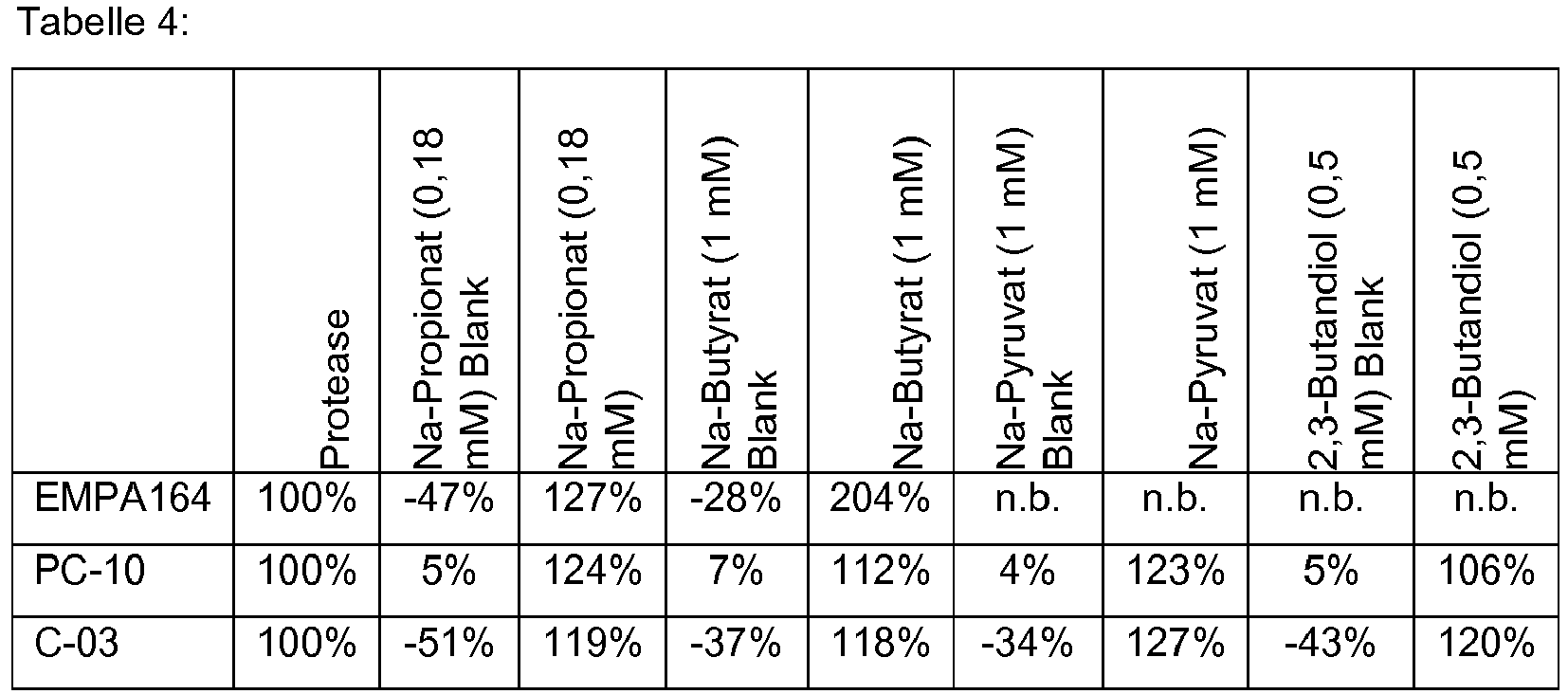


- Die Waschleistung wurde mit bakteriellen oder pilzlichen Fermenterüberständen und Nährmedien (Kulturüberständen) bzw. Fraktionen aus der Aufreinigung dieser Flüssigkeiten gesteigert, besonders mit Bacillus Fermenterüberstanden und Bacillus Nährmedien (Kulturüberständen) und Fraktionen, die derartige Substanzen beinhalten.
- Fermenterkulturen wurden zentrifugiert oder nicht zentrifugiert um Feststoffe abzutrennen und gekocht (15 Min, 97,5-100°C), um die Enzyme zu inaktivieren. Nachdem der Brei abgekocht war, wurde die entstandene Lösung erneut zentrifugiert, um entstandenes Präzipitat abzutrennen (= abgekochter Überstand). Der abgekochte Überstand wurde gegebenenfalls weiter behandelt, indem er mittels einer 10 kDa-Cutoff Membran filtriert wurde, anschliessend über eine 1 kDa-Cutoff Membran. Das Filtrat der 1 kDa-Cutoff Membran wurde weiter fraktioniert mittels einer Bio-Gel P2 Säule (Gelpermeationschromatographie / "size exclusion chromatography").
- Eingesetzt als Komponente (b) wurden daher Kulturüberstände bzw. Verdünnungen zweier verschiedener Kulturen von Bacillus sp. (Stamm 1 bzw. Stamm 2) sowie unterschiedlich prozessierte und/oder fraktionierte Präparationen der Überstände wie jeweils angegeben.
- Die nachfolgenden Tabellen 10 bis 15 zeigen die erhaltenen Waschleistungen. Es wird deutlich, dass die eingesetzten Komponenten (b) eine synergistische Steigerung der Waschleistung bei Waschmitteln bewirken, die ein hydrolytisches Enzym, nämlich eine Protease, d.h. Komponente (a), enthalten. Ferner wird anhand der unterschiedlichen Wirksamkeit einzelner Fraktionen deutlich, dass der Effekt auf einzelnen, distinkten Bestandteilen der Überstände beruht, die in den jeweiligen Fraktionen, beispielsweise größenbedingt, enthalten sind.


- Die Waschleistung wurde mit Surfactin oder Lichenycin oder fermentierten Überständen von Mikroorganismen erzielt, die Surfactin, Lichenysin oder ähnliche Moleküle vom Typ Lipopeptid produzieren. In den fermentierten Überstanden wurden mittels Massenspektroskopie Surfactin bzw. Surfactin-ähnliche Moleküle nachgewiesen.
- Die nachfolgenden Tabellen 16 bis 19 zeigen die erhaltenen Waschleistungen. Es wird deutlich, dass die eingesetzten Komponenten (b) eine synergistische Steigerung der Waschleistung bei denjenigen Waschmitteln bewirken, die ein hydrolytisches Enzym, nämlich eine Protease, d.h. Komponente (a), enthalten. In Kontrollen, in denen kein hydrolytisches Enzym enthalten ist bewirken diese Komponenten (b) keine Steigerung der Waschleistung, so dass die gesteigerte Waschleistung auf einem vorteilhaften, synergistischen Zusammenwirken der Komponenten (a) und (b) beruht. Ein inaktiviertes hydrolytisches Enzym (vgl. Tabelle 19) führt ebenfalls dazu, dass keine synergistische Reinigungsleistung mehr auftritt, was ein weiterer Beleg ist für das spezifische vorteilhafte Zusammenwirken der Komponenten (a) und (b).


-
- Figur 1:
- Struktur von Surfactin
Claims (14)
- Verfahren zur Verbesserung der Reinigungsleistung eines Wasch- oder Reinigungsmittels, das ein hydrolytisches Enzym, insbesondere eine Protease, Amylase, Cellulase, Hemicellulase, Mannanase, Tannase, Xylanase, Xanthanase, β-Glucosidase, Carrageenase oder eine Lipase, besonders bevorzugt eine Protease, umfasst, dadurch gekennzeichnet, dass dem Wasch- oder Reinigungsmittel eine Komponente zugesetzt wird, die im Zusammenwirken mit dem hydrolytischen Enzym bei Anwendung des Mittels eine synergistische Reinigungsleistung bewirkt und die ausgewählt ist ausi. Aminosäure oder Polyaminosäure oder deren Derivat und/oderii. Biotensid und/oderiii. mikrobieller Metabolitiv. Präparat eines mikrobiellen Kulturüberstandes, das mindestens 2,5 Gew.-% einer der Substanzen i) bis iii) enthält.
- Verfahren nach Anspruch 1, dadurch gekennzeichnet, dass die Komponente in einem mikrobiellen Kulturüberstand enthalten ist, insbesondere in einem bakteriellen oder pilzlichen Kulturüberstand, insbesondere in einem Kulturüberstand von Bacillus sp. und insbesondere in einem Kulturüberstand von Bacillus subtilis, Bacillus licheniformis, Bacillus pumilus, Bacillus aeolius oder Bacillus subtilis natto, und dem Wasch- oder Reinigungsmittel als Kulturüberstand, bevorzugt als eine Fraktion des Kulturüberstandes, zugesetzt wird.
- Verfahren nach einem der Ansprüche 1 oder 2, dadurch gekennzeichnet, dass die Komponentei. ein Molekulargewicht (MW) aufweist von 150 bis 5x10⁶ Dalton, insbesondere von 200 bis 1x10⁶ Dalton, von 220 bis 0,75x10⁶ Dalton und insbesondere von 400 bis 0,5x10⁶ Dalton,ii. ein Molekulargewicht (MW) aufweist von 500 bis 3000 Dalton, insbesondere von 600 bis 2500 Dalton, von 700 bis 2250 Dalton und insbesondere von 800 bis 2000 Dalton,iii. ein Molekulargewicht (MW) aufweist von 150 bis 5x10⁶ Dalton, insbesondere von 200 bis 1x10⁶ Dalton, von 220 bis 0,75x10⁶ Dalton und insbesondere von 400 bis 0,5x10⁶ Dalton.
- Verfahren nach einem der Ansprüche 1 bis 3, dadurch gekennzeichnet, dass die Komponentei. in dem Mittel vorliegt von 0,018 bis 0,2 Gew.-%, insbesondere von 0,04 bis 0,1 Gew.-%,ii. in dem Mittel vorliegt von 0,001% bis 25 Gew.-%, insbesondere von 0,005 bis 10 Gew.-%,iii. in dem Mittel vorliegt von 0,018 bis 0,2 Gew.-%, insbesondere von 0,04 bis 0,1 Gew.-%.
- Verfahren nach einem der Ansprüche 1 bis 4, dadurch gekennzeichnet, dass die Komponente in der Wasch- bzw. Reinigungsflotte vorliegt in einer Konzentration von 0,00025 bis 0,6 Gew.- %, insbesondere von 0,0003 bis 0,5 Gew.-%.
- Verfahren nach einem der Ansprüche 1 bis 5, dadurch gekennzeichnet, dass das Wasch- oder Reinigungsmittel das hydrolytische Enzym in einer Menge von 2 µg bis 20 mg, vorzugsweise von 5 µg bis 17,5 mg, besonders bevorzugt von 20 µg bis 15 mg und ganz besonders bevorzugt von 50 µg bis 10 mg pro g des Mittels enthält, und/oder
dass das hydrolytische Enzym in dem Wasch- oder Reinigungsmittel mit einer bei Raumtemperatur oder bei Abwesenheit von Wasser für das Enzym undurchlässigen Substanz umhüllt ist. - Verfahren nach einem der Ansprüche 1 bis 6, dadurch gekennzeichnet, dass das Wasch- oder Reinigungsmittel(a) in fester Form vorliegt, insbesondere als rieselfähiges Pulver mit einem Schüttgewicht von 300 g/l bis 1200 g/l, insbesondere 500 g/l bis 900 g/l, oder(b) in pastöser oder in flüssiger Form vorliegt, und/oder(c) als Einkomponentensystem vorliegt, oder(d) in mehrere Komponenten aufgeteilt ist.
- Wasch- oder Reinigungsverfahren umfassend die Verfahrensschritte(a) Bereitstellen einer Wasch- oder Reinigungslösung umfassend ein Wasch- oder Reinigungsmittel, dasi. ein hydrolytisches Enzym enthält, insbesondere eine Protease, Amylase, Cellulase, Hemicellulase, Mannanase, Tannase, Xylanase, Xanthanase, β-Glucosidase, Carrageenase oder eine Lipase, besonders bevorzugt eine Protease, undii. eine Komponente enthält, die im Zusammenwirken mit dem hydrolytischen Enzym bei Anwendung des Mittels eine synergistische Reinigungsleistung bewirkt und die ausgewählt ist aus1. Aminosäure oder Polyaminosäure oder deren Derivat und/oder2. Biotensid und/oder3. mikrobieller Metabolit4. Präparat eines mikrobiellen Kulturüberstandes, das mindestens 2,5 Gew.-% einer der Substanzen 1) bis 3);(b) In Kontakt bringen eines Textils oder einer harten Oberfläche mit der Wasch- oder Reinigungslösung gemäß (a).
- Verfahren nach einem der Ansprüche 1 bis 8, dadurch gekennzeichnet, dass es in einem Temperaturbereich von 10°C bis 60°C, insbesondere von 10°C bis 50°C, von 10°C bis 40°C, von 10°C bis 30°C, von 15°C bis 30°C von 10°C bis 25°C und von 15°C bis 25°C, durchgeführt wird.
- Verwendung einer Komponente, die ausgewählt ist ausi. Aminosäure oder Polyaminosäure oder deren Derivat und/oderii. Biotensid und/oderiii. mikrobieller Metabolit und/oderiv. Präparat eines mikrobiellen Kulturüberstandes, das mindestens 2,5 Gew.-% einer der Substanzen i) bis iii) enthält,
zum Erreichen einer synergistischen Reinigungsleistung im Zusammenwirken mit einem hydrolytischen Enzym in einem Wasch- oder Reinigungsmittel bei Anwendung des Wasch-oder Reinigungsmittels, insbesondere im Zusammenwirken mit einer Protease, Amylase, Cellulase, Hemicellulase, Mannanase, Tannase, Xylanase, Xanthanase, β-Glucosidase, Carrageenase oder einer Lipase, besonders bevorzugt im Zusammenwirken mit einer Protease. - Verwendung nach Anspruch 10, dadurch gekennzeichnet, dass die Komponentei. in dem Mittel vorliegt von 0,018 bis 0,2 Gew.-%, insbesondere von 0,04 bis 0,1 Gew.-%,ii. in dem Mittel vorliegt von 0,001% bis 25 Gew.-%, insbesondere von 0,005 bis 10 Gew.-%,iii. in dem Mittel vorliegt von 0,018 bis 0,2 Gew.-%, insbesondere von 0,04 bis 0,1 Gew.-%.
- Verwendung einer Komponente, die ausgewählt ist ausi. Aminosäure oder Polyaminosäure oder deren Derivat und/oderii. Biotensid und/oderiii. mikrobieller Metabolit und/oderiv. Präparat eines mikrobiellen Kulturüberstandes, das mindestens 2,5 Gew.-% einer der Substanzen i) bis iii) enthält,
zur Steigerung der Reinigungsleistung eines hydrolytischen Enzyms in einem Wasch- oder Reinigungsprozess. - Verwendung nach einem der Ansprüche 10 bis 12, dadurch gekennzeichnet, dass die Komponente in einem mikrobiellen Kulturüberstand enthalten ist, insbesondere in einem bakteriellen oder pilzlichen Kulturüberstand, insbesondere in einem Kulturüberstand von Bacillus sp. und insbesondere in einem Kulturüberstand von Bacillus subtilis, Bacillus licheniformis, Bacillus pumilus, Bacillus aeolius oder Bacillus subtilis natto.
- Verwendung nach einem der Ansprüche 9 bis 13, dadurch gekennzeichnet, dass die Komponentei. ein Molekulargewicht (MW) aufweist von 150 bis 5x10⁶ Dalton, insbesondere von 200 bis 1x10⁶ Dalton, von 220 bis 0,75x10⁶ Dalton und insbesondere von 400 bis 0,5x10⁶ Dalton,ii. ein Molekulargewicht (MW) aufweist von 500 bis 3000 Dalton, insbesondere von 600 bis 2500 Dalton, von 700 bis 2250 Dalton und insbesondere von 800 bis 2000 Dalton,iii. ein Molekulargewicht (MW) aufweist von 150 bis 5x10⁶ Dalton, insbesondere von 200 bis 1x10⁶ Dalton, von 220 bis 0,75x10⁶ Dalton und insbesondere von 400 bis 0,5x10⁶ Dalton.
Priority Applications (1)
| Application Number | Priority Date | Filing Date | Title |
|---|---|---|---|
| PL14152968T PL2727988T3 (pl) | 2008-08-20 | 2009-07-10 | Sposób polepszenia skuteczności czyszczenia środka piorącego lub czyszczącego |
Applications Claiming Priority (3)
| Application Number | Priority Date | Filing Date | Title |
|---|---|---|---|
| DE102008038479A DE102008038479A1 (de) | 2008-08-20 | 2008-08-20 | Wasch- oder Reinigungsmittel mit gesteigerter Waschkraft |
| PCT/EP2009/058789 WO2010020475A2 (de) | 2008-08-20 | 2009-07-10 | Verfahren zur verbesserung der reinigungsleistung eines wasch- oder reinigungsmittels |
| EP09780407.4A EP2313482B2 (de) | 2008-08-20 | 2009-07-10 | Verfahren zur verbesserung der reinigungsleistung eines wasch- oder reinigungsmittels |
Related Parent Applications (2)
| Application Number | Title | Priority Date | Filing Date |
|---|---|---|---|
| EP09780407.4A Division EP2313482B2 (de) | 2008-08-20 | 2009-07-10 | Verfahren zur verbesserung der reinigungsleistung eines wasch- oder reinigungsmittels |
| EP09780407.4A Division-Into EP2313482B2 (de) | 2008-08-20 | 2009-07-10 | Verfahren zur verbesserung der reinigungsleistung eines wasch- oder reinigungsmittels |
Publications (3)
| Publication Number | Publication Date |
|---|---|
| EP2727988A2 true EP2727988A2 (de) | 2014-05-07 |
| EP2727988A3 EP2727988A3 (de) | 2016-03-16 |
| EP2727988B1 EP2727988B1 (de) | 2019-09-04 |
Family
ID=41059950
Family Applications (5)
| Application Number | Title | Priority Date | Filing Date |
|---|---|---|---|
| EP14152970.1A Active EP2727989B2 (de) | 2008-08-20 | 2009-07-10 | Verfahren zur Verbesserung der Reinigungsleistung eines Wasch- und Reinigungsmittels |
| EP14152968.5A Active EP2727988B1 (de) | 2008-08-20 | 2009-07-10 | Verfahren zur Verbesserung der Reinigungsleistung eines Wasch- oder Reinigungsmittels |
| EP14152971.9A Ceased EP2727990A3 (de) | 2008-08-20 | 2009-07-10 | Verfahren zur Verbesserung der Reinigungsleistung eines Wasch- oder Reinigungsmittels |
| EP09780407.4A Active EP2313482B2 (de) | 2008-08-20 | 2009-07-10 | Verfahren zur verbesserung der reinigungsleistung eines wasch- oder reinigungsmittels |
| EP09780409.0A Revoked EP2313483B1 (de) | 2008-08-20 | 2009-07-10 | Verfahren zur verbesserung der reinigungsleistung eines wasch- oder reinigungsmittels |
Family Applications Before (1)
| Application Number | Title | Priority Date | Filing Date |
|---|---|---|---|
| EP14152970.1A Active EP2727989B2 (de) | 2008-08-20 | 2009-07-10 | Verfahren zur Verbesserung der Reinigungsleistung eines Wasch- und Reinigungsmittels |
Family Applications After (3)
| Application Number | Title | Priority Date | Filing Date |
|---|---|---|---|
| EP14152971.9A Ceased EP2727990A3 (de) | 2008-08-20 | 2009-07-10 | Verfahren zur Verbesserung der Reinigungsleistung eines Wasch- oder Reinigungsmittels |
| EP09780407.4A Active EP2313482B2 (de) | 2008-08-20 | 2009-07-10 | Verfahren zur verbesserung der reinigungsleistung eines wasch- oder reinigungsmittels |
| EP09780409.0A Revoked EP2313483B1 (de) | 2008-08-20 | 2009-07-10 | Verfahren zur verbesserung der reinigungsleistung eines wasch- oder reinigungsmittels |
Country Status (6)
| Country | Link |
|---|---|
| US (2) | US20110136720A1 (de) |
| EP (5) | EP2727989B2 (de) |
| DE (1) | DE102008038479A1 (de) |
| ES (3) | ES2744829T5 (de) |
| PL (3) | PL2727988T3 (de) |
| WO (2) | WO2010020476A2 (de) |
Families Citing this family (34)
| Publication number | Priority date | Publication date | Assignee | Title |
|---|---|---|---|---|
| DE102008038479A1 (de) | 2008-08-20 | 2010-02-25 | Henkel Ag & Co. Kgaa | Wasch- oder Reinigungsmittel mit gesteigerter Waschkraft |
| WO2011086694A1 (ja) | 2010-01-18 | 2011-07-21 | トヨタ自動車株式会社 | 非接触受電装置、非接触送電装置、非接触給電システムおよび車両 |
| WO2012010405A1 (en) | 2010-07-22 | 2012-01-26 | Unilever Plc | Detergent compositions comprising biosurfactant and enzyme |
| DE102012206571A1 (de) | 2012-04-20 | 2013-10-24 | Henkel Ag & Co. Kgaa | Lagerstabiles Wasch- oder Reinigungsmittel mit gesteigerter Reinigungsleistung |
| DK2847308T3 (en) | 2012-05-07 | 2017-10-23 | Novozymes As | Polypeptides with xanthan-degrading activity and polynucleotides encoding them |
| DE102012220103A1 (de) | 2012-11-05 | 2014-05-08 | Henkel Ag & Co. Kgaa | Die Primärwaschkraft verbessernde Tensidkombination |
| WO2014200658A1 (en) | 2013-06-13 | 2014-12-18 | Danisco Us Inc. | Alpha-amylase from promicromonospora vindobonensis |
| WO2014200657A1 (en) | 2013-06-13 | 2014-12-18 | Danisco Us Inc. | Alpha-amylase from streptomyces xiamenensis |
| WO2014200656A1 (en) | 2013-06-13 | 2014-12-18 | Danisco Us Inc. | Alpha-amylase from streptomyces umbrinus |
| WO2014204596A1 (en) | 2013-06-17 | 2014-12-24 | Danisco Us Inc. | Alpha-amylase from bacillaceae family member |
| DE102013215824A1 (de) * | 2013-08-09 | 2015-02-12 | Henkel Ag & Co. Kgaa | Wasch- oder Reinigungsmittel mit immobilisierter Enzymkomponente |
| US20160186102A1 (en) | 2013-10-03 | 2016-06-30 | Danisco Us Inc. | Alpha-amylases from exiguobacterium, and methods of use, thereof |
| EP3060659B1 (de) | 2013-10-03 | 2019-05-29 | Danisco US Inc. | Alpha-amylase aus exiguobacterium, und deren verfahren und anwendung |
| MX2016005852A (es) | 2013-11-11 | 2016-07-13 | Ecolab Usa Inc | Detergente de lavado de utensilios altamente alcalino con control de incrustaciones y dispersion de suciedad mejorados. |
| JP2017503061A (ja) | 2013-11-11 | 2017-01-26 | エコラボ ユーエスエー インコーポレイティド | 多目的酵素洗剤及び使用溶液を安定化する方法 |
| US20160272957A1 (en) | 2013-11-20 | 2016-09-22 | Danisco Us Inc. | Variant alpha-amylases having reduced susceptibility to protease cleavage, and methods of use, thereof |
| WO2015123323A1 (en) * | 2014-02-14 | 2015-08-20 | E. I. Du Pont De Nemours And Company | Poly-alpha-1,3-1,6-glucans for viscosity modification |
| EP3070155A1 (de) * | 2015-03-18 | 2016-09-21 | Evonik Degussa GmbH | Zusammensetzung enthaltend peptidase und biotensid |
| DE102015211640B4 (de) | 2015-06-24 | 2017-09-21 | Organon eG Frankfurt | Stoff zum mikrobiologischen Behandeln von Gegenständen oder deren Oberflächen |
| AR105803A1 (es) | 2015-08-28 | 2017-11-08 | Unilever Nv | Composiciones de lavado mejoradas |
| US10183087B2 (en) * | 2015-11-10 | 2019-01-22 | American Sterilizer Company | Cleaning and disinfecting composition |
| AU2017240069B2 (en) | 2016-03-31 | 2024-03-07 | Gojo Industries, Inc. | Sanitizer composition with probiotic/prebiotic active ingredient |
| WO2017173240A1 (en) | 2016-03-31 | 2017-10-05 | Gojo Industries, Inc. | Antimicrobial peptide stimulating cleansing composition |
| EP3435765A1 (de) | 2016-03-31 | 2019-02-06 | Gojo Industries, Inc. | Desinfektionszusammensetzung zur stimulation von antimikrobiellen peptiden |
| WO2017173190A2 (en) | 2016-04-01 | 2017-10-05 | Danisco Us Inc. | Alpha-amylases, compositions & methods |
| WO2017173324A2 (en) | 2016-04-01 | 2017-10-05 | Danisco Us Inc. | Alpha-amylases, compositions & methods |
| EP3544575A1 (de) | 2016-11-23 | 2019-10-02 | GOJO Industries, Inc. | Desinfektionszusammensetzung mit probiotischem/präbiotischem wirkstoff |
| CN110072985B (zh) * | 2016-12-15 | 2021-04-20 | 高露洁-棕榄公司 | 在精细织物液体洗涤剂中使用柠檬酸和亚氨基二琥珀酸盐的织物色彩保护 |
| CN110869483B (zh) * | 2017-07-24 | 2026-03-10 | 法国特种经营公司 | 含酶的洗涤剂组合物 |
| DE102018214093A1 (de) | 2018-08-21 | 2020-02-27 | Henkel Ag & Co. Kgaa | Wasch- oder Reinigungsmittel mit gesteigerter Proteaseleistung |
| JP2022549712A (ja) * | 2019-09-29 | 2022-11-28 | ノボザイムス アクティーゼルスカブ | 洗剤の持続可能性の改善のためのセルラーゼの使用 |
| EP4363545A1 (de) | 2021-06-29 | 2024-05-08 | Christeyns | Enzymhaltiges additiv und waschmittelformulierungen |
| DE102022209246A1 (de) | 2022-09-06 | 2024-03-07 | Henkel Ag & Co. Kgaa | Wasch- und reinigungsmittel enthaltend tannase ii |
| DE102022209245A1 (de) | 2022-09-06 | 2024-03-07 | Henkel Ag & Co. Kgaa | Wasch- und reinigungsmittel enthaltend tannase i |
Citations (7)
| Publication number | Priority date | Publication date | Assignee | Title |
|---|---|---|---|---|
| WO1992021760A1 (en) | 1991-05-29 | 1992-12-10 | Cognis, Inc. | Mutant proteolytic enzymes from bacillus |
| WO2003002711A2 (de) | 2001-06-29 | 2003-01-09 | Henkel Kommanditgesellschaft Auf Aktien | EINE NEUE GRUPPE VON α-AMYLASEN SOWIE EIN VERFAHREN ZUR IDENTIFIZIERUNG UND GEWINNUNG NEUER α-AMYLASEN |
| WO2003054177A2 (de) | 2001-12-21 | 2003-07-03 | Henkel Kommanditgesellschaft Auf Aktien | Neue glykosylhydrolasen |
| WO2003057713A2 (en) | 2001-12-31 | 2003-07-17 | Genencor International, Inc. | Proteases producing an altered immunogenic response and methods of making and using the same |
| WO2007131656A1 (de) | 2006-05-11 | 2007-11-22 | Henkel Ag & Co. Kgaa | Subtilisin aus bacillus pumilus und wasch- und reinigungsmittel enthaltend dieses neue subtilisin |
| WO2008086916A1 (de) | 2007-01-16 | 2008-07-24 | Henkel Ag & Co. Kgaa | Neue alkalische protease aus bacillus gibsonii und wasch- und reinigungsmittel enthaltend diese neue alkalische protease |
| WO2009021867A2 (de) | 2007-08-10 | 2009-02-19 | Henkel Ag & Co. Kgaa | Mittel enthaltend proteasen |
Family Cites Families (71)
| Publication number | Priority date | Publication date | Assignee | Title |
|---|---|---|---|---|
| US1011108A (en) | 1909-09-23 | 1911-12-05 | Christian M Bowman | Attachment for engravers' blocks. |
| US3948838A (en) * | 1968-07-25 | 1976-04-06 | Burlington Industries, Inc. | Soil release composition |
| DE1942236A1 (de) * | 1969-08-20 | 1971-03-04 | Henkel & Cie Gmbh | Eiweissloesende Wasch-,Waschhilfs- und Reinigungsmittel |
| DE1964792A1 (de) * | 1969-12-24 | 1971-07-01 | Henkel & Cie Gmbh | Eiweissloesende Wasch-,Waschhilfs- und Reinigungsmittel |
| JPS5014651B1 (de) * | 1969-12-30 | 1975-05-29 | ||
| DE2038103A1 (de) * | 1970-07-31 | 1972-02-10 | Henkel & Cie Gmbh | Waessrige Reinigungsmittelkonzentrate mit einem Gehalt an stabilisierten Enzymen |
| CH540335A (de) * | 1970-09-28 | 1973-08-15 | Kronwitter & Co | Flüssiges biologisches Wasch-, Reinigungs- und Geschirrspülmittel |
| AT330930B (de) | 1973-04-13 | 1976-07-26 | Henkel & Cie Gmbh | Verfahren zur herstellung von festen, schuttfahigen wasch- oder reinigungsmitteln mit einem gehalt an calcium bindenden substanzen |
| IT1106254B (it) * | 1976-03-08 | 1985-11-11 | Procter & Gamble Europ | Composizione detergente liquida contenente enzimi |
| US4305837A (en) * | 1980-10-30 | 1981-12-15 | The Procter & Gamble Company | Stabilized aqueous enzyme composition |
| CA1334389C (en) * | 1986-03-26 | 1995-02-14 | Ernest H. Brumbaugh | Machine dishwasher water spot control composition |
| JPS6363796A (ja) | 1986-09-03 | 1988-03-22 | 花王株式会社 | 洗浄剤組成物 |
| JP2562624B2 (ja) * | 1986-11-07 | 1996-12-11 | 昭和電工株式会社 | 水溶性マイクロカプセルおよび液体洗剤組成物 |
| JPS63183999A (ja) | 1987-01-26 | 1988-07-29 | 花王株式会社 | 洗浄剤組成物 |
| DE3723873A1 (de) | 1987-07-18 | 1989-01-26 | Henkel Kgaa | Verwendung von hydroxyalkylpolyethylenglykolethern in klarspuelmitteln fuer die maschinelle geschirreinigung |
| US6287841B1 (en) | 1988-02-11 | 2001-09-11 | Genencor International, Inc. | High alkaline serine protease |
| DE3942617A1 (de) * | 1989-12-22 | 1991-06-27 | Henkel Kgaa | Stabilisatoren fuer waessrige fluessigwaschmittel |
| US5308530A (en) | 1990-11-21 | 1994-05-03 | Lever Brothers Company, Division Of Conopco, Inc. | Detergent compositions containing polycarboxylates and calcium-sensitive enzymes |
| US5468411A (en) * | 1991-05-31 | 1995-11-21 | Colgate Palmolive Co. | Powdered automatic dishwashing composition containing enzymes |
| US5545344A (en) * | 1991-05-31 | 1996-08-13 | Colgate-Palmolive Co. | Nonaqueous liquid, improved automatic dishwashing composition containing enzymes |
| US5879920A (en) * | 1991-10-07 | 1999-03-09 | Genencor International, Inc. | Coated enzyme-containing granule |
| US5559089A (en) * | 1992-03-12 | 1996-09-24 | The Procter & Gamble Company | Low-dosage automatic dishwashing detergent with monopersulfate and enzymes |
| CA2133446A1 (en) * | 1992-04-13 | 1993-10-28 | Janet L. Marshall | Thixotropic liquid automatic dishwashing composition with enzyme |
| AU669900B2 (en) * | 1992-07-20 | 1996-06-27 | Colgate-Palmolive Company, The | Stabilized built aqueous liquid softergent compositions |
| DK0583534T3 (da) * | 1992-08-14 | 1997-06-16 | Procter & Gamble | Flydende detergenter, der indeholder et peptidaldehyd |
| EP0694058A1 (de) | 1993-04-27 | 1996-01-31 | The Procter & Gamble Company | Flüssiges oder körniges machinengeschirrspülmittel |
| US5691295A (en) * | 1995-01-17 | 1997-11-25 | Cognis Gesellschaft Fuer Biotechnologie Mbh | Detergent compositions |
| WO1995029222A1 (en) * | 1994-04-22 | 1995-11-02 | The Procter & Gamble Company | Amylase-containing granular detergent compositions |
| DE69511091T2 (de) * | 1994-06-23 | 1999-11-18 | Unilever N.V., Rotterdam | Geschirrspülmittelzusammensetzungen |
| JP2849041B2 (ja) | 1994-06-30 | 1999-01-20 | ザ、プロクター、エンド、ギャンブル、カンパニー | 洗剤組成物 |
| US5858117A (en) * | 1994-08-31 | 1999-01-12 | Ecolab Inc. | Proteolytic enzyme cleaner |
| GB9501112D0 (en) * | 1995-01-20 | 1995-03-08 | Procter & Gamble | Detergent compositions comprising stabilised polyamino acid compounds |
| US5576282A (en) | 1995-09-11 | 1996-11-19 | The Procter & Gamble Company | Color-safe bleach boosters, compositions and laundry methods employing same |
| US5945394A (en) * | 1995-09-18 | 1999-08-31 | Stepan Company | Heavy duty liquid detergent compositions comprising salts of α-sulfonated fatty acid methyl esters and use of α-sulphonated fatty acid salts to inhibit redeposition of soil on fabric |
| US6165970A (en) * | 1996-03-29 | 2000-12-26 | The Procter & Gamble Company | Detergent composition comprising acrylic acid-based polymer and amino tricarboxylic acid-based compound |
| WO1997040131A1 (en) * | 1996-04-24 | 1997-10-30 | Unilever Plc | Synthetic bar composition comprising alkoxylated surfactants |
| US5858948A (en) * | 1996-05-03 | 1999-01-12 | Procter & Gamble Company | Liquid laundry detergent compositions comprising cotton soil release polymers and protease enzymes |
| US6121226A (en) * | 1996-05-03 | 2000-09-19 | The Procter & Gamble Company | Compositions comprising cotton soil release polymers and protease enzymes |
| DE69717133T2 (de) * | 1996-09-24 | 2003-07-10 | The Procter & Gamble Company, Cincinnati | Flüssige reinigungsmittel, die proteolytisches enzyme, peptidaldehyd und kalziumionen enthalten |
| US5919697A (en) * | 1996-10-18 | 1999-07-06 | Novo Nordisk A/S | Color clarification methods |
| US6436342B1 (en) * | 1996-11-13 | 2002-08-20 | The Procter & Gamble Company | Sprayable disinfecting compositions and processes for disinfecting surfaces therewith |
| US6218351B1 (en) * | 1998-03-06 | 2001-04-17 | The Procter & Gamble Compnay | Bleach compositions |
| BR9814589A (pt) | 1998-01-13 | 2000-10-24 | Procter & Gamble | Composições granulares tendo aperfeiçoada dissolução |
| JP3403332B2 (ja) * | 1998-05-12 | 2003-05-06 | 花王株式会社 | 洗浄剤組成物 |
| US6268329B1 (en) * | 1998-06-30 | 2001-07-31 | Nouozymes A/S | Enzyme containing granule |
| ES2290610T3 (es) * | 1998-09-30 | 2008-02-16 | Unilever N.V. | Tratamiento para tejidos. |
| DE60022111T2 (de) | 1999-03-17 | 2006-06-22 | Kao Corporation | Waschmittelzusammensetzung |
| MY120271A (en) | 1999-05-19 | 2005-09-30 | Colgate Palmolive Co | Laundry detergent composition containing high level of protease enzyme |
| GB9914622D0 (en) * | 1999-06-23 | 1999-08-25 | Reckitt & Colman Inc | Improvements in or relating to organic compositions |
| US6331512B1 (en) * | 1999-09-29 | 2001-12-18 | Amway Corporation | Phosphate-free automatic dishwashing detergent |
| DE19953057A1 (de) * | 1999-11-03 | 2001-05-10 | Henkel Kgaa | Enzymhaltige höherviskose Flüssigwaschmittel |
| DE10027634A1 (de) * | 2000-06-06 | 2001-12-13 | Basf Ag | Verwendung von kationisch modifizierten, teilchenförmigen, hydrophoben Polymeren als Zusatz zu Spül- oder Pflegemitteln für Textilien und als Zusatz zu Waschmitteln |
| EP1516918B2 (de) | 2000-11-27 | 2015-07-01 | The Procter & Gamble Company | Verpackung für Waschmittel |
| US20020183226A1 (en) * | 2001-02-28 | 2002-12-05 | Chandrika Kasturi | Liquid detergent composition exhibiting enhanced alpha-amylase enzyme stability |
| US7018821B2 (en) * | 2001-06-22 | 2006-03-28 | Genencor International, Inc. | Highly impact-resistant granules |
| JP2003013093A (ja) * | 2001-06-27 | 2003-01-15 | Saraya Kk | 低泡性洗浄剤組成物 |
| JP2003233945A (ja) | 2002-02-07 | 2003-08-22 | Shinano Kenshi Co Ltd | 光ディスク装置およびその制御方法 |
| US7557076B2 (en) | 2002-06-06 | 2009-07-07 | The Procter & Gamble Company | Organic catalyst with enhanced enzyme compatibility |
| EP1558718B1 (de) * | 2002-11-04 | 2007-09-12 | The Procter & Gamble Company | Flüssige waschmittelzusammensetzung |
| ATE359352T1 (de) | 2003-03-24 | 2007-05-15 | Ciba Sc Holding Ag | Waschmittelzusammensetzungen |
| US7556654B1 (en) * | 2004-10-15 | 2009-07-07 | Naturell | Methods for cleaning materials |
| US7300913B2 (en) * | 2004-10-15 | 2007-11-27 | Naturell Clean, Inc. | Systems and methods for cleaning materials |
| EP1867708B1 (de) | 2006-06-16 | 2017-05-03 | The Procter and Gamble Company | Waschmittelzusammensetzungen |
| DE102007029643A1 (de) | 2006-09-08 | 2009-01-15 | Henkel Ag & Co. Kgaa | Reinigungsmittel |
| WO2009087526A1 (en) † | 2008-01-04 | 2009-07-16 | The Procter & Gamble Company | Use of a cellulase to impart soil release benefits to cotton during a subsequent laundering process |
| EP2083067A1 (de) * | 2008-01-25 | 2009-07-29 | Basf Aktiengesellschaft | Verwendung von organischen Komplexbildnern und/oder polymeren carbonsäuregruppenhaltigen Verbindungen in einer flüssigen Wasch- oder Reinigungsmittelzusammensetzung |
| US20090233830A1 (en) † | 2008-03-14 | 2009-09-17 | Penny Sue Dirr | Automatic detergent dishwashing composition |
| EP2100948A1 (de) | 2008-03-14 | 2009-09-16 | The Procter and Gamble Company | Waschmittelzusammensetzung für Spülmaschinen |
| EP2100947A1 (de) | 2008-03-14 | 2009-09-16 | The Procter and Gamble Company | Waschmittelzusammensetzung für Spülmaschinen |
| DE102008038479A1 (de) | 2008-08-20 | 2010-02-25 | Henkel Ag & Co. Kgaa | Wasch- oder Reinigungsmittel mit gesteigerter Waschkraft |
| DK3679131T3 (da) | 2017-09-05 | 2024-10-21 | Henkel Ag & Co Kgaa | Ydelses-forbedrede proteasevarianter II |
-
2008
- 2008-08-20 DE DE102008038479A patent/DE102008038479A1/de not_active Withdrawn
-
2009
- 2009-07-10 ES ES09780407T patent/ES2744829T5/es active Active
- 2009-07-10 WO PCT/EP2009/058791 patent/WO2010020476A2/de not_active Ceased
- 2009-07-10 ES ES14152970T patent/ES2745761T5/es active Active
- 2009-07-10 PL PL14152968T patent/PL2727988T3/pl unknown
- 2009-07-10 PL PL14152970.1T patent/PL2727989T5/pl unknown
- 2009-07-10 EP EP14152970.1A patent/EP2727989B2/de active Active
- 2009-07-10 EP EP14152968.5A patent/EP2727988B1/de active Active
- 2009-07-10 PL PL09780407.4T patent/PL2313482T5/pl unknown
- 2009-07-10 WO PCT/EP2009/058789 patent/WO2010020475A2/de not_active Ceased
- 2009-07-10 EP EP14152971.9A patent/EP2727990A3/de not_active Ceased
- 2009-07-10 EP EP09780407.4A patent/EP2313482B2/de active Active
- 2009-07-10 EP EP09780409.0A patent/EP2313483B1/de not_active Revoked
- 2009-07-10 ES ES14152968T patent/ES2753240T3/es active Active
-
2011
- 2011-02-14 US US13/026,344 patent/US20110136720A1/en not_active Abandoned
- 2011-02-14 US US13/026,491 patent/US20110201536A1/en not_active Abandoned
Patent Citations (7)
| Publication number | Priority date | Publication date | Assignee | Title |
|---|---|---|---|---|
| WO1992021760A1 (en) | 1991-05-29 | 1992-12-10 | Cognis, Inc. | Mutant proteolytic enzymes from bacillus |
| WO2003002711A2 (de) | 2001-06-29 | 2003-01-09 | Henkel Kommanditgesellschaft Auf Aktien | EINE NEUE GRUPPE VON α-AMYLASEN SOWIE EIN VERFAHREN ZUR IDENTIFIZIERUNG UND GEWINNUNG NEUER α-AMYLASEN |
| WO2003054177A2 (de) | 2001-12-21 | 2003-07-03 | Henkel Kommanditgesellschaft Auf Aktien | Neue glykosylhydrolasen |
| WO2003057713A2 (en) | 2001-12-31 | 2003-07-17 | Genencor International, Inc. | Proteases producing an altered immunogenic response and methods of making and using the same |
| WO2007131656A1 (de) | 2006-05-11 | 2007-11-22 | Henkel Ag & Co. Kgaa | Subtilisin aus bacillus pumilus und wasch- und reinigungsmittel enthaltend dieses neue subtilisin |
| WO2008086916A1 (de) | 2007-01-16 | 2008-07-24 | Henkel Ag & Co. Kgaa | Neue alkalische protease aus bacillus gibsonii und wasch- und reinigungsmittel enthaltend diese neue alkalische protease |
| WO2009021867A2 (de) | 2007-08-10 | 2009-02-19 | Henkel Ag & Co. Kgaa | Mittel enthaltend proteasen |
Non-Patent Citations (6)
| Title |
|---|
| A. G. GORNALL; C. S. BARDAWILL; M.M. DAVID, J. BIOL. CHEM., vol. 177, 1948, pages 751 - 766 |
| ANSON, M.L., J. GEN. PHYSIOL, vol. 22, 1938, pages 79 - 89 |
| FOLIN, O.; CIOCALTEU, V., J. BIOL. CHEM., vol. 73, 1929, pages 627 |
| J. CHEM. SOC., 1931, pages 1451 |
| R. SIEZEN: "Subtilases: Subtilisin-like Proteases", 1996, article "Subtilisin enzymes", pages: 75 - 95 |
| TENSIDE, vol. 7, 1970, pages 125 - 132 |
Also Published As
| Publication number | Publication date |
|---|---|
| EP2727988B1 (de) | 2019-09-04 |
| EP2727989B2 (de) | 2022-12-21 |
| EP2313483B1 (de) | 2018-06-20 |
| US20110201536A1 (en) | 2011-08-18 |
| ES2744829T5 (es) | 2022-10-19 |
| WO2010020475A3 (de) | 2010-06-17 |
| EP2727990A2 (de) | 2014-05-07 |
| US20110136720A1 (en) | 2011-06-09 |
| EP2313482A2 (de) | 2011-04-27 |
| EP2727989A2 (de) | 2014-05-07 |
| ES2744829T3 (es) | 2020-02-26 |
| DE102008038479A1 (de) | 2010-02-25 |
| WO2010020475A2 (de) | 2010-02-25 |
| EP2313482B1 (de) | 2019-06-12 |
| EP2727988A3 (de) | 2016-03-16 |
| EP2727989A3 (de) | 2016-03-16 |
| EP2313483A2 (de) | 2011-04-27 |
| WO2010020476A2 (de) | 2010-02-25 |
| PL2727988T3 (pl) | 2020-02-28 |
| PL2313482T3 (pl) | 2019-11-29 |
| EP2727990A3 (de) | 2016-03-16 |
| PL2313482T5 (pl) | 2023-02-27 |
| PL2727989T5 (pl) | 2023-03-27 |
| ES2753240T3 (es) | 2020-04-07 |
| EP2727989B1 (de) | 2019-06-26 |
| ES2745761T3 (es) | 2020-03-03 |
| WO2010020476A3 (de) | 2010-06-17 |
| PL2727989T3 (pl) | 2019-12-31 |
| ES2745761T5 (es) | 2023-03-09 |
| EP2313482B2 (de) | 2022-07-27 |
Similar Documents
| Publication | Publication Date | Title |
|---|---|---|
| EP2727988B1 (de) | Verfahren zur Verbesserung der Reinigungsleistung eines Wasch- oder Reinigungsmittels | |
| EP0631622B1 (de) | Neuartige proteasen | |
| EP2756064A2 (de) | Verfahren zur anpassung eines hydrolytischen enzyms an eine das hydrolytische enzym stabilisierende komponente | |
| WO2023232194A1 (de) | Wasch- und reinigungsmittel mit verbesserter enzymstabilität | |
| EP3234088B1 (de) | Flüssige tensidzusammensetzung mit spezieller tensidkombination und enzym | |
| WO2006131503A2 (en) | Detergents with enzymatic builder and bleach systems | |
| EP2655587A1 (de) | Flüssige tensidzubereitung enthaltend lipase und phosphonat | |
| EP4649127A1 (de) | Enzymhaltiges wasch- und reinigungsmittel | |
| DE102022131732A1 (de) | Verbesserte Waschleistung durch den Einsatz einer Protease fusioniert mit speziellem Adhäsionsvermittlerpeptid | |
| DE102023204055A1 (de) | Leistungsverbesserte protease-varianten | |
| DE102022209246A1 (de) | Wasch- und reinigungsmittel enthaltend tannase ii | |
| EP4532666A1 (de) | Wasch- und reinigungsmittel mit verbesserter enzymstabilität | |
| DE102022209245A1 (de) | Wasch- und reinigungsmittel enthaltend tannase i | |
| DE102022213537A1 (de) | Wasch- und reinigungsmittel enthaltend protease | |
| DE102022213538A1 (de) | Wasch- und reinigungsmittel enthaltend protease | |
| DE102023201695A1 (de) | Wasch- und reinigungsmittel mit dispersin | |
| EP4532665A1 (de) | Wasch- und reinigungsmittel mit verbesserter enzymstabilität |
Legal Events
| Date | Code | Title | Description |
|---|---|---|---|
| PUAI | Public reference made under article 153(3) epc to a published international application that has entered the european phase |
Free format text: ORIGINAL CODE: 0009012 |
|
| 17P | Request for examination filed |
Effective date: 20140129 |
|
| AC | Divisional application: reference to earlier application |
Ref document number: 2313482 Country of ref document: EP Kind code of ref document: P |
|
| AK | Designated contracting states |
Kind code of ref document: A2 Designated state(s): AT BE BG CH CY CZ DE DK EE ES FI FR GB GR HR HU IE IS IT LI LT LU LV MC MK MT NL NO PL PT RO SE SI SK SM TR |
|
| PUAL | Search report despatched |
Free format text: ORIGINAL CODE: 0009013 |
|
| AK | Designated contracting states |
Kind code of ref document: A3 Designated state(s): AT BE BG CH CY CZ DE DK EE ES FI FR GB GR HR HU IE IS IT LI LT LU LV MC MK MT NL NO PL PT RO SE SI SK SM TR |
|
| RIC1 | Information provided on ipc code assigned before grant |
Ipc: C11D 3/22 20060101ALI20160211BHEP Ipc: C11D 3/37 20060101ALI20160211BHEP Ipc: C11D 3/33 20060101ALI20160211BHEP Ipc: C11D 3/20 20060101ALI20160211BHEP Ipc: C11D 3/386 20060101AFI20160211BHEP Ipc: C11D 3/38 20060101ALI20160211BHEP Ipc: C11D 1/32 20060101ALI20160211BHEP |
|
| 17Q | First examination report despatched |
Effective date: 20160912 |
|
| STAA | Information on the status of an ep patent application or granted ep patent |
Free format text: STATUS: EXAMINATION IS IN PROGRESS |
|
| GRAP | Despatch of communication of intention to grant a patent |
Free format text: ORIGINAL CODE: EPIDOSNIGR1 |
|
| STAA | Information on the status of an ep patent application or granted ep patent |
Free format text: STATUS: GRANT OF PATENT IS INTENDED |
|
| INTG | Intention to grant announced |
Effective date: 20190306 |
|
| GRAS | Grant fee paid |
Free format text: ORIGINAL CODE: EPIDOSNIGR3 |
|
| GRAA | (expected) grant |
Free format text: ORIGINAL CODE: 0009210 |
|
| STAA | Information on the status of an ep patent application or granted ep patent |
Free format text: STATUS: THE PATENT HAS BEEN GRANTED |
|
| AC | Divisional application: reference to earlier application |
Ref document number: 2313482 Country of ref document: EP Kind code of ref document: P |
|
| AK | Designated contracting states |
Kind code of ref document: B1 Designated state(s): AT BE BG CH CY CZ DE DK EE ES FI FR GB GR HR HU IE IS IT LI LT LU LV MC MK MT NL NO PL PT RO SE SI SK SM TR |
|
| REG | Reference to a national code |
Ref country code: GB Ref legal event code: FG4D Free format text: NOT ENGLISH |
|
| REG | Reference to a national code |
Ref country code: CH Ref legal event code: EP |
|
| REG | Reference to a national code |
Ref country code: AT Ref legal event code: REF Ref document number: 1175361 Country of ref document: AT Kind code of ref document: T Effective date: 20190915 |
|
| REG | Reference to a national code |
Ref country code: DE Ref legal event code: R096 Ref document number: 502009015945 Country of ref document: DE |
|
| REG | Reference to a national code |
Ref country code: IE Ref legal event code: FG4D Free format text: LANGUAGE OF EP DOCUMENT: GERMAN |
|
| REG | Reference to a national code |
Ref country code: NL Ref legal event code: MP Effective date: 20190904 |
|
| REG | Reference to a national code |
Ref country code: LT Ref legal event code: MG4D |
|
| PG25 | Lapsed in a contracting state [announced via postgrant information from national office to epo] |
Ref country code: SE Free format text: LAPSE BECAUSE OF FAILURE TO SUBMIT A TRANSLATION OF THE DESCRIPTION OR TO PAY THE FEE WITHIN THE PRESCRIBED TIME-LIMIT Effective date: 20190904 Ref country code: LT Free format text: LAPSE BECAUSE OF FAILURE TO SUBMIT A TRANSLATION OF THE DESCRIPTION OR TO PAY THE FEE WITHIN THE PRESCRIBED TIME-LIMIT Effective date: 20190904 Ref country code: HR Free format text: LAPSE BECAUSE OF FAILURE TO SUBMIT A TRANSLATION OF THE DESCRIPTION OR TO PAY THE FEE WITHIN THE PRESCRIBED TIME-LIMIT Effective date: 20190904 Ref country code: FI Free format text: LAPSE BECAUSE OF FAILURE TO SUBMIT A TRANSLATION OF THE DESCRIPTION OR TO PAY THE FEE WITHIN THE PRESCRIBED TIME-LIMIT Effective date: 20190904 Ref country code: NO Free format text: LAPSE BECAUSE OF FAILURE TO SUBMIT A TRANSLATION OF THE DESCRIPTION OR TO PAY THE FEE WITHIN THE PRESCRIBED TIME-LIMIT Effective date: 20191204 Ref country code: BG Free format text: LAPSE BECAUSE OF FAILURE TO SUBMIT A TRANSLATION OF THE DESCRIPTION OR TO PAY THE FEE WITHIN THE PRESCRIBED TIME-LIMIT Effective date: 20191204 |
|
| PG25 | Lapsed in a contracting state [announced via postgrant information from national office to epo] |
Ref country code: LV Free format text: LAPSE BECAUSE OF FAILURE TO SUBMIT A TRANSLATION OF THE DESCRIPTION OR TO PAY THE FEE WITHIN THE PRESCRIBED TIME-LIMIT Effective date: 20190904 Ref country code: GR Free format text: LAPSE BECAUSE OF FAILURE TO SUBMIT A TRANSLATION OF THE DESCRIPTION OR TO PAY THE FEE WITHIN THE PRESCRIBED TIME-LIMIT Effective date: 20191205 |
|
| REG | Reference to a national code |
Ref country code: ES Ref legal event code: FG2A Ref document number: 2753240 Country of ref document: ES Kind code of ref document: T3 Effective date: 20200407 |
|
| PG25 | Lapsed in a contracting state [announced via postgrant information from national office to epo] |
Ref country code: RO Free format text: LAPSE BECAUSE OF FAILURE TO SUBMIT A TRANSLATION OF THE DESCRIPTION OR TO PAY THE FEE WITHIN THE PRESCRIBED TIME-LIMIT Effective date: 20190904 Ref country code: PT Free format text: LAPSE BECAUSE OF FAILURE TO SUBMIT A TRANSLATION OF THE DESCRIPTION OR TO PAY THE FEE WITHIN THE PRESCRIBED TIME-LIMIT Effective date: 20200106 Ref country code: NL Free format text: LAPSE BECAUSE OF FAILURE TO SUBMIT A TRANSLATION OF THE DESCRIPTION OR TO PAY THE FEE WITHIN THE PRESCRIBED TIME-LIMIT Effective date: 20190904 Ref country code: EE Free format text: LAPSE BECAUSE OF FAILURE TO SUBMIT A TRANSLATION OF THE DESCRIPTION OR TO PAY THE FEE WITHIN THE PRESCRIBED TIME-LIMIT Effective date: 20190904 |
|
| PG25 | Lapsed in a contracting state [announced via postgrant information from national office to epo] |
Ref country code: CZ Free format text: LAPSE BECAUSE OF FAILURE TO SUBMIT A TRANSLATION OF THE DESCRIPTION OR TO PAY THE FEE WITHIN THE PRESCRIBED TIME-LIMIT Effective date: 20190904 Ref country code: IS Free format text: LAPSE BECAUSE OF FAILURE TO SUBMIT A TRANSLATION OF THE DESCRIPTION OR TO PAY THE FEE WITHIN THE PRESCRIBED TIME-LIMIT Effective date: 20200224 Ref country code: SM Free format text: LAPSE BECAUSE OF FAILURE TO SUBMIT A TRANSLATION OF THE DESCRIPTION OR TO PAY THE FEE WITHIN THE PRESCRIBED TIME-LIMIT Effective date: 20190904 Ref country code: SK Free format text: LAPSE BECAUSE OF FAILURE TO SUBMIT A TRANSLATION OF THE DESCRIPTION OR TO PAY THE FEE WITHIN THE PRESCRIBED TIME-LIMIT Effective date: 20190904 |
|
| REG | Reference to a national code |
Ref country code: DE Ref legal event code: R097 Ref document number: 502009015945 Country of ref document: DE |
|
| PLBE | No opposition filed within time limit |
Free format text: ORIGINAL CODE: 0009261 |
|
| STAA | Information on the status of an ep patent application or granted ep patent |
Free format text: STATUS: NO OPPOSITION FILED WITHIN TIME LIMIT |
|
| PG2D | Information on lapse in contracting state deleted |
Ref country code: IS |
|
| PG25 | Lapsed in a contracting state [announced via postgrant information from national office to epo] |
Ref country code: DK Free format text: LAPSE BECAUSE OF FAILURE TO SUBMIT A TRANSLATION OF THE DESCRIPTION OR TO PAY THE FEE WITHIN THE PRESCRIBED TIME-LIMIT Effective date: 20190904 Ref country code: IS Free format text: LAPSE BECAUSE OF FAILURE TO SUBMIT A TRANSLATION OF THE DESCRIPTION OR TO PAY THE FEE WITHIN THE PRESCRIBED TIME-LIMIT Effective date: 20200105 |
|
| 26N | No opposition filed |
Effective date: 20200605 |
|
| PG25 | Lapsed in a contracting state [announced via postgrant information from national office to epo] |
Ref country code: SI Free format text: LAPSE BECAUSE OF FAILURE TO SUBMIT A TRANSLATION OF THE DESCRIPTION OR TO PAY THE FEE WITHIN THE PRESCRIBED TIME-LIMIT Effective date: 20190904 |
|
| PG25 | Lapsed in a contracting state [announced via postgrant information from national office to epo] |
Ref country code: MC Free format text: LAPSE BECAUSE OF FAILURE TO SUBMIT A TRANSLATION OF THE DESCRIPTION OR TO PAY THE FEE WITHIN THE PRESCRIBED TIME-LIMIT Effective date: 20190904 |
|
| REG | Reference to a national code |
Ref country code: CH Ref legal event code: PL |
|
| REG | Reference to a national code |
Ref country code: BE Ref legal event code: MM Effective date: 20200731 |
|
| PG25 | Lapsed in a contracting state [announced via postgrant information from national office to epo] |
Ref country code: LI Free format text: LAPSE BECAUSE OF NON-PAYMENT OF DUE FEES Effective date: 20200731 Ref country code: CH Free format text: LAPSE BECAUSE OF NON-PAYMENT OF DUE FEES Effective date: 20200731 Ref country code: LU Free format text: LAPSE BECAUSE OF NON-PAYMENT OF DUE FEES Effective date: 20200710 |
|
| PG25 | Lapsed in a contracting state [announced via postgrant information from national office to epo] |
Ref country code: BE Free format text: LAPSE BECAUSE OF NON-PAYMENT OF DUE FEES Effective date: 20200731 |
|
| PG25 | Lapsed in a contracting state [announced via postgrant information from national office to epo] |
Ref country code: IE Free format text: LAPSE BECAUSE OF NON-PAYMENT OF DUE FEES Effective date: 20200710 |
|
| REG | Reference to a national code |
Ref country code: AT Ref legal event code: MM01 Ref document number: 1175361 Country of ref document: AT Kind code of ref document: T Effective date: 20200710 |
|
| PG25 | Lapsed in a contracting state [announced via postgrant information from national office to epo] |
Ref country code: AT Free format text: LAPSE BECAUSE OF NON-PAYMENT OF DUE FEES Effective date: 20200710 |
|
| PG25 | Lapsed in a contracting state [announced via postgrant information from national office to epo] |
Ref country code: TR Free format text: LAPSE BECAUSE OF FAILURE TO SUBMIT A TRANSLATION OF THE DESCRIPTION OR TO PAY THE FEE WITHIN THE PRESCRIBED TIME-LIMIT Effective date: 20190904 Ref country code: MT Free format text: LAPSE BECAUSE OF FAILURE TO SUBMIT A TRANSLATION OF THE DESCRIPTION OR TO PAY THE FEE WITHIN THE PRESCRIBED TIME-LIMIT Effective date: 20190904 Ref country code: CY Free format text: LAPSE BECAUSE OF FAILURE TO SUBMIT A TRANSLATION OF THE DESCRIPTION OR TO PAY THE FEE WITHIN THE PRESCRIBED TIME-LIMIT Effective date: 20190904 |
|
| PG25 | Lapsed in a contracting state [announced via postgrant information from national office to epo] |
Ref country code: MK Free format text: LAPSE BECAUSE OF FAILURE TO SUBMIT A TRANSLATION OF THE DESCRIPTION OR TO PAY THE FEE WITHIN THE PRESCRIBED TIME-LIMIT Effective date: 20190904 |
|
| REG | Reference to a national code |
Ref country code: FR Ref legal event code: PLFP Year of fee payment: 14 |
|
| P01 | Opt-out of the competence of the unified patent court (upc) registered |
Effective date: 20230705 |
|
| PGFP | Annual fee paid to national office [announced via postgrant information from national office to epo] |
Ref country code: PL Payment date: 20250626 Year of fee payment: 17 |
|
| PGFP | Annual fee paid to national office [announced via postgrant information from national office to epo] |
Ref country code: ES Payment date: 20250826 Year of fee payment: 17 |
|
| PGFP | Annual fee paid to national office [announced via postgrant information from national office to epo] |
Ref country code: DE Payment date: 20250722 Year of fee payment: 17 |
|
| PGFP | Annual fee paid to national office [announced via postgrant information from national office to epo] |
Ref country code: IT Payment date: 20250724 Year of fee payment: 17 |
|
| PGFP | Annual fee paid to national office [announced via postgrant information from national office to epo] |
Ref country code: GB Payment date: 20250722 Year of fee payment: 17 |
|
| PGFP | Annual fee paid to national office [announced via postgrant information from national office to epo] |
Ref country code: FR Payment date: 20250725 Year of fee payment: 17 |