EP2733882A2 - Techniques de retour d'informations de qualité de canal pour système hertzien - Google Patents
Techniques de retour d'informations de qualité de canal pour système hertzien Download PDFInfo
- Publication number
- EP2733882A2 EP2733882A2 EP14154740.6A EP14154740A EP2733882A2 EP 2733882 A2 EP2733882 A2 EP 2733882A2 EP 14154740 A EP14154740 A EP 14154740A EP 2733882 A2 EP2733882 A2 EP 2733882A2
- Authority
- EP
- European Patent Office
- Prior art keywords
- cqi feedback
- cqi
- channel quality
- base station
- dimension value
- Prior art date
- Legal status (The legal status is an assumption and is not a legal conclusion. Google has not performed a legal analysis and makes no representation as to the accuracy of the status listed.)
- Withdrawn
Links
- 238000000034 method Methods 0.000 title claims abstract description 34
- 238000005259 measurement Methods 0.000 claims description 27
- 230000007423 decrease Effects 0.000 claims description 11
- 230000005540 biological transmission Effects 0.000 claims description 5
- 238000004590 computer program Methods 0.000 claims description 4
- 230000004044 response Effects 0.000 claims description 3
- 230000007774 longterm Effects 0.000 claims description 2
- 230000003247 decreasing effect Effects 0.000 claims 1
- 238000004891 communication Methods 0.000 description 38
- 230000003044 adaptive effect Effects 0.000 description 6
- 238000013461 design Methods 0.000 description 6
- 238000007726 management method Methods 0.000 description 6
- 230000001413 cellular effect Effects 0.000 description 5
- 239000000969 carrier Substances 0.000 description 4
- 238000012545 processing Methods 0.000 description 4
- 230000006870 function Effects 0.000 description 3
- 238000004519 manufacturing process Methods 0.000 description 3
- 238000012544 monitoring process Methods 0.000 description 3
- 230000003287 optical effect Effects 0.000 description 3
- 230000003595 spectral effect Effects 0.000 description 3
- 230000008901 benefit Effects 0.000 description 2
- 229910003460 diamond Inorganic materials 0.000 description 2
- 239000010432 diamond Substances 0.000 description 2
- 230000003467 diminishing effect Effects 0.000 description 2
- 238000005516 engineering process Methods 0.000 description 2
- 238000013507 mapping Methods 0.000 description 2
- 229920000642 polymer Polymers 0.000 description 2
- 238000013468 resource allocation Methods 0.000 description 2
- 239000004065 semiconductor Substances 0.000 description 2
- 238000004458 analytical method Methods 0.000 description 1
- 238000013459 approach Methods 0.000 description 1
- 239000003990 capacitor Substances 0.000 description 1
- 230000008859 change Effects 0.000 description 1
- 238000007796 conventional method Methods 0.000 description 1
- 230000000694 effects Effects 0.000 description 1
- 239000004744 fabric Substances 0.000 description 1
- 230000002349 favourable effect Effects 0.000 description 1
- 239000000835 fiber Substances 0.000 description 1
- 239000000463 material Substances 0.000 description 1
- 239000002184 metal Substances 0.000 description 1
- 230000008569 process Effects 0.000 description 1
- 229910052710 silicon Inorganic materials 0.000 description 1
- 239000010703 silicon Substances 0.000 description 1
- 238000004088 simulation Methods 0.000 description 1
- 238000001228 spectrum Methods 0.000 description 1
- 230000003068 static effect Effects 0.000 description 1
- 230000001360 synchronised effect Effects 0.000 description 1
Images



Classifications
-
- H—ELECTRICITY
- H04—ELECTRIC COMMUNICATION TECHNIQUE
- H04L—TRANSMISSION OF DIGITAL INFORMATION, e.g. TELEGRAPHIC COMMUNICATION
- H04L1/00—Arrangements for detecting or preventing errors in the information received
- H04L1/0001—Systems modifying transmission characteristics according to link quality, e.g. power backoff
- H04L1/0023—Systems modifying transmission characteristics according to link quality, e.g. power backoff characterised by the signalling
- H04L1/0026—Transmission of channel quality indication
-
- H—ELECTRICITY
- H04—ELECTRIC COMMUNICATION TECHNIQUE
- H04W—WIRELESS COMMUNICATION NETWORKS
- H04W72/00—Local resource management
- H04W72/50—Allocation or scheduling criteria for wireless resources
- H04W72/54—Allocation or scheduling criteria for wireless resources based on quality criteria
- H04W72/542—Allocation or scheduling criteria for wireless resources based on quality criteria using measured or perceived quality
-
- H—ELECTRICITY
- H04—ELECTRIC COMMUNICATION TECHNIQUE
- H04B—TRANSMISSION
- H04B17/00—Monitoring; Testing
- H04B17/20—Monitoring; Testing of receivers
- H04B17/24—Monitoring; Testing of receivers with feedback of measurements to the transmitter
-
- H—ELECTRICITY
- H04—ELECTRIC COMMUNICATION TECHNIQUE
- H04L—TRANSMISSION OF DIGITAL INFORMATION, e.g. TELEGRAPHIC COMMUNICATION
- H04L1/00—Arrangements for detecting or preventing errors in the information received
- H04L1/0001—Systems modifying transmission characteristics according to link quality, e.g. power backoff
- H04L1/0023—Systems modifying transmission characteristics according to link quality, e.g. power backoff characterised by the signalling
- H04L1/0027—Scheduling of signalling, e.g. occurrence thereof
-
- H—ELECTRICITY
- H04—ELECTRIC COMMUNICATION TECHNIQUE
- H04L—TRANSMISSION OF DIGITAL INFORMATION, e.g. TELEGRAPHIC COMMUNICATION
- H04L1/00—Arrangements for detecting or preventing errors in the information received
- H04L1/0001—Systems modifying transmission characteristics according to link quality, e.g. power backoff
- H04L1/0023—Systems modifying transmission characteristics according to link quality, e.g. power backoff characterised by the signalling
- H04L1/0028—Formatting
- H04L1/0029—Reduction of the amount of signalling, e.g. retention of useful signalling or differential signalling
-
- H—ELECTRICITY
- H04—ELECTRIC COMMUNICATION TECHNIQUE
- H04L—TRANSMISSION OF DIGITAL INFORMATION, e.g. TELEGRAPHIC COMMUNICATION
- H04L5/00—Arrangements affording multiple use of the transmission path
- H04L5/003—Arrangements for allocating sub-channels of the transmission path
- H04L5/0032—Distributed allocation, i.e. involving a plurality of allocating devices, each making partial allocation
-
- H—ELECTRICITY
- H04—ELECTRIC COMMUNICATION TECHNIQUE
- H04L—TRANSMISSION OF DIGITAL INFORMATION, e.g. TELEGRAPHIC COMMUNICATION
- H04L5/00—Arrangements affording multiple use of the transmission path
- H04L5/003—Arrangements for allocating sub-channels of the transmission path
- H04L5/0058—Allocation criteria
- H04L5/0067—Allocation algorithms which involve graph matching
-
- H—ELECTRICITY
- H04—ELECTRIC COMMUNICATION TECHNIQUE
- H04L—TRANSMISSION OF DIGITAL INFORMATION, e.g. TELEGRAPHIC COMMUNICATION
- H04L5/00—Arrangements affording multiple use of the transmission path
- H04L5/0091—Signalling for the administration of the divided path, e.g. signalling of configuration information
-
- H—ELECTRICITY
- H04—ELECTRIC COMMUNICATION TECHNIQUE
- H04W—WIRELESS COMMUNICATION NETWORKS
- H04W24/00—Supervisory, monitoring or testing arrangements
- H04W24/02—Arrangements for optimising operational condition
-
- H—ELECTRICITY
- H04—ELECTRIC COMMUNICATION TECHNIQUE
- H04W—WIRELESS COMMUNICATION NETWORKS
- H04W24/00—Supervisory, monitoring or testing arrangements
- H04W24/10—Scheduling measurement reports ; Arrangements for measurement reports
-
- H—ELECTRICITY
- H04—ELECTRIC COMMUNICATION TECHNIQUE
- H04L—TRANSMISSION OF DIGITAL INFORMATION, e.g. TELEGRAPHIC COMMUNICATION
- H04L5/00—Arrangements affording multiple use of the transmission path
- H04L5/0001—Arrangements for dividing the transmission path
- H04L5/0003—Two-dimensional division
- H04L5/0005—Time-frequency
- H04L5/0007—Time-frequency the frequencies being orthogonal, e.g. OFDM(A) or DMT
-
- H—ELECTRICITY
- H04—ELECTRIC COMMUNICATION TECHNIQUE
- H04L—TRANSMISSION OF DIGITAL INFORMATION, e.g. TELEGRAPHIC COMMUNICATION
- H04L5/00—Arrangements affording multiple use of the transmission path
- H04L5/003—Arrangements for allocating sub-channels of the transmission path
- H04L5/0058—Allocation criteria
- H04L5/006—Quality of the received signal, e.g. BER, SNR, water filling
Definitions
- Wireless access networks that use a multi-carrier access technique, such as orthogonal frequency division multiple access (OFDMA), allow the sub-channels and time slots of an OFDMA frame to be assigned to several users.
- Sub-channel quality and achievable throughput for each user may vary over time.
- Channel quality indicator (CQI) is a measure of sub-channel quality.
- Sub-channels may be allocated to users based on a variety of factors including but not limited to CQI.
- CQI can be used to determine an appropriate modulation and coding scheme (MCS) to be applied to signals transmitted to a receiver.
- MCS modulation and coding scheme
- Communication of CQI uses bandwidth that could otherwise be used to communicate other information such as data. Consequently, it is desirable to efficiently communicate CQI while taking into account limitations of available bandwidth.
- Various embodiments may comprise one or more elements.
- An element may comprise any feature, characteristic, structure or operation described in connection with an embodiment. Examples of elements may include hardware elements, software elements, physical elements, or any combination thereof. Although an embodiment may be described with a limited number of elements in a certain arrangement by way of example, the embodiment may include more or less elements in alternate arrangements as desired for a given implementation. It is worthy to note that any references to "one embodiment” or “an embodiment” are not necessarily referring to the same embodiment.
- Various embodiments may be generally directed to channel quality information feedback techniques for a wireless communication system. Some embodiments may be particularly directed to an adaptive scheduling algorithm to adaptively determine an amount of channel quality information feedback needed to achieve a desired probability of sub-channel assignment based on system load and broadcasted allocation information. Some embodiments may provide techniques to improve the efficiency of channel quality information feedback from both a subscriber station and a base station. Some embodiments also quantify the trade-off between an amount of channel quality information feedback and the efficiency of sub-channel assignments. This facilitates design choices that can reduce channel quality information feedback overhead to prove system spectral efficiency by conserving valuable radio-frequency (RF) resources on uplink and/or downlink channels in the system.
- RF radio-frequency
- techniques are provided that are capable of determining a CQI feedback dimension value representing a number of resource blocks for an OFDMA system to be measured by a subscriber station based on a matching ratio value, and sending the CQI feedback dimension value to the subscriber station.
- techniques are provided that are capable of receiving a CQI feedback dimension value from a base station by a subscriber station, measure a channel quality for one or more resource blocks for an OFDMA system as indicated by the CQI feedback dimension value, and send a CQI representing the channel quality measurements to the base station.
- Various embodiments may be used in a number of different applications. Some embodiments may be used in conjunction with various devices and systems, for example, a transmitter, a receiver, a transceiver, a transmitter-receiver, a wireless communication station, a wireless communication device, a wireless Access Point (AP), a modem, a wireless modem, a Personal Computer (PC), a desktop computer, a mobile computer, a laptop computer, a notebook computer, a tablet computer, a server computer, a handheld computer, a handheld device, a Personal Digital Assistant (PDA) device, a handheld PDA device, a network, a wireless network, a Local Area Network (LAN), a Wireless LAN (WLAN), a Metropolitan Area Network (MAN), a Wireless MAN (WMAN), a Wide Area Network (WAN), a Wireless WAN (WWAN), devices and/or networks operating in accordance with existing IEEE 802.11, 802.11a, 802.11b, 802.11e, 802.11g, 802.11 h, 8
- Some embodiments may be used in conjunction with one or more types of wireless communication signals and/or systems, for example, Radio Frequency (RF), Infra Red (IR), Frequency-Division Multiplexing (FDM), Orthogonal FDM (OFDM), Orthogonal Frequency Division Multiple Access (OFDMA), Time-Division Multiplexing (TDM), Time-Division Multiple Access (TDMA), Extended TDMA (E-TDMA), General Packet Radio Service (GPRS), Extended GPRS, Code-Division Multiple Access (CDMA), Wideband CDMA (WCDMA), CDMA 2000, Multi-Carrier Modulation (MDM), Discrete Multi-Tone (DMT), Bluetooth (RTM), ZigBee (TM), or the like.
- RF Radio Frequency
- IR Frequency-Division Multiplexing
- OFDM Orthogonal FDM
- OFDM Orthogonal Frequency Division Multiple Access
- TDM Time-Division Multiplexing
- TDMA Time-Division Multiple
- base station or OFDMA schedulers in broadband wireless systems such as but not limited to 802.16e, 802.16m, or Third Generation Partnership Project (3GPP) LTE may allocate resource blocks comprising groups of sub-carriers which are referred to as sub-channels (802.16e) or chunks (LTE) in frequency and symbols or groups of symbols which are referred to as slots (802.16e) or sub-frames (LTE) in time.
- the schedulable OFDMA resource is two dimensional, for example, including OFDM symbols in the time domain and sub-carriers in frequency domain.
- a subscriber station receiver may measure channel quality of transmitted resource blocks and provide a CQI to the base station, thereby allowing the OFDMA scheduler to take advantage of channel variations in both time and frequency.
- the CQI may represent a single resource block or multiple resource blocks as desired for a given implementation. In the latter case, for example, a code book technique may be utilized to represent multiple resource blocks using a single CQI value.
- the embodiments are not limited in this context.
- the use of channel aware OFDMA schedulers implemented at the base station can significantly improve system capacity and spectral efficiency in broadband cellular wireless systems.
- These schedulers rely heavily on estimates of channel quality or CQI provided by the competing subscriber stations.
- the overhead associated with CQI impacts the available resource for uplink data scheduling and this poses a limitation on how much CQI can be fed back.
- CQI feedback is therefore a critical feature in the design of the air interface for broadband cellular wireless systems.
- the embodiments attempt to solve these and other problems using techniques that control the amount and type of CQI feedback provided by the subscriber stations to improve overall system performance.
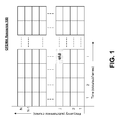
- FIG. 1 illustrates one example of an OFDMA resource 100.
- the OFDMA resource 100 may comprise an allocated system bandwidth partitioned on a y-axis by frequency into multiple sub-carriers, sub-channels or chunks 1- N , a subset of which is represented as 1- j , and partitioned on an x-axis by time slots or sub-frames 1- i .
- a resource block may be represented as one or more slot/subchannels (self definition) q(i, j).
- the CQI may represent channel measurement information for one or more resource blocks.
- the granularity of the CQI feedback information may refer to the number of sub-channels, sub-carriers, chunks, or other resource blocks measured by a subscriber station to generate one or more CQI values.
- the CQI value should provide the base station scheduler all the information necessary to optimally schedule sub-channels or chunks to competing subscriber stations.
- the CQI value is typically fed back for only a subset of the N available sub-channels due to feedback bandwidth limitations. Since the number of available sub-channels scales with system bandwidth, there is a practical limitation on the number of sub-channels for which the CQI value can be fed back.
- the CQI feedback granularity may influence several aspects of an OFDMA system.
- the granularity of the CQI feedback determines the amount of overhead required to signal this information.
- the amount of overhead consumed by the CQI feedback information increases as the number of competing subscriber stations in the OFDMA system increases.
- the granularity of the CQI feedback determines the amount of the OFDMA resource 100 that is remaining for scheduling data after accounting for the CQI feedback overhead.
- the granularity of the CQI feedback determines the complexity in scheduling resource blocks to contending subscriber stations and providing quality of service (QoS) guarantees.
- QoS quality of service
- an OFDMA scheduler may be arranged to use an adaptive scheduling algorithm to improve the effectiveness of the CQI feedback from the subscriber stations to the base station.
- the amount of CQI feedback is dynamically adjusted to the load on the wireless system.
- the set of sub-channels selected for CQI feedback is selected based on the subscriber station's own channel quality as well as the observation of the channel quality of other allocated sub-channels broadcasted on the downlink.
- the efficiency of sub-channel assignment may be quantified as a function of the CQI feedback granularity. Simulation results demonstrate diminishing gains in the efficiency of sub-channel assignment from increasing CQI feedback granularity.
- some embodiments may utilize a CQI for a relatively small subset of sub-channels to achieve most of the frequency selective scheduling gain, such as on the order of 2 to 3 sub-channels per subscriber station.
- the amount of feedback is typically independent of the number of sub-channels in the system. This is contrary to conventional techniques that operate with the presumption that the CQI feedback overhead increases with the number of sub-channels in the OFDMA system.
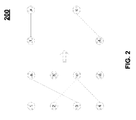
- FIG. 2 illustrates one embodiment of a bipartite graph 200.
- the bipartite graph 200 illustrates an example of matching efficiency for an OFDMA system.
- the left hand side of FIG. 2 illustrates a set of competing subscriber stations 1-4 and a set of OFDMA resource blocks A-D.
- the subscriber stations 1, 3 are providing CQI feedback for resource block A, while the subscriber stations 2, 4 are providing CQI feedback for resource block C. None of the subscriber stations 1-4 are providing CQI feedback for resource blocks B, D.
- the bipartite graph 200 illustrates each subscriber station as connected to only the sub-channels within its feedback subset. The weight of each connection is determined by the CQI value.
- the OFDMA scheduling algorithm uses these weights and the desired scheduling metric to assign sub-channels to competing subscriber stations. Since the bipartite graph 200 is only partially connected and each sub-channel can be allocated to only one subscriber station, however, the output of the scheduling algorithm can be represented by the right hand side of FIG. 2 . In this case, the OFDMA scheduling algorithm allocates the resource block A to subscriber station 1, and the resource block C to subscriber station 4. Since there was no feedback for the resource blocks B, D, the OFDMA scheduling algorithm was unable to provide a full matching for subscriber stations 2, 3 due in part to the limited CQI feedback set.
- a set of definitions may be used to further examine the relationship between CQI feedback and matching results for an OFDMA scheduler.
- a feedback set for each subscriber station may comprise a set of sub-channels for which CQI feedback is provided.
- a matching set for each subscriber station may comprise a set of sub-channels allocated by the OFDMA scheduler. The degree of connectivity or matching between competing subscriber stations and allocated sub-channels is determined by the size of the feedback set.
- the matching size D is the number of sub-channels assigned to competing subscriber stations by the OFDMA scheduler.
- One objective is to determine the relationship between the degree of connectivity and the maximum matching size.
- the degree of connectivity equals one (1) where each subscriber station reports exactly one (the best) sub-channel.
- the expected matching size is the expected matching size to determine whether every subscriber station can be potentially assigned a sub-channel.
- the matching size and its relationship to CQI feedback may be defined in accordance with the following lemma or subsidiary proposition, where if D sub-channels are connected to at least one of the M subscriber stations, and each subscriber station only connects to one sub-channel N , then the matching size is D .
- the probability that the matching size is D when each of M subscriber stations provides CQI feedback information for only one of the N sub-channels may be defined by Equation (1) as follows: p D
- Equation (2) the probability of a matching size of one (1) may be represented by Equation (2) as follows: p 1
- variable D can be calculated by solving the bipartite matching problem for any given feedback pattern. This can be further described with reference to FIGS. 3 , 4 .
- FIG. 3 illustrates one embodiment of a matching ratio graph 300.
- the matching ratio graph 300 illustrates a matching ratio between 0 and 1 on a y-axis, and a number of subscriber stations (users) between 0 and 35 on an x-axis.
- FIG. 4 illustrates one embodiment of a matching ratio graph 400.
- the matching ratio graph 400 illustrates a matching ratio between 0 and 1 on a y-axis, and a number of sub-channels between 0 and 64 on an x-axis.
- the matching ratio graph 400 shows the matching ratio as a function of the number of sub-channels N.
- the matching ratio graph 400 clearly shows that the worst case matching ratio quickly converges to a constant for a given feedback dimension K. This saturation point occurs for a fairly small number of sub-channels.
- the above analysis provides a basis for adapting CQI feedback granularity to the current system load of a base station. Since the base station always has knowledge of the number of competing subscriber stations, the number of sub-channels for which CQI is being fed back, and the matching ratio at any given time, it can broadcast a CQI feedback dimension value K to the competing subscriber stations, where K represents the number of sub-channels for which it requires CQI feedback to achieve a desired matching ratio. If the system load is lighter where the number of competing subscriber stations is smaller, the CQI feedback dimension value K can be fed back for a larger number of sub-channels to improve spectral efficiency without increasing CQI feedback overhead beyond a desired threshold. On the other hand if the system load is higher, the CQI feedback dimension value K can be reduced to increase the available resource blocks from the OFDMA resource 100 for scheduling data and reducing feedback overhead.
- FIG. 5 illustrates one embodiment of a wireless communication system 500.
- the wireless communication system 500 is an example of a wireless communication system suitable for implementing the adaptive scheduling techniques described herein.
- the wireless communication system 500 includes a base station 520 and a subscriber station 550.
- the wireless communication system 500 can include multiple base stations similar to the base station 520, and multiple subscriber stations that are similar to the subscriber station 550, as desired for a given implementation.
- the wireless communication system 500 may be implemented as a wireless access network that uses a multi-carrier access technique such as but not limited to OFDM or OFDMA. The embodiments are not limited in this context.
- the wireless communication system 500 may comprise an OFDMA system where the base station 520 can dynamically change the granularity of CQI feedback from the subscriber station 550 depending at least on a current load for the wireless communication system 500.
- the base station 520 may communicate such changes to the subscriber station 550 via a CQI granularity signal 562.
- the base station 520 may include a system configuration logic 502.
- the system configuration logic 502 may be arranged to indicate an initial or default set of one or more sub-channels (K) for which CQI is to be measured by the subscriber station 550.
- K sub-channels
- the base station 520 may include a QoS requirements and service flow mapping logic 505.
- the QoS requirements and service flow mapping logic 504 may be arranged to maintain information related to quality of service and service flow for subscribers in a network. The embodiments are not limited in this context.
- the base station 520 may include logic to manage requested resources and maintain queue state 506.
- the requested resources and queue state logic 506 may be arranged to manage downlink and uplink bandwidth allocated to subscriber stations such as subscriber station 550.
- the embodiments are not limited in this context.
- the base station 520 may include a CQI management logic 510.
- the CQI management logic 510 may be arranged to generate a message to be transmitted to the subscriber stations to request CQI feedback from one or more subscriber stations for one or more sub-channels based in part on bandwidth allocated for use to provide CQI feedback.
- the embodiments are not limited in this context.
- the base station 520 may include a base station scheduler and frame assembler logic 512.
- the base station scheduler and frame assembler logic 512 may allocate bandwidth based on subscriber needs.
- the base station scheduler and frame assembler logic 512 may allocate a region in a sub-frame for each unique subscriber station.
- the base station scheduler and frame assembler logic 512 may indicate a location of a region in a sub-frame allocated for the subscriber station 550.
- the base station scheduler and frame assembler logic 512 may set the bandwidth available for uplink communications from the subscriber station 550 to the base station 520 and vice-versa.
- the base station scheduler and frame assembler logic 512 may reduce bandwidth allocated to communication of CQI. For example, to reduce bandwidth allocated to communication of CQI, the base station scheduler and frame assembler logic 512 may reduce the granularity of CQI feedback. The base station scheduler and frame assembler logic 512 may provide frames for transmission to the subscriber station 550.
- the base station 500 may transmit to the subscriber station 550 various signals, including but not limited to a CQI granularity signal 562, and a resource allocation signal 564.
- the CQI granularity signal 562 may indicate the number of sub-channels ( K ) for which the subscriber station 550 is to make a CQI measurement.
- the resource allocation signal 564 may indicate to the subscriber station 550 where data is located in a received frame.
- the subscriber station 550 may include a scheduler and grant management logic 552.
- the scheduler and grant management logic 552 may perform various operations, such as monitoring downlink transmissions from the base station 520 to identify unassigned resource blocks, or assigned resource blocks having a link quality below a defined link quality threshold, for example.
- the subscriber station 550 may include a CQI measurement logic 554. Based on the CQI granularity signal 562, the CQI measurement logic 554 may perform channel measurements to measure a CQI at least the number of sub-channels identified by the CQI granularity signal 562.
- the CQI measurement logic 554 may be arranged to use any number of techniques to measure channel quality indicator, such as but not limited to Signal to Interference-plus-Noise Ratio (SINR) measurements, Modulation and Coding Scheme (MCS) option selection, and instantaneous rate feedback.
- SINR Signal to Interference-plus-Noise Ratio
- MCS Modulation and Coding Scheme
- the subscriber station 550 may indicate the CQI to the base station 520 by transmitting a CQI report signal 566.
- the manner by which CQI is reported may comply with applicable standards such as but not limited to SINR measurements, Modulation and Coding Scheme (MCS) option selection, and instantaneous rate feedback.
- MCS Modulation and Coding Scheme
- Operations for apparatus 500 may be further described with reference to one or more logic flows. It may be appreciated that the representative logic flows do not necessarily have to be executed in the order presented, or in any particular order, unless otherwise indicated. Moreover, various activities described with respect to the logic flows can be executed in serial or parallel fashion. The logic flows may be implemented using any desired hardware elements, software elements, or combination of both.
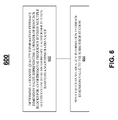
- FIG. 6 illustrates a logic flow 600.
- Logic flow 600 may be representative of the operations executed by one or more embodiments described herein, such as the base station 520, for example.
- the logic flow 600 may determine a CQI feedback dimension value representing a number of resource blocks for an OFDMA system to be measured by a subscriber station based on a matching ratio value at block 602.
- the logic flow 600 may send the CQI feedback dimension value to the subscriber station at block 604.
- the embodiments are not limited in this context.
- the base station scheduler and frame assembler logic 512 may determine a CQI feedback dimension value representing a number of resource blocks for an OFDMA system to be measured by a subscriber station based on a matching ratio value.
- the matching ratio value may represent a ratio denoting a number of subscriber stations allocated a resource block relative to a number of subscribers stations requesting service to the wireless communication system 500 or a number of resource blocks allocated for the wireless communication system 500.
- the base station scheduler and frame assembler logic 512 may increase the CQI feedback dimension value to increase the matching ratio value, and decrease the CQI feedback dimension value to decrease the matching ratio value.
- the base station scheduler and frame assembler logic 512 may determine the matching ratio value based on a subscriber station value representing a number of subscriber stations requesting service to the wireless communication system 500, a matching set value representing a number of resource blocks allocated for the wireless communication system 500, and/or a matching size value representing a number of resource blocks assigned to the subscriber stations.
- the matching ratio value may decrease as the subscriber station value increases.
- the base station scheduler and frame assembler logic 512 may send the CQI feedback dimension value to the subscriber station 550.
- the base station scheduler and frame assembler logic 512 may receive a CQI representing a channel quality measurement for the resource blocks as indicated by the CQI feedback dimension value from the subscriber station 550.
- some embodiments may also improve operations for a subscriber station to increase the efficiency of channel feedback generated by the subscriber station 550 and provided to the base station 520. For example, consider the case when M competing subscriber stations feed back CQI corresponding to their K most favorable sub-channels to the base stations. As described with reference to FIG. 2 , some subscriber stations may have overlapping feedback sets. Depending on the scheduling algorithm, a subsequent allocation may not result in all K sub-channels being allocated to subscriber stations as requested.
- the base station typically broadcast sub-channel assignments in the downlink channel.
- Each subscriber station can deduce information useful in generating a CQI feedback response. For example, each subscriber station can deduce whether a sub-channel is allocated: (1) to the monitoring subscriber station; (2) some other subscriber stations; or (3) remains unassigned. In another example, each subscriber station can deduce a rough estimate of the link quality of the sub-channels assigned to other subscriber stations. One way this may be accomplished is by using the coding/modulation format (MCS) associated with the sub-channel assignment.
- MCS coding/modulation format
- the number of sub-channels assigned to one subscriber station is less than the number it requested, it can improve the chance of allocation in the next round by sending CQI feedback corresponding to any of the remaining unassigned sub-channels, or the sub-channels assigned to other subscriber stations with weaker link quality. If channel quality remains unchanged in previously allocated sub-channels, the subscriber station continues to feedback CQI on the assigned channels. Such techniques may be described in more detail with reference to FIG. 7 .
- FIG. 7 illustrates one embodiment of a logic flow 700.
- Logic flow 700 may be representative of the operations executed by one or more embodiments described herein, such as the subscriber station 550, for example.
- the logic flow 700 may receive a CQI feedback dimension value from a base station by a subscriber station at block 702.
- the logic flow 700 may measure a channel quality for one or more resource blocks for an OFDMA system as indicated by the CQI feedback dimension value at block 704.
- the logic flow 700 may send a CQI representing the channel quality measurements to the base station at block 706.
- the embodiments are not limited in this context.
- the CQI measurement logic 554 may measure a channel quality for a feedback set of resource blocks for the wireless communication system 500 as indicated by the CQI feedback dimension value via the CQI granularity signal 562.
- the feedback set may include a number of the unassigned resource blocks as indicated by the CQI feedback dimension value.
- the feedback set may include a number of assigned resource blocks assigned to other subscribers with a lower link quality value as indicated by the CQI feedback dimension value.
- the scheduler and grant management logic 552 may monitor and identify unassigned resource blocks by monitoring downlink transmissions from the base station 520.
- the CQI measurement logic 554 may measure a channel quality for a number of the unassigned resource blocks as indicated by the CQI feedback dimension value. In this manner, the subscriber station 550 may increase a probability of the base station 520 allocating one or more of the unassigned resource blocks to the subscriber station 550 during the next cycle.
- the scheduler and grant management logic 552 may identify assigned resource blocks having a link quality value lower than a defined link quality value.
- the CQI measurement logic 554 may measure a channel quality for a number of the assigned resource blocks as indicated by the CQI feedback dimension value. In this manner, the subscriber station 550 may increase a probability of the base station 520 re-allocating one or more of the assigned resource blocks from a subscriber station with a lower link quality to the subscriber station 550 with a higher link quality during the next cycle.
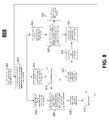
- FIG. 8 illustrates one embodiment of a logic flow 800.
- the logic flow 800 may be representative of an exemplary implementation for the adaptive technique performed by the subscriber station 550.
- the subscriber station 550 may select K best sub-channels and transmit a CQI to the base station 520 at block 802.
- the base station 520 broadcasts an allocation of sub-channels based on an adaptive scheduling algorithm and the CQI information in the next frame at block 804. Three separate execution paths may occur in sequence or parallel.
- the subscriber station 550 identifies a set K(a) of sub-channels that were requested and allocated at block 806.
- the subscriber station 550 identifies a set K(c) of sub-channels for which the CQI has degraded beyond a certain threshold and K(a) - K(c) for which CQI has not significantly degraded at block 808.
- the subscriber station 550 continues to send a CQI for K(a) - K ( c ) sub-channels at block 810.
- the subscriber station 550 sends a CQI for K(u) unassigned sub-channels at block 822.
- the subscriber station 550 sends a CQI for K - [K(a) - K(c)] - K(u) sub-channels on K(w) sub-channels at block 830, and the logic flow 800 passes control to block 804.
- the subscriber station 550 identifies a set K(u) of sub-channels that were not assigned to any subscriber station at block 814.
- the logic flow then passes control to the diamond 816, and the logic flow 800 proceeds as previously described.
- the subscriber station 550 identifies a set K(o) of sub-channels that were allocated to other subscriber stations at block 824.
- the subscriber station 550 does not send a CQI on sub-channels in K(b) to reduce chances of collisions at block 828.
- the logic flow 800 then passes control to the block 830, and the logic flow proceeds as previously described.
- Some embodiments such as apparatus 100, may be implemented as a part, component or sub-system of an electronic device.
- electronic devices may include, without limitation, a processing system, computer, server, work station, appliance, terminal, personal computer, laptop, ultra-laptop, handheld computer, personal digital assistant, television, digital television, set top box, telephone, mobile telephone, cellular telephone, handset, wireless access point, base station, subscriber station, mobile subscriber center, radio network controller, router, hub, gateway, bridge, switch, machine, or combination thereof.
- the embodiments are not limited in this context.
- a processing system may include one or more processors.
- a processor may comprise any hardware element or software element arranged to process information or data.
- Some examples of processors may include, without limitation, a complex instruction set computer (CISC) microprocessor, a reduced instruction set computing (RISC) microprocessor, a very long instruction word (VLIW) microprocessor, a processor implementing a combination of instruction sets, or other processor device.
- the processor may be implemented as a general purpose processor.
- the processor may be implemented as a dedicated processor, such as a controller, microcontroller, embedded processor, a digital signal processor (DSP), a network processor, a media processor, an input/output (I/O) processor, a media access control (MAC) processor, a radio baseband processor, a field programmable gate array (FPGA), a programmable logic device (PLD), an application specific integrated circuit (ASIC), and so forth.
- DSP digital signal processor
- MAC media access control
- FPGA field programmable gate array
- PLD programmable logic device
- ASIC application specific integrated circuit
- a processing device may include one or more memory units coupled to the processors.
- a memory unit may be any hardware element arranged to store information or data.
- Some examples of memory units may include, without limitation, random-access memory (RAM), dynamic RAM (DRAM), Double-Data-Rate DRAM (DDRAM), synchronous DRAM (SDRAM), static RAM (SRAM), read-only memory (ROM), programmable ROM (PROM), erasable programmable ROM (EPROM), EEPROM, Compact Disk ROM (CD-ROM), Compact Disk Recordable (CD-R), Compact Disk Rewriteable (CD-RW), flash memory (e.g., NOR or NAND flash memory), content addressable memory (CAM), polymer memory (e.g., ferroelectric polymer memory), phase-change memory (e.g., ovonic memory), ferroelectric memory, silicon-oxide-nitride-oxide-silicon (SONOS) memory, disk (e.g., floppy disk, hard drive, optical disk, magnetic
- a communication system may comprise multiple logic devices arranged to communicate information or data to each other.
- one or more logic devices may include various elements suitable for wireless communications, such as one or more antennas, transmitters, receivers, transceivers, radios, amplifiers, filters, communications interfaces, and other wireless elements.
- a wireless communication system communicates information or data over a wireless communication medium, such as one or more portions or bands of RF spectrum, for example.
- one or more logic devices may include various elements suitable for wired communications, such as one or more input/output (I/O) adapters, physical connectors to connect the I/O adapter with a corresponding wired communications medium, communication interfaces, network interface card (NIC), and other wired elements.
- I/O input/output
- wired communications media may include wire, cable, metal leads, printed circuit board (PCB), backplane, switch fabric, semiconductor material, twisted-pair wire, co-axial cable, fiber optics, and so forth. The embodiments are not limited in this context.
- the article of manufacture may include a storage medium to store logic and/or data for performing various operations of one or more embodiments.
- the storage medium may represent any storage media capable of storing data or information, such as volatile or non-volatile memory, removable or non-removable memory, erasable or non-erasable memory, writeable or re-writeable memory, and so forth. Examples of storage media may include, without limitation, those examples as previously provided for memory units.
- the article of manufacture may comprise a magnetic disk, optical disk, flash memory or firmware containing computer program instructions suitable for execution by a general purpose processor or application specific processor. The embodiments, however, are not limited in this context.
- Various embodiments may be implemented using hardware elements, software elements, or a combination of both.
- hardware elements may include any of the examples as previously provided for a logic device, and further including microprocessors, circuits, circuit elements (e.g., transistors, resistors, capacitors, inductors, and so forth), integrated circuits, logic gates, registers, semiconductor device, chips, microchips, chip sets, and so forth.
- Examples of software elements may include software components, programs, applications, computer programs, application programs, system programs, machine programs, operating system software, middleware, firmware, software modules, routines, subroutines, functions, methods, procedures, software interfaces, application program interfaces (API), instruction sets, computing code, computer code, code segments, computer code segments, words, values, symbols, or any combination thereof. Determining whether an embodiment is implemented using hardware elements and/or software elements may vary in accordance with any number of factors, such as desired computational rate, power levels, heat tolerances, processing cycle budget, input data rates, output data rates, memory resources, data bus speeds and other design or performance constraints, as desired for a given implementation.
- Coupled and “connected” along with their derivatives. These terms are not necessarily intended as synonyms for each other. For example, some embodiments may be described using the terms “connected” and/or “coupled” to indicate that two or more elements are in direct physical or electrical contact with each other. The term “coupled,” however, may also mean that two or more elements are not in direct contact with each other, but yet still cooperate or interact with each other.
- Example 1 An apparatus, comprising a base station having base station logic to determine a channel quality indicator feedback dimension value representing a number of resource blocks for an orthogonal frequency division multiple access system to be measured by a subscriber station based on a matching ratio value, and a transceiver to send said channel quality indicator feedback dimension value to said subscriber station.
- Example 2 The apparatus of example 1, said base station logic to increase said channel quality indicator feedback dimension value to increase said matching ratio value.
- Example 3 The apparatus of example 1, said base station logic to determine said matching ratio value based on a subscriber station value representing a number of subscriber stations requesting service to said system, a matching set value representing a number of resource blocks allocated for said system, and a matching size value representing a number of resource blocks assigned to said subscriber stations.
- Example 4 The apparatus of example 1, comprising a subscriber station having subscriber station logic to receive said channel quality indicator feedback dimension value, measure a channel quality for one or more resource blocks indicated by said channel quality indicator feedback dimension value, and send a channel quality indicator representing said channel quality measurements to said base station.
- Example 5 The apparatus of example 1, comprising an omnidirectional antenna coupled to said transceiver.
- Example 6 A method, comprising:
- Example 7 The method of example 6, comprising receiving a channel quality indicator representing a channel quality measurement for said resource blocks indicated by said channel quality indicator feedback dimension value from said subscriber station.
- Example 8 The method of example 6, comprising increasing said channel quality indicator feedback dimension value to increase said matching ratio value.
- Example 9 The method of example 6, comprising determining said matching ratio value representing a ratio denoting a number of subscriber stations allocated a resource block relative to a number of subscribers stations requesting service to said system or a number of resource blocks allocated for said system.
- Example 10 The method of example 6, comprising determining said matching ratio value based on a subscriber station value representing a number of subscriber stations requesting service to said system, a matching set value representing a number of resource blocks allocated for said system, and a matching size value representing a number of resource blocks assigned to said subscriber stations.
- Example 11 The method of example 6, comprising determining said matching ratio value based on a subscriber station value representing a number of subscriber stations requesting service to said system, said matching ratio value to decrease as said subscriber station value increases.
- Example 12 The method of example 6, comprising increasing said channel quality indicator feedback dimension value to increase said matching ratio value.
- Example 13 A method, comprising :
- Example 14 The method of example 13 , comprising :
- Example 15 The method of example 13 , comprising :
- Example 16 An article comprising a storage medium containing instructions that if executed enable a system to:
- Example 17 The article of example 16, further comprising instructions that if executed enable the system to receive a channel quality indicator representing a channel quality measurement for said resource blocks indicated by said channel quality indicator feedback dimension value from said subscriber station.
- Example 18 The article of example 16, further comprising instructions that if executed enable the system to increase said channel quality indicator feedback dimension value to increase said matching ratio value.
- Example 19 The article of example 16, further comprising instructions that if executed enable the system to determine said matching ratio value representing a ratio denoting a number of subscriber stations allocated a resource block relative to a number of subscribers stations requesting service to said system or a number of resource blocks allocated for said system.
- Example 20 The article of example 16, further comprising instructions that if executed enable the system to determine said matching ratio value based on a subscriber station value representing a number of subscriber stations requesting service to said system, a matching set value representing a number of resource blocks allocated for said system, and a matching size value representing a number of resource blocks assigned to said subscriber stations.
- Example 21 The article of example 16, further comprising instructions that if executed enable the system to determine said matching ratio value based on a subscriber station value representing a number of subscriber stations requesting service to said system, said matching ratio value to decrease as said subscriber station value increases.
- Example 22 The article of example 16, further comprising instructions that if executed enable the system to increase said channel quality indicator feedback dimension value to increase said matching ratio value.
- Example 23 An article comprising a storage medium containing instructions that if executed enable a system to:
- Example 24 The article of example 16, further comprising instructions that if executed enable the system to:
- Example 25 The article of example 16, further comprising instructions that if executed enable the system to:
Landscapes
- Engineering & Computer Science (AREA)
- Signal Processing (AREA)
- Computer Networks & Wireless Communication (AREA)
- Quality & Reliability (AREA)
- Physics & Mathematics (AREA)
- Electromagnetism (AREA)
- Mobile Radio Communication Systems (AREA)
Applications Claiming Priority (2)
| Application Number | Priority Date | Filing Date | Title |
|---|---|---|---|
| US11/613,983 US8462758B2 (en) | 2006-12-20 | 2006-12-20 | Channel quality information feedback techniques for a wireless system |
| EP07869094.8A EP2098001B1 (fr) | 2006-12-20 | 2007-12-10 | Techniques de retour d'informations de qualité de canal pour système hertzien |
Related Parent Applications (2)
| Application Number | Title | Priority Date | Filing Date |
|---|---|---|---|
| EP07869094.8A Division-Into EP2098001B1 (fr) | 2006-12-20 | 2007-12-10 | Techniques de retour d'informations de qualité de canal pour système hertzien |
| EP07869094.8A Division EP2098001B1 (fr) | 2006-12-20 | 2007-12-10 | Techniques de retour d'informations de qualité de canal pour système hertzien |
Publications (2)
| Publication Number | Publication Date |
|---|---|
| EP2733882A2 true EP2733882A2 (fr) | 2014-05-21 |
| EP2733882A3 EP2733882A3 (fr) | 2014-09-24 |
Family
ID=39543587
Family Applications (2)
| Application Number | Title | Priority Date | Filing Date |
|---|---|---|---|
| EP14154740.6A Withdrawn EP2733882A3 (fr) | 2006-12-20 | 2007-12-10 | Techniques de retour d'informations de qualité de canal pour système hertzien |
| EP07869094.8A Active EP2098001B1 (fr) | 2006-12-20 | 2007-12-10 | Techniques de retour d'informations de qualité de canal pour système hertzien |
Family Applications After (1)
| Application Number | Title | Priority Date | Filing Date |
|---|---|---|---|
| EP07869094.8A Active EP2098001B1 (fr) | 2006-12-20 | 2007-12-10 | Techniques de retour d'informations de qualité de canal pour système hertzien |
Country Status (9)
| Country | Link |
|---|---|
| US (2) | US8462758B2 (fr) |
| EP (2) | EP2733882A3 (fr) |
| JP (1) | JP5010687B2 (fr) |
| KR (1) | KR101098609B1 (fr) |
| CN (2) | CN101617557B (fr) |
| BR (1) | BRPI0720778A2 (fr) |
| ES (1) | ES2535606T3 (fr) |
| TW (1) | TWI376910B (fr) |
| WO (1) | WO2008079654A1 (fr) |
Families Citing this family (48)
| Publication number | Priority date | Publication date | Assignee | Title |
|---|---|---|---|---|
| US8462758B2 (en) | 2006-12-20 | 2013-06-11 | Intel Corporation | Channel quality information feedback techniques for a wireless system |
| KR101306729B1 (ko) * | 2007-02-05 | 2013-09-11 | 엘지전자 주식회사 | 피드백 정보 송수신 방법 |
| CA2680718C (fr) * | 2007-03-19 | 2016-01-26 | Telefonaktiebolaget L M Ericsson (Publ) | Affectation de liaison montante destinee a declencher un premier ou second type de rapport cqi |
| US20080232401A1 (en) * | 2007-03-20 | 2008-09-25 | Sassan Ahmadi | LOGICAL AND TRANSPORT CHANNEL STRUCTURES FOR MOBILE WiMAX WIRELESS SYSTEMS |
| US9413489B2 (en) * | 2007-04-27 | 2016-08-09 | Blackberry Limited | Method and system for data-driven, variable-rate, channel quality indicator for LTE non-real-time bursty traffic |
| US20080298486A1 (en) * | 2007-06-04 | 2008-12-04 | Nec Laboratories America, Inc. | Multi-cell interference mitigation via coordinated scheduling and power allocation in downlink odma networks |
| CN101355795B (zh) * | 2007-07-24 | 2013-06-19 | 夏普株式会社 | 移动通信系统、基站、用户设备和通信方法 |
| US20090029714A1 (en) * | 2007-07-25 | 2009-01-29 | Rudrapatna Ashok N | Method of allocating bandwidth for transmission of channel quality information |
| SE531057C2 (sv) * | 2007-08-24 | 2008-12-02 | Teliasonera Ab | Kommunikationssystem och förfarande för hantering av resurser i ett trådlöst kommunikationssystem |
| US7907572B2 (en) * | 2007-09-28 | 2011-03-15 | Intel Corporation | Collocated radio coexistence method |
| KR20090109046A (ko) * | 2008-04-14 | 2009-10-19 | 엘지전자 주식회사 | Tdd 방식에 따른 프레임 전송 방법 |
| EP2312897B1 (fr) * | 2008-08-06 | 2018-10-10 | Sharp Kabushiki Kaisha | Dispositif de station mobile, dispositif de station de base et procédé de communication |
| CN101729474B (zh) * | 2008-10-10 | 2013-05-08 | 中兴通讯股份有限公司 | 信道质量指数反馈方法和接收机 |
| WO2010126256A2 (fr) * | 2009-04-27 | 2010-11-04 | Lg Electronics Inc. | Procédé pour effectuer une procédure de transfert dans un système de communication sans fil |
| WO2010124715A1 (fr) * | 2009-04-27 | 2010-11-04 | Nokia Siemens Networks Oy | Renvoi de paramètre dans un système de communication sans fil |
| US20120057561A1 (en) * | 2009-05-25 | 2012-03-08 | Tetsuo Mabuchi | Base station apparatus, communication system, mapping control method and program storage medium |
| JP5348013B2 (ja) * | 2009-05-26 | 2013-11-20 | ソニー株式会社 | 無線通信装置、推定サーバ、無線通信方法および推定方法 |
| US9209933B2 (en) * | 2009-06-11 | 2015-12-08 | Qualcomm Incorporated | Method and apparatus for dispatching a channel quality indicator feedback in multicarrier system |
| KR101534865B1 (ko) * | 2009-06-23 | 2015-07-27 | 엘지전자 주식회사 | 링크 적응 절차 수행 방법 |
| US8886790B2 (en) * | 2009-08-19 | 2014-11-11 | Opanga Networks, Inc. | Systems and methods for optimizing channel resources by coordinating data transfers based on data type and traffic |
| KR101606409B1 (ko) * | 2009-08-27 | 2016-04-01 | 삼성전자주식회사 | 통신 시스템에서 채널 상태 정보 처리 장치 및 방법 |
| US8806510B2 (en) * | 2009-09-10 | 2014-08-12 | International Business Machines Corporation | Determining operator partitioning constraint feasibility |
| US8781005B2 (en) | 2009-10-01 | 2014-07-15 | Qualcomm Incorporated | Scalable quantization of channel state information for MIMO transmission |
| US9961579B2 (en) * | 2009-10-01 | 2018-05-01 | Qualcomm Incorporated | Scalable channel feedback for wireless communication |
| EP2317686B1 (fr) * | 2009-10-28 | 2017-08-30 | Alcatel Lucent | Procédé et appareil pour demander et attribuer des ressources de réseau |
| US8594718B2 (en) | 2010-06-18 | 2013-11-26 | Intel Corporation | Uplink power headroom calculation and reporting for OFDMA carrier aggregation communication system |
| US8315221B2 (en) * | 2010-06-18 | 2012-11-20 | Sharp Laboratories Of America, Inc. | Reducing feedback overhead for multiple component carriers |
| KR101615927B1 (ko) * | 2010-06-22 | 2016-05-12 | 삼성전자주식회사 | 피드백 손실을 고려하는 다중 사용자 mimo 통신 시스템 |
| CN103299590B (zh) * | 2010-10-11 | 2017-04-05 | 交互数字专利控股公司 | 用于为认知无线电网络的带宽分配的方法和装置 |
| US9807778B2 (en) | 2010-10-11 | 2017-10-31 | Interdigital Patent Holdings, Inc. | Dynamic spectrum management |
| WO2012054694A1 (fr) * | 2010-10-21 | 2012-04-26 | Mediatek Singapore Pte. Ltd. | Surveillance et signalisation d'intégrité et de qualité pour sondage et rétroaction réduite |
| US11152977B2 (en) | 2010-10-21 | 2021-10-19 | Mediatek Singapore Pte. Ltd. | Integrity and quality monitoring and signaling for sounding and reduced feedback |
| PH12013501440A1 (en) | 2011-01-07 | 2016-03-11 | Beijing Xiaomi Mobile Software Co Ltd | Channel quality indicator reporting |
| TWI442793B (zh) * | 2011-07-25 | 2014-06-21 | Acer Inc | 回報量測報告事件之方法 |
| CN102957515B (zh) * | 2011-08-22 | 2018-09-25 | 索尼公司 | 信道信息反馈方法、用户设备、发送数据方法和基站 |
| KR20130085480A (ko) * | 2011-12-07 | 2013-07-30 | 한국전자통신연구원 | 데이터 통신 장치와 방법 및 데이터 통신 시스템과 방법 |
| EP2632071A1 (fr) * | 2012-02-21 | 2013-08-28 | Thomson Licensing | Procédé d'évaluation de la qualité d'un canal de transmission radio et passerelle résidentielle utilisant le procédé |
| US9204448B2 (en) | 2013-03-26 | 2015-12-01 | Empire Technology Department Llc | Predictive spectral allocation in mobile networks |
| US9554293B2 (en) | 2013-06-11 | 2017-01-24 | Empire Technology Development Llc | Smooth transition between predictive and mobile-assisted spectral allocation |
| US9936502B2 (en) * | 2013-12-18 | 2018-04-03 | Huawei Technologies Co., Ltd. | System and method for OFDMA resource management in WLAN |
| US9755795B2 (en) | 2013-12-18 | 2017-09-05 | Huawei Technologies Co., Ltd. | System and method for WLAN OFDMA design of subcarrier groups and frame format |
| WO2015172098A1 (fr) | 2014-05-09 | 2015-11-12 | Interdigital Patent Holdings, Inc. | Procédé et système de sondage et de sélection de canal |
| US10333662B2 (en) * | 2016-03-08 | 2019-06-25 | Avago Technologies International Sales Pte. Limited | Multiple user (MU) short feedback response in wireless communications |
| CN108604944B (zh) * | 2016-03-11 | 2021-09-14 | 诺基亚技术有限公司 | 反馈信令管理 |
| CN108810932A (zh) * | 2017-05-05 | 2018-11-13 | 华为技术有限公司 | 信道状态信息处理方法及其装置 |
| CN110692212B (zh) | 2017-06-02 | 2023-04-04 | 瑞典爱立信有限公司 | 用于反馈信令的大小指示的方法和设备 |
| CN108111203B (zh) * | 2017-11-17 | 2025-12-23 | 中兴通讯股份有限公司 | 一种信息反馈的方法、装置、信息接收的方法及装置 |
| US11791929B2 (en) * | 2020-09-25 | 2023-10-17 | Cypress Semiconductor Corporation | Autonomous feedback for efficient allocation of wireless subcarriers |
Family Cites Families (36)
| Publication number | Priority date | Publication date | Assignee | Title |
|---|---|---|---|---|
| US6215827B1 (en) | 1997-08-25 | 2001-04-10 | Lucent Technologies, Inc. | System and method for measuring channel quality information in a communication system |
| WO2002049385A2 (fr) * | 2000-12-15 | 2002-06-20 | Broadstorm Telecommunications, Inc. | Telecommunications a multi-porteuses, a configuration et commutation de grappes adaptatives |
| US20040203476A1 (en) * | 2002-10-08 | 2004-10-14 | Jung-Tao Liu | Method of feedback for HSDPA system using OFMDA |
| JP4256158B2 (ja) | 2002-12-26 | 2009-04-22 | パナソニック株式会社 | 無線通信装置及び無線通信方法 |
| US7346018B2 (en) * | 2003-01-16 | 2008-03-18 | Qualcomm, Incorporated | Margin control in a data communication system |
| US7116982B2 (en) * | 2003-02-28 | 2006-10-03 | Lucent Technologies Inc. | Methods and systems for assigning channels in a power controlled time slotted wireless communications system |
| US20040179493A1 (en) | 2003-03-14 | 2004-09-16 | Khan Farooq Ullah | Methods of transmitting channel quality information and power allocation in wireless communication systems |
| US7640373B2 (en) * | 2003-04-25 | 2009-12-29 | Motorola, Inc. | Method and apparatus for channel quality feedback within a communication system |
| KR100640461B1 (ko) | 2003-07-30 | 2006-10-30 | 삼성전자주식회사 | 직교 주파수 분할 다중 접속 방식을 사용하는 이동 통신시스템에서 서브 채널 할당 장치 및 방법 |
| EP1646163B1 (fr) * | 2003-08-06 | 2013-04-24 | Panasonic Corporation | Dispositif et procede de radiocommunication |
| EP3484089B1 (fr) * | 2003-08-20 | 2021-11-24 | Panasonic Corporation | Appareil de communication sans fil et procédé d'attribution de sous-porteuses |
| WO2005081439A1 (fr) * | 2004-02-13 | 2005-09-01 | Neocific, Inc. | Procedes et dispositif pour des systemes de communication a porteuses multiples comportant une transmission et une retroaction adaptatives |
| KR100640516B1 (ko) | 2004-02-27 | 2006-10-30 | 삼성전자주식회사 | 직교주파수분할다중화 통신 시스템에서 채널품질 정보의전송방법 및 장치 |
| KR100946923B1 (ko) | 2004-03-12 | 2010-03-09 | 삼성전자주식회사 | 직교 주파수 분할 다중 방식을 사용하는 통신 시스템에서 채널 품질 정보의 송수신 장치 및 방법, 그리고 그에 따른 시스템 |
| KR101067772B1 (ko) * | 2004-04-22 | 2011-09-28 | 엘지전자 주식회사 | 직교 주파수 분할 다중화 방식에 적용되는 부반송파 할당방법 |
| KR100625143B1 (ko) | 2004-05-14 | 2006-09-20 | 에스케이 텔레콤주식회사 | 휴대 인터넷 시스템에서 채널 품질에 기반하여 채널 상태정보를 보고하는 방법 및 시스템 |
| JP4616338B2 (ja) | 2004-06-14 | 2011-01-19 | サムスン エレクトロニクス カンパニー リミテッド | 多重送受信アンテナを使用する移動通信システムにおける送信モードを制御するための装置,システム及び方法 |
| WO2006019263A2 (fr) * | 2004-08-17 | 2006-02-23 | Lg Electronics Inc. | Procede permettant d'etablir un canal de retroaction rapide et de transmettre des informations dans un systeme de communication sans fil |
| US9084199B2 (en) | 2004-09-30 | 2015-07-14 | Alcatel Lucent | Utilization of overhead channel quality metrics in a cellular network |
| US7564831B2 (en) * | 2004-12-27 | 2009-07-21 | Lg Electronics, Inc. | Method of transmitting feedback information using an extended subheader |
| KR100909531B1 (ko) * | 2004-12-31 | 2009-07-27 | 삼성전자주식회사 | 멀티캐리어를 사용하는 통신 시스템에서 스케쥴링 장치 및방법 |
| KR100617835B1 (ko) * | 2005-01-05 | 2006-08-28 | 삼성전자주식회사 | 통신 시스템에서 채널 품질 정보 송수신 장치 및 방법 |
| KR101208520B1 (ko) * | 2005-03-12 | 2012-12-05 | 엘지전자 주식회사 | 피드백 정보 통신 방법 |
| US8274880B2 (en) * | 2005-03-30 | 2012-09-25 | Apple Inc. | Systems and methods for OFDM channelization |
| EP3416321A1 (fr) * | 2005-06-16 | 2018-12-19 | QUALCOMM Incorporated | Rapport d'informations negociées concernant un canal dans un système de communication radio |
| EP1901573A1 (fr) * | 2005-08-03 | 2008-03-19 | Matsushita Electric Industrial Co., Ltd. | Appareil de poste de base, appareil de terminal de commnication et procédé de communication multiporteur |
| KR20070027844A (ko) * | 2005-08-29 | 2007-03-12 | 삼성전자주식회사 | 무선통신 시스템에서 채널품질 정보를 전송하기 위한 방법및 장치 |
| KR101119281B1 (ko) | 2005-08-29 | 2012-03-15 | 삼성전자주식회사 | 무선 통신 시스템에서 채널 품질 정보 피드백 장치 및방법과 이를 이용한 스케줄링 장치 및 방법 |
| KR20070041214A (ko) * | 2005-10-14 | 2007-04-18 | 삼성전자주식회사 | 무선 이동 통신 시스템에서 상향링크 스케줄링 방법 |
| US8054894B2 (en) * | 2005-10-31 | 2011-11-08 | Motorola Mobility, Inc. | Method and apparatus for providing channel quality feedback in an orthogonal frequency division multiplexing communication system |
| JP2007274094A (ja) * | 2006-03-30 | 2007-10-18 | Toshiba Corp | 基地局、無線端末および無線通信方法 |
| US7830977B2 (en) * | 2006-05-01 | 2010-11-09 | Intel Corporation | Providing CQI feedback with common code rate to a transmitter station |
| WO2008029700A1 (fr) * | 2006-09-04 | 2008-03-13 | Sharp Kabushiki Kaisha | Dispositif de terminal de communication, dispositif de commande de communication, système de communication et procédé de communication |
| US8199706B2 (en) * | 2006-10-27 | 2012-06-12 | Texas Instruments Incorporated | Random access design for high doppler in wireless networks |
| US8462758B2 (en) | 2006-12-20 | 2013-06-11 | Intel Corporation | Channel quality information feedback techniques for a wireless system |
| JP2012501610A (ja) * | 2008-08-29 | 2012-01-19 | インターデイジタル パテント ホールディングス インコーポレイテッド | 下りリンク共有サービスのためのフィードバックを送り、ワイヤレス送受信ユニットの数を推定する方法および装置 |
-
2006
- 2006-12-20 US US11/613,983 patent/US8462758B2/en active Active
-
2007
- 2007-11-23 TW TW096144516A patent/TWI376910B/zh active
- 2007-12-10 JP JP2009543059A patent/JP5010687B2/ja active Active
- 2007-12-10 ES ES07869094.8T patent/ES2535606T3/es active Active
- 2007-12-10 KR KR1020097012771A patent/KR101098609B1/ko active Active
- 2007-12-10 EP EP14154740.6A patent/EP2733882A3/fr not_active Withdrawn
- 2007-12-10 EP EP07869094.8A patent/EP2098001B1/fr active Active
- 2007-12-10 CN CN200780051611.7A patent/CN101617557B/zh active Active
- 2007-12-10 BR BRPI0720778-6A patent/BRPI0720778A2/pt not_active IP Right Cessation
- 2007-12-10 WO PCT/US2007/087013 patent/WO2008079654A1/fr not_active Ceased
- 2007-12-10 CN CN201210567903.9A patent/CN103067128B/zh active Active
-
2013
- 2013-02-01 US US13/757,025 patent/US9066360B2/en active Active
Non-Patent Citations (1)
| Title |
|---|
| None |
Also Published As
| Publication number | Publication date |
|---|---|
| US8462758B2 (en) | 2013-06-11 |
| BRPI0720778A2 (pt) | 2014-01-28 |
| CN103067128A (zh) | 2013-04-24 |
| JP2010514372A (ja) | 2010-04-30 |
| ES2535606T3 (es) | 2015-05-13 |
| EP2098001A1 (fr) | 2009-09-09 |
| JP5010687B2 (ja) | 2012-08-29 |
| TWI376910B (en) | 2012-11-11 |
| US9066360B2 (en) | 2015-06-23 |
| WO2008079654A1 (fr) | 2008-07-03 |
| CN101617557A (zh) | 2009-12-30 |
| KR101098609B1 (ko) | 2011-12-23 |
| EP2098001B1 (fr) | 2015-02-25 |
| EP2098001A4 (fr) | 2013-08-21 |
| US20130136026A1 (en) | 2013-05-30 |
| CN101617557B (zh) | 2013-02-06 |
| KR20090086112A (ko) | 2009-08-10 |
| TW200833000A (en) | 2008-08-01 |
| US20080153506A1 (en) | 2008-06-26 |
| CN103067128B (zh) | 2015-09-16 |
| EP2733882A3 (fr) | 2014-09-24 |
Similar Documents
| Publication | Publication Date | Title |
|---|---|---|
| EP2098001B1 (fr) | Techniques de retour d'informations de qualité de canal pour système hertzien | |
| US11464041B2 (en) | Network node, user device and methods thereof | |
| JP5558469B2 (ja) | パワーブーストを伴うサブチャネル化 | |
| JP4991833B2 (ja) | マルチセル無線通信システムにおける動的リソース配分方法および装置 | |
| EP2018712B1 (fr) | Attribution de puissance dépendant de la charge de trafic dans un réseau de communication sans fil multi-utilisateur avec une progammation équitable proportionelle dans le domaine temporel et de fréquence | |
| RU2580811C2 (ru) | Базовая станция и пользовательское устройство | |
| US9668250B2 (en) | Wireless communication system, master communication device, slave communication device, and channel allocation information notification method | |
| US20100177670A1 (en) | Resource allocation in a communication system | |
| US8929313B2 (en) | Resource allocation | |
| CN110769504B (zh) | 通信方法和通信装置 | |
| EP2697913B1 (fr) | Procédé et station de base pour attribution de puissance dans un système sans fil | |
| CN101222728B (zh) | 在ofdma系统中使用时频资源的方法及系统 | |
| CN101252768B (zh) | 调度装置和方法 | |
| US20190053268A1 (en) | Transmission allocation control | |
| JP5541411B2 (ja) | 無線通信ネットワークにおいてリソースブロックを割り当てるための方法および装置 | |
| Miuccio et al. | Implementation of a simulation environment for multi-numerology scenarios in 5G Vienna link level simulator | |
| Bohge et al. | Multi-user OFDM system performance subject to control channel reliability in a multi-cell environment | |
| JP5133223B2 (ja) | 無線通信装置および無線通信方法 | |
| KR20120072265A (ko) | 이동통신 시스템의 무선주파수 자원 스케줄러 |
Legal Events
| Date | Code | Title | Description |
|---|---|---|---|
| PUAI | Public reference made under article 153(3) epc to a published international application that has entered the european phase |
Free format text: ORIGINAL CODE: 0009012 |
|
| 17P | Request for examination filed |
Effective date: 20140211 |
|
| AC | Divisional application: reference to earlier application |
Ref document number: 2098001 Country of ref document: EP Kind code of ref document: P |
|
| AK | Designated contracting states |
Kind code of ref document: A2 Designated state(s): AT BE BG CH CY CZ DE DK EE ES FI FR GB GR HU IE IS IT LI LT LU LV MC MT NL PL PT RO SE SI SK TR |
|
| PUAL | Search report despatched |
Free format text: ORIGINAL CODE: 0009013 |
|
| AK | Designated contracting states |
Kind code of ref document: A3 Designated state(s): AT BE BG CH CY CZ DE DK EE ES FI FR GB GR HU IE IS IT LI LT LU LV MC MT NL PL PT RO SE SI SK TR |
|
| RIC1 | Information provided on ipc code assigned before grant |
Ipc: H04W 72/08 20090101ALI20140819BHEP Ipc: H04L 1/00 20060101AFI20140819BHEP Ipc: H04W 24/02 20090101ALI20140819BHEP Ipc: H04L 5/00 20060101ALI20140819BHEP Ipc: H04W 24/10 20090101ALN20140819BHEP |
|
| STAA | Information on the status of an ep patent application or granted ep patent |
Free format text: STATUS: THE APPLICATION IS DEEMED TO BE WITHDRAWN |
|
| 18D | Application deemed to be withdrawn |
Effective date: 20160701 |