EP2737848A2 - Vorrichtung und verfahren zur erhöhung der genauigkeit der erkennung von beschleunigungsdaten einer fötus-herzfrequenz - Google Patents
Vorrichtung und verfahren zur erhöhung der genauigkeit der erkennung von beschleunigungsdaten einer fötus-herzfrequenz Download PDFInfo
- Publication number
- EP2737848A2 EP2737848A2 EP12817485.1A EP12817485A EP2737848A2 EP 2737848 A2 EP2737848 A2 EP 2737848A2 EP 12817485 A EP12817485 A EP 12817485A EP 2737848 A2 EP2737848 A2 EP 2737848A2
- Authority
- EP
- European Patent Office
- Prior art keywords
- acceleration
- heart rate
- fetus heart
- rate data
- sequence
- Prior art date
- Legal status (The legal status is an assumption and is not a legal conclusion. Google has not performed a legal analysis and makes no representation as to the accuracy of the status listed.)
- Granted
Links
Images
Classifications
-
- A—HUMAN NECESSITIES
- A61—MEDICAL OR VETERINARY SCIENCE; HYGIENE
- A61B—DIAGNOSIS; SURGERY; IDENTIFICATION
- A61B8/00—Diagnosis using ultrasonic, sonic or infrasonic waves
- A61B8/08—Clinical applications
- A61B8/0866—Clinical applications involving foetal diagnosis; pre-natal or peri-natal diagnosis of the baby
-
- A—HUMAN NECESSITIES
- A61—MEDICAL OR VETERINARY SCIENCE; HYGIENE
- A61B—DIAGNOSIS; SURGERY; IDENTIFICATION
- A61B5/00—Measuring for diagnostic purposes; Identification of persons
- A61B5/02—Detecting, measuring or recording for evaluating the cardiovascular system, e.g. pulse, heart rate, blood pressure or blood flow
- A61B5/024—Measuring pulse rate or heart rate
- A61B5/02411—Measuring pulse rate or heart rate of foetuses
-
- A—HUMAN NECESSITIES
- A61—MEDICAL OR VETERINARY SCIENCE; HYGIENE
- A61B—DIAGNOSIS; SURGERY; IDENTIFICATION
- A61B5/00—Measuring for diagnostic purposes; Identification of persons
- A61B5/72—Signal processing specially adapted for physiological signals or for diagnostic purposes
- A61B5/7235—Details of waveform analysis
-
- A—HUMAN NECESSITIES
- A61—MEDICAL OR VETERINARY SCIENCE; HYGIENE
- A61B—DIAGNOSIS; SURGERY; IDENTIFICATION
- A61B8/00—Diagnosis using ultrasonic, sonic or infrasonic waves
- A61B8/02—Measuring pulse or heart rate
-
- A—HUMAN NECESSITIES
- A61—MEDICAL OR VETERINARY SCIENCE; HYGIENE
- A61B—DIAGNOSIS; SURGERY; IDENTIFICATION
- A61B8/00—Diagnosis using ultrasonic, sonic or infrasonic waves
- A61B8/52—Devices using data or image processing specially adapted for diagnosis using ultrasonic, sonic or infrasonic waves
- A61B8/5207—Devices using data or image processing specially adapted for diagnosis using ultrasonic, sonic or infrasonic waves involving processing of raw data to produce diagnostic data, e.g. for generating an image
-
- A—HUMAN NECESSITIES
- A61—MEDICAL OR VETERINARY SCIENCE; HYGIENE
- A61B—DIAGNOSIS; SURGERY; IDENTIFICATION
- A61B8/00—Diagnosis using ultrasonic, sonic or infrasonic waves
- A61B8/52—Devices using data or image processing specially adapted for diagnosis using ultrasonic, sonic or infrasonic waves
- A61B8/5215—Devices using data or image processing specially adapted for diagnosis using ultrasonic, sonic or infrasonic waves involving processing of medical diagnostic data
- A61B8/5223—Devices using data or image processing specially adapted for diagnosis using ultrasonic, sonic or infrasonic waves involving processing of medical diagnostic data for extracting a diagnostic or physiological parameter from medical diagnostic data
-
- A—HUMAN NECESSITIES
- A61—MEDICAL OR VETERINARY SCIENCE; HYGIENE
- A61B—DIAGNOSIS; SURGERY; IDENTIFICATION
- A61B8/00—Diagnosis using ultrasonic, sonic or infrasonic waves
- A61B8/52—Devices using data or image processing specially adapted for diagnosis using ultrasonic, sonic or infrasonic waves
- A61B8/5269—Devices using data or image processing specially adapted for diagnosis using ultrasonic, sonic or infrasonic waves involving detection or reduction of artifacts
- A61B8/5276—Devices using data or image processing specially adapted for diagnosis using ultrasonic, sonic or infrasonic waves involving detection or reduction of artifacts due to motion
Definitions
- the invention relates to the field of biomedical signal processing and specifically to a device for enhancing the accuracy of recognizing fetus heart rate acceleration and a realizing method thereof.
- the fetus heart rate acceleration is unique physiological phenomenon in third trimester and also an important indicator used for determining the fetus safety in the uterine in clinical practice.
- the fetus acceleration occurs because of fetus movement, external stimuli, etc.
- the phenomenon shows that fetus is healthy.
- the fetus acceleration is one of important indicators that the fetus is well stocked.
- the uterine has recurrent contraction and periodic acceleration, it indicates that the cord has mild compression. In this case, its changes shall be observed to determine whether the necessary interventions shall be taken to ensure fetus safety.
- the fetus heart rate lack acceleration for a long time is a sign of fetus hypoxia. At this time, the appropriate clinical trials shall be taken to determine the fetus situation and take corresponding interventions.
- fetus heart rate data acceleration When gestational weeks are equal to or bigger than 32 weeks, it is determined to be in acceleration if the fetus heart rate suddenly increases to be above the fetus heart rate baseline.
- An acceleration is a visually apparent abrupt increase in fetal heart rate. An abrupt increase is defined as an increase from the onset of acceleration to the peak in less than 30 seconds. To be called an acceleration, the peak must be equal to or bigger than 15bpm, and the acceleration must last equal to or bigger than 15 seconds from the onset to return.
- acceleration is defined as having a peak equal to or bigger than 10bpm and a duration equal to or bigger than 10 seconds from the onset to return.
- the intermediate data processing method of the automatic recognition of fetus heart rate is mainly based on the acceleration medical criteria.
- fetus monitoring hereinafter referred to as fetus monitoring
- the fetus heart rate baseline is recognized.
- the number, lasting time, amplitude, etc. of the acceleration above the baseline are calculated.
- the method has the following disadvantages: Firstly, when a fetus is active or in continuous stimulation, the collected data often have continuous acceleration.
- the continuous accelerations are only recognized as one acceleration but not recognized as a plurality of accelerations. Hence, the number of the recognized accelerations is less than the actual number of the accelerations.
- the curve of the fetus heart rate data often comprises the variation part of the baseline. The method may not recognize the variation part of the baseline and hence exclude them from the acceleration. Moreover, the variation part of the baseline often meets the above criteria but does not belong to the acceleration. If the acceleration is determined according to the method, the variation part of these baselines is mistaken to be regarded as the acceleration.
- the objective of the invention is to propose a device and method for enhancing the accuracy of recognizing the fetus heart rate data acceleration.
- the device for enhancing the accuracy of recognizing the fetus heart rate acceleration also comprises a fetus heart rate signal collecting and processing transforming module, a fetus heart rate data acceleration validation module, a fetus heart rate data acceleration determination criteria setting module, a fetus heart rate data acceleration type determination module, a collecting duration setting and determination module and a fetus heart rate data acceleration attribute calculation module, wherein the fetus heart rate signal collecting and processing transforming module is connected with the fetus heart rate data collecting module to be used for collecting a fetus heart signal, transforming the signal into the fetus heart rate data and transmitting the fetus heart rate data to the fetus heart rate data collecting module; the fetus heart rate acceleration validation module is connected with the fetus heart rate data acceleration recognition module and the fetus heart rate data acceleration attribute calculation module to be used for receiving the acceleration data segment transmitted by the f
- a timeout signal is transmitted to the fetus heart rate data collecting module; and the fetus heart rate data acceleration attribute calculation module is connected with the fetus heart rate data acceleration recognition module and the output module to be used for receiving the acceleration data segment transmitted by the fetus heart rate data acceleration recognition module, calculating the duration, amplitude and other acceleration attribute values of the each acceleration data segment and transmitting the calculated values to the output module.
- the fetus heart rate data preprocessed module also comprises:
- the fetus heart rate data acceleration recognition module also comprises:
- the output module also comprises:
- a method for enhancing the accuracy of recognizing a fetus heart rate data acceleration comprises:
- the method further comprises: collecting and processing a fetus heart signal, transforming it and obtaining the fetus heart rate data.
- Step 3 also comprises:
- Step 4 also comprises:
- the method also comprises: determining the signal loss situation of each the acceleration data segment and checking whether each the acceleration sequence segment is in real acceleration, according to the acceleration data segment.
- the method also comprises: determining the signal loss situation of each the acceleration data segment according to the acceleration data segment; and checking whether each the acceleration sequence segment is in real acceleration; furthermore, the method comprises:
- the method further comprises: calculating the acceleration attribute value of each the acceleration data segment.
- calculating the acceleration attribute value of each the acceleration data segment further comprises:
- Step 6 further comprises: displaying and / or printing and / or storing and / or recognizing the acceleration data segment and the calculation results of the attribute values.
- the pre-configured acceleration determination criteria in Step 4 also comprises:
- the fetus heart rate segment to be analyzed is the deceleration data segment, wherein A0, T0, A1 and P0 are the parameters set in advance.
- the invention may effectively distinguish the variations between the accelerations and the baseline, accurately recognizes each acceleration in continuous accelerations, and avoids the situations of detected number of fetus heart rate data accelerations being lower than actuality or being mistaken due to current method, thereby enhancing the accuracy in recognizing fetus heart rate curve acceleration.
- the method is suitable for not only the case that there are independent acceleration and variation part of the baseline but also the case that there occurs continuous accelerations and the variation part of the baseline is mixed in the acceleration.
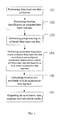
- the technical proposal for automatically recognizing the fetus heart rate acceleration is realized mainly through an upper computer and a lower computer, wherein the lower computer collects a fetus heart rate signal mainly through an ultrasound probe and then calculates the fetus heart rate through a hardware filtered process and autocorrelation algorithm, the upper computer is mainly used for receiving the data from the lower computer and then displaying and storing the fetus heart rate data, depicting the fetus heart rate curve, as well as analyzing, displaying and printing the fetus heart rate data (comprising the recognition of the fetus heart rate acceleration, etc.), wherein the main processing method is shown in Figure1 :
- the upper computer collects n-minute fetus heart rate data and obtains the fetus heart rate sequence, H(n), wherein in the example, at least ten minutes of data shall be needed to be collected.
- H(n) fetus heart rate sequence
- at least ten minutes of data are needed to determine the fetus heart rate baseline.
- the fetus heart rate baseline data sequence, B(n) is recognized with the adoption of a low-pass filtered method. Comparing to the fetus heart rate data, the baseline belongs to the low frequency signal.
- a low-pass filter is characterized in that low-frequency signals may be passed through the filter while high-frequency signals may not be passed through the filter, thus extracting the low frequency signals of the fetus heart rate baseline.
- the data in the sequence, H(n) may also be firstly processed. After the data are processed with an incorrect data processing method, an average filtering method and a linear interpolation method, the fetus heart rate baseline is indentified according to the data.
- Figure 5 shows collected fetus heart rate data and an recognized fetus heart rate baseline.
- the sequence, H(n) is processed with the incorrect data processing method and the linear interpolation method in sequence and then obtains the fetus heart rate data sequence corresponding to different preprocessing processes.
- the acceleration of the preprocessed fetus heart rate data are recognized according to the acceleration determination criteria and the fetus heart rate baseline to obtain the acceleration data segment.
- the sequence segment, meeting the conditions, is determined according to the preprocessed determination criteria. And according to the sequence segment and the corresponding baseline sequence segment thereof, the sequence segments of the variations between accelerations and baseline in the sequence segment are inspected and distinguished, and the number of continuous accelerations of the acceleration sequence segment is analyzed.
- the maximum amplitude value deviating the baseline in the acceleration is calculated.
- the example preferably displays and / or prints and / or stores the recognized acceleration data segment and the calculated results.
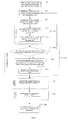
- Figure 2 shows the flow chart of a method for enhancing the accuracy of recognizing the fetus heart rate data acceleration in the following:
- the processing of the upper computer comprises: displaying, storing and depicting the fetus heart rate data into a fetus heart rate curve and processing the related data, etc.
- the hardware filtering is used for removing the frequency interference of the collected signals
- the autocorrelation algorithm is characterized in that it may strengthen a periodic signal and weakens stochastic noise, which are the general techniques for calculating the fetus heart rate data.
- the upper computer collects n-minute fetus heart rate data and obtains the fetus heart rate sequence, H(n), wherein in the example, at least ten minutes of data shall be needed to be collected.
- H(n) fetus heart rate sequence
- at least ten minutes of data are needed to determine the fetus heart rate baseline.
- the fetus heart rate baseline B(n) is recognized with the adoption of the low-pass filtered method. Comparing to the fetus heart rate data, the baseline belongs to the low frequency signal.
- a low-pass filter is characterized in that low-frequency signals may be passed through the filter while high-frequency signals may not be passed through the filter, thus extracting the low frequency signals of the fetus heart rate baseline.
- the data in the sequence, H(n) may also be firstly processed. After the data are processed with an incorrect data processing method, an average filtering method and a linear interpolation method, the fetus heart rate baseline is indentified according to the data.
- Figure 5 shows collected fetus heart rate data and an recognized fetus heart rate baseline.
- there are many methods for recognizing the fetus heart rate data baseline for example, an averaging method generally adopted in the industry, etc.
- the incorrect data in the sequence, H(n) are processed to obtain the effective fetus heart rate data sequence, V(n).
- This step may effectively filter out the invalid and incorrect data in the fetus heart sequence generated because of poor quality of the fetus heart signals, and the rest are valid data.
- the invalid data in the sequence, V(n) are fitted with the linear interpolation method and obtain the sequence, C(n).
- the linear interpolation method is a simple interpolation method in which other points in a straight line are obtained with a principle of forming a straight line through connecting two points.
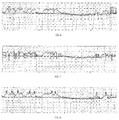
- Figure 6 is an effect diagram of a preprocessed fetus heart rate data sequence.
- the fetus heart rate curve part in a square frame in the Figure is just the curve section obtained after the incorrect data are processed with the interpolation.
- Steps 1031 and 1032 the collected fetus heart rate data are preprocessed.
- the fetus heart rate data preprocessing step is not limited to the above steps. It can also adopt the following methods informed in the industry: the fetus heart rate value with bpm (beats per min) as the unit is divided with incorrect data and / or moving average and / or interpolation fitting, etc.
- deceleration determination criteria which are preferably pre-configured in the example are as follows:
- the determination condition enhances the determination criteria, thus facilitating the determination to be more accurate.
- the parameters A0, T0, A1 and P0 are the pre-configured experiential parameters and set differently with the different input of the gestational week parameters.
- the sequences C(n) and B(n) are input into the acceleration determination criteria, thus obtaining the set C i S i E i 1 N of each sequence segment meeting the acceleration criteria in the sequence, C(n) and the corresponding baseline sequence segment set B i S i E i 1 N thereof. If there is not the sequence segment meeting the acceleration criteria, it means that there is not acceleration in the fetus heart rate curve. At this time, the recognition of the fetus heart rate acceleration may be ended, and the fetus heart rate data is collected once again.
- each sequence segment C i S i E i C i S i E i and B i S i E i are differenced to obtain the sequence segment D i S i E i .
- the continuous sequence segment which is not more than threshold R 0 , is sought in the sequence segment D i S i E i . If there is not the sequence segment in the sequence D i S i E i meeting the condition, the sequence segment C i S i E i consists of one acceleration group or continuous acceleration groups. The number of accelerations is analyzed with the continuous peak inspection algorithm method in the next step.
- the sequence segment at the corresponding place and in the C i S i E i is determined as the baseline variation part which is recorded as C j ⁇ S l ⁇ E j ⁇ 1 M , wherein C j ⁇ S j ⁇ E j ⁇ ⁇ C i S i E i .
- the baseline variation part divides the C i S i E i into a plurality of segments which are recorded as C ⁇ k ⁇ S ⁇ k ⁇ E k ⁇ 1 N 2 , wherein C ⁇ k ⁇ S ⁇ k ⁇ E k ⁇ ⁇ C i S i E i .
- C ⁇ k ⁇ S ⁇ k ⁇ E k ⁇ It is determined whether C ⁇ k ⁇ S ⁇ k ⁇ E k ⁇ meets the deceleration criteria. If it meets the acceleration criteria, C ⁇ k ⁇ S ⁇ k ⁇ E k ⁇ is one acceleration group or continuous acceleration groups, and the number of the accelerations is analyzed with the continuous peak inspection algorithm in the next step. If it does not meet the deceleration criteria, C ⁇ k ⁇ S ⁇ k ⁇ E k ⁇ with this step, the variations between the accelerations and the baseline may be distinguished.
- the fetus heart rate sequence segment (here, it may be C i S i E i or C ⁇ k ⁇ S ⁇ k ⁇ E k ⁇ to be analyzed, there is C ⁇ k ⁇ S ⁇ k ⁇ E k ⁇ ⁇ C i S i E i .
- the process analyzed with the continuous peak inspection algorithm is as follows: The continuous sequence segment, of which the deviation value of the corresponding baseline is not more than the threshold R1, is sought in the segment. If there is not the sequence segment (all deviation values exceed the threshold R1) meeting such condition, the C ⁇ k ⁇ S ⁇ k ⁇ E k ⁇ is one acceleration.
- Figure 7 is an effective diagram of acceleration recognition.
- the fetus heart rate curve part in the square frame in the figure is the variation part of baseline.
- the curve segment part designated with the arrow is the recognized fetus heart rate acceleration curve segment.
- Steps 1041, 1042 and 1043 are used for recognizing the acceleration of the processed and collected fetus heart rate data. So far, this step has completed the recognition on the acceleration data segment of the invention.
- Steps 105 and 106 may be directly entered into to calculate the attribute values and output the results, or Step 106 is directly entered into to output the calculated results.
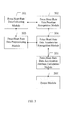
- the example also may preferably adopt the following acceleration validation steps prior to the steps of calculation and result output.
- the acceleration of the above steps is obtained according to the interpolated sequence, it means that the acceleration is obtained without the consideration of the situation of the signal loss.
- the acceleration shall be validated and the signal loss in each pre-acceleration shall be analyzed, thus determining whether each pre-acceleration is retained and split, and finally obtaining the real acceleration.
- the step also comprises the following processed processes:
- the second step as to each the acceleration, adjusting the places of starting and destination points of the acceleration according to the sequence, M(n) and facilitating the starting and destination points not to be the interpolation points and to be most close to the interpolation point;
- the third step the adjusted signal loss degree S calculated is the number (being equal to the number of the interpolation points) of the invalidated values in the fetus heart rate acceleration curve data and the proportion of the invalidated values against the whole part. If the S exceeds the threshold S , the qualification of the acceleration shall be cancelled. otherwise, the interpolation area in acceleration is searched, and the duration T of the interpolation area and the average amplitude A of the interpolation value are calculated; If T is larger than threshold T or by L times larger than A, the interpolation area is regarded as an unacceptable area; otherwise it is an acceptable area;
- the fourth step the acceleration data segment is divided into a plurality of areas by the unacceptable area. It is determined whether each area meets the acceleration criteria, if it meets the criteria, it is determined to be in real acceleration; otherwise its acceleration qualification is cancelled.
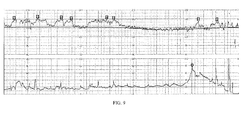
- Figure 8 is an effective diagram of acceleration validation. The arrow icon in the figure indicates acceleration.
- the maximum amplitude value deviating the baseline in the acceleration is calculated.
- the type of the acceleration may be determined while the uterine contraction data are collected, then if the uterine contraction data are not collected, the type of the acceleration is not determined and the final acceleration displaying effective diagram is in line with Figure 8 . If the uterine contraction data are collected, it is determined whether the starting point of the acceleration is bigger than that of the uterine contraction and whether the destination point of the acceleration is smaller than that of the uterine contraction at the same time; if the above two conditions are met, the acceleration is determined to be in periodic acceleration; otherwise, it is determined to be un-periodic acceleration.
- Figure 9 is an effective diagram of the acceleration display when there are uterine contraction data. In the drawings, represents periodic acceleration; represents non-periodic acceleration, and represents uterine contraction.
- the indentified acceleration data segments are respectively input into a displaying module, a printing module and a storage module.
- Each acceleration data segment and the attribute values thereof are also recognized and displayed in the fetus monitoring drawing. Its attribute values may be stored and printed.
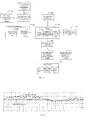
- a fetus heart rate data collecting module 301 :
- the module 301 is used for performing the fetus heart rate data collection with pre-configured duration to obtain the fetus heart rate data sequence, H(n);
- a fetus heart rate data baseline recognition module 302 :
- the module 302 is connected with the fetus heart rate data collecting module 301 and used for receiving the fetus heart rate data sequence, H(n) transmitted by the fetus heart rate data collecting module 301 and recognizing the fetus heart rate baseline sequence, B(n);
- a fetus heart rate data preprocessing module 303 :
- the module 302 is connected with the fetus heart rate data collecting module 301 and used for receiving the fetus heart rate data sequence, H(n) transmitted by the fetus heart rate data collecting module 301, and performing preprocessing on the sequence, H(n) to obtain the fetus heart rate data sequence, V(n);
- a fetus heart rate data acceleration recognition module 304 :
- the fetus heart rate data baseline recognition module 302 is connected with the fetus heart rate data preprocessing module 303 and used for receiving the fetus heart rate data baseline sequence, B(n) transmitted by the fetus heart rate data baseline recognition module 302 and the preprocessed sequence, V(n) transmitted by the fetus heart rate data preprocessing module 303.
- the acceleration recognition on the preprocessed fetus heart rate data sequence, V(n) is performed to obtain an acceleration data segment, according to the pre-configured acceleration determination criteria and the fetus heart rate data baseline sequence, B(n), and
- a fetus heart rate data acceleration attribute calculation module 305 :
- the module 305 is connected with the fetus heart rate data acceleration recognition module 304 and used for receiving the acceleration data segment transmitted by the fetus heart rate data acceleration recognition module 304 and calculating the duration, amplitude and other acceleration attributes of each the acceleration data segment.
- An output module 306 is
- the output module 306 is connected with the fetus heart rate data acceleration attribute calculation module 305 and used for receiving the acceleration data segment and the acceleration attribute calculation results thereof transmitted by the fetus heart rate data acceleration attribute calculation module 305, and outputting them.
- a device for enhancing accuracy of recognizing fetus heart rate acceleration also comprises:
- a fetus heart signal collecting, processing and transforming module 300 A fetus heart signal collecting, processing and transforming module 300:
- the module 300 is connected with the fetus heart rate data collecting module 301, is an ultrasound probe device realizing the collection, process and transformation of the signals, as well as is used for collecting the fetus heart signals, transforming them into the fetus heart rate data and transmitting the fetus heart rate data to the fetus heart rate data collecting module 301.
- a fetus heart rate data acceleration validation module 312 :
- the module 312 is connected with the fetus heart rate data acceleration recognition module 304 and the fetus heart rate data acceleration attribute calculation module 305 and is used for receiving the acceleration data segment transmitted by the fetus heart rate data acceleration recognition module 304, validating whether each acceleration sequence segment is real acceleration according to the signal loss situation of each acceleration, and transmitting the validated results to the fetus heart rate data acceleration attribute calculation module 305.
- a fetus heart rate data acceleration determination criteria setting module 313 :
- the module 313 is connected with the fetus heart rate data acceleration recognition module 304 and used for setting the fetus heart rate data acceleration determination criteria in advance and transmitting the criteria to the fetus heart rate data acceleration module 304.
- a fetus heart rate data acceleration type determination module 314 :
- the module 314 is connected with the fetus heart rate data acceleration attribute calculation module 305 and used for determining the acceleration type under the conditions of collecting the uterine contraction data, and transmitting the determined results to the fetus heart rate data acceleration attribute calculation module 305.
- a collecting duration setting and determination module 319 is a collecting duration setting and determination module 319:
- the module 319 is connected with the fetus heart rate data collecting module 301 and used for setting the collecting duration of the fetus heart rate data, and determining whether the collected data time exceeds the set duration. If it exceeds the set duration, a timeout signal is transmitted to the fetus heart rate data collecting module 301.
- the fetus heart rate data preprocessing module 303 further comprises:
Landscapes
- Health & Medical Sciences (AREA)
- Life Sciences & Earth Sciences (AREA)
- Engineering & Computer Science (AREA)
- Surgery (AREA)
- General Health & Medical Sciences (AREA)
- Biophysics (AREA)
- Veterinary Medicine (AREA)
- Pathology (AREA)
- Public Health (AREA)
- Physics & Mathematics (AREA)
- Biomedical Technology (AREA)
- Heart & Thoracic Surgery (AREA)
- Medical Informatics (AREA)
- Molecular Biology (AREA)
- Animal Behavior & Ethology (AREA)
- Nuclear Medicine, Radiotherapy & Molecular Imaging (AREA)
- Radiology & Medical Imaging (AREA)
- Computer Vision & Pattern Recognition (AREA)
- Physiology (AREA)
- Cardiology (AREA)
- Pregnancy & Childbirth (AREA)
- Gynecology & Obstetrics (AREA)
- Artificial Intelligence (AREA)
- Psychiatry (AREA)
- Signal Processing (AREA)
- Measuring Pulse, Heart Rate, Blood Pressure Or Blood Flow (AREA)
- Measurement And Recording Of Electrical Phenomena And Electrical Characteristics Of The Living Body (AREA)
- Ultra Sonic Daignosis Equipment (AREA)
Applications Claiming Priority (2)
| Application Number | Priority Date | Filing Date | Title |
|---|---|---|---|
| CN2011102095214A CN102319063B (zh) | 2011-07-26 | 2011-07-26 | 一种提高胎心率数据加速识别准确性的装置和方法 |
| PCT/CN2012/081934 WO2013013646A2 (zh) | 2011-07-26 | 2012-09-25 | 一种提高胎心率数据加速识别准确性的装置和方法 |
Publications (3)
| Publication Number | Publication Date |
|---|---|
| EP2737848A2 true EP2737848A2 (de) | 2014-06-04 |
| EP2737848A4 EP2737848A4 (de) | 2015-05-06 |
| EP2737848B1 EP2737848B1 (de) | 2021-05-19 |
Family
ID=45447000
Family Applications (1)
| Application Number | Title | Priority Date | Filing Date |
|---|---|---|---|
| EP12817485.1A Active EP2737848B1 (de) | 2011-07-26 | 2012-09-25 | Verfahren zur erhöhung der genauigkeit der erkennung von beschleunigungsdaten einer fötus-herzfrequenz |
Country Status (4)
| Country | Link |
|---|---|
| US (1) | US9801609B2 (de) |
| EP (1) | EP2737848B1 (de) |
| CN (1) | CN102319063B (de) |
| WO (1) | WO2013013646A2 (de) |
Cited By (2)
| Publication number | Priority date | Publication date | Assignee | Title |
|---|---|---|---|---|
| EP2767228A4 (de) * | 2011-10-13 | 2015-06-17 | Edan Instruments Inc | Vorrichtung und verfahren zur verbesserung der identifizierungsgenauigkeit einer fötalen herzfrequenzverzögerung |
| US10729349B2 (en) | 2016-10-05 | 2020-08-04 | Murata Manufacturing Co., Ltd. | Method and apparatus for monitoring heartbeats |
Families Citing this family (25)
| Publication number | Priority date | Publication date | Assignee | Title |
|---|---|---|---|---|
| CN103565433B (zh) * | 2013-10-30 | 2015-02-25 | 深圳市理邦精密仪器股份有限公司 | 一种提高胎儿监护效率的方法和装置 |
| CN104720748B (zh) * | 2013-12-24 | 2017-06-06 | 中国移动通信集团公司 | 一种睡眠阶段确定方法和系统 |
| CN103784130B (zh) * | 2014-01-24 | 2016-10-05 | 深圳市理邦精密仪器股份有限公司 | 一种提高胎心率曲线效率的方法及系统 |
| CN104207766B (zh) * | 2014-09-28 | 2016-07-06 | 广州视源电子科技股份有限公司 | 一种光学心率测量设备的数据处理方法 |
| CN104586378A (zh) * | 2015-01-21 | 2015-05-06 | 深圳市理邦精密仪器股份有限公司 | 一种胎心率曲线的输出方法及装置 |
| CN104586379B (zh) * | 2015-01-21 | 2017-05-24 | 深圳市理邦精密仪器股份有限公司 | 一种胎心率曲线的参数输出方法及装置 |
| CN104644150B (zh) * | 2015-02-10 | 2017-08-25 | 深圳市理邦精密仪器股份有限公司 | 胎儿唤醒方法、系统及装置 |
| CN105030231B (zh) * | 2015-07-16 | 2017-10-13 | 北京工业大学 | 一种胎心监护加速特征参数的提取方法 |
| CN105193451B (zh) * | 2015-10-21 | 2018-02-27 | 北京工业大学 | 一种胎儿心率曲线基线的识别方法 |
| CN106725511B (zh) * | 2017-02-10 | 2019-12-13 | 苏州萌动医疗科技有限公司 | 基于多特征融合的胎动检测方法 |
| CN109645975A (zh) * | 2017-10-10 | 2019-04-19 | 深圳市理邦精密仪器股份有限公司 | 胎心率曲线数据的处理方法及装置 |
| CN107753000A (zh) * | 2017-11-28 | 2018-03-06 | 合肥学院 | 用于光电容积脉搏波描记法的外部设备的数据处理方法 |
| CN110141203A (zh) * | 2018-02-12 | 2019-08-20 | 光宝新加坡有限公司 | 心率侦测系统与使用其的穿戴式装置 |
| CN109567867A (zh) * | 2018-10-15 | 2019-04-05 | 广东宝莱特医用科技股份有限公司 | 一种胎心率振幅变异的处理方法 |
| CN109567866B (zh) * | 2018-10-15 | 2021-12-28 | 广东宝莱特医用科技股份有限公司 | 一种胎心率周期变异的处理方法 |
| CN109567869B (zh) * | 2018-10-15 | 2022-03-11 | 广东宝莱特医用科技股份有限公司 | 一种处理胎心率曲线上加速活动的方法及系统 |
| CN109567868A (zh) * | 2018-10-15 | 2019-04-05 | 广东宝莱特医用科技股份有限公司 | 一种ctg胎心评分方法及系统 |
| CN110558967B (zh) * | 2019-08-27 | 2022-06-07 | 深圳市理邦精密仪器股份有限公司 | 基于多胞胎的胎动检测方法、终端设备及可读存储介质 |
| CN110935159B (zh) * | 2019-12-25 | 2021-08-03 | 青岛英派斯健康科技股份有限公司 | 一种健身器材心率显示方法、装置、设备及存储介质 |
| CN113598810B (zh) * | 2021-07-22 | 2023-08-15 | 暨南大学 | 一种基于分割网络的胎心率基线自动计算方法 |
| CN114081464B (zh) * | 2021-10-25 | 2023-06-30 | 天津极豪科技有限公司 | 心率检测方法、装置和电子设备 |
| CN114041770A (zh) * | 2021-11-29 | 2022-02-15 | 杭州电子科技大学 | 一种基于集成学习的胎心率缺失值填补方法 |
| CN116919450A (zh) * | 2022-03-30 | 2023-10-24 | 深圳市理邦精密仪器股份有限公司 | 超声信号的降噪方法及超声设备 |
| US20230364413A1 (en) * | 2022-05-13 | 2023-11-16 | Electrocore, Inc. | Systems and methods for optimizing nerve stimulation |
| CN114724720B (zh) * | 2022-06-10 | 2022-09-09 | 北京大学第三医院(北京大学第三临床医学院) | 一种基于深度学习的产前电子胎心监护自动识别系统 |
Family Cites Families (14)
| Publication number | Priority date | Publication date | Assignee | Title |
|---|---|---|---|---|
| US5713367A (en) * | 1994-01-26 | 1998-02-03 | Cambridge Heart, Inc. | Measuring and assessing cardiac electrical stability |
| KR20010105460A (ko) * | 2000-05-09 | 2001-11-29 | 권기철 | 태아 건강진단 원격 진료 시스템 |
| US7113819B2 (en) * | 2002-04-01 | 2006-09-26 | Lms Medical Systems Ltd. | Method and apparatus for monitoring the condition of a fetus |
| US20040133115A1 (en) | 2002-11-01 | 2004-07-08 | Hamilton Emily F. | Method and apparatus for identifying heart rate feature events |
| EP1568316A1 (de) | 2004-02-24 | 2005-08-31 | Neoventa medical AB | Einschätzung der fötalen Reaktivität mittels Analyse der fötalen Herzfrequenz |
| US20060229518A1 (en) * | 2005-03-31 | 2006-10-12 | Physical Logic Ag | Method for continuous, non-invasive, non-radiating detection of fetal heart arrhythmia |
| US8396540B2 (en) * | 2007-06-13 | 2013-03-12 | Clinical Computer Systems Incorporated | Electronic fetal monitoring assessment system and method |
| WO2010124117A2 (en) * | 2009-04-22 | 2010-10-28 | Lifewave, Inc. | Fetal monitoring device and methods |
| GB2471667B (en) | 2009-07-06 | 2011-11-09 | Monica Healthcare Ltd | Monitoring uterine activity |
| CN102048534B (zh) * | 2010-12-17 | 2012-12-19 | 深圳市理邦精密仪器股份有限公司 | 一种可回放胎心多普勒音频信号的监护方法和装置 |
| CN102090883B (zh) * | 2010-12-30 | 2012-11-07 | 深圳市理邦精密仪器股份有限公司 | 一种胎动自动识别方法及其装置 |
| CN102048558B (zh) * | 2011-01-28 | 2012-05-23 | 深圳市理邦精密仪器股份有限公司 | 一种胎心率信号处理方法及其装置 |
| CN102210586A (zh) * | 2011-06-03 | 2011-10-12 | 泰安市迈迪医疗电子有限公司 | 用于胎儿监护装置的自动分析方法 |
| CN102302363B (zh) | 2011-06-29 | 2013-06-19 | 深圳市理邦精密仪器股份有限公司 | 一种胎心率基线的自动识别装置和方法 |
-
2011
- 2011-07-26 CN CN2011102095214A patent/CN102319063B/zh active Active
-
2012
- 2012-09-25 WO PCT/CN2012/081934 patent/WO2013013646A2/zh not_active Ceased
- 2012-09-25 EP EP12817485.1A patent/EP2737848B1/de active Active
- 2012-09-25 US US14/235,050 patent/US9801609B2/en active Active
Cited By (2)
| Publication number | Priority date | Publication date | Assignee | Title |
|---|---|---|---|---|
| EP2767228A4 (de) * | 2011-10-13 | 2015-06-17 | Edan Instruments Inc | Vorrichtung und verfahren zur verbesserung der identifizierungsgenauigkeit einer fötalen herzfrequenzverzögerung |
| US10729349B2 (en) | 2016-10-05 | 2020-08-04 | Murata Manufacturing Co., Ltd. | Method and apparatus for monitoring heartbeats |
Also Published As
| Publication number | Publication date |
|---|---|
| WO2013013646A2 (zh) | 2013-01-31 |
| EP2737848B1 (de) | 2021-05-19 |
| US9801609B2 (en) | 2017-10-31 |
| EP2737848A4 (de) | 2015-05-06 |
| WO2013013646A3 (zh) | 2013-03-14 |
| CN102319063B (zh) | 2013-10-16 |
| US20160310102A1 (en) | 2016-10-27 |
| CN102319063A (zh) | 2012-01-18 |
Similar Documents
| Publication | Publication Date | Title |
|---|---|---|
| EP2737848A2 (de) | Vorrichtung und verfahren zur erhöhung der genauigkeit der erkennung von beschleunigungsdaten einer fötus-herzfrequenz | |
| EP2767228B1 (de) | Vorrichtung und verfahren zur verbesserung der identifizierungsgenauigkeit einer fötalen herzfrequenzverzögerung | |
| US9042973B2 (en) | Apparatus and method for measuring physiological signal quality | |
| CN103565433B (zh) | 一种提高胎儿监护效率的方法和装置 | |
| CN103702014A (zh) | 非接触式生理参数检测方法、系统及装置 | |
| CN102302363A (zh) | 一种胎心率基线的自动识别装置和方法 | |
| CN111598868B (zh) | 一种肺部超声图像识别方法和系统 | |
| KR101504487B1 (ko) | 태아의 심박동수를 실시간으로 측정하기 위한 시스템 | |
| CN109567869B (zh) | 一种处理胎心率曲线上加速活动的方法及系统 | |
| CN117503056A (zh) | 基于双模态特征学习的多尺度呼吸事件自动定位方法及装置 | |
| KR20170128236A (ko) | 두개내압의 비-침습적 평가 방법 및 장치 | |
| CN104055506A (zh) | 一种胎监数据处理方法及装置 | |
| CN119924852B (zh) | 棘波检测系统、癫痫检测设备 | |
| CN110547768A (zh) | 一种近红外脑功能成像质量控制方法和控制系统 | |
| CN117694925B (zh) | 一种无创连续逐搏超声血流动力学检测仪 | |
| JP6468635B2 (ja) | 眠気推定装置及び眠気推定プログラム | |
| CN113679354B (zh) | 一种胎动信号检测装置、方法及可存储介质 | |
| CN117542485A (zh) | 一种影像检查的智慧处理方法及系统 | |
| EP3988028A1 (de) | Pulswellengeschwindigkeitsmessverfahren und ultraschallvorrichtung | |
| JP3511201B2 (ja) | コンピュータ支援診断装置 | |
| CN121370219B (zh) | 基于多模态柔性超声的肺水肿与气胸鉴别与量化评估装置 | |
| RU2762818C2 (ru) | Способ обнаружения движения плода из доплеровского ультразвукового сигнала | |
| CN109567866B (zh) | 一种胎心率周期变异的处理方法 | |
| CN119991851B (zh) | 一种基于人工智能的胎心超声声音信号图形成像方法 | |
| CN116473524B (zh) | 一种基于光感传感器检测血管硬化参数的方法及系统 |
Legal Events
| Date | Code | Title | Description |
|---|---|---|---|
| PUAI | Public reference made under article 153(3) epc to a published international application that has entered the european phase |
Free format text: ORIGINAL CODE: 0009012 |
|
| 17P | Request for examination filed |
Effective date: 20140219 |
|
| AK | Designated contracting states |
Kind code of ref document: A2 Designated state(s): AL AT BE BG CH CY CZ DE DK EE ES FI FR GB GR HR HU IE IS IT LI LT LU LV MC MK MT NL NO PL PT RO RS SE SI SK SM TR |
|
| DAX | Request for extension of the european patent (deleted) | ||
| A4 | Supplementary search report drawn up and despatched |
Effective date: 20150410 |
|
| RIC1 | Information provided on ipc code assigned before grant |
Ipc: A61B 5/024 20060101AFI20150405BHEP Ipc: A61B 5/0444 20060101ALI20150405BHEP Ipc: A61B 5/02 20060101ALI20150405BHEP |
|
| 17Q | First examination report despatched |
Effective date: 20160503 |
|
| STAA | Information on the status of an ep patent application or granted ep patent |
Free format text: STATUS: EXAMINATION IS IN PROGRESS |
|
| RAP1 | Party data changed (applicant data changed or rights of an application transferred) |
Owner name: EDAN INSTRUMENTS, INC. |
|
| REG | Reference to a national code |
Ref country code: DE Ref legal event code: R079 Ref document number: 602012075621 Country of ref document: DE Free format text: PREVIOUS MAIN CLASS: A61B0005024000 Ipc: A61B0005344000 |
|
| GRAP | Despatch of communication of intention to grant a patent |
Free format text: ORIGINAL CODE: EPIDOSNIGR1 |
|
| STAA | Information on the status of an ep patent application or granted ep patent |
Free format text: STATUS: GRANT OF PATENT IS INTENDED |
|
| RIC1 | Information provided on ipc code assigned before grant |
Ipc: A61B 5/024 20060101ALI20210209BHEP Ipc: A61B 5/344 20210101AFI20210209BHEP |
|
| INTG | Intention to grant announced |
Effective date: 20210224 |
|
| GRAS | Grant fee paid |
Free format text: ORIGINAL CODE: EPIDOSNIGR3 |
|
| GRAA | (expected) grant |
Free format text: ORIGINAL CODE: 0009210 |
|
| STAA | Information on the status of an ep patent application or granted ep patent |
Free format text: STATUS: THE PATENT HAS BEEN GRANTED |
|
| AK | Designated contracting states |
Kind code of ref document: B1 Designated state(s): AL AT BE BG CH CY CZ DE DK EE ES FI FR GB GR HR HU IE IS IT LI LT LU LV MC MK MT NL NO PL PT RO RS SE SI SK SM TR |
|
| REG | Reference to a national code |
Ref country code: GB Ref legal event code: FG4D |
|
| REG | Reference to a national code |
Ref country code: CH Ref legal event code: EP |
|
| REG | Reference to a national code |
Ref country code: DE Ref legal event code: R096 Ref document number: 602012075621 Country of ref document: DE |
|
| REG | Reference to a national code |
Ref country code: AT Ref legal event code: REF Ref document number: 1393202 Country of ref document: AT Kind code of ref document: T Effective date: 20210615 |
|
| REG | Reference to a national code |
Ref country code: IE Ref legal event code: FG4D |
|
| REG | Reference to a national code |
Ref country code: LT Ref legal event code: MG9D |
|
| REG | Reference to a national code |
Ref country code: AT Ref legal event code: MK05 Ref document number: 1393202 Country of ref document: AT Kind code of ref document: T Effective date: 20210519 |
|
| REG | Reference to a national code |
Ref country code: NL Ref legal event code: MP Effective date: 20210519 |
|
| PG25 | Lapsed in a contracting state [announced via postgrant information from national office to epo] |
Ref country code: FI Free format text: LAPSE BECAUSE OF FAILURE TO SUBMIT A TRANSLATION OF THE DESCRIPTION OR TO PAY THE FEE WITHIN THE PRESCRIBED TIME-LIMIT Effective date: 20210519 Ref country code: LT Free format text: LAPSE BECAUSE OF FAILURE TO SUBMIT A TRANSLATION OF THE DESCRIPTION OR TO PAY THE FEE WITHIN THE PRESCRIBED TIME-LIMIT Effective date: 20210519 Ref country code: HR Free format text: LAPSE BECAUSE OF FAILURE TO SUBMIT A TRANSLATION OF THE DESCRIPTION OR TO PAY THE FEE WITHIN THE PRESCRIBED TIME-LIMIT Effective date: 20210519 Ref country code: AT Free format text: LAPSE BECAUSE OF FAILURE TO SUBMIT A TRANSLATION OF THE DESCRIPTION OR TO PAY THE FEE WITHIN THE PRESCRIBED TIME-LIMIT Effective date: 20210519 Ref country code: BG Free format text: LAPSE BECAUSE OF FAILURE TO SUBMIT A TRANSLATION OF THE DESCRIPTION OR TO PAY THE FEE WITHIN THE PRESCRIBED TIME-LIMIT Effective date: 20210819 |
|
| PG25 | Lapsed in a contracting state [announced via postgrant information from national office to epo] |
Ref country code: RS Free format text: LAPSE BECAUSE OF FAILURE TO SUBMIT A TRANSLATION OF THE DESCRIPTION OR TO PAY THE FEE WITHIN THE PRESCRIBED TIME-LIMIT Effective date: 20210519 Ref country code: SE Free format text: LAPSE BECAUSE OF FAILURE TO SUBMIT A TRANSLATION OF THE DESCRIPTION OR TO PAY THE FEE WITHIN THE PRESCRIBED TIME-LIMIT Effective date: 20210519 Ref country code: GR Free format text: LAPSE BECAUSE OF FAILURE TO SUBMIT A TRANSLATION OF THE DESCRIPTION OR TO PAY THE FEE WITHIN THE PRESCRIBED TIME-LIMIT Effective date: 20210820 Ref country code: LV Free format text: LAPSE BECAUSE OF FAILURE TO SUBMIT A TRANSLATION OF THE DESCRIPTION OR TO PAY THE FEE WITHIN THE PRESCRIBED TIME-LIMIT Effective date: 20210519 Ref country code: IS Free format text: LAPSE BECAUSE OF FAILURE TO SUBMIT A TRANSLATION OF THE DESCRIPTION OR TO PAY THE FEE WITHIN THE PRESCRIBED TIME-LIMIT Effective date: 20210919 Ref country code: NO Free format text: LAPSE BECAUSE OF FAILURE TO SUBMIT A TRANSLATION OF THE DESCRIPTION OR TO PAY THE FEE WITHIN THE PRESCRIBED TIME-LIMIT Effective date: 20210819 Ref country code: PT Free format text: LAPSE BECAUSE OF FAILURE TO SUBMIT A TRANSLATION OF THE DESCRIPTION OR TO PAY THE FEE WITHIN THE PRESCRIBED TIME-LIMIT Effective date: 20210920 Ref country code: PL Free format text: LAPSE BECAUSE OF FAILURE TO SUBMIT A TRANSLATION OF THE DESCRIPTION OR TO PAY THE FEE WITHIN THE PRESCRIBED TIME-LIMIT Effective date: 20210519 Ref country code: ES Free format text: LAPSE BECAUSE OF FAILURE TO SUBMIT A TRANSLATION OF THE DESCRIPTION OR TO PAY THE FEE WITHIN THE PRESCRIBED TIME-LIMIT Effective date: 20210519 |
|
| PG25 | Lapsed in a contracting state [announced via postgrant information from national office to epo] |
Ref country code: NL Free format text: LAPSE BECAUSE OF FAILURE TO SUBMIT A TRANSLATION OF THE DESCRIPTION OR TO PAY THE FEE WITHIN THE PRESCRIBED TIME-LIMIT Effective date: 20210519 |
|
| PG25 | Lapsed in a contracting state [announced via postgrant information from national office to epo] |
Ref country code: EE Free format text: LAPSE BECAUSE OF FAILURE TO SUBMIT A TRANSLATION OF THE DESCRIPTION OR TO PAY THE FEE WITHIN THE PRESCRIBED TIME-LIMIT Effective date: 20210519 Ref country code: DK Free format text: LAPSE BECAUSE OF FAILURE TO SUBMIT A TRANSLATION OF THE DESCRIPTION OR TO PAY THE FEE WITHIN THE PRESCRIBED TIME-LIMIT Effective date: 20210519 Ref country code: CZ Free format text: LAPSE BECAUSE OF FAILURE TO SUBMIT A TRANSLATION OF THE DESCRIPTION OR TO PAY THE FEE WITHIN THE PRESCRIBED TIME-LIMIT Effective date: 20210519 Ref country code: SK Free format text: LAPSE BECAUSE OF FAILURE TO SUBMIT A TRANSLATION OF THE DESCRIPTION OR TO PAY THE FEE WITHIN THE PRESCRIBED TIME-LIMIT Effective date: 20210519 Ref country code: SM Free format text: LAPSE BECAUSE OF FAILURE TO SUBMIT A TRANSLATION OF THE DESCRIPTION OR TO PAY THE FEE WITHIN THE PRESCRIBED TIME-LIMIT Effective date: 20210519 Ref country code: RO Free format text: LAPSE BECAUSE OF FAILURE TO SUBMIT A TRANSLATION OF THE DESCRIPTION OR TO PAY THE FEE WITHIN THE PRESCRIBED TIME-LIMIT Effective date: 20210519 |
|
| REG | Reference to a national code |
Ref country code: DE Ref legal event code: R097 Ref document number: 602012075621 Country of ref document: DE |
|
| PLBE | No opposition filed within time limit |
Free format text: ORIGINAL CODE: 0009261 |
|
| STAA | Information on the status of an ep patent application or granted ep patent |
Free format text: STATUS: NO OPPOSITION FILED WITHIN TIME LIMIT |
|
| 26N | No opposition filed |
Effective date: 20220222 |
|
| REG | Reference to a national code |
Ref country code: CH Ref legal event code: PL |
|
| REG | Reference to a national code |
Ref country code: BE Ref legal event code: MM Effective date: 20210930 |
|
| GBPC | Gb: european patent ceased through non-payment of renewal fee |
Effective date: 20210925 |
|
| PG25 | Lapsed in a contracting state [announced via postgrant information from national office to epo] |
Ref country code: IS Free format text: LAPSE BECAUSE OF FAILURE TO SUBMIT A TRANSLATION OF THE DESCRIPTION OR TO PAY THE FEE WITHIN THE PRESCRIBED TIME-LIMIT Effective date: 20210919 Ref country code: MC Free format text: LAPSE BECAUSE OF FAILURE TO SUBMIT A TRANSLATION OF THE DESCRIPTION OR TO PAY THE FEE WITHIN THE PRESCRIBED TIME-LIMIT Effective date: 20210519 Ref country code: AL Free format text: LAPSE BECAUSE OF FAILURE TO SUBMIT A TRANSLATION OF THE DESCRIPTION OR TO PAY THE FEE WITHIN THE PRESCRIBED TIME-LIMIT Effective date: 20210519 |
|
| PG25 | Lapsed in a contracting state [announced via postgrant information from national office to epo] |
Ref country code: LU Free format text: LAPSE BECAUSE OF NON-PAYMENT OF DUE FEES Effective date: 20210925 Ref country code: IT Free format text: LAPSE BECAUSE OF FAILURE TO SUBMIT A TRANSLATION OF THE DESCRIPTION OR TO PAY THE FEE WITHIN THE PRESCRIBED TIME-LIMIT Effective date: 20210519 Ref country code: IE Free format text: LAPSE BECAUSE OF NON-PAYMENT OF DUE FEES Effective date: 20210925 Ref country code: GB Free format text: LAPSE BECAUSE OF NON-PAYMENT OF DUE FEES Effective date: 20210925 Ref country code: FR Free format text: LAPSE BECAUSE OF NON-PAYMENT OF DUE FEES Effective date: 20210930 Ref country code: BE Free format text: LAPSE BECAUSE OF NON-PAYMENT OF DUE FEES Effective date: 20210930 |
|
| PG25 | Lapsed in a contracting state [announced via postgrant information from national office to epo] |
Ref country code: LI Free format text: LAPSE BECAUSE OF NON-PAYMENT OF DUE FEES Effective date: 20210930 Ref country code: CH Free format text: LAPSE BECAUSE OF NON-PAYMENT OF DUE FEES Effective date: 20210930 |
|
| PG25 | Lapsed in a contracting state [announced via postgrant information from national office to epo] |
Ref country code: HU Free format text: LAPSE BECAUSE OF FAILURE TO SUBMIT A TRANSLATION OF THE DESCRIPTION OR TO PAY THE FEE WITHIN THE PRESCRIBED TIME-LIMIT; INVALID AB INITIO Effective date: 20120925 Ref country code: CY Free format text: LAPSE BECAUSE OF FAILURE TO SUBMIT A TRANSLATION OF THE DESCRIPTION OR TO PAY THE FEE WITHIN THE PRESCRIBED TIME-LIMIT Effective date: 20210519 |
|
| PG25 | Lapsed in a contracting state [announced via postgrant information from national office to epo] |
Ref country code: MK Free format text: LAPSE BECAUSE OF FAILURE TO SUBMIT A TRANSLATION OF THE DESCRIPTION OR TO PAY THE FEE WITHIN THE PRESCRIBED TIME-LIMIT Effective date: 20210519 |
|
| PG25 | Lapsed in a contracting state [announced via postgrant information from national office to epo] |
Ref country code: MT Free format text: LAPSE BECAUSE OF FAILURE TO SUBMIT A TRANSLATION OF THE DESCRIPTION OR TO PAY THE FEE WITHIN THE PRESCRIBED TIME-LIMIT Effective date: 20210519 |
|
| PGFP | Annual fee paid to national office [announced via postgrant information from national office to epo] |
Ref country code: DE Payment date: 20250916 Year of fee payment: 14 |
|
| PG25 | Lapsed in a contracting state [announced via postgrant information from national office to epo] |
Ref country code: TR Free format text: LAPSE BECAUSE OF FAILURE TO SUBMIT A TRANSLATION OF THE DESCRIPTION OR TO PAY THE FEE WITHIN THE PRESCRIBED TIME-LIMIT Effective date: 20210519 |