EP2744794B1 - Composés de 1-{2-cyclyloxy-2-[2-halo-4-(4-halogène-phénoxy)-phényl]-éthyl}-1h-[1,2,4]triazole substitués fongicides - Google Patents
Composés de 1-{2-cyclyloxy-2-[2-halo-4-(4-halogène-phénoxy)-phényl]-éthyl}-1h-[1,2,4]triazole substitués fongicides Download PDFInfo
- Publication number
- EP2744794B1 EP2744794B1 EP12751297.8A EP12751297A EP2744794B1 EP 2744794 B1 EP2744794 B1 EP 2744794B1 EP 12751297 A EP12751297 A EP 12751297A EP 2744794 B1 EP2744794 B1 EP 2744794B1
- Authority
- EP
- European Patent Office
- Prior art keywords
- compounds
- line
- formula
- methyl
- meaning
- Prior art date
- Legal status (The legal status is an assumption and is not a legal conclusion. Google has not performed a legal analysis and makes no representation as to the accuracy of the status listed.)
- Active
Links
- 0 *C(C[n]1ncnc1)(c(c(Cl)c1)ccc1Oc(cc1)ccc1Cl)OCC1CC1 Chemical compound *C(C[n]1ncnc1)(c(c(Cl)c1)ccc1Oc(cc1)ccc1Cl)OCC1CC1 0.000 description 5
- QRKFOVYRHSULNR-UHFFFAOYSA-N CCC(C[n]1ncnc1)(c(c(Cl)c1)ccc1Oc(cc1)ccc1Cl)OC Chemical compound CCC(C[n]1ncnc1)(c(c(Cl)c1)ccc1Oc(cc1)ccc1Cl)OC QRKFOVYRHSULNR-UHFFFAOYSA-N 0.000 description 1
Classifications
-
- A—HUMAN NECESSITIES
- A01—AGRICULTURE; FORESTRY; ANIMAL HUSBANDRY; HUNTING; TRAPPING; FISHING
- A01N—PRESERVATION OF BODIES OF HUMANS OR ANIMALS OR PLANTS OR PARTS THEREOF; BIOCIDES, e.g. AS DISINFECTANTS, AS PESTICIDES OR AS HERBICIDES; PEST REPELLANTS OR ATTRACTANTS; PLANT GROWTH REGULATORS
- A01N43/00—Biocides, pest repellants or attractants, or plant growth regulators containing heterocyclic compounds
- A01N43/64—Biocides, pest repellants or attractants, or plant growth regulators containing heterocyclic compounds having rings with three nitrogen atoms as the only ring hetero atoms
- A01N43/647—Triazoles; Hydrogenated triazoles
- A01N43/653—1,2,4-Triazoles; Hydrogenated 1,2,4-triazoles
-
- C—CHEMISTRY; METALLURGY
- C07—ORGANIC CHEMISTRY
- C07D—HETEROCYCLIC COMPOUNDS
- C07D249/00—Heterocyclic compounds containing five-membered rings having three nitrogen atoms as the only ring hetero atoms
- C07D249/02—Heterocyclic compounds containing five-membered rings having three nitrogen atoms as the only ring hetero atoms not condensed with other rings
- C07D249/08—1,2,4-Triazoles; Hydrogenated 1,2,4-triazoles
Definitions
- the present invention relates to fungicidal 1- ⁇ 2-cyclyloxy-2-[2-halo-4-(4-halogen-phenoxy)-phenyl]-ethyl ⁇ -1H-[1,2,4]triazole compounds and the N-oxides and the salts thereof for combating phytopathogenic fungi, and to the use and methods for combating phytopathogenic fungi and to seeds coated with at least one such compound.
- the invention also relates to processes for preparing these compounds and to compositions comprising at least one such compound.
- EP 0 126 430 A2 concerns antifungal substituted 1H-[1,2,4]triazole compounds of formula wherein R 3 can inter alia be phenyl optionally substituted by 1 to 3 halogen, C 1 -C 6 -haloalkyl, C 1 -C 6 -haloalkoxy, C 1 -C 6 -alkoxy, C 1 -C 6 -alkyl, phenoxy, halophenoxy, phenyl, benzyl, halobenzyl, nitro and/or cyano, and wherein R 2 can be unsubstituted C 1 -C 6 -alkyl, C 1 -C 6 -alkyl substituted by C 1 -C 6 -alkoxy, C 3 -C 4 -alkenyl, benzyl or halobenzyl.
- R 3 can inter alia be phenyl optionally substituted by 1 to 3 halogen, C 1 -C 6 -haloal
- DE 3801233 A1 is directed to microbiocides of the formula I wherein R 1 is halogen and R 2 is halogen or methyl, R 3 is alkyl, haloalkyl, alkoxyalkyl, alkenyl, alkynyl or cyclopropyl. Guang-Ping Yu et al. (J. Agric. Food Chem., vol.
- EP 0113640 A2 is directed to certain 1-azolyl-2-aryl-3-fluoroalkane-2-oles and their use as microbiocides.
- the fungicidal activity of the known fungicidal compounds is unsatisfactory. Based on this, it was an object of the present invention to provide compounds having improved activity and/or a broader activity spectrum against phytopathogenic harmful fungi.
- the present invention furthermore relates to processes for preparing compounds of formula I and to intermediates such as compounds of formula Va, VI, VII, VIII, XI, XII and XIII.
- the compounds I can be obtained by various routes in analogy to prior art processes known (cf. J.Agric. Food Chem. (2009) 57, 4854-4860 ; EP 0 275 955 A1 ; DE 40 03 180 A1 ; EP 0 113 640 A2 ; EP 0 126 430 A2 ) and by the synthesis routes shown in the following schemes and in the experimental part of this application.
- the resulting compounds IVa, in particular IV are then transformed into Grignard reagents by the reaction with transmetallation reagents such as isopropylmagnesium halides and subsequently reacted with acetyl chloride preferably under anhydrous conditions and optionally in the presence of a catalyst such as CuCl, AlCl 3 , LiCl and mixtures thereof, to obtain acetophenones V.
- transmetallation reagents such as isopropylmagnesium halides
- acetyl chloride preferably under anhydrous conditions and optionally in the presence of a catalyst such as CuCl, AlCl 3 , LiCl and mixtures thereof.
- a catalyst such as CuCl, AlCl 3 , LiCl and mixtures thereof.
- acetophenones V can be halogenated e.g. with bromine or chlorine preferably in an organic solvent such as diethyl ether, methyl tert.-butyl ether (MTBE
- a Lewis acid such as LaCl 3 x2 LiCl or MgBr 2 xOEt 2 can be used.
- derivatives IIIa in particular bromo derivatives III, in a first step, are reacted with e.g. isopropylmagnesium bromide followed by an acyl chloride agent IX wherein R 1 is as defined herein (e.g. acetyl chloride) preferably under anhydrous conditions and optionally in the presence of a catalyst such as CuCl, AlCl 3 , LiCl and mixtures thereof, to obtain compounds X.
- R 1 e.g. acetyl chloride
- compounds IIIc e.g. 1,3-dichlorobenzene of formula IIIb can be reacted with an acyl chloride agent IX wherein R 1 is as defined above (e.g.
- ketones X are reacted with phenoles II preferably in the presence of a base to obtain compounds Va.
- Compounds Va may also be obtained in analogy to the first process described for compounds V
- the epoxide ring of intermediates XI which may be obtained according to the second process described herein is cleaved by reaction with alcohols R 2 OH preferably under acidic conditions. Thereafter, the resulting compounds XII are reacted with halogenating agents or sulfonating agents such as PBr 3 , PCl 3 , mesyl chloride, tosyl chloride or thionyl chloride to obtain compounds XIII wherein LG is a nucleophilically replaceable leaving group such as halogen, alkylsulfonyl, alkylsulfonyloxy and arylsulfonyloxy, preferably chloro, bromo or iodo, particularly preferably bromo or alkylsulfonyl. Then compounds XII are reacted with 1H-1,2,4-triazole to obtain compounds I.
- the preparation of compounds I can be illustrated by the following scheme:
- variables X 1 , X 2 are as defined and preferably defined for formula I herein, and wherein Hal stands for halogen, in particular Cl or Br. According to one preferred embodiment Hal in compounds VI stands for Br.
- R 1 is defined as given for compounds VIII above.
- variables X 1 , X 2 , R 1 and R 2 are as defined and preferably defined for formula I herein.
- the substituents X 1 , X 2 , R 1 and R 2 are as defined in tables 1 to 84, tables 84a to 84x, tables 85 to 168, tables 168a to 168x, 169 to 252 and 252a to 252x, wherein the substituents are specific embodiments independently of each other or in any combination.
- the variables X 1 , X 2 , R 1 and R 2 are as defined and preferably defined for formula I herein, wherein LG stands for a leaving group as defined above.
- the substituents X 1 , X 2 , R 1 and R 2 are as defined in tables 1 to 84, tables 84a to 84x, tables 85 to 168, tables 168a to 168x, 169 to 252 and 252a to 252x, wherein the substituents are specific embodiments independently of each other or in any combination.
- C n -C m indicates the number of carbon atoms possible in each case in the substituent or substituent moiety in question.
- C 1 -C 6 -alkyl refers to a straight-chained or branched saturated hydrocarbon group having 1 to 6 carbon atoms, e.g. methyl, ethyl, propyl, 1-methylethyl, butyl, 1-methylpropyl, 2-methylpropyl, 1,1-dimethylethyl, pentyl, 1-methylbutyl, 2-methylbutyl, 3-methylbutyl, 2,2-dimethylpropyl, 1-ethylpropyl, 1,1-dimethylpropyl, 1,2-dimethylpropyl, hexyl, 1-methylpentyl, 2-methylpentyl, 3-methylpentyl, 4-methylpentyl, 1,1-dimethylbutyl, 1,2-dimethylbutyl, 1,3-dimethylbutyl, 2,2-dimethylbutyl, 2,3-dimethylbutyl, 3,3-dimethylbutyl, 1-ethylbutyl,
- C 2 -C 4 -alkynyl refers to a straight-chain or branched unsaturated hydrocarbon radical having 2 to 4 carbon atoms and containing at least one triple bond, such as ethynyl, prop-1-ynyl, prop-2-ynyl (propargyl), but-1-ynyl, but-2-ynyl, but-3-ynyl, 1-methyl-prop-2-ynyl.
- C 2 -C 6 -alkynyl refers to a straight-chain or branched unsaturated hydrocarbon radical having 2 to 6 carbon atoms and at least one triple bond.
- C 1 -C 4 -halogenalkyl refers to a straight-chained or branched alkyl group having 1 to 4 carbon atoms, wherein some or all of the hydrogen atoms in these groups may be replaced by halogen atoms as mentioned above, for example chloromethyl, bromomethyl, dichloromethyl, trichloromethyl, fluoromethyl, difluoromethyl, trifluoromethyl, chlorofluoromethyl, dichlorofluoromethyl, chlorodifluoromethyl, 1-chloroethyl, 1-bromoethyl, 1-fluoroethyl, 2-fluoroethyl, 2,2-difluoroethyl, 2,2,2-trifluoroethyl, 2-chloro-2-fluoroethyl, 2-chloro-2,2-difluoroethyl, 2,2-dichloro-2-fluoroethyl, 2,2,2-trichloroethyl and
- C 3 -C 8 -cycloalkyl-C 1 -C 4 -alkyl refers to alkyl having 1 to 4 carbon atoms (as defined above), wherein one hydrogen atom of the alkyl radical is replaced by a cycloalkyl radical having 3 to 8 carbon atoms (as defined above).
- C 1 -C 4 -alkoxy refers to a straight-chain or branched alkyl group having 1 to 4 carbon atoms which is bonded via an oxygen, at any position in the alkyl group, e.g. methoxy, ethoxy, n-propoxy, 1-methylethoxy, butoxy, 1-methyhpropoxy, 2-methyl-propoxy or 1,1-dimethylethoxy.
- C 1 -C 4 -halogenalkoxy refers to a C 1 -C 4 -alkoxy radical as defined above, wherein some or all of the hydrogen atoms in these groups may be replaced by halogen atoms as mentioned above, e.g., OCH 2 F, OCHF 2 , OCF 3 , OCH 2 Cl, OCHCl 2 , OCCl 3 , chlorofluoromethoxy, dichlorofluoromethoxy, chlorodifluoromethoxy, 2-fluoroethoxy, 2-chloroethoxy, 2-bromoethoxy, 2-iodoethoxy, 2,2-difluoroethoxy, 2,2,2-trifluoroethoxy, 2-chloro-2-fluoroethoxy, 2-chloro-2,2-difluoroethoxy, 2,2-dichloro-2-fluoroethoxy, 2,2,2-trichioro ⁇ ethoxy, OC 2 F 5 , 2-fluoro
- phenyl-C 1 -C 4 -alkyl refers to alkyl having 1 to 4 carbon atoms (as defined above), wherein one hydrogen atom of the alkyl radical is replaced by a phenyl radical.
- phenyl-C 2 -C 4 -alkenyl and “phenyl-C 2 -C 4 -alkynyl” refer to alkenyl and alkynyl, respectively, wherein one hydrogen atom of the aforementioned radicals is replaced by a phenyl radical.
- Agriculturally acceptable salts of compounds I encompass especially the salts of those cations or the acid addition salts of those acids whose cations and anions, respectively, have no adverse effect on the fungicidal action of the compounds I.
- Suitable cations are thus in particular the ions of the alkali metals, preferably sodium and potassium, of the alkaline earth metals, preferably calcium, magnesium and barium, of the transition metals, preferably manganese, copper, zinc and iron, and also the ammonium ion which, if desired, may carry one to four C 1 -C 4 -alkyl substituents and/or one phenyl or benzyl substituent, preferably diisopropylammonium, tetramethylammonium, tetrabutylammonium, trimethylbenzylammonium, furthermore phosphonium ions, sulfonium ions, preferably tri(C 1 -C 4 -alkyl)sulfonium, and s
- Anions of useful acid addition salts are primarily chloride, bromide, fluoride, hydrogensulfate, sulfate, dihydrogenphosphate, hydrogenphosphate, phosphate, nitrate, bicarbonate, carbonate, hexafluorosilicate, hexafluorophosphate, benzoate, and the anions of C 1 -C 4 -alkanoic acids, preferably formate, acetate, propionate and butyrate. They can be formed by reacting a compound of formula I with an acid of the corresponding anion, preferably of hydrochloric acid, hydrobromic acid, sulfuric acid, phosphoric acid or nitric acid.
- the compounds of formula I can be present in atropisomers arising from restricted rotation about a single bond of asymmetric groups. They also form part of the subject matter of the present invention.
- the compounds of formula I and their N-oxides may have one or more centers of chirality, in which case they are present as pure enantiomers or pure diastereomers or as enantiomer or diastereomer mixtures. Both, the pure enantiomers or diastereomers and their mixtures are subject matter of the present invention.
- R 1 is phenyl.
- the phenyl is unsubstituted, according to another embodiment, the phenyl carries 1, 2, 3, 4 or 5, in particular 1, 2 or 3, identical or different groups R b which independently of one another are selected from F, Cl, Br, CN, C 1 -C 2 -alkyl, C 1 -C 2 -alkoxy, C 1 -C 2 -halogenalkyl and C 1 -C 2 -halogenalkoxy.
- R 1 is phenyl-C 1 -C 4 -alkyl, in particular phenyl-C 1 -C 2 -alkyl.
- a specific embodiment is benzyl.
- the phenyl is unsubstituted, according to another embodiment, the phenyl carries 1, 2, 3, 4 or 5, in particular 1, 2 or 3, identical or different groups R b which independently of one another are selected from F, Cl, Br, CN, C 1 -C 2 -alkyl, C 1 -C 2 -alkoxy, C 1 -C 2 -halogenalkyl and C 1 -C 2 -halogenalkoxy.
- the alkyl is unsubstituted, according to a further embodiment, the alkyl carries 1, 2, 3, 4 or 5, in particular 1, 2 or 3, identical or different groups R a which independently of one another are selected from F, Cl, Br, CN, C 1 -C 2 -alkoxy and C 1 -C 2 -halogenalkoxy.
- R 1 is C 3 -C 8 -cycloalkyl, in particular C 3 -C 6 -cycloalkyl. According to specific embodiments, R 1 is cyclopropyl, cyclopentyl or cyclohexyl.
- the alkyl moiety is unsubstituted, according to another embodiment, the alkyl moiety is substituted by 1, 2, 3, 4 or 5, in particular 1, 2 or 3, identical or different groups R a which independently of one another are selected from F, Cl, Br, CN, C 1 -C 2 -alkoxy and C 1 -C 2 -halogenalkoxyl.
- a further embodiment relates to compounds I, wherein R 1 is C 3 -C 8 -cycloalkyl or C 3 -C 8 -cycloalkyl-C 1 -C 4 -alkyl, more preferably selected from cyclopropyl, cyclopentyl, cyclohexyl and cyclopropylmethyl, wherein the aforementioned groups may be substituted by R a and/or R b as defined herein.
- R 2 is C 3 -C 8 -cycloalkyl, C 3 -C 8 -cycloalkyl-C 1 -C 4 -alkyl, phenyl, phenyl-C 1 -C 4 -alkyl, phenyl-C 2 -C 4 -alkenyl or phenyl-C 2 -C 4 -alkynyl; wherein the aliphatic moieties are unsubstituted or carry 1, 2, 3 or up to the maximum possible number of identical or different groups R a which independently of one another are selected from halogen, CN, nitro, C 1 -C 4 -alkoxy and C 1 -C 4 -halogenalkoxy, and wherein the cycloalkyl and/or phenyl moieties of R 2 may carry 1, 2, 3, 4, 5 or up to the maximum number of identical or different groups R b which independently of one another are selected from halogen, CN, nitro, C 1 -C
- the cycloalkyl moiety is unsubstituted, according to another embodiment, the cycloalkyl moiety carries 1, 2, 3, 4, 5 or 6, in particular 1, 2, 3 or 4, R b , wherein R b is selected from F, Cl, Br, CN, C 1 -C 2 -alkyl, C 1 -C 2 -alkoxy, C 1 -C 2 -halogenalkyl and C 1 -C 2 -halogenalkoxy.
- a further embodiment relates to compounds I, wherein R 2 is C 3 -C 6 -cycloalkyl or C 3 -C 6 -cycloalkyl-C 1 -C 4 -alkyl, more preferably selected from cyclopropyl, and cyclopropylmethyl, wherein the aforementioned groups may be substituted by R a and/or R b as defined above.
- the compounds I and VIII and the compositions according to the invention, respectively, are suitable as fungicides. They are distinguished by an outstanding effectiveness against a broad spectrum of phytopathogenic fungi, including soil-borne fungi, which derive especially from the classes of the Plasmodiophoromycetes, Peronosporomycetes (syn. Oomycetes), Chytridiomycetes, Zygomycetes, Ascomycetes, Basidiomycetes and Deuteromycetes (syn. Fungi imperfecti). Some are systemically effective and they can be used in crop protection as foliar fungicides, fungicides for seed dressing and soil fungicides. Moreover, they are suitable for controlling harmful fungi, which inter alia occur in wood or roots of plants.
- auxin herbicides such as
- herbicides e. bromoxynil or ioxynil herbicides as a result of conventional methods of breeding or genetic engineering. Furthermore, plants have been made resistant to multiple classes of herbicides through multiple genetic modifications, such as resistance to both glyphosate and glufosinate or to both glyphosate and a herbicide from another class such as ALS inhibitors, HPPD inhibitors, auxin herbicides, or ACCase inhibitors.
- ALS inhibitors e.g. described in Pest Managem. Sci.
- plants are also covered that are by the use of recombinant DNA techniques capable to synthesize one or more proteins to increase the resistance or tolerance of those plants to bacterial, viral or fungal pathogens.
- proteins are the so-called "pathogenesis-related proteins" (PR proteins, see, e. g. EP-A 392 225 ), plant disease resistance genes (e. g. potato cultivars, which express resistance genes acting against Phytophthora infestans derived from the mexican wild potato Solanum bulbocastanum ) or T4-lysozym (e. g. potato cultivars capable of synthesizing these proteins with increased resistance against bacteria such as Erwinia amylvora ).
- PR proteins pathogenesis-related proteins
- plant disease resistance genes e. g. potato cultivars, which express resistance genes acting against Phytophthora infestans derived from the mexican wild potato Solanum bulbocastanum
- T4-lysozym e. g
- plants are also covered that are by the use of recombinant DNA techniques capable to synthesize one or more proteins to increase the productivity (e. g. bio mass production, grain yield, starch content, oil content or protein content), tolerance to drought, salinity or other growth-limiting environmental factors or tolerance to pests and fungal, bacterial or viral pathogens of those plants.
- productivity e. g. bio mass production, grain yield, starch content, oil content or protein content
- plants are also covered that contain by the use of recombinant DNA techniques a modified amount of substances of content or new substances of content, specifically to improve human or animal nutrition, e. g. oil crops that produce healthpromoting long-chain omega-3 fatty acids or unsaturated omega-9 fatty acids (e. g. Nexera ® rape, DOW Agro Sciences, Canada).
- the compounds I and VIII, respectively, and compositions thereof, respectively, are also suitable for controlling harmful fungi in the protection of stored products or harvest and in the protection of materials.
- the term "protection of materials” is to be understood to denote the protection of technical and non-living materials, such as adhesives, glues, wood, paper and paperboard, textiles, leather, paint dispersions, plastics, colling lubricants, fiber or fabrics, against the infestation and destruction by harmful microorganisms, such as fungi and bacteria.
- yeast fungi are worthy of note: Candida spp. and Saccharomyces cerevisae.
- plant health is to be understood to denote a condition of the plant and/or its products which is determined by several indicators alone or in combination with each other such as yield (e. g. increased biomass and/or increased content of valuable ingredients), plant vigor (e. g. improved plant growth and/or greener leaves ("greening effect")), quality (e. g. improved content or composition of certain ingredients) and tolerance to abiotic and/or biotic stress.
- yield e. g. increased biomass and/or increased content of valuable ingredients
- plant vigor e. g. improved plant growth and/or greener leaves ("greening effect")
- quality e. g. improved content or composition of certain ingredients
- tolerance to abiotic and/or biotic stress e. g. improved content or composition of certain ingredients
- the compounds of formula I and VIII, respectively, can be present in different crystal modifications whose biological activity may differ. They are likewise subject matter of the present invention.
- the compounds I and VIII, respectively, are employed as such or in form of compositions by treating the fungi or the plants, plant propagation materials, such as seeds, soil, surfaces, materials or rooms to be protected from fungal attack with a fungicidally effective amount of the active substances.
- the application can be carried out both before and after the infection of the plants, plant propagation materials, such as seeds, soil, surfaces, materials or rooms by the fungi.
- Plant propagation materials may be treated with compounds I and VIII, respectively, as such or a composition comprising at least one compound I and VIII, respectively, prophylactically either at or before planting or transplanting.
- the invention also relates to agrochemical compositions comprising an auxiliary and at least one compound I and VIII, respectively, according to the invention.
- An agrochemical composition comprises a fungicidally effective amount of a compound I or VIII, respectively.
- effective amount denotes an amount of the composition or of the compounds I or VIII, respectively, which is sufficient for controlling harmful fungi on cultivated plants or in the protection of materials and which does not result in a substantial damage to the treated plants. Such an amount can vary in a broad range and is dependent on various factors, such as the fungal species to be controlled, the treated cultivated plant or material, the climatic conditions and the specific compound I or VIII, respectively, used.
- compositions e.g. solutions, emulsions, suspensions, dusts, powders, pastes, granules, pressings, capsules, and mixtures thereof.
- composition types are suspensions (e.g. SC, OD, FS), emulsifiable concentrates (e.g. EC), emulsions (e.g. EW, EO, ES, ME), capsules (e.g. CS, ZC), pastes, pastilles, wettable powders or dusts (e.g. WP, SP, WS, DP, DS), pressings (e.g.
- compositions types are defined in the " Catalogue of pesticide formulation types and international coding system", Technical Monograph No. 2, 6th Ed. May 2008, CropLife International .
- Suitable auxiliaries are solvents, liquid carriers, solid carriers or fillers, surfactants, dispersants, emulsifiers, wetters, adjuvants, solubilizers, penetration enhancers, protective colloids, adhesion agents, thickeners, humectants, repellents, attractants, feeding stimulants, compatibilizers, bactericides, anti-freezing agents, anti-foaming agents, colorants, tackifiers and binders.
- Suitable solvents and liquid carriers are water and organic solvents, such as mineral oil fractions of medium to high boiling point, e.g. kerosene, diesel oil; oils of vegetable or animal origin; aliphatic, cyclic and aromatic hydrocarbons, e. g. toluene, paraffin, tetrahydronaphthalene, alkylated naphthalenes; alcohols, e.g. ethanol, propanol, butanol, benzylalcohol, cyclohexanol; glycols; DMSO; ketones, e.g. cyclohexanone; esters, e.g.
- mineral oil fractions of medium to high boiling point e.g. kerosene, diesel oil
- oils of vegetable or animal origin oils of vegetable or animal origin
- aliphatic, cyclic and aromatic hydrocarbons e. g. toluene, paraffin, tetrahydronaphthalene, alkylated
- lactates carbonates, fatty acid esters, gamma-butyrolactone; fatty acids; phosphonates; amines; amides, e.g. N-methylpyrrolidone, fatty acid dimethylamides; and mixtures thereof.
- Suitable surfactants are surface-active compounds, such as anionic, cationic, nonionic and amphoteric surfactants, block polymers, polyelectrolytes, and mixtures thereof. Such surfactants can be used as emusifier, dispersant, solubilizer, wetter, penetration enhancer, protective colloid, or adjuvant. Examples of surfactants are listed in McCutcheon's, Vol.1: Emulsifiers & Detergents, McCutcheon's Directories, Glen Rock, USA, 2008 (International Ed. or North American Ed .).
- esters are fatty acid esters, glycerol esters or monoglycerides.
- sugar-based surfactants are sorbitans, ethoxylated sorbitans, sucrose and glucose esters or alkylpolyglucosides.
- polymeric surfactants are home- or copolymers of vinylpyrrolidone, vinylalcohols, or vinylacetate.
- Suitable cationic surfactants are quaternary surfactants, for example quaternary ammonium compounds with one or two hydrophobic groups, or salts of long-chain primary amines.
- Suitable amphoteric surfactants are alkylbetains and imidazolines.
- Suitable block polymers are block polymers of the A-B or A-B-A type comprising blocks of polyethylene oxide and polypropylene oxide, or of the A-B-C type comprising alkanol, polyethylene oxide and polypropylene oxide.
- Suitable polyelectrolytes are polyacids or polybases. Examples of polyacids are alkali salts of polyacrylic acid or polyacid comb polymers. Examples of polybases are polyvinylamines or polyethyleneamines.
- Suitable adjuvants are compounds, which have a neglectable or even no pesticidal activity themselves, and which improve the biological performance of the compound I on the target.
- examples are surfactants, mineral or vegetable oils, and other auxilaries. Further examples are listed by Knowles, Adjuvants and additives, Agrow Reports DS256, T&F Informa UK, 2006, chapter 5 .
- Suitable thickeners are polysaccharides (e.g. xanthan gum, carboxymethylcellulose), anorganic clays (organically modified or unmodified), polycarboxylates, and silicates.
- composition types and their preparation are:
- a compound I or VIII 10-60 wt% of a compound I or VIII, respectively, and 5-15 wt% wetting agent (e.g. alcohol alkoxylates) are dissolved in water and/or in a water-soluble solvent (e.g. alcohols) ad 100 wt%.
- the active substance dissolves upon dilution with water.
- a compound I or VIII 20-60 wt% of a compound I or VIII, respectively, are comminuted with addition of 2-10 wt% dispersants and wetting agents (e.g. sodium lignosulfonate and alcohol ethoxylate), 0.1-2 wt% thickener (e.g. xanthan gum) and water ad 100 wt% to give a fine active substance suspension. Dilution with water gives a stable suspension of the active substance.
- dispersants and wetting agents e.g. sodium lignosulfonate and alcohol ethoxylate
- 0.1-2 wt% thickener e.g. xanthan gum
- water 100 wt% to give a fine active substance suspension.
- Dilution with water gives a stable suspension of the active substance.
- binder e.g. polyvinylalcohol
- wt% of a compound I or VIII are ground in a rotor-stator mill with addition of 1-5 wt% dispersants (e.g. sodium lignosulfonate), 1-3 wt% wetting agents (e.g. alcohol ethoxylate) and solid carrier (e.g. silica gel) ad 100 wt%. Dilution with water gives a stable dispersion or solution of the active substance.
- dispersants e.g. sodium lignosulfonate
- wetting agents e.g. alcohol ethoxylate
- solid carrier e.g. silica gel
- compositions types i) to xi) may optionally comprise further auxiliaries, such as 0.1-1 wt% bactericides, 5-15 wt% anti-freezing agents, 0.1-1 wt% anti-foaming agents, and 0.1-1 wt% colorants.
- auxiliaries such as 0.1-1 wt% bactericides, 5-15 wt% anti-freezing agents, 0.1-1 wt% anti-foaming agents, and 0.1-1 wt% colorants.
- Solutions for seed treatment (LS), Suspoemulsions (SE), flowable concentrates (FS), powders for dry treatment (DS), water-dispersible powders for slurry treatment (WS), water-soluble powders (SS), emulsions (ES), emulsifiable concentrates (EC) and gels (GF) are usually employed for the purposes of treatment of plant propagation materials, particularly seeds.
- the compositions in question give, after two-to-tenfold dilution, active substance concentrations of from 0.01 to 60% by weight, preferably from 0.1 to 40%, in the ready-to-use preparations. Application can be carried out before or during sowing.
- oils, wetters, adjuvants, fertilizer, or micronutrients, and further pesticides may be added to the active substances or the compositions comprising them as premix or, if appropriate not until immediately prior to use (tank mix).
- pesticides e.g. herbicides, insecticides, fungicides, growth regulators, safeners
- These agents can be admixed with the compositions according to the invention in a weight ratio of 1:100 to 100:1, preferably 1:10 to 10:1.
- the user applies the composition according to the invention usually from a predosage device, a knapsack sprayer, a spray tank, a spray plane, or an irrigation system.
- the agrochemical composition is made up with water, buffer, and/or further auxiliaries to the desired application concentration and the ready-to-use spray liquor or the agrochemical composition according to the invention is thus obtained.
- 20 to 2000 liters, preferably 50 to 400 liters, of the ready-to-use spray liquor are applied per hectare of agricultural useful area.
- composition according to the invention such as parts of a kit or parts of a binary or ternary mixture may be mixed by the user himself in a spray tank and further auxiliaries may be added, if appropriate.
- the stock solutions were mixed according to the ratio, pipetted onto a micro titer plate (MTP) and diluted with water to the stated concentrations.
- MTP micro titer plate
- a spore suspension of Septoria tritici in an aqueous biomalt or yeast-bactopeptone-glycerine solution was then added.
- the plates were placed in a water vapor-saturated chamber at a temperature of 18°C.
- the MTPs were measured at 405 nm 7 days after the inoculation.
- Compounds I-1, I-2, I-3, I-4, I-5 and I-6 showed a growth of 14 % or less at 32 ppm.
Landscapes
- Life Sciences & Earth Sciences (AREA)
- Chemical & Material Sciences (AREA)
- Organic Chemistry (AREA)
- Dentistry (AREA)
- Pest Control & Pesticides (AREA)
- Plant Pathology (AREA)
- Health & Medical Sciences (AREA)
- Engineering & Computer Science (AREA)
- Agronomy & Crop Science (AREA)
- General Health & Medical Sciences (AREA)
- Wood Science & Technology (AREA)
- Zoology (AREA)
- Environmental Sciences (AREA)
- Agricultural Chemicals And Associated Chemicals (AREA)
- Plural Heterocyclic Compounds (AREA)
- Pretreatment Of Seeds And Plants (AREA)
Claims (17)
- Composés de formule I
 X1, X2 sont choisis indépendamment l'un de l'autre parmi halogène ;R1 est C1-C6-alkyle, C2-C6-alcényle, C2-C6-alcynyle, C3-C8-cycloalkyle, C3-C8-cycloalkyl-C1-C4-alkyle, phényle, phényl-C1-C4-alkyle, phényl-C2-C4-alcényle ou phényl-C2-C4-alcynyle ;R2 est C3-C8-cycloalkyle, C3-C8-cycloalkyl-C1-C4-alkyle, phényle, phényl-C1-C4-alkyle, phényl-C2-C4-alcényle ou phényl-C2-C4-alcynyle ;où les motifs aliphatiques de R1 et/ou R2 peuvent porter 1, 2, 3 ou jusqu'au nombre maximum possible de groupements Ra identiques ou différents, qui sont choisis indépendamment les uns des autres parmi Ra halogène, CN, nitro, C1-C4-alcoxy et C1-C4-halogénoalcoxy ;où les motifs cycloalkyle et/ou phényle de R1 et/ou R2 peuvent porter 1, 2, 3, 4, 5 ou jusqu'au nombre maximum de groupements Rb identiques ou différents qui sont choisis indépendamment les uns des autres parmi : Rb halogène, CN, nitro, C1-C4-alkyle, C1-C4-alcoxy, C1-C4-halogénoalkyle et C1-C4-halogénoalcoxy ;et les N-oxydes et les sels acceptables sur le plan agricole de ceux-ci.
 - Composés selon la revendication 1, dans lesquels X1 est Cl.
- Composés selon l'une quelconque des revendications 1 et 2, dans lesquels X2 est Cl.
- Composés selon l'une quelconque des revendications 1 à 3, dans lesquels R1 est C1-C4-alkyle.
- Composés selon l'une quelconque des revendications 1 à 4, dans lesquels R1 est non substitué.
- Composés selon l'une quelconque des revendications 1 à 4, dans lesquels R2 est C3-C8-cycloalkyl-C1-C4-alkyle ou phényl-C1-C4-alkyle, qui sont non substitués ou substitués par Ra et/ou Rb tels que définis selon la revendication 1.
- Composés selon l'une quelconque des revendications 1 à 6, dans lesquels R2 est non substitué.
- Composés selon la revendication 1, dans lesquels X1 et X2 sont Cl, R2 est CH2C6H5 et R1 est CH3, C2H5, cyclopropyle, C≡CH ou CHFC2H5, et les composés, dans lesquels X1 et X2 sont Cl, R2 est CH2C3H5 et R1 est CH3, C2H5 ou cyclopropyle.
- Procédé de préparation de composés de formule I tels que définis selon l'une quelconque des revendications 1 à 8, comprenant la réaction d'un composé de formule IIIa
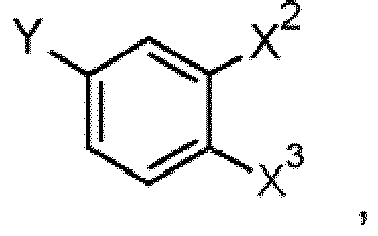
Br, avec un halogéno-phénol de formule II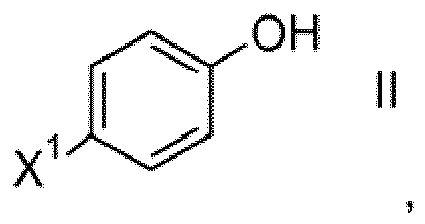
dans des conditions basiques ;
et la réaction du composé résultant de formule IVa
avec du bromure d'isopropylmagnésium suivi d'une réaction avec du chlorure d'acétyle ;
et l'halogénation du composé résultant de formule V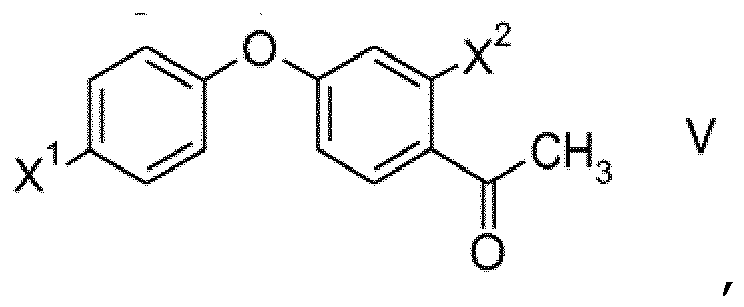
et la réaction du composé résultant de formule VI
et la réaction du composé résultant de formule VII
avec R1-M, où R1 est tel que défini selon l'une quelconque des revendications 1 à 8 et M est MgBr, MgCl, Li ou Na,
et la réaction du composé résultant de formule VIII
dans des conditions basiques avec R2-LG, où R2 est tel que défini selon l'une quelconque des revendications 1 à 8 et LG est un groupement partant nucléophiliquement remplaçable,
afin d'obtenir les composés de formule I. - Procédé de préparation de composés de formule I tels que définis selon l'une quelconque des revendications 1 à 8, comprenant la réaction d'un composé de formule IIIa

R1-COCl,
où R1 est tel que défini selon l'une quelconque des revendications 1 à 8,
et la conversion du composé résultant de formule X
dans des conditions basiques avec un halogéno-phénol de formule II
et la réaction du composé résultant de formule Va
avec de l'halogénure de triméthylsulf(ox)onium ;
et la réaction du composé résultant de formule XI
dans des conditions basiques avec du 1H-1,2,4-triazole ;
et la réaction du composé résultant de formule VIII
dans des conditions basiques avec R2-LG, où R2 est tel que défini selon l'une quelconque des revendications 1 à 8 et LG est un groupement partant nucléophiliquement remplaçable,
afin d'obtenir les composés de formule I. - Procédé de préparation de composés de formule I tels que définis selon l'une quelconque des revendications 1 à 8, comprenant la réaction d'un composé de formule XI

dans des conditions acides avec R2-OH, où R2 est tel que défini selon l'une quelconque des revendications 1 à 8,
et la réaction du composé résultant de formule XII
avec un agent d'halogénation ou un agent de sulfonation tel que défini ici ;
et la réaction du composé résultant de formule XIII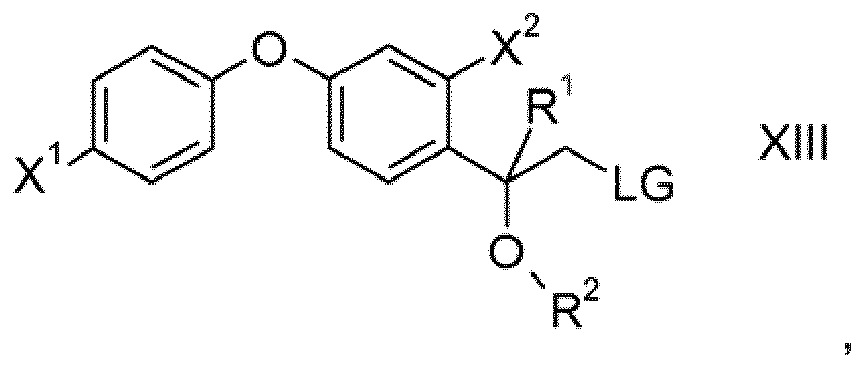
afin d'obtenir les composés I. - Composés de formule XII, VIII et XI

 1) des composés VIII et XI, où X1 et X2 sont Cl et R1 est CH2CH3, CH2CH2CH3, CH(CH3)2, CH2CH2CH2CH3, CH(CH2CH3)2, C(CH3)3, CH2CH(CH3)2, CH2CH2CH2CH2CH3, CH2CH2CH2CH2CH2CH3, CH=CH2, CH=CHCH3, CH2CH=CH2, C(CH3)=CH2, CH=CHCH2CH3, CH2CH=CHCH3, CH2CH2CH=CH2, CH(CH=CH2)2, CH=C(CH3)2, CH=CHCH2CH2CH3, CH=CHCH2CH2CH2CH3, CH=CHC(CH3)3, C≡CH, C≡CCH3, C≡CCH2CH3, CH2C≡CCH3, CH2CH2C≡CH, CH(C≡CH)2, C≡CCH2CH2CH3, C≡CCH(CH3)2, C≡CCH2CH2CH2CH3, C≡CC(CH3)3, C3H5 (cyclopropyle), 1-Cl-cyclopropyle, 1-F-cyclopropyle, C4H7, C6H11 (cyclohexyle), CH2-C3H5, CH2CN, CH2CH2CN, CH2C(CH3)=CH2, C5H9 (cyclopentyle), CH(CH3)CH2CH3, CH2C≡CH, CH2C=CCH2CH3, CH(CH3)C3H5, 1-méthylcyclopropyle, 1-CN-cyclopropyle ou CH(CH3)CN ;
et2) des composés VIII et XI, où X1 et X2 sont Cl et R1 est un motif AR1 # désigne le point de fixation à la formule VIII,X est C1-C4-alcanediyle, C2-C4-alcynediyle ou une liaison ;R est halogène, CN, nitro, C1-C4-alkyle, C1-C4-alcoxy, C1-C4-halogénoalkyle ou C1-C4-halogénoalcoxy ;n est un nombre entier et vaut 0, 1, 2, 3, 4 ou 5 ; et3) des composés VIII et XI, où X1 est Cl ou F et X2 est Cl et R1 est CH3 ; et4) des composés VIII et XI, où X1 est Cl ou F et X2 est Cl et R1 est CH2OCH3 ; et5) des composés VIII et XI, où X1 et X2 sont Cl et R1 est CH=CHC6H5, CH=CH(4-Cl-C6H4), CH=CH(2,4-Cl2-C6H3), CH=CH(2,6-Cl2-C6H3), CH=CH(4-CH3-C6H4), CH=CH(4-OCH3-C6H4), CH=CH(3,4-Cl2-C6H3), CH=CH(2-F-C6H4), CH=CH(4-NO2-C6H4), CH=CH(2-NO2-C6H4), CH=CH(2-Cl-C6H4), CH=CH (4-F-C6H4) ou CH=CH(4-C2H5-C6H4) ; et6) des composés VIII et XI, où X1 et X2 sont Cl et R1 est CH2F, CH2CCl2CHCl2, CH(OCH3)2, CH2C≡CH, CH2C(Br)=CHBr, CH2CCl=CHCl ou CHF(CH3).
 - Compositions agrochimiques, caractérisées en ce que lesdites compositions comprennent un auxiliaire et au moins un composé de formule I ou VIII, tel que défini selon l'une quelconque des revendications 1 à 8 ou 12, un N-oxyde ou un sel acceptable sur le plan agricole de celui-ci.
- Compositions selon la revendication 13, comprenant en outre une substance active supplémentaire.
- Composition agrochimique, caractérisée en ce que ladite composition comprend un auxiliaire et au moins un composé de formule I ou VIII, tel que défini selon la revendication 1 ou 12, un N-oxyde ou un sel acceptable sur le plan agricole de celui-ci, et comprenant en outre une substance active supplémentaire choisie parmi les groupes A) à O) :A) Inhibiteurs de la Respiration- inhibiteurs du complexe III au niveau du site Qo (par exemple, les strobilurines) : azoxystrobine, couméthoxystrobine, coumoxystrobine, dimoxystrobine, énestroburine, fénaminstrobine, fénoxystrobine/ flufénoxystrobine, fluoxastrobine, krésoxime-méthyle, métominostrobine, orysastrobine, picoxystrobine, pyraclostrobine, pyramétostrobine, pyraoxystrobine, trifloxystrobine, acide 2-[2-(2,5-diméthylphénoxy-méthyl)phényl]-3-méthoxyacrylique méthylester et 2-(2-(3-(2,6-dichlorophényl)-1-méthylallylidèneaminooxy-méthyl)phényl)-2-méthoxyimino-N-méthylacétamide, pyribencarb, triclopyricarb/chlorodincarb, famoxadone, fénamidone ;- inhibiteurs du complexe III au niveau du site Qi : cyazofamide, amisulbrom, 2-méthylpropanoate de [(3S,6S,7R,8R)-8-benzyl-3-[(3-acétoxy-4-méthoxy-pyridine-2-carbonyl)amino]-6-méthyl-4,9-dioxo-1,5-dioxonan-7-yl], 2-méthylpropanoate de [(3S,6S,7R,8R)-8-benzyl-3-[[3-(acétoxyméthoxy)-4-méthoxy-pyridine-2-carbonyl]amino]-6-méthyl-4,9-dioxo-1,5-dioxonan-7-yl], 2-méthylpropanoate de [(3S,6S,7R,8R)-8-benzyl-3-[(3-isobutoxycarbonyloxy-4-méthoxy-pyridine-2-carbonyl)amino]-6-méthyl-4,9-dioxo-1,5-dioxonan-7-yl], 2-méthylpropanoate de [(3S,6S,7R,8R)-8-benzyl-3-[[3-(1,3-benzodioxol-5-ylméthoxy)-4-méthoxy-pyridine-2-carbonyl]amino]-6-méthyl-4,9-dioxo-1,5-dioxonan-7-yl] ; 2-méthylpropanoate de (3S,6S,7R,8R)-3-[[(3-hydroxy-4-méthoxy-2-pyridinyl)carbonyl]amino]-6-méthyl-4,9-dioxo-8-(phénylméthyl)-1,5-dioxonan-7-yle ;- inhibiteurs du complexe II (par exemple, les carboxamides) : bénodanil, bixafène, boscalide, carboxine, fenfuram, fluopyram, flutolanil, fluxapyroxad, furametpyr, isopyrazam, mépronil, oxycarboxine, penflufène, penthiopyrad, sédaxane, tecloftalam, thifluzamide, N-(4'-trifluorométhylthiobiphényl-2-yl)-3-difluorométhyl-1-méthyl-1H-pyrazole-4-carboxamide, N-(2-(1,3,3-triméthylbutyl)phényl)-1,3-diméthyl-5-fluoro-1H-pyrazole-4-carboxamide, N-[9-(dichlorométhylène)-1,2,3,4-tétrahydro-1,4-méthanonaphtalén-5-yl]-3-(difluorométhyl)-1-méthyl-1H-pyrazole-4-carboxamide ; 3-(difluorométhyl)-1-méthyl-N-(1,1,3-triméthylindan-4-yl)pyrazole-4-carboxamide, 3-(trifluorométhyl)-1-méthyl-N-(1,1,3-triméthylindan-4-yl)pyrazole-4-carboxamide, 1,3-diméthyl-N-(1,1,3-triméthylindan-4-yl)pyrazole-4-carboxamide, 3-(trifluorométhyl)-1,5-diméthyl-N-(1,1,3-triméthylindan-4-yl)pyrazole-4-carboxamide, 3-(difluorométhyl)-1,5-diméthyl-N-(1,1,3-triméthylindan-4-yl)pyrazole-4-carboxamide, 1,3,5-triméthyl-N-(1,1,3-triméthylindan-4-yl)pyrazole-4-carboxamide ;- d'autres inhibiteurs de la respiration (par exemple du complexe I, découpleurs): diflumétorime, (5,8-difluoroquinazolin-4-yl)-{2-[2-fluoro-4-(4-trifluorométhylpyridin-2-yloxy)phényl]éthyl}amine ; dérivés de nitrophényle : binapacryle, dinobuton, dinocap, fluazinam ; férimzone ; composés organométalliques : sels de fentine, tels que : fentine-acétate, chlorure de fentine ou hydroxyde de fentine ; amétoctradine ; et silthiofam ;B) Inhibiteurs de la Biosynthèse des Stérols (Fongicides SBI)- inhibiteurs de C14 déméthylase (fongicides DMI): triazoles : azaconazole, bitertanol, bromuconazole, cyproconazole, difénoconazole, diniconazole, diniconazole-M, époxiconazole, fenbuconazole, fluquinconazole, flusilazole, flutriafol, hexaconazole, imibenconazole, ipconazole, metconazole, myclobutanil, oxpoconazole, paclobutrazole, penconazole, propiconazole, prothioconazole, siméconazole, tébuconazole, tétraconazole, triadiméfon, triadiménol, triticonazole, uniconazole, [rel-(2S;3R)-3-(2-chlorophényl)-2-(2,4-difluorophényl)-oxiranylméthyl]-5-thiocyanato-1H-[1,2,4]triazole, 2-[rel-(2S;3R)-3-(2-chlorophényl)-2-(2,4-difluorophényl)-oxiranylméthyl]-2H-[1,2,4]triazole-3-thiol ; imidazoles: imazalil, péfurazoate, prochloraz, triflumizol ; pyrimidines, pyridines et pipérazines : fénarimol, nuarimol, pyrifénox, triforine ;- inhibiteurs de Delta14-réductase : aldimorph, dodémorph, dodémorph-acétate, fenpropimorph, tridémorph, fenpropidine, pipéraline, spiroxamine ;- Inhibiteurs de 3-céto réductase : fenhexamid ;C) Inhibiteurs de la Synthèse des Acides Nucléiques- phénylamides ou fongicides à base d'acides aminés acylés : bénalaxyle, bénalaxyle-M, kiralaxyl, métalaxyle, métalaxyle-M (méfénoxam), ofurace, oxadixyle ;- autres : hyméxazol, octhilinone, acide oxolinique, bupirimate, 5-fluorocytosine, 5-fluoro-2-(p-tolyl-méthoxy)pyrimidin-4-amine, 5-fluoro-2-(4-fluorophényl-méthoxy)pyrimidin-4-amine ;D) Inhibiteurs de la Division Cellulaire et du Cytosquelette- inhibiteurs de la tubuline, tels que les benzimidazoles, les thiophanates : bénomyle, carbendazime, fubéridazole, thiabendazole, thiophanate-méthyle ; les triazolopyrimidines : 5-chloro-7-(4-méthylpipéridin-1-yl)-6-(2,4,6-trifluorophényl)[1,2,4]-triazolo[1,5-a]pyrimidine ;- autres inhibiteurs de la division cellulaire : diéthofencarb, éthaboxam, pencycuron, fluopicolide, zoxamide, métrafénone, pyriofénone ;E) Inhibiteurs de la Synthèse des Acides Aminés et des Protéines- inhibiteurs de la synthèse de la méthionine (anilinopyrimidines) : cyprodinil, mépanipyrim, pyriméthanil ;- inhibiteurs de la synthèse des protéines : blasticidine-S, kasugamycine, chlorhydrate-hydrate de kasugamycine, mildiomycine, streptomycine, oxytétracycline, polyoxine, validamycine A ;F) Inhibiteurs de la Transduction de Signal- inhibiteurs de la MAP/histidine kinase : fluoroimide, iprodione, procymidone, vinclozoline, fenpiclonil, fludioxonil ;- inhibiteurs de la protéine G : quinoxyfène ;G) Inhibiteurs de la Synthèse des Lipides et des Membranes- inhibiteurs de la biosynthèse des phospholipides : édifenphos, iprobenfos, pyrazophos, isoprothiolane ;- peroxydation des lipides : dicloran, quintozène, tecnazène, tolclofos-méthyle, biphényle, chloroneb, étridiazole ;- biosynthèse des phospholipides et dépôt des parois cellulaires : diméthomorph, flumorph, mandipropamide, pyrimorph, benthiavalicarb, iprovalicarb, valifénalate et acide N-(1-(1-(4-cyanophényl)éthanesulfonyl)-but-2-yl)carbamique (4-fluorophényl)ester ;- composés affectant la perméabilité des membranes cellulaires et les acides gras : propamocarb, propamocarb-chlorhydrate ;- inhibiteurs de l'acide gras amide hydrolase : 1-[4-[4-[5-(2,6-difluorophényl)-4,5-dihydro-3-isoxazolyl]-2-thiazolyl]-1-pipéridinyl]-2-[5-méthyl-3-(trifluorométhyl)-1H-pyrazol-1-yl]éthanone ;H) Inhibiteurs à Action Multi-Sites- substances actives inorganiques : bouillie bordelaise, acétate de cuivre, hydroxyde de cuivre, oxychlorure de cuivre, sulfate de cuivre basique, soufre ;- thio- et dithiocarbamates : ferbam, mancozeb, maneb, métam, métiram, propineb, thiram, zineb, ziram ;- composés organochlorés (par exemple phtalimides, sulfamides, chloronitriles): anilazine, chlorothalonil, captafol, captan, folpet, dichlofluanid, dichlorophène, flusulfamide, hexachlorobenzène, pentachlorophénol et ses sels, phtalide, tolylfluanide, N-(4-chloro-2-nitrophényl)-N-éthyl-4-méthylbenzènesulfonamide ;- guanidines et autres : guanidine, dodine, base libre de dodine, guazatine, guazatine-acétate, iminoctadine, iminoctadine-triacétate, iminoctadine-tris(albésilate), dithianon ; 2,6-diméthyl-1H,5H-[1,4]dithiino[2,3-c:5,6-c']dipyrrole-1,3,5,7(2H,6H)-tétraone ;I) Inhibiteurs de la Synthèse des Parois Cellulaires- inhibiteurs de la synthèse des glucanes : validamycine, polyoxine B ; inhibiteurs de la synthèse de mélanine : pyroquilon, tricyclazole, carpropamide, dicyclomet, fénoxanil ;J) Inducteurs de Défense Végétale- acibenzolar-S-méthyle, probénazole, isotianil, tiadinil, prohexadione-calcium ; phosphonates : fosétyl, fosétyl-aluminium, acide phosphoreux et ses sels ;K) Mode d'Action Inconnu- bronopol, chinométhionat, cyflufénamide, cymoxanil, dazomet, débacarb, diclomézine, difenzoquat, difenzoquat-méthylsulfate, diphénylamine, fenpyrazamine, flumétover, flusulfamide, flutianil, méthasulfocarb, nitrapyrine, nitrothal-isopropyle, oxine-cuivre, proquinazid, tébufloquine, tecloftalam, triazoxide, 2-butoxy-6-iodo-3-propylchromén-4-one, N-(cyclopropylméthoxyimino-(6-difluorométhoxy-2,3-difluorophényl)méthyl)-2-phénylacétamide, N'-(4-(4-chloro-3-trifluorométhylphénoxy)-2,5-diméthylphényl)-N-éthyl-N-méthylformamidine, N'-(4-(4-fluoro-3-trifluorométhylphénoxy)-2,5-diméthylphényl)-N-éthyl-N-méthylformamidine, N'-(2-méthyl-5-trifluorométhyl-4-(3-triméthylsilanylpropoxy)-phényl)-N-éthyl-N-méthylformamidine, N'-(5-difluorométhyl-2-méthyl-4-(3-triméthylsilanylpropoxy)phényl)-N-éthyl-N-méthylformamidine, acide 2-{1-[2-(5-méthyl-3-trifluorométhyl-pyrazole-1-yl)acétyl]pipéridin-4-yl}-thiazole-4-carboxylique méthyl-(1,2,3,4-tétrahydro-naphtalén-1-yl)amide, acide 2-{1-[2-(5-méthyl-3-trifluorométhylpyrazol-1-yl)acétyl]-pipéridin-4-yl}-thiazole-4-carboxylique méthyl-(R)-1,2,3,4-tétrahydro-naphtalén-1-ylamide, 1-[4-[4-[5-(2,6-difluorophényl)-4,5-dihydro-3-isoxazolyl]-2-thiazolyl]-1-pipéridinyl]-2-[5-méthyl-3-(trifluorométhyl)-1H-pyrazol-1-yl]éthanone, acide méthoxyacétique 6-tertio-butyl-8-fluoro-2,3-diméthyl-quinoléin-4-ylester, N-méthyl-2-{1-[(5-méthyl-3-trifluorométhyl-1H-pyrazol-1-yl)acétyl]-pipéridin-4-yl}-N-[(1R)-1,2,3,4-tétrahydronaphtalén-1-yl]-4-thiazolecarboxamide, 3-[5-(4-méthylphényl)-2,3-diméthylisoxazolidin-3-yl]-pyridine, 3-[5-(4-chlorophényl)-2,3-diméthylisoxazolidin-3-yl]-pyridine (pyrisoxazole), acide N-(6-méthoxy-pyridin-3-yl)cyclopropanecarboxylique amide, 5-chloro-1-(4,6-diméthoxypyrimidin-2-yl)-2-méthyl-1H-benzoimidazole, 2-(4-chlorophényl)-N-[4-(3,4-diméthoxyphényl)-isoxazol-5-yl]-2-prop-2-ynyloxyacétamide ;L) Agents Antifongiques de Biocontrôle, Bio-activateurs Végétaux :Ampelomyces quisqualis (par exemple AQ 10® de chez Intrachem Bio GmbH & Co. KG, Allemagne), Aspergillus flavus (par exemple AFLAGUARD® de chez Syngenta, CH), Aureobasidium pullulans (par exemple BOTECTOR® de chez bio-ferm GmbH, Allemagne), Bacillus pumilus (par exemple numéro d'accès NRRL B-30087 dans SONATA® et BALLAD® Plus de chez AgraQuest Inc., USA), Bacillus subtilis (par exemple isolat NRRL n° B-21661 dans RHAPSODY®, SERENADE® MAX et SERENADE® ASO de chez AgraQuest Inc., USA), Bacillus subtilis var. amyloliquefaciens FZB24 (par exemple TAEGRO® de chez Novozyme Biologicals, Inc., USA), Candida oleophila I-82 (par exemple ASPIRE® de chez Ecogen Inc., USA), Candida saitoana (par exemple BIOCURE® (en mélange avec du lysozyme) et BIOCOAT® de chez Micro Flo Company, USA (BASF SE) et Arysta), Chitosane (par exemple ARMOUR-ZEN de chez BotriZen Ltd., NZ), Clonostachys rosea f. catenulata, également appelé Gliocladium catenulatum (par exemple isolat J1446 : PRESTOP® de chez Verdera, Finlande), Coniothyrium minitans (par exemple CONTANS® de chez Prophyta, Allemagne), Cryphonectria parasitica (par exemple Endothia parasitica de chez CNICM, France), Cryptococcus albidus (par exemple YIELD PLUS® de chez Anchor Bio-Technologies, Afrique du Sud), Fusarium oxysporum (par exemple BIOFOX® de chez S.I.A.P.A., Italie, FUSACLEAN® de chez Natural Plant Protection, France), Metschnikowia fructicola (par exemple SHEMER® de chez Agrogreen, Israël), Microdochium dimerum (par exemple ANTIBOT® de chez Agrauxine, France), Phlebiopsis gigantea (par exemple ROTSOP® de chez Verdera, Finlande), Pseudozyma flocculosa (par exemple SPORODEX® de chez Plant Products Co. Ltd., Canada), Pythium oligandrum DV74 (par exemple POLYVERSUM® de chez Remeslo SSRO, Biopreparaty, République Tchèque), Reynoutria sachlinensis (par exemple REGALIA® de chez Marrone Biolnnovations, USA), Talaromyces flavus V117b (par exemple PROTUS® de chez Prophyta, Allemagne), Trichoderma asperellum SKT-1 (par exemple ECO-HOPE® de chez Kumiai Chemical Industry Co., Ltd., Japon), T. atroviride LC52 (par exemple SENTINEL® de chez Agrimm Technologies Ltd, NZ), T. harzianum T-22 (par exemple PLANTSHIELD® de chez BioWorks Inc., USA), T. harzianum TH 35 (par exemple ROOT PRO® de chez Mycontrol Ltd., Israël), T. harzianum T-39 (par exemple TRICHODEX® et TRICHODERMA 2000® de chez Mycontrol Ltd., Israël et Makhteshim Ltd., Israël), T. harzianum et T. viride (par exemple TRICHOPEL de chez Agrimm Technologies Ltd, NZ), T. harzianum ICC012 et T. viride ICC080 (par exemple REMEDIER® WP de chez Isagro Ricerca, Italie), T. polysporum et T. harzianum (par exemple BINAB® de chez BINAB Biolnnovation AB, Suède), T. stromaticum (par exemple TRICOVAB® de chez C.E.P.L.A.C., Brésil), T. virens GL-21 (par exemple SOILGARD® de chez Certis LLC, USA), T. viride (par exemple TRIECO® de chez Ecosense Labs. (Inde) Pvt. Ltd., Inde, BIO-CURE® F de chez T. Stanes & Co. Ltd., Inde), T. viride TV1 (par exemple T. viride TV1 de chez Agribiotec srl, Italie), Ulocladium oudemansii HRU3 (par exemple BOTRY-ZEN® de chez Botry-Zen Ltd, NZ) ;M) Substances de Croissance
acide abscissique, amidochlor, ancymidol, 6-benzylaminopurine, brassinolide, butraline, chlorméquat (chlorure de chlorméquat), chlorure de choline, cyclanilide, daminozide, dikégulac, diméthipine, 2,6-diméthylpyridine, éthéphon, flumétraline, flurprimidol, fluthiacét, forchlorfénuron, acide gibbérellique, inabenfide, acide indole-3-acétique, hydrazide maléique, méfluidide, mépiquat (chlorure de mépiquat), acide naphtalèneacétique, N-6-benzyladénine, paclobutrazol, prohexadione (prohexadione-calcium), prohydrojasmone, thidiazuron, triapenthénol, phosphorotrithioate de tributyle, acide 2,3,5-tri-iodobenzoïque, trinéxapac-éthyle et uniconazole ;N) Herbicides- acétamides: acétochlor, alachlor, butachlor, diméthachlor, diméthénamide, flufénacet, méfénacet, métolachlor, métazachlor, napropamide, naproanilide, péthoxamid, prétilachlor, propachlor, thénylchlor ;- dérivés d'acides aminés : bilanaphos, glyphosate, glufosinate, sulfosate ;- aryloxyphénoxypropionates : clodinafop, cyhalofop-butyle, fenoxaprop, fluazifop, haloxyfop, métamifop, propaquizafop, quizalofop, quizalofop-P-téfuryle ;- bipyridyles : diquat, paraquat ;- (thio)carbamates : asulam, butylate, carbétamide, desmédipham, dimépipérate, eptam (EPTC), esprocarb, molinate, orbencarb, phenmédipham, prosulfocarb, pyributicarb, thiobencarb, triallate ;- cyclohexanediones : butroxydime, cléthodime, cycloxydime, profoxydime, séthoxydime, tépraloxydime, tralcoxydime ;- dinitroanilines : benfluraline, éthalfluraline, oryzaline, pendiméthaline, prodiamine, trifluraline ;- diphényléthers : acifluorfen, aclonifen, bifénox, diclofop, éthoxyfen, fomésafen, lactofen, oxyfluorfen ;- hydroxybenzonitriles : bromoxynil, dichlobénil, ioxynil ;- imidazolinones : imazaméthabenz, imazamox, imazapic, imazapyr, imazaquin, imazéthapyr ;- acides phénoxyacétiques : cloméprop, acide 2,4-dichlorophénoxyacétique (2,4-D), 2,4-DB, dichloroprop, MCPA, MCPA-thioéthyle, MCPB, Mécoprop ;- pyrazines : chloridazone, flufenpyr-éthyle, fluthiacét, norflurazon, pyridate ;- pyridines: aminopyralid, clopyralid, diflufénican, dithiopyr, fluridone, fluroxypyr, picloram, picolinafen, thiazopyr ;- sulfonylurées : amidosulfuron, azimsulfuron, bensulfuron, chlorimuron-éthyle, chlorsulfuron, cinosulfuron, cyclosulfamuron, éthoxysulfuron, flazasulfuron, flucétosulfuron, flupyrsulfuron, foramsulfuron, halosulfuron, imazosulfuron, iodosulfuron, mésosulfuron, métazosulfuron, metsulfuron-méthyle, nicosulfuron, oxasulfuron, primisulfuron, prosulfuron, pyrazosulfuron, rimsulfuron, sulfométuron, sulfosulfuron, thifensulfuron, triasulfuron, tribénuron, trifloxysulfuron, triflusulfuron, tritosulfuron, 1-((2-chloro-6-propyl-imidazo[1,2-b]pyridazin-3-yl)sulfonyl)-3-(4,6-diméthoxypyrimidin-2-yl)urée ;- triazines : amétryne, atrazine, cyanazine, diméthamétryne, éthiozine, hexazinone, métamitron, métribuzine, prométryne, simazine, terbuthylazine, terbutryne, triaziflam ;- urées : chlorotoluron, daimuron, diuron, fluométuron, isoproturon, linuron, méthabenzthiazuron, tébuthiuron ;- autres inhibiteurs de l'acétolactate synthase : bispyribac-sodium, cloransulam-méthyle, diclosulam, florasulam, flucarbazone, flumétsulam, métosulam, orthosulfamuron, pénoxsulam, propoxycarbazone, pyribambenz-propyle, pyribenzoxim, pyriftalid, pyriminobac-méthyle, pyrimisulfan, pyrithiobac, pyroxasulfone, pyroxsulam ;- autres : amicarbazone, aminotriazole, anilofos, béflubutamid, bénazoline, bencarbazone, benfurésate, benzofénap, bentazone, benzobicyclon, bicyclopyrone, bromacil, bromobutide, butafénacil, butamiphos, cafenstrole, carfentrazone, cinidon-éthyle, chlorthal, cinméthyline, clomazone, cumyluron, cyprosulfamide, dicamba, difenzoquat, diflufenzopyr, Drechslera monoceras, endothal, éthofumésate, étobenzanid, fénoxasulfone, fentrazamide, flumiclorac-pentyle, flumioxazine, flupoxam, flurochloridone, flurtamone, indanofan, isoxaben, isoxaflutole, lénacil, propanil, propyzamide, quinclorac, quinmérac, mésotrione, acide méthylarsonique, naptalam, oxadiargyle, oxadiazon, oxazicloméfone, pentoxazone, pinoxaden, pyraclonil, pyraflufen-éthyle, pyrasulfotole, pyrazoxyfène, pyrazolynate, quinoclamine, saflufénacil, sulcotrione, sulfentrazone, terbacil, téfuryltrione, tembotrione, thièncarbazone, topramézone, acide (3-[2-chloro-4-fluoro-5-(3-méthyl-2,6-dioxo-4-trifluorométhyl-3,6-dihydro-2H-pyrimidin-1-yl)phénoxy]pyridin-2-yloxy)-acétique éthylester, acide 6-amino-5-chloro-2-cyclopropylpyrimidine-4-carboxylique méthylester, 6-chloro-3-(2-cyclopropyl-6-méthylphénoxy)pyridazin-4-ol, acide 4-amino-3-chloro-6-(4-chlorophényl)-5-fluoro-pyridine-2-carboxylique, acide 4-amino-3-chloro-6-(4-chloro-2-fluoro-3-méthoxyphényl)pyridine-2-carboxylique méthylester, et acide 4-amino-3-chloro-6-(4-chloro-3-diméthylamino-2-fluorophényl)-pyridine-2-carboxylique méthylester.O) Insecticides- organo(thio)phosphates : acéphate, azaméthiphos, azinphos-méthyle, chlorpyrifos, chlorpyrifos-méthyle, chlorfenvinphos, diazinon, dichlorvos, dicrotophos, diméthoate, disulfoton, éthion, fénitrothion, fenthion, isoxathion, malathion, méthamidophos, méthidathion, méthyl-parathion, mévinphos, monocrotophos, oxydéméton-méthyle, paraoxon, parathion, phenthoate, phosalone, phosmet, phosphamidon, phorate, phoxime, pirimiphos-méthyle, profénofos, prothiofos, sulprophos, tétrachlorvinphos, terbufos, triazophos, trichlorfon ;- carbamates : alanycarb, aldicarb, bendiocarb, benfuracarb, carbaryle, carbofuran, carbosulfan, fénoxycarb, furathiocarb, méthiocarb, méthomyle, oxamyle, pirimicarb, propoxur, thiodicarb, triazamate ;- pyréthrinoïdes : alléthrine, bifenthrine, cyfluthrine, cyhalothrine, cyphénothrine, cyperméthrine, alpha-cyperméthrine, beta-cyperméthrine, zêta-cyperméthrine, deltaméthrine, esfenvalérate, étofenprox, fenpropathrine, fenvalérate, imiprothrine, lambda-cyhalothrine, perméthrine, pralléthrine, pyréthrine I et II, resméthrine, silafluofène, taufluvalinate, téfluthrine, tétraméthrine, tralométhrine, transfluthrine, profluthrine, diméfluthrine ;- régulateurs de la croissance des insectes : a) inhibiteurs de la synthèse de la chitine : benzoylurées : chlorfluazuron, cyromazine, diflubenzuron, flucycloxuron, flufénoxuron, hexaflumuron, lufénuron, novaluron, teflubenzuron, triflumuron ; buprofézine, diofénolan, hexythiazox, étoxazole, clofentazine ; b) antagonistes de l'ecdysone : halofénozide, méthoxyfénozide, tébufénozide, azadirachtine ; c) juvénoïdes : pyriproxyfène, méthoprène, fénoxycarb ; d) inhibiteurs de la biosynthèse des lipides : spirodiclofène, spiromesifène, spirotétramat ;- composés agonistes/antagonistes du récepteur nicotinique : clothianidine, dinotéfuran, flupyradifurone, imidacloprid, thiaméthoxam, nitenpyram, acétamipride, thiacloprid, 1-(2-chloro-thiazol-5-ylméthyl)-2-nitroimino-3,5-diméthyl[1,3,5]-triazinane ;- composés antagonistes du GABA : endosulfan, éthiprole, fipronil, vaniliprole, pyrafluprole, pyriprole, acide 5-amino-1-(2,6-dichloro-4-méthylphényl)-4-sulfinamoyl-1H-pyrazole-3-carbothioïque amide ;- insecticides à base de lactones macrocycliques : abamectine, émamectine, milbémectine, lépimectine, spinosad, spinétoram ;- acaricides inhibiteurs du transfert mitochondrial des électrons (METI) I : fénazaquin, pyridabène, tébufenpyrad, tolfenpyrad, flufénérime ;- composés METI II et III : acéquinocyle, fluacyprim, hydraméthylnon ;- découpleurs : chlorfénapyr ;- inhibiteurs de la phosphorylation oxydative : cyhexatin, diafenthiuron, fenbutatine-oxyde, propargite ;- composés perturbateurs de la mue : cyromazine ;- inhibiteurs d'oxydases à fonction mixte : butylate de pipéronyle ;- bloquants du canal sodique : indoxacarb, métaflumizone ;- autres : benclothiaz, bifénazate, cartap, flonicamide, pyridalyle, pymétrozine, soufre, thiocyclam, flubendiamide, chloranthraniliprole, cyazypyr (HGW86), cyénopyrafène, flupyrazophos, cyflumétofène, amidoflumet, imicyafos, bistrifluron, et pyrifluquinazone. - Utilisation de composés de formule I ou VIII, des N-oxydes et des sels acceptables sur le plan agricole de ceux-ci, tels que définis selon l'une quelconque des revendications 1 à 8 ou 12, ou des compositions telles que définies selon l'une quelconque des revendications 13 à 15, pour lutter contre des champignons phytopathogènes.
- Semence enrobée par au moins un composé de formule I ou VIII tel que défini selon l'une quelconque des revendications 1 à 8 ou 12, ou par une composition telle que définie selon l'une quelconque des revendications 13 à 15, selon une quantité allant de 0,1 g à 10 kg pour 100 kg de semences.
Priority Applications (1)
| Application Number | Priority Date | Filing Date | Title |
|---|---|---|---|
| EP12751297.8A EP2744794B1 (fr) | 2011-08-15 | 2012-08-14 | Composés de 1-{2-cyclyloxy-2-[2-halo-4-(4-halogène-phénoxy)-phényl]-éthyl}-1h-[1,2,4]triazole substitués fongicides |
Applications Claiming Priority (3)
| Application Number | Priority Date | Filing Date | Title |
|---|---|---|---|
| EP11177549 | 2011-08-15 | ||
| EP12751297.8A EP2744794B1 (fr) | 2011-08-15 | 2012-08-14 | Composés de 1-{2-cyclyloxy-2-[2-halo-4-(4-halogène-phénoxy)-phényl]-éthyl}-1h-[1,2,4]triazole substitués fongicides |
| PCT/EP2012/065850 WO2013024082A1 (fr) | 2011-08-15 | 2012-08-14 | Composés de 1-{2-cyclyloxy-2-[2-halogéno-4-(4-halogéno-phénoxy)-phényl]-éthyl}-1h-[1,2,4]triazole substitués fongicides |
Publications (2)
| Publication Number | Publication Date |
|---|---|
| EP2744794A1 EP2744794A1 (fr) | 2014-06-25 |
| EP2744794B1 true EP2744794B1 (fr) | 2015-12-30 |
Family
ID=46754412
Family Applications (1)
| Application Number | Title | Priority Date | Filing Date |
|---|---|---|---|
| EP12751297.8A Active EP2744794B1 (fr) | 2011-08-15 | 2012-08-14 | Composés de 1-{2-cyclyloxy-2-[2-halo-4-(4-halogène-phénoxy)-phényl]-éthyl}-1h-[1,2,4]triazole substitués fongicides |
Country Status (6)
| Country | Link |
|---|---|
| US (1) | US9247746B2 (fr) |
| EP (1) | EP2744794B1 (fr) |
| JP (1) | JP2014529594A (fr) |
| CN (1) | CN103717577B (fr) |
| BR (1) | BR112014003412A2 (fr) |
| WO (1) | WO2013024082A1 (fr) |
Families Citing this family (92)
| Publication number | Priority date | Publication date | Assignee | Title |
|---|---|---|---|---|
| PE20140826A1 (es) | 2011-07-13 | 2014-07-09 | Basf Se | Compuestos sustituidos fungicidas de 2-[2-halogenalquil-4-(fenoxi)-fenil]-1-[1,2,4]triazol-1-il-etanol |
| EP2731438B1 (fr) | 2011-07-15 | 2015-04-08 | Basf Se | Composés fongicides alkyl-substitués 2-[2-chloro-4-(4-chloro-phénoxy)-phényl]-1-[1,2,4]triazol-1 yl-éthanol |
| BR112014000538A2 (pt) | 2011-07-15 | 2016-08-23 | Basf Se | compostos, processo para a preparação dos compostos, composições agroquímicas, utilização dos compostos e semente revestida |
| JP2014525407A (ja) | 2011-08-15 | 2014-09-29 | ビーエーエスエフ ソシエタス・ヨーロピア | 殺菌性置換1−{2−[2−ハロ−4−(4−ハロゲン−フェノキシ)−フェニル]−2−アルコキシ−2−アルキニル/アルケニル−エチル}−1h−[1,2,4]トリアゾール化合物 |
| EP2744791B1 (fr) | 2011-08-15 | 2015-10-28 | Basf Se | Composés de 1-{2-[2-halogéno-4-(4-halogéno-phénoxy)-phényl]-2-alcoxy-3-méthyl-butyl}-1h-[1,2,4]triazole substitués fongicides |
| US20150313229A1 (en) | 2012-11-27 | 2015-11-05 | Basf Se | Substituted [1,2,4] Triazole Compounds |
| BR112015014753B8 (pt) | 2012-12-20 | 2020-03-03 | Basf Agro Bv | composições, uso de uma composição, método para o combate de fungos fitopatogênicos e uso dos componentes |
| UA122520C2 (uk) | 2013-01-09 | 2020-11-25 | Басф Агро Б.В. | Кристалічна форма 2-[4-(4-хлорфенокси)-2-(трифторметил)феніл]-1-(1,2,4-триазол-1-іл)пропан-2-олу, агрохімічна композиція, застосування та спосіб боротьби зі шкідливими грибами |
| WO2015003908A1 (fr) | 2013-07-08 | 2015-01-15 | Basf Se | Compositions comprenant un composé triazole et un biopesticide |
| EP3080092B1 (fr) * | 2013-12-12 | 2019-02-06 | Basf Se | Composés substitués de [1,2,4]triazole et leur utilisation comme fongicides |
| CN106170205B (zh) | 2014-02-14 | 2020-01-17 | 巴斯夫农业公司 | 包含农药、脂肪酰胺和乳酰胺的可乳化浓缩物 |
| AU2015261166A1 (en) | 2014-05-13 | 2016-12-01 | Basf Se | Substituted [1,2,4]triazole and imidazole compounds as fungicides |
| EA201892682A1 (ru) | 2014-06-25 | 2019-04-30 | Басф Агро Б.В. | Пестицидные композиции |
| UA120058C2 (uk) | 2014-07-14 | 2019-09-25 | Басф Се | Пестицидні композиції |
| PL3214937T3 (pl) | 2014-11-07 | 2024-10-14 | Basf Se | Mieszaniny szkodnikobójcze |
| EP3028573A1 (fr) | 2014-12-05 | 2016-06-08 | Basf Se | Utilisation d'un triazole fongicide sur des plantes transgéniques |
| EP3111763A1 (fr) | 2015-07-02 | 2017-01-04 | BASF Agro B.V. | Compositions pesticides comprenant un composé de triazole |
| PL3316692T3 (pl) | 2015-07-02 | 2021-10-11 | BASF Agro B.V. | Kompozycje owadobójcze zawierające związek triazolowy |
| SI3361870T1 (sl) | 2015-10-14 | 2020-07-31 | Syngenta Participations Ag | Fungicidni sestavki |
| RU2754614C2 (ru) | 2016-03-16 | 2021-09-03 | Басф Се | Применение тетразолинонов для борьбы с устойчивыми фитопатогенными грибами на злаковых культурах |
| BR112018068705B1 (pt) | 2016-03-16 | 2022-09-06 | Basf Se | Método para controlar fungos fitopatogênicos |
| WO2017157920A1 (fr) | 2016-03-16 | 2017-09-21 | Basf Se | Utilisation de tétrazolinones pour lutter contre des champignons phytopathogènes résistants sur des fruits |
| US20190345150A1 (en) | 2016-04-12 | 2019-11-14 | Syngenta Participations Ag | Microbiocidal oxadiazole derivatives |
| EP3464251B1 (fr) | 2016-06-03 | 2021-03-03 | Syngenta Participations AG | Derives d'oxadiazole microbiocides |
| AR108745A1 (es) | 2016-06-21 | 2018-09-19 | Syngenta Participations Ag | Derivados de oxadiazol microbiocidas |
| WO2018015449A1 (fr) | 2016-07-22 | 2018-01-25 | Syngenta Participations Ag | Dérivés d'oxadiazole microbiocides |
| US10757941B2 (en) | 2016-07-22 | 2020-09-01 | Syngenta Participations Ag | Microbiocidal oxadiazole derivatives |
| US20200138028A1 (en) | 2016-07-22 | 2020-05-07 | Syngenta Participations Ag | Microbiocidal oxadiazole derivatives |
| WO2018029242A1 (fr) | 2016-08-11 | 2018-02-15 | Syngenta Participations Ag | Dérivés d'oxadiazole microbicides |
| CN109715622A (zh) | 2016-09-22 | 2019-05-03 | 拜耳作物科学股份公司 | 新的三唑衍生物及其作为杀真菌剂的用途 |
| EP3515907A1 (fr) | 2016-09-22 | 2019-07-31 | Bayer CropScience Aktiengesellschaft | Nouveaux dérivés triazole |
| WO2018055133A1 (fr) | 2016-09-23 | 2018-03-29 | Syngenta Participations Ag | Dérivés de tétrazolone microbiocides |
| EP3515908A1 (fr) | 2016-09-23 | 2019-07-31 | Syngenta Participations AG | Dérivés d'oxadiazole microbiocides |
| JP7077313B2 (ja) | 2016-10-06 | 2022-05-30 | シンジェンタ パーティシペーションズ アーゲー | 殺微生物オキサジアゾール誘導体 |
| BR112019016241A2 (pt) | 2017-02-08 | 2020-04-07 | Bayer Cropscience Ag | derivados de triazol e seu uso como fungicidas |
| CA3052519A1 (fr) | 2017-02-08 | 2018-08-16 | Andreas Gortz | Derives de triazolethione |
| US20200045967A1 (en) | 2017-02-08 | 2020-02-13 | Bayer Cropscience Aktiengesellschaft | Novel triazole derivatives |
| KR20190115449A (ko) | 2017-02-10 | 2019-10-11 | 바이엘 악티엔게젤샤프트 | 1-(페녹시-피리디닐)-2-(1,2,4-트리아졸-1-일)-에탄올 유도체를 포함하는 유해 미생물을 방제하기 위한 조성물 |
| UY37623A (es) | 2017-03-03 | 2018-09-28 | Syngenta Participations Ag | Derivados de oxadiazol tiofeno fungicidas |
| WO2018162643A1 (fr) | 2017-03-10 | 2018-09-13 | Syngenta Participations Ag | Dérivés d'oxadiazole microbiocides |
| WO2018177880A1 (fr) | 2017-03-31 | 2018-10-04 | Syngenta Participations Ag | Compositions fongicides |
| CA3055680A1 (fr) | 2017-03-31 | 2018-10-04 | Syngenta Participations Ag | Compositions fongicides |
| WO2018185013A1 (fr) | 2017-04-03 | 2018-10-11 | Syngenta Participations Ag | Dérivés d'oxadiazole microbiocides |
| BR112019020734B1 (pt) | 2017-04-05 | 2023-12-05 | Syngenta Participations Ag | Compostos derivados de oxadiazol, composição agroquímica, método para controlar ou prevenir a infestação de plantas úteis por microrganismos fitopatogênicos e uso dos referidos compostos |
| BR112019020735B1 (pt) | 2017-04-05 | 2023-12-05 | Syngenta Participations Ag | Compostos derivados de oxadiazol microbiocidas e seu uso, composição agroquímica e método para controlar ou prevenir a infestação de plantas úteis por microrganismos fitopatogênicos |
| BR112019020739B1 (pt) | 2017-04-05 | 2023-12-19 | Syngenta Participations Ag | Compostos derivados de oxadiazol microbiocidas e seu uso, composição agroquímica, método para controlar ou prevenir a infestação de plantas úteis por microrganismos fitopatogênicos |
| WO2018184984A1 (fr) | 2017-04-05 | 2018-10-11 | Syngenta Participations Ag | Dérivés d'oxadiazole microbiocides |
| BR112019021019B1 (pt) | 2017-04-05 | 2023-12-05 | Syngenta Participations Ag | Compostos derivados de oxadiazol microbiocidas, composição agrícola, método para controlar ou prevenir a infestação de plantas úteis por microrganismos fitopatogênicos e uso de um composto derivado de oxadiazol |
| BR112019020819B1 (pt) | 2017-04-05 | 2023-12-05 | Syngenta Participations Ag | Composto de fórmula (i), composição agroquímica, método para controlar ou prevenir a infestação de plantas úteis por micro-organismos fitopatogênicos e uso de um composto de fórmula (i) |
| WO2018185211A1 (fr) | 2017-04-06 | 2018-10-11 | Syngenta Participations Ag | Dérivés d'oxadiazole microbiocides |
| WO2018219773A1 (fr) | 2017-06-02 | 2018-12-06 | Syngenta Participations Ag | Compositions fongicides |
| EP3630753A1 (fr) | 2017-06-02 | 2020-04-08 | Syngenta Participations AG | Dérivés d'oxadiazole microbiocides |
| WO2018228896A1 (fr) | 2017-06-14 | 2018-12-20 | Syngenta Participations Ag | Compositions fongicides |
| EP3638650B1 (fr) * | 2017-06-14 | 2021-06-23 | BASF Agro B.V. | Procede de preparation d'alcools phenoxyphenyles substitues |
| KR20200022452A (ko) | 2017-06-28 | 2020-03-03 | 신젠타 파티서페이션즈 아게 | 살진균 조성물 |
| WO2019011926A1 (fr) | 2017-07-11 | 2019-01-17 | Syngenta Participations Ag | Dérivés d'oxadiazole microbiocides |
| WO2019011929A1 (fr) | 2017-07-11 | 2019-01-17 | Syngenta Participations Ag | Dérivés d'oxadiazole microbiocides |
| WO2019011928A1 (fr) | 2017-07-11 | 2019-01-17 | Syngenta Participations Ag | Dérivés d'oxadiazole microbiocides |
| BR112020000465B1 (pt) | 2017-07-11 | 2024-02-20 | Syngenta Participations Ag | Derivados oxadiazol microbiocidas |
| BR112020000414A2 (pt) | 2017-07-12 | 2020-07-21 | Syngenta Participations Ag | derivados de oxadiazol microbicidas |
| WO2019012011A1 (fr) | 2017-07-12 | 2019-01-17 | Syngenta Participations Ag | Dérivés d'oxadiazole microbiocides |
| WO2019012003A1 (fr) | 2017-07-13 | 2019-01-17 | Syngenta Participations Ag | Dérivés d'oxadiazole microbiocides |
| WO2019053015A1 (fr) | 2017-09-13 | 2019-03-21 | Syngenta Participations Ag | Dérivés microbiocides de quinoline (thio)carboxamide |
| CN111094247A (zh) | 2017-09-13 | 2020-05-01 | 先正达参股股份有限公司 | 杀微生物的喹啉(硫代)甲酰胺衍生物 |
| EP3681870B1 (fr) | 2017-09-13 | 2021-08-04 | Syngenta Participations AG | Dérivés de (thio)carboxamide de quinoline microbiocide |
| US11241011B2 (en) | 2017-09-13 | 2022-02-08 | Syngenta Participations Ag | Microbiocidal quinoline (thio)carboxamide derivatives |
| JP7158469B2 (ja) | 2017-09-13 | 2022-10-21 | シンジェンタ パーティシペーションズ アーゲー | 殺微生物性キノリン(チオ)カルボキサミド誘導体 |
| ES2908668T3 (es) | 2017-09-13 | 2022-05-03 | Syngenta Participations Ag | Derivados de quinolina (tio)carboxamida microbiocidas |
| WO2019053016A1 (fr) | 2017-09-13 | 2019-03-21 | Syngenta Participations Ag | Dérivés microbiocides de quinoline (thio)carboxamide |
| UY37912A (es) | 2017-10-05 | 2019-05-31 | Syngenta Participations Ag | Derivados de picolinamida fungicidas que portan grupos terminales heteroarilo o heteroariloxi |
| UY37913A (es) | 2017-10-05 | 2019-05-31 | Syngenta Participations Ag | Derivados de picolinamida fungicidas que portan un grupo terminal cuaternario |
| BR112020009659A2 (pt) | 2017-11-15 | 2020-11-10 | Syngenta Participations Ag | derivados picolinamida microbiocidas |
| WO2019097054A1 (fr) | 2017-11-20 | 2019-05-23 | Syngenta Participations Ag | Dérivés d'oxadiazole microbiocides |
| US11882834B2 (en) | 2017-11-29 | 2024-01-30 | Syngenta Participations Ag | Microbiocidal thiazole derivatives |
| US11535594B2 (en) | 2017-12-19 | 2022-12-27 | Syngenta Participations Ag | Microbiocidal picolinamide derivatives |
| EP3421460A1 (fr) | 2018-03-15 | 2019-01-02 | Bayer Aktiengesellschaft | Fongicides de 2-[(4-alkylphenoxy)-pyridinyl]-1-(1,2,4-triazol-1-yl)alkan-2-ol |
| CN112020503A (zh) | 2018-04-26 | 2020-12-01 | 先正达参股股份有限公司 | 杀微生物的噁二唑衍生物 |
| WO2020002331A1 (fr) | 2018-06-29 | 2020-01-02 | Syngenta Crop Protection Ag | Dérivés d'oxadiazole microbiocides |
| US20210284633A1 (en) | 2018-07-02 | 2021-09-16 | Syngenta Crop Protection Ag | 3-(2-thienyl)-5-(trifluoromethyl)-1,2,4-oxadiazole derivatives as agrochemical fungicides |
| EP3823966A1 (fr) | 2018-07-16 | 2021-05-26 | Syngenta Crop Protection AG | Dérivés d'oxadiazole microbiocides |
| WO2020020813A1 (fr) | 2018-07-25 | 2020-01-30 | Bayer Aktiengesellschaft | Combinaisons de composés actifs fongicides |
| WO2020020816A1 (fr) | 2018-07-26 | 2020-01-30 | Bayer Aktiengesellschaft | Nouveaux dérivés de triazole |
| CN112739685A (zh) | 2018-09-19 | 2021-04-30 | 先正达农作物保护股份公司 | 杀微生物的喹啉甲酰胺衍生物 |
| WO2020064696A1 (fr) | 2018-09-26 | 2020-04-02 | Syngenta Crop Protection Ag | Compositions fongicides |
| WO2020070132A1 (fr) | 2018-10-06 | 2020-04-09 | Syngenta Participations Ag | Dérivés de quinoléine dihydro-(thiazine) oxazine microbiocides |
| CN112789278A (zh) | 2018-10-06 | 2021-05-11 | 先正达参股股份有限公司 | 杀微生物的喹啉二氢-(噻嗪)噁嗪衍生物 |
| TW202035404A (zh) | 2018-10-24 | 2020-10-01 | 瑞士商先正達農作物保護公司 | 具有含亞碸亞胺的取代基之殺有害生物活性雜環衍生物 |
| EP3620053A1 (fr) | 2018-12-14 | 2020-03-11 | Bayer Aktiengesellschaft | Combinaisons de composés actifs des fongicides |
| WO2020141135A1 (fr) | 2018-12-31 | 2020-07-09 | Syngenta Crop Protection Ag | Dérivés hétérocycliques à action pesticide comprenant des substituants contenant du soufre |
| CN113348169A (zh) | 2018-12-31 | 2021-09-03 | 先正达农作物保护股份公司 | 具有含硫取代基的杀有害生物活性的杂环衍生物 |
| CN117924197B (zh) * | 2024-03-21 | 2024-06-07 | 山东百农思达生物科技有限公司 | 戊唑醇的高纯度合成方法 |
| US20260020564A1 (en) * | 2024-07-19 | 2026-01-22 | Elicit Plant | Fungal diseases reduction and yield improvement methods and composition thereof |
Family Cites Families (94)
| Publication number | Priority date | Publication date | Assignee | Title |
|---|---|---|---|---|
| US3325503A (en) | 1965-02-18 | 1967-06-13 | Diamond Alkali Co | Polychloro derivatives of mono- and dicyano pyridines and a method for their preparation |
| US3296272A (en) | 1965-04-01 | 1967-01-03 | Dow Chemical Co | Sulfinyl- and sulfonylpyridines |
| DE2325878A1 (de) | 1973-05-22 | 1974-12-12 | Kalk Chemische Fabrik Gmbh | Phenoxyderivate des trifluormethylbenzols und verfahren zu deren herstellung |
| GB1543964A (en) | 1976-04-08 | 1979-04-11 | Ici Ltd | Method of antagonising herbicides on soyabean and cotton |
| DE2725314A1 (de) | 1977-06-04 | 1978-12-14 | Bayer Ag | 1-(2-phenylaethyl)-triazolium-salze, verfahren zu ihrer herstellung sowie ihre verwendung als fungizide |
| JPS5764632A (en) | 1980-10-09 | 1982-04-19 | Mitsui Toatsu Chem Inc | Novel 2-arylethyl ether derivative and thioether derivative, their production and insecticide and acaricide |
| BG48681A3 (bg) | 1982-12-14 | 1991-04-15 | Ciba - Geigy Ag | Фунгицидно средство |
| EP0126430B1 (fr) * | 1983-05-19 | 1991-08-28 | Ciba-Geigy Ag | Procédé pour la préparation de dérivés de 1-triazolyléthyléthers, composés microbicides contenant des dérivés nouveaux de 1-triazolyl-phenoxyphényléthyléther comme ingrédients actifs et leur application |
| DE3338292A1 (de) | 1983-10-21 | 1985-05-02 | Basf Ag, 6700 Ludwigshafen | 7-amino-azolo(1,5-a)-pyrimidine und diese enthaltende fungizide |
| CA1249832A (fr) | 1984-02-03 | 1989-02-07 | Shionogi & Co., Ltd. | Derives d'azolylcycloalcanol, fongicides agricoles |
| BR8600161A (pt) | 1985-01-18 | 1986-09-23 | Plant Genetic Systems Nv | Gene quimerico,vetores de plasmidio hibrido,intermediario,processo para controlar insetos em agricultura ou horticultura,composicao inseticida,processo para transformar celulas de plantas para expressar uma toxina de polipeptideo produzida por bacillus thuringiensis,planta,semente de planta,cultura de celulas e plasmidio |
| DE3545319A1 (de) | 1985-12-20 | 1987-06-25 | Basf Ag | Acrylsaeureester und fungizide, die diese verbindungen enthalten |
| MY100846A (en) | 1986-05-02 | 1991-03-15 | Stauffer Chemical Co | Fungicidal pyridyl imidates |
| ATE82966T1 (de) | 1986-08-12 | 1992-12-15 | Mitsubishi Chem Ind | Pyridincarboxamid-derivate und ihre verwendung als fungizides mittel. |
| DE3801233A1 (de) * | 1987-01-21 | 1988-08-04 | Ciba Geigy Ag | Mikrobizides mittel |
| EP0275955B1 (fr) | 1987-01-21 | 1990-07-04 | Ciba-Geigy Ag | Composition microbicide |
| DE58903329D1 (de) | 1988-08-04 | 1993-03-04 | Ciba Geigy Ag | Mikrobizide mittel. |
| EP0374753A3 (fr) | 1988-12-19 | 1991-05-29 | American Cyanamid Company | Toxines insecticides, gènes les codant, anticorps les liant, ainsi que cellules végétales et plantes transgéniques exprimant ces toxines |
| DK0392225T3 (da) | 1989-03-24 | 2003-09-22 | Syngenta Participations Ag | Sygdomsresistente transgene planter |
| US4940720A (en) | 1989-08-02 | 1990-07-10 | Ciba-Geigy Corporation | Microbicidal compositions |
| EP0427529B1 (fr) | 1989-11-07 | 1995-04-19 | Pioneer Hi-Bred International, Inc. | Lectines larvicides, et résistance induite des plantes aux insectes |
| AU628229B2 (en) | 1989-11-10 | 1992-09-10 | Agro-Kanesho Co. Ltd. | Hexahydrotriazine compounds and insecticides |
| DE4003180A1 (de) | 1990-02-03 | 1991-08-08 | Bayer Ag | Halogenallyl-azolyl-derivate |
| DE4025204A1 (de) | 1990-08-09 | 1992-02-13 | Bayer Ag | Halogenalkyl-azolyl-derivate |
| EP0470466A3 (en) | 1990-08-09 | 1992-07-29 | Bayer Ag | Halogenalkyl-azolyl derivatives |
| JP2828186B2 (ja) | 1991-09-13 | 1998-11-25 | 宇部興産株式会社 | アクリレート系化合物、その製法及び殺菌剤 |
| UA48104C2 (uk) | 1991-10-04 | 2002-08-15 | Новартіс Аг | Фрагмент днк, який містить послідовність,що кодує інсектицидний протеїн, оптимізовану для кукурудзи,фрагмент днк, який забезпечує направлену бажану для серцевини стебла експресію зв'язаного з нею структурного гена в рослині, фрагмент днк, який забезпечує специфічну для пилку експресію зв`язаного з нею структурного гена в рослині, рекомбінантна молекула днк, спосіб одержання оптимізованої для кукурудзи кодуючої послідовності інсектицидного протеїну, спосіб захисту рослин кукурудзи щонайменше від однієї комахи-шкідника |
| US5530195A (en) | 1994-06-10 | 1996-06-25 | Ciba-Geigy Corporation | Bacillus thuringiensis gene encoding a toxin active against insects |
| DE19521487A1 (de) | 1995-06-13 | 1996-12-19 | Bayer Ag | Mercapto-triazolyl-dioxacycloalkane |
| DE19650197A1 (de) | 1996-12-04 | 1998-06-10 | Bayer Ag | 3-Thiocarbamoylpyrazol-Derivate |
| TW460476B (en) | 1997-04-14 | 2001-10-21 | American Cyanamid Co | Fungicidal trifluoromethylalkylamino-triazolopyrimidines |
| NZ503594A (en) | 1997-09-18 | 2001-08-31 | Basf Ag | (Phenyl, thienyl or pyrazolyl)-substituted and alkyl-substituted benzamidoxime derivatives, and benzonitrile intermediates, useful as fungicides |
| DE19750012A1 (de) | 1997-11-12 | 1999-05-20 | Bayer Ag | Isothiazolcarbonsäureamide |
| BR9813376A (pt) | 1997-12-04 | 2001-06-19 | Dow Agrosciences Llc | Composição fungicidas e métodos e compostos para a preparação das mesmas |
| CN1243002C (zh) | 1998-11-17 | 2006-02-22 | 组合化学工业株式会社 | 嘧啶基苯并咪唑和三嗪基苯并咪唑衍生物及农业/园艺杀菌剂 |
| IT1303800B1 (it) | 1998-11-30 | 2001-02-23 | Isagro Ricerca Srl | Composti dipeptidici aventi elevata attivita' fungicida e loroutilizzo agronomico. |
| JP3417862B2 (ja) | 1999-02-02 | 2003-06-16 | 新東工業株式会社 | 酸化チタン光触媒高担持シリカゲルおよびその製造方法 |
| AU770077B2 (en) | 1999-03-11 | 2004-02-12 | Dow Agrosciences Llc | Heterocyclic substituted isoxazolidines and their use as fungicides |
| US6586617B1 (en) | 1999-04-28 | 2003-07-01 | Sumitomo Chemical Takeda Agro Company, Limited | Sulfonamide derivatives |
| UA73307C2 (uk) | 1999-08-05 | 2005-07-15 | Куміаі Кемікал Індастрі Ко., Лтд. | Похідна карбамату і фунгіцид сільськогосподарського/садівницького призначення |
| DE10021412A1 (de) | 1999-12-13 | 2001-06-21 | Bayer Ag | Fungizide Wirkstoffkombinationen |
| SK10822002A3 (sk) | 2000-01-25 | 2003-05-02 | Syngenta Participations Ag | Herbicídna kompozícia a jej použitie na kontrolu buriny |
| US6376548B1 (en) | 2000-01-28 | 2002-04-23 | Rohm And Haas Company | Enhanced propertied pesticides |
| IL167954A (en) | 2000-02-04 | 2007-10-31 | Sumitomo Chemical Co | History of pyrimidine |
| AU8590001A (en) | 2000-08-25 | 2002-03-04 | Syngenta Participations Ag | Novel insecticidal toxins derived from bacillus thuringiensis insecticidal crystal proteins |
| MXPA03002338A (es) | 2000-09-18 | 2003-09-10 | Du Pont | Piridinilamidas y piridinilimidas para uso como fungicidas. |
| CN100438865C (zh) | 2000-11-17 | 2008-12-03 | 美国陶氏益农公司 | 有杀真菌活性的化合物及其制备和使用方法 |
| JP5034142B2 (ja) | 2001-04-20 | 2012-09-26 | 住友化学株式会社 | 植物病害防除剤組成物 |
| DE10136065A1 (de) | 2001-07-25 | 2003-02-13 | Bayer Cropscience Ag | Pyrazolylcarboxanilide |
| AR037228A1 (es) | 2001-07-30 | 2004-11-03 | Dow Agrosciences Llc | Compuestos del acido 6-(aril o heteroaril)-4-aminopicolinico, composicion herbicida que los comprende y metodo para controlar vegetacion no deseada |
| FR2828196A1 (fr) | 2001-08-03 | 2003-02-07 | Aventis Cropscience Sa | Derives de chromone a action fongicide, procede de preparation et application dans le domaine de l'agriculture |
| KR100879693B1 (ko) | 2001-08-17 | 2009-01-21 | 상꾜 아그로 가부시키가이샤 | 2-시클로프로필-6-메틸페놀 |
| US7230167B2 (en) | 2001-08-31 | 2007-06-12 | Syngenta Participations Ag | Modified Cry3A toxins and nucleic acid sequences coding therefor |
| EP1431275B1 (fr) | 2001-09-27 | 2010-04-07 | Kyorin Pharmaceutical Co., Ltd. | Derive d'ether de diaryle, son sel d'addition et son immunosuppresseur |
| WO2003052073A2 (fr) | 2001-12-17 | 2003-06-26 | Syngenta Participations Ag | Nouvel evenement du mais |
| WO2003053145A1 (fr) | 2001-12-21 | 2003-07-03 | Nissan Chemical Industries, Ltd. | Composition bactericide |
| TWI327462B (en) | 2002-01-18 | 2010-07-21 | Sumitomo Chemical Co | Condensed heterocyclic sulfonyl urea compound, a herbicide containing the same, and a method for weed control using the same |
| US20030166476A1 (en) | 2002-01-31 | 2003-09-04 | Winemiller Mark D. | Lubricating oil compositions with improved friction properties |
| DE10204390A1 (de) | 2002-02-04 | 2003-08-14 | Bayer Cropscience Ag | Disubstituierte Thiazolylcarboxanilide |
| MXPA04008314A (es) | 2002-03-05 | 2004-11-26 | Syngenta Participations Ag | O-ciclopropil-carboxaniluros y su uso como funguicidas. |
| GB0227966D0 (en) | 2002-11-29 | 2003-01-08 | Syngenta Participations Ag | Organic Compounds |
| WO2004083193A1 (fr) | 2003-03-17 | 2004-09-30 | Sumitomo Chemical Company, Limited | Compose amide et composition bactericide contenant ledit compose |
| TWI355894B (en) | 2003-12-19 | 2012-01-11 | Du Pont | Herbicidal pyrimidines |
| EP1725560B1 (fr) | 2004-03-10 | 2010-07-07 | Basf Se | 5,6-dialkyl-7-amino-triazolopyrimidines, procedes pour leur production, leur utilisation pour lutter contre des champignons nuisibles, ainsi qu'agents les contenant |
| DE502005009862D1 (de) | 2004-03-10 | 2010-08-19 | Basf Se | 5,6-dialkyl-7-aminotriazolopyrimidine, verfahren zu ihrer herstellung und ihre verwendung zur bekämpfung von schadpilzen sowie sie enthaltende mittel |
| EP1750508A2 (fr) | 2004-06-03 | 2007-02-14 | E.I.Du pont de nemours and company | Melanges fongicides de composes d'amidinylphenyle |
| US20080108686A1 (en) | 2004-06-18 | 2008-05-08 | Basf Aktiengesellschaft | N-(Ortho-Phenyl)-1-Methyl-3-Difluoromethylpyrazole-4-Carboxanilides And Their Use As Fungicides |
| JP2008502625A (ja) | 2004-06-18 | 2008-01-31 | ビーエーエスエフ アクチェンゲゼルシャフト | N−(オルト−フェニル)−1−メチル−3−トリフルオロメチルピラゾール−4−カルボキシアニリドおよびそれらの殺菌剤としての使用 |
| GB0418048D0 (en) | 2004-08-12 | 2004-09-15 | Syngenta Participations Ag | Method for protecting useful plants or plant propagation material |
| AU2006215624A1 (en) | 2005-02-16 | 2006-08-24 | Basf Aktiengesellschaft | 5-alkoxyalkyl-6-alkyl-7-amino-azolopyrimidines, method for their production, their use for controlling pathogenic fungi and agents containing said substances |
| DE102005007160A1 (de) | 2005-02-16 | 2006-08-24 | Basf Ag | Pyrazolcarbonsäureanilide, Verfahren zu ihrer Herstellung und sie enthaltende Mittel zur Bekämpfung von Schadpilzen |
| WO2006087373A1 (fr) | 2005-02-17 | 2006-08-24 | F. Hoffmann-La Roche Ag | Utilisation du rapport nt-proanp/nt-probnp pour diagnostiquer des dysfonctionnements cardiaques |
| DE102005009458A1 (de) | 2005-03-02 | 2006-09-07 | Bayer Cropscience Ag | Pyrazolylcarboxanilide |
| EP1871766A4 (fr) | 2005-03-30 | 2010-07-21 | Dae Woong Pharma | Derives de triazole antifongiques |
| WO2006119876A1 (fr) | 2005-05-07 | 2006-11-16 | Merial Ltd. | Phenylethers pesticides substitues |
| EP2060566B1 (fr) | 2006-01-13 | 2016-06-08 | Dow AgroSciences LLC | Aryles poly-substitués |
| WO2007090624A2 (fr) | 2006-02-09 | 2007-08-16 | Syngenta Participations Ag | Procede de protection d'une matiere de propagation vegetale, d'un vegetal et/ou d'un organisme vegetal |
| KR20080062876A (ko) | 2006-12-29 | 2008-07-03 | 주식회사 대웅제약 | 신규한 항진균성 트리아졸 유도체 |
| CN101225074A (zh) | 2007-01-18 | 2008-07-23 | 青岛科技大学 | 一类含芳醚三氮唑化合物的合成及杀菌活性 |
| EP2283020B8 (fr) | 2008-05-19 | 2012-12-12 | OSI Pharmaceuticals, LLC | Imidazopyrazines et imidazotriazines substituées |
| WO2010146114A1 (fr) | 2009-06-18 | 2010-12-23 | Basf Se | Composés de triazole portant un substituant soufré |
| CN102639502B (zh) | 2009-09-01 | 2014-07-16 | 陶氏益农公司 | 用于控制谷物中的真菌的含有5-氟嘧啶衍生物的协同增效的杀真菌组合物 |
| CN102762542B (zh) | 2010-02-12 | 2015-07-22 | 大熊制药株式会社 | 一种抗真菌三唑衍生物 |
| US8871928B2 (en) | 2010-09-20 | 2014-10-28 | Glaxo Group Limited | Tricyclic compounds, preparation methods, and their uses |
| PE20140826A1 (es) | 2011-07-13 | 2014-07-09 | Basf Se | Compuestos sustituidos fungicidas de 2-[2-halogenalquil-4-(fenoxi)-fenil]-1-[1,2,4]triazol-1-il-etanol |
| EP2731438B1 (fr) | 2011-07-15 | 2015-04-08 | Basf Se | Composés fongicides alkyl-substitués 2-[2-chloro-4-(4-chloro-phénoxy)-phényl]-1-[1,2,4]triazol-1 yl-éthanol |
| JP2014520833A (ja) | 2011-07-15 | 2014-08-25 | ビーエーエスエフ ソシエタス・ヨーロピア | 殺菌性フェニルアルキル−置換2−[2−クロロ−4−(4−クロロ−フェノキシ)−フェニル]−1−[1,2,4]トリアゾール−1−イル−エタノール化合物 |
| BR112014000538A2 (pt) | 2011-07-15 | 2016-08-23 | Basf Se | compostos, processo para a preparação dos compostos, composições agroquímicas, utilização dos compostos e semente revestida |
| BR112014002499A2 (pt) | 2011-08-15 | 2017-02-21 | Basf Se | compostos, processos para a preparação de compostos de fórmula i, composições agroquímicas e usos de compostos de fórmula i ou viii |
| JP2014524431A (ja) | 2011-08-15 | 2014-09-22 | ビーエーエスエフ ソシエタス・ヨーロピア | 殺菌性置換1−{2−[2−ハロ−4−(4−ハロゲン−フェノキシ)−フェニル]−2−アルコキシ−ヘキシル}−1h−[1,2,4]トリアゾール化合物 |
| AR087535A1 (es) | 2011-08-15 | 2014-04-03 | Basf Se | Compuestos fungicidas de 1-{2-[2-halo-4-(4-halogen-fenoxi)-fenil]-2-etoxi-etil}-1h-[1,2,4]triazol sustituidos |
| PE20141393A1 (es) | 2011-08-15 | 2014-10-22 | Basf Se | Compuestos fungicidas de 1-{2-[2-halo-4-(4-halogen-fenoxi)-fenil]-2-aluiniloxi-etil}-1h-[1,2,4] triazol sustituidos |
| JP2014525407A (ja) | 2011-08-15 | 2014-09-29 | ビーエーエスエフ ソシエタス・ヨーロピア | 殺菌性置換1−{2−[2−ハロ−4−(4−ハロゲン−フェノキシ)−フェニル]−2−アルコキシ−2−アルキニル/アルケニル−エチル}−1h−[1,2,4]トリアゾール化合物 |
| EP2744791B1 (fr) | 2011-08-15 | 2015-10-28 | Basf Se | Composés de 1-{2-[2-halogéno-4-(4-halogéno-phénoxy)-phényl]-2-alcoxy-3-méthyl-butyl}-1h-[1,2,4]triazole substitués fongicides |
-
2012
- 2012-08-14 EP EP12751297.8A patent/EP2744794B1/fr active Active
- 2012-08-14 BR BR112014003412A patent/BR112014003412A2/pt not_active Application Discontinuation
- 2012-08-14 CN CN201280037077.5A patent/CN103717577B/zh active Active
- 2012-08-14 WO PCT/EP2012/065850 patent/WO2013024082A1/fr not_active Ceased
- 2012-08-14 JP JP2014525427A patent/JP2014529594A/ja active Pending
- 2012-08-14 US US14/237,040 patent/US9247746B2/en active Active
Also Published As
| Publication number | Publication date |
|---|---|
| CN103717577A (zh) | 2014-04-09 |
| US20140235441A1 (en) | 2014-08-21 |
| EP2744794A1 (fr) | 2014-06-25 |
| CN103717577B (zh) | 2016-06-15 |
| BR112014003412A2 (pt) | 2017-03-14 |
| WO2013024082A1 (fr) | 2013-02-21 |
| JP2014529594A (ja) | 2014-11-13 |
| US9247746B2 (en) | 2016-02-02 |
Similar Documents
| Publication | Publication Date | Title |
|---|---|---|
| EP2744794B1 (fr) | Composés de 1-{2-cyclyloxy-2-[2-halo-4-(4-halogène-phénoxy)-phényl]-éthyl}-1h-[1,2,4]triazole substitués fongicides | |
| EP2744795B1 (fr) | Composés de 1-{2-[2-halo-4-(4-halogène-phénoxy)-phényl]-2-alkoxy-2-cyclyl-éthyl}-1h [1,2,4]triazole substitués fongicides | |
| EP2744791B1 (fr) | Composés de 1-{2-[2-halogéno-4-(4-halogéno-phénoxy)-phényl]-2-alcoxy-3-méthyl-butyl}-1h-[1,2,4]triazole substitués fongicides | |
| EP2744793B1 (fr) | Composés de 1-{2-[2-halogéno-4-(4-halogéno-phénoxy)-phényl]-2-éthoxy-éthyl}-1h- [1,2,4]triazole substitués fongicides | |
| EP2744790B1 (fr) | Composés de 1-{2-[2-halo-4-(4-halogène-phénoxy)-phényl]-2-alkoxy-2-alkynyl-éthyl}-1h [1,2,4]triazole substitués fongicides | |
| EP2744792B1 (fr) | Composés de 1-{2-[2-halo-4-(4-halogène-phénoxy)-phényl]-2-alkynyloxy-éthyl}-1h [1,2,4]triazole substitués fongicides | |
| US10358426B2 (en) | Fungicidal substituted 2-[2-halogenalkyl-4-(phenoxy)-phenyl]-1-[1,2,4]triazol-1-yl-ethanol compounds | |
| EP2731438B1 (fr) | Composés fongicides alkyl-substitués 2-[2-chloro-4-(4-chloro-phénoxy)-phényl]-1-[1,2,4]triazol-1 yl-éthanol | |
| US9137996B2 (en) | Fungicidal alkyl- and aryl-substituted 2[-2-chloro-4-(dihalo-phenoxy)-phenyl]-1-[1,2,4]triazol-1-yl-ethanol compounds | |
| US20140187423A1 (en) | Fungicidal substituted 1--1H-[1,2,4]triazole compounds | |
| US20140141974A1 (en) | Fungicidal phenylalkyl-substituted 2-[2-chloro-4-(4-chloro-phenoxy)-phenyl]-1-[1,2,4]triazol-1-yl-ethanol compounds | |
| EP2559688A1 (fr) | Composés de 1-{2-[2-halo-4-(4-halogène-phénoxy)-phényl]-2-butoxy-éthyl}-1h [1,2,4]triazole substitués fongicides | |
| EP2815648A1 (fr) | Nouveaux composés de type strobilurine pour lutter contre des champignons phytopathogènes | |
| EP2746276A1 (fr) | Nouveaux triazoles substitués et imidazoles et leur utilisation comme fongicides | |
| EP2746266A1 (fr) | Nouveaux triazoles substitués et imidazoles et leur utilisation comme fongicides | |
| EP2746275A1 (fr) | Nouveaux triazoles substitués et imidazoles et leur utilisation comme fongicides |
Legal Events
| Date | Code | Title | Description |
|---|---|---|---|
| PUAI | Public reference made under article 153(3) epc to a published international application that has entered the european phase |
Free format text: ORIGINAL CODE: 0009012 |
|
| 17P | Request for examination filed |
Effective date: 20140317 |
|
| AK | Designated contracting states |
Kind code of ref document: A1 Designated state(s): AL AT BE BG CH CY CZ DE DK EE ES FI FR GB GR HR HU IE IS IT LI LT LU LV MC MK MT NL NO PL PT RO RS SE SI SK SM TR |
|
| DAX | Request for extension of the european patent (deleted) | ||
| RIC1 | Information provided on ipc code assigned before grant |
Ipc: A01N 43/653 20060101ALI20150202BHEP Ipc: C07D 249/08 20060101AFI20150202BHEP Ipc: A01P 3/00 20060101ALI20150202BHEP |
|
| GRAP | Despatch of communication of intention to grant a patent |
Free format text: ORIGINAL CODE: EPIDOSNIGR1 |
|
| INTG | Intention to grant announced |
Effective date: 20150318 |
|
| GRAP | Despatch of communication of intention to grant a patent |
Free format text: ORIGINAL CODE: EPIDOSNIGR1 |
|
| INTG | Intention to grant announced |
Effective date: 20150731 |
|
| GRAS | Grant fee paid |
Free format text: ORIGINAL CODE: EPIDOSNIGR3 |
|
| GRAA | (expected) grant |
Free format text: ORIGINAL CODE: 0009210 |
|
| AK | Designated contracting states |
Kind code of ref document: B1 Designated state(s): AL AT BE BG CH CY CZ DE DK EE ES FI FR GB GR HR HU IE IS IT LI LT LU LV MC MK MT NL NO PL PT RO RS SE SI SK SM TR |
|
| REG | Reference to a national code |
Ref country code: GB Ref legal event code: FG4D |
|
| REG | Reference to a national code |
Ref country code: CH Ref legal event code: EP |
|
| REG | Reference to a national code |
Ref country code: AT Ref legal event code: REF Ref document number: 767414 Country of ref document: AT Kind code of ref document: T Effective date: 20160115 |
|
| REG | Reference to a national code |
Ref country code: IE Ref legal event code: FG4D |
|
| REG | Reference to a national code |
Ref country code: DE Ref legal event code: R096 Ref document number: 602012013403 Country of ref document: DE |
|
| REG | Reference to a national code |
Ref country code: LT Ref legal event code: MG4D |
|
| PG25 | Lapsed in a contracting state [announced via postgrant information from national office to epo] |
Ref country code: LT Free format text: LAPSE BECAUSE OF FAILURE TO SUBMIT A TRANSLATION OF THE DESCRIPTION OR TO PAY THE FEE WITHIN THE PRESCRIBED TIME-LIMIT Effective date: 20151230 Ref country code: HR Free format text: LAPSE BECAUSE OF FAILURE TO SUBMIT A TRANSLATION OF THE DESCRIPTION OR TO PAY THE FEE WITHIN THE PRESCRIBED TIME-LIMIT Effective date: 20151230 Ref country code: NO Free format text: LAPSE BECAUSE OF FAILURE TO SUBMIT A TRANSLATION OF THE DESCRIPTION OR TO PAY THE FEE WITHIN THE PRESCRIBED TIME-LIMIT Effective date: 20160330 |
|
| REG | Reference to a national code |
Ref country code: NL Ref legal event code: MP Effective date: 20151230 |
|
| REG | Reference to a national code |
Ref country code: AT Ref legal event code: MK05 Ref document number: 767414 Country of ref document: AT Kind code of ref document: T Effective date: 20151230 |
|
| PG25 | Lapsed in a contracting state [announced via postgrant information from national office to epo] |
Ref country code: FI Free format text: LAPSE BECAUSE OF FAILURE TO SUBMIT A TRANSLATION OF THE DESCRIPTION OR TO PAY THE FEE WITHIN THE PRESCRIBED TIME-LIMIT Effective date: 20151230 Ref country code: LV Free format text: LAPSE BECAUSE OF FAILURE TO SUBMIT A TRANSLATION OF THE DESCRIPTION OR TO PAY THE FEE WITHIN THE PRESCRIBED TIME-LIMIT Effective date: 20151230 Ref country code: RS Free format text: LAPSE BECAUSE OF FAILURE TO SUBMIT A TRANSLATION OF THE DESCRIPTION OR TO PAY THE FEE WITHIN THE PRESCRIBED TIME-LIMIT Effective date: 20151230 Ref country code: SE Free format text: LAPSE BECAUSE OF FAILURE TO SUBMIT A TRANSLATION OF THE DESCRIPTION OR TO PAY THE FEE WITHIN THE PRESCRIBED TIME-LIMIT Effective date: 20151230 Ref country code: GR Free format text: LAPSE BECAUSE OF FAILURE TO SUBMIT A TRANSLATION OF THE DESCRIPTION OR TO PAY THE FEE WITHIN THE PRESCRIBED TIME-LIMIT Effective date: 20160331 |
|
| PG25 | Lapsed in a contracting state [announced via postgrant information from national office to epo] |
Ref country code: NL Free format text: LAPSE BECAUSE OF FAILURE TO SUBMIT A TRANSLATION OF THE DESCRIPTION OR TO PAY THE FEE WITHIN THE PRESCRIBED TIME-LIMIT Effective date: 20151230 |
|
| PG25 | Lapsed in a contracting state [announced via postgrant information from national office to epo] |
Ref country code: IT Free format text: LAPSE BECAUSE OF FAILURE TO SUBMIT A TRANSLATION OF THE DESCRIPTION OR TO PAY THE FEE WITHIN THE PRESCRIBED TIME-LIMIT Effective date: 20151230 Ref country code: ES Free format text: LAPSE BECAUSE OF FAILURE TO SUBMIT A TRANSLATION OF THE DESCRIPTION OR TO PAY THE FEE WITHIN THE PRESCRIBED TIME-LIMIT Effective date: 20151230 Ref country code: CZ Free format text: LAPSE BECAUSE OF FAILURE TO SUBMIT A TRANSLATION OF THE DESCRIPTION OR TO PAY THE FEE WITHIN THE PRESCRIBED TIME-LIMIT Effective date: 20151230 |
|
| REG | Reference to a national code |
Ref country code: FR Ref legal event code: PLFP Year of fee payment: 5 |
|
| PG25 | Lapsed in a contracting state [announced via postgrant information from national office to epo] |
Ref country code: SM Free format text: LAPSE BECAUSE OF FAILURE TO SUBMIT A TRANSLATION OF THE DESCRIPTION OR TO PAY THE FEE WITHIN THE PRESCRIBED TIME-LIMIT Effective date: 20151230 Ref country code: PL Free format text: LAPSE BECAUSE OF FAILURE TO SUBMIT A TRANSLATION OF THE DESCRIPTION OR TO PAY THE FEE WITHIN THE PRESCRIBED TIME-LIMIT Effective date: 20151230 Ref country code: RO Free format text: LAPSE BECAUSE OF FAILURE TO SUBMIT A TRANSLATION OF THE DESCRIPTION OR TO PAY THE FEE WITHIN THE PRESCRIBED TIME-LIMIT Effective date: 20151230 Ref country code: EE Free format text: LAPSE BECAUSE OF FAILURE TO SUBMIT A TRANSLATION OF THE DESCRIPTION OR TO PAY THE FEE WITHIN THE PRESCRIBED TIME-LIMIT Effective date: 20151230 Ref country code: SK Free format text: LAPSE BECAUSE OF FAILURE TO SUBMIT A TRANSLATION OF THE DESCRIPTION OR TO PAY THE FEE WITHIN THE PRESCRIBED TIME-LIMIT Effective date: 20151230 Ref country code: AT Free format text: LAPSE BECAUSE OF FAILURE TO SUBMIT A TRANSLATION OF THE DESCRIPTION OR TO PAY THE FEE WITHIN THE PRESCRIBED TIME-LIMIT Effective date: 20151230 Ref country code: IS Free format text: LAPSE BECAUSE OF FAILURE TO SUBMIT A TRANSLATION OF THE DESCRIPTION OR TO PAY THE FEE WITHIN THE PRESCRIBED TIME-LIMIT Effective date: 20160430 Ref country code: PT Free format text: LAPSE BECAUSE OF FAILURE TO SUBMIT A TRANSLATION OF THE DESCRIPTION OR TO PAY THE FEE WITHIN THE PRESCRIBED TIME-LIMIT Effective date: 20160502 |
|
| REG | Reference to a national code |
Ref country code: DE Ref legal event code: R097 Ref document number: 602012013403 Country of ref document: DE |
|
| PG25 | Lapsed in a contracting state [announced via postgrant information from national office to epo] |
Ref country code: DK Free format text: LAPSE BECAUSE OF FAILURE TO SUBMIT A TRANSLATION OF THE DESCRIPTION OR TO PAY THE FEE WITHIN THE PRESCRIBED TIME-LIMIT Effective date: 20151230 |
|
| PLBE | No opposition filed within time limit |
Free format text: ORIGINAL CODE: 0009261 |
|
| STAA | Information on the status of an ep patent application or granted ep patent |
Free format text: STATUS: NO OPPOSITION FILED WITHIN TIME LIMIT |
|
| 26N | No opposition filed |
Effective date: 20161003 |
|
| PG25 | Lapsed in a contracting state [announced via postgrant information from national office to epo] |
Ref country code: BE Free format text: LAPSE BECAUSE OF FAILURE TO SUBMIT A TRANSLATION OF THE DESCRIPTION OR TO PAY THE FEE WITHIN THE PRESCRIBED TIME-LIMIT Effective date: 20151230 |
|
| PG25 | Lapsed in a contracting state [announced via postgrant information from national office to epo] |
Ref country code: SI Free format text: LAPSE BECAUSE OF FAILURE TO SUBMIT A TRANSLATION OF THE DESCRIPTION OR TO PAY THE FEE WITHIN THE PRESCRIBED TIME-LIMIT Effective date: 20151230 |
|
| REG | Reference to a national code |
Ref country code: DE Ref legal event code: R119 Ref document number: 602012013403 Country of ref document: DE |
|
| PG25 | Lapsed in a contracting state [announced via postgrant information from national office to epo] |
Ref country code: MC Free format text: LAPSE BECAUSE OF FAILURE TO SUBMIT A TRANSLATION OF THE DESCRIPTION OR TO PAY THE FEE WITHIN THE PRESCRIBED TIME-LIMIT Effective date: 20151230 |
|
| REG | Reference to a national code |
Ref country code: CH Ref legal event code: PL |
|
| GBPC | Gb: european patent ceased through non-payment of renewal fee |
Effective date: 20160814 |
|
| PG25 | Lapsed in a contracting state [announced via postgrant information from national office to epo] |
Ref country code: CH Free format text: LAPSE BECAUSE OF NON-PAYMENT OF DUE FEES Effective date: 20160831 Ref country code: LI Free format text: LAPSE BECAUSE OF NON-PAYMENT OF DUE FEES Effective date: 20160831 |
|
| REG | Reference to a national code |
Ref country code: IE Ref legal event code: MM4A |
|
| PG25 | Lapsed in a contracting state [announced via postgrant information from national office to epo] |
Ref country code: DE Free format text: LAPSE BECAUSE OF NON-PAYMENT OF DUE FEES Effective date: 20170301 Ref country code: IE Free format text: LAPSE BECAUSE OF NON-PAYMENT OF DUE FEES Effective date: 20160814 Ref country code: GB Free format text: LAPSE BECAUSE OF NON-PAYMENT OF DUE FEES Effective date: 20160814 |
|
| REG | Reference to a national code |
Ref country code: FR Ref legal event code: PLFP Year of fee payment: 6 |
|
| PG25 | Lapsed in a contracting state [announced via postgrant information from national office to epo] |
Ref country code: LU Free format text: LAPSE BECAUSE OF NON-PAYMENT OF DUE FEES Effective date: 20160814 |
|
| PG25 | Lapsed in a contracting state [announced via postgrant information from national office to epo] |
Ref country code: CY Free format text: LAPSE BECAUSE OF FAILURE TO SUBMIT A TRANSLATION OF THE DESCRIPTION OR TO PAY THE FEE WITHIN THE PRESCRIBED TIME-LIMIT Effective date: 20151230 Ref country code: HU Free format text: LAPSE BECAUSE OF FAILURE TO SUBMIT A TRANSLATION OF THE DESCRIPTION OR TO PAY THE FEE WITHIN THE PRESCRIBED TIME-LIMIT; INVALID AB INITIO Effective date: 20120814 |
|
| PG25 | Lapsed in a contracting state [announced via postgrant information from national office to epo] |
Ref country code: MK Free format text: LAPSE BECAUSE OF FAILURE TO SUBMIT A TRANSLATION OF THE DESCRIPTION OR TO PAY THE FEE WITHIN THE PRESCRIBED TIME-LIMIT Effective date: 20151230 Ref country code: MT Free format text: LAPSE BECAUSE OF NON-PAYMENT OF DUE FEES Effective date: 20160831 |
|
| PG25 | Lapsed in a contracting state [announced via postgrant information from national office to epo] |
Ref country code: BG Free format text: LAPSE BECAUSE OF FAILURE TO SUBMIT A TRANSLATION OF THE DESCRIPTION OR TO PAY THE FEE WITHIN THE PRESCRIBED TIME-LIMIT Effective date: 20151230 |
|
| REG | Reference to a national code |
Ref country code: FR Ref legal event code: PLFP Year of fee payment: 7 |
|
| PG25 | Lapsed in a contracting state [announced via postgrant information from national office to epo] |
Ref country code: TR Free format text: LAPSE BECAUSE OF FAILURE TO SUBMIT A TRANSLATION OF THE DESCRIPTION OR TO PAY THE FEE WITHIN THE PRESCRIBED TIME-LIMIT Effective date: 20151230 Ref country code: AL Free format text: LAPSE BECAUSE OF FAILURE TO SUBMIT A TRANSLATION OF THE DESCRIPTION OR TO PAY THE FEE WITHIN THE PRESCRIBED TIME-LIMIT Effective date: 20151230 |
|
| P01 | Opt-out of the competence of the unified patent court (upc) registered |
Effective date: 20230404 |
|
| PGFP | Annual fee paid to national office [announced via postgrant information from national office to epo] |
Ref country code: FR Payment date: 20250825 Year of fee payment: 14 |