EP2744795B1 - Fungizide substituierte 1-{2-[2-halo-4-(4-halogen-phenoxy)-phenyl]-2-alkoxy-2-cyclyl-ethyl}-1h [1,2,4]triazol-verbindungen - Google Patents
Fungizide substituierte 1-{2-[2-halo-4-(4-halogen-phenoxy)-phenyl]-2-alkoxy-2-cyclyl-ethyl}-1h [1,2,4]triazol-verbindungen Download PDFInfo
- Publication number
- EP2744795B1 EP2744795B1 EP12753093.9A EP12753093A EP2744795B1 EP 2744795 B1 EP2744795 B1 EP 2744795B1 EP 12753093 A EP12753093 A EP 12753093A EP 2744795 B1 EP2744795 B1 EP 2744795B1
- Authority
- EP
- European Patent Office
- Prior art keywords
- compounds
- methyl
- formula
- line
- phenyl
- Prior art date
- Legal status (The legal status is an assumption and is not a legal conclusion. Google has not performed a legal analysis and makes no representation as to the accuracy of the status listed.)
- Active
Links
- 0 CCC(**)(c(c(*)c1)ccc1Oc1ccc(**)cc1)O* Chemical compound CCC(**)(c(c(*)c1)ccc1Oc1ccc(**)cc1)O* 0.000 description 8
Classifications
-
- A—HUMAN NECESSITIES
- A01—AGRICULTURE; FORESTRY; ANIMAL HUSBANDRY; HUNTING; TRAPPING; FISHING
- A01N—PRESERVATION OF BODIES OF HUMANS OR ANIMALS OR PLANTS OR PARTS THEREOF; BIOCIDES, e.g. AS DISINFECTANTS, AS PESTICIDES OR AS HERBICIDES; PEST REPELLANTS OR ATTRACTANTS; PLANT GROWTH REGULATORS
- A01N43/00—Biocides, pest repellants or attractants, or plant growth regulators containing heterocyclic compounds
- A01N43/64—Biocides, pest repellants or attractants, or plant growth regulators containing heterocyclic compounds having rings with three nitrogen atoms as the only ring hetero atoms
- A01N43/647—Triazoles; Hydrogenated triazoles
- A01N43/653—1,2,4-Triazoles; Hydrogenated 1,2,4-triazoles
-
- C—CHEMISTRY; METALLURGY
- C07—ORGANIC CHEMISTRY
- C07D—HETEROCYCLIC COMPOUNDS
- C07D249/00—Heterocyclic compounds containing five-membered rings having three nitrogen atoms as the only ring hetero atoms
- C07D249/02—Heterocyclic compounds containing five-membered rings having three nitrogen atoms as the only ring hetero atoms not condensed with other rings
- C07D249/08—1,2,4-Triazoles; Hydrogenated 1,2,4-triazoles
Definitions
- the present invention relates to fungicidal 1- ⁇ 2-[2-halo-4-(4-halogen-phenoxy)-phenyl]-2-alkoxy-2-cyclyl-ethyl ⁇ -1H-[1,2,4]triazole compounds and the N-oxides and the salts thereof for combating phytopathogenic fungi, and to the use and methods for combating phytopathogenic fungi and to seeds coated with at least one such compound.
- the invention also relates to processes for preparing these compounds, intermediates and to compositions comprising at least one such compound.
- EP 0 126 430 A2 concerns antifungal substituted 1H-[1,2,4]triazole compounds of formula wherein R 3 can inter alia be phenyl optionally substituted by 1 to 3 halogen, C 1 -C 6 -halo-alkyl, C 1 -C 6 -haloalkoxy, C 1 -C 6 -alkoxy, C 1 -C 6 -alkyl, phenoxy, halophenoxy, phenyl, benzyl, halobenzyl, nitro and/or cyano, and wherein R 1 can be optionally substituted C 1 -C 12 -alkyl; C 3 -C 8 -cycloalkyl; phenyl optionally substituted by 1 to 3 halogen, C 1 -C 6 -halo-alkyl, C 1 -C 6 -haloalkoxy, C 1 -C 6 -alkoxy, C 1 -C 6 -alkyl, phenoxy,
- the compounds according to the present invention differ from those described in the abovementioned publications the combination of the particular 2-[2-halo-4-(4-halogen-phenoxy)-phenyl] group and the specific cyclic R 1 group as defined herein.
- DE 3801233 is directed to microbiocides of the formula I wherein R 1 is halogen and R 2 is halogen or methyl, R 3 is alkyl, haloalkyl, alkoxy-alkyl, alkenyl, alkynyl or cyclopropyl.
- J. Agric. Fod Chem. 2009, 57, 4854-4860 releates to the synthesis and fungicidal evaluation of certain 2-arylphenyl ether-3-(1 H-1,2,4-triazol-1-yl)propan-2-ol derivatives.
- the fungicidal activity of the known fungicidal compounds is unsatisfactory. Based on this, it was an object of the present invention to provide compounds having improved activity and/or a broader activity spectrum against phytopathogenic harmful fungi.
- the present invention furthermore relates to to the use of these compounds for combating harmful fungi, provided that the use for combating such fungi by treating the human or animal body is excluded, and seed coated with at least one such compound and also to compositions comprising at least one such compound of formula I.
- the present invention furthermore relates to processes for preparing compounds of formula I and to intermediates such as compounds of formula Va, VI, VII, VIII, XI, XII and XIII.
- the compounds I can be obtained by various routes in analogy to prior art processes known (cf. J.Agric. Food Chem. (2009) 57, 4854-4860 ; EP 0 275 955 A1 ; DE 40 03 180 A1 ; EP 0 113 640 A2 ; EP 0 126 430 A2 ) and by the synthesis routes shown in the following schemes and in the experimental part of this application.
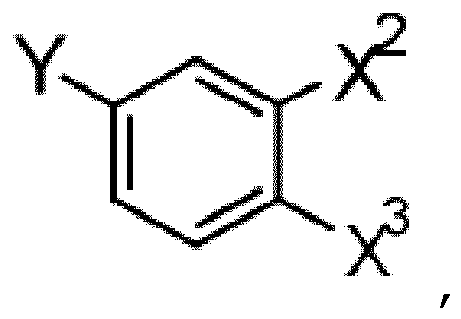
- halo-phenoles II wherein X 1 and X 2 as defined herein, are reacted, in a first step, with derivatives IIIa wherein X 3 stands for I or Br, in particular bromo derivatives III wherein Y is F or Cl, preferably in the presence of a base.
- the resulting compounds IVa, in particular IV are then transformed into Grignard reagents by the reaction with trans-metallation reagents such as isopropylmagnesium halides and subsequently reacted with acetyl chloride preferably under anhydrous conditions and optionally in the presence of a catalyst such as CuCl, AlCl 3 , LiCl and mixtures thereof, to obtain acetophenones V.
- trans-metallation reagents such as isopropylmagnesium halides
- acetyl chloride preferably under anhydrous conditions and optionally in the presence of a catalyst such as CuCl, AlCl 3 , LiCl and mixtures thereof.
- a catalyst such as CuCl, AlCl 3 , LiCl and mixtures thereof.
- acetophenones V can be halogenated e.g. with bromine or chlorine preferably in an organic solvent such as diethyl ether, methyl tert.-butyl ether (
- a Lewis acid such as LaCl 3 x2 LiCl or MgBr 2 xOEt 2 can be used.
- R 1 is as defined above and LG represents a nucleophilically replaceable leaving group such as halogen, alkylsulfonyl, alkylsulfonyloxy and aryl-sulfonyloxy, preferably chloro, bromo or iodo, particularly preferably bromo, preferably in the presence of a base, such as for example, NaH in a suitable solvent such as THF, to form compounds I.
- a base such as for example, NaH in a suitable solvent such as THF
- derivatives IIIa in particular bromo derivatives III, in a first step, are reacted with e.g. isopropylmagnesium bromide followed by an acyl chloride agent IX wherein R 1 is as defined herein (e.g. acetyl chloride) preferably under anhydrous conditions and optionally in the presence of a catalyst such as CuCl, AlCl 3 , LiCl and mixtures thereof, to obtain compounds X.
- R 1 e.g. acetyl chloride
- compounds IIIc e.g. 1,3-dichlorobenzene of formula IIIb can be reacted with an acyl chloride agent IX wherein R 1 is as defined above (e.g.
- ketones X are reacted with phenoles II preferably in the presence of a base to obtain compounds Va.
- Compounds Va may also be obtained in analogy to the first process described for compounds V.
- intermediates Va are reacted with trimethylsulf(ox)onium halides preferably iodide preferably in the presence of a base such as sodium hydroxide.
- a base such as sodium hydroxide.
- the epoxides XI are reacted with 1H-1,2,4-triazole preferably in the presence of a base such as potassium carbonate and preferably in the presence of an organic solvent such as DMF to obtain compounds VIII.
- R 2 is as defined above and LG represents a nucleophilically replaceable leaving group such as halogen, alkylsulfonyl, alkylsulfonyloxy and arylsulfonyloxy, preferably chloro, bromo or iodo, particularly preferably bromo, preferably in the presence of a base to form compounds I., which can subsequently be alkylated as described above.
- LG represents a nucleophilically replaceable leaving group such as halogen, alkylsulfonyl, alkylsulfonyloxy and arylsulfonyloxy, preferably chloro, bromo or iodo, particularly preferably bromo, preferably in the presence of a base to form compounds I., which can subsequently be alkylated as described above.
- the preparation of compounds I can be illustrated by the following scheme:
- the epoxide ring of intermediates XI which may be obtained according to the second process described herein is cleaved by reaction with alcohols R 2 OH preferably under acidic conditions. Thereafter, the resulting compounds XII are reacted with halogenating agents or sulfonating agents such as PBr 3 , PCl 3 , mesyl chloride, tosyl chloride or thionyl chloride to obtain compounds XII wherein LG is a nucleophilically replaceable leaving group such as halogen, alkylsulfonyl, alkylsulfonyloxy and arylsulfonyloxy, preferably chloro, bromo or iodo, particularly preferably bromo or alkyl-sulfonyl. Then compounds XII are reacted with 1H-1,2,4-triazole to obtain compounds I.
- the preparation of compounds I can be illustrated by the following scheme:
- the N-oxides may be prepared from the compounds I according to conventional oxidation methods, e. g. by treating compounds I with an organic peracid such as meta-chloroperbenzoic acid (cf. WO 03/64572 or J. Med. Chem. 38(11), 1892-903, 1995 ); or with inorganic oxidizing agents such as hydrogen peroxide (cf. J. Heterocyc. Chem. 18(7), 1305-8, 1981 ) or oxone (cf. J. Am. Chem. Soc. 123(25), 5962-5973, 2001 ).
- the oxidation may lead to pure mono-N-oxides or to a mixture of different N-oxides, which can be separated by conventional methods such as chromatography.
- the present invention also relates to novel compounds of formula Va wherein the variables R 1 , X 1 , X 2 are as defined and preferably defined for formula I herein.
- the substituents R 1 , X 1 , X 2 are as defined in tables 1 to 84, tables 84a to 84w, tables 85 to 168 and tables 168a to 168w for compounds I, wherein the substituents are specific embodiments independently of each other or in any combination.
- variables X 1 , X 2 are as defined and preferably defined for formula I herein, and wherein Hal stands for halogen, in particular Cl or Br. According to one preferred embodiment Hal in compounds VI stands for Br.
- the variables X 1 , X 2 are as defined and preferably defined for formula I herein.
- the substituents X 1 , X 2 are as defined in tables 1 to 84, tables 84a to 84w, tables 85 to 168 and tables 168a to 168w, wherein the substituents are specific embodiments independently of each other or in any combination.
- X 1 , X 2 and R 1 are as defined and preferably defined for formula I herein, with the exception
- X 1 and X 2 are not both Cl.
- a further embodiment of the present invention are novel compounds of formula XI: herein the variables XII, X 2 and R 1 are as defined and preferably defined for formula I herein, with the exception
- X 1 , X 2 and R 1 are as defined and preferably defined for formula I herein, with the exception
- X 1 and X 2 are not both Cl.
- variables X 1 , X 2 , R 1 and R 2 are as defined and preferably defined for formula I herein.
- the substituents X 1 , X 2 , R 1 and R 2 are as defined in tables 1 to 84, tables 84a to 84w, tables 85 to 168 and tables 168a to 168w, wherein the substituents are specific embodiments independently of each other or in any combination.
- variables X 1 , X 2 , R 1 and R 2 are as defined and preferably defined for formula I herein, wherein LG stands for a leaving group as defined above.
- the substituents X 1 , X 2 , R 1 and R 2 are as defined in tables 1 to 84, tables 84a to 84w, tables 85 to 168 and tables 168a to 168w, wherein the substituents are specific embodiments independently of each other or in any combination.
- C n -C m indicates the number of carbon atoms possible in each case in the substituent or substituent moiety in question.
- halogen refers to fluorine, chlorine, bromine and iodine.
- C 1 -C 6 -alkyl refers to a straight-chained or branched saturated hydrocarbon group having 1 to 6 carbon atoms, e.g. methyl, ethyl, propyl, 1-methylethyl, butyl, 1-methylpropyl, 2-methylpropyl, 1,1-dimethylethyl, pentyl, 1-methylbutyl, 2-methylbutyl, 3-methylbutyl, 2,2-dimethylpropyl, 1-ethylpropyl, 1,1-dimethylpropyl, 1,2-dimethylpropyl, hexyl, 1-methylpentyl, 2-methylpentyl, 3-methylpentyl, 4-methylpentyl, 1,1-dimethylbutyl, 1,2-dimethylbutyl, 1,3-dimethylbutyl, 2,2-dimethylbutyl, 2,3-dimethylbutyl, 3,3-di-methylbutyl, 1-ethylbutyl
- C 2 -C 4 -alkyl refers to a straight-chained or branched alkyl group having 2 to 4 carbon atoms, such as ethyl, propyl (n-propyl), 1-methylethyl (iso-propoyl), butyl, 1-methylpropyl (sec.-butyl), 2-methylpropyl (iso-butyl), 1,1-dimethylethyl (tert.-butyl).
- C 2 -C 4 -alkenyl refers to a straight-chain or branched unsaturated hydrocarbon radical having 2 to 4 carbon atoms and a double bond in any position, e.g. ethenyl, 1-propenyl, 2-propenyl (allyl), 1-methylethenyl, 1-butenyl, 2-butenyl, 3-butenyl, 1-methyl-1-propenyl, 2-methyl-1-propenyl, 1-methyl-2-propenyl, 2-methyl-2-propenyl.
- C 2 -C 6 -alkenyl refers to a straight-chain or branched unsaturated hydrocarbon radical having 2 to 6 carbon atoms and a double bond in any position.
- C 2 -C 4 -alkynyl refers to a straight-chain or branched unsaturated hydrocarbon radical having 2 to 4 carbon atoms and containing at least one triple bond, such as ethynyl, prop-1-ynyl, prop-2-ynyl (propargyl), but-1-ynyl, but-2-ynyl, but-3-ynyl, 1-methyl-prop-2-ynyl.
- C 2 -C 6 -alkynyl refers to a straight-chain or branched unsaturated hydrocarbon radical having 2 to 6 carbon atoms and at least one triple bond.
- C 1 -C 4 -halogenalkyl refers to a straight-chained or branched alkyl group having 1 to 4 carbon atoms, wherein some or all of the hydrogen atoms in these groups may be replaced by halogen atoms as mentioned above, for example chloromethyl, bromomethyl, dichloromethyl, trichloromethyl, fluoromethyl, difluoromethyl, trifluoromethyl, chlorofluoromethyl, dichlorofluoromethyl, chlorodifluoromethyl, 1-chloroethyl, 1-bromoethyl, 1-fluoroethyl, 2-fluoroethyl, 2,2-difluoroethyl, 2,2,2-trifluoroethyl, 2-chloro-2-fluoroethyl, 2-chloro-2,2-difluoroethyl, 2,2-dichloro-2-fluoroethyl, 2,2,2-trichloroethyl and
- C 3 -C 8 -cycloalkyl refers to monocyclic saturated hydrocarbon radicals having 3 to 8 carbon ring members, such as cyclopropyl, cyclobutyl, cyclopentyl, cyclohexyl, cycloheptyl or cyclooctyl.
- C 3 -C 8 -cycloalkyl-C 1 -C 4 -alkyl refers to alkyl having 1 to 4 carbon atoms (as defined above), wherein one hydrogen atom of the alkyl radical is replaced by a cycloalkyl radical having 3 to 8 carbon atoms (as defined above).
- C 1 -C 4 -alkoxy refers to a straight-chain or branched alkyl group having 1 to 4 carbon atoms which is bonded via an oxygen, at any position in the alkyl group, e.g. methoxy, ethoxy, n-propoxy, 1-methylethoxy, butoxy, 1-methyhpropoxy, 2-methyl-propoxy or 1,1-dimethylethoxy.
- C 1 -C 4 -halogenalkoxy refers to a C 1 -C 4 -alkoxy radical as defined above, wherein some or all of the hydrogen atoms in these groups may be replaced by halogen atoms as mentioned above, e.g., OCH 2 F, OCHF 2 , OCF 3 , OCH 2 Cl, OCHCl 2 , OCCl 3 , chlorofluoromethoxy, dichlorofluoromethoxy, chlorodifluoromethoxy, 2-fluoroethoxy, 2-chloroethoxy, 2-bromoethoxy, 2-iodoethoxy, 2,2-difluoroethoxy, 2,2,2-trifluoroethoxy, 2-chloro-2-fluoroethoxy, 2-chloro-2,2-difluoroethoxy, 2,2-dichloro-2-fluoroethoxy, 2,2,2-trichloro-ethoxy, OC 2 F 5 , 2-fluoro
- phenyl-C 1 -C 4 -alkyl refers to alkyl having 1 to 4 carbon atoms (as defined above), wherein one hydrogen atom of the alkyl radical is replaced by a phenyl radical.
- phenyl-C 2 -C 4 -alkenyl and “phenyl-C 2 -C 4 -alkynyl” refer to alkenyl and alkynyl, respectively, wherein one hydrogen atom of the aforementioned radicals is replaced by a phenyl radical.
- Agriculturally acceptable salts of compounds I encompass especially the salts of those cations or the acid addition salts of those acids whose cations and anions, respectively, have no adverse effect on the fungicidal action of the compounds I.
- Suitable cations are thus in particular the ions of the alkali metals, preferably sodium and potassium, of the alkaline earth metals, preferably calcium, magnesium and barium, of the transition metals, preferably manganese, copper, zinc and iron, and also the ammonium ion which, if desired, may carry one to four C 1 -C 4 -alkyl substituents and/or one phenyl or benzyl substituent, preferably diisopropylammonium, tetramethylammonium, tetrabutylammonium, trimethylbenzylammonium, furthermore phosphonium ions, sulfonium ions, preferably tri(C 1 -C 4 -alkyl)sulfonium, and s
- Anions of useful acid addition salts are primarily chloride, bromide, fluoride, hydrogensulfate, sulfate, dihydrogenphosphate, hydrogenphosphate, phosphate, nitrate, bicarbonate, carbonate, hexafluorosilicate, hexafluorophosphate, benzoate, and the anions of C 1 -C 4 -alkanoic acids, preferably formate, acetate, propionate and butyrate. They can be formed by reacting a compound of formula I with an acid of the corresponding anion, preferably of hydrochloric acid, hydrobromic acid, sulfuric acid, phosphoric acid or nitric acid.
- the compounds of formula I can be present in atropisomers arising from restricted rotation about a single bond of asymmetric groups. They also form part of the subject matter of the present invention.
- the compounds of formula I and their N-oxides may have one or more centers of chirality, in which case they are present as pure enantiomers or pure diastereomers or as enantiomer or diastereomer mixtures. Both, the pure enantiomers or diastereomers and their mixtures are subject matter of the present invention.
- the embodiments of the intermediates correspond to the embodiments of the compounds I.
- X 1 and X 2 are independently selected from halogen.
- One embodiment relates to compounds I, wherein X 1 is F or Cl, in particular Cl.
- Another embodiment relates to compounds I, wherein X 2 is F or Cl, in particular Cl.
- R 1 is C 3 -C 8 -cycloalkyl, C 3 -C 8 -cycloalkyl-C 1 -C 4 -alkyl, phenyl, phenyl-C 1 -C 4 -alkyl, phenyl-C 2 -C 4 -alkenyl or phenyl-C 2 -C 4 -alkynyl, wherein the aliphatic moieties are unsubstituted or carry 1, 2, 3 or up to the maximum possible number of identical or different groups R a which independently of one another are selected from halogen, CN, nitro, C 1 -C 4 -alkoxy and C 1 -C 4 -halogenalkoxy; and wherein the cycloalkyl and/or phenyl moieties are unsubstituted or carry 1, 2, 3, 4, 5 or up to the maximum number of identical or different groups R b which independently of one another are selected from halogen, CN, nitro, C
- R 1 is C 3 -C 8 -cycloalkyl, in particular C 3 -C 6 -cycloalkyl. According to specific embodiments, R 1 is cyclopropyl, cyclopentyl or cyclohexyl, in particular cyclopropyl.
- the cycloalkyl is unsubstituted, according to another embodiment, the cycloalkyl carries 1, 2, 3, 4 or 5, in particular 1, 2 or 3, identical or different groups R b which independently of one another are selected from F, Cl, Br, CN, C 1 -C 2 -alkyl, C 1 -C 2 -alkoxy, C 1 -C 2 -halogenalkyl and C 1 -C 2 -halogenalkoxy.
- R 1 is cyclopropyl, 1-Cl-cyclopropyl, 1-F-cyclopropyl, 1-CH 3 -cyclopropyl or 1-CN-cyclopropyl.
- R 1 is C 3 -C 8 -cycloalkyl-C 1 -C 4 -alkyl, in particular C 3 -C 6 -cycloalkyl-C 1 -C 4 -alkyl.
- the cycloalkyl moiety is unsubstituted, according to another embodiment, the cycloalkyl moiety is substituted by 1, 2, 3, 4 or 5, in particular 1,2 or 3, identical or different groups R b which independently of one another are selected from F, Cl, Br, CN, C 1 -C 2 -alkyl, C 1 -C 2 -alkoxy, C 1 -C 2 -halogenalkyl and C 1 -C 2 -halogenalkoxy.
- the alkyl moiety is unsubstituted, according to another embodiment, the alkyl moiety is substituted by 1, 2, 3, 4 or 5, in particular 1, 2 or 3, identical or different groups R a which independently of one another are selected from F, Cl, Br, CN, C 1 -C 2 -alkoxy and C 1 -C 2 -halogenalkoxyl.
- a further embodiment relates to compounds I, wherein R 1 is C 3 -C 6 -cycloalkyl or C 3 -C 6 -cycloalkyl-C 1 -C 4 -alkyl, more preferably selected from cyclopropyl and cyclopropylmethyl, wherein the aforementioned groups may be substituted by R a and/or R b as defined above.
- R 1 is phenyl.
- the phenyl is unsubstituted, according to another embodiment, the phenyl is substituted by 1, 2, 3, 4 or 5, in particular 1, 2 or 3, identical or different groups R b which independently of one another are selected from F, Cl, Br, CN, C 1 -C 2 -alkyl, C 1 -C 2 -alkoxy, C 1 -C 2 -halogenalkyl and C 1 -C 2 -halogenalkoxy.
- a further embodiment relates to compounds I, wherein R 1 is phenyl, wherein the aforementioned groups may be substituted by R b as defined above, more preferably said phenyl carries 1, 2 or 3 halogen substituents, in particular selected from Cl and F.
- a further embodiment relates to compounds I, wherein R 1 is phenyl-C 1 -C 4 -alkyl, phenyl-C 2 -C 4 -alkenyl or phenyl-C 2 -C 4 -alkynyl, more preferably benzyl, phenylethenyl and phenylethynyl, in particular R 1 is benzyl, wherein the aforementioned groups may be substituted by R a and/or R b as defined above.
- R 1 is phenyl-C 1 -C 4 -alkyl, in particular phenyl-C 1 -C 2 -alkyl.
- the phenyl moiety is unsubstituted, according to another embodiment, the phenyl moiety is substituted by 1, 2, 3, 4 or 5, in particular 1,2 or 3, identical or different groups R b which independently of one another are selected from F, Cl, Br, CN, C 1 -C 2 -alkyl, C 1 -C 2 -alkoxy, C 1 -C 2 -halogenalkyl and C 1 -C 2 -halogenalkoxy.
- the alkyl moiety is unsubstituted, according to another embodiment, the alkyl moiety is substituted by 1, 2, 3, 4 or 5, in particular 1, 2 or 3, identical or different groups R a which independently of one another are selected from F, Cl, Br, CN, C 1 -C 2 -alkoxy and C 1 -C 2 -halogenalkoxy.
- a further embodiment relates to compounds I, wherein R 1 is unsubstituted.
- R 2 is C 1 -C 6 -alkyl, C 2 -C 6 -alkenyl, C 2 -C 6 -alkynyl, C 3 -C 8 -cycloalkyl, C 3 -C 8 -cycloalkyl-C 1 -C 4 -alkyl, phenyl, phenyl-C 1 -C 4 -alkyl, phenyl-C 2 -C 4 -alkenyl or phenyl-C 2 -C 4 -alkynyl; wherein the aliphatic moieties are unsubstituted or carry 1, 2, 3 or up to the maximum possible number of identical or different groups R a which independently of one another are selected from halogen, CN, nitro, C 1 -C 4 -alkoxy and C 1 -C 4 -halogenalkoxy; and wherein the cycloalkyl and/or phenyl moieties of R 2 may carry 1, 2, 3,
- R 2 is C 1 -C 6 -alkyl, in particular C 1 -C 4 -alkyl. Specific embodiments relate to compounds, wherein R 2 is methyl, ethyl or isopropyl.
- the alkyl is unsubstituted, according to another embodiment, the alkyl carries 1, 2, 3, 4, 5 or 6, in particular 1, 2, 3 or 4, R a , wherein R a is selected from F, Cl, Br, CN, C 1 -C 2 -alkoxy and C 1 -C 2 -halogenalkoxy.
- R 2 is C 2 -C 6 -alkenyl, in particular C 2 -C 4 -alkenyl.
- R 2 is allyl.
- the alkenyl is unsubstituted, according to another embodiment, the alkenyl carries 1, 2, 3, 4, 5 or 6, in particular 1, 2, 3 or 4, R a , wherein R a is selected from F, Cl, Br, CN, C 1 -C 2 -alkoxy and C 1 -C 2 -halogenalkoxy.
- R 2 is C 2 -C 6 -alkynyl, in particular C 2 -C 4 -alkynyl.
- R 2 is propargyl.
- the alkynyl is unsubstituted, according to another embodiment, the alkynyl carries 1, 2, 3, 4, 5 or 6, in particular 1, 2, 3 or 4, R a , wherein R a is selected from F, Cl, Br, CN, C 1 -C 2 -alkoxy and C 1 -C 2 -halogenalkoxy.
- a further embodiment relates to compounds I, wherein R 2 is C 1 -C 4 -alkyl, C 2 -C 4 -alkenyl, C 2 -C 4 -alkynyl, cyclopropyl, cyclopropylmethyl, phenyl, benzyl, phenylethenyl or phenylethynyl, wherein the aforementioned groups may be substituted by R a and/or R b as defined above, more preferably they carry 1, 2 or 3 halogen substituents, even more preferably R 2 is C 1 -C 2 -haloalkyl, in particular R 2 is CF 3 .
- a further embodiment relates to compounds I, wherein R 2 is C 1 -C 4 -alkyl, C 2 -C 4 -alkenyl, C 2 -C 4 -alkynyl, cyclopropyl, cyclopropylmethyl, phenyl, benzyl, phenylethenyl or phenylethynyl, more preferably from C 1 -C 4 -alkyl, in particular methyl.
- R 2 is C 3 -C 8 -cycloalkyl, in particular C 3 -C 6 -cycloalkyl.
- R 2 is cyclopropyl.
- the cycloalkyl is unsubstituted, according to another embodiment, the cycloalkyl carries 1, 2, 3, 4, 5 or 6, in particular 1, 2, 3 or 4, R b , wherein R b is selected from F, Cl, Br, CN, C 1 -C 2 -alkyl, C 1 -C 2 -alkoxy, C 1 -C 2 -halogenalkyl and C 1 -C 2 -halogenalkoxy.
- R 2 is C 3 -C 8 -cycloalkyl-C 1 -C 4 -alkyl, in particular C 3 -C 6 -cycloalkyl-C 1 -C 4 -alkyl.
- Specific embodiments relate to compounds, wherein R 2 is cyclopropylmethyl.
- the cycloalkyl moiety is unsubstituted, according to another embodiment, the cycloalkyl moiety carries 1, 2, 3, 4, 5 or 6, in particular 1, 2, 3 or 4, R b , wherein R b is selected from F, Cl, Br, CN, C 1 -C 2 -alkyl, C 1 -C 2 -alkoxy, C 1 -C 2 -halogenalkyl and C 1 -C 2 -halogenalkoxy.
- the alkyl moiety is unsubstituted, according to another embodiment, the alkyl moiety carries 1, 2, 3, 4, 5 or 6, in particular 1, 2, 3 or 4, R a , wherein R a is selected from F, Cl, Br, CN, C 1 -C 2 -alkoxy and C 1 -C 2 -halogenalkoxy.
- a further embodiment relates to compounds I, wherein R 2 is C 3 -C 8 -cycloalkyl or C 3 -C 8 -cycloalkyl-C 1 -C 4 -alkyl, more preferably selected from cyclopropyl and cyclopropylmethyl, wherein the aforementioned groups may be substituted by R a and/or R b as defined above.
- R 2 is phenyl.
- the phenyl is unsubstituted, according to another embodiment, the phenyl carries 1, 2, 3, 4 or 5, in particular 1, 2 or 3, R b , wherein R b is selected from F, Cl, Br, CN, C 1 -C 2 -alkyl, C 1 -C 2 -alkoxy, C 1 -C 2 -halogenalkyl and C 1 -C 2 -halogenalkoxy.
- R 2 is phenyl-C 1 -C 4 -alkyl, in particular phenyl-C 1 -C 2 -alkyl, specifically benzyl.
- the phenyl moiety is unsubstituted, according to another embodiment, the phenyl moiety carries 1, 2, 3, 4 or 5, in particular 1, 2 or 3 R b , wherein R b is selected from F, Cl, Br, CN, C 1 -C 2 -alkyl, C 1 -C 2 -alkoxy, C 1 -C 2 -halogenalkyl and C 1 -C 2 -halogenalkoxy.
- the alkyl moiety is unsubstituted, according to another embodiment, the alkyl moiety carries 1, 2, 3, 4 or 5, in particular 1, 2 or 3, R a , wherein R a is selected from F, Cl, Br, CN, C 1 -C 2 -alkoxy and C 1 -C 2 -halogenalkoxy.
- R a is selected from F, Cl, Br, CN, C 1 -C 2 -alkoxy and C 1 -C 2 -halogenalkoxy.
- a further embodiment relates to compounds, wherein X 1 and X 2 are both Cl and R 1 is unsubstituted benzyl, which compounds are of formula I.A:
- a further embodiment relates to compounds, wherein X 1 and X 2 are both Cl and R 1 is unsubstituted cyclopropyl, which compounds are of formula I.B:
- Particularly preferred embodiments of the invention relate to compounds I, wherein the combination of X 1 , X 2 and R 1 (including R a , R b ) is as defined in Table P below.
- the compounds I and VIII, respectively, and the compositions according to the invention, respectively, are suitable as fungicides. They are distinguished by an outstanding effectiveness against a broad spectrum of phytopathogenic fungi, including soil-borne fungi, which derive especially from the classes of the Plasmodiophoromycetes, Peronosporomycetes (syn. Oomycetes), Chytridiomycetes, Zygomycetes, Ascomycetes, Basidiomycetes and Deuteromycetes (syn. Fungi imperfecti). Some are systemically effective and they can be used in crop protection as foliar fungicides, fungicides for seed dressing and soil fungicides. Moreover, they are suitable for controlling harmful fungi, which inter alia occur in wood or roots of plants.
- the compounds I and VIII, respectively, and the compositions according to the invention are particularly important in the control of a multitude of phytopathogenic fungi on various cultivated plants, such as cereals, e. g. wheat, rye, barley, triticale, oats or rice; beet, e. g. sugar beet or fodder beet; fruits, such as pomes, stone fruits or soft fruits, e. g.
- compounds I and VIII, respectively, and compositions thereof, respectively are used for controlling a multitude of fungi on field crops, such as potatoes sugar beets, tobacco, wheat, rye, barley, oats, rice, corn, cotton, soybeans, rape, legumes, sunflowers, coffee or sugar cane; fruits; vines; ornamentals; or vegetables, such as cucumbers, tomatoes, beans or squashes.
- field crops such as potatoes sugar beets, tobacco, wheat, rye, barley, oats, rice, corn, cotton, soybeans, rape, legumes, sunflowers, coffee or sugar cane; fruits; vines; ornamentals; or vegetables, such as cucumbers, tomatoes, beans or squashes.
- plant propagation material is to be understood to denote all the generative parts of the plant such as seeds and vegetative plant material such as cuttings and tubers (e. g. potatoes), which can be used for the multiplication of the plant. This includes seeds, roots, fruits, tubers, bulbs, rhizomes, shoots, sprouts and other parts of plants, including seedlings and young plants, which are to be transplanted after germination or after emergence from soil. These young plants may also be protected before transplantation by a total or partial treatment by immersion or pouring.
- treatment of plant propagation materials with compounds I and VIII, respectively, and compositions thereof, respectively is used for controlling a multitude of fungi on cereals, such as wheat, rye, barley and oats; rice, corn, cotton and soybeans.
- cultiva plants is to be understood as including plants which have been modified by breeding, mutagenesis or genetic engineering including but not limiting to agricultural biotech products on the market or in development (cf. http://www.bio.org/speeches/pubs/er/agri_products.asp).
- Genetically modified plants are plants, which genetic material has been so modified by the use of recombinant DNA techniques that under natural circumstances cannot readily be obtained by cross breeding, mutations or natural recombination.
- one or more genes have been integrated into the genetic material of a genetically modified plant in order to improve certain properties of the plant.
- Such genetic modifications also include but are not limited to targeted post-translational modification of protein(s), oligo- or polypeptides e. g. by glycosylation or polymer additions such as prenylated, acetylated or farnesylated moieties or PEG moieties.
- auxin herbicides such
- herbicides e. bromoxynil or ioxynil herbicides as a result of conventional methods of breeding or genetic engineering. Furthermore, plants have been made resistant to multiple classes of herbicides through multiple genetic modifications, such as resistance to both glyphosate and glufosinate or to both glyphosate and a herbicide from another class such as ALS inhibitors, HPPD inhibitors, auxin herbicides, or ACCase inhibitors.
- ALS inhibitors e.g. described in Pest Managem. Sci.
- plants are also covered that are by the use of recombinant DNA techniques capable to synthesize one or more insecticidal proteins, especially those known from the bacterial genus Bacillus , particularly from Bacillus thuringiensis , such as ⁇ -endotoxins, e. g. CryIA(b), CryIA(c), CryIF, CryIF(a2), CryIIA(b), CryIIIA, CryIIIB(b1) or Cry9c; vegetative insecticidal proteins (VIP), e. g. VIP1, VIP2, VIP3 orVIP3A; insecticidal proteins of bacteria colonizing nematodes, e. g. Photorhabdus spp.
- VIP vegetative insecticidal proteins
- toxins produced by animals such as scorpion toxins, arachnid toxins, wasp toxins, or other insect-specific neurotoxins
- toxins produced by fungi such Streptomycetes toxins, plant lectins, such as pea or barley lectins; agglutinins
- proteinase inhibitors such as trypsin inhibitors, serine protease inhibitors, patatin, cystatin or papain inhibitors
- ribosome-inactivating proteins (RIP) such as ricin, maize-RIP, abrin, luffin, saporin or bryodin
- steroid metabolism enzymes such as 3-hydroxysteroid oxidase, ecdysteroid-IDP-glycosyl-transferase, cholesterol oxidases, ecdysone inhibitors or HMG-CoA-reductase
- ion channel blockers such as blockers of sodium or calcium channels
- these insecticidal proteins or toxins are to be understood expressly also as pre-toxins, hybrid proteins, truncated or otherwise modified proteins.
- Hybrid proteins are characterized by a new combination of protein domains, (see, e. g. WO 02/015701 ).
- Further examples of such toxins or genetically modified plants capable of synthesizing such toxins are disclosed, e. g., in EP-A 374 753 , WO 93/007278 , WO 95/34656 , EP-A 427 529 , EP-A 451 878 , WO 03/18810 und WO 03/52073 .
- the methods for producing such genetically modified plants are generally known to the person skilled in the art and are described, e. g. in the publications mentioned above.
- These insecticidal proteins contained in the genetically modified plants impart to the plants producing these proteins tolerance to harmful pests from all taxonomic groups of athropods, especially to beetles (Coeloptera), two-winged insects (Diptera), and moths (Lepidoptera) and to nematodes (Nematoda).
- Genetically modified plants capable to synthesize one or more insecticidal proteins are, e.
- WO 03/018810 MON 863 from Monsanto Europe S.A., Belgium (corn cultivars producing the Cry3Bb1 toxin), IPC 531 from Monsanto Europe S.A., Belgium (cotton cultivars producing a modified version of the Cry1Ac toxin) and 1507 from Pioneer Overseas Corporation, Belgium (corn cultivars producing the Cry1F toxin and PAT enzyme).
- plants are also covered that are by the use of recombinant DNA techniques capable to synthesize one or more proteins to increase the resistance or tolerance of those plants to bacterial, viral or fungal pathogens.
- proteins are the so-called "pathogenesis-related proteins" (PR proteins, see, e. g. EP-A 392 225 ), plant disease resistance genes (e. g. potato cultivars, which express resistance genes acting against Phytophthora infestans derived from the mexican wild potato Solanum bulbocastanum ) or T4-lysozym (e. g. potato cultivars capable of synthesizing these proteins with increased resistance against bacteria such as Erwinia amylvora).
- PR proteins pathogenesis-related proteins
- plant disease resistance genes e. g. potato cultivars, which express resistance genes acting against Phytophthora infestans derived from the mexican wild potato Solanum bulbocastanum
- T4-lysozym e. g.
- plants are also covered that are by the use of recombinant DNA techniques capable to synthesize one or more proteins to increase the productivity (e. g. bio mass production, grain yield, starch content, oil content or protein content), tolerance to drought, salinity or other growth-limiting environmental factors or tolerance to pests and fungal, bacterial or viral pathogens of those plants.
- productivity e. g. bio mass production, grain yield, starch content, oil content or protein content
- plants are also covered that contain by the use of recombinant DNA techniques a modified amount of substances of content or new substances of content, specifically to improve human or animal nutrition, e. g. oil crops that produce health-promoting long-chain omega-3 fatty acids or unsaturated omega-9 fatty acids (e. g. Nexera ® rape, DOW Agro Sciences, Canada).
- plants are also covered that contain by the use of recombinant DNA techniques a modified amount of substances of content or new substances of content, specifically to improve raw material production, e. g. potatoes that produce increased amounts of amylopectin (e. g. Amflora ® potato, BASF SE, Germany).
- a modified amount of substances of content or new substances of content specifically to improve raw material production, e. g. potatoes that produce increased amounts of amylopectin (e. g. Amflora ® potato, BASF SE, Germany).
- the compounds I and VIII, respectively, and compositions thereof, respectively, are particularly suitable for controlling the following plant diseases:
- the compounds I and VIII, respectively, and compositions thereof, respectively, are also suitable for controlling harmful fungi in the protection of stored products or harvest and in the protection of materials.
- the term "protection of materials” is to be understood to denote the protection of technical and non-living materials, such as adhesives, glues, wood, paper and paperboard, textiles, leather, paint dispersions, plastics, colling lubricants, fiber or fabrics, against the infestation and destruction by harmful microorganisms, such as fungi and bacteria.
- Ascomycetes such as Ophiostoma spp., Ceratocystis spp., Aureobasidium pullulans , Sclerophoma spp., Chaetomium spp., Humicola spp., Petriella spp., Trichurus spp.; Basidiomycetes such as Coniophora spp., Coriolus spp., Gloeophyllum spp., Lentinus spp., Pleurotus spp., Poria spp., Serpula spp.
- Ascomycetes such as Ophiostoma spp., Ceratocystis spp., Aureobasidium pullulans , Sclerophoma spp., Chaetomium spp., Humicola spp., Petriella spp., Trichurus spp.
- Basidiomycetes such as Coniophora
- yeast fungi are worthy of note: Candida spp. and Saccharomyces cerevisae.
- the compounds I and VIII, respectively, and compositions thereof, resepectively, may be used for improving the health of a plant.
- the invention also relates to a method for improving plant health by treating a plant, its propagation material and/or the locus where the plant is growing or is to grow with an effective amount of compounds I or VIII, respectively, and compositions thereof, respectively.
- plant health is to be understood to denote a condition of the plant and/or its products which is determined by several indicators alone or in combination with each other such as yield (e. g. increased biomass and/or increased content of valuable ingredients), plant vigor (e. g. improved plant growth and/or greener leaves ("greening effect")), quality (e. g. improved content or composition of certain ingredients) and tolerance to abiotic and/or biotic stress.
- yield e. g. increased biomass and/or increased content of valuable ingredients
- plant vigor e. g. improved plant growth and/or greener leaves ("greening effect")
- quality e. g. improved content or composition of certain ingredients
- tolerance to abiotic and/or biotic stress e. g. improved content or composition of certain ingredients
- the compounds of formula I and VIII, respectively, can be present in different crystal modifications whose biological activity may differ. They are likewise subject matter of the present invention.
- the compounds I and VIII, respectively, are employed as such or in form of compositions by treating the fungi or the plants, plant propagation materials, such as seeds, soil, surfaces, materials or rooms to be protected from fungal attack with a fungicidally effective amount of the active substances.
- the application can be carried out both before and after the infection of the plants, plant propagation materials, such as seeds, soil, surfaces, materials or rooms by the fungi.
- Plant propagation materials may be treated with compounds I or VIII, respectively, as such or a composition comprising at least one compound I or VIII, respectively, prophylactically either at or before planting or transplanting.
- the invention also relates to agrochemical compositions comprising an auxiliary and at least one compound I or VIII, respectively, according to the invention.
- An agrochemical composition comprises a fungicidally effective amount of a compound I or VIII, respectively.
- effective amount denotes an amount of the composition or of the compounds I or VII, respectively, which is sufficient for controlling harmful fungi on cultivated plants or in the protection of materials and which does not result in a substantial damage to the treated plants. Such an amount can vary in a broad range and is dependent on various factors, such as the fungal species to be controlled, the treated cultivated plant or material, the climatic conditions and the specific compound I or VIII, respectively, used.
- compositions e.g. solutions, emulsions, suspensions, dusts, powders, pastes, granules, pressings, capsules, and mixtures thereof.
- composition types are suspensions (e.g. SC, OD, FS), emulsifiable concentrates (e.g. EC), emulsions (e.g. EW, EO, ES, ME), capsules (e.g. CS, ZC), pastes, pastilles, wettable powders or dusts (e.g. WP, SP, WS, DP, DS), pressings (e.g.
- compositions types are defined in the " Catalogue of pesticide formulation types and international coding system", Technical Monograph No. 2, 6th Ed. May 2008, CropLife International .
- compositions are prepared in a known manner, such as described by Mollet and Grubemann, Formulation technology, Wiley VCH, Weinheim, 2001 ; or Knowles, New developments in crop protection product formulation, Agrow Reports DS243, T&F Informa, London, 2005 .
- Suitable auxiliaries are solvents, liquid carriers, solid carriers or fillers, surfactants, dispersants, emulsifiers, wetters, adjuvants, solubilizers, penetration enhancers, protective colloids, adhesion agents, thickeners, humectants, repellents, attractants, feeding stimulants, compatibilizers, bactericides, anti-freezing agents, anti-foaming agents, colorants, tackifiers and binders.
- Suitable solvents and liquid carriers are water and organic solvents, such as mineral oil fractions of medium to high boiling point, e.g. kerosene, diesel oil; oils of vegetable or animal origin; aliphatic, cyclic and aromatic hydrocarbons, e. g. toluene, paraffin, tetrahydronaphthalene, alkylated naphthalenes; alcohols, e.g. ethanol, propanol, butanol, benzylalcohol, cyclohexanol; glycols; DMSO; ketones, e.g. cyclohexanone; esters, e.g.
- mineral oil fractions of medium to high boiling point e.g. kerosene, diesel oil
- oils of vegetable or animal origin oils of vegetable or animal origin
- aliphatic, cyclic and aromatic hydrocarbons e. g. toluene, paraffin, tetrahydronaphthalene, alkylated
- lactates carbonates, fatty acid esters, gamma-butyrolactone; fatty acids; phosphonates; amines; amides, e.g. N-methylpyrrolidone, fatty acid dimethylamides; and mixtures thereof.
- Suitable solid carriers or fillers are mineral earths, e.g. silicates, silica gels, talc, kaolins, limestone, lime, chalk, clays, dolomite, diatomaceous earth, bentonite, calcium sulfate, magnesium sulfate, magnesium oxide; polysaccharides, e.g. cellulose, starch; fertilizers, e.g. ammonium sulfate, ammonium phosphate, ammonium nitrate, ureas; products of vegetable origin, e.g. cereal meal, tree bark meal, wood meal, nutshell meal, and mixtures thereof.
- mineral earths e.g. silicates, silica gels, talc, kaolins, limestone, lime, chalk, clays, dolomite, diatomaceous earth, bentonite, calcium sulfate, magnesium sulfate, magnesium oxide
- polysaccharides e.g. cellulose, starch
- fertilizers
- Suitable surfactants are surface-active compounds, such as anionic, cationic, nonionic and amphoteric surfactants, block polymers, polyelectrolytes, and mixtures thereof. Such surfactants can be used as emusifier, dispersant, solubilizer, wetter, penetration enhancer, protective colloid, or adjuvant. Examples of surfactants are listed in McCutcheon's, Vol.1: Emulsifiers & Detergents, McCutcheon's Directories, Glen Rock, USA, 2008 (International Ed. or North American Ed.).
- Suitable anionic surfactants are alkali, alkaline earth or ammonium salts of sulfonates, sulfates, phosphates, carboxylates, and mixtures thereof.
- sulfonates are alkylarylsulfonates, diphenylsulfonates, alpha-olefin sulfonates, lignine sulfonates, sulfonates of fatty acids and oils, sulfonates of ethoxylated alkylphenols, sulfonates of alkoxylated arylphenols, sulfonates of condensed naphthalenes, sulfonates of dodecyl- and tridecylbenzenes, sulfonates of naphthalenes and alkylnaphthalenes, sulfosuccinates or sulfosuccinamates.
- Examples of sulfates are sulfates of fatty acids and oils, of ethoxylated alkylphenols, of alcohols, of ethoxylated alcohols, or of fatty acid esters.
- Examples of phosphates are phosphate esters.
- Examples of carboxylates are alkyl carboxylates, and carboxylated alcohol or alkylphenol ethoxylates.
- Suitable nonionic surfactants are alkoxylates, N-subsituted fatty acid amides, amine oxides, esters, sugar-based surfactants, polymeric surfactants, and mixtures thereof.
- alkoxylates are compounds such as alcohols, alkylphenols, amines, amides, arylphenols, fatty acids or fatty acid esters which have been alkoxylated with 1 to 50 equivalents.
- Ethylene oxide and/or propylene oxide may be employed for the alkoxylation, preferably ethylene oxide.
- N-subsititued fatty acid amides are fatty acid glucamides or fatty acid alkanolamides.
- esters are fatty acid esters, glycerol esters or monoglycerides.
- sugar-based surfactants are sorbitans, ethoxylated sorbitans, sucrose and glucose esters or alkylpolyglucosides.
- polymeric surfactants are home- or copolymers of vinylpyrrolidone, vinylalcohols, or vinylacetate.
- Suitable cationic surfactants are quaternary surfactants, for example quaternary ammonium compounds with one or two hydrophobic groups, or salts of long-chain primary amines.
- Suitable amphoteric surfactants are alkylbetains and imidazolines.
- Suitable block polymers are block polymers of the A-B or A-B-A type comprising blocks of polyethylene oxide and polypropylene oxide, or of the A-B-C type comprising alkanol, polyethylene oxide and polypropylene oxide.
- Suitable polyelectrolytes are polyacids or polybases. Examples of polyacids are alkali salts of polyacrylic acid or polyacid comb polymers. Examples of polybases are polyvinylamines or polyethyleneamines.
- Suitable adjuvants are compounds, which have a neglectable or even no pesticidal activity themselves, and which improve the biological performance of the compound I on the target.
- examples are surfactants, mineral or vegetable oils, and other auxilaries. Further examples are listed by Knowles, Adjuvants and additives, Agrow Reports DS256, T&F Informa UK, 2006, chapter 5.
- Suitable thickeners are polysaccharides (e.g. xanthan gum, carboxymethylcellulose), anorganic clays (organically modified or unmodified), polycarboxylates, and silicates.
- Suitable bactericides are bronopol and isothiazolinone derivatives such as alkyliso-thiazolinones and benzisothiazolinones.
- Suitable anti-freezing agents are ethylene glycol, propylene glycol, urea and glycerin.
- Suitable anti-foaming agents are silicones, long chain alcohols, and salts of fatty acids.
- Suitable colorants are pigments of low water solubility and water-soluble dyes.
- examples are inorganic colorants (e.g. iron oxide, titan oxide, iron hexacyanoferrate) and organic colorants (e.g. alizarin-, azo- and phthalocyanine colorants).
- Suitable tackifiers or binders are polyvinylpyrrolidons, polyvinylacetates, polyvinyl alcohols, polyacrylates, biological or synthetic waxes, and cellulose ethers.
- composition types and their preparation are:
- compositions types i) to xi) may optionally comprise further auxiliaries, such as 0.1-1 wt% bactericides, 5-15 wt% anti-freezing agents, 0.1-1 wt% anti-foaming agents, and 0.1-1 wt% colorants.
- auxiliaries such as 0.1-1 wt% bactericides, 5-15 wt% anti-freezing agents, 0.1-1 wt% anti-foaming agents, and 0.1-1 wt% colorants.
- the agrochemical compositions generally comprise between 0.01 and 95%, preferably between 0.1 and 90%, and in particular between 0.5 and 75%, by weight of active substance.
- the active substances are employed in a purity of from 90% to 100%, preferably from 95% to 100% (according to NMR spectrum).
- Solutions for seed treatment (LS), Suspoemulsions (SE), flowable concentrates (FS), powders for dry treatment (DS), water-dispersible powders for slurry treatment (WS), water-soluble powders (SS), emulsions (ES), emulsifiable concentrates (EC) and gels (GF) are usually employed for the purposes of treatment of plant propagation materials, particularly seeds.
- the compositions in question give, after two-to-tenfold dilution, active substance concentrations of from 0.01 to 60% by weight, preferably from 0.1 to 40%, in the ready-to-use preparations. Application can be carried out before or during sowing.
- Methods for applying compound I or VIII, respectively, and compositions thereof, respectively, on to plant propagation material, especially seeds include dressing, coating, pelleting, dusting, soaking and in-furrow application methods of the propagation material.
- compound I or VIII, respectively, or the compositions thereof, respectively are applied on to the plant propagation material by a method such that germination is not induced, e. g. by seed dressing, pelleting, coating and dusting.
- the amounts of active substances applied are, depending on the kind of effect desired, from 0.001 to 2 kg per ha, preferably from 0.005 to 2 kg per ha, more preferably from 0.05 to 0.9 kg per ha, and in particular from 0.1 to 0.75 kg per ha.
- amounts of active substance of from 0.1 to 1000 g, preferably from 1 to 1000 g, more preferably from 1 to 100 g and most preferably from 5 to 100 g, per 100 kilogram of plant propagation material (preferably seeds) are generally required.
- the amount of active substance applied depends on the kind of application area and on the desired effect. Amounts customarily applied in the protection of materials are 0.001 g to 2 kg, preferably 0.005 g to 1 kg, of active substance per cubic meter of treated material.
- oils, wetters, adjuvants, fertilizer, or micronutrients, and further pesticides may be added to the active substances or the compositions comprising them as premix or, if appropriate not until immediately prior to use (tank mix).
- pesticides e.g. herbicides, insecticides, fungicides, growth regulators, safeners
- These agents can be admixed with the compositions according to the invention in a weight ratio of 1:100 to 100:1, preferably 1:10 to 10:1.
- the user applies the composition according to the invention usually from a predosage device, a knapsack sprayer, a spray tank, a spray plane, or an irrigation system.
- the agrochemical composition is made up with water, buffer, and/or further auxiliaries to the desired application concentration and the ready-to-use spray liquor or the agrochemical composition according to the invention is thus obtained.
- 20 to 2000 liters, preferably 50 to 400 liters, of the ready-to-use spray liquor are applied per hectare of agricultural useful area.
- composition according to the invention such as parts of a kit or parts of a binary or ternary mixture may be mixed by the user himself in a spray tank and further auxiliaries may be added, if appropriate.
- the present invention furthermore relates to agrochemical compositions comprising a mixture of at least one compound I or VIII, respectively, (component 1) and at least one further active substance useful for plant protection, e. g. selected from the groups A) to O) (component 2), in particular one further fungicide, e. g. one or more fungicide from the groups A) to L), as described above, and if desired one suitable solvent or solid carrier.
- component 1 agrochemical compositions
- component 2 e. g. selected from the groups A) to O
- component 2 in particular one further fungicide, e. g. one or more fungicide from the groups A) to L
- suitable solvent or solid carrier e.g. one or more fungicide from the groups A) to L
- combating harmful fungi with a mixture of compounds I or VIII, respectively, and at least one fungicide from groups A) to L), as described above, is more efficient than combating those fungi with individual compounds I or VIII, respectively, or individual fungicides from groups A) to L).
- compounds I or VIII, respectively, together with at least one active substance from groups A) to O) a synergistic effect can be obtained, i.e. more then simple addition of the individual effects is obtained (synergistic mixtures).
- the order of application is not essential for working of the present invention.
- the weight ratio of component 1 and component 2 generally depends from the properties of the active substances used, usually it is in the range of from 1:100 to 100:1, regularly in the range of from 1:50 to 50:1, preferably in the range of from 1:20 to 20:1, more preferably in the range of from 1:10 to 10:1 and in particular in the range of from 1:3 to 3:1.
- the weight ratio of component 1 and component 2 depends from the properties of the active substances used, preferably it is in the range of from 1:50 to 50:1 and particularly in the range of from 1:10 to 10:1, and the weight ratio of component 1 and component 3 preferably is in the range of from 1:50 to 50:1 and particularly in the range of from 1:10 to 10:1.
- mixtures comprising a compound I or VIII, respectively, (component 1) and at least one active substance selected from group A) (component 2) and particularly selected from azoxystrobin, dimoxystrobin, fluoxastrobin, kresoxim-methyl, orysastrobin, picoxystrobin, pyraclostrobin, trifloxystrobin; famoxadone, fenamidone; bixafen, boscalid, fluopyram, fluxapyroxad, isopyrazam, penflufen, penthiopyrad, sedaxane; ametoctradin, cyazofamid, fluazinam, fentin salts, such as fentin acetate.
- mixtures comprising a compound of formula I or VIII, respectively, (component 1) and at least one active substance selected from group B) (component 2) and particularly selected from cyproconazole, difenoconazole, epoxiconazole, fluquinconazole, flusilazole, flutriafol, metconazole, myclobutanil, penconazole, propiconazole, prothioconazole, triadimefon, triadimenol, tebuconazole, tetraconazole, triticonazole, prochloraz, fenarimol, triforine; dodemorph, fenpropimorph, tridemorph, fenpropidin, spiroxamine; fenhexamid.
- mixtures comprising a compound of formula I or VIII, respectively, (component 1) and at least one active substance selected from group C) (component 2) and particularly selected from metalaxyl, (metalaxyl-M) mefenoxam, ofurace.
- mixtures comprising a compound of formula I or VIII, respectively, (component 1) and at least one active substance selected from group D) (component 2) and particularly selected from benomyl, carbendazim, thiophanate-methyl, ethaboxam, fluopicolide, zoxamide, metrafenone, pyriofenone.
- mixtures comprising a compound I or VIII, respectively, (component 1) and at least one active substance selected from group E) (component 2) and particularly selected from cyprodinil, mepanipyrim, pyrimethanil.
- mixtures comprising a compound I or VIII, respectively, (component 1) and at least one active substance selected from group F) (component 2) and particularly selected from iprodione, fludioxonil, vinclozolin, quinoxyfen.
- mixtures comprising a compound I or VIII, respectively, (component 1) and at least one active substance selected from group G) (component 2) and particularly selected from dimethomorph, flumorph, iprovalicarb, benthiavalicarb, mandipropamid, propamocarb.
- mixtures comprising a compound I or VIII, respectively, (component 1) and at least one active substance selected from group H) (component 2) and particularly selected from copper acetate, copper hydroxide, copper oxychloride, copper sulfate, sulfur, mancozeb, metiram, propineb, thiram, captafol, folpet, chlorothalonil, dichlofluanid, dithianon.
- mixtures comprising a compound I or VIII, respectively, (component 1) and at least one active substance selected from group I) (component 2) and particularly selected from carpropamid and fenoxanil.
- mixtures comprising a compound I or VIII, respectively, (component 1) and at least one active substance selected from group J) (component 2) and particularly selected from acibenzolar-S-methyl, probenazole, tiadinil, fosetyl, fosetyl-aluminium, H 3 PO 3 and salts thereof.
- mixtures comprising a compound I or VIII, respectively, (component 1) and at least one active substance selected from group K) (component 2) and particularly selected from cymoxanil, proquinazid and N -methyl-2- ⁇ 1-[(5-methyl-3-trifluoromethyl-1H-pyrazol-1-yl)-acetyl]-piperidin-4-yl ⁇ - N -[(1R)-1,2,3,4-tetrahydronaphthalen-1-yl]-4-thiazolecarboxamide.
- mixtures comprising a compound I or VIII, respectively, (component 1) and at least one active substance selected from group L) (component 2) and particularly selected from Bacillus subtilis strain NRRL No. B-21661, Bacillus pumilus strain NRRL No. B-30087 and Ulocladium oudemansii .
- the present invention furthermore relates to compositions comprising one compound I or VIII, respectively, (component 1) and one further active substance (component 2), which further active substance is selected from the column "Component 2" of the lines B-1 to B-372 of Table B.
- a further embodiment relates to the compositions B-1 to B-372 listed in Table B, where a row of Table B corresponds in each case to a fungicidal composition comprising one of the in the present specification individualized compounds of formula I (component 1) and the respective further active substance from groups A) to O) (component 2) stated in the row in question.
- the compositions described comprise the active substances in synergistically effective amounts.
- Table B Composition comprising one indiviualized compound I and one further active substance from groups A) to O) Mixture Component 1 Component 2 B-1 one individualized compound I Azoxystrobin B-2 one individualized compound I Coumethoxystrobin B-3 one individualized compound I Coumoxystrobin B-4 one individualized compound I Dimoxystrobin B-5 one individualized compound I Enestroburin B-6 one individualized compound I Fenaminstrobin B-7 one individualized compound I Fenoxystrobin/Flufenoxystrobin B-8 one individualized compound I Fluoxastrobin B-9 one individualized compound I Kresoxim-methyl B-10 one individualized compound I Metominostrobin B-11 one individualized compound I Orysastrobin B-12 one individualized compound I Picoxystrobin B-13 one individualized compound I Pyraclostrobin B-14 one individualized compound I Pyrametostrobin B-15 one individualized compound I Pyraoxystrobin B-16 one individualized compound I Pyribencarb B-17 one individualized compound I Trifloxystro
- B-21661 B-259 one individualized compound I Bacillus pumilus NRRL No. B-30087 B-260 one individualized compound I Ulocladium oudemansii B-261 one individualized compound I Carbaryl B-262 one individualized compound I Carbofuran B-263 one individualized compound I Carbosulfan B-264 one individualized compound I Methomylthiodicarb B-265 one individualized compound I Bifenthrin B-266 one individualized compound I Cyfluthrin B-267 one individualized compound I Cypermethrin B-268 one individualized compound I alpha-Cypermethrin B-269 one individualized compound I zeta-Cypermethrin B-270 one individualized compound I Deltamethrin B-271 one individualized compound I Esfenvalerate B-272 one individualized compound I Lambda-cyhalothrin B-273 one individualized compound I Permethrin B-274 one individualized compound I Tefluthrin B
- a further embodiment relates to the compositions B2-1 to B2-372 listed in Table B2, where a row of Table B corresponds in each case to a fungicidal composition comprising one of the in the present specification individualized compounds of formula VIII (component 1) and the respective further active substance from groups A) to O) (component 2) stated in the row in question.
- the compositions described comprise the active substances in synergistically effective amounts.
- Table B2 Composition comprising one indiviualized compound VIII and one further active substance from groups A) to O). This table corresponds to table B, wherein in the first column the number/name of the individualized mixture is named “B2-" instead of "B-" and in the second column, it says in each line “one individualized compound VIII” instead of "one individualized compound I”.
- component 2 The active substances referred to as component 2, their preparation and their activity against harmful fungi is known (cf.: http://www.alanwood.net/pesticides/); these substances are commercially available.
- the compounds described by IUPAC nomenclature, their preparation and their fungicidal activity are also known (cf. Can. J. Plant Sci.
- the mixtures of active substances can be prepared as compositions comprising besides the active ingridients at least one inert ingredient by usual means, e. g. by the means given for the compositions of compounds I.
- the mixtures of active substances according to the present invention are suitable as fungicides, as are the compounds of formula I. They are distinguished by an outstanding effectiveness against a broad spectrum of phytopathogenic fungi, especially from the classes of the Ascomycetes, Basidiomycetes, Deuteromycetes and Perono-sporomycetes (syn. Oomycetes). In addition, it is refered to the explanations regarding the fungicidal activity of the compounds and the compositions containing compounds I, respectively.
- the active compounds were formulated separately as a stock solution having a concentration of 10000 ppm in dimethyl sulfoxide.
- the stock solutions were mixed according to the ratio, pipetted onto a micro titer plate (MTP) and diluted with water to the stated concentrations.
- MTP micro titer plate
- a spore suspension of Septoria tritici in an aqueous biomalt or yeast-bactopeptone-glycerine solution was then added.
- the plates were placed in a water vapor-saturated chamber at a temperature of 18°C. Using an absorption photometer, the MTPs were measured at 405 nm 7 days after the inoculation.
- the stock solutions were mixed according to the ratio, pipetted onto a micro titer plate (MTP) and diluted with water to the stated concentrations.
- MTP micro titer plate
- a spore suspension of Pyricularia oryzae in an aqueous biomalt or yeast-bactopeptone-glycerine solution was then added.
- the plates were placed in a water vapor-saturated chamber at a temperature of 18°C. Using an absorption photometer, the MTPs were measured at 405 nm 7 days after the inoculation.
- the stock solutions were mixed according to the ratio, pipetted onto a micro titer plate (MTP) and diluted with water to the stated concentrations.
- MTP micro titer plate
- a spore suspension of Pyrenophora teres in an aqueous biomalt or yeast-bactopeptone-glycerine solution was then added.
- the plates were placed in a water vapor-saturated chamber at a temperature of 18°C. Using an absorption photometer, the MTPs were measured at 405 nm 7 days after the inoculation.
- the spray solutions were prepared in several steps:
- the spray solutions were prepared in several steps:
- Leaves of pot-grown wheat seedling were sprayed to run-off with an aqueous suspension of the active compound or their mixture, prepared as described. The plants were allowed to air-dry. Seven days later the plants were inoculated with an aqueous spore suspension of Septoria tritici. Then the trial plants were immediately transferred to a humid chamber at 18-22°C and a relative humidity close to 100 %. After 4 days the plants were transferred to a chamber with 18-22°C and a relative humidity close to 70 %. After 4 weeks the extent of fungal attack on the leaves was visually assessed as % diseased leaf area.
- the first two developed leaves of pot-grown wheat seedling were sprayed to run-off with an aqueous suspension, containing the concentration of active ingredient or their mixture as described below. Seven days later the plants were inoculated with spores of Puccinia recondita. To ensure the success the artificial inoculation, the plants were transferred to a humid chamber without light and a relative humidity of 95 to 99 % and 20 to 24 ⁇ C for 24 h. Then the trial plants were cultivated for 6 days in a greenhouse chamber at 20-24°C and a relative humidity between 65 and 70 %. The extent of fungal attack on the leaves was visually assessed as % diseased leaf area.
- Leaves of pot-grown soy bean seedlings were inoculated with spores of Phakopsora pachyrhizi. To ensure the success of the artificial inoculation, the plants were transferred to a humid chamber with a relative humidity of about 95 % and 20 to 24 ⁇ C for 24 h. The next day the plants were cultivated for 3 days in a greenhouse chamber at 23-27°C and a relative humidity between 60 and 80 %. Then the plants were sprayed to run-off with an aqueous suspension, containing the concentration of active ingredient or their mixture as described below. The plants were allowed to air-dry. Then the trial plants were cultivated for 14 days in a greenhouse chamber at 23-27°C and a relative humidity between 60 and 80 %.
- the active compounds were formulated separately as a stock solution having a concentration of 10000 ppm in dimethyl sulfoxide.
- Botrytis cinerea in the microtiterplate test (Botrci)
- the stock solutions were mixed according to the ratio, pipetted onto a micro titer plate (MTP) and diluted with water to the stated concentrations.
- a spore suspension of Botrci cinerea in an aqueous biomalt or yeast-bactopeptone-sodiumacetate solution was then added.
- the plates were placed in a water vapor-saturated chamber at a temperature of 18°C.
- the MTPs were measured at 405 nm 7 days after the inoculation.
- Compounds I-1, I-3, I-4 and I-5 showed a growth of 10 % or less at 32 ppm.
- M2 Activity against wheat leaf spots caused by Leptosphaeria nodorum (Leptno)
- the stock solutions were mixed according to the ratio, pipetted onto a micro titer plate (MTP) and diluted with water to the stated concentrations.
- a spore suspension of Leptosphaeria nodorum in an aqueous biomalt or yeast-bactopeptone-glycerine solution was then added.
- the plates were placed in a water vapor-saturated chamber at a temperature of 18°C. Using an absorption photometer, the MTPs were measured at 405 nm 7 days after the inoculation.
- Compounds I-1, I-2, I-3, I-4, I-5 and I-6 showed a growth of 7 % or less at 32 ppm.
- the measured parameters were compared to the growth of the active compound-free control variant (100%) and the fungus-free and active compound-free blank value to determine the relative growth in % of the pathogens in the respective active compounds. These percentages were converted into efficacies.
Landscapes
- Life Sciences & Earth Sciences (AREA)
- Chemical & Material Sciences (AREA)
- Organic Chemistry (AREA)
- Health & Medical Sciences (AREA)
- Pest Control & Pesticides (AREA)
- Plant Pathology (AREA)
- Agronomy & Crop Science (AREA)
- Engineering & Computer Science (AREA)
- Dentistry (AREA)
- General Health & Medical Sciences (AREA)
- Wood Science & Technology (AREA)
- Zoology (AREA)
- Environmental Sciences (AREA)
- Agricultural Chemicals And Associated Chemicals (AREA)
- Plural Heterocyclic Compounds (AREA)
Claims (18)
- Verbindungen der Formel I
 X1, X2 sind unabhängig voneinander aus Halogen ausgewählt;R1 bedeutet C3-C8-Cycloalkyl, C3-C8-Cycloalkyl-C1-C4-Alkyl, Phenyl, Phenyl-C1-C4-alkyl, Phenyl-C2-C4-Alkenyl oder Phenyl-C2-C4-Alkinyl;R2 bedeutet C1-C6-Alkyl, C2-C6-Alkenyl, C2-C6-Alkinyl, C3-C8-Cycloalkyl, C3-C8-Cyloalkyl-C1-C4-alykl, Phenyl, Phenyl-C1-C4-alkyl, Phenyl-C2-C4-Alkneyl oder Phenyl-C2-C4-Alkinyl;und die N-Oxide und landwirtschaftlich unbedenklichen Salze davon.
wobei die aliphatischen Reste von R1 und/oder R2 1, 2, 3 oder bis zur maximal möglichen Anzahl gleiche oder verschiedene Gruppen Ra tragen können, die unabhängig voneinander aus den folgenden ausgewählt sind:Ra Halogen, CN, Nitro, C1-C4-Alkoxy und C1-C4-Halogenalkoxy;wobei die Cycloalkyl- und/oder Phenylreste von R1 und/oder R2 1, 2, 3, 4, 5 oder bis zur maximal möglichen Anzahl gleiche oder verschiedene Gruppen Rb tragen können, die unabhängig voneinander aus den Folgenden ausgewählt sind:Rb Halogen, CN, Nitro, C1-C4-Alkyl, C1-C4-Alkoxy, C1-C4-Halogenalkyl und C1-C4-Halogenalkoxy; - Verbindungen nach Anspruch 1, wobei X1 Cl bedeutet.
- Verbindungen nach einem der Ansprüche 1 und 2, wobei X2 Cl bedeutet.
- Verbindungen nach einem der Ansprüche 1 bis 3, wobei R1 Phenyl, Benzyl, Phenylethenyl oder Phenylethinyl bedeutet.
- Verbindungen nach einem der Ansprüche 1 bis 3, wobei R1 C3-C8-Cycloalkyl oder C3-C6-Cycloalkyl-C1-C4-alkyl bedeutet.
- Verbindungen nach einem der Ansprüche 1 bis 5, wobei R1 unsubstituiert ist.
- Verbindungen nach einem der Ansprüche 1 bis 6, wobei R2 C1-C4-Alkyl, das unsubstituiert oder durch 1, 2, 3 oder bis zur maximal möglichen Anzahl gleiche oder verschiedene Gruppen Ra substituiert ist, bedeutet.
- Verbindungen nach Anspruch 1, wobei X1 und X2 Cl bedeuten, R1 unsubstituiertes Cyclopropyl bedeutet und R2 CH3, C2H5, CH2CH=CH2, CH2C≡CH, CH2C6H5 oder CH2C3H5 bedeutet und die Verbindung, wobei X1 und X2 Cl bedeuten, R1 CH=CHC6H5 bedeutet und R2 CH2C≡CH bedeutet.
- Verfahren zur Herstellung von Verbindungen der Formel I wie in einem der Ansprüche 1 bis 8 definiert, bei dem man eine Verbindung der Formel IIIa
Formel II
unter basischen Bedingungen umsetzt;
und die entstandene Verbindung der Formel IVa
mit Isopropylmagnesiumbromid umsetzt, wonach mit Acetylchlorid umgesetzt wird;
und die entstandene Verbindung der Formel V
und die entstandene Verbindung der Formel VI
und die entstandene Verbindung der Formel VII
mit R1-M umsetzt, wobei R1 wie in einem der Ansprüche 1, 4, 5, 6 oder 8 definiert ist und M MgBr, MgCl, Li oder Na bedeutet,
und die entstandene Verbindung der Formel VIII
unter basischen Bedingungen mit R2-LG umsetzt, wobei R2 wie in Anspruch 1 oder 7 definiert ist und LG eine nukleophilaustauschbare Abgangsgruppe bedeutet,
wodurch man zu Verbindungen der Formel I gelangt. - Verfahren zur Herstellung von Verbindungen der Formel I wie in einem der Ansprüche 1 bis 8 definiert, bei dem man eine Verbindung der Formel IIIa

wobei R1 wie in einem der Ansprüche 1, 4, 5, 6 oder 8 definiert ist;
und die entstandene Verbindung der Formel X
unter basischen Bedingungen mit einem Halogenphenol der Formel II
umwandelt;
und die entstandene Verbindung der Formel Va
mit Trimethylsulf(ox)oniumhalogenid umsetzt;
und die entstandene Verbindung der Formel XI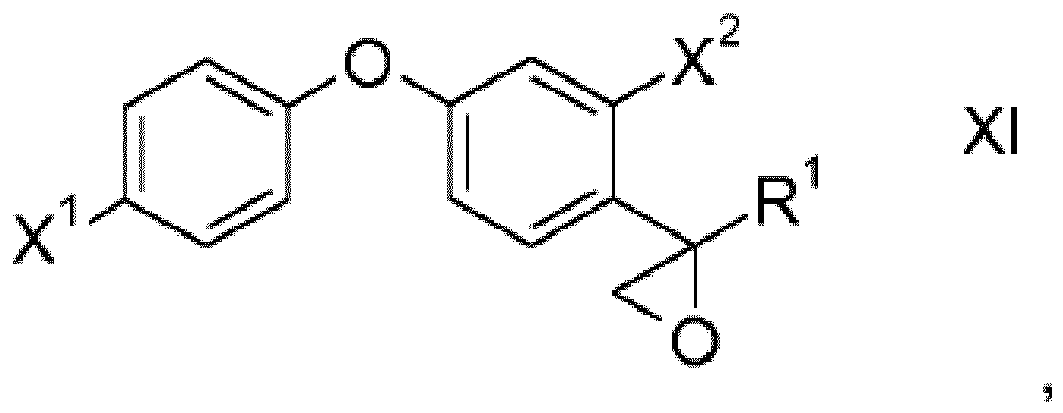
unter basischen Bedingungen mit 1H-1,2,4-Triazol umsetzt;
und die entstandene Verbindung der Formel VIII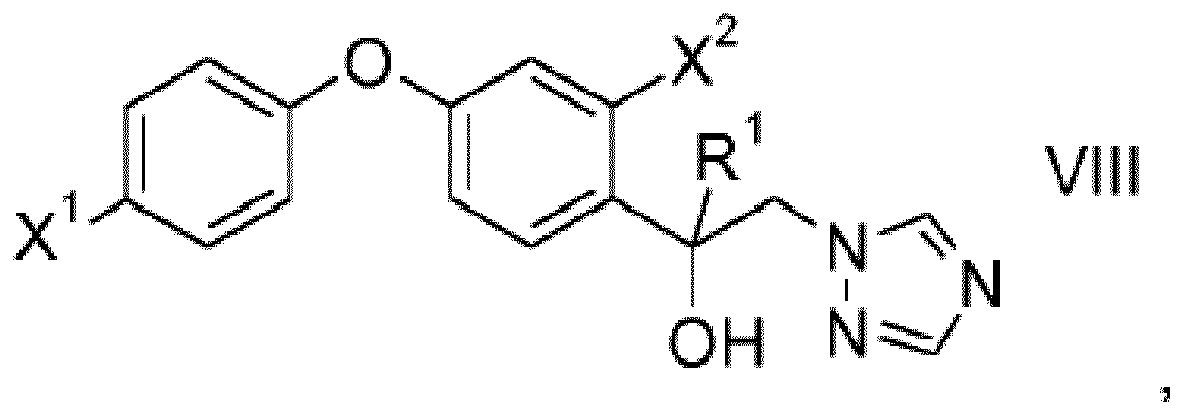
unter basischen Bedingungen mit R2-LG umsetzt, wobei R2 wie in Anspruch 1 oder 7 definiert ist und LG eine nukleophilaustauschbare Abgangsgruppe bedeutet,
wodurch man zu Verbindungen der Formel I gelangt. - Verfahren zur Herstellung von Verbindungen der Formel I wie in einem der Ansprüche 1 bis 8 definiert, bei dem man eine Verbindung der Formel XI

unter sauren Bedingungen mit R2-OH umsetzt, wobei R2 wie in den Ansprüchen 1 oder 7 definiert ist;
und die entstandene Verbindung der Formel XII
mit einem Halogenierungsmittel oder einem Sulfonierungsmittel umsetzt;
und die entstandene Verbindung der Formel XIII
wodurch man zu Verbindungen I gelangt. - Verbindungen der Formel XII

- Verbindungen der Formel VIII und XI
 1) von Verbindungen, worin X1 und X2 Cl bedeuten und R1 C3H5-(Cyclopropyl), 1-Cl-Cyclopropyl, 1-F-Cyclopropyl, C4H7, C6H11-(Cyclohexyl), CH2-C3H5, C5H9-(Cyclopentyl), CH(CH3)C3H5, 1-Methylcyclo-propyl oder 1-CN-Cyclopropyl bedeutet; und2) von Verbindungen worin X1 und X2 Cl bedeuten und R1 einen Rest AR1 bedeutet
 # den Anknüpfungspunkt an Formel VIII bedeutet,X C1-C4-Alkandiyl, C2-C4-Alkindiyl oder eine Bindung bedeutet;R Halogen, CN, Nitro, C1-C4-Alkyl, C1-C4-Alkoxy, C1-C4-Halogenalkyl oder C1-C4-Halogenalkoxy bedeutet;n eine ganzen Zahl bedeutet und 0, 1, 2, 3, 4 oder 5 bedeutet; und3) von Verbindungen worin X1 und X2 Cl bedeuten und R1 CH=CHC6H5, CH=CH(4-C1-C6H4), CH=CH(2,4-Cl2-C6H3), CH=CH(2,6-Cl2-C6H3), CH=CH(4-CH3-C6H4), CH=CH(4-OCH3-C6H4), CH=CH (3, 4-Cl2-C6-H3), CH=CH (2-F-C6H4), CH=CH(4-NO2-C6H4), CH=CH(2-NO2-C6H4), CH=CH(2-Cl-C6H4), CH=CH(4-F-C6H4) oder CH=CH(4-C2H5-C6H4) bedeutet.
 - Agrarchemische Zusammensetzungen, wobei die Zusammensetzungen einen Hilfsstoff und mindestens eine Verbindung der Formel I oder VIII wie in einem der Ansprüche 1 bis 8 oder 13 definiert, ein N-Oxid oder ein landwirtschaftlich annehmbares Salz davon umfassen.
- Agrarchemische Zusammensetzungen, wobei die Zusammensetzungen einen Hilfsstoff und mindestens eine Verbindung der Formel I wie in Anspruch 1 definiert, ein N-Oxid oder ein landwirtschaftlich annehmbares Salz davon, oder der Formel VIII wie in Anspruch 13 definiert und zusätzlich einen weiteren Wirkstoff umfassen.
- Zusammensetzungen nach Anspruch 15, wobei der weitere Wirkstoff aus den Gruppen A) bis O) ausgewählt ist:A) Atmungshemmern- Komplex-III-Hemmer im Qo-Zentrum (z.B. Strobilurinen): Azoxystrobin, Coumethoxystrobin, Coumoxystrobin, Dimoxystrobin, Enestroburin, Fenaminstrobin, Fenoxystrobin/Flufenoxystrobin, Fluoxastrobin, Kresoxim-methyl, Metominostrobin, Orysastrobin, Picoxystrobin, Pyraclostrobin, Pyrametostrobin, Pyraoxystrobin, Trifloxystrobin, 2-[2-(2,5-Dimethylphenoxymethyl)phenyl]-3-methoxyacrylsäuremethylester und 2-(2-(3-(2,6-Dichlorphenyl)-1-methylallylidenamino-oxymethyl)phenyl)-2-methoxyimino-N-methylacetamid, Pyribencarb, Triclopyricarb/Chlorodincarb, Famoxadon, Fenamidon;- Komplex-III-Hemmer am Qi-Zentrum: Cyazofamid, Amisulbrom, [(3S,6S,7R,8R)-8-Benzyl-3-[(3-acetoxy-4-methoxypyridin-2-carbonyl)amino]-6-methyl-4,9-dioxo-1,5-dioxonan-7-yl]-2-methylpropanoat, [(3S,6S,7R,8R)-8-Benzyl-3-[[3-(acetoxymethoxy)-4-methoxypyridin-2-carbonyl]amino]-6-methyl-4,9-dioxo-1,5-dioxonan-7-yl]-2-methylpropanoat, [(3S,6S,7R,8R)-8-Benzyl-3-[(3-isobutoxycarbonyloxy-4-methoxypyridin-2-carbonyl)amino]-6-methyl-4,9-dioxo-1,5-dioxonan-7-yl]-2-methylpropanoat, [(3S,6S,7R,8R)-8-Benzyl-3-[[3-(1,3-benzodioxol-5-ylmethoxy)-4-methoxypyridin-2-carbonyl]amino]-6-methyl-4,9-dioxo-1,5-dioxonan-7-yl]-2-methylpropanoat; (3S,6S,7R,8R)-3-[[(3-Hydroxy-4-methoxy-2-pyridinyl)carbonyl]amino]-6-methyl-4,9-dioxo-8-(phenylmethyl)-1,5-dioxonan-7-yl-2-methylpropanoat;- Komplex-II-Hemmern (z.B. Carboxamiden): Benodanil, Bixafen, Boscalid, Carboxin, Fenfuram, Fluopyram, Flutolanil, Fluxapyroxad, Furametpyr, Isopyrazam, Mepronil, Oxycarboxin, Penflufen, Penthiopyrad, Sedaxan, Tecloftalam, Thifluzamid, N-(4'-Trifluormethylthiobiphenyl-2-yl)-3-difluormethyl-1-methyl-1H-pyrazol-4-carboxamid, N-(2-(1,3,3-Trimethylbutyl)phenyl)-1,3-dimethyl-5-fluor-1H-pyrazol-4-carboxamid, N-[9-(Dichlormethylen)-1,2,3,4-tetrahydro-1,4-methanonaphthalin-5-yl]-3-(difluormethyl)-1-methyl-1H-pyrazol-4-carboxamid; 3-(Difluormethyl)-1-methyl-N-(1,1,3-trimethylindan-4-yl)pyrazol-4-carboxamid, 3-(Trifluormethyl)-1-methyl-N-(1,1,3-trimethylindan-4-yl)pyrazol-4-carboxamid, 1,3-Dimethyl-N-(1,1,3-trimethylindan-4-yl)pyrazol-4-carboxamid, 3-(Trifluormethyl)-1,5-dimethyl-N-(1,1,3-trimethylindan-4-yl)pyrazol-4-carboxamid, 3-(Difluormethyl)-1,5-dimethyl-N-(1,1,3-trimethylindan-4-yl)pyrazol-4-carboxamid, 1,3,5-Trimethyl-N-(1,1,3-trimethylindan-4-yl)pyrazol-4-carboxamid;- sonstigen Atmungshemmern (z.B. Komplex-I, Entkopplern): Diflumetorim, (5,8-Difluorchinazolin-4-yl)-{2-[2-fluor-4-(4-trifluormethylpyridin-2-yloxy)phenyl]ethyl}amin; Nitrophenylderivaten: Binapacryl, Dinobuton, Dinocap, Fluazinam; Ferimzon; metallorganischen Verbindungen: Fentin-Salzen, wie: Fentinacetat, Fentinchlorid oder Fentinhydroxid; Ametoctradin; und Silthiofam;B) Sterolbiosynthesehemmern (SBI-Fungiziden)- C14-Demethylasehemmern (DMI-Fungiziden): Triazolen: Azaconazol, Bitertanol, Bromuconazol, Cyproconazol, Difenoconazol, Diniconazol, Diniconazol-M, Epoxiconazol, Fenbuconazol, Fluquinconazol, Flusilazol, Flutriafol, Hexaconazol, Imibenconazol, Ipconazol, Metconazol, Myclobutanil, Oxpoconazol, Paclobutrazol, Penconazol, Propiconazol, Prothioconazol, Simeconazol, Tebuconazol, Tetraconazol, Triadimefon, Triadimenol, Triticonazol, Uniconazol, [rel-(2S;3R)-3-(2-Chlorphenyl)-2-(2,4-difluorphenyl)oxiranylmethyl]-5-thiocyanato-1H-[1,2,4]triazol, 2-[rel-(2S;3R)-3-(2-Chlorphenyl)-2-(2,4-difluorphenyl)oxiranylmethyl]-2H-[1,2,4]triazol-3-thiol; Imidazolen: Imazalil, Pefurazoat, Prochloraz, Triflumizol; Pyrimidinen, Pyridinen und Piperazinen: Fenarimol, Nuarimol, Pyrifenox, Triforin;- delta-14-Reduktasehemmern: Aldimorph, Dodemorph, Dodemorphacetat, Fenpropimorph, Tridemorph, Fenpropidin, Piperalin, Spiroxamin;- Hemmern der 3-Ketoreduktase: Fenhexamid;C) Nukleinsäuresynthesehemmern- Phenylamiden oder Acylaminosäurefungiziden: Benalaxyl, Benalaxyl-M, Kiralaxyl, Metalaxyl, Metalaxyl-M (Mefenoxam), Ofurace, Oxadixyl;- sonstigen: Hymexazol, Octhilinon, Oxolinsäure, Bupirimat, 5-Fluorcytosin, 5-Fluor-2-(p-tolyl-methoxy)pyrimidin-4-amin, 5-Fluor-2-(4-fluorphenylmethoxy)pyrimidin-4-amin;D) Hemmern der Zellteilung und des Cytoskeletts- Tubulinhemmern wie Benzimidazolen, Thiophanaten: Benomyl, Carbendazim, Fuberidazol, Thiabendazol, Thiophanatmethyl; Triazolopyrimidinen: 5-Chlor-7-(4-methylpiperidin-1-yl)-6-(2,4,6-trifluorphenyl)[1,2,4]triazolo[1,5-a]pyrimidin;- anderen Hemmern der Zellteilung: Diethofencarb, Ethaboxam, Pencycuron, Fluopicolid, Zoxamid, Metrafenon, Pyriofenon;E) Hemmern der Aminosäure- und Proteinsynthese- Methioninsynthesehemmern (Anilinopyrimidinen): Cyprodinil, Mepanipyrim, Pyrimethanil;- Proteinsynthesehemmern: Blasticidin-S, Kasugamycin, Kasugamycin-hydrochlorid-Hydrat, Mildiomycin, Streptomycin, Oxytetracyclin, Polyoxin, Validamycin A;F) Hemmern der Signalleitung- MAP/Histidinkinasehemmern: Fluorimid, Iprodion, Procymidon, Vinclozolin, Fenpiclonil, Fludioxonil;- G-Protein-Hemmern: Quinoxyfen;G) Lipid- und Membransynthesehemmern- Phospholipidbiosynthesehemmern: Edifenphos, Iprobenfos, Pyrazophos, Isoprothiolan;- Lipidperoxidation: Dicloran, Quintozen, Tecnazen, Tolclofos-methyl, Biphenyl, Chloroneb, Etridiazol;- Phospholipidbiosynthese und Zellwandablagerung: Dimethomorph, Flumorph, Mandipropamid, Pyrimorph, Benthiavalicarb, Iprovalicarb, Valifenalat und N-(1-(1-(4-Cyanophenyl)ethansulfonyl)but-2-yl)carbaminsäure-(4-fluorphenyl)ester;- Verbindungen, die die Zellmembranpermeabilität beeinflussen, und Fettsäuren: Propamocarb, Propamocarb-hydrochlorid;- Hemmern der Fettsäureamidhydrolase: 1-[4-[4-[5-(2,6-Difluorphenyl)-4,5-dihydro-3-isoxazolyl]-2-thiazolyl]-1-piperidinyl]-2-[5-methyl-3-(trifluormethyl)-1H-pyrazol-1-yl]ethanon;H) Hemmern mit Multisite-Wirkung- Anorganischen Wirkstoffen: Bordeaux-Brühe, Kupferacetat, Kupferhydroxid, Kupferoxychlorid, basisches Kupfersulfat, Schwefel;- Thio- und Dithiocarbamaten: Ferbam, Mancozeb, Maneb, Metam, Metiram, Propineb, Thiram, Zineb, Ziram;- Chlororganischen Verbindungen (z.B. Phthalimiden, Sulfamiden, Chlornitrilen): Anilazin, Chlorthalonil, Captafol, Captan, Folpet, Dichlofluanid, Dichlorphen, Flusulfamid, Hexachlorbenzol, Pentachlorphenol und seine Salze, Phthalid, Tolylfluanid, N-(4-Chlor-2-nitrophenyl)-N-ethyl-4-methylbenzolsulfonamid;- Guanidinen und sonstigen: Guanidin, Dodin, Dodin-freie Base, Guazatin, Guazatinacetat, Iminoctadin, Iminoctadintriacetat, Iminoctadin-tris(albesilat), Dithianon; 2,6-Dimethyl-1H,5H-[1,4]dithiino[2,3-c:5,6-c']dipyrrol-1,3,5,7(2H,6H)tetraon;I) Zellwandsynthesehemmern- Hemmern der Glucansynthese: Validamycin, Polyoxin B; Hemmern der Melaninsynthese: Pyroquilon, Tricyclazol, Carpropamid, Dicyclomet, Fenoxanil;J) Induktoren der pflanzlichen Abwehr- Acibenzolar-S-methyl, Probenazol, Isotianil, Tiadinil, Prohexadion-Calcium; Phosphonaten: Fosetyl, Fosetyl-Aluminium, phosphorige Säure und ihre Salze;K) Unbekannte Wirkungsweise- Bronopol, Chinomethionat, Cyflufenamid, Cymoxanil, Dazomet, Debacarb, Diclomezin, Difenzoquat, Difenzoquatmethylsulfat, Diphenylamin, Fenpyrazamin, Flumetover, Flusulfamid, Flutianil, Methasulfocarb, Nitrapyrin, Nitrothal-isopropyl, Oxin-Kupfer, Proquinazid, Tebufloquin, Tecloftalam, Triazoxid, 2-Butoxy-6-iod-3-propylchromen-4-on, N-(Cyclopropylmethoxyimino-(6-difluormethoxy-2,3-difluorphenyl)methyl)-2-phenylacetamid, N'-(4-(4-Chlor-3-trifluormethylphenoxy)-2,5-dimethylphenyl)-N-ethyl-N-methylformamidin, N'-(4-(4-Fluor-3-trifluormethylphenoxy)-2,5-dimethylphenyl)-N-ethyl-N-methylformamidin, N'-(2-Methyl-5-trifluormethyl-4-(3-trimethyl-silanylpropoxy)phenyl)-N-ethyl-N-methylformamidin, N'-(5-Difluormethyl-2-methyl-4-(3-trimethylsilanylpropoxy)phenyl)-N-ethyl-N-methyl-formamidin, 2-{1-[2-(5-Methyl-3-trifluor-methylpyrazol-1-yl)acetyl]piperidin-4-yl}thiazol-4-carbonsäuremethyl-(1,2,3,4-tetrahydronaphthalin-1-yl)amid, 2-{1-[2-(5-Methyl-3-trifluormethyl-pyrazol-1-yl)acetyl]piperidin-4-yl}-thiazol-4-carbonsäuremethyl-(R)-1,2,3,4-tetrahydronaphtha-lin-1-ylamid, 1-[4-[4-[5-(2,6-Difluorphenyl)-4,5-dihydro-3-isoxazolyl]-2-thiazolyl]-1-piperidinyl]-2-[5-methyl-3-(trifluormethyl)-1H-pyrazol-1-yl]-ethanon, Methoxyessigsäure-6-tert.-butyl-8-fluor-2,3-dimethylchinolin-4-ylester, N-Methyl-2-{1-[(5-methyl-3-trifluormethyl-1H-pyrazol-1-yl)acetyl]-piperidin-4-yl}-N-[(1R)-1,2,3,4-tetrahydro-naphthalin-1-yl]-4-thiazolcarboxamid, 3-[5-(4-Methylphenyl)-2,3-dimethylisoxazolidin-3-yl]pyridin, 3-[5-(4-Chlorphenyl)-2,3-dimethyl-isoxazolidin-3-yl]pyridin(pyrisoxazol), N-(6-Methoxypyridin-3-yl)cyclopropancarbonsäureamid, 5-Chlor-1-(4,6-dimethoxypyrimidin-2-yl)-2-methyl-1H-benzoimidazol, 2-(4-Chlorphenyl)-N-[4-(3,4-dimethoxyphenyl)isoxazol-5-yl]-2-prop-2-inyloxyacetamid;L) Antifungalen biologischen Bekämpfungsmitteln, Pflanzenbioaktivatoren: Ampelomyces quisqualis (z.B. AQ 10® von Intrachem Bio GmbH & Co. KG, Deutschland), Aspergillus flavus (z.B. AFLAGUARD® von Syngenta, CH), Aureobasidium pullulans (z.B. BOTECTOR® von bio-ferm GmbH, Deutschland), Bacillus pumilus (z.B. NRRL-Eingangs-Nr. B-30087 in SONATA® und BALLAD® Plus von AgraQuest Inc., USA), Bacillus subtilis (z.B. Isolat NRRL-Nr. B-21661 in RHAPSODY®, SERENADE® MAX und SERENADE® ASO von AgraQuest Inc., USA), Bacillus subtilis var. amyloliquefaciens FZB24 (z.B. TAEGRO® von Novozyme Biologicals, Inc., USA), Candida oleophila 1-82 (z.B. ASPIRE® von Ecogen Inc., USA), Candida saitoana (z.B. BIOCURE® (in Mischung mit Lysozym) und BIOCOAT® von Micro Flo Company, USA (BASF SE) und Arysta), Chitosan (z.B. ARMOUR-ZEN von BotriZen Ltd., NZ), Clonostachys rosea f. catenulata, auch Gliocladium catenulatum genannt (z.B. Isolat J1446: PRESTOP® der Firma Verdera, Finnland), Coniothyrium minitans (z.B. CONTANS® der Firma Prophyta, Deutschland), Cryphonectria parasitica (z.B. Endothia parasitica der Firma CNICM, Frankreich), Cryptococcus albidus (z.B. YIELD PLUS® der Firma Anchor Bio-Technologies, Südafrika), Fusarium oxysporum (z.B. BIOFOX® der Firma S.I.A.P.A., Italien, FUSACLEAN® der Firma Natural Plant Protection, Frankreich), Metschnikowia fructicola (z.B. SHEMER® der Firma Agrogreen, Israel), Microdochium dimerum (z.B. ANTIBOT® der Firma Agrauxine, Frankreich), Phlebiopsis gigantea (z.B. ROTSOP® der Firma Verdera, Finnland), Pseudozyma flocculosa (z.B. SPORODEX® der Firma Plant Products Co. Ltd., Kanada), Pythium oligandrum DV74 (z.B. POLYVERSUM® der Firma Remeslo SSRO, Biopreparaty, Tschechische Republik), Reynoutria sachlinensis (z.B. REGALIA® der Firma Marrone BioInnovations, USA), Talaromyces flavus V117b (z.B. PROTUS® der Firma Prophyta, Deutschland), Trichoderma asperellum SKT-1 (z.B. ECO-HOPE® der Firma Kumiai Chemical Industry Co., Ltd., Japan), T. atroviride LC52 (z.B. SENTINEL® der Firma Agrimm Technologies Ltd, NZ), T. harzianum T-22 (z.B. PLANTSHIELD® der Firma BioWorks Inc., USA), T. harzianum TH 35 (z.B. ROOT PRO® der Firma Mycontrol Ltd., Israel), T. harzianum T-39 (z.B. TRICHODEX® und TRICHODERMA 2000® der Firma Mycontrol Ltd., Israel und Makhteshim Ltd., Israel), T. harzianum und T. viride (z.B. TRICHOPEL der Firma Agrimm Technologies Ltd, NZ), T. harzianum ICC012 und T. viride ICC080 (z.B. REMEDIER® WP der Firma Isagro Ricerca, Italien), T. polysporum und T. harzianum (z.B. BINAB® der Firma BINAB BioInnovation AB, Schweden), T. stromaticum (z.B. TRICOVAB® der Firma C.E.P.L.A.C., Brasilien), T. virens GL-21 (z.B. SOILGARD® der Firma Certis LLC, USA), T. viride (z.B. TRIECO® der Firma Ecosense Labs. (Indien) Pvt. Ltd., Indien, BIO-CURE® F der Firma T. Stanes & Co. Ltd., Indien), T. viride TV1 (z.B. T. viride TV1 der Firma Agribiotec srl, Italien), Ulocladium oudemansii HRU3 (z.B. BOTRY-ZEN® der Firma Botry-Zen Ltd, NZ);M) Wachstumsregulatoren
Abszisinsäure, Amidochlor, Ancymidol, 6-Benzyl-aminopurin, Brassinolid, Butralin, Chlormequat (Chlormequatchlorid), Cholinchlorid, Cyclanilid, Daminozid, Dikegulac, Dimethipin, 2,6-Dimethylpuridin, Ethephon, Flumetralin, Flurprimidol, Fluthiacet, Forchlorfenuron, Gibberellinsäure, Inabenfid, Indol-3-essigsäure, Maleinsäurehydrazid, Mefluidid, Mepiquat (Mepiquatchlorid), Naphthalinessigsäure, N-6-Benzyladenin, Paclobutrazol, Prohexadion (Prohexadion-Calcium), Prohydrojasmon, Thidiazuron, Triapenthenol, Tributylphosphorotrithioat, 2,3,5-Triiodbenzoe-säure, Trinexapac-ethyl und Uniconazol;N) Herbiziden- Acetamiden: Acetochlor, Alachlor, Butachlor, Dimethachlor, Dimethenamid, Flufenacet, Mefenacet, Metolachlor, Metazachlor, Napropamid, Naproanilid, Pethoxamid, Pretilachlor, Propachlor, Thenylchlor;- Aminosäurederivaten: Bilanafos, Glyphosat, Glufosinat, Sulfosat;- Aryloxyphenoxypropionaten: Clodinafop, Cyhalofop-butyl, Fenoxaprop, Fluazifop, Haloxyfop, Metamifop, Propaquizafop, Quizalofop, Quizalofop-P-tefuryl;- Bipyridylen: Diquat, Paraquat;- (Thio)carbamaten: Asulam, Butylat, Carbetamid, Desmedipham, Dimepiperat, Eptam (EPTC), Esprocarb, Molinat, Orbencarb, Phenmedipham, Prosulfocarb, Pyributicarb, Thiobencarb, Triallat;- Cyclohexandionen: Butroxydim, Clethodim, Cycloxydim, Profoxydim, Sethoxydim, Tepraloxydim, Tralkoxydim;- Dinitroanilinen: Benfluralin, Ethalfluralin, Oryzalin, Pendimethalin, Prodiamin, Trifluralin;- Diphenylethern: Acifluorfen, Aclonifen, Bifenox, Diclofop, Ethoxyfen, Fomesafen, Lactofen, Oxyfluorfen;- Hydroxybenzonitrilen: Bromoxynil, Dichlobenil, Ioxynil;- Imidazolinonen: Imazamethabenz, Imazamox, Imazapic, Imazapyr, Imazachin, Imazethapyr;- Phenoxyessigsäuren: Clomeprop, 2,4-Dichlorphenoxyessigsäure (2,4-D), 2,4-DB, Dichlorprop, MCPA, MCPA-thioethyl, MCPB, Mecoprop;- Pyrazinen: Chloridazon, Flufenpyr-ethyl, Fluthiacet, Norflurazon, Pyridat;- Pyridinen: Aminopyralid, Clopyralid, Diflufenican, Dithiopyr, Fluridon, Fluroxypyr, Picloram, Picolinafen, Thiazopyr;- Sulfonylharnstoffen: Amidosulfuron, Azimsulfuron, Bensulfuron, Chlorimuron-ethyl, Chlorsulfuron, Cinosulfuron, Cyclosulfamuron, Ethoxysulfuron, Flazasulfuron, Flucetosulfuron, Flupyrsulfuron, Foramsulfuron, Halosulfuron, Imazosulfuron, Iodsulfuron, Mesosulfuron, Metazosulfuron, Metsulfuron-methyl, Nicosulfuron, Oxasulfuron, Primisulfuron, Prosulfuron, Pyrazosulfuron, Rimsulfuron, Sulfometuron, Sulfosulfuron, Thifensulfuron, Triasulfuron, Tribenuron, Trifloxysulfuron, Triflusulfuron, Tritosulfuron, 1-((2-Chlor-6-propylimidazo[1,2-b]pyridazin-3-yl)sulfonyl)-3-(4,6-dimethoxypyrimidin-2-yl)harnstoff;- Triazinen: Ametryn, Atrazin, Cyanazin, Dimethametryn, Ethiozin, Hexazinon, Metamitron, Metribuzin, Prometryn, Simazin, Terbuthylazin, Terbutryn, Triaziflam;- Harnstoffen: Chlortoluron, Daimuron, Diuron, Fluometuron, Isoproturon, Linuron, Methabenzthiazuron, Tebuthiuron;- sonstigen Acetolactatsynthasehemmern: Bispyribac-Natrium, Cloransulam-methyl, Diclosulam, Florasulam, Flucarbazon, Flumetsulam, Metosulam, ortho-Sulfamuron, Penoxsulam, Propoxycarbazon, Pyribambenz-propyl, Pyribenzoxim, Pyriftalid, Pyriminobac-methyl, Pyrimisulfan, Pyrithiobac, Pyroxasulfon, Pyroxsulam;- sonstigen: Amicarbazon, Aminotriazol, Anilofos, Beflubutamid, Benazolin, Bencarbazon, Benfluresat, Benzofenap, Bentazon, Benzobicyclon, Bicyclopyron, Bromacil, Brombutid, Butafenacil, Butamifos, Cafenstrol, Carfentrazon, Cinidon-ethyl, Chlorthal, Cinmethylin, Clomazon, Cumyluron, Cyprosulfamid, Dicamba, Difenzoquat, Diflufenzopyr, Drechslera monoceras, Endothal, Ethofumesat, Etobenzanid, Fenoxasulfon, Fentrazamid, Flumiclorac-pentyl, Flumioxazin, Flupoxam, Flurochloridon, Flurtamon, Indanofan, Isoxaben, Isoxaflutol, Lenacil, Propanil, Propyzamid, Quinclorac, Quinmerac, Mesotrion, Methylarsensäure, Naptalam, Oxadiargyl, Oxadiazon, Oxaziclomefon, Pentoxazon, Pinoxaden, Pyraclonil, Pyraflufen-ethyl, Pyrasulfotol, Pyrazoxyfen, Pyrazolynat, Quinoclamin, Saflufenacil, Sulcotrion, Sulfentrazon, Terbacil, Tefuryltrion, Tembotrion, Thiencarbazon, Topramezon, (3-[2-Chlor-4-fluor-5-(3-methyl-2,6-dioxo-4-trifluormethyl-3,6-dihydro-2H-pyrimidin-1-yl)phenoxy]pyridin-2-yloxy)essigsäureethylester, 6-Amino-5-chlor-2-cyclopropylpyrimidin-4-carbonsäuremethylester, 6-Chlor-3-(2-cyclopropyl-6-methylphenoxy)pyridazin-4-ol, 4-Amino-3-chlor-6-(4-chlorphenyl)-5-fluorpyridin-2-carbonsäure, 4-Amino-3-chlor-6-(4-chlor-2-fluor-3-methoxyphenyl)-pyridin-2-carbonsäuremethylester und 4-Amino-3-chlor-6-(4-chlor-3-dimethylamino-2-fluorphenyl)pyridin-2-carbonsäuremethylester. (0)Insektiziden- Organo(thio)phosphaten: Acephat, Azamethiphos, Azinphos-methyl, Chlorpyrifos, Chlorpyrifosmethyl, Chlorfenvinphos, Diazinon, Dichlorvos, Dicrotophos, Dimethoat, Disulfoton, Ethion, Fenitrothion, Fenthion, Isoxathion, Malathion, Methamidophos, Methidathion, Methylparathion, Mevinphos, Monocrotophos, Oxydemeton-methyl, Paraoxon, Parathion, Phenthoat, Phosalon, Phosmet, Phosphamidon, Phorat, Phoxim, Pirimiphos-methyl, Profenofos, Prothiofos, Sulprophos, Tetrachlorvinphos, Terbufos, Triazophos, Trichlorfon;- Carbamaten: Alanycarb, Aldicarb, Bendiocarb, Benfuracarb, Carbaryl, Carbofuran, Carbosulfan, Fenoxycarb, Furathiocarb, Methiocarb, Methomyl, Oxamyl, Pirimicarb, Propoxur, Thiodicarb, Triazamat;- Pyrethroiden: Allethrin, Bifenthrin, Cyfluthrin, Cyhalothrin, Cyphenothrin, Cypermethrin, alpha-Cypermethrin, beta-Cypermethrin, zeta-Cypermethrin, Deltamethrin, Esfenvalerat, Etofenprox, Fenpropathrin, Fenvalerat, Imiprothrin, lambda-Cyhalothrin, Permethrin, Prallethrin, Pyrethrin I und II, Resmethrin, Silafluofen, tau-Fluvalinat, Tefluthrin, Tetramethrin, Tralomethrin, Transfluthrin, Profluthrin, Dimefluthrin;- Insektenwachstumsregulatoren: a) Chitinsynthesehemmern: Benzoylharnstoffen: Chlorfluazuron, Cyramazin, Diflubenzuron, Flucycloxuron, Flufenoxuron, Hexaflumuron, Lufenuron, Novaluron, Teflubenzuron, Triflumuron; Buprofezin, Diofenolan, Hexythiazox, Etoxazol, Clofentazin; b) Ecdysonantagonisten: Halofenozid, Methoxyfenozid, Tebufenozid, Azadirachtin; c) Juvenoiden: Pyriproxyfen, Methopren, Fenoxycarb; d) Lipidbiosynthesehemmern: Spirodiclofen, Spiromesifen, Spirotetramat;- Nicotinsäurerezeptoragonisten/-antagonistenver-bindungen: Clothianidin, Dinotefuran, Flupyradifuron, Imidacloprid, Thiamethoxam, Nitenpyram, Acetamiprid, Thiacloprid, 1-(2-Chlorthiazol-5-ylmethyl)-2-nitrimino-3,5-dimethyl[1,3,5]triazinan;- GABA-Antagonistenverbindungen: Endosulfan, Ethiprol, Fipronil, Vaniliprol, Pyrafluprol, Pyriprol, 5-Amino-1-(2,6-dichlor-4-methylphenyl)-4-sulfinamoyl-1H-pyrazol-3-thiocarbonsäureamid;- makrozyklischen Lactoninsektiziden: Abamectin, Emamectin, Milbemectin, Lepimectin, Spinosad, Spinetoram;- Akariziden des Typs der mitochondrialen Elektronentransporthemmer (METI) I: Fenazaquin, Pyridaben, Tebufenpyrad, Tolfenpyrad, Flufenerim;- METI-II- und -III-Verbindungen: Acequinocyl, Fluacyprim, Hydramethylnon;- Entkopplern: Chlorfenapyr;- Hemmern der oxydativen Phosphorylierung: Cyhexatin, Diafenthiuron, Fenbutatinoxid, Propargit;- Verbindungen, die die Häutung unterbrechen: Cyromazin;- Oxidasehemmern mit Mischfunktion: Piperonylbutanolat;- Natriumkanalblockern: Indoxacarb, Metaflumizon;- sonstigen: Benclothiaz, Bifenazat, Cartap, Flonicamid, Pyridalyl, Pymetrozin, Schwefel, Thiocyclam, Flubendiamid, Chlorantraniliprol, Cyazypyr (HGW86), Cyenopyrafen, Flupyrazofos, Cyflumetofen, Amidoflumet, Imicyafos, Bistrifluron und Pyrifluquinazon. - Verwendung von Verbindungen der Formel I wie in einem der Ansprüche 1 bis 8 definiert, ihren N-Oxiden und landwirtschaftlich unbedenklichen Salzen, oder der Formel VIII wie in Anspruch 13 definiert, oder der Verbindungen wie in einem der Ansprüche 14 bis 16 definiert, für die Bekämpfung von phytopathogenen Pilzen, mit der Maßgabe, dass die Verwendung für die Bekämpfung von solchen Pilzen durch Behandlung des menschlichen oder tierischen Körpers ausgeschlossen ist.
- Saatgut, das mit mindestens einer Verbindung der Formel I oder VIII wie in einem der Ansprüche 1 bis 8 oder 13 definiert oder mit einer Zusammensetzung wie in einem der Ansprüche 14 bis 16 definiert in einer Menge von 0,1 g bis 10 kg pro 100 kg Saatgut beschichtet ist.
Priority Applications (1)
| Application Number | Priority Date | Filing Date | Title |
|---|---|---|---|
| EP12753093.9A EP2744795B1 (de) | 2011-08-15 | 2012-08-14 | Fungizide substituierte 1-{2-[2-halo-4-(4-halogen-phenoxy)-phenyl]-2-alkoxy-2-cyclyl-ethyl}-1h [1,2,4]triazol-verbindungen |
Applications Claiming Priority (3)
| Application Number | Priority Date | Filing Date | Title |
|---|---|---|---|
| EP11177555 | 2011-08-15 | ||
| EP12753093.9A EP2744795B1 (de) | 2011-08-15 | 2012-08-14 | Fungizide substituierte 1-{2-[2-halo-4-(4-halogen-phenoxy)-phenyl]-2-alkoxy-2-cyclyl-ethyl}-1h [1,2,4]triazol-verbindungen |
| PCT/EP2012/065847 WO2013024080A1 (en) | 2011-08-15 | 2012-08-14 | Fungicidal substituted 1-{2-[2-halo-4-(4-halogen-phenoxy)-phenyl ]-2-alkoxy-2-cyclyl-ethyl}-1h [1,2,4]triazole compounds |
Publications (2)
| Publication Number | Publication Date |
|---|---|
| EP2744795A1 EP2744795A1 (de) | 2014-06-25 |
| EP2744795B1 true EP2744795B1 (de) | 2015-12-30 |
Family
ID=46758729
Family Applications (1)
| Application Number | Title | Priority Date | Filing Date |
|---|---|---|---|
| EP12753093.9A Active EP2744795B1 (de) | 2011-08-15 | 2012-08-14 | Fungizide substituierte 1-{2-[2-halo-4-(4-halogen-phenoxy)-phenyl]-2-alkoxy-2-cyclyl-ethyl}-1h [1,2,4]triazol-verbindungen |
Country Status (19)
| Country | Link |
|---|---|
| US (1) | US20140187422A1 (de) |
| EP (1) | EP2744795B1 (de) |
| JP (1) | JP2014525406A (de) |
| KR (1) | KR20140054235A (de) |
| CN (1) | CN103717579B (de) |
| AR (1) | AR087537A1 (de) |
| AU (1) | AU2012296890A1 (de) |
| BR (1) | BR112014002499A2 (de) |
| CA (1) | CA2838332A1 (de) |
| CL (1) | CL2013003672A1 (de) |
| CO (1) | CO6900161A2 (de) |
| CR (1) | CR20130678A (de) |
| EA (1) | EA201400232A1 (de) |
| IL (1) | IL229954A0 (de) |
| MX (1) | MX2013014348A (de) |
| PE (1) | PE20141412A1 (de) |
| UY (1) | UY34261A (de) |
| WO (1) | WO2013024080A1 (de) |
| ZA (1) | ZA201401797B (de) |
Families Citing this family (36)
| Publication number | Priority date | Publication date | Assignee | Title |
|---|---|---|---|---|
| DK2731935T3 (en) | 2011-07-13 | 2016-06-06 | Basf Agro Bv | FUNGICIDE SUBSTITUTED 2- [2-HALOGENALKYL-4- (PHENOXY) -PHENYL] -1- [1,2,4] TRIAZOL-1-YLETHANOL COMPOUNDS |
| EP2731934A1 (de) | 2011-07-15 | 2014-05-21 | Basf Se | Fungizide alkyl- und arylsubstituierte 2-[2-chlor-4-(dihalo-phenoxy)-phenyl]-1-[1,2,4]triazol-1-yl-ethanolverbindungen |
| EA201400137A1 (ru) | 2011-07-15 | 2014-06-30 | Басф Се | Фунгицидные алкилзамещенные 2-[2-хлоро-4-(4-хлорофенокси)фенил]-1-[1,2,4]триазол-1-ил-этанольные соединения |
| CN103717577B (zh) | 2011-08-15 | 2016-06-15 | 巴斯夫欧洲公司 | 杀真菌的取代的1-{2-环基氧基-2-[2-卤代-4-(4-卤代苯氧基)苯基]乙基}-1h-[1,2,4]三唑化合物 |
| AR087538A1 (es) | 2011-08-15 | 2014-04-03 | Basf Se | Compuestos fungicidas de 1-{2-[2-halo-4-(4-halogen-fenoxi)-fenil]-2-alcoxi-2-alquinil/alquenil-etil}-1h-[1,2,4]triazol sustituidos |
| EP2744791B1 (de) | 2011-08-15 | 2015-10-28 | Basf Se | Fungizide substituierte 1-{2-[2-halo-4-(4-halogen-phenoxy-)phenyl-]2-alkoxy-3-methyl-butyl}-1h-[1,2,4-]triazol-verbindungen |
| WO2014082880A1 (en) | 2012-11-27 | 2014-06-05 | Basf Se | Substituted [1,2,4] triazole compounds |
| WO2014095381A1 (en) * | 2012-12-19 | 2014-06-26 | Basf Se | Fungicidal imidazolyl and triazolyl compounds |
| EA030875B1 (ru) | 2012-12-20 | 2018-10-31 | Басф Агро Б.В. | Композиции, содержащие триазольное соединение |
| CA2895256C (en) | 2013-01-09 | 2021-06-01 | BASF Agro B.V. | Process for the preparation of substituted oxiranes and triazoles |
| MX2015017636A (es) | 2013-06-18 | 2016-09-07 | Basf Se | Mezclas fungicidas i que comprenden fungicidas de tipo estrobilurina. |
| CN106028817A (zh) * | 2013-07-08 | 2016-10-12 | 巴斯夫农业公司 | 包含三唑化合物和生物农药的组合物 |
| EP2839745A1 (de) | 2013-08-21 | 2015-02-25 | Basf Se | Agrochemische Formulierungen enthaltend ein 2-Ethylhexanolalkoxylat |
| UA118214C2 (uk) | 2014-02-14 | 2018-12-10 | Басф Агро Б.В. | Здатний до емульгування концентрат, що включає пестицид, жирний амід і лактамід |
| EA201892682A1 (ru) | 2014-06-25 | 2019-04-30 | Басф Агро Б.В. | Пестицидные композиции |
| WO2016008740A1 (en) | 2014-07-14 | 2016-01-21 | Basf Se | Pesticidal compositions |
| UA120628C2 (uk) | 2014-11-07 | 2020-01-10 | Басф Се | Пестицидні суміші |
| EP3028573A1 (de) | 2014-12-05 | 2016-06-08 | Basf Se | Verwendung eines triazolfungizids auf transgenen pflanzen |
| PL3316692T3 (pl) | 2015-07-02 | 2021-10-11 | BASF Agro B.V. | Kompozycje owadobójcze zawierające związek triazolowy |
| EP3111763A1 (de) | 2015-07-02 | 2017-01-04 | BASF Agro B.V. | Pestizidzusammensetzungen mit einer triazolverbindung |
| CN105693638B (zh) * | 2016-01-05 | 2018-12-04 | 浙江博仕达作物科技有限公司 | 一种杀菌化合物、杀菌剂组合物和制剂及其应用 |
| CN105669576B (zh) * | 2016-02-22 | 2018-12-04 | 浙江博仕达作物科技有限公司 | 一种杀菌化合物、杀菌剂组合物和制剂及其应用 |
| US11241012B2 (en) | 2016-03-16 | 2022-02-08 | Basf Se | Use of tetrazolinones for combating resistant phytopathogenic fungi on soybean |
| ES3056157T3 (en) | 2016-03-16 | 2026-02-18 | Basf Se | Use of a specific tetrazolinone for combating resistant phytopathogenic fungi on cereals |
| CA3015456C (en) | 2016-03-16 | 2024-09-17 | Basf Se | USE OF TETRAZOLINONES TO CONTROL RESISTANT PLANT PATHOGENIC FUNGI ON FRUIT |
| CN109715621A (zh) | 2016-09-22 | 2019-05-03 | 拜耳作物科学股份公司 | 新的三唑衍生物 |
| US20190281828A1 (en) | 2016-09-22 | 2019-09-19 | Bayer Cropscience Aktiengesellschaft | Novel triazole derivatives |
| BR112019016241A2 (pt) | 2017-02-08 | 2020-04-07 | Bayer Cropscience Ag | derivados de triazol e seu uso como fungicidas |
| EA201991839A1 (ru) | 2017-02-08 | 2020-02-17 | Байер Акциенгезельшафт | Новые производные триазолтиона |
| WO2018145934A1 (en) | 2017-02-08 | 2018-08-16 | Bayer Cropscience Aktiengesellschaft | Novel triazole derivatives |
| CA3052898A1 (en) | 2017-02-10 | 2018-08-16 | Bayer Aktiengesellschaft | Composition for controlling harmful microorganisms comprising 1 -(phenoxy-pyridinyl)-2-(1,2,4-triazol-1 -yl)-ethanol derivatives |
| EP3421460A1 (de) | 2018-03-15 | 2019-01-02 | Bayer Aktiengesellschaft | 2-[(4-alkylphenoxy)-pyridinyl]-1-(1,2,4-triazol-1-yl)alkan-2-ol fungizide |
| WO2020020813A1 (en) | 2018-07-25 | 2020-01-30 | Bayer Aktiengesellschaft | Fungicidal active compound combinations |
| WO2020020816A1 (en) | 2018-07-26 | 2020-01-30 | Bayer Aktiengesellschaft | Novel triazole derivatives |
| EP3620053A1 (de) | 2018-12-14 | 2020-03-11 | Bayer Aktiengesellschaft | Wirkstoffkombinationen von fungiziden |
| CN112442018B (zh) * | 2019-08-27 | 2024-02-02 | 东莞市东阳光农药研发有限公司 | 三唑-1,3-二磺酰胺衍生物及其在农业中的应用 |
Family Cites Families (66)
| Publication number | Priority date | Publication date | Assignee | Title |
|---|---|---|---|---|
| US3325503A (en) | 1965-02-18 | 1967-06-13 | Diamond Alkali Co | Polychloro derivatives of mono- and dicyano pyridines and a method for their preparation |
| US3296272A (en) | 1965-04-01 | 1967-01-03 | Dow Chemical Co | Sulfinyl- and sulfonylpyridines |
| BG48681A3 (bg) * | 1982-12-14 | 1991-04-15 | Ciba - Geigy Ag | Фунгицидно средство |
| EP0126430B1 (de) | 1983-05-19 | 1991-08-28 | Ciba-Geigy Ag | Verfahren zur Herstellung von 1-Triazolylethylether-Derivaten, sowie mikrobizide Mittel enthaltende neue 1-triazolyl-phenoxyphenylethylether-derivate als Wirkstoffe und deren Verwendung |
| DE3338292A1 (de) | 1983-10-21 | 1985-05-02 | Basf Ag, 6700 Ludwigshafen | 7-amino-azolo(1,5-a)-pyrimidine und diese enthaltende fungizide |
| CA1249832A (en) | 1984-02-03 | 1989-02-07 | Shionogi & Co., Ltd. | Azolyl cycloalkanol derivatives and agricultural fungicides |
| US4595100A (en) * | 1984-09-07 | 1986-06-17 | Chabot Paul Andre | Coin holder |
| BR8600161A (pt) | 1985-01-18 | 1986-09-23 | Plant Genetic Systems Nv | Gene quimerico,vetores de plasmidio hibrido,intermediario,processo para controlar insetos em agricultura ou horticultura,composicao inseticida,processo para transformar celulas de plantas para expressar uma toxina de polipeptideo produzida por bacillus thuringiensis,planta,semente de planta,cultura de celulas e plasmidio |
| DE3545319A1 (de) | 1985-12-20 | 1987-06-25 | Basf Ag | Acrylsaeureester und fungizide, die diese verbindungen enthalten |
| CN1050538A (zh) | 1986-05-02 | 1991-04-10 | 施托福化学公司 | 杀真菌性吡啶基亚胺组合物及杀真菌方法 |
| ES2011602T3 (es) | 1986-08-12 | 1994-07-16 | Mitsubishi Chem Ind | Derivados de piridinacarboxamida y su uso como fungicidas. |
| EP0275955B1 (de) | 1987-01-21 | 1990-07-04 | Ciba-Geigy Ag | Mikrobizides Mittel |
| DE3801233A1 (de) * | 1987-01-21 | 1988-08-04 | Ciba Geigy Ag | Mikrobizides mittel |
| EP0374753A3 (de) | 1988-12-19 | 1991-05-29 | American Cyanamid Company | Insektizide Toxine, Gene, die diese Toxine kodieren, Antikörper, die sie binden, sowie transgene Pflanzenzellen und transgene Pflanzen, die diese Toxine exprimieren |
| EP0392225B1 (de) | 1989-03-24 | 2003-05-28 | Syngenta Participations AG | Krankheitsresistente transgene Pflanze |
| EP0427529B1 (de) | 1989-11-07 | 1995-04-19 | Pioneer Hi-Bred International, Inc. | Larven abtötende Lektine und darauf beruhende Pflanzenresistenz gegen Insekten |
| AU628229B2 (en) | 1989-11-10 | 1992-09-10 | Agro-Kanesho Co. Ltd. | Hexahydrotriazine compounds and insecticides |
| DE4003180A1 (de) | 1990-02-03 | 1991-08-08 | Bayer Ag | Halogenallyl-azolyl-derivate |
| JP2828186B2 (ja) | 1991-09-13 | 1998-11-25 | 宇部興産株式会社 | アクリレート系化合物、その製法及び殺菌剤 |
| UA48104C2 (uk) | 1991-10-04 | 2002-08-15 | Новартіс Аг | Фрагмент днк, який містить послідовність,що кодує інсектицидний протеїн, оптимізовану для кукурудзи,фрагмент днк, який забезпечує направлену бажану для серцевини стебла експресію зв'язаного з нею структурного гена в рослині, фрагмент днк, який забезпечує специфічну для пилку експресію зв`язаного з нею структурного гена в рослині, рекомбінантна молекула днк, спосіб одержання оптимізованої для кукурудзи кодуючої послідовності інсектицидного протеїну, спосіб захисту рослин кукурудзи щонайменше від однієї комахи-шкідника |
| US5530195A (en) | 1994-06-10 | 1996-06-25 | Ciba-Geigy Corporation | Bacillus thuringiensis gene encoding a toxin active against insects |
| DE19650197A1 (de) | 1996-12-04 | 1998-06-10 | Bayer Ag | 3-Thiocarbamoylpyrazol-Derivate |
| TW460476B (en) | 1997-04-14 | 2001-10-21 | American Cyanamid Co | Fungicidal trifluoromethylalkylamino-triazolopyrimidines |
| PL193553B1 (pl) | 1997-09-18 | 2007-02-28 | Basf Ag | Pochodne benzamidoksymu, benzamidoksymy, zastosowanie pochodnych benzamidoksymu i środek grzybobójczy |
| DE19750012A1 (de) | 1997-11-12 | 1999-05-20 | Bayer Ag | Isothiazolcarbonsäureamide |
| BR9813376A (pt) | 1997-12-04 | 2001-06-19 | Dow Agrosciences Llc | Composição fungicidas e métodos e compostos para a preparação das mesmas |
| US6576631B1 (en) | 1998-11-17 | 2003-06-10 | Kumiai Chemical Industry Co., Ltd. | Pyrimidinylbenzimidazole and triazinylbenzimidazole derivatives and agricultural/horticultural bactericides |
| IT1303800B1 (it) | 1998-11-30 | 2001-02-23 | Isagro Ricerca Srl | Composti dipeptidici aventi elevata attivita' fungicida e loroutilizzo agronomico. |
| JP3417862B2 (ja) | 1999-02-02 | 2003-06-16 | 新東工業株式会社 | 酸化チタン光触媒高担持シリカゲルおよびその製造方法 |
| AU770077B2 (en) | 1999-03-11 | 2004-02-12 | Dow Agrosciences Llc | Heterocyclic substituted isoxazolidines and their use as fungicides |
| US6586617B1 (en) | 1999-04-28 | 2003-07-01 | Sumitomo Chemical Takeda Agro Company, Limited | Sulfonamide derivatives |
| UA73307C2 (uk) | 1999-08-05 | 2005-07-15 | Куміаі Кемікал Індастрі Ко., Лтд. | Похідна карбамату і фунгіцид сільськогосподарського/садівницького призначення |
| DE10021412A1 (de) | 1999-12-13 | 2001-06-21 | Bayer Ag | Fungizide Wirkstoffkombinationen |
| WO2001054501A2 (en) | 2000-01-25 | 2001-08-02 | Syngenta Participations Ag | Herbicidal composition |
| US6376548B1 (en) | 2000-01-28 | 2002-04-23 | Rohm And Haas Company | Enhanced propertied pesticides |
| IL167958A (en) | 2000-02-04 | 2010-11-30 | Sumitomo Chemical Co | 2-thio 3-hydroxypyridine derivatives |
| AU2001285900B2 (en) | 2000-08-25 | 2005-02-17 | Syngenta Participations Ag | Novel insecticidal toxins derived from bacillus thuringiensis insecticidal crystal proteins |
| EP1322614A2 (de) | 2000-09-18 | 2003-07-02 | E. I. du Pont de Nemours and Company | Pyridinamide und -imide und ihre verwendung als fungizide |
| US6815556B2 (en) | 2000-11-17 | 2004-11-09 | Dow Agrosciences Llc | Compounds having fungicidal activity and processes to make and use same |
| JP5034142B2 (ja) | 2001-04-20 | 2012-09-26 | 住友化学株式会社 | 植物病害防除剤組成物 |
| DE10136065A1 (de) | 2001-07-25 | 2003-02-13 | Bayer Cropscience Ag | Pyrazolylcarboxanilide |
| AR037228A1 (es) | 2001-07-30 | 2004-11-03 | Dow Agrosciences Llc | Compuestos del acido 6-(aril o heteroaril)-4-aminopicolinico, composicion herbicida que los comprende y metodo para controlar vegetacion no deseada |
| FR2828196A1 (fr) | 2001-08-03 | 2003-02-07 | Aventis Cropscience Sa | Derives de chromone a action fongicide, procede de preparation et application dans le domaine de l'agriculture |
| CN1543455B (zh) | 2001-08-17 | 2012-07-11 | 三井化学Agro株式会社 | 3-苯氧基-4-哒嗪醇衍生物以及含有它的除草剂组合物 |
| US7230167B2 (en) | 2001-08-31 | 2007-06-12 | Syngenta Participations Ag | Modified Cry3A toxins and nucleic acid sequences coding therefor |
| AR037856A1 (es) | 2001-12-17 | 2004-12-09 | Syngenta Participations Ag | Evento de maiz |
| AU2002354251A1 (en) | 2001-12-21 | 2003-07-09 | Nissan Chemical Industries, Ltd. | Bactericidal composition |
| TWI327462B (en) | 2002-01-18 | 2010-07-21 | Sumitomo Chemical Co | Condensed heterocyclic sulfonyl urea compound, a herbicide containing the same, and a method for weed control using the same |
| US20030166476A1 (en) | 2002-01-31 | 2003-09-04 | Winemiller Mark D. | Lubricating oil compositions with improved friction properties |
| DE10204390A1 (de) | 2002-02-04 | 2003-08-14 | Bayer Cropscience Ag | Disubstituierte Thiazolylcarboxanilide |
| KR100818540B1 (ko) | 2002-03-05 | 2008-04-01 | 신젠타 파티서페이션즈 아게 | O-사이클로프로필-카복스아닐리드 및 이를 포함하는 살진균 조성물 |
| GB0227966D0 (en) | 2002-11-29 | 2003-01-08 | Syngenta Participations Ag | Organic Compounds |
| WO2004083193A1 (ja) | 2003-03-17 | 2004-09-30 | Sumitomo Chemical Company, Limited | アミド化合物およびこれを含有する殺菌剤組成物 |
| TWI355894B (en) | 2003-12-19 | 2012-01-11 | Du Pont | Herbicidal pyrimidines |
| EA009883B1 (ru) | 2004-03-10 | 2008-04-28 | Басф Акциенгезельшафт | 5, 6-диалкил-7-амино-триазолопиримидины, способ их получения и их применение для борьбы с патогенными растениями, а также содержащие их средства |
| US9487519B2 (en) | 2004-03-10 | 2016-11-08 | Basf Se | 5,6-Dialkyl-7-aminotriazolopyrimidines, their preparation and their use for controlling harmful fungi, and compositions comprising these compounds |
| CA2564813A1 (en) | 2004-06-03 | 2005-12-22 | E.I. Du Pont De Nemours And Company | Fungicidal mixtures of amidinylphenyl compounds |
| JP2008502625A (ja) | 2004-06-18 | 2008-01-31 | ビーエーエスエフ アクチェンゲゼルシャフト | N−(オルト−フェニル)−1−メチル−3−トリフルオロメチルピラゾール−4−カルボキシアニリドおよびそれらの殺菌剤としての使用 |
| US20080108686A1 (en) | 2004-06-18 | 2008-05-08 | Basf Aktiengesellschaft | N-(Ortho-Phenyl)-1-Methyl-3-Difluoromethylpyrazole-4-Carboxanilides And Their Use As Fungicides |
| GB0418048D0 (en) | 2004-08-12 | 2004-09-15 | Syngenta Participations Ag | Method for protecting useful plants or plant propagation material |
| DE502006001074D1 (de) | 2005-02-16 | 2008-08-21 | Basf Se | 5-alkoxyalkyl-6-alkyl-7-amino-azolopyrimidine, verfahren zu ihrer herstellung und ihre verwendung zur bekämpfung von schadpilzen sowie sie enthaltende mittel |
| DE102005007160A1 (de) | 2005-02-16 | 2006-08-24 | Basf Ag | Pyrazolcarbonsäureanilide, Verfahren zu ihrer Herstellung und sie enthaltende Mittel zur Bekämpfung von Schadpilzen |
| DE102005009458A1 (de) | 2005-03-02 | 2006-09-07 | Bayer Cropscience Ag | Pyrazolylcarboxanilide |
| MY143535A (en) | 2006-01-13 | 2011-05-31 | Dow Agrosciences Llc | 6-(poly-substituted aryl)-4-aminopicolinates and their use as herbicides |
| EP1983832A2 (de) | 2006-02-09 | 2008-10-29 | Syngeta Participations AG | Verfahren zum schützen von pflanzlichem vermehrungsmaterials, von einer pflanze und/oder von pflanzenorganen |
| US8470840B2 (en) | 2009-09-01 | 2013-06-25 | Dow Agrosciences, Llc. | Synergistic fungicidal compositions containing a 5-fluoropyrimidine derivative for fungal control in cereals |
-
2012
- 2012-08-14 BR BR112014002499A patent/BR112014002499A2/pt not_active Application Discontinuation
- 2012-08-14 AU AU2012296890A patent/AU2012296890A1/en not_active Abandoned
- 2012-08-14 EP EP12753093.9A patent/EP2744795B1/de active Active
- 2012-08-14 MX MX2013014348A patent/MX2013014348A/es unknown
- 2012-08-14 UY UY0001034261A patent/UY34261A/es unknown
- 2012-08-14 WO PCT/EP2012/065847 patent/WO2013024080A1/en not_active Ceased
- 2012-08-14 AR ARP120102977A patent/AR087537A1/es unknown
- 2012-08-14 CA CA2838332A patent/CA2838332A1/en not_active Abandoned
- 2012-08-14 PE PE2014000200A patent/PE20141412A1/es not_active Application Discontinuation
- 2012-08-14 EA EA201400232A patent/EA201400232A1/ru unknown
- 2012-08-14 US US14/237,444 patent/US20140187422A1/en not_active Abandoned
- 2012-08-14 KR KR1020147006616A patent/KR20140054235A/ko not_active Withdrawn
- 2012-08-14 CN CN201280039231.2A patent/CN103717579B/zh active Active
- 2012-08-14 JP JP2014525425A patent/JP2014525406A/ja active Pending
-
2013
- 2013-12-17 IL IL229954A patent/IL229954A0/en unknown
- 2013-12-19 CR CR20130678A patent/CR20130678A/es unknown
- 2013-12-20 CL CL2013003672A patent/CL2013003672A1/es unknown
-
2014
- 2014-03-12 ZA ZA2014/01797A patent/ZA201401797B/en unknown
- 2014-03-13 CO CO14053890A patent/CO6900161A2/es unknown
Also Published As
| Publication number | Publication date |
|---|---|
| UY34261A (es) | 2013-02-28 |
| ZA201401797B (en) | 2016-01-27 |
| CN103717579A (zh) | 2014-04-09 |
| WO2013024080A1 (en) | 2013-02-21 |
| EP2744795A1 (de) | 2014-06-25 |
| EA201400232A1 (ru) | 2014-07-30 |
| MX2013014348A (es) | 2014-04-30 |
| IL229954A0 (en) | 2014-03-06 |
| US20140187422A1 (en) | 2014-07-03 |
| CN103717579B (zh) | 2016-10-12 |
| CO6900161A2 (es) | 2014-03-20 |
| AR087537A1 (es) | 2014-04-03 |
| CA2838332A1 (en) | 2013-02-21 |
| BR112014002499A2 (pt) | 2017-02-21 |
| CL2013003672A1 (es) | 2014-07-11 |
| AU2012296890A1 (en) | 2014-02-20 |
| JP2014525406A (ja) | 2014-09-29 |
| CR20130678A (es) | 2014-03-13 |
| PE20141412A1 (es) | 2014-10-23 |
| KR20140054235A (ko) | 2014-05-08 |
Similar Documents
| Publication | Publication Date | Title |
|---|---|---|
| EP2744795B1 (de) | Fungizide substituierte 1-{2-[2-halo-4-(4-halogen-phenoxy)-phenyl]-2-alkoxy-2-cyclyl-ethyl}-1h [1,2,4]triazol-verbindungen | |
| EP2744794B1 (de) | Fungizide substituierte 1-{2-cyclyloxy-2-[2-halo-4-(4-halogen-phenoxy)-phenyl]-ethyl}-1h-[1,2,4]triazol-verbindungen | |
| EP2744791B1 (de) | Fungizide substituierte 1-{2-[2-halo-4-(4-halogen-phenoxy-)phenyl-]2-alkoxy-3-methyl-butyl}-1h-[1,2,4-]triazol-verbindungen | |
| EP2744790B1 (de) | Fungizide substituierte 1-{2-[2-halo-4-(4-halogen-phenoxy)-phenyl]-2-alkoxy-2-alkynyl-ethyl}-1h [1,2,4]triazol-verbindungen | |
| EP2744793B1 (de) | Fungizide substituierte 1-{2-[2-halo-4-(4-halogen-phenoxy)-phenyl]-2-ethoxy-ethyl}-1h [1,2,4]triazol-verbindungen | |
| US10358426B2 (en) | Fungicidal substituted 2-[2-halogenalkyl-4-(phenoxy)-phenyl]-1-[1,2,4]triazol-1-yl-ethanol compounds | |
| EP2744792B1 (de) | Fungizide substituierte 1-{2-[2-halo-4-(4-halogen-phenoxy)-phenyl]-2-alkynyloxy-ethyl}-1h [1,2,4]triazol-verbindungen | |
| US9173402B2 (en) | Fungicidal alkyl-substituted 2[2-chloro-4-(4-chioro-phenoxy)-phenyl]-1[1,2,4]triazol-1-yl-ethanol compounds | |
| US9137996B2 (en) | Fungicidal alkyl- and aryl-substituted 2[-2-chloro-4-(dihalo-phenoxy)-phenyl]-1-[1,2,4]triazol-1-yl-ethanol compounds | |
| US20140187423A1 (en) | Fungicidal substituted 1--1H-[1,2,4]triazole compounds | |
| US20140141974A1 (en) | Fungicidal phenylalkyl-substituted 2-[2-chloro-4-(4-chloro-phenoxy)-phenyl]-1-[1,2,4]triazol-1-yl-ethanol compounds | |
| EP2559688A1 (de) | Fungizide substituierte 1-{2-[2-halo-4-(4-halogen-phenoxy)-phenyl]-2-butoxy-ethyl}-1h [1,2,4]triazol-Verbindungen | |
| EP2815648A1 (de) | Neuartige Strobilurin-Verbindungen zur Bekämpfung phytopathogenetischer Pilze | |
| EP2746266A1 (de) | Neue substituierte Triazole und Imidazole sowie ihre Verwendung als Fungizide | |
| EP2746276A1 (de) | Neue substituierte Triazole und Imidazole sowie ihre Verwendung als Fungizide |
Legal Events
| Date | Code | Title | Description |
|---|---|---|---|
| PUAI | Public reference made under article 153(3) epc to a published international application that has entered the european phase |
Free format text: ORIGINAL CODE: 0009012 |
|
| 17P | Request for examination filed |
Effective date: 20140317 |
|
| AK | Designated contracting states |
Kind code of ref document: A1 Designated state(s): AL AT BE BG CH CY CZ DE DK EE ES FI FR GB GR HR HU IE IS IT LI LT LU LV MC MK MT NL NO PL PT RO RS SE SI SK SM TR |
|
| DAX | Request for extension of the european patent (deleted) | ||
| 17Q | First examination report despatched |
Effective date: 20150128 |
|
| GRAP | Despatch of communication of intention to grant a patent |
Free format text: ORIGINAL CODE: EPIDOSNIGR1 |
|
| INTG | Intention to grant announced |
Effective date: 20150709 |
|
| GRAS | Grant fee paid |
Free format text: ORIGINAL CODE: EPIDOSNIGR3 |
|
| GRAA | (expected) grant |
Free format text: ORIGINAL CODE: 0009210 |
|
| AK | Designated contracting states |
Kind code of ref document: B1 Designated state(s): AL AT BE BG CH CY CZ DE DK EE ES FI FR GB GR HR HU IE IS IT LI LT LU LV MC MK MT NL NO PL PT RO RS SE SI SK SM TR |
|
| REG | Reference to a national code |
Ref country code: GB Ref legal event code: FG4D |
|
| REG | Reference to a national code |
Ref country code: CH Ref legal event code: EP |
|
| REG | Reference to a national code |
Ref country code: AT Ref legal event code: REF Ref document number: 767415 Country of ref document: AT Kind code of ref document: T Effective date: 20160115 |
|
| REG | Reference to a national code |
Ref country code: IE Ref legal event code: FG4D |
|
| REG | Reference to a national code |
Ref country code: DE Ref legal event code: R096 Ref document number: 602012013406 Country of ref document: DE |
|
| REG | Reference to a national code |
Ref country code: LT Ref legal event code: MG4D |
|
| PG25 | Lapsed in a contracting state [announced via postgrant information from national office to epo] |
Ref country code: HR Free format text: LAPSE BECAUSE OF FAILURE TO SUBMIT A TRANSLATION OF THE DESCRIPTION OR TO PAY THE FEE WITHIN THE PRESCRIBED TIME-LIMIT Effective date: 20151230 Ref country code: NO Free format text: LAPSE BECAUSE OF FAILURE TO SUBMIT A TRANSLATION OF THE DESCRIPTION OR TO PAY THE FEE WITHIN THE PRESCRIBED TIME-LIMIT Effective date: 20160330 Ref country code: LT Free format text: LAPSE BECAUSE OF FAILURE TO SUBMIT A TRANSLATION OF THE DESCRIPTION OR TO PAY THE FEE WITHIN THE PRESCRIBED TIME-LIMIT Effective date: 20151230 |
|
| REG | Reference to a national code |
Ref country code: NL Ref legal event code: MP Effective date: 20151230 |
|
| REG | Reference to a national code |
Ref country code: AT Ref legal event code: MK05 Ref document number: 767415 Country of ref document: AT Kind code of ref document: T Effective date: 20151230 |
|
| PG25 | Lapsed in a contracting state [announced via postgrant information from national office to epo] |
Ref country code: RS Free format text: LAPSE BECAUSE OF FAILURE TO SUBMIT A TRANSLATION OF THE DESCRIPTION OR TO PAY THE FEE WITHIN THE PRESCRIBED TIME-LIMIT Effective date: 20151230 Ref country code: LV Free format text: LAPSE BECAUSE OF FAILURE TO SUBMIT A TRANSLATION OF THE DESCRIPTION OR TO PAY THE FEE WITHIN THE PRESCRIBED TIME-LIMIT Effective date: 20151230 Ref country code: FI Free format text: LAPSE BECAUSE OF FAILURE TO SUBMIT A TRANSLATION OF THE DESCRIPTION OR TO PAY THE FEE WITHIN THE PRESCRIBED TIME-LIMIT Effective date: 20151230 Ref country code: GR Free format text: LAPSE BECAUSE OF FAILURE TO SUBMIT A TRANSLATION OF THE DESCRIPTION OR TO PAY THE FEE WITHIN THE PRESCRIBED TIME-LIMIT Effective date: 20160331 Ref country code: SE Free format text: LAPSE BECAUSE OF FAILURE TO SUBMIT A TRANSLATION OF THE DESCRIPTION OR TO PAY THE FEE WITHIN THE PRESCRIBED TIME-LIMIT Effective date: 20151230 |
|
| PG25 | Lapsed in a contracting state [announced via postgrant information from national office to epo] |
Ref country code: NL Free format text: LAPSE BECAUSE OF FAILURE TO SUBMIT A TRANSLATION OF THE DESCRIPTION OR TO PAY THE FEE WITHIN THE PRESCRIBED TIME-LIMIT Effective date: 20151230 |
|
| PG25 | Lapsed in a contracting state [announced via postgrant information from national office to epo] |
Ref country code: ES Free format text: LAPSE BECAUSE OF FAILURE TO SUBMIT A TRANSLATION OF THE DESCRIPTION OR TO PAY THE FEE WITHIN THE PRESCRIBED TIME-LIMIT Effective date: 20151230 Ref country code: IT Free format text: LAPSE BECAUSE OF FAILURE TO SUBMIT A TRANSLATION OF THE DESCRIPTION OR TO PAY THE FEE WITHIN THE PRESCRIBED TIME-LIMIT Effective date: 20151230 Ref country code: CZ Free format text: LAPSE BECAUSE OF FAILURE TO SUBMIT A TRANSLATION OF THE DESCRIPTION OR TO PAY THE FEE WITHIN THE PRESCRIBED TIME-LIMIT Effective date: 20151230 |
|
| REG | Reference to a national code |
Ref country code: FR Ref legal event code: PLFP Year of fee payment: 5 |
|
| PG25 | Lapsed in a contracting state [announced via postgrant information from national office to epo] |
Ref country code: EE Free format text: LAPSE BECAUSE OF FAILURE TO SUBMIT A TRANSLATION OF THE DESCRIPTION OR TO PAY THE FEE WITHIN THE PRESCRIBED TIME-LIMIT Effective date: 20151230 Ref country code: PT Free format text: LAPSE BECAUSE OF FAILURE TO SUBMIT A TRANSLATION OF THE DESCRIPTION OR TO PAY THE FEE WITHIN THE PRESCRIBED TIME-LIMIT Effective date: 20160502 Ref country code: AT Free format text: LAPSE BECAUSE OF FAILURE TO SUBMIT A TRANSLATION OF THE DESCRIPTION OR TO PAY THE FEE WITHIN THE PRESCRIBED TIME-LIMIT Effective date: 20151230 Ref country code: SM Free format text: LAPSE BECAUSE OF FAILURE TO SUBMIT A TRANSLATION OF THE DESCRIPTION OR TO PAY THE FEE WITHIN THE PRESCRIBED TIME-LIMIT Effective date: 20151230 Ref country code: IS Free format text: LAPSE BECAUSE OF FAILURE TO SUBMIT A TRANSLATION OF THE DESCRIPTION OR TO PAY THE FEE WITHIN THE PRESCRIBED TIME-LIMIT Effective date: 20160430 Ref country code: PL Free format text: LAPSE BECAUSE OF FAILURE TO SUBMIT A TRANSLATION OF THE DESCRIPTION OR TO PAY THE FEE WITHIN THE PRESCRIBED TIME-LIMIT Effective date: 20151230 Ref country code: RO Free format text: LAPSE BECAUSE OF FAILURE TO SUBMIT A TRANSLATION OF THE DESCRIPTION OR TO PAY THE FEE WITHIN THE PRESCRIBED TIME-LIMIT Effective date: 20151230 Ref country code: SK Free format text: LAPSE BECAUSE OF FAILURE TO SUBMIT A TRANSLATION OF THE DESCRIPTION OR TO PAY THE FEE WITHIN THE PRESCRIBED TIME-LIMIT Effective date: 20151230 |
|
| REG | Reference to a national code |
Ref country code: DE Ref legal event code: R097 Ref document number: 602012013406 Country of ref document: DE |
|
| PG25 | Lapsed in a contracting state [announced via postgrant information from national office to epo] |
Ref country code: DK Free format text: LAPSE BECAUSE OF FAILURE TO SUBMIT A TRANSLATION OF THE DESCRIPTION OR TO PAY THE FEE WITHIN THE PRESCRIBED TIME-LIMIT Effective date: 20151230 |
|
| PLBE | No opposition filed within time limit |
Free format text: ORIGINAL CODE: 0009261 |
|
| STAA | Information on the status of an ep patent application or granted ep patent |
Free format text: STATUS: NO OPPOSITION FILED WITHIN TIME LIMIT |
|
| 26N | No opposition filed |
Effective date: 20161003 |
|
| PG25 | Lapsed in a contracting state [announced via postgrant information from national office to epo] |
Ref country code: BE Free format text: LAPSE BECAUSE OF FAILURE TO SUBMIT A TRANSLATION OF THE DESCRIPTION OR TO PAY THE FEE WITHIN THE PRESCRIBED TIME-LIMIT Effective date: 20151230 |
|
| PG25 | Lapsed in a contracting state [announced via postgrant information from national office to epo] |
Ref country code: SI Free format text: LAPSE BECAUSE OF FAILURE TO SUBMIT A TRANSLATION OF THE DESCRIPTION OR TO PAY THE FEE WITHIN THE PRESCRIBED TIME-LIMIT Effective date: 20151230 |
|
| REG | Reference to a national code |
Ref country code: DE Ref legal event code: R119 Ref document number: 602012013406 Country of ref document: DE |
|
| PG25 | Lapsed in a contracting state [announced via postgrant information from national office to epo] |
Ref country code: MC Free format text: LAPSE BECAUSE OF FAILURE TO SUBMIT A TRANSLATION OF THE DESCRIPTION OR TO PAY THE FEE WITHIN THE PRESCRIBED TIME-LIMIT Effective date: 20151230 |
|
| REG | Reference to a national code |
Ref country code: CH Ref legal event code: PL |
|
| GBPC | Gb: european patent ceased through non-payment of renewal fee |
Effective date: 20160814 |
|
| PG25 | Lapsed in a contracting state [announced via postgrant information from national office to epo] |
Ref country code: CH Free format text: LAPSE BECAUSE OF NON-PAYMENT OF DUE FEES Effective date: 20160831 Ref country code: LI Free format text: LAPSE BECAUSE OF NON-PAYMENT OF DUE FEES Effective date: 20160831 |
|
| REG | Reference to a national code |
Ref country code: IE Ref legal event code: MM4A |
|
| PG25 | Lapsed in a contracting state [announced via postgrant information from national office to epo] |
Ref country code: GB Free format text: LAPSE BECAUSE OF NON-PAYMENT OF DUE FEES Effective date: 20160814 Ref country code: DE Free format text: LAPSE BECAUSE OF NON-PAYMENT OF DUE FEES Effective date: 20170301 Ref country code: IE Free format text: LAPSE BECAUSE OF NON-PAYMENT OF DUE FEES Effective date: 20160814 |
|
| REG | Reference to a national code |
Ref country code: FR Ref legal event code: PLFP Year of fee payment: 6 |
|
| PG25 | Lapsed in a contracting state [announced via postgrant information from national office to epo] |
Ref country code: LU Free format text: LAPSE BECAUSE OF NON-PAYMENT OF DUE FEES Effective date: 20160814 |
|
| PG25 | Lapsed in a contracting state [announced via postgrant information from national office to epo] |
Ref country code: CY Free format text: LAPSE BECAUSE OF FAILURE TO SUBMIT A TRANSLATION OF THE DESCRIPTION OR TO PAY THE FEE WITHIN THE PRESCRIBED TIME-LIMIT Effective date: 20151230 Ref country code: HU Free format text: LAPSE BECAUSE OF FAILURE TO SUBMIT A TRANSLATION OF THE DESCRIPTION OR TO PAY THE FEE WITHIN THE PRESCRIBED TIME-LIMIT; INVALID AB INITIO Effective date: 20120814 |
|
| PG25 | Lapsed in a contracting state [announced via postgrant information from national office to epo] |
Ref country code: MK Free format text: LAPSE BECAUSE OF FAILURE TO SUBMIT A TRANSLATION OF THE DESCRIPTION OR TO PAY THE FEE WITHIN THE PRESCRIBED TIME-LIMIT Effective date: 20151230 Ref country code: MT Free format text: LAPSE BECAUSE OF NON-PAYMENT OF DUE FEES Effective date: 20160831 |
|
| PG25 | Lapsed in a contracting state [announced via postgrant information from national office to epo] |
Ref country code: BG Free format text: LAPSE BECAUSE OF FAILURE TO SUBMIT A TRANSLATION OF THE DESCRIPTION OR TO PAY THE FEE WITHIN THE PRESCRIBED TIME-LIMIT Effective date: 20151230 |
|
| REG | Reference to a national code |
Ref country code: FR Ref legal event code: PLFP Year of fee payment: 7 |
|
| PG25 | Lapsed in a contracting state [announced via postgrant information from national office to epo] |
Ref country code: AL Free format text: LAPSE BECAUSE OF FAILURE TO SUBMIT A TRANSLATION OF THE DESCRIPTION OR TO PAY THE FEE WITHIN THE PRESCRIBED TIME-LIMIT Effective date: 20151230 Ref country code: TR Free format text: LAPSE BECAUSE OF FAILURE TO SUBMIT A TRANSLATION OF THE DESCRIPTION OR TO PAY THE FEE WITHIN THE PRESCRIBED TIME-LIMIT Effective date: 20151230 |
|
| P01 | Opt-out of the competence of the unified patent court (upc) registered |
Effective date: 20230404 |
|
| PGFP | Annual fee paid to national office [announced via postgrant information from national office to epo] |
Ref country code: FR Payment date: 20250825 Year of fee payment: 14 |