EP2762191A1 - Ballonnet de cathéter et cathéter à ballonnet - Google Patents
Ballonnet de cathéter et cathéter à ballonnet Download PDFInfo
- Publication number
- EP2762191A1 EP2762191A1 EP12835108.7A EP12835108A EP2762191A1 EP 2762191 A1 EP2762191 A1 EP 2762191A1 EP 12835108 A EP12835108 A EP 12835108A EP 2762191 A1 EP2762191 A1 EP 2762191A1
- Authority
- EP
- European Patent Office
- Prior art keywords
- balloon
- polyamide
- layer
- catheter
- refractive index
- Prior art date
- Legal status (The legal status is an assumption and is not a legal conclusion. Google has not performed a legal analysis and makes no representation as to the accuracy of the status listed.)
- Granted
Links
Images




Classifications
-
- A—HUMAN NECESSITIES
- A61—MEDICAL OR VETERINARY SCIENCE; HYGIENE
- A61L—METHODS OR APPARATUS FOR STERILISING MATERIALS OR OBJECTS IN GENERAL; DISINFECTION, STERILISATION OR DEODORISATION OF AIR; CHEMICAL ASPECTS OF BANDAGES, DRESSINGS, ABSORBENT PADS OR SURGICAL ARTICLES; MATERIALS FOR BANDAGES, DRESSINGS, ABSORBENT PADS OR SURGICAL ARTICLES
- A61L29/00—Materials for catheters, medical tubing, cannulae, or endoscopes or for coating catheters
- A61L29/04—Macromolecular materials
- A61L29/06—Macromolecular materials obtained otherwise than by reactions only involving carbon-to-carbon unsaturated bonds
-
- A—HUMAN NECESSITIES
- A61—MEDICAL OR VETERINARY SCIENCE; HYGIENE
- A61L—METHODS OR APPARATUS FOR STERILISING MATERIALS OR OBJECTS IN GENERAL; DISINFECTION, STERILISATION OR DEODORISATION OF AIR; CHEMICAL ASPECTS OF BANDAGES, DRESSINGS, ABSORBENT PADS OR SURGICAL ARTICLES; MATERIALS FOR BANDAGES, DRESSINGS, ABSORBENT PADS OR SURGICAL ARTICLES
- A61L29/00—Materials for catheters, medical tubing, cannulae, or endoscopes or for coating catheters
- A61L29/04—Macromolecular materials
- A61L29/044—Proteins; Polypeptides; Degradation products thereof
- A61L29/048—Other specific proteins or polypeptides not covered by A61L29/045 - A61L29/047
-
- A—HUMAN NECESSITIES
- A61—MEDICAL OR VETERINARY SCIENCE; HYGIENE
- A61M—DEVICES FOR INTRODUCING MEDIA INTO, OR ONTO, THE BODY; DEVICES FOR TRANSDUCING BODY MEDIA OR FOR TAKING MEDIA FROM THE BODY; DEVICES FOR PRODUCING OR ENDING SLEEP OR STUPOR
- A61M29/00—Dilators with or without means for introducing media, e.g. remedies
- A61M29/02—Dilators made of swellable material
-
- A—HUMAN NECESSITIES
- A61—MEDICAL OR VETERINARY SCIENCE; HYGIENE
- A61M—DEVICES FOR INTRODUCING MEDIA INTO, OR ONTO, THE BODY; DEVICES FOR TRANSDUCING BODY MEDIA OR FOR TAKING MEDIA FROM THE BODY; DEVICES FOR PRODUCING OR ENDING SLEEP OR STUPOR
- A61M25/00—Catheters; Hollow probes
- A61M25/10—Balloon catheters
- A61M2025/1043—Balloon catheters with special features or adapted for special applications
- A61M2025/1075—Balloon catheters with special features or adapted for special applications having a balloon composed of several layers, e.g. by coating or embedding
-
- A—HUMAN NECESSITIES
- A61—MEDICAL OR VETERINARY SCIENCE; HYGIENE
- A61M—DEVICES FOR INTRODUCING MEDIA INTO, OR ONTO, THE BODY; DEVICES FOR TRANSDUCING BODY MEDIA OR FOR TAKING MEDIA FROM THE BODY; DEVICES FOR PRODUCING OR ENDING SLEEP OR STUPOR
- A61M25/00—Catheters; Hollow probes
- A61M25/10—Balloon catheters
- A61M25/1027—Making of balloon catheters
- A61M25/1029—Production methods of the balloon members, e.g. blow-moulding, extruding, deposition or by wrapping a plurality of layers of balloon material around a mandril
Definitions
- the present invention relates to a catheter balloon and a balloon catheter. Particularly, the present invention relates to a balloon and a balloon catheter inserted into lumens in the body.
- a catheter equipped with a balloon is used for body organ dilation, which is performed for maintaining a luminal space by means of placing a stent in a stenosed site of lumens in the body, such as blood vessels, the bile duct, the esophagus, the trachea, the urethra, and other organs.
- the catheter is also being used for treating ischemic heart diseases or for urethral catheterization for patients having a difficulty in urination.
- the balloon catheter is required to have properties including (1) trackability (a property that enables the balloon to move along the tortuous blood vessels and the like), (2) an ability to pass through stenosed sites of blood vessels and the like, (3) an ability to dilate stenosed sites of calcified blood vessels and the like, (4) compliance (an appropriate degree of non-extensibility by which the balloon catheter does not inflate any further once it has dilated up to a desired diameter), (5) a sufficient degree of strength and pressure resistance that enables the balloon catheter to endure the internal pressure or impact caused at the time of balloon dilation, and the like.
- trackability a property that enables the balloon to move along the tortuous blood vessels and the like
- an ability to pass through stenosed sites of blood vessels and the like (3) an ability to dilate stenosed sites of calcified blood vessels and the like
- compliance an appropriate degree of non-extensibility by which the balloon catheter does not inflate any further once it has dilated up to a desired diameter
- the balloon portion is required to have compliance, pressure resistance, and flexibility and to be formed of a thin membrane.
- materials of the catheter balloon satisfying such properties polyethylene terephthalate, polyolefins, polyamide, and the like have been conventionally used.
- the conventional balloon which is obtained as disclosed in JP-A-2008-253786 by means of selecting aliphatic-aromatic polyamide as a base polymer and making the aliphatic polyamide having a short carbon chain into a polymer alloy to improve compliance or pressure resistance, has aromatic rings in the main chain, and hence the pressure resistance and compliance thereof can be improved.
- this balloon is inferior to a balloon made of polyethylene terephthalate (PET) and the flexibility thereof is poorer than that of aliphatic polyamide.
- PET polyethylene terephthalate
- the JP-A-2008-253786 discloses a technique relating to a balloon obtained by adding inorganic crystals to the polymer.
- JP-A-2005-319289 can be exemplified.
- the JP-A-2005-319289 discloses a technique of producing a balloon by means of biaxial stretch blow molding by using a block polymer, which includes a polyamide-based hard segment and a glycol-based soft segment, as a material of the balloon membrane such that a calculated elastic modulus under a pressure caused at the time of balloon dilation becomes 1,300 MPa or higher.
- inorganic crystals are added to the polymer as described in the JP-A-2008-253786 , pressure resistance or compliance of the balloon are definitely improved. However, the improvement in the flexibility or a property of thin membrane cannot be expected. Moreover, the catheter balloon repeatedly dilates and contracts by medical practice. In the balloon which is disclosed in the JP-A-2008-253786 and formed of a membrane that is merely a mixture of inorganic crystals and a polymer, the adhesion force between the polymer and the inorganic crystals is weak, and the inorganic crystals themselves do not easily dilate or contract. Consequently, when the balloon dilates, delamination occurs in the interface between the polymer and the inorganic crystal inside the membrane, and gaps are formed.
- the balloon is generally in the form of a cylinder and has a structure that dilates due to the internal pressure thereof. Therefore, from a dynamic viewpoint, a maximum stress is applied to the innermost circumference thereof, and this leads to a problem that balloon membrane easily ruptures from the direction of the inner circumference if there are gap inside the membrane.
- the block copolymer which includes a polyamide-based hard segment and a glycol-based soft segment, as a material of the balloon membrane, sufficient pressure resistance is not obtained.
- a maximum stress is applied to the innermost circumference of the balloon, hence the problem that the balloon membrane easily ruptures from the direction of the inner circumference thereof cannot be resolved.
- the present invention is focused on the orientation of polymers in the balloon membrane, and aims to provide a catheter balloon with improved pressure resistance of the entire membrane and a balloon catheter by converting the maximum stress applied to the innermost circumference into extensibility.
- a cylindrical catheter balloon formed of a membrane as a laminate of at least two or more layers including a polyamide elastomer layer and a polyamide layer, in which the polyamide elastomer layer is disposed at the inner side of the polyamide layer, a refractive index n r1 in the circumferential direction of a cross-section perpendicular to the axis in the surface of inner side of the polyamide layer is greater than a refractive index n r2 in the circumferential direction of a cross-section perpendicular to the axis in the surface of inner side of the polyamide elastomer layer, and a difference between the refractive index n r1 and the refractive index n r2 is 0.01 or greater.
- a first aspect of the present invention is a cylindrical catheter balloon formed of a membrane as a laminate of at least two or more layers including a polyamide elastomer layer and a polyamide layer, in which the polyamide elastomer layer is disposed at the inner side of the polyamide layer, a refractive index n r1 in the circumferential direction of a cross-section perpendicular to the axis in the surface of inner side of the polyamide layer is greater than a refractive index n r2 in the circumferential direction of a cross-section perpendicular to the axis in the surface of inner side of the polyamide elastomer layer, and a difference between the refractive index n r1 and the refractive index n r2 is 0.01 or greater.
- a catheter balloon that has been further improved in terms of pressure resistance compared to the conventional catheter balloon can be provided. Moreover, it is possible to inhibit the balloon portion from dilating due to pressurization while maintaining flexibility and pass-through ability that the conventional balloon has. Furthermore, it is possible to reliably dilate a lesion and to prevent the mucous membrane or the inner lining of blood vessels from being damaged. Accordingly, if the balloon according to the present invention is used, it is possible to obtain a balloon catheter which exhibits excellent trackability at the time of the balloon dilation, inhibits cracking or crazing as a starting point of rupture, and has excellent mechanical strength and flexibility.
- a compliance, which shows how easily the diameter can be increased, of the balloon of the present invention is as low as 0.012 mm/atm or less. Therefore, it is possible to dramatically inhibit the balloon portion from stretching due to the pressurization while maintaining flexibility and pass-through ability that the conventional balloon has.
- Fig 1A is a cross-sectional view showing an example of the catheter balloon according to the present invention that has a two-layer structure consisting of a polyamide layer and a polyamide elastomer layer.
- Fig. 1B is a cross-sectional view showing an example of the catheter balloon of the present invention that has a three-layer structure in which a polyamide elastomer layer 8, a polyamide layer 9, and the polyamide elastomer layer 8 are laminated on each other in this order.
- a catheter balloon 11 according to the present invention is constituted with a cylindrical membranous body 2 that can dilate or contract by fluid supplied from a catheter and connection portions 7a and 7b that extend from both ends in the axial direction of the membranous body and are connected to the catheter.
- connection portions 7a and 7b at both ends, opening portions 3a and 3b through which a catheter is inserted are formed.
- the opening portion 3b of one of the connection portions to have a diameter larger than that of the opening portion 3a of the other connection portion.
- the catheter balloon 11 has a cylindrical portion which is for dilating stenosed portions of lumens in the body, such as blood vessels, the ureter, and the bile duct, and has a practically uniform outer diameter.
- each of both ends of the cylindrical membranous body 2 may have a tapered shape (portion with a gradient). That is, it is preferable for the balloon according to the present invention to have the cylindrical membranous body 2 including tapered portions 6a and 6b that have the shape of an (approximately) truncated cone (or the shape of an approximately truncated pyramid) becoming narrow toward the both ends thereof, and the connection portions 7a and 7b that are linked respectively to the tapered portions 6a and 6b and are connected to the catheter extending out of the axial direction. Further, in the connection portions 7a and 7b at the both ends, opening portions 3a and 3b through which the catheter is inserted are respectively formed.
- both ends of the cylindrical membranous body have a tapered shape
- the portion where the diameter of the balloon is maximized continues in the central portion of the cylindrical membranous body.
- the tapered portions 6a and 6b continue from the central portion of the cylindrical membranous body and show the change in which the diameter continuously decreases toward the end thereof.
- connection portions 7a and 7b connected to the catheter continue respectively from the tapered portions 6a and 6b, and have small outer diameters of almost the same size.
- a balloon is mounted on the catheter in the connection potions 7a and 7b, and the opening portions 3a and 3b are formed respectively in these portions.
- the tapered portions 6a and 6b and the connection portions 7a and 7b connected with the catheter are respectively positioned in both ends of the cylindrical membranous body of the balloon.
- the shapes of the respective tapered portions and connections portions may be different from each other.
- the catheter balloon according to the present invention is formed of a membrane having a multi-layer structure as a laminate of at least two or more layers including a polyamide elastomer layer and a polyamide layer.
- the catheter balloon is preferably formed of a membrane having one to three polyamide elastomer layers and one to two polyamide layers, and more preferably formed of a membrane having two polyamide elastomer layers and one polyamide layer.
- the polyamide elastomer is laminated on the polyamide as described above, a parison, which will be described later, can be easily molded by coextrusion. Moreover, flexibility and pass-through ability required for a catheter balloon as well as pressure resistance can be established simultaneously.
- the catheter balloon according to the present invention is constituted with a membrane having a three-layer structure in which the polyamide elastomer layer 8, the polyamide layer 9, and the polyamide elastomer layer 8 are laminated on each other in this order.
- the balloon exhibits flexibility when being inserted into the body by being mounted on a catheter. Accordingly, the balloon excellently passes through lumens in the body, such as blood vessels.
- the surface of the polyamide elastomer layer provided as an outermost layer or the polyamide layer may be optionally coated with a biocompatible material or an antithrombotic material.
- a biocompatible material or an antithrombotic material one kind among various known polymers may be used alone, or a mixture thereof may be used.
- natural polymers (collagen, gelatin, chitin, chitosan, cellulose, polyaspartic acid, polyglutamic acid, polylysine, casein, and the like), synthetic polymers (phosphatide polymers and Methacryloyloxyethyl Phosphorylcholin (MPC) block polymers having a phosphoric acid group on the side chain thereof), polyhydroxyethyl methacrylate, hydroxyethyl methacrylate-styrene copolymers (for example, a HEMA-St-HEMA block copolymer), polymethyl methacrylate, polylactic acid, polyglycolic acid, a lactic acid-glycolic acid copolymer, polyethylene, polypropylene, and the like can be preferably used.
- synthetic polymers phosphatide polymers and Methacryloyloxyethyl Phosphorylcholin (MPC) block polymers having a phosphoric acid group on the side chain thereof
- MPC Methacrylo
- the catheter balloon according to the present invention In order to make it easy to insert the catheter balloon according to the present invention into blood vessels or a guide catheter, it is preferable to treat the outer surface of the balloon or the membranous body such that the outer surface of the balloon or the membranous body exhibits lubricity when coming into contact with blood and the like.
- Examples of the above treatment include a method of coating the surface with hydrophilic polymers such as poly(2-hydroxyethylmethacrylate), polyhydroxyethyl acrylate, hydroxypropyl cellulose, methyl vinyl ether-maleic anhydride copolymers, polyethylene glycol, polyacrylamide, polyvinyl pyrrolidone, and random or block copolymers of dimethylacrylamide-glycidyl methacrylate, a method fixing these polymers onto the surface, and the like.
- hydrophilic polymers such as poly(2-hydroxyethylmethacrylate), polyhydroxyethyl acrylate, hydroxypropyl cellulose, methyl vinyl ether-maleic anhydride copolymers, polyethylene glycol, polyacrylamide, polyvinyl pyrrolidone, and random or block copolymers of dimethylacrylamide-glycidyl methacrylate, a method fixing these polymers onto the surface, and the like.
- the polyamide elastomer layer prefferably be formed while being in close contact with the surface of the polyamide layer. Furthermore, it is preferable for the polyamide elastomer layer to be formed while being in close contact with the entire surface of the polyamide layer. In this manner, a catheter balloon with improved pressure resistance can be provided.
- the catheter balloon according to the present invention is a cylindrical membranous body in which a polyamide elastomer layer is disposed at the inner side of a polyamide layer, in which a refractive index n r1 in the circumferential direction of a cross-section perpendicular to the axis in the surface of inner side of the polyamide layer is greater than a refractive index n r2 in the circumferential direction of a cross-section perpendicular to the axis in the surface of inner side of the polyamide elastomer layer, and a difference between the refractive index n r1 and the refractive index n r2 is 0.01 or greater.
- the difference between the refractive index n r1 in the circumferential direction of a cross-section perpendicular to the axis in the surface of inner side of the polyamide layer and the refractive index n r2 in the circumferential direction of a cross-section perpendicular to the axis in the surface of inner side of the polyamide elastomer layer is preferably from 0.01 to 0.02 and more preferably from 0.01 to 0.015.
- the polyamide elastomer layer is disposed at the inner side of the polyamide layer, and the difference between the refractive index n r1 in the circumferential direction of a cross-section perpendicular to the axis in the surface of inner side of the polyamide layer and the refractive index n r2 in the circumferential direction of a cross-section perpendicular to the axis in the surface of inner side of the polyamide elastomer layer is 0.01 or greater, the number of the polyamide elastomer molecules in the polyamide elastomer layer that are oriented in the circumferential direction becomes relatively small. Consequently, the polyamide elastomer layer obtains a margin for stretching. It is considered that for this reason, the stress applied to the innermost circumference can be converted into extensibility of the polyamide elastomer layer.
- a flexible polyamide elastomer layer in which a relatively small number of polymers are oriented in the circumferential direction, is disposed at the side of the innermost circumference to which a maximum stress is applied, whereby the maximum stress applied to the innermost circumference is converted into extensibility of the flexible polyamide elastomer layer. It is considered that for this reason, the internal pressure applied to the balloon can be effectively absorbed in the system of the catheter balloon.
- the orientation state of the polymer chains can be confirmed by measuring birefringence in general.
- the molecular chains are oriented in the stretch direction. Accordingly, there is a difference between a refractive index in the stretch direction and a refractive index in a direction perpendicular to the stretch direction. This results in anisotropy of the refractive index of light, and can be measured as birefringence.
- birefringence is measured by the (2) compensation method as follows, and then a refractive index (n r ) in the circumferential direction of a cross-section perpendicular to the axis of the balloon, a refractive index (n 1 ) in the long axis direction of the balloon, and a refractive index (n d ) in a radial direction of the cross-section perpendicular to the axis of the balloon are calculated.
- a relative refractive index used in the present invention is calculated by three-dimensional analysis by using a polarization microscope.
- the cross-section of a fragment having a thickness of 16 ⁇ m that is sliced from the central portion of the straight tube portion of the balloon and the cross-section of a fragment that is sliced in the long axis direction were observed with a polarization microscope, and retardation thereof was measured using a compensator to calculate a birefringence ⁇ n of the cross-section and a birefringence ⁇ n of the long axis by the following Formulae (1) to (3).
- ⁇ n cross-section
- ⁇ n (long axis) indicates a birefringence in the long-axis direction
- n r indicates a refractive index in the circumferential direction
- n L indicates a refractive index in the long-axis direction
- n d indicates a refractive index in the thickness direction
- n is 1.51 (average refractive index.)
- the orientation state of polymer chains in each direction can be specified.
- n r2 of the polyamide elastomer layer is smaller than n r1 of the polyamide layer by 0.01 or a larger value. Accordingly, in the polyamide elastomer layer, the degree of orientation in the circumferential direction is low, hence the innermost circumference of the balloon obtains a margin for stretching.
- n r2 a refractive index in the circumferential direction of the cross-section perpendicular to the axis
- n L2 a refractive index in the long-axis direction
- n d2 a refractive index in the radial direction of the cross-section perpendicular to the axis
- n r1 a refractive index in the circumferential direction of the cross-section perpendicular to the axis
- n L1 a refractive index in the long-axis direction
- n d1 a refractive index in the radial direction of the cross-section perpendicular to the axis
- each of the refractive indices of the surface of inner side of the polyamide layer refers to a refractive index in the area of the polyamide layer near the inner surface (interface between the polyamide layer and the polyamide elastomer layer) of the polyamide layer.
- the refractive index in the circumferential direction of the cross-section perpendicular to the axis of the surface of inner side of the polyamide layer refers to a refractive index in the circumferential direction that is found in an area which starts from the inner surface of the polyamide layer and is equal to or smaller than one third of the thickness of the entire polyamide layer.
- each of the refractive indices of the surface of inner side of the polyamide elastomer layer refers to a refractive index in the area of the polyamide elastomer layer near the inner surface of the polyamide elastomer layer.
- the refractive index in the circumferential direction of the cross-section perpendicular to the axis of the surface of inner side of the polyamide elastomer layer refers to a refractive index in the circumferential direction that is found in an area which starts from the inner surface of the polyamide elastomer layer and is equal to smaller than a half the thickness of the entire polyamide elastomer layer.
- the outer diameter of the cylindrical membranous body is preferably 1 mm to 35 mm and preferably 1.5 mm to 30 mm when the balloon dilates.
- the length of the cylindrical membranous body in the long-axis direction is 3 mm to 80 mm and preferably 10 mm to 75 mm, and the full length of the balloon (total length of the cylindrical membranous body and the connection portions in the long-axis direction) is 5 mm to 120 mm and preferably 15 mm to 100 mm.
- the shape of the cross-section perpendicular to the axis of the balloon according to the present invention is not particularly limited and may be a circle, an ellipse, an approximately elliptic shape, an approximately circular shape, or a polygonal columnar shape. It is preferable for the balloon according to the present invention to have a cylindrical shape.
- the average thickness (thickness) thereof is preferably 5 ⁇ m to 50 ⁇ m and more preferably 10 ⁇ m to 30 ⁇ m.
- the average thickness of the catheter balloon is within a range of 5 ⁇ m to 50 ⁇ m at the time of contraction, this is preferable in view of trackability or the ability to pass through stenosed portions of blood vessels and the like.
- connection portions of the catheter balloon of the present invention may be integrated (monolithically molded) with the membranous body 2 as described in Fig. 1A or 1B shown above, or may be separately bonded to the membranous body, in the form of a membranous substance which has a diameter smaller than that of the membranous body 2 and an approximately cylindrical shape.
- the average thickness of the connection portions according to the present invention is preferably 5 ⁇ m to 50 ⁇ m and more preferably 10 ⁇ m to 30 ⁇ m.
- the catheter balloon according to the present invention includes a membranous body that can dilate or contract by fluid supplied from a catheter. Therefore, the catheter balloon is foldable and can contract in a state of being folded around the outer circumference of the body of the catheter.
- the average thickness of the polyamide layer constituting the catheter balloon according to the present invention is preferably 0.5 ⁇ m to 49.5 ⁇ m and more preferably 5 ⁇ m to 25 ⁇ m. This is because flexibility and pass-through ability required for a catheter balloon as well as pressure resistance can be established simultaneously.
- the polyamide layer according to the present invention contains polyamide and may optionally contain known additives or radiopaque substances. Alternatively, the polyamide layer may be constituted only with polyamide. If the polyamide layer contains polyamide in an amount of 50% by weight to 100% by weight, pressure resistance or compliance required for a catheter balloon can be secured.
- the polyamide that can be preferably used for the polyamide layer according to the present invention is not particularly limited as long as it has an acid amide bond (-CO-NH-) on a main chain, and is produced by polymerization (homopolymerization) of lactam or amino acid having a cyclic structure or condensation polymerization of dicarboxylic acid and diamine in general. Therefore, it is preferable to use homopolyamide as the polyamide.
- homopolymerizable monomers examples include ⁇ -caprolactam, aminocaproic acid, enantholactam, 7-aminoheptanoic acid, 11-aminoundecanoic acid, 12-aminododecanoic acid, 9-aminononanoic acid, peperidone, and the like.
- dicarboxylic acid to be subjected to condensation polymerization together with diamine examples include adipic acid, sebacic acid, dodecanedicarboxylic acid, glutaric acid, terephtalic acid, 2-methylterephthalic acid, isophthalic acid, naphthalene dicarboxylic acid, and the like.
- diamine examples include tetramethylenediamine, hexamethylenediamine, nonamethylenediamine, decamethylenediamine, undecamethylenediamine, dodecamethylenediamine, paraphenylenediamine, metaphenylenediamine, and the like.
- polyamide those having other segments such as polyester and polyether are preferable.
- the polyamide may be used in the form of a commercially available product or may be synthesized. Examples of commercially available polyamide include nylon 4, 6, 7, 8, 11, 12, 6.6, 6.9, 6.10, 6.11, 6.12, 6T, 6/6.6, 6/12, 6/6T, 6T/6I, and the like.
- the terminal of the polyamide may be sealed with a carboxyl group, an amino group, or the like.
- One kind of the polyamide resin may be used alone, or two or more kinds thereof may be used in combination.
- nylon 11 and nylon 12 are particularly preferable as the polyamide according to the present invention.
- the weight average molecular weight of the polyamide according to the present invention is preferably 10,000 to 500,000, more preferably 15,000 to 400,000, and even more preferably 20,000 to 300,000.
- the molecular weight of the polyamide used for the polyamide layer according to the present invention is 10,000 to 500,000, mechanical strength sufficient for improving pressure resistance is obtained.
- the weight average molecular weight of the polyamide according to the present invention can be measured by known methods such as MS spectrometry, a light scattering method, liquid chromatography, and gas chromatography.
- MS spectrometry a molecular weight measured by gel permeation chromatography is used.
- the measurement conditions are as follows.
- Mobile phase hexafluoroisopropanol (including 5 mmol/L of additive CF 3 COONa); standard substance: standard PMMA/dimethyl terephthalate; injection amount: 100 ⁇ L; a flow rate: 1 mL/min, column temperature: 40°C, concentration: 0.1 w/v% DS-4; column: Shodex GPC HFIP-806M-2 + HFIP-803, detector: Shodex RI-71
- the refractive index (n r1 ) in the circumferential direction of the cross-section perpendicular to the axis is preferably 1.520 to 1.540
- the refractive index (n L1 ) of the long-axis direction is preferably 1.500 to 1.520
- the refractive index (n d1 ) in the radial direction of the cross-section perpendicular to the axis is preferably 1.480 to 1.510.
- the refractive index (n r1 ) in the circumferential direction of the cross-section perpendicular to the axis is more preferably 1.525 to 1.535
- the refractive index (n L1 ) in the long-axis direction is more preferably 1.505 to 1.515
- the refractive index (n d1 ) in the radial direction of the cross-section perpendicular to the axis is more preferably 1.485 to 1.500.
- each of the refractive indices of the surface of inner side of the polyamide layer is obtained by the compensation method and calculation method described above. Accordingly, needless to say, the above refractive index may be different from each of refractive indices obtained by other methods in some cases.
- additives that are optionally added to the polyamide layer include higher alcohols, hydroxybenzoic acid ester, aromatic sulfonamide, and the like, but the present invention is not limited to these.
- the radiopaque substances that are optionally added to the polyamide layer are not particularly limited as long as they do not transmit X rays, and known radiopaque substances can be used. Specific examples thereof include iodine, barium, bismuth, boron, bromine, calcium, gold, platinum, silver, iron, manganese, nickel, gadolinium, dysprosium, tungsten, tantalum, stainless steel, nitinol, barium sulfate, compounds of these, and solution/dispersion (for example, a physiological salt solution); amidotrizoic acid (3,5-diacetamino-2,4,6-triidobenzoic acid), meglumine sodium amidotrizoate, meglumine amidotrizoate, sodium iothalamate, meglumine iothalamate, meglumine iotroxate, iotrolan, ioxaglic acid, ioxalan, iopamido
- the polyamide elastomer layer according to the present invention contains a polyamide elastomer.
- the polyamide elastomer layer may optionally contain known additives or radiopaque substances or may be constituted only with at least one or more kinds of polyamide elastomers. Therefore, one kind of polyamide elastomer may be used alone, or two or more kinds thereof may be used in combination. If the polyamide elastomer layer contains the polyamide elastomer in an amount of 50% by weight to 100% by weight, trackability required for a catheter balloon, an ability to pass through stenosed portions of blood vessels and the like, and flexibility necessary for an ability to dilate stenosed portions of calcified blood vessels and the like can be secured.
- the average thickness of the polyamide elastomer layer constituting the catheter balloon according to the present invention is preferably 0.5 ⁇ m to 10 ⁇ m and more preferably 1 ⁇ m to 5 ⁇ m. If the average thickness is 0.5 ⁇ m to 10 ⁇ m, flexibility and pass-through ability required for a catheter balloon as well as pressure resistance can be established simultaneously.
- the polyamide elastomer that is preferably used for the polyamide elastomer layer according to the present invention is preferably a polyamide block copolymer and more preferably a diblock copolymer consisting of a hard segment and a soft segment.
- the diblock copolymer include polyamide (hard segment)-polyether (soft segment) block copolymers, which specifically include a nylon 11-polytetramethylene glycol block copolymer and a nylon 12-polytetramethylene glycol block copolymer.
- the content of the soft segment in the polyamide elastomer according to the present invention is preferably 1 wt% to 50 wt% and more preferably 10 wt% to 30 wt%.
- the shore D hardness of the polyamide elastomer according to the present invention is preferably 50 to 80 and more preferably 55 to 63.
- the tensile modulus of the polyamide elastomer according to the present invention is preferably 200 MPa to 600 MPa and more preferably 230 MPa to 500 MPa. It is preferable for the polyamide elastomer according to the present invention to have a block copolymer represented by the following Chemical formula (1) or (2) on the polymer chain. [Chem. 1]
- a is an integer of 4 to 12
- b is an integer of 4 to 10
- c is an integer of 0 to 100
- d is an integer of 0 to 100
- p is an integer of 2 to 4
- q is an integer of 1 to 100
- Ln is a linker site which is -C(O)-R-O-C(O)-
- R is an alkylene group having 2 to 12 methylene groups.
- the polyamide elastomer according to the present invention may be the polyamide block copolymer itself represented by the Chemical formula (1) or (2) or a substance which is obtained by further polymerizing the polyamide block copolymer represented by the Chemical formula (1) or (2) by means of melt polymerization.
- the polyamide elastomer according to the present invention is preferably a substance which is obtained by further polymerizing the polyamide block copolymer represented by the Chemical formula (1) or (2) by means of melt polymerization. Accordingly, when the polyamide elastomer is further polymerized by means of melt polymerization, the polyamide block copolymer represented by the Chemical formula (1) or (2) becomes, so to speak, a "repeating unit".
- R in the Chemical formulae (1) and (2) is not particularly limited and may be linear, branched, or cyclic, as long as R is an alkylene group having 2 to 12 methylene groups. Specific examples thereof include a tetramethylene group, a 2-methylpropyl group, a 1,1-dimethylethylene group, an n-pentylene group, an n-hexylene group, an n-nonylene group, a 1-methyloctylene group, a 6-methyloctylene group, a 1-ethylheptylene group, a 1-(n-butyl)pentylene group, a 4-methyl-1-(n-propyl)pentylene group, a 1,5,5-trimethylhexylene group, a 1,1,5-trimethylhexylene group, an n-decylene group, a 1-methylnonylene group, a 1-ethyloctylene group, a 1-(n-butyl)hex
- the polyamide elastomer that is further polymerized as described above can be obtained by performing melt polymerization on the polyamide elastomer of which both terminals are not sealed.
- the melt polymerization can be performed by conducting heating for a certain time (12 to 96 hours) under vacuum by using a vacuum drier (VOS301SD manufactured by EYELA) having a cooling function (cooling machine; UT-4000L manufactured by EYELA) and a vacuum pump (GCD136XN manufactured by ULVAC KIKO, Inc.).
- polyamide block copolymer represented by the Chemical formula (1) or (2) When the polyamide block copolymer represented by the Chemical formula (1) or (2) is used for the polyamide elastomer layer according to the present invention, one kind of the polyamide block copolymer represented by the Chemical formula (1) or (2) may be used alone, or two or more kinds thereof may be used in combination.
- the weight average molecular weight of the polyamide elastomer according to the present invention is preferably 10,000 to 500,000, more preferably 15,000 to 400,000, and even more preferably 20,000 to 300,000. Moreover, the molecular weight of the polyamide elastomer is measured by the same method as the method used for polyamide.
- the weight average molecular weight of the polyamide elastomer is 10,000 to 500,000, extensional viscosity increases, and stretching caused by pressurization is suppressed. Accordingly, a degree of the overall compliance of the balloon decreases.
- the polyamide elastomer according to the present invention may be synthesized, or a commercially available product may be purchased as the polyamide elastomer.
- Examples of the polyamide elastomer usable in the present invention include ELG5660 (manufactured by EMS-GRIVORY, trade name; Grilflex), ELG6260 (manufactured by EMS-GRIVORY, trade name; Grilflex), a high-molecular weight substance (having a melt viscosity of 1,260 Pa ⁇ s to 3,489 Pa ⁇ s) obtained by performing melt polymerization on the ELG5660, a high-molecular weight substance (having a melt viscosity of 5,282 Pa ⁇ s to 7,391 Pa ⁇ s) obtained by performing melt polymerization on the ELG6260, and the like.
- terminal of the polyamide elastomer according to the present invention may be sealed with a carboxyl group, an amino group, and the like.
- the melt viscosity of the polyamide elastomer according to the present invention is preferably 500 or higher and more preferably 500 Pa ⁇ s to 20,000 Pa ⁇ s. This is because stretching caused by pressurization is suppressed, and a degree of the overall compliance of the balloon decreases.
- the melt viscosity is measured using a flow tester "CFT-500D manufactured by Shimadzu Corporation".
- the additives or radiopaque substances that the polyamide elastomer layer may optionally contain are the same as those that the polyamide layer may contain. Accordingly, description thereof will not be repeated herein.
- the weight average molecular weight of the polyamide is 20,000 to 50,000, and the weight average molecular weight of the polyamide elastomer is 20,000 to 500,000.
- the difference in the refractive index can be easily controlled to be 0.01 or greater.
- the production method for the catheter balloon according to the present invention includes a step 1 in which a dichroic (two-layered) or trichroic (three-layered) polymer tube (parison) is formed by coextrusion of a polyamide layer and a polyamide elastomer layer; a step 2 in which the parison is stretched in the axial direction at a temperature within a range from a secondary transition temperature to a primary transition temperature of both the polymers, and the stretched parison is biaxially stretched by being caused to expand in the radial direction; and a step 3 in which the expanded parison is cooled to a temperature equal to or lower than the secondary transition temperature of both the polymers to form a biaxially stretched balloon including a cylindrical membranous body that has a practically uniform inner diameter, tapered portions that are respectively disposed in the front and back of the membra
- the step 1 in which a tube-like parison is formed of a stretchable polymer can be performed by a general-purpose extruder equipped with a dice.
- the polyamide elastomer which is obtained by polymerizing a polyamide elastomer by the method described above by means of melt polymerization, or the polyamide elastomer itself having not undergone polymerization, and polyamide are used as polymers for molding.
- the polymers for molding are respectively heated and melted in the extruder and subjected to coextrusion to form a tube-like parison 27 by the dice.
- the temperature at the time of the extrusion molding is not particularly limited as long as the polymers can be melted. However, the temperature is preferably 180°C to 300°C and more preferably 200°C to 280°C.
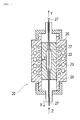
- Fig. 2 is a cross-sectional view of the mold 20 for molding a balloon.
- the mold 20 includes heaters 22 as heating means and cooling tubes 23 as cooling means.
- the mold 20 consists of separable molds 25 and 26. The shape of the inner surface that is formed when the separable molds 25 and 26 are combined with each other becomes the basic shape of the outer surface of the balloon to be formed.
- the heaters 22 are operated such that the tube 27 in the portion for forming a balloon 11 is heated at a temperature within a range from a secondary transition temperature to a primary transition temperature of the polymers (the polyamide and polyamide elastomer that form the tube 27), specifically, at a temperature slightly exceeding the secondary transition temperature.
- the tube 27 While being kept in a heated state, the tube 27 is stretched in the direction of the arrows X and Y.
- gas is supplied in a pressurized state into the tube 27 in the direction of the arrow Z, such that the tube 27 of the heated portion in the mold 20 is caused to come into close contact with the inner wall surface of the separable molds 25 and 26.
- a coolant is circulated inside a cooling tube 23 to cool the tube 27 to a temperature equal to or lower than the secondary transition temperature.
- the tube may be naturally cooled simply by being left as is without performing circulation of the coolant.
- the internal pressure of the tube 27 is controlled to be normal pressure, and then the tube 27 is pulled out of the mold 20.
- the tube 27 is cut in the distal end portion and the proximal end portion thereof, whereby the basic shape of a balloon as shown in Fig. 1 is formed.
- the above stretching treatment may be performed twice or more to form a balloon having a desired thickness.
- the balloon catheter according to the present invention will be described below, but the present invention is not limited to the following embodiment.
- the same constituents are marked with the same signs so as not to repeat the same description.
- the dimensional ratio of the drawings has been exaggerated for the convenience of description and may be different from the actual ratio in some cases.
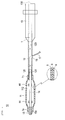
- Fig. 3 is a schematic view showing an example of the balloon catheter according to the present invention.
- a three-layer lamination-type balloon shown in Fig. 1B is described as an example of the balloon 11.
- the balloon having a two-layer structure shown in Fig. 1A or other balloons according to the present invention can also be preferably used, and accordingly, the scope of the balloon catheter according to the present invention is not limited thereto.
- a balloon catheter 10 includes a catheter body 1 that has a long outer tube 12 being able to transport fluid, the balloon 11 that is connected to the distal end of the catheter body 1, and a hub 13 that is mounted on the proximal end of the catheter body 1.
- the catheter body 1 also includes an inner tube 14 that passes through a lumen 120 formed inside the outer tube 12 and a distal end member 15 that is disposed at the distal end of the inner tube 14.
- the distal end refers to an end portion positioned at the side to be inserted into the blood vessel at the time of use
- the proximal end refers to an end portion positioned at the side of an operator who operates the balloon catheter 10 at the time of use.
- Fig. 3 shows a rapid exchange-type catheter in which a single lumen is formed at the side of the proximal end portion of the catheter and which includes a wire port into which a guide wire is inserted between the distal end and the proximal end thereof.
- the catheter may be an over-the-wire type in which a double-lumen may be formed around the same axis at the side of the proximal end portion of the catheter, and the inner tube extends to the hub.
- the balloon catheter 10 is an example applied to a vasodilating catheter.
- the balloon and the balloon catheter of the present invention can also be applied to other catheters such as a urethral catheter.
- Examples of the fluid supplied into the balloon from the catheter include known substances such as contrast media, helium gas, a physiological salt solution, CO 2 gas, O 2 gas, N 2 gas, and the air.
- the balloon catheter 10 includes the inner tube 14 that has a first lumen 150 having opened distal end; the outer tube 12 that is disposed in a position, which is away from the distal end of the inner tube 14 toward the proximal end by a predetermined length, while sharing the same axis with the inner tube 14 and forming the second lumen 120 between the outer tube 12 and the outer surface of the inner tube 14; the foldable balloon 1 that has a connection portion (at the side of distal end portion of the balloon) 7a connected to and mounted on the inner tube 14 and a connection portion (at the side of proximal end portion of the balloon) 7b connected to and mounted on the outer tube 12, and is communicated with the second lumen 120 near the proximal end portion; and the hub 13 that includes an opening portion communicated with the second lumen.
- the balloon catheter 10 of the present invention is constituted with the catheter balloon body 1, which includes the inner tube 14 and the outer tube 12, the hub 13, and the balloon 11.
- the inner tube 14 includes a first lumen 150 (outer lumen at the inner side) having an opened distal end.
- the first lumen 150 is a lumen for inserting a guide wire and is communicated with a wire port 18 as an opening portion forming a guide wire port.
- a guide wire 17 can be inserted through the wire port 18.
- the outer diameter of the inner tube 14 is 0.30 mm to 2.50 mm and preferably 0.40 mm to 2.00 mm, and the inner diameter thereof is 0.20 mm to 2.35 mm and preferably 0.25 mm to 1.70 mm.
- the material for forming the inner tube 24 is flexible to some extent.
- polyolefins such as polyethylene, polypropylene, an ethylene-propylene copolymer, and an ethylene-vinyl acetate copolymer
- thermoplastic resins such as polyvinyl chloride, polyurethane, polyamide, polyamide elastomer, and polyester elastomer can be used.
- the inner tube 14 is inserted into the outer tube 12.
- the distal end of the outer tube 12 is placed in a position that slightly recedes from the distal end of the inner tube.
- the second lumen 120 is formed. Accordingly, the second lumen 120 can become a lumen having a sufficient volume.
- the distal end of the second lumen 120 is communicated with the inside of the aforementioned balloon 11 in the distal end portion of the balloon.
- the proximal end of the second lumen 120 is communicated with an opening portion 130 of the hub 13 that forms an injection port for injecting fluid (for example, contrast media, helium gas, a physiological salt solution, CO 2 gas, or O 2 gas) for expanding the balloon.
- the outer diameter of the outer tube 12 is 0.50 mm to 4.30 mm and preferably 0.60 mm to 4.00 mm, and the inner diameter thereof is 0.40 mm to 3.80 mm and preferably 0.50 mm to 3.00 mm.
- radiopaque substances may be optionally injected into the balloon at the time of balloon dilation.
- the material for forming the outer tube 12 is flexible to some extent.
- polyolefins such as polyethylene, polypropylene, an ethylene-propylene copolymer, and an ethylene-vinyl acetate copolymer and thermoplastic resins such as polyvinyl chloride, polyurethane, polyamide, polyamide elastomer, and polyester elastomer can be used.
- the distal end of the balloon catheter 10 of the present invention be provided with the distal end member 15 having a spherical surface that plays a role of assisting the catheter to move along the blood vessel and prevents the blood vessel wall from being damaged.
- the balloon 11 is foldable. When being in a state of not being dilated, the balloon can be folded around the outer periphery of the inner tube 14. Moreover, the balloon 11 is foldable balloon having a cylindrical body with practically uniform diameter, in which at least a portion thereof has a cylindrical shape so as to easily dilate stenosed portions of blood vessels or body cavities.
- the connection portion 7b of the balloon 11 is fixed in a liquid-tight manner to the distal end portion of the outer tube 12 by an adhesive or heat-sealing.
- the connection portion 7a is also fixed in a liquid-tight manner to the distal end portion of the inner tube 14 in the same manner as described above.
- a space 112 is formed between the inner surface of the balloon 11 and the outer surface of the inner tube 14 at the time of dilation.
- the entire circumference of the proximal end of the space 112 is communicated with the second lumen 120.
- the proximal end of the balloon 11 is communicated with the second lumen having a relatively large volume, it is easy to inject fluid into the balloon 11 from the second lumen.
- the balloon 11 As the balloon 11, the balloon described above is used.
- the balloon 11 is constituted with three layers.
- the constitution is not particularly limited as long as the balloon is constituted with at least two or more layers including the polyamide layer and the polyamide elastomer layer as described above.
- the X-ray markers 44 be placed on the outer surface of the inner tube 14. As shown in Fig. 3 , it is preferable that the X-ray markers 44 be placed in a position that is closer to the proximal end of the balloon 11 than to the portion where the balloon 11 is fixed to the inner tube 14 and a position that is closer to the distal end of the balloon 11 than to the portion where the balloon is fixed to the outer tube 12. In other words, it is preferable that the markers be placed at sites positioned in both ends of the cylindrical membranous body 2 of the balloon 11.
- the X-ray markers 44 prefferably be formed of a radiopaque substance (for example, gold, platinum, iridium, tungsten, or an alloy of these).
- a radiopaque substance for example, gold, platinum, iridium, tungsten, or an alloy of these.
- the hub 13 includes the opening portion 130 which is communicated with the second lumen 120 and forms an injection port as an inlet of a path through which fluid is injected or discharged. Accordingly, the opening portion 130 plays a role of a flow path and is communicated with a portion for supplying and discharging fluid (not shown in the drawing), for example, an indeflator, a syringe, or a pump. In this manner, fluid is supplied to the balloon 11 through the opening portion 130 and the second lumen 120 and discharged out of the balloon 11. That is, the opening portion 130 and the lumen 120 function as a pathway for supplying and discharging drive fluid which causes the balloon 11 to dilate or contract.
- a portion for supplying and discharging fluid for example, an indeflator, a syringe, or a pump.
- thermoplastic resins such as polycarbonate, polyamide, polysulfone, polyarylate, and a methacrylate-butylene-styrene copolymer can be preferably used.
- PAE1 melt viscosity of 1,260 Pa ⁇ s resin
- the term "compliance”, which is used in the present invention and indicates how easily the diameter expands, is represented by the slope of a compliance curve that shows the relationship established between pressure and the increase in the outer diameter of the balloon when internal pressure in an operation range of 12 atm to 22 atm is applied to the balloon.
- the obtained balloon was cut into slices and cut in the long-axis direction.
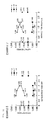
- the cross-section thereof was observed with a polarization microscope, and retardation at five sites shown in Fig. 4(a) was measured to calculate the birefringence.
- the refractive index n r1 in the circumferential direction of the surface of inner side of the polyamide layer as the interlayer was 1.532
- the refractive index n r2 in the circumferential direction of the surface of inner side of the polyamide elastomer layer as the inner layer was 1.517.
- Fig. 4(a) shows the sites for measuring each of the refractive indices in Examples and Comparative examples.
- retardation was measured in each of five sites shown in Fig. 4(a) .
- retardation was measured in each of four sites shown in Fig. 4(a) .
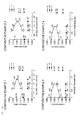
- graphs of Examples and Comparative examples shown in Fig. 4(b) to Fig. 8 show the relationship between the position of the five or four sites in the balloon and the refractive indices in those positions.
- n r indicates a refractive index in the circumferential direction
- n 1 indicates a refractive index in the long-axis direction
- n d indicates a refractive index in the thickness direction. That is, as shown in Fig. 4(a) , for the balloon formed of three-layered membrane, five sites in total, which include a site that is assigned with 0 and corresponds to the vicinity of the surface of inner side of the polyamide elastomer layer forming the innermost circumference of the cross-section of the catheter balloon, a site that is assigned with 1 and corresponds to the vicinity of the surface of inner side of the polyamide layer adjacent to the polyamide elastomer layer as the innermost circumference, a site that is assigned with 2 and corresponds to the vicinity of the surface of outer side of the polyamide layer, a site that is assigned with 1.5 and interposed between the surface of inner side and the surface of outer side of the polyamide layer, and a site that is assigned with 3 and corresponds to the vicinity of the surface of outer side of
- four sites in total which include a site that is assigned with 0 and corresponds to the vicinity of the surface of inner side of the polyamide layer forming the innermost circumference of the cross-section of the balloon, a site that is assigned with 1 and corresponds to the vicinity of the surface of outer side of the polyamide layer, a site that is assigned with 1.5 and interposed between the surface of inner side and the surface of outer side of the polyamide layer, and a site that is assigned with 2 and corresponds to the vicinity of the surface of outer side of the polyamide elastomer layer forming the outermost circumference of the cross-section of the catheter balloon, are defined as distances from the inner circumferential surface of the catheter balloon of Comparative examples 3 and 4.
- PAE1 melt viscosity of 1,260 Pa ⁇ s resin
- the obtained balloon was cut into slices and cut in the long-axis direction.
- the cross-section thereof was observed with a polarization microscope, and retardation at five sites shown in Fig. 4(a) was measured to calculate the birefringence.
- the refractive index n r1 in the circumferential direction of the surface of inner side of the polyamide layer as the interlayer was 1.533
- the refractive index n r2 in the circumferential direction of the surface of inner side of the polyamide elastomer layer as the inner layer was 1.520.
- PAE1 melt viscosity of 3,489 Pa ⁇ s resin
- the obtained balloon was cut into slices and cut in the long-axis direction.
- the cross-section thereof was observed with a polarization microscope, and retardation at five sites shown in Fig. 4(a) was measured to calculate the birefringence.
- the refractive index n r1 in the circumferential direction of the surface of inner side of the polyamide layer as the interlayer was 1.531
- the refractive index n r2 in the circumferential direction of the surface of inner side of the polyamide elastomer layer as the inner layer was 1.517.
- PAE1 melt viscosity of 5,282 Pa ⁇ s resin
- the obtained balloon was cut into slices and cut in the long-axis direction.
- the cross-section thereof was observed with a polarization microscope, and retardation at five sites shown in Fig. 4(a) was measured to calculate the birefringence.
- the refractive index n r1 in the circumferential direction of the surface of inner side of the polyamide layer as the interlayer was 1.530
- the refractive index n r2 in the circumferential direction of the surface of inner side of the polyamide elastomer layer as the inner layer was 1.516.
- PAE1 melt viscosity of 5,282 Pa ⁇ s resin
- the refractive index n r1 in the circumferential direction of the surface of inner side of the polyamide layer as the interlayer was 1.530
- the refractive index n r2 in the circumferential direction of the surface of inner side of the polyamide elastomer layer as the inner layer was 1.517.
- PAE1 melt viscosity of 7,391 Pa ⁇ s resin
- the obtained balloon was cut into slices and cut in the long-axis direction.
- the cross-section thereof was observed with a polarization microscope, and retardation at five sites shown in Fig. 4(a) was measured to calculate the birefringence.
- the refractive index n r1 in the circumferential direction of the surface of inner side of the polyamide layer as the interlayer was 1.531
- the refractive index n r2 in the circumferential direction of the surface of inner side of the polyamide elastomer layer as the inner layer was 1.517.
- a three-layered tube (magnification of inner diameter expansion; 8.5-fold, ⁇ 0.36 ⁇ 0.50 ⁇ 0.84 ⁇ 0.88 mm) using polyamide elastomer (Grilamide ELG5660 manufactured by EMS-GRIVORY, shore D hardness of 56) for the inner and outer layers and polyamide (Grilamide L25 manufactured by EMS-GRIVORY) for the interlayer was molded. Thereafter, dry nitrogen was blown into the obtained tube for 30 seconds at a pressure of 4.2 MPa at 90°C to perform blow molding, thereby preparing a balloon having an outer diameter of 3.00 mm and a thickness of 20.4 ⁇ m. A withstanding pressure (burst pressure of the balloon) was 33.1 atm, and a compliance thereof was 0.013 mm/atm.
- the obtained balloon was cut into slices and cut in the long-axis direction.
- the cross-section thereof was observed with a polarization microscope, and retardation at five sites shown in Fig. 4(a) was measured to calculate the birefringence.
- the refractive index n r1 in the circumferential direction of the surface of inner side of the polyamide layer as the interlayer was 1.526
- the refractive index n r2 in the circumferential direction of the surface of inner side of the polyamide elastomer layer as the inner layer was 1.514.
- a three-layered tube (magnification of inner diameter expansion; 8.2-fold, ⁇ 0.37 ⁇ 0.51 ⁇ 0.84 ⁇ 0.88 mm) using polyamide elastomer (Grilamide ELG5660 manufactured by EMS-GRIVORY, shore D hardness of 56) for the inner and outer layers and polyamide (Grilamide L25 manufactured by EMS-GRIVORY) for the interlayer was molded. Thereafter, dry nitrogen was blown into the obtained tube for 30 seconds at a pressure of 4.2 MPa at 90°C to perform blow molding, thereby preparing a balloon having an outer diameter of 3.00 mm and a thickness of 19.6 ⁇ m.
- a withstanding pressure (burst pressure of the balloon) was 33.3 atm, and a compliance thereof was 0.016 mm/atm.
- the obtained balloon was cut into slices and cut in the long-axis direction. The cross-section thereof was observed with a polarization microscope, and retardation at five sites shown in Fig. 4(a) was measured to calculate the birefringence.
- the refractive index n r1 in the circumferential direction of inner side of the polyamide layer as the interlayer was 1.528
- the refractive index n r2 in the circumferential direction of the surface of inner side of the polyamide elastomer layer as the inner layer was 1.513.
- a three-layered tube (magnification of inner diameter expansion; 7.9-fold, ⁇ 0.38 ⁇ 0.52 ⁇ 0.85 ⁇ 0.89 mm) using polyamide elastomer (Grilamide ELG5660 manufactured by EMS-GRIVORY, shore D hardness of 56) for the inner and outer layers and polyamide (Grilamide L25 manufactured by EMS-GRIVORY) for the interlayer was molded. Thereafter, dry nitrogen was blown into the obtained tube for 30 seconds at a pressure of 4.0 MPa at 100°C to perform blow molding, thereby preparing a balloon having an outer diameter of 3.00 mm and a thickness of 19.4 ⁇ m. A withstanding pressure (burst pressure of the balloon) was 33.0 atm, and a compliance thereof was 0.015 mm/atm.
- the obtained balloon was cut into slices and cut in the long-axis direction.
- the cross-section thereof was observed with a polarization microscope, and retardation at five sites shown in Fig. 4(a) was measured to calculate the birefringence.
- the refractive index n r1 in the circumferential direction of inner side of the polyamide layer as the interlayer was 1.525
- the refractive index n r2 in the circumferential direction of the surface of inner side of the polyamide elastomer layer as the inner layer was 1.515.
- a three-layered tube (magnification of inner diameter expansion; 8.2-fold, ⁇ 0.37 ⁇ 0.48 ⁇ 0.82 ⁇ 0.90 mm) using polyamide elastomer (PEBAX5533 manufactured by ARUKEMA K.K., shore D hardness of 55) for the inner and outer layers and polyamide (Grilamide L25 manufactured by EMS-GRIVORY) for the interlayer was molded. Thereafter, dry nitrogen was blown into the obtained tube for 30 seconds at a pressure of 3.0 MPa at 110°C to perform blow molding, thereby preparing a balloon having an outer diameter of 3.00 mm and a thickness of 22.3 ⁇ m. A withstanding pressure (burst pressure of the balloon) was 26.0 atm, and a compliance thereof was 0.018 mm/atm.
- PEBAX5533 manufactured by ARUKEMA K.K., shore D hardness of 55
- Polyamide Grilamide L25 manufactured by EMS-GRIVORY
- the obtained balloon was cut into slices and cut in the long-axis direction.
- the cross-section thereof was observed with a polarization microscope, and retardation at five sites shown in Fig. 4(a) was measured to calculate the birefringence.
- the refractive index n r1 in the circumferential direction of the surface of inner side of the polyamide layer as the interlayer was 1.528
- the refractive index n r2 in the circumferential direction of the surface of inner side of the polyamide elastomer layer as the inner layer was 1.522.
- a three-layered tube (magnification of inner diameter expansion; 8.6-fold, ⁇ 0.35 ⁇ 0.47 ⁇ 0.82 ⁇ 0.88 mm) using polyamide elastomer (Grilamide ELG5930 manufactured by EMS-GRIVORY, shore D hardness of 59) for the inner layer, polyamide (Grilamide L25 manufactured by EMS-GRIVORY) for the interlayer, and polyamide elastomer (Grilamide ELG5660 manufactured by EMS-GRIVORY, shore D hardness of 56) for the outer layer was molded.
- polyamide elastomer (Grilamide ELG5930 manufactured by EMS-GRIVORY, shore D hardness of 59)
- Polyamide Grilamide L25 manufactured by EMS-GRIVORY
- Polyamide elastomer (Grilamide ELG5660 manufactured by EMS-GRIVORY, shore D hardness of 56) for the outer layer was molded.
- the obtained balloon was cut into slices and cut in the long-axis direction.
- the cross-section thereof was observed with a polarization microscope, and retardation at five sites shown in Fig. 4(a) was measured to calculate the birefringence.
- the refractive index n r1 in the circumferential direction of the surface of inner side of the polyamide layer as the interlayer was 1.532
- the refractive index n r2 in the circumferential direction of the surface of inner side of the polyamide elastomer layer as the inner layer was 1.527.
- a balloon Hiryu ( ⁇ 3.00 mm ⁇ 15 mm, membrane thickness of 19.8 ⁇ m, withstanding pressure of 28.0 atm, compliance of 0.016 mm/atm) manufactured by Terumo Corporation (two-layered balloon constituted with an inner layer formed of polyamide and an outer layer formed of polyamide elastomer) was observed with a polarization microscope, and retardation at four sites shown in Fig. 4(a) was measured.
- a refractive index in the circumferential direction (nr) of the surface of inner side of the polyamide layer was 1.531, and n r of the surface of innermost layer where polyamide elastomer did not exist was less than 1.520.
- a balloon Kongou ( ⁇ 3.00 mm ⁇ 15 mm, membrane thickness of 23.4 ⁇ m, withstanding pressure of 27.9 atm, compliance of 0.015 mm/atm) manufactured by Terumo Corporation (two-layered balloon constituted with an inner layer formed of polyamide and an outer layer formed of polyamide elastomer) was observed with a polarization microscope, and retardation at four sites shown in Fig. 4(a) was measured.
- a refractive index in the circumferential direction (nr) in the surface of inner side of the polyamide layer was 1.529, and n r of the surface of the innermost layer where polyamide elastomer did not exist was less than 1.520.
- Example 1 The refractive index n r in the circumferential direction of Examples 1 to 9 and Comparative examples 1 to 4 are shown below.
- Table 1 nr2 of surface of inner side of inner layer (A) nr1 of surface of inner side of inter layer (B) (B) - (A)
- Example 1 1.517 1.532 0.015
- Example 2 1.520 1.533 0.013
- Example 3 1.517 1.531 0.014
- Example 4 1.516 1.530 0.014
- Example 5 1.517 1.530 0.013
- Example 6 1.517 1.531 0.014
- Example 7 1.514 1.526 0.012
- Example 8 1.513 1.528 0.015
- Example 9 1.515 1.525 0.010 Comparative example 1 1.522 1.528 0.006 Comparative example 2 1.527 1.532 0.005 Comparative example 3 No PAE layer 1.531 Failure of calculation Comparative example 4 No PAE layer 1.529 Failure of calculation
Landscapes
- Health & Medical Sciences (AREA)
- General Health & Medical Sciences (AREA)
- Veterinary Medicine (AREA)
- Public Health (AREA)
- Life Sciences & Earth Sciences (AREA)
- Animal Behavior & Ethology (AREA)
- Epidemiology (AREA)
- Chemical & Material Sciences (AREA)
- Chemical Kinetics & Catalysis (AREA)
- Heart & Thoracic Surgery (AREA)
- Hematology (AREA)
- Biomedical Technology (AREA)
- Anesthesiology (AREA)
- Engineering & Computer Science (AREA)
- Vascular Medicine (AREA)
- Materials For Medical Uses (AREA)
- Media Introduction/Drainage Providing Device (AREA)
- Medicinal Chemistry (AREA)
- Polymers & Plastics (AREA)
- Organic Chemistry (AREA)
Applications Claiming Priority (2)
| Application Number | Priority Date | Filing Date | Title |
|---|---|---|---|
| JP2011214496 | 2011-09-29 | ||
| PCT/JP2012/074419 WO2013047449A1 (fr) | 2011-09-29 | 2012-09-24 | Ballonnet de cathéter et cathéter à ballonnet |
Publications (3)
| Publication Number | Publication Date |
|---|---|
| EP2762191A1 true EP2762191A1 (fr) | 2014-08-06 |
| EP2762191A4 EP2762191A4 (fr) | 2015-04-15 |
| EP2762191B1 EP2762191B1 (fr) | 2017-07-12 |
Family
ID=47995482
Family Applications (1)
| Application Number | Title | Priority Date | Filing Date |
|---|---|---|---|
| EP12835108.7A Revoked EP2762191B1 (fr) | 2011-09-29 | 2012-09-24 | Ballonnet de cathéter et cathéter à ballonnet |
Country Status (12)
| Country | Link |
|---|---|
| US (1) | US9713657B2 (fr) |
| EP (1) | EP2762191B1 (fr) |
| JP (1) | JP5886862B2 (fr) |
| KR (1) | KR102017914B1 (fr) |
| CN (1) | CN103764181A (fr) |
| AU (1) | AU2012317726B2 (fr) |
| BR (1) | BR112014006461B1 (fr) |
| CA (1) | CA2847148C (fr) |
| ES (1) | ES2640950T3 (fr) |
| IN (1) | IN2014DN01972A (fr) |
| SG (1) | SG11201400370RA (fr) |
| WO (1) | WO2013047449A1 (fr) |
Cited By (1)
| Publication number | Priority date | Publication date | Assignee | Title |
|---|---|---|---|---|
| EP2832396A4 (fr) * | 2012-03-28 | 2015-11-04 | Terumo Corp | Ballonnet pour cathéter et cathéter à ballonnet |
Families Citing this family (13)
| Publication number | Priority date | Publication date | Assignee | Title |
|---|---|---|---|---|
| WO2014107178A1 (fr) * | 2013-01-04 | 2014-07-10 | St. Jude Medical Puerto Rico Llc | Dispositif de cessation de circulation sanguine temporaire à échange rapide pour fermeture de grands orifices |
| WO2014141440A1 (fr) * | 2013-03-14 | 2014-09-18 | テルモ株式会社 | Cathéter à ballonnet |
| EP3057643A1 (fr) * | 2013-10-15 | 2016-08-24 | Boston Scientific Scimed, Inc. | Ballon haute pression résistant à la déchirure |
| JP2017063803A (ja) * | 2014-02-14 | 2017-04-06 | テルモ株式会社 | バルーンおよびその製造方法 |
| EP3189872B1 (fr) * | 2014-09-04 | 2019-05-08 | Terumo Kabushiki Kaisha | Cathéter |
| CN105327440B (zh) * | 2015-12-01 | 2018-09-04 | 广东博迈医疗器械有限公司 | 一种网状结构微晶球囊及其制备工艺 |
| JP2019063138A (ja) * | 2017-09-29 | 2019-04-25 | フクダ電子株式会社 | バルーンカテーテル |
| EP4297836A1 (fr) * | 2021-02-24 | 2024-01-03 | Mayo Foundation for Medical Education and Research | Dispositifs de dilatation et procédés associés |
| CN113198084A (zh) * | 2021-04-26 | 2021-08-03 | 深圳麦普奇医疗科技有限公司 | 一种外周血管介入治疗微导管 |
| JP2025176718A (ja) * | 2022-09-29 | 2025-12-05 | テルモ株式会社 | バルーンカテーテル |
| EP4570296A4 (fr) * | 2022-09-29 | 2025-07-30 | Terumo Corp | Cathéter à ballonnet |
| WO2025204639A1 (fr) * | 2024-03-28 | 2025-10-02 | 株式会社カネカ | Ballonnet et cathéter médicaux |
| WO2025204640A1 (fr) * | 2024-03-28 | 2025-10-02 | 株式会社カネカ | Ballonnet médical et cathéter |
Family Cites Families (14)
| Publication number | Priority date | Publication date | Assignee | Title |
|---|---|---|---|---|
| US5339198A (en) * | 1992-10-16 | 1994-08-16 | The Dow Chemical Company | All-polymeric cold mirror |
| JP3766122B2 (ja) * | 1995-08-04 | 2006-04-12 | 株式会社カネカ | カテーテルバルーン及びその製造方法 |
| JP4190513B2 (ja) * | 1995-10-11 | 2008-12-03 | テルモ株式会社 | カテーテル用バルーンおよびバルーンカテーテルならびに血管拡張用カテーテル |
| DE69636829T3 (de) * | 1995-10-11 | 2016-07-21 | Terumo K.K. | Ballon für Katheter und Ballonkatheter |
| WO1999044649A1 (fr) | 1998-03-04 | 1999-09-10 | Scimed Life Systems, Inc. | Composition et procede de production de ballonnets de catheter en pbt |
| JP2004298363A (ja) | 2003-03-31 | 2004-10-28 | Nippon Zeon Co Ltd | バルーンカテーテル用バルーン及びその製造方法 |
| JP2005319289A (ja) | 2004-04-08 | 2005-11-17 | Kaneka Corp | カテーテルバルーン |
| US7309324B2 (en) * | 2004-10-15 | 2007-12-18 | Futuremed Interventional, Inc. | Non-compliant medical balloon having an integral woven fabric layer |
| US8038691B2 (en) * | 2004-11-12 | 2011-10-18 | Boston Scientific Scimed, Inc. | Cutting balloon catheter having flexible atherotomes |
| JP2005305187A (ja) | 2005-07-07 | 2005-11-04 | Kaneka Corp | カテーテルバルーン及びその製造方法 |
| JP2007061258A (ja) * | 2005-08-30 | 2007-03-15 | Kaneka Corp | バルーンおよびバルーンカテーテル |
| CN201132006Y (zh) * | 2007-10-17 | 2008-10-15 | 微创医疗器械(上海)有限公司 | 多层球囊导管 |
| JP4877267B2 (ja) | 2008-04-14 | 2012-02-15 | 株式会社カネカ | 無機結晶を含有する医用カテーテル |
| US8052638B2 (en) * | 2008-11-26 | 2011-11-08 | Abbott Cardiovascular Systems, Inc. | Robust multi-layer balloon |
-
2012
- 2012-09-24 IN IN1972DEN2014 patent/IN2014DN01972A/en unknown
- 2012-09-24 BR BR112014006461-0A patent/BR112014006461B1/pt active IP Right Grant
- 2012-09-24 CN CN201280042334.4A patent/CN103764181A/zh active Pending
- 2012-09-24 WO PCT/JP2012/074419 patent/WO2013047449A1/fr not_active Ceased
- 2012-09-24 AU AU2012317726A patent/AU2012317726B2/en active Active
- 2012-09-24 EP EP12835108.7A patent/EP2762191B1/fr not_active Revoked
- 2012-09-24 JP JP2013536269A patent/JP5886862B2/ja active Active
- 2012-09-24 SG SG11201400370RA patent/SG11201400370RA/en unknown
- 2012-09-24 ES ES12835108.7T patent/ES2640950T3/es active Active
- 2012-09-24 CA CA2847148A patent/CA2847148C/fr active Active
- 2012-09-24 KR KR1020147004248A patent/KR102017914B1/ko active Active
-
2014
- 2014-03-21 US US14/221,580 patent/US9713657B2/en active Active
Cited By (1)
| Publication number | Priority date | Publication date | Assignee | Title |
|---|---|---|---|---|
| EP2832396A4 (fr) * | 2012-03-28 | 2015-11-04 | Terumo Corp | Ballonnet pour cathéter et cathéter à ballonnet |
Also Published As
| Publication number | Publication date |
|---|---|
| CA2847148C (fr) | 2017-01-03 |
| EP2762191B1 (fr) | 2017-07-12 |
| IN2014DN01972A (fr) | 2015-05-15 |
| US20140207171A1 (en) | 2014-07-24 |
| KR20140067002A (ko) | 2014-06-03 |
| ES2640950T3 (es) | 2017-11-07 |
| AU2012317726A1 (en) | 2014-03-13 |
| BR112014006461B1 (pt) | 2021-05-04 |
| JP5886862B2 (ja) | 2016-03-16 |
| CA2847148A1 (fr) | 2013-04-04 |
| AU2012317726B2 (en) | 2014-05-15 |
| SG11201400370RA (en) | 2014-05-29 |
| WO2013047449A1 (fr) | 2013-04-04 |
| KR102017914B1 (ko) | 2019-09-03 |
| CN103764181A (zh) | 2014-04-30 |
| US9713657B2 (en) | 2017-07-25 |
| JPWO2013047449A1 (ja) | 2015-03-26 |
| EP2762191A4 (fr) | 2015-04-15 |
| BR112014006461A2 (pt) | 2017-03-28 |
Similar Documents
| Publication | Publication Date | Title |
|---|---|---|
| EP2762191B1 (fr) | Ballonnet de cathéter et cathéter à ballonnet | |
| AU2012374641B2 (en) | Balloon for catheter, and balloon catheter | |
| JP5891046B2 (ja) | バルーンおよびバルーンカテーテル | |
| JP5873674B2 (ja) | カテーテル用バルーンおよびバルーンカテーテル | |
| EP0537069B1 (fr) | Ballonnet pour cathéter dilatateur de vaisseau sanguin | |
| US20070142772A1 (en) | Dual-Layer Medical Balloon | |
| KR101596651B1 (ko) | 위내 장치 | |
| US20150105815A1 (en) | High pressure tear resistant balloon | |
| WO2018047575A1 (fr) | Ballonnet destiné à être utilisé dans un traitement médical et procédé de fabrication de cathéter à ballonnet | |
| JP2009519778A (ja) | 2層式の医療用バルーン | |
| JP2012010846A (ja) | 医療用チューブ | |
| JP2012066008A (ja) | 多重構造バルーンおよびその製造方法 |
Legal Events
| Date | Code | Title | Description |
|---|---|---|---|
| PUAI | Public reference made under article 153(3) epc to a published international application that has entered the european phase |
Free format text: ORIGINAL CODE: 0009012 |
|
| 17P | Request for examination filed |
Effective date: 20140221 |
|
| AK | Designated contracting states |
Kind code of ref document: A1 Designated state(s): AL AT BE BG CH CY CZ DE DK EE ES FI FR GB GR HR HU IE IS IT LI LT LU LV MC MK MT NL NO PL PT RO RS SE SI SK SM TR |
|
| DAX | Request for extension of the european patent (deleted) | ||
| RA4 | Supplementary search report drawn up and despatched (corrected) |
Effective date: 20150312 |
|
| RIC1 | Information provided on ipc code assigned before grant |
Ipc: A61L 29/00 20060101ALI20150306BHEP Ipc: A61M 25/10 20130101AFI20150306BHEP |
|
| GRAP | Despatch of communication of intention to grant a patent |
Free format text: ORIGINAL CODE: EPIDOSNIGR1 |
|
| STAA | Information on the status of an ep patent application or granted ep patent |
Free format text: STATUS: GRANT OF PATENT IS INTENDED |
|
| INTG | Intention to grant announced |
Effective date: 20170322 |
|
| GRAS | Grant fee paid |
Free format text: ORIGINAL CODE: EPIDOSNIGR3 |
|
| GRAA | (expected) grant |
Free format text: ORIGINAL CODE: 0009210 |
|
| STAA | Information on the status of an ep patent application or granted ep patent |
Free format text: STATUS: THE PATENT HAS BEEN GRANTED |
|
| AK | Designated contracting states |
Kind code of ref document: B1 Designated state(s): AL AT BE BG CH CY CZ DE DK EE ES FI FR GB GR HR HU IE IS IT LI LT LU LV MC MK MT NL NO PL PT RO RS SE SI SK SM TR |
|
| REG | Reference to a national code |
Ref country code: GB Ref legal event code: FG4D |
|
| REG | Reference to a national code |
Ref country code: CH Ref legal event code: EP |
|
| REG | Reference to a national code |
Ref country code: AT Ref legal event code: REF Ref document number: 907767 Country of ref document: AT Kind code of ref document: T Effective date: 20170715 |
|
| REG | Reference to a national code |
Ref country code: IE Ref legal event code: FG4D |
|
| REG | Reference to a national code |
Ref country code: DE Ref legal event code: R096 Ref document number: 602012034547 Country of ref document: DE |
|
| REG | Reference to a national code |
Ref country code: FR Ref legal event code: PLFP Year of fee payment: 6 |
|
| REG | Reference to a national code |
Ref country code: NL Ref legal event code: FP |
|
| REG | Reference to a national code |
Ref country code: ES Ref legal event code: FG2A Ref document number: 2640950 Country of ref document: ES Kind code of ref document: T3 Effective date: 20171107 |
|
| REG | Reference to a national code |
Ref country code: LT Ref legal event code: MG4D |
|
| REG | Reference to a national code |
Ref country code: AT Ref legal event code: MK05 Ref document number: 907767 Country of ref document: AT Kind code of ref document: T Effective date: 20170712 |
|
| PG25 | Lapsed in a contracting state [announced via postgrant information from national office to epo] |
Ref country code: LT Free format text: LAPSE BECAUSE OF FAILURE TO SUBMIT A TRANSLATION OF THE DESCRIPTION OR TO PAY THE FEE WITHIN THE PRESCRIBED TIME-LIMIT Effective date: 20170712 Ref country code: NO Free format text: LAPSE BECAUSE OF FAILURE TO SUBMIT A TRANSLATION OF THE DESCRIPTION OR TO PAY THE FEE WITHIN THE PRESCRIBED TIME-LIMIT Effective date: 20171012 Ref country code: AT Free format text: LAPSE BECAUSE OF FAILURE TO SUBMIT A TRANSLATION OF THE DESCRIPTION OR TO PAY THE FEE WITHIN THE PRESCRIBED TIME-LIMIT Effective date: 20170712 Ref country code: SE Free format text: LAPSE BECAUSE OF FAILURE TO SUBMIT A TRANSLATION OF THE DESCRIPTION OR TO PAY THE FEE WITHIN THE PRESCRIBED TIME-LIMIT Effective date: 20170712 Ref country code: FI Free format text: LAPSE BECAUSE OF FAILURE TO SUBMIT A TRANSLATION OF THE DESCRIPTION OR TO PAY THE FEE WITHIN THE PRESCRIBED TIME-LIMIT Effective date: 20170712 Ref country code: HR Free format text: LAPSE BECAUSE OF FAILURE TO SUBMIT A TRANSLATION OF THE DESCRIPTION OR TO PAY THE FEE WITHIN THE PRESCRIBED TIME-LIMIT Effective date: 20170712 |
|
| PG25 | Lapsed in a contracting state [announced via postgrant information from national office to epo] |
Ref country code: GR Free format text: LAPSE BECAUSE OF FAILURE TO SUBMIT A TRANSLATION OF THE DESCRIPTION OR TO PAY THE FEE WITHIN THE PRESCRIBED TIME-LIMIT Effective date: 20171013 Ref country code: LV Free format text: LAPSE BECAUSE OF FAILURE TO SUBMIT A TRANSLATION OF THE DESCRIPTION OR TO PAY THE FEE WITHIN THE PRESCRIBED TIME-LIMIT Effective date: 20170712 Ref country code: BG Free format text: LAPSE BECAUSE OF FAILURE TO SUBMIT A TRANSLATION OF THE DESCRIPTION OR TO PAY THE FEE WITHIN THE PRESCRIBED TIME-LIMIT Effective date: 20171012 Ref country code: IS Free format text: LAPSE BECAUSE OF FAILURE TO SUBMIT A TRANSLATION OF THE DESCRIPTION OR TO PAY THE FEE WITHIN THE PRESCRIBED TIME-LIMIT Effective date: 20171112 Ref country code: RS Free format text: LAPSE BECAUSE OF FAILURE TO SUBMIT A TRANSLATION OF THE DESCRIPTION OR TO PAY THE FEE WITHIN THE PRESCRIBED TIME-LIMIT Effective date: 20170712 Ref country code: PL Free format text: LAPSE BECAUSE OF FAILURE TO SUBMIT A TRANSLATION OF THE DESCRIPTION OR TO PAY THE FEE WITHIN THE PRESCRIBED TIME-LIMIT Effective date: 20170712 |
|
| REG | Reference to a national code |
Ref country code: DE Ref legal event code: R026 Ref document number: 602012034547 Country of ref document: DE |
|
| PLBI | Opposition filed |
Free format text: ORIGINAL CODE: 0009260 |
|
| PG25 | Lapsed in a contracting state [announced via postgrant information from national office to epo] |
Ref country code: RO Free format text: LAPSE BECAUSE OF FAILURE TO SUBMIT A TRANSLATION OF THE DESCRIPTION OR TO PAY THE FEE WITHIN THE PRESCRIBED TIME-LIMIT Effective date: 20170712 Ref country code: CZ Free format text: LAPSE BECAUSE OF FAILURE TO SUBMIT A TRANSLATION OF THE DESCRIPTION OR TO PAY THE FEE WITHIN THE PRESCRIBED TIME-LIMIT Effective date: 20170712 Ref country code: DK Free format text: LAPSE BECAUSE OF FAILURE TO SUBMIT A TRANSLATION OF THE DESCRIPTION OR TO PAY THE FEE WITHIN THE PRESCRIBED TIME-LIMIT Effective date: 20170712 |
|
| REG | Reference to a national code |
Ref country code: CH Ref legal event code: PL |
|
| 26 | Opposition filed |
Opponent name: HOEHFELD, JOCHEN Effective date: 20180411 |
|
| PG25 | Lapsed in a contracting state [announced via postgrant information from national office to epo] |
Ref country code: SK Free format text: LAPSE BECAUSE OF FAILURE TO SUBMIT A TRANSLATION OF THE DESCRIPTION OR TO PAY THE FEE WITHIN THE PRESCRIBED TIME-LIMIT Effective date: 20170712 Ref country code: EE Free format text: LAPSE BECAUSE OF FAILURE TO SUBMIT A TRANSLATION OF THE DESCRIPTION OR TO PAY THE FEE WITHIN THE PRESCRIBED TIME-LIMIT Effective date: 20170712 Ref country code: SM Free format text: LAPSE BECAUSE OF FAILURE TO SUBMIT A TRANSLATION OF THE DESCRIPTION OR TO PAY THE FEE WITHIN THE PRESCRIBED TIME-LIMIT Effective date: 20170712 Ref country code: MC Free format text: LAPSE BECAUSE OF FAILURE TO SUBMIT A TRANSLATION OF THE DESCRIPTION OR TO PAY THE FEE WITHIN THE PRESCRIBED TIME-LIMIT Effective date: 20170712 |
|
| PLAX | Notice of opposition and request to file observation + time limit sent |
Free format text: ORIGINAL CODE: EPIDOSNOBS2 |
|
| REG | Reference to a national code |
Ref country code: IE Ref legal event code: MM4A |
|
| REG | Reference to a national code |
Ref country code: BE Ref legal event code: MM Effective date: 20170930 |
|
| PG25 | Lapsed in a contracting state [announced via postgrant information from national office to epo] |
Ref country code: LU Free format text: LAPSE BECAUSE OF NON-PAYMENT OF DUE FEES Effective date: 20170924 |
|
| PG25 | Lapsed in a contracting state [announced via postgrant information from national office to epo] |
Ref country code: CH Free format text: LAPSE BECAUSE OF NON-PAYMENT OF DUE FEES Effective date: 20170930 Ref country code: IE Free format text: LAPSE BECAUSE OF NON-PAYMENT OF DUE FEES Effective date: 20170924 Ref country code: LI Free format text: LAPSE BECAUSE OF NON-PAYMENT OF DUE FEES Effective date: 20170930 |
|
| REG | Reference to a national code |
Ref country code: FR Ref legal event code: PLFP Year of fee payment: 7 |
|
| PG25 | Lapsed in a contracting state [announced via postgrant information from national office to epo] |
Ref country code: SI Free format text: LAPSE BECAUSE OF FAILURE TO SUBMIT A TRANSLATION OF THE DESCRIPTION OR TO PAY THE FEE WITHIN THE PRESCRIBED TIME-LIMIT Effective date: 20170712 Ref country code: BE Free format text: LAPSE BECAUSE OF NON-PAYMENT OF DUE FEES Effective date: 20170930 |
|
| PG25 | Lapsed in a contracting state [announced via postgrant information from national office to epo] |
Ref country code: MT Free format text: LAPSE BECAUSE OF NON-PAYMENT OF DUE FEES Effective date: 20170924 |
|
| PLBB | Reply of patent proprietor to notice(s) of opposition received |
Free format text: ORIGINAL CODE: EPIDOSNOBS3 |
|
| PG25 | Lapsed in a contracting state [announced via postgrant information from national office to epo] |
Ref country code: HU Free format text: LAPSE BECAUSE OF FAILURE TO SUBMIT A TRANSLATION OF THE DESCRIPTION OR TO PAY THE FEE WITHIN THE PRESCRIBED TIME-LIMIT; INVALID AB INITIO Effective date: 20120924 |
|
| PG25 | Lapsed in a contracting state [announced via postgrant information from national office to epo] |
Ref country code: CY Free format text: LAPSE BECAUSE OF NON-PAYMENT OF DUE FEES Effective date: 20170712 |
|
| PG25 | Lapsed in a contracting state [announced via postgrant information from national office to epo] |
Ref country code: MK Free format text: LAPSE BECAUSE OF FAILURE TO SUBMIT A TRANSLATION OF THE DESCRIPTION OR TO PAY THE FEE WITHIN THE PRESCRIBED TIME-LIMIT Effective date: 20170712 |
|
| RDAF | Communication despatched that patent is revoked |
Free format text: ORIGINAL CODE: EPIDOSNREV1 |
|
| APBM | Appeal reference recorded |
Free format text: ORIGINAL CODE: EPIDOSNREFNO |
|
| APBP | Date of receipt of notice of appeal recorded |
Free format text: ORIGINAL CODE: EPIDOSNNOA2O |
|
| APAH | Appeal reference modified |
Free format text: ORIGINAL CODE: EPIDOSCREFNO |
|
| PG25 | Lapsed in a contracting state [announced via postgrant information from national office to epo] |
Ref country code: TR Free format text: LAPSE BECAUSE OF FAILURE TO SUBMIT A TRANSLATION OF THE DESCRIPTION OR TO PAY THE FEE WITHIN THE PRESCRIBED TIME-LIMIT Effective date: 20170712 |
|
| PG25 | Lapsed in a contracting state [announced via postgrant information from national office to epo] |
Ref country code: PT Free format text: LAPSE BECAUSE OF FAILURE TO SUBMIT A TRANSLATION OF THE DESCRIPTION OR TO PAY THE FEE WITHIN THE PRESCRIBED TIME-LIMIT Effective date: 20170712 |
|
| APBQ | Date of receipt of statement of grounds of appeal recorded |
Free format text: ORIGINAL CODE: EPIDOSNNOA3O |
|
| PG25 | Lapsed in a contracting state [announced via postgrant information from national office to epo] |
Ref country code: AL Free format text: LAPSE BECAUSE OF FAILURE TO SUBMIT A TRANSLATION OF THE DESCRIPTION OR TO PAY THE FEE WITHIN THE PRESCRIBED TIME-LIMIT Effective date: 20170712 |
|
| PGFP | Annual fee paid to national office [announced via postgrant information from national office to epo] |
Ref country code: NL Payment date: 20220819 Year of fee payment: 11 |
|
| PGFP | Annual fee paid to national office [announced via postgrant information from national office to epo] |
Ref country code: IT Payment date: 20220811 Year of fee payment: 11 Ref country code: GB Payment date: 20220804 Year of fee payment: 11 Ref country code: DE Payment date: 20220621 Year of fee payment: 11 |
|
| PGFP | Annual fee paid to national office [announced via postgrant information from national office to epo] |
Ref country code: FR Payment date: 20220808 Year of fee payment: 11 |
|
| PGFP | Annual fee paid to national office [announced via postgrant information from national office to epo] |
Ref country code: ES Payment date: 20221004 Year of fee payment: 11 |
|
| APBU | Appeal procedure closed |
Free format text: ORIGINAL CODE: EPIDOSNNOA9O |
|
| REG | Reference to a national code |
Ref country code: DE Ref legal event code: R103 Ref document number: 602012034547 Country of ref document: DE Ref country code: DE Ref legal event code: R064 Ref document number: 602012034547 Country of ref document: DE |
|
| RDAG | Patent revoked |
Free format text: ORIGINAL CODE: 0009271 |
|
| STAA | Information on the status of an ep patent application or granted ep patent |
Free format text: STATUS: PATENT REVOKED |
|
| 27W | Patent revoked |
Effective date: 20230513 |
|
| GBPR | Gb: patent revoked under art. 102 of the ep convention designating the uk as contracting state |
Effective date: 20230513 |