EP2763533B1 - Inhibiteurs triazolyles de pde10 - Google Patents
Inhibiteurs triazolyles de pde10 Download PDFInfo
- Publication number
- EP2763533B1 EP2763533B1 EP12838891.5A EP12838891A EP2763533B1 EP 2763533 B1 EP2763533 B1 EP 2763533B1 EP 12838891 A EP12838891 A EP 12838891A EP 2763533 B1 EP2763533 B1 EP 2763533B1
- Authority
- EP
- European Patent Office
- Prior art keywords
- methyl
- triazol
- cyclopropyl
- dimethyl
- methylpyrimidin
- Prior art date
- Legal status (The legal status is an assumption and is not a legal conclusion. Google has not performed a legal analysis and makes no representation as to the accuracy of the status listed.)
- Active
Links
- 0 C*(*)CC(C1)C1c1cc(-[n]2nc(C)nc2*)nc(C)n1 Chemical compound C*(*)CC(C1)C1c1cc(-[n]2nc(C)nc2*)nc(C)n1 0.000 description 3
- VEEGVDQMJQHICI-HOTGVXAUSA-N CC(C)Nc1nc([C@@H](C2)[C@H]2c2nc(cccc3)c3[n]2C)cc(-[n]2nc(C)nc2C)n1 Chemical compound CC(C)Nc1nc([C@@H](C2)[C@H]2c2nc(cccc3)c3[n]2C)cc(-[n]2nc(C)nc2C)n1 VEEGVDQMJQHICI-HOTGVXAUSA-N 0.000 description 1
- DCVJCYXUUPFDJT-XTIFALICSA-N CC(C1)([C@H]1C1=NC2C=CC=CC2N1C)c1cc(-[n]2nc(C)nc2C2CC2)nc(C)n1 Chemical compound CC(C1)([C@H]1C1=NC2C=CC=CC2N1C)c1cc(-[n]2nc(C)nc2C2CC2)nc(C)n1 DCVJCYXUUPFDJT-XTIFALICSA-N 0.000 description 1
- HWDBFEWBPCJESA-OHYMYOQYSA-N CC/N=C(/CCCCC=[IH](C)I)\C[I](N)N1N[C@H](C)N=C1CC(C=C1)=[I][IH](OC)=C1OC Chemical compound CC/N=C(/CCCCC=[IH](C)I)\C[I](N)N1N[C@H](C)N=C1CC(C=C1)=[I][IH](OC)=C1OC HWDBFEWBPCJESA-OHYMYOQYSA-N 0.000 description 1
- JBIDGEYYHMGOHG-CMDGGOBGSA-N Cc(nc1Cc(cc2OC)ccc2OC)n[n]1-c1cc(/C=C/c(cc2)nc3c2nccc3)nc(C)n1 Chemical compound Cc(nc1Cc(cc2OC)ccc2OC)n[n]1-c1cc(/C=C/c(cc2)nc3c2nccc3)nc(C)n1 JBIDGEYYHMGOHG-CMDGGOBGSA-N 0.000 description 1
- ZEONBJYVYRIHNM-UHFFFAOYSA-N Cc(nc1Cc(cc2OC)ccc2OC)n[n]1-c1nc(C)nc(OCc(nc2)ccc2OC)c1 Chemical compound Cc(nc1Cc(cc2OC)ccc2OC)n[n]1-c1nc(C)nc(OCc(nc2)ccc2OC)c1 ZEONBJYVYRIHNM-UHFFFAOYSA-N 0.000 description 1
- ZTLVEGLVKIXHIK-ZIAGYGMSSA-N Cc1nc(C)n[n]1-c1nc(C)nc([C@H](C2)[C@@H]2c2nc3ccccc3[nH]2)c1 Chemical compound Cc1nc(C)n[n]1-c1nc(C)nc([C@H](C2)[C@@H]2c2nc3ccccc3[nH]2)c1 ZTLVEGLVKIXHIK-ZIAGYGMSSA-N 0.000 description 1
- VNPUTFVKDDMVAF-PWWBFRNWSA-N Cc1nc(C)n[n]1-c1nc(N2CCN(C)CC2)nc(C(C2)[C@H]2C2=NC3C=CC=CC3N2C)c1 Chemical compound Cc1nc(C)n[n]1-c1nc(N2CCN(C)CC2)nc(C(C2)[C@H]2C2=NC3C=CC=CC3N2C)c1 VNPUTFVKDDMVAF-PWWBFRNWSA-N 0.000 description 1
Classifications
-
- C—CHEMISTRY; METALLURGY
- C07—ORGANIC CHEMISTRY
- C07D—HETEROCYCLIC COMPOUNDS
- C07D487/00—Heterocyclic compounds containing nitrogen atoms as the only ring hetero atoms in the condensed system, not provided for by groups C07D451/00 - C07D477/00
- C07D487/02—Heterocyclic compounds containing nitrogen atoms as the only ring hetero atoms in the condensed system, not provided for by groups C07D451/00 - C07D477/00 in which the condensed system contains two hetero rings
- C07D487/04—Ortho-condensed systems
-
- A—HUMAN NECESSITIES
- A61—MEDICAL OR VETERINARY SCIENCE; HYGIENE
- A61P—SPECIFIC THERAPEUTIC ACTIVITY OF CHEMICAL COMPOUNDS OR MEDICINAL PREPARATIONS
- A61P25/00—Drugs for disorders of the nervous system
-
- C—CHEMISTRY; METALLURGY
- C07—ORGANIC CHEMISTRY
- C07D—HETEROCYCLIC COMPOUNDS
- C07D401/00—Heterocyclic compounds containing two or more hetero rings, having nitrogen atoms as the only ring hetero atoms, at least one ring being a six-membered ring with only one nitrogen atom
- C07D401/14—Heterocyclic compounds containing two or more hetero rings, having nitrogen atoms as the only ring hetero atoms, at least one ring being a six-membered ring with only one nitrogen atom containing three or more hetero rings
-
- C—CHEMISTRY; METALLURGY
- C07—ORGANIC CHEMISTRY
- C07D—HETEROCYCLIC COMPOUNDS
- C07D403/00—Heterocyclic compounds containing two or more hetero rings, having nitrogen atoms as the only ring hetero atoms, not provided for by group C07D401/00
- C07D403/02—Heterocyclic compounds containing two or more hetero rings, having nitrogen atoms as the only ring hetero atoms, not provided for by group C07D401/00 containing two hetero rings
- C07D403/04—Heterocyclic compounds containing two or more hetero rings, having nitrogen atoms as the only ring hetero atoms, not provided for by group C07D401/00 containing two hetero rings directly linked by a ring-member-to-ring-member bond
-
- C—CHEMISTRY; METALLURGY
- C07—ORGANIC CHEMISTRY
- C07D—HETEROCYCLIC COMPOUNDS
- C07D403/00—Heterocyclic compounds containing two or more hetero rings, having nitrogen atoms as the only ring hetero atoms, not provided for by group C07D401/00
- C07D403/14—Heterocyclic compounds containing two or more hetero rings, having nitrogen atoms as the only ring hetero atoms, not provided for by group C07D401/00 containing three or more hetero rings
-
- C—CHEMISTRY; METALLURGY
- C07—ORGANIC CHEMISTRY
- C07D—HETEROCYCLIC COMPOUNDS
- C07D405/00—Heterocyclic compounds containing both one or more hetero rings having oxygen atoms as the only ring hetero atoms, and one or more rings having nitrogen as the only ring hetero atom
- C07D405/14—Heterocyclic compounds containing both one or more hetero rings having oxygen atoms as the only ring hetero atoms, and one or more rings having nitrogen as the only ring hetero atom containing three or more hetero rings
-
- C—CHEMISTRY; METALLURGY
- C07—ORGANIC CHEMISTRY
- C07D—HETEROCYCLIC COMPOUNDS
- C07D413/00—Heterocyclic compounds containing two or more hetero rings, at least one ring having nitrogen and oxygen atoms as the only ring hetero atoms
- C07D413/14—Heterocyclic compounds containing two or more hetero rings, at least one ring having nitrogen and oxygen atoms as the only ring hetero atoms containing three or more hetero rings
-
- C—CHEMISTRY; METALLURGY
- C07—ORGANIC CHEMISTRY
- C07D—HETEROCYCLIC COMPOUNDS
- C07D417/00—Heterocyclic compounds containing two or more hetero rings, at least one ring having nitrogen and sulfur atoms as the only ring hetero atoms, not provided for by group C07D415/00
- C07D417/14—Heterocyclic compounds containing two or more hetero rings, at least one ring having nitrogen and sulfur atoms as the only ring hetero atoms, not provided for by group C07D415/00 containing three or more hetero rings
-
- C—CHEMISTRY; METALLURGY
- C07—ORGANIC CHEMISTRY
- C07D—HETEROCYCLIC COMPOUNDS
- C07D471/00—Heterocyclic compounds containing nitrogen atoms as the only ring hetero atoms in the condensed system, at least one ring being a six-membered ring with one nitrogen atom, not provided for by groups C07D451/00 - C07D463/00
- C07D471/02—Heterocyclic compounds containing nitrogen atoms as the only ring hetero atoms in the condensed system, at least one ring being a six-membered ring with one nitrogen atom, not provided for by groups C07D451/00 - C07D463/00 in which the condensed system contains two hetero rings
- C07D471/04—Ortho-condensed systems
Definitions
- the invention relates generally to compounds which act as inhibitors of the phosphodiesterase (PDE) 10 enzyme, compositions and therapeutic uses thereof.
- PDE phosphodiesterase
- Schizophrenia is debilitating disorder affecting the psychic and motor functions of the brain. It is typically diagnosed in individuals in their early to mid-twenties and symptoms include hallucinations and delusions or at the other extreme, anhedonia or social withdrawal. Across the spectrum, the symptoms are indicative of cognitive impairment and functional disabilities. Notwithstanding improvements in antipsychotic treatments, current therapies, including typical (haloperidol) and atypical (clozapine or olanzapine) antipsychotics, have been less than acceptable and result in an extremely high rate of noncomplicance or discontinuation of medication. Dissatisfaction with therapy is attributed to lack of efficacy or intolerable and unacceptable side affects. The side effects have been associated with significant metabolic, extrapyramidal, prolactic and cardiac adverse events. See, Lieberman et al., N. Engl. J. Med. (2005) 353:1209-1223 .
- Cyclic AMP is thought to regulate the activity of cAMP-dependent protein kinase (PKA), which in turns phosphorylates and regulates many types of proteins including ion channels, enzymes and transcription factors.
- PKA cAMP-dependent protein kinase
- cGMP may also be responsible for downstream regulation of kinases and ion channels.
- PDEs 3', 5'-cyclic nucleotide specific phosphodiesterases
- the PDE superfamily includes twenty one genes that encode for eleven families of PDEs. These families are further subdivided based on catalytic domain homology and substrate specificity and include the 1) cAMP specific, PDE4A-D, 7A and 7B, and 8A and 8B, 2) cGMP specific, PDE 5A, 6A-C, and 9A, and 3) those that are dual substrate, PDE 1A-C, 2A, 3A and 3B, 10A, and 11A.
- the homology between the families ranging from 20% to 45% suggests that it may be possible to develop selective inhibitors for each of these subtypes.
- PDE10 The identification of PDE10 was reported by three groups independently and was distinguished from other PDEs on the basis of its amino acid sequence, functional properties, and tissue distribution ( Fujishige et al., J. Biol. Chem. (1999) 274:18438-18445 ; Loughney et al., Gene (1999) 234: 109-117 ; Soderling et al., PNAS, USA (1999) 96: 7071-7076 ).
- the PDE10 subtype at present consists of a sole member, PDE10A, having alternative splice variants at both the N-terminus (three variants) and C-terminus (two variants), but that does not affect the GAF domain in the N-terminus or the catalytic site in C-terminus.
- PDE10A is unique relative to other PDE families also having the conserved GAF domain in that its ligand is cAMP, while for the other GAF-domain PDEs the ligand is cGMP ( Kehler et al., Expert Opin. Ther. Patents (2007) 17(2): 147-158 ).
- PDE10A has limited but high expression in the brain and testes.
- WO2007/129183 A2 and the art cited therein, describes other heteroaryl compounds that serve a PDE10 inhibitors.
- 4-chloro-6-(3,5-dimethyl-1H-1,2,4-triazol-1-yl)-pyrimidine is disclosed in Chemical Abstracts Service: Columbus, OH; accession no. 1250723-19-3 (accessed 2 November 2010).
- PDE10 Inhibition of PDE10 is believed to be useful in the treatment of schizophrenia and a wide variety of conditions or disorders that would benefit from increasing levels of cAMP and/or cGMP within neurons, including a variety neurological, psychotic, anxiety and/or movement disorders. Accordingly, agents that inhibit PDE10 and especially PDE10A may be desirable as therapeutics for neurological and psychiatric disorders.
- the present invention is directed to substituted triazolyl compounds which may be useful as therapeutic agents for the treatment of central nervous system disorders associated with phosphodiesterase 10 (PDE10).
- PDE10 phosphodiesterase 10
- the present invention also relates to the use of such compounds for treating neurological and psychiatric disorders, such as schizophrenia, psychosis or Huntington's disease, and those associated with striatal hypofunction or basal ganglia dysfunction.
- the present invention is directed to compounds of the formula I: wherein:
- An embodiment of the present invention includes compounds wherein R 2 is selected from the group consisting of halogen, (CH 2 ) n C 3-10 cycloalkyl, (CH 2 ) n C 5-10 heterocycle, C 2-6 alkenyl, C 2-6 alkenylC 5-10 heterocycle, C 2 - 6 alkynylC 5 -ioheterocycle, -O-(CH 2 ) n C 5-10 heterocycle, said alkyl, heterocyclyl, alkenyl, and cycloalkyl optionally substituted with 1 to 3 groups of Ra.
- R 2 is halogen, preferably chlorine or fluorine.
- R 2 is (CH 2 ) n C 3-10 cycloalkyl such as cyclopropyl, said cycloalkyl optionally substituted with 1 to 3 groups of Ra.
- R 2 is optionally substituted (CH 2 ) n C 5-10 heterocycle wherein the heterocycle is such as quinolinyl, pyrimidinyl, pyridyl, and naphthyridinyl, which is optionally substituted with 1 to 3 groups of Ra.
- R 2 is C 2-6 alkenylC 5-10 heterocycle, wherein the heterocycle is such as quinolinyl, pyrimidinyl, pyridyl, and naphthyridinyl, which can be optionally substituted with 1 to 3 groups of Ra.
- R 2 is C 2-6 alkynylC 5-10 heterocycle, wherein the heterocycle is such as quinolinyl, pyrimidinyl, pyridyl, and naphthyridinyl, which can be optionally substituted with 1 to 3 groups of Ra.
- R 2 is -O-(CH 2 ) n C 5-10 heterocycle wherein the heterocycle is such as quinolinyl, pyrimidinyl, pyridyl, and naphthyridinyl, which can be optionally substituted with 1 to 3 groups of R a .
- R 2 is optionally substituted C 2-6 alkenyl such as such as ethenyl.
- Another embodiment of the present invention includes compounds where R 3 is hydrogen.
- R 3 is C 1-6 alkyl such as methyl, ethyl, propyl and butyl, preferably methyl.
- Still another embodiment of the present invention includes compounds where R 3 is O(CH 2 ) 2 OH, OR, O(CH 2 ) 2 OCH 3 , OCHRCH 2 OCH 3 , SR, SO 2 R, S(O)R, O(CH 2 ) n CH 2 F, O(CH 2 )nCF 3 , C(O)N(R) 2 , or N(R) 2 .
- Yet another embodiment of the present invention includes compounds where R 3 is optionally substituted O(CH 2 ) n C 3-6 cycloalkyl, (CH 2 ) n C 5-10 heterocycle, C 1-6 alkyl, and C 3-10 cylcoalkyl.
- R 3 is optionally substituted O(CH 2 ) n C 3-6 cycloalkyl, (CH 2 ) n C 5-10 heterocycle, C 1-6 alkyl, and C 3-10 cylcoalkyl.
- the cycloalkyl and heterocyl is selected from the group consisting of cyclopropyl, cyclopropylbenzimidazolyl, pyrrolidinyl, morpholinyl, and piperazinyl.
- Still another embodiment of the present invention includes compounds where R 4 is hydrogen.
- Still another embodiment of the present invention includes compounds where R 4 is O(CH 2 ) 2 OH, OR, O(CH 2 ) 2 OCH 3 , OCHRCH 2 OCH 3 , SR, SO 2 R, S(O)R, O(CH 2 ) n CH 2 F, O(CH 2 )nCF 3 , C(O)N(R) 2 , or N(R) 2 .
- Yet another embodiment of the present invention includes compounds where R 4 is optionally substituted O(CH 2 ) n C 3-6 cycloalkyl, (CH 2 ) n C 5-10 heterocycle, C 1-6 alkyl, and C 3-10 cylcoalkyl.
- R 4 is optionally substituted O(CH 2 ) n C 3-6 cycloalkyl, (CH 2 ) n C 5-10 heterocycle, C 1-6 alkyl, and C 3-10 cylcoalkyl.
- the cycloalkyl and heterocyl is selected from the group consisting of cyclopropyl, cyclopropylbenzimidazolyl, pyrrolidinyl, morpholinyl, and piperazinyl.
- Yet another embodiment of the present invention includes compounds where R 1 is C 1-6 alkyl, (CH 2 ) n C 3-10 cycloalkyl, (CH 2 ) n C 6-10 aryl, and (CH 2 ) n C 5-10 heterocycle, said alkyl, aryl and heterocycle optionally substituted with 1 to 3 groups of Ra.
- Another embodiment of the present invention includes compounds where R 1 is (CH 2 ) n C 6-10 aryl, where the aryl is preferably phenyl, said and aryl optionally substituted with 1 to 3 groups of R a .
- R 1 is (CH 2 ) n C 5-10 heterocycle, where the heterocycle is tetrahydrofuranyl, pyranyl, piperidinyl, cyclohexyl, pyridyl, thiazolyl, pyrazinyl, preferably thiazolyl, pyridyl, or pyrazinyl.
- R 1 is C 1-6 alkyl, such as methyl, ethyl, propyl, isopropyl, and butyl, preferably methyl, propyl or isopropyl.
- Another embodiment of the present invention includes compounds where R 1 is (CH 2 ) n C 3-10 cycloalkyl, preferably cyclopropyl or cyclohexyl.
- R 7 is C 1-6 alkyl, preferably methyl.
- Another embodiment of the present invention is realized when R 7 is halogen.
- R b is selected from the group consisting of halogen, OCHF 2 , CF 3 , (CH 2 ) n CH 2 F, cyclopropyl, C 1-6 alkyl, OR, (CH 2 ) n N(R) 2 , (CH 2 ) n tetrahydrofuranyl, (CH 2 ) n pyridyl, pyrazolyl, (CH 2 ) n tetrahydropyranyl, and (CH 2 ) n phenyl.
- An embodiment of the present invention includes compounds wherein R 1 is optionally substituted C 1-6 alkyl, (CH 2 ) n phenyl, (CH 2 ) n pyrazinyl, or (CH 2 ) n pyridyl, R 7 is methyl, R 3 is methyl, and R 2 is cyclopropyl substituted with optionally substituted with benzimidazole.
- An embodiment of the present invention includes compounds represented by structural formula Ia: wherein R 1 , R 2 , R 3 , R 4 , and R 7 are as previously described.
- Still another embodiment of the present invention of formula I and Ia is represented by structural formula II: or a pharmaceutically acceptable salt thereof, wherein R 1 , and Ra are as originally described.
- Still another embodiment of the present invention of formula I, Ia and II is represented by structural formula IIa: or a pharmaceutically acceptable salt thereof, wherein R 1 , and Ra are as originally described.
- R 1 is (CH 2 ) n C 6-10 aryl, where the aryl is preferably phenyl, said aryl optionally substituted with 1 to 3 groups of Ra.
- Still another embodiment of the invention of formula II and IIa is realized when R 1 is (CH 2 ) n C 5-10 heterocycle, where the heterocycle is preferably thiazolyl, pyridyl, or pyrazinyl, said heterocycle optionally substituted with 1 to 3 groups of R a .
- R 1 is C 1-6 alkyl, such as methyl, ethyl, propyl, isopropyl, or butyl.
- Another embodiment of the invention of formula II and IIa is realized when R 1 is (CH 2 ) n C 3-10 cycloalkyl, such as cyclopropyl or cyclohexyl.
- Ra is selected from the group consisting of halogen, CO 2 R, COR, (CH 2 ) n C 5-10 heterocycle, and (CH 2 ) n C 6-10 aryl, said heterocyle and aryl optionally substituted with 1 to 3 groups of R b .
- a sub-embodiment of this aspect of the invention is realized when the n in (CH 2 ) n C 5-10 heterocycle, and (CH 2 ) n C 6-10 aryl off the cyclopropyl is zero and the heterocyle is selected from the group consisting of optionally substituted pyridyl, benzimidazolyl, thiazolyl, dihydropyrrolopyrazolyl, imidazolylpyridinyl, tetrahydropyrazolopyridinyl, naphthyridinyl, oxadiazolyl, thiadiazolyl, pentapyrazolyl, and benzthiazolyl.
- Another sub-embodiment of this aspect of the invention is realized when the heterocycle is optionally substituted benzimidazolyl.
- R 1 is optionally substituted methyl, ethyl, propyl, isopropyl, butyl, (CH 2 )phenyl, cyclopropyl, cyclohexyl, (CH 2 )thiazolyl, (CH 2 )pyrazinyl, or (CH 2 ) 0-1 pyridyl, piperidinyl, pyranyl, pyrrolidinyl, the Ra off of the cyclopropyl is selected from the group consisting of halogen, CO 2 R, COR, CONHCH 3 , or pyridyl, benzimidazolyl, oxadiazolyl, thiadiazolyl, thiazolyl, imidazopyridinyl, dihydropyrrolopyrazolyl, tetrahydropyrazolopyridinyl, naphthyridinyl, pentapyrazolyl,
- a subembodiment of formula III is realized when Y' is -CH 2 CH 2 .
- Y' is -OCH 2
- Another subembodiment of formula III is realized when the heterocycle of R 2 a is selected from the group consisting of pyrimidinyl, quinolinyl, pyridyl, and naphthyridinyl, any of which are optionally substituted with 1 to 3 groups of Ra.
- R 1 is (CH 2 ) n C 6-10 aryl, where the aryl is preferably phenyl, said aryl optionally substituted with 1 to 3 groups of R a .
- Still another embodiment of the invention of formula III is realized when R 1 is (CH 2 ) n C 5-10 heterocycle, where the heterocycle is preferably thiazolyl, pyridyl, or pyrazinyl, said heterocycle optionally substituted with 1 to 3 groups of R a .
- R 1 is C 1-6 alkyl, such as methyl, ethyl, propyl, isopropyl, or butyl.
- Another embodiment of the invention of formula III is realized when R 1 is (CH 2 ) n C 3-10 cycloalkyl, such as cyclopropyl or cyclohexyl.
- Examples of compounds of this invention include those in Table 1: Table 1 ( ⁇ de notes reference compoun ds)C pd. Structure Name MS m/z (M+H) 1 4-chloro-6-(5-(3,4-dimethoxybenzyl)-1H-1,2,4-triazol-1-yl)-2-methylpyrimidine 361.1 found, 361.1 required 2 2-((6-(5-(3,4-dimethoxybenzyl)-3-methyl-1H-1,2,4-triazol-1-yl)-2-methylpyrimidin-4-yl)ethynyl)quinoline 477.2 found, 477.2 required 3 2-(2-(6-(5-(3,4-dimethoxybenzyl)-3-methyl-1H-1,2,4-triazol-1-yl)-2-methylpyrimidin-4-yl)ethyl)quinoline 481.2 found, 481.2 required 4 4-(5-(3,4-dimethoxybenzyl)-3-methyl-1H-1,2,4-tria
- Particular compounds of the invention include:
- Specific embodiments of the present invention include a compound which is selected from the group consisting of the subject compounds of the Examples herein and pharmaceutically acceptable salts thereof and individual enantiomers and diastereomers thereof.
- variable e.g. aryl, heterocycle, R 1 , R 5 etc.
- its definition on each occurrence is independent at every other occurrence.
- combinations of substituents/or variables are permissible only if such combinations result in stable compounds.
- alkyl encompasses groups having the prefix “alk” such as, for example, alkoxy, alkanoyl, alkenyl, and alkynyl and means carbon chains which may be linear or branched or combinations thereof.
- alkyl groups include methyl, ethyl, propyl, isopropyl, butyl, sec- and tert-butyl, pentyl, hexyl, and heptyl.
- alkenyl refers to a hydrocarbon radical straight, branched or cyclic containing from 2 to 10 carbon atoms and at least one carbon to carbon double bond.
- alkenyl groups include ethenyl, propenyl, butenyl and cyclohexenyl.
- alkenyl is C 2 -C 6 alkenyl.
- Preferred alkynyls are C 2 -C 6 alkynyl.
- Alkenyl “alkynyl” and other like terms include carbon chains containing at least one unsaturated C-C bond.
- haloalkyl refers to an alkyl substituent as described herein containing at least one halogen substituent.
- cycloalkyl refers to a saturated hydrocarbon containing one ring having a specified number of carbon atoms.
- examples of cycloalkyl include cyclopropyl, cyclobutyl, cyclopentyl, and cyclohexyl.
- C 1-6 includes alkyls containing 6, 5, 4, 3, 2, or 1 carbon atoms
- alkoxy or "O-alkyl”as used herein, alone or in combination, includes an alkyl group connected to the oxy connecting atom.
- alkoxy also includes alkyl ether groups, where the term 'alkyl' is defined above, and 'ether' means two alkyl groups with an oxygen atom between them.
- suitable alkoxy groups include methoxy, ethoxy, n-propoxy, i-propoxy, n-butoxy, s-butoxy, t-butoxy, methoxymethane (also referred to as 'dimethyl ether'), and methoxyethane (also referred to as 'ethyl methyl ether').
- aryl is intended to mean any stable monocyclic or bicyclic carbon ring of up to 7 members in each ring, wherein at least one ring is aromatic. Examples of such aryl elements include phenyl, napthyl, tetrahydronapthyl, indanyl, or biphenyl.
- heterocycle, heterocyclyl, or heterocyclic represents a stable 5- to 7-membered monocyclic or stable 8- to 11-membered bicyclic heterocyclic ring which is either saturated or unsaturated, and which consists of carbon atoms and from one to four heteroatoms selected from the group consisting of N, O, and S, and including any bicyclic group in which any of the above-defined heterocyclic rings is fused to a benzene ring.
- the heterocyclic ring may be attached at any heteroatom or carbon atom which results in the creation of a stable structure.
- heterocycle or heterocyclic includes heteroaryl moieties.
- heterocyclic elements include, but are not limited to, azepinyl, azetidinyl, benzimidazolyl, benzisoxazolyl, benzofurazanyl, benzopyranyl, benzothiopyranyl, benzofuryl, benzothiazolyl, benzothienyl, benzoxazolyl, chromanyl, cinnolinyl, dihydrobenzofuryl, dihydrobenzothienyl, dihydrobenzothiopyranyl, dihydrobenzothiopyranyl sulfone, 1,3-dioxolanyl, furyl, imidazolidinyl, imidazolinyl, imidazolyl, indolinyl, indolyl, isochromanyl, isoindolinyl, isoquinolinyl, isothiazolidinyl, isothiazolyl, isothiazolidinyl, morph
- heteroaryl represents a stable 5- to 7-membered monocyclic- or stable 9- to 10-membered fused bicyclic heterocyclic ring system which contains an aromatic ring, any ring of which may be saturated, such as piperidinyl, partially saturated, or unsaturated, such as pyridinyl, and which consists of carbon atoms and from one to four heteroatoms selected from the group consisting of N, O and S, and wherein the nitrogen and sulfur heteroatoms may optionally be oxidized, and the nitrogen heteroatom may optionally be quaternized, and including any bicyclic group in which any of the above-defined heterocyclic rings is fused to a benzene ring.
- the heterocyclic ring may be attached at any heteroatom or carbon atom which results in the creation of a stable structure.
- heteroaryl groups include, but are not limited to, benzimidazole, benzisothiazole, benzisoxazole, benzofuran, benzothiazole, benzothiophene, benzotriazole, benzoxazole, carboline, cinnoline, furan, furazan, imidazole, indazole, indole, indolizine, isoquinoline, isothiazole, isoxazole, naphthyridine, oxadiazole, oxazole, phthalazine, pteridine, purine, pyran, pyrazine, pyrazole, pyridazine, pyridine, pyrimidine, pyrrole, quinazoline, quinoline, quinoxaline, tetrazole, thiadiazole, thiazole,
- heteroatom means O, S or N, selected on an independent basis.
- a moiety that is substituted is one in which one or more hydrogens have been independently replaced with another chemical substituent.
- substituted phenyls include 2-flurophenyl, 3, 4-dichlorophenyl, 3-chloro-4-fluoro-phenyl, 2,4 fluor-3-propylphenyl.
- substituted n-octyls include 2, 4 dimethyl-5-ethyl-octyl and 3-cyclopentyloctyl. Included within this definition are methylenes (-CH 2 -) substituted with oxygen to form carbonyl (-CO-).
- Suitable substituents include, without limitation, halo, hydroxy, oxo (e.g., an annular -CH- substituted with oxo is -C(O)-), nitro, halohydrocarbyl, hydrocarbyl, aryl, aralkyl, alkoxy, aryloxy, amino, acylamino, alkylcarbamoyl, arylcarbamoyl, aminoalkyl, acyl, carboxy, hydroxyalkyl, , alkanesulfonyl, arenesulfonyl, alkanesulfonamido, arenesulfonamido, aralkylsulfonamido, alkylcarbonyl, acyloxy, cyano, and ureido groups.
- Preferred substituents, which are themselves not further substituted are:
- Halogen or "halo"refer to fluorine, chlorine, bromine and iodine.
- mammal “mammalian” or “mammals” includes humans, as well as animals, such as dogs, cats, horses, pigs and cattle.
- racemic mixtures of the compounds may be separated so that the individual enantiomers or diastereomers are isolated.
- the separation can be carried out by methods well known in the art, such as the coupling of a racemic mixture of compounds to an enantiomerically pure compound to form a diastereomeric mixture, followed by separation of the individual diastereomers by standard methods, such as fractional crystallization or chromatography.
- the coupling reaction is often the formation of salts using an enantiomerically pure acid or base.
- the diastereomeric derivatives may then be converted to the pure enantiomers by cleavage of the added chiral residue.
- the racemic mixture of the compounds can also be separated directly by chromatographic methods using chiral stationary phases, which methods are well known in the art.
- any enantiomer or diastereomer of a compound may be obtained by stereoselective synthesis using optically pure starting materials or reagents of known configuration by methods well known in the art.
- the atoms may exhibit their natural isotopic abundances, or one or more of the atoms may be artificially enriched in a particular isotope having the same atomic number, but an atomic mass or mass number different from the atomic mass or mass number predominantly found in nature.
- the present invention is meant to include all suitable isotopic variations of the compounds of generic Formula I.
- different isotopic forms of hydrogen (H) include protium ( 1 H) and deuterium (2H).
- Protium is the predominant hydrogen isotope found in nature.
- Enriching for deuterium may afford certain therapeutic advantages, such as increasing in vivo half-life or reducing dosage requirements, or may provide a compound useful as a standard for characterization of biological samples.
- Isotopically-enriched compounds within generic Formula I can be prepared without undue experimentation by conventional techniques well known to those skilled in the art or by processes analogous to those described in the Schemes and Examples herein using appropriate isotopically-enriched reagents and/or intermediates.
- references to the compounds of present invention are meant to also include the pharmaceutically acceptable salts, and also salts that are not pharmaceutically acceptable when they are used as precursors to the free compounds or in other synthetic manipulations.
- the compounds of the present invention may be administered in the form of a pharmaceutically acceptable salt.
- pharmaceutically acceptable salts refers to salts prepared from pharmaceutically acceptable non-toxic bases or acids. When the compound of the present invention is acidic, its corresponding salt can be conveniently prepared from pharmaceutically acceptable non-toxic bases, including inorganic bases and organic bases.
- Salts derived from such inorganic bases include aluminum, ammonium, calcium, cupric, cuprous, ferric, ferrous, lithium, magnesium, manganic, manganous, potassium, sodium, zinc and the like salts. Particular embodiments include the ammonium, calcium, magnesium, potassium, and sodium salts. Salts in the solid form may exist in more than one crystal structure, and may also be in the form of hydrates.
- Salts derived from pharmaceutically acceptable organic non-toxic bases include salts of primary, secondary, and tertiary amines, substituted amines including naturally occurring substituted amines, cyclic amines, and basic ion exchange resins, such as arginine, betaine, caffeine, choline, N,N '-dibenzylethylene-diamine, diethylamine, 2-diethylaminoethanol, 2-dimethylamino-ethanol, ethanolamine, ethylenediamine, N -ethylmorpholine, N -ethylpiperidine, glucamine, glucosamine, histidine, hydrabamine, isopropylamine, lysine, methylglucamine, morpholine, piperazine, piperidine, polyamine resins, procaine, purines, theobromine, triethylamine, trimethylamine, tripropylamine, tromethamine, and the like.
- salts may be prepared from pharmaceutically acceptable non-toxic acids, including inorganic and organic acids.
- acids include acetic, benzenesulfonic, benzoic, camphorsulfonic, citric, ethanesulfonic, fumaric, gluconic, glutamic, hydrobromic, hydrochloric, isethionic, lactic, maleic, malic, mandelic, methanesulfonic, mucic, nitric, pamoic, pantothenic, phosphoric, succinic, sulfuric, tartaric, p-toluenesulfonic acid, and the like.
- the subject compounds may be useful in a method of treating a neurological or psychiatric disorder associated with PDE10 dysfunction in a patient such as a mammal in need of such inhibition comprising the administration of an effective amount of the compound.
- a neurological or psychiatric disorder associated with PDE10 dysfunction in a patient such as a mammal in need of such inhibition comprising the administration of an effective amount of the compound.
- a variety of other mammals may be treated according to the method of the present invention.
- the subject compounds may be useful in a method of inhibiting PDE10 activity in a patient such as a mammal in need of such inhibition comprising the administration of an effective amount of the compound.
- the subject compounds are also may be useful for treating a neurological or psychiatric disorder associated with striatal hypofunction or basal ganglia dysfunction in a mammalian patient in need thereof.
- a neurological or psychiatric disorder associated with striatal hypofunction or basal ganglia dysfunction in a mammalian patient in need thereof.
- primates, especially humans a variety of other mammals may be treated according to the method of the present invention.
- the present invention is directed to a compound of the present invention or a pharmaceutically acceptable salt thereof for use in medicine.
- the present invention is further directed to a use of a compound of the present invention or a pharmaceutically acceptable salt thereof for the manufacture of a medicament for treating a neurological or psychiatric disorder associated with PDE10 dysfunction in a mammalian patient in need thereof.
- the present invention is further directed to a use of a compound of the present invention or a pharmaceutically acceptable salt thereof for the manufacture of a medicament for treating a neurological or psychiatric disorder associated with striatal hypofunction or basal ganglia dysfunction in a mammalian patient in need thereof.
- Treating" or “treatment of' a disease state includes: 1) preventing the disease state, i.e. causing the clinical symptoms of the disease state not to develop in a subject that may be exposed to or predisposed to the disease state, but does not yet experience or display symptoms of the disease state; 2) inhibiting the disease state, i.e., arresting the development of the disease state or its clinical symptoms; 3) or relieving the disease state, i.e., causing temporary or permanent regression of the disease state or its clinical symptoms.
- the subject treated in the present methods is generally a mammal, in particular, a human being, male or female, in whom therapy is desired.
- the term "therapeutically effective amount” means the amount of the subject compound that will elicit the biological or medical response of a tissue, system, animal or human that is being sought by the researcher, veterinarian, medical doctor or other clinician. It is recognized that one skilled in the art may affect the neurological and psychiatric disorders by treating a patient presently afflicted with the disorders or by prophylactically treating a patient afflicted with such disorders with an effective amount of the compound of the present invention.
- treatment refers to all processes wherein there may be a slowing, interrupting, arresting, controlling, or stopping of the progression of the neurological and psychiatric disorders described herein, but does not necessarily indicate a total elimination of all disorder symptoms, as well as the prophylactic therapy to retard the progression or reduce the risk of the noted conditions, particularly in a patient who is predisposed to such disease or disorder.
- inhibitors of PDE10 and, in particular inhibitors of PDE10A may provide therapeutic benefit to those individuals suffering from psychiatric and cognitive disorders.
- inhibition of PDE10A in the striatum may result in increased cAMP/cGMP signaling and striatal output, which has the potential to restore behavioral inhibition that is impaired in cognitive disease such as schizophrenia.
- a compound of the invention for use in a method for treating ameliorating diseases or conditions in which striatal hypofunction is a prominent feature or ones in which basal ganglia dysfunction plays a role, such as, Parkinson's disease, Huntington's disease, schizophrenia, obsessive-compulsive disorders, addiction and psychosis.
- Other conditions for which the inhibitors described herein may have a desirable and useful effect include those requiring a reduction in activity and reduced response to psychomotor stimulants or where it would be desirable to reduce conditional avoidance responses, which is often predictive of clinical antipsychotic activity.
- a selective PDE10 inhibitor refers to an organic molecule that effectively inhibits an enzyme from the PDE10 family to a greater extent than enzymes from the PDE 1-9 or PDE11 families.
- a selective PDE10 inhibitor is an organic molecule having a Ki for inhibition of PDE10 that is less than or about one-tenth that for a substance that is an inhibitor for another PDE enzyme.
- the organic molecule inhibits PDE10 activity to the same degree at a concentration of about one-tenth or less than the concentration required for any other PDE enzyme.
- a selective PDE10 inhibitor is an organic molecule, having a Ki for inhibition of PDE10 that is less than or about one-hundredth that for a substance that is an inhibitor for another PDE enzyme.
- the organic molecule inhibits PDE10 activity to the same degree at a concentration of about one-hundredth or less than the concentration required for any other PDE enzyme.
- a "selective PDE10 inhibitor” can be identified, for example, by comparing the ability of an organic molecule to inhibit PDE10 activity to its ability to inhibit PDE enzymes from the other PDE families.
- an organic molecule may be assayed for its ability to inhibit PDE10 activity, as well as PDE1A, PDE1B, PDE1C, PDE2A, PDE3A, PDE3B, PDE4A, PDE4B, PDE4C, PDE4D, PDE5A, PDE6A, PDE6B, PDE6C, PDE7A, PDE7B, PDE8A, PDE8B, PDE9A, and/or PDE11A.
- Phosphodiesterase enzymes including PDE10 have been implicated in a wide range of biological functions. This has suggested a potential role for these enzymes in a variety of disease processes in humans or other species.
- the compounds of the present invention may have utility in treating a variety of neurological and psychiatric disorders.
- compounds of the present invention may be provided for use in a method for treating schizophrenia or psychosis, the method comprising administering to a patient in need thereof an effective amount of a compound of the present invention.
- the Diagnostic and Statistical Manual of Mental Disorders (DSM-IV-TR) (2000, American Psychiatric Association, Washington DC) provides a diagnostic tool that includes paranoid, disorganized, catatonic or undifferentiated schizophrenia and substance-induced psychotic disorders.
- DSM-IV-TR The Diagnostic and Statistical Manual of Mental Disorders (DSM-IV-TR) (2000, American Psychiatric Association, Washington DC) provides a diagnostic tool that includes paranoid, disorganized, catatonic or undifferentiated schizophrenia and substance-induced psychotic disorders.
- the term "schizophrenia or psychosis” includes the diagnosis and classification of these mental disorders as described in DSM-IV-TR and the term is intended to include similar disorders described in other sources.
- Disorders and conditions encompassed herein include, but are not limited to, conditions or diseases such as schizophrenia or psychosis, including schizophrenia (paranoid, disorganized, catatonic, undifferentiated, or residual type), schizophreniform disorder, schizoaffective disorder, for example of the delusional type or the depressive type, delusional disorder, psychotic disorder, brief psychotic disorder, shared psychotic disorder, psychotic disorder due to a general medical condition and substance-induced or drug-induced (for example psychosis induced by alcohol, amphetamine, cannabis, cocaine, hallucinogens, inhalants, opioids, phencyclidine, ketamine and other dissociative anaesthetics, and other psychostimulants), psychosispsychotic disorder, psychosis associated with affective disorders, brief reactive psychosis, schizoaffective psychosis, "schizophrenia-spectrum" disorders such as schizoid or schizotypal personality disorders, personality disorder of the paranoid type, personality disorder of the schizo
- the compounds of the present invention may be provided for use in a method for treating cognitive disorders, the method comprising administering to a patient in need thereof an effective amount of a compound of the present invention.
- the DSM-IV-TR also provides a diagnostic tool that includes cognitive disorders including dementia, delirium, amnestic disorders and age-related cognitive decline.
- cognitive disorders includes the diagnosis and classification of these disorders as described in DSM-IV-TR and the term is intended to include similar disorders described in other sources.
- disorders and conditions encompassed herein include, but are not limited to, disorders that comprise as a symptom a deficiency in attention and/or cognition, such as dementia (associated with Alzheimer's disease, ischemia, multi-infarct dementia, trauma, intracranial tumors, cerebral trauma, vascular problems or stroke, alcoholic dementia or other drug-related dementia, AIDS, HIV disease, Parkinson's disease, Huntington's disease, Pick's disease, Creutzfeldt Jacob disease, perinatal hypoxia, other general medical conditions or substance abuse), Alzheimer's disease, multi-infarct dementia, AIDS-related dementia, and Fronto temperal dementia, delirium, amnestic disorders or age related cognitive decline.
- dementia associated with Alzheimer's disease, ischemia, multi-infarct dementia, trauma, intracranial tumors, cerebral trauma, vascular problems or stroke
- alcoholic dementia or other drug-related dementia AIDS
- HIV disease Parkinson's disease
- Huntington's disease Huntington's disease
- Pick's disease Creutzfeldt Jacob disease
- compounds of the present invention may be provided for use in a method for treating anxiety disorders, the method comprising administering to a patient in need thereof an effective amount of a compound of the present invention.
- the DSM-IV-TR also provides a diagnostic tool that includes anxiety disorders as generalized anxiety disorder, obsessive-compulsive disorder and panic attack.
- anxiety disorders includes the diagnosis and classification of these mental disorders as described in DSM-IV-TR and the term is intended to include similar disorders described in other sources.
- Disorders and conditions encompassed herein include, but are not limited to, anxiety disorders such as, acute stress disorder, agoraphobia, generalized anxiety disorder, obsessive-compulsive disorder, panic attack, panic disorder, post-traumatic stress disorder, separation anxiety disorder, social phobia, specific phobia, substance-induced anxiety disorder and anxiety due to a general medical condition.
- anxiety disorders such as, acute stress disorder, agoraphobia, generalized anxiety disorder, obsessive-compulsive disorder, panic attack, panic disorder, post-traumatic stress disorder, separation anxiety disorder, social phobia, specific phobia, substance-induced anxiety disorder and anxiety due to a general medical condition.
- compounds of the present invention may be provided for use in a method for treating substance-related disorders and addictive behaviors, the method comprising administering to a patient in need thereof an effective amount of a compound of the present invention.
- the DSM-IV-TR also provides a diagnostic tool that includes persisting dementia, persisting amnestic disorder, psychotic disorder or anxiety disorder induced by substance abuse, and tolerance of, dependence on or withdrawal from substances of abuse.
- the term "substance-related disorders and addictive behaviors” includes the diagnosis and classification of these mental disorders as described in DSM-IV-TR and the term is intended to include similar disorders described in other sources.
- Disorders and conditions encompassed herein include, but are not limited to, substance-related disorders and addictive behaviors, such as substance-induced delirium, persisting dementia, persisting amnestic disorder, psychotic disorder or anxiety disorder, drug addiction, tolerance, and dependence or withdrawal from substances including alcohol, amphetamines, cannabis, cocaine, hallucinogens, inhalants, nicotine, opioids, phencyclidine, sedatives, hypnotics or anxiolytics.
- substance-related disorders and addictive behaviors such as substance-induced delirium, persisting dementia, persisting amnestic disorder, psychotic disorder or anxiety disorder, drug addiction, tolerance, and dependence or withdrawal from substances including alcohol, amphetamines, cannabis, cocaine, hallucinogens, inhalants, nicotine, opioids, phencyclidine, sedatives, hypnotics or anxiolytics.
- compounds of the present invention may be provided for use in a method for treating obesity or eating disorders associated with excessive food intake, and complications associated therewith, the method comprising administering to a patient in need thereof an effective amount of a compound of the present invention.
- obesity is included in the tenth edition of the International Classification of Diseases and Related Health Problems (ICD-10) (1992 World Health Organization) as a general medical condition.
- the DSM-IV-TR also provides a diagnostic tool that includes obesity in the presence of psychological factors affecting medical condition.
- the term "obesity or eating disorders associated with excessive food intake” includes the diagnosis and classification of these medical conditions and disorders described in ICD-10 and DSM-IV-TR and the term is intended to include similar disorders described in other sources.
- Disorders and conditions encompassed herein include, but are not limited to, obesity, bulimia nervosa and compulsive eating disorders.
- compounds of the present invention may be provided for use in a method for treating mood and depressive disorders, the method comprising administering to a patient in need thereof an effective amount of a compound of the present invention.
- the term "mood and depressive disorders” includes the diagnosis and classification of these medical conditions and disorders described in the DSM-IV-TR and the term is intended to include similar disorders described in other sources.
- disorders and conditions encompassed herein include, but are not limited to, bipolar disorders, mood disorders including depressive disorders, major depressive episode of the mild, moderate or severe type, a manic or mixed mood episode, a hypomanic mood episode, a depressive episode with atypical features, a depressive episode with melancholic features, a depressive episode with catatonic features, a mood episode with postpartum onset, post-stroke depression; major depressive disorder, dysthymic disorder, minor depressive disorder, premenstrual dysphoric disorder, post-psychotic depressive disorder of schizophrenia, a major depressive disorder superimposed on a psychotic disorder such as delusional disorder or schizophrenia, a bipolar disorder, for example, bipolar I disorder, bipolar II disorder, cyclothymic disorder, depression including unipolar depression, seasonal depression and post-partum depression, premenstrual syndrome (PMS) and premenstrual dysphoric disorder (PDD), mood disorders due to a general medical condition, and substance-induced mood disorders.
- a bipolar disorder
- compounds of the present invention may be provided for use in a method for treating pain, the method comprising administering to a patient in need thereof an effective amount of a compound of the present invention.
- pain embodiments are bone and joint pain (osteoarthritis), repetitive motion pain, dental pain, cancer pain, myofascial pain (muscular injury, fibromyalgia), perioperative pain (general surgery, gynecological), chronic pain and neuropathic pain.
- compounds of the invention may be provided for use in methods for treating other types of cognitive, learning and mental related disorders including, but not limited to, learning disorders, such as a reading disorder, a mathematics disorder, or a disorder of written expression, attention-deficit/hyperactivity disorder, age-related cognitive decline, pervasive developmental disorder including autistic disorder, attention disorders such as attention-deficit hyperactivity disorder (ADHD) and conduct disorder; an NMDA receptor-related disorder, such as autism, depression, benign forgetfulness, childhood learning disorders and closed head injury; a neurodegenerative disorder or condition, such as neurodegeneration associated with cerebral trauma, stroke, cerebral infarct, epileptic seizure, neurotoxin poisoning, or hypoglycemia-induced neurodegeneration; multi-system atrophy; movement disorders, such as akinesias and akinetic-rigid syndromes (including, Parkinson's disease, drug-induced parkinsonism, post-encephalitic parkinsonism, progressive supranuclear palsy, multiple system atrophy
- schizophrenia bipolar disorder
- depression including unipolar depression, seasonal depression and post-partum depression
- premenstrual syndrome PMS
- premenstrual dysphoric disorder PDD
- learning disorders pervasive developmental disorders, including autistic disorder, attention disorders including Attention-Deficit/Hyperactivity Disorder, autism, tic disorders including Tourette's disorder, anxiety disorders including phobia and post traumatic stress disorder, cognitive disorders associated with dementia, AIDS dementia, Alzheimer's, Parkinson's, Huntington's disease, spasticity, myoclonus, muscle spasm, tinnitus and hearing impairment and loss are of particular importance.
- the activity of the compounds in accordance with the present invention as PDE10 inhibitors may be readily determined without undue experimentation using a fluorescence polarization (FP) methodology that is well known in the art ( Huang, W., et al., J. Biomol Screen, 2002, 7: 215 ).
- FP fluorescence polarization
- the compounds of the following examples had activity in reference assays by exhibiting the ability to inhibit the hydrolysis of the phosphosphate ester bond of a cyclic nucleotide. Any compound exhibiting a Ki (inhibitory constant) below 1 ⁇ M would be considered a PDE10 inhibitor as defined herein.
- PDE10 inhibitory activity of the compounds of the present invention was determined in accordance with the following experimental method.
- PDE10A2 was amplified from human fetal brain cDNA (Clontech, Mountain View, CA) using a forward primer corresponding to nucleotides 56-77 of human PDE10A2 (Accession No. AF 127480, Genbank Identifier 4894716), containing a Kozak consensus sequence, and a reverse primer corresponding to nucleotides 2406-2413 of human PDE10A2 (Accession No. AF127480, Genbank Identifier 4894716).
- Amplification with Easy-A polymerase (Stratagene, La Jolla, CA) was 95 °C for 2 minutes followed by thirty three cycles of 95°C for 40 seconds, 55°C for 30 seconds, and 72°C for 2 minutes 48 seconds. Final extension was 72°C for 7 minutes.
- the PCR product was TA cloned into pcDNA3.2-TOPO (Invitrogen, Carlsbad, CA) according to standard protocol.
- AD293 cells with 70-80% confluency were transiently transfected with human PDE10A2/pcDNA3.2-TOPO using Lipofectamine 2000 according to manufacturer specifications (Invitrogen, Carlsbad, CA).
- a Labcyte Echo 555 (Labcyte, Sunnyvale, CA) is used to dispense 200 nL from each well of the titration plate to the 384 well assay plate.
- a solution of enzyme (1/1600 dilution from aliquots; sufficient to produce 20% substrate conversion) and a separate solution of FAM-labeled cAMP PDE from Molecular Devices (product # R7506), at a final concentration of 50 nM are made in the assay buffer (10 mM Tris HCl, pH 7.2, 10 mM MgCl 2 , 0.05% NaN 3 0.01% Tween-20, and 1 mM DTT).
- the enzyme and the substrate are then added to the assay plates in two consecutive additions of 10 ⁇ L, and then shaken to mix.
- the reaction is allowed to proceed at room temperature for 30 minutes.
- a binding solution is then made from the kit components, comprised of 80% Solution A, 20% Solution B and binding reagent at a volume of 1/600 the total binding solution.
- the enzymatic reaction is stopped by addition of 60 ⁇ L of the binding solution to each well of the assay plates and the plates are sealed and shaken for 10 seconds.
- the plate was incubated at room temperature for at least one hour prior to determining the fluorescence polarization (FP).
- FP fluorescence polarization
- the parallel and perpendicular fluorescence of each well of the plate was measured using a Perkin Elmer EnVision TM plate reader (Waltham, MA).
- the median signal of the "0% inhibition controls” (0%mP) and the median signal of the "100% inhibition controls” (100%mP) are constants determined from the controls located in columns 1-2 and 23-24 of each assay plate.
- An apparent (K m ) for FAM-labeled cAMP of 150 nM was determined in separate experiments through simultaneous variation of substrate and selected drug concentrations.
- PDE1A (Cat# 60010), PDE3A (Cat# 60030), PDE4A1A (Cat# 60040), PDE5A1 (Cat# 60050), PDE6C (Cat# 60060), PDE7A (Cat# 60070), PDE8A1 (Cat# 60080), PDE9A2 (Cat# 60090), PDE11A4 (Cat# 60110).
- Assays for PDE 1 through 11 were performed in parallel at room temperature in 384-well microtiter plates with an incubation volume of 20.2 ⁇ L. Solutions of test compounds were prepared in DMSO and serially diluted with DMSO to yield 30 ⁇ L of each of ten solutions differing by 3-fold in concentration, at 32 serial dilutions per plate. 100% inhibition was determined by adding buffer in place of the enzyme and 0% inhibition is determined by using DMSO (1% final concentrations). A Labcyte POD 810 (Labcyte, Sunnyvale, CA) was used to dispense 200 nL from each well of the titration plate to make eleven copies of the assay plate for each titration, one copy for each PDE enzyme.
- a solution of each enzyme (dilution from aliquots, sufficient to produce 20% substrate conversion) and a separate solution of FAM-labeled cAMP or FAM-labeled cGMP from Molecular Devices (Sunnyvale, CA, product # R7506 or cGMP#R7508), at a final concentration of 50 nM were made in the assay buffer (10 mM Tris HCl, pH 7.2, 10 mM MgCl 2 , 0.05% NaN 3 0.01% Tween-20, and 1 mM DTT).
- the substrate for PDE2 is 50 nM FAM cAMP containing 1000 nM of cGMP
- the enzyme and the substrate were then added to the assay plates in two consecutive additions of 10 ⁇ L and then shaken to mix. The reaction was allowed to proceed at room temperature for 60 minutes.
- a binding solution was then made from the kit components, comprised of 80% Solution A, 20% Solution B and binding reagent at a volume of 1/600 the total binding solution. The enzymatic reaction was stopped by addition of 60 ⁇ L of the binding solution to each well of the assay plate. The plates were sealed and shaken for 10 seconds.
- the compounds of the following examples had activity in inhibiting the human PDE10 enzyme in the aforementioned assays, generally with a Ki of less than about 1 ⁇ M. Many of compounds within the present invention had activity in inhibiting the human PDE10 enzyme in the aforementioned assays, generally with a Ki of less than about 0.1 ⁇ M. Additional data is provided in the following Examples. Such a result is indicative of the intrinsic activity of the compounds in use as inhibitors of the PDE10 enzyme. In general, one of ordinary skill in the art would appreciate that a substance is considered to effectively inhibit PDE10 activity if it has a Ki of less than or about 1 ⁇ M, preferably less than or about 0.1 ⁇ M.
- the present invention also includes compounds within the generic scope of the invention which possess activity as inhibitors of other phosphodiesterase enzymes.
- the subject compounds may be further useful in a method for the prevention, treatment, control, amelioration, or reduction of risk of the diseases, disorders and conditions noted herein.
- the subject compounds may be further useful in a method for the prevention, treatment, control, amelioration, or reduction of risk of the aforementioned diseases, disorders and conditions in combination with other agents.
- the compounds of the present invention may be used in combination with one or more other drugs in the treatment, prevention, control, amelioration, or reduction of risk of diseases or conditions for which compounds of the present invention or the other drugs may have utility, where the combination of the drugs together are safer or more effective than either drug alone.
- Such other drug(s) may be administered, by a route and in an amount commonly used therefore, contemporaneously or sequentially with a compound of the present invention.
- a pharmaceutical composition in unit dosage form containing such other drugs and the compound of the present invention may be desirable.
- the combination therapy may also include therapies in which the compound of the present invention and one or more other drugs are administered on different overlapping schedules.
- the compounds of the present invention and the other active ingredients may be used in lower doses than when each is used singly.
- the pharmaceutical compositions of the present invention include those that contain one or more other active ingredients, in addition to a compound of the present invention.
- the above combinations include combinations of a compound of the present invention not only with one other active compound, but also with two or more other active compounds.
- compounds of the present invention may be used in combination with other drugs that are used in the prevention, treatment, control, amelioration, or reduction of risk of the diseases or conditions for which compounds of the present invention are useful.
- Such other drugs may be administered, by a route and in an amount commonly used therefore, contemporaneously or sequentially with a compound of the present invention.
- the pharmaceutical compositions of the present invention include those that also contain one or more other active ingredients, in addition to a compound of the present invention.
- the weight ratio of the compound of the present invention to the second active ingredient may be varied and will depend upon the effective dose of each ingredient. Generally, an effective dose of each will be used.
- the weight ratio of the compound of the present invention to the other agent will generally range from about 1000:1 to about 1:1000, such as about 200:1 to about 1:200.
- Combinations of a compound of the present invention and other active ingredients will generally also be within the aforementioned range, but in each case, an effective dose of each active ingredient should be used.
- the compound of the present invention and other active agents may be administered separately or in conjunction.
- the administration of one element may be prior to, concurrent to, or subsequent to the administration of other agent(s).
- the subject compounds may be used alone or in combination with other agents which are known to be beneficial in the subject indications or other drugs that affect receptors or enzymes that either increase the efficacy, safety, convenience, or reduce unwanted side effects or toxicity of the compounds of the present invention.
- the subject compound and the other agent may be co-administered, either in concomitant therapy or in a fixed combination.
- the subject compound may be employed in combination with anti-Alzheimer's agents, beta-secretase inhibitors, gamma-secretase inhibitors, HMG-CoA reductase inhibitors, NSAID's including ibuprofen, vitamin E, and anti-amyloid antibodies.
- the subject compound may be employed in combination with sedatives, hypnotics, anxiolytics, antipsychotics, antianxiety agents, cyclopyrrolones, imidazopyridines, pyrazolopyrimidines, minor tranquilizers, melatonin agonists and antagonists, melatonergic agents, benzodiazepines, barbiturates, 5HT-2 antagonists, and the like, such as: adinazolam, allobarbital, alonimid, alprazolam, amisulpride, amitriptyline, amobarbital, amoxapine, aripiprazole, atypical antipsychotics, bentazepam, benzoctamine, brotizolam, bupropion, busprione, butabarbital, butalbital, capuride, carbocloral, chloral betaine, chloral hydrate, clomipramine, clonazepam, cloperidone,
- the subject compound may be employed in combination with levodopa (with or without a selective extracerebral decarboxylase inhibitor such as carbidopa or benserazide), anticholinergics such as biperiden (optionally as its hydrochloride or lactate salt) and trihexyphenidyl (benzhexol) hydrochloride, COMT inhibitors such as entacapone, MOA-B inhibitors, antioxidants, A2a adenosine receptor antagonists, cholinergic agonists, NMDA receptor antagonists, serotonin receptor antagonists and dopamine receptor agonists such as alentemol, bromocriptine, fenoldopam, lisuride, naxagolide, pergolide and pramipexole.
- levodopa with or without a selective extracerebral decarboxylase inhibitor such as carbidopa or benserazide
- anticholinergics such as biperi
- the dopamine agonist may be in the form of a pharmaceutically acceptable salt, for example, alentemol hydrobromide, bromocriptine mesylate, fenoldopam mesylate, naxagolide hydrochloride and pergolide mesylate.
- a pharmaceutically acceptable salt for example, alentemol hydrobromide, bromocriptine mesylate, fenoldopam mesylate, naxagolide hydrochloride and pergolide mesylate.
- Lisuride and pramipexol are commonly used in a non-salt form.
- the subject compound may be employed in combination with a compound from the phenothiazine, thioxanthene, heterocyclic dibenzazepine, butyrophenone, diphenylbutylpiperidine and indolone classes of neuroleptic agent.
- phenothiazines include chlorpromazine, mesoridazine, thioridazine, acetophenazine, fluphenazine, perphenazine and trifluoperazine.
- Suitable examples of thioxanthenes include chlorprothixene and thiothixene.
- An example of a dibenzazepine is clozapine.
- An example of a butyrophenone is haloperidol.
- An example of a diphenylbutylpiperidine is pimozide.
- An example of an indolone is molindolone.
- Other neuroleptic agents include loxapine, sulpiride and risperidone.
- the neuroleptic agents when used in combination with thesubject compound may be in the form of a pharmaceutically acceptable salt, for example, chlorpromazine hydrochloride, mesoridazine besylate, thioridazine hydrochloride, acetophenazine maleate, fluphenazine hydrochloride, flurphenazine enathate, fluphenazine decanoate, trifluoperazine hydrochloride, thiothixene hydrochloride, haloperidol decanoate, loxapine succinate and molindone hydrochloride.
- a pharmaceutically acceptable salt for example, chlorpromazine hydrochloride, mesoridazine besylate, thioridazine hydrochloride, acetophenazine maleate, fluphenazine hydrochloride, flurphenazine enathate, fluphenazine decanoate, trifluoperazine hydrochloride, thiothix
- Perphenazine, chlorprothixene, clozapine, haloperidol, pimozide and risperidone are commonly used in a non-salt form.
- the subject compound may be employed in combination with acetophenazine, alentemol, aripiprazole, amisulpride, benzhexol, bromocriptine, biperiden, chlorpromazine, chlorprothixene, clozapine, diazepam, fenoldopam, fluphenazine, haloperidol, levodopa, levodopa with benserazide, levodopa with carbidopa, lisuride, loxapine, mesoridazine, molindolone, naxagolide, olanzapine, pergolide, perphenazine, pimozide, pramipexole, quetiapine, ris
- the subject compound may be employed in combination with an anti-depressant or anti-anxiety agent, including norepinephrine reuptake inhibitors (including tertiary amine tricyclics and secondary amine tricyclics), selective serotonin reuptake inhibitors (SSRIs), monoamine oxidase inhibitors (MAOIs), reversible inhibitors of monoamine oxidase (RIMAs), serotonin and noradrenaline reuptake inhibitors (SNRIs), corticotropin releasing factor (CRF) antagonists, ⁇ -adrenoreceptor antagonists, neurokinin-1 receptor antagonists, atypical anti-depressants, benzodiazepines, 5-HT 1A agonists or antagonists, especially 5-HT 1A partial agonists, and corticotropin releasing factor (CRF) antagonists.
- norepinephrine reuptake inhibitors including tertiary amine tricyclics and secondary amine tricyclics
- Specific agents include: amitriptyline, clomipramine, doxepin, imipramine and trimipramine; amoxapine, desipramine, maprotiline, nortriptyline and protriptyline; fluoxetine, fluvoxamine, paroxetine and sertraline; isocarboxazid, phenelzine, tranylcypromine and selegiline; moclobemide: venlafaxine; duloxetine; aprepitant; bupropion, lithium, nefazodone, trazodone and viloxazine; alprazolam, chlordiazepoxide, clonazepam, chlorazepate, diazepam, halazepam, lorazepam, oxazepam and prazepam; buspirone, flesinoxan, gepirone and ipsapirone, and pharmaceutically acceptable salts thereof.
- the compounds of the present invention may be administered by oral, parenteral (e.g., intramuscular, intraperitoneal, intravenous, ICV, intracisternal injection or infusion, subcutaneous injection, or implant), by inhalation spray, nasal, vaginal, rectal, sublingual, or topical routes of administration and may be formulated, alone or together, in suitable dosage unit formulations containing conventional non-toxic pharmaceutically acceptable carriers, adjuvants and vehicles appropriate for each route of administration.
- the compounds of the invention are effective for use in humans.
- administration of" and or “administering a" compound should be understood to mean providing a compound of the invention or a prodrug of a compound of the invention to the individual in need of treatment.
- composition as used herein is intended to encompass a product comprising specified ingredients in predetermined amounts or proportions, as well as any product which results, directly or indirectly, from combination of the specified ingredients in the specified amounts.
- Such term in relation to pharmaceutical composition is intended to encompass a product comprising the active ingredient(s), and the inert ingredient(s) that make up the carrier, as well as any product which results, directly or indirectly, from combination, complexation or aggregation of any two or more of the ingredients, or from dissociation of one or more of the ingredients, or from other types of reactions or interactions of one or more of the ingredients.
- compositions are prepared by uniformly and intimately bringing the active ingredient into association with a liquid carrier or a finely divided solid carrier or both, and then, if necessary, shaping the product into the desired formulation.
- the active object compound is included in an amount sufficient to produce the desired effect upon the process or condition of diseases.
- the pharmaceutical compositions of the present invention encompass any composition made by mixing a compound of formula I and a pharmaceutically acceptable carrier.
- compositions intended for oral use may be prepared according to any method known to the art for the manufacture of pharmaceutical compositions and such compositions may contain one or more agents selected from the group consisting of sweetening agents, flavoring agents, coloring agents and preserving agents in order to provide pharmaceutically elegant and palatable preparations.
- Tablets contain the active ingredient in admixture with non-toxic pharmaceutically acceptable excipients that are suitable for the manufacture of tablets.
- the tablets may be uncoated or they may be coated by known techniques to delay disintegration and absorption in the gastrointestinal tract and thereby provide a sustained action over a longer period.
- compositions for oral use may also be presented as hard gelatin capsules wherein the active ingredients are mixed with an inert solid diluent, for example, calcium carbonate, calcium phosphate or kaolin, or as soft gelatin capsules wherein the active ingredient is mixed with water or an oil medium, for example peanut oil, liquid paraffin, or olive oil.
- an inert solid diluent for example, calcium carbonate, calcium phosphate or kaolin
- water or an oil medium for example peanut oil, liquid paraffin, or olive oil.
- Aqueous suspensions, oily suspensions, dispersible powders or granules, oil-in-water emulsions, and sterile injectable aqueous or oleagenous suspension may be prepared by standard methods known in the art.
- pharmaceutically acceptable it is meant the carrier, diluent or excipient must be compatible with the other ingredients of the formulation and not deleterious to the recipient thereof.
- the subject compounds may be further useful in a method for the prevention, treatment, control, amelioration, or reduction of risk of the diseases, disorders and conditions noted herein.
- the dosage of active ingredient in the compositions of this invention may be varied, however, it is necessary that the amount of the active ingredient be such that a suitable dosage form is obtained.
- the active ingredient may be administered to patients (animals and human) in need of such treatment in dosages that will provide optimal pharmaceutical efficacy.
- the selected dosage depends upon the desired therapeutic effect, on the route of administration, and on the duration of the treatment.
- the dose will vary from patient to patient depending upon the nature and severity of disease, the patient's weight, special diets then being followed by a patient, concurrent medication, and other factors which those skilled in the art will recognize.
- dosage levels of between 0.001 to 10 mg/kg. of body weight daily are administered to the patient, e.g., humans and elderly humans.
- the dosage range will generally be about 0.5 mg to 1.0 g. per patient per day which may be administered in single or multiple doses.
- the dosage range will be about 0.5 mg to 500 mg per patient per day; in another embodiment about 0.5 mg to 200 mg per patient per day; and in yet another embodiment about 5 mg to 50 mg per patient per day.
- Pharmaceutical compositions of the present invention may be provided in a solid dosage formulation such as comprising about 0.5 mg to 500 mg active ingredient, or comprising about 1 mg to 250 mg active ingredient.
- the pharmaceutical composition may be provided in a solid dosage formulation comprising about 1 mg, 5 mg, 10 mg, 25 mg, 50 mg, 100 mg, 200 mg or 250 mg active ingredient.
- the compositions may be provided in the form of tablets containing 1.0 to 1000 milligrams of the active ingredient, such as 1, 5, 10, 15, 20, 25, 50, 75, 100, 150, 200, 250, 300, 400, 500, 600, 750, 800, 900, and 1000 milligrams of the active ingredient for the symptomatic adjustment of the dosage to the patient to be treated.
- the compounds may be administered on a regimen of 1 to 4 times per day, such as once or twice per day.
- Reactions used to generate the compounds of this invention are prepared by employing reactions as shown in the schemes and examples herein, in addition to other standard manipulations such as ester hydrolysis, cleavage of protecting groups, etc., as may be known in the literature or exemplified in the experimental procedures. Starting materials are made according to procedures known in the art or as illustrated herein.
- Me methyl; Et: ethyl; t -Bu: tert-butyl; Ar: aryl; Ph: phenyl; Bn: benzyl; Ac: acetyl; THF: tetrahydrofuran; Boc: tert-butyloxycarbonyl; DIPEA: N,N- diisopropylethylamine; DPPA: diphenylphosphorylazide; EDC: N -(3-Dimethylaminopropyl)-N'-ethylcarbodiimide; EtOAc: ethyl acetate; HOBt: hydroxybenzotriazole hydrate; TEA: triethylamine; DMF: N,N -dimethylformamide; rt: room temperature; HPLC: high performance liquid chromatography; NMR: nuclear magnetic resonance; TLC: thin-layer chromatography.
- the final product may be further modified, for example, by manipulation of substituents.
- substituents may include, but are not limited to, reduction, oxidation, alkylation, acylation, and hydrolysis reactions which are commonly known to those skilled in the art.
- the order of carrying out the foregoing reaction schemes may be varied to facilitate the reaction or to avoid unwanted reaction products.
- the following examples are provided so that the invention might be more fully understood. These examples are illustrative only and should not be construed as limiting the invention in any way.
- ammonia 0.5M in 1,4-dioxane, 3.78
- trans -4-(3,5-dimethyl-1 H -1,2,4-triazol-1-yl)- N -isopropyl-6-(2-(1-methyl-1 H -benzo[ d ]imidazol-2-yl)cyclopropyl)pyrimidin-2-amine (2) was synthesized by using method A: Isolated as a white glue.
- trans -4-(3,5-dimethyl-1 H -1,2,4-triazol-1-yl)- N -methyl-6-(2-(1-methyl-1 H -benzo[ d ]imidazol-2-yl)cyclopropyl)pyrimidin-2-amine (3) was synthesized by using method A: Isolated as an off-white solid.
- trans -4-(4-(3,5-dimethyl-1 H -1,2,4-triazol-1-yl)-6-(2-(1-methyl-1 H -benzo[ d ]imidazol-2-yl)cyclopropyl)pyrimidin-2-yl)morpholine (5) was synthesized by using method A: Isolated as an off-white solid.
- trans -2-(-2-(6-(3,5-dimethyl-1 H -1,2,4-triazol-1-yl)-2-(4-methylpiperazin-1-yl)pyrimidin-4-yl)cyclopropyl)-1-methyl-1 H -benzo[ d ]imidazole ( 6 ) was synthesized by using method A: Further purification by reverse phase HPLC, isolated as an off-white foam.
- trans-N -tert-butyl-4-(3,5-dimethyl-1 H -1,2,4-triazol-1-yl)-6-(2-(1-methyl-1 H -benzo[ d ]imidazol-2-yl)cyclopropyl)pyrimidin-2-amine (7) was synthesized by using method A: Further purification by preparative TLC isolated as a white foam.
- trans -4-(3,5-dimethyl-1 H -1,2,4-triazol-1-yl)- N,N -dimethyl-6-(2-(1-methyl-1 H- benzo[ d ]imidazol-2-yl)cyclopropyl)pyrimidin-2-amine ( 8 ) was synthesized by using method A: Isolated as an off-white foam.
- trans -2-(4-(3,5-dimethyl-1 H -1,2,4-triazol-1-yl)-6-(2-(1-methyl-1 H -benzo[ d ]imidazol-2-yl)cyclopropyl)pyrimidin-2-yloxy)ethanol (11) was synthesized by using method B: Isolated as a white foam.
- ethyl- trans -2-(6-(3,5-dimethyl-1 H -1,2,4-triazol-1-yl)-2-(trifluoromethyl)pyrimidin-4-yl)cyclopropanecarboxylate (16-4) ethyl- trans -2-(6-(3,5-dimethyl-1 H -1,2,4-triazol-1-yl)-2-(trifluoromethyl)pyrimidin-4-yl)cyclopropanecarboxylate (16-4) was synthesized using a procedure similar to the synthesis of compound (1-4).
- the resulting mixture was stirred at 0 °C for 2 hours under an atmosphere of nitrogen gas.
- the mixture was then quenched with saturated aqueous Rochelle's salt solution (10 mL) at 0 °C and vigorously stirred at room temperature for 1 hour. After dilution with H 2 O (50 mL), the biphasic mixture was separated. The separated aqueous layer was extracted with EtOAc (3 ⁇ 50 mL).
- the resulting mixture was stirred for 2 hours at room temperature under an atmosphere of nitrogen gas.
- the mixture was then quenched with saturated aqueous NaHCO 3 solution (10 mL) and 10% aqueous Na 2 S 2 O 3 solution (10 mL) and vigorously stirred at room temperature for 1 hour until it formed a clear two phase solution.
- the separated aqueous layer was extracted with DCM (2 ⁇ 50 mL). The combined organics were washed with brine, dried over sodium sulfate, filtered and concentrated to dryness.
- reaction mixture was neutralized by the addition of aqueous concentrated HCl and the resulting precipitate was filtered, washed with 1,4-dioxane (2.0 mL) and dried to afford trans -4-(3,5-dimethyl-1 H -1,2,4-triazol-1-yl)-6-(2-(1-methyl-1 H -benzo[ d ]imidazol-2-yl)cyclopropyl)pyrimidin-2-ol ( 20 ) as an amorphous white solid.
- trans -2-(6-(3,5-dimethyl-1 H -1,2,4-triazol-1-yl)pyridazin-4-yl)cyclopropanecarbaldehyde 23-6 : To a stirred solution of trans -2-(6-(3,5-dimethyl-1 H -1,2,4-triazol-1-yl)pyridazin-4-yl)cyclopropyl)methanol (23-5, 150 mg, 0.61 mmol, 1.0 eq.) in DCM (3.1 mL) was added Dess-Martin periodinane (311 mg, 0.73 mmol, 1.2 eq.) at room temperature.
- trans -2-(4-(3,5-dimethyl-1 H -1,2,4-triazol-1-yl)-6-methylpyridin-2-yl)cyclopropanecarbaldehyde 24-7 : To a solution of trans -2-(4-(3,5-dimethyl-1 H -1,2,4-triazol-1-yl)-6-methylpyridin-2-yl)cyclopropyl)methanol ( 24-6 ) (165 mg, 0.639) in DCM (8 mL) was added Dess-Martin periodinane (542 mg, 1.28 mmol) at 0 °C. The reaction mixture was stirred at room temperature for 2 hours.
- 2-(3,5-dimethyl-1 H -1,2,4-triazol-1-yl)-6-methyl-4-vinylpyridine 25-1 : A mixture of 4-chloro-2-(3,5-dimethyl-1 H -1,2,4-triazol-1-yl)-6-methylpyridine ( 24-3 , 456 mg, 2.05 mmol), tributyl(vinyl)tin (845 mg, 2.67 mmol), and tetrakis(triphenylphosphine)-palladium(0) (118 mg, 0.102 mmol) in toluene (10 mL) was refluxed under an atmosphere of argon for 2 hours and cooled to room temperature.
- trans -2-(2-(2-(3,5-dimethyl-1 H -1,2,4-triazol-1-yl)-6-methylpyridin-4-yl)cyclopropyl)-1-methyl-1 H -benzo[ d ]imidazole 25-4
- Acetic acid (3 mL) was added and the mixture was heated at 95°C for 1 hour, cooled to room temperature, and evaporated. The residue was partitioned between ethyl acetate and saturated aqueous NaHCO 3 solution. The extract was washed with brine, dried over sodium sulfate, and concentrated.
- reaction mixture was filtered through C-lite, and the C-lite was washed with dichloromethane (3 ⁇ 100 mL).
- the filtrate was concentrated and purified by reverse phase liquid chromatography (H 2 O/CH 3 CN gradient w/ 0.1 % TFA present) to afford 4-(5-(3,4-dimethoxybenzyl)-1H-1,2,4-triazol-1-yl)-2-methyl-6-(2-(5-methylpyridin-2-yl)ethyl)pyrimidine (1-5).
- (Z)-N-(1-(dimethylamino)ethylidene)acetamide (2-1) A slurry of acetamide (500 mg, 8.46 mmol, 1 eq.) was heated neat in 1,1-dimethoxy-N,N-dimethylethanamine (5 mL) for 16 hours. The 1,1-dimethoxy-N,N-dimethylethanamine was removed by roto-evaporation to afford (Z)-N-(1-(dimethylamino)ethylidene)acetamide (2-1) as a dark yellow oil.
- 4-(3,5-dimethyl-1H-1,2,4-triazol-1-yl)-2-methyl-6-vinylpyrimidine ( 2-3 ): A slurry of 4-chloro-6-(3,5-dimethyl-1H-1,2,4-triazol-1-yl)-2-methylpyrimidine (2-2 , 800 mg, 3.58 mmol, 1.0 eq.), tributyl(vinyl)tin (1.358 mL, 4.65 mmol, 1.3 eq.) and tetrakis(triphenylphosphine)palladium(0) (207 mg, 0.179 mmol, 0.050 eq.) in toluene (20 mL) was heated at 110 °C for 3 hours.
- 4-chloro-2-methyl-6-vinylpyrimidine (4-1) In the reaction vessel 4,6-dichloro-2-methylpyrimidine (26.3 g, 161 mmol, 1.0 eq), potassium trifluoro(vinyl)borate (0.905 g, 4.03 mmol) cesium carbonate (97 g, 299 mmol, 2.0 eq) and butyldi-1-adamantylphosphine (2.89 g, 8.06 mmol 0.054 eq) were combined. This mixture was then evacuated and backfilled with nitrogen (3 times). Toluene (452 ml) and water (45 mL) were added to this flask.
- ethyl 2-(6-chloro-2-methylpyrimidin-4-yl)cyclopropanecarboxylate (4-2) A solution of 4-chloro-2-methyl-6-vinylpyrimidine (4-1, 15.0 g, 97 mmol 1.0 eq) in Toluene (300 mL) was heated to 100 °C under a nitrogen atmosphere. A solution of ethyl diazoacetate (30.2 mL, 291 mmol, 3.0 eq) was added as a solution in toluene (100 mL) over 1.5 hours. Heating was continued for 2 hours. The reaction mixture was allowed to cool to room temperature and concentrated to dryness.
- 2-(6-chloro-2-methylpyrimidin-4-yl)cyclopropanecarbaldehyde (4-4) To a solution of 2-(6-chloro-2-methylpyrimidin-4-yl)cyclopropyl)methanol (4.2g, 21.14 mmol, 1.0 eq) in dichloromethane (106 mL) was added dess-martin periodinane (10.76 g, 25.4 mmol, 1.2 eq) and then water (0.381 g, 21.14 mmol. 1.0 eq). The resulting cloudy solution was stirred for 2 hours.
- the first peak to elute was concentrated to afford 2-((1R,2R)-2-(6-chloro-2-methylpyrimidin-4-yl)cyclopropyl)-1-methyl-1H-benzo[d]imidazole (4-6) as a yellow glassy solid.
- the acetic acid solution was heated at 100 °C for 30 minutes, allowed to cool to room temperature and concentrated to dryness.
- the residue was partitioned between saturated aqueous sodium bicarbonate solution (100 mL) and ethyl acetate (100 mL). The organic layer was separated, dried over sodium sulfate, filtered and concentrated to dryness.
- the reaction was heated at 100 °C for 48 hours and cooled to room temperature.
- the reaction was quenched by the addition of water (5.0 mL) and ethyl acetate (5.0 mL) was added and the mixture was filtered through Celite.
- the organic layer was separated and the aqueous layer was washed with ethyl acetate (2 ⁇ 5.0 mL).
- the combined organic layers were dried over sodium sulfate, filtered and concentrated to dryness.
- the PDE10 Ki is a measure of the ability of the test compound to inhibit the action of the PDE10 enzyme.
Landscapes
- Chemical & Material Sciences (AREA)
- Organic Chemistry (AREA)
- Health & Medical Sciences (AREA)
- Engineering & Computer Science (AREA)
- Bioinformatics & Cheminformatics (AREA)
- Biomedical Technology (AREA)
- Neurology (AREA)
- Neurosurgery (AREA)
- Chemical Kinetics & Catalysis (AREA)
- General Chemical & Material Sciences (AREA)
- Medicinal Chemistry (AREA)
- Nuclear Medicine, Radiotherapy & Molecular Imaging (AREA)
- Pharmacology & Pharmacy (AREA)
- Life Sciences & Earth Sciences (AREA)
- Animal Behavior & Ethology (AREA)
- General Health & Medical Sciences (AREA)
- Public Health (AREA)
- Veterinary Medicine (AREA)
- Pharmaceuticals Containing Other Organic And Inorganic Compounds (AREA)
- Plural Heterocyclic Compounds (AREA)
Claims (17)
- Composé de la formule I :
 R représente H ou un alkyle en C1-6,R1 est sélectionné parmi le groupe constitué d'alkyle en C1-6, (CH2)ncycloalkyle en C3-10, (CH2)naryle en C6-10 et (CH2)nhétérocycle en C5-10, lesdits alkyle, cycloalkyle, hétérocycle et aryle étant optionnellement substitués par 1 à 3 groupes de Ra, dans lequel les cycloalkyle, aryle et hétérocycle sont sélectionnés parmi le groupe constitué de phényle, tétrahydrofuranyle, pyranyle, pipéridinyle, pyridyle, thiazolyle, pyrazinyle, cyclopropyle et cyclohexyle ;R2 est sélectionné parmi le groupe constitué de :(1) halogène,(2) alkyle en C1-6, qui est non substitué ou substitué par 1 à 3 groupes de Ra,(3) (CH2)naryle en C6-10, qui est non substitué ou substitué par 1 à 3 groupes de Ra,(4) -O-(CH2)nhétérocycle en C5-10, qui est non substitué ou substitué par 1 à 3 groupes de Ra,(5) -(CH2)nhétérocycle en C5-10, qui est non substitué ou substitué par 1 à 3 groupes de Ra,(6) -(CH2)ncycloalkyle en C3-10, qui est non substitué ou substitué par 1 à 3 groupes de Ra,(7) alcényle en C2-6hétérocycle en C5-10, qui est non substitué ou substitué par 1 à 3 groupes de Ra,(8) alcynyle en C2-6hétérocycle en C5-10, qui est non substitué ou substitué par 1 à 3 groupes de Ra, et(9) alcényle en C2-6, qui est non substitué ou substitué par 1 à 3 groupes de Ra ;R3 et R4 sont sélectionnés indépendamment parmi le groupe constitué de H, -O-R, CN, O(CH2)nOR, -OCHR(CH2)nOR, SR, SO2R, S(O)R, N(R)2, C(O)N(R)2, haloalkyle en C1-3, O(CH2)n-haloalkyle en C1-3, -O(CH2)nCycloalkyle en C3-6, (CH2)nhétérocycle en C5-10, - O(CH2)nhétérocycle en C5-10, alkyle en C1-6 et cycloalkyle en C3-10, lesdits alkyle, cycloalkyle et hétérocycle étant non substitués ou substitués par 1 à 3 groupes de Ra ;R7 est un alkyle en C1-6 ou un halo ;Ra est sélectionné parmi le groupe constitué de :(1) halogène,(2) hydroxyle,(3) alkyle en C1-6,(4) -(CH2)nO-R,(5) (CH2)naryle en C6-10,(6) (CH2)nhétérocycle en C5-10,(7) Ohaloalkyle en C1-5,(8) CO2R,(9) C(O)N(R)2,(10) (CH2)nC(O)R,(11) CN,(12) (CH2)nN(R)2,(13) (CH2)ncycloalkyle en C3-6,(14) (CH2)nhaloalkyle en C1-3,lesdits cycloalkyle, aryle et hétérocycle étant optionnellement substitués par 1 à 3 groupes deRb ;Rb est sélectionné parmi le groupe constitué de (CH2)nhaloalkyle en C1-3, (CH2)ncycloalkyle en C3-6, (CH2)nhétérocycle en C5-10, (CH2)naryle en C6-10, (CH2)nN(R)2, halogène, CN, Ohaloalkyle en C1-4, alkyle en C1-6 et OR, ledit hétérocycle étant non substitué ou substitué par 1 à 3 groupes d'alkyle en C1-6 ; etn représente 0-4,ou un sel pharmaceutiquement acceptable de celui-ci ;à l'exception du composé suivant :
4-chloro-6-(3,5-diméthyl-1H-1,2,4-triazol-1-yl)-pyrimidine. - Composé selon la revendication 1, dans lequel R2 est sélectionné parmi le groupe constitué d'halogène, (CH2)ncycloalkyle en C3-10, (CH2)nhétérocycle en C5-10, alcényle en C2-6, alcényle en C2-6hétérocycle en C5-10, alcynyle en C2-6hétérocycle en C5-10- -O-(CH2)nhétérocycle en C5-10, lesdits alkyle, hétérocyclyle, alcényle et cycloalkyle étant optionnellement substitués par 1 à 3 groupes de Ra.
- Composé selon la revendication 2, dans lequel R2 est sélectionné parmi le groupe constitué de chlore, fluor ; cyclopropyle, quinolinyle, pyrimidinyle, pyridyle et naphtyridinyle optionnellement substitués, alcényle en C2-6hétérocycle en C5-10, alcynyle en C2-6hétérocycle en C5-10, O-(CH2)nhétérocycle en C5-10 optionnellement substitués, dans lequel l'hétérocycle sur l'alcényle-hétérocycle et l'alcynyle-hétérocycle est sélectionné parmi le groupe constitué de quinolinyle, pyrimidinyle, pyridyle et naphtyridinyle.
- Composé selon la revendication 1, dans lequel R3, lorsque présent, est sélectionné parmi le groupe constitué d'hydrogène, alkyle en C1-6, O(CH2)2OH, OR, O(CH2)2OCH3, OCHRCH2OCH3, SR, O(CH2)nCH2F, O(CH2)nCF3, C(O)N(R)2, N(R)2 ou O(CH2)ncycloalkyle en C3-6, (CH2)nhétérocycle en C5-10, alkyle en C1-6 et cycloalkyle en C3-10 optionnellement substitués et R4, lorsque présent, est un hydrogène.
- Composé selon la revendication 1, dans lequel R1 est sélectionné parmi le groupe constitué d'alkyle en C1-6, (CH2)nphényle, (CH2)npyrazinyle et (CH2)npyridyle optionnellement substitués, R7 est un méthyle, R3 est un méthyle et R2 est un cyclopropyle substitué par un benzimidazole optionnellement substitué.
- Composé selon la revendication 1 de formule I représentée par la formule développée II :

- Composé selon la revendication 1 de formule I représentée par la formule développée IIa :

- Composé selon la revendication 7, dans lequel il y a un Ra attaché hors du cyclopropyle, ledit Ra étant sélectionné parmi le groupe constitué d'halogène, CO2R, COR, (CH2)nhétérocycle en C5-10 et (CH2)naryle en C6-10, lesdits hétérocycle et aryle étant optionnellement substitués par 1 à 3 groupes de Rb et l'aryle et l'hétérocycle hors du cyclopropyle sont sélectionnés parmi le groupe constitué de pyridyle, benzimidazolyle, thiazolyle, dihydropyrrolopyrazolyle, imidazolylpyridinyle, tétrahydropyrazolopyridinyle, naphtyridinyle, oxadiazolyle, thiadiazolyle, pentapyrazolyle et benzthiazolyle optionnellement substitués.
- Composé selon la revendication 1 de formule I représentée par la formule développée III :
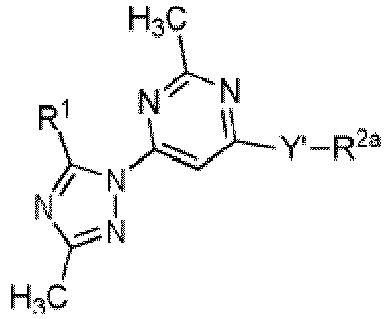
- Composé selon la revendication 9, dans lequel R2a est sélectionné parmi le groupe constitué de pyrimidinyle, quinolinyle, pyridyle et naphtyridinyle, chacun de ceux-ci est optionnellement substitué par 1 à 3 groupes de Ra, R1 est sélectionné parmi le groupe constitué de méthyle, éthyle, propyle, isopropyle, butyle, (CH2)phényle, cyclopropyle, cyclohexyle, (CH2)thiazolyle, (CH2)pyrazinyle, (CH2)0-1pyridyle, pipéridinyle et pyranyle optionnellement substitués.
- Composé selon la revendication 1 qui est :4-chloro-6-(5-(3,4-diméthoxybenzyl)-1H-1,2,4-triazol-1 -yl)-2-méthylpyrimidine, 2-((6-(5-(3,4-diméthoxybenzyl)-3-méthyl-1H-1,2,4-triazol-1-yl)-2-méthylpyrimidin-4-yl)éthynyl)quinoline,2-(2-(6-(5-(3,4-diméthoxybenzyl)-3-méthyl-1H-1,2,4-triazol-1-yl)-2-méthylpyrimidin-4-yl)éthyl)quinoline,2-((6-(5-(3,4-diméthoxybenzyl)-3-méthyl-1H-1,2,4-triazol-1-yl)-2-méthylpyrimidin-4-yloxy)méthyl)quinoline,4-(5-(3,4-diméthoxybenzyl)-3-méthyl-1H-1,2,4-triazol-1-yl)-2-méthyl-6-(2-(5-méthylpyridin-2-yl)éthyl)pyrimidine,4-chloro-6-(5-((5,6-diméthoxypyridin-2-yl)méthyl)-3-méthyl-1H-1,2,4-triazol-1-yl)-2-méthylpyrimidine,2-((6-(5-((5,6-diméthoxypyridin-2-yl)méthyl)-3-méthyl-1H-1,2,4-triazol-1-yl)-2-méthylpyrimidin-4-yl)éthynyl)quinoline,2-(2-(6-(5-((5,6-diméthoxypyridin-2-yl)méthyl)-3-méthyl-1H-1,2,4-triazol-1-yl)-2-méthylpyrimidin-4-yl)éthyl)quinoline,2,5-diméthyl-4-((3-méthyl-1-(2-méthyl-6-(quinolin-2-ylméthoxy)pyrimidin-4-yl)-1H-1,2,4-triazol-5-yl)méthyl)thiazole,4-(5-(3,4-diméthoxybenzyl)-3-méthyl-1H-1,2,4-triazol-1-yl)-2-méthyl-6-vinylpyrimidine,4-chloro-6-(5-((5,6-diméthoxypyrazin-2-yl)méthyl)-3-méthyl-1H-1,2,4-triazol-1-yl)-2-méthylpyrimidine,(E)-2-(2-(6-(5-(3,4-diméthoxybenzyl)-3-méthyl-1H-1,2,4-triazol-1-yl)-2-méthylpyrimidin-4-yl)vinyl)-1,5-naphtyridine,2-((6-(5-(3,4-diméthoxybenzyl)-3-méthyl-1H-1,2,4-triazol-1-yl)-2-méthylpyrimidin-4-yl)éthynyl)-1,5-naphtyridine,2-(2-(6-(5-((5,6-diméthoxypyrazin-2-yl)méthyl)-3-méthyl-1H-1,2,4-triazol-1-yl)-2-méthylpyrimidin-4-yl)éthyl)quinoline,2-(2-(6-(5-(3,4-diméthoxybenzyl)-3-méthyl-1H-1,2,4-triazol-1-yl)-2-méthylpyrimidin-4-yl)éthyl)-1,5-naphtyridine,carboxylate de trans-éthyl-2-(6-(5-(3,4-diméthoxybenzyl)-3-méthyl-1H-1,2,4-triazol-1-yl)-2-méthylpyrimidin-4-yl)cyclopropane,(E)-2-(2-(6-(5-(3,4-diméthoxybenzyl)-3-méthyl-1H-1,2,4-triazol-1-yl)-2-méthylpyrimidin-4-yl)vinyl)quinoline,(E)-4-(5-(3,4-diméthoxybenzyl)-3-méthyl-1H-1,2,4-triazol-1-yl)-2-méthyl-6-(2-(pyridin-2-yl)vinyl)pyrimidine,(E)-4-(5-(3,4-diméthoxybenzyl)-3-méthyl-1H-1,2,4-triazol-1-yl)-2-méthyl-6-(2-(5-méthylpyridin-2-yl)vinyl)pyrimidine,acide 2-(6-(5-(3,4-diméthoxybenzyl)-3-méthyl-1H-1,2,4-triazol-1-yl)-2-méthylpyrimidin-4-yl)cyclopropanecarboxylique,2-(6-(5-(3,4-diméthoxybenzyl)-3-méthyl-1H-1,2,4-triazol-1-yl)-2-méthylpyrimidin-4-yl)-N-méthylcyclopropanecarboxamide,1-(2-(6-(5-(3,4-diméthoxybenzyl)-3-méthyl-1H-1,2,4-triazol-1-yl)-2-méthylpyrimidin-4-yl)cyclopropyl)éthanone,5-(2-(6-(5-(3,4-diméthoxybenzyl)-3-méthyl-1H-1,2,4-triazol-1-yl)-2-méthylpyrimidin-4-yl)cyclopropyl)-3-méthyl-1,2,4-oxadiazole,2-((1S,2S)-2-(6-(5-(3,4-diméthoxybenzyl)-3-méthyl-1H-1,2,4-triazol-1-yl)-2-méthylpyrimidin-4-yl)cyclopropyl)-1H-benzo[d]imidazole,2-((1R,2R)-2-(6-(5-(3,4-diméthoxybenzyl)-3-méthyl-1H-1,2,4-triazol-1-yl)-2-méthylpyrimidin-4-yl)cyclopropyl)-1H-benzo[d]imidazole,2-(2-(6-(5-(3,4-diméthoxybenzyl)-3-méthyl-1H-1,2,4-triazol-1-yl)-2-méthylpyrimidin-4-yl)cyclopropyl)-5-méthyl-1,3,4-oxadiazole,2-(2-(6-(5-(3,4-diméthoxybenzyl)-3-méthyl-1H-1,2,4-triazol-1-yl)-2-méthylpyrimidin-4-yl)cyclopropyl)-1-méthyl-1H-benzo[d]imidazole,2-(2-(6-(5-(3,4-diméthoxybenzyl)-3-méthyl-1H-1,2,4-triazol-1-yl)-2-méthylpyrimidin-4-yl)cyclopropyl)-5-méthyl-1,3,4-thiadiazole,4-(5-(3,4-diméthoxybenzyl)-3-méthyl-1H-1,2,4-triazol-1-yl)-6-(2-iodocyclopropyl)-2-méthylpyrimidine,4-(3, 5-diméthyl-1H-1,2,4-triazol-1-yl)-2-méthyl-6-chloropyrimidine,4-(3, 5-diméthyl-1H-1,2,4-triazol-1-yl)-2-méthyl-6-vinylpyrimidine,carboxylate d'éthyl-2-(6-(3,5-diméthyl-1H-1,2,4-triazol-1-yl)-2-méthylpyrimidin-4-yl)cyclopropane,trans-2-(2-(6-(5-(3,4-diméthoxybenzyl)-3-méthyl-1H-1,2,4-triazol-1-yl)-2-méthylpyrimidin-4-yl)cyclopropyl)-1,5-naphtyridine,cis-2-(2-(6-(5-(3,4-diméthoxybenzyl)-3-méthyl-1H-1,2,4-triazol-1-yl)-2-méthylpyrimidin-4-yl)cyclopropyl)-1,5-naphtyridine,4-(5-(3,4-diméthoxybenzyl)-3-méthyl-1H-1,2,4-triazol-1-yl)-2-méthyl-6-(2-(5-méthylpyridin-2-yl)cyclopropyl)pyrimidine,2-(2-(6-(3, 5-diméthyl-1H-1,2,4-triazol-1-yl)-2-méthylpyrimidin-4-yl)cyclopropyl)-1-méthyl-1H-benzo[d]imidazole,2-((1R,2R)-2-(6-(3, 5-diméthyl-1H-1,2,4-triazol-1-yl)-2-méthylpyrimidin-4-yl)cyclopropyl)-1-méthyl-1H-benzo[d]imidazole,2-(2-(6-(5-(3,4-diméthoxybenzyl)-3-méthyl-1H-1,2,4-triazol-1-yl)-2-méthylpyrimidin-4-yl)cyclopropyl)-1H-benzo[d]imidazole,3,5-diméthyl-1-(2-méthyl-6-(2-(5-méthyl-1,3,4-oxadiazol-2-yl)cyclopropyl)pyrimidin-4-yl)-1H-1,2,4-triazol-4-ium ,2-(2-(6-(3, 5-diméthyl-1H-1,2,4-triazol-1-yl)-2-méthylpyrimidin-4-yl)cyclopropyl)-5-méthyl-1,3,4-thiadiazole,2-(2-(6-(3, 5-diméthyl-1H-1,2,4-triazol-1-yl)-2-méthylpyrimidin-4-yl)cyclopropyl)-1H-benzo[d]imidazole,2-(2-(6-(5-(3,4-diméthoxybenzyl)-3-méthyl-1H-1,2,4-triazol-1-yl)-2-méthylpyrimidin-4-yl)cyclopropyl)-5,6-dihydro-4H-pyrrolo[1,2-b]pyrazole,4-(5-(3,4-diméthoxybenzyl)-3-méthyl-1H-1,2,4-triazol-1-yl)-6-(2-(5-méthoxypyridin-2-yl)cyclopropyl)-2-méthylpyrimidine,4-(5-benzyl-3-méthyl-1H-1,2,4-triazol-1-yl)-6-chloro-2-méthylpyrimidine,4-chloro-6-(5-(4-méthoxybenzyl)-3-méthyl-1H-1,2,4-triazol-1-yl)-2-méthylpyrimidine,4-(5-benzyl-3-méthyl-1H-1,2,4-triazol-1-yl)-2-méthyl-6-vinylpyrimidine,4-(5-(4-méthoxybenzyl)-3-méthyl-1H-1,2,4-triazol-1-yl)-2-méthyl-6-vinylpyrimidine,4-chloro-6-(5-isopropyl-3-méthyl-1H-1,2,4-triazol-1-yl)-2-méthylpyrimidine,4-(5-benzyl-3-méthyl-1H-1,2,4-triazol-1-yl)-2-méthyl-6-(2-(5-méthylpyridin-2-yl)cyclopropyl)pyrimidine,4-(3, 5-diméthyl-1H-1,2,4-triazol-1-yl)-2-méthyl-6-(2-(5-méthylpyridin-2-yl)éthyl)pyrimidine,2-(2-(6-(3, 5-diméthyl-1H-1,2,4-triazol-1-yl)-2-méthylpyrimidin-4-yl)cyclopropyl)-1-phényl-1H-benzo[d]imidazole,1-benzyl-2-(2-(6-(3, 5-diméthyl-1H-1,2,4-triazol-1-yl)-2-méthylpyrimidin-4-yl)cyclopropyl)-1H-benzo[d]imidazole,2-(2-(6-(3,5-diméthyl-1H-1,2,4-triazol-1-yl)-2-méthylpyrimidin-4-yl)cyclopropyl)-6-fluoro-1H-benzo[d]imidazole,2-(2-(6-(3,5-diméthyl-1H-1,2,4-triazol-1-yl)-2-méthylpyrimidin-4-yl)cyclopropyl)-5,6-difluoro-1H-benzo[d]imidazole,2-(2-(6-(3, 5-diméthyl-1H-1,2,4-triazol-1-yl)-2-méthylpyrimidin-4-yl)cyclopropyl)-7-méthyl-1H-benzo[d]imidazole,2-(2-(6-(5-isopropyl-3-méthyl-1H-1,2,4-triazol-1-yl)-2-méthylpyrimidin-4-yl)cyclopropyl)-1-méthyl-1H-benzo[d]imidazole,6-chloro-2-(2-(6-(3,5-diméthyl-1H-1,2,4-triazol-1-yl)-2-méthylpyrimidin-4-yl)cyclopropyl)-1H-benzo[d]imidazole,2-(2-(6-(3,5-diméthyl-1H-1,2,4-triazol-1-yl)-2-méthylpyrimidin-4-yl)cyclopropyl)-6-méthyl-1H-benzo[d]imidazole,2-(2-(6-(3,5-diméthyl-1H-1,2,4-triazol-1-yl)-2-méthylpyrimidin-4-yl)cyclopropyl)-6-méthoxy-1H-benzo[d]imidazole,6-(difluorométhoxy)-2-(2-(6-(3, 5-diméthyl-1H-1,2,4-triazol-1-yl)-2-méthylpyrimidin-4-yl)cyclopropyl)-1H-benzo[d]imidazole,4-(3,5-diméthyl-1H-1,2,4-triazol-1-yl)-6-[(1R,2R)-2-(1-méthyl-1H-benzimidazol-2-yl)cyclopropyl]pyrimidine-2-carbonitrile,4-(3,5-diméthyl-1H-1,2,4-triazol-1-yl)-N-méthyl-6-[(1R,2R)-2-(1-méthyl-1H-benzimidazol-2-yl)cyclopropyl]pyrimidin-2-amine,2-{(1R,2R)-2-[6-(3,5-diméthyl-1H-1,2,4-triazol-1-yl)-2-éthoxypyrimidin-4-yl]cyclopropyl}-1-méthyl-1H-benzimidazole,2-({4-(3,5-diméthyl-1H-1,2,4-triazol-1-yl)-6-[(1R,2R)-2-(1-méthyl-1H-benzimidazol-2-yl)cyclopropyl]pyrimidin-2-yl}oxy)éthanol,2-{(1R,2R)-2-[6-(3,5-diméthyl-1H-1,2,4-triazol-1-yl)-2-(2-méthoxyéthoxy)pyrimidin-4-yl]cyclopropyl}-1-méthyl-1H-benzimidazole,2-[(1R,2R)-2-f6-(3,5-diméthyl-1H-1,2,4-triazol-1-yl)-2-[(1R)-2-méthoxy-1-méthyléthoxy]pyrimidin-4-yl}cyclopropyl]-1-méthyl-1H-benzimidazole,2-[(1R,2R)-2-(3,5-diméthyl-1H-1,2,4-triazol-1-yl)-2-[(1S)-2-méthoxy-1-méthyléthoxy]pyrimidin-4-yl}cyclopropyl]-1-méthyl-1H-benzimidazole,2- f (1R,2R)-2-[6-(3,5-diméthyl-1H-1,2,4-triazol-1-yl)-2-méthylpyrimidin-4-yl]cyclopropyl}-6-fluoro-1H-benzimidazole,2-{(1R,2R)-2-[6-(3,5-diméthyl-1H-1,2,4-triazol-1-yl)-2-(méthylsulfanyl)pyrimidin-4-yl]cyclopropyl}-1-méthyl-1H-benzimidazole,2-{2-[6-(3,5-diméthyl-1H-1,2,4-triazol-1-yl)-2-méthylpyrimidin-4-yl]cyclopropyl}-1-(tetrahydro-2H-pyran-2-ylméthyl)-1H-benzimidazole,2-{2-[6-(3,5-diméthyl-1H-1,2,4-triazol-1-yl)-2-méthylpyrimidin-4-yl]cyclopropyl}-1-(1-méthyléthyl)-1H-benzimidazole,2-(2-{2-[6-(3,5-diméthyl-1H-1,2,4-triazol-1-yl)-2-méthylpyrimidin-4-yl]cyclopropyl}-1H-benzimidazol-1-yl)-N,N-diméthyléthanamine,2-{2-[6-(3,5-diméthyl-1H-1,2,4-triazol-1-yl)-2-méthylpyrimidin-4-yl]cyclopropyl}-1-(pyridin-2-ylméthyl)-1H-benzimidazole,2-{2-[6-(3,5-diméthyl-1H-1,2,4-triazol-1-yl)-2-méthylpyrimidin-4-yl]cyclopropyl}-1-(pyridin-3-ylméthyl)-1H-benzimidazole,2-{2-[6-(3,5-diméthyl-1H-1,2,4-triazol-1-yl)-2-méthylpyrimidin-4-yl]cyclopropyl}-1-(tetrahydrofuran-2-ylméthyl)-1H -benzimidazole,2-{2-[6-(3,5-diméthyl-1H-1,2,4-triazol-1-yl)-2-méthylpyrimidin-4-yl]cyclopropyl}-1-(pyridin-4-ylméthyl)-1H -benzimidazole,1-méthyl-2-{(1R,2R)-2-[2-méthyl-6-(3-méthyl-1H-1,2,4-triazol-1-yl)pyrimidin-4-yl]cycopropyl}-1H-benzimidazole,2-{2-[6-(5-cyclohexyl-3-méthyl-1H-1,2,4-triazol-1-yl)-2-méthylpyrimidin-4-yl]cyclopropyl}-1-méthyl-1H-benzimidazole,2-{2-[6-(3,5-diméthyl-1H-1,2,4-triazol-1-yl)-2-méthylpyrimidin-4-yl]cyclopropyl}-1-méthyl-1H-imidazo[4,5-b]pyridine,1-méthyl-2-{2-[2-méthyl-6-(3-méthyl-5-pyridin-3-yl-1H-1,2,4-triazol-1-yl)pyrimidin-4-yl]cycopropyl}-1H-benzimidazole,1-méthyl-2-{2-[2-méthyl-6-(3-méthyl-5-pyridin-2-yl-1H-1,2,4-triazol-1-yl)pyrimidin-4-yl]cycopropyl}-1H-benzimidazole,2-{2-[6-(5-éthyl-3-méthyl-1H-1,2,4-triazol-1-yl)-2-méthylpyrimidin-4-yl]cyclopropyl}-1-méthyl-1H-benzimidazole,4-(3-méthyl-1-{2-méthyl-6-[2-(1-méthyl-1H-benzimidazol-2-yl)cyclopropyl]pyrimidin-4-yl}-1H-1,2,4-triazol-5-yl)pipéridine-1-carboxylate de tert-butyle,2-{2-[6-(5-cyclopropyl-3-méthyl-1H-1,2,4-triazol-1-yl)-2-méthylpyrimidin-4-yl]cyclopropyl}-1-méthyl-1H-benzimidazole,2-[2-{6-[5-(méthoxyméthyl)-3-méthyl-1H-,2,4-triazol-1-yl]-2-méthylpyrimidin-4-yl}cyclopropyl]-1-méthyl-1H-benzimidazole,N,N-diméthyl-1-(3-méthyl-1-{2-méthyl-6-[2-(1-méthyl-1H-benzimidazol-2-yl)cyclopropyl]pyrimidin-4-yl}-1H-1,2,4-triazol-5-yl)méthanamine,2-{(1R,2R)-2-[6-(3-bromo-5-méthyl-1H-1,2,4-triazol-1-yl)-2-méthylpyrimidin-4-yl]cyclopropyl}-1-méthyl-1H-benzimidazole,2-{(1R,2R)-2-[6-(3,5-diméthyl-1H-1,2,4-triazol-1-yl)-2-méthylpyrimidin-4-yl]cycopropyl}-1H-benzimidazole,2-{(1S,2S)-2-[6-(3,5-diméthyl-1H-1,2,4-triazol-1-yl)-2-méthylpyrimidin-4-yl]cycopropyl}-1H-benzimidazole,2-[(1R,2R)-2-{6-[5-(méthoxyméthyl)-3-méthyl-1H-1,2,4-triazol-1-yl]-2-méthylpyrimidin-4-yl}cyclopropyl]-1-méthyl-1H-benzimidazole,2-{(1R,2R)-2-[6-(5-éthyl-3-méthyl-1H-1,2,4-triazol-1-yl)-2-méthylpyrimidin-4-yl]cyclopropyl}-1-méthyl-1H-benzimidazole,2-[(1R,2R)-2-{6-[5-(fluorométhyl)-3-méthyl-1H-1,2,4-triazol-1-yl]-2-méthylpyrimidin-4-yl}cyclopropyl]-1-méthyl-1H-benzimidazole,2-[(1R,2R)-2-{6-[5-(méthoxyméthyl)-1H-1,2,4-triazol-1-yl]-2-méthylpyrimidin-4-yl}cyclopropyl]-1-méthyl-1H-benzimidazole,2-[(1R,2R)-2-(6-{5-[(1S)-1-méthoxyéthyl]-3-méthyl-1H-1,2,4-triazol-1-yl}-2-méthylpyrimidin-4-yl)cyclopropyl]-1-méthyl-1H-benzimidazole,1-méthyl-2-[(1R,2R)-2-{2-méthyl-6-[3-méthyl-5-(1-méthylpipéridin-4-yl)-1H-1,2,4-triazol-1-yl]pyrimidin-4-yl}cyclopropyl]-1H-benzimidazole,1-méthyl-2-[(1R,2R)-2-{2-méthyl-6-[3-méthyl-5-(tetrahydro-2H-pyran-4-yl)-1H-1,2,4-triazol-1-yl]pyrimidin-4-yl}cyclopropyl]-1H-benzimidazole,2-(3-méthyl-1-{2-méthyl-6-[(1R,2R)-2-(1-méthyl-1H-benzimidazol-2-yl)cyc1opropyl]pyrimidin-4-yl}-1H-1,2,4-triazol-5-yl)propan-2-ol,2-{2-[6-(3,5-diméthyl-1H-1,2,4-triazol-1-yl)-2-méthylpyrimidin-4-yl]éthyl}-1,5-naphtyridine,2-{(1R,2R)-2-[6-(5-tert-butyl-3-méthyl-1H-1,2,4-triazol-1-yl)-2-méthylpyrimidin-4-yl]cyclopropyl}-1-méthyl-1H-benzimidazole,1-méthyl-2-[(1R,2R)-2-(2-méthyl-6-{3-méthyl-5-[(2S)-tetrahydrofuran-2-yl]-1H-1,2,4-triazol-1-yl}pyrimidin-4-yl)cyclopropyl]-1H-benzimidazole,2-{(1S,2S)-2-[6-(3,5-diméthyl-1H-1,2,4-triazol-1-yl)-2-méthylpyrimidin-4-yl]cyclopropyl}-1-(2-fluoroéthyl)-1H-benzimidazole,2-{(1S,2S)-2-[6-(3,5-diméthyl-1H-1,2,4-triazol-1-yl)-2-méthylpyrimidin-4-yl]cyclopropyl}-1-(2-fluoroéthyl)-1H-benzimidazole,2-{(1S,2S)-2-[6-(3,5-diméthyl-1H-1,2,4-triazol-1-yl)-2-méthylpyrimidin-4-yl]cyclopropyl}-1,3-benzothiazole,4-(3,5-diméthyl-1H-1,2,4-triazol-1-yl)-2-méthyl-6-{(1S,2S)-2-[5-(1-méthyl-1H-pyrazol-3-yl)-1,3,4-thiadiazol-2-yl]cyclopropyl}pyrimidine,2-{(1R,2R)-2-[6-(3,5-diéthyl-1H-1,2,4-triazol-1-yl)-2-méthylpyrimidin-4-yl]cyclopropyl}-1-méthyl-1H-benzimidazole,2-{(1R,2R)-2-[6-(3,5-diméthyl-1H-1,2,4-triazol-1-yl)-2-méthylpyrimidin-4-yl]cyclopropyl}-4,5,6,7-tetrahydropyrazolo[1,5-a]pyridine,trans-2-{2-[4-(3,5-diméthyl-1H-1,2,4-triazol-1-yl)-6-méthylpyridin-2-yl]cyclopropyl}-1-méthyl-1H-benzimidazole,trans-2-{2-[6-(3,5-diméthyl-1H-1,2,4-triazol-1-yl)-2-(trifluorométhyl)pyrimidin-4-yl]cyclopropyl}-1-méthyl-1H-benzimidazole,trans-2-{2-[2-(3,5-diméthyl-1H-1,2,4-triazol-1-yl)-6-méthylpyridin-4-yl]cyclopropyl}-1-méthyl-1H-benzimidazole,trans-2-{2-[6-(3,5-diméthyl-1H-1,2,4-triazol-1-yl)-2-méthoxypyrimidin-4-yl]cyclopropyl}-1-méthyl-1H-benzimidazole,trans-2-{2-[2-cyclopropyl-6-(3,5-diméthyl-1H-1,2,4-triazol-1-yl)pyrimidin-4-yl]cyclopropyl}-1-méthyl-1H-benzimidazole,trans-2-{2-[6-(3,5-diméthyl-1H-1,2,4-triazol-1-yl)-2-(1-méthyléthoxy)pyrimidin-4-yl]cyclopropyl}-1-méthyl-1H-benzimidazole,trans-4-(3,5-diméthyl-1H-1,2,4-triazol-1-yl)-N,N-diméthyl-6-[2-(1-méthyl-1H-benzimidazol-2-yl)cyclopropyl]pyrimidin-2-amine,trans-4-(3,5-diméthyl-1H-1,2,4-triazol-1-yl)-6-[2-(1-méthyl-1H-benzimidazol-2-yl)cyclopropyl]-N-(1-méthyléthyl)pyrimidin-2-amine,trans-2-{2-[6-(3,5-diméthyl-1H-1,2,4-triazol-1-yl)-2-pyrrolidin-1-ylpyrimidin-4-yl]cyclopropyl}-1-méthyl-1H-benzimidazole,trans-2-{2-[6-(3,5-diméthyl-1H-1,2,4-triazol-1-yl)-2-morpholin-4-ylpyrimidin-4-yl]cyclopropyl}-1-méthyl-1H-benzimidazole,trans-N-tert-butyl-4-(3,5-diméthyl-1H-1,2,4-triazol-1-yl)-6-[2-(1-méthyl-1H-benzimidazol-2-yl)cyclopropyl]pyrimidin-2-amine,trans-2-{2-[6-(3,5-diméthyl-1H-1,2,4-triazol-1-yl)-2-éthylpyrimidin-4-yl]cyclopropyl}-1-méthyl-1H-benzimidazole,trans-2-{2-[2-(cyclopropylméthoxy)-6-(3,5-diméthyl-1H-1,2,4-triazol-1-yl)pyrimidin-4-yl]cyclopropyl}-1-méthyl-1H-benzimidazole,trans-2-{2-[6-(3,5-diméthyl-1H-1,2,4-triazol-1-yl)-2-(4-méthylpipérazin-1-yl)pyrimidin-4-yl]cyclopropyl}-1-méthyl-1H-benzimidazole,trans-2-{2-[6-(3,5-diméthyl-1H-1,2,4-triazol-1-yl)-2-(2-fluoroéthoxy)pyrimidin-4-yl]cyclopropyl}-1-méthyl-1H-benzimidazole,trans-4-(3,5-diméthyl-1H-1,2,4-triazol-1-yl)-6-[2-(1-méthyl-1H-benzimidazol-2-yl)cyclopropyl]pyrimidin-2-amine,trans-2-{2-[6-(3,5-diméthyl-1H-1,2,4-triazol-1-yl)-2-(2,2,2-trifluoroéthoxy)pyrimidin-4-yl]cyclopropyl}-1-méthyl-1H-benzimidazole,trans-4-(3,5-diméthyl-1H-1,2,4-triazol-1-yl)-6-[2-(1-méthyl-1H-benzimidazol-2-yl)cyclopropyl]pyrimidin-2-ol,trans-2-{2-[6-(3,5-diméthyl-1H-1,2,4-triazol-1-yl)-2-méthylpyrimidin-4-yl]cyclopropyl}quinoline,trans-2-{2-[6-(3,5-diméthyl-1H-1,2,4-triazol-1-yl)pyridazin-4-yl]cyclopropyl}-1-méthyl-1H-benzimidazole,trans-2-{2-[6-(3,5-diméthyl-1H-1,2,4-triazol-1-yl)-2-méthylpyrimidin-4-yl]cyclopropyl}-1,3-benzothiazole,trans-4-(3,5-diméthyl-1H-1,2,4-triazol-1-yl)-6-[2-(1-méthyl-1H-benzimidazol-2-yl)cyclopropyl]pyrimidine-2-carboxamide2-(4-(3,5-diméthyl-1H-1,2,4-triazol-1-yl)-6-((1R,2R)-2-(1-méthyl-1H-benzo[d]imidazol-2-yl)cyclopropyl)pyrimidin-2-yl)propan-2-ol,2-((1R,2R)-2-(2-(3,3-difluoroazétidin-1-yl)-6-(3,5-diméthyl-1H-1,2,4-triazol-1-yl)pyrimidin-4-yl)cyclopropyl)-1-méthyl-1H-benzo[d]imidazole,2-((1R,2R)-2-(6-(3,5-diméthyl-1H-1,2,4-triazol-1-yl)-2-((R)-2-méthylpyrrolidin-1-yl)pyrimidin-4-yl)cyclopropyl)-1-méthyl-1H-benzo[d]imidazole,2-((1R,2R)-2-(6-(3,5-diméthyl-1H-1,2,4-triazol-1-yl)-2-((R)-3-fluoropyrrolidin-1-yl)pyrimidin-4-yl)cyclopropyl)-1-méthyl-1H-benzo[d]imidazole,1-(4-(3,5-diméthyl-1H-1,2,4-triazol-1-yl)-6-((1R,2R)-2-(1-méthyl-1H-benzo[d]imidazol-2-yl)cyclopropyl)pyrimidin-2-yl)-3-méthylazétidin-3-ol,2-((1R,2R)-2-(2-cyclobutoxy-6-(3,5-diméthyl-1H-1,2,4-triazol-1-yl)pyrimidin-4-yl)cyclopropyl)-1-méthyl-1H-benzo[d]imidazole,2-((1R,2R)-2-(6-(3,5-diméthyl-1H-1,2,4-triazol-1-yl)-2-((1-méthylcyclopropyl)méthoxy)pyrimidin-4-yl)cyclopropyl)-1-méthyl-1H-benzo[d]imidazole,2-((1R,2R)-2-(6-(3,5-diméthyl-1H-1,2,4-triazol-1-yl)-2-(oxétan-2-ylméthoxy)pyrimidin-4-yl)cyclopropyl)-1-méthyl-1H-benzo[d]imidazole,ou un sel pharmaceutiquement acceptable de ceux-ci.
- Composition pharmaceutique qui comprend un véhicule pharmaceutiquement acceptable et un composé selon l'une quelconque des revendications précédentes ou un sel pharmaceutiquement acceptable de celui-ci.
- Composition pharmaceutique qui comprend un véhicule pharmaceutiquement acceptable et un composé de la formule I :
 R représente H ou un alkyle en C1-6,R1 est sélectionné parmi le groupe constitué d'alkyle en C1-6, (CH2)ncycloalkyle en C3-10, (CH2)naryle en C6-10 et (CH2)nhétérocycle en C5-10, lesdits alkyle, cycloalkyle, hétérocycle et aryle étant optionnellement substitués par 1 à 3 groupes de Ra, dans lequel les cycloalkyle, aryle et hétérocycle sont sélectionnés parmi le groupe constitué de phényle, tétrahydrofuranyle, pyranyle, pipéridinyle, pyridyle, thiazolyle, pyrazinyle, cyclopropyle et cyclohexyle ;R2 est sélectionné parmi le groupe constitué de :(1) halogène,(2) alkyle en C1-6, qui est non substitué ou substitué par 1 à 3 groupes de Ra,(3) (CH2)naryle en C6-10, qui est non substitué ou substitué par 1 à 3 groupes de Ra,(4) -O-(CH2)nhétérocycle en C5-10, qui est non substitué ou substitué par 1 à 3 groupes de Ra,(5) -(CH2)nhétérocycle en C5-10, qui est non substitué ou substitué par 1 à 3 groupes de Ra,(6) -(CH2)ncycloalkyle en C3-10, qui est non substitué ou substitué par 1 à 3 groupes de Ra,(7) alcényle en C2-6hétérocycle en C5-10, qui est non substitué ou substitué par 1 à 3 groupes de Ra,(8) alcynyle en C2-6hétérocycle en C5-10, qui est non substitué ou substitué par 1 à 3 groupes de Ra, et(9) alcényle en C2-6, qui est non substitué ou substitué par 1 à 3 groupes de Ra ;R3 et R4 sont sélectionnés indépendamment parmi le groupe constitué de H, -O-R, CN, O(CH2)nOR, -OCHR(CH2)nOR, SR, SO2R, S(O)R, N(R)2, C(O)N(R)2, haloalkyle en C1-3, O(CH2)n-haloalkyle en C1-3, -O(CH2)ncycloalkyle en C3-6, (CH2)nhétérocycle en C5-10, - O(CH2)nhétérocycle en C5-10, alkyle en C1-6 et cycloalkyle en C3-10, lesdits alkyle, cycloalkyle et hétérocycle étant non substitués ou substitués par 1 à 3 groupes de Ra ;R7 est un alkyle en C1-6 ou un halo ;Ra est sélectionné parmi le groupe constitué de :(1) halogène,(2) hydroxyle,(3) alkyle en C1-6,(4) -(CH2)nO-R,(5) (CH2)naryle en C6-10,(6) (CH2)nhétérocycle en C5-10,(7) Ohaloalkyle en C1-5,(8) CO2R,(9) C(O)N(R)2,(10) (CH2)nC(O)R,(11) CN,(12) (CH2)nN(R)2,(13) (CH2)ncycloalkyle en C3-6,(14) (CH2)nhaloalkyle en C1-3,lesdits cycloalkyle, aryle et hétérocycle étant optionnellement substitués par 1 à 3 groupes deRb ;Rb est sélectionné parmi le groupe constitué de (CH2)nhaloalkyle en C1-3, (CH2)ncycloalkyle en C3-6, (CH2)nhétérocycle en C5-10, (CH2)naryle en C6-10, (CH2)nN(R)2, halogène, CN, Ohaloalkyle en C1-4, alkyle en C1-6 et OR, ledit hétérocycle étant non substitué ou substitué par 1 à 3 groupes d'alkyle en C1-6 ; etn représente 0-4,ou un sel pharmaceutiquement acceptable de celui-ci.
 - Composé selon l'une quelconque des revendications 1-11, ou un sel pharmaceutiquement acceptable de celui-ci, pour utilisation en thérapie.
- Composition pharmaceutique telle que définie dans la revendication 13, pour utilisation en thérapie.
- Composition pharmaceutique telle que définie dans la revendication 13, pour utilisation dans le traitement d'un trouble sélectionné parmi des troubles psychotiques, des troubles délirants et des pharmacopsychoses ; des troubles anxieux, des troubles des mouvements, des troubles de l'humeur et des troubles neurodégénératifs.
- Composé selon l'une quelconque des revendications 1-11, ou un sel pharmaceutiquement acceptable de celui-ci, pour utilisation dans le traitement d'un trouble sélectionné parmi des troubles psychotiques, des troubles délirants et des pharmacopsychoses ; des troubles anxieux, des troubles des mouvements, des troubles de l'humeur et des troubles neurodégénératifs.
Applications Claiming Priority (2)
| Application Number | Priority Date | Filing Date | Title |
|---|---|---|---|
| US201161544055P | 2011-10-06 | 2011-10-06 | |
| PCT/US2012/058525 WO2013052526A1 (fr) | 2011-10-06 | 2012-10-03 | Inhibiteurs triazolyles de pde10 |
Publications (3)
| Publication Number | Publication Date |
|---|---|
| EP2763533A1 EP2763533A1 (fr) | 2014-08-13 |
| EP2763533A4 EP2763533A4 (fr) | 2015-05-13 |
| EP2763533B1 true EP2763533B1 (fr) | 2021-12-29 |
Family
ID=48044116
Family Applications (1)
| Application Number | Title | Priority Date | Filing Date |
|---|---|---|---|
| EP12838891.5A Active EP2763533B1 (fr) | 2011-10-06 | 2012-10-03 | Inhibiteurs triazolyles de pde10 |
Country Status (3)
| Country | Link |
|---|---|
| US (1) | US9200001B2 (fr) |
| EP (1) | EP2763533B1 (fr) |
| WO (1) | WO2013052526A1 (fr) |
Families Citing this family (16)
| Publication number | Priority date | Publication date | Assignee | Title |
|---|---|---|---|---|
| EP2861596B1 (fr) | 2012-06-19 | 2019-03-20 | Sunovion Pharmaceuticals Inc. | Composés hétéroaryles et leurs procédés d'utilisation |
| US9284302B2 (en) | 2012-11-15 | 2016-03-15 | Merck Sharp & Dohme Corp. | Cyclobutyl benzimidazoles as PDE 10 inhibitors |
| EP2919783B1 (fr) * | 2012-11-15 | 2018-01-31 | Merck Sharp & Dohme Corp. | Cyclopropylimidazopyridine utilisable en tant qu'inhibiteur de pde10 |
| TW201422610A (zh) | 2012-11-15 | 2014-06-16 | Merck Sharp & Dohme | 作爲pde10抑制劑之經二級醇取代之三唑 |
| MX2016009448A (es) | 2014-01-31 | 2016-10-13 | Hoffmann La Roche | (hetero)aril-imidazoles/pirazoles para el tratamiento de trastornos neurologicos. |
| CR20170077A (es) | 2014-08-04 | 2017-06-26 | Nuevolution As | Derivados de heterociclilo opcionalmente condensados de pirimidina útiles para el tratamiento de enfermedades inflamatorias, metabólicas, oncológicas y autoinmunitarias |
| WO2016145614A1 (fr) | 2015-03-17 | 2016-09-22 | Merck Sharp & Dohme Corp. | Composés de triazolyl pyrimidinone en tant qu'inhibiteurs de pde2 |
| CN109776351B (zh) * | 2017-11-15 | 2021-11-09 | 江苏优士化学有限公司 | 一种重氮乙酸酯连续化合成方法 |
| EP3765459A1 (fr) | 2018-03-13 | 2021-01-20 | Shire Human Genetic Therapies, Inc. | Imidazopyridines substituées en tant qu'inhibiteurs de la kallicréine plasmatique et leurs utilisations |
| EP4031245A1 (fr) | 2019-09-18 | 2022-07-27 | Takeda Pharmaceutical Company Limited | Inhibiteurs hétéroaryles de la kallicréine plasmatique |
| DK4031547T3 (da) | 2019-09-18 | 2024-09-09 | Takeda Pharmaceuticals Co | Plasmakallikreininhibitorer og anvendelser deraf |
| UY38994A (es) | 2019-12-20 | 2021-07-30 | Nuevolution As | Compuestos activos frente a receptores nucleares |
| MX2022007265A (es) | 2019-12-20 | 2022-09-09 | Nuevolution As | Compuestos activos frente a receptores nucleares. |
| AU2021245397A1 (en) | 2020-03-31 | 2022-10-20 | Nuevolution A/S | Compounds active towards nuclear receptors |
| WO2021198956A1 (fr) | 2020-03-31 | 2021-10-07 | Nuevolution A/S | Composés actifs vis-à-vis des récepteurs nucléaires |
| US20240199613A1 (en) * | 2021-03-17 | 2024-06-20 | Takeda Pharmaceutical Company Limited | Polycyclic inhibitors of plasma kallikrein |
Family Cites Families (13)
| Publication number | Priority date | Publication date | Assignee | Title |
|---|---|---|---|---|
| JPS6339875A (ja) * | 1986-08-05 | 1988-02-20 | Nissin Food Prod Co Ltd | ピリミジン誘導体 |
| DE3825867A1 (de) * | 1988-03-04 | 1989-09-14 | Bayer Ag | Heterocyclisch substituierte sulfonylaminoazole und ihre verwendung als herbizide |
| EP0421266A1 (fr) * | 1989-10-06 | 1991-04-10 | BASF Aktiengesellschaft | Dérivés du azolylpyrimidine- et -triazine, et agents les contenant |
| CA2341370A1 (fr) * | 1998-08-20 | 2000-03-02 | Smithkline Beecham Corporation | Nouveaux composes de triazole substitues |
| CA2551944A1 (fr) * | 2003-12-15 | 2005-06-30 | Almirall Prodesfarma Ag | 2, 6-bisheteroaryl-4-aminopyrimidines utilisees en tant qu'antagonistes des recepteurs de l'adenosine |
| DE102004003428A1 (de) * | 2004-01-23 | 2005-08-11 | Boehringer Ingelheim Pharma Gmbh & Co. Kg | Neue langwirksame Beta-2-Agonisten, und deren Verwendung als Arzneimittel |
| US20090176829A1 (en) * | 2006-05-02 | 2009-07-09 | Pfizer Inc | Bicyclic heteroaryl compounds as pde10 inhibitors |
| JP2010511727A (ja) * | 2006-12-04 | 2010-04-15 | ニューロクライン バイオサイエンシーズ,インコーポレイテッド | アデノシン受容体アンタゴニストとしての置換ピリミジン |
| WO2010119878A1 (fr) * | 2009-04-16 | 2010-10-21 | Sumitomo Chemical Company, Limited | Composé de pyrimidine et son utilisation pour la lutte antiparasitaire |
| WO2010119879A1 (fr) * | 2009-04-16 | 2010-10-21 | Sumitomo Chemical Company, Limited | Composé de pyrimidine et son utilisation pour la lutte antiparasitaire |
| CA2787365A1 (fr) * | 2010-01-25 | 2011-07-28 | Chdi Foundation, Inc. | Certains inhibiteurs de kynurenine-3-monooxygenase, compositions pharmaceutiques, et procedes d'utilisation de ceux-ci |
| WO2012044561A2 (fr) | 2010-09-30 | 2012-04-05 | Merck Sharp & Dohme Corp. | Inhibiteurs de 2-alcoxy pyrimidine pde10 |
| BR112014004310B8 (pt) | 2011-08-25 | 2023-04-18 | Merck Sharp & Dohme | Composto de pirimidina inibidor da enzima fosfodiesterase 10, composição farmacêutica, uso de um composto |
-
2012
- 2012-10-03 WO PCT/US2012/058525 patent/WO2013052526A1/fr not_active Ceased
- 2012-10-03 EP EP12838891.5A patent/EP2763533B1/fr active Active
- 2012-10-03 US US14/349,030 patent/US9200001B2/en active Active
Non-Patent Citations (9)
| Title |
|---|
| DATABASE REGISTRY [online] CHEMICAL ABSTRACTS SERVICE, COLUMBUS, OHIO, US; 1 November 2010 (2010-11-01), Database accession no. 1250223-66-5 * |
| DATABASE REGISTRY [online] CHEMICAL ABSTRACTS SERVICE, COLUMBUS, OHIO, US; 2 November 2010 (2010-11-02), Database accession no. 1250723-19-3 * |
| DATABASE REGISTRY [online] CHEMICAL ABSTRACTS SERVICE, COLUMBUS, OHIO, US; 2 November 2010 (2010-11-02), Database accession no. 1250950-97-0, 1250723-19-3 * |
| DATABASE REGISTRY [online] CHEMICAL ABSTRACTS SERVICE, COLUMBUS, OHIO, US; 21 March 2011 (2011-03-21), Database accession no. 1269008-95-8 * |
| DATABASE REGISTRY [online] CHEMICAL ABSTRACTS SERVICE, COLUMBUS, OHIO, US; 21 March 2011 (2011-03-21), Database accession no. 1269264-91-6 * |
| DATABASE REGISTRY [online] CHEMICAL ABSTRACTS SERVICE, COLUMBUS, OHIO, US; 21 March 2011 (2011-03-21), Database accession no. 1269385-11-6 * |
| DATABASE REGISTRY [online] CHEMICAL ABSTRACTS SERVICE, COLUMBUS, OHIO, US; 29 October 2010 (2010-10-29), Database accession no. 1248427--70-4 * |
| DATABASE REGISTRY [online] CHEMICAL ABSTRACTS SERVICE, COLUMBUS, OHIO, US; 31 October 2010 (2010-10-31), Database accession no. 1249659-28-6 * |
| KONISHI KAZUO ET AL: "Fungicidal pyrimidinylhydrazones. V. Fungicidal activity of pyrazolylpyrimidines", JOURNAL OF PESTICIDE SCIENCE - NIPPON NOYAKU GAKKAISHI, NIPPON NOYAKU GAKKAI, TOKYO, JP, vol. 15, no. 1, 1 January 1990 (1990-01-01), pages 13 - 22, XP009193602, ISSN: 0385-1559 * |
Also Published As
| Publication number | Publication date |
|---|---|
| EP2763533A1 (fr) | 2014-08-13 |
| EP2763533A4 (fr) | 2015-05-13 |
| WO2013052526A1 (fr) | 2013-04-11 |
| US9200001B2 (en) | 2015-12-01 |
| US20140249134A1 (en) | 2014-09-04 |
Similar Documents
| Publication | Publication Date | Title |
|---|---|---|
| EP2763533B1 (fr) | Inhibiteurs triazolyles de pde10 | |
| EP2763672B1 (fr) | Inhibiteurs azétidines substitués en 1,3 de pde10 | |
| US9266881B2 (en) | Triazolopyridinone PDE10 inhibitors | |
| EP2621276B1 (fr) | 2-alcoxy pyrimidine inhibiteur de pde10 | |
| WO2012054366A2 (fr) | Amino-triazolyles inhibiteurs de ped10 | |
| EP2922543A1 (fr) | Dérivés de pyridone substitués utilisés en tant qu'inhibiteurs de pde10 | |
| EP2919781B1 (fr) | Cyclobutyl benzimidazoles en tant qu'inhibiteurs de pde10 | |
| WO2014078214A1 (fr) | Azétidine benzimidazoles utilisables en tant qu'inhibiteurs de pde10 | |
| EP2919782B1 (fr) | Triazoles substitués par un alcool secondaire en tant qu'inhibiteurs de pde10 | |
| EP2968324B1 (fr) | Dérivés de pyridazinone substitués en tant qu'inhibiteurs de pde10 | |
| EP2922823B1 (fr) | Inhibiteurs pyrimidines de pde10 | |
| EP3291817B1 (fr) | Composés d'hétéroaryl-pyrimidinone en tant qu'inhibiteurs de pde2 | |
| EP2919783B1 (fr) | Cyclopropylimidazopyridine utilisable en tant qu'inhibiteur de pde10 |
Legal Events
| Date | Code | Title | Description |
|---|---|---|---|
| PUAI | Public reference made under article 153(3) epc to a published international application that has entered the european phase |
Free format text: ORIGINAL CODE: 0009012 |
|
| 17P | Request for examination filed |
Effective date: 20140506 |
|
| AK | Designated contracting states |
Kind code of ref document: A1 Designated state(s): AL AT BE BG CH CY CZ DE DK EE ES FI FR GB GR HR HU IE IS IT LI LT LU LV MC MK MT NL NO PL PT RO RS SE SI SK SM TR |
|
| DAX | Request for extension of the european patent (deleted) | ||
| RIC1 | Information provided on ipc code assigned before grant |
Ipc: A61K 31/506 20060101ALI20150331BHEP Ipc: C07D 487/04 20060101ALI20150331BHEP Ipc: C07D 403/14 20060101ALI20150331BHEP Ipc: A61K 31/501 20060101ALI20150331BHEP Ipc: C07D 405/14 20060101ALI20150331BHEP Ipc: C07D 471/04 20060101ALI20150331BHEP Ipc: C07D 417/14 20060101ALI20150331BHEP Ipc: A61K 31/4439 20060101ALI20150331BHEP Ipc: C07D 401/14 20060101AFI20150331BHEP Ipc: A61P 25/00 20060101ALI20150331BHEP Ipc: C07D 413/14 20060101ALI20150331BHEP Ipc: C07D 403/04 20060101ALI20150331BHEP |
|
| RA4 | Supplementary search report drawn up and despatched (corrected) |
Effective date: 20150413 |
|
| STAA | Information on the status of an ep patent application or granted ep patent |
Free format text: STATUS: EXAMINATION IS IN PROGRESS |
|
| 17Q | First examination report despatched |
Effective date: 20170309 |
|
| GRAP | Despatch of communication of intention to grant a patent |
Free format text: ORIGINAL CODE: EPIDOSNIGR1 |
|
| STAA | Information on the status of an ep patent application or granted ep patent |
Free format text: STATUS: GRANT OF PATENT IS INTENDED |
|
| INTG | Intention to grant announced |
Effective date: 20210708 |
|
| GRAS | Grant fee paid |
Free format text: ORIGINAL CODE: EPIDOSNIGR3 |
|
| GRAA | (expected) grant |
Free format text: ORIGINAL CODE: 0009210 |
|
| STAA | Information on the status of an ep patent application or granted ep patent |
Free format text: STATUS: THE PATENT HAS BEEN GRANTED |
|
| AK | Designated contracting states |
Kind code of ref document: B1 Designated state(s): AL AT BE BG CH CY CZ DE DK EE ES FI FR GB GR HR HU IE IS IT LI LT LU LV MC MK MT NL NO PL PT RO RS SE SI SK SM TR |
|
| REG | Reference to a national code |
Ref country code: GB Ref legal event code: FG4D |
|
| REG | Reference to a national code |
Ref country code: CH Ref legal event code: EP |
|
| REG | Reference to a national code |
Ref country code: AT Ref legal event code: REF Ref document number: 1458592 Country of ref document: AT Kind code of ref document: T Effective date: 20220115 |
|
| REG | Reference to a national code |
Ref country code: IE Ref legal event code: FG4D |
|
| REG | Reference to a national code |
Ref country code: DE Ref legal event code: R096 Ref document number: 602012077453 Country of ref document: DE |
|
| REG | Reference to a national code |
Ref country code: LT Ref legal event code: MG9D |
|
| PG25 | Lapsed in a contracting state [announced via postgrant information from national office to epo] |
Ref country code: RS Free format text: LAPSE BECAUSE OF FAILURE TO SUBMIT A TRANSLATION OF THE DESCRIPTION OR TO PAY THE FEE WITHIN THE PRESCRIBED TIME-LIMIT Effective date: 20211229 Ref country code: LT Free format text: LAPSE BECAUSE OF FAILURE TO SUBMIT A TRANSLATION OF THE DESCRIPTION OR TO PAY THE FEE WITHIN THE PRESCRIBED TIME-LIMIT Effective date: 20211229 Ref country code: FI Free format text: LAPSE BECAUSE OF FAILURE TO SUBMIT A TRANSLATION OF THE DESCRIPTION OR TO PAY THE FEE WITHIN THE PRESCRIBED TIME-LIMIT Effective date: 20211229 Ref country code: BG Free format text: LAPSE BECAUSE OF FAILURE TO SUBMIT A TRANSLATION OF THE DESCRIPTION OR TO PAY THE FEE WITHIN THE PRESCRIBED TIME-LIMIT Effective date: 20220329 |
|
| REG | Reference to a national code |
Ref country code: NL Ref legal event code: MP Effective date: 20211229 |
|
| REG | Reference to a national code |
Ref country code: AT Ref legal event code: MK05 Ref document number: 1458592 Country of ref document: AT Kind code of ref document: T Effective date: 20211229 |
|
| PG25 | Lapsed in a contracting state [announced via postgrant information from national office to epo] |
Ref country code: SE Free format text: LAPSE BECAUSE OF FAILURE TO SUBMIT A TRANSLATION OF THE DESCRIPTION OR TO PAY THE FEE WITHIN THE PRESCRIBED TIME-LIMIT Effective date: 20211229 Ref country code: NO Free format text: LAPSE BECAUSE OF FAILURE TO SUBMIT A TRANSLATION OF THE DESCRIPTION OR TO PAY THE FEE WITHIN THE PRESCRIBED TIME-LIMIT Effective date: 20220329 Ref country code: LV Free format text: LAPSE BECAUSE OF FAILURE TO SUBMIT A TRANSLATION OF THE DESCRIPTION OR TO PAY THE FEE WITHIN THE PRESCRIBED TIME-LIMIT Effective date: 20211229 Ref country code: HR Free format text: LAPSE BECAUSE OF FAILURE TO SUBMIT A TRANSLATION OF THE DESCRIPTION OR TO PAY THE FEE WITHIN THE PRESCRIBED TIME-LIMIT Effective date: 20211229 Ref country code: GR Free format text: LAPSE BECAUSE OF FAILURE TO SUBMIT A TRANSLATION OF THE DESCRIPTION OR TO PAY THE FEE WITHIN THE PRESCRIBED TIME-LIMIT Effective date: 20220330 |
|
| PG25 | Lapsed in a contracting state [announced via postgrant information from national office to epo] |
Ref country code: NL Free format text: LAPSE BECAUSE OF FAILURE TO SUBMIT A TRANSLATION OF THE DESCRIPTION OR TO PAY THE FEE WITHIN THE PRESCRIBED TIME-LIMIT Effective date: 20211229 |
|
| PG25 | Lapsed in a contracting state [announced via postgrant information from national office to epo] |
Ref country code: SM Free format text: LAPSE BECAUSE OF FAILURE TO SUBMIT A TRANSLATION OF THE DESCRIPTION OR TO PAY THE FEE WITHIN THE PRESCRIBED TIME-LIMIT Effective date: 20211229 Ref country code: SK Free format text: LAPSE BECAUSE OF FAILURE TO SUBMIT A TRANSLATION OF THE DESCRIPTION OR TO PAY THE FEE WITHIN THE PRESCRIBED TIME-LIMIT Effective date: 20211229 Ref country code: RO Free format text: LAPSE BECAUSE OF FAILURE TO SUBMIT A TRANSLATION OF THE DESCRIPTION OR TO PAY THE FEE WITHIN THE PRESCRIBED TIME-LIMIT Effective date: 20211229 Ref country code: PT Free format text: LAPSE BECAUSE OF FAILURE TO SUBMIT A TRANSLATION OF THE DESCRIPTION OR TO PAY THE FEE WITHIN THE PRESCRIBED TIME-LIMIT Effective date: 20220429 Ref country code: ES Free format text: LAPSE BECAUSE OF FAILURE TO SUBMIT A TRANSLATION OF THE DESCRIPTION OR TO PAY THE FEE WITHIN THE PRESCRIBED TIME-LIMIT Effective date: 20211229 Ref country code: EE Free format text: LAPSE BECAUSE OF FAILURE TO SUBMIT A TRANSLATION OF THE DESCRIPTION OR TO PAY THE FEE WITHIN THE PRESCRIBED TIME-LIMIT Effective date: 20211229 Ref country code: CZ Free format text: LAPSE BECAUSE OF FAILURE TO SUBMIT A TRANSLATION OF THE DESCRIPTION OR TO PAY THE FEE WITHIN THE PRESCRIBED TIME-LIMIT Effective date: 20211229 |
|
| PG25 | Lapsed in a contracting state [announced via postgrant information from national office to epo] |
Ref country code: PL Free format text: LAPSE BECAUSE OF FAILURE TO SUBMIT A TRANSLATION OF THE DESCRIPTION OR TO PAY THE FEE WITHIN THE PRESCRIBED TIME-LIMIT Effective date: 20211229 Ref country code: AT Free format text: LAPSE BECAUSE OF FAILURE TO SUBMIT A TRANSLATION OF THE DESCRIPTION OR TO PAY THE FEE WITHIN THE PRESCRIBED TIME-LIMIT Effective date: 20211229 |
|
| REG | Reference to a national code |
Ref country code: DE Ref legal event code: R081 Ref document number: 602012077453 Country of ref document: DE Owner name: MERCK SHARP & DOHME LLC, RAHWAY, US Free format text: FORMER OWNER: MERCK SHARP & DOHME CORP., RAHWAY, NJ, US |
|
| PG25 | Lapsed in a contracting state [announced via postgrant information from national office to epo] |
Ref country code: IS Free format text: LAPSE BECAUSE OF FAILURE TO SUBMIT A TRANSLATION OF THE DESCRIPTION OR TO PAY THE FEE WITHIN THE PRESCRIBED TIME-LIMIT Effective date: 20220429 |
|
| REG | Reference to a national code |
Ref country code: DE Ref legal event code: R097 Ref document number: 602012077453 Country of ref document: DE |
|
| RAP2 | Party data changed (patent owner data changed or rights of a patent transferred) |
Owner name: MERCK SHARP & DOHME LLC |
|
| PG25 | Lapsed in a contracting state [announced via postgrant information from national office to epo] |
Ref country code: DK Free format text: LAPSE BECAUSE OF FAILURE TO SUBMIT A TRANSLATION OF THE DESCRIPTION OR TO PAY THE FEE WITHIN THE PRESCRIBED TIME-LIMIT Effective date: 20211229 Ref country code: AL Free format text: LAPSE BECAUSE OF FAILURE TO SUBMIT A TRANSLATION OF THE DESCRIPTION OR TO PAY THE FEE WITHIN THE PRESCRIBED TIME-LIMIT Effective date: 20211229 |
|
| PLBE | No opposition filed within time limit |
Free format text: ORIGINAL CODE: 0009261 |
|
| STAA | Information on the status of an ep patent application or granted ep patent |
Free format text: STATUS: NO OPPOSITION FILED WITHIN TIME LIMIT |
|
| REG | Reference to a national code |
Ref country code: GB Ref legal event code: 732E Free format text: REGISTERED BETWEEN 20221013 AND 20221019 |
|
| 26N | No opposition filed |
Effective date: 20220930 |
|
| PG25 | Lapsed in a contracting state [announced via postgrant information from national office to epo] |
Ref country code: SI Free format text: LAPSE BECAUSE OF FAILURE TO SUBMIT A TRANSLATION OF THE DESCRIPTION OR TO PAY THE FEE WITHIN THE PRESCRIBED TIME-LIMIT Effective date: 20211229 |
|
| PG25 | Lapsed in a contracting state [announced via postgrant information from national office to epo] |
Ref country code: MC Free format text: LAPSE BECAUSE OF FAILURE TO SUBMIT A TRANSLATION OF THE DESCRIPTION OR TO PAY THE FEE WITHIN THE PRESCRIBED TIME-LIMIT Effective date: 20211229 Ref country code: IT Free format text: LAPSE BECAUSE OF FAILURE TO SUBMIT A TRANSLATION OF THE DESCRIPTION OR TO PAY THE FEE WITHIN THE PRESCRIBED TIME-LIMIT Effective date: 20211229 |
|
| REG | Reference to a national code |
Ref country code: CH Ref legal event code: PL |
|
| REG | Reference to a national code |
Ref country code: BE Ref legal event code: MM Effective date: 20221031 |
|
| PG25 | Lapsed in a contracting state [announced via postgrant information from national office to epo] |
Ref country code: LU Free format text: LAPSE BECAUSE OF NON-PAYMENT OF DUE FEES Effective date: 20221003 |
|
| P01 | Opt-out of the competence of the unified patent court (upc) registered |
Effective date: 20230526 |
|
| PG25 | Lapsed in a contracting state [announced via postgrant information from national office to epo] |
Ref country code: LI Free format text: LAPSE BECAUSE OF NON-PAYMENT OF DUE FEES Effective date: 20221031 Ref country code: CH Free format text: LAPSE BECAUSE OF NON-PAYMENT OF DUE FEES Effective date: 20221031 |
|
| PG25 | Lapsed in a contracting state [announced via postgrant information from national office to epo] |
Ref country code: BE Free format text: LAPSE BECAUSE OF NON-PAYMENT OF DUE FEES Effective date: 20221031 |
|
| PG25 | Lapsed in a contracting state [announced via postgrant information from national office to epo] |
Ref country code: IE Free format text: LAPSE BECAUSE OF NON-PAYMENT OF DUE FEES Effective date: 20221003 |
|
| PG25 | Lapsed in a contracting state [announced via postgrant information from national office to epo] |
Ref country code: HU Free format text: LAPSE BECAUSE OF FAILURE TO SUBMIT A TRANSLATION OF THE DESCRIPTION OR TO PAY THE FEE WITHIN THE PRESCRIBED TIME-LIMIT; INVALID AB INITIO Effective date: 20121003 |
|
| PG25 | Lapsed in a contracting state [announced via postgrant information from national office to epo] |
Ref country code: CY Free format text: LAPSE BECAUSE OF FAILURE TO SUBMIT A TRANSLATION OF THE DESCRIPTION OR TO PAY THE FEE WITHIN THE PRESCRIBED TIME-LIMIT Effective date: 20211229 |
|
| PG25 | Lapsed in a contracting state [announced via postgrant information from national office to epo] |
Ref country code: MK Free format text: LAPSE BECAUSE OF FAILURE TO SUBMIT A TRANSLATION OF THE DESCRIPTION OR TO PAY THE FEE WITHIN THE PRESCRIBED TIME-LIMIT Effective date: 20211229 |
|
| PG25 | Lapsed in a contracting state [announced via postgrant information from national office to epo] |
Ref country code: MT Free format text: LAPSE BECAUSE OF FAILURE TO SUBMIT A TRANSLATION OF THE DESCRIPTION OR TO PAY THE FEE WITHIN THE PRESCRIBED TIME-LIMIT Effective date: 20211229 |
|
| PGFP | Annual fee paid to national office [announced via postgrant information from national office to epo] |
Ref country code: GB Payment date: 20240912 Year of fee payment: 13 |
|
| PGFP | Annual fee paid to national office [announced via postgrant information from national office to epo] |
Ref country code: FR Payment date: 20240913 Year of fee payment: 13 |
|
| PGFP | Annual fee paid to national office [announced via postgrant information from national office to epo] |
Ref country code: DE Payment date: 20240913 Year of fee payment: 13 |
|
| PG25 | Lapsed in a contracting state [announced via postgrant information from national office to epo] |
Ref country code: TR Free format text: LAPSE BECAUSE OF FAILURE TO SUBMIT A TRANSLATION OF THE DESCRIPTION OR TO PAY THE FEE WITHIN THE PRESCRIBED TIME-LIMIT Effective date: 20211229 |