EP2769735B1 - Compositions de vaccin contre la grippe stable à température de réfrigérateur - Google Patents
Compositions de vaccin contre la grippe stable à température de réfrigérateur Download PDFInfo
- Publication number
- EP2769735B1 EP2769735B1 EP14157639.7A EP14157639A EP2769735B1 EP 2769735 B1 EP2769735 B1 EP 2769735B1 EP 14157639 A EP14157639 A EP 14157639A EP 2769735 B1 EP2769735 B1 EP 2769735B1
- Authority
- EP
- European Patent Office
- Prior art keywords
- influenza virus
- virus
- influenza
- refrigerator
- composition
- Prior art date
- Legal status (The legal status is an assumption and is not a legal conclusion. Google has not performed a legal analysis and makes no representation as to the accuracy of the status listed.)
- Expired - Lifetime
Links
Images



Classifications
-
- C—CHEMISTRY; METALLURGY
- C12—BIOCHEMISTRY; BEER; SPIRITS; WINE; VINEGAR; MICROBIOLOGY; ENZYMOLOGY; MUTATION OR GENETIC ENGINEERING
- C12N—MICROORGANISMS OR ENZYMES; COMPOSITIONS THEREOF; PROPAGATING, PRESERVING, OR MAINTAINING MICROORGANISMS; MUTATION OR GENETIC ENGINEERING; CULTURE MEDIA
- C12N7/00—Viruses; Bacteriophages; Compositions thereof; Preparation or purification thereof
-
- A—HUMAN NECESSITIES
- A61—MEDICAL OR VETERINARY SCIENCE; HYGIENE
- A61K—PREPARATIONS FOR MEDICAL, DENTAL OR TOILETRY PURPOSES
- A61K39/00—Medicinal preparations containing antigens or antibodies
- A61K39/12—Viral antigens
-
- A—HUMAN NECESSITIES
- A61—MEDICAL OR VETERINARY SCIENCE; HYGIENE
- A61K—PREPARATIONS FOR MEDICAL, DENTAL OR TOILETRY PURPOSES
- A61K39/00—Medicinal preparations containing antigens or antibodies
- A61K39/12—Viral antigens
- A61K39/145—Orthomyxoviridae, e.g. influenza virus
-
- A—HUMAN NECESSITIES
- A61—MEDICAL OR VETERINARY SCIENCE; HYGIENE
- A61K—PREPARATIONS FOR MEDICAL, DENTAL OR TOILETRY PURPOSES
- A61K47/00—Medicinal preparations characterised by the non-active ingredients used, e.g. carriers or inert additives; Targeting or modifying agents chemically bound to the active ingredient
- A61K47/06—Organic compounds, e.g. natural or synthetic hydrocarbons, polyolefins, mineral oil, petrolatum or ozokerite
- A61K47/16—Organic compounds, e.g. natural or synthetic hydrocarbons, polyolefins, mineral oil, petrolatum or ozokerite containing nitrogen, e.g. nitro-, nitroso-, azo-compounds, nitriles, cyanates
- A61K47/18—Amines; Amides; Ureas; Quaternary ammonium compounds; Amino acids; Oligopeptides having up to five amino acids
- A61K47/183—Amino acids, e.g. glycine, EDTA or aspartame
-
- A—HUMAN NECESSITIES
- A61—MEDICAL OR VETERINARY SCIENCE; HYGIENE
- A61K—PREPARATIONS FOR MEDICAL, DENTAL OR TOILETRY PURPOSES
- A61K47/00—Medicinal preparations characterised by the non-active ingredients used, e.g. carriers or inert additives; Targeting or modifying agents chemically bound to the active ingredient
- A61K47/06—Organic compounds, e.g. natural or synthetic hydrocarbons, polyolefins, mineral oil, petrolatum or ozokerite
- A61K47/26—Carbohydrates, e.g. sugar alcohols, amino sugars, nucleic acids, mono-, di- or oligo-saccharides; Derivatives thereof, e.g. polysorbates, sorbitan fatty acid esters or glycyrrhizin
-
- A—HUMAN NECESSITIES
- A61—MEDICAL OR VETERINARY SCIENCE; HYGIENE
- A61K—PREPARATIONS FOR MEDICAL, DENTAL OR TOILETRY PURPOSES
- A61K9/00—Medicinal preparations characterised by special physical form
- A61K9/0012—Galenical forms characterised by the site of application
- A61K9/0043—Nose
-
- A—HUMAN NECESSITIES
- A61—MEDICAL OR VETERINARY SCIENCE; HYGIENE
- A61P—SPECIFIC THERAPEUTIC ACTIVITY OF CHEMICAL COMPOUNDS OR MEDICINAL PREPARATIONS
- A61P31/00—Antiinfectives, i.e. antibiotics, antiseptics, chemotherapeutics
- A61P31/12—Antivirals
- A61P31/14—Antivirals for RNA viruses
- A61P31/16—Antivirals for RNA viruses for influenza or rhinoviruses
-
- A—HUMAN NECESSITIES
- A61—MEDICAL OR VETERINARY SCIENCE; HYGIENE
- A61K—PREPARATIONS FOR MEDICAL, DENTAL OR TOILETRY PURPOSES
- A61K39/00—Medicinal preparations containing antigens or antibodies
- A61K2039/51—Medicinal preparations containing antigens or antibodies comprising whole cells, viruses or DNA/RNA
- A61K2039/525—Virus
- A61K2039/5252—Virus inactivated (killed)
-
- A—HUMAN NECESSITIES
- A61—MEDICAL OR VETERINARY SCIENCE; HYGIENE
- A61K—PREPARATIONS FOR MEDICAL, DENTAL OR TOILETRY PURPOSES
- A61K39/00—Medicinal preparations containing antigens or antibodies
- A61K2039/51—Medicinal preparations containing antigens or antibodies comprising whole cells, viruses or DNA/RNA
- A61K2039/525—Virus
- A61K2039/5254—Virus avirulent or attenuated
-
- C—CHEMISTRY; METALLURGY
- C12—BIOCHEMISTRY; BEER; SPIRITS; WINE; VINEGAR; MICROBIOLOGY; ENZYMOLOGY; MUTATION OR GENETIC ENGINEERING
- C12N—MICROORGANISMS OR ENZYMES; COMPOSITIONS THEREOF; PROPAGATING, PRESERVING, OR MAINTAINING MICROORGANISMS; MUTATION OR GENETIC ENGINEERING; CULTURE MEDIA
- C12N2760/00—MICROORGANISMS OR ENZYMES; COMPOSITIONS THEREOF; PROPAGATING, PRESERVING, OR MAINTAINING MICROORGANISMS; MUTATION OR GENETIC ENGINEERING; CULTURE MEDIA ssRNA viruses negative-sense
- C12N2760/00011—Details
- C12N2760/16011—Orthomyxoviridae
- C12N2760/16111—Influenzavirus A, i.e. influenza A virus
- C12N2760/16134—Use of virus or viral component as vaccine, e.g. live-attenuated or inactivated virus, VLP, viral protein
-
- C—CHEMISTRY; METALLURGY
- C12—BIOCHEMISTRY; BEER; SPIRITS; WINE; VINEGAR; MICROBIOLOGY; ENZYMOLOGY; MUTATION OR GENETIC ENGINEERING
- C12N—MICROORGANISMS OR ENZYMES; COMPOSITIONS THEREOF; PROPAGATING, PRESERVING, OR MAINTAINING MICROORGANISMS; MUTATION OR GENETIC ENGINEERING; CULTURE MEDIA
- C12N2760/00—MICROORGANISMS OR ENZYMES; COMPOSITIONS THEREOF; PROPAGATING, PRESERVING, OR MAINTAINING MICROORGANISMS; MUTATION OR GENETIC ENGINEERING; CULTURE MEDIA ssRNA viruses negative-sense
- C12N2760/00011—Details
- C12N2760/16011—Orthomyxoviridae
- C12N2760/16111—Influenzavirus A, i.e. influenza A virus
- C12N2760/16151—Methods of production or purification of viral material
-
- C—CHEMISTRY; METALLURGY
- C12—BIOCHEMISTRY; BEER; SPIRITS; WINE; VINEGAR; MICROBIOLOGY; ENZYMOLOGY; MUTATION OR GENETIC ENGINEERING
- C12N—MICROORGANISMS OR ENZYMES; COMPOSITIONS THEREOF; PROPAGATING, PRESERVING, OR MAINTAINING MICROORGANISMS; MUTATION OR GENETIC ENGINEERING; CULTURE MEDIA
- C12N2760/00—MICROORGANISMS OR ENZYMES; COMPOSITIONS THEREOF; PROPAGATING, PRESERVING, OR MAINTAINING MICROORGANISMS; MUTATION OR GENETIC ENGINEERING; CULTURE MEDIA ssRNA viruses negative-sense
- C12N2760/00011—Details
- C12N2760/16011—Orthomyxoviridae
- C12N2760/16211—Influenzavirus B, i.e. influenza B virus
- C12N2760/16234—Use of virus or viral component as vaccine, e.g. live-attenuated or inactivated virus, VLP, viral protein
-
- C—CHEMISTRY; METALLURGY
- C12—BIOCHEMISTRY; BEER; SPIRITS; WINE; VINEGAR; MICROBIOLOGY; ENZYMOLOGY; MUTATION OR GENETIC ENGINEERING
- C12N—MICROORGANISMS OR ENZYMES; COMPOSITIONS THEREOF; PROPAGATING, PRESERVING, OR MAINTAINING MICROORGANISMS; MUTATION OR GENETIC ENGINEERING; CULTURE MEDIA
- C12N2760/00—MICROORGANISMS OR ENZYMES; COMPOSITIONS THEREOF; PROPAGATING, PRESERVING, OR MAINTAINING MICROORGANISMS; MUTATION OR GENETIC ENGINEERING; CULTURE MEDIA ssRNA viruses negative-sense
- C12N2760/00011—Details
- C12N2760/16011—Orthomyxoviridae
- C12N2760/16211—Influenzavirus B, i.e. influenza B virus
- C12N2760/16251—Methods of production or purification of viral material
Definitions
- the current invention provides liquid vaccine formulations that are substantially stable at temperatures ranging from 4°C to 8 °C.
- liquid formulations which are specific embodiments of the invention are referred to herein, for example, as “vaccine formulations of the invention,” “refrigerator stable vaccine formulations,” “liquid formulations of the invention,” “formulations of the invention,” “refrigerator-temperature stable (RTS) formulations of the invention,” or simply “compositions of the invention” or "virus compositions of the invention.”
- liquid vaccine formulations of the invention comprise live influenza viruses.
- formulations of the invention may comprise one or more of the following: an attenuated influenza virus, a cold-adapted influenza virus, a temperature-sensitive influenza virus, an attenuated cold-adapted temperature sensitive influenza virus, an influenza A virus, and an influenza B virus.
- liquid vaccine formulations of the invention comprise two influenza A virus strains and one influenza B virus strains.
- methods of producing an influenza virus composition of the invention comprises one or more of the following steps: 1) infection of a population of host eggs or into a population of host cells with influenza viruses; 2) culturing the population of host eggs or population of host cells at an appropriate temperature; 3) recovering influenza viruses in a viral harvest; 4) clarifying the viral harvest by filtration, thereby producing a clarified viral harvest; 5) subjecting the clarified viral harvest to centrifugation (e.g., continuous flow centrifugation), thereby producing a further clarified viral harvest; 6) addition of stabilizers (e.g., 2-8% sucrose; 0.75% - 2%% arginine monohydrochloride; optionally 0.02-0.15% glutamic acid, monosodium monohydrate; and 0.5-2% gelatin hydrolysate); and 6) sterilizing said further clarified viral harvest by filtration.
- stabilizers e.g., 2-8% sucrose; 0.75% - 2%% arginine monohydrochloride; optionally 0.02-0.15% glut
- methods of producing an influenza virus composition of the invention comprises all of the following steps: 1) infection of a population of host eggs or into a population of host cells with influenza viruses; 2) culturing the population of host eggs or population of host cells at an appropriate temperature; 3) recovering influenza viruses in a viral harvest; 4) clarifying the viral harvest by filtration, thereby producing a clarified viral harvest; 5) subjecting the clarified viral harvest to centrifugation (e.g., continuous flow centrifugation), thereby producing a further clarified viral harvest; and 6) sterilizing said further clarified viral harvest by filtration.
- centrifugation e.g., continuous flow centrifugation
- methods of producing an influenza virus composition of the invention comprise one or more of the following steps: 1) infection of a population of host eggs or into a population of host cells with influenza viruses; 2) culturing the population of host eggs or population of host cells at an appropriate temperature; 3) recovering influenza viruses in a viral harvest; 4) clarifying the viral harvest; 5) subjecting the clarified viral harvest to diafiltration; and 6) addition of stabilizers (e.g., 2-8% sucrose; 0.75% - 2%% arginine monohydrochloride; optionally 0.02-0.15% glutamic acid, monosodium monohydrate; and 0.5-2% gelatin hydrolysate).
- stabilizers e.g., 2-8% sucrose; 0.75% - 2%% arginine monohydrochloride; optionally 0.02-0.15% glutamic acid, monosodium monohydrate; and 0.5-2% gelatin hydrolysate.
- the invention further teachesmethods of producing one or more influenza virus compositions by filtering an influenza virus harvest, whereby the virus harvest is heated during the filtering.
- the filtering comprises passage of the composition through a microfilter of a pore size ranging from 0.2 micrometers to about 0.45 micrometers.
- the temperature of heating in such embodiments optionally comprises from about 28°C to about 40°C or more, while in some embodiments, the temperature comprises 31°C or from about 30°C to about 32°C.
- the heating in such embodiments optionally occurs before or during or before and during the filtration and optionally comprises from about 50 minutes to about 100 minutes, from about 60 minutes to about 90 minutes, or about 60 minutes.
- the invention also provides an influenza virus composition produced by such methods (including wherein the composition is a vaccine composition).
- Buffers of the invention include, for example, one or more of the following: phosphate buffer (mono or dibasic or both) (e.g., 10-200mM, pH 7-7.5; 100 mM, pH 7.2; 100 mM, pH 7-7.3); and histidine buffers (e.g., 25 - 50 mM histidine, pH 7-7.5, 50-100mM Histidine, pH 7-7.5).
- phosphate buffer mono or dibasic or both
- histidine buffers e.g., 25 - 50 mM histidine, pH 7-7.5, 50-100mM Histidine, pH 7-7.5.
- CAIV-T trivalent, live, cold-adapted influenza vaccine
- FluMist® which is referenced throughout as FluMist, but should be assumed to be FluMist®
- the current invention involves the development of a formulation of CAIV-T, which has improved stability profile at refrigerated temperatures.
- Methods of producing such improved formulations are provided herein and may include one or more of the following steps: a sterile filtration step to reduce contamination risk, ultracentrifugation (e.g., rate zonal centrifugation), and diafiltration.
- ultracentrifugation e.g., rate zonal centrifugation
- diafiltration included herein are a number of methods of producing liquid FluMist and other refrigerator-temperature stable (RTS) formulations of the invention.
- a 6:2 CAIV strain is produced by in vitro co-infection of the relevant A or B strain Master Donor Virus (MDV) with the circulating flu strain of interest, and antibody-mediated selection of the proper reassortant.
- the target 6:2 reassortant contains HA and NA genes from the circulating strain, and the remaining genes from the cold adapted master donor virus (MDV).
- MDV Master Donor Virus
- the reassortant retains the cold adapted phenotypic properties described above.
- the original formulation of FluMist contained virus harvest (VH) produced by infecting specific pathogen-free chicken eggs with Manufacturer's Working Virus Seed (MWVS) of the selected strain, followed by incubation for two to three days, and harvesting infected allantoic fluid. VH was stabilized by the addition at 1/10th volume of a 10X sucrose phosphate glutamate (SPG) solution. Trivalent FluMist was produced by combining VH from each of the three strains in the vaccines for a given year with stabilized normal allantoic fluid (NAF) to a target concentration of 7.3 log10TCID50/mL of each strain. The resulting blend was then filled into sprayers fitted with a spray tip allowing intranasal delivery of FluMist vaccine.
- VH virus harvest
- MWVS Manufacturer's Working Virus Seed
- MWVS virus could also optionally be manufactured by, e.g., plasmid reassortment. See, e.g., U.S. patent application nos. 60/375,675 filed April 26, 2002 , PCT/US03/12728 filed April 25, 2003 , 10/423,828 filed April 25, 2003 , PCT/US05/017734 filed May 20, 2005 , and US20050186563 .
- RTS room temperature stable
- Such "refrigerator-temperature stable” (or RTS) forms are characterized by one or more (but not necessarily all in each embodiment) of the following: retention of stability when distributed as a refrigerated liquid; are passed through sterilizing filters (e.g., 0.2 micron) to provide assurance of a sterile product; have reduced content of egg protein (e.g., substantially free of NAF); have eliminated the need for manufacture of NAF diluent; have a reduced volume of a dose; and comprises either or both arginine and gelatin as excipients (e.g., as stabilizers).
- formulations having one or more such characteristics are referred to as "liquid FluMist" or RTS or various similar terms, to distinguish from other versions of CAIV-T vaccine, such as frozen.
- the current invention presents these and other aspects.
- MWVS viruses e.g., reassortants
- the viruses are optionally produced through different means in different embodiments.
- the viruses herein are optionally made through the protocols shown herein, while in other embodiments, the MWVS viruses are optionally made through, e.g., plasmid reassortment or "plasmid rescue" technologies. See, e.g., U.S. patent application nos.
- infection of a population of host cells encompasses host cells infected by virus created by or during plasmid reassortment.
- the invention comprises virus and vaccine compositions that are substantially stable, e.g., do not show unacceptable losses in potency, e.g., potency loss of less than 1.0 log, over selected time periods (typically for at least 3 months, for at least 4 months, for at least 5 months, for at least 6 months, for at least 7 months, for at least 8 months, for at least 9 months, for at least 10 months, for at least 11 months, for at least 12 months, for at least 13 months, for at least 14 months, for at least 15 months, for at least 16 months, for at least 17 months, for at least 18 months, for at least 19 months, for at least 20 months, for at least 21 months, for at least 22 months, for at least 23 months, or for at least 24 months, or for greater than 24 months, etc.) at desired temperatures (e.g., typically 4°C, 5°C, 8°C, from about 4°C to about 8°C.).
- desired temperatures e.g., typically 4°C, 5°C, 8°C, from about 4
- influenza A strains influenza B strains
- attenuated and non-attenuated influenza strains cold adapted and non-cold adapted influenza strains
- temperature sensitive and non-temperature sensitive influenza strains etc.
- virus and vaccine can be used, e.g., as new vaccine and/or as controls for testing other vaccine either in humans or animals, etc.
- live viral vaccine compositions particularly those comprising live viruses grown in chicken cells or eggs (e.g., measles virus) are embodiments of the invention.
- the principles embodied by the invention are also largely applicable to virus and vaccine compositions comprising live viruses grown in mammalian cells. See, e.g., U.S. patents 6,244,354 ; 6,146,873 ; and 6,656,720 .
- Purification of the cold-adapted influenza virus (or other similar viruses) and the actual formulation of the compositions are features of RTS, or liquid, virus compositions. Separation of influenza virus from allantoic fluid had been practiced as a part of commercial processes for manufacture of inactivated vaccines. The method of choice for such inactivated vaccine has been ultra-centrifugation. Commercial scale continuous flow ultracentrifuge became available in 1969 and was quickly applied to the preparation of inactivated influenza vaccines. While chromatographic purification of live influenza virus would be an attractive alternative, robust large-scale processes that retain viral activity are not yet available. This is thought to be due to the membrane coat and pleiomorphic nature of the influenza virus particle.
- the median process yield for the VH clarification step of the methods of the invention is at least 30%, or at least 40%, or at least 50%, or at least 60%, or at least 70%, or at least 80%, or at least 90%.
- the median process yield for the ultracentrifugation (e.g., zonal centrifugation) step of the methods of the invention is at least 30%, or at least 40%, or at least 50%, or at least 60%, or at least 70%, or at least 80%, or at least 90%.
- the ultra-centrifugation step provides the benefit of concentrating CAIV.
- Such reduced volume is more typical of nasally administered products and can increase consumer acceptance and reduce product losses due to swallowing or vaccine dripping out of the nose.
- Infected allantoic fluid harvest titers for CAIV have typically been between 8.3 and 9.5 log10TCID50/mL, which is more than an order of magnitude above the target product concentration for frozen FluMist (7.3 log10 TCID50/mL, or 7.0 log10 TCID50 per dose).
- a low titer influenza vaccine composition whereby the viral titer is less than 7.3 log10 TCID50/mL, or less than 7.0 log10 TCID50/mL, or less than 6.0 log10 TCID50/mL, or less than 5.0 log10 TCID50/mL, or less than 4.0 log10 TCID50/mL, or less than 3.0 log10 TCID50/mL, or less than 2.0 log10 TCID50/mL.
- Such low titer influenza vaccine compositions may further comprise a pharmaceutically acceptable adjuvant, e.g., E. coli heat-labile toxin (or fragments thereof), pertussis toxin, aluminum.
- vaccine formulations comprise the following: sucrose: 6.84% weight/volume (w/v); arginine monohydrochloride 1.21% w/v; glutamic acid, monosodium monohydrate 0.094 w/v; gelatin hydrolysate, porcine Type A (or other sources) 1% w/v; potassium phosphate dibasic 1.13%; and potassium phosphate monobasic 0.48% w/v.
- vaccine formulations comprise all of the following: sucrose: 6.84% weight/volume (w/v); arginine monohydrochloride 1.21% w/v; glutamic acid, monosodium monohydrate 1% w/v; gelatin hydrolysate, porcine Type A (or other sources) 1% w/v; potassium phosphate dibasic 1.13%; and potassium phosphate monobasic 0.48% w/v.
- vaccine formulations comprise all of the following (within 10% variation of one or more component): sucrose: 6.84% weight/volume (w/v); arginine monohydrochloride 1.21% w/v; glutamic acid, monosodium monohydrate 0.094% w/v; gelatin hydrolysate, porcine Type A (or other sources) 1% w/v; potassium phosphate dibasic 1.13%; and potassium phosphate monobasic 0.48% w/v.
- vaccine formulations comprise all of the following (within 10% variation of one or more component): sucrose: 6.84% weight/volume (w/v); arginine monohydrochloride 1.21% w/v; gelatin hydrolysate, porcine Type A (or other sources) 1% w/v.
- buffer e.g., a potassium phosphate buffer (pH 7.0-7.2)).
- vaccine formulations comprise all of the following (within 1% variation of one or more component): sucrose: 6.84% weight/volume (w/v); arginine monohydrochloride 1.21% w/v; glutamic acid, monosodium monohydrate 0.094% w/v; gelatin hydrolysate, porcine Type A (or other sources) 1% w/v; potassium phosphate dibasic 1.13%; and potassium phosphate monobasic 0.48% w/v.
- formulations of the invention comprise all of the following per dose (e.g., per 0.2 mL dose): sucrose (13.68 mg), dibasic potassium phosphate (2.26 mg), monobasic potassium phosphate (0.96 mg), gelatin hydrolysate (2.0 mg), arginine hydrochloride (2.42 mg), and monosodium glutamate (0.188 mg).
- formulations of the invention comprise an influenza virus comprising the genetic backbone of one or more of the following influenza viruses: A/Ann Arbor/6/60 (A/AA/6/60) B/Ann Arbor/1/66 virus, the FluMist MDV-A (ca A/Ann Arbor/6/60), the FluMist MDV-B (ca B/Ann Arbor/1/66), A/Leningrad/17 donor strain backbone, and PR8.
- the various steps of vaccine composition production in general can be thought of as comprising or falling into four broad groups (roughly similar to the presentation outlined previously above).
- the first group comprises such aspects as co-infection, reassortment, selection of reassortants, and cloning of reassortants.
- the second group comprises such aspects as purification and expansion of reassortants.
- the third group comprises further expansion of reassortants in eggs, along with harvesting and purification of such harvested virus solutions.
- the fourth group comprises stabilization of harvested virus solutions and potency/sterility assays of the virus solutions.
- the top of the eggshell is typically removed for manual harvesting of the allantoic fluid containing virus within the egg. See, above. This harvesting is another point where microbial contamination may originate. Unfortunately eggs with such contaminating bioburden may escape detection, necessitating pooling into multiple bottles to minimize the rejection of the entire lot due to a failed MPA test. Since three influenza strains are typically used in vaccine production, blending of the three strains is required for the final bulk. In-process MPA (microbiological purity assay) testing is performed, e.g., at virus harvest prior to use in the blending and filling to ensure microbial-free product.
- MPA microbiological purity assay
- detection of microbial contamination can be needed at multiple steps during the manufacture of influenza vaccine.
- Current methods for detection of contaminating microorganisms include, e.g., compendial methods (MPA and Bioburden).
- the current invention involves aspects of ultra-centrifugation, see above, which can fall into the current grouping.
- U.S. patent application nos. 10/788,236 and PCT/US04/05697 both filed February 25, 2004 also give other filtering and warming steps that can optionally be used with the methods and compositions of the current invention.
- the FluMistTM manufacturing process can use embryonated chicken eggs to generate master virus seeds (MVS), manufacturer's working virus seeds (MWVS) and virus harvests (VH).
- the seeds and viral harvest may contain bioburden (typically bacterial contamination), which would cause the seed or bulk virus product lots to be rejected in the vaccine production process.
- bioburden typically bacterial contamination
- the final viral solutions/vaccines comprising live viruses are stable in liquid form for a period of time sufficient to allow storage "in the field" (e.g., on sale and commercialization when refrigerated at 4-8 °C, 4 °C, 5 °C, etc.) throughout an influenza vaccination season (e.g., typically from about September through March in the northern hemisphere).
- the virus/vaccine compositions are desired to retain their potency or to lose their potency at an acceptable rate over the storage period.
- such solutions/vaccines are stable in liquid form at from about 4°C to about 8°C, e.g., refrigerator temperature.
- genes are used broadly to refer to any nucleic acid associated with a biological function. Thus, genes include coding sequences and/or the regulatory sequences required for their expression. The term “gene” applies to a specific genomic sequence, as well as to a cDNA or an mRNA encoded by that genomic sequence.
- reassortant when referring to a virus, indicates that the virus includes genetic and/or polypeptide components derived from more than one parental viral strain or source.
- a 7:1 reassortant includes 7 viral genomic segments (or gene segments) derived from a first parental virus, and a single complementary viral genomic segment, e.g ., encoding hemagglutinin or neuraminidase, from a second parental virus.
- a 6:2 reassortant includes 6 genomic segments, most commonly the 6 internal genes from a first parental virus, and two complementary segments, e.g ., hemagglutinin and neuraminidase, from a different parental virus.
- nucleic acid when referring to a heterologous or isolated nucleic acid refers to the incorporation of a nucleic acid into a eukaryotic or prokaryotic cell where the nucleic acid can be incorporated into the genome of the cell (e.g ., chromosome, plasmid, plastid or mitochondrial DNA), converted into an autonomous replicon, or transiently expressed (e.g ., transfected mRNA).
- host cell means a cell that contains a heterologous nucleic acid, such as a vector, and supports the replication and/or expression of the nucleic acid.
- Host cells can be prokaryotic cells such as E. coli , or eukaryotic cells such as yeast, insect, amphibian, avian or mammalian cells, including human cells.
- Exemplary host cells in the context of the invention include Vero (African green monkey kidney) cells, BHK (baby hamster kidney) cells, primary chick kidney (PCK) cells, Madin-Darby Canine Kidney (MDCK) cells, Madin-Darby Bovine Kidney (MDBK) cells, 293 cells ( e.g. , 293T cells), and COS cells ( e.g. , COS1, COS7 cells).
- reassortments are optionally further amplified in hen eggs.
- the cultures are maintained in a system, such as a cell culture incubator, under controlled humidity and CO 2 , at constant temperature using a temperature regulator, such as a thermostat to insure that the temperature does not exceed 35 °C.
- a temperature regulator such as a thermostat to insure that the temperature does not exceed 35 °C.
- Reassortant influenza viruses can be readily obtained by introducing a subset of vectors corresponding to genomic segments of a master influenza virus, in combination with complementary segments derived from strains of interest (e.g ., antigenic variants of interest).
- the master strains are selected on the basis of desirable properties relevant to vaccine administration. For example, for vaccine production, e.g. , for production of a live attenuated vaccine, the master donor virus strain may be selected for an attenuated phenotype, cold adaptation and/or temperature sensitivity.
- influenza vaccine is FluMist which is a live, attenuated vaccine that protects children and adults from influenza illness ( Belshe et al. (1998) The efficacy of live attenuated, cold-adapted, trivalent, intranasal influenza virus vaccine in children N. Engl. J. Med. 338:1405-12 ; Nichol et al. (1999) Effectiveness of live, attenuated intranasal influenza virus vaccine in healthy, working adults: a randomized controlled trial JAMA 282:137-44 ).
- the methods and compositions of the current invention are preferably adapted to, or used with, production of FluMist vaccine.
- the steps/compositions herein are also adaptable to production of similar or even different viral vaccines and their compositions.
- FluMistTM vaccine strains contain, e.g ., HA and NA gene segments derived from the wild-type strains to which the vaccine is addressed along with six gene segments, PB1, PB2, PA, NP, M and NS, from a common master donor virus (MDV).
- MDV master donor virus
- the MDV for influenza A strains of FluMist (MDV-A) was created by serial passage of the wild-type A/Ann Arbor/6/60 (A/AA/6/60) strain in primary chicken kidney tissue culture at successively lower temperatures ( Maassab (1967) Adaptation and growth characteristics of influenza virus at 25 degrees C Nature 213:612-4 ).
- the system and methods described previously are useful for the rapid production in cell culture of recombinant and reassortant influenza A and B viruses, including viruses suitable for use as vaccines, including live attenuated vaccines, such as vaccines suitable for intranasal administration such as FluMist®.
- the methods of the current invention herein are optionally used in conjunction with or in combination with such previous work involving, e.g ., reassorted influenza viruses for vaccine production to produce viruses for vaccines in a more stable, consistent and productive manner.
- influenza virus optionally can be grown in cell culture. Typically, propagation of the virus is accomplished in the media compositions in which the host cell is commonly cultured. Suitable host cells for the replication of influenza virus include, e.g ., Vero cells, BHK cells, MDCK cells, 293 cells and COS cells, including 293T cells, COS7 cells. Commonly, co-cultures including two of the above cell lines, e.g ., MDCK cells and either 293T or COS cells are employed at a ratio, e.g., of 1:1, to improve replication efficiency.
- cells are cultured in a standard commercial culture medium, such as Dulbecco's modified Eagle's medium supplemented with serum (e.g ., 10% fetal bovine serum), or in serum free medium, under controlled humidity and CO 2 concentration suitable for maintaining neutral buffered pH (e.g., at pH between 7.0 and 7.2).
- a standard commercial culture medium such as Dulbecco's modified Eagle's medium supplemented with serum (e.g ., 10% fetal bovine serum), or in serum free medium, under controlled humidity and CO 2 concentration suitable for maintaining neutral buffered pH (e.g., at pH between 7.0 and 7.2).
- the medium contains antibiotics to prevent bacterial growth, e.g ., penicillin, streptomycin, etc., and/or additional nutrients, such as L-glutamine, sodium pyruvate, non-essential amino acids, additional supplements to promote favorable growth characteristics, e.g., trypsin, ⁇ -mercaptoethanol, and the like.
- host cells of the invention are cultured and/or infected under serum-free conditions, in the presence or absence of trypsin, and are cultured and/or infected at temperatures ranging from 30 degrees Celsius to 39 degrees Celsius; or 30 degrees Celsius, or 31 degrees Celsius, 32 degrees Celsius, 33 degrees Celsius, 34 degrees Celsius, 35 degrees Celsius, 36 degrees Celsius, 37 degrees Celsius, 38 degrees Celsius, or 39 degrees Celsius.
- Cells for production of influenza virus can be cultured in serum-containing or serum free medium. In some cases, e.g. , for the preparation of purified viruses, it is typically desirable to grow the host cells in serum free conditions. Cells can be cultured in small scale, e.g.
- microcarrier beads e.g ., DEAE-Dextran microcarrier beads, such as Dormacell, Pfeifer & Langen; Superbead, Flow Laboratories; styrene copolymer-tri-methylamine beads, such as Hillex, SoloHill, Ann Arbor
- Microcarrier beads are small spheres (in the range of 100-200 microns in diameter) that provide a large surface area for adherent cell growth per volume of cell culture.
- a single liter of medium can include more than 20 million microcarrier beads providing greater than 8000 square centimeters of growth surface.
- Bioreactors are available in volumes from under 1 liter to in excess of 100 liters, e.g. , Cyto3 Bioreactor (Osmonics, Minnetonka, MN); NBS bioreactors (New Brunswick Scientific, Edison, N.J.); laboratory and commercial scale bioreactors from B. Braun Biotech International (B. Braun Biotech, Melsoder, Germany).
- the cultures be maintained at an appropriate temperature, to insure efficient recovery of recombinant and/or reassortant influenza virus using temperature dependent multi plasmid systems (see , e.g ., Multi-Plasmid System for the Production of Influenza Virus, cited above), heating of virus solutions for filtration, etc.
- a regulator e.g ., a thermostat, or other device for sensing and maintaining the temperature of the cell culture system and/or other solution, is employed to insure that the temperature is at the correct level during the appropriate period ( e.g ., virus replication, etc.).
- plasmids can be transfected into host cells, such as COS cells, 293T cells or combinations of COS or 293T cells and MDCK cells, using the polyamine transfection reagent TransIT-LT1 (Mirus) according to the manufacturer's instructions in order to produce reassorted viruses, etc.
- host cells such as COS cells, 293T cells or combinations of COS or 293T cells and MDCK cells
- TransIT-LT1 Manuent cells
- the DNA:transfection reagent mixtures are incubated at room temperature for 45 minutes followed by addition of 800 ⁇ l of medium.
- transfection mixture is added to the host cells, and the cells are cultured as described above or via other methods well known to those skilled in the art. Accordingly, for the production of recombinant or reassortant viruses in cell culture, vectors incorporating each of the 8 genome segments, (PB2, PB1, PA, NP, M, NS, HA and NA) are mixed with approximately 20 ⁇ l TransIT-LT1 and transfected into host cells.
- serum-containing medium is replaced prior to transfection with serum-free medium, e.g ., Opti-MEM I, and incubated for 4-6 hours.
- Electroporation is performed according to the manufacturer's instructions (e.g ., BioRad Gene Pulser II with Capacitance Extender Plus connected) at 300 volts, 950 microFarads with a time constant of between 28-33 msec.
- the cells are remixed by gently tapping and, approximately 1-2 minutes following electroporation, 0.7 ml MEM with 10% FBS is added directly to the cuvette.
- the cells are then transferred to two wells of a standard 6 well tissue culture dish containing 2 ml MEM, 10% FBS.
- the cuvette is washed to recover any remaining cells and the wash suspension is divided between the two wells. Final volume is approximately 3.5 mL.
- the cells are then incubated under conditions permissive for viral growth, e.g ., at approximately 33°C for cold adapted strains. See, e.g ., US20050158342 .
- any of the vaccine components and/or compositions e.g ., virus in various formulations, etc., and additional components, such as, buffer, cells, culture medium, useful for packaging and infection of influenza viruses for experimental or therapeutic vaccine purposes, can be packaged in the form of a kit.
- the kit contains, in addition to the above components, additional materials which can include, e.g ., instructions for performing the methods of the invention, packaging material, and a container.
- a total of 19 monovalent bulk lots of virus were initiated under protocol, including four development lots (CB0006H, CB0008H, CG0017H, CB0018H and CB0019H). Lots CB0018H and CB0019H were conducted to supply material for various studies and are not discussed further in this application. Two lots (CB00180H and CB0012H) were combined after the ultra-centrifugation step to produce A/Sydney monovalent bulk CB0020H. Each lot was initiated with about 2000 eggs.
- Fractions containing peak HA levels were pooled, diluted to 0.2M sucrose concentration, filtered through a 0.2 micron filter, and then transferred into 250 mL flexible polymer bags (Stedim) which were frozen and held below -60 °C for further manufacture.
- the process for liquid compositions was developed and included monovalent bulk lots CAZ001-024 and CAZ035-043.
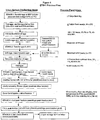
- the liquid FluMist manufacturing process developed and used for CTM-1 is divided into six discrete process stages below.
- the process stages 1 through 5 were defined to match the major process steps as conducted using separate manufacturing instruction documents.
- Stage 6 includes the entire blend and fill process. It will be appreciated that such stages can be roughly compared to the generalized steps outlined below for manufacturing/production of vaccine compositions in general.
- Stage 1 receipt and sanitization of SPF eggs; Stage 2: production of virus harvest; Stage 3: concentration of virus by zonal centrifugation; Stage 4: pooling and dilution of peak fractions; Stage 5: sterile filtration and monovalent bulk storage; and, Stage 6: blend and fill
- FIG. 1 A process flow diagram for the CTM-1 monovalent bulk production is shown in Figure 1 .
- the blend and fill process flow is shown in Figure 2 .
- SPF pathogen-free embryonated eggs
- SPAFAS, Inc. which utilizes flock management and surveillance programs designed to provide suitable assurance of disease-free eggs.
- Eggs were laid in the United States and sanitized using Clorwash and Quat 800 sprays. The eggs were then transported by air and road using packaging sufficient to maintain cleanliness and avoid freezing or overheating.
- the cold fertile eggs were inspected and stored in an SPF incubation unit at 14 °C +/- 2°C with 60-80% relative humidity (RH) for a maximum of 7 days.
- RH relative humidity
- Eggs were placed on 36-egg Jamesway trays and the eggshell surfaces sanitized with Chlorwash and Quat 800 in an automated egg sanitization system to minimize bioburden prior to placing them in the incubator.
- Chlorwash was prepared at a range of 43-44 °C and 48-49 °C and Quat 800 was prepared at a range of 48-49 °C.
- the eggs were placed on trolleys and air dried at ambient temperature for not less than 2 hours. The eggs were then placed in a Buckeye Incubator and incubated at 37.5 °C +/- 1 °C with 60-80% RH for 264 hours +/- 12 hours.
- the SPF eggs were transferred from the SPF egg unit to a candling area. Using a fiber optic lamp, the position of the air sac was located in each egg. Dead or infertile eggs were discarded, and the fertile eggs marked for inoculation.
- the fertile eggs were surface sanitized with 70% industrial methylated spirits (IMS) prior to inoculation and then transferred for mass inoculation.
- IMS industrial methylated spirits
- MWVS manufacturer's working virus seed
- the MWVS was transferred into the AVU and serial dilutions of the thawed MWVS were prepared in sterile 0.01M phosphate buffered saline, pH 7.7 within a microbiological safety cabinet using a sterile disposable pipette for each transfer.
- the inoculation occurred under laminar flow in a class 10,000 room using a semi-automatic Bibby inoculation machine, which penetrates and inoculates 36 eggs per tray.
- the target titer of the inoculum was log 10 2.1 TCID 50 per 0.1 mL and the dilution was calculated from the predetermined titer of the MWVS.
- Preparation of each virus inoculum was completed within 2 hours of the removal of the vial from the freezer. Aliquots of the inoculum were stored at 5 +/- 3 °C until use. Inoculum was used within 8 hours of preparation.
- Each tray of eggs was hand-fed into the Bibby automated inoculation machine.
- a punch was used to pierce the eggshell and penetrate the egg to a preset adjustable depth.
- the inoculation needles extended into the egg and the dosing pump delivered 0.1 mL of the MWVS inoculum into each egg after which the punch was withdrawn.
- the egg tray was removed by an operator and the process repeated with a new tray of eggs.
- the CAIV inoculated eggs were incubated at 33 +/- 1 °C for a time determined by the growth curve of the virus strain. After incubation, the SPF embryonated eggs were chilled to 28 °C for 18 +/- 6 hours. At the end of chilling, the eggs were transferred for the harvesting step.
- Eggs were harvested with an automatic harvest machine (Bibby). The trays were hand fed to a decapitation station where the upper section of the eggshell was removed to create an access hole for harvest needle entry. The eggs were visually inspected prior to harvest and unsuitable eggs ( e.g ., discolored) rejected. The acceptable eggs proceeded to a harvest station, where the allantoic fluid was withdrawn using needles and suction provided by a vacuum system. The harvest was collected mixed in a 100 L jacketed stainless vessel with a jacket temperature of 2-8 °C. Samples of the virus harvest were collected from the VH pool and tested for: potency (TCID 50 ), safety, avian leucosis, M. tuberculoses , mycoplasma, extraneous virus, identity, reverse transcriptase assay, virus genotype, virus phenotype, and attenuation.
- potency TCID 50
- avian leucosis M. tuberculoses
- mycoplasma extraneous virus
- VH pooled virus harvest
- SPG pooled virus harvest
- 10X SPG 9 parts VH to 1 part 10X SPG
- the centrifuge rotor Prior to use, the centrifuge rotor was sanitized with a 1:20 dilution of concentrated formaldehyde solution.
- the clarified VH was loaded onto a sucrose gradient (10-60% sucrose in phosphate buffer, pH 7.2) for continuous high-speed centrifugation using a Hitachi CP40Y zonal centrifuge.
- the gradient was formed by addition to the centrifuge of a 60% sucrose solution followed by a 10% sucrose solution in phosphate buffer.
- the centrifuge speed was set to 4,000 rpm for 20 minutes to allow the sucrose solutions to form a density gradient.
- Centrifuge temperature was set at 2-8 °C during gradient formation.
- fractions were collected under laminar flow into 125 mL sterile polycarbonate bottles. Fractions were held at 2-8 °C for approximately 1 hour while fractions were assayed for HA activity. Peak fractions were typically found between 38-45% of the sucrose gradient.
- the centrifuge peak fractions as identified by the HA assay, were pooled under a laminar flow hood by aseptically pouring the fractions into a 5 L sterile glass bottle, and mixed by swirling.
- the refractive index (RI) was read to determine sucrose concentration and the pool sampled for potency.
- the centrifuge peak fraction pool (CP) was diluted by aseptically adding a calculated volume of sterile cold (2-8°C) phosphate-glutamate buffer, pH 7.2 (PBG buffer) to a final concentration of 0.2M sucrose, 0.1M phosphate, and 0.005 M glutamate. This was typically a 1:6 dilution.
- the diluted centrifuge peak fraction pool (DCP) was sampled for potency and bioburden.
- the DCP was pumped through sterile tubing to a Class 100 filling room for sterile filtration.
- the DCP was sterile filtered with a 0.22 ⁇ m filter into a sterile 5L glass bottle under a Laminair Air Flow hood.
- the filtered monovalent bulk was mixed and sampled for potency, identity, and sterility testing.
- the 0.22 ⁇ m filter was integrity tested before and after the filtration process.
- the MB was then aliquoted into sterile one liter polycarbonate bottles.
- the MB was collected in 500 mL aliquots with a total volume of three to four liters.
- the sterile one-liter PC bottles were stored at -60°C or below.
- the titer of the bulk virus was determined by TCID 50 assay. Monovalent bulk was then shipped at ⁇ -60°C for blending and testing.
- the major steps for the blend and fill process of the preparation of the bulk trivalent blend were: Thawing, Preparation of Diluent, Blending, Filling, and Packaging.
- the appropriate 1 bottles of monovalent bulk were removed from frozen storage ( ⁇ -60°C for MB) and transferred to a thaw room.
- the required quantities of the three individual monovalent bulks and SPG diluent were calculated based on the bulk infectivity titer and the required formulation strength.
- the bottles of MB were loaded into a 33 ⁇ 3°C water bath and manually agitated every five minutes. Thawing was monitored visually to ensure that all bottles were thawed before leaving the water bath, and that all thawed bottles were removed every 15 minutes. Once thawed, the bottles of MB were moved to a 5 ⁇ 3°C refrigerator and held until all of the required bottles had been thawed.
- SPG Sterile sucrose phosphate glutamate
- Thawed bottles were moved to a blend room and virus aseptically transferred to a 5 L glass process vessel.
- the vessel was kept at 5 ⁇ 3°C throughout the blending process and the subsequent filling process by using refrigerated cold packs.
- the SPG -gelatin diluent was added after the three virus strains had been added, and, if necessary, the pH was adjusted with HCl to 7.2 ⁇ 0.3.
- the three virus strains and diluent were blended by continuous mixing with a magnetic stir bar and stir plate.
- the bulk trivalent blend vessel was moved to a filling room and connected to an INOVA filler.
- the INOVA filling machine filled a preset volume of product into a row of eight BD HYPAK disposable sprayers and then stoppered the sprayers. Sprayer filling and stoppering operations and weight check verifications continued as directed. A new tub of sprayers was manually placed at the in-feed stations upon completion of each fill cycle and the tub of filled sprayers removed to the discharge station.
- the blend vessel was maintained at 5 ⁇ 3°C with cold packs during the filling process.
- the filled trivalent vaccines were loaded into tubs and immediately transported via cart to a packaging area for final packaging and labeling.
- Packaged and labeled sprayers were stored at 5 ⁇ 3°C.
- the 5 ⁇ m (Pall Profile II) filter was compared to a 20 ⁇ m depth filter (Pall Profile Star), which was used for lots CAZ035 (A/Sydney), CAZ036 (A/Beijing) and CAZ037 (B/Harbin).
- A/Beijing, A/Sydney, and B/Harbin had clarification step yields of 65%, 35%, and 209% respectively for the 20 ⁇ m clarification step. These yields were comparable to 5 ⁇ m clarification results, however a process change to the 20 ⁇ m filter was not recommended for all embodiments due to significant contamination of clarified harvests by red blood cells when larger pore size was used.
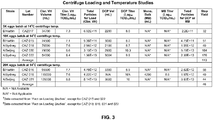
- Centrifuge loading and temperature studies were performed using the large-scale CP40Y centrifuge and RP40CT Type D continuous-flow rotor; these compared various egg batch sizes and centrifuge temperature set points ( see Figure 3 ).
- CA0Z15 (B/Harbin), CAZ018 (A/Sydney), CAZ020 (A/Beijing) and CAZ022 (A/Sydney) had batch sizes of 10K eggs and a centrifuge set temperature of 4°C.
- CAZ 016 (B/Harbin), CAZ019 (A/Sydney), and CAZ021 (A/Beijing) had batch sizes of 20K eggs and a centrifuge set temperature of 14°C.
- step yield Percent recovery in the diluted peak-fraction pool was based on the clarified harvest titer in the figure. As can be seen, lots with 10K egg batches had a recovery range from 40 - 184% whereas the 20K egg batches ranged from 40-55%. The average recovery for the 10K batch size was 113% and the 20K egg batch recoveries averaged 46%. A batch size of 10,000 eggs per run was selected for CTM manufacturing as a conservative limit in this step of the development process.
- the monovalent virus lots for CTM-1 were produced and included monovalent bulk lots CAZ025 through CAZ034.
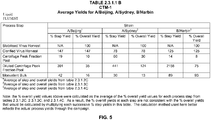
- In-process QC assay results for the CTM-1 monovalent bulk lots are presented in Figure 3 and herein. Average step yields per strain are presented in Figure 3 and herein. Results are summarized below.
- Potency The potencies (log 10 TCID 50 mL) of B/Harbin and A/Beijing virus harvest lots were equal or greater than 8.1.
- A/Sydney ranged from 7.5 to 8.8 except for CAZ030, which showed very low titer (6.0) because of yolk contamination in the harvest.
- the titer of the monovalent bulk for A/Beijing was 9.3 or above, for B/Harbin the titer ranged from 8.4 to 9.85 and for A/Sydney ranged from 7.9 to 8.6 (excluding CAZ030).
- CAZ030 the titer was below the acceptable level for blending as discussed below.
- Process Yield Process yields for each lot are referenced in the Figures and discussed further herein. Process yields were not corrected for sampling losses. A/Beijing had an average overall process yield of 16% (163 doses/egg), A/Sydney had an average yield of 13% (6 doses/egg), and B/Harbin had an average yield of 93% (86 doses/egg). See figures. The erratic yield estimates reflect assay variability as well as the actual process performance. In particular, the B/Harbin results were skewed upward by a very high estimate of Lot CAZ028 monovalent bulk titer (resulting in estimated 252% process yield and 246 doses/egg).
- the diluted peak pool titer in this case was determined at 0.95 logs higher than the centrifuge peak pool, though a decline would be expected due to dilution. Likewise the filtered monovalent bulk titer was higher than the prefiltered material, which can be accounted for by assay variability.
- the other two B/Harbin lots, (CAZ026 and CAZ027) had process yields of 20% and 8% respectively, and an egg yield of 7 doses/egg for both lots.
- the trivalent blends that included bulk lot CAZ028 (CBF1004 and CBF1007) resulted in B/Harbin potencies in final product sprayers that were 0.6 and 0.4 log 10 TCID 50 per dose. This further suggests that the CAZ028 monovalent bulk titer was overestimated.
- Bioburden and Endotoxin Virus harvest, stabilized harvest and diluted centrifuge peak fractions were tested for bioburden. Bioburden test results do not give a clear picture of organism loads through the process: test results on virus harvest and diluted centrifuge peak fraction pool samples consisted primarily of "none detected" (eight readings); or ">100 cfu/mL” (ten readings) with only two intermediate values. Endotoxin values for the monovalent bulks varied from ⁇ 5 EU/mL to 587 EU/mL.
- sucrose Concentration The centrifuge peak fraction pools had sucrose concentrations ranging from 39 to 43.5% (CAZ030 was not included in the range). The monovalent bulks had an average sucrose concentration of 7.6%.
- SDS-PAGE Analysis Monovalent bulks were further characterized by 10% SDS-PAGE gels stained with Gel Code Blue. Based on the calculated protein molecular weights and number of copies per particle for influenza A and B strains, gel bands in the region of 50-60kDa (HA1protein), 56kDa (NP protein) and 27kDa (M1protein) would be expected to be prominent in gels of purified influenza virus. Ha2 protein (23 to 30kD) may also be present.
- Doses per Lot and Egg The dose calculation for all three strains was based on a 0.24mL average fill volume containing 1.2E+07 TCID 50 particles. Based on the dose calculation above, the A/Beijing monovalent lots had an average of 1,576,022 total doses per lot. Average total doses per lot for B/Harbin and A/Sydney were 601,446 and 50,825 doses per lot respectively, or 38% and 3.2% of the average A/Beijing total doses per lot respectively. These results translate to the following values for monovalent doses per egg: 163 doses/egg for A/Beijing, 86 doses/egg for B/Harbin-like and 6 doses/egg for A/Sydney. The calculation for doses/egg was based on the total number of eggs harvested to manufacture the lot.
- A/Sydney had the highest average harvest volume per egg yield, followed by A/Beijing and B/Harbin. The yield per egg averaged 5.6 mL/egg for B/Harbin, 6.5 mL/egg for A/Beijing, and 6.8 mL/egg for A/Sydney. The overall yield of viable eggs for production averaged 82%. Egg yields were based on the total number of eggs harvested compared to total number of eggs for production. Percent eggs rejected pre-inoculation averaged 10%. Percent rejection post-incubation averaged 5%, with the exception of CAZ028, which had a 29% rejection rate.
- TCID 50 Purification Yield Summary: Clarified harvest potency values were higher than the starting material for some of the lots, resulting in step yields greater than 100%. Step yield estimates are affected by the variability of the TCID 50 assay, which had a standard deviation above 0.3 log 10 TCID 50 /mL as performed at the time of the production runs. In addition, the step yield at the Diluted Centrifuge Pak Fraction Pool step varies widely for all three strains and is greater than 100% for all ten CTM lots. This appears to be due to a systematic downward bias of titers for Centrifuge Peak Fraction Pools (as suggested by the >100 yield of the next step), thought to be related to the high sucrose levels in these samples.
- a trivalent vaccine formulation was prepared comprising three different reassortant influenza viruses (7.0 +/- 0.5 log 10 FFU/dose [approximately 7.0 +/- 0.5 log 10 TCID 50 /dose]) and comprising 200 mM sucrose; 1% (w/v) porcine gelatin hydrolysate; 1.21% (w/v) arginine monohydrocloride [equivalent to 1% (w/v) arginine base]; and 5 mM monosodium glutamate in 100 mM potassium phosphate buffer (pH 7.2).
- the stability of the formulation was stored at -25.0 degrees C +/- 5.0 degrees for greater than or equal to 24 hours, but less than or equal to two weeks and then stored at 2-8 degrees C for various time periods.
- This formulation e.g ., lot 0141500003
- the potency for each strain of virus remained within 0.5 log 10 of the beginning potency prior to 4-8 degree C storage.
- equivalent formulations comprising three different reassortant influenza viruses (7.0 +/- 0.5 log 10 FFU/dose [approximately 7.0 +/- 0.5 log 10 TCID 50 /dose]) and comprising 200 mM sucrose; 1% (w/v) porcine gelatin hydrolysate; 1.21% (w/v) arginine monohydrocloride [equivalent to 1% (w/v) arginine base]; and 5 mM monosodium glutamate in 100 mM potassium phosphate buffer, pH 7.2) of different clinical lots (e.g ., "Campaign 3") are stable for about 12-15 months at 5.0 (+/- 3.0) degrees C.
Landscapes
- Health & Medical Sciences (AREA)
- Life Sciences & Earth Sciences (AREA)
- Chemical & Material Sciences (AREA)
- General Health & Medical Sciences (AREA)
- Medicinal Chemistry (AREA)
- Virology (AREA)
- Engineering & Computer Science (AREA)
- Veterinary Medicine (AREA)
- Public Health (AREA)
- Pharmacology & Pharmacy (AREA)
- Animal Behavior & Ethology (AREA)
- Epidemiology (AREA)
- Organic Chemistry (AREA)
- Microbiology (AREA)
- Zoology (AREA)
- Immunology (AREA)
- Wood Science & Technology (AREA)
- Genetics & Genomics (AREA)
- Bioinformatics & Cheminformatics (AREA)
- General Chemical & Material Sciences (AREA)
- Chemical Kinetics & Catalysis (AREA)
- Biochemistry (AREA)
- Oil, Petroleum & Natural Gas (AREA)
- Biotechnology (AREA)
- Biomedical Technology (AREA)
- Molecular Biology (AREA)
- Mycology (AREA)
- Pulmonology (AREA)
- General Engineering & Computer Science (AREA)
- Proteomics, Peptides & Aminoacids (AREA)
- Otolaryngology (AREA)
- Communicable Diseases (AREA)
- Oncology (AREA)
- Nuclear Medicine, Radiotherapy & Molecular Imaging (AREA)
- Medicines Containing Antibodies Or Antigens For Use As Internal Diagnostic Agents (AREA)
- Micro-Organisms Or Cultivation Processes Thereof (AREA)
- Medicinal Preparation (AREA)
Claims (18)
- Composition de virus de la grippe actif stable dans un réfrigérateur qui comprend au moins une souche de virus de la grippe et comprend en outre un stabilisant constitué:(a) de 2% à 8% de saccharose poids/volume (p/v), de 0,75% à 2% d'arginine p/v, de 0,02% à 0,15% de glutamate p/v, de 0,5% à 2% d'hydrolysat de gélatine et d'un tampon; ou(b) de 2% à 8% de saccharose p/v, de 0,75% à 2% d'arginine p/v, de 0,5% à 2% d'hydrolysat de gélatine et d'un tampon;dans laquelle chaque quantité de chacun des composants du stabilisant est la quantité finale dans la composition de virus et laquelle composition de virus affiche une perte de puissance de moins de 1,0 log lorsqu'elle est stockée pendant une période de 3 mois à 4°C à 8°C.
- Composition de virus de la grippe actif stable dans un réfrigérateur selon la revendication 1, dans laquelle le stabilisant est constitué de 6,84% de saccharose p/v, de 1,21% d'arginine p/v, de 0,094% de glutamate p/v, de 1% d'hydrolysat de gélatine et d'un tampon.
- Composition de virus de la grippe actif stable dans un réfrigérateur selon la revendication 1, dans laquelle le stabilisant est constitué de 6,84% de saccharose p/v, de 1,21% d'arginine p/v, de 1% d'hydrolysat de gélatine et d'un tampon.
- Composition de virus de la grippe actif stable dans un réfrigérateur selon la revendication 1, 2 ou 3, dans laquelle au moins une souche de virus de la grippe est choisie parmi: un virus de la grippe atténué, un virus de la grippe adapté au froid, un virus de la grippe sensible à la température, un virus de la grippe adapté au froid atténué, un virus de la grippe sensible à la température adapté au froid, un virus de la grippe sensible à la température atténué et un virus de la grippe sensible à la température adapté au froid atténué.
- Composition de virus de la grippe actif stable dans un réfrigérateur selon l'une quelconque des revendications 1 à 4, dans laquelle au moins une souche de virus de la grippe comprend un squelette génétique de ca A/Ann Arbor/6/60 ou ca B/Ann Arbor/1/66.
- Composition de virus de la grippe actif stable dans un réfrigérateur selon l'une quelconque des revendications 1 à 5, dans laquelle le tampon est un tampon de phosphate de potassium.
- Composition de virus de la grippe actif stable dans un réfrigérateur selon la revendication 6, dans laquelle le tampon de phosphate de potassium comprend 1,13% (p/v) de phosphate de potassium dibasique et 0,48% (p/v) de phosphate de potassium monobasique.
- Composition de virus de la grippe actif stable dans un réfrigérateur selon l'une quelconque des revendications 1 à 7, dans laquelle l'arginine est le monochlorhydrate d'arginine et le glutamate est le monohydrate de monosodium d'acide glutamique.
- Composition de virus de la grippe actif stable dans un réfrigérateur selon l'une quelconque des revendications 1 à 8, dans laquelle une formulation de vaccin de la composition comprend entre 6,5 et 7,5 log10 d'unités de foyer de fluorescence (FFU) de chaque souche de virus de la grippe par dose de 0,2 ml.
- Composition de virus de la grippe actif stable dans un réfrigérateur selon l'une quelconque des revendications 1 à 9, où la composition comprend au moins deux souches de virus de la grippe.
- Composition de virus de la grippe actif stable dans un réfrigérateur selon la revendication 10, où la composition comprend trois souches de virus de la grippe.
- Composition de virus de la grippe actif stable dans un réfrigérateur selon l'une quelconque des revendications 1 à 11, où la composition de virus affiche une perte de puissance de moins de 1,0 log stockée pendant une période de 12 mois à 4°C à 8°C.
- Composition immunogénique comprenant la composition de virus de la grippe actif stable dans un réfrigérateur selon l'une quelconque des revendications 1 à 12.
- Vaccin comprenant la composition immunogénique selon la revendication 13.
- Formulation de vaccin de la composition de virus de la grippe actif stable dans un réfrigérateur selon la revendication 1 qui comprend:a) au moins deux souches de virus de la grippe, dans laquelle:i) au moins une souche de virus de la grippe comprend un squelette génétique de ca A/Ann Arbor/6/60 et au moins une souche de virus de la grippe comprend un squelette génétique de ca B/Ann Arbor/1/66, etii) la formulation de vaccin comprend entre 6,5 et 7,5 log10 d'unités de foyer de fluorescence (FFU) de chaque souche de virus de la grippe par dose de 0,2 ml; etb) un stabilisant constitué de 6,84% de saccharose p/v, de 1,21% de monochlorhydrate d'arginine p/v, de 0,094% de monohydrate de monosodium d'acide glutamique p/v, de 1% d'hydrolysat de gélatine et d'un tampon de phosphate de potassium, lequel tampon comprend 1,13% (p/v) de phosphate de potassium dibasique et 0,48% (p/v) de phosphate de potassium monobasique;dans laquelle chaque quantité de chacun des composants du stabilisant est la quantité finale dans la formulation de vaccin et laquelle formulation de vaccin affiche une perte de puissance de moins de 1,0 log lorsqu'elle est stockée pendant une période de 3 mois à 4°C à 8°C.
- Formulation de vaccin selon la revendication 15, où la formulation comprend trois souches de virus de la grippe.
- Formulation de vaccin selon la revendication 15 ou 16, où la formulation affiche une perte de puissance de moins de 1,0 log lorsqu'elle est stockée pendant une période de 12 mois à 4°C à 8°C.
- Kit comprenant la formulation de vaccin selon la revendication 15, 16 ou 17.
Applications Claiming Priority (2)
| Application Number | Priority Date | Filing Date | Title |
|---|---|---|---|
| US61671104P | 2004-10-06 | 2004-10-06 | |
| EP05804424.9A EP1796719B1 (fr) | 2004-10-06 | 2005-10-04 | Compositions vaccinales antigrippales stables a des temperatures de refrigerateur |
Related Parent Applications (2)
| Application Number | Title | Priority Date | Filing Date |
|---|---|---|---|
| EP05804424.9A Division EP1796719B1 (fr) | 2004-10-06 | 2005-10-04 | Compositions vaccinales antigrippales stables a des temperatures de refrigerateur |
| EP05804424.9A Division-Into EP1796719B1 (fr) | 2004-10-06 | 2005-10-04 | Compositions vaccinales antigrippales stables a des temperatures de refrigerateur |
Publications (2)
| Publication Number | Publication Date |
|---|---|
| EP2769735A1 EP2769735A1 (fr) | 2014-08-27 |
| EP2769735B1 true EP2769735B1 (fr) | 2017-04-19 |
Family
ID=36148654
Family Applications (2)
| Application Number | Title | Priority Date | Filing Date |
|---|---|---|---|
| EP14157639.7A Expired - Lifetime EP2769735B1 (fr) | 2004-10-06 | 2005-10-04 | Compositions de vaccin contre la grippe stable à température de réfrigérateur |
| EP05804424.9A Expired - Lifetime EP1796719B1 (fr) | 2004-10-06 | 2005-10-04 | Compositions vaccinales antigrippales stables a des temperatures de refrigerateur |
Family Applications After (1)
| Application Number | Title | Priority Date | Filing Date |
|---|---|---|---|
| EP05804424.9A Expired - Lifetime EP1796719B1 (fr) | 2004-10-06 | 2005-10-04 | Compositions vaccinales antigrippales stables a des temperatures de refrigerateur |
Country Status (8)
| Country | Link |
|---|---|
| EP (2) | EP2769735B1 (fr) |
| JP (3) | JP5147405B2 (fr) |
| KR (3) | KR101376889B1 (fr) |
| CN (2) | CN102302773B (fr) |
| AU (1) | AU2005294528B2 (fr) |
| CA (1) | CA2583698C (fr) |
| ES (2) | ES2633471T3 (fr) |
| WO (1) | WO2006041819A1 (fr) |
Families Citing this family (21)
| Publication number | Priority date | Publication date | Assignee | Title |
|---|---|---|---|---|
| DK1499348T3 (en) | 2002-04-26 | 2015-01-05 | Medimmune Llc | PROCEDURE FOR PREPARING INFECTIOUS INFLUENZA B-VIRA IN CELL CULTURE |
| US7465456B2 (en) | 2002-04-26 | 2008-12-16 | Medimmune, Llc | Multi plasmid system for the production of influenza virus |
| US20060110406A1 (en) | 2003-02-25 | 2006-05-25 | Medimmune Vaccines, Inc. | Refrigerator-temperature stable influenza vaccine compositions |
| EP2481819A1 (fr) | 2003-02-25 | 2012-08-01 | MedImmune Vaccines, Inc. | Filtration á contra courant dans la production de compositions du vaccins d'influenza stabilisées |
| CA2551489C (fr) | 2003-12-23 | 2013-09-03 | Gregory Duke | Systeme a plasmides multiples pour la production du virus de la grippe |
| EP2769735B1 (fr) * | 2004-10-06 | 2017-04-19 | MedImmune, LLC | Compositions de vaccin contre la grippe stable à température de réfrigérateur |
| GB0614460D0 (en) * | 2006-07-20 | 2006-08-30 | Novartis Ag | Vaccines |
| EP2615167A1 (fr) | 2006-09-15 | 2013-07-17 | MedImmune, LLC | Méthode d'élimination de contaminants d'ADN des préparations de virus |
| AU2008225501B2 (en) | 2007-03-09 | 2013-08-29 | Otsuka Pharmaceutical Co., Ltd. | Lyophilized preparation comprising influenza vaccine, and method for preparation thereof |
| EP2674486A1 (fr) | 2007-06-18 | 2013-12-18 | MedImmune, LLC | Virus de la grippe B présentant des modifications du polypeptide de le hémagglutinine |
| US8785173B2 (en) | 2008-09-24 | 2014-07-22 | Medimmune, Llc | Methods for purification of viruses |
| GB0822672D0 (en) | 2008-12-12 | 2009-01-21 | Univ Warwick | Anti-viral protection with viruses containing a defective genome |
| CN107365751B (zh) | 2008-12-16 | 2021-07-09 | 纳米医疗公司 | 流感疫苗的生产 |
| CN102191226A (zh) * | 2010-03-08 | 2011-09-21 | 北京清大天一科技有限公司 | 细胞培养混合物的分离纯化方法 |
| EP2646051A4 (fr) * | 2010-12-02 | 2014-05-28 | Oncolytics Biotech Inc | Formulations de virus liquides |
| KR20150023297A (ko) * | 2012-05-31 | 2015-03-05 | 에이전시 포 사이언스, 테크놀로지 앤드 리서치 | 고상 우레이드에 대한 생물학적 표적의 선택적 결합 |
| US9314519B2 (en) * | 2012-08-21 | 2016-04-19 | Intervet Inc. | Liquid stable virus vaccines |
| CN104984357B (zh) * | 2015-06-02 | 2018-01-30 | 长春百克生物科技股份公司 | 不含明胶的疫苗保护剂组合物及流感减毒活疫苗 |
| BR112021016059A2 (pt) * | 2019-02-15 | 2021-10-13 | Serum Institute Of India Pvt Ltd. | Composição de vacina de vírus de influenza atenuada viva e processo para a preparação da mesma |
| CA3174826A1 (fr) | 2021-01-19 | 2022-07-28 | Katsuro HAGIWARA | Stabilisateur de virus, hydrolysat de gelatine pour stabilisateur de virus, et composition contenant un virus |
| WO2022229853A1 (fr) * | 2021-04-27 | 2022-11-03 | Novartis Ag | Système de production de vecteurs viraux |
Family Cites Families (23)
| Publication number | Priority date | Publication date | Assignee | Title |
|---|---|---|---|---|
| US4512972A (en) * | 1980-06-30 | 1985-04-23 | Kureha Chemical Industry Co., Ltd. | Nasal preparation and processes for their production |
| FR2505657A1 (fr) * | 1981-05-13 | 1982-11-19 | Pasteur Institut | Perfectionnements apportes aux agents de stabilisation de virus vivants pour la preparation de vaccins, et vaccins stabilises contenant lesdits agents de stabilisation |
| CA2075521C (fr) * | 1992-05-05 | 1995-11-28 | Kuniaki Koyama | Vaccin vivant stabilise |
| US6207646B1 (en) | 1994-07-15 | 2001-03-27 | University Of Iowa Research Foundation | Immunostimulatory nucleic acid molecules |
| US6146873A (en) | 1994-11-10 | 2000-11-14 | Baxter Aktiengesellschaft | Production of orthomyxoviruses in monkey kidney cells using protein-free media |
| KR960037065A (ko) * | 1995-04-24 | 1996-11-19 | 허영섭 | 약독화 수두 생바이러스 백신의 안정제 |
| US6244354B1 (en) | 1995-09-15 | 2001-06-12 | Harmelerwaard Patents B.V. | Device and process for cutting grass sods with a constant thickness from grass land |
| ATE213646T1 (de) * | 1995-10-20 | 2002-03-15 | Yissum Res Dev Co | Grippe-impfstoff |
| DE19612966B4 (de) | 1996-04-01 | 2009-12-10 | Novartis Vaccines And Diagnostics Gmbh & Co. Kg | MDCK-Zellen und Verfahren zur Vermehrung von Influenzaviren |
| EP1112350A2 (fr) * | 1998-09-01 | 2001-07-04 | St. Louis University | Virus parainfluenza humain de type 2 (hpiv-2) thermosensible et adapte au froid; vaccins a base d'un tel virus |
| PT1117435E (pt) | 1998-09-30 | 2008-02-21 | Us Gov Univ Health Sciences | Holotoxina da cólera mutante como adjuvante |
| NZ512980A (en) * | 1998-12-17 | 2003-07-25 | Aventis Pasteur | Multivalent immunogenic composition containing RSV subunit composition and influenza virus preparation |
| RU2002112751A (ru) * | 1999-11-12 | 2004-02-27 | Файброджен, Инк. (Us) | Рекомбинантные желатины |
| ES2319864T3 (es) | 2000-04-28 | 2009-05-14 | St. Jude Children's Research Hospital | Sistema de transfeccion de adn para la generacion de virus infecciosos de arn de cadena negativa. |
| EP2281573A3 (fr) * | 2001-02-23 | 2011-12-07 | GlaxoSmithKline Biologicals s.a. | Formulations de vaccins contre la grippe dispositif pour administration intradermique |
| MY134424A (en) * | 2001-05-30 | 2007-12-31 | Saechsisches Serumwerk | Stable influenza virus preparations with low or no amount of thiomersal |
| WO2003087327A2 (fr) * | 2002-04-11 | 2003-10-23 | Medimmune Vaccines, Inc. | Conservation de matieres bio-actives au moyen de mousse lyophilisee |
| WO2003087335A2 (fr) * | 2002-04-11 | 2003-10-23 | Medimmune Vaccines, Inc. | Conservation de matieres bioactives par sechage par pulverisation |
| CN1745170A (zh) * | 2002-12-17 | 2006-03-08 | 米迪缪尼疫苗股份有限公司 | 生物活性材料的高压喷雾干燥 |
| EP2481819A1 (fr) * | 2003-02-25 | 2012-08-01 | MedImmune Vaccines, Inc. | Filtration á contra courant dans la production de compositions du vaccins d'influenza stabilisées |
| US7566458B2 (en) | 2003-06-16 | 2009-07-28 | Medimmune, Llc | Influenza hemagglutinin and neuraminidase variants |
| CA2551489C (fr) | 2003-12-23 | 2013-09-03 | Gregory Duke | Systeme a plasmides multiples pour la production du virus de la grippe |
| EP2769735B1 (fr) * | 2004-10-06 | 2017-04-19 | MedImmune, LLC | Compositions de vaccin contre la grippe stable à température de réfrigérateur |
-
2005
- 2005-10-04 EP EP14157639.7A patent/EP2769735B1/fr not_active Expired - Lifetime
- 2005-10-04 CN CN201110270932.4A patent/CN102302773B/zh not_active Expired - Fee Related
- 2005-10-04 ES ES14157639.7T patent/ES2633471T3/es not_active Expired - Lifetime
- 2005-10-04 KR KR1020137010888A patent/KR101376889B1/ko not_active Expired - Lifetime
- 2005-10-04 WO PCT/US2005/035614 patent/WO2006041819A1/fr not_active Ceased
- 2005-10-04 EP EP05804424.9A patent/EP1796719B1/fr not_active Expired - Lifetime
- 2005-10-04 JP JP2007535747A patent/JP5147405B2/ja not_active Expired - Lifetime
- 2005-10-04 KR KR1020077010143A patent/KR101346989B1/ko not_active Expired - Lifetime
- 2005-10-04 KR KR1020127026911A patent/KR101230187B1/ko not_active Expired - Lifetime
- 2005-10-04 AU AU2005294528A patent/AU2005294528B2/en not_active Expired
- 2005-10-04 CA CA2583698A patent/CA2583698C/fr not_active Expired - Fee Related
- 2005-10-04 ES ES05804424.9T patent/ES2531734T3/es not_active Expired - Lifetime
- 2005-10-04 CN CN2005800397937A patent/CN101060859B/zh not_active Expired - Lifetime
-
2012
- 2012-09-28 JP JP2012215517A patent/JP5632435B2/ja not_active Expired - Lifetime
-
2014
- 2014-05-07 JP JP2014095625A patent/JP5818940B2/ja not_active Expired - Lifetime
Non-Patent Citations (1)
| Title |
|---|
| None * |
Also Published As
| Publication number | Publication date |
|---|---|
| KR20070083964A (ko) | 2007-08-24 |
| AU2005294528A1 (en) | 2006-04-20 |
| HK1201720A1 (en) | 2015-09-11 |
| CN102302773B (zh) | 2014-05-14 |
| HK1102047A1 (en) | 2007-11-02 |
| KR20120123729A (ko) | 2012-11-09 |
| JP2013035861A (ja) | 2013-02-21 |
| CN101060859B (zh) | 2011-11-09 |
| ES2531734T3 (es) | 2015-03-18 |
| EP2769735A1 (fr) | 2014-08-27 |
| JP2008515894A (ja) | 2008-05-15 |
| KR101230187B1 (ko) | 2013-02-07 |
| CN102302773A (zh) | 2012-01-04 |
| AU2005294528B2 (en) | 2011-04-07 |
| CA2583698A1 (fr) | 2006-04-20 |
| WO2006041819A1 (fr) | 2006-04-20 |
| EP1796719B1 (fr) | 2014-12-03 |
| KR101346989B1 (ko) | 2014-02-06 |
| KR101376889B1 (ko) | 2014-03-25 |
| ES2633471T3 (es) | 2017-09-21 |
| EP1796719A4 (fr) | 2010-06-09 |
| JP5632435B2 (ja) | 2014-11-26 |
| KR20130048280A (ko) | 2013-05-09 |
| JP5147405B2 (ja) | 2013-02-20 |
| JP5818940B2 (ja) | 2015-11-18 |
| JP2014193877A (ja) | 2014-10-09 |
| EP1796719A1 (fr) | 2007-06-20 |
| CN101060859A (zh) | 2007-10-24 |
| CA2583698C (fr) | 2014-12-02 |
Similar Documents
| Publication | Publication Date | Title |
|---|---|---|
| US8652822B2 (en) | Refrigerator-temperature stable influenza vaccine compositions | |
| JP5818940B2 (ja) | 冷蔵温度安定型インフルエンザワクチン組成物 | |
| US8012737B2 (en) | Methods of producing influenza vaccine compositions | |
| AU2013203203B2 (en) | Refrigerator-temperature stable influenza vaccine compositions | |
| HK1201720B (en) | Refrigerator-temperature stable influenza vaccine compositions | |
| HK1102047B (en) | Refrigerator-temperature stable influenza vaccine compositions | |
| HK1182138A (en) | Methods of producing influenza vaccine compositions |
Legal Events
| Date | Code | Title | Description |
|---|---|---|---|
| PUAI | Public reference made under article 153(3) epc to a published international application that has entered the european phase |
Free format text: ORIGINAL CODE: 0009012 |
|
| 17P | Request for examination filed |
Effective date: 20140304 |
|
| AC | Divisional application: reference to earlier application |
Ref document number: 1796719 Country of ref document: EP Kind code of ref document: P |
|
| AK | Designated contracting states |
Kind code of ref document: A1 Designated state(s): AT BE BG CH CY CZ DE DK EE ES FI FR GB GR HU IE IS IT LI LT LU LV MC NL PL PT RO SE SI SK TR |
|
| R17P | Request for examination filed (corrected) |
Effective date: 20150223 |
|
| RBV | Designated contracting states (corrected) |
Designated state(s): AT BE BG CH CY CZ DE DK EE ES FI FR GB GR HU IE IS IT LI LT LU LV MC NL PL PT RO SE SI SK TR |
|
| REG | Reference to a national code |
Ref country code: HK Ref legal event code: DE Ref document number: 1201720 Country of ref document: HK |
|
| 17Q | First examination report despatched |
Effective date: 20160314 |
|
| REG | Reference to a national code |
Ref country code: DE Ref legal event code: R079 Ref document number: 602005051815 Country of ref document: DE Free format text: PREVIOUS MAIN CLASS: A61K0039145000 Ipc: C12N0007000000 |
|
| GRAP | Despatch of communication of intention to grant a patent |
Free format text: ORIGINAL CODE: EPIDOSNIGR1 |
|
| RIC1 | Information provided on ipc code assigned before grant |
Ipc: A61K 47/18 20060101ALI20161006BHEP Ipc: A61K 39/12 20060101ALI20161006BHEP Ipc: A61K 9/00 20060101ALI20161006BHEP Ipc: A61K 39/145 20060101ALI20161006BHEP Ipc: C12N 7/00 20060101AFI20161006BHEP Ipc: A61K 47/26 20060101ALI20161006BHEP Ipc: A61K 39/00 20060101ALI20161006BHEP |
|
| INTG | Intention to grant announced |
Effective date: 20161103 |
|
| GRAS | Grant fee paid |
Free format text: ORIGINAL CODE: EPIDOSNIGR3 |
|
| GRAA | (expected) grant |
Free format text: ORIGINAL CODE: 0009210 |
|
| AC | Divisional application: reference to earlier application |
Ref document number: 1796719 Country of ref document: EP Kind code of ref document: P |
|
| AK | Designated contracting states |
Kind code of ref document: B1 Designated state(s): AT BE BG CH CY CZ DE DK EE ES FI FR GB GR HU IE IS IT LI LT LU LV MC NL PL PT RO SE SI SK TR |
|
| REG | Reference to a national code |
Ref country code: GB Ref legal event code: FG4D |
|
| REG | Reference to a national code |
Ref country code: CH Ref legal event code: EP |
|
| REG | Reference to a national code |
Ref country code: AT Ref legal event code: REF Ref document number: 885992 Country of ref document: AT Kind code of ref document: T Effective date: 20170515 |
|
| REG | Reference to a national code |
Ref country code: IE Ref legal event code: FG4D |
|
| REG | Reference to a national code |
Ref country code: DE Ref legal event code: R096 Ref document number: 602005051815 Country of ref document: DE |
|
| REG | Reference to a national code |
Ref country code: NL Ref legal event code: FP |
|
| REG | Reference to a national code |
Ref country code: SE Ref legal event code: TRGR |
|
| REG | Reference to a national code |
Ref country code: CH Ref legal event code: NV Representative=s name: SERVOPATENT GMBH, CH |
|
| REG | Reference to a national code |
Ref country code: LT Ref legal event code: MG4D |
|
| REG | Reference to a national code |
Ref country code: FR Ref legal event code: PLFP Year of fee payment: 13 |
|
| REG | Reference to a national code |
Ref country code: ES Ref legal event code: FG2A Ref document number: 2633471 Country of ref document: ES Kind code of ref document: T3 Effective date: 20170921 |
|
| PG25 | Lapsed in a contracting state [announced via postgrant information from national office to epo] |
Ref country code: LT Free format text: LAPSE BECAUSE OF FAILURE TO SUBMIT A TRANSLATION OF THE DESCRIPTION OR TO PAY THE FEE WITHIN THE PRESCRIBED TIME-LIMIT Effective date: 20170419 Ref country code: GR Free format text: LAPSE BECAUSE OF FAILURE TO SUBMIT A TRANSLATION OF THE DESCRIPTION OR TO PAY THE FEE WITHIN THE PRESCRIBED TIME-LIMIT Effective date: 20170720 |
|
| PG25 | Lapsed in a contracting state [announced via postgrant information from national office to epo] |
Ref country code: LV Free format text: LAPSE BECAUSE OF FAILURE TO SUBMIT A TRANSLATION OF THE DESCRIPTION OR TO PAY THE FEE WITHIN THE PRESCRIBED TIME-LIMIT Effective date: 20170419 Ref country code: PL Free format text: LAPSE BECAUSE OF FAILURE TO SUBMIT A TRANSLATION OF THE DESCRIPTION OR TO PAY THE FEE WITHIN THE PRESCRIBED TIME-LIMIT Effective date: 20170419 Ref country code: IS Free format text: LAPSE BECAUSE OF FAILURE TO SUBMIT A TRANSLATION OF THE DESCRIPTION OR TO PAY THE FEE WITHIN THE PRESCRIBED TIME-LIMIT Effective date: 20170819 Ref country code: BG Free format text: LAPSE BECAUSE OF FAILURE TO SUBMIT A TRANSLATION OF THE DESCRIPTION OR TO PAY THE FEE WITHIN THE PRESCRIBED TIME-LIMIT Effective date: 20170719 |
|
| REG | Reference to a national code |
Ref country code: DE Ref legal event code: R097 Ref document number: 602005051815 Country of ref document: DE |
|
| REG | Reference to a national code |
Ref country code: HU Ref legal event code: AG4A Ref document number: E033824 Country of ref document: HU |
|
| PG25 | Lapsed in a contracting state [announced via postgrant information from national office to epo] |
Ref country code: RO Free format text: LAPSE BECAUSE OF FAILURE TO SUBMIT A TRANSLATION OF THE DESCRIPTION OR TO PAY THE FEE WITHIN THE PRESCRIBED TIME-LIMIT Effective date: 20170419 Ref country code: CZ Free format text: LAPSE BECAUSE OF FAILURE TO SUBMIT A TRANSLATION OF THE DESCRIPTION OR TO PAY THE FEE WITHIN THE PRESCRIBED TIME-LIMIT Effective date: 20170419 Ref country code: DK Free format text: LAPSE BECAUSE OF FAILURE TO SUBMIT A TRANSLATION OF THE DESCRIPTION OR TO PAY THE FEE WITHIN THE PRESCRIBED TIME-LIMIT Effective date: 20170419 Ref country code: EE Free format text: LAPSE BECAUSE OF FAILURE TO SUBMIT A TRANSLATION OF THE DESCRIPTION OR TO PAY THE FEE WITHIN THE PRESCRIBED TIME-LIMIT Effective date: 20170419 Ref country code: SK Free format text: LAPSE BECAUSE OF FAILURE TO SUBMIT A TRANSLATION OF THE DESCRIPTION OR TO PAY THE FEE WITHIN THE PRESCRIBED TIME-LIMIT Effective date: 20170419 |
|
| PLBE | No opposition filed within time limit |
Free format text: ORIGINAL CODE: 0009261 |
|
| STAA | Information on the status of an ep patent application or granted ep patent |
Free format text: STATUS: NO OPPOSITION FILED WITHIN TIME LIMIT |
|
| 26N | No opposition filed |
Effective date: 20180122 |
|
| REG | Reference to a national code |
Ref country code: HK Ref legal event code: GR Ref document number: 1201720 Country of ref document: HK |
|
| PG25 | Lapsed in a contracting state [announced via postgrant information from national office to epo] |
Ref country code: MC Free format text: LAPSE BECAUSE OF FAILURE TO SUBMIT A TRANSLATION OF THE DESCRIPTION OR TO PAY THE FEE WITHIN THE PRESCRIBED TIME-LIMIT Effective date: 20170419 Ref country code: SI Free format text: LAPSE BECAUSE OF FAILURE TO SUBMIT A TRANSLATION OF THE DESCRIPTION OR TO PAY THE FEE WITHIN THE PRESCRIBED TIME-LIMIT Effective date: 20170419 |
|
| REG | Reference to a national code |
Ref country code: IE Ref legal event code: MM4A |
|
| PG25 | Lapsed in a contracting state [announced via postgrant information from national office to epo] |
Ref country code: LU Free format text: LAPSE BECAUSE OF NON-PAYMENT OF DUE FEES Effective date: 20171004 |
|
| REG | Reference to a national code |
Ref country code: FR Ref legal event code: PLFP Year of fee payment: 14 |
|
| PG25 | Lapsed in a contracting state [announced via postgrant information from national office to epo] |
Ref country code: IE Free format text: LAPSE BECAUSE OF NON-PAYMENT OF DUE FEES Effective date: 20171004 |
|
| REG | Reference to a national code |
Ref country code: AT Ref legal event code: UEP Ref document number: 885992 Country of ref document: AT Kind code of ref document: T Effective date: 20170419 |
|
| PG25 | Lapsed in a contracting state [announced via postgrant information from national office to epo] |
Ref country code: CY Free format text: LAPSE BECAUSE OF NON-PAYMENT OF DUE FEES Effective date: 20170419 |
|
| PG25 | Lapsed in a contracting state [announced via postgrant information from national office to epo] |
Ref country code: PT Free format text: LAPSE BECAUSE OF FAILURE TO SUBMIT A TRANSLATION OF THE DESCRIPTION OR TO PAY THE FEE WITHIN THE PRESCRIBED TIME-LIMIT Effective date: 20170419 |
|
| REG | Reference to a national code |
Ref country code: CH Ref legal event code: PCAR Free format text: NEW ADDRESS: WANNERSTRASSE 9/1, 8045 ZUERICH (CH) |
|
| PGFP | Annual fee paid to national office [announced via postgrant information from national office to epo] |
Ref country code: GB Payment date: 20240829 Year of fee payment: 20 |
|
| PGFP | Annual fee paid to national office [announced via postgrant information from national office to epo] |
Ref country code: BE Payment date: 20240917 Year of fee payment: 20 |
|
| PGFP | Annual fee paid to national office [announced via postgrant information from national office to epo] |
Ref country code: FR Payment date: 20240909 Year of fee payment: 20 |
|
| PGFP | Annual fee paid to national office [announced via postgrant information from national office to epo] |
Ref country code: NL Payment date: 20240917 Year of fee payment: 20 |
|
| PGFP | Annual fee paid to national office [announced via postgrant information from national office to epo] |
Ref country code: SE Payment date: 20240910 Year of fee payment: 20 Ref country code: IT Payment date: 20240910 Year of fee payment: 20 |
|
| PGFP | Annual fee paid to national office [announced via postgrant information from national office to epo] |
Ref country code: HU Payment date: 20240930 Year of fee payment: 20 |
|
| PGFP | Annual fee paid to national office [announced via postgrant information from national office to epo] |
Ref country code: TR Payment date: 20240920 Year of fee payment: 20 |
|
| PGFP | Annual fee paid to national office [announced via postgrant information from national office to epo] |
Ref country code: DE Payment date: 20240904 Year of fee payment: 20 |
|
| PGFP | Annual fee paid to national office [announced via postgrant information from national office to epo] |
Ref country code: FI Payment date: 20241015 Year of fee payment: 20 |
|
| PGFP | Annual fee paid to national office [announced via postgrant information from national office to epo] |
Ref country code: AT Payment date: 20240925 Year of fee payment: 20 |
|
| PGFP | Annual fee paid to national office [announced via postgrant information from national office to epo] |
Ref country code: ES Payment date: 20241106 Year of fee payment: 20 |
|
| PGFP | Annual fee paid to national office [announced via postgrant information from national office to epo] |
Ref country code: CH Payment date: 20241101 Year of fee payment: 20 |
|
| REG | Reference to a national code |
Ref country code: DE Ref legal event code: R071 Ref document number: 602005051815 Country of ref document: DE Ref country code: CH Ref legal event code: H14 Free format text: ST27 STATUS EVENT CODE: U-0-0-H10-H14 (AS PROVIDED BY THE NATIONAL OFFICE) Effective date: 20251004 |
|
| REG | Reference to a national code |
Ref country code: NL Ref legal event code: MK Effective date: 20251003 |
|
| REG | Reference to a national code |
Ref country code: GB Ref legal event code: PE20 Expiry date: 20251003 |
|
| REG | Reference to a national code |
Ref country code: AT Ref legal event code: MK07 Ref document number: 885992 Country of ref document: AT Kind code of ref document: T Effective date: 20251004 |
|
| REG | Reference to a national code |
Ref country code: SE Ref legal event code: EUG |
|
| REG | Reference to a national code |
Ref country code: BE Ref legal event code: MK Effective date: 20251004 |