EP2770629A2 - Contrôle de machine électrique sans balai - Google Patents
Contrôle de machine électrique sans balai Download PDFInfo
- Publication number
- EP2770629A2 EP2770629A2 EP14155108.5A EP14155108A EP2770629A2 EP 2770629 A2 EP2770629 A2 EP 2770629A2 EP 14155108 A EP14155108 A EP 14155108A EP 2770629 A2 EP2770629 A2 EP 2770629A2
- Authority
- EP
- European Patent Office
- Prior art keywords
- output
- detent
- phase
- region
- current
- Prior art date
- Legal status (The legal status is an assumption and is not a legal conclusion. Google has not performed a legal analysis and makes no representation as to the accuracy of the status listed.)
- Granted
Links
Images



Classifications
-
- H—ELECTRICITY
- H02—GENERATION; CONVERSION OR DISTRIBUTION OF ELECTRIC POWER
- H02P—CONTROL OR REGULATION OF ELECTRIC MOTORS, ELECTRIC GENERATORS OR DYNAMO-ELECTRIC CONVERTERS; CONTROLLING TRANSFORMERS, REACTORS OR CHOKE COILS
- H02P23/00—Arrangements or methods for the control of AC motors characterised by a control method other than vector control
- H02P23/30—Direct torque control [DTC] or field acceleration method [FAM]
-
- H—ELECTRICITY
- H02—GENERATION; CONVERSION OR DISTRIBUTION OF ELECTRIC POWER
- H02P—CONTROL OR REGULATION OF ELECTRIC MOTORS, ELECTRIC GENERATORS OR DYNAMO-ELECTRIC CONVERTERS; CONTROLLING TRANSFORMERS, REACTORS OR CHOKE COILS
- H02P23/00—Arrangements or methods for the control of AC motors characterised by a control method other than vector control
- H02P23/0004—Control strategies in general, e.g. linear type, e.g. P, PI, PID, using robust control
-
- H—ELECTRICITY
- H02—GENERATION; CONVERSION OR DISTRIBUTION OF ELECTRIC POWER
- H02P—CONTROL OR REGULATION OF ELECTRIC MOTORS, ELECTRIC GENERATORS OR DYNAMO-ELECTRIC CONVERTERS; CONTROLLING TRANSFORMERS, REACTORS OR CHOKE COILS
- H02P7/00—Arrangements for regulating or controlling the speed or torque of electric DC motors
- H02P7/06—Arrangements for regulating or controlling the speed or torque of electric DC motors for regulating or controlling an individual DC dynamo-electric motor by varying field or armature current
- H02P7/18—Arrangements for regulating or controlling the speed or torque of electric DC motors for regulating or controlling an individual DC dynamo-electric motor by varying field or armature current by master control with auxiliary power
- H02P7/24—Arrangements for regulating or controlling the speed or torque of electric DC motors for regulating or controlling an individual DC dynamo-electric motor by varying field or armature current by master control with auxiliary power using discharge tubes or semiconductor devices
- H02P7/28—Arrangements for regulating or controlling the speed or torque of electric DC motors for regulating or controlling an individual DC dynamo-electric motor by varying field or armature current by master control with auxiliary power using discharge tubes or semiconductor devices using semiconductor devices
- H02P7/298—Arrangements for regulating or controlling the speed or torque of electric DC motors for regulating or controlling an individual DC dynamo-electric motor by varying field or armature current by master control with auxiliary power using discharge tubes or semiconductor devices using semiconductor devices controlling armature and field supplies
Definitions
- This invention relates to the control of brushless electrical machines.
- the invention particularly, but not exclusively, relates to switched reluctance machines.
- the switched reluctance machine is a type of brushless electrical machine. It comprises a rotor, defining rotor poles, a stator, defining stator poles, and a set of windings arranged in relation to the stator poles to define one or more independently energisable phases.
- energisation of one or more phase windings sets up magnetic flux in a circuit which includes the associated stator poles, urging the rotor into a position where the reluctance of the circuit is a minimum (and the inductance of the associated phase winding is a maximum).
- timing the sequential energisation of the windings according to rotor position induces rotor movement.
- switched reluctance machines are purely 'magnetic' machines.
- the torque is produced solely by the magnetic field as the reluctance of the magnetic circuit changes. It follows that the methods of controlling the two types of machine are quite different, since the control is related to the method of torque production. In general, the control methods used for sinusoidally fed conventional machines are inappropriate for switched reluctance machines.
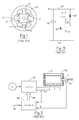
- FIG. 1 shows a typical switched reluctance machine in cross section.
- the ferromagnetic stator 10 has six stator poles 12.
- the ferromagnetic rotor 14 has four rotor poles 16.
- Each stator pole carries a coil 18.
- the coils on diametrically opposite poles are connected in series to provide three phase windings. Only one phase winding is shown, for clarity.
- the control of the switched reluctance machine can be achieved in a variety of ways well known to the person skilled in the art. If information on the angular position of the rotor is available, e.g. from a position transducer, the excitation can be applied as a function of the position. Such machines are often referred to as "rotor position switched machines”.
- a typical switched reluctance drive is shown in Figure 2 .
- the machine 36 corresponds to that shown in Figure 1 .
- the three phase windings, A, B and C are switched in turn onto a DC supply V by a set of power electronic switches 48.
- the moments (i.e., the rotor positions) at which the switches operate are determined by the controller 38, which may be implemented either in hardware or in the software of a processing device such as a microcontroller or digital signal processor.
- the control signals are sent to the switches via a data bus 46. Closed loop current feedback is provided by sensing the phase currents using a current sensor 44 and feeding back a signal proportional to phase current which is compared to a demanded current i D .
- the control algorithms may include a proportional (P), proportional-plus-integral (P+I), time optimal, feedback linearised, proportional/integral/ derivative (PID) function, or one of many others as is well understood in the art. It is also common for an outer control loop of position or speed to be provided by feeding back a rotor position signal from a position detector 40.
- P proportional
- P+I proportional-plus-integral
- PID proportional/integral/ derivative
- a signal corresponding to current demand 42 is provided to the controller. This regulates the current in the windings, according to the particular control scheme adopted, to produce the desired output from the machine.
- the performance of a switched reluctance machine depends, in part, on the accurate timing of phase energisation with respect to rotor position.
- Detection of rotor position is conventionally achieved by using a physical rotor position transducer (RPT) 40, shown schematically in Figure 2 , such as a rotating toothed disk mounted on the machine rotor, which co-operates, for example, with an optical or magnetic sensor mounted on the stator.
- RPT physical rotor position transducer
- a pulse train indicative of rotor position relative to the stator is generated and supplied to the processing device, allowing accurate phase energisation.
- Alternative methods of position detection include the so-called "sensorless" methods, in which there is no physical position transducer and the position is deduced from measurements of one or more other parameters of the machine.
- the capacitor 25 may comprise several capacitors connected in series and/or parallel. Where parallel connection is used, some of the elements may be distributed throughout the converter.
- a polyphase system typically uses several "phase legs" of Figure 3 connected in parallel to energise the phases of the electrical machine independently.
- the phase inductance cycle of a switched reluctance machine is the period of the variation of inductance for the, or each, phase between common points in successive cycles (for example between inductance maxima when the rotor poles and the relevant respective stator poles are fully aligned).
- the maximum inductance region is centred around the rotor position where a pair of rotor poles are fully aligned with a pair of stator poles.
- the minimum inductance region is centred around the position where the interpolar axis on the rotor is aligned with the stator pole axis, as shown in Figure 1 .
- switched reluctance systems generally operate in a current-controlled or "chopping" mode.
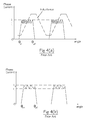
- a hysteresis current controller using “hard” chopping is often used, as explained in the Stephenson paper referred to above. This is illustrated in Figure 4(a) where the current cycles between an upper hysteresis level I u and a lower hysteresis level I 1 in a conduction region of the phase in question, between the switch-on angle ⁇ on at which the phase is energised and the switch-off angle ⁇ off at which energisation is removed.
- An alternative control regime is "soft" chopping in which only one switch is opened when the current reaches its upper level.
- switched reluctance systems typically operate in the "single-pulse" mode of energisation instead of the chopping mode. This is also explained in the Stephenson paper referred to above.
- systems generally use a chopping mode at low speeds and a single-pulse mode at higher speeds.
- the upper and lower chopping current levels are normally set to values above the expected peak current of the single pulse mode, so that these parameters do not interfere with single-pulse operation. It is known to set the upper current level to a value which would act as a "safety net" so that if a fault condition developed in the drive, the current would exceed this upper level and cause one or more switching devices to be opened, thereby limiting the current to a safe value.
- the switched reluctance machine does not generally have a linear relationship between torque and current.
- the reasons for this are discussed in greater detail in the Miller book and the Stephenson paper cited above.
- the relationship is illustrated in Figure 5 , where the so-called static torque for one phase of the three-phase machine of Figure 1 is shown for a constant current applied over a rotor angle of 45°.
- the torque would be almost rectangular.
- the magnetic properties of the iron carrying the flux become significantly non-linear and the shape of the torque becomes rounded.
- the shape of torque curve shown is typical for the rated current for the machine.
- Figure 6 shows the relationships between the torque curves of the different phases of the machine.
- the angular displacement of the curves (the so-called " ⁇ angle") is 30°.
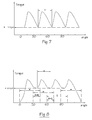
- the simplest method of providing continuous torque from the machine as it rotates is to switch on a phase when the torque curves cross and to switch it off and switch on the next phase after the ⁇ angle has been traversed. This is illustrated in Figure 7 , again for a constant phase current. While this is a simple control regime to implement, it has the obvious drawback of producing a large torque ripple.
- the minimum torque available at any angle is called the ⁇ torque and is shown in Figure 7 .
- the average torque produced over the ⁇ angle will be somewhere between the peak torque and ⁇ torque, depending on the exact shape of the curve.
- This method has another drawback in that each phase is only being used for one third of the phase period, so the utilisation of the stator and the electronic controller is poor.
- a method of controlling a brushless electrical machine to produce an output wherein the output is torque or force.
- the method comprises energising a first phase of the machine in a conduction region between a switch-on point and a switch-off point.
- the machine is energised in response to an output demand to produce an output between an upper and a lower output limit, respectively higher or lower than the output demand, compensating for a non-linear relationship between the output of the brushless electrical machine and current in the first phase.
- the output between an upper and a lower output limit is produced in response to the output demand from a beginning of the conduction region to a detent region and from the detent region to an end of the conduction region. In the detent region, an output is produced at a detent level.
- the detent level is below the lower limit. In this way, stalling of the machine at a detent position within the detent region is favoured.
- a detent region within which the machine is more likely to stall can be defined. This provides control over the stalling behaviour of the machine.
- the upper and lower output limits would be the same (equal to the output demand) so that the output would be ideally smooth or flat in the conduction region.
- the output fluctuations described above cannot be fully compensated so that the machine is controlled to produce an output at the output demand, which is substantially smooth or flat and varies between upper and lower limits due to uncompensated output fluctuations.
- the upper and lower limits may be 5% on either side of the output demand, with flatter output potentially achievable, for example with upper and lower limits of 3% or even 1% or 2% on either side of the output demand (relative to the output demand).
- any known output conditioning technique may be used, for example profiling of the current (or other controlled quantity, such as flux) to achieve the desired smoothness of the output.
- the control and/or profiling may be based on feed forward control based on the characteristics of the machine or feedback control based on a suitable feedback quantity, such as the output or variation of the output.
- a combination of feed forward and feedback control is equally possible.
- the various possible control schemes may employ sensorless forms of rotor position detection, or position detection using rotor position detector hardware. A combination of sensorless and hardware forms of rotor position detection is equally possible.
- the detent level is less than 96% of the output demand.
- the detent level may be 95%.
- Lower or higher values for the detent level are equally possible, although the detent effect is reduced for higher values, while lower levels may introduce undesirable torque ripple.
- the method may comprise energising respective second and third phases together with the first phase.
- the second phase is energised together with the first phase for a first portion of the conduction region before the detent region and the third phase is energised together with the first phase for a second portion of the conduction region after the detent region to produce the output between the upper and lower limits.
- These embodiments may use the energisation scheme described above with reference to Figure 8 to facilitate smoothing the output.
- the current drawn by the first phase for a constant output demand is above a notional level in a second and fourth portion of the conduction region.
- the second and fourth portions of the conduction region are located between first, third and fifth portions of the conduction region in which the current is below the notional level.
- the current profile (whether as result of direct current control or, for example, flux control) has two peaks with a trough in between.
- the detent position is within the third portion, that is the trough portion between the two peaks of the current profile. In this way, the detent region is placed such that the detent position is within a region in which the current drawn by the first phase is relatively low.
- the notional level may be less than the average of the maximum current in the conduction region of a first phase and the minimum current in the third portion of the conduction region of the first phase.
- the notional level may be less than the sum of 90% of the minimum current and 10% of the maximum current in the conduction region of the first phase.
- the minimum of current in the third portion of the conduction region of the first phase occurs in the detent region. This results in the phase drawing minimum current (or close to minimum current) when stalling in the detent region.
- the brushless electrical machine is coupled to a load by a compliant torque transmission arrangement.
- the compliance of the transmission arrangement means that the machine may move to a stall position within the detent region without movement of the load.
- the brushless electrical machine is coupled to one or more traction wheels of a vehicle, for example a loader as discussed below.
- the brushless electrical machine has more than one phase and the method comprises varying the output demand between at least two levels to cause the machine to stall at different detent positions, wherein each detent position is in a different phase.
- the output demand is varied in response to detecting that the machine has stalled.
- the different phases may be mutually adjacent and for brushless electrical machines which have n phases, the output demand may be varied between n levels (to cause stall positions associated with each of the n phases to be visited).
- the brushless electrical machine has a rotor, that is it is a rotating machine with a torque output.
- the present disclosure is equally applicable to embodiments in which the machine has a movable part arranged for linear motion relative to a stationary part and is thus a linear machine with an output of force.
- the brushless electrical machine is a switched reluctance machine. In other embodiments, the brushless electrical machine may be a brushless DC machine or any other suitable type of brushless electrical machine.
- the introduction of a detent region with an output at a detent level is made speed-dependent.
- a speed of the machine is determined and an output produced in the detent region at the detent level if the speed is below a first value and at or above the lower level if the speed is above a second value.
- the second value may be the same as the first value and act as a threshold level.
- the second value could be larger than the first value, for example by implementing a gradual transition from the detent level to no output reduction at all as the speed increases from the first to the second value. This would reduce the risk of resonances being introduced in the machine/drive by the torque ripple associated with the periodic reduction in output to the detent level in the detent region.
- control system comprising means for controlling a brushless electrical machine in accordance with the methods and techniques described above.
- drive comprising a brushless electrical machine and a control system coupled to the brushless electrical machine.
- the control system comprises a processor configured to cause the control system to control the brushless electrical machine in accordance with the methods and techniques described above.
- Some types of load are particularly susceptible to torque ripple produced by the prime mover and there are many techniques advocated for producing "smooth" torque, i.e. torque which has no significant variation with rotor position.
- Some of these techniques concentrate on mechanical solutions, e.g. modifying the profile of the rotor and/or stator poles, as disclosed in EP 0930694 (Randall ).
- Other methods make the current a function of rotor angle, so that instead of being constant (as was shown in Figures 5 to 8 ), the magnitude of the current is varied during the conduction angle, as disclosed in US 6922036 (Ehsani ). These latter techniques are generally described as "current profiling".
- the current profiling can be achieved in a variety of ways.
- One of the simplest methods follows from Figure 7 and uses one phase at a time.
- the current is modulated inversely to the shape of the torque to keep the torque constant across the ⁇ angle. This is shown in Figure 9 .
- the ⁇ torque is quite low when only one phase is energised at a time, so the output from the machine has been reduced from the average torque of Figure 7 (approximately twice the ⁇ torque, depending on the actual wave shape) to the ⁇ torque.
- ⁇ torque in Figure 10 is shown as a straight line corresponding to an ideally flat or smooth torque
- the torque output for a given torque demand will fluctuate somewhat about the torque demand, between an upper and lower level of acceptable torque fluctuation, for example due to model inaccuracies or limited feedback gains.
- the torque output will be substantially flat or smooth, allowing for noise, inaccuracies or design constraints in the control process.
- phase conduction region Common to all these methods is the energisation of a phase such that it carries a current that varies with rotor position to compensate (as fully as possible or partially) for the nonlinear relationship between the phase current and torque generated by the phase.
- the resulting current waveform will have two peaks with a trough in between to reflect torque generation characteristics which produce a higher torque for a given current in a middle region of the phase conduction region.
- the current profile of the phase winding is altered in a detent region in the conduction region to ensure that the drive will stall at a point (or detent position) where the phase current is at or near its lowest value, thus minimising the associated losses in the drive system.
- Figure 12 shows a small dip introduced to the current profile of Figure 10 in a detent region DR to encourage stalling of the drive at a detent position within the detent region. This produces a corresponding dip in the torque, as shown.
- this torque waveform is applied to the tyre compliance, it will be seen from Figure 13 that the drive stalls at the torque dip, corresponding to the lowest current.
- the amount of torque dip needed will depend, inter alia, on the amount of compliance in the transmission of torque and the gearing between an electrical cycle of the machine and the load, but a typical value for a large industrial vehicle would be to introduce a torque dip of around 5% of the output torque.
- a notional current level 30 can be drawn in Figure 12 to divide the conduction region into five portions: two flanking portions A and E; a middle portion C in which the current is below the notional level; and two in-between portions B and D in which the current is above the notional level.
- Some benefit of stall current reduction can be achieved where the current (and hence torque) dip is introduced in the middle portion, where the current is lower than in the in-between portions. The benefit is higher, the lower the notional level.
- Optimum or near optimum stall current reduction may be achieved if the detent region is chosen to include the lowest point of the middle portion. By choosing the dip to occur in the middle portion, the current drawn by adjacent phases in some energisation schemes may also be reduced, depending on the positioning of the dip, the energisation scheme and the number of phases in the machine.
- the description above has illustrated the use of current profiling throughout the conduction angle. This can be implemented with the current controllers commonly used in drive systems.
- the invention can be put into effect by using other parameters to control the level of energisation in the machine, e.g., the drive may include a flux controller and the energisation may be controlled by monitoring the flux in the machine and controlling it to follow a predetermined profile.
- the invention in its various embodiments provides a torque control technique for electronically switched brushless machines of various types, and is particularly suited to switched reluctance machines. It allows close control of the thermal behaviour of the drive system.
- the disclosed embodiments illustrate a significant benefit, in that the additional control scheme can be incorporated into an existing control system with minimal modification. It will be apparent to the skilled person that various modifications and changes can be made to the specifically disclosed embodiments without departing from the invention. The invention is to be limited only by the scope of the following claims.
Landscapes
- Engineering & Computer Science (AREA)
- Power Engineering (AREA)
- Control Of Motors That Do Not Use Commutators (AREA)
- Control Of Electric Motors In General (AREA)
Applications Claiming Priority (2)
| Application Number | Priority Date | Filing Date | Title |
|---|---|---|---|
| US201361769456P | 2013-02-26 | 2013-02-26 | |
| GBGB1303417.8A GB201303417D0 (en) | 2013-02-26 | 2013-02-26 | Control of a brushless electrical machine |
Publications (3)
| Publication Number | Publication Date |
|---|---|
| EP2770629A2 true EP2770629A2 (fr) | 2014-08-27 |
| EP2770629A3 EP2770629A3 (fr) | 2017-11-22 |
| EP2770629B1 EP2770629B1 (fr) | 2020-03-11 |
Family
ID=48092132
Family Applications (1)
| Application Number | Title | Priority Date | Filing Date |
|---|---|---|---|
| EP14155108.5A Active EP2770629B1 (fr) | 2013-02-26 | 2014-02-13 | Contrôle de machine électrique sans balai |
Country Status (6)
| Country | Link |
|---|---|
| US (1) | US9312801B2 (fr) |
| EP (1) | EP2770629B1 (fr) |
| JP (1) | JP2014166137A (fr) |
| KR (1) | KR20140106454A (fr) |
| CN (1) | CN104009683A (fr) |
| GB (1) | GB201303417D0 (fr) |
Families Citing this family (3)
| Publication number | Priority date | Publication date | Assignee | Title |
|---|---|---|---|---|
| US10122251B2 (en) | 2015-05-29 | 2018-11-06 | Com Dev Ltd. | Sequential actuator with sculpted active torque |
| CN106970527B (zh) * | 2017-03-30 | 2020-04-10 | 奥克斯空调股份有限公司 | 一种pid控制的工程实现方法 |
| WO2019136489A1 (fr) * | 2018-01-08 | 2019-07-11 | Broan-Nutone Llc | Système et procédé de commande intégrée de ventilateur d'alimentation |
Citations (3)
| Publication number | Priority date | Publication date | Assignee | Title |
|---|---|---|---|---|
| EP0769844A1 (fr) | 1995-10-18 | 1997-04-23 | Switched Reluctance Drives Limited | Circuit de commande du courant pour machine à réluctance variable |
| EP0930694A2 (fr) | 1998-01-20 | 1999-07-21 | Switched Reluctance Drives Limited | Réduction du bruit dans des machines à réluctance |
| US6922036B1 (en) | 2000-11-30 | 2005-07-26 | The Texas A&M University System | Method and apparatus for reducing noise and vibration in switched reluctance motor drives |
Family Cites Families (12)
| Publication number | Priority date | Publication date | Assignee | Title |
|---|---|---|---|---|
| GB1460741A (fr) * | 1973-09-10 | 1977-01-06 | Lan | |
| FR2614481B1 (fr) * | 1987-02-13 | 1990-08-31 | Pk I | Procede de commande d'un moteur asynchrone et entrainement electrique mettant ce procede en application |
| JPH02206389A (ja) * | 1989-01-31 | 1990-08-16 | Daikin Ind Ltd | リラクタンスモータのトルク脈動低減方法 |
| JPH0817586B2 (ja) * | 1989-02-06 | 1996-02-21 | 株式会社日立製作所 | デジタル制御装置 |
| US5485047A (en) * | 1992-01-27 | 1996-01-16 | Kabushikigaisha Sekogiken | Reluctance-type motor and a rotor for a reluctance-type high-speed motor |
| WO1994000909A1 (fr) * | 1992-06-29 | 1994-01-06 | Kabushikigaisya Sekogiken | Moteur a reluctance capable de fournir un freinage par recuperation et moteur a courant continu |
| JPH07274570A (ja) * | 1994-03-31 | 1995-10-20 | Aisin Seiki Co Ltd | スイッチドレラクタンスモ−タの制御装置 |
| CA2151532C (fr) * | 1994-07-25 | 1998-12-22 | Emerson Electric Co. | Moteur a reluctance commutable muni d'un demarreur auxiliaire |
| US6891343B2 (en) * | 2003-03-14 | 2005-05-10 | Petersen Technology Corporation | Multiphase motors with single point sensing based commutation |
| CN1326315C (zh) * | 2005-10-11 | 2007-07-11 | 中国矿业大学 | 开关磁阻伺服电动机输出转矩消脉动控制方法 |
| GB0618751D0 (en) * | 2006-09-22 | 2006-11-01 | Switched Reluctance Drives Ltd | Operating electrical machines from a DC link |
| CN102545743B (zh) * | 2010-12-27 | 2014-08-06 | 北京中纺锐力机电有限公司 | 开关磁阻电机的转矩平滑控制方法 |
-
2013
- 2013-02-26 GB GBGB1303417.8A patent/GB201303417D0/en not_active Ceased
-
2014
- 2014-02-13 EP EP14155108.5A patent/EP2770629B1/fr active Active
- 2014-02-25 US US14/190,013 patent/US9312801B2/en not_active Expired - Fee Related
- 2014-02-25 JP JP2014034285A patent/JP2014166137A/ja not_active Ceased
- 2014-02-26 CN CN201410067243.7A patent/CN104009683A/zh active Pending
- 2014-02-26 KR KR1020140022936A patent/KR20140106454A/ko not_active Withdrawn
Patent Citations (3)
| Publication number | Priority date | Publication date | Assignee | Title |
|---|---|---|---|---|
| EP0769844A1 (fr) | 1995-10-18 | 1997-04-23 | Switched Reluctance Drives Limited | Circuit de commande du courant pour machine à réluctance variable |
| EP0930694A2 (fr) | 1998-01-20 | 1999-07-21 | Switched Reluctance Drives Limited | Réduction du bruit dans des machines à réluctance |
| US6922036B1 (en) | 2000-11-30 | 2005-07-26 | The Texas A&M University System | Method and apparatus for reducing noise and vibration in switched reluctance motor drives |
Non-Patent Citations (5)
| Title |
|---|
| GOBBI, R; SAHOO, NC: "A fuzzy iterative approach for determination of current waveform for switched reluctance motors using a torque sharing function at positive and negative torque production regions", PROCEEDINGS OF THE 30TH ANNUAL CONFERENCE OF THE INDUSTRIAL ELECTRONICS SOCIETY, vol. 4, 2 November 2004 (2004-11-02), pages 3172 - 3177, XP010799479, DOI: doi:10.1109/IECON.2004.1432320 |
| HUNG, JY: "Torque ripple minimisation for variable reluctance motors", MECHATRONICS, vol. 4, no. 8, 1994, pages 785 - 794 |
| SCHRAMM, DS; WILLIAMS, BW; GREEN TC: "Optimum commutation-current profile on torque linearization of switched reluctance motor", PROCEEDINGS OF THE INTERNATIONAL CONFERENCE ON ELECTRICAL MACHINES, vol. 2, 15 September 1992 (1992-09-15), pages 484 - 488 |
| STEPHENSON; BLAKE: "The Characteristics, Design and Applications of Switched Reluctance Motors and Drives", PCIM '93 CONFERENCE AND EXHIBITION AT NURNBERG, 21 June 1993 (1993-06-21) |
| TJE MILLER: "Electronic Control of Switched Reluctance Machines", NEWNES, 2001 |
Also Published As
| Publication number | Publication date |
|---|---|
| KR20140106454A (ko) | 2014-09-03 |
| US9312801B2 (en) | 2016-04-12 |
| CN104009683A (zh) | 2014-08-27 |
| JP2014166137A (ja) | 2014-09-08 |
| EP2770629B1 (fr) | 2020-03-11 |
| EP2770629A3 (fr) | 2017-11-22 |
| US20140239862A1 (en) | 2014-08-28 |
| GB201303417D0 (en) | 2013-04-10 |
Similar Documents
| Publication | Publication Date | Title |
|---|---|---|
| EP1959560B1 (fr) | Contrôle d'une machine électrique | |
| Bass et al. | Robust torque control of switched-reluctance motors without a shaft-position sensor | |
| Kjaer et al. | A new energy optimizing control strategy for switched reluctance motors | |
| DE69725231T2 (de) | Einphasiger Permanentmagnetmotor | |
| Toliyat et al. | AC machines controlled as DC machines (Brushless DC machines/electronics) | |
| CN113300653B (zh) | 一种开关磁阻电机直接瞬时转矩控制系统及方法 | |
| WO2015071662A1 (fr) | Procédé et appareil de commande de moteurs à réluctance commutée | |
| Jinupun et al. | Direct torque control for sensorless switched reluctance motor drives | |
| EP2770629B1 (fr) | Contrôle de machine électrique sans balai | |
| JP2014166137A5 (fr) | ||
| Lee | Torque ripple and switching power loss minimization with constant band hysteresis current controller for bldc motor | |
| Xiao et al. | A novel control strategy for brushless DC motor drive with low torque ripples | |
| Do et al. | Modeling, simulation and control of reluctance motor drives for high speed operation | |
| Hingmire et al. | Simulation and Analysis Studies of Speed Control of Brushless DC Motor Using Hall Sensors | |
| JP7199535B2 (ja) | ブラシレス永久磁石モータを制御する方法 | |
| KR101660509B1 (ko) | 릴럭턴스 전동기의 오프 각 제어방법 | |
| Husain | Switched reluctance machines | |
| Naitoh et al. | A current controller for a switched reluctance motor based on model reference adaptive control | |
| Sahoo et al. | A comparative study of Single Pulse Voltage and Hysteresis current control methods for switched reluctance motors | |
| Hasegawa et al. | Reduction of Iron Loss and Back EMFs of the Doubly Salient Synchronous Reluctance Motor by Estimation of Flux Linkage | |
| Muthulakshmi et al. | Performance analysis of Current controlled three phase switched reluctance motor | |
| Oh et al. | A novel control scheme for low cost SRM drive | |
| Ishikawa et al. | Novel speed control system with flat torque control for switched reluctance motor drives | |
| Dufare et al. | Design and Analysis of PI and PID Controllers for Dual-Loop PWM Voltage Control in Switched Reluctance Motor Drives | |
| Mondal et al. | Evaluation of a novel analog based closed-loop sensorless controller for switched reluctance motor drive |
Legal Events
| Date | Code | Title | Description |
|---|---|---|---|
| PUAI | Public reference made under article 153(3) epc to a published international application that has entered the european phase |
Free format text: ORIGINAL CODE: 0009012 |
|
| 17P | Request for examination filed |
Effective date: 20140213 |
|
| AK | Designated contracting states |
Kind code of ref document: A2 Designated state(s): AL AT BE BG CH CY CZ DE DK EE ES FI FR GB GR HR HU IE IS IT LI LT LU LV MC MK MT NL NO PL PT RO RS SE SI SK SM TR |
|
| AX | Request for extension of the european patent |
Extension state: BA ME |
|
| PUAL | Search report despatched |
Free format text: ORIGINAL CODE: 0009013 |
|
| AK | Designated contracting states |
Kind code of ref document: A3 Designated state(s): AL AT BE BG CH CY CZ DE DK EE ES FI FR GB GR HR HU IE IS IT LI LT LU LV MC MK MT NL NO PL PT RO RS SE SI SK SM TR |
|
| AX | Request for extension of the european patent |
Extension state: BA ME |
|
| RIC1 | Information provided on ipc code assigned before grant |
Ipc: H02P 7/298 20160101AFI20171019BHEP |
|
| STAA | Information on the status of an ep patent application or granted ep patent |
Free format text: STATUS: REQUEST FOR EXAMINATION WAS MADE |
|
| R17P | Request for examination filed (corrected) |
Effective date: 20180510 |
|
| RBV | Designated contracting states (corrected) |
Designated state(s): AL AT BE BG CH CY CZ DE DK EE ES FI FR GB GR HR HU IE IS IT LI LT LU LV MC MK MT NL NO PL PT RO RS SE SI SK SM TR |
|
| GRAP | Despatch of communication of intention to grant a patent |
Free format text: ORIGINAL CODE: EPIDOSNIGR1 |
|
| STAA | Information on the status of an ep patent application or granted ep patent |
Free format text: STATUS: GRANT OF PATENT IS INTENDED |
|
| INTG | Intention to grant announced |
Effective date: 20191002 |
|
| GRAS | Grant fee paid |
Free format text: ORIGINAL CODE: EPIDOSNIGR3 |
|
| GRAA | (expected) grant |
Free format text: ORIGINAL CODE: 0009210 |
|
| STAA | Information on the status of an ep patent application or granted ep patent |
Free format text: STATUS: THE PATENT HAS BEEN GRANTED |
|
| AK | Designated contracting states |
Kind code of ref document: B1 Designated state(s): AL AT BE BG CH CY CZ DE DK EE ES FI FR GB GR HR HU IE IS IT LI LT LU LV MC MK MT NL NO PL PT RO RS SE SI SK SM TR |
|
| REG | Reference to a national code |
Ref country code: GB Ref legal event code: FG4D |
|
| REG | Reference to a national code |
Ref country code: CH Ref legal event code: EP |
|
| REG | Reference to a national code |
Ref country code: AT Ref legal event code: REF Ref document number: 1244413 Country of ref document: AT Kind code of ref document: T Effective date: 20200315 |
|
| REG | Reference to a national code |
Ref country code: IE Ref legal event code: FG4D |
|
| REG | Reference to a national code |
Ref country code: DE Ref legal event code: R096 Ref document number: 602014062065 Country of ref document: DE |
|
| PG25 | Lapsed in a contracting state [announced via postgrant information from national office to epo] |
Ref country code: FI Free format text: LAPSE BECAUSE OF FAILURE TO SUBMIT A TRANSLATION OF THE DESCRIPTION OR TO PAY THE FEE WITHIN THE PRESCRIBED TIME-LIMIT Effective date: 20200311 Ref country code: RS Free format text: LAPSE BECAUSE OF FAILURE TO SUBMIT A TRANSLATION OF THE DESCRIPTION OR TO PAY THE FEE WITHIN THE PRESCRIBED TIME-LIMIT Effective date: 20200311 Ref country code: NO Free format text: LAPSE BECAUSE OF FAILURE TO SUBMIT A TRANSLATION OF THE DESCRIPTION OR TO PAY THE FEE WITHIN THE PRESCRIBED TIME-LIMIT Effective date: 20200611 |
|
| REG | Reference to a national code |
Ref country code: NL Ref legal event code: MP Effective date: 20200311 |
|
| PG25 | Lapsed in a contracting state [announced via postgrant information from national office to epo] |
Ref country code: BG Free format text: LAPSE BECAUSE OF FAILURE TO SUBMIT A TRANSLATION OF THE DESCRIPTION OR TO PAY THE FEE WITHIN THE PRESCRIBED TIME-LIMIT Effective date: 20200611 Ref country code: HR Free format text: LAPSE BECAUSE OF FAILURE TO SUBMIT A TRANSLATION OF THE DESCRIPTION OR TO PAY THE FEE WITHIN THE PRESCRIBED TIME-LIMIT Effective date: 20200311 Ref country code: GR Free format text: LAPSE BECAUSE OF FAILURE TO SUBMIT A TRANSLATION OF THE DESCRIPTION OR TO PAY THE FEE WITHIN THE PRESCRIBED TIME-LIMIT Effective date: 20200612 Ref country code: LV Free format text: LAPSE BECAUSE OF FAILURE TO SUBMIT A TRANSLATION OF THE DESCRIPTION OR TO PAY THE FEE WITHIN THE PRESCRIBED TIME-LIMIT Effective date: 20200311 Ref country code: SE Free format text: LAPSE BECAUSE OF FAILURE TO SUBMIT A TRANSLATION OF THE DESCRIPTION OR TO PAY THE FEE WITHIN THE PRESCRIBED TIME-LIMIT Effective date: 20200311 |
|
| REG | Reference to a national code |
Ref country code: LT Ref legal event code: MG4D |
|
| PG25 | Lapsed in a contracting state [announced via postgrant information from national office to epo] |
Ref country code: NL Free format text: LAPSE BECAUSE OF FAILURE TO SUBMIT A TRANSLATION OF THE DESCRIPTION OR TO PAY THE FEE WITHIN THE PRESCRIBED TIME-LIMIT Effective date: 20200311 |
|
| PG25 | Lapsed in a contracting state [announced via postgrant information from national office to epo] |
Ref country code: SM Free format text: LAPSE BECAUSE OF FAILURE TO SUBMIT A TRANSLATION OF THE DESCRIPTION OR TO PAY THE FEE WITHIN THE PRESCRIBED TIME-LIMIT Effective date: 20200311 Ref country code: SK Free format text: LAPSE BECAUSE OF FAILURE TO SUBMIT A TRANSLATION OF THE DESCRIPTION OR TO PAY THE FEE WITHIN THE PRESCRIBED TIME-LIMIT Effective date: 20200311 Ref country code: PT Free format text: LAPSE BECAUSE OF FAILURE TO SUBMIT A TRANSLATION OF THE DESCRIPTION OR TO PAY THE FEE WITHIN THE PRESCRIBED TIME-LIMIT Effective date: 20200805 Ref country code: CZ Free format text: LAPSE BECAUSE OF FAILURE TO SUBMIT A TRANSLATION OF THE DESCRIPTION OR TO PAY THE FEE WITHIN THE PRESCRIBED TIME-LIMIT Effective date: 20200311 Ref country code: RO Free format text: LAPSE BECAUSE OF FAILURE TO SUBMIT A TRANSLATION OF THE DESCRIPTION OR TO PAY THE FEE WITHIN THE PRESCRIBED TIME-LIMIT Effective date: 20200311 Ref country code: IS Free format text: LAPSE BECAUSE OF FAILURE TO SUBMIT A TRANSLATION OF THE DESCRIPTION OR TO PAY THE FEE WITHIN THE PRESCRIBED TIME-LIMIT Effective date: 20200711 Ref country code: LT Free format text: LAPSE BECAUSE OF FAILURE TO SUBMIT A TRANSLATION OF THE DESCRIPTION OR TO PAY THE FEE WITHIN THE PRESCRIBED TIME-LIMIT Effective date: 20200311 Ref country code: EE Free format text: LAPSE BECAUSE OF FAILURE TO SUBMIT A TRANSLATION OF THE DESCRIPTION OR TO PAY THE FEE WITHIN THE PRESCRIBED TIME-LIMIT Effective date: 20200311 |
|
| REG | Reference to a national code |
Ref country code: AT Ref legal event code: MK05 Ref document number: 1244413 Country of ref document: AT Kind code of ref document: T Effective date: 20200311 |
|
| REG | Reference to a national code |
Ref country code: DE Ref legal event code: R097 Ref document number: 602014062065 Country of ref document: DE |
|
| PLBE | No opposition filed within time limit |
Free format text: ORIGINAL CODE: 0009261 |
|
| STAA | Information on the status of an ep patent application or granted ep patent |
Free format text: STATUS: NO OPPOSITION FILED WITHIN TIME LIMIT |
|
| PG25 | Lapsed in a contracting state [announced via postgrant information from national office to epo] |
Ref country code: IT Free format text: LAPSE BECAUSE OF FAILURE TO SUBMIT A TRANSLATION OF THE DESCRIPTION OR TO PAY THE FEE WITHIN THE PRESCRIBED TIME-LIMIT Effective date: 20200311 Ref country code: AT Free format text: LAPSE BECAUSE OF FAILURE TO SUBMIT A TRANSLATION OF THE DESCRIPTION OR TO PAY THE FEE WITHIN THE PRESCRIBED TIME-LIMIT Effective date: 20200311 Ref country code: DK Free format text: LAPSE BECAUSE OF FAILURE TO SUBMIT A TRANSLATION OF THE DESCRIPTION OR TO PAY THE FEE WITHIN THE PRESCRIBED TIME-LIMIT Effective date: 20200311 Ref country code: ES Free format text: LAPSE BECAUSE OF FAILURE TO SUBMIT A TRANSLATION OF THE DESCRIPTION OR TO PAY THE FEE WITHIN THE PRESCRIBED TIME-LIMIT Effective date: 20200311 |
|
| 26N | No opposition filed |
Effective date: 20201214 |
|
| PG25 | Lapsed in a contracting state [announced via postgrant information from national office to epo] |
Ref country code: PL Free format text: LAPSE BECAUSE OF FAILURE TO SUBMIT A TRANSLATION OF THE DESCRIPTION OR TO PAY THE FEE WITHIN THE PRESCRIBED TIME-LIMIT Effective date: 20200311 Ref country code: SI Free format text: LAPSE BECAUSE OF FAILURE TO SUBMIT A TRANSLATION OF THE DESCRIPTION OR TO PAY THE FEE WITHIN THE PRESCRIBED TIME-LIMIT Effective date: 20200311 |
|
| PG25 | Lapsed in a contracting state [announced via postgrant information from national office to epo] |
Ref country code: MC Free format text: LAPSE BECAUSE OF FAILURE TO SUBMIT A TRANSLATION OF THE DESCRIPTION OR TO PAY THE FEE WITHIN THE PRESCRIBED TIME-LIMIT Effective date: 20200311 |
|
| REG | Reference to a national code |
Ref country code: BE Ref legal event code: MM Effective date: 20210228 |
|
| PG25 | Lapsed in a contracting state [announced via postgrant information from national office to epo] |
Ref country code: LU Free format text: LAPSE BECAUSE OF NON-PAYMENT OF DUE FEES Effective date: 20210213 Ref country code: LI Free format text: LAPSE BECAUSE OF NON-PAYMENT OF DUE FEES Effective date: 20210228 Ref country code: CH Free format text: LAPSE BECAUSE OF NON-PAYMENT OF DUE FEES Effective date: 20210228 |
|
| PG25 | Lapsed in a contracting state [announced via postgrant information from national office to epo] |
Ref country code: IE Free format text: LAPSE BECAUSE OF NON-PAYMENT OF DUE FEES Effective date: 20210213 |
|
| PGFP | Annual fee paid to national office [announced via postgrant information from national office to epo] |
Ref country code: GB Payment date: 20220131 Year of fee payment: 9 Ref country code: DE Payment date: 20220228 Year of fee payment: 9 |
|
| PGFP | Annual fee paid to national office [announced via postgrant information from national office to epo] |
Ref country code: FR Payment date: 20220218 Year of fee payment: 9 |
|
| PG25 | Lapsed in a contracting state [announced via postgrant information from national office to epo] |
Ref country code: BE Free format text: LAPSE BECAUSE OF NON-PAYMENT OF DUE FEES Effective date: 20210228 |
|
| PG25 | Lapsed in a contracting state [announced via postgrant information from national office to epo] |
Ref country code: HU Free format text: LAPSE BECAUSE OF FAILURE TO SUBMIT A TRANSLATION OF THE DESCRIPTION OR TO PAY THE FEE WITHIN THE PRESCRIBED TIME-LIMIT; INVALID AB INITIO Effective date: 20140213 |
|
| PG25 | Lapsed in a contracting state [announced via postgrant information from national office to epo] |
Ref country code: CY Free format text: LAPSE BECAUSE OF FAILURE TO SUBMIT A TRANSLATION OF THE DESCRIPTION OR TO PAY THE FEE WITHIN THE PRESCRIBED TIME-LIMIT Effective date: 20200311 |
|
| REG | Reference to a national code |
Ref country code: DE Ref legal event code: R119 Ref document number: 602014062065 Country of ref document: DE |
|
| GBPC | Gb: european patent ceased through non-payment of renewal fee |
Effective date: 20230213 |
|
| PG25 | Lapsed in a contracting state [announced via postgrant information from national office to epo] |
Ref country code: GB Free format text: LAPSE BECAUSE OF NON-PAYMENT OF DUE FEES Effective date: 20230213 |
|
| PG25 | Lapsed in a contracting state [announced via postgrant information from national office to epo] |
Ref country code: GB Free format text: LAPSE BECAUSE OF NON-PAYMENT OF DUE FEES Effective date: 20230213 Ref country code: FR Free format text: LAPSE BECAUSE OF NON-PAYMENT OF DUE FEES Effective date: 20230228 Ref country code: DE Free format text: LAPSE BECAUSE OF NON-PAYMENT OF DUE FEES Effective date: 20230901 |
|
| PG25 | Lapsed in a contracting state [announced via postgrant information from national office to epo] |
Ref country code: MK Free format text: LAPSE BECAUSE OF FAILURE TO SUBMIT A TRANSLATION OF THE DESCRIPTION OR TO PAY THE FEE WITHIN THE PRESCRIBED TIME-LIMIT Effective date: 20200311 |
|
| PG25 | Lapsed in a contracting state [announced via postgrant information from national office to epo] |
Ref country code: MT Free format text: LAPSE BECAUSE OF FAILURE TO SUBMIT A TRANSLATION OF THE DESCRIPTION OR TO PAY THE FEE WITHIN THE PRESCRIBED TIME-LIMIT Effective date: 20200311 |
|
| PG25 | Lapsed in a contracting state [announced via postgrant information from national office to epo] |
Ref country code: TR Free format text: LAPSE BECAUSE OF FAILURE TO SUBMIT A TRANSLATION OF THE DESCRIPTION OR TO PAY THE FEE WITHIN THE PRESCRIBED TIME-LIMIT Effective date: 20200311 |