EP2773036B1 - Verfahren zur Gleichstrom-Wechselstrom-Umwandlung - Google Patents
Verfahren zur Gleichstrom-Wechselstrom-Umwandlung Download PDFInfo
- Publication number
- EP2773036B1 EP2773036B1 EP13156985.7A EP13156985A EP2773036B1 EP 2773036 B1 EP2773036 B1 EP 2773036B1 EP 13156985 A EP13156985 A EP 13156985A EP 2773036 B1 EP2773036 B1 EP 2773036B1
- Authority
- EP
- European Patent Office
- Prior art keywords
- converters
- voltage
- converter
- energy storage
- storage element
- Prior art date
- Legal status (The legal status is an assumption and is not a legal conclusion. Google has not performed a legal analysis and makes no representation as to the accuracy of the status listed.)
- Not-in-force
Links
Images

Classifications
-
- H—ELECTRICITY
- H02—GENERATION; CONVERSION OR DISTRIBUTION OF ELECTRIC POWER
- H02J—ELECTRIC POWER NETWORKS; CIRCUIT ARRANGEMENTS OR SYSTEMS FOR SUPPLYING OR DISTRIBUTING ELECTRIC POWER; SYSTEMS FOR STORING ELECTRIC ENERGY
- H02J3/00—Circuit arrangements for AC mains or AC distribution networks
- H02J3/28—Arrangements for balancing of the load in networks by storage of energy
-
- H—ELECTRICITY
- H02—GENERATION; CONVERSION OR DISTRIBUTION OF ELECTRIC POWER
- H02J—ELECTRIC POWER NETWORKS; CIRCUIT ARRANGEMENTS OR SYSTEMS FOR SUPPLYING OR DISTRIBUTING ELECTRIC POWER; SYSTEMS FOR STORING ELECTRIC ENERGY
- H02J3/00—Circuit arrangements for AC mains or AC distribution networks
- H02J3/38—Arrangements for feeding a single network from two or more generators or sources in parallel; Arrangements for feeding already energised networks from additional generators or sources in parallel
- H02J3/381—Dispersed generators
-
- H—ELECTRICITY
- H02—GENERATION; CONVERSION OR DISTRIBUTION OF ELECTRIC POWER
- H02J—ELECTRIC POWER NETWORKS; CIRCUIT ARRANGEMENTS OR SYSTEMS FOR SUPPLYING OR DISTRIBUTING ELECTRIC POWER; SYSTEMS FOR STORING ELECTRIC ENERGY
- H02J3/00—Circuit arrangements for AC mains or AC distribution networks
- H02J3/38—Arrangements for feeding a single network from two or more generators or sources in parallel; Arrangements for feeding already energised networks from additional generators or sources in parallel
- H02J3/40—Synchronisation of generators for connection to a network or to another generator
-
- H—ELECTRICITY
- H02—GENERATION; CONVERSION OR DISTRIBUTION OF ELECTRIC POWER
- H02J—ELECTRIC POWER NETWORKS; CIRCUIT ARRANGEMENTS OR SYSTEMS FOR SUPPLYING OR DISTRIBUTING ELECTRIC POWER; SYSTEMS FOR STORING ELECTRIC ENERGY
- H02J7/00—Circuit arrangements for charging or discharging batteries or for supplying loads from batteries
- H02J7/34—Parallel operation in networks using both storage and other DC sources, e.g. providing buffering
-
- H—ELECTRICITY
- H02—GENERATION; CONVERSION OR DISTRIBUTION OF ELECTRIC POWER
- H02M—APPARATUS FOR CONVERSION BETWEEN AC AND AC, BETWEEN AC AND DC, OR BETWEEN DC AND DC, AND FOR USE WITH MAINS OR SIMILAR POWER SUPPLY SYSTEMS; CONVERSION OF DC OR AC INPUT POWER INTO SURGE OUTPUT POWER; CONTROL OR REGULATION THEREOF
- H02M7/00—Conversion of AC power input into DC power output; Conversion of DC power input into AC power output
- H02M7/42—Conversion of DC power input into AC power output without possibility of reversal
- H02M7/44—Conversion of DC power input into AC power output without possibility of reversal by static converters
- H02M7/48—Conversion of DC power input into AC power output without possibility of reversal by static converters using discharge tubes with control electrode or semiconductor devices with control electrode
- H02M7/483—Converters with outputs that each can have more than two voltages levels
- H02M7/49—Combination of the output voltage waveforms of a plurality of converters
-
- H—ELECTRICITY
- H02—GENERATION; CONVERSION OR DISTRIBUTION OF ELECTRIC POWER
- H02M—APPARATUS FOR CONVERSION BETWEEN AC AND AC, BETWEEN AC AND DC, OR BETWEEN DC AND DC, AND FOR USE WITH MAINS OR SIMILAR POWER SUPPLY SYSTEMS; CONVERSION OF DC OR AC INPUT POWER INTO SURGE OUTPUT POWER; CONTROL OR REGULATION THEREOF
- H02M7/00—Conversion of AC power input into DC power output; Conversion of DC power input into AC power output
- H02M7/42—Conversion of DC power input into AC power output without possibility of reversal
- H02M7/44—Conversion of DC power input into AC power output without possibility of reversal by static converters
- H02M7/48—Conversion of DC power input into AC power output without possibility of reversal by static converters using discharge tubes with control electrode or semiconductor devices with control electrode
- H02M7/53—Conversion of DC power input into AC power output without possibility of reversal by static converters using discharge tubes with control electrode or semiconductor devices with control electrode using devices of a triode or transistor type requiring continuous application of a control signal
- H02M7/537—Conversion of DC power input into AC power output without possibility of reversal by static converters using discharge tubes with control electrode or semiconductor devices with control electrode using devices of a triode or transistor type requiring continuous application of a control signal using semiconductor devices only, e.g. single switched pulse inverters
-
- H—ELECTRICITY
- H02—GENERATION; CONVERSION OR DISTRIBUTION OF ELECTRIC POWER
- H02J—ELECTRIC POWER NETWORKS; CIRCUIT ARRANGEMENTS OR SYSTEMS FOR SUPPLYING OR DISTRIBUTING ELECTRIC POWER; SYSTEMS FOR STORING ELECTRIC ENERGY
- H02J2101/00—Supply or distribution of decentralised, dispersed or local electric power generation
- H02J2101/20—Dispersed power generation using renewable energy sources
- H02J2101/22—Solar energy
- H02J2101/24—Photovoltaics
-
- H—ELECTRICITY
- H02—GENERATION; CONVERSION OR DISTRIBUTION OF ELECTRIC POWER
- H02J—ELECTRIC POWER NETWORKS; CIRCUIT ARRANGEMENTS OR SYSTEMS FOR SUPPLYING OR DISTRIBUTING ELECTRIC POWER; SYSTEMS FOR STORING ELECTRIC ENERGY
- H02J2101/00—Supply or distribution of decentralised, dispersed or local electric power generation
- H02J2101/20—Dispersed power generation using renewable energy sources
- H02J2101/22—Solar energy
- H02J2101/24—Photovoltaics
- H02J2101/25—Photovoltaics involving maximum power point tracking control for photovoltaic sources
-
- H—ELECTRICITY
- H02—GENERATION; CONVERSION OR DISTRIBUTION OF ELECTRIC POWER
- H02J—ELECTRIC POWER NETWORKS; CIRCUIT ARRANGEMENTS OR SYSTEMS FOR SUPPLYING OR DISTRIBUTING ELECTRIC POWER; SYSTEMS FOR STORING ELECTRIC ENERGY
- H02J7/00—Circuit arrangements for charging or discharging batteries or for supplying loads from batteries
- H02J7/34—Parallel operation in networks using both storage and other DC sources, e.g. providing buffering
- H02J7/345—Parallel operation in networks using both storage and other DC sources, e.g. providing buffering using capacitors as storage or buffering devices
-
- Y—GENERAL TAGGING OF NEW TECHNOLOGICAL DEVELOPMENTS; GENERAL TAGGING OF CROSS-SECTIONAL TECHNOLOGIES SPANNING OVER SEVERAL SECTIONS OF THE IPC; TECHNICAL SUBJECTS COVERED BY FORMER USPC CROSS-REFERENCE ART COLLECTIONS [XRACs] AND DIGESTS
- Y02—TECHNOLOGIES OR APPLICATIONS FOR MITIGATION OR ADAPTATION AGAINST CLIMATE CHANGE
- Y02E—REDUCTION OF GREENHOUSE GAS [GHG] EMISSIONS, RELATED TO ENERGY GENERATION, TRANSMISSION OR DISTRIBUTION
- Y02E10/00—Energy generation through renewable energy sources
- Y02E10/50—Photovoltaic [PV] energy
- Y02E10/56—Power conversion systems, e.g. maximum power point trackers
-
- Y—GENERAL TAGGING OF NEW TECHNOLOGICAL DEVELOPMENTS; GENERAL TAGGING OF CROSS-SECTIONAL TECHNOLOGIES SPANNING OVER SEVERAL SECTIONS OF THE IPC; TECHNICAL SUBJECTS COVERED BY FORMER USPC CROSS-REFERENCE ART COLLECTIONS [XRACs] AND DIGESTS
- Y02—TECHNOLOGIES OR APPLICATIONS FOR MITIGATION OR ADAPTATION AGAINST CLIMATE CHANGE
- Y02E—REDUCTION OF GREENHOUSE GAS [GHG] EMISSIONS, RELATED TO ENERGY GENERATION, TRANSMISSION OR DISTRIBUTION
- Y02E70/00—Other energy conversion or management systems reducing GHG emissions
- Y02E70/30—Systems combining energy storage with energy generation of non-fossil origin
Definitions
- the invention disclosed herein relates to DC/AC converters for photovoltaic panels. More precisely, it relates to a method of controlling DC/AC converters arranged to receive an input direct current and voltage from a photovoltaic panel and to deliver an output alternating current and voltage.
- PV elements such as e.g. solar panels
- DC direct current
- the solar energy can be fed into the electrical AC grid by means of a string inverter, wherein series connected panel are directly connected to the input of the string inverter.
- a DC/DC boost converter is used in the input stage of the string inverter to adapt the voltage to a desired level to the next DC/AC converter stage.
- the DC/AC converter stage converts the intermediate voltage into an alternating current (AC) which can be fed into existing electrical grids. Since the output power of a PV panel, is determined by a non-linear relationship between voltage and current, a partial shadowing of a PV panel may cause a great reduction in its output and greatly increase its internal resistance.
- Filho F. et al. describes a cascade multilevel DC-AC grid tied inverter in the document "11-Level cascaded H-bridge grid-tied inverter interface with solar panels", Applied power electronics conference and exposition (APEC), 2010, 25th annual IEEE, IEEE, PISCATAWAY, NJ, USA,v21 February 2010 , pages 968-972.
- An object of at least some of the embodiments of the present invention is to wholly or partly overcome the above drawbacks and to provide an improved alternative to the above technique.
- a method of controlling a plurality of DC/AC converters in cascade configuration wherein each one of the plurality of DC/AC converters are arranged to receive an input direct current and voltage from a respective photovoltaic panel and to deliver an output.
- the method comprises receiving information representing at least one of frequency, phase, amplitude and harmonics of a required AC, and receiving information on at least of input current and voltage to each one of the plurality of DC/AC converters.
- each one of the plurality of DC/AC converters is individually controlled such that the combined output from the plurality of DC/AC converters produces an AC matching the required AC.
- At least one dummy unit is further connected to the plurality of DC/AC converters in cascade configuration.
- the dummy unit comprises an energy storage element and a DC/AC converter.
- the dummy unit is used for producing the combined output such that the combined output the plurality of DC/AC converter produces an AC matching the required AC.
- the term "dummy unit" should be understood as a unit comprising a DC/AC converter in cascade configuration and an energy storage element, which DC/AC converter is not directly connected to a PV element.
- the dummy unit may however be indirectly supplied with power from the PV elements in the system through the cascade connection.
- the use of a dummy unit enables a circuit comprising an arbitrary number of PV panels connected to DC/AC converters to be installed in the system.
- “Missing" panels may hence be compensated for by a respective dummy unit which enables circuits having a arbitrary number of PV panels, thereby improving the flexibility and modularity of the DC/AC converter.
- the present embodiment is also advantageous in that it provides a possibility to disconnect a PV panel from a respective DC/AC converter upon installation, or at a later stage, such as during operation.
- the PV panel may e.g. be disconnected due to shadowing, damage, low performance, or reconfiguration.
- the present embodiment enables a combined output from the plurality of DC/AC converters produces an AC matching the required AC even though one or several of the PV panels are out of order or missing.
- the present invention makes use of an understanding that adding conversion stages in the power path results in low efficiency and high cost. Furthermore, to maximize system energy output individual control of the PV panels is needed. This requires a separate converter for each PV panel. In the present invention only one conversion stage is used. Each PV panel converter directly converts the input power to a low-voltage AC. Each one of the DC/AC converters is individually operated in response to the input direct current and voltage of each one of the DC/AC converters and the required AC.
- the present invention is advantageous in that it provides the possibility of individually adapt the DC/AC converters to the actual performance of each one of the PV panels and the characteristics of e.g. an existing electrical AC grid. By only having one conversion stage, a high overall DC/AC conversion efficiency is enabled, and an AC having e.g., voltage, phase, frequency, and harmonics matching the required AC is provided.
- the present invention allows for individual PV panel monitoring. Monitoring energy production of each panel may e.g. give an operator an early indication regarding need for panel cleaning and maintenance, resulting in better utilisation. Monitoring and controlling PV panels instead of each PV element (or cell) of the panels, advantageously allows for a modular converter system and at a lower cost. Additionally, by controlling the respective DC/AC converters based on the received PV panel input, the input direct current and voltage may be efficiently converted even if some of the PV elements are shadowed.
- any boost converter i.e. a DC-to-DC power converter increasing the voltage delivered by the PV panel to a desired level, may be eliminated, which may increase efficiency and reduce costs related to e.g. manufacturing and maintenance.
- the plurality of DC/AC converters in cascade configuration may be referred to as a DC/AC inverter adapted to convert input direct current and voltage from a plurality, or array, of PV panels (comprising at least two PV elements or cells) into a combined output.
- each one of the plurality of DC/AC converters may comprise an H-bridge converter having e.g. four metal oxide semiconductor field effect transistors (MOSFETs) or insulated gate bipolar transistors (IGBTs), and may be controlled by a control circuitry comprising e.g. a micro-controller.
- MOSFETs metal oxide semiconductor field effect transistors
- IGBTs insulated gate bipolar transistors
- the method further comprises charging an energy storage element electrically connected to at least one of the plurality of DC/AC converters.
- the energy storage element may be charged by output current from at least one of the plurality of DC/AC converters in the cascade configuration, the power grid, and/or the photovoltaic (PV) panel connected to the DC/AC converter.
- PV photovoltaic
- direct current and voltage is input to the DC/AC converter from the energy storage element in response to the input current and voltage to a DC/AC converter received from the photovoltaic panel being below a threshold, and/or the combined output from the plurality of DC/AC converters being below a threshold.
- the method further comprises converting, at the DC/AC converter, the received input direct current and voltage to output such that the combined output from the plurality of DC/AC converters produces an AC matching the required AC.
- an energy storage element such as e.g. a capacitive storage element, for inputting direct current and voltage to the DC/AC converter may increase redundancy and fault tolerance of a PV plant.
- the present embodiment is advantageous in that it enables a DC/AC converter to be active in delivering an output even though the input from its related PV panel is reduced, e.g. due to shadowing.
- Alternative solutions to this problem already exist (see: EP 2200 152 ).
- the energy storage element allows the DC/AC converters to participate in producing the combined output by means of reactive power flow which allows delivering the output also when the PV panel is out of order or even disconnected.
- the energy storage element advantageously may be charged by e.g. the output from at least one of the other DC/AC converters of in the cascade configuration, or by the power grid. This also enables a robust system that may continue to operate if a panel fails.
- an energy storage is used to cover the mismatch between the power produced by the PV panels and the power supplied to the grid.
- the steps of charging and discharging the energy storage element are performed during a time shorter than 1 second, preferably during a period, i.e. cycle, of the required AC.
- each one of the plurality of DC/AC converters is individually controlled such that each one of the respective photovoltaic panels is operated in their respective optimum working points.
- the current-voltage (I-V) characteristic of a PV panel is non-linear. Along this I-V curve, an optimum working point, or maximum output power point, of the PV panel can be found for a certain current and a certain voltage level.
- the PV panel may deliver a maximum (or at least near-maximum) output power when a proper load is applied to the PV panel. This may e.g.
- the present embodiment is advantageous in that it enables the PV panels to be operated with improved efficiency.
- the information representing the input current and voltage to each one of the plurality of DC/AC converters is received repeatedly during operation. This provides the possibility to dynamically adjust the operation of the DC/AC converters during operation, preferably automatically, such that changes in the input power caused by e.g. shadowing of the PV panels may be compensated for.
- the information may be received on the basis of a time interval, which may be chosen to be so short that it is equivalent to receiving the information on a continuous basis.
- the method may further comprise receiving information on at least one of the number of DC/AC converters in cascade configuration, the number of DC/AC converters currently connected to a photovoltaic panel, the number of DC/AC converters currently connected to a non-operating photovoltaic panel, and the number of dummy units currently connected in the cascade configuration.
- This information may e.g. be received upon connection to an existing power grid, which enables the DC/AC converters to be efficiently controlled in accordance to the prevailing conditions (i.e., e.g. the required AC and the performance of the PV panels) and the configuration of the PV panel array and the plurality of DC/AC converters (i.e., the number of DC/AC converters, the number of dummy units, and the number of non-operating PV panels). It will also be appreciated that the information may be received during operation, for example on the basis of a time interval, which advantageously enables the DC/AC converters to be controlled in response to changes, such as e.g. failing PV panels.
- each one of the plurality of DC/AC converters is arranged to be integrated with a respective PV panel, which advantageously may facilitate manufacturing and installation. Further, the need for DC cabling between the PV panels and the DC/AC converters may be eliminated. Thereby power loss between the PV panels and the DC/AC converter may be reduced, as well as the cost for DC cabling and connectors.
- the invention may be embodied as computer-readable instructions for controlling a programmable computer in such manner that it performs the control method outlined above.
- Such instructions may be distributed in the form of a computer-program product comprising a computer-readable medium storing the instructions.
- the instructions may be loaded in a switch control circuitry or a micro-controller responsible for controlling the DC/AC converters.
- FIG. 1 With reference to fig. 1 , there is shown a schematic outline of a method according to an embodiment of the present invention, wherein a plurality of DC/AC converters in cascade configuration is controlled. Each one of the plurality of DC/AC converters are arranged to receive an input direct current and voltage from a respective PV panel and to deliver an electric output.
- the method comprises receiving 102 information on a required AC, wherein the information may represent at least one of frequency, phase, amplitude, and harmonics.
- the required AC may e.g. correspond to an existing AC power grid into which the output AC from the DC/AC converters is fed, and be delivered by a current meter, arranged at a measuring point of the AC power grid, to a micro-controller arranged to control the DC/AC converters.
- the information may e.g. be received repeatedly during operation so as enable monitoring of the required AC.
- the method further comprises receiving 104 information on the input direct current and voltage to each one of the plurality of DC/AC converters, representing e.g. current and voltage.
- the information may, e.g., be collected by a current meter arranged at an output terminal of each one of the PV panels and delivered to the micro-controller.
- the information is received on the basis of a time interval which is chosen to be so short that it is equivalent to receiving the information on a continuous basis. Thereby a continuous monitoring of the performance of individual PV panels is enabled.
- each one of the plurality of DC/AC converters is individually controlled 106 to deliver a combined output that produces an AC matching the required AC.
- the controlling is based on the received information about the required AC and the input supplied to each one of the DC/AC converters by e.g. a respective PV panel.
- Each one of the plurality of DC/AC converters may be controlled, e.g. by Maximum Power Point Tracking (MPPT) such that they are operated in their respective optimum working points.
- MPPT Maximum Power Point Tracking
- the method may also comprise a step of charging 108 an energy storage element, such as e.g. a capacitor, that is electrically connected to at least one of the plurality of DC/AC converters.
- the energy storage element may be charged using output from another one of the plurality of DC/AC converters, the power grid, the AC power grid, or from the PV panel connected to the DC/AC converter.
- the energy storage element may input 110 direct current and voltage to the DC/AC converter. This may e.g. be performed in response to the input generated by the PV panel being below a threshold, for example indicating that the input direct current and/or voltage is too low to be converted to alternating current and voltage that can be combined to produce an AC matching the required AC.
- the energy storage element may also input direct current and voltage to the DC/AC converter if the combined output from the plurality of DC/AC converters is below a dynamically determined value.
- the DC/AC converter converts 112 the received input direct current and voltage from the energy storage element such that the combined output produces an AC matching the required AC.
- the steps of charging the energy storage element and inputting direct current and voltage to the DC/AC converter may be performed during a time interval shorter than 1 second.
- the method also comprises a step of using 114 a dummy unit for producing a combined output producing an AC matching the required AC.
- the dummy may e.g. comprise a DC/AC converter which is connected to an energy storage element, being supplied with an input power from an energy storage element as described with reference to the above step of charging 108 an energy storage element, but not electrically connected to a PV panel.
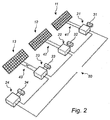
- DC/AC converters 21, 22, 23, 24 connected to an array of three PV panels 11, 12, 13.
- the DC/AC converters 21, 22, 23, 24 are arranged to receive a respective input direct current and voltage, and to deliver a respective output.
- An AC, matching the required AC, is produced by the combined output and fed into an AC power grid via an AC terminal 50.
- Each one of the DC/AC converters 21, 22, 23, 24 is electrically connected to an energy storage 31, 32, 33, 34 adapted to be charged by output from e.g. another DC/AC converter or by the AC power grid.
- the energy storage element 31, 32, 33, 34 may be active in the conversion, e.g. by supplying the DC/AC converter 21, 22, 23, 24 with input direct current and voltage.
- three of the DC/AC converters 21, 22, 23 are electrically connected to a respective PV panel 11, 12, 13 which is adapted to deliver input direct current and voltage during operation.
- a switch 41, 42, 43, 44 may be provided at the input of the DC/AC converter 21, 22, 23, 24 so as to enable the PV panel 11, 12, 13,14 to be disconnected from the DC/AC converter 21, 22, 23, 24, e.g. in response to the PV panel 11, 12, 13, 14 delivering reduced power due to shadowing.
- the fourth DC/AC panel 24, which is not associated with a PV panel, is a dummy unit 24 converting input current and voltage from an energy storage element 34 in accordance with the operation of the other three DC/AC converters 21, 22, 23.
- the present DC/AC converters 21, 22, 23 may be used both with PV panels and without. Arrays comprising an arbitrary number of panels can be realized through combining units like 21, 22, 23 and units like 24. Furthermore, it is appreciated that any one of the DC/AC converters 21, 22, 23, 24 may be disconnected at any time, e.g. due to a non-operating or damaged PV panel 11, 12, 13, thus turning the functionality of the DC/AC converter into that of a dummy unit 24.
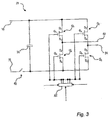
- fig. 3 shows an exemplifying embodiment of a DC/AC converter 21, more specifically a circuit diagram of an H-bridge converter 21, comprising four switching elements Q 1 , Q 2 , Q 3 , Q 4 in the form of four metal oxide semiconductor field effect transistors (MOSFETs) Q 1 , Q 2 , Q 3 , Q 4 .
- MOSFETs metal oxide semiconductor field effect transistors
- any other appropriate switching element may be used, such as insulated gate bipolar transistors (IGBTs), or bipolar junction transistors (BJTs).
- the drain D 1 of the first transistor Q 1 and the drain D 2 of the second transistor Q 2 are electrically connected to a positive pole 15 of the input from the PV panel (not shown), while the sources S 1 and S 2 of the respective first and second transistors Q 1 and Q 2 are electrically connected to the drains D 4 and D 3 of the fourth and third transistors Q 4 , Q 3 , respectively.
- the sources S 3 , S 4 of the third and fourth transistors Q 3 , Q 4 are electrically connected to a negative pole 43 of the input from the PV panel.
- the source S 1 of the first transistor Q 1 is electrically connected to the drain D 4 of the fourth transistor Q 4 at a first output terminal 52, whereas the source S 2 of the second transistor Q 2 is electrically connected to the drain D 3 of the third transistor Q 3 at a second output terminal 54.
- the gate terminals G 1 , G 2 , G 3 , G 4 of the four transistors Q 1 , Q 2 , Q 3 , Q 4 are electrically connected to a switch control circuitry 60 adapted to control the MOSFETs Q 1 , Q 2 , Q 3 , Q 4 by supplying a gate voltage to their respective gates G 1 , G 2 , G 3 , G 4 .
- the switch control circuitry may comprise a micro-controller 60, e.g. mounted on a printed circuit board (not shown) along with the H-bridge converter 21.
- the micro-controller 60 may also be connected to current and/or voltage meters (not shown) providing the micro-controller with information on the input direct current and/or voltage from the PV panel, the output at the first and second AC terminals, and the required AC (the input represented by arrows).
- the micro-controller 60 may be used for controlling the DC/AC converter 21 in such manner that the combined output from the plurality of the DC/AC converters 21, 22, 23, 24 produces an AC matching the required AC. This may be achieved by means of pulse-width modulation (PWM) techniques adapted to consider the required AC, the voltage, current, and frequency of the output from each one of the DC/AC converters 21, 22, 23, 24, and possible input voltage and current from their respective PV panels 11, 12, 13.
- PWM pulse-width modulation
- the micro-controller 60 may also be adapted to operate a switch 43 arranged at the input of the H-bridge converter 21.
- the switch 43 is adapted to disconnect the H-bridge converter 21 from the PV panel, and may e.g. be realised by a fifth MOSFET.
- the micro-controller 60 may comprise a signal and/or data processing module for processing received data, such as the information received from the current meters, and/or for further processing of refined data, as well as a central processing unit (CPU). Further, the micro-controller 60 may comprise a memory or storage unit for storing the received information and/or for storing other data, such as data further processed by the micro-controller. The micro-controller may also comprise suitable peripheral I/O capability executing software e.g. for analyzing input information. Other types of hardware, e.g. a personal computer, may also be used.
- a capacitor 31 is connected in parallel with the H-bridge converter 21 and is adapted to filter input power to or act as a storage element for the H-bridge converter 21 during operation, e.g. as the H-bridge 21 is disconnected from the PV panel 11 by the switch 43.
- the capacitor 31 may be charged by power from another of the DC/AC converters 22, 23, 24, by the PV panels 12, 13, or e.g. by the power grid.
- computer-readable media may comprise computer storage media and communication media.
- computer storage media includes both volatile and non-volatile, removable and non-removable media implemented in any method or technology for storage of information such as computer readable instructions, data structures, program modules or other data.
- Computer storage media includes, but is not limited to, RAM, ROM, EEPROM, flash memory or other memory technology, CD-ROM, digital versatile disks (DVD) or other optical disk storage, magnetic cassettes, magnetic tape, magnetic disk storage or other magnetic storage devices.
- communication media typically embodies computer readable instructions, data structures, program modules or other data in a modulated data signal such as a carrier wave or other transport mechanism and includes any information delivery media.
Landscapes
- Engineering & Computer Science (AREA)
- Power Engineering (AREA)
- Inverter Devices (AREA)
- Charge And Discharge Circuits For Batteries Or The Like (AREA)
- Dc-Dc Converters (AREA)
Claims (15)
- Verfahren zum Steuern mehrerer Gleichspannungs/Wechselspannungs-Umsetzer in Kaskadenkonfiguration, wobei jeder der mehreren Gleichspannungs/Wechselspannungs-Umsetzer (21, 22, 23) angeordnet ist, um einen Eingangsgleichstrom und eine Eingangsgleichspannung von einem entsprechenden Photovoltaikpaneel (PV-Paneel) (11, 12, 13) zu empfangen und um eine Ausgangsleistung zu liefern, wobei das Verfahren Folgendes umfasst:Empfangen (102) von Informationen, die eine Frequenz, eine Phase, eine Amplitude und/oder Oberschwingungen eines erforderlichen Wechselstroms darstellen;Empfangen (104) von Informationen, die den Strom und/oder die Spannung des Eingangsgleichstroms und der Eingangsgleichspannung für jeden der mehreren Gleichspannungs/Wechselspannungs-Umsetzer darstellen; undbasierend auf den empfangenen Informationen einzelnes Steuern (106) jedes der mehreren Gleichspannungs/Wechselspannungs-Umsetzer, so dass die kombinierte Ausgangsleistung der mehreren Gleichspannungs/Wechselspannungs-Umsetzer einen Wechselstrom erzeugt, der mit dem erforderlichen Wechselstrom übereinstimmt, dadurch gekennzeichnet, dass ferner eine oder mehrere Blindeinheiten (24) mit den mehreren Gleichspannungs/Wechselspannungs-Umsetzern in einer Kaskadenkonfiguration verbunden sind, wobei die eine oder die mehreren Blindeinheiten ein Energiespeicherelement (34), das dafür ausgelegt ist, aufgeladen zu werden und Gleichstrom und -spannung auszugeben, und einen Gleichspannungs/Wechselspannungs-Umsetzer umfassen, undVerwenden (114) der einen oder mehreren Blindeinheiten zum Erzeugen einer Ausgangsleistung, so dass die kombinierte Ausgangsleistung von den mehreren Gleichspannungs/Wechselspannungs-Umsetzern einen Wechselstrom erzeugt, der mit dem erforderlichen Wechselstrom übereinstimmt.
- Verfahren nach Anspruch 1, das ferner Folgendes umfasst:Aufladen eines Energiespeicherelements (31, 32, 33), das mit mindestens einem der mehreren Gleichspannungs/Wechselspannungs-Umsetzer elektrisch verbunden ist.
- Verfahren nach Anspruch 2, wobei das Aufladen des Energiespeicherelements das Aufladen des Energiespeicherelements durch den Ausgangsstrom von mindestens einem der folgenden Elemente umfasst:von mindestens einem der mehreren Gleichspannungs/Wechselspannungs-Umsetzer in der Kaskadenkonfiguration,von dem Stromnetz, undvon dem Photovoltaikpaneel, das mit dem Gleichspannungs/Wechselspannungs-Umsetzer verbunden ist.
- Verfahren nach einem der Ansprüche 2 und 3, das ferner Folgendes umfasst:als Reaktion darauf, dass:der Strom und/oder die Spannung des Eingangsgleichstroms und der Eingangsgleichspannung an einem Gleichspannungs/Wechselspannungs-Umsetzer, der von dem Photovoltaikpaneel empfangen worden ist, und/oderdie kombinierte Ausgangsleistung der mehreren Gleichspannungs/Wechselspannungs-Umsetzer,unterhalb eines Schwellwerts liegen,Eingeben (110) von Gleichstrom und Gleichspannung aus dem Energiespeicherelement in den Gleichspannungs/Wechselspannungs-Umsetzer, undUmsetzen des empfangenen Eingangsgleichstroms und der Eingangsgleichspannung in dem Gleichspannungs/Wechselspannungs-Umsetzer in Ausgangsleistung, so dass die kombinierte Ausgangsleistung der mehreren Gleichspannungs/Wechselspannungs-Umsetzer einen Wechselstrom erzeugt, der mit dem erforderlichen Wechselstrom übereinstimmt.
- Verfahren nach einem der Ansprüche 2-4, wobei die Schritte des Aufladens des Energiespeicherelements und des Eingebens von Gleichstrom und Gleichspannung aus dem Energiespeicherelement in den Gleichspannungs/Wechselspannungs-Umsetzer in einer Zeit von weniger als 1 Sekunde durchgeführt werden.
- Verfahren nach einem der vorhergehenden Ansprüche, wobei mindestens einer der mehreren Gleichspannungs/Wechselspannungs-Umsetzer einen Schalter (41, 42, 43) umfasst, der zwischen dem mindestens einen Gleichspannungs/Wechselspannungs-Umsetzer und einem Photovoltaikpaneel platziert ist und wobei das Verfahren ferner den Schritt des Änderns des Schalters umfasst, um den mindestens einen Gleichspannungs/Wechselspannungs-Umsetzer von dem Photovoltaikpaneel zu trennen.
- Verfahren nach einem der vorhergehenden Ansprüche, wobei jeder der mehreren Gleichspannungs/Wechselspannungs-Umsetzer einzeln gesteuert wird (106), so dass jedes entsprechende Photovoltaikmodul in seinem jeweiligen optimalen Arbeitspunkt betrieben wird.
- Verfahren nach einem der vorhergehenden Ansprüche, wobei die Informationen, die den Strom und/oder die Spannung des Eingangsgleichstroms und der Eingangsgleichspannung in jedem der mehreren Gleichspannungs/Wechselspannungs-Umsetzer darstellen, während des Betriebs wiederholt empfangen werden.
- Verfahren nach einem der vorhergehenden Ansprüche, das ferner das Empfangen von Informationen über die Anzahl von Gleichspannungs/Wechselspannungs-Umsetzern in Kaskadenkonfiguration umfasst.
- Verfahren nach einem der vorhergehenden Ansprüche, das ferner das Empfangen von folgenden Informationen umfasst:die Anzahl von Gleichspannungs/Wechselspannungs-Umsetzern, die aktuell mit einem Photovoltaikpaneel verbunden ist,die Anzahl von Gleichspannungs/Wechselspannungs-Umsetzern, die aktuell mit einem nicht arbeitenden Photovoltaikpaneel verbunden ist, und/oderder Anzahl von Blindeinheiten, die aktuell in der Kaskadenkonfiguration verbunden ist.
- Verfahren nach einem der vorhergehenden Ansprüche, wobei jeder der mehreren Gleichspannungs/Wechselspannungs-Umsetzer von Anspruch 1 dafür ausgelegt ist, auf ein entsprechendes PV-Paneel abgestimmt zu werden.
- Verfahren nach einem der vorhergehenden Ansprüche, wobei jeder der mehreren Gleichspannungs/Wechselspannungs-Umsetzer von einem Mikrocontroller (60) gesteuert wird.
- Verfahren nach einem der vorhergehenden Ansprüche, wobei jeder der mehreren Gleichspannungs/Wechselspannungs-Umsetzer ein H-Brücken-Umsetzer (21) ist.
- Verfahren nach einem der vorhergehenden Ansprüche, wobei das Energiespeicherelement ein Kondensator ist.
- Verfahren nach einem der vorhergehenden Ansprüche, wobei die erforderliche Wechselspannung eine Stromnetz-Wechselspannung ist.
Priority Applications (7)
| Application Number | Priority Date | Filing Date | Title |
|---|---|---|---|
| EP13156985.7A EP2773036B1 (de) | 2013-02-27 | 2013-02-27 | Verfahren zur Gleichstrom-Wechselstrom-Umwandlung |
| ES13156985T ES2570356T3 (es) | 2013-02-27 | 2013-02-27 | Método de conversión de CC - CA |
| JP2015559480A JP6531237B2 (ja) | 2013-02-27 | 2014-02-24 | Dc−ac変換方法 |
| CN201480010635.8A CN105164909B (zh) | 2013-02-27 | 2014-02-24 | Dc-ac转换方法 |
| PCT/EP2014/053555 WO2014131734A1 (en) | 2013-02-27 | 2014-02-24 | Method for dc-ac conversion |
| US14/770,555 US9917444B2 (en) | 2013-02-27 | 2014-02-24 | Method for DC-AC conversion |
| AU2014222801A AU2014222801B2 (en) | 2013-02-27 | 2014-02-24 | Method for DC-AC conversion |
Applications Claiming Priority (1)
| Application Number | Priority Date | Filing Date | Title |
|---|---|---|---|
| EP13156985.7A EP2773036B1 (de) | 2013-02-27 | 2013-02-27 | Verfahren zur Gleichstrom-Wechselstrom-Umwandlung |
Publications (2)
| Publication Number | Publication Date |
|---|---|
| EP2773036A1 EP2773036A1 (de) | 2014-09-03 |
| EP2773036B1 true EP2773036B1 (de) | 2016-02-24 |
Family
ID=47750538
Family Applications (1)
| Application Number | Title | Priority Date | Filing Date |
|---|---|---|---|
| EP13156985.7A Not-in-force EP2773036B1 (de) | 2013-02-27 | 2013-02-27 | Verfahren zur Gleichstrom-Wechselstrom-Umwandlung |
Country Status (7)
| Country | Link |
|---|---|
| US (1) | US9917444B2 (de) |
| EP (1) | EP2773036B1 (de) |
| JP (1) | JP6531237B2 (de) |
| CN (1) | CN105164909B (de) |
| AU (1) | AU2014222801B2 (de) |
| ES (1) | ES2570356T3 (de) |
| WO (1) | WO2014131734A1 (de) |
Families Citing this family (16)
| Publication number | Priority date | Publication date | Assignee | Title |
|---|---|---|---|---|
| EP2777674B1 (de) | 2013-03-14 | 2016-02-17 | Liko Research and Development AB | Schutzhülle für einen Hebegurt in einem Deckenlift |
| US9906038B2 (en) * | 2015-01-29 | 2018-02-27 | Cyboenergy, Inc. | Smart renewable power generation system with grid and DC source flexibility |
| SE539911C2 (en) | 2015-11-18 | 2018-01-09 | Optistring Tech Ab | Common line communication in cascaded inverters |
| SE539353C2 (en) | 2015-11-18 | 2017-07-25 | Optistring Tech Ab | Combined common mode inductor and differential signal 12 |
| GB2597856B (en) * | 2015-12-18 | 2022-07-20 | Southwire Co Llc | Cable integrated solar inverter |
| CN105720857B (zh) * | 2016-04-22 | 2019-12-03 | 阳光电源股份有限公司 | 一种级联h桥逆变器及其故障处理方法 |
| CN109565245B (zh) * | 2016-08-12 | 2021-07-09 | 马里奇控股荷兰有限公司 | 劣化光伏板的恢复 |
| CN106602999B (zh) * | 2016-12-21 | 2019-01-18 | 湖北工业大学 | 一种基于超级电容储能的混合级联型光伏逆变装置及控制方法 |
| CN106953361B (zh) * | 2017-04-28 | 2019-10-11 | 中南大学 | 交流微电网运行控制方法及装置 |
| US11251621B1 (en) | 2017-08-03 | 2022-02-15 | Southwire Company, Llc | Solar power generation system |
| US11438988B1 (en) | 2017-08-11 | 2022-09-06 | Southwire Company, Llc | DC power management system |
| CN108899937A (zh) * | 2018-09-05 | 2018-11-27 | 阳光电源股份有限公司 | 一种交流优化器系统 |
| EP3633816A1 (de) * | 2018-10-01 | 2020-04-08 | ABB Schweiz AG | Wechselrichteranordnung mit elementen zur bereitstellung von fotovoltaischer energie |
| US11502618B2 (en) * | 2021-02-12 | 2022-11-15 | NeoVolta, Inc. | DC photovoltaic input emulation using an AC generator source |
| EP4367770A4 (de) | 2021-07-07 | 2025-06-18 | TAE Technologies, Inc. | Systeme, vorrichtungen und verfahren für modulare kaskadierte energiesysteme mit konfiguration zur kopplung mit erneuerbaren energiequellen |
| CN114006391B (zh) * | 2021-10-28 | 2023-07-07 | 山东泰开直流技术有限公司 | 一种中压直挂式储能变流系统及其启停控制方法 |
Citations (1)
| Publication number | Priority date | Publication date | Assignee | Title |
|---|---|---|---|---|
| EP2200152A1 (de) * | 2008-12-19 | 2010-06-23 | ABB Research Ltd. | Photovoltaiksystem |
Family Cites Families (14)
| Publication number | Priority date | Publication date | Assignee | Title |
|---|---|---|---|---|
| JP3663455B2 (ja) * | 1996-08-29 | 2005-06-22 | 株式会社安川電機 | 太陽光電力変換装置 |
| JPH1189242A (ja) * | 1997-09-08 | 1999-03-30 | Yaskawa Electric Corp | 電力変換装置 |
| JP4468840B2 (ja) * | 2005-02-25 | 2010-05-26 | 三菱電機株式会社 | 電力変換装置 |
| ITVA20080002A1 (it) * | 2008-01-10 | 2009-07-11 | St Microelectronics Srl | Sistema fotovoltaico a pannelli multicellulari con conversione dc-dc multiplata per gruppi di celle in serie di ciascun pannello e struttura di pannello fotovoltaico |
| JP5398162B2 (ja) * | 2008-03-31 | 2014-01-29 | 三菱電機株式会社 | 系統連系インバータ装置 |
| EP2234237A1 (de) * | 2009-03-26 | 2010-09-29 | ABB Research Ltd. | Verfahren zur Steuerung von Einzelphasen-Gleichstrom-Wechselstrom-Wandler und Wandleranordnung |
| EP2290834A1 (de) * | 2009-08-25 | 2011-03-02 | SMA Solar Technology AG | Geschlossene Stromleitungskommunikation |
| US8772965B2 (en) * | 2010-06-29 | 2014-07-08 | General Electric Company | Solar power generation system and method |
| WO2012035175A1 (es) * | 2010-09-14 | 2012-03-22 | Ingeteam Energy, S. A. | Método de control para puesta en paralelo de convertidores cc/ca |
| JP5132797B2 (ja) * | 2011-06-06 | 2013-01-30 | 三菱電機株式会社 | 電力変換装置 |
| KR101906895B1 (ko) * | 2011-06-08 | 2018-10-11 | 엘에스산전 주식회사 | 태양광 전력 변환 장치 |
| US9685886B2 (en) * | 2011-08-31 | 2017-06-20 | Optistring Technologies Ab | Photovoltaic DC/AC inverter with cascaded H-bridge converters |
| CN102832815A (zh) * | 2012-08-30 | 2012-12-19 | 西安交通大学 | 基于多级多模块级联结构的三相电力电子变压器 |
| US9595888B2 (en) * | 2012-11-29 | 2017-03-14 | General Electric Company | System and method to avoid reverse recovery in a power converter |
-
2013
- 2013-02-27 EP EP13156985.7A patent/EP2773036B1/de not_active Not-in-force
- 2013-02-27 ES ES13156985T patent/ES2570356T3/es active Active
-
2014
- 2014-02-24 AU AU2014222801A patent/AU2014222801B2/en not_active Ceased
- 2014-02-24 JP JP2015559480A patent/JP6531237B2/ja not_active Expired - Fee Related
- 2014-02-24 CN CN201480010635.8A patent/CN105164909B/zh not_active Expired - Fee Related
- 2014-02-24 US US14/770,555 patent/US9917444B2/en not_active Expired - Fee Related
- 2014-02-24 WO PCT/EP2014/053555 patent/WO2014131734A1/en not_active Ceased
Patent Citations (1)
| Publication number | Priority date | Publication date | Assignee | Title |
|---|---|---|---|---|
| EP2200152A1 (de) * | 2008-12-19 | 2010-06-23 | ABB Research Ltd. | Photovoltaiksystem |
Also Published As
| Publication number | Publication date |
|---|---|
| WO2014131734A1 (en) | 2014-09-04 |
| US20160006251A1 (en) | 2016-01-07 |
| EP2773036A1 (de) | 2014-09-03 |
| AU2014222801B2 (en) | 2018-03-29 |
| CN105164909A (zh) | 2015-12-16 |
| JP2016508709A (ja) | 2016-03-22 |
| CN105164909B (zh) | 2018-09-25 |
| ES2570356T3 (es) | 2016-05-18 |
| AU2014222801A1 (en) | 2015-09-03 |
| US9917444B2 (en) | 2018-03-13 |
| JP6531237B2 (ja) | 2019-06-19 |
Similar Documents
| Publication | Publication Date | Title |
|---|---|---|
| EP2773036B1 (de) | Verfahren zur Gleichstrom-Wechselstrom-Umwandlung | |
| CN112075004B (zh) | 用于太阳能领域的dc功率转换和传输的系统和方法 | |
| EP3171478B1 (de) | Fotovoltaiknetzgekoppelter wechselrichter und steuerungsverfahren dafür | |
| Dhople et al. | Multiple-input boost converter to minimize power losses due to partial shading in photovoltaic modules | |
| US20120161526A1 (en) | Dc power source conversion modules, power harvesting systems, junction boxes and methods for dc power source conversion modules | |
| US20180233919A1 (en) | Photovoltaic inverter system and operation method thereof | |
| US8772965B2 (en) | Solar power generation system and method | |
| Trabelsi et al. | 1-MW quasi-Z-source based multilevel PV energy conversion system | |
| Mollah et al. | Single phase grid-connected inverter for photovoltaic system with maximum power point tracking | |
| US9473044B2 (en) | Power inverter implementing phase skipping control | |
| Harfman-Todorovic et al. | A high efficiency PV micro-inverter with grid support functions | |
| US20120187766A1 (en) | Device and Method For Improving The Performance Of An Inverter In A Photovoltaic System | |
| KR20210121588A (ko) | 태양광 발전 시스템의 성능 향상을 위한 차동 전력변환기 | |
| Sheir et al. | A high efficiency single-phase multilevel packed U cell inverter for photovoltaic applications | |
| Coppola et al. | Modulation technique for grid-tied PV multilevel inverter | |
| US20150062990A1 (en) | Circuit arrangement and method for converting and adapting a dc voltage, photovoltaic installation | |
| de Melo Bento et al. | Dual input single switch DC-DC converter for renewable energy applications | |
| Abolhasani et al. | A comparison between buck and boost topologies as module integrated converters to mitigate partial shading effects on PV arrays | |
| Zapata et al. | Partial power converter for a two-stage photovoltaic cascaded string inverter | |
| CN110198073B (zh) | 能源供应系统及能源管理的方法 | |
| Chen et al. | Development of an autonomous distributed maximum power point tracking PV system | |
| Muttath et al. | Interleaved Luo converter for the residential PV grid connected systems | |
| Elkhateb et al. | Impact of fill factor on input current ripple of photovoltaic system | |
| CN115589021A (zh) | 光伏控制系统、方法、装置、设备及介质 | |
| JP2023000318A (ja) | パワーコンディショナ |
Legal Events
| Date | Code | Title | Description |
|---|---|---|---|
| PUAI | Public reference made under article 153(3) epc to a published international application that has entered the european phase |
Free format text: ORIGINAL CODE: 0009012 |
|
| 17P | Request for examination filed |
Effective date: 20130227 |
|
| AK | Designated contracting states |
Kind code of ref document: A1 Designated state(s): AL AT BE BG CH CY CZ DE DK EE ES FI FR GB GR HR HU IE IS IT LI LT LU LV MC MK MT NL NO PL PT RO RS SE SI SK SM TR |
|
| AX | Request for extension of the european patent |
Extension state: BA ME |
|
| R17P | Request for examination filed (corrected) |
Effective date: 20150227 |
|
| RBV | Designated contracting states (corrected) |
Designated state(s): AL AT BE BG CH CY CZ DE DK EE ES FI FR GB GR HR HU IE IS IT LI LT LU LV MC MK MT NL NO PL PT RO RS SE SI SK SM TR |
|
| 17Q | First examination report despatched |
Effective date: 20150326 |
|
| GRAP | Despatch of communication of intention to grant a patent |
Free format text: ORIGINAL CODE: EPIDOSNIGR1 |
|
| INTG | Intention to grant announced |
Effective date: 20150928 |
|
| GRAS | Grant fee paid |
Free format text: ORIGINAL CODE: EPIDOSNIGR3 |
|
| GRAA | (expected) grant |
Free format text: ORIGINAL CODE: 0009210 |
|
| AK | Designated contracting states |
Kind code of ref document: B1 Designated state(s): AL AT BE BG CH CY CZ DE DK EE ES FI FR GB GR HR HU IE IS IT LI LT LU LV MC MK MT NL NO PL PT RO RS SE SI SK SM TR |
|
| REG | Reference to a national code |
Ref country code: GB Ref legal event code: FG4D |
|
| REG | Reference to a national code |
Ref country code: CH Ref legal event code: EP |
|
| REG | Reference to a national code |
Ref country code: AT Ref legal event code: REF Ref document number: 777187 Country of ref document: AT Kind code of ref document: T Effective date: 20160315 |
|
| REG | Reference to a national code |
Ref country code: IE Ref legal event code: FG4D |
|
| REG | Reference to a national code |
Ref country code: DE Ref legal event code: R096 Ref document number: 602013005101 Country of ref document: DE |
|
| REG | Reference to a national code |
Ref country code: FR Ref legal event code: PLFP Year of fee payment: 4 |
|
| REG | Reference to a national code |
Ref country code: ES Ref legal event code: FG2A Ref document number: 2570356 Country of ref document: ES Kind code of ref document: T3 Effective date: 20160518 |
|
| REG | Reference to a national code |
Ref country code: SE Ref legal event code: TRGR |
|
| REG | Reference to a national code |
Ref country code: LT Ref legal event code: MG4D |
|
| REG | Reference to a national code |
Ref country code: NL Ref legal event code: MP Effective date: 20160224 |
|
| REG | Reference to a national code |
Ref country code: AT Ref legal event code: MK05 Ref document number: 777187 Country of ref document: AT Kind code of ref document: T Effective date: 20160224 |
|
| PG25 | Lapsed in a contracting state [announced via postgrant information from national office to epo] |
Ref country code: GR Free format text: LAPSE BECAUSE OF FAILURE TO SUBMIT A TRANSLATION OF THE DESCRIPTION OR TO PAY THE FEE WITHIN THE PRESCRIBED TIME-LIMIT Effective date: 20160525 Ref country code: NO Free format text: LAPSE BECAUSE OF FAILURE TO SUBMIT A TRANSLATION OF THE DESCRIPTION OR TO PAY THE FEE WITHIN THE PRESCRIBED TIME-LIMIT Effective date: 20160524 Ref country code: FI Free format text: LAPSE BECAUSE OF FAILURE TO SUBMIT A TRANSLATION OF THE DESCRIPTION OR TO PAY THE FEE WITHIN THE PRESCRIBED TIME-LIMIT Effective date: 20160224 Ref country code: HR Free format text: LAPSE BECAUSE OF FAILURE TO SUBMIT A TRANSLATION OF THE DESCRIPTION OR TO PAY THE FEE WITHIN THE PRESCRIBED TIME-LIMIT Effective date: 20160224 |
|
| PG25 | Lapsed in a contracting state [announced via postgrant information from national office to epo] |
Ref country code: PT Free format text: LAPSE BECAUSE OF FAILURE TO SUBMIT A TRANSLATION OF THE DESCRIPTION OR TO PAY THE FEE WITHIN THE PRESCRIBED TIME-LIMIT Effective date: 20160624 Ref country code: PL Free format text: LAPSE BECAUSE OF FAILURE TO SUBMIT A TRANSLATION OF THE DESCRIPTION OR TO PAY THE FEE WITHIN THE PRESCRIBED TIME-LIMIT Effective date: 20160224 Ref country code: LV Free format text: LAPSE BECAUSE OF FAILURE TO SUBMIT A TRANSLATION OF THE DESCRIPTION OR TO PAY THE FEE WITHIN THE PRESCRIBED TIME-LIMIT Effective date: 20160224 Ref country code: LT Free format text: LAPSE BECAUSE OF FAILURE TO SUBMIT A TRANSLATION OF THE DESCRIPTION OR TO PAY THE FEE WITHIN THE PRESCRIBED TIME-LIMIT Effective date: 20160224 Ref country code: NL Free format text: LAPSE BECAUSE OF FAILURE TO SUBMIT A TRANSLATION OF THE DESCRIPTION OR TO PAY THE FEE WITHIN THE PRESCRIBED TIME-LIMIT Effective date: 20160224 Ref country code: RS Free format text: LAPSE BECAUSE OF FAILURE TO SUBMIT A TRANSLATION OF THE DESCRIPTION OR TO PAY THE FEE WITHIN THE PRESCRIBED TIME-LIMIT Effective date: 20160224 Ref country code: AT Free format text: LAPSE BECAUSE OF FAILURE TO SUBMIT A TRANSLATION OF THE DESCRIPTION OR TO PAY THE FEE WITHIN THE PRESCRIBED TIME-LIMIT Effective date: 20160224 |
|
| REG | Reference to a national code |
Ref country code: CH Ref legal event code: PL |
|
| PG25 | Lapsed in a contracting state [announced via postgrant information from national office to epo] |
Ref country code: LI Free format text: LAPSE BECAUSE OF NON-PAYMENT OF DUE FEES Effective date: 20160229 Ref country code: EE Free format text: LAPSE BECAUSE OF FAILURE TO SUBMIT A TRANSLATION OF THE DESCRIPTION OR TO PAY THE FEE WITHIN THE PRESCRIBED TIME-LIMIT Effective date: 20160224 Ref country code: CH Free format text: LAPSE BECAUSE OF NON-PAYMENT OF DUE FEES Effective date: 20160229 Ref country code: DK Free format text: LAPSE BECAUSE OF FAILURE TO SUBMIT A TRANSLATION OF THE DESCRIPTION OR TO PAY THE FEE WITHIN THE PRESCRIBED TIME-LIMIT Effective date: 20160224 |
|
| REG | Reference to a national code |
Ref country code: DE Ref legal event code: R097 Ref document number: 602013005101 Country of ref document: DE |
|
| PG25 | Lapsed in a contracting state [announced via postgrant information from national office to epo] |
Ref country code: SM Free format text: LAPSE BECAUSE OF FAILURE TO SUBMIT A TRANSLATION OF THE DESCRIPTION OR TO PAY THE FEE WITHIN THE PRESCRIBED TIME-LIMIT Effective date: 20160224 Ref country code: CZ Free format text: LAPSE BECAUSE OF FAILURE TO SUBMIT A TRANSLATION OF THE DESCRIPTION OR TO PAY THE FEE WITHIN THE PRESCRIBED TIME-LIMIT Effective date: 20160224 Ref country code: SK Free format text: LAPSE BECAUSE OF FAILURE TO SUBMIT A TRANSLATION OF THE DESCRIPTION OR TO PAY THE FEE WITHIN THE PRESCRIBED TIME-LIMIT Effective date: 20160224 Ref country code: RO Free format text: LAPSE BECAUSE OF FAILURE TO SUBMIT A TRANSLATION OF THE DESCRIPTION OR TO PAY THE FEE WITHIN THE PRESCRIBED TIME-LIMIT Effective date: 20160224 |
|
| REG | Reference to a national code |
Ref country code: IE Ref legal event code: MM4A |
|
| PLBE | No opposition filed within time limit |
Free format text: ORIGINAL CODE: 0009261 |
|
| STAA | Information on the status of an ep patent application or granted ep patent |
Free format text: STATUS: NO OPPOSITION FILED WITHIN TIME LIMIT |
|
| PG25 | Lapsed in a contracting state [announced via postgrant information from national office to epo] |
Ref country code: IE Free format text: LAPSE BECAUSE OF NON-PAYMENT OF DUE FEES Effective date: 20160227 |
|
| 26N | No opposition filed |
Effective date: 20161125 |
|
| REG | Reference to a national code |
Ref country code: FR Ref legal event code: PLFP Year of fee payment: 5 |
|
| PG25 | Lapsed in a contracting state [announced via postgrant information from national office to epo] |
Ref country code: SI Free format text: LAPSE BECAUSE OF FAILURE TO SUBMIT A TRANSLATION OF THE DESCRIPTION OR TO PAY THE FEE WITHIN THE PRESCRIBED TIME-LIMIT Effective date: 20160224 Ref country code: BG Free format text: LAPSE BECAUSE OF FAILURE TO SUBMIT A TRANSLATION OF THE DESCRIPTION OR TO PAY THE FEE WITHIN THE PRESCRIBED TIME-LIMIT Effective date: 20160524 |
|
| PG25 | Lapsed in a contracting state [announced via postgrant information from national office to epo] |
Ref country code: MT Free format text: LAPSE BECAUSE OF FAILURE TO SUBMIT A TRANSLATION OF THE DESCRIPTION OR TO PAY THE FEE WITHIN THE PRESCRIBED TIME-LIMIT Effective date: 20160224 |
|
| REG | Reference to a national code |
Ref country code: FR Ref legal event code: PLFP Year of fee payment: 6 |
|
| PG25 | Lapsed in a contracting state [announced via postgrant information from national office to epo] |
Ref country code: CY Free format text: LAPSE BECAUSE OF FAILURE TO SUBMIT A TRANSLATION OF THE DESCRIPTION OR TO PAY THE FEE WITHIN THE PRESCRIBED TIME-LIMIT Effective date: 20160224 Ref country code: HU Free format text: LAPSE BECAUSE OF FAILURE TO SUBMIT A TRANSLATION OF THE DESCRIPTION OR TO PAY THE FEE WITHIN THE PRESCRIBED TIME-LIMIT; INVALID AB INITIO Effective date: 20130227 |
|
| PG25 | Lapsed in a contracting state [announced via postgrant information from national office to epo] |
Ref country code: TR Free format text: LAPSE BECAUSE OF FAILURE TO SUBMIT A TRANSLATION OF THE DESCRIPTION OR TO PAY THE FEE WITHIN THE PRESCRIBED TIME-LIMIT Effective date: 20160224 Ref country code: MC Free format text: LAPSE BECAUSE OF FAILURE TO SUBMIT A TRANSLATION OF THE DESCRIPTION OR TO PAY THE FEE WITHIN THE PRESCRIBED TIME-LIMIT Effective date: 20160224 Ref country code: IS Free format text: LAPSE BECAUSE OF FAILURE TO SUBMIT A TRANSLATION OF THE DESCRIPTION OR TO PAY THE FEE WITHIN THE PRESCRIBED TIME-LIMIT Effective date: 20160224 Ref country code: LU Free format text: LAPSE BECAUSE OF NON-PAYMENT OF DUE FEES Effective date: 20160227 Ref country code: MK Free format text: LAPSE BECAUSE OF FAILURE TO SUBMIT A TRANSLATION OF THE DESCRIPTION OR TO PAY THE FEE WITHIN THE PRESCRIBED TIME-LIMIT Effective date: 20160224 Ref country code: MT Free format text: LAPSE BECAUSE OF FAILURE TO SUBMIT A TRANSLATION OF THE DESCRIPTION OR TO PAY THE FEE WITHIN THE PRESCRIBED TIME-LIMIT Effective date: 20160229 |
|
| PG25 | Lapsed in a contracting state [announced via postgrant information from national office to epo] |
Ref country code: AL Free format text: LAPSE BECAUSE OF FAILURE TO SUBMIT A TRANSLATION OF THE DESCRIPTION OR TO PAY THE FEE WITHIN THE PRESCRIBED TIME-LIMIT Effective date: 20160224 |
|
| REG | Reference to a national code |
Ref country code: DE Ref legal event code: R081 Ref document number: 602013005101 Country of ref document: DE Owner name: MARICI HOLDINGS THE NETHERLANDS B.V., NL Free format text: FORMER OWNER: OPTISTRING TECHNOLOGIES AB, STOCKHOLM, SE Ref country code: DE Ref legal event code: R081 Ref document number: 602013005101 Country of ref document: DE Owner name: ABB SCHWEIZ AG, CH Free format text: FORMER OWNER: OPTISTRING TECHNOLOGIES AB, STOCKHOLM, SE |
|
| REG | Reference to a national code |
Ref country code: BE Ref legal event code: PD Owner name: ABB SCHWEIZ AG; CH Free format text: DETAILS ASSIGNMENT: CHANGE OF OWNER(S), CESSION Effective date: 20191209 |
|
| REG | Reference to a national code |
Ref country code: ES Ref legal event code: PC2A Owner name: ABB SCHWEIZ AG Effective date: 20200310 |
|
| REG | Reference to a national code |
Ref country code: GB Ref legal event code: 732E Free format text: REGISTERED BETWEEN 20200312 AND 20200318 |
|
| PGFP | Annual fee paid to national office [announced via postgrant information from national office to epo] |
Ref country code: SE Payment date: 20200220 Year of fee payment: 8 Ref country code: GB Payment date: 20200219 Year of fee payment: 8 Ref country code: ES Payment date: 20200322 Year of fee payment: 8 |
|
| PGFP | Annual fee paid to national office [announced via postgrant information from national office to epo] |
Ref country code: BE Payment date: 20200219 Year of fee payment: 8 |
|
| PGFP | Annual fee paid to national office [announced via postgrant information from national office to epo] |
Ref country code: FR Payment date: 20200219 Year of fee payment: 8 |
|
| REG | Reference to a national code |
Ref country code: DE Ref legal event code: R081 Ref document number: 602013005101 Country of ref document: DE Owner name: MARICI HOLDINGS THE NETHERLANDS B.V., NL Free format text: FORMER OWNER: ABB SCHWEIZ AG, BADEN, CH |
|
| REG | Reference to a national code |
Ref country code: SE Ref legal event code: EUG |
|
| GBPC | Gb: european patent ceased through non-payment of renewal fee |
Effective date: 20210227 |
|
| REG | Reference to a national code |
Ref country code: BE Ref legal event code: MM Effective date: 20210228 |
|
| PG25 | Lapsed in a contracting state [announced via postgrant information from national office to epo] |
Ref country code: SE Free format text: LAPSE BECAUSE OF NON-PAYMENT OF DUE FEES Effective date: 20210228 |
|
| PG25 | Lapsed in a contracting state [announced via postgrant information from national office to epo] |
Ref country code: FR Free format text: LAPSE BECAUSE OF NON-PAYMENT OF DUE FEES Effective date: 20210228 Ref country code: GB Free format text: LAPSE BECAUSE OF NON-PAYMENT OF DUE FEES Effective date: 20210227 |
|
| REG | Reference to a national code |
Ref country code: ES Ref legal event code: FD2A Effective date: 20220523 |
|
| PG25 | Lapsed in a contracting state [announced via postgrant information from national office to epo] |
Ref country code: ES Free format text: LAPSE BECAUSE OF NON-PAYMENT OF DUE FEES Effective date: 20210228 Ref country code: BE Free format text: LAPSE BECAUSE OF NON-PAYMENT OF DUE FEES Effective date: 20210228 |
|
| PGFP | Annual fee paid to national office [announced via postgrant information from national office to epo] |
Ref country code: IT Payment date: 20230223 Year of fee payment: 11 Ref country code: DE Payment date: 20230216 Year of fee payment: 11 |
|
| REG | Reference to a national code |
Ref country code: DE Ref legal event code: R119 Ref document number: 602013005101 Country of ref document: DE |
|
| PG25 | Lapsed in a contracting state [announced via postgrant information from national office to epo] |
Ref country code: DE Free format text: LAPSE BECAUSE OF NON-PAYMENT OF DUE FEES Effective date: 20240903 |
|
| PG25 | Lapsed in a contracting state [announced via postgrant information from national office to epo] |
Ref country code: DE Free format text: LAPSE BECAUSE OF NON-PAYMENT OF DUE FEES Effective date: 20240903 |
|
| PG25 | Lapsed in a contracting state [announced via postgrant information from national office to epo] |
Ref country code: IT Free format text: LAPSE BECAUSE OF NON-PAYMENT OF DUE FEES Effective date: 20240227 |