EP2777416B1 - Schlittschuh mit Schnürelement mit mindestens einer Öffnung - Google Patents
Schlittschuh mit Schnürelement mit mindestens einer Öffnung Download PDFInfo
- Publication number
- EP2777416B1 EP2777416B1 EP20130159496 EP13159496A EP2777416B1 EP 2777416 B1 EP2777416 B1 EP 2777416B1 EP 20130159496 EP20130159496 EP 20130159496 EP 13159496 A EP13159496 A EP 13159496A EP 2777416 B1 EP2777416 B1 EP 2777416B1
- Authority
- EP
- European Patent Office
- Prior art keywords
- insert
- skate boot
- lace member
- opening
- lace
- Prior art date
- Legal status (The legal status is an assumption and is not a legal conclusion. Google has not performed a legal analysis and makes no representation as to the accuracy of the status listed.)
- Active
Links
Images






Classifications
-
- A—HUMAN NECESSITIES
- A43—FOOTWEAR
- A43B—CHARACTERISTIC FEATURES OF FOOTWEAR; PARTS OF FOOTWEAR
- A43B5/00—Footwear for sporting purposes
- A43B5/16—Skating boots
- A43B5/1666—Skating boots characterised by the upper
- A43B5/1683—Skating boots characterised by the upper characterised by the lower part of the upper or by the shell
-
- A—HUMAN NECESSITIES
- A43—FOOTWEAR
- A43B—CHARACTERISTIC FEATURES OF FOOTWEAR; PARTS OF FOOTWEAR
- A43B5/00—Footwear for sporting purposes
- A43B5/16—Skating boots
- A43B5/1666—Skating boots characterised by the upper
- A43B5/1691—Skating boots characterised by the upper characterised by the higher part of the upper, e.g. surrounding the ankle, by the quarter or cuff
Definitions
- the present invention relates to a skate boot having medial and lateral lace members, wherein each lace member has at least one opening for receiving an insert and wherein the flexibility of the lace member may be adjusted by a skater between different flexion modes.
- Skate boots are well known in the art for use in hockey skates, figure skates or roller skates, for example.
- laces are used to secure the skate boot to the skater's foot although other securement mechanisms such as Velcro TM or snaps can also be used.
- Velcro TM Velcro TM
- snaps can also be used.
- skate boots While some skate boots are made with flexibility issues in mind, they are usually manufactured in bulk with a pre-defined design. This can present an inconvenience to a potential purchaser if a particular skate or roller blade design is desired (due to its affordability or performance features) because the skate boot may not provide a comfortable fit. Thus, many different skaters with different needs are presented with, at best, a rather limited set of choices with regard to the flexibility characteristics of a given design.
- a skate boot for enclosing a human foot when in use.
- the foot has medial and lateral sides.
- the skate boot comprises an outer shell including medial and lateral side portions for facing the medial and lateral sides of the foot.
- Each of the medial and lateral side portions has an upper edge.
- the skate boot also comprises a lace member mounted to either of the upper edges of the medial and lateral side portions.
- the lace member has a proximal portion, a distal portion, a top portion with a top edge and a bottom portion extending along the upper edge of one of the medial and lateral side portions for covering the upper edge.
- the lace member further has at least one opening for receiving an insert.
- the at least one opening is provided within the lace member between the top edge and the bottom portion of the lace member.
- the lace member has a first flexion mode when no insert is received in the at least one opening and a second flexion mode when the insert is received in the at least one opening.
- the second flexion mode is different from the first flexion mode.
- Shown in Figures 1 and 2 is a typical right human foot F that includes toes T, a plantar surface PS, a top surface TS, a medial side MS and a lateral side LS.
- the human foot includes a heel H, an Achilles tendon AT and an ankle A having a lateral malleolus LM and a medial malleolus MM, the lateral malleolus LM being at a lower position than the medial malleolus MM.
- the Achilles tendon AT has an upper part UP and a lower part LP projecting outwardly with relation to the upper part UP, the lower part merging with the heel H.
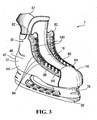
- FIG. 3 and 4 Shown in Figures 3 and 4 is an ice skate 1 that comprises a skate boot 10 suitable for enclosing the foot F.
- a skate boot 10 suitable for enclosing the foot F.
- the skate boot 10 shown in the figures is being used for an ice skate 1, it is understood that the skate boot 10 can be used for a roller skate.
- the ice skate 1 has an outer shell 12 for receiving the foot F, a toe cap 14 made of rigid molded plastic for facing the toes T, a tongue 16 extending upwardly and rearwardly from the toe cap 14 for covering the top surface TS of the foot F, a rigid insert 18 for providing more rigidity around the ankle A and heel H, an inner lining 20, a footbed 22, an insole 24, an outsole 26, an ice skate blade holder 28 and a blade 30.
- the rigid insert 18 may be glued to an inner surface of the outer shell 12. It is understood that the rigid insert 18 is an optional component and may be eliminated if the outer shell 12 is sufficiently rigid for supporting the ankle A and heel H. Similarly, the insole 24 and outsole 26 are optional components and may be eliminated if the outer shell 12 is sufficiently rigid for receiving the blade holder 28.
- the inner lining 20 is affixed to an inner surface of the outer shell 12 and it comprises an inner surface 32 intended for contact with the heel H, ankle A and medial and lateral sides MS, LS of the foot F in use. If the skate boot 10 comprises the rigid insert 18, such rigid insert 18 is sandwiched between the outer shell 12 and inner lining 20 and such inner lining 20 may be glued to the inner surfaces of the outer shell 12 and rigid insert 18 and stitched along its periphery to the outer shell 12.
- the inner lining 20 is made of a soft material and can be a fabric made of 100% NYLON ® fibers.
- the footbed 22 is mounted inside the outer shell 12 and it comprises an upper surface 34 for receiving the plantar surface PS of the foot F and a wall 36 projecting upwardly from the upper surface 34.
- the wall 36 partially cups the heel H and extends up to a medial line of the foot F.
- the skate boot 10 also comprises lace members 80 with openings 90 for receiving inserts 100 as will be described in further detail below.
- the lace members 80 may be made of fabric, textile, leather or plastic and comprise apertures 40 for receiving laces. Eyelets 89 may be punched into the apertures 40 of lace members 80, outer shell 12 and inner lining 20 vis-à-vis apertures 40.
- the outer shell 12 is thermoformed such that it comprises a heel portion 44 for receiving the heel H, an ankle portion 46 for receiving the ankle A and medial and lateral side portions 50, 60 for facing the medial and lateral sides MS, LS of the foot F respectively. These components form a foot receiving cavity that conforms to the general shape of the foot F.
- each of the medial and lateral side portions 50, 60 include a respective upper edge 51, 61 which connects to a respective lace member 80.
- the heel portion 44 may be thermoformed such that it is substantially cup shaped for following the contour of the heel H.
- the ankle portion 46 comprises medial and lateral ankle sides 52, 54.
- the medial ankle side 52 has a medial cup-shaped depression 56 for receiving the medial malleolus MM and the lateral ankle side 54 has a lateral cup-shaped depression 58 for receiving the lateral malleolus LM.
- the lateral depression 58 is located slightly lower than the medial depression 56, for conforming to the morphology of the foot F.
- the ankle portion 46 further comprises a rear portion 47 facing the lower part LP of the Achilles tendon AT.
- the rear portion 47 may be thermoformed such that it follows the lower part LP of the Achilles tendon AT.
- the medial and lateral side portions 50, 60 of the outer shell 12 extend forwardly from the heel and ankle portions 44, 46.
- the skate boot 10 may comprise the insole 24 that has an upper surface 24A for facing the plantar surface PS of the foot and a lower surface 24B on which the a sole portion 25 of the outer shell 12 may be affixed.
- the outsole 26 of the skate boot 10 also has an upper surface 26A on which the sole portion 25 of the outer shell 12 may be affixed and a lower surface 26B on which the blade holder 28 is mounted.
- the insole 24 and outsole 26 are optional components and may be eliminated if the sole portion 25 of the outer shell 12 is sufficiently rigid for receiving the blade holder 28. Alternatively, only the outsole 26 may be eliminated and the insole 24 may still be used in the construction of the skate boot 10.
- the skate boot 10 may also comprise a tendon guard 42 for protecting the Achilles tendon AT.
- a skater is shown with a pair of ice skates 1. It can be seen that the skater's feet are in different positions. As such, each of the skater's feet F induces different forces onto their respective skate boots 10. This is especially true for the portions of the skate boot 10 which overly the ankle A and the top surface TS of the skater's foot F (i.e.: in the upper portions of the lace members 80).
- the left foot F is in a substantially flexed position while the right foot F is in a substantially extended position.
- the flexibility of the skate boot 10 would not be adjustable and could possibly cause discomfort to the skater. For example, if the skate boot 10 is too flexible, this may provide for an insecure (loose) fit on the skater's foot F. On the other hand, if the skate boot 10 is too rigid, the skater may experience discomfort during various skating maneuvers as his or her feet F and ankles A may be over-restrained.
- the lace member 80 is shaped to be mounted to the upper edge 61 of the lateral side portion 60 of the outer shell 12 and to the upper edge 51 of the medial side portion 50 of the outer shell.
- the lace member 80 includes a proximal portion 82, a distal portion 84, a top portion 86 with a top edge 87, a bottom portion 88 and a plurality of eyelets 89 and openings 90.
- the bottom portion 88 serves as an attachment portion for mounting the lace member 80 to the outer shell 12 of the skate boot 10.
- the proximal portion 82 of the lace member 80 is positioned adjacent the top portion of the ankle portion 46 of the outer shell 12 while the distal portion 84 of the lace member 80 is positioned adjacent the toe cap 14 of the skate boot 10.
- the top edge 87 may have edge portions 91, each defining a groove 92 and being located between two openings 90.
- the openings 90 extend from the top edge 87 of the top portion 86 of the lace member 80 in a direction towards the bottom portion 88 of the lace member 80.
- Each of the openings 90 may have a substantially elongated shape defined by opposed walls 90A, opposed distal inclined walls 90B and opposed rounded walls 90C located between the opposed walls 90A and opposed distal inclined walls 90B (see Figure 7A ).
- the opposed walls 90A extend from the top edge 87 of the top portion 86 and the distal inclined walls 90B may be located between two apertures 40 (or eyelets 89).
- a plurality of protuberances, bumps, projections or gripping means may be provided on the outer surface of the lace member 80 above the apertures 40/eyelets 89 in order to increase gripping contact between the lace and the outer surface of the lace member 80.
- openings 90 have been described in accordance with a specific embodiment, it is understood that the dimensions, orientation, position and number of the openings of the lace member 80 can vary from one embodiment to another.
- the lace member 80 may include five openings 90, each of which may have a length L O of approximately 1.25 cm.
- the length L O of the openings can be between 0.5 cm and 3 cm and the lace member 80 may include three openings instead of five.
- openings 90 are of similar shape, it should be noted that openings of a given lace member 80 may also be shaped differently from one another.
- openings 90 extend in a direction generally perpendicular to the top edge 87
- openings of a give lace member 80 can be oriented in any other transversal direction relative to the top edge 87.
- the openings 90 are preferably positioned in a region of the lace member 80 which is most likely to bend when the skater's foot is flexed or extended. This region of the lace member 80 is generally referred to as a flexion zone FZ (see Figures 7 , 11 and 12 ).
- the bottom portion 88 of the lace member 80 defines a slit 93 which extends throughout the length of the lace member 80 for mounting the lace member 80 to either of the upper edges 51, 61 of the medial or lateral side portions 50, 60 of the outer shell 12.
- the slit 93 is relatively thin.
- the bottom portion 88 of the lace member 80 can define a more pronounced opening to receive the outer shell upper edges of thicker dimensions.
- the slit can be an inverted "U-shaped" groove (a "saddle" shape).
- the lace member 80 can be mounted to the upper edges 51, 61 of the medial or lateral side portions 50, 60 of the outer shell 12 via any method known in the art such as stitching, over molding, thermal bonding, high frequency welding, vibration welding, piping, zipper, adhesive and staples, or any combination thereof. In yet other embodiments, the lace member can form an integral part of the outer shell 12.
- the lace member 80 has a curved shape which generally lies within a plane P.
- the shape of the lace member 80 is predefined to accommodate the curvatures of the upper edges of the 51, 61 of the medial or lateral side portions 50, 60 of the outer shell 12.
- the lace member 80 may be made of a material which exhibits a degree of flexibility to respond to flexing of the skater's feet F.
- the lace member 80 may be made of silicone or may be made by injection molding using polyester (e.g. polyester HYTREL ® ), polyurethane, polyamide, or other suitable thermoplastics.
- the lace member 80 may be more flexible than the outer shell 12.
- the lace member 80 may be capable of in-plane bending (as depicted by bending arrows B1 in Figure 7 ) and the lace member 80 may also be capable of out-of-plane bending (as depicted by bending arrows B2 in Figure 8 ).
- the in-plane bending will result in the proximal portion 82 of the lace member 80 bending towards or away from the distal portion 84 of the lace member 80 such as to accommodate flexion and extension of a skater's foot F.
- the out-of-plane bending may allow the lace member 80 to wrap around the skater's ankle A and foot F (as required during tightening of the skate boot 10).
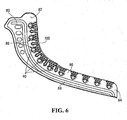
- the insert 100 has a main body portion 102 from which a plurality of protrusions 104 extend.
- the main body portion 102 of the insert 100 may be at least partially received in the grooves 92 of the edge portions 91.
- each protrusion 104 is shaped to cooperate with a corresponding opening 90 of the lace member 80 (as shown in Figures 6 , 11 and 12 ).
- each of the protrusions 104 may have a length L P (see Figure 9 ) substantially equal to the length L O of the openings 90 (see Figure 7 ).
- each of the protrusions 104 has a shaft portion 104A, a distal portion 104B and ridges 104C located between the shaft portion 104A and the distal portion 104B.
- the shaft portion 104A, distal portion 104B and ridges 104C of a given protrusion 104 respectively fit in the corresponding opening 90 defined by opposed walls 90A, opposed distal inclined walls 90B and opposed rounded walls 90C.
- each of the protrusions 204 has a spacing (depicted as a slit 204D) extending from the main body portion 202 towards the distal portion 204B of the protrusion 204.
- the protrusion 204 has a shape that is substantially similar to the shape of the protrusion 104 but instead of being a full body as the protrusion 104, the protrusion 204 is defined by thin walls 204A defining the slit 204D and being joined together at the distal portion 204B.
- the protrusion 204 may also have ridges 204C between the walls 204A and distal portion 204B.
- the slit 204D may have a thickness of approximately 1 mm between the walls 204A and a maximum thickness of approximately 2 mm at the ridges 204C. Other slit dimensions can readily be envisioned by a person of skill in the art. Moreover, the slit 204D may be replaced by any other type of spacing, hole or indentation on the protrusion 204 or may be filled or occupied by a further insert that may be made from a material different from the one of the insert 200.
- the protrusions of a given insert need not be substantially similar in shape. Rather, the protrusions of a same insert can vary in shape from one another to fit in corresponding openings on a lace member 80. In such an embodiment, the openings of a given lace member 80 will also differ in shape as mentioned previously. For example, the openings located along a middle region of the flexion zone FZ can be larger to accommodate protrusions of larger size. This may be desirable as the middle region of the flexion zone FZ is likely to exhibit the most flexion forces when the skate boot 10 is in use.
- the insert can include a single protrusion which would fit in a single corresponding opening on the lace member 80.
- main body portion 102 may be omitted such that the insert or inserts are separate single inserts, each defining a protrusion for registering in a given opening of the lace member 80.
- inserts 100, 200 can be made of different materials having different hardness values.
- inserts 100, 200 can be molded from any type of rubber such as natural rubber, isoprene rubber, polychloroprene, styrene butadiene rubber, etc.
- the inserts 100, 200, and/or their protrusions 104, 204 if the inserts have a body portion may have hardness values between 20 Shore A and 70 Shore D.
- a very hard insert may have a hardness value between 60 and 70 Shore D
- a hard insert may have a hardness value between 40 and 50 Shore D
- a medium insert may have a hardness value between 20 and 30 Shore D
- a soft insert may have a hardness value between 5 and 15 Shore D
- a very soft insert may have a hardness value between 15 and 25 Shore A.
- the insert may comprise a frame, skeleton or armature made of a relatively rigid material being covered or overmolded by a material having a hardness value lower from the one of the rigid material.
- the inserts 100, 200 and/or the protrusions 104, 204 may be made of a material which is more flexible than the lace member 80 such that the protrusions 104, 204 can be compressed in the openings 90 when the lace member 80 experiences in-plane bending. Furthermore, in order to differentiate one insert from another, an insert with a particular characteristic can have a differentiating feature (such as a specific color). As such, if a skater were to lose (or damage) a preferred insert, the skater can easily identify and purchase a new replacement insert identical to the lost (or damaged) insert.
- a plurality of inserts 100, 200 can be produced with different specifications, thereby allowing a skater to at least partially define the amount of flexibility permitted in the flexion zone FZ of the lace member 80.
- the term "specification" may refer to any mechanical property or dimension of a given insert (such as hardness, density, shape, thickness, etc.).
- the insert 100 in the lace member 80 may not substantially affect the level of out-of-plane bending, the insert 100 or insert 200 may affect the level of in-plane bending which occurs during flexion and extension of a skater's foot F. Nevertheless, if the skater determines that the natural resiliency of the lace member 80 without any inserts is adequate, the lace member can simply be used with the openings 90 free of any inserts.
- flexion force can be understood to represent any type of physical force or pressure capable of bending the lace member 80.
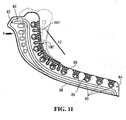
- a first insert 100 1 is positioned in the openings 90 of the lace member 80 while in Figure 12 , a second insert 100 2 different from the first insert 100 1 is positioned in the openings 90 of the lace member 80.
- the lace member 80 is shown in an initial (rest) position in solid lines and in a first (bent) position in dotted lines.
- the lace member 80 is shown in the initial (rest) position in solid lines and in a second (bent) position in dotted lines.
- Force vector F schematically depicts a force which would be exerted onto the lace member 80 in response to the flexion of a skater's foot. Force vector F is the same in both of Figures 11 and 12 and is applied at the same point on the lace member 80 in order to represent equivalent flexion forces in each of the cases shown. While force vector F is shown as being applied along a particular line of action, it is understood that, other forces can be applied to the lace member 80 along any line of action to cause the lace member 80 to experience bending.
- the lace member 80 including the first insert 100 1 has a first flexion mode (as depicted by the first position of the lace member 80 shown in dotted lines), while the lace member 80 including the second insert 100 2 ( Figure 12 ) has a second flexion mode (as depicted by the second position of the lace member 80 shown in dotted lines), the second flexion mode being different from the first flexion mode because each of the inserts 100 1 , 100 2 has different specifications.
- this lace member 80 may return to its initial position shown in solid lines according to different counter-forces.
- first insert 100 1 has a higher hardness than second insert 100 2 .
- the first insert 100 1 may have a hardness value higher than 30 Shore A while the second insert 100 2 may have a hardness value lower than 30 Shore A, or the first insert 100 1 may have a hardness value higher than 40 Shore A while the second insert 100 2 may have a hardness value lower than 40 Shore A, or the first insert 100 1 may have a hardness value higher than 50 Shore A while the second insert 100 2 may have a hardness value lower than 50 Shore A, etc.
- each protrusion 104 2 is pinched more than the top part of each protrusion 104 1 for a same flexion force.
- the presence of a given insert in the openings 90 of the lace member 80 will modify the overall resiliency of the lace member 80 and define, at least in part, the flexion mode of the lace member 80 as it experiences flexion forces.
- the lace member 80 has a first flexion mode when a first insert is positioned in the openings 90 of the lace member 80, while the lace member 80 has a second flexion mode when a second insert is positioned in the openings 90 of the lace member 80, the first flexion mode being different from the second flexion mode.
- flexion mode should not be restricted to a particular position of the lace member 80. Rather, the expression “flexion mode” is meant to generally represent a range of positions achieved by a given lace member 80 as it reacts under an array of possible flexion forces.
Landscapes
- Health & Medical Sciences (AREA)
- General Health & Medical Sciences (AREA)
- Physical Education & Sports Medicine (AREA)
- Footwear And Its Accessory, Manufacturing Method And Apparatuses (AREA)
Claims (21)
- Schlittschuh- bzw. Rollschuhstiefel (10) zum Umschließen eines menschlichen Fußes im Gebrauch, wobei der Fuß eine mediale und eine laterale Seite hat, wobei der Schlittschuh- bzw. Rollschuhstiefel Folgendes umfasst: (i) eine äußere Schale (12) einschließlich eines medialen und eines lateralen Seitenabschnitts (50; 60), damit sie der medialen und der lateralen Seite des Fußes zugewandt sind, wobei der mediale und der laterale Seitenabschnitt jeweils einen oberen Rand (51; 61) hat, und (ii) ein Schnürelement (80), das an einem der oberen Ränder des medialen und des lateralen Seitenabschnitts der äußeren Schale montiert ist, wobei das Schnürelement dadurch gekennzeichnet ist, dass es einen proximalen Abschnitt (82), einen distalen Abschnitt (84), einen oberen Abschnitt (86) mit einem oberen Rand (87) und einen unteren Abschnitt (88) umfasst, der sich entlang dem oberen Rand (51; 61) des medialen oder lateralen Seitenabschnitts (50; 60) erstreckt, um den oberen Rand abzudecken, und dass es ferner mindestens eine Öffnung (90) zur Aufnahme eines Einsatzes (100) umfasst, wobei die mindestens eine Öffnung (90) im Schnürelement zwischen dem oberen Rand (87) und dem unteren Abschnitt (88) des Schnürelements vorgesehen ist, wobei das Schnürelement einen ersten Biegemodus, wenn kein Einsatz in der mindestens einen Öffnung aufgenommen ist, und einen zweiten Biegemodus, wenn der Einsatz in der mindestens einen Öffnung aufgenommen ist, hat, wobei sich der zweite Biegemodus vom ersten Biegemodus unterscheidet.
- Schlittschuh- bzw. Rollschuhstiefel nach Anspruch 1, wobei der zweite Biegemodus von Spezifikationen des Einsatzes (100) abhängig ist, wobei die Spezifikationen Abmessungen, Formen, Dichten, Dicken oder Härtewerte umfassen.
- Schlittschuh- bzw. Rollschuhstiefel nach Anspruch 1 oder 2, wobei der Einsatz (100) einen Härtewert zwischen 20 Shore A und 70 Shore D hat.
- Schlittschuh- bzw. Rollschuhstiefel nach einem der Ansprüche 1 bis 3, wobei sich die mindestens eine Öffnung (90) vom oberen Rand (87) zum unteren Abschnitt (88) des Schnürelements erstreckt.
- Schlittschuh- bzw. Rollschuhstiefel nach einem der Ansprüche 1 bis 4, wobei die mindestens eine Öffnung (90) eine wesentlich gestreckte Form hat.
- Schlittschuh- bzw. Rollschuhstiefel nach einem der Ansprüche 1 bis 5, wobei sich die mindestens eine Öffnung (90) in einer allgemein senkrecht zum oberen Rand (51) verlaufenden Richtung erstreckt.
- Schlittschuh- bzw. Rollschuhstiefel nach einem der Ansprüche 1 bis 6, wobei das Schnürelement (80) mehrere Öffnungen (40) zur Aufnahme eines Schnürsenkels aufweist und wobei sich die mindestens eine Öffnung (90) zwischen zwei Schnürsenkelöffnungen (40) befindet.
- Schlittschuh- bzw. Rollschuhstiefel nach einem der Ansprüche 1 bis 7, wobei der Einsatz (100) mindestens einen Vorsprung (104) definiert, der so gestaltet ist, dass er in die mindestens eine Öffnung (90) des Schnürelements passt.
- Schlittschuh- bzw. Rollschuhstiefel nach Anspruch 8, wobei der Einsatz (100) ferner einen Hauptkörperabschnitt (102) definiert, von dem aus sich der mindestens eine Vorsprung (104) erstreckt.
- Schlittschuh- bzw. Rollschuhstiefel nach Anspruch 9, wobei der mindestens eine Vorsprung (104) einen Abstand aufweist.
- Schlittschuh- bzw. Rollschuhstiefel nach Anspruch 9, wobei die mindestens eine Öffnung (90) mehrere Öffnungen aufweist und wobei der mindestens eine Vorsprung (104) mehrere Vorsprünge aufweist.
- Schlittschuh- bzw. Rollschuhstiefel nach Anspruch 11, wobei die mehreren Öffnungen (90) und die mehreren Vorsprünge (104) jeweils in gleicher Anzahl vorliegen, wobei jede der mehreren Öffnungen so gestaltet ist, dass sie einen jeweiligen der mehreren Vorsprünge aufnimmt.
- Schlittschuh- bzw. Rollschuhstiefel nach einem der Ansprüche 1 bis 12, wobei der Einsatz (100) aus Naturkautschuk und/oder Isopren-Kautschuk und/oder Polychloropren und/oder Styrol-Butadien-Kautschuk hergestellt ist.
- Schlittschuh- bzw. Rollschuhstiefel nach Anspruch 1, wobei das Schnürelement ferner mehrere Öffnungen zur Aufnahme mehrerer von einem Hauptkörper vorragender Einsätze umfasst.
- Schlittschuh- bzw. Rollschuhstiefel nach Anspruch 1, wobei das Schnürelement ferner mehrere Öffnungen zur Aufnahme mehrerer Einsätze umfasst.
- Schlittschuh- bzw. Rollschuhstiefel nach einem der Ansprüche 1 bis 12, wobei der erste Einsatz im Gebrauch aus mehreren Einsätzen (1001; 1002) ausgewählt ist.
- Schlittschuh- bzw. Rollschuhstiefel nach Anspruch 16, wobei die mehreren Einsätze den ersten Einsatz und einen zweiten Einsatz (1001; 1002) umfassen, wobei sich die Härte des ersten Einsatzes (1001) von der des zweiten Einsatzes (1002) unterscheidet.
- Schlittschuh- bzw. Rollschuhstiefel nach Anspruch 17, wobei der erste Einsatz (1001) einen Härtewert von unter 50 Shore A hat und der zweite Einsatz (1002) einen Härtewert von über 50 Shore A hat.
- Schlittschuh- bzw. Rollschuhstiefel nach Anspruch 16, wobei die mehreren Einsätze den ersten Einsatz und einen zweiten Einsatz (1001; 1002) umfassen, wobei sich die Abmessung, Gestalt, Dichte oder Dicke des ersten Einsatzes (1001) von der des zweiten Einsatzes (1002) unterscheidet.
- Schlittschuh- bzw. Rollschuhstiefel nach Anspruch 19, wobei der erste Einsatz (1001) einen vollen Körper hat und der zweite Einsatz (1002) einen Schlitz hat.
- Schlittschuh- bzw. Rollschuhstiefel nach Anspruch 19, wobei der erste Einsatz (1001) in der mindestens einen Öffnung im Wesentlichen eingeschlossen ist, wenn er dort aufgenommen ist, und der zweite Einsatz (1002) etwas kleiner als die mindestens eine Öffnung ist, wodurch eine Lücke entsteht, wenn der zweite Einsatz in der mindestens einen Öffnung aufgenommen ist.
Priority Applications (1)
| Application Number | Priority Date | Filing Date | Title |
|---|---|---|---|
| EP20130159496 EP2777416B1 (de) | 2013-03-15 | 2013-03-15 | Schlittschuh mit Schnürelement mit mindestens einer Öffnung |
Applications Claiming Priority (1)
| Application Number | Priority Date | Filing Date | Title |
|---|---|---|---|
| EP20130159496 EP2777416B1 (de) | 2013-03-15 | 2013-03-15 | Schlittschuh mit Schnürelement mit mindestens einer Öffnung |
Publications (2)
| Publication Number | Publication Date |
|---|---|
| EP2777416A1 EP2777416A1 (de) | 2014-09-17 |
| EP2777416B1 true EP2777416B1 (de) | 2015-03-04 |
Family
ID=48013739
Family Applications (1)
| Application Number | Title | Priority Date | Filing Date |
|---|---|---|---|
| EP20130159496 Active EP2777416B1 (de) | 2013-03-15 | 2013-03-15 | Schlittschuh mit Schnürelement mit mindestens einer Öffnung |
Country Status (1)
| Country | Link |
|---|---|
| EP (1) | EP2777416B1 (de) |
Cited By (1)
| Publication number | Priority date | Publication date | Assignee | Title |
|---|---|---|---|---|
| US10231508B2 (en) | 2013-03-14 | 2019-03-19 | Bauer Hockey, Llc | Skate boot having a lace member with at least one opening |
Family Cites Families (4)
| Publication number | Priority date | Publication date | Assignee | Title |
|---|---|---|---|---|
| EP0109380A1 (de) * | 1982-10-18 | 1984-05-23 | Koflach Sportgeräte Gesellschaft m.b.H | Eislaufschuh, insbesondere Eishockeyschuh |
| CA1244648A (en) * | 1985-11-08 | 1988-11-15 | Gaston Schaeffer | Ice skate |
| CA2256932A1 (en) * | 1998-12-22 | 2000-06-22 | Bauer Nike Hockey Inc. | Sole connection for piece of footwear |
| US7513068B2 (en) * | 2002-05-06 | 2009-04-07 | William Benjamin Fauver | Variable flexion resistance sport boot |
-
2013
- 2013-03-15 EP EP20130159496 patent/EP2777416B1/de active Active
Cited By (1)
| Publication number | Priority date | Publication date | Assignee | Title |
|---|---|---|---|---|
| US10231508B2 (en) | 2013-03-14 | 2019-03-19 | Bauer Hockey, Llc | Skate boot having a lace member with at least one opening |
Also Published As
| Publication number | Publication date |
|---|---|
| EP2777416A1 (de) | 2014-09-17 |
Similar Documents
| Publication | Publication Date | Title |
|---|---|---|
| US11547923B2 (en) | Skate and skate boot | |
| US5924706A (en) | Skate boot construction | |
| US6079128A (en) | Skate boot construction with integral plastic insert | |
| US6018892A (en) | Internal collar device for an article of footwear | |
| EP2777417B1 (de) | Schlittschuh mit Zehenkappe mit hinterem Erweiterungen | |
| US6371494B1 (en) | Sports boot with variable rigidity | |
| EP1397971A1 (de) | Sportschuh insbesondere für Moto-Cross | |
| US20160081420A1 (en) | Article Of Footwear With Customizable Stiffness | |
| EP0804102B1 (de) | Schlittschuh mit eingebauter kunststoffeinlage | |
| US7290355B2 (en) | Skate boot comprising a tongue | |
| US11140942B2 (en) | Skate boot having a lace member with at least one opening | |
| EP0887028A1 (de) | Rollschuh | |
| EP2777415B1 (de) | Schlittschuh mit Sehnenschutz mit Aussparung | |
| CA2254327C (en) | In-line roller skate | |
| EP2777416A1 (de) | Schlittschuh mit Schnürelement mit mindestens einer Öffnung | |
| CA2809462C (en) | Skate boot having a tendon guard with a recess | |
| CA2809449C (en) | Skate boot having a lace member with at least one opening | |
| CA2942109C (en) | Skate with tendon guard | |
| JP7291926B2 (ja) | アッパーコア及びスケートシューズ | |
| CA2256932A1 (en) | Sole connection for piece of footwear | |
| KR200395910Y1 (ko) | 샌들형 인라인 스케이트 | |
| CA2462408C (en) | A skate boot comprising a tongue | |
| US20050253346A1 (en) | Skates having instep protectors | |
| EP1946662A1 (de) | Schlittschuh | |
| KR200333082Y1 (ko) | 직결식 인라인 스케이트 부츠용 샤시 |
Legal Events
| Date | Code | Title | Description |
|---|---|---|---|
| PUAI | Public reference made under article 153(3) epc to a published international application that has entered the european phase |
Free format text: ORIGINAL CODE: 0009012 |
|
| 17P | Request for examination filed |
Effective date: 20131121 |
|
| AK | Designated contracting states |
Kind code of ref document: A1 Designated state(s): AL AT BE BG CH CY CZ DE DK EE ES FI FR GB GR HR HU IE IS IT LI LT LU LV MC MK MT NL NO PL PT RO RS SE SI SK SM TR |
|
| AX | Request for extension of the european patent |
Extension state: BA ME |
|
| GRAP | Despatch of communication of intention to grant a patent |
Free format text: ORIGINAL CODE: EPIDOSNIGR1 |
|
| RIC1 | Information provided on ipc code assigned before grant |
Ipc: A43B 5/16 20060101AFI20141128BHEP |
|
| INTG | Intention to grant announced |
Effective date: 20141217 |
|
| GRAS | Grant fee paid |
Free format text: ORIGINAL CODE: EPIDOSNIGR3 |
|
| GRAA | (expected) grant |
Free format text: ORIGINAL CODE: 0009210 |
|
| AK | Designated contracting states |
Kind code of ref document: B1 Designated state(s): AL AT BE BG CH CY CZ DE DK EE ES FI FR GB GR HR HU IE IS IT LI LT LU LV MC MK MT NL NO PL PT RO RS SE SI SK SM TR |
|
| REG | Reference to a national code |
Ref country code: GB Ref legal event code: FG4D |
|
| REG | Reference to a national code |
Ref country code: CH Ref legal event code: EP |
|
| RAP2 | Party data changed (patent owner data changed or rights of a patent transferred) |
Owner name: BAUER HOCKEY CORP. |
|
| REG | Reference to a national code |
Ref country code: IE Ref legal event code: FG4D |
|
| REG | Reference to a national code |
Ref country code: AT Ref legal event code: REF Ref document number: 713010 Country of ref document: AT Kind code of ref document: T Effective date: 20150415 |
|
| REG | Reference to a national code |
Ref country code: DE Ref legal event code: R096 Ref document number: 602013001032 Country of ref document: DE Effective date: 20150416 |
|
| RAP4 | Party data changed (patent owner data changed or rights of a patent transferred) |
Owner name: BAUER HOCKEY CORP. |
|
| REG | Reference to a national code |
Ref country code: CH Ref legal event code: NV Representative=s name: AMMANN PATENTANWAELTE AG BERN, CH |
|
| REG | Reference to a national code |
Ref country code: SE Ref legal event code: TRGR |
|
| REG | Reference to a national code |
Ref country code: AT Ref legal event code: MK05 Ref document number: 713010 Country of ref document: AT Kind code of ref document: T Effective date: 20150304 Ref country code: NL Ref legal event code: VDEP Effective date: 20150304 |
|
| PG25 | Lapsed in a contracting state [announced via postgrant information from national office to epo] |
Ref country code: NO Free format text: LAPSE BECAUSE OF FAILURE TO SUBMIT A TRANSLATION OF THE DESCRIPTION OR TO PAY THE FEE WITHIN THE PRESCRIBED TIME-LIMIT Effective date: 20150604 Ref country code: HR Free format text: LAPSE BECAUSE OF FAILURE TO SUBMIT A TRANSLATION OF THE DESCRIPTION OR TO PAY THE FEE WITHIN THE PRESCRIBED TIME-LIMIT Effective date: 20150304 Ref country code: LT Free format text: LAPSE BECAUSE OF FAILURE TO SUBMIT A TRANSLATION OF THE DESCRIPTION OR TO PAY THE FEE WITHIN THE PRESCRIBED TIME-LIMIT Effective date: 20150304 Ref country code: ES Free format text: LAPSE BECAUSE OF FAILURE TO SUBMIT A TRANSLATION OF THE DESCRIPTION OR TO PAY THE FEE WITHIN THE PRESCRIBED TIME-LIMIT Effective date: 20150304 |
|
| REG | Reference to a national code |
Ref country code: LT Ref legal event code: MG4D |
|
| PG25 | Lapsed in a contracting state [announced via postgrant information from national office to epo] |
Ref country code: AT Free format text: LAPSE BECAUSE OF FAILURE TO SUBMIT A TRANSLATION OF THE DESCRIPTION OR TO PAY THE FEE WITHIN THE PRESCRIBED TIME-LIMIT Effective date: 20150304 Ref country code: RS Free format text: LAPSE BECAUSE OF FAILURE TO SUBMIT A TRANSLATION OF THE DESCRIPTION OR TO PAY THE FEE WITHIN THE PRESCRIBED TIME-LIMIT Effective date: 20150304 Ref country code: GR Free format text: LAPSE BECAUSE OF FAILURE TO SUBMIT A TRANSLATION OF THE DESCRIPTION OR TO PAY THE FEE WITHIN THE PRESCRIBED TIME-LIMIT Effective date: 20150605 Ref country code: LV Free format text: LAPSE BECAUSE OF FAILURE TO SUBMIT A TRANSLATION OF THE DESCRIPTION OR TO PAY THE FEE WITHIN THE PRESCRIBED TIME-LIMIT Effective date: 20150304 |
|
| PG25 | Lapsed in a contracting state [announced via postgrant information from national office to epo] |
Ref country code: NL Free format text: LAPSE BECAUSE OF FAILURE TO SUBMIT A TRANSLATION OF THE DESCRIPTION OR TO PAY THE FEE WITHIN THE PRESCRIBED TIME-LIMIT Effective date: 20150304 |
|
| PG25 | Lapsed in a contracting state [announced via postgrant information from national office to epo] |
Ref country code: SK Free format text: LAPSE BECAUSE OF FAILURE TO SUBMIT A TRANSLATION OF THE DESCRIPTION OR TO PAY THE FEE WITHIN THE PRESCRIBED TIME-LIMIT Effective date: 20150304 Ref country code: RO Free format text: LAPSE BECAUSE OF FAILURE TO SUBMIT A TRANSLATION OF THE DESCRIPTION OR TO PAY THE FEE WITHIN THE PRESCRIBED TIME-LIMIT Effective date: 20150304 Ref country code: EE Free format text: LAPSE BECAUSE OF FAILURE TO SUBMIT A TRANSLATION OF THE DESCRIPTION OR TO PAY THE FEE WITHIN THE PRESCRIBED TIME-LIMIT Effective date: 20150304 Ref country code: PT Free format text: LAPSE BECAUSE OF FAILURE TO SUBMIT A TRANSLATION OF THE DESCRIPTION OR TO PAY THE FEE WITHIN THE PRESCRIBED TIME-LIMIT Effective date: 20150706 |
|
| PG25 | Lapsed in a contracting state [announced via postgrant information from national office to epo] |
Ref country code: IS Free format text: LAPSE BECAUSE OF FAILURE TO SUBMIT A TRANSLATION OF THE DESCRIPTION OR TO PAY THE FEE WITHIN THE PRESCRIBED TIME-LIMIT Effective date: 20150704 Ref country code: PL Free format text: LAPSE BECAUSE OF FAILURE TO SUBMIT A TRANSLATION OF THE DESCRIPTION OR TO PAY THE FEE WITHIN THE PRESCRIBED TIME-LIMIT Effective date: 20150304 |
|
| REG | Reference to a national code |
Ref country code: DE Ref legal event code: R097 Ref document number: 602013001032 Country of ref document: DE |
|
| PG25 | Lapsed in a contracting state [announced via postgrant information from national office to epo] |
Ref country code: IT Free format text: LAPSE BECAUSE OF FAILURE TO SUBMIT A TRANSLATION OF THE DESCRIPTION OR TO PAY THE FEE WITHIN THE PRESCRIBED TIME-LIMIT Effective date: 20150304 |
|
| PLBE | No opposition filed within time limit |
Free format text: ORIGINAL CODE: 0009261 |
|
| STAA | Information on the status of an ep patent application or granted ep patent |
Free format text: STATUS: NO OPPOSITION FILED WITHIN TIME LIMIT |
|
| REG | Reference to a national code |
Ref country code: IE Ref legal event code: MM4A |
|
| PG25 | Lapsed in a contracting state [announced via postgrant information from national office to epo] |
Ref country code: IE Free format text: LAPSE BECAUSE OF NON-PAYMENT OF DUE FEES Effective date: 20150315 Ref country code: MC Free format text: LAPSE BECAUSE OF FAILURE TO SUBMIT A TRANSLATION OF THE DESCRIPTION OR TO PAY THE FEE WITHIN THE PRESCRIBED TIME-LIMIT Effective date: 20150304 Ref country code: DK Free format text: LAPSE BECAUSE OF FAILURE TO SUBMIT A TRANSLATION OF THE DESCRIPTION OR TO PAY THE FEE WITHIN THE PRESCRIBED TIME-LIMIT Effective date: 20150304 |
|
| 26N | No opposition filed |
Effective date: 20151207 |
|
| REG | Reference to a national code |
Ref country code: FR Ref legal event code: ST Effective date: 20160113 |
|
| PG25 | Lapsed in a contracting state [announced via postgrant information from national office to epo] |
Ref country code: SI Free format text: LAPSE BECAUSE OF FAILURE TO SUBMIT A TRANSLATION OF THE DESCRIPTION OR TO PAY THE FEE WITHIN THE PRESCRIBED TIME-LIMIT Effective date: 20150304 |
|
| PGFP | Annual fee paid to national office [announced via postgrant information from national office to epo] |
Ref country code: CZ Payment date: 20160303 Year of fee payment: 4 |
|
| PG25 | Lapsed in a contracting state [announced via postgrant information from national office to epo] |
Ref country code: FR Free format text: LAPSE BECAUSE OF NON-PAYMENT OF DUE FEES Effective date: 20150504 |
|
| PGFP | Annual fee paid to national office [announced via postgrant information from national office to epo] |
Ref country code: FI Payment date: 20160309 Year of fee payment: 4 |
|
| PG25 | Lapsed in a contracting state [announced via postgrant information from national office to epo] |
Ref country code: BE Free format text: LAPSE BECAUSE OF FAILURE TO SUBMIT A TRANSLATION OF THE DESCRIPTION OR TO PAY THE FEE WITHIN THE PRESCRIBED TIME-LIMIT Effective date: 20150304 |
|
| PG25 | Lapsed in a contracting state [announced via postgrant information from national office to epo] |
Ref country code: MT Free format text: LAPSE BECAUSE OF FAILURE TO SUBMIT A TRANSLATION OF THE DESCRIPTION OR TO PAY THE FEE WITHIN THE PRESCRIBED TIME-LIMIT Effective date: 20150304 |
|
| PG25 | Lapsed in a contracting state [announced via postgrant information from national office to epo] |
Ref country code: BG Free format text: LAPSE BECAUSE OF FAILURE TO SUBMIT A TRANSLATION OF THE DESCRIPTION OR TO PAY THE FEE WITHIN THE PRESCRIBED TIME-LIMIT Effective date: 20150304 Ref country code: HU Free format text: LAPSE BECAUSE OF FAILURE TO SUBMIT A TRANSLATION OF THE DESCRIPTION OR TO PAY THE FEE WITHIN THE PRESCRIBED TIME-LIMIT; INVALID AB INITIO Effective date: 20130315 |
|
| PG25 | Lapsed in a contracting state [announced via postgrant information from national office to epo] |
Ref country code: CY Free format text: LAPSE BECAUSE OF FAILURE TO SUBMIT A TRANSLATION OF THE DESCRIPTION OR TO PAY THE FEE WITHIN THE PRESCRIBED TIME-LIMIT Effective date: 20150304 |
|
| PG25 | Lapsed in a contracting state [announced via postgrant information from national office to epo] |
Ref country code: TR Free format text: LAPSE BECAUSE OF FAILURE TO SUBMIT A TRANSLATION OF THE DESCRIPTION OR TO PAY THE FEE WITHIN THE PRESCRIBED TIME-LIMIT Effective date: 20150304 |
|
| PG25 | Lapsed in a contracting state [announced via postgrant information from national office to epo] |
Ref country code: CZ Free format text: LAPSE BECAUSE OF NON-PAYMENT OF DUE FEES Effective date: 20170315 Ref country code: FI Free format text: LAPSE BECAUSE OF NON-PAYMENT OF DUE FEES Effective date: 20170315 |
|
| GBPC | Gb: european patent ceased through non-payment of renewal fee |
Effective date: 20170315 |
|
| PG25 | Lapsed in a contracting state [announced via postgrant information from national office to epo] |
Ref country code: LU Free format text: LAPSE BECAUSE OF NON-PAYMENT OF DUE FEES Effective date: 20150315 |
|
| PG25 | Lapsed in a contracting state [announced via postgrant information from national office to epo] |
Ref country code: GB Free format text: LAPSE BECAUSE OF NON-PAYMENT OF DUE FEES Effective date: 20170315 |
|
| PGFP | Annual fee paid to national office [announced via postgrant information from national office to epo] |
Ref country code: CH Payment date: 20180314 Year of fee payment: 6 |
|
| PG25 | Lapsed in a contracting state [announced via postgrant information from national office to epo] |
Ref country code: SM Free format text: LAPSE BECAUSE OF FAILURE TO SUBMIT A TRANSLATION OF THE DESCRIPTION OR TO PAY THE FEE WITHIN THE PRESCRIBED TIME-LIMIT Effective date: 20150304 |
|
| PG25 | Lapsed in a contracting state [announced via postgrant information from national office to epo] |
Ref country code: MK Free format text: LAPSE BECAUSE OF FAILURE TO SUBMIT A TRANSLATION OF THE DESCRIPTION OR TO PAY THE FEE WITHIN THE PRESCRIBED TIME-LIMIT Effective date: 20150304 |
|
| PG25 | Lapsed in a contracting state [announced via postgrant information from national office to epo] |
Ref country code: AL Free format text: LAPSE BECAUSE OF FAILURE TO SUBMIT A TRANSLATION OF THE DESCRIPTION OR TO PAY THE FEE WITHIN THE PRESCRIBED TIME-LIMIT Effective date: 20150304 |
|
| REG | Reference to a national code |
Ref country code: DE Ref legal event code: R082 Ref document number: 602013001032 Country of ref document: DE Representative=s name: DR. GASSNER & PARTNER MBB PATENTANWAELTE, DE Ref country code: DE Ref legal event code: R081 Ref document number: 602013001032 Country of ref document: DE Owner name: BAUER HOCKEY LTD., BLAINVILLE, CA Free format text: FORMER OWNER: BAUER HOCKEY CORP., BLAINVILLE, CA |
|
| REG | Reference to a national code |
Ref country code: CH Ref legal event code: PUE Owner name: BAUER HOCKEY LTD., CA Free format text: FORMER OWNER: BAUER HOCKEY CORP., CA |
|
| REG | Reference to a national code |
Ref country code: CH Ref legal event code: PL |
|
| PG25 | Lapsed in a contracting state [announced via postgrant information from national office to epo] |
Ref country code: CH Free format text: LAPSE BECAUSE OF NON-PAYMENT OF DUE FEES Effective date: 20190331 Ref country code: LI Free format text: LAPSE BECAUSE OF NON-PAYMENT OF DUE FEES Effective date: 20190331 |
|
| P01 | Opt-out of the competence of the unified patent court (upc) registered |
Effective date: 20230606 |
|
| PGFP | Annual fee paid to national office [announced via postgrant information from national office to epo] |
Ref country code: DE Payment date: 20240220 Year of fee payment: 12 |
|
| REG | Reference to a national code |
Ref country code: DE Ref legal event code: R119 Ref document number: 602013001032 Country of ref document: DE |
|
| PG25 | Lapsed in a contracting state [announced via postgrant information from national office to epo] |
Ref country code: DE Free format text: LAPSE BECAUSE OF NON-PAYMENT OF DUE FEES Effective date: 20251001 |
|
| PGFP | Annual fee paid to national office [announced via postgrant information from national office to epo] |
Ref country code: SE Payment date: 20260327 Year of fee payment: 14 |