EP2778004A2 - Steuerungs- und Bedienerschnittstelle für Mähdrescher mit Hybridantrieb - Google Patents
Steuerungs- und Bedienerschnittstelle für Mähdrescher mit Hybridantrieb Download PDFInfo
- Publication number
- EP2778004A2 EP2778004A2 EP14155740.5A EP14155740A EP2778004A2 EP 2778004 A2 EP2778004 A2 EP 2778004A2 EP 14155740 A EP14155740 A EP 14155740A EP 2778004 A2 EP2778004 A2 EP 2778004A2
- Authority
- EP
- European Patent Office
- Prior art keywords
- charge
- combine
- soc
- power
- storage device
- Prior art date
- Legal status (The legal status is an assumption and is not a legal conclusion. Google has not performed a legal analysis and makes no representation as to the accuracy of the status listed.)
- Withdrawn
Links
Images



Classifications
-
- B—PERFORMING OPERATIONS; TRANSPORTING
- B60—VEHICLES IN GENERAL
- B60K—ARRANGEMENT OR MOUNTING OF PROPULSION UNITS OR OF TRANSMISSIONS IN VEHICLES; ARRANGEMENT OR MOUNTING OF PLURAL DIVERSE PRIME-MOVERS IN VEHICLES; AUXILIARY DRIVES FOR VEHICLES; INSTRUMENTATION OR DASHBOARDS FOR VEHICLES; ARRANGEMENTS IN CONNECTION WITH COOLING, AIR INTAKE, GAS EXHAUST OR FUEL SUPPLY OF PROPULSION UNITS IN VEHICLES
- B60K6/00—Arrangement or mounting of plural diverse prime-movers for mutual or common propulsion, e.g. hybrid propulsion systems comprising electric motors and internal combustion engines
- B60K6/20—Arrangement or mounting of plural diverse prime-movers for mutual or common propulsion, e.g. hybrid propulsion systems comprising electric motors and internal combustion engines the prime-movers consisting of electric motors and internal combustion engines, e.g. HEVs
- B60K6/42—Arrangement or mounting of plural diverse prime-movers for mutual or common propulsion, e.g. hybrid propulsion systems comprising electric motors and internal combustion engines the prime-movers consisting of electric motors and internal combustion engines, e.g. HEVs characterised by the architecture of the hybrid electric vehicle
- B60K6/48—Parallel type
-
- B—PERFORMING OPERATIONS; TRANSPORTING
- B60—VEHICLES IN GENERAL
- B60W—CONJOINT CONTROL OF VEHICLE SUB-UNITS OF DIFFERENT TYPE OR DIFFERENT FUNCTION; CONTROL SYSTEMS SPECIALLY ADAPTED FOR HYBRID VEHICLES; ROAD VEHICLE DRIVE CONTROL SYSTEMS FOR PURPOSES NOT RELATED TO THE CONTROL OF A PARTICULAR SUB-UNIT
- B60W20/00—Control systems specially adapted for hybrid vehicles
- B60W20/10—Controlling the power contribution of each of the prime movers to meet required power demand
- B60W20/13—Controlling the power contribution of each of the prime movers to meet required power demand in order to stay within battery power input or output limits; in order to prevent overcharging or battery depletion
-
- B—PERFORMING OPERATIONS; TRANSPORTING
- B60—VEHICLES IN GENERAL
- B60W—CONJOINT CONTROL OF VEHICLE SUB-UNITS OF DIFFERENT TYPE OR DIFFERENT FUNCTION; CONTROL SYSTEMS SPECIALLY ADAPTED FOR HYBRID VEHICLES; ROAD VEHICLE DRIVE CONTROL SYSTEMS FOR PURPOSES NOT RELATED TO THE CONTROL OF A PARTICULAR SUB-UNIT
- B60W50/00—Details of control systems for road vehicle drive control not related to the control of a particular sub-unit, e.g. process diagnostic or vehicle driver interfaces
- B60W2050/0001—Details of the control system
- B60W2050/0043—Signal treatments, identification of variables or parameters, parameter estimation or state estimation
- B60W2050/005—Sampling
-
- B—PERFORMING OPERATIONS; TRANSPORTING
- B60—VEHICLES IN GENERAL
- B60W—CONJOINT CONTROL OF VEHICLE SUB-UNITS OF DIFFERENT TYPE OR DIFFERENT FUNCTION; CONTROL SYSTEMS SPECIALLY ADAPTED FOR HYBRID VEHICLES; ROAD VEHICLE DRIVE CONTROL SYSTEMS FOR PURPOSES NOT RELATED TO THE CONTROL OF A PARTICULAR SUB-UNIT
- B60W50/00—Details of control systems for road vehicle drive control not related to the control of a particular sub-unit, e.g. process diagnostic or vehicle driver interfaces
- B60W2050/0001—Details of the control system
- B60W2050/0043—Signal treatments, identification of variables or parameters, parameter estimation or state estimation
- B60W2050/005—Sampling
- B60W2050/0051—Sampling combined with averaging
-
- B—PERFORMING OPERATIONS; TRANSPORTING
- B60—VEHICLES IN GENERAL
- B60W—CONJOINT CONTROL OF VEHICLE SUB-UNITS OF DIFFERENT TYPE OR DIFFERENT FUNCTION; CONTROL SYSTEMS SPECIALLY ADAPTED FOR HYBRID VEHICLES; ROAD VEHICLE DRIVE CONTROL SYSTEMS FOR PURPOSES NOT RELATED TO THE CONTROL OF A PARTICULAR SUB-UNIT
- B60W50/00—Details of control systems for road vehicle drive control not related to the control of a particular sub-unit, e.g. process diagnostic or vehicle driver interfaces
- B60W2050/0062—Adapting control system settings
- B60W2050/0075—Automatic parameter input, automatic initialising or calibrating means
-
- B—PERFORMING OPERATIONS; TRANSPORTING
- B60—VEHICLES IN GENERAL
- B60W—CONJOINT CONTROL OF VEHICLE SUB-UNITS OF DIFFERENT TYPE OR DIFFERENT FUNCTION; CONTROL SYSTEMS SPECIALLY ADAPTED FOR HYBRID VEHICLES; ROAD VEHICLE DRIVE CONTROL SYSTEMS FOR PURPOSES NOT RELATED TO THE CONTROL OF A PARTICULAR SUB-UNIT
- B60W2510/00—Input parameters relating to a particular sub-units
- B60W2510/24—Energy storage means
- B60W2510/242—Energy storage means for electrical energy
- B60W2510/244—Charge state
-
- B—PERFORMING OPERATIONS; TRANSPORTING
- B60—VEHICLES IN GENERAL
- B60W—CONJOINT CONTROL OF VEHICLE SUB-UNITS OF DIFFERENT TYPE OR DIFFERENT FUNCTION; CONTROL SYSTEMS SPECIALLY ADAPTED FOR HYBRID VEHICLES; ROAD VEHICLE DRIVE CONTROL SYSTEMS FOR PURPOSES NOT RELATED TO THE CONTROL OF A PARTICULAR SUB-UNIT
- B60W2556/00—Input parameters relating to data
- B60W2556/10—Historical data
-
- B—PERFORMING OPERATIONS; TRANSPORTING
- B60—VEHICLES IN GENERAL
- B60W—CONJOINT CONTROL OF VEHICLE SUB-UNITS OF DIFFERENT TYPE OR DIFFERENT FUNCTION; CONTROL SYSTEMS SPECIALLY ADAPTED FOR HYBRID VEHICLES; ROAD VEHICLE DRIVE CONTROL SYSTEMS FOR PURPOSES NOT RELATED TO THE CONTROL OF A PARTICULAR SUB-UNIT
- B60W2710/00—Output or target parameters relating to a particular sub-units
- B60W2710/24—Energy storage means
- B60W2710/242—Energy storage means for electrical energy
- B60W2710/244—Charge state
-
- B—PERFORMING OPERATIONS; TRANSPORTING
- B60—VEHICLES IN GENERAL
- B60Y—INDEXING SCHEME RELATING TO ASPECTS CROSS-CUTTING VEHICLE TECHNOLOGY
- B60Y2200/00—Type of vehicle
- B60Y2200/20—Off-Road Vehicles
- B60Y2200/22—Agricultural vehicles
- B60Y2200/222—Harvesters
-
- Y—GENERAL TAGGING OF NEW TECHNOLOGICAL DEVELOPMENTS; GENERAL TAGGING OF CROSS-SECTIONAL TECHNOLOGIES SPANNING OVER SEVERAL SECTIONS OF THE IPC; TECHNICAL SUBJECTS COVERED BY FORMER USPC CROSS-REFERENCE ART COLLECTIONS [XRACs] AND DIGESTS
- Y02—TECHNOLOGIES OR APPLICATIONS FOR MITIGATION OR ADAPTATION AGAINST CLIMATE CHANGE
- Y02T—CLIMATE CHANGE MITIGATION TECHNOLOGIES RELATED TO TRANSPORTATION
- Y02T10/00—Road transport of goods or passengers
- Y02T10/60—Other road transportation technologies with climate change mitigation effect
- Y02T10/62—Hybrid vehicles
-
- Y—GENERAL TAGGING OF NEW TECHNOLOGICAL DEVELOPMENTS; GENERAL TAGGING OF CROSS-SECTIONAL TECHNOLOGIES SPANNING OVER SEVERAL SECTIONS OF THE IPC; TECHNICAL SUBJECTS COVERED BY FORMER USPC CROSS-REFERENCE ART COLLECTIONS [XRACs] AND DIGESTS
- Y10—TECHNICAL SUBJECTS COVERED BY FORMER USPC
- Y10S—TECHNICAL SUBJECTS COVERED BY FORMER USPC CROSS-REFERENCE ART COLLECTIONS [XRACs] AND DIGESTS
- Y10S903/00—Hybrid electric vehicles, HEVS
- Y10S903/902—Prime movers comprising electrical and internal combustion motors
- Y10S903/903—Prime movers comprising electrical and internal combustion motors having energy storing means, e.g. battery, capacitor
Definitions
- This invention relates to an apparatus, system and method for driving a combine harvester with a battery electric hybrid drive.
- the engine load on an internal combustion engine in a combine harvester or “combine” may increase as the vegetation density or yield increases in certain zones in a field.
- Internal Combustion (“IC") engines are used to power combines under a wide variety of load conditions and must be able to accept sudden changes in load. When the combine is in a transport mode, sudden increases in power and torque are required from the engine when negotiating the terrain between fields. Tillage in the field also presents conditions where there are sudden increases in load due to changes in soil condition, where the resistance of the tillage tool increases significantly or the field has steep inclines. Engines of this type are expected to respond to these conditions by increasing output torque with relatively small variations of engine speed.
- Combine harvesters currently have a basic engine torque curve to provide a nominal rated power at a power level approximately 14% below the power capability envelope of the engine.
- a 14% power bulge with a 200 RPM droop in engine RPM provides good slug handling capability and enhanced drivability for the operator. This enables the use of a power boost for unloading or a power bulge for additional power to handle gradual increases in a load or to handle slugs or other operational overloads without excessive loss of functional engine speed or the stalling of the engine.
- Battery electric hybrid drives for combine harvesters are known, such as described in US Patent 7,949,442 , herein incorporated by reference.
- the present inventors have recognized that one issue with electric hybrid harvesters that are enabled by energy storage is managing the charge of the battery pack to maximize its life while at the same time achieving a useful increase in power.
- a hybrid electric system is desired to store energy in a battery pack and uses this energy when the harvester is in need of additional power.
- the present inventors have also recognized the desirability to make the operator aware of the interaction between power consumption of the harvester and the charging of the battery pack. If the operator runs the combine at capacity such that the battery pack is always being drained, eventually the extra boost provided by the battery pack will be dissipated. Conversely, if the operator does not know the upper limits of the combine, then he may not take advantage of the electric boost available.
- the invention provides a control of a hybrid electric hybrid drive for a combine.
- the invention also provides an operator interface for the drive.
- a first method is an automatic control with limited operator involvement.
- a control algorithm would automatically adjust available combine power to add power when needed, without direction from the operator.
- the control utilizes a control algorithm to automatically control state-of-charge (SOC) of an electrical energy storage device such as a battery pack, by either increasing power demand by increasing ground speed or decreasing power demand such as by reducing combine ground speed.
- SOC state-of-charge
- the operator will be able to input a maximum engine power percentage that he wants to utilize or a default value can automatically be used.
- the algorithm will determine the battery pack state-of-charge along with charge level trends. Based on this information, the control algorithm adjusts engine load accordingly. This can be accomplished by adjusting ground speed which increases or decreases the propulsion power and threshing power which brings the engine power to the correct percentage to allow recharging or increased discharging of the battery pack. This algorithm is implemented to ensure that when more power is demanded by the operator, the battery pack has the power available to meet that request.
- a control algorithm can calculate a running average of the battery pack SOC.
- a target battery pack SOC is set, it can be pre-determined. If the running SOC average is above the target, then the machine loading (combine power) can be increased. If the running SOC average is below the target, the machine loading can be decreased. If the running SOC average is on the target, then the machine loading can be maintained. Changes in machine loading can be accomplished by varying the ground speed of the combine.
- the system will "learn” over time what the tendency of the harvest cycle is and can modify as time progresses.
- the time period for averaging could be a modifiable term or adjustable by the operator. For example, setting the system to "high” sensitivity might force averaging over a short time period (10 sec or 20 sec, for example). Setting to "low” sensitivity might raise this averaging time to 10 min, 20 min or more.
- a second method uses mean and standard deviation to gauge SOC and make necessary adjustments.
- the actual SOC is monitored over a time interval and the values of actual SOC are associated with time durations for those values of SOC.
- the time interval can be the immediately prior ten minutes refreshed every minute.
- the mean and standard deviation of SOC values versus time duration are calculated over the selected time interval.
- the combine power demand such as the combine ground speed, is adjusted when the actual SOC falls outside a selected standard deviation, and the mean is thus shifted over time to line up with the target SOC.
- the target SOC can be set at 50% SOC and the K value can be selected to be 3.
- the K value can be selected by the operator or can be a variable, such as varying with the value of the SOC.
- a third method of the invention includes operator involvement.
- the operator would gain active feedback regarding the hybrid drive and the SOC of the battery pack and would be able to input a percentage of maximum engine power to utilize.
- a user interface for a hybrid drive for a combine is provided.
- the user interface can be integrated with the aforementioned automatic controls or correspond to manual, operator control of the hybrid drive. It not only displays the battery pack state-of-charge, it also shows the operator when he is benefitting from the extra power afforded to him from battery pack power.
- the interface includes a hybrid system power gauge, a tachometer and an adjacent SOC gauge. The SOC gauge depicts whether the battery pack is charging or discharging, which is depicted through the small arrows going to and from the hybrid system power gauge. In times of light load, the battery pack will be recharged and increase its state of charge (shown as green).
- the interface will tell the operator that the battery pack is being discharged (shown in orange). The operator can reduce combine power to increase battery pack SOC or increase combine power to decrease battery pack SOC, to utilize maximum combine power during operation.
- FIG. 1 illustrates a system 10 for an electric hybrid drive for a combine harvester.
- the system 10 comprises an internal combustion engine 11 mechanically coupled to a gearbox 12.
- An electric motor/generator 14 is also coupled to the gearbox 12.
- An output 16 (e.g., output shaft) of the gearbox 12 provides rotational energy for propelling the vehicle, operating implements, or both.
- the IC engine and the electric motor generator can both propel rotation of the output 16 via the gearbox.
- the IC engine 11 can propel rotation of the motor/generator 14 via the gearbox, especially when the motor/generator functions as a generator.
- An electronic control unit (ECU) 20 is signal-connected to engine controls and sensors.
- An engine speed sensor 21 (e.g., revolution per minute (RPM) sensor) is associated with the internal combustion engine 11.
- the output of the engine speed sensor is provided directly or indirectly to the ECU 20. If the engine speed sensor provides an analog output signal, an analog-to-digital (A/D) converter may be interposed between the engine speed sensor and the data processor.
- RPM revolution per minute
- the ECU 20 communicates with one or more of the following devices: the IC engine 11, an energy storage device 24, and a motor/generator control 26.
- the lines interconnecting the foregoing devices 11, 24, 26 with the ECU 20 may represent one or more logical data paths, physical data paths, or both.
- the interconnections may be realized as a databus such as an industry known CAN bus 30.
- the energy storage device 24 can comprise a battery control unit 31 and a battery pack 32.
- the databus 30 is signal-connected to the battery control unit 31.
- the motor control 26 can comprise an inverter control unit 35 that is signal-connected to a three-phase inverter 36.
- the databus 30 is signal connected to the inverter control unit 35.
- the electric motor/generator 14 may operate in at least two modes: an electric propulsion mode and a power generation mode. In the electric propulsion mode, the electric motor/generator 14 acts as a motor where both an electric motor 14 and the engine 11 are active and propel the vehicle.
- the electric motor/generator 14 acts as a generator.
- the engine 11 may drive the electric motor/generator 14.
- the electric motor/generator 14 may comprise a direct current (DC) motor and a direct current (DC) generator.
- DC direct current
- DC direct current
- the electric motor/generator 14 may comprise an alternating current (AC) motor/alternator that consumes and generates alternating current. If the electric motor/generator 14 or generator produces alternating current, a rectifier (e.g., full wave bridge rectifier or diode circuit) may be positioned between the electric motor/generator 14 and the energy storage device 24.
- AC alternating current
- a rectifier e.g., full wave bridge rectifier or diode circuit
- the motor control 26 (e.g., inverter or variable voltage source) is capable of providing a motor control signal to the electric motor/generator 14.
- the motor control signal may be used to control any of the following: motor rotational speed, motor torque, motor rotational direction, motor active or inactive status, and motor duty cycle.
- the electric motor/generator 14 described has an alternating current configuration and the motor controller 26 comprises an inverter control unit 35 and three phase inverter 36 that converts direct current electric energy from the energy storage device 24 into alternating current.
- the inverter may comprise a chopper circuit, a switching circuit, or a variable frequency oscillator for controlling the frequency, phase, or pulse duration of the motor control signal to regulate or adjust an electric motor speed of the electric motor/generator 14.
- the motor controller 26 may comprise a variable voltage source.
- the variable voltage source controls the voltage level or current level of the control signal to regulator or adjusts an electric motor speed of the electric motor/generator 14.
- the energy storage device 24 comprises a battery pack 32. Alternately it could comprise an ultra-capacitor, a network of capacitors, a combination of the foregoing devices, or another storage device.
- the energy storage device 24 receives and stores electrical energy generated by the electric motor/generator 14 in a power generation mode.
- the energy storage device 24 supplies stored electrical energy to the motor controller 26 in an electric propulsion mode.
- the ECU 20 may comprise a microcontroller, a microprocessor, a digital signal processor, a programmable logic array, a logic device, or another device for processing data (e.g., sensor data provided by the engine speed sensor, the battery control unit 31, the inverter control unit 26, or a torque sensor).
- the ECU 20 may include a data storage device and data storage and retrieval software or instructions for retrieving or accessing reference data stored in the data storage device.
- the ECU 20 comprises an evaluator for evaluating or comparing engine speed data, engine torque data, energy storage status data (e.g., state-of-charge data), or other sensor data to reference data stored in the data storage device.
- the reference data may comprise baseline torque curve data, supplemental torque curve data, and engine speed data, for example.
- the battery control unit 31 comprises a system for monitoring the energy storage status or state of charge (SOC) of the energy storage device 24 (e.g., battery pack).
- the battery control unit 31 may comprise one or more of the following components: a data processing device (e.g., microcontroller) or logic device, an ammeter or current meter, a volt meter, a thermometer, and a clock.
- the SOC represents the remaining capacity of a battery or battery pack in a charge/discharge cycle.
- the SOC may be expressed as the percentage of the remaining capacity to the full charge capacity of a cycle-aged battery pack.
- the SOC of the battery pack may be estimated by measuring current drain and voltage levels at regular time intervals.
- the SOC may be based on a battery model that takes into account one or more of the following: charging voltage, charging time, charging temperature, discharge rate, discharge temperature, charge recovery, cycle aging, electrochemical composition factors, and an electrical equivalent circuit.
- the state-of-charge data may be time-stamped or associated with a temporal indicator.
- the invention provides a control of a battery electric hybrid drive for a combine.
- the invention also provides an operator interface for the drive.
- a first method is an automatic control with limited operator involvement.
- a control algorithm would automatically adjust available combine power to add power when needed, without direction from the operator.
- the control utilizes a control algorithm to automatically control a battery pack state-of-charge by either increasing or decreasing combine speed.
- step S100 the operator initiates the control.
- step S104 the operator inputs a maximum engine power percentage that he wants to utilize. For example, the operator can select 99% power. Alternately, step S104 could be an automatic or pre-selected default value not selected by the operator.
- step S108 the algorithm will determine the battery pack state-of-charge along with charge level trends. Based on this information, the control algorithm adjusts engine load accordingly. This is accomplished by adjusting ground speed which increases or decreases the propulsion power and threshing power which brings the engine power to the adjusted percentage to allow recharging of the battery pack or increased discharging of the battery pack. This algorithm is implemented to ensure that when more power is demanded by the operator, the battery pack has the power available to meet that request.
- step S112 the control algorithm calculates a running average of the battery pack SOC.
- a target SOC is set, or pre-determined, for example 50% of maximum SOC for the battery pack.
- the algorithm compares the running average SOC with the target SOC.
- step S122 if the running SOC average is above the target SOC, then the machine loading can be increased.
- step S126 if the running SOC average is below the target, the machine loading can be decreased.
- step S1208 if the running SOC average is above the target SOC, then the machine loading can be maintained. Changes in machine loading are accomplished by varying the ground speed of the combine.
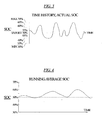
- the actual values of SOC can be compared with the running average of AOC by comparing FIGS. 3 and 4 .
- the running average of battery pack SOC momentary swings due to transient loads can be dampened out.
- the system will "learn” over time what the tendency of the harvest cycle is and can modify as time progresses.
- the time period for averaging could be a modifiable term or adjustable by the operator. For example, setting the system to "high” sensitivity might force averaging over a short time period (10 sec or 20 sec, for example). Setting to "low” sensitivity might raise this averaging time to 10 min, 20 min or more.
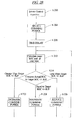
- a second method uses statistical mean and standard deviation to control SOC and make necessary adjustments as illustrated in FIG. 2B .
- the actual SOC values and time duration of those values are monitored over a time interval and the mean and standard deviation of SOC values over time are calculated over the selected time interval.
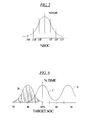
- the actual SOC values and time durations can be monitored over the prior 10 minutes, refreshed every 1 minute. This is demonstrated in FIG. 5 .
- FIG. 5 illustrates a histogram or bell curve where after the actual SOC values and the time duration of the SOC values are calculated, the SOC values versus % time duration for those SOC values are calculated and standard deviations are calculated and noted in FIG. 5 .
- the system speed is increased when the actual measured and calculated SOC is greater than a selected multiple of the calculated standard deviation added to the target SOC, and the mean is shifted over time to line up with the target SOC.
- the system speed is decreased when the actual measured and calculated SOC is less than a selected multiple of the calculated standard deviation subtracted from the target SOC, and the mean is shifted over time to line up with the target SOC.
- FIG. 6 locates the histogram or bell curve onto an axis showing three positions.
- a position "A" of the bell curve is a position wherein the power is underutilized given a target SOC of 50%. The mean of this bell curve is centered around 68%.
- the algorithm would cause the combine power demand, such as ground speed, to be increased to shift this curve to the left.
- a position "B” of the bell curve is a position wherein the power is over utilized given a target SOC of 50%.
- the mean of this bell curve is centered around 43%.
- the algorithm would cause the combine power demand, such as ground speed, to be decreased to shift this curve to the right.
- a position "C" of the bell curve is the desired position wherein the mean of this bell curve is centered around 50% the target SOC.
- the algorithm would cause the combine power demand, such as ground speed, to be maintained. According to this position "C" some actual SOC would be measured below the target SOC of 50% and some actual SOC would be measured above the target SOC of 50%, but the mean would be at 50% and measured SOC values would be within +/- +/- K ⁇ , K being 3 in this example.
- FIG 2B illustrates the second method.
- the operator initiates the control.
- the operator selects combine power demand, such as by selecting the combine ground speed.
- the algorithm calculates a mean SOC and a standard deviation over an interval of time, such as an immediately prior interval of time.
- the actual SOC is compared to the target SOC +/- K ⁇ .
- the target SOC can be 50% of maximum battery SOC and K can equal 3.
- the symbol ⁇ is the standard deviation.
- the immediately prior interval of time for example can be 10 minutes refreshed every one minute.
- the interval of time and the refresh rate can be longer or shorter in duration.
- the interval of time can be adjustable or selectable by the operator.
- the value of K can be a variable based on SOC or can be selectable by the operator to increase or decrease "sensitivity" such as the frequency of engine power corrections.
- step S222 if the actual SOC is greater than the target range SOC +/- K ⁇ then the combine power demand, such as ground speed, is increased. In other words, the SOC is high enough that the combine power is underutilized and can be increased.
- step S226 if the actual SOC is less than the target range SOC +/- K ⁇ then the combine power demand, such as ground speed, is decreased. In other words, the SOC is low enough that the combine power is over utilized and should be decreased to ensure that sufficient battery power is available when needed.
- step S228 if the actual SOC is within the target range SOC +/- K ⁇ then the combine power demand, such as ground speed, need not be changed.
- the third method is one where the operator is involved. The operator would gain active feedback regarding the hybrid drive and would be able to input a percentage of maximum engine power he wants to utilize.
- a user interface 300 for a hybrid drive for a combine is provided.
- the user interface is illustrated in FIGS. 7 and 8 and could be displayed on an operator screen.
- the user interface 300 can be integrated with the aforementioned automatic controls or correspond to a manual, operator control of the hybrid drive.
- the interface 300 includes a combine power gauge 306 that uses a moving arrow 307 that indicates combine power along the gauge 306, an SOC gauge 312, and a tachometer 313.
- the gauge 306 and the moving arrow 307 show the total combined power of the hybrid drive including the IC engine 11 and the electric motor/generator 14. The arrow moves over a green region 306a, a yellow region 306b and a red region 306c.
- the SOC gauge 312 not only displays the battery pack SOC, it also shows the operator when he is benefitting from the extra power afforded to him from battery power.
- the SOC gauge 312 depicts whether the battery pack is charging or discharging with "+" and "-" indicators 320.
- the gauge 312 also shows whether the battery pack is charging or discharging with arrow indicators going to (330) and from (332) the power gauge 306.
- the battery pack In times of light load, the battery pack will be recharged and increase its state of charge. During unloading on the go, slugs, or needs of transient response, the interface will tell the operator that the battery pack is being discharged.
- the interface allows an operator to manually adjust the combine load, such as to increase ground speed while monitoring the SOC drop, or to decrease speed, while monitoring the SOC gain. Alternately, the above described control algorithms can be automatically initiated to control engine speed and power to maintain the SOC at a target amount.
- FIG. 7 illustrates the operator interface 300 in a battery pack charging state.
- the IC engine is charging the battery pack.
- the power indicator arrow 307 is in the green region and the tachometer shows 2400 rpm.
- the SOC indicator 312 shows about 75% useful charge range, the charge indicator is at "+”, and the arrow indicators 332 are illuminated to show power flow from the power gauge 306 to the SOC gauge 312.
- the arrow indicators 330 are not illuminated.
- the useful charge range illustrated by the SOC gauge 312 need not be calibrated to exactly match the SOC percentages, in other words, a 75% on the gauge 312 doesn't have to correlate to a 75% SOC. Particularly, since the SOC may be controlled to not deviate too greatly from 50% SOC, the range displayed on the gauge 312 may show a smaller overall range of SOC values. For example, a 100% on the SOC gauge 312 can correspond to a 70% SOC and a 0% on the SOC gauge 312 can correspond to a 30% SOC gauge.
- FIG. 8 illustrates the operator interface 300 in a battery boost state.
- the battery pack through an electric motor, is providing power to the IC engine and the combine.
- the power gauge 306 is in the yellow range and the tachometer 313 is at 2000 RPM.
- the SOC indicator 312 shows about 25% useful charge range, the charge indicator is at "-", and the arrow indicators 330 are illuminated to show power flow from the SOC gauge 312 to the power gauge 306.
- the arrow indicators 332 are not illuminated. At about 25% shown the SOC gauge the display shows the 25% amount and lesser amounts in orange rather than green to alert the operator of low battery pack charge.
- the operator interface 300 for the hybrid combine shows the driver when the combine is benefitting from the power increase provided by the battery pack, and shows live feedback of the battery pack state of charge.
Landscapes
- Engineering & Computer Science (AREA)
- Transportation (AREA)
- Mechanical Engineering (AREA)
- Automation & Control Theory (AREA)
- Chemical & Material Sciences (AREA)
- Combustion & Propulsion (AREA)
- Charge And Discharge Circuits For Batteries Or The Like (AREA)
- Electric Propulsion And Braking For Vehicles (AREA)
- Hybrid Electric Vehicles (AREA)
Applications Claiming Priority (1)
| Application Number | Priority Date | Filing Date | Title |
|---|---|---|---|
| US13/841,101 US20140277877A1 (en) | 2013-03-15 | 2013-03-15 | Control and Operator Interface For Combine Having Hybrid Drive |
Publications (2)
| Publication Number | Publication Date |
|---|---|
| EP2778004A2 true EP2778004A2 (de) | 2014-09-17 |
| EP2778004A3 EP2778004A3 (de) | 2014-11-19 |
Family
ID=50151140
Family Applications (1)
| Application Number | Title | Priority Date | Filing Date |
|---|---|---|---|
| EP14155740.5A Withdrawn EP2778004A3 (de) | 2013-03-15 | 2014-02-19 | Steuerungs- und Bedienerschnittstelle für Mähdrescher mit Hybridantrieb |
Country Status (5)
| Country | Link |
|---|---|
| US (1) | US20140277877A1 (de) |
| EP (1) | EP2778004A3 (de) |
| AU (1) | AU2014201447A1 (de) |
| BR (1) | BR102014006080A2 (de) |
| RU (1) | RU2014108198A (de) |
Cited By (3)
| Publication number | Priority date | Publication date | Assignee | Title |
|---|---|---|---|---|
| US9987946B2 (en) * | 2015-06-29 | 2018-06-05 | Hyundai Motor Company | Apparatus for controlling state of charge of hybrid vehicle and method using the same |
| CN109991554A (zh) * | 2019-03-29 | 2019-07-09 | 深圳猛犸电动科技有限公司 | 一种电池电量检测方法、装置及终端设备 |
| CN109991545A (zh) * | 2019-03-29 | 2019-07-09 | 深圳猛犸电动科技有限公司 | 一种电池包电量检测方法、装置及终端设备 |
Families Citing this family (3)
| Publication number | Priority date | Publication date | Assignee | Title |
|---|---|---|---|---|
| JP6396867B2 (ja) * | 2015-08-25 | 2018-09-26 | 日立建機株式会社 | ハイブリッド建設機械 |
| JP7184028B2 (ja) | 2019-12-19 | 2022-12-06 | トヨタ自動車株式会社 | 電力制御システム、電動車両および電力制御方法 |
| JP2024053958A (ja) * | 2022-10-04 | 2024-04-16 | カワサキモータース株式会社 | 乗物用の表示システム、鞍乗型乗物及び乗物用の表示方法 |
Citations (1)
| Publication number | Priority date | Publication date | Assignee | Title |
|---|---|---|---|---|
| US7949442B2 (en) | 2006-09-08 | 2011-05-24 | Deere & Company | System and method for boosting torque output of a drive train |
Family Cites Families (23)
| Publication number | Priority date | Publication date | Assignee | Title |
|---|---|---|---|---|
| JP3050054B2 (ja) * | 1994-09-01 | 2000-06-05 | トヨタ自動車株式会社 | 発電制御方法 |
| DE102004007837A1 (de) * | 2004-02-17 | 2005-09-01 | Claas Selbstfahrende Erntemaschinen Gmbh | Landwirtschaftliche Arbeitsmaschine |
| US8026698B2 (en) * | 2006-02-09 | 2011-09-27 | Scheucher Karl F | Scalable intelligent power supply system and method |
| US7276806B1 (en) * | 2006-09-08 | 2007-10-02 | Deere & Company | System and method for boosting torque output of a drive train |
| US7992370B2 (en) * | 2008-03-14 | 2011-08-09 | Deere & Company | Work machine with auxiliary power unit and intelligent power management |
| US7945378B2 (en) * | 2008-09-22 | 2011-05-17 | Deere & Company | Method of selecting engine torque curves |
| US8639392B2 (en) * | 2008-09-29 | 2014-01-28 | Battelle Memorial Institute | Electric power grid control using a market-based resource allocation system |
| RU2496039C2 (ru) * | 2008-10-21 | 2013-10-20 | Вольво Ластвагнар Аб | Способ и устройство выбора передачи для трогания с места гибридного электромобиля |
| US8086364B2 (en) * | 2009-03-11 | 2011-12-27 | General Electric Company | System and method for operation of electric and hybrid vehicles |
| US8209095B2 (en) * | 2009-05-11 | 2012-06-26 | Deere & Company | Agricultural harvester with dual engines and power sharing based on engine temperature |
| US8150584B2 (en) * | 2009-05-12 | 2012-04-03 | Deere & Company | Generation and starting system |
| US8352155B2 (en) * | 2009-05-21 | 2013-01-08 | Deere & Company | Engine for an agricultural harvester having isochronous torque curve with power bulge |
| US8087900B2 (en) * | 2009-05-22 | 2012-01-03 | Deere & Company | Agricultural harvester with propulsion load shifting between dual engines |
| US8008800B2 (en) * | 2009-05-22 | 2011-08-30 | Deere & Company | Harvester multiple engine energy control system |
| US20110100735A1 (en) * | 2009-11-05 | 2011-05-05 | Ise Corporation | Propulsion Energy Storage Control System and Method of Control |
| US9145048B2 (en) * | 2010-03-31 | 2015-09-29 | General Electric Company | Apparatus for hybrid engine control and method of manufacture same |
| US8405355B2 (en) * | 2010-09-23 | 2013-03-26 | GM Global Technology Operations LLC | Energy storage system energy capacity and capability monitor |
| JP5594748B2 (ja) * | 2010-10-15 | 2014-09-24 | 日立建機株式会社 | ハイブリッド建設機械 |
| US9859532B2 (en) * | 2011-03-31 | 2018-01-02 | Johnson Controls Technology Llc | Battery module and method incorporating exterior casing and liner |
| KR101294055B1 (ko) * | 2011-07-25 | 2013-08-08 | 기아자동차주식회사 | 하이브리드 차량의 파워트레인의 복합 분기 모드의 제어 방법 |
| US8981727B2 (en) * | 2012-05-21 | 2015-03-17 | General Electric Company | Method and apparatus for charging multiple energy storage devices |
| US20140081490A1 (en) * | 2012-09-14 | 2014-03-20 | Plug-In Conversions Corporation | System and method of converting a standard hybrid vehicle into a plug-in hybrid electric vehicle (phev) |
| US8670888B1 (en) * | 2013-06-18 | 2014-03-11 | XL Hybrids | Dynamically assisting hybrid vehicles |
-
2013
- 2013-03-15 US US13/841,101 patent/US20140277877A1/en not_active Abandoned
-
2014
- 2014-02-19 EP EP14155740.5A patent/EP2778004A3/de not_active Withdrawn
- 2014-03-03 RU RU2014108198/11A patent/RU2014108198A/ru not_active Application Discontinuation
- 2014-03-13 AU AU2014201447A patent/AU2014201447A1/en not_active Abandoned
- 2014-03-14 BR BRBR102014006080-4A patent/BR102014006080A2/pt not_active IP Right Cessation
Patent Citations (1)
| Publication number | Priority date | Publication date | Assignee | Title |
|---|---|---|---|---|
| US7949442B2 (en) | 2006-09-08 | 2011-05-24 | Deere & Company | System and method for boosting torque output of a drive train |
Cited By (3)
| Publication number | Priority date | Publication date | Assignee | Title |
|---|---|---|---|---|
| US9987946B2 (en) * | 2015-06-29 | 2018-06-05 | Hyundai Motor Company | Apparatus for controlling state of charge of hybrid vehicle and method using the same |
| CN109991554A (zh) * | 2019-03-29 | 2019-07-09 | 深圳猛犸电动科技有限公司 | 一种电池电量检测方法、装置及终端设备 |
| CN109991545A (zh) * | 2019-03-29 | 2019-07-09 | 深圳猛犸电动科技有限公司 | 一种电池包电量检测方法、装置及终端设备 |
Also Published As
| Publication number | Publication date |
|---|---|
| BR102014006080A2 (pt) | 2015-05-05 |
| RU2014108198A (ru) | 2015-09-10 |
| US20140277877A1 (en) | 2014-09-18 |
| AU2014201447A1 (en) | 2014-10-02 |
| EP2778004A3 (de) | 2014-11-19 |
Similar Documents
| Publication | Publication Date | Title |
|---|---|---|
| EP2778004A2 (de) | Steuerungs- und Bedienerschnittstelle für Mähdrescher mit Hybridantrieb | |
| US8897943B2 (en) | Battery electric hybrid drive for a combine harvester | |
| JP4784566B2 (ja) | 二次電池の入出力電力制御装置及び入出力電力制御方法 | |
| CN106058362B (zh) | 车载二次电池的冷却系统 | |
| US7917276B2 (en) | Vehicle-use power supply apparatus | |
| DE102011054144B4 (de) | Regelverfahren zur Detektion von übermäßigem Strom | |
| US9475497B2 (en) | Electric implement power management system | |
| US12032030B2 (en) | Power unit including multiple battery packs for use with outdoor power equipment | |
| US9192096B2 (en) | Electric lawn tractor power management system and method | |
| US20220137147A1 (en) | Detecting battery pack type based on battery pack impedance | |
| US11979049B2 (en) | Electric work machine | |
| EP2383141A2 (de) | Steuervorrichtung eines elektrischen Fahrzeugs | |
| US20150357853A1 (en) | Motor-driven appliance and main body thereof | |
| US9113596B2 (en) | Hybrid electric turf mower with power shed and power boost | |
| US20170120774A1 (en) | Management device for secondary battery | |
| US9729008B2 (en) | Life degradation mitigation for transient response energy storage | |
| CN107472080A (zh) | 车辆的转矩控制方法、装置及车辆 | |
| US11437936B2 (en) | Outdoor power equipment with distributed motor controllers | |
| FR3002370A1 (fr) | Procede de regulation de la temperature d'une batterie d'accumulateurs | |
| JP7645787B2 (ja) | 電動作業車 | |
| CN119975321B (zh) | 一种插电式混动动力车辆的能量管理方法及系统 | |
| US11014549B1 (en) | Regeneration power control | |
| JP2017192272A (ja) | 電源制御装置 | |
| JP6585638B2 (ja) | 自動較正を有する電力管理システム | |
| CN119855491A (zh) | 电池和负载控制系统及方法 |
Legal Events
| Date | Code | Title | Description |
|---|---|---|---|
| PUAI | Public reference made under article 153(3) epc to a published international application that has entered the european phase |
Free format text: ORIGINAL CODE: 0009012 |
|
| 17P | Request for examination filed |
Effective date: 20140219 |
|
| AK | Designated contracting states |
Kind code of ref document: A2 Designated state(s): AL AT BE BG CH CY CZ DE DK EE ES FI FR GB GR HR HU IE IS IT LI LT LU LV MC MK MT NL NO PL PT RO RS SE SI SK SM TR |
|
| AX | Request for extension of the european patent |
Extension state: BA ME |
|
| PUAL | Search report despatched |
Free format text: ORIGINAL CODE: 0009013 |
|
| AK | Designated contracting states |
Kind code of ref document: A3 Designated state(s): AL AT BE BG CH CY CZ DE DK EE ES FI FR GB GR HR HU IE IS IT LI LT LU LV MC MK MT NL NO PL PT RO RS SE SI SK SM TR |
|
| AX | Request for extension of the european patent |
Extension state: BA ME |
|
| RIC1 | Information provided on ipc code assigned before grant |
Ipc: B60W 20/00 20060101AFI20141010BHEP |
|
| STAA | Information on the status of an ep patent application or granted ep patent |
Free format text: STATUS: THE APPLICATION IS DEEMED TO BE WITHDRAWN |
|
| 18D | Application deemed to be withdrawn |
Effective date: 20150520 |