EP2778047A2 - Ensemble d'amortissement pour train d'atterrissage d'aéronef, par exemple une roue de nez - Google Patents
Ensemble d'amortissement pour train d'atterrissage d'aéronef, par exemple une roue de nez Download PDFInfo
- Publication number
- EP2778047A2 EP2778047A2 EP14159545.4A EP14159545A EP2778047A2 EP 2778047 A2 EP2778047 A2 EP 2778047A2 EP 14159545 A EP14159545 A EP 14159545A EP 2778047 A2 EP2778047 A2 EP 2778047A2
- Authority
- EP
- European Patent Office
- Prior art keywords
- nosewheel
- landing gear
- damper
- eddy current
- damping arrangement
- Prior art date
- Legal status (The legal status is an assumption and is not a legal conclusion. Google has not performed a legal analysis and makes no representation as to the accuracy of the status listed.)
- Withdrawn
Links
Images




Classifications
-
- B—PERFORMING OPERATIONS; TRANSPORTING
- B64—AIRCRAFT; AVIATION; COSMONAUTICS
- B64C—AEROPLANES; HELICOPTERS
- B64C25/00—Alighting gear
- B64C25/32—Alighting gear characterised by elements which contact the ground or similar surface
- B64C25/50—Steerable undercarriages; Shimmy-damping
- B64C25/505—Shimmy damping
-
- F—MECHANICAL ENGINEERING; LIGHTING; HEATING; WEAPONS; BLASTING
- F16—ENGINEERING ELEMENTS AND UNITS; GENERAL MEASURES FOR PRODUCING AND MAINTAINING EFFECTIVE FUNCTIONING OF MACHINES OR INSTALLATIONS; THERMAL INSULATION IN GENERAL
- F16F—SPRINGS; SHOCK-ABSORBERS; MEANS FOR DAMPING VIBRATION
- F16F15/00—Suppression of vibrations in systems; Means or arrangements for avoiding or reducing out-of-balance forces, e.g. due to motion
- F16F15/02—Suppression of vibrations of non-rotating, e.g. reciprocating systems; Suppression of vibrations of rotating systems by use of members not moving with the rotating systems
- F16F15/03—Suppression of vibrations of non-rotating, e.g. reciprocating systems; Suppression of vibrations of rotating systems by use of members not moving with the rotating systems using magnetic or electromagnetic means
- F16F15/035—Suppression of vibrations of non-rotating, e.g. reciprocating systems; Suppression of vibrations of rotating systems by use of members not moving with the rotating systems using magnetic or electromagnetic means by use of eddy or induced-current damping
-
- F—MECHANICAL ENGINEERING; LIGHTING; HEATING; WEAPONS; BLASTING
- F16—ENGINEERING ELEMENTS AND UNITS; GENERAL MEASURES FOR PRODUCING AND MAINTAINING EFFECTIVE FUNCTIONING OF MACHINES OR INSTALLATIONS; THERMAL INSULATION IN GENERAL
- F16F—SPRINGS; SHOCK-ABSORBERS; MEANS FOR DAMPING VIBRATION
- F16F2222/00—Special physical effects, e.g. nature of damping effects
- F16F2222/06—Magnetic or electromagnetic
Definitions
- This disclosure relates to a damping arrangement for damping oscillations in the landing gear of an aircraft, for example the nosewheel of an aircraft. This is commonly referred to in the art as shimmy.
- the nosewheel landing gear of an aircraft typically comprises one or more wheels mounted on an axle support which is supported for rotation about a steering axis.
- the axle support is mounted at the lower end of an oleo shock absorber tube, the upper end of which is received, in a telescopic manner, within a drive element.
- the telescopic mounting of the oleo tube is arranged to allow vertical movement of the axle support relative to the support, thereby serving to absorb shocks.
- the nature of the mounting between the oleo tube and the drive element also permits angular movement to occur therebetween. In order to transmit steering movement from the drive element to the axle support, a steering linkage is connected therebetween.
- a steering motor is arranged to drive the drive element for angular movement relative to a housing.
- a reduction gearbox may be provided between the steering motor and the drive element so as to reduce a relatively high rate of rotation of the motor to a relatively low rate of rotation of the drive element.
- the angular movement of the drive element is transmitted to the axle support via the steerage linkage, thereby changing the angular position of the axle support and thus the steering direction of the wheels.
- nosewheel landing gear arrangements of the above type can lead to the axle support oscillating or shimmying from side to side around its axis. If unchecked, resonance may result in the oscillations tending to increase in amplitude, and there is the risk of damage being caused to the landing gear by the oscillations, or in loss of control of the aircraft on the ground.
- This disclosure addresses the problem of shimmying in aircraft landing gear, for example in an aircraft nosewheel.
- One aspect of this disclosure relates to an aircraft landing gear damping arrangement comprising an eddy current damper coupled to a component of the landing gear to damp oscillations of the landing gear about an axis.
- the component damped may be a main landing gear component or a nosewheel component for example.
- a further aspect of this disclosure therefore relates to an aircraft nosewheel damping arrangement comprising:
- shimmying of the nosewheel may be reduced or prevented by an eddy current damper which is coupled to the nosewheel support axle.
- the damping arrangement may be incorporated in an aircraft nosewheel drive arrangement comprising a steering motor, a drive element coupled to the motor and coupled to a nosewheel support axle through an articulated linkage for rotating the nosewheel support axle about the steering axis.
- the eddy current damper may be coupled to the component or nosewheel support axle in any appropriate manner.
- the damper may for example be arranged in series with the steering motor with respect to the nosewheel support axle. In such arrangements, the damper may be arranged in the drive path between the steering motor and the nosewheel support axle.
- the eddy current damper may be incorporated into the steering motor itself.
- the eddy current damper may be provided at least in part on the shaft of the motor or on a shaft coupled to the motor shaft.
- the eddy current damper may be arranged upstream of, i.e. on the steering motor side of, the gearing.
- the damper may be arranged between the steering motor and the reduction gearing.
- the eddy current damper may be positioned downstream of, i.e. on the drive element side of, the reduction gearing in other examples.
- the eddy current damper may be positioned in parallel therewith (or around the leg, etc.), i.e. not in the drive path between the motor and the nosewheel support axle.
- parallel as used in this context therefore does not mean that the axis of the eddy damper is necessarily parallel to that of the motor, although in various embodiments described below it is.
- the damper may for example be provided on a separate damper shaft driven by, for example, the drive element.
- the steering motor may be aligned generally coaxially with, generally parallel to, or generally perpendicular to the steering axis.
- the eddy current damper may be coupled to the component or nosewheel support axle by gearing which magnifies the rotational speed of the oscillation of the component or nosewheel support axle by the ratio of the gearing, and reduces the torque generated by the movement by the same ratio.
- the eddy current damper may take any convenient form. In the described arrangements it is a permanent magnet eddy current damper, i.e. one which incorporates permanent magnets.
- the magnets interact with an electrically conductive member, for example a plate or ring of an electrically conductive material to produce a damping force.
- the damper is a rotary damper having a rotor and a stator, the relative rotary movement between the rotor and stator providing the damping effect.
- the damper may therefore comprise a first element comprising one or more magnetic elements arranged in a ring and an electrically conductive element arranged in a facing relationship to the magnetic elements.
- the magnetic element or elements may be arranged on an outward surface of a support, and the conductive element arranged radially outwardly theerof. In another arrangement, however, the magnetic element or elements may be arranged on an inner surface of a support with the conductive element arranged radially inwardly of the magnetic element(s).
- the magnetic element(s) may be permanent magnets e.g. samarium cobalt magnets.
- the conductive material may be copper, aluminium, copper alloy, aluminium alloy or brass, for example. The particular materials chosen and their size and disposition will depend upon the particular installation and the damping effect required.
- Figure 1 illustrates schematically a first damping arrangement in accordance with this disclosure.
- a nosewheel landing gear 2 comprises a pair of nosewheels 4 mounted on a support axle 6.
- the support axle 6 is mounted on an oleo strut 8 which is received telescopically within a support housing (not shown) such that the nosewheel 4 and support axle 6 may move up and down.
- the support axle 6 is rotatable about a steering axis A.
- the support axle 6 is coupled to a drive element 10, for example a drive tube or collar, by means of an articulated steering linkage 12.
- the drive element 10 is fixed vertically relative to the support housing, such that the steering linkage 12 accommodates the relative vertical movement between the support axle 6 and the drive element 10.
- the drive element 10 is, however, mounted for rotation relative to the support housing about steering axis A.
- the linkage 12 transmits rotation of the drive element 10 to the support axle 6 to rotate the support axle 6 about the steering axis A to steer the aircraft.
- the drive element 10 is driven by an electric steering motor 14 via gearing 16.
- the rotational axis X of the steering motor 14 is arranged parallel to the steering axis A.
- the gearing 16 may include a reduction gearbox 18 operatively coupled to the steering motor 14 and spur or other gearing 20 for transmitting the output of the gearbox 18 to the drive element 10.
- the gearing 22 provided on the drive element 10 is illustrated as extending through 360° about the drive element 10, this may not be necessary since the drive element 10 does need to rotate through 360°.
- an eddy current damper 24 which is coupled in series with the steering motor 14.
- the damper 24 may be integrated in the steering motor 14, for example arranged between the steering motor 14 and the reduction gearbox 18.
- the damper 24 could be positioned elsewhere, for example in the gearbox 16 or between the gearbox 18 and the gearing 20. Further details of the damper 24 and its mode of operation will be given below.
- FIG 2 illustrates an alternative damping arrangement 2.
- the eddy current damper 24 is arranged in parallel with the steering motor 14, i.e. not in the direct drive path between the steering motor 14 and the nosewheel support axle.
- the damper 24 is provided on or coupled to a subsidiary shaft 26 which is coupled to the gearing 20 such that rotary movement of the drive element 10 due either to rotation of the steering motor 14 or from shimmying of the nosewheels 4 is transmitted to the damper 24 to provide a damping effect. It is 'geared-up' from steering speed.
- FIG 3 illustrates a further alternative damping arrangement which is similar to that shown in Figure 2 , except that the steering motor 14 is arranged along and axis Y which is parallel to an axis which is perpendicular to the steering axis A, rather than parallel to the steering axis A itself.
- the gearbox 16 may be replaced by a screw and nut arrangement 28 in which, for example, a screw 30 drives a rack 32 which drives the drive element 10 via a pinion gear 34.
- the damper 24 is coupled to the subsidiary shaft 26 as in the arrangement of Figure 2 so that the damper 24 will be responsive to movement of the drive element 10 caused by either rotation of the steering motor 14 or shimmying of the nosewheel 4.
- the damper 24 could be arranged between the steering motor 14 and the pinion gear 34.
- the nosewheel landing gear 102 comprises a support housing 104 which receives an oleo strut 106.
- the oleo strut 106 carries a nosewheel support axle 108 at its lower end.
- the support housing 104 is connected to a retracting linkage (not shown) for retracting the nosewheel landing gear into the aircraft.
- the nosewheel support axle is coupled to a tubular drive collar 110 via a torque steering linkage 112, as is conventional in the art.
- the drive collar 110 is mounted to the support housing 104 such that it may rotate about steering axis A relative to the support housing 104, but such that it is fixed vertically with respect thereto.
- the drive collar 110 has an axle 114 for pivotably receiving one end of the upper link of the steering linkage 112.
- An upper part 116 of the drive collar 110 is provided with gear teeth 118 which extend over a limited circumferential arc.
- the gear teeth 118 mesh with a spur gear 120 mounted to the output of a planetary reduction gearbox 122 which is mounted to the lower end of the motor housing 124 of an brushless DC electric steering motor 126 via fasteners 128 to form a motor/gearbox assembly 130.
- the reduction gearbox 122 has a reduction ratio of about 150:1 such that a typical motor speed of 450 rpm is reduced to a rotational speed of the drive collar 110 (and thus of the nosewheel support axle) of about 3 rpm. This corresponds to a turning speed of about 18° per second at the nosewheel.
- this gearing ratio is purely exemplary and other ratios are possible for example in the range 100:1 to 200:1.
- the motor/gearbox assembly 130 is fixedly mounted to the support housing 104 by suitable means, for example including a mounting ring 132 connected to the motor housing 124.
- the lower end of the motor housing 124 receives a bearing housing 134 which mounts a bearing 136 which supports a lower end 138 of the motor shaft 140.
- the lower end 138 of the motor shaft 140 includes internal splines 142 which engage with external splines 144 of an input shaft 146 of the reduction gearbox 122.
- the upper end 148 of the motor shaft 140 is supported by means of bearings 150 provided in a cap 152 of the motor housing 124.
- the motor shaft 140 is also provided with an array of permanent magnets 154 which are arranged radially inwardly of a motor stator and winding 156.
- the motor housing 124 is provided with external fins 158 in the vicinity of the stator 156 to dissipate heat generated in the stator 156 in use.
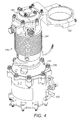
- An eddy current damper indicated generally 160 is integrated in the motor 132.
- the eddy current damper 160 comprises a rotor 162 comprising a circumferential array of permanent magnets 164, for example samarium cobalt magnets, arranged on an external surface of an intermediate section 166 of the motor shaft 140.
- 16 magnets 164 are provided, but this number may vary depending on the particular installation.
- the motor shaft 140 acts as a back iron for the magnets 164.
- the damper rotor 162 is surrounded by a damper stator 168 which is formed by a conductive metal ring 170, which may for example be formed of copper, aluminum or brass, and which is received within a sleeve 172 mounted within a bore 174 of the motor housing 124. There is a relatively small gap between the damper rotor 162 and the damper stator 168.
- the position of the magnets 164 and the conductive ring 170 may be reversed (i.e. the magnets 164 mounted statically to the motor housing 130 and the conductive ring 170 mounted to or formed by the motor shaft 142.
- the stator 168 is circumferentially continuous in this embodiment in order to maximise the creation of eddy currents therein and therefore maximise the damping effect.
- damper rotor 162 will induce eddy currents in the damper 160 which will give rise to a force or torque being generated which will act in a direction opposite that of the rotational movement, thereby acting to damp that movement, i.e. the shimmying.
- the ring 170 acts as a mechanical ground against which the torque produced by the damper 160 is generated.
- the eddy current damper 160 is functionally separate from the motor, that is, it functions independently from the motor. This is therefore functionally the same as in the other arrangements illustrated where the eddy current damper is completely separate from the motor.
- a suitable input is fed to the motor stator 156 so as to rotate the motor shaft 140.
- the steering motor 126 typically rotates at about 450 rpm.
- the rotation of the motor shaft 140 is transmitted via the reduction gearbox 122 and gearing 118, 120 to the drive collar 110 and thence to the nosewheel support axle via the torque linkage 112 in order to rotate the nosewheel support axle and thereby steer the aircraft.
- the axle Given the reduction ratio of the gearbox, the axle will rotate about steering axis A at about 3 rpm, i.e. at about 18° per second.
- the nosewheels when they have been moved to the commanded position, they may be subject to shimmy, which will cause the nosewheel support axle to oscillate about the steering axis A.
- This oscillation will typically be at a relatively high rotational speed compared to the rotational steering speed.
- the oscillation may have a rotational speed (in each rotational direction) in the region of 120° per second, i.e. 20 rpm.
- the shimmy speed may differ, for example be 15 - 30 rpm.
- This oscillating motion will be transmitted back to the drive collar 110 through the steering linkage 112 and from the collar 110 back to the motor shaft 140 through the gearbox 122.
- the reduction gearbox now magnifies the rotational speed of the oscillation by its reduction ratio, so that a shimmy speed of say 20 rpm at the nosewheel will be magnified to 3000 rpm at the motor shaft 140. It also reduces the torque produced by the shimmying movement by the same ratio.
- the eddy current damper rotor 162 which in effect forms a part of the motor shaft 140, will oscillate with an alternating rotational speed of about 3000 rpm.
- This oscillation relative to the eddy current damper stator 168 will induce eddy currents in the damper 160 which will act to produce a force on the motor shaft 140 to counteract the oscillation, thereby damping the shimmying of the nosewheel.
- damping force or torque produced by the eddy current damper 160 will, for example, depend upon the size of the damper rotor 162 and the damper stator 168 and the materials used therein. It is undesirable to create a high damping force at the normal operating speed or under back-drive conditions of the steering motor 126 as this would counteract the steering force applied to the nosewheels.
- the speed response of damper is in effect tunable to a particular application. However, a higher damping force is desirable at the higher shimmy speeds.
- the damping force created by a rotary eddy current damper will generally increase with the relative speeds of the damper rotor and the rotor stator, so that the shimmy damping forces will be higher and advantageously very much higher than those forces acting to damp the normal operation of the steering motor.
- Figure 7 illustrates the damping torque produced by a damper with the following dimensions and properties:
- the torque produced by the damper at shimmy speeds of 1800 rpm will be at least three times the torque produced by the damper at a normal motor steering speed of 450 rpm, or under back-drive conditions, when a tow truck is being used to move the aircraft on the ground, which will typically produce a rotational speed of about 300 rpm at the damper.
- integrating the damper 160 in the motor 124 is advantageous in that, inter alia, it permits a reduction in the size of the damper 160 since the gearbox 122 reduces the load which needs to be counteracted by the damper 160 by the ratio of the gearbox. Also, the positioning of the damper between the motor 124 and the gearbox 122 allows a compact arrangement. Providing the damper rotor 162 as part of the motor shaft 140 also reduces the number of parts. Of course at least some of these benefits would be achieved in arrangements in which for example the damper rotor 162 was provided on a shaft separate from but coupled to the motor shaft 140.
- rotary damper described above may also be used in, for example, the arrangements illustrated schematically in Figures 2 and 3 .
- the damper rotor may be suitably formed on the subsidiary shaft driven by the drive element 10.
- the eddy current damper of this disclosure is a passive damper and does not rely upon or require any external electrical, hydraulic or other supply. This is advantageous not only in terms of simplifying construction, but also meaning that the damper will operate even if there were to be a fault in the electrical or hydraulic systems.
- the damper is permanently operable, meaning that no control mechanism is required to operate the systems. Thus the damper is active even while the steering motor is operative or inoperative in case of electrical failure.
- the described dampers are noncontact meaning that damper wear and thus the need for maintenance is insignificant.
- the embodiments show the eddy current damper to be arranged around an axis which is offset from the steering axis of the nosewheel, it may be possible to arrange the eddy current damper around the steering axis. This may be desirable in arrangements where, for example, the steering motor is coaxial with the steering axis.
- the eddy current damper may also be used with other forms of steering motor, for example hydraulic steering motors.
- the eddy current damper may be positioned in any convenient location, for example coaxially with or offset from the component. It may be coupled to the relevant component through a direct connection, i.e. such that it oscillates with the same rotational speed as the component, or through a "geared up" arrangement which increases the rotational speed experienced by the damper, depending on the particular circumstances.
Landscapes
- Engineering & Computer Science (AREA)
- Mechanical Engineering (AREA)
- Aviation & Aerospace Engineering (AREA)
- Physics & Mathematics (AREA)
- General Engineering & Computer Science (AREA)
- Electromagnetism (AREA)
- Acoustics & Sound (AREA)
- Dynamo-Electric Clutches, Dynamo-Electric Brakes (AREA)
- Vibration Prevention Devices (AREA)
- Steering-Linkage Mechanisms And Four-Wheel Steering (AREA)
- Gear Transmission (AREA)
Applications Claiming Priority (1)
| Application Number | Priority Date | Filing Date | Title |
|---|---|---|---|
| GB1304791.5A GB2511856B (en) | 2013-03-15 | 2013-03-15 | Damping arrangement for aircraft landing gear, for example a nosewheel |
Publications (2)
| Publication Number | Publication Date |
|---|---|
| EP2778047A2 true EP2778047A2 (fr) | 2014-09-17 |
| EP2778047A3 EP2778047A3 (fr) | 2017-06-21 |
Family
ID=48226487
Family Applications (1)
| Application Number | Title | Priority Date | Filing Date |
|---|---|---|---|
| EP14159545.4A Withdrawn EP2778047A3 (fr) | 2013-03-15 | 2014-03-13 | Ensemble d'amortissement pour train d'atterrissage d'aéronef, par exemple une roue de nez |
Country Status (2)
| Country | Link |
|---|---|
| EP (1) | EP2778047A3 (fr) |
| GB (1) | GB2511856B (fr) |
Cited By (9)
| Publication number | Priority date | Publication date | Assignee | Title |
|---|---|---|---|---|
| US9732818B2 (en) | 2015-10-13 | 2017-08-15 | Goodrich Corporation | Axial engagement-controlled variable damper systems and methods |
| US9765850B2 (en) | 2015-10-13 | 2017-09-19 | Goodrich Corporation | Saturation-controlled variable damper systems and methods |
| CN110271689A (zh) * | 2019-06-03 | 2019-09-24 | 西安飞机工业(集团)有限责任公司 | 一种飞机前轮转弯电动检测装置 |
| FR3086638A1 (fr) | 2018-09-28 | 2020-04-03 | Airbus Helicopters | Atterriseur a balancier motorise et aeronef |
| CN111038687A (zh) * | 2019-12-10 | 2020-04-21 | 中国航空工业集团公司成都飞机设计研究所 | 一种机械双余度起落架收放电动撑杆 |
| EP3702271A1 (fr) | 2019-02-28 | 2020-09-02 | Airbus Helicopters | Atterrisseur motorise et aeronef |
| EP3882137A1 (fr) * | 2020-03-19 | 2021-09-22 | Goodrich Corporation | Amortisseur de shimmy magnétique à centrage automatique |
| US11584517B2 (en) | 2021-03-08 | 2023-02-21 | Goodrich Corporation | Nose-wheel steering system |
| CN117698997A (zh) * | 2023-12-25 | 2024-03-15 | 兰州飞行控制有限责任公司 | 一种适用于全电无人机起落架的电动前轮操纵装置 |
Families Citing this family (5)
| Publication number | Priority date | Publication date | Assignee | Title |
|---|---|---|---|---|
| EP3006332A1 (fr) | 2014-10-08 | 2016-04-13 | Goodrich Actuation Systems Ltd. | Système d'orientation d'un train d'atterrissage avant |
| CN104443366B (zh) * | 2014-12-02 | 2016-08-24 | 国网山东省电力公司潍坊供电公司 | 用于无人直升机的长度可调式起落架 |
| EP3677812A4 (fr) * | 2017-08-29 | 2021-08-25 | Nippon Steel Corporation | Instrument à courant de foucault |
| FR3080363B1 (fr) * | 2018-04-18 | 2020-04-17 | Safran Landing Systems | Atterrisseur d'aeronef a partie inferieure orientable et dispositif d'orientation simplifie |
| CN112623201B (zh) * | 2020-12-14 | 2022-08-02 | 中航飞机起落架有限责任公司 | 一种具有双余度电动的转弯和减摆机构及飞机起落架 |
Family Cites Families (10)
| Publication number | Priority date | Publication date | Assignee | Title |
|---|---|---|---|---|
| NL58578C (fr) * | 1938-07-19 | 1900-01-01 | ||
| GB561456A (en) * | 1941-06-20 | 1944-05-22 | Dowty Equipment Ltd | Improvements in aircraft retractable alighting gear |
| US2372710A (en) * | 1941-12-11 | 1945-04-03 | Houdaille Hershey Corp | Hydraulic steering motor and shimmy dampener for airplane landing gear wheels |
| GB1256133A (en) * | 1969-06-30 | 1971-12-08 | British Aircraft Corp Ltd | Improvements relating to eddy current damping devices |
| GB2192041B (en) * | 1986-06-24 | 1990-10-10 | Fokker Bv | Vibration absorber with controllable resonance frequency |
| JPH06249290A (ja) * | 1993-02-22 | 1994-09-06 | Ebara Corp | 渦電流ダンパ |
| US7237748B2 (en) * | 2003-12-15 | 2007-07-03 | Delos Aerospace, Llc | Landing gear method and apparatus for braking and maneuvering |
| US7578465B2 (en) * | 2004-01-20 | 2009-08-25 | Lord Corporation | Aircraft front nose landing gear and method of making an aircraft landing gear |
| FR2925017B1 (fr) * | 2007-12-13 | 2010-01-15 | Messier Bugatti | Procede d'alimentation en energie d'actionneurs associes a un train d'atterrissage d'aeronef |
| GB0805829D0 (en) * | 2008-04-01 | 2008-04-30 | Goodrich Actuation Systems Ltd | Damping arrangement |
-
2013
- 2013-03-15 GB GB1304791.5A patent/GB2511856B/en not_active Expired - Fee Related
-
2014
- 2014-03-13 EP EP14159545.4A patent/EP2778047A3/fr not_active Withdrawn
Cited By (13)
| Publication number | Priority date | Publication date | Assignee | Title |
|---|---|---|---|---|
| US9732817B2 (en) | 2015-10-13 | 2017-08-15 | Goodrich Corporation | Axial engagement-controlled variable damper systems and methods |
| US9765850B2 (en) | 2015-10-13 | 2017-09-19 | Goodrich Corporation | Saturation-controlled variable damper systems and methods |
| US9732818B2 (en) | 2015-10-13 | 2017-08-15 | Goodrich Corporation | Axial engagement-controlled variable damper systems and methods |
| FR3086638A1 (fr) | 2018-09-28 | 2020-04-03 | Airbus Helicopters | Atterriseur a balancier motorise et aeronef |
| EP3702271A1 (fr) | 2019-02-28 | 2020-09-02 | Airbus Helicopters | Atterrisseur motorise et aeronef |
| FR3093322A1 (fr) | 2019-02-28 | 2020-09-04 | Airbus Helicopters | Atterrisseur motorisé et aéronef |
| CN110271689A (zh) * | 2019-06-03 | 2019-09-24 | 西安飞机工业(集团)有限责任公司 | 一种飞机前轮转弯电动检测装置 |
| CN111038687A (zh) * | 2019-12-10 | 2020-04-21 | 中国航空工业集团公司成都飞机设计研究所 | 一种机械双余度起落架收放电动撑杆 |
| CN111038687B (zh) * | 2019-12-10 | 2022-08-09 | 中国航空工业集团公司成都飞机设计研究所 | 一种机械双余度起落架收放电动撑杆 |
| EP3882137A1 (fr) * | 2020-03-19 | 2021-09-22 | Goodrich Corporation | Amortisseur de shimmy magnétique à centrage automatique |
| US11492104B2 (en) | 2020-03-19 | 2022-11-08 | Goodrich Corporation | Magnetic self-centering shimmy damper |
| US11584517B2 (en) | 2021-03-08 | 2023-02-21 | Goodrich Corporation | Nose-wheel steering system |
| CN117698997A (zh) * | 2023-12-25 | 2024-03-15 | 兰州飞行控制有限责任公司 | 一种适用于全电无人机起落架的电动前轮操纵装置 |
Also Published As
| Publication number | Publication date |
|---|---|
| GB2511856B (en) | 2015-07-01 |
| GB2511856A (en) | 2014-09-17 |
| EP2778047A3 (fr) | 2017-06-21 |
| GB201304791D0 (en) | 2013-05-01 |
Similar Documents
| Publication | Publication Date | Title |
|---|---|---|
| EP2778047A2 (fr) | Ensemble d'amortissement pour train d'atterrissage d'aéronef, par exemple une roue de nez | |
| JP5563642B2 (ja) | ヘリコプタの電動テールロータ | |
| EP1309482B1 (fr) | Actionneur de moyeu de rotor monte destine a commander une ailette sur un giravion | |
| JP5815200B2 (ja) | 航空機着陸装置用操向システム | |
| US10752343B2 (en) | Electric propulsion system for a rotary wing aircraft | |
| US10295029B2 (en) | Magnetic damping systems | |
| EP2107004B1 (fr) | Agencement d'amortisseur | |
| CA2903888A1 (fr) | Actionneur electromecanique loge dans l'articulation | |
| EP2916032B1 (fr) | Ensembles d'amortissement débrayable pour des surfaces aérodynamiques mobiles | |
| US10308355B2 (en) | Hub mounted vibration suppression system | |
| CN110461707B (zh) | 用于能够悬停的飞行器的旋翼 | |
| US20110255967A1 (en) | Active force generation/isolation system employing magneto rheological fluid (mrf) | |
| EP2624416B1 (fr) | Entraînement direct pour machine électrique rotative | |
| CN109236918B (zh) | 一种能量回收型电磁阻尼器 | |
| EP4461640A1 (fr) | Train d'atterrissage pour aéronef | |
| KR101452438B1 (ko) | 로봇 관절 구동장치 | |
| CN112984069A (zh) | 一种抗高过载舵系统 | |
| GB2597719A (en) | Motor for Aircraft | |
| RU2464444C1 (ru) | Ветродвигатель | |
| CN105546070B (zh) | 一种连接装置 |
Legal Events
| Date | Code | Title | Description |
|---|---|---|---|
| 17P | Request for examination filed |
Effective date: 20140313 |
|
| AK | Designated contracting states |
Kind code of ref document: A2 Designated state(s): AL AT BE BG CH CY CZ DE DK EE ES FI FR GB GR HR HU IE IS IT LI LT LU LV MC MK MT NL NO PL PT RO RS SE SI SK SM TR |
|
| AX | Request for extension of the european patent |
Extension state: BA ME |
|
| PUAI | Public reference made under article 153(3) epc to a published international application that has entered the european phase |
Free format text: ORIGINAL CODE: 0009012 |
|
| PUAL | Search report despatched |
Free format text: ORIGINAL CODE: 0009013 |
|
| AK | Designated contracting states |
Kind code of ref document: A3 Designated state(s): AL AT BE BG CH CY CZ DE DK EE ES FI FR GB GR HR HU IE IS IT LI LT LU LV MC MK MT NL NO PL PT RO RS SE SI SK SM TR |
|
| AX | Request for extension of the european patent |
Extension state: BA ME |
|
| RIC1 | Information provided on ipc code assigned before grant |
Ipc: B64C 25/50 20060101AFI20170515BHEP Ipc: F16F 15/03 20060101ALI20170515BHEP |
|
| STAA | Information on the status of an ep patent application or granted ep patent |
Free format text: STATUS: REQUEST FOR EXAMINATION WAS MADE |
|
| R17P | Request for examination filed (corrected) |
Effective date: 20171221 |
|
| RBV | Designated contracting states (corrected) |
Designated state(s): AL AT BE BG CH CY CZ DE DK EE ES FI FR GB GR HR HU IE IS IT LI LT LU LV MC MK MT NL NO PL PT RO RS SE SI SK SM TR |
|
| STAA | Information on the status of an ep patent application or granted ep patent |
Free format text: STATUS: THE APPLICATION HAS BEEN WITHDRAWN |
|
| 18W | Application withdrawn |
Effective date: 20210927 |