EP2788416B1 - Flammschutzmittel-mischungen enthaltend flammschutzmittel und aluminiumphosphite, verfahren zu ihrer herstellung und ihre verwendung - Google Patents
Flammschutzmittel-mischungen enthaltend flammschutzmittel und aluminiumphosphite, verfahren zu ihrer herstellung und ihre verwendung Download PDFInfo
- Publication number
- EP2788416B1 EP2788416B1 EP12798157.9A EP12798157A EP2788416B1 EP 2788416 B1 EP2788416 B1 EP 2788416B1 EP 12798157 A EP12798157 A EP 12798157A EP 2788416 B1 EP2788416 B1 EP 2788416B1
- Authority
- EP
- European Patent Office
- Prior art keywords
- flame retardant
- weight
- flame
- salts
- aluminium
- Prior art date
- Legal status (The legal status is an assumption and is not a legal conclusion. Google has not performed a legal analysis and makes no representation as to the accuracy of the status listed.)
- Active
Links
Classifications
-
- C—CHEMISTRY; METALLURGY
- C09—DYES; PAINTS; POLISHES; NATURAL RESINS; ADHESIVES; COMPOSITIONS NOT OTHERWISE PROVIDED FOR; APPLICATIONS OF MATERIALS NOT OTHERWISE PROVIDED FOR
- C09K—MATERIALS FOR MISCELLANEOUS APPLICATIONS, NOT PROVIDED FOR ELSEWHERE
- C09K21/00—Fireproofing materials
- C09K21/02—Inorganic materials
- C09K21/04—Inorganic materials containing phosphorus
-
- C—CHEMISTRY; METALLURGY
- C08—ORGANIC MACROMOLECULAR COMPOUNDS; THEIR PREPARATION OR CHEMICAL WORKING-UP; COMPOSITIONS BASED THEREON
- C08K—Use of inorganic or non-macromolecular organic substances as compounding ingredients
- C08K3/00—Use of inorganic substances as compounding ingredients
- C08K3/32—Phosphorus-containing compounds
-
- C—CHEMISTRY; METALLURGY
- C08—ORGANIC MACROMOLECULAR COMPOUNDS; THEIR PREPARATION OR CHEMICAL WORKING-UP; COMPOSITIONS BASED THEREON
- C08K—Use of inorganic or non-macromolecular organic substances as compounding ingredients
- C08K5/00—Use of organic ingredients
- C08K5/49—Phosphorus-containing compounds
- C08K5/51—Phosphorus bound to oxygen
- C08K5/53—Phosphorus bound to oxygen bound to oxygen and to carbon only
- C08K5/5313—Phosphinic compounds, e.g. R2=P(:O)OR'
-
- C—CHEMISTRY; METALLURGY
- C09—DYES; PAINTS; POLISHES; NATURAL RESINS; ADHESIVES; COMPOSITIONS NOT OTHERWISE PROVIDED FOR; APPLICATIONS OF MATERIALS NOT OTHERWISE PROVIDED FOR
- C09K—MATERIALS FOR MISCELLANEOUS APPLICATIONS, NOT PROVIDED FOR ELSEWHERE
- C09K21/00—Fireproofing materials
- C09K21/06—Organic materials
- C09K21/10—Organic materials containing nitrogen
-
- C—CHEMISTRY; METALLURGY
- C09—DYES; PAINTS; POLISHES; NATURAL RESINS; ADHESIVES; COMPOSITIONS NOT OTHERWISE PROVIDED FOR; APPLICATIONS OF MATERIALS NOT OTHERWISE PROVIDED FOR
- C09K—MATERIALS FOR MISCELLANEOUS APPLICATIONS, NOT PROVIDED FOR ELSEWHERE
- C09K21/00—Fireproofing materials
- C09K21/06—Organic materials
- C09K21/12—Organic materials containing phosphorus
Definitions
- the present invention relates to flame retardant mixtures containing flame retardants and aluminum phosphites, processes for their production and their use.
- Flame retardants are known from the prior art which are used alone or together with other components, in particular synergists, in a wide variety of polymers. These synergists, also known as flame retardant synergists, do not have to be flame retardant themselves, but they can significantly increase the effectiveness of flame retardants.
- the various components such as, for example, flame retardants, flame retardant synergists, additives and fillers, are usually mixed with the polymer to be flame-retarded by kneading and extrusion. This takes place at temperatures at which the polymer is molten and which can significantly exceed 320 °C for a short time. All components, in particular the flame retardants and the flame retardant synergists, must be able to withstand these temperatures without decomposing in order to be effective, i. H. here the flame retardancy, and obtain a flame retardant polymer blend.
- the task here is to additionally stabilize flame-retardant polymers with nanofillers and thus increase the glow-wire ignition temperature (GWIT).
- GWIT glow-wire ignition temperature
- the nanofiller acts as an inert substance and is used in addition to the flame retardant, whereby the proportion of solids in the flame-retardant polymer molding would be increased, which is accompanied by a loss of mechanical (positive) properties of the polymer.
- the object of using molding compositions based on halogen-containing polymers for cable sheathing, which meet the requirements for thermal stability and resistance to aging, is achieved by using a molding composition containing at least one halogen-containing polymer and a stabilizer combination.
- the stabilizer combination comprises a hydrotalcite and a basic calcium-aluminum hydroxy compound, preferably a zinc salt.
- the flame retardants are preferably dialkylphosphinic acids and/or their salts; to condensation products of melamine and / or reaction products of melamine with phosphoric acid and/or reaction products of condensation products of melamine with polyphosphoric acid or mixtures thereof; nitrogen-containing phosphates of the formulas (NH 4 ) y H 3 - y PO 4 or (NH 4 PO 3 ) z , where y is 1 to 3 and z is 1 to 10,000; benzoguanamine, tris(hydroxyethyl)isocyanurate, allantoin, glycouril, melamine, melamine cyanurate, dicyandiamide and/or guanidine; magnesium oxide, calcium oxide, aluminum oxide, zinc oxide, manganese oxide, tin oxide, aluminum hydroxide, boehmite, dihydrotalcite, hydrocalumite, magnesium hydroxide, calcium hydroxide, zinc hydroxide, hydrated tin oxide, manganese hydroxide, zinc borate, basic
- the flame retardant is preferably also melam, melem, melon, dimelamin pyrophosphate, melamine polyphosphate, melam polyphosphate, melon polyphosphate and/or melem polyphosphate and/or mixed polysalts thereof and/or ammonium hydrogen phosphate, ammonium dihydrogen phosphate and/or ammonium polyphosphate.
- the flame retardant is preferably also aluminum hypophosphite, zinc hypophosphite, calcium hypophosphite, sodium phosphite, monophenylphosphinic acid and salts thereof, mixtures of dialkylphosphinic acids and salts thereof and monoalkylphosphinic acids and salts thereof, 2-carboxyethylalkylphosphinic acid and salts thereof, 2-carboxyethylmethylphosphinic acid and salts thereof Salts, 2-carboxyethylarylphosphinic acid and salts thereof, 2-carboxyethylphenylphosphinic acid and salts thereof, oxa-10-phosphaphenanthrene (DOPO) and salts thereof and adducts of para-benzoquinone or itaconic acid and/or salts thereof.
- DOPO oxa-10-phosphaphenanthrene
- the invention also relates to flame retardant mixtures as claimed in one or more of claims 1 to 9, containing 0.1 to 99.9% by weight of flame retardants and 0.1 to 99.9% by weight of aluminum phosphites of the formulas (II) and/or or (III) and/or mixtures of aluminum phosphite of formula (III) with aluminum salts.
- the flame retardant mixtures preferably contain 50 to 99.9% by weight of flame retardants and 0.1 to 50% by weight of aluminum phosphites of the formulas (II) and/or (III) and/or Mixtures of aluminum phosphite of formula (III) with aluminum salts.
- the invention also relates to a method for producing flame retardant mixtures according to one or more of Claims 1 to 9, characterized in that powdered flame retardants are mixed with powdered aluminum phosphites of the formulas (II) and/or (III) and/or mixtures of aluminum phosphite Formula (III) mixes with aluminum salts.
- the invention also relates to the use of flame retardant mixtures according to one or more of claims 1 to 9 as an intermediate for further syntheses, as a binder, as a crosslinker or accelerator in the curing of epoxy resins, polyurethanes, unsaturated polyester resins, as polymer stabilizers, as crop protection agents, as Sequestering agent, as a mineral oil additive, as an anti-corrosion agent, in detergent and cleaning agent applications, in electronics applications.
- flame retardant mixtures in or as flame retardants, in particular in or as flame retardants for clear lacquers and intumescent coatings, in or as flame retardants for wood and other cellulose-containing products, in or as reactive and/or non-reactive flame retardants for polymers, for the production of flame-retardant polymer molding compositions, for the production of flame-retardant polymer moldings and/or for rendering polyester and cellulose pure and mixed fabrics flame-retardant by impregnation and/or as a synergist and/or as a synergist in other flame retardant mixtures.
- the invention also includes flame-retardant thermoplastic or duroplastic polymer molding compositions, polymer moldings, films, threads and/or fibers containing 0.1 to 45% by weight of flame retardant mixtures one or more of claims 1 to 9, 55 to 99.9% by weight thermoplastic or thermosetting polymer or mixtures thereof, 0 to 55% by weight additives and 0 to 55% by weight filler or reinforcing materials, the sum total of the components is 100% by weight.
- the invention preferably relates to flame-retardant thermoplastic or thermoset polymer molding compositions, polymer moldings, films, threads and/or fibers containing 1 to 30% by weight of flame retardant mixtures as claimed in one or more of claims 1 to 9, 10 to 97% by weight.
- the plastic of the flame-retardant thermoplastic or duroplastic polymer molding composition, polymer molding, films, threads and/or fibers is preferably thermoplastic polymers of the type polystyrene-HI (high-impact), polyphenylene ether, polyamides, polyesters, polycarbonates and blends or polymer blends of the ABS (acrylonitrile butadiene styrene) or PC/ABS (polycarbonate/acrylonitrile butadiene styrene) type or PPE/HIPS (polyphenylene ether/polystyrene HI) type plastics and/or thermosetting polymers of the unsaturated polyester and epoxy resin type.
- polystyrene-HI high-impact
- polyphenylene ether polyamides
- polyesters polycarbonates and blends or polymer blends of the ABS (acrylonitrile butadiene styrene) or PC/ABS (polycarbonate/acrylonitrile butadiene st
- the mixtures according to the invention preferably have a particle size of from 0.1 to 1000 ⁇ m.
- the mixtures according to the invention preferably have a bulk density of from 80 to 800 g/l, particularly preferably from 200 to 700 g/l.
- the mixtures according to the invention preferably have an L color value of from 85 to 99.9, particularly preferably from 90 to 98.
- the mixtures according to the invention preferably have an a color value of -4 to +9, particularly preferably -2 to +6.
- the mixtures according to the invention preferably have a b color value of -2 to +6, particularly preferably -1 to +3.
- L values range from 0 (black) to 100 (white), a values from -a (green) to +a (red), and b values from -b (blue) to +b (yellow).
- Preferred dialkylphosphinic acid salts are aluminum trisdiethylphosphinate, aluminum trismethylethylphosphinate, titanylbisdiethylphosphinate, titanium tetrakisdiethylphosphinate, titanylbismethylethylphosphinate, titanium tetrakismethylethylphosphinate, zinc bisdiethylphosphinate, zinc bismethylethylphosphinate and mixtures thereof.
- the mixtures according to the invention also include mixtures of one or more flame retardants with one or more aluminum phosphites, i. H. Mixtures of three, four or more are possible.
- Preferred polymer additives for flame-retardant polymer molding compositions and flame-retardant polymer moldings are UV absorbers, light stabilizers, lubricants, colorants, antistatic agents, nucleating agents, fillers, reinforcing agents and/or synergists
- the use of the flame-retardant polymer moldings according to the invention as lamp parts such as lamp sockets and holders, plugs and connector strips, bobbins, housings for capacitors or contactors and fuse switches, relay housings and reflectors is preferred.
- the invention also relates to intumescent flame retardant coatings containing 1 to 50% of the flame retardant mixtures according to the invention containing flame retardants and aluminum phosphites, 0 to 60% ammonium polyphosphate and 0 to 80% by weight of binders, foaming agents, fillers and/or polymer additives.
- the sparingly soluble aluminum salts are preferably aluminum hydroxide, aluminum hydroxychloride, polyaluminium hydroxy compounds, aluminum carbonates, hydrotalcites (Mg 6 Al 2 (OH) 16 CO 3 *nH 2 O) , Dihydroxyaluminum sodium carbonate (NaAl(OH) 2 CO 3 ), aluminum oxides, aluminum oxide hydrate, mixed aluminum oxide hydroxides, basic aluminum sulfate and/or alunite and, in the case of foreign ions, preferably chlorides, complex chlorides, bromides; to hydroxides, peroxides, peroxide hydrates, sulfites, sulfates, sulfate hydrates, acidic sulfates, hydrogen sulfates, peroxosulfates, peroxodisulfates; about nitrates; to carbonates, percarbonates,
- the aluminum salts in the mixtures of aluminum phosphite of the formula (III) with aluminum salts are preferably aluminum metal, aluminum alloys, oxides, hydroxides, peroxides, peroxide hydrates, carbonates, percarbonates, mixed carbonates/hydrates, formates, acetates, propionates, stearates, lactates , ascorbates, oxalates or aluminum salts with anions of acids that have a higher vapor pressure than phosphorous acid.
- the polymers preferably come from the group of thermoplastic polymers such as polyester, polystyrene or polyamide and/or thermoset polymers.
- the polymers are preferably polymers of mono- and diolefins, for example polypropylene, polyisobutylene, polybutene-1, poly-4-methyl-pentene-1, polyisoprene or polybutadiene, and polymers of cycloolefins such as, for. B. of cyclopentene or norbornene; also polyethylene (which may optionally be crosslinked), e.g. B.
- HDPE high density polyethylene
- HDPE-HMW high density and high molecular weight polyethylene
- HDPE-UHMW medium density polyethylene
- MDPE low density polyethylene
- LDPE low density polyethylene
- LLDPE linear lower polyethylene Density
- VLDPE branched low density polyethylene
- the polymers are preferably copolymers of mono- and diolefins with one another or with other vinyl monomers, such as e.g. B. ethylene-propylene copolymers, linear low-density polyethylene (LLDPE) and blends thereof with low-density polyethylene (LDPE), propylene-butene-1 copolymers, propylene-isobutylene copolymers, ethylene-butene-1 copolymers, ethylene- hexene copolymers, ethylene-methylpentene copolymers, ethylene-heptene copolymers, ethylene-octene copolymers, propylene-butadiene copolymers, isobutylene-isoprene copolymers, ethylene-alkyl acrylate copolymers, ethylene-alkyl methacrylate copolymers, ethylene-vinyl acetate Copolymers and their copolymers with carbon monoxide, or ethylene-
- the polymers are hydrocarbon resins (e.g. C 5 -C 9 ) including hydrogenated modifications thereof (e.g. tackifier resins) and mixtures of polyalkylenes and starch.
- hydrocarbon resins e.g. C 5 -C 9
- hydrogenated modifications thereof e.g. tackifier resins
- the polymers are preferably polystyrene ( Polystyrol® 143E (BASF)), poly(p-methylstyrene), poly(alpha-methylstyrene).
- the polymers are preferably copolymers of styrene or alpha-methylstyrene with dienes or acrylic derivatives, such as e.g. styrene butadiene, styrene acrylonitrile, styrene alkyl methacrylate, styrene butadiene alkyl acrylate and methacrylate, styrene maleic anhydride, styrene acrylonitrile methyl acrylate; Blends of high impact strength from styrene copolymers and another polymer, such as. B.
- styrene such as. styrene-butadiene-styrene, styrene-isoprene-styrene, styrene-ethylene/butylene-styrene or styrene-ethylene/propylene-styrene.
- the polymers are preferably graft copolymers of styrene or alpha-methylstyrene, such as styrene on polybutadiene, styrene on polybutadiene-styrene or polybutadiene-acrylonitrile copolymers, styrene and acrylonitrile (or methacrylonitrile) on polybutadiene; styrene, acrylonitrile and methyl methacrylate on polybutadiene; styrene and maleic anhydride on polybutadiene; styrene, acrylonitrile and maleic anhydride or maleimide on polybutadiene; Styrene and maleimide on polybutadiene, styrene and alkyl acrylates or alkyl methacrylates on polybutadiene, styrene and acrylonitrile on ethylene-propylene-diene terpolymers,
- the styrene polymers are preferably rather coarse-pored foams such as EPS (expanded polystyrene), e.g. B. Styrofoam (BASF) and / or fine-pored such as XPS (extruded polystyrene foam), z. B. Styrodur® (BASF).
- EPS expanded polystyrene
- BASF Styrofoam
- XPS extruded polystyrene foam
- BASF Styrodur®
- Polystyrene foams such as e.g. B.
- the polymers are preferably halogen-containing polymers, such as e.g. B. polychloroprene, chlorinated rubber, chlorinated and brominated copolymer of isobutylene-isoprene (halobutyl rubber), chlorinated or chlorosulfonated polyethylene, copolymers of ethylene and chlorinated ethylene, epichlorohydrin homo- and copolymers, especially polymers of halogen-containing vinyl compounds, such as. B.
- halogen-containing polymers such as e.g. B. polychloroprene, chlorinated rubber, chlorinated and brominated copolymer of isobutylene-isoprene (halobutyl rubber), chlorinated or chlorosulfonated polyethylene, copolymers of ethylene and chlorinated ethylene, epichlorohydrin homo- and copolymers, especially polymers of halogen-containing vinyl compounds, such as. B.
- polyvinyl chloride polyvinylidene chloride, polyvinyl fluoride, polyvinylidene fluoride; and their copolymers, such as vinyl chloride-vinylidene chloride, vinyl chloride-vinyl acetate or vinylidene chloride-vinyl acetate.
- the polymers are preferably polymers derived from alpha, beta-unsaturated acids and derivatives thereof, such as polyacrylates and polymethacrylates, polymethyl methacrylates impact-modified with butyl acrylate, polyacrylamides and polyacrylonitriles and copolymers of the monomers mentioned with one another or with other unsaturated monomers, such as B. acrylonitrile-butadiene copolymers, acrylonitrile-alkyl acrylate copolymers, acrylonitrile-alkoxyalkyl acrylate copolymers, acrylonitrile-vinyl halide copolymers or acrylonitrile-alkyl methacrylate-butadiene terpolymers.
- B acrylonitrile-butadiene copolymers
- acrylonitrile-alkyl acrylate copolymers acrylonitrile-alkoxyalkyl acrylate copolymers
- the polymers are preferably polymers derived from unsaturated alcohols and amines or their acyl derivatives or acetals, such as polyvinyl alcohol, polyvinyl acetate, stearate, benzoate, maleate, polyvinyl butyral, polyallyl phthalate, polyallylmelamine; and their copolymers with olefins.
- the polymers are preferably homo- and copolymers of cyclic ethers, such as polyalkylene glycols, polyethylene oxide, polypropylene oxide or their copolymers with bisglycidyl ethers.
- the polymers are preferably polyacetals, such as polyoxymethylene, and those polyoxymethylenes which contain comonomers, such as, for. ethylene oxide; Polyacetals modified with thermoplastic polyurethanes, acrylates or MBS.
- the polymers are preferably polyphenylene oxides and sulfides and mixtures thereof with styrene polymers or polyamides.
- the polymers are preferably polyurethanes derived from hydroxyl-terminated polyethers, polyesters and polybutadienes on the one hand and aliphatic or aromatic polyisocyanates on the other hand, and precursors thereof.
- the polymers are preferably polyamides and copolyamides derived from diamines and dicarboxylic acids and/or from aminocarboxylic acids or the corresponding lactams, such as polyamide 2/12, polyamide 4 (poly-4-aminobutyric acid, Nylon ® 4, Fa.
- polyamide 4/6 poly(tetramethylene adipamide), poly(tetramethylene adipamide), Nylon ® 4/6, from DuPont
- polyamide 6 polycaprolactam, poly-6-aminohexanoic acid, Nylon ® 6, from DuPont, Akulon K122, DSM, Zytel ® 7301, DuPont, Durethan ® B 29, Bayer
- polyamide 6/6 ((poly(N,N'-hexamethylene adipamide), Nylon ® 6/6, DuPont, Zytel ® 101, DuPont, Durethan ® A30, Durethan ® AKV, Durethan ® AM, Bayer, Ultramid ® A3, BASF), polyamide 6/9 (poly(hexamethylenenonanediamide), Nylon ® 6/ 9, DuPont), polyamide 6/10 (poly(hexamethylene sebacamide), Nylon® 6/10, DuPont), polyamide 6/12 (pol
- B poly-2,4,4-trimethylhexamethylene terephthalamide or poly-m-phenylene isophthalamide.
- Polyamides or copolyamides modified with EPDM or ABS; and polyamides condensed during processing ("RIM polyamide systems").
- the polymers are preferably polyureas, polyimides, polyamideimides, polyetherimides, polyesterimides, polyhydantoins and polybenzimidazoles.
- the polymers are preferably polyesters derived from dicarboxylic acids and dialcohols and/or from hydroxycarboxylic acids or the corresponding lactones, such as polyethylene terephthalate, polybutylene terephthalate ® (Celanex ® 2500, Celanex ® 2002, from Celanese; Ultradur ® , from BASF ), poly-1,4-dimethylolcyclohexane terephthalate, polyhydroxybenzoates, and block polyetheresters derived from hydroxyl-terminated polyethers; also polyesters modified with polycarbonates or MBS.
- polyesters derived from dicarboxylic acids and dialcohols and/or from hydroxycarboxylic acids or the corresponding lactones such as polyethylene terephthalate, polybutylene terephthalate ® (Celanex ® 2500, Celanex ® 2002, from Celanese; Ultradur ® , from BASF ), poly-1,4-dimethylol
- the polymers are preferably polycarbonates and polyester carbonates.
- the polymers are preferably polysulfones, polyethersulfones and polyetherketones.
- the polymers are preferably crosslinked polymers derived from aldehydes on the one hand and phenols, urea or melamine on the other. such as phenol-formaldehyde, urea-formaldehyde and melamine-formaldehyde resins.
- the polymers are preferably drying and non-drying alkyd resins.
- the polymers are preferably unsaturated polyester resins derived from copolyesters of saturated and unsaturated dicarboxylic acids with polyhydric alcohols, and vinyl compounds as crosslinking agents, as well as their halogen-containing, flame-retardant modifications.
- the polymers are preferably crosslinkable acrylic resins derived from substituted acrylic acid esters, such as epoxy acrylates, urethane acrylates or polyester acrylates.
- the polymers are preferably alkyd resins, polyester resins and acrylate resins which are crosslinked with melamine resins, urea resins, isocyanates, isocyanurates, polyisocyanates or epoxy resins.
- the polymers are preferably crosslinked epoxy resins which are derived from aliphatic, cycloaliphatic, heterocyclic or aromatic glycidyl compounds, e.g. B. products of bisphenol A diglycidyl ethers, bisphenol F diglycidyl ethers, which are produced using conventional hardeners such as e.g. B. anhydrides or amines with or without accelerators.
- B. products of bisphenol A diglycidyl ethers, bisphenol F diglycidyl ethers which are produced using conventional hardeners such as e.g. B. anhydrides or amines with or without accelerators.
- the polymers are preferably mixtures (polyblends) of the aforementioned polymers, such as e.g. B. PP/EPDM (polypropylene/ethylene propylene diene rubber), polyamide/EPDM or ABS (polyamide/ethylene propylene diene rubber or acrylonitrile butadiene styrene), PVC/EVA (polyvinyl chloride/ethylene vinyl acetate), PVC/ABS (polyvinyl chloride/acrylonitrile butadiene styrene), PVC/MBS (polyvinyl chloride/methacrylate butadiene styrene), PC/ABS (polycarbonate/acrylonitrile butadiene styrene), PBTP/ABS (polybutylene terephthalate/acrylonitrile butadiene styrene), PC /ASA (polycarbonate/acrylic ester styrene acrylonitrile), PC/
- Suitable compounding units that can be used for the production of polymer molding materials are single-screw extruders or single-screw extruders, e.g. B. the company Berstorff GmbH, Hanover and or the company Leistritz, Nuremberg.
- Suitable compounding units are multi-zone screw extruders with three-zone screws and/or short compression screws.
- Suitable compounding units are twin-screw extruders, e.g. from Coperion Werner & Pfleiderer GmbH & Co.KG, Stuttgart (ZSK 25, ZSK30, ZSK 40, ZSK 58, ZSK MEGAcompounder 40, 50, 58, 70, 92, 119, 177, 250, 320, 350, 380) and/or from Berstorff GmbH, Hanover, Leistritz Extrusionstechnik GmbH, Nuremberg.
- Compounding units that can be used are also ring extruders, e.g. B. the company 3 + Extruder GmbH, running with a ring of three to twelve small screws that rotate around a static core and / or planetary roller extruder e.g. B. Entex, Bochum and / or venting extruder and / or cascade extruder and / or Maillefer-Schecken.
- ring extruders e.g. B. the company 3 + Extruder GmbH, running with a ring of three to twelve small screws that rotate around a static core and / or planetary roller extruder e.g. B. Entex, Bochum and / or venting extruder and / or cascade extruder and / or Maillefer-Schecken.
- Suitable compounding units are compounders with counter-rotating twin screws, e.g. B. Compex 37 or -70 types from Krauss-Maffei Berstorff.
- the flame retardant components were mixed with the polymer granules and any additives and extruded in a twin-screw extruder (Leistritz LSM 30/34) at temperatures of 230 to 260 °C (PBT-GV) or 260 to 280 °C (PA 66- GV) incorporated.
- the homogenized polymer strand was drawn off, cooled in a water bath and then granulated.
- the molding compounds were processed into test specimens on an injection molding machine (Aarburg Allrounder type) at melt temperatures of 240 to 270° C. (PBT-GV) or 260 to 290° C. (PA 66-GV).
- the fire class UL 94 (Underwriter Laboratories) was determined on test specimens from each mixture with a thickness of 1.5 mm.
- thermo stability of the flame retardant mixtures according to the invention containing flame retardants and aluminum phosphites is the temperature at which decomposition occurs and toxic PH 3 is formed. Its release must be avoided in the manufacture of flame-retardant polymers.
- a material sample is heated in a tube furnace under flowing nitrogen (30 l/g) by gradually increasing the temperature. The decomposition temperature has been reached when more than 1 ppm PH 3 (short-term tubes for phosphine) can be detected with a Dräger detection tube.
- a sample is heated to constant weight in a Nabertherm muffle furnace heated to 300°C. This usually takes 15 minutes.
- Example 1 As in Example 1, 593 g of aluminum hydroxide, 1330 g of 70% by weight phosphorous acid, 318 g of 25% by weight sulfuric acid and 9 liters of deionized water are initially taken, heated to 145° C. and stirred for 3 hours, then 605 g of 25 Added wt .-% sodium hydroxide solution and stirred for 1.5 h. As in Example 1, the suspension is drained, filtered, washed and dried. Aluminum phosphite of the formula (I) with very high thermal stability (PH 3 formation from 380° C.) is obtained in a very high yield (99%).
- PH 3 formation from 380° C. very high thermal stability
- 2958 g of water are placed in a 16 l high-pressure stirred vessel, heated to 155° C. and stirred.
- 3362 g of aluminum sulphate solution and 2780 g of sodium phosphite solution are metered in simultaneously over a period of 3 hours.
- the suspension is drained and filtered at 80° C., washed with hot water, redispersed and washed again.
- the filter cake is dried in a Reaktortherm dryer at 220°C.
- An alkali aluminum mixed phosphite according to the invention with very high thermal stability (PH 3 formation from 380° C.) is obtained in a very high yield.
- Example 3 Water is introduced at 155° C. and aluminum sulfate and sodium phosphite solution are metered in over the course of 0.5 h. The yield is 85% and the thermal stability (PH 3 formation from 360 °C) of the product is very high.
- Example 5 As in Example 5, 1537 g of aluminum hydroxide and 2463 g of phosphorous acid are reacted.
- the product contains aluminum hydrogen phosphite with the composition Al 2 (HPO 3 ) 2 (H 2 PO 3 ) 2 and 0.45% phosphorous acid.
- the yield is 90.5%.
- the thermal stability is very high (PH 3 formation from 360 °C).
- Example 7 1600 g of aluminum hydroxide and 2570 g of phosphorous acid are reacted.
- the product contains 90.8% by weight aluminum phosphite of the composition Al 2 (HPO 3 ) 2 (H 2 PO 3 ) 2 , 8.7% by weight aluminum hydroxide and 0.4% by weight phosphorous acid.
- Example 9 Mixtures of aluminum phosphite of the formula (I) with sparingly soluble aluminum salts and nitrogen-free foreign ions
- 606 g of aluminum hydroxide, 1360 g of 70% by weight phosphorous acid, 325 g of 25% by weight sulfuric acid and 10 liters of deionized water are placed in a 16 l high-pressure stirred tank from Pfaudler, heated to 155° C. and left for 170 minutes touched.
- the resulting suspension is drained off, filtered at 80° C. using a Seitz pressure filter and washed several times with deionized water and redispersed, then dried at 150° C. In very high yield (99%).
- Example 10 Mixtures of aluminum phosphite of the formula (I) with sparingly soluble aluminum salts and nitrogen-free foreign ions
- Example 9 634 g of aluminum hydroxide, 1420 g of 70% by weight phosphorous acid, 340 g of 25% by weight sulfuric acid and 10 liters of deionized water are initially taken, heated to 125° C. and stirred for 3 hours, then 646 g of 25 Wt .-% sodium hydroxide solution added and 80 minutes. As in Example 9, the suspension is drained, filtered, washed and dried. A mixture according to the invention of aluminum phosphite of the formula (III) with sparingly soluble aluminum salts (3% by weight aluminum hydroxide) and nitrogen-free foreign ions (0.3% by weight sodium, 0.1% by weight -% sulfate) with very high thermal stability (PH 3 formation from 380 °C).
- Example 12 (Comparative) Aluminum phosphite of formula (I) in polyamide
- Exolit® OP1230 (Clariant) are made according to the above general regulations flame-retardant polymer molding compositions and flame-retardant polymer moldings produced in the form of UL-94 test rods.
- Example 13 (Comparative) Aluminum phosphite of formula (I) in polyester
- Example 14 Aluminum phosphite of formula (II) in polyamide
- Exolit® OP1230 (from Clariant) is made according to the above general regulations flame-retardant polymer molding compositions and flame-retardant polymer moldings produced in the form of UL-94 test rods.
- Example 16 Aluminum phosphite of formula (III) in polyamide
- Exolit® OP1230 (Clariant) are made according to the above general regulations flame-retardant polymer molding compositions and flame-retardant polymer moldings produced in the form of UL-94 test rods.
- Example 17 Aluminum phosphite of formula (II) in polyester
- Example 18 Mixture of aluminum salt and aluminum hydrogen phosphite of the formula (III) in polyamide
- Exolit® OP1230 (Clariant) are used to produce flame-retardant polymer molding compositions and flame-retardant polymer moldings in the form of UL 94 test rods according to the general regulations mentioned.
Landscapes
- Chemical & Material Sciences (AREA)
- Organic Chemistry (AREA)
- Engineering & Computer Science (AREA)
- Materials Engineering (AREA)
- Health & Medical Sciences (AREA)
- Chemical Kinetics & Catalysis (AREA)
- Medicinal Chemistry (AREA)
- Polymers & Plastics (AREA)
- Inorganic Chemistry (AREA)
- Compositions Of Macromolecular Compounds (AREA)
- Fireproofing Substances (AREA)
- Paints Or Removers (AREA)
Description
- Die vorliegende Erfindung betrifft Flammschutzmittel-Mischungen enthaltend Flammschutzmittel und Aluminiumphosphite, Verfahren zu ihrer Herstellung und ihre Verwendung.
- Aus dem Stand der Technik sind Flammschutzmittel bekannt, welche alleine oder zusammen mit anderen Komponenten, insbesondere Synergisten, in den verschiedenartigsten Polymeren eingesetzt werden. Diese Synergisten, auch Flammschutzmittelsynergisten genannt, müssen selbst nicht flammschutzaktiv sein, können aber die Wirksamkeit von Flammschutzmitteln wesentlich steigern. Üblicherweise werden die verschiedenen Komponenten, wie beispielsweise Flammschutzmittel, Flammschutzmittelsynergist, Additive und Füllstoffe durch Kneten und Extrusion mit dem flammzuschützenden Polymer vermischt. Dies erfolgt bei Temperaturen, bei denen das Polymer geschmolzen vorliegt und die für kurze Zeit 320 °C deutlich überschreiten können. Alle Komponenten, insbesondere die Flammschutzmittel und die Flammschutzmittelsynergisten müssen diese Temperaturen unzersetzt überstehen können, um ihre Wirkung, d. h. hier die Flammhemmung, beizubehalten und ein flammgeschütztes Polymergemisch zu erhalten.
- So beschreibt die
EP-A-1624015 flammgeschützte Polymermassen, ein Verfahren zu deren Herstellung und flammgeschützte Polymerformkörper. - Hier wird die Aufgabe gestellt, flammgeschützte Polymere zusätzlich mit Nanofillern zu stabilisieren und damit die Glühdrahtentzündungstemperatur (GWIT) anzuheben. Es soll hierbei vermieden werden, dass der Nanofiller als Inertsubstanz wirkt und additiv zum Flammschutzmittel eingesetzt wird, wobei der Festkörperanteil im flammgeschützten Polymerformkörper erhöht würde, was mit einem Verlust an mechanischen (positiven) Eigenschaften des Polymeren einhergeht.
- Diese Aufgabe wird in
EP-A-1624015 durch die Verwendung von nanoteiligen phosphorhaltigen Flammschutzmitteln gelöst. - In der
EP-A-0838493 wird die Aufgabe, Formmassen auf Basis halogenhaltiger Polymere für Kabelummantelungen zu verwenden, die die Anforderungen an Thermostabilität und Alterungsbeständigkeit erfüllen, dadurch gelöst, dass eine Formmasse, enthaltend mindestens ein halogenhaltiges Polymer und eine Stabilisatorkombination, eingesetzt wird. Die Stabilisatorkombination umfasst ein Hydrotalcit und eine basische Calcium-Aluminium-Hydroxyverbindung, zudem bevorzugt ein Zinksalz. - In der
WO-A-2012/046414 wird die Aufgabe, eine Flammschutzmittel-StabilisatorKombination, die eine ganze Reihe von Polymer-stabilisierenden Eigenschaften aufweist, zur Verfügung zu stellen, dadurch gelöst, dass eine Mischung einer Dialkylphosphinsäure mit einem Salz der phosphorigen Säure und gegebenenfalls weiteren Substanzen in speziellen Mengenverhältnissen eingesetzt wird. - Es wurde überraschend gefunden, dass die erfindungsgemäßen Mischungen von Flammschutzmitteln mit Aluminiumphosphiten deutlich thermostabiler sind, als wenn Flammschutzmittel alleine bzw. Aluminiumphosphite alleine eingesetzt werden. Auch zeigt sich ein synergistischer Effekt der beanspruchten Mischungen, wenn sie als Flammschutzmittel ihre Wirkung entfalten.
- Die Erfindung betrifft daher Flammschutzmittel-Mischungen enthaltend Flammschutzmittel und Aluminiumphosphite, wobei es sich bei den Aluminiumphosphiten um solche der Formeln (II) und/oder (III) handelt,
Al2,00Mz(HPO3)y(OH)v x (H2O)w (II)
in der - M
- Alkalimetallionen
- z
- 0,01 bis 1,5
- y
- 2,63 bis 3,5
- v
- 0 bis 2 und w 0 bis 4
- u
- 2 bis 2,99
- t
- 2 bis 0,01 und
- s
- 0 bis 4
- Bevorzugt handelt es sich bei dem Flammschutzmittel um Dialkylphosphinsäuren und/oder deren Salze; um Kondensationsprodukte des Melamins und/oder Umsetzungsprodukte des Melamins mit Phosphorsäure und/oder um Umsetzungsprodukte von Kondensationsprodukten des Melamins mit Polyphosphorsäure oder Gemischen davon; um stickstoffhaltige Phosphate der Formeln (NH4)y H3-y PO4 bzw. (NH4 PO3)z, mit y gleich 1 bis 3 und z gleich 1 bis 10.000; um Benzoguanamin, Tris(hydroxyethyl)isocyanurat, Allantoin, Glycouril, Melamin, Melamincyanurat, Dicyandiamid und/oder Guanidin; um Magnesiumoxid, Calciumoxid, Aluminiumoxid, Zinkoxid, Manganoxid, Zinnoxid, Aluminiumhydroxid, Böhmit, Dihydrotalcit, Hydrocalumit, Magnesiumhydroxid, Calciumhydroxid, Zinkhydroxid, Zinnoxidhydrat, Manganhydroxid, Zinkborat, basisches Zink-Silikat und/oder Zinkstannat.
- Bevorzugt entsprechen die Dialkylphosphinsäuren oder deren Salze der Formel (IV),

- R1, R2
- gleich oder verschieden sind und C1-C6-Alkyl, linear oder verzweigt;
- M
- Mg, Ca, Al, Sb, Sn, Ge, Ti, Fe, Zr, Zn, Ce, Bi, Sr, Mn, Li, Na, K, H
- m
- 1 bis 4 bedeuten.
- Bevorzugt handelt es sich bei dem Flammschutzmittel auch um Melam, Melem, Melon, Dimelaminpyrophosphat, Melaminpolyphosphat, Melampolyphosphat, Melonpolyphosphat und/oder Melempolyphosphat und/oder gemischte Polysalze davon und/oder um Ammoniumhydrogenphosphat, Ammoniumdihydrogenphosphat und/oder Ammoniumpolyphosphat.
- Bevorzugt handelt es sich bei dem Flammschutzmittel auch um Aluminiumhypophosphit, Zinkhypophosphit, Calciumhypophosphit, Natriumphosphit, Monophenylphosphinsäure und deren Salze, Mischungen von Dialkylphosphinsäuren und deren Salzen und Monoalkylphosphinsäuren und deren Salzen, 2-Carboxyethyl-alkylphosphinsäure und deren Salze, 2-Carboxyethyl-methylphosphinsäure und deren Salze, 2-Carboxyethylarylphosphinsäure und deren Salze, 2-Carboxyethyl-phenylphosphinsäure und deren Salze, Oxa-10-phosphaphenanthrene (DOPO) und dessen Salze und Addukte an para-Benzochinon bzw. Itaconsäure und/oder deren Salze.
- Bevorzugt bedeutet beim Aluminiumphosphit der Formel (II)
- z
- 0,15 bis 0,4
- y
- 2,80 bis 3
- v
- 0,1 bis 0,4 und
- w
- 0,01 bis 0,1.
- Bevorzugt bedeutet beim Aluminiumphosphit der Formel (III)
- u
- 2,834 bis 2,99
- t
- 0,332 bis 0,03 und
- s
- 0,01 bis 0,1.
- Die Erfindung betrifft auch Flammschutzmittel-Mischungen nach einem oder mehreren der Ansprüche 1 bis 9, enthaltend 0,1 bis 99,9 Gew.-% Flammschutzmittel und 0,1 bis 99,9 Gew.-% Aluminiumphosphite der Formeln (II) und/oder (III) und/oder Mischungen von Aluminiumphosphit der Formel (III) mit Aluminiumsalzen.
- Bevorzugt enthalten die Flammschutzmittel-Mischungen 50 bis 99,9 Gew.-% Flammschutzmittel und 0,1 bis 50 Gew.-% Aluminiumphosphite der Formeln (II) und/oder (III) und/oder
Mischungen von Aluminiumphosphit der Formel (III) mit Aluminiumsalzen. - Die Erfindung betrifft auch ein Verfahren zur Herstellung von Flammschutzmittel-Mischungen nach einem oder mehreren der Ansprüche 1 bis 9, dadurch gekennzeichnet, dass man pulverförmige Flammschutzmittel mit pulverförmigen Aluminiumphosphiten der Formeln (II) und/oder (III) und/oder Mischungen von Aluminiumphosphit der Formel (III) mit Aluminiumsalzen mischt.
- Die Erfindung betrifft auch die Verwendung von Flammschutzmittel-Mischungen nach einem oder mehreren der Ansprüche 1 bis 9 als Zwischenprodukt für weitere Synthesen, als Binder, als Vernetzer bzw. Beschleuniger beim Aushärten von Epoxyharzen, Polyurethanen, ungesättigten Polyesterharzen, als Polymerstabilisatoren, als Pflanzenschutzmittel, als Sequestrierungsmittel, als Mineralöl-Additiv, als Korrosionsschutzmittel, in Wasch- und Reinigungsmittelanwendungen, in Elektronikanwendungen.
- Bevorzugt ist die Verwendung von Flammschutzmittel-Mischungen nach einem oder mehreren der Ansprüche 1 bis 9 in oder als Flammschutzmittel, insbesondere in oder als Flammschutzmittel für Klarlacke und Intumeszenzbeschichtungen, in oder als Flammschutzmittel für Holz und andere cellulosehaltige Produkte, in oder als reaktive und/oder nicht reaktive Flammschutzmittel für Polymere, zur Herstellung von flammgeschützten Polymerformmassen, zur Herstellung von flammgeschützten Polymerformkörpern und/oder zum flammhemmend Ausrüsten von Polyester und Cellulose-Rein- und Mischgeweben durch Imprägnierung und/oder als Synergist und/oder als Synergist in weiteren Flammschutzmittel-Mischungen.
- Die Erfindung umfasst auch flammgeschützte thermoplastische oder duroplastische Polymerformmasse, Polymer-Formkörper, -Filme, -Fäden und/oder -Fasern, enthaltend 0,1 bis 45 Gew.-% Flammschutzmittel-Mischungen nach einem oder mehreren der Ansprüche 1 bis 9, 55 bis 99,9 Gew.-% thermoplastisches oder duroplastisches Polymer oder Mischungen derselben, 0 bis 55 Gew.-% Additive und 0 bis 55 Gew.-% Füllstoff bzw. Verstärkungsmaterialien, wobei die Summe der Komponenten 100 Gew.-% beträgt.
- Die Erfindung betrifft bevorzugt flammgeschützte thermoplastische oder duroplastische Polymerformmasse, Polymer-Formkörper, Filme, -Fäden und/oder -Fasern, enthaltend 1 bis 30 Gew.-% Flammschutzmittel-Mischungen nach einem oder mehreren der Ansprüche 1 bis 9, 10 bis 97 Gew.-% thermoplastisches oder duroplastisches Polymer oder Mischungen derselben, 1 bis 30 Gew.-% Additive und 1 bis 30 Gew.-% Füllstoff bzw. Verstärkungsmaterialien, wobei die Summe der Komponenten 100 Gew. % beträgt.
- Bevorzugt handelt es sich bei dem Kunststoff der flammgeschützten thermoplastischen oder duroplastischen Polymerformmasse, Polymer-Formkörper, Filme, -Fäden und/oder -Fasern um thermoplastische Polymere der Art Polystyrol-HI (High-Impact), Polyphenylenether, Polyamide, Polyester, Polycarbonate und Blends oder Polymerblends vom Typ ABS (Acrylnitril-Butadien-Styrol) oder PC/ABS (Polycarbonat/ Acrylnitril-Butadien-Styrol) oder PPE/HIPS (Polyphenylenether/Polystyrol-HI) Kunststoffe und/oder um duroplastische Polymere der Art ungesättigter Polyester und Epoxidharze.
- Bevorzugt weisen die erfindungsgemäßen Mischungen eine Teilchengröße von 0,1 bis 1000 µm auf.
- Bevorzugt weisen die erfindungsgemäßen Mischungen eine Schüttdichte von 80 bis 800 g/l, besonders bevorzugt von 200 bis 700 g/l auf.
- Bevorzugt weisen die erfindungsgemäßen Mischungen einen L-Farbwerte von 85 bis 99,9, besonders bevorzugt von 90 bis 98 auf.
- Bevorzugt weisen die erfindungsgemäßen Mischungen einen a-Farbwerte von -4 bis +9, besonders bevorzugt -2 bis +6, auf.
- Bevorzugt weisen die erfindungsgemäßen Mischungen einen b-Farbwerte von -2 bis +6, besonders bevorzugt -1 bis +3, auf.
- Die Farbwerte werden im System nach Hunter (CIE-LAB-System, Commission Internationale d'Eclairage) angegeben. L-Werte gehen von 0 (schwarz) bis 100 (weiß), a-Werte von -a (grün) bis +a (rot) und b-Werte von -b (blau) bis +b (gelb).
- Bevorzugte Dialkylphosphinsäure-Salze sind Aluminiumtrisdiethylphosphinat, Aluminiumtrismethylethylphosphinat, Titanylbisdiethylphosphinat, Titantetrakisdiethylphosphinat, Titanylbismethylethylphosphinat, Titantetrakismethylethylphosphinat, Zinkbisdiethylphosphinat, Zinkbismethylethylphosphinat und Mischungen davon.
- Die erfindungsgemäßen Mischungen umfassen grundsätzlich auch Mischungen von einem oder mehrerer Flammschutzmittel mit einem oder mehreren Aluminiumphosphiten, d. h. es sind Dreier-, Vierer- oder Mehrfachmischungen möglich.
- Bevorzugte Polymer-Additive für flammgeschützte Polymerformmassen und flammgeschützte Polymer-Formkörper sind UV-Absorber, Lichtschutzmittel, Gleitmittel, Farbmittel, Antistatika, Nukleierungsmittel, Füllstoffe, Verstärkungsmittel und/oder Synergisten
- Erfindungsgemäß bevorzugt ist die Anwendung der erfindungsgemäßen flammgeschützten Polymer-Formkörper als Lampenteile wie Lampenfassungen und -halterungen, Stecker und Steckerleisten, Spulenkörper, Gehäuse für Kondensatoren oder Schaltschütze sowie Sicherungsschalter, Relaisgehäuse und Reflektoren.
- Die Erfindung betrifft auch Intumeszenz-Flammschutz-Beschichtung enthaltend 1 bis 50 % der erfindungsgemäßen Flammschutzmittel-Mischungen enthaltend Flammschutzmittel und Aluminiumphosphite, 0 bis 60 % Ammoniumpolyphosphat sowie 0 bis 80 Gew.-% Bindemittel, Schaumbildner, Füllstoffe und/oder Polymeradditive.
- Bei den Mischungen von Aluminiumphosphit der Formel (I) mit schwerlöslichen Aluminiumsalzen und stickstofffreien Fremdionen handelt es sich bei den schwerlöslichen Aluminiumsalzen bevorzugt um Aluminumhydroxid, Aluminiumhydroxychlorid, Polyaluminiumhydroxyverbindungen, Aluminiumcarbonate, Hydrotalcite (Mg6Al2(OH)16CO3 * nH2O), Dihydroxyaluminiumnatriumcarbonat (NaAl(OH)2CO3), Aluminiumoxide, Aluminiumoxid-Hydrat, gemischte Aluminiumoxidhydroxide, basisches Alumiumsulfat und/oder Alunit und bei den Fremdionen bevorzugt um Chloride, komplexe Chloride, Bromide; um Hydroxide, Peroxide, Peroxidhydrate, Sulfite, Sulfate, Sulfathydrate, saure Sulfate, Hydrogensulfate, Peroxosulfate, Peroxodisulfate; um Nitrate; um Carbonate, Percarbonate, Stannate; um Borate, Perborate, Perborathydrate; um Formiate, Acetate, Propionate, Lactate und/oder Ascorbate und/oder um Kationen der Elemente Li, Na, K, Mg, Ca, Ba, Pb, Sn, Cu, Zn, La, Ce, Ti, Zr, V, Cr, Mn, Fe, Co und/oder Ni.
- Bevorzugt handelt es sich bei den Aluminiumsalzen in den Mischungen von Aluminiumphosphit der Formel (III) mit Aluminiumsalzen um Aluminiummetall, Aluminiumlegierungen, Oxide, Hydroxide, Peroxide, Peroxidhydrate, Carbonate, Percarbonate, gemischte Carbonate/Hydrate, Formiate, Acetate, Propionate, Stearate, Lactate, Ascorbate, Oxalate oder um Aluminiumsalze mit Anionen von Säuren, die einen höheren Dampfdruck haben als phosphorige Säure.
- Bevorzugt entstammen die Polymere aus der Gruppe der thermoplastischen Polymere wie Polyester, Polystyrol oder Polyamid und/oder der duroplastischen Polymere.
- Bevorzugt handelt es sich bei den Polymeren um Polymere von Mono- und Diolefinen, beispielsweise Polypropylen, Polyisobutylen, Polybuten-1, Poly-4-Methyl-penten-1, Polyisopren oder Polybutadien sowie Polymerisate von Cycloolefinen wie z. B. von Cyclopenten oder Norbornen; ferner Polyethylen (das gegebenenfalls vernetzt sein kann), z. B. Polyethylen hoher Dichte (HDPE), Polyethylen hoher Dichte und hoher Molmasse (HDPE-HMW), Polyethylen hoher Dichte und ultrahoher Molmasse (HDPE-UHMW), Polyethylen mittlerer Dichte (MDPE), Polyethylen niederer Dichte (LDPE), lineares Polyethylen niederer Dichte (LLDPE), verzweigtes Polyethylen niederer Dichte (VLDPE), sowie Mischungen davon.
- Bevorzugt handelt es sich bei den Polymeren um Copolymere von Mono- und Diolefinen untereinander oder mit anderen Vinylmonomeren, wie z. B. Ethylen-Propylen-Copolymere, lineares Polyethylen niederer Dichte (LLDPE) und Mischungen desselben mit Polyethylen niederer Dichte (LDPE), Propylen-Buten-1-Copolymere, Propylen-Isobutylen-Copolymere, Ethylen-Buten-1-Copolymere, Ethylen-Hexen-Copolymere, Ethylen-Methylpenten-Copolymere, Ethylen-Hepten-Copolymere, Ethylen-Octen-Copolymere, Propylen-Butadien-Copolymere, Isobutylen-Isopren-Copolymere, Ethylen-Alkylacrylat-Copolymere, Ethylen-Alkylmethacrylat-Copolymere, Ethylen-Vinylacetat-Copolymere und deren Copolymere mit Kohlenstoffmonoxid, oder Ethylen-Acrylsäure-Copolymere und deren Salze (lonomere), sowie Terpolymere von Ethylen mit Propylen und einem Dien, wie Hexadien, Dicyclopentadien oder Ethylidennorbornen; ferner Mischungen solcher Copolymere untereinander, z. B. Polypropylen/Ethylen-Propylen-Copolymere, LDPE/Ethylen-Vinylacetat-Copolymere, LDPE/Ethylen-Acrylsäure-Copolymere, LLDPE/Ethylen-Vinylacetat-Copolymere, LLDPE/Ethylen-Acrylsäure-Copolymere und alternierend oder statistisch aufgebaute Polyalkylen/Kohlenstoffmonoxid-Copolymere und deren Mischungen mit anderen Polymeren wie z. B. Polyamiden.
- Bevorzugt handelt es sich bei den Polymeren um Kohlenwasserstoffharze (z. B. C5-C9) inklusive hydrierte Modifikationen davon (z. B. Klebrigmacherharze) und Mischungen von Polyalkylenen und Stärke.
- Bevorzugt handelt es sich bei den Polymeren um Polystyrol (Polystyrol® 143E (BASF)), Poly-(p-Methylstyrol), Poly-(alpha-Methylstyrol).
- Bevorzugt handelt es sich bei den Polymeren um Copolymere von Styrol oder alpha-Methylstyrol mit Dienen oder Acrylderivaten, wie z. B. Styrol-Butadien, Styrol-Acrylnitril, Styrol-Alkylmethacrylat, Styrol-Butadien-Alkylacrylat und - methacrylat, Styrol-Maleinsäureanhydrid, Styrol-Acrylnitril-Methylacrylat; Mischungen von hoher Schlagzähigkeit aus Styrol-Copolymeren und einem anderen Polymer, wie z. B. einem Polyacrylat, einem Dien-Polymeren oder einem Ethylen-Propylen-Dien-Terpolymeren; sowie Block-Copolymere des Styrols, wie z. B. Styrol-Butadien-Styrol, Styrol-Isopren-Styrol, Styrol-Ethylen/Butylen-Styrol oder Styrol-Ethylen/Propylen-Styrol.
- Bevorzugt handelt es sich bei den Polymeren um Pfropfcopolymere von Styrol oder alpha-Methylstyrol, wie z.B. Styrol auf Polybutadien, Styrol auf Polybutadien-Styrol- oder Polybutadien-Acrylnitril-Copolymere, Styrol und Acrylnitril (bzw. Methacrylnitril) auf Polybutadien; Styrol, Acrylnitril und Methylmethacrylat auf Polybutadien; Styrol und Maleinsäureanhydrid auf Polybutadien; Styrol, Acrylnitril und Maleinsäureanhydrid oder Maleinsäureimid auf Polybutadien; Styrol und Maleinsäureimid auf Polybutadien, Styrol und Alkylacrylate bzw. Alkylmethacrylate auf Polybutadien, Styrol und Acrylnitril auf Ethylen-Propylen-Dien-Terpolymeren, Styrol und Acrylnitril auf Polyalkylacrylaten oder Polyalkylmethacrylaten, Styrol und Acrylnitril auf Acrylat-Butadien-Copolymeren, sowie deren Mischungen, wie sie z. B. als sogenannte ABS-, MBS-, ASA- oder AES-Polymere bekannt sind.
- Bevorzugt handelt es sich bei den Styrol-Polymeren um eher grobporigen Schaum wie EPS (expandiertes Polystyrol), z. B. Styropor (BASF) und/oder feinporigeren wie XPS (Extrudierter Polystyrol-Hartschaum), z. B. Styrodur® (BASF). Bevorzugt sind Polystyrolschaumstoffe wie z. B. Austrotherm® XPS, Styrofoam® (Dow Chemical), Floormate®, Jackodur®, Lustron®, Roofmate®, Styropor, Styrodur®, Styrofoam®, Sagex® und Telgopor®.
- Bevorzugt handelt es sich bei den Polymeren um Halogenhaltige Polymere, wie z. B. Polychloropren, Chlorkautschuk, chloriertes und bromiertes Copolymer aus Isobutylen-Isopren (Halobutylkautschuk), chloriertes oder chlorsulfoniertes Polyethylen, Copolymere von Ethylen und chloriertem Ethylen, Epichlorhydrinhomo- und -copolymere, insbesondere Polymere aus halogenhaltigen Vinylverbindungen, wie z. B. Polyvinylchlorid, Polyvinylidenchlorid, Polyvinylfluorid, Polyvinylidenfluorid; sowie deren Copolymere, wie Vinylchlorid-Vinylidenchlorid, Vinylchlorid-Vinylacetat oder Vinylidenchlorid-Vinylacetat.
- Bevorzugt handelt es sich bei den Polymeren um Polymere, die sich von alpha, beta -ungesättigten Säuren und deren Derivaten ableiten, wie Polyacrylate und Polymethacrylate, mit Butylacrylat schlagzäh modifizierte Polymethylmethacrylate, Polyacrylamide und Polyacrylnitrile und Copolymere der genannten Monomeren untereinander oder mit anderen ungesättigten Monomeren, wie z. B. Acrylnitril-Butadien-Copolymere, Acrylnitril-Alkylacrylat-Copolymere, Acrylnitril-Alkoxyalkylacrylat-Copolymere, Acrylnitril-Vinylhalogenid-Copolymere oder Acrylnitril-Alkylmethacrylat-Butadien-Terpolymere.
- Bevorzugt handelt es sich bei den Polymeren um Polymere, die sich von ungesättigten Alkoholen und Aminen bzw. deren Acylderivaten oder Acetalen ableiten, wie Polyvinylalkohol, Polyvinylacetat, -stearat, -benzoat, -maleat, Polyvinylbutyral, Polyallylphthalat, Polyallylmelamin; sowie deren Copolymere mit Olefinen.
- Bevorzugt handelt es sich bei den Polymeren um Homo- und Copolymere von cyclischen Ethern, wie Polyalkylenglykole, Polyethylenoxyd, Polypropylenoxyd oder deren Copolymere mit Bisglycidylethern.
- Bevorzugt handelt es sich bei den Polymeren um Polyacetale, wie Polyoxymethylen, sowie solche Polyoxymethylene, die Comonomere, wie z. B. Ethylenoxid, enthalten; Polyacetale, die mit thermoplastischen Polyurethanen, Acrylaten oder MBS modifiziert sind.
- Bevorzugt handelt es sich bei den Polymeren um Polyphenylenoxide und -sulfide und deren Mischungen mit Styrolpolymeren oder Polyamiden.
- Bevorzugt handelt es sich bei den Polymeren um Polyurethane, die sich von Polyethern, Polyestern und Polybutadienen mit endständigen Hydroxylgruppen einerseits und aliphatischen oder aromatischen Polyisocyanaten andererseits ableiten, sowie deren Vorprodukte.
- Bevorzugt handelt es sich bei den Polymeren um Polyamide und Copolyamide, die sich von Diaminen und Dicarbonsäuren und/oder von Aminocarbonsäuren oder den entsprechenden Lactamen ableiten, wie Polyamid 2/12, Polyamid 4 (Poly-4-aminobuttersäure, Nylon® 4, Fa. DuPont), Polyamid 4/6 (Poly(tetramethylen-adipamid), Poly-(tetramethylen-adipinsäurediamid), Nylon® 4/6, Fa. DuPont), Polyamid 6 (Polycaprolactam, Poly-6-aminohexansäure, Nylon® 6, Fa. DuPont, Akulon K122, Fa. DSM; Zytel® 7301, Fa. DuPont; Durethan® B 29, Fa. Bayer), Polyamid 6/6 ((Poly(N,N'-hexamethylenadipindiamid), Nylon® 6/6 , Fa. DuPont, Zytel® 101, Fa. DuPont; Durethan® A30, Durethan® AKV, Durethan® AM, Fa. Bayer; Ultramid® A3, Fa BASF), Polyamid 6/9 (Poly(hexamethylennonanediamid), Nylon® 6/9 , Fa. DuPont), Polyamid 6/10 (Poly(hexamethylensebacamid), Nylon® 6/10 , Fa. DuPont), Polyamid 6/12 (Poly(hexamethylendodecanediamid), Nylon® 6/12 , Fa. DuPont), Polyamid 6/66 (Poly(hexamethylenadipamid-co-caprolactam), Nylon® 6/66 , Fa. DuPont), Polyamid 7 (Poly-7-aminoheptansäure, Nylon® 7, Fa. DuPont), Polyamid 7,7 (Polyheptamethylenpimelamid, Nylon® 7,7, Fa. DuPont), Polyamid 8 (Poly-8-aminooctansäure, Nylon® 8, Fa. DuPont), Polyamid 8,8 (Polyoctamethylensuberamid, Nylon® 8,8, Fa. DuPont), Polyamid 9 (Poly-9-aminononansäure, Nylon® 9, Fa. DuPont), Polyamid 9,9 (Polynonamethylenazelamid, Nylon® 9,9, Fa. DuPont), Polyamid 10 (Poly-10-amino-decansäure, Nylon® 10, Fa. DuPont), Polyamid 10,9 (Poly(decamethylenazelamid), Nylon® 10,9, Fa. DuPont), Polyamid 10,10 (Polydecamethylensebacamid, Nylon® 10,10, Fa. DuPont), Polyamid 11 (Poly-11-aminoundecansäure, Nylon® 11, Fa. DuPont), Polyamid 12 (Polylauryllactam , Nylon® 12 , Fa. DuPont, Grillamid® L20, Fa. Ems Chemie), aromatische Polyamide ausgehend von m-Xylol, Diamin und Adipinsäure; Polyamide, hergestellt aus Hexamethylendiamin und Iso- und/oder Terephthalsäure (Polyhexamethylenisophthalamid Polyhexamethylenterephthalamid) und gegebenenfalls einem Elastomer als Modifikator, z. B. Poly-2,4,4-trimethylhexamethylenterephthalamid oder Poly-m-phenylenisophthalamid. Blockcopolymere der vorstehend genannten Polyamide mit Polyolefinen, Olefin-Copolymeren, lonomeren oder chemisch gebundenen oder gepfropften Elastomeren; oder mit Polyethern, wie z. B. mit Polyethylenglykol, Polypropylenglykol oder Polytetramethylenglykol. Ferner mit EPDM oder ABS modifizierte Polyamide oder Copolyamide; sowie während der Verarbeitung kondensierte Polyamide ("RIM-Polyamidsysteme").
- Bevorzugt handelt es sich bei den Polymeren um Polyharnstoffe, Polyimide, Polyamidimide, Polyetherimide, Polyesterimide, Polyhydantoine und Polybenzimidazole.
- Bevorzugt handelt es sich bei den Polymeren um Polyester, die sich von Dicarbonsäuren und Dialkoholen und/oder von Hydroxycarbonsäuren oder den entsprechenden Lactonen ableiten, wie Polyethylenterephthalat, Polybutylenterephthalat® (Celanex® 2500, Celanex® 2002, Fa Celanese; Ultradur®, Fa. BASF), Poly-1,4-dimethylolcyclohexanterephthalat, Polyhydroxybenzoate, sowie Block-Polyetherester, die sich von Polyethern mit Hydroxylendgruppen ableiten; ferner mit Polycarbonaten oder MBS modifizierte Polyester.
- Bevorzugt handelt es sich bei den Polymeren um Polycarbonate und Polyestercarbonate.
- Bevorzugt handelt es sich bei den Polymeren um Polysulfone, Polyethersulfone und Polyetherketone.
- Bevorzugt handelt es sich bei den Polymeren um vernetzte Polymere, die sich von Aldehyden einerseits und Phenolen, Harnstoff oder Melamin andererseits ableiten, wie Phenol-Formaldehyd-, Harnstoff-Formaldehyd- und Melamin-Formaldehydharze.
- Bevorzugt handelt es sich bei den Polymeren um trocknende und nicht-trocknende Alkydharze.
- Bevorzugt handelt es sich bei den Polymeren um ungesättigte Polyesterharze, die sich von Copolyestern gesättigter und ungesättigter Dicarbonsäuren mit mehrwertigen Alkoholen, sowie Vinylverbindungen als Vernetzungsmittel ableiten, wie auch deren halogenhaltige, schwerbrennbare Modifikationen.
- Bevorzugt handelt es sich bei den Polymeren um vernetzbare Acrylharze, die sich von substituierten Acrylsäureestern ableiten, wie z.B. von Epoxyacrylaten, Urethanacrylaten oder Polyesteracrylaten.
- Bevorzugt handelt es sich bei den Polymeren um Alkydharze, Polyesterharze und Acrylatharze, die mit Melaminharzen, Harnstoffharzen, Isocyanaten, Isocyanuraten, Polyisocyanaten oder Epoxidharzen vernetzt sind.
- Bevorzugt handelt es sich bei den Polymeren um vernetzte Epoxidharze, die sich von aliphatischen, cycloaliphatischen, heterocyclischen oder aromatischen Glycidylverbindungen ableiten, z. B. Produkte von Bisphenol-A-diglycidylethern, Bisphenol-F-diglycidylethern, die mittels üblichen Härtern wie z. B. Anhydriden oder Aminen mit oder ohne Beschleunigern vernetzt werden.
- Bevorzugt handelt es sich bei den Polymeren um Mischungen (Polyblends) der vorgenannten Polymeren, wie z. B. PP/EPDM (Polypropylen/ Ethylen-Propylen-Dien-Kautschuk), Polyamid/EPDM oder ABS (Polyamid/Ethylen-Propylen-DienKautschuk oder Acrylnitril-Butadien-Styrol), PVC/EVA (Polyvinylchlorid/ Ethylenvinylacetat), PVC/ABS (Polyvinylchlorid/Acrylnitril-Butadien-Styrol), PVC/MBS (Polyvinylchlorid/ Methacrylat-Butadien-Styrol), PC/ABS (Polycarbonat/Acrylnitril-Butadien-Styrol), PBTP/ABS (Polybutylenterephthalat /Acrylnitril-Butadien-Styrol), PC/ASA (Polycarbonat/Acrylester-Styrol-Acrylnitril), PC/PBT (Polycarbonat/Polybutylen-terephthalat), PVC/CPE (Polyvinylchlorid/chloriertes Polyethylen), PVC/Acrylate (Polyvinylchlorid/Acrylate, POM/thermoplastisches PUR (Polyoxymethylen / thermoplastisches Polyurethan), PC/thermoplastisches PUR (Polycarbonat / thermoplastisches Polyurethan), POM/Acrylat (Polyoxymethylen/Acrylat), POM/MBS (Polyoxymethylen/ Methacrylat-Butadien-Styrol), PPO/HIPS (Polyphenylenoxid /High impact polystyrol), PPO/PA 6.6 (Polyphenylenoxid /Polyamid 6.6) und Copolymere, PA/HDPE (Polyamid /High Density Polyethylen), PA/PP (Polyamid / Polyethylen), PA/PPO (Polyamid / Polyphenylenoxid), PBT/PC/ABS (Polybutylenterephthalat / Polycarbonat / Acrylnitril-Butadien-Styrol) und/ oder PBT/PET/PC (Polybutylenterephthalat / Polyethylenterephthalat / Polycarbonat).
- Geeignete zur Herstellung von Polymerformmassen einsetzbare Compoundieraggregate sind Einwellenextruder bzw. Einschneckenextruder z. B. der Fa. Berstorff GmbH, Hannover und oder der Fa. Leistritz, Nürnberg.
- Geeignete Compoundieraggregate sind Mehrzonenschnecken-Extruder mit Dreizonenschnecken und/oder Kurzkompressionsschnecken.
- Geeignete Compoundieraggregate sind auch Ko-Kneter z. B. von Fa. Coperion Buss Compounding Systems, CH-Pratteln, z. B. MDK/E46-11D und/oder Laborkneter (MDK 46 der Firma Buss, Schweiz mit L=11D).
- Geeignete Compoundieraggregate sind Doppelschneckenextruder z. B. der Fa. Coperion Werner & Pfleiderer GmbH & Co.KG, Stuttgart (ZSK 25, ZSK30, ZSK 40, ZSK 58, ZSK MEGAcompounder 40, 50, 58, 70, 92, 119, 177, 250, 320, 350, 380) und/oder der Fa. Berstorff GmbH, Hannover, Leistritz Extrusionstechnik GmbH, Nürnberg.
- Einsetzbare Compoundieraggregate sind auch Ring-Extruder z. B. der Fa. 3+Extruder GmbH, Laufen mit einem Ring von drei bis zwölf kleinen Schnecken, die um einem statischen Kern rotieren und/oder Planetwalzenextruder z. B. der Fa. Entex, Bochum und/oder Entgasungs-Extruder und/oder Kaskadenextruder und/oder Maillefer-Schecken.
- Geeignete Compoundieraggregate sind Compounder mit gegenläufiger Doppelschnecke z. B. Compex 37- bzw. -70-Typen der Fa. Krauss-Maffei Berstorff.
- Wirksame Schneckenlängen (L) sind bei Einwellenextrudern bzw. Einschneckenextrudern 20 bis 40D und bei bei Mehrzonenschneckenextudern z. B. 25D mit Einzugzone (L=10D), Übergangszone (L=6D), Ausstoßzone (L=9D); bei Doppelschneckenextrudern 8 bis 48D.
- Herstellung, Verarbeitung und Prüfung von flammgeschützten Kunststoffformmassen und Kunststoff-Formkörpern
- Die Flammschutzkomponenten wurden mit dem Polymergranulat und evtl. Additiven vermischt und auf einem Doppelschnecken-Extruder (Typ Leistritz LSM 30/34) bei Temperaturen von 230 bis 260 °C (PBT-GV) bzw. von 260 bis 280 °C (PA 66-GV) eingearbeitet. Der homogenisierte Polymerstrang wurde abgezogen, im Wasserbad gekühlt und anschließend granuliert.
- Nach ausreichender Trocknung wurden die Formmassen auf einer Spritzgießmaschine (Typ Aarburg Allrounder) bei Massetemperaturen von 240 bis 270 °C (PBT-GV) bzw. von 260 bis 290°C (PA 66-GV) zu Prüfkörpern verarbeitet.
- An Prüfkörpern aus jeder Mischung wurden die Brandklasse UL 94 (Underwriter Laboratories) an Probekörpern der Dicke 1,5 mm bestimmt.
- Nach UL 94 ergeben sich folgende Brandklassen:
- V-0: kein Nachbrennen länger als 10 sec, Summe der Nachbrennzeiten bei 10 Beflammungen nicht grösser als 50 sec, kein brennendes Abtropfen, kein vollständiges Abbrennen der Probe, kein Nachglühen der Proben länger als 30 sec nach Beflammungsende
- V-1: kein Nachbrennen länger als 30 sec nach Beflammungsende, Summe der Nachbrennzeiten bei 10 Beflammungen nicht grösser als 250 sec, kein Nachglühen der Proben länger als 60 sec nach Beflammungsende, übrige Kriterien wie bei V-0
- V-2: Zündung der Watte durch brennendes Abtropfen, übrige Kriterien wie bei V-1 Nicht klassifizierbar (nkl) erfüllt nicht die Brandklasse V-2.
- Ein wichtiges Kriterium für die thermische Stabilität der erfindungsgemäßen Flammschutzmittel-Mischungen enthaltend Flammschutzmittel und Aluminiumphosphite ist die Temperatur bei der Zersetzung eintritt und giftiges PH3 gebildet wird. Dessen Freisetzung muss bei der Herstellung von flammgeschützten Polymeren vermieden werden. Zur Bestimmung wird eine Materialprobe in einem Röhrenofen unter strömendem Stickstoff (30 l/g) erhitzt, indem die Temperatur stufenweise angehoben wird. Die Zersetzungstemperatur ist erreicht, wenn mit einem Nachweisröhrchen der Fa. Dräger mehr als 1 ppm PH3 (Kurzzeitröhren auf Phosphorwasserstoff) nachgewiesen werden kann.
- Eine Probe wird in einem auf 300 °C geheizten Muffelofen der Fa. Nabertherm bis zur Gewichtskonstanz erhitzt. Dies dauert üblicherweise 15 min. Die Masse des Rückstandes bezogen auf die Einwaage ergibt, in Prozent gerechnet und von 100 subtrahiert, den Gewichtsverlust.
- Die Erfindung wird durch die nachstehenden Beispiele erläutert.
- 573 g Aluminiumhydroxid, 1284 g 70 Gew.-%ige phosphorige Säure, 307 g 25 Gew.-%ige Schwefelsäure und 9.400 g vollentsalztes Wasser werden in einem 16 I-Hochdruckrührbehälter vorgelegt, auf 150 °C erhitzt und 2,5 h gerührt. Die entstandene Suspension wird abgelassen, bei 80 °C filtriert und mit vollentsalztem Wasser mehrfach gewaschen, dann bei 220 °C getrocknet. In sehr hoher Ausbeute (99 %) wird Aluminiumphosphit der Formel (I) mit sehr hoher thermischer Stabilität (PH3-Bildung ab 360 °C) erhalten.
- Wie in Beispiel 1 werden 593 g Aluminiumhydroxid, 1330 g 70 Gew.-%ige phosphorige Säure, 318 g 25 Gew.-%ige Schwefelsäure und 9 Liter vollentsalztes Wasser vorgelegt, auf 145 °C erhitzt und 3 h gerührt, dann 605 g 25 Gew.-%ige Natronlauge zugegeben und 1,5 h gerührt. Wie in Beispiel 1 wird die Suspension abgelassen, filtriert, gewaschen und getrocknet. In sehr hoher Ausbeute (99 %) wird Aluminiumphosphit der Formel (I) mit sehr hoher thermischer Stabilität (PH3-Bildung ab 380 °C) erhalten.
- 2958 g Wasser werden in einem 16 I-Hochdruckrührbehälter vorgelegt, auf 155 °C erhitzt und gerührt. Während 3 h werden gleichzeitig 3362 g Aluminiumsulfat-Lösung und 2780 g Natriumphosphit-Lösung zudosiert. Die Suspension wird abgelassen und bei 80 °C filtriert, mit heißem Wasser gewaschen, redispergiert und nochmals gewaschen. Der Filterkuchen wird in einem Reaktortherm-Trockner bei 220 °C getrocknet. In sehr hoher Ausbeute wird ein erfindungsgemäßes Alkali-Aluminium-Mischphosphit mit sehr hoher thermischer Stabilität (PH3-Bildung ab 380 °C) erhalten.
- Analog zu Beispiel 3 wird bei 155 °C Wasser vorgelegt und innerhalb 0,5 h Aluminiumsulfat- und Natriumphosphitlösung zudosiert. Die Ausbeute beträgt 85 % und die thermische Stabilität (PH3-Bildung ab 360 °C) des Produkts ist sehr hoch.
- 1644 g Aluminiumhydroxid (Hydral® 710; Fa. ALCOA; 99,6 %ig) werden in einem Kneter vorgelegt. Unter Mischen werden portionsweise 2635 g phosphorige Säure (98 %ig) dazugegeben. Spontan tritt eine Reaktion unter Wärmeentwicklung ein. Man lässt weitere 5 h bei 145 °C reagieren. Man erhält in 99,5 % Ausbeute Aluminiumhydrogenphosphit der Zusammensetzung Al2(HPO3)2,89 (H2PO3)0,22. Die thermische Stabilität ist sehr hoch (PH3-Bildung ab 360 °C).
- Wie in Beispiel 5 werden 1537 g Aluminiumhydroxid und 2463 g phosphorige Säure umgesetzt. Das Produkt enthält Aluminiumhydrogenphosphit der Zusammensetzung Al2(HPO3)2 (H2PO3)2, und 0,45 % phosphorige Säure. Die Ausbeute ist 90,5 %. Die thermische Stabilität ist sehr hoch (PH3-Bildung ab 360 °C).
- 1600 g Aluminiumhydroxid (Hydral® 710; Fa. ALCOA; 99,6 %ig) werden in einem Kneter vorgelegt. Unter Mischen werden portionsweise 2570 g phosphorige Säure (98 %ig) dazugegeben. Spontan tritt eine Reaktion unter Wärmeentwicklung ein. Man lässt weitere 160 Minuten h bei 148 °C reagieren. Das Produkt enthält 98,1 Gew.-% Aluminiumphosphit der Zusammensetzung Al2(HPO3)2,89 (H2PO3)0,22, 1,5 Gew.-% Aluminiumhydroxid und 0,25 Gew.-% nicht umgesetzte phosphorige Säure.
- Wie in Beispiel 7 werden 1600 g Aluminiumhydroxid und 2570 g phosphorige Säure umgesetzt. Das Produkt enthält 90,8 Gew.-% Aluminiumphosphit der Zusammensetzung Al2(HPO3)2 (H2PO3)2, 8,7 Gew.-% Aluminiumhydroxid und 0,4 Gew-% phosphorige Säure.
- 606 g Aluminiumhydroxid, 1360 g 70 Gew.-%ige phosphorige Säure, 325 g 25 Gew.-%ige Schwefelsäure und 10 Liter vollentsalztes Wasser werden in einem 16 I-Hochdruckrührbehälter der Fa. Pfaudler vorgelegt, auf 155 °C erhitzt und 170 Minuten gerührt. Die entstandene Suspension wird abgelassen, mittels Seitz-Druckfilter bei 80 °C filtriert und mehrfach mit vollentsalztem Wasser gewaschen und redispergiert, dann bei 150 °C getrocknet. In sehr hoher Ausbeute (99 %) wird eine erfindungsgemäße Mischung von Aluminiumphosphit der Formel (II) mit schwerlöslichen Aluminiumsalzen (1,3 Gew.-% Aluminiumhydroxid) und stickstofffreien Fremdionen (0,1 Gew.-% Sulfat) mit sehr hoher thermischer Stabilität (PH3-Bildung ab 360 °C) erhalten.
- Wie in Beispiel 9 werden 634 g Aluminiumhydroxid, 1420 g 70 Gew.-%ige phosphorige Säure, 340 g 25 Gew.-%ige Schwefelsäure und 10 Liter vollentsalztes Wasser vorgelegt, auf 125 °C erhitzt und 3 h gerührt, dann 646 g 25 Gew.-%ige Natronlauge zugegeben und 80 Minuten. Wie in Beispiel 9 wird die Suspension abgelassen, filtriert, gewaschen und getrocknet. In sehr hoher Ausbeute (98,9 %) wird eine erfindungsgemäße Mischung von Aluminiumphosphit der Formel (III) mit schwerlöslichen Aluminiumsalzen(3 Gew.-% Aluminiumhydroxid) und stickstofffreien Fremdionen (0,3 Gew.-% Natrium, 0,1 Gew.-% Sulfat) mit sehr hoher thermischer Stabilität (PH3-Bildung ab 380 °C) erhalten.
- Nicht erfindungsgemäßes, käufliches Aluminumphosphit zeigt im Vergleich eine geringere thermische Stabiltät (PH3-Bildung ab 320 °C).
- Mit 52 Gew.-% Polyamid 66-Polymer, 28 Gew.-% Glasfasern, 3,9 Gew.-% Aluminiumphosphit nach Beispiel 1 und 16,1 Gew.-% Aluminiumdiethylphosphinat Exolit® OP1230 (Fa. Clariant) werden nach den genannten allgemeinen Vorschriften flammgeschützte Polymerformmassen und flammgeschützte Polymerformkörper in Form von UL-94-Probestäben hergestellt. Der UL-94-Test ergibt V-0-Klassifizierung.
- Mit 52 Gew.-% Polybutylenterephthalat-Polymer, 28 Gew.-% Glasfasern, 3,9 Gew.-% Aluminiumphosphit nach Beispiel 1 und 16,1 Gew.-% Aluminiumdiethylphosphinat Exolit® OP1240 (Fa. Clariant) werden nach den genannten allgemeinen Vorschriften flammgeschützte Polymerformmassen und flammgeschützte Polymerformkörper in Form von UL-94-Probestäben hergestellt. Der UL-94-Test ergibt V-0-Klassifizierung.
- Mit 52 Gew.-% Polyamid 66-Polymer, 28 Gew.-% Glasfasern, 3,9 Gew.-% Aluminiumphosphit nach Beispiel 3 und 16,1 Gew.-% Aluminiumdiethylphosphinat Exolit® OP1230 (Fa. Clariant) werden nach den genannten allgemeinen Vorschriften flammgeschützte Polymerformmassen und flammgeschützte Polymerformkörper in Form von UL-94-Probestäben hergestellt. Der UL-94-Test ergibt V-0-Klassifizierung.
- Mit 52 Gew.-% Polybutylenterephthalat-Polymer, 28 Gew.-% Glasfasern, 3,9 Gew.-% Aluminiumphosphit nach Beispiel 3 und 16,1 Gew.-% Aluminiumdiethylphosphinat Exolit® OP1240 (Fa. Clariant) werden nach den genannten allgemeinen Vorschriften flammgeschützte Polymerformmassen und flammgeschützte Polymerformkörper in Form von UL-94-Probestäben hergestellt. Der UL-94-Test ergibt V-0-Klassifizierung.
- Mit 52 Gew.-% Polyamid 66-Polymer, 28 Gew.-% Glasfasern, 3,9 Gew.-% Aluminiumphosphit nach Beispiel 5 und 16,1 Gew.-% Aluminiumdiethylphosphinat Exolit® OP1230 (Fa. Clariant) werden nach den genannten allgemeinen Vorschriften flammgeschützte Polymerformmassen und flammgeschützte Polymerformkörper in Form von UL-94-Probestäben hergestellt. Der UL-94-Test ergibt V-0-Klassifizierung.
- Mit 52 Gew.-% Polybutylenterephthalat-Polymer, 28 Gew.-% Glasfasern, 3,9 Gew.-% Aluminiumphosphit nach Beispiel 5 und 16,1 Gew.-% Aluminiumdiethylphosphinat Exolit® OP1240 (Fa. Clariant) werden nach den genannten allgemeinen Vorschriften flammgeschützte Polymerformmassen und flammgeschützte Polymerformkörper in Form von UL-94-Probestäben hergestellt. Der UL-94-Test ergibt V-0-Klassifizierung.
- Mit 52 Gew.-% Polyamid 66-Polymer, 28 Gew.-% Glasfasern, 3,9 Gew.-% einer Mischung von Aluminiumsalz und Aluminium-Hydrogenphosphit der Formel (III) nach Beispiel 7 und 16,1 Gew.-% Aluminumdiethylphosphinat Exolit® OP1230 (Fa. Clariant) werden nach den genannten allgemeinen Vorschriften flammgeschützte Polymerformmassen und flammgeschützte Polymerformkörper in Form von UL-94-Probestäben hergestellt. Der UL-94-Test ergibt V-0-Klassifizierung.
- Mit 52 Gew.-% Polybutylenterephthalat-Polymer, 28 Gew.-% Glasfasern, 3,9 Gew.-% einer Mischung von Aluminiumsalz mit Aluminiumphosphit der Formel (III) nach Beispiel 7 und 16,1 Gew.-% Aluminumdiethylphosphinat Exolit® OP1240 (Fa. Clariant) werden nach den genannten allgemeinen Vorschriften flammgeschützte Polymerformmassen und flammgeschützte Polymerformkörper in Form von UL-94-Probestäben hergestellt. Der UL-94-Test ergibt V-0-Klassifizierung.
- Mit 52 Gew.-% Polyamid 66-Polymer, 28 Gew.-% Glasfasern, 3,9 Gew.-% erfindungsgemäße Mischung von Aluminiumphosphit der Formel (I) mit schwerlöslichen Aluminiumsalzen und stickstofffreien Fremdionen nach Beispiel 9 und 16,1 Gew.-% Aluminiumdiethylphosphinat Exolit® OP1230 (Fa. Clariant) werden nach den genannten allgemeinen Vorschriften flammgeschützte Polymerformmassen und flammgeschützte Polymerformkörper in Form von UL-94-Probestäben hergestellt. Der UL-94-Test ergibt V-0-Klassifizierung.
- Mit 52 Gew.-% Polybutylenterephthalat-Polymer, 28 Gew.-% Glasfasern, 3,9 Gew.-% erfindungsgemäße Mischung von Aluminiumphosphit der Formel (I) mit schwerlöslichen Aluminiumsalzen und stickstofffreien Fremdionen nach Beispiel 10 und 16,1 Gew.-% Aluminiumdiethylphosphinat Exolit® OP1240 (Fa. Clariant) werden nach den genannten allgemeinen Vorschriften flammgeschützte Polymerformmassen und flammgeschützte Polymerformkörper in Form von UL-94-Probestäben hergestellt. Der UL-94-Test ergibt V-0-Klassifizierung.
- Mit 52 Gew.-% Polybutylenterephthalat-Polymer, 28 Gew.-% Glasfasern, 3,9 Gew.-% Aluminiumphosphit aus Beispiel 11 und 16,1 Gew.-% Aluminiumdiethylphosphinat Exolit® OP1240 (Fa. Clariant) ist wegen der Bildung von toxischem Phosphin eine Verarbeitung zu flammgeschützte Polymerformmassen und flammgeschützte Polymerformkörper in Form von UL-94-Probestäben nicht möglich.
Al2,00(HPO3)u(H2PO3)t x (H2O)s (III)
in der
und/oder um Mischungen von Aluminiumphosphit der Formel (III) mit Aluminiumsalzen handelt.
Claims (15)
- Flammschutzmittel-Mischungen enthaltend Flammschutzmittel und Aluminiumphosphite, wobei es sich bei den Aluminiumphosphiten um solche der Formeln (II) und/oder (III)
Al2,00Mz(HPO3)y(OH)v x (H2O)w (II)
in derM Alkalimetallionenz 0,01 bis 1,5y 2,63 bis 3,5v 0 bis 2 undw 0 bis 4bedeutet,
Al2,00(HPO3)u(H2PO3)t x (H2O)s (III)
in deru 2 bis 2,99t 2 bis 0,01 unds 0 bis 4bedeutet,
und/oder um Mischungen von Aluminiumphosphit der Formel (III) mit Aluminiumsalzen handelt. - Flammschutzmittel-Mischungen nach Anspruch 1, dadurch gekennzeichnet, dass es sich bei dem Flammschutzmittel um Dialkylphosphinsäuren und/oder deren Salze; um Kondensationsprodukte des Melamins und/oder Umsetzungsprodukte des Melamins mit Phosphorsäure und/oder um Umsetzungsprodukte von Kondensationsprodukten des Melamins mit Polyphosphorsäure oder Gemischen davon; um stickstoffhaltige Phosphate der Formeln (NH4)y H3-y PO4 bzw. (NH4 PO3)z, mit y gleich 1 bis 3 und z gleich 1 bis 10.000; um Benzoguanamin, Tris(hydroxyethyl)isocyanurat, Allantoin, Glycouril, Melamin, Melamincyanurat, Dicyandiamid und/oder Guanidin; um Magnesiumoxid, Calciumoxid, Aluminiumoxid, Zinkoxid, Manganoxid, Zinnoxid, Aluminiumhydroxid, Böhmit, Dihydrotalcit, Hydrocalumit, Magnesiumhydroxid, Calciumhydroxid, Zinkhydroxid, Zinnoxidhydrat, Manganhydroxid, Zinkborat, basisches Zink-Silikat und/oder Zinkstannat handelt.
- Flammschutzmittel-Mischungen nach Anspruch 1 oder 2, dadurch gekennzeichnet, dass die Dialkylphosphinsäuren oder deren Salze der Formel (IV)
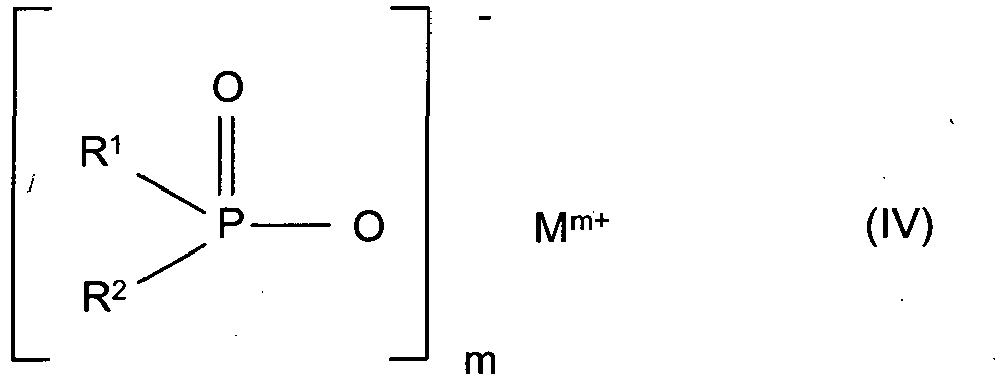 R1, R2 gleich oder verschieden sind und C1-C6-Alkyl, linear oder verzweigt;M Mg, Ca, Al, Sb, Sn, Ge, Ti, Fe, Zr, Zn, Ce, Bi, Sr, Mn, Li, Na, K, H und/oder eine protonierte Stickstoffbase ;m 1 bis 4 bedeuten.
 - Flammschutzmittel-Mischungen nach einem oder mehreren der Ansprüche 1 bis 3, dadurch gekennzeichnet, dass es sich bei dem Flammschutzmittel um Melam, Melem, Melon, Dimelaminpyrophosphat, Melaminpolyphosphat, Melampolyphosphat, Melonpolyphosphat und/oder Melempolyphosphat und/oder gemischte Polysalze davon und/oder um Ammoniumhydrogenphosphat, Ammoniumdihydrogenphosphat und/oder Ammoniumpolyphosphat handelt.
- Flammschutzmittel-Mischungen nach einem oder mehreren der Ansprüche 1 bis 3, dadurch gekennzeichnet, dass es sich bei dem Flammschutzmittel um Aluminiumhypophosphit, Zinkhypophosphit, Calciumhypophosphit, Natriumphosphit. Monophenylphosphinsäure und deren Salze, Mischungen von Dialkylphosphinsäuren und deren Salzen und Monoalkylphosphinsäuren und deren Salzen, 2-Carboxyethyl-alkylphosphinsäure und deren Salze, 2-Carboxyethyl-methylphosphinsäure und deren Salze, 2-Carboxyethylarylphosphinsäure und deren Salze, 2-Carboxyethyl-phenylphosphinsäure und deren Salze, Oxa-10-phosphaphenanthrene (DOPO) und dessen Salze und Addukte an para-Benzochinon bzw. Itaconsäure und/oder deren Salze handelt.
- Flammschutzmittel-Mischungen nach einem oder mehreren der Ansprüche 1 bis 5, dadurch gekennzeichnet, dass beim Aluminiumphosphit der Formel (II) z 0,15 bis 0,4, y 2,80 bis 3 v 0,1 bis 0,4 und w 0,01 bis 0,1 bedeutet.
- Flammschutzmittel-Mischungen nach einem oder mehreren der Ansprüche 1 bis 5, dadurch gekennzeichnet, dass beim Aluminiumphosphit der Formel (III) u 2,834 bis 2,99, t 0,332 bis 0,03 und s 0,01 bis 0,1 bedeutet.
- Flammschutzmittel-Mischungen nach einem oder mehreren der Ansprüche 1 bis 7, enthaltend 0,1 bis 99,9 Gew.-% Flammschutzmittel und 0,1 bis 99,9 Gew.-% Aluminiumphosphite der Formeln (II) und/oder (III) und/oder Mischungen von Aluminiumphosphit der Formel (III) mit Aluminiumsalzen .
- Flammschutzmittel-Mischungen nach einem oder mehreren der Ansprüche 1 bis 8, enthaltend 50 bis 99,9 Gew.-% Flammschutzmittel und 0,1 bis 50 Gew.-% Aluminiumphosphite der Formeln (II) und/oder (III) und/oder Mischungen von Aluminiumphosphit der Formel (III) mit Aluminiumsalzen
- Verfahren zur Herstellung von Flammschutzmittel-Mischungen nach einem oder mehreren der Ansprüche 1 bis 9, dadurch gekennzeichnet, dass man pulverförmige Flammschutzmittel mit pulverförmige Aluminiumphosphiten der Formeln (II) und/oder (III) und/oder Mischungen von Aluminiumphosphit der Formel (III) mit Aluminiumsalzen mischt.
- Verwendung von Flammschutzmittel-Mischungen nach einem oder mehreren der Ansprüche 1 bis 9 als Zwischenprodukt für weitere Synthesen, als Binder, als Vernetzer bzw. Beschleuniger beim Aushärten von Epoxyharzen, Polyurethanen, ungesättigten Polyesterharzen, als Polymerstabilisatoren, als Pflanzenschutzmittel, als Sequestrierungsmittel, als Mineralöl-Additiv, als Korrosionsschutzmittel, in Wasch- und Reinigungsmittelanwendungen, in Elektronikanwendungen.
- Verwendung von Flammschutzmittel-Mischungen nach einem oder mehreren der Ansprüche 1 bis 9 in oder als Flammschutzmittel, insbesondere in oder als Flammschutzmittel für Klarlacke und Intumeszenzbeschichtungen, in oder als Flammschutzmittel für Holz und andere cellulosehaltige Produkte, in oder als reaktive und/oder nicht reaktive Flammschutzmittel für Polymere, zur Herstellung von flammgeschützten Polymerformmassen, zur Herstellung von flammgeschützten Polymerformkörpern und/oder zum flammhemmend Ausrüsten von Polyester und Cellulose-Rein- und Mischgeweben durch Imprägnierung und/oder als Synergist und/oder als Synergist in weiteren Flammschutzmittel-Mischungen.
- Flammgeschützte thermoplastische oder duroplastische Polymerformmasse, Polymer-Formkörper, -Filme, -Fäden und/oder -Fasern, enthaltend 0,1 bis 45 Gew.-% Flammschutzmittel-Mischungen nach einem oder mehreren der Ansprüche 1 bis 9, 55 bis 99,9 Gew.-% thermoplastisches oder duroplastisches Polymer oder Mischungen derselben, 0 bis 55 Gew.-% Additive und 0 bis 55 Gew.-% Füllstoff bzw. Verstärkungsmaterialien, wobei die Summe der Komponenten 100 Gew.-% beträgt.
- Flammgeschützte thermoplastische oder duroplastische Polymerformmasse, Polymer-Formkörper, Filme, -Fäden und/oder -Fasern, enthaltend 1 bis 30 Gew.-% Flammschutzmittel-Mischungen nach einem oder mehreren der Ansprüche 1 bis 9, 10 bis 97 Gew.-% thermoplastisches oder duroplastisches Polymer oder Mischungen derselben, 1 bis 30 Gew.-% Additive und 1 bis 30 Gew.-% Füllstoff bzw. Verstärkungsmaterialien, wobei die Summe der Komponenten 100 Gew. % beträgt.
- Flammgeschützte thermoplastische oder duroplastische Polymerformmasse, Polymer-Formkörper, -Filme, -Fäden und/oder -Fasern, enthaltend Flammschutzmittel-Mischungen nach einem oder mehreren der Ansprüche 1 bis 9, dadurch gekennzeichnet, dass es sich bei dem Kunststoff um thermoplastische Polymere der Art Polystyrol-Hl (High-Impact), Polyphenylenether, Polyamide, Polyester, Polycarbonate und Blends oder Polymerblends vom Typ ABS (Acrylnitril-Butadien-Styrol) oder PC/ABS (Polycarbonat/ Acrylnitril-Butadien-Styrol) oder PPE/HIPS (Polyphenylenether/Polystyrol-HI) Kunststoffe und/oder um duroplastische Polymere der Art ungesättigter Polyester oder Epoxidharze handelt.
Applications Claiming Priority (2)
| Application Number | Priority Date | Filing Date | Title |
|---|---|---|---|
| DE102011120200A DE102011120200A1 (de) | 2011-12-05 | 2011-12-05 | Flammschutzmittel-Mischungen enthaltend Flammschutzmittel und Aluminiumphosphite, Verfahren zu ihrer Herstellung und ihre Verwendung |
| PCT/EP2012/004905 WO2013083247A1 (de) | 2011-12-05 | 2012-11-28 | Flammschutzmittel-mischungen enthaltend flammschutzmittel und aluminiumphosphite, verfahren zu ihrer herstellung und ihre verwendung |
Publications (2)
| Publication Number | Publication Date |
|---|---|
| EP2788416A1 EP2788416A1 (de) | 2014-10-15 |
| EP2788416B1 true EP2788416B1 (de) | 2023-04-19 |
Family
ID=47324030
Family Applications (1)
| Application Number | Title | Priority Date | Filing Date |
|---|---|---|---|
| EP12798157.9A Active EP2788416B1 (de) | 2011-12-05 | 2012-11-28 | Flammschutzmittel-mischungen enthaltend flammschutzmittel und aluminiumphosphite, verfahren zu ihrer herstellung und ihre verwendung |
Country Status (10)
| Country | Link |
|---|---|
| US (1) | US9481831B2 (de) |
| EP (1) | EP2788416B1 (de) |
| JP (1) | JP6316752B2 (de) |
| KR (1) | KR102097262B1 (de) |
| CN (1) | CN104364305B (de) |
| DE (1) | DE102011120200A1 (de) |
| PL (1) | PL2788416T3 (de) |
| SG (1) | SG11201402871QA (de) |
| TW (1) | TWI582222B (de) |
| WO (1) | WO2013083247A1 (de) |
Cited By (1)
| Publication number | Priority date | Publication date | Assignee | Title |
|---|---|---|---|---|
| EP3696141B1 (de) * | 2017-10-11 | 2025-07-16 | Taihei Chemical Industrial Co., Ltd. | Aluminiumphosphit und zusammensetzung mit aluminiumphosphit |
Families Citing this family (78)
| Publication number | Priority date | Publication date | Assignee | Title |
|---|---|---|---|---|
| DE102011120191A1 (de) * | 2011-12-05 | 2013-06-06 | Clariant International Ltd. | Mischungen von Aluminiumphosphit mit schwerlöslichen Aluminiumsalzen und Fremdionen, Verfahren zu ihrer Herstellung sowie ihre Verwendung |
| DE102011120190A1 (de) | 2011-12-05 | 2013-06-06 | Clariant International Limited | Mischungen von Aluminium-Hydrogenphosphiten mit Aluminiumsalzen, Verfahren zu ihrer Herstellung sowie ihre Verwendung |
| DE102011120200A1 (de) | 2011-12-05 | 2013-06-06 | Clariant International Ltd. | Flammschutzmittel-Mischungen enthaltend Flammschutzmittel und Aluminiumphosphite, Verfahren zu ihrer Herstellung und ihre Verwendung |
| DE102011121591A1 (de) | 2011-12-16 | 2013-06-20 | Clariant International Ltd. | Gemische aus Dialkylphosphinsäuren und Alkylphosphonsäuren, ein Verfahren zu deren Herstellung und ihre Verwendung |
| DE102011121900A1 (de) | 2011-12-21 | 2013-06-27 | Clariant International Ltd. | Gemische von mindestens einer Dialkylphosphinsäure mit mindestens einer anderen, davon unterschiedlichen Dialkylphosphinsäure, Verfahren zu deren Herstellung und ihre Verwendung |
| JP6099767B2 (ja) * | 2013-12-13 | 2017-03-22 | 旭化成株式会社 | ポリアミド組成物、成形品、led用反射板、及び熱による反射率の低下を抑制する方法 |
| DE102014001222A1 (de) * | 2014-01-29 | 2015-07-30 | Clariant lnternational Ltd | Halogenfreie feste Flammschutzmittelmischung und ihre Verwendung |
| CN105646938B (zh) * | 2014-10-29 | 2017-08-11 | 广州金凯新材料有限公司 | 一种用于聚合物的添加剂组合物和其制备方法及由其组成的阻燃热塑性聚合物模塑材料 |
| CN104371142B (zh) * | 2014-10-29 | 2016-07-13 | 广州金凯新材料有限公司 | 一种用于聚合物的添加剂组合物和其制备方法及由其组成的阻燃热塑性聚合物模塑材料 |
| EP3034553A1 (de) | 2014-12-19 | 2016-06-22 | LANXESS Deutschland GmbH | Polyamidzusammensetzungen |
| US11407880B2 (en) * | 2014-12-24 | 2022-08-09 | Kuraray Co., Ltd. | Polymethallyl alcohol resin composition and molding containing same |
| JP6680694B2 (ja) | 2014-12-24 | 2020-04-15 | 株式会社クラレ | ポリメタアリルアルコール樹脂組成物及びそれを用いた成形体 |
| CN104497504B (zh) * | 2014-12-26 | 2016-03-30 | 肖群 | 一种用于聚合物的添加剂组合物和其制备方法及由其组成的阻燃热塑性聚合物模塑材料 |
| CN104774476B (zh) * | 2015-03-10 | 2018-03-09 | 广东生益科技股份有限公司 | 含磷阻燃组合物以及使用它的含磷聚苯醚树脂组合物、预浸料和层压板 |
| KR20160115157A (ko) | 2015-03-26 | 2016-10-06 | 주식회사 우성케미칼 | 알루미늄 분말을 포함하는 폴리아세탈 수지, 폴리아세탈 수지 펠릿 및 그 제조 방법 |
| KR20160115156A (ko) | 2015-03-26 | 2016-10-06 | 주식회사 우성케미칼 | 알루미늄 분말을 포함하는 abs 수지, abs 수지 펠릿 및 그 제조 방법 |
| CN105037795B (zh) * | 2015-07-03 | 2017-08-08 | 西南大学 | 氧化石墨烯有机膦酸锆异质耦合阻燃剂及其制备方法和应用 |
| EP3337831B1 (de) | 2015-08-21 | 2024-02-28 | G&P Holding, Inc. | Silber- und kupferitaconate und -polyitaconate |
| CN105271149B (zh) * | 2015-10-26 | 2018-01-23 | 厦门理工学院 | 纳米杂化阻燃剂及其制备方法 |
| JP6788967B2 (ja) * | 2015-12-25 | 2020-11-25 | 太平化学産業株式会社 | 難燃性樹脂組成物 |
| CN107828084A (zh) * | 2016-09-15 | 2018-03-23 | 科莱恩塑料和涂料有限公司 | 用于热塑性聚合物的阻燃剂‑稳定剂组合 |
| CN107828207B (zh) * | 2016-09-15 | 2020-12-25 | 科莱恩塑料和涂料有限公司 | 用于热塑性聚合物的阻燃剂-稳定剂组合 |
| JP7196107B2 (ja) * | 2017-06-22 | 2022-12-26 | ビーエーエスエフ ソシエタス・ヨーロピア | リン及びAl-ホスホネートを有するポリアミド |
| EP3651960A1 (de) | 2017-07-13 | 2020-05-20 | LANXESS Deutschland GmbH | Thermostabilisierte zusammensetzungen |
| WO2019012061A1 (de) | 2017-07-13 | 2019-01-17 | Lanxess Deutschland Gmbh | Thermostabilisierte zusammensetzungen |
| CN107602924A (zh) * | 2017-08-25 | 2018-01-19 | 浙江传化华洋化工有限公司 | 一种热塑性弹性体用无卤复合阻燃剂及其应用 |
| CN107629806A (zh) * | 2017-09-14 | 2018-01-26 | 绵竹耀隆化工有限公司 | 一种磷酸锆阻燃剂及其制备方法 |
| CN111315810A (zh) | 2017-10-17 | 2020-06-19 | 塞拉尼斯销售德国有限公司 | 阻燃剂聚酰胺组合物 |
| CN107698798A (zh) * | 2017-11-22 | 2018-02-16 | 江苏利思德新材料有限公司 | 玻纤增强尼龙用不含氮无卤阻燃复配体系及其应用 |
| CN108102361A (zh) * | 2017-11-22 | 2018-06-01 | 浙江大学 | 有机亚磷酸铝协同的无卤阻燃复配体系及其在玻纤增强工程塑料中的应用 |
| DE102017221039B4 (de) * | 2017-11-24 | 2020-09-03 | Tesa Se | Verfahren zur Herstellung einer Haftklebemasse auf Basis von Acrylnitril-Butadien-Kautschuk |
| EP3546510A1 (de) | 2018-03-26 | 2019-10-02 | LANXESS Deutschland GmbH | Polyamidzusammensetzungen |
| CN108441102A (zh) * | 2018-03-30 | 2018-08-24 | 天长市巨龙车船涂料有限公司 | 一种耐磨防火水性涂料 |
| KR102095283B1 (ko) * | 2018-06-04 | 2020-04-01 | 한국에너지기술연구원 | 차아인산계 난연제의 제조방법 |
| CN109054454A (zh) * | 2018-08-15 | 2018-12-21 | 什邡市太丰新型阻燃剂有限责任公司 | 一种无机包覆次磷酸铝及其制备方法 |
| KR102254316B1 (ko) * | 2018-12-10 | 2021-05-21 | 럭키목재 주식회사 | 목재용 수용성 난연조성물 및 난연목재 |
| WO2020126984A1 (de) | 2018-12-20 | 2020-06-25 | Lanxess Deutschland Gmbh | Polyesterzusammensetzungen |
| EP3670589B1 (de) | 2018-12-20 | 2026-04-01 | Envalior Deutschland GmbH | Polyamidzusammensetzungen |
| JP7121149B2 (ja) * | 2019-02-15 | 2022-08-17 | 島田 誠之 | コーティング剤、薄膜、薄膜付き基材、および薄膜の製造方法 |
| CN111662323A (zh) | 2019-03-07 | 2020-09-15 | 黎杰 | 二烷基次膦酸-烷基亚磷酸金属复合盐,其制备方法和用途 |
| JP7271705B2 (ja) | 2019-03-15 | 2023-05-11 | ランクセス・ドイチュランド・ゲーエムベーハー | 高電圧用構成材料 |
| WO2020187704A1 (de) | 2019-03-15 | 2020-09-24 | Lanxess Deutschland Gmbh | Hochvoltkomponenten |
| EP3947601B1 (de) * | 2019-04-02 | 2023-09-20 | Italmatch Chemicals S.p.A. | Nicht entflammbare pulver auf der basis von hypophosphitmetallsalzen und deren verwendung als flammhemmende bestandteile |
| CN110540743B (zh) * | 2019-07-30 | 2021-09-28 | 燕京理工学院 | 一种氧化锌-dopo功能化苯并三唑复合改性聚氨酯材料及其制备方法 |
| EP3792303A1 (de) | 2019-09-10 | 2021-03-17 | LANXESS Deutschland GmbH | Hochvoltkomponenten |
| EP3792302A1 (de) | 2019-09-10 | 2021-03-17 | LANXESS Deutschland GmbH | Hochvoltkomponenten |
| EP3868553A1 (de) | 2020-02-18 | 2021-08-25 | LANXESS Deutschland GmbH | Mehrschichtverbundwerkstoff |
| EP3868817B1 (de) | 2020-02-19 | 2026-03-25 | Envalior Deutschland GmbH | Hochvoltkomponenten |
| EP3868818B1 (de) | 2020-02-19 | 2025-02-19 | Envalior Deutschland GmbH | Hochvoltkomponenten |
| EP3919562A1 (de) | 2020-06-02 | 2021-12-08 | LANXESS Deutschland GmbH | Polyamid basierte erzeugnisse |
| EP3919561A1 (de) | 2020-06-02 | 2021-12-08 | LANXESS Deutschland GmbH | Polyamid basierte erzeugnisse |
| EP3919563A1 (de) | 2020-06-02 | 2021-12-08 | LANXESS Deutschland GmbH | Polyamid basierte erzeugnisse |
| EP4165121B1 (de) * | 2020-06-15 | 2024-07-24 | DuPont Polymers, Inc. | Verbesserter copolyetherester |
| CN111748203B (zh) * | 2020-07-03 | 2021-11-19 | 金旸(厦门)新材料科技有限公司 | 一种己内酰胺原位改性勃姆石协效阻燃增强高温尼龙材料及其制备方法 |
| CN112093786B (zh) * | 2020-10-12 | 2022-02-18 | 江苏利思德新材料有限公司 | 多/单亚磷酸缩二亚磷酸氢盐化合物及其制备和应用 |
| CN113460984B (zh) * | 2020-10-22 | 2022-08-23 | 江苏利思德新材料有限公司 | 一种结晶型亚磷酸铝及其制备方法和应用 |
| CN113462020B (zh) * | 2020-11-06 | 2022-04-26 | 江苏利思德新材料有限公司 | 具有双峰热失重分解特征的基于亚磷酸铝的复合体及其制备和应用 |
| CN112725937B (zh) * | 2020-12-29 | 2022-08-12 | 河北宝盛纺织品有限公司 | 一种产生负离子的纤维制作方法 |
| WO2022190600A1 (ja) * | 2021-03-08 | 2022-09-15 | ナミックス株式会社 | 絶縁性樹脂組成物、基板用層間絶縁フィルム及びその製造方法、並びに半導体ic内蔵基板 |
| DE102021202508A1 (de) | 2021-03-15 | 2022-09-15 | Fraunhofer-Gesellschaft zur Förderung der angewandten Forschung eingetragener Verein | Verwendung einer Stabilisatorzusammensetzung zur Stabilisierung von Polyolefin-Recyclaten, Stabilisatorzusammensetzung, Masterbatchkonzentrat, Kunststoffzusammensetzung, Formmasse oder Formteil, Verfahren zur Stabilisierung eines Polyolefin-Recyclats sowie Verwendung einer Kunststoffzusammensetzung |
| US12037492B2 (en) | 2021-06-17 | 2024-07-16 | Teknor Apex Company | Halogen free, flameproof, compatibilized polyamide and polyphenylene ether blend |
| KR102704491B1 (ko) * | 2021-07-30 | 2024-09-06 | 롯데케미칼 주식회사 | 열가소성 수지 조성물 및 이로부터 형성된 성형품 |
| CN113771168A (zh) * | 2021-09-06 | 2021-12-10 | 桃江县大丰木业有限责任公司 | 一种防火阻燃实木板 |
| TW202328155A (zh) * | 2021-10-18 | 2023-07-16 | 南韓商Lg化學股份有限公司 | 基於磷之阻燃劑和含有彼之熱塑性樹脂組成物 |
| CN118339224A (zh) | 2021-12-01 | 2024-07-12 | 恩骅力德国有限公司 | 基于聚酰胺的产品 |
| EP4190851B1 (de) | 2021-12-01 | 2026-01-28 | Envalior Deutschland GmbH | Polyamid basierte erzeugnisse |
| DE112023000623T5 (de) | 2022-01-19 | 2024-11-14 | Galata Chemicals Gmbh | Wärmestabilisator für chlorhaltige polymere |
| JP2023107680A (ja) * | 2022-01-24 | 2023-08-03 | 旭化成株式会社 | 連続繊維樹脂複合体 |
| KR102459675B1 (ko) * | 2022-02-03 | 2022-10-26 | 이정훈 | 금속 포스피네이트계 난연제를 포함하는 난연성 조성물 및 이를 적용한 난연성 합성 수지 조성물 |
| CN114573870A (zh) * | 2022-03-10 | 2022-06-03 | 江苏利思德新材料有限公司 | 无卤阻燃剂组合物及其应用 |
| CN114957822B8 (zh) * | 2022-05-23 | 2023-05-23 | 临沂沂光电缆有限公司 | 一种阻燃抗蚀电缆材料及其制备方法 |
| KR102730192B1 (ko) * | 2022-08-19 | 2024-11-15 | 코오롱인더스트리 주식회사 | 난연성 조성물 및 이로부터 제조된 난연성 시트 |
| CN116355624B (zh) * | 2023-03-07 | 2025-09-09 | 清远市普塞呋磷化学有限公司 | 一种磷-氮-铝无卤膨胀型阻燃剂及其制备方法和应用 |
| KR102928654B1 (ko) * | 2023-06-21 | 2026-02-20 | 코오롱인더스트리 주식회사 | 난연성 조성물, 이로부터 제조된 난연성 시트 및 난연성 시트를 포함하는 난연성 패널 |
| CN116874878B (zh) * | 2023-07-20 | 2024-09-10 | 烟台艾弗尔阻燃科技有限公司 | 一种三元乙丙橡胶用阻燃剂及其制备方法 |
| KR20250030773A (ko) * | 2023-08-25 | 2025-03-05 | 삼성에스디아이 주식회사 | 전고체 이차 전지용 탄성 시트 및 전고체 이차 전지 |
| WO2025184155A1 (en) * | 2024-02-27 | 2025-09-04 | Celanese Polymers Holding, Inc. | Halogen-free flame retardant thermoplastic polymer composition with increased glow wire performance |
| CN119307007B (zh) * | 2024-12-19 | 2025-07-11 | 上海金发科技发展有限公司 | 聚合物添加剂、阻燃剂、聚合物模塑材料及其制备方法和应用 |
Family Cites Families (47)
| Publication number | Priority date | Publication date | Assignee | Title |
|---|---|---|---|---|
| US1725551A (en) | 1926-08-30 | 1929-08-20 | Norman P Harshberger | Shingle |
| ZA738245B (en) | 1972-10-25 | 1974-09-25 | Hoechst Ag | Flame resistant thermoplastic polyesters |
| DE2447727A1 (de) | 1974-10-07 | 1976-04-08 | Hoechst Ag | Schwerentflammbare polyamidformmassen |
| JPS5159946A (ja) * | 1974-11-22 | 1976-05-25 | Teijin Ltd | Nannenseijushisoseibutsu |
| AU2557988A (en) | 1987-10-20 | 1989-05-23 | Ferro Corporation | Synthetic resin composition |
| JPH02175604A (ja) | 1988-12-28 | 1990-07-06 | Taihei Kagaku Sangyo Kk | 亜リン酸銅化合物の製造法 |
| US5256718A (en) * | 1990-02-14 | 1993-10-26 | Mitsui Petrochemical Industries, Ltd. | Flame retardant polyamide thermoplastic resin composition |
| JP2899916B2 (ja) * | 1990-07-30 | 1999-06-02 | 太平化学産業株式会社 | 球状亜リン酸アルミニウム結晶、その製造方法、及び、それを含有する塗料 |
| DE4430932A1 (de) | 1994-08-31 | 1996-03-07 | Hoechst Ag | Flammgeschützte Polyesterformmasse |
| JPH08198609A (ja) | 1995-01-23 | 1996-08-06 | Taihei Kagaku Sangyo Kk | 無機発泡性結晶、及び、それを含有する塗料 |
| US5877250A (en) | 1996-01-31 | 1999-03-02 | Cabot Corporation | Carbon blacks and compositions incorporating the carbon blacks |
| DE19614424A1 (de) | 1996-04-12 | 1997-10-16 | Hoechst Ag | Synergistische Flammschutzmittel-Kombination für Polymere |
| US5965639A (en) * | 1996-10-16 | 1999-10-12 | Toray Industries, Inc. | Flame retardant resin composition |
| DE19644128C2 (de) * | 1996-10-23 | 1999-07-22 | Baerlocher Gmbh | Stabilisatorkombination für Kabelummantelungen |
| DE19708726A1 (de) | 1997-03-04 | 1998-09-10 | Hoechst Ag | Flammgeschützte Polymerformmassen |
| DE19734437A1 (de) | 1997-08-08 | 1999-02-11 | Clariant Gmbh | Synergistische Flammschutzmittel-Kombination für Polymere |
| DE19737727A1 (de) | 1997-08-29 | 1999-07-08 | Clariant Gmbh | Synergistische Flammschutzmittel-Kombination für Kunststoffe |
| DE19920276A1 (de) | 1999-05-04 | 2000-11-09 | Basf Ag | Thermoplastische Formmassen |
| DE19933901A1 (de) | 1999-07-22 | 2001-02-01 | Clariant Gmbh | Flammschutzmittel-Kombination |
| AU2003210404A1 (en) | 2002-03-15 | 2003-09-29 | Bayer Chemicals Ag | Stabiliser combinations for polymer systems |
| DE10255155B4 (de) | 2002-11-26 | 2006-02-23 | Baerlocher Gmbh | Stabilisierungszusammensetzung für halogenhaltige Polymere, Verfahren zu deren Herstellung und deren Verwendung |
| JP4951187B2 (ja) * | 2002-12-26 | 2012-06-13 | ポリプラスチックス株式会社 | 難燃性樹脂組成物 |
| DE10320465A1 (de) | 2003-05-08 | 2004-12-02 | Clariant Gmbh | Flammschutzmittel-Nanocomposite-Kombination für thermoplastische Polymere |
| DE102004023085A1 (de) | 2004-05-11 | 2005-12-15 | Clariant Gmbh | Dialkylphosphinsäure-Salze, ein Verfahren zu ihrer Herstellung und ihre Verwendung |
| CN1997698B (zh) * | 2004-06-10 | 2013-01-09 | 伊塔尔麦奇化学股份公司 | 用不含卤素的添加剂阻燃的聚酯组合物 |
| DE102004035508A1 (de) * | 2004-07-22 | 2006-02-16 | Clariant Gmbh | Flammgeschützte Polymerformmassen |
| DE102004035517A1 (de) * | 2004-07-22 | 2006-02-16 | Clariant Gmbh | Nanoteiliges Phosphor-haltiges Flammschutzmittel |
| DE102004048876A1 (de) | 2004-09-13 | 2006-03-30 | Bayer Ag | Halogenfreie flammgeschützte thermoplastische Formmassen auf Basis von Polyamid mit erhöhter Glühdrahtbeständigkeit |
| DE102005013957A1 (de) | 2005-03-26 | 2006-09-28 | Clariant Produkte (Deutschland) Gmbh | Phosphorhaltige thermostabilisierte Flammschutzmittelagglomerate |
| CN101218305B (zh) | 2005-07-08 | 2011-03-23 | 宝理塑料株式会社 | 阻燃性树脂组合物 |
| BRPI0816398A2 (pt) * | 2007-09-07 | 2015-02-24 | Perachem Ltd | Método, material e composição |
| WO2009109318A1 (de) | 2008-03-03 | 2009-09-11 | Clariant International Ltd | Verfahren zur herstellung flammwidriger, nicht korrosiver und gut fliessfähiger polyamid- und polyesterformmassen |
| JP2010111739A (ja) | 2008-11-05 | 2010-05-20 | Teijin Chem Ltd | 難燃性ポリ乳酸樹脂組成物 |
| JP5378904B2 (ja) | 2009-08-05 | 2013-12-25 | 帝人株式会社 | 難燃性ポリ乳酸樹脂組成物 |
| JP5612365B2 (ja) * | 2010-06-09 | 2014-10-22 | 帝人株式会社 | ポリ乳酸樹脂組成物 |
| JP5341013B2 (ja) * | 2010-04-20 | 2013-11-13 | 太平化学産業株式会社 | 亜リン酸系難燃剤および難燃性樹脂組成物 |
| DE102010048025A1 (de) * | 2010-10-09 | 2012-04-12 | Clariant International Ltd. | Flammschutzmittel- Stabilisator-Kombination für thermoplastische Polymere |
| DE102011120192A1 (de) | 2011-12-05 | 2013-06-06 | Clariant International Ltd. | Aluminium-Hydrogenphosphite, ein Verfahren zu ihrer Herstellung sowie ihre Verwendung |
| DE102011120191A1 (de) | 2011-12-05 | 2013-06-06 | Clariant International Ltd. | Mischungen von Aluminiumphosphit mit schwerlöslichen Aluminiumsalzen und Fremdionen, Verfahren zu ihrer Herstellung sowie ihre Verwendung |
| DE102011120190A1 (de) | 2011-12-05 | 2013-06-06 | Clariant International Limited | Mischungen von Aluminium-Hydrogenphosphiten mit Aluminiumsalzen, Verfahren zu ihrer Herstellung sowie ihre Verwendung |
| DE102011120200A1 (de) | 2011-12-05 | 2013-06-06 | Clariant International Ltd. | Flammschutzmittel-Mischungen enthaltend Flammschutzmittel und Aluminiumphosphite, Verfahren zu ihrer Herstellung und ihre Verwendung |
| DE102011120218A1 (de) | 2011-12-05 | 2013-06-06 | Clariant International Ltd. | Alkali-Aliminium-Mischphosphite, Verfahren zur ihrer Herstellung sowie deren Verwendung |
| DE102011121504A1 (de) | 2011-12-16 | 2013-06-20 | Clariant International Ltd. | Gemische von Diphosphinsäuren und Alkylphosphonsäuren, ein Verfahren zu deren Herstellung und ihre Verwendung |
| DE102011121503A1 (de) | 2011-12-16 | 2013-06-20 | Clariant International Ltd. | Gemische von Dioshinsäuren und Dialkylphosphinsäuren, ein Verfahren zu deren Herstellung und ihre Verwendung |
| DE102011121590A1 (de) | 2011-12-16 | 2013-06-20 | Clariant International Ltd. | Gemische von Diphosphinsäuren und Alkylphosphinsäuren, ein Verfahren zu deren Herstellung und ihre Verwendung |
| DE102011121591A1 (de) | 2011-12-16 | 2013-06-20 | Clariant International Ltd. | Gemische aus Dialkylphosphinsäuren und Alkylphosphonsäuren, ein Verfahren zu deren Herstellung und ihre Verwendung |
| DE102011121900A1 (de) | 2011-12-21 | 2013-06-27 | Clariant International Ltd. | Gemische von mindestens einer Dialkylphosphinsäure mit mindestens einer anderen, davon unterschiedlichen Dialkylphosphinsäure, Verfahren zu deren Herstellung und ihre Verwendung |
-
2011
- 2011-12-05 DE DE102011120200A patent/DE102011120200A1/de not_active Withdrawn
-
2012
- 2012-11-14 TW TW101142467A patent/TWI582222B/zh not_active IP Right Cessation
- 2012-11-28 CN CN201280060050.8A patent/CN104364305B/zh active Active
- 2012-11-28 EP EP12798157.9A patent/EP2788416B1/de active Active
- 2012-11-28 KR KR1020147018712A patent/KR102097262B1/ko active Active
- 2012-11-28 SG SG11201402871QA patent/SG11201402871QA/en unknown
- 2012-11-28 PL PL12798157.9T patent/PL2788416T3/pl unknown
- 2012-11-28 JP JP2014543795A patent/JP6316752B2/ja active Active
- 2012-11-28 US US14/362,886 patent/US9481831B2/en active Active
- 2012-11-28 WO PCT/EP2012/004905 patent/WO2013083247A1/de not_active Ceased
Cited By (1)
| Publication number | Priority date | Publication date | Assignee | Title |
|---|---|---|---|---|
| EP3696141B1 (de) * | 2017-10-11 | 2025-07-16 | Taihei Chemical Industrial Co., Ltd. | Aluminiumphosphit und zusammensetzung mit aluminiumphosphit |
Also Published As
| Publication number | Publication date |
|---|---|
| US9481831B2 (en) | 2016-11-01 |
| CN104364305A (zh) | 2015-02-18 |
| DE102011120200A1 (de) | 2013-06-06 |
| PL2788416T3 (pl) | 2023-09-04 |
| CN104364305B (zh) | 2016-10-26 |
| JP2015504926A (ja) | 2015-02-16 |
| HK1202568A1 (en) | 2015-10-02 |
| EP2788416A1 (de) | 2014-10-15 |
| WO2013083247A1 (de) | 2013-06-13 |
| TWI582222B (zh) | 2017-05-11 |
| KR102097262B1 (ko) | 2020-04-07 |
| SG11201402871QA (en) | 2014-08-28 |
| US20140336325A1 (en) | 2014-11-13 |
| KR20140105814A (ko) | 2014-09-02 |
| TW201335345A (zh) | 2013-09-01 |
| JP6316752B2 (ja) | 2018-04-25 |
Similar Documents
| Publication | Publication Date | Title |
|---|---|---|
| EP2788416B1 (de) | Flammschutzmittel-mischungen enthaltend flammschutzmittel und aluminiumphosphite, verfahren zu ihrer herstellung und ihre verwendung | |
| EP2788287B1 (de) | Alkali-aluminium-mischphosphite, verfahren zu ihrer herstellung sowie deren verwendung | |
| EP2788284B1 (de) | Mischungen von aluminium-hydrogenphosphiten mit aluminiumsalzen, verfahren zu ihrer herstellung sowie ihre verwendung | |
| EP2788285B1 (de) | Mischungen von aluminiumphosphit mit schwerlöslichen aluminiumsalzen und fremdionen, verfahren zu ihrer herstellung sowie ihre verwendung | |
| EP2788286B1 (de) | Aluminium-hydrogenphosphite, ein verfahren zu ihrer herstellung sowie ihre verwendung | |
| EP1544206B1 (de) | Verwendung von Dialkylphosphinsäure-Salze | |
| EP2145893B1 (de) | Diorganylphosphinsäure-Salze, ein Verfahren zu ihrer Herstellung und ihre Verwendung | |
| EP3505596B1 (de) | Halogenfreie feste flammschutzmittelmischung und ihre verwendung | |
| DE10321298B4 (de) | Halogenhaltige Flammschutzmittel-Kombination und deren Verwendung | |
| EP2062904B1 (de) | Mischsalze von Diorganylphosphinsäuren und Carbonsäuren | |
| WO2019048313A1 (de) | Synergistische flammschutzmittelkombinationen für polymerzusammensetzungen und deren verwendung | |
| WO2019048312A1 (de) | Flammschutzmittelkombinationen für polymerzusammensetzungen und deren verwendung |
Legal Events
| Date | Code | Title | Description |
|---|---|---|---|
| PUAI | Public reference made under article 153(3) epc to a published international application that has entered the european phase |
Free format text: ORIGINAL CODE: 0009012 |
|
| 17P | Request for examination filed |
Effective date: 20140707 |
|
| AK | Designated contracting states |
Kind code of ref document: A1 Designated state(s): AL AT BE BG CH CY CZ DE DK EE ES FI FR GB GR HR HU IE IS IT LI LT LU LV MC MK MT NL NO PL PT RO RS SE SI SK SM TR |
|
| DAX | Request for extension of the european patent (deleted) | ||
| 17Q | First examination report despatched |
Effective date: 20150714 |
|
| RAP1 | Party data changed (applicant data changed or rights of an application transferred) |
Owner name: CLARIANT INTERNATIONAL LTD |
|
| RAP1 | Party data changed (applicant data changed or rights of an application transferred) |
Owner name: CLARIANT INTERNATIONAL LTD |
|
| STAA | Information on the status of an ep patent application or granted ep patent |
Free format text: STATUS: EXAMINATION IS IN PROGRESS |
|
| GRAP | Despatch of communication of intention to grant a patent |
Free format text: ORIGINAL CODE: EPIDOSNIGR1 |
|
| STAA | Information on the status of an ep patent application or granted ep patent |
Free format text: STATUS: GRANT OF PATENT IS INTENDED |
|
| INTG | Intention to grant announced |
Effective date: 20230203 |
|
| GRAS | Grant fee paid |
Free format text: ORIGINAL CODE: EPIDOSNIGR3 |
|
| GRAA | (expected) grant |
Free format text: ORIGINAL CODE: 0009210 |
|
| STAA | Information on the status of an ep patent application or granted ep patent |
Free format text: STATUS: THE PATENT HAS BEEN GRANTED |
|
| AK | Designated contracting states |
Kind code of ref document: B1 Designated state(s): AL AT BE BG CH CY CZ DE DK EE ES FI FR GB GR HR HU IE IS IT LI LT LU LV MC MK MT NL NO PL PT RO RS SE SI SK SM TR |
|
| REG | Reference to a national code |
Ref country code: GB Ref legal event code: FG4D Free format text: NOT ENGLISH |
|
| REG | Reference to a national code |
Ref country code: CH Ref legal event code: EP |
|
| REG | Reference to a national code |
Ref country code: DE Ref legal event code: R096 Ref document number: 502012017152 Country of ref document: DE |
|
| REG | Reference to a national code |
Ref country code: IE Ref legal event code: FG4D Free format text: LANGUAGE OF EP DOCUMENT: GERMAN |
|
| REG | Reference to a national code |
Ref country code: AT Ref legal event code: REF Ref document number: 1561173 Country of ref document: AT Kind code of ref document: T Effective date: 20230515 |
|
| P01 | Opt-out of the competence of the unified patent court (upc) registered |
Effective date: 20230504 |
|
| REG | Reference to a national code |
Ref country code: NL Ref legal event code: FP |
|
| REG | Reference to a national code |
Ref country code: LT Ref legal event code: MG9D |
|
| PG25 | Lapsed in a contracting state [announced via postgrant information from national office to epo] |
Ref country code: SE Free format text: LAPSE BECAUSE OF FAILURE TO SUBMIT A TRANSLATION OF THE DESCRIPTION OR TO PAY THE FEE WITHIN THE PRESCRIBED TIME-LIMIT Effective date: 20230419 Ref country code: PT Free format text: LAPSE BECAUSE OF FAILURE TO SUBMIT A TRANSLATION OF THE DESCRIPTION OR TO PAY THE FEE WITHIN THE PRESCRIBED TIME-LIMIT Effective date: 20230821 Ref country code: NO Free format text: LAPSE BECAUSE OF FAILURE TO SUBMIT A TRANSLATION OF THE DESCRIPTION OR TO PAY THE FEE WITHIN THE PRESCRIBED TIME-LIMIT Effective date: 20230719 Ref country code: ES Free format text: LAPSE BECAUSE OF FAILURE TO SUBMIT A TRANSLATION OF THE DESCRIPTION OR TO PAY THE FEE WITHIN THE PRESCRIBED TIME-LIMIT Effective date: 20230419 |
|
| PG25 | Lapsed in a contracting state [announced via postgrant information from national office to epo] |
Ref country code: RS Free format text: LAPSE BECAUSE OF FAILURE TO SUBMIT A TRANSLATION OF THE DESCRIPTION OR TO PAY THE FEE WITHIN THE PRESCRIBED TIME-LIMIT Effective date: 20230419 Ref country code: LV Free format text: LAPSE BECAUSE OF FAILURE TO SUBMIT A TRANSLATION OF THE DESCRIPTION OR TO PAY THE FEE WITHIN THE PRESCRIBED TIME-LIMIT Effective date: 20230419 Ref country code: LT Free format text: LAPSE BECAUSE OF FAILURE TO SUBMIT A TRANSLATION OF THE DESCRIPTION OR TO PAY THE FEE WITHIN THE PRESCRIBED TIME-LIMIT Effective date: 20230419 Ref country code: IS Free format text: LAPSE BECAUSE OF FAILURE TO SUBMIT A TRANSLATION OF THE DESCRIPTION OR TO PAY THE FEE WITHIN THE PRESCRIBED TIME-LIMIT Effective date: 20230819 Ref country code: HR Free format text: LAPSE BECAUSE OF FAILURE TO SUBMIT A TRANSLATION OF THE DESCRIPTION OR TO PAY THE FEE WITHIN THE PRESCRIBED TIME-LIMIT Effective date: 20230419 Ref country code: GR Free format text: LAPSE BECAUSE OF FAILURE TO SUBMIT A TRANSLATION OF THE DESCRIPTION OR TO PAY THE FEE WITHIN THE PRESCRIBED TIME-LIMIT Effective date: 20230720 |
|
| PG25 | Lapsed in a contracting state [announced via postgrant information from national office to epo] |
Ref country code: FI Free format text: LAPSE BECAUSE OF FAILURE TO SUBMIT A TRANSLATION OF THE DESCRIPTION OR TO PAY THE FEE WITHIN THE PRESCRIBED TIME-LIMIT Effective date: 20230419 |
|
| PG25 | Lapsed in a contracting state [announced via postgrant information from national office to epo] |
Ref country code: SK Free format text: LAPSE BECAUSE OF FAILURE TO SUBMIT A TRANSLATION OF THE DESCRIPTION OR TO PAY THE FEE WITHIN THE PRESCRIBED TIME-LIMIT Effective date: 20230419 |
|
| REG | Reference to a national code |
Ref country code: DE Ref legal event code: R097 Ref document number: 502012017152 Country of ref document: DE |
|
| PG25 | Lapsed in a contracting state [announced via postgrant information from national office to epo] |
Ref country code: SM Free format text: LAPSE BECAUSE OF FAILURE TO SUBMIT A TRANSLATION OF THE DESCRIPTION OR TO PAY THE FEE WITHIN THE PRESCRIBED TIME-LIMIT Effective date: 20230419 Ref country code: SK Free format text: LAPSE BECAUSE OF FAILURE TO SUBMIT A TRANSLATION OF THE DESCRIPTION OR TO PAY THE FEE WITHIN THE PRESCRIBED TIME-LIMIT Effective date: 20230419 Ref country code: RO Free format text: LAPSE BECAUSE OF FAILURE TO SUBMIT A TRANSLATION OF THE DESCRIPTION OR TO PAY THE FEE WITHIN THE PRESCRIBED TIME-LIMIT Effective date: 20230419 Ref country code: EE Free format text: LAPSE BECAUSE OF FAILURE TO SUBMIT A TRANSLATION OF THE DESCRIPTION OR TO PAY THE FEE WITHIN THE PRESCRIBED TIME-LIMIT Effective date: 20230419 Ref country code: DK Free format text: LAPSE BECAUSE OF FAILURE TO SUBMIT A TRANSLATION OF THE DESCRIPTION OR TO PAY THE FEE WITHIN THE PRESCRIBED TIME-LIMIT Effective date: 20230419 Ref country code: CZ Free format text: LAPSE BECAUSE OF FAILURE TO SUBMIT A TRANSLATION OF THE DESCRIPTION OR TO PAY THE FEE WITHIN THE PRESCRIBED TIME-LIMIT Effective date: 20230419 |
|
| PGFP | Annual fee paid to national office [announced via postgrant information from national office to epo] |
Ref country code: TR Payment date: 20231115 Year of fee payment: 12 |
|
| PLBE | No opposition filed within time limit |
Free format text: ORIGINAL CODE: 0009261 |
|
| STAA | Information on the status of an ep patent application or granted ep patent |
Free format text: STATUS: NO OPPOSITION FILED WITHIN TIME LIMIT |
|
| 26N | No opposition filed |
Effective date: 20240122 |
|
| PG25 | Lapsed in a contracting state [announced via postgrant information from national office to epo] |
Ref country code: SI Free format text: LAPSE BECAUSE OF FAILURE TO SUBMIT A TRANSLATION OF THE DESCRIPTION OR TO PAY THE FEE WITHIN THE PRESCRIBED TIME-LIMIT Effective date: 20230419 |
|
| PG25 | Lapsed in a contracting state [announced via postgrant information from national office to epo] |
Ref country code: SI Free format text: LAPSE BECAUSE OF FAILURE TO SUBMIT A TRANSLATION OF THE DESCRIPTION OR TO PAY THE FEE WITHIN THE PRESCRIBED TIME-LIMIT Effective date: 20230419 |
|
| REG | Reference to a national code |
Ref country code: CH Ref legal event code: PL |
|
| PG25 | Lapsed in a contracting state [announced via postgrant information from national office to epo] |
Ref country code: MC Free format text: LAPSE BECAUSE OF FAILURE TO SUBMIT A TRANSLATION OF THE DESCRIPTION OR TO PAY THE FEE WITHIN THE PRESCRIBED TIME-LIMIT Effective date: 20230419 |
|
| PG25 | Lapsed in a contracting state [announced via postgrant information from national office to epo] |
Ref country code: LU Free format text: LAPSE BECAUSE OF NON-PAYMENT OF DUE FEES Effective date: 20231128 |
|
| PG25 | Lapsed in a contracting state [announced via postgrant information from national office to epo] |
Ref country code: CH Free format text: LAPSE BECAUSE OF NON-PAYMENT OF DUE FEES Effective date: 20231130 |
|
| PG25 | Lapsed in a contracting state [announced via postgrant information from national office to epo] |
Ref country code: MC Free format text: LAPSE BECAUSE OF FAILURE TO SUBMIT A TRANSLATION OF THE DESCRIPTION OR TO PAY THE FEE WITHIN THE PRESCRIBED TIME-LIMIT Effective date: 20230419 Ref country code: LU Free format text: LAPSE BECAUSE OF NON-PAYMENT OF DUE FEES Effective date: 20231128 Ref country code: CH Free format text: LAPSE BECAUSE OF NON-PAYMENT OF DUE FEES Effective date: 20231130 |
|
| REG | Reference to a national code |
Ref country code: BE Ref legal event code: MM Effective date: 20231130 |
|
| REG | Reference to a national code |
Ref country code: IE Ref legal event code: MM4A |
|
| PG25 | Lapsed in a contracting state [announced via postgrant information from national office to epo] |
Ref country code: IE Free format text: LAPSE BECAUSE OF NON-PAYMENT OF DUE FEES Effective date: 20231128 |
|
| PG25 | Lapsed in a contracting state [announced via postgrant information from national office to epo] |
Ref country code: BE Free format text: LAPSE BECAUSE OF NON-PAYMENT OF DUE FEES Effective date: 20231130 |
|
| PG25 | Lapsed in a contracting state [announced via postgrant information from national office to epo] |
Ref country code: IE Free format text: LAPSE BECAUSE OF NON-PAYMENT OF DUE FEES Effective date: 20231128 Ref country code: BE Free format text: LAPSE BECAUSE OF NON-PAYMENT OF DUE FEES Effective date: 20231130 |
|
| PG25 | Lapsed in a contracting state [announced via postgrant information from national office to epo] |
Ref country code: BG Free format text: LAPSE BECAUSE OF FAILURE TO SUBMIT A TRANSLATION OF THE DESCRIPTION OR TO PAY THE FEE WITHIN THE PRESCRIBED TIME-LIMIT Effective date: 20230419 |
|
| PG25 | Lapsed in a contracting state [announced via postgrant information from national office to epo] |
Ref country code: BG Free format text: LAPSE BECAUSE OF FAILURE TO SUBMIT A TRANSLATION OF THE DESCRIPTION OR TO PAY THE FEE WITHIN THE PRESCRIBED TIME-LIMIT Effective date: 20230419 |
|
| PGFP | Annual fee paid to national office [announced via postgrant information from national office to epo] |
Ref country code: NL Payment date: 20241126 Year of fee payment: 13 |
|
| REG | Reference to a national code |
Ref country code: AT Ref legal event code: MM01 Ref document number: 1561173 Country of ref document: AT Kind code of ref document: T Effective date: 20231128 |
|
| PGFP | Annual fee paid to national office [announced via postgrant information from national office to epo] |
Ref country code: PL Payment date: 20241118 Year of fee payment: 13 |
|
| PGFP | Annual fee paid to national office [announced via postgrant information from national office to epo] |
Ref country code: GB Payment date: 20241126 Year of fee payment: 13 |
|
| PGFP | Annual fee paid to national office [announced via postgrant information from national office to epo] |
Ref country code: FR Payment date: 20241126 Year of fee payment: 13 |
|
| PG25 | Lapsed in a contracting state [announced via postgrant information from national office to epo] |
Ref country code: AT Free format text: LAPSE BECAUSE OF NON-PAYMENT OF DUE FEES Effective date: 20231128 |
|
| PG25 | Lapsed in a contracting state [announced via postgrant information from national office to epo] |
Ref country code: AT Free format text: LAPSE BECAUSE OF NON-PAYMENT OF DUE FEES Effective date: 20231128 |
|
| PG25 | Lapsed in a contracting state [announced via postgrant information from national office to epo] |
Ref country code: CY Free format text: LAPSE BECAUSE OF FAILURE TO SUBMIT A TRANSLATION OF THE DESCRIPTION OR TO PAY THE FEE WITHIN THE PRESCRIBED TIME-LIMIT; INVALID AB INITIO Effective date: 20121128 |
|
| PG25 | Lapsed in a contracting state [announced via postgrant information from national office to epo] |
Ref country code: HU Free format text: LAPSE BECAUSE OF FAILURE TO SUBMIT A TRANSLATION OF THE DESCRIPTION OR TO PAY THE FEE WITHIN THE PRESCRIBED TIME-LIMIT; INVALID AB INITIO Effective date: 20121128 |
|
| REG | Reference to a national code |
Ref country code: DE Ref legal event code: R082 Ref document number: 502012017152 Country of ref document: DE Representative=s name: PACZKOWSKI, MARCUS, DIPL.-CHEM. DR. RER. NAT., DE |
|
| PGFP | Annual fee paid to national office [announced via postgrant information from national office to epo] |
Ref country code: DE Payment date: 20251126 Year of fee payment: 14 |
|
| PGFP | Annual fee paid to national office [announced via postgrant information from national office to epo] |
Ref country code: IT Payment date: 20251121 Year of fee payment: 14 |