EP2789664A1 - Adhésifs sensibles à la pression résistants au blanchiment de l'eau - Google Patents
Adhésifs sensibles à la pression résistants au blanchiment de l'eau Download PDFInfo
- Publication number
- EP2789664A1 EP2789664A1 EP20140001449 EP14001449A EP2789664A1 EP 2789664 A1 EP2789664 A1 EP 2789664A1 EP 20140001449 EP20140001449 EP 20140001449 EP 14001449 A EP14001449 A EP 14001449A EP 2789664 A1 EP2789664 A1 EP 2789664A1
- Authority
- EP
- European Patent Office
- Prior art keywords
- polymer
- monomers
- water resistant
- acrylate
- pressure sensitive
- Prior art date
- Legal status (The legal status is an assumption and is not a legal conclusion. Google has not performed a legal analysis and makes no representation as to the accuracy of the status listed.)
- Granted
Links
Images
Classifications
-
- C—CHEMISTRY; METALLURGY
- C09—DYES; PAINTS; POLISHES; NATURAL RESINS; ADHESIVES; COMPOSITIONS NOT OTHERWISE PROVIDED FOR; APPLICATIONS OF MATERIALS NOT OTHERWISE PROVIDED FOR
- C09J—ADHESIVES; NON-MECHANICAL ASPECTS OF ADHESIVE PROCESSES IN GENERAL; ADHESIVE PROCESSES NOT PROVIDED FOR ELSEWHERE; USE OF MATERIALS AS ADHESIVES
- C09J133/00—Adhesives based on homopolymers or copolymers of compounds having one or more unsaturated aliphatic radicals, each having only one carbon-to-carbon double bond, and at least one being terminated by only one carboxyl radical, or of salts, anhydrides, esters, amides, imides, or nitriles thereof; Adhesives based on derivatives of such polymers
- C09J133/04—Homopolymers or copolymers of esters
- C09J133/06—Homopolymers or copolymers of esters of esters containing only carbon, hydrogen and oxygen, the oxygen atom being present only as part of the carboxyl radical
-
- C—CHEMISTRY; METALLURGY
- C08—ORGANIC MACROMOLECULAR COMPOUNDS; THEIR PREPARATION OR CHEMICAL WORKING-UP; COMPOSITIONS BASED THEREON
- C08F—MACROMOLECULAR COMPOUNDS OBTAINED BY REACTIONS ONLY INVOLVING CARBON-TO-CARBON UNSATURATED BONDS
- C08F220/00—Copolymers of compounds having one or more unsaturated aliphatic radicals, each having only one carbon-to-carbon double bond, and only one being terminated by only one carboxyl radical or a salt, anhydride ester, amide, imide or nitrile thereof
- C08F220/02—Monocarboxylic acids having less than ten carbon atoms; Derivatives thereof
- C08F220/10—Esters
- C08F220/12—Esters of monohydric alcohols or phenols
- C08F220/16—Esters of monohydric alcohols or phenols of phenols or of alcohols containing two or more carbon atoms
- C08F220/18—Esters of monohydric alcohols or phenols of phenols or of alcohols containing two or more carbon atoms with acrylic or methacrylic acids
-
- C—CHEMISTRY; METALLURGY
- C08—ORGANIC MACROMOLECULAR COMPOUNDS; THEIR PREPARATION OR CHEMICAL WORKING-UP; COMPOSITIONS BASED THEREON
- C08F—MACROMOLECULAR COMPOUNDS OBTAINED BY REACTIONS ONLY INVOLVING CARBON-TO-CARBON UNSATURATED BONDS
- C08F220/00—Copolymers of compounds having one or more unsaturated aliphatic radicals, each having only one carbon-to-carbon double bond, and only one being terminated by only one carboxyl radical or a salt, anhydride ester, amide, imide or nitrile thereof
- C08F220/02—Monocarboxylic acids having less than ten carbon atoms; Derivatives thereof
- C08F220/10—Esters
- C08F220/12—Esters of monohydric alcohols or phenols
- C08F220/16—Esters of monohydric alcohols or phenols of phenols or of alcohols containing two or more carbon atoms
- C08F220/18—Esters of monohydric alcohols or phenols of phenols or of alcohols containing two or more carbon atoms with acrylic or methacrylic acids
- C08F220/1808—C8-(meth)acrylate, e.g. isooctyl (meth)acrylate or 2-ethylhexyl (meth)acrylate
-
- C—CHEMISTRY; METALLURGY
- C09—DYES; PAINTS; POLISHES; NATURAL RESINS; ADHESIVES; COMPOSITIONS NOT OTHERWISE PROVIDED FOR; APPLICATIONS OF MATERIALS NOT OTHERWISE PROVIDED FOR
- C09J—ADHESIVES; NON-MECHANICAL ASPECTS OF ADHESIVE PROCESSES IN GENERAL; ADHESIVE PROCESSES NOT PROVIDED FOR ELSEWHERE; USE OF MATERIALS AS ADHESIVES
- C09J125/00—Adhesives based on homopolymers or copolymers of compounds having one or more unsaturated aliphatic radicals, each having only one carbon-to-carbon double bond, and at least one being terminated by an aromatic carbocyclic ring; Adhesives based on derivatives of such polymers
- C09J125/02—Homopolymers or copolymers of hydrocarbons
- C09J125/04—Homopolymers or copolymers of styrene
- C09J125/08—Copolymers of styrene
-
- C—CHEMISTRY; METALLURGY
- C09—DYES; PAINTS; POLISHES; NATURAL RESINS; ADHESIVES; COMPOSITIONS NOT OTHERWISE PROVIDED FOR; APPLICATIONS OF MATERIALS NOT OTHERWISE PROVIDED FOR
- C09J—ADHESIVES; NON-MECHANICAL ASPECTS OF ADHESIVE PROCESSES IN GENERAL; ADHESIVE PROCESSES NOT PROVIDED FOR ELSEWHERE; USE OF MATERIALS AS ADHESIVES
- C09J133/00—Adhesives based on homopolymers or copolymers of compounds having one or more unsaturated aliphatic radicals, each having only one carbon-to-carbon double bond, and at least one being terminated by only one carboxyl radical, or of salts, anhydrides, esters, amides, imides, or nitriles thereof; Adhesives based on derivatives of such polymers
- C09J133/02—Homopolymers or copolymers of acids; Metal or ammonium salts thereof
-
- C—CHEMISTRY; METALLURGY
- C09—DYES; PAINTS; POLISHES; NATURAL RESINS; ADHESIVES; COMPOSITIONS NOT OTHERWISE PROVIDED FOR; APPLICATIONS OF MATERIALS NOT OTHERWISE PROVIDED FOR
- C09J—ADHESIVES; NON-MECHANICAL ASPECTS OF ADHESIVE PROCESSES IN GENERAL; ADHESIVE PROCESSES NOT PROVIDED FOR ELSEWHERE; USE OF MATERIALS AS ADHESIVES
- C09J7/00—Adhesives in the form of films or foils
- C09J7/30—Adhesives in the form of films or foils characterised by the adhesive composition
- C09J7/38—Pressure-sensitive adhesives [PSA]
- C09J7/381—Pressure-sensitive adhesives [PSA] based on macromolecular compounds obtained by reactions involving only carbon-to-carbon unsaturated bonds
- C09J7/385—Acrylic polymers
-
- C—CHEMISTRY; METALLURGY
- C09—DYES; PAINTS; POLISHES; NATURAL RESINS; ADHESIVES; COMPOSITIONS NOT OTHERWISE PROVIDED FOR; APPLICATIONS OF MATERIALS NOT OTHERWISE PROVIDED FOR
- C09J—ADHESIVES; NON-MECHANICAL ASPECTS OF ADHESIVE PROCESSES IN GENERAL; ADHESIVE PROCESSES NOT PROVIDED FOR ELSEWHERE; USE OF MATERIALS AS ADHESIVES
- C09J2203/00—Applications of adhesives in processes or use of adhesives in the form of films or foils
- C09J2203/334—Applications of adhesives in processes or use of adhesives in the form of films or foils as a label
-
- Y—GENERAL TAGGING OF NEW TECHNOLOGICAL DEVELOPMENTS; GENERAL TAGGING OF CROSS-SECTIONAL TECHNOLOGIES SPANNING OVER SEVERAL SECTIONS OF THE IPC; TECHNICAL SUBJECTS COVERED BY FORMER USPC CROSS-REFERENCE ART COLLECTIONS [XRACs] AND DIGESTS
- Y10—TECHNICAL SUBJECTS COVERED BY FORMER USPC
- Y10T—TECHNICAL SUBJECTS COVERED BY FORMER US CLASSIFICATION
- Y10T428/00—Stock material or miscellaneous articles
- Y10T428/28—Web or sheet containing structurally defined element or component and having an adhesive outermost layer
- Y10T428/2852—Adhesive compositions
- Y10T428/2878—Adhesive compositions including addition polymer from unsaturated monomer
- Y10T428/2891—Adhesive compositions including addition polymer from unsaturated monomer including addition polymer from alpha-beta unsaturated carboxylic acid [e.g., acrylic acid, methacrylic acid, etc.] Or derivative thereof
-
- Y—GENERAL TAGGING OF NEW TECHNOLOGICAL DEVELOPMENTS; GENERAL TAGGING OF CROSS-SECTIONAL TECHNOLOGIES SPANNING OVER SEVERAL SECTIONS OF THE IPC; TECHNICAL SUBJECTS COVERED BY FORMER USPC CROSS-REFERENCE ART COLLECTIONS [XRACs] AND DIGESTS
- Y10—TECHNICAL SUBJECTS COVERED BY FORMER USPC
- Y10T—TECHNICAL SUBJECTS COVERED BY FORMER US CLASSIFICATION
- Y10T428/00—Stock material or miscellaneous articles
- Y10T428/31504—Composite [nonstructural laminate]
- Y10T428/31855—Of addition polymer from unsaturated monomers
- Y10T428/31935—Ester, halide or nitrile of addition polymer
Definitions
- the subject of the invention is pressure sensitive adhesives and more particularly, acrylic based emulsion pressure sensitive adhesives that, when coated and dried as a film, are clear and resist whitening by the action of water.
- Clear polymeric labels are increasingly desired, since they provide a no-label look to decorated glass and plastic containers. Paper labels block the visibility of the container and/or the contents in the container. Clear labels enhance the visual aesthetics of the container, and therefore the products, and are growing much faster than paper labels in the package decoration market as consumer product companies are continuously trying to upgrade the appearance of their products on store shelves.
- a high degree of resistance to water whitening, especially hot water and/or very cold water, by pressure sensitive adhesives (PSAs) is required for some clear label applications.
- PSAs pressure sensitive adhesives
- bottles labeled with clear film PSA labels can be subjected to pasteurization conditions where the label is expected to remain clear throughout the process.
- bottles labeled with clear PSA labels are subjected to long-term submersion in very cold water, such as with beer and beverage bottles.
- solvent based adhesives have been used for such demanding applications.
- Emulsion based PSA polymers are made in the presence of surfactants and other water soluble electrolytes such as initiators.
- comonomers such as unsaturated carboxylic acids are employed to impart or enhance adhesive properties and tend to be present at the latex-particle interface and remain there during film formation.
- Films cast from such emulsions are sensitive to water and become cloudy simply when a drop of water is placed on the film. Water whitening is almost always assured when the water is hot, e.g., the temperature of the water is 70°C or higher.
- a water resistant acrylic pressure sensitive adhesive polymer is formed by polymerizing in emulsion a mixture of monomers comprising at least one alkyl acrylate ester of an alcohol containing 4 to 8 carbon atoms in the alkyl chain; at least one polar monomer; and at least one copolymerizable monomer selected from (a) styrene and styrene derivative monomers or (b) methyl methacrylate, ethyl acrylate, methyl acrylate, vinyl acetate, and combinations of two or more thereof, wherein the monomer of (b) is used with a chain transfer agent.
- the pressure sensitive adhesive polymer may have a volume average particle diameter of greater than about 210 nm as determined by laser light scattering and exhibits an opacity increase of less than about 10% as determined by the Hot Water Resistance Test described herein. In one embodiment, the PSA polymer exhibits an opacity increase of less than about 5%, and in one embodiment, less than 3%.
- a water resistant acrylic pressure sensitive adhesive polymer is formed by polymerizing in emulsion a mixture of monomers comprising about 55% to about 98% by weight based on the total weight of monomers of at least one alkyl acrylate ester of an alcohol containing 4 to 8 carbon atoms in the alkyl chain; about 0.5% to about 5% by weight based on the total weight of monomers of at least one polar monomer; and about 1 % to about 25% by weight based on the total weight of monomers of at least one styrene or styrene derivative copolymerizable monomer, wherein the pressure sensitive adhesive polymer has a volume average particle diameter of greater than about 210 nm as determined by laser light scattering and exhibits an opacity increase of less than about 10% as determined by the Hot Water Resistance Test.
- a water resistant acrylic pressure sensitive adhesive polymer is formed by polymerizing in emulsion a mixture of monomers comprising about 50% to about 99% by weight based on the total weight of monomers of at least one alkyl acrylate ester of an alcohol containing 4 to 8 carbon atoms in the alkyl chain; about 0.5% to about 3% by weight based on the total weight of monomers of at least one polar monomer; about 5% to about 50% by weight based on the total weight of monomers of at least one copolymerizable monomer selected from methyl methacrylate, ethyl acrylate, methyl acrylate, vinyl acetate, and combinations of two or more thereof, about 0.1 % to about 0.5 % by weight of a chain transfer agent.
- the pressure sensitive adhesive polymer may have a volume average particle diameter of greater than about 210 nm as determined by laser light scattering and exhibits an opacity increase of less than about 10% as determined by the Hot Water Resistance Test described herein. In one embodiment, the PSA polymer exhibits an opacity increase of less than about 5%.
- the pressure sensitive adhesives may exhibit resistance to water whitening by the action of very cold water.
- the pressure sensitive adhesives in one embodiment of the invention exhibit an opacity increase of less than about 10% as determined by the Cold Water Resistance Test described herein. In one embodiment, the opacity increase is less than about 5% as determined by the Cold Water Resistance Test.
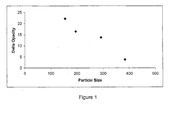
- Figure 1 graph showing the polymer particle size versus the water resistance of acrylic emulsion PSAs.
- acrylic emulsion pressure sensitive adhesive (PSA) polymer compositions which, when coated and dried as a film, are substantially unaffected by the action water, particularly the action of hot (greater than 65°C) and very cold (about 0°C) water.
- the water resistant acrylic pressure sensitive adhesive polymer is formed by polymerizing in emulsion a mixture of monomers.
- the monomer mixture comprises at least one alkyl acrylate ester of an alcohol containing at least 4 carbon atoms in the alkyl chain; at least one polar monomer; and at least one copolymerizable monomer selected from styrene and styrene derivative monomers.
- the monomer mixture comprises at least one alkyl acrylate ester of an alcohol containing at least 4 carbon atoms in the alkyl chain; at least one polar monomer; and at least one copolymerizable monomer chosen from methyl methacrylate, ethyl acrylate, methyl acrylate, vinyl acetate, and combinations of two or more thereof.
- the acrylic emulsion PSA polymers are comprised of a predominant amount of one or more alkyl acrylate esters of an alcohol containing at least 4 carbon atoms.
- the alkyl acrylate esters contain 4 to 8 carbon atoms in the alkyl chain.
- Alkyl acrylates esters include, among others, n-butyl acrylate, 2-ethyl hexyl acrylate, hexyl acrylate, decyl acrylate, dodecyl acrylate, isooctylacrylate and the like.
- the alkyl acrylate esters are present in an amount of at least about 50% of the weight of total monomers.
- the alkyl acrylate ester is present in the range of about 50% to about 99%, or about 55 to about 98%, or about 75% to about 90% of the weight of total monomers.
- the acrylic emulsion PSA polymer comprises at least one polar comonomer.
- polar monomers include carboxylic acids containing from about 3 to about 5 carbon atoms.
- carboxylic acids are acrylic acid, methacrylic acid, maleic acid, fumaric acid, itaconic acid, and the like, and combinations of two or more thereof.
- Other polar comonomers containing carboxylic and hydroxy groups can also be used.
- polar comonomers examples include beta-carboxyethyl acrylate, monomethacryloylethyl succinate, monomethacryloylethyl phthalate, polyethylene(propylene) glycol mono(meth)acrylates, 2-hydroethyl (meth)acrylate, 2-hydroxypropyl (meth)acrylates and the like, and combinations of two or more thereof.
- the polar monomer is present in the range of about 0.5% to about 5%, or about 0.5% to about 3%, or about 1 % to about 3% of the weight of total monomers.
- the acrylic emulsion PSA polymer also comprises at least one styrene or styrene derivative such as tertiary butyl styrene, dimethyl styrene and vinyl toluene and the like.
- the styrene or styrene derivative is present in the range of about 1% to about 25%, or about 1 % to about 15% of the weight of total monomers.
- the acrylic emulsion PSA also comprises at least one copolymerizable monomer chosen from methyl methacrylate, ethyl acrylate, methyl acrylate, vinyl acetate and combinations of two or more thereof.
- the copolymerizable monomer may be present in an amount of from 0% to about 50% based on the total weight of monomers, or about 5% to about 50%, or about 5% to about 15%.
- the acrylic emulsion polymer may include multifunctional ethylenically unsaturated monomers.
- monomers include, for example, divinyl benzene, trivinylbenzene, divinyltoluene, divinylpyridine, divinylnaphthalene, divinylxylene, ethyleneglycol di(meth)acrylate, trimethylolpropane tri(meth)acrylate, diethylenegrycol divinyl ether, trivinylcyclohexane, allyl (meth)acrylate, diethylene glycol di(meth)acrylate, propyleneglycol di(meth)acrylate, trimethylolpropane tri(meth)acrylate, 2,2-dimethylpropane-1,3-di(meth)acrylate, 1,3-butylene glycol di(meth)acrylate, 1,4-butanediol di(meth)acrylate, 1,6-hexanediol di(meth)
- the optional monomer is present in the acrylic emulsion polymer in the range of 0% to about 20% by weight of the total monomers. In one embodiment, the optional copolymerizable monomer is present in an amount of about 0 to about 15% by weight of the monomers.
- comonomers including acetoacetoxyethyl (meth)acrylate, N-vinyl caprolactam, hydroxyethyl(propyl) (meth) acrylate, and the like may be added to the monomer mix.
- Chemical crosslinkers may be provided in an amount of up to 1 % by weight of the monomers.
- the acrylic emulsion PSA polymers are formed in the presence of at least one surfactant.
- useful surfactants include anionic surfactants, nonionic surfactants and mixtures thereof.
- both anionic and ionic surfactants are used and are provided in a weight ratio of nonionic to anionic of at least about 1.5:1.
- the surfactants are provided in a weight ratio of about 1.5:1 to about 4:1, or about 2:1 to about 3:1.
- Anionic surfactants useful in the polymerization process include those containing sulfate, sulfonate, phosphate, polyoxyethylene sulfate, polyoxyethylene sulfonate, polyoxyethylene phosphate groups, and the like, and the salts of such anionic groups including alkali metal salts, ammonium salts, teritary amino salts, and the like, including salts of sulfated nonyl or octyl phenoxy poly(ethyleneoxy) ethanols, alkyl sulfonate, alkyl sulfosuccinate, polyoxyethylene alkyl sulfate, polyoxyethylene alkylaryl sulfate, polyoxyethylene alkyl phenol ether sulfate and combinations of two or more thereof.
- anionic surfactants include lauryl ether sulfates such as DisponilTM FES-32, DisponilTM FES-993 available from Cognis Corporation; di-2-ethyl hexyl sulphosuccinate sodium salt also from Cognis Corporation; salts of sulfated nonyl and octyl phenoxy poly(ethyleneoxy) ethanols such as AerosolTM NPES-458, AerosolTM OT-75, AerosolTM A-501 available from Cytec Industries; aromatic phosphate ester surfactants such as RhodafacTM PE-510 available from Rhone Poulenc; copolymerizable surfactants such as sulfated acrylic polyethers such as SAM 211 from PPG Industries and the like.
- Other surfactants useful for polymerization include docecyl benzene sulfonate, lauryl sulfate, and the like.
- Nonionic surfactants useful in the polymerization process include those containing modified fatty alcohol or acid ethoxylates, alkyl phenol ethoxylate, polyoxyethylene alkyl phenol ether, polyoxyethylene alkyl ether, and combinations of two or more thereof.
- Commercially available nonionic surfactants include modified fatty alcohol polyglycolether such as DisponilTM AFX 1080 from Cognis Corporation; octyl and nonylphenol ethoxylates such as the IgepalTM surfactants from Rhodia; and the C 11 -C 15 secondary alcohol ethoxylates such as the Tergitol 15-S series from Dow.
- the surfactant comprises a fatty alcohol polyglycol ether containing C-12 hydrophobes and having an ethoxylation (EO) content of less than or equal to about 20 mols. In one embodiment, the EO content is less than or equal to about 10 mols.
- EO ethoxylation
- polymerization catalysts initiators
- electrolytes chain transfer agents, for example, those containing mono- or multi-mercapton groups such as n-dodecyl mercaptan (n-DDM), halogenated groups, hydroxy groups and the like
- base solutions e.g., aqueous ammonia sodium hydroxide, etc.
- accelerators e.g., aqueous ammonia sodium hydroxide, etc.
- defoaming agents for example, Drewplus T-1201 commercially available from Ashland Specialty Chemical Company
- biocides for example, Kathon LX, commercially available as a 1.5% solution from Rohm & Haas.
- the polymer comprises 0.01% to about 0.5% by weight, based on the total weight of monomers of a chain transfer agent.
- water soluble free radical initiators can be used for polymerization. They include ammonium persulfate, potassium persulfate and sodium persulfate. Other initiators such as water soluble azo initiators, redox initiators such as persulfate/bisulfate catalyst systems can also be used.
- the typical concentration of polymerization initiator is about 0.05% to about 1.0% of the total weight of monomers.
- the pH of the emulsion may be adjusted by contacting the emulsion with a suitable base in an amount necessary to raise the pH of at least 7.
- a suitable base in an amount necessary to raise the pH of at least 7.
- the pH is from about 7.2 to about 9, or from about 7.5 to about 8.
- suitable bases include alkali metal hydroxides, alkaline earth metal hydroxides, ammonium hydroxide, amines and the like.
- the emulsion polymer typically has a mean "volume-average" particle diameter of greater than about 210 nm as determined by laser light scattering using a Nicomp Instrument spectrometer. In one embodiment, the emulsion polymer has a mean volume-average particle size of at least 250 nm, or about 300 nm, or about 350 nm. In one embodiment, the emulsion polymer has a bimodal particle size distribution.
- emulsion polymers are prepared that have a high solids content and low viscosity.
- the solids content of the emulsion polymer may be at least 55% by weight. In one embodiment, the solids content is about 55% to about 70% by weight.
- the emulsified product of polymerization may have a viscosity in the range of about 300 to about 15,000 cps. In one embodiment, the viscosity is in the range of about 300 to about 4,000 cps.
- a hot water resistance test was developed to simulate the effect of pasteurization and as a standard method to determine candidate adhesive polymer opacity.
- Opacity is the ratio of the reflectance of a sample backed with a white background to that of a sample backed with a black background, multiplied by one hundred, and reported as percent opacity.
- a pressure sensitive adhesive is coated to a thickness of 1 mil on a clear 2 mil biaxially oriented polypropylene (BOPP) facestock or backing, dried at 60°C in an oven for 10 min. and cooled. After cooling, the film facestock or backing is immersed in a beaker of hot water water (66+°C) for 60 min.
- BOPP biaxially oriented polypropylene
- the PSA coated facestock is then immediately laminated to a clear 2 mil polyester film with a plastic squeegee and opacity of the resultant laminate determined using a spectrocolorimeter (Hunter Lab ColorQuest 45/0). Percentage opacity for the immersed sample is compared to a sample that has not been immersed and the difference is recorded as Delta Opacity. An opacity increase of up to about 5% is regarded as good. An opacity increase of up to about 2.5 is regarded as excellent. An opacity increase above 10.0% is regarded as poor for applications requiring a non-water whitening PSA.
- a cold water resistance test was developed to simulate the effect of "ice chest" conditions and as a standard method to determine candidate adhesive polymer opacity for beverage bottle applications.
- the test is substantially the same as that of the hot water test, with the exception that the PSA coated facestock is immersed in a bath of water at a temperature of about 0°C (32°F) for a period of 72 hours before measuring the opacity with a spectrocolorimeter.
- An opacity increase of up to about 5% is regarded as excellent.
- An opacity increase greater than 10.0% is regarded as poor for applications requiring a non-water whitening PSA.
- a coated construction is prepared by coating the polymer emulsion on release liner, drying the emulsion, and laminating the resulting subassembly to a facestock or other substrate, such as a paper or film backing.
- the emulsion may be coated directly on a facestock, dried, and then protected until use by a release liner or a low release energy backside of the construction.
- a coated construction is prepared by simply coating the emulsion polymer on a substrate and allowing it to dry.
- a reactor charge containing 307.2 g of deionized water.
- a pre-emulsion feed soap solution is formed by dissolving 42.01 g of Disponil 993 (32% solids, manufactured by Cognis Corp.), 7.26g of Aerosol OT-75 (75% solids, manufactured by Cytec) in 120.03g of deionized water.
- a monomer mix is made up with 753.62g of 2-ethyl hexyl acrylate, 89.75g of methyl methacrylate, 44.88g of styrene, and 8.97g of acrylic acid.
- the monomer mix is added to the pre-emulsion solution with mixing and is stirred until the viscosity is in the range of 1000 - 4000 cps (Brookfield, RV, #3/12 rpm).
- An aqueous initiator feed solution was prepared by dissolving 1.95g of potassium persulfate in 77.96g of deionized water.
- a kickoff initiator was prepared and comprised of 1.95g of potassium persulfate.
- the reactor charge is introduced to a 1.5-liter reactor.
- the reactor charge is heated to 78°C and the kickoff initiator added.
- the mixture is held for 5 minutes at 78°C.
- the pre-emulsion feed is started at the rate of 4.637 g/min.
- Twenty five minutes after the start of the pre-emulsion feed the aqueous initiator feed is added at the rate of 0.347 g/min.
- the pre-emulsion is added over 3.83 hours.
- the aqueous initiator feed is added over 3.83 hours.
- the internal temperature of the reactor is maintained at 80-82°C. After the feeds are completed, the contents are held at 80°C for an additional hour, and then cooled.
- the latex is neutralized with a dilute ammonium hydroxide solution to a pH of 7.5.
- the final latex solids are 61.95%.
- Viscosity is 460cps (Brookfield, RV, #3/12rpm). Particle size measurement yielded a bimodal distribution of which 52.1% is comprised of 185.3nm particles and 47.9% comprised of 578.3nm particles. When tested by the above described hot water resistance test, a delta opacity of 9.5% is measured.
- a pre-emulsion feed soap solution is formed by dissolving 17.65g of Disponil AFX-1080 (80% solids, manufactured by Cognis Corp.), 7.45g of Aerosol OT-75 (75% solids, manufactured by Cytec) in 106.78g of deionized water.
- a monomer mix is made up with 772.74g of 2-ethyl hexyl acrylate, 92.03g of methyl methacrylate, 46.01 g of styrene, and 9.20g of acrylic acid.
- the monomer mix is added to the pre-emulsion solution with mixing and is stirred until the viscosity is in the range of 1000 - 4000 cps (Brookfield, RV, #3/12 rpm).
- An aqueous initiator feed solution is prepared by dissolving 2.67g of potassium persulfate in 118.54g of deionized water.
- a kickoff initiator is prepared and comprised of 2.67g of potassium persulfate.
- the reactor charge is introduced to a 1.5-liter reactor.
- the reactor charge is heated to 78°C and the kickoff initiator added.
- the mixture is held for five minutes at 78°C.
- the pre-emulsion feed is started at the rate of 4.574 g/min.
- Twenty-five minutes after the start of the pre-emulsion feed the aqueous initiator feed is added at the rate of 0.527 g/min.
- the pre-emulsion is added over 3.83 hours.
- the aqueous initiator feed is added over 3.83 hours.
- the internal temperature of the reactor is maintained at 80-82°C. After the feeds are complete, the contents are held at 80°C for an additional hour and then cooled.
- the latex is neutralized with a dilute ammonium hydroxide solution to a pH of 7.5.
- the final latex solids are 62.46%.
- Viscosity is 1780cps (Brookfield, RV, #3/12rpm). Particle size measurement yielded a bimodal distribution. When tested by the above described hot water resistance test, a delta opacity of 3.75% is measured.
- a reactor charge containing 283.52g of deionized water.
- a pre-emulsion feed soap solution is formed by dissolving 17.65g of Disponil AFX-1080 (80% solids, manufactured by Cognis Corp.), 7.44g of Aerosol OT-75 (75% solids, manufactured by Cytec) in 106.67g of deionized water.
- a monomer mix is made up with 771.95g of 2-ethyl hexyl acrylate, 91.93g of methyl methacrylate, 45.97g of styrene, 9.20g of acrylic acid, and 1.54g of tetra ethylene glycol diacrylate (100% active manufactured by Sartomer).
- the monomer mix is added to the pre-emulsion solution with mixing and is stirred until the viscosity is in the range of 1000 - 4000 cps (Brookfield, RV, #3/12 rpm).
- An aqueous initiator feed solution is prepared by dissolving 2.67g of potassium persulfate in 118.42g of deionized water.
- a kickoff initiator is prepared and comprised of 2.67g of potassium persulfate.
- the reactor charge is introduced to a 1.5-liter reactor.
- the reactor charge is heated to 78°C and the kickoff initiator added.
- the mixture is held for 5 minutes at 78°C.
- the pre-emulsion feed is started at the rate of 4.576 g/min.
- Twenty-five minutes after the start of the pre-emulsion feed the aqueous initiator feed is added at the rate of 0.526 g/min.
- the pre-emulsion is added over 3.83 hours.
- the aqueous initiator feed is added over 3.83 hours.
- the internal temperature of the reactor is maintained at 80-82°C. After the feeds are complete, the contents are held at 80°C for an additional hour and then cooled.
- the latex is neutralized with a dilute ammonium hydroxide solution to a pH of 7.5.
- the final latex solids is 62.5%.
- Viscosity is 1560cps (Brookfield, RV, #3/12rpm). Particle size measurements yielded a bimodal distribution. When tested by the above described hot water resistance test, a delta opacity of 6.9% is measured.
- a reactor charge containing 283.52g of deionized water.
- a pre-emulsion feed soap solution is formed by dissolving 22.06g of Igepal CO-887 (70% solids, manufactured by Rhodia), 7.44g of Aerosol OT-75 (75% solids, manufactured by Cytec) in 106.67g of deionized water.
- a monomer mix is made up with 771.95g of 2-ethyl hexyl acrylate, 91.93g of methyl methacrylate, 45.97g of styrene, and 9.20g of acrylic acid.
- the monomer mix is added to the pre-emulsion solution with mixing and is stirred until the viscosity is in the range of 1000 - 4000 cps (Brookfield, RV, #3/12 rpm).
- An aqueous initiator feed solution is prepared by dissolving 2.67g of potassium persulfate in 118.42g of deionized water.
- a kickoff initiator is prepared and comprised of 2.67g of potassium persulfate.
- the reactor charge is introduced to a 1.5-liter reactor.
- the reactor charge is heated to 78°C and the kickoff initiator added.
- the mixture is held for five minutes at 78°C.
- the pre-emulsion feed is started at the rate of 4.576-g/min.
- Twenty-five minutes after the start of the pre-emulsion feed the aqueous initiator feed is added at the rate of 0.526 g/min.
- the pre-emulsion is added over 3.83 hours.
- the aqueous initiator feed is added over 3.83 hours.
- the internal temperature of the reactor is maintained at 80-82°C. After the feeds are complete, the contents are held at 80°C for an additional hour and then cooled.
- the latex is neutralized with a dilute ammonium hydroxide solution to a pH of 7.5.
- the final latex solids are 62.39%.
- Viscosity is 1340cps (Brookfield, RV, #3/12rpm). Particle size measurements yielded a bimodal distribution. When tested by the above described hot water resistance test, a delta opacity of 6.9% is measured.
- a reactor charge containing 283.52g of deionized water.
- a pre-emulsion feed soap solution is formed by dissolving 23.09 of Disponil AFX-1080 (80% solids, manufactured by Cognis Corp.), in 117.4g of deionized water.
- a monomer mix is made up with 773.95g of 2-ethyl hexyl acrylate, 91.93g of methyl methacrylate, 45.97g of styrene, and 9.20g of acrylic acid.
- the monomer mix is added to the pre-emulsion solution with mixing and is stirred until the viscosity is in the range of 1000 - 4000 cps (Brookfield, RV, #3/12 rpm).
- An aqueous initiator feed solution is prepared by dissolving 2.67g of potassium persulfate in 118.42g of deionized water.
- a kickoff initiator was prepared and comprised of 2.67g of potassium persulfate.
- the reactor charge is introduced to a 1.5-liter reactor.
- the reactor charge is heated to 78°C and the kickoff initiator added.
- the mixture is held for five minutes at 78°C.
- the pre-emulsion feed is started at the rate of 4.576 g/min.
- Twenty five minutes after the start of the pre-emulsion feed the aqueous initiator feed is added at the rate of 0.526 g/min.
- the pre-emulsion is added over 3.83 hours.
- the aqueous initiator feed is added over 3.83 hours.
- the internal temperature of the reactor is maintained at 80-82°C. After the feeds are complete, the contents are held at 80°C for an additional hour and then cooled.
- the latex is neutralized with a dilute ammonium hydroxide solution to a pH of 7.5.
- the final latex solids are 62.5%.
- Viscosity is 1050cps (Brookfield, RV, #3/12rpm) Particle size yielded a bimodal distribution. When tested by the above described hot water resistance test, a delta opacity of 8.35% is measured.
- a reactor charge containing 283.81g of deionized water.
- a pre-emulsion feed soap solution is formed by dissolving 17.65g of Disponil AFX-1080 (80% solids, manufactured by Cognis Corp.), 7.45g of Aerosol OT-75 (75% solids, manufactured by Cytec) in 116.78g of deionized water.
- a monomer mix is made up with 772.74g of 2-ethyl hexyl acrylate, 92.03g of methyl methacrylate, 46.01g of styrene, and 9.20g of acrylic acid.
- the monomer mix is added to the pre-emulsion solution with mixing and is stirred until the viscosity is in the range of 1000 - 4000 cps (Brookfield, RV, #3/12 rpm).
- An aqueous initiator feed solution is prepared by dissolving 2.26g of ammonium persulfate in 118.54g of deionized water.
- a kickoff initiator is prepared comprising of 2.26g of potassium persulfate.
- the reactor charge is introduced to a 1.5-liter reactor.
- the reactor charge is heated to 78°C and the kickoff initiator added.
- the mixture is held for five minutes at 78°C.
- the pre-emulsion feed is started at the rate of 4.574 g/min.
- Twenty five minutes after the start of the pre-emulsion feed the aqueous initiator feed is added at the rate of 0.527 g/min.
- the pre-emulsion is added over 3.83 hours.
- the aqueous initiator feed is added over 3.83 hours.
- the internal temperature of the reactor is maintained at 80-82°C. After the feeds are complete, the contents are held at 80°C for an additional hour and then cooled.
- the latex is neutralized with a dilute ammonium hydroxide solution to a pH of 7.5.
- the final latex solids are 62.46%.
- Viscosity is 1120cps (Brookfield, RV, #3/12rpm) and particle size yielded a bimodal distribution. When tested by the above described hot water resistance test, a delta opacity of 2.85% is measured.
- a reactor charge containing 40.0g of 100nm emulsion polymer (commonly known as a seed or pre-form seed) in 185.0g of deionized water.
- a pre-emulsion feed soap solution is formed by dissolving 15.34g of Disponil AFX-1080 (80% solids, manufactured by Cognis), and 6.48g of Aerosol OT-75 (75% solids) in 120.0g of deionized water.
- a monomer mix is made up with 669.38g 2-ethylhexyl acrylate (2-EHA), 79.69g methyl methacrylate (MMA), 39.84g of styrene, and 7.97g of acrylic acid (AA).
- the monomer mix is added to the pre-emulsion soap solution with mixing and is stirred until the viscosity is approximately 2000 cps (Brookfield, RV, #3 12rpm).
- a cofeed solution is prepared by dissolving 3.19g of potassium persulfate in 156.0g of deionized water.
- An initial kickoff initiator solution is prepared by dissolving 1.43g of potassium persulfate in 47.5g of deionized water.
- the reactor charge is added to a 1.5 liter jacketed reactor that has been flushed with nitrogen. The reactor charge is held at 82°C and the kickoff initiator solution added. The mixture is held for five minutes at 80°C.
- the pre-emulsion feed is started at a rate of 4.0g/min.
- the initiator cofeed is started at a rate of 0.69g/min.
- the pre-emulsion is fed over a period of four hours.
- the temperature inside the reactor is maintained at approximately 80°C.
- the contents are held at approximately 80°C for one hour and then cooled.
- the latex is neutralized with dilute ammonium hydroxide to a pH of 7.0.
- the final latex solids are 58.3%.
- the viscosity is 400 cps (Brookfield RV #4 at 20rpm).
- the average particle diameter is 383nm.
- Disponil AFX-1080 80% solids, manufactured by Cognis
- Aerosol OT-75 75% solids
- a pre-emulsion feed soap solution is formed by dissolving 5.4g of Disponil AFX-1080 (80% solids, manufactured by Cognis), and 2.24g of Aerosol OT-75 (75% solids) in 120.0g of deionized water.
- a monomer mix is made up with 504.0g 2-EHA, 60.0g MMA, 30.0g of styrene, and 6.0g of AA.
- the monomer mix is added to the pre-emulsion soap solution with mixing and is stirred until the viscosity is approximately 2000 cps (Brookfield, RV, 3 #12).
- the reactor charge is added to a 1.5 liter jacketed reactor that is flushed with nitrogen.
- the reactor charge is held at 82°C and 3.8g of potassium persulfate is added.
- the mixture is held for five minutes at 80°C.
- the pre-emulsion feed is started at a rate of 8.1g/min.
- the pre-emulsion is fed over a period of one and one half-hours. During the feeds, the temperature inside the reactor is maintained at approximately 80°C. After all of the feeds are complete, the contents are held at approximately 80°C for one hour and then cooled.
- the latex is neutralized with dilute ammonium hydroxide to a pH of 7.0.
- the final latex solids are 50.1%.
- the viscosity is 800 cps (Brookfield RV, #4 at 20rpm).
- the average particle diameter is 154nm.
- Examples 9 and 10 are prepared substantially in accordance with the procedure of Example 7, with the exception that the seed amount was increased to result in a smaller average particle size.
- Figure 1 is a graph of the data presented in Table 1 below.
- Table 1 Example Particle Size (nm) Delta Opacity 7 383 3.8 8 154 22.2 9 292 13.8 10 195 16.5
- a reactor charge containing 41.92g of 100nm emulsion polymer (commonly known as a seed or pre-form seed) in 183.4g of deionized water.
- a pre-emulsion feed soap solution is formed by dissolving 16.08g of Disponil AFX-1080 (80% solids, manufactured by Cognis), and 6.79g of Aerosol OT-75 (75% solids) in deionized water.
- a monomer mix is made up with 701.52 2-EHA, 83.52g MMA, 41.75g of styrene, and 8.16 of AA.
- the monomer mix is added to the pre-emulsion soap solution with mixing and is stirred until the viscosity is approximately 1000 - 4000 cps (Brookfield, RV, 3 #12).
- a cofeed solution is prepared by dissolving 3.34g of potassium persulfate in 163.49g of deionized water.
- An initial kickoff initiator solution is prepared by dissolving 1.50g of potassium in 52.4g of deionized water.
- the reactor charge is added to a 2.0 liter jacketed reactor that has been flushed with nitrogen. The reactor charge is held at 82°C and the kickoff initiator solution added. The mixture is held for five minutes at 80°C.
- the pre-emulsion feed is started at a rate of 2.9g/min.
- the initiator cofeed is started at a rate of 0.47g/min.
- the pre-emulsion is fed over a period of 5.83 hours.
- the temperature inside the reactor is maintained at approximately 80°C.
- the contents are held at approximately 80°C for one hour and then cooled.
- the latex is neutralized with dilute ammonium hydroxide to a pH of 7.5.
- the final latex solids are 58.3%.
- the viscosity are 780 cps (Brookfield RV, #4, rpm20).
- the average particle diameter is 385nm.
- a reactor charge containing 11.33 of 70nm emulsion polymer (commonly known as a seed or pre-form seed) in 226.59g of deionized water.
- a pre-emulsion feed soap solution is formed by dissolving 13.20g of Disponil AFX-1080 (80% solids, manufactured by Cognis), and 5.55g of Aerosol OT-75 (75% solids) in deionized water.
- a monomer mix is made up with 758.39g 2-EHA, 45.14g MMA, 90.29g of styrene, 8.83g of AA, and 2.27g of tetra ethylene glycol diacrylate.
- the monomer mix is added to the pre-emulsion soap solution with mixing and is stirred until the viscosity is approximately 1000 - 4000 cps (Brookfield, RV, 3 #12).
- a cofeed solution is prepared by dissolving 3.05g of ammonium persulfate in 107.63g of deionized water.
- An initial kickoff initiator solution is prepared by dissolving 1.37g of ammonium persulfate in 28.32g of deionized water.
- the reactor charge is added to a 2.0 liter jacketed reactor that has been flushed with nitrogen. The reactor charge is held at 82°C and the kickoff initiator solution added. The mixture is held for five minutes at 80°C.
- the pre-emulsion feed is started at a rate of 3.09g/min. After five minutes, the initiator cofeed is started at a rate of 0.299g/min.
- the pre-emulsion is fed over a period of 5.83 hours. During the feeds, the temperature inside the reactor is maintained at approximately 80°C. After all of the feeds are complete, the contents are held at approximately 80°C for one hour and then cooled.
- the latex is neutralized with dilute ammonium hydroxide to a pH of 7.5. The final latex solids are 61.5%.
- the viscosity is 3200 cps (Brookfield RV, #3/12). The average particle diameter is 385nm. When tested by the above described hot water resistance test, a delta opacity of 3.21% is measured.
- a reactor charge containing 10.73g of 70nm emulsion polymer (commonly known as a seed or pre-form seed) in 225.37g of deionized water.
- a pre-emulsion feed soap solution is formed by dissolving 12.5g of Disponil AFX-1080 (80% solids, manufactured by Cognis), and 5.25g of Aerosol OT-75 (75% solids) in 171.69g in deionized water.
- a monomer mix is made up with 719.56g 2-EHA, 128.5g MMA, 8.57g of AA, and 3.51 g n-dodecyl mercaptan (nDDM).
- the monomer mix is added to the pre-emulsion soap solution with mixing and is stirred until the viscosity is approximately 2000 cps (Brookfield, RV, 3 #12).
- a cofeed solution is prepared by dissolving 2.89g of ammonium persulfate in 167.4g of deionized water.
- An initial kickoff initiator solution is prepared by dissolving 1.3g of potassium in 26.83g of deionized water.
- the reactor charge is added to a 2.0 liter jacketed reactor that has been flushed with nitrogen. The reactor charge is held at 82°C and the kickoff initiator solution added. The mixture is held for five minutes at 82°C.
- the pre-emulsion feed is started at a rate of 5.81g/min.
- the initiator cofeed is started at a rate of 0.895g/min.
- the pre-emulsion is fed over a period of five hours and fifty minutes.
- the temperature inside the reactor is maintained at approximately 82°C.
- the contents are held at approximately 82°C for one hour and then cooled.
- the latex is neutralized with dilute ammonium hydroxide to a pH of 7.0.
- the final latex solids are 58.5% and the delta opacity is 2.1%.
- a reactor charge containing 10.73g of 70nm emulsion polymer (commonly known as a seed or pre-form seed) and .04g of Fe 2+ EDTA in 225.37g of deionized water.
- a pre-emulsion feed soap solution is formed by dissolving 12.5g of Disponil AFX-1080 (80% solids, manufactured by Cognis), 5.25g of Aerosol OT-75 (75% solids), and 0.86g of Bruggeman FF-6 in 171.69g in deionized water.
- a monomer mix is made up with 719.56g 2-EHA, 128.5g MMA, 1.76g nDDM and 8.57g of AA.
- the monomer mix is added to the pre-emulsion soap solution with mixing and is stirred until the viscosity is approximately 2000 cps (Brookfield, RV, 3 #12).
- a cofeed solution is prepared by dissolving 6.85g of ammonium persulfate in 167.4g of deionized water.
- the reactor charge is added to a 2.0 liter jacketed reactor that has been flushed with nitrogen.
- the reactor charge is held at 40°C and the cofeed solution is begun at 0.85g/min.
- the pre-emulsion feed is started at a rate of 5.81 g/min.
- the pre-emulsion is fed over a period of five hours and fifty minutes.
- the temperature inside the reactor is maintained at approximately 40°C. After all of the feeds are complete, the contents are held at approximately 40°C for one half-hour and then cooled.
- the latex is neutralized with dilute ammonium hydroxide to a pH of 7.0.
- the final latex solids are 6
- a reactor charge containing 10.73g of 70nm emulsion polymer (commonly known as a seed or pre-form seed) and .04g of Fe 2+ EDTA in 225.37g of deionized water.
- a pre-emulsion feed soap solution is formed by dissolving 12.5g of Disponil AFX-1080 (80% solids, manufactured by Cognis), 5.25g of Aerosol OT-75 (75% solids), and 0.86g of Bruggeman FF-6 in 171.69g of deionized water.
- a monomer mix is made up with 719.56g 2-EHA, 85.66g MMA, 42.83g styrene, and 8.57g of AA.
- the monomer mix is added to the pre-emulsion soap solution with mixing and is stirred until the viscosity is approximately 2000 cps (Brookfield, RV, 3 #12).
- a cofeed solution is prepared by dissolving 6.85g of ammonium persulfate in 167.4g of deionized water.
- the reactor charge is added to a 2.0 liter jacketed reactor that has been flushed with nitrogen.
- the reactor charge is held at 40°C and the cofeed solution is begun at 0.85g/min.
- the pre-emulsion feed is started at a rate of 5.81g/min.
- the pre-emulsion is fed over a period of five hours and fifty minutes.
- the temperature inside the reactor is maintained at approximately 40°C. After all of the feeds are complete, the contents are held at approximately 40°C for one half-hour and then cooled.
- the latex is neutralized with dilute ammonium hydroxide to a pH of 7.0.
- the final latex solids are 60.1
- a reactor charge containing 4.33 g or potassium persulphate inn 511.50 g deionized water is formed.
- a pre-emulsion feed soap solution is formed by dissolving 69.95 g of Disponil FES0993 and 12.09 g Hydropalat 875 in 199.86 g of deionized water.
- a monomer mix is made up with 1254.80 g 2-EHA, 149.44 g MMA, 74.72 g styrene and 14.94 g acrylic acid. To the monomer mix is added 0.26 g n-dodecyl mercaptan. The monomer mix is added to the pre-emulsion soap solution with mixing.
- An initiator feed is prepared by dissolving 129.81 g of ammonium persulfate in 129.81 g deionized water.
- the reactor charge is added to a jacketed reactor that has been flushed with nitrogen.
- the reactor charge is held at 78°C and the pre-emulsion feed is begun at 6.5 g/min.
- the initiator feed is begun at 0.6 g/min.
- the contents are held at approximately 78-81°C for one hour, and then cooled.
- the latex is neutralized with 19.39 g of a 12% ammonium hydroxide solution.
- a biocide, Acticide LA is added in an amount of 2.33 g when the latex has cooled to below 38°C.
- the pressure sensitive adhesives of the invention may be employed as part of a label laminate or facestock and PSA provided as a self wound tape or label.
- the acrylic emulsion PSA is applied to a transparent polymeric facestock to form a clear label.
- the polymeric facestock may be a polyolefin, polyester, polyvinyl chloride, polycarbonate film or a multilayer construction comprising layers of the same or different polymers.
- the multilayer films may be coextruded films. Examples of commercially available multilayer films include FasClear ® film and Primax ® film from Avery Dennison Corp.
- the label may comprise a release liner adhered to the acrylic emulsion PSA.
- the tapes or labels may be applied to clear substrates such as glass or plastic bottles and containers and the like.
- the label comprises a 2 mil clear biaxially oriented polypropylene (BOPP) facestock with an adhesive layer adhered thereto.
- a 1 mil polyethylene terephthalate (PET) release liner may be adhered to the surface of the adhesive layer opposite to the facestock.
- PET polyethylene terephthalate
- the adhesive layer may be applied directly to the facestock, or can be coated onto the release liner and then laminated to the facestock.
- the present invention relates to the following items:
Landscapes
- Chemical & Material Sciences (AREA)
- Organic Chemistry (AREA)
- Chemical Kinetics & Catalysis (AREA)
- Health & Medical Sciences (AREA)
- Medicinal Chemistry (AREA)
- Polymers & Plastics (AREA)
- Polymerisation Methods In General (AREA)
- Addition Polymer Or Copolymer, Post-Treatments, Or Chemical Modifications (AREA)
- Adhesives Or Adhesive Processes (AREA)
Priority Applications (1)
| Application Number | Priority Date | Filing Date | Title |
|---|---|---|---|
| PL14001449T PL2789664T3 (pl) | 2005-05-20 | 2006-05-19 | Kleje samoprzylepne odporne na bielenie pod wpływem wody |
Applications Claiming Priority (4)
| Application Number | Priority Date | Filing Date | Title |
|---|---|---|---|
| US68297305P | 2005-05-20 | 2005-05-20 | |
| US78486706P | 2006-03-22 | 2006-03-22 | |
| EP06770727A EP1882023A1 (fr) | 2005-05-20 | 2006-05-19 | Adhesifs sensibles a la pression, resistants au blanchiment et a l'eau |
| PCT/US2006/019563 WO2006127513A1 (fr) | 2005-05-20 | 2006-05-19 | Adhesifs sensibles a la pression, resistants au blanchiment et a l'eau |
Related Parent Applications (1)
| Application Number | Title | Priority Date | Filing Date |
|---|---|---|---|
| EP06770727A Division EP1882023A1 (fr) | 2005-05-20 | 2006-05-19 | Adhesifs sensibles a la pression, resistants au blanchiment et a l'eau |
Publications (3)
| Publication Number | Publication Date |
|---|---|
| EP2789664A1 true EP2789664A1 (fr) | 2014-10-15 |
| EP2789664B1 EP2789664B1 (fr) | 2018-09-05 |
| EP2789664B2 EP2789664B2 (fr) | 2026-01-07 |
Family
ID=36936490
Family Applications (2)
| Application Number | Title | Priority Date | Filing Date |
|---|---|---|---|
| EP14001449.9A Active EP2789664B2 (fr) | 2005-05-20 | 2006-05-19 | Adhésifs sensibles à la pression résistants au blanchiment de l'eau |
| EP06770727A Withdrawn EP1882023A1 (fr) | 2005-05-20 | 2006-05-19 | Adhesifs sensibles a la pression, resistants au blanchiment et a l'eau |
Family Applications After (1)
| Application Number | Title | Priority Date | Filing Date |
|---|---|---|---|
| EP06770727A Withdrawn EP1882023A1 (fr) | 2005-05-20 | 2006-05-19 | Adhesifs sensibles a la pression, resistants au blanchiment et a l'eau |
Country Status (9)
| Country | Link |
|---|---|
| US (1) | US9914858B2 (fr) |
| EP (2) | EP2789664B2 (fr) |
| KR (1) | KR101353283B1 (fr) |
| AU (1) | AU2006251643B2 (fr) |
| BR (1) | BRPI0610015A2 (fr) |
| ES (1) | ES2698331T3 (fr) |
| PL (1) | PL2789664T3 (fr) |
| RU (1) | RU2418834C2 (fr) |
| WO (1) | WO2006127513A1 (fr) |
Families Citing this family (23)
| Publication number | Priority date | Publication date | Assignee | Title |
|---|---|---|---|---|
| CN101102889B (zh) | 2005-01-10 | 2011-09-21 | 艾利丹尼森公司 | 可剥离卷曲标签 |
| WO2006127513A1 (fr) | 2005-05-20 | 2006-11-30 | Avery Dennison Corporation | Adhesifs sensibles a la pression, resistants au blanchiment et a l'eau |
| US9422465B2 (en) * | 2006-11-02 | 2016-08-23 | Avery Dennison Corporation | Emulsion adhesive for washable film |
| CN102037091B (zh) | 2008-03-20 | 2014-09-03 | 艾利丹尼森公司 | 具有官能团的控制位置的丙烯酸聚合物 |
| EP2147935B1 (fr) * | 2008-07-02 | 2011-12-28 | Rohm and Haas Company | Adhésifs sur base de polymères en émulsion |
| EP3255111B1 (fr) | 2009-03-30 | 2022-10-12 | Avery Dennison Corporation | Étiquette adhésive décollable contenant une couche à film polymère à module en traction élevée |
| EP2415042B1 (fr) | 2009-03-30 | 2017-03-29 | Avery Dennison Corporation | Étiquette adhésive décollable contenant une couche de film polymère présentant une affinité pour l'eau |
| US20120018098A1 (en) | 2009-03-30 | 2012-01-26 | Avery Dennison Corporation | Removable Adhesive Label Containing Inherently Shrinkable Polymeric Film |
| PL2571906T3 (pl) | 2010-05-19 | 2015-02-27 | Avery Dennison Corp | Uporządkowana architektura w polimerach akrylowych |
| EP2766404B1 (fr) | 2011-10-14 | 2019-11-13 | Avery Dennison Corporation | Polymères à architecture régulée |
| TWI521032B (zh) * | 2012-06-28 | 2016-02-11 | 羅門哈斯公司 | 濕性膠 |
| US20150203618A1 (en) * | 2014-01-22 | 2015-07-23 | Adhesives Research, Inc. | Gamma resistant adhesives |
| CN104449485B (zh) * | 2014-11-13 | 2016-08-24 | 苏州斯迪克新材料科技股份有限公司 | 一种反光膜用乳液型聚丙烯酸酯压敏胶的制备方法 |
| KR102209391B1 (ko) | 2016-12-21 | 2021-01-29 | 주식회사 엘지화학 | 키스택이 우수한 점착제 조성물 |
| WO2018117694A1 (fr) * | 2016-12-21 | 2018-06-28 | 주식회사 엘지화학 | Composition adhésive présentant d'excellentes caractéristiques en matière de force de décollage instantané (kisstack) |
| CN108192535B (zh) * | 2017-12-25 | 2020-06-19 | 河南中包科技有限公司 | 一种自动贴标机用塑料瓶环保标签粘合剂及其制法 |
| KR102524479B1 (ko) * | 2018-11-29 | 2023-04-20 | 주식회사 엘지화학 | 아크릴계 에멀젼 점착제 조성물 |
| KR102671012B1 (ko) * | 2019-08-22 | 2024-05-29 | 주식회사 엘지화학 | 아크릴계 에멀젼 점착제 조성물 |
| CN114901703B (zh) * | 2019-12-31 | 2024-04-23 | 巴斯夫欧洲公司 | 水性聚合物组合物、其制备方法及其作为可移除压敏胶粘剂的用途 |
| CN112143422A (zh) * | 2020-09-01 | 2020-12-29 | 岳刚 | 一种耐水有机硅改性丙烯酸压敏胶及其制备方法 |
| CN112552462B (zh) * | 2020-12-15 | 2022-12-20 | 苏州太湖电工新材料股份有限公司 | 一种水性丙烯酸环氧树脂乳液及其制备方法和应用 |
| US11840591B2 (en) | 2020-12-31 | 2023-12-12 | Sanipeel, LLC | In situ peelable protective barrier films |
| CN113462325A (zh) * | 2021-06-22 | 2021-10-01 | 山东新华医疗器械股份有限公司 | 含有机硅水性丙烯酸酯压敏胶的制备方法 |
Citations (3)
| Publication number | Priority date | Publication date | Assignee | Title |
|---|---|---|---|---|
| WO1998044064A1 (fr) * | 1997-03-31 | 1998-10-08 | Avery Dennison Corporation | Adhesifs auto-collants pour pellicules de marquage |
| US20010003765A1 (en) * | 1995-09-29 | 2001-06-14 | Prakash Mallya | Hot water whitening resistant emulsion pressure sensitive adhesives |
| EP1464656A1 (fr) * | 2003-04-04 | 2004-10-06 | Ucb S.A. | Composition émulsifiante |
Family Cites Families (32)
| Publication number | Priority date | Publication date | Assignee | Title |
|---|---|---|---|---|
| JPH0813923B2 (ja) * | 1987-08-17 | 1996-02-14 | 三菱化学ビーエーエスエフ株式会社 | 常温架橋型重合体分散体組成物 |
| US4994538A (en) * | 1989-02-24 | 1991-02-19 | Avery International Corporation | Siliconized emulsion based pressure-sensitive adhesives |
| US5202375A (en) * | 1989-07-28 | 1993-04-13 | Rohm And Haas Company | Water-resistant polymeric emulsions |
| JP2652459B2 (ja) * | 1990-06-20 | 1997-09-10 | 第一工業製薬株式会社 | 乳化重合用乳化剤 |
| AU642055B2 (en) * | 1990-11-28 | 1993-10-07 | Scholl Plc | An emulsion polymerised polymer |
| US5420195A (en) * | 1992-01-10 | 1995-05-30 | Avery Dennison Corporation | Water resistant, removable acrylic emulsion pressure sensitive adhesive |
| US5286843A (en) * | 1992-05-22 | 1994-02-15 | Rohm And Haas Company | Process for improving water-whitening resistance of pressure sensitive adhesives |
| KR0174804B1 (ko) * | 1994-04-20 | 1999-04-01 | 유미꾸라 레이이찌 | 수성 실리콘 변성 아크릴레이트 중합체 에멀젼 |
| CA2180839C (fr) | 1994-04-20 | 2000-08-08 | Toyoaki Yamauchi | Emulsion a base aqueuse de polymere d'acrylate modifie par silicone |
| DE19505039A1 (de) * | 1995-02-15 | 1996-08-22 | Basf Ag | Verfahren zur Herstellung von emulgatorfreien wäßrigen Polymerdispersionen |
| WO1996029373A1 (fr) | 1995-03-22 | 1996-09-26 | Nippon Shokubai Co., Ltd. | Composition d'adhesif autocollant dispersable dans l'eau, son procede de production, et articles adhesifs autocollants fabriques a partir de cette composition |
| CN1200755A (zh) * | 1995-08-14 | 1998-12-02 | 花王株式会社 | 胶粘剂用水性乳液及其生产方法 |
| US6270871B1 (en) * | 1996-09-27 | 2001-08-07 | Avery Dennison Corporation | Overlaminated pressure-sensitive adhesive construction |
| US6239240B1 (en) * | 1997-01-28 | 2001-05-29 | Stepan Company | Emulsion polymerization process utilizing ethylenically unsaturated amine salts of sulfonic, phosphoric and carboxylic acids |
| CN1231545C (zh) * | 1997-08-15 | 2005-12-14 | 伊斯曼化学公司 | 表面活性剂作为增塑剂的应用以减少水基聚合物涂料组合物中的挥发性有机化合物 |
| US6013722A (en) * | 1998-01-27 | 2000-01-11 | 3M Innovative Properties Company | Non-whitening emulsion pressure sensitive adhesives |
| US5928783A (en) * | 1998-03-09 | 1999-07-27 | National Starch And Chemical Investment Holding Corporation | Pressure sensitive adhesive compositions |
| DE69912362T2 (de) | 1998-08-04 | 2004-07-29 | Toagosei Co., Ltd. | Verfahren zur Herstellung eines drucksensitiven Klebmittelfilmes |
| MY130724A (en) | 1998-10-09 | 2007-07-31 | Union Carbide Chem Plastic | Latex polymer compositions |
| US6518342B1 (en) * | 1998-10-29 | 2003-02-11 | Nippon Shokubai Co., Ltd. | Emulsion for pressure-sensitive adhesive |
| DE19920807A1 (de) | 1999-05-06 | 2000-11-09 | Basf Ag | Haftklebstoffe |
| US6534590B1 (en) * | 1999-10-29 | 2003-03-18 | Dow Corning Toray Silicone Co., Ltd. | Silicone-grafted vinyl copolymer emulsion composition |
| US6359092B1 (en) * | 2000-05-09 | 2002-03-19 | Ashland Chemical, Inc. | Water-whitening resistant latex emulsion pressure sensitive adhesive and its production |
| AU2001278020A1 (en) | 2000-07-28 | 2002-02-13 | National Starch And Chemical Investment Holding Corporation | Pressure sensitive adhesive and surfactant composition |
| US6964991B2 (en) * | 2001-07-13 | 2005-11-15 | Surf Chip, Inc. | Process for improving water-whitening resistance of pressure sensitive adhesives |
| EP1448636B1 (fr) * | 2001-10-05 | 2007-03-21 | Avery Dennison Corporation | Polymeres en emulsion de faible viscosite et a teneur elevee en solides |
| JP3891883B2 (ja) | 2002-05-31 | 2007-03-14 | 日本エヌエスシー株式会社 | 接着剤組成物 |
| US6761969B2 (en) * | 2002-08-21 | 2004-07-13 | Avery Dennison Corporation | Labels and labeling process |
| KR20050084597A (ko) * | 2002-09-26 | 2005-08-26 | 설패이스 스페셜티즈, 에스.에이. | 재부착가능하며,수-백화에 저항성이 있는 감압성 접착제 |
| JP4204838B2 (ja) * | 2002-10-04 | 2009-01-07 | リンテック株式会社 | オーバーラミ用粘着フィルム |
| RU2240335C1 (ru) * | 2003-07-04 | 2004-11-20 | Федеральное государственное унитарное предприятие "Пермский завод им. С.М. Кирова" | Водно-дисперсионная клеевая композиция |
| WO2006127513A1 (fr) | 2005-05-20 | 2006-11-30 | Avery Dennison Corporation | Adhesifs sensibles a la pression, resistants au blanchiment et a l'eau |
-
2006
- 2006-05-19 WO PCT/US2006/019563 patent/WO2006127513A1/fr not_active Ceased
- 2006-05-19 EP EP14001449.9A patent/EP2789664B2/fr active Active
- 2006-05-19 KR KR1020077029406A patent/KR101353283B1/ko active Active
- 2006-05-19 AU AU2006251643A patent/AU2006251643B2/en active Active
- 2006-05-19 PL PL14001449T patent/PL2789664T3/pl unknown
- 2006-05-19 EP EP06770727A patent/EP1882023A1/fr not_active Withdrawn
- 2006-05-19 BR BRPI0610015-5A patent/BRPI0610015A2/pt not_active Application Discontinuation
- 2006-05-19 US US11/437,253 patent/US9914858B2/en active Active
- 2006-05-19 ES ES14001449T patent/ES2698331T3/es active Active
- 2006-05-19 RU RU2007147123A patent/RU2418834C2/ru active
Patent Citations (3)
| Publication number | Priority date | Publication date | Assignee | Title |
|---|---|---|---|---|
| US20010003765A1 (en) * | 1995-09-29 | 2001-06-14 | Prakash Mallya | Hot water whitening resistant emulsion pressure sensitive adhesives |
| WO1998044064A1 (fr) * | 1997-03-31 | 1998-10-08 | Avery Dennison Corporation | Adhesifs auto-collants pour pellicules de marquage |
| EP1464656A1 (fr) * | 2003-04-04 | 2004-10-06 | Ucb S.A. | Composition émulsifiante |
Also Published As
| Publication number | Publication date |
|---|---|
| PL2789664T3 (pl) | 2019-03-29 |
| EP1882023A1 (fr) | 2008-01-30 |
| EP2789664B2 (fr) | 2026-01-07 |
| US20060263600A1 (en) | 2006-11-23 |
| EP2789664B1 (fr) | 2018-09-05 |
| WO2006127513A1 (fr) | 2006-11-30 |
| RU2418834C2 (ru) | 2011-05-20 |
| KR101353283B1 (ko) | 2014-02-18 |
| ES2698331T3 (es) | 2019-02-04 |
| RU2007147123A (ru) | 2009-06-27 |
| US9914858B2 (en) | 2018-03-13 |
| AU2006251643A1 (en) | 2006-11-30 |
| KR20080019624A (ko) | 2008-03-04 |
| AU2006251643B2 (en) | 2012-01-12 |
| BRPI0610015A2 (pt) | 2010-05-18 |
Similar Documents
| Publication | Publication Date | Title |
|---|---|---|
| EP2789664B1 (fr) | Adhésifs sensibles à la pression résistants au blanchiment de l'eau | |
| EP0852602B1 (fr) | Procede de preparation d'adhesifs autocollants a partir d'une emulsion resistante au blanchiment par eau chaude | |
| EP0971994B1 (fr) | Adhesifs auto-collants pour pellicules de marquage | |
| WO1998044064A1 (fr) | Adhesifs auto-collants pour pellicules de marquage | |
| EP1198502B1 (fr) | Adhesifs sensibles a la pression | |
| EP1409561B1 (fr) | Procede servant a accroitre la resistance au blanchiment par l'eau d'adhesifs autocollants | |
| EP1242555B1 (fr) | Adhesifs sensibles a la pression pouvant etre dissous | |
| US20030055161A1 (en) | Process for improving water-whitening resistance of pressure sensitive adhesives | |
| JP2000313863A (ja) | エマルジョン型粘着剤組成物 | |
| CN101180376A (zh) | 防水变白压敏粘合剂 | |
| CN119110833A (zh) | 用于pet的洗去型压敏粘合剂 | |
| US20250340756A1 (en) | Wash off pressure sensitive adhesive | |
| US20240018394A1 (en) | Waterborne Pressure Sensitive Adhesive Composition with Polymodal Particle Size Distribution |
Legal Events
| Date | Code | Title | Description |
|---|---|---|---|
| PUAI | Public reference made under article 153(3) epc to a published international application that has entered the european phase |
Free format text: ORIGINAL CODE: 0009012 |
|
| 17P | Request for examination filed |
Effective date: 20140422 |
|
| AC | Divisional application: reference to earlier application |
Ref document number: 1882023 Country of ref document: EP Kind code of ref document: P |
|
| AK | Designated contracting states |
Kind code of ref document: A1 Designated state(s): AT BE BG CH CY CZ DE DK EE ES FI FR GB GR HU IE IS IT LI LT LU LV MC NL PL PT RO SE SI SK TR |
|
| R17P | Request for examination filed (corrected) |
Effective date: 20150414 |
|
| RBV | Designated contracting states (corrected) |
Designated state(s): AT BE BG CH CY CZ DE DK EE ES FI FR GB GR HU IE IS IT LI LT LU LV MC NL PL PT RO SE SI SK TR |
|
| STAA | Information on the status of an ep patent application or granted ep patent |
Free format text: STATUS: EXAMINATION IS IN PROGRESS |
|
| 17Q | First examination report despatched |
Effective date: 20170321 |
|
| TPAC | Observations filed by third parties |
Free format text: ORIGINAL CODE: EPIDOSNTIPA |
|
| RIC1 | Information provided on ipc code assigned before grant |
Ipc: C09J 133/06 20060101AFI20180215BHEP |
|
| GRAP | Despatch of communication of intention to grant a patent |
Free format text: ORIGINAL CODE: EPIDOSNIGR1 |
|
| STAA | Information on the status of an ep patent application or granted ep patent |
Free format text: STATUS: GRANT OF PATENT IS INTENDED |
|
| RIC1 | Information provided on ipc code assigned before grant |
Ipc: C08F 220/18 20060101ALI20180305BHEP Ipc: C09J 133/06 20060101AFI20180305BHEP |
|
| INTG | Intention to grant announced |
Effective date: 20180323 |
|
| GRAS | Grant fee paid |
Free format text: ORIGINAL CODE: EPIDOSNIGR3 |
|
| GRAA | (expected) grant |
Free format text: ORIGINAL CODE: 0009210 |
|
| STAA | Information on the status of an ep patent application or granted ep patent |
Free format text: STATUS: THE PATENT HAS BEEN GRANTED |
|
| AC | Divisional application: reference to earlier application |
Ref document number: 1882023 Country of ref document: EP Kind code of ref document: P |
|
| AK | Designated contracting states |
Kind code of ref document: B1 Designated state(s): AT BE BG CH CY CZ DE DK EE ES FI FR GB GR HU IE IS IT LI LT LU LV MC NL PL PT RO SE SI SK TR |
|
| REG | Reference to a national code |
Ref country code: GB Ref legal event code: FG4D |
|
| REG | Reference to a national code |
Ref country code: CH Ref legal event code: EP |
|
| REG | Reference to a national code |
Ref country code: AT Ref legal event code: REF Ref document number: 1037773 Country of ref document: AT Kind code of ref document: T Effective date: 20180915 |
|
| REG | Reference to a national code |
Ref country code: IE Ref legal event code: FG4D |
|
| REG | Reference to a national code |
Ref country code: DE Ref legal event code: R096 Ref document number: 602006056289 Country of ref document: DE |
|
| REG | Reference to a national code |
Ref country code: NL Ref legal event code: FP |
|
| REG | Reference to a national code |
Ref country code: LT Ref legal event code: MG4D |
|
| PG25 | Lapsed in a contracting state [announced via postgrant information from national office to epo] |
Ref country code: GR Free format text: LAPSE BECAUSE OF FAILURE TO SUBMIT A TRANSLATION OF THE DESCRIPTION OR TO PAY THE FEE WITHIN THE PRESCRIBED TIME-LIMIT Effective date: 20181206 Ref country code: BG Free format text: LAPSE BECAUSE OF FAILURE TO SUBMIT A TRANSLATION OF THE DESCRIPTION OR TO PAY THE FEE WITHIN THE PRESCRIBED TIME-LIMIT Effective date: 20181205 Ref country code: FI Free format text: LAPSE BECAUSE OF FAILURE TO SUBMIT A TRANSLATION OF THE DESCRIPTION OR TO PAY THE FEE WITHIN THE PRESCRIBED TIME-LIMIT Effective date: 20180905 Ref country code: LT Free format text: LAPSE BECAUSE OF FAILURE TO SUBMIT A TRANSLATION OF THE DESCRIPTION OR TO PAY THE FEE WITHIN THE PRESCRIBED TIME-LIMIT Effective date: 20180905 Ref country code: SE Free format text: LAPSE BECAUSE OF FAILURE TO SUBMIT A TRANSLATION OF THE DESCRIPTION OR TO PAY THE FEE WITHIN THE PRESCRIBED TIME-LIMIT Effective date: 20180905 |
|
| REG | Reference to a national code |
Ref country code: ES Ref legal event code: FG2A Ref document number: 2698331 Country of ref document: ES Kind code of ref document: T3 Effective date: 20190204 |
|
| REG | Reference to a national code |
Ref country code: AT Ref legal event code: MK05 Ref document number: 1037773 Country of ref document: AT Kind code of ref document: T Effective date: 20180905 |
|
| PG25 | Lapsed in a contracting state [announced via postgrant information from national office to epo] |
Ref country code: LV Free format text: LAPSE BECAUSE OF FAILURE TO SUBMIT A TRANSLATION OF THE DESCRIPTION OR TO PAY THE FEE WITHIN THE PRESCRIBED TIME-LIMIT Effective date: 20180905 |
|
| PG25 | Lapsed in a contracting state [announced via postgrant information from national office to epo] |
Ref country code: EE Free format text: LAPSE BECAUSE OF FAILURE TO SUBMIT A TRANSLATION OF THE DESCRIPTION OR TO PAY THE FEE WITHIN THE PRESCRIBED TIME-LIMIT Effective date: 20180905 Ref country code: IS Free format text: LAPSE BECAUSE OF FAILURE TO SUBMIT A TRANSLATION OF THE DESCRIPTION OR TO PAY THE FEE WITHIN THE PRESCRIBED TIME-LIMIT Effective date: 20190105 Ref country code: RO Free format text: LAPSE BECAUSE OF FAILURE TO SUBMIT A TRANSLATION OF THE DESCRIPTION OR TO PAY THE FEE WITHIN THE PRESCRIBED TIME-LIMIT Effective date: 20180905 Ref country code: AT Free format text: LAPSE BECAUSE OF FAILURE TO SUBMIT A TRANSLATION OF THE DESCRIPTION OR TO PAY THE FEE WITHIN THE PRESCRIBED TIME-LIMIT Effective date: 20180905 Ref country code: CZ Free format text: LAPSE BECAUSE OF FAILURE TO SUBMIT A TRANSLATION OF THE DESCRIPTION OR TO PAY THE FEE WITHIN THE PRESCRIBED TIME-LIMIT Effective date: 20180905 |
|
| PG25 | Lapsed in a contracting state [announced via postgrant information from national office to epo] |
Ref country code: SK Free format text: LAPSE BECAUSE OF FAILURE TO SUBMIT A TRANSLATION OF THE DESCRIPTION OR TO PAY THE FEE WITHIN THE PRESCRIBED TIME-LIMIT Effective date: 20180905 Ref country code: PT Free format text: LAPSE BECAUSE OF FAILURE TO SUBMIT A TRANSLATION OF THE DESCRIPTION OR TO PAY THE FEE WITHIN THE PRESCRIBED TIME-LIMIT Effective date: 20190105 |
|
| REG | Reference to a national code |
Ref country code: DE Ref legal event code: R026 Ref document number: 602006056289 Country of ref document: DE |
|
| PLBI | Opposition filed |
Free format text: ORIGINAL CODE: 0009260 |
|
| PLAX | Notice of opposition and request to file observation + time limit sent |
Free format text: ORIGINAL CODE: EPIDOSNOBS2 |
|
| 26 | Opposition filed |
Opponent name: BASF SE Effective date: 20190603 |
|
| PG25 | Lapsed in a contracting state [announced via postgrant information from national office to epo] |
Ref country code: DK Free format text: LAPSE BECAUSE OF FAILURE TO SUBMIT A TRANSLATION OF THE DESCRIPTION OR TO PAY THE FEE WITHIN THE PRESCRIBED TIME-LIMIT Effective date: 20180905 |
|
| PG25 | Lapsed in a contracting state [announced via postgrant information from national office to epo] |
Ref country code: SI Free format text: LAPSE BECAUSE OF FAILURE TO SUBMIT A TRANSLATION OF THE DESCRIPTION OR TO PAY THE FEE WITHIN THE PRESCRIBED TIME-LIMIT Effective date: 20180905 |
|
| RAP2 | Party data changed (patent owner data changed or rights of a patent transferred) |
Owner name: AVERY DENNISON CORPORATION |
|
| PLBB | Reply of patent proprietor to notice(s) of opposition received |
Free format text: ORIGINAL CODE: EPIDOSNOBS3 |
|
| REG | Reference to a national code |
Ref country code: CH Ref legal event code: PL |
|
| PG25 | Lapsed in a contracting state [announced via postgrant information from national office to epo] |
Ref country code: MC Free format text: LAPSE BECAUSE OF FAILURE TO SUBMIT A TRANSLATION OF THE DESCRIPTION OR TO PAY THE FEE WITHIN THE PRESCRIBED TIME-LIMIT Effective date: 20180905 Ref country code: CH Free format text: LAPSE BECAUSE OF NON-PAYMENT OF DUE FEES Effective date: 20190531 Ref country code: LI Free format text: LAPSE BECAUSE OF NON-PAYMENT OF DUE FEES Effective date: 20190531 |
|
| PG25 | Lapsed in a contracting state [announced via postgrant information from national office to epo] |
Ref country code: LU Free format text: LAPSE BECAUSE OF NON-PAYMENT OF DUE FEES Effective date: 20190519 |
|
| PG25 | Lapsed in a contracting state [announced via postgrant information from national office to epo] |
Ref country code: TR Free format text: LAPSE BECAUSE OF FAILURE TO SUBMIT A TRANSLATION OF THE DESCRIPTION OR TO PAY THE FEE WITHIN THE PRESCRIBED TIME-LIMIT Effective date: 20180905 |
|
| PG25 | Lapsed in a contracting state [announced via postgrant information from national office to epo] |
Ref country code: IE Free format text: LAPSE BECAUSE OF NON-PAYMENT OF DUE FEES Effective date: 20190519 |
|
| PG25 | Lapsed in a contracting state [announced via postgrant information from national office to epo] |
Ref country code: CY Free format text: LAPSE BECAUSE OF FAILURE TO SUBMIT A TRANSLATION OF THE DESCRIPTION OR TO PAY THE FEE WITHIN THE PRESCRIBED TIME-LIMIT Effective date: 20180905 |
|
| APBM | Appeal reference recorded |
Free format text: ORIGINAL CODE: EPIDOSNREFNO |
|
| APBP | Date of receipt of notice of appeal recorded |
Free format text: ORIGINAL CODE: EPIDOSNNOA2O |
|
| PG25 | Lapsed in a contracting state [announced via postgrant information from national office to epo] |
Ref country code: HU Free format text: LAPSE BECAUSE OF FAILURE TO SUBMIT A TRANSLATION OF THE DESCRIPTION OR TO PAY THE FEE WITHIN THE PRESCRIBED TIME-LIMIT; INVALID AB INITIO Effective date: 20060519 |
|
| APAH | Appeal reference modified |
Free format text: ORIGINAL CODE: EPIDOSCREFNO |
|
| APBQ | Date of receipt of statement of grounds of appeal recorded |
Free format text: ORIGINAL CODE: EPIDOSNNOA3O |
|
| RAP4 | Party data changed (patent owner data changed or rights of a patent transferred) |
Owner name: AVERY DENNISON CORPORATION |
|
| REG | Reference to a national code |
Ref country code: BE Ref legal event code: PD Owner name: AVERY DENNISON CORPORATION; US Free format text: DETAILS ASSIGNMENT: CHANGE OF OWNER(S), OTHER; FORMER OWNER NAME: AVERY DENNISON CORPORATION Effective date: 20220428 |
|
| REG | Reference to a national code |
Ref country code: DE Ref legal event code: R081 Ref document number: 602006056289 Country of ref document: DE Owner name: AVERY DENNISON CORPORATION, MENTOR, US Free format text: FORMER OWNER: AVERY DENNISON CORPORATION, PASADENA, CALIF., US |
|
| REG | Reference to a national code |
Ref country code: FR Ref legal event code: PLFP Year of fee payment: 18 |
|
| P01 | Opt-out of the competence of the unified patent court (upc) registered |
Effective date: 20230527 |
|
| APBU | Appeal procedure closed |
Free format text: ORIGINAL CODE: EPIDOSNNOA9O |
|
| PLAY | Examination report in opposition despatched + time limit |
Free format text: ORIGINAL CODE: EPIDOSNORE2 |
|
| PLAB | Opposition data, opponent's data or that of the opponent's representative modified |
Free format text: ORIGINAL CODE: 0009299OPPO |
|
| PLBC | Reply to examination report in opposition received |
Free format text: ORIGINAL CODE: EPIDOSNORE3 |
|
| R26 | Opposition filed (corrected) |
Opponent name: BASF SE Effective date: 20190603 |
|
| PLAY | Examination report in opposition despatched + time limit |
Free format text: ORIGINAL CODE: EPIDOSNORE2 |
|
| PGFP | Annual fee paid to national office [announced via postgrant information from national office to epo] |
Ref country code: NL Payment date: 20250421 Year of fee payment: 20 |
|
| PGFP | Annual fee paid to national office [announced via postgrant information from national office to epo] |
Ref country code: PL Payment date: 20250512 Year of fee payment: 20 Ref country code: DE Payment date: 20250409 Year of fee payment: 20 |
|
| PGFP | Annual fee paid to national office [announced via postgrant information from national office to epo] |
Ref country code: GB Payment date: 20250410 Year of fee payment: 20 Ref country code: ES Payment date: 20250609 Year of fee payment: 20 |
|
| PGFP | Annual fee paid to national office [announced via postgrant information from national office to epo] |
Ref country code: BE Payment date: 20250411 Year of fee payment: 20 Ref country code: IT Payment date: 20250509 Year of fee payment: 20 |
|
| PGFP | Annual fee paid to national office [announced via postgrant information from national office to epo] |
Ref country code: FR Payment date: 20250409 Year of fee payment: 20 |
|
| PUAH | Patent maintained in amended form |
Free format text: ORIGINAL CODE: 0009272 |
|
| STAA | Information on the status of an ep patent application or granted ep patent |
Free format text: STATUS: PATENT MAINTAINED AS AMENDED |
|
| REG | Reference to a national code |
Ref country code: CH Ref legal event code: M12 Free format text: ST27 STATUS EVENT CODE: U-0-0-M10-M12 (AS PROVIDED BY THE NATIONAL OFFICE) Effective date: 20251210 |
|
| 27A | Patent maintained in amended form |
Effective date: 20260107 |
|
| AK | Designated contracting states |
Kind code of ref document: B2 Designated state(s): AT BE BG CH CY CZ DE DK EE ES FI FR GB GR HU IE IS IT LI LT LU LV MC NL PL PT RO SE SI SK TR |
|
| REG | Reference to a national code |
Ref country code: DE Ref legal event code: R102 Ref document number: 602006056289 Country of ref document: DE |