EP2790260A1 - Zusammensetzung für gel-polymer-elektrolyt und lithiumsekundärbatterie damit - Google Patents
Zusammensetzung für gel-polymer-elektrolyt und lithiumsekundärbatterie damit Download PDFInfo
- Publication number
- EP2790260A1 EP2790260A1 EP14728802.1A EP14728802A EP2790260A1 EP 2790260 A1 EP2790260 A1 EP 2790260A1 EP 14728802 A EP14728802 A EP 14728802A EP 2790260 A1 EP2790260 A1 EP 2790260A1
- Authority
- EP
- European Patent Office
- Prior art keywords
- composition
- polymer electrolyte
- gel polymer
- monomer
- carbonate
- Prior art date
- Legal status (The legal status is an assumption and is not a legal conclusion. Google has not performed a legal analysis and makes no representation as to the accuracy of the status listed.)
- Granted
Links
Images

Classifications
-
- H—ELECTRICITY
- H01—ELECTRIC ELEMENTS
- H01M—PROCESSES OR MEANS, e.g. BATTERIES, FOR THE DIRECT CONVERSION OF CHEMICAL ENERGY INTO ELECTRICAL ENERGY
- H01M10/00—Secondary cells; Manufacture thereof
- H01M10/05—Accumulators with non-aqueous electrolyte
- H01M10/056—Accumulators with non-aqueous electrolyte characterised by the materials used as electrolytes, e.g. mixed inorganic/organic electrolytes
- H01M10/0564—Accumulators with non-aqueous electrolyte characterised by the materials used as electrolytes, e.g. mixed inorganic/organic electrolytes the electrolyte being constituted of organic materials only
- H01M10/0565—Polymeric materials, e.g. gel-type or solid-type
-
- C—CHEMISTRY; METALLURGY
- C08—ORGANIC MACROMOLECULAR COMPOUNDS; THEIR PREPARATION OR CHEMICAL WORKING-UP; COMPOSITIONS BASED THEREON
- C08L—COMPOSITIONS OF MACROMOLECULAR COMPOUNDS
- C08L33/00—Compositions of homopolymers or copolymers of compounds having one or more unsaturated aliphatic radicals, each having only one carbon-to-carbon double bond, and only one being terminated by only one carboxyl radical, or of salts, anhydrides, esters, amides, imides or nitriles thereof; Compositions of derivatives of such polymers
- C08L33/18—Homopolymers or copolymers of nitriles
-
- H—ELECTRICITY
- H01—ELECTRIC ELEMENTS
- H01M—PROCESSES OR MEANS, e.g. BATTERIES, FOR THE DIRECT CONVERSION OF CHEMICAL ENERGY INTO ELECTRICAL ENERGY
- H01M10/00—Secondary cells; Manufacture thereof
- H01M10/05—Accumulators with non-aqueous electrolyte
- H01M10/052—Li-accumulators
-
- H—ELECTRICITY
- H01—ELECTRIC ELEMENTS
- H01M—PROCESSES OR MEANS, e.g. BATTERIES, FOR THE DIRECT CONVERSION OF CHEMICAL ENERGY INTO ELECTRICAL ENERGY
- H01M2300/00—Electrolytes
- H01M2300/0085—Immobilising or gelification of electrolyte
-
- H—ELECTRICITY
- H01—ELECTRIC ELEMENTS
- H01M—PROCESSES OR MEANS, e.g. BATTERIES, FOR THE DIRECT CONVERSION OF CHEMICAL ENERGY INTO ELECTRICAL ENERGY
- H01M4/00—Electrodes
- H01M4/02—Electrodes composed of, or comprising, active material
- H01M4/36—Selection of substances as active materials, active masses, active liquids
- H01M4/48—Selection of substances as active materials, active masses, active liquids of inorganic oxides or hydroxides
- H01M4/50—Selection of substances as active materials, active masses, active liquids of inorganic oxides or hydroxides of manganese
- H01M4/505—Selection of substances as active materials, active masses, active liquids of inorganic oxides or hydroxides of manganese of mixed oxides or hydroxides containing manganese for inserting or intercalating light metals, e.g. LiMn2O4 or LiMn2OxFy
-
- H—ELECTRICITY
- H01—ELECTRIC ELEMENTS
- H01M—PROCESSES OR MEANS, e.g. BATTERIES, FOR THE DIRECT CONVERSION OF CHEMICAL ENERGY INTO ELECTRICAL ENERGY
- H01M4/00—Electrodes
- H01M4/02—Electrodes composed of, or comprising, active material
- H01M4/36—Selection of substances as active materials, active masses, active liquids
- H01M4/48—Selection of substances as active materials, active masses, active liquids of inorganic oxides or hydroxides
- H01M4/52—Selection of substances as active materials, active masses, active liquids of inorganic oxides or hydroxides of nickel, cobalt or iron
- H01M4/525—Selection of substances as active materials, active masses, active liquids of inorganic oxides or hydroxides of nickel, cobalt or iron of mixed oxides or hydroxides containing iron, cobalt or nickel for inserting or intercalating light metals, e.g. LiNiO2, LiCoO2 or LiCoOxFy
-
- Y—GENERAL TAGGING OF NEW TECHNOLOGICAL DEVELOPMENTS; GENERAL TAGGING OF CROSS-SECTIONAL TECHNOLOGIES SPANNING OVER SEVERAL SECTIONS OF THE IPC; TECHNICAL SUBJECTS COVERED BY FORMER USPC CROSS-REFERENCE ART COLLECTIONS [XRACs] AND DIGESTS
- Y02—TECHNOLOGIES OR APPLICATIONS FOR MITIGATION OR ADAPTATION AGAINST CLIMATE CHANGE
- Y02E—REDUCTION OF GREENHOUSE GAS [GHG] EMISSIONS, RELATED TO ENERGY GENERATION, TRANSMISSION OR DISTRIBUTION
- Y02E60/00—Enabling technologies; Technologies with a potential or indirect contribution to GHG emissions mitigation
- Y02E60/10—Energy storage using batteries
Definitions
- the present invention relates to a composition for a gel polymer electrolyte and a lithium secondary battery including the same, and more particularly, to a composition for a gel polymer electrolyte including a monomer having a functional group bondable to metal ions that are dissolved from a cathode, and a lithium secondary battery including the composition.
- chargeable and dischargeable secondary batteries are being increasingly expanded to electric vehicles as well as portable devices such as mobile phones, notebooks, and camcorders. Accordingly, secondary batteries have been actively developed. Also, research and development of battery design to improve capacity density and specific energy have been conducted during the development of the secondary batteries.
- An electrolyte in a liquid state particularly, an ion conductive organic liquid electrolyte, in which a salt is dissolved in a non-aqueous organic solvent, has been mainly used as an electrolyte for an electrochemical device, such as a typical battery using an electrochemical reaction and an electric double-layer capacitor.
- an electrode material may degrade and the organic solvent is likely to be volatilized.
- there may be limitations in safety such as combustion due to ambient temperature and the temperature rise of the battery itself.
- the gel polymer electrolyte may have excellent electrochemical safety, the thickness of the battery may be constantly maintained. Furthermore, since a contact between an electrode and the electrolyte may be excellent due to the inherent adhesion of a gel phase, a thin-film type battery may be prepared. Thus, the development of various gel polymer electrolytes is being expanded.
- a lithium secondary battery including the gel polymer electrolyte generally uses a lithium transition metal oxide, such as LiCoO 2 , as a cathode active material.
- a lithium transition metal oxide such as LiCoO 2
- metal ions may be dissolved.
- the metal ions may be reduced to a metallic state in an anode to block reaction sites of the anode.
- an electrolyte solution produces a new solid electrolyte interface (SEI) layer on the surface of the metal, and thus, the electrolyte solution is continuously consumed.
- SEI solid electrolyte interface
- the present invention provides a composition for a gel polymer electrolyte which may not only improve the lifetime of a battery, but may also improve capacity characteristics of the battery in both normal and high voltage ranges by preventing the movement or decreasing the movement speed of metal ions dissolved from a cathode to an anode to reduce the precipitation of metal on the anode, and a lithium secondary battery including the composition.
- composition for a gel polymer electrolyte including i) an electrolyte solution solvent; ii) an ionizable lithium salt; iii) a polymerization initiator; and iv) a monomer having a functional group bondable to metal ions.
- a lithium secondary battery including a cathode; an anode; a separator; and a gel polymer electrolyte, wherein the gel polymer electrolyte is formed by polymerizing the composition for a gel polymer electrolyte.
- a composition for a gel polymer electrolyte of the present invention includes a monomer having a functional group bondable to metal ions.
- a composition for a gel polymer electrolyte according to an embodiment of the present invention may include an electrolyte solution solvent, an ionizable lithium salt, a polymerization initiator, and a monomer having a functional group bondable to metal ions.
- the monomer having the functional group is acrylonitrile or an acrylate-based monomer, and preferably, the functional group may include any one selected from the group consisting of and which are substituted or unsubstituted with C 1 -C 5 alkyl or halogen, or a mixture of two or more thereof.
- any one selected from the group consisting of 2-cyanoethyl acrylate, 2-cyanoethoxyethyl acrylate, acrylonitrile, and ethyl (E)-3-(pyridin-2-yl)-acrylate, or a mixture of two or more thereof may be particularly used.
- the functional group since the monomer having the functional group includes the functional group in the monomer, the functional group may be stably fixed in a gel structure in the gel polymer electrolyte.
- the complex in a case where a complex is formed by respectively adding a cyano group and acrylate to the composition for a gel polymer electrolyte (gel electrolyte solution) and polymerizing, the complex itself may move in the composition for a gel polymer electrolyte so that reduction may occur at an anode and metal may be precipitated.
- the cyano group in a case where 2-cyanoethylacrylate is used as the monomer having the functional group, since a cyano group is included in the monomer having the functional group, the cyano group itself may not move in the gel structure.
- the monomer having the functional group in a case where the monomer having the functional group is used in the composition for a gel polymer electrolyte, the monomer having the functional group may be bonded to metal ions dissolved from a cathode to reduce the precipitation of metal on an anode, different from a case of using a typical electrolyte solution in which metal ions dissolved from the cathode is precipitated on the anode.
- charge and discharge efficiency of a lithium secondary battery may be improved and good cycle characteristics may be exhibited.
- capacity characteristics in a case where the composition for a gel polymer electrolyte including the monomer having the functional group is used in a lithium secondary battery, capacity characteristics may be improved in both normal and high voltage ranges.
- normal voltage used in the present specification denotes a case in which a charge voltage of the lithium secondary battery is in a range of 3.0 V to less than 4.3 V
- high voltage denotes a case in which a charge voltage is in a range of 4.3 V to 5.0 V.
- the monomer having the functional group may be included in an amount of 0.1 wt% to 10 wt%, for example, 0.5 wt% to 5 wt% based on a total weight of the composition for a gel polymer electrolyte.
- the amount of the monomer having the functional group is less than 0.1 wt%, gelation may be difficult and thus, characteristics of the gel polymer electrolyte may not be exhibited.
- the amount of the monomer is greater than 10 wt%, resistance may increase due to the excessive amount of the monomer and thus, battery performance may decrease.
- the composition for a gel polymer electrolyte may further include a monomer having 2 to 6 acrylate groups, and the monomer may be a branched monomer.
- Examples of the branched monomer may be any one selected from the group consisting of ditrimethylolpropane tetraacrylate, dipentaerythritol pentaacrylate, and dipentaerythritol hexaacrylate, or a mixture of two or more thereof.
- the branched monomer may be included in an amount of 0.1 wt% to 10 wt%, preferably, 0.5 wt% to 5 wt% based on the total weight of the composition for a gel polymer electrolyte.
- the monomer having the functional group and the branched monomer are mixed and reacted at a temperature ranging from 30°C to 100°C for 2 minutes to 12 hours to prepare a polymerizable monomer.
- a content ratio(weight ratio) of the monomer having the functional group to the branched monomer may be in a range of 1:0.1 to 1:10.
- the present invention is not limited thereto.
- Examples of the ionizable lithium salt included in the composition for a gel polymer electrolyte according to an embodiment of the present invention may be any one selected from the group consisting of LiPF 6 , LiBF 4 , LiSbF 6 , LiAsF 6 , LiClO 4 , LiN(C 2 F 5 SO 2 ) 2 , LiN(CF 3 SO 2 ) 2 , CF 3 SO 3 Li, LiC(CF 3 SO 2 ) 3 , and LiC 4 BO 8 , or a mixture of two or more thereof.
- the present invention is not limited thereto.
- any electrolyte solution solvent typically used in an electrolyte solution for a lithium secondary battery may be used as the electrolyte solution solvent used according to an embodiment of the present invention without limitation, and for example, ether, ester, amide, linear carbonate, or cyclic carbonate may be used alone or in a mixture of two or more thereof.
- the cyclic carbonate, the linear carbonate, or a carbonate compound as a mixture thereof may be representatively included.
- Specific examples of the cyclic carbonate may be any one selected from the group consisting of ethylene carbonate (EC), propylene carbonate (PC), 1,2-butylene carbonate, 2,3-butylene carbonate, 1,2-pentylene carbonate, 2,3-pentylene carbonate, vinylene carbonate, and a halide thereof, or a mixture of two or more thereof.
- linear carbonate may be any one selected from the group consisting of dimethyl carbonate (DMC), diethyl carbonate (DEC), dipropyl carbonate (DPC), ethylmethyl carbonate (EMC), methylpropyl carbonate (MPC), and ethylpropyl carbonate (EPC), or a mixture of two or more thereof.
- DMC dimethyl carbonate
- DEC diethyl carbonate
- DPC dipropyl carbonate
- EMC ethylmethyl carbonate
- MPC methylpropyl carbonate
- EPC ethylpropyl carbonate
- EPC ethylpropyl carbonate
- the ethylene carbonate and propylene carbonate as cyclic carbonates among the carbonate-based electrolyte solution solvents, are highly viscous organic solvents and have high dielectric constants, the ethylene carbonate and propylene carbonate may well dissociate the lithium salt in the electrolyte solution.
- the ethylene carbonate and propylene carbonate may be used.
- an electrolyte solution having high electrical conductivity may be prepared when the above cyclic carbonate is mixed with low viscosity, low dielectric constant linear carbonate, such as ethylmethyl carbonate, diethyl carbonate, and dimethyl carbonate, in an appropriate ratio, the ethylene carbonate and propylene carbonate, preferably, may be used.
- any one selected from the group consisting of methyl acetate, ethyl acetate, propyl acetate, methyl propionate, ethyl propionate, ⁇ -butyrolactone, ⁇ -valerolactone, ⁇ -caprolactone, ⁇ -valerolactone, and ⁇ -caprolactone, or a mixture of two or more thereof may be used.
- the present invention is not limited thereto.
- a typical polymerization initiator known in the art may be used as the polymerization initiator.
- Non-limiting examples of the polymerization initiator may be organic peroxides or hydroperoxides, such as benzoyl peroxide, acetyl peroxide, dilauryl peroxide, di-tert-butyl peroxide, t-butyl peroxy-2-ethyl-hexanoate, cumyl hydroperoxide, and hydrogen peroxide, and azo compounds such as 2,2'-azobis(2-cyanobutane), 2,2'-azobis(methylbutyronitrile), 2,2'-azobis(iso-butyronitrile) (AIBN), and 2,2'-azobis(dimethylvaleronitrile) (AMVN).
- organic peroxides or hydroperoxides such as benzoyl peroxide, acetyl peroxide, dilauryl peroxide, di-tert-butyl peroxide, t-butyl peroxy-2-ethyl-hexanoate, cumyl hydro
- the polymerization initiator may be dissociated by heat in the battery, for a non-limiting example, at a temperature of 30°C to 100°C or may be dissociated at room temperature (5°C to 30°C) to form a radical, and may be reacted with a polymerizable monomer by free radical polymerization to form a gel polymer electrolyte.
- the polymerization initiator may be used in an amount of 0.01 wt% to 2 wt% based on the total weight of the composition for a gel polymer electrolyte.
- the amount of the polymerization initiator used is greater than 2 wt%, the gelation may occur too quickly during the injection of the composition for a gel polymer electrolyte into the battery or the unreacted initiator may remain to adversely affect the battery performance afterwards.
- the amount of the polymerization initiator used is less than 0.01 wt%, the gelation may not be well performed.
- composition for a gel polymer electrolyte according to the embodiment of the present invention may selectively include other additives known in the art, in addition to the above-described components.
- a lithium secondary battery including a cathode; an anode; a separator; and a gel polymer electrolyte, wherein the gel polymer electrolyte may be formed by polymerizing the composition for a gel polymer electrolyte.
- the gel polymer electrolyte according to an embodiment of the present invention is formed by polymerizing the composition for a gel polymer electrolyte according to a typical method known in the art.
- the gel polymer electrolyte may be formed by in-situ polymerization of the composition for a gel polymer electrolyte in the secondary battery.
- the present invention may include (a) inserting an electrode assembly formed of a cathode, an anode, and a separator disposed between the cathode and the anode into a battery case, and (b) injecting a composition for a gel polymer electrolyte according to the present invention into the battery case and polymerizing the composition to form a gel polymer electrolyte.
- An in-situ polymerization reaction in the lithium secondary battery may be performed by heat polymerization.
- polymerization time required may be in a range of about 2 minutes to 12 hours
- heat polymerization temperature may be in a range of 30°C to 100°C.
- a gel polymer electrolyte is formed. Specifically, a gel polymer is formed, in which polymerizable monomers are cross-linked each other by the polymerizaton reaction, and the gel polymer thus formed may be uniformly impregnated with a liquid electrolyte solution, in which an electrolyte salt is dissociated in an electrolyte solution solvent.
- the lithium secondary battery according to an embodiment of the present invention has a charge voltage ranging from 3.0 V to 5.0 V, and thus, capacity characteristics of the lithium secondary battery may be excellent in both normal and high voltage ranges.
- an electrode of the lithium secondary battery may be prepared by a typical method known in the art. For example, a binder, a conductive agent, and a dispersant, if necessary, as well as a solvent are mixed with an electrode active material and stirred to prepare a slurry, and a metal current collector is then coated with the slurry and pressed. Thereafter, the electrode may be prepared by drying the metal current collector.
- any compound may be used as a cathode active material in the cathode without limitation as long as it may be used at a normal voltage or high voltage and may reversibly intercalate/deintercalate lithium.
- the present invention is not limited thereto.
- sulfide, selenide, and halide may be included in addition to the above oxides.
- the cathode active material usable at a high voltage may include any one selected from the group consisting of spinel lithium transition metal oxides having a hexagonal layered rock-salt structure with high capacity characteristics, an olivine structure, and a cubic structure, V 2 O 5 , TiS, and MoS, or a composite oxide of two or more thereof.
- the cathode active material usable at a high voltage may include any one selected from the group consisting of compounds of Chemical Formulas 1 to 3, or a mixture of two or more thereof.
- ⁇ Chemical Formula 1> Li[Li x Ni a CO b Mn c ]O 2 (where 0 ⁇ x ⁇ 0.3, 0.3 ⁇ c ⁇ 0.7, 0 ⁇ a+b ⁇ 0.5, and x+a+b+c 1);
- the cathode active material may satisfy 0.4 ⁇ c ⁇ 0.7 and 0.2 ⁇ a+b ⁇ 0.5 in Chemical Formula 1, and may include any one selected from the group consisting of LiNi 0.5 Mn 1.5 O 4 , LiCoPO 4 , and LiFePO 4 , or a mixture of two or more thereof.
- a carbon material, lithium metal, silicon, or tin, which may intercalate and deintercalate lithium ions may be typically used as an anode active material.
- the carbon material may be used and both low crystalline carbon and high crystalline carbon may be used as the carbon material.
- Representative examples of the low crystalline carbon may be soft carbon and hard carbon
- representative examples of the high crystalline carbon may be natural graphite, Kish graphite, pyrolytic carbon, mesophase pitch-based carbon fibers, meso-carbon microbeads, mesophase pitches, and high-temperature sintered carbon such as petroleum or coal tar pitch derived cokes.
- a slurry is prepared by mixing and stirring the anode or the cathode active material, a binder, a solvent, and a conductive agent and a dispersant which may be typically used if necessary. Then, the anode or cathode may be prepared by coating a current collector with the slurry and pressing the coated current collector.
- binder polymers such as a polyvinylidene fluoride-hexafluoropropylene copolymer (PVDF-co-HEP), polyvinylidene fluoride, polyacrylonitrile, polymethylmethacrylate, polyvinyl alcohol, carboxymethyl cellulose (CMC), starch, hydroxypropyl cellulose, regenerated cellulose, polyvinylpyrrolidone, tetrafluoroethylene, polyethylene, polypropylene, polyacrylate, an ethylenepropylene-diene monomer (EPDM), a sulfonated EPDM, a styrenebutadiene rubber (SBR), a fluorine rubber, and various copolymers, may be used as the binder.
- PVDF-co-HEP polyvinylidene fluoride-hexafluoropropylene copolymer
- SBR styrenebutadiene rubber
- a typical porous polymer film used as a typical separator for example, a porous polymer film prepared from a polyolefin-based polymer, such as an ethylene homopolymer, a propylene homopolymer, an ethylene/butene copolymer, an ethylene/hexene copolymer, and an ethylene/methacrylate copolymer, may be used alone or in a lamination therewith as the separator.
- a typical porous nonwoven fabric for example, a nonwoven fabric formed of high melting point glass fibers or polyethylene terephthalate fibers may be used.
- the separator is not limited thereto.
- a shape of the lithium secondary battery according to an embodiment of the present invention is not particularly limited, and for example, a cylindrical type using a can, a prismatic type, a pouch type, or a coin type may be used.
- An electrolyte solution was prepared by dissolving LiPF 6 in a non-aqueous electrolyte solution solvent having a composition, in which a volume ratio of ethylene carbonate (EC) to ethylmethyl carbonate (EMC) was 1:2, to obtain a LiPF 6 concentration of 1 M.
- EC ethylene carbonate
- EMC ethylmethyl carbonate
- a composition for a gel polymer electrolyte was prepared by adding 5 parts by weight of a polymerizable monomer (2.5 parts by weight of 2-cyanoethyl acrylate and 2.5 parts by weight of ditrimetylolpropane tetraacrylate) and 0.25 parts by weight of t-butylperoxy-2-ethylhexanoate as a polymerization initiator based on 100 parts by weight of the electrolyte solution.
- a cathode mixture slurry was prepared by adding 94 wt% of LiCoO 2 as a cathode active material, 3 wt% of carbon black as a conductive agent, and 3 wt% of polyvinylidene fluoride (PVdF) as a binder to N-methyl-2-pyrrolidone (NMP) as a solvent.
- PVdF polyvinylidene fluoride
- NMP N-methyl-2-pyrrolidone
- An about 20 ⁇ m thick aluminum (Al) thin film as a cathode current collector was coated with the cathode mixture slurry and dried, and the Al thin film was then roll-pressed to prepare a cathode.
- An anode mixture slurry was prepared by adding 96 wt% of carbon powder as an anode active material, 3 wt% of PVdF as a binder, and 1 wt% of carbon black as a conductive agent to NMP as a solvent.
- a 10 ⁇ m thick copper (Cu) thin film as an anode current collector was coated with the anode mixture slurry and dried, and the Cu thin film was then roll-pressed to prepare an anode.
- a battery was assembled using the cathode, the anode, and a separator formed of three layers of polypropylene/polyethylene/polypropylene (PP/PE/PP), and the prepared composition for a gel polymer electrolyte was injected into the assembled battery. Then, a coin-type secondary battery was prepared by heating the assembled battery to 80°C for 2 minutes to 30 minutes.
- PP/PE/PP polypropylene/polyethylene/polypropylene
- a coin-type secondary battery was prepared in the same manner as in Example 1 except that 2-cyanoethoxyethyl acrylate was used instead of 2-cyanoethyl acrylate in the preparation of the composition for a gel polymer electrolyte of Example 1.
- a coin-type secondary battery was prepared in the same manner as in Example 1 except that acrylonitrile was used instead of 2-cyanoethyl acrylate in the preparation of the composition for a gel polymer electrolyte of Example 1.
- a coin-type secondary battery was prepared in the same manner as in Example 1 except that ethyl (E)-3-(pyridin-2-yl)-acrylate was used instead of 2-cyanoethyl acrylate in the preparation of the composition for a gel polymer electrolyte of Example 1.
- a coin-type secondary battery was prepared in the same manner as in Example 1 except that a mixture, in which LiMn 2 O 4 and Li(Ni 0.33 Co 0.33 Mn 0.33 )O 2 was mixed at a weight ratio of 3:7, was used as a cathode active material in the preparation of the coin-type secondary battery of Example 1.
- a coin-type secondary battery was prepared in the same manner as in Example 1 except that 2-cyanoethoxyethyl acrylate was used instead of 2-cyanoethyl acrylate in the preparation of the composition for a gel polymer electrolyte of Example 1, and a mixture, in which LiMn 2 O 4 and Li (Ni 0.33 Co 0.33 Mn 0.33 )O 2 was mixed at a weight ratio of 3:7, was used as a cathode active material in the preparation of a coin-type secondary battery.
- a coin-type secondary battery was prepared in the same manner as in Example 1 except that Li [Li 0.29 Ni 0.14 Co 0.11 Mn 0.46 ]O 2 was used instead of LiCoO 2 as a cathode active material in the preparation of the cathode of Example 1.
- a coin-type secondary battery was prepared in the same manner as in Example 1 except that 2-cyanoethoxyethyl acrylate was used instead of 2-cyanoethyl acrylate in the preparation of the composition for a gel polymer electrolyte of Example 1, and Li [Li 0.29 Ni 0.14 Co 0.11 Mn 0 . 46 ]O 2 was used instead of LiCoO 2 as a cathode active material in the preparation of a cathode.
- a coin-type secondary battery was prepared in the same manner as in Example 1 except that acrylonitrile was used instead of 2-cyanoethyl acrylate in the preparation of the composition for a gel polymer electrolyte of Example 1, and Li [Li 0.29 Ni 0.14 Co 0.11 Mn 0.46 ]O 2 was used instead of LiCoO 2 as a cathode active material in the preparation of a cathode.
- a coin-type secondary battery was prepared in the same manner as in Example 1 except that ethyl (E)-3-(pyridin-2-yl)-acrylate was used instead of 2-cyanoethyl acrylate in the preparation of the composition for a gel polymer electrolyte of Example 1, and Li [Li 0.29 Ni 0.14 Co 0.11 Mn 0.46 ] O 2 was used instead of LiCoO 2 as a cathode active material in the preparation of a cathode.
- a coin-type secondary battery was prepared in the same manner as in Example 1 except that a polymerizable monomer and a polymerization initiator were not used in the preparation of the composition for a gel polymer electrolyte of Example 1.
- a coin-type secondary battery was prepared in the same manner as in Example 1 except that 5 parts by weight of ditrimetylolpropane tetraacrylate was used alone instead of using 5 parts by weight of a polymerizable monomer prepared by mixing 2.5 parts by weight of 2-cyanoethyl acrylate and 2.5 parts by weight of ditrimetylolpropane tetraacrylate in the preparation of the composition for a gel polymer electrolyte of Example 1.
- a coin-type secondary battery was prepared in the same manner as in Example 1 except that 5 parts by weight of dipentaerythritol pentaacrylate was used alone instead of using 5 parts by weight of a polymerizable monomer prepared by mixing 2.5 parts by weight of 2-cyanoethyl acrylate and 2.5 parts by weight of ditrimetylolpropane tetraacrylate in the preparation of the composition for a gel polymer electrolyte of Example 1.
- a coin-type secondary battery was prepared in the same manner as in Example 5 except that a polymerizable monomer and a polymerization initiator were not used in the preparation of the composition for a gel polymer electrolyte of Example 5.
- a coin-type secondary battery was prepared in the same manner as in Example 5 except that 5 parts by weight of ditrimetylolpropane tetraacrylate was used alone instead of using 5 parts by weight of a polymerizable monomer prepared by mixing 2.5 parts by weight of 2-cyanoethyl acrylate and 2.5 parts by weight of ditrimetylolpropane tetraacrylate in the preparation of the composition for a gel polymer electrolyte of Example 5.
- a coin-type secondary battery was prepared in the same manner as in Example 7 except that a polymerizable monomer and a polymerization initiator were not used in the preparation of the composition for a gel polymer electrolyte of Example 7.
- a coin-type secondary battery was prepared in the same manner as in Example 7 except that 5 parts by weight of ditrimetylolpropane tetraacrylate was used alone instead of using 5 parts by weight of a polymerizable monomer prepared by mixing 2.5 parts by weight of 2-cyanoethyl acrylate and 2.5 parts by weight of ditrimetylolpropane tetraacrylate in the preparation of the composition for a gel polymer electrolyte of Example 7.
- a coin-type secondary battery was prepared in the same manner as in Example 7 except that 5 parts by weight of dipentaerythritol pentaacrylate was used alone instead of using 5 parts by weight of a polymerizable monomer prepared by mixing 2.5 parts by weight of 2-cyanoethyl acrylate and 2.5 parts by weight of ditrimetylolpropane tetraacrylate in the preparation of the composition for a gel polymer electrolyte of Example 7.
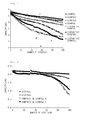
- the lithium secondary batteries (battery capacity: 5.5 mAh) prepared in Examples 1 to 4 and Comparative Examples 1 to 3 were charged at a constant current of 0.7 C to a voltage of 4.2 V at 55°C. Thereafter, the lithium secondary batteries were charged at a constant voltage of 4.2 V and the charge was terminated when a charge current became 0.275 mA. After the batteries were left standing for 10 minutes, the batteries were discharged at a constant current of 0.5 C to a voltage of 3.0 V. The charge and discharge were repeated for 100 cycles and battery capacities were then measured. The results thereof are presented in FIG. 3 .
- the lithium secondary batteries (battery capacity: 2.5 mAh) prepared in Examples 5 and 6 and Comparative Examples 4 and 5 were charged at a constant current of 0.7 C to a voltage of 4.2 V at 45°C. Thereafter, the lithium secondary batteries were charged at a constant voltage of 4.2 V and the charge was terminated when a charge current became 0.125 mA. After the batteries were left standing for 10 minutes, the batteries were discharged at a constant current of 0.5 C to a voltage of 3.0 V. The charge and discharge were repeated for 100 cycles and battery capacities were then measured. The results thereof are presented in FIG. 4 .
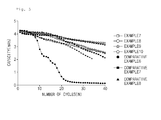
- the lithium secondary batteries (battery capacity: 4.3 mAh) prepared in Examples 7 to 10 and Comparative Examples 6 to 8 were charged at a constant current of 0.7 C to a voltage of 4.3 V at 55°C. Thereafter, the lithium secondary batteries were charged at a constant voltage of 4.3 V and the charge was terminated when a charge current became 0.215 mA. After the batteries were left standing for 10 minutes, the batteries were discharged at a constant current of 0.5 C to a voltage of 3.0 V. The charge and discharge were repeated for 40 cycles and battery capacities were then measured. The results thereof are presented in FIG. 5 .
- composition for a gel polymer electrolyte of the present invention is used in a lithium secondary battery, since the precipitation of metal on an anode may be reduced by preventing the movement or decreasing the movement speed of metal ions dissolved from a cathode to the anode, the lifetime of the battery may not only be improved but capacity characteristics of the battery may also be improved in both normal and high voltage ranges.
- the composition for a gel polymer electrolyte may be suitable for secondary batteries.
Landscapes
- Chemical & Material Sciences (AREA)
- Chemical Kinetics & Catalysis (AREA)
- Engineering & Computer Science (AREA)
- Manufacturing & Machinery (AREA)
- Electrochemistry (AREA)
- General Chemical & Material Sciences (AREA)
- Dispersion Chemistry (AREA)
- Condensed Matter Physics & Semiconductors (AREA)
- Physics & Mathematics (AREA)
- General Physics & Mathematics (AREA)
- Inorganic Chemistry (AREA)
- Health & Medical Sciences (AREA)
- Medicinal Chemistry (AREA)
- Polymers & Plastics (AREA)
- Organic Chemistry (AREA)
- Secondary Cells (AREA)
Applications Claiming Priority (4)
| Application Number | Priority Date | Filing Date | Title |
|---|---|---|---|
| KR20130009334 | 2013-01-28 | ||
| KR20130009337 | 2013-01-28 | ||
| KR1020140009648A KR101633966B1 (ko) | 2013-01-28 | 2014-01-27 | 겔 폴리머 전해질용 조성물 및 이를 포함하는 리튬 이차 전지 |
| PCT/KR2014/000793 WO2014116082A1 (ko) | 2013-01-28 | 2014-01-28 | 겔 폴리머 전해질용 조성물 및 이를 포함하는 리튬 이차 전지 |
Publications (3)
| Publication Number | Publication Date |
|---|---|
| EP2790260A1 true EP2790260A1 (de) | 2014-10-15 |
| EP2790260A4 EP2790260A4 (de) | 2015-01-07 |
| EP2790260B1 EP2790260B1 (de) | 2016-03-23 |
Family
ID=51227815
Family Applications (1)
| Application Number | Title | Priority Date | Filing Date |
|---|---|---|---|
| EP14728802.1A Active EP2790260B1 (de) | 2013-01-28 | 2014-01-28 | Zusammensetzung für gel-polymer-elektrolyt und lithiumsekundärbatterie damit |
Country Status (3)
| Country | Link |
|---|---|
| US (1) | US9882239B2 (de) |
| EP (1) | EP2790260B1 (de) |
| WO (1) | WO2014116082A1 (de) |
Cited By (2)
| Publication number | Priority date | Publication date | Assignee | Title |
|---|---|---|---|---|
| EP2784867B1 (de) * | 2013-01-28 | 2016-11-23 | LG Chem, Ltd. | Hochspannungs-lithiumsekundärbatterie |
| EP4307430A4 (de) * | 2022-03-21 | 2024-12-25 | LG Energy Solution, Ltd. | Lithiumsekundärbatterie mit unterdrückter metallelution |
Families Citing this family (9)
| Publication number | Priority date | Publication date | Assignee | Title |
|---|---|---|---|---|
| CN106463767B (zh) * | 2014-03-31 | 2019-03-01 | Nec 能源元器件株式会社 | 锂离子二次电池 |
| TWI624990B (zh) * | 2016-06-14 | 2018-05-21 | 財團法人工業技術研究院 | 電解質組成物及包含其之金屬離子電池 |
| CN107507999B (zh) | 2016-06-14 | 2019-11-08 | 财团法人工业技术研究院 | 电解质组合物及包含其的金属离子电池 |
| KR102093965B1 (ko) | 2016-11-21 | 2020-03-26 | 주식회사 엘지화학 | 리튬-황 전지 |
| EP3780223B1 (de) * | 2018-09-10 | 2024-05-29 | LG Energy Solution, Ltd. | Wärmehärtbare elektrolytzusammensetzung für lithium-sekundärbatterie, daraus hergestellter gelpolymerelektrolyt und lithium-sekundärbatterie denselben umfassend |
| US11283110B2 (en) | 2018-12-27 | 2022-03-22 | Industrial Technology Research Institute | Electrolyte composition and metal-ion battery employing the same |
| DE102020206126A1 (de) * | 2020-05-14 | 2021-11-18 | Tesa Se | Haftklebriger Elektrolyt |
| CA3214267A1 (en) | 2021-09-10 | 2023-03-16 | Lg Energy Solution, Ltd. | Non-aqueous electrolyte solution for lithium secondary battery and lithium secondary battery including the same |
| CN114156533B (zh) * | 2022-02-10 | 2022-04-22 | 河南电池研究院有限公司 | 一种锂离子电池凝胶电解质及锂离子电池的制备方法 |
Family Cites Families (34)
| Publication number | Priority date | Publication date | Assignee | Title |
|---|---|---|---|---|
| JPH11121012A (ja) | 1997-10-09 | 1999-04-30 | Yuasa Corp | 非水電解質電池 |
| JP4003298B2 (ja) | 1998-07-01 | 2007-11-07 | 宇部興産株式会社 | 非水二次電池 |
| JP2000268871A (ja) | 1999-03-19 | 2000-09-29 | Hitachi Chem Co Ltd | 高分子固体電解質、高分子固体電解質の製造法及びこれを用いた電気化学的デバイス |
| JP4439610B2 (ja) | 1999-04-07 | 2010-03-24 | アオイ電子株式会社 | 高分子ゲル電解質及びそれを用いたリチウム二次電池 |
| JP2000311715A (ja) | 1999-04-26 | 2000-11-07 | Mitsubishi Chemicals Corp | リチウム二次電池 |
| JP4158071B2 (ja) * | 1999-05-20 | 2008-10-01 | 東洋紡績株式会社 | 高分子電解質ゲル組成物 |
| AUPQ389599A0 (en) | 1999-11-05 | 1999-12-02 | Ilion Technology Corporation | Polyelectrolyte gel |
| JP4636644B2 (ja) * | 2000-01-17 | 2011-02-23 | 富士フイルム株式会社 | 電解質組成物、電気化学電池およびイオン性液晶モノマー |
| KR100369076B1 (ko) | 2001-01-05 | 2003-01-24 | 삼성에스디아이 주식회사 | 고분자 전해질 및 이를 구비하는 리튬 2차전지 |
| CN100364167C (zh) | 2001-12-03 | 2008-01-23 | 三星Sdi株式会社 | 可充电的锂电池及其制备方法 |
| JP4413460B2 (ja) * | 2001-12-03 | 2010-02-10 | 三星エスディアイ株式会社 | リチウム二次電池及びリチウム二次電池の製造方法 |
| KR100525278B1 (ko) | 2003-03-26 | 2005-11-02 | 한국전기연구원 | 겔폴리머전해질을 사용한 리튬이온폴리머전지의 제조방법 |
| EP1737924B1 (de) | 2004-04-19 | 2018-02-14 | LG Chem, Ltd. | Gelpolymerelektrolyt mit ionischer flüssigkeit und davon gebrauch machende elektrochrome vorrichtung |
| US20050271939A1 (en) * | 2004-06-07 | 2005-12-08 | Yang Xu | Novel polymer electrolyte for electrochemical power sources |
| WO2007049922A1 (en) * | 2005-10-27 | 2007-05-03 | Lg Chem, Ltd. | Secondary battery comprising eutectic mixture and preparation method thereof |
| KR100821833B1 (ko) * | 2005-12-15 | 2008-04-11 | 주식회사 엘지화학 | 고반사형 전기 변색 소자 및 이의 제조방법 |
| JP2007273445A (ja) * | 2006-03-09 | 2007-10-18 | Nec Tokin Corp | ポリマーゲル電解質およびそれを用いたポリマー二次電池 |
| JP2007287630A (ja) | 2006-04-20 | 2007-11-01 | Sony Corp | 非水電解質二次電池 |
| CN101563808A (zh) * | 2006-12-21 | 2009-10-21 | 株式会社Lg化学 | 凝胶聚合物电解质组合物、凝胶聚合物电解质及含有其的电化学装置 |
| CN101340009A (zh) | 2007-07-05 | 2009-01-07 | 黄穗阳 | 聚合物电解质硬包装锂离子电池 |
| KR101375328B1 (ko) | 2007-07-27 | 2014-03-19 | 삼성에스디아이 주식회사 | Si/C 복합물, 이를 포함하는 음극활물질 및 리튬전지 |
| JP5235404B2 (ja) | 2007-12-28 | 2013-07-10 | 三洋電機株式会社 | ポリマー電解質二次電池 |
| CN101353435A (zh) | 2008-09-12 | 2009-01-28 | 华南师范大学 | 一种活化型凝胶态锂离子电池聚合物电解质薄膜及其制备方法和应用 |
| CN101685876B (zh) | 2008-09-27 | 2013-06-26 | 深圳市比克电池有限公司 | 聚合物电池的制备方法 |
| JP5225002B2 (ja) | 2008-09-30 | 2013-07-03 | 株式会社東芝 | 二次電池 |
| EP2445041B1 (de) | 2009-06-17 | 2016-04-13 | Sony Corporation | Batterie mit nichtwässrigem elektrolyt, positivelektrode für die batterie mit nichtwässrigem elektrolyt, negativelektrode für die batterie mit nichtwässrigem elektrolyt, separator für die batterie mit nichtwässrigem elektrolyt, elektrolyt für die batterie mit nichtwässrigem elektrolyt und verfahren zur herstellung des separators für die batterie mit nichtwässrigem elektrolyt |
| EP2447216A2 (de) | 2009-06-25 | 2012-05-02 | NGK Insulators, Ltd. | Aktives positivelektrodenmaterial und lithium-sekundärbatterie |
| JP2011119097A (ja) | 2009-12-02 | 2011-06-16 | Sony Corp | 非水電解質電池 |
| CN101774563A (zh) | 2010-01-08 | 2010-07-14 | 上海交通大学 | 一种锂离子电池用高电压正极材料及其制备方法 |
| CN101826635A (zh) | 2010-04-09 | 2010-09-08 | 广州天赐高新材料股份有限公司 | 一种锂电池用聚合物电解液及其电池的制造方法 |
| CN101872875A (zh) | 2010-05-27 | 2010-10-27 | 西北工业大学 | 聚烯烃类凝胶聚合物电解质锂离子电池的组装工艺 |
| JP5809870B2 (ja) * | 2011-06-22 | 2015-11-11 | 富士フイルム株式会社 | 光電変換素子、光電気化学電池、及びそれらに用いられる色素 |
| JP5765835B2 (ja) | 2011-06-30 | 2015-08-19 | エルジー ケム. エルティーディ. | 新規なポリマー電解質及びそれを含むリチウム二次電池 |
| CN102891010B (zh) | 2012-09-19 | 2015-08-19 | 华东师范大学 | 一种聚合物凝胶电解质及其制备方法和应用 |
-
2014
- 2014-01-28 WO PCT/KR2014/000793 patent/WO2014116082A1/ko not_active Ceased
- 2014-01-28 EP EP14728802.1A patent/EP2790260B1/de active Active
- 2014-04-09 US US14/248,448 patent/US9882239B2/en active Active
Cited By (4)
| Publication number | Priority date | Publication date | Assignee | Title |
|---|---|---|---|---|
| EP2784867B1 (de) * | 2013-01-28 | 2016-11-23 | LG Chem, Ltd. | Hochspannungs-lithiumsekundärbatterie |
| US10170791B2 (en) | 2013-01-28 | 2019-01-01 | Lg Chem, Ltd. | High-voltage lithium secondary battery |
| EP4307430A4 (de) * | 2022-03-21 | 2024-12-25 | LG Energy Solution, Ltd. | Lithiumsekundärbatterie mit unterdrückter metallelution |
| US12476281B2 (en) | 2022-03-21 | 2025-11-18 | Lg Energy Solution, Ltd. | Lithium secondary battery with inhibited exsolution of transition metal |
Also Published As
| Publication number | Publication date |
|---|---|
| US20140220427A1 (en) | 2014-08-07 |
| EP2790260A4 (de) | 2015-01-07 |
| US9882239B2 (en) | 2018-01-30 |
| EP2790260B1 (de) | 2016-03-23 |
| WO2014116082A1 (ko) | 2014-07-31 |
Similar Documents
| Publication | Publication Date | Title |
|---|---|---|
| KR101633966B1 (ko) | 겔 폴리머 전해질용 조성물 및 이를 포함하는 리튬 이차 전지 | |
| EP2790260B1 (de) | Zusammensetzung für gel-polymer-elektrolyt und lithiumsekundärbatterie damit | |
| KR101020346B1 (ko) | 비수 전해액 리튬 이차전지 | |
| EP2905831B1 (de) | Kathodenadditiv für eine hochkapazitive lithiumsekundärbatterie | |
| JP5356405B2 (ja) | リチウム二次電池用非水電解液及びそれを備えたリチウム二次電池 | |
| KR101545432B1 (ko) | 리튬 이차 전지 | |
| KR20180083272A (ko) | 비수 전해액 및 이를 포함하는 리튬 이차전지 | |
| KR20160040113A (ko) | 겔 폴리머 전해질 및 이를 포함하는 리튬 이차전지 | |
| JP6504550B2 (ja) | 高電圧リチウム二次電池 | |
| EP2782182B1 (de) | Sekundäre lithiumbatterie | |
| US10170791B2 (en) | High-voltage lithium secondary battery | |
| KR102109836B1 (ko) | 겔 폴리머 전해질용 조성물 및 이를 포함하는 리튬 이차전지 | |
| KR102803272B1 (ko) | 고분자 전해질 제조용 전구체 조성물, 이를 이용하여 제조된 고분자 전해질 및 이차전지 | |
| KR102846664B1 (ko) | 리튬 이차 전지의 전해질용 조성물, 겔 폴리머 전해질 및 이를 포함하는 리튬 이차 전지 |
Legal Events
| Date | Code | Title | Description |
|---|---|---|---|
| PUAI | Public reference made under article 153(3) epc to a published international application that has entered the european phase |
Free format text: ORIGINAL CODE: 0009012 |
|
| 17P | Request for examination filed |
Effective date: 20140617 |
|
| AK | Designated contracting states |
Kind code of ref document: A1 Designated state(s): AL AT BE BG CH CY CZ DE DK EE ES FI FR GB GR HR HU IE IS IT LI LT LU LV MC MK MT NL NO PL PT RO RS SE SI SK SM TR |
|
| A4 | Supplementary search report drawn up and despatched |
Effective date: 20141209 |
|
| RIC1 | Information provided on ipc code assigned before grant |
Ipc: H01M 4/525 20100101ALI20141203BHEP Ipc: H01M 10/052 20100101ALI20141203BHEP Ipc: H01M 10/0565 20100101AFI20141203BHEP Ipc: H01M 4/505 20100101ALI20141203BHEP Ipc: H01M 10/0569 20100101ALI20141203BHEP |
|
| REG | Reference to a national code |
Ref country code: DE Ref legal event code: R079 Ref document number: 602014001207 Country of ref document: DE Free format text: PREVIOUS MAIN CLASS: H01M0010056500 Ipc: H01M0004505000 |
|
| GRAP | Despatch of communication of intention to grant a patent |
Free format text: ORIGINAL CODE: EPIDOSNIGR1 |
|
| RIC1 | Information provided on ipc code assigned before grant |
Ipc: H01M 4/525 20100101ALI20151028BHEP Ipc: H01M 4/505 20100101AFI20151028BHEP Ipc: H01M 10/052 20100101ALI20151028BHEP Ipc: C08L 33/18 20060101ALI20151028BHEP Ipc: H01M 10/0565 20100101ALI20151028BHEP Ipc: H01M 10/0569 20100101ALI20151028BHEP |
|
| DAX | Request for extension of the european patent (deleted) | ||
| INTG | Intention to grant announced |
Effective date: 20151119 |
|
| GRAS | Grant fee paid |
Free format text: ORIGINAL CODE: EPIDOSNIGR3 |
|
| GRAA | (expected) grant |
Free format text: ORIGINAL CODE: 0009210 |
|
| AK | Designated contracting states |
Kind code of ref document: B1 Designated state(s): AL AT BE BG CH CY CZ DE DK EE ES FI FR GB GR HR HU IE IS IT LI LT LU LV MC MK MT NL NO PL PT RO RS SE SI SK SM TR |
|
| REG | Reference to a national code |
Ref country code: GB Ref legal event code: FG4D |
|
| REG | Reference to a national code |
Ref country code: CH Ref legal event code: EP |
|
| REG | Reference to a national code |
Ref country code: AT Ref legal event code: REF Ref document number: 783937 Country of ref document: AT Kind code of ref document: T Effective date: 20160415 |
|
| REG | Reference to a national code |
Ref country code: IE Ref legal event code: FG4D |
|
| REG | Reference to a national code |
Ref country code: DE Ref legal event code: R096 Ref document number: 602014001207 Country of ref document: DE |
|
| REG | Reference to a national code |
Ref country code: SE Ref legal event code: TRGR |
|
| REG | Reference to a national code |
Ref country code: LT Ref legal event code: MG4D |
|
| REG | Reference to a national code |
Ref country code: NL Ref legal event code: MP Effective date: 20160323 |
|
| PG25 | Lapsed in a contracting state [announced via postgrant information from national office to epo] |
Ref country code: HR Free format text: LAPSE BECAUSE OF FAILURE TO SUBMIT A TRANSLATION OF THE DESCRIPTION OR TO PAY THE FEE WITHIN THE PRESCRIBED TIME-LIMIT Effective date: 20160323 Ref country code: GR Free format text: LAPSE BECAUSE OF FAILURE TO SUBMIT A TRANSLATION OF THE DESCRIPTION OR TO PAY THE FEE WITHIN THE PRESCRIBED TIME-LIMIT Effective date: 20160624 Ref country code: NO Free format text: LAPSE BECAUSE OF FAILURE TO SUBMIT A TRANSLATION OF THE DESCRIPTION OR TO PAY THE FEE WITHIN THE PRESCRIBED TIME-LIMIT Effective date: 20160623 |
|
| REG | Reference to a national code |
Ref country code: AT Ref legal event code: MK05 Ref document number: 783937 Country of ref document: AT Kind code of ref document: T Effective date: 20160323 |
|
| PG25 | Lapsed in a contracting state [announced via postgrant information from national office to epo] |
Ref country code: RS Free format text: LAPSE BECAUSE OF FAILURE TO SUBMIT A TRANSLATION OF THE DESCRIPTION OR TO PAY THE FEE WITHIN THE PRESCRIBED TIME-LIMIT Effective date: 20160323 Ref country code: NL Free format text: LAPSE BECAUSE OF FAILURE TO SUBMIT A TRANSLATION OF THE DESCRIPTION OR TO PAY THE FEE WITHIN THE PRESCRIBED TIME-LIMIT Effective date: 20160323 Ref country code: LV Free format text: LAPSE BECAUSE OF FAILURE TO SUBMIT A TRANSLATION OF THE DESCRIPTION OR TO PAY THE FEE WITHIN THE PRESCRIBED TIME-LIMIT Effective date: 20160323 Ref country code: LT Free format text: LAPSE BECAUSE OF FAILURE TO SUBMIT A TRANSLATION OF THE DESCRIPTION OR TO PAY THE FEE WITHIN THE PRESCRIBED TIME-LIMIT Effective date: 20160323 |
|
| PG25 | Lapsed in a contracting state [announced via postgrant information from national office to epo] |
Ref country code: IS Free format text: LAPSE BECAUSE OF FAILURE TO SUBMIT A TRANSLATION OF THE DESCRIPTION OR TO PAY THE FEE WITHIN THE PRESCRIBED TIME-LIMIT Effective date: 20160723 Ref country code: PL Free format text: LAPSE BECAUSE OF FAILURE TO SUBMIT A TRANSLATION OF THE DESCRIPTION OR TO PAY THE FEE WITHIN THE PRESCRIBED TIME-LIMIT Effective date: 20160323 Ref country code: EE Free format text: LAPSE BECAUSE OF FAILURE TO SUBMIT A TRANSLATION OF THE DESCRIPTION OR TO PAY THE FEE WITHIN THE PRESCRIBED TIME-LIMIT Effective date: 20160323 |
|
| PG25 | Lapsed in a contracting state [announced via postgrant information from national office to epo] |
Ref country code: AT Free format text: LAPSE BECAUSE OF FAILURE TO SUBMIT A TRANSLATION OF THE DESCRIPTION OR TO PAY THE FEE WITHIN THE PRESCRIBED TIME-LIMIT Effective date: 20160323 Ref country code: SM Free format text: LAPSE BECAUSE OF FAILURE TO SUBMIT A TRANSLATION OF THE DESCRIPTION OR TO PAY THE FEE WITHIN THE PRESCRIBED TIME-LIMIT Effective date: 20160323 Ref country code: PT Free format text: LAPSE BECAUSE OF FAILURE TO SUBMIT A TRANSLATION OF THE DESCRIPTION OR TO PAY THE FEE WITHIN THE PRESCRIBED TIME-LIMIT Effective date: 20160725 Ref country code: RO Free format text: LAPSE BECAUSE OF FAILURE TO SUBMIT A TRANSLATION OF THE DESCRIPTION OR TO PAY THE FEE WITHIN THE PRESCRIBED TIME-LIMIT Effective date: 20160323 Ref country code: SK Free format text: LAPSE BECAUSE OF FAILURE TO SUBMIT A TRANSLATION OF THE DESCRIPTION OR TO PAY THE FEE WITHIN THE PRESCRIBED TIME-LIMIT Effective date: 20160323 Ref country code: ES Free format text: LAPSE BECAUSE OF FAILURE TO SUBMIT A TRANSLATION OF THE DESCRIPTION OR TO PAY THE FEE WITHIN THE PRESCRIBED TIME-LIMIT Effective date: 20160323 Ref country code: CZ Free format text: LAPSE BECAUSE OF FAILURE TO SUBMIT A TRANSLATION OF THE DESCRIPTION OR TO PAY THE FEE WITHIN THE PRESCRIBED TIME-LIMIT Effective date: 20160323 |
|
| REG | Reference to a national code |
Ref country code: FR Ref legal event code: PLFP Year of fee payment: 4 |
|
| PG25 | Lapsed in a contracting state [announced via postgrant information from national office to epo] |
Ref country code: BE Free format text: LAPSE BECAUSE OF FAILURE TO SUBMIT A TRANSLATION OF THE DESCRIPTION OR TO PAY THE FEE WITHIN THE PRESCRIBED TIME-LIMIT Effective date: 20160323 Ref country code: IT Free format text: LAPSE BECAUSE OF FAILURE TO SUBMIT A TRANSLATION OF THE DESCRIPTION OR TO PAY THE FEE WITHIN THE PRESCRIBED TIME-LIMIT Effective date: 20160323 |
|
| REG | Reference to a national code |
Ref country code: DE Ref legal event code: R097 Ref document number: 602014001207 Country of ref document: DE |
|
| PLBE | No opposition filed within time limit |
Free format text: ORIGINAL CODE: 0009261 |
|
| STAA | Information on the status of an ep patent application or granted ep patent |
Free format text: STATUS: NO OPPOSITION FILED WITHIN TIME LIMIT |
|
| PG25 | Lapsed in a contracting state [announced via postgrant information from national office to epo] |
Ref country code: DK Free format text: LAPSE BECAUSE OF FAILURE TO SUBMIT A TRANSLATION OF THE DESCRIPTION OR TO PAY THE FEE WITHIN THE PRESCRIBED TIME-LIMIT Effective date: 20160323 |
|
| PG25 | Lapsed in a contracting state [announced via postgrant information from national office to epo] |
Ref country code: BG Free format text: LAPSE BECAUSE OF FAILURE TO SUBMIT A TRANSLATION OF THE DESCRIPTION OR TO PAY THE FEE WITHIN THE PRESCRIBED TIME-LIMIT Effective date: 20160623 |
|
| 26N | No opposition filed |
Effective date: 20170102 |
|
| PG25 | Lapsed in a contracting state [announced via postgrant information from national office to epo] |
Ref country code: SI Free format text: LAPSE BECAUSE OF FAILURE TO SUBMIT A TRANSLATION OF THE DESCRIPTION OR TO PAY THE FEE WITHIN THE PRESCRIBED TIME-LIMIT Effective date: 20160323 |
|
| REG | Reference to a national code |
Ref country code: CH Ref legal event code: PL |
|
| PG25 | Lapsed in a contracting state [announced via postgrant information from national office to epo] |
Ref country code: MC Free format text: LAPSE BECAUSE OF FAILURE TO SUBMIT A TRANSLATION OF THE DESCRIPTION OR TO PAY THE FEE WITHIN THE PRESCRIBED TIME-LIMIT Effective date: 20160323 |
|
| PG25 | Lapsed in a contracting state [announced via postgrant information from national office to epo] |
Ref country code: LI Free format text: LAPSE BECAUSE OF NON-PAYMENT OF DUE FEES Effective date: 20170131 Ref country code: CH Free format text: LAPSE BECAUSE OF NON-PAYMENT OF DUE FEES Effective date: 20170131 |
|
| REG | Reference to a national code |
Ref country code: IE Ref legal event code: MM4A |
|
| PG25 | Lapsed in a contracting state [announced via postgrant information from national office to epo] |
Ref country code: LU Free format text: LAPSE BECAUSE OF NON-PAYMENT OF DUE FEES Effective date: 20170128 |
|
| REG | Reference to a national code |
Ref country code: FR Ref legal event code: PLFP Year of fee payment: 5 |
|
| PG25 | Lapsed in a contracting state [announced via postgrant information from national office to epo] |
Ref country code: IE Free format text: LAPSE BECAUSE OF NON-PAYMENT OF DUE FEES Effective date: 20170128 |
|
| PG25 | Lapsed in a contracting state [announced via postgrant information from national office to epo] |
Ref country code: MT Free format text: LAPSE BECAUSE OF NON-PAYMENT OF DUE FEES Effective date: 20170128 |
|
| PG25 | Lapsed in a contracting state [announced via postgrant information from national office to epo] |
Ref country code: AL Free format text: LAPSE BECAUSE OF FAILURE TO SUBMIT A TRANSLATION OF THE DESCRIPTION OR TO PAY THE FEE WITHIN THE PRESCRIBED TIME-LIMIT Effective date: 20160323 |
|
| PG25 | Lapsed in a contracting state [announced via postgrant information from national office to epo] |
Ref country code: HU Free format text: LAPSE BECAUSE OF FAILURE TO SUBMIT A TRANSLATION OF THE DESCRIPTION OR TO PAY THE FEE WITHIN THE PRESCRIBED TIME-LIMIT; INVALID AB INITIO Effective date: 20140128 |
|
| PG25 | Lapsed in a contracting state [announced via postgrant information from national office to epo] |
Ref country code: CY Free format text: LAPSE BECAUSE OF FAILURE TO SUBMIT A TRANSLATION OF THE DESCRIPTION OR TO PAY THE FEE WITHIN THE PRESCRIBED TIME-LIMIT Effective date: 20160323 |
|
| PG25 | Lapsed in a contracting state [announced via postgrant information from national office to epo] |
Ref country code: MK Free format text: LAPSE BECAUSE OF FAILURE TO SUBMIT A TRANSLATION OF THE DESCRIPTION OR TO PAY THE FEE WITHIN THE PRESCRIBED TIME-LIMIT Effective date: 20160323 |
|
| PG25 | Lapsed in a contracting state [announced via postgrant information from national office to epo] |
Ref country code: TR Free format text: LAPSE BECAUSE OF FAILURE TO SUBMIT A TRANSLATION OF THE DESCRIPTION OR TO PAY THE FEE WITHIN THE PRESCRIBED TIME-LIMIT Effective date: 20160323 |
|
| REG | Reference to a national code |
Ref country code: DE Ref legal event code: R081 Ref document number: 602014001207 Country of ref document: DE Owner name: LG ENERGY SOLUTION LTD., KR Free format text: FORMER OWNER: LG CHEM. LTD., SEOUL, KR Ref country code: DE Ref legal event code: R081 Ref document number: 602014001207 Country of ref document: DE Owner name: LG ENERGY SOLUTION, LTD., KR Free format text: FORMER OWNER: LG CHEM. LTD., SEOUL, KR |
|
| P01 | Opt-out of the competence of the unified patent court (upc) registered |
Effective date: 20230323 |
|
| P02 | Opt-out of the competence of the unified patent court (upc) changed |
Effective date: 20230411 |
|
| REG | Reference to a national code |
Ref country code: GB Ref legal event code: 732E Free format text: REGISTERED BETWEEN 20230824 AND 20230831 |
|
| REG | Reference to a national code |
Ref country code: FI Ref legal event code: PCE Owner name: LG ENERGY SOLUTION, LTD., KR |
|
| REG | Reference to a national code |
Ref country code: DE Ref legal event code: R081 Ref document number: 602014001207 Country of ref document: DE Owner name: LG ENERGY SOLUTION, LTD., KR Free format text: FORMER OWNER: LG ENERGY SOLUTION LTD., SEOUL, KR |
|
| PGFP | Annual fee paid to national office [announced via postgrant information from national office to epo] |
Ref country code: GB Payment date: 20251222 Year of fee payment: 13 |
|
| PGFP | Annual fee paid to national office [announced via postgrant information from national office to epo] |
Ref country code: FI Payment date: 20251222 Year of fee payment: 13 |
|
| PGFP | Annual fee paid to national office [announced via postgrant information from national office to epo] |
Ref country code: FR Payment date: 20251223 Year of fee payment: 13 |
|
| PGFP | Annual fee paid to national office [announced via postgrant information from national office to epo] |
Ref country code: SE Payment date: 20251223 Year of fee payment: 13 |
|
| PGFP | Annual fee paid to national office [announced via postgrant information from national office to epo] |
Ref country code: DE Payment date: 20251222 Year of fee payment: 13 |